THE EVOLUTION OF WARFARE FROM THE 18TH
CENTURY TO MODERN TIMES
removed
removed
HUM361
Removed
1
THE
EVOLUTION OF
WARFARE
FROM THE 18TH
CENTURY TO
MODERN
TIMES
Image by cleanpng.com A LOOK AT THE ARMS RACE FROM 1800’S TO TODAY
3
THESIS STATEMENT
From ancient civilization to the 1800s, speed, and range were the driving forces
behind changes in combat. History would repeat this theme but at an accelerated
rate thanks to advancements in technology, strategy, and societal values, which
shaped the course of history and influenced the modern world and its future. We
will look at technological advancements and changes in how commanders thought
war should be fought, tracking their evolution from the 1800s to modern times.
5
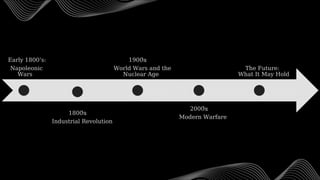
What It May Hold
The Future:
Modern Warfare
:
’s
2000
Nuclear Age
World Wars and the
1900
’s:
Industrial Revolution
:
’s
1800
Wars
Napoleonic
Early 1800’s:
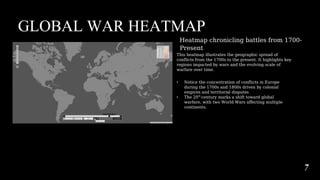
GLOBAL WAR HEATMAP
Heatmap chronicling battles from 1700-
Present
This heatmap illustrates the geographic spread of
conflicts from the 1700s to the present. It highlights key
regions impacted by wars and the evolving scale of
warfare over time.
• Notice the concentration of conflicts in Europe
during the 1700s and 1800s driven by colonial
empires and territorial disputes
• The 20th
century marks a shift toward global
warfare, with two World Wars affecting multiple
continents.
7
• Heatmap sourced from Nodegoat
EARLY 1800’S:
NAPOLEONIC
WARS
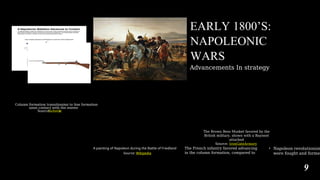
Advancements In strategy
The Brown Bess Musket favored by the
British military, shown with a Bayonet
attached
Source: IronGateArmory
A painting of Napoleon during the Battle of Friedland
Source: Wikipedia
The French infantry favored advancing
in the column formation, compared to
• Napoleon revolutionize
were fought and formed
9
k
Substac
Source:
upon contact with the enemy
Column formation transitioning to line formation
the British, who preferred marching in
the line formation. Column formation
provided more flexibility and mobility.
strategies were the first time that calvary,
infantry, and artillery worked in a
synchronized manner.
“The economic costs of weapons and warfare increased enormously, and wars of this period
after, produced near actual financial collapse for the participants.” – Richard A. Gabriel p.81
Successor to the Arquebus, Brown Bess was used by the British, whereas the French used
the Charleville.
• Effective range of 100 to 150 meters
and were often used in coordinated
volleys, where groups of soldiers fired
simultaneously to overwhelm opposing
forces.
• Many muskets were equipped with
bayonet, allowing soldiers to transition
to close-quarters combat.
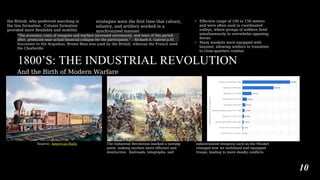
1800’S: THE INDUSTRIAL REVOLUTION
And the Birth of Modern Warfare
Source: American-Rails The Industrial Revolution marked a turning
point, making warfare more efficient and
destructive. Railroads, telegraphs, and
industrialized weapons such as the Musket
changed how we mobilized and equipped
troops, leading to more deadly conflicts.
10
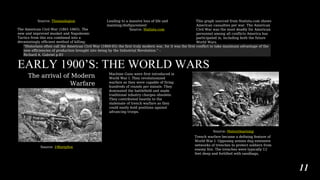
Source: Thomaslegion
The American Civil War (1861-1865). The
new and improved musket and Napoleonic
Tactics from this era combined into a
devastatingly efficient method of killing.
Leading to a massive loss of life and
maiming/disfigurement
Source: Statista.com
This graph sourced from Statista.com shows
American casualties per war. The American
Civil War was the most deadly for American
personnel among all conflicts America has
participated in, including both the future
World Wars.
“Historians often call the American Civil War (1860-65) the first truly modern war, for it was the first conflict to take maximum advantage of the
new efficiencies of production brought into being by the Industrial Revolution.” –
Richard A. Gabriel p.83
EARLY 1900’S: THE WORLD WARS
The arrival of Modern
Warfare
Source: 19fortyfive
Machine Guns were first introduced in
World War I. They revolutionized
warfare as they were capable of firing
hundreds of rounds per minute. They
dominated the battlefield and made
traditional infantry charges obsolete.
They contributed heavily to the
stalemate of trench warfare as they
could easily hold positions against
advancing troops.
Source: Historylearning
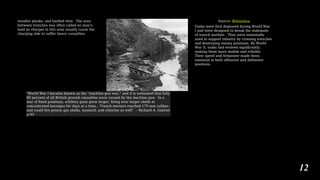
Trench warfare became a defining feature of
World War I. Opposing armies dug extensive
networks of trenches to protect soldiers from
enemy fire. The trenches were typically 12
feet deep and fortified with sandbags,
11
wooden planks, and barbed wire. The area
between trenches was often called no man’s
land as charges in this area usually cause the
charging side to suffer heavy casualties.
Source: Britannica
Tanks were first deployed during World War
I and were designed to break the stalemate
of trench warfare. They were essentially
used to support infantry by crossing trenches
and destroying enemy positions. By World
War II, tanks had evolved significantly,
making them more mobile and reliable.
Their speed and firepower made them
essential in both offensive and defensive
positions.
“World War I became known as the “machine gun war,” and it is estimated that fully
80 percent of all British ground casualties were caused by the machine gun. In a
war of fixed positions, artillery guns grew larger, firing ever larger shells in
concentrated barrages for days at a time… Trench mortars reached 170 mm caliber,
and could fire poison gas shells, mustard, and chlorine as well” – Richard A. Gabriel
p.93
12
MID 1900’S: THE COLD WAR
The Nuclear Age: A Balance of Terror
The Manhattan
Project
• The world’s first nuclear weapon was developed
during World War II by the United States.
• This culminated in the atomic bombings of
Hiroshima and Nagasaki in 1945, which ended the
war in the Pacific.
• The bombing demonstrated to the world the
devastating power of nuclear technology, resulting
in over 200,000 casualties.
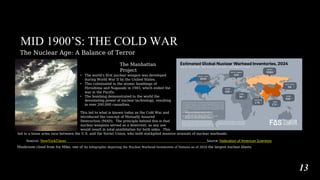
This led to what is known today as the Cold War and
introduced the concept of Mutually Assured
Destruction (MAD). The principle behind this is that
nuclear weapons served as a deterrent, as any use
would result in total annihilation for both sides. This
led to a tense arms race between the U.S. and the Soviet Union, who both stockpiled massive arsenals of nuclear warheads.
Source: NewYorkTimes Source: Federation of American Scientists
Mushroom cloud from Ivy Mike, one of An Infographic depicting the Nuclear Warhead Inventories of Nations as of 2024 the largest nuclear blasts.
13
“In August 1945, the United States unveiled the most awesome weapon of war yet
invented by man, the atomic bomb, and devastated the civilian population centers of
Hiroshima and Nagasaki. Warfare had undergone yet another revolutionary change.” –
Richard A. Gabriel p.98-99
14
LATE 1900’S: THE RISE OF ASYMMETRIC
WARFARE
15
Asymmetric Warfare and
16
Asymmetric warfare changed
the dynamics of war,
emphasizing adaptability and
local resistance. We saw this
in the Vietnam War and the
Afghan-Soviet War. During
this time, we also saw the
rise of non-state actors like
terrorist organizations.
Asymmetric warfare typically
occurs when a smaller force
uses unconventional tactics
against larger militaries,
such as what we saw in the
Vietnam War and later in
Afghanistan and Iraq.
An artist's depiction of the tunnels
used by the Vietcong against the
U.S. troops during the Vietnam War.
This style of combat made it very
difficult for modern weapons and
tools to be effective, and often,
because of the use booby traps with
Guerilla Warfare, combatants were
able to inflict psychological damage
and terror on their enemies. Usually,
these tunnels had places for the
Vietcong to sleep/cook, as well as
places to trap and kill any would-be
intruders.
“Much has been heard of the concept of ‘asymmetric warfare’. Broadly speaking, this purports
to describe a means of fighting through which a weaker power can offset or neutralize the
strengths of a more powerful opponent by applying what strength it has to its opponent’s
weaknesses.” – Sir Martin Ewans
Guerilla Tactics
Source: Reddit
17
2000’S: CYBER WARFARE AND MODERN
TECHNOLOGY
The Digital And Technological
Battlefield
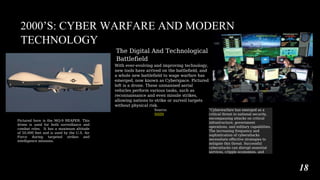
With ever-evolving and improving technology,
new tools have arrived on the battlefield, and
a whole new battlefield to wage warfare has
emerged, now known as Cyberspace. Pictured
left is a drone. These unmanned aerial
vehicles perform various tasks, such as
reconnaissance and even missile strikes,
allowing nations to strike or surveil targets
without physical risk.
Source:
NSIN
Pictured here is the MQ-9 REAPER. This
drone is used for both surveillance and
combat roles. It has a maximum altitude
of 50,000 feet and is used by the U.S. Air
Force during targeted strikes and
intelligence missions.
“Cyberwarfare has emerged as a
critical threat to national security,
encompassing attacks on critical
infrastructure, government
operations, and military capabilities.
The increasing frequency and
sophistication of cyberattacks
necessitate effective strategies to
mitigate this threat. Successful
cyberattacks can disrupt essential
services, cripple economies, and
18
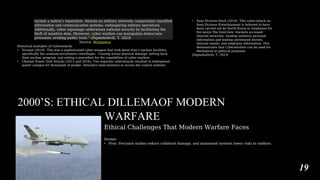
tarnish a nation’s reputation. Attacks on military networks compromise classified
information and communication systems, endangering military operations.
Additionally, cyber espionage undermines national security by facilitating the
theft of sensitive data. Moreover, cyber warfare can manipulate democratic
processes, eroding public trust.” (Digmelashvili, T. 2023)
Source: Britannica
Historical examples of Cyberattacks
• Stuxnet (2010): This was a sophisticated cyber-weapon that took down Iran’s nuclear facilities,
specifically the uranium enrichment centrifuges. Causing actual physical damage, setting back
their nuclear program, and setting a precedent for the capabilities of cyber warfare.
• Ukraine Power Grid Attacks (2015 and 2016): Two separate cyberattacks resulted in widespread
power outages for thousands of people. Attackers used malware to access the control systems.
• Sony Pictures Hack (2014): This cyber-attack on
Sony Pictures Entertainment is believed to have
been carried out by North Korea in retaliation for
the movie The Interview. Hackers accessed
internal networks, stealing sensitive personal
information and leaking unreleased movies,
internal emails, and employee information. This
demonstrates that Cyberwarfare can be used for
ideological or political purposes.
(Digmelashvili, T. 2023)
2000’S: ETHICAL DILLEMAOF MODERN
WARFARE
Ethical Challenges That Modern Warfare Faces
Drones
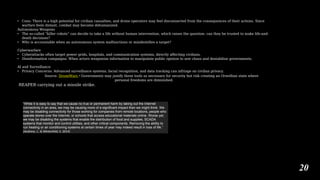
• Pros: Precision strikes reduce collateral damage, and unmanned systems lower risks to soldiers.
19
• Cons: There is a high potential for civilian casualties, and drone operators may feel disconnected from the consequences of their actions. Since
warfare feels distant, combat may become dehumanized.
Autonomous Weapons
• The so-called “killer robots” can decide to take a life without human intervention, which raises the question: can they be trusted to make life-and-
death decisions?
• Who is accountable when an autonomous system malfunctions or misidentifies a target?
Cyberwarfare
• Cyberattacks often target power grids, hospitals, and communication systems, directly affecting civilians.
• Disinformation campaigns: When actors weaponize information to manipulate public opinion to sew chaos and destabilize governments.
AI and Surveillance
• Privacy Concerns: Advanced surveillance systems, facial recognition, and data tracking can infringe on civilian privacy.
Source: DroneWars • Governments may justify these tools as necessary for security but risk creating an Orwellian state where
personal freedoms are diminished.
REAPER carrying out a missile strike.
“While it is easy to say that we cause no true or permanent harm by taking out the Internet
connectivity in an area, we may be causing more of a significant impact than we might think. We
may be disabling connectivity for those working for companies from remote locations, people who
operate stores over the Internet, or schools that access educational materials online. Worse yet,
we may be disabling the systems that enable the distribution of food and supplies, SCADA
systems that monitor and control utilities, and other critical components. Removing the ability to
run heating or air conditioning systems at certain times of year may indeed result in loss of life.”
(Andress, J., & Winterfeld, S. 2014)
20
2XXX: THE FUTURE OF WARFARE
Technology’s Pivotal Position In The Future Of Combat
Source: USNI Source: Forbes
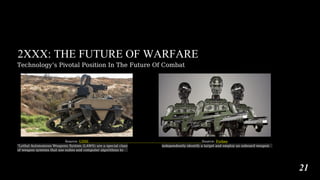
“Lethal Autonomous Weapons System (LAWS) are a special class
of weapon systems that use suites and computer algorithms to
independently identify a target and employ an onboard weapon
21
system to engage and destroy the target without manual human
control of the system.” (U.S. NAVAL INSTITUTE STAFF, 2022)
An artist's depiction of what AI humanoid robots
could look like. Just as in the past, whenever an
emerging technology appears, someone will find
a way to weaponize it. Machine learning is still in
its infancy today; however, it can already
perform tasks in short time frames that would be
impossible for a human to do. New laws and
global regulations must be made to limit the
ability for these systems to be misused or
hijacked for misuse, as the future of warfare lies
at the intersection of advanced technology.
REFLECTION AND CONCLUSION
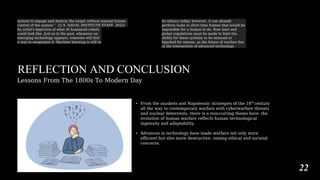
Lessons From The 1800s To Modern Day
• From the muskets and Napoleonic strategies of the 18th
century
all the way to contemporary warfare with cyberwarfare threats
and nuclear deterrents, there is a reoccurring theme here: the
evolution of human warfare reflects human technological
ingenuity and adaptability.
• Advances in technology have made warfare not only more
efficient but also more destructive, raising ethical and societal
concerns.
22
• This leads me to my next point: There must be some global consensus and agreement between nations on what should be
deemed acceptable with these emerging technologies.
• The evolution of warfare is not just a story of technological advancement but a reflection of human choices, a reminder of
our potential and capacity to come together and hopefully shape a more peaceful future.
Source: istockphoto
As we continue to innovate, how do we balance the
need for security with the responsibility to safeguard
humanity’s future?
23
REFERENCES
Andress, J., & Winterfeld, S. (2014). Cyber Warfare : Techniques, Tactics and Tools for Security Practitioners (Second edition). Syngress, an imprint of Elsevier.
http://www.books24x7.com/marc.asp?bookid=56535
Black, J. (1999). Eighteenth-Century Warfare Reconsidered https://www.jstor.org/stable/26004317
Carland, J. M. (2000). [Review of Britain as a Military Power, 1688–1815, by J. Black]. Army History, 50, 25–28. http://www.jstor.org/stable/26304953
Editorial. (2024). Transformations in Warfare: Military Revolutions in the 19th Century https://militarysaga.com/military-revolutions-in-the-19th-century//
Ewans, M. (2005). Conflict in Afghanistan: studies in asymmetric warfare. Routledge. https://doi.org/10.4324/9780203312544
Gabriel, A. R. (1992). A Short History of War: The Evolution of Warfare and Weapons. https://archive.org/details/DTIC_ADA255111
Salik, N (2022). Evolution of Military Technology from the Early 19th
to Late 20th
Century: It’s IMPACT on WARFARE, https://thesvi.org/wp-content/uploads/2022/11/SVI-
Monograph-
Series-No.1.pdf
Stewart, N. (2001). The Changing Nature of Warfare https://archive.org/details/changingnatureof0000stew
Temur Digmelashvili. (2023). The Impact of Cyberwarfare on the National Security. Future Human Image, 19, 12–19. https://doi.org/10.29202/fhi/19/2
U.S. NAVAL INSTITUTE STAFF, 2022. Defense Primer: U.S. Policy on Lethal Autonomous Weapon Systems. https://news.usni.org/2022/11/17/defense-primer-u-s-policy-
on-lethalautonomous-weapon-systems
15

90d3600a-0b1d-4a63-a213-4ac25ae99fa7_Rough-Draft_Template.docx

  • 1.
    THE EVOLUTION OFWARFARE FROM THE 18TH CENTURY TO MODERN TIMES removed removed HUM361 Removed 1
  • 2.
  • 3.
    MODERN TIMES Image by cleanpng.comA LOOK AT THE ARMS RACE FROM 1800’S TO TODAY 3
  • 4.
    THESIS STATEMENT From ancientcivilization to the 1800s, speed, and range were the driving forces behind changes in combat. History would repeat this theme but at an accelerated rate thanks to advancements in technology, strategy, and societal values, which shaped the course of history and influenced the modern world and its future. We
  • 5.
    will look attechnological advancements and changes in how commanders thought war should be fought, tracking their evolution from the 1800s to modern times. 5
  • 6.
    What It MayHold The Future: Modern Warfare : ’s 2000 Nuclear Age World Wars and the 1900 ’s: Industrial Revolution : ’s 1800 Wars Napoleonic Early 1800’s:
  • 7.
    GLOBAL WAR HEATMAP Heatmapchronicling battles from 1700- Present This heatmap illustrates the geographic spread of conflicts from the 1700s to the present. It highlights key regions impacted by wars and the evolving scale of warfare over time. • Notice the concentration of conflicts in Europe during the 1700s and 1800s driven by colonial empires and territorial disputes • The 20th century marks a shift toward global warfare, with two World Wars affecting multiple continents. 7
  • 8.
    • Heatmap sourcedfrom Nodegoat
  • 9.
    EARLY 1800’S: NAPOLEONIC WARS Advancements Instrategy The Brown Bess Musket favored by the British military, shown with a Bayonet attached Source: IronGateArmory A painting of Napoleon during the Battle of Friedland Source: Wikipedia The French infantry favored advancing in the column formation, compared to • Napoleon revolutionize were fought and formed 9 k Substac Source: upon contact with the enemy Column formation transitioning to line formation
  • 10.
    the British, whopreferred marching in the line formation. Column formation provided more flexibility and mobility. strategies were the first time that calvary, infantry, and artillery worked in a synchronized manner. “The economic costs of weapons and warfare increased enormously, and wars of this period after, produced near actual financial collapse for the participants.” – Richard A. Gabriel p.81 Successor to the Arquebus, Brown Bess was used by the British, whereas the French used the Charleville. • Effective range of 100 to 150 meters and were often used in coordinated volleys, where groups of soldiers fired simultaneously to overwhelm opposing forces. • Many muskets were equipped with bayonet, allowing soldiers to transition to close-quarters combat. 1800’S: THE INDUSTRIAL REVOLUTION And the Birth of Modern Warfare Source: American-Rails The Industrial Revolution marked a turning point, making warfare more efficient and destructive. Railroads, telegraphs, and industrialized weapons such as the Musket changed how we mobilized and equipped troops, leading to more deadly conflicts. 10
  • 11.
    Source: Thomaslegion The AmericanCivil War (1861-1865). The new and improved musket and Napoleonic Tactics from this era combined into a devastatingly efficient method of killing. Leading to a massive loss of life and maiming/disfigurement Source: Statista.com This graph sourced from Statista.com shows American casualties per war. The American Civil War was the most deadly for American personnel among all conflicts America has participated in, including both the future World Wars. “Historians often call the American Civil War (1860-65) the first truly modern war, for it was the first conflict to take maximum advantage of the new efficiencies of production brought into being by the Industrial Revolution.” – Richard A. Gabriel p.83 EARLY 1900’S: THE WORLD WARS The arrival of Modern Warfare Source: 19fortyfive Machine Guns were first introduced in World War I. They revolutionized warfare as they were capable of firing hundreds of rounds per minute. They dominated the battlefield and made traditional infantry charges obsolete. They contributed heavily to the stalemate of trench warfare as they could easily hold positions against advancing troops. Source: Historylearning Trench warfare became a defining feature of World War I. Opposing armies dug extensive networks of trenches to protect soldiers from enemy fire. The trenches were typically 12 feet deep and fortified with sandbags, 11
  • 12.
    wooden planks, andbarbed wire. The area between trenches was often called no man’s land as charges in this area usually cause the charging side to suffer heavy casualties. Source: Britannica Tanks were first deployed during World War I and were designed to break the stalemate of trench warfare. They were essentially used to support infantry by crossing trenches and destroying enemy positions. By World War II, tanks had evolved significantly, making them more mobile and reliable. Their speed and firepower made them essential in both offensive and defensive positions. “World War I became known as the “machine gun war,” and it is estimated that fully 80 percent of all British ground casualties were caused by the machine gun. In a war of fixed positions, artillery guns grew larger, firing ever larger shells in concentrated barrages for days at a time… Trench mortars reached 170 mm caliber, and could fire poison gas shells, mustard, and chlorine as well” – Richard A. Gabriel p.93 12
  • 13.
    MID 1900’S: THECOLD WAR The Nuclear Age: A Balance of Terror The Manhattan Project • The world’s first nuclear weapon was developed during World War II by the United States. • This culminated in the atomic bombings of Hiroshima and Nagasaki in 1945, which ended the war in the Pacific. • The bombing demonstrated to the world the devastating power of nuclear technology, resulting in over 200,000 casualties. This led to what is known today as the Cold War and introduced the concept of Mutually Assured Destruction (MAD). The principle behind this is that nuclear weapons served as a deterrent, as any use would result in total annihilation for both sides. This led to a tense arms race between the U.S. and the Soviet Union, who both stockpiled massive arsenals of nuclear warheads. Source: NewYorkTimes Source: Federation of American Scientists Mushroom cloud from Ivy Mike, one of An Infographic depicting the Nuclear Warhead Inventories of Nations as of 2024 the largest nuclear blasts. 13
  • 14.
    “In August 1945,the United States unveiled the most awesome weapon of war yet invented by man, the atomic bomb, and devastated the civilian population centers of Hiroshima and Nagasaki. Warfare had undergone yet another revolutionary change.” – Richard A. Gabriel p.98-99 14
  • 15.
    LATE 1900’S: THERISE OF ASYMMETRIC WARFARE 15
  • 16.
    Asymmetric Warfare and 16 Asymmetricwarfare changed the dynamics of war, emphasizing adaptability and local resistance. We saw this in the Vietnam War and the Afghan-Soviet War. During this time, we also saw the rise of non-state actors like terrorist organizations. Asymmetric warfare typically occurs when a smaller force uses unconventional tactics against larger militaries, such as what we saw in the Vietnam War and later in Afghanistan and Iraq. An artist's depiction of the tunnels used by the Vietcong against the U.S. troops during the Vietnam War. This style of combat made it very difficult for modern weapons and tools to be effective, and often, because of the use booby traps with Guerilla Warfare, combatants were able to inflict psychological damage and terror on their enemies. Usually, these tunnels had places for the Vietcong to sleep/cook, as well as places to trap and kill any would-be intruders. “Much has been heard of the concept of ‘asymmetric warfare’. Broadly speaking, this purports to describe a means of fighting through which a weaker power can offset or neutralize the strengths of a more powerful opponent by applying what strength it has to its opponent’s weaknesses.” – Sir Martin Ewans
  • 17.
  • 18.
    2000’S: CYBER WARFAREAND MODERN TECHNOLOGY The Digital And Technological Battlefield With ever-evolving and improving technology, new tools have arrived on the battlefield, and a whole new battlefield to wage warfare has emerged, now known as Cyberspace. Pictured left is a drone. These unmanned aerial vehicles perform various tasks, such as reconnaissance and even missile strikes, allowing nations to strike or surveil targets without physical risk. Source: NSIN Pictured here is the MQ-9 REAPER. This drone is used for both surveillance and combat roles. It has a maximum altitude of 50,000 feet and is used by the U.S. Air Force during targeted strikes and intelligence missions. “Cyberwarfare has emerged as a critical threat to national security, encompassing attacks on critical infrastructure, government operations, and military capabilities. The increasing frequency and sophistication of cyberattacks necessitate effective strategies to mitigate this threat. Successful cyberattacks can disrupt essential services, cripple economies, and 18
  • 19.
    tarnish a nation’sreputation. Attacks on military networks compromise classified information and communication systems, endangering military operations. Additionally, cyber espionage undermines national security by facilitating the theft of sensitive data. Moreover, cyber warfare can manipulate democratic processes, eroding public trust.” (Digmelashvili, T. 2023) Source: Britannica Historical examples of Cyberattacks • Stuxnet (2010): This was a sophisticated cyber-weapon that took down Iran’s nuclear facilities, specifically the uranium enrichment centrifuges. Causing actual physical damage, setting back their nuclear program, and setting a precedent for the capabilities of cyber warfare. • Ukraine Power Grid Attacks (2015 and 2016): Two separate cyberattacks resulted in widespread power outages for thousands of people. Attackers used malware to access the control systems. • Sony Pictures Hack (2014): This cyber-attack on Sony Pictures Entertainment is believed to have been carried out by North Korea in retaliation for the movie The Interview. Hackers accessed internal networks, stealing sensitive personal information and leaking unreleased movies, internal emails, and employee information. This demonstrates that Cyberwarfare can be used for ideological or political purposes. (Digmelashvili, T. 2023) 2000’S: ETHICAL DILLEMAOF MODERN WARFARE Ethical Challenges That Modern Warfare Faces Drones • Pros: Precision strikes reduce collateral damage, and unmanned systems lower risks to soldiers. 19
  • 20.
    • Cons: Thereis a high potential for civilian casualties, and drone operators may feel disconnected from the consequences of their actions. Since warfare feels distant, combat may become dehumanized. Autonomous Weapons • The so-called “killer robots” can decide to take a life without human intervention, which raises the question: can they be trusted to make life-and- death decisions? • Who is accountable when an autonomous system malfunctions or misidentifies a target? Cyberwarfare • Cyberattacks often target power grids, hospitals, and communication systems, directly affecting civilians. • Disinformation campaigns: When actors weaponize information to manipulate public opinion to sew chaos and destabilize governments. AI and Surveillance • Privacy Concerns: Advanced surveillance systems, facial recognition, and data tracking can infringe on civilian privacy. Source: DroneWars • Governments may justify these tools as necessary for security but risk creating an Orwellian state where personal freedoms are diminished. REAPER carrying out a missile strike. “While it is easy to say that we cause no true or permanent harm by taking out the Internet connectivity in an area, we may be causing more of a significant impact than we might think. We may be disabling connectivity for those working for companies from remote locations, people who operate stores over the Internet, or schools that access educational materials online. Worse yet, we may be disabling the systems that enable the distribution of food and supplies, SCADA systems that monitor and control utilities, and other critical components. Removing the ability to run heating or air conditioning systems at certain times of year may indeed result in loss of life.” (Andress, J., & Winterfeld, S. 2014) 20
  • 21.
    2XXX: THE FUTUREOF WARFARE Technology’s Pivotal Position In The Future Of Combat Source: USNI Source: Forbes “Lethal Autonomous Weapons System (LAWS) are a special class of weapon systems that use suites and computer algorithms to independently identify a target and employ an onboard weapon 21
  • 22.
    system to engageand destroy the target without manual human control of the system.” (U.S. NAVAL INSTITUTE STAFF, 2022) An artist's depiction of what AI humanoid robots could look like. Just as in the past, whenever an emerging technology appears, someone will find a way to weaponize it. Machine learning is still in its infancy today; however, it can already perform tasks in short time frames that would be impossible for a human to do. New laws and global regulations must be made to limit the ability for these systems to be misused or hijacked for misuse, as the future of warfare lies at the intersection of advanced technology. REFLECTION AND CONCLUSION Lessons From The 1800s To Modern Day • From the muskets and Napoleonic strategies of the 18th century all the way to contemporary warfare with cyberwarfare threats and nuclear deterrents, there is a reoccurring theme here: the evolution of human warfare reflects human technological ingenuity and adaptability. • Advances in technology have made warfare not only more efficient but also more destructive, raising ethical and societal concerns. 22
  • 23.
    • This leadsme to my next point: There must be some global consensus and agreement between nations on what should be deemed acceptable with these emerging technologies. • The evolution of warfare is not just a story of technological advancement but a reflection of human choices, a reminder of our potential and capacity to come together and hopefully shape a more peaceful future. Source: istockphoto As we continue to innovate, how do we balance the need for security with the responsibility to safeguard humanity’s future? 23
  • 24.
    REFERENCES Andress, J., &Winterfeld, S. (2014). Cyber Warfare : Techniques, Tactics and Tools for Security Practitioners (Second edition). Syngress, an imprint of Elsevier. http://www.books24x7.com/marc.asp?bookid=56535 Black, J. (1999). Eighteenth-Century Warfare Reconsidered https://www.jstor.org/stable/26004317 Carland, J. M. (2000). [Review of Britain as a Military Power, 1688–1815, by J. Black]. Army History, 50, 25–28. http://www.jstor.org/stable/26304953 Editorial. (2024). Transformations in Warfare: Military Revolutions in the 19th Century https://militarysaga.com/military-revolutions-in-the-19th-century// Ewans, M. (2005). Conflict in Afghanistan: studies in asymmetric warfare. Routledge. https://doi.org/10.4324/9780203312544 Gabriel, A. R. (1992). A Short History of War: The Evolution of Warfare and Weapons. https://archive.org/details/DTIC_ADA255111 Salik, N (2022). Evolution of Military Technology from the Early 19th to Late 20th Century: It’s IMPACT on WARFARE, https://thesvi.org/wp-content/uploads/2022/11/SVI- Monograph- Series-No.1.pdf Stewart, N. (2001). The Changing Nature of Warfare https://archive.org/details/changingnatureof0000stew Temur Digmelashvili. (2023). The Impact of Cyberwarfare on the National Security. Future Human Image, 19, 12–19. https://doi.org/10.29202/fhi/19/2 U.S. NAVAL INSTITUTE STAFF, 2022. Defense Primer: U.S. Policy on Lethal Autonomous Weapon Systems. https://news.usni.org/2022/11/17/defense-primer-u-s-policy- on-lethalautonomous-weapon-systems
  • 25.