
A Robot’s Experience of Another Robot: Simulation Tibor Bosse Johan F. Hoorn Matthijs Pontier Ghazanfar F. Siddiqui
Overview of this presentation Introduction to I-PEFiC Model Implementation Results simulation experiments Discussion Future steps
Goal of this study Let virtual agent / robot perceive other agent, or human By determining its engagement with its interaction partner, a virtual agent can show an appropriate affective response    Formalise well-validated I-PEFiC model about how humans perceive virtual characters, and use it to let virtual agents perceive each other, or their users Interesting for any application which requires human-like emotional behaviour / communication; e.g.: (serious) games, e-therapy, agents that serve as practice subjects for therapists or police officers, etc.
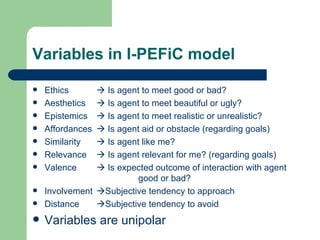
Variables in I-PEFiC model Ethics    Is agent to meet good or bad? Aesthetics    Is agent to meet beautiful or ugly? Epistemics    Is agent to meet realistic or unrealistic? Affordances    Is agent aid or obstacle (regarding goals) Similarity    Is agent like me? Relevance    Is agent relevant for me? (regarding goals) Valence    Is expected outcome of interaction with agent    good or bad? Involvement   Subjective tendency to approach Distance   Subjective tendency to avoid Variables are unipolar
Introduction to I-PEFiC model
Domain Soccer agents you might remember from earlier presentations Virtual soccer fans communicate with each other in a virtual world They can decide to meet with each other and talk about certain conversation subjects
Implementation Agents perceive each others features  good ,  bad ,  realistic , and  unrealistic  using a  designed  value [0, 1] (what would the average agent think) and a (personal)  bias  [0, 2]; e.g., Perceived (Beautiful, A1, A2)  = Bias (A1, A2, Beautiful)  * Designed (Beautiful, A2)
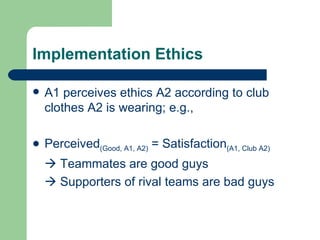
Implementation Ethics A1 perceives ethics A2 according to club clothes A2 is wearing; e.g., Perceived (Good, A1, A2)  = Satisfaction (A1, Club A2)    Teammates are good guys    Supporters of rival teams are bad guys
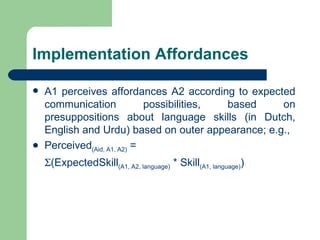
Implementation Affordances A1 perceives affordances A2 according to expected communication possibilities, based on presuppositions about language skills (in Dutch, English and Urdu) based on outer appearance; e.g., Perceived (Aid, A1, A2)  =   (ExpectedSkill (A1, A2, language)  * Skill (A1, language) )
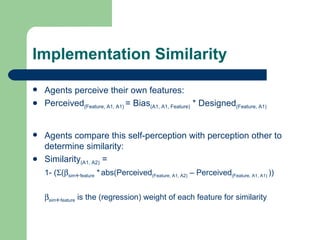
Implementation Similarity Agents perceive their own features: Perceived (Feature, A1, A1)  = Bias (A1, A1, Feature)  * Designed (Feature, A1) Agents compare this self-perception with perception other to determine similarity: Similarity (A1, A2)  = 1- (  (  sim  feature  *   abs(Perceived (Feature, A1, A2)  – Perceived (Feature, A1, A1)  ))  sim  feature  is the (regression) weight of each feature for similarity
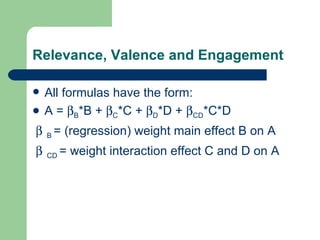
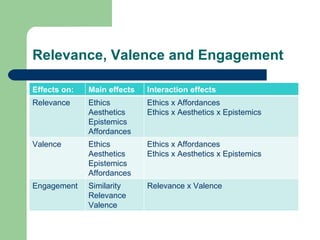
Relevance, Valence and Engagement All formulas have the form: A =   B *B +   C *C +   D *D +   CD *C*D  B  = (regression) weight main effect B on A  CD  = weight interaction effect C and D on A
Relevance, Valence and Engagement Effects on: Main effects Interaction effects Relevance Ethics Aesthetics Epistemics Affordances Ethics x Affordances Ethics x Aesthetics x Epistemics Valence Ethics Aesthetics Epistemics Affordances Ethics x Affordances Ethics x Aesthetics x Epistemics Engagement Similarity Relevance Valence Relevance x Valence
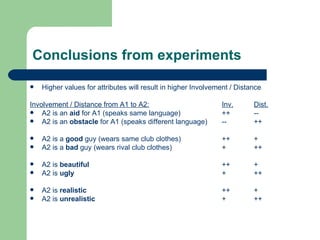
Conclusions from experiments Higher values for attributes will result in higher Involvement / Distance Involvement / Distance from A1 to A2: Inv. Dist. A2 is an  aid  for A1 (speaks same language) ++ -- A2 is an  obstacle  for A1 (speaks different language) -- ++ A2 is a  good  guy (wears same club clothes) ++ + A2 is a  bad  guy (wears rival club clothes) + ++ A2 is  beautiful  ++ + A2 is  ugly + ++ A2 is  realistic ++ + A2 is  unrealistic + ++
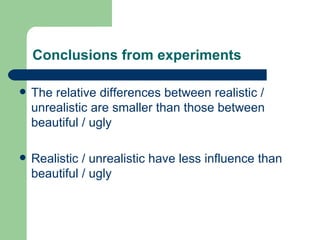
Conclusions from experiments The relative differences between realistic / unrealistic are smaller than those between beautiful / ugly Realistic / unrealistic have less influence than beautiful / ugly
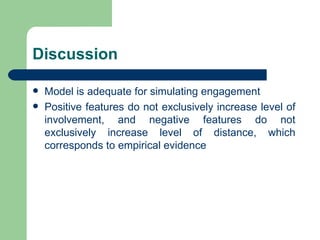
Discussion Model is adequate for simulating engagement Positive features do not exclusively increase level of involvement, and negative features do not exclusively increase level of distance, which corresponds to empirical evidence
Future Steps Combine I-PEFiC (emotion elicitation) with Gross (emotion regulation), so virtual agents can perform affective response selection Validate model against empirical data human affective trade-off processes
Questions?

A Robot's Experience of Another Robot: Simulation

  • 1.
    A Robot’s Experienceof Another Robot: Simulation Tibor Bosse Johan F. Hoorn Matthijs Pontier Ghazanfar F. Siddiqui
  • 2.
    Overview of thispresentation Introduction to I-PEFiC Model Implementation Results simulation experiments Discussion Future steps
  • 3.
    Goal of thisstudy Let virtual agent / robot perceive other agent, or human By determining its engagement with its interaction partner, a virtual agent can show an appropriate affective response  Formalise well-validated I-PEFiC model about how humans perceive virtual characters, and use it to let virtual agents perceive each other, or their users Interesting for any application which requires human-like emotional behaviour / communication; e.g.: (serious) games, e-therapy, agents that serve as practice subjects for therapists or police officers, etc.
  • 4.
    Variables in I-PEFiCmodel Ethics  Is agent to meet good or bad? Aesthetics  Is agent to meet beautiful or ugly? Epistemics  Is agent to meet realistic or unrealistic? Affordances  Is agent aid or obstacle (regarding goals) Similarity  Is agent like me? Relevance  Is agent relevant for me? (regarding goals) Valence  Is expected outcome of interaction with agent good or bad? Involvement  Subjective tendency to approach Distance  Subjective tendency to avoid Variables are unipolar
  • 5.
  • 6.
    Domain Soccer agentsyou might remember from earlier presentations Virtual soccer fans communicate with each other in a virtual world They can decide to meet with each other and talk about certain conversation subjects
  • 7.
    Implementation Agents perceiveeach others features good , bad , realistic , and unrealistic using a designed value [0, 1] (what would the average agent think) and a (personal) bias [0, 2]; e.g., Perceived (Beautiful, A1, A2) = Bias (A1, A2, Beautiful) * Designed (Beautiful, A2)
  • 8.
    Implementation Ethics A1perceives ethics A2 according to club clothes A2 is wearing; e.g., Perceived (Good, A1, A2) = Satisfaction (A1, Club A2)  Teammates are good guys  Supporters of rival teams are bad guys
  • 9.
    Implementation Affordances A1perceives affordances A2 according to expected communication possibilities, based on presuppositions about language skills (in Dutch, English and Urdu) based on outer appearance; e.g., Perceived (Aid, A1, A2) =  (ExpectedSkill (A1, A2, language) * Skill (A1, language) )
  • 10.
    Implementation Similarity Agentsperceive their own features: Perceived (Feature, A1, A1) = Bias (A1, A1, Feature) * Designed (Feature, A1) Agents compare this self-perception with perception other to determine similarity: Similarity (A1, A2) = 1- (  (  sim  feature * abs(Perceived (Feature, A1, A2) – Perceived (Feature, A1, A1) ))  sim  feature is the (regression) weight of each feature for similarity
  • 11.
    Relevance, Valence andEngagement All formulas have the form: A =  B *B +  C *C +  D *D +  CD *C*D  B = (regression) weight main effect B on A  CD = weight interaction effect C and D on A
  • 12.
    Relevance, Valence andEngagement Effects on: Main effects Interaction effects Relevance Ethics Aesthetics Epistemics Affordances Ethics x Affordances Ethics x Aesthetics x Epistemics Valence Ethics Aesthetics Epistemics Affordances Ethics x Affordances Ethics x Aesthetics x Epistemics Engagement Similarity Relevance Valence Relevance x Valence
  • 13.
    Conclusions from experimentsHigher values for attributes will result in higher Involvement / Distance Involvement / Distance from A1 to A2: Inv. Dist. A2 is an aid for A1 (speaks same language) ++ -- A2 is an obstacle for A1 (speaks different language) -- ++ A2 is a good guy (wears same club clothes) ++ + A2 is a bad guy (wears rival club clothes) + ++ A2 is beautiful ++ + A2 is ugly + ++ A2 is realistic ++ + A2 is unrealistic + ++
  • 14.
    Conclusions from experimentsThe relative differences between realistic / unrealistic are smaller than those between beautiful / ugly Realistic / unrealistic have less influence than beautiful / ugly
  • 15.
    Discussion Model isadequate for simulating engagement Positive features do not exclusively increase level of involvement, and negative features do not exclusively increase level of distance, which corresponds to empirical evidence
  • 16.
    Future Steps CombineI-PEFiC (emotion elicitation) with Gross (emotion regulation), so virtual agents can perform affective response selection Validate model against empirical data human affective trade-off processes
  • 17.