Grandfathers, cogs and bots:
Learner choices for designs of companion
agents
EDMEDIA, 25th June, 2013
The Shift
• Aimed at NEETs – not in education
employment or training
• Ravensbourne based in Greenwich, London,
Creative and Media Industries
• Courses will pull OER content together
• Website constructed from widgets, profile
info, badges, social networks, drag and
dropped between public and private spaces
The bot
• Bot is an autonomous interactive
program, interactive and social - aka companion
agent. Can be text only, can be situated in a 3D
virtual world (when it is an embodied companion
agent).
• Distinct from an avatar in that avatar refers only
to a digital representation of a human although
Nowak, K.L. and Biocca, F. (2003) found that
people don’t distinguish.
• Previous research indicates learning effectiveness
relates to affinity to avatar
The research
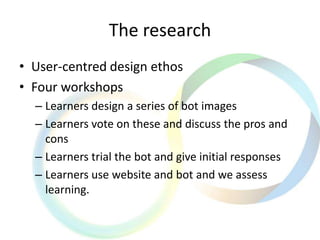
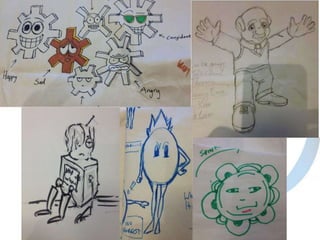
• User-centred design ethos
• Four workshops
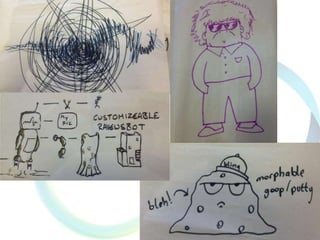
– Learners design a series of bot images
– Learners vote on these and discuss the pros and
cons
– Learners trial the bot and give initial responses
– Learners use website and bot and we assess
learning.
What do you think?
1. Really very bad
2. Dislike it
3. Meh
4. It’s OK
5. It’s excellent
Second Thing
So, what should it be able to do?
• Must have
• Should have
• Could have
• Would be nice if …
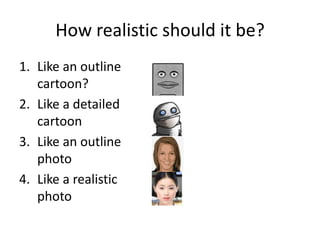
How realistic should it be?
1. Like an outline
cartoon?
2. Like a detailed
cartoon
3. Like an outline
photo
4. Like a realistic
photo
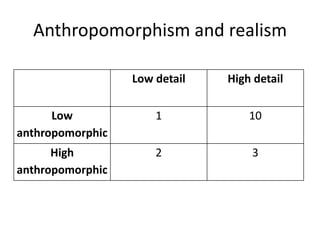
Anthropomorphism and realism
Low detail High detail
Low
anthropomorphic
1 10
High
anthropomorphic
2 3
Methodology
• Attributed a score for each response on Lykert
scale, then ranked the designs
• Removed those where responses indicated
additional elements associated with factors
outside of appearance were having effect
• Grouped them according to degree of realism
and anthropomorphism.
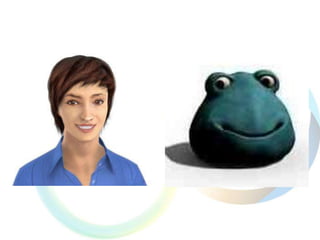
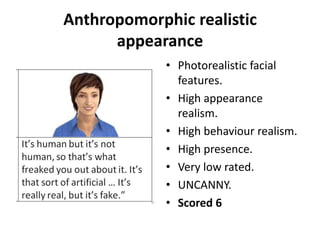
Anthropomorphic realistic
appearance
• Photorealistic facial
features.
• High appearance
realism.
• High behaviour realism.
• High presence.
• Very low rated.
• UNCANNY.
• Scored 6
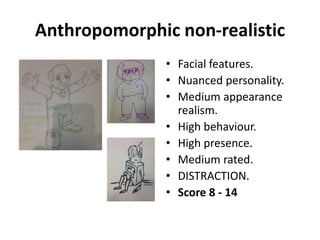
Anthropomorphic non-realistic
• Facial features.
• Nuanced personality.
• Medium appearance
realism.
• High behaviour.
• High presence.
• Medium rated.
• DISTRACTION.
• Score 8 - 14
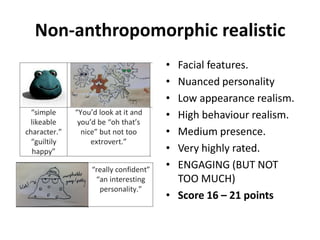
Non-anthropomorphic realistic
• Facial features.
• Nuanced personality
• Low appearance realism.
• High behaviour realism.
• Medium presence.
• Very highly rated.
• ENGAGING (BUT NOT
TOO MUCH)
• Score 16 – 21 points
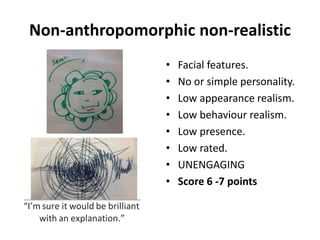
Non-anthropomorphic non-realistic
• Facial features.
• No or simple personality.
• Low appearance realism.
• Low behaviour realism.
• Low presence.
• Low rated.
• UNENGAGING
• Score 6 -7 points
Functionality
• Ranking of functionality
– Highest: Student tracking and info, personality
– Upper mid-range: interactivity
– Lower mid-range: growth and change
– Lowest: Customisability
– Negative: Ability to speak
• In third workshop
– Students reiterated usefulness over personality
– Wanted control over turning personality on and off
Conclusions
• Students did not want to sacrifice any usability
for “fun” factors
• Students wanted behavioural and design
realism as long as it was not anthropomorphic
(the Uncanny Valley lives).
• There is an optimum level (from the learners’
perspective) of social presence in bots, too
much and they are not engaging, too little and
they are distracting.
Further work
• Need to test learners’ perspectives against
actual learning effectiveness
• Ideally would work with a design team and
larger learner base to create range of
designs, altering the separate variables, to
identify which factors are influencing
affinity, presence and preference.
Further reading
• Nowak, K.L. and Biocca, F. (2003) The Effect of
the Agency and Anthropomorphism on Users’
Sense of Telepresence, Copresence, and Social
Presence in Virtual Environments, Presence,
Vol. 12, No. 5, October 2003, 481–494
Authors
Mark Childs mark@markchilds.org
Academic lead: presence
Anna Peachey anna@annapeachey.co.uk
Academic lead: learning pathways
Lizzie Jackson lizzie.jackson@rave.ac.uk
Principle Investigator
Phil Hall phil.hall@elzware.com
Programmer, lead designer

Grandfathers, cogs and bots

  • 1.
    Grandfathers, cogs andbots: Learner choices for designs of companion agents EDMEDIA, 25th June, 2013
  • 2.
    The Shift • Aimedat NEETs – not in education employment or training • Ravensbourne based in Greenwich, London, Creative and Media Industries • Courses will pull OER content together • Website constructed from widgets, profile info, badges, social networks, drag and dropped between public and private spaces
  • 3.
    The bot • Botis an autonomous interactive program, interactive and social - aka companion agent. Can be text only, can be situated in a 3D virtual world (when it is an embodied companion agent). • Distinct from an avatar in that avatar refers only to a digital representation of a human although Nowak, K.L. and Biocca, F. (2003) found that people don’t distinguish. • Previous research indicates learning effectiveness relates to affinity to avatar
  • 4.
    The research • User-centreddesign ethos • Four workshops – Learners design a series of bot images – Learners vote on these and discuss the pros and cons – Learners trial the bot and give initial responses – Learners use website and bot and we assess learning.
  • 8.
    What do youthink? 1. Really very bad 2. Dislike it 3. Meh 4. It’s OK 5. It’s excellent
  • 9.
    Second Thing So, whatshould it be able to do? • Must have • Should have • Could have • Would be nice if …
  • 10.
    How realistic shouldit be? 1. Like an outline cartoon? 2. Like a detailed cartoon 3. Like an outline photo 4. Like a realistic photo
  • 11.
    Anthropomorphism and realism Lowdetail High detail Low anthropomorphic 1 10 High anthropomorphic 2 3
  • 12.
    Methodology • Attributed ascore for each response on Lykert scale, then ranked the designs • Removed those where responses indicated additional elements associated with factors outside of appearance were having effect • Grouped them according to degree of realism and anthropomorphism.
  • 13.
    Anthropomorphic realistic appearance • Photorealisticfacial features. • High appearance realism. • High behaviour realism. • High presence. • Very low rated. • UNCANNY. • Scored 6
  • 14.
    Anthropomorphic non-realistic • Facialfeatures. • Nuanced personality. • Medium appearance realism. • High behaviour. • High presence. • Medium rated. • DISTRACTION. • Score 8 - 14
  • 15.
    Non-anthropomorphic realistic • Facialfeatures. • Nuanced personality • Low appearance realism. • High behaviour realism. • Medium presence. • Very highly rated. • ENGAGING (BUT NOT TOO MUCH) • Score 16 – 21 points
  • 16.
    Non-anthropomorphic non-realistic • Facialfeatures. • No or simple personality. • Low appearance realism. • Low behaviour realism. • Low presence. • Low rated. • UNENGAGING • Score 6 -7 points
  • 17.
    Functionality • Ranking offunctionality – Highest: Student tracking and info, personality – Upper mid-range: interactivity – Lower mid-range: growth and change – Lowest: Customisability – Negative: Ability to speak • In third workshop – Students reiterated usefulness over personality – Wanted control over turning personality on and off
  • 18.
    Conclusions • Students didnot want to sacrifice any usability for “fun” factors • Students wanted behavioural and design realism as long as it was not anthropomorphic (the Uncanny Valley lives). • There is an optimum level (from the learners’ perspective) of social presence in bots, too much and they are not engaging, too little and they are distracting.
  • 19.
    Further work • Needto test learners’ perspectives against actual learning effectiveness • Ideally would work with a design team and larger learner base to create range of designs, altering the separate variables, to identify which factors are influencing affinity, presence and preference.
  • 20.
    Further reading • Nowak,K.L. and Biocca, F. (2003) The Effect of the Agency and Anthropomorphism on Users’ Sense of Telepresence, Copresence, and Social Presence in Virtual Environments, Presence, Vol. 12, No. 5, October 2003, 481–494
  • 21.
    Authors Mark Childs mark@markchilds.org Academiclead: presence Anna Peachey anna@annapeachey.co.uk Academic lead: learning pathways Lizzie Jackson lizzie.jackson@rave.ac.uk Principle Investigator Phil Hall phil.hall@elzware.com Programmer, lead designer