Refugee Women’s Health
HMAP 5326
April 28. 2014
THE A-TEAM: CYMPHONI CAMPBELL, SHAILESH JAISWAL, CHIAO-CHIN (GEORGE) LIN,
SUBHADA PRASAD, KENZIE TABOR, AND SHAMYRA THOMPSON
Background Population
• Refugee women in the Dallas-
Fort Worth Metroplex
Program Problem Statement
• In 2012, Texas had the largest
number of refugees in the
United States
• Many refugee women did not
receive proper health care
• Refugee women only receive
free health care for 8 months
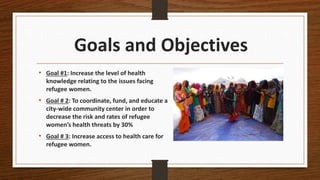
Goals and Objectives
• Goal #1: Increase the level of health
knowledge relating to the issues facing
refugee women.
• Goal # 2: To coordinate, fund, and educate a
city-wide community center in order to
decrease the risk and rates of refugee
women’s health threats by 30%
• Goal # 3: Increase access to health care for
refugee women.
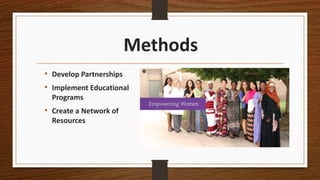
Methods
• Develop Partnerships
• Implement Educational
Programs
• Create a Network of
Resources
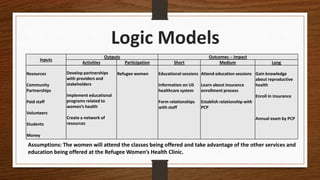
Logic Models
Inputs
Outputs Outcomes -- Impact
Activities Participation Short Medium Long
Resources
Community
Partnerships
Paid staff
Volunteers
Students
Money
Develop partnerships
with providers and
stakeholders
Implement educational
programs related to
women’s health
Create a network of
resources
Refugee women Educational sessions
Information on US
healthcare system
Form relationships
with staff
Attend education sessions
Learn about insurance
enrollment process
Establish relationship with
PCP
Gain knowledge
about reproductive
health
Enroll in insurance
Annual exam by PCP
Assumptions: The women will attend the classes being offered and take advantage of the other services and
education being offered at the Refugee Women’s Health Clinic.
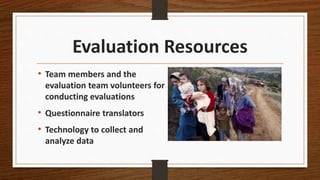
Evaluation Resources
• Team members and the
evaluation team volunteers for
conducting evaluations
• Questionnaire translators
• Technology to collect and
analyze data
Evaluation Team
• Lead Evaluator: Conduct process
and outcome evaluation
• Evaluation Analyzer: Create frame
of evaluation; Collection of data
and initial analysis
• Evaluation Advisor: Providing
external oversight for evaluation
Stakeholder Assessment and
Engagement Plan
• Funder: Efficient use of grants
• Governance: Legal compliance
• Influencers: Program process
• Providers: Gain insured patient pool
• Stakeholders: Refugee women,
Catholic Charities, World Relief Fort
Worth, International Rescue
Committee, Refugee Services of
Texas, other and existing refugee
clinics.
Impact & Outcome
Impact:
• Thoroughly education is in
regards to personal women’s
health.
• Within 8 months, 75% of the
refugee women attending the
clinic will be enrolled in
proper health care coverage.
• 90% of those women will
have a primary care physician
whom they are visiting at
least once a year.
Outcome:
• Attend weekly information
sessions about reproductive
health topics
• Complete the necessary steps
and requirements to enroll in
health insurance.
• Within 3 months of entering the
program, 60% of insured refugee
women would get their annual
exams and have established
relationship with their primary
care physicians.
Outcome Indicators
• Increased knowledge: By 2016 70 % of participants will
increase their knowledge of health and human service
for which they are eligible from baseline.
• Education Session Attendance: By 2016 80% of
participants will be in attendance at least 3 educational
sessions each month.
• Physician Visit Follow-Up: By 2016 90% of participants
will have a primary care physician and attend their
annual appointments.
• Health Insurance Enrollment: By 2016 75% of program
participants will be enrolled in a quality health
insurance program.
Analysis Plan
• Qualitative comparison and association:
Measuring the pre-test and post-test the
refugee women take
• Association and prediction: Calculating how
many refugee women signed up for health
insurance at the end of the program (8 months)
• Descriptive and prediction: Calculating how
many refugee women went to their bi-annual
check-ups with their physicians at the end of 2
years
2Refugee Women's Health Final Presentation

2Refugee Women's Health Final Presentation

  • 1.
    Refugee Women’s Health HMAP5326 April 28. 2014 THE A-TEAM: CYMPHONI CAMPBELL, SHAILESH JAISWAL, CHIAO-CHIN (GEORGE) LIN, SUBHADA PRASAD, KENZIE TABOR, AND SHAMYRA THOMPSON
  • 2.
    Background Population • Refugeewomen in the Dallas- Fort Worth Metroplex
  • 3.
    Program Problem Statement •In 2012, Texas had the largest number of refugees in the United States • Many refugee women did not receive proper health care • Refugee women only receive free health care for 8 months
  • 4.
    Goals and Objectives •Goal #1: Increase the level of health knowledge relating to the issues facing refugee women. • Goal # 2: To coordinate, fund, and educate a city-wide community center in order to decrease the risk and rates of refugee women’s health threats by 30% • Goal # 3: Increase access to health care for refugee women.
  • 5.
    Methods • Develop Partnerships •Implement Educational Programs • Create a Network of Resources
  • 6.
    Logic Models Inputs Outputs Outcomes-- Impact Activities Participation Short Medium Long Resources Community Partnerships Paid staff Volunteers Students Money Develop partnerships with providers and stakeholders Implement educational programs related to women’s health Create a network of resources Refugee women Educational sessions Information on US healthcare system Form relationships with staff Attend education sessions Learn about insurance enrollment process Establish relationship with PCP Gain knowledge about reproductive health Enroll in insurance Annual exam by PCP Assumptions: The women will attend the classes being offered and take advantage of the other services and education being offered at the Refugee Women’s Health Clinic.
  • 7.
    Evaluation Resources • Teammembers and the evaluation team volunteers for conducting evaluations • Questionnaire translators • Technology to collect and analyze data
  • 8.
    Evaluation Team • LeadEvaluator: Conduct process and outcome evaluation • Evaluation Analyzer: Create frame of evaluation; Collection of data and initial analysis • Evaluation Advisor: Providing external oversight for evaluation
  • 9.
    Stakeholder Assessment and EngagementPlan • Funder: Efficient use of grants • Governance: Legal compliance • Influencers: Program process • Providers: Gain insured patient pool • Stakeholders: Refugee women, Catholic Charities, World Relief Fort Worth, International Rescue Committee, Refugee Services of Texas, other and existing refugee clinics.
  • 10.
    Impact & Outcome Impact: •Thoroughly education is in regards to personal women’s health. • Within 8 months, 75% of the refugee women attending the clinic will be enrolled in proper health care coverage. • 90% of those women will have a primary care physician whom they are visiting at least once a year. Outcome: • Attend weekly information sessions about reproductive health topics • Complete the necessary steps and requirements to enroll in health insurance. • Within 3 months of entering the program, 60% of insured refugee women would get their annual exams and have established relationship with their primary care physicians.
  • 11.
    Outcome Indicators • Increasedknowledge: By 2016 70 % of participants will increase their knowledge of health and human service for which they are eligible from baseline. • Education Session Attendance: By 2016 80% of participants will be in attendance at least 3 educational sessions each month. • Physician Visit Follow-Up: By 2016 90% of participants will have a primary care physician and attend their annual appointments. • Health Insurance Enrollment: By 2016 75% of program participants will be enrolled in a quality health insurance program.
  • 12.
    Analysis Plan • Qualitativecomparison and association: Measuring the pre-test and post-test the refugee women take • Association and prediction: Calculating how many refugee women signed up for health insurance at the end of the program (8 months) • Descriptive and prediction: Calculating how many refugee women went to their bi-annual check-ups with their physicians at the end of 2 years

Editor's Notes

  • #3 Definition:  “A refugee is someone who has been forced to flee his or her country because of persecution, war, or violence; someone who has a well-founded fear of maltreatment for reasons such as race, religion, nationality, political opinion or membership in a particular social group Collaborators (see example below)   Many of the refugee women that migrate to the United States come without their husband, making them the main provider and caregiver for their family
  • #4 In 2012, Texas was reported as having one the highest numbers of refugees in the United States. Of the refugees, over half of those immigrating to the United States are women who have not received proper health care developing numerous gynecological issues, cancers, and increased risk to highly problematic and fatal pregnancies For up to eight months after their arrival, many refugees are only eligible for free medical care. After the 8 months of free health care expire, refugee women are responsible to obtain their own insurance in order to continue receiving routine preventive women’s health care so that they are able to stay healthy and provide for their family
  • #5 Goal 1: the women will attend weekly educational sessions on reproductive health topics and show their improvement/change in knowledge through pre/post tests 75% of women refugees will have health care coverage 90% of women will have a primary care physician  
  • #8 along with their vast knowledge and experience; translated into their language; Statistic Software eg. SPSS & SAS
  • #9 Invite Director of Refugee Women’s Health as lead evaluator; Manager of Refugee Women’s Health Program as Evaluation Analyzer; Health Educator of Refugee Women’s Health Program as Evaluation Advisor
  • #10 Funder: CBA(cost and benefit analysis); Governance: Legal assistance; Influencers: Decision making; Providers: Clinical screening and professional consulting
  • #11 ; taking knowledge based post assessment monthly (after four consecutive Sessions). **Behavior Change**
  • #12 Pre-intervention assessment and post-intervention assessment. Increase % of participants with knowledge of services eligible ; Weekly Sign-In Sheets (Electronic) Participants attending regularly; Excel Attendance Form completing their annual clinical visits ; Health Insurance Policy Card Insurance Enrollment Forms for Participants enrolling in health insurance
  • #13 Responsible Person: Health Educators; Social Worker; Health Counselors