Social Web
2014
Lecture V: Personalization on the Social Web
(some slides adopted from Fabian Abel)
Lora Aroyo
The Network Institute	

VU University Amsterdam
theory & techniques for 	

how to design & evaluate 	

recommenders & user models 	

to use in Social Web applications

Social Web 2014, Lora Aroyo!
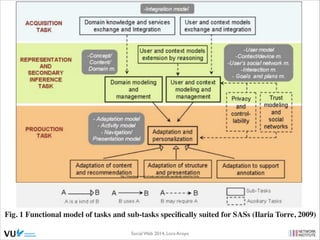
Fig. 1 Functional model of tasks and sub-tasks specifically suited for SASs

Fig. 1 Functional model of tasks and sub-tasks specifically suited for SASs (Ilaria Torre, 2009)
Social Web 2014, Lora Aroyo!
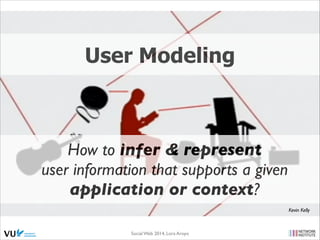
User Modeling

How to infer & represent 	

user information that supports a given
application or context?
Kevin Kelly

Social Web 2014, Lora Aroyo!
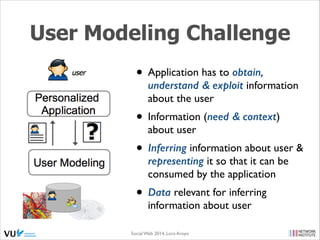
User Modeling Challenge
• Application has to obtain,

understand & exploit information
about the user	


• Information (need & context)
about user	


• Inferring information about user &
representing it so that it can be
consumed by the application	


• Data relevant for inferring
information about user

Social Web 2014, Lora Aroyo!
User & Usage Data
is Everywhere
• People leave traces on the Web and on their computers:
• Usage data, e.g., query logs, click-through-data 	

• Social data, e.g., tags, (micro-)blog posts, comments,
bookmarks, friend connections 	

• Documents, e.g., pictures, videos	

• Personal data, e.g., affiliations, locations 	

• Products, applications, services - bought, used, installed	

• Not only a user’s behavior, but also interactions of other users
• “people can make statements about me”	

• “people who are similar to me can reveal information about me”	

• “social learning” collaborative recommender systems
Social Web 2014, Lora Aroyo!
UM: Basic Concepts
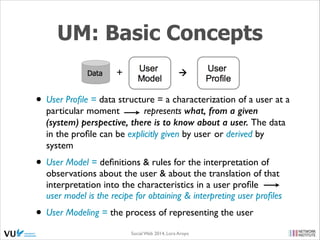
• User Profile = data structure = a characterization of a user at a
particular moment
represents what, from a given
(system) perspective, there is to know about a user. The data
in the profile can be explicitly given by user or derived by
system	


• User Model = definitions & rules for the interpretation of

observations about the user & about the translation of that
interpretation into the characteristics in a user profile
user model is the recipe for obtaining & interpreting user profiles	


• User Modeling = the process of representing the user
Social Web 2014, Lora Aroyo!
User Modeling Approaches
• Overlay User Modeling: describe user characteristics, e.g.

“knowledge of a user”, “interests of a user” with respect to
“ideal” characteristics	


• Customizing: user explicitly provides & adjusts elements of
the user profile	


• User model elicitation: ask & observe the user; learn &
improve user profile successively
modeling”	


“interactive user

• Stereotyping: stereotypical characteristics to describe a user	

• User Relevance Modeling: learn/infer probabilities that a given
item or concept is relevant for a user

Related scientific conference: http://umap2011.org/ Related journal: http:/umuai.org/
Social Web 2014, Lora Aroyo!
Which approach suits best
the conditions of
applications?

Social Web 2014, Lora Aroyo! http://farm7.staticflickr.com/6240/6346803873_e756dd9bae_b.jpg
Overlay User Models
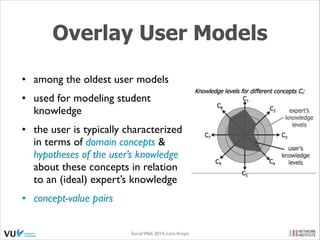
• among the oldest user models	

• used for modeling student
knowledge	

• the user is typically characterized
in terms of domain concepts &
hypotheses of the user’s knowledge
about these concepts in relation
to an (ideal) expert’s knowledge	

• concept-value pairs
Social Web 2014, Lora Aroyo!
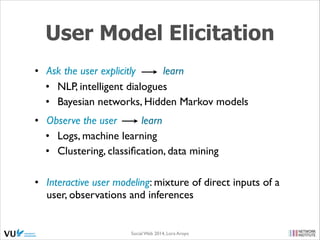
User Model Elicitation
• Ask the user explicitly
learn	

• NLP, intelligent dialogues	

• Bayesian networks, Hidden Markov models	

• Observe the user
learn 	

• Logs, machine learning	

• Clustering, classification, data mining

• Interactive user modeling: mixture of direct inputs of a
user, observations and inferences

Social Web 2014, Lora Aroyo!
http://hunch.com
Social Web 2014, Lora Aroyo!
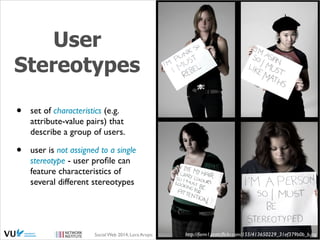
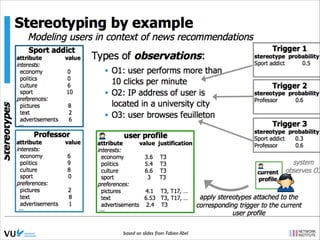
User
Stereotypes
•

set of characteristics (e.g.
attribute-value pairs) that
describe a group of users.	


•

user is not assigned to a single
stereotype - user profile can
feature characteristics of
several different stereotypes

Social Web 2014, Lora Aroyo!

http://farm1.staticflickr.com/155/413650229_31ef379b0b_b.jpg
based on slides from Fabien Abel
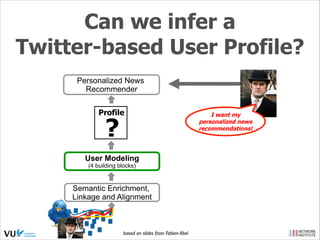
Can we infer a
Twitter-based User Profile?
Personalized News
Recommender
Profile

?

User Modeling
(4 building blocks)

Semantic Enrichment,
Linkage and Alignment

based on slides from Fabien Abel

I want my
personalized news
recommendations!
User Modeling Building
Blocks

1. Temporal
Constraints

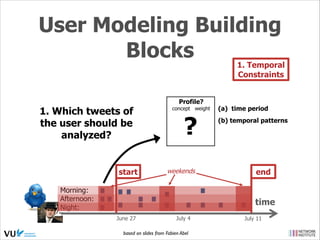
1. Which tweets of
the user should be
analyzed?

start

Profile?

concept weight

?

weekends

Morning:
Afternoon:
Night:

(a) time period
(b) temporal patterns

end

time
June 27

July 4

based on slides from Fabien Abel

July 11
User Modeling Building
Blocks
Francesca
Schiavone

T Sport
concept weight

# hashtag-based
entity-based

T topic-based

#

2. Profile
Type

Profile?

Francesca Schiavone won
French Open #fo2010
French
Open

1. Temporal
Constraints

?

fo2010

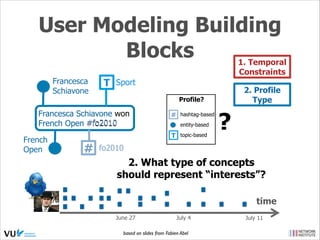
2. What type of concepts
should represent “interests”?
time
June 27

July 4

based on slides from Fabien Abel

July 11
User Modeling Building
Blocks
Francesca
Schiavone

1. Temporal
Constraints

(a) tweet-based
Profile?

Francesca Schiavone won!
http://bit.ly/2f4t7a

concept weight
Francesca
Schiavone
French Open
Tennis

Francesca wins French Open
Thirty in women's
tennis is primordially
old, an age when
agility and desire
recedes as the …

French
Open

2. Profile
Type
3. Semantic
Enrichment

(b) further enrichment

Tennis

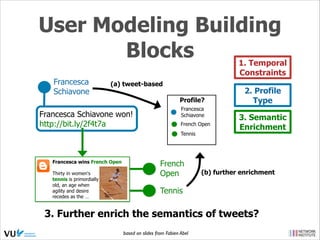
3. Further enrich the semantics of tweets?
based on slides from Fabien Abel
User Modeling Building
Blocks

1. Temporal
Constraints

Profile?

concept

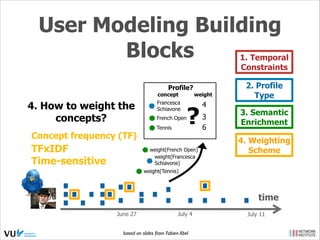
4. How to weight the
concepts?
Concept frequency (TF)

TFxIDF
Time-sensitive

weight

Francesca
Schiavone

4

French Open
Tennis

?

weight(French Open)
weight(Francesca
Schiavone)

3
6

2. Profile
Type
3. Semantic
Enrichment
4. Weighting
Scheme

weight(Tennis)

time
June 27

July 4

based on slides from Fabien Abel

July 11
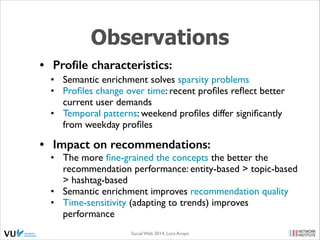
Observations
• Profile characteristics:
• Semantic enrichment solves sparsity problems	

• Profiles change over time: recent profiles reflect better
current user demands	

• Temporal patterns: weekend profiles differ significantly
from weekday profiles	


• Impact on recommendations:
• The more fine-grained the concepts the better the
recommendation performance: entity-based > topic-based
> hashtag-based 	

• Semantic enrichment improves recommendation quality 	

• Time-sensitivity (adapting to trends) improves
performance
Social Web 2014, Lora Aroyo!
User Modeling
it is not about putting everything in a user profile 	

it is about making the right choices

Social Web 2014, Lora Aroyo!
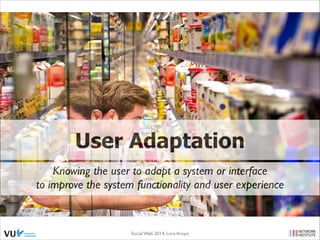
User Adaptation
Knowing the user to adapt a system or interface	

to improve the system functionality and user experience

Social Web 2014, Lora Aroyo!
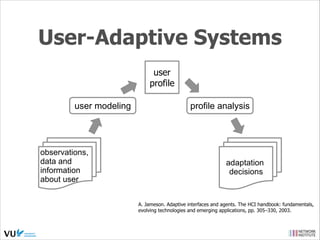
User-Adaptive Systems
user
profile
user modeling

observations,
data and
information
about user

profile analysis

adaptation
decisions

A. Jameson. Adaptive interfaces and agents. The HCI handbook: fundamentals,
evolving technologies and emerging applications, pp. 305–330, 2003.
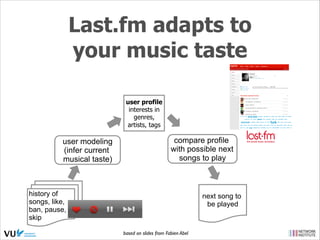
Last.fm adapts to
your music taste
user profile
interests in
genres,
artists, tags

user modeling
(infer current
musical taste)

compare profile
with possible next
songs to play

history of
songs, like,
ban, pause,
skip

next song to
be played

based on slides from Fabien Abel
Issues in User-Adaptive
Systems
• Overfitting, “bubble effects”, loss of serendipity problem: 	

• systems may adapt too strongly to the interests/behavior	

• e.g., an adaptive radio station may always play the same or
very similar songs	

• We search for the right balance between novelty and
relevance for the user	

• “Lost in Hyperspace” problem: 	

• when adapting the navigation – i.e. the links on which
users can click to find/access information 	

• e.g., re-ordering/hiding of menu items may lead to
confusion
Social Web 2014, Lora Aroyo!
What is good user modelling
& personalisation?

Social Web 2014, Lora Aroyo!

http://www.flickr.com/photos/bellarosebyliz/4729613108
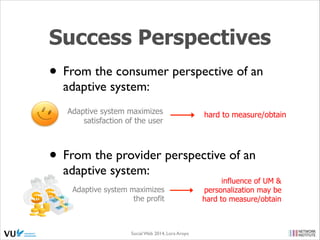
Success Perspectives

• From the consumer perspective of an
adaptive system: 	


! Adaptive system maximizes
satisfaction of the user

hard to measure/obtain

!

• From the provider perspective of an
adaptive system:

Adaptive system maximizes
the profit

Social Web 2014, Lora Aroyo!

influence of UM &
personalization may be
hard to measure/obtain
Evaluation Strategies
• User studies: ask/observe (selected) people whether you did a
good job	


• Log analysis: Analyze (click) data and infer whether you did a
good job,	


• Evaluation of user modeling:	

• measure quality of profiles directly, e.g. measure overlap with
•

existing (true) profiles, or let people judge the quality of the
generated user profiles 	

measure quality of application that exploits the user profile,
e.g., apply user modeling strategies in a recommender
system

Social Web 2014, Lora Aroyo!
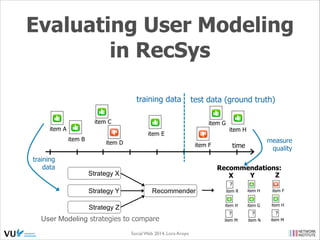
Evaluating User Modeling
in RecSys
training data

test data (ground truth)

item C
item A
item B

training
data

item G
item E

item D

measure
quality

time

item F

Recommendations:
Z
X
Y

Strategy X
Strategy Y

item H

Recommender

?

User Modeling strategies to compare
Social Web 2014, Lora Aroyo!

item H

item F

item H

Strategy Z

item R

item G

item H

?

?

?

item M

item N

item M
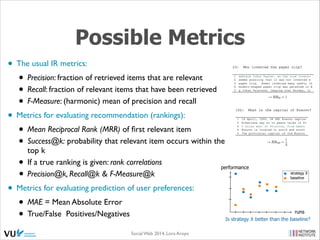
Possible Metrics
• The usual IR metrics:	

• Precision: fraction of retrieved items that are relevant	

• Recall: fraction of relevant items that have been retrieved	

• F-Measure: (harmonic) mean of precision and recall	

• Metrics for evaluating recommendation (rankings):	

• Mean Reciprocal Rank (MRR) of first relevant item	

• Success@k: probability that relevant item occurs within the
top k	

• If a true ranking is given: rank correlations 	

• Precision@k, Recall@k & F-Measure@k	

• Metrics for evaluating prediction of user preferences:	

• MAE = Mean Absolute Error	

• True/False Positives/Negatives

performance

Social Web 2014, Lora Aroyo!

strategy X
baseline

runs
Is strategy X better than the baseline?
Example Evaluation
• [Rae et al.] a typical example of how to investigate and evaluate a proposal for
improving (tag) recommendations (using social networks)	


• Task: test how well the different strategies (different tag contexts) can be used
for tag prediction/recommendation	


• Steps:	

1. Gather a dataset of tag data part of which can be used as input and aim to
test the recommendation on the remaining tag data	

2. Use the input data and calculate for the different strategies the predictions	

3. Measure the performance using standard (IR) metrics: Precision of the top
5 recommended tags (P@5), Mean Reciprocal Rank (MRR), Mean Average
Precision (MAP)	

4. Test the results for statistical significance using T-test, relative to the
baseline (e.g. existing approach, competitive approach)

[Rae et al. Improving Tag Recommendations Using Social Networks, RIAO’10]]
Social Web 2014, Lora Aroyo!
Example Evaluation
• [Guy et al.] another example of a similar evaluation approach	

• The different strategies differ in the way people & tags are
used: with tag-based systems, there are complex
relationships between users, tags and items, and strategies
aim to find the relevant aspects of these relationships for
modeling and recommendation	


• The baseline is the ‘most popular’ tags - often used to

compare the most popular tags to the tags predicted by a
particular personalization strategy - investigating whether
the personalization is worth the effort and is able to
outperform the easily available baseline.

[Guy et al. Social Media Recommendation based on People and Tags, SIGIR’10]]
Social Web 2014, Lora Aroyo!
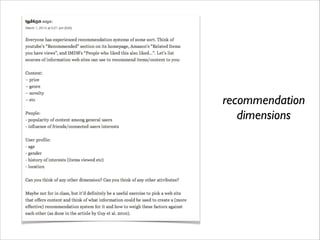
recommendation 	

dimensions
Recommendation Systems
Predict relevant/useful/interesting items	

for a given user (in a given context)	

it’s often a ranking task

Social Web 2014, Lora Aroyo!
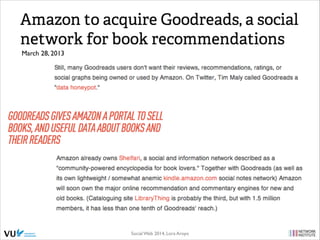
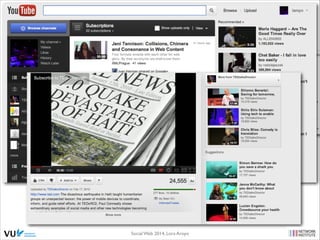
March 28, 2013

Social Web 2014, Lora Aroyo!
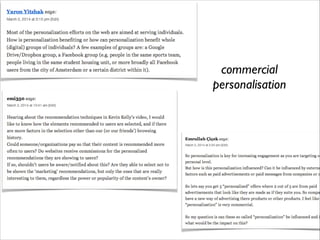
commercial 	

personalisation
http://www.wired.com/magazine/2011/11/mf_artsy/all/1

Social Web 2014, Lora Aroyo!
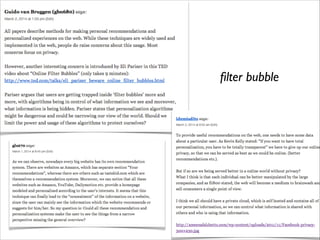
filter bubble
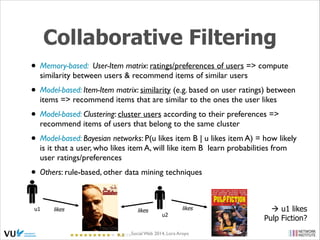
Collaborative Filtering
• Memory-based: User-Item matrix: ratings/preferences of users => compute
similarity between users & recommend items of similar users	


• Model-based: Item-Item matrix: similarity (e.g. based on user ratings) between
items => recommend items that are similar to the ones the user likes	


• Model-based: Clustering: cluster users according to their preferences =>
recommend items of users that belong to the same cluster	


• Model-based: Bayesian networks: P(u likes item B | u likes item A) = how likely
is it that a user, who likes item A, will like item B learn probabilities from
user ratings/preferences	


• Others: rule-based, other data mining techniques	

u1

likes

likes

u2

likes

Social Web 2014, Lora Aroyo!

! u1 likes
Pulp Fiction?
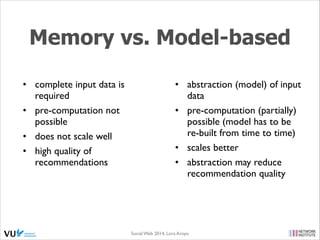
Memory vs. Model-based
• complete input data is
required	

• pre-computation not
possible	

• does not scale well 	

• high quality of
recommendations	

!

• abstraction (model) of input
data	

• pre-computation (partially)
possible (model has to be
re-built from time to time)	

• scales better	

• abstraction may reduce
recommendation quality

Social Web 2014, Lora Aroyo!
Social Networks &
Interest Similarity
• collaborative filtering: ‘neighborhoods’ of people with similar interest
& recommending items based on likings in neighborhood	


• limitations: next to ‘cold start’ and ‘sparsity’ the lack of control (over

one’s neighborhood) is also a problem, i.e. cannot add ‘trusted’ people, nor
exclude ‘strange’ ones	


• therefore, interest in ‘social recommenders’, where presence of social

connections defines the similarity in interests (e.g. social tagging CiteULike):	


• does a social connection indicate user interest similarity?	

• how much users interest similarity depends on the strength of their
connection?	

• is it feasible to use a social network as a personalized
recommendation?

[Lin & Brusilovsky, Social Social Web 2014, Lora Aroyo! Similarity: The Case of CiteULike, HT’10]
Networks and Interest
Conclusions
• unilaterally connected pairs have more common items/metadata/tags than non-connected pairs	

• highest similarity for direct connections - decreasing with the increase of distance between users in SN 	

• reciprocal relationship users - significantly larger similarity than users in a unidirectional relationship 	

• traditional item-level similarity may be less reliable to find similar users in social bookmarking systems	

• peers connected by self-defined social connections could be a useful source for cross-recommendation

Social Web 2014, Lora Aroyo!
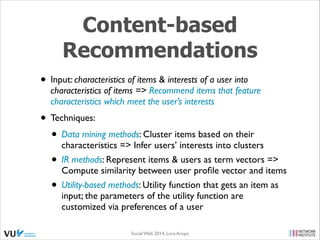
Content-based
Recommendations
• Input: characteristics of items & interests of a user into

characteristics of items => Recommend items that feature
characteristics which meet the user’s interests	


• Techniques:	

• Data mining methods: Cluster items based on their
•
•

characteristics => Infer users’ interests into clusters	

IR methods: Represent items & users as term vectors =>
Compute similarity between user profile vector and items	

Utility-based methods: Utility function that gets an item as
input; the parameters of the utility function are
customized via preferences of a user
Social Web 2014, Lora Aroyo!
Government stops
renovation of tower
bridge Oct 13th 2011

Tower Bridge
is a combined bascule and suspension
bridge in London, England, over the
River Thames.
Category: politics, england
Related Twiper news:
@bob: Why do they stop to… [more]
@mary: London stops reno… [more]

Tower Bridge today Under construction

Content
Features

db:Politics
db:Sports
db:Education
db:London
db:Tower_Bridge
db:Government
db:UK

Weighting strategy:
-  occurrence frequency
-  normalize vectors (1-norm ! sum of vector equals 1)
based on slides from Fabien Abel

0.2
0
0
0.2 = a
0.4
0.1
0.1
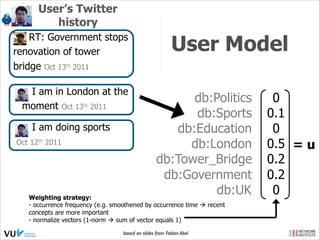
User’s Twitter
history
RT: Government stops
renovation of tower
bridge Oct 13th 2011
I am in London at the
moment Oct 13th 2011
I am doing sports
Oct 12th 2011

User Model
db:Politics
db:Sports
db:Education
db:London
db:Tower_Bridge
db:Government
db:UK

Weighting strategy:
-  occurrence frequency (e.g. smoothened by occurrence time ! recent
concepts are more important
-  normalize vectors (1-norm ! sum of vector equals 1)
based on slides from Fabien Abel

0
0.1
0
0.5 = u
0.2
0.2
0
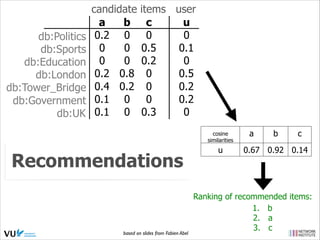
db:Politics
db:Sports
db:Education
db:London
db:Tower_Bridge
db:Government
db:UK

candidate
a
b
0.2 0
0
0
0
0
0.2 0.8
0.4 0.2
0.1 0
0.1 0

items user
c
u
0
0
0.5
0.1
0.2
0
0
0.5
0
0.2
0
0.2
0.3
0
cosine
similarities

Recommendations

based on slides from Fabien Abel

u

a

b

c

0.67 0.92 0.14

Ranking of recommended items:
1.  b
2.  a
3.  c
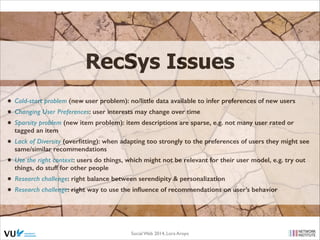
RecSys Issues
• Cold-start problem (new user problem): no/little data available to infer preferences of new users
• Changing User Preferences: user interests may change over time
• Sparsity problem (new item problem): item descriptions are sparse, e.g. not many user rated or
tagged an item

• Lack of Diversity (overfitting): when adapting too strongly to the preferences of users they might see
same/similar recommendations

• Use the right context: users do things, which might not be relevant for their user model, e.g. try out
things, do stuff for other people

• Research challenge: right balance between serendipity & personalization
• Research challenge: right way to use the influence of recommendations on user’s behavior

Social Web 2014, Lora Aroyo!
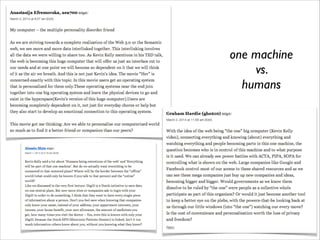
one machine	

vs. 	

humans
Hands-on Teaser
• Your Facebook Friends’ popularity in a spread sheet	

• Locations of your Facebook Friends	

• Tag Cloud of your wall posts

image
Social Web 2014, Lora Aroyo! source: http://www.flickr.com/photos/bionicteaching/1375254387/

Lecture 5: Personalization on the Social Web (2014)

  • 1.
    Social Web 2014 Lecture V:Personalization on the Social Web (some slides adopted from Fabian Abel) Lora Aroyo The Network Institute VU University Amsterdam
  • 2.
    theory & techniquesfor how to design & evaluate recommenders & user models to use in Social Web applications Social Web 2014, Lora Aroyo!
  • 3.
    Fig. 1 Functionalmodel of tasks and sub-tasks specifically suited for SASs Fig. 1 Functional model of tasks and sub-tasks specifically suited for SASs (Ilaria Torre, 2009) Social Web 2014, Lora Aroyo!
  • 4.
    User Modeling How toinfer & represent user information that supports a given application or context? Kevin Kelly Social Web 2014, Lora Aroyo!
  • 5.
    User Modeling Challenge •Application has to obtain, understand & exploit information about the user • Information (need & context) about user • Inferring information about user & representing it so that it can be consumed by the application • Data relevant for inferring information about user Social Web 2014, Lora Aroyo!
  • 6.
    User & UsageData is Everywhere • People leave traces on the Web and on their computers: • Usage data, e.g., query logs, click-through-data • Social data, e.g., tags, (micro-)blog posts, comments, bookmarks, friend connections • Documents, e.g., pictures, videos • Personal data, e.g., affiliations, locations • Products, applications, services - bought, used, installed • Not only a user’s behavior, but also interactions of other users • “people can make statements about me” • “people who are similar to me can reveal information about me” • “social learning” collaborative recommender systems Social Web 2014, Lora Aroyo!
  • 7.
    UM: Basic Concepts •User Profile = data structure = a characterization of a user at a particular moment represents what, from a given (system) perspective, there is to know about a user. The data in the profile can be explicitly given by user or derived by system • User Model = definitions & rules for the interpretation of observations about the user & about the translation of that interpretation into the characteristics in a user profile user model is the recipe for obtaining & interpreting user profiles • User Modeling = the process of representing the user Social Web 2014, Lora Aroyo!
  • 8.
    User Modeling Approaches •Overlay User Modeling: describe user characteristics, e.g. “knowledge of a user”, “interests of a user” with respect to “ideal” characteristics • Customizing: user explicitly provides & adjusts elements of the user profile • User model elicitation: ask & observe the user; learn & improve user profile successively modeling” “interactive user • Stereotyping: stereotypical characteristics to describe a user • User Relevance Modeling: learn/infer probabilities that a given item or concept is relevant for a user Related scientific conference: http://umap2011.org/ Related journal: http:/umuai.org/ Social Web 2014, Lora Aroyo!
  • 9.
    Which approach suitsbest the conditions of applications? Social Web 2014, Lora Aroyo! http://farm7.staticflickr.com/6240/6346803873_e756dd9bae_b.jpg
  • 10.
    Overlay User Models •among the oldest user models • used for modeling student knowledge • the user is typically characterized in terms of domain concepts & hypotheses of the user’s knowledge about these concepts in relation to an (ideal) expert’s knowledge • concept-value pairs Social Web 2014, Lora Aroyo!
  • 11.
    User Model Elicitation •Ask the user explicitly learn • NLP, intelligent dialogues • Bayesian networks, Hidden Markov models • Observe the user learn • Logs, machine learning • Clustering, classification, data mining
 • Interactive user modeling: mixture of direct inputs of a user, observations and inferences Social Web 2014, Lora Aroyo!
  • 12.
  • 13.
    User Stereotypes • set of characteristics(e.g. attribute-value pairs) that describe a group of users. • user is not assigned to a single stereotype - user profile can feature characteristics of several different stereotypes Social Web 2014, Lora Aroyo! http://farm1.staticflickr.com/155/413650229_31ef379b0b_b.jpg
  • 14.
    based on slidesfrom Fabien Abel
  • 15.
    Can we infera Twitter-based User Profile? Personalized News Recommender Profile ? User Modeling (4 building blocks) Semantic Enrichment, Linkage and Alignment based on slides from Fabien Abel I want my personalized news recommendations!
  • 16.
    User Modeling Building Blocks 1.Temporal Constraints 1. Which tweets of the user should be analyzed? start Profile? concept weight ? weekends Morning: Afternoon: Night: (a) time period (b) temporal patterns end time June 27 July 4 based on slides from Fabien Abel July 11
  • 17.
    User Modeling Building Blocks Francesca Schiavone TSport concept weight # hashtag-based entity-based T topic-based # 2. Profile Type Profile? Francesca Schiavone won French Open #fo2010 French Open 1. Temporal Constraints ? fo2010 2. What type of concepts should represent “interests”? time June 27 July 4 based on slides from Fabien Abel July 11
  • 18.
    User Modeling Building Blocks Francesca Schiavone 1.Temporal Constraints (a) tweet-based Profile? Francesca Schiavone won! http://bit.ly/2f4t7a concept weight Francesca Schiavone French Open Tennis Francesca wins French Open Thirty in women's tennis is primordially old, an age when agility and desire recedes as the … French Open 2. Profile Type 3. Semantic Enrichment (b) further enrichment Tennis 3. Further enrich the semantics of tweets? based on slides from Fabien Abel
  • 19.
    User Modeling Building Blocks 1.Temporal Constraints Profile? concept 4. How to weight the concepts? Concept frequency (TF) TFxIDF Time-sensitive weight Francesca Schiavone 4 French Open Tennis ? weight(French Open) weight(Francesca Schiavone) 3 6 2. Profile Type 3. Semantic Enrichment 4. Weighting Scheme weight(Tennis) time June 27 July 4 based on slides from Fabien Abel July 11
  • 20.
    Observations • Profile characteristics: •Semantic enrichment solves sparsity problems • Profiles change over time: recent profiles reflect better current user demands • Temporal patterns: weekend profiles differ significantly from weekday profiles • Impact on recommendations: • The more fine-grained the concepts the better the recommendation performance: entity-based > topic-based > hashtag-based • Semantic enrichment improves recommendation quality • Time-sensitivity (adapting to trends) improves performance Social Web 2014, Lora Aroyo!
  • 21.
    User Modeling it isnot about putting everything in a user profile it is about making the right choices Social Web 2014, Lora Aroyo!
  • 22.
    User Adaptation Knowing theuser to adapt a system or interface to improve the system functionality and user experience Social Web 2014, Lora Aroyo!
  • 23.
    User-Adaptive Systems user profile user modeling observations, dataand information about user profile analysis adaptation decisions A. Jameson. Adaptive interfaces and agents. The HCI handbook: fundamentals, evolving technologies and emerging applications, pp. 305–330, 2003.
  • 24.
    Last.fm adapts to yourmusic taste user profile interests in genres, artists, tags user modeling (infer current musical taste) compare profile with possible next songs to play history of songs, like, ban, pause, skip next song to be played based on slides from Fabien Abel
  • 25.
    Issues in User-Adaptive Systems •Overfitting, “bubble effects”, loss of serendipity problem: • systems may adapt too strongly to the interests/behavior • e.g., an adaptive radio station may always play the same or very similar songs • We search for the right balance between novelty and relevance for the user • “Lost in Hyperspace” problem: • when adapting the navigation – i.e. the links on which users can click to find/access information • e.g., re-ordering/hiding of menu items may lead to confusion Social Web 2014, Lora Aroyo!
  • 26.
    What is gooduser modelling & personalisation? Social Web 2014, Lora Aroyo! http://www.flickr.com/photos/bellarosebyliz/4729613108
  • 27.
    Success Perspectives • Fromthe consumer perspective of an adaptive system: ! Adaptive system maximizes satisfaction of the user hard to measure/obtain ! • From the provider perspective of an adaptive system: Adaptive system maximizes the profit Social Web 2014, Lora Aroyo! influence of UM & personalization may be hard to measure/obtain
  • 28.
    Evaluation Strategies • Userstudies: ask/observe (selected) people whether you did a good job • Log analysis: Analyze (click) data and infer whether you did a good job, • Evaluation of user modeling: • measure quality of profiles directly, e.g. measure overlap with • existing (true) profiles, or let people judge the quality of the generated user profiles measure quality of application that exploits the user profile, e.g., apply user modeling strategies in a recommender system Social Web 2014, Lora Aroyo!
  • 29.
    Evaluating User Modeling inRecSys training data test data (ground truth) item C item A item B training data item G item E item D measure quality time item F Recommendations: Z X Y Strategy X Strategy Y item H Recommender ? User Modeling strategies to compare Social Web 2014, Lora Aroyo! item H item F item H Strategy Z item R item G item H ? ? ? item M item N item M
  • 30.
    Possible Metrics • Theusual IR metrics: • Precision: fraction of retrieved items that are relevant • Recall: fraction of relevant items that have been retrieved • F-Measure: (harmonic) mean of precision and recall • Metrics for evaluating recommendation (rankings): • Mean Reciprocal Rank (MRR) of first relevant item • Success@k: probability that relevant item occurs within the top k • If a true ranking is given: rank correlations • Precision@k, Recall@k & F-Measure@k • Metrics for evaluating prediction of user preferences: • MAE = Mean Absolute Error • True/False Positives/Negatives performance Social Web 2014, Lora Aroyo! strategy X baseline runs Is strategy X better than the baseline?
  • 31.
    Example Evaluation • [Raeet al.] a typical example of how to investigate and evaluate a proposal for improving (tag) recommendations (using social networks) • Task: test how well the different strategies (different tag contexts) can be used for tag prediction/recommendation • Steps: 1. Gather a dataset of tag data part of which can be used as input and aim to test the recommendation on the remaining tag data 2. Use the input data and calculate for the different strategies the predictions 3. Measure the performance using standard (IR) metrics: Precision of the top 5 recommended tags (P@5), Mean Reciprocal Rank (MRR), Mean Average Precision (MAP) 4. Test the results for statistical significance using T-test, relative to the baseline (e.g. existing approach, competitive approach) [Rae et al. Improving Tag Recommendations Using Social Networks, RIAO’10]] Social Web 2014, Lora Aroyo!
  • 32.
    Example Evaluation • [Guyet al.] another example of a similar evaluation approach • The different strategies differ in the way people & tags are used: with tag-based systems, there are complex relationships between users, tags and items, and strategies aim to find the relevant aspects of these relationships for modeling and recommendation • The baseline is the ‘most popular’ tags - often used to compare the most popular tags to the tags predicted by a particular personalization strategy - investigating whether the personalization is worth the effort and is able to outperform the easily available baseline. [Guy et al. Social Media Recommendation based on People and Tags, SIGIR’10]] Social Web 2014, Lora Aroyo!
  • 33.
  • 34.
    Recommendation Systems Predict relevant/useful/interestingitems for a given user (in a given context) it’s often a ranking task Social Web 2014, Lora Aroyo!
  • 35.
    Social Web 2014,Lora Aroyo!
  • 36.
    March 28, 2013 SocialWeb 2014, Lora Aroyo!
  • 37.
    Social Web 2014,Lora Aroyo!
  • 38.
    Social Web 2014,Lora Aroyo!
  • 39.
  • 40.
  • 41.
  • 42.
    Collaborative Filtering • Memory-based:User-Item matrix: ratings/preferences of users => compute similarity between users & recommend items of similar users • Model-based: Item-Item matrix: similarity (e.g. based on user ratings) between items => recommend items that are similar to the ones the user likes • Model-based: Clustering: cluster users according to their preferences => recommend items of users that belong to the same cluster • Model-based: Bayesian networks: P(u likes item B | u likes item A) = how likely is it that a user, who likes item A, will like item B learn probabilities from user ratings/preferences • Others: rule-based, other data mining techniques u1 likes likes u2 likes Social Web 2014, Lora Aroyo! ! u1 likes Pulp Fiction?
  • 43.
    Memory vs. Model-based •complete input data is required • pre-computation not possible • does not scale well • high quality of recommendations ! • abstraction (model) of input data • pre-computation (partially) possible (model has to be re-built from time to time) • scales better • abstraction may reduce recommendation quality Social Web 2014, Lora Aroyo!
  • 44.
    Social Networks & InterestSimilarity • collaborative filtering: ‘neighborhoods’ of people with similar interest & recommending items based on likings in neighborhood • limitations: next to ‘cold start’ and ‘sparsity’ the lack of control (over one’s neighborhood) is also a problem, i.e. cannot add ‘trusted’ people, nor exclude ‘strange’ ones • therefore, interest in ‘social recommenders’, where presence of social connections defines the similarity in interests (e.g. social tagging CiteULike): • does a social connection indicate user interest similarity? • how much users interest similarity depends on the strength of their connection? • is it feasible to use a social network as a personalized recommendation? [Lin & Brusilovsky, Social Social Web 2014, Lora Aroyo! Similarity: The Case of CiteULike, HT’10] Networks and Interest
  • 45.
    Conclusions • unilaterally connectedpairs have more common items/metadata/tags than non-connected pairs • highest similarity for direct connections - decreasing with the increase of distance between users in SN • reciprocal relationship users - significantly larger similarity than users in a unidirectional relationship • traditional item-level similarity may be less reliable to find similar users in social bookmarking systems • peers connected by self-defined social connections could be a useful source for cross-recommendation Social Web 2014, Lora Aroyo!
  • 46.
    Content-based Recommendations • Input: characteristicsof items & interests of a user into characteristics of items => Recommend items that feature characteristics which meet the user’s interests • Techniques: • Data mining methods: Cluster items based on their • • characteristics => Infer users’ interests into clusters IR methods: Represent items & users as term vectors => Compute similarity between user profile vector and items Utility-based methods: Utility function that gets an item as input; the parameters of the utility function are customized via preferences of a user Social Web 2014, Lora Aroyo!
  • 47.
    Government stops renovation oftower bridge Oct 13th 2011 Tower Bridge is a combined bascule and suspension bridge in London, England, over the River Thames. Category: politics, england Related Twiper news: @bob: Why do they stop to… [more] @mary: London stops reno… [more] Tower Bridge today Under construction Content Features db:Politics db:Sports db:Education db:London db:Tower_Bridge db:Government db:UK Weighting strategy: -  occurrence frequency -  normalize vectors (1-norm ! sum of vector equals 1) based on slides from Fabien Abel 0.2 0 0 0.2 = a 0.4 0.1 0.1
  • 48.
    User’s Twitter history RT: Governmentstops renovation of tower bridge Oct 13th 2011 I am in London at the moment Oct 13th 2011 I am doing sports Oct 12th 2011 User Model db:Politics db:Sports db:Education db:London db:Tower_Bridge db:Government db:UK Weighting strategy: -  occurrence frequency (e.g. smoothened by occurrence time ! recent concepts are more important -  normalize vectors (1-norm ! sum of vector equals 1) based on slides from Fabien Abel 0 0.1 0 0.5 = u 0.2 0.2 0
  • 49.
    db:Politics db:Sports db:Education db:London db:Tower_Bridge db:Government db:UK candidate a b 0.2 0 0 0 0 0 0.2 0.8 0.40.2 0.1 0 0.1 0 items user c u 0 0 0.5 0.1 0.2 0 0 0.5 0 0.2 0 0.2 0.3 0 cosine similarities Recommendations based on slides from Fabien Abel u a b c 0.67 0.92 0.14 Ranking of recommended items: 1.  b 2.  a 3.  c
  • 50.
    RecSys Issues • Cold-startproblem (new user problem): no/little data available to infer preferences of new users • Changing User Preferences: user interests may change over time • Sparsity problem (new item problem): item descriptions are sparse, e.g. not many user rated or tagged an item • Lack of Diversity (overfitting): when adapting too strongly to the preferences of users they might see same/similar recommendations • Use the right context: users do things, which might not be relevant for their user model, e.g. try out things, do stuff for other people • Research challenge: right balance between serendipity & personalization • Research challenge: right way to use the influence of recommendations on user’s behavior Social Web 2014, Lora Aroyo!
  • 51.
  • 52.
    Hands-on Teaser • YourFacebook Friends’ popularity in a spread sheet • Locations of your Facebook Friends • Tag Cloud of your wall posts image Social Web 2014, Lora Aroyo! source: http://www.flickr.com/photos/bionicteaching/1375254387/