A MODEL FOR NET MIGRATION BETWEEN THE PORTUGUESE
              REGIONS. ANOTHER PERSPECTIVE
                                     Vitor João Pereira Domingues Martinho

                                  Unidade de I&D do Instituto Politécnico de Viseu
                                       Av. Cor. José Maria Vale de Andrade
                                                Campus Politécnico
                                                 3504 - 510 Viseu
                                                  (PORTUGAL)
                                         e-mail: vdmartinho@esav.ipv.pt


         ABSTRACT

         We built a model identifying the determinants that affect the mobility of labor. The empirical part of the
work will be performed for the NUTS III of Portugal, from 1991 and 2001. At this level of spatial disaggregation
(and in this period) the basic equipment (amenities), particularly in terms of availability of housing, are the main
determinants of migration (1)(Martinho 2011).

         Keyword: net migration; Portuguese regions; cross-section estimations.

         1. INTRODUCTION

          There are many authors who have dedicated themselves to issues of labor mobility, with very different
theoretical assumptions, trying to investigate how these issues or do not explain the regional differences.
For example, the authors associated with the Neoclassical theory, as (2)Solow (1956), consider that the tendency
is, for the labor mobility, to alleviate, in the medium and long term, the regional disparities. This, because these
authors consider the mobility of factors as a function of wages and the supply of resources as exogenous. Thus,
what determines the mobility factor is their compensation.
          On the other hand, the works in line with the Keynesian theory, such as (3)Myrdal (1957) and (4)Kaldor
(1966), among others, argue that the trend is for labor mobility accentuate regional differences, these authors
argue that because the existence of growth processes with circular and cumulative causes. This comes from
assuming the existence of increasing returns to scale, to admit endogenous factors and to consider forces of
demand (especially in foreign demand) as the main determinants of the growth process. Thus, factor mobility is a
function of the forces of demand and employment moves to where demand is strong.
          More recently, authors associated with the New Economic Geography, as (5)Fujita et al. (2000), among
others, are also in favor of the labor mobility accentuates regional disparities. This derivative, as well as in the
Keynesian theory (although with different assumptions), to assume the existence of growth processes with
circular and cumulative causes. The assumptions for the New Economic Geography are microeconomic and have
much to do with transportation costs "iceberg" and the existence of perfect competition in some economic sectors
(for example, agriculture) and monopolistic competition in others sectors (for example, manufactured industry).
These assumptions explain the existence of "backward and forward" linkages that create growth forces centripetal
(having underlying monopolistic competition and increasing returns to scale) and centrifuges forces (because
there are sectors in perfect competition with constant returns to scale). To verify these forces and linkages there
will inevitably mobility of factors, including labor. Generally, the result of these links, forces and labor mobility is
the formation of structures central-periphery, with benefits for the richest and prosperous.
          Therefore, with this context, it appears that the current trend of various economic theories is to consider
that the labor mobility accentuates regional disparities. Even writers in the line of neoclassical theory, as (6)Barro
and Sala-i-Martin (1991), associated with endogenous growth theory, now admit that the mobility of labor reacts
to processes of convergence and reduce regional disparities, but only if some conditions are met. That is, left to
disappear the idea of absolute convergence for the same "steady state" of neoclassical influence, to a perspective
of conditional convergence for differents "steady states".

         2. THE MODEL USED

         In the estimates with spatial effects there are some spatial econometric techniques that are commonly
used. In particular, the Moran's I statistic that is used to identify the existence of local and global spatial
autocorrelation, the strategies of specification classical in six steps of (7)Florax et al. (2003) and LM tests to
identify which form is most appropriate to the model specification, in other words, the component "spatial lag"
(where the dependent variable is spatially lagged through the matrix W), or the component with the "spatial error
"(where is the error term is spatially lagged).
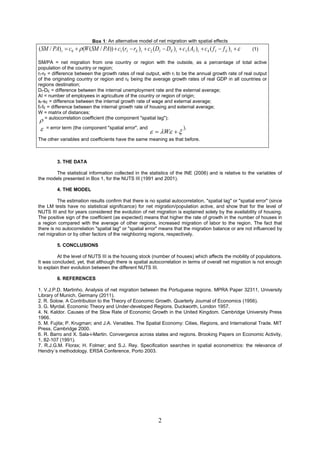
Box 1: An alternative model of net migration with spatial effects
(SM / PA) t  c0   (W (SM / PA))  c1 (rI  rE ) t  c 2 ( DI  DE ) t  c3 ( AI ) t  c 4 ( f I  f E ) t     (1)

SM/PA = net migration from one country or region with the outside, as a percentage of total active
population of the country or region;
rI-rE = difference between the growth rates of real output, with rI to be the annual growth rate of real output
of the originating country or region and rE being the average growth rates of real GDP in all countries or
regions destination;
DI-DE = difference between the internal unemployment rate and the external average;
AI = number of employees in agriculture of the country or region of origin;
sI-sE = difference between the internal growth rate of wage and external average;
fI-fE = difference between the internal growth rate of housing and external average;
W = matrix of distances;
    = autocorrelation coefficient (the component "spatial lag");

   = error term (the component "spatial error", and
                                                               W  
                                                                                ).

The other variables and coefficients have the same meaning as that before.


          3. THE DATA

        The statistical information collected in the statistics of the INE (2006) and is relative to the variables of
the models presented in Box 1, for the NUTS III (1991 and 2001).

          4. THE MODEL

          The estimation results confirm that there is no spatial autocorrelation, "spatial lag" or "spatial error" (since
the LM tests have no statistical significance) for net migration/population active, and show that for the level of
NUTS III and for years considered the evolution of net migration is explained solely by the availability of housing.
The positive sign of the coefficient (as expected) means that higher the rate of growth in the number of houses in
a region compared with the average of other regions, increased migration of labor to the region. The fact that
there is no autocorrelation "spatial lag" or "spatial error" means that the migration balance or are not influenced by
net migration or by other factors of the neighboring regions, respectively.

          5. CONCLUSIONS

         At the level of NUTS III is the housing stock (number of houses) which affects the mobility of populations.
It was concluded, yet, that although there is spatial autocorrelation in terms of overall net migration is not enough
to explain their evolution between the different NUTS III.

          6. REFERENCES

1. V.J.P.D. Martinho. Analysis of net migration between the Portuguese regions. MPRA Paper 32311, University
Library of Munich, Germany (2011).
2. R. Solow. A Contribution to the Theory of Economic Growth. Quarterly Journal of Economics (1956).
3. G. Myrdal. Economic Theory and Under-developed Regions. Duckworth, London 1957.
4. N. Kaldor. Causes of the Slow Rate of Economic Growth in the United Kingdom. Cambridge University Press
1966.
5. M. Fujita; P. Krugman; and J.A. Venables. The Spatial Economy: Cities, Regions, and International Trade. MIT
Press, Cambridge 2000.
6. R. Barro and X. Sala-i-Martin. Convergence across states and regions. Brooking Papers on Economic Activity,
1, 82-107 (1991).
7. R.J.G.M. Florax; H. Folmer; and S.J. Rey. Specification searches in spatial econometrics: the relevance of
Hendry´s methodology. ERSA Conference, Porto 2003.


                                                                  2

A MODEL FOR NET MIGRATION BETWEEN THE PORTUGUESE REGIONS. ANOTHER PERSPECTIVE

  • 1.
    A MODEL FORNET MIGRATION BETWEEN THE PORTUGUESE REGIONS. ANOTHER PERSPECTIVE Vitor João Pereira Domingues Martinho Unidade de I&D do Instituto Politécnico de Viseu Av. Cor. José Maria Vale de Andrade Campus Politécnico 3504 - 510 Viseu (PORTUGAL) e-mail: vdmartinho@esav.ipv.pt ABSTRACT We built a model identifying the determinants that affect the mobility of labor. The empirical part of the work will be performed for the NUTS III of Portugal, from 1991 and 2001. At this level of spatial disaggregation (and in this period) the basic equipment (amenities), particularly in terms of availability of housing, are the main determinants of migration (1)(Martinho 2011). Keyword: net migration; Portuguese regions; cross-section estimations. 1. INTRODUCTION There are many authors who have dedicated themselves to issues of labor mobility, with very different theoretical assumptions, trying to investigate how these issues or do not explain the regional differences. For example, the authors associated with the Neoclassical theory, as (2)Solow (1956), consider that the tendency is, for the labor mobility, to alleviate, in the medium and long term, the regional disparities. This, because these authors consider the mobility of factors as a function of wages and the supply of resources as exogenous. Thus, what determines the mobility factor is their compensation. On the other hand, the works in line with the Keynesian theory, such as (3)Myrdal (1957) and (4)Kaldor (1966), among others, argue that the trend is for labor mobility accentuate regional differences, these authors argue that because the existence of growth processes with circular and cumulative causes. This comes from assuming the existence of increasing returns to scale, to admit endogenous factors and to consider forces of demand (especially in foreign demand) as the main determinants of the growth process. Thus, factor mobility is a function of the forces of demand and employment moves to where demand is strong. More recently, authors associated with the New Economic Geography, as (5)Fujita et al. (2000), among others, are also in favor of the labor mobility accentuates regional disparities. This derivative, as well as in the Keynesian theory (although with different assumptions), to assume the existence of growth processes with circular and cumulative causes. The assumptions for the New Economic Geography are microeconomic and have much to do with transportation costs "iceberg" and the existence of perfect competition in some economic sectors (for example, agriculture) and monopolistic competition in others sectors (for example, manufactured industry). These assumptions explain the existence of "backward and forward" linkages that create growth forces centripetal (having underlying monopolistic competition and increasing returns to scale) and centrifuges forces (because there are sectors in perfect competition with constant returns to scale). To verify these forces and linkages there will inevitably mobility of factors, including labor. Generally, the result of these links, forces and labor mobility is the formation of structures central-periphery, with benefits for the richest and prosperous. Therefore, with this context, it appears that the current trend of various economic theories is to consider that the labor mobility accentuates regional disparities. Even writers in the line of neoclassical theory, as (6)Barro and Sala-i-Martin (1991), associated with endogenous growth theory, now admit that the mobility of labor reacts to processes of convergence and reduce regional disparities, but only if some conditions are met. That is, left to disappear the idea of absolute convergence for the same "steady state" of neoclassical influence, to a perspective of conditional convergence for differents "steady states". 2. THE MODEL USED In the estimates with spatial effects there are some spatial econometric techniques that are commonly used. In particular, the Moran's I statistic that is used to identify the existence of local and global spatial autocorrelation, the strategies of specification classical in six steps of (7)Florax et al. (2003) and LM tests to identify which form is most appropriate to the model specification, in other words, the component "spatial lag" (where the dependent variable is spatially lagged through the matrix W), or the component with the "spatial error "(where is the error term is spatially lagged).
  • 2.
    Box 1: Analternative model of net migration with spatial effects (SM / PA) t  c0   (W (SM / PA))  c1 (rI  rE ) t  c 2 ( DI  DE ) t  c3 ( AI ) t  c 4 ( f I  f E ) t   (1) SM/PA = net migration from one country or region with the outside, as a percentage of total active population of the country or region; rI-rE = difference between the growth rates of real output, with rI to be the annual growth rate of real output of the originating country or region and rE being the average growth rates of real GDP in all countries or regions destination; DI-DE = difference between the internal unemployment rate and the external average; AI = number of employees in agriculture of the country or region of origin; sI-sE = difference between the internal growth rate of wage and external average; fI-fE = difference between the internal growth rate of housing and external average; W = matrix of distances;  = autocorrelation coefficient (the component "spatial lag");  = error term (the component "spatial error", and   W   ). The other variables and coefficients have the same meaning as that before. 3. THE DATA The statistical information collected in the statistics of the INE (2006) and is relative to the variables of the models presented in Box 1, for the NUTS III (1991 and 2001). 4. THE MODEL The estimation results confirm that there is no spatial autocorrelation, "spatial lag" or "spatial error" (since the LM tests have no statistical significance) for net migration/population active, and show that for the level of NUTS III and for years considered the evolution of net migration is explained solely by the availability of housing. The positive sign of the coefficient (as expected) means that higher the rate of growth in the number of houses in a region compared with the average of other regions, increased migration of labor to the region. The fact that there is no autocorrelation "spatial lag" or "spatial error" means that the migration balance or are not influenced by net migration or by other factors of the neighboring regions, respectively. 5. CONCLUSIONS At the level of NUTS III is the housing stock (number of houses) which affects the mobility of populations. It was concluded, yet, that although there is spatial autocorrelation in terms of overall net migration is not enough to explain their evolution between the different NUTS III. 6. REFERENCES 1. V.J.P.D. Martinho. Analysis of net migration between the Portuguese regions. MPRA Paper 32311, University Library of Munich, Germany (2011). 2. R. Solow. A Contribution to the Theory of Economic Growth. Quarterly Journal of Economics (1956). 3. G. Myrdal. Economic Theory and Under-developed Regions. Duckworth, London 1957. 4. N. Kaldor. Causes of the Slow Rate of Economic Growth in the United Kingdom. Cambridge University Press 1966. 5. M. Fujita; P. Krugman; and J.A. Venables. The Spatial Economy: Cities, Regions, and International Trade. MIT Press, Cambridge 2000. 6. R. Barro and X. Sala-i-Martin. Convergence across states and regions. Brooking Papers on Economic Activity, 1, 82-107 (1991). 7. R.J.G.M. Florax; H. Folmer; and S.J. Rey. Specification searches in spatial econometrics: the relevance of Hendry´s methodology. ERSA Conference, Porto 2003. 2