A MODEL BASED ON THE RYBCZYNSKI EQUATION FOR
                         PORTUGAL
                                   Vitor João Pereira Domingues Martinho

                                Unidade de I&D do Instituto Politécnico de Viseu
                                     Av. Cor. José Maria Vale de Andrade
                                              Campus Politécnico
                                               3504 - 510 Viseu
                                                (PORTUGAL)
                                       e-mail: vdmartinho@esav.ipv.pt


         ABSTRACT

         We built a model analyzing the importance which the natural advantages and local resources are in
the manufacturing industry location, in relation with the "spillovers" effects and industrial policies. To this, we
estimate the Rybczynski equation matrix for the various manufacturing industries in Portugal, at regional level
(NUTS II) and for the period 1986 to 1994. As a summary conclusion, noted that the location of manufacturing
in Portugal is still mostly explained by specific factors, with a tendency to increase in some cases the
explanation by these factors, having the effect "spillovers" and industrial policies little importance in this
context.

         Keywords: geographical concentration; Portuguese regions; linear models.

         1. INTRODUCTION

          In this work, taking into account the work of (1)Kim (1999), seeks to analyze the importance of the
natural advantages and local resources (specific factors of locations) have in explaining the geographic
concentration over time in the Portuguese regions, relatively effects "spillovers" and industrial policies (in
particular, the modernization and innovation that have allowed manufacturing in other countries take better
advantage of positive externalities). For this, we estimated the Rybczynski equation matrix for the different
manufacturing industries in the regions of Portugal, for the period 1980 to 1999. It should be noted that while
the model of inter-regional trade, the Heckscher-Ohlin-Vanek, presents a linear relationship between net
exports and inter-regional specific factors of locations, the Rybczynski theorem provides a linear relationship
between regional production and specific factors of locations. In principle, the residual part of the estimation of
Rybczynski, measured by the difference between the adjusted degree of explanation (R2) and the unit
presents a approximated estimate of the importance not only of the "spillovers” effects, as considered by Kim
(1999), but also of the industrial policies, because, industrial policies of modernization and innovation are
interconnected with the "spillover" effects. However, it must be some caution with this interpretation, because,
for example, although the growth of unexplained variation can be attributed to the growing importance of
externalities "Marshallians" or "spillovers" effects and industrial policies, this conclusion may not be correct.
Since the "spillovers" effects and industrial policies are measured as a residual part, the growth in the residual
can be caused, also, for example, by growth in the randomness of the location of the products manufactured
and the growing importance of external trade in goods and factors.
          The designation of externalities "Marshallians" or "spillovers" effects, is because (2)Marshall (1920)
have identified in a systematic way the causes of geographical concentration in industrial activities. Some
recent works in these areas of thought, have sought to precisely identify solutions to these and other
assumptions, present in some works, such as (3)Krugman (1991), (4)Krugman (1992), (5)Krugman et al.
(1995), (6)Fujita et al. (1999), (7)Matsuyama (1991), (8)Gali (1994) and other related with spatial issues. It is
also important to note that Marshall identifies the natural advantages as a major cause of geographical
concentration (Kim, 1999). Another classification for the causes of concentration was made by (9)Scitovsky
(1954), in other words, this author made a distinction between technological externalities, materialized through
interactions unrelated to the market that directly affect consumers' utility or production functions of companies
and pecuniary externalities that result from market interactions, in the proportion that companies engage in
trade of products.

         2. THE BASE MODEL

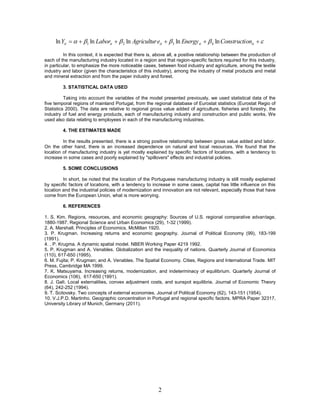
         The base model is then the following (10)(Martinho, 2011):


                                                        1
ln Yit    1 ln Laborit   2 ln Agricultur eit   3 ln Energy it   4 ln Constructi onit  

          In this context, it is expected that there is, above all, a positive relationship between the production of
each of the manufacturing industry located in a region and that region-specific factors required for this industry,
in particular, to emphasize the more noticeable cases, between food industry and agriculture, among the textile
industry and labor (given the characteristics of this industry), among the industry of metal products and metal
and mineral extraction and from the paper industry and forest.

         3. STATISTICAL DATA USED

          Taking into account the variables of the model presented previously, we used statistical data of the
five temporal regions of mainland Portugal, from the regional database of Eurostat statistics (Eurostat Regio of
Statistics 2000). The data are relative to regional gross value added of agriculture, fisheries and forestry, the
industry of fuel and energy products, each of manufacturing industry and construction and public works. We
used also data relating to employees in each of the manufacturing industries.

         4. THE ESTIMATES MADE

         In the results presented, there is a strong positive relationship between gross value added and labor.
On the other hand, there is an increased dependence on natural and local resources. We found that the
location of manufacturing industry is yet mostly explained by specific factors of locations, with a tendency to
increase in some cases and poorly explained by "spillovers" effects and industrial policies.

         5. SOME CONCLUSIONS

         In short, be noted that the location of the Portuguese manufacturing industry is still mostly explained
by specific factors of locations, with a tendency to increase in some cases, capital has little influence on this
location and the industrial policies of modernization and innovation are not relevant, especially those that have
come from the European Union, what is more worrying.

         6. REFERENCES

1. S. Kim. Regions, resources, and economic geography: Sources of U.S. regional comparative advantage,
1880-1987. Regional Science and Urban Economics (29), 1-32 (1999).
2. A. Marshall. Principles of Economics. McMillan 1920.
3. P. Krugman. Increasing returns and economic geography. Journal of Political Economy (99), 183-199
(1991).
4. , P. Krugma. A dynamic spatial model. NBER Working Paper 4219 1992.
5. P. Krugman and A. Venables. Globalization and the inequality of nations. Quarterly Journal of Economics
(110), 617-650 (1995).
6. M. Fujita; P. Krugman; and A. Venables. The Spatial Economy. Cities, Regions and International Trade. MIT
Press, Cambridge MA 1999.
7. K. Matsuyama. Increasing returns, modernization, and indeterminacy of equilibrium. Quarterly Journal of
Economics (106), 617-650 (1991).
8. J. Galì. Local externalities, convex adjustment costs, and sunspot equilibria. Journal of Economic Theory
(64), 242-252 (1994).
9. T. Scitovsky. Two concepts of external economies. Journal of Political Economy (62), 143-151 (1954).
10. V.J.P.D. Martinho. Geographic concentration in Portugal and regional specific factors. MPRA Paper 32317,
University Library of Munich, Germany (2011).


                                                         2

A MODEL BASED ON THE RYBCZYNSKI EQUATION FOR PORTUGAL

  • 1.
    A MODEL BASEDON THE RYBCZYNSKI EQUATION FOR PORTUGAL Vitor João Pereira Domingues Martinho Unidade de I&D do Instituto Politécnico de Viseu Av. Cor. José Maria Vale de Andrade Campus Politécnico 3504 - 510 Viseu (PORTUGAL) e-mail: vdmartinho@esav.ipv.pt ABSTRACT We built a model analyzing the importance which the natural advantages and local resources are in the manufacturing industry location, in relation with the "spillovers" effects and industrial policies. To this, we estimate the Rybczynski equation matrix for the various manufacturing industries in Portugal, at regional level (NUTS II) and for the period 1986 to 1994. As a summary conclusion, noted that the location of manufacturing in Portugal is still mostly explained by specific factors, with a tendency to increase in some cases the explanation by these factors, having the effect "spillovers" and industrial policies little importance in this context. Keywords: geographical concentration; Portuguese regions; linear models. 1. INTRODUCTION In this work, taking into account the work of (1)Kim (1999), seeks to analyze the importance of the natural advantages and local resources (specific factors of locations) have in explaining the geographic concentration over time in the Portuguese regions, relatively effects "spillovers" and industrial policies (in particular, the modernization and innovation that have allowed manufacturing in other countries take better advantage of positive externalities). For this, we estimated the Rybczynski equation matrix for the different manufacturing industries in the regions of Portugal, for the period 1980 to 1999. It should be noted that while the model of inter-regional trade, the Heckscher-Ohlin-Vanek, presents a linear relationship between net exports and inter-regional specific factors of locations, the Rybczynski theorem provides a linear relationship between regional production and specific factors of locations. In principle, the residual part of the estimation of Rybczynski, measured by the difference between the adjusted degree of explanation (R2) and the unit presents a approximated estimate of the importance not only of the "spillovers” effects, as considered by Kim (1999), but also of the industrial policies, because, industrial policies of modernization and innovation are interconnected with the "spillover" effects. However, it must be some caution with this interpretation, because, for example, although the growth of unexplained variation can be attributed to the growing importance of externalities "Marshallians" or "spillovers" effects and industrial policies, this conclusion may not be correct. Since the "spillovers" effects and industrial policies are measured as a residual part, the growth in the residual can be caused, also, for example, by growth in the randomness of the location of the products manufactured and the growing importance of external trade in goods and factors. The designation of externalities "Marshallians" or "spillovers" effects, is because (2)Marshall (1920) have identified in a systematic way the causes of geographical concentration in industrial activities. Some recent works in these areas of thought, have sought to precisely identify solutions to these and other assumptions, present in some works, such as (3)Krugman (1991), (4)Krugman (1992), (5)Krugman et al. (1995), (6)Fujita et al. (1999), (7)Matsuyama (1991), (8)Gali (1994) and other related with spatial issues. It is also important to note that Marshall identifies the natural advantages as a major cause of geographical concentration (Kim, 1999). Another classification for the causes of concentration was made by (9)Scitovsky (1954), in other words, this author made a distinction between technological externalities, materialized through interactions unrelated to the market that directly affect consumers' utility or production functions of companies and pecuniary externalities that result from market interactions, in the proportion that companies engage in trade of products. 2. THE BASE MODEL The base model is then the following (10)(Martinho, 2011): 1
  • 2.
    ln Yit   1 ln Laborit   2 ln Agricultur eit   3 ln Energy it   4 ln Constructi onit   In this context, it is expected that there is, above all, a positive relationship between the production of each of the manufacturing industry located in a region and that region-specific factors required for this industry, in particular, to emphasize the more noticeable cases, between food industry and agriculture, among the textile industry and labor (given the characteristics of this industry), among the industry of metal products and metal and mineral extraction and from the paper industry and forest. 3. STATISTICAL DATA USED Taking into account the variables of the model presented previously, we used statistical data of the five temporal regions of mainland Portugal, from the regional database of Eurostat statistics (Eurostat Regio of Statistics 2000). The data are relative to regional gross value added of agriculture, fisheries and forestry, the industry of fuel and energy products, each of manufacturing industry and construction and public works. We used also data relating to employees in each of the manufacturing industries. 4. THE ESTIMATES MADE In the results presented, there is a strong positive relationship between gross value added and labor. On the other hand, there is an increased dependence on natural and local resources. We found that the location of manufacturing industry is yet mostly explained by specific factors of locations, with a tendency to increase in some cases and poorly explained by "spillovers" effects and industrial policies. 5. SOME CONCLUSIONS In short, be noted that the location of the Portuguese manufacturing industry is still mostly explained by specific factors of locations, with a tendency to increase in some cases, capital has little influence on this location and the industrial policies of modernization and innovation are not relevant, especially those that have come from the European Union, what is more worrying. 6. REFERENCES 1. S. Kim. Regions, resources, and economic geography: Sources of U.S. regional comparative advantage, 1880-1987. Regional Science and Urban Economics (29), 1-32 (1999). 2. A. Marshall. Principles of Economics. McMillan 1920. 3. P. Krugman. Increasing returns and economic geography. Journal of Political Economy (99), 183-199 (1991). 4. , P. Krugma. A dynamic spatial model. NBER Working Paper 4219 1992. 5. P. Krugman and A. Venables. Globalization and the inequality of nations. Quarterly Journal of Economics (110), 617-650 (1995). 6. M. Fujita; P. Krugman; and A. Venables. The Spatial Economy. Cities, Regions and International Trade. MIT Press, Cambridge MA 1999. 7. K. Matsuyama. Increasing returns, modernization, and indeterminacy of equilibrium. Quarterly Journal of Economics (106), 617-650 (1991). 8. J. Galì. Local externalities, convex adjustment costs, and sunspot equilibria. Journal of Economic Theory (64), 242-252 (1994). 9. T. Scitovsky. Two concepts of external economies. Journal of Political Economy (62), 143-151 (1954). 10. V.J.P.D. Martinho. Geographic concentration in Portugal and regional specific factors. MPRA Paper 32317, University Library of Munich, Germany (2011). 2