A MODEL BASED ON THE NEOCLASSICAL THEORY FOR THE
          PORTUGUESE MANUFACTURED INDUSTRY
                                      Vitor João Pereira Domingues Martinho

                                   Unidade de I&D do Instituto Politécnico de Viseu
                                        Av. Cor. José Maria Vale de Andrade
                                                 Campus Politécnico
                                                  3504 - 510 Viseu
                                                   (PORTUGAL)
                                          e-mail: vdmartinho@esav.ipv.pt


         ABSTRACT

           We built a model analyzing the absolute convergence, associated with the neoclassical theory, of the
sectoral productivity at regional level. Presenting some empirical evidence of absolute convergence of productivity
for each manufactured industry in each of the regions of mainland Portugal (NUTS II) in the period 1986 to 1994
and from 1995 to 1999. The main conclusions should be noted that the signs of convergence are stronger in the
first period than in the second.

         Keywords: neoclassical theory; linear models; manufactured industry; Portuguese regions

         1. THE BASE MODEL

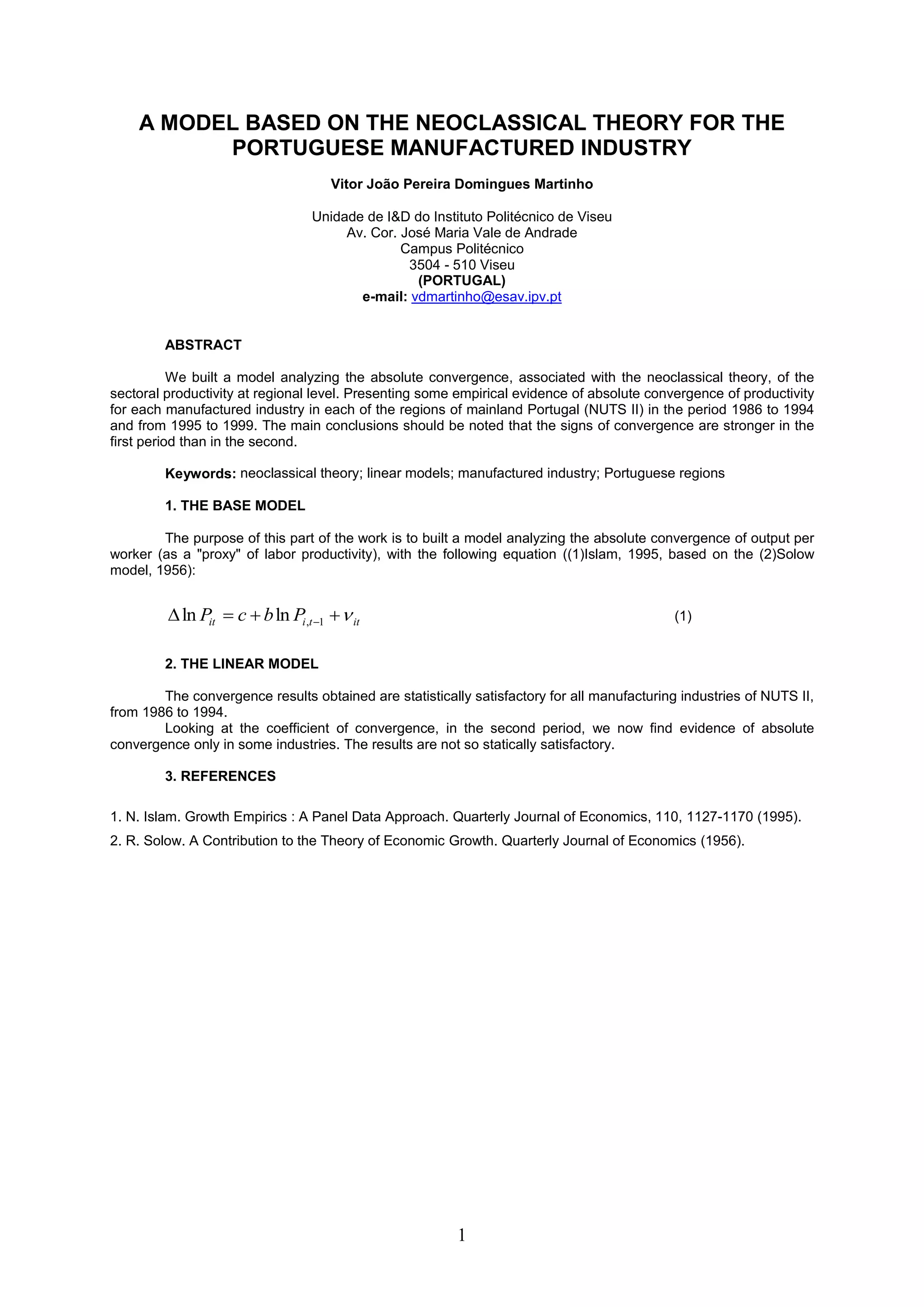
        The purpose of this part of the work is to built a model analyzing the absolute convergence of output per
worker (as a "proxy" of labor productivity), with the following equation ((1)Islam, 1995, based on the (2)Solow
model, 1956):


          ln Pit  c  b ln Pi ,t 1   it                                                (1)


         2. THE LINEAR MODEL

        The convergence results obtained are statistically satisfactory for all manufacturing industries of NUTS II,
from 1986 to 1994.
        Looking at the coefficient of convergence, in the second period, we now find evidence of absolute
convergence only in some industries. The results are not so statically satisfactory.

         3. REFERENCES

1. N. Islam. Growth Empirics : A Panel Data Approach. Quarterly Journal of Economics, 110, 1127-1170 (1995).
2. R. Solow. A Contribution to the Theory of Economic Growth. Quarterly Journal of Economics (1956).


                                                          1

A MODEL BASED ON THE NEOCLASSICAL THEORY FOR THE

  • 1.
    A MODEL BASEDON THE NEOCLASSICAL THEORY FOR THE PORTUGUESE MANUFACTURED INDUSTRY Vitor João Pereira Domingues Martinho Unidade de I&D do Instituto Politécnico de Viseu Av. Cor. José Maria Vale de Andrade Campus Politécnico 3504 - 510 Viseu (PORTUGAL) e-mail: vdmartinho@esav.ipv.pt ABSTRACT We built a model analyzing the absolute convergence, associated with the neoclassical theory, of the sectoral productivity at regional level. Presenting some empirical evidence of absolute convergence of productivity for each manufactured industry in each of the regions of mainland Portugal (NUTS II) in the period 1986 to 1994 and from 1995 to 1999. The main conclusions should be noted that the signs of convergence are stronger in the first period than in the second. Keywords: neoclassical theory; linear models; manufactured industry; Portuguese regions 1. THE BASE MODEL The purpose of this part of the work is to built a model analyzing the absolute convergence of output per worker (as a "proxy" of labor productivity), with the following equation ((1)Islam, 1995, based on the (2)Solow model, 1956):  ln Pit  c  b ln Pi ,t 1   it (1) 2. THE LINEAR MODEL The convergence results obtained are statistically satisfactory for all manufacturing industries of NUTS II, from 1986 to 1994. Looking at the coefficient of convergence, in the second period, we now find evidence of absolute convergence only in some industries. The results are not so statically satisfactory. 3. REFERENCES 1. N. Islam. Growth Empirics : A Panel Data Approach. Quarterly Journal of Economics, 110, 1127-1170 (1995). 2. R. Solow. A Contribution to the Theory of Economic Growth. Quarterly Journal of Economics (1956). 1