VOTING WITH WATSON
FOR IBM DESIGN
Emma Fagergren | Tony Pattin | Angélica Rosenzweig
INTRO

DEMOCRACY
”Democracy cannot succeed unless those who express
their choice are prepared to choose wisely. The real
safeguard of democracy, therefore, is education. ”

Benjamin Franklin
OVERVIEW

TABLE OF CONTENTS
PROBLEM 4
RESEARCH INSIGHTS 5
TARGET USERS 6
CORE 7
EXPERIENCE MAP 9
SCENARIO & WIREFRAMES 11
SYSTEM MAP 23
DATA SOURCE 24
POTENTIAL ISSUES 25
FINANCIAL 26
THANK YOU 27
APPENDIX 28
PROBLEM

PROBLEM
Parsing information to stay politically informed is time
consuming as well as energy consuming, and this in turn can
can discourage people from voting.
RESEARCH INSIGHTS

CONFIDENCE MATTERS
Voting is considered “the right thing” to do, but a low
confidence in understanding of political issues and parties
discourages voting (1).

PRESENTATION MATTERS
It is not lack of information that is the problem, it is lack of
information presented in a way that people can relate to.
TARGET USER

TARGET USERS
Individuals who want to vote but feel like they don't know
enough to make an informed decision.
CORE

CORE
Make complex historical and current political data transparent
and digestible to aid the voting decision process.
CORE

DO THIS BY:
Letting users ask Watson questions (in natural language)
Synthesizing information relating to issues that the user has
identified as relevant
Showing how candidate’s values align with the user’s

WE ARE NOT:
Telling the user who to vote for. The app should be politically
neutral.
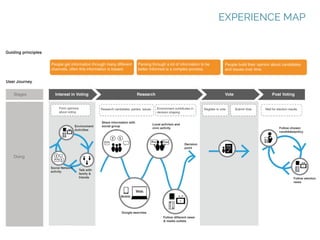
EXPERIENCE MAP
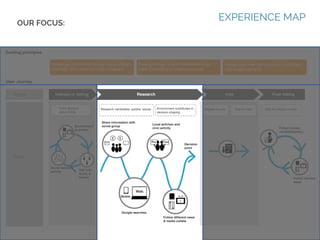
OUR FOCUS:

EXPERIENCE MAP
SCENARIO

It is the fall of 2016 and with elections coming up
millions of Americans are getting ready to vote. Some
are certain who they are voting for, others are still trying
to decide.
SCENARIO

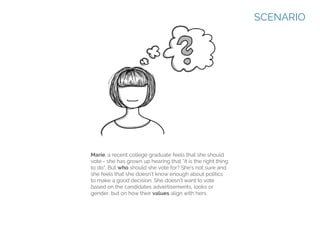
Marie, a recent college graduate feels that she should
vote - she has grown up hearing that “it is the right thing
to do”. But who should she vote for? She’s not sure and
she feels that she doesn’t know enough about politics
to make a good decision. She doesn’t want to vote
based on the candidates advertisements, looks or
gender, but on how their values align with hers.
SCENARIO

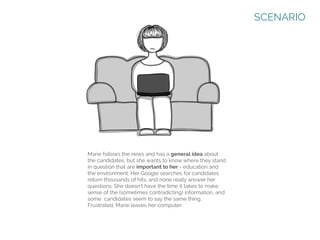
Marie follows the news and has a general idea about
the candidates, but she wants to know where they stand
in question that are important to her - education and
the environment. Her Google searches for candidates
return thousands of hits, and none really answer her
questions. She doesn’t have the time it takes to make
sense of the (sometimes contradicting) information, and
some candidates seem to say the same thing.
Frustrated, Marie leaves her computer.
SCENARIO

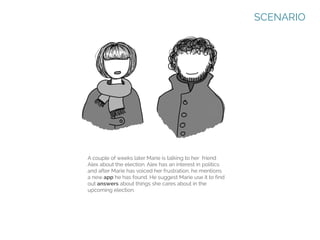
A couple of weeks later Marie is talking to her friend
Alex about the election. Alex has an interest in politics
and after Marie has voiced her frustration, he mentions
a new app he has found. He suggest Marie use it to find
out answers about things she cares about in the
upcoming election.
WIREFRAMES
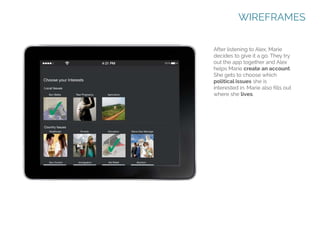
After listening to Alex, Marie
decides to give it a go. They try
out the app together and Alex
helps Marie create an account.
She gets to choose which
political issues she is
interested in. Marie also fills out
where she lives.
WIREFRAMES
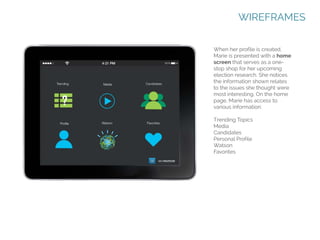
When her profile is created,
Marie is presented with a home
screen that serves as a onestop shop for her upcoming
election research. She notices
the information shown relates
to the issues she thought were
most interesting. On the home
page, Marie has access to
various information:
Trending Topics
Media
Candidates
Personal Profile
Watson
Favorites
WIREFRAMES
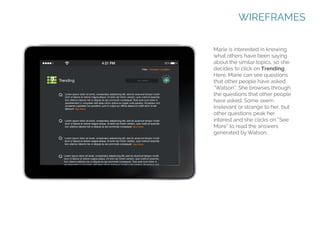
Marie is interested in knowing
what others have been saying
about the similar topics, so she
decides to click on Trending.
Here, Marie can see questions
that other people have asked
“Watson”. She browses through
the questions that other people
have asked. Some seem
irrelevant or strange to her, but
other questions peak her
interest and she clicks on “See
More” to read the answers
generated by Watson.
WIREFRAMES
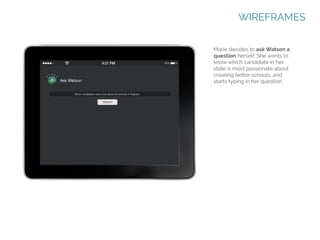
Marie decides to ask Watson a
question herself. She wants to
know which candidate in her
state is most passionate about
creating better schools, and
starts typing in her question.
WIREFRAMES
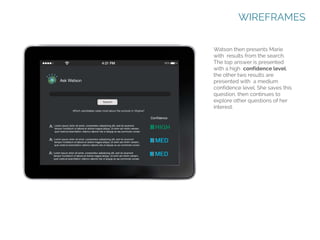
Watson then presents Marie
with results from the search.
The top answer is presented
with a high confidence level;
the other two results are
presented with a medium
confidence level. She saves this
question, then continues to
explore other questions of her
interest.
SCENARIO

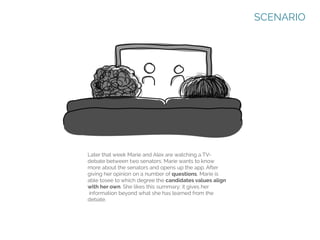
Later that week Marie and Alex are watching a TVdebate between two senators. Marie wants to know
more about the senators and opens up the app. After
giving her opinion on a number of questions, Marie is
able tosee to which degree the candidates values align
with her own. She likes this summary; it gives her
information beyond what she has learned from the
debate.
SCENARIO
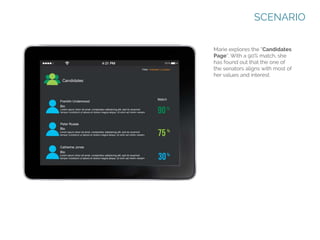
Marie explores the “Candidates
Page”. With a 90% match, she
has found out that the one of
the senators aligns with most of
her values and interest.
SCENARIO

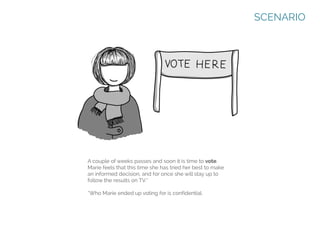
A couple of weeks passes and soon it is time to vote.
Marie feels that this time she has tried her best to make
an informed decision, and for once she will stay up to
follow the results on TV.*
*Who Marie ended up voting for is confidential.
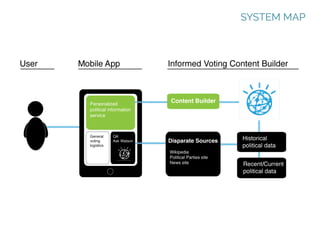
SYSTEM MAP
DATA SOURCE

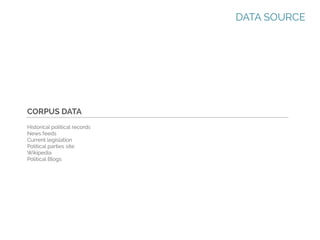
CORPUS DATA
Historical political records
News feeds
Current legislation
Political parties site
Wikipedia
Political Blogs
POTENTIAL ISSUES

DIFFERENT CANDIDATES
Watson is likely to find more information for experienced
candidates than new candidates. This might affect confidence
levels.

CONFIDENCE LEVELS
Use Watson’s Confidence levels to avoid deception. The nature of
political information is often biased, but by looking at many
different sources, Watson triangulate between different sources to
create meaning and show confidence levels in the response
FINANCIAL

SELLING DATA
After a period of use, the app will have collected user data
that will be of interest to politicians and campaign managers.
Selling this data would generate revenue.

POTENTIAL SPONSORS
Independent civic organizations
Project Vote Smart
Federal Election Commission (FEC)
THANK YOU

SPECIAL THANKS TO:
IBM Design
Tarun Gangwani
Chung-Ching Huang
Brandon Le
Mark Marrara
Marty Siegel
HCI/d 2014 Cohort
APPENDIX

RESEARCH
(1) Youth Federal Election voting intention
http:/
/www.whitlam.org/__data/assets/pdf_file/0005/507803/Newsp
oll_Analysis_Update_Election_Poll_Update_Aug_2013.pdf @ 20 Nov. 2013
(2) http:/
/photos.state.gov/libraries/amgov/30145/publicationsenglish/USA_Elections_InBrief.pdf @ 20 Nov. 2013
APPENDIX

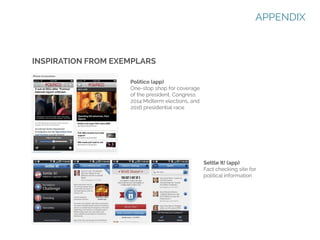
INSPIRATION FROM EXEMPLARS
Politico (app)
One-stop shop for coverage
of the president, Congress,
2014 Midterm elections, and
2016 presidential race

Settle It! (app)
Fact checking site for
political information
APPENDIX

OUR PROCESS
Understanding Watson
Brainstorming problem spaces
Research: Understanding the voting process
Personas
Sketching and problem exploration
User case scenarios
High-fidelity wireframes and graphics
Crafting deliverables

Voting with Watson

  • 1.
    VOTING WITH WATSON FORIBM DESIGN Emma Fagergren | Tony Pattin | Angélica Rosenzweig
  • 2.
    INTRO DEMOCRACY ”Democracy cannot succeedunless those who express their choice are prepared to choose wisely. The real safeguard of democracy, therefore, is education. ” Benjamin Franklin
  • 3.
    OVERVIEW TABLE OF CONTENTS PROBLEM4 RESEARCH INSIGHTS 5 TARGET USERS 6 CORE 7 EXPERIENCE MAP 9 SCENARIO & WIREFRAMES 11 SYSTEM MAP 23 DATA SOURCE 24 POTENTIAL ISSUES 25 FINANCIAL 26 THANK YOU 27 APPENDIX 28
  • 4.
    PROBLEM PROBLEM Parsing information tostay politically informed is time consuming as well as energy consuming, and this in turn can can discourage people from voting.
  • 5.
    RESEARCH INSIGHTS CONFIDENCE MATTERS Votingis considered “the right thing” to do, but a low confidence in understanding of political issues and parties discourages voting (1). PRESENTATION MATTERS It is not lack of information that is the problem, it is lack of information presented in a way that people can relate to.
  • 6.
    TARGET USER TARGET USERS Individualswho want to vote but feel like they don't know enough to make an informed decision.
  • 7.
    CORE CORE Make complex historicaland current political data transparent and digestible to aid the voting decision process.
  • 8.
    CORE DO THIS BY: Lettingusers ask Watson questions (in natural language) Synthesizing information relating to issues that the user has identified as relevant Showing how candidate’s values align with the user’s WE ARE NOT: Telling the user who to vote for. The app should be politically neutral.
  • 9.
  • 10.
  • 11.
    SCENARIO It is thefall of 2016 and with elections coming up millions of Americans are getting ready to vote. Some are certain who they are voting for, others are still trying to decide.
  • 12.
    SCENARIO Marie, a recentcollege graduate feels that she should vote - she has grown up hearing that “it is the right thing to do”. But who should she vote for? She’s not sure and she feels that she doesn’t know enough about politics to make a good decision. She doesn’t want to vote based on the candidates advertisements, looks or gender, but on how their values align with hers.
  • 13.
    SCENARIO Marie follows thenews and has a general idea about the candidates, but she wants to know where they stand in question that are important to her - education and the environment. Her Google searches for candidates return thousands of hits, and none really answer her questions. She doesn’t have the time it takes to make sense of the (sometimes contradicting) information, and some candidates seem to say the same thing. Frustrated, Marie leaves her computer.
  • 14.
    SCENARIO A couple ofweeks later Marie is talking to her friend Alex about the election. Alex has an interest in politics and after Marie has voiced her frustration, he mentions a new app he has found. He suggest Marie use it to find out answers about things she cares about in the upcoming election.
  • 15.
    WIREFRAMES After listening toAlex, Marie decides to give it a go. They try out the app together and Alex helps Marie create an account. She gets to choose which political issues she is interested in. Marie also fills out where she lives.
  • 16.
    WIREFRAMES When her profileis created, Marie is presented with a home screen that serves as a onestop shop for her upcoming election research. She notices the information shown relates to the issues she thought were most interesting. On the home page, Marie has access to various information: Trending Topics Media Candidates Personal Profile Watson Favorites
  • 17.
    WIREFRAMES Marie is interestedin knowing what others have been saying about the similar topics, so she decides to click on Trending. Here, Marie can see questions that other people have asked “Watson”. She browses through the questions that other people have asked. Some seem irrelevant or strange to her, but other questions peak her interest and she clicks on “See More” to read the answers generated by Watson.
  • 18.
    WIREFRAMES Marie decides toask Watson a question herself. She wants to know which candidate in her state is most passionate about creating better schools, and starts typing in her question.
  • 19.
    WIREFRAMES Watson then presentsMarie with results from the search. The top answer is presented with a high confidence level; the other two results are presented with a medium confidence level. She saves this question, then continues to explore other questions of her interest.
  • 20.
    SCENARIO Later that weekMarie and Alex are watching a TVdebate between two senators. Marie wants to know more about the senators and opens up the app. After giving her opinion on a number of questions, Marie is able tosee to which degree the candidates values align with her own. She likes this summary; it gives her information beyond what she has learned from the debate.
  • 21.
    SCENARIO Marie explores the“Candidates Page”. With a 90% match, she has found out that the one of the senators aligns with most of her values and interest.
  • 22.
    SCENARIO A couple ofweeks passes and soon it is time to vote. Marie feels that this time she has tried her best to make an informed decision, and for once she will stay up to follow the results on TV.* *Who Marie ended up voting for is confidential.
  • 23.
  • 24.
    DATA SOURCE CORPUS DATA Historicalpolitical records News feeds Current legislation Political parties site Wikipedia Political Blogs
  • 25.
    POTENTIAL ISSUES DIFFERENT CANDIDATES Watsonis likely to find more information for experienced candidates than new candidates. This might affect confidence levels. CONFIDENCE LEVELS Use Watson’s Confidence levels to avoid deception. The nature of political information is often biased, but by looking at many different sources, Watson triangulate between different sources to create meaning and show confidence levels in the response
  • 26.
    FINANCIAL SELLING DATA After aperiod of use, the app will have collected user data that will be of interest to politicians and campaign managers. Selling this data would generate revenue. POTENTIAL SPONSORS Independent civic organizations Project Vote Smart Federal Election Commission (FEC)
  • 27.
    THANK YOU SPECIAL THANKSTO: IBM Design Tarun Gangwani Chung-Ching Huang Brandon Le Mark Marrara Marty Siegel HCI/d 2014 Cohort
  • 28.
    APPENDIX RESEARCH (1) Youth FederalElection voting intention http:/ /www.whitlam.org/__data/assets/pdf_file/0005/507803/Newsp oll_Analysis_Update_Election_Poll_Update_Aug_2013.pdf @ 20 Nov. 2013 (2) http:/ /photos.state.gov/libraries/amgov/30145/publicationsenglish/USA_Elections_InBrief.pdf @ 20 Nov. 2013
  • 29.
    APPENDIX INSPIRATION FROM EXEMPLARS Politico(app) One-stop shop for coverage of the president, Congress, 2014 Midterm elections, and 2016 presidential race Settle It! (app) Fact checking site for political information
  • 30.
    APPENDIX OUR PROCESS Understanding Watson Brainstormingproblem spaces Research: Understanding the voting process Personas Sketching and problem exploration User case scenarios High-fidelity wireframes and graphics Crafting deliverables