Breakdowns as Pleasurable
Experiences
Dennis Ellis | Vamsi Pasupuleti | Angélica Rosenzweig
Predispositions
- Some people don’t want to continually check on their appliances.
- Interactions with appliances in themselves can be pleasurable.
- Slow change in behavior can be attained through repetitive actions.
Target Users
2nd or 3rd generation (late) adopters
They may know about the energy-saving capabilities but cannot be
bothered with lots of information about use.
In-and-out users
Getting the job done is most important, doesn’t want to spend too much
time messing with controls.
Research
Primary Research: Artifact Analysis
- Identify interaction points with appliances at home for 3 individuals
- Breakdown existing workflow when interacting with appliances
Research
Insight: Complex appliance controllers are often ignored.

Interaction with coffee machine: plug-in, start, plug-off when done
Research
Insight: Immediate feedback is expected from fine-tuning

Interaction with stove: Increase/decrease heat intensity
Research
Primary Research: Ethnography (Appliance section, Sears)
- Played around with different appliances
- Identified points of interaction
- Viewed competitor solutions
Research
Insight: The first and main form of interaction with any appliance is
either a handle or a nob.
Research
Insight: There is a finite number of output modes currently used in
Appliances. These modes are lights, sounds, and textures.
Existing Interface
The energy-saving functions
on washer and dryer units are
disconnected with the first
interaction a person has,
which is with the nob.
Connecting parts of the
interface that perform
similar tasks can help clarify
task flows for people.
Secondary Research
1.Present-at-hand attitude towards appliances
2. Take advantage of possible “breakdowns” that occur when the
appliance becomes present-at-hand.

Present-at-hand is an idea taken from Martin Heidegger. Present-at-hand is an attitude that is adopted towards an
object. This attitude occurs when breakdowns in the user journey happen. We understand breakdowns as moments
in an interaction where attention is called to the interaction. These moments need not be jarring, but can be simple
moments of reflection and discovery with an object. We use the present-at-hand attitude to call attention to
energy-saving behaviors and reward people with smooth and pleasurable interactions.
Design Core
Make the appliance a more meaningful part of the home by increasing
the capabilities for interaction.
- Do this by creating pleasurable breakdowns to make eco-friendly
attitudes present-at-hand
Concept
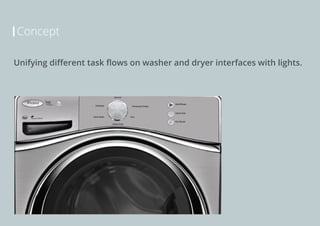
Unifying different task flows on washer and dryer interfaces with lights.
The static “home” state of the washer interface.

The knob starts to glow when approached. In this way, the washer unit greets each person.
Here, the person has selected the “Normal” setting. Notice that the Start button illuminates in the
same color that illuminates the knob.

Here, the person has selected the “Permanent Press” setting. Notice that the Start button illuminates in the same color that illuminates the knob.
Now the person decides to try the “Eco” setting. Notice that the color call outs are different and
more elaborate for the Eco setting. These call outs help guide each person to the appropriate controls on the washer.
Experiential Prototype
https://vimeo.com/79509735
A washing machine user interface to test and learn how simple changes
can lead to changes in user’s actions.
- Tested 4 users, all said the blue eco-friendly light mode was more
appealing, and seemed surprised to see the change in color.
Conclusion
- Simple changes in can fit in a user’s workflow, and make frequently
unused modes of operation present-to-hand.
- Our concept maintain’s user’s mental models while creating a window
of opportunity to affect change.
- Similar approaches can be taken with other appliances without big
changes in modes of operation.
Thank you

Whirlpool UX team
Marty Siegel
Chung-Ching Huang

Breakdowns as Pleasurable Experiences

  • 1.
    Breakdowns as Pleasurable Experiences DennisEllis | Vamsi Pasupuleti | Angélica Rosenzweig
  • 2.
    Predispositions - Some peopledon’t want to continually check on their appliances. - Interactions with appliances in themselves can be pleasurable. - Slow change in behavior can be attained through repetitive actions.
  • 3.
    Target Users 2nd or3rd generation (late) adopters They may know about the energy-saving capabilities but cannot be bothered with lots of information about use. In-and-out users Getting the job done is most important, doesn’t want to spend too much time messing with controls.
  • 4.
    Research Primary Research: ArtifactAnalysis - Identify interaction points with appliances at home for 3 individuals - Breakdown existing workflow when interacting with appliances
  • 5.
    Research Insight: Complex appliancecontrollers are often ignored. Interaction with coffee machine: plug-in, start, plug-off when done
  • 6.
    Research Insight: Immediate feedbackis expected from fine-tuning Interaction with stove: Increase/decrease heat intensity
  • 7.
    Research Primary Research: Ethnography(Appliance section, Sears) - Played around with different appliances - Identified points of interaction - Viewed competitor solutions
  • 8.
    Research Insight: The firstand main form of interaction with any appliance is either a handle or a nob.
  • 9.
    Research Insight: There isa finite number of output modes currently used in Appliances. These modes are lights, sounds, and textures.
  • 10.
    Existing Interface The energy-savingfunctions on washer and dryer units are disconnected with the first interaction a person has, which is with the nob. Connecting parts of the interface that perform similar tasks can help clarify task flows for people.
  • 11.
    Secondary Research 1.Present-at-hand attitudetowards appliances 2. Take advantage of possible “breakdowns” that occur when the appliance becomes present-at-hand. Present-at-hand is an idea taken from Martin Heidegger. Present-at-hand is an attitude that is adopted towards an object. This attitude occurs when breakdowns in the user journey happen. We understand breakdowns as moments in an interaction where attention is called to the interaction. These moments need not be jarring, but can be simple moments of reflection and discovery with an object. We use the present-at-hand attitude to call attention to energy-saving behaviors and reward people with smooth and pleasurable interactions.
  • 12.
    Design Core Make theappliance a more meaningful part of the home by increasing the capabilities for interaction. - Do this by creating pleasurable breakdowns to make eco-friendly attitudes present-at-hand
  • 13.
    Concept Unifying different taskflows on washer and dryer interfaces with lights.
  • 14.
    The static “home”state of the washer interface. The knob starts to glow when approached. In this way, the washer unit greets each person.
  • 15.
    Here, the personhas selected the “Normal” setting. Notice that the Start button illuminates in the same color that illuminates the knob. Here, the person has selected the “Permanent Press” setting. Notice that the Start button illuminates in the same color that illuminates the knob.
  • 16.
    Now the persondecides to try the “Eco” setting. Notice that the color call outs are different and more elaborate for the Eco setting. These call outs help guide each person to the appropriate controls on the washer.
  • 17.
    Experiential Prototype https://vimeo.com/79509735 A washingmachine user interface to test and learn how simple changes can lead to changes in user’s actions. - Tested 4 users, all said the blue eco-friendly light mode was more appealing, and seemed surprised to see the change in color.
  • 18.
    Conclusion - Simple changesin can fit in a user’s workflow, and make frequently unused modes of operation present-to-hand. - Our concept maintain’s user’s mental models while creating a window of opportunity to affect change. - Similar approaches can be taken with other appliances without big changes in modes of operation.
  • 19.
    Thank you Whirlpool UXteam Marty Siegel Chung-Ching Huang