CASES ON CHALLENGES FACING E-LEARNING
AND NATIONAL DEVELOPMENT:

Institutional Studies and Practices

VOLUME: I

Editor
Ugur DEMIRAY

Co-Editors
Leena VAINIO
Mehmet Can SAHIN
Gulsun KURUBACAK
Petri T. LOUNASKORPI
S. Raja RAO
Carlos MACHADO
Anadolu University-2010
Eskisehir-Turkey
Electronic ISBN 978-975-98590-9-1 (2.c)
978-975-98590-7-7 (tk.)
Cover Design by: Atila Ozer
Page Design by: Ahmet Kirez
Webmaster Erdinc Ergun

© Ugur Demiray-2010
BIODATA OF THE EDITORS
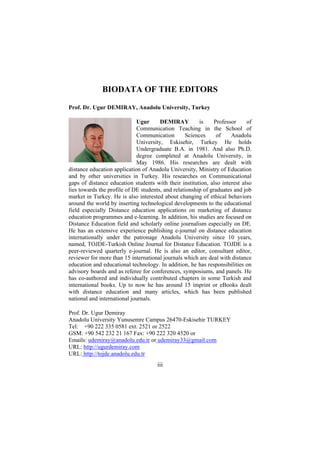
Prof. Dr. Ugur DEMIRAY, Anadolu University, Turkey
Ugur
DEMIRAY
is
Professor
of
Communication Teaching in the School of
Communication
Sciences
of
Anadolu
University, Eskisehir, Turkey He holds
Undergraduate B.A. in 1981. And also Ph.D.
degree completed at Anadolu University, in
May 1986. His researches are dealt with
distance education application of Anadolu University, Ministry of Education
and by other universities in Turkey. His researches on Communicational
gaps of distance education students with their institution, also interest also
lies towards the profile of DE students, and relationship of graduates and job
market in Turkey. He is also interested about changing of ethical behaviors
around the world by inserting technological developments to the educational
field especially Distance education applications on marketing of distance
education programmes and e-learning. In addition, his studies are focused on
Distance Education field and scholarly online journalism especially on DE.
He has an extensive experience publishing e-journal on distance education
internationally under the patronage Anadolu University since 10 years,
named, TOJDE-Turkish Online Journal for Distance Education. TOJDE is a
peer-reviewed quarterly e-journal. He is also an editor, consultant editor,
reviewer for more than 15 international journals which are deal with distance
education and educational technology. In addition, he has responsibilities on
advisory boards and as referee for conferences, symposiums, and panels. He
has co-authored and individually contributed chapters in some Turkish and
international books. Up to now he has around 15 imprint or eBooks dealt
with distance education and many articles, which has been published
national and international journals.
Prof. Dr. Ugur Demiray
Anadolu University Yunusemre Campus 26470-Eskisehir TURKEY
Tel: +90 222 335 0581 ext. 2521 or 2522
GSM: +90 542 232 21 167 Fax: +90 222 320 4520 or
Emails: udemiray@anadolu.edu.tr or udemiray33@gmail.com
URL: http://ugurdemiray.com
URL: http://tojde.anadolu.edu.tr

iii
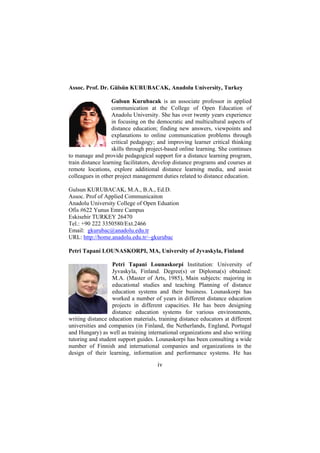
Assoc. Prof. Dr. Gülsün KURUBACAK, Anadolu University, Turkey
Gulsun Kurubacak is an associate professor in applied
communication at the College of Open Education of
Anadolu University. She has over twenty years experience
in focusing on the democratic and multicultural aspects of
distance education; finding new answers, viewpoints and
explanations to online communication problems through
critical pedagogy; and improving learner critical thinking
skills through project-based online learning. She continues
to manage and provide pedagogical support for a distance learning program,
train distance learning facilitators, develop distance programs and courses at
remote locations, explore additional distance learning media, and assist
colleagues in other project management duties related to distance education.
Gulsun KURUBACAK, M.A., B.A., Ed.D.
Assoc. Prof of Applied Communicaiton
Anadolu University College of Open Eduation
Ofis #622 Yunus Emre Campus
Eskisehir TURKEY 26470
Tel.: +90 222 3350580/Ext.2466
Email: gkurubac@anadolu.edu.tr
URL: http://home.anadolu.edu.tr/~gkurubac
Petri Tapani LOUNASKORPI, MA, University of Jyvaskyla, Finland
Petri Tapani Lounaskorpi Institution: University of
Jyvaskyla, Finland. Degree(s) or Diploma(s) obtained:
M.A. (Master of Arts, 1985), Main subjects: majoring in
educational studies and teaching Planning of distance
education systems and their business. Lounaskorpi has
worked a number of years in different distance education
projects in different capacities. He has been designing
distance education systems for various environments,
writing distance education materials, training distance educators at different
universities and companies (in Finland, the Netherlands, England, Portugal
and Hungary) as well as training international organizations and also writing
tutoring and student support guides. Lounaskorpi has been consulting a wide
number of Finnish and international companies and organizations in the
design of their learning, information and performance systems. He has

iv
worked in this sector, among others, for projects at Central Finlands
educational system ( secondary level ) and the Finnish Tax Admistration.
Petri Lounaskorpi
NewTEC, Nuutinpojantie 4, 40270 Palokka
Tel: +358 40 7343889
Email: petri.lounaskorpi@gmail.com
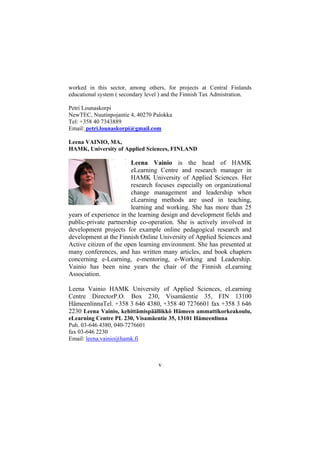
Leena VAINIO, MA,
HAMK, University of Applied Sciences, FINLAND

Leena Vainio is the head of HAMK
eLearning Centre and research manager in
HAMK University of Applied Sciences. Her
research focuses especially on organizational
change management and leadership when
eLearning methods are used in teaching,
learning and working. She has more than 25
years of experience in the learning design and development fields and
public-private partnership co-operation. She is actively involved in
development projects for example online pedagogical research and
development at the Finnish Online University of Applied Sciences and
Active citizen of the open learning environment. She has presented at
many conferences, and has written many articles, and book chapters
concerning e-Learning, e-mentoring, e-Working and Leadership.
Vainio has been nine years the chair of the Finnish eLearning
Association.
Leena Vainio HAMK University of Applied Sciences, eLearning
Centre DirectorP.O. Box 230, Visamäentie 35, FIN 13100
HämeenlinnaTel. +358 3 646 4380, +358 40 7276601 fax +358 3 646
2230 Leena Vainio, kehittämispäällikkö Hämeen ammattikorkeakoulu,
eLearning Centre PL 230, Visamäentie 35, 13101 Hämeenlinna
Puh. 03-646 4380, 040-7276601
fax 03-646 2230
Email: leena.vainio@hamk.fi

v
Dr. Mehmet Can SAHIN, Anadolu University, Eskisehir, Turkey
Mehmet Can SAHIN is a Drin the Computer Education
and Instructional Technologies Department in the Faculty
of Education in Anadolu University, Eskisehir, Turkey. His
research interests are Educational Theories, Instructional
Design, Internet Based Distance Education, Individual
differences in Education and Profiles of Students,
Instructional Design, Mobile Learning and ICT use in
Education. He has articles and symposium proceedings in
both national and international levels on the subjects such as Computer
Ethics, Evaluation of Educational Books, Changing Profiles of Students with
ICT Use, Instructional Design, Educational Theories, Educational
Evaluation, Internet Based Distance Education, Meta–analysis and NanoLearning. He had the responsibilities on organizing committees in
educational conferences and symposiums in both national and international
levels. He gives lectures on Instructional Technology, Instructional Material
Use and Design, Computer Programming, Educational Communication and
Instructional Message Design.
Dr. Mehmet Can SAHIN
Anadolu University
Faculty of Education
Tel: 222 3350581ext: 3519
Mobile: 05359851187
Email: mcsahin@anadolu.edu.tr
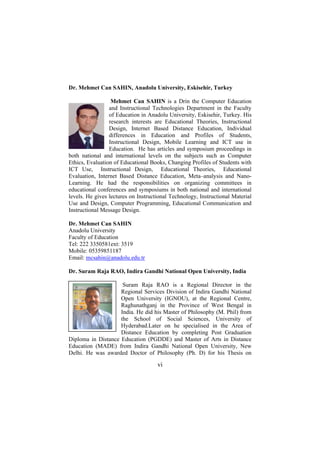
Dr. Suram Raja RAO, Indira Gandhi National Open University, India
Suram Raja RAO is a Regional Director in the
Regional Services Division of Indira Gandhi National
Open University (IGNOU), at the Regional Centre,
Raghunathganj in the Province of West Bengal in
India. He did his Master of Philosophy (M. Phil) from
the School of Social Sciences, University of
Hyderabad.Later on he specialised in the Area of
Distance Education by completing Post Graduation
Diploma in Distance Education (PGDDE) and Master of Arts in Distance
Education (MADE) from Indira Gandhi National Open University, New
Delhi. He was awarded Doctor of Philosophy (Ph. D) for his Thesis on

vi
“Administration of Student Support Services in Distance Education: A Case
Study of Dr. B. R. Ambedkar Open University”. During his more than 20
years of service in IGNOU, he worked in four Regional Centres at Shimla,
Ahmedabad, Hyderabad and Pune. Initially he joined as a Lecturer in Pubic
Administration and later on he became the Assistant Regional Director and
Deputy Director and at present he is heading a Regional Centre as the
Regional Director.
As an active academic researcher, his research articles are published in the
National and International referred Journals in the area of Open and Distance
Education. He is one of the reviewers for Indian Journal of Open Learning
(IJOL) and Kakatiya Journal of Distance Education (KJDE). He contributed
chapters to books and Associate Editor to a book on “Distance Education in
Andhra Pradesh: Policies, Practices, Perspectives”. He participated in
National and International Seminars and attended many Workshops. He also
organised and coordinated more than 50 Orientation Programmes for the
Academic Counselors and Functionaries for ensuring quality support
services to the learners. He has been actively involved in the activities of
professional organisations in the field of Distance Education and Public
Administration as a Life Member in Indian Distance Education Association
(IDEA) and New Public Administration Society of India (NEPASI) and as a
Secretary of Indian Distance Education Association (2006-07).
Academically he had many distinctions like University First Rank in M. A.
Public Administration, Awarded Junior Research Fellowship and Best
Research Paper Award.
Dr. Suram Raja RAO,
Regional Director
IGNOU Regional Centre, Room No. 312, Second Floor
New Administrative Building, SDO Jangipur Office Compound
Raghunathganj – 742 225, District Murshidabad, (WB), INDIA
Telephone: +91 3483- 271 666, Mobile: +91 94 34 73 15 14
Email: srajarao@ignou.ac.in or drsrajarao@gmail.com

vii
Dr. Carlos MACHADO, International Project Manager, Belgium
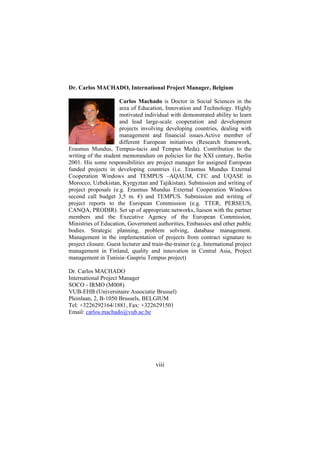
Carlos Machado is Doctor in Social Sciences in the
area of Education, Innovation and Technology. Highly
motivated individual with demonstrated ability to learn
and lead large-scale cooperation and development
projects involving developing countries, dealing with
management and financial issues.Active member of
different European initiatives (Research framework,
Erasmus Mundus, Tempus-tacis and Tempus Meda). Contribution to the
writing of the student memorandum on policies for the XXI century, Berlin
2001. His some responsibilities are project manager for assigned European
funded projects in developing countries (i.e. Erasmus Mundus External
Cooperation Windows and TEMPUS –AQAUM, CFC and UQASE in
Morocco, Uzbekistan, Kyrgyztan and Tajikistan). Submission and writing of
project proposals (e.g. Erasmus Mundus External Cooperation Windows
second call budget 3,5 m. €) and TEMPUS. Submission and writing of
project reports to the European Commission (e.g. TTER, PERSEUS,
CANQA, PRODIR). Set up of appropriate networks, liaison with the partner
members and the Executive Agency of the European Commission,
Ministries of Education, Government authorities, Embassies and other public
bodies. Strategic planning, problem solving, database management.
Management in the implementation of projects from contract signature to
project closure. Guest lecturer and train-the-trainer (e.g. International project
management in Finland, quality and innovation in Central Asia, Project
management in Tunisia–Gaspriu Tempus project)
Dr. Carlos MACHADO
International Project Manager
SOCO - IRMO (M008)
VUB-EHB (Universitaire Associatie Brussel)
Pleinlaan, 2, B-1050 Brussels, BELGIUM
Tel: +3226292164/1881, Fax: +3226291501
Email: carlos.machado@vub.ac.be

viii
LIST OF CONRIBUTORS

(Arranged in alphabetical order surname)
Mosleh Al ADHAILEH, King Faisal University, SAUDI ARABIA
Hend S. Al-Khalifa, King Saud University, Riyadh, SAUDI
ARABIA
Ali Sharaf Al MUSAWI, Sultan Qaboos University, OMAN

Rachida AJHOUN, Université Mohamed V-Souissi,
MOROCCO
Tomaz AMON, President Center for Scientific Visualization,
SLOVENIA
Yelena ARTYKBAYEVA, National Center of Informatization,
KAZAKHSTAN
Laura ASANDULUI, “Al. I. Cuza” University, Iasi, ROMANIA

Modafar ATI, Abu Dhabi University, UNITED ARAB
EMIRATES
Cengiz Hakan AYDIN, Anadolu University, TURKEY

Fawzi BAROUD, Faculty of Natural & Applied Sciences,
LEBANON
Géza BOGNÁR, Dennis Gabor Applied University, HUNGARY
Driss BOUZIDI, Hassan II Ain Chock University, MOROCCO
Tudor BRAGARU State University of Moldova, MOLDOVA
Zoran BUDIMAC, University of Novi Sad, SERBIA
Ciprian CEOBANU, “Al. I. Cuza” University, Iasi, ROMANIA

Kamal Abou CHEDID, Notre Dame University, LEBANON
Roxana CRIU, “Al. I. Cuza” University, Iasi, ROMANIA
Habil Valentina DAGIENE, Institute of Mathematics and
Informatics LITHUANIA
Maryia DAVIDOUSKAIA, Belarus State University, Minsk,
BELARUS
Zeineb DEYMI GHERIANI, Higher Institute of Languages in
Gabes, TUNISIA
Mahieddine DJOUDI, XLIM-SIC Lab. & IRMA Research Group,
University of Poitiers, FRANCE
Rositsa DONEVA, University of Plovdiv, BULGARIA

ix
Vladimir DOUNAEV, Independent Expert, Belarusian Higher
Education, Minsk, BELARUS
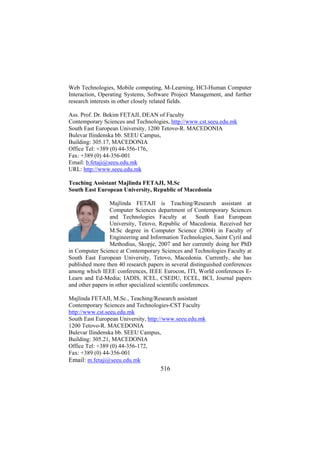
Bekim FETAJI, South East European University, Republic of
MACEDONIA
Majlinda FETAJI, South East European University, Republic of
MACEDONIA
Nidhal GUESSOUM, American University of Sharjah, UNITED
ARAB EMIRATES
Mohamed Ziad HAMDAN, Consultant to Arab Open University
North America, SYRIA
Alena ILAVSKA, UT Zvolen, SLOVAKIA
Olimpius ISTRATE,, University of Bucharest, ROMANIA
Mirjana IVANOVIC, University of Novi Sad, SERBIA
Nabil J. J. JONDI, Hebron University, PALESTINE
Ala'a Al-Din J. KADHEM AL-RADHI, Senior Consultant
Ahmad KHAMESAN, Birjand University, IRAN
Mahmoud M. EL-KHOULY, Helwan University, EGYPT
Paul KAWACHI, Fellow of the Royal Society of Art- FRSA,
Open University of China, CHINA
KJÄLLANDER, Stockholm University, Stockholm, SWEDEN
Ene KOITLA, Estonian Information Technology Foundation,
ESTONIA
Jaroslava KOVACOVA, University of Economics, SLOVAKIA
Eugenijus KURILOVAS, Institute of Mathematics and Informatics,
Vilnius, LITHUANIA
Natalija LEPKOVA, Vilnius Gediminas Technical University,
Vilnius, LITHUANIA
Alla MANAKO, International Research and Training Center for
Information Technologies and Systems Kiev, UKRAINE
Boriss F. MISNEVS, Transport and Telecommunication Institute,
LATVIA
Vardan MKRTTCHIAN, All Armenian Internet University,
HHH Technology Incorporation, ARMENIA

Petri T LOUNASKORPI, University of Tampere, FINLAND
Carlos MACHADO, International Project Manager, BELGIUM
Despina MAKRIDOU BOUSIOU, Department of Applied
Informatics, University of Macedonia, GREECE
Davoud MASOUMI, University of Gothenburg, SWEDEN
Maria MAVROMATI, Department of Applied Informatics,
University of Macedonia, GREECE

x
Mohammad A. MIKKI, Islamic University of Gaza, PALESTINE
Gul NURGALIEVA, National Center of Informatization,
KAZAKHSTAN
Sergey POZDNYAKOV, Saint-Petersburg State Electrotechnical
University, RUSSIA
Zoran PUTNIK, University of Novi Sad, SERBIA
Ali Hechemi. RADDAOUI, University of Wyoming, USA
Torstein REKKEDAL, Director of Research and Development,
NORWAY
Silva RIMKUVIENE, Vilnius Gediminas Technical University,
LITHUANIA
Serge RUKSHIN, Russian State Pedagogical University, RUSSIA
Anna RYBAK, University of Bialystokx, POLAND
Dimirios SIDIROPOULOS, Katerini Technical High School,
GREECE
Conţiu SOITU, Al.I. Cuza University, ROMANIA
Eva Edman STÅLBRANDT, Stockholm University, Stockholm,
SWEDEN
Nevena STAEVSKY, Mannheim, DEUTSCHLAND
Kateryna SYNYTSYA, International Research and Training Center
for Information Technologies and Systems Kiev, UKRAINE
Almira TAZHIGULOVA, National Center of Informatization
KAZAKHSTAN
Khurshed I. TESHAEV, Technological University of TAJIKISTAN
Daniela DUREVA TUPAROVA, South West University,
BULGARIA
Georgi Teoharov TUPAROV, South West University, BULGARIA
Botir USMONOV, Moscow State University in Tashkent,

UZBEKISTAN
Leena VAINIO, University of Applied Sciences, FINLAND
Tapio VARIS, UNESCO eLearning Director, FINLAND
Yoav YAIR, The Open University of Israel, ISRAEL
Gonca TELLI YAMAMOTO, Okan University, TURKEY
Sarolta ZÁRDA, Dennis Gabor Applied University, HUNGARY

xi
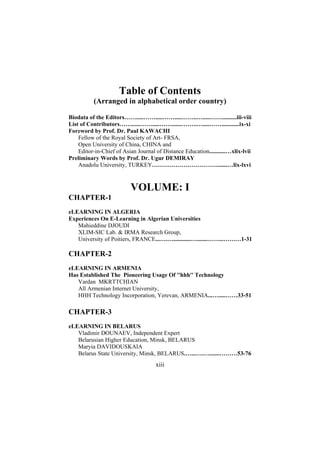
Table of Contents
(Arranged in alphabetical order country)
Biodata of the Editors…….....…….....…….....……..….....……..........iii-viii
List of Contributors……......…….....…….......……..….....……............ix-xi
Foreword by Prof. Dr. Paul KAWACHI
Fellow of the Royal Society of Art- FRSA,
Open University of China, CHINA and
Editor-in-Chief of Asian Journal of Distance Education...........…xlix-lvii
Preliminary Words by Prof. Dr. Ugur DEMIRAY
Anadolu University, TURKEY…………………………….......…lix-lxvi

VOLUME: I
CHAPTER-1
eLEARNING IN ALGERIA
Experiences On E-Learning in Algerian Universities
Mahieddine DJOUDI
XLIM-SIC Lab. & IRMA Research Group,
University of Poitiers, FRANCE...….…............….......……...………1-31

CHAPTER-2
eLEARNING IN ARMENIA
Has Established The Pioneering Usage Of ''hhh'' Technology
Vardan MKRTTCHIAN
All Armenian Internet University,
HHH Technology Incorporation, Yerevan, ARMENIA...….....……33-51

CHAPTER-3
eLEARNING IN BELARUS
Vladimir DOUNAEV, Independent Expert
Belarusian Higher Education, Minsk, BELARUS
Maryia DAVIDOUSKAIA
Belarus State University, Minsk, BELARUS.…...….….......………53-76

xiii
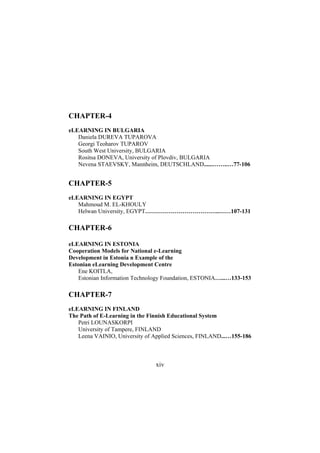
CHAPTER-4
eLEARNING IN BULGARIA
Daniela DUREVA TUPAROVA
Georgi Teoharov TUPAROV
South West University, BULGARIA
Rositsa DONEVA, University of Plovdiv, BULGARIA
Nevena STAEVSKY, Mannheim, DEUTSCHLAND......……..…77-106

CHAPTER-5
eLEARNING IN EGYPT
Mahmoud M. EL-KHOULY
Helwan University, EGYPT………………………………..……107-131

CHAPTER-6
eLEARNING IN ESTONIA
Cooperation Models for National e-Learning
Development in Estonia n Example of the
Estonian eLearning Development Centre
Ene KOITLA,
Estonian Information Technology Foundation, ESTONIA…...…133-153

CHAPTER-7
eLEARNING IN FINLAND
The Path of E-Learning in the Finnish Educational System
Petri LOUNASKORPI
University of Tampere, FINLAND
Leena VAINIO, University of Applied Sciences, FINLAND...…155-186

xiv
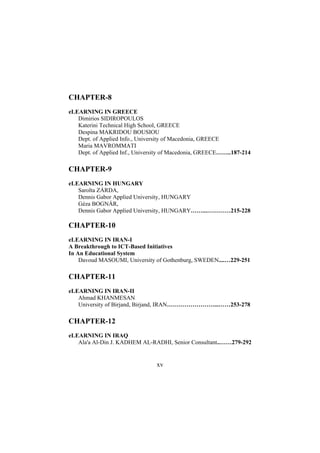
CHAPTER-8
eLEARNING IN GREECE
Dimirios SIDIROPOULOS
Katerini Technical High School, GREECE
Despina MAKRIDOU BOUSIOU
Dept. of Applied Info., University of Macedonia, GREECE
Maria MAVROMMATI
Dept. of Applied Inf., University of Macedonia, GREECE……..187-214

CHAPTER-9
eLEARNING IN HUNGARY
Sarolta ZÁRDA,
Dennis Gabor Applied University, HUNGARY
Géza BOGNÁR,
Dennis Gabor Applied University, HUNGARY……...…………215-228

CHAPTER-10
eLEARNING IN IRAN-I
A Breakthrough to ICT-Based Initiatives
In An Educational System
Davoud MASOUMI, University of Gothenburg, SWEDEN....…229-251

CHAPTER-11
eLEARNING IN IRAN-II
Ahmad KHANMESAN
University of Birjand, Birjand, IRAN……………………...……253-278

CHAPTER-12
eLEARNING IN IRAQ
Ala'a Al-Din J. KADHEM AL-RADHI, Senior Consultant..……279-292

xv
CHAPTER-13
eLEARNING IN ISRAEL:
A Case Study of Technology in Distance Higher Education:
The Open University of Israel
Yoav YAIR, The Open University of Israel, ISRAEL…..............293-317

CHAPTER-15
eLEARNING IN JORDAN
Challenges Facing e-Learning in the New Millennium
Mosleh AL-ADHAILEH
King Faisal University, SAUDI ARABIA…………...…………319--336

CHAPTER-15
eLEARNING IN KAZAKHSTAN
Gul NURGALIEVA
National Center of Informatization, KAZAKHSTAN
Almira TAZHIGULOVA
National Center of Informatization KAZAKHSTAN
Yelena ARTYKBAYEVA
National Center of Informatization, KAZAKHSTAN………..…337-356

CHAPTER-16
eLEARNING IN KYRGYZTAN
E-Learning and ICT Development in Education In Kyrgyzstan
Carlos MACHADO
International Project Manager, BELGIUM………..….....………357-378

CHAPTER-17
eLEARNING IN LATVIA
Dimensions of E-Learning Education in Latvia
Boriss F. MISNEVS
Transport and Telecommunication Institute, LATVIA….............379-409

xvi
CHAPTER-18
eLEARNING IN LEBANON
Patterns of E-learning Development in Lebanon’s
Mosaic Educational Context
Fawzi BAROUD
Notre Dame University-Louaize (NDU), LEBANON
Kamal ABOUCHEDID
Notre Dame University-Louaize (NDU), LEBANON…..………411-436

CHAPTER-19
eLEARNING IN LITHUANIA-I
Natalija LEPKOVA
Silva RIMKUVIENE,
Vilnius Gediminas Technical University, LITHUANIA..………437-462

CHAPTER-20
eLEARNING IN LITHUANIA-II
Eugenijus KURILOVAS
Institute of Mathematics and Informatics, Vilnius, LITHUANIA
Habil Valentina DAGIENE
Institute of Mathematics and Informatics
Vilnius, LITHUANIA……………………………………………463-484

xvii
VOLUME: II

CHAPTER-21
eLEARNING IN MACEDONIA
Bekim FETAJI
Majlinda FETAJI
South East European University, Republic of MACEDONIA…..485-516

CHAPTER-22
eLEARNING IN MOLDOVA
E-Learning and ICT Development
in Education In The Republic of Moldova
Tudor B RAGARU State University of Moldova, MOLDOVA

Conţiu SOITU, Al.I. Cuza University, ROMANIA.......… 517-547

CHAPTER-230
eLEARNING IN MOROCCO
Developments and Issues in Morocco
Rachida AJHOUN
Université Mohamed V-Souissi, MOROCCO
Driss BOUZIDI
Hassan II Ain Chock University, MOROCCO..…….…...…...… 549-584

CHAPTER-24
eLEARNING IN NORWAY
Torstein REKKEDAL
Director of Research and Development, NKI, NORWAY………585-602

xviii
CHAPTER-25
eLEARNING IN OMAN:
E-Learning from an Omani Perspective
Ali Sharaf Al MUSAWI
Sultan Qaboos University, OMAN..…….………….……………603-626

CHAPTER-26
eLEARNING IN PALESTINE
Mohammad A. MIKKI
Islamic University of Gaza, PALESTINE
Nabil J. J. JONDI
Hebron University, PALESTINE…………..…...…….…………627-652

CHAPTER-27
eLEARNING IN POLAND
Anna RYBAK
University of Bialystokx, POLAND..….………….…..…………653-672

CHAPTER-28
eLEARNING IN ROMANIA-I
Olimpius ISTRATE
Institute for Education
University of Bucharest, ROMANIA....……….…………………673-694

CHAPTER-29
eLEARNING IN ROMANIA-II
Past, Present and Future
Ciprian CEOBANU
Laura ASANDULUI
Roxana CRIU
“Al. I. Cuza” University, Iasi, ROMANIA........…............…......…… 695-710

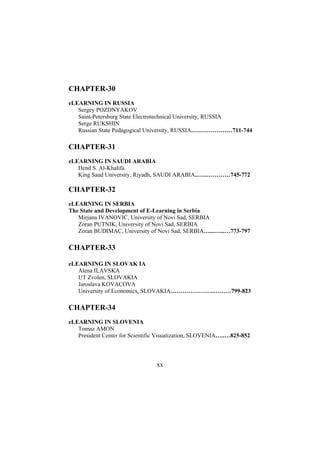
xix
CHAPTER-30
eLEARNING IN RUSSIA
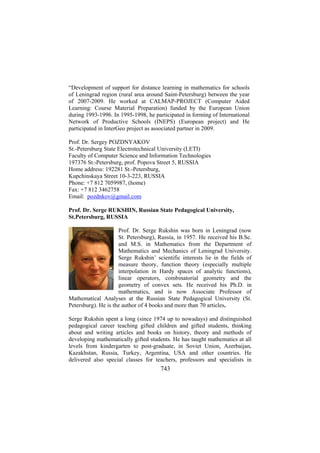
Sergey POZDNYAKOV
Saint-Petersburg State Electrotechnical University, RUSSIA
Serge RUKSHIN
Russian State Pedagogical University, RUSSIA…………………711-744

CHAPTER-31
eLEARNING IN SAUDI ARABIA
Hend S. Al-Khalifa
King Saud University, Riyadh, SAUDI ARABIA..…..…………745-772

CHAPTER-32
eLEARNING IN SERBIA
The State and Development of E-Learning in Serbia
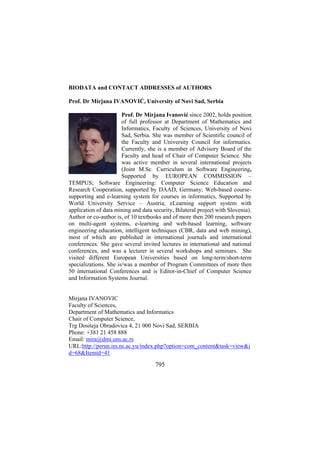
Mirjana IVANOVIC, University of Novi Sad, SERBIA
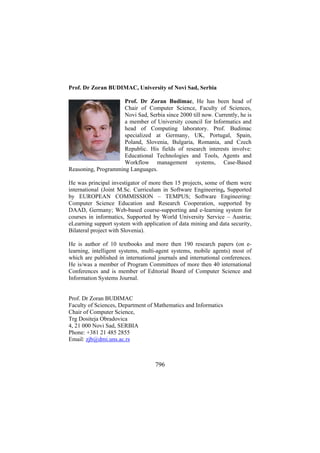
Zoran PUTNIK, University of Novi Sad, SERBIA
Zoran BUDIMAC, University of Novi Sad, SERBIA…...…...…773-797

CHAPTER-33
eLEARNING IN SLOVAK IA
Alena ILAVSKA
UT Zvolen, SLOVAKIA
Jaroslava KOVACOVA
University of Economics, SLOVAKIA………………….………799-823

CHAPTER-34
eLEARNING IN SLOVENIA
Tomaz AMON
President Center for Scientific Visualization, SLOVENIA…..…825-852

xx
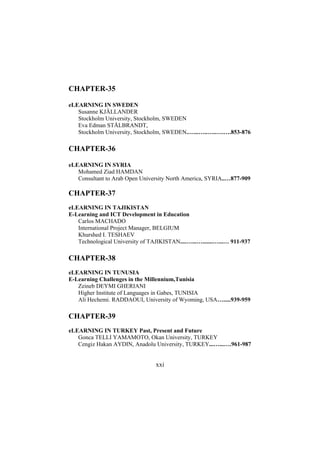
CHAPTER-35
eLEARNING IN SWEDEN
Susanne KJÄLLANDER
Stockholm University, Stockholm, SWEDEN
Eva Edman STÅLBRANDT,
Stockholm University, Stockholm, SWEDEN.…...…..…..….….853-876

CHAPTER-36
eLEARNING IN SYRIA
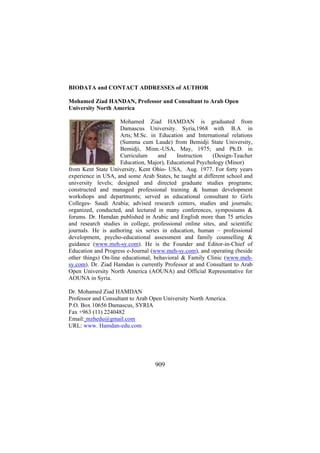
Mohamed Ziad HAMDAN
Consultant to Arab Open University North America, SYRIA..…877-909

CHAPTER-37
eLEARNING IN TAJIKISTAN
E-Learning and ICT Development in Education
Carlos MACHADO
International Project Manager, BELGIUM
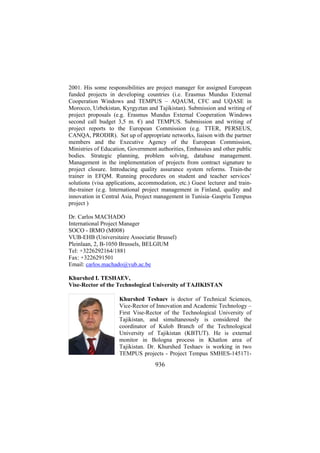
Khurshed I. TESHAEV
Technological University of TAJIKISTAN....…...….......…...… 911-937

CHAPTER-38
eLEARNING IN TUNUSIA
E-Learning Challenges in the Millennium,Tunisia
Zeineb DEYMI GHERIANI
Higher Institute of Languages in Gabes, TUNISIA
Ali Hechemi. RADDAOUI, University of Wyoming, USA….....939-959

CHAPTER-39
eLEARNING IN TURKEY Past, Present and Future
Gonca TELLI YAMAMOTO, Okan University, TURKEY
Cengiz Hakan AYDIN, Anadolu University, TURKEY...…...….961-987

xxi
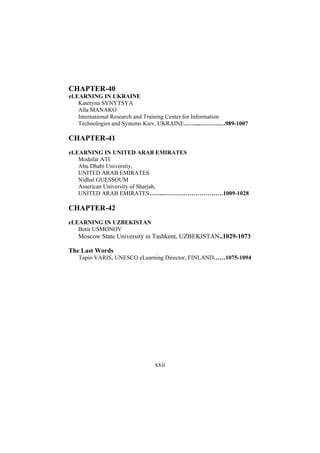
CHAPTER-40
eLEARNING IN UKRAINE
Kateryna SYNYTSYA
Alla MANAKO
International Research and Training Center for Information
Technologies and Systems Kiev, UKRAINE……...……….…989-1007

CHAPTER-41
eLEARNING IN UNITED ARAB EMIRATES
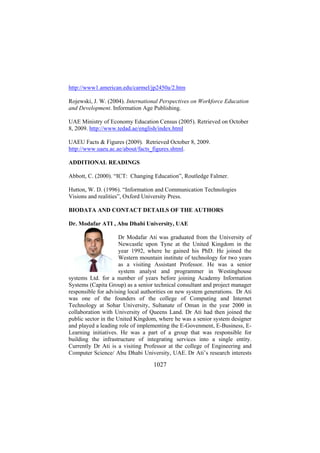
Modafar ATI
Abu Dhabi University,
UNITED ARAB EMIRATES
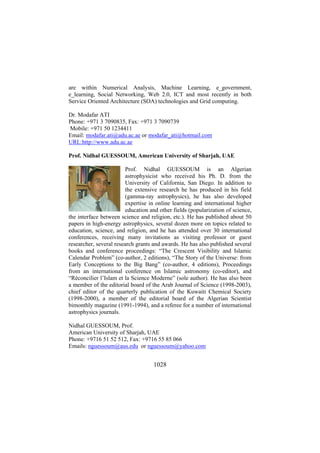
Nidhal GUESSOUM
American University of Sharjah,
UNITED ARAB EMIRATES……..…………………………1009-1028

CHAPTER-42
eLEARNING IN UZBEKISTAN
Botir USMONOV

Moscow State University in Tashkent, UZBEKISTAN..1029-1073
The Last Words
Tapio VARIS, UNESCO eLearning Director, FINLAND……1075-1094

xxii
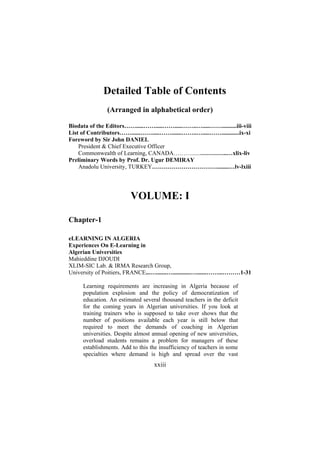
Detailed Table of Contents
(Arranged in alphabetical order)
Biodata of the Editors…….....…….....…….....……..….....……..........iii-viii
List of Contributors……......…….....…….......……..….....……............ix-xi
Foreword by Sir John DANIEL
President & Chief Executive Officer
Commonwealth of Learning, CANADA………......…………..…xlix-liv
Preliminary Words by Prof. Dr. Ugur DEMIRAY
Anadolu University, TURKEY……………………………........…lv-lxiii

VOLUME: I
Chapter-1
eLEARNING IN ALGERIA
Experiences On E-Learning in
Algerian Universities
Mahieddine DJOUDI
XLIM-SIC Lab. & IRMA Research Group,
University of Poitiers, FRANCE...….......…............….......……...………1-31
Learning requirements are increasing in Algeria because of
population explosion and the policy of democratization of
education. An estimated several thousand teachers in the deficit
for the coming years in Algerian universities. If you look at
training trainers who is supposed to take over shows that the
number of positions available each year is still below that
required to meet the demands of coaching in Algerian
universities. Despite almost annual opening of new universities,
overload students remains a problem for managers of these
establishments. Add to this the insufficiency of teachers in some
specialties where demand is high and spread over the vast

xxiii
territory of Algeria. E-learning presents an alternative then the
more it brings benefits in terms of educational and economic
consequences. Indeed with the e-learning problems of housing,
food and transportation for students will no longer arise.
Secondly Algeria can not afford to remain on the margins of
technological innovations.

Chapter-2
eLEARNING IN ARMENIA
Has Established The Pioneering Usage Of ''hhh'' Technology
Vardan MKRTTCHIAN
All Armenian Internet University,
HHH Technology Incorporation, Yerevan, ARMENIA...….......………33-51
The chapter presents the development of “hhh” technology in
eLearning in Armenia. All People Internet University (called
“hhh”) education technology is a patented software tool that
allows rapid creation of interactive simulations and modelling in
Distance and Online Educations systems. The main features of
these new capabilities, new issues and challenges in same private
universities are presented.

Chapter-3
eLEARNING IN BELARUS
Vladimir DOUNAEV, Independent Expert
Belarusian Higher Education, Minsk, BELARUS
Maryia DAVIDOUSKAIA
Belarus State University, Minsk, BELARUS...….......…..........………53-76
This chapter is dedicated to the history and present state of elearning in Belarus - the only European country not participating
in the Bologna process. The authors analyze the low efficiency
of governmental programs of e-learning in secondary schools
and political obstacles to the spread of distance learning and the
designing networked learning environment in higher education.

xxiv
Chapter-4
eLEARNING IN BULGARIA
Daniela DUREVA-TUPAROVA, South West University, BULGARIA
Georgi Teoharov TUPAROV, South West University, BULGARIA
Rositsa DONEVA, University of Plovdiv, BULGARIA
Nevena STAEVSKY, Mannheim, DEUTSCHLAND...….......…...…77-106
The goal of this chapter is to present the recent challenges and
conditions in Bulgaria for involvement and efficient use of elearning in different forms, types, modes and levels of education.
The chapter gives an overall picture of the Bulgarian educational
system, taking into account the current political priorities and the
most significant concrete measures, accelerating the ongoing
reform in different sectors of the educational domain. It captures
in brief the government requirements for implementation of
distance learning in the higher education institutions. Some good
practices, applied by non-governmental organizations and
private educational companies, are outlined. Two case studies
demonstrate the experience of two Bulgarian universities in the
field of e-learning which Bulgaria faces in the field of e-learning
in the dawn of the millennium, are pointed out.

Chapter-5
eLEARNING IN EGYPT
Mahmoud M. EL-KHOULY
Head of Management Information Systems
Helwan University, EGYPT.....…….…...……..…...………...……107-131
This chapter summarizes the current situation of using the elearning technologies in Egypt. Higher education in Egypt faces
many challenges such as high student numbers, financing of
education, governance and management of the education system,
and quality assurance. In this manner, the National E-learning
Center (NELC) was established, Egyptian E-learning University
(EELU) established 2008 to provide e-learning nationally,
regionally, and internationally.

xxv
And this is one of the Information and Communication
Technology Project (ICTP) outcomes, to serve as a technical unit
within the Supreme Council of Universities to promote and
support the development of e-learning in Egypt by improving the
development of the e-learning content.

Chapter-6
eLEARNING IN ESTONIA
Cooperation Models for National e-Learning
Development in Estonia n Example of the
Estonian eLearning Development Centre
Ene KOITLA
Estonian Information Technology Foundation, ESTONIA...………133-153
In this chapter evolvement of the Estonian e-Learning
Development Centre (Estonian Information Technology
Foundation) will be analyzed during its five years of operation.
Attention will be paid to processes that were the drivers behind
the formation of the Estonian e-Learning Development Centre
and contributed to its sustainability.

Chapter-7
eLEARNING IN FINLAND
The Path of E-Learning in the Finnish Educational System
Petri LOUNASKORPI
University of Tampere, FINLAND
Leena VAINIO
University of Applied Sciences, FINLAND……………............……155-186
e-Learning has been a strategically significant focus of
development in the Finnish education system. In particular, ICT
skills and deployment have been emphasized in the National
Board of Education’s strategies since the beginning of 1990.
Other administrative bodies have also gradually recognized ICT
utilization as a significant skills area and in various development
strategies and ventures e-learning has been seen as a pivotal

xxvi
method to promote skill development and innovation. In this
chapter, e-learning strategies and their implementation in
different educational sectors are described from the perspective
of life-long learning. Current Finnish e-learning best practices
and development areas are also introduced.

Chapter-8
eLEARNING IN GREECE
Dimirios SIDIROPOULOS
Katerini Technical High School, GREECE
Despina MAKRIDOU BOUSIOU
Dept. of Applied Info., University of Macedonia, GREECE
Maria MAVROMMATI
Dept. of Applied Inf., University of Macedonia, GREECE………… 187-214
The following chapter is an effort to describe the development
of eLearning in Greece. In the first part we describe the Greek
educational system in general. The second part deals with
distance education in Greece. Later on we address the issue of
development of Information and Communication Technologies
and infrastructure in Greece. eLearning Research, Lifelong
Learning, Adult Training, Intercultural Education and Future
Strategy are also addressed as major parts of the eLearning
sector in the Greek educational system.

Chapter-9
eLEARNING IN HUNGARY
Sarolta ZÁRDA, Rector
Dennis Gabor Applied University, HUNGARY
Géza BOGNÁR, Deputy Rector,
Dennis Gabor Applied University, HUNGARY……….......…...……215-228
The restructuration of Hungarian legislation yielded to
restructuring of companies-ownership and to important changes
in Hungarian higher education in the early 90 years of the past
century. Accordingly the higher education market was
liberalized. Due to technological development, eLearning
applications entered to the everyday practice of universities since

xxvii
year 2000. For the time being mainly private-owned universities
are using the eLearning technology. This is the way by means of
which more services can be offered to students, accordingly it is
expected that more candidates will choose universities having
eLearning facilities. This chapter discusses development of the
elearning in Hungary for the Millennium.

Chapter-10
eLEARNING IN IRAN-I
A Breakthrough to ICT-Based Initiatives
In An Educational System
Davoud MASOUMI
University of Gothenburg, SWEDEN……………………..........……229-251
In this contribution, an overview of Iranian educational system in
general and higher learning/education in particular is presented
over the last hundreds years. We mainly aim to give a brief
account of the country’s rapidly expanding ICT-based initiatives
in the light of its actual realities, progress and difficulties by
looking at the following areas: the social and historical situation
in Iran, Educational system, Higher education, Distance
education and particularly Virtual Institutions in Iran.

Chapter-11
eLEARNING IN IRAN-II
Ahmad KHANMESAN
University of Birjand, Birjand, IRAN……………………..........……253-278
This chapter reviews the efforts made to integrate ICT in the
Iranian educational system and addresses the issues related to elearning in pre-tertiary and higher education. The development
of ICT in Iran began at the beginning of the millennium with a
plan called TAKFA. Although the ICT infrastructures have
developed considerably in the last decade and the number of
internet users increased, the e-readiness of Iran is not at the
proper level; Iran rank in e-readiness is 68 (out of 70 countries)
with the average score of 3.4 (out of 10). It shows Iran should

xxviii
Although many initiatives have taken into account to integrate
ICT in educational system, such as developing ICT departments,
increasing the bandwidth of the universities, developing a
scientific network, national network of schools equipping
schools to computer centers, etc., there are still some challenges
on the way of e-learning in Iran, such as the lack of an official
domestic guidelines and standards, an adequate governmental
supervision, low bandwidth, high price of connectivity, etc.
For optimum use of ICT capacities for e-learning in Iran,
cultural, political, and technical and policy issues should be
taken into consideration.

Chapter-12
eLEARNING IN IRAQ
Ala'a Al-Din J. KADHEM AL-RADHI
Senior Consultant...……......…….......….....….......…….......…..…… 279-292
Empowering distance education's is crucial for Iraq after
decades of traditional learning. Iraq needs new models of
education facilitated by educational technology. Some of the
most promising new educational approaches are being
developed through e-learning and virtual schools. This is an
exciting, creative and transforming era for students, teachers,
administrators, policymakers and parents. It’s time for Iraqi
higher education entities to keep abreast of this quite
revolution.
This Conceptual and roadmap paper, presented at the Iraqi
Higher Education conference to be held in Kurdistan/Iraq, on
December 2007, tries to promote the Iraqi Higher Education
entities, via utilizing distance learning or education eLearning
strategy considerations.

xxix
Chapter-13
eLEARNING IN ISRAEL
A Case Study of Technology in
Distance Higher Education:
The Open University of Israel
Yoav YAIR
The Open University of Israel, ISRAEL….…...……...……...………293-317
This chapter describes the transition from traditional, on-campus
delivery to technology-based higher education in Israel. It
reviews the higher education arena in the country and offers an
updated and concentrated summary with special focus on
distance education as is practiced at the Open University of
Israel. Various aspects of technology usage and e-learning
models are described, including collaborative learning, on-line
video and OCW. The review draws from the vast experience
gained in over a decade of e-learning experimentation and
model-development and is based on user-experience surveys and
faculty interviews.

Chapter-14
eLEARNING IN JORDAN
Challenges Facing e-Learning in the New Millennium
Mosleh AL-ADHAILEH
King Faisal University, SAUDI ARABIA...…...…….......……….… 319-336
Many challenges have taken place in the ever-growing and
mobile society and today’s constant and rapidly changing
technology and resource. The explosion of web-based
technologies and internet provides a new trend for educational
systems to introduce new teaching and learning environments. In
response to the fast development in Information and
Communication Technologies (ICT), e-learning was adopted by
many universities around the globe as a way of improving and
supporting their teaching-learning activities and making
education accessible for all society members. Hashemite

xxx
Kingdome of Jordan took e-learning initiative in its vision since
1998, and progressed rapidly since that time. Infrastructure has
been upgraded for this purpose. Issues related to adopting and
supporting e-learning such as training, e-course development for
both K-12 education and higher education has been progressed.
This Chapter describes the issues and barriers associated with
integrating e-learning into Jordan educational system. We
discussed Jordan successful e-learning experience and case
studies including infrastructure, ICT integration, attentions,
training, readiness and awareness, and challenges facing elearning in Jordan.

Chapter-15
eLEARNING IN KAZAKHSTAN
Gul NURGALIEVA,
National Center of Informatization, KAZAKHSTAN
Almira TAZHIGULOVA
National Center of Informatization KAZAKHSTAN
Yelena ARTYKBAYEVA
National Center of Informatization, KAZAKHSTAN...…...…..…… 337-356
In the Republic of Kazakhstan held a large-scale informatization
of education is held in the following areas: regulatory support,
info-communication software, software, content and staffing. Elearning has had wide development at the expense of electronic
textbooks which are considered as applied programs of
interaction of subjects of educational process.
Electronic textbooks are developed for high school practically in
all subjects and on all classes in the Kazakh and Russian
languages; their translation into English is planned. In electronic
textbooks integration of pedagogical and informationcommunication technologies are provided. Efficiency of etraining depends also on the level of readiness of teachers,
therefore in Kazakhstan training courses are held for teachers on
use of electronic textbooks, network technologies, and
interactive boards in educational process.

xxxi
Chapter-16
eLEARNING IN KYRGYZTAN
E-Learning and ICT Development
In The Republic of Kyrgyztan
Carlos MACHADO
International Project Manager, BELGIUM….………….......…..……357-378
This chapter documents on the research study conducted in the
Kyrgyz Republic. The implementation of learning technologies
in developing countries is as much a journey as a destination.
Our case study focuses on two specific phases in this journey:
planning and implementation. Initial planning and carefully
analysis of implementation, with attention to the challenges for
teaching staff and students, can mean the difference between
success and failure. The adoption of new technologies in a
country with a long Soviet legacy, and a characteristic Central
Asian culture based on oral tradition, defies indeed economics.
The evolution of telecommunications, in general, and ICTs
applied to education, in particular, in the Kyrgyz Republic is on
the rise as official statistics show. However, it is not
technological but economic resources that pose more problems
(CAICT, 2005). This is especially the case of more isolated and
distant regions like Karakol. From own research, we came to
observe some of the differences in terms of resources between a
university located in the capital and another located in the fareast of the country.

Chapter-17
eLEARNING IN LATVIA
Dimensions of E-Learning Education in Latvia
Boriss F. MISNEVS
Transport and Telecommunication Institute, Riga, LATVIA.....…… 379-409
The chapter contains brief description of Latvian education
system and the findings of a study institutional corporations and

xxxii
the emphasis in the study is on the implications of increasing use
of Information and Telecommunication Technologies (ICTs) for
The chapter discusses the bilingual situation presented in Latvia
and related problems regarding e-training courses development
as well. Because of this, Latvian society must consider their
entire policy towards bilingualism in the educational system.
Brief information is sent about the current financial model for
Latvian education. Then topic on the contribution and the
situation of distance education in Latvia follows. Starting with
historical facts the chapter cover also current state of e-learning
activities in Latvia.
This overview contains the description of e-learning education
framework in Latvia including computers and Internet usage in
education. Most resent policy measures at national level are
discussed and medium term plans 2007-2013 are evaluated.
National or International e-learning content suppliers, e-learning
Technology Suppliers, e-learning service suppliers are briefly
discussed. Then an attempt is made to estimate the Latvian elearning market size and its characteristics. After all the
applications of e-learning in Latvia educational system by study
levels is observed. At the end of the chapter an author’s forecast
for e-learning education as a future of Latvia is represented.

Chapter-18
eLEARNING IN LEBANON
Patterns of E-learning Development in Lebanon’s
Mosaic Educational Context
Fawzi BAROUD
Notre Dame University-Louaize (NDU), LEBANON
Kamal ABOUCHEDID
Notre Dame University-Louaize (NDU), LEBANON…………....… 411-436
This chapter is set to trace the development of e-learning in
schools and higher educational contexts in Lebanon utilizing
information obtained from policy papers, national reports,
journal articles, and national statistics. In addition, three case
studies are presented as examples of e-learning development in
higher education. As the topic of e-learning continues to attract

xxxiii
the attention of practitioners, policymakers and researchers, this
chapter attempts to make an incremental contribution to elearning experiences from a Lebanese context-dependent
perspective.

Chapter-19
eLEARNING IN LITHUANIA-I
Natalija LEPKOVA
Silva RIMKUVIENE
Vilnius Gediminas Technical University, LITHUANIA………....… 437-462
This chapter contains the general information about Lithuania:
country description, overview of economical and financial
issues, description of education system in Lithuania, case study.
The chapter presents the overview of eLearning in Lithuania and
the special attention paid on experience in eLearning field at the
department of Construction Economics and Property
Management of the Faculty of Civil Engineering of Vilnius
Gediminas Technical University (VGTU).

Chapter-20
eLEARNING IN LITHUANIA-II
Eugenijus KURILOVAS,
Habil Valentina DAGIENE
Institute of Mathematics and Informatics
Vilnius, LITHUANIA...….…...………...….…...…...….…...……… 463-484
The chapter is aimed to examine the emergence and growth of elearning, i.e., the application of information and communication
technology (ICT) in formal education (i.e., primary, secondary
and vocational education) in Lithuania. The chapter concentrates
primarily on ICT policy and practice (incl. content and services,
teacher training for ICT, and participation in international R&D
projects), research findings and case studies of e-learning in
Lithuanian primary, secondary and vocational education system.

xxxiv
VOLUME: II
Chapter-21
eLEARNING IN MACEDONIA
Bekim FETAJI
Majlinda FETAJI
South East European University, Republic of MACEDONIA...….… 485-516
The focus of the analyses is elearning in Macedonia focusing on
the developed strategy and analyses of the insights gained from a
case study of particular distance education application in South
East European University, Macedonia. The analyses covers the
impact of ICT on University’s mission in achieving multicultural
and multilingual education within Macedonia and the context of
the Balkans, but also in a wider European and global context. A
number of issues related to such an impact and specific context
of the University, and the developed strategy as well as analyses
of its applications as case study. The implemented strategy and
solution as well as experiences gained in the process led to a
number of important results as outcomes and recommendations
for similar initiatives.

Chapter-22
eLEARNING IN MOLDOVA
E-Learning and ICT Development
in Education In The Republic of Moldova
Tudor BRAGARU, State University of Moldova, MOLDOVA
Conţiu SOITU, Al.I. Cuza University, ROMANIA..........………..… 517-547
This chapter is devoted to the existing educational system in one
of the 15 former Soviet republics: Moldavian SSR, nowadays
Republic of Moldova that has gained its independence in 1991.
More than 4 years ago a reform of the Moldavian educational

xxxv
system has started. It was oriented to European values and aimed
to the innovational training and teaching methods adoption. A
proper ICT integration in the technological teaching process,
however, did not take place yet. The implementation of the new
forms of the distance learning based on e-Learning is
experiencing an evident slowdown. This chapter discusses the
penetration and application of ICT in Moldova in whole and in
educational institutions, as well as some problems related to
education informatization.

Chapter-23
eLEARNING IN MOROCCO
Developments and Issues in Morocco
Rachida AJHOUN, Université Mohamed V-Souissi, MOROCCO
Driss BOUZIDI,Hassan II Ain Chock University, MOROCCO.....… 549-584
This chapter presents an overview on the strategy and actions
undertaken by Morocco to achieve the introduction of the use of
ICT in education and training. The case studies discussed shed
light on the situation of e-learning in Morocco which is defined
as: "the use of new multimedia technologies and the Internet to
improve the quality of learning by facilitating access to resources
and services, as well as exchanges and distance collaboration”.
These studies show both the different approaches adopted by
those in charge of the training in order to benefit from numerous
advantages of e-learning and other difficulties encountered in its
implementation. Following these studies, a synthesis is presented
on the reflexion conducted by decision makers and those in
charge for training to identify new measures to address the
obstacles that hinder the emergence of e-learning culture in
Morocco.

Chapter-24
eLEARNING IN NORWAY
Torstein REKKEDAL
Director of Research and Development, NKI, NORWAY.....……… 585-602

xxxvi
Norway was the first country in the world to introduce specific
legislation on distance education when the Act on
correspondence schools was passed in 1948. As one of the
richest, according to GPD per capita and most developed
countries in the world, it is no surprise that Norway has a highly
developed technological infrastructure for distance education,
online learning and e-learning. The government has over the last
15 years taken a number of initiatives to develop ICT
competence among teachers and students on all educational
levels. By establishing the Norwegian Opening Universities, a
national body for distance education in higher education the
government has clearly defined a strategy for development of
online higher education that supports the development of dualmode solutions rather than establishing a single-mode distance
education university. Norway’s leading position concerning elearning was demonstrated in the Megatrend-project, that in
2007 found four Norwegian institutions among the 26 identified
European ‘mega-providers of e-learning.

Chapter-25
eLEARNING IN OMAN
E-Learning from an Omani Perspective
Ali Sharaf Al MUSAWI
Sultan Qaboos University, OMAN.....…………...……….….……… 603-626
E-Learning has introduced new approaches of instructional
delivery where the roles of teacher and student have significantly
changed. The case in Oman shows that the introduction of these
approaches needs to keep pace with the demands of the times,
but only the actual needs arising from social and educational
context of Oman. Attention should be given to the socio-cultural
understanding of teacher-student relationship in open
technology-enriched learning contexts. Omani educational
institutions continue to review their policies and provision of eLearning, considering technological alternatives for resolving
some of the pressing issues posed by the actual needs. There is a
need for coordination at the national level to create strategies and

xxxvii
mechanisms and controls that ensure the quality of e-Learning
institutions and outputs

Chapter-26
eLEARNING IN PALESTINE
Mohammad A. MIKKI, Islamic University of Gaza, PALESTINE
Nabil J. J. JONDI, Hebron University, PALESTINE...…..…...…… 627-652
No doubt that globalization and rapid changes occurring in the
world have thrown its impact on education and human
endeavors. Both training and education are considered as a
lifelong experience for workforce cross the world. Palestine, in
fact, is part of the sweeping globalization and transformation,
regardless of its difficult political context and might be because
of it. Palestine opened itself up to many international
interventions and programs. Hence e-learning is needed and the
documentation on e-learning is also needed. There is a very big
need for this chapter about the Palestinian environment as it is
achieving two goals. The first goal is to provide information data
that sheds light on what is going on in Palestine regarding elearning. This goal will clarify how information technology, elearning programs, electronic libraries, twining programs,
international courses, worldwide research initiatives, electronic
homepages, and other tools of communications, are developed in
Palestinian schools and universities. The second goal is to
explore challenges and obstacles faced and institutions’
strategies of coping with these challenges as well as the national
policy to develop learning at this particular context.

Chapter-27
eLEARNING IN POLAND
Anna RYBAK, University of Bialystokx, POLAND..…......….…… 653-672
The chapter contains information about Poland, Polish
educational system, using ICT in education and state of
development eLearning for Poland distance education system in
the Millennium.

xxxviii
Chapter-28
eLEARNING IN ROMANIA-I
Olimpius ISTRATE
Institute for Education
University of Bucharest, ROMANIA………………………………...673-694
This chapter focuses on the use of ICT in Romanian education
system, presenting the relevant programmes, projects and
initiatives, and using research data from several reports released
in the last years. Being aware that innovation related to the use
of ICT in the education system is still at the beginning, we tried
to bring forward the landmarks of the early stages this
transformation, convinced that time will settle practices and
theories which would put strength on the development of
students’ key-competencies. In our opinion, the new
technologies are an invitation and an opportunity for teachers
and for education decision-makers to think deeper about
education practice, to re-invent and to discover the real
Pedagogy. First steps are already done in Romania, but many
more are still to be developed, aligned with international
experiences and initiatives, and adapted to the local context.

Chapter-29
eLEARNING IN ROMANIA-II
Past, Present and Future
Ciprian CEOBANU
Laura ASANDULUI
Roxana CRIU
“Al. I. Cuza” University, Iasi, ROMANIA........…............…...…… 695-710
In the first decade of the 21st century, worldwide, the tremendous
increase in the amount of available information and the
spreading of the e-learning was possible through the
enhancement of the access to computers and to Internet. This
fact indicates a reality that became more and more stringent and
that cannot be ignored. These challenges were integrated into
national programs and were supported by general actions. E-

xxxix
learning became a common place and a widely spread
educational tool. The present chapter tries to offer a snapshot of
this very dynamic component of the Romanian educational
reality.

Chapter-30
eLEARNING IN RUSSIA
Sergey POZDNYAKOV
Saint-Petersburg State Electrotechnical University, RUSSIA
Serge RUKSHIN
Russian State Pedagogical University, RUSSIA........…......…...…… 711-744
The article is devoted to the history of distance learning
development and to the current state of e-learning in Russia. A
new classification of distance learning development stages is
proposed by the authors. Authors highlight three stages of this
educational form's development, comparing it with the stages of
political, social, and economic changes in the country. In the
second part, the analysis of the basic directions of development
of e-learning is presented; each direction is explained by the
most typical examples. Chapter is beginning with brief
information about Russia and a structure of the present education
system.

Chapter-31
eLEARNING IN SAUDI ARABIA
Hend S. AL-KHALIFA
King Saud University, SAUDI ARABIA.………………......……… 745-772
Saudi Arabia as one of the largest Islamic countries in the world
with the largest reserves of petroleum, has radically improved its
educational system as a result of comprehensive development
programs. General and Higher education is experiencing
capacity issues which lead to the need to adopt distance
education as an instructional strategy. The following chapter
describes the country, its tertiary education system and current
developments in distance education and eLearning.

xl
Chapter-32
eLEARNING IN SERBIA
The State and Development of E-Learning in Serbia
Mirjana IVANOVIC,
Zoran PUTNIK
Zoran BUDIMAC
Department of Mathematics and Informatics,
Faculty of Science, University of Novi Sad, SERBIA..………...… 773-797
eLearning and distance learning facilities are important for
regular students but also for employed people (important support
for lifelong learning). eLearning can contribute to the
development of the Educational System in the West Balkan
region, and have a high social importance with direct impact on
the creation of new job opportunities. Quality and capacities of
educational institutions must be significantly improved from
elementary schools to doctoral studies. The need for modernized
and ICT supported learning processes, adapted to specific local
education system needs, is evident in Serbia today.
Implementation of eLearning as a support to education
represents the opportunity for everybody to have the access to
educational materials. It will enable equal opportunities for all
population segments, to continue with their education. In this
chapter different educational issues and aspects in Serbia today
are discussed. Current state-of-the-art and further necessary steps
are pointed out and suggested.

Chapter-33
eLEARNING IN SLOVAKIA
Alena ILAVSKA
UT Zvolen, SLOVAKIA
Jaroslava KOVACOVA
University of Economics, SLOVAKIA...…………..……….……… 799-823
The purpose of this chapter is to provide a view of the
eLearning’s state in the Slovak republic and possible
implications for policy and practice. The chapter does not seek to

xli
inform on a technical level, it assumes knowledge of
terminology definitions, theories, research findings and case
studies of eLearning and offers a view of the driving forces for
eLearning, a historical context for its development in the Slovak
republic. First, the chapter introduces the general data about
Slovakia, such as history, geography, people, educational system
and its priorities, the role of distance education in the country,
ICT and the role played by eLearning in it. Drivers and barriers
for them in Slovakia are assessed.

Chapter-34
eLEARNING IN SLOVENIA
Tomaz AMON
President Center for Scientific Visualization, SLOVENIA.....………825-852
The author wants to point out in this chapter that Slovenia as a
small country with nice, still well preserved nature needs to
develop especially intensively its knowledge pool because it has
no important natural resources like coal, gas etc. but it has
already well educated people who need to stay update with their
knowledge also in the future and of course the young generations
need to obtain the best education possible. As it will be shown
later on, the funding for education in Slovenia is sometimes
more intensive, sometimes less intensive and especially in less
intensive periods the e-learning becomes even more important
since online or computer (internet) aided learning is the cheapest
and most “democratic” learning. I grew up in times before
computers and so I feel the revolutional importance of
improvement the computer-aided learning offers now.

Chapter-35
eLEARNING IN SWEDEN
Susanne KJÄLLANDER
Stockholm University, Stockholm, SWEDEN
Eva Edman STÅLBRANDT,
Stockholm University, Stockholm, SWEDEN......…………….…… 853-876

xlii
Sweden is viewed as a high-tech country with a top rank in ereadiness. It is recognized as a country of high speed in adopting
new technology. Since long ago Sweden is known as world
leading in educational ICT. All Swedish schools have had
computers and Internet for many years. As Sweden is
decentralized, differences are vast between different
municipalities and schools. Sweden has no national e-strategy
for schools. A current key challenge is how to transform elearning from individual initiative to university culture. Another
challenge is the teachers’ and academic staff’s lack of ICT skills
and knowledge. Pupils and students are often more
knowledgeable than their teachers. Swedish educational ICT
discussions are to be considered as quite mature and therefore
this chapter can make a contribution to countries where ICT is
being introduced in the educational system.

Chapter-36
eLEARNING IN SYRIA
Mohamed Ziad HAMDAN
Consultant to Arab Open University
North America, SYRIA................……………………….……...……877-909
The Information Age, the digital knowledge, the knowledge
society, knowledge economies and cyber schooling have by the
beginning of Third Millennium intensified in speed, working
space, quality content, and human concerns. They are now
looked upon as a measurement index for locating the ranks of
nation states on the ladder of current world civilization. While
developing countries (DCs) in general spent the second half of
the twentieth century in consuming what the industrial nations
are producing in the fields of information and communication
technologies, they (the DCs) launched very recently however,
several pursuits in this decisive sphere, not as much in the
industries of ICT but rather in their applications to business,
management, production, education, recreation, and more. In
fact, Syrian Virtual University (SVU) is the first to none until
this date in Arab Middle East. SVU has fame in on-line
education, and attracts students from all over the world. As
such, this chapter endures the purpose of the current book in

xliii
providing a real picture of Syrian applications of ICT into
education, thus clarifying Syria ICT status comparable to other
nation state world wide.

Chapter-37
eLEARNING IN TAJIKISTAN
E-Learning and ICT Development in Education
Carlos MACHADO
International Project Manager, BELGIUM
Khurshed I. TESHAEV
Technological University of TAJIKISTAN....….………….…...……911-937
In a country once devastated by a civil war during the mid-90s as
it was Tajikistan, a new economy and new challenges have been
brought through the beginning of the twenty-first century. As
Tajikistan steadily recovers from economic and social collapse,
government, civil society, and the private sector are all looking
for ways to accelerate development. One of the avenues for
recovery has been put in Information Communities Technologies
(ICTs) and the benefits expected from them. In the present
chapter, we concentrate on the efforts sustained in Tajikistan to
introduce and spread the use of ICTs in the classroom in
particular and in education in general. Although the wide spread
of new technologies is a relevant issue at educational policy
level, however, main challenges and resource constraints
abound. These in turn are hindering the maintenance of a steady
pace of technological development in the country. We describe,
hereunder, the current status of ICT development and elearning
in Tajikistan.

Chapter-38
eLEARNING IN TUNUSIA
E-Learning Challenges in the Millennium,Tunisia
Zeineb DEYMI GHERIANI
Higher Institute of Languages in Gabes, TUNISIA
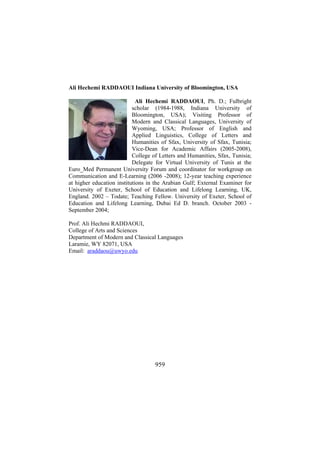
Ali Hechemi. RADDAOUI
University of Wyoming, USA..….........…...….........….......…....……939-959

xliv
The purpose of this paper is to provide a general overview of the
e-learning situation in Tunisia and a peek into specific e-learning
initiatives conducted by both authors. Many support institutions
have been put in place to oversee and assist with Tunisia’s elearning agenda: the Tunisian Internet Agency (ATI), Virtual
University of Tunisia (UVT), the Tunisian Association for the
Promotion of e-Learning (APREV), the Tunisian Association for
Digital Solidarity, among others.
With better technological provision, access to these courses
increased dramatically.
Over and beyond the need for
technology and training, the following conclusions stand out.

Chapter-39
eLEARNING IN TURKEY: Past, Present and Future
Gonca Telli YAMAMOTO, Okan University, TURKEY
Cengiz Hakan AYDIN, Anadolu University, TURKEY…………..…961-987
eLearning offers many opportunities for individuals and
institutions all over the world. Individuals can access to
education they need almost anytime and anywhere they are ready
to. Institutions are able to provide more cost-effective training to
their employees.
Not only globally but also in every country e-learning market is
growing fast. The Turkish e-learning market is especially
showing a significant growth in higher education and corporate
settings.
This chapter intends to draw a big picture about the Turkish elearning market. It mainly focuses on past and present status of
e-learning implementations and examines how the institutions
have been going through a transition to be able to reach ‘elearners’.
Having an insight about the status of e-learning market in Turkey
can be very beneficial for the entrepreneurial accessions to this
market and also for the future collaboration opportunities.

xlv
Chapter-40
eLEARNING IN UKRAINE
Kateryna SYNYTSYA
International Research and Training Center for
Information Technologies and Systems, Kiev, UKRAINE
Alla MANAKO
International Research and Training Center for
Information Technologies and Systems Kiev, UKRAINE….......…989-1007
E-learning in Ukraine is in the focus of both academic research
and educational practice. It is considered as a vital element of
educational innovations, an important component of modern
education and a bridge to e-society. One can observe both
grassroots activities of the teachers looking for technologies to
increase students’ motivation, learning efficiency and depth of
understanding, and institutional efforts to support and upgrade
teachers’ competencies in information and learning technologies.
At the same time, research area covers models and methods for
learner’s assessment, control and support, intelligent
technologies for innovative interfaces, knowledge representation
and processing, decision-making and problem-solving. This
chapter describes socio-economic conditions, educational
landscape and technological infrastructure that constitute an
environment for e-learning development and deployment in
Ukraine. It demonstrates some results, progress and prospects for
e-learning, as well as research potential for collaborative projects
and cross-cultural educational studies.

Chapter-41
eLEARNING IN
UNITED ARAB EMIRATES
Modafar ATI
Abu Dhabi University, UNITED ARAB EMIRATES
Nidhal GUESSOUM
American University of Sharjah,
UNITED ARAB EMIRATES……………………………..………1009-1028

xlvi
The learning process has been a passive process for so long.
However, with the advent of ICT in recent years has a direct
impact on such a process. Online learning was introduced and
implemented by western universities.
The United Arab Emirates is no different from other nations that
benefited from the ICT in the education sector. Since the
formation of the federal government, one of the targets was to
improve the education and to implement the latest technologies
within such a sector as well others. In this chapter we aim to
show the evolution process that education in the UAE went
through. The plans that were adopted in order to make the UAE
as a hub for higher education in the region are also presented.
The chapter reflects the background of the UAE
anthropologically and educationally. We try to show the
implementation and usage of ICT in higher education and its
relevance to the government’s long term plans. Two cases are
presented, showing the implementation of ICT and the
encouragement of online teaching at two important universities
of the UAE. Issues associated with implementing and using of
ICT in the delivery of online teaching is also presented.

Chapter-42
eLEARNING IN UZBKISTAN
Botir USMONOV
Moscow State University in Tashkent, UZBEKISTAN..…....……1029-1073
Advantages brought by development and expansion of
information and communication technologies are more and more
realized in the world today. Their revolutionary impact spread on
state body’s activities, civil society institutions, economic and
social spheres, science and education, culture and people’s life
style. Uzbekistan is not aside of those processes, it participates
more and more actively in formation of global information
society. The long-term strategy of social and economic
development of Uzbekistan is also oriented to information
society, create and realize of prerequisites and conditions of its
formation.

xlvii
Those strategies allow Uzbekistan to integrate into the world
economic. To implement those strategies; a number of legislative
and regulatory acts were adopted. In particular, Decree of the
President of Uzbekistan #3080 dated 30 May 2002 determined
objectives of development and implementation of information
and communication technologies. Also in accordance with this
Decree started development of computerization and information
and communication technologies, the customs and tax privileges
have been set, measures on stimulation of entrepreneurship have
been determined.

The Last Words
Tapio VARIS, UNESCO eLearning Director, FINLAND.……….1075-1094

xlviii
Foreword
e-LEARNING IN PRACTICE:
Covering Thirty-Nine Countries
Paul KAWACHI
Fellow of the Royal Society of Art- FRSA,
Open University of China, CHINA and
Editor-in-Chief of Asian Journal of Distance Education
e-Learning has developed greatly as the method of first choice for distance
education and we are seeing a convergence between distance and
conventional face-to-face education -due to moves by conventional
education providers. Conventional universities and schools throughout the
world are pro-actively adopting distance learning technologies not only to
reach the unreached providing wider openness and access but notably as
augmentation for their current on-campus students. The use of computers in
education can be classified into four types; - computer-assisted instruction
(CAI), computer-managed instruction (CMI), computer-based multimedia
(CBM), and computer-mediated communication (CMC). The fourth CMC
involves computer-to-computer transactions including email, is sometimes
referred to as online learning, and is commonly referred to as ‘e-learning’
(Kawachi, 2005 ; Kawachi 2008a).
Under e-learning, educational interactivity can be among the institution(s),
tutor(s), and student(s), for both academic purposes as storage, delivery and
retrieval of content, and non-academic purposes as administration and
counselling support. Library resources support services are the most
common CMI use of computers. Asynchronous emailing appears to be the
most common CMC use. In highly developed centres of excellence such as
in Hong Kong, Japan, or Korea, synchronous text-chat is common, and this
occasionally becomes multimedia with the addition of digital graphics and
even video transmissions along with plain text. In rural developing countries,
computers have widely entered into classrooms in the past few years, though
as recently as two years ago, for example in India, schools were despondent
with their computers in the room and no educational interactivity taking
place.

xlix
One reason why more educationally effective use cannot be made of these
computers in the classrooms is the lack of regional infrastructure- such as no
internet provision and inadequate or unreliable connectivity (regarding
telephonic transmission rate or very low bandwidth) -preventing the use of
multimedia and e-learning. These difficulties in connectivity and
infrastructure- seen in many of the countries reviewed in this book - could be
circumvented by the use of CD-hybrids.
e-Learning is generally taken to mean learning that has utilized electronic
means of information and knowledge management in a wide sense, and
social constructivist learning through computer-mediated communications in
a virtual space in a narrow sense. E-learning is a relatively new term, and
derives from the development of alliances and consortia consisting of
corporate businesses and education providers emerging at around 1995
(Jegede, 2001, p.75). This development has occurred through the internet
and has brought internationalization through sharing of knowledge. It has
also brought globalization and different cultures into juxtaposition, and into
superimposition. Now conventional face-to-face institutions are opting to
utilize e-learning and open learning values in the classroom.
Many countries including most reviewed in this book generally hold onto an
apprentice model and experiential learning through a cooperative process.
Even with e-learning technology, the apprentice model is still employed.
Internationalization through e-learning has brought the two processes of
collaborative learning and cooperative learning into the same forum. In
many of these countries, the social economics has meant a student who is
busy e-learning is more isolated from his or her surrounding culture, than a
student for example in London where the surroundings may be all high
technology, conducive, motivating, encouraging and accepting of a person
engaging e-learning. In rural developing countries, it is easy to imagine that
the student is not only physically alone but psychologically and emotionally
as well -without social infrastructure supporting e-learning. Thus, computers
and multimedia are not simply instruments for the student but provide a total
environment for learning. The reader is referred to Kawachi (2005) for
comparative review of e-learning in Bangladesh, (mainland) China, Hong
Kong (China), India, Indonesia, Iran, Japan, Korea, Malaysia, Pakistan, the
Philippines, Singapore, Sri Lanka, Thailand, and Vietnam. That review also
discusses in detail the need for e-learning scaffolds and different pacing
provided through e-learning. These topics and gender, old age learning,
group size and others are not dealt with in detail by many of the country

l
reviews in this book, so readers will find that there are areas or trends that
need further exploration.
This book reviews e-learning in thirty-nine countries. A close reading shows
that there are clusters of some common trends and challenges which could
be addressed regionally through satellite or optical cable. This book provides
an excellent need analysis that should be useful for funding agencies and
global organizations such as UNESCO and the World Bank. The thirty-nine
countries are geographically in two wide swaths from North to South down
the eastern side of Europe, and then from West to East across northern
Africa into Central Asia. The countries include from northern to southern
Europe (on the eastern side) Norway, Sweden, Finland, Estonia, Latvia,
Lithuania, Belarus, Poland, Ukraine, Slovakia, Moldova, Hungary, Slovenia,
Romania, Serbia, Bulgaria, Macedonia, Turkey, and Greece. Then from
north-western Africa across to the Middle East, up through to Central Asia,
the countries are Morocco, Algeria, Tunisia, Egypt, Israel, Palestine,
Lebanon, Jordan, Syria, Iraq, Saudi Arabia, United Arab Emirates, Oman,
Iran, Armenia, Uzbekistan, Kazakhstan, Kyrgyzstan, Tajikistan, and Russia.
The countries basically surround Western Europe.
These chapters give a lot of background information on each region, and
then describe the education systems that current exist. Within these systems,
e-learning is covered alongside conventional and distance education.
Naturally the countries have various levels of e-learning infrastructure and
practice. When arranged geographically, some trends can be seen from one
country to another, throughout several countries in most cases. These trends
are likely the outcome of the sociopolitical development in the regions.
Superimposed now on top of these sociopolitical trends, we can now see
individual identities emerging and national characteristics of e-learning in
practice. This review examines the individual countries, then the regional
groups, and finally draws some critical insights from the overall metaanalysis.
In previous published work (Kawachi, 2008b, pp. 609-610), the need for
international cooperation was noted concerning sharing resources.
“After reviewing all these Papers in English and a brief look at the
others not in English, some points do seem to be noteworthy; for
instance all 22 literature references cited in the Paper in Portuguese
from Brazil are references to books and articles in only Portuguese.

li
This should give us something to consider deeply - along the lines
that there is more to global distance education than the AngloAmerican perspective. …
Even in one’s native language, reading research is often a complex
and deeply puzzling task at most times, and in a second or third
language the expressed nuances are very likely to be overlooked. We
should note therefore that we need to build research teams that
bring in speakers of different native language to somehow increase
coverage of the issues, not yet globally perhaps, but beyond the
Anglo-American view of distance education.”
Here, the Editors have collected papers from 39 countries to provide a rich
resource -all in English. While a few sentences can be sourced to Wikipedia,
each paper overall has offered to the rest of the world in English valuable
insights. The Paper on e-learning in Russia, for example, cites 18 references
and all of these are references to the literature in Russian. All 20 references except one to a UNESCO report in English- are non-English in the Paper on
e-learning in Kazakhstan. This clearly demonstrates the great achievement of
the editors in producing an open resource for sharing with the world. In the
fast evolving internet age perhaps we should expect links to fail, and
researchers need the coping strategies to re-source many of the reference
links given in this collection.
In many regions (and in some cases whole countries), there is inadequate
infrastructure and such poverty that students cannot afford to have internet
access at home. Even in the most advanced Western countries broadband is
not universal, so poorer regions should develop coping strategies at a slower
pace within their means. One important aspect of e-learning is learning to
manage with what resources you have available: living within one’s means.
Spender (2002, p. 25) characterizes e-learning as education being a
commodity, rather than as a right; that e-learning is for all, rather than with
controlled entry; e-learning and skilling is a lifestyle, rather than a
qualification; e-learning occurs at any time, any place, any pace, rather than
as a scheduled activity; e-learning is making information, rather than taking
in content; e-learning is demonstration of performance, rather than memory
testing; and e-learning is collaborative. According to Spender’s definition, elearning does not generally take place in many of the countries reviewed in

lii
this book, notably the developing countries in which e-learning is used for
administrative purposes or cooperative -but not collaborative- learning.
Comparative Infrastructure for e-Learning in Selected Countries :
Latvia
While teacher in primary and secondary schools are computer illiterate,
Latvia has the highest penetration of work-place e-learning in Europe.
Lithuania
In the past five years, many young adults have emigrated, so e-learning is
now focusing on older adults at work - mostly re-training that can help the
students in full-time employment get vertical and horizontal job mobility. In
similar fashion, in-service teacher education and training also use workplace e-learning.
Belarus
Despite a relatively young educational system, government disinterest to
support e-learning and more than half the population speaking Russian have
led to the current status here of most students relying on Russia for elearning resources, with only 1% of students officially studying at a distance
in the country. The very limited educational e-resources produced within the
system are basically just digitized print versions. Accordingly teacher
training is not keeping pace with advances in e-learning technologies and
methodologies.
Macedonia
In the general population, Macedonia has a relatively high penetration (30%)
of internet access at home. This rises to 60% for students and those who
have graduated from college. Unfortunately, only 5% of the old aged persons
and housewives had internet at home. Thus while e-learning is recognized
for institution-based education, e-learning is not used for community-based
lifelong learning. The researchers as authors here remain steadfast in their
conviction that e-learning should and will remain within the university
function. This does not bode well for open community-based lifelong
learning. Moreover there is little awareness among conventional university
teachers of how to teach online both in practice and in theory.
Palestine
Palestine has the single-mode distance-education Al-Quds Open University
with 500 full-time and 1500 part-time teaching faculty serving 60,000

liii
students (60% women). With international aid assistance in training, school
teachers and universities work collaboratively in e-learning networks with
counterparts in Britain, Belgium, France, Italy, Spain, Egypt, Jordan,
Lebanon and Syria.
Kazakhstan
Teachers are generally too poor to be able to afford their own computer at
home, while many parents are buying internet access for students at home,
creating an ironic digital divide where the students are more computer
literate than the teachers.
Russia
Being geographically the largest country in the world, the teachers in
distance education are faced with many challenges and little time to develop
e-learning resources using modern learning technologies. As a result, elearning resources are of poor outdated quality and limited in quantity.
Comparative e-Learning Among Regional Countries:
e-Learning can be analyzed with respect to technical vocational education
and training and at-work learning. Such learning can represent the subregion’s readiness to engage and profit with e-business including use of the
internet for business. Together with e-business opportunities, e-learning is
correlated with lifelong learning. This involves adult education for literacy in
poor regions and sociocultural participation in regions with high literacy. In
the developed countries therefore, e-learning can be associated with their
sociocultural participation: the extent to which the population engage
community cultural and traditional events.
The Scandinavian countries are well known as highly developed for elearning (EIU, 2009), with Norway moving up from 11th last year to 4th
position in the world (after Denmark 2009 1st, 2008 5th), Sweden moving
up from 3rd to 2nd position, and Finland at 10th. They are thus well
positioned for e-business and sociocultural participation.
In central Eastern Europe, Estonia and Latvia are the two leading countries
for e-learning (the Czech Republic is among these leaders but not reviewed
here). In the Middle East, Israel is the leading country for e-learning,
followed by the UAE.

liv
The overall e-readiness of the thirty-nine countries where data are available
are given here as position (1~70) among the top 70 countries in the world
(EIU, 2009) ;- Norway 4, Sweden 2, Finland 10, Estonia 24, Latvia 37,
Lithuania 32, Belarus (data missing; estimated 41), Poland 39, Ukraine 62,
Slovakia 36, Moldova, Hungary 35, Slovenia 29, Romania 48, Serbia,
Bulgaria 47, Macedonia, Turkey 43, Greece 33, Morocco, Algeria 67,
Tunisia, Egypt 57, Israel 27, Palestine, Lebanon, Jordan 50, Syria, Iraq,
Saudi Arabia 51, United Arab Emirates 34, Oman, Iran 68, Armenia,
Uzbekistan, Kazakhstan 69, Kyrgyzstan, Tajikistan, and Russia 59.
There is a close correlation between their global ranking and geographic
location, suggesting that regional development could be provided to clusters
of countries. The brief summaries given above for selected countries
illustrate the regional trends across several countries in geographic clusters.
In many aspects, most reports from developing countries are predictable. For
example, “one of the obstacles … is the delay and slow pace of equipping
public schools with computer laboratories and internet access. Another
obstacle is the lack of qualified teachers … [And] the greatest obstacle will
be how to use the ICT in teaching in such a way as to make technology an
effective tool that aids students in learning, both in school and at home, and
not just in locating information but also in answering questions, choosing
relevant information, and constructing knowledge through individual and
group efforts. …[While in universities] the outcome of implementing ICT on
students’ learning is still unclear due to the distinct paucity of evaluation and
assessment studies on ICT use in teaching and learning” (cited from the
Conclusion, Lebanon).
It seems clearer after reading these country chapters that more cooperation is
needed among countries to help each other free through simply
communicating. Following this – and growing out from this – should be
collaboration that tackles the questions and challenges that countries face in
common within a region. With the internet, many poor believe that the
simple answer is money.
This is not foreseeable and anyway is not likely to succeed in practice.
Getting hardware is not going to resolve the issues. e-Learning involves
conversations and openness, with reflection on own practice and own ideas.
In this sense, many developing regions are indeed poor.

lv
REFERENCES
EIU (2009). The 2009 e-learning readiness rankings: The usage imperative.
The Economist Intelligence Unit. Retrieved January 3, 2010, from
http://www-935.ibm.com/services/us/gbs/bus/pdf/ereadiness_rankings_june_2009_final_web.pdf
Jegede, O. (2001). ‘Hong Kong’, In Jegede, O., & Shive, G. (Eds.) Open
and Distance Education in the Asia Pacific Region. Open University of
Hong Kong Press, Hong Kong. pp. 44-79.
Kawachi, P. (2005). Computers, multimedia and e-learning. In U.V. Reddi &
S. Mishra (Eds.), Educational media in Asia, (pp. 97-122). Vancouver :
Commonwealth of Learning. Retrieved January 4, 2010, from
http://www.col.org/colweb/site/pid/3329
Kawachi, P. (2008a). Empirical validation of a multimedia construct for
learning. In Mahbubur Rahman Syed (Ed.), Multimedia technologies :
Concepts, methodologies, tools, and applications (3 Volumes), (Volume 3
Section 5, Chapter 11, pp. 1156-1173). Hershey, PA : Information Science
Reference / IGI Global.
Kawachi, P. (2008b). Critical assessment for future distance education.
Distances et savoirs, 6 (4), 595-618.
Spender, D. (2002). e-Learning and its future. Paper presented at the Global
Summit in Australia. Retrieved January 3, 2010, from
http://www.educationau.edu.au/globalsummit/papers/d_spender.pdf

lvi
BIODATA and CONTACT ADDRESSES
Prof. Dr. Paul KAWACHI, Open University of China, CHINA
Paul Kawachi is Professor of Instructional Design, at the
Open University of China (formerly the China Central
Radio & TV University, and which has about 3,000,000
active enrolled students). He is a Fellow of the Royal
Society of Arts, a Fellow of the British Institute of English
Language Teaching, and a Fellow of the Asian Society of
Open and Distance Education. He holds a doctorate in
education, three master’s degrees and several teaching diplomas with
distinction. He has English internationally accredited licences for multimedia
teaching, and English language teaching, and for teaching other teachers at
all levels either face-to-face or online. He has recently graduated (July
2007) in Advanced Technologies for Education from the University of West
Georgia, with Grade A distinctions in all modules. Earlier he has graduated
from the UK Open University, Institute of Educational Technology, with a
Master’s in Open and Distance Education, and won the Gold Medal for his
research from the Asian Association of Open Universities. He is Editor of
the Asian Journal of Distance Education, and on the Editorial Board of many
others. He is a Founding Member of the International Society for the
Scholarship of Teaching and Learning, and elected Board Director of
International Professors for volunteer teaching in developing countries. His
research interests are in third-generation instructional design and how this
facilitates lifelong learning, teacher professional development, cognitive
learning theories especially lifelong learning and adult learning theories,
educational psychology, and learning technologies especially when applied
across cultures. He does international consultancy on curriculum design,
applying learning technologies and e-learning. He is widely published in
books and leading international journals. He is a Board Member of the Asian
Association of Open Universities AAOU, and a Member of the International
Council for Open and Distance Education ICDE.
Dr Paul KAWACHI
Email: kawachi@open-ed.net
Telephone: 0086 10 5880 7592,
Dr Paul KAWACHI
Room 1302, Foreign Experts Building, Beijing Normal
University, 19 Xinjiekouwai Daijie,
Hai Dian, Beijing 100 875, PR CHINA

lvii
Preliminary Words
Prof. Dr. Ugur DEMIRAY,
Anadolu University, TURKEY
E-Learning offers many opportunities for individuals and institutions all over
the world. Individuals can access to education they need almost anytime and
anywhere they are ready to. Institutions are able to provide more costeffective training to their employees.
E-learning context is very important. It is common to find educators who
perceive e-learning as internet-only education that encourages a static and
content-focused series of text pages on screen. Others envisage the shallow
and random online messages that are typical of a social real-time chat
session, and wonder how that type of communication could add any value to
academic discourse. Some may have experienced e-learning done poorly, and
extrapolate their experience into a negative impression of all e-learning.
While e-learning started in the early 1970s with mainframe computing, it
really didn't take off until the advent of CD-ROMs and the World Wide Web.
Multimedia CD-ROMs in the early 1990s allowed us to develop programs
that had color, action, and interactivity. These were a major advance over
text on monochrome screens that characterized educational computing in the
1980s.
The invention of the World Wide Web in the early 1990s introduced the
ability Access resources from anywhere in the world through Universal
Resource Locators (URLs). But the Web was a step backwards in terms of
animation and interactivity because of the slowness of computers, modems
and the network at the time it was introduced. It is only now that the
capabilities of networked computers are catching up to the level necessary to
produce the quality of e-learning that was possible using CD-ROMs.
(Woodill, p. 9)
The new learning landscape is a multichannel learning environment that can
be seen as a “complex adaptive system”. For the most part, this environment
is “self organizing” and because of that it is difficult to exactly predict how it
is all going to turn out in the next five years. But, there is no question that a

lix
major shift is taking place -a turn from instructor centric curricula towards
learner centric searching for relevant resources of learning as need.
The shift is from instructor controlled classroom learning and instructor
controlled e-learning to a mix of approaches that includes instructor control
when appropriate (for specific certifications, for example) along with many
different channels of resources and requirements from which learners can
choose and explore.
Emerging e-learning will not be simply mixed with “face-to-face” learning to
form blended learning. Rather, all learning will be multichannel learning.
The “e” in e-learning will gradually disappear, as electronic support for
learning by any means becomes invisible and taken-for-granted (Norman,
1999, quoted from Woodill, p. 16.).
E-learning continues to evolve with new delivery methods – to PDA or
mobile phone (called MLearning) and via blogs, wikis, Podcasts, and easierto-use tools.
There is also a trend seen in the transition from training to learning that
leverages the power of the Internet to go beyond eLearning through
knowledge management, competency management, and performance support
and to HR processes like performance management, talent management,
succession planning, and hiring. Web 2.0 (and e-learning 2.0) technologies
are driven by collaboration. It’s the next phase of eLearning (Clarey, p.29).
Today’s learning and education technology is developing with
overwhelmingly what we guess for tomorrow. In those days eLearning
technology application changed its structure by combining via new
discussion technologies such as mLearning, tLearning and uLearning.
Developed chart below, show us the latest trends of technology which,
education institutions should have to adopt their education or material
producing strategies according to newest technologies indicated in chart.

lx
Source: Yamamoto, G. T., Ozan, O & Demiray, U. (2010).

Consequently, Yang & Yuen indicate that learning has been dramatically
influenced by information and communication technology. There is no doubt
that information and communication technology keeps bringing excitement
in to learning and communication. Multimedia on the internet,
telecommunications, wireless applications, mobile devices, social network
software, Web 2.0 etc are radically redefining the way people obtain
information and the way to learn (Yang & Yuen 2010, xxiv)
Policymakers, international organizations, higher education institutions and
researchers in the field of education agree that Information and
Communication Technologies (ICT) have the potential to stimulate
international collaboration, to create flexible learning paths and to open the

lxi
borders of the university. Throughout the last decade, numerous initiatives
have been set up to experiment with the establishment of ICT-enhanced
activities, under various frameworks and to varying degrees of success. The
higher education area is a very complex world with a diverse list of
providers; these include traditional universities, distance education providers,
public and private institutions, associations and consortia. (Schreurs, p. 7,
Preface)
Western and East Asian nations are increasingly embracing e-learning in
education and training, both within their classrooms and in distance
education. E-transformation has been much slower in the education systems
of the Eastern Europe, Nordic, Turkic, Middle East, Arab and North African
countries. It is therefore considered timely to conduct an inquiry into the
ways and extent of e-learning in these countries, the factors driving and
constraining such developments, and how progress might be further
encouraged. Searching the literature, it is possible to find reports, accounts,
research findings and conference presentations on e-learning in these
countries but many of these are in languages other than English. This book
will feature studies in English language developed in collaboration with
colleagues in these various countries and so will be a first and of
international significance. It will be so conceived and so written as to be
useful to policy-makers, managers, practitioners and researchers.
The book will examine the emergence and growth of e-learning. The use of
the ‘e’ prefix indicates the application of information and communication
technology (ICT) in government, finance, and all forms of socio-economic
and community development.
This book will take all of these into account, plus the roll-out of technology,
but will concentrate primarily on definitions, theories, research findings and
case studies of e-learning in formal education and specifically in higher
education.
Many of the institutions in the countries to be reviewed also make extensive
use of traditional teaching and methods and media, so this book will not only
consider e-learning and mobile or m-learning in isolation but in blended or
mixed-mode learning, both in classroom environments and in distance
education. It will examine and discuss at:

lxii
• How and why ICT is working its way into learning in the various
countries, its potential, and how its integration and broader use may
be promoted.
• The constraints on e-learning development.
• The benefits and cost benefits of e-learning.
• Internet penetration and usage rates
• Government initiatives to promote ICT literacy and the use of elearning in education and training.
• The extent and nature of e-learning and blended learning provision.
• The cultural and pedagogical implications of e-learning.
• The policy-making and organizational dimensions of e-learning
To obtain authors for this study, the editors conducted contact with
colleagues known to be interested in, knowledgeable about, and experienced
in applications of e-learning in the following countries: Armenia, Algeria,
Belarus, Bulgaria, Egypt, Estonia, Finland, Greece, Jordan, Hungary, Iraq,
Iran I-II, Israel, Kazakhstan, Kyrgyzstan, Latvia, Lebanon, Lithuania I-II,
Macedonia, Moldova, Morocco, Norway, Oman, Palestine, Poland, Romania
I-II, Russia, Saudi Arabia, Serbia, Slovakia, Slovenia, Sweden, Syria,
Tajikistan, Tunisia, Turkey, Ukraine, United Arab Emirates and Uzbekistan.
Some of the countries are participated with two chapters such as Iran,
Lithuania and Romania
This eBook is designed and presented in two volumes. The fist volume
consists of the country cases of Armenia, Algeria, Belarus, Bulgaria, Egypt,
Estonia, Finland, Greece, Jordan, Hungary, Iraq, Iran, Israel, Kazakhstan,
Kyrgyzstan, Latvia, Lebanon and Lithuania. The second volume gives a
place to the country cases of Macedonia, Moldova, Morocco Norway,
Oman, Palestine, Poland, Romania, Russia, Saudi Arabia, Serbia, Slovakia,
Slovenia, Sweden, Syria, Tajikistan, Tunisia, Turkey, Ukraine, United Arab
Emirates and Uzbekistan.
As being all we editors wish to thank all of those involved in the collection,
without whose support, the project could not have been satisfactory
completed. The work of this magnitude and significance is not possible
without the support, efforts and time of many persons. At the outset, as we
editors we would like to thank all of the authors for their excellent
contributions. Trough your efforts, we have been able to produce this
valuable resource. It has been an exciting experience working with
colleagues from across the world.

lxiii
We also, take this opportunity to thank those colleagues who devoted time in
developing and submitting their proposal but later on could not join our team
such as Azerbaijan, Iceland, Denmark, Libya, Turkmenistan and etc. We
hope and believe to join with them in other studies in due course.
And also, my thanks go to my dear colleagues Dr. Ramesh C. SHARMA and
Sanjaya MISHRA from IGNOU-India, Dr Paul KAWACHI, from Open
University of China, Dr Colin LATCHEM from Australia who consultant

and writer in distance education. He works mainly in Australia and the
Asia-Pacific and Dr Tapio VARIS, Professor, UNESCO Chair in global elearning, Vocational Education with particular reference to Global Learning
Environments University of Tampere, Faculty of Education Finland and for
their highly motivating me, to start to this book project at the beginning of
February-March 2009 for giving and sharing their very valuable academic
support and experiences.
As well as providing articles for his chapter, most of the authors are
supported us to start to this project. So, we are particularly grateful to the
authors for their excellent contributions in this crucial and growing area of
research, helped to promote interest in project. Hereby, I would like to
declare the names and affiliations of my authors here but they are more than
70 authors from 39 different countries and from more tan 40 universities and
14 institutions with company for all 42 chapters. But, you will see their
names and a brief biodata and full contact addresses at the end of chapters
with their photos also.
The book starts with my dear colleagues Emeritus Prof. Dr. Tony BATES
and Prof. Dr. Paul KAWACHI’s forewords. Dr Bates currently he is Chair of
the International Experts Panel for the Open University of Portugal and
President and CEO of Tony Bates Associates Ltd.
Dr. KAWACHI who is Professor of Educational Technology, teaching in the
School of Foreign Languages and researching at the Institute of Distance
Education at Open University of China, he is also Fellow of the Royal
Society of Art- FRSA, and editor of The Asian Journal of Distance
Education. And then book carries on with the country cases which are given
in aphetically in order in spite of sectional or regional positions of the
countries. The book ends with my dear colleague Prof. Dr Tapio VARIS’s
evaluation under the Last Words Section.

lxiv
In this way we would like express our gratitude to Professor Paul
KAWACHI, Tony Bates and professor Tapio VARIS once more for
accepting to write a Foreword and The Last Words for this study. This has
been mammoth task, but one which we have found most rewarding.
Initially, this book was thought to be published as an eBook. Then it was
decided to get it published through by IGI Global Publishing. At the last
phase of signing contract with IGI Global we denounced an agreement for
the some serial reasons; mainly publishing date was September 2010. Once
more my thanks go to all the authors for their understanding.
We have been demanding much information from them every now and then;
they have been very gracious in accommodating me on every step. Due to
their efforts and willingness, we were able to bring this eBook within the
tight schedule. And also its printed version will be published as soon as
possible. Moreover, we are still thinking republish, expanded and revised
version for different regions of the world in due course.
Hope to raffish readings…
January 20, 2010
Lead Editor Ugur DEMIRAY
Anadolu University, Eskisehir, TURKEY
REFERENCES
Clarey, J. (2007).E-Learning 101: An Introduction to E-Learning, Learning
Tools, and Technologies, April 2007, Brandon Hall Research, USA.
Woodill, G.(2007). Emerging E-Learning Content: New Approaches to
Delivering Engaging Online Learning Experiences, in New Approaches to
Delivering Engaging Online Training, Brandon Hall Research, and second
edition May, 2007. USA.
Schreurs, B. (Ed.) (2010). Re.ViCa Online Handbook The Rise Of LargeScale E-Learning Initiatives Worldwide, EuroPACE ivzw, ISBN number:
9789081148030, retrieved on 2.01.2010, available from
http://www.virtualcampuses.eu/index.php/Re.ViCa_Handbook

lxv
Yamamoto, G. T., Ozan, O & Demiray, U. (2010). Drugstore For Learners:
Learning Vitamins D-E-M-T-U Learning, accepted for presentation at the
Future-Learning 2010 International Conference, May 10-14, 2010 IstanbulTurkey, It will be also published as a full paper in the Proceedings.
Yang, H. H. & Yuen, Chi-Yin S. (2010). Handbook of Research on Practices
and Outcomes in E-Learning: Issues and trends, Information Science
Refererence-IGI Global, Hersey-New York, USA.
Ugur DEMIRAY, Professor Anadolu University, Eskisehir, Turkey
Ugur DEMIRAY is Professor of School of
Communication Sciences, Anadolu University,
Eskisehir, Turkey He holds Undergraduate B.A.
is in the a media Studies at Anadolu University,
Faculty of Communication Sciences. And also,
Ph.D. from Anadolu University, Social Sciences
Graduate Institution, in May 1986. His
researches are dealt with distance education application of Anadolu
University, Ministry of Education and by other universities in Turkey. His
researches carry on Communicational gaps of distance education students
with their institution, and relationship of graduates and job market in Turkey.
He is also interested about changing of ethical behaviors in the Distance
education applications and marketing of distance education programmes and
e-learning. In addition, he has an extensive experience publishing e-journal
on distance education internationally under the patronage Anadolu
University since 10 years, titled as TOJDE-Turkish Online Journal for
Distance Education. TOJDE is a peer-reviewed quarterly e-journal and
indexing in ERIC. He is also an editor, consultant editor, reviewer, or book
reviewer for more than 15 international journals which are deal with distance
education and educational technology. In addition, he has responsibilities on
advisory boards and as referee for conferences, symposiums, and panels. He
has co-authored and individually contributed chapters in some Turkish and
international books. Up to now, he has around 15 imprint or eBooks dealt
with distance education and many articles, which has been published
national and international journals.

lxvi
CHAPTER-21
eLEARNING IN MACEDONIA
Bekim FETAJI
South East European University, Republic of MACEDONIA
Majlinda FETAJI
South East European University, Republic of MACEDONIA
ABSTRACT
The focus of the analyses is elearning in Macedonia focusing on the
developed strategy and analyses of the insights gained from a case study of
particular distance education application in South East European University,
Macedonia.
The analyses covers the impact of ICT on University’s mission in achieving
multicultural and multilingual education within Macedonia and the context
of the Balkans, but also in a wider European and global context.
A number of issues related to such an impact and specific context of the
University, and the developed strategy as well as analyses of its applications
as case study.
The implemented strategy and solution as well as experiences gained in the
process led to a number of important results as outcomes and
recommendations for similar initiatives.
COUNTRY
Republic of Macedonia with a capital city Skopje, represents a major
transportation corridor from Western and Central Europe to Aegean Sea and
Southern Europe to Western Europe. It covers an area of 25,713 km².
It is located in South East Europe, bordering with: in south Greece, west
Albania, east Bulgaria, north Kosovo and north-east Serbia. The country
comparison to the world is ranked as 149 (according to The online Factbook
(2009).

485
Figure.1.
Map of the Macedonia and region

The part of the southern Balkan Peninsula traditionally known as Macedonia
is bounded to the south by the Aegean Sea and the Aliakmon River; to the
west by Lakes Prespa and Ohrid, the watershed west of the Crni Drim River,
and the Shar Mountains; and to the north by the mountains of the Skopska
Crna Gora and the watershed between the Morava and Vardar basins. Skopje
is the capital and the largest city of the Republic of Macedonia. It lies on the
upper course of the Vardar River and is located on a major north - south
Balkan route between Belgrade and Athens.
The existing infrastructure in the Republic of Macedonia in general terms
includes the fixed public telecommunication networks, public mobile
telecommunication networks and networks offering Internet access and other
telecommunication
signals
transmission.
The
fixed
public
telecommunication network of AD "Makedonski Telecomunikacii" is based
on 100% digital exchanges offering voice and data transmission, and a wide
range of various services (voice mail, conference calls, emergency lines,
0800 lines ("green numbers"), 08xy ("blue numbers"), fixed telephony
prepaid cards etc.

486
Since October 1997 the provision of Internet services in the Republic of
Macedonia has been liberalised through awarding concessions for data
transmission, so that today five major Internet Service Providers are offering
Internet services. According to (sei.gov.mk, 2008) there are a total of
126,000 Internet users in the Republic of Macedonia. The usage and
utilization of the basic communications infrastructure in the local selfGovernment units is at a minimal level. Out of a total of 124 mayors, e-mail
was used by 44 of them, only 23 used web-addresses, which mean that less
than 35.4% have been using e-mail, and less than 18.6% were presented on a
web-site 4.
Regarding the use of ICT and Internet according to (e-gov.org.mk , 2007),
31% of the total population have a PC in their household, and 69% don't.
Understandable differences from the average figures were noted among
participants with university degree 62%, urban population, 37%, employed
40% and pupils/students, 56%. The percentage of participants that have a PC
in the category of people with primary education is 18%, people from the
rural regions, 20%, housewives and retired people, 12%, and unemployed,
23%. 24% of the total population uses the Internet. Figures higher than the
average were noted in the categories: men 28%, age group 14-29, 48%,
participants with university degree 43%, pupils and students, 63%, employed
28% and interviewed participants from the urban population 27%. Figures
lower than the average were presented in the categories: female population
19%, age group 40-49, 15%, age group 50-59, 11%, older than 60 only 3%,
participants with primary education 19%, housewives and retired people 5%,
unemployed 16% and participants from the rural regions in Macedonia 17%.
EDUCATION SYSTEM
The educational system in the Republic of Macedonia is made of primary,
secondary, high and higher education. Teaching at all levels of education is
constantly being developed and modernized. The advantages of interactive
audio-visual methods and use of ICT in learning are increasingly used.
Technical and technological innovations are becoming an inseparable part of
learning instructions. According to (Macedonian MK National Strategy,
2009) education in Macedonia has undergone several reforms. Currently it is
in the process of a radical reform according to Bologna declaration which
will unburden it of ideological connotations and will make it compatible
with European education.

487
Nowadays, in spite of the fast development and spread of electronic
communication networks and information technologies, many people of
different social classes, geographic regions and countries have very reduced
access to info-communications technologies, and consequently less
opportunity to feel the benefits provided by such technologies, i.e. the
benefit of the digital convergence. People who do not have access to
information and knowledge, i.e. those who do not have access to ICT remain
in the zone of stagnation. This difference, which occurs as a result of those
who have and those who do not have access to information, is known as
“digital divide” and significant efforts have been made to bridge this digital
divide.
Digital divide exists not only among different countries, but it can also exist
between regions in the same country, between cities, villages and between
people as individuals. The digital divide appears on two levels: the level of
access to information which is bridged by access to ICT infrastructures and
the level of using e-services5. Currently, in most of the EU countries, 3040% of population is excluded from the benefits of information society.
In Macedonia, this number reaches 50-70% (according to studies made so
far according to the document of National Strategy, 2009, only 50% of the
population use computers and only 30% use the Internet). This part of
population called digitally illiterate has the potential to experience serious
repercussions related to employment opportunities and integration in the
society.
In the case of Macedonia, the economic future of the state, especially the
transition to a society based on knowledge, depends on e-inclusion of this
group of people in the information society. Due to this fact in Macedonia,
the process of mass education is forthcoming in this area. Adopted is the
new vision of “society of the future”, or the so-called information society of
future, promoted by the European Union and expressed in the Lisbon
Strategy. According to it, the entire society should be based on knowledge
and innovations, i.e. a society where all the citizens will have easy and cheap
access to information and knowledge via electronic communications
infrastructures and digital technologies (according to MK National Strategy,
2009). As a technological platform necessary for ensuring accessibility of
the new e-services and digital contents, and hence overcoming the digital
divide as regards access to information, electronic communications have a
central role in the creation and the development of the information society.

488
eLEARNING IMPACT ON EDUCATION
Despite dramatic changes in the curriculum and credit transfer system
according to the Bologna process, pedagogy, usage of Information and
Communication Technologies-ICT and service to society, Universities today
in Macedonia and in the broader region are organized, managed, and
governed in a matter little different from the far simpler colleges and
Universities of a century ago. But will this be the case in the close future?
Technology and ICT bring a new way of learning and teaching, and so
should be accompanied by new pedagogies and new approaches and
strategies, according to (Sutherland, 2004). What will be the impact of elearning opportunities and distance education on Universities in the future as
well as on education and learning in a global framework is a very important
issue.
We should anticipate and foresee this impact in order to avoid the undesired
and possible devaluation of the education, long learning and knowledge
construction. Strong business orientation and focus on e-learning without
regards to quality long life learning could bring undesired devaluation and
lower quality of education. One of the risks of such development could be
the disappearance of the Universities as we know them today. Are there
instead of Universities going to be distant certification centers? What will
happen if we don’t give special thought and anticipate the e-learning impact
on Universities?
We anticipate two possible scenarios. The Universities as such
organizational unit for education will stop to exist or they will not? In order
to answer these questions and foresee the future of Universities an overview
of education, impact of ICT, e-learning with special focus on distance
education on Universities and educational model will be reviewed.
eLEARNING IN SEE UNIVERSITY
In South East European University-SEEU (http://seeu.edu.mk), in
Macedonia along with transferring resources and using technology, SEEU is
also transmitting cultures, values and educational methodologies. It can be
argued that ICT as technology is seldom neutral. Some researchers and
philosophers consider education and the use of technology as a means of
favouring parental ways of knowing, which favour particular economic
systems as discussed by (Biraimah, 2001).

489
SEEU uses the Angel LMS-Learning Management System. But Angel LMS
is not a stand-alone solution, but rather is "blended learning," mixing hands
on and technology-based training.
The strategy SEEU has employed takes into account the traditional
classroom education and classical methodologies and compares the options
and possibilities to apply them in combination with the current technologies
in a blended manner following the guidelines from (Rosenberg, 2001).
Below is the schema for service request.
Figure.2.
Service request
UivrstySrvc Ue
ne i e i e sr

Amnrao
d isit ti n

US
M

Rqetreorc
eus su e
Ap vl
proa

Ap vlg n d
proa rate
Rqetresne
eus pos

Actio oreorcs
loa n f su e

F incs m stis co set
il uto e a fati n he
r

The regional multilingual and multicultural geographic specifics are an
important factor driving the decision of how to implement technologyenhanced e-learning multicultural education. The complexities associated
with multilingual and multicultural geography specifics invites a new
dimension of teaching/training issues in providing borderless education.
Thus, special attention is given to the multicultural, multiethnic and
multilingual society of Macedonia. For example, SEEU has introduced three
official languages:

490
Albanian, Macedonian and English, representing an unique example in the
country and wider region by incorporating not only multilinguicity but also
multicultural aspects into the essence of the University existence. Also,
much attention has been given to promote inter-ethnic understanding by
ensuring a multicultural approach to teaching and research, and to develop
the teaching programme in a broader international, regional and European
perspective.
Central to SEEU's existence is the belief that multicultural education can
help to solve interethnic conflict. The University was created with the goal
of increasing the representation of the large ethnic Albanian minority in
higher education in the Republic of Macedonia. At the same time, it was
founded as a multicultural and multilingual university whose aims were
clearly defined and sights aimed at European integration and full
implementation of the Bologna Process. In all of these aspects, it was and
still is a leader in the country and the region.
The current ethnic distribution of students at the University is 82% Albanian,
15% Macedonian, and 3% other (including Turkish, Roma, Greek, etc.). It
is the only university in Macedonia that has a public-private and non
profitable status, allowing it to charge small tuition.
This situation enables the University to keep tuition relatively low, while
keeping services and opportunities for students and staff at a high level.
From the start, SEEU has endeavored to be a truly modern university.
It has been able achieve a good degree of success partly due to support from
USAID, which contributed a large part of the funding for the educational
development of the university during its first six years (2001-2007).
This funding, administered chiefly by Indiana University, and included the
establishment of both the Language Center and the Computer Center, two
large teaching units on campus where all SEEU students at some point
attend classes.
Other projects, all of which involve the use of electronic technology include
the Instructional Support Center (providing training in modern, interactive
teaching methodologies with an emphasis on the use of technology and
intercultural communication), the Career Center (bringing students and local
businesses together, and networking with other career centers in the region),
the Business Development Center (providing services to local businesses,

491
again with an emphasis on using technology), and the Distance Education
Center (an effort to extend the University's services beyond the campus and
into surrounding communities).
SEEU has a unique language policy, which it defines as the "flexible use of
languages." There are officially three main languages used actively in all
communications on campus:
Albanian, Macedonian, and English. All students are required to study two
semesters of either Albanian or Macedonian (Albanian students attend
Macedonian language and vice versa).
All students (with the exception of a small number of students who enroll in
degree programs in French or German) are also required to study English for
four semesters, starting with general English and concluding with advanced
study relevant to their chosen field.
Both the Business Administration and Computer Sciences and Technologies
faculties also routinely offer courses taught by foreign professors in English.
In addition to language study, curricula in the five faculties at SEEU have a
strong focus on technology. All students attend one obligatory course in
basic Instructional Technology (IT) skills during their first year with elective
courses available later.
The University is quite well equipped, having a number of dedicated
computer labs, and sophisticated equipment in many of the classrooms. The
University's website (translated into the three official languages)
disseminates information to students and the community outside.
All students complete their schedules electronically and have access to their
transcripts and other pertinent information via E-services. Teachers also
manage their schedules on the same service and post grades on the recently
implemented E-grading service. Instruction in all courses is supported by the
course management tool Angel.
SEEU has also analyzed factors that influence instructional technology.
From qualitative research and content analyses, the next factors that
influence IT are: technological experience, student access to technology,
multicultural background, language ability.

492
The second aspect of technology focuses on digital opportunities in
developing confidence, skills, and abilities with educational technology.
Figure 3.
Multicultural and multilingual model

DISTANCE EDUCATION
Distance education is a form of application of educational methodology in
the cases where the instructors and students are physically distant all the
time or partially during the educational process. The distance education
environment is an expanding market driven by several market forces. Many
factors have contributed to the popularity and growth of distance education.
Some are organizational, such as the desire to reduce cost or increase reach,
and others are societal. Another is the desire to improve the quality of
education, but there is little data to substantiate this to date.There is wide
variety of implementation methodologies for the distance education as
described by (Moore et al 2005) with focus in three areas:

493
• Course Design and Development;
• Management, Administration, and
• Policy; and The Global Span of Distance Education.
ICTs potentially offer increased possibilities for codification of knowledge
about teaching and for innovation in teaching activities through being able to
deliver learning and cognitive activities anywhere at any time. Learning at a
distance can furthermore be more learner-centered, self-paced, and problem
solving-based than face-to-face teaching.
Education is still fundamentally time-based and depends on standard
curricula for groups of students. The model is that of a group of people
starting at the same time, studying the same materials at the same pace, and
ending at the same time.
The model and implementation methodology we have been implementing
for distance education is based on synchronous video conferencing. Video
conferencing is a form of communication and depends from the bandwidth
of the connections, which can be interpreted as the speed with which
information flows.
RESEARCH METHOD
The data for this research was gathered from research interviews with elearning specialists and participants and a web based survey of students
participating in distance education courses. The research method used was
qualitative research and comparative analyses of distance learning factors
influencing learning in a distance education setting. We have started our
research based in the assumption that the learners construct their own
knowledge, in that they interpret their experiences according to their own
perceptions.
• The individual construction of knowledge and the refinement of the
ability to do so do not happen passively and autonomously.
• Learning is situated. The social, motivational and emotional
contextual factors of the learning situation decisively control the
ways and means of the learning- and retention-process as well as the
use of the knowledge and abilities.
• Active construction demands a high level of independence and self
organization.

494
Our recommendations are to use this kind of structured approach described
here to develop similar graphical user interfaces using the user centered
approach that will include the users at all the development stages of the
graphical interface. In order to asses Distance Education we have defined the
following Distance Education Indicators:
•
•
•
•
•
•
•
•
•

Students needs analyses,
motivation,
face-to-face interaction,
social effects,
organizational specifics,
instructional design,
accessibility,
learning specifics based on learners needs and
constraints in assessing the barriers that influence distance education
overall in correlation with the environment and universal policies of
the Universities.

ISSUES IN DISTANCE EDUCATION
There are two types of distance education delivery methods:
synchronous and asynchronous distance learning. Synchronous
meaning "at the same time," involves interacting with an instructor via
the Web in real time. Asynchronous on the other hand means "not at
the same time," allows the student to complete the course at their own
time and schedule, without live interaction with the instructor.
The emulation and spontaneity generated by physical presence and social
groupings often remain crucial. Likewise, face-to-face exchanges are
important when they enable other forms of sensory perception to be
stimulated apart from these used within the framework of electronic
interaction. In order to achieve this we have used the approach with
synchronous online video conferencing for course delivery and learning. The
distance education environment is designed around the hypothesis that the
face-to-face communication is crucial towards improving knowledge
dissemination and enhanced learning overall.
According to Mehrabian (1981) and his studies there are basically three
elements in any face-to-face communication: words, tone of voice and body
language.

495
These three elements account differently for the meaning of the message:
words account for 7%, tone of voice accounts for 38%, and body language
accounts for 55% of the message. For effective and meaningful
communication, these three parts of the message need to support each other
in meaning - they have to be "congruent". In case of any "incongruence", the
receiver of the message might be irritated by two messages coming from two
different channels, giving cues in two different directions.
Figure 4.
Three elements in face-to-face communication

Words

Voice

Body

To compensate for the lack of face-to-face interaction, successful remote
courses focus on innovative, technology-enabled methodologies to facilitate
and enhance the student learning experience.
Based on these findings of the Mehrabian study and different research
interviews with e-learning specialists and participants, focus group we have
concluded that the synchronous type of distance education throw video
conferencing would be encapturing most of elements of meaningful
communication. Having the instructor in face-to-face communication with
learners separated in location would still integrate the three elements
mentioned above. However we have been evidencing that the body language
element is not the same because of the static position of the instructor who is
seating in front of the computer and usually reads and talks minimizing the
body language.
Second issue is the bandwidth connection speed and lack of technical
equipment to support learners and instructors. Third issue is the general
apprehension of distance education as not effective from the general public

496
because of the lack of proximity between instructors and the learners.
Bandwidth is the limiting factor associated with communication. Most
videoconferences today travel over 384K (kilobytes per second) which is
generally today considered the minimum in applications where motion is
critical. The connection between the two remote sites through which the
information flows is called a communications channel. When numbers are
associated with bandwidth they are usually given in bits/sec. The number is a
simple rate. Sending video through a communications channel requires a lot
of bandwidth. To achieve the frame/rates mentioned above would require an
expensive piece of hardware called a CODEC. Because of the high price cost
today are in widespread use compression algorithms that are the software
schemes that determine a codec’s ability to fit what would be a huge amount
of data into the relatively small capacity of the connection line. The industry
has come together to set standard algorithms. Current systems all recognize
the H.320 standard and also the older international standard called H.261
In order to asses’ further issues and barriers to enhanced distance learning
we have used a web based survey.
CASE STUDY IN SEE UNIVERSITY, MACEDONIA
The survey was designed following the rule of thumb for all
communications: Audience+Purpose=Design. This survey was divided into
9 (nine) DISTANCE EDUCATION INDICATORS to cover Students needs
analyses, motivation, face-to-face interaction, social effects, organizational
specifics, instructional design, accessibility, learning specifics based on
learners needs and constraints. The survey had 18 (eighteen) questions in
total. The questions were designed reviewing similar web based and printed
surveys from similar research. It was communicated to the participants and
provided as link in the message board of the eservice system of the
University. There were 61 filled surveys. The total number of students
engaged in distance education was 94 students from different faculties and
study years. The answer rate according to the total number of students
included in distance education was 64.89 %. The distance education program
at the moment has 81undergraduate full time students, and 13 part time
students, or in totals 94 students. The distance education courses during the
spring semester 2006/2007 were:
• Advanced IT Skills with 7 students (Full time: 7; and Part Time: 0)
• Career Development with 82 students (Full time:69; and Part Time:13)
• Client Server Programming with students (Full time: 5 and Part

497
Time: 0)
The data was collected using Angel Learning Management System,
Angel (2007), survey options and further analyzed in Excel.
SURVEY ANALYSES AND RESULTS
Analyses of Motivation-Question 1 & 2 (from the survey)
Q1: Would you prefer taking a Distance Education course as compared to an
on campus course? (1) YES - (2) No.
Q2: I am considering taking a distance learning class because?
•
•
•
•
•
•

the flexibility fits into my schedule
to add another course to fill the requirements
time constraints
work schedule
personal issues (other)
course scheduling conflicts on campus

Findings
On the whole, 85.25% of respondents rated them self’s as preferring distance
education over classical classroom while the others 14.75% rated them self’s
as liking more the classical classroom over distance courses.
Discussion of the Findings
From the findings we can see that the student motivation depends primarily
on the balance in the two dimensions: the flexibility of the schedule and the
need to achieve the requirements.
The findings indicate that students are primarily motivated by the flexibility
of the schedule 40.98%, while 21.31 % were motivated just to add another
course to achieve the credit point requirements.
On the other side 14.75% of the students were motivated because of non
conflict with their work schedule in comparison to 11.48% that categorize
their motivation as personal issues (other), 08.20% are motivated to take
distance education course because of their course conflicts on campus, and
3.28 % of the student respondents were motivated because of the different
time constraints they have.
These findings indicate that the structure and curriculum of the distance

498
education studies should change and embrace the preferring factors for
student motivation.

Motivation
the flexibility fits into my schedule
add another course to fill the requirements
time constraints
work schedule
personal issues
course scheduling conflicts on campus

Students Needs Analyses-Q3 (survey)
My need to take a distance learning course is:
• high-I need it for graduation, my major or my job.
• medium-I could take it later, on campus, or substitute another
course.
• low-it's for personal interest; I can take it anytime.
Discussion of the Findings
The findings from the student needs analyses indicate that 45.90 % of the
students are categorised as medium, and they could take later that course,
while 36.07 % need the distance education course categorised as high, on the
other side 18.03% of the students respondents categorised their need as lowit’s for personal interest (other).
These findings indicate that the student needs are not the most influencing
factor for engaging in distance education.

499
Needs analyses

(1) high,
36.07%

(2)
medium,
45.90%

(3) low,
18.03%

(1) high

(2) medium

(3) low

Face-to-Face Interaction-Q6, Question 6 (from the survey)
Face to face meetings with my instructor and my classmates:
• are not important to me
• are helpful but not essential
• are very important to me
Findings
Face-to-Face Interaction

(1) are not important to me
(2) are helpful but not essential
(3) are very important to me

500
Discussion of the Findings
The face-to-face interaction with the instructor and other classmates 42.62 %
of the students categorized as helpful but not essential, similarly 13.11% of
the student correspondents feel that face-to-face interaction is not at all
important and they could take a course independent of the instructor or
classmates presence, on the other hand 44.26 % of the students need
interaction with the instructor and classmates. This findings indicate that
face-to-face interaction is however very influencing factor and we
recommend it as necessity in any distance education course throw video
conferencing or similar tools like Skype, MSN messenger, and other
available today as freeware video communication software.
Social effects-Question 8 (from the survey)
When I have to work individually:
• I almost always complete the task successfully;
• I finish the task, but I feel a bit uncomfortable without the
instructor's presence ;
• I rarely finish the task
Findings
Social Effects

(1) I almost always complete the task successfully
(2) I finish the task, but I feel a bit uncomfortable without the instructor's presence
(3) I rarely finish the task

Discussion of the Findings
The social interaction and effects are categorised not as highly impacting
factor. 52.46 % of the students
complete their task successfully

501
when they are asked to work individually, similarly 32.79 finishes the task
but feel a bit uncomfortable without instructor presence. On the other hand
32.79% of the student correspondents feel that they rarely finish their task
when they are left to work individually and do not socialize with their fellow
colleges and the instructor. This finding indicate that socialization is required
but not prevailing factor in distance education course, however our
recommendation is to have some at least discussion forum and synchronous
chat sessions in cases when face-to-face interaction is not used.
Organizational specifics-Question 11 (from the survey)
What are your preferences of Distance Education course?
• a self-paced distance education course completed independently;
• distance education course facilitated by an instructor who requires
completed assignments and discussions with peers situated in the
same physical location;
• a real-time distance education course conducted online with a
facilitator and participants in different locations
Findings

Organisational
specific

(1) a self-paced distance education course completed independently
(2) distance education course facilitated by an instructor who requires completed assignments
and discussions with peers situated in the same physical location
(3) a real-time distance education course conducted online with a facilitator and participants in
different locations

Discussion of the Findings
The organizational specifics are categorised not as highly impacting factor.
14.75 % of the students prefer “a self-paced distance education course
completed independently”; 54.10% of the student correspondents prefer
“distance education course facilitated by an instructor who requires
completed assignments and discussions with peers situated in the same
physical location”; and 31.15% of the student respondents prefer “a real-time

502
distance education course conducted online with a facilitator and participants
in different locations”. These findings indicate that students prefer distance
education courses with face-to-face instructor with discussions with their
peers situated at the same location. We recommend using a videoconferencing in real time distance education courses-synchronous distance
education.
E-content-Question 14 (from the survey)
If you could choose different formats for the same content which one do you
think is best to convey knowledge and to learn from? Text? Animation?
Graphich? Video or from the combination of all?
Findings
E-content

(1) Text

(2) Animation

(4) Video

(3) Graphic

(5) combination of all

Discussion of the Findings
e-content factor is categorized as one of the highly impacting factor. 45.90 %
of the students prefer “combination of all media”; 27.87% of the student
correspondents prefer “text” format e-content; 18.03% of the student
respondents prefer “video” format e-content, 04.92% of the students prefer
“Animation” as preferred e-content format, and 03.28 % prefer “Graphics”
as preferred e-content. These findings indicate that e-content provided as
combination of all media with higher interactivity is highly preferred econtent that students learn best from. We recommend using a videoconferencing in real time distance education courses-synchronous distance
education that also provide e-content in different media and combination of
different formats that provide higher interactivity .
Concerns in Distance Education-Question 14 (from the survey)
Which of the following describes the reasons and main concerns of some of

503
your colleges that did not take a Distance Education (DE) course?
•
•
•
•
•
•

Prefer the face-to-face classroom experience
Concerned about the quality of (DE) courses
Lack of technical equipment (computer & high speed connection)
General apprehension
No reflection of undertaken study and learning
Other

Findings
Concerns in Distance Education

(1) Prefer the face-to-face classroom experience
(2) Concerned about the quality of Distance Education (DE) courses
(3) Lack of technical equipment
(4) General apprehension
(5) No reflection of undertaken study and learning
(6) Other

Discussion of the Findings
Concerns in distance education have been proposed as a result of focused
groups and interviews with distance education specialists. 03.28 % of the
students have defined “No reflection of undertaken study and learning” as
the important concern and reason for not attending distance education
courses; 04.92% of the student correspondents defined “General
apprehension” as important reason; 9.84% of the student respondents
defined “Concerned about the quality of (DE) courses” and “Lack of
technical equipment (computer & high speed connection)” as reasons not in
favour to distance education, 29.51% of the students defined “Prefer the
face-to-face classroom experience” as important reason against distance
education, and 42.62% of the respondent students found that they can not
pin-point the exact concerns and reason against distance education courses.

504
Analyses of: Self Efficacy in Distance Learning-Question 16 (in the
survey)
Please rate your self efficacy in distance education. How effective and
efficient you are? Scaled in interval (Bad to Excellent)
Findings
Most of the respondents, 49.1% of them, have rated them self’s as good their
efficacy in distance learning. While 36.06% of them have rated them self’s
as very good. 14.75% of the students rated themselves as excellent and very
satisfied with the distance education course. None of the participants
selected the negative answers: bad and not good.
25,00%

19,40%

8,30%
0,00%
Bad

0,00%
Not so
good

Good

Very
Good

Very
Good

Self Efficacy in distance learning

Discussion of the Findings
We have interpreted and concluded that students are satisfied with the
distance education course and they consider that they are doing well, since
the participants did not select any of the negative answers: bad and not
good,. As Bandura (1997) defined it, self-efficacy refers to people beliefs
about their capabilities whether or not they can perform successfully at
designated levels using the distance learning environment. From the analyses
of the findings it indicates that student achievement after their engagement in
distance education environment varies. Overall all of the students are
satisfied with their self-efficacy and have shown progress moving in the
distance education environment from the traditional classroom. The reason
for this will be analyzed and researched at the end doing a comparison
analysis of al the findings.
CONCLUSIONS
According to the research results we acquired from the empirical study the
conclusion is that distance education has specific requirements that need to

505
be fulfilled in order to have enhanced learning and successful distance
learning.
Universities recently often make the mistake in assuming that providing
distance education is a simple process of translating from one medium to the
next: from classical classroom to Internet environment. However, the
dangers in this approach are next. First, if the components of distance
education are not understood or ignored then an inappropriate pedagogy and
strategy may result. Second, putting the instructor directly from a classical
classroom environment in distance education environment is most common
mistake. Using the same teaching method and without training in
pedagogical theories and instructional methods will result in that the
instructor will not be very found of the new environment and he will pass
this negative experience and influence to his students.
Thirdly, a lack of understanding of the properties of the Internet as a medium
may cause unrealistic and unrealizable expectations. Thus the inappropriate
strategy is matched to an unreliable medium expectation and the distance
education program is unlikely to provide the desired educational
environment for the student. This will result in failure and scepticism of the
distance education as valid learning method. Based on the findings from the
research study we have concluded that in order for the distance education
course to be successful it has to include face-to-face interaction. We
recommend using a synchronous – real time distance education courses
using a video-conferencing or similar software tools like Skype, MSN
messenger, and other available today as freeware video communication
software.
The learners could be situated in different locations but the time of
connection should be synchronous (at the same time) for all class
participants. We also recommend that socialization is required but not
prevailing factor in distance education course, however our recommendation
is to have some at least discussion forum and synchronous chat sessions in
cases when face-to-face interaction is not used. E-content provided as
combination of all media with higher interactivity is highly preferred econtent that students learn best from.
As final overall recommendation we recommend using a video-conferencing
in real time distance education courses-synchronous courses that will
provide e-content in different media and combination of different formats
with higher interactivity. Also in order to compensate for the body language
in distance education according to Mehrabian (1981) recommendation is that

506
video-conferencing should be realized by a team of people that would follow
the instructor in a larger plan then just frontally, and instead the video should
provide view to instructor explaining in front of whiteboard with an
optionally to switch to computer screen view–slides or other screen
simulations. We share the opinion that using these active video-conferencing
procedures proposed here as Distance Education throw video-conferencingDEVC methodology would enhance distance learning and prove it as viable
learning environment.
Will Universities be necessary in the future? Our conclusion to this question
based on the literature review of the experts in the field as well as on the
qualitative research and comparative analyses is that such a evolution path is
not likely to happened since the University is and will be the driving force
for education and it role according to Gerhard Casper is not likely to be
automatized in such a level that it will not need human interaction and
organization like those of an University. The research function of
universities, ironically, will probably be a strong force holding them together
unless that function is ultimately assumed by industry. We do not see
industry assuming heavy enough responsibility in basic research any time in
the future. However the impact of e-learning on Universities and education
based on this research is that it will globalize education in a world wide
framework and will increase the level of knowledge dramatically. The level
of information and knowledge dissemination will also increase rapidly in
such a level that it will become very hard to grasp its borders. How will this
impact Universities-We think dramatically. Universities will offer higher
level of knowledge and learning at higher sophistication level especially in
the fields were emulation of real environments is crucial for learning like in
medicine, astronomy, physics, but not so much in the field poetry,
philosophy, pedagogy, literature and various fields will still need real life
laboratories and real life experiments and hands on approach especially like
in chemistry and medicine were simulation is simple not an option compared
to real life examples and real laboratories. If employers were to abandon
college and university degrees as marks of job readiness, then the world
might learn to do without universities as issuers of credentials. Whole
batteries of proficiency tests might become the means by which to
demonstrate preparation for various careers. The e-learning recent
developments bring the next questions to bear on universities.
• First, how will these changes affect the University, its roles and
conduct?
• Second, how should universities react to these changes?

507
• Thirdly and more important will Universities be necessary in the
future or there are going to be global e-learning distance certification
centers?
The knowledge-based economy recently impacts education and it imposes
new challenges and promises. Firstly, the knowledge-based economy as a
prerequisite has education. Secondly, e-learning is the fundamental aspect of
the education process since it is a very powerful tool for diffusing
knowledge and information.
Regarding the first question to bear on Universities, our opinion is that the
recent e-learning developments will highly affect the Universities mission
and the way they conduct their teaching and research. We anticipate that the
next logical step for the modern Universities will be to turn to distance
education and e-learning solutions.
The reason for this at first will be the desire to be progressive and modern
and especially since the other Universities will do so not taking this path will
put them in position to stay behind of opportunities of globalization and the
global market. Globalization-technology, economic exchange, political
integration and culture require education systems to reduce inequalities and
marginalization and prevent widening technology and knowledge gaps
between countries, among other challenges; with the development of the ICT
and rapid development of e-learning changes and impacts the Universities in
general in a considerable manner.
Within the new virtual environment provided by e-learning the possibilities,
accessibility and other options previously not possible in the traditional
classroom now become available.
Some of the new options like the virtual reality, 3 dimensional (3D)
multimedia, higher interactivity, are still under development and in its infant
stage.
With the advancement of the ICT the new e-learning environment is thought
to offer more possibilities and options in comparison to the traditional
classroom especially in filling the gap previously left in the traditional
classroom. The previous educational model in traditional classroom that was
teacher oriented did not take into accounts the different models and types of
learners. Huge group of learners that were visual learners were left behind in
this model. Aldo some of the learners quite very advanced and with high IQ
because of the unsuited educational model to their way of learning and

508
memorizing information they often shown low or unsatisfactory results.
With the usage of e-learning environment these groups of learners are taken
care by adopting the learning to this type of learners.
Regarding the second question the Universities should definitely change the
way they conduct their teaching in a considerable manner to adjust to the
new ways and circumstances. Universities should also work hard to improve
accessibility and employability skills of their student and offerings as answer
to this impact. Arguably the biggest opportunity in moving away from the
confines of the classroom is the ability to redefine the notion of a course:
• What type of interaction is most beneficial to students?
• What will help them learn the best? Educators grapple with how to
rethink education.
As John Maynard Keynes said, "The difficulty lies, not in the new ideas, but
in escaping the old ones, which ramify, for those brought up as most of us
have been, into every corner of our minds" (Keynes, 1997).Moving from
traditional classroom into e-learning environment learning and teaching
should adapt to the new circumstances and possibilities. If the
teacher/instructor/lecturer is not aware of the learning theories and what
makes good teaching principle the movement into e-learning environment
where students depend on good content and interactivity much more this
might be a serious issue. Most of the lecturers in the Universities are good
experts in their fields but in academic environment being an expert in your
field is not enough and certainly is not equal to being a good teacher too.
The lecturer role changes in the new environment from a centered
knowledge disseminator to learning guider. Because of this we are in an
opinion that this fact is very crucial especially in e-learning environment
were the learners depend more on content then on the lecturer. Regarding the
third question will Universities be necessary in the future or there are going
to be global distance certification centers?
The answer to this depends on another question: can e-learning reduplicate
University roles, especially the role of knowledge assessment. Further,
knowledge assessment is maybe the most important role that today in some
form is possible and is actually realised on the web and the most known
example is the Thompson Prometric certification centre. If this role of the
University ”knowledge assessment” could be entirely and satisfactorily
realized and reproduced on-line than the distance certification centers is
more likely to occur as alternatives of the Universities.

509
The Universities in the beginning could function as certification centers but
with time there are most likely to be independent global certification centers
that might be automated in testing and certification. Such an example is the
“International distance education certification centre”- IDECC (2006) and
Thomson Prometric. According to IDECC (2006) provides a service to
distance education courses providers with its program to review course
delivery in light of the established standards and to issue IDECC
certification to those courses. If the future of education is the distance
education and e-learning in general then most likely scenario to happen is to
provide materials to learners and asses their knowledge in a fully automated
process throw separated learning centers and certificate centers without any
human intervene. If this scenario is most likely to happen then the
Universities might become obsolete since there will be no need for it since it
will not be cost effective and the second solution is more easily to manage
and have control over to.
However without some sort of laboratory experience the scientific method is
extremely difficult to learn Laboratory experience is therefore required by all
universities from its undergraduates. Without a knowledgeable guide and
direct experience with real art, appreciation of art and music is difficult.
Nonetheless, learning a foreign language without speaking it is very hard to
learn, similarly as learning any sport discipline without participating actively
in it. These intangibles are certainly some of that can not be offered and
captured on-line. This is the main reason we strongly believe that
Universities should prevail and should remain as educational centers and
certification centres at the same time.
The cost effectiveness and other privileges that the other solution provides
and might look like better option at first sight should be carefully foreseen
and try to avoid because of the later consequences it might arise.
Technology integration should be associated with constructivist teaching
practices (Driscoll, 2000; Putnam & Borko, 2000). Within a constructivist
framework, technology is used and integrated not to support largely teacherled, lecture-dominated activities but student-cantered activities where
students play an active role in their own learning process. Constructivist
teachers commonly facilitate learning through student-cantered discussions,
project-based and problem-based group activities, simulations, and students
teaching other students. We propose the next strategy for the Universities to
follow is to handle the next issues:

510
• improve quality, increasing access and reducing costs;
• change the role of faculty;
• change institutional leadership styles to become more adaptable and
flexible.
• modularize education so that it can be used and re-used;
• develop e-learning competencies;
Universities make the assumption that providing distance education is a
simple process of translating from one medium to the next: the current
popular medium being the Internet.
However, the danger in this approach is two fold. First, if the components of
distance education are ill understood then an inappropriate pedagogy and
strategy may result. Second, a lack of understanding of the properties of the
Internet as a medium may cause unrealistic and unrealizable expectations.
Thus the inappropriate strategy is matched to an unreliable medium
expectation and the distance education programme is unlikely to provide the
desired educational environment for the student.
At the same time, there is considerable debate about whether online courses
are effective and whether online degrees are valued. Universities should
prevail against the global certification centers and should remain as
educational centers and certification centers at the same time.
The cost effectiveness and other privileges that the other solution provides
and might look like better option at first sight should be carefully foreseen
and try to avoid because of the later consequences it might arise.
One such consequence is that it could bring undesired lower quality of
education and learning limited and focused only in recognition suited to the
market needs and not to scientific and progressive learning as such. The
emulation and spontaneity generated by physical presence and social
groupings often remain crucial.
Likewise, face-to-face exchanges are important when they enable other
forms of sensory perception to be stimulated apart from these used within
the framework of electronic interaction. However, the influence of distance
and time is waning now that the technological capacity is available for
knowledge-sharing, remote access and teamwork. As an added benefit of
these analyses and proposed guidelines, the SEE Universities will:

511
• Improve and stream the path of the evolution of education and the
life cycle
• Anticipate and foresee this impact in order to avoid the undesired
and possible destruction of the education quality by limiting it and
not taking into account the learning theories and the quality of the
life long learning and knowledge construction y has been able to
create a seamless university wide e-learning support content by
using the experiences drawn from these analyses and experiences
gained from these courses.
Analysis led to a series of recommendations for changes to methods and
procedures currently employed in creating distance education courses in the
University framework. Those involved in analyses gained a substantial
increase in understanding of the overall goals of the process and attitudinal
changes occurred.
A common understanding of the overall e-learning process and the role of
the University played in its successful completion lead to increased goal
congruence. The university has recognized the need to streamline its
instructional design process to ensure that courses delivered through distance
education in the future would share findings from this research.
RECOMMENDATIONS FOR eLEARNING STRATEGY
Based on the insights of the research study recommended and proposed is a
strategy for implementing E-Learning at South East Europe. The developed
strategy takes into account the Universities current mission in achieving a
so-called borderless education within the regional Balkans context, but also
in a wider European and global context. A number of issues related to such a
specific context of the University, such as its multilingual and multicultural
environment influenced the developed strategy and its implementation
plan.The main principle of such a strategy is to support the university’s
mission of borderless education by providing the widest possible access to
national and regional excellence in learning and teaching by means of the
current and novel technology.
The identified goals can be classified into three groups: organizationalsocial, pedagogical and technological goals. The regional multilingual and
multicultural geographic specifics are an important factor driving the
decision how to implement an E-Learning strategy.

512
The complexities associated with multilingual and multicultural geography
specifics opens up a new dimension of teaching/training issues in providing
borderless education.
Implementing such an ambitious and integrative approach to E-Learning
requires an action plan that comprises the following steps:
• E-learning Indicators measurement and evaluation of the learner
audience.
• Compiling a project plan and budget for the E-Learning curriculum
and tools.
• Summarizing the needs, analyzing the results and presenting them to
the University’s management.
• Deciding upon the exact E-Learning tools, techniques and
methodologies,
• Developing an implementation plan of integration of E-Learning
tools into the existing technological infrastructure of the University.
• Implementation, usability testing and overall evaluation.
• The developed E-Learning strategy will lead to three important
outcomes:
• E-Learning tailored to regional multilingual and multicultural
specifics.
• Contribution in emphasizing the role of pedagogy over the
technology and in this way encouraging development of the
pedagogical aspects of E-Learning.
• Contribution in developing multilingual and multicultural content
and giving the same borderless educational opportunities to all
learners regardless of their ethnicity, language, faith, geographic
location and cultural specifics.
The University should aim to break down the borders and limitations in
education and provide convenient E-Learning opportunities that enhance
teaching/training and personal prospects, particularly for those learners
within the region wherever they may be living and working.
In this way, the SEEU can strive for transformation of education and training
processes by developing and renewing education pedagogically in the spirit
of the Bologna process defined by the European Commission.

513
REFERENCES
ANGEL LMS (2006). Available from www.angellearning.com retrieved
March 17, 2009.
Bandura, A. (1997). Self-efficacy: The exercise of control. New York. W.H.
Beard, R. (n.d. Will the Twenty-First Century Need Universities? from
http://www.facstaff.bucknell.edu/rbeard/papers/universities.html Retrieved
February 28, 2009.
Driscoll, M. P. (2000). Psychology of learning for instruction. Boston: Allyn
& Bacon.
Education in Macedonia (Macedonia.org, 2001)
http://faq.macedonia.org/information/education.html
IDECC (2006). Available from www.idecc.org retrieved March 17, 2009.
Kolb, D. (1984). Experiential learning: Experience as the source of learning
and development. Englewood Cliffs, NJ: Prentice-Hall.
Mehrabian, A. (1981). Silent messages: Implicit communication of emotions
and attitudes (2nd ed.). Wadsworth, Belmont, California
MK NATIONAL STRATEGY (2009) for the development of Electronic
Communications With Information Technologies, retrieved March 17, 2009
http://www.mio.gov.mk/files/pdf/na_angliski/NSEKIT_EnglishParlament%20_2.pdf
Moore, M. & Kearsely, G. (2005). Distance education: A systems view, 2nd
edition. Thomson, Wadsworth, pp. xxii+368.
Piaget, J. (2001). The psychology of intelligence. New York: Routledge.
Putnam, R. & Borko, H. (2000). What do new views of knowledge and
thinking have to say about research on teachers’ learning? Educational
Researcher, 29(1), 4-15.
Research within the frames of the Project E-governance at a local level in the
Republic of Macedonia, conducted in co-operation with UNDP, Ministry of
Local Self-Government, Committee for Information Technology - CIT and

514
CSGU (Community of the Self-Government Units), 2004
Schramm, W. (1977). Big media, little media. Beverly Hills, CA: Sage
Statistical ICT research conducted by the State Statistical Office in the
Republic of Macedonia (ICT-1 for enterprises; ICT-2 for financial institutions;
ICT-3 for households; ICT-4 for state bodies, institutions and organisations)

Sutherland, R., Robertson, S. & John, P. (2004). Interactive education:
Teaching and learning in the information age. Journal of Computer Assisted
Learning, 20, pp. 410-412.
The Online Factbook (2009). ISSN 1553-8133
Thomson Prometric (n.d) http://www.prometric.com Retrieved March 17, 2009.
WEBLIOGRAPY
www.sei.gov.mk Sector for European Integration - Government of the
Republic of Macedonia, Answers to the EC Questionnaire, referring to the
part for telecommunications and information technology. Retrieved March
17, 2009.
www.sei.gov.mk Sector for European Integration - Government of the
Republic of Macedonia, Answers to the EC Questionnaire, referring to the
part for telecommunications and information technology. Retrieved March
17, 2009.
BIODATA and CONTACT ADDRESSES of AUTHORS
Assis. Prof. Dr. Bekim FETAJI,
South East European University, Republic of Macedonia
Bekim FETAJI Received his M.Sc degree in Computer
Science (2004) from Oxford Brookes University, Oxford,
England, UK and his PhD degree in Computer Science
(2008) from Graz University of Technology, Graz, Austria.
Currently published more then 50 research papers in
several distinguished conferences among which 10 papers
in IEEE conferences, IEEE Eurocon, ITI, World
conferences E-Learn and Ed-Media; IADIS, ICEL, CSEDU, ECEL, BCI,
Journal papers and other papers in other specialized scientific conferences.
Research interests cover the areas of Software Engineering, Programming,

515
Web Technologies, Mobile computing, M-Learning, HCI-Human Computer
Interaction, Operating Systems, Software Project Management, and further
research interests in other closely related fields.
Ass. Prof. Dr. Bekim FETAJI, DEAN of Faculty
Contemporary Sciences and Technologies, http://www.cst.seeu.edu.mk
South East European University, 1200 Tetovo-R. MACEDONIA
Bulevar Ilindenska bb. SEEU Campus,
Building: 305.17, MACEDONIA
Office Tel: +389 (0) 44-356-176,
Fax: +389 (0) 44-356-001
Email: b.fetaji@seeu.edu.mk
URL: http://www.seeu.edu.mk
Teaching Assistant Majlinda FETAJI, M.Sc
South East European University, Republic of Macedonia
Majlinda FETAJI is Teaching/Research assistant at
Computer Sciences department of Contemporary Sciences
and Technologies Faculty at
South East European
University, Tetovo, Republic of Macedonia. Received her
M.Sc degree in Computer Science (2004) in Faculty of
Engineering and Information Technologies, Saint Cyril and
Methodius, Skopje, 2007 and her currently doing her PhD
in Computer Science at Contemporary Sciences and Technologies Faculty at
South East European University, Tetovo, Macedonia. Currently, she has
published more then 40 research papers in several distinguished conferences
among which IEEE conferences, IEEE Eurocon, ITI, World conferences ELearn and Ed-Media; IADIS, ICEL, CSEDU, ECEL, BCI, Journal papers
and other papers in other specialized scientific conferences.
Majlinda FETAJI, M.Sc., Teaching/Research assistant
Contemporary Sciences and Technologies-CST Faculty
http://www.cst.seeu.edu.mk
South East European University, http://www.seeu.edu.mk
1200 Tetovo-R. MACEDONIA
Bulevar Ilindenska bb. SEEU Campus,
Building: 305.21, MACEDONIA
Office Tel: +389 (0) 44-356-172,
Fax: +389 (0) 44-356-001
Email: m.fetaji@seeu.edu.mk

516
CHAPTER-22
eLEARNING IN MOLDOVA
E-Learning and ICT Development
in Education In The Republic of Moldova
Tudor BRAGARU
State University of Moldova, MOLDOVA
Conţiu SOITU
Al.I. Cuza University, ROMANIA
ABSTRACT
This chapter is devoted to the existing educational system in one of the 15
former Soviet republics: Moldavian SSR, nowadays Republic of Moldova
that has gained its independence in 1991. The legal foundation for the
present educational system in Moldova was laid in 1995. Since then the
Education Law has undergone many versions. Its basis, educational
structure, infrastructure and levels remained, however, unchanged. This is
being confirmed by the existing structure of the Ministry of Education, as
well as by student, professorial and teaching contingent. More than 4 years
ago a reform of the Moldavian educational system has started. It was
oriented to European values and aimed to the innovational training and
teaching methods adoption. A proper I&CT integration in the technological
teaching process, however, did not take place yet. The implementation of the
new forms of the distance learning based on e-Learning is experiencing an
evident slowdown. This chapter discusses the penetration and application of
ICT in Moldova in whole and in educational institutions, as well as some
problems related to education informatization.
INTRODUCTION
Moldova's territory was inhabited in ancient times by Dacians. Due to its
strategic location on a route between Asia and Europe, Moldova has suffered
from several invasions, including those of the Kievan Rus' and the Mongols.

517
During the Middle Ages the territory of Republic of Moldova (including
most of present-day Moldova but also including districts to the north and
south, known as Northern Bukovina and Budjak) formed the eastern part of
the principality of Moldavia (which, like the present-day republic, was
known in Romanian as "Moldova"). The principality became tributary to the
Ottoman Empire during 16th century. According to the Treaty of Bucharest
in 1812, the territory passed to Russia together with Budjak (Southern
Bessarabia).
At first, the Russians used the name "Guberniya of Moldova and
Bessarabia", but later called it simply Bessarabia. The western part of
Moldavia remained an autonomous principality and united with Walachia to
form the Old Kingdom of Romania in 1859.Following the Russian
Revolution of 1917, Bessarabia proclaimed independence from Russia in
1918, and united with the Kingdom of Romania the same year. In
accordance with the June 1940 Ribbentrop-Molotov Pact with Nazi
Germany, the Soviet Union forced Romania to evacuate its administration
from Bessarabia and Northern Bukovine and immediately annexed these
territories. Although Soviet troops were forced out in 1941 by the invasion
of Axis forces, the Soviet Union re-occupied and annexed the area in August
1944.
Soviet rule brought a harsh de-nationalization policy. The southern and
northern parts (which had significant Slavic and Turkic minorities) were
transferred to Ukraine. At the same time, Transnistria (where, at that time,
ethnic Romanians were the largest ethnic group) was joined with the
remaining land to form the Moldavian Soviet Socialist Republic, identical in
territory to present-day Moldova. Under Stalin, ethnic Russians and
Ukrainians were encouraged to immigrate into the new country, especially
into urbanized areas, while large numbers of ethnic Romanians were
deported to Siberia and Kazakhstan. The overall result was the destruction of
Romanian elites and middle-classes, and their replacement with Soviet
(mostly Slavic) elements.After the Soviet Union occupied the region of
Bessarabia during World War II, the Soviet government began a campaign
to promote a Moldovan ethnic identity, different from the one of the
Romanians, based on a theory developed during the existence of the
Moldovan SSR. The Soviet official policy also stated that Romanian and
Moldovan were two different languages and Moldovan was written in
Cyrillic alphabet, as opposed to Romanian, which was written in Latin
alphabet.

518
The part of Moldova east of the Dniestr River, Transnistria-which is more
heavily industrialized and is populated by a larger proportion of ethnic
Russians and Ukrainians-claimed independence in 1990, fearing the rise of
nationalism in Moldova and the country's expected unification with
Romania. This caused a brief military conflict between Moldova and
Transnistria. Russian and Ukrainian forces intervened on the Transnistrian
side, and remain there. Negotiations between the Transnistrian and
Moldovan leaders have been going on under the mediation of European
Union, OSCE, USA, Russia and Ukraine. Despite expectations of the

Popular Front, Moldova did not unite with Romania in 1991. In the
early 1990s, the future of Moldova was a source of tension in
Romania's relations with Russia. Russian President Boris Yeltsin's
government did not want to see one of the former Soviet republics on
Russia's frontier joined to another country. A March 1994 referendum
saw an overwhelming majority of voters favoring continued
independence.
COUNTRY
Republic of Moldova is a relatively small country located Eastern Europe,
northeast of Romania and west of Ukraine. Is a landlocked country, without a
coastline? Border countries: Romania
450 km, Ukraine 939 km. Geographic
coordinates: 47 00 N, 29 00 E. Total
are is 33,843 sq km, land: 33,371 sq
km, water: 472 sq km. Total
population is around 4,500,500 (July
2006 est.). Major cities and their
population are Chişinău (716,700),
Tiraspol (164,900), Tighina (144,400),
Bălţi (127,600) Ungheni (32,700),
Soroca (28,400) and Orhei (25,700).
Ethnic groups in Moldova and their
ditrinbutions are Moldovan/Romanian
78.2%, Ukrainian 8.4%, Russian 5.8%,
Gagauz 4.4%, Bulgarian 1.9%, other
1.3% (2004 census). Different
religions are as: Eastern Orthodox
98%, Jewish 1.5%, Baptist and other
0.5% (2000).

519
Economy of Moldova remains one of the poorest countries in Europe despite
recent progress from its small economic base. It enjoys a favorable climate
and good farmland but has no major mineral deposits. As a result, the
economy depends heavily on agriculture, featuring fruits, vegetables, wine,
and tobacco. Moldova must import almost all of its energy supplies. Energy
shortages contributed to sharp production declines after the breakup of the
Soviet Union in December 1991. As part of an ambitious reform effort after
independence, Moldova introduced a convertible currency, freed prices,
stopped issuing preferential credits to state enterprises, backed steady land
privatization, removed export controls, and freed interest rates. The
government entered into agreements with the World Bank and the IMF to
promote growth and reduce poverty. The economy returned to positive
growth in 2000, and has remained at or above 6% every year since. Further
reforms will come slowly because of strong political forces backing
government controls. The economy remains vulnerable to higher fuel prices,
poor agricultural weather, and the scepticism of foreign investors.
EDUCATION SYSTEM IN THE REPUBLIC OF MOLDOVA
In The Republic of Moldova (RM) the normative act that determines the
state’s policy regarding education and regulates the organization and
functioning of the educational system is the Education Law no 547 from
21.07.95, the Ministry of Education and Youth (EYM) being responsible of
it. The education system is organized on levels and stages and it has the
following structure:
I.
II.
III.

IV.
V.
VI.

Pre-school education
Primary education
Secondary education
1. Generally secondary education
a. gymnasium education
b. high school education/general culture education
2. Vocational secondary education
Medium specialized education (college)
Higher university education
Post university education

The lists of every educational institution in the subordinated to the Ministry
of Education and Youth on levels, curricula, accreditation results etc can be
consulted on the official website EYM. (http://www.edu.md retrieved on
11.10.2009).

520
Figure 2.

Education system in Republic of Moldova

Source: http://www.edu.md/?lng=ro&MenuItem=3&SubMenu0=1 retrieved on
12.11.2009

521
Table 1.
Higher education institutions 2004-2008
(Adapted from the source: BNS:
http://www.statistica.md retrieved 10.11.2009)
2004/
2005
Higher
education
institutions
Students
Day
education
Education by
correspondence
Students per
10000
inhabitants

2004/
2005

35

35

35

31

114552

114552

126132

127997

122939

74865

74865

79871

81201

79490

39687

39687

46261

46796

43449

318

351

357

344

318

2005/
2006

2006/
2007

2007/
2008
31

Approximately 9% of the total number of students undertakes pre-Bologna
superior studies, taking in consideration the adhering to the Bologna process
from 2005, with the first series of graduates from the first cycle in 2008 and
from the second cycle in 2010.
The teching staff/personnel from the educational institutions in the year of
studies 2008/09 was of 6415 (base personnel) compared to 6447 persons in
2007/08.
The women’s share from the total of the didactic personnel was of 54,0%. In
the superior education institutions the personnel with scientific degree was
of 2704 persons (42,2% from the total number of persons), of which 2301
doctors of science and 403 habilitated doctors.
Besides, the auxiliary didactic personnel, whose structure is made of:
laboratory assistants, technicians and librarians, were of 2190 persons. The
medium proportion teaching staff: students for the year of study 2007/08
were of 1:19, being on the decrease.
In the year of studies 2008/09, the existing didactic personnel in colleges
was of 2438 teaching staff, of which 91, 7% had full time job.

522
The didactic and instruction activity was provided by 269 people with
management positions, 2027 teachers, 43 foremen–instructors, 38
methodologists, 56 social pedagogues and 5 psychologists.
The women’s share from the total number of personnel was of 67, 6%.
Table 2.
Colleges between 2003-2008
2002/
2003

Colleges

2003/
2004

2004/
2005

63

60

56

2005/
2006

2006/
2007

51

49

2007/
2008

49

Pupils

15207

18727

23618

27060

30223

31307

Day education

13625

16958

22048

25538

28908

30339

1582

1769

1570

1522

1315

968

42

52

65

75

84

87

1762

1898

1972

1999

1967

Education by
correspondence
Pupils per 10000
inhabitants
Teaching staff

1691

(Adapted by the source: BNS: http://www.statistica.md retrieved on 11.11.2009)

The Secondary Vocational Education System
The didactic personnel at the beginning of the year of study 2008/09 was
ensured by 2344 teaching staff (in decrease with 4,2% compared to the
precedent year of study), of which 227 management personnel, 852 teachers,
1137 foremen-instructors and instructors, 126 social pedagogues and 2
psychologists.
The auxiliary didactic personnel counted 186 persons. The women’s share
from the total of persons was of 55,3%. The number of pupils to a teacher
was of 10.
The number of institutions and students to be seen in Table 3, to which must
be added two vocational high schools open in the year of study 2007/2008
with a number of 1875 pupils (retrieved 11.11.2009 details are obtain from
http://www.statistica.md/newsview.php?l=ro&idc= 168&id=2474).

523
Table 3.
Secondary education institutions in 2003-2008
2003/
2004

2004/
2005

2005/
2006

2006/
2007

2007/
2008

Institutions of
secondary vocational
education
Schools of trades

83

81

78

78

75

29

28

26

26

23

Vocational schools

54

53

52

52

50

Pupils

22757

22696

25005

23656

24506

Schools of trades

4825

4590

4209

3962

3284

Vocational schools

17932

18106

20796

19694

19347

Pupils per 10000
inhabitants

63

63

70

66

68

(Adapted by the source: BNS: http://www.statistica.md retrieved 11.11.2009)

The number of schools, gymnasiums and high schools (table 4) as a result of
the reorganization process has decreased from 2004 until now with 42 units.
Three quarters from the total number of school were in the rural area. The
schools, gymnasiums and high schools that represent the public property
have the main share-98,6%.
The private institutions consist in 22 educational institutions, including 21
high schools and one gymnasium, which are placed only in the urban area.
From the total number of pupils enrolled in the primary and secondary
general education 59,4% -were studying in the rural area.
The share of pupils in the primary and secondary education is major in the
rural area, over 63%, while the share of pupils in the high school education
is higher in the urban area 64,8%.

524
Table 4.
Schools, gymnasiums and high schools, state and private between 2003-2008
2003/
2004

2004/
2005

2005/
2006

2006/
2007

2007/
2008

1583

1577

1558

1546

1541

1576

1570

1551

1539

1534

Primary schools

119

116

104

96

94

Gymnasiums

669

667

664

668

678

Lyceums

284

369

387

442

471

Secondary schools
Schools for children
with development
deficiencies
Evening schools
Number of pupils –
total, thousands
Number of pupils per
10000 inhabitants
Teaching staff – total,
thousands

466

380

359

296

254

38

38

37

37

37

7

7

7

7

7

Number of
institutions-total
Day schools

580,5

548,5

519,0

493,5

462,8

1607

1522

1438

1372

1289

42,7

41,1

41,0

40,1

38,7

(Adapted by the source: BNS: http://www.statistica.m retrieved 11.11.2009)

In accordance to the normative documents the EYM is responsible with
making and promoting of the politics in all these fields, including the
children rights, youth politics, promoting international relations in the
education field, the integration of the education system from the RM in the
European educational system, the state’s linguistic politics, the integration of
the information and communication technologies in education, the initial
training and continuous perfecting of the teaching staff and of the
management staff within the educational system, scientific research in the
subordinate superior educational and research institutions, the evaluation and
accreditation of the educational institutions.
The present situation of the Ministry of Education and Youth with limited
human and financial resources is a problematic one, the educational system
being in a profound crisis, caused firstly by the insufficient investments and

525
by the insignificant allocations from the state’s budget. In the school and
high school from the RM can be found a grave insufficiency of pedagogical
staff, the salaries of the pedagogues being a lot under the consumption
needs, the young are not retained, especially in schools and high schools.
At the same time, there is a continuous series of problems connected to the
legislative base. Since 2005 the Republic of Moldova has adhered to the
Process of Bologna, but there still isn’t an adequate legislative and
normative frame. “The autochthonous educational system, instead of being
open and flexible is closing and becomes rigid, remains amorphous and in a
unfinished reform”. (Toderas, 2008)
The Educational Code adopted is obviously oriented towards pseudo reform
and is very much criticised by the specialists. But the adjustment of the
legislation is important especially in the context of the RM’s orientation
towards the European Union (EU), to the application of the EU’s standards
regarding the quality of education and organizational structures.

In the modern informational societies based on knowledge, in the
context of fast erosion of knowledge, new models of training and
instruction are imposing, that get an essential role both in the
individuals’ manifestation as a unique personality, and in the
longstanding social development. The most of the developed
countries around the world (for example: the G8 Committee
[Okinawa], the countries of the European Union) as well as those that
are in the process of development, in the process of adhering to the
European Union plead for e-Learning. The Republic of Moldova has
accepted this desideratum as well, by adopting “The National Strategy
of edification of the informational Society “The Electronic Moldova”
(Strategy) and the Plan of actions “The Electronic Moldova””
(PAME). The nowadays society, mainly based on changing
information, generates a great diversity of it, and the way of
structuring this knowledge, determines the need of life long learning.
This cause-effect tandem produces a major impact on the individual, as the
knowledge assimilation at his level, according to his personal compulsion
and in the rhythm of the changes can no longer be realized efficiently by
traditional teaching-learning methods. The phenomenon can only be solved
at the level of organizational and structural modifications in the conditions of
unified
politics
and
mutual
advantageous collaboration both

526
at national and international levels. Among the main social directions of the
strategy are being stated:
• The institutionalization of the methods and techniques offered by
TIC within the whole educational system, so it can offer access to
continuous learning (The Strategy p12);
• The transition from a learning process based on the memorization of
knowledge to one that ensures the development of the abilities of
their acquisition (The Strategy p13);
• The founding within the Ministry of Education of the National
Centre of informational and educational communication
technologies, that will ensure the scientific – methodical
coordination, the elaboration and implementation of the public
politics, the training and perfection of the staff from the TIC field
within the limitation of the existing institutional network (PAME, pt 26);

• The founding within the superior and medium specialized education
institutions, that don’t have specialized departments, of the
methodical sections for the based assisted learning and long
distance learning;
• The implementation of the pilot projects in the field of based
assisted learning and long distance learning (PAME PT 27);
• The founding of the educational management system;
• The accomplishment of the standards anticipated by ECDL
(European Driving Licence) for every graduate of the secondary
general, medium specialized and higher educational institutions (The
Strategy) and others.
The strategic objective of the higher education is the integration in the
Unique European Area of the higher education and the active participation to
its construction. In order to make this desideratum in May 2005, at Bergen,
Moldova has adhered to the Process of Bologna. The HEIs create their own
internal quality management systems that have as purpose the organization
of these processes in accordance with the national standards and the requests
of the external evaluation systems. In this context, from 2005 until now
there have carried out some reforms, including:
• The organization of the higher education on cycles starting with 1st
of September 2005 and the elaboration of the new study programs:
superior degree studies, with a duration of 3-4 years and superior
master studies with a duration of 1-2 years;

527
• The elaboration of an educational law code in order to make it
compatible with the European rigours and requests;
• The elaboration and the implementation of the temporary frame –
plan for cycle I (superior degree studies);
• The elaboration of the new classifying list of the fields of
professional training and of the specializations for the first cycle;
• The elaboration of the implementation guide of the national study
credit system;
• The institutionalization of the study credits, type ECTS, in every
superior education institutions;
• The implementation of the Supplement to the diploma according to
the unique European model.
At the present moment, in conformity to the laws, at the end of the superior
education cycle the students get tow types of diploma:
• The diploma for superior studies for the graduates that have ended
the whole Plan of studies and that have sustained the degree exams,
without the degree thesis;
• The diploma for the graduates that have ended the Plan of studies,
have sustained the degree exams and the degree thesis.
But the main conclusion of the educational system’s reform is that an
important part of the strategic declarations have remained only declarations,
and the reformation is still needed.
E-LEARNING AND I&CT FOR EDUCATION
In the new era of learning, the E-Learning has become an important strategy
for the most of the educational institutions. I&CT have become
indispensable to all the didactic activities, centred on the pupil, the student.
The Internet and the Web have open new horizons for education, learning
and long life distance learning, offering access to the most recent researches
and to the knowledge global cyberspace.
At the same time, the Internet is both the environment for distributing the
materials and the main communication channel between the involved actors
in the educational processes. The electronic education (e-Learning) is
represented by the interaction between the teaching/learning process and the
informational technologies I&CT (Information and Communication
Technology).

528
The educational digital materials have become a veritable bibliographical
source for lesson presentations or for doing homework. Lately the teachers
are more and more trained in special preparation modules in the field of
I&CT. More than a new type of education and distance training, an eLearning system is at the same time a new business solution, a success
option for the institutions and centres that offer these services.
The main objectives of e-Learning
• To support the isolated persons, to value their whole creative
potential and to ensure the premises for a fulfilled life;
• To reduce the gaps between individuals or groups of individuals;
• To ensure the concordance between the companies requests for
professionals and the offer of the labour;
• Wider access to education.
The main advantages of the e-Learning;
• The capacity to provide a big volume of information;
• The possibility of real and complete individualization of the learning
process;
• The making of some communication channels at big distances and
the possibility to ask for support from experts from different corners
of the world;
• Intercultural educational cooperation;
• I&CT have became indispensable to every didactic activity, focused
on student;
• The Internet and the Web.
The teacher Tom Brown from the Pretoria University made available to us a
suggestive presentation for the clear understanding of the learning
alternatives in the modern informational societies based on knowledge
(Figure 2.). The environment for the process of e-/electronic, i-/IT, m/mobile, d-/distance, on-line/learning is a virtual environment type virtual
class/school/university. T
he m-Learning/mobile learning supposes obtaining necessary knowledge at
the right time, wherever you might be, even on the move. It makes that the
users of the knowledge (knowledgist) to be correctly oriented and to
correctly choose the right learning alternatives: end-to-end, back-to-back,
door-to-door, one-to-one, face-to-face, m-Learning being the advanced elearning forms that allows the learning in state of TM-Total Mobility.

529
Figure 2.
Alternative and complementary ways of learning
Flexible learning
Contact learning
(residential/face-to-face)
Distance learning
e-Learning
On-line
learning

m-Learning

Paper-based
distance learning

(Source© 2004 Tom Brown)

The professor Ion Gh. Rosca, the recently named Rector of the Studies
Academy from Bucharest (Rosca 2002) specifies the semantic area of the eLearning concept, the multitude of valences of the term e-Learning, as being
a generic term, an umbrella term that designates multiple educational
situations in which is being used in a meaningful way the information and
communication technology (eTeaching, eTesting, eTraining, eEducation, ,
Web, Internet based assisted/mediated teaching – instructing – learning –
training figure 3.).
Figure 3.
Semantic representation of the e-Learning concept

(adapted based on ”(Rosca I. Gh. and Zamfir G., 2002)

In the context of these statements on ways of learning (image 2) and on the
semantic area of the e-Learning concept (image 3), in the Republic of
Moldova at national level there are the necessary premises and infrastructure
for e-Learning practically in every university education institution, in many
colleges and in over 60 schools.

530
But the e-Learning is still being weakly used in the learning and control
technologic processes. One of the main obstacles is the weak training of the
teaching staff in order to integrate I&CT in education, their weak co-interest
in the development of the digital educational resources, the fear of
diminishing the teacher’s role etc.
Contrary to the appearances, the teacher’s role in such an educational
environment amplifies. Thus, if in the classical learning process, the didactic
skills manifest through selecting some adequate to the content and to the
students teaching methods, in the e-Learning process the teacher should
propose a digital content that compensates the lack of verbal explanations.
Moreover, it is difficult to maintain the interest of the students in a virtual
educational environment, where it doesn’t matter either the teacher’s
personality or the quality of good orator or the capacity to capture the
attention by his explanations. Another obstacle is the lack of an unique
reference frame at national level often at institutional level, which allows the
coexistence of the bad courses besides the good ones, putting the innovative
teachers in unfavourable conditions.
In conclusion, following the model of IT development, the computer based
assisted learning, the computers and Internet networks in the Republic of
Moldova is recognized as a vital factor in the edification of the informational
society and in the formation of an informational culture, stipulated in the
Strategy. The computerization of the all levels education as main task of the
modern informational societies anticipates the institutionalization of the
methods and of the techniques offered by I&CT in the education system, so it
offers access to continuous and quality training. But, as a big regret, the
mechanism for implementing is missing; the talking is different from the
facts and the reforms of the educational system are much below the real
necessities. The accomplishment of the anticipations of the Strategy needs
colossal human, material and financial efforts. To illustrate this is sufficient
to make an approximate calculation of the financial resources needed to
accomplish just one of the strategic anticipations –the standards for ECDL
for every graduate from the superior education institutions.
This results from the number of graduates, which is of 25 thousand every
year, and from the minimum cost (only for examination) of ECDL–start of
about 600 lei and ECDL–complete 715 lei the improvised costs would be
over 15-18 million lei, which is very high for the budget of the higher
education institutions (for example, this would mean two annual budgets of

531
USM). Even greater are the efforts in order to acquire an informational
culture by the teachers and adults, for whom the cost of an exam is about 2530% higher, it needs supplementary training by the courses. These costs tend
to grow in the future, as in the informational society every young man will
have to undertake university courses, and the most part of the adults – to self
perfect continuously throughout their life.
DISTANCE LEARNING
In short about the new way of open distance learning (Open Distance
Learning, ODL) mediated by I&CT and used more and more, can be
characterized as study from anywhere, anytime is convenient and anything
you want. Any student works and learns in his own rhythm, when it is
convenient for him, anywhere he would be, anything he wants, according to
his own needs, by the 4As principle: Anyone, Anywhere, Anytime, Anything.
The distance learning develops self-motivation, offers an independent
approach of the long life continuous perfecting for everyone, it allows that
the process of initial and post university training matches the complaints of
personal life, widens the access to education.
Obviously, in the process of distance self learning difficult questions appear
for the students. But now they have many possibilities of making contact and
communicate with the teachers, tutors and colleagues: on-line by
teleconferences or programmed consultations, by phone, by e-mail, direct
contact through residential school and/or weekend. Beside this, in the case
that the course is being offered on campus, the distance learning students can
participate too, face-to-face anytime they need, and every time it suits them.
The emphasis on some definitive aspects of DL/ODL (Bragaru et Al: DL,
2008) allow a better understanding of the position, role and applicability of
the new form of training:
• DL is when a pupil/student and a teacher are separated by a certain
physical distance and the interaction between them takes place by an
audio, video technology, network or mass-media, supplemented by
face-to face communication;
• DL, usually does not take place under the continuous surveillance of
the teaching staff in the classroom, but it benefits of support,
guiding and planning from an institution;
• DL can take place in a synchronous way (TV, virtual classes) and
asynchronous-anytime mediated by network;

532
ODL is a sort of DL that offers the four big openings: the access, the
programme, the organization and the student’s management, the duration
and flexible timetable.
• The term of open learning suggests the idea that the students can
enrol to classes or programmes without constraints;
• ODL individualizes itself by its open character, high flexibility, its
own rhythm, the place of study, the resources and informational
technologies used, the methodology of study, the evaluation
methods and the system of quality ensuring;
• ODL is in general informal, often free, addressed to wide masses of
users;
• ODL does not mean just the use of digital training resources or
denial of printed materials. ODL is called in to improve the classical
training methods and materials.
Among the benefices of DL/ODL for the society we could mention:
• Flexible and accessible efficient own rhythm of study, from
anywhere (from home, from work…) and anytime; it allows the
personification of learning; becomes more accessible (for anyone);
• Economical: it reduces the costs of training, including the taxes of
training, of transportation, of accommodation etc;
• Practical: favours the continuous forming, without interrupting the
activity, extends the young men chances to access the university and
post university education;
• Innovative is centred on the student, but it possesses the benefits of
teacher based assisted training; reduces the difficulties of
programming the classrooms and synchronization;
• Increases the learning performance studying without the teacher
reduces stress by 50%;
• Standardizes the quantity of knowledge tests that ensure an
uniform level of knowledge, a formative, continuous, summative
evaluation a more objective, more economical one; reports on the
training plan on the whole and individually.
iCEM–the main resource for IDD, term introduced by the authors (see
Bragaru, iCEM-2009). iCEM–Computer-based Methodical Educational
Complex or Electronic (eCEM)–a set of materials, interconnected documents
in digital form, which reflects the educational purpose, the content, the

533
teaching methods, consecutively material and the afferent training,
evaluation and control tools for a concrete subject.
A type of electronic Case of the student is on a subject, with digital study
material. All the essential learning content and the distance learning tools
can be found within this iCEM.
It includes an interactive site with subject’s presentations and evaluations, a
study/activity guide per weeks, supplementary topics connected to readings
or laboratory textbooks, according to the necessities, communication
instruments and resources to support the learning and collaboration with
other students.
In certain cases iCEM can be delivered on DVDs/CDs either with
autonomous activities or with evaluations in real time on an institutional
platform. As equivalent terms can be taken into consideration the terms of
electronic course, digital course (e-courses):
• For distance asynchronous learning (Internet mediated);
• For synchronous learning in real classes and/or virtual classes;
• For spreading by publishing/writing it on CD/DVD.
This is the essence of distance learning and for RM
In the case of Moldova, NOT THE GEOGRAPHICAL DISTANCE is the
most important for ODL (actually in the countries with big areas the distance
problem is solved by filial networks).
The true reason for DL is the own rhythm of study, the liberalization of the
program according to own necessities and compulsions. According to the
teachers and students from Charles Sturt University evaluations, the main
distance learning provider in Australia, (http://www.csu.edu.au retrieved on
13.11.2009), these are the main advantages for the distance learning students
compared to classical learning students. At the same time the distance can be
a criterion in the favour of ODL for about a million of inhabitants of
Moldova, scattered by the economical crisis throughout the whole globe.
The Open Distance Learning Based On I&CT
Doesn’t Take Roots Yet In Moldova.
The classical forms of study with low attendance based on the use of printed
materials with postal distribution or collected in person by the students at the
study institutions are being widely used.

534
In Moldova there were launched a series of particular initiatives of
implementing the modern form of ODL in university and post university
study in a series of institutions of higher education from RM as USM,
ASEM, UTM,. ULIM, UAM, as well as in the Institute of Continuous
Learning/ICL (post university studies, recycling etc). But at this moment
there is neither open learning, non formal, nor distance formal learning, with
graduation, master degree or post university degree. There are no official
graduates of the autochthonous institutions at this form of ODL. All these
are in an incipient state, even though in essence they are the same innovative
forms of learning, widely used in developed countries, and which have the
future ahead of them. Let’s hope they will be appropriate for Moldova, too.
The main brake factor is the fact that the new open educative environments
impose substantial mutations within the education system: new competences
from teaching staff, new study materials, innovative methods of
training/teaching/evaluation. At the same time the information of the
population about this form of learning is missing, being present only on the
sites of some institutions and not in the most visible places.
E-Learning/Distance Learning technologies
• Case-technologies-the didactic – methodical materials are
supplemented in a special complete (from the English word Case)
are being transmitted to the student in order to be taught by its own
(with periodical advice from the tutors). If initially these had only
been printed, now the modern Cases are completed with means and
multimedia and hypermedia systems, delivered on CDs/DVDs.
• Radio and TV-technologies-are based on radio or TV lessons with
consultations from the tutors, including interactive technologies
radio, video by request.
• Network technologies-uses Internet / Intranet / Extranet
technologies for ensuring the student with didactic -methodical
materials and interactive tutor, which intensifies the learning
process. At their turn, these are materialized in:
Hypertext author systems (Web)
Learning platforms based on Web and property systems
Collaborative technologies (e-mail, news groups, postal
lists, chat, forum, blog and other systems of video
communications)
Virtual Reality Systems
Audio / video author classes delivered by network in
synchronous / asynchronous way, including CDs/DVDs

535
Table 5
Use of Internet in the Republic of Moldova and neighbour countries

Country

Users

% population
in the world

Penetration,
% population

Dynamics
2000-2008

Romania

12.000.000

3,1

53,9

1.400,0 %

Moldova

700.000

0,2

16,2

2.700,0 %

Ukraine

10.000.000

2,6

21,7

4.900,0 %

Russia

32.700.000

8,5

23,2

954,8 %

(Adapted by the source: InterenetWorld Stats,
http://www.internetworldstats.com, retrieved of June 2009

In reality the penetration rate can be higher if we take into account the
population’s migration and that a lot of the population lives abroad.
According to a sociologic study carried out in 2007 the penetration rate was
evaluated to a level of about 24%. At the end of September 2009 the
population’s penetration with landline was of 31,7% (1.132.084 numbers).
The services quota (and incomes) belongs to the state company Moldtelecom
(about 98%).
Figure 4.
The evolution of the subscribers’ number at fixed points, thousands
(Source: ANRCETI, Statistics http://www.anrti.md retrieved on 12.11.2009/)

Total number of
subscribers

Dial-up subscribers
at fixed points

536

Broadband
subscribers
Figure 5.
The evolution of the broadband subscribers for the access technologies,
thousands(Source: ANRCETI, Statistics http://www.anrti.md retrieved on
13.11.2009)

Broadband subscribers

xDSL subscribers

Cable TV subscribers

FTTB/LAN subscribers

Figure 6.
The share of the operators on the broadband services market
according to the number of subscribers
(Source: ANRCETI, Statistics http://www.anrti.md retrieved on 13.11.2009)

Total multimedia mobile users, thousands
Users per 100 inhabitants

537
Figure 7.
The evolution of the mobile multimedia
subscribers, including mobile Internet

(Source: ANRCETI, Statistics http://www.anrti.md retrieved on 11.11.2009)

Figure 8.
The market’s structure according to the number of users
(Source: ANRCETI, Statistics http://www.anrti.md retrieved on 11.11.2009)

538
Figure 9.
The evolution of the subscribers number and of the penetration rates for
mobile telephones , thousands

Total users

Penetration for mobile telephones

(Source: ANRCETI, Statistics http://www.anrti.md retrieved on 12.11.2009

In conclusion, the minimal technical – technological base in order to carry
out e-/, m-/, d-/, on-/ line learning in the Republic of Moldova exists.
Obviously it should be continuously maintained and improved. What does
not exist in RM: an adequate legislative frame, the financial support for the
necessary measures, including for mass perfecting of the teaching staff, for
the elaboration of new training digital resources.Computer based assisted
training and mediated by modern I&CT realizes the best way for initial
training, personified self learning and life long perfecting for anyone,
allowing to the study process to fit the personal life’s compulsions and
offering advanced possibilities of communication and collaboration of the
student with the learning environment, fact that needs the respective efforts.
The universities, as education and research forum, initial training and
continuous perfecting of all levels teaching staff, the first should raise to the
level of the EU’s requests. This is the main chain link of the reforms chain of
the education system from RM for its conformation to the EU.
In the case of RM is necessary to be adopted a series of measures and
acceleration mechanisms of the reform and education’s every level
computerization, motivation and to
draw in the teaching staff. Here

539
are just a few of the concrete suggestions on how to achieve some of the
goals of the Strategy in the university education field.
• The reformation of the technologic process of training and
control, staking more on computerized, authorized and certificated
systems. New actors of the distance learning are appearing as the
authors of digital courses, electronics textbooks, tests: tutors,
operators etc. that impose an adequate legislative frame that would
reflect all these changes at an organizer’s level. There are necessary
new laboratories for e-Learning, for education software development
and for implementing innovative methods in industry, the creation of
certification centres, excellence centres etc. Until these normative
documents are not adopted -implemented, all these will remain at a
level of particular initiatives and requests.
• Drawing in into quality the nowadays organization of the higher
education with limited budget allocations and the limitation of the
fee training positions stimulates maintaining at any costs the
enrolled students, fact that contravenes to the quality assurance.
Also, the student’s impossibility to choose the courses, the
professors, and the timetable does not stimulate quality. The fee
should be paid by the students not for attendance but for the exams
passed. At the same time it would be good that the professors’
payment to be made not only for the courses of contact with the
students but also for the courses/tests elaborated, for the number of
students enrolled etc.
• The Stimulation of the Informational Culture taking as a
base the international documents and the national normative acts,
can be easily proved the necessity of intensification of the active
promoting effort of the computer-based subjects within the modern
university educational system. The IT study, the use of the
information technologies should be considered as a significant part
of the general and superior mandatory education as well as of the
continuous recycling and training. Once with the informational
supersaturating and the adopting of more and more sophisticated
technologies, with the widening of the possibilities of Internet access
in schools, universities, industrial units, at home, we estimate that in
time every one should have a certain level of the informational
culture in order no to feel disoriented, isolated.

540
• Effort coordination the computerization of the university
education, nowadays, takes place in a splendid isolation of the
autonomous institutions. The lack of the stipulated Centre at the 24th
point of the PAME, of some unique politics in the computerization
of the training and control processes, of the training management etc
leads to a dissipation of the human and financial resources,
considered adverse in the area of education. In the education area
there are excellent possibilities for mutual enrichment, the scale
effect that practically are not at all valued.
• Unification/standardization of the IT study programmes, but not
only! Nowadays there is a too high number of computer-based
subjects elaborated / oriented towards the teacher and as a result the
knowledge is too dispersed. In this context very some good
examples are the programmes ECDL/ICDL, certification in CISCO
networks, Microsoft and others. This is the way to do with the most
of the professions and computer-based subjects, imposing an unique
reference frame, unique requests and standards, recognized not only
in the institution but at national level and at EU’s level. If every
teacher has to comply to the requests, then this will discourage the
existing practice to teach the student courses according to the
available didactic frame (courses, that often disappear at the same
time with the teacher’s leaving the institution).
The identification of some cooperation and experience exchange options
between the organizations and institutions, foreign and native ones
specialized form the academic environment, learning ones etc. including by
launching some projects, commands, contests etc to get investments and
financial support in order to reform the education system, to elaborate and
adopt innovations in the education area is required.
CASE STUDIES
The implementation of open distance learning at the State University of
Moldova-USM is the standard bearer of the university education in the
Republic of Moldova, having the highest quota of the accredited
specializations, the highest number of students, professors and scientific
personnel etc.
Long Life Learning, Open Distance Learning that will replace the non
attendance education, computer based assisted learning, electronic networks,
Internet and Web (eLearning) have became the most important tendencies of
541
reforming the education systems all around the world. By attending distance
learning courses people develop continuously their own capacities and
qualities.
The courses can be offered through Internet and Web, in a synchronous or
asynchronous regime; they can be accessed from home, work or from any
other location where there is a computer connected to the Internet.
Thus, anyone that has access to Internet can learn from anywhere, anytime
it’s comfortable for him and in his own rhythm. Every country encourages
the implementation of this new form of open distance learning (ID). The
most of the education institutions around the world (over 60%) have adopted
strategies in this field. The State University of Moldova is determined to
implement this new progressive form of ID.
Thus, at the meeting on 27.03.2007 the Senate of USM decides the creation
of the University Council that will organize the Open distance Learning and
at the meeting on 24.04.2007 approves the nominal constitution of the
Council for the implementation of the Open Distance Learning.
Further on the Council of administration of the State University of Moldova,
at the meeting on the 9.10.2007 adopts the following internal regulations:
• Regulation regarding the organization of the Open Distance
Learning at USM;
• Regulation of the Open Distance Learning Centre at USM;
• The phases of the Open Distance Learning implementation at USM.
In January 2008 at USM was launched an advanced system of eLearning
(AeL-Advanced eLearning, elaborated by SA “SIVECO”, Romania),
destined to the administration of the electronic content of the courses and of
the students (Learning & Content Management System, LCMS). AeL can
be successfully used both in the traditional education process and in the
distance learning. In February 2008 at USM was prepared the first group of
36 professor users of this system.
At 22nd of April 2008 The Council of the Mathematics and Informatics
Faculty (MIF) has approved the proposal of the Applied Informatics
Department to launch a pilot-programme at ID at the specialization
“Network technologies”, profile Informatics.

542
It has been decided that the management of the faculty to negotiate with the
management of USM the concrete conditions of stimulate the application of
the innovative methods in the traditional education system and distance
learning.
And the mass use of AeL first for evaluation and control in the traditional
education, then for teaching, including the ID form is advantageous both for
USM and for the teachers and the students. In January 2009 another group of
professors / distance course authors and AeL tutors was trained and was
launched the Moodle research for distance learning.
In the context of these measures of implementation of IDD/ODL within the
Project 08.815.08.04A “The elaboration and application of the innovative
methods in distance learning” of the State’s Programme “The elaboration of
the Scientific and technologic support in the enlighten of the informational
society in the Republic of Moldova” at USM recently was launched the web
page “Open distance learning” (http://idd.usm.md), was researched and
implemented the platform MOODLE for the distance master, were
elaborated three open distance courses of general informational culture.
On the site http://idd.usm.md you can find: detailed information about ID, a
glossary of terms and news regarding Id, the first open distance learning
courses, as well as a series of useful links to other resources and electronic
libraries. Within a grant sponsored by Hewlett Pacckard there were
elaborated three distance courses for master, other six being in state of work
so that from the new year of study will be launched the distance master as a
pilot programme “Network technologies”.
Towards the end of 2009 taking into consideration the results of the courses
with the classic form of learning was taking the decision to be used the
Moodle platform for distance learning.
The problems regarding the implementation of IDD at USM are the same for
the whole country: the lack of investment, of prepared teachers, the lack of
drawing in etc.
Maybe more slowly than expected not as in developed countries as
Australia, but in essence at USM they plead for the same innovative forms of
instruction, to which the future belongs: the integration of I&CT in
education, e-Learning and ODL. Let’s hope this will catch to us too.

543
REFERENCES
Bragaru T., Capatana Gh., Craciun I. and all. (2008). Distance Learning:
Concept and Terminology. Initiation Guide. SUM,-101p.ISBN 978-9975-70764-0.
Bragaru T., Cîrhană V., Crăciun I. (2009). The Development of the
Informatics Resources for Distance Learning, SUM, 36p. ISBN 978-997570-835-7.
Detailed presentation of the AeL: http://www.advancedelearning.co
retrieved on 14.11.2009.
e-Learning Solutions. Official Site of Siveco Romania, retrieved on
12.10.2009, http://www.siveco.ro/index.jsp www.eudimensions.eu
InternetWorldStat, retrieved on 12.10.2009
http://www.internetworldstat.com/global_internet_stats.htm
MOODLE. The official documentation: http://docs.moodle.org
N. Toderas. Waiting for the Education System Reform (Toderas-2008) 30th
April 2008, 19th August 2008, 29th August 2008, retrieved on 20.11.2009.
Open Directory - Regional:Europe:Moldova (Resource SEM). A category
of digital resources dedicated to the sites that contain information about
The Education System in Moldova, in English, Romanian or another,
http://www.dmoz.org/Regional/Europe/Moldova/desc.html
Rosca I.Gh. and Zamfir G. (2002). Informatics Training. Bucuresti (Eds).
Technology (ANRCETI): http://www.anrti.md/node/16
The Action Plan for the accomplishment of the National Strategy for the
enlightenment of the Informational Society in “Electronic Moldova” (PAME
2005). Annex 2 at the Government’s Decision no 255 from 09.03.2005,
Monitorul official no 46 from 25.03.06
The Declaration of the Liberal Party regarding The Education Code from
11th December 2008. (DeclPL-2008) retrieved on 20.11.2009.

544
http://www.edemocracy.md/parties/docs/pl/200812111retrieved
The Ministry of Education and Youth. Institutional Development Plan 200920011 (MET-2009): http://www.edu.md
The National Agency for Regulation of Electronic Communication and
Information
The National Strategy of Enlighten of The Informational Society “The
electronic Moldova” (Strategy–2005). Annex no.1 to the Government’s
Decision no.255 from 09.03.2005, Monitorul oficial no.46.from 25.03.06
World Bank Statistics Online. (2008). http://web.worldbank.org retrieved on
13.11.2009.
WEBLIOGRAPHY
http://www.europa.md/primary.php?d=rom_Despre%20Europa.md&n=Artico
le.0_3500
http://www.europa.md/primary.php?d=rom_Despre%20Europa.md&n=Artico
le.0_4106
http://www.europa.md/primary.php?d=rom_Despre%20Europa.md&n=Artico
le.0_4156
http://www.edu.md/?lng=ro&MenuItem=3&SubMenu0=1
ADDITIONAL READINGS
Official data from the Education and Youth Ministry’s website
http://www.edu.md and from the National statistics Bureau/NSB/
http://www.statistica.md retrieved on 13.11.2009. A series of digital
resources dedicated to the websites that contain information about the
Educational System in Moldova, in English, Romanian etc can be found at:
OPEN DIRECTORY-REGIONAL:EUROPE:MOLDOVAdetails can be
obtained from http://www.dmoz.org/Regional/Europe/Moldova/desc.html
retrieved on 13.11.2009
The Action Plan for the accomplishment of the National Strategy for the
enlightenment of the Informational Society in “Electronic Moldova” (PAME
2005): Annex 2 at the Government’s Decision no 255 from 09.03.2005,
Monitorul official no 46 from 25.03.06

545
BIODATA and CONTACT ADDRESSES of AUTHORS
Tudor BRAGARU, State University of Moldova, Moldova
Bragaru, Ph.D.in Economic Informatics,
University Lecturer at the Applied Informatics
Department, USM, Manager of the Distance
Learning Centre, USM, Vice-president of the
University Council for the organization of the
Open Distance Learning, member of the
Mathematics
and
Informatics
Faculty
Professors’ Council (FMI), Member of the commission of FMI for quality
assurance.
T Bragaru in 2008-2009 was the executive manager of the project “The
elaboration and the application of the innovative methods in distance
learning” within the state programme “Elaboration of the scientific and
technologic support for the enlightenment of the informatics society in the
Republic of Moldova”, executive manager of the project eLaboratory for
eLearning courses sponsored by Hewlett Packard regarding the
implementation of a master distance learning pilot programme at USM.
Ph.D. university lecturer T Bragaru has about 30 works in the fields of the
I&CT integration in education and Distance/e-Learning, of which the most
important are:

Tudor BRAGARU
State University of Moldova
60 Mateevici str., Chisinau,
Republic of Moldova, MOLDOVA
Email: tbragaru@usm.md

546
Conţiu SOITU, Al.I. Cuza University, Romania
Conţiu ŞOITU Ph.D.in Psychology, Senior Lecturer at
the Faculty of Philosophy and Socio-Political Sciences,
“Al.I.Cuza” University, Iasi, Romania. Chancellor of
Faculty of Philosophy and Socio-Political Sciences,
Director of the Research Department of Faculty of
Philosophy and Socio-Political Sciences.Director,
coordinator, member or expert in over 25 projects on
assessment and developing social services. Projects are
(was) developed by the “Al.I.Cuza” University and/or
by NGOs. Main topics: persons with special needs,
children and adolescents on residential care, life-long-learning, victims of
violence, offenders, persons with special needs on jail.Over 50 participations
on conferences and work-shops in Romania, Germany, United Kingdom,
Italy, France, Poland, Former Yugoslavian Republic of Macedonia,
Lithuania, Austria, Finland, Moldova, Bulgaria, Greece, Hungary, Turkey,
Cyprus. Main topics: persons with special needs, children and adolescents on
residential care, victims of violence, offenders, persons with special needs on
jail, adult education.

Conţiu SOITU
Associated Professor, Ph.D

Department of Sociology and Social Work,
Faculty of Philosophy, "Alexandru Ioan Cuza",
IASI (UAIC) University
Bulevardul Carol I, Nr.11,
700506, Iasi, ROMANIA
Email: soitucontiu@yahoo.com

547
CHAPTER-23
eLEARNING IN MOROCCO
Developments and Issues in Morocco
Prof. Rachida AJHOUN
Université Mohamed V-Souissi, MOROCCO
Prof. Driss BOUZIDI
Hassan II Ain Chock University, MOROCCO
ABSTRACT
Morocco is experiencing a very important dynamic growth and human
development considerably. A set of reform on the modernization of the state,
human development, economic growth and employment promotion and
planning have emerged. Many major programs are dedicated to human
development especially education of citizens. This chapter presents an
overview on the strategy and actions undertaken by Morocco to achieve the
introduction of the use of ICT in education and training. The case studies
discussed shed light on the situation of e-learning in Morocco which is
defined as: "the use of new multimedia technologies and the Internet to
improve the quality of learning by facilitating access to resources and
services, as well as exchanges and distance collaboration”.
These studies show both the different approaches adopted by those in charge
of the training in order to benefit from numerous advantages of e-learning
and other difficulties encountered in its implementation. Following these
studies, an synthesis is presented on the reflexion conducted by decision
makers and those in charge for training to identify new measures to address
the obstacles that hinder the emergence of e-learning culture in Morocco.
These guidelines will thus accelerate the use of e-learning effectively to
achieve quality education.
INTRODUCTION
Knowledge, competence and creativity became the true sources of the wealth
of the society; this encourages governments, industry, organizations and civil
society to get strongly involved in sustainable human development. Anxious

549
about the importance of the role of education in the emergence of the country
towards an information and knowledge society, the majority of the countries
adopted a policy which dedicates an important part of their BNP to the
expenses of education and training.
For a successful transition to the knowledge society, Morocco has committed
also first and foremost to make general and modernize its educational and
training system. The charter drafted, for «the decade of education », a period
stretching from 1999 to 2009, and seeks to adapt Moroccan education
particularly to the international standards. It offers a set of initiatives to fully
reorganize the educational system focusing on the information and
communication technology promotion. The reform of the educational system
and training particularly revolves around two goals outlined in "e-Morocco"
strategy: «reducing the digital divide »and «the positioning of Morocco at the
international level in terms of NICT».
The usage of ICT in education and training and particularly e-learning are
seen by Moroccan state as a promising and inevitable channel towards a
diversification of good quality learning modalities. They efficiently meet the
needs in terms of renewal of knowledge which intensifies in a growing way.
We come by the present chapter to shed light on the strategy and actions
undertaken by Morocco to come to the introduction of the usage of ICT in
the traditional field of education and training, and to present the situation of
the e-learning particularly as supplementary solution necessary to quality and
to interactivity trainings.
This chapter is organized in six parts: The first section outlines the context of
development in Morocco; it reviews the biggest programs of development
and the governance at the national level and the international participation.
The second section introduces evolution, the national charter and structure of
the Moroccan educational and training system. The third section presents the
strategy adopted to achieve the incorporation of ICT in the learning. The
fourth section, devoted to deployment, we are interested in actions and
programs launched by Moroccan government for the reinforcing of telecom
infrastructure, as well as the efforts to introduce the ICT in the educational
and training system. The fifth section skims over the different developed
elearning initiatives both in educational context and professional continuous
education matters. The last section is set to display some experiments lived
of implementation of e-learning with their strengths and weaknesses

550
COUNTRY
An Atlantic and Mediterranean country, Morocco is in the northwest part of
the African continent. It is separated from Spain by the strait of Gibraltar. It
shares its borders in the East with Algeria and in the southeast with
Mauritania.
The west and the north respectively lie on the Atlantic Ocean and the
Mediterranean Sea. Its surface is of 710 000 km2.
The Moroccan population is estimated at 34,3 million inhabitants in 2008
among which 56 % live in cities. It is a country which registers entirely in the
historical space of Mediterranean Sea while benefiting, thanks to its Atlantic
façade, from a window on the new world which reinforces its aspirations of
opening.
Muslim country, of Arab and amazighi culture, it is African not only because
it is part of the continent but because of the deep cultural features of its
society. Morocco was the soil of several dynasties (Almoravid, Merinid). It
was colonized by France and Spain.
These declared its independence in 1956. Since the independence, anxious
about its development, Morocco is engaged in an internal and external
context marked by deep mutations, Morocco weighs it and assumes
involvements in terms of economic, political and institutional reforms and it
realizes the vocation to impact, for a long time, the project of society to
which its elite aspires.
At the external context, it is member in the European free trade area, in full
leadership in the promotion of a renovated model of euro Mediterranean
partnership and the free trade area with USA.
It speeds up, resolutely, its traditional economic, social and political
solidarity with the Maghreb, the Arab world and Africa. It also develops
voluntarist policy South-South cooperation with Asia and Latin America.
The main advantage of the economy of Morocco is its proximity to
mainland Europe insofar as the latter has very largely benefited from
numerous relocations carried out by European businesses. Tourism
generates about 15 billion dollars (USD) in revenue; Morocco is part of the
favorite destination of the European.

551
Figure 1.
A map of Morocco

At the internal context, Morocco witnesses, globally, a dynamics of human
growth and development which it controls progressively. Morocco has made
significant progress in the path to building a modern State; the progress
made in the recent years in the field of human rights, health care, in the
participation of woman on social, economic and political issues. Morocco is
also fond of the modernization of the administration and the improvement of
the performances of the public. To achieve this progress, reforms revolves
around the modernization of the state, human development; economic fast
growth and promotion of employment and special planning have emerged.
DEVELOPMENTS IN MOROCCO:
Reforms of Development and the Governance
Among the biggest programs which were set these last years and that touch
human development, we shall mention:
• The national initiative of human development (NIDH): it has
emerged towards the end of 2005. It is an innovative and ambitious
initiative aiming at reducing poverty, vulnerability, precariousness
and social exclusion, in accordance with the millennium goals for

552
development and commitments taken by Morocco and also at the
institution of a permanent dynamics in favor of human development
(http: // www.indh.gov.ma retrieved on 14 July, 2009).
• The e-Morocco strategy: National strategy for the development of
the Society of Information and the Economy of Knowledge named eMorocco 2010 was lunched in January, 2005. Since its elaboration,
e-Morocco was able to benefit from the general agreement of the
different actors intervening in the area of ICT (governmental
departments, committees in place, private sector and society). The
following paragraph presents the main axis of this strategy
EDUCATION AND TRAINING SYSTEM IN MOROCCO
At the dawn of independence, Morocco fixed as objectives the general
implementation of schooling and a good quality education. Several projects
of reform being accomplished, the last of which dates back to the year 1999
named National Charter of Education and Training (NCET) (Hddigui, 2007).
NCET is the fourth project of reform of education since independence
[MIN04]. It is centered on three fundamental objectives:
• the general implementation of a fundamental education for all
children from 6 to 15 years old and a basic education for all;
• the improvement of the quality of education and training and
performances of the educational and training system (SEF);
• the improvement of governance of SEF and overall its coherence
Since then, progress was recorded in general implementation of primary
education but important delays on the calendar of implementation of reform
being accumulated in certain areas. This situation urged the decision-makers
to assess the plans of actions and to offer a supplementary and urgent
strategy named: urgent plan for the period 2009-2012.
The structuring of the Moroccan educational system, such as it was kept by
CNEF is composed of three levels:
• fundamental education;
• The higher education including university training and professional
training.
• Non formal Training.

553
Fundamental and Secondary Education
Since 2000, fundamental education is composed of the preschool and
primary education followed by collegial education and finally a secondary or
professional education. Arabic is the main language at this stage of
education.
Higher education
In Morocco, the birth of the university takes on its full sense; its university
can pride on one of the most ancient. It is about the mosque Al Quarawiyin
University in Fez, created in 19th century.
In the second half of the 20th century and at the end of the French
protectorate, a second university, it is about the university Mohamed V in
Rabat, was created. It was a persistent hybrid university implement up to the
middle of the eighties. From the beginning the 80s, the continuously growing
flux of students and speeded up economic and social development of the
country requested from the higher education a consistent adaptation of
physical and pedagogic structures demanding the creation of other
universities.
Nowadays, Morocco counts 15 universities. All the universities work with
the LMD system (bachelor degree, Master and PhD) which was instituted in
establishments with open access since 2003 and in some engineering schools
since 2007 (Lahlou, 2009). Up till now, it is the French language which is
used for the education of the majority of subjects and especially for scientific
and technical education (medicine, engineering). For other disciplines such
as Law, economy, etc both Arabic and French languages are used.
It is also to be noted that further to the strong demand that Morocco has
known in the field of education during the two last decades, the Moroccan
educational system also integrates the private schooling.
The latter is essentially composed of national institutions and of some
establishments dependent on foreign cultural missions, notably the French.
Non Formal Education
In spite of all efforts of extension of the formal educational system, many
groups of the population remain outside the school, or leave it before
reaching a level which protects them against risks of the illiteracy which
touches more than four adults out of ten. Morocco, under the framework of
an enlarged vision of education, adopted a policy of diversification and

554
complementarities of modes of learning, by developing various programs of
literacy and non formal education. NCET kept the development of this subsector, as an essential lever for a good quality education and training for all.
Improvement of the Quality of Education
With a view to ensuring a good quality education for all, several programs
and projects were set benefiting from the foreign financing and from the
international technical support. For instance the French collaboration with
APEF project, European Union with MEDA project and the projects ALPHA
Morocco financed by the World Bank.
The majority of projects had as objectives to participate in the reduction of
the rate of literacy, the teachers’ professional continuous education to
improve pedagogic quality and improve the rate of schooling and the
reduction of the rate of school abandonment. Further to these efforts,
Morocco knew a considerable progress in the area of education and as
accounted for by the statistics introduced in the national report on the
development of education (RAP08, 2008).
But, Morocco, while doing all the requested efforts to reach the Objectives of
the Millennium for Development (OMD) and e-Morocco strategy, is
persuaded that the introduction of ITC in its educational system and training
is a compulsory condition (RAP07, 2007).
EDUCATION AND THE USE OF ITC
The use of ITC in and for education is now perceived worldwide as a
necessity and an opportunity. They therefore became an inevitable means to
achieve a good quality training, to make it more efficient and make easier the
preparation for the different jobs the society needs (Mahdi, 2007). Therefore,
Morocco is no exception, there was a big motivation of the decision-makers
but besides the official report relating to the digital fracture with the
countries of Europe, the access of the citizens in ITC is slowed down by
several constrains, namely:
• Reduced competences due to "illiteracy" in ITC;
• The reduced rate of household equipment in matters of
microcomputers due to the weak purchasing power;
• The restricted access to Internet network due to the fees of accesses
which still remain beyond the reach of the majority of the
population;

555
• Deficiency in contents in comparison with the national needs;
• The lack of incentive governmental policy for access to ITC.
Many projects and programs were launched to overcome these obstacles
while answering axes defined by e-Morocco strategy. These projects center
on the three following main and supplementary axes:
• Infrastructure: to make the access to information easier;
• Training: train the users of these facilities for pedagogic purposes;
• Development of contents: that concerns the development of
pedagogic contents adapted to education in Morocco.
Several projects were accomplished or are in progress, each of them targets a
public according to the structuring defined in CNET (TRI08, 2008).
EDUCATION AND THE USE OF ITC
The use of ITC in and for education is now perceived worldwide as a
necessity and an opportunity. They therefore became an inevitable means to
achieve a good quality training, to make it more efficient and make easier
the preparation for the different jobs the society needs (Mahdi, 2007).
Therefore, Morocco is no exception, there was a big motivation of the
decision-makers but besides the official report relating to the digital fracture
with the countries of Europe, the access of the citizens in ITC is slowed
down by several constrains, namely:
• Reduced competences due to "illiteracy" in ITC;
• The reduced rate of household equipment in matters of
microcomputers due to the weak purchasing power;
• The restricted access to Internet network due to the fees of accesses
which still remain beyond the reach of the majority of the
population;
• Deficiency in contents in comparison with the national needs;
• The lack of incentive governmental policy for access to ITC.
Many projects and programs were launched to overcome these obstacles
while answering axes defined by e-Morocco strategy. These projects center
on the three following main and supplementary axes:

556
• infrastructure: to make the access to information easier;
• Training: train the users of these facilities for pedagogic purposes;
• Development of contents: that concerns the development of
pedagogic contents adapted to education in Morocco.
Several projects were accomplished or are in progress, each of them targets
a public according to the structuring defined in CNET (TRI08, 2008).
E-MOROCCO STRATEGY
The present strategy revolves around two major strategic goals strongly
linked: Reduction of the digital divide and positioning Morocco
internationally in the domain of ICT (PTT07, 2007).
To satisfy these aims six major axis were defined (MAE07A, 2007):
• Development of content: Make available structured, useful Moroccan
contents, updated and adapted to the needs of the target;
• Reinforcement of Infrastructures: in term of capacities offered,
improvement of the quality of services and their diversifications and
make at the disposal, homes and firms, computer equipment adapted
to competitive prices;
• Generalization of access to ICT services: Simplification and general
implementation of the access to the services of basic
telecommunications including the Internet, by reducing cost of
access and development of the places of public accesses;
• Training: Training in profiles meeting needs for the development of
ICT industry (increasing capacity of offer–redeployment) and a
training to fight against the digital divide (for example continuous
education)
• ICT Industry: Development of a productive, competitive national
industry of ICT by the accompaniment of businesses of the ICT
sector, the planning of places dedicated thereto, the support for
export and the encouragement of R & D and innovation;
• Teleservices: Positioning in the world market of tele-services by the
encouragement of relocation and different types of outsourcing
(computer processing, info-management, etc) and strengthening and
development of the activity of the call centers

557
Figure 2 .
e-Morocco strategy 2010 (MAE07B, 200)

The main pilot projects which were launched are related to the following
areas: E-Education, E-Business, E-Government, E-Commerce and the
generalization of the ICT in the Moroccan society. Since the domain which
interests us in this book is in connection with e-education, we shall first
introduce a panorama on education and training in Morocco before
approaching the e-education or the use of ICT for training.
Fundamental and Secondary Education
GENIE: it is one of the key programs planned by e-Morocco strategy (GEN,
2006). Its objectives are:
• the equipment of schools, secondary schools and high schools with
multimedia rooms connected to Internet,
• training of the teachers in ITC,
• acquisition of digital pedagogic means and
• development of usage of TICE [GENIE].

558
Nafida: being a continuity part of the program GENIE, this program targets
the teachers only, so as to be able to be equipped with computer equipment,
subscribe at Internet high debit, to acquire tools and pedagogic contents and
e-learning platform (Ouzahra, 2008).
ALEF: a program of assistance initiated by the American agency for
international development (USAID), these purposes aim at reinforcing the
capacity of the teachers and establishments (elementary and secondary
education, literacy) to dispense their programs appropriately. They also tend
to help the areas of education and professional training to prepare futures
graduates to meet current and future needs of Morocco in matters of
competences (ALEF, 2009).
TVI: It is a pilot project relating to the use of the interactive television
relying on a connection by satellite; it was intended to give remote trainings
to improve competences of the teachers of elementary education in rural
areas (Abbassi, 2004).
Higher Education
MARWAN: the project MARWAN has as objective to endow the Moroccan
University with a high debit network and thus reinforce exchanges between
universities while allowing them to participate in the different research
projects led by Europeans networks.
GENIE-SUP: this project is part of the program GENIE; it aims at bringing
up to standards the material of facilities in higher education, development of
digital means, and promotion of scientific and technical research.
CVM: The Moroccan Virtual Campus is a project intended to federate and to
share the different initiatives of the public universities in matters of eLearning to be able to develop courses of study eventually given remotely for
three levels: professional, fundamental degree and the specialized Master
[CVM].
MEDA-ETE: it is a logical continuation of the project MEDA financed by
the European union, Its objective is to develop professional training in ICT
by giving a training in the e-learning (production, tutoring system,
evaluation) in favor of the training officers of professional training centers
[MEDA].
Non Formal Training
Let us note that, in parallel in the areas of university and professional,
fundamental training, some ambitious projects exist touching the area of

559
literacy. e-alpha Literacy by ICT is one of the examples of projects among
several initiatives. Its objective consists of the creation of the contents of the
programs of literacy on multimedia support in the form of simple educational
software program of use and the adaptation of these contents to a web
format. It is a training of the illiterate adults in Arabic language.
All these programs and projects show well the importance and interest that
«the use of ICT in education and training has in the strategic axes of the
vision of the Moroccan decision-makers for the development of the country.
TELECOMS INFRASTRUCTURE AND COMPUTER
EQUIPMENT FOR THE INCORPORATION OF ICT
IN EDUCATION AND TRAINING
To implement acts inscribed as part of the orientations of e-Morocco strategy
and more particularly: «Generalize telecommunications infrastructure and
facilitate access to equipment » and «to ensure adequate training to the needs
of the knowledge economy», the Moroccan government launched several
actions.
In this section, we are interested at first in initiatives taken to reinforce
telecommunications infrastructure, and then we present the efforts committed
to introduce ICT in the educational system and training.
Telecommunication Operators
The three operators Maroc Telecom (Ittissalat Al-Maghrib), Méditel (Medi
Telecom) and Wana share the Moroccan market of fixed and mobile
telephony.
Maroc Telecom remains the leader on the market of the mobile telephony,
and the first provider in the Internet by ADSL. Fixed services with restricted
mobility given by Méditel and Wana puts an end to the de facto monopoly of
Maroc Telecom.
Other actors operate sharply in the sector of telecommunications in Morocco
since 2002, it is about INQUAM Telecom SA, Moratel SA for a shared
resources radio-electric network, European Datacomm Maghreb SA, Thuraya
Maghreb SA, Soremar Ltd, Orbcomm Maghreb and TESAM Maroc in a
public telecommunication network via satellite of GMPCS type and in fine
Spacecom, Gulfsat and CIMECOM in VSAT networks.

560
Regulation of the telecommunications sector: The strategy of the
liberalization of the telecommunications sector rests on the institution of a
legal framework compatible with the systems of the international operators,
for this purpose, the National Agency of Regulation of Telecommunications
(NART) was established in 1998. It is a public establishment instituted by the
Prime minister, set as legal entity and with financial autonomy.
It looks after the respect for loyal competition in the telecommunications
sector and to settle the related litigations. It counts among its functions the
instruction of applications for licenses and authorizations in the field of
private networks, as well as frequencies.
It also takes care of the monitoring of the development of technologies of
information and communication. Since May, 2007, NART manages in
addition to that the domain names ".ma", and also operates as national
authority of licensing and surveillance of the electronic certification.
This policy of the liberalization of the telecommunications sector made it
possible to switch from monopoly to a competitive market, and helped
Morocco become a regional leader in this area.
The latter witnessed a considerable development with a turnover jumping
from 1,01billion USD in 1999 to more than 4,25billion USD in 2008. Its
contribution in the Gross domestic product (GDP) is 7 %.
The Market of Fixed and Mobile Telephony
The number of the subscribers of fixed telephony passed from 1 140 in 2001
to 2 991 158 in 2008. 2004, 2005 and 2006 were marked by a very poor
penetration rate of 4,3 %, but which passed to 9,7 % in 2008 after the
introduction of fixed telephony with restricted mobility.
The part of the residential lines in 2008 jumped to 82,1 %, as opposed to the
professional lines and to the publiphones whose related shares dropped
down. Concerning the market of the mobile telephony, the number of mobile
subscribers reached 22,8 millions in 2008 with a rate of 73,98 % penetration
(ANRT , 2009).
Concerning the allocation of clients of the mobile by types of subscription,
the prepaid formula dominates very broadly with a share of 96 % against 4 %
for the postpaid. (ANRT, 2009)

561
Internet in Morocco: Internet has been introduced in Morocco in
November 1995, during these two last years the market of the Internet
witnessed a good progress compared with other years, the complete
Internet base attains 834 463 subscribers in March, 2009.
The access via ADSL remains the most favorite mode of connection
with a share of 58,21 % against 40,66 % for Internet 3G.
Figure 3.
Internet subscribers by access

Despite of the marked progress, the rate of penetration of Internet remains
weak compared to the average rate of penetration in developing countries.
This can be accounted for by:
• a set of obstacles which slow down the access to Internet at home
(the high cost of subscriptions (60 %), non-equipment in computer
for 1 individual out of 3, the illiteracy/lack of training (27 %), the
absence of usefulness (20 %), The fear of the parents that the Internet
diverts their children of their studies (10 %)) and
• the strong explosion of cybercafes on the whole Moroccan territory
(ANRT , 2009).

562
Figure 4.
Home-outside-Internet-access

The registered rates of penetration of telephony and Internet and the
numerous offers of services, which keep increasing, explain well the success
of the strategy of the liberalization of telecommunications sector in Morocco
Integration of the Usage of ITC in Education and Training
Conscious about the necessity of the incorporation of ICT in education and
training to contribute to the reduction of the digital divide and answer the
objectives of the millennium, the Moroccan government promised to take a
certain number of measures, matched by definite timelines, to win this
challenge.
The reform inscribed in NCEF of 1999 played an important role to draw the
broad lines of modifications and adaptations that the educational system and
training must undergo during period 2000–2009.

563
It is thus, as it was introduced in section III, that some ambitious programs
and projects were adopted, contributing together to the development of
necessary infrastructure for the use of ICT in education and training. We are
interested in this part in the description of these projects in term of
infrastructure (MAE07A, 2007).
Fundamental and Secondary Education
The GENIE program: it was inaugurated in 2005 by the Minister of National
Education, Higher Education, Staff Training, and Scientific Research
(MNEHESTSR); it initially aimed at the general implementation of the
introduction of ICT within all public schools (schools, colleges and high
schools). Its strategy is three-dimensional: Infrastructure, Training and
pedagogical Contents. This program which spread out over 3 years (20062008), envisaged the equipment of 8604 establishments by multimedia rooms
connected to Internet, and the training of 230 000 teachers.
In 2008, an assessment of this program was launched concerning the
condition of the equipment given and the quality of usage of the multimedia
rooms. The result of this inquiry underlines the discontent relating to the first
results of the phase 1.
Indeed, the stage of the generalization of ICT enabled the equipment of 1878
establishments with 2058 Multimedia rooms with which only 1543 are
operational. As for the training of the teachers, It enabled 30 000 persons to
benefit from it. This report of valuation also gave an account of the
discontent noted as for the real pedagogical impact of the first stage of
deployment.
As a result of these findings, A roadmap has been produced, it provides a
five-year rational deployment (2009-2013) of a new strategy taking support
on the review of the policy of the deployment of equipment, the
improvement of the modules of training and the conduct of change.
This new strategy was marked by the addition of a fourth axe, result of the
assessment of the first stage of GENIE program. It is about the
«Development of usages »; it is an axe which comes to follow closely what
the final users, in matters of education and training, do with ICT. It will
therefore be a matter of noticing the usage of the tools of communication,
collaboration and production of contents by the teachers, to value and
promote them. On the infrastructure level, it is planned to continue equipping
establishments according to following distribution (MEN09, 2009):

564
Table 1.
Number of establishments

Year

2009

Number of
establishments 883

2010

2011

2012

2013

Total

2119

2013

2010

2010

9260

And for the plan of training deployment, the Directorate of GENIE Program
(DGP) undertook, in collaboration with its partners, the review of the
curricula and the development of a frame of reference of competences
adapted to each of the three targets: teachers, inspectors and directors.

Table 2.
Estimation for 5 years
Year
Teachers

2009
2010
61083 38724

2011
27857

2012
24373

2013
24373

Total
176410

Teachers
trainees

3920

3920

3920

3920

19600

Directors
Inspectors
Total

2412 1298
2671
70086 43942

1350

2100

2100

33127

30393

30393

9260
2671
207942

3920

For the part relating to digital learning resources, DGP mobilized different
means namely the creation of the national laboratory of digital learning
resources, of programs of training orientated to the use of ICT and the
production of digital contents, and the launching of invitation to tender for
the acquisition of good quality means adapted to Moroccan cultural and
scholastic context.
Nafida: Initiated in 2008 by the Mohammed VI Foundation for the
promotion of social works for the education and Training Sector, Nafida is in
continuity of the program GENIE. It is the result of a partnership between the
foundations, the MNEHESTSR; the Universal Service Fund of the Telecoms;

565
Intel; Microsoft; telecommunications operators and partners of computer
equipment.
The projects Nafida comes to reinforce the introduction of ICT in the field of
education and to participate also in the reduction of the digital divide with the
countries of the North. Thanks to a fund of 53,6 million USD, Nafida works
to speed up the accessibility of the teachers in ICT by giving them the
possibility of equipping themselves with computer equipment and of
subscribing in high debit Internet at very affordable prices. Spreading over
three years (2008-2010), the project plans to benefit 100 000 teachers,
according to following sharing out of 25 000 in 2008, 50 000 in 25 000 in
2010. Up till July 2009, 39 040 were registered as beneficiary of PC laptops
and 150 000 Internet connection. An agreement was signed between
Mohammed VI Foundation and the three main operators (Maroc TeleCom,
Méditel and Wana), inviting these to contribute to the success of this
operation by offering a large choice of debit with very affordable expenses in
comparison with those of the market.
Finally, Intel and Microsoft participate at Nafida by financing the equipment
of the material, the assignment of licenses and the pre-installation of
instructive contents. The teachers will have so access to ABC e-learning
programs of Microsoft and PC BASIC of Intel.
In June, 2009, a tender has been launched by the Foundation for the
acquisition of pedagogical contents and e-learning platform, the objective is
to conceive, implement and assist with the working of an e-learning system
to the advantage of the teachers who are members of the project Nafida.
TVI: initiated in 1996 by the MNEHESTSR with the help of the UNESCO
and ITU (International Telecommunications Union), the project Interactive
Television TVI is an innovative remote training device. It was implemented
in 2000 to develop competences of the teachers of primary schools practicing
in the rural areas of the kingdom.
A Presentation Centre located in Rabat broadcasts the program of remote
continuous Training, via satellite links, in 12 learning sites located in remote
locations. These sites are areas of training located as closely as possible to
the teachers in rural areas and can receive until 60 learners (Abbassi, 2005).
The training device is of hybrid type, there is: a presential mode, remote
learning via interactive television by satellite, remote learning by Internet and
of self-training.

566
Trainers are permanently affected in the sites of learning; they take care of
the animation of trainings with a presential mode and assistance for remote
trainings.
The official launch of project TVI happened on 29 March 2004, with the start
of the first cycles of training intended for teachers.
Higher Education
MARWAN: Started in 2002, the MARWAN project is the first non-profitmaking national computer network, dedicated to interconnect the
establishments of education and research.Starting with a backbone of 2 Mbps
interconnecting the establishments of training with liaisons between 64 Kbps
and 512 Kbps, MARWAN progressed in 2004 towards a new high debit
network MARWAN2 filling growing demands of the universities in passerby band. Nowadays MARWAN2 is a network based on the backbone MPLS
of Maroc Telecom, it offers in 107 establishments the possibility to connect
to important debits which are 2 Mbps or 34 Mbps.
Table 3.
Establishments connection
INSTITUTIONS

Connected

Total

%

Universities

13

14

93%

University Establishments

77

80

96%

Institutes and Research centers

7

-

-

Ministerial Deptof Education
University Hospitals

2
1

3
4

67%
25%

It is also connected to other networks for teaching and research in the world.
This connectivity is assured under of the project EUMEDCONNECT by a
link little by little with GEANT network at 155 Mbps between Rabat and
Catane in Italy.
GENIE-SUP: natural suite of project GENIE, aims at the generalization of
ICT in higher education, development of digital resources, it aims at bringing
up to standards the material of infrastructure in higher education and finally
at the promotion of scientific and technical research.

567
The bringing up of the infrastructure to the standard consists of:
• bringing up to the standard the computer base devoted to modules
LCI (Linguistic, Communication, Computer) of the rooms of
education equipped with multimedia tools (20 students/terminals),
• Endow 100 % all residences and student halls of residence of free
access room and points of access out doors (30 students/terminals),
• Endow every university with a unit of computer assistance and
service.
• Endow all computer tools research structures and make general
facilities wireless networks
Reinforce the Moroccan Virtual Campus and make it general in all the
universities
CVM: The Moroccan Virtual Campus is an action initiated in 2004 by the
MNEHESTSR, it has as role to support and encourage the 15 Moroccan
public universities to get the new practices of education. The CVM also
serves to develop and share digital means produced by the teachers allowing
developing the e-learning within the establishments of training.
It allowed several interesting achievements particularly the creation of the
Centers of University Resources (CUR). The CUR consists of the teachersresearchers and of technical personnel organized at the centre of resources
which are in charge of the administrative, pedagogic and technical aspects of
the e-learning. It is at the disposal of the teaching body of the university for
all that is related to remote training. It sets as main objectives: Incorporation
of ICT in higher education, Promotion of the e-learning and to modernize
pedagogical practices. The CUR gives a support in matters of advice and
training relating to the development of contents and also makes available for
teachers the multimedia rooms equipped with material resources and
software for the development of contents.
ELEARNING IN MOROCCO: Inventory of Fixture
Now, the majority of e-learning projects in Morocco are used in the training
of the adults. These initiatives aim at the strengthening of competences of the
officials in a specific job. We will afterwards tackle the e-learning wingspans
projects devoted for continuous training.

568
Public Sector
Being persuaded by the contribution of ICT in the improvement of quality
and the effectiveness of their services, several Moroccan ministerial
departments invested to integrate them into the process of their system. The
e-learning is one of the actions of modernization of the administration.The
initiatives of the MNEHESTSR were the first ones in Morocco:
• The jobs on a system of interactive television TVI were initiated in
1996. The objective is to develop competences of a big mass of
teachers by palliating their geographical constraints. This project
allowed giving remote trainings in favor of some hundred teachers of
primary schools practicing in rural areas. The model of training
includes three main elements: individual learning, collaborative
study and support of learning. 17 modules of training were
developed, their content aims firstly at developing the competences
of the teacher to allow him follow remote continuous training by
interactive technologies, then to be able to develop the workmanship
of taught disciplines (languages, computing, sciences etc) and
pedagogical and didactical competences relating to the different roles
of the teacher (planning, assessor, animator, researcher and teacher)
(Lablidi, Abbassi, 2008).
• COLLAB another initiative of the Ministry of education launched in
2005 with a technical accompaniment on behalf from ALEF of
USAID. The purpose of this project is to favor the access to training
and answer a growing demand of the Moroccan instructive
community in training in ICT. We propose in the following section
to display the actions of training accomplished as part of this project.
• The Moroccan Virtual Campus is also a plan of MNEHESTSR
intended to federate and to share the different initiatives of the public
universities in matters of e-learning to be able to develop courses of
study eventually given with hindsight for three levels: professional,
fundamental degree and the specialized Master. It managed to
accomplish several actions to achieve the incorporation of ICT in
education and promotion of the e-learning within universities
(Bennani, 2006):
Setting UP centers of university resources
Training of 21 e-learning experts under the framework of
coselearn program outcome of cooperation between CVM
and Switzerland.
Training on the network administration and e-learning
platform in favor of 14 technicians dedicated for CUR

569
• The Nafida program, launched by the Foundation Mohammed VI,
includes in its actions a project of setting up an e-learning platform
in favor of teachers of MNEHESTSR. An invitation to bid was
launched in June 2009, the objective is to identify functional and
technical needs allowing to develop basic infrastructure as well as
content. The content to be integrated in the first phase will
concentrate on product provided by INTEL of the type: PC Basics,
Skoool , Teach Advanced Online, Teach Essential Online, Online
Teacher Community(PROJET NAFID@, 2008).
Other Ministerial departments, interested in the articulation of ICT and
training, have invested in the area of e-learning:
• The Ministry of Economy and Finances of Morocco decided in 2003
to adopt the e-learning as solution to supplement and modernize the
training of its officials. FORM@NET is one of the first platforms in
the ministerial departments in Morocco set up by the Ministry of
Finance. Under this framework, this Ministry could produce and
integrate several pedagogic resources. This experience will be
presented in detail in the following section
• The Ministry of Justice launched a project in March 2006 «elearning Judicial Curriculum ". Financed by the American Agency of
development (USAID) in close partnership with the association ABA
(American Bar Association). This project being deployed, aims at the
production of a package of eight modules of online training (descent,
Approach of type, confirmation of marital relation, etc) in favor of
the judges and to the Moroccan clerks in charge of files of the code
of the family "MOUDAWANA". The choice of the e-learning is
justified by the wish to standardize the contents of lessons but also to
allow training the maximum of judges’ by avoiding the constraints of
availability and travel.
• The first version of modules was accomplished in October, 2007. A
pilot experimentation of the remote training of these modules was
implemented in favor of a hundred of magistrates. The purpose is to
measure the degree of reaching of objectives fixed by the project. In
March 2009, a second more adapted version was produced taking
into account recommendations drawn from the assessment made to
disclose lacunas met during the making of pilot online sessions
Without forgetting, the university initiatives which gave rise to projects
initiated in collaboration with European organisms:

570
• The African virtual University (UVA), which is a program of access
to contents in asynchronous, has as objective to enrich the African
instructive system. It is spread in the French-speaking African
countries, and Morocco is called to be the driving force.
• Project EUMEDIS, aims at setting up a Euro-Mediterranean network
to share resources, by the development of a technological platform
and a base of knowledge. Example of projects AVICENNA,
MEDNETUNO, MEDFORIST.
• The Mediterranean virtual university: THETYS, four Moroccan
universities are subscribed to this plan. This institution leans on
NTIC for the implementation of high level educations in sectors
considered priority in Mediterranean such as health, environment,
the high-tech, medicine, economy and Law.
Research projects: Other university initiatives contribute to the development
of the elearning by the research projects related with its various axis:
standards (Daoudi, Ajhoun, 2008), platform (Bouzidi, Retbi, Benkiran,
Ajhoun, 2001), tools (Bouzidi, Ajhoun , Benkiran, 2006) (Ouzzif, Erradi
2006), experimentations (Elkamoun, Bousmah, Aqqal, Berraissoul,
Benabdillah , 2005).
Private Sector
The Economic context encourages the firm to continuously vary its products
and services and as a result to do customized and quick trainings on these
services in favor of its personnel.
Training in presential mode becomes inadequate in case it is necessary to
frequently free an important party of the personnel for training and to stop
production. In such situation, the e-learning is then considered, for the
majority of the big firms, as most adapted solution.
Several big firms in Morocco plan an establishment of techniques of the elearning with a view to answering their needs in continuous training. Among
the first experiences in the private sector, there is that of BCP (Popular
Central Bank) which set up in 2001, a first project of continuous training on
Internet. Lydec also launched a pilot-project of the e-learning in the field of
the office software, applied to certain chosen collaborators. The operator
Maroc telecom started several sessions of training centered on the office
software and languages in favor of these collaborators since 2006, we
introduce this experience in detail in the section relating to case study.

571
Besides, the very dynamic potential of the Moroccan market of the e-learning
shows more and more the interest of the providers of solutions specialized in
the domain. It encouraged them actively present their expertise and to
accompany administrations and Moroccan firms throughout the life of their
e-learning device.
Nowadays, several offices of training integrate into their catalogues of the
remote training degrees such as Master. The civil society is also one of the
actors being interested in the use of the elearning.
For example, the NassrTV.org project which initiated by the international
organization SIFE and International Institute for Higher Education in
Morocco (IIHEM) and in close collaboration with the association Nassr of
Rabat is a space of exchange of information devoted to meet needs of deaf
people. It gives a content written in three languages French, English and in
Moroccan language of signs. This e-learning platform promises to offer the
deaf a broader access to information and to education, thus contributing to
the improvement of the quality of life of these persons
E-LEARNING IN MOROCCO:
CASE STUDY
In this section we are going to introduce three projects showing the different
states of progress of the e-learning in Morocco both in the public sector and
private sector and approaches adopted for the setting up of these projects.

The Project Collab: Department of National EducationCollab an
implement of remote continuous education accomplished by the National
Centre of Pedagogic Innovations and
Experimentation (NCPIE) of the

572
Ministry of national education in close cooperation with the project ALEF of
USAID is.
Its conception springs from the will to remedy the problems of access to
training linked to distance and answer a growing and varied demand in term
of training.
Collab offers two modules of standard remote training: «Production of
educational multimedia contents » and «Preventive maintenance ». Training
sessions started in October, 2005 in favor of four regions of the kingdom:
«Oriental », «Grand Casablanca», «Chaouia-Ouardigha» et «MeknèsTafilalet»
Table 4.
Learner’s participation indicators
Year
Number of
participants
Number of
group
Rate of
abandoning

2nd
1st
session session
2006
2007

2nd
session
2007

1st
session
2008

2nd
session
2008

1stsession
2009

20

151

145

527

452

563

1

10

9

10

10

14

20%

40%

31%

23%

35%

34%

Conducting Remote Training
Its first session of training in favor of 20 teachers, was an action of
experimentation. At this stage, a very limited public filling conditions of
choice and to a very specific profile was chosen.
Training was crowned by the realization of a Educational micro-project
argued before jury. The training device is meant to be hybrid, alternating
groupings in presential mode, tutored self-training, and remote training using
synchronous and asynchronous tools of collaboration (chat, forum, videoconference, collaborative workshop).
In addition to the both modules offered by Collab, these learners received
training to tutoring; the objective was to make of them tutors for the
subsequent sessions of training. These learners could develop competences
and techniques necessary for tutoring both technical as pedagogic

573
This first action enabled the launch of a second session of training in favor
of 151 teachers split into groups of 15 - 20 learners. Every group had two
dedicated tutors playing the role of the animator assuring the step of
different stages of the sessions of training, and that of expert assisting
learners.
Workshops of tutoring system were organized in favor of 26 learners
selected to be tutors for future sessions of training, this allowed having a
total of 46 tutors bringing life and activities to the Collab’s training device.
This approach was applied for any session of remote training; this allowed
forming 780 learners and 80 tutors. Once the system was well controlled, it
was decided to enrich pedagogic contents. Three new modules were set and
will be deployed for 2009-2010 sessions: «Pedagogy of integration ", "
to the teachers and "
didactics of English " dedicated mainly
Establishment’s Project " in favor of the inspectors and Directors .
The Constrains Faced
During the training sessions undertaken, the Collab’s training device has
known more human constrains than technical. The project managers
concluded that the success of remote training is closely linked to motivation
as well of learners involved in the training device, as well as their tutors. For
instance, nowadays tutoring system is done in a voluntary way, nothing
compels the tutor to ensure the accompaniment and follow up of his trainees.
Therefore incentive measures must be taken in favor of the learners and
tutors. The project Collab is an initiative which knew a very big success
among the educational community where the people in-charge is aware of
the added value of this new approach of training.
This conducted the Ministry of education to create a committee in 2007; the
latter is dedicated to set up a national strategy of e-learning to accompany
the reform of the Moroccan educational system.
The Project Form@Net: Ministry of Finances
Since 2003, the Ministry of Economy and Finances of Morocco decided to
adopt the e-learning as solution to supplement and modernize the training of
its officials. FORM@NET is one of the first platforms in the ministerial
departments in Morocco set up by the Ministry of Finance. At first, the
Ministry started with the acquisition of two modules " Office software" and"
learning language", deployment and tutoring system were assured by its own
means of edge.

574
These sessions of remote training registered in the general guidance notes
encouraging the officials of the Ministry to use ICT in the professional
world. Then, the Ministry produced and integrated several targeted
pedagogic resources touching closely and directly the interests of officials
such the Preparation for professional examinations guide, online modules on
the ministry trades.
Customs Accountancy, forced public debt enforcement, public contracts,
internal audit, etc, the objective was to motivate his officials to gain
knowledge of this new approach of training.
At the national level, the Ministry was applead to help to dissemination of
elearning culture in other ministerial departments of the kingdom, it was
provided a funding as part of FOMAP (Fund of the Modernization of the
Public administration), for the setting up of a remote training device relating
to «the modernization of the management of public resources » in favor of
the other ministries (2009-2011).
This project which will span three years 2009-2011, covers topics related to
"generic" public management: management accounting, budget, procedures
of purchase, management of the personnel and on new subjects related to
reform: management control, inward control, internal audit, projected
management of human resources.
The year 2009 was marked by the development of a course on «the budget of
performance », produced in close cooperation with the World Bank. This
course is intended for the officials of the ministry, for the Moroccan
ministerial departments and at the international level in countries pertaining
to GIFT-MENA network.
The project FORM@NET was appreciated within the managements of the
Ministry, and made very good echoes in other ministerial departments of the
kingdom as innovative project.
This urged the Ministry to re-inject new energies allowing the increase of
profitability of the e-learning by seeking important improvements of
productiveness.
Training Done: Concerning the actions of remote training accomplished by
the Ministry of Finance internally, they take a census of development and of
the deployment of several trade courses to serve the officials of the Ministry.

575
Table 5. Learner’s participation indicators
Year
Modules
deployed

Number of
participants
External
Services
Number of
hours of
training
Rate of
abandoning

2005

2006

2007

2008

•Monitoring IT •Monitoring IT •Monitoring IT
•Management
•Management
•Management
•Communication •Communication •Communication
•Public contracts
•Inward Audit
• Computer
security

• Monitoring IT
•Management
•Communication
•Public contracts
•Inward Audit
• Computer
security
• financial
computing
•statistics
•Data analysis

200

400

500

300

--

40

100

120

--

2000

4000

3000

80%

80%

46%

50%

Deployment process of a training module: To control the setting up of a
new remote training, the approach of deployment adopted by the ministry is
simple but efficient. The Ministry launches an action of pilot training in
which it chooses a group of twenty participants about different directorates
with this training. The purpose of this action is to disclose in advance any
possible problem, from both a pedagogical and technical side, which can
arise during the production of the aforementioned training. This enables to
offer corrective measures allowing refining the new training before final
deployment.
The tutoring in the Remote training device: It was admitted in the
approach of deployment of remote training, to appoint tutor for each
Directorate of the Ministry. This latter performs this task benevolently. The
tutoring function in the remote training device of the Ministry of Finance
suffers a lack of regulation. In 2008, the rate of abandonment was low in
comparison with other years; tutoring system had a very important role. In
effect, it was noted that the success of tutoring system depends on several
factors among which:

576
•
•
•
•
•

The motivation of the tutor,
The number of courses assigned to the tutor,
The degree of assimilation of the courses affected
The number of learners entrusted to it
The level of elearning culture acquired by his learners.

Among measures taken to fill up these lacunas and allowing putting remote
training on the right trucks, the Ministry has created a skills centre of elearning allowing its Directorates to develop their own courses. Training on
«the trades of the remote training » was organized in favor of 13
administrators of training, 36 internal trainers and tutors, and 12 media
designers (MEF08, 2008). More numerous considerations under way to
institutionalize tutoring system within the Ministry
The Maroc Telecom E-Learning
With an aim to increase efficiency and give more spatio-temporal flexibility
to his employees to get trained, Maroc Telecom launched sessions of remote
training encompassing particularly two modules: Learning language and
office software. Maroc Telecom wished to benefit fully from e-learning
advantages: cost, optimization of length, regular adaptation of support and
quick deployment, involvement of the operational, possibility of assessing
and of improving results in terms of competences and performance. Thanks
to inherent advantages in the e-learning to train learners according to their
rhythm and their needs, Maroc Telecom wanted to make its employees
benefit from this opportunity. Since 2005 until 2008, several session of
remote training were accomplished, they concern the two modules «learning
language" and "office software", the number of registered learners is given
as follows: Its sessions contributed to the transmission of knowledge in the
firm without substituting traditional training. Indeed, the training sessions
took place on the presential mode, they were dedicated for exchanges more
rich with interaction, in case studies and setting up of situation.
Table 6.Learners participation indicators

Year
Languages
Office software
Total

2005
23
22
45

2006/2007
124
73
197

577

2007/2008
187
735
922

Total
334
830
1164
The trainers, the managers and the people responsible for human resources
noticed closely the degree of the evolution of competences acquired by their
collaborators.
They encourage the people with difficulties and the non-attendees, to
provide more effort to meet efficiently the needs of the firm. However,
despite the efforts deployed by the people responsible to succeed the elearning, this implement of remote training knew significant rates of
abandonment raised particularly for module the office software:
Table 7.
Learner’s participation indicators
Year

2005

2006/2007 2007/2008

Languages

17%

15%

Office automation

10%

13%

4%
35%

This encouraged the decision-makers of Maroc Telecom to stand back on elearning actions. The year 2009 was marked by the cancellation of all
sessions of distance learning. A study was accomplished to disclose lacunas
having favored these rates of abandonment.
The result of this study showed that several factors have acted negatively on
the good running of remote training. Among the preponderant factors, there
was lack of taking into account of the real needs and the real implementation
of the learning proposed. This project remains interesting in the total
implement of training and management of competences at Maroc Telecom.
Nowadays, consideration is conducted by the people in charge of training,
tackling all key axes related to the e-learning: the target population, contents,
tutoring system and evaluation. New approaches which will be adopted
should make of e-learning a true source of "competitive advantage".
CONCLUSION
The strategy of Morocco was expressed through the liberalization of the
telecommunications sector, and the programs of incorporation of ICT in the
different ministerial departments, notably that of education and higher
education, allowed developing physical infrastructure in a spectacular
manner.

578
We can say that technology does not seem to be any more a notable barrier
for the e-learning in Morocco.
The many advantages of the e-learning: the spacio-temporal flexibility,
customization of learning, adaptation to the punctual needs etc justify the
explosion of e-learning projects in Morocco. Everybody is persuaded of the
real added value and the richness of this new mode of training.Despite of the
growing popularity enjoyed by the e-learning in Morocco, the decisionmakers and those responsible for these projects signal the existence of gaps
and obstacles which slow its evolution down in a very sensitive way. It is
thus, the strategic reflections are conducted to define new measures aiming
at remedying the obstacles which hinder the emergence of e-learning culture
in Morocco and allowing speeding up the process of its efficient usage in the
different sectors:
Conduct Change
Beyond the technological dimension of this type of training, reluctance of
the trainer as well of the learner, in relation to the e-learning stems primarily
from the habits related to the presential training. The new role of the trainer:
accompaniment and stimulation of interactions between learners, and the
contribution of these latters by their autonomy and their commitment in the
process of learning requires new tools and methods of the conduct change to
make easier the development of the e-learning.
A New Institutional Dimension in Tutoring System
Given the key role that the tutor has in the success of learning, and further to
lived rewarding experiences in e-learning, the majority of the holders of
projects recommended to institutionalize tutoring system. Some legal
measures and regulation relating to tutoring system as part of the
professionalization are necessary to motivate and to empower the tutor.
Legal Regulation For The Equivalence of Degrees
Weak legal value, lack of equivalence of diplomas and certificates issued in
e-learning mode in comparison with presential training, remains among the
main barriers which hinder its evolution (Jankari, 2007). A legal and
regulatory framework must be defined quickly to ensure an environment of
trust, both to the investors in this field as well as learners wishing to follow
distance learning.
Promotion of E-Learning Manifestations
The meetings around e-learning represent a conducive space to exchange

579
experiences and to broaden the debate between the players in the field. Even
if it was reported in e-Morocco strategy to support and promote these events,
these remain very little organized.The broad lines drawn by the strategy, of
the Moroccan government, the firm and the civil society, to the usages of
ICT in the field of education and training remain the key pillars which lead
the projects e-learning towards maturity and success.
REFERENCES
Abbassi. (2004). "TVI (Télévision Interactive): Formation à distance des
éducateurs par les technologies interactives. 'Une palette technologique pour
des fonctions pédagogiques", colloque international TICE Octobre 2004,
Compiègne, France.
Lablidi, A. (2005). "De la craie à l’écran, quelle innovation", Top Edition
Maroc Novembre 2005.
ALEF. (2009). "Education : Plus de 268.000 bénéficiaires du programme
ALEF de l'USAID" Ajourd’hui le Maroc, Juillet 2009.
ANRT (2009). "Analyze Of The Telecommunications Sector Evolution".
ANRT. (2009). "Mobile telephony in morocco".
ANRT. (2009). "Enquête de collecte des indicateurs TIC pour l’année 2008".
Bouzidi, R., Benkiran, A. (2001). "An Architecture of Adaptive Cooperative
distance learning, SMART-Learning" 12th EAEEIE Annual Conference on
Innovations in Education for Electrical and Information Engineering (EIE),
EAEEIE 2001 page 181-186. Nancy, France.
Bouzidi, R., Benkiran, A. (2006). "Les annotations pour un apprentissage
collaboratif", JOCAIR’2006, colloque International, Juillet 2006 pp.372382, Amiens, France.
Bennani. (2006). "Le Campus Virtuel Marocain, Soutien à l’Enseignement
Supérieur".
Daoudi, A. (2008). "An Adaptation of E-learning standards to M-learning"
International Journal of Interactive Mobile Technologies" - iJIM, www.ijim.org , July 2008.

580
Elkamoun, Bousmah, Aqqal, Berraissoul, Benabdillah. (2005). "Utilisation
d’un dispositif de Formation Ouverte et A Distance (FOAD) comme appui à
une formation présentielle. Cas d’une formation supérieure spécialisée en
Télécommunications et Réseaux", 3rd International Conference: Sciences of
Electronic, Technologies of Information and Telecommunications. March
27-31, 2005 – TUNISIA.
PROJET NAFID@ (2008). "Acces De La Famille De L’enseignement Aux Tic".
Hddigui. (2007). "Maroc et Mauritanie : Etudes de cas" Profil de pays établi
pour le Rapport mondial de suivi sur l’éducation pour tous 2008.
L’éducation pour tous en 2015 un objectif accessible? UNESCO 2007.
GEN. (2006). "Généralisation des TIC dans l’enseignement: Vision
stratégique et plan d’action pour le développement de contenus éducatifs
numériques", ICTEI/DCN/23022006.
Jankari (2007). "E-learning, des avantages à découvrir" La Vie Eco Mars
2007.
Lablidi, A. (2008). "Et nos enseignants des écoles primaires, sont-ils
satisfaits de la formation continue à distance ? " Colloque CEMAFORAD ,
avril 2008, Strasbourg, France
Lahlou (2009). "La réforme de l’Université marocaine entre idéal
organisationnel et réalité pratique" Colloque international organisé par
l’université Paris VIII à l’occasion de son quarantième anniversaire (11-14
mai 2009).
MAE07A. (2007). "Note de synthèse: Composants Majeurs de la Stratégie
Nationale e-Maroc 2010", Ministère des Affaires Economiques et Générales
2007 retrieved on July 02, 2009
http://www.septi.gov.ma/Fiche_pdf/E_maroc/Note-de-Synth%C3%A8se_eMaroc_2010_Fr.pdf
MAE07B. (2007). "E-Morocco 2010 Strategy, Accomplishments,
Perspectives & Action Plans" Ministère des Affaires Economiques et
Générales October 2007, retrieved on July 09, 2009
www.septi.gov.ma/Livre_Référence_Stratégie_eMaroc_An.pdf

581
Mahdi. (2007). "Le e-learning se développe au Maroc"–Magharebia Octobre
2007 .
MEF08. (2008). "Rapport D’activite Du Ministere Des Finances Du Maroc
2008".
MEN04. (2004). "Aperçu sur le système éducatif marocain" conférence
internationale de l’éducation : Genève 8-11 Septembre 2004. Ministère de
l’éducation nationale, de l’enseignement supérieur de la formation des
cadres et de la recherche scientifiques .
MEN09. (2009). "Programme GENIE FEUILLE DE ROUTE 2009-2013"
Ministère de l’Education nationale, l’Enseignement Supérieur, Formation
des Cadres et de la Recherche Scientifique Janvier 2009.
Ouzahra. (2008). "Nafida, une fenêtre ouverte sur les TIC au Maroc",
thot.cursus.edu, Juin 2008.
Ouzzif, E. (2006). "Traitement des pannes lors d’une session coopérative
synchrone" Congrès international sur les Nouvelles TEchnnologies de la
Répartition, NOTERE 2006, Toulouse France.
PTT07. (2007). "Stratégie e-Maroc 2010 : Réalisations, Orientations & Plans
d’action" Département de la Poste, des Télécommunications et des
Technologies de l'Information, Septembre 2007, retrieved on July 25, 2009
hwww.septi.gov.ma/Livre_Référence_Stratégie_eMaroc.pdf
RAP07. (2007). "Objectifs du millénaire pour le développement" rapport
national 2007. Royaume du Maroc, retrieved on July 13, 2009
RAP08. (2008). Rapport national sur le développement de l’éducation
"L’éducation pour l’inclusion : la voie de l’avenir" la conférence
internationale de l’éducation 2008 : retrieved on July 13, 2009
http://www.ibe.unesco.org/National_Reports/ICE_2008/morocco_NR08_fr.pdf

TRI08. (2008). "Développement des TIC au Maroc" EUMED EVENT 2.
Amman, 04 Novembre 2008, retrieved on July 10, 2009
http://www.terena.org/activities/...support/.../Tricha-EUMed2.pdf

582
WEBLIOGRAPHY
[COLLAB]: collab.tarbiya.ma
[CVM]: www.cvm.ac.ma
[GENIE]: genie.men.gov.ma
[NAFID]: www.nafida.ma
[MEDA]: www.meda-ete4elearning.eu/

BIODATA and CONTACT ADDRESSES of THE AUTHORS
Prof. Dr. Rachida AJHOUN, Ecole Nationale Supérieure
d’Informatique et d’Analyse des Systèmes, Morocco
Rachida AJHOUN is Computer Science Professor at the
ENSIAS (Ecole Nationale Supérieure d’Informatique et
d’Analyse des Systèmes), Morocco. She obtained her PHD
in 2001. Her main research field is the improvement of the
online training techniques (E-Learning and M-learning).
She is the author of the GCM Model (Generic Course
Model) for the production of adaptative courses on the
Internet. She is the responsible of the project “Mobile and pervasive learning
in the context of new network generation” Financed by the national fund of
scientific research and technological development support in Morocco. She
is the responsible of e-NGN.org Association. Vice president of the APRIMT
(Association for Research in Data-processing Networks, Multi-media and
educational television). Author and co-author of more than forty papers and
communications. She is the chair of NGNS’09 conference, June 2009,
Rabat, Morocco. She was the program chair of the ITHET' 03. Program
committee member in many international conferences on the E-Learning, MLearning, mobile technology. Assistant responsible of the project MED
NET' U (Mediterranean Network for Unified outdistances learning University and Vocational Training) at the ENSIAS. Member of several
projects nationals and internationals.
Prof. Dr. Rachida AJHOUN
Mohamed-V-Souissi University ENSIAS
e-ngn association
BP :713, Agdal Rabat MOROCCO
Tel : (212) 537 77 73 17,
Fax : (212) 537 77 72 30
Emails: ajhoun@ensias.ma or ajhoun@gmail.com

583
Assistant Professor Dr. Driss BOUZIDI,
Hassan II Ain Chock University, Casablanca, Morocco
Driss BOUZIDI is an Assistance Professor in Computer
Science at the Hassan II Ain Chock University, Faculty of
Science Casablanca, Morocco. He received a Ph.D. degree
in computer engineering from Mohammed V University in
2004 on "Collaboration in hypermedia courses of e-learning
system SMART-Learning". Dr. Bouzidi's research interests
are in Distributed multimedia Applications, Collaboration
systems, and e-learning. He was vice-chair of the international conference
NGNS'09 (Next Generation Network and Services) and the treasurer of the
two research associations e-NGN and APRIMT.
Assistant Professor Dr. Driss BOUZIDI
Hassan II Ain Chock University, Faculty of Science
e-ngn association
Km8- Route El Jadida BP 5366,
code postal 20100, Mâarif, Casablanca, MOROCCO
Tel : (212)522 23 06 80/84
Fax (212)522 23 06 74
Email: d.bouzidi@fsac.ac.ma

584
CHAPTER-24
eLEARNING IN NORWAY
Torstein REKKEDAL
Director of Research and Development,
NKI Distance Education and
Norwegian School of Information Technology, NORWAY

ABSTRACT
In spite of its small size, both in geographical area and in population
Norway has for many years been in the forefront of distance education
and in e-learning. E.g. Norway was the first country in the world to
introduce specific legislation on distance education when the Act on
correspondence schools was passed in 1948. For many years Norway
was assumedly the country in the world with the highest number of
distance students in proportion to the population.
As one of the richest, according to GPD per capita and most
developed countries in the world, it is no surprise that Norway has a
highly developed technological infrastructure for distance education,
online learning and e-learning.
The government has over the last 15 years taken a number of
initiatives to develop ICT competence among teachers and students on
all educational levels. By establishing the Norwegian Opening
Universities, a national body for distance education in higher
education the government has clearly defined a strategy for
development of online higher education that supports the development
of dual-mode solutions rather than establishing a single-mode distance
education university. Norway’s leading position concerning e-learning
was demonstrated in the Megatrend-project, that in 2007 found four
Norwegian institutions among the 26 identified European ‘megaproviders of e-learning (institutions with more than 5,000 e-learning
students or more than 100 online distance education courses).
585
COUNTRY
Norway is situated in the far north-west of Europe. The country is
characterized by long distances and is sparsely populated with 4.8 million
inhabitants, i.e. 15 per sq. km.
The air distance from south-west to north-east is about 1750 km. Another
characteristic of Norway is a long coastline with lengthy fjords, deep valleys
and high mountains. Map of Norway with borders to Sweden, Finland and
Russia.
Although research indicates that most distance students choose distance elearning for other than geographical reasons, the Norwegian topography has
been the main cause of distance education and e-learning being a great
concern for the government, e.g. by Norway being the first country in the
world to pass specific legislation on distance education by the Act on
correspondence schools from 1948.
The recent white paper to the parliament of June 2009 says: “Related to the
scattered settlement pattern of Norway distance education is one of the most
important form of flexibility of higher education, both in ordinary
programmes and for continued education” (Ministry of Research and
Education 2009, p.82 (author’s translation).
Politically Norway is Parliamentary democracy under constitutional
monarchy.
Norway has the second highest GPD per capita in the world, and has also
held the first place for six consecutive years in the UNDP Development
Index (Wikipedia 2009a).
The Norwegian highly developed economy comes from rich natural
resources, such as off shore oil and gas fields, hydropower, minerals and
fishing industry, as well as from having on of the largest merchant fleets in
the world.
Further, Norway is an egalitarian country with one of the lowest differences
in wages in the western world.

586
Figure 1.
A map of Norway

Norway was among the founding members of the United Nations, NATO
and the Council of Europe. Popular votes in 1972 and 1994 rejected
membership of the European Union, but due to membership in the European
Economic Area most EU legislation is implemented in the country. As a
result of both wealth and technological developments there is no surprise
that Norway has a high number of Internet users (4.074 mill.) and mobile
phone subscriptions (5,041 mill.), (2006 data from 2006 Economic
Intelligence Unit 2007).
EDUCATION
Higher education is offered by 7 universities (newly expanded from four
after the Law on universities and colleges of 2005 (Lovdata 2005) opened
for colleges to be accredited as universities), 5 specialized colleges, 25
university colleges and a number of private colleges. Primary school is 10
years (lower level age 6 till 13 and upper level age 14 till 16). Secondary
school is 3 years and opens for entrance to higher education for students who
earn ‘general study competence, based on exams in a certain number of
general subjects.

587
Norway operates a ‘unity school’ system where all students at primary
school and secondary school level independent on disabilities or directions
of studies attend the same schools. Vocational secondary schools and the
more theoretical based gymnasiums were merged into secondary schools in
1974. On the tertiary level there are also a large number of public and private
vocational schools og duration from 1/5 to 2 years. Both higher education
institutions and tertiary vocational schools must obtain accreditation from
the Norwegian Agency for Quality Assurance in Education (NOKUT) that
was established in 2002. Recent reforms of the educational system include
the ‘Quality Reform’ in higher education from 2003 KUF (2001) that gave
institutions more freedom and a new degree structure (where the Bologna
Declaration concerning comparable standards and system based on bachelor,
master and doctoral degrees and levels were introduced). Further, the reform
emphasized closer follow-up schemes for students and introduced systems
for quality assurance (Kunnskapsdepartementet 2007).
The ‘Knowledge Promotion’ initiative is the latest reform in the 10-year
compulsory school and in upper secondary education and training. It
introduces certain changes in substance, structure and organization from the
first grade in the 10-year compulsory school to the last grade in upper
secondary education and training. The reform took effect in autumn 2006 for
pupils in grades 1-9 in 10-year compulsory school and for students in their
first year of upper secondary education and training.
In the adult education system the ‘Competence reform’ were introduced in
1999/2000 with the aim of increasing access for life long learning and
competence development in the adult population (KUF 1997, 1998). As a
result a new body, the Norwegian Institute for Adult Learning (VOX), was
established in 2001. The reform included revisions of legislation,
accreditation of prior learning and the development of a market for inservice training. Vox was given the administrative responsibility for the
multi-million kroner initiative, the ‘Competence Development Programme’
through which workplaces and providers of education cooperated to develop
workplace learning, of these a large number of e-learning
programmes.Generally, education in Norway is publicly provided and free of
charge. Both on primary and secondary level there are some private school
provision. Private schools has to have governmental accreditation which
gives extensive state support but also by law gives no opportunity to make
profit. Accreditation is only granted to schools based on alternative
pedagogy, religion or philosophy of life.

588
Other private schools may or may not obtain state financial support.By law
there is in Norway 100 percent coverage of kindergarten, primary school and
secondary school places. All Norwegians have by law the right to secondary
level education. However, there is a great concern that in secondary school
the drop out is high, specifically in some vocational programmes, were well
over 50 percent have not completed after 5 years.
There is no doubt that Norway has a great need for a highly educated work
force. Norway is today the country in the OECD that has the lowest rate of
workers in occupations that require the lowest level of skills and competence
(Utdanningsdepartementet 2009).
On the other hand, Norway is around the middle when it comes to the rate of
workers who have completed secondary school. In 2009 of the total work
force 34 percent possessed a higher education degree, 44 had completed
secondary school, and 21 percent primary school. In 2006 over 40 percent of
the Norwegian population in the age group 25-34 years had completed
higher education (among women 49 percent), compared to 25 percent as an
average in OECD countries. The number of students in higher education has
increased considerably from 74,000 in 1980 to 177,000 in 1995.
DISTANCE EDUCATION
The first correspondence school, NKS (Norwegian Correspondence School)
was established in 1914. Before and during the World War II, a great
number of correspondence schools were established, during the war as a
result of closing of schools and detention of teachers. After the war an
initiative was taken to establish a state correspondence school. This did not
happen, but the preparations led to Norway being the first country to
legislate distance education through the ‘Act on correspondence schools’
effective from 1949.
A special body (the Correspondence School Council) for the control and
accreditation of correspondence schools and courses was established.
This probably led to the development of high quality distance education,
cooperation between correspondence schools and the government and a large
degree of credibility of distance education in the public. From 1975 the
government introduced a generous funding scheme, supporting distance
students by paying 80-100 percent of student fees.

589
This resulted in a large increase in student numbers. According to Karow
(1977) in an international survey on private distance education Norway was
the country in the world having the highest rate of distance students in the
population (5%).
Since then the governmental financial support has continuously decreased
down to less than 10 percent. This has had the consequence of student
number in non-governmental distance education institutions and also the
number of institutions has decreased considerably. In 2000 there were 12
distance education institutions accredited and receiving state support. Of
these, NKI (Norwegian Competence Institute) represented more than 50
percent of the activities in the sector (SSB 2009). Regulation of private
distance education was placed under the ‘Adult Education Law’ from 1993.
One of the consequences of this was that the institutions were granted
responsibility for teaching quality and that the Norwegian Association of
Distance Education (NADE) in cooperation with the Ministry of Education
developed its ‘Quality Standards for Distance Education’, one of the first
quality systems for distance education in the world (Ljoså & Rekkedal
1993). Spring 2009 the Storting passed a new Adult Education Act that will
terminate financial support based on teaching activities in private distance
teaching institutions, but opens for financial support for technological and
pedagogical development (Kunnskapsdepartementet 2009).
While distance education until 1990 was an area for private initiative, the
Norwegian government in recent years has taken a number of initiatives to
stimulate the development of distance education at universities and colleges.
Based on a report on ‘higher education on higher education towards 20002010 (KUF 1988) and a white paper to the Storting (KUF 1989) a project on
establishing a national network of higher education institutions with a
specific responsibility for distance education were initiated. To organize the
work a special body was set up, the Norwegian Agency for Flexible
Learning in Higher Education (SOFF). For more than ten years SOFF
worked on stimulating the development of distance education, e-learning and
flexible learning offered by higher education institutions. The main means
were to distribute project money for distance and e-learning course and
programme development.
The Confederation of Norwegian Enterprise (NHO), the main representative
body for employers was not satisfied with the higher education
institutions’ ability to contribute to the need of the work force for taking
higher education courses through distance education and flexible part-time

590
solutions. In a provocative article in one of the main newspapers, NHO
proposed that a Norwegian Open University should be established to
compete with traditional institutions (Brækken 1997). This resulted in higher
education institutions cooperating with employers’ and employees’
organization in 2000 to establish the ‘Norwegian University Network for
Life Long Learning’ that should represent a network of dual mode
institutions to develop and organize flexible study programmes based on ICT
and online learning on the Internet. As the state body, SOFF, and the new
cooperative organization in many ways had similar aims and goals, the
executive boards took an initiative to merge. This resulted in the foundation
of the ‘Norwegian Opening Universities’ (NOU) (a little strange English
name for the Norwegian ‘Norgesuniversitetet’) in 2003 (see below).
During the process of distance education development in Norway there are
some examples of initiatives that have been cancelled or failed to reach their
goals. In 1977 ‘The Norwegian State Institution for Distance Education’
(NFU) was set up. Relative to high ambitions on establishing a state
institution for distance education on a broad basis in prior governmental
propositions and reports (KUD 1971), it was established as a modest
operation to cooperate with publishers, the Norwegian Broadcasting
Corporation, distance teaching and other education institutions. During its
life time until 2001 it conducted projects that produced a large number of
multi-media distance education programmes often according to
governmental priorities for marginal target groups, e.g. disabled persons and
the sámi population.
There are in Norway some examples of high profiled projects with high
investments of governmental or investor money on establishing
infrastructure or business on e-learning that have experienced complete
failure. Examples are the Winix project (state initiative to develop software
for e-learning), IT Fornebo Knowation (investor initiative to establish a
company to offer e-learning and distance education mainly via video
conferencing), the Competence Network of Norwegian Business and
Industry (establishing a national learning management system based on the
American SABA software to organize e-learning for work place learning)
(Keegan et al. 2007).
INFORMATION AND COMMUNICATIONS TECHNOLOGY-ICT
The Ministry of Government Administration and Reform (FAD) is
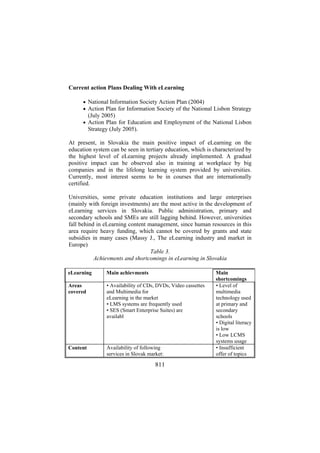
responsible for national policies concerning ICT developments in all sectors.

591
Its department for ICT Policy and Public Sector Reform coordinates the
work connected with the programme, ‘eNorway’, that is an initiative:
“… across political boundaries, to take part in a comprehensive
ICT policy – to cooperate –secures a more effective utilisation of
society's common resources as well as better services for citizens
and businesses. Open standards and open source code is one
example; to create a common ICT architecture in the public sector is
another –while cooperation between the public and the private
sector to increase the level of competence in the population and
businesses is a third one.” (FAD 2009)
In line with e-learning in general, Norway, and Scandinavia, has a higher
penetration of mobile phone subscriptions than most other countries. All the
Scandinavian countries have more mobile subscriptions than inhabitants.
Mobile communications increased with 21 percent from 2006 to 2007. The
average Norwegian talks 2.4 hours by mobile phone during a month. 3
billion SMS/MMS messages were sent during the first half of 2007. The
average Norwegian mobile subscriber sends 99 messages per month. The
number of SMS messages increased 5 percent last year, while the number of
MMS is much lower (totally 51 million during the first half of 2007) and
shows less increase (2 percent). There is a clear tendency that the mobile
phone takes over for ordinary telephone communication; two years ago
mobile phone communication stood for 28 percent, in 2006 38 percent and
first half of 2007 46 percent of all telephone communications (Aftenposten
2007).
eLEARNING AND ICT INTEGRATION
Within the educational sector a number of continuous efforts are taking place
to stimulate the use of ICT in all sectors at all levels of education. In addition
to the NOU, mentioned above, some examples are: The NOU, mentioned
above, has three main function areas: Knowledge development related to
distance education and ICT in education, Project funding to stimulate elearning development and Information and cooperation between higher
education and working life.
The NOU is the main centre for distance education and the use of ICT in
higher education. The project funding scheme has resulted in the
development of a great number of higher education courses and study
programmes at a distance based on e-learning and the use of ICT.

592
While the former state organization, SOFF, specifically was oriented
towards distance education, the NOU has a broader perspective on
stimulating development of higher education applying ICT. According to a
wide spread perception, the borders between on campus and distance
teaching is diminishing as ICT is introduced on a more general basis, so that
in principle both target groups can be reached by the same course
(Kunnskapsdepartementet 2009). This author is not convinced that this is the
case, as most distance students may have quite different needs for
concerning course organization, structure and pedagogical solutions.
Problems concerning teaching different target groups have been discussed by
Tønneson (2005).
Partly as a result of the governmental initiatives through the NOU most
higher education institutions offer some distance education courses. To
organize distance education some institutions have established separate
departments or business units. In spite of governmental policies and efforts,
e-learning, online learning or distance education is still a very marginal
activity of public higher education institutions, and, in fact, it seems that the
Competence Reform of 2003 reduced attention towards external studies as a
result of the greater pressure on quality issues concerning on campus
teaching.
The UNINETT Group supplies network and network services for
universities, university colleges and research institutions and handles other
national ICT tasks (UNINETT 2009). The Research and Competence
Network for ICT in Education (ITU) was established in 1997 as part of the
Ministry of Education’s action plan for ‘ICT in Norwegian Education 1996999” (KUF 1996).
ITU works to stimulate the competence and development of ICT in schools.
This includes work directed towards primary and secondary schools as well
as stimulating teacher education in the field (ITU 2009).
At regular intervals ITU carries out a survey on ICT competence and ICT
applications in schools, the ITU Monitor (e.g. Arnseth et al. 1997. Within
ITU the National Secretariat for Standardization of Learning Technologies
(NSSL) is established as a national project to arrange for ‘reuse of learning
resources’ through standardization (NSSL 2009). Utdanning.no is a national
integrated portal with the aim of giving access to all relevant information on
education, career development, learning and educational system.

593
The development of a coherent system for Course Description Metadata
(CDM) has been important to exchange information of courses.
The Coordination Group for Portals in the Educational Sector (SANU) is an
advisory and coordination body for the Ministry and other portal owners in
education.
All the above mentioned organizations, UNINETT, ITU, Utdanning.no and
NOU are owned or governed by the Norwegian Ministry of Education and
Research. It has been decided to merge the three first of these, and the
geographical location will be Tromsø in the north of Norway, where the
NOU is already located.
CASE STUDIES
As discussed above, Norway has a long tradition in distance learning and has
also been a leading country in developing e-learning/online learning. E.g. the
http://www.nettskolen.com/in_english/megatrends/the_project.html) Mega
trends Project (which identified and analyzed ‘megatrends’ in e-learning in
Europe and European ‘Megaproviders’ of e-learning found that in spite of
the low population of Norway (4.7 million), Norway included 4 out of 26
European Megaproviders (Arneberg et al. 2007, Paulsen 2007).
NKI Distance Education
NKI Distance Education (www.nki.no ) is the largest distance teaching
institution in the Nordic countries. NKI courses within higher education,
secondary level education and vocational training. Originally a
correspondence school, NKI was among the first institutions in the world to
offer online education when it launched its in-house developed LMS for
online distance learning in 1987.
The total numbers of student enrolments 2008 were approximately 8000 to
about 23,000 e-learning courses (and about 4000 other distance learning
courses). Presently (autumn 2009) NKI has approximately 11000 active elearning students in the system. NKI has continuously developed new
generations of its LMS and refined the LMS to satisfy the defined needs of
distance teaching and learning. NKI operates a system were students can
start at any day of the year and follow their individual progression schedule.
To combine individual flexibility with support through voluntary
cooperation NKI has developed a number of solutions for individual follow
up and cooperation between pairs or groups of students.

594
NKS Distance Education (www.nks.no), the second largest distance
education institution in Norway, also offers courses within higher education,
secondary level education and vocational training.
BI Distance Education Centre
BI Distance Education Centre (www.bi.no) is a separate business unit for
online distance education courses and programmes within BI (Norwegian
School of Management), an on campus based non-governmental university
college for business and management studies. The centre provides courses
within higher education and vocational training. The centre had about 8500
course enrolments in 54 online courses in 2005.
Consequently, the institution is, as many public Norwegian higher education
institutions, operating a dual mode system.
Sør-Trøndelag University College (www.hist.no).
Sør-Trøndelag University College offers courses at higher education level.
In 2005, the institutions had about 2500 enrolments in 148 online courses.
Another institution that was considered as a megapovider in the Megatrends
Project was the Norwegian Networked University (NVU)(www.nvu.no), a
consortium consisting of 1 university and 5 university colleges. These were:
Agder University College, Bergen University College, NordTrøndelagUniversity College, Stord/Haugesund University College, SørTrøndelag University College and University of Stavanger. The consortium
used to act as a common provider. However, during the last years, the
participating institutions have increasingly been operating as independent
providers, and in 2005 they ceased to operate as a common provider. They
nevertheless continue to cooperate on research and development related to
online e-learning.
Thus, today the consortium has several activities aimed at building
knowledge and competence within e-learning provision and has important
dissemination activities related to this (for example a yearly conference).
Without necessarily offering distance education courses, all higher
education institutions in Norway (with exception of a few small privately
owned ones) have implemented a virtual learning environment (VLE).
Typically, a central part of a VLE is a commercial Learning Management
System (LMS). Other systems are often linked with the LMS, e.g.
administrative tools.
A large number of these institutions have more than 5000 students or 100
courses using a VLE (for example, in 2005 more than 15000 students were

595
connected to the VLE at the University of Oslo) (Arneberg et al. 2007, p.
61). According to the Ministry of Education (Kunnskapsdepartementet 2009)
there were in 2008 registered approximately 5500 distance e-learning
students in public higher education institutions.
According to NADE, it is assumed to be around 30,000 students in private
distance education (of these assumedly 20,000 e-learning students). It should
also be mentioned that the LMS provider, Fronter, is a major player in the
Norwegian and international e-learning field. Established in 1998 Fronter
claims 2009 to have 6 million users.
A majority of Norwegian schools and higher education institutions use the
Fronter learning platform for course delivery and/or administration. Another
Norwegian LMS provider, It’s Learning, claims to have about 700,000 users
in 10 countries.
Mobile learning may be seen as an extension of more standard e-learning
solutions in education.
There are in Norway a number of examples of projects on mobile learning in
Norway. Projects may have been initiated by industry with needs for flexible
on the job training, universities, school authorities and distance teaching
institutions (Rekkedal 2008).
RESEARCH AND EVALUATION
Norwegian higher education institutions and educational research centres
have not generally focused on research on distance education, online
education or e-learning. However, the Monitor surveys of ITU (Arnseth et
al. 2007) and NOU (Wilhelmsen et al. 2009) deserve to be mentioned. Both
organizations publish regularly research on ICT and flexible learning.
The publication series from NOU contains a large number of editions, e.g.
one study concerned a 10 year evaluation of project work (Støkken et al.
2002) that criticized that evaluation information from the state financed
projects was meager.
Also anthologies concerned with theoretical or practical project experiences
are regularly published (e.g. Grepperud et al. 2005, Arneberg et al.
2006).NKI distance education has operated a research and evaluation
department since the beginning of the 1970’ies.

596
A large number of evaluation reports and reports on distance education,
online education and mobile learning have been published (www.nki.no)
(See also this author’s home page (http://home.nki.no/torstein)
SOME PRESENT ISSUES
It is a paradox that all political parties and governmental policies stress the
importance of stimulating the development of e-learning and online distance
education, and at the same time, in practice, financial solutions and
regulations concerning distance education at distance teaching institutions
and in higher education have not supported this goal.
In spite of the fact that the government supports the NOU, although budgets
are not very substantial, financial regulations of higher education and the
Competence Reform with emphasis on costly efforts to increase quality of
on campus study, has worked in the opposite direction. In this author’s view
the situation for non-governmental distance education is even worse, as the
new legislation, Adult Education Act, and financial solutions do not give
priority to the adult distance student. Another negative factor is that from
2008 distance students taking courses that are not directly related to formal
accredited school and college curricula in 2008 lost the right for study loans.
Some of the effects are probably not actually foreseen by the politicians
when they take the decisions.
While the recent white paper from the Ministry of Education
(Kunnskapsdepartementet 2009) states the intention to focus on the
development of higher distance education, the distance education
institutions, which traditionally have been in the forefront of distance and
online education developments, are largely neglected in the paper.
CONCLUSION
In this article we have tried to describe and discuss e-learning and online
learning in Norway, perhaps with some special reference to distance
education (as the special field of the author’s research).
As a country in the top of the world nations concerning national finances, it
is no wonder that Norway probably also is among the leading nations in the
development of e-learning. Norway has a long tradition of high quantity and
quality in distance education, mainly dominated by private initiatives. Since
1990 distance and online education have also been a focus area by many

597
higher education institutions.
Although, there have been some signs of decrease in attention and priority of
distance education in higher education recently, there are signs in
governmental policy that one will take actions to change this trend. Private
providers of online education faces great challenges both in competing with
state supported public institutions and in costs-efficiency as financial support
from the government is more or less withdrawn. There has for many years
been a tradition of cooperation between higher education institutions and
private distance education institutions in offering online distance
programmes. Whether new policies and funding schemes will support or
work against such solutions remain to be seen.
REFERENCES
Aftenposten (2007): Nordmenn elsker mobilen. Aftenposten 26. October
2007. Nyheter, pp. 4-5. Andreas Bakke.
Arneberg, P., Myklebost, G. & Skare, O. (eds.)(2006): Fra erfaring til
kunnskap. Noen lærdommer fra utviklingsprosjekter 2005. 2006-2. Tromsø:
Norgesuniversitetet.
Arneberg, P., Keegan, D., Lõssenko, J., Mázár, I., Fernández, P., Paulsen,
M. F., Rekkedal, T., Toska, J. A., Sangrà, A. & Zarka, D.: The provision of
e-learning in the European Union. Bekkestua: Norway, NKI. Retrieved on
16.6.2009 http://www.nettskolen.com/in_english/megatrends/Book1.pdf
Arnseth, H. C., Hatlevik, O., Kløvstad, V., Kristiansen, T. & Ottestad, G.
(1997). ITU Monitor for 1997. Skolens Digitale tilstand. Oslo:
Universitetsforlaget. Retrieved on 17.6.2009, and available from
http://www.itu.no/filestore/Rapporter-PDF/ITU.
Brækken, G. (1997). Tiden er inne for et åpent universitet. Aftenposten, 12th
Carvalo, J., Carrill, I., Dias, A., Ispán, Z., Jack, J., Keegan, D., Kismihók,
G., Mileva. N., Paulsen, M. F., Rekkedal, T. & Simpson, B. (eds.) (2008).
The Role of Mobile Learning in Europe Today, pp, 178-206. Dublin:
Ericsson Education.
Economic Intelligence Unit (2007): The 2007 e-readiness rankings – raising
the bar. A white paper from the Economist Intelligence Unit. London, New

598
York and Hong Kong: The Economist Intelligence Unit Limited and IBM
Corporation. Retrieved on 15.6.2009, and available from
http://graphics.eiu.com/files/ad_pdfs/2007Ereadiness_Ranking_WP.pdf
FAD (2009). ICT Policy/eNorway. Retrieved on 17.6.2009. and available
from http://www.regjeringen.no/en/dep/fad/Selected-topics/ictpolicyenorway.html?id=1367
Grepperud, G., Iversen, A., Myklebost, G. & Rekkedal, T. (eds.)(2005). Til å
bli klok av… Et knippe prosjekterfaringer 2004. 2005-2. Tromsø:
Norgesuniversitetet.
Karow, W. (1977). Privater Fernunterricht in 16 Ländern. Übersich und
Vergleich. Berlin: Bundesinstitut für Berufsbildungsforschung.
Keegan, D., Lõssenko, J., Mázár, I., Fernández, P. M., Paulsen, M. F.,
Rekkedal, T., Toska, J. A. & Zarka, D. (1997. E-learning initiatives that did
not reach targeted goals. Bekkestua: NKI. Retrieved on 16.6.2009. and
available from http://nettskolen.nki.no/in_english/megatrends/Book3.pdf
KUD (1971). St. meld. 84 (1979-1971) Om undervisning i radio og fjernsyn.
KUF (1988). NOU:1988:28 Med viten og vilje.
KUF (1989). St. meld. nr. 43 (1988-89) Mer kunnskap til flere.
KUF (1996). IT i norsk utdanning. Plan for 1996-1999.
KUF (1997). NOU 1997:25 - Ny Kompetanse.
KUF (1998). Stortingsmelding nr 42. (1997-98) Kompetansereformen.
KUF (2001). St.meld. nr. 27 (2000–2001) Gjør din plikt – Krev din rett.
Kvalitetsreform av høyere utdanning.
Kunnskapsdepartementet – Ministry of Education and Research (2007).
St.meld. nr. 7 (2007-2008) Statusrapport for Kvalitetsreformen i høgre utdanning.

Kunnskapsdepartementet (2009). Ot. prp. pr. 87. Om lov om
voksenopplæring (voksenopplæringsloven).
Kunnskapsdepartementet – Ministry of Education and Research (2009).

599
St.meld. nr. 44 (2008-2009) Kunnskapslinja.
ITU (2009). Om ITU.Retrieved on17.6.2009 available from
http://www.itu.no
Ljoså, E. & Rekkedal, T. (1993): From External Control to Internal Quality
Assurance. Background for the Development of NADE’s Quality Standards
for Distance Education. Oslo: NADE.
Lovdata (2005). Lov om universiteter og høgskoler. Retrieved on 16.6.2009,
and available from http://www.lovdata.no/all/nl-20050401-015.html.
Norwegian Ministry of Education and Research (2009). Stortingsmelding nr.
44 (2008-2009), Utdanningslinja.
NSSL (2009). Nasjonal Sekretariat for Standardisering av Læringsteknologi.
Retrieved on 16.6.2009. and available from http://www.itu.no/no/NSSL/
Paulsen, M. F. (Ed.) (2007). Megaproviders of e-learning in the European
Union. Bekkestua: NKI. Retrieved on 16.6.2009, and available from
http://www.nettskolen.com/in_english/megatrends/Book2.pdf
Rekkedal, T. (2008). Mobile Learning in Norway. In: Carvalo, J. et al. eds.).
The Role of Mobile Learning in Europe Today, pp, 178-206. Dublin:
SSB – Statistics Norway (2009). Education statistics. Independent distance
teaching institutions, 2008. Retrieved on 16.6.2009, and available from
http://www.ssb.no/fjernund_en
Støkken, A. M. et al. (2002). Mange bekker små Evaluering av arbeid med
SOFF-støttede fjernundervisningsprosjekter. SOFF rapport. Tromsø: SOFF.
Tønneson, Ø. (2005) Fleksibilisering av grunnfagsstudiet I samtidshistorie –
et prosjekt som gikk I grøfte? In: Grepperud, G. et al. (eds.). Til å bli klok
av… Et knippe prosjekterfaringer 2004, pp. 177-187.
UNINETT (2009). About the UNINETT Group. Retrieved on 17.6.2009,
and available from http://www.uninett.no/om.en.html
Wilhelmsen, J., Ørnes, H., Kristiansen, T. & Breivik, J. (2009). Disgitale
utfordringer i høyere utdanning. Norgesuniversitetets IKT-monitor. 2009-1.
Tromsø: Norgesuniversitetet.

600
WEBLOGRAPHY
Megatrends Project: Retrieved on 16.6.2009, and available from
http://nettskolen.nki.no/in_english/megatrends/
NADE – Norwegian Association for Distance Education: Retrieved on
16.6.2009, and available from http://www.nade-ff.no/default.pl?showPage=189
NOKUT – National Agency for Quality Assurance in Education: Retrieved
on 16.6.2009, and available from http://www.nokut.no/sw335.asp
NOU – Norwegian Opening Universities: Retrieved on 16.6.2009, and
available from http://norgesuniversitetet.no/seksjoner/english
UNINETT – The Norwegian Research Network: Retrieved on 23.11.2009,
and available from http://www.uninett.no/index.en.html
Utdanning.no – Norwegian national portal for educational information:
Retrieved on 16.6.2009, and available from
http://utdanning.no/om_utdanning_no/about_utdanning_no
T. Rekkedal home page: http://home.nki.no/torstein Retrieved on 16.6.2009
Wikipedia (2009a). Norway. Retrieved on 15.6.2009, and available from
http://en.wikipedia.org/wiki/Norway.
VOX–Norwegian Institute for Adult Learning: Retrieved on 16.6.2009,
http://www.vox.no/templates/CommonPage.aspx?id=2598&epslanguage=NO

BIODATA and CONTACT ADDRESSES of AUTHOR
Prof. Dr. Torstein REKKEDAL, NKI Distance Education
Torstein REKKEDAL is Director of Research and
Development, NKI. Postal address: N-Box 111, 1319
Bekkestua, Norway Visit address: Hans Burumsvei 30,
1340 Bekkestua, Norway, Professor in distance
education at the Norwegian School of Information
Technology (NITH). Head of Distance Education
Research and Development at NKI Distance Education. Academically
responsible for the training of distance tutors and subjects within pedagogy
and distance teaching and learning. Adjunct professor at Athabasca
University, Canada. External visiting professor at Carl von Ossietzky
University Oldenburg, Germany, and University of Maryland University
College, USA. Roll of Honour 2000 from the European Association for
Distance Learning (EADL) Prize of Excellence for Life Long Constribution
to the Field of Open and Distance Education 2001 from International
Council for Open and Distance Learning (ICDE), Anniversary Certificate of
Honour 2001 from European Distance Education Network (EDEN),

601
Honorary Doctor of the British Open University 2003, Awarded Senior
Fellow 2008 by European Distance Education Network (EDEN)
Torstein REKKEDAL
Professor and Director of Research and Development,
NKI Office, NORWAY
Phone: +47 67588800,
Direct line: +47 67588944,
Telefax: +47 67530500
Email: torstein.rekkedal@nki.no
http://home.nki.no/torstein

602
CHAPTER-25
eLEARNING IN OMAN
E-Learning from an Omani Perspective
Ali Sharaf Al MUSAWI
Sultan Qaboos University, OMAN
ABSTRACT
E-Learning has introduced new approaches of instructional delivery where
the roles of teacher and student have significantly changed.
The case in Oman shows that the introduction of these approaches needs to
keep pace with the demands of the times, but only the actual needs arising
from social and educational context of Oman. Attention should be given to
the socio-cultural understanding of teacher-student relationship in open
technology-enriched learning contexts.
Omani educational institutions continue to review their policies and
provision of e-Learning, considering technological alternatives for resolving
some of the pressing issues posed by the actual needs. There is a need for
coordination at the national level to create strategies and mechanisms and
controls that ensure the quality of e-Learning institutions and outputs.
INTRODUCTION
The Sultanate of Oman, being a developing country, has gone through many
social changes that have, in turn, altered the Omani society needs.
Technology, on the other hand, has exerted a tremendous impact on the
Omani societal setting and contributed to even more needs.
The above argument also raises another demanding social need. For example,
the number of secondary schools graduates is increasing throughout the years
and accommodating these ever increasing numbers forms a great challenge to
the Omani higher education system.
The social demand to increase the higher education intake is obvious. Taking
in consideration that these graduates are well tuned to recent technological

603
development, may contribute to alleviate this problem through instituting a
quality technology enriched distance and electronic learning system where
the higher education institutions could admit a certain number of students
using this delivery method.
The Internet and other forms of e-learning platforms are being introduced
and diffused into the Omani educational systems for teachers and faculty
members to go online.
Versions of learning management systems such as WebCT, Moodle, and eportals have been implemented at many educational institutions.
Strategies are being used to publicize and popularize e-learning and
encourage lecturers to put their courses onlineIt is important to discuss
lessons learned in the Omani context to set the stage for future development.
Studies have been conducted on the perspectives of the early adopters and
other dimensions of e-learning.
These shoe that the planning and organization of change in educational
system takes time, tact, skills, experience, perseverance and much more.
These and other challenges may have implications for other Arab educational
institutions in the region as moves are being made by some of these
institutions to collaborate in the pursuit of e-learning.
COUNTRY
The Sultanate of Oman is an Arab country in southwest Asia on the southeast
coast of the Arabian Peninsula. Chief of state and government is His Majesty
Sultan Qaboos bin Said Al Said who appoints the cabinet of ministers. The
Council of Oman is made up of member of the "state council" and
"consultation council" and assists the government in drawing up the general
policies of the state.
The Council meets at the request of Sultan Qaboos, to study and discuss
matters raised by him, taking all its decisions on the basis of a majority vote
(MOI, 2008).
The Sultanate is divided into nine governorates and regions. Each
governorate consists of states share common cultures, habits, Arabic dialects,
history, traditional clothing and traditional occupations.

604
Figure 1.
A Map of Oman

The Ministry of Economy estimates that in mid 2006 the total population was
(2.577) million. Of those, (1.844) million were Omanis. The population has
grown from (2.018) million in the 1993 census to (2.340) million in the 2003
census. Omani citizens enjoy good living standards. Major source of income
is oil. The other sources of income, agriculture and local industries, are small
in comparison and count for less than (1%) of the country's exports.
Industries contribute only with (4%), but there are governmental plans to
increase this.
Oman has other mineral resources including copper, asbestos and marble.
The Omani economy has been radically transformed over a series of
development plans beginning with the first five-year plan (1976-1980). A
vision of Oman's economic future up to the year 2020 was set out at the end
of the first phase of the country's development 1970-1995. Vision 2020,
outlined the country's economic and social goals over the (25) years of the
second phase of the development process (1996-2020).

605
It has developed the following aims with regard to securing Oman's future
prosperity and growth (MONE, 2007):
• To have economic and financial stability
• To reshape the role of the Government in the economy and to
broaden private sector participation
• To diversify the economic base and sources of national income
• To globalize the Omani economy
• To upgrade the skills of the Omani workforce and develop human
resources
The estimated workforce was (920,000) in 2002. A large proportion of the
population were still engaged in subsistence agriculture or fishing. The
skilled local labor force is small, and many of the larger industries depend on
foreign workers who constituted over (80%) of the modern-sector workforce
in 1996 (MONE, 2007). The Omani culture has its roots firmly in the Islamic
religion. All Omanis are Muslims, but they are not only tolerant of the beliefs
of different Muslim divisions, they are also tolerant towards believers of
other faiths, who are allowed to practise their religion in churches and
temples. Although Arabic is Oman's official language, the country has also
adopted English as a second language (MOI, 2008).
EDUCATION
In 1970, there were only (3) boys schools with (909) students in Oman. On
the the 2nd National Day on 18th November 1972, His Majesty Sultan Qaboos
bin Said, talked about the importance of education emphasizing the need to
“break the chains of ignorance. Schools have been opened regardless; the
important thing is that there should be education, even under the shadow of
trees“.
The educational mutation was enormous. It accrues at (1000) schools and
(469,849) male and female students in 1995. However, in that same year, the
Ministry of Education prepared a report on how to implement new education
reforms focusing on human resources development; and in 1997, the Minister
of Education at the "consultation council" stressed the importance of the
reform and shared with members the new changes which involve changing
the structure of the Ministry, revising the aims of education, abolishing the
afternoon schools, and providing a unified (10) year education system with

606
two cycles (4 years for cycle 1 and 6 years for cycle 2) by the government for
all children of school age. It meets their basic education needs in terms of
knowledge and skills, enabling them to continue their education and training
according to their interests, aptitudes and dispositions. It also prepares them
to face the challenges of present circumstances and future development in the
context of comprehensive social development.
This basic education aims at an integration between theory and practice,
thought and work, education and life comprehensiveness in developing all
aspects of a whole personality the acquisition of self-learning skills in the
context of a lifelong education inculcating the values and practices necessary
for mastery and excellence in learning and teaching meeting the needs of
human development in the context of comprehensive social development.
The schools are furnished with learning resource centers, computer
laboratories, and science, environmental life skills, music, and multi-purpose
rooms (Al Balushi, 2000). It is envisaged that the Basic Education System
will be expanded, while post-Basic education for the 11th and 12th grades
will be upgraded to encourage the continuing development of skills, enabling
young people to benefit from educational, training, and work opportunities
schemes, after they have left full time education.
The Sultanate has over than (50) public and private higher education
institutions. Those are regulated and, sometimes, administered by the
ministries of higher education, manpower, and health. The Ministry of
Higher Education continues to send students on scholarships abroad. There
are currently Omanis in Australia, New Zealand, the United States, the UK,
France and Germany.
There are two categories of sponsorship, full scholarships, and partial
scholarships. In 2007, five colleges of education were converted into colleges
of applied sciences with language laboratories along with information
technology centers were installed at each college. From the moment the door
was first opened to private investment in higher education the sector has seen
steady progress. The Accreditation Council was set up in 2001 to regulate the
accreditation, assessment and quality control of the Sultanate’s higher
education institutions and several plans and programs have been drawn up to
guarantee the standards of the higher education sector.
The government offers extensive facilities and support to encourage the
growth of private higher education institutions.

607
Non-government universities receive grants totaling (50%) of their paid-up
capital, to a maximum of (USD8) million (MOI, 2008).
Sultan Qaboos University (SQU) received its first student intake in (1986)
and endeavored to establish itself as one of the Sultanate’s academic and
scientific pioneers.
Today SQU offers a wider range of opportunities for general secondary
certificate graduates than ever before. The University has ten colleges and
seven research centers, and awards bachelors and masters' degrees, as well as
higher diplomas and doctorates. Scientific research is devised to upgrade the
quality of education offered by at the university, while enhancing its
contribution to the sciences and human knowledge. In 2005, a national
scientific research council was also established to reflect official recognition
of the importance of scientific research both for the national economy and
the entire society in a sustainable manner. A science and technology policy
that consists of clear strategies and a detailed road map to ensure its
successful implementation of research and development was formulated
(MOI, 2008).
DISTANCE EDUCATION IN OMAN
Recently, most of the Omani educational institutions at all levels have
adopted the concept of electronic learning in which educational and training
programs are presented to the students at a distance over the internet.
Students who are part of this scheme either study alone or with the assistance
of a teacher. These programs depict some of the early adopters of distance
learning systems in the Sultanate.
The Ministry of Education holds the view that distance education is bringing
new types of learning to isolated students and, where trained teachers in
specialized subject areas do not exist, distance education represents a lifeline
of hope. However, one of the most crucial aspects of the implementation of
sound plans involves the development of trained teachers who know not only
how to operate computers and other technology, but also are experts at how
to use technology to help students to learn more easily and more effectively.
Planning for ICT must be carried out in a responsible way to ensure that its
implementation is not short lived, but sustainable over a period of time.
While young students in Oman are encouraged to build virtual worlds, older
students learn to create animations, web pages and to program what the
computer does using advanced programming languages (MOE, 2008).

608
On the other hand, some Omani higher education institutions are affiliated
with overseas universities in India, USA, UK, and Australia through which
some provide their students with distance learning courses and programs. For
example Virginia Tech act as educational adviser, and a partner to establish a
new university that will focus mainly on science, business, and engineering,
but once it gets off the ground, there are hopes for a liberal arts curriculum
outside of the core course that it's currently prepared to offer (Prendergast,
2008).
The Omani branch of the Arab Open University is a full-fledged distance
learning higher education institution. Its case will be discussed later. The
Ministry of Higher Education has also approved several accredited
distance/online universities for Omani students to study through. Those
include a list of Arab, regional and international universities. Yet, with the
increase of students' numbers graduating from the secondary schools, access
to higher education is indeed one of the main difficulties that must be
actively dealt with (Al Musawi, and Abelraheem, 2004).
Distance learning materials and software used in traditional and electronic
formats are copyrighted. Copyrights in Oman are protected under Royal
Decree 37/2000. Protection continues for (50) years after the author’s death.
Financial rights such as royalties are afforded under this law. The authors
enjoy the right to have their work published in a pen name. Infringement of
copyright is punishable by the Omani law. Ministry of Commerce and
Industry in association with World Intellectual Property Organization
(WIPO) organized an International Seminar discussed the theoretical
framework of intellectual property and its role in trade and commerce within
the Arab world (ITA, 2007).
TECHNOLOGY AND ICT
The Sultanate’s strategy to fully liberalize the communication sector has
provision to allow private operators of internet services. Oman
Telecommunication Company (Omantel), the government agency in-charge
of communications in the Sultanate, was privatized in March 2002. It
currently provides the countries fixed-line and internet services. It has
completed several fiber optic projects in the interior regions of the Sultanate
and linked the remote islands with microwave link.
Wireless connectivity for broadband services is available for adoption in
Oman. Currently the mobile communication service providers offer a

609
wireless connectivity for accessing the Internet. Such a service connects to
the Internet, using a WiFi enabled laptop, PDA or mobile device to make it
possible to conduct remote meetings and tele-presentations as well as process
emails (ITA, 2007). Telecommunication Regulatory Authority (TRA) is a
governmental agency established in 2002 to regulate telecommunication
activities at the national level (TRA, 2006).
Other regulatory bodies and strategies were formed to introduce eGovernment and create a ‘digital society’. In 1998, the National Information
Technology Committee was set up to oversee the development of the
Sultanate’s information technology sector and to work towards an egovernment initiative. This committee set up the ‘Information Technology
Task Force’ as the technical action group comprising representatives of the
competent departments and bodies and the National Information Technology
Strategy was launched in November 2002.
A plan of action to be implemented by the Information Technology
Technical Secretariat was compiled. It is the first major step in the country’s
ambitious plans. Information Technology Authority (ITA) was then set up in
2006 as an autonomous legal body affiliated to the Minister of National
Economy. ITA serves as a competency centre on best practices in eGovernance and in harnessing information and communication technologies
(ICT), thereby offering efficient and timely services, integrating processes
and improving efficiency in service delivery.
E-Oman, the digital society plan of action, incorporated a range of initiatives
towards provision of government services through electronic channels,
building ICT capacity within various segments of corporate sector and the
common public. E-Oman comprises of a wide range of initiatives and
services that are designed and created to improve the efficiency of
government services, enhance the activities of businesses and empower
individuals with skills and knowledge, to meet society’s needs and
expectations and to direct Oman towards becoming a Knowledge-based
Economy.
The implementation of the strategy began in May 2003 with the following
focus areas: streamlining government services to citizens and business,
creating and nurturing knowledge-based industries developing a local ICT
sector, supporting a better competitive environment, providing employment
for Omani youth, enabling better healthcare, improving educational
opportunities, supporting tourism sector, enhancing social development using

610
it, making Oman a more attractive destination for foreign investment and
conducive for business. Knowledge Oasis is the Information Technology
park of Oman.
It is a public-private sector led initiative committed to creating a multistakeholder environment. In such an environment, entrepreneurs, small and
medium-sized enterprises as well as established multi-nationals can innovate
and nourish the ICT sector within the region. The park now hosts two
dedicated technical colleges to groom and nurture future talents and upgrade
the manpower skills required for various businesses. The National
Information Technology Training and Awareness Initiative is a nation-wide
initiative aimed at developing ICT skills capability and increasing ICT
awareness within the government and the community. The Government
Information Technology Training project aims to train and certify all civil
service employees during the three year period 2007-2010. The Community
Information Technology Training project aims to set up community
technology learning centers throughout the country. The primary purpose of
these centers will be to reduce computer illiteracy and bridge the digital
divide by providing free or low cost information technology education to the
community. ITA launched pilot programs in the first and second quarter of
2007 in order to prepare a framework for national implementation of
community information technology training (ITA, 2007).
In response to academic and training needs, Omani specialists in educational
and information technologies have formed a professional society, the Omani
Society of Educational Technology (OSET). As an ICT in education expert
group, OSET, which was formally inaugurated in 2006, aims to: (1) conduct
research on educational technology impact on education in Oman and the
Gulf states; (2) present the society role and emphasize its contribution to the
socio-educational developments; (3) form a niche to the Omani/Gulf
specialists and develop their experiences; (4) keep abreast of the
technological innovation in education and disseminate their applications
within the Omani society; and (5) link with similar associations in the Gulf
and other parts of the world. OSET has conducted many workshops and
seminars and plans to have its first international conference in March 2010. It
also plans to issue a specialized reviewed journal of its own (OSET, 2009).
In 2006, penetration levels of ICT services in Oman show that the number of
internet subscribers is (63,332) with dial- up subscribers at (48,770), DSL
subscribers at (13,360), leased Line Subscribers at (246), and other internet
services subscribers at (956).

611
A gender based ICT usage study was conducted by the TRA and SQU's
telecommunication research center revealed that the male-female ratio is
almost 1:1. The dominant age group in the population pyramid is between
(15) and (64) years of age. The results showed that in Oman males normally
spend more on ICT than females and that around (54) and (46) per cent of
male and female respectively use internet in the Sultanate. The demand and
access to the internet service is much related to the availability of means of
access such as computers, fixed line and public access centers such as
internet cafes. It was also evident from this survey that on an average an
Omani individual spends (USD7.8) per month for Internet access
(International Telecommunication Union, 2006).
In education sector, ICT was first introduced into mixed gender basic
education first cycle schools in September 1998. Seven computers were
initially located in each school’s learning resource centre (LRC). All students
in grades one to three visited the LRC once a week, while this was increased
to two visits a week for grade four students.
In 2003, computers began to be introduced into the teaching classrooms. Two
laptop computers were used in these classrooms as one of the sets of
resources through which groups of students rotated. While some commercial
software was employed, most of the activities are created locally by
curriculum developers and classroom teachers.
The first batch of second cycle basic education schools was opened in the
2001-2002 school year. Second cycle covers grades five to ten and in most
cases, boys and girls attend separate schools. ICT was from the very
beginning considered as an important part of the new basic education
program. Spiral information technology curriculum has been introduced to
provide opportunities for students to gradually become aware of the many
ways in which computers and their peripheral components can be used as a
personal tool to assist them in their learning and their future lives. Every year
a new ICT grade level curriculum and support materials were introduced and
an ICT curriculum is now available for all grade levels in second cycle
schools. Students in second cycle schools have greater access to technology
than students in first cycle schools.
At each grade level in second cycle, students have two ICT classes every
week. Teachers encourage students to use laptop computers and LCD
projectors to make presentations in subject classrooms.

612
In addition, many of the concepts and skills introduced in the ICT curriculum
are complemented by curriculum units in other subject areas. Collaborating
with other students and out-of-school experts is encouraged through
dedicated software and troubleshooting strategies for hardware and software
are explored. Information literacy and information and communications
technology knowledge, skills and values comprise the expected outcomes of
the program. Continuous assessment and the evaluation of student progress
are achieved through observation, interviews, performance tasks and
analyzing student products (MOE, 2008).
In higher education, an Internet-based admission service has been rolled out
from the higher education admissions centre of the Ministry of Higher
Education for the student fraternity.
This online service improves the experience of the students seeking
admission into over (50) different public and private higher education
institutions in Oman. Apart from increased efficiency in processing student
applications, the system also ensures fair and equal treatment for all
applicants while enabling secure electronic data transfer for better accuracy
and transparency. Many higher education institutions have equipped their
campuses with office and portable computers, LCD data shows, Internet and
Intranet links, e-mail facility, plasma screens, multimedia laboratories, and
learning management systems (LMS) (Al-Musawi, 2007).
For example, the Ministry of Higher Education has initiated recently a
restructuring program aiming to provide the existing six colleges of applied
sciences with more applied information technology.
A particular emphasis is directed towards improving the learning methods by
developing and implementing a unified LMS which serves the new form of
these colleges. Such system is particularly intended to improve the e-learning
skills in the six colleges (Gattoufi, Al-Naabi, and Gattoufi, 2007). Some of
these institutions own their videoconferencing facilities.
They usually have their own service centers of educational and information
technologies with skilled technical staff to provide the required maintenance
of hardware and systems. Some of these centers have trainers and designers,
and run in-house training programs for the faculty members and students. In
this regard, Al Musawi (2007) study's findings showed a tendency for future
expansion with less expensive technologies and the need for training.

613
The study found that there is a need to support higher education institutions
with technical and human resources to increase and activate the use and
number of new instructional media and equipment.
E-LEARNING AND INTEGRATION
E-Learning implies making use of ICT to develop student learning. It
becomes one of the important applications and an innovative way of using
these technologies in education and training systems. "With the advent of the
Internet and e-Learning methodologies and technologies, providers of
education (K12 and higher education) and training are creating e-Learning
materials to fulfill the demand (Khan, 2005: 3). The technological
developments, especially concerning the possibility of communicating
directly and creating groups of virtual interaction, and the introduction of
multimedia, audio-conferencing and remote imaging; all this has led to the
emergence of a modern e-Learning with the most prestigious universities in
the US and Europe transfer from their traditional to e-Learning and distance
learning methods (Gaddaa, 2003). E-Learning content is based on the
cognitive structural theory (constructivism). Research indicates that the new
direction of research should be about the recruitment methods and the design
of "virtual teacher" by the "effective teacher" to attract the attention of article
about student learning on the Web (Marriott, 2004).
The Ministry of Education is continually developing and enhancing its elearning environment. Classrooms are being linked to the new world of
learning possibilities available through Intranets and the Internet. Both public
and private schools are rapidly adopting technology to create a
comprehensive and connected learning community.
A part of the MOE reform of education are LRCs with the mission to provide
an educationally sound information literacy curriculum for developing the
students of Oman into life-long learners, ones who would be able to use
learning throughout their lives as a way to solve problems, act ethically, plan
for the future, and prepare for change (Moore, 2004). In addition, a course on
refining research skills has been made compulsory for all students in grades
eleven and twelve where ICT skills play a vital role in student investigations
to identify patterns in the data and construct new knowledge.
Through a project with UNESCO, a virtual library of learning materials is
being developed to aid blind and deaf students.

614
Students who cannot attend one of the special schools will be able to access
this bank of voice and image enhanced materials over the Internet. Secondary
students who have not come through basic education are learning basic
computer skills through the International Computer Drivers’ License (ICDL)
program to learn basic IT skills before entering a collegiate study program.
As of date approximately (370) accredited school-based training centers have
been established with ICDL certified teachers. Over 100,000 students have
been trained and tested at about (18) ICDL accredited testing centers (MOE,
2008). In addition, a comprehensive educational portal has been designed by
the Ministry of Education and it is currently at the pilot stage. The portal
facilitates a centralized electronic archive of information about students
studying under the
Omani educational system at both public and private schools. Interactivity
between administrators, teachers, students, and parents occurs through the
Internet, email and SMS. Due to the integrated data management, students
shall be able to transfer the classrooms as well with improved quality of
learning experience (ITA, 2007; Al Shanfari, 2007).
Although most teachers who initially worked with students in first cycle
schools were very committed, they tended to have limited experience of
using computers and were drawn from other subject areas.
All of their professional development came through courses and workshops
organized by the Ministry of education and delivered either centrally or
regionally. While most of these teachers had good teaching and assessment
skills, they often lacked knowledge and skills related to the use of computers,
both personally and professionally, and on ways in which computers can
enhance student learning.
In the second cycle, most ICT teachers in were graduates of the new teachers
colleges in Oman and came with a combined specialty in mathematics and
computers but had only limited practical experience in teaching and
assessment, little understanding of the concept of integration of ICT into the
curriculum, and no experience with graphics software.
A cascading model of professional development was developed with regional
core teams attending courses and workshops in Muscat and then returning to
the regions to pass on the knowledge and skills acquired using some of the
instructional strategies and learning materials provided (MOE, 2008).

615
In 2005, the college of education at Sultan Qaboos University has opened a
new department offering a bachelors degree in instructional and learning
technologies to prepare information technology teachers and LRC specialists.
The first batch of graduates from this department joins the service in the
schools in 2009 (Al Musawi, 2010).
The Ministry thinks of applying a comprehensive plan of 'school of
excellence'. The concept is proposed to:
•
•
•
•

pilot new hardware and software technologies in education;
model ICT in education programs;
pilot new e-content and digital interactive materials;
collaborate with universities to develop and evaluate new teaching
methodologies; and
• provide regular ICT trainings.
The implementation of these objectives starts by establishing three schools
(one from each grade level cycle 1, cycle 2, and post basic) in 2013 in each
educational region with a total of 33 schools of excellence where each school
has highly developed technology classrooms, a technology specialist, a well
equipped LRC.
The Ministry of Education has to develop partnerships with technology
companies and universities to pilot, evaluate, and develop new teaching
strategies and methodologies that use ICT in education and expand the new
teaching strategies and methodologies of the school of excellence to other
schools in Oman so they become training centers for teachers (MOE, 2009).
In higher education, technology has transformed the practice of Omani
institutions which is set to modernize her education to align with the rest of
the world. Several issues are receiving attention as policies are formulated
and the requisite foundations are being laid in preparation for the national
distance education program in Oman. While these institutions are not
oblivious of the advantages of e-learning, many Omani educators will be
better convinced with more research evidence on the quality, security and
credibility issues of e-learning.
The Omani concern for comparability of standards with the traditional
system is a genuine one which must be attended to before e-learning can be
developed, disseminated and diffused into higher education on a large scale
(Al Musawi and Akinyemi, 2002).

616
CASE STUDIES
Case 1: Sultan Qaboos University
At Sultan Qaboos University, the centre for information systems has issued
the university computing policies and security, equipment and information
protection rules to guide the clients on how to use on-campus information
technology and systems (SQU, 2002A and 2002B). They regulate the use and
abuse of the resources including hardware, software, networks and any other
support facilities. These documents are available online. Sultan Qaboos
University, also hosts the CISCO regional academy for CISCO training
programs. Other higher education universities host such e-learning
certification programs and operate under the regional academy at SQU. This
has expanded the opportunities for students and employees to gain vendor
based certification through e-learning mode (ITA, 2007). There are several
students' societies at SQU working in the fields of educational, information,
and communication technologies at the university and colleges levels. Those
hold many annual scientific activities and exhibitions showing the students'
products, thoughts and innovations. Sultan Qaboos University has
undertaken number of research projects based on specialized areas of eLearning. The research has been funded by SQU, private organization and
some external sponsors.
1. Some of these described the development of distance learning project
for common courses (Al Kindi, Al Musawi, Eltahir, et al., 2006).
Another research was conducted by Rawahi (2006) on e-Learning
evolution at the college of medicine and health sciences. It concludes
by presenting the college visions and directions on the
implementations of information technology infrastructure.
2. Faculty members use the Internet in their instruction, but it was
found that web-assisted instruction is equally effective as f2f
instruction in students’ achievements (Al Musawi, and Abelraheem,
2004).
3. Research also conducted in terms of LMS. Akinyemi (2002) wrote
that the adoption of Web-CT marks the beginning of a new era of
instructional delivery mode at the Sultan Qaboos University but the
challenges of the new technologies are being surmounted. However,
the positive attitude of faculty across programs towards e-learning as
demonstrated through their willing attendance of presentations and
workshops is a reliable proof of interest in technology adoption. A
study conducted by Al-Khanjari, Kutti, and Dorvlo (2005) indicate
that the Web Based Instruction (through WebCT) classroom

617
education with the use of an efficient course management system is a
good alternative for SQU lecturers. In a follow-up study Al-Khanjari,
Kutti, and Ramadhan (2005) found that WebCT in conjunction with
classroom education can provide a feasible platform particularly for
SQU undergraduate students. Students trained in the e-Learning will
be life-long learners and able to apply the acquired training in
solving problems in their workforce. Naqvi (2005) study has too
showed that SQU students who were exposed to the WebCT online
learning environment, had positive attitudes toward WebCT and in
turn had better learning and understanding of the course material
because it helps them in better understanding and learning the course
material. Hatem, Ramadhan, and Neagu (2005) suggested a practical
method towards semantic web application to e-Learning along with
its design framework to ensure that SQU develops a repository
reflecting the actual data and the semantics of all of its resources
including courses on WebCT and materials of the Visual Library.
4. Research in the field of professional development shows found that
there is no structured form of program or plan that has a clear vision,
goals, and strategies for educational technology faculty development
at the college level (Al Washahi, 2007). Al-Musawi (2008) reiterated
that professional development workshops at the university level,
although satisfactory to an extent as perceived by the faculty
members, need improvements in terms of planning, implementation,
and evaluation.
Case 2: Arab Open University, Oman
The Omani branch of the Arab Open University (AOU, 2009) is a fullfledged distance learning higher education institution attempting to promote
an open system of higher education that provides open opportunities of
studies for professional development and lifelong learning and to produce
graduates who are capable of embracing current and emerging technologies,
and who are competent in working in a global economy. AOU branch started
its operation in 2007 after being granted approval by Ministry of Higher
Education. The AOU with its emerging information technology platforms
has opened new learning opportunities.It offers bachelors degree programs in
business, English language, and in information technology for those in the
upper age group, in employment, and belonging to the lower and middle
income strata of the society. The university used an open system, good
quality subsidized higher education, and flexible mode of learning. Recent
research shows that AOU students and workers are aware of the use of the
distance learning system and that they are highly satisfied with the flexible

618
methods of delivery (Al Khadouri, Al Rajhi, Al Nasri, et al., 2009; Al
Balushi, Al Suleimani, Al Jahwari, et al., 2009).
Case 3: Huda Private School
Huda Private School (ITA, 2007) is the first electronic school in the
Sultanate which is completely networked with about (50) wireless access
points. Both the teacher and the students use multimedia laptops which are
connected to the school’s intranet website and to the Internet. The school’s
intranet hosts e-books and other software which enable the students to use
their e-pens to write on their monitor and transfer these to their electronic
exercise books. Student registrations, attendance recording, exam scheduling,
grading, annual results compilations, etc. are centrally managed and
information is made available to both teachers and parents. In addition the
SMS technology is used send alerts to parents about the progress of the
student. The inter-connectivity also enables ministry circulars, internal
bulletins, correspondences between teachers and students and activity
photographs are exchanged through electronic networks thus saving time and
increasing efficiency dramatically.
ISSUES OF E-LEARNING
Research has identified different issues. Behl, Fitzgerald, and Vrazalic
(2007) found that the four main areas to address in relation to the use of
online delivery are student characteristics, ICT environment issues, and
support for students and authentic activities. Akinyemi (2003) examines the
perspectives of some Omani students on web based learning and possible
cultural interference and found that results are yielding evidences of the need
for further research in this area as the interactivity factor in web based
learning poses an obvious threat to the Arab culture and religion in view of
some of the foregoing learner reactions and the uncontrollable inevitable
potential of virtual learning. Hall (2009) reported that if online learning is to
be used in Oman then the effect of cultural values and preferences must be
considered in the way that learning is designed; this emphasizes the necessity
of using design principles that account for culture and enable the challenges
of quality and access to be met more effectively. Al Musawi, and
Abelraheem (2004) concluded that e-Learning standards must be set before it
can be used widely in Oman. An increase in the human and technical
resources should be sought and more technical staff is required for
employment. Omanis should be sent abroad on scholarships in order to be
able to run bachelors and masters' programs preparing young Omanis in the
field of e-Learning.

619
This means graduate and post-graduate programs should be opened locally
(Al Musawi, 2010). Al Gharbi, Al Hatali, and Hatem (2004) supported these
conclusions and called for greater cooperation and coordination between
higher educational institutions and other government and private agencies to
help fill the gap between demand for information technology specialists and
their supply by higher educational institutions. Higher educational
institutions should also benefit from the expertise of the Sultan Qaboos
University academic and information technology technical staff.
CONCLUSION
It becomes obvious that as the number of students enrolled increases at
Omani educational system, the need to offer additional resources and
facilities increases too. Academic programs could be offered through elearning in addition to the traditional education. Research findings show that
there is awareness among Omani teachers and faculty members to expand on
new e-learning and digital multimedia technologies and that their perceived
values of the technology are tangible. However, the Omani concern for
comparability of standards with the traditional system is a genuine one which
must be attended to before e-learning can be developed, disseminated and
diffused on a large scale. This addresses one of the most important questions
faces the implementation of e-learning: the question of quality. E-learning
quality issue need to be resolved as the continuing rapid growth in students’
number graduated from Omani secondary schools poses major strategic
challenges for the higher education system.
REFERENCES
Akinyemi, A. (2002). E-Learning: A Reality in Sultan Qaboos University. In
G. Richards (Ed.), Proceedings of World Conference on E-Learning in
Corporate, Government, Healthcare, and Higher Education 2002, pp. 1113–
1115, Chesapeake, VA: AACE; retrieved on 03.10.2009, available at:
http://www.editlib.org/d/10350/proceeding_10350.pdf
Akinyemi, A. (2003). Web-Based Learning and Cultural Interference:
Perspectives of Arab Students. In G. Richards (Ed.), Proceedings of World
Conference on E-Learning in Corporate, Government, Healthcare, and
Higher Education 2003, pp. 1858-1862, Chesapeake, VA: AACE; retrieved
on 03.10.2009, available at: http://www.editlib.org/d/12239/proceeding_12239.pdf
Al Balushi, A., Al Suleimani, S., Al Jahwari, F., and Al Weheibi, N. (2009).
Current Status of Distance Learning Systems at the Arab Open University-

620
Oman Branch as Perceived by Its Workers, Unpublished MA Course SmallScale Research Project, College of Education, SQU, Muscat.
Al Balushi, S. (2000). Education Reforms in Oman, Technical Office of
Studies and Development Reports (PPT presentation), MOE, Muscat.
Al Gharbi, K., Al Hatali, S. and Hatem, M. (2004). Information Technology
at Omani Higher Education Institutions, the Strategy for the Development of
Higher Education in the Sultanate of Oman 2006–2020, Ministry of Higher
Education, Oman.
Al Khadouri, M. & Al Rajhi, H., Al Nasri, A., Al Shihhi, A., Nawfal, Z., and
Al Lamki, K. (2009). Arab Open University's Omani Students' Level of
Satisfaction on Distance Learning, Unpublished MA Course Small-Scale
Research Project, College of Education, SQU, Muscat.
Al-Khanjari, Z.A., Kutti, N.S. and Dorvlo, A. (2005). Preparedness for the
introduction of e-Learning in Higher Education– The Case of Oman, Journal
of Social Science, 1(2), pp. 92–98; retrieved on 03.10.2009, available at:
http://www.scipub.org/fulltext/jss/jss1292-98.pdf
Al-Khanjari, Z.A., Kutti, N.S. and Ramadhan, H. (2005). E-learning under
WebCT, The Journal of Computer Science, 1(4), pp. 487–493; retrieved on
03.10.2009, http://findarticles.com/p/articles/mi_m0VVT/is_4_1/ai_n25121133
Al Kindi, M., Al Musawi, A., Eltahir, M., and Al Naamany, A. (2006).
Analyzing Theoretical Approaches and Their Implications to the
Development of Distance Learning Courses Research Project at Sultan
Qaboos University, Malaysian Journal of Distance Learning, 8(1), pp. 15-29.
Al Musawi, A. (2010). The Instructional and Learning Technologies
Department in the College of Education, Sultan Qaboos University, In Orey,
M. (Ed.) Educational Media and Technology Yearbook, Volume 35,
Association of Educational and Communication Technology (AECT).
Al-Musawi, A. (2007). Current Status of Educational Technologies at Omani
Higher Education Institutions and Their Future Perspectives, Educational
Technology Research and Development, 55(4), 395–410; retrieved on
03.10.2009, available at: http://www.springerlink.com/content/8172068r2rn02756

621
Al-Musawi, A. (2008). Faculty Perceptions of the Professional Development
Workshops Conducted at Sultan Qaboos University, Journal of University
Teaching & Learning Practice: Vol. 5: Iss. 2, Article 7; retrieved on
03.10.2009, available at: http://ro.uow.edu.au/jutlp/vol5/iss2/7
Al Musawi, A. and Abelraheem, A. (2004). E-learning at Sultan Qaboos
University: Status and Future, British Journal of Educational Technology,
35(3), 363–367; retrieved on 03.10.2009, available at:
http://www.ingentaconnect.com/content/bpl/bjet/2004/00000035/00000003/art00008

Al Musawi, A. and Akinyemi, A. (2002). Issues and Prospects of E-Learning
in Oman. In P. Barker and S. Rebelsky (Eds.), Proceedings of World
Conference on Educational Multimedia, Hypermedia and
Telecommunications 2002, pp. 17-18, Chesapeake, VA: AACE; retrieved on
03.10.2009, available at: http://www.editlib.org/d/9281/proceeding_9281.pdf
Al Shanfari, S. (2007). E-Portal Project in Basic Education; PPT report
presented at Omani Teacher Forum 2007, MOE: Muscat.
Al-Washahi, M. (2007). The Perceived Effectiveness and Impact of
Educational Technology Faculty Development Activities in the College of
Education at Sultan Qaboos University, PhD dissertation, presented to the
faculty of the College of Education, Ohio University; retrieved on
03.10.2009, available at: http://www.ohiolink.edu/etd/view.cgi?ohiou1185200451
Arab Open University (2009). About the University, AOU Publications,
Oman branch, Muscat, retrieved on 03.10.2009, available at:
http://www.aouoman.org/About%20AOU.htm
Behl, D., Fitzgerald, J. & Vrazalic, L. (2007). Barriers to e-Learning for
Students in the United Arab Emirates and Oman. In T. Bastiaens & S.
Carliner (Eds.), Proceedings of World Conference on E-Learning in
Corporate, Government, Healthcare, and Higher Education 2007, pp. 23342338, Chesapeake, VA: AACE; retrieved on 03.10.2009, available at:
http://www.editlib.org/d/26707/proceeding_26707.pdf
Gaddaa, Nahid (2003). The Design of Information Systems for Distance
Learning, Proceedings of the 3rd Education Technology Conference, 20-22
October 2003, pp. 11-17, Center of Educational Technology, Sultan Qaboos
University, Muscat.

622
Gattoufi, S., Al-Naabi, S. and Gattoufi, B. (2007). Readiness For Shifting
From A Traditional Higher Education Learning System To An E-Learning
System: A Case Study From The Sultanate Of Oman, Journal of College
Teaching & Learning, November 2007 Volume 4, Number 11, pp. 55-60.
Hall, A. (2009). Designing Online Learning Environments for Local
Contexts, As Exemplified in the Sultanate of Oman, EdD thesis, Faculty of
Education, University of Wollongong; retrieved on 03.10.2009, available at:
http://ro.uow.edu.au/theses/272
Hatem, M., Ramadan, H., and Neagu , D. (2005). E-Learning Based on
Context Oriented Semantic Web, Journal of Computer Science, 1(4), pp.
499-503; retrieved on 03.10.2009, retrieved on 03.10.2009, available at:
http://www.scipub.org/fulltext/jcs/jcs14500-504.pdf
Information Technology Authority (2007). Oman Digital Society Report, ITA
Publications, Muscat.
International Telecommunication Union (2006). Telecom Data CollectionCountry Best Practice: Sultanate of Oman, World Telecommunication/ICT
Indicators Meeting, Geneva, 11–13 October 2006, Document 023-E:
presented by TRA, Oman; retrieved on 03.10.2009, available at:
http://www.itu.int/md/dologin_md.asp?lang=en&id=D02-ISAP2B.1.1.1-C0023!!PDF-E
Khan (2005). E-Learning Strategies: Design, Delivery, Implementation and
Evaluation, Information Science Publishing.
Marriott, A. (2004). You, By Proxy: Advances in Virtual Teachers, In R.
Atkinson, C. McBeath, D. Jonas-Dwyer & R. Phillips (Eds), Beyond the
Comfort Zone: Proceedings of the 21st ASCILITE Conference, pp. 587–595,
Perth, 5-8 December. Retrieved on 03.10.2009, retrieved on 03.10.2009,
available at: Http://www.ascilite.org.au/conferences/perth04/procs/marriott.html
Ministry of Education (2008). ICT and Education in the Sultanate of Oman,
MOE Annual Report, MOE, Muscat.
Ministry of Education (2009). ICT and Education Plan, MOE Technical
Report, MOE: Muscat.

623
Ministry of Information (2008). Oman 2009, MOI Publications, Muscat;
retrieved on 03.10.2009, available at:
http://www.omanet.om/english/social/dev1.asp?cat=hist
Ministry of National Economy (2007). "Statistical Year Book", MONE
Publications, Muscat; retrieved on 03.10.2009, retrieved on 03.10.2009,
available at:
http://www.moneoman.gov.om/book/syb2008cd/Datafile/Population/indicators.pdf

Moore, M. (2004). The Development of the Information Literacy Skills
Curriculum in the Sultanate of Oman, Proceedings of World Library and
Information Congress: 70th IFLA General Conference and Council, 22-27
August 2004, Buenos Aires, Argentina; retrieved on 03.10.2009, available
at: http://www.ifla.org.sg/IV/ifla70/papers/146e-Moore.pdf
Naqvi, S. (2005). Impact of WebCT on Learning: An Oman Experience,
International Journal of. Education and Development using Information and
Communication Technology, Vol. 2, Issue 4, pp. 18–27, retrieved on
03.10.2009, retrieved on 03.10.2009, available at:
http://ijedict.dec.uwi.edu/include/getdoc.php?id=1653&article=220&mode=pdf

Omani Society of educational Technology (2009). About the Society, OSET
Brochures and Newsletters, OSET, Muscat; available at:
http://www.omaniset.org
Prendergast, R. (2008). In Oman, Tech Fosters Emerging University,
collegiate Times News Report, retrieved on 03.10.2009, available at:
http://www.collegiatetimes.com/stories/12658
Rawahi, Z. (2006). The e-Learning Evolution at Sultan Qaboos University
(Oman) College of Medicine and Health Sciences. In E. Pearson & P.
Bohman (Eds.), Proceedings of World Conference on Educational
Multimedia, Hypermedia and Telecommunications 2006, pp. 336-341,
Chesapeake, VA: AACE; retrieved on 03.10.2009, available at:
http://www.editlib.org/p/23035
Sultan Qaboos University (2002A). Computing Policies, Center for
Information Systems Publications, SQU.
Sultan Qaboos University (2002B). Rules Regulating Security, Equipment
and Information Protection; Center for Information Systems Publications, SQU.

624
Telecommunication Regulatory Authority (2006). Statistical Report, TRA
Publications, November 2006.
WEBLIOGRAPHY
UNESCO:http://portal.unesco.org/education/en/ev.phpURL_ID=4318&URL_DO=DO_TOPIC&URL_SECTION=201.html
UNESCO:http://portal.unesco.org/education/en/ev.phpURL_ID=40150&URL_DO=DO_TOPIC&URL_SECTION=201.html
ALECSO:
http://www.alecso.org.tn/lng/index.php?option=com_frontpage&Itemid=144
&lang=en
ABEGS: http://www.abegs.org/aportal/default.aspx
ISESCO:
http://www.isesco.org.ma/english/education/education.php?page=/Home/Edu
cation
BIODATA and CONTACT ADDRESSES of AUTHOR
Assoc. Prof. Dr Ali Sharaf Al MUSAWI
Dr Ali Sharaf Al MUSAWI has obtained his PhD on
learning resources and technology centers in 1995 from
Southampton University, UK. He works for the Sultan
Qaboos University since 1985. At present, he is an
associate professor, and HOD of the Instructional and
Learning Technologies Department at the College of
Education. He has published several journal research
articles and papers; and contributed in many conferences,
symposia, and workshops. He conducted and compiled several national,
regional, and Arab studies and reports.
He wrote a book on cooperative learning in 1992, contributed in writing
another in 2003; and published a book on learning resources and technology
centers in 2004. He also translated, with others, a book on e-learning
strategies to Arabic in 2005. Dr Ali has several activities in fields of
instructional skills development, study skills, instructional design, and webbased design; his interests include Arabic poetry; he issued his first
anthology "ponderings" in 1998.

625
Dr Ali Sharaf Al MUSAWI Ph.D. (SOTON)
HOD and Associate Professor, Instructional and Learning Technologies,
(ILT), College of Education (COE), Sultan Qaboos University (SQU)
POB 32, PC 123 Al Khodh, SULTANATE OF OMAN
Phone: (+968) 24415636
Fax.. (+968) 24413817
E-mail: asmusawi@al-musawi.com or asmusawi@omantel.net.om
URL: www.al-musawi.com

626
CHAPTER-26
eLEARNING IN PALESTINE
Mohammad A. MIKKI
Islamic University of Gaza, PALESTINE
Nabil J. J. JONDI
Hebron University, PALESTINE
ABSTRACT
No doubt that globalization and rapid changes occurring in the world have
thrown its impact on education and human endeavors. Both training and
education are considered as a lifelong experience for workforce cross the
world. Palestine, in fact, is part of the sweeping globalization and
transformation, regardless of its difficult political context and might be
because of it. Palestine opened itself up to many international interventions
and programs. Hence e-learning is needed and the documentation on elearning is also needed.
There is a very big need for this chapter about the Palestinian environment as
it is achieving two goals. The first goal is to provide information data that
sheds light on what is going on in Palestine regarding e-learning. This goal
will clarify how information technology, e-learning programs, electronic
libraries, twining programs, international courses, worldwide research
initiatives, electronic homepages, and other tools of communications, are
developed in Palestinian schools and universities. The second goal is to
explore challenges and obstacles faced and institutions’ strategies of coping
with these challenges as well as the national policy to develop learning at
this particular context.
COUNTRY
Palestinian covers 10,163 square miles or 26,322 square kilometers. It is one
of the smallest countries in the Middle East, and most of its territory remains
under Israeli occupation and control. In ancient times, the area called
Palestine extended roughly from the Mediterranean Sea in the west to just
beyond the Jordan Valley in the east and from the mountains of Lebanon in
the north to the Red Sea in the south. In other words, in today’s terms, it

627
included not only Israel and the Palestinian territories but parts of Jordan,
Lebanon and Syria. It was at the western end of the Fertile Crescent in which
the earliest civilizations flourished and traces of a Palestinian culture have
been found that pre-date 6,500 BC (Geography of Palestine, 06.01.2010).
Under the British Mandate, until the establishment of the Kingdom of Jordan
in 1922, Palestine included Transjordan. Palestine as a political entity was
created after the Second World War as a consequence of the 1948
Palestinian/Jewish War and UN partition. The boundaries of the country are
never constant due to ongoing political negotiations between Israel and the
Palestinian Authority and due to political turbulence.
Figure 1 shows the map of Palestine. The map highlights West Bank and
Gaza which constitute the Palestinian Authority territories. The rest of
Palestine is currently recognized as Israel.
Figure 1.
A map of Palestine

628
As Figure 1 shows, ‘Palestinian territories’ is one of a number of
designations for today’s Palestine. The Palestinian territories are composed
of two discontinuous regions whose final status has yet to be determined, the
West Bank and the Gaza Strip. The West Bank is situated west of the Jordan
River and the Dead Sea, and east of Israel and contains Jerusalem, Ramallah,
Hebron, Nablus, Jenin, TulKarm, Jericho and Bethlehem. The Gaza Strip is
bordered on the south by Egypt, on the West by the Mediterranean Sea and
on the north and east by Israel and its main city is Gaza. The territories,
which were originally contained within the British Mandate of Palestine,
were captured and occupied by Jordan and by Egypt in the late 1940s, and
captured and occupied by Israel in the 1967 Six-Day War. Including those in
the disputed territories, the population is around 4 million there are
approximately 2.4 million Palestinians in the West Bank and 1.4 million in
the Gaza Strip. In 2008, 38% of the West Bank residents were aged between
0-14, 58.3% were in the 15-64 age group and 3.6% were 65 years and over.
In the Gaza Strip, 44.7% were in the 0-14 age group, 52.7% in the15-64 age
group and 2.7% were 65 years and over (Wikipedia, the free encyclopedia,
06.01.2010).
Due to the Arab-Israel conflict there is some debate about the recognition of
the state of Palestine. Several views regarding the status of the State of
Palestine coexist. Thee are more than 100 states recognize the state of
Palestine, 20 more grant some form of diplomatic status to a Palestinian
delegation, and Palestine is also represented at international level in different
organizations such as sporting events, including Olympics and Paralympics
and films from Palestine have won awards at international events such as the
Oscars.
The Oslo peace process obligated Israel and Palestinians to work towards a
two-state solution but there are currently significant areas of disagreement
over the shape of any final agreement. Following the signing of the Oslo
Accords in 1993, portions of the territories have been governed in varying
degrees by the Palestinian Authority. Israel does not consider East Jerusalem
(annexed in 1980) or the former Israeli-Jordanian no man's land (annexed in
1967) to be parts of the West Bank.
Although this has not been recognized by any other country Israel claims
that both fall under full Israeli law and jurisdiction as opposed to the 58% of
the Israeli-defined West Bank which is ruled by the Israeli 'Judea and
Samaria Civil Administration' (Wikipedia, the free encyclopedia,
06.01.2010).

629
The culture of the Palestinian society is similar to its neighboring countries,
Syria, Lebanon and Jordan. Arabic language is the main language in
Palestine and the Islamic religion is the main religion there. Ninety-eight
percent of the population is Muslim, the majority of who are Sunni. The
other religions practiced in Palestine are Druzism, Christianity,
Samaritanism and Judaism. The customs, religion, languages, literature, art,
costumes and music are essentially Arabic. In addition, the Palestinian who
live in Israel and the countries of the Diaspora still have the Palestinian
culture despite being separated from the territory of Palestine.
Gaza Strip which lies on the coast of the Mediterranean Sea is only 6-12
kilometers (4-7.5 miles) wide and about 41 kilometers (25 miles) long is
mostly sandy areas that are flat. The annual rainfall does not usually exceed
400 mm and the arable land is a only 13%. The climate of the West Bank
varies considerably based on altitude and location, with most of the rainfall
in the north and west.
After the signing of the Oslo Accords in 1993, Palestinians began taking
control of their own economic destiny. Positioned at the heart of the Middle
East, on the coast of the Mediterranean and constituting a sizable portion of
‘the land of milk and honey’, Palestine has inherent economic potential.
However, as Halabi (Halabi, 2009) observes, the Palestinian economy is
adversely affected by the Israeli occupation, lack of a contiguous Palestinian
land mass, the political and economic division of the West Bank and the
Gaza Strip, physical impediments and the lack of access to economies of
scale, natural resources and an investment horizon.
EDUCATION SYSTEM
As a result of Oslo agreements, the Palestinian National Authority in 1994
and the Ministry of Education and Higher Education (MOEHE) were
established after 27 years of Israeli military control of the Palestinian
educational system. Hence, responsibility for education was assumed by
MOEHE. Prior to 1994
Palestine had never had its own school curriculum, so a national education
system became a high priority for MOEHE. A first five-year plan was
designed and despite the shortages of school buildings and teachers, the
Palestinian Authority and the Ministry firmly committed to providing all
Palestinian children with sufficient teachers, classrooms, books and quality
services.

630
In 1996 higher education was entrusted to a separate Ministry of Higher
Education and Scientific Research but a ministerial reshuffle in 2002
resulted in the re-merging of ministries into the current MOEHE.
Government expenditure on education is around 20% of total budget.
International organizations and donors contribute to funding the Palestinian
education as well. The MOEHE’s 2008-2012 Education Development
Strategic Plan has four goals: to increase access and retention rates of
school-aged children; to improve the quality of teaching and learning; to
improve the financial and management systems used; and to gradually
change the higher education sector from supply-oriented to demand-oriented
and guarantee more compatibility between higher education outputs and the
labor market needs.
Schools
Palestinians have one of the highest ranks in the interest in achieving
educational degrees, Palestine participates in many international educational
activities including the Education for All (EFA) movement, and Palestinians
enrolment rates in EA are relatively high by regional and global standards.
According to a 2003 survey, 60% of 10-24 year olds indicated that education
was their first priority. However, the eradication of illiteracy is high on the
Ministry’s agenda, especially in the rural regions. The overall national
literacy rate is 91.2%; amongst 15-24 year olds it is 98.2%, amongst males
aged 15 and over it is 96.3% and amongst females it is 87.4%.
Education in the Palestinian territories is centralized around curriculum,
textbooks, instructions, and regulations. The MOEHE publishes textbooks
for all levels which are available online in the Palestinian Curriculum
Development Center Website (www.pcdc.edu.ps).
The schools system comprises 1.1 million students, 30,000 teachers and
2,000 schools -30% of which are for boys, 35% for girls and 29% are coeducational. Pre- school learning (Kindergarten) is available for two years.
Compulsory basic schooling is Grade 1-10. General secondary schools and a
few vocational secondary schools teach Grades 11-12. The United Nations
Relief and Works Agency for Palestine Refugees (UNRWA), which has
played a major role in Palestinian education over the years also runs schools
but these only offer Grades 1-10, not Grade 11-12 secondary education. The
vocational schools, including two agricultural schools, now allow entry into
certain courses by female students. There are also over 100 Christian
schools.

631
Teaching is considered to be most pious professions and religious subjects
incorporated in the schools curriculum help to develop the students
spiritually. The schools also offer sound education in the humanities and
science. The Ministry also expended great efforts on teacher training and
introducing the latest pedagogic techniques, including preparing teachers and
pupils for the age of information and communications technology.
Introducing computers to schools at all levels has been a primary goal of the
ministry. To date there are 622 computer labs in schools. Recognizing the
importance of languages, the Ministry has also introduced foreign languages
other than English in the curriculum. There are currently 14 schools teaching
French and two schools teaching German. The MOEHE also supports
extracurricular activities such as cultural, artistic, and social events and
summer camps.
However, resources are limited, conditions are difficult and Israeli incursions
into Palestinian cities and towns have resulted in tremendous damage to
schools and classrooms, in some cases rendering them unusable. The
Ministry itself has sustained massive destruction of its hardware and
software, requiring great expense and effort in restoring its database and
replacing stolen and destroyed equipment. Furthermore, the increasing
numbers of students calls for the provision of thousands of extra classrooms,
so the Ministry is constantly waging an uphill battle to achieve its objectives.
Insufficient government funding and the loss of revenue base from fees
causes over-crowding and difficulties in securing even the most basic
schools’ supplies and materials. There is also inequity in resource allocation
as between the West Bank and the Gaza Strip.
Counseling is vital for children with special needs and those experiencing
psychological trauma and there are now 511 counselors providing services to
950 schools but far more are needed services. Long-term plans are also
hindered by the Israeli occupation and repeated incursions which place
restrictions upon movement and result in students missing out on their
schooling as a consequence of curfews and closures. With the deteriorating
economic conditions, the Ministry also faces the problem of students
dropping out of school before reaching the mandatory tenth grade and
female students dropping out in the upper grades due to family pressure or
early marriage. But despite all of these drawbacks, the Ministry is forging
ahead with its plans to upgrade the education of all Palestinian citizens and
the teachers are devoted to helping all children, regardless of geographical
areas, income groups, or circumstances.

632
Technical and Vocational Education And Training
When Palestine became responsible for its own education system, it
inherited a run-down Technical and Vocational Education and Training
(TVET) system that was only capable of training 3% of the student
population a year and producing low skill workers. It was staffed by teachers
with little or no training, Palestinian educational system's curricula at least
25 years old, and the equipment and buildings were outdated or obsolete.
Today, there are 11 technical colleges (4 governments, 2 UNRWA, 4 public
and 1 private) mainly offering 4-year programs and 19 community colleges
(1 government, 9 public, 2 UNRWA, and 7 private) mainly offering twoyear diploma courses in technical and commercial subjects. There are also
15 secondary industrial schools, all but three of which are government
funded, two private hotel training schools, some Ministry of Labor and
Social Affairs community colleges, and a National Institute of Information
Technology which currently has 450 enrollees. The Ministry of ExDetainees also offers TVET to around 1,000 mostly male students. However,
the demand for most of the vocational training courses is weak. Manual
skilled occupations continue to have low status and only the least
academically able students tend to enroll at these institutions. Therefore the
majority of the colleges have low student-teacher ratios and high unit costs.
Higher Education
Demand for higher education in Palestine has increased significantly in
recent years. Student enrolments increased more than 300% between 1995
and 2006. The higher education system is in serious need of development if
it is to satisfy the increasing demand from the growing population of
secondary education graduates and meet the changing demands of the global
economy. However, the current financial in Palestinian universities is bad
due to political circumstances. Public funding for the universities is weak
and the system is heavily dependent upon student fees which currently
provide 60% of the operating costs.
The universities offer 4-year (5-year for engineering and 6-year for
medicine) bachelor degree programs and additional 2 years for masters
programs and in some cases, diploma programs. In the West Bank and Gaza
there are 10 traditional universities, one Open University, 13 university
colleges, and 19 community colleges. Most of these were established during
the Israel occupation and are non-profit institutions. The single Open
University is the Al-Quds Open University. The other universities are the
Al-Aqsa University; Al-Azhar University-Gaza; Al-Quds University; AnNajah National University; Arab American University; Bethlehem

633
University; Birzeit University; Hebron University; Islamic University of
Gaza; Khodori Institute, Tulkarm; and Palestine Polytechnic University. The
colleges are the Al-Najah College; Al-Rahmeh Collage for Girls; Al-Rawdah
Technical College; Al-Ummeh College; Hebron College of Technical
Engineering; Ibrahimieh College; Jerusalem Collage of Islamic Studies;
Kalandia Training Centre; Khan-Yunis Scientific and Technological Centre;
Palestine Technical College; Qalqiliya College of Islamic Studies; Ramallah
Women's Training Centre; Training Centre for Boys; and Edward Said
National Conservatory of Music.
In 2004-2005, 138,139 students were enrolled in higher education: 76,650
(55%) in traditional universities, 46,453 (34%) in the Al-Quds Open
University and 6,034 (4%) in the university colleges and 9,002 (7%) in the
community colleges. The majority of university students, Open University
students and university college students were male while the share of
females was greater in the community colleges. In 2007, gross enrolment
ratios for higher education were 46.2% (41.6% male, and 50.9% female).
Most of the students sign up for the social science, education and humanities
and arts courses. The number studying science and engineering is small
(Wikipedia, the free encyclopedia, 06.01.2010).
UNESCO states that the universities have suffered from their isolation from
international academia. Inter-university co-operation programs have been
instituted by UNESCO, UNDP and the EU including TOKTEN, PEACE and
MEDCAMPUS. The PEACE program (Palestinian-European Academic Cooperation in Education) has allowed students and teachers to attend
European universities when the universities in Gaza and the West Bank were
closed and has arranged for volunteer academics from Europe, North
America and elsewhere to provide advice and support in the West Bank and
Gaza.
DISTANCE EDUCATION
In addition to the usual reasons for off-campus study in other countries,
distance education has become almost obligatory in Palestine because of the
problems students face travelling to the various education centers and
because the existing universities cannot absorb the growing student demand.
Al-Quds Open University (QOU)
(http://www.qou.edu/englishIndexPage.do) was the Arab World’s first
single-mode open and distance state university and it is the only distance

634
teaching university in Palestine. Originally established in Amman, Jordan,
by decree of the Palestinian Liberation Organization, it started operating in
the Palestinian territories in 1991. It is administratively, academically and
financially an independent public university. It plays a key role in
Palestinian higher education despite having to operate amidst political, social
and economic turmoil and on a cost-recovery basis. In 2005-2006, QOU had
a student enrolment of almost 45,834, 876 administrative staff, 300 full-time
teaching staff and 1081 part-time teachers. Today, it has around 60,000
students, 40.21% of whom are male and 59.78% female, and nearly 2000
academic staff, between 25% and 30% of whom are full-time. QOU is the
largest academic institution in Palestine, serving about 40% of all Palestinian
university students. It offers bachelor programs in Technology and Applied
Sciences, Agriculture, Social and Family Development, Administration and
Entrepreneurship, Administrative and Economic Sciences and Education
which are the equivalent of their counterparts in conventional universities,
plus a Preparing Year. It has 24 study centers in the West Bank and Gaza
Strip and the largest computerized network in Palestine.
For Palestinians of the Diaspora, QOU also operates through study centers in
Dubai, Abu Dhabi and Saudi Arabia. Like all open universities, its mission is
to serve disadvantaged and disabled students but in the Palestinian context, it
also serves liberated Palestinian prisoners, wounded citizens, and those
whose mobility is constrained by the ongoing conflict.
In response to the events in Gaza and the consequent disruption in classes,
exam schedules and students’ lives, in 2009 QOU students in that territory
were safeguarded against a proposed hike in first year fees, granted six
credits of classes without charge, have their tuition fees reimbursed if they
had lost family members and provided with financial assistance if they had
lost resources (Turkish Weekly, 2009).
Almost single-handedly, QOU has coped with the increasing demand, not
only from working adults, housewives and so on but increasingly, high
school graduates.
MOEHE sees QOU as playing a key role as a program quality enhancer and
enabler of a more efficient use of resources.
Needless to say, this is perceived as a problematic trend by many in the
Palestinian higher education community. Likewise, the alliance between
the QOU and the TEVT sector in the field of continuing education and

635
training could help to modernize the colleges, redefine their mandate and
integrate them more fully in higher education system (MOEHE, 2005). QOU
has also been involved in a number of EU-supported projects in ICT
development, including the Avicenna Virtual Campus, EUMEDCONNECT
and RUFO projects described in the later section on e-learning and ICT
integration.

In addition to the e-learnig initiatives in QOU, most Palestinian
universities including the Islamic university of Gaza, BirZeit
University, Al-Najah University, BethLehem University, PPU
(Palestine Polytechnic University) and other Palestinian universities
established e-learning centers to enhance the traditional educational
system with e-Learning technologies. Palestinian e-Learning centers
use electronic exams, school virtual labs, multimedia production,
video streaming, Learning Management Systems (Web CT, moodle,
etc.), e-registration systems and Web 2 tools (Wikis, blogs, podcasts,
video sharing sites etc.) to blend face to face classrooms with modern
e-learning technologies. The e-learning centers in the Palestinian
universities already support colleges in their universities to offer
blended learning mode courses in addition to some limited number of
fully on-line courses.
e-TRAINING IN GOVERNMENT AND INDUSTRY
The Ministry of Education and Higher Education (MOEHE) as well as other
non-governmental agencies that are active in Palestine currently provide
computer and Internet training. The following paragraphs present some
examples.
Futurekids project is an international project that provides schools and
learning centers with complete technology curricula. Information
Technology Provision and Training at the Welfare Association (WA) have
initiated 38 ICT related projects including:
 
• Cooperation with Birzeit University to place disabled Palestinians in
computer and IT training courses.
• A regional academy for Cisco Systems computer networking
qualification training was established at Birzeit University and five
local academies were set up, two in Gaza and three in the West
Bank.

636
• WA and Microsoft Corporation partner to establish accredited
training academies at 7 universities.
• A computer technology department was established at Al-Quds
University (Jerusalem).
• A CISCO-supported advanced computer training and certification
program was sponsored at Birzeit University;
(http://www.welfareassociation.org).
• WA is supporting the establishment of a Center for Excellence at
Birzeit University for training computer graduates in advanced
skills.
• Computer-based technology was used to upgrade al-Azhar
University library in Gaza.
Computer Clubs and Internet Cafes in West Bank and Gaza Strip help to
spread computer literacy.
Many companies are turning to organizing trade shows and other marketing
activities to increase public awareness.
The Ministry of Education and Higher Education distributed 2588 computers
and 293 printers to Palestinian schools during 2004.
Palestinian Academic Network (PLANET) links universities, colleges as
well as schools with the Web. It also links most of the Palestinian ministries,
and offers connectivity between cities and within cities.
The Ministry of Labour offers computer training to technicians and
professionals from all disciplines in an effort to strengthen ICT integration in
different professional sectors.
There are many vocational schools providing long and short-term training
programs, but vocational programs in schools do not incorporate IT-related
courses. Some technical colleges and continuing education centers offer
training workshops, seminars in computers.Jawwal works currently to
establish “Jawwal’s Academy for Technical Training” at Abu Kash/Birzeit.
UNRWA Education Department has a program to upgrade technical training
and management practices at eight Vocational Training Centers (VTCs) in
the Palestinian territories.

637
In BirZeit University the first Internet training canter within a refugee camp
and the first cellular phone service in Palestine which was introduced by
PALTEL was inaugurated in 1999.
At the commercial level, tens of training centers that offered training in
Microsoft Windows, Microsoft Office, Computer networking, design of
multimedia, computer programming. In addition, tens of Internet cafes were
inaugurated for public use of Internet as a communication tool (through chat
programs) and for entertainment (games, etc.).
In late June 2000, the first Palestinian cellular phone service was inaugurated
by President Arafat signaling a new communication era. The new GSM
technology system is called "Al-Jawwal" and offers to the Palestinians their
own service. Paltel bought lines from Bezeq and upgraded them by adding
fiber optic cables. Paltel aimed to offer higher-speed communications and
Internet access by the end of following year.
AMIN is a project of Internews Middle East that aims at supporting Arabicspeaking journalists and media personnel. AMIN's focus is on putting Arabic
language reports and news stories on the World Wide Web and training
journalists in accessing Arabic media and other resources on the Internet.
In July 2000, the first Internet training Center in a refugee camp in Dheisheh
near Bethlehem, signaled the launch of the Across Border Project. The
Project was initiated in January 1999 by the Birzeit University Information
Technology Unit and aims to bring Internet technology into Palestinian
refugee camps across the Middle East.
The first bilingual website was ready one month later completely designed
by a group of camp residents, including on-line news, oral history and stories
from Palestinians refugees giving a meeting place and a window onto the
world. The Across Borders Project also aims to facilitate the connection of
refugees with each other.
Palestinian Information Technology Association of Companies (PITA) , as
an association for the ICT companies in Palestine, is assisting in the
organization of ICT exhibitions and lobbying for its success, locally as well
as internationally (like GITEX and others). PITA was active in organizing
various lectures and discussions dealing with the legal aspects for the
Internet and for telecommunications within Palestine in general.

638
PITA had invited international lecturers to speak at these events, attempting
to bring a different perspective to the participants. However, PITA was not
the only body who instigated some activity within the IS Community, the
EUMEDIS Focal Point Coordinator held a workshop, CISCO Chairman
visited Birzeit University, and Paltel signed an agreement with Startec to
provide VoIP services to the Palestinian market (IS Promotional Activities,
2000).
According to (Tesdell L. and Mimi O, 2009) training of teachers in online
pedagogy is progressing in Palestine. One of the current projects of the
Center for Continuing Education at Birzeit University is to train university
and college faculty in online pedagogy. Two projects are currently
underway, running from 2008-20010, for the training of teachers in the use
of online pedagogy. E-Learning Models in Higher Education is a project
which is a partnership of Bethlehem University, Al-Quds University, and
funded by Ford Foundation. This project has three goals: (1) to identify
effective e-enabled models at the university education level, (2) to establish
national showcases as a model for innovative learning solutions, and (3) to
build a community of practice in e-learning. The second current project is
the Learning Innovation Team at UNRWA (United Nations Relief Works
Agency) and is a partnership with Al-Quds University and the UNRWA
Teaching Education College. This project is funded by CISCO Systems.
Again, the goal is to train current experienced teachers in online pedagogy.
TECHNOLOGY AND ICT
Awartani (2004) reported that there had been a quite remarkable spread of
computers and the Internet to villages and remote areas in Palestine—a great
deal more than might have been be expected given the income level of
Palestinian society. He attributed this to the use of videoconferencing and
online technology during Israeli military incursions when it was often
impossible for teachers and students to gain access to their educational
institutions. According to the latest data from Internet World Stats
(http://www.internetworldstats.com/stats5.htm) in 2009 355,000 people in
the West Bank (they only give data for this) had Internet access compared
with is 35,000 in 2000. In other words, the penetration rate among the
population of 2.4 million persons is 14.8 % and the growth rate over the past
few years. However, to put this in perspective, this is not as high as in the
Middle East as a whole where the penetration rate is 23.3% and overall
growth rate 1296.2%. About 26.4% of families have computers at home,
29.5% of household the main reason for having computer is to use for the

639
teaching and study of family members (not children) while 27.2% for
teaching children of family.

The total number of PC users over 10 years of age was 35.7%. As for
the Internet, the PCBS study showed that 9.2% of the Palestinian
households have connection to the Internet and that the total
percentage of Internet users who are older than 10 years old reached
33.3%.
Acording to (Tesdell L. and Mimi O, 2009) Palestine receives its
Internet from NetVision an Israeli company, which brings the Internet
on
shore
from
a
Mediterranean
undersea
cable.
http://www.013netvision.net.il/Article/?ArticleID=539031&typeid=2

Within Palestine, PalTel (http://www.paltel.net/index.php?lang=en). For
maps of the distribution of distributes Internet service Internet cables
in the world, One element that influences the use of online pedagogy
by
http://www.telegeography.com/products/map_internet/images/internet_map0
9_lg.gif students in Palestine, of course, is the price of Internet

connection and associated expenses visit
The necessary components for getting connected from home are, of course,
the computer, the monthly fee for Internet connection, other associated
devices, and one-time installation fees. On this matter personal income
clearly plays a role.
In a recently presented paper, Dr. Rita Giacaman, a professor at Birzeit
University claimed that some 52% of Palestinian families (40% in the West
Bank and 74% in the Gaza Strip) were living below the poverty line of
US$3.15
per
person
per
day
in
2007
(Source:
http://www.birzeit.edu/news/19583/news).
Clearly, students or trainees in these families would find it difficult to pay
for the required equipment for e-learning.
Table 1 shows the percentage of households who have some (ICT) tools at
home by region in 2009 (Palestinian Central Bureau of Statistics, 2009).

640
Table 1.
Percentage of households who have some
(ICT) tools at home by region in 2009
Some (ICT) Tools
Gaza Strip
Computer
Internet at home
TV
Telephone Line

Region
West Bank

45.6
30.9
93.2
40.0

51.1
27.2
97.0
51.4

Palestinian
Territories
49.2
28.5
95.7
47.5

Examples of e-learning software tools used in the Palestinian universities
include IUG Tube achieving of online Lectures at the Islamic university of
Gaza. Similar tools are used in other Palestinian universities. This service
enables learners to access recorded lectures and comment on them. IUG also
currently uses Web Conference tool to provide some functionalities of the
virtual classroom studios to conduct online lectures. This service provides
video conferencing service through the Web and enables instructors to
design/provide and deliver their courses through virtual classroom, conduct
meeting with international partners/peers etc.
In Cooperation with JICA (Japan International Cooperation Agency) elearning centers in IUG and BZU have established smart rooms. Five smart
rooms in were established in Birzeit university and one smart room was
established in IUG. These Smart Class Rooms are equipped with Smart
Boards and are used to conduct online classes.
E-LEARNING AND ICT INTEGRATION
Several international agencies support and help Palestinian schools and
universities to introduce e-learning into the classroom. In the Regional ICT
in Education Project, the British Council has collaborated with the MOEHE
and UNRWA in providing training and assistance for teachers’ uses of ICT
in West Bank and Gaza schools, with the support of the Birzeit and Al Aqsa
universities.
The teachers in Ramallah were also trained in moodle and enabled to
network with teachers in Egypt, Jordan, Lebanon and Syria. An online
school linking project was also run between Nablus and UK secondary
schools (British Council, undated).

641
Pacetti (2008) describes the SPEP (Support to Palestinian Education
Program) project funded by the Italian Cooperation, managed by UNDP and
involving the MoEHE, 24 public schools, 3 West Bank universities and one
in the Gaza Strip and the University of Bologna. The Belgian Government
has also been active in helping with e-Learning in the Palestinian education
system.
Most of the Palestinian universities are introducing e-learning into their
courses either independently or with support of international organizations
such as the British Council and JICA (Japan International Cooperation
Agency). In 2004, the British Council ran a fully online professional
development project between the Islamic University Gaza and Middlesex
University. This was concerned with on-line learning environments,
webcams and videoconferencing and won the Times Higher Education
Supplement e-tutor of the year award. The British Council also organized
videoconferencing forums to enable Palestinian policy makers and
practitioners to share experiences and discuss with their UK counterparts
such matters as e-learning pedagogy, evaluation and assessment
methodologies.
E-Learning is a key part of QOU development strategy (Hodali and Amro,
2004). QOU uses Moodle and ELLUMINATE systems to provide online
lectures, blended sessions, workshops, discussion circles, and conferences
and enable students to access and download course materials, submit
assignments and interact with their teachers and fellow students. In the
AVICENNA project (Hodali I. and Amro I., 2004)), QOU invited faculty
members from other universities to collaborate in e-learning course
development. This sharing of ideas and human resources led to the
institutions considering other avenues of cooperation and expansion into
other institutions. QOU also played a key role in the EUMEDCONNECT
project.
Before EUMEDCONNECT, there was almost no direct Internet connectivity
or research and academic linkage between the non-EU Mediterranean
countries and the rest of Europe. The infrastructure provided by this project
makes it possible for Palestinian universities to develop and share e-learning
courses, resources and virtual libraries and connect to other research and
education networks. The fibre optic line used for this was hosted by QOU
and shared with Birzeit University, Al Quds University, Al Najah University
and Palestine Polytechnic University.

642
The network was originally contracted to operate up to June 2006. In
January 2006 its funding was extended to 2007. The universities approached
donors and governmental bodies and considered raising revenues for work
done using this line to help with the connection fees.
The government did provide US$30,000 but such were the financial
problems facing Palestinian universities that only QOU and Birzeit were
able to fulfill their financial commitments. Cooperation between Palestinian
educational institutions is not that common but EU-supported projects have
created opportunities for faculty members to collaborate in ICT and elearning development. Mention was made earlier of the Avicenna Virtual
Campus, EUMEDCONNECT project and RUFO project.
The Avicenna Virtual Campus was designed to accelerate the adoption and
use of ICT-assisted learning in 11 Mediterranean non-EU Member States.
The EUMEDCONNECT project concerned with establishing and operating
an IP-based network in the Mediterranean region, and RUFO (InterUniversity Network for Open and Distance Learning), supported and
financed by the General Directorate of Education and Culture of the
European Commission, aimed create an inter-university network in Palestine
for open and distance learning in connection with European networks
The 2005-2008 RUFO project aimed to create an inter-university network in
Palestine to develop knowledge and skills in open and distance learning in
collaboration with European networks. Again, the Palestinian partners were
QOU, Al-Quds University, Al-Najah National University, Birzeit University
and Palestine Polytechnic University.
The European partners were the Basque University, the French
Conservatoire National des Arts et Métiers (CNAM) and Université Lille1Sciences et Technologies, and the Belgian Université Libre de Bruxelles.
Workshops, study visits, training and project proposals were developed but
political events in Palestine made it difficult for the Palestinian Ministry for
Higher Education to take charge of the contract and the completion date was
revised to early 2009 rather than September 2008 (Hodali, 2007).
CASE STUDIES
All Palestinian universities adopted some form of e-Learning delivery mode
of courses. This is caused by both market pull and technology push. Itmazi J.
and Tmeizeh M. (2008) summarizes the experiences of eLearning initiatives
at traditional Palestinian universities.

643
Al-Quds University (QU), (www.alquds.edu) e-learning activities are
supervised by Said Khoury IT Center of Excellence, QU uses the e-learning
solution to facilitate course delivery through Web technology and to solve
problems of the lack of hosting course material, QU uses the open source
platform (moodle) to offer some of its courses. The QU offered eCourses.
Palestine Polytechnic University (PPU), (www.ppu.edu) has an e-learning
Unit for managing e-learning activities, it uses e-learning solution to support
its courses by using a customized version of the open source platform
(moodle). In the past, PPU used Online Syllabus as a Web-based application
realized by PPU to support the course content and to attract students.
The Islamic University of Gaza has also started an e-learning center offering
online teaching and learning and online training for staff. Islamic University
of Gaza (IUG), (www.iugaza.edu.ps) has an e-learning Center for managing
eLearning activities. A Web Course Tools (WebCT) has been used as a
course management system to support and facilitate using information
technology and modern communication in the educational process. Recently,
IUG has added the open source platform (moodle) as additional platform for
e-learning activities.
IUG offered two courses as online course (via virtual mode); First Aid
Course and Holy Quran Course as mandatory courses of IUG requirement
courses.
Birzeit University (BZU), (www.birzeit.edu) uses e-learning solution to
support its courses by using the open source platform (moodle), which
offered some eCourses. The BZU offered eCourses are supported courses.
Birzeit university has also started the Ritaj portal, which provides online
information, administration and material services to the students.
An-Najah National University (NNU), (www.najah.edu) e-learning activities
are supervised by e-learning Committee (from Computer center, Computer
Engineering Department, IT College).
It uses a local platform (On-line Course Container and Digital Contents) to
provide shell for the learning content and to facilitate student and instructor
communications.
Bethlehem University (BU), (http://www.bethlehem.edu) used the open
source platform (moodle) to offer some of its courses as supported courses.

644
Currently, Institute for Community Partnership (ICP) at BU announced an
Online Professional Diploma Programs as the first diplomas in Palestine to
offer courses using blended learning; “Small-Scale Business
Administration”, “E-Business”, and “Project Management”. It is wroth
mentioning that these programs are non-academic programs.
Al-Quds Open University (QOU), (http://www.qou.edu) has two e-learning
initiatives; Avicenna virtual Campus project, (http://pleiad.qou.edu) which
aims to produce online courses and it has already offered at this project some
eCourses related to its open courses. It has also Academic Portal
(www.qou.edu) which allows students and tutors to communicate and
exchange materials.
RESEARCH AND TRAINING IN E-LEARNING
According to (Araeh, 2008), there are three major e-learning research areas.
The first one includes applying e-learning in education as well as higher
education. The various research issues addressed encompass: the Quality of
e-learning and its various dimensions focusing on the pedagogical one,
applying e-learning in practical and experimental laboratories, electronically
grading an essay type questions, and applying Mobile-learning locally. Up to
date, an Auto Grading Essay System has been developed and it is under
testing from different university instructors. Further more, a smart
preliminary input-output card with its associated software has been
developed. This real time-based system allows students to perform an
electronic experiment at home or in the laboratory without using the basic
instruments such as the oscilloscope, and signal generators. An enhancement
to the preliminary card is currently under development that will facilitate
accomplishing more experiments and generating the reports. The research
partners include several local universities as well as Umea UniversitySweden, and CNAM-France.
The second research area focuses on applying the various mathematical
modeling tools in predicting electric power load and water demands. A demo
version will be finished that will be submitted for testing by a local electric
company. This is done in collaboration with a local private sector and Brunel
University-UK. The third area of interest addresses the quality assurance and
enhancement in higher education. The most important outputs were to
develop and establish local benchmarks for all Computer-related and
Electrical Engineering academic programs. This was funded by UNESCO,
Jerusalem office.

645
Some faculty who were involved in e-learning projects in Palestinian
universities including IUG, PPU, BZU, Al-Najah University and others
conducted research in the e-learning field. Research papers of these faculty
members were published in international journals and conferences. For
example, the MVU team (M. Mikki, Hatem Hamad) in IUG contributed in
the publication of a book chapter titled "Control/Quality Issues in Webbased Learning"in the Educational Virtual Spaces in Practice book which
was published by Ariel Publication Company, Spain, in October 2005.
Dr. M. Mikki from IUG wrote a paper that presents the design of a video
streaming LMS which was submitted for publication. Mr.Abdallah Arman
from PPU has presented two scientific papers at the International Business
Information Management Association (IBIMA) conference held in January
4-6, 2009 in cairo, Egypt. Paper submitted by Dr. Jamil Itmazi from the
Friends of Fawzi Kawas IT Canter of Excellence at the Palestine Polytechnic
University with the title “Using Recommendation Systems in Course
Management Systems to recommend Learning Objects” has been published
at the "International Arab Journal of Information Technology (IAJIT)” on
July 2008. Dr. Jamil Itmazi has also published a paper titled "Merging elearning in the Palestinian universities and its requirements, methodology
and advantages" in the Journal of human science, Number 38
(http://www.ulum.nl/index.htm).
Dr. Jamil Itmazi from IT Center of Excellence at the Palestine polytechnic
University has been selected as a Member of International Program
Committee and a Reviewer of two Conferences: the “4rd International
Conference on Interactive Mobile and Computer Aided Learning
(IMCL2009)”, which will be held at Princess Sumaya University for
Technology, Amman – Jordan, and at the “e-learning and eResearch in the
Arab World” Conference, which will be part of the “5th Congress of
Scientific Research Outlook in the Arab World: Scientific Innovation and
Sustained Development”, which was held in Fez-Morocco in the period 2630 October 2008.
Paper submitted by Dr. Jamil Itmazi from the Friends of Fawzi Kawas IT
Center of Excellence at the Palestine Polytechnic University with the title
"Blended eLearning Approach for Traditional Palestinian Universities" has
been published at IMCL2008- the 3rd International Conference on
Interactive Mobile and Computer aided Learning”, which was held in
Amman, at 16–18 April 2008.

646
In addition, Palestinian universities usually hold workshops in e-learning.
For example, BirZeit university On 10 February 2008, the Department of
Languages and Translation held a one day workshop for its faculty members
entitled "E-enabled Curriculum Design-Development and Delivery: Theory
and Practice." at the Center for Continuing Education (CCE), conducted by
Dr. Osama Mimi, Head of the Unit for Learning Innovation at CCE. The
workshop addressed the following topics:
•
•
•
•

An introduction to the models of E-enabled curricula
A definition of E-Learning (what and Why)
Instructional strategies and activities in E-Learning
Types of E-Learning resources.

Many senior students from computer engineering department and computer
science departments at the Palestinian universities select their senior
graduation projects in the field of e-learning including the design of online
courses, Learning Management Systems, eExams, and other eContent of
traditional courses.
CONCLUSION
Use of e-learning solution in Palestinian universities and schools is currently
being supported and enhanced at different levels due to its advantages and
promising investment and business opportunities.
Other factors that led to the adaption of the e-learning solution include the
political separation of the two components of the Palestinian territories:
Gaza strip and West Bank, and the lack of trainers.
Institutions are finding that eLearning is an effective instrument for exposing
learners to the tools of digital scholarship. It is proving especially useful at
multi-campus universities as a mechanism for achieving consistency in
learning experiences and outcomes across the distributed campuses.
eLearning using "open" (available for everyone) educational resources is
being used to share learning resources across institutions, accelerating the
development of emerging institutions.
The following factors represent potential threats to online programs at the
Palestinian universities. They need to be examined and addressed to
minimize their impact.

647
E-Learning Culture Needs To Be Promoted
Faculty and students in Palestinian universities especially, in non-scientific
colleges not have the minimum requirement to conduct the teaching/learning
process using the offered e-learning technology. In order for the e-learning
solution to be successful we need both to convert students into eStudents and
instructors into eInstructors. This process requires a lot of training which is
not easy to implement at the university-wide scale.
eStudents Do Not Have Required Technology At Home
In order for eStudents to learn from home through taking online courses,
they need to have the minimum requirements of software, hardware and
Internet connectivity bandwidth. These requirements are not necessarily
guaranteed to be available. eStudents may not have enough money to
buy/upgrade personal computers to meet software and hardware minimum
requirements. In addition, since the Internet Service Providers usually
provide an Internet connectivity through ADSL that is shared among several
customers.
Market Uncertainty
Assumptions on the attractiveness of online learning are at times made on
behalf of students. Flexibility of access time & place is considered to be a
motive. Feedback from potential participants should be conducted by means
of surveys. Surveys are designed to reduce levels of uncertainty.
Conducting market research in the wider community will assist eliminating
the uncertainty associated with target groups such as students, professionals
and corporate training schemes.
Shortage of Funds
In order for the e-learning centers at the Palestinian universities to launch elearning solutions they need to have certain fund to be able to buy necessary
software and hardware equipment needed for virtual classroom, design of eregistration/payment systems etc. They need also to buy servers to support
multimedia streaming and videoconferencing. In addition they need to have
high bandwidth Internet connectivity. Currently, these e-learning centers and
their corresponding universities lack the enough funds to achieve the above
goals.
Perceived Costs in Students Target Group
Students do not pay fees or pay little to enrol in their local universities in
undergraduate programs.

648
The perception in such students’ communities is that higher (undergraduate)
education is freely available, and offering online courses should follow the
same trend.
Accreditation & Recognition
Not being granted accreditation by higher education authorities will pose a
potential threat to attracting audience from students target group.
REFERENCES
Araeh, L. (2008). 'An Analytical and Comparative Study on the Palestinian
Research Knowledge National System', Submitted to the Global research
seminar: Sharing Research Agendas on Knowledge Systems, August 2008
Awartani, M. (2003). The Role of Civil Society in the Education System,
paper presented at The Palestinian Education System, Seminar No. 2, June
13-14, 2003,
British Council (undated) Education Partnerships, retrieved on 06.01.2010
http://www.britishcouncil.org/ps-education-partnerships.htm
Geography of Palestine, (06.01.2010) Available:
http://geography.howstuffworks.com/middle-east/geography-of-palestine.ht
Halabi, S. (2009) ‘Palestinian economy: Foundation of a state or common
burden?’ The Electronic Intifada, 27 January 2009, retrieved on 06.01.2010
(http://electronicintifada.net/v2/article10249.shtml
Hodali, I. & Amro, I (2004). ‘The implementation of e-learning in Al-Quds
Open University’, in the proceedings of ΕΤΠΕ, The Hellenic Association of
Scientific Information and Communication Technologies in Education
Conference, 29 September-3 October, 2004, retrieved on 06.01.2010
http://www.etpe.gr/files/proceedings/filessyn/B327-332.pdf
Hodali, I. (2007) How EU-supported projects helped increase cooperation
between Palestinian universities, paper presented at the International
Conference on Research Development in Palestinian Universities, UNESCO,
Paris, 4-5 November 2007 retrieved on 06.01.2010 http://www.peaceprogramme.org/component/option,com.../Itemid

649
IS Promotional Activities, (2000). Update November 2000: Palestine
Territories, Website: http://www.eu-esis.org/esis2prom
Itmazi J. & Tmeizeh M. (2008). 'Blended eLearning Approach for
Traditional Palestinian Universities', IEEE Multidisciplinary Engineering
Education Magazine, Vol. 3, No. 4, December 2008
Ma’ale Hachamisha retrieved on 06.01.2010
http://spirit.tau.ac.il/socant/peace/psp/downloads/s2p3.pdf
MOEHE (2005). MOEHE launches a comprehensive evaluation study of AlQuds Open University, Ministry of Education and Higher Education,
Ramallah, West Bank http://www.tep.ps/etemplate.php?id=44
Pacetti, E. (2008). ‘Improving the quality of education in Palestine through
elearning and ICT: the bottom-up approach for a sustainable pedagogy’,
paper presented at Knowledge Construction in E-learning Context
Conference, September 1-2, 2008, Cesena, Italy, retrieved on 06.01.2010
http://ftp1.de.freebsd.org/Publications/CEUR-WS/Vol-398/S3_Pacetti.pdf
Palestinian Central Bureau of Statistics (2009). Press Release on the Survey
Results: Household Culture Survey, Palestinian National Authority,
Ramallah-Palestine, retrieved Sep. 2009, Web-Site: http://www.pcbs.gov.ps
Tesdell L. & Mimi O. (2009). What is the state of online pedagogy in
Palestinian universities?, Research, Reflections and Innovations in
Integrating ICT in Education
Turkish Weekly (2009) ‘Al-Quds Open University Promises to Waive
Proposed Fee Hikes’, (retrieved on Thursday, 12 February 2009)
http://www.turkishweekly.net/news/64525/al-quds-open-universitypromises-to-waive-proposed-fee-hikes.html
Wikipedia, the free encyclopedia, (retrieved 06.01.2010). Palestinian
territories, Available: http://en.wikipedia.org/wiki/Palestinian_territories

650
BIODATA and CONTACT ADDRESSES of AUTHORS
Assoc. Prof. Dr. Mohammad A. MIKKI
Eng. Mohammad A. MIKKI, Associate professor of
Electrical and computer engineering, College of
Engineering Islamic University of Gaza (IUG) Gaza Strip,
Palestinian Authority Dr. Mohammad A. Mikki is an
associate professor at the Department of electrical and
computer engineering in the Islamic University of Gaza
(IUG), Gaza, Palestine since October 2004.
He got his Ph.D. and Masters Degrees in Computer engineering from
Syracuse University, Syracuse, New York, USA in December 1994 and
May 1989 respectively. He got his B.Sc.in electrical engineering from
BirZeit university, BirZeit, West Bank in August 1984. Dr. Mikki is
currently the manager of the e-Learning center at IUG. Dr. Mikki is a
member of engineers syndicate in Gaza, Palestine, co-founder of the
Palestinian computer society in Gaza in October 1997, a member of society
of scientific research and studies in Gaza, Palestine, and a co-founder of the
Palestinian Fulbright Association in 2007.
Eng. Mohammad A. MIKKI
P.O. Box 108, Gaza, Gaza Strip,
Palestinian Authority (PA) PALESTINE
Tel: +972 - 8- 2860700 Ext. 2872,
Fax: +972 - 8 -2860800,
Mobile: +972 - 599-727187
Email: mmikk@iugaza.edu.ps
http://www.iugaza.edu.ps/emp/mmikki
Assistant Professor Dr. Nabil J. J. JONDI, Algiers University
Assistant Prof. Dr. Nabil J. J. JONDI holds Ph.D. in
"Education & Psychology" from Algiers University.
Previous dean of Faculty of Education Hebron
University (2005-2008). Previous head of Psychology
& Education Department Hebron University, 20022005. Participated in many local, regional and
international conferences in education, sociology,
psychology, and globalization. Interested in e-learning

651
and new technologies, statistics software and analyses, content analysis,
gender and diversity, communication, cultures dialogue, IQ tests, research
methods, approaches to design practice, planning and design education,
hands on instruction, psychological health. Published many research papers
in Referees Journals linked to Psychology and Education and a series of
leading articles in many online Journals. One of the Editorial Panel of
"Group of Research and Action for the Formation and Teaching" Journal
(GRAFE). http://www.unesco.ma/GRAFE. One of the Editorial Board of
the Hebron University Research Journal. The Palestinian representative in
the "Arabic Repertoire Project", Oman Sultanate, 2007. One of the
administration staff of Palestinian Creativity Center (PCC), Hebron, 2000. A
member in many social and scientific committees in Hebron District.
Assistant Prof. Dr. Nabil J. J. JONDI
Hebron University
West Bank, (OPT), PALESTINE
Phone: +970-2-2270705/
Mobile: +970- 599- 770274
Emails: nab466@yahoo.com, Jondin@hebron.edu

652
CHAPTER-27
eLEARNING IN POLAND
Anna RYBAK
University of Bialystokx, POLAND
ABSTRACT
The chapter contains information about Poland, Polish educational system,
using ICT in education and state of development eLearning for Poland
distance education system in the Millennium.
COUNTRY
Poland is a country in Central Europe bordered by Germany to the west; the
Czech Republic and Slovakia to the south; Ukraine, Belarus and Lithuania to
the east; and the Baltic Sea and Kaliningrad Oblast, a Russian exclave, to the
north.
Figure 1.
Poland in Europe

Source:http://www.cia.gov/library/publications/the-world-factbook/geos/pl.html

The total area of Poland is 312,679 square kilometres (120,726 sq mi),
making it the 69th largest country in the world and the 9th largest in Europe.
Poland has a population of over 38 million people, which makes it the 34th

653
most populous country in the world and one of the most populous members
of the European Union.
Figure 2.
A map of Poland

Age and gender distribution of the population of Poland are 0-14 years old
15% (male 2.964.995, female 2.802.278), 15-64 years old 71.6% (male
13.713.078, female 13.845.251), 65 years old and over 13.4% (male
1.966.406, female 3.190.911) (2009 est.)
EDUCATION SYSTEM
The education of Polish society was a goal of rulers as early as the 12th
century, and Poland soon became one of the most educated European
countries. The library catalogue of the Cathedral Chapter of Kraków dating
back to 1110 shows that already in the early 12th century Polish intellectuals
had access to the European literature. In 1364, in Kraków, the Jagiellonian
University, founded by King Casimir III, became one of Europe's great early
universities. In 1773 King Stanisław August Poniatowski established his
Commission of National Education (Komisja Edukacji Narodowej), the
world's first state ministry of education.
Today Poland has more than a hundred tertiary education institutions;
traditional universities to be found in its major cities: Białystok, Bydgoszcz,

654
Gdańsk, Katowice, Kraków, Lublin, Łódź, Olsztyn, Opole, Poznań,
Rzeszów, Szczecin, Toruń, Warsaw, Wrocław and Zielona Góra, as well as
technical, medical, economic institutions elsewhere, employing around
61,000 workers. There are also around 300 research and development
institutes, with about 10,000 more researchers. In total, there are around
91,000 scientists in Poland today.
The Polish educational system was reformed in 1999. Reform involved
profound changes in the school structure, curriculum, the grading system,
and requirements for students. Teacher training has also changed.
The Polish educational system consists of elementary (primary) schools
(szkoła podstawowa), grammar schools (gimnazjum), secondary schools
(high school/liceum or technical grammar schools, and vocational schools
(technikum), and universities and other institutions of higher education.
Tuition is free (in the state’s schools) and compulsory until the age of 18.
Attending both primary and lower secondary schools is now obligatory.
Pupils begin their education at the age of 6.
Children begin education in "Form 0" (klasa “0”, zerówka), where they
acquire preliminary skills like reading and writing, and learn simple
mathematical concepts and operations. After one year in “Form 0” they
continue their education at primary school (szkoła podstawowa). Education
in the primary school lasts for 6 years. This 6-year period of school ends
with an exam (test).
The purpose of the exam (test) is only to provide information on how much
pupils have learned. After primary school pupils move on to grammar school
(gimnazjum).Education in the grammar school lasts for 3 years.
Education at grammar school (gimnazjum) concludes with an examination
divided into a humanities paper, and a mathematics and natural science
paper. This exam is very important for pupils. They select their chosen
secondary school on the basis of the results of this examination.
The higher the outcome or result, the greater the chance to attend the
particular school chosen by the pupil. After grammar school (gimnazjum),
students may choose:
•
•
•

3-year high school/liceum (liceum),
4-year technical grammar schools (technikum),
2-3 year vocational schools (szkoła zasadnicza).

655
Figure 3.

How educational system is organized in Poland

Source: http://www1.american.edu/initeb/rw9257a/workforce.htm#appendix

656
Education at a vocational school is concluded with a professional
examination. This exam is an external one - it is graded by an independent
external examiners' board.
General (liceum) and technical grammar school is concluded with the
matura, a school-leaving examination, which is currently predominantly
internal in character, i.e. it is held at the student's school and is marked by
examiners who are teachers from the same school. The new mature system
was introduced in 2005. The new system is a mandatory scheme. The new
mature school-leaving examination is divided into 2 parts.
The first one will consist of an oral examination at the pupil's school
(internal type). The second one will be an external written paper, marked by
an external board of qualified examiners. Results of the new mature will be
very important because this exam will provide the basis on which pupils will
choose their area of specialization.
Most schools in Poland are public. They are financed by state authorities.
Education in these schools is free and anybody may attend them. A person
who has finished school obtains a diploma or certificate of
education.However there are also non-public schools which may be set up
and managed by both natural and legal person. Education at a non-public
school is usually not free. Non-public school may receive the status
equivalent to that of a public school only if the curriculum is the same as in
public school and if the teachers working there are also qualified to teach in
public schools.Both elementary and middle schools may only be public or
non-public schools which have received the status equivalent to that of a
public school. A pupil who has finished elementary school has an
elementary education.
Pupils who finish middle school obtain a middle school education. Pupils
who finish vocational school receive vocational education.
Education at grammer school level may be obtained by a pupil who has
finished grammar school or technical grammar schools and who passes
matura/final exam.
USING TECHNOLOGY IN EDUCATION
Student begins taking technology-related courses during primary school
when the student is approximately 12 years of age. At the grammar school
level students are exposed to 2 hours a week of obligatory subject "computer

657
science", which is called "informatyka". The curricula of this subject include
the following issues:
• Computer in the human life.
• Work with the computer.
• Utility software (graphics editors, text editors, spreadsheets,
databases).
• Multimedia sources of information.
• Algorithms.Simulation and modelling.
Students continue technology-related classes while in vocational, technical
secondary, specialized lyceum, and general lyceum schools.As mentioned,
technology is being incorporated into the curriculum as Head Teachers are
encouraging Teachers to include such tools in class learnings.
IATEFL Poland, a computer special interest group mentioned, "nowadays,
the expectations towards knowing the potential of Information and
Communication Technology and effective using it in teaching are quite high
in Poland-Teachers are often obliged by Head Teachers to make use of the
Internet lab, students exercise pressure on their teachers to use the Internet in
learning English, while parents are extremely glad to see new methods and
teaching aids such as computers and the Web facilitating and enhancing
language learning. More and more schools have Internet labs available for
English lessons, making it possible to execute Web-based lessons."
Computers at Schools
In Poland many programmes and projects aiming at equipping schools with
computers and Internet access, IT education and improving the use of the
information society technologies as well as improving the quality of
teaching, have been implemented, e.g. Interkl@sa (including “An Internet
classroom in every community” and “An Internet classroom in every junior
secondary school”), “Equipping secondary schools with an Internet
laboratory”, “Teaching for the future” and two “Internet for schools”
projects. Poland supports the European Union’s vision for ICT in education
policy. In particular, the Lisbon strategy: to make the European Union the
most competitive and dynamic knowledge based economy with improved
employment and social cohesion was the basis of the Polish strategy.
Consequently, eEurope and eEurope+ action plans were followed. However,
ICT in Polish education is not as widespread and modern as it is in the EU
countries.

658
The main aims and priorities of the policy were and still are:
• Introduce the ICT in education to all schools not only on lessons of
computer science but also on lessons of other school subjects,
• Prepare all teachers to become animators of ICT in their schools and
to use ICT for pedagogical
• Purposes,
• Assure the global access to rich educational content for all students.
An example of a Public Private Partnership is an agreement between
Ministry of National Education and Sport (MoNES) and Intel on teacher
training in the frame of "Intel Teach to the Future" programme. During the
last three years (2001-2003) over 50 000 teachers were trained.
The Interkl@sa Programme were a nationwide co-operation network of
thousands of schools, teachers, pupils, educational NGOs working together
to bring Polish education closer to the European Union standards. It is a nongovernmental programme but it co-operates closely with of the Ministry of
National Education and Sport and is supported by private companies,
especially from the IT sector. The programme also closely co-operated with
Polish media: Public TV, Public Radio and the biggest Polish daily
newspaper.
Between January 1998 and December 2002 Polish schools, under the
programme of the Ministry of National Education and Sport, were equipped
with a total of 100 000 computers. ICT workrooms have appeared already in
all lower secondary schools in Poland. The aim of Interkl@sa is to equip all
secondary schools by the end of 2004 and all Polish primary schools by the
end of 2007. Interkl@sa started in co-operation with the private company
Intel the teachers training programme "Intel teach to the future". Thanks to
the cascading structure of the programme, by the end of 2002 over 40 000
teachers had been trained in using Information and Communication
Technology for teaching and for their own work. It is vital for the Interkl@sa
programme to open the ICT workrooms for local communities, to make use
of them as training centres, and also as communal European information
points, as tools for the promotion of communes, for the implementation of
ecological projects, programmes for the disabled, in elections and referenda.
Efforts are made to turn school libraries into multimedia information centres.
Computers in Polish schools are mostly purchased by the Ministry of
National Education and Sport (presently the name is: Ministry of National
Education) and local governments.

659
Now (in 2009) all schools in Poland are equipped in computers with the
access to Internet. In many schools there is more than one computer
laboratory (for example: two laboratories for regular lessons from ICT
education and one multimedia laboratory for lessons from other subjects
supported by using technology). At the end of 2008 programme „Laptop for
grammar school (gimnazjum) student” started. The main aim of this
programme is to equip schools in big sets of laptops–with proper educational
software - in order to lend them to students for three years (duration of
staying students in the school). About 12000 teachers were trained in
operating mobile devices, multimedia devices and using methods of distance
education. Methodology of using educational software (properly to particular
subject taught at school) is to be a next stage of training.
Educational Portals
In Poland teachers and students can use didactic materials gathered in
educational portals. Portal Scholaris (www.scholaris.pl retrieved on
December 9th, 2009) (Internet Centre of Educational Resourses of Ministry
of Education- launched with the support from European Union) is the
biggest and the most famous one. It contains a big number of e-lessons,
presentations, simulations, tests, pictures, maps, movies etc. categorized in
two ways: type of material and subject that it is useful for. Also portal
contains journals online for teachers. Many of these journals are focused on
using ICT in education (for example: New Technologies in the School, Safe
Internet, Interklasa). A very interesting initiative: it is possible to learn how
to create a virtual school and lead it (option: e-Szkoła). Other very good
educational portals are:
• Eduseek (http://eduseek.ids.pl retrieved on December 9th, 2009,
divided ito parts for students, teachers and parents,
• Interklasa (http://www.interklasa.pl retrieved on December 9th,
2009, it contains catalogue of Polish educational resources,
• http://www.ids.edu.pl, retrieved on December 9th, 2009,
everything (almost) about Internet for schools
• and other......(For more information about educational portals under
address and retrieved on December 9th, 2009

http://wienmar.republika.pl/linki/Portale_%20edu.htm
Internet “Linings” of Schoolbooks
Now many schoolbooks are equipped with CD that contains different
multimedia interactive materials for students. A very interesting initiative is
„Internet lining for schoolbook”.

660
This title means materials for students and teachers available via website of a
publishing house. Materials are strongly connected with particular
schoolbook, interactive and (mostly) dynamic. The most interesting example
in this field available at the website (www.wsip.com.pl retrieved on
December 9th, 2009)
E-LEARNING IN POLAND
Legal regulations
Minister of Science and Higher Education established in 2007 that teaching
with using distance education methods is allowed at the university if:
academic teachers are prepared to use distance education methods,
there is at the university hardware and software that makes
synchronic and asynchronic communication between teachers and
students possible,
• didactic materials in electronic (digital) form were created,
• it is possible to control activity of teachers.
•
•

Also Minister says that total number of didactic hours led in form of distant
education cannot be more than 70% of number of hours determinate in
Educational Standards (National Curriculum) proper for particular faculty.
Higher school must guarantee a proper way of controlling students'
achievements, including exams in traditional form. Higher school must
guarantee proper preparation students for using distance education methods
(special courses). As for schools at pre-academic level, distance learning
methods are allowed only as complementary method of work. Teachers are
responsible for children during their presence at school, so it is forbidden to
replace traditional lessons with online lessons. Of course, teachers can
prepare e-learning materials and use them as additional way of work with
pupils.
Selected Examples of Good Practices
Many universities are developing e-learning. Usually this whole action starts
from individual initiative of academic teachers from particular faculties, and
then complex solutions come. Unfortunately there are no available data on
the number of people enrolled in distance education. Main suppliers are
higher education institutions including:
•

the Distance Learning Centre at Warsaw University of Technology
(http://www.okno.pw.edu.pl retrieved on December 9th, 2009)

661
Open and Multimedia Education Centre at Warsaw University
(www.come.uw.edu.pl retrieved on December 9th, 2009)
• Distance Education Study Centre at AGH - University of Science
and Technology (www.oen.agh.edu.pl retrieved on December 9th,
2009)
• Polish Virtual University (PUW) - joint project of Maria CurieSklodowska University in Lublin and Academy of Humanities and
Economics in Lodz (http://www.puw.pl retrieved on December 9th,
2009)
• Distance Education Centre at Gdansk University of Technology
(http://www.dec.pg retrieved on December 9th, 2009)
•

Example 1
Polish Virtual University (PVU) is a joint project of Maria CurieSklodowska University in Lublin (state university) and Academy of
Humanities and Economics in Lodz (private university). One of the first and
bigger-probably the biggest “pure” initiative delivering regular studies using
eLearning method (and only this one) on bachelor/engineer degrees.
The advantages of e-Learning in PVU:
• possibility of studying anywhere anytime: lectures and course
materials are available online
• developing practical skills: learning by doing projects and solving
problem tasks
• efficiency of learning: gaining knowledge at the pace that is suitable
for student
• possibility of educating and developing the professional career
simultaneously
• availability of employment
Polish Virtual University has started since October 2002. Its main „merits”
are:
• “Pure” e-learning methodology in educational process: during
standard extramural/part-time mode of education most elements
are delivered using e-learning techniques: content, courses,
resources, internal tests, virtual classrooms, etc..., only final exams
realized in ‘standard’ way: face-to-face with the commission.

662
• Higher education offer – studies
Marketing and Management
Computer science
Political science
Nursing
other courses (over 180, including training course for tutors
teaching over the Internet), andmuch more...
• PVU as the competence centre: PVU is also a competence centre
for methodology, technology and organisation of e-learning. They
have the capacity to provide state-of-the-art information
technologies and methodological support to all interested
institutions, especially to other Universities and Colleges. PVU’s
offer for other higher education institutions:
Designing, production and conducting on-line courses
a. Methodological counselling
b. Production of individual courses and trainings
c. Blended eLearning: supplementation of traditional
trainings with on-line ones
d. Realisation of didactic paths, training modules and entire
study curricula
Supplementation of minimum curriculum requirements with
on-line trainings
a. Creation of new trainings ordered by higher education
institutions
b. Ready-made trainings
Organisation of studies and management of students
a. Organisation and execution of admission process
b. Complete student’s administrative procedures
c. Dedicated information system
d. Student service department, hotline
e. Management of students
Financial management of the teaching process
Infrastructure necessary for on-line teaching and IT services
a. On-line teaching platforms (R5 Generation)
b. Information highway: fast and efficient Internet connection
c. System administration
d. On-line videoconferencing software
Ready-made on-line courses
Trainings for tutors of on-line courses (preparation of
academic teachers for teaching over the Internet)
Technical aspects:

663
PVU has at its disposal modern technical infrastructure, indispensable for
conducting teaching over the Internet. It includes: on-line teaching platforms
(WebCT, Lotus Learning Space and R5 Generation), videoconferencing
solutions, software governing admission process and dean’s office operation
as well as fast and efficient Internet connection.
• PVU is a partner or cooperator of the following institutions:
Polish higher education institutions
Warsaw University (COME–Centre for Open Multimedia
Education)
Jagiellonian University: Department of Strategic
Management and Technology
University of Warmia and Mazury
European College of Polish and Ukrainian Universities
Other Universities within the University Centre for
Computerization
Interklasa–initiative aimed at computerization of Polish
gymnasiums
Maria Curie-Sklodowska University Foundation
Gdansk Foundation for Management Development
Fuga Mundi Foundation
• Higher education institutions abroad:
University of Washington
Jones International University
University of Lille
• Polish companies:
TVP SA
IBM Poland
Lotus Poland
Young Digital Poland
WiedzaNet Co.
• Foreign companies:
Siebel Systems
R5 Vision
WebCT

664
Example 2.
E-sgh- elearning platform in Warsaw School of Economics
At the website http://www.e-sgh.com (retrieved on December 9th, 2009)
authors of the e-learning system in the most famous economical higher
school write:
Warsaw School of Economics assists the traditional forms of education by
introducing the e-learning system. The system enables:
• Presentation of the supplementary materials to the lectures and the
classes for the full-time studies, extramural studies and postgraduate
studies-thereby the teacher expand the traditional lectures with
additional content, tasks, tests and exercises as well as enlarge the
syllabus of the lecture (or the classes) by brand new issues. The
teacher may also introduce to the system the materials presented
during a lecture-which certainly will help students to cope with the
material.
• Conducting full-standard lectures for the full-time studies,
extramural studies and post-graduate studies, which extend the
education offer of the School.
• Organization and conducting courses and trainings for the people
from outside the School.
All the lectures available in the system are divide into one-screen slides,
which allows ordering subsequent pieces of information presented in
different part of the lecture.
They also facilitate acquiring the content by displaying the optimal volume
of the text. It is therefore easier to scan without searching between the
following lines of the text. The materials presented on the Platform are fully
multimedia. The text is accompanied by photographs, drawings, animations.
The system allows combining the materials with the audio files and the
visual ones. Access to the consecutive slides may be limited, e.g. in case of
wrong answer in a test. The tests may also include auxiliary part, suggesting
the right answer to the user.
Furthermore, the system remembers the history of the resolved tests and
enables another approach e.g. to the most difficult questions for the user.
Despite the fact that the lectures run via the internet are accessible at any
chosen moment, the student is not left to himself. We prepared four
independent ways of contact for the students and the teachers: chat, forum,
text messages, e-mail.

665
The Platform elaborated by the SGH’s Centre for Development of Distance
and Permanent Education was designed in such a way as to allow full usage
of its possibilities without regard to the configuration of the end user’s
computer. It is compatible with most internet browsers. Also, the screen
resolution (of a particular computer) is not an obstacle for the system – it
adjusts to the current configuration of the computer. Thanks to this function
the whole surface of the screen might be used. What is more, the user is able
to choose the size of the font so that studying is more comfortable and
effective. There is a register prepared exclusively for the teacher.

Therewith, he is able to evaluate continuously the engagement of the
participants and their progress. Within the register’s functions there
are browsing options available (of student’s activity statistics, test
results, marks and record of the communication with a student). There
was launched a special section for coordinating all works related to elearning in Warsaw School of Economics: The Centre for Development of
Distance and Permanent Education. The main aims of the Centre are to

organize, promote and develop SGH e-learning activity. The Centre
also deals with courses for SGH personnel and training for companies.
The aims are realized by:
•
•
•

•
•
•
•
•

encouraging and organizing projects concerning online education
and lifelong learning,
carrying out research concerning e-learning,
developing e-learning platform www.e-sgh.pl (retrieved on
December 9th, 2009), i.e.:
creating and promoting educational programs,
creating and implementing appropriate tools and methods of
teaching,
encouraging individual ideas and coordinating teaching offers
of SGH lecturers,
creating and running multimedia library.
organizing seminars and conferences concerning online education
and lifelong learning,
editing elearning magazine 'e-mentor' and other publications which
concern online education and lifelong learning,
cooperation with state and foreign organizations dealing with online
education and lifelong learning,
organizing educational projects and trainings, also for companies.

(For more information: http://www.cren.pl retrieved on December 9th,
2009)

666
Good Practices in Other Universities
Now more and more universities develop e-learning. Centres of E-learning
are created in many universities. Many higher schools got support from
European Union. See the websites (retrieved on December 9th, 2009):
•
•
•
•
•
•
•

http://kampus.uw.edu.pl (Warsaw University)
http://www.uni.lodz.pl/studia/zdalneksztalcenie (University of Lodz)
http://cnz.univ.szczecin.pl/ (University of Szczecin)
https://pe.ug.edu.pl (university of Gdansk)
http://cko.us.edu.pl (University of Silesia in Katowice)
http://elf.pk.edu.pl (Cracow University of Technology)
http://www.cnm.pg.gda.pl/page/pl/strona_glowna(Gdansk
University of Technology) and websites of other Polish higher
schools.

Repositories of didactic materials for higher education were created. The
repository of materials from area of computer science is the most famous
one. (See website: http://wazniak.mimuw.edu.pl retrieved on December
9th, 2009)
Association of Academic E-learning
E-learning has been successfully developing at Polish academic institutions
for many years now. Despite no system solutions or legislative support a
great number of educational centers in Poland have already taken their first
steps in the field of e-learning.
There is no need to convince anybody of the value and advantages of elearning, which considerably enriches traditional forms of education. The
role of e-education has been gaining importance both as a complementary
form of education and in organising university courses or even whole
studies. E-learning is becoming an inseparable element of the education
process and virtualization of higher education.
All this proves that we are entering a stage of full development of e-learning
in Poland. It is the stage at which we are going to not only share our
experience during conferences or seminars but also, by working together,
create some patterns of good e-learning practice and propagate them, thus
contributing to the development of e-learning in Poland.

The Association of Academic E-learning was registered in the National
Court Register (KRS) in September 2006.
667
The goals of the AAE are:
to participate in the process of raising the level of education of
Polish society and the development of the idea of an information society;
• to promote and develop e-learning in academic communities, public
administration and economy;
• to promote high quality education standards with the use of
Information and Communication Technology;
• to participate in activities aimed at the virtualization of didactic and
organizational processes in higher education;
• to support scientific and organizational cooperation between
institutions involved in online teaching;
• to inspire and enhance bonds between science and economic
practice.
The goals will be reached by means of such activities as:
• developing standard curricula which will include the use of ICT in
education;
• developing models of e-learning implementation in academic
education;
• developing standards of Internet-based teaching and organizing the
process of accreditation and certification;
• promoting good practices in creating teaching materials and
conducting online classes;
• building a platform of cooperation for e-learning practitioners;
• organizing conferences and seminars;
• acting in the fields of e-learning popularization, information and
publishing;
• monitoring and reviewing research and educational offers in the field
of e-learning;
• organizing and financing competitions for the best research projects
in the field of e-learning;
• organizing scientific and didactic exchange of experience between
institutions offering Internet-based education
• organizing and supporting national and international research on elearning;
• setting ranking lists in the field of e-learning;
•

•

cooperating with public institutions, non-governmental
organizations and others whose activities are within the scope
of the Association's goals as well as cooperating with
institutions and persons interested in the Association's goals
both at home and abroad. (www.sea.edu.pl retrieved on
December 9th, 2009)
668
E-mentor
E-mentor is the online magazine published by Warsaw School of
Economics. It concentrates on such issues as e-learning, lifelong education,
knowledge management, e-business, methods and forms of training at the
academic level. The first issue of 'e-mentor' was published in October 2003.
The magazine concentrates on such issues as e-learning, lifelong education,
knowledge management and e-business and in more extensive scopemethods and forms of training on an academic level.
'E-mentor' is mainly e-zine www.e-mentor.edu.pl (retrieved on December
9th, 2009) which is addressed to wide range of readers interested in the
subject. It also has a printed version (1200 copies) which is sent to Polish
academics dealing with e-learning and higher education methods. The
magazine is co-published by Foundation for the Promotion and
Accreditation of Economic Education. The average number of visits of the
online version per month is 80 000. Partners of E-mentor are such
institutions as: AT Kearney, BRE Bank-mBank, Deutsche Bank, the
Ministry of National Education and Sport, National Bank of Poland,
MasterSolution, Allegro.pl, Plagiat.pl, IMC AG (Information Multimedia
Communication) and others.
Research
A lot of aspects of e-learning still require research, especially which this
form of education is quite new and discussions about its effectiveness are
very lively. Researchers in many Polish higher schools work on:
•
•
•
•
•
•
•
•
•
•
•
•

Methodology of creating e-learning content
Methodology of online courses
Means of learning content delivery in distance education
Efficiency and effectiveness of distance education
Evaluation of e-learning
Optimization of a didactic process in blended learning trainings–
system theory approach
Online courses quality standards
Personalization and individualization in e-learning
Reusable learning objects
Legal and organizational conditions of e-learning
New trends in e-learning
Methodology of teachers’ training.

669
CONCLUSION
Using ICT in education is more and more popular. Education via Internet is
necessary in age of Lifelong Learning and global education. Blended
learning and e-learning in Poland are on stage of intensive development and
probably each month, year and other period will bring new achievements in
this field.
Recently a big step toward gathering information about e-learning in
academic environment was made: a database of e-learning activities in all
higher schools has been created (see: www.sea.edu.pl/baza retrieved on
December 10nd, 2009). Now representatives of particular institutions put
data there. This database will be a source of knowledge about the state of elearning in Poland; also information included in this database can be a good
starting-point to research on different aspects of e-learning, especially on
effectiveness of this form of education.
Individualization of educational process in e-learning systems is another
strong point of interest of Polish researchers. Recognizing individual style
of learning of user and offering proper activities and strategy of teaching are
the first steps on the way to building learning environments adaptive to
user's needs.
Work on idea of reusable learning objects and its' repositories is the next
problem for researchers and specialists in informatics; working out such
repositories would make creating e-courses easier and faster. Creating
repositories of reusable learning objects is strongly connected with methods
of knowledge management, so in this moment it is necessary to apply
interdisciplinary approach to research on topics that are interesting from elearning point of view. This interdisciplinary approach is necessary also in
research on pedagogical side of e-learning.
REFERENCES
E-user: (2005). Public Online Services and User Orientation, Country Brief:
Poland, 8/2005
E-user: Public Online Services and User Orientation. (n.d.).
eLearning user orientation profile for Poland, retrieved from
http://www.eusereu.org/ShowCase.asp?CaseTitleID=968&CaseID=2010&MenuID=111

670
Meger Z., Experiences in Physics-e-learning in Poland, retrieved from
www.physik.uni-mainz.de/lehramt/epec/meger.pdf
Piaskowska A. (2008). E-learning. Identification of the state of development
and its future concepts in teaching students - a report from the conference,
E-mentor, No: 2 (24).
Research and projects of the Centre for Development of Distance and
Permanent Education (CREN) Warsaw School of Economics (SGH). (2009).
Retrieved from www.cren.pl/uploaded-files/cren_sgh_research_apr2009.pdf
Skulimowski A. (n.d.) E-learning in Poland, retrieved from
www.navreme.net/downloads/Vol%205%206-E-Learning.in.Poland.pdf
Zielinski W. (n.d). e-Learning in Poland: experiences from higher
education, retrieved from
http://www.elearningeuropa.info/directory/index.php?page=doc&doc_id=63
60&doclng=6
WEBLOGRAPHY
http://en.wikipedia.org/wiki/Poland
http://www.e-mentor.edu.pl
http://www.sea.edu.pl
http://www.nauka.gov.pl
http://www.e-sgh.pl
http://www.e-sgh.com
http://www.cren.pl
BIODATA and CONTACT ADDRESSES of AUTHOR
Anna RYBAK Ph.D., University of Bialystokx, POLAND
Anna RYBAK (on the picture at middle with
just defensed Master of Computer Science and
colleague from the Institute) was born in
Bialystok (Poland). She graduated from
Warsaw University in computer science.
Qualifications for teaching of mathematics in
Postgraduate Studies for Teachers in 1983. She
received her doctoral degree in pedagogy in
2003 from the University of Bialystok, Faculty of Teacher Education and

671
Psychology; title of dissertation: ‘Modeling Method and Modern
Technologies of Information Processing in the Educational Process’, her
research areas are: different aspects of usage of multimedia in education,
effectiveness of technology aided education and individualization of learning
in intelligent tutoring systems. She is teaching (presently) courses on Elearning Systems, Knowledge Management Systems, Intelligent Multimedia
Tutoring Systems, Expert Systems, Multimedia in Education and Didactics
of Mathematics.
She works on EU projects are "Adaptive Multimedia Tutoring System
(AMTS)" - project submitted to Brussels in FP7 in 2008 in the field
Cooperation/ICT, Nr in Brussels 231801–not supported. “Modern and
Effective Education in Cooperation with SMEs” - project submitted in 2009
to Polish Department of Science and Higher Education, supported by
European Union, now in accomplishment at University of Bialystok; she is a
coordinator of this project. In addition in 2008 she was working in the
National Programme Foresight Poland 2020 as an expert in ICT area and she
lead in her institute the monthly seminar for math teachers who want to use
computers in their work with students; since October 2008. She invited also
groups of students for special seminar “How computer can help us in math
learning”. She has a membership in associations such as Association for
Computing Machinery (ACM), Association of Academic E-learning,
Association of Math Teachers, and Polish Mathematical Society. She has
many national and international studies which some of them Computer on
Math Lessons, 2001, Manual for Math Teachers in Vocational School, 2002,
(as co-author; author of part about using computers in education), Manual
for Math Teachers in Secondary School, 2005, (part of the book and CD
joined to the book, contained Polish versions of educational software and
didactic materials with example of using this software in math education),
and about 20 articles about multimedia in education, including distance
education and intelligent multimedia systems.
Anna RYBAK Ph.D.
University of Bialystok
Faculty of Mathematics and Computer Science
Institute of Computer Science
15-887 Bialystok, Sosnowa Street 64, POLAND
Home address: 15-856 Białystok, Siemiatycka Street 18, POLAND
Phone: +48 85 6514145, (home), +48 603100306 (mobile)
Fax: +48 85 7457662
Emails: aniar1@onet.eu, aniar@klub.chip.pl

672
CHAPTER-28
eLEARNING IN ROMANIA-I
Olimpius ISTRATE
Institute for Education
University of Bucharest, ROMANIA
ABSTRACT
The most recent and significant innovation introduced in education refers to
the use of ICT for teaching, learning, assessment, and for administrative
tasks complementing the education process. Due to the complexity and
continuous advancement of the technologies, this innovation remains a part
of everyone’s life from the first years of schooling and continuing with
professional activities and self-development. It is a cycle of development,
with increasingly faster frequency: the improved formal education context
raises creativity and autonomy of graduates. Therefore, better prepared
human resources innovate and push further the (technological) limits, and
consequently the new technologies and methods are incorporated in the
education system, helping new generations to become innovators.
This chapter focuses on the use of ICT in Romanian education system,
presenting the relevant programmes, projects and initiatives, and using
research data from several reports released in the last years.
Being aware that innovation related to the use of ICT in the education system
is still at the beginning, we tried to bring forward the landmarks of the early
stages this transformation, convinced that time will settle practices and
theories which would put strength on the development of students’ keycompetencies.

In our opinion, the new technologies are an invitation and an
opportunity for teachers and for education decision-makers to think
deeper about education practice, to re-invent and to discover the real
Pedagogy. First steps are already done in Romania, but many more are
still to be developed, aligned with international experiences and
initiatives, and adapted to the local context.
673
COUNTRY
Romania is the second largest country in Central and Eastern Europe -with a
population of 22 million inhabitants- and the 19th largest economy in Europe
by total GDP. The capital, Bucharest, is one of the largest financial centres
in the region, with around 2,1 million people.
Figure 1.
A map of Romania

The country is in the process of comprehensively reforming and
restructuring its economy, significantly increased by the European Union
joining in 2007. As part of this effort, the Government is seeking to build
institutions and design and implement public policies to fundamentally
transform Romania’s economy and society.
EDUCATION SYSTEM
The Romanian education system has an open character and includes public
and private education units and institutions. Public compulsory education is
free of charge. The pre-university education system also includes related
units: "Houses of the Teaching Staff" (teacher training centres), County
Centres for Pedagogical and Psychological Assistance, logopedic centres,
School Inspectorates.

674
Starting with the school-year 2003-2004, a new structure of the Romanian
education and training system was implemented, according to the Law no.
268/2003 that modified the Education Law no. 84/1995 by:
• extending the compulsory education from 8 to 10 grades (school
years);
• starting age of compulsory schooling at 6, instead of 7 years old;
• changing the structure of upper secondary education: the first phase
(2 years) becomes compulsory schooling and the second phase (2-3
years) is non-compulsory;
• establishing the structures and routes for vocational training, by
creating the Arts and Crafts Schools (replacing the apprentice
schools and the vocational schools).
Pre-school education (ISCED level 0) is organized for children aged 3-5, in
kindergartens with standard, extended or weekly programme. Children
participation in preschool education is optional. The overall participation rate
is around 70%, while the participation rate in the last year of kindergarten
(school preparatory year) reaches more than 90%.
Compulsory education is organized in schools as full-time education, lasts
10 grades and includes: primary education (grades 1-4, ISCED level 1) and
lower secondary education (ISCED level 2), comprising two phases:
gymnasium (grades 5-8) and the second phase of lower secondary education
(grades 9-10, the lower cycle of the lyceum or the Arts and Crafts School).
Upper secondary education (grades 11-12/13, ISCED 3) is organized in
highschools (4-5 years) or in Arts and Crafts Schools (2-3 years).
Post-highschool education (1-3 years, ISCED 4) comprises tertiary
education, non-university level, organized in post-high school and foreman
schools.
University education (ISCED 5, 6 and 7). Starting with 2005, the structure
of the higher education was revised in the framework of the Bologna process;
therefore, beginning with the university year 2005-2006, the higher education
in Romania is structured on three cycles (excepting the fields of studies
particularly regulated in accordance with the European Union provisions):
Bachelor (3 years of study), Master (2 years) and Doctoral studies (3 years).
The structural reform is accompanied by a curriculum reform.

675
ICT IN EDUCATION
In 1998, the framework for compulsory education was designed and
approved and a new curriculum was implemented starting with 1998-1999
academic year. This was an opportunity to put emphasis on sustainable
knowledge, as well as on acquainting students with new electronic means of
manipulating the information. The improvement of school infrastructure and
the connection of educational institutions to Internet have been the goals of
two major-impact programmes: SEI (Sistemul Educational InformatizatEducation IT-based System) and RoEduNet (extending of Romanian
educational information network). Beside these programmes, initiatives and
projects aiming to support the innovation in education were undertaken by
various institutions and individuals.
Romanian Education Network programme -RoEduNet- was initiated in June
1993 and began with the installation of the Central Node at the University
Politehnica of Bucharest. From the very beginning RoEduNet was conceived
as an open structure, offering free access to the academic, scientific and
cultural non-profit institutions; once the first institution was connected – the
University of Bucharest, August 1993 – the nucleus of the academic data
communication infrastructure was created. The structure remains open to all
universities as well as to non-profit scientific and cultural institutions. A
large percentage of the education institutions in Romania are now connected
to the Internet through RoEduNet.
In 1990, the Institute for Education Sciences, with UNESCO support, was
implementing the first research project concerning the use of computers in
schools, providing equipments for 6 school labs and then organizing 2
disseminating conferences.
Especially before 2000, private initiatives supported some projects aiming
computer integration into educational activities, most of them providing
funding for computer acquisition. For example, Procter & Gamble selected
160 schools based on a competition of proposals (P&G project).
Approximately 800 computers (5 per school) were provided by P&G in
partnership with MoE, IBM, Xnet (local ISP founded by a GSM operator),
ProTV (local television) and Save the Children Foundation. Several applicant
schools expressed their intention to use computers for community benefit,
training parents or using the labs to offer multimedia services at low prices.

676
Figure 2.
RoEduNet, 1993

In early 90s, a project is funded by Soros Foundation were set up with the
intention of promoting new ICTs for teaching and learning. 314 schools were
equipped with IT labs comprised of 10-20 computers during 1992-1996 and
teachers were trained to use UNIX. Satellite antennas were set up for
communication between schools, in 4 main cities in Romania (Bucharest,
Iasi, Cluj, and Timisoara). The total budget was around 4 million USD. A
similar relevant example can be picked up also from the middle 90s, when a
non-governmental organization provided computer networks to schools,
accompanied by IT training sessions for teachers. At that time, a number of
110 computers were placed by EOS Foundation in Romanian schools. EOS
is acting now in Timisoara, delivering teacher training courses in using ICT
for education. Since the 90th, within the framework of European programmes
such as Socrates-Minerva, eLearning, eContentplus, FP5, FP6 etc., series of
projects were developed in partnership with institutions from other European
countries.

677
Another relevant example could be picked up from the latest years, when
there could be noticed a general trend shifting from the access to technology
(equipping schools with ICT tools) to the access to quality eContent and to
virtual learning spaces. For instance, in 2005-2007, Take Part Too project,
partially funded by the European Commission through Socrates-Minerva,
was implemented in Romania by the Institute for Education Sciences and
TEHNE- Centre for Innovation and Development in Education, with partners
from UK and Denmark. Take Part Too project aimed to provide young
people the opportunity to take active and responsible roles in European
multicultural societies, by creating an ICT based platform for collaboration,
exchanging opinions and decision-making on local and global issues. The
“simulation game” Take Part Too was played by 14 to 18 year old learners
and their teachers (facilitators) in three different countries: Romania,
Denmark and UK.
SEI Programme
Enhancing education with new ICTs was stated in 1998 by the Ministry of
Education and Research as a priority and concrete actions were taken
beginning with 2001. The premises and incentive of SEI national programme
are three-folded, based on: the social and political commitment
(harmonization within EU framework principles, objectives and actions), the
e-readiness objectives and the education process efficiency development.
The goal of SEI programme is introducing IT as a teaching/ learning tool in
lower and upper secondary education. Schools are provided with
computerized laboratories in order to support the IT-Based teaching/learning
process. Besides the availability of technology in the school, it aims to
establish a high level of interactivity and direct, personal experimentation of
phenomena and scientific theories by learners.
The program was approved in early 2001 by the Information Technology
Promotion Group -a task force composed of several Ministries and presided
by the Romanian Prime Minister- with an initial estimated budget of 200 mil.
USD. It is implemented in partnership by the state administration and the
private sector; the main companies involved being SIVECO Romania, HP
and IBM.
Several programmes’ components were run since 2001 -equipping schools
with IT labs, developing educational software and eContent, training human
resources, connecting education institutions to the Internet, continuous
technical support-, and important goals were achieved:

678
• 4.780 IT labs, each comprising a network of 15 to 25 computers
were delivered and configured (a total figure of 78.000 computers),
• basic operating software was installed on every computer,
• AeL learning (and) management system was installed on every
network,
• 65.000 pre-university teachers were trained,
• 1.674 multimedia lessons for 10 curriculum subjects were elaborated
considering rigorous pedagogical principles.
Figure 3.
The Avarage of SEI components within the project

Within the SEI programme, there were also developed additional projects
such as: the national computerized evaluation of text-books (EvalMan), highschool computerized admission (ADLIC), IT support for the national contest
for vacant teacher positions in all Romanian schools, the development of SEI
education portal etc.
Elearning.Romania Programme
Elearning.Romania is an initiative of several civil society institutions
(TEHNE-Centre for Innovation and Development in Education, ASTEDAssociation for Education Sciences, National Foundation for Community
Development), developed in collaboration with two research centres in
universities (University of Bucharest, University “Politehnica” of Bucharest)

679
and with a national research institute in education (Institute for Education).
Decision-makers, academics, researchers, practitioners, opinion leaders and
educational software developers were involved within a community meant to
share resources, since the beginning of 2006, when the programme started.
Other institutions from private sector supported this initiative (Altfactor Ltd.,
Agata Publishing House).
Figure 4.
Elearning.Romania portal

Elearning.Romania programme aims to raise the quality and the efficiency of
the computer-assisted education area, through offering theoretical support,
disseminating best practices and significant local elearning experiences,
continuous informing regarding the events and relevant announcements,
promoting available solutions, systems and services for elearning. The
Elearning.Romania community complements the efforts of the governmental
institutions in charge with the policies and strategies having a strong
elearning component.
Knowledge Economy Project
The Knowledge Economy project is implemented by the Government of
Romania, through the Ministry of Communications and Information

680
Technology (MCIT) and is financed by the World Bank with a total budget
of USD 70 million. The KE project (with a life span from 2006 to 2010) aims
to support knowledge-driven activities at the national level, as well as
directly within local communities, and in particular to accelerate the
participation of knowledge-disadvantaged communities in the knowledge
economy. The target groups are around 250 rural and small urban
communities in Romania, where there will be established Local
Communities e-Networks, through which rural communities will be ensured
access to knowledge through a number of services and technologies,
including computers, Internet services and specific content provision for
different target groups (citizens, businesses and pupils). The project has a
strong education component, which aims to pilot “an education model based
on teaching and learning through ICT” through the integration of computers
and Internet access within the primary and lower secondary schools. Even
though the project started more than three years ago, little information about
the progress and achievements is available yet.
CURRENT SITUATION
The major needs addressed in the respect of using ICTs for instruction are
referring to the appropriate educational software, the skills to use it and the
competences for teachers to build learning situations using various IT tools.
Diverse support measures, teacher-training programmes and computer-based
learning material development projects are only parts of the introduction of
ICTs in the classroom process. Various usages of ICTs in education system
give the measure of the complexity of this activity; studies and reports are
available in Romania, referring to the implementation practices, effects,
stakeholders’ perception and practitioners’ opinions.
portal.edu.ro
A communication platform for pupils and teachers was set up in early 2002
at portal.edu.ro address, as a portal for SEI programme, to support the
education system by providing teaching assistance materials, facilitating
some administrative activities, encouraging the flow of information etc.
The platform currently reaches 3 million pages visited monthly. A number of
over 150.000 user accounts -mostly teachers and students- are currently
active on the SEI portal.
AeL
AeL (from Advanced eLearning) is the core of the SEI programme, offering
support for teaching and learning, evaluation and grading, curriculum design

681
and content management, but also for process management and monitoring,
for administration, and also providing the tools for communication and
synchronization between the local solutions within the national SEI
framework. Within AeL application, the local, regional and country
administration is provided with managerial and administrative support. The
IT laboratories (local solutions) are integrated into a logical network
comprising all the schools in a county. All Romanian counties are integrated
into a national network connected to and coordinated by the SEI management
unit located in MoE.
Educational Software
Some documents, surveys and discussions of the latest years revealed that
teachers request every subject matter dedicated software modules educational
content and electronic tests. The lessons prepared and delivered so far in high
schools are not sufficient, but, on the other hand, one or two computer
laboratories in each school cannot cover the eventual necessary study hours
needed to be completed with computer assistance. Furthermore, there is to be
noticed a lack of integration of ICTs in a way that creates new educational
situations in subject areas other than IT-specific.
Among the pedagogical methods that have been implemented in the highschools, there are: the tutorial strategy, including dialogs, where the
computer is used to teach part of a subject; drill and practice; the use of
databases as a resource; modeling and simulations, either in the guided
discovery mode or in the insight development mode. None of these
techniques is exclusive and using a simple or a mixed strategy depends on
the subject, the pedagogical aims, the time available, and the age range of
students. As with other aspects of computer-based learning in Romanian high
schools, our knowledge is far from complete and therefore several directions
should be pursued.
The existing computer-based programme developed by SIVECO and
distributed in high schools integrates learning modules from both two main
categories that represent two different approaches to the use of computers for
education.
In one category, unfortunately less exploited than it should be, the computer
is used for teaching and learning a certain amount of information/ knowledge
and in this case the software includes modules that are able to check
students’ progress, offer help and assistance with learning, assist pupils
facing problems related to the material comprehension, etc. Pace may vary

682
from group to group or learner to learner, and even mastery learning is
presented as being possible for all students because of the highly interactive
capabilities of the computer and the possibility of setting up individualized
training routes. In this case, the pedagogical strategy is included within the
program (Noveanu, 2003). It should however be emphasized that this kind of
practice is yet far of its potential and even far from its declared success in
actual classrooms.
In the second category the user is expected to learn from the use of the
computer, but the computer is not expected to teach anything. The teaching
process, the checking of the learner’s progress, the assistance of those with
learning problems and the presentation of various learning approaches are
left to the teacher. The software allows the user to ask questions, to undertake
experiments, to explore the area of knowledge, to ask for exercises of
different levels of difficulty etc. and the user is expected to do so as various
steps of a pedagogical strategy which has been defined by the teacher for that
particular moment.The computer-based learning modules of the second
category are much easier to design and implement, mainly because each
module is a single step in a pedagogical strategy the developer might not be
familiar with, and not a set of steps defining a complete pedagogical strategy
as in the case of first category.
Moreover, the software modules are much shorter, firstly for the above
reason and secondly because the computer asks no questions, therefore there
is no need for extra-pieces of software devoted to the student’s answer
analysis.In the first step now being completed in Romania, much of the
software produced consists in pieces related to the compulsory curriculum
objectives.
There are two problems on which teachers usually put emphasis on:
• The regular use of this software doesn’t allow teachers to attain the
learning objectives, partially due to the limited time and the
overloaded compulsory curriculum, and partially due to the
uncertainty of teachers in using such new tools, conducting to timeconsuming computer-assisted teaching activities.
• The rapid changes of compulsory curriculum for some disciplines
maintain a distance between the learning objectives and the content
of educational software provided by MER.

683
Figure 5.
Screenshot from educational software available to schools

Along with the management and delivery of various content types such as
interactive multimedia, tutorials, exercises, simulations, educational games
etc., AeL allows the development of various learning modules. Within the
limits of their confidence, skills and know-how, teachers can:
• create content (built-in HTML editor, mathematical formulae editor,
test editors and wizards, glossaries/ dictionaries editor);
• import/export content from files, archives/folders of resources,
standard packaging formats;
• adapt or modify content;
• derive their own courses from common content components.
Content can be structured and adapted upon teacher’s needs, and enriched
with metadata related to curricula, keywords, version, author etc. Access
privileges on user/user-group level may be applied to any part of the
knowledge base.

684
The knowledge base may be browsed hierarchically, filtered or searched.
Tests are integrated with study records, the system keeping track of each
student’s history and evolution.
After the initial phase of development and implementation, AeL was reconsidered in the view of strong pedagogical and psychological basis for
further curricular content. More than an option, the pedagogical principles
integration is recognized today as a must for high-quality added value of
educational software to be used in the Romanian education system.
ICT IN HIGHER EDUCATION
Regarding the higher education system, the level of implementation of the
new learning technologies as well as of up-to-date ICT infrastructure is quite
high, mainly due to the involvement of Romanian higher education
institutions within European and international projects in the field of
technology-enhanced learning or aiming at institutional development. Beside
the know-how transfer, the higher education institutions benefit of higher
funding resources through these programmes that increased substantially the
funds received from the Romanian Government through different national
programmes.
Consequently, all of the higher education institutions have set-up Distance
Education departments and some of them Technology Enhanced Education
units that deal with the implementation of the new teaching methodologies
within the traditional education activities. Some of the already “historical”
initiatives in the field of implementing ICT in higher education are presented
here. We must say though that nowadays, a lot of quality elearning
programmes are operational within universities; legislative regulations are
yet awaited for these programmes to rise.
CREDIS
(Centre for Resources, Documentation, Information and Services for Open
Distance Learning) The Open Distance Learning Department of the
University of Bucharest was established in 1994. It offers various distance
courses, either initial, continuous or post higher education. By the
Governmental Decision 944 /29 Aug. 2002 the University of Bucharest has
15 authorized specializations to function by distance education. The distance
education programs have comparing to the regular study program the same
curriculum, the same specialization, equivalent diplomas, all the rights of the
graduates assured by law.

685
The distance study program offered by CREDIS provides specific resources,
individual learning tutoring, bi-directional communication and selfassessment facilities. The new ICT tools used are: CD-ROM, e-books, audiovideo tapes, websites, and virtual laboratory. Formative assessment methods
are used, as well as final examination. The elearning platform can be found at
http://portal.credis.ro
SNSPA
(National School for Political and Administrative Studies) As an example,
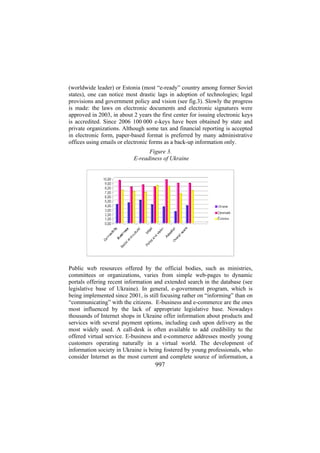
the Faculty of Political Sciences from SNSPA have also on distance
education program for post high education level. The admission procedure
takes into account the Bachelor diploma marks as well as the results of a
short interview according to a fix number of places. It also provides tutorial
facilities (specialty guiding and coordination of the student), run by
university teachers and researchers. The curriculum is the same as for the
regular study program and ends with exams accounting a certain number of
credits. The program is flexible with regard to the dates of the exams,
recognition of the diplomas and opportunity to enter the regular study
program. Any student may take the diploma exam proving the
accomplishment of the required number of credits from the analytical
curriculum aside the students from the regular study program.
Romanian-European eUniversity
University Politehnica of Bucharest has various different type projects in the
field of elearning. The most visible is the Socrates-Minerva project
“Romanian-European eUniversity” (RE2U), launched in October 2002.
RE2U (http://www.reu.pub.ro/re2u) intends to promote a critical and
responsible use of ICT to support the innovative processes of the Romanian
higher education system required in view of its full adaptation to the changes
occurring in the economic and social context. It aims at developing a
Romanian virtual university based on state-of-the-art innovative teaching and
learning methodologies and emerging ICTs.
The main challenges undertook by the Romanian-European eUniversity
initiative (as stated by the project team) are:
• to design and implement a platform that will foster the interinstitutional collaboration at national and international level;
• to establish the capacity of quality content production and quality
services provision in a national and international partnership context;

686
• to build a training system for the higher education teachers and
trainers on the use of ICT for learning;
• to accompany Romanian higher education institutions in their
process of institutional, organizational, pedagogical and economic
innovation.
ASE-Academy for Economic Studies
ASE is one of the first universities from Romania establishing a distance
education department. Yet it was mainly about the correspondence education
than using modern information and communication technologies. Today,
ASE has several virtual campuses for students, offering also support
materials for learning.
TEACHER TRAINING
Most of the teachers and school managers complain about the difficulties in
working with the educational software provided by the MoE and about the
lack of resources allocated for upgrade, for software acquisition from the free
market, and for appropriate training. Other sources indicate that the computer
labs and AeL platform is underused by teachers and pupils in high schools.
Also, punctual questions reveal that, with some interest, teachers can easily
overcome the problems and set up good classes within AeL labs.
The implementation of the SEI programme is a complex process and there
have been many critical aspects to be dealt with during its various phases,
derived from the programmes’ scale.
In spite of the difficulties, teachers and schools staff is optimistic. They
consider that time and decision-makers are able to solve the gaps of the
school computerization process through a proper policy. Until then, more and
more students are able to have their own computers at home, supported by
the parents and pushed by the labour-market demands to gain more
experience and ICT skills, an increased rhythm of learning and formal
curriculum integrating ICTs risks to remain behind, old-fashioned and not
attractive.
For having the teachers’ support, actions have been taken in several
directions, at national and regional level and in each school: mass-media
campaigns, training of teachers and administrative personnel, dissemination
sessions, seminars and workshops.

687
A very strong emphasis was put on the acceptance of technology as a special
tool (considering its power). The main issues identified are:
• Fear for “replacement of the teacher by the computer”
• Fear for “the unknown”.
MoE is currently implementing two methods for gaining teacher acceptance
for the program:
• AeL training offered within SEI is officially equivalent with the
courses that are mandatory for teachers within continuous training
programs;
• Teachers receive special financial benefits for classes taught using
computer-assisted learning (e.g. 1 physical hour of teaching is
counted as 1,25 teaching hours etc.).
Curriculum limited to general use of computer, as ECDL, ICDL or
comprising information about standard application packages as Microsoft
Office, is often delivered within teacher training programmes, instead of CAI
curriculum. Even in the Teacher Training Departments of the best Romanian
universities it is still preserved confusion between being PC literate and
knowing how to use computer to design and to support learning situations.
Most of actual in-service and pre-service training courses for teachers focus
on computer literacy, emphasizing general tools, such as word processors
and databases management systems.
SIVECO’s training programme, implemented in high schools as part of SEI
programme, has particular characteristics, being designed to prepare teachers
to handle with AeL program and comprising a mixture of computer network
administration, computer literacy and information about how to use the
lessons provided and how to create their own electronic content for classes.
Anyway, the principals complain about insufficient training oriented on
gaining practical skills to use computers for different subjects. The
improvement of teachers’ competencies through this kind of distance courses
has not been yet the object of a proper evaluation, but there is an obvious
implicit formative aspect that resides in achievement of increased digital
literacy.
On the other hand, the opportunities and experiences offered by such
programmes keep educators and learners’ expectations at a high level,

688
avoiding acceptation of poor e-learning products such as digital page turners,
computerized frontal teaching, low quality content etc.
Pre-service Training
According to a recent order of Ministry of Education the pre-service teacher
training programmes provided by the Teacher Training Departments has
been reorganized. The new curriculum includes a compulsory course of
“Computer-Assisted Instruction”. The difficulties of developing and
supporting an appropriate training course of Computer Assisted/ Based
Instruction (CAI) stem from the lack of specialists and the lack of sufficient
adequate software to furnish examples of a variety of types of usage in a
specific academic area. Some Teacher Training Departments within
universities provide a CAI course, but most of them deliver PC literacy
content under the name of Computer Assisted Instruction.
In-service Training
The in-service teacher training can be organized by Teacher Training Departments in universities, by Teachers’ Houses (a support structure of the
education system, comprised by one resource-centre institution in each
county), by NGOs and by companies, through accredited training
programmes. The need to provide more opportunities for in-service teachers
was addressed by an early initiative to create a Distance Education Centre
within the Institute for Education. The intention was that teachers would
receive training in a series of modules supplemented by continuous tutoring.
These activities were not continued, due to the lack of political and financial
support.
TRANSNATIONAL PROGRAMMES
Romania is part of global and European education initiatives which brings
closer innovation, creativity, competence and commitment, in an effort to
raise the quality and the equity of the education system and to complement
the governmental steps towards developing an authentic knowledge society.
In particular, two programs have a visible impact on the education practice,
contributing to the improvement of the classroom teaching, learning and
assessment on the new co-ordinates set up by the 21st Century: development
of new competences for future professionals, introduction of computerassisted education, and increased importance of non-formal learning.
One of them is the eTwinning project, and European initiative aimed to link
schools in order to develop collaborative projects involving students, and the

689
other one is Intel Teach program, aiming to prepare teachers to better use
pedagogy and ICT to create adequate learning situations.
The two demarches complete each-other and overlap to a certain extent, one
creating the premises for hands-on activities with pupils using the ICT and
especially the Internet for collaborative activities, being based on the projectbased learning method, and the other setting-up the theoretical frame and the
pedagogical tools needed by teachers to educate in the 21st Century.
The first one is a community of schools and teachers, the second one prepare
teachers to use new ICT tools to co-operate and to develop collaborative
projects with their students.
Furthermore, both initiatives are putting stress on the learner-centered
approach and on the transversal competences as a result of learning:
communication and social skills, using new technologies, critical thinking,
collaboration, creativity.
eTwinning
eTwinning has an innovation and creativity dimension, addressing an area of
the formal and non-formal education at the very heart of the on-going reform,
allowing experimentation of new ways of teaching and new ways of
performing traditional tasks. Being part of Life-long Learning Programme,
accompanying Comenius action, the main aim of the eTwinning program is
to facilitate communication and cooperation between schools in EU
countries, involving students in new learning activities: creation of various
collaborative educational projects with the use of ICT. So far, around 4000
Romanian teachers, from both urban and rural areas, initiated and
participated in eTwinning projects together with colleagues from around
Europe. The eTwinning projects promote the use of ICT for development,
allowing schools to incorporate innovative practices with impact at students
and teachers levels, but also at institutional level.
Participation to eTwinning allows pupils to learn using the new technologies,
to communicate with their peers from other countries, to acknowledge other
cultures’ elements, and to improve their competences of communication in
foreign languages.
As indicated by their teachers, the students’ enjoyment and motivation to
accomplish learning tasks is significantly improving when they are involved
in such collaborative projects.

690
The teaching methods are also diversifying, becoming more efficient and
motivating for learners, as a result of experience exchanges between teachers
within eTwinning partnerships and professional development activities. Not
least, the online twinning of schools allows the transfer of information and
good practices at institutional level, having also, in some cases, an impact at
community level.
As stressed by the Romanian Minister of Education (March 2008),
eTwinning initiative is a way to capitalist upon the investment in ICT
equipments for schools -the Romanian IT-based Education System programproviding teachers proper pedagogical instruments to develop significant
learning situations for their students.
Intel Teach
The support offered by Intel programs in Romania complements the
demarches of implementing ICT in education, creating the premises for
adequate education reform. The areas of support shows the concern and the
added value provided by Intel to Romanian education system in the last
years: development of education policies towards implementing education
solutions for XXI century, teacher training programmes, access of teachers
and students to reliable IT equipments, access to Internet and knowledge,
support for education process through offering pedagogical materials for
teachers, supporting Science education through participation to
the
International Science and Engineering Fair (the world's largest pre-college
science competition), establishing a common arena for eLearning
stakeholders: education policy makers, researchers, teachers, education
software developers, opinion leaders.
Intel Teach programme was accredited by the Ministry of Education,
Research and Innovation in 2007. Implemented by SIVECO Romania and
with the support of the County Teachers’ Houses, the Teach Essentials
course is run all over the country and the Romanian teachers are part of a
global initiative which trained over 7 million teachers around the world. This
coverage and impact have led Intel Teach to be called the most successful
professional development program of its kind.Within this initiative, along
with the continuous teacher training activities, Intel was supporting the
localizations of two significant packages of support-materials for teachers:
Designing Effective Projects and Assessing Projects. Romanian teachers
have access to pedagogical instruments, education projects templates and
examples, in an extended range of curricular domains and levels.

691
CONCLUSION
European working documents reviewing countries progress in implementing
ICTs in education system noticed that equipment is usually the first item on a
policymaker’s agenda. EU member states are, however, reporting that
investing in equipments only, even to begin with, is not the best option.
The focus must be, from the very beginning, on the educational uses of ICT.
It has been increasingly recognized that the main challenge in the integration
of ICT is not introducing the hardware, but getting the staff ready and
developing educational uses that will effectively contribute to the attainment
of the fundamental educational objectives and the evolving needs of learners.
The real impact of evolving technologies upon education and training
systems, as most of the researches envisage, refers to the shift in considering
education for all, consisting in the empowerment of individualized
instruction, stimulation of creative potential and cognitive skills for future
knowledge-builders, development of competences and skills for life-long
learning.
Nowadays, most of the Romanian efforts in the area of elearning are directed
towards educational use of ICT. A coherent strategic document dealing
specifically with technology-enhanced education is under development and
its policy recommendations could represent the accent needed for a
responsible usage of computers and Internet for education purposes, on a
large scale. But the sustainable results could only be achieved through a more
pro-active attitude of education policy makers, of the education practitioners
and of the entire society, because such a shift goes far beyond a simple
governmental decision and the education renewing is not the responsibility of
a single institution.
REFERENCES
Făt, S. & Adrian L. (2009). Eficienta utilizarii noilor tehnologii in educatie.
EduTIC 2009 (Efficiency of ICT Use in Education. EduTIC 2009). Bucharest:
Centre for Innovation in Education.
Gabureanu, S. (2004). Training the Teachers- a Condition for Successful
Integration of ICT in Education. In Elearning.Romania, Bucharest. Available
online: www.elearning.ro.

692
Ilia, F. (2003). AeL-O tehnologie de vârf a sistemului educaţional românesc
(AeL-A Top Technology in the Romanian Education System). În CNIV, Noi
tehnologii de eLearning (New eLearning Technologies). University of
Bucharest.
Istrate, O. (2004). Towards Romanian Knowledge Society. Implementation of
ICTs in Formal Education. Bucharest: World Bank, May 2004.
Jugureanu, R. (2006). Using AeL e-Content for Arts and Crafts Schools. In
Elearning.Romania, Bucharest. Available online: www.elearning.ro.
Jugureanu, R. (2005). Proiectarea pedagogica a soft-ului educational.
Taxonomia lui Bloom si Bloom-Anderson (Pedagogical Design of
Educational Software. Bloom Taxonomy and Bloom-Anderson). În: eLearning Technologies and Virtual Reality. University of Bucharest
Publishing House, Bucharest.
Martin, W, Katherine Mi C., Andrew G. 8 Hannah N. (2003). Intel Teach to
the Future: Lessons learned from the evaluation of a large-scale technologyinterpretation professional development program. Education Development
Center’s Center for Children and Technology.
Ministry of Education and Research (2006). Programul SEI, Sistem
Educaţional Informatizat – De la reformă la dezvoltare 2001-2008 (The SEI
Programme- From Reform to Development 2001-2008). Bucharest.
Noveanu, E., Istrate, O. (2004). Impactul formativ al utilizării AEL în
educaţie (The Formative Impact of AEL in Education). TEHNE, Bucharest.
Potolea, D. & Noveanu E. (coord.) (2008). Informatizarea sistemului de
învăţământ: Programul S.E.I. (Using ICT in the Romanian Education
System: SEI Programme) Agata Publishing House,
Toma, S. et al. (2009). Teaching in the Knowledge Society: The Impact of the
Intel Teach Program in Romania. Bucharest: Agata Publishing House.
Velea, L. S. (2009). Proiectul eTwinning în Romania (eTwinning Project in
Romania). In: Elearning.Romania. Bucharest: TEHNE- Centre for
Innovation in Education. Available from http://www.elearning.ro

693
Vlada, M. (2009). Utilizarea Tehnologiilor eLearning: cele mai importante
10 initiative si proiecte din Romania (Using eLearning Technologies: the
Most Important 10 Initiatives and Projects in Romania). In:
Elearning.Romania. Bucharest: TEHNE- Centre for Innovation in Education.
Available online: http://www.elearning.ro.
WEBLIOGRAPHY
http://www.edu.ro - Ministry of Education, Research and Innovation, Romania
http://www.elearning.ro - Elearning.Romania portal
http://www.ise.ro - Institute for Education
http://www.insse.ro - Institute for Statistics
BIODATA and CONTACT ADDRESSES of AUTHOR
Assistant Prof. Olimpius ISTRATE, Education Research Director
Centre for Innovation in Education (TEHNE Romania).
Olimpius ISTRATE is Education Research Director
within the Centre for Innovation in Education (TEHNE
Romania). He gives keynotes and lectures on a number of
topics such as elearning, computer assisted instruction,
pedagogy, education programmes evaluation, and teacher
training, being also appointed as assistant professor at the
University of Bucharest, Faculty of Psychology and
Education Sciences. His previous professional experience
includes a research position at the Institute of Education, Bucharest, and
several short-term assignments at various institutions: Ministry of Education,
World Bank, Siveco Romania, National Foundation for Community
Development, Academia Online, Elearning.Romania etc. Istrate holds a
Master degree in Education Management and Evaluation and a B.A. in
Education Sciences from the University of Bucharest. Currently, he is
enrolled in a PhD program on Elearning Evaluation, within the same
institution. Since 2007, he is coordinating Intel Education programmes in
Romania.
Olimpius ISTRATE
Institute for Education
University of Bucharest ROMANIA
Tel/Fax: +40-21-410.4332
Email: olimpius.istrate@elearning

694
CHAPTER-29
eLEARNING IN ROMANIA-II
Past, Present and Future
Ciprian CEOBANU
Laura ASANDULUI
Roxana CRIU
“Al. I. Cuza” University, Iasi, ROMANIA
ABSTRACT
In the first decade of the 21st century, worldwide, the tremendous increase in
the amount of available information and the spreading of the e-learning was
possible through the enhancement of the access to computers and to Internet.
This fact indicates a reality that became more and more stringent and that
cannot be ignored.
As an EU member, Romania needed to face a great number of challenges
linked to the ICT spreading and the development of a knowledge-based
society. These challenges were integrated into national programs and were
supported by general actions. E-learning became a common place and a
widely spread educational tool. The present chapter tries to offer a snapshot
of this very dynamic component of the Romanian educational reality.
INTRODUCTION
In the last decade, the exponential growth of the virtual space, of the Internet
and the broadband communication can lead us to the idea that two societal
models are available: a society based on information, and a society of
knowledge. Which one is the most appropriate and which one is the most
suitable as a developmental model?
A rational analysis, the reality indicates that the humanity is moving towards
a society where media are more and more influent, where the ICT and
databases are widespread in a “savage” manner, and the Internet is shaping
in a negative way individuals’ temporal and cognitive perception.

695
The scenarios describing the two different societal evolutions can be
advanced as follows. Either we evolve in the same manner towards “the
same society overloaded with information, a society for which we can
predict an overwhelming amount of information, characterized by a decrease
in the quality of communication, inter-human and intercultural relationships,
[…] with very few rules and with “relaxed” ethical standards; or “we evolve
towards a society of knowledge, where we rejoice a rational structure of
information and an interconnection for developing tools that can make
knowledge and inter-knowledge easier” (Cucos, Ceobanu, 2009, 310-311).
It is obvious that he last one is the desired model. Each and every national
developmental program must take into account this reality.
COUNTRY
Romania is a country situated in the South East of Central Europe, with an
area of 238,391 square kilometers and with a population of 21.5 million
inhabitants in 2009. Romania is the largest country in Southeastern Europe
and has the 12th largest territory among the European states. Its capital and
largest city is Bucharest with 2.2 million people. There are other 5 cities with
a population over 300,000 people (Iasi, Cluj, Timisoara, Constanta, and
Craiova).
A large part of Romania's border with Serbia and Bulgaria is formed by the
Danube. The Danube flows into the Black Sea within Romania's territory
forming the Danube Delta, the second largest and the best preserved delta in
Europe, and a biosphere reserve and a biodiversity World Heritage Site.
Romania's territory is distributed roughly equally between mountainous,
hilly and lowland territories. The Carpathian Mountains dominate the center
of Romania, with fourteen of its mountain ranges reaching above the altitude
of 2,000 meters.
Forests cover over one quarter of the country and the fauna is one of the
richest in Europe. 39.2% of Romania's territory is arable land, 28% forests,
21% pastures, hayfields and orchards and 2.5% vineyards.
The dominant religion is Orthodox (Eastern Orthodox 87%, Roman Catholic
5%, and Protestant 5%).

696
Figure 1.
A Map of Romania

Source: http://www.pickatrail.com/jupiter/map/romania.html

The official language is Romanian, a Romance language, related to Italian,
French, Spanish, Portuguese and Catalan. Romanian is spoken as a first
language by 91% of the population, Hungarian and Roma being the most
important minority languages. Romania is a NATO member and has joined
the European Union on January 1, 2007.
Romania’s mineral resources are various: coal, crude oil, natural gas, iron
ore, gold, silver, salt, etc. GNI PPP per capita, in 2008, was 13500 USD.

The Romanian GDP per capita in PPS increased from 26% of the EU
average, in 2000, to 47%, in 2008. Main Romanian industries are textiles,
metal processing, light, constructing, manufacturing, mining, wood
processing, building materials, chemical, food processing and petroleum
refining machinery. Also, the Romanian IT industry has grown constantly.
Romania's main exports are clothing and textiles, industrial machinery,
electrical and electronic equipment, metallurgic products, raw materials,
cars, military equipment, software, pharmaceuticals, fine chemicals, and
agricultural products.

697
The economy is based on services, which account 55% of GDP, even though
industry and agriculture also have significant contributions, making up 35%
and 10% of GDP, respectively. 32% of the Romanian population is
employed in agriculture and primary production, which is one of the highest
rates in Europe. Unemployment in Romania was at average 6.3% in 2009,
which is low compared to other European countries.
In 2009 Romania has suffered more than most of its neighbors in the global
economic downturn. Gross domestic product contracted 7.1% in the third
quarter of 2009.
EDUCATION SYSTEM
The Romanian educational system is regulated by the Ministry of Education
and Research. There are 7 levels and each level has its own form of
organization. Kindergarten is optional for children between the age of 3 and
7. Schooling starts at age 6 or 7 and it is compulsory until 10th grade. Higher
education is aligned to the European higher education area. Literacy rate in
Romania is 98%.
Allocation of 6% of GDP for education, introduction of new curriculum
centered on competencies, promotion of performance-based education,
quality assurance and stimulation of excellence in education, introduction of
new qualifications through continuous education, the extention of further
specialization and training are among the main priorities of development for
education between 2009-2012. Improvement and diversification of the
educational offer of the entire system of education and professional training
in Romania is a key strategic goal and a necessary condition for
implementing principles of long and medium term sustainable development.
In Romanian society it is widely acknowledged that education is a strategic
factor of future development of the country by its contribution to multidimensional modeling of human capital.
The process of implementation of the objectives of knowledge-based society
and of life-long learning has been supported by the following: Lisbon
Strategy, Strategic Community Guidelines on Cohesion, EU’s Commision
Communication on Knowledge-based Society, Education and Trening 2010
Work Program, Lifelong Learning program 2007-2013, as well as the
Bologna Declaration (1999), 2000 Millenium objectives, the UN Decade of
Education for Sustainable Development 2005-2014 under the auspicies of
the UN Economic Commission for Europe (UNECE).

698
A national objective for 2013 is the development of human capital and
growth of competitiveness through correlating education and lifelong lorning
with the labour market and developing opportunities for the future, more
flexible and inclusive labour market. Promotion of continuous education
through is a priority for Romania due to lifelong learning due to its
remaining behind in participating in various forms of qualification,
professional reconversion and training (5 times lower than the average in the
EU).
Starting with the early 90’s, demographics of Romania have been
characterized by a decreasing trend: birth rate decreased and implicitly the
natural growth and the annual growth rate of population. The entire school
population has decreased simultaneously with school-age population. An
overwhelming increase of higher education population has been registered.
The educational attainment rate at all levels shows a growth reaching over
70% in 2008 (Figure 1.).
Figure 1.
Educational attainment in Romania, in the period 1997-2008.
Educational Attainment

2008

2007

2006

2005

2004

2003

2002

2001

2000

1999

1998

1997

78
76
74
72
70
68
66
64
62
60
58

Source: http://epp.eurostat.ec.europa.eu/portal

The educational system in Romania faces a set of diverse challenges,
resulting in early school dropouts (Figure 2.) and irregular attendance or
grade repetition, and also a rate of finalizing compulsory education lower
than the European average.
Focusing on the dimension of schooling quantity, many policy initiatives
have tried to increase the educational attainment of the population.

699
Figure 2.
School dropout in first two levels of school, in the period 2001-2008.
School dropout in first two levels of
school
2.5
2
1.5
1
0.5
20
07
/2
00
8

20
06
/2
00
7

20
05
/2
00
6

20
01
/2
00
2
20
02
/2
00
3
20
03
/2
00
4
20
04
/2
00
5

0

Source: Report on the national educational system, The Ministry of Education,
Research and Innovation, Bucuresti, 2009, p. 67.

The amount of public spending on education diminished in 2008 its pace of
growth compared to previous years. There has an important growth of
allotted funds in higher education (as % of the GDP, for all levels of
education), mainly from 2006 (Figure 3). The percentage of spending for
tertiary education amounted in 2007 and 2008 approximately a quarter of
total expenditure on education in comparison to 22% in 2006.
Figure 3.
Total public expenditure on education in Romania,
in the period 2000-2008.
Total public expenditure on
education
7
6
5
4
3
2
1
0
2000 2001 2002 2003 2004 2005 2006 2007 2008

Source: http://epp.eurostat.ec.europa.eu/portal

The increasing demands on education systems to meet the challenges set by
the revised Lisbon strategy are likely to require additional sources of
funding. Public expenditure on education in the EU-27 in 2006 was
equivalent to 5.04% of GDP. Romania has been forced to revise many
budgetary chapters and priorities in development policy after joining the EU.
Education became one of the priorities. The educational policy in Romania
is facing a great challenge.

700
The international trends in research and education -emphasizing the role of
knowledge and innovation, the international trends on the labour market and
the human capital, the cultural disparity and the disparity in development
comparative to other EU countries are some elements that can prompt the
leaders to re-consider the role of education, to implement an unprecedented
increase of the budget allotted to education, as well as an institutional reform
meant to increase the overall quality of the educational system. Compared
with the European average, Romania allots education a far lower percentage
of its GDP (Baciu L. et. al.).
The greatest discrepancy as compared to the European average is present in
secondary education, where the need for financing is greater due to a higher
rate in school-drop out.
TOWARDS A KNOWLEDGE-BASED SOCIETY IN ROMANIA
The knowledge-based society in Romania is an ambitious but justified goal
for the future development of the country. The Ministry of Communication
and the Ministry of Education efforts along with private companies’
development, lead to a significant mutation within this domain. As a
consequence of these efforts in the last years, the Internet penetration rate
grows; today all the schools have an Internet access point and the
development of the e-learning and the CAL, became an important goal
within the national strategy of education The percentage of households
having access to the Internet rose from 6%, in 2006, to 38%, in 2009 (Figure 4.).
Figure 4.
Level of Internet access of households, in the period 2004-2009.
Level of Internet access of
households
40
35
30
25
20
15
10
5
0
2004

2005

2006

2007

2008

Source: http://epp.eurostat.ec.europa.eu/portal

701

2009
High-speed internet access is an important factor in productivity growth and
stimulating innovation. The number of broadband access lines growth from
6.6 lines per 100 inhabitants, in 2007, to 10.7 lines, in 2008 (Figure 5.).
Figure 5.
Broadband penetration rate.
Broadband penetration rate
12
10
8
6
4
2
0
2007

2008

Source: http://epp.eurostat.ec.europa.eu/portal

In Romania, a society built on knowledge should be also based on education,
irrespective of the ways in which it is carried out. A society built on
knowledge needs professionals to face new challenges and new information.
An EU country that can successfully cope with the competition launched by
the European Union needs active citizens to build a good future and give
experts in any field.
A specific framework was designed for compulsory education in Romania in
1998; in 1998-1999, a new curriculum was implemented so as to stress the
importance of acquiring computer skills, as well as obtaining and processing
information and knowledge. Moreover, special IT equipment was provided to
schools (especially computers) so pupils had access to it.
Developing the school infrastructure and the internet connection assured in
many Romanian schools were the main goals of two major programs: SEI (The
IT-Based Educational System) and RoEduNet (extending the IT network at a
national level).
Furthermore, various institutions initiated and applied a wide range of
projects that aimed at sustaining technological innovation in education.

702
We thus identify the most important ways that allowed TIC to be introduced
in education as eLearning models in some studies (Istrate, O.):
• RoEduNet – is a programme initiated in 1993 and conceived as an
open source that gives access to all educational, academic and
cultural units. Once the first unit had an internet connection due to
this network (Bucharest University, 1993), the core of
communicational infrastructure for academic data was created. A
large number of schools and universities in our country have an
internet connection due to this programme which is still operational.
• SEI (The IT Based Educational System) -educational efforts
intensified due to the use of NTIC which was considered to be a
basic element in educational practice by the Ministry of Education
and Research and coherent actions were carried out since 2001. The
premises and motivations of applying the SEI programme at a
national level were divided in three categories: social and political
engagements (i.e. adjusting to the EU principles, aims and actions),
the aims pertaining to training and the increase in educational
efficiency. The main purpose of this programme is to introduce TIC
as necessary instruments in the process of teaching-learning in
secondary education. Schools are equipped with IT laboratories to
sustain the TIC based learning process. Besides the technology
available in schools, the project aims at establishing a high level of
interaction and guide pupils to practical experiment and research of
the studied theories and phenomena. Moreover, the programme is
implemented by state administration and the private sector and the
main companies involved are SIVECO Romania, HP Romania and
IBM Romania. Several parts of the programme were carried out
since 2001 (equipping schools with IT laboratories, developing
educational software and e-Content, training human resources,
connecting educational units to internet and ensuring permanent
technical support), and the following objectives were met:
4780 IT laboratories, each having a network of 15-25
computers, approximately 78000 computers were delivered
and used;
Software systems were installed on every computer;
More than 65000 secondary education teachers were trained;
Approximately 1674 multimedia lessons were conceived for
10 disciplines, with the respect of teaching principles.
• The programme eLearning.Romania -eLearning.Romania is an
initiative of several institutions of civil society (TEHNE -The Centre

703
for Innovation and Development in Education; ASTED-The
Association for Sciences of Education and the National Foundation
for Community Development), developed with the help of two
university research centres (The Polytechnic University of
Bucharest) and a national institute of research in education (The
Institute for Sciences of Education). Its purpose is to develop quality
and efficiency in computer aided education by giving technical
support, instances of local significant eLearning experiences and
solutions to the implementation of eLearning systems.
• The project Knowledge Economy -is implemented (between 2006
and 2010) by the Romanian Government and is financed by the
World Bank, having a total budget of 70 million dollars and aims at
sustaining activities that bring knowledge at a national level and at
the level of local communities; it particularly aims at speeding the
participation of poor communities to the acquaintance with the field
of economy.
E-LEARNING AND ICT IN SECONDARY EDUCATION
To a certain extent, distance learning does not fall into the habits of the
classical organization of face-to-face education. In most of the cases, the
prerequisites of flexibility in education, the broadening of educational
opportunities and education which is encouraged throughout the entire life of
a person led to a peripheral position of this educational model in the context
of usual teaching activities.
Along with the implementation of the „eLearning” model, distance learning
and teaching moved from the periphery to the centre of training-educational
approaches. As a result of the Internet boom, distance learning became a
strong educational practice -now it is possible to learn by accessing virtual
museums, by consulting tutors that can be found a few steps or thousands of
miles away, by experiments in virtual laboratories and by taking part in
debates and attending online courses.
It is clear that the maximum potential of online technology to increase the
training and educational process does not consist in technical aspects, but
rather in practical activities, approaches and examples given at the individual
and institutional level. Both teachers and trainers are often attracted by
eLearning just as a means to escape didactic routine or to make the daily
educational-training activities more attractive.

704
The National Curriculum Council developed a new curriculum for the
discipline of Information Technology at the end of the 90’s (i.e. the use of
NTIC). Thus, classes have in view a series of specific aims pertaining to
programming languages.
The main requirements and expectancies for the efficient use of ICT in the
educational process refer to the use of appropriate software, to the abilities
and competencies to use it and to the teachers’ capacity to create learning
situations and didactic strategies by using the instruments of new
technologies.
Olimpius Istrate identifies the main projects, on-line platforms, eLearning
training activities implemented in Romania secondary education in the past
years. Ergo, we are speaking of the following projects:
The Informational System of Educational Management project,
implemented as a pilot in 10 schools is designed to give suggestions
to educational, financial, informational and administrative
management at all levels of the national system of education. The
project was included in the Reform of Secondary Education, the
element of Management and Financing initiated and developed by
the Government of Romania with the help of the World Bank. No
information on the present use of EMIS is available.
portal.edu.ro – a platform for pupils and teachers to communicate
was established at the beginning of 2002 at (www.portal.edu.ro
retrieved on December 20th 2009) as a portal for the SEI programme
to sustain education and give materials for assistance in teaching,
thus facilitating certain administrative activities, encouraging the
circulation of information, etc.
AeL (advanced eLearning) is the central part of the SEI programme
in the teaching process – learning, evaluation, curriculum projection
and organisation of contents. In AeL, local, regional and national
governments receive managerial and administrative support. IT
laboratories are integrated in a network that includes all the schools
of the region. All Romanian regions are included in a national
network, being connected and coordinated by the SEI management
unit located in MEdC.
the ADLIC (High School Admission) Project was firstly
implemented in 2001 to support national admission and the
distribution of middle school graduates in high schools and
vocational centres.

705
the EvalMan project (Evaluation of Textbooks) gave IT support
since 2002 for the recommendation and public acquisition of school
textbooks in Romania. Publishing houses give anonymous books for
evaluation and a software system makes random choices for each
subject, i.e. a group of evaluators from a list of authorized competent
persons.
Furthermore, the author assesses that certain documents, research and
debates over the last few years show that teachers desire software modules
for each discipline- having both an educational content and online tests.
The lessons prepared and taught in high schools so far are not enough and
one or two IT laboratories in each school cannot cover the necessary hours
of computer aided training.
E-LEARNING AND ICT IN HIGHER EDUCATION
Regarding higher education, eLearning and the use of ICT (through a
relatively good infrastructure) show a high degree of update and
implementation especially due to the involvement of Romanian institutions
of higher education in European and international projects that had the use of
informational and communication technologies or institutional development
as their main aim.
The main higher education units formed distance learning departments
(either at the central or faculty level), having well structured regulations and
clear instructions to use ICT at their disposal. Moreover, the human
resources involved in these activities are quite important and professional.
The most important programmes and approaches initiated at the academic
level in the field of eLearning were identified in the literature of the field
(Nistor, N., Banciu, D., Jalobeanu, M. and Istrate, O.,):
• CREDIS (Centre of Resources, Documentation, Information and
Services for Open Distance Education). The Department for Open
Distance Education at Bucharest University was founded in 1994.
By Government Decision 944/29 August, 2002 the University of
Bucharest has 15 authorized fields that are operational as distance
learning. The new ICT instruments used are CDROM, e-books,
audio-video tapes and virtual laboratories. The methods of training

706
evaluation are used as final examination, as well. The elearning
platform can be found at the following address:
http://portal.credis.ro (retrieved on December 20th 2009).
• SNSPA – The Faculty of Political Sciences of SNSPA also has a
distance learning programme for the postgraduate level.
• The Romanian-European eUniversity -The Polytechnic University
of Bucharest carries out various types of projects in the field of
elearning. The most visible one is the “The Romanian-European
eUniversity” (RE2U) Socrates-Minerva project, launched in October
2002. RE2U (http://www.reu.pub.ro/re2u retrieved on December
20th 2009) aimed at making the individuals aware of the importance
of responsible use of ICT to back up the innovation processes of the
higher education system in Romania for its complete adjustment to
the changes occurring in the social and economic context.
• ASE-The Academy of Economic Studies – is one of the first
Romanian universities to create a distance learning department. At
first, it mainly consisted of education by post, and not of the use of
TIC. Today, ASE has more virtual campuses for students and offers
support materials for learning.
It is also important to mention a few things on the attitude and competencies
of teachers in Romania when it comes to the use of TIC. By carrying out a
few analyses of the educational context (especially in secondary education),
we can hear at any time several teachers and headmasters complaining about
the technical difficulties when using the educational software offered by
MEdC, the lack of material resources allocated for the purchase of
computers, software and appropriate training, the IT classes where theory
cannot be combined with practice due to the low number of computers in
school, etc. However, we have obviously evolved since 1990 but this is not
enough if we consider the unceasing and inherent educational and cultural
international challenges. They believe that time and decision factors will be
capable of solving the gaps in the process of computer acquisitions in
schools by means of a proper policy. We can also mention a training
programme which was performed in June 2003, when a significant number
of people (more than 65 000) was directly engaged by SIVECO experts to
integrate the AeL software in education. More than 1 500 of them were part
of the auxiliary staff comprising IT administrators, librarians and school
secretaries. In each of the 1 400 high schools that received IT equipment, an
additional number of 2 to 4 persons was trained by hardware administrators
(Istrate, O., p. 11).

707
It is necessary for the aforementioned values in formal education to be
perpetuated both in its formal and informal forms, i.e. those abilities that the
pupil acquires in school during IT classes to be continued, exerted and well
structured at home. No sooner than pupils have a computer at home,
sustained by their parents and constrained by the demands on the labour
market with respect to the necessity to have experience, will the formal
curriculum be able to face all TIC requirements.
TRENDS & ISSUES
The documents which include the monitoring progress in implementing ICT
in the educational system have underlined the fact that the equipment needed
to sustain an eLearning platform is usually the main concern at educational
policy level. The assuring of the needed equipment is, in most cases,
considered the sole premise in consolidation of the educational systems.
Educational practice shows that a serious investment in teacher’s training is
also a needed measure.
Thus, key goal for continuing the implementation of the e-learning in
Romanian schools is the strengthening of teacher training programs for
shaping the skills to use ICT and to introduce on a largely scale the
eLearning. The developing of the eLearning programs is considered essential
to all educational levels, in order to foster creative thinking in students, to
stimulate their ability to cope with different learning activities, to develop
their critical thinking.
In the context of changing the summative national assessments (and here we
refer to the last changes for the high school graduates) among the main skills
that must have a high school graduate, the use of ICT and Internet is one of
the most important. This, to be implemented in 2010, will actually lead the
above mentioned aims, as being imperatives for the entire range of teaching
activities and for the Romanian educational system.
CONCLUSION
The information era make possible the enlargement of the information’
accessibility by tools more sophisticated. Education is facing many
challenges to make education relevant for the information society. In this
society the citizens have to be life-long learners, the workers are expected to
acquire independently knowledge and skills and to be able to communicate
in a variety of contexts and using a variety of means.

708
This requires an important transformation of education and Information and
Communication Technologies (ICT) can be the means to realize that
transformation.
Thus, one of the goals of the educational system should be to prepare
students for taking an independent and responsible role in the information
society. This goal can be attained only if the students acquire the necessary
skills for working with large amounts of information from a wide range of
sources. ICT - mediated learning became an integral component of education
and training systems. Moreover, with the rise of information and
communication technologies era, new competencies became vital. Digital
literacy, the ability to use ICT, is one of the most important.
REFERENCES
Baciu, L., Asandului, L., Iacobuta, A. (2008). Compulsory Education in
Romania-Priorities And Challenges, 1st International Conference on
Economic and Management Perspectives, Famagusta, Cyprus.
Cucoş, C., Ceobanu, C. (2009) „Cyberculture: A New Reference Frame for
Learning” in The International Journal Of Learning, 2009, vol.16, nr.6, pp.
309-318, Common Ground Publishing.
Eurostat, http://epp.eurostat.ec.europa.eu retrieved on December 10th 2009.
Horton, W. K, ( 2006). E-learning by design, San Francisco, Pfeiffer
Istrate, O. (2007). eLearning in Romania: the State of the Art, eLearning
Papers , Nr. 5, Sept. 2007, ISSN 1887-1542
Istrate, O. (2009). Modalitati de utilizare a TIC pentru evaluarea studenţilor.
(Means for using ICT in students’ evaluation) im: ELearning.Romania,
2009-03-22. Bucureşti: TEHNE- Centrul pentru Dezvoltare şi Inovare în
Educaţie: http://www.eLearning.ro retrieved on December 25th 2009.
Nistor, N., Banciu, D. & Jalobeanu, M. (2005). “E-learning at Romanian
universities: Dealing with essential changes of society and culture” in U.
Dittler, H. Kahler, M. Kindt & C. Schwarz (Eds.), E-learning in Europe Learning Europe. How have new media contributed to the development of
higher education? (pp. 251-270). Münster: Waxmann.

709
ADDITIONAL READINGS
The Reform National Program 2007-2010. (2007) Romanian Government,
Report on the national educational system. (2009) The Ministry of Education,
Research and Innovation, Bucuresti.
The National Strategy for Sustainable Development of Romania. (2008) Bucuresti.

BIODATA and CONTACT ADDRESSES of AUTHORS
Assoc. Prof. Dr. Ciprian CEOBANU, Al. I. Cuza University, ROMANIA
Dr. Ciprian CEOBANU is Associate Professor at the
Teacher’s Training Department within the Faculty of
Psychology and Education Sciences from “Alexandru Ioan
Cuza” University in Iasi. Dr. Ceobanu got his doctorate in
Psychology from the same University in 1999. His scientific
interests are: e-learning, psychology of education,
educational management.
Assoc. Professor Dr. Ciprian CEOBANU
Faculty of Psychology and Education Sciences
Al. I. Cuza University, 3, T. Cozma street, Iasi, ROMANIA
Phone: +40 232 216 324
Email: ciprian@uaic.ro
Prof. Dr. Laura ASANDULUI, Al. I. Cuza University, ROMANIA
Dr. Laura ASANDULUI is Professor at the Statistics
Department within the Faculty of Economics and Business
Administration at “Alexandru Ioan Cuza” University in Iasi.
She received her doctorate in Economics at the same
University. Dr Asandului scientific interests are: social
statistics, statistics in education.
Professor Dr. Laura ASANDULUI,
Faculty of Economics and Business Administration
Al. I. Cuza University
11, Carol I street, Iasi, ROMANIA
Phone: +40 232 201 629
Email: asand@uaic.ro

710
CHAPTER-30
eLEARNING IN RUSSIA
Sergey POZDNYAKOV
Saint-Petersburg State Electrotechnical University, RUSSIA
Serge RUKSHIN
Russian State Pedagogical University, RUSSIA
ABSTRACT
The article is devoted to the history of distance learning development and to
the current state of e-learning in Russia. A new classification of distance
learning development stages is proposed by the authors. Authors highlight
three stages of this educational form's development, comparing it with the
stages of political, social, and economic changes in the country. In the second
part, the analysis of the basic directions of development of e-learning is
presented; each direction is explained by the most typical examples. Chapter
is beginning with brief information about Russia and a structure of the
present education system.
COUNTRY
Russia, also officially known as the Russian Federation, is a country in
northern Eurasia. It is a federal semi-presidential democratic republic,
comprising 83 federal subjects. Russia shares borders with the following
countries (from northwest to southeast): Norway, Finland, Estonia, Latvia,
Lithuania and Poland (both via Kaliningrad Oblast), Belarus, Ukraine,
Georgia, Azerbaijan, Kazakhstan, China, Mongolia, and North Korea. It also
has maritime borders with Japan (by the Sea of Okhotsk) and the United
States (by the Bering Strait). At 17,075,400 square kilometers (6,592,800 sq
mi), Russia is by far the largest country in the world, covering more than a
ninth of the Earth's land area. Russia is also the ninth most populous nation
in the world with 142 million people. It extends across the whole of northern
Asia and 40% of Europe, spanning 11 time zones and incorporating a wide
range of environments and landforms.

711
Russia has the world's largest reserves of mineral and energy resources, and
is considered an energy superpower. It has the world's largest forest reserves
and its lakes contain approximately one-quarter of the world's fresh water.
Figure 1.
A map of Russia

Source: http://commons.wikimedia.org/wiki/File:Rs-map.png
The country has 157,895 towns and villages. Russia's population, according
to the latest figures available, is 132,000,000 people. Of these 74%
(97,680,000) live in towns and town/villages.
Moscow 10,969,000, Moscow Region 7,900,000, St. Petersburg 6,897,000
Leningrad Region 3,350,000 The following towns have populations of a 1
million or so. Novosibirsk 1,391,900; Yekaterinburg 1,315,100; Nizhny
Novgorod 1,278,300; Samara 1,139,000; Omsk 1,134,800; Kazan 1,116,000;
Chelyabinsk 1,091,500; Rostov-on-Don 1,051,600; Ufa 1,022,600; Perm
990,200 and Volgograd 986,400.
Russia established worldwide power and influence from the times of the
Russian Empire to being the largest and leading constituent of the Soviet
Union, the world's first constitutionally socialist state and a recognized
superpower that played a decisive role in the allied victory in World War II.
The Russian Federation was founded following the dissolution of the Soviet
Union in 1991, but is recognized as the continuing legal personality of the
Soviet state.

712
Russia has the world's eighth largest economy by nominal GDP or the sixth
largest by purchasing power parity, with the eighth largest nominal military
budget or third largest by PPP. It is one of the five recognized nuclear
weapons states and possesses the world's largest stockpile of weapons of
mass destruction.
Russia is a permanent member of the United Nations Security Council, a
member of the G8, G20, the Council of Europe, the Asia-Pacific Economic
Cooperation, the Shanghai Cooperation Organization and the Eurasian
Economic Community, and is the leading member of the Commonwealth of
Independent States.
The Russian nation has a long tradition of excellence in every aspect of the
arts and sciences, as well as a strong tradition in technology, including such
significant achievements as the first human spaceflight.
(http://en.wikipedia.org/wiki/Russia. Retrieved 05.01.2010)
EDUCATION SYSTEM OF RUSSIA
In the Russian Federation, there are 180,000 educational establishments of
all types and categories. About 35 million people or 23 percent of the total
population of the country are annually involved in one type of education or
another. More than 6 million people are employed in the sphere of
education.
The socio-political changes that have been taking place in Russia and the
transition to a market economy have led to a need to reform the education
system. The Constitution of the Russian Federation of 1993 and the federal
law On Education of 1992 and its 1996 revisions stimulated the
democratization of life in educational institutions, extended academic
freedom and institutional autonomy, and promoted the humanization of
education.
The non-state education sector, including educational establishments
founded by both individuals and by non-state organizations, has been
developing rapidly. The Federal Programme for the Development of
Education, aimed at the encouragement of innovations in all components of
the education system, has been designed for the support of educational
reforms. In recent years, the system of education of the Russian Federation
has been undergoing drastic changes in the framework of the comprehensive
transformation of the country as a whole.

713
The system of education in the Russian Federation comprises:
• successive educational programmes and the State educational
standard;
• educational institutions in which educational programmes and the
State educational standard are implemented;
• administrative and other bodies and organizations which govern the
educational system.
In the Russian Federation, all educational programmes are of two types
(Figure 2): general education; professional education (Retrieved 05.01.2010
http://www.gks.ru/bgd/regl/b09_11/IssWWW.exe/Stg/d01/08-10.htm ).
General education is aimed at the intellectual, moral, emotional, and physical
development of the individual; at shaping his or her general cultural level; at
developing his or her ability to adapt himself or herself to life in society, and
at the setting of the foundations which will enable individuals to make a
conscious choice of a professional education programme and to cope with it.
General education comprises: pre-school education, primary general
education, basic general education, secondary (complete) general education.
Professional education is aimed at the continued development of an
individual in the process of which he or she acquires a professional
qualification and at the preparation of graduates to exercise a profession.
Since in the Russian Federation all programmes, except general education
programmes, lead to diplomas or to diplomas and degrees as well as to
professional qualifications and give the right to exercise professions, they are
called professional education programmes.
Thus professional education covers the following:
• vocational education;
• non-university level higher education;
• university level higher education;
• postgraduate education including doctoral study programmes.
(http://en.russia.edu.ru/edu/description/sysobr Retrieved 05.01.2010)

714
Figure 2.
Scheme of the Education System of the Russian Federation

(http://en.russia.edu.ru/edu/description/sysobr/902/. Retrieved 2010-01-05)

715
Table 1. Statistic data about higher professional education
1993/ 1995/ 2000/ 2003/ 2004/ 2005/ 2006/ 2007/ 2008/
94
96
01
04
05
06
07
08
09
Number of higher
educational Ist. All all

626

762

965 1044 1071 1068 1090 1108 1134

548

569

607

652

662

655

660

658

660

78

193

358

392

409

413

430

450

474

Including:
State and municipal
private
Number of students all (thousands)

2613 2791 4741 6456 6884 7064 7310 7461 7513

Including:
in state and municipal
institutions
2543 2655 4271 5596 5860 5985 6133 6208 6215
From them it was
trained on
full-time attendance
courses

1625 1700 2442 3010 3144 3195 3251 3241 3153

evening courses

170

161

remote training
courses

748

795 1519 2165 2279 2348 2443 2532 2637

external training

259

302

137

300

142

291

147

280

155

269

-

0,1

51

70

136

471

860 1024 1079 1177 1253 1298

37

53

183

267

290

313

331

331

304

evening courses

5

14

44

50

61

71

81

72

74

remote training
courses

22

61

243

539

663

684

753

835

904

external training

6

7

1

4

10

11

12

14

16

Number of students
as to 10000
population

176

188

324

448

480

495

514

525

529

including in state and
municipal institutions

171

179

292

388

408

419

431

437

438

in private institutions

120

300

156

From them it was
trained on
full-time attendance
courses

716
DISTANCE EDUCATION IN RUSSIA
Russia is a geographically unusual country, its territorial extent and a lack of
good transport communication between small settlements makes
development of distant learning a pressing problem. The specificity of distant
learning development in Russia during the last two decades is a
correspondence between its phases and changings of the country's economic
strategies and its government institutions. According to this, there may be
defined the three phases of distance learning development, each lasting from
5 to 10 years.
The First Phase
The first phase, which lasted from 1995 to 2000, refers to the realization of
the program “Creation and Development of the Distant Learning System in
Russia”. At this phase several universities began to teach not only in a
traditional form, but also in a distant one as an experiment. Meanwhile, the
majority of universities acted on their own and they were not worried about
standardization of means for distant learning.
Representative offices of other countries’ educational organizations, which
educated distantly according to their own programs, began to appear.
Considerable role in the development of distant learning system was played
by the work of institute “Open Society” (by Soros Foundation). They started
a development of open education and opened Internet-centers based on
universities and other educational institutions. On the other hand, legislative
and regulatory basis for the distant learning hadn’t been worked out yet and
the work has been held as an experiment.
The Second Phase
The second phase was supported by the Federal special-purpose program
“Development of the Unified Informational and Educational Environment
(2001-2005)”. At this stage, a tendency to standardize means of distant
learning appeared and a net of regional Internet-centers, which provided
distant forms of education, was founded (Ovsyannikov, 2003). The stage was
implemented by means of a specially created state institution “Research
Institute of Informational Technologies and Telecommunications” governed
by the Department of Education and Science of the Russian Federation. At
the beginning of the stage the law about a distant learning regulation was
passed. It made the 2002nd year be a beginning of an establishment of a
distant learning as an educational form equal in rights to others. The
methodology introduced in the law provided educational organizations with

717
an instrument of regulation of distant learning and gave them an opportunity
to combine it with traditional forms of education (Halitova, 2004).
A valuable contribution to the development of distant learning at this phase
was made by the Federation of Internet Education that was founded by funds
of UCOS Company. Federation’s projects assisted in the retraining of
teachers in the field of application of Internet technologies.
The Third Stage
The third stage is taking place nowadays. It is supported by the priority
national project “Education”. At this stage much attention is paid to the
development of distant education in institutions of high education.
The National Fund of Stuff Training was created and it carried out a number
of projects to development of study materials for online education. Large
publishers were involved in standardization of the materials presentation.
Developed materials joined the Unified Collection of Digital Educational
Resources which has an open access and is currently a basis for regional
centers for development of their own educational programs and courses for
distant education. Let’s look closer at the stages of the development of
distance learning in Russia.
Phase 1:
An Experimental Phase of Creation of
The Distant Learning System in Russia (1995-2000)
“Conception of creation and development of distant learning in the Russian
Federation” was accepted in 1995 (The concept, 1995). The document gives
the following definition of the distant learning: “Distant learning is a package
of educational services, provided for great masses of population in the
country and abroad with a specialized informational and educational
environment, based on means of exchanging of educational information at a
distance”.
Department of Education and Science organized a distance learning
implementation experiment in several Moscow universities in 1997. The
leading institutions participating in the experiment were (Andreev, 2003):
• Distance learning institute of Moscow State University of
Economics, Statistics and Informatics (MESI), Moscow,
http://www.mesi.ru (Tikhomirov, 1997)

718
• Moscow branch of the International Management institute LINK.
(LINK is a strategic partner of the Open University of Great Britain
on the territory of CIS), http://www.link.msk.ru.
• Modern University for the Humanities, Moscow, http://www.muh.ru.
It should be noted that that time the development of distance learning was
connected with education in fields of management, finances, law sciences,
linguistics and IT.
Meanwhile, some technical universities began to adopt technologies of
distance learning too.
One of these universities was Moscow Institute of Electronics and
Mathematics (MIEM) (http://www.miem.edu.ru retrieved 2010-01-05),
which began to develop means of distance learning to support an electronics
design.
Currently, the networks center of the university develops the NetSpice
subsystem, that acts as a web interface for a system of circuit modeling
Spice, developed in the Department of Electrical Engineering and Computer
Sciences, University of California, Berkeley, and for a package Mathematica
by Wolfram Research.
Some projects connected with the programs of native education abroad arose
For example, Moscow State Industrial University (MSIU) (http://www.sde.ru
retrieved 2010-01-05) provided for compatriots lived abroad and Russian
citizens with programs of distance learning.
Taking into account the specificity of this centers’ students (Russianspeaking population) and the absence of laws regulating relationships
between Russia and the Baltic States concerning questions of higher
education (particularly, mutual acceptance of certificates of degree),
education was provided on behalf of International Institute Info-Ruthenia
(http://www.institute-info.ru retrieved 2010-01-05), with MSIU as one of its
co-founders.
University Ruthenia was established and acted within the Association of the
assistance to International Science Academy, and so its diplomas were
indexed in the all-European register according to UNESCO Charter and the
Convention of recognition of diplomas and certificates of degree in the
European States.

719
Figure 3.
An experimental phase of creation of the distance learning system in
Russia (1995-2000)

Ministry of Education
Coordination Council

Temporary regulations for pilot
projects in distance education

Pilot projects in several
universities

The Institute of Distant Learning on the basis of Peoples’ Friendship
University of Russia (PFUR) (http://ido.rudn.ru retrieved 05.01.2010) was
established in 1997. Now the institute teaches specialists in the fields of
economics, law sciences, journalism and public and municipal management.
Regional institutes became an important part of distance learning in Russia.
Thus a leading regional institute of higher education Udmurtia State
University (UdSU) based its activity on the concept of distributed university
(http://e-learning.udsu.ru retrieved 05.01.2010). An Internet-center was
established in UdSU with the help of Institute “Open Society”, which
possessed satellite and ground communication channels, Internet classrooms
and web-laboratory. Nowadays it provides education on the basis of learning
management system Moodle.
It became clear that effective distance learning could be achieved by
combination of resources of several universities, which was not a problem

720
for distance learning from technical point of view (Popov, 1999). Thus,
consortiums and associations of education foundations appeared and started
to teach distantly in collaboration. For example, the major role in the distance
learning of Siberia plays Association of education foundations of Western
Siberia “Siberian Open University” (http://ou.tsu.ru retrieved 05.01.2010).
The association was established by major Siberian universities which by
themselves are big independent centers of art and science in their regions:
Novosibirsk State Technical University, Tomsk State University and Altai
State University (Anisimova, 2005).
Within the association distance learning programs are implemented by the
most well-known institutes of Siberia and Far East: Polzunov Altai State
Technical University, Far East State University, Irkutsk State University,
Kemerovo State University, Novosibirsk State University, Omsk State
University, Tomsk State University, Tomsk Polytechnic State University,
Tomsk State University of Management System and Radio Electronics,
Yakut State University.
Within the association there were developed joint educational programs
devoted to new areas both of science and technology (for example,
“Efficient Computing on Clusters”, “Geoinformation System (GIS) and
Space Geological Monitoring of Natural Objects”, “Nanostructured Materials
on Metallic and Ceramic Base: Technology, Structure and Properties”) and
programs connected with professional development of the university workers
in field of new educational technologies and effective using of distant
learning means (for example, “Program of Workers’ Education in Field of
Open and Distant Learning”, “Work Organization in a Network Distributive
Structure of Lecturers and Research Officer Training”, “Management of
Innovative Processes in Modern University: Conversion to Competent and
Oriented Education”, “Bologna Process in Russian System of Higher
Education”, “Designing of Educational Space in Modern University”).
Results of the experiment were summarized by Russian Department of
Education and Science in 2002. In the final document “On the Results of the
Experiment in the Field of Distance Learning and the Outlook of the Distant
Learning technologies Development” (About results, 2002) it is said that
there were established 588 educational centers in participating universities
and more than 206 thousand students were taught and more than 13 thousand
lecturers, tutors and teachers-technologists took part in organization of the
educational process.

721
The experiment helped to reveal important issues which appeared at this
stage of the creation of distance learning system. One of them is an
insufficient development of the system of electronic and computer network
communications; strong financial aid from the state was necessary to solve
the problem;
Another problem appeared, because institutes, that provided distance courses,
acted mostly on their own and used software products which were based on
different standards. On the one hand, it considerably complicated an efficient
informational exchange between universities. On the other hand, it brought
about troubles of integration into the worldwide system of distance learning
which is based on international standards. Also it was noticed that issues of
legal support of distance learning implementation were worth special
attention: there were no normative documents that could permit to use distant
learning technologies beyond the experiment.
Phase 2:
Development of Distance Learning
And Its Obtaining f Legal Status (2001-2005)
This phase is characterized by the acceptance of the methodology of using
distance learning technologies in institutions of higher, high and additional
professional education in The Russian Federation (Technique, 2002). Some
principles of the methodology:
… The primary distance learning technologies are: case technology,
Internet technology, telecommunication technology. It’s possible to
combine primary technology types.
Let us note one of the technologies called case technology, which has
nothing in common with educational technology called case method. It can
be interpreted in the following: “according to the case technology,
educational and methodological materials are combined into a special set
(case); the set is sent to a student for independent learning; communication
with tutors is provided by regional educational centers that are established for
this purpose. It is considered that motivated student is able to learn and
master considerable amount of material on a wide variety of subjects if this
education is supported by a substantial case”.
This concept appeared on the earlier phases of distance learning system
development when besides print materials students began to receive
electronic ones: video cassettes, floppy and CD disks.

722
The name of the method sounds a lot like the name of the Case Method
(method of specific situations) that is an educational technique which uses
descriptions of real economic and social situations. Students should analyze
some situation, understand the essence of the problems, suggest possible
solutions and choose the best one”.
This ambiguity is connected with using of different meanings of the word
case (a situation or a large box or container in which things can be stored or
moved).
Internet technology refers to the usage of the Internet, which was not so wellspread those years as it is spread now.
Telecommunication technology refers to other types of communication
including video broadcast.
• Educational programs are said to be as implemented with full usage
of distant learning if not less than 70% of curriculum hours students
learn through distant learning technologies. Besides traditional
informational resources the following means of distant learning are
used in educational process: specialized textbooks with multimedia
supplements, electronic methodological complexes including
electronic textbooks, tutorials, training computer programs,
computer laboratories for practical work, set of control tests,
educational films, audio and other materials which are intended for
transmission through telecommunicational channels.
• Monitoring and intermediate certification of students is provided by
institute either by traditional methods or by electronic means which
can guarantee personal identification. Obligatory final assessment of
graduating students is implemented by traditional methods. To
organize distance learning it is reasonable to maintain students’
results and to keep records in an electronic form according to
conditions of Federal Law “On Digital Signature”.
Meanwhile, distant learning is considered not as independent education
form, but as a way of organization of educational process (informational
and telecommunicational educational technology).
There traditional educational forms are preserved: full-time and half fulltime instruction, instruction by correspondence, external

723
Figure 4.
Development of distance learning
and its obtaining of legal status (2001-2005)

Ministry of Education

State Institute of
information
Technologies and
Telecommunications

Standards and
Regulations for Distance
Education

Portals for integration of
educational resources

The centralised services
to support distance
learning

Universities

Associations of
universities

The great achievement of this stage was the establishment of state institution
called “Research Institute of Informational Technologies and
Telecommunications” (Informica) with the help of the Russian Federation’s
Department of Education and Science.
This institution became a leading one in development and maintenance of
educational portals. A system of so-called “horizontal” and “vertical” portals
was established; they started to concentrate open educational materials and
became a mean of coordination of the development of informational and
educational space.

724
At this stage, in 2000, it was established a non-commercial organization
Federation of Internet Education (FIE).
The main aim of FIE was an assistance in developing of Internet education in
our country.
Due to this organization, which was financed by UKOS, there was a mass
retraining of teachers in the field of computer and Internet competence.
FIE implements a few important Russian projects:
•

•

Generation.ru. Its aim was an overcoming of the fact that Russia is
seriously behind the other world powers in the field of
informatization of education. The five-year project included an
establishment of Internet-educational centers in 50 Russian regions
were high school teachers could learn how to use Internet
technologies in educational process. The centers were established on
the basis of regional leading educational institutions by cooperation
of regional administrations and FIE. To educate teachers, the
Internet-centers worked out original programs, that didn’t have any
analogues.
Within the federation there worked a youth center with the aim to
popularize Internet education among Russian young people, a set of
Internet resources with educational subject (Teacher.ru, Parent.ru,
Teenager.ru, etc), Several events were maintained, they were such
conferences as “Informational Technologies in Education”, Virtual
Parental Meeting, contests “Teacher of the Year” and “Leader in
Education” and so on.

Phase 3:
Development of Methodical Support for Distant Learning
and Organization of Distant Learning At Schools (From 2006 Till Now)
Current stage of distance learning development is being implemented within
the priority national project “Education”.
Great amount of attention is paid to distance learning development in
institutions of high education. Management of projects on informatization of
education is fulfilled by National Personnel Training Fund (NPTF).

725
One of the work directions is a providing of all Russian schools with an
access to Internet. Implementation of the large program of connecting to the
Internet of all general educational institutions in Russia started in September
2006.
About 300 Russian schools have been connected to Internet every day. As a
result a broadband access to the Internet was provided to every general
educational institution of the country within the priority national project
“Education” for 2 years.
The payment for the traffic was made by the state at the first years. Another
important problem of the national project “Education” was to develop
educational resources and to provide pupils and teachers of all Russian
territory with modern informational educational resources.
There were implemented some projects of development of digital educational
resources (DER), which supplemented basic textbooks of all subject.
Besides, during 2005-2008 years, there were developed Innovative
Educational and Methodological Complexes (IEMC) on every subject of
school curriculum.
Permissions to its development were given to authors collectives offered the
most original and innovative ideas. Meanwhile, Informational Resources of
Difficult Structures (IRDS) were established in different areas.
All worked out resources are freely available in the Unified Collection of
Digital Educational Resources (http://school-collection.edu.ru retrieved
retrieved 05.01.2010). Nowadays more than 100 thousands educational
resources are developed and published in the Internet; they provide teachers
and pupils with big enough number of new educational materials.
The number of children, who study in up-to-date well-appointed classrooms
and constantly use computers and Internet at schools, increased.
Before the project “Education” there was one computer for more than 40
pupils, now this correlation is about 1 to 20, that is almost an average
European level and in some regions this number is near to 10.
Less than 10% of schools used to have access to Internet and often
connection was gained through modem; today all schools have access to
Internet through dedicated channels.

726
Fiigure 5.
Development of methodical support for distant learning and
organization of distant learning at schools (from 2006 till now)
National Fund of
Professional
Education

Ministry of
Education and
Science

State Institute of
Information
Technologies and
Telecommunications

Financing on a
competitive basis

Strategy planning

Coordination and
integration

Distance learning
realization

Universities

Contents development

Private
companies

State Centers for
Distance
Education

Contractual relations

Schools

All schools have gained unlimited access to informational educational
resources during the period of project implementation (2006-2008); it gave

727
opportunities to considerably increase the quality of educational services and
availability of quality high education in all country regions due to
familiarization of teachers and pupils to modern education technologies. Two
years after schools were connected to the Internet, financing was passed to
subjects of the Russian Federation.
It caused a problem of providing schools with traffic and the situation with
the access of schools to the Internet has become worse in some regions for
the last two years (Inquiries, 2009).
Features of The Modern Phase of
Distance Learning Development in Russia
Distance Learning in Universities
Nowadays new normative documents have come into effect. They create
legal platform for the usage of distance technologies in educational process
and transfer the most part of responsibility for quality of specialists’ training
to a leading university.
Let us consider features of the modern phase of distance learning
development in universities on the example of the distance learning
organization of the most prestigious Russian university – Moscow State
University (MSU).
The concept of distance learning development of this university defines
basic directions in the following way:
• diversification of educational technologies in MSU in compliance
with modern world tendencies;
• maximal satisfaction of high demand for quality educational service
of MSU (training of university entrants, comprehensive programs,
higher professional education, advanced training, professional
retraining);
• Participation of MSU in united educational space of world
community, including exchange and usage of full range of
information, communication with other participants of world
educational system;
• overcoming of territorial barriers for education in MSU and
providing all social classes with availability of getting education;

728
• expansion of MSU's main scopes of activities.
• Development of distance learning in the university is considered to
be a self-financing activity. Management of the university distance
learning is implemented by the Coordinating Council of MSU on
Distance Learning Technologies. Control is realized by a committee
of quality of distance learning service under the Coordinating
Council of Distance Learning Technologies. The usage of licensed
software is under a special control in distance learning system of
MSU. Open technologies and means are considered to be preferable
for a distance learning.
Private Firms in Distance Learning
Private firms designing distance learning courses, actively develop
simultaneously with distant learning development in universities. The most
effective way for these firms is not to turn into separate educational
institution, but to make agreements with universities to fulfill particular
work, for example, further training for faculties of universities or teaching
separate courses, which are connected with innovative activity of
universities, such as courses on information technologies.
Let us consider particular features of cooperation between private firms,
which specialize in distance courses development, and universities by
example of work by Internet University of Informational Technologies
(http://www.intuit.ru/ retrieved 2010-01-05).
This private firm works in collaboration with a few classical Russian
universities such as the School of Information Systems and Computer
Technologies of New Russian University (http://www.rosnou.ru/it retrieved
2010-01-05), the School of Business Informatics of State University “Higher
School of Economics” (http://hsbi.hse.ru
retrieved 2010-01-05),
Novosibirsk State University (http://www.nsu.ru retrieved 2010-01-05), etc.
Main objectives of the company are:
• Financing of development of educational courses on informationalcommunication technologies (ICT);
• Coordination of educational and methodological activities of
computer industry companies on creation of courses on ICT;
• providing university faculties and their libraries with textbooks and
methodological materials on ICT courses;

729
• assistance for public authorities in development of educational
programs in the field of modern informational technologies.
Internet University exists at the expense of founders; financial support is
rendered by a number of Russian and foreign companies and private persons.
All courses of Internet University are open.
Organizers point to the following reasons for this decision (Shkred, 2005):
• at first, they claim that sooner or later every piece of knowledge,
even the most secret, will be known and accessible in the Internet,
therefore there is no sense to hide it;
• secondly, regardless of the uniqueness of an educational course there
are a lot of other alternative courses organized by “competitors” and
the winner will be the one who publish its course earlier.
However, if a student needs a diploma, he or she has to enter a paid
educational program, implemented together with universities that have State
accreditation. Companies owners do not allow putting their courses on other
websites, but do not object if they are used in educational process of other
universities.
Courses are prepared by professors and lectures from Russian and foreign
universities, members of research institutes, employees of state organizations
and business representatives. Directors of Internet University of
Informational Technologies rely on authors absolutely and do not interfere in
the process of courses creation.
Russian systems supporting distance education
The peak of development of new Russian systems for distance learning
support was about 10 years ago and nowadays only a few systems remain
along with commercial distance learning systems, well-known in other
countries, and open systems (such as Moodle). There are three most wellspread systems:
• PROMETEUS (http://www.prometeus.ru/ retrieved 05.01.2010)
• E-Learning Server 3000 (http://www.learnware.ru/
retrieved
05.01.2010)
• OROCS (http://mocnit.miet.ru/ retrieved 05.01.2010)

730
The first one was spread not only in Russia, but in the states of the former
USSR; the second one which began to develop later gained great spread in
Russia.
Each of these systems is used in 300-400 universities and other educational
institutions. The last system has more limited spread.
All these systems passed the following development phases:
• at first, there were created systems to support distance management
of students' work, creation of distance courses and education control;
• during the development of a system, new modules were added. For
example, a system of educational content management, a multimedia
server for network transmission of streaming audio/video in live
broadcast or by a request, informational portal of organization,
module of human resources management, etc.
Appearing of WEB 2.0 technologies, which gave new opportunities for
communication between lecturers and students, lead to parallel coexistence
of large distance learning systems, which are inertial in their development,
and open systems for comfortable communication and collaboration that
develop actively last years. For example, collaborative work of lecturers and
students with educational materials by means of Google open services was
more convenient than by analogous means that were presented by spread
distance learning systems.
There is still a niche for distance learning systems, which is connected with
organization of auxiliary administrative work (such as accounting of courses
taken by students, financial data, keeping a courses library and so on). This
tendency will probably increase even more soon. Meanwhile, development
of general standards for materials and systems of distance learning, such as
SCORM, gives opportunities for development of subject modules that will
meet requirements of lecturers for subject learning environment and at the
same time will cooperate with distance learning systems of general
purpose.Let’s consider some examples of such subject-oriented products that
are created and developed in Russia.
Subject-Oriented Environments as A Basis of Electronic Education
Let us consider as an example the work of two large Russian companies,
developers of educational software, that work actively in education field.

731
1C company: 1C company (http://www.1c.ru/ retrieved 2010-01-05) got
fame in Russia because of creation of software for support of accounting
activity and administration for small enterprises. The company possesses a
wide net of dealers and small enterprises that create their products on the
basis of 1C platform.
This year, the fund of small business support in the field of research and
technology, supported small enterprises, which develop software on the basis
of 1C platform. About 15 years ago, a company created a department of
educational software development.
During the last few years, it released a line of its own software products for
support of teaching of almost all school subjects, and also integrated
programs of small firms, which did not have their own dealer networks, into
the system. 1C company developed its own platform “1C Education” for
organization of educational process, which makes possible to integrate and
administrate different educational courses (Baljan, 2007).
Not long ago new product of this company called “Mathematical constructor
1C” was released; it cooperates with every distance learning system, which
is standardized according to SCORM 2004 (Dubrovsky, 2007). A significant
feature of the product is a combination of rich dynamic geometry
opportunities for solving of geometrical problems by means of tools
implemented in the product, and opportunity to transfer solutions to distance
learning systems.
Thus, the poorness of means of general purpose knowledge control, which
are included into distance learning systems, such as tests with multiple
choices, can be compensated by including of problem-applets that let
students’ present solutions in natural for geometry form and at the same time
record the correctness of the solution in control system of chosen distance
learning system automatically.
The first results of usage of “Mathematical constructer 1C” were obtained in
St. Petersburg Center of Informational Technologies KIO, which develops
system of distance scientific contests support: geometrical problems are
included as new type to a set of problem types that are supported by system.
Physicon Company: Another large company that works in Russian market of
subject-oriented environments is Physicon Company (Competentum)
(http://www.physicon.ru/ retrieved 2010-01-05). It was established in 1993

732
on basis of well-known Physics-technical University that was founded by
Kapitza.
From the beginning of its existence the company developed only educational
computer programs. The course “Physics in Pictures” was released on CDs
in 1994 and it was the first multimedia educational course in Russia; its
revised version is still used in Russia and the USA.
That time the company formed the development concepts of Competentum
educational programs, and they still distinguish the programs from
analogues; the concept means integration of a huge amount of interactive
computer experiments and methodological materials into courses.
Joint work of Physicon Company and OpenTeach Software Inc. began in the
USA in 1995. Since then active developments are made for the largest
American publishers and suppliers of e-Learning solutions: Cengage NOW,
Pearson Education and so on.
After that new educational computer courses were developed by the
company; such courses as “Open Physics”, “Open Mathematics”, “Open
Chemistry”, “Open Astronomy” and “Open Biology” were awarded by
many prizes in national and international competitions and exhibitions.
These products are used in more than 40 thousand Russian schools. The
company founded an Internet project, server College.ru, for distance learning
support that is awarded by many prizes and is translated in 8 languages and
used by companies and educational institutions in 16 countries (Soboleva,
2002).
In 2004, the technological platform Competentum was developed for a
construction of large distributed informational systems. And in 2006
international group Competentum was founded; it was an integration of
Physicon Company, OpenTeach Software Inc. and Competentum Service
and became a large supplier of e-Learning solutions for business and
education both in Russia, the USA and Europe.
Competentum provides development of education management systems on
the basis of portal technologies of Microsoft SharePoint 2007 using their
advanced functionality and integration possibilities. The unique library of
educational electronic courses by Competentum Group includes more than
100 thousand educational objects.

733
Distance Projects For Schoolchildren
MCCME Library
The easiest and at the same time the most important project is a creation of
electronic libraries with open access to classical textbooks and popular
science literature. An example of such project is a creation of library of
mathematical books on the website of Moscow Center for Continuous
Mathematical Education (www.mccme.ru retrieved 2010-01-05).
There is a rich library of popular publications in mathematics from the
previous century that consists of books written for children by famous
scientists; these books popularized science, and every teacher and pupil
interested in subject wished to possess them. For example, all books by
famous popularize of science Perelman, all issues of the “Quantum”
magazine, the whole collection of books published by editors of this
magazine and so on.
Relying on the content of the library, it became possible to work with pupils
distantly by making them read some materials connected with a course.
Mathematical Sketches
Besides the usage of educational materials in traditional printed form
transferred into digital one, other forms of information representation may be
used. The most successful group that tried that approach was the group of
developers of distance program complex called “Mathematical sketches”
(www.etudes.ru retrieved 2010-01-05).
They develop movies based on 3D technology that show mathematics and its
applications in interesting and fascinating way. The complex contains
sketches which are entertaining popular science stories about modern
mathematical problems or cartoons that present well-known plots in a new
way. Ideas of the plots are understandable for pupils, but some of problems
offered in these films are not yet solved by scientists.
Game-competition “Construct, Research, Optimize”
Usage of digital books and computer films has one shortcoming – lack of
interactivity. This shortcoming was eliminated by authors of gamecompetition “Construct, Research, Optimize” on experimental acquaintance
with scientific achievements in mathematics and informatics
(www.kio.spb.ru/kio retrieved 05.01.2010). Participants are offered with
scientific laboratories where difficult or problems without general solutions

734
are presented in the form of a game. Participants have a week to carry out
experiments trying to find the most optimal solution according to criteria,
given in the task. The best solutions are saved automatically and passed to
the competition website where they are compared with results of other
participants. Due to the competition pupils were acquainted with many
important ideas of informatics and such a new branch of science as
experimental mathematics (Pozdnyakov, 2008).
Distance Scientific Academic Competitions
Nowadays the question of knowledge assessment after high school education
and the system of entrance into universities is being solved in Russia. The
Unified National Exam was introduced this year, it is used both for the
estimation of school knowledge and as an opportunity to enter university
without additional exams (apart from a few universities that preserved right
to set exams and usually only one).
Meanwhile, this system is widely criticized by pedagogical society that
insists on usage of different indicators for estimation of school education and
on changing of the system of entering into universities.
Academic competitions held by regional universities are suggested to be one
of such mechanisms; these universities usually co-operate within one city or
region and are certified at the Federal level by special committee.Russia has
long and successful experience of academic competitions and out-of-school
activities therefore support and consolidation of these traditions improved
educational system, which has been put to repeated and groundless
reforming during last years.
One successful example of such academic competitions is distance
competition held by Saint Petersburg State University of Informational
Technologies, Mechanics and Optics (SPbSUITMO, http://olymp.ifmo.ru/
retrieved 05.01.2010world competition in programming called ACM and
therefore possesses both good resource bases for holding distance learning in
informatics and strong stuff potential for such kind of activity.
For mathematical and physical academic competitions SPbSUITMO invited
specialist in the field of distance education organization from other St.
Petersburg universities: the faculty of Physics and the faculty of
Mathematics and Mechanics of St. Petersburg State University (SPbSU), St.
Petersburg State Electro technical University (SPSEU) and Russian State
Pedagogical University (RSPU).

735
For example, physics competition use a system for carrying out virtual
physical experiments that was created by the Physics faculty of SPbSU, and
authors of the article participate in creation of a system for distance
competitions in mathematics.
Heuristic Academic Competitions by Eidos Center
A big problem of distance learning organization is to motivate teachers to
use various Internet technologies that became standard but are not accepted
by teachers as a tool for everyday usage (Hutorskoj, 2006).
The problem of overcoming a fear of new ways of communication is
successfully solved in the Center of distance education called Eidos
(http://www.eidos.ru retrieved 05.01.2010), which holds since 1998
distance academic competitions, courses, conference, mobile seminars for
pupils, lecturers and other specialists, and also holds annual all-Russian
competition “best distance teacher of a year”.
Among their partners there are such leading research and educational
organizations as Russian Academy of Education (RAE), Institute of Content
and Methods of Education under RAE, institutions of Department of
Education and Science in the Russian Federation, Internet organizations,
gymnasium and lyceums.
During the existence of the Center its website has been visited by more than
3 million people, about 500 distance events were carried out with more than
200 thousand participants: teachers, pupils, students, lecturers,
methodologists and educational administrators.
Letopisi.ru
Besides projects that were initiated for direct support of education, there are
projects, which support out-of-school activities for pupils and because of this
help teachers to organize pedagogical work. One of these projects is
Letopisi.ru (www.letopisi.ru retrieved 2010-01-05).
This Internet project was created when WEB 2.0 technologies appeared. The
aim of the project is to give pupils, students and lecturers an opportunity to
“play Wikipedia” creating together collective hypertext.
Co-authors of articles assembled and presented historical events of towns,
settlements and villages of Russia during 2006-2007 and the following years.
Participating in the project according to project authors’ give such skills as:

736
• creativity, because of creation of own unique articles, notes and
histories that can be told only by certain participant;
• tolerance, because creation of collective hypertext demands kindness
and mutual understanding among joint authors;
• working with technologies: WikiWiki, national classifiers, live
journal, mobile devices;
• development of ecological thinking, because Letopisi.ru is created
by efforts of many participants and can be successfully used as a
model for examination of regularity of growth and development of
difficult decentralized systems.
• There have been created about 40 thousand articles at the moment of
this article was written.
TV Channel BIBIGON
Development of stream video made it possible to combine tv educational
technologies with Internet technologies. Educational channel BIBIGON has
been working in Russia for several years; it is named after a character of
stories for children by Chukovsky. This channel records lessons about
important events and persons of Russian history, discussions of literature
compositions and their authors, sketches about natural phenomena. All
lessons are prepared by scientists with skills in narration. The channel
encourages children in creativity and creation of handicrafts from
improvised materials, going on for sport, instills good manners, carries out
competitions and quizzes.
All these materials are on open access in the project's website
(http://www.bibigon.ru/ retrieved 2010-01-05). Thus, active teachers and
kindergartner teachers can use recorded TV programs in their work.
CONCLUSION
Performed analysis shows quick development of conditions for
implementation of distance learning in Russia. Many universities use
technologies of blended education successfully by combining emerging
opportunities of electronic resources usage with traditional education
methods. Availability of personal computers and Internet access in schools
increases rapidly. At the same time problems of adaptation of educational
system to the new conditions become obvious.

737
Teachers do not have enough time to adapt rapidly to new opportunities,
business occurrence in creation of informational technologies leads to
including of outdated pedagogical technologies into distance learning
process, which are the easiest for formalization in these systems.
In next years, methodologists working in the field of e-learning will have to
find new ways of usage of different informational resources in the structure
of distance learning, to initiate intellectual development of students as much
as possible, to support students’ initiative and an individuality of
pedagogical approach. Specialists in the field of e-learning software
development will have to develop means of subject representation
(modeling) in which unrestricted activity of student will be of an educational
nature itself and teacher will be able to implement pedagogical strategies
without artificial restrictions by poor capabilities of available environments.
Acknowledgement
The authors are grateful to Anastasia Dementeva and Ilya Posov for
assistance in English translation of the article.
REFERENCES
About results of the experiment in the field of distance learning and
prospects of distance learning technologies development. The decision of
board of the Ministry of Education of the Russian federation № 16/1 from
26.06.2002 Moscow (rus) (Ob itogah eksperimenta v oblasti distancionnogo
obucheniya i perspektivah razvitiya distancionnyh obrazovatel'nyh
tehnologii. Reshenie kollegii Ministerstva obrazovaniya Rossiiskoi federacii
№ 16/1 ot 26.06.2002 Moskva).
Andreev A. A., Soldatkin V. I., Distance learning: essence, technology,
organization. Analysis of distance learning forms. UNESCO Institute for
Information Technologies in Education (IITE), 2003: http://www.cisbalticodl.org/russia/structure/. Retrieved 2010-01-05 (rus) (Distancionnoe
obuchenie: sushnost', tehnologiya, organizaciya. Analiz variantov
organizacii distancionnogo obucheniya).
Anisimova S. P., Demkin V. P, Mayer G. V, Mozhaev G.V. (2005). Network
interaction of high schools in the uniform educational information
environment (Experience of Tomsk state university)//the Bulletin of the
Peoples’ Friendship University of Russia. 2005, № 1 (2). Moscow, p. 78-86
(rus) (Anisimova S.P., Demkin V.P., Maier G.V., Mozhaeva G.V. Setevoe

738
vzaimodeistvie vuzov v edinoi obrazovatel'noi informacionnoi srede (Opyt
Tomskogo gosudarstvennogo universiteta)//Vestnik Rossiiskogo universiteta
druzhby narodov. Seriya "Informatizaciya obrazovaniya". - 2005, № 1(2).
Moskva, 2005. - S. 78-86).
Baljan A.N., Bahtina E.J., Belajchuk O. A, Hooters of Item Г, Krupa T.V.,
Kuzora I.V. (2007). "1С"-approaches to a development of digital educational
resources // In "Internet portals: the maintenance and technologies". Release
4 / A.N.Tikhonov, etc.; FGU GNII ITT "Informika". -М: Education, p. 575594 (rus) (Balyan A.N., Bahtina E.Yu., Belaichuk O.A., Gudkov P.G.,
Krupa T.V., Kuzora I.V. Podhody firmy "1S" k razrabotke cifrovyh
obrazovatel'nyh resursov // V sb. nauch. st. "Internet-portaly: soderzhanie i
tehnologii". Vypusk 4 / Redkol.: A.N. Tihonov (pred.) i dr.; FGU GNII ITT
"Informika". - M.: Prosveshenie, 2007. - S. 575-594).
Dubrovsky V. N, Lebedeva N.A., Belajchuk O. A. 1С. (2007). The
Mathematical Constructor - new program for dynamic geometry//Computer
Tools in Education Journal. – SPb, N3, p. 47-56 (rus) (Dubrovskii V.N.,
Lebedeva N.A., Belaichuk O.A. 1S:Matematicheskii konstruktor - novaya
programma dinamicheskoi geometrii // Komp'yuternye instrumenty v
obrazovanii. -SPb.: Izd-vo CPO "Informatizaciya obrazovaniya", 2007, N3,
S. 47-56).
Halitova R.R. Education and the right Legal regulation of distance learning:
the Collection of statutory acts, 2004 (rus)
(Halitova R.R. Obrazovanie i pravo Pravovoe regulirovanie distancionnogo
obrazovaniya: Sbornik normativnyh aktov, 2004).
Hutorskoj A.V. (2006). Heuristic methods as an innovative training tool
//Innovations in a comprehensive school. Training methods. Proceedings. –
М: Russian Academy of Education, p.108-118 (rus) (Hutorskoi A.V.
Evristicheskie metody kak instrument innovacionnogo obucheniya //
Innovacii v obsheobrazovatel'noi shkole. Metody obucheniya. Sbornik
nauchnyh trudov / Pod red. A.V.Hutorskogo. -M.: GNU ISMO RAO, 2006.
p.108-118).
Inquiries on actions monitoring of the priority national project "Education"
from 23.09.2009 and 07.10.2009 (rus) (Spravki o monitoringe meropriyatii
prioritetnogo nacional'nogo proekta «Obrazovanie» ot 23.09.2009 i 07.10.

739
Kulagin V. P, Najhanov V.V., Ovezov B.B., Robert I.V., Koltsov G. V,
Jurasov V.G. (2004). Information technology in an education sphere. – М:
Janus-to, 2004 (rus) (Kulagin V.P., Naihanov V.V., Ovezov B.B., Robert
I.V., Kol'cova G.V., Yurasov V.G. Informacionnye tehnologii v sfere
obrazovaniya. -M.: Yanus-K, 2004).
Ovsyannikov V. I., Gustyr' A. V. Introduction in distance learning. Modern
structure of distance learning in Russia. UNESCO Institute for Information
Technologies in Education (IITE), (2003). http://www.cisbalticodl.org/russia/structure/. Retrieved 2010-01-05 (rus) (Ovsyannikov V. I.,
Gustyr' A. V. Vvedenie v distancionnoe obrazovanie. Sovremennaya
struktura distancionnogo obrazovaniya v Rossii)
Pozdnyakov S. N., Posov I. A., Stepulenok D. O. (2008). “Construct,
Investigate, Explore” Contest. ICME-11, the International Congress on
Mathematical Education, Monterrey, Mexico, July 6 - 13, DG-19,(eng).
Polat E. S. (1996). Distance learning: organizational and pedagogical
aspects//Informatics and education, №3, p.87-92 (rus) (Polat E. S.
obrazovanie:
organizacionnyi
i
pedagogicheskii
Distancionnoe
aspekty//Informatika i obrazovanie, 1996, №3, p.87-92).
Popov V. V., Verzhbitsky V. V., Krasnov V. N., Hannanov A. D., Gusev A.
V. (1999). Integration of information resources of the Russian universities.
VI All-Russia scientifically-methodical conference "Telematics'99".
Moscow, (rus) (V.V.Popov, V.V.Verzhbickii, V.N.Krasnov, A.D.Hannanov,
A.V.Gusev. Integraciya informacionnyh resursov rossiiskoi vysshei shkoly.
VI Vserossiiskaya nauchno-metodicheskaya konferenciya "Telematika'99".
Moskova, 1999).
Shkred Anatoly (interview about Internet University project). Magazine of
network decisions LAN 24/08/2005, №08 (rus)
http://www.osp.ru/lan/2005/08/377070/ Retrieved 05.01.2010 (Anatolii
Shkred (interv'yu o sozdanii Internet-universiteta). Zhurnal setevyh reshenii
LAN 24/08/2005, №08).
Soboleva N. N., Bragin V. E, Gomulina N. N., Mamontov D. I., Kasyanov
O. A, Bogatyryov M. V. (2002). Educational portal of the company of
PHYSICONS "Open college". The ninth conference of representatives of
regional scientifically-educational networks RELARN-2002, Moscow, 2002
(rus) (Soboleva N.N., Bragin V.E., Gomulina N.N., Mamontov D.I.,

740
Kas'yanov O.A., Bogatyrev M.V. Obrazovatel'nyi portal kompanii FIZIKON

"Otkrytyi kolledzh". Devyataya konferenciya predstavitelei regional'nyh
nauchno-obrazovatel'nyh setei RELARN-2002, Moskva, 2002).
Technique of an application of distance learning technologies in educational
institutions of the higher, average and vocational training of the Russian
Federation. Confirmed by the order of Ministry of Education of Russia from
18.12.2002 (rus) (Metodika primeneniya distancionnyh obrazovatel'nyh
tehnologii (distancionnogo obucheniya) v obrazovatel'nyh uchrezhdeniyah
vysshego, srednego i dopolnitel'nogo professional'nogo obrazovaniya
Rossiiskoi Federacii. Utverzhdena prikazom Minobrazovaniya Rossii ot
18.12.2002).
The concept for creation and development of distance learning system in
Russia. Confirmed by the decision of the State Committee of the Russian
Federation on higher education from May, 31st, 1995 № 6 (rus) (Koncepciya
sozdaniya i razvitiya edinoi sistemy distancionnogo obrazovaniya v Rossii.
Utverzhdena postanovleniem Gosudarstvennogo Komiteta Rossiiskoi
Federacii po vysshemu obrazovaniyu ot 31 maya 1995 g. № 6).
Tikhomirov V.P. Development of a virtual educational environment as an
organizational and technical basis for distance learning / Distance Learning
Journal. 1997, № 1, p. 8-11 (rus) (Tihomirov V.P. Realizaciya koncepcii
virtual'noi obrazovatel'noi sredy kak organizacionno-tehnicheskaya osnova
DO // Distancionnoe obrazovanie. 1997, № 1, s. 8-11).
WEBLIOGRAPHY
Education in Russia for Foreigners
http://en.russia.edu.ru/edu/description/sysobr/. Retrieved 05.01.2010.
Russia. http://en.wikipedia.org/wiki/Russia. Retrieved 05.01.2010.
Russia in digits – 2009. Federal State Statistics Service.
http://www.gks.ru/bgd/regl/b09_11/IssWWW.exe/Stg/d01/08-10.htm.
Retrieved 05.01.2010.
The Constitution of the Russian Federation. (Article 1).
http://www.constitution.ru/en/10003000-02.htm. Retrieved 25.06.2009
The Russian federation: general characteristics.
http://www.gks.ru/scripts/free/1c.exe?XXXX09F.2.1/010000R. Retrieved
04.05.2009.
The Russian map http://commons.wikimedia.org/wiki/File:Rs-map.png

Retrieved 04.05.2009.
741
BIODATA and CONTACT ADDRESSES of AUTHORS
Prof. Dr. Sergey N. POZDNYAKOV,
St.-Petersburg State Electrotechnical University, RUSSIA
Sergey N. POZDNYAKOV is educated at
undergraduate, postgraduate, Department of Algebra,
Faculty of Mathematics and Mechanics, Leningrad
University. His candidate degree is on methodology of
mathematics 1986 (Moscow). He became Dr. by taking a
degree in theory and methodology of mathematics and
computer science 1999 in Moscow,(by Russian
classification) thesis title: “The modeling of information
environment as technological base for teaching mathematics” His basic
specialties are on the math. theory and methodology of teaching in
mathematics. He was assistant of the Chair of Mathematics of Khabarovsk
Polytechnic Institute between 1979-982 and1982-1985 teacher of
mathematics and computer science in professional school since 1986
associate professor of the Department of Mathematics of the St.-Petersburg,
University of Electrical Engineering. He became a full professor of the
Department of Mathematics of the St.-Petersburg State Electrotechnical
University (LETI) in 1999. He was also a chairman of KIOTM center which
celebrated its 15th anniversary in 2008. It was founded in 1993 as a part of
CALMAP-PROJECT (Computer Aided Learning: Course Material
Preparation) sponsored by the European Union; also he is editor-in-chief of
Computer Tools in Education Journal which has been published since 1998
and he is scientific manager of on-line contest and game CTE (Construct,
Test, Explore) on experimental mathematics. He was responsible from the
Under the aegis of Russian State Academy of Education participated in two
programs “CAL/CAD technologies in computer-oriented learning in
school” and “Interaction of human and information environment in
educational process” during 2004-2007. In 2005-2007 he worked in the
Project of “Computer tools for support of searching activity in
mathematics” and «Computer tools for verification of hypotheses and
decisions of logically difficult mathematical problems» were carried out
with financial support of Russian National Training Foundation for
development of e-resources and e-instruments for supporting of studying
mathematics in secondary schools. 2007-2009: “Interactive forms of
knowledge representation to form a scientific outlook (from a school media
library to a virtual museum of an amazing science)” was carried out with
financial support of Russian Humanitarian Research Foundation and

742
“Development of support for distance learning in mathematics for schools
of Leningrad region (rural area around Saint-Petersburg) between the year
of 2007-2009. He worked at CALMAP-PROJECT (Computer Aided
Learning: Course Material Preparation) funded by the European Union
during 1993-1996. In 1995-1998, he participated in forming of International
Network of Productive Schools (INEPS) (European project) and He
participated in InterGeo project as associated partner in 2009.
Prof. Dr. Sergey POZDNYAKOV
St.-Petersburg State Electrotechnical University (LETI)
Faculty of Computer Science and Information Technologies
197376 St.-Petersburg, prof. Popova Street 5, RUSSIA
Home address: 192281 St.-Petersburg,
Kupchinskaya Street 10-3-223, RUSSIA
Phone: +7 812 7059987, (home)
Fax: +7 812 3462758
Email: pozdnkov@gmail.com
Prof. Dr. Serge RUKSHIN, Russian State Pedagogical University,
St.Petersburg, RUSSIA
Prof. Dr. Serge Rukshin was born in Leningrad (now
St. Petersburg), Russia, in 1957. He received his B.Sc.
and M.S. in Mathematics from the Department of
Mathematics and Mechanics of Leningrad University.
Serge Rukshin’ scientific interests lie in the fields of
measure theory, function theory (especially multiple
interpolation in Hardy spaces of analytic functions),
linear operators, combinatorial geometry and the
geometry of convex sets. He received his Ph.D. in
mathematics, and is now Associate Professor of
Mathematical Analyses at the Russian State Pedagogical University (St.
Petersburg). He is the author of 4 books and more than 70 articles.
Serge Rukshin spent a long (since 1974 up to nowadays) and distinguished
pedagogical career teaching gifted children and gifted students, thinking
about and writing articles and books on history, theory and methods of
developing mathematically gifted students. He has taught mathematics at all
levels from kindergarten to post-graduate, in Soviet Union, Azerbaijan,
Kazakhstan, Russia, Turkey, Argentina, USA and other countries. He
delivered also special classes for teachers, professors and specialists in

743
mathematical education of gifted students. Serge Rukshin is a founder
(1975), lecturer and permanent Director of the St. Petersburg Specialized
Mathematical Centre for Gifted Students. His students won about 70 medals
of the International Olympiads, including more then 35 gold medals. Among
them G. Perelman, who was awarded Fields Medal for proving Poincare
conjecture; Salem Prize winner F.Nazarov; Salem Prize winner S. Smirnov,
who also was awarded Clay Research Award and European Math. Soc.
Prize; World Chess ex-champion A. Khalifman and many others. Since
1992 Prof. S. Rukshin is also Scientific Supervisor and vice-director of the
St. Petersburg Physical and Mathematical Lyceum #239. Besides his work at
the university and teaching, S. Rukshin many years is engaged in
mathematical Olympiads and other competitions. He was a member of
Mathematical Olympiads Council of the Russian Ministry of Education,
Coach of the Soviet Union and Russian International Math. Olympiad Team,
Head Coach of the Azerbaijan and Kazakhstan IMO Team. Under his
guidance in 1998-2001 Kazakhstan Team raised in the world ranking from
the fortieth places to the 6th place (IMO 2001, Washington). S. Rukshin
served as Senior Coordinator at the IMO 1992 (Moscow, Russia) and IMO
1997 (Mar del Plata, Argentina). In recognition of his outstanding work as a
Coach he received a Certificate of Appreciation from the Assistant to the
President of the USA, Ministries of Science and Education of different
countries. Serge Rukshin won many awards including International George
Soros Science and Education Foundation Award (quintuple), Special Prize to
the Best Instructor of the Young Mathematicians in Soviet Union (1991),
Award “For Distinguished Service to People’s Education”. He has State
Award - honorary title “Honored Teacher of Russian Federation”. Since
2002 Serge Rukshin is the regional Director of the Russian Foundation for
the Development of Professional Education. In 2002-2003 he served as an
Assistant to the Chairman of the Science and Education Committee of
Russian Parliament. Since 2004 up to nowadays he serves as a Science and
Education Problem Assistant to the Depute of Russian Parliament.
Prof. Serge RUKSHIN,
Dept. of Mathematics,
Russian State Pedagogical University,
Moika, 48, St.Petersburg
191186, RUSSIA
Phone: +7 812 2751144 (home)
Email: vliuser@gmail.com

744
CHAPTER-31
eLEARNING IN SAUDI ARABIA
Hend S. Al-Khalifa
Information Technology Department, CCIS,
King Saud University, Riyadh, SAUDI ARABIA
ABSTRACT
Saudi Arabia as one of the largest Islamic countries in the world with the
largest reserves of petroleum, has radically improved its educational system
as a result of comprehensive development programs. General and Higher
education is experiencing capacity issues which lead to the need to adopt
distance education as an instructional strategy. The following chapter
describes the country, its tertiary education system and current developments
in distance education and eLearning.
COUNTRY
The Kingdom of Saudi Arabia covers almost four-fifths of the Arabian
Peninsula or 2,217,949 km². At just over one-fifth of the size of the United
States it is the world's 14th largest state and with a population of more than
28 million people (Source: Population Reference Bureau (2008) www.prb.org), it is one of the largest Islamic countries in the world. The
Kingdom is sometimes referred to as ‘The Land of the Two Holy Mosques’
in reference to Mecca and Medinah, the two holiest places in Islam. The
capital, Riyadh, has a population of around 6 million.
There are plans for two new cities on the outskirts of the capital to cope with
the expected rise in the Kingdom's population over the next 50 years. The
other main population centers are mainly along the eastern and western
coasts. Saudi Arabia is divided into thirteen administrative divisions. The
official language of Saudi Arabic is Arabic, the Holy Qur'an is the
constitution, and governance is according to Islamic law (MOE, 2001). Much
of the nation's landmass comprises desert and semi-arid regions which are
largely uninhabited. The southwestern region, with mountains as high as
3,000m, has the country’s greenest and freshest climate. The eastern part of
the country is primarily rocky or sandy lowland. The southern desert region,
Rub' al Khali or Empty Quarter contains almost no life. Less than 2% of the
land is arable.

745
Saudi Arabia has world's largest reserves of petroleum -26% of the proven
total- and oil is the country’s major source of income, accounting for more
than 90% of exports and nearly 75% of the government revenues that
facilitate a welfare state. Other natural resources’ income comes from natural
gas, iron ore, gold and copper (UNDP, 2008). In 2008, agriculture accounted
for 3.1% of the GDP, industry 61.6%, and services 35.4% (CIA, 2009). In
that same year, the GDP growth was 6% and GDP per capita $21,300.
Despite the 63% drop in oil prices, and to minimize the impact of the
recession on the country's economy, the government is continuing to spend
heavily on infrastructure and development projects, drawing funding from its
reserves and ongoing oil receipts.
Traditionally, the government has been the major employer but the
bureaucracy is being overhauled and state jobs are likely to become fewer as
the private sector increasingly becomes the main driver of economic activity.
Figure 1.
A Map of Saudi Arabia

Saudi culture mainly revolves around the religion of Islam. The annual, twoweek National Festival of Heritage and Culture, which is held in AlJanadriyah, a village 45 km north of
Riyadh is considered one of the

746
most important cultural festivals in the Arab world being an event where
poetry, intellect, culture, art, theater, heritage and history meet (MOE, Saudi
Culture, 2005).
EDUCATION SYSTEM
In recent years, Saudi living standards have radically improved as a result of
comprehensive development programs. Education is at the forefront of the
Saudi Government's priorities. Saudi Arabia’s education is going through an
important phase in its history as a result of the reforms introduced by
Custodian of the Two Holy Mosques, King Abdullah, to improve the
country’s educational standards and match its position in the comity of
nations. It is the government’s aim to ‘strengthen Saudi Arabia’s position by
building brains and investing in humans’ to ensure that its citizens become
more qualified and skilful to match the religious, economic and social needs
of the country and to eliminate adult illiteracy. A measure of the
government's commitment is the allocation of over 27% of the nation’s
annual budget for education and vocational training (MOE, About Saudi
Arabia, Ministry of Education, 2001).
The Saudi educational system provides free education from pre-school until
university for all citizens; it also supplies students with free books and health
services. 93% of all children complete a full course of primary education and
97% of youth and 85% of the adult population are literate (UNESCO, 2007).
In most educational settings, the intermixing of genders is prohibited.
The highest authority supervising education in Saudi Arabia is the Supreme
Committee for Educational Policy. At the ministerial level, education is
primarily the responsibility of the Ministry of Education (MoE), Ministry of
Higher Education (MoHE) and General Organization for Technical
Education and Vocational Training (GOTEVOT). Other authorities such as
the Ministry of Defense and Aviation, Presidency of the National Guard, and
Ministry of the Interior also provide kindergarten, elementary, intermediate,
secondary and adult education, adhering to the curricula formulated by the
MoE. The MoE’s General Directorate of Private Education is responsible of
the supervision and planning of private education departments in all
educational directorates and the private universities and vocational schools
fall under the jurisdictions of the MoHE and GOTEVOT.
Policies for private education in Saudi Arabia stipulate that licenses may only
be issued to Saudi Arabian citizens, and schools must comply with Islamic

747
requirements (MOE, General Management of Private Education, 2006).
There are around 31,798 public education schools with around half of a
million teachers in the Kingdom (MOE, Projected Summary Statistics for the
year 1428/1429H, 2005). Schooling consists of six years of primary
schooling and three years each of intermediate and high school education.
The Ministry of Education (MoE) sets the standards both for the country's
public and private schools. Government public schools follow the MoE
curriculum. The private schools follow the MoE curriculum but also provide
some additional courses. International schools use their own curricula. The
government pays close attention to girls’ education and the number of girls’
schools has increased faster than boys’ schools.
Recently there has been a new breed of government public schools - the
(Tatweer) Model Schools. These teach according to a new MoE curriculum.
The King Abdullah Bin Abdul Aziz Project for Developing Public Education
or Tatweer (http://www.tatweer.edu.sa) was launched in 2007 with a budget
of SR11.8 billion (US$3.1 billion).
Its aim is to improve the overall quality of education and produce generations
of Saudis who will contribute to the development of the nation and society.
Its objectives include (AlShemary, 2007):
• The development of educational curricula to comply with modern
scientific and technical developments and meet the value-based,
knowledge, professional, psychological, physical, and mental and
lifestyle needs of male and female students.
• Re-qualification of teachers and preparing them to carry out their
educational duties.
• Improving the educational environment and preparing to utilize ICT
for acquiring information and training, strengthening personal and
creative capabilities, developing skills and hobbies, satisfying
psychological needs of students, and strengthening ideas as well as
national and social relations through extra-curricular activities of
various kinds.
In the Tatweer schools, the aim is to help the students analyze, think, and
come up with answers while the teachers’ role is to monitor the classes,
allocate roles among the learners, and provide them with library or Web
resources with which they can conduct their own research. The Kingdom’s
higher education system is shown in Figure 2.

748
The higher education institutions can be divided into two groups, those
awarding university degrees, such as the 21 government universities,
12 private universities, Institute of Diplomatic Studies, Naif Arab
Academy for Security Sciences and King Fahad Security College, and
those awarding non-university degrees, such as Technical Vocational
Colleges, Institute for Public Administration and Institute of Banking.
Figure 2.
The Saudi Arabian Higher Education System
Higher Education
Ministry of Higher
Education
Public Universities

Private Universities

Teachers Collages
Royal Commission for
Jubail and Yanbu
Jubail Industrial College

Yanbu Industrial College

Ministry of Interior
King Fahad Security College

Naif Arab University

Ministry of Civil Service
Institute for Public Administration
Ministry of Health
Intermediate Health Colleges
Saudi Commission
Private Health Institute
Ministry of Defense and Aviation
King Faisal Aviation College

749

King Abdulaziz Military College
The Ministry of Higher Education (MoHE) funds the Kingdom's
universities and colleges, provides the necessary technical and
administrative support, and offers scholarships and financial support
for Saudi students studying overseas (SACM, 2008).The establishment
of King Saud University in 1957 marked the starting point of the Kingdom’s
modern higher education system. Today, there are more than 40 public and
private universities offering certificate/diploma, associate degree, bachelors’,
masters’ and PhD programs. According to the World Bank, 70% of their
students are studying in the humanities and social sciences. Amongst recent
developments is the establishment of the King Abdullah University of
Science and Technology (KAUST) at Thuwal, 80 km north of Jeddah. This is
conceived as a centre of excellence in the sciences, specializing in such fields
as micro-technology, nano-technology, water conservation, biotechnology
and IT.
In line with the government’s efforts to provide better higher education
opportunities and facilities for females, the 2009 budget included
appropriations for the construction of a new female university campus
(Princess Norah University) in Riyadh and the Medical City for King Saud
University.

The higher education system also comprises private colleges,
community colleges affiliated to universities, and girls’ colleges. In
2009 the gross enrollment rate for higher education was 85.6%, for
females, 45%, and for males, 55% (N/A, 2009). As a consequence of
the growing population rate, more than 50% of the population being
categorized as 'young', and rising labor market expectations, the
government has recently increased funding for overseas study and
announced that it will authorize foreign providers to set up campuses
in the Kingdom.
A significant proportion of Saudi students are study abroad. About
50% of these go to study in the US, UK and Canada, but there are now
plans to send more students to Asian countries including China, India,
Singapore, Malaysia, South Korea and Japan. The Saudi government
also collaborates with international organizations such as the British Council
and UNESCO. The British Council, for instance, has established centres in
Riyadh, Jeddah and Dammam/ Al-Khobar to guide and help Saudi students
studying for UK qualifications, wishing to develop their English skills, etc
(BC, 2009).

750
UNESCO, on the other hand, has established a UNESCO chair to train
teachers in the health field at the Sebai Institute for Development. It has also
accepted assistance from the United Nations whose international experts and
consultants have helped to develop technical education and vocational
training in Riyadh, Jeddah, and Dammam, and from the United Nation
Development Programme (UNDP) which has provided technical assistance
in such fields as education, health, industry and agriculture training
(UNESCO, 2007) (UNDP, UNDP in Saudi Arabia, 2009).
DISTANCE EDUCATION
Saudi Arabia is experiencing higher education capacity issues and there is
need to adopt distance education as an instructional strategy. Teaching and
learning by printed; electronic or broadcast means for students who are not
physically ‘on site’ has a short history in the Kingdom. Bachelor degree
distance education programs have only been on offer through the traditional
universities for about a decade and policies for single-mode, distance and
virtual tertiary institutions are still under development for approval by
MoHE. Some public universities such as King AbdulAziz University (KAU)
and Imam Mohammad Bin Saud Islamic University are dual-mode while
single-mode distance education is offered by the Arab Open University.
Distance education is primarily applied where gender segregation is required
in the various levels of public and higher education. Male instructors are only
authorized to teach female students through distance learning technologies
such as closed-circuit television, one-way video and two-way audio and
broadcast.
Three examples exemplify the development of distance education in Saudi
Arabia. The first is the establishment of the Deanship and Faculty of
Distance Learning at King AbdulAziz University in Jeddah
(http://elearning.kau.edu.sa/), designed to provide distance learning in the
western region of the country. Its first academic year of operation was 20072008 and its programs are offered by the Faculty of Arts and Humanities and
Faculty of Economics and Administration. These programs involve blended
learning, the Virtual Class Room System (CENTRA) which provides lectures
over the Internet and the E-Learning Management Electronic System
(EMES) which facilitates interaction between students and faculty. The
Deanship is also responsible for training and certificating faculty members
and individuals outside the university in distance education as well as
students using the system. KAU is also the permanent headquarters of the
Saudi Distance Learning Society (http://ssdl.kau.edu.sa)

751
The second example is Al-Imam Muhammad ibn Saud Islamic University.
The University is permitted to offer four years of distance courses leading to
Bachelor's level degrees. Admission is open for all Saudi and non-Saudi
students in all majors, lectures are transmitted live via the internet on a daily
basis and they are recorded and uploaded onto the distance learning website
for students to watch. Students/professor communication is carried out via
the internet using emails, forums, and virtual classrooms. In year 2008, more
than 6000 students were admitted into the university and more than 15,000
are currently enrolled in the program (Imam, 2009).
The third example is distance education in the Girls' Colleges, which were
previously operating under the umbrella of General Presidency for Girls
Education (subsidiary sector of MOE) until their recent transformation under
Princess Noura University supervision. The Girls' Colleges used VSAT
broadcasting technology to serve more than 300 Master students in 36
colleges (Al-Kethery, 2006).
The broadcasting centre was in the capital city Riyadh and lectures were
broadcasted to Girls' Colleges all around the Kingdom. The project consisted
of two parts: the first part started in the first semester of year 2006 with the
broadcasting of cultural, religious and economic public lectures; the second
part was concerned with the development of electronic curriculums and
hosting them in the General Presidency for Girls Education website.
Given this ambitious project for improving higher education opportunities
and facilities for female students, yet, no progress of the project have been
reported since its launch.
Like most Arab countries, Saudi Arabia has yet to authorize alternative
providers such as private institutions or virtual universities. However, the
private but non-profit (http://www.arabou.org.sa/en/index.php) Arab Open
University which was founded in 2002 in Kuwait, Jordan, and Lebanon and
subsequently opened branches in Saudi Arabia, Bahrain, and Egypt, has been
accredited by the MoHE and National Commission for Academic
Accreditation and Assessment (NCAAA).
The AOU is sponsored by the Arab Gulf Program for United Nations
Development Organizations and is affiliated with the UK Open University.
Its fully accredited regional centers in Saudi Arabia are in Jeddah, Ahsa,
Dammam, Hail, and Medina.

752
It has three faculties: Business Studies; Language Studies (English
language); and Information Technology & Computing. Students learn via the
Moodle-based learning management system, interactive multimedia lectures,
face-to-face lectures and practical sessions and texts.
The lectures are also made available in the form of DVDs, streaming video
and different video formats for portable devices such as mobile phones and
iPods. Computing facilities and wireless Internet access are available in all of
the regional centres which are equipped with separate labs for male and
female students. Most of the classrooms are also equipped with instructors’
PCs, multimedia kits and video-conferencing equipment for teaching and
intra-branch meetings and male-female closed circuit TV transmission. There
are currently plans to equip students with state-of-the-art laptops. The AOU
subscribes to a number of world-class digital libraries and these online
resources are also accessible to the students through the LMS.
AOU enrollees must have successfully completed their secondary education,
be proficient in English and able to afford the relatively high fees.
Collaboration, partnership and licensing agreements between the AOU and
UK Open University allow AOU to adopt and adapt UKOU learning
materials for its own uses, be accredited by UKOU Validation Services, and
award its own degrees.
However, AOU degrees are not universally recognized throughout the
region, even in Lebanon, despite the university having one of its branches
there (Abouchedid & Eid, 2004) and having established quality assurance
units in all of its branches. Another interesting development has been the
launch of the Knowledge International University (http://www.kiu.com.sa),
the first virtual university in Saudi Arabia.
KIU is a non-profit, Islamic ‘virtual university’ offering bachelor-level
degrees programs from the College of Sharee’ah and Qur’anic studies and
the College of Islamic Studies for non-Arabic Speakers.
KIU has gathered an international array of leading scholars of high repute to
supervise and deliver academically sound curricula in the various traditional
disciplines of learning. Entrants to KIU must have either hold high school
certificates or pass an admissions exam.
They study through a mix of pdf format study materials, audio and video
recorded lectures and live lectures.

753
Each subject consists of 25 live and recorded lectures and students must
‘attend’ by listening to at least 15 of the 20 recorded lectures and being
physically present at least four of the five live lectures.
In 2008, KIU had students in Saudi Arabia, Egypt, Jordan and Morocco. KIU
is seeking to expand its range of courses. It was also seeking accreditation
from the MoHE, a process which had been delayed by the Ministry’s
finalizing the rules and regulations governing e-learning and accreditation
from other Arabic and international institutions.
Online distance education provided by international universities is not yet
accredited by the MoHE.
This is because the MoHE currently stipulates that in order to approve a
degree from any international university, the students must present evidence
that their time is dedicated to studying on a full-time basis while residing in
the country where the degree was earned. Thus, not surprisingly,
unaccredited online universities play a much smaller role than organizationsfunded universities.
However, some Saudi students do enrol in courses offered by University of
Phoenix Online, the largest private, accredited university in the US, and
premier educational provider for working professionals throughout the world.
Given the increasing population rates and expansion of the main cities,
distance education would appear to be an obvious means of widening access
and offering quality and flexibility in programs of choice. However, there are
some constraining factors.
Distance education is often looked upon by faculty members as less
scholarly, less rewarding and offering fewer career advantages. There is still
a lack of funding and insufficient ICT infrastructure.
The students may be resistance to change since most of them are comfortable
with traditional classroom education and lack the motivation to learn by
them.
However, it is to be expected that these constraints will diminish over time as
more students experience the advantages of distance education.

754
TECHNOLOGY
Saudi Arabia is the largest ICT market in the Middle East. According to
SAGIA (www.sagia.gov.sa/english), the Saudi telecommunications and
information technology industries represent over 55% and 51% of the total
Middle East markets [Source: SAGIA Website]. As a result, the government
has paid special attention to ICT, both in its periodically updated five-year
development plans and long-term national comprehensive development
plans. The national policy for science and technology was a result of such
plans. The national policy adopted ten general objectives, ten strategic
foundations (basic elements) and ninety directives or policies related to them.
The tenth strategic foundation dealt with information and its technologies
and stressed the importance of providing scientific and technological
information and conducting whatever possible to make it accessible under
regulations and laws that conform to objectives and conditions of the
Kingdom (MCIT, 2007). The strategic element concerning ICT and the
related eight policies, include (MCIT, 2007):
1. Support and develop national databases for science and technology,
assure that they are easily accessible and continuously update them.
2. Adoption of national systems and programs that encourage the
production, transfer, dissemination and exchange of information and
simplify their use.
3. Support and development of science and technology information systems
and facilitation of their acquisition in a manner that enables the Kingdom
to keep abreast with the information age.
4. Interconnect the scientific organizations and research centres using a
high speed national information network, so as to facilitate the exchange
of expertise inside and outside the country and boost scientific research
and technological development.
5. Provide the necessary machineries that guarantee the security and
protection of information.
6. Consolidate and support the position of the Arabic language in the area
of ICT.
7. Concentration on the indigenization and development of information
technologies that have an effective impact on the competence and
efficiency of information and its services in the Kingdom.
8. Preparation of an ICT national plan that conforms to the objectives and
directives of the national policy for science and technology and supports
comprehensive development in the Kingdom.

755
Table 1.
The general objectives of the NCITP (MCIT, 2007)
Objectives
Raising the productivity of all sectors, dissemination
of electronic governmental services in business,
social and health, and encouragement of teleworking
through the optimum utilization of ICT.
Regulating the ICT sector in a form that guarantees
impartiality, stimulation and attracts investment.
Building a solid information industry that is locally
and internationally competitive, through reliance on
scientific research, innovation, development in
strategic areas, regional and international
cooperation, so that it becomes a major source of
income.
The optimum utilization of ICT at all levels of
education and training.
Enable all sections of the society in all parts of the
country to deal with ICT easily and efficiently so as
to bridge the digital divide.
The optimum utilization of ICT in serving the
Arabic language and consolidating the civilizational
mission of Islam, patriotism and Arabic language.

Domain
Services and
productivity

Provision of qualified, trained human capabilities,
from both sexes, in the various specializations of ICT
through the preparation of national manpower and
the attraction of foreign expertise.

Development of
human resources
and the preparation
of manpower.

Sector regulation
Information
industries,
innovation and
development
Education and
training.
The digital divide
Islam, (Al
WATAN),
Arabic language

Based on these eight policies the National Communications and Information
Technology Plan (NCITP), sets out seven general objectives together with
their domain of application, with the aim of bridging the digital divide within
the country. The general objectives of the NCITP are shown in Table: 1.
It will be seen that the fourth objective of the NCITP plan is to ensure the
best possible utilization of ICT in education and training. The realization of
this objective is stated through three specific objectives, seven
implementation policies and eight projects (Table 2).

756
Table 2.
The specific objectives, implementation policies and projects
regarding ICT in education and training (MCIT, 2007)
Specific Objective (15):
Employment of ICT in supporting education
and training and adoption of e-learning
Implementation Policies
Projects
Establishment of a reference
Agency for e-learning.

Setting up a national centre
for e-learning

Development of educational curricula Employment of ICT and the
Internet in supporting general
so as to include e-learning and
education.
increase the interactive digital
content.
Specific Objective (16):
Preparation of all people involved in the education process
(Teachers, administrators, students) for the use of ICT in education
Implementation Policies
Projects
Prepare students and education-related Introduction of ICT subjects in
staff for the use of ICT.
school curricula. Train educationrelated staff on the use of ICT.
Consider knowledge of ICT basics a
Issuing regulations for
factor in screening for admission or
appointment, admission and
promotion in educational institutes.
promotion requirements for
teachers.
Specific Objective (17):
Development of the infrastructure in educational institutes
Implementation Policies

Projects

Raise the level of electronic
readiness in all educational institutions.
Facilitate access to information and
libraries.
Secure the necessary funding to
support ICT projects in education and
training.

Dissemination of ICT systems in
all educational institutions.
Providing digital libraries.
Provide the necessary budgetary
allocations for ICT projects in
education and training.

757
The Internet service became officially available in the Kingdom in 1997.
Since then, according to http://www.internetworldstats.com/middle.htm#sa)
Internet World Stats (the number of Internet users in the Kingdom has risen
exponentially.
In March, 2008, there were approximately 6.2 million users and a 22.0%
penetration rate, and in September 2007, there were 218,200 broadband
connections (from http://www.internetworldstats.com/middle.htm#sa). It is
foreseen that Internet usage will keep growing rapidly as the infrastructure
improves, access costs reduce, the population increases, and the 60% of the
population comprising teenagers and young adults adapt to the new
technologies (internet.gov.sa, 2007). Saudi Arabia’s state of 'e-readiness' is
evidenced in developments in e-government and e-health. A number of egovernment projects have been implemented or are under development by
various government bodies.
Examples of this include the e-government portal, e-government network,
public key infrastructure (PKI), national smart ID cards, e-Payment gateway
(Sadad), Social Insurance System, and electronic information exchange in
2005, the Ministry of Communications and Information Technology
embarked on the e-government program in conjunction with the Ministry of
Finance and Communications and Information Technology Commission
(CITC). One of the main goals was to develop a governmental portal for
services and to work on the presence of the government infrastructure.
This program was called ‘Yesser’ (http://www.yesser.gov.sa). Other
government institutions and agencies including the Ministry of Interior,
Ministry of Foreign Affairs, Ministry of Hajj, Ministry of Labor, Finance and
General Investments Commission are also providing some of their services
electronically (MCIT, 2007). The UNDP has collaborated with the Ministry
of Foreign Affairs in developing the e-readiness, e-transaction and e-service
of the ICT Infrastructure in order to prepare for e-government. UNDP has
also engaged with the Ministry of Foreign Affairs (MOFA) to develop the ereadiness, e-transaction, e-visa and other e-services of MOFA systems and
deal with various bodies, such as local governments, Ministries, banks, Royal
Embassies and the large number of Saudi citizens around the globe (MCIT,
2007).
Another reflection of the government’s recognition of the importance of ICT
is the involvement of the King Abdulaziz City for Science and Technology

758
(KACST) (http://www.kacst.edu.sa), an independent scientific organization
reporting directly to the Prime Minister, in ICT development. KACST
operates the internet backbone in Saudi Arabia as well as the local registry
address space, and through its BADIR-ICT project, provides a national ICT
technology incubator.
In regard to e-health, many government hospitals, military hospitals,
National Guard hospitals, King Faisal Specialist hospital, university hospitals
and private hospitals and medical centres have automated their various
operations including the management of medical records and human
resources.
By comparison, the use of e-commerce in the Kingdom is still very limited.
This can be attributed to the incompleteness of the underlying infrastructure
and related regulations.
However, to develop and promote e-commerce in the country, in 2008 an
e-commerce committee was formed, headed by the Ministry of
Commerce and Industry, and this work is continuing under the aegis of the
Ministry of Communication and Information Technology (MCIT) as the
Permanent Committee for Electronic Transactions. Efforts are also being
made to bridge the country’s digital and educational divide. For instance, in
1999, a pilot project in Internet-based distance training for Saudi professional
women was initiated under UNDP to enable these females to become more
productive and develop professionally (Khan, Shazli, Khan, & Sait, 2000).
Saudi Arabia is also seeing moves towards ‘teleworking’, for example, in
journalism, publishing and Web design. This type of work helps to utilize the
capacity of its citizens and is particularly suited to the working needs of
Muslim women (MCIT, 2007).
In yet another initiative, the MCIT and CITC have jointly launched the Saudi
Arabia Home Computer Initiative (SaCHI) or ‘Tawasul’ project
(http:www.tawasul.com.sa). Through this, the CITC aims to induct Saudi
citizens into the information society. For around US$25 a month, families
can get a fully functional computer equipped with a pre-installed software
suite including desktop applications and a wide range of Islamic and Arabic
digital literature along with free 15 hours of Internet usage for two years plus
free training. The initiative aims to add at least one million personal
computer users to the Saudi market.

759
As shown in the following section, Saudi universities and colleges are
adopting e-learning. There are strong financial as well as access and equity
motivations for this. Dubai-based Madar Research estimates that the Saudi elearning market will expand by 33% annually over the next five years.
E-LEARNING AND ICT INTEGRATION
Schools
The use of computers in teaching and learning in schools began in the 1990s
(Oyaid, 2009). In 1996, the MoE established the Computer and Information
Centre (CIC) to be responsible for ICT infrastructure and employment in
education. Today, the CIC provides a range of ICT services to schools,
educational centres and MoE offices and the MoE is promoting new
curricula, developing teachers’ and student’ capabilities in ICT.
There are computer labs in virtually all secondary schools and intermediate
schools are now being similarly equipped to enable students to have firsthand experience of using ICT for research, creativity and experimentation
(Oyaid, 2009).
MoE initiatives in support of ICT integration in schools have included an
ambitious computer project launched in 2000 and covering all schools in the
Kingdom, the WATANI Schools’ Net project launched in 2001 to connect
schools and educational directorates by means of a wide area network
covering the entire country, approval for teaching computer studies in
primary schools in 2003-2004, the electronic school project, the purpose of
which was to build a website for each school in the country through which
each school could publishes its news and students grades, and many pilot
projects. Most public school libraries have been transformed into Learning
Resources Centres, containing ICT multimedia as well as print teaching and
learning resources.
The Need for Local Content Is Recognized and Multimedia
Educational Programs Have Been Produced By Semanoor
E-Learning and Training Company
(http://www.semanoor.com.sa), is a local software company specialising in
education. In collaboration with Intel, Semanoor has also produced an
electronic version of all official government K-12 public and private schools’
curriculums (male and female), which is available in DVD form or through
the MoE website (http:www2.moe.gov.sa/ebooks).

760
Semanoor also provides a set of tools such as: Semanoor browser,
multimedia library and electronic class system; These tools help teachers to
develop their own e-lessons with minimal training, taking them from a level
where they are merely implementing other people's lessons to a level where
they can tailor their own plans to the needs of their students. Similarly,
Obeikan Education with collaboration with Intel has launched a website
called Skoool (http://www.skoool.com.sa) that contains over 250 interactive
lessons for math and science for K-12 students.
Through the Jehazi project (http://www.jehazi.org), the MoE is enabling all
teachers to have their own laptops along with other equipment such as
printers and scanners, by paying reasonable price in the form of monthly
instalments. Teachers are provided with support and incentives to apply for
International Computer Driving License (ICDL) and Teacher Computer
Driving License (TCDL) with international accredited corporations (ICT in
Saudi Arabia, reference WSIS/PC-3/CONTR/25-E, 28 May 2003, page 10).
The MoE has also initiated a project for training teachers’ online
(http//:www.tadreebi.net). The website offers in both the technological and
educational aspects of e-learning and teachers are certificated on successfully
completing each course.
In 2008, MoE also launched the Google Educational Program. This initiative
currently involves 1,200 schools and more than 20,000 teachers and
participants are provided with personal emails, access to office applications,
program schedules and personal websites.
MoE has also signed Memorandums of Understanding with Intel and
Microsoft to establish several educational, training and e-learning programs
for students and teachers, which would facilitate schools entrance into the
knowledge society. Private schools such as King Faisal School, Kingdom
school and Riyadh school are also embarking on e-learning, equipping their
classrooms with computers, smart boards, data show, etc and delivering some
of their courses via dedicated Learning Management System (LMS).
Technical Education and Vocational Training
In 2002, GOTEVOT, the government authority responsible for technical
education and vocational training in the Kingdom, established the ELearning Training and Resources Centre (http://www.elearning.edu.sa)
which provides an e-library of more than 50,000 books and more than 3,000

761
training programs for lifelong learning and community services with
electronic training portfolios. GOTEVOT also publishes its technical and
vocational courses in Arabic as well as in English on the Web.
These courses include Management Technology, Chemical Technology,
Telecommunications Technology, Computer Technology, Food Production
Technology, Tourism and Hotels Technology and Poultry. They were
developed by the general Directorate for Design and Development of
Curricula (DDDC) in GOTEVOT and are fully accessible and freely
available through the (http://www.cdd.gotevot.edu.sa/en/index.htm) website.
GOTEVOT has also signed a Memorandum of Understanding (MOU) with
Cisco, Microsoft and ICDL to deliver electronic courses training packages
covering these technologies to its students and vocational training centres.
Higher Education
The MoHE recognizes the need and potential for a co-coordinated and
collaborative approach to e-learning in the universities. There is a
considerable shortage of female lecturers in the gender-segregated
institutions, thousands of students are over-enrolled by these institutions and
simply given the course materials and sent home to study on their own, and
there are many demands for part-time study.
The universities have quite good technical facilities but these need to be
better employed to provide equitable and quality education (Almohaisen,
2007). It was for these reasons that in 2006, the Ministry established the
National Centre for E-Learning and Distance Education (NCeDL)
(http://www.elc.edu.sa) to provide nationwide e-learning development in
higher education with assistance from Open University of Malaysia and
Multimedia Technology Enhancement Operations or METEOR (Almegren,
Al-Yafei, & Hashem, 2007). This centre is responsible for a range of
research and development initiatives aimed at facilitating next generation elearning in Saudi higher education, including the National Learning
Management System ‘Jusur’, based upon the OUM LMS and the National
Repository ‘Makniz’ to store, manage and share learning objects between
Saudi universities.
The centre also runs a project called ‘Tajseer’ which is designed to help
progress from the more traditional ways of teaching and learning to more
advanced methods through the use of technology. NCeDL also offers training

762
programs aim to improve the abilities of female faculty members in Saudi
universities and others interested in the field of e-learning and its
applications. These cover instructional design, designing interactive lessons
using CourseLab and how to use the Jusur Learning Management System
and Jusur Learning Content Management System. The Centre also operates
an E-learning Excellence Award scheme. NCeDL has also established
alliances with some international e-learning agencies. Jusur was developed
by the Malaysian METEOR company, the Maknaz learning object repository
is being developed using HarvestRoad Hive, an Australian based-company,
and Makanz content will be developed initially by TATA Interactive
Systems, an Indian e-learning company.
The public universities are also beginning to embrace e-learning. The Elearning Centre in the Deanship of Academic Development at King Fahad
University of Petroleum and Minerals which was established in 2003,
(http://www.kfupm.edu.sa/dad/elearn/about/elearn.home.htm) promotes the
use of the web in teaching and learning at the university using WebCT to
offer integrated access to online resources by students and instructors.
KFUPM has also joined the global movement for open sharing of educational
content online through the OpenCourseWare Consortium. KFUPM
http://opencourseware.kfupm.edu.sa;http://ocw.kfupm.edu.sa contains Arabic
and English language materials from approximately 80 KFUPM courses
including engineering, sciences and industrial management. Alfaisal
University (http://www.alfaisal.edu/default.htm), a newly established private
university, has also joined the OpenCourseWare Consortium.
King AbdulAziz University (KAU) (http://elearning.kau.edu.sa) has a long
tradition of print/correspondence-base distance education and since 2005,
when the Deanship of Distance Learning was established, has embarked on
online course delivery. KAU uses the EMES LMS and virtual classrooms to
provide extra learning support for students enrolled in the first and second
year in basic science courses, particularly Mathematics and Physics.
The university also contains a digital library of 16,000 e-books. King Khalid
University in Abha (http://elearning.kau.edu.sa) established its Deanship for
e-Learning and Distance Learning in 2006, King Saud University in Riyadh,
http://www.ksu.edu.sa/sites/KSUArabic/Deanships/Elearn/Pages/default.asp
x Deanship for e-Learning and Distance Learning in 2007 The
http://www.kfu.edu.sa/en/deans/development/elearningunit/pages/home.aspx

763
e-Learning Unit at King Faisal University was established in 2008, as well as
the Deanship for e-Learning and Distance Learning at Imam University
(http://www.imamu.edu.sa/support_deanery/e_learn/Pages/default_01.aspx#)
The Prince Mohammed bin Fahad University in Dammam and Effat
University in Jeddah have also established e-learning centres to use online
methods to augment the educational experiences of their students. These
universities and others have also equipped their lecture rooms with
interactive white boards, data shows, e-podiums, Polycom video
conferencing solutions and multi media centres.
Digital distance learning via satellite, microwave, and wireless networks is
also delivered (http://www.medu.net.sa) by MeduNet, a leading Saudi ehealth services provider which provides real-time classes, symposia, etc. for
the Kingdom’s medical schools, government universities and ministries in
collaboration with leading US healthcare institutions. MeduNet has
agreements with George Mason University School of Nursing to provide
nursing education classes and with Columbia Presbyterian Medical Centre
and other providers of telemedicine services.
The Corporate and Ministry Sectors
As noted earlier and in common with other Arab countries, e-training is only
just the beginning. The early adopters tend to be the larger companies
employing large numbers of staff and / or operate regionally which therefore
need to economize on their travel and training costs. These companies
depend largely upon advice and support from their parent or overseas
organizations and customize their programs by translating them into Arabic
and incorporating local case studies (Gain, 2005). One well-known corporate
provider is the Arabian American Oil Company (ARAMCO) which it uses elearning to provide personal improvement, recertification and lifelong
learning to its 50,000 employees. Its e-Learning Site contains more than
1,512 courses with subjects ranging from Business, IT, Engineering,
Leadership, to Job Skills. The e-Learning Site uses videoconferencing and
virtual classroom delivery methods.
Similarly, SAMREF, an Aramco subsidiary oil-refining company, is
supporting e-learning by providing employees with full training packages. In
2004, the following courses were carried out: 220 off-site courses in
Technical and Management and 68 in-house courses in Technical, Computer
and English language (http://www.samref.com.sa/english/saudization.asp).

764
The Saudi Electricity Company is using the “iLearn” system, an e-training
system that was applied for the entire company employee after a trail period
of three months.
The e-training system offers courses in administrative skills, computer,
English as well as technical courses. In 2007, more than 3840 employee
(http://www.se.com.sa/SEC/Arabic/Menu/Employees/Iam+Learning)
accessed the system to reach 311 courses The General Presidency for
Promotion of Virtue and Prevention of vice (PVPV), an independent
governmental organization, has recently launched an electronic
(http://www.alriyadh.com/2009/04/27/article425243.html) training site for its
employees The training packages will cover topics in communication skills
and religious knowledge.
In early 2009, the Saudi Telecom Company, a major telecommunication
company in Saudi Arabia, has signed an agreement with Cisco to supply
Cisco WebEx web and audio collaboration technology to local businesses.
STC supplied WebEx technology to the First International Conference of eLearning and Distance Learning held in Saudi Arabia, with the event
encouraging partnership and cooperation between public and private sectors
in the areas of e-learning and e- training development.
Individual Initiatives
There are also bottom-up developments taking place. For example, a group
of female researchers at the Information Technology Department at King
Saud University has recently launched an Arabic learning object repository
called ‘Marfiah’ with recommendation (http://www.marifah.org) capabilities
to serve the needs of the Arabic educational community under an open
licenses (Al-Khalifa, 2008). Mirza (2007) describes the application of
modern telecommunications simultaneous course delivery to male and
female students in the Master of Health Informatics program at the King
Saud bin AbdulAziz University for Health Sciences.
Likewise, Alrumaih (2008) shows the uptake of JUSUR at Prince Sultan
Military College of Health Sciences to conduct online discussion and
quizzes, submit homework and disseminate lecture notes among female
students enrolled in the Nursing Department’s pharmacology course at the
nursing department. Overall the students’ level of satisfaction was shown to
be very high, despite the problems of Internet access in Saudi Arabia.

765
Finally, many individuals have also established online training via web
forums or synchronous web conferencing systems. Websites such as
maharty.com and at3lm.com, to name but a few are exemplars of this kind of
online training.
RESEARCH AND TRAINING IN E-LEARNING
Most research in the field of eLearning and Distance learning are carried out
in the form of master or doctorate research or by individual academics.
Shedding the light on research being done in the Kingdom can be witnessed
in some of the contributed papers presented at the first International
Conference of eLearning and Distance learning (http://eli.elc.edu.sa) held in
Riyadh.
For instance, Basuhail (2009) demonstrated in his paper "Design and
Implementation of an E-learning Content Using Simple and Obtainable
Tools", the use of PowerPoint, a Microsoft Office software package, for
delivering E-course content in some of his taught courses.
While in Al-Khalifa (2009) paper she conducted a comparative study
between JUSUR LMS (one of NCeDL products) and Weblogs.
On the other hand, Al-Natheer and Khashan (2009) measured the attitude of
preparatory year students toward the use of McGraw Hill MathZone in the
Precalculus course.
As has been stated before, the national centre for e-learning and distance
learning (NCeEL) provides training program each semester on JUSUR LMS,
ID. It also conducts international training programs for faculty staff in the
Kingdom to Malaysia, Korea, Japan and UK. These training programs range
from (http://www.elc.edu.sa/portal/index.php?mod=smr) case studies to
advanced el-learning programs.
Outside the umbrella of academic settings, some research is carried out in
non-formal adult and community education. As an example, the Saudi prison
system allows offenders to continue their education.
The educational prison system parallels that the regular schools, but does not
cater for those who have never attended school and is limited to a few basic
subjects such as religious studies, self-development, electricity and

766
plumbing. Surveying female and male inmates in the prisons in Riyadh,
Makkah and Qassim, Al Saif (2007) found that they were very positively
inclined towards distance education and web-based learning although their
attitudes were influenced by the extent of their computer and Internet skills,
access and prior education and training.
CONCLUSIONS
The Saudi government is beginning to implement modern educational
reforms and the MoE and MoHE are encouraging and supporting e-learning.
The e-learning agenda is also being supported in higher education through
the work of the National Centre for E-learning and Distance Education and
within the universities themselves. However, there are still many challenges.
Human capacity is an important factor in the adoption and successful
application of e-learning, and there is still:
• A lack of belief in the effectiveness of e-learning and lack of computer
literacy and understanding of the requirements of e-learning among
students and teachers.
• A lack of training in pedagogy and managing e-learning environments.
• A lack of incentives for using e-learning.
• Inadequate managerial understanding, strategic planning and funding
in public sector organisations.
• The lack of coordination and conformity in procedures, standards and
specifications, leading to duplication in efforts.
• A lack of awareness of e-learning in the corporate sector
Also, there is a lack of policy-making in regard to:
• Quality assurance in e-learning.
• Equivalency in admissions and graduation between distance teaching
regular university universities.
• Accreditation for cross-border distance and online learning and crossborder.
Telecommunications infrastructure is improving in Saudi Arabia and Internet
services are extending to the more rural areas, but unreliable technology and
infrastructure and poor maintenance and technical support could negatively
affect the availability of, and accessibility to, online learning.

767
REFERENCES
Abouchedid, K., & Eid, G. (2004). E-learning challenges in the Arab world:.
Quality Assurance in Education , 12 (1), 15-27.
Al Saif, A. (2007). Prisoners' attitudes toward using distance education
whilst in prisons in Saudi Arabia. In e. Eli Cohen (Ed.), Information and
Beyond: Part I. 4, pp. 124-131. Informing Science.
Al-Kethery, M. (2006, 6 23). Women's colleges in Saudi apply distance
education faculty and 38 associated with the center in Riyadh. Retrieved 9 2,
2009, from Al-Riyadh News Papaer:
http://www.alriyadh.com/2006/06/23/article165515.html
Al-Khalifa, H. (2008). Building an Arabic learning object repository with an
ad hoc recommendation engine. 10th International Conference on
Information Integration and Web-based Applications and Services (pp. 390394). Linz, Austria: ACM.
Al-Khalifa, H. (2009). From Weblogs to JUSUR: A Compartive Study. The
first International Conference of eLearning and Distance learning. Riyadh:
Almegren, A., Al-Yafei, A., & Hashem, A. (2007). Pilot nationwide
elearning provision in the Kingdom of Saudi Arabia: issues and challenges.
21st Asian Association of Open Universities Conference. Kuala Lumpur,
Malaysia.
Almohaisen, I. (2007). E-learning in the Kingdom of Saudi Arabia . National
Centre for Distance and E-Learning Seminar. Riyadh: Keynote speech.
Al-Natheer, M., & Khashan, K. (2009). The attitude of preparatory year
students toward the use of McGraw Hill MathZone in the Precalculus course.
The first International Conference of eLearning and Distance learnin. Riyadh
Alrumaih, A. (2008). Evaluating JUSUR LMS on the female section of the
nursing department at Prince Sultan Military College of Health Sciences.
Retrieved from http://conference.msd.med.sa/Ar/Conf/Pages/Program.aspx
AlShemary, A. (2007, 4 18). The King Abdullah Project for the Development
of Public Education. Retrieved 9 1, 2009, from Asharq Alawsat:
http://www.asharq-e.com/news.asp?section=7&id=8686

768
Basuhail, A. (2009). Design and Implementation of an E-learning Content
Using Simple and Obtainable Tools. The first International Conference of
eLearning and Distance learning. Riyadh: Online.
BC. (2009). Retrieved 9 2, 2009, from British Council www.britishcouncil.org
CIA. (2009, 8 28). Saudi Arabia entry at The World Factbook. Retrieved 9 2,
2009, from Central Intelligence Agency:
https://www.cia.gov/library/publications/the-world-factbook/geos/sa.html
Gain, S. (2005, 9 21). Electronic education. Retrieved 8 21, 2009,
http://www.itp.net/index.php?view=article&id=491996&Itemid=1&option
Imam. (2009). Distance Learning Open for All: Dean. Retrieved 9 2, 2009,
from Al-Imam Muhammad ibn Saud Islamic University:
http://www.imamu.edu.sa/sites/en/news/Pages/news_25-8-1429_1.aspx
internet.gov.sa (2007). Internet in Saudi Arabia. Retrieved 9 2, 2009, from
Communications and Information Technology Commission CITC:
http://www.internet.gov.sa/learn-the-web/guides/internet-in-saudi-arabia
Khan, S. A., Shazli, S. Z., Khan, J. A., & Sait, S. M. (2000). Distance
Education and its Prospects in Saudi Arabia. First Saudi Technical
Conference and Exhibition (STCEX2000). Riyadh.
MCIT. (2007, 5 28). The National Communications and Information
Technology Plan: The Vision towards the Information Society. Retrieved 9 2,
2009, Ministry of Communications and Information Technology
http://www.mcit.gov.sa/english/NCITP/AboutNCITP
Mirza, A. (2007). Utilizing Distance Learning Technologies to Deliver
Courses in a Segregated Educational Environment. In C. Montgomerie & J.
Seale (Eds.), Proceedings of World Conference on Educational Multimedia,
Hypermedia and Telecommunications (pp. 126-129). Chesapeake, VA:
AACE.
MOE. (2001). Retrieved 9 1, 2009, from About Saudi Arabia, Ministry of
Education: http://www.moe.gov.sa/openshare/EnglishCon/AboutSaud/AboutSA.htm_cvt.html

769
MOE. (2006, 12 7). General Management of Private Education. Retrieved 9
2, 2009, from Ministry of Education:
http://www.moe.gov.sa/openshare/englishcon/Department/privateeducation.h
tm_cvt.html
MOE. (2005, 3 9). Projected Summary Statistics for the year 1428/1429H:
http://www.moe.gov.sa/openshare/englishcon/Statistics/Projected-SummaryStatistics-for-he.htm_cvt.html . Retrieved 9 2, 2009, from Minstry of
Education.
MOE. (2005, 3 6). Saudi Culture. Retrieved 9 2, 2009, from Ministry of
Education: http://www.moe.gov.sa/openshare/englishcon/AboutSaud/Culture.htm_cvt.html
N/A. (2009, 8 29). High numbers of admissions to universities in Saudi
Arabia to more than 216 thousand students. Retrieved 9 2, 2009, from
Aleqtisadiah News paper:
http://www.aleqt.com/2009/08/29/article_267760.html
Oyaid, A. (2009). Education Policy in Saudi Arabia and its Relation to
Secondary School Teachers’ ICT Use, Perceptions, and Views of the Future
of ICT in Education. PhD Thesis University of Exeter.
SACM. (2008). Background Educational System in Saudi Arabia. Retrieved
9 2, 2009, from Saudi Arabian Culture Mission to the USA:
http://www.sacm.org/Education.aspx
UNDP. (2008). Facts about Saudi Arabia. United Nations Development
Programme: Retrieved 9 2, 2009, from
http://www.undp.org.sa/sa/index.php/en/undp-saudi-arabia/facts-about-saudiarabia
UNDP. (2009). UNDP in Saudi Arabia. Retrieved 9 2, 2009, from
http://www.undp.org.sa/sa/index.php/en/undp-saudi-arabia/undp-in-saudiarabia United Nations Development Programme.
UNESCO. (2007). Education in Saudi Arabia Retrieved 9 2, 2009,
http://stats.uis.unesco.org/unesco/TableViewer/document.aspx?ReportId=12
1&IF_Language=eng&BR_Country=6820&BR_Region=40525 UNESCO
Institute for statistics

770
WEBLOGRAPY
http://www.tvtc.gov.sa/EnglishGeneral Organization for Technical Education
and Vocational Training: [In Arabic and English]
http://www.moe.gov.sa Ministry of Education: [In Arabic and English]
http://www.mohe.gov.saMinistry of Higher Education: [In Arabic]
http://www.mcit.gov.saMinistry of Communications and Information
Technology: [In Arabic and English]
http://www.internet.gov.saInternet in Saudi Arabia: [In Arabic and English]
http://www.saudincc.org.sa The National Competitiveness Centre (NCC):
[In Arabic and English]
http://www.sagia.gov.sa Saudi Arabian General Investment Authority: [In
Arabic and English]
http://www.mcit.gov.sa/english/NCITP/AboutNCITPThe National
Communications and Information Technology Plan: The Vision towards the
Information Society, Ministry of Communications and Information
Technology (MCIT). DOI
http://http://www.yesser.gov.sa/documents/ksa-to-information-society.pdf
Saudi Arabia- towards the Information Society,
internet.gov.sa (2007). Internet in Saudi Arabia. Retrieved 9 2, 2009, from
Communications and Information Technology Commission CITC:
http://www.internet.gov.sa/learn-the-web/guides/internet-in-saudi-arabia
ADDITIONAL READINGS
Federal Research Division. Saudi Arabia A Country Study (2004). pp 316.
Royal Embassy Saudi Arabia, Washington, DC. http://www.saudiembassy.net
Saudi Arabian Information Resource, Saudi Ministry of Culture and
Information. http://www.saudinf.com
David E. L. (1997). The Kingdom of Saudi Arabia, Florida University Press
Yousif Alshumaimeri (2001). Education in Saudi Arabia. online:
http://faculty.ksu.edu.sa/yousif/Master%20Dissertation/Chapter%202%20Ed
ucation%20in%20Saudi%20Arabia.pdf
Michaela Prokop, (2003). Saudi Arabia: The Politics of Education, Royal
Institute of International Affairs. pp. 77-89. http://www.jstor.org/pss/3095542

771
BIODATA and CONTACT ADDRESSES of AUTHOR
Assistant Prof. Dr. Hend Suliman AL-KHALIFA
Hend Suliman. AL-KHALIFA- Assistant professor at Information
Technology Department, CCIS, King Saud University, Riyadh, Saudi Arabia.
She received her Ms.c degree in Information Systems (2001) from King Saud
University, Riyadh, KSA, and her PhD degree in Computer Science (2007)
from Southampton University, UK. Hend has participated with more than 45
research papers in symposiums, workshops and conferences and published
many journal articles. She also works as a technology writer in Al-Riyadh
daily newspaper since 1999, and she moderates an Arabic blog called
tech2click.net, which contains information about new trends and
technologies in E-Learning and the Web. Her area of interest includes web
technologies (i.e. Semantic Web/Web 2.0), Technology Enhanced Learning
(e.g. E-learning, Adaptive Hypermedia, etc), computer for people with
special needs and Arabic language and computers.
Hend S. AL-KHALIFA, PhD,
Assistant Professor
Information Technology Department
CCIS, King Saud University
Saudi Arabia, Riyadh
Tel/Fax: +966-1-4781479
Email: hend@ccis.edu.sa
URL: http://www.hend-alkhalifa.com

772
CHAPTER-32
eLEARNING IN SERBIA
The State and Development
of E-Learning in Serbia
Mirjana IVANOVIC
University of Novi Sad, SERBIA
Zoran PUTNIK
University of Novi Sad, SERBIA
Zoran BUDIMAC
University of Novi Sad, SERBIA
ABSTRACT
Knowledge based society is built on educated and very skilled people and in
last decade ICT, eLearning and distance learning support these activities.
eLearning and distance learning facilities are important for regular students
but also for employed people (important support for lifelong learning).
eLearning can contribute to the development of the Educational System in
the West Balkan region, and have a high social importance with direct
impact on the creation of new job opportunities. Quality and capacities of
educational institutions must be significantly improved from elementary
schools to doctoral studies.
The need for modernized and ICT supported learning processes, adapted to
specific local education system needs, is evident in Serbia today.
Implementation of eLearning as a support to education represents the
opportunity for everybody to have the access to educational materials.
It will enable equal opportunities for all population segments, to continue
with their education. In this chapter different educational issues and aspects
in Serbia today are discussed. Current state-of-the-art and further necessary
steps are pointed out and suggested.

773
COUNTRY
Republic of Serbia is located in Central and Southeastern Europe (part of
Balkan Peninsula and Pannonian Plain). After the World War II, Serbia was
a part of Social Federal Republic of Yugoslavia.
After disintegration of Yugoslavia (1990s); it became an independent state in
2006. Serbia is populated mostly by Serbs (83%), while the significant
minorities include Hungarians, Bosnians, Albanians, Roma, Croats, Czechs
and Slovaks, Macedonians, Bulgarians, Romanians, Germans etc.
Figure 1.
A map of Serbia

(as recognized by United Nations at the end of 2009)

Economy of Serbia is, by the World Bank, an upper-middle income
economy. Its economy was hugely impacted by breakup of Yugoslavia,
several recent wars, UN economic sanctions. After the overthrow of
Slobodan Milosevics’ regime in 2000, with the GDP growth rate of 6.3%,
5.8%, 7.5% and 8.7% from 2005-2008, Serbia is considered as the fastest
growing economy in the region.

774
Culture being divided for centuries between Roman, Byzantium, Ottoman,
Venice and Austria-Hungarian Empire, Serbia had overlapping influences in
different parts of the country. By the Encyclopedia of World History (2001)
it is considered as "most westernized of the Eastern Orthodox peoples, both
socially and culturally". Education is controlled by the Ministry of
Education. It starts at the age of seven in elementary school, and lasts for
eight years. Secondary school lasts for 4 years (3 years for vocational
schools). Serbia adopted Bologna principles (Ministry of Education and
Sport, 2009) for tertiary level education: three years for a graduate diploma;
two for master diploma, and three for doctoral degree. Some of most
important Educational Priorities are:
•
•
•
•
•

Adopt national strategy of education
Increase quality of education for socially excluded children
Developing adequate preschool curriculum
Inclusion of children with special needs in all levels of education
Improve school quality: education attainments of all students;
Improvement of methodology; promotion of inclusive, child
centered education; reduction of school violence; improvement of
school sanitation and reduction of drop out rates.

Religion being straddled for centuries between Orthodoxy, Roman
Catholicism and Islam, Serbia continues to be one of the most diverse
countries in Europe. Differences are vast –while northern province of
Vojvodina is 25% Catholic or Protestant, central Serbia and Beograd regions
are over 90% Orthodox Christian.
EDUCATION
By the laws, education is equally accessible to everyone. Regular education
(Figure 2.) at all levels is financed from the budget of Republic of Serbia.
Yet, enrollment quotas are based on the market needs, and are re-evaluated
every year. Minority members have the right to educate in their own
languages (Youth, 2009; Vocational Education, 2009), Elementary education
is obligatory, starts at the age of 6 or 7, and lasts 8 years. Secondary
education is not obligatory, there are three types:
• Gymnasium/grammar school - general purpose education (4 years),
• vocational-4 years, and
• craft -3 years.

775
Figure 2.
Structure of Serbian educational system

High education is possible at 7 state (84 faculties) and 8 private universities
(56 faculties). Most of the faculties have passed the process of accreditation
by the “National agency for High Education”, in the last two years.

776
Figure 3.
Education at a glance: Serbia and Montenegro

Figure 4.
Enrollment and drop-out education rate in Serbia

Coverage of children at entry to elementary school is 98.3% of the
generation (SEE, 2009). While the officially reported drop-out rate is around
5%, there is no systematic monitoring of the data on drop-out rates for
children from educationally high-risk groups (Unicef 2, 2009).

777
According to professional estimates, the real drop-out rate is 15% over the
course of eight years of schooling, and 7% between elementary and
secondary school. The percentage of children dropping out of school is high
with the rural population, the Roma, displaced persons and children with
disability. General data concerning enrollment and drop-out rate is presented
(Unicef 2, 2009) in Figures 3. and 4. .
Ministry of Education biannually issues a list of „obligatory programs of
vocational education” for teacher licensing (Zavod, 2009). Since 2004 on
this list there exist several programs based on wider usage of ICT.
At the official web-site of Serbian Government, there is a list of more than
2100 donations made exclusively for educational purposes (List, 2009), of
which around 1200 are already received, since changes in Serbia. Education
is also supported by non-governmental agencies, foundations and
organizations: TEMPUS (Tempus, 2009), DAAD (DAAD, 2009), WUS
(WUS, 2009), Scopes (Scopes, 2009), SEE-ERA.NET (Seera, 2009).
Mobility of teachers and students is achieved through various projects and
networks: CEEPUS (Ceepus, 2009), ERASMUS-MUNDUS (Erasmus,
2009) and so on. An example of successful application of those funds is the
development of curriculum for master studies (Bothe et al., 2009).
DISTANCE EDUCATION
Open schooling in Serbia is meant to offer each individual capability for a
complete social participation, improvement in a quality of life, personal
choice, employment, ability for a continual professional development, and
ability for a life of a higher quality in a healthy environment. In other words,
open schooling should enable Serbian citizens knowledge acquisition, both
for young and adults, acquirement of skills and competencies needed for a
successful work and employment, and further education and learning with
appreciation for sustainable development of the whole society.
Strategy of Serbian Government concerning adult education is actually
invitation to creation of learning culture, organization of society and
economy on the bases of knowledge and advancements in achievements and
capabilities of adults (Government, 2009). Lifelong learning considers
educational programs and processes that happen after finishing of obligatory
education and entering of working environment, in order to:

778
• advance knowledge, skills, and competences,
• achieve new competencies, and
• further personal and professional development (Ivanovic Greece,
2007).
Strategy of adult education is based on attitudes that it is:
• Manifestation of lifelong learning and integral part of the whole
educational system;
• Powerful factor of economic development, productivity increase,
raise of the employment level, and lowering of disproportions in
economic development;
• Corrective factor for regular educational system, giving another
chance for acquisition of relevant skills;
• Innovative mechanism of an educational system, capable for
immediate reaction to the needs of a society;
Serbian “National Council for High Education” developed in late 2006
document “Statute of Standards and Procedures or Accreditation of Faculties
and Faculty Curricula” (Policy, 2009). Within that Statute, one of the
standards deals with distance education. It claims the following:“Distance
education: Study program, based on methods and technologies of distance
education is supported by resources that enable qualitative execution of this
study program. Faculty can organize distance study program for each area,
and for each educational-scientific and educational-artistic field, if
educational content, supported by available resources, can be qualitatively
adopted through distance studies, and if it secures the same level of
knowledge of graduated students, same study efficiency and the same
diploma degree, as in case of usual methods of study program realization”.
Requirements for study methods and tools are explained in some more
details in the Statute:
1. Course contents should be conceptually adjusted to distance
learning, with clearly noted consultation hours;
2. Learning guides, provided by the faculty, contain concrete proposals
and suggestions about the learning strategies of students and selftesting;
3. Testing subsystem is integrated into a LMS (learning management
system) and supports different learning and assessment methods
(consultations, self-testing, pre-tests, reports, exam);

779
4. Exam is executed within the premises of the faculty;
5. Faculty provides necessary equipment and ICT for keeping and
maintaining two-way communication between lecturers and
students, needed for realization of distance education. Within the
distance learning system, faculty must provide:
• one owned or rented integrated computer platform (Distance
Learning System), equipped with specialized software for
storage and distribution of multimedia teaching resources,
created for independent learning and complete management of
learning process;
• different forms of teaching: public broadcasting of timely
planned teaching event (lectures or discussions of
teachers/experts, recorded live, or prepared in advance), lectures
delivery, and multimedia teaching resources available at the
server, and consultations for guided and informal studies
through discussion forums;
• unique user interface supporting different user categories,
including students, teachers, and administrative stuff;
• quality two-way communication of teachers and assistants with
students, through e-mail, discussion forums and real-time
discussions;
• ability to record time student spent studying teaching material,
and checking and assessment of students knowledge through
tests, and with complete support of specialized software system;
• High reliability of a system, through appropriate control and
management system, including access control, and protection of
resources.
Current providers of distance education facilities in Serbia are universities,
but not all of them, and some major international companies.
TECHNOLOGY
Official “Strategy of the Development of Information Society in Republic
Serbia” (Information Society, 2009; Ivanovic Bulgaria, 2007), adopted by
the Government of Serbia in 2005., declares the main principles of the future
development of information-communication society in Serbia, quoting
conclusions of “Declaration of Principles” of the World Summit on the
Information Society held in Geneve, 2003.

780
Strategy claims a need for creation of: “…information society, in which
everyone can create, use, and exchange information and knowledge,
enabling individuals, communities, and nations do achieve their full potential
in promotion of sustainable development, and enhance the quality of their
lives.”. In order to enable legal environment for the development of ICT,
Government enumerates a list of regulations already existing in Serbia. The
most important ones, in connection with computers, are:
• Law about the legality of electronic documents, Law about the
protection and security of public information system,
• Handbook for creation of information system of government
agencies, Laws covering copyright protection, privacy, data
protection,
• Law concerning free access to information of public interest,
• Law about electronic signature.
Besides those, Government is in a process of acceptance of additional laws
that will encompass the system, such are:
•
•
•
•
•

Law about eBusiness,
eGovernment,
protection of personal data,
privacy in eCommunications, and
laws about eDocuments and eArchives.

Some statistical data available for 2008, about Internet usage in Serbia
(Internet, 2009), in comparison to Europe and whole world are given in
Table 1.
Table 1.
Internet usage in Serbia in 2008
Population (2008 Est.)
Europe
Serbia
World

803,903,540
8,032,338
6,710,029,070

Internet
users

%
Population
Penetration

393,373,398 48.9%
2,602,478
32.4%
1,596,270,108 23.8%

781

User
Growth
2000-2008

%
Users
Europe

274.3%
550.6%
342.2%

100%
0.7%
As can be noticed, while covering approximately 1% of population of
Europe, Serbia has somewhat less percentage of Internet user than that (only
0.7%), and Internet penetration of population is also bellow European
average (32.4% vs. 48.9%). Yet, with the user growth being double higher
than for the whole of Europe, Serbia is on a good way of improving its’
position.
Within the report of Economist Intelligence Unit about eReadiness, there is
no data for Serbia, but as can be found in “The ICT Sector Status Report”,
created by United Nations Development Programme, The Stability Pact for
South-Eastern Europe, data for the Serbia is the following (data is from year
2004):
• Penetration of fixed telephony
• Access to computers
• Access to Internet

> 95%
> 16%
> 14%

Computers are available in almost all elementary and secondary schools in
Serbia, but not all of them are available to pupils (70% of the ICT equipment
is used by pupils, 8% by teachers and 12% is reserved for school
administration). According to the total number of pupils in Serbian schools,
there are 0.03 computers per student (3 computers per 100 pupils).
According to UNESCO study (Unesco 1, 2009), when this area is
considered, Serbia is approaching the leading countries in the region.
Schools generally have Internet access, though in some cases it is not
available to pupils. Some of the national Internet providers directly
supported ICT development in Serbian secondary schools by providing
broadband access to a large number of schools.
The majority of Serbian schools (79%) have their own Web sites (not rarely
developed and maintained by students), and some initial steps towards the
application of eLearning tools and methodologies can be noticed (Ivanovic
Bulgaria, 2007).
“Academic and Research” network of Serbia is funded as a special project
by Ministry of Science, Technology and Development, and all of the
Universities are connected to “Academic Network”. Also, COBISS Initiative
connects libraries of Balkan countries into functional shared cataloguing
system.

782
Russian Institute of Information Society (Institute, 2009) also published data
about the information society development in Central and Eastern Europe
and Central Asia, where Serbia is included. According that data, (data from
2005), Serbia is ready and equipped for: eInclusion, eLiteracy, eSkills,
eAccess, eInitiatives, eNetworks, eLaw, eGovernment, eBusiness,
eLearning, eHealth (Institute Report, 2009). At Bharat Book Bureau
(Bharat, 2009.), within the “Information Technology Report for Serbia”
published in 2009., with the latest available data for each field, considering
eReadiness, it has been reported that: “Demand for more sophisticated
banking services is growing rapidly among an increasingly financially
literate public, and after four years of development, the National Bank of
Serbia’s (NBS) automated inter-bank clearing system has developed
considerably. The electronic system (RTGS) covers 38 banks and 12 other
participants with infrastructure comparable to modern payment systems
elsewhere in Europe and the world.
On the e-government front, the Ministries of Education Science are being
promoted as examples for other parts of government to follow as the
administration rolls out its plans (see Industry Developments.)
The Ministry of Education has placed the whole process of enrolment in
elementary and high schools on the web, while the web portal of the
Ministry of Science, Technology and Development allows for
personalization for registered users, and boasts a content management
system, an additional portal for researchers, and web collaboration. Around
50 local governments are also involved in projects for ‘good government,’
which include an ‘e-citizen’ component. Overall, Serbia-Montenegro
recently scored 80th place for ICT development in the “World Summit on
the Information Society” rankings, out of a total of 115 countries for which
information was collected. The main ranking criteria were number of
available PCs, number of internet users and telecoms infrastructure.”
E-LEARNING AND ICT INTEGRATION
In document “Strategy of Development of Information Society in Republic
of Serbia”, Government of Republic Serbia defined policy concerning
eEducation (Information Society, 2009). Policy claims that “effective
integration of ICT into an educational system is one of the catalysts for a
creation of knowledge-based society and economy.” Strategic aims in the
field of eEducation are:

783
Raising the Level of Knowledge and Skills
For ICT Usage, With the Widest Population
Educate people to use computers and enable them to use ICT in everyday
activities. Enable people to have enough knowledge, skills, and abilities to
be concurrent workers in conditions of constant changes of information
society.
Creation of A Modern Educational System,
Adjusted to the Needs of Information Society
Modernization of curricula on all levels, specially improving competence in
critical thinking, teamwork, and usage of ICT tools. Implementation of new
curricula through usage of modern learning methods, based on ICT. Support
for modernization of schools, connection of schools to the Internet, enabling
distance education, facilitation of methods and tools for eLearning.
Stimulation of research and development;
Strengthening of national research capacities, improvement of the research
quality, broadening of knowledge and skill of researchers and preventing
brain-drain. Support for research and development and enablement to
companies and research centers to acquire knowledge, experiences, and
references to be concurrent within a global market.
Assurance of Access to Information About
Natural, Cultural, And Scientific Legacy
Creation of national strategy for legacy digitalization, estimate needed
resources, determinate priorities of digitalization and development of
information systems. Creation of a specific legacy digitalization program,
needed legal regulations, and standards. Provision of needed hardware and
software, qualification of human resources, promotion of digitized legacy
and its accessibility to public.
Governmental strategy requires creation of a new concept of an educational
system: “… classical education should be drastically reformed, and a new
educational model, based on creative thinking and lifelong learning, should
be introduced, to be better adjusted of demands of information society.”
Lifelong learning becomes one of the main objectives of the policy. Since a
contemporary society is constantly changing, learning process lasts
throughout the whole life. So, educational system should be made much
more efficient and effective, and develop different forms of permanent,

784
lifelong learning. Suggested methods for the achievement of strategic policy
(Information Society, 2009) are:
• ICT should be used within a function of useful and valuable
education, research and development;
• ICT in education should be used for introduction of contemporary
concepts of eLearning and open distance learning;
• ICT should be a technological base for an up to date and efficient
research and development.
At the same time, Government policy tries not to overlook and neglect social
aspects of eLearning:
• Ability to use ICT has to be accessible to all citizens. This assumes
training with ICT during the obligatory, elementary education,
which country should secure through educational contents, creation
of school networks, and connection of schools to the Internet, and
provision of necessary technology.
• Differences in access to eEducation concerning place of living,
income, education, age, or gender have to be surpassed.
• Special educational needs of certain parts of society should be
considered. Gaining knowledge and skills about ICT for the adults,
who didn’t have a chance to get it on time, should be performed
through social services and professional agencies. Special care
should be taken on the education of teachers, and teacher training.
Key areas that have to be covered in order to deal with the challenges and to
employ knowledge, are:
• Inclusion of wide population,
• Introduction of concepts additional adult education and lifelong
learning,
• Adjustment of educational policies and process to the needs of
information society,
• Qualification of teachers for contemporary teaching forms,
• Strengthening of ICT capacities for teaching and research purposes,
• Support for creative research and development, and
• Education and culture supported through usage of modern ICT.

785
CASE STUDIES
New generations, currently enrolling elementary and secondary schools,
experience computers as a part of everyday life, so naturally they expect
different education.
Within a project “Application of eLearning Teaching Methods in Secondary
Vocational Education” (Student World, 2009), data is reported, that almost
2/3 of pupil has “medium” level of knowledge of computers, while almost
20% of them can be characterized as having a “high” level knowledge. 2/3
of pupil has “medium” level of knowledge of computers, while almost 20%
of them can be characterized as having a “high” level knowledge.
The same source also documents intentions of pupil to continue their
educational progress, especially in the field of expanding existing
knowledge. On the other hand, official data of a Statistical Office of the
Republic of Serbia (Statistical Office, 2009) for 2006. claims the following:
• 26.5% of houses in Serbia own a computer (highest rate in Beograd,
with 30.7%);
within homes with income higher than 600 euro, 65.9% own a
computer, while
homes with income lower than 300 euro, only 15.7% own a
computer.
• 97.3% companies use computer in their work;
Considering the usage of Internet and distance education, pioneers in Serbia
were Faculty of Economy in Beograd (since 2004.), and Faculty of
Organizational Sciences in Beograd. Official distance education programs
later were offered at the Civil Engineering Faculty from Subotica, and
several private faculties: Economic Academy from Novi Sad, Megatrend and
Singidunum Universities from Beograd. Currently, at a large number of
faculties in Serbia, distance education facilities are offered starting from
sporadic usage for several courses, to offering all of the courses covering
curriculum of the whole direction.
At the official web-site of the most famous and mostly used LMS “Moodle”
(Moodle, 2009), within a list of registered users of a system in Serbia,
faculties given in the following list are mentioned. Here we emphasize that
all of the mentioned faculties offer distance education as an additional

786
support to regular studies. In other words, instead of expensive official
accreditation and later enrollment to distance studies, blended learning is
used as a model, to support individual courses, up to the whole curricula,
depending on the faculty.
Also, it is noticeable that coverage percentage is growing, same as the
number of faculties using these facilities.
• Faculty of Civil Engineering, Subotica, University of Novi Sad,
(http://athos.gf.su.ac.yu/moodle)–The whole curricula is offered in a
form of distance learning;
• Faculty of Economics, Subotica, University of Novi Sad,
(http://kruska.eccf.su.ac.yu/moodle)–the whole curricula is offered
in a form of distance learning;
• Chair of Computer Science, Department of Mathematics and
Informatics, Faculty of Science, University of Novi Sad (with more
than 90 courses, and more than 700 users) (available at
http://perun.dmi.uns.ac.rs/courses)
• Faculty of Electronics, University of Nis, Nis,
(http://gislabweb.gislab.elfak.ni.ac.yu/nastava) –Web-site of the
“Laboratory for Computer Graphics and GIS”, covering courses
presented at that Chair;
• Faculty of Organizational Sciences, University of Beograd,
(http://myelab.net/moodle) he whole curricula is offered in a form
of distance learning;
• Faculty of Medicine, University of Beograd,
(http://www.reticulum.org/moodle) and also (http://www.bionetskola.com/moodle)–Dealing more with localization of Moodle,
training of teachers and students in its usage, and spreading the ideas
of eLearning, than used in actual studies;
Some smaller faculties, from less developed parts of the country, and with
smaller number of course covered, are:
• Technical Faculty of Čačak, University of Kragujevac,
(http://itlab.tfc.kg.ac.rs/moodle)–with around 40 courses covered,
most of them belonging to the Chair for Information Technologies,
and also (http://e-lab.tfc.kg.ac.rs/moodle)–with around 20 courses;
• Mechanical Faculty of Kragujevac, University of Kragujevac,
(http://moodle.mfkg.kg.ac.yu)–with a huge number of courses
(around 240), covering all years of studies;

787
• Faculty for Traffic Communication, University of Beograd,
(http://nastava.sf.bg.ac.rs)–again with large number of courses
(around 170), but not equally distributed between different
directions;
• Technical-business College in Užice, University of Beograd,
(http://vpts.edu.rs/moodle)–just at the beginning of development,
with only a few courses;
• University of Novi Pazar, Novi Pazar, (http://dls.uninp.edu.rs) with
the whole web-site developed, but only a couple of courses:
• Vocational College for Electronics and Computers, Beograd,
(http://e-learn.viser.edu.rs/moodle)–Institution dedicated to
vocational education, but successfully using distance education and
having over 50 courses developed.
Besides them, there are some private schools and training centers offering
this type of education. Those are, for example:
• ITAcademy – training school established under the assistance of
Cambridge University, and companies Microsoft and Adobe,
(http://www.it-akademija.com/), Beograd
• Beograd Business School, (http://195.252.121.251)
• AlterLab, School for Virtual Courses for Exam Preparation,
Beograd,
(http://www.alter-lab.net/kursevi)
• Several schools for learning foreign languages,
(http://elearn.providafuturi.edu.rs), Official, government agencies,
also developed their web-sites offering help for usage of eLearning
facilities:
• Agency for Improvement of Literacy and Ubringing, Beograd,
(http://www.e-ucenje.rs)
• System for eLearning Support, Business Chamber of Serbia,
(http://147.91.26.59)
• Agency for Development and Application of Science, Technology
and Informatics, Novi Sad, (http://www.cnti.info/moodle)
At the beginning of 2008, at the “High School for Mechanical Engineering”
in Novi Sad, a Distance learning center for the Province of Vojvodina has
been officially opened (Center, 2009). Creation of a center is supported by
the Province Secretariat for Education and Culture, and Administration

788
Office for Education and Culture of a city of Novi Sad.Second important
creator and user of eLearning and distance learning facilities in Serbia is
„Cisco Academy“. As it can be found at the web site of Cisco Academy
(Cisco Academy, 2009), it is aiming at „giving opportunity to students to
gain networking skills and knowledge, influencing the growth of number of
IT specialists in a region, and finally faster development and technological
growth of their country.“ One of the bigger centers for education (Cisco
Beograd, 2009) under the licence of Cisco Academy is located at
„Computing Center of the University of Beograd“. It offers a large number
of electronic resources, wikis, and other eLearning facilities to help enrolled
students in their work.
Finally, third important direction in usage and application of eLearning and
distance learning is the development of self-made systems, where we can
mention some of the publications where authors were involved, such are
(Komlenov, 2008; Ivanovic, 2008), or systems for the assessment of
students work, such as (Pribela, 2009).
BARRIERS
Barriers influencing further development of eLearning in Serbia can be
divided into several categories:
Technical Barriers
Situation with the Internet network is varied depending on the domain of
usage. Academic network, that all of the Universities are using, is on a very
high level of development and is constantly improving. Over the years, this
system came a long way from serially linked computers to fiber-optical links
of a great bandwidth, spread across each large university campus in Serbia.
Access to a global network that government and private companies are
using, is a mixture of strength, ranging from excellent, to a slow,
interruptible, dial-up connections.
Finally, connections students are using to access eLearning resources are the
biggest problem. Except in large cities, availability and connections to the
Internet are either of a bad quality, or not available at all.
Administrative Barriers
Procedure for approval of inclusion of distance education as a part of official
school/faculty is rather complicated. On the other hand, the estimated, and/or

789
realized profit is not high enough to approve the effort. Namely, average
salary in Serbia is around 300 Euros, and there are a large number of both
unemployed and poor people, not able to pay for such kind of education.
This is especially true in case of lifelong learning, for adults in a need of
additional education. Instead, most of the faculties are simply relying on
some sort of blended learning. Facilities of eLearning and distance learning
are offered as an additional resource to traditional face-to-face learning, even
though those resources fulfill educational standards and would be sufficient
as a separate, stand-alone feature.
Economical Barriers
After 10 years of economic sanctions of United nations, several wars in the
neighboring countries effecting in a large number of refugees, and NATO
bombing in 1999., Serbia is estimated falling down in economical sense, for
more than 20 years! Since the changes in 2000., lifting of economic
sanctions and large quantity of donations arriving to the country, Serbia
started its development with a very high rate, but some time is needed to
catch-up in all the areas.
Solution to the mentioned problems mostly depends on economic
development of the country in the future. Being the country with the fastest
growing rate of Internet users in the area, and also with the highest level of
economic expansion rate, it can be expected that the situation with eLearning
usage will be getting better and better as time passes.
Having the official strategy for the development of eLearning, and learning
in general, Serbian Government has shown its attitude, so brighter future is
expected. Additionally, currently, under the auspices of Ministry of Finance
of Serbia and European Commission, a fund is created for the support of
bilateral (IPA, 2009) and regional (Europe, 2009) projects. Also, a long list
of internationally funded projects enables that current European and world
standards in development of eLearning facilities are followed.
The largest international foundations interested in development of education
in Serbia, and Balkan in general, and actively participating in funding
international projects, are Tempus (Tempus, 2009), DAAD (DAAD, 2009),
Scopes (SCOPES, 2009), SEE-ERA.NET (SEEERA, 2009). For example
significant results obtained under one Tempus project devoted to the
development of Joint Master Studies in Software Engineering are presented
in a ComSIS journal (Bothe et al., 2009).

790
REFERENCES
Bharat (2009). Retrieved November 24, 2009, from the Bharat Book Bureau
web-site at http://www.bharatbook.com/Market-ResearchReports/Information-Technology-Report-Serbia.html
Bothe K., Budimac Z., Cortazar R., Ivanović M., Zedan H. (2009).
Development of a Modern Curriculum in Software Engineering at Master
Level across Countries, Computer Science and Information Systems, Volume
6, Number. 1, pp. 1-21.
Ceepus (2009) Central European Exchange Program for University Studies,
Retrieved November 25, 2009, Web site: http://www.ceepus.info/
Center (2009) Vojvodinian Center for Distance Learning, Retrieved
November 25, 2009, web site: http://www.naslovi.net/2008-0129/blic/nastava-na-internetu/557932
Cisco Academy (2009) Retrieved November 25, 2009, from the Cisco
Academy web site at: http://www.cisco.com/web/YU/index.html
Cisco Beograd (2009). Retrieved November 25, 2009, from RCUB Cisco
Networking Academy web site at: http://www.netakademija.rs/
DAAD (2009). Deutscher Akademischer Austausch Dienst, Retrieved
November 25, 2009, Web site: http://www.daad.de
Erasmus (2009). Europen commission, Erasmus-Mundus program, Retrieved
November 25, 2009, Web site: http://ec.europa.eu/education/externalrelation-programmes/doc72_en.htm
Europe (2009). Retrieved November 25, 2009, Cross Border Cooperation,
Web site: http://www.evropa.gov.rs/Evropa/PublicSite/index.aspx
Expert Education (2009). Retrieved November 25, 2009 as „Strategy for the
Development of Expert Education“, from the web site:
http://www.prsp.gov.rs/download/strategija_razvoja_strucnog_obrazovanja1
73a_lat.zip
Government (2009). „Strategy of the Development of Adult Education in
Republic of Serbia“, Retrieved November 24, 2009, from the Government of
the Republic of Serbia web-site at

791
http://www.prsp.gov.rs/download/strategija_razvoja_obrazovanja_odraslih1
73a_lat.zip
Information Society (2009). Retrieved November 25, 2009 as “Strategy of
the Development of Information Society in Republic of Serbia”, from the
Informatics Society of Serbia web site:
http://www.dis.org.rs/www1/nauka_strategija_id.pdf
Institute (2009). Retrieved November 25, 2009 from the Institute of the
Information Society web site: http://www.iis.ru/en/index.html
Institute Report (2009). Retrieved November 25, 2009 as “Information
Society Development in Central and Eastern Europe & Central Asia” web
site: http://www.iis.ru/en/docs/20051117/Hohlov_2005-11-17.pdf
Internet (2009). Retrieved November 25, 2009, as “Internet usage statistics”
from web site: http://www.internetworldstats.com/
IPA (2009). Retrieved November 25, 2009,Application for IPA projects web
site: http://www.cbccro-mne.org/forum/showthread.php?p=369
Ivanovic Greece Ivanovic, M., Budimac, Z., Dudan, Z. (2007), Lifelong
Learning for Small and Medium Companies in Serbia, Proceedings of the
Conference Informatics Education Europe II, Thesalloniki, Greece, pp. 60-67.
Ivanovic Bulgaria Ivanovic, M., Budimac, Z., Komlenov, Z., Rakic, G.
(2007) . Bridging The Digital Divide In South Eastern Europe National
Report – Serbia, Proceedings of the Workshop “Bridging the Digital Divide
in SEE”, Sofia, Bulgaria, pp. 112-150
Ivanovic Ivanović M., Pribela I., Vesin B., Budimac Z. (2008) .
Multifunctional Environment for E-Learning Purposes, Novi Sad J. Math,
Vol. 38, No. 2, pp. 153-170
Komlenov Komlenov Ž, Ivanović M., Budimac Z. (2008). Introducing
Adaptivity to eLessons to Enhance Student Learning, Proceedings of 7th
European Conference on e-Learning, Agia Napa, Cyprus, pp. 571-580.

792
List (2009). Retrieved November 25, 2009, from the List of educational
donations web site at:
http://www.evropa.gov.rs/Evropa/PublicSite/Search.aspx?type=donation
Ministry of Education and Sport (2009). Retrieved November 24, 2009, from
web-site of the Conference of European Ministers responsible for Higher
Education at http://www.bologna-berlin2003.de/pdf/Serbia.pdf
Moodle (2009). Retrieved November 25, 2009, as “List of registered websites in Serbia”, from web-site: http://moodle.org/sites/
Policy (2009). Retrieved November 25, 2009, from the Centre for Education
Policy, High education – legal regulation, Web site:
http://www.cep.edu.rs/?q=node/55
Pribela (2009). Pribela I., Ivanović M., Budimac Z., Svetovid – interactive
development and submission system with prevention of academic collusion
in computer programming, The British Journal of Educational Technology,
Vol. 40, Nr. 6, pp. 1076-1093(18)
SCOPES (2009). Swiss National Science Foundation, Retrieved November
25, 2009, Web site: http://www.snf.ch/E/aboutus/Pages/default.aspx
SEE (2009) Reports on Serbia education, Retrieved November 25, 2009,
Web site: http://www.see-educoop.net/education_in/pdf/chal-educ-reformser-08-ser-enl-t02.pdf
SEEERA (2009) SEE ERA Network, Retrieved November 25, 2009, Web
site: http://www.see-era.net/
Statistical Office (2009) Statistical Office of the Republic of Serbia,
Retrieved November 25, 2009, Web site:
http://webrzs.stat.gov.rs/axd/en/index.php
Student World (2009) . eLearning in Serbia, Retrieved November 25, 2009,
Web site: http://www.studentskisvet.com/magazin/20080128/e-learningobrazovanje-na-daljinu
Tempus (2009). European commission, Tempus program, Retrieved
November 25, 2009, Web site: http://ec.europa.eu/education/externalrelation-programmes/doc70_en.htm

793
Unesco 1 (2009). „High Education in Serbia: Reform Strategy“, Retrieved
November 25, 2009, at “International Bureau of Education” web site:
http://www.ibe.unesco.org/International/ICE47/English/Natreps/reports/serbi
a.pdf
Unesco 2 (2009). UNESCO Institute of Statistics, World Bank, UNAIDS,
ILO, Household Surveys, IMF, Retrieved November 25, web site:
http://siteresources.worldbank.org/EXTEDSTATS/Resources/32327631171296190619/3445877-1172014191219/YUG.xls
Unicef 1 (2009). Country profile, “Education in Serbia”, Retrieved
November 25, web site: http://www.unicef.org/ceecis/Serbia.pdf
Unicef 2 (2009). “Report on primary school years”, Retrieved November 25,
web site: http://www.unicef.org/serbia/children_612.html
Vocational Education (2009) „Development of Politics and Strategy of
Vocational Education in Serbia“, Retrieved November 25, from the
Government of Republic Serbia web site at:
http://www.prsp.gov.rs/download/Razvoj_politike_i_strategije_strucnog_obr
azovanja_u_Srbiji.doc
WUS (2009). WUS Austria program, Retrieved November 25, web site:
http://www.wus-austria.org/
Youth (2009). National Youth Strategy“, Retrieved November 25, from the
Government of Republic Serbia web site:
http://www.prsp.sr.gov.yu/download/nacionalna-strategija-za-mlade.pdf
Zavod (2009). „Catalogue of Vocational Development“, Retrieved
November 25, 2009, from the web-site of Agency for Improvement of
Education and Upbringing, at http://www.zavod.edu.rs/, approved by
Ministry of Education of the Government of Republic of Serbia

794
BIODATA and CONTACT ADDRESSES of AUTHORS
Prof. Dr Mirjana IVANOVIĆ, University of Novi Sad, Serbia
Prof. Dr Mirjana Ivanović since 2002, holds position
of full professor at Department of Mathematics and
Informatics, Faculty of Sciences, University of Novi
Sad, Serbia. She was member of Scientific council of
the Faculty and University Council for informatics.
Currently, she is a member of Advisory Board of the
Faculty and head of Chair of Computer Science. She
was active member in several international projects
(Joint M.Sc. Curriculum in Software Engineering,
Supported by EUROPEAN COMMISSION –
TEMPUS; Software Engineering: Computer Science Education and
Research Cooperation, supported by DAAD, Germany; Web-based coursesupporting and e-learning system for courses in informatics, Supported by
World University Service – Austria; eLearning support system with
application of data mining and data security, Bilateral project with Slovenia).
Author or co-author is, of 10 textbooks and of more then 200 research papers
on multi-agent systems, e-learning and web-based learning, software
engineering education, intelligent techniques (CBR, data and web mining),
most of which are published in international journals and international
conferences. She gave several invited lectures in international and national
conferences, and was a lecturer in several workshops and seminars. She
visited different European Universities based on long-term/short-term
specializations. She is/was a member of Program Committees of more then
50 international Conferences and is Editor-in-Chief of Computer Science
and Information Systems Journal.
Mirjana IVANOVIC
Faculty of Sciences,
Department of Mathematics and Informatics
Chair of Computer Science,
Trg Dositeja Obradovica 4, 21 000 Novi Sad, SERBIA
Phone: +381 21 458 888
Email: mira@dmi.uns.ac.rs
URL:http://perun.im.ns.ac.yu/index.php?option=com_content&task=view&i
d=68&Itemid=41

795
Prof. Dr Zoran BUDIMAC, University of Novi Sad, Serbia
Prof. Dr Zoran Budimac, He has been head of
Chair of Computer Science, Faculty of Sciences,
Novi Sad, Serbia since 2000 till now. Currently, he is
a member of University council for Informatics and
head of Computing laboratory. Prof. Budimac
specialized at Germany, UK, Portugal, Spain,
Poland, Slovenia, Bulgaria, Romania, and Czech
Republic. His fields of research interests involve:
Educational Technologies and Tools, Agents and
Workflow management systems, Case-Based
Reasoning, Programming Languages.
He was principal investigator of more then 15 projects, some of them were
international (Joint M.Sc. Curriculum in Software Engineering, Supported
by EUROPEAN COMMISSION – TEMPUS; Software Engineering:
Computer Science Education and Research Cooperation, supported by
DAAD, Germany; Web-based course-supporting and e-learning system for
courses in informatics, Supported by World University Service – Austria;
eLearning support system with application of data mining and data security,
Bilateral project with Slovenia).
He is author of 10 textbooks and more then 190 research papers (on elearning, intelligent systems, multi-agent systems, mobile agents) most of
which are published in international journals and international conferences.
He is/was a member of Program Committees of more then 40 international
Conferences and is member of Editorial Board of Computer Science and
Information Systems Journal.
Prof. Dr Zoran BUDIMAC
Faculty of Sciences, Department of Mathematics and Informatics
Chair of Computer Science,
Trg Dositeja Obradovica
4, 21 000 Novi Sad, SERBIA
Phone: +381 21 485 2855
Email: zjb@dmi.uns.ac.rs

796
Research assistant Zoran PUTNIK, University of Novi Sad, Serbia
Zoran PUTNIK is a research assistant at the Faculty of
Science, Department of Mathematics and Informatics,
University of Novi Sad. He received master’s degree
(computer science) in 2004. He is currently working on
his Ph.D. degree in computer science at the University
of Novi Sad in the field of e-learning and virtual
learning environments. He has published over 80
scientific articles in proceedings of international or
national conferences and journals, participated in a work of over 90
international or local congresses, conferences, seminars, or workshops, and
written several university textbooks in different fields of informatics. He was
a part of organizational committee of 14 conferences and workshops, and is
a managerial editor of an international journal “ComSys”. Zoran Putnik is
connected with e-learning since the early beginnings of his academic work.
He was a member of a team who created an educational software system in
the late ’90s, and successfully used. Research related, Zoran Putnik was a
member of several projects connected with e-Learning, such are “eLearning
support system with application of data-mining and data security”, a bilateral
project with researchers from Slovenia, “Web-based course-supporting and
e-learning system for courses in informatics”, eLearning project supported
by WUS Austria. Zoran Putnik is a member of European Association for
Programming Languages and Systems, ACM Computer Science Teachers
Association, and EDUCAUSE.
Research assistant Zoran PUTNIK
Faculty of Science,Department of Mathematics and Informatics
Chair of Computer Science, Trg Dositeja Obradovica
4, 21 000 Novi Sad, SERBIA
Phone: +381 21 485 2852
Email: putnik@dmi.uns.ac.rs

797
CHAPTER33
eLEARNING IN SLOVAK IA
Alena ILAVSKA
UT Zvolen, SLOVAKIA
Jaroslava KOVACOVA
University of Economics, SLOVAKIA
ABSTRACT
The purpose of this chapter is to provide a view of the eLearning’s state in
the Slovak republic and possible implications for policy and practice.
The chapter does not seek to inform on a technical level, it assumes
knowledge of terminology definitions, theories, research findings and case
studies of eLearning and offers a view of the driving forces for eLearning, a
historical context for its development in the Slovak republic.
First, the chapter introduces the general data about Slovakia, such as history,
geography, people, educational system and its priorities, the role of distance
education in the country, ICT and the role played by eLearning in it. Then,
the major technical, economic, political, and socio-cultural factors of
eLearning developments, and the major drivers and barriers for them in
Slovakia, are assessed.
COUNTRY
The Slovak Republic is a landlocked country in Central Europe with a
population of over five million and an area of about 49,000 square
kilometers. Slovakia borders the EU member states Austria, Czech Republic,
Hungary and Poland, and non-EU Ukraine in the east.
The largest city is its capital, Bratislava. Slovakia is a member state of the
European Union, NATO, UN, OECD, WTO, UNESCO and other
international organizations.

799
Figure 1.
A map of Slovakia

The Slovak Republic is the official name, but the geographical centre of
Europe is mostly known just as Slovakia. Slovakia was considered a part of
Greater Hungary until 1918, when it united with the Czech lands of Bohemia
and Moravia, in addition to a small part of Silesia, to form Czechoslovakia.
In 1939, shortly before the start of World War II, Slovakia declared its
independence under pressure from German dictator Adolf Hitler, but in 1945
it was reunited with the rest of Czechoslovakia. From 1948 until 1989
Czechoslovakia was ruled by a Soviet-style Communist regime. In 1993 the
country broke apart, and Slovakia and the Czech Republic became
independent.
The Slovak landscape is noted primarily for its mountainous nature. Many of
the country’s mountains give way to rolling hills and river valleys, where
agriculture, winemaking, and livestock raising are practiced. Southwestern
Slovakia is dominated by the Danubian Lowlands, a fertile region that
extends to the Danube River on the Hungarian border. Much of the country’s
agriculture is produced in this area; Bratislava is its main industrial center.
The Slovak climate lies between the temperate and continental climate zones
with relatively warm summers and cold, cloudy and humid winters.

800
The average population of Slovakia is currently around 5.4 million. Since the
numerous population groups born during the post-war period and during the
1970-1980s have now reached productive age, the largest groups of
population are 20–34 year old and 45-54 year old persons. Forecasts of the
Slovak Ministry of Labour for the years 2005 - 2010 predicted a significant
increase (approx. by 1/3) of the population in the age group 55 - 64 years.
On the other hand, only a minor increase is expected in the age group
between 25 - 54 years.
The Slovak economy is considered to be a tiger economy, which has
transformed from a centrally planned to a market-driven economy.
Slovakia's has recently been characterized by sustained high economic
growth. In 2006, Slovakia achieved the highest growth of GDP (8.9%)
among the members of OECD. The annual GDP growth in 2007 was
estimated at 10.4% with a record level of 14.3% reached in the fourth
quarter. According to EUROSTAT data, Slovak GDP per capita at
purchasing power parity was $22,600 in 2008, which is 70% of the EU
average.
Unemployment, peaking at 19.2% at the end of 1999, decreased to 7.51% in
October 2008 according to the Statistical Office of the Slovak Republic. In
addition to economic growth, migration of workers to other EU countries
also contributed to this reduction.
Slovakia has been an EU member state since 2004 and adopted the euro
currency at the beginning of 2009 as the 16th member of the Eurozone. The
euro in Slovakia was approved by the European commission on 7 May 2008.
The Slovak crown was revalued on 28 May 2008 to 30.126 for 1 euro, which
was also the exchange rate for the euro.
Slovakia is an attractive country for foreign investors mainly because of its
low wages, low tax rates and well educated labour force. In recent years,
Slovakia has been pursuing a policy of encouraging foreign investment. FDI
inflow grew more than 600% from 2000 and cumulatively reached an alltime high of $17.3 billion USD in 2006, or around $22,000 per capita by the
end of 2008.
Despite a sufficient number of researchers and a solid secondary educational
system, Slovakia, along with other post-communist countries, still faces
many challenges in the field of the knowledge economy.

801
The business and public research and development expenditures are
well below the EU average. The Programme for International Student
Assessment, coordinated by the OECD, currently ranks Slovak
secondary education as the 30th in the world (placing it just below the
United States and just above Spain). Slovakia’s International rankings
are:
• Human Development Index 2007: Rank 42nd out of 177 countries
• Index of Economic Freedom 2008: Rank 35th out of 157 countries
• Global Competitiveness Report 2008-2009: Rank 46th out of 157

countries
• Corruption Perceptions Index 2008: 52nd out of 180 countries
• Democracy Index 2008: Rank 44th out of 167 countries
• Global Peace Index 2008: Rank 20th out of 140 countries

EDUCATIONAL SYSTEM
Education has very long tradition in the territory of contemporary Slovakia.
Its development can be traced to the ninth century when Christian
missionaries St. Constantin and St. Method established here the first schools.
The first university, Academia Istropolitana, was established in Bratislava,
today’s capital of Slovakia, in 1465.
The educational system continued to develop within the framework of the
Habsburg Empire. After 1918, secondary and higher education developed
considerably and compulsory schooling was extended up to 8 years. After
World War II the school system became identified with the principles of
Marxism-Leninism, and eventually turned into a uniform, conforming and
particularly ideological institution.
Though younger Slovaks have grown up under a Communist educational
system, the system was based on historical roots of German and Dutch
educational systems and the Slovaks are still among the best-educated
people in the world, with 63% having completed secondary school (The
educational system of the Slovak Republic, Fullbright Comission).
Education is compulsory from ages 6 to 16 and is fully funded by the state at
all levels. Church and private schools have augmented a spectrum of state
schools and they receive subsidies from the state. The literacy rate is almost
99%. As education is one of the most important areas in today’s fast moving
world, it must follow the needs of society. This is the main reason why the

802
Slovak Government pays long-term attention to reforms in education. The
main goal of the reforms was to transform the traditional schools into a
modern school system for the 21st century, which works with other
components of the lifelong learning system to prepare and continue
preparing people for life and work in new conditions.
The preparation of implementation of this reform is based on the National
Program of Training and Education in the Slovak Republic-Millenium,
approved by the Government in 2001. After the public administration reform
in the country the administration and financing of all type of education is
decentralized. But essential reform of education is the reform of its contents.

Regional Institutions of Education
Local and municipal governments are authorized to:
• Establishing and abolishing pre-school educational establishments,

•
•
•
•
•

primary schools, primary art schools, school clubs of all types,
leisure activity centers, school kitchens and cantinas, primary school
language centers;
Appointing and removing directors of schools and educational
establishments;
Supervising compulsory attendance at primary schools;
Supervising economic management of schools and their handling of
financial and material assets;
Allocating funds for private and church schools and establishments
and supervising the use of money;
Approving contracts on school buildings and space.

The system includes the following components:
Pre-school Education is composed of nurseries and kindergartens assigned
for children from 3 to 6 years of age. The Ministry of Health manages them
and their main function in addition to caring for children is preparation for
primary school.
Elementary schools provide general, ethical, esthetic polytechnic, health,
and environmental education, physical training and religious education.
Elementary education lasts for 9 years and the curricula vary mainly in the
higher grades.

803
Secondary education is comprised of three types of secondary schools:
gymnasium, secondary specialized school and secondary vocational school.
The applicants must pass selective exams for all types of secondary schools.
Institutions of Higher Education is belongs to The Act on Higher
Education (the Act of the National Council of the Slovak Republic No.
131/2002 of Law Code on Higher Education and on Change and Supplement
to Some Acts) defines the institutions of higher education as legal entities,
providing education and research in the Slovak Republic. According the
character and amount of activities they can be divided into university type
institutions, providing education up to the PhD. study, and non-university
type institutions, providing education up to the Bachelor’s level.
There are the three types of institutions of higher education in the Slovak
Republic:
Public Institution of higher education legally established according the Act
on Higher Education. The bodies of the academic autonomy of the
institutions are the Academic Senate, the Rector, The Scientific Council and
the Disciplinary Commission. They decide on the organization, activities and
administration of the institution.
State Institution of higher education, established through the Ministries of
the Slovak government. The respective Ministry sets the rules for the types
of study, administering the financial means, regulating the number of
students, the employees etc. supervised by respective Ministry as:
• police institutions of higher education (established and supervised

by the Ministry of Interior)
• military institutions for higher education (established and supervised

by the Ministry of Defense)
• health care institutions of higher education (established and

supervised by the Ministry of Health).
Private Institutions of Higher Education, established by non-government
institutions or founders, but the providing of education and research must be
approved by the Ministry of Education. The approval is based on the
approval of the Accreditation Commission or the administration and
operation of the institution would harm the laws or regulations of the
country.

804
Financing of Institutions of Higher Education
The Public and State Institutions of Higher Education are financed mainly
form the state budget. The finances are transferred to the institution through
the budget of the Ministry of Education as grants or subsidies for the
administration of established by law, financed through state donations,
independently managing property and financial means. State Institutions of
higher education are established through respective Ministry, financed from
the state budget, without own property and financial means. They are
directly supervised by respective Ministries. Private Institutions of Higher
Education secure its own financial means. Based on the approval of the
government and the representation of the institutions of higher education
award partial grants for development of accredited programs, research, and
the development of the institution. The Ministry also supports the social aid
for the students.
Tuition and Fees connected with the Study
The base amount for establishing the tuition and fees connected with the
study on a public institution of higher education are 10% from the average
amount of all expenses given by the Ministry of Education to the public
institutions from the state budged, based on the allocation from the previous
fiscal year. The students can study free of charge on the first, second or third
level in case they do not exceed the standard amount of necessary for
accomplishment of the respective level. In case the student will exceed the
necessary time, he will pay the total of 5-times of the base amount.
There are several regulations defining the payment of tuition and fees for
foreigners studying at institutions according bi-national agreements, for self
paid students. There are several types of fees that the institution can charge
for certain services provided to the students (copies of documents etc.) The
rector can decide on the terms and the waiver of tuition and fees due to
social, health or other conditions. The tuition and fees connected with the
study at a private institution of higher education are defined by the
respective institution.
DISTANCE EDUCATION
Since 1994 Slovak Republic applies distance education at higher education
institutions. In a multi-country Phare project (1994-1999) which had two
phases five different local centres of distance education (DE) have been
established within this project at the following Slovak universities: Slovak

805
University of Technology in Bratislava, Technical University in Zvolen,
Technical University in Kosice, Slovak University of Agriculture in Nitra,
and University of Zilina. All of these centres were coordinated by the Slovak
National Distance Education Centre based in Bratislava at the Slovak
University of Technology. After the end of the Phare project the centres tried
to cooperate and establish a solid base for DE provision. Most of them
concentrated on provision of DE courses within further education. Only
following three of these centres have participated actively in the provision of
DE university graduate courses at their home universities (University in
Zvolen, Zilina, and Bratislava).
Nowadays approximately 100 students study graduate program at the Slovak
University of Technology (study programm Electrical Engineering),
approximately 250 students at the Technical University in Zvolen (study
branch Corporate Management), 60 students of bachelor study at the
Technical University of Kosice (study programm Geotourism). All of the
above mentioned centres provide life-long education (mostly short term)
courses in DE form. The number of students varies. Due to these facts, the
importance of distance education, as the precursor of eLearning, for adult
education in Slovakia is still very arguable (Arneberg P., Keegan D.The
provision of eLearning in the EU).
INFORMATION AND COMMUNICATIONS TECHNOLOGY-ICT
Information and communication technologies (ICT) has proven to be a key
enabler of socioeconomic progress and development, enhancing productivity
and therefore economic growth, reducing poverty and improving living
standards in many ways. ICT is increasingly revolutionizing production
processes, access to markets, and information sources together with social
interactions. ICT also has an impact on government efficiency, fostering
transparency and better communication and services with and to citizens.
While the ICT sector in Slovakia has been a source of growth in recent
years, notably due to foreign investment, there remains a sizeable challenge
in terms of improving access to and take up of ICT technologies if a fully
inclusive information society is to be achieved. Indeed, Slovakia is ranked in
43rd position, out of 134 countries, in the 2008-2009 Networked Readiness
Index (NRI), which measures the degree of preparation of a nation or
community to participate in and benefit from ICT developments (The Global
Information Technology Report 2008-2009).

806
In terms of the broader information society, there remain important regional
differences in personal computer and internet penetration rates and Slovakia
remains a laggard in terms of public internet access points.
Pricing policies appear to be one major impediment to a greater access for
the general public along with low broadband access rates for both
households and enterprises.
In this respect, on 13 April 2005, the government approved a National
Strategy for Broadband Connection in the Slovak Republic, which aims to
reach the level of leading European countries in terms of broadband
availability and penetration in the next 5 to 8 years. Identified priorities
include local loop unbundling in the fixed line market, effective use of
national frequency spectrum and wider use of the state-owned
communication infrastructure.
Slovakia has an overall low level of connectivity, but Slovak citizens are
active Internet users within the limits set by the infrastructure. Household
take-up of broadband and overall Internet connectivity is among the lowest
in Europe. Usage levels are higher than the connectivity would imply, and
not far from EU average. Reading news and magazines online is particularly
popular.
This can partly be explained with the high frequency of Internet use outside
the homes, at Public Internet Access Places, in schools and at work. Despite
the popularity of music and games downloads, the low broadband
penetration does not permit the development of a commercial market for
online content. Digital television is in its infancy as well.
Table 1.
Internet access by households (%)

EU27*
Slovakia

2006
49
27

Internet access
2007
2008
54
60
46
58

2006
30
11

Broadband
2007
2008
42
48
27
35

The development of the Information Society is one of the policy
priorities of Slovakia.
807
• Government: The Central
Public
Administration
Portal was put into
limited
operation;
electronic procurement
systems and electronic
signature projects have
been furthered; several
studies on future ICT
measures have been
prepared (including a
system for electronic data
exchange
among
registers, a personal
embedded chip ID cards
and free access to the
land
register).
eGovernment services are
not yet widely available
online in Slovakia but
citizens and enterprises
use of basic services is
above the EU average
and close to average for
advanced
services.
Enterprise service use has
grown especially fast.
Availability of broadband
and computers in school
are low but teachers use
computers for teaching more than availability would imply. ICT
skill levels among employees are unequal: For expert skills,
Slovakia is above EU average whereas basic user skill levels are
among the lowest in Europe.
Connectivity among enterprises is slightly better than in households
but at the low end of the European scale. Enterprise use of eBusiness
applications and eCommerce is low, with the exception of
eSignatures.

808
• Digital Literacy: ICT issues are being included in the curricula at all

levels of education, teachers have been given training on the use of
ICT in the educational process and schools were provided with some
necessary infrastructure. To promote digital literacy the “Stur’s
Movement” project has funded ICT training for local communities.
• eBusiness: some legislative actions were undertaken to support
electronic
commerce
and
developments
in
electronic
communications.
Key challenges for developing ICT
• Investigate the potential for supporting programmes of support for

ICT development involving large foreign investment firms, smaller
local ICT companies and leading research teams;
• Multiply the number of public internet access points to overcome
cost related impediments to the information society;
• Pursue the implementation of the national broadband strategy.
eLEARNING AND ICT INTEGRATION
The area of eLearning belongs to the responsibility of the following
institutions:
• the Ministry of Transport, Posts and Telecommunications, as an

integral part of its responsibility for the Information society-valid
only until January 2007,
• the Ministry of Finance, as an integral part of its responsibility for
the Information society-valid since February 2007,
• the Ministry of Education (general responsibility for education
including life-long education and training).
Since November 2004, the Government has appointed the Plenipotentiary
for the InformationSociety as an advisory body to coordinate tasks in the
area of the Information Society. In the area of eLearning-the Plenipotentiary
plays an important role in necessary supporting activities and can influence
the intersectoral coordination or discussion of relevant problems. There has
been no specific Government policy document directly dealing with the
eLearning area adopted yet. However, there are two main policy documents:
Government Program Declaration and National Information Society Policy
that define Government’s policy on eLearning.

809
After the general election in June 2006, the new Government and Parliament
adopted the Government priorities for the period 2006-2010.
Current Policies Dealing With eLearning
• Millennium - National Policy for Education and Training (2000) -

strategy for the implementation of the Bologna Declaration
principles was established by the Program document Concept of the
Further Development of Higher Education in Slovakia for the 21st
Century, which was approved by the Government of the Slovak
Republic in August 2000. In November 2003 and December 2004
the amendments to this Act were adopted to regulate some areas
significant from the point of view of European Union law,
particularly the adaptation of the content of education in higher
education institutions according to the respective directives of the
European Commission.
• National Information Society Policy (2001) - the former
Government has adopted the National Information Society Policy
document, which indicated, in one priority (education), the necessity
to give attention to modern teaching methods including eLearning in
the future. The document did not specifically deal with eLearning
activities.
• Government Program Declaration (August 2006) - after the general
election in June 2006, the new Government and Parliament adopted
the Government priorities for the period 2006-2010. The Document
presents the new Government’s vision in eight specific areas (e.g.
information society, employment policy, education).
Current strategies dealing with eLearning
•
•
•
•

Training Strategy in Civil Service (2003),
Sectoral Operational Program - Human Resources (2003),
National Information Society Strategy (2004),
The Strategy of Competitiveness until 2010 (National Lisbon
Strategy) adopted by the former Government in February 2005,
• National Concept for Further Education (2002),
• National Strategy for Lifelong Learning (April 2007),
• The National Strategic Reference Framework (adopted in December
2006) for Structural Funds programming 2007-2013.

810
Current action Plans Dealing With eLearning
• National Information Society Action Plan (2004)
• Action Plan for Information Society of the National Lisbon Strategy

(July 2005)
• Action Plan for Education and Employment of the National Lisbon

Strategy (July 2005).
At present, in Slovakia the main positive impact of eLearning on the
education system can be seen in tertiary education, which is characterized by
the highest level of eLearning projects already implemented. A gradual
positive impact can be observed also in training at workplace by big
companies and in the lifelong learning system provided by universities.
Currently, most interest seems to be in courses that are internationally
certified.
Universities, some private education institutions and large enterprises
(mainly with foreign investments) are the most active in the development of
eLearning services in Slovakia. Public administration, primary and
secondary schools and SMEs are still lagging behind. However, universities
fall behind in eLearning content management, since human resources in this
area require heavy funding, which cannot be covered by grants and state
subsidies in many cases (Massy J., The eLearning industry and market in
Europe)
Table 3.
Achievments and shortcomings in eLearning in Slovakia
eLearning

Main achievments

Areas
covered

• Availability of CDs, DVDs, Video cassettes
and Multimedia for
eLearning in the market
• LMS systems are frequently used
• SES (Smart Enterprise Suites) are
availabl

Content

Availability of following
services in Slovak market:

811

Main
shortcomings
• Level of
multimedia
technology used
at primary and
secondary
schools
• Digital literacy
is low
• Low LCMS
systems usage
• Insufficient
offer of topics
• foreign language courses in eLearning
form (some free of charge)
• natural science (physics, chemistry, etc.)
• health-care trainings and fire protection at
workplace trainings
• IT topics (ECDL, CNAP)
• specific topics taught by universities or
training institutions in eLearning from

Interactivity

Availability of following services in Slovak
market:
• products for self-education
• distance learning

Usage in
different
target groups

Availability of services for
• employed people (large companies)
• students (higher education and lifelong
training)
• business sector

ICT
infrastructure

• multimedia technology is regularly
used at universities and training
centres
• computer access rates for enterprises
are high
• computer penetration in training
institutions is very high
• increasing purchases of new PCs and
especially branded PCs
• SANET infrastructure for universities is at

812

for
education and
training of
adults,
unemployed and
specific target
groups
• free eLearning
courses usually
prove
only basic skills
and knowledge
• uniform
access with
same standard
and
quality for all
participants
without
special features
for gifted
students
Unsatisfactory
usage of
eLearning by
• the
unemployed
• inactive
population
• SMEs
• majority of
primary and
secondary
schools
• percentage of
primary school
teachers
using PCs for
education still
low
• computer
penetration rates
for primary and
secondary
place
• solid broadband penetration for
training institutions

schools still low
• multimedia
technology not
used by 70% of
primary and
secondary
schools
• computer
access rates for
households still
low
• broadband
penetration at
primary and
secondary
schools still low
• household
broadband
penetration still
very low
(compared to
EU25 average)

Source: eLearning country report for Slovakia Tomas Sabol, Faculty of Electrical Engineering and
Informatics, Technical University of Kosice, Slovak Republic http://www.eusereu.org/ShowCase.asp?CaseTitleID=606&CaseID=1244&MenuID=109

CASE STUDIES
Main eLearning actors in the Slovak Republic
The most significant eLearning projects in non-commercial sector were
initiated and provided mainly by these institutions:
•
•
•
•

Universities,
State Institute of Information and Prognoses on Education,
Non-Government organizations,
Private sector.

In private sector there can be found the following companies being
significant in providing trainings through eLearning:
• CISCO Slovakia s.r.o. –eLearning on ICT topics (certified courses)
only,34

813
• EL&T, s.r.o., Bratislava –different kind of eLearning topics,
• ELFA s.r.o. –different kinds of eLearning topics,35
• Novitech Partner a.s.–project TeleDom–different kinds of eLearning
topics (management,
• marketing, finance, project management).
The most active actors in training institutions using eLearning in the training
of relevant target groups are as follows:
• CNAP (CISCO Networking Academy Program),
• Institute of Lifelong Learning (ICV) of Slovak Technical University

in Bratislava,
• Academy of Education (Akademia vzdelavania),
• Slovak Society for Computer Science (civic association)–ECDL

trainings coordinator and
• methodology centre in Slovakia.

The most active business companies using eLearning in the training of their
own employees based on reports in the media are as follows:
•
•
•
•
•
•
•
•

Slovnaft (oil company –MOL subsidiary company),
Slovak Telekom and T-Mobile (Deutsche Telekom group),
Orange Slovakia (Orange group –mobile operator),
Matador Puchov (tyre manufacturer),
ESET (Slovak private SW company–antivirus software
producer well known worldwide),
banks (mainly with foreign capital)-e.g. Slovenska
sporitelna (Erste Bank group),
a few alternative telecom operators,
national and regional energy distribution companies (e.g.
SPP – monopoly gas distributor).

Government plans to use eLearning as an important training method in
trainings of unemployed people and physically disadvantaged people (by
calls for Specific Structural Fund Operational Programs–in the areas of
Human Resources, Training, and Education).
Usage of eLearning is limited by low digital literacy currently reachable by
the mentioned target groups. eLearning courses for the unemployed and
disadvantaged are managed by local Labour Offices located in each district.

814
Current projects including eLearning
• CNAP (CISCO Networking Academy Program, 2001) - it can be

•

•

•

•

•

regarded as one of the Ministry of Education’s most important
activities in the field of eLearning. The project is very popular
among students, secondary schools, universities and the private
sector (ICT companies mainly). The project offers excellent
possibilities for secondary and tertiary education students as well as
employed people to be trained in high-tech IT by eLearning
methods.
INFOVEK Project (within the State Institute of Information and
Prognoses on Education) - the INFOVEK project is one of the most
effective projects managed by public administration in the area of
eLearning. The aim was to provide all primary and secondary
schools within four to five years with computer classrooms of about
ten computers and an Internet connection in each. There are training
programs being organised for INFOVEK teachers and a centralised
purchasing of hardware for the selected schools. One of the four
pillars of this project was to equip every primary and secondary
school (public, church or private) in Slovakia with a multimedia
classroom with high quality Internet access.
DIGISTUR Project - the project is a successor of the INFOVEK
project idea. It is trying to involve the majority of schools
participating in the INFOVEK project in wider ICT training
activities for citizens in the whole territory of Slovakia.
eLearning projects implemented by universities - during 2005-2006,
the majority of universities have actively worked on the
implementation of eLearning for their own students and successfully
developed eLearning portals.
ECDL - the initial objective of the former Slovak Government was
to make all civil servants pass the tests until the end of 2008. From
January 2007 on, there will no longer be compulsory ECDL
(European Computer Driving Licence) tests for civil servants in
Slovakia. The arguments in favour of the current decision say that
most of the civil servants are already computer literate and that there
would be preselected companies to make a profit from those courses.
DILBAC project (2004-2006) - the project was financed by the
European Union under the Leonardo da Vinci Program. The aim of
the project was preparation of eLearning modules in the area of
banking and accounting in the four participating countries.
Cooperation between the academic institutions and institutions from

815
•

•

•

•

practice laid a realistic basis for meeting project objectives. The
beneficiaries of offered courses were students and interested people
from practice. The outputs included survey of eLearning needs in
banks and enterprises, elaboration of curricula that take into account
working needs and the creation of education modules, command of
eLearning methodology, the establishment of a virtual library under
the DILBAC project.
Tomorrow is Today - the Slovak Telekom eLearning project
“eLearning – Tomorrow is Today” won the 6th annual competition
Slovak HR Oscar in 2006. The aim of the project was to create a
learning system to enable coherent learning management, focused on
supporting strategic tasks and corporate objectives in the times of
transformation.
VUDU eLearning Project (Virtual University of Drama Art) - since
September 2006, the Theatre Science Department at the Drama
Faculty of the Academy of Music and Dramatic Arts in Bratislava
has implemented its initial eLearning project in collaboration with
the European Cultural Society, drawing a grant from the European
Social Fund. For theatre science and drama students, five courses
dealing with the world and Slovak theatre of the 20th century were
organised. The eLearning Courses in the form of learning texts,
assignments, tests and visual materials were distributed via the
Internet.
School for Young Rescuers - since September 2005, the Rescue
Team Slovakia civic association, focusing mainly on voluntary
rescue services, has been carrying out the learning project “School
for Young Rescuers”. This preemptive eLearning project was
designed to enable all pupils, students and even teachers, parents and
ordinary citizens to acquire and renew their knowledge in the area of
prevention, health- and lifesaving, first aid and emergency aid.
Several eLearning courses were realized to date, all of them being
systematically divided into units covering child injury prevention,
traffic education, first aid, health- and lifesaving in dangerous
situations and the survival in such instances.
DIVES Program - the civic association The House of Europe,
prepared for the period of March 2005 - March 2007 the DIVES
Program (Distance Learning Via Internet), which should have
contributed to eliminating discrimination and inequality in the
labour market. It was designed for secondary school and university
graduates, mothers on maternity leave, the long-term unemployed,

816
people over the age of 50, employees of non-profit organisations as
well as for disabled people. The courses were free of charge and
their purpose was to find a job. Project participants had a choice of
nine courses. The most favourite course was the English language
course, since many consider it as the best start to get a better job.
Other favourite courses were project management, regional policy
and EU structural funds. Participants can also choose to attend
entrepreneurial, self-Government and public administration, civil
society, community development courses as well as volunteering or
international political development courses. All nine courses
received the accreditation from the Ministry of Education.
Successful course graduates received a certificate.
• Internet for Education - the project has started in June 2006, based
on the MINERVA Action Plan for Information Society aiming to
support the wider usage of broadband by the young generation in
Slovakia. The project offers the possibility to receive a 2-year
limited financial subsidy from the state (approx. 8 EUR per month)
for the establishment of a new broadband connection at home. Up to
40 thousand young people (aged 15-25, in October 2006 the age
limit was cancelled) can participate, 5 thousand people in each of 8
Slovak regions. Broadband access should be faster than 512
kbps/256 kbps. The integral part of this project also rests on
eLearning in that it supports education of project beneficiaries in
foreign languages and ICT skills.
The list of above-mentioned projects is not exhaustive, however these
projects are worth mentioning in this report because of the speed of their
implementation, innovative character or their originality.
RESEARCH AND EVALUATION
The following positive features and trends were observed in Slovakia in the
area of eLearning:

In the Field of Education
• blended learning is regularly used for many years,
• INFOVEK activities (coordination, trainings for teachers and

students) were developed,
• implementation of specific eLearning pilot projects,

817
• private initiatives like a Slovak Telekom project supported higher

computer penetration at school facilities,
• specific eLearning products (e-Economy) are available, several

secondary school projects were implemented,
• multimedia technology and eLearning courses are regularly used in

universities,
• SANET activities created technological infrastructure support for

eLearning services,
• since 1997 there has been CNAP (Cisco Networking Academy

Program) implemented,
• several specific university eLearning projects were implemented
(e.g. VUDU project),
• financing from EU funds was available also for eLearning,
• newer multimedia technology available at the majority of schools.

In training at the Workplace
• multimedia technology is regularly used,
• eLearning for trainings at the workplace are regularly implemented

by big companies (Slovak Telekom, banks, etc.),
• few domestic eLearning products on CDs, DVDs and Internet

•
•

•

•
•

designed for training and education can be used in the training of
specific target groups,
CNAP-Cisco Networking Academy Program- trainings are available
eLearning started to be an important training method for civil
servants, several eLearning projects were implemented by central
state administration institutions (eJustice, ECDL),
several eLearning projects organised by regional self-Government
administrations were already implemented (e.g. a regional selfGovernment eLearning project for the region of Zilina, a specialised
Virtual Academy project prepared by the regional self-Government
for the region of Bratislava),
specific international cooperative eLearning projects (e.g. DILBAC
– the banking sector in cooperation with universities),
Multimedia technology is regularly used for teaching,

In Life Long Learning
• the National Centre of Distance Education was established in 1996,
• the national life-long learning strategy and life-long learning

guidance were adopted by the Ministry of Education (in 2006 and
2007),

818
• several universities have established lifelong training centres,
• multimedia technology is regularly used at training centres,
• government initiatives, such as the DIGISTUR Project, support

development of ICT literacy by citizens,
• the structure of eLearning products on CDs and DVDs for education

•

•

•

•
•

•
•

and training is well developed (mainly foreign products, e.g. Czech
eLearning products on CDs and DVDs can be also used by at least
42% of Slovak citizens aged 15+),
few domestic eLearning products on CDs, DVDs and Internet
designed for training and education can be used in the training of
specific target groups (lifelong learning, at home),
several educational institutions started to provide eLearning courses,
e.g.: City University Bratislava (business programs), Transfer
Slovakia (management, marketing, engineering),
Academia Istropolitana Nova (postgraduate studies in economics,
architecture, environmental policy, European studies, English
language), Akademia vzdelavania (language, professional and spare
time courses), Verlag Dashofer (IT skills, practical economy
courses),
few free of charge English training eLearning courses are available,
the Government supports eLearning as an important method for the
training of unemployed people and specifically disabled groups of
people (SOP 2007-2013),
several NGO eLearning projects (e.g. School for Young Rescuers,
DIVES project) were already implemented,
rapid foreign language skills development by youth creates a great
potential for use of foreign eLearning products.

In Slovakia in the area of eLearning the following negative features were
observed:

In the Field of Education
• the information society framework is lagging behind the EU level

(institutional, legal, financing matters),
• there is absence of the National eLearning Strategy, eLearning

coordination at the national level, and database of existing eLearning
products designed for education and training.
• multimedia technology is not properly used in a large scale of schools,

819
• inadequate financing of schools and HEIs causes the absence of

modern/expensive latest eLearning systems at the majority of
universities,
• generally poor skills in eLearning content development at
universities,
• existing eLearning activities are very fragmented,
• ICT literacy at the general level is less developed than the EU25
average.

In training at the Workplace
• poor implementation of eLearning by SMEs.

In Life Long Learning
• insufficient legislation for life-long learning,
• an inadequate portfolio of domestic eLearning products designed for

training and education on CDs, DVDs and Internet are available.
CONCLUSION
At present, in Slovakia the main positive impact of eLearning on the
education system can be seen only in tertiary education, which is
characterised by the highest level of eLearning projects already
implemented. A gradual positive impact can be observed also in training at
workplace by big companies and in the lifelong learning system provided by
universities.
eLearning is gradually included in strategic Governmental documents
(National Lisbon Strategy, education-related documents, etc.) as a significant
and promising tool for the further development of education systems in
Slovakia for all target groups.
Generally, available statistical data indicates that the supply of eLearning in
Slovakia is currently not well developed. Potential demand seems to exist,
although there is no statistical data available which could demonstrate its
extent.
Currently, most interest seems to be in courses that are internationally
certified. Universities, some private education institutions and large
enterprises (mainly with foreign investments) are the most active in the
development of eLearning services in Slovakia.

820
Public administration, primary and secondary schools and SMEs are still
lagging behind. However, universities fall behind in eLearning content
management, since human resources in this area require heavy funding,
which cannot be covered by grants and state subsidies in many cases.
WEBLIOGRAPHY
Arneberg P., Keegan D.,The provision of eLearning in the EU. Retrieved on
20.07.2009http://www.fulbright.sk/documents/TheEducationalSystemintheS
lovakRepublic.doc
eLearning Country Report–Slovakia. Retrieved on 2.12.2009
http://www.eusereu.org/ShowCase.asp?CaseTitleID=606&CaseID=1244&MenuID=109
The Global Information Technology Report 2008-2009. Retrieved on
05.08.2009 http://www.nettskolen.com/in_english/megatrends/Book1.pdf
The educational system of the Slovak Republic, Fullbright Comission.
Retrieved on 20.07.2009 http://en.wikipedia.org/wiki/Slovakia
Massy J., The eLearning industry and market in Europe.
http://www.weforum.org/en/initiatives/gcp/Global%20Information%20Tech
nology%20Report/index.htm Retrieved on 05.08.2009
Tomas Sabol, Faculty of Electrical Engineering and Informatics, Technical
University of Kosice, Slovak Republic. Retrieved on 08.08.2009
http://ec.europa.eu/education/archive/elearning/doc/studies/market_annex1a
_en.pdf
ADDITIONAL READINGS
The project Megatrends in eLearning Provision has produced four main
reports. As noted in the introduction to the most recent one: The first book,
The Provision of eLearning in the European Union (PDF - 98 pages) (ISBN
978 82 562 68177) presents data gathered from Norway and the 25 members
of the European Union as an introductory overview of the provision of
eLearning in Europe.
The second book, Megaproviders of eLearning in Europe (PDF - 212 pages)
(ISBN 978 82 562 88184), includes 26 case study articles of European
megaproviders of eLearning.

821
The third book, eLearning initiatives that did not reach targeted goals (PDF 104 pages) (ISBN 978 82 562 68276), provides case study articles and
analyses of nine prestigious European eLearning initiatives that did not reach
their targeted goals.
The fourth book, Analyses of European megaproviders of eLearning (PDF 152 pages) (ISBN 978 82 562 68191), presents important success factors
identified by the in-depth analyses of both the megaproviders and the
discontinued initiatives identified in the project.
All four books, a comprehensive bibliography and a set of recommendations
can be downloaded from the http://www.nettskolen.com/in_english/megatrends
BIODATA AND CONTACT DEATILS OF AUTHORS
Dr. Alena ILAVSKA, Technical University in Zvolen, Slovakia
Alena Ilavska since 1989 she has been teaching at
the Technical University in Zvolen. She started her
teaching activities as a teacher of Philosophy and
taught graduate and postgraduate students as well as
being responsible for lectures and seminars. Later on
when the Faculty of Ecology was founded she also
started to teach Ecophilosophy, History of Arts and
Esthetical Aspects of Relation Man and Nature. She
completed her PhD. degree at the Department of
Sociology at Comenius University enabled her to include the new subject –
Sociology and Business Psychology into her syllabus. She has been teaching
15 years as from 1989 and since 1994 have been director of Local Center for
Distance Education. She also has been teaching abroad within the framework
Erasmus Socrates Program and within the framework Telematic
Management which is Master study Program of Donnau Universität Krems
for 4 years. Her subject is Social Impact of ICT on Social Sphere. After the
successful competition of tenders she won the position of director for Local
Center of Distance Education in 1994. She was a member of a working
group responsible for creation of methodology of distance and flexible
learning. She has been teaching Sociology and Business Psychology at the
Center for the students of Distance Education. She is responsible for the
methodology and for preparation of study materials and for the
implementation new ICT tools into the education system.

822
Dr. Alena ILAVSKA
Dlha nad Kysucou 243, 02354 Turzovka, Slovakia
Local Cener for Distance Education at UT Zvolen
T.G.Masaryka 24, 960 53 Zvolen, Slovakia
Fax: +421 45 5321 070Tel: +421 905 56 99 13
Emails:ilavska@e-ducation.sk or ilavska@vsld.tuzvo.sk or
alena_ilavska@hotmail.com
Jaroslava KOVACOVA, University of Economics, Slovakia
Jaroslava KOVACOVA received her degree in Public
Economy at the Masaryk Univeristy in Brno, Czech
Republic. The title of her graduate thesis is “Utilization of
structural funds for implementation of eLearning within the
terciary education area in Slovakia”. Currently, Jaroslava is
working on a PhD. At the department of Social
Development and Social Policy, Faculty of National
Economy at the University of Economics in Bratislava, Slovakia. Her PhD.
thesis is linked to the fulfillment of the Lisboa Strategy objectives in the
field of education, research and development. Apart from her studies she is
empolyed at the Ministry of Education of the Slovak Republic. Her areas of
expertise are participatory adult learning, eLearning and lifelong learning,
training, coaching and personal development.
Jaroslava KOVACOVA
SNP 23, 920 01 Hlohovec, SLOVAKIA
University of Economics,
Dolnozemská cesta 1, 852 35 Bratislava, SLOVAKIA
Email: jaroslava.kovacova@minedu.sk or jkovacova@gmail.com

823
CHAPTER-34
eLEARNING IN SLOVENIA
Dr. Tomaz AMON
President Center for Scientific Visualization, SLOVENIA
ABSTRACT
The author wants to point out in this chapter that Slovenia as a small country
with nice, still well preserved nature needs to develop especially intensively
its knowledge pool because it has no important natural resources like coal,
gas etc. but it has already well educated people who need to stay update with
their knowledge also in the future and of course the young generations need
to obtain the best education possible. As it will be shown later on, the
funding for education in Slovenia is sometimes more intensive, sometimes
less intensive and especially in less intensive periods the e-learning becomes
even more important since online or computer (internet) aided learning is the
cheapest and most “democratic” learning. I grew up in times before
computers and so I feel the revolutional importance of improvement the
computer-aided learning offers now.
So in this chapter we illustrate the status of ICT and e-learning in Slovenia
and in conclusion the author shows his personal opinion which as all written
in this chapter might not reflect the official Slovenia opinion.
COUNTRY
Slovenia is one of the smallest European countries and has 2 million
inhabitants. It is open to the neighboring countries and lies on the crossroads
between West and East Europe (e.g. Barcelona- Kiev highway) and South
and North Europe (e.g. Athens-Hamburg highway) Slovenians traditionally
speak foreign languages (mostly English, German and Croatian, on the
borders also Italian and Hungarian).
Already in Yugoslavia (Slovenia was a part of the former Yugoslavia and
became independent in 1991) there was a lot of interest for the

825
computerization in Slovenia. So at the end of the last century the
computerization and e-learning in Slovenia was above the European average.
However in the last years this development has run more slowly and now the
e-learning status in Slovenia is around the Europe average.
Slovenia is a rather small country of Europe. It has only 2 million
inhabitants. Slovenia's GDP/per capita reached 88% of the EU27 average in
2006 (Eurostat). Slovenia has had one of the sharpest declines in birth rates
in Europe, but my wife who is a pediatric says this situation is improving in
the last years. The Population is (in 1,000): 2,002 inhabitants (2006) and
Slovenia is 20,273 km2. Ljubljana is t he capital of Slovenia. The languages
are speaking Slovenian; Italian and Hungarian in some areas. Euro is using
since 1.1.2007.vGDP at market prices is €26,146.3 million (2004) and GDP
per inhabitant in PPS (purchasing power standards) is €17,600 in 2004.
(Vasja Vehovar http://ftp.jrc.es/EURdoc/JRC45496.pdf retrieved on Dec.1st
2009)
Figure 1.
A map of Slovenia

After becoming independent 1991, Slovenia has been growing into a rapidly
developing country. It joined the NATO in 2003, acquired full membership

826
in the European Union in 2004, adopted the euro (€) in 2007 and was
holding the EU Presidency in 2008.
So one sees that Slovenia is a stable economy with relatively low
unemployment and a country investing much into its educational system
from the preschool children to the university sector. However, in 2009 due to
the world economic crisis, the unemployment increases in Slovenia.
EDUCATION SYSTEM
The Slovenian education system consists of the following basic segments:
pre-school education, basic education (single structure of primary and lower
secondary education), (upper) secondary education (vocational and technical
education, secondary general education), high vocational education, and
higher education.
Other parts of the system include: adult education, music and dance
education, special needs education, modified programmes and programmes
in ethnically- and linguistically-mixed areas.
About half of the Slovenian companies practice some form of the e-learning
to educate their workers. However, the workers naturally prefer live teaching
if only possible. As the education in the companies needs to be formalized,
then also live lectures with real teachers are a normal solution. But e-learning
becomes handy when people need to improve their knowledge e.g. at home.
The Slovenian Constitution (Article 57) states that primary education is
compulsory and funded from public sources. Is also says that the state should
provide an environment which guarantees the citizens’ real options for
education, as well as the freedom to select one’s preferred education.
The prevailing free and public form of formal education was already one of
the advantages for the citizens retained from the previous (i.e. ‘socialist’)
system of the previous Yugoslavia.
Slovenia has also preserved its culture and language, while the Slovenian
language somehow now also complicates the e-learning process.
Basic education and most of the secondary education is financed by the state.
High education is also free, the exception are some business schools. But the

827
place on the universities is restricted so that (depending on their number) a
considerable percentage of students are not accepted to the university at least
without any money contribution.
Table 1

Educational attainment of the population aged 15 and above (%)
1971

1981

1991

2002

No schooling and incomplete
primary school

30

26

18

7

Primary school

41

33

30

26

Upper secondary school

26

35

43

54

Tertiary education

3

6

9

13

100

100

100

100

Total

(Source: Slovenia in Figures 2005,
Statistical Office of the Republic of Slovenia, p. 24, Census data)

Table 2
Comparison of Slovenia, EU15, NMS and EU25 regarding the five
European benchmarks in the field of education and training in percentages

91

Benchmark
EU15 NMS EU25 target 2010
89
75
***
78
85

-*

-*

Lifelong learning42

15

MST graduates43
Early school leavers44

9
5

Five European Benchmarks
Youth education
attainment level40
Low-achieving
15-year-olds in reading41

SI

828

20 *

15.5 **

11

-*
5
***

10

14
17

8
8

12
15

12.5
15%
increase by
2010
10
However many Slovenes do not believe the education obtained via on-line
course is of the same quality as the traditional education. I do not agree with
them and I think it is just a matter of time when they adapt to the new
technology.
Although the percentage of students in Slovenia is approaching the leading
countries in Europe, in the nationality -the “smaller” young generation
growing up- is reaching these years the primary and secondary school. So
teachers there receive less and less pupils.
Although schools know that this situation will improve again in the next
years, the teachers fear for their status as long as the shortage of students is
going to occur.
There was also a significant change in the primary school as its duration
changed from 8 to 9 years. This happened because the young children enter
the primary school now with the age of 6 years, not with 7 years as it was the
case before. The religious education is currently excluded from the official
state school, but this is hard debate all the time and could change in future.
Web The Ministry of Education and Sport is responsible for the development
of school education regulations, as well as for the allocation of funds, the
implementation of laws and administrative decisions related to pre-primary,
primary, secondary schools, as well as high vocational education.
Local school councils play an important role in the process of administrative
decentralization in primary and secondary education. Local authorities are
also responsible for the administration and funding of pre-primary
establishments and primary education establishments.
The regions have an ever more important role in establishing faculties, which
are also funded by local resources. The plans for the future explicitly
stimulate regional education centres. It is true that these new faculties and
universities are more open to implementing eLearning. Another aspect where
local levels have some impact is pre-school education and primary schools.
Formally, it is local communities that are establishing these organizations,
they participate in appointing the principals and in part they also provide
funding for them. They have, however, no impact on the curriculum but they
can often do-contribute to the ICT equipment of schools.

829
Table 3.
Comparison of Slovenia, EU15, NMS (EU10) and EU25
with respect to selected indicators in education and training
Slovenia

NMS

EU25

80 %

66 %

84 %**

69 %

13 %

20 %

9%

16 %

6.02 %

5.2 %

5.42 %

5.2 %

0.86 %

Population with completed
secondary education31
Population with tertiary
education32
Public expenditure on
education (% of GDP) 33
Private expenditure on
education (% of GDP) 34

EU15

0.63 %

0.59 %

0.63 %

(Source: Eurostat and other European sources)

Students as already their name says, study. As we therefore needed to visit
libraries before the internet era, now we all first try to find useful information
on the web or on the memory units of our computer. It takes drastically less
time and is drastically more effective. So e-learning is the standard routine
with the students. In addition, most Slovenian universities have their LMS
systems where students need to work obligatory and so of course they use
them. So we can say that practically all students in Slovenia use e-learning.
They also complain if professors do not offer their lectures online.
Table 4.
Children, pupils and students enrolled in education programmes in selected
years (Source: Ministry of Education and Sport 2006)
1980
/81
Pre-school
education
Basic
education
Secondary
education
High
vocational
Higher
education**

1985
/86

1990/
91

1995
/96

2000
/01

2003
/04*

2004
/05

2005
/06

71,784

75,669

73,631

66,553

63,328

54,515

54,831

57,134

217,806 225,789

225,640 193,914

181,594 177,535* 172,521 167,890

90,874

80,451

92,060

102,079

104,840

103,203

101,876

99,860

-

-

-

-

4,760

11,099

12,621

14,246

27,707

29,601

33,565

45,951

82,812

87,205

91,229

92,204

830
Pre-school
Pre-school education includes children 1 - 5 years old and although it is not
obligatory, more than half of all Slovene children attend it mainly because
their parents work and cannot take care of children all the time.
Theschooling program involves movement, language, art, nature, society and
mathematics. Most pre-schools have also the computers, but the preschool elearning is not a part of the curriculum.
Primary school
Primary education lasts nine years and starts when the child is six years old.
There is an obligatory part of the curriculum and a freely adaptable part. The
obligatory part consists of compulsory subjects covering science and art and
activity days covering culture, science, sports and technology. There is
assistance for children with special needs, remedial classes, additional
classes, after-school care and other forms of care for pupils, interest activities
and out-of-school classes. The primary education finishes typically at the age
of 15. Computer education is a compulsory part of the curriculum in all
primary schools
Secondary school
Slovenian secondary education curricula are variable. The basic and most
popular is the general 4-year secondary school basically prepares pupils for
further studies. It is called gymnasium (‘Gimnazija’). It ends with ‘matura’,
an external final examination like elsewhere in Euroipe. Then students enter
the higher education programmes. nother estimate made by experts says that
roughly around 20-30% of schools actually use computer laboratories not
only for ICT courses but also for introducing eLearning and computer to
other substantial subjects/courses.
Most frequently, this is informatics but we often also encounter geography,
physics, chemistry and recently increasingly often languages. Here, we may
repeat that almost all schools in Slovenia have computer labs and their own
website; however, it is unclear to what extent they use it for on-line teaching
contents. With respect to international comparisons we have already
mentioned (in II.4 and II.5) the research performed in 2006144 for the
European Commission, Information Society and Media Research.145
High Schools and University
Higher education is either university or more practically oriented the latter
finishes with the final technical exam. The classical university typically lasts

831
four years, and then there is an additional year when students can finish all
their exams and prepare the diploma, which is the final exam on the
university. Because of the more and more difficult conditions on the labour
market many students proceed further to the master’s degree study and
eventually the doctorate. Master’s degree lasts about 2 years and the
doctorate additional 2 years.
Finally the students hope to get a job, although the companies are sometimes
reluctant to take the doctors because they typically have a higher formal
degree of education than the CEO of such a company.
In Slovenia my personal impression is that it is difficult with knowledge
because Slovenia is more trade oriented and not so much a think-tank
country. here is also common a kind of rigid hierarchy which makes difficult
for young experts to confront their ideas with the ones of colleagues that are
higher in the hierarchy. It is good if educated students with doctorate go for
some time abroad to work in a renowned scientific lab. When they return,
they have better chances because in Slovenia people and knowledge from
abroad are very much respected. All of the above is going to change with the
introduction of the Bologna system that will be adopted according to the EU
recommendations (i.e. the Bologna reforms).
In 2005 some universities started with the Bologna system. Full
implementation has been postponed until 2015/16, which is the last year to
graduate within the old programmes. Further changes are expected in higher
education, predominantly in financing schemes for organizations, the
government’s role in managing public universities, the regulation of the
status of researchers and high school teachers, stimulating the establishment
of new -and particularly private- universities etc. Student status is also
problematic, particularly their no-tuition right for regular involvement in
public universities and their right to work on a tax-free basis through socalled Student Services. These all are very radical changes that lie ahead of
the higher education sector.
Lifelong Learning
Lifeling education is very diverse in its curriculum. Institute for Adult
Education reports that in 2006 there were more than 300 institutions offering
6,000 different adult education courses, comprising on average 40 hours and
involving 280,000 participants.

832
The main providers are private education institutions (31.5%), followed by
secondary schools 16.45%) and specific public institutions called ‘Adult
education centres’ (12.3%). Various societies (5.5%), museums and galleries
(3.9%) and general educational libraries (2.2%), which are increasingly
incorporating adult education within their activities, are also involved.
A new law introducing a certification system was passed in 2000. It enables
the assessment and verification of the vocation-related knowledge, skills and
experience acquired from schools. It thus enables individuals to obtain a
vocational qualification in ways other than through formal schooling.
Candidates undergo a knowledge assessment procedure by a special
commission to obtain a state approved certificate attesting to their
competence in performing certain vocational tasks. Vocational qualifications
obtained in this way can be used by their holders to find a job or in further
training. The most traditional and well-known providers of adult education
courses are the ‘ljudske univerze’ (adult education centre). More than 40
centres are active in Slovenia, carrying out the education of adults as their
basic activity. The most popular are basic adult education, foreign languages,
computer programmes, and work-related programmes on legal, financial and
managerial topics.
The main barriers which keep adults from participating in lifelong learning
in Slovenia are similar to those seen in other countries. For example, a lack
of access to employer-provided training reduces the likelihood of
participation, as does older age or unemployment. According to data issued
by the Statistical Office of the Republic of Slovenia (2003), as much as twothirds of the population did not take part in formal education or continuing
education. Most of them stated a lack of interest as the reason for not
participating.
The second reason for not taking part is a lack of time, which is most
frequent in the age groups 25-54, followed by health reasons, too busy with
work and family responsibilities. Citizens mention the cost of education
courses or difficulty in reaching places of education much less often. The
OECD study on the ‘Literacy of Adults and their Participation in Education’
by the Centre for Adult Education of Slovenia, (1998) found that 57% of all
adult participants in education do so on their own initiative.71 This finding
indicates that most individuals need to be personally motivated in order to
participate in lifelong learning. On the other hand, the overall rate of
participation in lifelong learning is considerably above the EU15 and EU25

833
averages, while it seems that companies provide limited learning (compared
to the EU).
Slovenia is a typical average European country regarding its ICT indicators.
The young generation uses the computers routinely and Slovenia has the
highest share of the “very competent” in EU25 according to Eurostat survey
on ICT among households 2006.Regarding the communication infrastructure
(i.e. Internet and broadband access for schools, LAN, websites etc.),
Slovenia is one of the most advanced in the EU (Empirica, 2006).
Furthermore, all schools have computer laboratories. However, the PC ratio
per 100 pupils is only 8 in Slovenia, what is for abou the 4 less as it is
typically in Europe. The moodle platform prevails in Slovenia as the elearning tool.
ICT AND E-LEARNING INFRASTRUCTURE IN SLOVENIA
E-learning is seems to be very popular in Slovenia especially in the young
generation. One of the reasons might be that it is a transforming country
where many people need to adapt their knowledge to the new needs of
industry or other employers and the market. Slovenia needs to take care that
its working force is competitive and well educated.
This situation is especially striking in the lower developed parts of Slovenia
where also the computer literacy is lower. E-learning plays a very important
role in overcoming such problems. E-learning so gives additional chances to
the less developed regions in Slovenia by giving chances to those who want
to learn more individually, with the help of the computer. In fact even the
computer is not necessary any more. Smart mobile phones can be effective
platforms for e-learning. It is possible to use Adobe software Flash
(www.adobe.com retrieved on Dec.1st 2009) to author e-learning content for
a number of mobile phone types. So one can develop or adapt a Flash elearning application for the personal computer platform. This application is
then adapted to a lower version of Flash action script that works with mobile
phones and the project is simply exported to the mobile phone. We are
convinced that in the future most of the e-learning will be used on mobile
phones or similar hand held platforms since people want to use their spare
time to learn and typically the “free” time occurs when one is travelling with
train or bus or waiting or driving a car. When driving the car one can of
course not use the visual display but instead listen to the sound only.

834
Learning foreign languages is the typical example. When authoring an
interactive computer aided language learning course the author needs to
provide parallel with the interactive also the non-interactive language
teaching course as was in the time before the computers when we were
learning from the audio cassettes.
In Slovenia we are producing the e-content on the web
(http://www.mss.gov.si/si/delovna_podrocja/ikt_v_solstvu/e_gradiva
see
also http://www.mss.gov.si/si/delovna_podrocja/ikt_v_solstvu retrieved on
December.1st 2009) for the whole spectrum of the nature and social
sciences. In praxis this looks like this: There are tenders to where institutions
can apply and get covered the working time for the work on the project. The
results (e-learning content) are then published in Slovene language on the
web and available for free to all.
The Slovene project e-schooling is supporting in the years 2008-2013 two
(http://www.mss.gov.si/si/delovna_podrocja/ikt_v_solstvu/sredisce_za_e_sol
stvo retrieved on Dec.1st 2009) projects: First one educates Slovene teachers
how to use e-learning along with the classical learning in schools. The
second one is an advisory service for those who want to implement elearning in their institutions.
E-learning process transforms the role of the pupil from the passive spectator
in the classical classroom into the active player as the user of an e-learning
platform. The role of the teacher changes from the knowledge dispatcher
into the coordinator of the learning process. The learning process is no more
restricted to the years of schooling, but lasts the whole life. The role of the
traditional school system becomes on the other hand more dedicated to the
evaluation of the knowledge acquired during the e-learning process.
Slovenia was one of the first European countries as it in 1993 established the
fundamentals of the Information and Communication Technologies (ICT) in
the Slovene educational sphere. It then defined three main topics of this
activity:
Education of teachers, bringing hardware and software into the Slovene
schools and of course developing and research on this area. In 1999 there
was seen in Slovenia (like in other EU countries) the so called digital divide
-the growing abyss between the teachers used to ICT and the ones not used
to it.

835
From 1994 to 2005 there was performed in Slovenia more than 4300
seminars (lasting typically 3 days) where altogether around 54.000 slovene
teachers improved their knowledge.
A very important initiative was the so called “Računalniško opismenjevanje”
(computer literacy project) where also my first web portal was sponsored
(www.bioanim.com retrieved on Dec.1st 2009), made in 1999 and written
also in English. So encourage yourself to visit it! It was one of the first web
virtual reality portals on the field of biology and it still lives quite well after
being ten years online (and updated during this time). As I write this, it is the
second one on Google unsponsored list if you type “cell tissue” into the
Google search. The computer literacy project established many fundamentals
for the modern ICT development in Slovenia.
For the pre-school children there were developed attractive applications
combining playing with the educational powers of the computers. For the
primary school children a more demanding computer technology was used,
but still very much connected to the playing. In schools for children with
special needs the dedicated hardware and software was implemented to suit
their special needs. In the secondary schools there was encouraged more
intensive approach to the use of the computer in the school, especially for
those schools which are the only ones in Slovenia.
The computer literacy project also started the initiatives for the e-learning
stimulating the use of computers in the living quarters of pupils and students.
For example, there was enhanced the use and research of the computer aided
technologies in education on the high school.
The computer literacy project also took care to educate the teachersmultiplicators who then transferred the knowledge to other people- teachers
and pupils. The educational process was always tending to take place not far
away from the location of the respective “target population”. For the
logistics took care the companies hired for this purpose and the prices for the
workshops were kept as low as possible.
There were established two important portals in Slovenia at that time: The
Slovene educational network (http://sio.edus.si retrieved on Dec.1st 2009)
and the Slovene school network (www.eun.org retrieved on Dec.1st 2009).
The Edus.si started in 1995 with the goal to connect together the servers with
the educational contents.

836
Its initiative was to offer good technical platform for the educational portals
and offer lots of educational material in the Slovene language. The school
network Eun.org connects 27 school networks of Europe. It encourages the
exchange of experience, offers a lot of educational material and establishes
common educational standards, useful for all educational portals. There is a
catalogue of Slovene educational software at (http://ro.zrsss.si/katalog.html
retrieved on Dec.1st 2009)
.
From the year 1993 Slovenia participates in the ICT projects like eTwinning,
IEARN, Kidlink, ESP, Commenius, Socrates-Minerva and other projects.
Regarding the e-learning there are four target populations of pupils: The
ones who cannot attend the class for any reason, the ones who need
additional support through e-learning, then education of teachers through elearning and the education of adults generally (life-long learning). For the
pupils who cannot attend the school the Slovene educational system
established already in 1997 when the project of distance learning started.
Afterwards the amount of e-content slowly increased, but at that time there
was no systematic approach for all the topics that are learned in the school.
At that time the Slovene educational society was participating in several
regular conferences like COLOS (modern education in Physics), MIRK (the
principals+ conference) and the educational fairs.
The computer literacy project of Slovenia finished around the year 2000.
Then it was for some time hard with the state financing of the ICT, now it is
better due to the Europeas social funding that supports the Slovene
initiatives. There was all the time taken care of bringing the modern and
standardized equipment into the Slovene schools. It was in 2006 about
25.000 multimedia personal computers in the Slovene schools what meant
around 12-13 pupils per one computer. The computers were typically
collected in the so-called computer room or computer laboratory.
This is the case also nowadays. The good side here is that the equipment is
nicely located at the same, safe location and every pupil works on his “own”
computer when in this room, On the other hand, these computers can be used
only by a fraction of the school pupils at the same time and the subject which
are not so “technical” like social science or even biology are not so frequent
guests in the “computer room”. So the educational software for such subjects
is not so frequently practiced, what is definitely not good. Again let me
stress the importance of modern mobile phones – they are more powerful

837
computers that the PCs some years ago! And they are even forbidden in most
Slovene schools instead of being used as the learning platforms!All the
schools in Slovenia naturally use the legal computer software. There is taken
care for the technical support online or through telephone (http://ro.zrsss.si/~
nisisam retrieved on Dec.1st 2009) More than 90% of the 600 Slovene
schools has a well working network connected to the internet. The main
provider here is Arnes (www.arnes.si retrieved on Dec.1st 2009).
Research and development of ICT in Slovenia
Up to the year 2001 there were basic strategical initiatives like the following:
• CoLoS (conceptual teaching in natural sciences
(http://colos1.fri.unilj.si/~colos/index_si.html retrieved on Dec.1st
2009)
Internet as the support for learning and teaching – the Trubar project
(http://www.educa.fmf.uni-lj.si/trubar retrieved on Dec.1st 2009)
Expert educational system (http://lopes1.fov.uni-mb.si/Esi/esi.htm
retrieved on Dec.1st 2009)
• Didactic approaches to e-learning (http://www.pfmb.uni-mb.si/ivan
retrieved on Dec.1st 2009)
The computer in the experimental work: http://www.eprolab.com/comlab retrieved on Dec.1st 2009
• In the years 2002-2004 there were running projects which founded
the further strategy of the Slovene e- educational system:
The didactic approach to ICT at learning and teaching:
http://www.pfmb.unimb. retrieved on Dec.1st 2009
• si/gerlic/crp retrieved on Dec.1st 2009
• ICT in schools: http://colos1.fri.uni-lj.si/~infor retrieved on Dec.1st
2009
• Distance learning in Slovenia: http://www.ltfe.org/crp retrieved on
Dec.1st 2009
• At the same time there were also running the projects where
educational software was developed for different subjects like
chemistry, physics, special needs and smaller educational projects
where internet e-content was produced – more that 300 products:
(http://ro.zrsss.si/projekti.htm retrieved on Dec.1st 2009)
The teachers were educated on the following fields:
• the informational skills
• scoring the e-content

838
•
•
•
•

teamwork in leading the modern ICT school
building of the profile of the ICT expert
using the internet classroom
Using the e-content for specific topics like the language learning.

Basics for e-learning postulate of course the basic knowledge of computers
and internet as well as having the necessary hardware and fast enough
internet connection. The only shortage here is the fast internet connection
not so much for schools and companies, but sometimes for households
located out of cities. There is all OK in urban centers where fast (optic)
cables are everywhere as well as UMTS wireless connections. However,
Slovenia has also many mountains and mountain walleyes where are very
nice to live but UMTS typically fails on the rough terrain. The telephone
wires there are mainly the old copper wires so that the speed of connection is
not as fast as desired. So I always suggest e-learning provides to have also
contents to download, where the user can first download the material and
then learn offline on his or her computer.
There are four universities in Slovenia: The oldest is the University in
Ljubljana (founded 1919), the second in the University in Maribor (founded
1975. Maribor is the second largest city of Slovenia located at its north-east
border). The third university is the Univerza na Primorskem (2003,
University of Primorska or roughly translated into English: the Littoral
University)The fourth university is the University in Nova Gorica (2006),
located in the small quite new town Nova Gorica, which lies at the very
border with Italy.
In addition to the state universities and other state owned schools there are
also many private schools. Especially language teaching schools are popular
and they also heavily rely on the e-learning. For example, the school Lingula
(http://www.e-jezikovni-tecaji.com/e-ucenje retrieved on Dec.1st 2009)
offers e-learning software to practice language and rhetoric learning.
There are eight faculties that provide specialized ICT education leading to a
diploma of computer sciences or informatics (e.g. business informatics,
social informatics, computer engineering etc.). We need to point out the
PC/student ratio is significantly below the European average. It also happens
that even the existing equipments have not always been fully used. Many
teachers still teach the old way although they are attending ICT courses.

839
The developments thus basically rely on enthusiasm of the teachers. Mambo
(Joomla!) and Moodle are the platforms in teachers’ education schemes (A
20-hour Moodle course is included there) Institute for Education of Republic
of Slovenia included Moodle and Mambo in official courses for teachers
financed from public sources. Schools are also increasingly involved in
international projects (e.g. eTwinning).
Slovenians are open to the use of new information society technologies. But
the skilled kinds of population are of course the young Slovenes, who have
already grown up with the computers. Statistically Slovenia stands on the
average level in Europe.

(Source:
Vasja Vehovar http://ftp.jrc.es/EURdoc/JRC45496.pdf retrieved on Dec.1st 2009)

Government
(http://www.mss.gov.si/fileadmin/mss.gov.si/pageuploads/podrocje/IKT/akci
jski_nacrt_informatizacija_solstva_8_2006.pdf retrieved on Dec.1st 2009)
advises that every pupil must acquire the basic e-learning skills. There need
to be performed seminars and workshops which teach how to make use of

840
ICT and e-learning. These workshops are organized for students as well as
for the teachers (of course different seminars for these two different groups).
The teachers and the school management need to attend an e-learning fair
every three years or in a more frequent period. They also must author papers
related to the ICT and e-learning. The ICT on those areas of Slovenia where
it is already well established needs to be further evolved and the on the less
developed areas the ICT needs to be set up.
In its projects the Slovene government makes sure that enough of etextbooks is produced. These e-textbooks have to be routinely used in the
everyday schooling process and at home. Also the classical (paper)
textbooks need to be scanned and offered electronically. For the new
textbooks it will be required that their e-form is required as the basic form of
the modern textbook. The government also established expert groups that
take care of the above mentioned needs and requirements.
The Ministry of Education and Sport takes care about educational policy of
the school, inspections, funding etc. The Ministry of Higher Education,
Science and Technology similar tasks for the university level.
The National Education Institute (http://www.zrss.si retrieved on Dec.1st
2009) takes care over the public education what means about 300
kindergartens, 450 primary and 160 secondary schools. It supports also ICT
education. In fact it was there where I started to produce my first e-content in
1997 since they had the best computer in Slovenia dedicated to e-contant and
accessible. (Silicon Graphics Indigo with Softimage software) But lately the
intensity of dedication to e-learning there is not so intense anymore.
The Laboratory for Telecommunications at the Faculty of Electronic
Engineering, University of Ljubljana (http://www.LTFE.org and
http://www.e-studij.net retrieved on Dec.1st 2009) is one of the most
important e-learning technology and content providing organizations in
Slovenia. Its proprietary virtual learning platform E-CHO, is used on the
university, in the Slovenian Army and some commercial organizations.
The Faculty of Economics (http://www.ef.uni-lj.si retrieved on Dec.1st
2009) at the University of Ljubljana is was one of the early users of elearning in Slovenia. It provides online support for most of its courses and
uses its own software.

841
The Faculty of Management Koper at the University of Primorska
(http://www.fm-kp.si retrieved on Dec.1st 2009) is using the Moodle
platform and started with online courses already very early. This is also
important sinc Primorska is not a town, but for Slovenian standards quite a
vast district.
The Academic and Research Network of Slovenia; http://www.arnes.si
retrieved on Dec.1st 2009) –ARNES, established in 1992 provides free
broadband access to all schools, universities and research institutions
because ARNES if funded by the government
ARNES has a 2x622 Mbit/s connection to the pan-European
research network GEANT. ARNES maintains its own WWW, FTP,
WAIS, X.500, News, MBONE, IRC and Gopher servers. ARNES also
manages the top-level domain (.si) for Slovenia and runs the toplevel Domain Name Server. In addition, ARNES runs the SIX
(Slovenian Internet Exchange) where all those Internet providers,
which have their own international connectivity can peer between
themselves. ARNES is a full national member of TERENA, a
shareholder of DANTE, a member of CEENet and a member of
RIPE. (Vasja Vehovar http://ftp.jrc.es/EURdoc/JRC45496.pdf
retrieved on Dec.1st 2009)
Research related to ICT and E-learning in Slovenia
In the field of artificial intelligence and machine learning (Prof.Bratko),
Slovenia is one of the leading countries. (Institute Josef Stefan;
http://www.ijs.si and Faculty of Computer and Information Sciences;
http://www.fri.uni-lj.si retrieved on Dec.1st 2009). However, governmental
funding of e-learning research projects is very limited. In the research grants
that obtained by the above mentioned institutions the e-learning is only of
indirect relevance.
The computerisation of schools (RO) is a central project for funding ICTrelated educational activities in pre-school, primary and secondary
educations and is related to the Ministry of Education and Sports. It has
been undergoing various transformations in the almost two decades of its
history. The total funds have thus varied, however, currently, the entire
budget for all schools (below-tertiary education) can be estimated at around
€12 million per year for computer equipments, software solutions, teachers’
computer training etc. Slightly more than half of this sum is provided by the

842
Ministry, while other sources (local sources, own sources, EU sources…)
contribute the remaining parts. This sum includes the full array of relevant
costs, from the salaries of computer support staff to software and hardware
for the school. The share of funds for the development of on-line courses,
digital content and virtual environments is low and difficult to estimate,
perhaps around a few percent of the above sum. Other target funding from
EU structural funds, such as the €7 million ECDL100 project for 2005 and
2006 are partially supported by EU sources. There are other EU funds such
as the €0.5 million annually for teachers’ ICT education and the recent
tender for almost €2 million for e-content developments in 2006 and 2007.
As an illustration we should also add here a more general figure that
roughly 1% of total public education expenditures in Slovenia is allocated to
ICT-related costs. This is also in line with the ICT share within total
government spending on ICT, which is also around 1% of the total
government budget (€8 billion). Total governmental ICT spending (relative
to the budget) is among the largest in the EU25. It is much more difficult to
estimate the commercial eLearning market. If we limit ourselves to the
development of tools for the virtual learning environment and for the
production of on-line courses, we can estimate the number of persons
working full-time in eLearning commercial providers, global vendors (e.g.
IBM) and their local subcontractors and other organizations that offer
eLearning services in the commercial market. Very roughly, this number
does not exceed the equivalent of a few tens of person years annually and the
corresponding budget could thus not go much beyond €1-2 million. Despite
this, we are perhaps not talking about more than around few more tens of
persons per year, which also does not surpass €1-2 million. With respect to
LMS and other tools and platforms related to virtual learning environments,
the prices are increasingly low due to competition from the open source
platforms. Moodle has become almost a standard platform in secondary
schools. It is also used in the majority of universities and in many large
corporations. If we talk about the implementation of on-line courses, the
prices vary with respect to the level of requirements of the client. Besides
technology itself, which is getting cheaper and cheaper, the prices of
implementation are basically determined by the amount of persons-month
work for eLearning specialists and supporting ICT and designer staff.
Annual costs for a professional do not exceed €4 000 monthly and are much
lower for the technicians. Very rarely can the e-learning service provider
afford an advanced ratio of 1:80 (80 hours for preparing 1 hour of on-line
course), which was the case with ECDL. (Vasja Vehovar
http://ftp.jrc.es/EURdoc/JRC45496.pdf retrieved on Dec.1st 2009)

843
ICT and E-learning Users in Slovenia
The Slovenian Constitution (Article 57) states that primary education is
compulsory and funded from public sources. Is also says that the state should
provide an environment which guarantees the citizens’ real options for
education, as well as the freedom to select one’s preferred education. The
prevailing free and public form of formal education was already one of the
advantages for the citizens retained from the previous (i.e. ‘socialist’) system
of the previous Yugoslavia. Slovenia has also preserved its culture and
language, while the Slovenian language somehow now also complicates the
e-learning process.
Real teacher represent different “tools” which could never be replaced by the
e-learning. However, just e-learning makes teachers less restricted to
classical curriculum and gives them more time than they had before for their
creative work.
In addition to the worldwide known international commercial e-learning
solutions in Slovenia there is also some e-learning solutions developed by
the Slovenian companies and/or universities. LMS software EcHO was the
first and developed at the Faculty of Electronic Engineering (University of
Ljubljana). Then comes the LMS tool ‘ELEUM’ from the University of
Maribor. the eCampus of B2 is a business oriented solution which contains
LMS, LCMS and content-creation aspects. EasyCoBu (easy content builder)is an open source platform, produced by the Nevron company. But the free
Moodle is increasingly popular in Slovenia.
Many people in Slovenia agree that technology is not the crucial factor
anymore on the e-learning field. My opinion, as the author of the e-learning
content since 1996 is that this is both true and not true – as we look at it. If
we stand with the classical e-learning then technology is OK. But people
want to learn the new way. For example, my company is specializing from
its very beginning on the web virtual reality e-learning (web3D).
It started in 1997 with VRML (virtual modeling language) which is still the
“latin language” of web3D. My e-learning philosophy is that we need to
offer people highest quality e-learning content and let them decide what way
do they learn and do not bother them with uninteresting explanations and
tests. I also think that often LMS (learning management systems) are more a
police control of the students that a real educational help. Myself as the
teacher I do not need to be able to follow all the steps a student has

844
performed during his learning session. This is his privacy, the teacher’s role
is to take care during the exam. The LMS systems tend to exclude many new
technologies like web3D and the typical design if the LMS systems on the
Slovene portals are standardized and poor, at least to my taste. Also pupils
say to me that they prefer using Google as their primary e-learning tool.
ISSUES
ICT and E-learning Projects in Slovenia
In 1993 the RO project started (computer literacy for ‘Računalniško
Opismenjevanje’). In part, the ambitions of these activities resemble those of
the Tiger Leap project in Estonia but as I was in Estonia in 2004 my personal
impression was that the ICT and e-learning seemed to be more developed
than in Slovenia of that time. In Slovenia RO stimulated and founded the
computerization of the schools and producing the e-content. But in the start
of this century the RO funding was much reduced (after the RO project
being formally finished) what coincided with the general decline in ICTrelated speed of adoption in Slovenia.
Ambitious redesigns of the RO project proposed in 1999 and in 2003 were
not accepted. The latter had foreseen a radical increase in investments, from
€4 million to €40 million per year. My personal opinion is that since
Slovenia has not many natural resources apart from its nice nature with
forests and water, investing into ICT at that time when Sloviena was quite
above EU average would make much sense. Today Slovenia already missed
this opportunity and has fallen into the EU average. For the creation of elearning software a public tender in 2006 was launched (and it lasts till now 2009 and will probably also in the future) with the target population mainly
for the primary and secondary schools although that also university elearning. So on the on the Slovenia e-content portal there is gathering more
and more e-learning content.
Slovenia is much involved into the European projects and they are and
important source of funding for us. An example is the eLearning
programme (2004-2006) http://www.elearningeuropa.info/), with increased
digital literacy, eTwinning activities, horizontal activities and virtual
universities. There were 100 Slovenian schools involved in the eTwinning
project (http://www.etwinning.net). There is also an increasing involvement
in EU programmes, from Leonardo to Framework programmes.

845
CONCLUSION
At the end of the last century the already mentioned RO (Computer literacy)
project made a strong stimulus toward modern e-learning in Slovenia and at
that time the Slovenia was above the European average. However in the
beginning of this century funding decreased and Slovenia became the
average country in Europe? In the last years there has been a significant
funding stimulation through the e-gradiva project supported also by the
European Social Fund and there is presently a lot of e-learning material on
the Slovene servers. Also other European projects contribute significantly to
the development of the e-learning in Slovenia.
As it has been shown above, there is available considerable funding for ICT
and e-learning activities in Slovenia. I have been involved in this with my
company for more than ten years and I express here my personal view about
the possible improvements.
First of all, as the funding comes from the EU Slovenia needs to obey to the
respective EU laws and is not solely itself responsible for the current status.
As EU projects are most welcome and they provide life-saving funding to
many Slovene employees, we feel that there can be much improved and the
EU money could be spent in a much more efficient way. First of all, the
classical EU projects are tailored to big companies and universities
especially because they seem to be more trusted to give back the work in
return for the EU funding (this is reflected through the company viability
requirements a company needs to fulfill before it can become a candidate for
a project).
On the other hand, small companies which would like to dedicate their full
time and enthusiasm to the production of the e-learning content encounter
difficulties especially because typically (and especially for the Slovenian egradiva project) the company needs to pay its workers in advance and then
this personal costs become eligible for the EU commission. Basically there is
also possible to get advance payment by the EU, but then bank guarantees
are needed which are expensive and difficult to obtain. The simple solution
is to allow that the company is eligible to pre-finance with the work of its
staff.
The staff works for free or for low wages producing a high quality product,
for which then it gets funding afterwards by the EU. This was possible in the

846
5th Framework project scheme of the EU, but now this seems to be almost
impossible to practice although it is in the industry a common practice – the
workers finish their job and then get paid… Or a book author writes the
book “for free” and then shares the profit with the publishing company that
sells his book. Let me point out again that Slovenia is not responsible here;
the rules are given ba EU. Our company is working also in the e-gradiva
project which is a very good and healthy initiative that has already produced
lots of free e-content materials for the users in Slovenia. However, I still
have some suggestions that might much improve the value for money ratio
in this and similar projects.
First, the criteria to obtain such a project are friendly to the universities and
big companies with lots of reference. Newcomers wanting to work hard and
having fresh ideas encounter many difficulties before they obtain the project.
Although the products of the previous calls for the e-gradiva projects
produced lots of content this content was often of very elementary quality
and one is surprised how big institutions with lots of reference can produce
such elementary quality. One of the possible answers would be that the real
authors there (students or doctorate students) have neither the time nor the
will to produce the real quality product since this is just a minor part of their
everyday tasks they have to accomplish.
My experience shows that producing good e-learning content is a very
demanding task which needs the involvement of real experts who are skilled
in the topics they explain, computer technology and art design. Professors
often do not understand this and being educated before the computer era they
think e-learning is as simple in its philosophy as a Disney cartoon film seen
though the eyes of a child (the same cartoon seen through the eyes of an
expert is understood as a highly professional achievement). Therefore the
solution according to my opinion is to cultivate working groups around the
expert teams for e-learning. The newcomers learn from them and are able to
make their new products which they get funded e.g. by the e-gradiva project
foundation if only the products meet the required standards. This drastically
reduces the administrative costs which can then be redirected into the
content building. This is no new idea. There was such a practice already
implemented in the RO projects in the late previous century (RO being
funded by Slovenia). So the EU pays for the finished product and no bank
guaranties and pre-payment hassle is required.

847
REFERENCES
“i2010 – A European Information Society for growth and employment”:
http://ec.europa.eu/information_society/eeurope/i2010/docs/communications
/com_229_i2010_310505_fv_en.doc retrieved on Dec.1st 2009.
ADL Technology Center, (January 2006). www.adlnet.org retrieved on
Dec.1st 2009
Advanced Distributed Learning, Content Object Repository and Registration
Architecture, ADL Technology Centre, January 2006, www.adlnet.org
retrieved on Dec.1st 2009
Arh, T., Kovačič, M., Blažič B., J. (2006): Analiza ponudbe stanja na
področju e-izobraževanja v Sloveniji. Ljubljana: Institut Jožef Štefan.
ARNES – Academic and Research Network of Slovenia, www.arnes.si
B2 d.o.o http://www.b2.eu/Default.aspx retrieved on Dec.1st 2009
Bates, T. (2001): “National strategies for e-learning in post-secondary
education and training”, UNESCO, International Institute for Education
Planning, Paris
Benchmarking Access and Use of ICT in European Schools 2006:
http://ec.europa.eu/information_society/eeurope/i2010/docs/studies/final_rep
ort_3.pdf retrieved on Dec.1st 2009
Bologna declaration: retrieved on Dec.1st 2009 avaiable fom
http://ec.europa.eu/education/policies/educ/bologna/bologna.pdf
Bulletin of Government finance (3/2006) retrieved on Dec.1st 2009
(http://www.gov.si/mf/angl/tekgib/bilten/bulletin_march_2006.pdf)
CMEPIUS: http://www.cmepius.si retrieved on Dec.1st 2009
Constitution of Republic of Slovenia, Article 57, http://www.varuhrs.si/index.php?id=113&L=0 retrieved on Dec.1st 2009
Copenhagen declaration, retrieved on Dec.1st 2009
http://ec.europa.eu/education/copenhagen/copenahagen_declaration_en.pdf

848
Dinevski, D., Jakončič Faganel, J., Lokar, M., Žnidaršič, B. (2006):
“Kakovost elektronskih učnih gradiv”, V partnerstvu z informatiko do
poslovne odličnosti. Dnevi slovenske informatike 2006, Portorož, Slovenija,
19−21 April, Slovensko društvo Informatika, Ljubljana, Slovenija.
Directorate for Information Society, February 2007:
http://www.mvzt.gov.si/si/novinarsko_sredisce/novica/article/94/5369/?cHas
h=ee405eefc0 retrieved on Dec.1st 2009
Doba: http://www.doba.si retrieved on Dec.1st 2009
Državni izpitni center, http://www.ric.si retrieved on Dec.1st 2009
Education and Training 2010 Main policy initiatives and outputs in
education and training since the year 2000: retrieved on Dec.1st 2009
http://eu2006.bmbwk.gv.at/veranst/qual/education_and_training_2010_main
policy_initiatives_since_2000.pdf
eEurope + Action plan: http://ec.europa.eu/idabc/servlets/Doc?id=18411
retrieved on Dec.1st 2009
eEurope+ Progress Report, September 2004 for year 2003:
http://ec.europa.eu/information_society/eeurope/2005/doc/all_about/benchm
arking/eeuropeplus_progress_report.pdf retrieved on Dec.1st 2009
e-Learning – Designing tomorrow’s education: retrieved on Dec.1st 2009
http://ec.europa.eu/education/programmes/elearning/comen.pdf
eLearning Action Plan: retrieved on Dec.1st 2009, available from
http://europa.eu.int/eurlex/en/com/cnc/2001/com2001_0172en01.pdf68
eLearning in general population, RIS report 2005, retrieved on Dec.1st 2009
http://www.ris.org/main/baza/baza.php?bid=695&cat=75&p1=276&p2=285
&p3=288&id=288
eLearning research and Development: Roadmap for Ireland retrieved on
Dec.1st 2009
http://www.ncirl.ie/downloads/research_and_innovation/SFI_reportFINAL.pdf

849
eNorway 2009 – The digital leap. retrieved on Dec.1st 2009
http://odin.dep.no/filarkiv/254956/eNorway_2009.pdf
eStrategy: Harnessing Technology: Transforming learning and children's
services. (25.5.2006). http://www.dfes.gov.uk/publications/e-strategy,
retrieved on Dec.1st 2009
ETS − http://www.ets.org retrieved on Dec.1st 2009
eTwinning project http://www.etwinning.net retrieved on Dec.1st 2009
EU eLearning programme (2004-2006) http://www.elearningeuropa.info
retrieved on Dec.1st 2009
EU study Private Household spending on education and training
(http://ec.europa.eu/education/doc/reports/doc/privatespending.pdf)
eucenje.spin.si retrieved on Dec.1st 2009
European Foundation for the Improvement of Living and Working
Conditions, retrieved on Dec.1st 2009, available from
http://www.uvi.si/eng/slovenia/publications/slovenia-news/2098/2121
Eurostat, retrieved on Dec.1st 2009, available from
http://epp.eurostat.cec.eu.int
Faculty of Management Koper, University of Primorska (www.fm-kp.si)
retrieved on Dec.1st 2009.
Final report of SIBIS+ for Slovenia, retrieved on Dec.1st 2009, available
from http://www.ris.org/uploadi/editor/slovenia_cremonti.pdf
Vasja V. Available from http://ftp.jrc.es/EURdoc/JRC45496.pdf retrieved
on Dec.1st 2009
WEBLIOGRAPHY
Gerlič, I. (2005). Stanje in trendi uporabe informacijsko komunikacijske
tehnologije (IKT) v slovenskih osnovnih šolah. http://www.pfmb.unimb.si/raziskave/os2005

850
Gerlič, I. (2006). Stanje in trendi uporabe informacijsko komunikacijske
tehnologije (IKT) v slovenskih srednjih šolah. http://www.pfmb.unimb.si/raziskave/sr2005
http://info.edus.si
http://info.edus.si/sem_zrss/course/category.php?id=13
http://lt.fe.uni-lj.si/project.asp
http://Nauci.se
http://ris.org/index.php?fl=1&nt=9&p1=276&p2=285&p3=&id=336&sid=460

http://Spletna-akademija.com
http://www.e-studij.net
http://www.gov.si/euskladi/skladi/1raz/6/single_programmeming_document
2004-2006_for_slovenia.pdf
http://www.gov.si/mdds
http://www.ifc.org
http://www.ivz.si/javne_datoteke/slike/1111-image049.gif
http://www.nevron.si/index.php?option=content&task=view&id=107&Itemid=181

http://www.sigov.si/umar/aprojekt/dr/04/nti.pdf
http://www.spletna-akademija.com/
http://www.spletno-ucenje.com
http://www.stat.si
http://www.bioanim.com
http://www.eduanim.com
http://www.algaehunter.com
http://www.fonsr.org
http:// http://www.cisci.net
BIODATA and CONTACT ADDRESSES of AUTHOR
Dr. Tomaz AMON, Universtiy of Ljubljana, Slovenia
Dr. Tomaz Amon is a biologist with a lot of computer
experience. He finds his main field of interest in
connecting biology with logical thinking. He devotes
most of his time to the visualization of biological
processes. He creates both the biological and the
technical components of his projects . Tomaz Amon
studied biology at the Universtiy of Ljubljana, Slovenia
and did the work for his Ph. D. at the Max-Planck
Institute in Seewiesen, Germany. He worked with Prof.
Franz Huber and Dr. Dietmar Otto. Then he worked in Berlin in the lab of

851
Prof. Randolf Menzel, where he studied the mechanisms of learning in
honeybees using whole-cell patch-clamp techniques.
In the meantime he was involved in the computer programming and
visualization of biological data. Recently he works on modern educatioal
technology strategies and their connection to Asia. He works closely
together with Prof.Piet Kommers from the Twente University, Netherlands.
Tomaz AMON,
Trzaska 11, SLO-1000 Ljubljana, SLOVENIA
Phone +386 1 42 61 791,
Fax +386 1 42 61 791,
GSM +386 41 896 715
Email: tomaz.amon@bioanim.com

852
CHAPTER-35
eLEARNING IN SWEDEN
Susanne KJÄLLANDER
Stockholm University, Stockholm, SWEDEN
Eva Edman STÅLBRANDT,
Stockholm University, Stockholm, SWEDEN

ABSTRACT
Sweden is viewed as a high-tech country with a top rank in e-readiness. It is
recognized as a country of high speed in adopting new technology. Since
long ago Sweden is known as world leading in educational ICT.
All Swedish schools have had computers and Internet for many years. As
Sweden is decentralized, differences are vast between different
municipalities and schools. Sweden has no national e-strategy for schools.
A current key challenge is how to transform e-learning from individual
initiative to university culture. Another challenge is the teachers’ and
academic staff’s lack of ICT skills and knowledge. Pupils and students are
often more knowledgeable than their teachers.
Swedish educational ICT discussions are to be considered as quite mature
and therefore this chapter can make a contribution to countries where ICT is
being introduced in the educational system.

COUNTRY
Sweden is the third largest country in Western Europe. The inhabitants are
9.3 million and its capital is Stockholm. Sweden is a constitutional monarchy
and the nation's legislature is the Swedish Parliament. Elections are held
every four years. The Life expectancy is 79 years for men and 83 years for
women.

853
The Swedish GDP, was in 2007 2, 6 and the employment rate 75, 6. In 1970
Sweden was the fourth richest OECD country, measured as GDP per capita.
During this decade, Sweden position has varied between 12th and 15th place
(http://www.ekonomifakta.se/en/Facts_and_figures/GDP/Economic_growth/
GDP). Since 1995 Sweden has been a member of the European Union. The
Social Democrats, have ruled Sweden for most of the 20th century. In 2006,
the four Alliance parties — the Moderates, Liberals, Centre and Christian
Democrats — formed a government. The Parliament then set a new "world
record" because 47 % of its members are women.
Figure 1.
A Map of Sweden

Sweden's culture is characterized by simplicity, wit, sensitivity to new
impressions, as well as an ever-present love and respect for the Nordic
natural scenery, which is evident in great Swedish artists like August
Strindberg, Ingmar Bergman and Astrid Lindgren. In recent years Sweden

854
has attracted attention internationally by art forms such as design, fashion,
pop music and gastronomy.
The value of Sweden’ natural resources have been enhanced by a long series
of Swedish inventions and refinements of inventions. This is one reason why
Sweden today has an extremely large number of multinational corporations
and brands. Volvo, Saab, Ericsson, ABB, AstraZeneca, Electrolux, IKEA,
H&M, Hasselblad and Absolut are a few of these Swedish-rooted companies
(http://www.sweden.se/eng/Home/Quick-facts/Sweden-inand
brands
brief/Arts-Culture ).
During the 20th century, at the price of the world's highest tax burden,
Sweden built up what is often called the world's most generous general
social welfare system, in which all inhabitants would always be guaranteed
basic economic security in all stages of life, with free (tax-financed) schools,
child care, health care, pensions, elder care and social services.
Sweden is internationally recognized as a country of high speed in adopting
new technology (http://www.sweden.se/eng/Home/Quick-facts/Sweden-inbrief/Technology-Infrastructure ).
EDUCATION
Education and its priorities
Education begins in day care centres and preschools, and then continues with
the nine-year compulsory school and the voluntary upper secondary school.
Remarkable in an international perspective is that university and college
education in Sweden is also heavily tax-financed and more or less free, as
well as supported by a generous system of study loans and grants that makes
higher education accessible to people from all social classes.
During the past decade, large investments have been made in higher
education and the number of students has risen by 50 %. Also characteristic
of the Swedish educational ethos are extensive publicly subsidized systems
of further education, retraining, adult schools and study circles.
In addition, the private business sector offers a well-developed system of
further education and self-improvement. Research plays a key role as an
investment in the future (http://www.sweden.se/eng/Home/Quickfacts/Sweden-in-brief/Education-Research).

855
In 1842 compulsory elementary schooling was introduced in Sweden. Today
it is a nine-year compulsory education for children between seven and
sixteen years old. In 1966 the Ministry of Education took responsibility for
pre-schools in Sweden.
Pre-schools are open to children from one to five years of age.
Municipalities have an obligation to provide pre-schooling for children
whose parents work or study. In 1998 pre-schools got their own national
curriculum and six-year-olds were given the opportunity to attend pre-school
classes in school. The tradition emphasizes the importance of play in the
development and learning process and the interests and needs of the child are
keys to their education. In the autumn of 2005, 77 % of all children between
one and five were registered in pre-school. Children between 6 and 12 years
are offered day care before and after school hours. It can be an after-school
centre, a family day-care home or an open after-school program. Day-care
fees for school children must not exceed 2 % of parents’ gross income.

Students who need special support generally attend ordinary classes
and students with intellectual disabilities are offered a special
program. A three-grade system is used. Grades are not given until the
autumn term of year eight, but the Swedish National Agency for
Education recommends formal school reports from year five. Around
98% of Swedish students start upper secondary school. Students can
choose from 17 different programs and they run for three years.
All programs comprise eight core subjects. For students who fail to
qualify individual programs can be tailored to their needs. 89 % of
students meet the requirement to attend upper secondary school
(http://www.sweden.se/eng/Home/Education/Facts/Swedisheducation).
The state is responsible for higher education. The Parliament and the
government decide which rules should apply and how resources
should be allocated.
There are 14 public universities and 22 state colleges in Sweden.
Altogether there are 61 colleges, universities and private training
providers. A large part of the state-funded research takes place at
universities and colleges.
856
In 2006 the drop out rate for full time students was 17% and 2759
(http://www.hsv.se/statistik/statistikomhogskolan/oversiktstabeller/rik
suppgifter.4.6df71dcd1157e43051580001791.html)
passed
for
doctorates. In 2007 a new educational structure was introduced as part
of Sweden's efforts to bring higher education to the work of the
Bologna process. There are three levels of higher education: A basic,
an advanced and a research level. Sweden has also switched from its
national credit point system to the ECTS credit system.
(http://www.hsv.se/densvenskahogskolan.4.539a949110f3d5914ec800
056443.html)
The public adult education system comprises municipally-run adult
education, adult education for the intellectually disabled and Swedish
for immigrants. There is also advanced vocational education as well as
supplementary educational programmes. Liberal adult education,
which has a long history in Swedish, is provided by folk high schools
and adult education associations.
In 1991, the government handed over much of the responsibility for schools
to the municipalities. It gave way to more goal- and result-based methods. In
1994, new curricula were introduced that interpreted the mission of Swedish
schools in a radically different way. The changes outlined, educational
responsibility, teaching methods, non-traditional teacher roles and teaching
materials.
Independent Schools
During the 1990s, the terms “school choice” and “independent schools” were
established and schools now operate on an open market. About 11% of the
Swedish pupils attend an independent school. 25 % of the pre-schools are
independent schools. The vast majority of independent schools are in the big
cities area. In approximately 33% of the country's municipalities there are no
independent schools at all. Each child is financially allocated an education,
in this way the Swedish government supports the establishment of
independent schools to a unique extent. Independent schools must be
approved by the Swedish National Agency for Education and follow the
national curricula and syllabuses.
Current issues are; whether the independent schools only receive the good
and problem-free students, if the profit limited liability is an inappropriate

857
organizational form and if independent schools have contributed to
segregation
(http://www.friskola.se/Om_friskolor_Fordomar_och_fakta_DXNI70516_.aspx).

The Democratic Mission and Other Issues
Swedish schools and pre-schools have a democratic mission. This is a matter
of developing students’ knowledge of democracy and upholding basic
educational values, and a matter of helping to raise students as democratic
citizens. In line with this work, Parliament unveiled a national strategy in
1999 to anchor the UN Convention on the Rights of the Child, with state and
municipal authorities and county councils. Apart from organizational and
curricula issues the school system is also affected by issues such as
immigration and integration. The discussion is both political and educational
and goes to the root of society and democracy. Another issue is about how
state control of universities and higher education institutions is to be
structured. To increase the autonomy of higher education institutions while
providing for the interests of the state in being able to govern and control
parts of higher education are some aspects of the debate.
(http://www.sweden.se/eng/Home/Education/Facts/Swedish-education).
DISTANCE EDUCATION
Government Policies
In 1898 the Swedish distance education started based on correspondence
courses. Institutions of correspondence developed rapidly. They
demonstrated the independence of time, of physical location and the idea of
mass education. A new way to look at education emerged and the
correspondence institutions paved the ground for the adult education we see
today. Three reasons have dominated Swedish distance learning through the
ages; compensatory education ideals, the link between the prosperity of
society and population’s level of education and updating of the workforce
caused by developments in business (SOU1998:83).
In the mid-1990s the Government appointed The Distance Learning
Committee, (Dukom). The aim was to conduct an extensive experimentation
in higher and adult education and to make proposals on how the continued
developments of Swedish distance learning could be supported. The study
proposed that a national support agency for the development of distance
learning was needed. The Distance Authority (Distum) established in 1999
and lasted for three and a half years.

858
Two new offices were then created, one targeting distance learning activities
in universities, the Swedish Agency for Virtual campuses and one to support
similar activities in adult education and municipal adult education, National
Centre for Flexible Learning, both were funded by the Swedish Ministry of
Education and Science.
The primary task for the Swedish Agency for Virtual campuses (2002-2008)
was to co-ordinate the different e-learning courses offered by the various
universities. The Authority managed in short time and their name changed to
The Agency for networking and collaboration in higher education and got
the responsibility for the operation of the virtual portal and to funds support
to the development of its content.
The mission for National Centre for Flexible Learning (CFL) was to support
the development of flexible learning in education and municipal adult
education. It developed a new model for state aid for local development. The
role was not to be the expert, but rather a hub of the network. The model was
one of the main reasons the National Centre received the elearning price in
2005. The authority was closed in 2008. Today the government's view is that
both the implementation and the development of flexible learning is a
responsibility that rests with the municipalities and public education
organizations (Holmberg, 2008).
Large national investment in this together, one billion USD has given
distance learning environment for rapid development. The initiative has
come from the government and the Ministry of Education. The Knowledge
Foundation, Wallenberg Foundation and The Public Education Council are
examples of other financial supporters. Sweden has never had a distance
university as in England and Finland but Swedish Educational Broadcasting
Company (UR) has had an important role in adult education (Holmberg 2008
& http://www.ur.se/aboutUR).
Higher education
During the academic year 2006/07, the number of distant students were 89
000, or 23 % of all students in higher education (compared with 8,4% in
1993). In 2007 (https://www.studera.nu/studera/1374.html). more than 2700
courses were offered. (https://www.studera.nu/studera/1374.html). More
than 40% of the distance students combine studies at a distance and campus.
Students only studying at a distance are in average older than students who
only study on campus.

859
The proportion of women is also slightly higher among distance students, in
traditional
distance
learning
76%
are
women
and
http://www.hsv.se/download/18.1dbd1f9a120d72e05717ffe2356/0912R.pdf
in online education 66% Many who study at a distance are students who
have children and have already studied at university or college and return to
(http://www.hsv.se/download/18.539a949110f3d5914ec800085827/0639R.p
df). further studies
Potentials, Constraints and Further issues
To work with distance learning has become a positive force in the
development of the regular education (SOU1998:83). Online education is a
qualitatively good way to meet society's growing need for education. No
significant difference exists when the results are compared to previous
research. The new technology has revolutionized distance education from
largely to be based on the tutorials to make learning something in
collaboration with other possible. It is what differentiates distance learning
and online education (Hrastinski, 2009).
Distance education has been difficult to penetrate in higher education in
Sweden. It is expected to achieve more with less resource. University
teachers have prioritized research and campus-based learning. When
distance learning has taken place, it has often been a lack of independence of
time and place both for students and staff (Holmberg, SOU1998:83).
Distance learning has given educational opportunities to women. The
limitations of time and movement as home workers women often live with,
does not mean that they are well represented in the industrialized world's
(http://www.cisco.com/web/DE/pdfs/publicsector/elearning_07_04.pdf)
distance-learning In higher education Sweden is an exception in this case,
the reasons for this can be discussed.
If the primary characteristic of distance learning is that most of the
communication between student and teacher takes place through a medium,
so is the way to prepare for teaching the second most distinguishing feature
(Hrastinski 2009). The new challenge for the teacher is to collaborate. To
change perspective and see colleagues and experts from other areas of
productive forces and to have enough time for it (SOU1998:83). Another
aspect concerning redistribution of power is discernible in the relationship
between students and teachers. Education systems should offer courses that
allow students to pursue their studies so that time, tempo, study paths and

860
study sources vary. If the course material moves into material selected in
newspapers and web environments selected by the students, and the course is
conducted with a far-reaching individualisation the student will be the one
controlling tempo and study time. Initiative and control will move from
teachers to students. If so, is it a risk that the education then moves to just
serving the students?
The conditions for interaction which the classroom provides physical
presence and synchronically in time, is usually lacking in distance education.
Therefore an important issue is how to create a good learning environment
online? (Hrastinski, 2009). Maybe further and different research about
distance learning is required? We often meet biases like the support students
can get with the intellectual side of their studies is essential for study success
but studies of emotional support and its importance barely exist.
TECHNOLOGY
ICT in Sweden
Sweden is since long ago known as world leading in ICT in education and
all Swedish schools have had computers and Internet for many years now
(Myndigheten för skolutveckling, 2007). Although the financial crisis has
struck very hard on Sweden’s economy, digital development marches on in
Sweden (EIU, 2009). On the Economist Intelligence Unit’s list 2009,
Sweden was ranked second. The Swedish social and cultural ICT
environment is the most supportive for innovations in Europe and perform
strong in fostering new businesses. Swedish government ICT policies and
visions are very well developed (EIU, 2009).
Sweden as a country has a high tech profile and slightly more than 80% of
its population of about 9 million people is Internet users and about 40 % are
broadband subscribers (www.internetworldstats.com). Swedes often use
mobile Internet connections (www.scb.se) and generally they use the
Internet as follows: The average Internet user in Sweden is a man of 15-24
years of age. About 70% of all Swedes use the Internet daily or almost daily
(www.nordicom.gu.se) and spend 9,7 h/week online. 50% of all 5 year olds
have used Internet (Skolverket, 2008).
The purpose of individuals use of the Internet in 2007 was sending/receiving
e-mails: 69%, playing/downloading games and music: 35%,
reading/downloading online newspapers/news magazines: 43%, listening to

861
web radio/ watching web television: 33% and other communication uses:
28% (www.nordicom.gu.se).
As we have seen Sweden is a country where most people have digital
competence, still the government put an effort to bridge the digital divide.
The Swedish government participates in the i2010 Strategy for an innovative
and inclusive European Information Society. i2010 connects EC ICTpolicies, initiatives and actions so that ICT can make a positive contribution
to economic growth. i2010 is part of the Lisbon strategy to make Europe a
more competitive economy The Swedish government presented three ICT
(http://ec.europa.eu/information_society/eeurope/i2010/strategy/index_en.ht
m) objectives in 2008:
• ICT shall give life quality and ease every day lives for people and
companies.
• ICT shall enhance sustainable development.
• ICT shall be effective and safe in all parts of the country for everyone
to be able to access interactive public e-services (Regeringskansliet,
2007).
The Swedish government has financed about 40 popular adult education
projects within the project Digital divides – efforts to overcome these. These
projects were for example designed for physically handicapped, senior
citizens, immigrated females with short education and owners of small
companies (SIKA, 2007).
ICT in Swedish Education
Sweden is the OECD country that in the years of 1995-2002 had the largest
contribution of ICT investment to GDP growth (OECD, 2005). Given that
Sweden is in the forefront of ICT development the number of computers in
school is not so impressive. In the PISA survey of 2003 only 0,2 computers
per student were available which was average among OECD countries.
Almost 100% of the computers in school were connected to the Internet
though (OECD, 2005).
Educational ICT has not developed in the same pace as in the market.
Researchers in Sweden often lift digital competence as the fourth basic skill
along with reading, writing and counting. Sweden has done massive
investments in ICT in education, especially when it comes to the interface
between ICT and learning.

862
Despite this reluctance to ICT is often found within the school system.
Sweden was fast to see the use of ICT as a question of democracy and
equality and is ahead internationally when it comes to ICT skills and
competence (KK-stiftelsen, 2008).
Teachers -most pre school teachers use a shared computer.10% of pre school
teachers use it in class every day, 25% every week and only 5% of them
think that they are very good ICT users. The average compulsory school
teacher use a computer in class every week, want to learn more about how to
use ICT as a pedagogical tool and how to use graphics, audio and video in
class. The average teacher has the best access to pedagogical software in
Maths and Language and do not very often teach source criticism. In Upper
Secondary 80% of the teachers have their own computer and almost 30% use
it in class every day. Especially language and vocational software is
accessed.
More than 15% think they have very good ICT competence and almost all
teach source criticism. About 70% of teachers in higher education have their
own computer and 40% of them use it in class every day
(www.skolverket.se).
Students – about 50% of students frequently use the computer in school and
about 95% use it frequently at home (OECD, 2005). Swedish students are
among the most confident ICT users when it comes to routine tasks such as
opening a file or playing a computer game, especially boys. When talking
about high-level tasks the gender differences are very large according to
PISA.
Also Swedish students are among the most confident when it comes to using
the Internet (OECD, 2005). In Sweden ICT is especially integrated in special
education and special teachers believe that students with concentration
difficulties or other functional disabilities such as speech, language and
communication problems, visual handicaps, multiple handicaps and physical
difficulties are benefited by ICT (Myndigheten för skolutveckling, 2007).
Sweden’s educational ICT profile
E-learning Nordic 2006 studied the effects of ICT in learning in the Nordic
countries. The result from questionnaires of Swedish school leaders,
teachers, parents and students show that ICT has a positive impact on overall

863
objectives and student performance such as reading and writing (E-learning
Nordic, 2006).
Given all statistics a complex ICT profile emerges. If you combine the assets
of ICT in school with the knowledge about ICT and motivation to use ICT in
the classroom Sweden is ranked almost last in the EC commission study ICT
in schools (Myndigheten för skolutveckling, 2007). This is very interesting
since Sweden has a top rank in e-readiness and since ICT is a focal point in
the Swedish educational discourse.
Government Policies for ICT in Education
In the end of 2008 the Swedish government gave the National Agency for
Education the commission to promote the development and use of ICT in pre
schools and schools. Communication between pupils, parents and students is
to be promoted by ICT. The agency shall work for a safe use of ICT where
integrity is secured and where critical viewpoints are encouraged. Needs for
development at schools and pre schools shall be assessed and especially
teacher’s use of ICT as pedagogic learning resources aimed to develop their
education shall be promoted.
The agency is responsible for the development of different projects within
the frames of the European Schoolnet. About 2 million Euros is budgeted
and the assignment shall be presented in September 2009
(Utbildningsdepartementet, 2008).
The Swedish National Agency for Education is also developing hands on
projects and resources to increase ICT competence. To mention a few
examples (http://itforpedagoger.skolverket.se) there is a special website for
pedagogues with facts, research, activities, blogs and interactive examples of
how to use ICT for learning.
Another website provides ten directions for use of different online
(http://www.pim.skolverket.se) resources in the classroom There is a
resource that offers free inspiration- and support material such as images,
sound effects and graphs (http://www.multimedia.skolverket.se).
Another web resource is designed to increase teachers´ and librarians´
knowledge in information search (http://kollakallan.skolverket.se). The
agency is also responsible for a search engine specially designed for younger
school children’s needs (http://lankskafferiet.skolverket.se).

864
They also have a special website for principals and school leaders about how
to use ICT to run a school (http://ledamedit.skolverket.se).
The Swedish Schoolnet is operated on behalf of the Government. Its purpose
is to serve as a guide in the process of integrating ICT in teaching in Swedish
schools. It was also the initiator to the European School net with the aim to
bring about innovation in teaching and learning to its key stakeholders:
Ministries
of
Education,
schools,
teachers
and
researchers
(http://www.europeanschoolnet.org/ww/en/pub/eun/about/euninfo.htm).
A unique initiative in Sweden is The Swedish Media Council which is a
committee of inquiry in the Swedish government offices, working with
young people’s media situation. Their aim is to reduce the risks of harmful
effects of media such as the Internet, film, TV, computer and video games.
They raise awareness about risks and benefits of media use, offering advice
to parents and teachers. One of their campaigns is partly funded by the EC;
The Young Internet which is collaboration with BRIS (Children’s Rights in
Society) and represents Sweden in Insafe, a European network of e-safety
awareness (www.medieradet.se/inenglish).
E-LEARNING AND ICT INTEGRATION
E-learning in schools
One of the goals to achieve in compulsory school is to use information
technology as a tool for awareness and learning (Lpo94). Otherwise there are
no guidelines for how IT should be used in Swedish schools. Sweden has no
national e-strategy for schools; it is an issue which is the responsibility of the
municipalities and the schools. Many municipalities have got e-strategies on
a more general level, some municipalities have got a common e-strategy and
some schools have their own e-strategy. In the report of study on a new
teacher education (SOU2008:109) they suggest that one of the four global
perspectives which will characterize and permeate all teacher education is
ICT as an educational recourse and that Sweden establish a national action
plan for ICT and digital literacy.
An important and current issue in Sweden is the teachers’ skills and
knowledge about ICT. Students are often more knowledgeable in the field of
ICT than their teachers, which reduce the teacher's propensity to use ICT in
teaching (SOU2008:109).

865
E-learning at Higher Education
The development of ICT is regarded as an issue which Swedish universities
have to prioritise alongside all the other considerations that are involved in
running a modern university. A national strategy for e-learning is considered
to be irrelevant, as ICT already is regarded being a mainstream strand.
Though since 2008, there is a national investment, in the network “ICT in
teacher education” from the Knowledge Foundation. The purpose is to raise
teachers' students' digital skills so that they in their future profession can use
ICT to enhance students' learning. The Swedish universities have been
offering courses in e-learning format for many years. There are two modes
of e-learning, decentralised study and internet-based study.
In decentralised study the students meet at regional mini-campuses or at
study centres. In internet-based study, courses are followed via the Internet
with little or no face-to-face interaction. Sweden has a long tradition of
building study centres all over the country to promote continuing and further
education. With the integration of ICT these centres have been reinforced
and acquired new vigour in relation to higher education. According to the
study,” Virtual Models of European Universities” Swedish universities were
described as co-operating universities, characterised by the extensiveness of
their involvement in strategic cooperation with both domestic and foreign
universities and with other education suppliers. They were, like the frontrunners, quite advanced in the integration of ICT into their campus-based
teaching, but show a more limited use of e-learning courses and digital
services. This means that all the universities had access to computers, as well
as the Internet and e-mail accounts. In other words, the basic foundation for
(http://ec.europa.eu/education/archive/elearning/doc/studies/virtual_annex_a
_en.pdf) the use of ICT was essentially in place in 2003.
A key challenge is that most academic staff lack knowledge concerning the
potential of ICT and new ways to use it. Another challenge is how to
transform e-learning from individual initiative to university culture. This is
impeded by a combination of the absence of a coherent and comprehensive
management approach to ICT integration with a degree of resistance to
change in the university culture.
Single and Dual Mode
After extensive investigations small-scale solutions were chosen in Sweden.
The campus-based institutions, would also take on distance learning, the
dual mode system. In 1980s the dual mode was only at the university level,

866
the two state schools for adults already had built up single mode institutions.
The motives for dual mode were; the need for linkage between education
and research, inexperience of interaction between governmental solutions
and private initiatives, doubtfulness about the possibility to reach sufficiently
large numbers of students and finally it had to do with attitudes towards and
concerns about distance learning in large-scale form. A basic problem for
teachers who work with distance education in dual mode institutions today is
to have sufficient time and resources for the extensive development distance
education requires (SOU1998:83).
Lifelong Learning
Lifelong learning is determined by the individual study line and is therefore
difficult to clearly capture statistically. Lifelong learning within the
university is described in several respects with information on how and at
what age people are participating in education, if they have studied
previously and how they study.
Nearly half of college students are older than 25 years in Sweden, 20% older
than 30 years, 10% older than 40 years and 4% are older than 50 years. The
proportion of the population who are studying at higher education is
increasing in all age groups over 25 years. Lifelong learning is also
facilitated by the increased distance education, offering training that is
flexible in time and space. In all age groups from 30 years onwards, the
number of women studying at higher education is at least twice as large as
the number of men.
The proportion of women in the recurrent training is 50 % higher than the
corresponding proportion for men. In the case of recurrence after graduation,
the difference is even greater, partly as a result of that there are more femaledominated courses of advanced nature.
Another measure of lifelong learning is the distinction between traditional
and non-traditional students. Traditional students are those who begin
studying right after high school and pursue their studies at universities and
colleges on a full-time without major disruption. The proportion of nontraditional students is 51% at Swedish universities and colleges
http://www.hsv.se/download/18.539a949110f3d5914ec800085827/0639R.pdf
Use of ICT and other methods of distance learning, tutoring at learning in
the workplace, the systematic use of validation of real skills, the

867
infrastructure of adult learning which can support an individual's awareness
and learning, are key issues according to lifelong learning in Sweden today.
CASE STUDIES
School projects
ENIS – European Network of Innovative Schools are schools that have been
selected as front runners and the most innovative ICT schools in Sweden.
Schools are supposed to act as examples of good practice and they are:
•
•
•
•
•

exchanging experiences, problems and solutions
setting up new ICT-collaborative projects with European schools
participating in seminars, conferences, exhibitions and workshops
testing and validating new educational materials
supporting other schools and offering study visits http://enis.eun.org)

ITiS–the largest ICT school development initiative in Sweden ever run, in
different forms, from 1999 to 2004 at all educational levels. ITiS educated
teacher work groups, invested in schools digital infrastructure in all Swedish
municipals (http://www.kks.se/templates/ProjectPage.aspx?id=4144) and the
result indicates that ITiS brought about rejuvenation to school work, as a
result of ICT use in combination with problem-based learning.
ICT in teacher training – The Swedish Knowledge Foundation are at the
moment investing over 10 million Euro to enhance ICT in teacher training
which is the second largest ICT-project ever in education in Sweden. The
project is made in collaboration between universities, municipalities and
industry with the aim to make the future teacher digitally competent to be
able to attend to the commission to contribute to students´ and schools´
development (http://www.kks.se/templates/StandardPage.aspx?id=12749).
Microsoft’s innovative school program – Microsoft has created The School
of the Future and knowledge from that school is now a basis for a world
wide program where Microsoft cooperates with 12 schools around the world
(http://www.microsoft.com/education/schoolofthefuture/overview.aspx) to
develop ICT as a pedagogical tool.
Research Projects
LearnIT -The Knowledge Foundation developed a special research program
on the relation between ICT and learning. It supports exchange of
knowledge between higher education, society and industry. LearnIT also

868
work to enhance ICT in further education and develop ICT research at new
universities. It develops results and knowledge from earlier Swedish ICT
investments and is responsible for spreading this knowledge in society.
During three years LearnIT supported more than 10 large research projects
on for example working life, school, university, libraries, on-line
(http://www.learnit.org.gu.se/forskning/forskningsprojekt) communities and
health care. In 2009 LearnIT will publish three volumes based on research
results from these projects. One of LearnIT´s projects is Digital Learning
Resources and Learning Design Sequence in Swedish Schools – Users´
Perspective. The purpose is to deepen the understanding of how digital
media are used as a resource for learning in education. The study shows that
teachers´ interventions can be both supportive and preventive. Students are
in need of more conceptual, meta cognitive, strategic, emotional and
technical teacher support. Teacher themselves are in great need of support.
ICT opens up for both possibilities and restraints for collaboration. Students
are transforming the subject as they are working with it on the Internet. They
create their own learning path and digital media’s semiotic resources have a
massive affect on their knowledge.
Young net cultures -from 2008 the Knowledge Foundation is financing nine
large research projects where researchers, youth and companies such as
Pirate Bay, My space, a rock band, Telia Sonera and Ericsson are
cooperating. The project aim at finding how to use young peoples natural
ICT habits to enhance learning and to develop new methods for education
(http://www.kks.se/templates/ArticlePage.aspx?id=13384).
Women creating knowledge on the Net. Computer based further education
for teachers -studied how First-Class can be used to for bridge distances. It
shows that the women appreciated distance studies since it is flexible and
involves a fellowship. They felt that the written communication developed
their knowledge despite difficulties to establish co-operation. The study
shows that distance education can be a gender-trap as it allows women to
combine unpaid housework with both paid work and studies (Wännman
Toresson, 2002).
ISSUES
As described in this chapter Sweden is viewed as a high-tech country with a
top rank in e-readiness. Despite this it has recently been discovered that ICT
tools in school and the motivation to use them is surprisingly low.

869
There are lots of on going educational ICT initiatives to maintain Sweden’s
competitiveness but as Sweden is decentralized most of them are not
national. Differences are therefore vast between different municipals, cities
and schools which might be a reason for us not performing so well in
international comparative international school tests as one might think we
would. There is a current political discussion about the implementation of a
national ICT agenda in Sweden but so far all different levels produce their
own ICT agenda. To mention an example, the capital of Sweden, Stockholm
City, has developed what they call a “future document” for schools and pre
schools. It is a hands-on ICT strategy for reaching an ICT mature education
and it is organized in seven items:
•
•
•
•
•
•
•

Coordinate different schools´ ICT development
See to that ICT objectives are attained
Develop on the basis of needs of activities and users´ contributions
Prioritise ICT tools
INSET on the basis of every day ICT work
Use ICT based routines

Guarantee ICT based activity solutions (Stockholms Stad,
2008).

Another interesting project is “School 2021”, initiated by among others the
Swedish government, industry, municipals and the Swedish Educational
Broadcasting Company. All participants agreed on that ICT is the strongest
individual factor to affect the future in Swedish schools (Tiberg, et al. 2006).
Swedish teachers do not have the digital competence needed to meet these
demands and at the moment a great deal of research and development money
is spent to make future teachers digitally competent. Swedish studies show
that poor results can be improved for entire schools if ICT is used more
strategic and systematic such as mandatory ICT use in all subjects and an
ICT focus in teacher training (Myndigheten för skolutveckling, 2008).
Swedish research show that the role of both teachers and student is changed
and will keep on changing in the ICT environment. The relationship will be
more horizontal and students will be producers rather than consumers of
knowledge (Selander, 2008). It is a fact that ICT has revolutionized
education generally, and especially distance education. Sometimes distance
education is referred to as the education mode of the future, maybe because

870
of its impact on people that would not have been able to attend to class
education. Collaboration between teachers and students is the big issue in
distance education at the moment and it pursue with the fact that a lot of
money is being raised at the moment to explore communication on the web.
REFERENCES
EIU, Economist Intelligence Unit (2009) E-readiness rankings 2009 The
usage imperative. A report from the Economist Intelligence Unit. Written in
co-operation with The IBM Institute for Business Value. Retrieved online
15.06.2009 at: (http://www-935.ibm.com/services/us/gbs/bus/pdf/ereadiness_rankings_june_2009_final_web.pdf)
E-learning at higher education Virtual Models of European Universities
(2004) Retrieved online 13/07/09 at:
(http://www.cisco.com/web/DE/pdfs/publicsector/elearning_07_04.pdf)
Europe´s information Society. Retrieved online 21.06.2009 at:
(http://ec.europa.eu/information_society/eeurope/i2010/strategy/index_en.htm)

European Network of Innovative Schools. Retrieved online 27.06.2009 at:
(http://enis.eun.or)
Internet World Stats. Retrieved online 15.06.2009 at:
(http://www.internetworldstats.com)
European schoolnet Retrieved online 23.07.2009 at:
(http://www.europeanschoolnet.org/ww/en/pub/eun/about/euninfo.htm)
Facts and figures/GDP/Economic growth Retrieved online 20.07.2009 at:
(http://www.ekonomifakta.se/en/Facts_and_figures/GDP/Economic_growth/GDP)

Friskolornas riksförbund Retrieved online 26.07.2009 at:
(http://www.friskola.se/Om_friskolor_Fordomar_och_fakta_DXNI70516.aspx)
Holmberg, C. (2008) Del II: Ett nytt landskap– det flexibla lärandets
framväxt Retrieved online 20.07.2009 at: (http://www.cfl.se/inlaga1.pdf )
Hrastinski,S. (2009) Nätbaserad utbildning:en introduktion.Studentlitteratur.
Lund.Internet World Stats Retrieved on 14.06.2009 www.internetworldstats.com

871
Högskoleverkets årsrapport (2008) Retrieved online 20/07/09 at:
(http://www.hsv.se/download/18.1dbd1f9a120d72e05717ffe2356/0912R.pd)
Högskoleverkets årsrapport 2006 Retrieved online 20.07.2009 at:
(http://www.hsv.se/download/18.539a949110f3d5914ec800085827/0639R.pdf)
Kjällander, S. (2009) Designs for assessment in a 1:1 computing school
setting. (in press)
KK-stiftelsen. (2008) Forskare överens: Digital kompetens ett måste i
framtiden. 2008-06-11. Retrieved online 15.06.2009 at:
(http://www.kks.se/templates/ArticlePage.aspx?id=13514)
KK-stiftelsen. Retrieved online 27.06.2009 at:
(http://www.kks.se/templates/ArticlePage.aspx?id=13384)
KK-stiftelsen. Retrieved online 27.06.2009 at:
(http://www.kks.se/templates/ProjectPage.aspx?id=4144)
KK-stiftelsen. Retrieved online 27.06.2009 at:
(http://www.kks.se/templates/StandardPage.aspx?id=12749)
LearnIT. Retrieved online 27.06.2009 at:
(http://www.learnit.org.gu.se/forskning/forskningsprojekt/)
Läroplan för det obligatoriska skolväsendet, förskoleklassen och
fritidshemmet - Lpo 94(2006) Stockholm. Retrieved online 27.06.2009 at:
(http://www.skolverket.se/publikationer?id=1069)
Medierådet. Retrieved online Retrieved online 26.06.2009 at: at:
(http://www.medieradet.se/Om-Medieradet/About-the-Swedish-MediaCouncil-in-English-)
Microsoft. School of the future. Retrieved online 20.06.2009 at: at:
(http://www.microsoft.com/education/schoolofthefuture/overview.aspx)
Myndigheten för skolutveckling (2007) Internationell forskningsöversikt
kring IT i skolan. Skolverket. Retrieved online 15.06.2009 at:
(www.skolutveckling.se/publikationer)
Myndigheten för skolutveckling. (2008) Effective use of ICT in school.
Analysis of international research. Retrieved online 24.06.2009 at:
(http://itforpedagoger.skolverket.se/in_english/Surveys)

872
Myndigheten för skolutveckling. Retrieved online 22.06.2009 at:
(www.skolutveckling.se/publikationer)
NORDICOM. Nordiskt Informationscenter för Medie- och
Kommunikationsforskning. Retrieved online 15.06.2009 at:
(www.nordicom.gu.se)
OECD. (2005) Formative assessment: improving learning in secondary
classrooms. Paris: Organisation for Economic Co-operation and Development.
OECD. (2005) Programme for International Student Assessment. Are
Students Ready for a Technology-Rich World? What PISA Studies Tell Us.
Ramböll Management (2006) E-learning Nordic 2006. Effekterna av IT i
undervisningen. Retrieved online 24.06.2009 at:
(http://itforpedagoger.skolverket.se/digitalAssets/178836_26682_Svensk_Elearning_Nordic_Print.pdf)
Regeringskansliet. (2007) Faktapromemoria 2007/08:FPM113.
Halvtidsöversyn i2010. Retrieved online 27.06.2009 at:
(http://www.riksdagen.se/webbnav/?nid=251&doktyp=fpm&rm=2007/08&b
et=FPM113&dok_id=GV06FPM113)
Selander, S. (2008). Designs for Learning and the Formnation and
Transformation of Knowledge in an Era of Globalization. Studies in
Philosophy and Education, Vol 27, No 4, 267-283
SIKA. (2007) Rapport 2007:6 Digitala klyftor –Insatser för att överbrygga
dessa. Statens institut för kommunikationsanalys. Retrieved online 22.07.2009
at: (http://www.resurs.folkbildning.net/download/989/sikarapport2007.pdf)

Skolverket. Retrieved online 16.06.2009at: (www.skolverket.se)
Skolverket (2008) ICT in schools -the Swedish experience. Retrieved online
26.07.2009 at: (www.skolverket.se/sb/d/190)
Skolverket. IT för pedagoger. Retrieved online 21.06.2009 at:
(http://itforpedagoger.skolverket.se)

873
Skolverket. Kolla Källan. Retrieved online 21.06.2009 at:
(http://kollakallan.skolverket.se)
Skolverket. Länkskafferiet. Retrieved online 21.06.2009 at:
(http://lankskafferiet.skolverket.se)
Skolverket. Länkskafferiet. Retrieved online 21.06.2009 at:
(http://lankskafferiet.skolverket.se)
Skolverket. Leda med IT. Retrieved online 21.06.2009 at:
(http://ledamedit.skolverket.se/)
Skolverket. Multimediabyrån. Retrieved online 21.06.2009 at:
(http://www.multimedia.skolverket.se/)
Skolverket. PIM. Retrieved online 21.06.2009 at:
(http://www.pim.skolverket.se/)
Skolverket. Retrieved online 22.06.2009 at: (www.skolverket.se)
Social issues in Sweden http://www.sweden.gov.se/sb/d/3288/a/19569
Statens offentliga utredningar SOU1998:83
Statens offentliga utredningar SOU2008:109 En hållbar lärarutbildning
Utbildningsdepartementet Utredningen om en ny lärarutbildning
(http://www.regeringen.se/download/b4b3b355.pdf?major=1&minor=11673
7&cn=attachmentPublDuplicator_0_attachment)Retrieved online 20.07.2009
Statistiska Centralbyrån. Retrieved online 18.06.2009 at: (www.scb.se)
Stockholms stad. (200X) Skola 2021. Framtidens kunskap, skola och
lärande. En sammanfattning.
Studera.nu. Retrieved online 06.07.2009(https://www.studera.nu/studera/1374.html)

Studies in the Context of the E-learning Initiative:Virtual Models of
European Universities (Lot 1) (2004) Draft Final Report to the EU
Commission, DG Education & Culture Retrieved online 13.07.2009 at:
http://ec.europa.eu/education/archive/elearning/doc/studies/virtual_annex_a_en.pdf

874
Sweden.Se The Official Gateway to Sweden Retrieved online 13/07/09 at:
(http://www.sweden.se/eng/Home/Quick-facts/Sweden-in-brief/Arts-Culture)

Sweden.Se The Official Gateway to Sweden Retrieved online 26.07.2009 at:
(http://www.sweden.se/eng/Home/Quick-facts/Sweden-in-brief/TechnologyInfrastructure)/
Sweden.Se The Official Gateway to Sweden Retrieved online 26.07.2009 at:
(http://www.sweden.se/eng/Home/Quick-facts/Sweden-in-brief/EducationResearch)
Sweden.Se The Official Gateway to Sweden. Retrieved online 20.07.2009 at:
(http://www.sweden.se/eng/Home/Education/Facts/Swedish-education)
Swedish Educational Broadcasting Company-Utbildningsradion viewed
Retrieved online 20.07.2009 at: (http://www.ur.se/aboutUR)
Swedish National Agency for Higer Education Högskoleverket
(http://www.hsv.se/statistik/statistikomhogskolan/oversiktstabeller/riksuppgi
fter.4.6df71dcd1157e43051580001791.html)
Retrieved online 20.07.2009 at:
Swedish National Agency for Higer Education Högskoleverket
(http://www.hsv.se/densvenskahogskolan.4.539a949110f3d5914ec80005644
3.html) Retrieved online 27.07.2009 at:
Tiberg, T. Krafft, G, Lindgren, M & Lundberg, P. (2006) Skola 2021.
Framtidens kunskap, skola och lärande. En sammanfattning. Kairos future.
(http://www.kairosfuture.com/sv/system/files/Skola%202021%20Sammanfa
ttning_0.pdf) Retrieved online 23.07.2009 at:
Utbildningsdepartementet. 2008-12-11. Regeringsbeslut 1:2. U2008/8180/S.
Uppdrag till Statens Skolverk att främja användningen av informations- och
kommunikationsteknik. Retrieved online 22.07.2009 at:
http://itforpedagoger.skolverket.se/om_IT_for_pedagoger/Regeringsuppdrag
Wännman Toresson, G. (2002) Kvinnor skapar kunskap på nätet.
Datorbaserad fortbildning för lärare. Dissertation of the Faculty of Social
Sciences, Umeå University, Sweden.

875
BIODATA AND FULL CONTACTS DETAIL OF THE AUTHORS
Eva Edman STÅLBRANDT, Stockholm University, Sweden
Eva Edman Stålbrandt Junior Lecturer at Teacher
Education Stockholm University, Sweden. Degree of
Master of Social Science with major in Education
Curriculum studies and didactics. Doctoral student at
Åbo Academy University, Finland. The research project
concerns how to develop and use a digital reflection tool
in Teacher Education in order to improve the preparation
for professional practice. Member of the Research
project: Digital Learning Resources and Learning Design
sequence in Swedish schools–User’s perspective. Regional coordinator in
the Swedish national project ITiS, ICT in school 1999-2003.
Eva Edman STÅLBRANDT, Junior Lecturer
Stockholm University, 106 91 Stockholm, SWEDEN
Tel: + 46812076268, Mobile: + 46704972358
Email: eva.edman-stalbrandt@did.su.se

Susanne KJÄLLANDER, Stockholm University, Sweden
Susanne KJÄLLANDER is Lecturer and PhD Student at
the Teacher Education Programme, Department of
Didactic Science and Early Childhood Education,
Stockholm University, Sweden. She is a member of the
research project: Digital Learning Resources and
Learning Design sequence in Swedish schools – User’s
perspective. Her research interest concerns Primary
School pupils´ learning in Social Science with digital learning resources
such as computers and digital cameras. She is a Course Leader and a Course
Developer of different Didactic courses within the Teacher Education
Programme. She is an editor of the journal Designs for Learning..
Susanne KJÄLLANDER
Lecturer and PhD Student at the Teacher Education Programme,
Department of Didactic Science and Early Childhood Education,
Stockholm University, 106 91 Stockholm, SWEDEN
Tel: + 46812076271, Mobile: + 46736789958
Email: susanne.kjallander@did.su.se

876
CHAPTER-36
eLEARNING IN SYRIA
Mohamed Ziad HAMDAN
Professor and Consultant to Arab Open University North America
(AOUNA) and Official Representative for AOUNA in Syria;
Consultant and General Advisor to Modern Education House
Damascus, SYRIA
ABSTRACT
The Information Age, the digital knowledge, the knowledge society,
knowledge economies and cyber schooling have by the beginning of Third
Millennium intensified in speed, working space, quality content, and human
concerns. They are now looked upon as a measurement index for locating the
ranks of nation states on the ladder of current world civilization. While
developing countries (DCs) in general spent the second half of the twentieth
century in consuming what the industrial nations are producing in the fields
of information and communication technologies (ICT), they (the DCs)
launched very recently however, several pursuits in this decisive sphere, not
as much in the industries of ICT but rather in their applications to business,
management, production, education, recreation, and more. Syria, in
recognizing the ultimate importance of ICT for:
• advancing into the Information Age,
• realizing the welfare of it’s people and economy, and
• measuring well on the scale of info world civilization, had made
significant strides in integrating ICT into the management and work
of private and governmental organizations, businesses, industries,
communications, and education.
In fact, Syrian Virtual University (SVU) is the first to none until this date in
Arab Middle East. SVU has fame in on-line education, and attracts students
from all over the world. As such, this chapter endures the purpose of the
current Book in providing a real picture of Syrian applications of ICT into

877
education, thus clarifying Syria ICT status comparable to other nation state
world wide.
COUNTRY
Syria, or Syrian Arab Republic (Tore Kjeilen, 2009; www.wikipedia.org;
HowStuffWorks.com.; www.ibe.unesco.org), is a Middle Eastern country
located in southwestern Asia, at the eastern end of the Mediterranean Sea
and occupies part of the ancient Fertile Crescent, the center of early world
civilizations. Due to its strategic geographic location and to breeding and
hosting several civilizations, Syria continues to be the focus of transit trade
among many countries of the Middle East and abroad, and to be a vital factor
in Arab and world affairs.
Figure 1.
A Map of Syria

Arabic is the official language of the country; and modern Syrian culture is
based on the Islamic faith and civic Arab tradition. Strong moral and ethical
values are placed on family, religion, education and self discipline and
respect.

878
Economically, Syria has notably improved its status since the early
1950's by means of five-year consecutive developmental plans. But
one fundamental development project in Syria was the building of the
Euphrates Dam which affected profoundly all major changes ever
occurred in agriculture, industry, and other main sectors of the
economy. Further, Syria has launched lately economic reforms
including cutting interest rates, opening private banks, a stock market
exchange, and relaxing regulations on foreign investments.
EDUCATIONAL SYSTEM
Education is the State Responsibility
Article 33 of the Decree Law No. 208 of 13 March 1973, which embodies
the Constitution of the Syrian Arab Republic, states: “Education is a right
guaranteed by the State, free at all stages and compulsory in the primary
stage and efforts shall be exerted to extend compulsory education to higher
stages. The State supervises and directs education in order to ensure its
adaptation to the needs of society and production” (www.ibe.unesco.org).
Current educational Priorities and Concerns
Since 1963, education has been at the core of State’s attention, and is
considered a determining factor in the socio-economic progress. Expenditure
on education increased considerably since that time.
The government exerts great efforts to further democratization of education
(i.e. compulsory education at the primary stage, free education at all stages,
eradicating adult illiteracy, extending access to education) and to the process
of developing educational structures, contents, and regulations in order to
improve quality and performance so as to attain the educational goals within
the framework of the State’s general policy.
The government is also committed to developing educational management,
enhancing the potential of the educational staff through pre- and in-service
training, updating methodologies and technologies, devoting more emphasis
to research and experimentation, developing the educational assessment
process, and introducing computers and information technologies into the
heart of educational activity. All above educational concerns are embodied in
the following current priorities:

879
• Fostering the teaching of computer science;
• Developing vocational education in terms of requirements and plans;
• Training teachers for all stages of education at the university
faculties of education and training centers (www.ibe.unesco.org).
Syria has a good basic education system (syrianeducation.org.sy; www.maps
of world.com; http://en.wikipedia.org) despite being a relatively low-income
country with a growing population.
The government adopts the philosophy that education is basic to human,
economic and social developments. Since 1967, all schools, colleges, and
universities have been under close governmental supervision to ensure both
above philosophy and the quality of education.
Education (ec.europa.eu/education) is free and compulsory from ages 6 to 11.
Schooling consists of 6 years of primary education followed by a 3-year
general or vocational training period and a 3-year academic or vocational
program.
The second 3-year period of academic training is required for university
admission. Total enrollment at post-secondary schools is over 150,000. The
literacy rate of Syrians aged 15 and older is 86% for males and 73.6% for
females.
Types and Stages of Education in Syria
These types and stages are sorted according to age and purpose. Thus appear
as follows (www.mhe.gov.sy/; syrianeducation.org.sy):
Pre-school education: Pre-primary education (kindergarten) serves children
aged 3-5 and lasts three years. Pre-primary education is not compulsory and
is provided on a fee-paying basis.
Primary education: Primary education is compulsory for all children aged 6
and lasts six years.
Secondary education is also free and lasts three years and holds two sub interweaving stages: junior (Intermediate) and high schoolings as practiced in
western education. Syria Intermediate or middle school education which is
according to Law No. 32 of 2002, is part of the basic free and compulsory

880
schooling, lasts three years. At the end of this stage, successful students are
awarded the Basic Education Certificate.
Figure 2.
Structure of the education system of Syria

Vocational secondary education (lasting three years according to the nature
of vocation and training requirements) and technical secondary education
(lasting three years) follow the intermediate stage. Technical secondary
education comprises the following studies: technical industrial, commercial,

881
and technical education for girls. Vocational secondary education comprises
industrial and vocational education for girls.
Postsecondary Intermediate Education students who pass the
baccalaureate exam (general or technical) can attend postsecondary
intermediate institutes. Intermediate Teacher Institutes train assistant teachers
and physical education teachers. Intermediate Technological Institutes
comprise: industrial intermediate institutes, for students who have passed the
technical industrial baccalaureate exam; banking commercial intermediate
institutes, for students who have passed the commercial baccalaureate exam;
and girls’ technical intermediate institutes, for girls who have passed the
girls’ technical secondary education exam. The duration of studies is two
years. Admission to the two-year higher institutes under the Ministry of
Higher Education is limited to graduates of general secondary education.
Special education Pupils with different handicaps talents attend ordinary
primary school unless there is a certain reason that invalidates this rule. In
this case, those pupils are admitted to special schools and institutes
controlled by the Ministry of Social Affairs and Labor.
Private education comprises: schools sponsored by independent individuals
or societies. Several types of these schools are available such as:
kindergartens; primary, intermediate and secondary schools; vocational,
technical and language evening laboratories and centers); and foreign schools
established in accordance with Law No. 167 of 1959, with their own
curricula as well as two Arabic classes per week, for non-Syrians and nonPalestinians.
Adult and non-formal education: The Ministry of Culture (Gennaoui,
1995) is in charge of co-coordinating all programs and administering literacy
classes. Other technical ministries and agencies involved in literacy training
and professional projects are: the ministries of Social Affairs and Labor,
Agriculture and Industry; the General Federation of Women’s Trade Unions;
farmers; and students.
The Ministry of Social Affairs and Labor provides, through its community
development centers, courses and activities such as home economics, nursing
education, veterinary medicine, and film shows. The Ministry of Agriculture
provides long- and short-term training courses for illiterate farmers above 16
years of age, while the Ministry of Industry is in charge of several vocational

882
training courses for literate adults. The Ministry of Public Works also
operates several centers for accelerated training in the building and
construction trades.
Computer Literacy at Schools: This contemporary ambition focuses on
making computer literacy mandatory at the high-school level and Englishand French- language instruction compulsory in the elementary schools. It
pays attention too to equipping students with computer and language skills in
order to modernize the economy through the education system.
Higher Education: Holders of the "Baccalauria" (general secondary
diploma) may enter universities according to their marks and within the
quotas specified by the Council of Higher Education.
The duration of undergraduate programs leading to the award of the license
is between four and five years (six years in the case of medicine), depending
on the field of study in the different faculties. At the postgraduate level, the
‘magister’ (the master's) degree is usually awarded after three years of study.
The school year consists of thirty-two working weeks (not including
examination periods), divided into two equal terms at all stages.
Most universities in Syria follow the French model of the high education, the
university stages and the academic degrees are briefly (www.wikipedia.org):
• University level, first stage -License/Bachelor. The License/Bachelor
Degree is awarded after four to six years study depending on the
subject:
• Four years for Arts, Humanities, Law, Islamic Law, Economics,
Social Sciences and Fine Arts.
• Five years for engineering, Architecture, Agriculture, Pharmacy,
Dentistry and Veterinary Science.
• Six years for Medicine leading to the License/Bachelor of Docteur
en Médecine.
University level, second stage–Master's Degree, Postgraduate Diploma. The
Master's Degree is awarded after a minimum of two years' study beyond the
License/Bachelor Degree. A Postgraduate Diploma is conferred after one
year's further study. University level third stage–Doctorate. The highest
University Degree is awarded after three years' study following the Master's

883
Degree. It involves personal research work and the defense of a thesis. There
are more than 17 state and private universities currently operating in Syria.
The Ministry of Education is responsible for pre-university education,
defines the educational policy, and translates the educational plans into
reality. Five deputy ministers assist the Minister of Education and each one
supervises a number of directorates and technical offices. The Ministry of
Higher Education is responsible for universities, some intermediate and
higher education institutes, and post-graduate studies. The process of
planning and definition of academic programs is centralized, while
implementation is decentralized. Coordination is ensured by the Council of
Higher Education, chaired by the Minister of Higher Education.
In addition, the Ministry of Higher Education supervises all intermediate
institutes through the Supreme Council of Intermediate Institutes.One
significant merit characterizes Syrian public education is being free of charge
for Syrian students from primary, intermediate and secondary up to
university bachelor's, master's and doctorate degrees. State budget is the main
source for financing education at all stages but the contribution of the private
sector is negligible (Kabbani and Salloum www.erf.org.eg/...Syria.pdf.
DISTANCE EDUCATION
In general, distance higher education in the Arab countries comes in three
different institutions: traditional universities open or distance education
universities, and online universities (Amel Ahmed, Spring 2005,
www.westga.edu/~distance). All these methods apply to Syrian case in
distance education.
Most Arab states including Syria have been unable to meet the needs of all
students desiring to pursue their careers due to dramatic increases in student
enrollment accompanied by insufficient resources. For this, the 1998 Beirut
Declaration of the Arab Regional Conference on Higher Education calls for
utilizing modern information and communication technologies in offering
courses and degree programs through unconventional means like traditional
universities, thus breaking the educational barriers of space and time”
(UNESCO,1998).
Distance education was limited in Syria until late 1990s when the Ministry of
Education focused only on traditional forms of instruction. Educational

884
television and programming are the responsibility of the Ministry of
Education's Directorate of Teaching Technology Center, which develops and
produces educational resources.
The televised programs have primarily been used to provide general
information or series of programs designed to introduce and teach computer
applications. However, Syria by the beginning of the third Millennium
worked heavily for establishing distance education programs adopting two
mechanisms for this purpose:
Open Learning Centers in 2001
These centers are permitted to award Bachelor's level degrees with majors in
English translation from Al-Baath University , in information and translation
from Damascus University , and in law studies from Aleppo University
(2009 (http://olc-albaathu.com/ ; aleppo-olc.com).
Online University Distance Education
In this regard, Syria by means of the Ministry of Higher Education, erected in
September 2002 the first online university in Arab World naming it Syrian
Virtual University (SVU). SVU (web site is http://www.svuonline.org.) Is
expected from the start to provide world-class education without boundaries,
internationally accredited degrees, and to link the Arab region with the
western world (Mohamed, Spring 2005, op.cited).
Syrian Virtual University (SVU)
SVU is fully accredited and endorsed by the Syrian Ministry of Higher
Education. The primarily goals of SVU are to provide Arab students
worldwide with a world-class quality education at home through an
integrated online learning environments by utilizing international experiences
and the latest technological and educational advances. Further, the Syrian
Virtual University has a unique role to exercise in establishing and promoting
a new educational culture in Arab Middle East, that is: Lifelong Learning.
To keep up with the academic and quality standards practiced internationally,
SVU concluded an agreement with the UK Open University; followed by
agreements with western leading online universities in Canada, Europe,
Australia, and the USA. The intention of SVU management behind these
mutual arrangements is to offer programs to Arab students with the same
academic qualifications. Further details are concerning SVU Learning
Management System, Student Information System, and Academic Programs.

885
will be presented in next paragraph: E-Learning and ICT Integration
(www.svu.org/; www.virtualcampuses.eu, www.arabicnews.com; www.araboo.com)
in Syrian Education
Syria Informal Open / Distance Education
More education in Syria occurs daily by informal open and distant means
like libraries, computer and language centers, and non-profit organizations
(education.stateuniversity.com/Syria). Libraries in Syria are open educational
centers supervised by the Ministry of Culture. There are over 300 libraries in
Syria. The major public libraries are the National Assad Library in Damascus
and the university libraries in Damascus and Aleppo.
The first academic library was the Medical College Library in Damascus. In
addition to providing library services, Syrian libraries organize and present a
range of cultural activities such as lectures, workshops, training course, art
exhibitions, and shows of educational movies.
American Middle East Educational & Training Services, Inc. (AMIDEAST),
a private nonprofit organization based in Washington, DC, was founded in
1951 to promote cooperation and understanding between Americans and
people of the Middle East and North Africa through education, information,
and development assistance programs. The site in Syria opened in 1955,
closed in 1967, and reopened in 1978. The Syrian Computer Society was
established in 1989 as a non-profit organization to promote and to contribute
to the diffusion of information technology in Syria. The organization
provides different levels of training programs that are open to the public;
offers training programs for profession; and organizes workshops, seminars,
and conferences.
Challenges facing Distance/Online Education in Syria
A Syrian scholar summarizes the challenges facing distance/online education
in Syria as follows (Abdul-Wahed, May 2006 css.escwa.org.lb):
•
•
•
•
•
•
•

Poor Expenditure on Education
Huge Number of Students needing Higher Education
Selection according to student score, Not preference
Incompatibility with Market Needs
Migration of “Brains” to foreign countries.
Low Quality of Education of both students and professors.
Traditional Style in Teaching.

886
More principal shortcomings from which Distance/ online Education in Syria
is suffering, related to Internet Access (www.svuonline.org; Bender, October
004, www.technologyreview.com; Gould, 2003). In this regard, one of the
issues which face the SVU is the lack of a proper broad-band Internet
infrastructure in Syria.
This can be viewed as a strategic problem, as it hinders potential students.
Faced with the terrible performance of the teleconferencing software on DialUp (then the only available option), the university created a number of telecenters in various Syrian Directorates so that students who didn't have
broadband Internet could attend their lessons comfortably. With the
introduction of ADSL and ISDN in 2004 however, it was hoped that the
severity of the problem would be eased. Unfortunately, the situation has not
improved much: up to the end of 2007, ADSL is not yet available to students
and the general public. ISDN, while difficult to attain in many areas, is more
publicly available than ADSL, and thus is the only option for Syrian SVU
students who wish to attend lessons from their homes. Most Syrian SVU
students, however, attend their lessons from a local tele-center.
TECHNOLOGY AND ICT
Educators are often accused of resisting the change, especially in applying
ICT, comparable to their colleagues in fields like economics, aviations, and
communications. They are commonly hesitant to indulge using information
and communication technologies in schooling on claims of preserving
societal culture, traditions, values, local identity and so forth.
Recognizing the importance of culture for the successful implementation of
information and communication technologies (ICT), a study (Albirini, 2006)
was conducted to explore the cultural perceptions of high school EFL
(English as a Foreign Language) teachers in Syria toward ICT. Using both
quantitative and qualitative research methods, the study sought to determine
the teachers' overall perceptions of ICT as influenced by their national
culture as well as school culture(s).
The findings point to a notable conservatism in participants' perception of
ICT in education and society at large. Teachers were mainly concerned about
the morally damaging effect of ICT (particularly the Internet), its
inattentiveness to their cultural and language needs, and its growing primacy
at the expense of other societal needs.

887
The participants urged as a result for the creation of local computers and
software that would better serve identity and culture. The implications of the
findings are discussed.
Similar acknowledgment of the ICT value and this time for the field of
special education was confirmed by a Syrian professional (Nabil Eid, May
5th, 2007). http://www.digitaldivide.net/). He called officials to take the
following actions for the successful promotion of ICT to advance special
needs education (SNE):
• Establish national dedicated agencies for ICT in education and
development skills.
• Establish support services that work directly with teachers – trainers
and pupils within in disabilities students and handicaps.
• Establish specialist resource centers where volunteers and teachers
obtain advice materials and information.
• Establish specialist regional working groups. Establish specialist
websites and online networks.
• Establish support for in school- training and streaming ICT in SNE
training". Establish national dedicated agencies for ICT in education
and development skills.
• Establish support services that work directly with teachers – trainers
and pupils within in disabilities students and handicaps.
• Establish specialist resource centers where volunteers and teachers
obtain advice materials and information.
• Establish specialist regional working groups.
• Establish specialist websites and online networks. Establish support
for in school- training and streaming ICT in SNE training".
Integration of Internet ICT in Syrian Education,
Businesses and Daily Communication
The importance of ICT for advancing human daily tasks was recognized by a
group of experts who gathered 2008 in an international conference to discuss
the topic: government and Administrative Simplifications.
The third adopted recommendation of the conference, states: "The use of
information and/ communication technologies (ICT) tools. Generalizing egovernment or the digitalization of the administration provides better access
to services, information and procedures" (www.oecd.org)

888
ICT and e-Communication in Syria
Syria has the most regulated telecoms sector in the Middle East. Fixed-line
services remain the ownership of the State Telecommunications
Establishment (STE). STE is investing in upgrading and extending its
network and aims to gain 100% coverage by end-2013. Fixed-line subscriber
numbers are still rising and although penetration rates are low, they are
higher than in many more wealthy Middle Eastern countries. Two BuildOwn-Transfer operators, Syriatel and MTN Syria, provide mobile services.
Syriatel is locally owned and MTN is a subsidiary of MTN of South Africa,
which gained ownership through its purchase of Invest COM (Paul Budde
Communication, 2009).
ICT and the Internet Use in Syria
For internet usage, a senior Syrian official in the field of communication
announced (www.ArabicNews.com), details of a national initiative to boost
internet dissemination in Syria, expecting subscription to reach at 20% in
2013 and to bringing the internet in every Syrian home. Dr.Nibal Idlbi told
that the new program to build information and communication sector in Syria
has aimed at improving the infrastructures of information technology in a
way that suites Syrian needs. The project includes four sub-programs, the
first of which aims at boosting the spread of internet in Syria by utilizing the
national data exchange network. She expected subscription in the internet to
reach at 20% in the year 2013 and added that the second program guarantees
Syrians the right of data privacy of individuals as well institutions.The third
program is to put rules to regulate data profession while concentrating on
software's industry and its requirements. Meanwhile the fourth program
seeks reactivating the common internet program in cooperation with the
private sector to install it in every Syrian home. Internet by Satellite is
considered as a revolutionary solution to the areas that face difficulties in
receiving land communication.
Table 1.
Internet Users in the Middle East
Middle
East
Syria

Population
(2009 Est)
21.76.978

Usage in
December
2000
30.000

Internet
Usage
Latest Data
3.565.000

%
Population
(penetration)
16.4%

User
Growth
(2000-2009)
11.783.3%

* The Middle East Statistics were updated as of June 30, 2009
* Internet Users in the Middle East comparable to the World as of Dec. 2008,
are: 45,861, 346 = 2,9%%

889
This service is of interest for economists and those who need high speed
access to execute work in education and other working fields
(www.ArabicNews.com). With all professional efforts to boost the
integration of internet technologies into Syrian institutions, businesses,
homes and daily life communications, Internet World Statistics gives the
following Internet use and penetration rates per population
(www.internetworldstats.com).
Looking further at the Internet user growth, the table shows that it has
doubled during the period of 2000-2009 to 11,783.3 %,, the highest
percentage ever achieved by any Arab State. In fact, this exceptional
percentage Internet user growth indicates how much the government and
civil society are effective in integrating ICT into public as well as private
institutions and daily life activities; and too how highly promising will be the
role of ICT in the making of Syria education in the future.
E-LEARNING AND ICT INTEGRATION
A General Look at the Developments of E-Learning
"Man who had confined his schooling from the era of Plato with needs on
earth, had entered by the last mid-twentieth century the space-electronic age.
Consequently, his psycho-social, economical, material and educational needs
for a productive schooling seem to have been changed. The reason beyond
these profound shifts in living priorities is that the cognitive, life concerns, as
well as the behavioral fields in which man operates have extended to
infinity" (Hamdan, 1999).
As a result, the new Millennium has witnessed accelerating advances in
economic, social and political globalization,, and in the rhythm of
Information and Communication Revolutions which subsequently led to
what is currently called the Information Age and Knowledge Society. All
these changes have proved conventional schooling not only obsolete
physically, but also invalid in its educational mission, goals, content,
curricula, instruction, assessment, management and the quality of student
graduates. Conventional educational institutions at both school and university
levels, if persisting, are serving at best the welfare of generations and society
in the fifties of the past twentieth century (Hamdan, 2008).
One notable eastern country: Malaysia recognized early the crucial role of
ICT in the social, economic, administrative reforms on both societal and

890
governmental levels. By the end of the twentieth century, Malaysia put into
effect 1991 a strategic ambitious vision called 2020, to indulge ICT into the
lives of people, the works of institutions, the processes of education, and the
policies and actions of the government.
The ultimate goal of the ICT Vision as Prime Minster Mahathir Mohamad
the vision's creator and maestro) stated, is enabling Malaysia to transform
from a developing into a developed country (www.dailyexpress.com.my).
While the 2020 Vision has marked by this date 2009 two thirds of it's march
toward success, it attracted early attention world wide for technological and
economic reasons (HighBeam™ Research, Inc. 1993).
While the Malaysian government went ahead in implementing the "ICT 2020
vision" following thoughtful and carefully sequenced plans, education had
experienced profound shifts by introducing the new "Smart School" in which
conventional learning transited to an online activity (e-learning). It is
projected that e-learning in Malaysian schools and universities will become
within next 6 years (2009-2015) more viable and prevailing due to current
ever developing technologies coupled with the broadband via FTTx
technologies, mobile broadband such as 3G and beyond, and the Next
Generation Networks (NGNs)" (Hamid and Anwar, 2000).
Due to different emergent geographical, political, educational, military
insurgencies, health or economic reasons, e- learning has become a global
concern (Bender, 2004).
E-Learning and ICT Integration in Education- the Syrian Experience
Syria introduced ICT into education and public institutions in a later time
after Malaysia, but has similar ICT action story. As the case of Malaysia, the
initiative of ICT integration plan was governmental, launched by the Head of
State Dr. Bashar Al- Assad and supported by international agencies like the
UN and some world business groups.
At 2001, Syria with the collaboration of UNDP identified a coherent strategic
program to use Information and communication technologies to further
needed socio-economic developments. The program spelled out six major
interweaving interventions with an emphasis to develop infrastructures and
professional capacities for effective use of ICT as a tool for human
development. These interventions are:

891
• "Assessment of the suitability of the current and future ICT
developments in the country to serve as a tool for human
development,
• A financial mechanism to ensure the proliferation and sustainability
of telecenters, using the franchise model,
• Development of the information content relevant to local and
national
• human development requirements, through a development portal,
• A model Mobile Internet Unit to serve as a bridge of information
into remote areas until the overall proliferation of the tele-centers
and ICT in general,
• Policy advise to ensure that the national ICT strategy whether on
infrastructures and application are in line with the needs of human
development, and
• Training and capacity building in areas of ISP management.
A Partnerships with public and private institutions will be critical to the
success of the program" (UNDP Syria. (http://www.undp.org.sy).
SYR/02/001.
Government policies directed to e-learning in Schools and universities
Action policies taken by Syrian Government toward utilizing ICT in elearning in schools and universities are briefly (Najib Abdul Wahed, 2007):
Legislative Changes Affecting the ICT Sector and Implementation:
• Implementing and activating intellectual Properties Laws
• Organizing the processes of exporting & importing
software/hardware.
• Legislating relevant laws governing the distribution, exchange and
protection of data.
• Encouraging and organizing investment in the ICT sector.
• Organizing and regulating e-Commerce and e-Trade and benefiting
from the experience of other countries in this field.
• Legislating relevant laws authorizing and regulating the usage of
electronic signature and its use.
In education:
• Integrating IT curricula, information, and usage in all levels of
formal education.

892
• Initiating and supporting training and continuing education programs

to eradicate PC illiteracy on the national level.
• Supporting the utilization of existing infrastructure and facilities in

rural areas to initiate training programs.
• Supporting the initiative of the “Popular PC”.
• Supporting the “Mobile Internet Unit” Main objectives of the Higher

Education Policy set out in the 10th National 5Y Plan include
• Expansion of ICT access to tertiary education.
• Promotion of ICT responsiveness to the needs of the economy and
society.
• Improvement of ICT governance and accountability procedures
within the institutions.
• Development of ICT innovative and relevant modes of learning and
teaching.
• Achievement of effective quality assurance.
• Enhancing the ICT quantity, quality and relevance of scientific, basic
and applied research.
• Promotion of ICT entrepreneurship and innovation skills within
graduates to stimulate their capabilities in creating self-jobs.
Table 2.
Single and dual-mode public colleges and universities
University
Damascus
Aleppo
Tishreen
Al-Baath
TOTAL

City
Damascus
Aleppo
Lattakia
Homs

Established
1923
1958
1971
1979

Students
110.000
65.000
40.000
30.000
245.000

Open Learning
37.012
26.552
12.145
11.405
87.114

Source: Abdul-Wahed and Al-Awa, 2006

Applications of ICT in e-Higher Education of Syria
The Application areas of ICT, Levels of ICT integration, and procedures
used for Integrating ICT in Higher Education, appear in the following
paragraphs (Abdul Wahed, 2007):
Application areas of ICT in Higher e-Education
• Teaching, Learning and Research; Introducing On-Line Courses
• Contents provision;
• Professional tool for future labor market;

893
•
•
•
•
•

Administration and Operational Management;
Tactical and Strategic Management;
Collection, dissemination and exchange of information;
Support for conduct and management of research;
Transformation of library to an Information collection, processing,
compiling and dissemination unit;
• Establishment of “online Universities”
Levels of ICT Development in Higher e-Education
• Single Computer with Dial-Up facilities
• Local Area Network (LAN) in a location for
all users
• Local Area Network
• Campus Area Network
• Library LAN
• Internet Connectivity of Campus Network
• Wireless facilities for quick deployment
• Full Click Universities
Procedures for Integrating ICT into the Functions of e-Higher Education
• Entry (teachers teach students to use IT)
• Adoption (teachers use IT to support traditional instruction)
• Adaptation (teachers use IT to enrich curricula)
• Customization and implantation (IT is integrated and used for its
unique capabilities)
• Innovation (Development of new learning environment using IT as a
tool): On-line courses, Distance Education, Virtual Learning.
The Syrian Virtual University- the Ultimate
Application of ICT in e-Learning
Syrian Virtual University (SVU) (www.svu.org; www.virtualcampuses.eu
retrieved on July 2009; (www.arabicnews.com; www.araboo.com), is an
integrated online educational institution that allows for some conventional
university environment, with overwhelmingly features of the latest
technological applications of the SVU provides World-class online education
for Syrian and Arab students at home; and offers Accredited American,
European and International degree and certificate programs at : diploma's,
bachelor's, and master's levels.
The student support services are maintained by online community of Arab
Professors and experts worldwide. Management System is characterized by
the following features:

894
• Compliant to emerging standards in learning systems like IMS and

SCORM
• Configurable to suit any type of learning situations including
•
•
•
•
•
•
•
•
•
•
•

informal learning opportunities
Supports different business models of learning service providers
Flexible content and course structure
Enrollment can be at any desired level in the course structure
Handles all known forms of multimedia
Floatable and collapsible menus provide user-friendly interface
A variety of learning resources
Instructors can sequence the content browsing so as to enable
learner-specific learning paths
Personalization ensures most relevant content, FAQs, forum threads
are made available
Asynchronous and synchronous communication tools enable
effective collaboration between learners and instructors
Powerful/advanced search engine to search learning resources within
the system
Learning activities on the system can be tracked and managed by
authorized users

This system provides instant statistical data concerning any factor, process,
or outcomes related to SVU. For example, if asked for general data of the
Spring semester, 2009,, the SVU Student Information System will show the
following:
2-year Undergraduate Programs (High National Diploma-Associate
degrees: A, AS, APS,) HND. HND stands for the Higher National Diploma
in Computing and Business Applications.
4-year Undergraduate Programs (Bachelor's degrees: BA, BS, BBA,
BIT, BGS,)
Postgraduate Programs (Master's degrees: MA, MS, MBA, MIT,)
The Syrian Virtual University Partnerships
• Baker College Online
• Bellevue Community College
• Bellevue University
• Ohio University
• Canadian Virtual University
• Columbia University

895
•
•
•
•

Cornell University
Edmonds Community College
MMU
Edexcel

With the third millennium, Syria embarked on administrative reforms
involving all governmental institutions and services. Decisions were taken in
this respect for (Abdul Wahed, 2007; Hassan, July 2009, www.unpan.org):
• "Updating laws and regulation and eliminating all bureaucratic barriers
prohibiting national and foreign investments
• Administrative reforms through training and recuperating Human
resources.
• Creating Administrative information centers for decision support
systems in all ministries
• Creating either a central committee or high committee to put the
strategy for e-transformation
• Updating laws and procedures of the banking systems
• Updating and modernizing education and higher education, especially
programs of e-learning and continuing education
• Increasing the role and involvement of all information mediums
(public and private) in the processes of good governance".
Examples of concrete projects & programs resulted from ICT
integration strategy, are:
•
•
•
•
•
•
•
•
•
•
•
•
•

Strengthening the Institutional Capacity of the Peoples’ Assembly.
E Strategy for Syria.
Strategic ICT program for socio-economic development in Syria.
Support to Administrative Development.
Project implementation and coordination unit.
The Electronic Library.
Syrian Virtual University.
E-Village.
Syrian Higher Education and research Network (SHERN).
The National Number Project.
H-Card: also known as the Smart Health Record.
Virtual Museum.
literacy eradication.

896
Barriers handicapping ICT Integration in e-Education (Central Bureau of
Statistics, 2008; KABBANI and SALLOUM, 2009; and Nabil Eid, 2007).
One Syrian ICT professional writer however, cautions from several barriers
that stand against the integration of ICT in education. These are:
• Diffused responsibility for policy implementation of ICT.
• Lack of information on needs and requirements of schools and pupils
upon which to base ICT policy initiatives.
• Limited finances supporting different aspects of provision or funding.
• Lack of specialist teacher training and limited options available for
training.
• Limited availability of specialists in hard and software resources.
• Lack of formal national support infrastructures for ICT.
• Insufficient number of qualified specialists at regional level.
• Limited availability of information specialist (particularly online)
resources.
• Lack of communication facilities in some areas.
• Poor spending. Despite serious governmental efforts to increase
spending on higher education, but remains 2007 below the world
average.
• Unemployment of university graduates which reached at 27% males
and 30% females.
• Irrelevant training for ICT literacy and skills.
The 10th national plan for Higher Education aims at enabling the needed
infrastructures for courses and research while enhancing institutional and
individual capacities. ICT tools are being increasingly provided to university
students and staff, but equipments are only one factor necessary for ICT
integration; the more crucial is the relevant training of teachers and students
to make the best use of the new tools into their everyday teaching and
learning activities.
RESEARCH and TRAINING in E-LEARNING
At the pre-university level, the Department of Planning and Statistics and the
Department of Curriculum and Research (of the Ministry of Education) are in
charge of educational research and studies. Research at the university level is
accomplished and supervised by faculties as a part of graduate programs,
especially at the master's level mandated by Syrian Virtual University (SVU)

897
(Gennaoui, 1995, op. cited). On another hand, Tempus organization
(http://ec.europa.eu/tempus) has launched jointly with Syrian Government
and Ministry of Higher Education, several programs for the modernization of
Higher Education in Syria. A sample of undertaken studies and projects in
this regard, are:
• Micro-Finance at the University ( JEP -30003)
• Developing an MSc Curriculum in construction Management, 2003 (
JEP-30047)
• Quality University Management and Institutional Autonomy, 2004
(JEP-32120)
• Development of the Mechatronics Curriculum., 2004 ( JEP- 32164)
• Innovative and Integrated Approaches, Methods and Tools for
Mediterranean Forest Ecosystem Management, 2004 ( JEP- 32028)
• Occupational Medicine Training Course, 2005 (JEP-33042)
• New Medical Curriculum at Syrian Universities, 2006 (JEP-34006)
• New MSc Curriculum in TeleInformatics, 2006 (JEP-34030)
• Education in Road Safety supported with ICT, 2006 (JEP-34042)
• Development of an M.Sc. program in IT management in
Construction at Damascus University, 2006 (JEP-34054)
• Establishing a strategic framework for electronic libraries in Syrian
Higher Education, (SCM – M030A06, 2006).
On another hand, additional attention is given to the investigation of possible
challenges which could threaten the credibility of online educational
institutions in Syria. Research and case studies were conducted by scholars
at both local and international levels.
Hala Dalbani for example investigated the Support for distance learners at
the Syrian Virtual University (Dalbani, 2008); and Albirini, based on
Sponsorship of Syrian Ministry of Education, June, 2006, searched the
missing element in the implementation of ICT in developing countries, that
is: cultural perceptions.
It concluded that cultural perceptions should improve for the integration of
ICT to be possible (Albirini, 2006, http://ijedict.dec.uwi.edu). Further, Aczel
and Hardy (Aczel, and Pascale 2007) investigated three distance/online
universities: the African Virtual University (AVU), the Arab Open
University (AOU) and the Syrian Virtual University (SVU).

898
The results of the case study support the claim that outdated 2rd and 3rd ICT
generations deems insufficient for students learning, since they neglect the
social and individual aspects of students. Other local professionals (AlBadowi and Celebi, 2009; Abdul Wahed, 2007; and Sheikhalard, 2007)
searched constrains experienced by distance and online institutions,
especially the case of SVU. They found:
•
•
•
•

Not Satisfactory English level for most of A-HND students.
Insufficient students learning of English through virtual classroom.
Poor voice quality due to outdated existing infrastructures.
Delay in project execution due to training of tutors and learners
(Computer illiteracy)
• Learners lack of motivation which is the driving force of self paced
learning.
• Deviation from SVU model.
• Insufficient E-content.
They presented however some recommendations for improvements, appear
as follows:
• Providing more Options for continuous human training and
development of the university staff and in the marketplace.
• Improvement of Academic content to update the workforce’s
knowledge and skills.
• Dissemination of World-class education beyond campus limits.
• Continuous updating of Modern Technology and Educational
Methods.
• Availability of Wide range of specializations.
• Provision of Work and study programs at the same time.
• Provision of more students’ interaction: Peer-to-peer learning, Selflearning, and Learning from Experts.
CONCLUSIONS
Syria is a civic country rooted deeply in the early glorious B.C history.
Records in this regard go to the fifth millennium B.C. and beyond
(University of Chicago News Office.. Dec 16, 2005). In education, Syria is
seen one of best within Arab Middle East to have a well planned, managed,
guided, and accountable quality system; despite the tight budgeting and the

899
highly growing birth rate population. It is generally evident that people in
charge of steering the system at different administrative levels are concerned
for realizing the mission and priorities embodied in the government
educational policies. This optimal statement of the good will applies also to
the sector of communication and technology. As a result several
breakthroughs are observed in the integration of ICT in education and
communication fields, beside others.The Ministry of Higher Education
(MHE) is exerting every effort to insure quality and modernization in
programs and projects offered in it's mandated institutions. For this end,
MHE is collaborating with national (public and private) and international
partners like the European Union and UNDP. MHE tends to achieve soon by
these partnerships the following priorities (europe-education-formation,
www.europe-education-formation.fr/):
• The establishment of new institutions, faculties and programs within
•
•

•
•
•

•
•
•
•

existing institutions.
New admissions policy congruent with academic standards, potential
students need, and national development needs.
Developing existing Curriculum and implementing a dynamic
flexible rules for their continuous revision in response to social and
market needs.
Continuing the process of the establishment of Quality Assurance
and Accreditation System.
Charting executive plans for the purpose of upgrading the skills of
Academic staff.
Upgrading the enabling environment through the provision of the
needed tools such as: labs, modern libraries, network connectivity,
etc..
Revamping academic research and graduate studies programs.
Upgrading of vocational and educational training institutes.
Sector restructuring to enhance governance and introducing updated
management information systems.
Establishment of effective statistical matrix which is important for
planning at the strategic and policy level.

Some examples of the remarkable advances in regard of ICT integration is
the exceptional percentage Internet user growth of 11,783.3 %,, the highest
ever achieved by any Arab State. More over, Syrian Virtual University
(SVU) was erected 2002 as the first quality online university in Arab Middle
East:, resembling from it's start the professional standards and methods

900
practiced by comparable world on-line higher education institutions in
Canada, England, Australia, south Africa, France, U.S.A, and many others.
SVU according to one source is "a world class university education at your
fingertips" (www.uksna, www.uksna.com). It is observed that SVU keeps
endeavoring for better standards, practices, and building it's educational
fame. One can find in this regard, study programs in Quality Management
(for the master's degree), and a fundamental department within the University
devoted solely for the issue of Quality Assurance. The Department spells out
its mission in the next statement (www.svuonline.org). The task is to
implement the internationally recognized quality assurance measures which
include the identification of the intended learning outcomes, the continuous
assessment and development of the curricula and the supervision of the
teaching methodology used and the teachers’ performance besides giving
both tutors and students the needed support to ensure efficient teaching and
learning.
The QAO also decides on and approves all forms of assessment including
choosing the most appropriate forms of assessment and monitoring the
process of entering exam questions on the assessment management system
and reviewing questions to ensure that it is appropriate to the students’ level
of competency. The QAO also supervises the process of teaching staff
recruitment and arranges for new staff training, and monitors staff
development. Moreover, the QAO ensures that the quality of IT support and
resources are sufficient to facilitate the teaching learning process and to
realize the intended learning outcomes".
Finally, to insure the quality of Syrian e-education within the coming years,
the following recommendations are offered:
• keep up with the quality work standards practiced by "first class" e-

university world wide. Update and improve where deems beneficial.
• Keep updating the professional knowledge, skills, and attitudes of

instructors, tutors and other faculty members. Any negligence in this
regard, educational messages to students either reach poorly or never
reach at all.
• Guide, train, and help students improving attitudes and skills as
successful e-learners. Some of these are (en.wikipedia.org): using
software tools, mastering new study habits, help accessing on line
academic resources, building confidence to do well, building

901
learning and achievement motivation, building excellent time
management skills.
• Keep updating the equipments, services, and facilities of e-education
to guarantee the flow of effective learning- teaching messages.
• Keep updating the academic programs of study offered to students in
lieu of their professional needs and contemporary developments of
market place.
• Apply more formative assessment techniques of students' e-learning
and achievement. While administrators can with summative
evaluation recognize failing and succeeding students, formative
assessment benefits teachers and students in building interactions,
attitudes, learning, and teaching activities for better achievement
results.
REFERENCES
Abdul-W. N. (2007). ICT in Higher Education: The Syrian Experience.
Expert Group Meeting on ICT Indicators Adoption and Data Collection- ICT
Indicators in Education and E-Government. Cairo 13-15
http://www.escwa.un.org
Abdul W. N. and Nawar Al-Awa. (2006). ICT Strategy in Higher Education
in Syria. Retrieved June 2009. http://css.escwa.org.lb
Aczel, James and Hardy, Pascale (2007). Modelling the impact of university
ICT strategies on learning. In: Computer Assisted Learning (CAL '07), 26-28
March 2007, Trinity College Dublin, Ireland. http://oro.open.ac.uk
Al-Badowi, A. and Erbug C. (2009). "E-Learning Designing and the
Implementation in the Light of the Australian Flexible Learning Framework:
The Syrian Virtual University Roadmap to Success," iciw, pp.413-417,
Fourth International Conference on Internet and Web Applications and
Services, 2009. http://doi.ieeecomputersociety Retrieved on June 2009.
Albirini, A. (2006). Cultural perceptions: The missing element in the
implementation of ICT in developing countries. Sponsored by Syrian
Ministry of Education. International Journal of Education and Development
Using ICT. Vol. 2, No. 1. Retrieved on Sept.2009 http://ijedict.dec.uwi.edu.

902
Aleppo University-Open Learning Center Syria .Website about the Open
Learning Center Department in University of Aleppo, Syria. Domain:
(www.aleppo-olc.com).
ArabicNews.com Al-Assad inaugurates first Arab virtual university Syria,
Education, 9/3/2002.Retrieved June, 2009 (http://www.arabicnews.com),
ArabicNews. Syria works to connect the internet to every house Syria,
Economics, 5-4-2004. (www.ArabicNews.com).
ArabicNews. Satellite internet in Syria soon. Syria, Economics, 6-23-2005.
(www.ArabicNews.com).
Araboo. Syrian Virtual University. http://www.araboo.com/site/syria.
Retrieved June, 2009
Austrade. Education to Syria-Trends and opportunities. Apr 2009. Retrieved
July 2009.
Bender, E. (2004). A LINC for E-Learning A new global forum lets
educators discuss distance learning. (http://www.technologyreview.com)
Retrieved July 2009.
CampusExplorer.com. Syria-Nonformal Education. July, 2009. Retrieved on
Aug., 2009, Central Bureau of Statistics, Syria, World Development
Indicators, 2008, (http://education.stateuniversity.com/Syria),
Craig J. B. and Jeffrey H. M. (2001). E-Government: Is E-Democracy
Inevitable? Alliance Law Group LLC, (itas.fzk.de).
Craig J. B. and Jeffrey H. Ma. (2000). U. S. General Services
Administration. Office of Intergovernmental Solutions, Alliance Law Group
LLC, (itas.fzk.de).
Daily express Malaysia. (2006). PM committed to Vision 2020. April 04,
2006. http://www.dailyexpress.com.my

Dalbani, H. (2005). The Syrian Virtual University, Syria. Support for
distance Learners at the Syrian Virtual University. Retrieved Sept.
2009. ec.europa.eu.
903
Eid, N . (2007). Promote the use ICT in SNE – yria. digital divide network,
May 5th, 2007. Retrieved July 2009 (http://www.digitaldivide.net).
Europe-education-formation. Higher Education in Syria. Retrieved Aug.
2009 http://www.europe-education-formation.fr
Fletcher, P. D. (2002). Editorial Preface - Electronic Government: New
Models of Service Delivery. Journal of Global Information Management,
(www.igi-pub.com).
Gennaoui, A. (2007). Syria. In: T. N. Postlethwaite, ed. International
encyclopaedia of national systems of education, Second edition, Oxford:
Elsevier Science, 1995; UNESCO Institute for Statistics. The Syrian Arab
Republic. April 2007. Retrieved June, 2009 (http://www.ibe.unesco.org).
Gould, J. W. (2003). Program planning of asynchronous on-line courses
design complexities and ethics–Research. Acquisition Review Quarterly, Winter.

Hamdan, M. Z. (1999). Re-schooling Society with a Clinico-Personal
Approach for The Education of Global Inter-Independence. Damascus, Syria:
Modern Education House.
Hamdan, M. Z. The Rise and Fall of Conventional Schooling in lieu of the
Information Age. Education & Progress Journal (EPeJ), Volume 2, no. 2,
October 2008, (http://www.meh-sy.com).
Hassan, N. K. (2009). Needs’ Assessments of Governance &
Public Administration in Syria- Innovation In Public Administration
InEuro-Mediterranean Region. Retrieved July 2009 http://www.unpan.org
HighBeam™ Research, Inc. (1993). U. S. exporters keeping eye on
Malaysia's 'Vision 2020.' AgExporter, 1.1.1993 (http://www.encyclopedia.com)
High Beam Research. (2002). Syria: President Assad Opened Syria's First
Virtual University. Retrieved June, 2009 (Encyclopedia.com).
Higher Education System in Syria-An Overview. (2005).
Retrieved June, 2009 (http://ec.europa.eu/education/programmes).
Howstuffworks "Geography of Syria.(2008). "30 March 2008
Retrieved June, 2009 (HowStuffWorks.com.)

904
Idlebi, N. (2009). Steps towards E-Government in Syria. Ministry of
Communications and Technology. 2009 (www.ituarabic.org).
Internet World Stats. Web Site Directory: Syria. December 2008.
Retrieved July, 2009.
Kabbani, N., and Salloum, S. (2009). Financing Higher Education in Syria,
May 1, 2009. Retrieved June 2009. (http://www.erf.org.eg)
Khoja, M. A. (2004). Information and Communication Technologies: Egovernment From Theory to Applications, 2004. Proceedings 2004
International Conference. Volume, Issue, 19-23 April 2004.
Ministry of Higher Education. (2004). Higher Education System in Syria An Overview. Retrieved June 2009. http://eacea.ec.europa.eu.
SVU Site. (2009). Retrieved June 2009, www.svuonline.org
Ministry of Communications & Technology, and UNDP – Syria. National
ICT Strategy for Socio-Economic Development in Syria. (2004). A study
prepared by a national team of experts and consultants. Damascus
Retrieved June, 2009 (www.undp.org.sy).
Ministry of Communications and Technology in association with Syrian
Computer Society. 3nd National Conference of eGovernment in Syria "The
Birth of Syrian eGovernment". (2009). Damascus–Syrian, 13-14 Oct. 2009.
Ministry of Higher Education. (April 2007). (Arabic Site). Retrieved June,
2009 (http://www.mhe.gov.sy).
Mohamed, A. A. H. (2005). Distance Higher Education in the Arab Region:
The Need for Quality Assurance Frameworks. Online Journal of Distance
Learning Administration, Volume VIII, Number I,. Retrieved June, 2009
(www.westga.edu/~distance)
OECD.org. High Level Capacity Building Seminar on “Administrative
Simplification: Overcoming Barriers to Implementation”. Cairo, Egypt on
18-19 June 2008. (www.oecd.org).

905
Open Learning Center of Al-Baath University. (2002). Retrieved June 9,
2003. Retrieved June, 2009 (http://olc-albaathu.com).
Paul Budde Communication. Syria – Telecoms, Mobile & Broadband
MMM& Broadband Syria - Telecoms, Mobile & Broadband Synopsis
Communication Pty, Ltd, 2009.
Re.ViCa. Syrian Virtual University. (2009). Retrieved June, 2009.
(www.virtualcampuses.eu)
Re.ViCa.Syria. Retrieved June, 2009 (www.virtualcampuses.eu/ Syria)
Sheikhalard, T. (2007). On behalf Riad Daoudi . Syrian Virtual University- 5
Years Experience- A Case of Challenges, and Success. MIT LINC, October
28th 2007. Retrieved July 2009. (http://linc.mit.edu/conference).
Hamid. S. and Rina Md. A. (2000). Framework and Roadmap forElearning
Industry An Analysis MIT Technology Review http://www.technologyreview.com
SVU Site. (2009). Retrieved June 2009 (www.svuonline.org).
Syrian university Intelligent Student Information System. Spring Session,
2009. Retrieved June 2009. (www.svuonline.org)
Syria Ministry of Education Site. (2009). Retrieved June, 2009
(http://syrianeducation.org.sy).
Tempus. Higher Education in Syria. (2002). www.europe-educationformation.fr/docs/Tempus/priorites-Syrie.
Tore Kjeilen. Arab Republic of Syria. (2009).
Retrieved June, 2009 LookLex Ltd);
Syrian Virtual University. (2009). World class university education at your
fingertips. Retrieved June, 2009. (www.uksna.com).
uksna.Syrian Virtual University. (2009). (www.uksna.com) Retrieved June
UNDP Syria. (2001). Strategic ICT Program for Social and Economic
Development. SYR/02/001. United Nations Development Programme Project

906
of the Government of Syria. PSD DOCUMENT, Project number:
SYR/02/001. (http://www.undp.org.sy).
UNESCO. (1995). Higher Education in the twenty-first century Vision and
Action . World Conference on Higher Education, volume 1, Final Report ,
October 5-9, 1998, Paris: UNESCO. In, Amel Ahmed Hassan Mohamed,
Spring 2005.
UNESCO Institute for Statistics. (April 2007). The Syrian Arab Republic.
Retrieved June, 2009 (www.ibe.unesco.org).
United Nations Population Division and Statistics Division. (April 2007).
The Syrian Arab Republic. April 2007. Retrieved June, 2009
(www.ibe.unesco.org).
University of Chicago News Office. (2005). An Ancient Civilization
Discovered In Syria. Dec 16, 2005. Retrieved on August 2009.
(www.tipsofallsorts.com/an-ancient-civilization-discovered-in-syria).
Wikimedia Foundation, Inc. Education in Syria. (March 2009).
Retrieved June, 2009 (http://en.wikipedia.org/wiki/Education_in_Syria).
Wikipedia Foundation, Inc.. Geography of Syria. Retrieved (June, 2009).
(www.wikipedia.org).
Wikipedi Foundation, Inc.. Virtual university. Retrieved July 2009
http://en.wikipedia.org.
WEBLIOGRAPYH
Arab DataNet Country profile, key facts, overview, economic review,
political structure, sector analysis, investment, government, companies....
Atlapedia Geography, climate, people, demography, religion, education,
modern history, currency, other information....
Britannica.Com Country info, land, people, economy, society, government,
history, culture, maps, statistics, links....
Cafe-Syria Complete guide on the Country of Syria
CIA World Factbook Map, geography, people, government, economy,
communications, transportation, military, issues

907
Cradle of Civilizations Encyclopedia Americana, Syria, Damascus, land &
natural resources, people, economy, history, government....
Country Reports Economy, defense, geography, government, people,
anthem, map, news, weather, links....
Damascus Online Everything Syrian! Damascus, photo gallery,
encyclopedia, Syrian history, proverbs....
Encarta OnLine Info, land & resources, population, economy, government,
history, other related items, links....
Encyclopaedia of the Orient Geography, politics, economy, health,
education, religion, people, history, anthem, cities....
Hello Syria News, events, history, arts and traditions, tourism, attractions and
general daily life….
Info Please General info, map, geography, government, history, land &
MidEast.Com Damascus, Aleppo, Latkaia, Palmyra, Homs, Hama, Zabadani,
Bosra, Banyas, Tartus, Arwad....
Syria - OnLine News, business, technology, culture, education, tourism,
shopping, government, entertainment….
Syria Today Government, history, politics, investment, industry, geography,
US Department of State - Background Notes People, history, government,
political conditions, economy, travel, business, foreign relations....
US Library of Congress
ADDITIONAL READINGS
Antoun, R. T. and Others. (1991). Syria: society, culture, and polity. SUNY
series in Middle Eastern studies. SUNY Press, 1991.
Dougherty, T. (2004). Syria. Thomson Gale November, 2004
Gaskin, James J., (2006). Geography and sacred history of Syria. Oxford
University, 1846. Digitized Oct, 2006. 80 pages.
Jessup, H. H. (2002). Fifty-three years in Syria, Volume 1, Folios archive
library. Garnet,
Zachs, F. (2005). The making of Syrian identity: intellectuals and merchants
in nineteenth century Beirut. Volume 98, Social, economic, and political
studies of the Middle East and Asia. Brill, 277 pages

908
BIODATA and CONTACT ADDRESSES of AUTHOR
Mohamed Ziad HANDAN, Professor and Consultant to Arab Open
University North America
Mohamed Ziad HAMDAN is graduated from
Damascus University. Syria,1968 with B.A in
Arts; M.Sc. in Education and International relations
(Summa cum Laude) from Bemidji State University,
Bemidji, Minn.-USA, May, 1975; and Ph.D. in
Curriculum
and
Instruction
(Design-Teacher
Education, Major), Educational Psychology (Minor)
from Kent State University, Kent Ohio- USA, Aug. 1977. For forty years
experience in USA, and some Arab States, he taught at different school and
university levels; designed and directed graduate studies programs;
constructed and managed professional training & human development
workshops and departments; served as educational consultant to Girls
Colleges- Saudi Arabia; advised research centers, studies and journals;
organized, conducted, and lectured in many conferences, symposiums &
forums. Dr. Hamdan published in Arabic and English more than 75 articles
and research studies in college, professional online sites, and scientific
journals. He is authoring six series in education, human – professional
development, psycho-educational assessment and family counselling &
guidance (www.meh-sy.com). He is the Founder and Editor-in-Chief of
Education and Progress e-Journal (www.meh-sy.com), and operating (beside
other things) On-line educational, behavioral & Family Clinic (www.mehsy.com). Dr. Ziad Hamdan is currently Professor at and Consultant to Arab
Open University North America (AOUNA) and Official Representative for
AOUNA in Syria.
Dr. Mohamed Ziad HAMDAN
Professor and Consultant to Arab Open University North America.
P.O. Box 10656 Damascus, SYRIA
Fax +963 (11) 2240482
Email: mzhedu@gmail.com
URL: www. Hamdan-edu.com

909
CHAPTER-37
eLEARNING IN TAJIKISTAN
E-Learning and ICT Development in Education
Carlos MACHADO
International Project Manager, BELGIUM
Khurshed I. TESHAEV
Vice-Rector of Innovation and Academic Technology,
Technological University of TAJIKISTAN
ABSTRACT
In a country once devastated by a civil war during the mid-90s as it was
Tajikistan, a new economy and new challenges have been brought through
the beginning of the twenty-first century. As Tajikistan steadily recovers
from economic and social collapse, government, civil society, and the
private sector are all looking for ways to accelerate development. One of the
avenues for recovery has been put in Information Communities
Technologies (ICTs) and the benefits expected from them.
In the present chapter, we concentrate on the efforts sustained in Tajikistan
to introduce and spread the use of ICTs in the classroom in particular and in
education in general. Although the wide spread of new technologies is a
relevant issue at educational policy level, however, main challenges and
resource constraints abound. These in turn are hindering the maintenance of
a steady pace of technological development in the country. We describe,
hereunder, the current status of ICT development and elearning in Tajikistan.
COUNTRY
Tajikistan is a small, landlocked mountainous country located in Central
Asia - bordering Afghanistan (1,206km, south), Uzbekistan (1,161km west),
Kyrgyzstan (870km, north) and China (414km, east). In total, 93% of the
land is mountainous. With a population of around 7 million, 72% lives in
rural areas while the rest in urban areas - mostly in the capital Dushambe.
Native inhabitants of Tajikistan are Tajiks. They constitute the majority of

911
the population (80%) although they live together with representatives of
more than 100 ethnic groups (e.g. Uzbeks, Kyrgyz, aygurs, Russians, etc.).
Figure 1.
A map of Tajikistan

In September 1991 Tajikistan declared its independence from the Soviet
Union. The Constitution of the Republic of Tajikistan was adopted in 1994.
The highest legislative body is called Majlisi Oli. Since 1994 the president is
Emomali Rahmonov.
The country is implementing significant changes to its education system
which are all derived from Tajikistan’s independence as a result of the
break-up of the former Soviet Union and the subsequent civil war (19921997). Unfortunately one of the aftermaths of the civil war was a massive
outflow of the most qualified part of population. Qualified people are likely
to emigrate for better opportunities: rates of return from skilled people will
in the mid-term come back as remittances to the country, but the economic
and social situation in Tajikistan remains critical and at a very low level.

912
Tajikistan is one of the poorest countries in the world and ranks 113th
among 175 countries according to the UNDP’s Human Development Report
2003.Being Tajikistan a low income country, after the initial economic
collapse which followed independence and the civil war, signs of recovery
were seen again in 1998 and since then the country has experienced
continuous high growth rates. GDP growth has been robust at about 9% per
year on average during the last five years (remittances from labour migrants
represent 40% of the GDP).
However, the remittances sent back are not used to invest in the country,
because the money is urgently needed for consumption issues to sustain the
families of the migrant workers, most of them are in the Russian Federation
and Kazakhstan. Inflation has dropped from 38.1% in 2001 to 7.1% in 2005,
increased to 10.2% in 2006 with an 8.5% in 2008 and a prevision of 7.5% in
2009 (Economist Intelligent Unit, Country Report 2008).
During 2008 and 2009, Tajikistan has experienced multiple stresses,
compounded by the global food crisis and the global economic recession.
The extremely harsh winter of 2007-08, combined with power shortages and
high fuel prices, has already imposed great hardship and rising expenses on
the population, particularly in rural areas.
The sharp rise in prices of imported food has exacerbated the difficulties
faced by poor people. A large increase in the price of bread, for example,
generates a particularly negative effect on the living standards of the already
poor and disadvantaged population. Moreover, the economic recession in
Russia or Kazakhstan has forced many Tajik people to lose their jobs and go
back to Tajikistan. At a steady official unemployment rate of around 2-2,5%
until 2006 this official figure must be seen in relation to migration and high
levels of underemployment in the informal sector. Consequently, these
figures may have considerably soared after the global crisis of 2009. This in
turn has put Tajikistan in an economically very unfavorable situation since
the labour market is not capable of absorbing the current working age
population. It is thought that only 20-30% of the existing industrial potential
is being used, meaning that the industrial sector still does not create enough
jobs for the labour force even less for those returning migrants.
In short, unemployment, migration, low salaries which affect the education
sector, lack of preparation for new skills, lack of opportunities to make
career, weak linkages of output to the domestic economy, weak

913
infrastructural capacities of the industry and an over-dependence on
industries like cotton and aluminum are all factors that hinder the
development of higher and vocational education in Tajikistan.
EDUCATION SYSTEM
Education has always been among top priorities in Tajikistan, and the
country tries to continue that tradition in spite of dire economic
circumstances. The Constitution of the Republic of Tajikistan is a major
guarantee on ensuring equal opportunities of men and women in the sphere
of education and science. In its article 6 any institution of science and
education of any property form (both public and private) are obliged to
ensure equal conditions for men and women regarding access to main,
general, secondary professional and higher education, to all forms of
professional education and qualification for advancement and to
participation in the fulfillment of educational and scientific progress. The
Constitution also recognizes the right to a free education.
Within Central Asia, Tajikistan is one of - if not - the most severely affected
in terms of poverty due to a lack of resources, the weakness of the state and
ministerial authority, and regional fragmentation. Tajikistan was the poorest
republic in the Soviet Union and was completely dependent on federal
subsidies, and ranked lowest in educational development, especially in
secondary and tertiary education and research. The situation became even
worse during the civil war of 1992-1997, and has remained unstable in part
because of the ongoing violence and the drug trade flowing out of
Afghanistan. This situation has influenced cutting expenditures in education.
GDP per capita in 2006 was 358 USD according to World Bank data for
Tajikistan. Domestic and international attention on the depths of the
systemic crisis that hindered education started with the preparation of the
UN’s Millenium Goal on Education for All in 1999.
The impact of the civil war of 1992-1997 led to a substantial cut in
educational expenditures which subsequently impacted negatively on student
attendance and brain outflow. Moreover, most of the teaching materials have
been used since old Soviet times. Teachers’ salaries are well below
consumer basket minimum; that is why many teachers have fled to other
countries in search of employment and career opportunities.

914
The latest educational system structure is oriented towards a 12th grade
general education for students from 7 to 17 years old. Grades 1 to 9 are
compulsory. Between the ages of one and six pre-school children are
expected to get basic care and to prepare for school, i.e., acquire some
reading and writing skills. Professional education would include a primary
professional (mostly vocational) education, 1-4 years of training; a
secondary professional education, 2-4 years of training. Higher education
would consist of 4-6 years of training. In 2002, a two-tier education system
was introduced, consisting of a bachelor’s degree (4 years) and a master’s
degree (2 years). However, in 2003 the Ministry of Education decided to
reinstate the Soviet-style system, i.e. the specialist degree requiring 5 years
of study. The current reform is oriented towards a three-cycle model
followed by Bologna and widely implemented in Europe. The process
transformation to a 3 cycle structure will be able to offer specialists, bachelor
and master students. Currently universities are transforming to a credit
system (ECTS-like) with some pilot projects in several HEIs for the period
2008-2012. Additional or continuing education is offered in grade schools,
institutes of professional education and other educational institutions.
Oppositely to Kyrgyzstan there are around 30 higher education institutions
with many of them located in the capital Dushambe. There are at least 16
universities (plus branches), 12 institutes, 1 private institute and 3
Academies. Among total number of teachers in higher education only 6,3%
are doctor of sciences and 29% candidate of sciences (PhDs)(cf. Tempus).
Table 1.
Number of HEIs and students in Tajikistan

Vocational
Specialized
professional
(‘tekhnikums’)
Higher
education

Number of
institutions
72

Number of
students (.000)
25.0

Number of
teachers
3,120

50

29.2

2,660

38

108.0

6,056

Source: Tajikistan country case study, UNESCO, 2007.

915
The governmental policy in the field of the higher education is based on the
following principles: equal access to higher education for all -with special
emphasis on female equality; identification of priority directions for the
development of research, technologies, training and retraining specialists;
civil education; protection and development of achievements and traditions
of higher education; integration of the Tajik higher education system into
global education; development of life-long learning into the education
process; State support for training specialists in fundamental and applied
sciences research. In support of the achievement of these goals, there has
been a significant level of international support, including the usual
programs from UNICEF, Open Society Institute (Soros Foundations),
USAID especially through its PEAKS (participation, education and
knowledge improvement for schools) program, ADB, ETF with assistance on
vocational education and the European Commission through its
Development and Cooperation Instrument (DCI). Despite the efforts at
funding education from other sources through non-governmental inputs, the
motivation of the population, and the transferring of funding responsibility to
local authorities the financial gap cannot be covered. Likewise, corruption is
thriving.
In this sense, according to Transparency International, Tajikistan occupies
142th place out of 163 on the corruption country list. One of the reasons may
be the centralization of the process of administration and exam organization,
which encourages corrupt practices, a lack of transparency and monitoring
system and indeed lack of funds for example to cover teachers’ decent
wages.
The key issues facing education in Tajikistan are not only the insufficient
funding of education and the ineffective system of financing but deficiencies
in reform planning and implementation. Although the reforms in education
are considered a high priority in the country (they are endorsed by the
Government, the President and the Minister of Education), policy-makers
struggle with a severe lack of policy-making skills, such as professional
analytical and strategic planning capacities.
Even if many initiatives have appeared in recent years, these deficiencies
have meant that Ministries’ concept papers on education and reform plans
are mostly perceived as declarative documents and letter of intention stating
broad and general goals without clear strategies to carry them out.

916
As consequence of lack of funding we could observe as general pattern that
course content is not properly oriented and its quality is not satisfactory.
Likewise, curricula and student assessment is outdated. One of the major
changes has been the attempt to decentralize curriculum in order to give
HEIs more freedom in deciding locally appropriate content for their courses.
In practice, however, most HEIs are unable to develop and implement their
own curricula components due to financial constraints, lack of technical
resources and skills, and teacher shortages. Even if many teachers would like
to develop materials, they lack the necessary training to do so. Only a few
universities are innovators in curriculum development. Programs like
Tempus have helped in this direction but only few HEIs have benefitted
from it.
In recent years the Ministry of education of Tajikistan has worked out main
priorities in reforming the higher and vocational education in the Republic of
Tajikistan. A strategic direction for long-term reform of the educational
system in Tajikistan 2006-2015 has been established herein. It focuses on 3
main priorities: improved higher education management; syllabus upgrade
and a review of priority subjects, relevant for the country’s economy; and
more efficient and equitable funding systems for higher education
institutions.
Together with the Strategic Directions of Long Term Reforms of
Educational System of Tajikistan for the years 2006-2015, the Government
has adopted the National Action Plan for Reform of Initial Vocational
Education and Training (NAP) for the same period in which it defines
several reform issues for the near future. VET is organized by the Ministry
of Education who is in charge of the sub-sector since the end of 2006. In
December 2006 the responsibility for initial VET was transferred from the
Ministry of Labour and Social Protection to the Ministry of Education. The
Ministry of Labour and Social Protection remains responsible for
Employment, Migration and Adult Education, which includes training for
unemployed and re-qualification with a particular focus on migrants –
declared to the authors its deputy Minister Mr. Ashurov. The Ministry of
Education is now starting to develop a comprehensive policy for technical
and vocational education and training.
Vocational education and training was slower at initiating policy reform.
With the support of the ETF, the Ministry of Labour and Social Protection
began discussing more fundamental reforms in 2003 with the development

917
of a new concept for initial vocational education and training. This work was
followed up in 2006 with the Government National Action Plan for the
Reform of the Initial Vocational Education and Training System in
Tajikistan. Key policy issues addressed in the Plan include the content and
organization of education processes, the structure of qualifications, adult
education, social partnership, VET system management and quality control,
the links between the labour market and migration and international and
regional cooperation.
DISTANCE EDUCATION
When the national concept of education in the Republic of Tajikistan was
developed in 2002 distance education as a form of additional education was
designed with the purpose of strengthening the basic knowledge, adapting
the individual to the new social environment, physical and mental support of
the individual in the new conditions of production relations, and effectively
spending free time for the development of the science and production. The
additional education should be offered to all citizens regardless their age and
age limits.
This form of additional education was envisaged as a mean for specialization
according to which citizens are involved in certain activities in order to
improve their knowledge, experience and skills by attending the seminars,
special up-grading courses, academy, institutes and universities, educational
centers and distance learning centers.
Thereafter, together with the strategic direction for long-term reform of the
educational system in Tajikistan that was established for the period 20062015, long-term strategies for implementing distance learning in higher
education for the period 2003-2013 were proposed as well. With this
strategy the government attempts to establish new standards of education
from other Central Asian countries, to ensure and guaranty low expenses and
high education scale in the country.
Distance education can surely serve as a mean of enhancement of
opportunities for students in remote areas, and giving a chance to educate
students in fields which do not exist in republic.
Distance education makes possible to ensure education to various strata of
society, to women, invalids, inhabitants of rural areas and former soldiers.

918
Given that one of the priorities of the government is to improve the quality
of education, this is provided by a function of the teaching and learning
process, and defined by the pedagogical approaches adopted. At present the
country’s schools still use old and conservative methods of formalized
textbook based teaching.
A wide variety of innovations need to be introduced into education system to
improve the quality of education provided. Also special strategies such as
distance learning, mobile classes and multigrade learning, and pedagogies
associated with these approaches, which have been successfully
experimented in other countries, may be more relevant for Tajikistan.
One of the objectives before 2015 is to introduce new technologies and
methodologies in the education process. The development of a legal
regulatory basis for the use of distance education is in process. The Centre of
Distance Education is functioning from August 1999 in Tajik Technical
University. 84 students nowadays are studying in Moscow University of
Economics, ICT and Statistics (Russia), from which 16 students are already
studying a second profession.
Presently Technical University of Tajikistan (TUT), University of
Technology in Tajikistan (UTT) became a member of association of “Virtual
University of Europe and Central Asia”, it includes 35 Higher Educational
Institutions of other countries too. For achieving better progress results in
distance education it is necessary to solve several objects as first steps to
establishing the system:

• Creating national program of developing distance education in the
•
•
•
•

Republic of Tajikistan
Creating a national system of distance education on the basis of
educational materials, books and other data
Creating upgrading and equipped, man Centers of Distance
Education in all regions of Tajikistan, giving in this way equal
possibility for education for all levels of population.
Creating network of Centers of Distance Education which combines
territorial and different levels of education having possibility to
move to a broader globe scale.
To involve investment of capital to covering shortage of resources of
Government budget.

919
For developing and spreading using ICT in larger scale together with
TARENA, GIPI on the basis of Technical University of Tajikistan in 2002
was held seminar on “Utilizing ICT in education”. More than 20 teachers of
different universities took part in the seminar. The main object of the
seminar was–advantages of using ICT in educational sphere,
recommendation and strategies were figure out for HEI and for Ministry of
Education (http://www.tajik-gateway.org).
Some examples of distance education can be observed with initiatives of the
Ministry of Education and the British Council to provide open learning to
teachers of English language. There is a strong desire on the part of the
Ministry of Education in Tajikistan to reform the INSETT especially in
higher education. The demand for English has been growing in all spheres of
life in post-Soviet Central Asian countries over the last 12 years since
independence.
Consequently, the demand for qualified teachers of English is becoming
even more urgent. However the current situation in English language teacher
education does not meet the growing demand. In 2005-2006 a small scale
piloting of individual activities with the introduction of in-service distance
training course materials was implemented in one center in Tajikistan.
As result of the pilot project, as one of the English teachers from Khujand
State University put it “taking into consideration the condition of teaching
contexts in our countries- poor teaching resources, outdated textbooks,
teacher centered classes, old traditional methods and methodologies of
teaching English -this type of projects would assist them to improve the
process of teaching English and teachers would benefit of the outputs of the
project”.
Within this context it is widely recognized that there is a great demand for
retraining the teachers of English in Tajikistan.
Education experts say that innovative programs, like distance education,
could be one of the answers to education pains in countries such as
Tajikistan. Distance education, based upon new information technologies,
offers an opportunity to "reach the unreached," explains Dr. Mikhail
Karpenko, rector of the Moscow-based Modern University of Humanities
(MUH). MUH has tens of thousands of distance education students
throughout Russian and former Soviet states.

920
The university, which is also mulling projects in China, has set up an outlet
in Khujand, Tajikistan, recognizing the high potential for distance education
in this mountainous country.
TECHNOLOGY AND ICT
Tajikistan’s telecommunications network is arguably the least developed of
all the countries that emerged from the former Soviet Union. With a telecom
network that was near total collapse, the government has started the daunting
task of bringing it to modern standards. Following a decision of Government
to restructure the telecommunications sector which was made in 1996 the
Ministry of Communications transferred all operational functions in the field
of telecommunications to the newly established Open Joint Stock company
"Tajiktelecom". The separation of ownership, management and regulatory
functions was being further developed by transforming Tajiktelecom into a
commercial company that has to follow certain development objectives
defined in the license and laws and is regulated by a telecommunications
regulatory authority. A gradual process of liberalisation is under way and a
number of private operators have been allowed to enter the telecom market
since 1996, notably in the mobile and Internet sectors. Despite the Ministry
of Communications remains the policy development body for the
communications sector. An independent regulatory authority was created
based on the State Inspectorate of Communications at the Ministry of
Communications.
The Regulatory Authority fulfills all regulatory functions, e.g. tariff
regulation, licensing, frequency administration and enforce the
communications legislation.
In October 2001 a loan to finance essential investments in fixed-line
telecommunications network infrastructure of OJSC "Tajiktelecom", the
national incumbent operator of Tajikistan was done by EBRD an
international financial institution that support developing countries both in
Europe and Central Asia. The project aimed to improve access to and the
quality of basic telecommunications services. Bank funds will be used
primarily to procure digital switching and transmission equipment for
Dushanbe and regional centres. Apart from improving telecommunications
services, especially for businesses, the loan conditionality focused on sector
reform, including a new telecommunications law, transparent licensing
procedures, and tariff reform and establishing an independent regulatory

921
framework. Making a phone call in Tajikistan became a much simpler task
as a result of an EBRD investment in the country's telecommunications
system. Although the EBRD loan is supported by a sovereign guarantee
from the Republic of Tajikistan and is used to make urgent investments in
new digital infrastructure, equipment for the widespread application of perminute call charging, new international connections and improvements in
power supply arrangements in rural areas, currently, still relatively few
people has a telephone and the system is difficult to maintain.
The PSTN (public switched telephone network) was renovated on the basis
of digital technology in 2003. Equipment SDH of system STM-16 which is
installed at all Automatic Telephonic Stations of Dushanbe city organizes a
fibre optic loop (or ring) 320 streams of 2 Mb/sec. Total length of cable
grooming in the city is 43,8 km. Currently there are 316 telephonic stations
functioning in the republic, 80 from which are digital, 236 are analogous.
General capacity of telephonic stations is 280 282 numbers (source: Ministry
of Telecommunications, 2008).
More foreign investments may bring an improvement in the quality of
service and will increase access to services for both business and the general
population. The Regulatory Development Programme has made significant
progress in developing a modern legal and regulatory framework. The
privatization of the state-owned fixed-line operator, Tajiktelecom, has been
planned. Despite exponential growth in the mobile sector, total fixed-line
and mobile teledensity was estimated at barely 10% in early 2006. Mobile
growth was continuing to move ahead; after the subscriber base more than
doubled in 2007, it was continuing to expand at an annual rate of more than
50% in 2008/2009.
Tajikistan has 9 cellular operators in GSM and CDMA standards. These
companies are CJSC «Babilon-M», CJSC «Indigo - Tajikistan», JV CJSC
«Somoncom», CJSC «TT - Mobile», CJSC «М.ТЕКО», «Takom» LLC,
CJSC «Telecomm Technology», «Babilon-T», CJSC «TK – Mobile» and
other companies provide cellular services and Internet service in Tajikistan.
The government welcomes this development and will foster further market
opening. For the International Voice service, the government started full
liberalization in 2006.
Alternative international gateways will be permitted and international
service providers will be required to offer non-discriminatory access to their

922
gateways. International service providers will be required to support the
financing of Universal Service. While the countries of Central Asia have
struggled with poor telecom infrastructure and underdeveloped regulatory,
one segment of the market that has been most adversely affected has been
the Internet.
With none of these countries having Internet user penetrations higher than
10% at the end of 2006, the race is now on in each of the markets to build
increased capacity to access the Internet. Tajikistan with Internet user
penetrations of less than 1% by end-2006 are the lowest ranked by this
measure and certainly have a huge task ahead of them. Right across the subregion, Internet access has been predominantly provided as a dial-up service.
The first signs of higher speed, broadband access services are evident in a
number of the markets, but the total broadband subscriber base remains very
tiny for the time being and therefore constitutes only a small proportion of
the total Internet subscriber base in this country.
The most popular satellite service in Tajikistan is a broadband two-way
satellite transfer system (VSAT), which provides quality access to the
internet in even the least accessible areas. It not only provides an internet
connection but also a wide range of additional services. Satellite service
providers in Tajikistan offer the following services: two way internet
broadband accesses, VSAT Private Network, broadcasting services,
SCPC/SCPC, SCPC/DVB, MESH services, STAR/DAMA, VSAT Mini
Hub Solution, VNO and many more. TS2, a service provider, for example
provides in Tajikistan new mobile services. BGAN deliver seamless network
coverage across most of the world's landmass. Users are able to get
broadband wherever they go, not just in major cities or airports. BGAN is
currently accessible in Tajikistan, Europe, Africa, the Middle East, Asia,
North and South America. TS2 provides also voice communication in
Tajikistan via global Iridium network.
Despite technological process is continuing at a steady pace, access to
information and communication tools are limited, with only an estimated 38
people out of every 1,000 having private access to a telephone. Moreover,
the existing telecommunications system is prone to breakdowns and is in
dire need of upgrading. Tajikistan was the last country among the former
East European countries and the Commonwealth of Independent States (CIS)
that was connected to the Internet. At least 2 Internet service providers and
several cellular telephone companies of limited range operate in the country.

923
Internet use among Tajiks has been increasing, but remains relatively low
(1.19 percent) despite government efforts to make information
communications technology (ICT) a pillar of national development
Technological progress in Tajikistan is growing mainly thanks to the efforts
of government and international donors. Nowadays the number of users of
Internet in Republic of Tajikistan is 484,200 Internet users as of Dec/08,
6.7% penetration rate, per ITU.
Table 2.
Internet Usage and Population Statistics:
YEAR

Users

Population % Pen.

2000

2,000

6,702,382

0.1 %

2005

19,500

6,702,382

0.3 %

GDP
p.c.*
US$ 410
US$
1,060

Usage
Source
ITU
ITU

Note: Per Capita GDP in US dollars, source: United Nations Department of
Economic and Social Affairs.(source: www.internetworldstats.com).

According to the Ministry of Communication (2008) the number of users
internet at home is 0,4% (estimated forecast -4 %). For insuring general
access of Internet for everyone Points of Shared Access are being created up
to 237.
More than 1 million people used their services in 2006. Nowadays the
computers in Tajikistan numbers 100 000 PC, it means 1,4 computer per 100
inhabitants. Resources of Internet are developing fast enough.
Many web sites are being created, but the form and substance is basically
dedicated to social and political subjects.
More than 2000 sites are open by domain .tj in Tajikistan. 37.5 % of
governmental organization of total number of organizations have their own
web sites. And the number of organizations which have their own website is
0,4 % from governmental organizations. The density of web sites in internet
is 0,03 to 100 inhabitants of republic.
Many organizations are installing local network. Analysis held in state run
public authorities showed in 2006, the level of using local network in
governmental organizations is 34%, 22% have corporate computer network.

924
Local access for the population of Tajikistan and for adoption domestic
electronic circulation of documents standard coding was created and
confirmed, besides keyboards of computers in Tajikistan was adapted to
UNICODE for users.
The rate of expansion of Internet services will no doubt increase on the back
of the wider push to improve the overall telecoms capacity and infrastructure
in each market. Although the pace is variable across the markets, there is
certainly a consistent commitment to developing the national networks.
Of course, it is not simply a matter of increased investment in infrastructure.
There also needs to be a commitment with regard to regulatory reform.
Interestingly, the Internet market has experienced some distinct challenges in
this regard, as some of the governments have seen online access as a specific
threat to national security and good order of their respective countries.
The lowly penetrated Internet market in Tajikistan has been subjected to
tight government restrictions and limitations on access, no doubt helping
stunt the growth of online activity in this country. According to Buddecom
in 2006 there were barely 1000 people subscribed to internet services. Yet as
Garth Willis (2006) suggests geography is not the only real obstacle for
technological development.
The mountain/lowland digital divide may stem from the technical challenges
for connectivity in the mountains, to the lack of infrastructure such as
irregular electrical supplies and impassable roads, to the lack of trained
personnel for training and maintenance of IT infrastructure.
The need for teacher training centers in Tajikistan is not only the result of
the geographical landscape of the country but also of the low standard of
living. It is almost impossible for many people to leave their communities to
obtain special education.
E-LEARNING AND ICT FOR EDUCATION
Education is one of the sectors to whom governments should pay attention in
order to enhance the level of human development. Educational system in
Tajikistan was characterized by wide scale of coverage and literacy. In
recent years the number of pupils that quitted the studies has increased
namely due to poverty and shortage of educational facilities in families.

925
There has also been a decrease in attendance of primary and secondary
schools and in the quality of education.
Few rural areas are covered by the local internet service providers because of
little or no paid demand. It is known that to be able to compete in modern
market it is necessary to know not only foreign languages, but also to be
acknowledged with computer sciences.
At present numerous private centers exist to teach job skills using personal
computers, taught by experts from other institutions. Pedagogical high
schools in the country do not prepare qualified teachers to use ICT. There is
no public elearning center in Tajikistan and the only academic network on
distance education does not use ICT. Considering the issue of information
technological knowledge it is fair to point the problem Tajikistan faced
during its transition to a market economy was that a big amount of
professional staff moved from the country. This was due to the economical
crisis and civil war in the country during the 90s. Outflow of skilled
personnel, was 40 % and had a tangible impact on educational sphere and
communication field as well.
At present there is great demand in personnel in communication field,
therefore the number of student applying to ICT faculties is significantly
increasing.
Presently Technical University of Tajikistan (TUT), University of
Technology in Tajikistan (UTT), Tajik National State University (TNSU),
and Russian-Tajik Slavic University (RTSU) are preparing professional in
engineers of connection and communication systems; professional in
Information Technologies, automatized control system and information
processing system, in software; systems engineers and others (from
http://www.tajik-gateway.org).
As regards to the technological development in educational Institutions,
during the reporting period of 2003, the Ministry of Education, in association
with other ministries and authorities, prepared legislation for 11 projects to
be enacted by the Government of the Republic of Tajikistan.
One of these projects consisted of the installation of computers in primary
and high schools in the Republic of Tajikistan for 2003-2007.

926
Table 3
Distribution of computers in HEIs of Tajikistan (2003)

Regions
Regions
under
republic
subordination
Khujand
Khatlon
Sogd
Dushanbe

Number of
Number of
schools with
Number of
Totas number
computer
computers
computer
of schools
cleasses
classes
1118

52

52

281

317
1248
886
174

14
127
171
102

14
127
171
102

58
734
651
770

The Presidential reform to install computers in primary and secondary
schools by the year 2006 has begun to be implemented. At the present time,
781 computer classes have been equipped with 11351 computers in
comprehensive schools, 4573 are the most modern and up-to-day.
Today, in some Dushanbe schools, 100% of the required computers have
been installed. In Sugd oblast, 37% of the required computers have been
installed and in GBAO 90% of the required computers have been installed.
In the regions surrounding the capital, 17% of the required computers have
been installed (source: tajik-gateway.org). 368 teachers were trained in
English language and computer courses.
The Ministry of Education and the Government of the Republic of Tajikistan
have been received funding from a variety of sources. International
organizations have been supporting projects related to providing computer
literacy for needy segments of population in accordance with the
Government policies.
According to initiatives provided by President Rahmonov, meetings of
representatives from the World Bank, the Asian Development Bank,
USAID, the Aga Khan Foundation and UNICEF were held to discuss
improvements in education and the creation of public nodes with free access
to internet for people with low income.

927
A pledge of 200 million dollars was made by these agencies to fund these
improvements. These funds have been used to repair and reconstruct schools
and universities, sponsor-training workshops in the English language,
provide textbooks and educational equipment to improve the educational
level. The embassy of India in Dushanbe has provided 30 modern computers
to the Center of Computer Study.
In summary, in 2003, 1900000 somoni were spent for construction and
equipping schools, including 900000 somoni from additional Presidential
funds.
The Islamic Development Bank provided funding for the reconstruction and
rehabilitation of secondary schools in Tajikistan. Repair of six schools and
one child’s home have been completed.
Equipment supplied to these schools included 4230 tables, 8607 chairs, 479
blackboards, 1222 cabinets, 1952 units of sporting equipment, 39 computers,
26 video recorders, 7 photocopies, 6 video systems, 26 TVs, 76 air
conditioners, 7 small telephone exchanges and other educational materials.
Grants from international humanitarian organizations to educational
institutes and the budgetary allotments from the Ministry of Education have
been used to purchase additional equipment and materials for schools.
These include 250 computers, 20 printers, 15125 student tables and chairs,
1505 microphones, 1500 posters of D.I. Mendeleev's Periodic Table, 27096
notebooks, 12466 pens, 5180 pencils, 764 blackboards, 15254 kg chalk, 60
class collections (each collection for 80 pupils), and 8 sets of furniture for
the heads of schools. In the new development strategy of the Government of
Tajikistan for Education ICT has a prominent role and importance.
Among the major objectives of the Ministry of Education we can cite:

• Set up on-going courses on studying and introducing of information
communication technologies into education.
• Establish computer centers with access to Internet in educational
facilities.
• Develop a program on the use of the new information technologies
and innovative teaching methods as well as methodological
materials on their introduction.

928
• Implementation of a program on computerization of basic and
•
•
•
•

secondary general schools for the period of 2005-2007 and
development of a new program till 2015.
Develop a comprehensive program of phased introduction of the
technologies of distance learning.
Establish in the Ministry of Education scientific methodological
center for co-ordination of all methodological services, and also
introduction of new technologies.
Equip pedagogical and other higher educational institutions with
computers.
Develop the state computerization programme for higher education
institutions.

CASE STUDIES
The Global Connections Program in Tajikistan
In the beginning of 2003, the US State Department funded Global
Connections Program brought Internet access to schools in Tajikistan on a
broad basis for the first time. The Global Connections program opened 26
Internet Learning Centers (ILCs) in regions throughout the country, with a
focus on ILCS in rural and mountainous regions.
Each ILC is comprised of 8 -10 computers, an Internet connection, and 2
local staff members to monitor the equipment and develop education plans.
As stated on the State Department website, the goals of the Global
Connections program were to empower youth to use technology to tackle
universal issues such as gender equity, health, environment, diversity and
human rights.
This program attempted to educate schools (as opposed to only individuals)
to benefit from Internet access and resources by engaging participants in
dialogue with the international community. Through this exchange of
information, students are able to expand their world vision and gain
perspectives that will help them succeed in the international arena.” (US
State 2006).
The Global Connections Program is one example of how ICT can be used
creatively to address some of these barriers for social, economic and

929
educational development. The introduction of a network in Internet centers
throughout the country provided a new way for the youth of Tajikistan to
find connections, to make friends with peers from their own country that
they have never met, to share stories, and to gain a better understanding of
their place within their country, as well as the world.
The Global Connections program has given this opportunity to thousands of
pupils, and while it is not a large enough program to reach all areas and
schools of the country, it has shown the potential that Internet gives as a
unifying force among the youth in this country. In the case of the Global
Connections Program in Tajikistan, this meant a heavy investment in human
resource development, online follow-up, technical support, the establishment
of community committees, and routine site visits. With over 40% of the
population of Tajikistan under the age of 14 social and economic progress
will be difficult without tapping into the potential of youth in the country.
ICT can be an engine of both economic and youth development.
Project for ICT in Rural Healthcare in Tajikistan
The project “ICT in rural healthcare in Tajikistan” has established
telemedicine and communication links between two rural healthcare centers
and a city hospital in northern Tajikistan.
The aim with the project was to provide not only means for reliable
communication, information sharing and exchange of second opinion
between rural and city healthcare workers, in order to build capacity and to
increase the quality of primary healthcare services to the rural patients, but
also to implement a test bed for telemedicine.
As a result of the project, fewer patients have been referred to the city
hospital for diagnostics and treatment. The referral system between the rural
healthcare centers and the hospital has also been improved and now suits the
patients’ needs in a more efficient way. The information flow between the
city hospital and the rural centers has improved and as a result the rural
healthcare workers have gained more experience and knowledge on e.g.
medical treatment. The communication network has gained interest in

the region and local branches of the national university, local
governmental organizations and schools have planned to join hands,
together with the Tajik counterpart, ShifoCom, in creating a regional
network with access to the Internet and for sharing resources and
knowledge.
930
Thanks to the SPIDER support, Karolinska University Hospital has taken a
step to internationalize telemedicine and e-health activities, and to establish
collaboration with emerging regions. Since 2006, five large-scale projects
were initiated by Karolinska University Hospital in Tajikistan, in
cooperation with Medical and Technical Universities from Tajikistan,
Germany and Portugal.
Successful results shown in the projects so far have inspired the team at
Karolinska to extend international cooperation with other Central Asian
countries (Uzbekistan, Kyrgyzstan and Kazakhstan) and the Russian
Federation. These projects are funded by the European Union.
The Project in Brief:
Partners: ShifoCom, Tajikistan
Karolinska University Hospital, Sweden
Aim: Increased access to qualitative primary healthcare for the rural poor in
northern Tajikistan. Primary healthcare in Tajikistan is severely lacking
human and financial resources and is considered to be of low priority when
allocating the scarce resources available.
Enhanced knowledge sharing and information transfer among healthcare
workers through appropriate technical solutions and necessary infrastructure.
Objectives:
• To provide ICT infrastructure between two rural healthcare centers
and one city hospital
• To provide medical diagnostics equipment to the rural healthcare
centers and the city hospital
• To train healthcare workers on the use and maintenance of the ICT
infrastructure and medical equipment
• To provide the possibility for healthcare workers to participate in
distance learning
Activities and results:
• Defining operational scenarios and developing architectural
solutions. Organization of workshops at the centers for awareness
raising and ensuring a participatory process. Developing a
sustainability model.

931
• System requirements specifications and analysis of hardware and

•

•

•
•

•

•

•

software requirements. Development of test-bed environment and
software/hardware simulators.
Procurement, testing and implementation of the communication
infrastructure. A mixed solution between satellite communication
and WIMAX was implemented. VoIP was also implemented.
Purchase, testing and implementation of medical diagnostics
equipment, including training on usage and maintenance of the
equipment.
System testing and clinical tests both by engineers from Sweden and
by medical staff from the rural centers and city hospital.
Development of training program and distance learning courses for
healthcare staff (basic ICT, medical databases, online searching,
essential medical informatics and telemedicine)
University of Central Asia (UCA) The University of Central Asia
was founded by an international treaty and charter in 2000 by the
Governments of Kazakhstan, the Kyrgyz Republic and Tajikistan,
and His Highness the Aga Khan. UCA was established to offer an
internationally recognized standard of higher education in Central
Asia and create knowledgeable, skilled and creative graduates who
will contribute leadership, ideas and innovations to the transitioning
economies and communities of the region.
In Khorog, the UCA School of Professional and Continuing
Education has begun offering training courses in English for
Business, management accounting and accounting technology to
employees of Afghan state and civil society organizations. Over 30
Afghan nationals have participated so far.
Construction on a UCA campus in Khorog, one of three campuses to
be built in Central Asia, is currently in process and is being designed
for approximately 1,000 students and over 100 faculty members.
UCA is in the early planning stages for a learning centre to be
constructed in Faizabad, Afghanistan. It is also considering
developing a distance learning programme that would allow UCA
programmes to reach Afghanistan and other countries in the region.

Main Issues Regarding ICT in Education
As we reviewed in this chapter, one of the basic problems to address is the
lack of infrastructure in the country, which in turn is connected to economic
complexities experienced since the independence of Tajikistan.

932
Electronic and online distance learning in terms of development for
education in a country like Tajikistan has until now had minor practice
although, the current legislation and policy in the field of informationcommunication technologies encourages the employment of such
technologies.
For example, the State Strategy of E-learning Development in Tajikistan “estrategy”, determine measures directed on creation of conditions and
formation of the mechanisms, providing to assistance of development of an
information society in the country considers the introduction of a system of
open education with application of e-learning technologies at all levels.
Nevertheless, at the level of educational institutions, most of the undertaken
measures are chaotic and have no permanent character. For example, most of
HEIs have not developed themselves an e-strategy for the use of new
technologies in education.
The only university-the Tajik Technical University (http://www.ttu.tj) which
is rendering official services of distance education in Tajikistan and open
education gives practically access to distance education together with HEIs
of the Russian Federation, not on the frame of a national network-based
system. This is an important remark, since such approach does not benefit
the domestic market of education. Furthermore, it also weakens the position
of domestic HEIs in the regional market once again proving to the
superiority of foreign education. Herein, it is necessary to emphasize, that
elements of distance education exist basically in joint Russian-Tajik
institutes, faculties and branches of universities of the Russian Federation in
the Republic Tajikistan.
Other key factor interfering introduction of distance education is observance,
most likely not observance; intellectual property rights both HEIs and
consumers of its services. The digital technologies used in many HEIs of the
country are law quality and not necessarily licensed. Accordingly, resources
created by many students of the given establishments not always are faultless
that to expose them on the general review in a network. Education is
critically important for Tajikistan’s future because not only it affects all
aspects of life but it is a significant contributor to country’s sustainability.
At this point in Tajikistan’s history, there is need for orchestrated efforts of
the government, international donors and community to change the situation.

933
The government on its own will not be able to make any positive changes
without the assistance of international institutions and vice versa.Ignoring
the passivity of educational institutions in questions of introduction of the
given technology, citizens of the country use opportunities accessible in a
global network for passage short-term and long-term, for example program
PhD, rates more and more.
If not immunity of the universities on clearing from service in army similar
rates would receive much more widely distributions that would promote
growth of a competition on internal market of education. For now,
universities enjoy existence of their microclimate, being comfortable, for the
state and its citizens.
REFERENCES
InternetWorldStat (online), retrieved on July 2, 2009.
http://www.internetworldstat.com/global_internet_stats.htm
Kamolitdinov S. K. (2003) Experience of the organization of Distance
education in RТ. X the All-Russia scientifically-methodical conference «
Telematics 2003 », retrieved at http: // www.ict.edu.ru on July 23rd, 2009)
Ministry of Education of the Republic of Tajikistan (2005) National Strategy
for Education Development of the Republic of Tajikistan (2006-2015),
Dushanbe, August, 2005.
Ministry of Telecommunications. (2001). “On Creating a Republican
Network of Data Transfer and Measures to Order Access to Global
Information Networks,” August 8, 2001.
Swedish program for ICT in developing regions (2006). Retrieved on July
25th 2009 http://www.spidercenter.org/project/ict-rural-healthcare-tajikistan
UNESCO (2008) Tajikistan country case study. Country profile prepared for
the Education for All Global Monitoring Report 2008 Education for All by
2015: will we make it?
United Nations. (2003). Towards a Knowledge-based Economy-Tajikistan, a
country readiness report (United Nations Publication). New York and
Geneva: United Nations Economic Comission For Europe

934
US-State-Department. (2006). Global Connections and Exchange. Retrieved
July 6, 2009, from http://exchanges.state.gov/education/citizens/students/
worldwide/connections.htm
Willis, G. (2006). ICT and Youth Development in Tajikistan retrieved July
6th, 2009 from www.flacso.edu.mx/uploads/pdf/willis.pdf
World Bank Statistics (2008) Online. Retrieve on July 23rd , 2009 from
http://web.worldbank.org
WEBLOGRAPHY
Ministry of Communications, http://www.mincom.tj, Law on
Telecommunications, law no 56 of 2002, May 10, 2002, http://www.tajikgateway.org/index.phtml?lang=en&id=1414
News agency Asia Plus, http: // www.asiaplus.tj/articles //121/3911.html
Public Fund the Civil initiative of policy the Internet, http: // www.cipi.tj
Sjulkova N. V., Legal bases of conducting educational activity by high
schools of the Russian Federation in Belorussia, Republic of Kazakhstan, the
Kirghiz Republic, Republic of Tajikistan, Republic Armenia http: //
www.russia.edu.ru/information/analit/1293
ADDITIONAL READING
Paraeli, V. (2004). Tajikistan in How to Build Open Information Societies. A
Collection of Best Practices and Know-How. UNDP, Slovakia (pp. 121-128)
BIODATA and CONTACT ADDRESSES of AUTHORS
Dr. Carlos MACHADO, International Project Manager, Belgium
Carlos Machado is Doctor in Social Sciences in the
area of Education, Innovation and Technology. Highly
motivated individual with demonstrated ability to learn
and lead large-scale cooperation and development
projects involving developing countries, dealing with
management and financial issues.Active member of
different European initiatives (Research framework,
Erasmus Mundus, Tempus-tacis and Tempus Meda). Contribution to the
writing of the student memorandum on policies for the XXI century, Berlin

935
2001. His some responsibilities are project manager for assigned European
funded projects in developing countries (i.e. Erasmus Mundus External
Cooperation Windows and TEMPUS – AQAUM, CFC and UQASE in
Morocco, Uzbekistan, Kyrgyztan and Tajikistan). Submission and writing of
project proposals (e.g. Erasmus Mundus External Cooperation Windows
second call budget 3,5 m. €) and TEMPUS. Submission and writing of
project reports to the European Commission (e.g. TTER, PERSEUS,
CANQA, PRODIR). Set up of appropriate networks, liaison with the partner
members and the Executive Agency of the European Commission,
Ministries of Education, Government authorities, Embassies and other public
bodies. Strategic planning, problem solving, database management.
Management in the implementation of projects from contract signature to
project closure. Introducing quality assurance system reforms. Train-the
trainer in EFQM. Running procedures on student and teacher services’
solutions (visa applications, accommodation, etc.) Guest lecturer and trainthe-trainer (e.g. International project management in Finland, quality and
innovation in Central Asia, Project management in Tunisia–Gaspriu Tempus
project )
Dr. Carlos MACHADO
International Project Manager
SOCO - IRMO (M008)
VUB-EHB (Universitaire Associatie Brussel)
Pleinlaan, 2, B-1050 Brussels, BELGIUM
Tel: +3226292164/1881
Fax: +3226291501
Email: carlos.machado@vub.ac.be
Khurshed I. TESHAEV,
Vise-Rector of the Technological University of TAJIKISTAN
Khurshed Teshaev is doctor of Technical Sciences,
Vice-Rector of Innovation and Academic Technology –
First Vise-Rector of the Technological University of
Tajikistan, and simultaneously is considered the
coordinator of Kulob Branch of the Technological
University of Tajikistan (KBTUT). He is external
monitor in Bologna process in Khatlon area of
Tajikistan. Dr. Khurshed Teshaev is working in two
TEMPUS projects - Project Tempus SMHES-145171-

936
2008 - Plan to establish research, science enterpriseoriented universities for
the benefit of society «Perseus», Project of TEMPUS JEP 27129_2006 on
the Bologna process promotion in Tajikistan through the reorganization of
the International Relations Offices. As well as implemented project IMG 06
– TAD 3001 “To Elaborate of Curriculum on Agro Technology and Credit
Technology” Dr. Khurshed Teshaev has several publications in the field of
Bologna process development and credit technology system in higher
universities of Tajikistan.
Khurshed I. TESHAEV
Vice-Rector of Innovation and Academic Technology,
Technological University of Tajikistan
63/3, N. Karabayev Street,
734061 Dushanbe, TAJIKISTAN
Email: x_teshaev@yahoo.com

937
CHAPTER-38
E-LEARNING IN TUNISIA
E-Learning Challenges in the Millennium,Tunisia
Zeineb DEYMI GHERIANI
Higher Institute of Languages in Gabes, TUNISIA
Ali Hechemi. RADDAOUI
Visiting Professor of Modern and Classical Languages,
University of Wyoming, USA

ABSTRACT
The purpose of this paper is to provide a general overview of the e-learning
situation in Tunisia and a peek into specific e-learning initiatives conducted
by both authors. Many support institutions have been put in place to oversee
and assist with Tunisia’s e-learning agenda: the Tunisian Internet Agency
(ATI), Virtual University of Tunisia (UVT), the Tunisian Association for the
Promotion of e-Learning (APREV), the Tunisian Association for Digital
Solidarity, among others. The first author co-taught a course labeled
Connect, Communicate and Collaborate with another two instructors. Fortyone students from different backgrounds and of different ages and interests
participated in this course which used Moodle for disseminating course
contents and Skype for communication. Course evaluation revealed both
instructors and students lacked Moodle training. Partial success for this
course can be attributed to hardware malfunctions and to the non-availability
of a qualified technician at hand.
Additionally, Skype was not always the most optimal communication tool.
The next experiment was conducted by the second author between 2005 and
2009 benefited 4th year and MA level students. This involved hosting
different courses online coupled with face-to-face teaching. Three elearning tools were used in this order: a basic internet classroom assistant
called Nicenet, the more sophisticated and open source learning management
system, Moodle, and finally a free ‘Wetpaint’ wiki.

939
Problems of access were most acute initially, with low bandwidth at the top,
lack of open-access to internet-rich laboratories, and a low-level of
technological savvy among students. With better technological provision,
access to these courses increased dramatically.
Over and beyond the need for technology and training, the following
conclusions stand out:
• it is useful neither for students nor for their instructors to wait until a
very advanced technological infrastructure is put in place,
• free, easy, and unfettered internet access must be made possible for
students both in the institution and in student residence halls;
• teachers and students must be re-trained to be ready for emergent
instructional platforms,
• more research needs to be conducted to understand the nature of
learning and collaboration in online environments, and finally
• as Palloff and Pratt pointed out, technology does not teach students;
effective teachers do (2000).

COUNTRY
Tunisia is the smallest country of the Arab Maghreb Union, with a
surface of 163.6 km2 and a population count of 10,400.000. It is
bordered by Algeria to the west, Libya to the southeast, the
Mediterranean to the north and Sub-Saharan Africa to the South.
Its strategic location at the crossroads between Europe, Africa, and the
Middle East has made it a commercially, culturally and geopoliticallyviable hub. With a recorded history of some 3000 years, Tunisia has
witnessed waves of intermingling and conquests from the
Phoenicians, the Romans, the Arabs, the Ottomans, the Spaniards, and
the French, to name but a few.
The country gained its independence in 1956 after an 81-year history
of French colonization, and has been a republic ever since.
While Tunisia is not as rich in natural resources as its neighbors, its
standards of living are among the best in the developing world with an
940
average annual income per capita over $4,022 (US Department of
State, 2009).
Figure 1.
A map of Tunisia

Source: The World Factbook 2007

According to The Global Competitiveness Report (2008-2009)
released by World Economic Forum (2009 a), Tunisia tops the
rankings among the North African countries at the 36th position out of
134 countries. The secret behind this reported success is that Tunisia
has always put emphasis on its human capital.
EDUCATION SYSTEM
Since its independence in 1956, Tunisia has prioritized education and
regarded it as a major factor in building a nation open to modernity, hence its

941
heavy investment in education. In 2005, for instance, the total public
expenditure on education reached 20.80 % of the governmental budget about 7.3% of GDP (UNICEF, 2008).
Tunisia's legal system provides for universal, compulsory and free basic
education lasting nine years and guarantees enrollment for each secondary
school graduate at a higher education institution. More than 99% of 6-yearold children enrolled at school in 2000-2001 and enrollment in primary
schools for ages 6 to 14 represented 95.1% in 2005; moreover, the number of
students completing secondary education which lasts four years after basic
education has reached 1,100,401 in 2006 (“Education,” n.d.).
Likewise, the number of students enrolled at university soared from 43.797
in 1987 to over 346.000 in 2005 (MHESRT, 2005). The World Economic
Forum (2009 a) ranks Tunisia 17th in the category of "quality of the [higher]
educational system", just after France and before Spain, and the 21st in the
category of "quality of primary education".
As of 2004, Tunisia engaged an ambitious program of reform to fall in line
with the LMD system initiated in the European Union since the mid-nineties.
This reform was occasioned in part by the educational system's inability to
secure employment for many university graduates as the number of young
unemployed graduates from Tunisian tertiary institutions had nearly doubled
in 10 years- 336,000 in 2006-2007 compared to 121,800 in 1996-1997
(World Bank, 2008) essentially due to an increasing university student
population which is expected to surpass 40% of the global student
population in 2010 (Dhouib, 2005, p. 29).
DISTANCE EDUCATION
There is a quite clear tendency in today’s Tunisian educational policy to
enhance e-learning and to keep pace with technological and pedagogical
developments as practiced by the world's major universities.
In addition to being an attraction in and of itself, there is a shared
understanding that e-learning will help solve the major problems facing
higher education today, notably the high costs incurred as a result of the
country's policy to secure enrollment for all secondary school graduates at
university, and the urgency of being on a par with European and world

942
educational standards after the partnership with the EU and the subsequent
integration of the LMD reform.
The first public virtual institution, L'université Virtuelle de Tunis, the Virtual
University of Tunis (UVT), was created by decree n°112 /02 of January 28,
2002.
As its web site indicates (UVT, 2009), it aims to modernize and concretize a
higher education project of open and distance formation accessible to all
Tunisians and adaptable to the needs of the Tunisian economy, through
effectively using digital multimedia technologies, leading eventually to the
creation of a strong knowledge economy. UVT’s intervention in the field of
e-learning, training, and certification is wide ranging, and can be
summarized as follows, with reference to its web site:
• Though it is essentially an educational institution, UVT offers

•

•

•

•

•
•

courses to public and private sector employees who do not
necessarily get a diploma upon completion of their training
programs. This is a measure of concretizing the principle of lifelong
learning.
UVT offers 10% fully online diploma-granting trainings at the
bachelor and master levels in the areas of radiology, applied
prospective, computer science, accounting, business, among others.
With reference to the LMD system, UVT serves as the driving force
for designing, preparing, and delivering courses in subjects required
of all university students, namely, ICT, English, and human rights.
Currently, UVT spearheads the training effort for over 2 870 tutors
as well as trainers in the use of ICTs, of digital pedagogy and
scenarization and of online educational platforms.
UVT provides free, easy and controlled access to more than 182 online teaching spaces with the Moodle platform emerging as favorite
learning management system.
Some 160 instructors use UVT-supported Moodle to deliver online
courses for about 6,800 regular students.
UVT provides more than 320 online courses free for all Tunisian
higher education students. (UVT, 2009)

As a leader in e-learning, UVT guides and assists all other higher
education institutions, provides training for their instructors and
technicians, and delivers part of the equipment necessary for meeting
943
the e-learning needs of these institutions, including in particular 14
videoconferencing centers, one filming and editing studio, and 14
laboratories for digital production (UVT, 2009)
INFORMATION AND COMMUNICATION TECHNOLOGY-ICT
Over and beyond the work conducted by UVT in the areas of training,
provision of technology and delivery of online courses, similar work is
conducted by the Ministry of Higher Education Scientific Research and
Technology (MHESRT) to consolidate international cooperation in the area
of ICT. One of the most influential programs is the one implemented
between Tunisia and the University of Athens in Georgia, called the UGATunisia Partnership.
Started in 2002, his partnership has had as one of its goals to help Tunisian
Universities deliver 20 % of the totality of their courses online by 2010
(UGA-Tunisia Educational Partnership, 2009).
Overall, the program has helped train both in Tunisia and in Athens,
Georgia, more than 130 Tunisian postgraduate and secondary students,
faculty and administrators, all of whom serve as disseminators, initiators and
advocates of distance learning at the local and national levels.
More importantly, the Partnership between Tunisia and UGA has been
instrumental in fostering a network of committed professionals who created
a pioneering association in the area of e-learning called Association pour la
Promotion de l’Enseignement Virtuel, Association for the Promotion of
Online Learning (APREV). APREV organizes bi-annual seminars so
attendees can showcase best practice, share their work and continue to
upgrade their skills in an area where skills need constant upgrading.Like all
countries interested in furthering the cause of e-learning, Tunisia has been
keen to put in place the infrastructure necessary for implementing its goals.
Three manifestations of such interest will be quickly reviewed here:
• The Association pour la Solidarité Numérique, Association for
Digital Solidarity. This is a presidential association whose goal is to
bring internet access to students and inhabitants of rural and outlying
areas where there is yet no electricity or internet service. The effort
consists in 10 roaming laboratories with 30 computer stations each
that implements a schedule of visits to ensure that the digital gap is

944
narrowed between those who have internet access at home and those
whose means do not permit them to partake in the internet age
(NBMI, 2009). In a BBC report (Smith, 2009) brings to the
testimony of a fourteen-year old beneficiary of this service: “I am
teaching my mother and my grandmother so they can learn
something new”.
• The World Summit on the Information Society 2005. Being one of
the high-profile events, this much publicized event took place in
Tunis between 16 and 18 November 2005 and marked Tunisia’s
adherence to the principles outlined in the Geneva Summit of 2003,
which stress the value of digital solidarity and the transfer of
information and communications technologies: “We recognize the
scale of the problem in bridging the digital divide, which will
require adequate and sustainable investments in ICT infrastructure
and services, and capacity building, and transfer of technology over
many years to come” (WSIS, 2005).
• The Tunisian Internet Agency (ATI). As its web site indicates,

ATI was created in March 1996 and operates as an internet tsar
and service provider in Tunisia. It plays the role of the national
operator for internet services offering access practically to all
the public and private institutions including higher education
institutions, research centers, secondary and primary education
institutions through its proxy vendors. ATI provides the
following figures in Tables 1 and 2 below as an indication of
internet penetration in the Tunisian society (ATI, 2009):
Table 1.
Internet Penetration in Tunisia
Number of subscriptions
Number of email accounts
Number of users
Number of domain names
Number of web sites
Number of broad-band internet connections
Source: ATI (2009)

945

305.960
405.995
2.960.000
11.893
8.563
262.986
Table 2.
Internet Penetration in Educational Institutions and Research Laboratories
Universities
Research laboratories
Secondary schools
Primary schools

100%
100%
100%
70%
Source: ATI, 2009

E-LEARNING AND ICT INTEGRATION
Though not on a par with the average rates in the most developed countries,
the figures in Tables 1 and 2 are considered by the Global Information
Technology Report 2008-2009 high enough to rank Tunisia on top of African
and Magrebine countries and 38th globally among 134 countries in the
category of the use of ICT as a catalyst for economic growth (World Bank,
2009 b).
Against this background, the two researchers are going to explore two case
studies with which they are most familiar, on account of personal
involvement. The first is the Connect Communicate and Collaborate (CCC)
online course undertaken by the first author. This is an interactive, fully
online English course offered by UVT for a diversified target public of
students and employees to improve their skills in English communication.
The second case represents a series of experiments with e-learning
conducted by the second author at the level of the Faculté des Lettres et des
Sciences Humaines de Sfax (FLSHS), Tunisia for the benefit of senior 4th
year students as well as MA level students. In both cases, the authors
consider themselves to be involved in action research, conducting
themselves as researchers, instructors, trainers and learners.
RESEARCH AND EVALUATION
The CCC Experience
The first case study, CCC, used essentially the interview method of data
collection to examine the e-learning systems used at the selected institutions
and a questionnaire-based survey to gather responses from students on their
perceptions of the effectiveness of instructional design elements, their e-

946
learning behavior and the different obstacles facing them while learning
virtually. The CCC course used two virtual spaces: Moodle for
asynchronous learning and Skype for the synchronous, real-time
communication. The project was run by three higher education instructors,
and the first author was one of them.
On Moodle platform, CCC students were required to interact with course
content, download/upload files, get informed about the planning of the
assignments and chat sessions, access some resources and use the discussion
forum. Via Skype, students were supposed to conduct 2-hour weekly chat
sessions of English practice. Skype, though not commonly known as an
educational teaching tool but rather as free social software popular among
teens, friends, and even small and mid-sized businesses, was used in this
course for lack of more professional real-time VOIP software. The use of
Skype was more of an obligation because of the complexity of the Dimdim
software which was originally planned for the course. Students and
instructors both found Dimdim training session frustrating on account of the
difficulty involved in operating it from the very first connection attempts.
Consequently, the choice of Skype came as a technical rescue from a total
collapse of the training. Gradually, students and the instructors began to
realize that Skype was not without its pedagogical merits.
Thus, the instructor could start a videoconference joining all the members of
the group at a time. The instructor could also sometimes have a private chat
with a student in particular to avoid intimidating him/her in front of
classmates.
Moreover, the instructor could send and share word files, PowerPoint
presentations, images and even short videos. Most importantly, Skype
proved to fit the overall orientation of the communicative nature of the
course. In Skype chat sessions, students found a unique opportunity to
practice their English speaking and listening skills.
It was important to monitor and analyze the CCC e-learning experience, and
to this end, the first author conducted a survey on how the experiment was
run. The survey, which gained approval from the institution at which it was
run, namely UVT, was developed to gather basic information on the needs
and competency levels of the students who participated in the CCC course,
their expectations, and the challenges facing them.

947
The entire research group consisted of 41 participants of varied academic
backgrounds. Some of them were undergraduate students; others were
graduates looking for a job or post-graduates doing research. The rest were
employees in different professions (teachers, officers, doctors, engineers,
businessmen, etc.). Although the survey response rate was not high, about
50%, the results are insightful as they can shape the overall perceptions of
the students' population. The major hardships students complained about are
essentially the technical nature of the course. Some of these problems arise
from lack of training on the part of both the learner and instructor and also
from low quality Internet connection, hardware malfunctions and some
problems inherent to the software itself:
• Almost half of the respondents do not consider themselves ICT-

savvy students and attribute this attitude to their inability to solve
any technical problem they encounter on their own, when in fact this
course needs for them to comfortably using a computer and the
internet.
• Students as well as course instructors had not received enough
technical training in using Moodle and the different functionalities
of Skype before the start of the course.
• The technician supposed to attend the course was not always at
hand. For a course engaging students with little experience and
instructors with insufficient training, the presence of the technician
would have been extremely useful from the very beginning till the
end to solve any technical problems that arose while the chat
sessions were going on. The "non-technical" role of the technician,
often overlooked, appeared to be very important as he/she could
indirectly influence the learning environment by “orientating
participants to the technology, reducing the anxiety of the
participants and by advising the instructor on instructional
techniques” (Olesinski et al, 1995, 3).
• For some students, slow internet connections and older

computers made accessing online course materials and chat
sessions frustrating.
There were, however, other problems beyond the responsibility of the
instructor, the technician and students. Some of these were technical glitches
inherent in the Skype software itself. Knowing that there are nearly 200
million registered Skype users all over the world, the number of people using
the software at any one time may be incredibly high, which could overcharge

948
the Skype server. This would make downloading or uploading files--mainly
if they are audio/video files-- much too slow and a video conference call
joining over 5 students practically hard. One of the respondents was aware of
this and surprisingly opted for Dimdim again: “I suggest that you fix the
Dimdim as it is a great solution for online training”.
Misuse of technology is another problem. Such misuse is not the only
barrier to effective e-learning nor is the efficient use of technology the only
prerequisite for it. Wells and Wells (2007) hold that, “Technology may not
be the appropriate or only solution to an educational problem”. Clark even
claims that technologies are merely vehicles that deliver instruction, but do
not, in and of themselves, influence student achievements.; students gain
significant learning benefits when learning from audio-visual or computer
media, as opposed to conventional instruction, yet the reason for these
benefits is not the medium of instruction, but the instructional strategies built
into the learning materials (as cited in Ally, 2008).
Palloff and Pratt (2000, p.4) go further by affirming that “technology does
not teach students; effective teachers do. Accordingly, the instructors must
be trained “not only to use technology, but also to shift the way in which
they organize and deliver material” (Palloff & Pratt, 2000, p.3). Greenberg
(1998) strongly believes that the best distance education practices depend on
creative, well-informed instructors.
Another major problem in the course was students missing the chat sessions
and F2F sessions. 20 % of the students dropped the course altogether at an
early stage. They had difficulty dealing with the lack of structure and
discipline in a self-paced online program. Students have to be highly
motivated and responsible enough to work on their own. Learners with low
motivation rarely complete modules. As a matter of fact, only twenty
students out of 41 sat for the final exam. This could be also attributed to the
fact that "adults sometimes only register for a course in order to obtain
knowledge, not credit, and may therefore drop the course once they obtain
the knowledge they desire" (Rovai, 2002).
FLSHS Experience With Online Learning
The second author has conducted a number of successive experiments with
online learning starting from 2004 to date. Involved in these experiments
were 4th year English department students and MA students in theoretical
and applied linguistics, as well as MA students from all college majors. This

949
report refers to three online learning platforms the author has used, reflecting
his gradual understanding of and practice with early types of internet
classroom assistants, learning course management systems, and web 2.0
tools. These platforms are respectively: www.nicenet.org, www.moodle.org,
and wiki spaces provided by www.wetpaint.com
Table 3.
Use of Virtual Learning Environments at FLSHS, 2004-2009

Year

Level

2004 4th year English
Department
2005 MA in
Theoretical and
Applied
Linguistics
2005 MA in
Theoretical
and Applied
Linguistics
May MA in
2006 Theoretical
and Applied
Linguistics
Oct 4th year English
2007 Department
Oct MA in
2007 Theoretical
and Applied
Linguistics
Oct MA in
2007 Theoretical
and Applied
Linguistics
Oct 4th years, MA in
2008 Theoretical
and Applied
Linguistics,
Aggregation
students

Number
of stds

Course(s)
Comparative
Stylistics
Sociolinguistics

Platform(s)
www.nicenet.org

8/140
www.nicenet.org
18/42

Research
Methods

6/42

www.nicenet.org

Research
Methods

27/42

www.nicenet.org

Sociolinguistics

57/140

www.uss.uvt.rnu.tn/FLSHS

Research
Methodology

13/40

www.uss.uvt.rnu.tn/FLSHS

Sociolinguistics

26/40

www.uss.uvt.rnu.tn/FLSHS

Sociolinguistics

61/200

sfax.sociolinguistics.wetpaint.co
m

950
2008 MA in
Theoretical and
Applied
Linguistics
2009 MA in
Theoretical
and Applied
Linguistics
May All FLSHS
2008 MA students
May All FLSHS
2009 MA students

Research
Meth0dology

Research
Methodology

Flshsfaxremal.wetpaint.com
19/32

Flshsfaxremal.wetpaint.com

82/87

Flshsfaxpedagogie.wetpaint.com

69/75

Teaching
pedagogy
Teaching
Pedagogy

41/45

Flshsfaxpedagogie.wetpaint.com

Note. Stds=online students out of the total number of the registered students per
level.

Table 3. summarizes the different phases of e-learning initiatives at the level
of FLSHS, starting from 2004, date at which the author joined the College
into today. All three platforms are free, open source, electronic
communication tools, providing different functionalities with different
requirements. Beginning with Nicenet.org, the level of technological savvy
required from both the instructor, who is often the administrator, and the
students is very low and thus not challenging, even to the novice user.
Nicenet is ad-free, easy to access, intuitive, and user-friendly. It does not
require downloading a client, can work easily on a 56 K modem, and is not
heavy on the system; in a word, it was a sort of poor man’s Blackboard.
Students were often excited about the ability to see course documents
available from any internet-equipped computer. Nicenet.org permits the
uploading of documents, an asynchronous discussion forum, link sharing,
internal email system, and event announcements.
The main shortcomings of Nicenet are the following:
• Posting is limited to html documents, and excludes all MS Office

suite applications.
• Nicenet has no ability to host audio or video or graphic content.
• Nicenet has limited capacity to create a dynamic, interactive

learning environment except through the asynchronous discussion
forum.

951
• Nicenet does have a test management program, where students could

complete a test from within the system and later see, privately, their
grades or comments on their work.
• Lack of a chat feature for communication or collaboration

from within the platform is not an insignificant weakness.
Following intensive training the second author had received as part of
partnership between UVT and The University of Georgia in Athens
and collaboration between the MHESRT on the one hand and the
Korean International Cooperation Agency (KOICA), the author
engaged the use of Moodle LMS with the same groups of students as
he had with Nicenet.
Moodle offered a comprehensive course management system, with
announcements, quiz management, inbuilt email and instant
messaging, blogs, real time chat forums, polls, the complete suite of
MS office applications, audio and video uploading and downloading,
scorm conformant learning objects, links, interactive exercises,
individual student activity reports, etc.
Along with these merits, the use of Moodle was also cause for
concern, through no fault of Moodle’s. In order to operate, the
computer connection needed high bandwidth; in 2007, bandwidth at
FLSHS was no more than 256 K; the one computer lab that was
allocated by UVT for the purposes of e-learning did not have more
than 20 computers stations, and only a maximum of 5 could actually
access the Moodle server or download a PDF, or play video at the
same time.
By 2007, the pitch of the talk about the merits web 2.0 tools was getting
louder and louder. The decision was taken to experiment with wikis and
blogs, particularly with wetpaint.com
Like Nicenet, wiki spaces have no client to download; design was extremely
simple, and access was easy at all times.
The course instructor hosted all his courses on Wetpaint, and, where
appropriate, students were given wiki spaces to write their own thoughts and
complete their assignments.

952
As the figures in Tables 2 and 3 show, this was the time at which students
easily and quickly joined the wiki in much larger numbers than had joined
Moodle-hosted course, and that in it, was a clear measure of success.
Evaluation of Experience
In 2004, as the online learning experiment was being piloted at the level of
the College, students had little, if any familiarity with online learning.
Introducing e-learning for the first time was both an opportunity and a
challenge.
It was an opportunity because it meant that the author had to upgrade his
courses and materials and to keep abreast of technological developments.
In addition, students could also claim having attended an online course on
their CV, which will be one of the highlights of their profile. On the other
hand, the challenges were many:
• The first major impediment was low bandwidth. It was not until

2008 that FLSH acquired a total of 4 internet-rich computer labs,
with bandwidth of 6 gigabytes, which made access a lot easier.
• Only a handful of students had access to the platforms at home,
outside college; ADSL/regular subscription was still something of a
novelty for most students in 2004. Many of them could not easily
afford to spend extended periods of time at internet cafes.
• Student knowledge of ITC was extremely limited, and most of them
did not even have email addresses. Though the situation has changed
rapidly since 2004, characterizing it as one of ICT illiteracy was not
incorrect.
• There was the beginning of a charge of elitism addressed at the
initiator of online learning as some contended that this style of
teaching was elitist since it did not recognize that most students still
had no easy and free access at college or at home, apart from the few
labs that are only open for select scheduled classes and never for
independent study.
ISSUES
Given the overall context, any serious experimenters with e-learning will
have to tackle a number of serious issues. Those could be described under
the following headings:

953
Teacher-Re-Training
The whole teaching philosophy on which teachers operated in their teaching
styles was based on transmission. Difficult though it may be, this challenge
has to be recognized, questioned, and confronted. There is a new distribution
of roles in novel environments: the instructor has to re-conceptualize his/her
role from content feeder to content manager; from being the center of class
to a person who can lead for a while, then begin to vanish, from a class
master to an activity orchestrator, from an authoritative figure to a facilitator,
from a sole judge to a seasoned and participatory manager.
Student Mentality
Just as the teacher needed to rethink their role, students were trained and
reared into the being an empty receptacle destined to be filled. Learning to
become an active member of a community of learners is not self-evident in a
learning ethos where only the teacher has knowledge. So, from teacherdependent persons, students have to relearn to be researchers and producers
in the making; from obedient note takers, they had to transform into
knowledge creators and communicators, and from a peripheral element in
the learning process to pivotal driving force.
Equipment and Infrastructure
A determining element in the whole process of evaluation will remains
superfluous without:
• The provision of adequate and sufficient hardware and software and
•
•
•
•

open access to
computer laboratories
Intensive teacher reeducation programs
A shift toward implementing ICT-sensitive assessment
Opening ICT-enriched instruction as an area of research in its own
right to rethink the theories of learning in light of emerging and fastchanging channels of communication.

With the number of students standing at 444.000 university students in 2009,
and estimated to reach a peak of 492.000 (MHESRT, 2005), higher
education institutions will find themselves confronted with the problem of
legally securing a place for every Tunisian secondary school graduate at the
university. Being able to deliver on this legal right will have to depend on
the ability of the university system to make full provisions for online

954
learning in order to be able to service this increasing population with
different training skills than traditional teachers have been accustomed to.
CONCLUSION
This paper has concerned itself with the description of e-learning provisions
and initiatives in Tunisia. Overall, it is fair to say that the material
foundations for disseminating and consolidating e-learning are in place: ATI
has been in place since 1996. It has played a major role in bringing internet
into many commercial, educational, and administrative institutions and into
many private homes. Institutions like UVT and edunet.tn have been
instrumental in affecting the lives of many educational primary, secondary
and tertiary institutions. Non-profit organizations, such as APREV have
served as major tractors and proponents of e-learning at individual and
professional levels. On the other hand, the constantly rising number of
students, together with the constitutional right every secondary school
graduate has to go to university put stringent demands on the educational
system to capitalize more and more on the promises of e-learning.
To do so, we suggest the following course of action:
• All parties concerned should engage a program of research designed

to study, analyze, and disseminate available research on e-learning
with the following goals:
Exploring differences between regular face-to-face instruction
and web-based instruction;
describing and solving the nature of resistance to e-learning
among learners and instructors and taking appropriate training
measures to weaken that resistance,
exploring and describing in the Tunisian e-learning context, the
nature of student-student interaction and teacher-student
interaction; (iv) formulating an e-learning-sensitive definition of
learning based on analysis of total e-learning experience;
defining a set of distance education best practices, and
conducting virtual student profile studies in the Tunisian
context.
• Naturally, the dilemma of generalizing computer use and providing
very affordable internet prices to reach the poorer and rural areas of
the country must be given added urgency if we want to steer clear of
putting the proverbial horse before the cart.

955
REFRECENCES
Ally, M. (2008). Foundations of educational theory for online learning. In
Anderson (ed.), Theory and Practice of Online Learning (pp. 15-44).
Canada: AUP.
Dhouib, Ahmed (2005). The Tunisian experience. Short-Term Vocational
Higher Education: Challenges and Opportunities in the Context of
Technological Change and Globalization, (29-32). Paris, France: CIEP.
http://www.ciep.fr/en/confint/conf_2005/doc/actes.pdf Retrieved on July 25, 2009.

Education (n.d.). Tunisia Online. Retrived on August 13, 2009.
http://www.tunisiaonline.com/society/society3.html
Greenberg, G. (1998). Distance education technologies: Best practices for K12 settings.IEEE Technology and Society, Winter, 36-40.
MHESRT (Ministry of Higher Education, Scientific Research and
Technology). 2005. Les Indicateurs de l'Enseignement Supérieur.
NBMI. ‫اﻟﻤﺸﺮوع اﻟﺮﺋﺎﺳﻲ ﻟﺮﺑﻂ اﻟﻤﺆﺳﺴﺎت اﻟﺘﺮﺑﻮﻳﺔ اﻟﻨﺎﺋﻴﺔ ﺑﺎﻹﻧﺘﺮﻧﺖ ﻋﺒﺮ اﻻﻗﻤﺎر اﻟﺼﻨﺎﻋﻴﺔ‬
[The presidential project to connect remote educational institutions to the
Internet via satellites] (2009). Retrieved on December 08, 2009, from the
web http://www.edunet.tn/labinfo/presentation.htm
Olesinski, R. et al. (1995). The operating technician’s role in video distance
learning. Paper presented at the Instructional Technology SIG, San
Francisco, California. (ERIC Document Reproduction Service No. ED 387 123).
Oxford Business Group (June 2008). Annual business economical and
political review: Tunisia. Retrieved from the web June 08, 2009.
http://atyponlink.com/OXF/doi/abs/10.5555/ertu.2008.4.1.11?journalCode=ertu

Rovai, Alfred (April 2002). Building sense of community at distance.
http://www.360doc.com/content/090616/11/18017_3915116.html Retrieved
on June 29, 2009.
Smith, S. February 5, 2009. Riding Tunisia's information superhighway by
bus. Retrieved on August 12, 2009 from the web
http://news.bbc.co.uk/2/hi/africa/7845714.stm

956
UNESCO Institute for Statistics (2005). Literacy and Non Formal Education
Section. Retrieved from the web July 09, 2009
http://www.uis.unesco.org/TEMPLATE/html/Exceltables/education/View_T
able_Literacy_04 March04.xls
UNICEF Division of Policy and Practice, Statistics and Monitoring Section
(May 2008). Education statistics: Tunisia. Retrieved from the web August
05, 2009. http://www.childinfo.org/files/MENA_Tunisia.pdf
UGA-Tunisia Educational Partnership. E-learning overview. Retrieved from
the web July 25, 2009. http://tunisia.uga.edu/programs.php?sp=3
US Department of State (March 2009) Background note: Tunisia. Retrieved
from the web July 05, 2009. http://www.state.gov/r/pa/ei/bgn/5439.htm
Wells, R., & S. Wells (2007). Challenges and opportunities in ICT
educational development: A Ugandan case study. International Journal of
Education and Development Using ICT. Vol. 3, No. 2. Retrieved on July 22,
2009. http://ijedict.dec.uwi.edu/viewarticle.php?id=296&layout=html
World Bank (March 2008). For a better integration into the labor market in
Tunisia. Retrieved on June 20, 2009. http://go.worldbank.org/3WXOHEUOG0
World Economic Forum (2009 a). The Global Competitiveness Report 20082009.http://www.weforum.org/en/initiatives/gcp/Global%20Competitiveness
%20Report/index.htm Retrieved on July 23, 2009.
World Economic Forum (2009b).The Global Information Technology
Report. http://www.insead.edu/v1/gitr/wef/main/fullreport/index.html
Retrieved on May 31, 2009.
WSIS (2005). Tunis Agenda for the Information Society. Retrieved on
September 05, 2009. http://www.itu.int/wsis/docs2/tunis/off/6rev1.html
WEBLIOGRAPHY
Agence Tunisienne d’Internet.http://www.ati.tn
APREV. http://www.aprev.org.tn
Connect Communicate Collaborate. http://pf-at.uvt.rnu.tn/course/view.php?id=3
Edunet. http://www.edunet.tn
Moodle. http://moodle.org

957
Nicenet. http://www.nicenet.org
Remal Wiki. http://Flshsfaxremal.wetpaint.com
Tunisia online. http://www.tunisiaonline.com/society/society3.html
University of Georgia-Tunisia Educational Partnership. http://tunisia.uga.ed
Virtual University of Tunis. http://www.uvt.rnu.tn
BIODATA AND CONTACT DETAILS OF THE AUTHORS
Zeineb DEYMI-GHERIANI, Higher Institute of Languages in Gabes,
Tunusia
Zeineb DEYMI-GHERIANI is currently a
teacher at the Higher Institute of Languages in
Gabes (ISLG), Tunisia. She is also a tutor of an
online course delivered by the Virtual University
of Tunis and a course designer of an online
course of English grammar for her students at the
ISLG. At the same time, she is preparing her PhD
thesis titled: Toward an Effective Online English
Teaching Strategy. She received her DEA (the
equivalent of MA) in linguistics in 2005, from the
University of Manouba, Tunisia. Her DEA focuses on Ibn Khaldûn’s
Holistic Model of the Study of Language and Language Learning.
Zeineb’s current scientific preoccupation is the area of e-learning. She
participated in a number of workshops and seminars on the subject and
experienced the online mode of learning herself as a student by attending an
online training on Information Technology and the Internet at the end of
which she was awarded the C2I certificate (Certificat d’Internet et
d’Informatique).
Zeineb DEYMI-GHERIANI
Street Name: Avenue 2 Mai 1966, 4100, Medenine, Tunisia
Rue Ali Jamel, 6002, Gabes, TUNISIA
Tel: 216 75 344 274,
Fax: 216 75 274 522
Cell phone: +216 98 663 260
E-mail: z_deymi@yahoo.fr
URL: www.etotunisia.net

958
Ali Hechemi RADDAOUI Indiana University of Bloomington, USA
Ali Hechemi RADDAOUI, Ph. D.; Fulbright
scholar (1984-1988, Indiana University of
Bloomington, USA); Visiting Professor of
Modern and Classical Languages, University of
Wyoming, USA; Professor of English and
Applied Linguistics, College of Letters and
Humanities of Sfax, University of Sfax, Tunisia;
Vice-Dean for Academic Affairs (2005-2008),
College of Letters and Humanities, Sfax, Tunisia;
Delegate for Virtual University of Tunis at the
Euro_Med Permanent University Forum and coordinator for workgroup on
Communication and E-Learning (2006 -2008); 12-year teaching experience
at higher education institutions in the Arabian Gulf; External Examiner for
University of Exeter, School of Education and Lifelong Learning, UK,
England. 2002 – Todate; Teaching Fellow. University of Exeter, School of
Education and Lifelong Learning, Dubai Ed D. branch. October 2003 September 2004;
Prof. Ali Hechmi RADDAOUI,
College of Arts and Sciences
Department of Modern and Classical Languages
Laramie, WY 82071, USA
Email: araddaou@uwyo.edu

959
CHAPTER-39
eLEARNING IN TURKEY
Past, Present and Future
Gonca TELLI YAMAMOTO,
Okan University, TURKEY
Cengiz HAKAN AYDIN
Anadolu University, TURKEY
ABSTRACT
E-Learning offers many opportunities for individuals and institutions all over
the world. Individuals can access to education they need almost anytime and
anywhere they are ready to. Institutions are able to provide more costeffective training to their employees. Not only globally but also in every
country e-learning market is growing fast. The Turkish e-learning market is
especially showing a significant growth in higher education and corporate
settings.
This chapter intends to draw a big picture about the Turkish e-learning
market. It mainly focuses on past and present status of e-learning
implementations and examines how the institutions have been going through
a transition to be able to reach ‘e-learners’. Having an insight about the status
of e-learning market in Turkey can be very beneficial for the entrepreneurial
accessions to this market and also for the future collaboration opportunities.
INTRODUCTION
E-Learning is an innovation usually preferred in educational institutions to
be able to reach more students. The term e-learning is one of those that are
difficult to define due to fact that it has been used by many for various
instructional activities. We do not intent to come up another definition but in
order to ensure readers about our field of reference we would like to mention
that we prefer to use this term for learning activities completed at a
computer, usually connected to a network, giving individuals the opportunity
to learn almost anytime, anywhere. That is why we believe that online

961
learning, distance education, open learning, open education, web-based
learning and some other terms are other terms frequently interchanged with
e-learning.
We also would like to start with an introduction of Turkey. We think that
having an idea about the context might help readers understand why some elearning initiatives are successful while others are not. Thus we provided
some descriptive information about Turkey in general and the education
system. Later we focused on distance education initiatives in the country as a
background for the development of e-learning in Turkey. Furthermore we
introduced some statistical and other information about e-learning in
educational and corporate settings in Turkey. Finally we listed several issues
and trends that we think important to mention for the development of elearning in Turkey.
TURKEY: THE COUNTRY PROFILE
Turkey is a developing country located between Europe, Middle East and
Asia. Turkey stands at the northeast end of the Mediterranean Sea in
Southeast Europe and Southwest Asia. To the north is the Black Sea and to
the west is the Aegean Sea. Its neighbors are Greece and Bulgaria to the
west, Russia, Ukraine, and Romania to the north and northwest (through the
Black Sea), Georgia, Armenia, Azerbaijan, and Iran to the east, and Syria
and Iraq to the south while in between Christian and Moslem countries. The
Dardanelles, the Sea of Marmara, and the Bosporus divide the country
geographically. Turkey’s highly strategic geopolitical position gives the
country the role of a mediating bridge of culture and facilitator of regional
trade and politics.
The modern country of Turkey was founded in 1923 from the Anatolian
remnants of the defeated Ottoman Empire by its national hero Mustafa
Kemal Atatürk. Turkey adopted wide-ranging social, legal, and political
reforms under Atatürk’s leadership and become a “secular moslem” and
democratic country. Turkey has also a great historical background and
diverse population from very ancient times.
According to Turkish Statistical Institute, Turkey has a population of
64.241.226 where 6-29 ages are 13.340.413 (20%) 30-55 ages are
18.505.941 (28%) by 2008 (TUIK, 2008). Besides 17.8% of the total
population of Turkey resides in Istanbul totally 12,573,836 people reside in

962
Figure 1.
A map of Turkey

Istanbul. Respectively 6.3% of the total population resides in Ankara, 5.3%
in Izmir, 3.5% in Bursa and 2.8% in Adana. Half of the population of Turkey
is younger than 28.3 years old.
Table 1.
Population increase expectation of Turkey
Years

Rough Birth
Rate 0%

Rough Death
Rate 0%

Population
Increase 0%

Total Population
(thousands)

2000

22,2

7,1

16,6

67.804

2005

20,1

7,0

14,6

72.843

2010

18,0

7,1

12,3

77.750

2015

17,2

7,4

11,0

82.315

2020

15,8

7,5

9,2

86.478

Source: Can Fuat Gürlesel (2004) Türkiyenin Kapısındaki Fırsat, Eğitim Reformu
Girişimi (Opportunity on the Gate of Turkey, Education Reform Initiative),
Istanbul, October 2004, p.74

963
Table 2.
Development of the population of Turkey as per age groups
Years

Population of
Turkey

Ages 0-14 (%)

Ages 15-64
(%)

Ages 65+
(%)

1950

20.947

38,3

58,4

3,3

1960

27.755

41,2

55,2

3,6

1970

35.605

41,8

53,8

4,4

1980

44.737

40,0

55,9

4,1

1990

56.473

35,0

60,7

4,3

2000

67.804

29,8

64,5

5,7

2005

72.843

28,3

65,8

5,9

2010

77.750

26,9

66,9

6,2

2015

82.315

25,3

67,9

6,8

2020

86.478

23,6

68,7

7,7

2025

90.225

22,7

68,5

8,8

Source: Nüfus Sayımları ve VIII Beş Yıllık Kalkınma Planı, Nüfus, Demografi
Yapısı, Göç Özel İhtisas Komisyonu, Veri Kaynakları, Analizi ve Nüfus
Projeksiyonları Alt Komisyonu Raporu, (Population Census and VIII Five-Year
Development Plan, Population, Demographic Structure, Migration Special
Commission, Data Sources, Analysis and Population Projections Sub-Commission
Report ) DPT:2556 ÖİK:572 Ankara, DPT, 2000.

A demographical transition process, similar to that of other communities
shifting from a pre-industrialism urban society to an industrialized urban
society is being experienced in Turkey. In this transition process, the birth
rates roughly remained unchanged in earlier years, while the rough death
rates rapidly decreased with an improvement in health conditions, resulting
in soaring population increases. After a while, rough birth rates also begin to
decrease while the decline of rough death rates paces down, causing to the
slowdown of population increase.

964
Then, the decline of rough death rates stops, and the population increase also
continues to slow down accordingly. Finally, rough birth rates and rough
death rates approach each other and consequently the population increase
rate reaches zero, and the population remains constant at a certain level (See
Table.1). Also the conducted projections indicate that the rapid population
increase by 2005 will slow down in and after 2010, and the ratio of old
population will increase (see Table 2).
EDUCATION SYSTEM
Total Adult literacy rate is 88,1 by 2006 in Turkey (DIE, 200?). The ratio of
total primary school enrolment, regardless of age, to the population of the
age group that officially corresponds to the primary school level of education
is 96,34 as to 2006 (http://nkg.die.gov.tr/en/goster.asp?aile=3). The Ministry
of National Education (MEB, 2006) gives the current participation rates as
95.6%(primary), 85.2% (secondary) and 30.5% (tertiary).
Table 3.
School Age Population of Turkey, 2000-2025 (millions)
Years

Preschool
Ages 3-5

Primary
School
Ages 6-14

Secondary
School Ages
15-18

University/College
Ages 19-22

2000

4113

12.208

5742

5648

2005

3865

12015

5425

5540

2010

3902

11748

5314

5328

2015

3777

11543

5171

5257

2020

3805

11294

5124

5064

2025

3655

11268

4956

5077

Source: Quoted from Can Fuat Gürlesel (2004) Türkiyenin Kapısındaki
Fırsat, Eğitim Reformu Girişimi (Opportunity at the Gate of Turkey,
Education Reform Initiative) in Türkiye'nin Yükseköğretim Stratejisi
(Higher Education Strategy of Turkey) (2007), Istanbul, October 2004, p.78
with certain alterations.

965
For many years, preschool education was perceived in Turkey as “child
care” and the ‘playschools’ to which working mothers leave their children
(Çağlar, 1999). However, the scientific findings indicate that most personal
traits of a child develop before the primary school age. In Turkey, preschool
education arbitrarily covers the children in ages 3-5 before the obligatory
primary school age. The schooling ratio of preschool education in Turkey for
2005 is stated as 17% (Gedikoğlu, 2005).
Eight-Years Obligatory and Continuous Primary Education program was
started in Turkey in 1997. The net schooling ratio of primary education in
Turkey was 91.95% in 2003 (T.R. Prime Ministry State Statistics Institute,
2002-2004, Population and Development Indicators). In addition to the rapid
population increase in Turkey, due to various reasons including mainly
immigration from rural sections to metropolises both binary education has
been started and very crowded classrooms with up to 50-60 students have
occurred.
According to a research in 2004, the issue that is considered as most
problematic at preschool, primary school, high school and equivalent schools
is the quality and lack of educational instruments (Living Satisfaction
Research 2004, p. 44). Although education is strategically important, it has
failed to receive the deserved share from the government’s budget most of
the time, and continued to struggle under lack of sufficient means.
According to the data of the Board of Education and Discipline, when the
figures of the European Union and Turkey -as a country which has adopted
accession to the EU as a government policy- are compared, it is noted that
the schooling rates in the EU countries at primary school and secondary
school level has reached 100 percent, while the ratio in Turkey was stated as
87.6 percent at primary schools and 59.4% at secondary schools for the
education year 1999-2000.
The schooling ratio at higher education level is 43% in average at the
European countries while that in Turkey is 29%. In 1999, the ratio of total
education expenditure to GNP is 5% in average in the European countries, 6
percent in average in OECD countries and 3.9% in Turkey. Under these
circumstances, the quality of our education, its international validity and
acceptability
is
questionable
(http://ttkb.meb.gov.tr/programlar/prog_giris/prg_giris.pdf).

966
Again, as another leading element noted in the program of the board of
education, it is mentioned that the purpose should not be complete
dependence of education to classes and text books, memorizing the subjects
in the books, telling or writing them when asked, and the necessity of using
the books only as instruments while the students realize the activities was
emphasized. The use of newspapers, journals, and extracurricular books and
resources is important. Actually, such resources also shift towards computers
and mobile devices with the advent of technology.
Figure 2.
Turkish Higher Education System’s organizational schema

President
Higher Education Council
Interuniversitary Council
Chairman
Center for student selection
and placement

Supervision Council

Universities
According to Gedikoglu (2005), a supra-parties education policy could not
be created in Turkey. The system could not settle due to the policies
changing from one government to another, and the continuity of education
policies could not be ensured.
These practices also caused to a great loss of resources. Changing
governments have muddled the system. This also depends on the efforts to
continue a stable education policy.

967
Meanwhile, the higher education in Turkey relatively has a more
autonomous structure than primary and secondary education in Turkey.
Universities continue their efforts as depended to the board of Higher
Education. Also the Student Selection and Placement Center, which
organizes the tests for passage to the Higher Education, also serves as
depended to the Board of Higher Education.
In Turkey, every year millions of student applications are received for higher
education. For example, for school year 2009-2010, 1,349,782 candidates
took the test (Cakmakcı, 2009). Considering the number of candidates that
took the Student Selection Test (OSS), and the quotas of the universities,
approximately 628 thousand of the candidates were entitled to register for
associate degree or bachelor’s degree of a public or foundation university
program, while approximately 722 thousand candidates failed. The
candidates, who obtain a certain score (higher than 145 limit points) and
desire to study, may apply to an Open Education Faculty program.
Due to the high number of students in Turkey and in order to make a test
which would not cause to a problem for such a high number of students, the
way of making a central test based on multi-choice questions was chosen.
Our country created a center that could be a model for many countries of the
world in terms of selection test (Student Selection and Placement CenterOSYM), and a test system conducted by this center was developed. The
present application form of the test was attained after passing through many
stages.
According to Kızılsu (2005) the internet use has changed tremendously in
Turkey since 1990 and nearly all Turkish universities have their own web
sites and this gives them the incredible opportunity to catch up to more
developed countries. The internet has given the researcher and the student
direct, under-the-fingertips access to the total sum of knowledge in the
world. It must not be forgotten that the potential of the www is 24-hour
access to documents. Many web sites have been designed to provide
educators with the necessary tools and information to explore the world of
education. Turkish universities put some course materials (abstracts,
literature, homework, etc.) on-line. They gather considerable technological
and pedagogical experiences in providing distance education and from
offering targeted supplementary educational courses.

968
DISTANCE EDUCATION IN TURKEY
To be able to get a better insight about the past and the current status of elearning, it might be beneficial to have an idea about distance education
tradition in Turkey. The roots of distance education can be traced back to
early 1920s in Turkey. Correspondence study was considered one of the
main solutions for ever-ending demand for formal higher education in
Turkey. After several unsuccessful attempts, Anadolu University was
established a solid distance education system in 1982 that has been helping
governments meet quite a big portion the demand for higher education in
Turkey. Anadolu University was established in 1981 from an older
institution, the Academy of Eskisehir, Economics and Commercial Sciences
(EAECS). In accordance with the Higher Education Act of 1981, it was also
authorized to provide distance education in Turkey on a national scale. As a
result in 1982 the former Faculty of Communication Sciences of the EAECS
was transformed to become the Faculty of Open Education, or, as it is called
commonly, the Open Education Faculty (OEF) (McIsaac, Murphy &
Demiray, 1988).
Ministry of National Education (MEB) in Turkiye, has always given
importance to technology use in education and distance education. Although
MEB did not implement systematic remote education before 1992; they
provided distance education material support for formal and non-formal
education by preparing film, film strips, cards, radio and television
programs; Even Training Materials branches were created at Provincial
Directorates of National Education and organs to support their in-service
training were developed.
Also in 1980’s, TV School/TV Courses Projects which were again realized
by the cooperation of the Ministry of National Education with TRT,
produces and broadcast many course programs including foreign language
teaching for high school students to back up their learning and prepare them
for the university. Another purpose of these projects is to train teachers in
terms of teaching methods and techniques (Adıyaman, 2002). Turkiye
became the number one country of the world due to the programs prepared
during the 5th Literacy Campaign which was started in 1981. With the book
“İş ve Hayat İçerisinde YetişkinlerAlfabesi” (Alphabet of Grown Up in
Business and Life), which was used in this campaign, the scripts of the TV
serials (TV school) which were offered for literacy purpo
e - Learning practices Volume 2

e - Learning practices Volume 2

  • 2.
    CASES ON CHALLENGESFACING E-LEARNING AND NATIONAL DEVELOPMENT: Institutional Studies and Practices VOLUME: I Editor Ugur DEMIRAY Co-Editors Leena VAINIO Mehmet Can SAHIN Gulsun KURUBACAK Petri T. LOUNASKORPI S. Raja RAO Carlos MACHADO Anadolu University-2010 Eskisehir-Turkey
  • 3.
    Electronic ISBN 978-975-98590-9-1(2.c) 978-975-98590-7-7 (tk.) Cover Design by: Atila Ozer Page Design by: Ahmet Kirez Webmaster Erdinc Ergun © Ugur Demiray-2010
  • 4.
    BIODATA OF THEEDITORS Prof. Dr. Ugur DEMIRAY, Anadolu University, Turkey Ugur DEMIRAY is Professor of Communication Teaching in the School of Communication Sciences of Anadolu University, Eskisehir, Turkey He holds Undergraduate B.A. in 1981. And also Ph.D. degree completed at Anadolu University, in May 1986. His researches are dealt with distance education application of Anadolu University, Ministry of Education and by other universities in Turkey. His researches on Communicational gaps of distance education students with their institution, also interest also lies towards the profile of DE students, and relationship of graduates and job market in Turkey. He is also interested about changing of ethical behaviors around the world by inserting technological developments to the educational field especially Distance education applications on marketing of distance education programmes and e-learning. In addition, his studies are focused on Distance Education field and scholarly online journalism especially on DE. He has an extensive experience publishing e-journal on distance education internationally under the patronage Anadolu University since 10 years, named, TOJDE-Turkish Online Journal for Distance Education. TOJDE is a peer-reviewed quarterly e-journal. He is also an editor, consultant editor, reviewer for more than 15 international journals which are deal with distance education and educational technology. In addition, he has responsibilities on advisory boards and as referee for conferences, symposiums, and panels. He has co-authored and individually contributed chapters in some Turkish and international books. Up to now he has around 15 imprint or eBooks dealt with distance education and many articles, which has been published national and international journals. Prof. Dr. Ugur Demiray Anadolu University Yunusemre Campus 26470-Eskisehir TURKEY Tel: +90 222 335 0581 ext. 2521 or 2522 GSM: +90 542 232 21 167 Fax: +90 222 320 4520 or Emails: udemiray@anadolu.edu.tr or udemiray33@gmail.com URL: http://ugurdemiray.com URL: http://tojde.anadolu.edu.tr iii
  • 5.
    Assoc. Prof. Dr.Gülsün KURUBACAK, Anadolu University, Turkey Gulsun Kurubacak is an associate professor in applied communication at the College of Open Education of Anadolu University. She has over twenty years experience in focusing on the democratic and multicultural aspects of distance education; finding new answers, viewpoints and explanations to online communication problems through critical pedagogy; and improving learner critical thinking skills through project-based online learning. She continues to manage and provide pedagogical support for a distance learning program, train distance learning facilitators, develop distance programs and courses at remote locations, explore additional distance learning media, and assist colleagues in other project management duties related to distance education. Gulsun KURUBACAK, M.A., B.A., Ed.D. Assoc. Prof of Applied Communicaiton Anadolu University College of Open Eduation Ofis #622 Yunus Emre Campus Eskisehir TURKEY 26470 Tel.: +90 222 3350580/Ext.2466 Email: gkurubac@anadolu.edu.tr URL: http://home.anadolu.edu.tr/~gkurubac Petri Tapani LOUNASKORPI, MA, University of Jyvaskyla, Finland Petri Tapani Lounaskorpi Institution: University of Jyvaskyla, Finland. Degree(s) or Diploma(s) obtained: M.A. (Master of Arts, 1985), Main subjects: majoring in educational studies and teaching Planning of distance education systems and their business. Lounaskorpi has worked a number of years in different distance education projects in different capacities. He has been designing distance education systems for various environments, writing distance education materials, training distance educators at different universities and companies (in Finland, the Netherlands, England, Portugal and Hungary) as well as training international organizations and also writing tutoring and student support guides. Lounaskorpi has been consulting a wide number of Finnish and international companies and organizations in the design of their learning, information and performance systems. He has iv
  • 6.
    worked in thissector, among others, for projects at Central Finlands educational system ( secondary level ) and the Finnish Tax Admistration. Petri Lounaskorpi NewTEC, Nuutinpojantie 4, 40270 Palokka Tel: +358 40 7343889 Email: petri.lounaskorpi@gmail.com Leena VAINIO, MA, HAMK, University of Applied Sciences, FINLAND Leena Vainio is the head of HAMK eLearning Centre and research manager in HAMK University of Applied Sciences. Her research focuses especially on organizational change management and leadership when eLearning methods are used in teaching, learning and working. She has more than 25 years of experience in the learning design and development fields and public-private partnership co-operation. She is actively involved in development projects for example online pedagogical research and development at the Finnish Online University of Applied Sciences and Active citizen of the open learning environment. She has presented at many conferences, and has written many articles, and book chapters concerning e-Learning, e-mentoring, e-Working and Leadership. Vainio has been nine years the chair of the Finnish eLearning Association. Leena Vainio HAMK University of Applied Sciences, eLearning Centre DirectorP.O. Box 230, Visamäentie 35, FIN 13100 HämeenlinnaTel. +358 3 646 4380, +358 40 7276601 fax +358 3 646 2230 Leena Vainio, kehittämispäällikkö Hämeen ammattikorkeakoulu, eLearning Centre PL 230, Visamäentie 35, 13101 Hämeenlinna Puh. 03-646 4380, 040-7276601 fax 03-646 2230 Email: leena.vainio@hamk.fi v
  • 7.
    Dr. Mehmet CanSAHIN, Anadolu University, Eskisehir, Turkey Mehmet Can SAHIN is a Drin the Computer Education and Instructional Technologies Department in the Faculty of Education in Anadolu University, Eskisehir, Turkey. His research interests are Educational Theories, Instructional Design, Internet Based Distance Education, Individual differences in Education and Profiles of Students, Instructional Design, Mobile Learning and ICT use in Education. He has articles and symposium proceedings in both national and international levels on the subjects such as Computer Ethics, Evaluation of Educational Books, Changing Profiles of Students with ICT Use, Instructional Design, Educational Theories, Educational Evaluation, Internet Based Distance Education, Meta–analysis and NanoLearning. He had the responsibilities on organizing committees in educational conferences and symposiums in both national and international levels. He gives lectures on Instructional Technology, Instructional Material Use and Design, Computer Programming, Educational Communication and Instructional Message Design. Dr. Mehmet Can SAHIN Anadolu University Faculty of Education Tel: 222 3350581ext: 3519 Mobile: 05359851187 Email: mcsahin@anadolu.edu.tr Dr. Suram Raja RAO, Indira Gandhi National Open University, India Suram Raja RAO is a Regional Director in the Regional Services Division of Indira Gandhi National Open University (IGNOU), at the Regional Centre, Raghunathganj in the Province of West Bengal in India. He did his Master of Philosophy (M. Phil) from the School of Social Sciences, University of Hyderabad.Later on he specialised in the Area of Distance Education by completing Post Graduation Diploma in Distance Education (PGDDE) and Master of Arts in Distance Education (MADE) from Indira Gandhi National Open University, New Delhi. He was awarded Doctor of Philosophy (Ph. D) for his Thesis on vi
  • 8.
    “Administration of StudentSupport Services in Distance Education: A Case Study of Dr. B. R. Ambedkar Open University”. During his more than 20 years of service in IGNOU, he worked in four Regional Centres at Shimla, Ahmedabad, Hyderabad and Pune. Initially he joined as a Lecturer in Pubic Administration and later on he became the Assistant Regional Director and Deputy Director and at present he is heading a Regional Centre as the Regional Director. As an active academic researcher, his research articles are published in the National and International referred Journals in the area of Open and Distance Education. He is one of the reviewers for Indian Journal of Open Learning (IJOL) and Kakatiya Journal of Distance Education (KJDE). He contributed chapters to books and Associate Editor to a book on “Distance Education in Andhra Pradesh: Policies, Practices, Perspectives”. He participated in National and International Seminars and attended many Workshops. He also organised and coordinated more than 50 Orientation Programmes for the Academic Counselors and Functionaries for ensuring quality support services to the learners. He has been actively involved in the activities of professional organisations in the field of Distance Education and Public Administration as a Life Member in Indian Distance Education Association (IDEA) and New Public Administration Society of India (NEPASI) and as a Secretary of Indian Distance Education Association (2006-07). Academically he had many distinctions like University First Rank in M. A. Public Administration, Awarded Junior Research Fellowship and Best Research Paper Award. Dr. Suram Raja RAO, Regional Director IGNOU Regional Centre, Room No. 312, Second Floor New Administrative Building, SDO Jangipur Office Compound Raghunathganj – 742 225, District Murshidabad, (WB), INDIA Telephone: +91 3483- 271 666, Mobile: +91 94 34 73 15 14 Email: srajarao@ignou.ac.in or drsrajarao@gmail.com vii
  • 9.
    Dr. Carlos MACHADO,International Project Manager, Belgium Carlos Machado is Doctor in Social Sciences in the area of Education, Innovation and Technology. Highly motivated individual with demonstrated ability to learn and lead large-scale cooperation and development projects involving developing countries, dealing with management and financial issues.Active member of different European initiatives (Research framework, Erasmus Mundus, Tempus-tacis and Tempus Meda). Contribution to the writing of the student memorandum on policies for the XXI century, Berlin 2001. His some responsibilities are project manager for assigned European funded projects in developing countries (i.e. Erasmus Mundus External Cooperation Windows and TEMPUS –AQAUM, CFC and UQASE in Morocco, Uzbekistan, Kyrgyztan and Tajikistan). Submission and writing of project proposals (e.g. Erasmus Mundus External Cooperation Windows second call budget 3,5 m. €) and TEMPUS. Submission and writing of project reports to the European Commission (e.g. TTER, PERSEUS, CANQA, PRODIR). Set up of appropriate networks, liaison with the partner members and the Executive Agency of the European Commission, Ministries of Education, Government authorities, Embassies and other public bodies. Strategic planning, problem solving, database management. Management in the implementation of projects from contract signature to project closure. Guest lecturer and train-the-trainer (e.g. International project management in Finland, quality and innovation in Central Asia, Project management in Tunisia–Gaspriu Tempus project) Dr. Carlos MACHADO International Project Manager SOCO - IRMO (M008) VUB-EHB (Universitaire Associatie Brussel) Pleinlaan, 2, B-1050 Brussels, BELGIUM Tel: +3226292164/1881, Fax: +3226291501 Email: carlos.machado@vub.ac.be viii
  • 10.
    LIST OF CONRIBUTORS (Arrangedin alphabetical order surname) Mosleh Al ADHAILEH, King Faisal University, SAUDI ARABIA Hend S. Al-Khalifa, King Saud University, Riyadh, SAUDI ARABIA Ali Sharaf Al MUSAWI, Sultan Qaboos University, OMAN Rachida AJHOUN, Université Mohamed V-Souissi, MOROCCO Tomaz AMON, President Center for Scientific Visualization, SLOVENIA Yelena ARTYKBAYEVA, National Center of Informatization, KAZAKHSTAN Laura ASANDULUI, “Al. I. Cuza” University, Iasi, ROMANIA Modafar ATI, Abu Dhabi University, UNITED ARAB EMIRATES Cengiz Hakan AYDIN, Anadolu University, TURKEY Fawzi BAROUD, Faculty of Natural & Applied Sciences, LEBANON Géza BOGNÁR, Dennis Gabor Applied University, HUNGARY Driss BOUZIDI, Hassan II Ain Chock University, MOROCCO Tudor BRAGARU State University of Moldova, MOLDOVA Zoran BUDIMAC, University of Novi Sad, SERBIA Ciprian CEOBANU, “Al. I. Cuza” University, Iasi, ROMANIA Kamal Abou CHEDID, Notre Dame University, LEBANON Roxana CRIU, “Al. I. Cuza” University, Iasi, ROMANIA Habil Valentina DAGIENE, Institute of Mathematics and Informatics LITHUANIA Maryia DAVIDOUSKAIA, Belarus State University, Minsk, BELARUS Zeineb DEYMI GHERIANI, Higher Institute of Languages in Gabes, TUNISIA Mahieddine DJOUDI, XLIM-SIC Lab. & IRMA Research Group, University of Poitiers, FRANCE Rositsa DONEVA, University of Plovdiv, BULGARIA ix
  • 11.
    Vladimir DOUNAEV, IndependentExpert, Belarusian Higher Education, Minsk, BELARUS Bekim FETAJI, South East European University, Republic of MACEDONIA Majlinda FETAJI, South East European University, Republic of MACEDONIA Nidhal GUESSOUM, American University of Sharjah, UNITED ARAB EMIRATES Mohamed Ziad HAMDAN, Consultant to Arab Open University North America, SYRIA Alena ILAVSKA, UT Zvolen, SLOVAKIA Olimpius ISTRATE,, University of Bucharest, ROMANIA Mirjana IVANOVIC, University of Novi Sad, SERBIA Nabil J. J. JONDI, Hebron University, PALESTINE Ala'a Al-Din J. KADHEM AL-RADHI, Senior Consultant Ahmad KHAMESAN, Birjand University, IRAN Mahmoud M. EL-KHOULY, Helwan University, EGYPT Paul KAWACHI, Fellow of the Royal Society of Art- FRSA, Open University of China, CHINA KJÄLLANDER, Stockholm University, Stockholm, SWEDEN Ene KOITLA, Estonian Information Technology Foundation, ESTONIA Jaroslava KOVACOVA, University of Economics, SLOVAKIA Eugenijus KURILOVAS, Institute of Mathematics and Informatics, Vilnius, LITHUANIA Natalija LEPKOVA, Vilnius Gediminas Technical University, Vilnius, LITHUANIA Alla MANAKO, International Research and Training Center for Information Technologies and Systems Kiev, UKRAINE Boriss F. MISNEVS, Transport and Telecommunication Institute, LATVIA Vardan MKRTTCHIAN, All Armenian Internet University, HHH Technology Incorporation, ARMENIA Petri T LOUNASKORPI, University of Tampere, FINLAND Carlos MACHADO, International Project Manager, BELGIUM Despina MAKRIDOU BOUSIOU, Department of Applied Informatics, University of Macedonia, GREECE Davoud MASOUMI, University of Gothenburg, SWEDEN Maria MAVROMATI, Department of Applied Informatics, University of Macedonia, GREECE x
  • 12.
    Mohammad A. MIKKI,Islamic University of Gaza, PALESTINE Gul NURGALIEVA, National Center of Informatization, KAZAKHSTAN Sergey POZDNYAKOV, Saint-Petersburg State Electrotechnical University, RUSSIA Zoran PUTNIK, University of Novi Sad, SERBIA Ali Hechemi. RADDAOUI, University of Wyoming, USA Torstein REKKEDAL, Director of Research and Development, NORWAY Silva RIMKUVIENE, Vilnius Gediminas Technical University, LITHUANIA Serge RUKSHIN, Russian State Pedagogical University, RUSSIA Anna RYBAK, University of Bialystokx, POLAND Dimirios SIDIROPOULOS, Katerini Technical High School, GREECE Conţiu SOITU, Al.I. Cuza University, ROMANIA Eva Edman STÅLBRANDT, Stockholm University, Stockholm, SWEDEN Nevena STAEVSKY, Mannheim, DEUTSCHLAND Kateryna SYNYTSYA, International Research and Training Center for Information Technologies and Systems Kiev, UKRAINE Almira TAZHIGULOVA, National Center of Informatization KAZAKHSTAN Khurshed I. TESHAEV, Technological University of TAJIKISTAN Daniela DUREVA TUPAROVA, South West University, BULGARIA Georgi Teoharov TUPAROV, South West University, BULGARIA Botir USMONOV, Moscow State University in Tashkent, UZBEKISTAN Leena VAINIO, University of Applied Sciences, FINLAND Tapio VARIS, UNESCO eLearning Director, FINLAND Yoav YAIR, The Open University of Israel, ISRAEL Gonca TELLI YAMAMOTO, Okan University, TURKEY Sarolta ZÁRDA, Dennis Gabor Applied University, HUNGARY xi
  • 13.
    Table of Contents (Arrangedin alphabetical order country) Biodata of the Editors…….....…….....…….....……..….....……..........iii-viii List of Contributors……......…….....…….......……..….....……............ix-xi Foreword by Prof. Dr. Paul KAWACHI Fellow of the Royal Society of Art- FRSA, Open University of China, CHINA and Editor-in-Chief of Asian Journal of Distance Education...........…xlix-lvii Preliminary Words by Prof. Dr. Ugur DEMIRAY Anadolu University, TURKEY…………………………….......…lix-lxvi VOLUME: I CHAPTER-1 eLEARNING IN ALGERIA Experiences On E-Learning in Algerian Universities Mahieddine DJOUDI XLIM-SIC Lab. & IRMA Research Group, University of Poitiers, FRANCE...….…............….......……...………1-31 CHAPTER-2 eLEARNING IN ARMENIA Has Established The Pioneering Usage Of ''hhh'' Technology Vardan MKRTTCHIAN All Armenian Internet University, HHH Technology Incorporation, Yerevan, ARMENIA...….....……33-51 CHAPTER-3 eLEARNING IN BELARUS Vladimir DOUNAEV, Independent Expert Belarusian Higher Education, Minsk, BELARUS Maryia DAVIDOUSKAIA Belarus State University, Minsk, BELARUS.…...….….......………53-76 xiii
  • 14.
    CHAPTER-4 eLEARNING IN BULGARIA DanielaDUREVA TUPAROVA Georgi Teoharov TUPAROV South West University, BULGARIA Rositsa DONEVA, University of Plovdiv, BULGARIA Nevena STAEVSKY, Mannheim, DEUTSCHLAND......……..…77-106 CHAPTER-5 eLEARNING IN EGYPT Mahmoud M. EL-KHOULY Helwan University, EGYPT………………………………..……107-131 CHAPTER-6 eLEARNING IN ESTONIA Cooperation Models for National e-Learning Development in Estonia n Example of the Estonian eLearning Development Centre Ene KOITLA, Estonian Information Technology Foundation, ESTONIA…...…133-153 CHAPTER-7 eLEARNING IN FINLAND The Path of E-Learning in the Finnish Educational System Petri LOUNASKORPI University of Tampere, FINLAND Leena VAINIO, University of Applied Sciences, FINLAND...…155-186 xiv
  • 15.
    CHAPTER-8 eLEARNING IN GREECE DimiriosSIDIROPOULOS Katerini Technical High School, GREECE Despina MAKRIDOU BOUSIOU Dept. of Applied Info., University of Macedonia, GREECE Maria MAVROMMATI Dept. of Applied Inf., University of Macedonia, GREECE……..187-214 CHAPTER-9 eLEARNING IN HUNGARY Sarolta ZÁRDA, Dennis Gabor Applied University, HUNGARY Géza BOGNÁR, Dennis Gabor Applied University, HUNGARY……...…………215-228 CHAPTER-10 eLEARNING IN IRAN-I A Breakthrough to ICT-Based Initiatives In An Educational System Davoud MASOUMI, University of Gothenburg, SWEDEN....…229-251 CHAPTER-11 eLEARNING IN IRAN-II Ahmad KHANMESAN University of Birjand, Birjand, IRAN……………………...……253-278 CHAPTER-12 eLEARNING IN IRAQ Ala'a Al-Din J. KADHEM AL-RADHI, Senior Consultant..……279-292 xv
  • 16.
    CHAPTER-13 eLEARNING IN ISRAEL: ACase Study of Technology in Distance Higher Education: The Open University of Israel Yoav YAIR, The Open University of Israel, ISRAEL…..............293-317 CHAPTER-15 eLEARNING IN JORDAN Challenges Facing e-Learning in the New Millennium Mosleh AL-ADHAILEH King Faisal University, SAUDI ARABIA…………...…………319--336 CHAPTER-15 eLEARNING IN KAZAKHSTAN Gul NURGALIEVA National Center of Informatization, KAZAKHSTAN Almira TAZHIGULOVA National Center of Informatization KAZAKHSTAN Yelena ARTYKBAYEVA National Center of Informatization, KAZAKHSTAN………..…337-356 CHAPTER-16 eLEARNING IN KYRGYZTAN E-Learning and ICT Development in Education In Kyrgyzstan Carlos MACHADO International Project Manager, BELGIUM………..….....………357-378 CHAPTER-17 eLEARNING IN LATVIA Dimensions of E-Learning Education in Latvia Boriss F. MISNEVS Transport and Telecommunication Institute, LATVIA….............379-409 xvi
  • 17.
    CHAPTER-18 eLEARNING IN LEBANON Patternsof E-learning Development in Lebanon’s Mosaic Educational Context Fawzi BAROUD Notre Dame University-Louaize (NDU), LEBANON Kamal ABOUCHEDID Notre Dame University-Louaize (NDU), LEBANON…..………411-436 CHAPTER-19 eLEARNING IN LITHUANIA-I Natalija LEPKOVA Silva RIMKUVIENE, Vilnius Gediminas Technical University, LITHUANIA..………437-462 CHAPTER-20 eLEARNING IN LITHUANIA-II Eugenijus KURILOVAS Institute of Mathematics and Informatics, Vilnius, LITHUANIA Habil Valentina DAGIENE Institute of Mathematics and Informatics Vilnius, LITHUANIA……………………………………………463-484 xvii
  • 18.
    VOLUME: II CHAPTER-21 eLEARNING INMACEDONIA Bekim FETAJI Majlinda FETAJI South East European University, Republic of MACEDONIA…..485-516 CHAPTER-22 eLEARNING IN MOLDOVA E-Learning and ICT Development in Education In The Republic of Moldova Tudor B RAGARU State University of Moldova, MOLDOVA Conţiu SOITU, Al.I. Cuza University, ROMANIA.......… 517-547 CHAPTER-230 eLEARNING IN MOROCCO Developments and Issues in Morocco Rachida AJHOUN Université Mohamed V-Souissi, MOROCCO Driss BOUZIDI Hassan II Ain Chock University, MOROCCO..…….…...…...… 549-584 CHAPTER-24 eLEARNING IN NORWAY Torstein REKKEDAL Director of Research and Development, NKI, NORWAY………585-602 xviii
  • 19.
    CHAPTER-25 eLEARNING IN OMAN: E-Learningfrom an Omani Perspective Ali Sharaf Al MUSAWI Sultan Qaboos University, OMAN..…….………….……………603-626 CHAPTER-26 eLEARNING IN PALESTINE Mohammad A. MIKKI Islamic University of Gaza, PALESTINE Nabil J. J. JONDI Hebron University, PALESTINE…………..…...…….…………627-652 CHAPTER-27 eLEARNING IN POLAND Anna RYBAK University of Bialystokx, POLAND..….………….…..…………653-672 CHAPTER-28 eLEARNING IN ROMANIA-I Olimpius ISTRATE Institute for Education University of Bucharest, ROMANIA....……….…………………673-694 CHAPTER-29 eLEARNING IN ROMANIA-II Past, Present and Future Ciprian CEOBANU Laura ASANDULUI Roxana CRIU “Al. I. Cuza” University, Iasi, ROMANIA........…............…......…… 695-710 xix
  • 20.
    CHAPTER-30 eLEARNING IN RUSSIA SergeyPOZDNYAKOV Saint-Petersburg State Electrotechnical University, RUSSIA Serge RUKSHIN Russian State Pedagogical University, RUSSIA…………………711-744 CHAPTER-31 eLEARNING IN SAUDI ARABIA Hend S. Al-Khalifa King Saud University, Riyadh, SAUDI ARABIA..…..…………745-772 CHAPTER-32 eLEARNING IN SERBIA The State and Development of E-Learning in Serbia Mirjana IVANOVIC, University of Novi Sad, SERBIA Zoran PUTNIK, University of Novi Sad, SERBIA Zoran BUDIMAC, University of Novi Sad, SERBIA…...…...…773-797 CHAPTER-33 eLEARNING IN SLOVAK IA Alena ILAVSKA UT Zvolen, SLOVAKIA Jaroslava KOVACOVA University of Economics, SLOVAKIA………………….………799-823 CHAPTER-34 eLEARNING IN SLOVENIA Tomaz AMON President Center for Scientific Visualization, SLOVENIA…..…825-852 xx
  • 21.
    CHAPTER-35 eLEARNING IN SWEDEN SusanneKJÄLLANDER Stockholm University, Stockholm, SWEDEN Eva Edman STÅLBRANDT, Stockholm University, Stockholm, SWEDEN.…...…..…..….….853-876 CHAPTER-36 eLEARNING IN SYRIA Mohamed Ziad HAMDAN Consultant to Arab Open University North America, SYRIA..…877-909 CHAPTER-37 eLEARNING IN TAJIKISTAN E-Learning and ICT Development in Education Carlos MACHADO International Project Manager, BELGIUM Khurshed I. TESHAEV Technological University of TAJIKISTAN....…...….......…...… 911-937 CHAPTER-38 eLEARNING IN TUNUSIA E-Learning Challenges in the Millennium,Tunisia Zeineb DEYMI GHERIANI Higher Institute of Languages in Gabes, TUNISIA Ali Hechemi. RADDAOUI, University of Wyoming, USA….....939-959 CHAPTER-39 eLEARNING IN TURKEY Past, Present and Future Gonca TELLI YAMAMOTO, Okan University, TURKEY Cengiz Hakan AYDIN, Anadolu University, TURKEY...…...….961-987 xxi
  • 22.
    CHAPTER-40 eLEARNING IN UKRAINE KaterynaSYNYTSYA Alla MANAKO International Research and Training Center for Information Technologies and Systems Kiev, UKRAINE……...……….…989-1007 CHAPTER-41 eLEARNING IN UNITED ARAB EMIRATES Modafar ATI Abu Dhabi University, UNITED ARAB EMIRATES Nidhal GUESSOUM American University of Sharjah, UNITED ARAB EMIRATES……..…………………………1009-1028 CHAPTER-42 eLEARNING IN UZBEKISTAN Botir USMONOV Moscow State University in Tashkent, UZBEKISTAN..1029-1073 The Last Words Tapio VARIS, UNESCO eLearning Director, FINLAND……1075-1094 xxii
  • 23.
    Detailed Table ofContents (Arranged in alphabetical order) Biodata of the Editors…….....…….....…….....……..….....……..........iii-viii List of Contributors……......…….....…….......……..….....……............ix-xi Foreword by Sir John DANIEL President & Chief Executive Officer Commonwealth of Learning, CANADA………......…………..…xlix-liv Preliminary Words by Prof. Dr. Ugur DEMIRAY Anadolu University, TURKEY……………………………........…lv-lxiii VOLUME: I Chapter-1 eLEARNING IN ALGERIA Experiences On E-Learning in Algerian Universities Mahieddine DJOUDI XLIM-SIC Lab. & IRMA Research Group, University of Poitiers, FRANCE...….......…............….......……...………1-31 Learning requirements are increasing in Algeria because of population explosion and the policy of democratization of education. An estimated several thousand teachers in the deficit for the coming years in Algerian universities. If you look at training trainers who is supposed to take over shows that the number of positions available each year is still below that required to meet the demands of coaching in Algerian universities. Despite almost annual opening of new universities, overload students remains a problem for managers of these establishments. Add to this the insufficiency of teachers in some specialties where demand is high and spread over the vast xxiii
  • 24.
    territory of Algeria.E-learning presents an alternative then the more it brings benefits in terms of educational and economic consequences. Indeed with the e-learning problems of housing, food and transportation for students will no longer arise. Secondly Algeria can not afford to remain on the margins of technological innovations. Chapter-2 eLEARNING IN ARMENIA Has Established The Pioneering Usage Of ''hhh'' Technology Vardan MKRTTCHIAN All Armenian Internet University, HHH Technology Incorporation, Yerevan, ARMENIA...….......………33-51 The chapter presents the development of “hhh” technology in eLearning in Armenia. All People Internet University (called “hhh”) education technology is a patented software tool that allows rapid creation of interactive simulations and modelling in Distance and Online Educations systems. The main features of these new capabilities, new issues and challenges in same private universities are presented. Chapter-3 eLEARNING IN BELARUS Vladimir DOUNAEV, Independent Expert Belarusian Higher Education, Minsk, BELARUS Maryia DAVIDOUSKAIA Belarus State University, Minsk, BELARUS...….......…..........………53-76 This chapter is dedicated to the history and present state of elearning in Belarus - the only European country not participating in the Bologna process. The authors analyze the low efficiency of governmental programs of e-learning in secondary schools and political obstacles to the spread of distance learning and the designing networked learning environment in higher education. xxiv
  • 25.
    Chapter-4 eLEARNING IN BULGARIA DanielaDUREVA-TUPAROVA, South West University, BULGARIA Georgi Teoharov TUPAROV, South West University, BULGARIA Rositsa DONEVA, University of Plovdiv, BULGARIA Nevena STAEVSKY, Mannheim, DEUTSCHLAND...….......…...…77-106 The goal of this chapter is to present the recent challenges and conditions in Bulgaria for involvement and efficient use of elearning in different forms, types, modes and levels of education. The chapter gives an overall picture of the Bulgarian educational system, taking into account the current political priorities and the most significant concrete measures, accelerating the ongoing reform in different sectors of the educational domain. It captures in brief the government requirements for implementation of distance learning in the higher education institutions. Some good practices, applied by non-governmental organizations and private educational companies, are outlined. Two case studies demonstrate the experience of two Bulgarian universities in the field of e-learning which Bulgaria faces in the field of e-learning in the dawn of the millennium, are pointed out. Chapter-5 eLEARNING IN EGYPT Mahmoud M. EL-KHOULY Head of Management Information Systems Helwan University, EGYPT.....…….…...……..…...………...……107-131 This chapter summarizes the current situation of using the elearning technologies in Egypt. Higher education in Egypt faces many challenges such as high student numbers, financing of education, governance and management of the education system, and quality assurance. In this manner, the National E-learning Center (NELC) was established, Egyptian E-learning University (EELU) established 2008 to provide e-learning nationally, regionally, and internationally. xxv
  • 26.
    And this isone of the Information and Communication Technology Project (ICTP) outcomes, to serve as a technical unit within the Supreme Council of Universities to promote and support the development of e-learning in Egypt by improving the development of the e-learning content. Chapter-6 eLEARNING IN ESTONIA Cooperation Models for National e-Learning Development in Estonia n Example of the Estonian eLearning Development Centre Ene KOITLA Estonian Information Technology Foundation, ESTONIA...………133-153 In this chapter evolvement of the Estonian e-Learning Development Centre (Estonian Information Technology Foundation) will be analyzed during its five years of operation. Attention will be paid to processes that were the drivers behind the formation of the Estonian e-Learning Development Centre and contributed to its sustainability. Chapter-7 eLEARNING IN FINLAND The Path of E-Learning in the Finnish Educational System Petri LOUNASKORPI University of Tampere, FINLAND Leena VAINIO University of Applied Sciences, FINLAND……………............……155-186 e-Learning has been a strategically significant focus of development in the Finnish education system. In particular, ICT skills and deployment have been emphasized in the National Board of Education’s strategies since the beginning of 1990. Other administrative bodies have also gradually recognized ICT utilization as a significant skills area and in various development strategies and ventures e-learning has been seen as a pivotal xxvi
  • 27.
    method to promoteskill development and innovation. In this chapter, e-learning strategies and their implementation in different educational sectors are described from the perspective of life-long learning. Current Finnish e-learning best practices and development areas are also introduced. Chapter-8 eLEARNING IN GREECE Dimirios SIDIROPOULOS Katerini Technical High School, GREECE Despina MAKRIDOU BOUSIOU Dept. of Applied Info., University of Macedonia, GREECE Maria MAVROMMATI Dept. of Applied Inf., University of Macedonia, GREECE………… 187-214 The following chapter is an effort to describe the development of eLearning in Greece. In the first part we describe the Greek educational system in general. The second part deals with distance education in Greece. Later on we address the issue of development of Information and Communication Technologies and infrastructure in Greece. eLearning Research, Lifelong Learning, Adult Training, Intercultural Education and Future Strategy are also addressed as major parts of the eLearning sector in the Greek educational system. Chapter-9 eLEARNING IN HUNGARY Sarolta ZÁRDA, Rector Dennis Gabor Applied University, HUNGARY Géza BOGNÁR, Deputy Rector, Dennis Gabor Applied University, HUNGARY……….......…...……215-228 The restructuration of Hungarian legislation yielded to restructuring of companies-ownership and to important changes in Hungarian higher education in the early 90 years of the past century. Accordingly the higher education market was liberalized. Due to technological development, eLearning applications entered to the everyday practice of universities since xxvii
  • 28.
    year 2000. Forthe time being mainly private-owned universities are using the eLearning technology. This is the way by means of which more services can be offered to students, accordingly it is expected that more candidates will choose universities having eLearning facilities. This chapter discusses development of the elearning in Hungary for the Millennium. Chapter-10 eLEARNING IN IRAN-I A Breakthrough to ICT-Based Initiatives In An Educational System Davoud MASOUMI University of Gothenburg, SWEDEN……………………..........……229-251 In this contribution, an overview of Iranian educational system in general and higher learning/education in particular is presented over the last hundreds years. We mainly aim to give a brief account of the country’s rapidly expanding ICT-based initiatives in the light of its actual realities, progress and difficulties by looking at the following areas: the social and historical situation in Iran, Educational system, Higher education, Distance education and particularly Virtual Institutions in Iran. Chapter-11 eLEARNING IN IRAN-II Ahmad KHANMESAN University of Birjand, Birjand, IRAN……………………..........……253-278 This chapter reviews the efforts made to integrate ICT in the Iranian educational system and addresses the issues related to elearning in pre-tertiary and higher education. The development of ICT in Iran began at the beginning of the millennium with a plan called TAKFA. Although the ICT infrastructures have developed considerably in the last decade and the number of internet users increased, the e-readiness of Iran is not at the proper level; Iran rank in e-readiness is 68 (out of 70 countries) with the average score of 3.4 (out of 10). It shows Iran should xxviii
  • 29.
    Although many initiativeshave taken into account to integrate ICT in educational system, such as developing ICT departments, increasing the bandwidth of the universities, developing a scientific network, national network of schools equipping schools to computer centers, etc., there are still some challenges on the way of e-learning in Iran, such as the lack of an official domestic guidelines and standards, an adequate governmental supervision, low bandwidth, high price of connectivity, etc. For optimum use of ICT capacities for e-learning in Iran, cultural, political, and technical and policy issues should be taken into consideration. Chapter-12 eLEARNING IN IRAQ Ala'a Al-Din J. KADHEM AL-RADHI Senior Consultant...……......…….......….....….......…….......…..…… 279-292 Empowering distance education's is crucial for Iraq after decades of traditional learning. Iraq needs new models of education facilitated by educational technology. Some of the most promising new educational approaches are being developed through e-learning and virtual schools. This is an exciting, creative and transforming era for students, teachers, administrators, policymakers and parents. It’s time for Iraqi higher education entities to keep abreast of this quite revolution. This Conceptual and roadmap paper, presented at the Iraqi Higher Education conference to be held in Kurdistan/Iraq, on December 2007, tries to promote the Iraqi Higher Education entities, via utilizing distance learning or education eLearning strategy considerations. xxix
  • 30.
    Chapter-13 eLEARNING IN ISRAEL ACase Study of Technology in Distance Higher Education: The Open University of Israel Yoav YAIR The Open University of Israel, ISRAEL….…...……...……...………293-317 This chapter describes the transition from traditional, on-campus delivery to technology-based higher education in Israel. It reviews the higher education arena in the country and offers an updated and concentrated summary with special focus on distance education as is practiced at the Open University of Israel. Various aspects of technology usage and e-learning models are described, including collaborative learning, on-line video and OCW. The review draws from the vast experience gained in over a decade of e-learning experimentation and model-development and is based on user-experience surveys and faculty interviews. Chapter-14 eLEARNING IN JORDAN Challenges Facing e-Learning in the New Millennium Mosleh AL-ADHAILEH King Faisal University, SAUDI ARABIA...…...…….......……….… 319-336 Many challenges have taken place in the ever-growing and mobile society and today’s constant and rapidly changing technology and resource. The explosion of web-based technologies and internet provides a new trend for educational systems to introduce new teaching and learning environments. In response to the fast development in Information and Communication Technologies (ICT), e-learning was adopted by many universities around the globe as a way of improving and supporting their teaching-learning activities and making education accessible for all society members. Hashemite xxx
  • 31.
    Kingdome of Jordantook e-learning initiative in its vision since 1998, and progressed rapidly since that time. Infrastructure has been upgraded for this purpose. Issues related to adopting and supporting e-learning such as training, e-course development for both K-12 education and higher education has been progressed. This Chapter describes the issues and barriers associated with integrating e-learning into Jordan educational system. We discussed Jordan successful e-learning experience and case studies including infrastructure, ICT integration, attentions, training, readiness and awareness, and challenges facing elearning in Jordan. Chapter-15 eLEARNING IN KAZAKHSTAN Gul NURGALIEVA, National Center of Informatization, KAZAKHSTAN Almira TAZHIGULOVA National Center of Informatization KAZAKHSTAN Yelena ARTYKBAYEVA National Center of Informatization, KAZAKHSTAN...…...…..…… 337-356 In the Republic of Kazakhstan held a large-scale informatization of education is held in the following areas: regulatory support, info-communication software, software, content and staffing. Elearning has had wide development at the expense of electronic textbooks which are considered as applied programs of interaction of subjects of educational process. Electronic textbooks are developed for high school practically in all subjects and on all classes in the Kazakh and Russian languages; their translation into English is planned. In electronic textbooks integration of pedagogical and informationcommunication technologies are provided. Efficiency of etraining depends also on the level of readiness of teachers, therefore in Kazakhstan training courses are held for teachers on use of electronic textbooks, network technologies, and interactive boards in educational process. xxxi
  • 32.
    Chapter-16 eLEARNING IN KYRGYZTAN E-Learningand ICT Development In The Republic of Kyrgyztan Carlos MACHADO International Project Manager, BELGIUM….………….......…..……357-378 This chapter documents on the research study conducted in the Kyrgyz Republic. The implementation of learning technologies in developing countries is as much a journey as a destination. Our case study focuses on two specific phases in this journey: planning and implementation. Initial planning and carefully analysis of implementation, with attention to the challenges for teaching staff and students, can mean the difference between success and failure. The adoption of new technologies in a country with a long Soviet legacy, and a characteristic Central Asian culture based on oral tradition, defies indeed economics. The evolution of telecommunications, in general, and ICTs applied to education, in particular, in the Kyrgyz Republic is on the rise as official statistics show. However, it is not technological but economic resources that pose more problems (CAICT, 2005). This is especially the case of more isolated and distant regions like Karakol. From own research, we came to observe some of the differences in terms of resources between a university located in the capital and another located in the fareast of the country. Chapter-17 eLEARNING IN LATVIA Dimensions of E-Learning Education in Latvia Boriss F. MISNEVS Transport and Telecommunication Institute, Riga, LATVIA.....…… 379-409 The chapter contains brief description of Latvian education system and the findings of a study institutional corporations and xxxii
  • 33.
    the emphasis inthe study is on the implications of increasing use of Information and Telecommunication Technologies (ICTs) for The chapter discusses the bilingual situation presented in Latvia and related problems regarding e-training courses development as well. Because of this, Latvian society must consider their entire policy towards bilingualism in the educational system. Brief information is sent about the current financial model for Latvian education. Then topic on the contribution and the situation of distance education in Latvia follows. Starting with historical facts the chapter cover also current state of e-learning activities in Latvia. This overview contains the description of e-learning education framework in Latvia including computers and Internet usage in education. Most resent policy measures at national level are discussed and medium term plans 2007-2013 are evaluated. National or International e-learning content suppliers, e-learning Technology Suppliers, e-learning service suppliers are briefly discussed. Then an attempt is made to estimate the Latvian elearning market size and its characteristics. After all the applications of e-learning in Latvia educational system by study levels is observed. At the end of the chapter an author’s forecast for e-learning education as a future of Latvia is represented. Chapter-18 eLEARNING IN LEBANON Patterns of E-learning Development in Lebanon’s Mosaic Educational Context Fawzi BAROUD Notre Dame University-Louaize (NDU), LEBANON Kamal ABOUCHEDID Notre Dame University-Louaize (NDU), LEBANON…………....… 411-436 This chapter is set to trace the development of e-learning in schools and higher educational contexts in Lebanon utilizing information obtained from policy papers, national reports, journal articles, and national statistics. In addition, three case studies are presented as examples of e-learning development in higher education. As the topic of e-learning continues to attract xxxiii
  • 34.
    the attention ofpractitioners, policymakers and researchers, this chapter attempts to make an incremental contribution to elearning experiences from a Lebanese context-dependent perspective. Chapter-19 eLEARNING IN LITHUANIA-I Natalija LEPKOVA Silva RIMKUVIENE Vilnius Gediminas Technical University, LITHUANIA………....… 437-462 This chapter contains the general information about Lithuania: country description, overview of economical and financial issues, description of education system in Lithuania, case study. The chapter presents the overview of eLearning in Lithuania and the special attention paid on experience in eLearning field at the department of Construction Economics and Property Management of the Faculty of Civil Engineering of Vilnius Gediminas Technical University (VGTU). Chapter-20 eLEARNING IN LITHUANIA-II Eugenijus KURILOVAS, Habil Valentina DAGIENE Institute of Mathematics and Informatics Vilnius, LITHUANIA...….…...………...….…...…...….…...……… 463-484 The chapter is aimed to examine the emergence and growth of elearning, i.e., the application of information and communication technology (ICT) in formal education (i.e., primary, secondary and vocational education) in Lithuania. The chapter concentrates primarily on ICT policy and practice (incl. content and services, teacher training for ICT, and participation in international R&D projects), research findings and case studies of e-learning in Lithuanian primary, secondary and vocational education system. xxxiv
  • 35.
    VOLUME: II Chapter-21 eLEARNING INMACEDONIA Bekim FETAJI Majlinda FETAJI South East European University, Republic of MACEDONIA...….… 485-516 The focus of the analyses is elearning in Macedonia focusing on the developed strategy and analyses of the insights gained from a case study of particular distance education application in South East European University, Macedonia. The analyses covers the impact of ICT on University’s mission in achieving multicultural and multilingual education within Macedonia and the context of the Balkans, but also in a wider European and global context. A number of issues related to such an impact and specific context of the University, and the developed strategy as well as analyses of its applications as case study. The implemented strategy and solution as well as experiences gained in the process led to a number of important results as outcomes and recommendations for similar initiatives. Chapter-22 eLEARNING IN MOLDOVA E-Learning and ICT Development in Education In The Republic of Moldova Tudor BRAGARU, State University of Moldova, MOLDOVA Conţiu SOITU, Al.I. Cuza University, ROMANIA..........………..… 517-547 This chapter is devoted to the existing educational system in one of the 15 former Soviet republics: Moldavian SSR, nowadays Republic of Moldova that has gained its independence in 1991. More than 4 years ago a reform of the Moldavian educational xxxv
  • 36.
    system has started.It was oriented to European values and aimed to the innovational training and teaching methods adoption. A proper ICT integration in the technological teaching process, however, did not take place yet. The implementation of the new forms of the distance learning based on e-Learning is experiencing an evident slowdown. This chapter discusses the penetration and application of ICT in Moldova in whole and in educational institutions, as well as some problems related to education informatization. Chapter-23 eLEARNING IN MOROCCO Developments and Issues in Morocco Rachida AJHOUN, Université Mohamed V-Souissi, MOROCCO Driss BOUZIDI,Hassan II Ain Chock University, MOROCCO.....… 549-584 This chapter presents an overview on the strategy and actions undertaken by Morocco to achieve the introduction of the use of ICT in education and training. The case studies discussed shed light on the situation of e-learning in Morocco which is defined as: "the use of new multimedia technologies and the Internet to improve the quality of learning by facilitating access to resources and services, as well as exchanges and distance collaboration”. These studies show both the different approaches adopted by those in charge of the training in order to benefit from numerous advantages of e-learning and other difficulties encountered in its implementation. Following these studies, a synthesis is presented on the reflexion conducted by decision makers and those in charge for training to identify new measures to address the obstacles that hinder the emergence of e-learning culture in Morocco. Chapter-24 eLEARNING IN NORWAY Torstein REKKEDAL Director of Research and Development, NKI, NORWAY.....……… 585-602 xxxvi
  • 37.
    Norway was thefirst country in the world to introduce specific legislation on distance education when the Act on correspondence schools was passed in 1948. As one of the richest, according to GPD per capita and most developed countries in the world, it is no surprise that Norway has a highly developed technological infrastructure for distance education, online learning and e-learning. The government has over the last 15 years taken a number of initiatives to develop ICT competence among teachers and students on all educational levels. By establishing the Norwegian Opening Universities, a national body for distance education in higher education the government has clearly defined a strategy for development of online higher education that supports the development of dualmode solutions rather than establishing a single-mode distance education university. Norway’s leading position concerning elearning was demonstrated in the Megatrend-project, that in 2007 found four Norwegian institutions among the 26 identified European ‘mega-providers of e-learning. Chapter-25 eLEARNING IN OMAN E-Learning from an Omani Perspective Ali Sharaf Al MUSAWI Sultan Qaboos University, OMAN.....…………...……….….……… 603-626 E-Learning has introduced new approaches of instructional delivery where the roles of teacher and student have significantly changed. The case in Oman shows that the introduction of these approaches needs to keep pace with the demands of the times, but only the actual needs arising from social and educational context of Oman. Attention should be given to the socio-cultural understanding of teacher-student relationship in open technology-enriched learning contexts. Omani educational institutions continue to review their policies and provision of eLearning, considering technological alternatives for resolving some of the pressing issues posed by the actual needs. There is a need for coordination at the national level to create strategies and xxxvii
  • 38.
    mechanisms and controlsthat ensure the quality of e-Learning institutions and outputs Chapter-26 eLEARNING IN PALESTINE Mohammad A. MIKKI, Islamic University of Gaza, PALESTINE Nabil J. J. JONDI, Hebron University, PALESTINE...…..…...…… 627-652 No doubt that globalization and rapid changes occurring in the world have thrown its impact on education and human endeavors. Both training and education are considered as a lifelong experience for workforce cross the world. Palestine, in fact, is part of the sweeping globalization and transformation, regardless of its difficult political context and might be because of it. Palestine opened itself up to many international interventions and programs. Hence e-learning is needed and the documentation on e-learning is also needed. There is a very big need for this chapter about the Palestinian environment as it is achieving two goals. The first goal is to provide information data that sheds light on what is going on in Palestine regarding elearning. This goal will clarify how information technology, elearning programs, electronic libraries, twining programs, international courses, worldwide research initiatives, electronic homepages, and other tools of communications, are developed in Palestinian schools and universities. The second goal is to explore challenges and obstacles faced and institutions’ strategies of coping with these challenges as well as the national policy to develop learning at this particular context. Chapter-27 eLEARNING IN POLAND Anna RYBAK, University of Bialystokx, POLAND..…......….…… 653-672 The chapter contains information about Poland, Polish educational system, using ICT in education and state of development eLearning for Poland distance education system in the Millennium. xxxviii
  • 39.
    Chapter-28 eLEARNING IN ROMANIA-I OlimpiusISTRATE Institute for Education University of Bucharest, ROMANIA………………………………...673-694 This chapter focuses on the use of ICT in Romanian education system, presenting the relevant programmes, projects and initiatives, and using research data from several reports released in the last years. Being aware that innovation related to the use of ICT in the education system is still at the beginning, we tried to bring forward the landmarks of the early stages this transformation, convinced that time will settle practices and theories which would put strength on the development of students’ key-competencies. In our opinion, the new technologies are an invitation and an opportunity for teachers and for education decision-makers to think deeper about education practice, to re-invent and to discover the real Pedagogy. First steps are already done in Romania, but many more are still to be developed, aligned with international experiences and initiatives, and adapted to the local context. Chapter-29 eLEARNING IN ROMANIA-II Past, Present and Future Ciprian CEOBANU Laura ASANDULUI Roxana CRIU “Al. I. Cuza” University, Iasi, ROMANIA........…............…...…… 695-710 In the first decade of the 21st century, worldwide, the tremendous increase in the amount of available information and the spreading of the e-learning was possible through the enhancement of the access to computers and to Internet. This fact indicates a reality that became more and more stringent and that cannot be ignored. These challenges were integrated into national programs and were supported by general actions. E- xxxix
  • 40.
    learning became acommon place and a widely spread educational tool. The present chapter tries to offer a snapshot of this very dynamic component of the Romanian educational reality. Chapter-30 eLEARNING IN RUSSIA Sergey POZDNYAKOV Saint-Petersburg State Electrotechnical University, RUSSIA Serge RUKSHIN Russian State Pedagogical University, RUSSIA........…......…...…… 711-744 The article is devoted to the history of distance learning development and to the current state of e-learning in Russia. A new classification of distance learning development stages is proposed by the authors. Authors highlight three stages of this educational form's development, comparing it with the stages of political, social, and economic changes in the country. In the second part, the analysis of the basic directions of development of e-learning is presented; each direction is explained by the most typical examples. Chapter is beginning with brief information about Russia and a structure of the present education system. Chapter-31 eLEARNING IN SAUDI ARABIA Hend S. AL-KHALIFA King Saud University, SAUDI ARABIA.………………......……… 745-772 Saudi Arabia as one of the largest Islamic countries in the world with the largest reserves of petroleum, has radically improved its educational system as a result of comprehensive development programs. General and Higher education is experiencing capacity issues which lead to the need to adopt distance education as an instructional strategy. The following chapter describes the country, its tertiary education system and current developments in distance education and eLearning. xl
  • 41.
    Chapter-32 eLEARNING IN SERBIA TheState and Development of E-Learning in Serbia Mirjana IVANOVIC, Zoran PUTNIK Zoran BUDIMAC Department of Mathematics and Informatics, Faculty of Science, University of Novi Sad, SERBIA..………...… 773-797 eLearning and distance learning facilities are important for regular students but also for employed people (important support for lifelong learning). eLearning can contribute to the development of the Educational System in the West Balkan region, and have a high social importance with direct impact on the creation of new job opportunities. Quality and capacities of educational institutions must be significantly improved from elementary schools to doctoral studies. The need for modernized and ICT supported learning processes, adapted to specific local education system needs, is evident in Serbia today. Implementation of eLearning as a support to education represents the opportunity for everybody to have the access to educational materials. It will enable equal opportunities for all population segments, to continue with their education. In this chapter different educational issues and aspects in Serbia today are discussed. Current state-of-the-art and further necessary steps are pointed out and suggested. Chapter-33 eLEARNING IN SLOVAKIA Alena ILAVSKA UT Zvolen, SLOVAKIA Jaroslava KOVACOVA University of Economics, SLOVAKIA...…………..……….……… 799-823 The purpose of this chapter is to provide a view of the eLearning’s state in the Slovak republic and possible implications for policy and practice. The chapter does not seek to xli
  • 42.
    inform on atechnical level, it assumes knowledge of terminology definitions, theories, research findings and case studies of eLearning and offers a view of the driving forces for eLearning, a historical context for its development in the Slovak republic. First, the chapter introduces the general data about Slovakia, such as history, geography, people, educational system and its priorities, the role of distance education in the country, ICT and the role played by eLearning in it. Drivers and barriers for them in Slovakia are assessed. Chapter-34 eLEARNING IN SLOVENIA Tomaz AMON President Center for Scientific Visualization, SLOVENIA.....………825-852 The author wants to point out in this chapter that Slovenia as a small country with nice, still well preserved nature needs to develop especially intensively its knowledge pool because it has no important natural resources like coal, gas etc. but it has already well educated people who need to stay update with their knowledge also in the future and of course the young generations need to obtain the best education possible. As it will be shown later on, the funding for education in Slovenia is sometimes more intensive, sometimes less intensive and especially in less intensive periods the e-learning becomes even more important since online or computer (internet) aided learning is the cheapest and most “democratic” learning. I grew up in times before computers and so I feel the revolutional importance of improvement the computer-aided learning offers now. Chapter-35 eLEARNING IN SWEDEN Susanne KJÄLLANDER Stockholm University, Stockholm, SWEDEN Eva Edman STÅLBRANDT, Stockholm University, Stockholm, SWEDEN......…………….…… 853-876 xlii
  • 43.
    Sweden is viewedas a high-tech country with a top rank in ereadiness. It is recognized as a country of high speed in adopting new technology. Since long ago Sweden is known as world leading in educational ICT. All Swedish schools have had computers and Internet for many years. As Sweden is decentralized, differences are vast between different municipalities and schools. Sweden has no national e-strategy for schools. A current key challenge is how to transform elearning from individual initiative to university culture. Another challenge is the teachers’ and academic staff’s lack of ICT skills and knowledge. Pupils and students are often more knowledgeable than their teachers. Swedish educational ICT discussions are to be considered as quite mature and therefore this chapter can make a contribution to countries where ICT is being introduced in the educational system. Chapter-36 eLEARNING IN SYRIA Mohamed Ziad HAMDAN Consultant to Arab Open University North America, SYRIA................……………………….……...……877-909 The Information Age, the digital knowledge, the knowledge society, knowledge economies and cyber schooling have by the beginning of Third Millennium intensified in speed, working space, quality content, and human concerns. They are now looked upon as a measurement index for locating the ranks of nation states on the ladder of current world civilization. While developing countries (DCs) in general spent the second half of the twentieth century in consuming what the industrial nations are producing in the fields of information and communication technologies, they (the DCs) launched very recently however, several pursuits in this decisive sphere, not as much in the industries of ICT but rather in their applications to business, management, production, education, recreation, and more. In fact, Syrian Virtual University (SVU) is the first to none until this date in Arab Middle East. SVU has fame in on-line education, and attracts students from all over the world. As such, this chapter endures the purpose of the current book in xliii
  • 44.
    providing a realpicture of Syrian applications of ICT into education, thus clarifying Syria ICT status comparable to other nation state world wide. Chapter-37 eLEARNING IN TAJIKISTAN E-Learning and ICT Development in Education Carlos MACHADO International Project Manager, BELGIUM Khurshed I. TESHAEV Technological University of TAJIKISTAN....….………….…...……911-937 In a country once devastated by a civil war during the mid-90s as it was Tajikistan, a new economy and new challenges have been brought through the beginning of the twenty-first century. As Tajikistan steadily recovers from economic and social collapse, government, civil society, and the private sector are all looking for ways to accelerate development. One of the avenues for recovery has been put in Information Communities Technologies (ICTs) and the benefits expected from them. In the present chapter, we concentrate on the efforts sustained in Tajikistan to introduce and spread the use of ICTs in the classroom in particular and in education in general. Although the wide spread of new technologies is a relevant issue at educational policy level, however, main challenges and resource constraints abound. These in turn are hindering the maintenance of a steady pace of technological development in the country. We describe, hereunder, the current status of ICT development and elearning in Tajikistan. Chapter-38 eLEARNING IN TUNUSIA E-Learning Challenges in the Millennium,Tunisia Zeineb DEYMI GHERIANI Higher Institute of Languages in Gabes, TUNISIA Ali Hechemi. RADDAOUI University of Wyoming, USA..….........…...….........….......…....……939-959 xliv
  • 45.
    The purpose ofthis paper is to provide a general overview of the e-learning situation in Tunisia and a peek into specific e-learning initiatives conducted by both authors. Many support institutions have been put in place to oversee and assist with Tunisia’s elearning agenda: the Tunisian Internet Agency (ATI), Virtual University of Tunisia (UVT), the Tunisian Association for the Promotion of e-Learning (APREV), the Tunisian Association for Digital Solidarity, among others. With better technological provision, access to these courses increased dramatically. Over and beyond the need for technology and training, the following conclusions stand out. Chapter-39 eLEARNING IN TURKEY: Past, Present and Future Gonca Telli YAMAMOTO, Okan University, TURKEY Cengiz Hakan AYDIN, Anadolu University, TURKEY…………..…961-987 eLearning offers many opportunities for individuals and institutions all over the world. Individuals can access to education they need almost anytime and anywhere they are ready to. Institutions are able to provide more cost-effective training to their employees. Not only globally but also in every country e-learning market is growing fast. The Turkish e-learning market is especially showing a significant growth in higher education and corporate settings. This chapter intends to draw a big picture about the Turkish elearning market. It mainly focuses on past and present status of e-learning implementations and examines how the institutions have been going through a transition to be able to reach ‘elearners’. Having an insight about the status of e-learning market in Turkey can be very beneficial for the entrepreneurial accessions to this market and also for the future collaboration opportunities. xlv
  • 46.
    Chapter-40 eLEARNING IN UKRAINE KaterynaSYNYTSYA International Research and Training Center for Information Technologies and Systems, Kiev, UKRAINE Alla MANAKO International Research and Training Center for Information Technologies and Systems Kiev, UKRAINE….......…989-1007 E-learning in Ukraine is in the focus of both academic research and educational practice. It is considered as a vital element of educational innovations, an important component of modern education and a bridge to e-society. One can observe both grassroots activities of the teachers looking for technologies to increase students’ motivation, learning efficiency and depth of understanding, and institutional efforts to support and upgrade teachers’ competencies in information and learning technologies. At the same time, research area covers models and methods for learner’s assessment, control and support, intelligent technologies for innovative interfaces, knowledge representation and processing, decision-making and problem-solving. This chapter describes socio-economic conditions, educational landscape and technological infrastructure that constitute an environment for e-learning development and deployment in Ukraine. It demonstrates some results, progress and prospects for e-learning, as well as research potential for collaborative projects and cross-cultural educational studies. Chapter-41 eLEARNING IN UNITED ARAB EMIRATES Modafar ATI Abu Dhabi University, UNITED ARAB EMIRATES Nidhal GUESSOUM American University of Sharjah, UNITED ARAB EMIRATES……………………………..………1009-1028 xlvi
  • 47.
    The learning processhas been a passive process for so long. However, with the advent of ICT in recent years has a direct impact on such a process. Online learning was introduced and implemented by western universities. The United Arab Emirates is no different from other nations that benefited from the ICT in the education sector. Since the formation of the federal government, one of the targets was to improve the education and to implement the latest technologies within such a sector as well others. In this chapter we aim to show the evolution process that education in the UAE went through. The plans that were adopted in order to make the UAE as a hub for higher education in the region are also presented. The chapter reflects the background of the UAE anthropologically and educationally. We try to show the implementation and usage of ICT in higher education and its relevance to the government’s long term plans. Two cases are presented, showing the implementation of ICT and the encouragement of online teaching at two important universities of the UAE. Issues associated with implementing and using of ICT in the delivery of online teaching is also presented. Chapter-42 eLEARNING IN UZBKISTAN Botir USMONOV Moscow State University in Tashkent, UZBEKISTAN..…....……1029-1073 Advantages brought by development and expansion of information and communication technologies are more and more realized in the world today. Their revolutionary impact spread on state body’s activities, civil society institutions, economic and social spheres, science and education, culture and people’s life style. Uzbekistan is not aside of those processes, it participates more and more actively in formation of global information society. The long-term strategy of social and economic development of Uzbekistan is also oriented to information society, create and realize of prerequisites and conditions of its formation. xlvii
  • 48.
    Those strategies allowUzbekistan to integrate into the world economic. To implement those strategies; a number of legislative and regulatory acts were adopted. In particular, Decree of the President of Uzbekistan #3080 dated 30 May 2002 determined objectives of development and implementation of information and communication technologies. Also in accordance with this Decree started development of computerization and information and communication technologies, the customs and tax privileges have been set, measures on stimulation of entrepreneurship have been determined. The Last Words Tapio VARIS, UNESCO eLearning Director, FINLAND.……….1075-1094 xlviii
  • 49.
    Foreword e-LEARNING IN PRACTICE: CoveringThirty-Nine Countries Paul KAWACHI Fellow of the Royal Society of Art- FRSA, Open University of China, CHINA and Editor-in-Chief of Asian Journal of Distance Education e-Learning has developed greatly as the method of first choice for distance education and we are seeing a convergence between distance and conventional face-to-face education -due to moves by conventional education providers. Conventional universities and schools throughout the world are pro-actively adopting distance learning technologies not only to reach the unreached providing wider openness and access but notably as augmentation for their current on-campus students. The use of computers in education can be classified into four types; - computer-assisted instruction (CAI), computer-managed instruction (CMI), computer-based multimedia (CBM), and computer-mediated communication (CMC). The fourth CMC involves computer-to-computer transactions including email, is sometimes referred to as online learning, and is commonly referred to as ‘e-learning’ (Kawachi, 2005 ; Kawachi 2008a). Under e-learning, educational interactivity can be among the institution(s), tutor(s), and student(s), for both academic purposes as storage, delivery and retrieval of content, and non-academic purposes as administration and counselling support. Library resources support services are the most common CMI use of computers. Asynchronous emailing appears to be the most common CMC use. In highly developed centres of excellence such as in Hong Kong, Japan, or Korea, synchronous text-chat is common, and this occasionally becomes multimedia with the addition of digital graphics and even video transmissions along with plain text. In rural developing countries, computers have widely entered into classrooms in the past few years, though as recently as two years ago, for example in India, schools were despondent with their computers in the room and no educational interactivity taking place. xlix
  • 50.
    One reason whymore educationally effective use cannot be made of these computers in the classrooms is the lack of regional infrastructure- such as no internet provision and inadequate or unreliable connectivity (regarding telephonic transmission rate or very low bandwidth) -preventing the use of multimedia and e-learning. These difficulties in connectivity and infrastructure- seen in many of the countries reviewed in this book - could be circumvented by the use of CD-hybrids. e-Learning is generally taken to mean learning that has utilized electronic means of information and knowledge management in a wide sense, and social constructivist learning through computer-mediated communications in a virtual space in a narrow sense. E-learning is a relatively new term, and derives from the development of alliances and consortia consisting of corporate businesses and education providers emerging at around 1995 (Jegede, 2001, p.75). This development has occurred through the internet and has brought internationalization through sharing of knowledge. It has also brought globalization and different cultures into juxtaposition, and into superimposition. Now conventional face-to-face institutions are opting to utilize e-learning and open learning values in the classroom. Many countries including most reviewed in this book generally hold onto an apprentice model and experiential learning through a cooperative process. Even with e-learning technology, the apprentice model is still employed. Internationalization through e-learning has brought the two processes of collaborative learning and cooperative learning into the same forum. In many of these countries, the social economics has meant a student who is busy e-learning is more isolated from his or her surrounding culture, than a student for example in London where the surroundings may be all high technology, conducive, motivating, encouraging and accepting of a person engaging e-learning. In rural developing countries, it is easy to imagine that the student is not only physically alone but psychologically and emotionally as well -without social infrastructure supporting e-learning. Thus, computers and multimedia are not simply instruments for the student but provide a total environment for learning. The reader is referred to Kawachi (2005) for comparative review of e-learning in Bangladesh, (mainland) China, Hong Kong (China), India, Indonesia, Iran, Japan, Korea, Malaysia, Pakistan, the Philippines, Singapore, Sri Lanka, Thailand, and Vietnam. That review also discusses in detail the need for e-learning scaffolds and different pacing provided through e-learning. These topics and gender, old age learning, group size and others are not dealt with in detail by many of the country l
  • 51.
    reviews in thisbook, so readers will find that there are areas or trends that need further exploration. This book reviews e-learning in thirty-nine countries. A close reading shows that there are clusters of some common trends and challenges which could be addressed regionally through satellite or optical cable. This book provides an excellent need analysis that should be useful for funding agencies and global organizations such as UNESCO and the World Bank. The thirty-nine countries are geographically in two wide swaths from North to South down the eastern side of Europe, and then from West to East across northern Africa into Central Asia. The countries include from northern to southern Europe (on the eastern side) Norway, Sweden, Finland, Estonia, Latvia, Lithuania, Belarus, Poland, Ukraine, Slovakia, Moldova, Hungary, Slovenia, Romania, Serbia, Bulgaria, Macedonia, Turkey, and Greece. Then from north-western Africa across to the Middle East, up through to Central Asia, the countries are Morocco, Algeria, Tunisia, Egypt, Israel, Palestine, Lebanon, Jordan, Syria, Iraq, Saudi Arabia, United Arab Emirates, Oman, Iran, Armenia, Uzbekistan, Kazakhstan, Kyrgyzstan, Tajikistan, and Russia. The countries basically surround Western Europe. These chapters give a lot of background information on each region, and then describe the education systems that current exist. Within these systems, e-learning is covered alongside conventional and distance education. Naturally the countries have various levels of e-learning infrastructure and practice. When arranged geographically, some trends can be seen from one country to another, throughout several countries in most cases. These trends are likely the outcome of the sociopolitical development in the regions. Superimposed now on top of these sociopolitical trends, we can now see individual identities emerging and national characteristics of e-learning in practice. This review examines the individual countries, then the regional groups, and finally draws some critical insights from the overall metaanalysis. In previous published work (Kawachi, 2008b, pp. 609-610), the need for international cooperation was noted concerning sharing resources. “After reviewing all these Papers in English and a brief look at the others not in English, some points do seem to be noteworthy; for instance all 22 literature references cited in the Paper in Portuguese from Brazil are references to books and articles in only Portuguese. li
  • 52.
    This should giveus something to consider deeply - along the lines that there is more to global distance education than the AngloAmerican perspective. … Even in one’s native language, reading research is often a complex and deeply puzzling task at most times, and in a second or third language the expressed nuances are very likely to be overlooked. We should note therefore that we need to build research teams that bring in speakers of different native language to somehow increase coverage of the issues, not yet globally perhaps, but beyond the Anglo-American view of distance education.” Here, the Editors have collected papers from 39 countries to provide a rich resource -all in English. While a few sentences can be sourced to Wikipedia, each paper overall has offered to the rest of the world in English valuable insights. The Paper on e-learning in Russia, for example, cites 18 references and all of these are references to the literature in Russian. All 20 references except one to a UNESCO report in English- are non-English in the Paper on e-learning in Kazakhstan. This clearly demonstrates the great achievement of the editors in producing an open resource for sharing with the world. In the fast evolving internet age perhaps we should expect links to fail, and researchers need the coping strategies to re-source many of the reference links given in this collection. In many regions (and in some cases whole countries), there is inadequate infrastructure and such poverty that students cannot afford to have internet access at home. Even in the most advanced Western countries broadband is not universal, so poorer regions should develop coping strategies at a slower pace within their means. One important aspect of e-learning is learning to manage with what resources you have available: living within one’s means. Spender (2002, p. 25) characterizes e-learning as education being a commodity, rather than as a right; that e-learning is for all, rather than with controlled entry; e-learning and skilling is a lifestyle, rather than a qualification; e-learning occurs at any time, any place, any pace, rather than as a scheduled activity; e-learning is making information, rather than taking in content; e-learning is demonstration of performance, rather than memory testing; and e-learning is collaborative. According to Spender’s definition, elearning does not generally take place in many of the countries reviewed in lii
  • 53.
    this book, notablythe developing countries in which e-learning is used for administrative purposes or cooperative -but not collaborative- learning. Comparative Infrastructure for e-Learning in Selected Countries : Latvia While teacher in primary and secondary schools are computer illiterate, Latvia has the highest penetration of work-place e-learning in Europe. Lithuania In the past five years, many young adults have emigrated, so e-learning is now focusing on older adults at work - mostly re-training that can help the students in full-time employment get vertical and horizontal job mobility. In similar fashion, in-service teacher education and training also use workplace e-learning. Belarus Despite a relatively young educational system, government disinterest to support e-learning and more than half the population speaking Russian have led to the current status here of most students relying on Russia for elearning resources, with only 1% of students officially studying at a distance in the country. The very limited educational e-resources produced within the system are basically just digitized print versions. Accordingly teacher training is not keeping pace with advances in e-learning technologies and methodologies. Macedonia In the general population, Macedonia has a relatively high penetration (30%) of internet access at home. This rises to 60% for students and those who have graduated from college. Unfortunately, only 5% of the old aged persons and housewives had internet at home. Thus while e-learning is recognized for institution-based education, e-learning is not used for community-based lifelong learning. The researchers as authors here remain steadfast in their conviction that e-learning should and will remain within the university function. This does not bode well for open community-based lifelong learning. Moreover there is little awareness among conventional university teachers of how to teach online both in practice and in theory. Palestine Palestine has the single-mode distance-education Al-Quds Open University with 500 full-time and 1500 part-time teaching faculty serving 60,000 liii
  • 54.
    students (60% women).With international aid assistance in training, school teachers and universities work collaboratively in e-learning networks with counterparts in Britain, Belgium, France, Italy, Spain, Egypt, Jordan, Lebanon and Syria. Kazakhstan Teachers are generally too poor to be able to afford their own computer at home, while many parents are buying internet access for students at home, creating an ironic digital divide where the students are more computer literate than the teachers. Russia Being geographically the largest country in the world, the teachers in distance education are faced with many challenges and little time to develop e-learning resources using modern learning technologies. As a result, elearning resources are of poor outdated quality and limited in quantity. Comparative e-Learning Among Regional Countries: e-Learning can be analyzed with respect to technical vocational education and training and at-work learning. Such learning can represent the subregion’s readiness to engage and profit with e-business including use of the internet for business. Together with e-business opportunities, e-learning is correlated with lifelong learning. This involves adult education for literacy in poor regions and sociocultural participation in regions with high literacy. In the developed countries therefore, e-learning can be associated with their sociocultural participation: the extent to which the population engage community cultural and traditional events. The Scandinavian countries are well known as highly developed for elearning (EIU, 2009), with Norway moving up from 11th last year to 4th position in the world (after Denmark 2009 1st, 2008 5th), Sweden moving up from 3rd to 2nd position, and Finland at 10th. They are thus well positioned for e-business and sociocultural participation. In central Eastern Europe, Estonia and Latvia are the two leading countries for e-learning (the Czech Republic is among these leaders but not reviewed here). In the Middle East, Israel is the leading country for e-learning, followed by the UAE. liv
  • 55.
    The overall e-readinessof the thirty-nine countries where data are available are given here as position (1~70) among the top 70 countries in the world (EIU, 2009) ;- Norway 4, Sweden 2, Finland 10, Estonia 24, Latvia 37, Lithuania 32, Belarus (data missing; estimated 41), Poland 39, Ukraine 62, Slovakia 36, Moldova, Hungary 35, Slovenia 29, Romania 48, Serbia, Bulgaria 47, Macedonia, Turkey 43, Greece 33, Morocco, Algeria 67, Tunisia, Egypt 57, Israel 27, Palestine, Lebanon, Jordan 50, Syria, Iraq, Saudi Arabia 51, United Arab Emirates 34, Oman, Iran 68, Armenia, Uzbekistan, Kazakhstan 69, Kyrgyzstan, Tajikistan, and Russia 59. There is a close correlation between their global ranking and geographic location, suggesting that regional development could be provided to clusters of countries. The brief summaries given above for selected countries illustrate the regional trends across several countries in geographic clusters. In many aspects, most reports from developing countries are predictable. For example, “one of the obstacles … is the delay and slow pace of equipping public schools with computer laboratories and internet access. Another obstacle is the lack of qualified teachers … [And] the greatest obstacle will be how to use the ICT in teaching in such a way as to make technology an effective tool that aids students in learning, both in school and at home, and not just in locating information but also in answering questions, choosing relevant information, and constructing knowledge through individual and group efforts. …[While in universities] the outcome of implementing ICT on students’ learning is still unclear due to the distinct paucity of evaluation and assessment studies on ICT use in teaching and learning” (cited from the Conclusion, Lebanon). It seems clearer after reading these country chapters that more cooperation is needed among countries to help each other free through simply communicating. Following this – and growing out from this – should be collaboration that tackles the questions and challenges that countries face in common within a region. With the internet, many poor believe that the simple answer is money. This is not foreseeable and anyway is not likely to succeed in practice. Getting hardware is not going to resolve the issues. e-Learning involves conversations and openness, with reflection on own practice and own ideas. In this sense, many developing regions are indeed poor. lv
  • 56.
    REFERENCES EIU (2009). The2009 e-learning readiness rankings: The usage imperative. The Economist Intelligence Unit. Retrieved January 3, 2010, from http://www-935.ibm.com/services/us/gbs/bus/pdf/ereadiness_rankings_june_2009_final_web.pdf Jegede, O. (2001). ‘Hong Kong’, In Jegede, O., & Shive, G. (Eds.) Open and Distance Education in the Asia Pacific Region. Open University of Hong Kong Press, Hong Kong. pp. 44-79. Kawachi, P. (2005). Computers, multimedia and e-learning. In U.V. Reddi & S. Mishra (Eds.), Educational media in Asia, (pp. 97-122). Vancouver : Commonwealth of Learning. Retrieved January 4, 2010, from http://www.col.org/colweb/site/pid/3329 Kawachi, P. (2008a). Empirical validation of a multimedia construct for learning. In Mahbubur Rahman Syed (Ed.), Multimedia technologies : Concepts, methodologies, tools, and applications (3 Volumes), (Volume 3 Section 5, Chapter 11, pp. 1156-1173). Hershey, PA : Information Science Reference / IGI Global. Kawachi, P. (2008b). Critical assessment for future distance education. Distances et savoirs, 6 (4), 595-618. Spender, D. (2002). e-Learning and its future. Paper presented at the Global Summit in Australia. Retrieved January 3, 2010, from http://www.educationau.edu.au/globalsummit/papers/d_spender.pdf lvi
  • 57.
    BIODATA and CONTACTADDRESSES Prof. Dr. Paul KAWACHI, Open University of China, CHINA Paul Kawachi is Professor of Instructional Design, at the Open University of China (formerly the China Central Radio & TV University, and which has about 3,000,000 active enrolled students). He is a Fellow of the Royal Society of Arts, a Fellow of the British Institute of English Language Teaching, and a Fellow of the Asian Society of Open and Distance Education. He holds a doctorate in education, three master’s degrees and several teaching diplomas with distinction. He has English internationally accredited licences for multimedia teaching, and English language teaching, and for teaching other teachers at all levels either face-to-face or online. He has recently graduated (July 2007) in Advanced Technologies for Education from the University of West Georgia, with Grade A distinctions in all modules. Earlier he has graduated from the UK Open University, Institute of Educational Technology, with a Master’s in Open and Distance Education, and won the Gold Medal for his research from the Asian Association of Open Universities. He is Editor of the Asian Journal of Distance Education, and on the Editorial Board of many others. He is a Founding Member of the International Society for the Scholarship of Teaching and Learning, and elected Board Director of International Professors for volunteer teaching in developing countries. His research interests are in third-generation instructional design and how this facilitates lifelong learning, teacher professional development, cognitive learning theories especially lifelong learning and adult learning theories, educational psychology, and learning technologies especially when applied across cultures. He does international consultancy on curriculum design, applying learning technologies and e-learning. He is widely published in books and leading international journals. He is a Board Member of the Asian Association of Open Universities AAOU, and a Member of the International Council for Open and Distance Education ICDE. Dr Paul KAWACHI Email: kawachi@open-ed.net Telephone: 0086 10 5880 7592, Dr Paul KAWACHI Room 1302, Foreign Experts Building, Beijing Normal University, 19 Xinjiekouwai Daijie, Hai Dian, Beijing 100 875, PR CHINA lvii
  • 58.
    Preliminary Words Prof. Dr.Ugur DEMIRAY, Anadolu University, TURKEY E-Learning offers many opportunities for individuals and institutions all over the world. Individuals can access to education they need almost anytime and anywhere they are ready to. Institutions are able to provide more costeffective training to their employees. E-learning context is very important. It is common to find educators who perceive e-learning as internet-only education that encourages a static and content-focused series of text pages on screen. Others envisage the shallow and random online messages that are typical of a social real-time chat session, and wonder how that type of communication could add any value to academic discourse. Some may have experienced e-learning done poorly, and extrapolate their experience into a negative impression of all e-learning. While e-learning started in the early 1970s with mainframe computing, it really didn't take off until the advent of CD-ROMs and the World Wide Web. Multimedia CD-ROMs in the early 1990s allowed us to develop programs that had color, action, and interactivity. These were a major advance over text on monochrome screens that characterized educational computing in the 1980s. The invention of the World Wide Web in the early 1990s introduced the ability Access resources from anywhere in the world through Universal Resource Locators (URLs). But the Web was a step backwards in terms of animation and interactivity because of the slowness of computers, modems and the network at the time it was introduced. It is only now that the capabilities of networked computers are catching up to the level necessary to produce the quality of e-learning that was possible using CD-ROMs. (Woodill, p. 9) The new learning landscape is a multichannel learning environment that can be seen as a “complex adaptive system”. For the most part, this environment is “self organizing” and because of that it is difficult to exactly predict how it is all going to turn out in the next five years. But, there is no question that a lix
  • 59.
    major shift istaking place -a turn from instructor centric curricula towards learner centric searching for relevant resources of learning as need. The shift is from instructor controlled classroom learning and instructor controlled e-learning to a mix of approaches that includes instructor control when appropriate (for specific certifications, for example) along with many different channels of resources and requirements from which learners can choose and explore. Emerging e-learning will not be simply mixed with “face-to-face” learning to form blended learning. Rather, all learning will be multichannel learning. The “e” in e-learning will gradually disappear, as electronic support for learning by any means becomes invisible and taken-for-granted (Norman, 1999, quoted from Woodill, p. 16.). E-learning continues to evolve with new delivery methods – to PDA or mobile phone (called MLearning) and via blogs, wikis, Podcasts, and easierto-use tools. There is also a trend seen in the transition from training to learning that leverages the power of the Internet to go beyond eLearning through knowledge management, competency management, and performance support and to HR processes like performance management, talent management, succession planning, and hiring. Web 2.0 (and e-learning 2.0) technologies are driven by collaboration. It’s the next phase of eLearning (Clarey, p.29). Today’s learning and education technology is developing with overwhelmingly what we guess for tomorrow. In those days eLearning technology application changed its structure by combining via new discussion technologies such as mLearning, tLearning and uLearning. Developed chart below, show us the latest trends of technology which, education institutions should have to adopt their education or material producing strategies according to newest technologies indicated in chart. lx
  • 60.
    Source: Yamamoto, G.T., Ozan, O & Demiray, U. (2010). Consequently, Yang & Yuen indicate that learning has been dramatically influenced by information and communication technology. There is no doubt that information and communication technology keeps bringing excitement in to learning and communication. Multimedia on the internet, telecommunications, wireless applications, mobile devices, social network software, Web 2.0 etc are radically redefining the way people obtain information and the way to learn (Yang & Yuen 2010, xxiv) Policymakers, international organizations, higher education institutions and researchers in the field of education agree that Information and Communication Technologies (ICT) have the potential to stimulate international collaboration, to create flexible learning paths and to open the lxi
  • 61.
    borders of theuniversity. Throughout the last decade, numerous initiatives have been set up to experiment with the establishment of ICT-enhanced activities, under various frameworks and to varying degrees of success. The higher education area is a very complex world with a diverse list of providers; these include traditional universities, distance education providers, public and private institutions, associations and consortia. (Schreurs, p. 7, Preface) Western and East Asian nations are increasingly embracing e-learning in education and training, both within their classrooms and in distance education. E-transformation has been much slower in the education systems of the Eastern Europe, Nordic, Turkic, Middle East, Arab and North African countries. It is therefore considered timely to conduct an inquiry into the ways and extent of e-learning in these countries, the factors driving and constraining such developments, and how progress might be further encouraged. Searching the literature, it is possible to find reports, accounts, research findings and conference presentations on e-learning in these countries but many of these are in languages other than English. This book will feature studies in English language developed in collaboration with colleagues in these various countries and so will be a first and of international significance. It will be so conceived and so written as to be useful to policy-makers, managers, practitioners and researchers. The book will examine the emergence and growth of e-learning. The use of the ‘e’ prefix indicates the application of information and communication technology (ICT) in government, finance, and all forms of socio-economic and community development. This book will take all of these into account, plus the roll-out of technology, but will concentrate primarily on definitions, theories, research findings and case studies of e-learning in formal education and specifically in higher education. Many of the institutions in the countries to be reviewed also make extensive use of traditional teaching and methods and media, so this book will not only consider e-learning and mobile or m-learning in isolation but in blended or mixed-mode learning, both in classroom environments and in distance education. It will examine and discuss at: lxii
  • 62.
    • How andwhy ICT is working its way into learning in the various countries, its potential, and how its integration and broader use may be promoted. • The constraints on e-learning development. • The benefits and cost benefits of e-learning. • Internet penetration and usage rates • Government initiatives to promote ICT literacy and the use of elearning in education and training. • The extent and nature of e-learning and blended learning provision. • The cultural and pedagogical implications of e-learning. • The policy-making and organizational dimensions of e-learning To obtain authors for this study, the editors conducted contact with colleagues known to be interested in, knowledgeable about, and experienced in applications of e-learning in the following countries: Armenia, Algeria, Belarus, Bulgaria, Egypt, Estonia, Finland, Greece, Jordan, Hungary, Iraq, Iran I-II, Israel, Kazakhstan, Kyrgyzstan, Latvia, Lebanon, Lithuania I-II, Macedonia, Moldova, Morocco, Norway, Oman, Palestine, Poland, Romania I-II, Russia, Saudi Arabia, Serbia, Slovakia, Slovenia, Sweden, Syria, Tajikistan, Tunisia, Turkey, Ukraine, United Arab Emirates and Uzbekistan. Some of the countries are participated with two chapters such as Iran, Lithuania and Romania This eBook is designed and presented in two volumes. The fist volume consists of the country cases of Armenia, Algeria, Belarus, Bulgaria, Egypt, Estonia, Finland, Greece, Jordan, Hungary, Iraq, Iran, Israel, Kazakhstan, Kyrgyzstan, Latvia, Lebanon and Lithuania. The second volume gives a place to the country cases of Macedonia, Moldova, Morocco Norway, Oman, Palestine, Poland, Romania, Russia, Saudi Arabia, Serbia, Slovakia, Slovenia, Sweden, Syria, Tajikistan, Tunisia, Turkey, Ukraine, United Arab Emirates and Uzbekistan. As being all we editors wish to thank all of those involved in the collection, without whose support, the project could not have been satisfactory completed. The work of this magnitude and significance is not possible without the support, efforts and time of many persons. At the outset, as we editors we would like to thank all of the authors for their excellent contributions. Trough your efforts, we have been able to produce this valuable resource. It has been an exciting experience working with colleagues from across the world. lxiii
  • 63.
    We also, takethis opportunity to thank those colleagues who devoted time in developing and submitting their proposal but later on could not join our team such as Azerbaijan, Iceland, Denmark, Libya, Turkmenistan and etc. We hope and believe to join with them in other studies in due course. And also, my thanks go to my dear colleagues Dr. Ramesh C. SHARMA and Sanjaya MISHRA from IGNOU-India, Dr Paul KAWACHI, from Open University of China, Dr Colin LATCHEM from Australia who consultant and writer in distance education. He works mainly in Australia and the Asia-Pacific and Dr Tapio VARIS, Professor, UNESCO Chair in global elearning, Vocational Education with particular reference to Global Learning Environments University of Tampere, Faculty of Education Finland and for their highly motivating me, to start to this book project at the beginning of February-March 2009 for giving and sharing their very valuable academic support and experiences. As well as providing articles for his chapter, most of the authors are supported us to start to this project. So, we are particularly grateful to the authors for their excellent contributions in this crucial and growing area of research, helped to promote interest in project. Hereby, I would like to declare the names and affiliations of my authors here but they are more than 70 authors from 39 different countries and from more tan 40 universities and 14 institutions with company for all 42 chapters. But, you will see their names and a brief biodata and full contact addresses at the end of chapters with their photos also. The book starts with my dear colleagues Emeritus Prof. Dr. Tony BATES and Prof. Dr. Paul KAWACHI’s forewords. Dr Bates currently he is Chair of the International Experts Panel for the Open University of Portugal and President and CEO of Tony Bates Associates Ltd. Dr. KAWACHI who is Professor of Educational Technology, teaching in the School of Foreign Languages and researching at the Institute of Distance Education at Open University of China, he is also Fellow of the Royal Society of Art- FRSA, and editor of The Asian Journal of Distance Education. And then book carries on with the country cases which are given in aphetically in order in spite of sectional or regional positions of the countries. The book ends with my dear colleague Prof. Dr Tapio VARIS’s evaluation under the Last Words Section. lxiv
  • 64.
    In this waywe would like express our gratitude to Professor Paul KAWACHI, Tony Bates and professor Tapio VARIS once more for accepting to write a Foreword and The Last Words for this study. This has been mammoth task, but one which we have found most rewarding. Initially, this book was thought to be published as an eBook. Then it was decided to get it published through by IGI Global Publishing. At the last phase of signing contract with IGI Global we denounced an agreement for the some serial reasons; mainly publishing date was September 2010. Once more my thanks go to all the authors for their understanding. We have been demanding much information from them every now and then; they have been very gracious in accommodating me on every step. Due to their efforts and willingness, we were able to bring this eBook within the tight schedule. And also its printed version will be published as soon as possible. Moreover, we are still thinking republish, expanded and revised version for different regions of the world in due course. Hope to raffish readings… January 20, 2010 Lead Editor Ugur DEMIRAY Anadolu University, Eskisehir, TURKEY REFERENCES Clarey, J. (2007).E-Learning 101: An Introduction to E-Learning, Learning Tools, and Technologies, April 2007, Brandon Hall Research, USA. Woodill, G.(2007). Emerging E-Learning Content: New Approaches to Delivering Engaging Online Learning Experiences, in New Approaches to Delivering Engaging Online Training, Brandon Hall Research, and second edition May, 2007. USA. Schreurs, B. (Ed.) (2010). Re.ViCa Online Handbook The Rise Of LargeScale E-Learning Initiatives Worldwide, EuroPACE ivzw, ISBN number: 9789081148030, retrieved on 2.01.2010, available from http://www.virtualcampuses.eu/index.php/Re.ViCa_Handbook lxv
  • 65.
    Yamamoto, G. T.,Ozan, O & Demiray, U. (2010). Drugstore For Learners: Learning Vitamins D-E-M-T-U Learning, accepted for presentation at the Future-Learning 2010 International Conference, May 10-14, 2010 IstanbulTurkey, It will be also published as a full paper in the Proceedings. Yang, H. H. & Yuen, Chi-Yin S. (2010). Handbook of Research on Practices and Outcomes in E-Learning: Issues and trends, Information Science Refererence-IGI Global, Hersey-New York, USA. Ugur DEMIRAY, Professor Anadolu University, Eskisehir, Turkey Ugur DEMIRAY is Professor of School of Communication Sciences, Anadolu University, Eskisehir, Turkey He holds Undergraduate B.A. is in the a media Studies at Anadolu University, Faculty of Communication Sciences. And also, Ph.D. from Anadolu University, Social Sciences Graduate Institution, in May 1986. His researches are dealt with distance education application of Anadolu University, Ministry of Education and by other universities in Turkey. His researches carry on Communicational gaps of distance education students with their institution, and relationship of graduates and job market in Turkey. He is also interested about changing of ethical behaviors in the Distance education applications and marketing of distance education programmes and e-learning. In addition, he has an extensive experience publishing e-journal on distance education internationally under the patronage Anadolu University since 10 years, titled as TOJDE-Turkish Online Journal for Distance Education. TOJDE is a peer-reviewed quarterly e-journal and indexing in ERIC. He is also an editor, consultant editor, reviewer, or book reviewer for more than 15 international journals which are deal with distance education and educational technology. In addition, he has responsibilities on advisory boards and as referee for conferences, symposiums, and panels. He has co-authored and individually contributed chapters in some Turkish and international books. Up to now, he has around 15 imprint or eBooks dealt with distance education and many articles, which has been published national and international journals. lxvi
  • 66.
    CHAPTER-21 eLEARNING IN MACEDONIA BekimFETAJI South East European University, Republic of MACEDONIA Majlinda FETAJI South East European University, Republic of MACEDONIA ABSTRACT The focus of the analyses is elearning in Macedonia focusing on the developed strategy and analyses of the insights gained from a case study of particular distance education application in South East European University, Macedonia. The analyses covers the impact of ICT on University’s mission in achieving multicultural and multilingual education within Macedonia and the context of the Balkans, but also in a wider European and global context. A number of issues related to such an impact and specific context of the University, and the developed strategy as well as analyses of its applications as case study. The implemented strategy and solution as well as experiences gained in the process led to a number of important results as outcomes and recommendations for similar initiatives. COUNTRY Republic of Macedonia with a capital city Skopje, represents a major transportation corridor from Western and Central Europe to Aegean Sea and Southern Europe to Western Europe. It covers an area of 25,713 km². It is located in South East Europe, bordering with: in south Greece, west Albania, east Bulgaria, north Kosovo and north-east Serbia. The country comparison to the world is ranked as 149 (according to The online Factbook (2009). 485
  • 67.
    Figure.1. Map of theMacedonia and region The part of the southern Balkan Peninsula traditionally known as Macedonia is bounded to the south by the Aegean Sea and the Aliakmon River; to the west by Lakes Prespa and Ohrid, the watershed west of the Crni Drim River, and the Shar Mountains; and to the north by the mountains of the Skopska Crna Gora and the watershed between the Morava and Vardar basins. Skopje is the capital and the largest city of the Republic of Macedonia. It lies on the upper course of the Vardar River and is located on a major north - south Balkan route between Belgrade and Athens. The existing infrastructure in the Republic of Macedonia in general terms includes the fixed public telecommunication networks, public mobile telecommunication networks and networks offering Internet access and other telecommunication signals transmission. The fixed public telecommunication network of AD "Makedonski Telecomunikacii" is based on 100% digital exchanges offering voice and data transmission, and a wide range of various services (voice mail, conference calls, emergency lines, 0800 lines ("green numbers"), 08xy ("blue numbers"), fixed telephony prepaid cards etc. 486
  • 68.
    Since October 1997the provision of Internet services in the Republic of Macedonia has been liberalised through awarding concessions for data transmission, so that today five major Internet Service Providers are offering Internet services. According to (sei.gov.mk, 2008) there are a total of 126,000 Internet users in the Republic of Macedonia. The usage and utilization of the basic communications infrastructure in the local selfGovernment units is at a minimal level. Out of a total of 124 mayors, e-mail was used by 44 of them, only 23 used web-addresses, which mean that less than 35.4% have been using e-mail, and less than 18.6% were presented on a web-site 4. Regarding the use of ICT and Internet according to (e-gov.org.mk , 2007), 31% of the total population have a PC in their household, and 69% don't. Understandable differences from the average figures were noted among participants with university degree 62%, urban population, 37%, employed 40% and pupils/students, 56%. The percentage of participants that have a PC in the category of people with primary education is 18%, people from the rural regions, 20%, housewives and retired people, 12%, and unemployed, 23%. 24% of the total population uses the Internet. Figures higher than the average were noted in the categories: men 28%, age group 14-29, 48%, participants with university degree 43%, pupils and students, 63%, employed 28% and interviewed participants from the urban population 27%. Figures lower than the average were presented in the categories: female population 19%, age group 40-49, 15%, age group 50-59, 11%, older than 60 only 3%, participants with primary education 19%, housewives and retired people 5%, unemployed 16% and participants from the rural regions in Macedonia 17%. EDUCATION SYSTEM The educational system in the Republic of Macedonia is made of primary, secondary, high and higher education. Teaching at all levels of education is constantly being developed and modernized. The advantages of interactive audio-visual methods and use of ICT in learning are increasingly used. Technical and technological innovations are becoming an inseparable part of learning instructions. According to (Macedonian MK National Strategy, 2009) education in Macedonia has undergone several reforms. Currently it is in the process of a radical reform according to Bologna declaration which will unburden it of ideological connotations and will make it compatible with European education. 487
  • 69.
    Nowadays, in spiteof the fast development and spread of electronic communication networks and information technologies, many people of different social classes, geographic regions and countries have very reduced access to info-communications technologies, and consequently less opportunity to feel the benefits provided by such technologies, i.e. the benefit of the digital convergence. People who do not have access to information and knowledge, i.e. those who do not have access to ICT remain in the zone of stagnation. This difference, which occurs as a result of those who have and those who do not have access to information, is known as “digital divide” and significant efforts have been made to bridge this digital divide. Digital divide exists not only among different countries, but it can also exist between regions in the same country, between cities, villages and between people as individuals. The digital divide appears on two levels: the level of access to information which is bridged by access to ICT infrastructures and the level of using e-services5. Currently, in most of the EU countries, 3040% of population is excluded from the benefits of information society. In Macedonia, this number reaches 50-70% (according to studies made so far according to the document of National Strategy, 2009, only 50% of the population use computers and only 30% use the Internet). This part of population called digitally illiterate has the potential to experience serious repercussions related to employment opportunities and integration in the society. In the case of Macedonia, the economic future of the state, especially the transition to a society based on knowledge, depends on e-inclusion of this group of people in the information society. Due to this fact in Macedonia, the process of mass education is forthcoming in this area. Adopted is the new vision of “society of the future”, or the so-called information society of future, promoted by the European Union and expressed in the Lisbon Strategy. According to it, the entire society should be based on knowledge and innovations, i.e. a society where all the citizens will have easy and cheap access to information and knowledge via electronic communications infrastructures and digital technologies (according to MK National Strategy, 2009). As a technological platform necessary for ensuring accessibility of the new e-services and digital contents, and hence overcoming the digital divide as regards access to information, electronic communications have a central role in the creation and the development of the information society. 488
  • 70.
    eLEARNING IMPACT ONEDUCATION Despite dramatic changes in the curriculum and credit transfer system according to the Bologna process, pedagogy, usage of Information and Communication Technologies-ICT and service to society, Universities today in Macedonia and in the broader region are organized, managed, and governed in a matter little different from the far simpler colleges and Universities of a century ago. But will this be the case in the close future? Technology and ICT bring a new way of learning and teaching, and so should be accompanied by new pedagogies and new approaches and strategies, according to (Sutherland, 2004). What will be the impact of elearning opportunities and distance education on Universities in the future as well as on education and learning in a global framework is a very important issue. We should anticipate and foresee this impact in order to avoid the undesired and possible devaluation of the education, long learning and knowledge construction. Strong business orientation and focus on e-learning without regards to quality long life learning could bring undesired devaluation and lower quality of education. One of the risks of such development could be the disappearance of the Universities as we know them today. Are there instead of Universities going to be distant certification centers? What will happen if we don’t give special thought and anticipate the e-learning impact on Universities? We anticipate two possible scenarios. The Universities as such organizational unit for education will stop to exist or they will not? In order to answer these questions and foresee the future of Universities an overview of education, impact of ICT, e-learning with special focus on distance education on Universities and educational model will be reviewed. eLEARNING IN SEE UNIVERSITY In South East European University-SEEU (http://seeu.edu.mk), in Macedonia along with transferring resources and using technology, SEEU is also transmitting cultures, values and educational methodologies. It can be argued that ICT as technology is seldom neutral. Some researchers and philosophers consider education and the use of technology as a means of favouring parental ways of knowing, which favour particular economic systems as discussed by (Biraimah, 2001). 489
  • 71.
    SEEU uses theAngel LMS-Learning Management System. But Angel LMS is not a stand-alone solution, but rather is "blended learning," mixing hands on and technology-based training. The strategy SEEU has employed takes into account the traditional classroom education and classical methodologies and compares the options and possibilities to apply them in combination with the current technologies in a blended manner following the guidelines from (Rosenberg, 2001). Below is the schema for service request. Figure.2. Service request UivrstySrvc Ue ne i e i e sr Amnrao d isit ti n US M Rqetreorc eus su e Ap vl proa Ap vlg n d proa rate Rqetresne eus pos Actio oreorcs loa n f su e F incs m stis co set il uto e a fati n he r The regional multilingual and multicultural geographic specifics are an important factor driving the decision of how to implement technologyenhanced e-learning multicultural education. The complexities associated with multilingual and multicultural geography specifics invites a new dimension of teaching/training issues in providing borderless education. Thus, special attention is given to the multicultural, multiethnic and multilingual society of Macedonia. For example, SEEU has introduced three official languages: 490
  • 72.
    Albanian, Macedonian andEnglish, representing an unique example in the country and wider region by incorporating not only multilinguicity but also multicultural aspects into the essence of the University existence. Also, much attention has been given to promote inter-ethnic understanding by ensuring a multicultural approach to teaching and research, and to develop the teaching programme in a broader international, regional and European perspective. Central to SEEU's existence is the belief that multicultural education can help to solve interethnic conflict. The University was created with the goal of increasing the representation of the large ethnic Albanian minority in higher education in the Republic of Macedonia. At the same time, it was founded as a multicultural and multilingual university whose aims were clearly defined and sights aimed at European integration and full implementation of the Bologna Process. In all of these aspects, it was and still is a leader in the country and the region. The current ethnic distribution of students at the University is 82% Albanian, 15% Macedonian, and 3% other (including Turkish, Roma, Greek, etc.). It is the only university in Macedonia that has a public-private and non profitable status, allowing it to charge small tuition. This situation enables the University to keep tuition relatively low, while keeping services and opportunities for students and staff at a high level. From the start, SEEU has endeavored to be a truly modern university. It has been able achieve a good degree of success partly due to support from USAID, which contributed a large part of the funding for the educational development of the university during its first six years (2001-2007). This funding, administered chiefly by Indiana University, and included the establishment of both the Language Center and the Computer Center, two large teaching units on campus where all SEEU students at some point attend classes. Other projects, all of which involve the use of electronic technology include the Instructional Support Center (providing training in modern, interactive teaching methodologies with an emphasis on the use of technology and intercultural communication), the Career Center (bringing students and local businesses together, and networking with other career centers in the region), the Business Development Center (providing services to local businesses, 491
  • 73.
    again with anemphasis on using technology), and the Distance Education Center (an effort to extend the University's services beyond the campus and into surrounding communities). SEEU has a unique language policy, which it defines as the "flexible use of languages." There are officially three main languages used actively in all communications on campus: Albanian, Macedonian, and English. All students are required to study two semesters of either Albanian or Macedonian (Albanian students attend Macedonian language and vice versa). All students (with the exception of a small number of students who enroll in degree programs in French or German) are also required to study English for four semesters, starting with general English and concluding with advanced study relevant to their chosen field. Both the Business Administration and Computer Sciences and Technologies faculties also routinely offer courses taught by foreign professors in English. In addition to language study, curricula in the five faculties at SEEU have a strong focus on technology. All students attend one obligatory course in basic Instructional Technology (IT) skills during their first year with elective courses available later. The University is quite well equipped, having a number of dedicated computer labs, and sophisticated equipment in many of the classrooms. The University's website (translated into the three official languages) disseminates information to students and the community outside. All students complete their schedules electronically and have access to their transcripts and other pertinent information via E-services. Teachers also manage their schedules on the same service and post grades on the recently implemented E-grading service. Instruction in all courses is supported by the course management tool Angel. SEEU has also analyzed factors that influence instructional technology. From qualitative research and content analyses, the next factors that influence IT are: technological experience, student access to technology, multicultural background, language ability. 492
  • 74.
    The second aspectof technology focuses on digital opportunities in developing confidence, skills, and abilities with educational technology. Figure 3. Multicultural and multilingual model DISTANCE EDUCATION Distance education is a form of application of educational methodology in the cases where the instructors and students are physically distant all the time or partially during the educational process. The distance education environment is an expanding market driven by several market forces. Many factors have contributed to the popularity and growth of distance education. Some are organizational, such as the desire to reduce cost or increase reach, and others are societal. Another is the desire to improve the quality of education, but there is little data to substantiate this to date.There is wide variety of implementation methodologies for the distance education as described by (Moore et al 2005) with focus in three areas: 493
  • 75.
    • Course Designand Development; • Management, Administration, and • Policy; and The Global Span of Distance Education. ICTs potentially offer increased possibilities for codification of knowledge about teaching and for innovation in teaching activities through being able to deliver learning and cognitive activities anywhere at any time. Learning at a distance can furthermore be more learner-centered, self-paced, and problem solving-based than face-to-face teaching. Education is still fundamentally time-based and depends on standard curricula for groups of students. The model is that of a group of people starting at the same time, studying the same materials at the same pace, and ending at the same time. The model and implementation methodology we have been implementing for distance education is based on synchronous video conferencing. Video conferencing is a form of communication and depends from the bandwidth of the connections, which can be interpreted as the speed with which information flows. RESEARCH METHOD The data for this research was gathered from research interviews with elearning specialists and participants and a web based survey of students participating in distance education courses. The research method used was qualitative research and comparative analyses of distance learning factors influencing learning in a distance education setting. We have started our research based in the assumption that the learners construct their own knowledge, in that they interpret their experiences according to their own perceptions. • The individual construction of knowledge and the refinement of the ability to do so do not happen passively and autonomously. • Learning is situated. The social, motivational and emotional contextual factors of the learning situation decisively control the ways and means of the learning- and retention-process as well as the use of the knowledge and abilities. • Active construction demands a high level of independence and self organization. 494
  • 76.
    Our recommendations areto use this kind of structured approach described here to develop similar graphical user interfaces using the user centered approach that will include the users at all the development stages of the graphical interface. In order to asses Distance Education we have defined the following Distance Education Indicators: • • • • • • • • • Students needs analyses, motivation, face-to-face interaction, social effects, organizational specifics, instructional design, accessibility, learning specifics based on learners needs and constraints in assessing the barriers that influence distance education overall in correlation with the environment and universal policies of the Universities. ISSUES IN DISTANCE EDUCATION There are two types of distance education delivery methods: synchronous and asynchronous distance learning. Synchronous meaning "at the same time," involves interacting with an instructor via the Web in real time. Asynchronous on the other hand means "not at the same time," allows the student to complete the course at their own time and schedule, without live interaction with the instructor. The emulation and spontaneity generated by physical presence and social groupings often remain crucial. Likewise, face-to-face exchanges are important when they enable other forms of sensory perception to be stimulated apart from these used within the framework of electronic interaction. In order to achieve this we have used the approach with synchronous online video conferencing for course delivery and learning. The distance education environment is designed around the hypothesis that the face-to-face communication is crucial towards improving knowledge dissemination and enhanced learning overall. According to Mehrabian (1981) and his studies there are basically three elements in any face-to-face communication: words, tone of voice and body language. 495
  • 77.
    These three elementsaccount differently for the meaning of the message: words account for 7%, tone of voice accounts for 38%, and body language accounts for 55% of the message. For effective and meaningful communication, these three parts of the message need to support each other in meaning - they have to be "congruent". In case of any "incongruence", the receiver of the message might be irritated by two messages coming from two different channels, giving cues in two different directions. Figure 4. Three elements in face-to-face communication Words Voice Body To compensate for the lack of face-to-face interaction, successful remote courses focus on innovative, technology-enabled methodologies to facilitate and enhance the student learning experience. Based on these findings of the Mehrabian study and different research interviews with e-learning specialists and participants, focus group we have concluded that the synchronous type of distance education throw video conferencing would be encapturing most of elements of meaningful communication. Having the instructor in face-to-face communication with learners separated in location would still integrate the three elements mentioned above. However we have been evidencing that the body language element is not the same because of the static position of the instructor who is seating in front of the computer and usually reads and talks minimizing the body language. Second issue is the bandwidth connection speed and lack of technical equipment to support learners and instructors. Third issue is the general apprehension of distance education as not effective from the general public 496
  • 78.
    because of thelack of proximity between instructors and the learners. Bandwidth is the limiting factor associated with communication. Most videoconferences today travel over 384K (kilobytes per second) which is generally today considered the minimum in applications where motion is critical. The connection between the two remote sites through which the information flows is called a communications channel. When numbers are associated with bandwidth they are usually given in bits/sec. The number is a simple rate. Sending video through a communications channel requires a lot of bandwidth. To achieve the frame/rates mentioned above would require an expensive piece of hardware called a CODEC. Because of the high price cost today are in widespread use compression algorithms that are the software schemes that determine a codec’s ability to fit what would be a huge amount of data into the relatively small capacity of the connection line. The industry has come together to set standard algorithms. Current systems all recognize the H.320 standard and also the older international standard called H.261 In order to asses’ further issues and barriers to enhanced distance learning we have used a web based survey. CASE STUDY IN SEE UNIVERSITY, MACEDONIA The survey was designed following the rule of thumb for all communications: Audience+Purpose=Design. This survey was divided into 9 (nine) DISTANCE EDUCATION INDICATORS to cover Students needs analyses, motivation, face-to-face interaction, social effects, organizational specifics, instructional design, accessibility, learning specifics based on learners needs and constraints. The survey had 18 (eighteen) questions in total. The questions were designed reviewing similar web based and printed surveys from similar research. It was communicated to the participants and provided as link in the message board of the eservice system of the University. There were 61 filled surveys. The total number of students engaged in distance education was 94 students from different faculties and study years. The answer rate according to the total number of students included in distance education was 64.89 %. The distance education program at the moment has 81undergraduate full time students, and 13 part time students, or in totals 94 students. The distance education courses during the spring semester 2006/2007 were: • Advanced IT Skills with 7 students (Full time: 7; and Part Time: 0) • Career Development with 82 students (Full time:69; and Part Time:13) • Client Server Programming with students (Full time: 5 and Part 497
  • 79.
    Time: 0) The datawas collected using Angel Learning Management System, Angel (2007), survey options and further analyzed in Excel. SURVEY ANALYSES AND RESULTS Analyses of Motivation-Question 1 & 2 (from the survey) Q1: Would you prefer taking a Distance Education course as compared to an on campus course? (1) YES - (2) No. Q2: I am considering taking a distance learning class because? • • • • • • the flexibility fits into my schedule to add another course to fill the requirements time constraints work schedule personal issues (other) course scheduling conflicts on campus Findings On the whole, 85.25% of respondents rated them self’s as preferring distance education over classical classroom while the others 14.75% rated them self’s as liking more the classical classroom over distance courses. Discussion of the Findings From the findings we can see that the student motivation depends primarily on the balance in the two dimensions: the flexibility of the schedule and the need to achieve the requirements. The findings indicate that students are primarily motivated by the flexibility of the schedule 40.98%, while 21.31 % were motivated just to add another course to achieve the credit point requirements. On the other side 14.75% of the students were motivated because of non conflict with their work schedule in comparison to 11.48% that categorize their motivation as personal issues (other), 08.20% are motivated to take distance education course because of their course conflicts on campus, and 3.28 % of the student respondents were motivated because of the different time constraints they have. These findings indicate that the structure and curriculum of the distance 498
  • 80.
    education studies shouldchange and embrace the preferring factors for student motivation. Motivation the flexibility fits into my schedule add another course to fill the requirements time constraints work schedule personal issues course scheduling conflicts on campus Students Needs Analyses-Q3 (survey) My need to take a distance learning course is: • high-I need it for graduation, my major or my job. • medium-I could take it later, on campus, or substitute another course. • low-it's for personal interest; I can take it anytime. Discussion of the Findings The findings from the student needs analyses indicate that 45.90 % of the students are categorised as medium, and they could take later that course, while 36.07 % need the distance education course categorised as high, on the other side 18.03% of the students respondents categorised their need as lowit’s for personal interest (other). These findings indicate that the student needs are not the most influencing factor for engaging in distance education. 499
  • 81.
    Needs analyses (1) high, 36.07% (2) medium, 45.90% (3)low, 18.03% (1) high (2) medium (3) low Face-to-Face Interaction-Q6, Question 6 (from the survey) Face to face meetings with my instructor and my classmates: • are not important to me • are helpful but not essential • are very important to me Findings Face-to-Face Interaction (1) are not important to me (2) are helpful but not essential (3) are very important to me 500
  • 82.
    Discussion of theFindings The face-to-face interaction with the instructor and other classmates 42.62 % of the students categorized as helpful but not essential, similarly 13.11% of the student correspondents feel that face-to-face interaction is not at all important and they could take a course independent of the instructor or classmates presence, on the other hand 44.26 % of the students need interaction with the instructor and classmates. This findings indicate that face-to-face interaction is however very influencing factor and we recommend it as necessity in any distance education course throw video conferencing or similar tools like Skype, MSN messenger, and other available today as freeware video communication software. Social effects-Question 8 (from the survey) When I have to work individually: • I almost always complete the task successfully; • I finish the task, but I feel a bit uncomfortable without the instructor's presence ; • I rarely finish the task Findings Social Effects (1) I almost always complete the task successfully (2) I finish the task, but I feel a bit uncomfortable without the instructor's presence (3) I rarely finish the task Discussion of the Findings The social interaction and effects are categorised not as highly impacting factor. 52.46 % of the students complete their task successfully 501
  • 83.
    when they areasked to work individually, similarly 32.79 finishes the task but feel a bit uncomfortable without instructor presence. On the other hand 32.79% of the student correspondents feel that they rarely finish their task when they are left to work individually and do not socialize with their fellow colleges and the instructor. This finding indicate that socialization is required but not prevailing factor in distance education course, however our recommendation is to have some at least discussion forum and synchronous chat sessions in cases when face-to-face interaction is not used. Organizational specifics-Question 11 (from the survey) What are your preferences of Distance Education course? • a self-paced distance education course completed independently; • distance education course facilitated by an instructor who requires completed assignments and discussions with peers situated in the same physical location; • a real-time distance education course conducted online with a facilitator and participants in different locations Findings Organisational specific (1) a self-paced distance education course completed independently (2) distance education course facilitated by an instructor who requires completed assignments and discussions with peers situated in the same physical location (3) a real-time distance education course conducted online with a facilitator and participants in different locations Discussion of the Findings The organizational specifics are categorised not as highly impacting factor. 14.75 % of the students prefer “a self-paced distance education course completed independently”; 54.10% of the student correspondents prefer “distance education course facilitated by an instructor who requires completed assignments and discussions with peers situated in the same physical location”; and 31.15% of the student respondents prefer “a real-time 502
  • 84.
    distance education courseconducted online with a facilitator and participants in different locations”. These findings indicate that students prefer distance education courses with face-to-face instructor with discussions with their peers situated at the same location. We recommend using a videoconferencing in real time distance education courses-synchronous distance education. E-content-Question 14 (from the survey) If you could choose different formats for the same content which one do you think is best to convey knowledge and to learn from? Text? Animation? Graphich? Video or from the combination of all? Findings E-content (1) Text (2) Animation (4) Video (3) Graphic (5) combination of all Discussion of the Findings e-content factor is categorized as one of the highly impacting factor. 45.90 % of the students prefer “combination of all media”; 27.87% of the student correspondents prefer “text” format e-content; 18.03% of the student respondents prefer “video” format e-content, 04.92% of the students prefer “Animation” as preferred e-content format, and 03.28 % prefer “Graphics” as preferred e-content. These findings indicate that e-content provided as combination of all media with higher interactivity is highly preferred econtent that students learn best from. We recommend using a videoconferencing in real time distance education courses-synchronous distance education that also provide e-content in different media and combination of different formats that provide higher interactivity . Concerns in Distance Education-Question 14 (from the survey) Which of the following describes the reasons and main concerns of some of 503
  • 85.
    your colleges thatdid not take a Distance Education (DE) course? • • • • • • Prefer the face-to-face classroom experience Concerned about the quality of (DE) courses Lack of technical equipment (computer & high speed connection) General apprehension No reflection of undertaken study and learning Other Findings Concerns in Distance Education (1) Prefer the face-to-face classroom experience (2) Concerned about the quality of Distance Education (DE) courses (3) Lack of technical equipment (4) General apprehension (5) No reflection of undertaken study and learning (6) Other Discussion of the Findings Concerns in distance education have been proposed as a result of focused groups and interviews with distance education specialists. 03.28 % of the students have defined “No reflection of undertaken study and learning” as the important concern and reason for not attending distance education courses; 04.92% of the student correspondents defined “General apprehension” as important reason; 9.84% of the student respondents defined “Concerned about the quality of (DE) courses” and “Lack of technical equipment (computer & high speed connection)” as reasons not in favour to distance education, 29.51% of the students defined “Prefer the face-to-face classroom experience” as important reason against distance education, and 42.62% of the respondent students found that they can not pin-point the exact concerns and reason against distance education courses. 504
  • 86.
    Analyses of: SelfEfficacy in Distance Learning-Question 16 (in the survey) Please rate your self efficacy in distance education. How effective and efficient you are? Scaled in interval (Bad to Excellent) Findings Most of the respondents, 49.1% of them, have rated them self’s as good their efficacy in distance learning. While 36.06% of them have rated them self’s as very good. 14.75% of the students rated themselves as excellent and very satisfied with the distance education course. None of the participants selected the negative answers: bad and not good. 25,00% 19,40% 8,30% 0,00% Bad 0,00% Not so good Good Very Good Very Good Self Efficacy in distance learning Discussion of the Findings We have interpreted and concluded that students are satisfied with the distance education course and they consider that they are doing well, since the participants did not select any of the negative answers: bad and not good,. As Bandura (1997) defined it, self-efficacy refers to people beliefs about their capabilities whether or not they can perform successfully at designated levels using the distance learning environment. From the analyses of the findings it indicates that student achievement after their engagement in distance education environment varies. Overall all of the students are satisfied with their self-efficacy and have shown progress moving in the distance education environment from the traditional classroom. The reason for this will be analyzed and researched at the end doing a comparison analysis of al the findings. CONCLUSIONS According to the research results we acquired from the empirical study the conclusion is that distance education has specific requirements that need to 505
  • 87.
    be fulfilled inorder to have enhanced learning and successful distance learning. Universities recently often make the mistake in assuming that providing distance education is a simple process of translating from one medium to the next: from classical classroom to Internet environment. However, the dangers in this approach are next. First, if the components of distance education are not understood or ignored then an inappropriate pedagogy and strategy may result. Second, putting the instructor directly from a classical classroom environment in distance education environment is most common mistake. Using the same teaching method and without training in pedagogical theories and instructional methods will result in that the instructor will not be very found of the new environment and he will pass this negative experience and influence to his students. Thirdly, a lack of understanding of the properties of the Internet as a medium may cause unrealistic and unrealizable expectations. Thus the inappropriate strategy is matched to an unreliable medium expectation and the distance education program is unlikely to provide the desired educational environment for the student. This will result in failure and scepticism of the distance education as valid learning method. Based on the findings from the research study we have concluded that in order for the distance education course to be successful it has to include face-to-face interaction. We recommend using a synchronous – real time distance education courses using a video-conferencing or similar software tools like Skype, MSN messenger, and other available today as freeware video communication software. The learners could be situated in different locations but the time of connection should be synchronous (at the same time) for all class participants. We also recommend that socialization is required but not prevailing factor in distance education course, however our recommendation is to have some at least discussion forum and synchronous chat sessions in cases when face-to-face interaction is not used. E-content provided as combination of all media with higher interactivity is highly preferred econtent that students learn best from. As final overall recommendation we recommend using a video-conferencing in real time distance education courses-synchronous courses that will provide e-content in different media and combination of different formats with higher interactivity. Also in order to compensate for the body language in distance education according to Mehrabian (1981) recommendation is that 506
  • 88.
    video-conferencing should berealized by a team of people that would follow the instructor in a larger plan then just frontally, and instead the video should provide view to instructor explaining in front of whiteboard with an optionally to switch to computer screen view–slides or other screen simulations. We share the opinion that using these active video-conferencing procedures proposed here as Distance Education throw video-conferencingDEVC methodology would enhance distance learning and prove it as viable learning environment. Will Universities be necessary in the future? Our conclusion to this question based on the literature review of the experts in the field as well as on the qualitative research and comparative analyses is that such a evolution path is not likely to happened since the University is and will be the driving force for education and it role according to Gerhard Casper is not likely to be automatized in such a level that it will not need human interaction and organization like those of an University. The research function of universities, ironically, will probably be a strong force holding them together unless that function is ultimately assumed by industry. We do not see industry assuming heavy enough responsibility in basic research any time in the future. However the impact of e-learning on Universities and education based on this research is that it will globalize education in a world wide framework and will increase the level of knowledge dramatically. The level of information and knowledge dissemination will also increase rapidly in such a level that it will become very hard to grasp its borders. How will this impact Universities-We think dramatically. Universities will offer higher level of knowledge and learning at higher sophistication level especially in the fields were emulation of real environments is crucial for learning like in medicine, astronomy, physics, but not so much in the field poetry, philosophy, pedagogy, literature and various fields will still need real life laboratories and real life experiments and hands on approach especially like in chemistry and medicine were simulation is simple not an option compared to real life examples and real laboratories. If employers were to abandon college and university degrees as marks of job readiness, then the world might learn to do without universities as issuers of credentials. Whole batteries of proficiency tests might become the means by which to demonstrate preparation for various careers. The e-learning recent developments bring the next questions to bear on universities. • First, how will these changes affect the University, its roles and conduct? • Second, how should universities react to these changes? 507
  • 89.
    • Thirdly andmore important will Universities be necessary in the future or there are going to be global e-learning distance certification centers? The knowledge-based economy recently impacts education and it imposes new challenges and promises. Firstly, the knowledge-based economy as a prerequisite has education. Secondly, e-learning is the fundamental aspect of the education process since it is a very powerful tool for diffusing knowledge and information. Regarding the first question to bear on Universities, our opinion is that the recent e-learning developments will highly affect the Universities mission and the way they conduct their teaching and research. We anticipate that the next logical step for the modern Universities will be to turn to distance education and e-learning solutions. The reason for this at first will be the desire to be progressive and modern and especially since the other Universities will do so not taking this path will put them in position to stay behind of opportunities of globalization and the global market. Globalization-technology, economic exchange, political integration and culture require education systems to reduce inequalities and marginalization and prevent widening technology and knowledge gaps between countries, among other challenges; with the development of the ICT and rapid development of e-learning changes and impacts the Universities in general in a considerable manner. Within the new virtual environment provided by e-learning the possibilities, accessibility and other options previously not possible in the traditional classroom now become available. Some of the new options like the virtual reality, 3 dimensional (3D) multimedia, higher interactivity, are still under development and in its infant stage. With the advancement of the ICT the new e-learning environment is thought to offer more possibilities and options in comparison to the traditional classroom especially in filling the gap previously left in the traditional classroom. The previous educational model in traditional classroom that was teacher oriented did not take into accounts the different models and types of learners. Huge group of learners that were visual learners were left behind in this model. Aldo some of the learners quite very advanced and with high IQ because of the unsuited educational model to their way of learning and 508
  • 90.
    memorizing information theyoften shown low or unsatisfactory results. With the usage of e-learning environment these groups of learners are taken care by adopting the learning to this type of learners. Regarding the second question the Universities should definitely change the way they conduct their teaching in a considerable manner to adjust to the new ways and circumstances. Universities should also work hard to improve accessibility and employability skills of their student and offerings as answer to this impact. Arguably the biggest opportunity in moving away from the confines of the classroom is the ability to redefine the notion of a course: • What type of interaction is most beneficial to students? • What will help them learn the best? Educators grapple with how to rethink education. As John Maynard Keynes said, "The difficulty lies, not in the new ideas, but in escaping the old ones, which ramify, for those brought up as most of us have been, into every corner of our minds" (Keynes, 1997).Moving from traditional classroom into e-learning environment learning and teaching should adapt to the new circumstances and possibilities. If the teacher/instructor/lecturer is not aware of the learning theories and what makes good teaching principle the movement into e-learning environment where students depend on good content and interactivity much more this might be a serious issue. Most of the lecturers in the Universities are good experts in their fields but in academic environment being an expert in your field is not enough and certainly is not equal to being a good teacher too. The lecturer role changes in the new environment from a centered knowledge disseminator to learning guider. Because of this we are in an opinion that this fact is very crucial especially in e-learning environment were the learners depend more on content then on the lecturer. Regarding the third question will Universities be necessary in the future or there are going to be global distance certification centers? The answer to this depends on another question: can e-learning reduplicate University roles, especially the role of knowledge assessment. Further, knowledge assessment is maybe the most important role that today in some form is possible and is actually realised on the web and the most known example is the Thompson Prometric certification centre. If this role of the University ”knowledge assessment” could be entirely and satisfactorily realized and reproduced on-line than the distance certification centers is more likely to occur as alternatives of the Universities. 509
  • 91.
    The Universities inthe beginning could function as certification centers but with time there are most likely to be independent global certification centers that might be automated in testing and certification. Such an example is the “International distance education certification centre”- IDECC (2006) and Thomson Prometric. According to IDECC (2006) provides a service to distance education courses providers with its program to review course delivery in light of the established standards and to issue IDECC certification to those courses. If the future of education is the distance education and e-learning in general then most likely scenario to happen is to provide materials to learners and asses their knowledge in a fully automated process throw separated learning centers and certificate centers without any human intervene. If this scenario is most likely to happen then the Universities might become obsolete since there will be no need for it since it will not be cost effective and the second solution is more easily to manage and have control over to. However without some sort of laboratory experience the scientific method is extremely difficult to learn Laboratory experience is therefore required by all universities from its undergraduates. Without a knowledgeable guide and direct experience with real art, appreciation of art and music is difficult. Nonetheless, learning a foreign language without speaking it is very hard to learn, similarly as learning any sport discipline without participating actively in it. These intangibles are certainly some of that can not be offered and captured on-line. This is the main reason we strongly believe that Universities should prevail and should remain as educational centers and certification centres at the same time. The cost effectiveness and other privileges that the other solution provides and might look like better option at first sight should be carefully foreseen and try to avoid because of the later consequences it might arise. Technology integration should be associated with constructivist teaching practices (Driscoll, 2000; Putnam & Borko, 2000). Within a constructivist framework, technology is used and integrated not to support largely teacherled, lecture-dominated activities but student-cantered activities where students play an active role in their own learning process. Constructivist teachers commonly facilitate learning through student-cantered discussions, project-based and problem-based group activities, simulations, and students teaching other students. We propose the next strategy for the Universities to follow is to handle the next issues: 510
  • 92.
    • improve quality,increasing access and reducing costs; • change the role of faculty; • change institutional leadership styles to become more adaptable and flexible. • modularize education so that it can be used and re-used; • develop e-learning competencies; Universities make the assumption that providing distance education is a simple process of translating from one medium to the next: the current popular medium being the Internet. However, the danger in this approach is two fold. First, if the components of distance education are ill understood then an inappropriate pedagogy and strategy may result. Second, a lack of understanding of the properties of the Internet as a medium may cause unrealistic and unrealizable expectations. Thus the inappropriate strategy is matched to an unreliable medium expectation and the distance education programme is unlikely to provide the desired educational environment for the student. At the same time, there is considerable debate about whether online courses are effective and whether online degrees are valued. Universities should prevail against the global certification centers and should remain as educational centers and certification centers at the same time. The cost effectiveness and other privileges that the other solution provides and might look like better option at first sight should be carefully foreseen and try to avoid because of the later consequences it might arise. One such consequence is that it could bring undesired lower quality of education and learning limited and focused only in recognition suited to the market needs and not to scientific and progressive learning as such. The emulation and spontaneity generated by physical presence and social groupings often remain crucial. Likewise, face-to-face exchanges are important when they enable other forms of sensory perception to be stimulated apart from these used within the framework of electronic interaction. However, the influence of distance and time is waning now that the technological capacity is available for knowledge-sharing, remote access and teamwork. As an added benefit of these analyses and proposed guidelines, the SEE Universities will: 511
  • 93.
    • Improve andstream the path of the evolution of education and the life cycle • Anticipate and foresee this impact in order to avoid the undesired and possible destruction of the education quality by limiting it and not taking into account the learning theories and the quality of the life long learning and knowledge construction y has been able to create a seamless university wide e-learning support content by using the experiences drawn from these analyses and experiences gained from these courses. Analysis led to a series of recommendations for changes to methods and procedures currently employed in creating distance education courses in the University framework. Those involved in analyses gained a substantial increase in understanding of the overall goals of the process and attitudinal changes occurred. A common understanding of the overall e-learning process and the role of the University played in its successful completion lead to increased goal congruence. The university has recognized the need to streamline its instructional design process to ensure that courses delivered through distance education in the future would share findings from this research. RECOMMENDATIONS FOR eLEARNING STRATEGY Based on the insights of the research study recommended and proposed is a strategy for implementing E-Learning at South East Europe. The developed strategy takes into account the Universities current mission in achieving a so-called borderless education within the regional Balkans context, but also in a wider European and global context. A number of issues related to such a specific context of the University, such as its multilingual and multicultural environment influenced the developed strategy and its implementation plan.The main principle of such a strategy is to support the university’s mission of borderless education by providing the widest possible access to national and regional excellence in learning and teaching by means of the current and novel technology. The identified goals can be classified into three groups: organizationalsocial, pedagogical and technological goals. The regional multilingual and multicultural geographic specifics are an important factor driving the decision how to implement an E-Learning strategy. 512
  • 94.
    The complexities associatedwith multilingual and multicultural geography specifics opens up a new dimension of teaching/training issues in providing borderless education. Implementing such an ambitious and integrative approach to E-Learning requires an action plan that comprises the following steps: • E-learning Indicators measurement and evaluation of the learner audience. • Compiling a project plan and budget for the E-Learning curriculum and tools. • Summarizing the needs, analyzing the results and presenting them to the University’s management. • Deciding upon the exact E-Learning tools, techniques and methodologies, • Developing an implementation plan of integration of E-Learning tools into the existing technological infrastructure of the University. • Implementation, usability testing and overall evaluation. • The developed E-Learning strategy will lead to three important outcomes: • E-Learning tailored to regional multilingual and multicultural specifics. • Contribution in emphasizing the role of pedagogy over the technology and in this way encouraging development of the pedagogical aspects of E-Learning. • Contribution in developing multilingual and multicultural content and giving the same borderless educational opportunities to all learners regardless of their ethnicity, language, faith, geographic location and cultural specifics. The University should aim to break down the borders and limitations in education and provide convenient E-Learning opportunities that enhance teaching/training and personal prospects, particularly for those learners within the region wherever they may be living and working. In this way, the SEEU can strive for transformation of education and training processes by developing and renewing education pedagogically in the spirit of the Bologna process defined by the European Commission. 513
  • 95.
    REFERENCES ANGEL LMS (2006).Available from www.angellearning.com retrieved March 17, 2009. Bandura, A. (1997). Self-efficacy: The exercise of control. New York. W.H. Beard, R. (n.d. Will the Twenty-First Century Need Universities? from http://www.facstaff.bucknell.edu/rbeard/papers/universities.html Retrieved February 28, 2009. Driscoll, M. P. (2000). Psychology of learning for instruction. Boston: Allyn & Bacon. Education in Macedonia (Macedonia.org, 2001) http://faq.macedonia.org/information/education.html IDECC (2006). Available from www.idecc.org retrieved March 17, 2009. Kolb, D. (1984). Experiential learning: Experience as the source of learning and development. Englewood Cliffs, NJ: Prentice-Hall. Mehrabian, A. (1981). Silent messages: Implicit communication of emotions and attitudes (2nd ed.). Wadsworth, Belmont, California MK NATIONAL STRATEGY (2009) for the development of Electronic Communications With Information Technologies, retrieved March 17, 2009 http://www.mio.gov.mk/files/pdf/na_angliski/NSEKIT_EnglishParlament%20_2.pdf Moore, M. & Kearsely, G. (2005). Distance education: A systems view, 2nd edition. Thomson, Wadsworth, pp. xxii+368. Piaget, J. (2001). The psychology of intelligence. New York: Routledge. Putnam, R. & Borko, H. (2000). What do new views of knowledge and thinking have to say about research on teachers’ learning? Educational Researcher, 29(1), 4-15. Research within the frames of the Project E-governance at a local level in the Republic of Macedonia, conducted in co-operation with UNDP, Ministry of Local Self-Government, Committee for Information Technology - CIT and 514
  • 96.
    CSGU (Community ofthe Self-Government Units), 2004 Schramm, W. (1977). Big media, little media. Beverly Hills, CA: Sage Statistical ICT research conducted by the State Statistical Office in the Republic of Macedonia (ICT-1 for enterprises; ICT-2 for financial institutions; ICT-3 for households; ICT-4 for state bodies, institutions and organisations) Sutherland, R., Robertson, S. & John, P. (2004). Interactive education: Teaching and learning in the information age. Journal of Computer Assisted Learning, 20, pp. 410-412. The Online Factbook (2009). ISSN 1553-8133 Thomson Prometric (n.d) http://www.prometric.com Retrieved March 17, 2009. WEBLIOGRAPY www.sei.gov.mk Sector for European Integration - Government of the Republic of Macedonia, Answers to the EC Questionnaire, referring to the part for telecommunications and information technology. Retrieved March 17, 2009. www.sei.gov.mk Sector for European Integration - Government of the Republic of Macedonia, Answers to the EC Questionnaire, referring to the part for telecommunications and information technology. Retrieved March 17, 2009. BIODATA and CONTACT ADDRESSES of AUTHORS Assis. Prof. Dr. Bekim FETAJI, South East European University, Republic of Macedonia Bekim FETAJI Received his M.Sc degree in Computer Science (2004) from Oxford Brookes University, Oxford, England, UK and his PhD degree in Computer Science (2008) from Graz University of Technology, Graz, Austria. Currently published more then 50 research papers in several distinguished conferences among which 10 papers in IEEE conferences, IEEE Eurocon, ITI, World conferences E-Learn and Ed-Media; IADIS, ICEL, CSEDU, ECEL, BCI, Journal papers and other papers in other specialized scientific conferences. Research interests cover the areas of Software Engineering, Programming, 515
  • 97.
    Web Technologies, Mobilecomputing, M-Learning, HCI-Human Computer Interaction, Operating Systems, Software Project Management, and further research interests in other closely related fields. Ass. Prof. Dr. Bekim FETAJI, DEAN of Faculty Contemporary Sciences and Technologies, http://www.cst.seeu.edu.mk South East European University, 1200 Tetovo-R. MACEDONIA Bulevar Ilindenska bb. SEEU Campus, Building: 305.17, MACEDONIA Office Tel: +389 (0) 44-356-176, Fax: +389 (0) 44-356-001 Email: b.fetaji@seeu.edu.mk URL: http://www.seeu.edu.mk Teaching Assistant Majlinda FETAJI, M.Sc South East European University, Republic of Macedonia Majlinda FETAJI is Teaching/Research assistant at Computer Sciences department of Contemporary Sciences and Technologies Faculty at South East European University, Tetovo, Republic of Macedonia. Received her M.Sc degree in Computer Science (2004) in Faculty of Engineering and Information Technologies, Saint Cyril and Methodius, Skopje, 2007 and her currently doing her PhD in Computer Science at Contemporary Sciences and Technologies Faculty at South East European University, Tetovo, Macedonia. Currently, she has published more then 40 research papers in several distinguished conferences among which IEEE conferences, IEEE Eurocon, ITI, World conferences ELearn and Ed-Media; IADIS, ICEL, CSEDU, ECEL, BCI, Journal papers and other papers in other specialized scientific conferences. Majlinda FETAJI, M.Sc., Teaching/Research assistant Contemporary Sciences and Technologies-CST Faculty http://www.cst.seeu.edu.mk South East European University, http://www.seeu.edu.mk 1200 Tetovo-R. MACEDONIA Bulevar Ilindenska bb. SEEU Campus, Building: 305.21, MACEDONIA Office Tel: +389 (0) 44-356-172, Fax: +389 (0) 44-356-001 Email: m.fetaji@seeu.edu.mk 516
  • 98.
    CHAPTER-22 eLEARNING IN MOLDOVA E-Learningand ICT Development in Education In The Republic of Moldova Tudor BRAGARU State University of Moldova, MOLDOVA Conţiu SOITU Al.I. Cuza University, ROMANIA ABSTRACT This chapter is devoted to the existing educational system in one of the 15 former Soviet republics: Moldavian SSR, nowadays Republic of Moldova that has gained its independence in 1991. The legal foundation for the present educational system in Moldova was laid in 1995. Since then the Education Law has undergone many versions. Its basis, educational structure, infrastructure and levels remained, however, unchanged. This is being confirmed by the existing structure of the Ministry of Education, as well as by student, professorial and teaching contingent. More than 4 years ago a reform of the Moldavian educational system has started. It was oriented to European values and aimed to the innovational training and teaching methods adoption. A proper I&CT integration in the technological teaching process, however, did not take place yet. The implementation of the new forms of the distance learning based on e-Learning is experiencing an evident slowdown. This chapter discusses the penetration and application of ICT in Moldova in whole and in educational institutions, as well as some problems related to education informatization. INTRODUCTION Moldova's territory was inhabited in ancient times by Dacians. Due to its strategic location on a route between Asia and Europe, Moldova has suffered from several invasions, including those of the Kievan Rus' and the Mongols. 517
  • 99.
    During the MiddleAges the territory of Republic of Moldova (including most of present-day Moldova but also including districts to the north and south, known as Northern Bukovina and Budjak) formed the eastern part of the principality of Moldavia (which, like the present-day republic, was known in Romanian as "Moldova"). The principality became tributary to the Ottoman Empire during 16th century. According to the Treaty of Bucharest in 1812, the territory passed to Russia together with Budjak (Southern Bessarabia). At first, the Russians used the name "Guberniya of Moldova and Bessarabia", but later called it simply Bessarabia. The western part of Moldavia remained an autonomous principality and united with Walachia to form the Old Kingdom of Romania in 1859.Following the Russian Revolution of 1917, Bessarabia proclaimed independence from Russia in 1918, and united with the Kingdom of Romania the same year. In accordance with the June 1940 Ribbentrop-Molotov Pact with Nazi Germany, the Soviet Union forced Romania to evacuate its administration from Bessarabia and Northern Bukovine and immediately annexed these territories. Although Soviet troops were forced out in 1941 by the invasion of Axis forces, the Soviet Union re-occupied and annexed the area in August 1944. Soviet rule brought a harsh de-nationalization policy. The southern and northern parts (which had significant Slavic and Turkic minorities) were transferred to Ukraine. At the same time, Transnistria (where, at that time, ethnic Romanians were the largest ethnic group) was joined with the remaining land to form the Moldavian Soviet Socialist Republic, identical in territory to present-day Moldova. Under Stalin, ethnic Russians and Ukrainians were encouraged to immigrate into the new country, especially into urbanized areas, while large numbers of ethnic Romanians were deported to Siberia and Kazakhstan. The overall result was the destruction of Romanian elites and middle-classes, and their replacement with Soviet (mostly Slavic) elements.After the Soviet Union occupied the region of Bessarabia during World War II, the Soviet government began a campaign to promote a Moldovan ethnic identity, different from the one of the Romanians, based on a theory developed during the existence of the Moldovan SSR. The Soviet official policy also stated that Romanian and Moldovan were two different languages and Moldovan was written in Cyrillic alphabet, as opposed to Romanian, which was written in Latin alphabet. 518
  • 100.
    The part ofMoldova east of the Dniestr River, Transnistria-which is more heavily industrialized and is populated by a larger proportion of ethnic Russians and Ukrainians-claimed independence in 1990, fearing the rise of nationalism in Moldova and the country's expected unification with Romania. This caused a brief military conflict between Moldova and Transnistria. Russian and Ukrainian forces intervened on the Transnistrian side, and remain there. Negotiations between the Transnistrian and Moldovan leaders have been going on under the mediation of European Union, OSCE, USA, Russia and Ukraine. Despite expectations of the Popular Front, Moldova did not unite with Romania in 1991. In the early 1990s, the future of Moldova was a source of tension in Romania's relations with Russia. Russian President Boris Yeltsin's government did not want to see one of the former Soviet republics on Russia's frontier joined to another country. A March 1994 referendum saw an overwhelming majority of voters favoring continued independence. COUNTRY Republic of Moldova is a relatively small country located Eastern Europe, northeast of Romania and west of Ukraine. Is a landlocked country, without a coastline? Border countries: Romania 450 km, Ukraine 939 km. Geographic coordinates: 47 00 N, 29 00 E. Total are is 33,843 sq km, land: 33,371 sq km, water: 472 sq km. Total population is around 4,500,500 (July 2006 est.). Major cities and their population are Chişinău (716,700), Tiraspol (164,900), Tighina (144,400), Bălţi (127,600) Ungheni (32,700), Soroca (28,400) and Orhei (25,700). Ethnic groups in Moldova and their ditrinbutions are Moldovan/Romanian 78.2%, Ukrainian 8.4%, Russian 5.8%, Gagauz 4.4%, Bulgarian 1.9%, other 1.3% (2004 census). Different religions are as: Eastern Orthodox 98%, Jewish 1.5%, Baptist and other 0.5% (2000). 519
  • 101.
    Economy of Moldovaremains one of the poorest countries in Europe despite recent progress from its small economic base. It enjoys a favorable climate and good farmland but has no major mineral deposits. As a result, the economy depends heavily on agriculture, featuring fruits, vegetables, wine, and tobacco. Moldova must import almost all of its energy supplies. Energy shortages contributed to sharp production declines after the breakup of the Soviet Union in December 1991. As part of an ambitious reform effort after independence, Moldova introduced a convertible currency, freed prices, stopped issuing preferential credits to state enterprises, backed steady land privatization, removed export controls, and freed interest rates. The government entered into agreements with the World Bank and the IMF to promote growth and reduce poverty. The economy returned to positive growth in 2000, and has remained at or above 6% every year since. Further reforms will come slowly because of strong political forces backing government controls. The economy remains vulnerable to higher fuel prices, poor agricultural weather, and the scepticism of foreign investors. EDUCATION SYSTEM IN THE REPUBLIC OF MOLDOVA In The Republic of Moldova (RM) the normative act that determines the state’s policy regarding education and regulates the organization and functioning of the educational system is the Education Law no 547 from 21.07.95, the Ministry of Education and Youth (EYM) being responsible of it. The education system is organized on levels and stages and it has the following structure: I. II. III. IV. V. VI. Pre-school education Primary education Secondary education 1. Generally secondary education a. gymnasium education b. high school education/general culture education 2. Vocational secondary education Medium specialized education (college) Higher university education Post university education The lists of every educational institution in the subordinated to the Ministry of Education and Youth on levels, curricula, accreditation results etc can be consulted on the official website EYM. (http://www.edu.md retrieved on 11.10.2009). 520
  • 102.
    Figure 2. Education systemin Republic of Moldova Source: http://www.edu.md/?lng=ro&MenuItem=3&SubMenu0=1 retrieved on 12.11.2009 521
  • 103.
    Table 1. Higher educationinstitutions 2004-2008 (Adapted from the source: BNS: http://www.statistica.md retrieved 10.11.2009) 2004/ 2005 Higher education institutions Students Day education Education by correspondence Students per 10000 inhabitants 2004/ 2005 35 35 35 31 114552 114552 126132 127997 122939 74865 74865 79871 81201 79490 39687 39687 46261 46796 43449 318 351 357 344 318 2005/ 2006 2006/ 2007 2007/ 2008 31 Approximately 9% of the total number of students undertakes pre-Bologna superior studies, taking in consideration the adhering to the Bologna process from 2005, with the first series of graduates from the first cycle in 2008 and from the second cycle in 2010. The teching staff/personnel from the educational institutions in the year of studies 2008/09 was of 6415 (base personnel) compared to 6447 persons in 2007/08. The women’s share from the total of the didactic personnel was of 54,0%. In the superior education institutions the personnel with scientific degree was of 2704 persons (42,2% from the total number of persons), of which 2301 doctors of science and 403 habilitated doctors. Besides, the auxiliary didactic personnel, whose structure is made of: laboratory assistants, technicians and librarians, were of 2190 persons. The medium proportion teaching staff: students for the year of study 2007/08 were of 1:19, being on the decrease. In the year of studies 2008/09, the existing didactic personnel in colleges was of 2438 teaching staff, of which 91, 7% had full time job. 522
  • 104.
    The didactic andinstruction activity was provided by 269 people with management positions, 2027 teachers, 43 foremen–instructors, 38 methodologists, 56 social pedagogues and 5 psychologists. The women’s share from the total number of personnel was of 67, 6%. Table 2. Colleges between 2003-2008 2002/ 2003 Colleges 2003/ 2004 2004/ 2005 63 60 56 2005/ 2006 2006/ 2007 51 49 2007/ 2008 49 Pupils 15207 18727 23618 27060 30223 31307 Day education 13625 16958 22048 25538 28908 30339 1582 1769 1570 1522 1315 968 42 52 65 75 84 87 1762 1898 1972 1999 1967 Education by correspondence Pupils per 10000 inhabitants Teaching staff 1691 (Adapted by the source: BNS: http://www.statistica.md retrieved on 11.11.2009) The Secondary Vocational Education System The didactic personnel at the beginning of the year of study 2008/09 was ensured by 2344 teaching staff (in decrease with 4,2% compared to the precedent year of study), of which 227 management personnel, 852 teachers, 1137 foremen-instructors and instructors, 126 social pedagogues and 2 psychologists. The auxiliary didactic personnel counted 186 persons. The women’s share from the total of persons was of 55,3%. The number of pupils to a teacher was of 10. The number of institutions and students to be seen in Table 3, to which must be added two vocational high schools open in the year of study 2007/2008 with a number of 1875 pupils (retrieved 11.11.2009 details are obtain from http://www.statistica.md/newsview.php?l=ro&idc= 168&id=2474). 523
  • 105.
    Table 3. Secondary educationinstitutions in 2003-2008 2003/ 2004 2004/ 2005 2005/ 2006 2006/ 2007 2007/ 2008 Institutions of secondary vocational education Schools of trades 83 81 78 78 75 29 28 26 26 23 Vocational schools 54 53 52 52 50 Pupils 22757 22696 25005 23656 24506 Schools of trades 4825 4590 4209 3962 3284 Vocational schools 17932 18106 20796 19694 19347 Pupils per 10000 inhabitants 63 63 70 66 68 (Adapted by the source: BNS: http://www.statistica.md retrieved 11.11.2009) The number of schools, gymnasiums and high schools (table 4) as a result of the reorganization process has decreased from 2004 until now with 42 units. Three quarters from the total number of school were in the rural area. The schools, gymnasiums and high schools that represent the public property have the main share-98,6%. The private institutions consist in 22 educational institutions, including 21 high schools and one gymnasium, which are placed only in the urban area. From the total number of pupils enrolled in the primary and secondary general education 59,4% -were studying in the rural area. The share of pupils in the primary and secondary education is major in the rural area, over 63%, while the share of pupils in the high school education is higher in the urban area 64,8%. 524
  • 106.
    Table 4. Schools, gymnasiumsand high schools, state and private between 2003-2008 2003/ 2004 2004/ 2005 2005/ 2006 2006/ 2007 2007/ 2008 1583 1577 1558 1546 1541 1576 1570 1551 1539 1534 Primary schools 119 116 104 96 94 Gymnasiums 669 667 664 668 678 Lyceums 284 369 387 442 471 Secondary schools Schools for children with development deficiencies Evening schools Number of pupils – total, thousands Number of pupils per 10000 inhabitants Teaching staff – total, thousands 466 380 359 296 254 38 38 37 37 37 7 7 7 7 7 Number of institutions-total Day schools 580,5 548,5 519,0 493,5 462,8 1607 1522 1438 1372 1289 42,7 41,1 41,0 40,1 38,7 (Adapted by the source: BNS: http://www.statistica.m retrieved 11.11.2009) In accordance to the normative documents the EYM is responsible with making and promoting of the politics in all these fields, including the children rights, youth politics, promoting international relations in the education field, the integration of the education system from the RM in the European educational system, the state’s linguistic politics, the integration of the information and communication technologies in education, the initial training and continuous perfecting of the teaching staff and of the management staff within the educational system, scientific research in the subordinate superior educational and research institutions, the evaluation and accreditation of the educational institutions. The present situation of the Ministry of Education and Youth with limited human and financial resources is a problematic one, the educational system being in a profound crisis, caused firstly by the insufficient investments and 525
  • 107.
    by the insignificantallocations from the state’s budget. In the school and high school from the RM can be found a grave insufficiency of pedagogical staff, the salaries of the pedagogues being a lot under the consumption needs, the young are not retained, especially in schools and high schools. At the same time, there is a continuous series of problems connected to the legislative base. Since 2005 the Republic of Moldova has adhered to the Process of Bologna, but there still isn’t an adequate legislative and normative frame. “The autochthonous educational system, instead of being open and flexible is closing and becomes rigid, remains amorphous and in a unfinished reform”. (Toderas, 2008) The Educational Code adopted is obviously oriented towards pseudo reform and is very much criticised by the specialists. But the adjustment of the legislation is important especially in the context of the RM’s orientation towards the European Union (EU), to the application of the EU’s standards regarding the quality of education and organizational structures. In the modern informational societies based on knowledge, in the context of fast erosion of knowledge, new models of training and instruction are imposing, that get an essential role both in the individuals’ manifestation as a unique personality, and in the longstanding social development. The most of the developed countries around the world (for example: the G8 Committee [Okinawa], the countries of the European Union) as well as those that are in the process of development, in the process of adhering to the European Union plead for e-Learning. The Republic of Moldova has accepted this desideratum as well, by adopting “The National Strategy of edification of the informational Society “The Electronic Moldova” (Strategy) and the Plan of actions “The Electronic Moldova”” (PAME). The nowadays society, mainly based on changing information, generates a great diversity of it, and the way of structuring this knowledge, determines the need of life long learning. This cause-effect tandem produces a major impact on the individual, as the knowledge assimilation at his level, according to his personal compulsion and in the rhythm of the changes can no longer be realized efficiently by traditional teaching-learning methods. The phenomenon can only be solved at the level of organizational and structural modifications in the conditions of unified politics and mutual advantageous collaboration both 526
  • 108.
    at national andinternational levels. Among the main social directions of the strategy are being stated: • The institutionalization of the methods and techniques offered by TIC within the whole educational system, so it can offer access to continuous learning (The Strategy p12); • The transition from a learning process based on the memorization of knowledge to one that ensures the development of the abilities of their acquisition (The Strategy p13); • The founding within the Ministry of Education of the National Centre of informational and educational communication technologies, that will ensure the scientific – methodical coordination, the elaboration and implementation of the public politics, the training and perfection of the staff from the TIC field within the limitation of the existing institutional network (PAME, pt 26); • The founding within the superior and medium specialized education institutions, that don’t have specialized departments, of the methodical sections for the based assisted learning and long distance learning; • The implementation of the pilot projects in the field of based assisted learning and long distance learning (PAME PT 27); • The founding of the educational management system; • The accomplishment of the standards anticipated by ECDL (European Driving Licence) for every graduate of the secondary general, medium specialized and higher educational institutions (The Strategy) and others. The strategic objective of the higher education is the integration in the Unique European Area of the higher education and the active participation to its construction. In order to make this desideratum in May 2005, at Bergen, Moldova has adhered to the Process of Bologna. The HEIs create their own internal quality management systems that have as purpose the organization of these processes in accordance with the national standards and the requests of the external evaluation systems. In this context, from 2005 until now there have carried out some reforms, including: • The organization of the higher education on cycles starting with 1st of September 2005 and the elaboration of the new study programs: superior degree studies, with a duration of 3-4 years and superior master studies with a duration of 1-2 years; 527
  • 109.
    • The elaborationof an educational law code in order to make it compatible with the European rigours and requests; • The elaboration and the implementation of the temporary frame – plan for cycle I (superior degree studies); • The elaboration of the new classifying list of the fields of professional training and of the specializations for the first cycle; • The elaboration of the implementation guide of the national study credit system; • The institutionalization of the study credits, type ECTS, in every superior education institutions; • The implementation of the Supplement to the diploma according to the unique European model. At the present moment, in conformity to the laws, at the end of the superior education cycle the students get tow types of diploma: • The diploma for superior studies for the graduates that have ended the whole Plan of studies and that have sustained the degree exams, without the degree thesis; • The diploma for the graduates that have ended the Plan of studies, have sustained the degree exams and the degree thesis. But the main conclusion of the educational system’s reform is that an important part of the strategic declarations have remained only declarations, and the reformation is still needed. E-LEARNING AND I&CT FOR EDUCATION In the new era of learning, the E-Learning has become an important strategy for the most of the educational institutions. I&CT have become indispensable to all the didactic activities, centred on the pupil, the student. The Internet and the Web have open new horizons for education, learning and long life distance learning, offering access to the most recent researches and to the knowledge global cyberspace. At the same time, the Internet is both the environment for distributing the materials and the main communication channel between the involved actors in the educational processes. The electronic education (e-Learning) is represented by the interaction between the teaching/learning process and the informational technologies I&CT (Information and Communication Technology). 528
  • 110.
    The educational digitalmaterials have become a veritable bibliographical source for lesson presentations or for doing homework. Lately the teachers are more and more trained in special preparation modules in the field of I&CT. More than a new type of education and distance training, an eLearning system is at the same time a new business solution, a success option for the institutions and centres that offer these services. The main objectives of e-Learning • To support the isolated persons, to value their whole creative potential and to ensure the premises for a fulfilled life; • To reduce the gaps between individuals or groups of individuals; • To ensure the concordance between the companies requests for professionals and the offer of the labour; • Wider access to education. The main advantages of the e-Learning; • The capacity to provide a big volume of information; • The possibility of real and complete individualization of the learning process; • The making of some communication channels at big distances and the possibility to ask for support from experts from different corners of the world; • Intercultural educational cooperation; • I&CT have became indispensable to every didactic activity, focused on student; • The Internet and the Web. The teacher Tom Brown from the Pretoria University made available to us a suggestive presentation for the clear understanding of the learning alternatives in the modern informational societies based on knowledge (Figure 2.). The environment for the process of e-/electronic, i-/IT, m/mobile, d-/distance, on-line/learning is a virtual environment type virtual class/school/university. T he m-Learning/mobile learning supposes obtaining necessary knowledge at the right time, wherever you might be, even on the move. It makes that the users of the knowledge (knowledgist) to be correctly oriented and to correctly choose the right learning alternatives: end-to-end, back-to-back, door-to-door, one-to-one, face-to-face, m-Learning being the advanced elearning forms that allows the learning in state of TM-Total Mobility. 529
  • 111.
    Figure 2. Alternative andcomplementary ways of learning Flexible learning Contact learning (residential/face-to-face) Distance learning e-Learning On-line learning m-Learning Paper-based distance learning (Source© 2004 Tom Brown) The professor Ion Gh. Rosca, the recently named Rector of the Studies Academy from Bucharest (Rosca 2002) specifies the semantic area of the eLearning concept, the multitude of valences of the term e-Learning, as being a generic term, an umbrella term that designates multiple educational situations in which is being used in a meaningful way the information and communication technology (eTeaching, eTesting, eTraining, eEducation, , Web, Internet based assisted/mediated teaching – instructing – learning – training figure 3.). Figure 3. Semantic representation of the e-Learning concept (adapted based on ”(Rosca I. Gh. and Zamfir G., 2002) In the context of these statements on ways of learning (image 2) and on the semantic area of the e-Learning concept (image 3), in the Republic of Moldova at national level there are the necessary premises and infrastructure for e-Learning practically in every university education institution, in many colleges and in over 60 schools. 530
  • 112.
    But the e-Learningis still being weakly used in the learning and control technologic processes. One of the main obstacles is the weak training of the teaching staff in order to integrate I&CT in education, their weak co-interest in the development of the digital educational resources, the fear of diminishing the teacher’s role etc. Contrary to the appearances, the teacher’s role in such an educational environment amplifies. Thus, if in the classical learning process, the didactic skills manifest through selecting some adequate to the content and to the students teaching methods, in the e-Learning process the teacher should propose a digital content that compensates the lack of verbal explanations. Moreover, it is difficult to maintain the interest of the students in a virtual educational environment, where it doesn’t matter either the teacher’s personality or the quality of good orator or the capacity to capture the attention by his explanations. Another obstacle is the lack of an unique reference frame at national level often at institutional level, which allows the coexistence of the bad courses besides the good ones, putting the innovative teachers in unfavourable conditions. In conclusion, following the model of IT development, the computer based assisted learning, the computers and Internet networks in the Republic of Moldova is recognized as a vital factor in the edification of the informational society and in the formation of an informational culture, stipulated in the Strategy. The computerization of the all levels education as main task of the modern informational societies anticipates the institutionalization of the methods and of the techniques offered by I&CT in the education system, so it offers access to continuous and quality training. But, as a big regret, the mechanism for implementing is missing; the talking is different from the facts and the reforms of the educational system are much below the real necessities. The accomplishment of the anticipations of the Strategy needs colossal human, material and financial efforts. To illustrate this is sufficient to make an approximate calculation of the financial resources needed to accomplish just one of the strategic anticipations –the standards for ECDL for every graduate from the superior education institutions. This results from the number of graduates, which is of 25 thousand every year, and from the minimum cost (only for examination) of ECDL–start of about 600 lei and ECDL–complete 715 lei the improvised costs would be over 15-18 million lei, which is very high for the budget of the higher education institutions (for example, this would mean two annual budgets of 531
  • 113.
    USM). Even greaterare the efforts in order to acquire an informational culture by the teachers and adults, for whom the cost of an exam is about 2530% higher, it needs supplementary training by the courses. These costs tend to grow in the future, as in the informational society every young man will have to undertake university courses, and the most part of the adults – to self perfect continuously throughout their life. DISTANCE LEARNING In short about the new way of open distance learning (Open Distance Learning, ODL) mediated by I&CT and used more and more, can be characterized as study from anywhere, anytime is convenient and anything you want. Any student works and learns in his own rhythm, when it is convenient for him, anywhere he would be, anything he wants, according to his own needs, by the 4As principle: Anyone, Anywhere, Anytime, Anything. The distance learning develops self-motivation, offers an independent approach of the long life continuous perfecting for everyone, it allows that the process of initial and post university training matches the complaints of personal life, widens the access to education. Obviously, in the process of distance self learning difficult questions appear for the students. But now they have many possibilities of making contact and communicate with the teachers, tutors and colleagues: on-line by teleconferences or programmed consultations, by phone, by e-mail, direct contact through residential school and/or weekend. Beside this, in the case that the course is being offered on campus, the distance learning students can participate too, face-to-face anytime they need, and every time it suits them. The emphasis on some definitive aspects of DL/ODL (Bragaru et Al: DL, 2008) allow a better understanding of the position, role and applicability of the new form of training: • DL is when a pupil/student and a teacher are separated by a certain physical distance and the interaction between them takes place by an audio, video technology, network or mass-media, supplemented by face-to face communication; • DL, usually does not take place under the continuous surveillance of the teaching staff in the classroom, but it benefits of support, guiding and planning from an institution; • DL can take place in a synchronous way (TV, virtual classes) and asynchronous-anytime mediated by network; 532
  • 114.
    ODL is asort of DL that offers the four big openings: the access, the programme, the organization and the student’s management, the duration and flexible timetable. • The term of open learning suggests the idea that the students can enrol to classes or programmes without constraints; • ODL individualizes itself by its open character, high flexibility, its own rhythm, the place of study, the resources and informational technologies used, the methodology of study, the evaluation methods and the system of quality ensuring; • ODL is in general informal, often free, addressed to wide masses of users; • ODL does not mean just the use of digital training resources or denial of printed materials. ODL is called in to improve the classical training methods and materials. Among the benefices of DL/ODL for the society we could mention: • Flexible and accessible efficient own rhythm of study, from anywhere (from home, from work…) and anytime; it allows the personification of learning; becomes more accessible (for anyone); • Economical: it reduces the costs of training, including the taxes of training, of transportation, of accommodation etc; • Practical: favours the continuous forming, without interrupting the activity, extends the young men chances to access the university and post university education; • Innovative is centred on the student, but it possesses the benefits of teacher based assisted training; reduces the difficulties of programming the classrooms and synchronization; • Increases the learning performance studying without the teacher reduces stress by 50%; • Standardizes the quantity of knowledge tests that ensure an uniform level of knowledge, a formative, continuous, summative evaluation a more objective, more economical one; reports on the training plan on the whole and individually. iCEM–the main resource for IDD, term introduced by the authors (see Bragaru, iCEM-2009). iCEM–Computer-based Methodical Educational Complex or Electronic (eCEM)–a set of materials, interconnected documents in digital form, which reflects the educational purpose, the content, the 533
  • 115.
    teaching methods, consecutivelymaterial and the afferent training, evaluation and control tools for a concrete subject. A type of electronic Case of the student is on a subject, with digital study material. All the essential learning content and the distance learning tools can be found within this iCEM. It includes an interactive site with subject’s presentations and evaluations, a study/activity guide per weeks, supplementary topics connected to readings or laboratory textbooks, according to the necessities, communication instruments and resources to support the learning and collaboration with other students. In certain cases iCEM can be delivered on DVDs/CDs either with autonomous activities or with evaluations in real time on an institutional platform. As equivalent terms can be taken into consideration the terms of electronic course, digital course (e-courses): • For distance asynchronous learning (Internet mediated); • For synchronous learning in real classes and/or virtual classes; • For spreading by publishing/writing it on CD/DVD. This is the essence of distance learning and for RM In the case of Moldova, NOT THE GEOGRAPHICAL DISTANCE is the most important for ODL (actually in the countries with big areas the distance problem is solved by filial networks). The true reason for DL is the own rhythm of study, the liberalization of the program according to own necessities and compulsions. According to the teachers and students from Charles Sturt University evaluations, the main distance learning provider in Australia, (http://www.csu.edu.au retrieved on 13.11.2009), these are the main advantages for the distance learning students compared to classical learning students. At the same time the distance can be a criterion in the favour of ODL for about a million of inhabitants of Moldova, scattered by the economical crisis throughout the whole globe. The Open Distance Learning Based On I&CT Doesn’t Take Roots Yet In Moldova. The classical forms of study with low attendance based on the use of printed materials with postal distribution or collected in person by the students at the study institutions are being widely used. 534
  • 116.
    In Moldova therewere launched a series of particular initiatives of implementing the modern form of ODL in university and post university study in a series of institutions of higher education from RM as USM, ASEM, UTM,. ULIM, UAM, as well as in the Institute of Continuous Learning/ICL (post university studies, recycling etc). But at this moment there is neither open learning, non formal, nor distance formal learning, with graduation, master degree or post university degree. There are no official graduates of the autochthonous institutions at this form of ODL. All these are in an incipient state, even though in essence they are the same innovative forms of learning, widely used in developed countries, and which have the future ahead of them. Let’s hope they will be appropriate for Moldova, too. The main brake factor is the fact that the new open educative environments impose substantial mutations within the education system: new competences from teaching staff, new study materials, innovative methods of training/teaching/evaluation. At the same time the information of the population about this form of learning is missing, being present only on the sites of some institutions and not in the most visible places. E-Learning/Distance Learning technologies • Case-technologies-the didactic – methodical materials are supplemented in a special complete (from the English word Case) are being transmitted to the student in order to be taught by its own (with periodical advice from the tutors). If initially these had only been printed, now the modern Cases are completed with means and multimedia and hypermedia systems, delivered on CDs/DVDs. • Radio and TV-technologies-are based on radio or TV lessons with consultations from the tutors, including interactive technologies radio, video by request. • Network technologies-uses Internet / Intranet / Extranet technologies for ensuring the student with didactic -methodical materials and interactive tutor, which intensifies the learning process. At their turn, these are materialized in: Hypertext author systems (Web) Learning platforms based on Web and property systems Collaborative technologies (e-mail, news groups, postal lists, chat, forum, blog and other systems of video communications) Virtual Reality Systems Audio / video author classes delivered by network in synchronous / asynchronous way, including CDs/DVDs 535
  • 117.
    Table 5 Use ofInternet in the Republic of Moldova and neighbour countries Country Users % population in the world Penetration, % population Dynamics 2000-2008 Romania 12.000.000 3,1 53,9 1.400,0 % Moldova 700.000 0,2 16,2 2.700,0 % Ukraine 10.000.000 2,6 21,7 4.900,0 % Russia 32.700.000 8,5 23,2 954,8 % (Adapted by the source: InterenetWorld Stats, http://www.internetworldstats.com, retrieved of June 2009 In reality the penetration rate can be higher if we take into account the population’s migration and that a lot of the population lives abroad. According to a sociologic study carried out in 2007 the penetration rate was evaluated to a level of about 24%. At the end of September 2009 the population’s penetration with landline was of 31,7% (1.132.084 numbers). The services quota (and incomes) belongs to the state company Moldtelecom (about 98%). Figure 4. The evolution of the subscribers’ number at fixed points, thousands (Source: ANRCETI, Statistics http://www.anrti.md retrieved on 12.11.2009/) Total number of subscribers Dial-up subscribers at fixed points 536 Broadband subscribers
  • 118.
    Figure 5. The evolutionof the broadband subscribers for the access technologies, thousands(Source: ANRCETI, Statistics http://www.anrti.md retrieved on 13.11.2009) Broadband subscribers xDSL subscribers Cable TV subscribers FTTB/LAN subscribers Figure 6. The share of the operators on the broadband services market according to the number of subscribers (Source: ANRCETI, Statistics http://www.anrti.md retrieved on 13.11.2009) Total multimedia mobile users, thousands Users per 100 inhabitants 537
  • 119.
    Figure 7. The evolutionof the mobile multimedia subscribers, including mobile Internet (Source: ANRCETI, Statistics http://www.anrti.md retrieved on 11.11.2009) Figure 8. The market’s structure according to the number of users (Source: ANRCETI, Statistics http://www.anrti.md retrieved on 11.11.2009) 538
  • 120.
    Figure 9. The evolutionof the subscribers number and of the penetration rates for mobile telephones , thousands Total users Penetration for mobile telephones (Source: ANRCETI, Statistics http://www.anrti.md retrieved on 12.11.2009 In conclusion, the minimal technical – technological base in order to carry out e-/, m-/, d-/, on-/ line learning in the Republic of Moldova exists. Obviously it should be continuously maintained and improved. What does not exist in RM: an adequate legislative frame, the financial support for the necessary measures, including for mass perfecting of the teaching staff, for the elaboration of new training digital resources.Computer based assisted training and mediated by modern I&CT realizes the best way for initial training, personified self learning and life long perfecting for anyone, allowing to the study process to fit the personal life’s compulsions and offering advanced possibilities of communication and collaboration of the student with the learning environment, fact that needs the respective efforts. The universities, as education and research forum, initial training and continuous perfecting of all levels teaching staff, the first should raise to the level of the EU’s requests. This is the main chain link of the reforms chain of the education system from RM for its conformation to the EU. In the case of RM is necessary to be adopted a series of measures and acceleration mechanisms of the reform and education’s every level computerization, motivation and to draw in the teaching staff. Here 539
  • 121.
    are just afew of the concrete suggestions on how to achieve some of the goals of the Strategy in the university education field. • The reformation of the technologic process of training and control, staking more on computerized, authorized and certificated systems. New actors of the distance learning are appearing as the authors of digital courses, electronics textbooks, tests: tutors, operators etc. that impose an adequate legislative frame that would reflect all these changes at an organizer’s level. There are necessary new laboratories for e-Learning, for education software development and for implementing innovative methods in industry, the creation of certification centres, excellence centres etc. Until these normative documents are not adopted -implemented, all these will remain at a level of particular initiatives and requests. • Drawing in into quality the nowadays organization of the higher education with limited budget allocations and the limitation of the fee training positions stimulates maintaining at any costs the enrolled students, fact that contravenes to the quality assurance. Also, the student’s impossibility to choose the courses, the professors, and the timetable does not stimulate quality. The fee should be paid by the students not for attendance but for the exams passed. At the same time it would be good that the professors’ payment to be made not only for the courses of contact with the students but also for the courses/tests elaborated, for the number of students enrolled etc. • The Stimulation of the Informational Culture taking as a base the international documents and the national normative acts, can be easily proved the necessity of intensification of the active promoting effort of the computer-based subjects within the modern university educational system. The IT study, the use of the information technologies should be considered as a significant part of the general and superior mandatory education as well as of the continuous recycling and training. Once with the informational supersaturating and the adopting of more and more sophisticated technologies, with the widening of the possibilities of Internet access in schools, universities, industrial units, at home, we estimate that in time every one should have a certain level of the informational culture in order no to feel disoriented, isolated. 540
  • 122.
    • Effort coordinationthe computerization of the university education, nowadays, takes place in a splendid isolation of the autonomous institutions. The lack of the stipulated Centre at the 24th point of the PAME, of some unique politics in the computerization of the training and control processes, of the training management etc leads to a dissipation of the human and financial resources, considered adverse in the area of education. In the education area there are excellent possibilities for mutual enrichment, the scale effect that practically are not at all valued. • Unification/standardization of the IT study programmes, but not only! Nowadays there is a too high number of computer-based subjects elaborated / oriented towards the teacher and as a result the knowledge is too dispersed. In this context very some good examples are the programmes ECDL/ICDL, certification in CISCO networks, Microsoft and others. This is the way to do with the most of the professions and computer-based subjects, imposing an unique reference frame, unique requests and standards, recognized not only in the institution but at national level and at EU’s level. If every teacher has to comply to the requests, then this will discourage the existing practice to teach the student courses according to the available didactic frame (courses, that often disappear at the same time with the teacher’s leaving the institution). The identification of some cooperation and experience exchange options between the organizations and institutions, foreign and native ones specialized form the academic environment, learning ones etc. including by launching some projects, commands, contests etc to get investments and financial support in order to reform the education system, to elaborate and adopt innovations in the education area is required. CASE STUDIES The implementation of open distance learning at the State University of Moldova-USM is the standard bearer of the university education in the Republic of Moldova, having the highest quota of the accredited specializations, the highest number of students, professors and scientific personnel etc. Long Life Learning, Open Distance Learning that will replace the non attendance education, computer based assisted learning, electronic networks, Internet and Web (eLearning) have became the most important tendencies of 541
  • 123.
    reforming the educationsystems all around the world. By attending distance learning courses people develop continuously their own capacities and qualities. The courses can be offered through Internet and Web, in a synchronous or asynchronous regime; they can be accessed from home, work or from any other location where there is a computer connected to the Internet. Thus, anyone that has access to Internet can learn from anywhere, anytime it’s comfortable for him and in his own rhythm. Every country encourages the implementation of this new form of open distance learning (ID). The most of the education institutions around the world (over 60%) have adopted strategies in this field. The State University of Moldova is determined to implement this new progressive form of ID. Thus, at the meeting on 27.03.2007 the Senate of USM decides the creation of the University Council that will organize the Open distance Learning and at the meeting on 24.04.2007 approves the nominal constitution of the Council for the implementation of the Open Distance Learning. Further on the Council of administration of the State University of Moldova, at the meeting on the 9.10.2007 adopts the following internal regulations: • Regulation regarding the organization of the Open Distance Learning at USM; • Regulation of the Open Distance Learning Centre at USM; • The phases of the Open Distance Learning implementation at USM. In January 2008 at USM was launched an advanced system of eLearning (AeL-Advanced eLearning, elaborated by SA “SIVECO”, Romania), destined to the administration of the electronic content of the courses and of the students (Learning & Content Management System, LCMS). AeL can be successfully used both in the traditional education process and in the distance learning. In February 2008 at USM was prepared the first group of 36 professor users of this system. At 22nd of April 2008 The Council of the Mathematics and Informatics Faculty (MIF) has approved the proposal of the Applied Informatics Department to launch a pilot-programme at ID at the specialization “Network technologies”, profile Informatics. 542
  • 124.
    It has beendecided that the management of the faculty to negotiate with the management of USM the concrete conditions of stimulate the application of the innovative methods in the traditional education system and distance learning. And the mass use of AeL first for evaluation and control in the traditional education, then for teaching, including the ID form is advantageous both for USM and for the teachers and the students. In January 2009 another group of professors / distance course authors and AeL tutors was trained and was launched the Moodle research for distance learning. In the context of these measures of implementation of IDD/ODL within the Project 08.815.08.04A “The elaboration and application of the innovative methods in distance learning” of the State’s Programme “The elaboration of the Scientific and technologic support in the enlighten of the informational society in the Republic of Moldova” at USM recently was launched the web page “Open distance learning” (http://idd.usm.md), was researched and implemented the platform MOODLE for the distance master, were elaborated three open distance courses of general informational culture. On the site http://idd.usm.md you can find: detailed information about ID, a glossary of terms and news regarding Id, the first open distance learning courses, as well as a series of useful links to other resources and electronic libraries. Within a grant sponsored by Hewlett Pacckard there were elaborated three distance courses for master, other six being in state of work so that from the new year of study will be launched the distance master as a pilot programme “Network technologies”. Towards the end of 2009 taking into consideration the results of the courses with the classic form of learning was taking the decision to be used the Moodle platform for distance learning. The problems regarding the implementation of IDD at USM are the same for the whole country: the lack of investment, of prepared teachers, the lack of drawing in etc. Maybe more slowly than expected not as in developed countries as Australia, but in essence at USM they plead for the same innovative forms of instruction, to which the future belongs: the integration of I&CT in education, e-Learning and ODL. Let’s hope this will catch to us too. 543
  • 125.
    REFERENCES Bragaru T., CapatanaGh., Craciun I. and all. (2008). Distance Learning: Concept and Terminology. Initiation Guide. SUM,-101p.ISBN 978-9975-70764-0. Bragaru T., Cîrhană V., Crăciun I. (2009). The Development of the Informatics Resources for Distance Learning, SUM, 36p. ISBN 978-997570-835-7. Detailed presentation of the AeL: http://www.advancedelearning.co retrieved on 14.11.2009. e-Learning Solutions. Official Site of Siveco Romania, retrieved on 12.10.2009, http://www.siveco.ro/index.jsp www.eudimensions.eu InternetWorldStat, retrieved on 12.10.2009 http://www.internetworldstat.com/global_internet_stats.htm MOODLE. The official documentation: http://docs.moodle.org N. Toderas. Waiting for the Education System Reform (Toderas-2008) 30th April 2008, 19th August 2008, 29th August 2008, retrieved on 20.11.2009. Open Directory - Regional:Europe:Moldova (Resource SEM). A category of digital resources dedicated to the sites that contain information about The Education System in Moldova, in English, Romanian or another, http://www.dmoz.org/Regional/Europe/Moldova/desc.html Rosca I.Gh. and Zamfir G. (2002). Informatics Training. Bucuresti (Eds). Technology (ANRCETI): http://www.anrti.md/node/16 The Action Plan for the accomplishment of the National Strategy for the enlightenment of the Informational Society in “Electronic Moldova” (PAME 2005). Annex 2 at the Government’s Decision no 255 from 09.03.2005, Monitorul official no 46 from 25.03.06 The Declaration of the Liberal Party regarding The Education Code from 11th December 2008. (DeclPL-2008) retrieved on 20.11.2009. 544
  • 126.
    http://www.edemocracy.md/parties/docs/pl/200812111retrieved The Ministry ofEducation and Youth. Institutional Development Plan 200920011 (MET-2009): http://www.edu.md The National Agency for Regulation of Electronic Communication and Information The National Strategy of Enlighten of The Informational Society “The electronic Moldova” (Strategy–2005). Annex no.1 to the Government’s Decision no.255 from 09.03.2005, Monitorul oficial no.46.from 25.03.06 World Bank Statistics Online. (2008). http://web.worldbank.org retrieved on 13.11.2009. WEBLIOGRAPHY http://www.europa.md/primary.php?d=rom_Despre%20Europa.md&n=Artico le.0_3500 http://www.europa.md/primary.php?d=rom_Despre%20Europa.md&n=Artico le.0_4106 http://www.europa.md/primary.php?d=rom_Despre%20Europa.md&n=Artico le.0_4156 http://www.edu.md/?lng=ro&MenuItem=3&SubMenu0=1 ADDITIONAL READINGS Official data from the Education and Youth Ministry’s website http://www.edu.md and from the National statistics Bureau/NSB/ http://www.statistica.md retrieved on 13.11.2009. A series of digital resources dedicated to the websites that contain information about the Educational System in Moldova, in English, Romanian etc can be found at: OPEN DIRECTORY-REGIONAL:EUROPE:MOLDOVAdetails can be obtained from http://www.dmoz.org/Regional/Europe/Moldova/desc.html retrieved on 13.11.2009 The Action Plan for the accomplishment of the National Strategy for the enlightenment of the Informational Society in “Electronic Moldova” (PAME 2005): Annex 2 at the Government’s Decision no 255 from 09.03.2005, Monitorul official no 46 from 25.03.06 545
  • 127.
    BIODATA and CONTACTADDRESSES of AUTHORS Tudor BRAGARU, State University of Moldova, Moldova Bragaru, Ph.D.in Economic Informatics, University Lecturer at the Applied Informatics Department, USM, Manager of the Distance Learning Centre, USM, Vice-president of the University Council for the organization of the Open Distance Learning, member of the Mathematics and Informatics Faculty Professors’ Council (FMI), Member of the commission of FMI for quality assurance. T Bragaru in 2008-2009 was the executive manager of the project “The elaboration and the application of the innovative methods in distance learning” within the state programme “Elaboration of the scientific and technologic support for the enlightenment of the informatics society in the Republic of Moldova”, executive manager of the project eLaboratory for eLearning courses sponsored by Hewlett Packard regarding the implementation of a master distance learning pilot programme at USM. Ph.D. university lecturer T Bragaru has about 30 works in the fields of the I&CT integration in education and Distance/e-Learning, of which the most important are: Tudor BRAGARU State University of Moldova 60 Mateevici str., Chisinau, Republic of Moldova, MOLDOVA Email: tbragaru@usm.md 546
  • 128.
    Conţiu SOITU, Al.I.Cuza University, Romania Conţiu ŞOITU Ph.D.in Psychology, Senior Lecturer at the Faculty of Philosophy and Socio-Political Sciences, “Al.I.Cuza” University, Iasi, Romania. Chancellor of Faculty of Philosophy and Socio-Political Sciences, Director of the Research Department of Faculty of Philosophy and Socio-Political Sciences.Director, coordinator, member or expert in over 25 projects on assessment and developing social services. Projects are (was) developed by the “Al.I.Cuza” University and/or by NGOs. Main topics: persons with special needs, children and adolescents on residential care, life-long-learning, victims of violence, offenders, persons with special needs on jail.Over 50 participations on conferences and work-shops in Romania, Germany, United Kingdom, Italy, France, Poland, Former Yugoslavian Republic of Macedonia, Lithuania, Austria, Finland, Moldova, Bulgaria, Greece, Hungary, Turkey, Cyprus. Main topics: persons with special needs, children and adolescents on residential care, victims of violence, offenders, persons with special needs on jail, adult education. Conţiu SOITU Associated Professor, Ph.D Department of Sociology and Social Work, Faculty of Philosophy, "Alexandru Ioan Cuza", IASI (UAIC) University Bulevardul Carol I, Nr.11, 700506, Iasi, ROMANIA Email: soitucontiu@yahoo.com 547
  • 129.
    CHAPTER-23 eLEARNING IN MOROCCO Developmentsand Issues in Morocco Prof. Rachida AJHOUN Université Mohamed V-Souissi, MOROCCO Prof. Driss BOUZIDI Hassan II Ain Chock University, MOROCCO ABSTRACT Morocco is experiencing a very important dynamic growth and human development considerably. A set of reform on the modernization of the state, human development, economic growth and employment promotion and planning have emerged. Many major programs are dedicated to human development especially education of citizens. This chapter presents an overview on the strategy and actions undertaken by Morocco to achieve the introduction of the use of ICT in education and training. The case studies discussed shed light on the situation of e-learning in Morocco which is defined as: "the use of new multimedia technologies and the Internet to improve the quality of learning by facilitating access to resources and services, as well as exchanges and distance collaboration”. These studies show both the different approaches adopted by those in charge of the training in order to benefit from numerous advantages of e-learning and other difficulties encountered in its implementation. Following these studies, an synthesis is presented on the reflexion conducted by decision makers and those in charge for training to identify new measures to address the obstacles that hinder the emergence of e-learning culture in Morocco. These guidelines will thus accelerate the use of e-learning effectively to achieve quality education. INTRODUCTION Knowledge, competence and creativity became the true sources of the wealth of the society; this encourages governments, industry, organizations and civil society to get strongly involved in sustainable human development. Anxious 549
  • 130.
    about the importanceof the role of education in the emergence of the country towards an information and knowledge society, the majority of the countries adopted a policy which dedicates an important part of their BNP to the expenses of education and training. For a successful transition to the knowledge society, Morocco has committed also first and foremost to make general and modernize its educational and training system. The charter drafted, for «the decade of education », a period stretching from 1999 to 2009, and seeks to adapt Moroccan education particularly to the international standards. It offers a set of initiatives to fully reorganize the educational system focusing on the information and communication technology promotion. The reform of the educational system and training particularly revolves around two goals outlined in "e-Morocco" strategy: «reducing the digital divide »and «the positioning of Morocco at the international level in terms of NICT». The usage of ICT in education and training and particularly e-learning are seen by Moroccan state as a promising and inevitable channel towards a diversification of good quality learning modalities. They efficiently meet the needs in terms of renewal of knowledge which intensifies in a growing way. We come by the present chapter to shed light on the strategy and actions undertaken by Morocco to come to the introduction of the usage of ICT in the traditional field of education and training, and to present the situation of the e-learning particularly as supplementary solution necessary to quality and to interactivity trainings. This chapter is organized in six parts: The first section outlines the context of development in Morocco; it reviews the biggest programs of development and the governance at the national level and the international participation. The second section introduces evolution, the national charter and structure of the Moroccan educational and training system. The third section presents the strategy adopted to achieve the incorporation of ICT in the learning. The fourth section, devoted to deployment, we are interested in actions and programs launched by Moroccan government for the reinforcing of telecom infrastructure, as well as the efforts to introduce the ICT in the educational and training system. The fifth section skims over the different developed elearning initiatives both in educational context and professional continuous education matters. The last section is set to display some experiments lived of implementation of e-learning with their strengths and weaknesses 550
  • 131.
    COUNTRY An Atlantic andMediterranean country, Morocco is in the northwest part of the African continent. It is separated from Spain by the strait of Gibraltar. It shares its borders in the East with Algeria and in the southeast with Mauritania. The west and the north respectively lie on the Atlantic Ocean and the Mediterranean Sea. Its surface is of 710 000 km2. The Moroccan population is estimated at 34,3 million inhabitants in 2008 among which 56 % live in cities. It is a country which registers entirely in the historical space of Mediterranean Sea while benefiting, thanks to its Atlantic façade, from a window on the new world which reinforces its aspirations of opening. Muslim country, of Arab and amazighi culture, it is African not only because it is part of the continent but because of the deep cultural features of its society. Morocco was the soil of several dynasties (Almoravid, Merinid). It was colonized by France and Spain. These declared its independence in 1956. Since the independence, anxious about its development, Morocco is engaged in an internal and external context marked by deep mutations, Morocco weighs it and assumes involvements in terms of economic, political and institutional reforms and it realizes the vocation to impact, for a long time, the project of society to which its elite aspires. At the external context, it is member in the European free trade area, in full leadership in the promotion of a renovated model of euro Mediterranean partnership and the free trade area with USA. It speeds up, resolutely, its traditional economic, social and political solidarity with the Maghreb, the Arab world and Africa. It also develops voluntarist policy South-South cooperation with Asia and Latin America. The main advantage of the economy of Morocco is its proximity to mainland Europe insofar as the latter has very largely benefited from numerous relocations carried out by European businesses. Tourism generates about 15 billion dollars (USD) in revenue; Morocco is part of the favorite destination of the European. 551
  • 132.
    Figure 1. A mapof Morocco At the internal context, Morocco witnesses, globally, a dynamics of human growth and development which it controls progressively. Morocco has made significant progress in the path to building a modern State; the progress made in the recent years in the field of human rights, health care, in the participation of woman on social, economic and political issues. Morocco is also fond of the modernization of the administration and the improvement of the performances of the public. To achieve this progress, reforms revolves around the modernization of the state, human development; economic fast growth and promotion of employment and special planning have emerged. DEVELOPMENTS IN MOROCCO: Reforms of Development and the Governance Among the biggest programs which were set these last years and that touch human development, we shall mention: • The national initiative of human development (NIDH): it has emerged towards the end of 2005. It is an innovative and ambitious initiative aiming at reducing poverty, vulnerability, precariousness and social exclusion, in accordance with the millennium goals for 552
  • 133.
    development and commitmentstaken by Morocco and also at the institution of a permanent dynamics in favor of human development (http: // www.indh.gov.ma retrieved on 14 July, 2009). • The e-Morocco strategy: National strategy for the development of the Society of Information and the Economy of Knowledge named eMorocco 2010 was lunched in January, 2005. Since its elaboration, e-Morocco was able to benefit from the general agreement of the different actors intervening in the area of ICT (governmental departments, committees in place, private sector and society). The following paragraph presents the main axis of this strategy EDUCATION AND TRAINING SYSTEM IN MOROCCO At the dawn of independence, Morocco fixed as objectives the general implementation of schooling and a good quality education. Several projects of reform being accomplished, the last of which dates back to the year 1999 named National Charter of Education and Training (NCET) (Hddigui, 2007). NCET is the fourth project of reform of education since independence [MIN04]. It is centered on three fundamental objectives: • the general implementation of a fundamental education for all children from 6 to 15 years old and a basic education for all; • the improvement of the quality of education and training and performances of the educational and training system (SEF); • the improvement of governance of SEF and overall its coherence Since then, progress was recorded in general implementation of primary education but important delays on the calendar of implementation of reform being accumulated in certain areas. This situation urged the decision-makers to assess the plans of actions and to offer a supplementary and urgent strategy named: urgent plan for the period 2009-2012. The structuring of the Moroccan educational system, such as it was kept by CNEF is composed of three levels: • fundamental education; • The higher education including university training and professional training. • Non formal Training. 553
  • 134.
    Fundamental and SecondaryEducation Since 2000, fundamental education is composed of the preschool and primary education followed by collegial education and finally a secondary or professional education. Arabic is the main language at this stage of education. Higher education In Morocco, the birth of the university takes on its full sense; its university can pride on one of the most ancient. It is about the mosque Al Quarawiyin University in Fez, created in 19th century. In the second half of the 20th century and at the end of the French protectorate, a second university, it is about the university Mohamed V in Rabat, was created. It was a persistent hybrid university implement up to the middle of the eighties. From the beginning the 80s, the continuously growing flux of students and speeded up economic and social development of the country requested from the higher education a consistent adaptation of physical and pedagogic structures demanding the creation of other universities. Nowadays, Morocco counts 15 universities. All the universities work with the LMD system (bachelor degree, Master and PhD) which was instituted in establishments with open access since 2003 and in some engineering schools since 2007 (Lahlou, 2009). Up till now, it is the French language which is used for the education of the majority of subjects and especially for scientific and technical education (medicine, engineering). For other disciplines such as Law, economy, etc both Arabic and French languages are used. It is also to be noted that further to the strong demand that Morocco has known in the field of education during the two last decades, the Moroccan educational system also integrates the private schooling. The latter is essentially composed of national institutions and of some establishments dependent on foreign cultural missions, notably the French. Non Formal Education In spite of all efforts of extension of the formal educational system, many groups of the population remain outside the school, or leave it before reaching a level which protects them against risks of the illiteracy which touches more than four adults out of ten. Morocco, under the framework of an enlarged vision of education, adopted a policy of diversification and 554
  • 135.
    complementarities of modesof learning, by developing various programs of literacy and non formal education. NCET kept the development of this subsector, as an essential lever for a good quality education and training for all. Improvement of the Quality of Education With a view to ensuring a good quality education for all, several programs and projects were set benefiting from the foreign financing and from the international technical support. For instance the French collaboration with APEF project, European Union with MEDA project and the projects ALPHA Morocco financed by the World Bank. The majority of projects had as objectives to participate in the reduction of the rate of literacy, the teachers’ professional continuous education to improve pedagogic quality and improve the rate of schooling and the reduction of the rate of school abandonment. Further to these efforts, Morocco knew a considerable progress in the area of education and as accounted for by the statistics introduced in the national report on the development of education (RAP08, 2008). But, Morocco, while doing all the requested efforts to reach the Objectives of the Millennium for Development (OMD) and e-Morocco strategy, is persuaded that the introduction of ITC in its educational system and training is a compulsory condition (RAP07, 2007). EDUCATION AND THE USE OF ITC The use of ITC in and for education is now perceived worldwide as a necessity and an opportunity. They therefore became an inevitable means to achieve a good quality training, to make it more efficient and make easier the preparation for the different jobs the society needs (Mahdi, 2007). Therefore, Morocco is no exception, there was a big motivation of the decision-makers but besides the official report relating to the digital fracture with the countries of Europe, the access of the citizens in ITC is slowed down by several constrains, namely: • Reduced competences due to "illiteracy" in ITC; • The reduced rate of household equipment in matters of microcomputers due to the weak purchasing power; • The restricted access to Internet network due to the fees of accesses which still remain beyond the reach of the majority of the population; 555
  • 136.
    • Deficiency incontents in comparison with the national needs; • The lack of incentive governmental policy for access to ITC. Many projects and programs were launched to overcome these obstacles while answering axes defined by e-Morocco strategy. These projects center on the three following main and supplementary axes: • Infrastructure: to make the access to information easier; • Training: train the users of these facilities for pedagogic purposes; • Development of contents: that concerns the development of pedagogic contents adapted to education in Morocco. Several projects were accomplished or are in progress, each of them targets a public according to the structuring defined in CNET (TRI08, 2008). EDUCATION AND THE USE OF ITC The use of ITC in and for education is now perceived worldwide as a necessity and an opportunity. They therefore became an inevitable means to achieve a good quality training, to make it more efficient and make easier the preparation for the different jobs the society needs (Mahdi, 2007). Therefore, Morocco is no exception, there was a big motivation of the decision-makers but besides the official report relating to the digital fracture with the countries of Europe, the access of the citizens in ITC is slowed down by several constrains, namely: • Reduced competences due to "illiteracy" in ITC; • The reduced rate of household equipment in matters of microcomputers due to the weak purchasing power; • The restricted access to Internet network due to the fees of accesses which still remain beyond the reach of the majority of the population; • Deficiency in contents in comparison with the national needs; • The lack of incentive governmental policy for access to ITC. Many projects and programs were launched to overcome these obstacles while answering axes defined by e-Morocco strategy. These projects center on the three following main and supplementary axes: 556
  • 137.
    • infrastructure: tomake the access to information easier; • Training: train the users of these facilities for pedagogic purposes; • Development of contents: that concerns the development of pedagogic contents adapted to education in Morocco. Several projects were accomplished or are in progress, each of them targets a public according to the structuring defined in CNET (TRI08, 2008). E-MOROCCO STRATEGY The present strategy revolves around two major strategic goals strongly linked: Reduction of the digital divide and positioning Morocco internationally in the domain of ICT (PTT07, 2007). To satisfy these aims six major axis were defined (MAE07A, 2007): • Development of content: Make available structured, useful Moroccan contents, updated and adapted to the needs of the target; • Reinforcement of Infrastructures: in term of capacities offered, improvement of the quality of services and their diversifications and make at the disposal, homes and firms, computer equipment adapted to competitive prices; • Generalization of access to ICT services: Simplification and general implementation of the access to the services of basic telecommunications including the Internet, by reducing cost of access and development of the places of public accesses; • Training: Training in profiles meeting needs for the development of ICT industry (increasing capacity of offer–redeployment) and a training to fight against the digital divide (for example continuous education) • ICT Industry: Development of a productive, competitive national industry of ICT by the accompaniment of businesses of the ICT sector, the planning of places dedicated thereto, the support for export and the encouragement of R & D and innovation; • Teleservices: Positioning in the world market of tele-services by the encouragement of relocation and different types of outsourcing (computer processing, info-management, etc) and strengthening and development of the activity of the call centers 557
  • 138.
    Figure 2 . e-Moroccostrategy 2010 (MAE07B, 200) The main pilot projects which were launched are related to the following areas: E-Education, E-Business, E-Government, E-Commerce and the generalization of the ICT in the Moroccan society. Since the domain which interests us in this book is in connection with e-education, we shall first introduce a panorama on education and training in Morocco before approaching the e-education or the use of ICT for training. Fundamental and Secondary Education GENIE: it is one of the key programs planned by e-Morocco strategy (GEN, 2006). Its objectives are: • the equipment of schools, secondary schools and high schools with multimedia rooms connected to Internet, • training of the teachers in ITC, • acquisition of digital pedagogic means and • development of usage of TICE [GENIE]. 558
  • 139.
    Nafida: being acontinuity part of the program GENIE, this program targets the teachers only, so as to be able to be equipped with computer equipment, subscribe at Internet high debit, to acquire tools and pedagogic contents and e-learning platform (Ouzahra, 2008). ALEF: a program of assistance initiated by the American agency for international development (USAID), these purposes aim at reinforcing the capacity of the teachers and establishments (elementary and secondary education, literacy) to dispense their programs appropriately. They also tend to help the areas of education and professional training to prepare futures graduates to meet current and future needs of Morocco in matters of competences (ALEF, 2009). TVI: It is a pilot project relating to the use of the interactive television relying on a connection by satellite; it was intended to give remote trainings to improve competences of the teachers of elementary education in rural areas (Abbassi, 2004). Higher Education MARWAN: the project MARWAN has as objective to endow the Moroccan University with a high debit network and thus reinforce exchanges between universities while allowing them to participate in the different research projects led by Europeans networks. GENIE-SUP: this project is part of the program GENIE; it aims at bringing up to standards the material of facilities in higher education, development of digital means, and promotion of scientific and technical research. CVM: The Moroccan Virtual Campus is a project intended to federate and to share the different initiatives of the public universities in matters of eLearning to be able to develop courses of study eventually given remotely for three levels: professional, fundamental degree and the specialized Master [CVM]. MEDA-ETE: it is a logical continuation of the project MEDA financed by the European union, Its objective is to develop professional training in ICT by giving a training in the e-learning (production, tutoring system, evaluation) in favor of the training officers of professional training centers [MEDA]. Non Formal Training Let us note that, in parallel in the areas of university and professional, fundamental training, some ambitious projects exist touching the area of 559
  • 140.
    literacy. e-alpha Literacyby ICT is one of the examples of projects among several initiatives. Its objective consists of the creation of the contents of the programs of literacy on multimedia support in the form of simple educational software program of use and the adaptation of these contents to a web format. It is a training of the illiterate adults in Arabic language. All these programs and projects show well the importance and interest that «the use of ICT in education and training has in the strategic axes of the vision of the Moroccan decision-makers for the development of the country. TELECOMS INFRASTRUCTURE AND COMPUTER EQUIPMENT FOR THE INCORPORATION OF ICT IN EDUCATION AND TRAINING To implement acts inscribed as part of the orientations of e-Morocco strategy and more particularly: «Generalize telecommunications infrastructure and facilitate access to equipment » and «to ensure adequate training to the needs of the knowledge economy», the Moroccan government launched several actions. In this section, we are interested at first in initiatives taken to reinforce telecommunications infrastructure, and then we present the efforts committed to introduce ICT in the educational system and training. Telecommunication Operators The three operators Maroc Telecom (Ittissalat Al-Maghrib), Méditel (Medi Telecom) and Wana share the Moroccan market of fixed and mobile telephony. Maroc Telecom remains the leader on the market of the mobile telephony, and the first provider in the Internet by ADSL. Fixed services with restricted mobility given by Méditel and Wana puts an end to the de facto monopoly of Maroc Telecom. Other actors operate sharply in the sector of telecommunications in Morocco since 2002, it is about INQUAM Telecom SA, Moratel SA for a shared resources radio-electric network, European Datacomm Maghreb SA, Thuraya Maghreb SA, Soremar Ltd, Orbcomm Maghreb and TESAM Maroc in a public telecommunication network via satellite of GMPCS type and in fine Spacecom, Gulfsat and CIMECOM in VSAT networks. 560
  • 141.
    Regulation of thetelecommunications sector: The strategy of the liberalization of the telecommunications sector rests on the institution of a legal framework compatible with the systems of the international operators, for this purpose, the National Agency of Regulation of Telecommunications (NART) was established in 1998. It is a public establishment instituted by the Prime minister, set as legal entity and with financial autonomy. It looks after the respect for loyal competition in the telecommunications sector and to settle the related litigations. It counts among its functions the instruction of applications for licenses and authorizations in the field of private networks, as well as frequencies. It also takes care of the monitoring of the development of technologies of information and communication. Since May, 2007, NART manages in addition to that the domain names ".ma", and also operates as national authority of licensing and surveillance of the electronic certification. This policy of the liberalization of the telecommunications sector made it possible to switch from monopoly to a competitive market, and helped Morocco become a regional leader in this area. The latter witnessed a considerable development with a turnover jumping from 1,01billion USD in 1999 to more than 4,25billion USD in 2008. Its contribution in the Gross domestic product (GDP) is 7 %. The Market of Fixed and Mobile Telephony The number of the subscribers of fixed telephony passed from 1 140 in 2001 to 2 991 158 in 2008. 2004, 2005 and 2006 were marked by a very poor penetration rate of 4,3 %, but which passed to 9,7 % in 2008 after the introduction of fixed telephony with restricted mobility. The part of the residential lines in 2008 jumped to 82,1 %, as opposed to the professional lines and to the publiphones whose related shares dropped down. Concerning the market of the mobile telephony, the number of mobile subscribers reached 22,8 millions in 2008 with a rate of 73,98 % penetration (ANRT , 2009). Concerning the allocation of clients of the mobile by types of subscription, the prepaid formula dominates very broadly with a share of 96 % against 4 % for the postpaid. (ANRT, 2009) 561
  • 142.
    Internet in Morocco:Internet has been introduced in Morocco in November 1995, during these two last years the market of the Internet witnessed a good progress compared with other years, the complete Internet base attains 834 463 subscribers in March, 2009. The access via ADSL remains the most favorite mode of connection with a share of 58,21 % against 40,66 % for Internet 3G. Figure 3. Internet subscribers by access Despite of the marked progress, the rate of penetration of Internet remains weak compared to the average rate of penetration in developing countries. This can be accounted for by: • a set of obstacles which slow down the access to Internet at home (the high cost of subscriptions (60 %), non-equipment in computer for 1 individual out of 3, the illiteracy/lack of training (27 %), the absence of usefulness (20 %), The fear of the parents that the Internet diverts their children of their studies (10 %)) and • the strong explosion of cybercafes on the whole Moroccan territory (ANRT , 2009). 562
  • 143.
    Figure 4. Home-outside-Internet-access The registeredrates of penetration of telephony and Internet and the numerous offers of services, which keep increasing, explain well the success of the strategy of the liberalization of telecommunications sector in Morocco Integration of the Usage of ITC in Education and Training Conscious about the necessity of the incorporation of ICT in education and training to contribute to the reduction of the digital divide and answer the objectives of the millennium, the Moroccan government promised to take a certain number of measures, matched by definite timelines, to win this challenge. The reform inscribed in NCEF of 1999 played an important role to draw the broad lines of modifications and adaptations that the educational system and training must undergo during period 2000–2009. 563
  • 144.
    It is thus,as it was introduced in section III, that some ambitious programs and projects were adopted, contributing together to the development of necessary infrastructure for the use of ICT in education and training. We are interested in this part in the description of these projects in term of infrastructure (MAE07A, 2007). Fundamental and Secondary Education The GENIE program: it was inaugurated in 2005 by the Minister of National Education, Higher Education, Staff Training, and Scientific Research (MNEHESTSR); it initially aimed at the general implementation of the introduction of ICT within all public schools (schools, colleges and high schools). Its strategy is three-dimensional: Infrastructure, Training and pedagogical Contents. This program which spread out over 3 years (20062008), envisaged the equipment of 8604 establishments by multimedia rooms connected to Internet, and the training of 230 000 teachers. In 2008, an assessment of this program was launched concerning the condition of the equipment given and the quality of usage of the multimedia rooms. The result of this inquiry underlines the discontent relating to the first results of the phase 1. Indeed, the stage of the generalization of ICT enabled the equipment of 1878 establishments with 2058 Multimedia rooms with which only 1543 are operational. As for the training of the teachers, It enabled 30 000 persons to benefit from it. This report of valuation also gave an account of the discontent noted as for the real pedagogical impact of the first stage of deployment. As a result of these findings, A roadmap has been produced, it provides a five-year rational deployment (2009-2013) of a new strategy taking support on the review of the policy of the deployment of equipment, the improvement of the modules of training and the conduct of change. This new strategy was marked by the addition of a fourth axe, result of the assessment of the first stage of GENIE program. It is about the «Development of usages »; it is an axe which comes to follow closely what the final users, in matters of education and training, do with ICT. It will therefore be a matter of noticing the usage of the tools of communication, collaboration and production of contents by the teachers, to value and promote them. On the infrastructure level, it is planned to continue equipping establishments according to following distribution (MEN09, 2009): 564
  • 145.
    Table 1. Number ofestablishments Year 2009 Number of establishments 883 2010 2011 2012 2013 Total 2119 2013 2010 2010 9260 And for the plan of training deployment, the Directorate of GENIE Program (DGP) undertook, in collaboration with its partners, the review of the curricula and the development of a frame of reference of competences adapted to each of the three targets: teachers, inspectors and directors. Table 2. Estimation for 5 years Year Teachers 2009 2010 61083 38724 2011 27857 2012 24373 2013 24373 Total 176410 Teachers trainees 3920 3920 3920 3920 19600 Directors Inspectors Total 2412 1298 2671 70086 43942 1350 2100 2100 33127 30393 30393 9260 2671 207942 3920 For the part relating to digital learning resources, DGP mobilized different means namely the creation of the national laboratory of digital learning resources, of programs of training orientated to the use of ICT and the production of digital contents, and the launching of invitation to tender for the acquisition of good quality means adapted to Moroccan cultural and scholastic context. Nafida: Initiated in 2008 by the Mohammed VI Foundation for the promotion of social works for the education and Training Sector, Nafida is in continuity of the program GENIE. It is the result of a partnership between the foundations, the MNEHESTSR; the Universal Service Fund of the Telecoms; 565
  • 146.
    Intel; Microsoft; telecommunicationsoperators and partners of computer equipment. The projects Nafida comes to reinforce the introduction of ICT in the field of education and to participate also in the reduction of the digital divide with the countries of the North. Thanks to a fund of 53,6 million USD, Nafida works to speed up the accessibility of the teachers in ICT by giving them the possibility of equipping themselves with computer equipment and of subscribing in high debit Internet at very affordable prices. Spreading over three years (2008-2010), the project plans to benefit 100 000 teachers, according to following sharing out of 25 000 in 2008, 50 000 in 25 000 in 2010. Up till July 2009, 39 040 were registered as beneficiary of PC laptops and 150 000 Internet connection. An agreement was signed between Mohammed VI Foundation and the three main operators (Maroc TeleCom, Méditel and Wana), inviting these to contribute to the success of this operation by offering a large choice of debit with very affordable expenses in comparison with those of the market. Finally, Intel and Microsoft participate at Nafida by financing the equipment of the material, the assignment of licenses and the pre-installation of instructive contents. The teachers will have so access to ABC e-learning programs of Microsoft and PC BASIC of Intel. In June, 2009, a tender has been launched by the Foundation for the acquisition of pedagogical contents and e-learning platform, the objective is to conceive, implement and assist with the working of an e-learning system to the advantage of the teachers who are members of the project Nafida. TVI: initiated in 1996 by the MNEHESTSR with the help of the UNESCO and ITU (International Telecommunications Union), the project Interactive Television TVI is an innovative remote training device. It was implemented in 2000 to develop competences of the teachers of primary schools practicing in the rural areas of the kingdom. A Presentation Centre located in Rabat broadcasts the program of remote continuous Training, via satellite links, in 12 learning sites located in remote locations. These sites are areas of training located as closely as possible to the teachers in rural areas and can receive until 60 learners (Abbassi, 2005). The training device is of hybrid type, there is: a presential mode, remote learning via interactive television by satellite, remote learning by Internet and of self-training. 566
  • 147.
    Trainers are permanentlyaffected in the sites of learning; they take care of the animation of trainings with a presential mode and assistance for remote trainings. The official launch of project TVI happened on 29 March 2004, with the start of the first cycles of training intended for teachers. Higher Education MARWAN: Started in 2002, the MARWAN project is the first non-profitmaking national computer network, dedicated to interconnect the establishments of education and research.Starting with a backbone of 2 Mbps interconnecting the establishments of training with liaisons between 64 Kbps and 512 Kbps, MARWAN progressed in 2004 towards a new high debit network MARWAN2 filling growing demands of the universities in passerby band. Nowadays MARWAN2 is a network based on the backbone MPLS of Maroc Telecom, it offers in 107 establishments the possibility to connect to important debits which are 2 Mbps or 34 Mbps. Table 3. Establishments connection INSTITUTIONS Connected Total % Universities 13 14 93% University Establishments 77 80 96% Institutes and Research centers 7 - - Ministerial Deptof Education University Hospitals 2 1 3 4 67% 25% It is also connected to other networks for teaching and research in the world. This connectivity is assured under of the project EUMEDCONNECT by a link little by little with GEANT network at 155 Mbps between Rabat and Catane in Italy. GENIE-SUP: natural suite of project GENIE, aims at the generalization of ICT in higher education, development of digital resources, it aims at bringing up to standards the material of infrastructure in higher education and finally at the promotion of scientific and technical research. 567
  • 148.
    The bringing upof the infrastructure to the standard consists of: • bringing up to the standard the computer base devoted to modules LCI (Linguistic, Communication, Computer) of the rooms of education equipped with multimedia tools (20 students/terminals), • Endow 100 % all residences and student halls of residence of free access room and points of access out doors (30 students/terminals), • Endow every university with a unit of computer assistance and service. • Endow all computer tools research structures and make general facilities wireless networks Reinforce the Moroccan Virtual Campus and make it general in all the universities CVM: The Moroccan Virtual Campus is an action initiated in 2004 by the MNEHESTSR, it has as role to support and encourage the 15 Moroccan public universities to get the new practices of education. The CVM also serves to develop and share digital means produced by the teachers allowing developing the e-learning within the establishments of training. It allowed several interesting achievements particularly the creation of the Centers of University Resources (CUR). The CUR consists of the teachersresearchers and of technical personnel organized at the centre of resources which are in charge of the administrative, pedagogic and technical aspects of the e-learning. It is at the disposal of the teaching body of the university for all that is related to remote training. It sets as main objectives: Incorporation of ICT in higher education, Promotion of the e-learning and to modernize pedagogical practices. The CUR gives a support in matters of advice and training relating to the development of contents and also makes available for teachers the multimedia rooms equipped with material resources and software for the development of contents. ELEARNING IN MOROCCO: Inventory of Fixture Now, the majority of e-learning projects in Morocco are used in the training of the adults. These initiatives aim at the strengthening of competences of the officials in a specific job. We will afterwards tackle the e-learning wingspans projects devoted for continuous training. 568
  • 149.
    Public Sector Being persuadedby the contribution of ICT in the improvement of quality and the effectiveness of their services, several Moroccan ministerial departments invested to integrate them into the process of their system. The e-learning is one of the actions of modernization of the administration.The initiatives of the MNEHESTSR were the first ones in Morocco: • The jobs on a system of interactive television TVI were initiated in 1996. The objective is to develop competences of a big mass of teachers by palliating their geographical constraints. This project allowed giving remote trainings in favor of some hundred teachers of primary schools practicing in rural areas. The model of training includes three main elements: individual learning, collaborative study and support of learning. 17 modules of training were developed, their content aims firstly at developing the competences of the teacher to allow him follow remote continuous training by interactive technologies, then to be able to develop the workmanship of taught disciplines (languages, computing, sciences etc) and pedagogical and didactical competences relating to the different roles of the teacher (planning, assessor, animator, researcher and teacher) (Lablidi, Abbassi, 2008). • COLLAB another initiative of the Ministry of education launched in 2005 with a technical accompaniment on behalf from ALEF of USAID. The purpose of this project is to favor the access to training and answer a growing demand of the Moroccan instructive community in training in ICT. We propose in the following section to display the actions of training accomplished as part of this project. • The Moroccan Virtual Campus is also a plan of MNEHESTSR intended to federate and to share the different initiatives of the public universities in matters of e-learning to be able to develop courses of study eventually given with hindsight for three levels: professional, fundamental degree and the specialized Master. It managed to accomplish several actions to achieve the incorporation of ICT in education and promotion of the e-learning within universities (Bennani, 2006): Setting UP centers of university resources Training of 21 e-learning experts under the framework of coselearn program outcome of cooperation between CVM and Switzerland. Training on the network administration and e-learning platform in favor of 14 technicians dedicated for CUR 569
  • 150.
    • The Nafidaprogram, launched by the Foundation Mohammed VI, includes in its actions a project of setting up an e-learning platform in favor of teachers of MNEHESTSR. An invitation to bid was launched in June 2009, the objective is to identify functional and technical needs allowing to develop basic infrastructure as well as content. The content to be integrated in the first phase will concentrate on product provided by INTEL of the type: PC Basics, Skoool , Teach Advanced Online, Teach Essential Online, Online Teacher Community(PROJET NAFID@, 2008). Other Ministerial departments, interested in the articulation of ICT and training, have invested in the area of e-learning: • The Ministry of Economy and Finances of Morocco decided in 2003 to adopt the e-learning as solution to supplement and modernize the training of its officials. FORM@NET is one of the first platforms in the ministerial departments in Morocco set up by the Ministry of Finance. Under this framework, this Ministry could produce and integrate several pedagogic resources. This experience will be presented in detail in the following section • The Ministry of Justice launched a project in March 2006 «elearning Judicial Curriculum ". Financed by the American Agency of development (USAID) in close partnership with the association ABA (American Bar Association). This project being deployed, aims at the production of a package of eight modules of online training (descent, Approach of type, confirmation of marital relation, etc) in favor of the judges and to the Moroccan clerks in charge of files of the code of the family "MOUDAWANA". The choice of the e-learning is justified by the wish to standardize the contents of lessons but also to allow training the maximum of judges’ by avoiding the constraints of availability and travel. • The first version of modules was accomplished in October, 2007. A pilot experimentation of the remote training of these modules was implemented in favor of a hundred of magistrates. The purpose is to measure the degree of reaching of objectives fixed by the project. In March 2009, a second more adapted version was produced taking into account recommendations drawn from the assessment made to disclose lacunas met during the making of pilot online sessions Without forgetting, the university initiatives which gave rise to projects initiated in collaboration with European organisms: 570
  • 151.
    • The Africanvirtual University (UVA), which is a program of access to contents in asynchronous, has as objective to enrich the African instructive system. It is spread in the French-speaking African countries, and Morocco is called to be the driving force. • Project EUMEDIS, aims at setting up a Euro-Mediterranean network to share resources, by the development of a technological platform and a base of knowledge. Example of projects AVICENNA, MEDNETUNO, MEDFORIST. • The Mediterranean virtual university: THETYS, four Moroccan universities are subscribed to this plan. This institution leans on NTIC for the implementation of high level educations in sectors considered priority in Mediterranean such as health, environment, the high-tech, medicine, economy and Law. Research projects: Other university initiatives contribute to the development of the elearning by the research projects related with its various axis: standards (Daoudi, Ajhoun, 2008), platform (Bouzidi, Retbi, Benkiran, Ajhoun, 2001), tools (Bouzidi, Ajhoun , Benkiran, 2006) (Ouzzif, Erradi 2006), experimentations (Elkamoun, Bousmah, Aqqal, Berraissoul, Benabdillah , 2005). Private Sector The Economic context encourages the firm to continuously vary its products and services and as a result to do customized and quick trainings on these services in favor of its personnel. Training in presential mode becomes inadequate in case it is necessary to frequently free an important party of the personnel for training and to stop production. In such situation, the e-learning is then considered, for the majority of the big firms, as most adapted solution. Several big firms in Morocco plan an establishment of techniques of the elearning with a view to answering their needs in continuous training. Among the first experiences in the private sector, there is that of BCP (Popular Central Bank) which set up in 2001, a first project of continuous training on Internet. Lydec also launched a pilot-project of the e-learning in the field of the office software, applied to certain chosen collaborators. The operator Maroc telecom started several sessions of training centered on the office software and languages in favor of these collaborators since 2006, we introduce this experience in detail in the section relating to case study. 571
  • 152.
    Besides, the verydynamic potential of the Moroccan market of the e-learning shows more and more the interest of the providers of solutions specialized in the domain. It encouraged them actively present their expertise and to accompany administrations and Moroccan firms throughout the life of their e-learning device. Nowadays, several offices of training integrate into their catalogues of the remote training degrees such as Master. The civil society is also one of the actors being interested in the use of the elearning. For example, the NassrTV.org project which initiated by the international organization SIFE and International Institute for Higher Education in Morocco (IIHEM) and in close collaboration with the association Nassr of Rabat is a space of exchange of information devoted to meet needs of deaf people. It gives a content written in three languages French, English and in Moroccan language of signs. This e-learning platform promises to offer the deaf a broader access to information and to education, thus contributing to the improvement of the quality of life of these persons E-LEARNING IN MOROCCO: CASE STUDY In this section we are going to introduce three projects showing the different states of progress of the e-learning in Morocco both in the public sector and private sector and approaches adopted for the setting up of these projects. The Project Collab: Department of National EducationCollab an implement of remote continuous education accomplished by the National Centre of Pedagogic Innovations and Experimentation (NCPIE) of the 572
  • 153.
    Ministry of nationaleducation in close cooperation with the project ALEF of USAID is. Its conception springs from the will to remedy the problems of access to training linked to distance and answer a growing and varied demand in term of training. Collab offers two modules of standard remote training: «Production of educational multimedia contents » and «Preventive maintenance ». Training sessions started in October, 2005 in favor of four regions of the kingdom: «Oriental », «Grand Casablanca», «Chaouia-Ouardigha» et «MeknèsTafilalet» Table 4. Learner’s participation indicators Year Number of participants Number of group Rate of abandoning 2nd 1st session session 2006 2007 2nd session 2007 1st session 2008 2nd session 2008 1stsession 2009 20 151 145 527 452 563 1 10 9 10 10 14 20% 40% 31% 23% 35% 34% Conducting Remote Training Its first session of training in favor of 20 teachers, was an action of experimentation. At this stage, a very limited public filling conditions of choice and to a very specific profile was chosen. Training was crowned by the realization of a Educational micro-project argued before jury. The training device is meant to be hybrid, alternating groupings in presential mode, tutored self-training, and remote training using synchronous and asynchronous tools of collaboration (chat, forum, videoconference, collaborative workshop). In addition to the both modules offered by Collab, these learners received training to tutoring; the objective was to make of them tutors for the subsequent sessions of training. These learners could develop competences and techniques necessary for tutoring both technical as pedagogic 573
  • 154.
    This first actionenabled the launch of a second session of training in favor of 151 teachers split into groups of 15 - 20 learners. Every group had two dedicated tutors playing the role of the animator assuring the step of different stages of the sessions of training, and that of expert assisting learners. Workshops of tutoring system were organized in favor of 26 learners selected to be tutors for future sessions of training, this allowed having a total of 46 tutors bringing life and activities to the Collab’s training device. This approach was applied for any session of remote training; this allowed forming 780 learners and 80 tutors. Once the system was well controlled, it was decided to enrich pedagogic contents. Three new modules were set and will be deployed for 2009-2010 sessions: «Pedagogy of integration ", " to the teachers and " didactics of English " dedicated mainly Establishment’s Project " in favor of the inspectors and Directors . The Constrains Faced During the training sessions undertaken, the Collab’s training device has known more human constrains than technical. The project managers concluded that the success of remote training is closely linked to motivation as well of learners involved in the training device, as well as their tutors. For instance, nowadays tutoring system is done in a voluntary way, nothing compels the tutor to ensure the accompaniment and follow up of his trainees. Therefore incentive measures must be taken in favor of the learners and tutors. The project Collab is an initiative which knew a very big success among the educational community where the people in-charge is aware of the added value of this new approach of training. This conducted the Ministry of education to create a committee in 2007; the latter is dedicated to set up a national strategy of e-learning to accompany the reform of the Moroccan educational system. The Project Form@Net: Ministry of Finances Since 2003, the Ministry of Economy and Finances of Morocco decided to adopt the e-learning as solution to supplement and modernize the training of its officials. FORM@NET is one of the first platforms in the ministerial departments in Morocco set up by the Ministry of Finance. At first, the Ministry started with the acquisition of two modules " Office software" and" learning language", deployment and tutoring system were assured by its own means of edge. 574
  • 155.
    These sessions ofremote training registered in the general guidance notes encouraging the officials of the Ministry to use ICT in the professional world. Then, the Ministry produced and integrated several targeted pedagogic resources touching closely and directly the interests of officials such the Preparation for professional examinations guide, online modules on the ministry trades. Customs Accountancy, forced public debt enforcement, public contracts, internal audit, etc, the objective was to motivate his officials to gain knowledge of this new approach of training. At the national level, the Ministry was applead to help to dissemination of elearning culture in other ministerial departments of the kingdom, it was provided a funding as part of FOMAP (Fund of the Modernization of the Public administration), for the setting up of a remote training device relating to «the modernization of the management of public resources » in favor of the other ministries (2009-2011). This project which will span three years 2009-2011, covers topics related to "generic" public management: management accounting, budget, procedures of purchase, management of the personnel and on new subjects related to reform: management control, inward control, internal audit, projected management of human resources. The year 2009 was marked by the development of a course on «the budget of performance », produced in close cooperation with the World Bank. This course is intended for the officials of the ministry, for the Moroccan ministerial departments and at the international level in countries pertaining to GIFT-MENA network. The project FORM@NET was appreciated within the managements of the Ministry, and made very good echoes in other ministerial departments of the kingdom as innovative project. This urged the Ministry to re-inject new energies allowing the increase of profitability of the e-learning by seeking important improvements of productiveness. Training Done: Concerning the actions of remote training accomplished by the Ministry of Finance internally, they take a census of development and of the deployment of several trade courses to serve the officials of the Ministry. 575
  • 156.
    Table 5. Learner’sparticipation indicators Year Modules deployed Number of participants External Services Number of hours of training Rate of abandoning 2005 2006 2007 2008 •Monitoring IT •Monitoring IT •Monitoring IT •Management •Management •Management •Communication •Communication •Communication •Public contracts •Inward Audit • Computer security • Monitoring IT •Management •Communication •Public contracts •Inward Audit • Computer security • financial computing •statistics •Data analysis 200 400 500 300 -- 40 100 120 -- 2000 4000 3000 80% 80% 46% 50% Deployment process of a training module: To control the setting up of a new remote training, the approach of deployment adopted by the ministry is simple but efficient. The Ministry launches an action of pilot training in which it chooses a group of twenty participants about different directorates with this training. The purpose of this action is to disclose in advance any possible problem, from both a pedagogical and technical side, which can arise during the production of the aforementioned training. This enables to offer corrective measures allowing refining the new training before final deployment. The tutoring in the Remote training device: It was admitted in the approach of deployment of remote training, to appoint tutor for each Directorate of the Ministry. This latter performs this task benevolently. The tutoring function in the remote training device of the Ministry of Finance suffers a lack of regulation. In 2008, the rate of abandonment was low in comparison with other years; tutoring system had a very important role. In effect, it was noted that the success of tutoring system depends on several factors among which: 576
  • 157.
    • • • • • The motivation ofthe tutor, The number of courses assigned to the tutor, The degree of assimilation of the courses affected The number of learners entrusted to it The level of elearning culture acquired by his learners. Among measures taken to fill up these lacunas and allowing putting remote training on the right trucks, the Ministry has created a skills centre of elearning allowing its Directorates to develop their own courses. Training on «the trades of the remote training » was organized in favor of 13 administrators of training, 36 internal trainers and tutors, and 12 media designers (MEF08, 2008). More numerous considerations under way to institutionalize tutoring system within the Ministry The Maroc Telecom E-Learning With an aim to increase efficiency and give more spatio-temporal flexibility to his employees to get trained, Maroc Telecom launched sessions of remote training encompassing particularly two modules: Learning language and office software. Maroc Telecom wished to benefit fully from e-learning advantages: cost, optimization of length, regular adaptation of support and quick deployment, involvement of the operational, possibility of assessing and of improving results in terms of competences and performance. Thanks to inherent advantages in the e-learning to train learners according to their rhythm and their needs, Maroc Telecom wanted to make its employees benefit from this opportunity. Since 2005 until 2008, several session of remote training were accomplished, they concern the two modules «learning language" and "office software", the number of registered learners is given as follows: Its sessions contributed to the transmission of knowledge in the firm without substituting traditional training. Indeed, the training sessions took place on the presential mode, they were dedicated for exchanges more rich with interaction, in case studies and setting up of situation. Table 6.Learners participation indicators Year Languages Office software Total 2005 23 22 45 2006/2007 124 73 197 577 2007/2008 187 735 922 Total 334 830 1164
  • 158.
    The trainers, themanagers and the people responsible for human resources noticed closely the degree of the evolution of competences acquired by their collaborators. They encourage the people with difficulties and the non-attendees, to provide more effort to meet efficiently the needs of the firm. However, despite the efforts deployed by the people responsible to succeed the elearning, this implement of remote training knew significant rates of abandonment raised particularly for module the office software: Table 7. Learner’s participation indicators Year 2005 2006/2007 2007/2008 Languages 17% 15% Office automation 10% 13% 4% 35% This encouraged the decision-makers of Maroc Telecom to stand back on elearning actions. The year 2009 was marked by the cancellation of all sessions of distance learning. A study was accomplished to disclose lacunas having favored these rates of abandonment. The result of this study showed that several factors have acted negatively on the good running of remote training. Among the preponderant factors, there was lack of taking into account of the real needs and the real implementation of the learning proposed. This project remains interesting in the total implement of training and management of competences at Maroc Telecom. Nowadays, consideration is conducted by the people in charge of training, tackling all key axes related to the e-learning: the target population, contents, tutoring system and evaluation. New approaches which will be adopted should make of e-learning a true source of "competitive advantage". CONCLUSION The strategy of Morocco was expressed through the liberalization of the telecommunications sector, and the programs of incorporation of ICT in the different ministerial departments, notably that of education and higher education, allowed developing physical infrastructure in a spectacular manner. 578
  • 159.
    We can saythat technology does not seem to be any more a notable barrier for the e-learning in Morocco. The many advantages of the e-learning: the spacio-temporal flexibility, customization of learning, adaptation to the punctual needs etc justify the explosion of e-learning projects in Morocco. Everybody is persuaded of the real added value and the richness of this new mode of training.Despite of the growing popularity enjoyed by the e-learning in Morocco, the decisionmakers and those responsible for these projects signal the existence of gaps and obstacles which slow its evolution down in a very sensitive way. It is thus, the strategic reflections are conducted to define new measures aiming at remedying the obstacles which hinder the emergence of e-learning culture in Morocco and allowing speeding up the process of its efficient usage in the different sectors: Conduct Change Beyond the technological dimension of this type of training, reluctance of the trainer as well of the learner, in relation to the e-learning stems primarily from the habits related to the presential training. The new role of the trainer: accompaniment and stimulation of interactions between learners, and the contribution of these latters by their autonomy and their commitment in the process of learning requires new tools and methods of the conduct change to make easier the development of the e-learning. A New Institutional Dimension in Tutoring System Given the key role that the tutor has in the success of learning, and further to lived rewarding experiences in e-learning, the majority of the holders of projects recommended to institutionalize tutoring system. Some legal measures and regulation relating to tutoring system as part of the professionalization are necessary to motivate and to empower the tutor. Legal Regulation For The Equivalence of Degrees Weak legal value, lack of equivalence of diplomas and certificates issued in e-learning mode in comparison with presential training, remains among the main barriers which hinder its evolution (Jankari, 2007). A legal and regulatory framework must be defined quickly to ensure an environment of trust, both to the investors in this field as well as learners wishing to follow distance learning. Promotion of E-Learning Manifestations The meetings around e-learning represent a conducive space to exchange 579
  • 160.
    experiences and tobroaden the debate between the players in the field. Even if it was reported in e-Morocco strategy to support and promote these events, these remain very little organized.The broad lines drawn by the strategy, of the Moroccan government, the firm and the civil society, to the usages of ICT in the field of education and training remain the key pillars which lead the projects e-learning towards maturity and success. REFERENCES Abbassi. (2004). "TVI (Télévision Interactive): Formation à distance des éducateurs par les technologies interactives. 'Une palette technologique pour des fonctions pédagogiques", colloque international TICE Octobre 2004, Compiègne, France. Lablidi, A. (2005). "De la craie à l’écran, quelle innovation", Top Edition Maroc Novembre 2005. ALEF. (2009). "Education : Plus de 268.000 bénéficiaires du programme ALEF de l'USAID" Ajourd’hui le Maroc, Juillet 2009. ANRT (2009). "Analyze Of The Telecommunications Sector Evolution". ANRT. (2009). "Mobile telephony in morocco". ANRT. (2009). "Enquête de collecte des indicateurs TIC pour l’année 2008". Bouzidi, R., Benkiran, A. (2001). "An Architecture of Adaptive Cooperative distance learning, SMART-Learning" 12th EAEEIE Annual Conference on Innovations in Education for Electrical and Information Engineering (EIE), EAEEIE 2001 page 181-186. Nancy, France. Bouzidi, R., Benkiran, A. (2006). "Les annotations pour un apprentissage collaboratif", JOCAIR’2006, colloque International, Juillet 2006 pp.372382, Amiens, France. Bennani. (2006). "Le Campus Virtuel Marocain, Soutien à l’Enseignement Supérieur". Daoudi, A. (2008). "An Adaptation of E-learning standards to M-learning" International Journal of Interactive Mobile Technologies" - iJIM, www.ijim.org , July 2008. 580
  • 161.
    Elkamoun, Bousmah, Aqqal,Berraissoul, Benabdillah. (2005). "Utilisation d’un dispositif de Formation Ouverte et A Distance (FOAD) comme appui à une formation présentielle. Cas d’une formation supérieure spécialisée en Télécommunications et Réseaux", 3rd International Conference: Sciences of Electronic, Technologies of Information and Telecommunications. March 27-31, 2005 – TUNISIA. PROJET NAFID@ (2008). "Acces De La Famille De L’enseignement Aux Tic". Hddigui. (2007). "Maroc et Mauritanie : Etudes de cas" Profil de pays établi pour le Rapport mondial de suivi sur l’éducation pour tous 2008. L’éducation pour tous en 2015 un objectif accessible? UNESCO 2007. GEN. (2006). "Généralisation des TIC dans l’enseignement: Vision stratégique et plan d’action pour le développement de contenus éducatifs numériques", ICTEI/DCN/23022006. Jankari (2007). "E-learning, des avantages à découvrir" La Vie Eco Mars 2007. Lablidi, A. (2008). "Et nos enseignants des écoles primaires, sont-ils satisfaits de la formation continue à distance ? " Colloque CEMAFORAD , avril 2008, Strasbourg, France Lahlou (2009). "La réforme de l’Université marocaine entre idéal organisationnel et réalité pratique" Colloque international organisé par l’université Paris VIII à l’occasion de son quarantième anniversaire (11-14 mai 2009). MAE07A. (2007). "Note de synthèse: Composants Majeurs de la Stratégie Nationale e-Maroc 2010", Ministère des Affaires Economiques et Générales 2007 retrieved on July 02, 2009 http://www.septi.gov.ma/Fiche_pdf/E_maroc/Note-de-Synth%C3%A8se_eMaroc_2010_Fr.pdf MAE07B. (2007). "E-Morocco 2010 Strategy, Accomplishments, Perspectives & Action Plans" Ministère des Affaires Economiques et Générales October 2007, retrieved on July 09, 2009 www.septi.gov.ma/Livre_Référence_Stratégie_eMaroc_An.pdf 581
  • 162.
    Mahdi. (2007). "Lee-learning se développe au Maroc"–Magharebia Octobre 2007 . MEF08. (2008). "Rapport D’activite Du Ministere Des Finances Du Maroc 2008". MEN04. (2004). "Aperçu sur le système éducatif marocain" conférence internationale de l’éducation : Genève 8-11 Septembre 2004. Ministère de l’éducation nationale, de l’enseignement supérieur de la formation des cadres et de la recherche scientifiques . MEN09. (2009). "Programme GENIE FEUILLE DE ROUTE 2009-2013" Ministère de l’Education nationale, l’Enseignement Supérieur, Formation des Cadres et de la Recherche Scientifique Janvier 2009. Ouzahra. (2008). "Nafida, une fenêtre ouverte sur les TIC au Maroc", thot.cursus.edu, Juin 2008. Ouzzif, E. (2006). "Traitement des pannes lors d’une session coopérative synchrone" Congrès international sur les Nouvelles TEchnnologies de la Répartition, NOTERE 2006, Toulouse France. PTT07. (2007). "Stratégie e-Maroc 2010 : Réalisations, Orientations & Plans d’action" Département de la Poste, des Télécommunications et des Technologies de l'Information, Septembre 2007, retrieved on July 25, 2009 hwww.septi.gov.ma/Livre_Référence_Stratégie_eMaroc.pdf RAP07. (2007). "Objectifs du millénaire pour le développement" rapport national 2007. Royaume du Maroc, retrieved on July 13, 2009 RAP08. (2008). Rapport national sur le développement de l’éducation "L’éducation pour l’inclusion : la voie de l’avenir" la conférence internationale de l’éducation 2008 : retrieved on July 13, 2009 http://www.ibe.unesco.org/National_Reports/ICE_2008/morocco_NR08_fr.pdf TRI08. (2008). "Développement des TIC au Maroc" EUMED EVENT 2. Amman, 04 Novembre 2008, retrieved on July 10, 2009 http://www.terena.org/activities/...support/.../Tricha-EUMed2.pdf 582
  • 163.
    WEBLIOGRAPHY [COLLAB]: collab.tarbiya.ma [CVM]: www.cvm.ac.ma [GENIE]:genie.men.gov.ma [NAFID]: www.nafida.ma [MEDA]: www.meda-ete4elearning.eu/ BIODATA and CONTACT ADDRESSES of THE AUTHORS Prof. Dr. Rachida AJHOUN, Ecole Nationale Supérieure d’Informatique et d’Analyse des Systèmes, Morocco Rachida AJHOUN is Computer Science Professor at the ENSIAS (Ecole Nationale Supérieure d’Informatique et d’Analyse des Systèmes), Morocco. She obtained her PHD in 2001. Her main research field is the improvement of the online training techniques (E-Learning and M-learning). She is the author of the GCM Model (Generic Course Model) for the production of adaptative courses on the Internet. She is the responsible of the project “Mobile and pervasive learning in the context of new network generation” Financed by the national fund of scientific research and technological development support in Morocco. She is the responsible of e-NGN.org Association. Vice president of the APRIMT (Association for Research in Data-processing Networks, Multi-media and educational television). Author and co-author of more than forty papers and communications. She is the chair of NGNS’09 conference, June 2009, Rabat, Morocco. She was the program chair of the ITHET' 03. Program committee member in many international conferences on the E-Learning, MLearning, mobile technology. Assistant responsible of the project MED NET' U (Mediterranean Network for Unified outdistances learning University and Vocational Training) at the ENSIAS. Member of several projects nationals and internationals. Prof. Dr. Rachida AJHOUN Mohamed-V-Souissi University ENSIAS e-ngn association BP :713, Agdal Rabat MOROCCO Tel : (212) 537 77 73 17, Fax : (212) 537 77 72 30 Emails: ajhoun@ensias.ma or ajhoun@gmail.com 583
  • 164.
    Assistant Professor Dr.Driss BOUZIDI, Hassan II Ain Chock University, Casablanca, Morocco Driss BOUZIDI is an Assistance Professor in Computer Science at the Hassan II Ain Chock University, Faculty of Science Casablanca, Morocco. He received a Ph.D. degree in computer engineering from Mohammed V University in 2004 on "Collaboration in hypermedia courses of e-learning system SMART-Learning". Dr. Bouzidi's research interests are in Distributed multimedia Applications, Collaboration systems, and e-learning. He was vice-chair of the international conference NGNS'09 (Next Generation Network and Services) and the treasurer of the two research associations e-NGN and APRIMT. Assistant Professor Dr. Driss BOUZIDI Hassan II Ain Chock University, Faculty of Science e-ngn association Km8- Route El Jadida BP 5366, code postal 20100, Mâarif, Casablanca, MOROCCO Tel : (212)522 23 06 80/84 Fax (212)522 23 06 74 Email: d.bouzidi@fsac.ac.ma 584
  • 165.
    CHAPTER-24 eLEARNING IN NORWAY TorsteinREKKEDAL Director of Research and Development, NKI Distance Education and Norwegian School of Information Technology, NORWAY ABSTRACT In spite of its small size, both in geographical area and in population Norway has for many years been in the forefront of distance education and in e-learning. E.g. Norway was the first country in the world to introduce specific legislation on distance education when the Act on correspondence schools was passed in 1948. For many years Norway was assumedly the country in the world with the highest number of distance students in proportion to the population. As one of the richest, according to GPD per capita and most developed countries in the world, it is no surprise that Norway has a highly developed technological infrastructure for distance education, online learning and e-learning. The government has over the last 15 years taken a number of initiatives to develop ICT competence among teachers and students on all educational levels. By establishing the Norwegian Opening Universities, a national body for distance education in higher education the government has clearly defined a strategy for development of online higher education that supports the development of dual-mode solutions rather than establishing a single-mode distance education university. Norway’s leading position concerning e-learning was demonstrated in the Megatrend-project, that in 2007 found four Norwegian institutions among the 26 identified European ‘megaproviders of e-learning (institutions with more than 5,000 e-learning students or more than 100 online distance education courses). 585
  • 166.
    COUNTRY Norway is situatedin the far north-west of Europe. The country is characterized by long distances and is sparsely populated with 4.8 million inhabitants, i.e. 15 per sq. km. The air distance from south-west to north-east is about 1750 km. Another characteristic of Norway is a long coastline with lengthy fjords, deep valleys and high mountains. Map of Norway with borders to Sweden, Finland and Russia. Although research indicates that most distance students choose distance elearning for other than geographical reasons, the Norwegian topography has been the main cause of distance education and e-learning being a great concern for the government, e.g. by Norway being the first country in the world to pass specific legislation on distance education by the Act on correspondence schools from 1948. The recent white paper to the parliament of June 2009 says: “Related to the scattered settlement pattern of Norway distance education is one of the most important form of flexibility of higher education, both in ordinary programmes and for continued education” (Ministry of Research and Education 2009, p.82 (author’s translation). Politically Norway is Parliamentary democracy under constitutional monarchy. Norway has the second highest GPD per capita in the world, and has also held the first place for six consecutive years in the UNDP Development Index (Wikipedia 2009a). The Norwegian highly developed economy comes from rich natural resources, such as off shore oil and gas fields, hydropower, minerals and fishing industry, as well as from having on of the largest merchant fleets in the world. Further, Norway is an egalitarian country with one of the lowest differences in wages in the western world. 586
  • 167.
    Figure 1. A mapof Norway Norway was among the founding members of the United Nations, NATO and the Council of Europe. Popular votes in 1972 and 1994 rejected membership of the European Union, but due to membership in the European Economic Area most EU legislation is implemented in the country. As a result of both wealth and technological developments there is no surprise that Norway has a high number of Internet users (4.074 mill.) and mobile phone subscriptions (5,041 mill.), (2006 data from 2006 Economic Intelligence Unit 2007). EDUCATION Higher education is offered by 7 universities (newly expanded from four after the Law on universities and colleges of 2005 (Lovdata 2005) opened for colleges to be accredited as universities), 5 specialized colleges, 25 university colleges and a number of private colleges. Primary school is 10 years (lower level age 6 till 13 and upper level age 14 till 16). Secondary school is 3 years and opens for entrance to higher education for students who earn ‘general study competence, based on exams in a certain number of general subjects. 587
  • 168.
    Norway operates a‘unity school’ system where all students at primary school and secondary school level independent on disabilities or directions of studies attend the same schools. Vocational secondary schools and the more theoretical based gymnasiums were merged into secondary schools in 1974. On the tertiary level there are also a large number of public and private vocational schools og duration from 1/5 to 2 years. Both higher education institutions and tertiary vocational schools must obtain accreditation from the Norwegian Agency for Quality Assurance in Education (NOKUT) that was established in 2002. Recent reforms of the educational system include the ‘Quality Reform’ in higher education from 2003 KUF (2001) that gave institutions more freedom and a new degree structure (where the Bologna Declaration concerning comparable standards and system based on bachelor, master and doctoral degrees and levels were introduced). Further, the reform emphasized closer follow-up schemes for students and introduced systems for quality assurance (Kunnskapsdepartementet 2007). The ‘Knowledge Promotion’ initiative is the latest reform in the 10-year compulsory school and in upper secondary education and training. It introduces certain changes in substance, structure and organization from the first grade in the 10-year compulsory school to the last grade in upper secondary education and training. The reform took effect in autumn 2006 for pupils in grades 1-9 in 10-year compulsory school and for students in their first year of upper secondary education and training. In the adult education system the ‘Competence reform’ were introduced in 1999/2000 with the aim of increasing access for life long learning and competence development in the adult population (KUF 1997, 1998). As a result a new body, the Norwegian Institute for Adult Learning (VOX), was established in 2001. The reform included revisions of legislation, accreditation of prior learning and the development of a market for inservice training. Vox was given the administrative responsibility for the multi-million kroner initiative, the ‘Competence Development Programme’ through which workplaces and providers of education cooperated to develop workplace learning, of these a large number of e-learning programmes.Generally, education in Norway is publicly provided and free of charge. Both on primary and secondary level there are some private school provision. Private schools has to have governmental accreditation which gives extensive state support but also by law gives no opportunity to make profit. Accreditation is only granted to schools based on alternative pedagogy, religion or philosophy of life. 588
  • 169.
    Other private schoolsmay or may not obtain state financial support.By law there is in Norway 100 percent coverage of kindergarten, primary school and secondary school places. All Norwegians have by law the right to secondary level education. However, there is a great concern that in secondary school the drop out is high, specifically in some vocational programmes, were well over 50 percent have not completed after 5 years. There is no doubt that Norway has a great need for a highly educated work force. Norway is today the country in the OECD that has the lowest rate of workers in occupations that require the lowest level of skills and competence (Utdanningsdepartementet 2009). On the other hand, Norway is around the middle when it comes to the rate of workers who have completed secondary school. In 2009 of the total work force 34 percent possessed a higher education degree, 44 had completed secondary school, and 21 percent primary school. In 2006 over 40 percent of the Norwegian population in the age group 25-34 years had completed higher education (among women 49 percent), compared to 25 percent as an average in OECD countries. The number of students in higher education has increased considerably from 74,000 in 1980 to 177,000 in 1995. DISTANCE EDUCATION The first correspondence school, NKS (Norwegian Correspondence School) was established in 1914. Before and during the World War II, a great number of correspondence schools were established, during the war as a result of closing of schools and detention of teachers. After the war an initiative was taken to establish a state correspondence school. This did not happen, but the preparations led to Norway being the first country to legislate distance education through the ‘Act on correspondence schools’ effective from 1949. A special body (the Correspondence School Council) for the control and accreditation of correspondence schools and courses was established. This probably led to the development of high quality distance education, cooperation between correspondence schools and the government and a large degree of credibility of distance education in the public. From 1975 the government introduced a generous funding scheme, supporting distance students by paying 80-100 percent of student fees. 589
  • 170.
    This resulted ina large increase in student numbers. According to Karow (1977) in an international survey on private distance education Norway was the country in the world having the highest rate of distance students in the population (5%). Since then the governmental financial support has continuously decreased down to less than 10 percent. This has had the consequence of student number in non-governmental distance education institutions and also the number of institutions has decreased considerably. In 2000 there were 12 distance education institutions accredited and receiving state support. Of these, NKI (Norwegian Competence Institute) represented more than 50 percent of the activities in the sector (SSB 2009). Regulation of private distance education was placed under the ‘Adult Education Law’ from 1993. One of the consequences of this was that the institutions were granted responsibility for teaching quality and that the Norwegian Association of Distance Education (NADE) in cooperation with the Ministry of Education developed its ‘Quality Standards for Distance Education’, one of the first quality systems for distance education in the world (Ljoså & Rekkedal 1993). Spring 2009 the Storting passed a new Adult Education Act that will terminate financial support based on teaching activities in private distance teaching institutions, but opens for financial support for technological and pedagogical development (Kunnskapsdepartementet 2009). While distance education until 1990 was an area for private initiative, the Norwegian government in recent years has taken a number of initiatives to stimulate the development of distance education at universities and colleges. Based on a report on ‘higher education on higher education towards 20002010 (KUF 1988) and a white paper to the Storting (KUF 1989) a project on establishing a national network of higher education institutions with a specific responsibility for distance education were initiated. To organize the work a special body was set up, the Norwegian Agency for Flexible Learning in Higher Education (SOFF). For more than ten years SOFF worked on stimulating the development of distance education, e-learning and flexible learning offered by higher education institutions. The main means were to distribute project money for distance and e-learning course and programme development. The Confederation of Norwegian Enterprise (NHO), the main representative body for employers was not satisfied with the higher education institutions’ ability to contribute to the need of the work force for taking higher education courses through distance education and flexible part-time 590
  • 171.
    solutions. In aprovocative article in one of the main newspapers, NHO proposed that a Norwegian Open University should be established to compete with traditional institutions (Brækken 1997). This resulted in higher education institutions cooperating with employers’ and employees’ organization in 2000 to establish the ‘Norwegian University Network for Life Long Learning’ that should represent a network of dual mode institutions to develop and organize flexible study programmes based on ICT and online learning on the Internet. As the state body, SOFF, and the new cooperative organization in many ways had similar aims and goals, the executive boards took an initiative to merge. This resulted in the foundation of the ‘Norwegian Opening Universities’ (NOU) (a little strange English name for the Norwegian ‘Norgesuniversitetet’) in 2003 (see below). During the process of distance education development in Norway there are some examples of initiatives that have been cancelled or failed to reach their goals. In 1977 ‘The Norwegian State Institution for Distance Education’ (NFU) was set up. Relative to high ambitions on establishing a state institution for distance education on a broad basis in prior governmental propositions and reports (KUD 1971), it was established as a modest operation to cooperate with publishers, the Norwegian Broadcasting Corporation, distance teaching and other education institutions. During its life time until 2001 it conducted projects that produced a large number of multi-media distance education programmes often according to governmental priorities for marginal target groups, e.g. disabled persons and the sámi population. There are in Norway some examples of high profiled projects with high investments of governmental or investor money on establishing infrastructure or business on e-learning that have experienced complete failure. Examples are the Winix project (state initiative to develop software for e-learning), IT Fornebo Knowation (investor initiative to establish a company to offer e-learning and distance education mainly via video conferencing), the Competence Network of Norwegian Business and Industry (establishing a national learning management system based on the American SABA software to organize e-learning for work place learning) (Keegan et al. 2007). INFORMATION AND COMMUNICATIONS TECHNOLOGY-ICT The Ministry of Government Administration and Reform (FAD) is responsible for national policies concerning ICT developments in all sectors. 591
  • 172.
    Its department forICT Policy and Public Sector Reform coordinates the work connected with the programme, ‘eNorway’, that is an initiative: “… across political boundaries, to take part in a comprehensive ICT policy – to cooperate –secures a more effective utilisation of society's common resources as well as better services for citizens and businesses. Open standards and open source code is one example; to create a common ICT architecture in the public sector is another –while cooperation between the public and the private sector to increase the level of competence in the population and businesses is a third one.” (FAD 2009) In line with e-learning in general, Norway, and Scandinavia, has a higher penetration of mobile phone subscriptions than most other countries. All the Scandinavian countries have more mobile subscriptions than inhabitants. Mobile communications increased with 21 percent from 2006 to 2007. The average Norwegian talks 2.4 hours by mobile phone during a month. 3 billion SMS/MMS messages were sent during the first half of 2007. The average Norwegian mobile subscriber sends 99 messages per month. The number of SMS messages increased 5 percent last year, while the number of MMS is much lower (totally 51 million during the first half of 2007) and shows less increase (2 percent). There is a clear tendency that the mobile phone takes over for ordinary telephone communication; two years ago mobile phone communication stood for 28 percent, in 2006 38 percent and first half of 2007 46 percent of all telephone communications (Aftenposten 2007). eLEARNING AND ICT INTEGRATION Within the educational sector a number of continuous efforts are taking place to stimulate the use of ICT in all sectors at all levels of education. In addition to the NOU, mentioned above, some examples are: The NOU, mentioned above, has three main function areas: Knowledge development related to distance education and ICT in education, Project funding to stimulate elearning development and Information and cooperation between higher education and working life. The NOU is the main centre for distance education and the use of ICT in higher education. The project funding scheme has resulted in the development of a great number of higher education courses and study programmes at a distance based on e-learning and the use of ICT. 592
  • 173.
    While the formerstate organization, SOFF, specifically was oriented towards distance education, the NOU has a broader perspective on stimulating development of higher education applying ICT. According to a wide spread perception, the borders between on campus and distance teaching is diminishing as ICT is introduced on a more general basis, so that in principle both target groups can be reached by the same course (Kunnskapsdepartementet 2009). This author is not convinced that this is the case, as most distance students may have quite different needs for concerning course organization, structure and pedagogical solutions. Problems concerning teaching different target groups have been discussed by Tønneson (2005). Partly as a result of the governmental initiatives through the NOU most higher education institutions offer some distance education courses. To organize distance education some institutions have established separate departments or business units. In spite of governmental policies and efforts, e-learning, online learning or distance education is still a very marginal activity of public higher education institutions, and, in fact, it seems that the Competence Reform of 2003 reduced attention towards external studies as a result of the greater pressure on quality issues concerning on campus teaching. The UNINETT Group supplies network and network services for universities, university colleges and research institutions and handles other national ICT tasks (UNINETT 2009). The Research and Competence Network for ICT in Education (ITU) was established in 1997 as part of the Ministry of Education’s action plan for ‘ICT in Norwegian Education 1996999” (KUF 1996). ITU works to stimulate the competence and development of ICT in schools. This includes work directed towards primary and secondary schools as well as stimulating teacher education in the field (ITU 2009). At regular intervals ITU carries out a survey on ICT competence and ICT applications in schools, the ITU Monitor (e.g. Arnseth et al. 1997. Within ITU the National Secretariat for Standardization of Learning Technologies (NSSL) is established as a national project to arrange for ‘reuse of learning resources’ through standardization (NSSL 2009). Utdanning.no is a national integrated portal with the aim of giving access to all relevant information on education, career development, learning and educational system. 593
  • 174.
    The development ofa coherent system for Course Description Metadata (CDM) has been important to exchange information of courses. The Coordination Group for Portals in the Educational Sector (SANU) is an advisory and coordination body for the Ministry and other portal owners in education. All the above mentioned organizations, UNINETT, ITU, Utdanning.no and NOU are owned or governed by the Norwegian Ministry of Education and Research. It has been decided to merge the three first of these, and the geographical location will be Tromsø in the north of Norway, where the NOU is already located. CASE STUDIES As discussed above, Norway has a long tradition in distance learning and has also been a leading country in developing e-learning/online learning. E.g. the http://www.nettskolen.com/in_english/megatrends/the_project.html) Mega trends Project (which identified and analyzed ‘megatrends’ in e-learning in Europe and European ‘Megaproviders’ of e-learning found that in spite of the low population of Norway (4.7 million), Norway included 4 out of 26 European Megaproviders (Arneberg et al. 2007, Paulsen 2007). NKI Distance Education NKI Distance Education (www.nki.no ) is the largest distance teaching institution in the Nordic countries. NKI courses within higher education, secondary level education and vocational training. Originally a correspondence school, NKI was among the first institutions in the world to offer online education when it launched its in-house developed LMS for online distance learning in 1987. The total numbers of student enrolments 2008 were approximately 8000 to about 23,000 e-learning courses (and about 4000 other distance learning courses). Presently (autumn 2009) NKI has approximately 11000 active elearning students in the system. NKI has continuously developed new generations of its LMS and refined the LMS to satisfy the defined needs of distance teaching and learning. NKI operates a system were students can start at any day of the year and follow their individual progression schedule. To combine individual flexibility with support through voluntary cooperation NKI has developed a number of solutions for individual follow up and cooperation between pairs or groups of students. 594
  • 175.
    NKS Distance Education(www.nks.no), the second largest distance education institution in Norway, also offers courses within higher education, secondary level education and vocational training. BI Distance Education Centre BI Distance Education Centre (www.bi.no) is a separate business unit for online distance education courses and programmes within BI (Norwegian School of Management), an on campus based non-governmental university college for business and management studies. The centre provides courses within higher education and vocational training. The centre had about 8500 course enrolments in 54 online courses in 2005. Consequently, the institution is, as many public Norwegian higher education institutions, operating a dual mode system. Sør-Trøndelag University College (www.hist.no). Sør-Trøndelag University College offers courses at higher education level. In 2005, the institutions had about 2500 enrolments in 148 online courses. Another institution that was considered as a megapovider in the Megatrends Project was the Norwegian Networked University (NVU)(www.nvu.no), a consortium consisting of 1 university and 5 university colleges. These were: Agder University College, Bergen University College, NordTrøndelagUniversity College, Stord/Haugesund University College, SørTrøndelag University College and University of Stavanger. The consortium used to act as a common provider. However, during the last years, the participating institutions have increasingly been operating as independent providers, and in 2005 they ceased to operate as a common provider. They nevertheless continue to cooperate on research and development related to online e-learning. Thus, today the consortium has several activities aimed at building knowledge and competence within e-learning provision and has important dissemination activities related to this (for example a yearly conference). Without necessarily offering distance education courses, all higher education institutions in Norway (with exception of a few small privately owned ones) have implemented a virtual learning environment (VLE). Typically, a central part of a VLE is a commercial Learning Management System (LMS). Other systems are often linked with the LMS, e.g. administrative tools. A large number of these institutions have more than 5000 students or 100 courses using a VLE (for example, in 2005 more than 15000 students were 595
  • 176.
    connected to theVLE at the University of Oslo) (Arneberg et al. 2007, p. 61). According to the Ministry of Education (Kunnskapsdepartementet 2009) there were in 2008 registered approximately 5500 distance e-learning students in public higher education institutions. According to NADE, it is assumed to be around 30,000 students in private distance education (of these assumedly 20,000 e-learning students). It should also be mentioned that the LMS provider, Fronter, is a major player in the Norwegian and international e-learning field. Established in 1998 Fronter claims 2009 to have 6 million users. A majority of Norwegian schools and higher education institutions use the Fronter learning platform for course delivery and/or administration. Another Norwegian LMS provider, It’s Learning, claims to have about 700,000 users in 10 countries. Mobile learning may be seen as an extension of more standard e-learning solutions in education. There are in Norway a number of examples of projects on mobile learning in Norway. Projects may have been initiated by industry with needs for flexible on the job training, universities, school authorities and distance teaching institutions (Rekkedal 2008). RESEARCH AND EVALUATION Norwegian higher education institutions and educational research centres have not generally focused on research on distance education, online education or e-learning. However, the Monitor surveys of ITU (Arnseth et al. 2007) and NOU (Wilhelmsen et al. 2009) deserve to be mentioned. Both organizations publish regularly research on ICT and flexible learning. The publication series from NOU contains a large number of editions, e.g. one study concerned a 10 year evaluation of project work (Støkken et al. 2002) that criticized that evaluation information from the state financed projects was meager. Also anthologies concerned with theoretical or practical project experiences are regularly published (e.g. Grepperud et al. 2005, Arneberg et al. 2006).NKI distance education has operated a research and evaluation department since the beginning of the 1970’ies. 596
  • 177.
    A large numberof evaluation reports and reports on distance education, online education and mobile learning have been published (www.nki.no) (See also this author’s home page (http://home.nki.no/torstein) SOME PRESENT ISSUES It is a paradox that all political parties and governmental policies stress the importance of stimulating the development of e-learning and online distance education, and at the same time, in practice, financial solutions and regulations concerning distance education at distance teaching institutions and in higher education have not supported this goal. In spite of the fact that the government supports the NOU, although budgets are not very substantial, financial regulations of higher education and the Competence Reform with emphasis on costly efforts to increase quality of on campus study, has worked in the opposite direction. In this author’s view the situation for non-governmental distance education is even worse, as the new legislation, Adult Education Act, and financial solutions do not give priority to the adult distance student. Another negative factor is that from 2008 distance students taking courses that are not directly related to formal accredited school and college curricula in 2008 lost the right for study loans. Some of the effects are probably not actually foreseen by the politicians when they take the decisions. While the recent white paper from the Ministry of Education (Kunnskapsdepartementet 2009) states the intention to focus on the development of higher distance education, the distance education institutions, which traditionally have been in the forefront of distance and online education developments, are largely neglected in the paper. CONCLUSION In this article we have tried to describe and discuss e-learning and online learning in Norway, perhaps with some special reference to distance education (as the special field of the author’s research). As a country in the top of the world nations concerning national finances, it is no wonder that Norway probably also is among the leading nations in the development of e-learning. Norway has a long tradition of high quantity and quality in distance education, mainly dominated by private initiatives. Since 1990 distance and online education have also been a focus area by many 597
  • 178.
    higher education institutions. Although,there have been some signs of decrease in attention and priority of distance education in higher education recently, there are signs in governmental policy that one will take actions to change this trend. Private providers of online education faces great challenges both in competing with state supported public institutions and in costs-efficiency as financial support from the government is more or less withdrawn. There has for many years been a tradition of cooperation between higher education institutions and private distance education institutions in offering online distance programmes. Whether new policies and funding schemes will support or work against such solutions remain to be seen. REFERENCES Aftenposten (2007): Nordmenn elsker mobilen. Aftenposten 26. October 2007. Nyheter, pp. 4-5. Andreas Bakke. Arneberg, P., Myklebost, G. & Skare, O. (eds.)(2006): Fra erfaring til kunnskap. Noen lærdommer fra utviklingsprosjekter 2005. 2006-2. Tromsø: Norgesuniversitetet. Arneberg, P., Keegan, D., Lõssenko, J., Mázár, I., Fernández, P., Paulsen, M. F., Rekkedal, T., Toska, J. A., Sangrà, A. & Zarka, D.: The provision of e-learning in the European Union. Bekkestua: Norway, NKI. Retrieved on 16.6.2009 http://www.nettskolen.com/in_english/megatrends/Book1.pdf Arnseth, H. C., Hatlevik, O., Kløvstad, V., Kristiansen, T. & Ottestad, G. (1997). ITU Monitor for 1997. Skolens Digitale tilstand. Oslo: Universitetsforlaget. Retrieved on 17.6.2009, and available from http://www.itu.no/filestore/Rapporter-PDF/ITU. Brækken, G. (1997). Tiden er inne for et åpent universitet. Aftenposten, 12th Carvalo, J., Carrill, I., Dias, A., Ispán, Z., Jack, J., Keegan, D., Kismihók, G., Mileva. N., Paulsen, M. F., Rekkedal, T. & Simpson, B. (eds.) (2008). The Role of Mobile Learning in Europe Today, pp, 178-206. Dublin: Ericsson Education. Economic Intelligence Unit (2007): The 2007 e-readiness rankings – raising the bar. A white paper from the Economist Intelligence Unit. London, New 598
  • 179.
    York and HongKong: The Economist Intelligence Unit Limited and IBM Corporation. Retrieved on 15.6.2009, and available from http://graphics.eiu.com/files/ad_pdfs/2007Ereadiness_Ranking_WP.pdf FAD (2009). ICT Policy/eNorway. Retrieved on 17.6.2009. and available from http://www.regjeringen.no/en/dep/fad/Selected-topics/ictpolicyenorway.html?id=1367 Grepperud, G., Iversen, A., Myklebost, G. & Rekkedal, T. (eds.)(2005). Til å bli klok av… Et knippe prosjekterfaringer 2004. 2005-2. Tromsø: Norgesuniversitetet. Karow, W. (1977). Privater Fernunterricht in 16 Ländern. Übersich und Vergleich. Berlin: Bundesinstitut für Berufsbildungsforschung. Keegan, D., Lõssenko, J., Mázár, I., Fernández, P. M., Paulsen, M. F., Rekkedal, T., Toska, J. A. & Zarka, D. (1997. E-learning initiatives that did not reach targeted goals. Bekkestua: NKI. Retrieved on 16.6.2009. and available from http://nettskolen.nki.no/in_english/megatrends/Book3.pdf KUD (1971). St. meld. 84 (1979-1971) Om undervisning i radio og fjernsyn. KUF (1988). NOU:1988:28 Med viten og vilje. KUF (1989). St. meld. nr. 43 (1988-89) Mer kunnskap til flere. KUF (1996). IT i norsk utdanning. Plan for 1996-1999. KUF (1997). NOU 1997:25 - Ny Kompetanse. KUF (1998). Stortingsmelding nr 42. (1997-98) Kompetansereformen. KUF (2001). St.meld. nr. 27 (2000–2001) Gjør din plikt – Krev din rett. Kvalitetsreform av høyere utdanning. Kunnskapsdepartementet – Ministry of Education and Research (2007). St.meld. nr. 7 (2007-2008) Statusrapport for Kvalitetsreformen i høgre utdanning. Kunnskapsdepartementet (2009). Ot. prp. pr. 87. Om lov om voksenopplæring (voksenopplæringsloven). Kunnskapsdepartementet – Ministry of Education and Research (2009). 599
  • 180.
    St.meld. nr. 44(2008-2009) Kunnskapslinja. ITU (2009). Om ITU.Retrieved on17.6.2009 available from http://www.itu.no Ljoså, E. & Rekkedal, T. (1993): From External Control to Internal Quality Assurance. Background for the Development of NADE’s Quality Standards for Distance Education. Oslo: NADE. Lovdata (2005). Lov om universiteter og høgskoler. Retrieved on 16.6.2009, and available from http://www.lovdata.no/all/nl-20050401-015.html. Norwegian Ministry of Education and Research (2009). Stortingsmelding nr. 44 (2008-2009), Utdanningslinja. NSSL (2009). Nasjonal Sekretariat for Standardisering av Læringsteknologi. Retrieved on 16.6.2009. and available from http://www.itu.no/no/NSSL/ Paulsen, M. F. (Ed.) (2007). Megaproviders of e-learning in the European Union. Bekkestua: NKI. Retrieved on 16.6.2009, and available from http://www.nettskolen.com/in_english/megatrends/Book2.pdf Rekkedal, T. (2008). Mobile Learning in Norway. In: Carvalo, J. et al. eds.). The Role of Mobile Learning in Europe Today, pp, 178-206. Dublin: SSB – Statistics Norway (2009). Education statistics. Independent distance teaching institutions, 2008. Retrieved on 16.6.2009, and available from http://www.ssb.no/fjernund_en Støkken, A. M. et al. (2002). Mange bekker små Evaluering av arbeid med SOFF-støttede fjernundervisningsprosjekter. SOFF rapport. Tromsø: SOFF. Tønneson, Ø. (2005) Fleksibilisering av grunnfagsstudiet I samtidshistorie – et prosjekt som gikk I grøfte? In: Grepperud, G. et al. (eds.). Til å bli klok av… Et knippe prosjekterfaringer 2004, pp. 177-187. UNINETT (2009). About the UNINETT Group. Retrieved on 17.6.2009, and available from http://www.uninett.no/om.en.html Wilhelmsen, J., Ørnes, H., Kristiansen, T. & Breivik, J. (2009). Disgitale utfordringer i høyere utdanning. Norgesuniversitetets IKT-monitor. 2009-1. Tromsø: Norgesuniversitetet. 600
  • 181.
    WEBLOGRAPHY Megatrends Project: Retrievedon 16.6.2009, and available from http://nettskolen.nki.no/in_english/megatrends/ NADE – Norwegian Association for Distance Education: Retrieved on 16.6.2009, and available from http://www.nade-ff.no/default.pl?showPage=189 NOKUT – National Agency for Quality Assurance in Education: Retrieved on 16.6.2009, and available from http://www.nokut.no/sw335.asp NOU – Norwegian Opening Universities: Retrieved on 16.6.2009, and available from http://norgesuniversitetet.no/seksjoner/english UNINETT – The Norwegian Research Network: Retrieved on 23.11.2009, and available from http://www.uninett.no/index.en.html Utdanning.no – Norwegian national portal for educational information: Retrieved on 16.6.2009, and available from http://utdanning.no/om_utdanning_no/about_utdanning_no T. Rekkedal home page: http://home.nki.no/torstein Retrieved on 16.6.2009 Wikipedia (2009a). Norway. Retrieved on 15.6.2009, and available from http://en.wikipedia.org/wiki/Norway. VOX–Norwegian Institute for Adult Learning: Retrieved on 16.6.2009, http://www.vox.no/templates/CommonPage.aspx?id=2598&epslanguage=NO BIODATA and CONTACT ADDRESSES of AUTHOR Prof. Dr. Torstein REKKEDAL, NKI Distance Education Torstein REKKEDAL is Director of Research and Development, NKI. Postal address: N-Box 111, 1319 Bekkestua, Norway Visit address: Hans Burumsvei 30, 1340 Bekkestua, Norway, Professor in distance education at the Norwegian School of Information Technology (NITH). Head of Distance Education Research and Development at NKI Distance Education. Academically responsible for the training of distance tutors and subjects within pedagogy and distance teaching and learning. Adjunct professor at Athabasca University, Canada. External visiting professor at Carl von Ossietzky University Oldenburg, Germany, and University of Maryland University College, USA. Roll of Honour 2000 from the European Association for Distance Learning (EADL) Prize of Excellence for Life Long Constribution to the Field of Open and Distance Education 2001 from International Council for Open and Distance Learning (ICDE), Anniversary Certificate of Honour 2001 from European Distance Education Network (EDEN), 601
  • 182.
    Honorary Doctor ofthe British Open University 2003, Awarded Senior Fellow 2008 by European Distance Education Network (EDEN) Torstein REKKEDAL Professor and Director of Research and Development, NKI Office, NORWAY Phone: +47 67588800, Direct line: +47 67588944, Telefax: +47 67530500 Email: torstein.rekkedal@nki.no http://home.nki.no/torstein 602
  • 183.
    CHAPTER-25 eLEARNING IN OMAN E-Learningfrom an Omani Perspective Ali Sharaf Al MUSAWI Sultan Qaboos University, OMAN ABSTRACT E-Learning has introduced new approaches of instructional delivery where the roles of teacher and student have significantly changed. The case in Oman shows that the introduction of these approaches needs to keep pace with the demands of the times, but only the actual needs arising from social and educational context of Oman. Attention should be given to the socio-cultural understanding of teacher-student relationship in open technology-enriched learning contexts. Omani educational institutions continue to review their policies and provision of e-Learning, considering technological alternatives for resolving some of the pressing issues posed by the actual needs. There is a need for coordination at the national level to create strategies and mechanisms and controls that ensure the quality of e-Learning institutions and outputs. INTRODUCTION The Sultanate of Oman, being a developing country, has gone through many social changes that have, in turn, altered the Omani society needs. Technology, on the other hand, has exerted a tremendous impact on the Omani societal setting and contributed to even more needs. The above argument also raises another demanding social need. For example, the number of secondary schools graduates is increasing throughout the years and accommodating these ever increasing numbers forms a great challenge to the Omani higher education system. The social demand to increase the higher education intake is obvious. Taking in consideration that these graduates are well tuned to recent technological 603
  • 184.
    development, may contributeto alleviate this problem through instituting a quality technology enriched distance and electronic learning system where the higher education institutions could admit a certain number of students using this delivery method. The Internet and other forms of e-learning platforms are being introduced and diffused into the Omani educational systems for teachers and faculty members to go online. Versions of learning management systems such as WebCT, Moodle, and eportals have been implemented at many educational institutions. Strategies are being used to publicize and popularize e-learning and encourage lecturers to put their courses onlineIt is important to discuss lessons learned in the Omani context to set the stage for future development. Studies have been conducted on the perspectives of the early adopters and other dimensions of e-learning. These shoe that the planning and organization of change in educational system takes time, tact, skills, experience, perseverance and much more. These and other challenges may have implications for other Arab educational institutions in the region as moves are being made by some of these institutions to collaborate in the pursuit of e-learning. COUNTRY The Sultanate of Oman is an Arab country in southwest Asia on the southeast coast of the Arabian Peninsula. Chief of state and government is His Majesty Sultan Qaboos bin Said Al Said who appoints the cabinet of ministers. The Council of Oman is made up of member of the "state council" and "consultation council" and assists the government in drawing up the general policies of the state. The Council meets at the request of Sultan Qaboos, to study and discuss matters raised by him, taking all its decisions on the basis of a majority vote (MOI, 2008). The Sultanate is divided into nine governorates and regions. Each governorate consists of states share common cultures, habits, Arabic dialects, history, traditional clothing and traditional occupations. 604
  • 185.
    Figure 1. A Mapof Oman The Ministry of Economy estimates that in mid 2006 the total population was (2.577) million. Of those, (1.844) million were Omanis. The population has grown from (2.018) million in the 1993 census to (2.340) million in the 2003 census. Omani citizens enjoy good living standards. Major source of income is oil. The other sources of income, agriculture and local industries, are small in comparison and count for less than (1%) of the country's exports. Industries contribute only with (4%), but there are governmental plans to increase this. Oman has other mineral resources including copper, asbestos and marble. The Omani economy has been radically transformed over a series of development plans beginning with the first five-year plan (1976-1980). A vision of Oman's economic future up to the year 2020 was set out at the end of the first phase of the country's development 1970-1995. Vision 2020, outlined the country's economic and social goals over the (25) years of the second phase of the development process (1996-2020). 605
  • 186.
    It has developedthe following aims with regard to securing Oman's future prosperity and growth (MONE, 2007): • To have economic and financial stability • To reshape the role of the Government in the economy and to broaden private sector participation • To diversify the economic base and sources of national income • To globalize the Omani economy • To upgrade the skills of the Omani workforce and develop human resources The estimated workforce was (920,000) in 2002. A large proportion of the population were still engaged in subsistence agriculture or fishing. The skilled local labor force is small, and many of the larger industries depend on foreign workers who constituted over (80%) of the modern-sector workforce in 1996 (MONE, 2007). The Omani culture has its roots firmly in the Islamic religion. All Omanis are Muslims, but they are not only tolerant of the beliefs of different Muslim divisions, they are also tolerant towards believers of other faiths, who are allowed to practise their religion in churches and temples. Although Arabic is Oman's official language, the country has also adopted English as a second language (MOI, 2008). EDUCATION In 1970, there were only (3) boys schools with (909) students in Oman. On the the 2nd National Day on 18th November 1972, His Majesty Sultan Qaboos bin Said, talked about the importance of education emphasizing the need to “break the chains of ignorance. Schools have been opened regardless; the important thing is that there should be education, even under the shadow of trees“. The educational mutation was enormous. It accrues at (1000) schools and (469,849) male and female students in 1995. However, in that same year, the Ministry of Education prepared a report on how to implement new education reforms focusing on human resources development; and in 1997, the Minister of Education at the "consultation council" stressed the importance of the reform and shared with members the new changes which involve changing the structure of the Ministry, revising the aims of education, abolishing the afternoon schools, and providing a unified (10) year education system with 606
  • 187.
    two cycles (4years for cycle 1 and 6 years for cycle 2) by the government for all children of school age. It meets their basic education needs in terms of knowledge and skills, enabling them to continue their education and training according to their interests, aptitudes and dispositions. It also prepares them to face the challenges of present circumstances and future development in the context of comprehensive social development. This basic education aims at an integration between theory and practice, thought and work, education and life comprehensiveness in developing all aspects of a whole personality the acquisition of self-learning skills in the context of a lifelong education inculcating the values and practices necessary for mastery and excellence in learning and teaching meeting the needs of human development in the context of comprehensive social development. The schools are furnished with learning resource centers, computer laboratories, and science, environmental life skills, music, and multi-purpose rooms (Al Balushi, 2000). It is envisaged that the Basic Education System will be expanded, while post-Basic education for the 11th and 12th grades will be upgraded to encourage the continuing development of skills, enabling young people to benefit from educational, training, and work opportunities schemes, after they have left full time education. The Sultanate has over than (50) public and private higher education institutions. Those are regulated and, sometimes, administered by the ministries of higher education, manpower, and health. The Ministry of Higher Education continues to send students on scholarships abroad. There are currently Omanis in Australia, New Zealand, the United States, the UK, France and Germany. There are two categories of sponsorship, full scholarships, and partial scholarships. In 2007, five colleges of education were converted into colleges of applied sciences with language laboratories along with information technology centers were installed at each college. From the moment the door was first opened to private investment in higher education the sector has seen steady progress. The Accreditation Council was set up in 2001 to regulate the accreditation, assessment and quality control of the Sultanate’s higher education institutions and several plans and programs have been drawn up to guarantee the standards of the higher education sector. The government offers extensive facilities and support to encourage the growth of private higher education institutions. 607
  • 188.
    Non-government universities receivegrants totaling (50%) of their paid-up capital, to a maximum of (USD8) million (MOI, 2008). Sultan Qaboos University (SQU) received its first student intake in (1986) and endeavored to establish itself as one of the Sultanate’s academic and scientific pioneers. Today SQU offers a wider range of opportunities for general secondary certificate graduates than ever before. The University has ten colleges and seven research centers, and awards bachelors and masters' degrees, as well as higher diplomas and doctorates. Scientific research is devised to upgrade the quality of education offered by at the university, while enhancing its contribution to the sciences and human knowledge. In 2005, a national scientific research council was also established to reflect official recognition of the importance of scientific research both for the national economy and the entire society in a sustainable manner. A science and technology policy that consists of clear strategies and a detailed road map to ensure its successful implementation of research and development was formulated (MOI, 2008). DISTANCE EDUCATION IN OMAN Recently, most of the Omani educational institutions at all levels have adopted the concept of electronic learning in which educational and training programs are presented to the students at a distance over the internet. Students who are part of this scheme either study alone or with the assistance of a teacher. These programs depict some of the early adopters of distance learning systems in the Sultanate. The Ministry of Education holds the view that distance education is bringing new types of learning to isolated students and, where trained teachers in specialized subject areas do not exist, distance education represents a lifeline of hope. However, one of the most crucial aspects of the implementation of sound plans involves the development of trained teachers who know not only how to operate computers and other technology, but also are experts at how to use technology to help students to learn more easily and more effectively. Planning for ICT must be carried out in a responsible way to ensure that its implementation is not short lived, but sustainable over a period of time. While young students in Oman are encouraged to build virtual worlds, older students learn to create animations, web pages and to program what the computer does using advanced programming languages (MOE, 2008). 608
  • 189.
    On the otherhand, some Omani higher education institutions are affiliated with overseas universities in India, USA, UK, and Australia through which some provide their students with distance learning courses and programs. For example Virginia Tech act as educational adviser, and a partner to establish a new university that will focus mainly on science, business, and engineering, but once it gets off the ground, there are hopes for a liberal arts curriculum outside of the core course that it's currently prepared to offer (Prendergast, 2008). The Omani branch of the Arab Open University is a full-fledged distance learning higher education institution. Its case will be discussed later. The Ministry of Higher Education has also approved several accredited distance/online universities for Omani students to study through. Those include a list of Arab, regional and international universities. Yet, with the increase of students' numbers graduating from the secondary schools, access to higher education is indeed one of the main difficulties that must be actively dealt with (Al Musawi, and Abelraheem, 2004). Distance learning materials and software used in traditional and electronic formats are copyrighted. Copyrights in Oman are protected under Royal Decree 37/2000. Protection continues for (50) years after the author’s death. Financial rights such as royalties are afforded under this law. The authors enjoy the right to have their work published in a pen name. Infringement of copyright is punishable by the Omani law. Ministry of Commerce and Industry in association with World Intellectual Property Organization (WIPO) organized an International Seminar discussed the theoretical framework of intellectual property and its role in trade and commerce within the Arab world (ITA, 2007). TECHNOLOGY AND ICT The Sultanate’s strategy to fully liberalize the communication sector has provision to allow private operators of internet services. Oman Telecommunication Company (Omantel), the government agency in-charge of communications in the Sultanate, was privatized in March 2002. It currently provides the countries fixed-line and internet services. It has completed several fiber optic projects in the interior regions of the Sultanate and linked the remote islands with microwave link. Wireless connectivity for broadband services is available for adoption in Oman. Currently the mobile communication service providers offer a 609
  • 190.
    wireless connectivity foraccessing the Internet. Such a service connects to the Internet, using a WiFi enabled laptop, PDA or mobile device to make it possible to conduct remote meetings and tele-presentations as well as process emails (ITA, 2007). Telecommunication Regulatory Authority (TRA) is a governmental agency established in 2002 to regulate telecommunication activities at the national level (TRA, 2006). Other regulatory bodies and strategies were formed to introduce eGovernment and create a ‘digital society’. In 1998, the National Information Technology Committee was set up to oversee the development of the Sultanate’s information technology sector and to work towards an egovernment initiative. This committee set up the ‘Information Technology Task Force’ as the technical action group comprising representatives of the competent departments and bodies and the National Information Technology Strategy was launched in November 2002. A plan of action to be implemented by the Information Technology Technical Secretariat was compiled. It is the first major step in the country’s ambitious plans. Information Technology Authority (ITA) was then set up in 2006 as an autonomous legal body affiliated to the Minister of National Economy. ITA serves as a competency centre on best practices in eGovernance and in harnessing information and communication technologies (ICT), thereby offering efficient and timely services, integrating processes and improving efficiency in service delivery. E-Oman, the digital society plan of action, incorporated a range of initiatives towards provision of government services through electronic channels, building ICT capacity within various segments of corporate sector and the common public. E-Oman comprises of a wide range of initiatives and services that are designed and created to improve the efficiency of government services, enhance the activities of businesses and empower individuals with skills and knowledge, to meet society’s needs and expectations and to direct Oman towards becoming a Knowledge-based Economy. The implementation of the strategy began in May 2003 with the following focus areas: streamlining government services to citizens and business, creating and nurturing knowledge-based industries developing a local ICT sector, supporting a better competitive environment, providing employment for Omani youth, enabling better healthcare, improving educational opportunities, supporting tourism sector, enhancing social development using 610
  • 191.
    it, making Omana more attractive destination for foreign investment and conducive for business. Knowledge Oasis is the Information Technology park of Oman. It is a public-private sector led initiative committed to creating a multistakeholder environment. In such an environment, entrepreneurs, small and medium-sized enterprises as well as established multi-nationals can innovate and nourish the ICT sector within the region. The park now hosts two dedicated technical colleges to groom and nurture future talents and upgrade the manpower skills required for various businesses. The National Information Technology Training and Awareness Initiative is a nation-wide initiative aimed at developing ICT skills capability and increasing ICT awareness within the government and the community. The Government Information Technology Training project aims to train and certify all civil service employees during the three year period 2007-2010. The Community Information Technology Training project aims to set up community technology learning centers throughout the country. The primary purpose of these centers will be to reduce computer illiteracy and bridge the digital divide by providing free or low cost information technology education to the community. ITA launched pilot programs in the first and second quarter of 2007 in order to prepare a framework for national implementation of community information technology training (ITA, 2007). In response to academic and training needs, Omani specialists in educational and information technologies have formed a professional society, the Omani Society of Educational Technology (OSET). As an ICT in education expert group, OSET, which was formally inaugurated in 2006, aims to: (1) conduct research on educational technology impact on education in Oman and the Gulf states; (2) present the society role and emphasize its contribution to the socio-educational developments; (3) form a niche to the Omani/Gulf specialists and develop their experiences; (4) keep abreast of the technological innovation in education and disseminate their applications within the Omani society; and (5) link with similar associations in the Gulf and other parts of the world. OSET has conducted many workshops and seminars and plans to have its first international conference in March 2010. It also plans to issue a specialized reviewed journal of its own (OSET, 2009). In 2006, penetration levels of ICT services in Oman show that the number of internet subscribers is (63,332) with dial- up subscribers at (48,770), DSL subscribers at (13,360), leased Line Subscribers at (246), and other internet services subscribers at (956). 611
  • 192.
    A gender basedICT usage study was conducted by the TRA and SQU's telecommunication research center revealed that the male-female ratio is almost 1:1. The dominant age group in the population pyramid is between (15) and (64) years of age. The results showed that in Oman males normally spend more on ICT than females and that around (54) and (46) per cent of male and female respectively use internet in the Sultanate. The demand and access to the internet service is much related to the availability of means of access such as computers, fixed line and public access centers such as internet cafes. It was also evident from this survey that on an average an Omani individual spends (USD7.8) per month for Internet access (International Telecommunication Union, 2006). In education sector, ICT was first introduced into mixed gender basic education first cycle schools in September 1998. Seven computers were initially located in each school’s learning resource centre (LRC). All students in grades one to three visited the LRC once a week, while this was increased to two visits a week for grade four students. In 2003, computers began to be introduced into the teaching classrooms. Two laptop computers were used in these classrooms as one of the sets of resources through which groups of students rotated. While some commercial software was employed, most of the activities are created locally by curriculum developers and classroom teachers. The first batch of second cycle basic education schools was opened in the 2001-2002 school year. Second cycle covers grades five to ten and in most cases, boys and girls attend separate schools. ICT was from the very beginning considered as an important part of the new basic education program. Spiral information technology curriculum has been introduced to provide opportunities for students to gradually become aware of the many ways in which computers and their peripheral components can be used as a personal tool to assist them in their learning and their future lives. Every year a new ICT grade level curriculum and support materials were introduced and an ICT curriculum is now available for all grade levels in second cycle schools. Students in second cycle schools have greater access to technology than students in first cycle schools. At each grade level in second cycle, students have two ICT classes every week. Teachers encourage students to use laptop computers and LCD projectors to make presentations in subject classrooms. 612
  • 193.
    In addition, manyof the concepts and skills introduced in the ICT curriculum are complemented by curriculum units in other subject areas. Collaborating with other students and out-of-school experts is encouraged through dedicated software and troubleshooting strategies for hardware and software are explored. Information literacy and information and communications technology knowledge, skills and values comprise the expected outcomes of the program. Continuous assessment and the evaluation of student progress are achieved through observation, interviews, performance tasks and analyzing student products (MOE, 2008). In higher education, an Internet-based admission service has been rolled out from the higher education admissions centre of the Ministry of Higher Education for the student fraternity. This online service improves the experience of the students seeking admission into over (50) different public and private higher education institutions in Oman. Apart from increased efficiency in processing student applications, the system also ensures fair and equal treatment for all applicants while enabling secure electronic data transfer for better accuracy and transparency. Many higher education institutions have equipped their campuses with office and portable computers, LCD data shows, Internet and Intranet links, e-mail facility, plasma screens, multimedia laboratories, and learning management systems (LMS) (Al-Musawi, 2007). For example, the Ministry of Higher Education has initiated recently a restructuring program aiming to provide the existing six colleges of applied sciences with more applied information technology. A particular emphasis is directed towards improving the learning methods by developing and implementing a unified LMS which serves the new form of these colleges. Such system is particularly intended to improve the e-learning skills in the six colleges (Gattoufi, Al-Naabi, and Gattoufi, 2007). Some of these institutions own their videoconferencing facilities. They usually have their own service centers of educational and information technologies with skilled technical staff to provide the required maintenance of hardware and systems. Some of these centers have trainers and designers, and run in-house training programs for the faculty members and students. In this regard, Al Musawi (2007) study's findings showed a tendency for future expansion with less expensive technologies and the need for training. 613
  • 194.
    The study foundthat there is a need to support higher education institutions with technical and human resources to increase and activate the use and number of new instructional media and equipment. E-LEARNING AND INTEGRATION E-Learning implies making use of ICT to develop student learning. It becomes one of the important applications and an innovative way of using these technologies in education and training systems. "With the advent of the Internet and e-Learning methodologies and technologies, providers of education (K12 and higher education) and training are creating e-Learning materials to fulfill the demand (Khan, 2005: 3). The technological developments, especially concerning the possibility of communicating directly and creating groups of virtual interaction, and the introduction of multimedia, audio-conferencing and remote imaging; all this has led to the emergence of a modern e-Learning with the most prestigious universities in the US and Europe transfer from their traditional to e-Learning and distance learning methods (Gaddaa, 2003). E-Learning content is based on the cognitive structural theory (constructivism). Research indicates that the new direction of research should be about the recruitment methods and the design of "virtual teacher" by the "effective teacher" to attract the attention of article about student learning on the Web (Marriott, 2004). The Ministry of Education is continually developing and enhancing its elearning environment. Classrooms are being linked to the new world of learning possibilities available through Intranets and the Internet. Both public and private schools are rapidly adopting technology to create a comprehensive and connected learning community. A part of the MOE reform of education are LRCs with the mission to provide an educationally sound information literacy curriculum for developing the students of Oman into life-long learners, ones who would be able to use learning throughout their lives as a way to solve problems, act ethically, plan for the future, and prepare for change (Moore, 2004). In addition, a course on refining research skills has been made compulsory for all students in grades eleven and twelve where ICT skills play a vital role in student investigations to identify patterns in the data and construct new knowledge. Through a project with UNESCO, a virtual library of learning materials is being developed to aid blind and deaf students. 614
  • 195.
    Students who cannotattend one of the special schools will be able to access this bank of voice and image enhanced materials over the Internet. Secondary students who have not come through basic education are learning basic computer skills through the International Computer Drivers’ License (ICDL) program to learn basic IT skills before entering a collegiate study program. As of date approximately (370) accredited school-based training centers have been established with ICDL certified teachers. Over 100,000 students have been trained and tested at about (18) ICDL accredited testing centers (MOE, 2008). In addition, a comprehensive educational portal has been designed by the Ministry of Education and it is currently at the pilot stage. The portal facilitates a centralized electronic archive of information about students studying under the Omani educational system at both public and private schools. Interactivity between administrators, teachers, students, and parents occurs through the Internet, email and SMS. Due to the integrated data management, students shall be able to transfer the classrooms as well with improved quality of learning experience (ITA, 2007; Al Shanfari, 2007). Although most teachers who initially worked with students in first cycle schools were very committed, they tended to have limited experience of using computers and were drawn from other subject areas. All of their professional development came through courses and workshops organized by the Ministry of education and delivered either centrally or regionally. While most of these teachers had good teaching and assessment skills, they often lacked knowledge and skills related to the use of computers, both personally and professionally, and on ways in which computers can enhance student learning. In the second cycle, most ICT teachers in were graduates of the new teachers colleges in Oman and came with a combined specialty in mathematics and computers but had only limited practical experience in teaching and assessment, little understanding of the concept of integration of ICT into the curriculum, and no experience with graphics software. A cascading model of professional development was developed with regional core teams attending courses and workshops in Muscat and then returning to the regions to pass on the knowledge and skills acquired using some of the instructional strategies and learning materials provided (MOE, 2008). 615
  • 196.
    In 2005, thecollege of education at Sultan Qaboos University has opened a new department offering a bachelors degree in instructional and learning technologies to prepare information technology teachers and LRC specialists. The first batch of graduates from this department joins the service in the schools in 2009 (Al Musawi, 2010). The Ministry thinks of applying a comprehensive plan of 'school of excellence'. The concept is proposed to: • • • • pilot new hardware and software technologies in education; model ICT in education programs; pilot new e-content and digital interactive materials; collaborate with universities to develop and evaluate new teaching methodologies; and • provide regular ICT trainings. The implementation of these objectives starts by establishing three schools (one from each grade level cycle 1, cycle 2, and post basic) in 2013 in each educational region with a total of 33 schools of excellence where each school has highly developed technology classrooms, a technology specialist, a well equipped LRC. The Ministry of Education has to develop partnerships with technology companies and universities to pilot, evaluate, and develop new teaching strategies and methodologies that use ICT in education and expand the new teaching strategies and methodologies of the school of excellence to other schools in Oman so they become training centers for teachers (MOE, 2009). In higher education, technology has transformed the practice of Omani institutions which is set to modernize her education to align with the rest of the world. Several issues are receiving attention as policies are formulated and the requisite foundations are being laid in preparation for the national distance education program in Oman. While these institutions are not oblivious of the advantages of e-learning, many Omani educators will be better convinced with more research evidence on the quality, security and credibility issues of e-learning. The Omani concern for comparability of standards with the traditional system is a genuine one which must be attended to before e-learning can be developed, disseminated and diffused into higher education on a large scale (Al Musawi and Akinyemi, 2002). 616
  • 197.
    CASE STUDIES Case 1:Sultan Qaboos University At Sultan Qaboos University, the centre for information systems has issued the university computing policies and security, equipment and information protection rules to guide the clients on how to use on-campus information technology and systems (SQU, 2002A and 2002B). They regulate the use and abuse of the resources including hardware, software, networks and any other support facilities. These documents are available online. Sultan Qaboos University, also hosts the CISCO regional academy for CISCO training programs. Other higher education universities host such e-learning certification programs and operate under the regional academy at SQU. This has expanded the opportunities for students and employees to gain vendor based certification through e-learning mode (ITA, 2007). There are several students' societies at SQU working in the fields of educational, information, and communication technologies at the university and colleges levels. Those hold many annual scientific activities and exhibitions showing the students' products, thoughts and innovations. Sultan Qaboos University has undertaken number of research projects based on specialized areas of eLearning. The research has been funded by SQU, private organization and some external sponsors. 1. Some of these described the development of distance learning project for common courses (Al Kindi, Al Musawi, Eltahir, et al., 2006). Another research was conducted by Rawahi (2006) on e-Learning evolution at the college of medicine and health sciences. It concludes by presenting the college visions and directions on the implementations of information technology infrastructure. 2. Faculty members use the Internet in their instruction, but it was found that web-assisted instruction is equally effective as f2f instruction in students’ achievements (Al Musawi, and Abelraheem, 2004). 3. Research also conducted in terms of LMS. Akinyemi (2002) wrote that the adoption of Web-CT marks the beginning of a new era of instructional delivery mode at the Sultan Qaboos University but the challenges of the new technologies are being surmounted. However, the positive attitude of faculty across programs towards e-learning as demonstrated through their willing attendance of presentations and workshops is a reliable proof of interest in technology adoption. A study conducted by Al-Khanjari, Kutti, and Dorvlo (2005) indicate that the Web Based Instruction (through WebCT) classroom 617
  • 198.
    education with theuse of an efficient course management system is a good alternative for SQU lecturers. In a follow-up study Al-Khanjari, Kutti, and Ramadhan (2005) found that WebCT in conjunction with classroom education can provide a feasible platform particularly for SQU undergraduate students. Students trained in the e-Learning will be life-long learners and able to apply the acquired training in solving problems in their workforce. Naqvi (2005) study has too showed that SQU students who were exposed to the WebCT online learning environment, had positive attitudes toward WebCT and in turn had better learning and understanding of the course material because it helps them in better understanding and learning the course material. Hatem, Ramadhan, and Neagu (2005) suggested a practical method towards semantic web application to e-Learning along with its design framework to ensure that SQU develops a repository reflecting the actual data and the semantics of all of its resources including courses on WebCT and materials of the Visual Library. 4. Research in the field of professional development shows found that there is no structured form of program or plan that has a clear vision, goals, and strategies for educational technology faculty development at the college level (Al Washahi, 2007). Al-Musawi (2008) reiterated that professional development workshops at the university level, although satisfactory to an extent as perceived by the faculty members, need improvements in terms of planning, implementation, and evaluation. Case 2: Arab Open University, Oman The Omani branch of the Arab Open University (AOU, 2009) is a fullfledged distance learning higher education institution attempting to promote an open system of higher education that provides open opportunities of studies for professional development and lifelong learning and to produce graduates who are capable of embracing current and emerging technologies, and who are competent in working in a global economy. AOU branch started its operation in 2007 after being granted approval by Ministry of Higher Education. The AOU with its emerging information technology platforms has opened new learning opportunities.It offers bachelors degree programs in business, English language, and in information technology for those in the upper age group, in employment, and belonging to the lower and middle income strata of the society. The university used an open system, good quality subsidized higher education, and flexible mode of learning. Recent research shows that AOU students and workers are aware of the use of the distance learning system and that they are highly satisfied with the flexible 618
  • 199.
    methods of delivery(Al Khadouri, Al Rajhi, Al Nasri, et al., 2009; Al Balushi, Al Suleimani, Al Jahwari, et al., 2009). Case 3: Huda Private School Huda Private School (ITA, 2007) is the first electronic school in the Sultanate which is completely networked with about (50) wireless access points. Both the teacher and the students use multimedia laptops which are connected to the school’s intranet website and to the Internet. The school’s intranet hosts e-books and other software which enable the students to use their e-pens to write on their monitor and transfer these to their electronic exercise books. Student registrations, attendance recording, exam scheduling, grading, annual results compilations, etc. are centrally managed and information is made available to both teachers and parents. In addition the SMS technology is used send alerts to parents about the progress of the student. The inter-connectivity also enables ministry circulars, internal bulletins, correspondences between teachers and students and activity photographs are exchanged through electronic networks thus saving time and increasing efficiency dramatically. ISSUES OF E-LEARNING Research has identified different issues. Behl, Fitzgerald, and Vrazalic (2007) found that the four main areas to address in relation to the use of online delivery are student characteristics, ICT environment issues, and support for students and authentic activities. Akinyemi (2003) examines the perspectives of some Omani students on web based learning and possible cultural interference and found that results are yielding evidences of the need for further research in this area as the interactivity factor in web based learning poses an obvious threat to the Arab culture and religion in view of some of the foregoing learner reactions and the uncontrollable inevitable potential of virtual learning. Hall (2009) reported that if online learning is to be used in Oman then the effect of cultural values and preferences must be considered in the way that learning is designed; this emphasizes the necessity of using design principles that account for culture and enable the challenges of quality and access to be met more effectively. Al Musawi, and Abelraheem (2004) concluded that e-Learning standards must be set before it can be used widely in Oman. An increase in the human and technical resources should be sought and more technical staff is required for employment. Omanis should be sent abroad on scholarships in order to be able to run bachelors and masters' programs preparing young Omanis in the field of e-Learning. 619
  • 200.
    This means graduateand post-graduate programs should be opened locally (Al Musawi, 2010). Al Gharbi, Al Hatali, and Hatem (2004) supported these conclusions and called for greater cooperation and coordination between higher educational institutions and other government and private agencies to help fill the gap between demand for information technology specialists and their supply by higher educational institutions. Higher educational institutions should also benefit from the expertise of the Sultan Qaboos University academic and information technology technical staff. CONCLUSION It becomes obvious that as the number of students enrolled increases at Omani educational system, the need to offer additional resources and facilities increases too. Academic programs could be offered through elearning in addition to the traditional education. Research findings show that there is awareness among Omani teachers and faculty members to expand on new e-learning and digital multimedia technologies and that their perceived values of the technology are tangible. However, the Omani concern for comparability of standards with the traditional system is a genuine one which must be attended to before e-learning can be developed, disseminated and diffused on a large scale. This addresses one of the most important questions faces the implementation of e-learning: the question of quality. E-learning quality issue need to be resolved as the continuing rapid growth in students’ number graduated from Omani secondary schools poses major strategic challenges for the higher education system. REFERENCES Akinyemi, A. (2002). E-Learning: A Reality in Sultan Qaboos University. In G. Richards (Ed.), Proceedings of World Conference on E-Learning in Corporate, Government, Healthcare, and Higher Education 2002, pp. 1113– 1115, Chesapeake, VA: AACE; retrieved on 03.10.2009, available at: http://www.editlib.org/d/10350/proceeding_10350.pdf Akinyemi, A. (2003). Web-Based Learning and Cultural Interference: Perspectives of Arab Students. In G. Richards (Ed.), Proceedings of World Conference on E-Learning in Corporate, Government, Healthcare, and Higher Education 2003, pp. 1858-1862, Chesapeake, VA: AACE; retrieved on 03.10.2009, available at: http://www.editlib.org/d/12239/proceeding_12239.pdf Al Balushi, A., Al Suleimani, S., Al Jahwari, F., and Al Weheibi, N. (2009). Current Status of Distance Learning Systems at the Arab Open University- 620
  • 201.
    Oman Branch asPerceived by Its Workers, Unpublished MA Course SmallScale Research Project, College of Education, SQU, Muscat. Al Balushi, S. (2000). Education Reforms in Oman, Technical Office of Studies and Development Reports (PPT presentation), MOE, Muscat. Al Gharbi, K., Al Hatali, S. and Hatem, M. (2004). Information Technology at Omani Higher Education Institutions, the Strategy for the Development of Higher Education in the Sultanate of Oman 2006–2020, Ministry of Higher Education, Oman. Al Khadouri, M. & Al Rajhi, H., Al Nasri, A., Al Shihhi, A., Nawfal, Z., and Al Lamki, K. (2009). Arab Open University's Omani Students' Level of Satisfaction on Distance Learning, Unpublished MA Course Small-Scale Research Project, College of Education, SQU, Muscat. Al-Khanjari, Z.A., Kutti, N.S. and Dorvlo, A. (2005). Preparedness for the introduction of e-Learning in Higher Education– The Case of Oman, Journal of Social Science, 1(2), pp. 92–98; retrieved on 03.10.2009, available at: http://www.scipub.org/fulltext/jss/jss1292-98.pdf Al-Khanjari, Z.A., Kutti, N.S. and Ramadhan, H. (2005). E-learning under WebCT, The Journal of Computer Science, 1(4), pp. 487–493; retrieved on 03.10.2009, http://findarticles.com/p/articles/mi_m0VVT/is_4_1/ai_n25121133 Al Kindi, M., Al Musawi, A., Eltahir, M., and Al Naamany, A. (2006). Analyzing Theoretical Approaches and Their Implications to the Development of Distance Learning Courses Research Project at Sultan Qaboos University, Malaysian Journal of Distance Learning, 8(1), pp. 15-29. Al Musawi, A. (2010). The Instructional and Learning Technologies Department in the College of Education, Sultan Qaboos University, In Orey, M. (Ed.) Educational Media and Technology Yearbook, Volume 35, Association of Educational and Communication Technology (AECT). Al-Musawi, A. (2007). Current Status of Educational Technologies at Omani Higher Education Institutions and Their Future Perspectives, Educational Technology Research and Development, 55(4), 395–410; retrieved on 03.10.2009, available at: http://www.springerlink.com/content/8172068r2rn02756 621
  • 202.
    Al-Musawi, A. (2008).Faculty Perceptions of the Professional Development Workshops Conducted at Sultan Qaboos University, Journal of University Teaching & Learning Practice: Vol. 5: Iss. 2, Article 7; retrieved on 03.10.2009, available at: http://ro.uow.edu.au/jutlp/vol5/iss2/7 Al Musawi, A. and Abelraheem, A. (2004). E-learning at Sultan Qaboos University: Status and Future, British Journal of Educational Technology, 35(3), 363–367; retrieved on 03.10.2009, available at: http://www.ingentaconnect.com/content/bpl/bjet/2004/00000035/00000003/art00008 Al Musawi, A. and Akinyemi, A. (2002). Issues and Prospects of E-Learning in Oman. In P. Barker and S. Rebelsky (Eds.), Proceedings of World Conference on Educational Multimedia, Hypermedia and Telecommunications 2002, pp. 17-18, Chesapeake, VA: AACE; retrieved on 03.10.2009, available at: http://www.editlib.org/d/9281/proceeding_9281.pdf Al Shanfari, S. (2007). E-Portal Project in Basic Education; PPT report presented at Omani Teacher Forum 2007, MOE: Muscat. Al-Washahi, M. (2007). The Perceived Effectiveness and Impact of Educational Technology Faculty Development Activities in the College of Education at Sultan Qaboos University, PhD dissertation, presented to the faculty of the College of Education, Ohio University; retrieved on 03.10.2009, available at: http://www.ohiolink.edu/etd/view.cgi?ohiou1185200451 Arab Open University (2009). About the University, AOU Publications, Oman branch, Muscat, retrieved on 03.10.2009, available at: http://www.aouoman.org/About%20AOU.htm Behl, D., Fitzgerald, J. & Vrazalic, L. (2007). Barriers to e-Learning for Students in the United Arab Emirates and Oman. In T. Bastiaens & S. Carliner (Eds.), Proceedings of World Conference on E-Learning in Corporate, Government, Healthcare, and Higher Education 2007, pp. 23342338, Chesapeake, VA: AACE; retrieved on 03.10.2009, available at: http://www.editlib.org/d/26707/proceeding_26707.pdf Gaddaa, Nahid (2003). The Design of Information Systems for Distance Learning, Proceedings of the 3rd Education Technology Conference, 20-22 October 2003, pp. 11-17, Center of Educational Technology, Sultan Qaboos University, Muscat. 622
  • 203.
    Gattoufi, S., Al-Naabi,S. and Gattoufi, B. (2007). Readiness For Shifting From A Traditional Higher Education Learning System To An E-Learning System: A Case Study From The Sultanate Of Oman, Journal of College Teaching & Learning, November 2007 Volume 4, Number 11, pp. 55-60. Hall, A. (2009). Designing Online Learning Environments for Local Contexts, As Exemplified in the Sultanate of Oman, EdD thesis, Faculty of Education, University of Wollongong; retrieved on 03.10.2009, available at: http://ro.uow.edu.au/theses/272 Hatem, M., Ramadan, H., and Neagu , D. (2005). E-Learning Based on Context Oriented Semantic Web, Journal of Computer Science, 1(4), pp. 499-503; retrieved on 03.10.2009, retrieved on 03.10.2009, available at: http://www.scipub.org/fulltext/jcs/jcs14500-504.pdf Information Technology Authority (2007). Oman Digital Society Report, ITA Publications, Muscat. International Telecommunication Union (2006). Telecom Data CollectionCountry Best Practice: Sultanate of Oman, World Telecommunication/ICT Indicators Meeting, Geneva, 11–13 October 2006, Document 023-E: presented by TRA, Oman; retrieved on 03.10.2009, available at: http://www.itu.int/md/dologin_md.asp?lang=en&id=D02-ISAP2B.1.1.1-C0023!!PDF-E Khan (2005). E-Learning Strategies: Design, Delivery, Implementation and Evaluation, Information Science Publishing. Marriott, A. (2004). You, By Proxy: Advances in Virtual Teachers, In R. Atkinson, C. McBeath, D. Jonas-Dwyer & R. Phillips (Eds), Beyond the Comfort Zone: Proceedings of the 21st ASCILITE Conference, pp. 587–595, Perth, 5-8 December. Retrieved on 03.10.2009, retrieved on 03.10.2009, available at: Http://www.ascilite.org.au/conferences/perth04/procs/marriott.html Ministry of Education (2008). ICT and Education in the Sultanate of Oman, MOE Annual Report, MOE, Muscat. Ministry of Education (2009). ICT and Education Plan, MOE Technical Report, MOE: Muscat. 623
  • 204.
    Ministry of Information(2008). Oman 2009, MOI Publications, Muscat; retrieved on 03.10.2009, available at: http://www.omanet.om/english/social/dev1.asp?cat=hist Ministry of National Economy (2007). "Statistical Year Book", MONE Publications, Muscat; retrieved on 03.10.2009, retrieved on 03.10.2009, available at: http://www.moneoman.gov.om/book/syb2008cd/Datafile/Population/indicators.pdf Moore, M. (2004). The Development of the Information Literacy Skills Curriculum in the Sultanate of Oman, Proceedings of World Library and Information Congress: 70th IFLA General Conference and Council, 22-27 August 2004, Buenos Aires, Argentina; retrieved on 03.10.2009, available at: http://www.ifla.org.sg/IV/ifla70/papers/146e-Moore.pdf Naqvi, S. (2005). Impact of WebCT on Learning: An Oman Experience, International Journal of. Education and Development using Information and Communication Technology, Vol. 2, Issue 4, pp. 18–27, retrieved on 03.10.2009, retrieved on 03.10.2009, available at: http://ijedict.dec.uwi.edu/include/getdoc.php?id=1653&article=220&mode=pdf Omani Society of educational Technology (2009). About the Society, OSET Brochures and Newsletters, OSET, Muscat; available at: http://www.omaniset.org Prendergast, R. (2008). In Oman, Tech Fosters Emerging University, collegiate Times News Report, retrieved on 03.10.2009, available at: http://www.collegiatetimes.com/stories/12658 Rawahi, Z. (2006). The e-Learning Evolution at Sultan Qaboos University (Oman) College of Medicine and Health Sciences. In E. Pearson & P. Bohman (Eds.), Proceedings of World Conference on Educational Multimedia, Hypermedia and Telecommunications 2006, pp. 336-341, Chesapeake, VA: AACE; retrieved on 03.10.2009, available at: http://www.editlib.org/p/23035 Sultan Qaboos University (2002A). Computing Policies, Center for Information Systems Publications, SQU. Sultan Qaboos University (2002B). Rules Regulating Security, Equipment and Information Protection; Center for Information Systems Publications, SQU. 624
  • 205.
    Telecommunication Regulatory Authority(2006). Statistical Report, TRA Publications, November 2006. WEBLIOGRAPHY UNESCO:http://portal.unesco.org/education/en/ev.phpURL_ID=4318&URL_DO=DO_TOPIC&URL_SECTION=201.html UNESCO:http://portal.unesco.org/education/en/ev.phpURL_ID=40150&URL_DO=DO_TOPIC&URL_SECTION=201.html ALECSO: http://www.alecso.org.tn/lng/index.php?option=com_frontpage&Itemid=144 &lang=en ABEGS: http://www.abegs.org/aportal/default.aspx ISESCO: http://www.isesco.org.ma/english/education/education.php?page=/Home/Edu cation BIODATA and CONTACT ADDRESSES of AUTHOR Assoc. Prof. Dr Ali Sharaf Al MUSAWI Dr Ali Sharaf Al MUSAWI has obtained his PhD on learning resources and technology centers in 1995 from Southampton University, UK. He works for the Sultan Qaboos University since 1985. At present, he is an associate professor, and HOD of the Instructional and Learning Technologies Department at the College of Education. He has published several journal research articles and papers; and contributed in many conferences, symposia, and workshops. He conducted and compiled several national, regional, and Arab studies and reports. He wrote a book on cooperative learning in 1992, contributed in writing another in 2003; and published a book on learning resources and technology centers in 2004. He also translated, with others, a book on e-learning strategies to Arabic in 2005. Dr Ali has several activities in fields of instructional skills development, study skills, instructional design, and webbased design; his interests include Arabic poetry; he issued his first anthology "ponderings" in 1998. 625
  • 206.
    Dr Ali SharafAl MUSAWI Ph.D. (SOTON) HOD and Associate Professor, Instructional and Learning Technologies, (ILT), College of Education (COE), Sultan Qaboos University (SQU) POB 32, PC 123 Al Khodh, SULTANATE OF OMAN Phone: (+968) 24415636 Fax.. (+968) 24413817 E-mail: asmusawi@al-musawi.com or asmusawi@omantel.net.om URL: www.al-musawi.com 626
  • 207.
    CHAPTER-26 eLEARNING IN PALESTINE MohammadA. MIKKI Islamic University of Gaza, PALESTINE Nabil J. J. JONDI Hebron University, PALESTINE ABSTRACT No doubt that globalization and rapid changes occurring in the world have thrown its impact on education and human endeavors. Both training and education are considered as a lifelong experience for workforce cross the world. Palestine, in fact, is part of the sweeping globalization and transformation, regardless of its difficult political context and might be because of it. Palestine opened itself up to many international interventions and programs. Hence e-learning is needed and the documentation on elearning is also needed. There is a very big need for this chapter about the Palestinian environment as it is achieving two goals. The first goal is to provide information data that sheds light on what is going on in Palestine regarding e-learning. This goal will clarify how information technology, e-learning programs, electronic libraries, twining programs, international courses, worldwide research initiatives, electronic homepages, and other tools of communications, are developed in Palestinian schools and universities. The second goal is to explore challenges and obstacles faced and institutions’ strategies of coping with these challenges as well as the national policy to develop learning at this particular context. COUNTRY Palestinian covers 10,163 square miles or 26,322 square kilometers. It is one of the smallest countries in the Middle East, and most of its territory remains under Israeli occupation and control. In ancient times, the area called Palestine extended roughly from the Mediterranean Sea in the west to just beyond the Jordan Valley in the east and from the mountains of Lebanon in the north to the Red Sea in the south. In other words, in today’s terms, it 627
  • 208.
    included not onlyIsrael and the Palestinian territories but parts of Jordan, Lebanon and Syria. It was at the western end of the Fertile Crescent in which the earliest civilizations flourished and traces of a Palestinian culture have been found that pre-date 6,500 BC (Geography of Palestine, 06.01.2010). Under the British Mandate, until the establishment of the Kingdom of Jordan in 1922, Palestine included Transjordan. Palestine as a political entity was created after the Second World War as a consequence of the 1948 Palestinian/Jewish War and UN partition. The boundaries of the country are never constant due to ongoing political negotiations between Israel and the Palestinian Authority and due to political turbulence. Figure 1 shows the map of Palestine. The map highlights West Bank and Gaza which constitute the Palestinian Authority territories. The rest of Palestine is currently recognized as Israel. Figure 1. A map of Palestine 628
  • 209.
    As Figure 1shows, ‘Palestinian territories’ is one of a number of designations for today’s Palestine. The Palestinian territories are composed of two discontinuous regions whose final status has yet to be determined, the West Bank and the Gaza Strip. The West Bank is situated west of the Jordan River and the Dead Sea, and east of Israel and contains Jerusalem, Ramallah, Hebron, Nablus, Jenin, TulKarm, Jericho and Bethlehem. The Gaza Strip is bordered on the south by Egypt, on the West by the Mediterranean Sea and on the north and east by Israel and its main city is Gaza. The territories, which were originally contained within the British Mandate of Palestine, were captured and occupied by Jordan and by Egypt in the late 1940s, and captured and occupied by Israel in the 1967 Six-Day War. Including those in the disputed territories, the population is around 4 million there are approximately 2.4 million Palestinians in the West Bank and 1.4 million in the Gaza Strip. In 2008, 38% of the West Bank residents were aged between 0-14, 58.3% were in the 15-64 age group and 3.6% were 65 years and over. In the Gaza Strip, 44.7% were in the 0-14 age group, 52.7% in the15-64 age group and 2.7% were 65 years and over (Wikipedia, the free encyclopedia, 06.01.2010). Due to the Arab-Israel conflict there is some debate about the recognition of the state of Palestine. Several views regarding the status of the State of Palestine coexist. Thee are more than 100 states recognize the state of Palestine, 20 more grant some form of diplomatic status to a Palestinian delegation, and Palestine is also represented at international level in different organizations such as sporting events, including Olympics and Paralympics and films from Palestine have won awards at international events such as the Oscars. The Oslo peace process obligated Israel and Palestinians to work towards a two-state solution but there are currently significant areas of disagreement over the shape of any final agreement. Following the signing of the Oslo Accords in 1993, portions of the territories have been governed in varying degrees by the Palestinian Authority. Israel does not consider East Jerusalem (annexed in 1980) or the former Israeli-Jordanian no man's land (annexed in 1967) to be parts of the West Bank. Although this has not been recognized by any other country Israel claims that both fall under full Israeli law and jurisdiction as opposed to the 58% of the Israeli-defined West Bank which is ruled by the Israeli 'Judea and Samaria Civil Administration' (Wikipedia, the free encyclopedia, 06.01.2010). 629
  • 210.
    The culture ofthe Palestinian society is similar to its neighboring countries, Syria, Lebanon and Jordan. Arabic language is the main language in Palestine and the Islamic religion is the main religion there. Ninety-eight percent of the population is Muslim, the majority of who are Sunni. The other religions practiced in Palestine are Druzism, Christianity, Samaritanism and Judaism. The customs, religion, languages, literature, art, costumes and music are essentially Arabic. In addition, the Palestinian who live in Israel and the countries of the Diaspora still have the Palestinian culture despite being separated from the territory of Palestine. Gaza Strip which lies on the coast of the Mediterranean Sea is only 6-12 kilometers (4-7.5 miles) wide and about 41 kilometers (25 miles) long is mostly sandy areas that are flat. The annual rainfall does not usually exceed 400 mm and the arable land is a only 13%. The climate of the West Bank varies considerably based on altitude and location, with most of the rainfall in the north and west. After the signing of the Oslo Accords in 1993, Palestinians began taking control of their own economic destiny. Positioned at the heart of the Middle East, on the coast of the Mediterranean and constituting a sizable portion of ‘the land of milk and honey’, Palestine has inherent economic potential. However, as Halabi (Halabi, 2009) observes, the Palestinian economy is adversely affected by the Israeli occupation, lack of a contiguous Palestinian land mass, the political and economic division of the West Bank and the Gaza Strip, physical impediments and the lack of access to economies of scale, natural resources and an investment horizon. EDUCATION SYSTEM As a result of Oslo agreements, the Palestinian National Authority in 1994 and the Ministry of Education and Higher Education (MOEHE) were established after 27 years of Israeli military control of the Palestinian educational system. Hence, responsibility for education was assumed by MOEHE. Prior to 1994 Palestine had never had its own school curriculum, so a national education system became a high priority for MOEHE. A first five-year plan was designed and despite the shortages of school buildings and teachers, the Palestinian Authority and the Ministry firmly committed to providing all Palestinian children with sufficient teachers, classrooms, books and quality services. 630
  • 211.
    In 1996 highereducation was entrusted to a separate Ministry of Higher Education and Scientific Research but a ministerial reshuffle in 2002 resulted in the re-merging of ministries into the current MOEHE. Government expenditure on education is around 20% of total budget. International organizations and donors contribute to funding the Palestinian education as well. The MOEHE’s 2008-2012 Education Development Strategic Plan has four goals: to increase access and retention rates of school-aged children; to improve the quality of teaching and learning; to improve the financial and management systems used; and to gradually change the higher education sector from supply-oriented to demand-oriented and guarantee more compatibility between higher education outputs and the labor market needs. Schools Palestinians have one of the highest ranks in the interest in achieving educational degrees, Palestine participates in many international educational activities including the Education for All (EFA) movement, and Palestinians enrolment rates in EA are relatively high by regional and global standards. According to a 2003 survey, 60% of 10-24 year olds indicated that education was their first priority. However, the eradication of illiteracy is high on the Ministry’s agenda, especially in the rural regions. The overall national literacy rate is 91.2%; amongst 15-24 year olds it is 98.2%, amongst males aged 15 and over it is 96.3% and amongst females it is 87.4%. Education in the Palestinian territories is centralized around curriculum, textbooks, instructions, and regulations. The MOEHE publishes textbooks for all levels which are available online in the Palestinian Curriculum Development Center Website (www.pcdc.edu.ps). The schools system comprises 1.1 million students, 30,000 teachers and 2,000 schools -30% of which are for boys, 35% for girls and 29% are coeducational. Pre- school learning (Kindergarten) is available for two years. Compulsory basic schooling is Grade 1-10. General secondary schools and a few vocational secondary schools teach Grades 11-12. The United Nations Relief and Works Agency for Palestine Refugees (UNRWA), which has played a major role in Palestinian education over the years also runs schools but these only offer Grades 1-10, not Grade 11-12 secondary education. The vocational schools, including two agricultural schools, now allow entry into certain courses by female students. There are also over 100 Christian schools. 631
  • 212.
    Teaching is consideredto be most pious professions and religious subjects incorporated in the schools curriculum help to develop the students spiritually. The schools also offer sound education in the humanities and science. The Ministry also expended great efforts on teacher training and introducing the latest pedagogic techniques, including preparing teachers and pupils for the age of information and communications technology. Introducing computers to schools at all levels has been a primary goal of the ministry. To date there are 622 computer labs in schools. Recognizing the importance of languages, the Ministry has also introduced foreign languages other than English in the curriculum. There are currently 14 schools teaching French and two schools teaching German. The MOEHE also supports extracurricular activities such as cultural, artistic, and social events and summer camps. However, resources are limited, conditions are difficult and Israeli incursions into Palestinian cities and towns have resulted in tremendous damage to schools and classrooms, in some cases rendering them unusable. The Ministry itself has sustained massive destruction of its hardware and software, requiring great expense and effort in restoring its database and replacing stolen and destroyed equipment. Furthermore, the increasing numbers of students calls for the provision of thousands of extra classrooms, so the Ministry is constantly waging an uphill battle to achieve its objectives. Insufficient government funding and the loss of revenue base from fees causes over-crowding and difficulties in securing even the most basic schools’ supplies and materials. There is also inequity in resource allocation as between the West Bank and the Gaza Strip. Counseling is vital for children with special needs and those experiencing psychological trauma and there are now 511 counselors providing services to 950 schools but far more are needed services. Long-term plans are also hindered by the Israeli occupation and repeated incursions which place restrictions upon movement and result in students missing out on their schooling as a consequence of curfews and closures. With the deteriorating economic conditions, the Ministry also faces the problem of students dropping out of school before reaching the mandatory tenth grade and female students dropping out in the upper grades due to family pressure or early marriage. But despite all of these drawbacks, the Ministry is forging ahead with its plans to upgrade the education of all Palestinian citizens and the teachers are devoted to helping all children, regardless of geographical areas, income groups, or circumstances. 632
  • 213.
    Technical and VocationalEducation And Training When Palestine became responsible for its own education system, it inherited a run-down Technical and Vocational Education and Training (TVET) system that was only capable of training 3% of the student population a year and producing low skill workers. It was staffed by teachers with little or no training, Palestinian educational system's curricula at least 25 years old, and the equipment and buildings were outdated or obsolete. Today, there are 11 technical colleges (4 governments, 2 UNRWA, 4 public and 1 private) mainly offering 4-year programs and 19 community colleges (1 government, 9 public, 2 UNRWA, and 7 private) mainly offering twoyear diploma courses in technical and commercial subjects. There are also 15 secondary industrial schools, all but three of which are government funded, two private hotel training schools, some Ministry of Labor and Social Affairs community colleges, and a National Institute of Information Technology which currently has 450 enrollees. The Ministry of ExDetainees also offers TVET to around 1,000 mostly male students. However, the demand for most of the vocational training courses is weak. Manual skilled occupations continue to have low status and only the least academically able students tend to enroll at these institutions. Therefore the majority of the colleges have low student-teacher ratios and high unit costs. Higher Education Demand for higher education in Palestine has increased significantly in recent years. Student enrolments increased more than 300% between 1995 and 2006. The higher education system is in serious need of development if it is to satisfy the increasing demand from the growing population of secondary education graduates and meet the changing demands of the global economy. However, the current financial in Palestinian universities is bad due to political circumstances. Public funding for the universities is weak and the system is heavily dependent upon student fees which currently provide 60% of the operating costs. The universities offer 4-year (5-year for engineering and 6-year for medicine) bachelor degree programs and additional 2 years for masters programs and in some cases, diploma programs. In the West Bank and Gaza there are 10 traditional universities, one Open University, 13 university colleges, and 19 community colleges. Most of these were established during the Israel occupation and are non-profit institutions. The single Open University is the Al-Quds Open University. The other universities are the Al-Aqsa University; Al-Azhar University-Gaza; Al-Quds University; AnNajah National University; Arab American University; Bethlehem 633
  • 214.
    University; Birzeit University;Hebron University; Islamic University of Gaza; Khodori Institute, Tulkarm; and Palestine Polytechnic University. The colleges are the Al-Najah College; Al-Rahmeh Collage for Girls; Al-Rawdah Technical College; Al-Ummeh College; Hebron College of Technical Engineering; Ibrahimieh College; Jerusalem Collage of Islamic Studies; Kalandia Training Centre; Khan-Yunis Scientific and Technological Centre; Palestine Technical College; Qalqiliya College of Islamic Studies; Ramallah Women's Training Centre; Training Centre for Boys; and Edward Said National Conservatory of Music. In 2004-2005, 138,139 students were enrolled in higher education: 76,650 (55%) in traditional universities, 46,453 (34%) in the Al-Quds Open University and 6,034 (4%) in the university colleges and 9,002 (7%) in the community colleges. The majority of university students, Open University students and university college students were male while the share of females was greater in the community colleges. In 2007, gross enrolment ratios for higher education were 46.2% (41.6% male, and 50.9% female). Most of the students sign up for the social science, education and humanities and arts courses. The number studying science and engineering is small (Wikipedia, the free encyclopedia, 06.01.2010). UNESCO states that the universities have suffered from their isolation from international academia. Inter-university co-operation programs have been instituted by UNESCO, UNDP and the EU including TOKTEN, PEACE and MEDCAMPUS. The PEACE program (Palestinian-European Academic Cooperation in Education) has allowed students and teachers to attend European universities when the universities in Gaza and the West Bank were closed and has arranged for volunteer academics from Europe, North America and elsewhere to provide advice and support in the West Bank and Gaza. DISTANCE EDUCATION In addition to the usual reasons for off-campus study in other countries, distance education has become almost obligatory in Palestine because of the problems students face travelling to the various education centers and because the existing universities cannot absorb the growing student demand. Al-Quds Open University (QOU) (http://www.qou.edu/englishIndexPage.do) was the Arab World’s first single-mode open and distance state university and it is the only distance 634
  • 215.
    teaching university inPalestine. Originally established in Amman, Jordan, by decree of the Palestinian Liberation Organization, it started operating in the Palestinian territories in 1991. It is administratively, academically and financially an independent public university. It plays a key role in Palestinian higher education despite having to operate amidst political, social and economic turmoil and on a cost-recovery basis. In 2005-2006, QOU had a student enrolment of almost 45,834, 876 administrative staff, 300 full-time teaching staff and 1081 part-time teachers. Today, it has around 60,000 students, 40.21% of whom are male and 59.78% female, and nearly 2000 academic staff, between 25% and 30% of whom are full-time. QOU is the largest academic institution in Palestine, serving about 40% of all Palestinian university students. It offers bachelor programs in Technology and Applied Sciences, Agriculture, Social and Family Development, Administration and Entrepreneurship, Administrative and Economic Sciences and Education which are the equivalent of their counterparts in conventional universities, plus a Preparing Year. It has 24 study centers in the West Bank and Gaza Strip and the largest computerized network in Palestine. For Palestinians of the Diaspora, QOU also operates through study centers in Dubai, Abu Dhabi and Saudi Arabia. Like all open universities, its mission is to serve disadvantaged and disabled students but in the Palestinian context, it also serves liberated Palestinian prisoners, wounded citizens, and those whose mobility is constrained by the ongoing conflict. In response to the events in Gaza and the consequent disruption in classes, exam schedules and students’ lives, in 2009 QOU students in that territory were safeguarded against a proposed hike in first year fees, granted six credits of classes without charge, have their tuition fees reimbursed if they had lost family members and provided with financial assistance if they had lost resources (Turkish Weekly, 2009). Almost single-handedly, QOU has coped with the increasing demand, not only from working adults, housewives and so on but increasingly, high school graduates. MOEHE sees QOU as playing a key role as a program quality enhancer and enabler of a more efficient use of resources. Needless to say, this is perceived as a problematic trend by many in the Palestinian higher education community. Likewise, the alliance between the QOU and the TEVT sector in the field of continuing education and 635
  • 216.
    training could helpto modernize the colleges, redefine their mandate and integrate them more fully in higher education system (MOEHE, 2005). QOU has also been involved in a number of EU-supported projects in ICT development, including the Avicenna Virtual Campus, EUMEDCONNECT and RUFO projects described in the later section on e-learning and ICT integration. In addition to the e-learnig initiatives in QOU, most Palestinian universities including the Islamic university of Gaza, BirZeit University, Al-Najah University, BethLehem University, PPU (Palestine Polytechnic University) and other Palestinian universities established e-learning centers to enhance the traditional educational system with e-Learning technologies. Palestinian e-Learning centers use electronic exams, school virtual labs, multimedia production, video streaming, Learning Management Systems (Web CT, moodle, etc.), e-registration systems and Web 2 tools (Wikis, blogs, podcasts, video sharing sites etc.) to blend face to face classrooms with modern e-learning technologies. The e-learning centers in the Palestinian universities already support colleges in their universities to offer blended learning mode courses in addition to some limited number of fully on-line courses. e-TRAINING IN GOVERNMENT AND INDUSTRY The Ministry of Education and Higher Education (MOEHE) as well as other non-governmental agencies that are active in Palestine currently provide computer and Internet training. The following paragraphs present some examples. Futurekids project is an international project that provides schools and learning centers with complete technology curricula. Information Technology Provision and Training at the Welfare Association (WA) have initiated 38 ICT related projects including:   • Cooperation with Birzeit University to place disabled Palestinians in computer and IT training courses. • A regional academy for Cisco Systems computer networking qualification training was established at Birzeit University and five local academies were set up, two in Gaza and three in the West Bank. 636
  • 217.
    • WA andMicrosoft Corporation partner to establish accredited training academies at 7 universities. • A computer technology department was established at Al-Quds University (Jerusalem). • A CISCO-supported advanced computer training and certification program was sponsored at Birzeit University; (http://www.welfareassociation.org). • WA is supporting the establishment of a Center for Excellence at Birzeit University for training computer graduates in advanced skills. • Computer-based technology was used to upgrade al-Azhar University library in Gaza. Computer Clubs and Internet Cafes in West Bank and Gaza Strip help to spread computer literacy. Many companies are turning to organizing trade shows and other marketing activities to increase public awareness. The Ministry of Education and Higher Education distributed 2588 computers and 293 printers to Palestinian schools during 2004. Palestinian Academic Network (PLANET) links universities, colleges as well as schools with the Web. It also links most of the Palestinian ministries, and offers connectivity between cities and within cities. The Ministry of Labour offers computer training to technicians and professionals from all disciplines in an effort to strengthen ICT integration in different professional sectors. There are many vocational schools providing long and short-term training programs, but vocational programs in schools do not incorporate IT-related courses. Some technical colleges and continuing education centers offer training workshops, seminars in computers.Jawwal works currently to establish “Jawwal’s Academy for Technical Training” at Abu Kash/Birzeit. UNRWA Education Department has a program to upgrade technical training and management practices at eight Vocational Training Centers (VTCs) in the Palestinian territories. 637
  • 218.
    In BirZeit Universitythe first Internet training canter within a refugee camp and the first cellular phone service in Palestine which was introduced by PALTEL was inaugurated in 1999. At the commercial level, tens of training centers that offered training in Microsoft Windows, Microsoft Office, Computer networking, design of multimedia, computer programming. In addition, tens of Internet cafes were inaugurated for public use of Internet as a communication tool (through chat programs) and for entertainment (games, etc.). In late June 2000, the first Palestinian cellular phone service was inaugurated by President Arafat signaling a new communication era. The new GSM technology system is called "Al-Jawwal" and offers to the Palestinians their own service. Paltel bought lines from Bezeq and upgraded them by adding fiber optic cables. Paltel aimed to offer higher-speed communications and Internet access by the end of following year. AMIN is a project of Internews Middle East that aims at supporting Arabicspeaking journalists and media personnel. AMIN's focus is on putting Arabic language reports and news stories on the World Wide Web and training journalists in accessing Arabic media and other resources on the Internet. In July 2000, the first Internet training Center in a refugee camp in Dheisheh near Bethlehem, signaled the launch of the Across Border Project. The Project was initiated in January 1999 by the Birzeit University Information Technology Unit and aims to bring Internet technology into Palestinian refugee camps across the Middle East. The first bilingual website was ready one month later completely designed by a group of camp residents, including on-line news, oral history and stories from Palestinians refugees giving a meeting place and a window onto the world. The Across Borders Project also aims to facilitate the connection of refugees with each other. Palestinian Information Technology Association of Companies (PITA) , as an association for the ICT companies in Palestine, is assisting in the organization of ICT exhibitions and lobbying for its success, locally as well as internationally (like GITEX and others). PITA was active in organizing various lectures and discussions dealing with the legal aspects for the Internet and for telecommunications within Palestine in general. 638
  • 219.
    PITA had invitedinternational lecturers to speak at these events, attempting to bring a different perspective to the participants. However, PITA was not the only body who instigated some activity within the IS Community, the EUMEDIS Focal Point Coordinator held a workshop, CISCO Chairman visited Birzeit University, and Paltel signed an agreement with Startec to provide VoIP services to the Palestinian market (IS Promotional Activities, 2000). According to (Tesdell L. and Mimi O, 2009) training of teachers in online pedagogy is progressing in Palestine. One of the current projects of the Center for Continuing Education at Birzeit University is to train university and college faculty in online pedagogy. Two projects are currently underway, running from 2008-20010, for the training of teachers in the use of online pedagogy. E-Learning Models in Higher Education is a project which is a partnership of Bethlehem University, Al-Quds University, and funded by Ford Foundation. This project has three goals: (1) to identify effective e-enabled models at the university education level, (2) to establish national showcases as a model for innovative learning solutions, and (3) to build a community of practice in e-learning. The second current project is the Learning Innovation Team at UNRWA (United Nations Relief Works Agency) and is a partnership with Al-Quds University and the UNRWA Teaching Education College. This project is funded by CISCO Systems. Again, the goal is to train current experienced teachers in online pedagogy. TECHNOLOGY AND ICT Awartani (2004) reported that there had been a quite remarkable spread of computers and the Internet to villages and remote areas in Palestine—a great deal more than might have been be expected given the income level of Palestinian society. He attributed this to the use of videoconferencing and online technology during Israeli military incursions when it was often impossible for teachers and students to gain access to their educational institutions. According to the latest data from Internet World Stats (http://www.internetworldstats.com/stats5.htm) in 2009 355,000 people in the West Bank (they only give data for this) had Internet access compared with is 35,000 in 2000. In other words, the penetration rate among the population of 2.4 million persons is 14.8 % and the growth rate over the past few years. However, to put this in perspective, this is not as high as in the Middle East as a whole where the penetration rate is 23.3% and overall growth rate 1296.2%. About 26.4% of families have computers at home, 29.5% of household the main reason for having computer is to use for the 639
  • 220.
    teaching and studyof family members (not children) while 27.2% for teaching children of family. The total number of PC users over 10 years of age was 35.7%. As for the Internet, the PCBS study showed that 9.2% of the Palestinian households have connection to the Internet and that the total percentage of Internet users who are older than 10 years old reached 33.3%. Acording to (Tesdell L. and Mimi O, 2009) Palestine receives its Internet from NetVision an Israeli company, which brings the Internet on shore from a Mediterranean undersea cable. http://www.013netvision.net.il/Article/?ArticleID=539031&typeid=2 Within Palestine, PalTel (http://www.paltel.net/index.php?lang=en). For maps of the distribution of distributes Internet service Internet cables in the world, One element that influences the use of online pedagogy by http://www.telegeography.com/products/map_internet/images/internet_map0 9_lg.gif students in Palestine, of course, is the price of Internet connection and associated expenses visit The necessary components for getting connected from home are, of course, the computer, the monthly fee for Internet connection, other associated devices, and one-time installation fees. On this matter personal income clearly plays a role. In a recently presented paper, Dr. Rita Giacaman, a professor at Birzeit University claimed that some 52% of Palestinian families (40% in the West Bank and 74% in the Gaza Strip) were living below the poverty line of US$3.15 per person per day in 2007 (Source: http://www.birzeit.edu/news/19583/news). Clearly, students or trainees in these families would find it difficult to pay for the required equipment for e-learning. Table 1 shows the percentage of households who have some (ICT) tools at home by region in 2009 (Palestinian Central Bureau of Statistics, 2009). 640
  • 221.
    Table 1. Percentage ofhouseholds who have some (ICT) tools at home by region in 2009 Some (ICT) Tools Gaza Strip Computer Internet at home TV Telephone Line Region West Bank 45.6 30.9 93.2 40.0 51.1 27.2 97.0 51.4 Palestinian Territories 49.2 28.5 95.7 47.5 Examples of e-learning software tools used in the Palestinian universities include IUG Tube achieving of online Lectures at the Islamic university of Gaza. Similar tools are used in other Palestinian universities. This service enables learners to access recorded lectures and comment on them. IUG also currently uses Web Conference tool to provide some functionalities of the virtual classroom studios to conduct online lectures. This service provides video conferencing service through the Web and enables instructors to design/provide and deliver their courses through virtual classroom, conduct meeting with international partners/peers etc. In Cooperation with JICA (Japan International Cooperation Agency) elearning centers in IUG and BZU have established smart rooms. Five smart rooms in were established in Birzeit university and one smart room was established in IUG. These Smart Class Rooms are equipped with Smart Boards and are used to conduct online classes. E-LEARNING AND ICT INTEGRATION Several international agencies support and help Palestinian schools and universities to introduce e-learning into the classroom. In the Regional ICT in Education Project, the British Council has collaborated with the MOEHE and UNRWA in providing training and assistance for teachers’ uses of ICT in West Bank and Gaza schools, with the support of the Birzeit and Al Aqsa universities. The teachers in Ramallah were also trained in moodle and enabled to network with teachers in Egypt, Jordan, Lebanon and Syria. An online school linking project was also run between Nablus and UK secondary schools (British Council, undated). 641
  • 222.
    Pacetti (2008) describesthe SPEP (Support to Palestinian Education Program) project funded by the Italian Cooperation, managed by UNDP and involving the MoEHE, 24 public schools, 3 West Bank universities and one in the Gaza Strip and the University of Bologna. The Belgian Government has also been active in helping with e-Learning in the Palestinian education system. Most of the Palestinian universities are introducing e-learning into their courses either independently or with support of international organizations such as the British Council and JICA (Japan International Cooperation Agency). In 2004, the British Council ran a fully online professional development project between the Islamic University Gaza and Middlesex University. This was concerned with on-line learning environments, webcams and videoconferencing and won the Times Higher Education Supplement e-tutor of the year award. The British Council also organized videoconferencing forums to enable Palestinian policy makers and practitioners to share experiences and discuss with their UK counterparts such matters as e-learning pedagogy, evaluation and assessment methodologies. E-Learning is a key part of QOU development strategy (Hodali and Amro, 2004). QOU uses Moodle and ELLUMINATE systems to provide online lectures, blended sessions, workshops, discussion circles, and conferences and enable students to access and download course materials, submit assignments and interact with their teachers and fellow students. In the AVICENNA project (Hodali I. and Amro I., 2004)), QOU invited faculty members from other universities to collaborate in e-learning course development. This sharing of ideas and human resources led to the institutions considering other avenues of cooperation and expansion into other institutions. QOU also played a key role in the EUMEDCONNECT project. Before EUMEDCONNECT, there was almost no direct Internet connectivity or research and academic linkage between the non-EU Mediterranean countries and the rest of Europe. The infrastructure provided by this project makes it possible for Palestinian universities to develop and share e-learning courses, resources and virtual libraries and connect to other research and education networks. The fibre optic line used for this was hosted by QOU and shared with Birzeit University, Al Quds University, Al Najah University and Palestine Polytechnic University. 642
  • 223.
    The network wasoriginally contracted to operate up to June 2006. In January 2006 its funding was extended to 2007. The universities approached donors and governmental bodies and considered raising revenues for work done using this line to help with the connection fees. The government did provide US$30,000 but such were the financial problems facing Palestinian universities that only QOU and Birzeit were able to fulfill their financial commitments. Cooperation between Palestinian educational institutions is not that common but EU-supported projects have created opportunities for faculty members to collaborate in ICT and elearning development. Mention was made earlier of the Avicenna Virtual Campus, EUMEDCONNECT project and RUFO project. The Avicenna Virtual Campus was designed to accelerate the adoption and use of ICT-assisted learning in 11 Mediterranean non-EU Member States. The EUMEDCONNECT project concerned with establishing and operating an IP-based network in the Mediterranean region, and RUFO (InterUniversity Network for Open and Distance Learning), supported and financed by the General Directorate of Education and Culture of the European Commission, aimed create an inter-university network in Palestine for open and distance learning in connection with European networks The 2005-2008 RUFO project aimed to create an inter-university network in Palestine to develop knowledge and skills in open and distance learning in collaboration with European networks. Again, the Palestinian partners were QOU, Al-Quds University, Al-Najah National University, Birzeit University and Palestine Polytechnic University. The European partners were the Basque University, the French Conservatoire National des Arts et Métiers (CNAM) and Université Lille1Sciences et Technologies, and the Belgian Université Libre de Bruxelles. Workshops, study visits, training and project proposals were developed but political events in Palestine made it difficult for the Palestinian Ministry for Higher Education to take charge of the contract and the completion date was revised to early 2009 rather than September 2008 (Hodali, 2007). CASE STUDIES All Palestinian universities adopted some form of e-Learning delivery mode of courses. This is caused by both market pull and technology push. Itmazi J. and Tmeizeh M. (2008) summarizes the experiences of eLearning initiatives at traditional Palestinian universities. 643
  • 224.
    Al-Quds University (QU),(www.alquds.edu) e-learning activities are supervised by Said Khoury IT Center of Excellence, QU uses the e-learning solution to facilitate course delivery through Web technology and to solve problems of the lack of hosting course material, QU uses the open source platform (moodle) to offer some of its courses. The QU offered eCourses. Palestine Polytechnic University (PPU), (www.ppu.edu) has an e-learning Unit for managing e-learning activities, it uses e-learning solution to support its courses by using a customized version of the open source platform (moodle). In the past, PPU used Online Syllabus as a Web-based application realized by PPU to support the course content and to attract students. The Islamic University of Gaza has also started an e-learning center offering online teaching and learning and online training for staff. Islamic University of Gaza (IUG), (www.iugaza.edu.ps) has an e-learning Center for managing eLearning activities. A Web Course Tools (WebCT) has been used as a course management system to support and facilitate using information technology and modern communication in the educational process. Recently, IUG has added the open source platform (moodle) as additional platform for e-learning activities. IUG offered two courses as online course (via virtual mode); First Aid Course and Holy Quran Course as mandatory courses of IUG requirement courses. Birzeit University (BZU), (www.birzeit.edu) uses e-learning solution to support its courses by using the open source platform (moodle), which offered some eCourses. The BZU offered eCourses are supported courses. Birzeit university has also started the Ritaj portal, which provides online information, administration and material services to the students. An-Najah National University (NNU), (www.najah.edu) e-learning activities are supervised by e-learning Committee (from Computer center, Computer Engineering Department, IT College). It uses a local platform (On-line Course Container and Digital Contents) to provide shell for the learning content and to facilitate student and instructor communications. Bethlehem University (BU), (http://www.bethlehem.edu) used the open source platform (moodle) to offer some of its courses as supported courses. 644
  • 225.
    Currently, Institute forCommunity Partnership (ICP) at BU announced an Online Professional Diploma Programs as the first diplomas in Palestine to offer courses using blended learning; “Small-Scale Business Administration”, “E-Business”, and “Project Management”. It is wroth mentioning that these programs are non-academic programs. Al-Quds Open University (QOU), (http://www.qou.edu) has two e-learning initiatives; Avicenna virtual Campus project, (http://pleiad.qou.edu) which aims to produce online courses and it has already offered at this project some eCourses related to its open courses. It has also Academic Portal (www.qou.edu) which allows students and tutors to communicate and exchange materials. RESEARCH AND TRAINING IN E-LEARNING According to (Araeh, 2008), there are three major e-learning research areas. The first one includes applying e-learning in education as well as higher education. The various research issues addressed encompass: the Quality of e-learning and its various dimensions focusing on the pedagogical one, applying e-learning in practical and experimental laboratories, electronically grading an essay type questions, and applying Mobile-learning locally. Up to date, an Auto Grading Essay System has been developed and it is under testing from different university instructors. Further more, a smart preliminary input-output card with its associated software has been developed. This real time-based system allows students to perform an electronic experiment at home or in the laboratory without using the basic instruments such as the oscilloscope, and signal generators. An enhancement to the preliminary card is currently under development that will facilitate accomplishing more experiments and generating the reports. The research partners include several local universities as well as Umea UniversitySweden, and CNAM-France. The second research area focuses on applying the various mathematical modeling tools in predicting electric power load and water demands. A demo version will be finished that will be submitted for testing by a local electric company. This is done in collaboration with a local private sector and Brunel University-UK. The third area of interest addresses the quality assurance and enhancement in higher education. The most important outputs were to develop and establish local benchmarks for all Computer-related and Electrical Engineering academic programs. This was funded by UNESCO, Jerusalem office. 645
  • 226.
    Some faculty whowere involved in e-learning projects in Palestinian universities including IUG, PPU, BZU, Al-Najah University and others conducted research in the e-learning field. Research papers of these faculty members were published in international journals and conferences. For example, the MVU team (M. Mikki, Hatem Hamad) in IUG contributed in the publication of a book chapter titled "Control/Quality Issues in Webbased Learning"in the Educational Virtual Spaces in Practice book which was published by Ariel Publication Company, Spain, in October 2005. Dr. M. Mikki from IUG wrote a paper that presents the design of a video streaming LMS which was submitted for publication. Mr.Abdallah Arman from PPU has presented two scientific papers at the International Business Information Management Association (IBIMA) conference held in January 4-6, 2009 in cairo, Egypt. Paper submitted by Dr. Jamil Itmazi from the Friends of Fawzi Kawas IT Canter of Excellence at the Palestine Polytechnic University with the title “Using Recommendation Systems in Course Management Systems to recommend Learning Objects” has been published at the "International Arab Journal of Information Technology (IAJIT)” on July 2008. Dr. Jamil Itmazi has also published a paper titled "Merging elearning in the Palestinian universities and its requirements, methodology and advantages" in the Journal of human science, Number 38 (http://www.ulum.nl/index.htm). Dr. Jamil Itmazi from IT Center of Excellence at the Palestine polytechnic University has been selected as a Member of International Program Committee and a Reviewer of two Conferences: the “4rd International Conference on Interactive Mobile and Computer Aided Learning (IMCL2009)”, which will be held at Princess Sumaya University for Technology, Amman – Jordan, and at the “e-learning and eResearch in the Arab World” Conference, which will be part of the “5th Congress of Scientific Research Outlook in the Arab World: Scientific Innovation and Sustained Development”, which was held in Fez-Morocco in the period 2630 October 2008. Paper submitted by Dr. Jamil Itmazi from the Friends of Fawzi Kawas IT Center of Excellence at the Palestine Polytechnic University with the title "Blended eLearning Approach for Traditional Palestinian Universities" has been published at IMCL2008- the 3rd International Conference on Interactive Mobile and Computer aided Learning”, which was held in Amman, at 16–18 April 2008. 646
  • 227.
    In addition, Palestinianuniversities usually hold workshops in e-learning. For example, BirZeit university On 10 February 2008, the Department of Languages and Translation held a one day workshop for its faculty members entitled "E-enabled Curriculum Design-Development and Delivery: Theory and Practice." at the Center for Continuing Education (CCE), conducted by Dr. Osama Mimi, Head of the Unit for Learning Innovation at CCE. The workshop addressed the following topics: • • • • An introduction to the models of E-enabled curricula A definition of E-Learning (what and Why) Instructional strategies and activities in E-Learning Types of E-Learning resources. Many senior students from computer engineering department and computer science departments at the Palestinian universities select their senior graduation projects in the field of e-learning including the design of online courses, Learning Management Systems, eExams, and other eContent of traditional courses. CONCLUSION Use of e-learning solution in Palestinian universities and schools is currently being supported and enhanced at different levels due to its advantages and promising investment and business opportunities. Other factors that led to the adaption of the e-learning solution include the political separation of the two components of the Palestinian territories: Gaza strip and West Bank, and the lack of trainers. Institutions are finding that eLearning is an effective instrument for exposing learners to the tools of digital scholarship. It is proving especially useful at multi-campus universities as a mechanism for achieving consistency in learning experiences and outcomes across the distributed campuses. eLearning using "open" (available for everyone) educational resources is being used to share learning resources across institutions, accelerating the development of emerging institutions. The following factors represent potential threats to online programs at the Palestinian universities. They need to be examined and addressed to minimize their impact. 647
  • 228.
    E-Learning Culture NeedsTo Be Promoted Faculty and students in Palestinian universities especially, in non-scientific colleges not have the minimum requirement to conduct the teaching/learning process using the offered e-learning technology. In order for the e-learning solution to be successful we need both to convert students into eStudents and instructors into eInstructors. This process requires a lot of training which is not easy to implement at the university-wide scale. eStudents Do Not Have Required Technology At Home In order for eStudents to learn from home through taking online courses, they need to have the minimum requirements of software, hardware and Internet connectivity bandwidth. These requirements are not necessarily guaranteed to be available. eStudents may not have enough money to buy/upgrade personal computers to meet software and hardware minimum requirements. In addition, since the Internet Service Providers usually provide an Internet connectivity through ADSL that is shared among several customers. Market Uncertainty Assumptions on the attractiveness of online learning are at times made on behalf of students. Flexibility of access time & place is considered to be a motive. Feedback from potential participants should be conducted by means of surveys. Surveys are designed to reduce levels of uncertainty. Conducting market research in the wider community will assist eliminating the uncertainty associated with target groups such as students, professionals and corporate training schemes. Shortage of Funds In order for the e-learning centers at the Palestinian universities to launch elearning solutions they need to have certain fund to be able to buy necessary software and hardware equipment needed for virtual classroom, design of eregistration/payment systems etc. They need also to buy servers to support multimedia streaming and videoconferencing. In addition they need to have high bandwidth Internet connectivity. Currently, these e-learning centers and their corresponding universities lack the enough funds to achieve the above goals. Perceived Costs in Students Target Group Students do not pay fees or pay little to enrol in their local universities in undergraduate programs. 648
  • 229.
    The perception insuch students’ communities is that higher (undergraduate) education is freely available, and offering online courses should follow the same trend. Accreditation & Recognition Not being granted accreditation by higher education authorities will pose a potential threat to attracting audience from students target group. REFERENCES Araeh, L. (2008). 'An Analytical and Comparative Study on the Palestinian Research Knowledge National System', Submitted to the Global research seminar: Sharing Research Agendas on Knowledge Systems, August 2008 Awartani, M. (2003). The Role of Civil Society in the Education System, paper presented at The Palestinian Education System, Seminar No. 2, June 13-14, 2003, British Council (undated) Education Partnerships, retrieved on 06.01.2010 http://www.britishcouncil.org/ps-education-partnerships.htm Geography of Palestine, (06.01.2010) Available: http://geography.howstuffworks.com/middle-east/geography-of-palestine.ht Halabi, S. (2009) ‘Palestinian economy: Foundation of a state or common burden?’ The Electronic Intifada, 27 January 2009, retrieved on 06.01.2010 (http://electronicintifada.net/v2/article10249.shtml Hodali, I. & Amro, I (2004). ‘The implementation of e-learning in Al-Quds Open University’, in the proceedings of ΕΤΠΕ, The Hellenic Association of Scientific Information and Communication Technologies in Education Conference, 29 September-3 October, 2004, retrieved on 06.01.2010 http://www.etpe.gr/files/proceedings/filessyn/B327-332.pdf Hodali, I. (2007) How EU-supported projects helped increase cooperation between Palestinian universities, paper presented at the International Conference on Research Development in Palestinian Universities, UNESCO, Paris, 4-5 November 2007 retrieved on 06.01.2010 http://www.peaceprogramme.org/component/option,com.../Itemid 649
  • 230.
    IS Promotional Activities,(2000). Update November 2000: Palestine Territories, Website: http://www.eu-esis.org/esis2prom Itmazi J. & Tmeizeh M. (2008). 'Blended eLearning Approach for Traditional Palestinian Universities', IEEE Multidisciplinary Engineering Education Magazine, Vol. 3, No. 4, December 2008 Ma’ale Hachamisha retrieved on 06.01.2010 http://spirit.tau.ac.il/socant/peace/psp/downloads/s2p3.pdf MOEHE (2005). MOEHE launches a comprehensive evaluation study of AlQuds Open University, Ministry of Education and Higher Education, Ramallah, West Bank http://www.tep.ps/etemplate.php?id=44 Pacetti, E. (2008). ‘Improving the quality of education in Palestine through elearning and ICT: the bottom-up approach for a sustainable pedagogy’, paper presented at Knowledge Construction in E-learning Context Conference, September 1-2, 2008, Cesena, Italy, retrieved on 06.01.2010 http://ftp1.de.freebsd.org/Publications/CEUR-WS/Vol-398/S3_Pacetti.pdf Palestinian Central Bureau of Statistics (2009). Press Release on the Survey Results: Household Culture Survey, Palestinian National Authority, Ramallah-Palestine, retrieved Sep. 2009, Web-Site: http://www.pcbs.gov.ps Tesdell L. & Mimi O. (2009). What is the state of online pedagogy in Palestinian universities?, Research, Reflections and Innovations in Integrating ICT in Education Turkish Weekly (2009) ‘Al-Quds Open University Promises to Waive Proposed Fee Hikes’, (retrieved on Thursday, 12 February 2009) http://www.turkishweekly.net/news/64525/al-quds-open-universitypromises-to-waive-proposed-fee-hikes.html Wikipedia, the free encyclopedia, (retrieved 06.01.2010). Palestinian territories, Available: http://en.wikipedia.org/wiki/Palestinian_territories 650
  • 231.
    BIODATA and CONTACTADDRESSES of AUTHORS Assoc. Prof. Dr. Mohammad A. MIKKI Eng. Mohammad A. MIKKI, Associate professor of Electrical and computer engineering, College of Engineering Islamic University of Gaza (IUG) Gaza Strip, Palestinian Authority Dr. Mohammad A. Mikki is an associate professor at the Department of electrical and computer engineering in the Islamic University of Gaza (IUG), Gaza, Palestine since October 2004. He got his Ph.D. and Masters Degrees in Computer engineering from Syracuse University, Syracuse, New York, USA in December 1994 and May 1989 respectively. He got his B.Sc.in electrical engineering from BirZeit university, BirZeit, West Bank in August 1984. Dr. Mikki is currently the manager of the e-Learning center at IUG. Dr. Mikki is a member of engineers syndicate in Gaza, Palestine, co-founder of the Palestinian computer society in Gaza in October 1997, a member of society of scientific research and studies in Gaza, Palestine, and a co-founder of the Palestinian Fulbright Association in 2007. Eng. Mohammad A. MIKKI P.O. Box 108, Gaza, Gaza Strip, Palestinian Authority (PA) PALESTINE Tel: +972 - 8- 2860700 Ext. 2872, Fax: +972 - 8 -2860800, Mobile: +972 - 599-727187 Email: mmikk@iugaza.edu.ps http://www.iugaza.edu.ps/emp/mmikki Assistant Professor Dr. Nabil J. J. JONDI, Algiers University Assistant Prof. Dr. Nabil J. J. JONDI holds Ph.D. in "Education & Psychology" from Algiers University. Previous dean of Faculty of Education Hebron University (2005-2008). Previous head of Psychology & Education Department Hebron University, 20022005. Participated in many local, regional and international conferences in education, sociology, psychology, and globalization. Interested in e-learning 651
  • 232.
    and new technologies,statistics software and analyses, content analysis, gender and diversity, communication, cultures dialogue, IQ tests, research methods, approaches to design practice, planning and design education, hands on instruction, psychological health. Published many research papers in Referees Journals linked to Psychology and Education and a series of leading articles in many online Journals. One of the Editorial Panel of "Group of Research and Action for the Formation and Teaching" Journal (GRAFE). http://www.unesco.ma/GRAFE. One of the Editorial Board of the Hebron University Research Journal. The Palestinian representative in the "Arabic Repertoire Project", Oman Sultanate, 2007. One of the administration staff of Palestinian Creativity Center (PCC), Hebron, 2000. A member in many social and scientific committees in Hebron District. Assistant Prof. Dr. Nabil J. J. JONDI Hebron University West Bank, (OPT), PALESTINE Phone: +970-2-2270705/ Mobile: +970- 599- 770274 Emails: nab466@yahoo.com, Jondin@hebron.edu 652
  • 233.
    CHAPTER-27 eLEARNING IN POLAND AnnaRYBAK University of Bialystokx, POLAND ABSTRACT The chapter contains information about Poland, Polish educational system, using ICT in education and state of development eLearning for Poland distance education system in the Millennium. COUNTRY Poland is a country in Central Europe bordered by Germany to the west; the Czech Republic and Slovakia to the south; Ukraine, Belarus and Lithuania to the east; and the Baltic Sea and Kaliningrad Oblast, a Russian exclave, to the north. Figure 1. Poland in Europe Source:http://www.cia.gov/library/publications/the-world-factbook/geos/pl.html The total area of Poland is 312,679 square kilometres (120,726 sq mi), making it the 69th largest country in the world and the 9th largest in Europe. Poland has a population of over 38 million people, which makes it the 34th 653
  • 234.
    most populous countryin the world and one of the most populous members of the European Union. Figure 2. A map of Poland Age and gender distribution of the population of Poland are 0-14 years old 15% (male 2.964.995, female 2.802.278), 15-64 years old 71.6% (male 13.713.078, female 13.845.251), 65 years old and over 13.4% (male 1.966.406, female 3.190.911) (2009 est.) EDUCATION SYSTEM The education of Polish society was a goal of rulers as early as the 12th century, and Poland soon became one of the most educated European countries. The library catalogue of the Cathedral Chapter of Kraków dating back to 1110 shows that already in the early 12th century Polish intellectuals had access to the European literature. In 1364, in Kraków, the Jagiellonian University, founded by King Casimir III, became one of Europe's great early universities. In 1773 King Stanisław August Poniatowski established his Commission of National Education (Komisja Edukacji Narodowej), the world's first state ministry of education. Today Poland has more than a hundred tertiary education institutions; traditional universities to be found in its major cities: Białystok, Bydgoszcz, 654
  • 235.
    Gdańsk, Katowice, Kraków,Lublin, Łódź, Olsztyn, Opole, Poznań, Rzeszów, Szczecin, Toruń, Warsaw, Wrocław and Zielona Góra, as well as technical, medical, economic institutions elsewhere, employing around 61,000 workers. There are also around 300 research and development institutes, with about 10,000 more researchers. In total, there are around 91,000 scientists in Poland today. The Polish educational system was reformed in 1999. Reform involved profound changes in the school structure, curriculum, the grading system, and requirements for students. Teacher training has also changed. The Polish educational system consists of elementary (primary) schools (szkoła podstawowa), grammar schools (gimnazjum), secondary schools (high school/liceum or technical grammar schools, and vocational schools (technikum), and universities and other institutions of higher education. Tuition is free (in the state’s schools) and compulsory until the age of 18. Attending both primary and lower secondary schools is now obligatory. Pupils begin their education at the age of 6. Children begin education in "Form 0" (klasa “0”, zerówka), where they acquire preliminary skills like reading and writing, and learn simple mathematical concepts and operations. After one year in “Form 0” they continue their education at primary school (szkoła podstawowa). Education in the primary school lasts for 6 years. This 6-year period of school ends with an exam (test). The purpose of the exam (test) is only to provide information on how much pupils have learned. After primary school pupils move on to grammar school (gimnazjum).Education in the grammar school lasts for 3 years. Education at grammar school (gimnazjum) concludes with an examination divided into a humanities paper, and a mathematics and natural science paper. This exam is very important for pupils. They select their chosen secondary school on the basis of the results of this examination. The higher the outcome or result, the greater the chance to attend the particular school chosen by the pupil. After grammar school (gimnazjum), students may choose: • • • 3-year high school/liceum (liceum), 4-year technical grammar schools (technikum), 2-3 year vocational schools (szkoła zasadnicza). 655
  • 236.
    Figure 3. How educationalsystem is organized in Poland Source: http://www1.american.edu/initeb/rw9257a/workforce.htm#appendix 656
  • 237.
    Education at avocational school is concluded with a professional examination. This exam is an external one - it is graded by an independent external examiners' board. General (liceum) and technical grammar school is concluded with the matura, a school-leaving examination, which is currently predominantly internal in character, i.e. it is held at the student's school and is marked by examiners who are teachers from the same school. The new mature system was introduced in 2005. The new system is a mandatory scheme. The new mature school-leaving examination is divided into 2 parts. The first one will consist of an oral examination at the pupil's school (internal type). The second one will be an external written paper, marked by an external board of qualified examiners. Results of the new mature will be very important because this exam will provide the basis on which pupils will choose their area of specialization. Most schools in Poland are public. They are financed by state authorities. Education in these schools is free and anybody may attend them. A person who has finished school obtains a diploma or certificate of education.However there are also non-public schools which may be set up and managed by both natural and legal person. Education at a non-public school is usually not free. Non-public school may receive the status equivalent to that of a public school only if the curriculum is the same as in public school and if the teachers working there are also qualified to teach in public schools.Both elementary and middle schools may only be public or non-public schools which have received the status equivalent to that of a public school. A pupil who has finished elementary school has an elementary education. Pupils who finish middle school obtain a middle school education. Pupils who finish vocational school receive vocational education. Education at grammer school level may be obtained by a pupil who has finished grammar school or technical grammar schools and who passes matura/final exam. USING TECHNOLOGY IN EDUCATION Student begins taking technology-related courses during primary school when the student is approximately 12 years of age. At the grammar school level students are exposed to 2 hours a week of obligatory subject "computer 657
  • 238.
    science", which iscalled "informatyka". The curricula of this subject include the following issues: • Computer in the human life. • Work with the computer. • Utility software (graphics editors, text editors, spreadsheets, databases). • Multimedia sources of information. • Algorithms.Simulation and modelling. Students continue technology-related classes while in vocational, technical secondary, specialized lyceum, and general lyceum schools.As mentioned, technology is being incorporated into the curriculum as Head Teachers are encouraging Teachers to include such tools in class learnings. IATEFL Poland, a computer special interest group mentioned, "nowadays, the expectations towards knowing the potential of Information and Communication Technology and effective using it in teaching are quite high in Poland-Teachers are often obliged by Head Teachers to make use of the Internet lab, students exercise pressure on their teachers to use the Internet in learning English, while parents are extremely glad to see new methods and teaching aids such as computers and the Web facilitating and enhancing language learning. More and more schools have Internet labs available for English lessons, making it possible to execute Web-based lessons." Computers at Schools In Poland many programmes and projects aiming at equipping schools with computers and Internet access, IT education and improving the use of the information society technologies as well as improving the quality of teaching, have been implemented, e.g. Interkl@sa (including “An Internet classroom in every community” and “An Internet classroom in every junior secondary school”), “Equipping secondary schools with an Internet laboratory”, “Teaching for the future” and two “Internet for schools” projects. Poland supports the European Union’s vision for ICT in education policy. In particular, the Lisbon strategy: to make the European Union the most competitive and dynamic knowledge based economy with improved employment and social cohesion was the basis of the Polish strategy. Consequently, eEurope and eEurope+ action plans were followed. However, ICT in Polish education is not as widespread and modern as it is in the EU countries. 658
  • 239.
    The main aimsand priorities of the policy were and still are: • Introduce the ICT in education to all schools not only on lessons of computer science but also on lessons of other school subjects, • Prepare all teachers to become animators of ICT in their schools and to use ICT for pedagogical • Purposes, • Assure the global access to rich educational content for all students. An example of a Public Private Partnership is an agreement between Ministry of National Education and Sport (MoNES) and Intel on teacher training in the frame of "Intel Teach to the Future" programme. During the last three years (2001-2003) over 50 000 teachers were trained. The Interkl@sa Programme were a nationwide co-operation network of thousands of schools, teachers, pupils, educational NGOs working together to bring Polish education closer to the European Union standards. It is a nongovernmental programme but it co-operates closely with of the Ministry of National Education and Sport and is supported by private companies, especially from the IT sector. The programme also closely co-operated with Polish media: Public TV, Public Radio and the biggest Polish daily newspaper. Between January 1998 and December 2002 Polish schools, under the programme of the Ministry of National Education and Sport, were equipped with a total of 100 000 computers. ICT workrooms have appeared already in all lower secondary schools in Poland. The aim of Interkl@sa is to equip all secondary schools by the end of 2004 and all Polish primary schools by the end of 2007. Interkl@sa started in co-operation with the private company Intel the teachers training programme "Intel teach to the future". Thanks to the cascading structure of the programme, by the end of 2002 over 40 000 teachers had been trained in using Information and Communication Technology for teaching and for their own work. It is vital for the Interkl@sa programme to open the ICT workrooms for local communities, to make use of them as training centres, and also as communal European information points, as tools for the promotion of communes, for the implementation of ecological projects, programmes for the disabled, in elections and referenda. Efforts are made to turn school libraries into multimedia information centres. Computers in Polish schools are mostly purchased by the Ministry of National Education and Sport (presently the name is: Ministry of National Education) and local governments. 659
  • 240.
    Now (in 2009)all schools in Poland are equipped in computers with the access to Internet. In many schools there is more than one computer laboratory (for example: two laboratories for regular lessons from ICT education and one multimedia laboratory for lessons from other subjects supported by using technology). At the end of 2008 programme „Laptop for grammar school (gimnazjum) student” started. The main aim of this programme is to equip schools in big sets of laptops–with proper educational software - in order to lend them to students for three years (duration of staying students in the school). About 12000 teachers were trained in operating mobile devices, multimedia devices and using methods of distance education. Methodology of using educational software (properly to particular subject taught at school) is to be a next stage of training. Educational Portals In Poland teachers and students can use didactic materials gathered in educational portals. Portal Scholaris (www.scholaris.pl retrieved on December 9th, 2009) (Internet Centre of Educational Resourses of Ministry of Education- launched with the support from European Union) is the biggest and the most famous one. It contains a big number of e-lessons, presentations, simulations, tests, pictures, maps, movies etc. categorized in two ways: type of material and subject that it is useful for. Also portal contains journals online for teachers. Many of these journals are focused on using ICT in education (for example: New Technologies in the School, Safe Internet, Interklasa). A very interesting initiative: it is possible to learn how to create a virtual school and lead it (option: e-Szkoła). Other very good educational portals are: • Eduseek (http://eduseek.ids.pl retrieved on December 9th, 2009, divided ito parts for students, teachers and parents, • Interklasa (http://www.interklasa.pl retrieved on December 9th, 2009, it contains catalogue of Polish educational resources, • http://www.ids.edu.pl, retrieved on December 9th, 2009, everything (almost) about Internet for schools • and other......(For more information about educational portals under address and retrieved on December 9th, 2009 http://wienmar.republika.pl/linki/Portale_%20edu.htm Internet “Linings” of Schoolbooks Now many schoolbooks are equipped with CD that contains different multimedia interactive materials for students. A very interesting initiative is „Internet lining for schoolbook”. 660
  • 241.
    This title meansmaterials for students and teachers available via website of a publishing house. Materials are strongly connected with particular schoolbook, interactive and (mostly) dynamic. The most interesting example in this field available at the website (www.wsip.com.pl retrieved on December 9th, 2009) E-LEARNING IN POLAND Legal regulations Minister of Science and Higher Education established in 2007 that teaching with using distance education methods is allowed at the university if: academic teachers are prepared to use distance education methods, there is at the university hardware and software that makes synchronic and asynchronic communication between teachers and students possible, • didactic materials in electronic (digital) form were created, • it is possible to control activity of teachers. • • Also Minister says that total number of didactic hours led in form of distant education cannot be more than 70% of number of hours determinate in Educational Standards (National Curriculum) proper for particular faculty. Higher school must guarantee a proper way of controlling students' achievements, including exams in traditional form. Higher school must guarantee proper preparation students for using distance education methods (special courses). As for schools at pre-academic level, distance learning methods are allowed only as complementary method of work. Teachers are responsible for children during their presence at school, so it is forbidden to replace traditional lessons with online lessons. Of course, teachers can prepare e-learning materials and use them as additional way of work with pupils. Selected Examples of Good Practices Many universities are developing e-learning. Usually this whole action starts from individual initiative of academic teachers from particular faculties, and then complex solutions come. Unfortunately there are no available data on the number of people enrolled in distance education. Main suppliers are higher education institutions including: • the Distance Learning Centre at Warsaw University of Technology (http://www.okno.pw.edu.pl retrieved on December 9th, 2009) 661
  • 242.
    Open and MultimediaEducation Centre at Warsaw University (www.come.uw.edu.pl retrieved on December 9th, 2009) • Distance Education Study Centre at AGH - University of Science and Technology (www.oen.agh.edu.pl retrieved on December 9th, 2009) • Polish Virtual University (PUW) - joint project of Maria CurieSklodowska University in Lublin and Academy of Humanities and Economics in Lodz (http://www.puw.pl retrieved on December 9th, 2009) • Distance Education Centre at Gdansk University of Technology (http://www.dec.pg retrieved on December 9th, 2009) • Example 1 Polish Virtual University (PVU) is a joint project of Maria CurieSklodowska University in Lublin (state university) and Academy of Humanities and Economics in Lodz (private university). One of the first and bigger-probably the biggest “pure” initiative delivering regular studies using eLearning method (and only this one) on bachelor/engineer degrees. The advantages of e-Learning in PVU: • possibility of studying anywhere anytime: lectures and course materials are available online • developing practical skills: learning by doing projects and solving problem tasks • efficiency of learning: gaining knowledge at the pace that is suitable for student • possibility of educating and developing the professional career simultaneously • availability of employment Polish Virtual University has started since October 2002. Its main „merits” are: • “Pure” e-learning methodology in educational process: during standard extramural/part-time mode of education most elements are delivered using e-learning techniques: content, courses, resources, internal tests, virtual classrooms, etc..., only final exams realized in ‘standard’ way: face-to-face with the commission. 662
  • 243.
    • Higher educationoffer – studies Marketing and Management Computer science Political science Nursing other courses (over 180, including training course for tutors teaching over the Internet), andmuch more... • PVU as the competence centre: PVU is also a competence centre for methodology, technology and organisation of e-learning. They have the capacity to provide state-of-the-art information technologies and methodological support to all interested institutions, especially to other Universities and Colleges. PVU’s offer for other higher education institutions: Designing, production and conducting on-line courses a. Methodological counselling b. Production of individual courses and trainings c. Blended eLearning: supplementation of traditional trainings with on-line ones d. Realisation of didactic paths, training modules and entire study curricula Supplementation of minimum curriculum requirements with on-line trainings a. Creation of new trainings ordered by higher education institutions b. Ready-made trainings Organisation of studies and management of students a. Organisation and execution of admission process b. Complete student’s administrative procedures c. Dedicated information system d. Student service department, hotline e. Management of students Financial management of the teaching process Infrastructure necessary for on-line teaching and IT services a. On-line teaching platforms (R5 Generation) b. Information highway: fast and efficient Internet connection c. System administration d. On-line videoconferencing software Ready-made on-line courses Trainings for tutors of on-line courses (preparation of academic teachers for teaching over the Internet) Technical aspects: 663
  • 244.
    PVU has atits disposal modern technical infrastructure, indispensable for conducting teaching over the Internet. It includes: on-line teaching platforms (WebCT, Lotus Learning Space and R5 Generation), videoconferencing solutions, software governing admission process and dean’s office operation as well as fast and efficient Internet connection. • PVU is a partner or cooperator of the following institutions: Polish higher education institutions Warsaw University (COME–Centre for Open Multimedia Education) Jagiellonian University: Department of Strategic Management and Technology University of Warmia and Mazury European College of Polish and Ukrainian Universities Other Universities within the University Centre for Computerization Interklasa–initiative aimed at computerization of Polish gymnasiums Maria Curie-Sklodowska University Foundation Gdansk Foundation for Management Development Fuga Mundi Foundation • Higher education institutions abroad: University of Washington Jones International University University of Lille • Polish companies: TVP SA IBM Poland Lotus Poland Young Digital Poland WiedzaNet Co. • Foreign companies: Siebel Systems R5 Vision WebCT 664
  • 245.
    Example 2. E-sgh- elearningplatform in Warsaw School of Economics At the website http://www.e-sgh.com (retrieved on December 9th, 2009) authors of the e-learning system in the most famous economical higher school write: Warsaw School of Economics assists the traditional forms of education by introducing the e-learning system. The system enables: • Presentation of the supplementary materials to the lectures and the classes for the full-time studies, extramural studies and postgraduate studies-thereby the teacher expand the traditional lectures with additional content, tasks, tests and exercises as well as enlarge the syllabus of the lecture (or the classes) by brand new issues. The teacher may also introduce to the system the materials presented during a lecture-which certainly will help students to cope with the material. • Conducting full-standard lectures for the full-time studies, extramural studies and post-graduate studies, which extend the education offer of the School. • Organization and conducting courses and trainings for the people from outside the School. All the lectures available in the system are divide into one-screen slides, which allows ordering subsequent pieces of information presented in different part of the lecture. They also facilitate acquiring the content by displaying the optimal volume of the text. It is therefore easier to scan without searching between the following lines of the text. The materials presented on the Platform are fully multimedia. The text is accompanied by photographs, drawings, animations. The system allows combining the materials with the audio files and the visual ones. Access to the consecutive slides may be limited, e.g. in case of wrong answer in a test. The tests may also include auxiliary part, suggesting the right answer to the user. Furthermore, the system remembers the history of the resolved tests and enables another approach e.g. to the most difficult questions for the user. Despite the fact that the lectures run via the internet are accessible at any chosen moment, the student is not left to himself. We prepared four independent ways of contact for the students and the teachers: chat, forum, text messages, e-mail. 665
  • 246.
    The Platform elaboratedby the SGH’s Centre for Development of Distance and Permanent Education was designed in such a way as to allow full usage of its possibilities without regard to the configuration of the end user’s computer. It is compatible with most internet browsers. Also, the screen resolution (of a particular computer) is not an obstacle for the system – it adjusts to the current configuration of the computer. Thanks to this function the whole surface of the screen might be used. What is more, the user is able to choose the size of the font so that studying is more comfortable and effective. There is a register prepared exclusively for the teacher. Therewith, he is able to evaluate continuously the engagement of the participants and their progress. Within the register’s functions there are browsing options available (of student’s activity statistics, test results, marks and record of the communication with a student). There was launched a special section for coordinating all works related to elearning in Warsaw School of Economics: The Centre for Development of Distance and Permanent Education. The main aims of the Centre are to organize, promote and develop SGH e-learning activity. The Centre also deals with courses for SGH personnel and training for companies. The aims are realized by: • • • • • • • • encouraging and organizing projects concerning online education and lifelong learning, carrying out research concerning e-learning, developing e-learning platform www.e-sgh.pl (retrieved on December 9th, 2009), i.e.: creating and promoting educational programs, creating and implementing appropriate tools and methods of teaching, encouraging individual ideas and coordinating teaching offers of SGH lecturers, creating and running multimedia library. organizing seminars and conferences concerning online education and lifelong learning, editing elearning magazine 'e-mentor' and other publications which concern online education and lifelong learning, cooperation with state and foreign organizations dealing with online education and lifelong learning, organizing educational projects and trainings, also for companies. (For more information: http://www.cren.pl retrieved on December 9th, 2009) 666
  • 247.
    Good Practices inOther Universities Now more and more universities develop e-learning. Centres of E-learning are created in many universities. Many higher schools got support from European Union. See the websites (retrieved on December 9th, 2009): • • • • • • • http://kampus.uw.edu.pl (Warsaw University) http://www.uni.lodz.pl/studia/zdalneksztalcenie (University of Lodz) http://cnz.univ.szczecin.pl/ (University of Szczecin) https://pe.ug.edu.pl (university of Gdansk) http://cko.us.edu.pl (University of Silesia in Katowice) http://elf.pk.edu.pl (Cracow University of Technology) http://www.cnm.pg.gda.pl/page/pl/strona_glowna(Gdansk University of Technology) and websites of other Polish higher schools. Repositories of didactic materials for higher education were created. The repository of materials from area of computer science is the most famous one. (See website: http://wazniak.mimuw.edu.pl retrieved on December 9th, 2009) Association of Academic E-learning E-learning has been successfully developing at Polish academic institutions for many years now. Despite no system solutions or legislative support a great number of educational centers in Poland have already taken their first steps in the field of e-learning. There is no need to convince anybody of the value and advantages of elearning, which considerably enriches traditional forms of education. The role of e-education has been gaining importance both as a complementary form of education and in organising university courses or even whole studies. E-learning is becoming an inseparable element of the education process and virtualization of higher education. All this proves that we are entering a stage of full development of e-learning in Poland. It is the stage at which we are going to not only share our experience during conferences or seminars but also, by working together, create some patterns of good e-learning practice and propagate them, thus contributing to the development of e-learning in Poland. The Association of Academic E-learning was registered in the National Court Register (KRS) in September 2006. 667
  • 248.
    The goals ofthe AAE are: to participate in the process of raising the level of education of Polish society and the development of the idea of an information society; • to promote and develop e-learning in academic communities, public administration and economy; • to promote high quality education standards with the use of Information and Communication Technology; • to participate in activities aimed at the virtualization of didactic and organizational processes in higher education; • to support scientific and organizational cooperation between institutions involved in online teaching; • to inspire and enhance bonds between science and economic practice. The goals will be reached by means of such activities as: • developing standard curricula which will include the use of ICT in education; • developing models of e-learning implementation in academic education; • developing standards of Internet-based teaching and organizing the process of accreditation and certification; • promoting good practices in creating teaching materials and conducting online classes; • building a platform of cooperation for e-learning practitioners; • organizing conferences and seminars; • acting in the fields of e-learning popularization, information and publishing; • monitoring and reviewing research and educational offers in the field of e-learning; • organizing and financing competitions for the best research projects in the field of e-learning; • organizing scientific and didactic exchange of experience between institutions offering Internet-based education • organizing and supporting national and international research on elearning; • setting ranking lists in the field of e-learning; • • cooperating with public institutions, non-governmental organizations and others whose activities are within the scope of the Association's goals as well as cooperating with institutions and persons interested in the Association's goals both at home and abroad. (www.sea.edu.pl retrieved on December 9th, 2009) 668
  • 249.
    E-mentor E-mentor is theonline magazine published by Warsaw School of Economics. It concentrates on such issues as e-learning, lifelong education, knowledge management, e-business, methods and forms of training at the academic level. The first issue of 'e-mentor' was published in October 2003. The magazine concentrates on such issues as e-learning, lifelong education, knowledge management and e-business and in more extensive scopemethods and forms of training on an academic level. 'E-mentor' is mainly e-zine www.e-mentor.edu.pl (retrieved on December 9th, 2009) which is addressed to wide range of readers interested in the subject. It also has a printed version (1200 copies) which is sent to Polish academics dealing with e-learning and higher education methods. The magazine is co-published by Foundation for the Promotion and Accreditation of Economic Education. The average number of visits of the online version per month is 80 000. Partners of E-mentor are such institutions as: AT Kearney, BRE Bank-mBank, Deutsche Bank, the Ministry of National Education and Sport, National Bank of Poland, MasterSolution, Allegro.pl, Plagiat.pl, IMC AG (Information Multimedia Communication) and others. Research A lot of aspects of e-learning still require research, especially which this form of education is quite new and discussions about its effectiveness are very lively. Researchers in many Polish higher schools work on: • • • • • • • • • • • • Methodology of creating e-learning content Methodology of online courses Means of learning content delivery in distance education Efficiency and effectiveness of distance education Evaluation of e-learning Optimization of a didactic process in blended learning trainings– system theory approach Online courses quality standards Personalization and individualization in e-learning Reusable learning objects Legal and organizational conditions of e-learning New trends in e-learning Methodology of teachers’ training. 669
  • 250.
    CONCLUSION Using ICT ineducation is more and more popular. Education via Internet is necessary in age of Lifelong Learning and global education. Blended learning and e-learning in Poland are on stage of intensive development and probably each month, year and other period will bring new achievements in this field. Recently a big step toward gathering information about e-learning in academic environment was made: a database of e-learning activities in all higher schools has been created (see: www.sea.edu.pl/baza retrieved on December 10nd, 2009). Now representatives of particular institutions put data there. This database will be a source of knowledge about the state of elearning in Poland; also information included in this database can be a good starting-point to research on different aspects of e-learning, especially on effectiveness of this form of education. Individualization of educational process in e-learning systems is another strong point of interest of Polish researchers. Recognizing individual style of learning of user and offering proper activities and strategy of teaching are the first steps on the way to building learning environments adaptive to user's needs. Work on idea of reusable learning objects and its' repositories is the next problem for researchers and specialists in informatics; working out such repositories would make creating e-courses easier and faster. Creating repositories of reusable learning objects is strongly connected with methods of knowledge management, so in this moment it is necessary to apply interdisciplinary approach to research on topics that are interesting from elearning point of view. This interdisciplinary approach is necessary also in research on pedagogical side of e-learning. REFERENCES E-user: (2005). Public Online Services and User Orientation, Country Brief: Poland, 8/2005 E-user: Public Online Services and User Orientation. (n.d.). eLearning user orientation profile for Poland, retrieved from http://www.eusereu.org/ShowCase.asp?CaseTitleID=968&CaseID=2010&MenuID=111 670
  • 251.
    Meger Z., Experiencesin Physics-e-learning in Poland, retrieved from www.physik.uni-mainz.de/lehramt/epec/meger.pdf Piaskowska A. (2008). E-learning. Identification of the state of development and its future concepts in teaching students - a report from the conference, E-mentor, No: 2 (24). Research and projects of the Centre for Development of Distance and Permanent Education (CREN) Warsaw School of Economics (SGH). (2009). Retrieved from www.cren.pl/uploaded-files/cren_sgh_research_apr2009.pdf Skulimowski A. (n.d.) E-learning in Poland, retrieved from www.navreme.net/downloads/Vol%205%206-E-Learning.in.Poland.pdf Zielinski W. (n.d). e-Learning in Poland: experiences from higher education, retrieved from http://www.elearningeuropa.info/directory/index.php?page=doc&doc_id=63 60&doclng=6 WEBLOGRAPHY http://en.wikipedia.org/wiki/Poland http://www.e-mentor.edu.pl http://www.sea.edu.pl http://www.nauka.gov.pl http://www.e-sgh.pl http://www.e-sgh.com http://www.cren.pl BIODATA and CONTACT ADDRESSES of AUTHOR Anna RYBAK Ph.D., University of Bialystokx, POLAND Anna RYBAK (on the picture at middle with just defensed Master of Computer Science and colleague from the Institute) was born in Bialystok (Poland). She graduated from Warsaw University in computer science. Qualifications for teaching of mathematics in Postgraduate Studies for Teachers in 1983. She received her doctoral degree in pedagogy in 2003 from the University of Bialystok, Faculty of Teacher Education and 671
  • 252.
    Psychology; title ofdissertation: ‘Modeling Method and Modern Technologies of Information Processing in the Educational Process’, her research areas are: different aspects of usage of multimedia in education, effectiveness of technology aided education and individualization of learning in intelligent tutoring systems. She is teaching (presently) courses on Elearning Systems, Knowledge Management Systems, Intelligent Multimedia Tutoring Systems, Expert Systems, Multimedia in Education and Didactics of Mathematics. She works on EU projects are "Adaptive Multimedia Tutoring System (AMTS)" - project submitted to Brussels in FP7 in 2008 in the field Cooperation/ICT, Nr in Brussels 231801–not supported. “Modern and Effective Education in Cooperation with SMEs” - project submitted in 2009 to Polish Department of Science and Higher Education, supported by European Union, now in accomplishment at University of Bialystok; she is a coordinator of this project. In addition in 2008 she was working in the National Programme Foresight Poland 2020 as an expert in ICT area and she lead in her institute the monthly seminar for math teachers who want to use computers in their work with students; since October 2008. She invited also groups of students for special seminar “How computer can help us in math learning”. She has a membership in associations such as Association for Computing Machinery (ACM), Association of Academic E-learning, Association of Math Teachers, and Polish Mathematical Society. She has many national and international studies which some of them Computer on Math Lessons, 2001, Manual for Math Teachers in Vocational School, 2002, (as co-author; author of part about using computers in education), Manual for Math Teachers in Secondary School, 2005, (part of the book and CD joined to the book, contained Polish versions of educational software and didactic materials with example of using this software in math education), and about 20 articles about multimedia in education, including distance education and intelligent multimedia systems. Anna RYBAK Ph.D. University of Bialystok Faculty of Mathematics and Computer Science Institute of Computer Science 15-887 Bialystok, Sosnowa Street 64, POLAND Home address: 15-856 Białystok, Siemiatycka Street 18, POLAND Phone: +48 85 6514145, (home), +48 603100306 (mobile) Fax: +48 85 7457662 Emails: aniar1@onet.eu, aniar@klub.chip.pl 672
  • 253.
    CHAPTER-28 eLEARNING IN ROMANIA-I OlimpiusISTRATE Institute for Education University of Bucharest, ROMANIA ABSTRACT The most recent and significant innovation introduced in education refers to the use of ICT for teaching, learning, assessment, and for administrative tasks complementing the education process. Due to the complexity and continuous advancement of the technologies, this innovation remains a part of everyone’s life from the first years of schooling and continuing with professional activities and self-development. It is a cycle of development, with increasingly faster frequency: the improved formal education context raises creativity and autonomy of graduates. Therefore, better prepared human resources innovate and push further the (technological) limits, and consequently the new technologies and methods are incorporated in the education system, helping new generations to become innovators. This chapter focuses on the use of ICT in Romanian education system, presenting the relevant programmes, projects and initiatives, and using research data from several reports released in the last years. Being aware that innovation related to the use of ICT in the education system is still at the beginning, we tried to bring forward the landmarks of the early stages this transformation, convinced that time will settle practices and theories which would put strength on the development of students’ keycompetencies. In our opinion, the new technologies are an invitation and an opportunity for teachers and for education decision-makers to think deeper about education practice, to re-invent and to discover the real Pedagogy. First steps are already done in Romania, but many more are still to be developed, aligned with international experiences and initiatives, and adapted to the local context. 673
  • 254.
    COUNTRY Romania is thesecond largest country in Central and Eastern Europe -with a population of 22 million inhabitants- and the 19th largest economy in Europe by total GDP. The capital, Bucharest, is one of the largest financial centres in the region, with around 2,1 million people. Figure 1. A map of Romania The country is in the process of comprehensively reforming and restructuring its economy, significantly increased by the European Union joining in 2007. As part of this effort, the Government is seeking to build institutions and design and implement public policies to fundamentally transform Romania’s economy and society. EDUCATION SYSTEM The Romanian education system has an open character and includes public and private education units and institutions. Public compulsory education is free of charge. The pre-university education system also includes related units: "Houses of the Teaching Staff" (teacher training centres), County Centres for Pedagogical and Psychological Assistance, logopedic centres, School Inspectorates. 674
  • 255.
    Starting with theschool-year 2003-2004, a new structure of the Romanian education and training system was implemented, according to the Law no. 268/2003 that modified the Education Law no. 84/1995 by: • extending the compulsory education from 8 to 10 grades (school years); • starting age of compulsory schooling at 6, instead of 7 years old; • changing the structure of upper secondary education: the first phase (2 years) becomes compulsory schooling and the second phase (2-3 years) is non-compulsory; • establishing the structures and routes for vocational training, by creating the Arts and Crafts Schools (replacing the apprentice schools and the vocational schools). Pre-school education (ISCED level 0) is organized for children aged 3-5, in kindergartens with standard, extended or weekly programme. Children participation in preschool education is optional. The overall participation rate is around 70%, while the participation rate in the last year of kindergarten (school preparatory year) reaches more than 90%. Compulsory education is organized in schools as full-time education, lasts 10 grades and includes: primary education (grades 1-4, ISCED level 1) and lower secondary education (ISCED level 2), comprising two phases: gymnasium (grades 5-8) and the second phase of lower secondary education (grades 9-10, the lower cycle of the lyceum or the Arts and Crafts School). Upper secondary education (grades 11-12/13, ISCED 3) is organized in highschools (4-5 years) or in Arts and Crafts Schools (2-3 years). Post-highschool education (1-3 years, ISCED 4) comprises tertiary education, non-university level, organized in post-high school and foreman schools. University education (ISCED 5, 6 and 7). Starting with 2005, the structure of the higher education was revised in the framework of the Bologna process; therefore, beginning with the university year 2005-2006, the higher education in Romania is structured on three cycles (excepting the fields of studies particularly regulated in accordance with the European Union provisions): Bachelor (3 years of study), Master (2 years) and Doctoral studies (3 years). The structural reform is accompanied by a curriculum reform. 675
  • 256.
    ICT IN EDUCATION In1998, the framework for compulsory education was designed and approved and a new curriculum was implemented starting with 1998-1999 academic year. This was an opportunity to put emphasis on sustainable knowledge, as well as on acquainting students with new electronic means of manipulating the information. The improvement of school infrastructure and the connection of educational institutions to Internet have been the goals of two major-impact programmes: SEI (Sistemul Educational InformatizatEducation IT-based System) and RoEduNet (extending of Romanian educational information network). Beside these programmes, initiatives and projects aiming to support the innovation in education were undertaken by various institutions and individuals. Romanian Education Network programme -RoEduNet- was initiated in June 1993 and began with the installation of the Central Node at the University Politehnica of Bucharest. From the very beginning RoEduNet was conceived as an open structure, offering free access to the academic, scientific and cultural non-profit institutions; once the first institution was connected – the University of Bucharest, August 1993 – the nucleus of the academic data communication infrastructure was created. The structure remains open to all universities as well as to non-profit scientific and cultural institutions. A large percentage of the education institutions in Romania are now connected to the Internet through RoEduNet. In 1990, the Institute for Education Sciences, with UNESCO support, was implementing the first research project concerning the use of computers in schools, providing equipments for 6 school labs and then organizing 2 disseminating conferences. Especially before 2000, private initiatives supported some projects aiming computer integration into educational activities, most of them providing funding for computer acquisition. For example, Procter & Gamble selected 160 schools based on a competition of proposals (P&G project). Approximately 800 computers (5 per school) were provided by P&G in partnership with MoE, IBM, Xnet (local ISP founded by a GSM operator), ProTV (local television) and Save the Children Foundation. Several applicant schools expressed their intention to use computers for community benefit, training parents or using the labs to offer multimedia services at low prices. 676
  • 257.
    Figure 2. RoEduNet, 1993 Inearly 90s, a project is funded by Soros Foundation were set up with the intention of promoting new ICTs for teaching and learning. 314 schools were equipped with IT labs comprised of 10-20 computers during 1992-1996 and teachers were trained to use UNIX. Satellite antennas were set up for communication between schools, in 4 main cities in Romania (Bucharest, Iasi, Cluj, and Timisoara). The total budget was around 4 million USD. A similar relevant example can be picked up also from the middle 90s, when a non-governmental organization provided computer networks to schools, accompanied by IT training sessions for teachers. At that time, a number of 110 computers were placed by EOS Foundation in Romanian schools. EOS is acting now in Timisoara, delivering teacher training courses in using ICT for education. Since the 90th, within the framework of European programmes such as Socrates-Minerva, eLearning, eContentplus, FP5, FP6 etc., series of projects were developed in partnership with institutions from other European countries. 677
  • 258.
    Another relevant examplecould be picked up from the latest years, when there could be noticed a general trend shifting from the access to technology (equipping schools with ICT tools) to the access to quality eContent and to virtual learning spaces. For instance, in 2005-2007, Take Part Too project, partially funded by the European Commission through Socrates-Minerva, was implemented in Romania by the Institute for Education Sciences and TEHNE- Centre for Innovation and Development in Education, with partners from UK and Denmark. Take Part Too project aimed to provide young people the opportunity to take active and responsible roles in European multicultural societies, by creating an ICT based platform for collaboration, exchanging opinions and decision-making on local and global issues. The “simulation game” Take Part Too was played by 14 to 18 year old learners and their teachers (facilitators) in three different countries: Romania, Denmark and UK. SEI Programme Enhancing education with new ICTs was stated in 1998 by the Ministry of Education and Research as a priority and concrete actions were taken beginning with 2001. The premises and incentive of SEI national programme are three-folded, based on: the social and political commitment (harmonization within EU framework principles, objectives and actions), the e-readiness objectives and the education process efficiency development. The goal of SEI programme is introducing IT as a teaching/ learning tool in lower and upper secondary education. Schools are provided with computerized laboratories in order to support the IT-Based teaching/learning process. Besides the availability of technology in the school, it aims to establish a high level of interactivity and direct, personal experimentation of phenomena and scientific theories by learners. The program was approved in early 2001 by the Information Technology Promotion Group -a task force composed of several Ministries and presided by the Romanian Prime Minister- with an initial estimated budget of 200 mil. USD. It is implemented in partnership by the state administration and the private sector; the main companies involved being SIVECO Romania, HP and IBM. Several programmes’ components were run since 2001 -equipping schools with IT labs, developing educational software and eContent, training human resources, connecting education institutions to the Internet, continuous technical support-, and important goals were achieved: 678
  • 259.
    • 4.780 ITlabs, each comprising a network of 15 to 25 computers were delivered and configured (a total figure of 78.000 computers), • basic operating software was installed on every computer, • AeL learning (and) management system was installed on every network, • 65.000 pre-university teachers were trained, • 1.674 multimedia lessons for 10 curriculum subjects were elaborated considering rigorous pedagogical principles. Figure 3. The Avarage of SEI components within the project Within the SEI programme, there were also developed additional projects such as: the national computerized evaluation of text-books (EvalMan), highschool computerized admission (ADLIC), IT support for the national contest for vacant teacher positions in all Romanian schools, the development of SEI education portal etc. Elearning.Romania Programme Elearning.Romania is an initiative of several civil society institutions (TEHNE-Centre for Innovation and Development in Education, ASTEDAssociation for Education Sciences, National Foundation for Community Development), developed in collaboration with two research centres in universities (University of Bucharest, University “Politehnica” of Bucharest) 679
  • 260.
    and with anational research institute in education (Institute for Education). Decision-makers, academics, researchers, practitioners, opinion leaders and educational software developers were involved within a community meant to share resources, since the beginning of 2006, when the programme started. Other institutions from private sector supported this initiative (Altfactor Ltd., Agata Publishing House). Figure 4. Elearning.Romania portal Elearning.Romania programme aims to raise the quality and the efficiency of the computer-assisted education area, through offering theoretical support, disseminating best practices and significant local elearning experiences, continuous informing regarding the events and relevant announcements, promoting available solutions, systems and services for elearning. The Elearning.Romania community complements the efforts of the governmental institutions in charge with the policies and strategies having a strong elearning component. Knowledge Economy Project The Knowledge Economy project is implemented by the Government of Romania, through the Ministry of Communications and Information 680
  • 261.
    Technology (MCIT) andis financed by the World Bank with a total budget of USD 70 million. The KE project (with a life span from 2006 to 2010) aims to support knowledge-driven activities at the national level, as well as directly within local communities, and in particular to accelerate the participation of knowledge-disadvantaged communities in the knowledge economy. The target groups are around 250 rural and small urban communities in Romania, where there will be established Local Communities e-Networks, through which rural communities will be ensured access to knowledge through a number of services and technologies, including computers, Internet services and specific content provision for different target groups (citizens, businesses and pupils). The project has a strong education component, which aims to pilot “an education model based on teaching and learning through ICT” through the integration of computers and Internet access within the primary and lower secondary schools. Even though the project started more than three years ago, little information about the progress and achievements is available yet. CURRENT SITUATION The major needs addressed in the respect of using ICTs for instruction are referring to the appropriate educational software, the skills to use it and the competences for teachers to build learning situations using various IT tools. Diverse support measures, teacher-training programmes and computer-based learning material development projects are only parts of the introduction of ICTs in the classroom process. Various usages of ICTs in education system give the measure of the complexity of this activity; studies and reports are available in Romania, referring to the implementation practices, effects, stakeholders’ perception and practitioners’ opinions. portal.edu.ro A communication platform for pupils and teachers was set up in early 2002 at portal.edu.ro address, as a portal for SEI programme, to support the education system by providing teaching assistance materials, facilitating some administrative activities, encouraging the flow of information etc. The platform currently reaches 3 million pages visited monthly. A number of over 150.000 user accounts -mostly teachers and students- are currently active on the SEI portal. AeL AeL (from Advanced eLearning) is the core of the SEI programme, offering support for teaching and learning, evaluation and grading, curriculum design 681
  • 262.
    and content management,but also for process management and monitoring, for administration, and also providing the tools for communication and synchronization between the local solutions within the national SEI framework. Within AeL application, the local, regional and country administration is provided with managerial and administrative support. The IT laboratories (local solutions) are integrated into a logical network comprising all the schools in a county. All Romanian counties are integrated into a national network connected to and coordinated by the SEI management unit located in MoE. Educational Software Some documents, surveys and discussions of the latest years revealed that teachers request every subject matter dedicated software modules educational content and electronic tests. The lessons prepared and delivered so far in high schools are not sufficient, but, on the other hand, one or two computer laboratories in each school cannot cover the eventual necessary study hours needed to be completed with computer assistance. Furthermore, there is to be noticed a lack of integration of ICTs in a way that creates new educational situations in subject areas other than IT-specific. Among the pedagogical methods that have been implemented in the highschools, there are: the tutorial strategy, including dialogs, where the computer is used to teach part of a subject; drill and practice; the use of databases as a resource; modeling and simulations, either in the guided discovery mode or in the insight development mode. None of these techniques is exclusive and using a simple or a mixed strategy depends on the subject, the pedagogical aims, the time available, and the age range of students. As with other aspects of computer-based learning in Romanian high schools, our knowledge is far from complete and therefore several directions should be pursued. The existing computer-based programme developed by SIVECO and distributed in high schools integrates learning modules from both two main categories that represent two different approaches to the use of computers for education. In one category, unfortunately less exploited than it should be, the computer is used for teaching and learning a certain amount of information/ knowledge and in this case the software includes modules that are able to check students’ progress, offer help and assistance with learning, assist pupils facing problems related to the material comprehension, etc. Pace may vary 682
  • 263.
    from group togroup or learner to learner, and even mastery learning is presented as being possible for all students because of the highly interactive capabilities of the computer and the possibility of setting up individualized training routes. In this case, the pedagogical strategy is included within the program (Noveanu, 2003). It should however be emphasized that this kind of practice is yet far of its potential and even far from its declared success in actual classrooms. In the second category the user is expected to learn from the use of the computer, but the computer is not expected to teach anything. The teaching process, the checking of the learner’s progress, the assistance of those with learning problems and the presentation of various learning approaches are left to the teacher. The software allows the user to ask questions, to undertake experiments, to explore the area of knowledge, to ask for exercises of different levels of difficulty etc. and the user is expected to do so as various steps of a pedagogical strategy which has been defined by the teacher for that particular moment.The computer-based learning modules of the second category are much easier to design and implement, mainly because each module is a single step in a pedagogical strategy the developer might not be familiar with, and not a set of steps defining a complete pedagogical strategy as in the case of first category. Moreover, the software modules are much shorter, firstly for the above reason and secondly because the computer asks no questions, therefore there is no need for extra-pieces of software devoted to the student’s answer analysis.In the first step now being completed in Romania, much of the software produced consists in pieces related to the compulsory curriculum objectives. There are two problems on which teachers usually put emphasis on: • The regular use of this software doesn’t allow teachers to attain the learning objectives, partially due to the limited time and the overloaded compulsory curriculum, and partially due to the uncertainty of teachers in using such new tools, conducting to timeconsuming computer-assisted teaching activities. • The rapid changes of compulsory curriculum for some disciplines maintain a distance between the learning objectives and the content of educational software provided by MER. 683
  • 264.
    Figure 5. Screenshot fromeducational software available to schools Along with the management and delivery of various content types such as interactive multimedia, tutorials, exercises, simulations, educational games etc., AeL allows the development of various learning modules. Within the limits of their confidence, skills and know-how, teachers can: • create content (built-in HTML editor, mathematical formulae editor, test editors and wizards, glossaries/ dictionaries editor); • import/export content from files, archives/folders of resources, standard packaging formats; • adapt or modify content; • derive their own courses from common content components. Content can be structured and adapted upon teacher’s needs, and enriched with metadata related to curricula, keywords, version, author etc. Access privileges on user/user-group level may be applied to any part of the knowledge base. 684
  • 265.
    The knowledge basemay be browsed hierarchically, filtered or searched. Tests are integrated with study records, the system keeping track of each student’s history and evolution. After the initial phase of development and implementation, AeL was reconsidered in the view of strong pedagogical and psychological basis for further curricular content. More than an option, the pedagogical principles integration is recognized today as a must for high-quality added value of educational software to be used in the Romanian education system. ICT IN HIGHER EDUCATION Regarding the higher education system, the level of implementation of the new learning technologies as well as of up-to-date ICT infrastructure is quite high, mainly due to the involvement of Romanian higher education institutions within European and international projects in the field of technology-enhanced learning or aiming at institutional development. Beside the know-how transfer, the higher education institutions benefit of higher funding resources through these programmes that increased substantially the funds received from the Romanian Government through different national programmes. Consequently, all of the higher education institutions have set-up Distance Education departments and some of them Technology Enhanced Education units that deal with the implementation of the new teaching methodologies within the traditional education activities. Some of the already “historical” initiatives in the field of implementing ICT in higher education are presented here. We must say though that nowadays, a lot of quality elearning programmes are operational within universities; legislative regulations are yet awaited for these programmes to rise. CREDIS (Centre for Resources, Documentation, Information and Services for Open Distance Learning) The Open Distance Learning Department of the University of Bucharest was established in 1994. It offers various distance courses, either initial, continuous or post higher education. By the Governmental Decision 944 /29 Aug. 2002 the University of Bucharest has 15 authorized specializations to function by distance education. The distance education programs have comparing to the regular study program the same curriculum, the same specialization, equivalent diplomas, all the rights of the graduates assured by law. 685
  • 266.
    The distance studyprogram offered by CREDIS provides specific resources, individual learning tutoring, bi-directional communication and selfassessment facilities. The new ICT tools used are: CD-ROM, e-books, audiovideo tapes, websites, and virtual laboratory. Formative assessment methods are used, as well as final examination. The elearning platform can be found at http://portal.credis.ro SNSPA (National School for Political and Administrative Studies) As an example, the Faculty of Political Sciences from SNSPA have also on distance education program for post high education level. The admission procedure takes into account the Bachelor diploma marks as well as the results of a short interview according to a fix number of places. It also provides tutorial facilities (specialty guiding and coordination of the student), run by university teachers and researchers. The curriculum is the same as for the regular study program and ends with exams accounting a certain number of credits. The program is flexible with regard to the dates of the exams, recognition of the diplomas and opportunity to enter the regular study program. Any student may take the diploma exam proving the accomplishment of the required number of credits from the analytical curriculum aside the students from the regular study program. Romanian-European eUniversity University Politehnica of Bucharest has various different type projects in the field of elearning. The most visible is the Socrates-Minerva project “Romanian-European eUniversity” (RE2U), launched in October 2002. RE2U (http://www.reu.pub.ro/re2u) intends to promote a critical and responsible use of ICT to support the innovative processes of the Romanian higher education system required in view of its full adaptation to the changes occurring in the economic and social context. It aims at developing a Romanian virtual university based on state-of-the-art innovative teaching and learning methodologies and emerging ICTs. The main challenges undertook by the Romanian-European eUniversity initiative (as stated by the project team) are: • to design and implement a platform that will foster the interinstitutional collaboration at national and international level; • to establish the capacity of quality content production and quality services provision in a national and international partnership context; 686
  • 267.
    • to builda training system for the higher education teachers and trainers on the use of ICT for learning; • to accompany Romanian higher education institutions in their process of institutional, organizational, pedagogical and economic innovation. ASE-Academy for Economic Studies ASE is one of the first universities from Romania establishing a distance education department. Yet it was mainly about the correspondence education than using modern information and communication technologies. Today, ASE has several virtual campuses for students, offering also support materials for learning. TEACHER TRAINING Most of the teachers and school managers complain about the difficulties in working with the educational software provided by the MoE and about the lack of resources allocated for upgrade, for software acquisition from the free market, and for appropriate training. Other sources indicate that the computer labs and AeL platform is underused by teachers and pupils in high schools. Also, punctual questions reveal that, with some interest, teachers can easily overcome the problems and set up good classes within AeL labs. The implementation of the SEI programme is a complex process and there have been many critical aspects to be dealt with during its various phases, derived from the programmes’ scale. In spite of the difficulties, teachers and schools staff is optimistic. They consider that time and decision-makers are able to solve the gaps of the school computerization process through a proper policy. Until then, more and more students are able to have their own computers at home, supported by the parents and pushed by the labour-market demands to gain more experience and ICT skills, an increased rhythm of learning and formal curriculum integrating ICTs risks to remain behind, old-fashioned and not attractive. For having the teachers’ support, actions have been taken in several directions, at national and regional level and in each school: mass-media campaigns, training of teachers and administrative personnel, dissemination sessions, seminars and workshops. 687
  • 268.
    A very strongemphasis was put on the acceptance of technology as a special tool (considering its power). The main issues identified are: • Fear for “replacement of the teacher by the computer” • Fear for “the unknown”. MoE is currently implementing two methods for gaining teacher acceptance for the program: • AeL training offered within SEI is officially equivalent with the courses that are mandatory for teachers within continuous training programs; • Teachers receive special financial benefits for classes taught using computer-assisted learning (e.g. 1 physical hour of teaching is counted as 1,25 teaching hours etc.). Curriculum limited to general use of computer, as ECDL, ICDL or comprising information about standard application packages as Microsoft Office, is often delivered within teacher training programmes, instead of CAI curriculum. Even in the Teacher Training Departments of the best Romanian universities it is still preserved confusion between being PC literate and knowing how to use computer to design and to support learning situations. Most of actual in-service and pre-service training courses for teachers focus on computer literacy, emphasizing general tools, such as word processors and databases management systems. SIVECO’s training programme, implemented in high schools as part of SEI programme, has particular characteristics, being designed to prepare teachers to handle with AeL program and comprising a mixture of computer network administration, computer literacy and information about how to use the lessons provided and how to create their own electronic content for classes. Anyway, the principals complain about insufficient training oriented on gaining practical skills to use computers for different subjects. The improvement of teachers’ competencies through this kind of distance courses has not been yet the object of a proper evaluation, but there is an obvious implicit formative aspect that resides in achievement of increased digital literacy. On the other hand, the opportunities and experiences offered by such programmes keep educators and learners’ expectations at a high level, 688
  • 269.
    avoiding acceptation ofpoor e-learning products such as digital page turners, computerized frontal teaching, low quality content etc. Pre-service Training According to a recent order of Ministry of Education the pre-service teacher training programmes provided by the Teacher Training Departments has been reorganized. The new curriculum includes a compulsory course of “Computer-Assisted Instruction”. The difficulties of developing and supporting an appropriate training course of Computer Assisted/ Based Instruction (CAI) stem from the lack of specialists and the lack of sufficient adequate software to furnish examples of a variety of types of usage in a specific academic area. Some Teacher Training Departments within universities provide a CAI course, but most of them deliver PC literacy content under the name of Computer Assisted Instruction. In-service Training The in-service teacher training can be organized by Teacher Training Departments in universities, by Teachers’ Houses (a support structure of the education system, comprised by one resource-centre institution in each county), by NGOs and by companies, through accredited training programmes. The need to provide more opportunities for in-service teachers was addressed by an early initiative to create a Distance Education Centre within the Institute for Education. The intention was that teachers would receive training in a series of modules supplemented by continuous tutoring. These activities were not continued, due to the lack of political and financial support. TRANSNATIONAL PROGRAMMES Romania is part of global and European education initiatives which brings closer innovation, creativity, competence and commitment, in an effort to raise the quality and the equity of the education system and to complement the governmental steps towards developing an authentic knowledge society. In particular, two programs have a visible impact on the education practice, contributing to the improvement of the classroom teaching, learning and assessment on the new co-ordinates set up by the 21st Century: development of new competences for future professionals, introduction of computerassisted education, and increased importance of non-formal learning. One of them is the eTwinning project, and European initiative aimed to link schools in order to develop collaborative projects involving students, and the 689
  • 270.
    other one isIntel Teach program, aiming to prepare teachers to better use pedagogy and ICT to create adequate learning situations. The two demarches complete each-other and overlap to a certain extent, one creating the premises for hands-on activities with pupils using the ICT and especially the Internet for collaborative activities, being based on the projectbased learning method, and the other setting-up the theoretical frame and the pedagogical tools needed by teachers to educate in the 21st Century. The first one is a community of schools and teachers, the second one prepare teachers to use new ICT tools to co-operate and to develop collaborative projects with their students. Furthermore, both initiatives are putting stress on the learner-centered approach and on the transversal competences as a result of learning: communication and social skills, using new technologies, critical thinking, collaboration, creativity. eTwinning eTwinning has an innovation and creativity dimension, addressing an area of the formal and non-formal education at the very heart of the on-going reform, allowing experimentation of new ways of teaching and new ways of performing traditional tasks. Being part of Life-long Learning Programme, accompanying Comenius action, the main aim of the eTwinning program is to facilitate communication and cooperation between schools in EU countries, involving students in new learning activities: creation of various collaborative educational projects with the use of ICT. So far, around 4000 Romanian teachers, from both urban and rural areas, initiated and participated in eTwinning projects together with colleagues from around Europe. The eTwinning projects promote the use of ICT for development, allowing schools to incorporate innovative practices with impact at students and teachers levels, but also at institutional level. Participation to eTwinning allows pupils to learn using the new technologies, to communicate with their peers from other countries, to acknowledge other cultures’ elements, and to improve their competences of communication in foreign languages. As indicated by their teachers, the students’ enjoyment and motivation to accomplish learning tasks is significantly improving when they are involved in such collaborative projects. 690
  • 271.
    The teaching methodsare also diversifying, becoming more efficient and motivating for learners, as a result of experience exchanges between teachers within eTwinning partnerships and professional development activities. Not least, the online twinning of schools allows the transfer of information and good practices at institutional level, having also, in some cases, an impact at community level. As stressed by the Romanian Minister of Education (March 2008), eTwinning initiative is a way to capitalist upon the investment in ICT equipments for schools -the Romanian IT-based Education System programproviding teachers proper pedagogical instruments to develop significant learning situations for their students. Intel Teach The support offered by Intel programs in Romania complements the demarches of implementing ICT in education, creating the premises for adequate education reform. The areas of support shows the concern and the added value provided by Intel to Romanian education system in the last years: development of education policies towards implementing education solutions for XXI century, teacher training programmes, access of teachers and students to reliable IT equipments, access to Internet and knowledge, support for education process through offering pedagogical materials for teachers, supporting Science education through participation to the International Science and Engineering Fair (the world's largest pre-college science competition), establishing a common arena for eLearning stakeholders: education policy makers, researchers, teachers, education software developers, opinion leaders. Intel Teach programme was accredited by the Ministry of Education, Research and Innovation in 2007. Implemented by SIVECO Romania and with the support of the County Teachers’ Houses, the Teach Essentials course is run all over the country and the Romanian teachers are part of a global initiative which trained over 7 million teachers around the world. This coverage and impact have led Intel Teach to be called the most successful professional development program of its kind.Within this initiative, along with the continuous teacher training activities, Intel was supporting the localizations of two significant packages of support-materials for teachers: Designing Effective Projects and Assessing Projects. Romanian teachers have access to pedagogical instruments, education projects templates and examples, in an extended range of curricular domains and levels. 691
  • 272.
    CONCLUSION European working documentsreviewing countries progress in implementing ICTs in education system noticed that equipment is usually the first item on a policymaker’s agenda. EU member states are, however, reporting that investing in equipments only, even to begin with, is not the best option. The focus must be, from the very beginning, on the educational uses of ICT. It has been increasingly recognized that the main challenge in the integration of ICT is not introducing the hardware, but getting the staff ready and developing educational uses that will effectively contribute to the attainment of the fundamental educational objectives and the evolving needs of learners. The real impact of evolving technologies upon education and training systems, as most of the researches envisage, refers to the shift in considering education for all, consisting in the empowerment of individualized instruction, stimulation of creative potential and cognitive skills for future knowledge-builders, development of competences and skills for life-long learning. Nowadays, most of the Romanian efforts in the area of elearning are directed towards educational use of ICT. A coherent strategic document dealing specifically with technology-enhanced education is under development and its policy recommendations could represent the accent needed for a responsible usage of computers and Internet for education purposes, on a large scale. But the sustainable results could only be achieved through a more pro-active attitude of education policy makers, of the education practitioners and of the entire society, because such a shift goes far beyond a simple governmental decision and the education renewing is not the responsibility of a single institution. REFERENCES Făt, S. & Adrian L. (2009). Eficienta utilizarii noilor tehnologii in educatie. EduTIC 2009 (Efficiency of ICT Use in Education. EduTIC 2009). Bucharest: Centre for Innovation in Education. Gabureanu, S. (2004). Training the Teachers- a Condition for Successful Integration of ICT in Education. In Elearning.Romania, Bucharest. Available online: www.elearning.ro. 692
  • 273.
    Ilia, F. (2003).AeL-O tehnologie de vârf a sistemului educaţional românesc (AeL-A Top Technology in the Romanian Education System). În CNIV, Noi tehnologii de eLearning (New eLearning Technologies). University of Bucharest. Istrate, O. (2004). Towards Romanian Knowledge Society. Implementation of ICTs in Formal Education. Bucharest: World Bank, May 2004. Jugureanu, R. (2006). Using AeL e-Content for Arts and Crafts Schools. In Elearning.Romania, Bucharest. Available online: www.elearning.ro. Jugureanu, R. (2005). Proiectarea pedagogica a soft-ului educational. Taxonomia lui Bloom si Bloom-Anderson (Pedagogical Design of Educational Software. Bloom Taxonomy and Bloom-Anderson). În: eLearning Technologies and Virtual Reality. University of Bucharest Publishing House, Bucharest. Martin, W, Katherine Mi C., Andrew G. 8 Hannah N. (2003). Intel Teach to the Future: Lessons learned from the evaluation of a large-scale technologyinterpretation professional development program. Education Development Center’s Center for Children and Technology. Ministry of Education and Research (2006). Programul SEI, Sistem Educaţional Informatizat – De la reformă la dezvoltare 2001-2008 (The SEI Programme- From Reform to Development 2001-2008). Bucharest. Noveanu, E., Istrate, O. (2004). Impactul formativ al utilizării AEL în educaţie (The Formative Impact of AEL in Education). TEHNE, Bucharest. Potolea, D. & Noveanu E. (coord.) (2008). Informatizarea sistemului de învăţământ: Programul S.E.I. (Using ICT in the Romanian Education System: SEI Programme) Agata Publishing House, Toma, S. et al. (2009). Teaching in the Knowledge Society: The Impact of the Intel Teach Program in Romania. Bucharest: Agata Publishing House. Velea, L. S. (2009). Proiectul eTwinning în Romania (eTwinning Project in Romania). In: Elearning.Romania. Bucharest: TEHNE- Centre for Innovation in Education. Available from http://www.elearning.ro 693
  • 274.
    Vlada, M. (2009).Utilizarea Tehnologiilor eLearning: cele mai importante 10 initiative si proiecte din Romania (Using eLearning Technologies: the Most Important 10 Initiatives and Projects in Romania). In: Elearning.Romania. Bucharest: TEHNE- Centre for Innovation in Education. Available online: http://www.elearning.ro. WEBLIOGRAPHY http://www.edu.ro - Ministry of Education, Research and Innovation, Romania http://www.elearning.ro - Elearning.Romania portal http://www.ise.ro - Institute for Education http://www.insse.ro - Institute for Statistics BIODATA and CONTACT ADDRESSES of AUTHOR Assistant Prof. Olimpius ISTRATE, Education Research Director Centre for Innovation in Education (TEHNE Romania). Olimpius ISTRATE is Education Research Director within the Centre for Innovation in Education (TEHNE Romania). He gives keynotes and lectures on a number of topics such as elearning, computer assisted instruction, pedagogy, education programmes evaluation, and teacher training, being also appointed as assistant professor at the University of Bucharest, Faculty of Psychology and Education Sciences. His previous professional experience includes a research position at the Institute of Education, Bucharest, and several short-term assignments at various institutions: Ministry of Education, World Bank, Siveco Romania, National Foundation for Community Development, Academia Online, Elearning.Romania etc. Istrate holds a Master degree in Education Management and Evaluation and a B.A. in Education Sciences from the University of Bucharest. Currently, he is enrolled in a PhD program on Elearning Evaluation, within the same institution. Since 2007, he is coordinating Intel Education programmes in Romania. Olimpius ISTRATE Institute for Education University of Bucharest ROMANIA Tel/Fax: +40-21-410.4332 Email: olimpius.istrate@elearning 694
  • 275.
    CHAPTER-29 eLEARNING IN ROMANIA-II Past,Present and Future Ciprian CEOBANU Laura ASANDULUI Roxana CRIU “Al. I. Cuza” University, Iasi, ROMANIA ABSTRACT In the first decade of the 21st century, worldwide, the tremendous increase in the amount of available information and the spreading of the e-learning was possible through the enhancement of the access to computers and to Internet. This fact indicates a reality that became more and more stringent and that cannot be ignored. As an EU member, Romania needed to face a great number of challenges linked to the ICT spreading and the development of a knowledge-based society. These challenges were integrated into national programs and were supported by general actions. E-learning became a common place and a widely spread educational tool. The present chapter tries to offer a snapshot of this very dynamic component of the Romanian educational reality. INTRODUCTION In the last decade, the exponential growth of the virtual space, of the Internet and the broadband communication can lead us to the idea that two societal models are available: a society based on information, and a society of knowledge. Which one is the most appropriate and which one is the most suitable as a developmental model? A rational analysis, the reality indicates that the humanity is moving towards a society where media are more and more influent, where the ICT and databases are widespread in a “savage” manner, and the Internet is shaping in a negative way individuals’ temporal and cognitive perception. 695
  • 276.
    The scenarios describingthe two different societal evolutions can be advanced as follows. Either we evolve in the same manner towards “the same society overloaded with information, a society for which we can predict an overwhelming amount of information, characterized by a decrease in the quality of communication, inter-human and intercultural relationships, […] with very few rules and with “relaxed” ethical standards; or “we evolve towards a society of knowledge, where we rejoice a rational structure of information and an interconnection for developing tools that can make knowledge and inter-knowledge easier” (Cucos, Ceobanu, 2009, 310-311). It is obvious that he last one is the desired model. Each and every national developmental program must take into account this reality. COUNTRY Romania is a country situated in the South East of Central Europe, with an area of 238,391 square kilometers and with a population of 21.5 million inhabitants in 2009. Romania is the largest country in Southeastern Europe and has the 12th largest territory among the European states. Its capital and largest city is Bucharest with 2.2 million people. There are other 5 cities with a population over 300,000 people (Iasi, Cluj, Timisoara, Constanta, and Craiova). A large part of Romania's border with Serbia and Bulgaria is formed by the Danube. The Danube flows into the Black Sea within Romania's territory forming the Danube Delta, the second largest and the best preserved delta in Europe, and a biosphere reserve and a biodiversity World Heritage Site. Romania's territory is distributed roughly equally between mountainous, hilly and lowland territories. The Carpathian Mountains dominate the center of Romania, with fourteen of its mountain ranges reaching above the altitude of 2,000 meters. Forests cover over one quarter of the country and the fauna is one of the richest in Europe. 39.2% of Romania's territory is arable land, 28% forests, 21% pastures, hayfields and orchards and 2.5% vineyards. The dominant religion is Orthodox (Eastern Orthodox 87%, Roman Catholic 5%, and Protestant 5%). 696
  • 277.
    Figure 1. A Mapof Romania Source: http://www.pickatrail.com/jupiter/map/romania.html The official language is Romanian, a Romance language, related to Italian, French, Spanish, Portuguese and Catalan. Romanian is spoken as a first language by 91% of the population, Hungarian and Roma being the most important minority languages. Romania is a NATO member and has joined the European Union on January 1, 2007. Romania’s mineral resources are various: coal, crude oil, natural gas, iron ore, gold, silver, salt, etc. GNI PPP per capita, in 2008, was 13500 USD. The Romanian GDP per capita in PPS increased from 26% of the EU average, in 2000, to 47%, in 2008. Main Romanian industries are textiles, metal processing, light, constructing, manufacturing, mining, wood processing, building materials, chemical, food processing and petroleum refining machinery. Also, the Romanian IT industry has grown constantly. Romania's main exports are clothing and textiles, industrial machinery, electrical and electronic equipment, metallurgic products, raw materials, cars, military equipment, software, pharmaceuticals, fine chemicals, and agricultural products. 697
  • 278.
    The economy isbased on services, which account 55% of GDP, even though industry and agriculture also have significant contributions, making up 35% and 10% of GDP, respectively. 32% of the Romanian population is employed in agriculture and primary production, which is one of the highest rates in Europe. Unemployment in Romania was at average 6.3% in 2009, which is low compared to other European countries. In 2009 Romania has suffered more than most of its neighbors in the global economic downturn. Gross domestic product contracted 7.1% in the third quarter of 2009. EDUCATION SYSTEM The Romanian educational system is regulated by the Ministry of Education and Research. There are 7 levels and each level has its own form of organization. Kindergarten is optional for children between the age of 3 and 7. Schooling starts at age 6 or 7 and it is compulsory until 10th grade. Higher education is aligned to the European higher education area. Literacy rate in Romania is 98%. Allocation of 6% of GDP for education, introduction of new curriculum centered on competencies, promotion of performance-based education, quality assurance and stimulation of excellence in education, introduction of new qualifications through continuous education, the extention of further specialization and training are among the main priorities of development for education between 2009-2012. Improvement and diversification of the educational offer of the entire system of education and professional training in Romania is a key strategic goal and a necessary condition for implementing principles of long and medium term sustainable development. In Romanian society it is widely acknowledged that education is a strategic factor of future development of the country by its contribution to multidimensional modeling of human capital. The process of implementation of the objectives of knowledge-based society and of life-long learning has been supported by the following: Lisbon Strategy, Strategic Community Guidelines on Cohesion, EU’s Commision Communication on Knowledge-based Society, Education and Trening 2010 Work Program, Lifelong Learning program 2007-2013, as well as the Bologna Declaration (1999), 2000 Millenium objectives, the UN Decade of Education for Sustainable Development 2005-2014 under the auspicies of the UN Economic Commission for Europe (UNECE). 698
  • 279.
    A national objectivefor 2013 is the development of human capital and growth of competitiveness through correlating education and lifelong lorning with the labour market and developing opportunities for the future, more flexible and inclusive labour market. Promotion of continuous education through is a priority for Romania due to lifelong learning due to its remaining behind in participating in various forms of qualification, professional reconversion and training (5 times lower than the average in the EU). Starting with the early 90’s, demographics of Romania have been characterized by a decreasing trend: birth rate decreased and implicitly the natural growth and the annual growth rate of population. The entire school population has decreased simultaneously with school-age population. An overwhelming increase of higher education population has been registered. The educational attainment rate at all levels shows a growth reaching over 70% in 2008 (Figure 1.). Figure 1. Educational attainment in Romania, in the period 1997-2008. Educational Attainment 2008 2007 2006 2005 2004 2003 2002 2001 2000 1999 1998 1997 78 76 74 72 70 68 66 64 62 60 58 Source: http://epp.eurostat.ec.europa.eu/portal The educational system in Romania faces a set of diverse challenges, resulting in early school dropouts (Figure 2.) and irregular attendance or grade repetition, and also a rate of finalizing compulsory education lower than the European average. Focusing on the dimension of schooling quantity, many policy initiatives have tried to increase the educational attainment of the population. 699
  • 280.
    Figure 2. School dropoutin first two levels of school, in the period 2001-2008. School dropout in first two levels of school 2.5 2 1.5 1 0.5 20 07 /2 00 8 20 06 /2 00 7 20 05 /2 00 6 20 01 /2 00 2 20 02 /2 00 3 20 03 /2 00 4 20 04 /2 00 5 0 Source: Report on the national educational system, The Ministry of Education, Research and Innovation, Bucuresti, 2009, p. 67. The amount of public spending on education diminished in 2008 its pace of growth compared to previous years. There has an important growth of allotted funds in higher education (as % of the GDP, for all levels of education), mainly from 2006 (Figure 3). The percentage of spending for tertiary education amounted in 2007 and 2008 approximately a quarter of total expenditure on education in comparison to 22% in 2006. Figure 3. Total public expenditure on education in Romania, in the period 2000-2008. Total public expenditure on education 7 6 5 4 3 2 1 0 2000 2001 2002 2003 2004 2005 2006 2007 2008 Source: http://epp.eurostat.ec.europa.eu/portal The increasing demands on education systems to meet the challenges set by the revised Lisbon strategy are likely to require additional sources of funding. Public expenditure on education in the EU-27 in 2006 was equivalent to 5.04% of GDP. Romania has been forced to revise many budgetary chapters and priorities in development policy after joining the EU. Education became one of the priorities. The educational policy in Romania is facing a great challenge. 700
  • 281.
    The international trendsin research and education -emphasizing the role of knowledge and innovation, the international trends on the labour market and the human capital, the cultural disparity and the disparity in development comparative to other EU countries are some elements that can prompt the leaders to re-consider the role of education, to implement an unprecedented increase of the budget allotted to education, as well as an institutional reform meant to increase the overall quality of the educational system. Compared with the European average, Romania allots education a far lower percentage of its GDP (Baciu L. et. al.). The greatest discrepancy as compared to the European average is present in secondary education, where the need for financing is greater due to a higher rate in school-drop out. TOWARDS A KNOWLEDGE-BASED SOCIETY IN ROMANIA The knowledge-based society in Romania is an ambitious but justified goal for the future development of the country. The Ministry of Communication and the Ministry of Education efforts along with private companies’ development, lead to a significant mutation within this domain. As a consequence of these efforts in the last years, the Internet penetration rate grows; today all the schools have an Internet access point and the development of the e-learning and the CAL, became an important goal within the national strategy of education The percentage of households having access to the Internet rose from 6%, in 2006, to 38%, in 2009 (Figure 4.). Figure 4. Level of Internet access of households, in the period 2004-2009. Level of Internet access of households 40 35 30 25 20 15 10 5 0 2004 2005 2006 2007 2008 Source: http://epp.eurostat.ec.europa.eu/portal 701 2009
  • 282.
    High-speed internet accessis an important factor in productivity growth and stimulating innovation. The number of broadband access lines growth from 6.6 lines per 100 inhabitants, in 2007, to 10.7 lines, in 2008 (Figure 5.). Figure 5. Broadband penetration rate. Broadband penetration rate 12 10 8 6 4 2 0 2007 2008 Source: http://epp.eurostat.ec.europa.eu/portal In Romania, a society built on knowledge should be also based on education, irrespective of the ways in which it is carried out. A society built on knowledge needs professionals to face new challenges and new information. An EU country that can successfully cope with the competition launched by the European Union needs active citizens to build a good future and give experts in any field. A specific framework was designed for compulsory education in Romania in 1998; in 1998-1999, a new curriculum was implemented so as to stress the importance of acquiring computer skills, as well as obtaining and processing information and knowledge. Moreover, special IT equipment was provided to schools (especially computers) so pupils had access to it. Developing the school infrastructure and the internet connection assured in many Romanian schools were the main goals of two major programs: SEI (The IT-Based Educational System) and RoEduNet (extending the IT network at a national level). Furthermore, various institutions initiated and applied a wide range of projects that aimed at sustaining technological innovation in education. 702
  • 283.
    We thus identifythe most important ways that allowed TIC to be introduced in education as eLearning models in some studies (Istrate, O.): • RoEduNet – is a programme initiated in 1993 and conceived as an open source that gives access to all educational, academic and cultural units. Once the first unit had an internet connection due to this network (Bucharest University, 1993), the core of communicational infrastructure for academic data was created. A large number of schools and universities in our country have an internet connection due to this programme which is still operational. • SEI (The IT Based Educational System) -educational efforts intensified due to the use of NTIC which was considered to be a basic element in educational practice by the Ministry of Education and Research and coherent actions were carried out since 2001. The premises and motivations of applying the SEI programme at a national level were divided in three categories: social and political engagements (i.e. adjusting to the EU principles, aims and actions), the aims pertaining to training and the increase in educational efficiency. The main purpose of this programme is to introduce TIC as necessary instruments in the process of teaching-learning in secondary education. Schools are equipped with IT laboratories to sustain the TIC based learning process. Besides the technology available in schools, the project aims at establishing a high level of interaction and guide pupils to practical experiment and research of the studied theories and phenomena. Moreover, the programme is implemented by state administration and the private sector and the main companies involved are SIVECO Romania, HP Romania and IBM Romania. Several parts of the programme were carried out since 2001 (equipping schools with IT laboratories, developing educational software and e-Content, training human resources, connecting educational units to internet and ensuring permanent technical support), and the following objectives were met: 4780 IT laboratories, each having a network of 15-25 computers, approximately 78000 computers were delivered and used; Software systems were installed on every computer; More than 65000 secondary education teachers were trained; Approximately 1674 multimedia lessons were conceived for 10 disciplines, with the respect of teaching principles. • The programme eLearning.Romania -eLearning.Romania is an initiative of several institutions of civil society (TEHNE -The Centre 703
  • 284.
    for Innovation andDevelopment in Education; ASTED-The Association for Sciences of Education and the National Foundation for Community Development), developed with the help of two university research centres (The Polytechnic University of Bucharest) and a national institute of research in education (The Institute for Sciences of Education). Its purpose is to develop quality and efficiency in computer aided education by giving technical support, instances of local significant eLearning experiences and solutions to the implementation of eLearning systems. • The project Knowledge Economy -is implemented (between 2006 and 2010) by the Romanian Government and is financed by the World Bank, having a total budget of 70 million dollars and aims at sustaining activities that bring knowledge at a national level and at the level of local communities; it particularly aims at speeding the participation of poor communities to the acquaintance with the field of economy. E-LEARNING AND ICT IN SECONDARY EDUCATION To a certain extent, distance learning does not fall into the habits of the classical organization of face-to-face education. In most of the cases, the prerequisites of flexibility in education, the broadening of educational opportunities and education which is encouraged throughout the entire life of a person led to a peripheral position of this educational model in the context of usual teaching activities. Along with the implementation of the „eLearning” model, distance learning and teaching moved from the periphery to the centre of training-educational approaches. As a result of the Internet boom, distance learning became a strong educational practice -now it is possible to learn by accessing virtual museums, by consulting tutors that can be found a few steps or thousands of miles away, by experiments in virtual laboratories and by taking part in debates and attending online courses. It is clear that the maximum potential of online technology to increase the training and educational process does not consist in technical aspects, but rather in practical activities, approaches and examples given at the individual and institutional level. Both teachers and trainers are often attracted by eLearning just as a means to escape didactic routine or to make the daily educational-training activities more attractive. 704
  • 285.
    The National CurriculumCouncil developed a new curriculum for the discipline of Information Technology at the end of the 90’s (i.e. the use of NTIC). Thus, classes have in view a series of specific aims pertaining to programming languages. The main requirements and expectancies for the efficient use of ICT in the educational process refer to the use of appropriate software, to the abilities and competencies to use it and to the teachers’ capacity to create learning situations and didactic strategies by using the instruments of new technologies. Olimpius Istrate identifies the main projects, on-line platforms, eLearning training activities implemented in Romania secondary education in the past years. Ergo, we are speaking of the following projects: The Informational System of Educational Management project, implemented as a pilot in 10 schools is designed to give suggestions to educational, financial, informational and administrative management at all levels of the national system of education. The project was included in the Reform of Secondary Education, the element of Management and Financing initiated and developed by the Government of Romania with the help of the World Bank. No information on the present use of EMIS is available. portal.edu.ro – a platform for pupils and teachers to communicate was established at the beginning of 2002 at (www.portal.edu.ro retrieved on December 20th 2009) as a portal for the SEI programme to sustain education and give materials for assistance in teaching, thus facilitating certain administrative activities, encouraging the circulation of information, etc. AeL (advanced eLearning) is the central part of the SEI programme in the teaching process – learning, evaluation, curriculum projection and organisation of contents. In AeL, local, regional and national governments receive managerial and administrative support. IT laboratories are integrated in a network that includes all the schools of the region. All Romanian regions are included in a national network, being connected and coordinated by the SEI management unit located in MEdC. the ADLIC (High School Admission) Project was firstly implemented in 2001 to support national admission and the distribution of middle school graduates in high schools and vocational centres. 705
  • 286.
    the EvalMan project(Evaluation of Textbooks) gave IT support since 2002 for the recommendation and public acquisition of school textbooks in Romania. Publishing houses give anonymous books for evaluation and a software system makes random choices for each subject, i.e. a group of evaluators from a list of authorized competent persons. Furthermore, the author assesses that certain documents, research and debates over the last few years show that teachers desire software modules for each discipline- having both an educational content and online tests. The lessons prepared and taught in high schools so far are not enough and one or two IT laboratories in each school cannot cover the necessary hours of computer aided training. E-LEARNING AND ICT IN HIGHER EDUCATION Regarding higher education, eLearning and the use of ICT (through a relatively good infrastructure) show a high degree of update and implementation especially due to the involvement of Romanian institutions of higher education in European and international projects that had the use of informational and communication technologies or institutional development as their main aim. The main higher education units formed distance learning departments (either at the central or faculty level), having well structured regulations and clear instructions to use ICT at their disposal. Moreover, the human resources involved in these activities are quite important and professional. The most important programmes and approaches initiated at the academic level in the field of eLearning were identified in the literature of the field (Nistor, N., Banciu, D., Jalobeanu, M. and Istrate, O.,): • CREDIS (Centre of Resources, Documentation, Information and Services for Open Distance Education). The Department for Open Distance Education at Bucharest University was founded in 1994. By Government Decision 944/29 August, 2002 the University of Bucharest has 15 authorized fields that are operational as distance learning. The new ICT instruments used are CDROM, e-books, audio-video tapes and virtual laboratories. The methods of training 706
  • 287.
    evaluation are usedas final examination, as well. The elearning platform can be found at the following address: http://portal.credis.ro (retrieved on December 20th 2009). • SNSPA – The Faculty of Political Sciences of SNSPA also has a distance learning programme for the postgraduate level. • The Romanian-European eUniversity -The Polytechnic University of Bucharest carries out various types of projects in the field of elearning. The most visible one is the “The Romanian-European eUniversity” (RE2U) Socrates-Minerva project, launched in October 2002. RE2U (http://www.reu.pub.ro/re2u retrieved on December 20th 2009) aimed at making the individuals aware of the importance of responsible use of ICT to back up the innovation processes of the higher education system in Romania for its complete adjustment to the changes occurring in the social and economic context. • ASE-The Academy of Economic Studies – is one of the first Romanian universities to create a distance learning department. At first, it mainly consisted of education by post, and not of the use of TIC. Today, ASE has more virtual campuses for students and offers support materials for learning. It is also important to mention a few things on the attitude and competencies of teachers in Romania when it comes to the use of TIC. By carrying out a few analyses of the educational context (especially in secondary education), we can hear at any time several teachers and headmasters complaining about the technical difficulties when using the educational software offered by MEdC, the lack of material resources allocated for the purchase of computers, software and appropriate training, the IT classes where theory cannot be combined with practice due to the low number of computers in school, etc. However, we have obviously evolved since 1990 but this is not enough if we consider the unceasing and inherent educational and cultural international challenges. They believe that time and decision factors will be capable of solving the gaps in the process of computer acquisitions in schools by means of a proper policy. We can also mention a training programme which was performed in June 2003, when a significant number of people (more than 65 000) was directly engaged by SIVECO experts to integrate the AeL software in education. More than 1 500 of them were part of the auxiliary staff comprising IT administrators, librarians and school secretaries. In each of the 1 400 high schools that received IT equipment, an additional number of 2 to 4 persons was trained by hardware administrators (Istrate, O., p. 11). 707
  • 288.
    It is necessaryfor the aforementioned values in formal education to be perpetuated both in its formal and informal forms, i.e. those abilities that the pupil acquires in school during IT classes to be continued, exerted and well structured at home. No sooner than pupils have a computer at home, sustained by their parents and constrained by the demands on the labour market with respect to the necessity to have experience, will the formal curriculum be able to face all TIC requirements. TRENDS & ISSUES The documents which include the monitoring progress in implementing ICT in the educational system have underlined the fact that the equipment needed to sustain an eLearning platform is usually the main concern at educational policy level. The assuring of the needed equipment is, in most cases, considered the sole premise in consolidation of the educational systems. Educational practice shows that a serious investment in teacher’s training is also a needed measure. Thus, key goal for continuing the implementation of the e-learning in Romanian schools is the strengthening of teacher training programs for shaping the skills to use ICT and to introduce on a largely scale the eLearning. The developing of the eLearning programs is considered essential to all educational levels, in order to foster creative thinking in students, to stimulate their ability to cope with different learning activities, to develop their critical thinking. In the context of changing the summative national assessments (and here we refer to the last changes for the high school graduates) among the main skills that must have a high school graduate, the use of ICT and Internet is one of the most important. This, to be implemented in 2010, will actually lead the above mentioned aims, as being imperatives for the entire range of teaching activities and for the Romanian educational system. CONCLUSION The information era make possible the enlargement of the information’ accessibility by tools more sophisticated. Education is facing many challenges to make education relevant for the information society. In this society the citizens have to be life-long learners, the workers are expected to acquire independently knowledge and skills and to be able to communicate in a variety of contexts and using a variety of means. 708
  • 289.
    This requires animportant transformation of education and Information and Communication Technologies (ICT) can be the means to realize that transformation. Thus, one of the goals of the educational system should be to prepare students for taking an independent and responsible role in the information society. This goal can be attained only if the students acquire the necessary skills for working with large amounts of information from a wide range of sources. ICT - mediated learning became an integral component of education and training systems. Moreover, with the rise of information and communication technologies era, new competencies became vital. Digital literacy, the ability to use ICT, is one of the most important. REFERENCES Baciu, L., Asandului, L., Iacobuta, A. (2008). Compulsory Education in Romania-Priorities And Challenges, 1st International Conference on Economic and Management Perspectives, Famagusta, Cyprus. Cucoş, C., Ceobanu, C. (2009) „Cyberculture: A New Reference Frame for Learning” in The International Journal Of Learning, 2009, vol.16, nr.6, pp. 309-318, Common Ground Publishing. Eurostat, http://epp.eurostat.ec.europa.eu retrieved on December 10th 2009. Horton, W. K, ( 2006). E-learning by design, San Francisco, Pfeiffer Istrate, O. (2007). eLearning in Romania: the State of the Art, eLearning Papers , Nr. 5, Sept. 2007, ISSN 1887-1542 Istrate, O. (2009). Modalitati de utilizare a TIC pentru evaluarea studenţilor. (Means for using ICT in students’ evaluation) im: ELearning.Romania, 2009-03-22. Bucureşti: TEHNE- Centrul pentru Dezvoltare şi Inovare în Educaţie: http://www.eLearning.ro retrieved on December 25th 2009. Nistor, N., Banciu, D. & Jalobeanu, M. (2005). “E-learning at Romanian universities: Dealing with essential changes of society and culture” in U. Dittler, H. Kahler, M. Kindt & C. Schwarz (Eds.), E-learning in Europe Learning Europe. How have new media contributed to the development of higher education? (pp. 251-270). Münster: Waxmann. 709
  • 290.
    ADDITIONAL READINGS The ReformNational Program 2007-2010. (2007) Romanian Government, Report on the national educational system. (2009) The Ministry of Education, Research and Innovation, Bucuresti. The National Strategy for Sustainable Development of Romania. (2008) Bucuresti. BIODATA and CONTACT ADDRESSES of AUTHORS Assoc. Prof. Dr. Ciprian CEOBANU, Al. I. Cuza University, ROMANIA Dr. Ciprian CEOBANU is Associate Professor at the Teacher’s Training Department within the Faculty of Psychology and Education Sciences from “Alexandru Ioan Cuza” University in Iasi. Dr. Ceobanu got his doctorate in Psychology from the same University in 1999. His scientific interests are: e-learning, psychology of education, educational management. Assoc. Professor Dr. Ciprian CEOBANU Faculty of Psychology and Education Sciences Al. I. Cuza University, 3, T. Cozma street, Iasi, ROMANIA Phone: +40 232 216 324 Email: ciprian@uaic.ro Prof. Dr. Laura ASANDULUI, Al. I. Cuza University, ROMANIA Dr. Laura ASANDULUI is Professor at the Statistics Department within the Faculty of Economics and Business Administration at “Alexandru Ioan Cuza” University in Iasi. She received her doctorate in Economics at the same University. Dr Asandului scientific interests are: social statistics, statistics in education. Professor Dr. Laura ASANDULUI, Faculty of Economics and Business Administration Al. I. Cuza University 11, Carol I street, Iasi, ROMANIA Phone: +40 232 201 629 Email: asand@uaic.ro 710
  • 291.
    CHAPTER-30 eLEARNING IN RUSSIA SergeyPOZDNYAKOV Saint-Petersburg State Electrotechnical University, RUSSIA Serge RUKSHIN Russian State Pedagogical University, RUSSIA ABSTRACT The article is devoted to the history of distance learning development and to the current state of e-learning in Russia. A new classification of distance learning development stages is proposed by the authors. Authors highlight three stages of this educational form's development, comparing it with the stages of political, social, and economic changes in the country. In the second part, the analysis of the basic directions of development of e-learning is presented; each direction is explained by the most typical examples. Chapter is beginning with brief information about Russia and a structure of the present education system. COUNTRY Russia, also officially known as the Russian Federation, is a country in northern Eurasia. It is a federal semi-presidential democratic republic, comprising 83 federal subjects. Russia shares borders with the following countries (from northwest to southeast): Norway, Finland, Estonia, Latvia, Lithuania and Poland (both via Kaliningrad Oblast), Belarus, Ukraine, Georgia, Azerbaijan, Kazakhstan, China, Mongolia, and North Korea. It also has maritime borders with Japan (by the Sea of Okhotsk) and the United States (by the Bering Strait). At 17,075,400 square kilometers (6,592,800 sq mi), Russia is by far the largest country in the world, covering more than a ninth of the Earth's land area. Russia is also the ninth most populous nation in the world with 142 million people. It extends across the whole of northern Asia and 40% of Europe, spanning 11 time zones and incorporating a wide range of environments and landforms. 711
  • 292.
    Russia has theworld's largest reserves of mineral and energy resources, and is considered an energy superpower. It has the world's largest forest reserves and its lakes contain approximately one-quarter of the world's fresh water. Figure 1. A map of Russia Source: http://commons.wikimedia.org/wiki/File:Rs-map.png The country has 157,895 towns and villages. Russia's population, according to the latest figures available, is 132,000,000 people. Of these 74% (97,680,000) live in towns and town/villages. Moscow 10,969,000, Moscow Region 7,900,000, St. Petersburg 6,897,000 Leningrad Region 3,350,000 The following towns have populations of a 1 million or so. Novosibirsk 1,391,900; Yekaterinburg 1,315,100; Nizhny Novgorod 1,278,300; Samara 1,139,000; Omsk 1,134,800; Kazan 1,116,000; Chelyabinsk 1,091,500; Rostov-on-Don 1,051,600; Ufa 1,022,600; Perm 990,200 and Volgograd 986,400. Russia established worldwide power and influence from the times of the Russian Empire to being the largest and leading constituent of the Soviet Union, the world's first constitutionally socialist state and a recognized superpower that played a decisive role in the allied victory in World War II. The Russian Federation was founded following the dissolution of the Soviet Union in 1991, but is recognized as the continuing legal personality of the Soviet state. 712
  • 293.
    Russia has theworld's eighth largest economy by nominal GDP or the sixth largest by purchasing power parity, with the eighth largest nominal military budget or third largest by PPP. It is one of the five recognized nuclear weapons states and possesses the world's largest stockpile of weapons of mass destruction. Russia is a permanent member of the United Nations Security Council, a member of the G8, G20, the Council of Europe, the Asia-Pacific Economic Cooperation, the Shanghai Cooperation Organization and the Eurasian Economic Community, and is the leading member of the Commonwealth of Independent States. The Russian nation has a long tradition of excellence in every aspect of the arts and sciences, as well as a strong tradition in technology, including such significant achievements as the first human spaceflight. (http://en.wikipedia.org/wiki/Russia. Retrieved 05.01.2010) EDUCATION SYSTEM OF RUSSIA In the Russian Federation, there are 180,000 educational establishments of all types and categories. About 35 million people or 23 percent of the total population of the country are annually involved in one type of education or another. More than 6 million people are employed in the sphere of education. The socio-political changes that have been taking place in Russia and the transition to a market economy have led to a need to reform the education system. The Constitution of the Russian Federation of 1993 and the federal law On Education of 1992 and its 1996 revisions stimulated the democratization of life in educational institutions, extended academic freedom and institutional autonomy, and promoted the humanization of education. The non-state education sector, including educational establishments founded by both individuals and by non-state organizations, has been developing rapidly. The Federal Programme for the Development of Education, aimed at the encouragement of innovations in all components of the education system, has been designed for the support of educational reforms. In recent years, the system of education of the Russian Federation has been undergoing drastic changes in the framework of the comprehensive transformation of the country as a whole. 713
  • 294.
    The system ofeducation in the Russian Federation comprises: • successive educational programmes and the State educational standard; • educational institutions in which educational programmes and the State educational standard are implemented; • administrative and other bodies and organizations which govern the educational system. In the Russian Federation, all educational programmes are of two types (Figure 2): general education; professional education (Retrieved 05.01.2010 http://www.gks.ru/bgd/regl/b09_11/IssWWW.exe/Stg/d01/08-10.htm ). General education is aimed at the intellectual, moral, emotional, and physical development of the individual; at shaping his or her general cultural level; at developing his or her ability to adapt himself or herself to life in society, and at the setting of the foundations which will enable individuals to make a conscious choice of a professional education programme and to cope with it. General education comprises: pre-school education, primary general education, basic general education, secondary (complete) general education. Professional education is aimed at the continued development of an individual in the process of which he or she acquires a professional qualification and at the preparation of graduates to exercise a profession. Since in the Russian Federation all programmes, except general education programmes, lead to diplomas or to diplomas and degrees as well as to professional qualifications and give the right to exercise professions, they are called professional education programmes. Thus professional education covers the following: • vocational education; • non-university level higher education; • university level higher education; • postgraduate education including doctoral study programmes. (http://en.russia.edu.ru/edu/description/sysobr Retrieved 05.01.2010) 714
  • 295.
    Figure 2. Scheme ofthe Education System of the Russian Federation (http://en.russia.edu.ru/edu/description/sysobr/902/. Retrieved 2010-01-05) 715
  • 296.
    Table 1. Statisticdata about higher professional education 1993/ 1995/ 2000/ 2003/ 2004/ 2005/ 2006/ 2007/ 2008/ 94 96 01 04 05 06 07 08 09 Number of higher educational Ist. All all 626 762 965 1044 1071 1068 1090 1108 1134 548 569 607 652 662 655 660 658 660 78 193 358 392 409 413 430 450 474 Including: State and municipal private Number of students all (thousands) 2613 2791 4741 6456 6884 7064 7310 7461 7513 Including: in state and municipal institutions 2543 2655 4271 5596 5860 5985 6133 6208 6215 From them it was trained on full-time attendance courses 1625 1700 2442 3010 3144 3195 3251 3241 3153 evening courses 170 161 remote training courses 748 795 1519 2165 2279 2348 2443 2532 2637 external training 259 302 137 300 142 291 147 280 155 269 - 0,1 51 70 136 471 860 1024 1079 1177 1253 1298 37 53 183 267 290 313 331 331 304 evening courses 5 14 44 50 61 71 81 72 74 remote training courses 22 61 243 539 663 684 753 835 904 external training 6 7 1 4 10 11 12 14 16 Number of students as to 10000 population 176 188 324 448 480 495 514 525 529 including in state and municipal institutions 171 179 292 388 408 419 431 437 438 in private institutions 120 300 156 From them it was trained on full-time attendance courses 716
  • 297.
    DISTANCE EDUCATION INRUSSIA Russia is a geographically unusual country, its territorial extent and a lack of good transport communication between small settlements makes development of distant learning a pressing problem. The specificity of distant learning development in Russia during the last two decades is a correspondence between its phases and changings of the country's economic strategies and its government institutions. According to this, there may be defined the three phases of distance learning development, each lasting from 5 to 10 years. The First Phase The first phase, which lasted from 1995 to 2000, refers to the realization of the program “Creation and Development of the Distant Learning System in Russia”. At this phase several universities began to teach not only in a traditional form, but also in a distant one as an experiment. Meanwhile, the majority of universities acted on their own and they were not worried about standardization of means for distant learning. Representative offices of other countries’ educational organizations, which educated distantly according to their own programs, began to appear. Considerable role in the development of distant learning system was played by the work of institute “Open Society” (by Soros Foundation). They started a development of open education and opened Internet-centers based on universities and other educational institutions. On the other hand, legislative and regulatory basis for the distant learning hadn’t been worked out yet and the work has been held as an experiment. The Second Phase The second phase was supported by the Federal special-purpose program “Development of the Unified Informational and Educational Environment (2001-2005)”. At this stage, a tendency to standardize means of distant learning appeared and a net of regional Internet-centers, which provided distant forms of education, was founded (Ovsyannikov, 2003). The stage was implemented by means of a specially created state institution “Research Institute of Informational Technologies and Telecommunications” governed by the Department of Education and Science of the Russian Federation. At the beginning of the stage the law about a distant learning regulation was passed. It made the 2002nd year be a beginning of an establishment of a distant learning as an educational form equal in rights to others. The methodology introduced in the law provided educational organizations with 717
  • 298.
    an instrument ofregulation of distant learning and gave them an opportunity to combine it with traditional forms of education (Halitova, 2004). A valuable contribution to the development of distant learning at this phase was made by the Federation of Internet Education that was founded by funds of UCOS Company. Federation’s projects assisted in the retraining of teachers in the field of application of Internet technologies. The Third Stage The third stage is taking place nowadays. It is supported by the priority national project “Education”. At this stage much attention is paid to the development of distant education in institutions of high education. The National Fund of Stuff Training was created and it carried out a number of projects to development of study materials for online education. Large publishers were involved in standardization of the materials presentation. Developed materials joined the Unified Collection of Digital Educational Resources which has an open access and is currently a basis for regional centers for development of their own educational programs and courses for distant education. Let’s look closer at the stages of the development of distance learning in Russia. Phase 1: An Experimental Phase of Creation of The Distant Learning System in Russia (1995-2000) “Conception of creation and development of distant learning in the Russian Federation” was accepted in 1995 (The concept, 1995). The document gives the following definition of the distant learning: “Distant learning is a package of educational services, provided for great masses of population in the country and abroad with a specialized informational and educational environment, based on means of exchanging of educational information at a distance”. Department of Education and Science organized a distance learning implementation experiment in several Moscow universities in 1997. The leading institutions participating in the experiment were (Andreev, 2003): • Distance learning institute of Moscow State University of Economics, Statistics and Informatics (MESI), Moscow, http://www.mesi.ru (Tikhomirov, 1997) 718
  • 299.
    • Moscow branchof the International Management institute LINK. (LINK is a strategic partner of the Open University of Great Britain on the territory of CIS), http://www.link.msk.ru. • Modern University for the Humanities, Moscow, http://www.muh.ru. It should be noted that that time the development of distance learning was connected with education in fields of management, finances, law sciences, linguistics and IT. Meanwhile, some technical universities began to adopt technologies of distance learning too. One of these universities was Moscow Institute of Electronics and Mathematics (MIEM) (http://www.miem.edu.ru retrieved 2010-01-05), which began to develop means of distance learning to support an electronics design. Currently, the networks center of the university develops the NetSpice subsystem, that acts as a web interface for a system of circuit modeling Spice, developed in the Department of Electrical Engineering and Computer Sciences, University of California, Berkeley, and for a package Mathematica by Wolfram Research. Some projects connected with the programs of native education abroad arose For example, Moscow State Industrial University (MSIU) (http://www.sde.ru retrieved 2010-01-05) provided for compatriots lived abroad and Russian citizens with programs of distance learning. Taking into account the specificity of this centers’ students (Russianspeaking population) and the absence of laws regulating relationships between Russia and the Baltic States concerning questions of higher education (particularly, mutual acceptance of certificates of degree), education was provided on behalf of International Institute Info-Ruthenia (http://www.institute-info.ru retrieved 2010-01-05), with MSIU as one of its co-founders. University Ruthenia was established and acted within the Association of the assistance to International Science Academy, and so its diplomas were indexed in the all-European register according to UNESCO Charter and the Convention of recognition of diplomas and certificates of degree in the European States. 719
  • 300.
    Figure 3. An experimentalphase of creation of the distance learning system in Russia (1995-2000) Ministry of Education Coordination Council Temporary regulations for pilot projects in distance education Pilot projects in several universities The Institute of Distant Learning on the basis of Peoples’ Friendship University of Russia (PFUR) (http://ido.rudn.ru retrieved 05.01.2010) was established in 1997. Now the institute teaches specialists in the fields of economics, law sciences, journalism and public and municipal management. Regional institutes became an important part of distance learning in Russia. Thus a leading regional institute of higher education Udmurtia State University (UdSU) based its activity on the concept of distributed university (http://e-learning.udsu.ru retrieved 05.01.2010). An Internet-center was established in UdSU with the help of Institute “Open Society”, which possessed satellite and ground communication channels, Internet classrooms and web-laboratory. Nowadays it provides education on the basis of learning management system Moodle. It became clear that effective distance learning could be achieved by combination of resources of several universities, which was not a problem 720
  • 301.
    for distance learningfrom technical point of view (Popov, 1999). Thus, consortiums and associations of education foundations appeared and started to teach distantly in collaboration. For example, the major role in the distance learning of Siberia plays Association of education foundations of Western Siberia “Siberian Open University” (http://ou.tsu.ru retrieved 05.01.2010). The association was established by major Siberian universities which by themselves are big independent centers of art and science in their regions: Novosibirsk State Technical University, Tomsk State University and Altai State University (Anisimova, 2005). Within the association distance learning programs are implemented by the most well-known institutes of Siberia and Far East: Polzunov Altai State Technical University, Far East State University, Irkutsk State University, Kemerovo State University, Novosibirsk State University, Omsk State University, Tomsk State University, Tomsk Polytechnic State University, Tomsk State University of Management System and Radio Electronics, Yakut State University. Within the association there were developed joint educational programs devoted to new areas both of science and technology (for example, “Efficient Computing on Clusters”, “Geoinformation System (GIS) and Space Geological Monitoring of Natural Objects”, “Nanostructured Materials on Metallic and Ceramic Base: Technology, Structure and Properties”) and programs connected with professional development of the university workers in field of new educational technologies and effective using of distant learning means (for example, “Program of Workers’ Education in Field of Open and Distant Learning”, “Work Organization in a Network Distributive Structure of Lecturers and Research Officer Training”, “Management of Innovative Processes in Modern University: Conversion to Competent and Oriented Education”, “Bologna Process in Russian System of Higher Education”, “Designing of Educational Space in Modern University”). Results of the experiment were summarized by Russian Department of Education and Science in 2002. In the final document “On the Results of the Experiment in the Field of Distance Learning and the Outlook of the Distant Learning technologies Development” (About results, 2002) it is said that there were established 588 educational centers in participating universities and more than 206 thousand students were taught and more than 13 thousand lecturers, tutors and teachers-technologists took part in organization of the educational process. 721
  • 302.
    The experiment helpedto reveal important issues which appeared at this stage of the creation of distance learning system. One of them is an insufficient development of the system of electronic and computer network communications; strong financial aid from the state was necessary to solve the problem; Another problem appeared, because institutes, that provided distance courses, acted mostly on their own and used software products which were based on different standards. On the one hand, it considerably complicated an efficient informational exchange between universities. On the other hand, it brought about troubles of integration into the worldwide system of distance learning which is based on international standards. Also it was noticed that issues of legal support of distance learning implementation were worth special attention: there were no normative documents that could permit to use distant learning technologies beyond the experiment. Phase 2: Development of Distance Learning And Its Obtaining f Legal Status (2001-2005) This phase is characterized by the acceptance of the methodology of using distance learning technologies in institutions of higher, high and additional professional education in The Russian Federation (Technique, 2002). Some principles of the methodology: … The primary distance learning technologies are: case technology, Internet technology, telecommunication technology. It’s possible to combine primary technology types. Let us note one of the technologies called case technology, which has nothing in common with educational technology called case method. It can be interpreted in the following: “according to the case technology, educational and methodological materials are combined into a special set (case); the set is sent to a student for independent learning; communication with tutors is provided by regional educational centers that are established for this purpose. It is considered that motivated student is able to learn and master considerable amount of material on a wide variety of subjects if this education is supported by a substantial case”. This concept appeared on the earlier phases of distance learning system development when besides print materials students began to receive electronic ones: video cassettes, floppy and CD disks. 722
  • 303.
    The name ofthe method sounds a lot like the name of the Case Method (method of specific situations) that is an educational technique which uses descriptions of real economic and social situations. Students should analyze some situation, understand the essence of the problems, suggest possible solutions and choose the best one”. This ambiguity is connected with using of different meanings of the word case (a situation or a large box or container in which things can be stored or moved). Internet technology refers to the usage of the Internet, which was not so wellspread those years as it is spread now. Telecommunication technology refers to other types of communication including video broadcast. • Educational programs are said to be as implemented with full usage of distant learning if not less than 70% of curriculum hours students learn through distant learning technologies. Besides traditional informational resources the following means of distant learning are used in educational process: specialized textbooks with multimedia supplements, electronic methodological complexes including electronic textbooks, tutorials, training computer programs, computer laboratories for practical work, set of control tests, educational films, audio and other materials which are intended for transmission through telecommunicational channels. • Monitoring and intermediate certification of students is provided by institute either by traditional methods or by electronic means which can guarantee personal identification. Obligatory final assessment of graduating students is implemented by traditional methods. To organize distance learning it is reasonable to maintain students’ results and to keep records in an electronic form according to conditions of Federal Law “On Digital Signature”. Meanwhile, distant learning is considered not as independent education form, but as a way of organization of educational process (informational and telecommunicational educational technology). There traditional educational forms are preserved: full-time and half fulltime instruction, instruction by correspondence, external 723
  • 304.
    Figure 4. Development ofdistance learning and its obtaining of legal status (2001-2005) Ministry of Education State Institute of information Technologies and Telecommunications Standards and Regulations for Distance Education Portals for integration of educational resources The centralised services to support distance learning Universities Associations of universities The great achievement of this stage was the establishment of state institution called “Research Institute of Informational Technologies and Telecommunications” (Informica) with the help of the Russian Federation’s Department of Education and Science. This institution became a leading one in development and maintenance of educational portals. A system of so-called “horizontal” and “vertical” portals was established; they started to concentrate open educational materials and became a mean of coordination of the development of informational and educational space. 724
  • 305.
    At this stage,in 2000, it was established a non-commercial organization Federation of Internet Education (FIE). The main aim of FIE was an assistance in developing of Internet education in our country. Due to this organization, which was financed by UKOS, there was a mass retraining of teachers in the field of computer and Internet competence. FIE implements a few important Russian projects: • • Generation.ru. Its aim was an overcoming of the fact that Russia is seriously behind the other world powers in the field of informatization of education. The five-year project included an establishment of Internet-educational centers in 50 Russian regions were high school teachers could learn how to use Internet technologies in educational process. The centers were established on the basis of regional leading educational institutions by cooperation of regional administrations and FIE. To educate teachers, the Internet-centers worked out original programs, that didn’t have any analogues. Within the federation there worked a youth center with the aim to popularize Internet education among Russian young people, a set of Internet resources with educational subject (Teacher.ru, Parent.ru, Teenager.ru, etc), Several events were maintained, they were such conferences as “Informational Technologies in Education”, Virtual Parental Meeting, contests “Teacher of the Year” and “Leader in Education” and so on. Phase 3: Development of Methodical Support for Distant Learning and Organization of Distant Learning At Schools (From 2006 Till Now) Current stage of distance learning development is being implemented within the priority national project “Education”. Great amount of attention is paid to distance learning development in institutions of high education. Management of projects on informatization of education is fulfilled by National Personnel Training Fund (NPTF). 725
  • 306.
    One of thework directions is a providing of all Russian schools with an access to Internet. Implementation of the large program of connecting to the Internet of all general educational institutions in Russia started in September 2006. About 300 Russian schools have been connected to Internet every day. As a result a broadband access to the Internet was provided to every general educational institution of the country within the priority national project “Education” for 2 years. The payment for the traffic was made by the state at the first years. Another important problem of the national project “Education” was to develop educational resources and to provide pupils and teachers of all Russian territory with modern informational educational resources. There were implemented some projects of development of digital educational resources (DER), which supplemented basic textbooks of all subject. Besides, during 2005-2008 years, there were developed Innovative Educational and Methodological Complexes (IEMC) on every subject of school curriculum. Permissions to its development were given to authors collectives offered the most original and innovative ideas. Meanwhile, Informational Resources of Difficult Structures (IRDS) were established in different areas. All worked out resources are freely available in the Unified Collection of Digital Educational Resources (http://school-collection.edu.ru retrieved retrieved 05.01.2010). Nowadays more than 100 thousands educational resources are developed and published in the Internet; they provide teachers and pupils with big enough number of new educational materials. The number of children, who study in up-to-date well-appointed classrooms and constantly use computers and Internet at schools, increased. Before the project “Education” there was one computer for more than 40 pupils, now this correlation is about 1 to 20, that is almost an average European level and in some regions this number is near to 10. Less than 10% of schools used to have access to Internet and often connection was gained through modem; today all schools have access to Internet through dedicated channels. 726
  • 307.
    Fiigure 5. Development ofmethodical support for distant learning and organization of distant learning at schools (from 2006 till now) National Fund of Professional Education Ministry of Education and Science State Institute of Information Technologies and Telecommunications Financing on a competitive basis Strategy planning Coordination and integration Distance learning realization Universities Contents development Private companies State Centers for Distance Education Contractual relations Schools All schools have gained unlimited access to informational educational resources during the period of project implementation (2006-2008); it gave 727
  • 308.
    opportunities to considerablyincrease the quality of educational services and availability of quality high education in all country regions due to familiarization of teachers and pupils to modern education technologies. Two years after schools were connected to the Internet, financing was passed to subjects of the Russian Federation. It caused a problem of providing schools with traffic and the situation with the access of schools to the Internet has become worse in some regions for the last two years (Inquiries, 2009). Features of The Modern Phase of Distance Learning Development in Russia Distance Learning in Universities Nowadays new normative documents have come into effect. They create legal platform for the usage of distance technologies in educational process and transfer the most part of responsibility for quality of specialists’ training to a leading university. Let us consider features of the modern phase of distance learning development in universities on the example of the distance learning organization of the most prestigious Russian university – Moscow State University (MSU). The concept of distance learning development of this university defines basic directions in the following way: • diversification of educational technologies in MSU in compliance with modern world tendencies; • maximal satisfaction of high demand for quality educational service of MSU (training of university entrants, comprehensive programs, higher professional education, advanced training, professional retraining); • Participation of MSU in united educational space of world community, including exchange and usage of full range of information, communication with other participants of world educational system; • overcoming of territorial barriers for education in MSU and providing all social classes with availability of getting education; 728
  • 309.
    • expansion ofMSU's main scopes of activities. • Development of distance learning in the university is considered to be a self-financing activity. Management of the university distance learning is implemented by the Coordinating Council of MSU on Distance Learning Technologies. Control is realized by a committee of quality of distance learning service under the Coordinating Council of Distance Learning Technologies. The usage of licensed software is under a special control in distance learning system of MSU. Open technologies and means are considered to be preferable for a distance learning. Private Firms in Distance Learning Private firms designing distance learning courses, actively develop simultaneously with distant learning development in universities. The most effective way for these firms is not to turn into separate educational institution, but to make agreements with universities to fulfill particular work, for example, further training for faculties of universities or teaching separate courses, which are connected with innovative activity of universities, such as courses on information technologies. Let us consider particular features of cooperation between private firms, which specialize in distance courses development, and universities by example of work by Internet University of Informational Technologies (http://www.intuit.ru/ retrieved 2010-01-05). This private firm works in collaboration with a few classical Russian universities such as the School of Information Systems and Computer Technologies of New Russian University (http://www.rosnou.ru/it retrieved 2010-01-05), the School of Business Informatics of State University “Higher School of Economics” (http://hsbi.hse.ru retrieved 2010-01-05), Novosibirsk State University (http://www.nsu.ru retrieved 2010-01-05), etc. Main objectives of the company are: • Financing of development of educational courses on informationalcommunication technologies (ICT); • Coordination of educational and methodological activities of computer industry companies on creation of courses on ICT; • providing university faculties and their libraries with textbooks and methodological materials on ICT courses; 729
  • 310.
    • assistance forpublic authorities in development of educational programs in the field of modern informational technologies. Internet University exists at the expense of founders; financial support is rendered by a number of Russian and foreign companies and private persons. All courses of Internet University are open. Organizers point to the following reasons for this decision (Shkred, 2005): • at first, they claim that sooner or later every piece of knowledge, even the most secret, will be known and accessible in the Internet, therefore there is no sense to hide it; • secondly, regardless of the uniqueness of an educational course there are a lot of other alternative courses organized by “competitors” and the winner will be the one who publish its course earlier. However, if a student needs a diploma, he or she has to enter a paid educational program, implemented together with universities that have State accreditation. Companies owners do not allow putting their courses on other websites, but do not object if they are used in educational process of other universities. Courses are prepared by professors and lectures from Russian and foreign universities, members of research institutes, employees of state organizations and business representatives. Directors of Internet University of Informational Technologies rely on authors absolutely and do not interfere in the process of courses creation. Russian systems supporting distance education The peak of development of new Russian systems for distance learning support was about 10 years ago and nowadays only a few systems remain along with commercial distance learning systems, well-known in other countries, and open systems (such as Moodle). There are three most wellspread systems: • PROMETEUS (http://www.prometeus.ru/ retrieved 05.01.2010) • E-Learning Server 3000 (http://www.learnware.ru/ retrieved 05.01.2010) • OROCS (http://mocnit.miet.ru/ retrieved 05.01.2010) 730
  • 311.
    The first onewas spread not only in Russia, but in the states of the former USSR; the second one which began to develop later gained great spread in Russia. Each of these systems is used in 300-400 universities and other educational institutions. The last system has more limited spread. All these systems passed the following development phases: • at first, there were created systems to support distance management of students' work, creation of distance courses and education control; • during the development of a system, new modules were added. For example, a system of educational content management, a multimedia server for network transmission of streaming audio/video in live broadcast or by a request, informational portal of organization, module of human resources management, etc. Appearing of WEB 2.0 technologies, which gave new opportunities for communication between lecturers and students, lead to parallel coexistence of large distance learning systems, which are inertial in their development, and open systems for comfortable communication and collaboration that develop actively last years. For example, collaborative work of lecturers and students with educational materials by means of Google open services was more convenient than by analogous means that were presented by spread distance learning systems. There is still a niche for distance learning systems, which is connected with organization of auxiliary administrative work (such as accounting of courses taken by students, financial data, keeping a courses library and so on). This tendency will probably increase even more soon. Meanwhile, development of general standards for materials and systems of distance learning, such as SCORM, gives opportunities for development of subject modules that will meet requirements of lecturers for subject learning environment and at the same time will cooperate with distance learning systems of general purpose.Let’s consider some examples of such subject-oriented products that are created and developed in Russia. Subject-Oriented Environments as A Basis of Electronic Education Let us consider as an example the work of two large Russian companies, developers of educational software, that work actively in education field. 731
  • 312.
    1C company: 1Ccompany (http://www.1c.ru/ retrieved 2010-01-05) got fame in Russia because of creation of software for support of accounting activity and administration for small enterprises. The company possesses a wide net of dealers and small enterprises that create their products on the basis of 1C platform. This year, the fund of small business support in the field of research and technology, supported small enterprises, which develop software on the basis of 1C platform. About 15 years ago, a company created a department of educational software development. During the last few years, it released a line of its own software products for support of teaching of almost all school subjects, and also integrated programs of small firms, which did not have their own dealer networks, into the system. 1C company developed its own platform “1C Education” for organization of educational process, which makes possible to integrate and administrate different educational courses (Baljan, 2007). Not long ago new product of this company called “Mathematical constructor 1C” was released; it cooperates with every distance learning system, which is standardized according to SCORM 2004 (Dubrovsky, 2007). A significant feature of the product is a combination of rich dynamic geometry opportunities for solving of geometrical problems by means of tools implemented in the product, and opportunity to transfer solutions to distance learning systems. Thus, the poorness of means of general purpose knowledge control, which are included into distance learning systems, such as tests with multiple choices, can be compensated by including of problem-applets that let students’ present solutions in natural for geometry form and at the same time record the correctness of the solution in control system of chosen distance learning system automatically. The first results of usage of “Mathematical constructer 1C” were obtained in St. Petersburg Center of Informational Technologies KIO, which develops system of distance scientific contests support: geometrical problems are included as new type to a set of problem types that are supported by system. Physicon Company: Another large company that works in Russian market of subject-oriented environments is Physicon Company (Competentum) (http://www.physicon.ru/ retrieved 2010-01-05). It was established in 1993 732
  • 313.
    on basis ofwell-known Physics-technical University that was founded by Kapitza. From the beginning of its existence the company developed only educational computer programs. The course “Physics in Pictures” was released on CDs in 1994 and it was the first multimedia educational course in Russia; its revised version is still used in Russia and the USA. That time the company formed the development concepts of Competentum educational programs, and they still distinguish the programs from analogues; the concept means integration of a huge amount of interactive computer experiments and methodological materials into courses. Joint work of Physicon Company and OpenTeach Software Inc. began in the USA in 1995. Since then active developments are made for the largest American publishers and suppliers of e-Learning solutions: Cengage NOW, Pearson Education and so on. After that new educational computer courses were developed by the company; such courses as “Open Physics”, “Open Mathematics”, “Open Chemistry”, “Open Astronomy” and “Open Biology” were awarded by many prizes in national and international competitions and exhibitions. These products are used in more than 40 thousand Russian schools. The company founded an Internet project, server College.ru, for distance learning support that is awarded by many prizes and is translated in 8 languages and used by companies and educational institutions in 16 countries (Soboleva, 2002). In 2004, the technological platform Competentum was developed for a construction of large distributed informational systems. And in 2006 international group Competentum was founded; it was an integration of Physicon Company, OpenTeach Software Inc. and Competentum Service and became a large supplier of e-Learning solutions for business and education both in Russia, the USA and Europe. Competentum provides development of education management systems on the basis of portal technologies of Microsoft SharePoint 2007 using their advanced functionality and integration possibilities. The unique library of educational electronic courses by Competentum Group includes more than 100 thousand educational objects. 733
  • 314.
    Distance Projects ForSchoolchildren MCCME Library The easiest and at the same time the most important project is a creation of electronic libraries with open access to classical textbooks and popular science literature. An example of such project is a creation of library of mathematical books on the website of Moscow Center for Continuous Mathematical Education (www.mccme.ru retrieved 2010-01-05). There is a rich library of popular publications in mathematics from the previous century that consists of books written for children by famous scientists; these books popularized science, and every teacher and pupil interested in subject wished to possess them. For example, all books by famous popularize of science Perelman, all issues of the “Quantum” magazine, the whole collection of books published by editors of this magazine and so on. Relying on the content of the library, it became possible to work with pupils distantly by making them read some materials connected with a course. Mathematical Sketches Besides the usage of educational materials in traditional printed form transferred into digital one, other forms of information representation may be used. The most successful group that tried that approach was the group of developers of distance program complex called “Mathematical sketches” (www.etudes.ru retrieved 2010-01-05). They develop movies based on 3D technology that show mathematics and its applications in interesting and fascinating way. The complex contains sketches which are entertaining popular science stories about modern mathematical problems or cartoons that present well-known plots in a new way. Ideas of the plots are understandable for pupils, but some of problems offered in these films are not yet solved by scientists. Game-competition “Construct, Research, Optimize” Usage of digital books and computer films has one shortcoming – lack of interactivity. This shortcoming was eliminated by authors of gamecompetition “Construct, Research, Optimize” on experimental acquaintance with scientific achievements in mathematics and informatics (www.kio.spb.ru/kio retrieved 05.01.2010). Participants are offered with scientific laboratories where difficult or problems without general solutions 734
  • 315.
    are presented inthe form of a game. Participants have a week to carry out experiments trying to find the most optimal solution according to criteria, given in the task. The best solutions are saved automatically and passed to the competition website where they are compared with results of other participants. Due to the competition pupils were acquainted with many important ideas of informatics and such a new branch of science as experimental mathematics (Pozdnyakov, 2008). Distance Scientific Academic Competitions Nowadays the question of knowledge assessment after high school education and the system of entrance into universities is being solved in Russia. The Unified National Exam was introduced this year, it is used both for the estimation of school knowledge and as an opportunity to enter university without additional exams (apart from a few universities that preserved right to set exams and usually only one). Meanwhile, this system is widely criticized by pedagogical society that insists on usage of different indicators for estimation of school education and on changing of the system of entering into universities. Academic competitions held by regional universities are suggested to be one of such mechanisms; these universities usually co-operate within one city or region and are certified at the Federal level by special committee.Russia has long and successful experience of academic competitions and out-of-school activities therefore support and consolidation of these traditions improved educational system, which has been put to repeated and groundless reforming during last years. One successful example of such academic competitions is distance competition held by Saint Petersburg State University of Informational Technologies, Mechanics and Optics (SPbSUITMO, http://olymp.ifmo.ru/ retrieved 05.01.2010world competition in programming called ACM and therefore possesses both good resource bases for holding distance learning in informatics and strong stuff potential for such kind of activity. For mathematical and physical academic competitions SPbSUITMO invited specialist in the field of distance education organization from other St. Petersburg universities: the faculty of Physics and the faculty of Mathematics and Mechanics of St. Petersburg State University (SPbSU), St. Petersburg State Electro technical University (SPSEU) and Russian State Pedagogical University (RSPU). 735
  • 316.
    For example, physicscompetition use a system for carrying out virtual physical experiments that was created by the Physics faculty of SPbSU, and authors of the article participate in creation of a system for distance competitions in mathematics. Heuristic Academic Competitions by Eidos Center A big problem of distance learning organization is to motivate teachers to use various Internet technologies that became standard but are not accepted by teachers as a tool for everyday usage (Hutorskoj, 2006). The problem of overcoming a fear of new ways of communication is successfully solved in the Center of distance education called Eidos (http://www.eidos.ru retrieved 05.01.2010), which holds since 1998 distance academic competitions, courses, conference, mobile seminars for pupils, lecturers and other specialists, and also holds annual all-Russian competition “best distance teacher of a year”. Among their partners there are such leading research and educational organizations as Russian Academy of Education (RAE), Institute of Content and Methods of Education under RAE, institutions of Department of Education and Science in the Russian Federation, Internet organizations, gymnasium and lyceums. During the existence of the Center its website has been visited by more than 3 million people, about 500 distance events were carried out with more than 200 thousand participants: teachers, pupils, students, lecturers, methodologists and educational administrators. Letopisi.ru Besides projects that were initiated for direct support of education, there are projects, which support out-of-school activities for pupils and because of this help teachers to organize pedagogical work. One of these projects is Letopisi.ru (www.letopisi.ru retrieved 2010-01-05). This Internet project was created when WEB 2.0 technologies appeared. The aim of the project is to give pupils, students and lecturers an opportunity to “play Wikipedia” creating together collective hypertext. Co-authors of articles assembled and presented historical events of towns, settlements and villages of Russia during 2006-2007 and the following years. Participating in the project according to project authors’ give such skills as: 736
  • 317.
    • creativity, becauseof creation of own unique articles, notes and histories that can be told only by certain participant; • tolerance, because creation of collective hypertext demands kindness and mutual understanding among joint authors; • working with technologies: WikiWiki, national classifiers, live journal, mobile devices; • development of ecological thinking, because Letopisi.ru is created by efforts of many participants and can be successfully used as a model for examination of regularity of growth and development of difficult decentralized systems. • There have been created about 40 thousand articles at the moment of this article was written. TV Channel BIBIGON Development of stream video made it possible to combine tv educational technologies with Internet technologies. Educational channel BIBIGON has been working in Russia for several years; it is named after a character of stories for children by Chukovsky. This channel records lessons about important events and persons of Russian history, discussions of literature compositions and their authors, sketches about natural phenomena. All lessons are prepared by scientists with skills in narration. The channel encourages children in creativity and creation of handicrafts from improvised materials, going on for sport, instills good manners, carries out competitions and quizzes. All these materials are on open access in the project's website (http://www.bibigon.ru/ retrieved 2010-01-05). Thus, active teachers and kindergartner teachers can use recorded TV programs in their work. CONCLUSION Performed analysis shows quick development of conditions for implementation of distance learning in Russia. Many universities use technologies of blended education successfully by combining emerging opportunities of electronic resources usage with traditional education methods. Availability of personal computers and Internet access in schools increases rapidly. At the same time problems of adaptation of educational system to the new conditions become obvious. 737
  • 318.
    Teachers do nothave enough time to adapt rapidly to new opportunities, business occurrence in creation of informational technologies leads to including of outdated pedagogical technologies into distance learning process, which are the easiest for formalization in these systems. In next years, methodologists working in the field of e-learning will have to find new ways of usage of different informational resources in the structure of distance learning, to initiate intellectual development of students as much as possible, to support students’ initiative and an individuality of pedagogical approach. Specialists in the field of e-learning software development will have to develop means of subject representation (modeling) in which unrestricted activity of student will be of an educational nature itself and teacher will be able to implement pedagogical strategies without artificial restrictions by poor capabilities of available environments. Acknowledgement The authors are grateful to Anastasia Dementeva and Ilya Posov for assistance in English translation of the article. REFERENCES About results of the experiment in the field of distance learning and prospects of distance learning technologies development. The decision of board of the Ministry of Education of the Russian federation № 16/1 from 26.06.2002 Moscow (rus) (Ob itogah eksperimenta v oblasti distancionnogo obucheniya i perspektivah razvitiya distancionnyh obrazovatel'nyh tehnologii. Reshenie kollegii Ministerstva obrazovaniya Rossiiskoi federacii № 16/1 ot 26.06.2002 Moskva). Andreev A. A., Soldatkin V. I., Distance learning: essence, technology, organization. Analysis of distance learning forms. UNESCO Institute for Information Technologies in Education (IITE), 2003: http://www.cisbalticodl.org/russia/structure/. Retrieved 2010-01-05 (rus) (Distancionnoe obuchenie: sushnost', tehnologiya, organizaciya. Analiz variantov organizacii distancionnogo obucheniya). Anisimova S. P., Demkin V. P, Mayer G. V, Mozhaev G.V. (2005). Network interaction of high schools in the uniform educational information environment (Experience of Tomsk state university)//the Bulletin of the Peoples’ Friendship University of Russia. 2005, № 1 (2). Moscow, p. 78-86 (rus) (Anisimova S.P., Demkin V.P., Maier G.V., Mozhaeva G.V. Setevoe 738
  • 319.
    vzaimodeistvie vuzov vedinoi obrazovatel'noi informacionnoi srede (Opyt Tomskogo gosudarstvennogo universiteta)//Vestnik Rossiiskogo universiteta druzhby narodov. Seriya "Informatizaciya obrazovaniya". - 2005, № 1(2). Moskva, 2005. - S. 78-86). Baljan A.N., Bahtina E.J., Belajchuk O. A, Hooters of Item Г, Krupa T.V., Kuzora I.V. (2007). "1С"-approaches to a development of digital educational resources // In "Internet portals: the maintenance and technologies". Release 4 / A.N.Tikhonov, etc.; FGU GNII ITT "Informika". -М: Education, p. 575594 (rus) (Balyan A.N., Bahtina E.Yu., Belaichuk O.A., Gudkov P.G., Krupa T.V., Kuzora I.V. Podhody firmy "1S" k razrabotke cifrovyh obrazovatel'nyh resursov // V sb. nauch. st. "Internet-portaly: soderzhanie i tehnologii". Vypusk 4 / Redkol.: A.N. Tihonov (pred.) i dr.; FGU GNII ITT "Informika". - M.: Prosveshenie, 2007. - S. 575-594). Dubrovsky V. N, Lebedeva N.A., Belajchuk O. A. 1С. (2007). The Mathematical Constructor - new program for dynamic geometry//Computer Tools in Education Journal. – SPb, N3, p. 47-56 (rus) (Dubrovskii V.N., Lebedeva N.A., Belaichuk O.A. 1S:Matematicheskii konstruktor - novaya programma dinamicheskoi geometrii // Komp'yuternye instrumenty v obrazovanii. -SPb.: Izd-vo CPO "Informatizaciya obrazovaniya", 2007, N3, S. 47-56). Halitova R.R. Education and the right Legal regulation of distance learning: the Collection of statutory acts, 2004 (rus) (Halitova R.R. Obrazovanie i pravo Pravovoe regulirovanie distancionnogo obrazovaniya: Sbornik normativnyh aktov, 2004). Hutorskoj A.V. (2006). Heuristic methods as an innovative training tool //Innovations in a comprehensive school. Training methods. Proceedings. – М: Russian Academy of Education, p.108-118 (rus) (Hutorskoi A.V. Evristicheskie metody kak instrument innovacionnogo obucheniya // Innovacii v obsheobrazovatel'noi shkole. Metody obucheniya. Sbornik nauchnyh trudov / Pod red. A.V.Hutorskogo. -M.: GNU ISMO RAO, 2006. p.108-118). Inquiries on actions monitoring of the priority national project "Education" from 23.09.2009 and 07.10.2009 (rus) (Spravki o monitoringe meropriyatii prioritetnogo nacional'nogo proekta «Obrazovanie» ot 23.09.2009 i 07.10. 739
  • 320.
    Kulagin V. P,Najhanov V.V., Ovezov B.B., Robert I.V., Koltsov G. V, Jurasov V.G. (2004). Information technology in an education sphere. – М: Janus-to, 2004 (rus) (Kulagin V.P., Naihanov V.V., Ovezov B.B., Robert I.V., Kol'cova G.V., Yurasov V.G. Informacionnye tehnologii v sfere obrazovaniya. -M.: Yanus-K, 2004). Ovsyannikov V. I., Gustyr' A. V. Introduction in distance learning. Modern structure of distance learning in Russia. UNESCO Institute for Information Technologies in Education (IITE), (2003). http://www.cisbalticodl.org/russia/structure/. Retrieved 2010-01-05 (rus) (Ovsyannikov V. I., Gustyr' A. V. Vvedenie v distancionnoe obrazovanie. Sovremennaya struktura distancionnogo obrazovaniya v Rossii) Pozdnyakov S. N., Posov I. A., Stepulenok D. O. (2008). “Construct, Investigate, Explore” Contest. ICME-11, the International Congress on Mathematical Education, Monterrey, Mexico, July 6 - 13, DG-19,(eng). Polat E. S. (1996). Distance learning: organizational and pedagogical aspects//Informatics and education, №3, p.87-92 (rus) (Polat E. S. obrazovanie: organizacionnyi i pedagogicheskii Distancionnoe aspekty//Informatika i obrazovanie, 1996, №3, p.87-92). Popov V. V., Verzhbitsky V. V., Krasnov V. N., Hannanov A. D., Gusev A. V. (1999). Integration of information resources of the Russian universities. VI All-Russia scientifically-methodical conference "Telematics'99". Moscow, (rus) (V.V.Popov, V.V.Verzhbickii, V.N.Krasnov, A.D.Hannanov, A.V.Gusev. Integraciya informacionnyh resursov rossiiskoi vysshei shkoly. VI Vserossiiskaya nauchno-metodicheskaya konferenciya "Telematika'99". Moskova, 1999). Shkred Anatoly (interview about Internet University project). Magazine of network decisions LAN 24/08/2005, №08 (rus) http://www.osp.ru/lan/2005/08/377070/ Retrieved 05.01.2010 (Anatolii Shkred (interv'yu o sozdanii Internet-universiteta). Zhurnal setevyh reshenii LAN 24/08/2005, №08). Soboleva N. N., Bragin V. E, Gomulina N. N., Mamontov D. I., Kasyanov O. A, Bogatyryov M. V. (2002). Educational portal of the company of PHYSICONS "Open college". The ninth conference of representatives of regional scientifically-educational networks RELARN-2002, Moscow, 2002 (rus) (Soboleva N.N., Bragin V.E., Gomulina N.N., Mamontov D.I., 740
  • 321.
    Kas'yanov O.A., BogatyrevM.V. Obrazovatel'nyi portal kompanii FIZIKON "Otkrytyi kolledzh". Devyataya konferenciya predstavitelei regional'nyh nauchno-obrazovatel'nyh setei RELARN-2002, Moskva, 2002). Technique of an application of distance learning technologies in educational institutions of the higher, average and vocational training of the Russian Federation. Confirmed by the order of Ministry of Education of Russia from 18.12.2002 (rus) (Metodika primeneniya distancionnyh obrazovatel'nyh tehnologii (distancionnogo obucheniya) v obrazovatel'nyh uchrezhdeniyah vysshego, srednego i dopolnitel'nogo professional'nogo obrazovaniya Rossiiskoi Federacii. Utverzhdena prikazom Minobrazovaniya Rossii ot 18.12.2002). The concept for creation and development of distance learning system in Russia. Confirmed by the decision of the State Committee of the Russian Federation on higher education from May, 31st, 1995 № 6 (rus) (Koncepciya sozdaniya i razvitiya edinoi sistemy distancionnogo obrazovaniya v Rossii. Utverzhdena postanovleniem Gosudarstvennogo Komiteta Rossiiskoi Federacii po vysshemu obrazovaniyu ot 31 maya 1995 g. № 6). Tikhomirov V.P. Development of a virtual educational environment as an organizational and technical basis for distance learning / Distance Learning Journal. 1997, № 1, p. 8-11 (rus) (Tihomirov V.P. Realizaciya koncepcii virtual'noi obrazovatel'noi sredy kak organizacionno-tehnicheskaya osnova DO // Distancionnoe obrazovanie. 1997, № 1, s. 8-11). WEBLIOGRAPHY Education in Russia for Foreigners http://en.russia.edu.ru/edu/description/sysobr/. Retrieved 05.01.2010. Russia. http://en.wikipedia.org/wiki/Russia. Retrieved 05.01.2010. Russia in digits – 2009. Federal State Statistics Service. http://www.gks.ru/bgd/regl/b09_11/IssWWW.exe/Stg/d01/08-10.htm. Retrieved 05.01.2010. The Constitution of the Russian Federation. (Article 1). http://www.constitution.ru/en/10003000-02.htm. Retrieved 25.06.2009 The Russian federation: general characteristics. http://www.gks.ru/scripts/free/1c.exe?XXXX09F.2.1/010000R. Retrieved 04.05.2009. The Russian map http://commons.wikimedia.org/wiki/File:Rs-map.png Retrieved 04.05.2009. 741
  • 322.
    BIODATA and CONTACTADDRESSES of AUTHORS Prof. Dr. Sergey N. POZDNYAKOV, St.-Petersburg State Electrotechnical University, RUSSIA Sergey N. POZDNYAKOV is educated at undergraduate, postgraduate, Department of Algebra, Faculty of Mathematics and Mechanics, Leningrad University. His candidate degree is on methodology of mathematics 1986 (Moscow). He became Dr. by taking a degree in theory and methodology of mathematics and computer science 1999 in Moscow,(by Russian classification) thesis title: “The modeling of information environment as technological base for teaching mathematics” His basic specialties are on the math. theory and methodology of teaching in mathematics. He was assistant of the Chair of Mathematics of Khabarovsk Polytechnic Institute between 1979-982 and1982-1985 teacher of mathematics and computer science in professional school since 1986 associate professor of the Department of Mathematics of the St.-Petersburg, University of Electrical Engineering. He became a full professor of the Department of Mathematics of the St.-Petersburg State Electrotechnical University (LETI) in 1999. He was also a chairman of KIOTM center which celebrated its 15th anniversary in 2008. It was founded in 1993 as a part of CALMAP-PROJECT (Computer Aided Learning: Course Material Preparation) sponsored by the European Union; also he is editor-in-chief of Computer Tools in Education Journal which has been published since 1998 and he is scientific manager of on-line contest and game CTE (Construct, Test, Explore) on experimental mathematics. He was responsible from the Under the aegis of Russian State Academy of Education participated in two programs “CAL/CAD technologies in computer-oriented learning in school” and “Interaction of human and information environment in educational process” during 2004-2007. In 2005-2007 he worked in the Project of “Computer tools for support of searching activity in mathematics” and «Computer tools for verification of hypotheses and decisions of logically difficult mathematical problems» were carried out with financial support of Russian National Training Foundation for development of e-resources and e-instruments for supporting of studying mathematics in secondary schools. 2007-2009: “Interactive forms of knowledge representation to form a scientific outlook (from a school media library to a virtual museum of an amazing science)” was carried out with financial support of Russian Humanitarian Research Foundation and 742
  • 323.
    “Development of supportfor distance learning in mathematics for schools of Leningrad region (rural area around Saint-Petersburg) between the year of 2007-2009. He worked at CALMAP-PROJECT (Computer Aided Learning: Course Material Preparation) funded by the European Union during 1993-1996. In 1995-1998, he participated in forming of International Network of Productive Schools (INEPS) (European project) and He participated in InterGeo project as associated partner in 2009. Prof. Dr. Sergey POZDNYAKOV St.-Petersburg State Electrotechnical University (LETI) Faculty of Computer Science and Information Technologies 197376 St.-Petersburg, prof. Popova Street 5, RUSSIA Home address: 192281 St.-Petersburg, Kupchinskaya Street 10-3-223, RUSSIA Phone: +7 812 7059987, (home) Fax: +7 812 3462758 Email: pozdnkov@gmail.com Prof. Dr. Serge RUKSHIN, Russian State Pedagogical University, St.Petersburg, RUSSIA Prof. Dr. Serge Rukshin was born in Leningrad (now St. Petersburg), Russia, in 1957. He received his B.Sc. and M.S. in Mathematics from the Department of Mathematics and Mechanics of Leningrad University. Serge Rukshin’ scientific interests lie in the fields of measure theory, function theory (especially multiple interpolation in Hardy spaces of analytic functions), linear operators, combinatorial geometry and the geometry of convex sets. He received his Ph.D. in mathematics, and is now Associate Professor of Mathematical Analyses at the Russian State Pedagogical University (St. Petersburg). He is the author of 4 books and more than 70 articles. Serge Rukshin spent a long (since 1974 up to nowadays) and distinguished pedagogical career teaching gifted children and gifted students, thinking about and writing articles and books on history, theory and methods of developing mathematically gifted students. He has taught mathematics at all levels from kindergarten to post-graduate, in Soviet Union, Azerbaijan, Kazakhstan, Russia, Turkey, Argentina, USA and other countries. He delivered also special classes for teachers, professors and specialists in 743
  • 324.
    mathematical education ofgifted students. Serge Rukshin is a founder (1975), lecturer and permanent Director of the St. Petersburg Specialized Mathematical Centre for Gifted Students. His students won about 70 medals of the International Olympiads, including more then 35 gold medals. Among them G. Perelman, who was awarded Fields Medal for proving Poincare conjecture; Salem Prize winner F.Nazarov; Salem Prize winner S. Smirnov, who also was awarded Clay Research Award and European Math. Soc. Prize; World Chess ex-champion A. Khalifman and many others. Since 1992 Prof. S. Rukshin is also Scientific Supervisor and vice-director of the St. Petersburg Physical and Mathematical Lyceum #239. Besides his work at the university and teaching, S. Rukshin many years is engaged in mathematical Olympiads and other competitions. He was a member of Mathematical Olympiads Council of the Russian Ministry of Education, Coach of the Soviet Union and Russian International Math. Olympiad Team, Head Coach of the Azerbaijan and Kazakhstan IMO Team. Under his guidance in 1998-2001 Kazakhstan Team raised in the world ranking from the fortieth places to the 6th place (IMO 2001, Washington). S. Rukshin served as Senior Coordinator at the IMO 1992 (Moscow, Russia) and IMO 1997 (Mar del Plata, Argentina). In recognition of his outstanding work as a Coach he received a Certificate of Appreciation from the Assistant to the President of the USA, Ministries of Science and Education of different countries. Serge Rukshin won many awards including International George Soros Science and Education Foundation Award (quintuple), Special Prize to the Best Instructor of the Young Mathematicians in Soviet Union (1991), Award “For Distinguished Service to People’s Education”. He has State Award - honorary title “Honored Teacher of Russian Federation”. Since 2002 Serge Rukshin is the regional Director of the Russian Foundation for the Development of Professional Education. In 2002-2003 he served as an Assistant to the Chairman of the Science and Education Committee of Russian Parliament. Since 2004 up to nowadays he serves as a Science and Education Problem Assistant to the Depute of Russian Parliament. Prof. Serge RUKSHIN, Dept. of Mathematics, Russian State Pedagogical University, Moika, 48, St.Petersburg 191186, RUSSIA Phone: +7 812 2751144 (home) Email: vliuser@gmail.com 744
  • 325.
    CHAPTER-31 eLEARNING IN SAUDIARABIA Hend S. Al-Khalifa Information Technology Department, CCIS, King Saud University, Riyadh, SAUDI ARABIA ABSTRACT Saudi Arabia as one of the largest Islamic countries in the world with the largest reserves of petroleum, has radically improved its educational system as a result of comprehensive development programs. General and Higher education is experiencing capacity issues which lead to the need to adopt distance education as an instructional strategy. The following chapter describes the country, its tertiary education system and current developments in distance education and eLearning. COUNTRY The Kingdom of Saudi Arabia covers almost four-fifths of the Arabian Peninsula or 2,217,949 km². At just over one-fifth of the size of the United States it is the world's 14th largest state and with a population of more than 28 million people (Source: Population Reference Bureau (2008) www.prb.org), it is one of the largest Islamic countries in the world. The Kingdom is sometimes referred to as ‘The Land of the Two Holy Mosques’ in reference to Mecca and Medinah, the two holiest places in Islam. The capital, Riyadh, has a population of around 6 million. There are plans for two new cities on the outskirts of the capital to cope with the expected rise in the Kingdom's population over the next 50 years. The other main population centers are mainly along the eastern and western coasts. Saudi Arabia is divided into thirteen administrative divisions. The official language of Saudi Arabic is Arabic, the Holy Qur'an is the constitution, and governance is according to Islamic law (MOE, 2001). Much of the nation's landmass comprises desert and semi-arid regions which are largely uninhabited. The southwestern region, with mountains as high as 3,000m, has the country’s greenest and freshest climate. The eastern part of the country is primarily rocky or sandy lowland. The southern desert region, Rub' al Khali or Empty Quarter contains almost no life. Less than 2% of the land is arable. 745
  • 326.
    Saudi Arabia hasworld's largest reserves of petroleum -26% of the proven total- and oil is the country’s major source of income, accounting for more than 90% of exports and nearly 75% of the government revenues that facilitate a welfare state. Other natural resources’ income comes from natural gas, iron ore, gold and copper (UNDP, 2008). In 2008, agriculture accounted for 3.1% of the GDP, industry 61.6%, and services 35.4% (CIA, 2009). In that same year, the GDP growth was 6% and GDP per capita $21,300. Despite the 63% drop in oil prices, and to minimize the impact of the recession on the country's economy, the government is continuing to spend heavily on infrastructure and development projects, drawing funding from its reserves and ongoing oil receipts. Traditionally, the government has been the major employer but the bureaucracy is being overhauled and state jobs are likely to become fewer as the private sector increasingly becomes the main driver of economic activity. Figure 1. A Map of Saudi Arabia Saudi culture mainly revolves around the religion of Islam. The annual, twoweek National Festival of Heritage and Culture, which is held in AlJanadriyah, a village 45 km north of Riyadh is considered one of the 746
  • 327.
    most important culturalfestivals in the Arab world being an event where poetry, intellect, culture, art, theater, heritage and history meet (MOE, Saudi Culture, 2005). EDUCATION SYSTEM In recent years, Saudi living standards have radically improved as a result of comprehensive development programs. Education is at the forefront of the Saudi Government's priorities. Saudi Arabia’s education is going through an important phase in its history as a result of the reforms introduced by Custodian of the Two Holy Mosques, King Abdullah, to improve the country’s educational standards and match its position in the comity of nations. It is the government’s aim to ‘strengthen Saudi Arabia’s position by building brains and investing in humans’ to ensure that its citizens become more qualified and skilful to match the religious, economic and social needs of the country and to eliminate adult illiteracy. A measure of the government's commitment is the allocation of over 27% of the nation’s annual budget for education and vocational training (MOE, About Saudi Arabia, Ministry of Education, 2001). The Saudi educational system provides free education from pre-school until university for all citizens; it also supplies students with free books and health services. 93% of all children complete a full course of primary education and 97% of youth and 85% of the adult population are literate (UNESCO, 2007). In most educational settings, the intermixing of genders is prohibited. The highest authority supervising education in Saudi Arabia is the Supreme Committee for Educational Policy. At the ministerial level, education is primarily the responsibility of the Ministry of Education (MoE), Ministry of Higher Education (MoHE) and General Organization for Technical Education and Vocational Training (GOTEVOT). Other authorities such as the Ministry of Defense and Aviation, Presidency of the National Guard, and Ministry of the Interior also provide kindergarten, elementary, intermediate, secondary and adult education, adhering to the curricula formulated by the MoE. The MoE’s General Directorate of Private Education is responsible of the supervision and planning of private education departments in all educational directorates and the private universities and vocational schools fall under the jurisdictions of the MoHE and GOTEVOT. Policies for private education in Saudi Arabia stipulate that licenses may only be issued to Saudi Arabian citizens, and schools must comply with Islamic 747
  • 328.
    requirements (MOE, GeneralManagement of Private Education, 2006). There are around 31,798 public education schools with around half of a million teachers in the Kingdom (MOE, Projected Summary Statistics for the year 1428/1429H, 2005). Schooling consists of six years of primary schooling and three years each of intermediate and high school education. The Ministry of Education (MoE) sets the standards both for the country's public and private schools. Government public schools follow the MoE curriculum. The private schools follow the MoE curriculum but also provide some additional courses. International schools use their own curricula. The government pays close attention to girls’ education and the number of girls’ schools has increased faster than boys’ schools. Recently there has been a new breed of government public schools - the (Tatweer) Model Schools. These teach according to a new MoE curriculum. The King Abdullah Bin Abdul Aziz Project for Developing Public Education or Tatweer (http://www.tatweer.edu.sa) was launched in 2007 with a budget of SR11.8 billion (US$3.1 billion). Its aim is to improve the overall quality of education and produce generations of Saudis who will contribute to the development of the nation and society. Its objectives include (AlShemary, 2007): • The development of educational curricula to comply with modern scientific and technical developments and meet the value-based, knowledge, professional, psychological, physical, and mental and lifestyle needs of male and female students. • Re-qualification of teachers and preparing them to carry out their educational duties. • Improving the educational environment and preparing to utilize ICT for acquiring information and training, strengthening personal and creative capabilities, developing skills and hobbies, satisfying psychological needs of students, and strengthening ideas as well as national and social relations through extra-curricular activities of various kinds. In the Tatweer schools, the aim is to help the students analyze, think, and come up with answers while the teachers’ role is to monitor the classes, allocate roles among the learners, and provide them with library or Web resources with which they can conduct their own research. The Kingdom’s higher education system is shown in Figure 2. 748
  • 329.
    The higher educationinstitutions can be divided into two groups, those awarding university degrees, such as the 21 government universities, 12 private universities, Institute of Diplomatic Studies, Naif Arab Academy for Security Sciences and King Fahad Security College, and those awarding non-university degrees, such as Technical Vocational Colleges, Institute for Public Administration and Institute of Banking. Figure 2. The Saudi Arabian Higher Education System Higher Education Ministry of Higher Education Public Universities Private Universities Teachers Collages Royal Commission for Jubail and Yanbu Jubail Industrial College Yanbu Industrial College Ministry of Interior King Fahad Security College Naif Arab University Ministry of Civil Service Institute for Public Administration Ministry of Health Intermediate Health Colleges Saudi Commission Private Health Institute Ministry of Defense and Aviation King Faisal Aviation College 749 King Abdulaziz Military College
  • 330.
    The Ministry ofHigher Education (MoHE) funds the Kingdom's universities and colleges, provides the necessary technical and administrative support, and offers scholarships and financial support for Saudi students studying overseas (SACM, 2008).The establishment of King Saud University in 1957 marked the starting point of the Kingdom’s modern higher education system. Today, there are more than 40 public and private universities offering certificate/diploma, associate degree, bachelors’, masters’ and PhD programs. According to the World Bank, 70% of their students are studying in the humanities and social sciences. Amongst recent developments is the establishment of the King Abdullah University of Science and Technology (KAUST) at Thuwal, 80 km north of Jeddah. This is conceived as a centre of excellence in the sciences, specializing in such fields as micro-technology, nano-technology, water conservation, biotechnology and IT. In line with the government’s efforts to provide better higher education opportunities and facilities for females, the 2009 budget included appropriations for the construction of a new female university campus (Princess Norah University) in Riyadh and the Medical City for King Saud University. The higher education system also comprises private colleges, community colleges affiliated to universities, and girls’ colleges. In 2009 the gross enrollment rate for higher education was 85.6%, for females, 45%, and for males, 55% (N/A, 2009). As a consequence of the growing population rate, more than 50% of the population being categorized as 'young', and rising labor market expectations, the government has recently increased funding for overseas study and announced that it will authorize foreign providers to set up campuses in the Kingdom. A significant proportion of Saudi students are study abroad. About 50% of these go to study in the US, UK and Canada, but there are now plans to send more students to Asian countries including China, India, Singapore, Malaysia, South Korea and Japan. The Saudi government also collaborates with international organizations such as the British Council and UNESCO. The British Council, for instance, has established centres in Riyadh, Jeddah and Dammam/ Al-Khobar to guide and help Saudi students studying for UK qualifications, wishing to develop their English skills, etc (BC, 2009). 750
  • 331.
    UNESCO, on theother hand, has established a UNESCO chair to train teachers in the health field at the Sebai Institute for Development. It has also accepted assistance from the United Nations whose international experts and consultants have helped to develop technical education and vocational training in Riyadh, Jeddah, and Dammam, and from the United Nation Development Programme (UNDP) which has provided technical assistance in such fields as education, health, industry and agriculture training (UNESCO, 2007) (UNDP, UNDP in Saudi Arabia, 2009). DISTANCE EDUCATION Saudi Arabia is experiencing higher education capacity issues and there is need to adopt distance education as an instructional strategy. Teaching and learning by printed; electronic or broadcast means for students who are not physically ‘on site’ has a short history in the Kingdom. Bachelor degree distance education programs have only been on offer through the traditional universities for about a decade and policies for single-mode, distance and virtual tertiary institutions are still under development for approval by MoHE. Some public universities such as King AbdulAziz University (KAU) and Imam Mohammad Bin Saud Islamic University are dual-mode while single-mode distance education is offered by the Arab Open University. Distance education is primarily applied where gender segregation is required in the various levels of public and higher education. Male instructors are only authorized to teach female students through distance learning technologies such as closed-circuit television, one-way video and two-way audio and broadcast. Three examples exemplify the development of distance education in Saudi Arabia. The first is the establishment of the Deanship and Faculty of Distance Learning at King AbdulAziz University in Jeddah (http://elearning.kau.edu.sa/), designed to provide distance learning in the western region of the country. Its first academic year of operation was 20072008 and its programs are offered by the Faculty of Arts and Humanities and Faculty of Economics and Administration. These programs involve blended learning, the Virtual Class Room System (CENTRA) which provides lectures over the Internet and the E-Learning Management Electronic System (EMES) which facilitates interaction between students and faculty. The Deanship is also responsible for training and certificating faculty members and individuals outside the university in distance education as well as students using the system. KAU is also the permanent headquarters of the Saudi Distance Learning Society (http://ssdl.kau.edu.sa) 751
  • 332.
    The second exampleis Al-Imam Muhammad ibn Saud Islamic University. The University is permitted to offer four years of distance courses leading to Bachelor's level degrees. Admission is open for all Saudi and non-Saudi students in all majors, lectures are transmitted live via the internet on a daily basis and they are recorded and uploaded onto the distance learning website for students to watch. Students/professor communication is carried out via the internet using emails, forums, and virtual classrooms. In year 2008, more than 6000 students were admitted into the university and more than 15,000 are currently enrolled in the program (Imam, 2009). The third example is distance education in the Girls' Colleges, which were previously operating under the umbrella of General Presidency for Girls Education (subsidiary sector of MOE) until their recent transformation under Princess Noura University supervision. The Girls' Colleges used VSAT broadcasting technology to serve more than 300 Master students in 36 colleges (Al-Kethery, 2006). The broadcasting centre was in the capital city Riyadh and lectures were broadcasted to Girls' Colleges all around the Kingdom. The project consisted of two parts: the first part started in the first semester of year 2006 with the broadcasting of cultural, religious and economic public lectures; the second part was concerned with the development of electronic curriculums and hosting them in the General Presidency for Girls Education website. Given this ambitious project for improving higher education opportunities and facilities for female students, yet, no progress of the project have been reported since its launch. Like most Arab countries, Saudi Arabia has yet to authorize alternative providers such as private institutions or virtual universities. However, the private but non-profit (http://www.arabou.org.sa/en/index.php) Arab Open University which was founded in 2002 in Kuwait, Jordan, and Lebanon and subsequently opened branches in Saudi Arabia, Bahrain, and Egypt, has been accredited by the MoHE and National Commission for Academic Accreditation and Assessment (NCAAA). The AOU is sponsored by the Arab Gulf Program for United Nations Development Organizations and is affiliated with the UK Open University. Its fully accredited regional centers in Saudi Arabia are in Jeddah, Ahsa, Dammam, Hail, and Medina. 752
  • 333.
    It has threefaculties: Business Studies; Language Studies (English language); and Information Technology & Computing. Students learn via the Moodle-based learning management system, interactive multimedia lectures, face-to-face lectures and practical sessions and texts. The lectures are also made available in the form of DVDs, streaming video and different video formats for portable devices such as mobile phones and iPods. Computing facilities and wireless Internet access are available in all of the regional centres which are equipped with separate labs for male and female students. Most of the classrooms are also equipped with instructors’ PCs, multimedia kits and video-conferencing equipment for teaching and intra-branch meetings and male-female closed circuit TV transmission. There are currently plans to equip students with state-of-the-art laptops. The AOU subscribes to a number of world-class digital libraries and these online resources are also accessible to the students through the LMS. AOU enrollees must have successfully completed their secondary education, be proficient in English and able to afford the relatively high fees. Collaboration, partnership and licensing agreements between the AOU and UK Open University allow AOU to adopt and adapt UKOU learning materials for its own uses, be accredited by UKOU Validation Services, and award its own degrees. However, AOU degrees are not universally recognized throughout the region, even in Lebanon, despite the university having one of its branches there (Abouchedid & Eid, 2004) and having established quality assurance units in all of its branches. Another interesting development has been the launch of the Knowledge International University (http://www.kiu.com.sa), the first virtual university in Saudi Arabia. KIU is a non-profit, Islamic ‘virtual university’ offering bachelor-level degrees programs from the College of Sharee’ah and Qur’anic studies and the College of Islamic Studies for non-Arabic Speakers. KIU has gathered an international array of leading scholars of high repute to supervise and deliver academically sound curricula in the various traditional disciplines of learning. Entrants to KIU must have either hold high school certificates or pass an admissions exam. They study through a mix of pdf format study materials, audio and video recorded lectures and live lectures. 753
  • 334.
    Each subject consistsof 25 live and recorded lectures and students must ‘attend’ by listening to at least 15 of the 20 recorded lectures and being physically present at least four of the five live lectures. In 2008, KIU had students in Saudi Arabia, Egypt, Jordan and Morocco. KIU is seeking to expand its range of courses. It was also seeking accreditation from the MoHE, a process which had been delayed by the Ministry’s finalizing the rules and regulations governing e-learning and accreditation from other Arabic and international institutions. Online distance education provided by international universities is not yet accredited by the MoHE. This is because the MoHE currently stipulates that in order to approve a degree from any international university, the students must present evidence that their time is dedicated to studying on a full-time basis while residing in the country where the degree was earned. Thus, not surprisingly, unaccredited online universities play a much smaller role than organizationsfunded universities. However, some Saudi students do enrol in courses offered by University of Phoenix Online, the largest private, accredited university in the US, and premier educational provider for working professionals throughout the world. Given the increasing population rates and expansion of the main cities, distance education would appear to be an obvious means of widening access and offering quality and flexibility in programs of choice. However, there are some constraining factors. Distance education is often looked upon by faculty members as less scholarly, less rewarding and offering fewer career advantages. There is still a lack of funding and insufficient ICT infrastructure. The students may be resistance to change since most of them are comfortable with traditional classroom education and lack the motivation to learn by them. However, it is to be expected that these constraints will diminish over time as more students experience the advantages of distance education. 754
  • 335.
    TECHNOLOGY Saudi Arabia isthe largest ICT market in the Middle East. According to SAGIA (www.sagia.gov.sa/english), the Saudi telecommunications and information technology industries represent over 55% and 51% of the total Middle East markets [Source: SAGIA Website]. As a result, the government has paid special attention to ICT, both in its periodically updated five-year development plans and long-term national comprehensive development plans. The national policy for science and technology was a result of such plans. The national policy adopted ten general objectives, ten strategic foundations (basic elements) and ninety directives or policies related to them. The tenth strategic foundation dealt with information and its technologies and stressed the importance of providing scientific and technological information and conducting whatever possible to make it accessible under regulations and laws that conform to objectives and conditions of the Kingdom (MCIT, 2007). The strategic element concerning ICT and the related eight policies, include (MCIT, 2007): 1. Support and develop national databases for science and technology, assure that they are easily accessible and continuously update them. 2. Adoption of national systems and programs that encourage the production, transfer, dissemination and exchange of information and simplify their use. 3. Support and development of science and technology information systems and facilitation of their acquisition in a manner that enables the Kingdom to keep abreast with the information age. 4. Interconnect the scientific organizations and research centres using a high speed national information network, so as to facilitate the exchange of expertise inside and outside the country and boost scientific research and technological development. 5. Provide the necessary machineries that guarantee the security and protection of information. 6. Consolidate and support the position of the Arabic language in the area of ICT. 7. Concentration on the indigenization and development of information technologies that have an effective impact on the competence and efficiency of information and its services in the Kingdom. 8. Preparation of an ICT national plan that conforms to the objectives and directives of the national policy for science and technology and supports comprehensive development in the Kingdom. 755
  • 336.
    Table 1. The generalobjectives of the NCITP (MCIT, 2007) Objectives Raising the productivity of all sectors, dissemination of electronic governmental services in business, social and health, and encouragement of teleworking through the optimum utilization of ICT. Regulating the ICT sector in a form that guarantees impartiality, stimulation and attracts investment. Building a solid information industry that is locally and internationally competitive, through reliance on scientific research, innovation, development in strategic areas, regional and international cooperation, so that it becomes a major source of income. The optimum utilization of ICT at all levels of education and training. Enable all sections of the society in all parts of the country to deal with ICT easily and efficiently so as to bridge the digital divide. The optimum utilization of ICT in serving the Arabic language and consolidating the civilizational mission of Islam, patriotism and Arabic language. Domain Services and productivity Provision of qualified, trained human capabilities, from both sexes, in the various specializations of ICT through the preparation of national manpower and the attraction of foreign expertise. Development of human resources and the preparation of manpower. Sector regulation Information industries, innovation and development Education and training. The digital divide Islam, (Al WATAN), Arabic language Based on these eight policies the National Communications and Information Technology Plan (NCITP), sets out seven general objectives together with their domain of application, with the aim of bridging the digital divide within the country. The general objectives of the NCITP are shown in Table: 1. It will be seen that the fourth objective of the NCITP plan is to ensure the best possible utilization of ICT in education and training. The realization of this objective is stated through three specific objectives, seven implementation policies and eight projects (Table 2). 756
  • 337.
    Table 2. The specificobjectives, implementation policies and projects regarding ICT in education and training (MCIT, 2007) Specific Objective (15): Employment of ICT in supporting education and training and adoption of e-learning Implementation Policies Projects Establishment of a reference Agency for e-learning. Setting up a national centre for e-learning Development of educational curricula Employment of ICT and the Internet in supporting general so as to include e-learning and education. increase the interactive digital content. Specific Objective (16): Preparation of all people involved in the education process (Teachers, administrators, students) for the use of ICT in education Implementation Policies Projects Prepare students and education-related Introduction of ICT subjects in staff for the use of ICT. school curricula. Train educationrelated staff on the use of ICT. Consider knowledge of ICT basics a Issuing regulations for factor in screening for admission or appointment, admission and promotion in educational institutes. promotion requirements for teachers. Specific Objective (17): Development of the infrastructure in educational institutes Implementation Policies Projects Raise the level of electronic readiness in all educational institutions. Facilitate access to information and libraries. Secure the necessary funding to support ICT projects in education and training. Dissemination of ICT systems in all educational institutions. Providing digital libraries. Provide the necessary budgetary allocations for ICT projects in education and training. 757
  • 338.
    The Internet servicebecame officially available in the Kingdom in 1997. Since then, according to http://www.internetworldstats.com/middle.htm#sa) Internet World Stats (the number of Internet users in the Kingdom has risen exponentially. In March, 2008, there were approximately 6.2 million users and a 22.0% penetration rate, and in September 2007, there were 218,200 broadband connections (from http://www.internetworldstats.com/middle.htm#sa). It is foreseen that Internet usage will keep growing rapidly as the infrastructure improves, access costs reduce, the population increases, and the 60% of the population comprising teenagers and young adults adapt to the new technologies (internet.gov.sa, 2007). Saudi Arabia’s state of 'e-readiness' is evidenced in developments in e-government and e-health. A number of egovernment projects have been implemented or are under development by various government bodies. Examples of this include the e-government portal, e-government network, public key infrastructure (PKI), national smart ID cards, e-Payment gateway (Sadad), Social Insurance System, and electronic information exchange in 2005, the Ministry of Communications and Information Technology embarked on the e-government program in conjunction with the Ministry of Finance and Communications and Information Technology Commission (CITC). One of the main goals was to develop a governmental portal for services and to work on the presence of the government infrastructure. This program was called ‘Yesser’ (http://www.yesser.gov.sa). Other government institutions and agencies including the Ministry of Interior, Ministry of Foreign Affairs, Ministry of Hajj, Ministry of Labor, Finance and General Investments Commission are also providing some of their services electronically (MCIT, 2007). The UNDP has collaborated with the Ministry of Foreign Affairs in developing the e-readiness, e-transaction and e-service of the ICT Infrastructure in order to prepare for e-government. UNDP has also engaged with the Ministry of Foreign Affairs (MOFA) to develop the ereadiness, e-transaction, e-visa and other e-services of MOFA systems and deal with various bodies, such as local governments, Ministries, banks, Royal Embassies and the large number of Saudi citizens around the globe (MCIT, 2007). Another reflection of the government’s recognition of the importance of ICT is the involvement of the King Abdulaziz City for Science and Technology 758
  • 339.
    (KACST) (http://www.kacst.edu.sa), anindependent scientific organization reporting directly to the Prime Minister, in ICT development. KACST operates the internet backbone in Saudi Arabia as well as the local registry address space, and through its BADIR-ICT project, provides a national ICT technology incubator. In regard to e-health, many government hospitals, military hospitals, National Guard hospitals, King Faisal Specialist hospital, university hospitals and private hospitals and medical centres have automated their various operations including the management of medical records and human resources. By comparison, the use of e-commerce in the Kingdom is still very limited. This can be attributed to the incompleteness of the underlying infrastructure and related regulations. However, to develop and promote e-commerce in the country, in 2008 an e-commerce committee was formed, headed by the Ministry of Commerce and Industry, and this work is continuing under the aegis of the Ministry of Communication and Information Technology (MCIT) as the Permanent Committee for Electronic Transactions. Efforts are also being made to bridge the country’s digital and educational divide. For instance, in 1999, a pilot project in Internet-based distance training for Saudi professional women was initiated under UNDP to enable these females to become more productive and develop professionally (Khan, Shazli, Khan, & Sait, 2000). Saudi Arabia is also seeing moves towards ‘teleworking’, for example, in journalism, publishing and Web design. This type of work helps to utilize the capacity of its citizens and is particularly suited to the working needs of Muslim women (MCIT, 2007). In yet another initiative, the MCIT and CITC have jointly launched the Saudi Arabia Home Computer Initiative (SaCHI) or ‘Tawasul’ project (http:www.tawasul.com.sa). Through this, the CITC aims to induct Saudi citizens into the information society. For around US$25 a month, families can get a fully functional computer equipped with a pre-installed software suite including desktop applications and a wide range of Islamic and Arabic digital literature along with free 15 hours of Internet usage for two years plus free training. The initiative aims to add at least one million personal computer users to the Saudi market. 759
  • 340.
    As shown inthe following section, Saudi universities and colleges are adopting e-learning. There are strong financial as well as access and equity motivations for this. Dubai-based Madar Research estimates that the Saudi elearning market will expand by 33% annually over the next five years. E-LEARNING AND ICT INTEGRATION Schools The use of computers in teaching and learning in schools began in the 1990s (Oyaid, 2009). In 1996, the MoE established the Computer and Information Centre (CIC) to be responsible for ICT infrastructure and employment in education. Today, the CIC provides a range of ICT services to schools, educational centres and MoE offices and the MoE is promoting new curricula, developing teachers’ and student’ capabilities in ICT. There are computer labs in virtually all secondary schools and intermediate schools are now being similarly equipped to enable students to have firsthand experience of using ICT for research, creativity and experimentation (Oyaid, 2009). MoE initiatives in support of ICT integration in schools have included an ambitious computer project launched in 2000 and covering all schools in the Kingdom, the WATANI Schools’ Net project launched in 2001 to connect schools and educational directorates by means of a wide area network covering the entire country, approval for teaching computer studies in primary schools in 2003-2004, the electronic school project, the purpose of which was to build a website for each school in the country through which each school could publishes its news and students grades, and many pilot projects. Most public school libraries have been transformed into Learning Resources Centres, containing ICT multimedia as well as print teaching and learning resources. The Need for Local Content Is Recognized and Multimedia Educational Programs Have Been Produced By Semanoor E-Learning and Training Company (http://www.semanoor.com.sa), is a local software company specialising in education. In collaboration with Intel, Semanoor has also produced an electronic version of all official government K-12 public and private schools’ curriculums (male and female), which is available in DVD form or through the MoE website (http:www2.moe.gov.sa/ebooks). 760
  • 341.
    Semanoor also providesa set of tools such as: Semanoor browser, multimedia library and electronic class system; These tools help teachers to develop their own e-lessons with minimal training, taking them from a level where they are merely implementing other people's lessons to a level where they can tailor their own plans to the needs of their students. Similarly, Obeikan Education with collaboration with Intel has launched a website called Skoool (http://www.skoool.com.sa) that contains over 250 interactive lessons for math and science for K-12 students. Through the Jehazi project (http://www.jehazi.org), the MoE is enabling all teachers to have their own laptops along with other equipment such as printers and scanners, by paying reasonable price in the form of monthly instalments. Teachers are provided with support and incentives to apply for International Computer Driving License (ICDL) and Teacher Computer Driving License (TCDL) with international accredited corporations (ICT in Saudi Arabia, reference WSIS/PC-3/CONTR/25-E, 28 May 2003, page 10). The MoE has also initiated a project for training teachers’ online (http//:www.tadreebi.net). The website offers in both the technological and educational aspects of e-learning and teachers are certificated on successfully completing each course. In 2008, MoE also launched the Google Educational Program. This initiative currently involves 1,200 schools and more than 20,000 teachers and participants are provided with personal emails, access to office applications, program schedules and personal websites. MoE has also signed Memorandums of Understanding with Intel and Microsoft to establish several educational, training and e-learning programs for students and teachers, which would facilitate schools entrance into the knowledge society. Private schools such as King Faisal School, Kingdom school and Riyadh school are also embarking on e-learning, equipping their classrooms with computers, smart boards, data show, etc and delivering some of their courses via dedicated Learning Management System (LMS). Technical Education and Vocational Training In 2002, GOTEVOT, the government authority responsible for technical education and vocational training in the Kingdom, established the ELearning Training and Resources Centre (http://www.elearning.edu.sa) which provides an e-library of more than 50,000 books and more than 3,000 761
  • 342.
    training programs forlifelong learning and community services with electronic training portfolios. GOTEVOT also publishes its technical and vocational courses in Arabic as well as in English on the Web. These courses include Management Technology, Chemical Technology, Telecommunications Technology, Computer Technology, Food Production Technology, Tourism and Hotels Technology and Poultry. They were developed by the general Directorate for Design and Development of Curricula (DDDC) in GOTEVOT and are fully accessible and freely available through the (http://www.cdd.gotevot.edu.sa/en/index.htm) website. GOTEVOT has also signed a Memorandum of Understanding (MOU) with Cisco, Microsoft and ICDL to deliver electronic courses training packages covering these technologies to its students and vocational training centres. Higher Education The MoHE recognizes the need and potential for a co-coordinated and collaborative approach to e-learning in the universities. There is a considerable shortage of female lecturers in the gender-segregated institutions, thousands of students are over-enrolled by these institutions and simply given the course materials and sent home to study on their own, and there are many demands for part-time study. The universities have quite good technical facilities but these need to be better employed to provide equitable and quality education (Almohaisen, 2007). It was for these reasons that in 2006, the Ministry established the National Centre for E-Learning and Distance Education (NCeDL) (http://www.elc.edu.sa) to provide nationwide e-learning development in higher education with assistance from Open University of Malaysia and Multimedia Technology Enhancement Operations or METEOR (Almegren, Al-Yafei, & Hashem, 2007). This centre is responsible for a range of research and development initiatives aimed at facilitating next generation elearning in Saudi higher education, including the National Learning Management System ‘Jusur’, based upon the OUM LMS and the National Repository ‘Makniz’ to store, manage and share learning objects between Saudi universities. The centre also runs a project called ‘Tajseer’ which is designed to help progress from the more traditional ways of teaching and learning to more advanced methods through the use of technology. NCeDL also offers training 762
  • 343.
    programs aim toimprove the abilities of female faculty members in Saudi universities and others interested in the field of e-learning and its applications. These cover instructional design, designing interactive lessons using CourseLab and how to use the Jusur Learning Management System and Jusur Learning Content Management System. The Centre also operates an E-learning Excellence Award scheme. NCeDL has also established alliances with some international e-learning agencies. Jusur was developed by the Malaysian METEOR company, the Maknaz learning object repository is being developed using HarvestRoad Hive, an Australian based-company, and Makanz content will be developed initially by TATA Interactive Systems, an Indian e-learning company. The public universities are also beginning to embrace e-learning. The Elearning Centre in the Deanship of Academic Development at King Fahad University of Petroleum and Minerals which was established in 2003, (http://www.kfupm.edu.sa/dad/elearn/about/elearn.home.htm) promotes the use of the web in teaching and learning at the university using WebCT to offer integrated access to online resources by students and instructors. KFUPM has also joined the global movement for open sharing of educational content online through the OpenCourseWare Consortium. KFUPM http://opencourseware.kfupm.edu.sa;http://ocw.kfupm.edu.sa contains Arabic and English language materials from approximately 80 KFUPM courses including engineering, sciences and industrial management. Alfaisal University (http://www.alfaisal.edu/default.htm), a newly established private university, has also joined the OpenCourseWare Consortium. King AbdulAziz University (KAU) (http://elearning.kau.edu.sa) has a long tradition of print/correspondence-base distance education and since 2005, when the Deanship of Distance Learning was established, has embarked on online course delivery. KAU uses the EMES LMS and virtual classrooms to provide extra learning support for students enrolled in the first and second year in basic science courses, particularly Mathematics and Physics. The university also contains a digital library of 16,000 e-books. King Khalid University in Abha (http://elearning.kau.edu.sa) established its Deanship for e-Learning and Distance Learning in 2006, King Saud University in Riyadh, http://www.ksu.edu.sa/sites/KSUArabic/Deanships/Elearn/Pages/default.asp x Deanship for e-Learning and Distance Learning in 2007 The http://www.kfu.edu.sa/en/deans/development/elearningunit/pages/home.aspx 763
  • 344.
    e-Learning Unit atKing Faisal University was established in 2008, as well as the Deanship for e-Learning and Distance Learning at Imam University (http://www.imamu.edu.sa/support_deanery/e_learn/Pages/default_01.aspx#) The Prince Mohammed bin Fahad University in Dammam and Effat University in Jeddah have also established e-learning centres to use online methods to augment the educational experiences of their students. These universities and others have also equipped their lecture rooms with interactive white boards, data shows, e-podiums, Polycom video conferencing solutions and multi media centres. Digital distance learning via satellite, microwave, and wireless networks is also delivered (http://www.medu.net.sa) by MeduNet, a leading Saudi ehealth services provider which provides real-time classes, symposia, etc. for the Kingdom’s medical schools, government universities and ministries in collaboration with leading US healthcare institutions. MeduNet has agreements with George Mason University School of Nursing to provide nursing education classes and with Columbia Presbyterian Medical Centre and other providers of telemedicine services. The Corporate and Ministry Sectors As noted earlier and in common with other Arab countries, e-training is only just the beginning. The early adopters tend to be the larger companies employing large numbers of staff and / or operate regionally which therefore need to economize on their travel and training costs. These companies depend largely upon advice and support from their parent or overseas organizations and customize their programs by translating them into Arabic and incorporating local case studies (Gain, 2005). One well-known corporate provider is the Arabian American Oil Company (ARAMCO) which it uses elearning to provide personal improvement, recertification and lifelong learning to its 50,000 employees. Its e-Learning Site contains more than 1,512 courses with subjects ranging from Business, IT, Engineering, Leadership, to Job Skills. The e-Learning Site uses videoconferencing and virtual classroom delivery methods. Similarly, SAMREF, an Aramco subsidiary oil-refining company, is supporting e-learning by providing employees with full training packages. In 2004, the following courses were carried out: 220 off-site courses in Technical and Management and 68 in-house courses in Technical, Computer and English language (http://www.samref.com.sa/english/saudization.asp). 764
  • 345.
    The Saudi ElectricityCompany is using the “iLearn” system, an e-training system that was applied for the entire company employee after a trail period of three months. The e-training system offers courses in administrative skills, computer, English as well as technical courses. In 2007, more than 3840 employee (http://www.se.com.sa/SEC/Arabic/Menu/Employees/Iam+Learning) accessed the system to reach 311 courses The General Presidency for Promotion of Virtue and Prevention of vice (PVPV), an independent governmental organization, has recently launched an electronic (http://www.alriyadh.com/2009/04/27/article425243.html) training site for its employees The training packages will cover topics in communication skills and religious knowledge. In early 2009, the Saudi Telecom Company, a major telecommunication company in Saudi Arabia, has signed an agreement with Cisco to supply Cisco WebEx web and audio collaboration technology to local businesses. STC supplied WebEx technology to the First International Conference of eLearning and Distance Learning held in Saudi Arabia, with the event encouraging partnership and cooperation between public and private sectors in the areas of e-learning and e- training development. Individual Initiatives There are also bottom-up developments taking place. For example, a group of female researchers at the Information Technology Department at King Saud University has recently launched an Arabic learning object repository called ‘Marfiah’ with recommendation (http://www.marifah.org) capabilities to serve the needs of the Arabic educational community under an open licenses (Al-Khalifa, 2008). Mirza (2007) describes the application of modern telecommunications simultaneous course delivery to male and female students in the Master of Health Informatics program at the King Saud bin AbdulAziz University for Health Sciences. Likewise, Alrumaih (2008) shows the uptake of JUSUR at Prince Sultan Military College of Health Sciences to conduct online discussion and quizzes, submit homework and disseminate lecture notes among female students enrolled in the Nursing Department’s pharmacology course at the nursing department. Overall the students’ level of satisfaction was shown to be very high, despite the problems of Internet access in Saudi Arabia. 765
  • 346.
    Finally, many individualshave also established online training via web forums or synchronous web conferencing systems. Websites such as maharty.com and at3lm.com, to name but a few are exemplars of this kind of online training. RESEARCH AND TRAINING IN E-LEARNING Most research in the field of eLearning and Distance learning are carried out in the form of master or doctorate research or by individual academics. Shedding the light on research being done in the Kingdom can be witnessed in some of the contributed papers presented at the first International Conference of eLearning and Distance learning (http://eli.elc.edu.sa) held in Riyadh. For instance, Basuhail (2009) demonstrated in his paper "Design and Implementation of an E-learning Content Using Simple and Obtainable Tools", the use of PowerPoint, a Microsoft Office software package, for delivering E-course content in some of his taught courses. While in Al-Khalifa (2009) paper she conducted a comparative study between JUSUR LMS (one of NCeDL products) and Weblogs. On the other hand, Al-Natheer and Khashan (2009) measured the attitude of preparatory year students toward the use of McGraw Hill MathZone in the Precalculus course. As has been stated before, the national centre for e-learning and distance learning (NCeEL) provides training program each semester on JUSUR LMS, ID. It also conducts international training programs for faculty staff in the Kingdom to Malaysia, Korea, Japan and UK. These training programs range from (http://www.elc.edu.sa/portal/index.php?mod=smr) case studies to advanced el-learning programs. Outside the umbrella of academic settings, some research is carried out in non-formal adult and community education. As an example, the Saudi prison system allows offenders to continue their education. The educational prison system parallels that the regular schools, but does not cater for those who have never attended school and is limited to a few basic subjects such as religious studies, self-development, electricity and 766
  • 347.
    plumbing. Surveying femaleand male inmates in the prisons in Riyadh, Makkah and Qassim, Al Saif (2007) found that they were very positively inclined towards distance education and web-based learning although their attitudes were influenced by the extent of their computer and Internet skills, access and prior education and training. CONCLUSIONS The Saudi government is beginning to implement modern educational reforms and the MoE and MoHE are encouraging and supporting e-learning. The e-learning agenda is also being supported in higher education through the work of the National Centre for E-learning and Distance Education and within the universities themselves. However, there are still many challenges. Human capacity is an important factor in the adoption and successful application of e-learning, and there is still: • A lack of belief in the effectiveness of e-learning and lack of computer literacy and understanding of the requirements of e-learning among students and teachers. • A lack of training in pedagogy and managing e-learning environments. • A lack of incentives for using e-learning. • Inadequate managerial understanding, strategic planning and funding in public sector organisations. • The lack of coordination and conformity in procedures, standards and specifications, leading to duplication in efforts. • A lack of awareness of e-learning in the corporate sector Also, there is a lack of policy-making in regard to: • Quality assurance in e-learning. • Equivalency in admissions and graduation between distance teaching regular university universities. • Accreditation for cross-border distance and online learning and crossborder. Telecommunications infrastructure is improving in Saudi Arabia and Internet services are extending to the more rural areas, but unreliable technology and infrastructure and poor maintenance and technical support could negatively affect the availability of, and accessibility to, online learning. 767
  • 348.
    REFERENCES Abouchedid, K., &Eid, G. (2004). E-learning challenges in the Arab world:. Quality Assurance in Education , 12 (1), 15-27. Al Saif, A. (2007). Prisoners' attitudes toward using distance education whilst in prisons in Saudi Arabia. In e. Eli Cohen (Ed.), Information and Beyond: Part I. 4, pp. 124-131. Informing Science. Al-Kethery, M. (2006, 6 23). Women's colleges in Saudi apply distance education faculty and 38 associated with the center in Riyadh. Retrieved 9 2, 2009, from Al-Riyadh News Papaer: http://www.alriyadh.com/2006/06/23/article165515.html Al-Khalifa, H. (2008). Building an Arabic learning object repository with an ad hoc recommendation engine. 10th International Conference on Information Integration and Web-based Applications and Services (pp. 390394). Linz, Austria: ACM. Al-Khalifa, H. (2009). From Weblogs to JUSUR: A Compartive Study. The first International Conference of eLearning and Distance learning. Riyadh: Almegren, A., Al-Yafei, A., & Hashem, A. (2007). Pilot nationwide elearning provision in the Kingdom of Saudi Arabia: issues and challenges. 21st Asian Association of Open Universities Conference. Kuala Lumpur, Malaysia. Almohaisen, I. (2007). E-learning in the Kingdom of Saudi Arabia . National Centre for Distance and E-Learning Seminar. Riyadh: Keynote speech. Al-Natheer, M., & Khashan, K. (2009). The attitude of preparatory year students toward the use of McGraw Hill MathZone in the Precalculus course. The first International Conference of eLearning and Distance learnin. Riyadh Alrumaih, A. (2008). Evaluating JUSUR LMS on the female section of the nursing department at Prince Sultan Military College of Health Sciences. Retrieved from http://conference.msd.med.sa/Ar/Conf/Pages/Program.aspx AlShemary, A. (2007, 4 18). The King Abdullah Project for the Development of Public Education. Retrieved 9 1, 2009, from Asharq Alawsat: http://www.asharq-e.com/news.asp?section=7&id=8686 768
  • 349.
    Basuhail, A. (2009).Design and Implementation of an E-learning Content Using Simple and Obtainable Tools. The first International Conference of eLearning and Distance learning. Riyadh: Online. BC. (2009). Retrieved 9 2, 2009, from British Council www.britishcouncil.org CIA. (2009, 8 28). Saudi Arabia entry at The World Factbook. Retrieved 9 2, 2009, from Central Intelligence Agency: https://www.cia.gov/library/publications/the-world-factbook/geos/sa.html Gain, S. (2005, 9 21). Electronic education. Retrieved 8 21, 2009, http://www.itp.net/index.php?view=article&id=491996&Itemid=1&option Imam. (2009). Distance Learning Open for All: Dean. Retrieved 9 2, 2009, from Al-Imam Muhammad ibn Saud Islamic University: http://www.imamu.edu.sa/sites/en/news/Pages/news_25-8-1429_1.aspx internet.gov.sa (2007). Internet in Saudi Arabia. Retrieved 9 2, 2009, from Communications and Information Technology Commission CITC: http://www.internet.gov.sa/learn-the-web/guides/internet-in-saudi-arabia Khan, S. A., Shazli, S. Z., Khan, J. A., & Sait, S. M. (2000). Distance Education and its Prospects in Saudi Arabia. First Saudi Technical Conference and Exhibition (STCEX2000). Riyadh. MCIT. (2007, 5 28). The National Communications and Information Technology Plan: The Vision towards the Information Society. Retrieved 9 2, 2009, Ministry of Communications and Information Technology http://www.mcit.gov.sa/english/NCITP/AboutNCITP Mirza, A. (2007). Utilizing Distance Learning Technologies to Deliver Courses in a Segregated Educational Environment. In C. Montgomerie & J. Seale (Eds.), Proceedings of World Conference on Educational Multimedia, Hypermedia and Telecommunications (pp. 126-129). Chesapeake, VA: AACE. MOE. (2001). Retrieved 9 1, 2009, from About Saudi Arabia, Ministry of Education: http://www.moe.gov.sa/openshare/EnglishCon/AboutSaud/AboutSA.htm_cvt.html 769
  • 350.
    MOE. (2006, 127). General Management of Private Education. Retrieved 9 2, 2009, from Ministry of Education: http://www.moe.gov.sa/openshare/englishcon/Department/privateeducation.h tm_cvt.html MOE. (2005, 3 9). Projected Summary Statistics for the year 1428/1429H: http://www.moe.gov.sa/openshare/englishcon/Statistics/Projected-SummaryStatistics-for-he.htm_cvt.html . Retrieved 9 2, 2009, from Minstry of Education. MOE. (2005, 3 6). Saudi Culture. Retrieved 9 2, 2009, from Ministry of Education: http://www.moe.gov.sa/openshare/englishcon/AboutSaud/Culture.htm_cvt.html N/A. (2009, 8 29). High numbers of admissions to universities in Saudi Arabia to more than 216 thousand students. Retrieved 9 2, 2009, from Aleqtisadiah News paper: http://www.aleqt.com/2009/08/29/article_267760.html Oyaid, A. (2009). Education Policy in Saudi Arabia and its Relation to Secondary School Teachers’ ICT Use, Perceptions, and Views of the Future of ICT in Education. PhD Thesis University of Exeter. SACM. (2008). Background Educational System in Saudi Arabia. Retrieved 9 2, 2009, from Saudi Arabian Culture Mission to the USA: http://www.sacm.org/Education.aspx UNDP. (2008). Facts about Saudi Arabia. United Nations Development Programme: Retrieved 9 2, 2009, from http://www.undp.org.sa/sa/index.php/en/undp-saudi-arabia/facts-about-saudiarabia UNDP. (2009). UNDP in Saudi Arabia. Retrieved 9 2, 2009, from http://www.undp.org.sa/sa/index.php/en/undp-saudi-arabia/undp-in-saudiarabia United Nations Development Programme. UNESCO. (2007). Education in Saudi Arabia Retrieved 9 2, 2009, http://stats.uis.unesco.org/unesco/TableViewer/document.aspx?ReportId=12 1&IF_Language=eng&BR_Country=6820&BR_Region=40525 UNESCO Institute for statistics 770
  • 351.
    WEBLOGRAPY http://www.tvtc.gov.sa/EnglishGeneral Organization forTechnical Education and Vocational Training: [In Arabic and English] http://www.moe.gov.sa Ministry of Education: [In Arabic and English] http://www.mohe.gov.saMinistry of Higher Education: [In Arabic] http://www.mcit.gov.saMinistry of Communications and Information Technology: [In Arabic and English] http://www.internet.gov.saInternet in Saudi Arabia: [In Arabic and English] http://www.saudincc.org.sa The National Competitiveness Centre (NCC): [In Arabic and English] http://www.sagia.gov.sa Saudi Arabian General Investment Authority: [In Arabic and English] http://www.mcit.gov.sa/english/NCITP/AboutNCITPThe National Communications and Information Technology Plan: The Vision towards the Information Society, Ministry of Communications and Information Technology (MCIT). DOI http://http://www.yesser.gov.sa/documents/ksa-to-information-society.pdf Saudi Arabia- towards the Information Society, internet.gov.sa (2007). Internet in Saudi Arabia. Retrieved 9 2, 2009, from Communications and Information Technology Commission CITC: http://www.internet.gov.sa/learn-the-web/guides/internet-in-saudi-arabia ADDITIONAL READINGS Federal Research Division. Saudi Arabia A Country Study (2004). pp 316. Royal Embassy Saudi Arabia, Washington, DC. http://www.saudiembassy.net Saudi Arabian Information Resource, Saudi Ministry of Culture and Information. http://www.saudinf.com David E. L. (1997). The Kingdom of Saudi Arabia, Florida University Press Yousif Alshumaimeri (2001). Education in Saudi Arabia. online: http://faculty.ksu.edu.sa/yousif/Master%20Dissertation/Chapter%202%20Ed ucation%20in%20Saudi%20Arabia.pdf Michaela Prokop, (2003). Saudi Arabia: The Politics of Education, Royal Institute of International Affairs. pp. 77-89. http://www.jstor.org/pss/3095542 771
  • 352.
    BIODATA and CONTACTADDRESSES of AUTHOR Assistant Prof. Dr. Hend Suliman AL-KHALIFA Hend Suliman. AL-KHALIFA- Assistant professor at Information Technology Department, CCIS, King Saud University, Riyadh, Saudi Arabia. She received her Ms.c degree in Information Systems (2001) from King Saud University, Riyadh, KSA, and her PhD degree in Computer Science (2007) from Southampton University, UK. Hend has participated with more than 45 research papers in symposiums, workshops and conferences and published many journal articles. She also works as a technology writer in Al-Riyadh daily newspaper since 1999, and she moderates an Arabic blog called tech2click.net, which contains information about new trends and technologies in E-Learning and the Web. Her area of interest includes web technologies (i.e. Semantic Web/Web 2.0), Technology Enhanced Learning (e.g. E-learning, Adaptive Hypermedia, etc), computer for people with special needs and Arabic language and computers. Hend S. AL-KHALIFA, PhD, Assistant Professor Information Technology Department CCIS, King Saud University Saudi Arabia, Riyadh Tel/Fax: +966-1-4781479 Email: hend@ccis.edu.sa URL: http://www.hend-alkhalifa.com 772
  • 353.
    CHAPTER-32 eLEARNING IN SERBIA TheState and Development of E-Learning in Serbia Mirjana IVANOVIC University of Novi Sad, SERBIA Zoran PUTNIK University of Novi Sad, SERBIA Zoran BUDIMAC University of Novi Sad, SERBIA ABSTRACT Knowledge based society is built on educated and very skilled people and in last decade ICT, eLearning and distance learning support these activities. eLearning and distance learning facilities are important for regular students but also for employed people (important support for lifelong learning). eLearning can contribute to the development of the Educational System in the West Balkan region, and have a high social importance with direct impact on the creation of new job opportunities. Quality and capacities of educational institutions must be significantly improved from elementary schools to doctoral studies. The need for modernized and ICT supported learning processes, adapted to specific local education system needs, is evident in Serbia today. Implementation of eLearning as a support to education represents the opportunity for everybody to have the access to educational materials. It will enable equal opportunities for all population segments, to continue with their education. In this chapter different educational issues and aspects in Serbia today are discussed. Current state-of-the-art and further necessary steps are pointed out and suggested. 773
  • 354.
    COUNTRY Republic of Serbiais located in Central and Southeastern Europe (part of Balkan Peninsula and Pannonian Plain). After the World War II, Serbia was a part of Social Federal Republic of Yugoslavia. After disintegration of Yugoslavia (1990s); it became an independent state in 2006. Serbia is populated mostly by Serbs (83%), while the significant minorities include Hungarians, Bosnians, Albanians, Roma, Croats, Czechs and Slovaks, Macedonians, Bulgarians, Romanians, Germans etc. Figure 1. A map of Serbia (as recognized by United Nations at the end of 2009) Economy of Serbia is, by the World Bank, an upper-middle income economy. Its economy was hugely impacted by breakup of Yugoslavia, several recent wars, UN economic sanctions. After the overthrow of Slobodan Milosevics’ regime in 2000, with the GDP growth rate of 6.3%, 5.8%, 7.5% and 8.7% from 2005-2008, Serbia is considered as the fastest growing economy in the region. 774
  • 355.
    Culture being dividedfor centuries between Roman, Byzantium, Ottoman, Venice and Austria-Hungarian Empire, Serbia had overlapping influences in different parts of the country. By the Encyclopedia of World History (2001) it is considered as "most westernized of the Eastern Orthodox peoples, both socially and culturally". Education is controlled by the Ministry of Education. It starts at the age of seven in elementary school, and lasts for eight years. Secondary school lasts for 4 years (3 years for vocational schools). Serbia adopted Bologna principles (Ministry of Education and Sport, 2009) for tertiary level education: three years for a graduate diploma; two for master diploma, and three for doctoral degree. Some of most important Educational Priorities are: • • • • • Adopt national strategy of education Increase quality of education for socially excluded children Developing adequate preschool curriculum Inclusion of children with special needs in all levels of education Improve school quality: education attainments of all students; Improvement of methodology; promotion of inclusive, child centered education; reduction of school violence; improvement of school sanitation and reduction of drop out rates. Religion being straddled for centuries between Orthodoxy, Roman Catholicism and Islam, Serbia continues to be one of the most diverse countries in Europe. Differences are vast –while northern province of Vojvodina is 25% Catholic or Protestant, central Serbia and Beograd regions are over 90% Orthodox Christian. EDUCATION By the laws, education is equally accessible to everyone. Regular education (Figure 2.) at all levels is financed from the budget of Republic of Serbia. Yet, enrollment quotas are based on the market needs, and are re-evaluated every year. Minority members have the right to educate in their own languages (Youth, 2009; Vocational Education, 2009), Elementary education is obligatory, starts at the age of 6 or 7, and lasts 8 years. Secondary education is not obligatory, there are three types: • Gymnasium/grammar school - general purpose education (4 years), • vocational-4 years, and • craft -3 years. 775
  • 356.
    Figure 2. Structure ofSerbian educational system High education is possible at 7 state (84 faculties) and 8 private universities (56 faculties). Most of the faculties have passed the process of accreditation by the “National agency for High Education”, in the last two years. 776
  • 357.
    Figure 3. Education ata glance: Serbia and Montenegro Figure 4. Enrollment and drop-out education rate in Serbia Coverage of children at entry to elementary school is 98.3% of the generation (SEE, 2009). While the officially reported drop-out rate is around 5%, there is no systematic monitoring of the data on drop-out rates for children from educationally high-risk groups (Unicef 2, 2009). 777
  • 358.
    According to professionalestimates, the real drop-out rate is 15% over the course of eight years of schooling, and 7% between elementary and secondary school. The percentage of children dropping out of school is high with the rural population, the Roma, displaced persons and children with disability. General data concerning enrollment and drop-out rate is presented (Unicef 2, 2009) in Figures 3. and 4. . Ministry of Education biannually issues a list of „obligatory programs of vocational education” for teacher licensing (Zavod, 2009). Since 2004 on this list there exist several programs based on wider usage of ICT. At the official web-site of Serbian Government, there is a list of more than 2100 donations made exclusively for educational purposes (List, 2009), of which around 1200 are already received, since changes in Serbia. Education is also supported by non-governmental agencies, foundations and organizations: TEMPUS (Tempus, 2009), DAAD (DAAD, 2009), WUS (WUS, 2009), Scopes (Scopes, 2009), SEE-ERA.NET (Seera, 2009). Mobility of teachers and students is achieved through various projects and networks: CEEPUS (Ceepus, 2009), ERASMUS-MUNDUS (Erasmus, 2009) and so on. An example of successful application of those funds is the development of curriculum for master studies (Bothe et al., 2009). DISTANCE EDUCATION Open schooling in Serbia is meant to offer each individual capability for a complete social participation, improvement in a quality of life, personal choice, employment, ability for a continual professional development, and ability for a life of a higher quality in a healthy environment. In other words, open schooling should enable Serbian citizens knowledge acquisition, both for young and adults, acquirement of skills and competencies needed for a successful work and employment, and further education and learning with appreciation for sustainable development of the whole society. Strategy of Serbian Government concerning adult education is actually invitation to creation of learning culture, organization of society and economy on the bases of knowledge and advancements in achievements and capabilities of adults (Government, 2009). Lifelong learning considers educational programs and processes that happen after finishing of obligatory education and entering of working environment, in order to: 778
  • 359.
    • advance knowledge,skills, and competences, • achieve new competencies, and • further personal and professional development (Ivanovic Greece, 2007). Strategy of adult education is based on attitudes that it is: • Manifestation of lifelong learning and integral part of the whole educational system; • Powerful factor of economic development, productivity increase, raise of the employment level, and lowering of disproportions in economic development; • Corrective factor for regular educational system, giving another chance for acquisition of relevant skills; • Innovative mechanism of an educational system, capable for immediate reaction to the needs of a society; Serbian “National Council for High Education” developed in late 2006 document “Statute of Standards and Procedures or Accreditation of Faculties and Faculty Curricula” (Policy, 2009). Within that Statute, one of the standards deals with distance education. It claims the following:“Distance education: Study program, based on methods and technologies of distance education is supported by resources that enable qualitative execution of this study program. Faculty can organize distance study program for each area, and for each educational-scientific and educational-artistic field, if educational content, supported by available resources, can be qualitatively adopted through distance studies, and if it secures the same level of knowledge of graduated students, same study efficiency and the same diploma degree, as in case of usual methods of study program realization”. Requirements for study methods and tools are explained in some more details in the Statute: 1. Course contents should be conceptually adjusted to distance learning, with clearly noted consultation hours; 2. Learning guides, provided by the faculty, contain concrete proposals and suggestions about the learning strategies of students and selftesting; 3. Testing subsystem is integrated into a LMS (learning management system) and supports different learning and assessment methods (consultations, self-testing, pre-tests, reports, exam); 779
  • 360.
    4. Exam isexecuted within the premises of the faculty; 5. Faculty provides necessary equipment and ICT for keeping and maintaining two-way communication between lecturers and students, needed for realization of distance education. Within the distance learning system, faculty must provide: • one owned or rented integrated computer platform (Distance Learning System), equipped with specialized software for storage and distribution of multimedia teaching resources, created for independent learning and complete management of learning process; • different forms of teaching: public broadcasting of timely planned teaching event (lectures or discussions of teachers/experts, recorded live, or prepared in advance), lectures delivery, and multimedia teaching resources available at the server, and consultations for guided and informal studies through discussion forums; • unique user interface supporting different user categories, including students, teachers, and administrative stuff; • quality two-way communication of teachers and assistants with students, through e-mail, discussion forums and real-time discussions; • ability to record time student spent studying teaching material, and checking and assessment of students knowledge through tests, and with complete support of specialized software system; • High reliability of a system, through appropriate control and management system, including access control, and protection of resources. Current providers of distance education facilities in Serbia are universities, but not all of them, and some major international companies. TECHNOLOGY Official “Strategy of the Development of Information Society in Republic Serbia” (Information Society, 2009; Ivanovic Bulgaria, 2007), adopted by the Government of Serbia in 2005., declares the main principles of the future development of information-communication society in Serbia, quoting conclusions of “Declaration of Principles” of the World Summit on the Information Society held in Geneve, 2003. 780
  • 361.
    Strategy claims aneed for creation of: “…information society, in which everyone can create, use, and exchange information and knowledge, enabling individuals, communities, and nations do achieve their full potential in promotion of sustainable development, and enhance the quality of their lives.”. In order to enable legal environment for the development of ICT, Government enumerates a list of regulations already existing in Serbia. The most important ones, in connection with computers, are: • Law about the legality of electronic documents, Law about the protection and security of public information system, • Handbook for creation of information system of government agencies, Laws covering copyright protection, privacy, data protection, • Law concerning free access to information of public interest, • Law about electronic signature. Besides those, Government is in a process of acceptance of additional laws that will encompass the system, such are: • • • • • Law about eBusiness, eGovernment, protection of personal data, privacy in eCommunications, and laws about eDocuments and eArchives. Some statistical data available for 2008, about Internet usage in Serbia (Internet, 2009), in comparison to Europe and whole world are given in Table 1. Table 1. Internet usage in Serbia in 2008 Population (2008 Est.) Europe Serbia World 803,903,540 8,032,338 6,710,029,070 Internet users % Population Penetration 393,373,398 48.9% 2,602,478 32.4% 1,596,270,108 23.8% 781 User Growth 2000-2008 % Users Europe 274.3% 550.6% 342.2% 100% 0.7%
  • 362.
    As can benoticed, while covering approximately 1% of population of Europe, Serbia has somewhat less percentage of Internet user than that (only 0.7%), and Internet penetration of population is also bellow European average (32.4% vs. 48.9%). Yet, with the user growth being double higher than for the whole of Europe, Serbia is on a good way of improving its’ position. Within the report of Economist Intelligence Unit about eReadiness, there is no data for Serbia, but as can be found in “The ICT Sector Status Report”, created by United Nations Development Programme, The Stability Pact for South-Eastern Europe, data for the Serbia is the following (data is from year 2004): • Penetration of fixed telephony • Access to computers • Access to Internet > 95% > 16% > 14% Computers are available in almost all elementary and secondary schools in Serbia, but not all of them are available to pupils (70% of the ICT equipment is used by pupils, 8% by teachers and 12% is reserved for school administration). According to the total number of pupils in Serbian schools, there are 0.03 computers per student (3 computers per 100 pupils). According to UNESCO study (Unesco 1, 2009), when this area is considered, Serbia is approaching the leading countries in the region. Schools generally have Internet access, though in some cases it is not available to pupils. Some of the national Internet providers directly supported ICT development in Serbian secondary schools by providing broadband access to a large number of schools. The majority of Serbian schools (79%) have their own Web sites (not rarely developed and maintained by students), and some initial steps towards the application of eLearning tools and methodologies can be noticed (Ivanovic Bulgaria, 2007). “Academic and Research” network of Serbia is funded as a special project by Ministry of Science, Technology and Development, and all of the Universities are connected to “Academic Network”. Also, COBISS Initiative connects libraries of Balkan countries into functional shared cataloguing system. 782
  • 363.
    Russian Institute ofInformation Society (Institute, 2009) also published data about the information society development in Central and Eastern Europe and Central Asia, where Serbia is included. According that data, (data from 2005), Serbia is ready and equipped for: eInclusion, eLiteracy, eSkills, eAccess, eInitiatives, eNetworks, eLaw, eGovernment, eBusiness, eLearning, eHealth (Institute Report, 2009). At Bharat Book Bureau (Bharat, 2009.), within the “Information Technology Report for Serbia” published in 2009., with the latest available data for each field, considering eReadiness, it has been reported that: “Demand for more sophisticated banking services is growing rapidly among an increasingly financially literate public, and after four years of development, the National Bank of Serbia’s (NBS) automated inter-bank clearing system has developed considerably. The electronic system (RTGS) covers 38 banks and 12 other participants with infrastructure comparable to modern payment systems elsewhere in Europe and the world. On the e-government front, the Ministries of Education Science are being promoted as examples for other parts of government to follow as the administration rolls out its plans (see Industry Developments.) The Ministry of Education has placed the whole process of enrolment in elementary and high schools on the web, while the web portal of the Ministry of Science, Technology and Development allows for personalization for registered users, and boasts a content management system, an additional portal for researchers, and web collaboration. Around 50 local governments are also involved in projects for ‘good government,’ which include an ‘e-citizen’ component. Overall, Serbia-Montenegro recently scored 80th place for ICT development in the “World Summit on the Information Society” rankings, out of a total of 115 countries for which information was collected. The main ranking criteria were number of available PCs, number of internet users and telecoms infrastructure.” E-LEARNING AND ICT INTEGRATION In document “Strategy of Development of Information Society in Republic of Serbia”, Government of Republic Serbia defined policy concerning eEducation (Information Society, 2009). Policy claims that “effective integration of ICT into an educational system is one of the catalysts for a creation of knowledge-based society and economy.” Strategic aims in the field of eEducation are: 783
  • 364.
    Raising the Levelof Knowledge and Skills For ICT Usage, With the Widest Population Educate people to use computers and enable them to use ICT in everyday activities. Enable people to have enough knowledge, skills, and abilities to be concurrent workers in conditions of constant changes of information society. Creation of A Modern Educational System, Adjusted to the Needs of Information Society Modernization of curricula on all levels, specially improving competence in critical thinking, teamwork, and usage of ICT tools. Implementation of new curricula through usage of modern learning methods, based on ICT. Support for modernization of schools, connection of schools to the Internet, enabling distance education, facilitation of methods and tools for eLearning. Stimulation of research and development; Strengthening of national research capacities, improvement of the research quality, broadening of knowledge and skill of researchers and preventing brain-drain. Support for research and development and enablement to companies and research centers to acquire knowledge, experiences, and references to be concurrent within a global market. Assurance of Access to Information About Natural, Cultural, And Scientific Legacy Creation of national strategy for legacy digitalization, estimate needed resources, determinate priorities of digitalization and development of information systems. Creation of a specific legacy digitalization program, needed legal regulations, and standards. Provision of needed hardware and software, qualification of human resources, promotion of digitized legacy and its accessibility to public. Governmental strategy requires creation of a new concept of an educational system: “… classical education should be drastically reformed, and a new educational model, based on creative thinking and lifelong learning, should be introduced, to be better adjusted of demands of information society.” Lifelong learning becomes one of the main objectives of the policy. Since a contemporary society is constantly changing, learning process lasts throughout the whole life. So, educational system should be made much more efficient and effective, and develop different forms of permanent, 784
  • 365.
    lifelong learning. Suggestedmethods for the achievement of strategic policy (Information Society, 2009) are: • ICT should be used within a function of useful and valuable education, research and development; • ICT in education should be used for introduction of contemporary concepts of eLearning and open distance learning; • ICT should be a technological base for an up to date and efficient research and development. At the same time, Government policy tries not to overlook and neglect social aspects of eLearning: • Ability to use ICT has to be accessible to all citizens. This assumes training with ICT during the obligatory, elementary education, which country should secure through educational contents, creation of school networks, and connection of schools to the Internet, and provision of necessary technology. • Differences in access to eEducation concerning place of living, income, education, age, or gender have to be surpassed. • Special educational needs of certain parts of society should be considered. Gaining knowledge and skills about ICT for the adults, who didn’t have a chance to get it on time, should be performed through social services and professional agencies. Special care should be taken on the education of teachers, and teacher training. Key areas that have to be covered in order to deal with the challenges and to employ knowledge, are: • Inclusion of wide population, • Introduction of concepts additional adult education and lifelong learning, • Adjustment of educational policies and process to the needs of information society, • Qualification of teachers for contemporary teaching forms, • Strengthening of ICT capacities for teaching and research purposes, • Support for creative research and development, and • Education and culture supported through usage of modern ICT. 785
  • 366.
    CASE STUDIES New generations,currently enrolling elementary and secondary schools, experience computers as a part of everyday life, so naturally they expect different education. Within a project “Application of eLearning Teaching Methods in Secondary Vocational Education” (Student World, 2009), data is reported, that almost 2/3 of pupil has “medium” level of knowledge of computers, while almost 20% of them can be characterized as having a “high” level knowledge. 2/3 of pupil has “medium” level of knowledge of computers, while almost 20% of them can be characterized as having a “high” level knowledge. The same source also documents intentions of pupil to continue their educational progress, especially in the field of expanding existing knowledge. On the other hand, official data of a Statistical Office of the Republic of Serbia (Statistical Office, 2009) for 2006. claims the following: • 26.5% of houses in Serbia own a computer (highest rate in Beograd, with 30.7%); within homes with income higher than 600 euro, 65.9% own a computer, while homes with income lower than 300 euro, only 15.7% own a computer. • 97.3% companies use computer in their work; Considering the usage of Internet and distance education, pioneers in Serbia were Faculty of Economy in Beograd (since 2004.), and Faculty of Organizational Sciences in Beograd. Official distance education programs later were offered at the Civil Engineering Faculty from Subotica, and several private faculties: Economic Academy from Novi Sad, Megatrend and Singidunum Universities from Beograd. Currently, at a large number of faculties in Serbia, distance education facilities are offered starting from sporadic usage for several courses, to offering all of the courses covering curriculum of the whole direction. At the official web-site of the most famous and mostly used LMS “Moodle” (Moodle, 2009), within a list of registered users of a system in Serbia, faculties given in the following list are mentioned. Here we emphasize that all of the mentioned faculties offer distance education as an additional 786
  • 367.
    support to regularstudies. In other words, instead of expensive official accreditation and later enrollment to distance studies, blended learning is used as a model, to support individual courses, up to the whole curricula, depending on the faculty. Also, it is noticeable that coverage percentage is growing, same as the number of faculties using these facilities. • Faculty of Civil Engineering, Subotica, University of Novi Sad, (http://athos.gf.su.ac.yu/moodle)–The whole curricula is offered in a form of distance learning; • Faculty of Economics, Subotica, University of Novi Sad, (http://kruska.eccf.su.ac.yu/moodle)–the whole curricula is offered in a form of distance learning; • Chair of Computer Science, Department of Mathematics and Informatics, Faculty of Science, University of Novi Sad (with more than 90 courses, and more than 700 users) (available at http://perun.dmi.uns.ac.rs/courses) • Faculty of Electronics, University of Nis, Nis, (http://gislabweb.gislab.elfak.ni.ac.yu/nastava) –Web-site of the “Laboratory for Computer Graphics and GIS”, covering courses presented at that Chair; • Faculty of Organizational Sciences, University of Beograd, (http://myelab.net/moodle) he whole curricula is offered in a form of distance learning; • Faculty of Medicine, University of Beograd, (http://www.reticulum.org/moodle) and also (http://www.bionetskola.com/moodle)–Dealing more with localization of Moodle, training of teachers and students in its usage, and spreading the ideas of eLearning, than used in actual studies; Some smaller faculties, from less developed parts of the country, and with smaller number of course covered, are: • Technical Faculty of Čačak, University of Kragujevac, (http://itlab.tfc.kg.ac.rs/moodle)–with around 40 courses covered, most of them belonging to the Chair for Information Technologies, and also (http://e-lab.tfc.kg.ac.rs/moodle)–with around 20 courses; • Mechanical Faculty of Kragujevac, University of Kragujevac, (http://moodle.mfkg.kg.ac.yu)–with a huge number of courses (around 240), covering all years of studies; 787
  • 368.
    • Faculty forTraffic Communication, University of Beograd, (http://nastava.sf.bg.ac.rs)–again with large number of courses (around 170), but not equally distributed between different directions; • Technical-business College in Užice, University of Beograd, (http://vpts.edu.rs/moodle)–just at the beginning of development, with only a few courses; • University of Novi Pazar, Novi Pazar, (http://dls.uninp.edu.rs) with the whole web-site developed, but only a couple of courses: • Vocational College for Electronics and Computers, Beograd, (http://e-learn.viser.edu.rs/moodle)–Institution dedicated to vocational education, but successfully using distance education and having over 50 courses developed. Besides them, there are some private schools and training centers offering this type of education. Those are, for example: • ITAcademy – training school established under the assistance of Cambridge University, and companies Microsoft and Adobe, (http://www.it-akademija.com/), Beograd • Beograd Business School, (http://195.252.121.251) • AlterLab, School for Virtual Courses for Exam Preparation, Beograd, (http://www.alter-lab.net/kursevi) • Several schools for learning foreign languages, (http://elearn.providafuturi.edu.rs), Official, government agencies, also developed their web-sites offering help for usage of eLearning facilities: • Agency for Improvement of Literacy and Ubringing, Beograd, (http://www.e-ucenje.rs) • System for eLearning Support, Business Chamber of Serbia, (http://147.91.26.59) • Agency for Development and Application of Science, Technology and Informatics, Novi Sad, (http://www.cnti.info/moodle) At the beginning of 2008, at the “High School for Mechanical Engineering” in Novi Sad, a Distance learning center for the Province of Vojvodina has been officially opened (Center, 2009). Creation of a center is supported by the Province Secretariat for Education and Culture, and Administration 788
  • 369.
    Office for Educationand Culture of a city of Novi Sad.Second important creator and user of eLearning and distance learning facilities in Serbia is „Cisco Academy“. As it can be found at the web site of Cisco Academy (Cisco Academy, 2009), it is aiming at „giving opportunity to students to gain networking skills and knowledge, influencing the growth of number of IT specialists in a region, and finally faster development and technological growth of their country.“ One of the bigger centers for education (Cisco Beograd, 2009) under the licence of Cisco Academy is located at „Computing Center of the University of Beograd“. It offers a large number of electronic resources, wikis, and other eLearning facilities to help enrolled students in their work. Finally, third important direction in usage and application of eLearning and distance learning is the development of self-made systems, where we can mention some of the publications where authors were involved, such are (Komlenov, 2008; Ivanovic, 2008), or systems for the assessment of students work, such as (Pribela, 2009). BARRIERS Barriers influencing further development of eLearning in Serbia can be divided into several categories: Technical Barriers Situation with the Internet network is varied depending on the domain of usage. Academic network, that all of the Universities are using, is on a very high level of development and is constantly improving. Over the years, this system came a long way from serially linked computers to fiber-optical links of a great bandwidth, spread across each large university campus in Serbia. Access to a global network that government and private companies are using, is a mixture of strength, ranging from excellent, to a slow, interruptible, dial-up connections. Finally, connections students are using to access eLearning resources are the biggest problem. Except in large cities, availability and connections to the Internet are either of a bad quality, or not available at all. Administrative Barriers Procedure for approval of inclusion of distance education as a part of official school/faculty is rather complicated. On the other hand, the estimated, and/or 789
  • 370.
    realized profit isnot high enough to approve the effort. Namely, average salary in Serbia is around 300 Euros, and there are a large number of both unemployed and poor people, not able to pay for such kind of education. This is especially true in case of lifelong learning, for adults in a need of additional education. Instead, most of the faculties are simply relying on some sort of blended learning. Facilities of eLearning and distance learning are offered as an additional resource to traditional face-to-face learning, even though those resources fulfill educational standards and would be sufficient as a separate, stand-alone feature. Economical Barriers After 10 years of economic sanctions of United nations, several wars in the neighboring countries effecting in a large number of refugees, and NATO bombing in 1999., Serbia is estimated falling down in economical sense, for more than 20 years! Since the changes in 2000., lifting of economic sanctions and large quantity of donations arriving to the country, Serbia started its development with a very high rate, but some time is needed to catch-up in all the areas. Solution to the mentioned problems mostly depends on economic development of the country in the future. Being the country with the fastest growing rate of Internet users in the area, and also with the highest level of economic expansion rate, it can be expected that the situation with eLearning usage will be getting better and better as time passes. Having the official strategy for the development of eLearning, and learning in general, Serbian Government has shown its attitude, so brighter future is expected. Additionally, currently, under the auspices of Ministry of Finance of Serbia and European Commission, a fund is created for the support of bilateral (IPA, 2009) and regional (Europe, 2009) projects. Also, a long list of internationally funded projects enables that current European and world standards in development of eLearning facilities are followed. The largest international foundations interested in development of education in Serbia, and Balkan in general, and actively participating in funding international projects, are Tempus (Tempus, 2009), DAAD (DAAD, 2009), Scopes (SCOPES, 2009), SEE-ERA.NET (SEEERA, 2009). For example significant results obtained under one Tempus project devoted to the development of Joint Master Studies in Software Engineering are presented in a ComSIS journal (Bothe et al., 2009). 790
  • 371.
    REFERENCES Bharat (2009). RetrievedNovember 24, 2009, from the Bharat Book Bureau web-site at http://www.bharatbook.com/Market-ResearchReports/Information-Technology-Report-Serbia.html Bothe K., Budimac Z., Cortazar R., Ivanović M., Zedan H. (2009). Development of a Modern Curriculum in Software Engineering at Master Level across Countries, Computer Science and Information Systems, Volume 6, Number. 1, pp. 1-21. Ceepus (2009) Central European Exchange Program for University Studies, Retrieved November 25, 2009, Web site: http://www.ceepus.info/ Center (2009) Vojvodinian Center for Distance Learning, Retrieved November 25, 2009, web site: http://www.naslovi.net/2008-0129/blic/nastava-na-internetu/557932 Cisco Academy (2009) Retrieved November 25, 2009, from the Cisco Academy web site at: http://www.cisco.com/web/YU/index.html Cisco Beograd (2009). Retrieved November 25, 2009, from RCUB Cisco Networking Academy web site at: http://www.netakademija.rs/ DAAD (2009). Deutscher Akademischer Austausch Dienst, Retrieved November 25, 2009, Web site: http://www.daad.de Erasmus (2009). Europen commission, Erasmus-Mundus program, Retrieved November 25, 2009, Web site: http://ec.europa.eu/education/externalrelation-programmes/doc72_en.htm Europe (2009). Retrieved November 25, 2009, Cross Border Cooperation, Web site: http://www.evropa.gov.rs/Evropa/PublicSite/index.aspx Expert Education (2009). Retrieved November 25, 2009 as „Strategy for the Development of Expert Education“, from the web site: http://www.prsp.gov.rs/download/strategija_razvoja_strucnog_obrazovanja1 73a_lat.zip Government (2009). „Strategy of the Development of Adult Education in Republic of Serbia“, Retrieved November 24, 2009, from the Government of the Republic of Serbia web-site at 791
  • 372.
    http://www.prsp.gov.rs/download/strategija_razvoja_obrazovanja_odraslih1 73a_lat.zip Information Society (2009).Retrieved November 25, 2009 as “Strategy of the Development of Information Society in Republic of Serbia”, from the Informatics Society of Serbia web site: http://www.dis.org.rs/www1/nauka_strategija_id.pdf Institute (2009). Retrieved November 25, 2009 from the Institute of the Information Society web site: http://www.iis.ru/en/index.html Institute Report (2009). Retrieved November 25, 2009 as “Information Society Development in Central and Eastern Europe & Central Asia” web site: http://www.iis.ru/en/docs/20051117/Hohlov_2005-11-17.pdf Internet (2009). Retrieved November 25, 2009, as “Internet usage statistics” from web site: http://www.internetworldstats.com/ IPA (2009). Retrieved November 25, 2009,Application for IPA projects web site: http://www.cbccro-mne.org/forum/showthread.php?p=369 Ivanovic Greece Ivanovic, M., Budimac, Z., Dudan, Z. (2007), Lifelong Learning for Small and Medium Companies in Serbia, Proceedings of the Conference Informatics Education Europe II, Thesalloniki, Greece, pp. 60-67. Ivanovic Bulgaria Ivanovic, M., Budimac, Z., Komlenov, Z., Rakic, G. (2007) . Bridging The Digital Divide In South Eastern Europe National Report – Serbia, Proceedings of the Workshop “Bridging the Digital Divide in SEE”, Sofia, Bulgaria, pp. 112-150 Ivanovic Ivanović M., Pribela I., Vesin B., Budimac Z. (2008) . Multifunctional Environment for E-Learning Purposes, Novi Sad J. Math, Vol. 38, No. 2, pp. 153-170 Komlenov Komlenov Ž, Ivanović M., Budimac Z. (2008). Introducing Adaptivity to eLessons to Enhance Student Learning, Proceedings of 7th European Conference on e-Learning, Agia Napa, Cyprus, pp. 571-580. 792
  • 373.
    List (2009). RetrievedNovember 25, 2009, from the List of educational donations web site at: http://www.evropa.gov.rs/Evropa/PublicSite/Search.aspx?type=donation Ministry of Education and Sport (2009). Retrieved November 24, 2009, from web-site of the Conference of European Ministers responsible for Higher Education at http://www.bologna-berlin2003.de/pdf/Serbia.pdf Moodle (2009). Retrieved November 25, 2009, as “List of registered websites in Serbia”, from web-site: http://moodle.org/sites/ Policy (2009). Retrieved November 25, 2009, from the Centre for Education Policy, High education – legal regulation, Web site: http://www.cep.edu.rs/?q=node/55 Pribela (2009). Pribela I., Ivanović M., Budimac Z., Svetovid – interactive development and submission system with prevention of academic collusion in computer programming, The British Journal of Educational Technology, Vol. 40, Nr. 6, pp. 1076-1093(18) SCOPES (2009). Swiss National Science Foundation, Retrieved November 25, 2009, Web site: http://www.snf.ch/E/aboutus/Pages/default.aspx SEE (2009) Reports on Serbia education, Retrieved November 25, 2009, Web site: http://www.see-educoop.net/education_in/pdf/chal-educ-reformser-08-ser-enl-t02.pdf SEEERA (2009) SEE ERA Network, Retrieved November 25, 2009, Web site: http://www.see-era.net/ Statistical Office (2009) Statistical Office of the Republic of Serbia, Retrieved November 25, 2009, Web site: http://webrzs.stat.gov.rs/axd/en/index.php Student World (2009) . eLearning in Serbia, Retrieved November 25, 2009, Web site: http://www.studentskisvet.com/magazin/20080128/e-learningobrazovanje-na-daljinu Tempus (2009). European commission, Tempus program, Retrieved November 25, 2009, Web site: http://ec.europa.eu/education/externalrelation-programmes/doc70_en.htm 793
  • 374.
    Unesco 1 (2009).„High Education in Serbia: Reform Strategy“, Retrieved November 25, 2009, at “International Bureau of Education” web site: http://www.ibe.unesco.org/International/ICE47/English/Natreps/reports/serbi a.pdf Unesco 2 (2009). UNESCO Institute of Statistics, World Bank, UNAIDS, ILO, Household Surveys, IMF, Retrieved November 25, web site: http://siteresources.worldbank.org/EXTEDSTATS/Resources/32327631171296190619/3445877-1172014191219/YUG.xls Unicef 1 (2009). Country profile, “Education in Serbia”, Retrieved November 25, web site: http://www.unicef.org/ceecis/Serbia.pdf Unicef 2 (2009). “Report on primary school years”, Retrieved November 25, web site: http://www.unicef.org/serbia/children_612.html Vocational Education (2009) „Development of Politics and Strategy of Vocational Education in Serbia“, Retrieved November 25, from the Government of Republic Serbia web site at: http://www.prsp.gov.rs/download/Razvoj_politike_i_strategije_strucnog_obr azovanja_u_Srbiji.doc WUS (2009). WUS Austria program, Retrieved November 25, web site: http://www.wus-austria.org/ Youth (2009). National Youth Strategy“, Retrieved November 25, from the Government of Republic Serbia web site: http://www.prsp.sr.gov.yu/download/nacionalna-strategija-za-mlade.pdf Zavod (2009). „Catalogue of Vocational Development“, Retrieved November 25, 2009, from the web-site of Agency for Improvement of Education and Upbringing, at http://www.zavod.edu.rs/, approved by Ministry of Education of the Government of Republic of Serbia 794
  • 375.
    BIODATA and CONTACTADDRESSES of AUTHORS Prof. Dr Mirjana IVANOVIĆ, University of Novi Sad, Serbia Prof. Dr Mirjana Ivanović since 2002, holds position of full professor at Department of Mathematics and Informatics, Faculty of Sciences, University of Novi Sad, Serbia. She was member of Scientific council of the Faculty and University Council for informatics. Currently, she is a member of Advisory Board of the Faculty and head of Chair of Computer Science. She was active member in several international projects (Joint M.Sc. Curriculum in Software Engineering, Supported by EUROPEAN COMMISSION – TEMPUS; Software Engineering: Computer Science Education and Research Cooperation, supported by DAAD, Germany; Web-based coursesupporting and e-learning system for courses in informatics, Supported by World University Service – Austria; eLearning support system with application of data mining and data security, Bilateral project with Slovenia). Author or co-author is, of 10 textbooks and of more then 200 research papers on multi-agent systems, e-learning and web-based learning, software engineering education, intelligent techniques (CBR, data and web mining), most of which are published in international journals and international conferences. She gave several invited lectures in international and national conferences, and was a lecturer in several workshops and seminars. She visited different European Universities based on long-term/short-term specializations. She is/was a member of Program Committees of more then 50 international Conferences and is Editor-in-Chief of Computer Science and Information Systems Journal. Mirjana IVANOVIC Faculty of Sciences, Department of Mathematics and Informatics Chair of Computer Science, Trg Dositeja Obradovica 4, 21 000 Novi Sad, SERBIA Phone: +381 21 458 888 Email: mira@dmi.uns.ac.rs URL:http://perun.im.ns.ac.yu/index.php?option=com_content&task=view&i d=68&Itemid=41 795
  • 376.
    Prof. Dr ZoranBUDIMAC, University of Novi Sad, Serbia Prof. Dr Zoran Budimac, He has been head of Chair of Computer Science, Faculty of Sciences, Novi Sad, Serbia since 2000 till now. Currently, he is a member of University council for Informatics and head of Computing laboratory. Prof. Budimac specialized at Germany, UK, Portugal, Spain, Poland, Slovenia, Bulgaria, Romania, and Czech Republic. His fields of research interests involve: Educational Technologies and Tools, Agents and Workflow management systems, Case-Based Reasoning, Programming Languages. He was principal investigator of more then 15 projects, some of them were international (Joint M.Sc. Curriculum in Software Engineering, Supported by EUROPEAN COMMISSION – TEMPUS; Software Engineering: Computer Science Education and Research Cooperation, supported by DAAD, Germany; Web-based course-supporting and e-learning system for courses in informatics, Supported by World University Service – Austria; eLearning support system with application of data mining and data security, Bilateral project with Slovenia). He is author of 10 textbooks and more then 190 research papers (on elearning, intelligent systems, multi-agent systems, mobile agents) most of which are published in international journals and international conferences. He is/was a member of Program Committees of more then 40 international Conferences and is member of Editorial Board of Computer Science and Information Systems Journal. Prof. Dr Zoran BUDIMAC Faculty of Sciences, Department of Mathematics and Informatics Chair of Computer Science, Trg Dositeja Obradovica 4, 21 000 Novi Sad, SERBIA Phone: +381 21 485 2855 Email: zjb@dmi.uns.ac.rs 796
  • 377.
    Research assistant ZoranPUTNIK, University of Novi Sad, Serbia Zoran PUTNIK is a research assistant at the Faculty of Science, Department of Mathematics and Informatics, University of Novi Sad. He received master’s degree (computer science) in 2004. He is currently working on his Ph.D. degree in computer science at the University of Novi Sad in the field of e-learning and virtual learning environments. He has published over 80 scientific articles in proceedings of international or national conferences and journals, participated in a work of over 90 international or local congresses, conferences, seminars, or workshops, and written several university textbooks in different fields of informatics. He was a part of organizational committee of 14 conferences and workshops, and is a managerial editor of an international journal “ComSys”. Zoran Putnik is connected with e-learning since the early beginnings of his academic work. He was a member of a team who created an educational software system in the late ’90s, and successfully used. Research related, Zoran Putnik was a member of several projects connected with e-Learning, such are “eLearning support system with application of data-mining and data security”, a bilateral project with researchers from Slovenia, “Web-based course-supporting and e-learning system for courses in informatics”, eLearning project supported by WUS Austria. Zoran Putnik is a member of European Association for Programming Languages and Systems, ACM Computer Science Teachers Association, and EDUCAUSE. Research assistant Zoran PUTNIK Faculty of Science,Department of Mathematics and Informatics Chair of Computer Science, Trg Dositeja Obradovica 4, 21 000 Novi Sad, SERBIA Phone: +381 21 485 2852 Email: putnik@dmi.uns.ac.rs 797
  • 378.
    CHAPTER33 eLEARNING IN SLOVAKIA Alena ILAVSKA UT Zvolen, SLOVAKIA Jaroslava KOVACOVA University of Economics, SLOVAKIA ABSTRACT The purpose of this chapter is to provide a view of the eLearning’s state in the Slovak republic and possible implications for policy and practice. The chapter does not seek to inform on a technical level, it assumes knowledge of terminology definitions, theories, research findings and case studies of eLearning and offers a view of the driving forces for eLearning, a historical context for its development in the Slovak republic. First, the chapter introduces the general data about Slovakia, such as history, geography, people, educational system and its priorities, the role of distance education in the country, ICT and the role played by eLearning in it. Then, the major technical, economic, political, and socio-cultural factors of eLearning developments, and the major drivers and barriers for them in Slovakia, are assessed. COUNTRY The Slovak Republic is a landlocked country in Central Europe with a population of over five million and an area of about 49,000 square kilometers. Slovakia borders the EU member states Austria, Czech Republic, Hungary and Poland, and non-EU Ukraine in the east. The largest city is its capital, Bratislava. Slovakia is a member state of the European Union, NATO, UN, OECD, WTO, UNESCO and other international organizations. 799
  • 379.
    Figure 1. A mapof Slovakia The Slovak Republic is the official name, but the geographical centre of Europe is mostly known just as Slovakia. Slovakia was considered a part of Greater Hungary until 1918, when it united with the Czech lands of Bohemia and Moravia, in addition to a small part of Silesia, to form Czechoslovakia. In 1939, shortly before the start of World War II, Slovakia declared its independence under pressure from German dictator Adolf Hitler, but in 1945 it was reunited with the rest of Czechoslovakia. From 1948 until 1989 Czechoslovakia was ruled by a Soviet-style Communist regime. In 1993 the country broke apart, and Slovakia and the Czech Republic became independent. The Slovak landscape is noted primarily for its mountainous nature. Many of the country’s mountains give way to rolling hills and river valleys, where agriculture, winemaking, and livestock raising are practiced. Southwestern Slovakia is dominated by the Danubian Lowlands, a fertile region that extends to the Danube River on the Hungarian border. Much of the country’s agriculture is produced in this area; Bratislava is its main industrial center. The Slovak climate lies between the temperate and continental climate zones with relatively warm summers and cold, cloudy and humid winters. 800
  • 380.
    The average populationof Slovakia is currently around 5.4 million. Since the numerous population groups born during the post-war period and during the 1970-1980s have now reached productive age, the largest groups of population are 20–34 year old and 45-54 year old persons. Forecasts of the Slovak Ministry of Labour for the years 2005 - 2010 predicted a significant increase (approx. by 1/3) of the population in the age group 55 - 64 years. On the other hand, only a minor increase is expected in the age group between 25 - 54 years. The Slovak economy is considered to be a tiger economy, which has transformed from a centrally planned to a market-driven economy. Slovakia's has recently been characterized by sustained high economic growth. In 2006, Slovakia achieved the highest growth of GDP (8.9%) among the members of OECD. The annual GDP growth in 2007 was estimated at 10.4% with a record level of 14.3% reached in the fourth quarter. According to EUROSTAT data, Slovak GDP per capita at purchasing power parity was $22,600 in 2008, which is 70% of the EU average. Unemployment, peaking at 19.2% at the end of 1999, decreased to 7.51% in October 2008 according to the Statistical Office of the Slovak Republic. In addition to economic growth, migration of workers to other EU countries also contributed to this reduction. Slovakia has been an EU member state since 2004 and adopted the euro currency at the beginning of 2009 as the 16th member of the Eurozone. The euro in Slovakia was approved by the European commission on 7 May 2008. The Slovak crown was revalued on 28 May 2008 to 30.126 for 1 euro, which was also the exchange rate for the euro. Slovakia is an attractive country for foreign investors mainly because of its low wages, low tax rates and well educated labour force. In recent years, Slovakia has been pursuing a policy of encouraging foreign investment. FDI inflow grew more than 600% from 2000 and cumulatively reached an alltime high of $17.3 billion USD in 2006, or around $22,000 per capita by the end of 2008. Despite a sufficient number of researchers and a solid secondary educational system, Slovakia, along with other post-communist countries, still faces many challenges in the field of the knowledge economy. 801
  • 381.
    The business andpublic research and development expenditures are well below the EU average. The Programme for International Student Assessment, coordinated by the OECD, currently ranks Slovak secondary education as the 30th in the world (placing it just below the United States and just above Spain). Slovakia’s International rankings are: • Human Development Index 2007: Rank 42nd out of 177 countries • Index of Economic Freedom 2008: Rank 35th out of 157 countries • Global Competitiveness Report 2008-2009: Rank 46th out of 157 countries • Corruption Perceptions Index 2008: 52nd out of 180 countries • Democracy Index 2008: Rank 44th out of 167 countries • Global Peace Index 2008: Rank 20th out of 140 countries EDUCATIONAL SYSTEM Education has very long tradition in the territory of contemporary Slovakia. Its development can be traced to the ninth century when Christian missionaries St. Constantin and St. Method established here the first schools. The first university, Academia Istropolitana, was established in Bratislava, today’s capital of Slovakia, in 1465. The educational system continued to develop within the framework of the Habsburg Empire. After 1918, secondary and higher education developed considerably and compulsory schooling was extended up to 8 years. After World War II the school system became identified with the principles of Marxism-Leninism, and eventually turned into a uniform, conforming and particularly ideological institution. Though younger Slovaks have grown up under a Communist educational system, the system was based on historical roots of German and Dutch educational systems and the Slovaks are still among the best-educated people in the world, with 63% having completed secondary school (The educational system of the Slovak Republic, Fullbright Comission). Education is compulsory from ages 6 to 16 and is fully funded by the state at all levels. Church and private schools have augmented a spectrum of state schools and they receive subsidies from the state. The literacy rate is almost 99%. As education is one of the most important areas in today’s fast moving world, it must follow the needs of society. This is the main reason why the 802
  • 382.
    Slovak Government payslong-term attention to reforms in education. The main goal of the reforms was to transform the traditional schools into a modern school system for the 21st century, which works with other components of the lifelong learning system to prepare and continue preparing people for life and work in new conditions. The preparation of implementation of this reform is based on the National Program of Training and Education in the Slovak Republic-Millenium, approved by the Government in 2001. After the public administration reform in the country the administration and financing of all type of education is decentralized. But essential reform of education is the reform of its contents. Regional Institutions of Education Local and municipal governments are authorized to: • Establishing and abolishing pre-school educational establishments, • • • • • primary schools, primary art schools, school clubs of all types, leisure activity centers, school kitchens and cantinas, primary school language centers; Appointing and removing directors of schools and educational establishments; Supervising compulsory attendance at primary schools; Supervising economic management of schools and their handling of financial and material assets; Allocating funds for private and church schools and establishments and supervising the use of money; Approving contracts on school buildings and space. The system includes the following components: Pre-school Education is composed of nurseries and kindergartens assigned for children from 3 to 6 years of age. The Ministry of Health manages them and their main function in addition to caring for children is preparation for primary school. Elementary schools provide general, ethical, esthetic polytechnic, health, and environmental education, physical training and religious education. Elementary education lasts for 9 years and the curricula vary mainly in the higher grades. 803
  • 383.
    Secondary education iscomprised of three types of secondary schools: gymnasium, secondary specialized school and secondary vocational school. The applicants must pass selective exams for all types of secondary schools. Institutions of Higher Education is belongs to The Act on Higher Education (the Act of the National Council of the Slovak Republic No. 131/2002 of Law Code on Higher Education and on Change and Supplement to Some Acts) defines the institutions of higher education as legal entities, providing education and research in the Slovak Republic. According the character and amount of activities they can be divided into university type institutions, providing education up to the PhD. study, and non-university type institutions, providing education up to the Bachelor’s level. There are the three types of institutions of higher education in the Slovak Republic: Public Institution of higher education legally established according the Act on Higher Education. The bodies of the academic autonomy of the institutions are the Academic Senate, the Rector, The Scientific Council and the Disciplinary Commission. They decide on the organization, activities and administration of the institution. State Institution of higher education, established through the Ministries of the Slovak government. The respective Ministry sets the rules for the types of study, administering the financial means, regulating the number of students, the employees etc. supervised by respective Ministry as: • police institutions of higher education (established and supervised by the Ministry of Interior) • military institutions for higher education (established and supervised by the Ministry of Defense) • health care institutions of higher education (established and supervised by the Ministry of Health). Private Institutions of Higher Education, established by non-government institutions or founders, but the providing of education and research must be approved by the Ministry of Education. The approval is based on the approval of the Accreditation Commission or the administration and operation of the institution would harm the laws or regulations of the country. 804
  • 384.
    Financing of Institutionsof Higher Education The Public and State Institutions of Higher Education are financed mainly form the state budget. The finances are transferred to the institution through the budget of the Ministry of Education as grants or subsidies for the administration of established by law, financed through state donations, independently managing property and financial means. State Institutions of higher education are established through respective Ministry, financed from the state budget, without own property and financial means. They are directly supervised by respective Ministries. Private Institutions of Higher Education secure its own financial means. Based on the approval of the government and the representation of the institutions of higher education award partial grants for development of accredited programs, research, and the development of the institution. The Ministry also supports the social aid for the students. Tuition and Fees connected with the Study The base amount for establishing the tuition and fees connected with the study on a public institution of higher education are 10% from the average amount of all expenses given by the Ministry of Education to the public institutions from the state budged, based on the allocation from the previous fiscal year. The students can study free of charge on the first, second or third level in case they do not exceed the standard amount of necessary for accomplishment of the respective level. In case the student will exceed the necessary time, he will pay the total of 5-times of the base amount. There are several regulations defining the payment of tuition and fees for foreigners studying at institutions according bi-national agreements, for self paid students. There are several types of fees that the institution can charge for certain services provided to the students (copies of documents etc.) The rector can decide on the terms and the waiver of tuition and fees due to social, health or other conditions. The tuition and fees connected with the study at a private institution of higher education are defined by the respective institution. DISTANCE EDUCATION Since 1994 Slovak Republic applies distance education at higher education institutions. In a multi-country Phare project (1994-1999) which had two phases five different local centres of distance education (DE) have been established within this project at the following Slovak universities: Slovak 805
  • 385.
    University of Technologyin Bratislava, Technical University in Zvolen, Technical University in Kosice, Slovak University of Agriculture in Nitra, and University of Zilina. All of these centres were coordinated by the Slovak National Distance Education Centre based in Bratislava at the Slovak University of Technology. After the end of the Phare project the centres tried to cooperate and establish a solid base for DE provision. Most of them concentrated on provision of DE courses within further education. Only following three of these centres have participated actively in the provision of DE university graduate courses at their home universities (University in Zvolen, Zilina, and Bratislava). Nowadays approximately 100 students study graduate program at the Slovak University of Technology (study programm Electrical Engineering), approximately 250 students at the Technical University in Zvolen (study branch Corporate Management), 60 students of bachelor study at the Technical University of Kosice (study programm Geotourism). All of the above mentioned centres provide life-long education (mostly short term) courses in DE form. The number of students varies. Due to these facts, the importance of distance education, as the precursor of eLearning, for adult education in Slovakia is still very arguable (Arneberg P., Keegan D.The provision of eLearning in the EU). INFORMATION AND COMMUNICATIONS TECHNOLOGY-ICT Information and communication technologies (ICT) has proven to be a key enabler of socioeconomic progress and development, enhancing productivity and therefore economic growth, reducing poverty and improving living standards in many ways. ICT is increasingly revolutionizing production processes, access to markets, and information sources together with social interactions. ICT also has an impact on government efficiency, fostering transparency and better communication and services with and to citizens. While the ICT sector in Slovakia has been a source of growth in recent years, notably due to foreign investment, there remains a sizeable challenge in terms of improving access to and take up of ICT technologies if a fully inclusive information society is to be achieved. Indeed, Slovakia is ranked in 43rd position, out of 134 countries, in the 2008-2009 Networked Readiness Index (NRI), which measures the degree of preparation of a nation or community to participate in and benefit from ICT developments (The Global Information Technology Report 2008-2009). 806
  • 386.
    In terms ofthe broader information society, there remain important regional differences in personal computer and internet penetration rates and Slovakia remains a laggard in terms of public internet access points. Pricing policies appear to be one major impediment to a greater access for the general public along with low broadband access rates for both households and enterprises. In this respect, on 13 April 2005, the government approved a National Strategy for Broadband Connection in the Slovak Republic, which aims to reach the level of leading European countries in terms of broadband availability and penetration in the next 5 to 8 years. Identified priorities include local loop unbundling in the fixed line market, effective use of national frequency spectrum and wider use of the state-owned communication infrastructure. Slovakia has an overall low level of connectivity, but Slovak citizens are active Internet users within the limits set by the infrastructure. Household take-up of broadband and overall Internet connectivity is among the lowest in Europe. Usage levels are higher than the connectivity would imply, and not far from EU average. Reading news and magazines online is particularly popular. This can partly be explained with the high frequency of Internet use outside the homes, at Public Internet Access Places, in schools and at work. Despite the popularity of music and games downloads, the low broadband penetration does not permit the development of a commercial market for online content. Digital television is in its infancy as well. Table 1. Internet access by households (%) EU27* Slovakia 2006 49 27 Internet access 2007 2008 54 60 46 58 2006 30 11 Broadband 2007 2008 42 48 27 35 The development of the Information Society is one of the policy priorities of Slovakia. 807
  • 387.
    • Government: TheCentral Public Administration Portal was put into limited operation; electronic procurement systems and electronic signature projects have been furthered; several studies on future ICT measures have been prepared (including a system for electronic data exchange among registers, a personal embedded chip ID cards and free access to the land register). eGovernment services are not yet widely available online in Slovakia but citizens and enterprises use of basic services is above the EU average and close to average for advanced services. Enterprise service use has grown especially fast. Availability of broadband and computers in school are low but teachers use computers for teaching more than availability would imply. ICT skill levels among employees are unequal: For expert skills, Slovakia is above EU average whereas basic user skill levels are among the lowest in Europe. Connectivity among enterprises is slightly better than in households but at the low end of the European scale. Enterprise use of eBusiness applications and eCommerce is low, with the exception of eSignatures. 808
  • 388.
    • Digital Literacy:ICT issues are being included in the curricula at all levels of education, teachers have been given training on the use of ICT in the educational process and schools were provided with some necessary infrastructure. To promote digital literacy the “Stur’s Movement” project has funded ICT training for local communities. • eBusiness: some legislative actions were undertaken to support electronic commerce and developments in electronic communications. Key challenges for developing ICT • Investigate the potential for supporting programmes of support for ICT development involving large foreign investment firms, smaller local ICT companies and leading research teams; • Multiply the number of public internet access points to overcome cost related impediments to the information society; • Pursue the implementation of the national broadband strategy. eLEARNING AND ICT INTEGRATION The area of eLearning belongs to the responsibility of the following institutions: • the Ministry of Transport, Posts and Telecommunications, as an integral part of its responsibility for the Information society-valid only until January 2007, • the Ministry of Finance, as an integral part of its responsibility for the Information society-valid since February 2007, • the Ministry of Education (general responsibility for education including life-long education and training). Since November 2004, the Government has appointed the Plenipotentiary for the InformationSociety as an advisory body to coordinate tasks in the area of the Information Society. In the area of eLearning-the Plenipotentiary plays an important role in necessary supporting activities and can influence the intersectoral coordination or discussion of relevant problems. There has been no specific Government policy document directly dealing with the eLearning area adopted yet. However, there are two main policy documents: Government Program Declaration and National Information Society Policy that define Government’s policy on eLearning. 809
  • 389.
    After the generalelection in June 2006, the new Government and Parliament adopted the Government priorities for the period 2006-2010. Current Policies Dealing With eLearning • Millennium - National Policy for Education and Training (2000) - strategy for the implementation of the Bologna Declaration principles was established by the Program document Concept of the Further Development of Higher Education in Slovakia for the 21st Century, which was approved by the Government of the Slovak Republic in August 2000. In November 2003 and December 2004 the amendments to this Act were adopted to regulate some areas significant from the point of view of European Union law, particularly the adaptation of the content of education in higher education institutions according to the respective directives of the European Commission. • National Information Society Policy (2001) - the former Government has adopted the National Information Society Policy document, which indicated, in one priority (education), the necessity to give attention to modern teaching methods including eLearning in the future. The document did not specifically deal with eLearning activities. • Government Program Declaration (August 2006) - after the general election in June 2006, the new Government and Parliament adopted the Government priorities for the period 2006-2010. The Document presents the new Government’s vision in eight specific areas (e.g. information society, employment policy, education). Current strategies dealing with eLearning • • • • Training Strategy in Civil Service (2003), Sectoral Operational Program - Human Resources (2003), National Information Society Strategy (2004), The Strategy of Competitiveness until 2010 (National Lisbon Strategy) adopted by the former Government in February 2005, • National Concept for Further Education (2002), • National Strategy for Lifelong Learning (April 2007), • The National Strategic Reference Framework (adopted in December 2006) for Structural Funds programming 2007-2013. 810
  • 390.
    Current action PlansDealing With eLearning • National Information Society Action Plan (2004) • Action Plan for Information Society of the National Lisbon Strategy (July 2005) • Action Plan for Education and Employment of the National Lisbon Strategy (July 2005). At present, in Slovakia the main positive impact of eLearning on the education system can be seen in tertiary education, which is characterized by the highest level of eLearning projects already implemented. A gradual positive impact can be observed also in training at workplace by big companies and in the lifelong learning system provided by universities. Currently, most interest seems to be in courses that are internationally certified. Universities, some private education institutions and large enterprises (mainly with foreign investments) are the most active in the development of eLearning services in Slovakia. Public administration, primary and secondary schools and SMEs are still lagging behind. However, universities fall behind in eLearning content management, since human resources in this area require heavy funding, which cannot be covered by grants and state subsidies in many cases (Massy J., The eLearning industry and market in Europe) Table 3. Achievments and shortcomings in eLearning in Slovakia eLearning Main achievments Areas covered • Availability of CDs, DVDs, Video cassettes and Multimedia for eLearning in the market • LMS systems are frequently used • SES (Smart Enterprise Suites) are availabl Content Availability of following services in Slovak market: 811 Main shortcomings • Level of multimedia technology used at primary and secondary schools • Digital literacy is low • Low LCMS systems usage • Insufficient offer of topics
  • 391.
    • foreign languagecourses in eLearning form (some free of charge) • natural science (physics, chemistry, etc.) • health-care trainings and fire protection at workplace trainings • IT topics (ECDL, CNAP) • specific topics taught by universities or training institutions in eLearning from Interactivity Availability of following services in Slovak market: • products for self-education • distance learning Usage in different target groups Availability of services for • employed people (large companies) • students (higher education and lifelong training) • business sector ICT infrastructure • multimedia technology is regularly used at universities and training centres • computer access rates for enterprises are high • computer penetration in training institutions is very high • increasing purchases of new PCs and especially branded PCs • SANET infrastructure for universities is at 812 for education and training of adults, unemployed and specific target groups • free eLearning courses usually prove only basic skills and knowledge • uniform access with same standard and quality for all participants without special features for gifted students Unsatisfactory usage of eLearning by • the unemployed • inactive population • SMEs • majority of primary and secondary schools • percentage of primary school teachers using PCs for education still low • computer penetration rates for primary and secondary
  • 392.
    place • solid broadbandpenetration for training institutions schools still low • multimedia technology not used by 70% of primary and secondary schools • computer access rates for households still low • broadband penetration at primary and secondary schools still low • household broadband penetration still very low (compared to EU25 average) Source: eLearning country report for Slovakia Tomas Sabol, Faculty of Electrical Engineering and Informatics, Technical University of Kosice, Slovak Republic http://www.eusereu.org/ShowCase.asp?CaseTitleID=606&CaseID=1244&MenuID=109 CASE STUDIES Main eLearning actors in the Slovak Republic The most significant eLearning projects in non-commercial sector were initiated and provided mainly by these institutions: • • • • Universities, State Institute of Information and Prognoses on Education, Non-Government organizations, Private sector. In private sector there can be found the following companies being significant in providing trainings through eLearning: • CISCO Slovakia s.r.o. –eLearning on ICT topics (certified courses) only,34 813
  • 393.
    • EL&T, s.r.o.,Bratislava –different kind of eLearning topics, • ELFA s.r.o. –different kinds of eLearning topics,35 • Novitech Partner a.s.–project TeleDom–different kinds of eLearning topics (management, • marketing, finance, project management). The most active actors in training institutions using eLearning in the training of relevant target groups are as follows: • CNAP (CISCO Networking Academy Program), • Institute of Lifelong Learning (ICV) of Slovak Technical University in Bratislava, • Academy of Education (Akademia vzdelavania), • Slovak Society for Computer Science (civic association)–ECDL trainings coordinator and • methodology centre in Slovakia. The most active business companies using eLearning in the training of their own employees based on reports in the media are as follows: • • • • • • • • Slovnaft (oil company –MOL subsidiary company), Slovak Telekom and T-Mobile (Deutsche Telekom group), Orange Slovakia (Orange group –mobile operator), Matador Puchov (tyre manufacturer), ESET (Slovak private SW company–antivirus software producer well known worldwide), banks (mainly with foreign capital)-e.g. Slovenska sporitelna (Erste Bank group), a few alternative telecom operators, national and regional energy distribution companies (e.g. SPP – monopoly gas distributor). Government plans to use eLearning as an important training method in trainings of unemployed people and physically disadvantaged people (by calls for Specific Structural Fund Operational Programs–in the areas of Human Resources, Training, and Education). Usage of eLearning is limited by low digital literacy currently reachable by the mentioned target groups. eLearning courses for the unemployed and disadvantaged are managed by local Labour Offices located in each district. 814
  • 394.
    Current projects includingeLearning • CNAP (CISCO Networking Academy Program, 2001) - it can be • • • • • regarded as one of the Ministry of Education’s most important activities in the field of eLearning. The project is very popular among students, secondary schools, universities and the private sector (ICT companies mainly). The project offers excellent possibilities for secondary and tertiary education students as well as employed people to be trained in high-tech IT by eLearning methods. INFOVEK Project (within the State Institute of Information and Prognoses on Education) - the INFOVEK project is one of the most effective projects managed by public administration in the area of eLearning. The aim was to provide all primary and secondary schools within four to five years with computer classrooms of about ten computers and an Internet connection in each. There are training programs being organised for INFOVEK teachers and a centralised purchasing of hardware for the selected schools. One of the four pillars of this project was to equip every primary and secondary school (public, church or private) in Slovakia with a multimedia classroom with high quality Internet access. DIGISTUR Project - the project is a successor of the INFOVEK project idea. It is trying to involve the majority of schools participating in the INFOVEK project in wider ICT training activities for citizens in the whole territory of Slovakia. eLearning projects implemented by universities - during 2005-2006, the majority of universities have actively worked on the implementation of eLearning for their own students and successfully developed eLearning portals. ECDL - the initial objective of the former Slovak Government was to make all civil servants pass the tests until the end of 2008. From January 2007 on, there will no longer be compulsory ECDL (European Computer Driving Licence) tests for civil servants in Slovakia. The arguments in favour of the current decision say that most of the civil servants are already computer literate and that there would be preselected companies to make a profit from those courses. DILBAC project (2004-2006) - the project was financed by the European Union under the Leonardo da Vinci Program. The aim of the project was preparation of eLearning modules in the area of banking and accounting in the four participating countries. Cooperation between the academic institutions and institutions from 815
  • 395.
    • • • • practice laid arealistic basis for meeting project objectives. The beneficiaries of offered courses were students and interested people from practice. The outputs included survey of eLearning needs in banks and enterprises, elaboration of curricula that take into account working needs and the creation of education modules, command of eLearning methodology, the establishment of a virtual library under the DILBAC project. Tomorrow is Today - the Slovak Telekom eLearning project “eLearning – Tomorrow is Today” won the 6th annual competition Slovak HR Oscar in 2006. The aim of the project was to create a learning system to enable coherent learning management, focused on supporting strategic tasks and corporate objectives in the times of transformation. VUDU eLearning Project (Virtual University of Drama Art) - since September 2006, the Theatre Science Department at the Drama Faculty of the Academy of Music and Dramatic Arts in Bratislava has implemented its initial eLearning project in collaboration with the European Cultural Society, drawing a grant from the European Social Fund. For theatre science and drama students, five courses dealing with the world and Slovak theatre of the 20th century were organised. The eLearning Courses in the form of learning texts, assignments, tests and visual materials were distributed via the Internet. School for Young Rescuers - since September 2005, the Rescue Team Slovakia civic association, focusing mainly on voluntary rescue services, has been carrying out the learning project “School for Young Rescuers”. This preemptive eLearning project was designed to enable all pupils, students and even teachers, parents and ordinary citizens to acquire and renew their knowledge in the area of prevention, health- and lifesaving, first aid and emergency aid. Several eLearning courses were realized to date, all of them being systematically divided into units covering child injury prevention, traffic education, first aid, health- and lifesaving in dangerous situations and the survival in such instances. DIVES Program - the civic association The House of Europe, prepared for the period of March 2005 - March 2007 the DIVES Program (Distance Learning Via Internet), which should have contributed to eliminating discrimination and inequality in the labour market. It was designed for secondary school and university graduates, mothers on maternity leave, the long-term unemployed, 816
  • 396.
    people over theage of 50, employees of non-profit organisations as well as for disabled people. The courses were free of charge and their purpose was to find a job. Project participants had a choice of nine courses. The most favourite course was the English language course, since many consider it as the best start to get a better job. Other favourite courses were project management, regional policy and EU structural funds. Participants can also choose to attend entrepreneurial, self-Government and public administration, civil society, community development courses as well as volunteering or international political development courses. All nine courses received the accreditation from the Ministry of Education. Successful course graduates received a certificate. • Internet for Education - the project has started in June 2006, based on the MINERVA Action Plan for Information Society aiming to support the wider usage of broadband by the young generation in Slovakia. The project offers the possibility to receive a 2-year limited financial subsidy from the state (approx. 8 EUR per month) for the establishment of a new broadband connection at home. Up to 40 thousand young people (aged 15-25, in October 2006 the age limit was cancelled) can participate, 5 thousand people in each of 8 Slovak regions. Broadband access should be faster than 512 kbps/256 kbps. The integral part of this project also rests on eLearning in that it supports education of project beneficiaries in foreign languages and ICT skills. The list of above-mentioned projects is not exhaustive, however these projects are worth mentioning in this report because of the speed of their implementation, innovative character or their originality. RESEARCH AND EVALUATION The following positive features and trends were observed in Slovakia in the area of eLearning: In the Field of Education • blended learning is regularly used for many years, • INFOVEK activities (coordination, trainings for teachers and students) were developed, • implementation of specific eLearning pilot projects, 817
  • 397.
    • private initiativeslike a Slovak Telekom project supported higher computer penetration at school facilities, • specific eLearning products (e-Economy) are available, several secondary school projects were implemented, • multimedia technology and eLearning courses are regularly used in universities, • SANET activities created technological infrastructure support for eLearning services, • since 1997 there has been CNAP (Cisco Networking Academy Program) implemented, • several specific university eLearning projects were implemented (e.g. VUDU project), • financing from EU funds was available also for eLearning, • newer multimedia technology available at the majority of schools. In training at the Workplace • multimedia technology is regularly used, • eLearning for trainings at the workplace are regularly implemented by big companies (Slovak Telekom, banks, etc.), • few domestic eLearning products on CDs, DVDs and Internet • • • • • designed for training and education can be used in the training of specific target groups, CNAP-Cisco Networking Academy Program- trainings are available eLearning started to be an important training method for civil servants, several eLearning projects were implemented by central state administration institutions (eJustice, ECDL), several eLearning projects organised by regional self-Government administrations were already implemented (e.g. a regional selfGovernment eLearning project for the region of Zilina, a specialised Virtual Academy project prepared by the regional self-Government for the region of Bratislava), specific international cooperative eLearning projects (e.g. DILBAC – the banking sector in cooperation with universities), Multimedia technology is regularly used for teaching, In Life Long Learning • the National Centre of Distance Education was established in 1996, • the national life-long learning strategy and life-long learning guidance were adopted by the Ministry of Education (in 2006 and 2007), 818
  • 398.
    • several universitieshave established lifelong training centres, • multimedia technology is regularly used at training centres, • government initiatives, such as the DIGISTUR Project, support development of ICT literacy by citizens, • the structure of eLearning products on CDs and DVDs for education • • • • • • • and training is well developed (mainly foreign products, e.g. Czech eLearning products on CDs and DVDs can be also used by at least 42% of Slovak citizens aged 15+), few domestic eLearning products on CDs, DVDs and Internet designed for training and education can be used in the training of specific target groups (lifelong learning, at home), several educational institutions started to provide eLearning courses, e.g.: City University Bratislava (business programs), Transfer Slovakia (management, marketing, engineering), Academia Istropolitana Nova (postgraduate studies in economics, architecture, environmental policy, European studies, English language), Akademia vzdelavania (language, professional and spare time courses), Verlag Dashofer (IT skills, practical economy courses), few free of charge English training eLearning courses are available, the Government supports eLearning as an important method for the training of unemployed people and specifically disabled groups of people (SOP 2007-2013), several NGO eLearning projects (e.g. School for Young Rescuers, DIVES project) were already implemented, rapid foreign language skills development by youth creates a great potential for use of foreign eLearning products. In Slovakia in the area of eLearning the following negative features were observed: In the Field of Education • the information society framework is lagging behind the EU level (institutional, legal, financing matters), • there is absence of the National eLearning Strategy, eLearning coordination at the national level, and database of existing eLearning products designed for education and training. • multimedia technology is not properly used in a large scale of schools, 819
  • 399.
    • inadequate financingof schools and HEIs causes the absence of modern/expensive latest eLearning systems at the majority of universities, • generally poor skills in eLearning content development at universities, • existing eLearning activities are very fragmented, • ICT literacy at the general level is less developed than the EU25 average. In training at the Workplace • poor implementation of eLearning by SMEs. In Life Long Learning • insufficient legislation for life-long learning, • an inadequate portfolio of domestic eLearning products designed for training and education on CDs, DVDs and Internet are available. CONCLUSION At present, in Slovakia the main positive impact of eLearning on the education system can be seen only in tertiary education, which is characterised by the highest level of eLearning projects already implemented. A gradual positive impact can be observed also in training at workplace by big companies and in the lifelong learning system provided by universities. eLearning is gradually included in strategic Governmental documents (National Lisbon Strategy, education-related documents, etc.) as a significant and promising tool for the further development of education systems in Slovakia for all target groups. Generally, available statistical data indicates that the supply of eLearning in Slovakia is currently not well developed. Potential demand seems to exist, although there is no statistical data available which could demonstrate its extent. Currently, most interest seems to be in courses that are internationally certified. Universities, some private education institutions and large enterprises (mainly with foreign investments) are the most active in the development of eLearning services in Slovakia. 820
  • 400.
    Public administration, primaryand secondary schools and SMEs are still lagging behind. However, universities fall behind in eLearning content management, since human resources in this area require heavy funding, which cannot be covered by grants and state subsidies in many cases. WEBLIOGRAPHY Arneberg P., Keegan D.,The provision of eLearning in the EU. Retrieved on 20.07.2009http://www.fulbright.sk/documents/TheEducationalSystemintheS lovakRepublic.doc eLearning Country Report–Slovakia. Retrieved on 2.12.2009 http://www.eusereu.org/ShowCase.asp?CaseTitleID=606&CaseID=1244&MenuID=109 The Global Information Technology Report 2008-2009. Retrieved on 05.08.2009 http://www.nettskolen.com/in_english/megatrends/Book1.pdf The educational system of the Slovak Republic, Fullbright Comission. Retrieved on 20.07.2009 http://en.wikipedia.org/wiki/Slovakia Massy J., The eLearning industry and market in Europe. http://www.weforum.org/en/initiatives/gcp/Global%20Information%20Tech nology%20Report/index.htm Retrieved on 05.08.2009 Tomas Sabol, Faculty of Electrical Engineering and Informatics, Technical University of Kosice, Slovak Republic. Retrieved on 08.08.2009 http://ec.europa.eu/education/archive/elearning/doc/studies/market_annex1a _en.pdf ADDITIONAL READINGS The project Megatrends in eLearning Provision has produced four main reports. As noted in the introduction to the most recent one: The first book, The Provision of eLearning in the European Union (PDF - 98 pages) (ISBN 978 82 562 68177) presents data gathered from Norway and the 25 members of the European Union as an introductory overview of the provision of eLearning in Europe. The second book, Megaproviders of eLearning in Europe (PDF - 212 pages) (ISBN 978 82 562 88184), includes 26 case study articles of European megaproviders of eLearning. 821
  • 401.
    The third book,eLearning initiatives that did not reach targeted goals (PDF 104 pages) (ISBN 978 82 562 68276), provides case study articles and analyses of nine prestigious European eLearning initiatives that did not reach their targeted goals. The fourth book, Analyses of European megaproviders of eLearning (PDF 152 pages) (ISBN 978 82 562 68191), presents important success factors identified by the in-depth analyses of both the megaproviders and the discontinued initiatives identified in the project. All four books, a comprehensive bibliography and a set of recommendations can be downloaded from the http://www.nettskolen.com/in_english/megatrends BIODATA AND CONTACT DEATILS OF AUTHORS Dr. Alena ILAVSKA, Technical University in Zvolen, Slovakia Alena Ilavska since 1989 she has been teaching at the Technical University in Zvolen. She started her teaching activities as a teacher of Philosophy and taught graduate and postgraduate students as well as being responsible for lectures and seminars. Later on when the Faculty of Ecology was founded she also started to teach Ecophilosophy, History of Arts and Esthetical Aspects of Relation Man and Nature. She completed her PhD. degree at the Department of Sociology at Comenius University enabled her to include the new subject – Sociology and Business Psychology into her syllabus. She has been teaching 15 years as from 1989 and since 1994 have been director of Local Center for Distance Education. She also has been teaching abroad within the framework Erasmus Socrates Program and within the framework Telematic Management which is Master study Program of Donnau Universität Krems for 4 years. Her subject is Social Impact of ICT on Social Sphere. After the successful competition of tenders she won the position of director for Local Center of Distance Education in 1994. She was a member of a working group responsible for creation of methodology of distance and flexible learning. She has been teaching Sociology and Business Psychology at the Center for the students of Distance Education. She is responsible for the methodology and for preparation of study materials and for the implementation new ICT tools into the education system. 822
  • 402.
    Dr. Alena ILAVSKA Dlhanad Kysucou 243, 02354 Turzovka, Slovakia Local Cener for Distance Education at UT Zvolen T.G.Masaryka 24, 960 53 Zvolen, Slovakia Fax: +421 45 5321 070Tel: +421 905 56 99 13 Emails:ilavska@e-ducation.sk or ilavska@vsld.tuzvo.sk or alena_ilavska@hotmail.com Jaroslava KOVACOVA, University of Economics, Slovakia Jaroslava KOVACOVA received her degree in Public Economy at the Masaryk Univeristy in Brno, Czech Republic. The title of her graduate thesis is “Utilization of structural funds for implementation of eLearning within the terciary education area in Slovakia”. Currently, Jaroslava is working on a PhD. At the department of Social Development and Social Policy, Faculty of National Economy at the University of Economics in Bratislava, Slovakia. Her PhD. thesis is linked to the fulfillment of the Lisboa Strategy objectives in the field of education, research and development. Apart from her studies she is empolyed at the Ministry of Education of the Slovak Republic. Her areas of expertise are participatory adult learning, eLearning and lifelong learning, training, coaching and personal development. Jaroslava KOVACOVA SNP 23, 920 01 Hlohovec, SLOVAKIA University of Economics, Dolnozemská cesta 1, 852 35 Bratislava, SLOVAKIA Email: jaroslava.kovacova@minedu.sk or jkovacova@gmail.com 823
  • 403.
    CHAPTER-34 eLEARNING IN SLOVENIA Dr.Tomaz AMON President Center for Scientific Visualization, SLOVENIA ABSTRACT The author wants to point out in this chapter that Slovenia as a small country with nice, still well preserved nature needs to develop especially intensively its knowledge pool because it has no important natural resources like coal, gas etc. but it has already well educated people who need to stay update with their knowledge also in the future and of course the young generations need to obtain the best education possible. As it will be shown later on, the funding for education in Slovenia is sometimes more intensive, sometimes less intensive and especially in less intensive periods the e-learning becomes even more important since online or computer (internet) aided learning is the cheapest and most “democratic” learning. I grew up in times before computers and so I feel the revolutional importance of improvement the computer-aided learning offers now. So in this chapter we illustrate the status of ICT and e-learning in Slovenia and in conclusion the author shows his personal opinion which as all written in this chapter might not reflect the official Slovenia opinion. COUNTRY Slovenia is one of the smallest European countries and has 2 million inhabitants. It is open to the neighboring countries and lies on the crossroads between West and East Europe (e.g. Barcelona- Kiev highway) and South and North Europe (e.g. Athens-Hamburg highway) Slovenians traditionally speak foreign languages (mostly English, German and Croatian, on the borders also Italian and Hungarian). Already in Yugoslavia (Slovenia was a part of the former Yugoslavia and became independent in 1991) there was a lot of interest for the 825
  • 404.
    computerization in Slovenia.So at the end of the last century the computerization and e-learning in Slovenia was above the European average. However in the last years this development has run more slowly and now the e-learning status in Slovenia is around the Europe average. Slovenia is a rather small country of Europe. It has only 2 million inhabitants. Slovenia's GDP/per capita reached 88% of the EU27 average in 2006 (Eurostat). Slovenia has had one of the sharpest declines in birth rates in Europe, but my wife who is a pediatric says this situation is improving in the last years. The Population is (in 1,000): 2,002 inhabitants (2006) and Slovenia is 20,273 km2. Ljubljana is t he capital of Slovenia. The languages are speaking Slovenian; Italian and Hungarian in some areas. Euro is using since 1.1.2007.vGDP at market prices is €26,146.3 million (2004) and GDP per inhabitant in PPS (purchasing power standards) is €17,600 in 2004. (Vasja Vehovar http://ftp.jrc.es/EURdoc/JRC45496.pdf retrieved on Dec.1st 2009) Figure 1. A map of Slovenia After becoming independent 1991, Slovenia has been growing into a rapidly developing country. It joined the NATO in 2003, acquired full membership 826
  • 405.
    in the EuropeanUnion in 2004, adopted the euro (€) in 2007 and was holding the EU Presidency in 2008. So one sees that Slovenia is a stable economy with relatively low unemployment and a country investing much into its educational system from the preschool children to the university sector. However, in 2009 due to the world economic crisis, the unemployment increases in Slovenia. EDUCATION SYSTEM The Slovenian education system consists of the following basic segments: pre-school education, basic education (single structure of primary and lower secondary education), (upper) secondary education (vocational and technical education, secondary general education), high vocational education, and higher education. Other parts of the system include: adult education, music and dance education, special needs education, modified programmes and programmes in ethnically- and linguistically-mixed areas. About half of the Slovenian companies practice some form of the e-learning to educate their workers. However, the workers naturally prefer live teaching if only possible. As the education in the companies needs to be formalized, then also live lectures with real teachers are a normal solution. But e-learning becomes handy when people need to improve their knowledge e.g. at home. The Slovenian Constitution (Article 57) states that primary education is compulsory and funded from public sources. Is also says that the state should provide an environment which guarantees the citizens’ real options for education, as well as the freedom to select one’s preferred education. The prevailing free and public form of formal education was already one of the advantages for the citizens retained from the previous (i.e. ‘socialist’) system of the previous Yugoslavia. Slovenia has also preserved its culture and language, while the Slovenian language somehow now also complicates the e-learning process. Basic education and most of the secondary education is financed by the state. High education is also free, the exception are some business schools. But the 827
  • 406.
    place on theuniversities is restricted so that (depending on their number) a considerable percentage of students are not accepted to the university at least without any money contribution. Table 1 Educational attainment of the population aged 15 and above (%) 1971 1981 1991 2002 No schooling and incomplete primary school 30 26 18 7 Primary school 41 33 30 26 Upper secondary school 26 35 43 54 Tertiary education 3 6 9 13 100 100 100 100 Total (Source: Slovenia in Figures 2005, Statistical Office of the Republic of Slovenia, p. 24, Census data) Table 2 Comparison of Slovenia, EU15, NMS and EU25 regarding the five European benchmarks in the field of education and training in percentages 91 Benchmark EU15 NMS EU25 target 2010 89 75 *** 78 85 -* -* Lifelong learning42 15 MST graduates43 Early school leavers44 9 5 Five European Benchmarks Youth education attainment level40 Low-achieving 15-year-olds in reading41 SI 828 20 * 15.5 ** 11 -* 5 *** 10 14 17 8 8 12 15 12.5 15% increase by 2010 10
  • 407.
    However many Slovenesdo not believe the education obtained via on-line course is of the same quality as the traditional education. I do not agree with them and I think it is just a matter of time when they adapt to the new technology. Although the percentage of students in Slovenia is approaching the leading countries in Europe, in the nationality -the “smaller” young generation growing up- is reaching these years the primary and secondary school. So teachers there receive less and less pupils. Although schools know that this situation will improve again in the next years, the teachers fear for their status as long as the shortage of students is going to occur. There was also a significant change in the primary school as its duration changed from 8 to 9 years. This happened because the young children enter the primary school now with the age of 6 years, not with 7 years as it was the case before. The religious education is currently excluded from the official state school, but this is hard debate all the time and could change in future. Web The Ministry of Education and Sport is responsible for the development of school education regulations, as well as for the allocation of funds, the implementation of laws and administrative decisions related to pre-primary, primary, secondary schools, as well as high vocational education. Local school councils play an important role in the process of administrative decentralization in primary and secondary education. Local authorities are also responsible for the administration and funding of pre-primary establishments and primary education establishments. The regions have an ever more important role in establishing faculties, which are also funded by local resources. The plans for the future explicitly stimulate regional education centres. It is true that these new faculties and universities are more open to implementing eLearning. Another aspect where local levels have some impact is pre-school education and primary schools. Formally, it is local communities that are establishing these organizations, they participate in appointing the principals and in part they also provide funding for them. They have, however, no impact on the curriculum but they can often do-contribute to the ICT equipment of schools. 829
  • 408.
    Table 3. Comparison ofSlovenia, EU15, NMS (EU10) and EU25 with respect to selected indicators in education and training Slovenia NMS EU25 80 % 66 % 84 %** 69 % 13 % 20 % 9% 16 % 6.02 % 5.2 % 5.42 % 5.2 % 0.86 % Population with completed secondary education31 Population with tertiary education32 Public expenditure on education (% of GDP) 33 Private expenditure on education (% of GDP) 34 EU15 0.63 % 0.59 % 0.63 % (Source: Eurostat and other European sources) Students as already their name says, study. As we therefore needed to visit libraries before the internet era, now we all first try to find useful information on the web or on the memory units of our computer. It takes drastically less time and is drastically more effective. So e-learning is the standard routine with the students. In addition, most Slovenian universities have their LMS systems where students need to work obligatory and so of course they use them. So we can say that practically all students in Slovenia use e-learning. They also complain if professors do not offer their lectures online. Table 4. Children, pupils and students enrolled in education programmes in selected years (Source: Ministry of Education and Sport 2006) 1980 /81 Pre-school education Basic education Secondary education High vocational Higher education** 1985 /86 1990/ 91 1995 /96 2000 /01 2003 /04* 2004 /05 2005 /06 71,784 75,669 73,631 66,553 63,328 54,515 54,831 57,134 217,806 225,789 225,640 193,914 181,594 177,535* 172,521 167,890 90,874 80,451 92,060 102,079 104,840 103,203 101,876 99,860 - - - - 4,760 11,099 12,621 14,246 27,707 29,601 33,565 45,951 82,812 87,205 91,229 92,204 830
  • 409.
    Pre-school Pre-school education includeschildren 1 - 5 years old and although it is not obligatory, more than half of all Slovene children attend it mainly because their parents work and cannot take care of children all the time. Theschooling program involves movement, language, art, nature, society and mathematics. Most pre-schools have also the computers, but the preschool elearning is not a part of the curriculum. Primary school Primary education lasts nine years and starts when the child is six years old. There is an obligatory part of the curriculum and a freely adaptable part. The obligatory part consists of compulsory subjects covering science and art and activity days covering culture, science, sports and technology. There is assistance for children with special needs, remedial classes, additional classes, after-school care and other forms of care for pupils, interest activities and out-of-school classes. The primary education finishes typically at the age of 15. Computer education is a compulsory part of the curriculum in all primary schools Secondary school Slovenian secondary education curricula are variable. The basic and most popular is the general 4-year secondary school basically prepares pupils for further studies. It is called gymnasium (‘Gimnazija’). It ends with ‘matura’, an external final examination like elsewhere in Euroipe. Then students enter the higher education programmes. nother estimate made by experts says that roughly around 20-30% of schools actually use computer laboratories not only for ICT courses but also for introducing eLearning and computer to other substantial subjects/courses. Most frequently, this is informatics but we often also encounter geography, physics, chemistry and recently increasingly often languages. Here, we may repeat that almost all schools in Slovenia have computer labs and their own website; however, it is unclear to what extent they use it for on-line teaching contents. With respect to international comparisons we have already mentioned (in II.4 and II.5) the research performed in 2006144 for the European Commission, Information Society and Media Research.145 High Schools and University Higher education is either university or more practically oriented the latter finishes with the final technical exam. The classical university typically lasts 831
  • 410.
    four years, andthen there is an additional year when students can finish all their exams and prepare the diploma, which is the final exam on the university. Because of the more and more difficult conditions on the labour market many students proceed further to the master’s degree study and eventually the doctorate. Master’s degree lasts about 2 years and the doctorate additional 2 years. Finally the students hope to get a job, although the companies are sometimes reluctant to take the doctors because they typically have a higher formal degree of education than the CEO of such a company. In Slovenia my personal impression is that it is difficult with knowledge because Slovenia is more trade oriented and not so much a think-tank country. here is also common a kind of rigid hierarchy which makes difficult for young experts to confront their ideas with the ones of colleagues that are higher in the hierarchy. It is good if educated students with doctorate go for some time abroad to work in a renowned scientific lab. When they return, they have better chances because in Slovenia people and knowledge from abroad are very much respected. All of the above is going to change with the introduction of the Bologna system that will be adopted according to the EU recommendations (i.e. the Bologna reforms). In 2005 some universities started with the Bologna system. Full implementation has been postponed until 2015/16, which is the last year to graduate within the old programmes. Further changes are expected in higher education, predominantly in financing schemes for organizations, the government’s role in managing public universities, the regulation of the status of researchers and high school teachers, stimulating the establishment of new -and particularly private- universities etc. Student status is also problematic, particularly their no-tuition right for regular involvement in public universities and their right to work on a tax-free basis through socalled Student Services. These all are very radical changes that lie ahead of the higher education sector. Lifelong Learning Lifeling education is very diverse in its curriculum. Institute for Adult Education reports that in 2006 there were more than 300 institutions offering 6,000 different adult education courses, comprising on average 40 hours and involving 280,000 participants. 832
  • 411.
    The main providersare private education institutions (31.5%), followed by secondary schools 16.45%) and specific public institutions called ‘Adult education centres’ (12.3%). Various societies (5.5%), museums and galleries (3.9%) and general educational libraries (2.2%), which are increasingly incorporating adult education within their activities, are also involved. A new law introducing a certification system was passed in 2000. It enables the assessment and verification of the vocation-related knowledge, skills and experience acquired from schools. It thus enables individuals to obtain a vocational qualification in ways other than through formal schooling. Candidates undergo a knowledge assessment procedure by a special commission to obtain a state approved certificate attesting to their competence in performing certain vocational tasks. Vocational qualifications obtained in this way can be used by their holders to find a job or in further training. The most traditional and well-known providers of adult education courses are the ‘ljudske univerze’ (adult education centre). More than 40 centres are active in Slovenia, carrying out the education of adults as their basic activity. The most popular are basic adult education, foreign languages, computer programmes, and work-related programmes on legal, financial and managerial topics. The main barriers which keep adults from participating in lifelong learning in Slovenia are similar to those seen in other countries. For example, a lack of access to employer-provided training reduces the likelihood of participation, as does older age or unemployment. According to data issued by the Statistical Office of the Republic of Slovenia (2003), as much as twothirds of the population did not take part in formal education or continuing education. Most of them stated a lack of interest as the reason for not participating. The second reason for not taking part is a lack of time, which is most frequent in the age groups 25-54, followed by health reasons, too busy with work and family responsibilities. Citizens mention the cost of education courses or difficulty in reaching places of education much less often. The OECD study on the ‘Literacy of Adults and their Participation in Education’ by the Centre for Adult Education of Slovenia, (1998) found that 57% of all adult participants in education do so on their own initiative.71 This finding indicates that most individuals need to be personally motivated in order to participate in lifelong learning. On the other hand, the overall rate of participation in lifelong learning is considerably above the EU15 and EU25 833
  • 412.
    averages, while itseems that companies provide limited learning (compared to the EU). Slovenia is a typical average European country regarding its ICT indicators. The young generation uses the computers routinely and Slovenia has the highest share of the “very competent” in EU25 according to Eurostat survey on ICT among households 2006.Regarding the communication infrastructure (i.e. Internet and broadband access for schools, LAN, websites etc.), Slovenia is one of the most advanced in the EU (Empirica, 2006). Furthermore, all schools have computer laboratories. However, the PC ratio per 100 pupils is only 8 in Slovenia, what is for abou the 4 less as it is typically in Europe. The moodle platform prevails in Slovenia as the elearning tool. ICT AND E-LEARNING INFRASTRUCTURE IN SLOVENIA E-learning is seems to be very popular in Slovenia especially in the young generation. One of the reasons might be that it is a transforming country where many people need to adapt their knowledge to the new needs of industry or other employers and the market. Slovenia needs to take care that its working force is competitive and well educated. This situation is especially striking in the lower developed parts of Slovenia where also the computer literacy is lower. E-learning plays a very important role in overcoming such problems. E-learning so gives additional chances to the less developed regions in Slovenia by giving chances to those who want to learn more individually, with the help of the computer. In fact even the computer is not necessary any more. Smart mobile phones can be effective platforms for e-learning. It is possible to use Adobe software Flash (www.adobe.com retrieved on Dec.1st 2009) to author e-learning content for a number of mobile phone types. So one can develop or adapt a Flash elearning application for the personal computer platform. This application is then adapted to a lower version of Flash action script that works with mobile phones and the project is simply exported to the mobile phone. We are convinced that in the future most of the e-learning will be used on mobile phones or similar hand held platforms since people want to use their spare time to learn and typically the “free” time occurs when one is travelling with train or bus or waiting or driving a car. When driving the car one can of course not use the visual display but instead listen to the sound only. 834
  • 413.
    Learning foreign languagesis the typical example. When authoring an interactive computer aided language learning course the author needs to provide parallel with the interactive also the non-interactive language teaching course as was in the time before the computers when we were learning from the audio cassettes. In Slovenia we are producing the e-content on the web (http://www.mss.gov.si/si/delovna_podrocja/ikt_v_solstvu/e_gradiva see also http://www.mss.gov.si/si/delovna_podrocja/ikt_v_solstvu retrieved on December.1st 2009) for the whole spectrum of the nature and social sciences. In praxis this looks like this: There are tenders to where institutions can apply and get covered the working time for the work on the project. The results (e-learning content) are then published in Slovene language on the web and available for free to all. The Slovene project e-schooling is supporting in the years 2008-2013 two (http://www.mss.gov.si/si/delovna_podrocja/ikt_v_solstvu/sredisce_za_e_sol stvo retrieved on Dec.1st 2009) projects: First one educates Slovene teachers how to use e-learning along with the classical learning in schools. The second one is an advisory service for those who want to implement elearning in their institutions. E-learning process transforms the role of the pupil from the passive spectator in the classical classroom into the active player as the user of an e-learning platform. The role of the teacher changes from the knowledge dispatcher into the coordinator of the learning process. The learning process is no more restricted to the years of schooling, but lasts the whole life. The role of the traditional school system becomes on the other hand more dedicated to the evaluation of the knowledge acquired during the e-learning process. Slovenia was one of the first European countries as it in 1993 established the fundamentals of the Information and Communication Technologies (ICT) in the Slovene educational sphere. It then defined three main topics of this activity: Education of teachers, bringing hardware and software into the Slovene schools and of course developing and research on this area. In 1999 there was seen in Slovenia (like in other EU countries) the so called digital divide -the growing abyss between the teachers used to ICT and the ones not used to it. 835
  • 414.
    From 1994 to2005 there was performed in Slovenia more than 4300 seminars (lasting typically 3 days) where altogether around 54.000 slovene teachers improved their knowledge. A very important initiative was the so called “Računalniško opismenjevanje” (computer literacy project) where also my first web portal was sponsored (www.bioanim.com retrieved on Dec.1st 2009), made in 1999 and written also in English. So encourage yourself to visit it! It was one of the first web virtual reality portals on the field of biology and it still lives quite well after being ten years online (and updated during this time). As I write this, it is the second one on Google unsponsored list if you type “cell tissue” into the Google search. The computer literacy project established many fundamentals for the modern ICT development in Slovenia. For the pre-school children there were developed attractive applications combining playing with the educational powers of the computers. For the primary school children a more demanding computer technology was used, but still very much connected to the playing. In schools for children with special needs the dedicated hardware and software was implemented to suit their special needs. In the secondary schools there was encouraged more intensive approach to the use of the computer in the school, especially for those schools which are the only ones in Slovenia. The computer literacy project also started the initiatives for the e-learning stimulating the use of computers in the living quarters of pupils and students. For example, there was enhanced the use and research of the computer aided technologies in education on the high school. The computer literacy project also took care to educate the teachersmultiplicators who then transferred the knowledge to other people- teachers and pupils. The educational process was always tending to take place not far away from the location of the respective “target population”. For the logistics took care the companies hired for this purpose and the prices for the workshops were kept as low as possible. There were established two important portals in Slovenia at that time: The Slovene educational network (http://sio.edus.si retrieved on Dec.1st 2009) and the Slovene school network (www.eun.org retrieved on Dec.1st 2009). The Edus.si started in 1995 with the goal to connect together the servers with the educational contents. 836
  • 415.
    Its initiative wasto offer good technical platform for the educational portals and offer lots of educational material in the Slovene language. The school network Eun.org connects 27 school networks of Europe. It encourages the exchange of experience, offers a lot of educational material and establishes common educational standards, useful for all educational portals. There is a catalogue of Slovene educational software at (http://ro.zrsss.si/katalog.html retrieved on Dec.1st 2009) . From the year 1993 Slovenia participates in the ICT projects like eTwinning, IEARN, Kidlink, ESP, Commenius, Socrates-Minerva and other projects. Regarding the e-learning there are four target populations of pupils: The ones who cannot attend the class for any reason, the ones who need additional support through e-learning, then education of teachers through elearning and the education of adults generally (life-long learning). For the pupils who cannot attend the school the Slovene educational system established already in 1997 when the project of distance learning started. Afterwards the amount of e-content slowly increased, but at that time there was no systematic approach for all the topics that are learned in the school. At that time the Slovene educational society was participating in several regular conferences like COLOS (modern education in Physics), MIRK (the principals+ conference) and the educational fairs. The computer literacy project of Slovenia finished around the year 2000. Then it was for some time hard with the state financing of the ICT, now it is better due to the Europeas social funding that supports the Slovene initiatives. There was all the time taken care of bringing the modern and standardized equipment into the Slovene schools. It was in 2006 about 25.000 multimedia personal computers in the Slovene schools what meant around 12-13 pupils per one computer. The computers were typically collected in the so-called computer room or computer laboratory. This is the case also nowadays. The good side here is that the equipment is nicely located at the same, safe location and every pupil works on his “own” computer when in this room, On the other hand, these computers can be used only by a fraction of the school pupils at the same time and the subject which are not so “technical” like social science or even biology are not so frequent guests in the “computer room”. So the educational software for such subjects is not so frequently practiced, what is definitely not good. Again let me stress the importance of modern mobile phones – they are more powerful 837
  • 416.
    computers that thePCs some years ago! And they are even forbidden in most Slovene schools instead of being used as the learning platforms!All the schools in Slovenia naturally use the legal computer software. There is taken care for the technical support online or through telephone (http://ro.zrsss.si/~ nisisam retrieved on Dec.1st 2009) More than 90% of the 600 Slovene schools has a well working network connected to the internet. The main provider here is Arnes (www.arnes.si retrieved on Dec.1st 2009). Research and development of ICT in Slovenia Up to the year 2001 there were basic strategical initiatives like the following: • CoLoS (conceptual teaching in natural sciences (http://colos1.fri.unilj.si/~colos/index_si.html retrieved on Dec.1st 2009) Internet as the support for learning and teaching – the Trubar project (http://www.educa.fmf.uni-lj.si/trubar retrieved on Dec.1st 2009) Expert educational system (http://lopes1.fov.uni-mb.si/Esi/esi.htm retrieved on Dec.1st 2009) • Didactic approaches to e-learning (http://www.pfmb.uni-mb.si/ivan retrieved on Dec.1st 2009) The computer in the experimental work: http://www.eprolab.com/comlab retrieved on Dec.1st 2009 • In the years 2002-2004 there were running projects which founded the further strategy of the Slovene e- educational system: The didactic approach to ICT at learning and teaching: http://www.pfmb.unimb. retrieved on Dec.1st 2009 • si/gerlic/crp retrieved on Dec.1st 2009 • ICT in schools: http://colos1.fri.uni-lj.si/~infor retrieved on Dec.1st 2009 • Distance learning in Slovenia: http://www.ltfe.org/crp retrieved on Dec.1st 2009 • At the same time there were also running the projects where educational software was developed for different subjects like chemistry, physics, special needs and smaller educational projects where internet e-content was produced – more that 300 products: (http://ro.zrsss.si/projekti.htm retrieved on Dec.1st 2009) The teachers were educated on the following fields: • the informational skills • scoring the e-content 838
  • 417.
    • • • • teamwork in leadingthe modern ICT school building of the profile of the ICT expert using the internet classroom Using the e-content for specific topics like the language learning. Basics for e-learning postulate of course the basic knowledge of computers and internet as well as having the necessary hardware and fast enough internet connection. The only shortage here is the fast internet connection not so much for schools and companies, but sometimes for households located out of cities. There is all OK in urban centers where fast (optic) cables are everywhere as well as UMTS wireless connections. However, Slovenia has also many mountains and mountain walleyes where are very nice to live but UMTS typically fails on the rough terrain. The telephone wires there are mainly the old copper wires so that the speed of connection is not as fast as desired. So I always suggest e-learning provides to have also contents to download, where the user can first download the material and then learn offline on his or her computer. There are four universities in Slovenia: The oldest is the University in Ljubljana (founded 1919), the second in the University in Maribor (founded 1975. Maribor is the second largest city of Slovenia located at its north-east border). The third university is the Univerza na Primorskem (2003, University of Primorska or roughly translated into English: the Littoral University)The fourth university is the University in Nova Gorica (2006), located in the small quite new town Nova Gorica, which lies at the very border with Italy. In addition to the state universities and other state owned schools there are also many private schools. Especially language teaching schools are popular and they also heavily rely on the e-learning. For example, the school Lingula (http://www.e-jezikovni-tecaji.com/e-ucenje retrieved on Dec.1st 2009) offers e-learning software to practice language and rhetoric learning. There are eight faculties that provide specialized ICT education leading to a diploma of computer sciences or informatics (e.g. business informatics, social informatics, computer engineering etc.). We need to point out the PC/student ratio is significantly below the European average. It also happens that even the existing equipments have not always been fully used. Many teachers still teach the old way although they are attending ICT courses. 839
  • 418.
    The developments thusbasically rely on enthusiasm of the teachers. Mambo (Joomla!) and Moodle are the platforms in teachers’ education schemes (A 20-hour Moodle course is included there) Institute for Education of Republic of Slovenia included Moodle and Mambo in official courses for teachers financed from public sources. Schools are also increasingly involved in international projects (e.g. eTwinning). Slovenians are open to the use of new information society technologies. But the skilled kinds of population are of course the young Slovenes, who have already grown up with the computers. Statistically Slovenia stands on the average level in Europe. (Source: Vasja Vehovar http://ftp.jrc.es/EURdoc/JRC45496.pdf retrieved on Dec.1st 2009) Government (http://www.mss.gov.si/fileadmin/mss.gov.si/pageuploads/podrocje/IKT/akci jski_nacrt_informatizacija_solstva_8_2006.pdf retrieved on Dec.1st 2009) advises that every pupil must acquire the basic e-learning skills. There need to be performed seminars and workshops which teach how to make use of 840
  • 419.
    ICT and e-learning.These workshops are organized for students as well as for the teachers (of course different seminars for these two different groups). The teachers and the school management need to attend an e-learning fair every three years or in a more frequent period. They also must author papers related to the ICT and e-learning. The ICT on those areas of Slovenia where it is already well established needs to be further evolved and the on the less developed areas the ICT needs to be set up. In its projects the Slovene government makes sure that enough of etextbooks is produced. These e-textbooks have to be routinely used in the everyday schooling process and at home. Also the classical (paper) textbooks need to be scanned and offered electronically. For the new textbooks it will be required that their e-form is required as the basic form of the modern textbook. The government also established expert groups that take care of the above mentioned needs and requirements. The Ministry of Education and Sport takes care about educational policy of the school, inspections, funding etc. The Ministry of Higher Education, Science and Technology similar tasks for the university level. The National Education Institute (http://www.zrss.si retrieved on Dec.1st 2009) takes care over the public education what means about 300 kindergartens, 450 primary and 160 secondary schools. It supports also ICT education. In fact it was there where I started to produce my first e-content in 1997 since they had the best computer in Slovenia dedicated to e-contant and accessible. (Silicon Graphics Indigo with Softimage software) But lately the intensity of dedication to e-learning there is not so intense anymore. The Laboratory for Telecommunications at the Faculty of Electronic Engineering, University of Ljubljana (http://www.LTFE.org and http://www.e-studij.net retrieved on Dec.1st 2009) is one of the most important e-learning technology and content providing organizations in Slovenia. Its proprietary virtual learning platform E-CHO, is used on the university, in the Slovenian Army and some commercial organizations. The Faculty of Economics (http://www.ef.uni-lj.si retrieved on Dec.1st 2009) at the University of Ljubljana is was one of the early users of elearning in Slovenia. It provides online support for most of its courses and uses its own software. 841
  • 420.
    The Faculty ofManagement Koper at the University of Primorska (http://www.fm-kp.si retrieved on Dec.1st 2009) is using the Moodle platform and started with online courses already very early. This is also important sinc Primorska is not a town, but for Slovenian standards quite a vast district. The Academic and Research Network of Slovenia; http://www.arnes.si retrieved on Dec.1st 2009) –ARNES, established in 1992 provides free broadband access to all schools, universities and research institutions because ARNES if funded by the government ARNES has a 2x622 Mbit/s connection to the pan-European research network GEANT. ARNES maintains its own WWW, FTP, WAIS, X.500, News, MBONE, IRC and Gopher servers. ARNES also manages the top-level domain (.si) for Slovenia and runs the toplevel Domain Name Server. In addition, ARNES runs the SIX (Slovenian Internet Exchange) where all those Internet providers, which have their own international connectivity can peer between themselves. ARNES is a full national member of TERENA, a shareholder of DANTE, a member of CEENet and a member of RIPE. (Vasja Vehovar http://ftp.jrc.es/EURdoc/JRC45496.pdf retrieved on Dec.1st 2009) Research related to ICT and E-learning in Slovenia In the field of artificial intelligence and machine learning (Prof.Bratko), Slovenia is one of the leading countries. (Institute Josef Stefan; http://www.ijs.si and Faculty of Computer and Information Sciences; http://www.fri.uni-lj.si retrieved on Dec.1st 2009). However, governmental funding of e-learning research projects is very limited. In the research grants that obtained by the above mentioned institutions the e-learning is only of indirect relevance. The computerisation of schools (RO) is a central project for funding ICTrelated educational activities in pre-school, primary and secondary educations and is related to the Ministry of Education and Sports. It has been undergoing various transformations in the almost two decades of its history. The total funds have thus varied, however, currently, the entire budget for all schools (below-tertiary education) can be estimated at around €12 million per year for computer equipments, software solutions, teachers’ computer training etc. Slightly more than half of this sum is provided by the 842
  • 421.
    Ministry, while othersources (local sources, own sources, EU sources…) contribute the remaining parts. This sum includes the full array of relevant costs, from the salaries of computer support staff to software and hardware for the school. The share of funds for the development of on-line courses, digital content and virtual environments is low and difficult to estimate, perhaps around a few percent of the above sum. Other target funding from EU structural funds, such as the €7 million ECDL100 project for 2005 and 2006 are partially supported by EU sources. There are other EU funds such as the €0.5 million annually for teachers’ ICT education and the recent tender for almost €2 million for e-content developments in 2006 and 2007. As an illustration we should also add here a more general figure that roughly 1% of total public education expenditures in Slovenia is allocated to ICT-related costs. This is also in line with the ICT share within total government spending on ICT, which is also around 1% of the total government budget (€8 billion). Total governmental ICT spending (relative to the budget) is among the largest in the EU25. It is much more difficult to estimate the commercial eLearning market. If we limit ourselves to the development of tools for the virtual learning environment and for the production of on-line courses, we can estimate the number of persons working full-time in eLearning commercial providers, global vendors (e.g. IBM) and their local subcontractors and other organizations that offer eLearning services in the commercial market. Very roughly, this number does not exceed the equivalent of a few tens of person years annually and the corresponding budget could thus not go much beyond €1-2 million. Despite this, we are perhaps not talking about more than around few more tens of persons per year, which also does not surpass €1-2 million. With respect to LMS and other tools and platforms related to virtual learning environments, the prices are increasingly low due to competition from the open source platforms. Moodle has become almost a standard platform in secondary schools. It is also used in the majority of universities and in many large corporations. If we talk about the implementation of on-line courses, the prices vary with respect to the level of requirements of the client. Besides technology itself, which is getting cheaper and cheaper, the prices of implementation are basically determined by the amount of persons-month work for eLearning specialists and supporting ICT and designer staff. Annual costs for a professional do not exceed €4 000 monthly and are much lower for the technicians. Very rarely can the e-learning service provider afford an advanced ratio of 1:80 (80 hours for preparing 1 hour of on-line course), which was the case with ECDL. (Vasja Vehovar http://ftp.jrc.es/EURdoc/JRC45496.pdf retrieved on Dec.1st 2009) 843
  • 422.
    ICT and E-learningUsers in Slovenia The Slovenian Constitution (Article 57) states that primary education is compulsory and funded from public sources. Is also says that the state should provide an environment which guarantees the citizens’ real options for education, as well as the freedom to select one’s preferred education. The prevailing free and public form of formal education was already one of the advantages for the citizens retained from the previous (i.e. ‘socialist’) system of the previous Yugoslavia. Slovenia has also preserved its culture and language, while the Slovenian language somehow now also complicates the e-learning process. Real teacher represent different “tools” which could never be replaced by the e-learning. However, just e-learning makes teachers less restricted to classical curriculum and gives them more time than they had before for their creative work. In addition to the worldwide known international commercial e-learning solutions in Slovenia there is also some e-learning solutions developed by the Slovenian companies and/or universities. LMS software EcHO was the first and developed at the Faculty of Electronic Engineering (University of Ljubljana). Then comes the LMS tool ‘ELEUM’ from the University of Maribor. the eCampus of B2 is a business oriented solution which contains LMS, LCMS and content-creation aspects. EasyCoBu (easy content builder)is an open source platform, produced by the Nevron company. But the free Moodle is increasingly popular in Slovenia. Many people in Slovenia agree that technology is not the crucial factor anymore on the e-learning field. My opinion, as the author of the e-learning content since 1996 is that this is both true and not true – as we look at it. If we stand with the classical e-learning then technology is OK. But people want to learn the new way. For example, my company is specializing from its very beginning on the web virtual reality e-learning (web3D). It started in 1997 with VRML (virtual modeling language) which is still the “latin language” of web3D. My e-learning philosophy is that we need to offer people highest quality e-learning content and let them decide what way do they learn and do not bother them with uninteresting explanations and tests. I also think that often LMS (learning management systems) are more a police control of the students that a real educational help. Myself as the teacher I do not need to be able to follow all the steps a student has 844
  • 423.
    performed during hislearning session. This is his privacy, the teacher’s role is to take care during the exam. The LMS systems tend to exclude many new technologies like web3D and the typical design if the LMS systems on the Slovene portals are standardized and poor, at least to my taste. Also pupils say to me that they prefer using Google as their primary e-learning tool. ISSUES ICT and E-learning Projects in Slovenia In 1993 the RO project started (computer literacy for ‘Računalniško Opismenjevanje’). In part, the ambitions of these activities resemble those of the Tiger Leap project in Estonia but as I was in Estonia in 2004 my personal impression was that the ICT and e-learning seemed to be more developed than in Slovenia of that time. In Slovenia RO stimulated and founded the computerization of the schools and producing the e-content. But in the start of this century the RO funding was much reduced (after the RO project being formally finished) what coincided with the general decline in ICTrelated speed of adoption in Slovenia. Ambitious redesigns of the RO project proposed in 1999 and in 2003 were not accepted. The latter had foreseen a radical increase in investments, from €4 million to €40 million per year. My personal opinion is that since Slovenia has not many natural resources apart from its nice nature with forests and water, investing into ICT at that time when Sloviena was quite above EU average would make much sense. Today Slovenia already missed this opportunity and has fallen into the EU average. For the creation of elearning software a public tender in 2006 was launched (and it lasts till now 2009 and will probably also in the future) with the target population mainly for the primary and secondary schools although that also university elearning. So on the on the Slovenia e-content portal there is gathering more and more e-learning content. Slovenia is much involved into the European projects and they are and important source of funding for us. An example is the eLearning programme (2004-2006) http://www.elearningeuropa.info/), with increased digital literacy, eTwinning activities, horizontal activities and virtual universities. There were 100 Slovenian schools involved in the eTwinning project (http://www.etwinning.net). There is also an increasing involvement in EU programmes, from Leonardo to Framework programmes. 845
  • 424.
    CONCLUSION At the endof the last century the already mentioned RO (Computer literacy) project made a strong stimulus toward modern e-learning in Slovenia and at that time the Slovenia was above the European average. However in the beginning of this century funding decreased and Slovenia became the average country in Europe? In the last years there has been a significant funding stimulation through the e-gradiva project supported also by the European Social Fund and there is presently a lot of e-learning material on the Slovene servers. Also other European projects contribute significantly to the development of the e-learning in Slovenia. As it has been shown above, there is available considerable funding for ICT and e-learning activities in Slovenia. I have been involved in this with my company for more than ten years and I express here my personal view about the possible improvements. First of all, as the funding comes from the EU Slovenia needs to obey to the respective EU laws and is not solely itself responsible for the current status. As EU projects are most welcome and they provide life-saving funding to many Slovene employees, we feel that there can be much improved and the EU money could be spent in a much more efficient way. First of all, the classical EU projects are tailored to big companies and universities especially because they seem to be more trusted to give back the work in return for the EU funding (this is reflected through the company viability requirements a company needs to fulfill before it can become a candidate for a project). On the other hand, small companies which would like to dedicate their full time and enthusiasm to the production of the e-learning content encounter difficulties especially because typically (and especially for the Slovenian egradiva project) the company needs to pay its workers in advance and then this personal costs become eligible for the EU commission. Basically there is also possible to get advance payment by the EU, but then bank guarantees are needed which are expensive and difficult to obtain. The simple solution is to allow that the company is eligible to pre-finance with the work of its staff. The staff works for free or for low wages producing a high quality product, for which then it gets funding afterwards by the EU. This was possible in the 846
  • 425.
    5th Framework projectscheme of the EU, but now this seems to be almost impossible to practice although it is in the industry a common practice – the workers finish their job and then get paid… Or a book author writes the book “for free” and then shares the profit with the publishing company that sells his book. Let me point out again that Slovenia is not responsible here; the rules are given ba EU. Our company is working also in the e-gradiva project which is a very good and healthy initiative that has already produced lots of free e-content materials for the users in Slovenia. However, I still have some suggestions that might much improve the value for money ratio in this and similar projects. First, the criteria to obtain such a project are friendly to the universities and big companies with lots of reference. Newcomers wanting to work hard and having fresh ideas encounter many difficulties before they obtain the project. Although the products of the previous calls for the e-gradiva projects produced lots of content this content was often of very elementary quality and one is surprised how big institutions with lots of reference can produce such elementary quality. One of the possible answers would be that the real authors there (students or doctorate students) have neither the time nor the will to produce the real quality product since this is just a minor part of their everyday tasks they have to accomplish. My experience shows that producing good e-learning content is a very demanding task which needs the involvement of real experts who are skilled in the topics they explain, computer technology and art design. Professors often do not understand this and being educated before the computer era they think e-learning is as simple in its philosophy as a Disney cartoon film seen though the eyes of a child (the same cartoon seen through the eyes of an expert is understood as a highly professional achievement). Therefore the solution according to my opinion is to cultivate working groups around the expert teams for e-learning. The newcomers learn from them and are able to make their new products which they get funded e.g. by the e-gradiva project foundation if only the products meet the required standards. This drastically reduces the administrative costs which can then be redirected into the content building. This is no new idea. There was such a practice already implemented in the RO projects in the late previous century (RO being funded by Slovenia). So the EU pays for the finished product and no bank guaranties and pre-payment hassle is required. 847
  • 426.
    REFERENCES “i2010 – AEuropean Information Society for growth and employment”: http://ec.europa.eu/information_society/eeurope/i2010/docs/communications /com_229_i2010_310505_fv_en.doc retrieved on Dec.1st 2009. ADL Technology Center, (January 2006). www.adlnet.org retrieved on Dec.1st 2009 Advanced Distributed Learning, Content Object Repository and Registration Architecture, ADL Technology Centre, January 2006, www.adlnet.org retrieved on Dec.1st 2009 Arh, T., Kovačič, M., Blažič B., J. (2006): Analiza ponudbe stanja na področju e-izobraževanja v Sloveniji. Ljubljana: Institut Jožef Štefan. ARNES – Academic and Research Network of Slovenia, www.arnes.si B2 d.o.o http://www.b2.eu/Default.aspx retrieved on Dec.1st 2009 Bates, T. (2001): “National strategies for e-learning in post-secondary education and training”, UNESCO, International Institute for Education Planning, Paris Benchmarking Access and Use of ICT in European Schools 2006: http://ec.europa.eu/information_society/eeurope/i2010/docs/studies/final_rep ort_3.pdf retrieved on Dec.1st 2009 Bologna declaration: retrieved on Dec.1st 2009 avaiable fom http://ec.europa.eu/education/policies/educ/bologna/bologna.pdf Bulletin of Government finance (3/2006) retrieved on Dec.1st 2009 (http://www.gov.si/mf/angl/tekgib/bilten/bulletin_march_2006.pdf) CMEPIUS: http://www.cmepius.si retrieved on Dec.1st 2009 Constitution of Republic of Slovenia, Article 57, http://www.varuhrs.si/index.php?id=113&L=0 retrieved on Dec.1st 2009 Copenhagen declaration, retrieved on Dec.1st 2009 http://ec.europa.eu/education/copenhagen/copenahagen_declaration_en.pdf 848
  • 427.
    Dinevski, D., JakončičFaganel, J., Lokar, M., Žnidaršič, B. (2006): “Kakovost elektronskih učnih gradiv”, V partnerstvu z informatiko do poslovne odličnosti. Dnevi slovenske informatike 2006, Portorož, Slovenija, 19−21 April, Slovensko društvo Informatika, Ljubljana, Slovenija. Directorate for Information Society, February 2007: http://www.mvzt.gov.si/si/novinarsko_sredisce/novica/article/94/5369/?cHas h=ee405eefc0 retrieved on Dec.1st 2009 Doba: http://www.doba.si retrieved on Dec.1st 2009 Državni izpitni center, http://www.ric.si retrieved on Dec.1st 2009 Education and Training 2010 Main policy initiatives and outputs in education and training since the year 2000: retrieved on Dec.1st 2009 http://eu2006.bmbwk.gv.at/veranst/qual/education_and_training_2010_main policy_initiatives_since_2000.pdf eEurope + Action plan: http://ec.europa.eu/idabc/servlets/Doc?id=18411 retrieved on Dec.1st 2009 eEurope+ Progress Report, September 2004 for year 2003: http://ec.europa.eu/information_society/eeurope/2005/doc/all_about/benchm arking/eeuropeplus_progress_report.pdf retrieved on Dec.1st 2009 e-Learning – Designing tomorrow’s education: retrieved on Dec.1st 2009 http://ec.europa.eu/education/programmes/elearning/comen.pdf eLearning Action Plan: retrieved on Dec.1st 2009, available from http://europa.eu.int/eurlex/en/com/cnc/2001/com2001_0172en01.pdf68 eLearning in general population, RIS report 2005, retrieved on Dec.1st 2009 http://www.ris.org/main/baza/baza.php?bid=695&cat=75&p1=276&p2=285 &p3=288&id=288 eLearning research and Development: Roadmap for Ireland retrieved on Dec.1st 2009 http://www.ncirl.ie/downloads/research_and_innovation/SFI_reportFINAL.pdf 849
  • 428.
    eNorway 2009 –The digital leap. retrieved on Dec.1st 2009 http://odin.dep.no/filarkiv/254956/eNorway_2009.pdf eStrategy: Harnessing Technology: Transforming learning and children's services. (25.5.2006). http://www.dfes.gov.uk/publications/e-strategy, retrieved on Dec.1st 2009 ETS − http://www.ets.org retrieved on Dec.1st 2009 eTwinning project http://www.etwinning.net retrieved on Dec.1st 2009 EU eLearning programme (2004-2006) http://www.elearningeuropa.info retrieved on Dec.1st 2009 EU study Private Household spending on education and training (http://ec.europa.eu/education/doc/reports/doc/privatespending.pdf) eucenje.spin.si retrieved on Dec.1st 2009 European Foundation for the Improvement of Living and Working Conditions, retrieved on Dec.1st 2009, available from http://www.uvi.si/eng/slovenia/publications/slovenia-news/2098/2121 Eurostat, retrieved on Dec.1st 2009, available from http://epp.eurostat.cec.eu.int Faculty of Management Koper, University of Primorska (www.fm-kp.si) retrieved on Dec.1st 2009. Final report of SIBIS+ for Slovenia, retrieved on Dec.1st 2009, available from http://www.ris.org/uploadi/editor/slovenia_cremonti.pdf Vasja V. Available from http://ftp.jrc.es/EURdoc/JRC45496.pdf retrieved on Dec.1st 2009 WEBLIOGRAPHY Gerlič, I. (2005). Stanje in trendi uporabe informacijsko komunikacijske tehnologije (IKT) v slovenskih osnovnih šolah. http://www.pfmb.unimb.si/raziskave/os2005 850
  • 429.
    Gerlič, I. (2006).Stanje in trendi uporabe informacijsko komunikacijske tehnologije (IKT) v slovenskih srednjih šolah. http://www.pfmb.unimb.si/raziskave/sr2005 http://info.edus.si http://info.edus.si/sem_zrss/course/category.php?id=13 http://lt.fe.uni-lj.si/project.asp http://Nauci.se http://ris.org/index.php?fl=1&nt=9&p1=276&p2=285&p3=&id=336&sid=460 http://Spletna-akademija.com http://www.e-studij.net http://www.gov.si/euskladi/skladi/1raz/6/single_programmeming_document 2004-2006_for_slovenia.pdf http://www.gov.si/mdds http://www.ifc.org http://www.ivz.si/javne_datoteke/slike/1111-image049.gif http://www.nevron.si/index.php?option=content&task=view&id=107&Itemid=181 http://www.sigov.si/umar/aprojekt/dr/04/nti.pdf http://www.spletna-akademija.com/ http://www.spletno-ucenje.com http://www.stat.si http://www.bioanim.com http://www.eduanim.com http://www.algaehunter.com http://www.fonsr.org http:// http://www.cisci.net BIODATA and CONTACT ADDRESSES of AUTHOR Dr. Tomaz AMON, Universtiy of Ljubljana, Slovenia Dr. Tomaz Amon is a biologist with a lot of computer experience. He finds his main field of interest in connecting biology with logical thinking. He devotes most of his time to the visualization of biological processes. He creates both the biological and the technical components of his projects . Tomaz Amon studied biology at the Universtiy of Ljubljana, Slovenia and did the work for his Ph. D. at the Max-Planck Institute in Seewiesen, Germany. He worked with Prof. Franz Huber and Dr. Dietmar Otto. Then he worked in Berlin in the lab of 851
  • 430.
    Prof. Randolf Menzel,where he studied the mechanisms of learning in honeybees using whole-cell patch-clamp techniques. In the meantime he was involved in the computer programming and visualization of biological data. Recently he works on modern educatioal technology strategies and their connection to Asia. He works closely together with Prof.Piet Kommers from the Twente University, Netherlands. Tomaz AMON, Trzaska 11, SLO-1000 Ljubljana, SLOVENIA Phone +386 1 42 61 791, Fax +386 1 42 61 791, GSM +386 41 896 715 Email: tomaz.amon@bioanim.com 852
  • 431.
    CHAPTER-35 eLEARNING IN SWEDEN SusanneKJÄLLANDER Stockholm University, Stockholm, SWEDEN Eva Edman STÅLBRANDT, Stockholm University, Stockholm, SWEDEN ABSTRACT Sweden is viewed as a high-tech country with a top rank in e-readiness. It is recognized as a country of high speed in adopting new technology. Since long ago Sweden is known as world leading in educational ICT. All Swedish schools have had computers and Internet for many years. As Sweden is decentralized, differences are vast between different municipalities and schools. Sweden has no national e-strategy for schools. A current key challenge is how to transform e-learning from individual initiative to university culture. Another challenge is the teachers’ and academic staff’s lack of ICT skills and knowledge. Pupils and students are often more knowledgeable than their teachers. Swedish educational ICT discussions are to be considered as quite mature and therefore this chapter can make a contribution to countries where ICT is being introduced in the educational system. COUNTRY Sweden is the third largest country in Western Europe. The inhabitants are 9.3 million and its capital is Stockholm. Sweden is a constitutional monarchy and the nation's legislature is the Swedish Parliament. Elections are held every four years. The Life expectancy is 79 years for men and 83 years for women. 853
  • 432.
    The Swedish GDP,was in 2007 2, 6 and the employment rate 75, 6. In 1970 Sweden was the fourth richest OECD country, measured as GDP per capita. During this decade, Sweden position has varied between 12th and 15th place (http://www.ekonomifakta.se/en/Facts_and_figures/GDP/Economic_growth/ GDP). Since 1995 Sweden has been a member of the European Union. The Social Democrats, have ruled Sweden for most of the 20th century. In 2006, the four Alliance parties — the Moderates, Liberals, Centre and Christian Democrats — formed a government. The Parliament then set a new "world record" because 47 % of its members are women. Figure 1. A Map of Sweden Sweden's culture is characterized by simplicity, wit, sensitivity to new impressions, as well as an ever-present love and respect for the Nordic natural scenery, which is evident in great Swedish artists like August Strindberg, Ingmar Bergman and Astrid Lindgren. In recent years Sweden 854
  • 433.
    has attracted attentioninternationally by art forms such as design, fashion, pop music and gastronomy. The value of Sweden’ natural resources have been enhanced by a long series of Swedish inventions and refinements of inventions. This is one reason why Sweden today has an extremely large number of multinational corporations and brands. Volvo, Saab, Ericsson, ABB, AstraZeneca, Electrolux, IKEA, H&M, Hasselblad and Absolut are a few of these Swedish-rooted companies (http://www.sweden.se/eng/Home/Quick-facts/Sweden-inand brands brief/Arts-Culture ). During the 20th century, at the price of the world's highest tax burden, Sweden built up what is often called the world's most generous general social welfare system, in which all inhabitants would always be guaranteed basic economic security in all stages of life, with free (tax-financed) schools, child care, health care, pensions, elder care and social services. Sweden is internationally recognized as a country of high speed in adopting new technology (http://www.sweden.se/eng/Home/Quick-facts/Sweden-inbrief/Technology-Infrastructure ). EDUCATION Education and its priorities Education begins in day care centres and preschools, and then continues with the nine-year compulsory school and the voluntary upper secondary school. Remarkable in an international perspective is that university and college education in Sweden is also heavily tax-financed and more or less free, as well as supported by a generous system of study loans and grants that makes higher education accessible to people from all social classes. During the past decade, large investments have been made in higher education and the number of students has risen by 50 %. Also characteristic of the Swedish educational ethos are extensive publicly subsidized systems of further education, retraining, adult schools and study circles. In addition, the private business sector offers a well-developed system of further education and self-improvement. Research plays a key role as an investment in the future (http://www.sweden.se/eng/Home/Quickfacts/Sweden-in-brief/Education-Research). 855
  • 434.
    In 1842 compulsoryelementary schooling was introduced in Sweden. Today it is a nine-year compulsory education for children between seven and sixteen years old. In 1966 the Ministry of Education took responsibility for pre-schools in Sweden. Pre-schools are open to children from one to five years of age. Municipalities have an obligation to provide pre-schooling for children whose parents work or study. In 1998 pre-schools got their own national curriculum and six-year-olds were given the opportunity to attend pre-school classes in school. The tradition emphasizes the importance of play in the development and learning process and the interests and needs of the child are keys to their education. In the autumn of 2005, 77 % of all children between one and five were registered in pre-school. Children between 6 and 12 years are offered day care before and after school hours. It can be an after-school centre, a family day-care home or an open after-school program. Day-care fees for school children must not exceed 2 % of parents’ gross income. Students who need special support generally attend ordinary classes and students with intellectual disabilities are offered a special program. A three-grade system is used. Grades are not given until the autumn term of year eight, but the Swedish National Agency for Education recommends formal school reports from year five. Around 98% of Swedish students start upper secondary school. Students can choose from 17 different programs and they run for three years. All programs comprise eight core subjects. For students who fail to qualify individual programs can be tailored to their needs. 89 % of students meet the requirement to attend upper secondary school (http://www.sweden.se/eng/Home/Education/Facts/Swedisheducation). The state is responsible for higher education. The Parliament and the government decide which rules should apply and how resources should be allocated. There are 14 public universities and 22 state colleges in Sweden. Altogether there are 61 colleges, universities and private training providers. A large part of the state-funded research takes place at universities and colleges. 856
  • 435.
    In 2006 thedrop out rate for full time students was 17% and 2759 (http://www.hsv.se/statistik/statistikomhogskolan/oversiktstabeller/rik suppgifter.4.6df71dcd1157e43051580001791.html) passed for doctorates. In 2007 a new educational structure was introduced as part of Sweden's efforts to bring higher education to the work of the Bologna process. There are three levels of higher education: A basic, an advanced and a research level. Sweden has also switched from its national credit point system to the ECTS credit system. (http://www.hsv.se/densvenskahogskolan.4.539a949110f3d5914ec800 056443.html) The public adult education system comprises municipally-run adult education, adult education for the intellectually disabled and Swedish for immigrants. There is also advanced vocational education as well as supplementary educational programmes. Liberal adult education, which has a long history in Swedish, is provided by folk high schools and adult education associations. In 1991, the government handed over much of the responsibility for schools to the municipalities. It gave way to more goal- and result-based methods. In 1994, new curricula were introduced that interpreted the mission of Swedish schools in a radically different way. The changes outlined, educational responsibility, teaching methods, non-traditional teacher roles and teaching materials. Independent Schools During the 1990s, the terms “school choice” and “independent schools” were established and schools now operate on an open market. About 11% of the Swedish pupils attend an independent school. 25 % of the pre-schools are independent schools. The vast majority of independent schools are in the big cities area. In approximately 33% of the country's municipalities there are no independent schools at all. Each child is financially allocated an education, in this way the Swedish government supports the establishment of independent schools to a unique extent. Independent schools must be approved by the Swedish National Agency for Education and follow the national curricula and syllabuses. Current issues are; whether the independent schools only receive the good and problem-free students, if the profit limited liability is an inappropriate 857
  • 436.
    organizational form andif independent schools have contributed to segregation (http://www.friskola.se/Om_friskolor_Fordomar_och_fakta_DXNI70516_.aspx). The Democratic Mission and Other Issues Swedish schools and pre-schools have a democratic mission. This is a matter of developing students’ knowledge of democracy and upholding basic educational values, and a matter of helping to raise students as democratic citizens. In line with this work, Parliament unveiled a national strategy in 1999 to anchor the UN Convention on the Rights of the Child, with state and municipal authorities and county councils. Apart from organizational and curricula issues the school system is also affected by issues such as immigration and integration. The discussion is both political and educational and goes to the root of society and democracy. Another issue is about how state control of universities and higher education institutions is to be structured. To increase the autonomy of higher education institutions while providing for the interests of the state in being able to govern and control parts of higher education are some aspects of the debate. (http://www.sweden.se/eng/Home/Education/Facts/Swedish-education). DISTANCE EDUCATION Government Policies In 1898 the Swedish distance education started based on correspondence courses. Institutions of correspondence developed rapidly. They demonstrated the independence of time, of physical location and the idea of mass education. A new way to look at education emerged and the correspondence institutions paved the ground for the adult education we see today. Three reasons have dominated Swedish distance learning through the ages; compensatory education ideals, the link between the prosperity of society and population’s level of education and updating of the workforce caused by developments in business (SOU1998:83). In the mid-1990s the Government appointed The Distance Learning Committee, (Dukom). The aim was to conduct an extensive experimentation in higher and adult education and to make proposals on how the continued developments of Swedish distance learning could be supported. The study proposed that a national support agency for the development of distance learning was needed. The Distance Authority (Distum) established in 1999 and lasted for three and a half years. 858
  • 437.
    Two new officeswere then created, one targeting distance learning activities in universities, the Swedish Agency for Virtual campuses and one to support similar activities in adult education and municipal adult education, National Centre for Flexible Learning, both were funded by the Swedish Ministry of Education and Science. The primary task for the Swedish Agency for Virtual campuses (2002-2008) was to co-ordinate the different e-learning courses offered by the various universities. The Authority managed in short time and their name changed to The Agency for networking and collaboration in higher education and got the responsibility for the operation of the virtual portal and to funds support to the development of its content. The mission for National Centre for Flexible Learning (CFL) was to support the development of flexible learning in education and municipal adult education. It developed a new model for state aid for local development. The role was not to be the expert, but rather a hub of the network. The model was one of the main reasons the National Centre received the elearning price in 2005. The authority was closed in 2008. Today the government's view is that both the implementation and the development of flexible learning is a responsibility that rests with the municipalities and public education organizations (Holmberg, 2008). Large national investment in this together, one billion USD has given distance learning environment for rapid development. The initiative has come from the government and the Ministry of Education. The Knowledge Foundation, Wallenberg Foundation and The Public Education Council are examples of other financial supporters. Sweden has never had a distance university as in England and Finland but Swedish Educational Broadcasting Company (UR) has had an important role in adult education (Holmberg 2008 & http://www.ur.se/aboutUR). Higher education During the academic year 2006/07, the number of distant students were 89 000, or 23 % of all students in higher education (compared with 8,4% in 1993). In 2007 (https://www.studera.nu/studera/1374.html). more than 2700 courses were offered. (https://www.studera.nu/studera/1374.html). More than 40% of the distance students combine studies at a distance and campus. Students only studying at a distance are in average older than students who only study on campus. 859
  • 438.
    The proportion ofwomen is also slightly higher among distance students, in traditional distance learning 76% are women and http://www.hsv.se/download/18.1dbd1f9a120d72e05717ffe2356/0912R.pdf in online education 66% Many who study at a distance are students who have children and have already studied at university or college and return to (http://www.hsv.se/download/18.539a949110f3d5914ec800085827/0639R.p df). further studies Potentials, Constraints and Further issues To work with distance learning has become a positive force in the development of the regular education (SOU1998:83). Online education is a qualitatively good way to meet society's growing need for education. No significant difference exists when the results are compared to previous research. The new technology has revolutionized distance education from largely to be based on the tutorials to make learning something in collaboration with other possible. It is what differentiates distance learning and online education (Hrastinski, 2009). Distance education has been difficult to penetrate in higher education in Sweden. It is expected to achieve more with less resource. University teachers have prioritized research and campus-based learning. When distance learning has taken place, it has often been a lack of independence of time and place both for students and staff (Holmberg, SOU1998:83). Distance learning has given educational opportunities to women. The limitations of time and movement as home workers women often live with, does not mean that they are well represented in the industrialized world's (http://www.cisco.com/web/DE/pdfs/publicsector/elearning_07_04.pdf) distance-learning In higher education Sweden is an exception in this case, the reasons for this can be discussed. If the primary characteristic of distance learning is that most of the communication between student and teacher takes place through a medium, so is the way to prepare for teaching the second most distinguishing feature (Hrastinski 2009). The new challenge for the teacher is to collaborate. To change perspective and see colleagues and experts from other areas of productive forces and to have enough time for it (SOU1998:83). Another aspect concerning redistribution of power is discernible in the relationship between students and teachers. Education systems should offer courses that allow students to pursue their studies so that time, tempo, study paths and 860
  • 439.
    study sources vary.If the course material moves into material selected in newspapers and web environments selected by the students, and the course is conducted with a far-reaching individualisation the student will be the one controlling tempo and study time. Initiative and control will move from teachers to students. If so, is it a risk that the education then moves to just serving the students? The conditions for interaction which the classroom provides physical presence and synchronically in time, is usually lacking in distance education. Therefore an important issue is how to create a good learning environment online? (Hrastinski, 2009). Maybe further and different research about distance learning is required? We often meet biases like the support students can get with the intellectual side of their studies is essential for study success but studies of emotional support and its importance barely exist. TECHNOLOGY ICT in Sweden Sweden is since long ago known as world leading in ICT in education and all Swedish schools have had computers and Internet for many years now (Myndigheten för skolutveckling, 2007). Although the financial crisis has struck very hard on Sweden’s economy, digital development marches on in Sweden (EIU, 2009). On the Economist Intelligence Unit’s list 2009, Sweden was ranked second. The Swedish social and cultural ICT environment is the most supportive for innovations in Europe and perform strong in fostering new businesses. Swedish government ICT policies and visions are very well developed (EIU, 2009). Sweden as a country has a high tech profile and slightly more than 80% of its population of about 9 million people is Internet users and about 40 % are broadband subscribers (www.internetworldstats.com). Swedes often use mobile Internet connections (www.scb.se) and generally they use the Internet as follows: The average Internet user in Sweden is a man of 15-24 years of age. About 70% of all Swedes use the Internet daily or almost daily (www.nordicom.gu.se) and spend 9,7 h/week online. 50% of all 5 year olds have used Internet (Skolverket, 2008). The purpose of individuals use of the Internet in 2007 was sending/receiving e-mails: 69%, playing/downloading games and music: 35%, reading/downloading online newspapers/news magazines: 43%, listening to 861
  • 440.
    web radio/ watchingweb television: 33% and other communication uses: 28% (www.nordicom.gu.se). As we have seen Sweden is a country where most people have digital competence, still the government put an effort to bridge the digital divide. The Swedish government participates in the i2010 Strategy for an innovative and inclusive European Information Society. i2010 connects EC ICTpolicies, initiatives and actions so that ICT can make a positive contribution to economic growth. i2010 is part of the Lisbon strategy to make Europe a more competitive economy The Swedish government presented three ICT (http://ec.europa.eu/information_society/eeurope/i2010/strategy/index_en.ht m) objectives in 2008: • ICT shall give life quality and ease every day lives for people and companies. • ICT shall enhance sustainable development. • ICT shall be effective and safe in all parts of the country for everyone to be able to access interactive public e-services (Regeringskansliet, 2007). The Swedish government has financed about 40 popular adult education projects within the project Digital divides – efforts to overcome these. These projects were for example designed for physically handicapped, senior citizens, immigrated females with short education and owners of small companies (SIKA, 2007). ICT in Swedish Education Sweden is the OECD country that in the years of 1995-2002 had the largest contribution of ICT investment to GDP growth (OECD, 2005). Given that Sweden is in the forefront of ICT development the number of computers in school is not so impressive. In the PISA survey of 2003 only 0,2 computers per student were available which was average among OECD countries. Almost 100% of the computers in school were connected to the Internet though (OECD, 2005). Educational ICT has not developed in the same pace as in the market. Researchers in Sweden often lift digital competence as the fourth basic skill along with reading, writing and counting. Sweden has done massive investments in ICT in education, especially when it comes to the interface between ICT and learning. 862
  • 441.
    Despite this reluctanceto ICT is often found within the school system. Sweden was fast to see the use of ICT as a question of democracy and equality and is ahead internationally when it comes to ICT skills and competence (KK-stiftelsen, 2008). Teachers -most pre school teachers use a shared computer.10% of pre school teachers use it in class every day, 25% every week and only 5% of them think that they are very good ICT users. The average compulsory school teacher use a computer in class every week, want to learn more about how to use ICT as a pedagogical tool and how to use graphics, audio and video in class. The average teacher has the best access to pedagogical software in Maths and Language and do not very often teach source criticism. In Upper Secondary 80% of the teachers have their own computer and almost 30% use it in class every day. Especially language and vocational software is accessed. More than 15% think they have very good ICT competence and almost all teach source criticism. About 70% of teachers in higher education have their own computer and 40% of them use it in class every day (www.skolverket.se). Students – about 50% of students frequently use the computer in school and about 95% use it frequently at home (OECD, 2005). Swedish students are among the most confident ICT users when it comes to routine tasks such as opening a file or playing a computer game, especially boys. When talking about high-level tasks the gender differences are very large according to PISA. Also Swedish students are among the most confident when it comes to using the Internet (OECD, 2005). In Sweden ICT is especially integrated in special education and special teachers believe that students with concentration difficulties or other functional disabilities such as speech, language and communication problems, visual handicaps, multiple handicaps and physical difficulties are benefited by ICT (Myndigheten för skolutveckling, 2007). Sweden’s educational ICT profile E-learning Nordic 2006 studied the effects of ICT in learning in the Nordic countries. The result from questionnaires of Swedish school leaders, teachers, parents and students show that ICT has a positive impact on overall 863
  • 442.
    objectives and studentperformance such as reading and writing (E-learning Nordic, 2006). Given all statistics a complex ICT profile emerges. If you combine the assets of ICT in school with the knowledge about ICT and motivation to use ICT in the classroom Sweden is ranked almost last in the EC commission study ICT in schools (Myndigheten för skolutveckling, 2007). This is very interesting since Sweden has a top rank in e-readiness and since ICT is a focal point in the Swedish educational discourse. Government Policies for ICT in Education In the end of 2008 the Swedish government gave the National Agency for Education the commission to promote the development and use of ICT in pre schools and schools. Communication between pupils, parents and students is to be promoted by ICT. The agency shall work for a safe use of ICT where integrity is secured and where critical viewpoints are encouraged. Needs for development at schools and pre schools shall be assessed and especially teacher’s use of ICT as pedagogic learning resources aimed to develop their education shall be promoted. The agency is responsible for the development of different projects within the frames of the European Schoolnet. About 2 million Euros is budgeted and the assignment shall be presented in September 2009 (Utbildningsdepartementet, 2008). The Swedish National Agency for Education is also developing hands on projects and resources to increase ICT competence. To mention a few examples (http://itforpedagoger.skolverket.se) there is a special website for pedagogues with facts, research, activities, blogs and interactive examples of how to use ICT for learning. Another website provides ten directions for use of different online (http://www.pim.skolverket.se) resources in the classroom There is a resource that offers free inspiration- and support material such as images, sound effects and graphs (http://www.multimedia.skolverket.se). Another web resource is designed to increase teachers´ and librarians´ knowledge in information search (http://kollakallan.skolverket.se). The agency is also responsible for a search engine specially designed for younger school children’s needs (http://lankskafferiet.skolverket.se). 864
  • 443.
    They also havea special website for principals and school leaders about how to use ICT to run a school (http://ledamedit.skolverket.se). The Swedish Schoolnet is operated on behalf of the Government. Its purpose is to serve as a guide in the process of integrating ICT in teaching in Swedish schools. It was also the initiator to the European School net with the aim to bring about innovation in teaching and learning to its key stakeholders: Ministries of Education, schools, teachers and researchers (http://www.europeanschoolnet.org/ww/en/pub/eun/about/euninfo.htm). A unique initiative in Sweden is The Swedish Media Council which is a committee of inquiry in the Swedish government offices, working with young people’s media situation. Their aim is to reduce the risks of harmful effects of media such as the Internet, film, TV, computer and video games. They raise awareness about risks and benefits of media use, offering advice to parents and teachers. One of their campaigns is partly funded by the EC; The Young Internet which is collaboration with BRIS (Children’s Rights in Society) and represents Sweden in Insafe, a European network of e-safety awareness (www.medieradet.se/inenglish). E-LEARNING AND ICT INTEGRATION E-learning in schools One of the goals to achieve in compulsory school is to use information technology as a tool for awareness and learning (Lpo94). Otherwise there are no guidelines for how IT should be used in Swedish schools. Sweden has no national e-strategy for schools; it is an issue which is the responsibility of the municipalities and the schools. Many municipalities have got e-strategies on a more general level, some municipalities have got a common e-strategy and some schools have their own e-strategy. In the report of study on a new teacher education (SOU2008:109) they suggest that one of the four global perspectives which will characterize and permeate all teacher education is ICT as an educational recourse and that Sweden establish a national action plan for ICT and digital literacy. An important and current issue in Sweden is the teachers’ skills and knowledge about ICT. Students are often more knowledgeable in the field of ICT than their teachers, which reduce the teacher's propensity to use ICT in teaching (SOU2008:109). 865
  • 444.
    E-learning at HigherEducation The development of ICT is regarded as an issue which Swedish universities have to prioritise alongside all the other considerations that are involved in running a modern university. A national strategy for e-learning is considered to be irrelevant, as ICT already is regarded being a mainstream strand. Though since 2008, there is a national investment, in the network “ICT in teacher education” from the Knowledge Foundation. The purpose is to raise teachers' students' digital skills so that they in their future profession can use ICT to enhance students' learning. The Swedish universities have been offering courses in e-learning format for many years. There are two modes of e-learning, decentralised study and internet-based study. In decentralised study the students meet at regional mini-campuses or at study centres. In internet-based study, courses are followed via the Internet with little or no face-to-face interaction. Sweden has a long tradition of building study centres all over the country to promote continuing and further education. With the integration of ICT these centres have been reinforced and acquired new vigour in relation to higher education. According to the study,” Virtual Models of European Universities” Swedish universities were described as co-operating universities, characterised by the extensiveness of their involvement in strategic cooperation with both domestic and foreign universities and with other education suppliers. They were, like the frontrunners, quite advanced in the integration of ICT into their campus-based teaching, but show a more limited use of e-learning courses and digital services. This means that all the universities had access to computers, as well as the Internet and e-mail accounts. In other words, the basic foundation for (http://ec.europa.eu/education/archive/elearning/doc/studies/virtual_annex_a _en.pdf) the use of ICT was essentially in place in 2003. A key challenge is that most academic staff lack knowledge concerning the potential of ICT and new ways to use it. Another challenge is how to transform e-learning from individual initiative to university culture. This is impeded by a combination of the absence of a coherent and comprehensive management approach to ICT integration with a degree of resistance to change in the university culture. Single and Dual Mode After extensive investigations small-scale solutions were chosen in Sweden. The campus-based institutions, would also take on distance learning, the dual mode system. In 1980s the dual mode was only at the university level, 866
  • 445.
    the two stateschools for adults already had built up single mode institutions. The motives for dual mode were; the need for linkage between education and research, inexperience of interaction between governmental solutions and private initiatives, doubtfulness about the possibility to reach sufficiently large numbers of students and finally it had to do with attitudes towards and concerns about distance learning in large-scale form. A basic problem for teachers who work with distance education in dual mode institutions today is to have sufficient time and resources for the extensive development distance education requires (SOU1998:83). Lifelong Learning Lifelong learning is determined by the individual study line and is therefore difficult to clearly capture statistically. Lifelong learning within the university is described in several respects with information on how and at what age people are participating in education, if they have studied previously and how they study. Nearly half of college students are older than 25 years in Sweden, 20% older than 30 years, 10% older than 40 years and 4% are older than 50 years. The proportion of the population who are studying at higher education is increasing in all age groups over 25 years. Lifelong learning is also facilitated by the increased distance education, offering training that is flexible in time and space. In all age groups from 30 years onwards, the number of women studying at higher education is at least twice as large as the number of men. The proportion of women in the recurrent training is 50 % higher than the corresponding proportion for men. In the case of recurrence after graduation, the difference is even greater, partly as a result of that there are more femaledominated courses of advanced nature. Another measure of lifelong learning is the distinction between traditional and non-traditional students. Traditional students are those who begin studying right after high school and pursue their studies at universities and colleges on a full-time without major disruption. The proportion of nontraditional students is 51% at Swedish universities and colleges http://www.hsv.se/download/18.539a949110f3d5914ec800085827/0639R.pdf Use of ICT and other methods of distance learning, tutoring at learning in the workplace, the systematic use of validation of real skills, the 867
  • 446.
    infrastructure of adultlearning which can support an individual's awareness and learning, are key issues according to lifelong learning in Sweden today. CASE STUDIES School projects ENIS – European Network of Innovative Schools are schools that have been selected as front runners and the most innovative ICT schools in Sweden. Schools are supposed to act as examples of good practice and they are: • • • • • exchanging experiences, problems and solutions setting up new ICT-collaborative projects with European schools participating in seminars, conferences, exhibitions and workshops testing and validating new educational materials supporting other schools and offering study visits http://enis.eun.org) ITiS–the largest ICT school development initiative in Sweden ever run, in different forms, from 1999 to 2004 at all educational levels. ITiS educated teacher work groups, invested in schools digital infrastructure in all Swedish municipals (http://www.kks.se/templates/ProjectPage.aspx?id=4144) and the result indicates that ITiS brought about rejuvenation to school work, as a result of ICT use in combination with problem-based learning. ICT in teacher training – The Swedish Knowledge Foundation are at the moment investing over 10 million Euro to enhance ICT in teacher training which is the second largest ICT-project ever in education in Sweden. The project is made in collaboration between universities, municipalities and industry with the aim to make the future teacher digitally competent to be able to attend to the commission to contribute to students´ and schools´ development (http://www.kks.se/templates/StandardPage.aspx?id=12749). Microsoft’s innovative school program – Microsoft has created The School of the Future and knowledge from that school is now a basis for a world wide program where Microsoft cooperates with 12 schools around the world (http://www.microsoft.com/education/schoolofthefuture/overview.aspx) to develop ICT as a pedagogical tool. Research Projects LearnIT -The Knowledge Foundation developed a special research program on the relation between ICT and learning. It supports exchange of knowledge between higher education, society and industry. LearnIT also 868
  • 447.
    work to enhanceICT in further education and develop ICT research at new universities. It develops results and knowledge from earlier Swedish ICT investments and is responsible for spreading this knowledge in society. During three years LearnIT supported more than 10 large research projects on for example working life, school, university, libraries, on-line (http://www.learnit.org.gu.se/forskning/forskningsprojekt) communities and health care. In 2009 LearnIT will publish three volumes based on research results from these projects. One of LearnIT´s projects is Digital Learning Resources and Learning Design Sequence in Swedish Schools – Users´ Perspective. The purpose is to deepen the understanding of how digital media are used as a resource for learning in education. The study shows that teachers´ interventions can be both supportive and preventive. Students are in need of more conceptual, meta cognitive, strategic, emotional and technical teacher support. Teacher themselves are in great need of support. ICT opens up for both possibilities and restraints for collaboration. Students are transforming the subject as they are working with it on the Internet. They create their own learning path and digital media’s semiotic resources have a massive affect on their knowledge. Young net cultures -from 2008 the Knowledge Foundation is financing nine large research projects where researchers, youth and companies such as Pirate Bay, My space, a rock band, Telia Sonera and Ericsson are cooperating. The project aim at finding how to use young peoples natural ICT habits to enhance learning and to develop new methods for education (http://www.kks.se/templates/ArticlePage.aspx?id=13384). Women creating knowledge on the Net. Computer based further education for teachers -studied how First-Class can be used to for bridge distances. It shows that the women appreciated distance studies since it is flexible and involves a fellowship. They felt that the written communication developed their knowledge despite difficulties to establish co-operation. The study shows that distance education can be a gender-trap as it allows women to combine unpaid housework with both paid work and studies (Wännman Toresson, 2002). ISSUES As described in this chapter Sweden is viewed as a high-tech country with a top rank in e-readiness. Despite this it has recently been discovered that ICT tools in school and the motivation to use them is surprisingly low. 869
  • 448.
    There are lotsof on going educational ICT initiatives to maintain Sweden’s competitiveness but as Sweden is decentralized most of them are not national. Differences are therefore vast between different municipals, cities and schools which might be a reason for us not performing so well in international comparative international school tests as one might think we would. There is a current political discussion about the implementation of a national ICT agenda in Sweden but so far all different levels produce their own ICT agenda. To mention an example, the capital of Sweden, Stockholm City, has developed what they call a “future document” for schools and pre schools. It is a hands-on ICT strategy for reaching an ICT mature education and it is organized in seven items: • • • • • • • Coordinate different schools´ ICT development See to that ICT objectives are attained Develop on the basis of needs of activities and users´ contributions Prioritise ICT tools INSET on the basis of every day ICT work Use ICT based routines Guarantee ICT based activity solutions (Stockholms Stad, 2008). Another interesting project is “School 2021”, initiated by among others the Swedish government, industry, municipals and the Swedish Educational Broadcasting Company. All participants agreed on that ICT is the strongest individual factor to affect the future in Swedish schools (Tiberg, et al. 2006). Swedish teachers do not have the digital competence needed to meet these demands and at the moment a great deal of research and development money is spent to make future teachers digitally competent. Swedish studies show that poor results can be improved for entire schools if ICT is used more strategic and systematic such as mandatory ICT use in all subjects and an ICT focus in teacher training (Myndigheten för skolutveckling, 2008). Swedish research show that the role of both teachers and student is changed and will keep on changing in the ICT environment. The relationship will be more horizontal and students will be producers rather than consumers of knowledge (Selander, 2008). It is a fact that ICT has revolutionized education generally, and especially distance education. Sometimes distance education is referred to as the education mode of the future, maybe because 870
  • 449.
    of its impacton people that would not have been able to attend to class education. Collaboration between teachers and students is the big issue in distance education at the moment and it pursue with the fact that a lot of money is being raised at the moment to explore communication on the web. REFERENCES EIU, Economist Intelligence Unit (2009) E-readiness rankings 2009 The usage imperative. A report from the Economist Intelligence Unit. Written in co-operation with The IBM Institute for Business Value. Retrieved online 15.06.2009 at: (http://www-935.ibm.com/services/us/gbs/bus/pdf/ereadiness_rankings_june_2009_final_web.pdf) E-learning at higher education Virtual Models of European Universities (2004) Retrieved online 13/07/09 at: (http://www.cisco.com/web/DE/pdfs/publicsector/elearning_07_04.pdf) Europe´s information Society. Retrieved online 21.06.2009 at: (http://ec.europa.eu/information_society/eeurope/i2010/strategy/index_en.htm) European Network of Innovative Schools. Retrieved online 27.06.2009 at: (http://enis.eun.or) Internet World Stats. Retrieved online 15.06.2009 at: (http://www.internetworldstats.com) European schoolnet Retrieved online 23.07.2009 at: (http://www.europeanschoolnet.org/ww/en/pub/eun/about/euninfo.htm) Facts and figures/GDP/Economic growth Retrieved online 20.07.2009 at: (http://www.ekonomifakta.se/en/Facts_and_figures/GDP/Economic_growth/GDP) Friskolornas riksförbund Retrieved online 26.07.2009 at: (http://www.friskola.se/Om_friskolor_Fordomar_och_fakta_DXNI70516.aspx) Holmberg, C. (2008) Del II: Ett nytt landskap– det flexibla lärandets framväxt Retrieved online 20.07.2009 at: (http://www.cfl.se/inlaga1.pdf ) Hrastinski,S. (2009) Nätbaserad utbildning:en introduktion.Studentlitteratur. Lund.Internet World Stats Retrieved on 14.06.2009 www.internetworldstats.com 871
  • 450.
    Högskoleverkets årsrapport (2008)Retrieved online 20/07/09 at: (http://www.hsv.se/download/18.1dbd1f9a120d72e05717ffe2356/0912R.pd) Högskoleverkets årsrapport 2006 Retrieved online 20.07.2009 at: (http://www.hsv.se/download/18.539a949110f3d5914ec800085827/0639R.pdf) Kjällander, S. (2009) Designs for assessment in a 1:1 computing school setting. (in press) KK-stiftelsen. (2008) Forskare överens: Digital kompetens ett måste i framtiden. 2008-06-11. Retrieved online 15.06.2009 at: (http://www.kks.se/templates/ArticlePage.aspx?id=13514) KK-stiftelsen. Retrieved online 27.06.2009 at: (http://www.kks.se/templates/ArticlePage.aspx?id=13384) KK-stiftelsen. Retrieved online 27.06.2009 at: (http://www.kks.se/templates/ProjectPage.aspx?id=4144) KK-stiftelsen. Retrieved online 27.06.2009 at: (http://www.kks.se/templates/StandardPage.aspx?id=12749) LearnIT. Retrieved online 27.06.2009 at: (http://www.learnit.org.gu.se/forskning/forskningsprojekt/) Läroplan för det obligatoriska skolväsendet, förskoleklassen och fritidshemmet - Lpo 94(2006) Stockholm. Retrieved online 27.06.2009 at: (http://www.skolverket.se/publikationer?id=1069) Medierådet. Retrieved online Retrieved online 26.06.2009 at: at: (http://www.medieradet.se/Om-Medieradet/About-the-Swedish-MediaCouncil-in-English-) Microsoft. School of the future. Retrieved online 20.06.2009 at: at: (http://www.microsoft.com/education/schoolofthefuture/overview.aspx) Myndigheten för skolutveckling (2007) Internationell forskningsöversikt kring IT i skolan. Skolverket. Retrieved online 15.06.2009 at: (www.skolutveckling.se/publikationer) Myndigheten för skolutveckling. (2008) Effective use of ICT in school. Analysis of international research. Retrieved online 24.06.2009 at: (http://itforpedagoger.skolverket.se/in_english/Surveys) 872
  • 451.
    Myndigheten för skolutveckling.Retrieved online 22.06.2009 at: (www.skolutveckling.se/publikationer) NORDICOM. Nordiskt Informationscenter för Medie- och Kommunikationsforskning. Retrieved online 15.06.2009 at: (www.nordicom.gu.se) OECD. (2005) Formative assessment: improving learning in secondary classrooms. Paris: Organisation for Economic Co-operation and Development. OECD. (2005) Programme for International Student Assessment. Are Students Ready for a Technology-Rich World? What PISA Studies Tell Us. Ramböll Management (2006) E-learning Nordic 2006. Effekterna av IT i undervisningen. Retrieved online 24.06.2009 at: (http://itforpedagoger.skolverket.se/digitalAssets/178836_26682_Svensk_Elearning_Nordic_Print.pdf) Regeringskansliet. (2007) Faktapromemoria 2007/08:FPM113. Halvtidsöversyn i2010. Retrieved online 27.06.2009 at: (http://www.riksdagen.se/webbnav/?nid=251&doktyp=fpm&rm=2007/08&b et=FPM113&dok_id=GV06FPM113) Selander, S. (2008). Designs for Learning and the Formnation and Transformation of Knowledge in an Era of Globalization. Studies in Philosophy and Education, Vol 27, No 4, 267-283 SIKA. (2007) Rapport 2007:6 Digitala klyftor –Insatser för att överbrygga dessa. Statens institut för kommunikationsanalys. Retrieved online 22.07.2009 at: (http://www.resurs.folkbildning.net/download/989/sikarapport2007.pdf) Skolverket. Retrieved online 16.06.2009at: (www.skolverket.se) Skolverket (2008) ICT in schools -the Swedish experience. Retrieved online 26.07.2009 at: (www.skolverket.se/sb/d/190) Skolverket. IT för pedagoger. Retrieved online 21.06.2009 at: (http://itforpedagoger.skolverket.se) 873
  • 452.
    Skolverket. Kolla Källan.Retrieved online 21.06.2009 at: (http://kollakallan.skolverket.se) Skolverket. Länkskafferiet. Retrieved online 21.06.2009 at: (http://lankskafferiet.skolverket.se) Skolverket. Länkskafferiet. Retrieved online 21.06.2009 at: (http://lankskafferiet.skolverket.se) Skolverket. Leda med IT. Retrieved online 21.06.2009 at: (http://ledamedit.skolverket.se/) Skolverket. Multimediabyrån. Retrieved online 21.06.2009 at: (http://www.multimedia.skolverket.se/) Skolverket. PIM. Retrieved online 21.06.2009 at: (http://www.pim.skolverket.se/) Skolverket. Retrieved online 22.06.2009 at: (www.skolverket.se) Social issues in Sweden http://www.sweden.gov.se/sb/d/3288/a/19569 Statens offentliga utredningar SOU1998:83 Statens offentliga utredningar SOU2008:109 En hållbar lärarutbildning Utbildningsdepartementet Utredningen om en ny lärarutbildning (http://www.regeringen.se/download/b4b3b355.pdf?major=1&minor=11673 7&cn=attachmentPublDuplicator_0_attachment)Retrieved online 20.07.2009 Statistiska Centralbyrån. Retrieved online 18.06.2009 at: (www.scb.se) Stockholms stad. (200X) Skola 2021. Framtidens kunskap, skola och lärande. En sammanfattning. Studera.nu. Retrieved online 06.07.2009(https://www.studera.nu/studera/1374.html) Studies in the Context of the E-learning Initiative:Virtual Models of European Universities (Lot 1) (2004) Draft Final Report to the EU Commission, DG Education & Culture Retrieved online 13.07.2009 at: http://ec.europa.eu/education/archive/elearning/doc/studies/virtual_annex_a_en.pdf 874
  • 453.
    Sweden.Se The OfficialGateway to Sweden Retrieved online 13/07/09 at: (http://www.sweden.se/eng/Home/Quick-facts/Sweden-in-brief/Arts-Culture) Sweden.Se The Official Gateway to Sweden Retrieved online 26.07.2009 at: (http://www.sweden.se/eng/Home/Quick-facts/Sweden-in-brief/TechnologyInfrastructure)/ Sweden.Se The Official Gateway to Sweden Retrieved online 26.07.2009 at: (http://www.sweden.se/eng/Home/Quick-facts/Sweden-in-brief/EducationResearch) Sweden.Se The Official Gateway to Sweden. Retrieved online 20.07.2009 at: (http://www.sweden.se/eng/Home/Education/Facts/Swedish-education) Swedish Educational Broadcasting Company-Utbildningsradion viewed Retrieved online 20.07.2009 at: (http://www.ur.se/aboutUR) Swedish National Agency for Higer Education Högskoleverket (http://www.hsv.se/statistik/statistikomhogskolan/oversiktstabeller/riksuppgi fter.4.6df71dcd1157e43051580001791.html) Retrieved online 20.07.2009 at: Swedish National Agency for Higer Education Högskoleverket (http://www.hsv.se/densvenskahogskolan.4.539a949110f3d5914ec80005644 3.html) Retrieved online 27.07.2009 at: Tiberg, T. Krafft, G, Lindgren, M & Lundberg, P. (2006) Skola 2021. Framtidens kunskap, skola och lärande. En sammanfattning. Kairos future. (http://www.kairosfuture.com/sv/system/files/Skola%202021%20Sammanfa ttning_0.pdf) Retrieved online 23.07.2009 at: Utbildningsdepartementet. 2008-12-11. Regeringsbeslut 1:2. U2008/8180/S. Uppdrag till Statens Skolverk att främja användningen av informations- och kommunikationsteknik. Retrieved online 22.07.2009 at: http://itforpedagoger.skolverket.se/om_IT_for_pedagoger/Regeringsuppdrag Wännman Toresson, G. (2002) Kvinnor skapar kunskap på nätet. Datorbaserad fortbildning för lärare. Dissertation of the Faculty of Social Sciences, Umeå University, Sweden. 875
  • 454.
    BIODATA AND FULLCONTACTS DETAIL OF THE AUTHORS Eva Edman STÅLBRANDT, Stockholm University, Sweden Eva Edman Stålbrandt Junior Lecturer at Teacher Education Stockholm University, Sweden. Degree of Master of Social Science with major in Education Curriculum studies and didactics. Doctoral student at Åbo Academy University, Finland. The research project concerns how to develop and use a digital reflection tool in Teacher Education in order to improve the preparation for professional practice. Member of the Research project: Digital Learning Resources and Learning Design sequence in Swedish schools–User’s perspective. Regional coordinator in the Swedish national project ITiS, ICT in school 1999-2003. Eva Edman STÅLBRANDT, Junior Lecturer Stockholm University, 106 91 Stockholm, SWEDEN Tel: + 46812076268, Mobile: + 46704972358 Email: eva.edman-stalbrandt@did.su.se Susanne KJÄLLANDER, Stockholm University, Sweden Susanne KJÄLLANDER is Lecturer and PhD Student at the Teacher Education Programme, Department of Didactic Science and Early Childhood Education, Stockholm University, Sweden. She is a member of the research project: Digital Learning Resources and Learning Design sequence in Swedish schools – User’s perspective. Her research interest concerns Primary School pupils´ learning in Social Science with digital learning resources such as computers and digital cameras. She is a Course Leader and a Course Developer of different Didactic courses within the Teacher Education Programme. She is an editor of the journal Designs for Learning.. Susanne KJÄLLANDER Lecturer and PhD Student at the Teacher Education Programme, Department of Didactic Science and Early Childhood Education, Stockholm University, 106 91 Stockholm, SWEDEN Tel: + 46812076271, Mobile: + 46736789958 Email: susanne.kjallander@did.su.se 876
  • 455.
    CHAPTER-36 eLEARNING IN SYRIA MohamedZiad HAMDAN Professor and Consultant to Arab Open University North America (AOUNA) and Official Representative for AOUNA in Syria; Consultant and General Advisor to Modern Education House Damascus, SYRIA ABSTRACT The Information Age, the digital knowledge, the knowledge society, knowledge economies and cyber schooling have by the beginning of Third Millennium intensified in speed, working space, quality content, and human concerns. They are now looked upon as a measurement index for locating the ranks of nation states on the ladder of current world civilization. While developing countries (DCs) in general spent the second half of the twentieth century in consuming what the industrial nations are producing in the fields of information and communication technologies (ICT), they (the DCs) launched very recently however, several pursuits in this decisive sphere, not as much in the industries of ICT but rather in their applications to business, management, production, education, recreation, and more. Syria, in recognizing the ultimate importance of ICT for: • advancing into the Information Age, • realizing the welfare of it’s people and economy, and • measuring well on the scale of info world civilization, had made significant strides in integrating ICT into the management and work of private and governmental organizations, businesses, industries, communications, and education. In fact, Syrian Virtual University (SVU) is the first to none until this date in Arab Middle East. SVU has fame in on-line education, and attracts students from all over the world. As such, this chapter endures the purpose of the current Book in providing a real picture of Syrian applications of ICT into 877
  • 456.
    education, thus clarifyingSyria ICT status comparable to other nation state world wide. COUNTRY Syria, or Syrian Arab Republic (Tore Kjeilen, 2009; www.wikipedia.org; HowStuffWorks.com.; www.ibe.unesco.org), is a Middle Eastern country located in southwestern Asia, at the eastern end of the Mediterranean Sea and occupies part of the ancient Fertile Crescent, the center of early world civilizations. Due to its strategic geographic location and to breeding and hosting several civilizations, Syria continues to be the focus of transit trade among many countries of the Middle East and abroad, and to be a vital factor in Arab and world affairs. Figure 1. A Map of Syria Arabic is the official language of the country; and modern Syrian culture is based on the Islamic faith and civic Arab tradition. Strong moral and ethical values are placed on family, religion, education and self discipline and respect. 878
  • 457.
    Economically, Syria hasnotably improved its status since the early 1950's by means of five-year consecutive developmental plans. But one fundamental development project in Syria was the building of the Euphrates Dam which affected profoundly all major changes ever occurred in agriculture, industry, and other main sectors of the economy. Further, Syria has launched lately economic reforms including cutting interest rates, opening private banks, a stock market exchange, and relaxing regulations on foreign investments. EDUCATIONAL SYSTEM Education is the State Responsibility Article 33 of the Decree Law No. 208 of 13 March 1973, which embodies the Constitution of the Syrian Arab Republic, states: “Education is a right guaranteed by the State, free at all stages and compulsory in the primary stage and efforts shall be exerted to extend compulsory education to higher stages. The State supervises and directs education in order to ensure its adaptation to the needs of society and production” (www.ibe.unesco.org). Current educational Priorities and Concerns Since 1963, education has been at the core of State’s attention, and is considered a determining factor in the socio-economic progress. Expenditure on education increased considerably since that time. The government exerts great efforts to further democratization of education (i.e. compulsory education at the primary stage, free education at all stages, eradicating adult illiteracy, extending access to education) and to the process of developing educational structures, contents, and regulations in order to improve quality and performance so as to attain the educational goals within the framework of the State’s general policy. The government is also committed to developing educational management, enhancing the potential of the educational staff through pre- and in-service training, updating methodologies and technologies, devoting more emphasis to research and experimentation, developing the educational assessment process, and introducing computers and information technologies into the heart of educational activity. All above educational concerns are embodied in the following current priorities: 879
  • 458.
    • Fostering theteaching of computer science; • Developing vocational education in terms of requirements and plans; • Training teachers for all stages of education at the university faculties of education and training centers (www.ibe.unesco.org). Syria has a good basic education system (syrianeducation.org.sy; www.maps of world.com; http://en.wikipedia.org) despite being a relatively low-income country with a growing population. The government adopts the philosophy that education is basic to human, economic and social developments. Since 1967, all schools, colleges, and universities have been under close governmental supervision to ensure both above philosophy and the quality of education. Education (ec.europa.eu/education) is free and compulsory from ages 6 to 11. Schooling consists of 6 years of primary education followed by a 3-year general or vocational training period and a 3-year academic or vocational program. The second 3-year period of academic training is required for university admission. Total enrollment at post-secondary schools is over 150,000. The literacy rate of Syrians aged 15 and older is 86% for males and 73.6% for females. Types and Stages of Education in Syria These types and stages are sorted according to age and purpose. Thus appear as follows (www.mhe.gov.sy/; syrianeducation.org.sy): Pre-school education: Pre-primary education (kindergarten) serves children aged 3-5 and lasts three years. Pre-primary education is not compulsory and is provided on a fee-paying basis. Primary education: Primary education is compulsory for all children aged 6 and lasts six years. Secondary education is also free and lasts three years and holds two sub interweaving stages: junior (Intermediate) and high schoolings as practiced in western education. Syria Intermediate or middle school education which is according to Law No. 32 of 2002, is part of the basic free and compulsory 880
  • 459.
    schooling, lasts threeyears. At the end of this stage, successful students are awarded the Basic Education Certificate. Figure 2. Structure of the education system of Syria Vocational secondary education (lasting three years according to the nature of vocation and training requirements) and technical secondary education (lasting three years) follow the intermediate stage. Technical secondary education comprises the following studies: technical industrial, commercial, 881
  • 460.
    and technical educationfor girls. Vocational secondary education comprises industrial and vocational education for girls. Postsecondary Intermediate Education students who pass the baccalaureate exam (general or technical) can attend postsecondary intermediate institutes. Intermediate Teacher Institutes train assistant teachers and physical education teachers. Intermediate Technological Institutes comprise: industrial intermediate institutes, for students who have passed the technical industrial baccalaureate exam; banking commercial intermediate institutes, for students who have passed the commercial baccalaureate exam; and girls’ technical intermediate institutes, for girls who have passed the girls’ technical secondary education exam. The duration of studies is two years. Admission to the two-year higher institutes under the Ministry of Higher Education is limited to graduates of general secondary education. Special education Pupils with different handicaps talents attend ordinary primary school unless there is a certain reason that invalidates this rule. In this case, those pupils are admitted to special schools and institutes controlled by the Ministry of Social Affairs and Labor. Private education comprises: schools sponsored by independent individuals or societies. Several types of these schools are available such as: kindergartens; primary, intermediate and secondary schools; vocational, technical and language evening laboratories and centers); and foreign schools established in accordance with Law No. 167 of 1959, with their own curricula as well as two Arabic classes per week, for non-Syrians and nonPalestinians. Adult and non-formal education: The Ministry of Culture (Gennaoui, 1995) is in charge of co-coordinating all programs and administering literacy classes. Other technical ministries and agencies involved in literacy training and professional projects are: the ministries of Social Affairs and Labor, Agriculture and Industry; the General Federation of Women’s Trade Unions; farmers; and students. The Ministry of Social Affairs and Labor provides, through its community development centers, courses and activities such as home economics, nursing education, veterinary medicine, and film shows. The Ministry of Agriculture provides long- and short-term training courses for illiterate farmers above 16 years of age, while the Ministry of Industry is in charge of several vocational 882
  • 461.
    training courses forliterate adults. The Ministry of Public Works also operates several centers for accelerated training in the building and construction trades. Computer Literacy at Schools: This contemporary ambition focuses on making computer literacy mandatory at the high-school level and Englishand French- language instruction compulsory in the elementary schools. It pays attention too to equipping students with computer and language skills in order to modernize the economy through the education system. Higher Education: Holders of the "Baccalauria" (general secondary diploma) may enter universities according to their marks and within the quotas specified by the Council of Higher Education. The duration of undergraduate programs leading to the award of the license is between four and five years (six years in the case of medicine), depending on the field of study in the different faculties. At the postgraduate level, the ‘magister’ (the master's) degree is usually awarded after three years of study. The school year consists of thirty-two working weeks (not including examination periods), divided into two equal terms at all stages. Most universities in Syria follow the French model of the high education, the university stages and the academic degrees are briefly (www.wikipedia.org): • University level, first stage -License/Bachelor. The License/Bachelor Degree is awarded after four to six years study depending on the subject: • Four years for Arts, Humanities, Law, Islamic Law, Economics, Social Sciences and Fine Arts. • Five years for engineering, Architecture, Agriculture, Pharmacy, Dentistry and Veterinary Science. • Six years for Medicine leading to the License/Bachelor of Docteur en Médecine. University level, second stage–Master's Degree, Postgraduate Diploma. The Master's Degree is awarded after a minimum of two years' study beyond the License/Bachelor Degree. A Postgraduate Diploma is conferred after one year's further study. University level third stage–Doctorate. The highest University Degree is awarded after three years' study following the Master's 883
  • 462.
    Degree. It involvespersonal research work and the defense of a thesis. There are more than 17 state and private universities currently operating in Syria. The Ministry of Education is responsible for pre-university education, defines the educational policy, and translates the educational plans into reality. Five deputy ministers assist the Minister of Education and each one supervises a number of directorates and technical offices. The Ministry of Higher Education is responsible for universities, some intermediate and higher education institutes, and post-graduate studies. The process of planning and definition of academic programs is centralized, while implementation is decentralized. Coordination is ensured by the Council of Higher Education, chaired by the Minister of Higher Education. In addition, the Ministry of Higher Education supervises all intermediate institutes through the Supreme Council of Intermediate Institutes.One significant merit characterizes Syrian public education is being free of charge for Syrian students from primary, intermediate and secondary up to university bachelor's, master's and doctorate degrees. State budget is the main source for financing education at all stages but the contribution of the private sector is negligible (Kabbani and Salloum www.erf.org.eg/...Syria.pdf. DISTANCE EDUCATION In general, distance higher education in the Arab countries comes in three different institutions: traditional universities open or distance education universities, and online universities (Amel Ahmed, Spring 2005, www.westga.edu/~distance). All these methods apply to Syrian case in distance education. Most Arab states including Syria have been unable to meet the needs of all students desiring to pursue their careers due to dramatic increases in student enrollment accompanied by insufficient resources. For this, the 1998 Beirut Declaration of the Arab Regional Conference on Higher Education calls for utilizing modern information and communication technologies in offering courses and degree programs through unconventional means like traditional universities, thus breaking the educational barriers of space and time” (UNESCO,1998). Distance education was limited in Syria until late 1990s when the Ministry of Education focused only on traditional forms of instruction. Educational 884
  • 463.
    television and programmingare the responsibility of the Ministry of Education's Directorate of Teaching Technology Center, which develops and produces educational resources. The televised programs have primarily been used to provide general information or series of programs designed to introduce and teach computer applications. However, Syria by the beginning of the third Millennium worked heavily for establishing distance education programs adopting two mechanisms for this purpose: Open Learning Centers in 2001 These centers are permitted to award Bachelor's level degrees with majors in English translation from Al-Baath University , in information and translation from Damascus University , and in law studies from Aleppo University (2009 (http://olc-albaathu.com/ ; aleppo-olc.com). Online University Distance Education In this regard, Syria by means of the Ministry of Higher Education, erected in September 2002 the first online university in Arab World naming it Syrian Virtual University (SVU). SVU (web site is http://www.svuonline.org.) Is expected from the start to provide world-class education without boundaries, internationally accredited degrees, and to link the Arab region with the western world (Mohamed, Spring 2005, op.cited). Syrian Virtual University (SVU) SVU is fully accredited and endorsed by the Syrian Ministry of Higher Education. The primarily goals of SVU are to provide Arab students worldwide with a world-class quality education at home through an integrated online learning environments by utilizing international experiences and the latest technological and educational advances. Further, the Syrian Virtual University has a unique role to exercise in establishing and promoting a new educational culture in Arab Middle East, that is: Lifelong Learning. To keep up with the academic and quality standards practiced internationally, SVU concluded an agreement with the UK Open University; followed by agreements with western leading online universities in Canada, Europe, Australia, and the USA. The intention of SVU management behind these mutual arrangements is to offer programs to Arab students with the same academic qualifications. Further details are concerning SVU Learning Management System, Student Information System, and Academic Programs. 885
  • 464.
    will be presentedin next paragraph: E-Learning and ICT Integration (www.svu.org/; www.virtualcampuses.eu, www.arabicnews.com; www.araboo.com) in Syrian Education Syria Informal Open / Distance Education More education in Syria occurs daily by informal open and distant means like libraries, computer and language centers, and non-profit organizations (education.stateuniversity.com/Syria). Libraries in Syria are open educational centers supervised by the Ministry of Culture. There are over 300 libraries in Syria. The major public libraries are the National Assad Library in Damascus and the university libraries in Damascus and Aleppo. The first academic library was the Medical College Library in Damascus. In addition to providing library services, Syrian libraries organize and present a range of cultural activities such as lectures, workshops, training course, art exhibitions, and shows of educational movies. American Middle East Educational & Training Services, Inc. (AMIDEAST), a private nonprofit organization based in Washington, DC, was founded in 1951 to promote cooperation and understanding between Americans and people of the Middle East and North Africa through education, information, and development assistance programs. The site in Syria opened in 1955, closed in 1967, and reopened in 1978. The Syrian Computer Society was established in 1989 as a non-profit organization to promote and to contribute to the diffusion of information technology in Syria. The organization provides different levels of training programs that are open to the public; offers training programs for profession; and organizes workshops, seminars, and conferences. Challenges facing Distance/Online Education in Syria A Syrian scholar summarizes the challenges facing distance/online education in Syria as follows (Abdul-Wahed, May 2006 css.escwa.org.lb): • • • • • • • Poor Expenditure on Education Huge Number of Students needing Higher Education Selection according to student score, Not preference Incompatibility with Market Needs Migration of “Brains” to foreign countries. Low Quality of Education of both students and professors. Traditional Style in Teaching. 886
  • 465.
    More principal shortcomingsfrom which Distance/ online Education in Syria is suffering, related to Internet Access (www.svuonline.org; Bender, October 004, www.technologyreview.com; Gould, 2003). In this regard, one of the issues which face the SVU is the lack of a proper broad-band Internet infrastructure in Syria. This can be viewed as a strategic problem, as it hinders potential students. Faced with the terrible performance of the teleconferencing software on DialUp (then the only available option), the university created a number of telecenters in various Syrian Directorates so that students who didn't have broadband Internet could attend their lessons comfortably. With the introduction of ADSL and ISDN in 2004 however, it was hoped that the severity of the problem would be eased. Unfortunately, the situation has not improved much: up to the end of 2007, ADSL is not yet available to students and the general public. ISDN, while difficult to attain in many areas, is more publicly available than ADSL, and thus is the only option for Syrian SVU students who wish to attend lessons from their homes. Most Syrian SVU students, however, attend their lessons from a local tele-center. TECHNOLOGY AND ICT Educators are often accused of resisting the change, especially in applying ICT, comparable to their colleagues in fields like economics, aviations, and communications. They are commonly hesitant to indulge using information and communication technologies in schooling on claims of preserving societal culture, traditions, values, local identity and so forth. Recognizing the importance of culture for the successful implementation of information and communication technologies (ICT), a study (Albirini, 2006) was conducted to explore the cultural perceptions of high school EFL (English as a Foreign Language) teachers in Syria toward ICT. Using both quantitative and qualitative research methods, the study sought to determine the teachers' overall perceptions of ICT as influenced by their national culture as well as school culture(s). The findings point to a notable conservatism in participants' perception of ICT in education and society at large. Teachers were mainly concerned about the morally damaging effect of ICT (particularly the Internet), its inattentiveness to their cultural and language needs, and its growing primacy at the expense of other societal needs. 887
  • 466.
    The participants urgedas a result for the creation of local computers and software that would better serve identity and culture. The implications of the findings are discussed. Similar acknowledgment of the ICT value and this time for the field of special education was confirmed by a Syrian professional (Nabil Eid, May 5th, 2007). http://www.digitaldivide.net/). He called officials to take the following actions for the successful promotion of ICT to advance special needs education (SNE): • Establish national dedicated agencies for ICT in education and development skills. • Establish support services that work directly with teachers – trainers and pupils within in disabilities students and handicaps. • Establish specialist resource centers where volunteers and teachers obtain advice materials and information. • Establish specialist regional working groups. Establish specialist websites and online networks. • Establish support for in school- training and streaming ICT in SNE training". Establish national dedicated agencies for ICT in education and development skills. • Establish support services that work directly with teachers – trainers and pupils within in disabilities students and handicaps. • Establish specialist resource centers where volunteers and teachers obtain advice materials and information. • Establish specialist regional working groups. • Establish specialist websites and online networks. Establish support for in school- training and streaming ICT in SNE training". Integration of Internet ICT in Syrian Education, Businesses and Daily Communication The importance of ICT for advancing human daily tasks was recognized by a group of experts who gathered 2008 in an international conference to discuss the topic: government and Administrative Simplifications. The third adopted recommendation of the conference, states: "The use of information and/ communication technologies (ICT) tools. Generalizing egovernment or the digitalization of the administration provides better access to services, information and procedures" (www.oecd.org) 888
  • 467.
    ICT and e-Communicationin Syria Syria has the most regulated telecoms sector in the Middle East. Fixed-line services remain the ownership of the State Telecommunications Establishment (STE). STE is investing in upgrading and extending its network and aims to gain 100% coverage by end-2013. Fixed-line subscriber numbers are still rising and although penetration rates are low, they are higher than in many more wealthy Middle Eastern countries. Two BuildOwn-Transfer operators, Syriatel and MTN Syria, provide mobile services. Syriatel is locally owned and MTN is a subsidiary of MTN of South Africa, which gained ownership through its purchase of Invest COM (Paul Budde Communication, 2009). ICT and the Internet Use in Syria For internet usage, a senior Syrian official in the field of communication announced (www.ArabicNews.com), details of a national initiative to boost internet dissemination in Syria, expecting subscription to reach at 20% in 2013 and to bringing the internet in every Syrian home. Dr.Nibal Idlbi told that the new program to build information and communication sector in Syria has aimed at improving the infrastructures of information technology in a way that suites Syrian needs. The project includes four sub-programs, the first of which aims at boosting the spread of internet in Syria by utilizing the national data exchange network. She expected subscription in the internet to reach at 20% in the year 2013 and added that the second program guarantees Syrians the right of data privacy of individuals as well institutions.The third program is to put rules to regulate data profession while concentrating on software's industry and its requirements. Meanwhile the fourth program seeks reactivating the common internet program in cooperation with the private sector to install it in every Syrian home. Internet by Satellite is considered as a revolutionary solution to the areas that face difficulties in receiving land communication. Table 1. Internet Users in the Middle East Middle East Syria Population (2009 Est) 21.76.978 Usage in December 2000 30.000 Internet Usage Latest Data 3.565.000 % Population (penetration) 16.4% User Growth (2000-2009) 11.783.3% * The Middle East Statistics were updated as of June 30, 2009 * Internet Users in the Middle East comparable to the World as of Dec. 2008, are: 45,861, 346 = 2,9%% 889
  • 468.
    This service isof interest for economists and those who need high speed access to execute work in education and other working fields (www.ArabicNews.com). With all professional efforts to boost the integration of internet technologies into Syrian institutions, businesses, homes and daily life communications, Internet World Statistics gives the following Internet use and penetration rates per population (www.internetworldstats.com). Looking further at the Internet user growth, the table shows that it has doubled during the period of 2000-2009 to 11,783.3 %,, the highest percentage ever achieved by any Arab State. In fact, this exceptional percentage Internet user growth indicates how much the government and civil society are effective in integrating ICT into public as well as private institutions and daily life activities; and too how highly promising will be the role of ICT in the making of Syria education in the future. E-LEARNING AND ICT INTEGRATION A General Look at the Developments of E-Learning "Man who had confined his schooling from the era of Plato with needs on earth, had entered by the last mid-twentieth century the space-electronic age. Consequently, his psycho-social, economical, material and educational needs for a productive schooling seem to have been changed. The reason beyond these profound shifts in living priorities is that the cognitive, life concerns, as well as the behavioral fields in which man operates have extended to infinity" (Hamdan, 1999). As a result, the new Millennium has witnessed accelerating advances in economic, social and political globalization,, and in the rhythm of Information and Communication Revolutions which subsequently led to what is currently called the Information Age and Knowledge Society. All these changes have proved conventional schooling not only obsolete physically, but also invalid in its educational mission, goals, content, curricula, instruction, assessment, management and the quality of student graduates. Conventional educational institutions at both school and university levels, if persisting, are serving at best the welfare of generations and society in the fifties of the past twentieth century (Hamdan, 2008). One notable eastern country: Malaysia recognized early the crucial role of ICT in the social, economic, administrative reforms on both societal and 890
  • 469.
    governmental levels. Bythe end of the twentieth century, Malaysia put into effect 1991 a strategic ambitious vision called 2020, to indulge ICT into the lives of people, the works of institutions, the processes of education, and the policies and actions of the government. The ultimate goal of the ICT Vision as Prime Minster Mahathir Mohamad the vision's creator and maestro) stated, is enabling Malaysia to transform from a developing into a developed country (www.dailyexpress.com.my). While the 2020 Vision has marked by this date 2009 two thirds of it's march toward success, it attracted early attention world wide for technological and economic reasons (HighBeam™ Research, Inc. 1993). While the Malaysian government went ahead in implementing the "ICT 2020 vision" following thoughtful and carefully sequenced plans, education had experienced profound shifts by introducing the new "Smart School" in which conventional learning transited to an online activity (e-learning). It is projected that e-learning in Malaysian schools and universities will become within next 6 years (2009-2015) more viable and prevailing due to current ever developing technologies coupled with the broadband via FTTx technologies, mobile broadband such as 3G and beyond, and the Next Generation Networks (NGNs)" (Hamid and Anwar, 2000). Due to different emergent geographical, political, educational, military insurgencies, health or economic reasons, e- learning has become a global concern (Bender, 2004). E-Learning and ICT Integration in Education- the Syrian Experience Syria introduced ICT into education and public institutions in a later time after Malaysia, but has similar ICT action story. As the case of Malaysia, the initiative of ICT integration plan was governmental, launched by the Head of State Dr. Bashar Al- Assad and supported by international agencies like the UN and some world business groups. At 2001, Syria with the collaboration of UNDP identified a coherent strategic program to use Information and communication technologies to further needed socio-economic developments. The program spelled out six major interweaving interventions with an emphasis to develop infrastructures and professional capacities for effective use of ICT as a tool for human development. These interventions are: 891
  • 470.
    • "Assessment ofthe suitability of the current and future ICT developments in the country to serve as a tool for human development, • A financial mechanism to ensure the proliferation and sustainability of telecenters, using the franchise model, • Development of the information content relevant to local and national • human development requirements, through a development portal, • A model Mobile Internet Unit to serve as a bridge of information into remote areas until the overall proliferation of the tele-centers and ICT in general, • Policy advise to ensure that the national ICT strategy whether on infrastructures and application are in line with the needs of human development, and • Training and capacity building in areas of ISP management. A Partnerships with public and private institutions will be critical to the success of the program" (UNDP Syria. (http://www.undp.org.sy). SYR/02/001. Government policies directed to e-learning in Schools and universities Action policies taken by Syrian Government toward utilizing ICT in elearning in schools and universities are briefly (Najib Abdul Wahed, 2007): Legislative Changes Affecting the ICT Sector and Implementation: • Implementing and activating intellectual Properties Laws • Organizing the processes of exporting & importing software/hardware. • Legislating relevant laws governing the distribution, exchange and protection of data. • Encouraging and organizing investment in the ICT sector. • Organizing and regulating e-Commerce and e-Trade and benefiting from the experience of other countries in this field. • Legislating relevant laws authorizing and regulating the usage of electronic signature and its use. In education: • Integrating IT curricula, information, and usage in all levels of formal education. 892
  • 471.
    • Initiating andsupporting training and continuing education programs to eradicate PC illiteracy on the national level. • Supporting the utilization of existing infrastructure and facilities in rural areas to initiate training programs. • Supporting the initiative of the “Popular PC”. • Supporting the “Mobile Internet Unit” Main objectives of the Higher Education Policy set out in the 10th National 5Y Plan include • Expansion of ICT access to tertiary education. • Promotion of ICT responsiveness to the needs of the economy and society. • Improvement of ICT governance and accountability procedures within the institutions. • Development of ICT innovative and relevant modes of learning and teaching. • Achievement of effective quality assurance. • Enhancing the ICT quantity, quality and relevance of scientific, basic and applied research. • Promotion of ICT entrepreneurship and innovation skills within graduates to stimulate their capabilities in creating self-jobs. Table 2. Single and dual-mode public colleges and universities University Damascus Aleppo Tishreen Al-Baath TOTAL City Damascus Aleppo Lattakia Homs Established 1923 1958 1971 1979 Students 110.000 65.000 40.000 30.000 245.000 Open Learning 37.012 26.552 12.145 11.405 87.114 Source: Abdul-Wahed and Al-Awa, 2006 Applications of ICT in e-Higher Education of Syria The Application areas of ICT, Levels of ICT integration, and procedures used for Integrating ICT in Higher Education, appear in the following paragraphs (Abdul Wahed, 2007): Application areas of ICT in Higher e-Education • Teaching, Learning and Research; Introducing On-Line Courses • Contents provision; • Professional tool for future labor market; 893
  • 472.
    • • • • • Administration and OperationalManagement; Tactical and Strategic Management; Collection, dissemination and exchange of information; Support for conduct and management of research; Transformation of library to an Information collection, processing, compiling and dissemination unit; • Establishment of “online Universities” Levels of ICT Development in Higher e-Education • Single Computer with Dial-Up facilities • Local Area Network (LAN) in a location for all users • Local Area Network • Campus Area Network • Library LAN • Internet Connectivity of Campus Network • Wireless facilities for quick deployment • Full Click Universities Procedures for Integrating ICT into the Functions of e-Higher Education • Entry (teachers teach students to use IT) • Adoption (teachers use IT to support traditional instruction) • Adaptation (teachers use IT to enrich curricula) • Customization and implantation (IT is integrated and used for its unique capabilities) • Innovation (Development of new learning environment using IT as a tool): On-line courses, Distance Education, Virtual Learning. The Syrian Virtual University- the Ultimate Application of ICT in e-Learning Syrian Virtual University (SVU) (www.svu.org; www.virtualcampuses.eu retrieved on July 2009; (www.arabicnews.com; www.araboo.com), is an integrated online educational institution that allows for some conventional university environment, with overwhelmingly features of the latest technological applications of the SVU provides World-class online education for Syrian and Arab students at home; and offers Accredited American, European and International degree and certificate programs at : diploma's, bachelor's, and master's levels. The student support services are maintained by online community of Arab Professors and experts worldwide. Management System is characterized by the following features: 894
  • 473.
    • Compliant toemerging standards in learning systems like IMS and SCORM • Configurable to suit any type of learning situations including • • • • • • • • • • • informal learning opportunities Supports different business models of learning service providers Flexible content and course structure Enrollment can be at any desired level in the course structure Handles all known forms of multimedia Floatable and collapsible menus provide user-friendly interface A variety of learning resources Instructors can sequence the content browsing so as to enable learner-specific learning paths Personalization ensures most relevant content, FAQs, forum threads are made available Asynchronous and synchronous communication tools enable effective collaboration between learners and instructors Powerful/advanced search engine to search learning resources within the system Learning activities on the system can be tracked and managed by authorized users This system provides instant statistical data concerning any factor, process, or outcomes related to SVU. For example, if asked for general data of the Spring semester, 2009,, the SVU Student Information System will show the following: 2-year Undergraduate Programs (High National Diploma-Associate degrees: A, AS, APS,) HND. HND stands for the Higher National Diploma in Computing and Business Applications. 4-year Undergraduate Programs (Bachelor's degrees: BA, BS, BBA, BIT, BGS,) Postgraduate Programs (Master's degrees: MA, MS, MBA, MIT,) The Syrian Virtual University Partnerships • Baker College Online • Bellevue Community College • Bellevue University • Ohio University • Canadian Virtual University • Columbia University 895
  • 474.
    • • • • Cornell University Edmonds CommunityCollege MMU Edexcel With the third millennium, Syria embarked on administrative reforms involving all governmental institutions and services. Decisions were taken in this respect for (Abdul Wahed, 2007; Hassan, July 2009, www.unpan.org): • "Updating laws and regulation and eliminating all bureaucratic barriers prohibiting national and foreign investments • Administrative reforms through training and recuperating Human resources. • Creating Administrative information centers for decision support systems in all ministries • Creating either a central committee or high committee to put the strategy for e-transformation • Updating laws and procedures of the banking systems • Updating and modernizing education and higher education, especially programs of e-learning and continuing education • Increasing the role and involvement of all information mediums (public and private) in the processes of good governance". Examples of concrete projects & programs resulted from ICT integration strategy, are: • • • • • • • • • • • • • Strengthening the Institutional Capacity of the Peoples’ Assembly. E Strategy for Syria. Strategic ICT program for socio-economic development in Syria. Support to Administrative Development. Project implementation and coordination unit. The Electronic Library. Syrian Virtual University. E-Village. Syrian Higher Education and research Network (SHERN). The National Number Project. H-Card: also known as the Smart Health Record. Virtual Museum. literacy eradication. 896
  • 475.
    Barriers handicapping ICTIntegration in e-Education (Central Bureau of Statistics, 2008; KABBANI and SALLOUM, 2009; and Nabil Eid, 2007). One Syrian ICT professional writer however, cautions from several barriers that stand against the integration of ICT in education. These are: • Diffused responsibility for policy implementation of ICT. • Lack of information on needs and requirements of schools and pupils upon which to base ICT policy initiatives. • Limited finances supporting different aspects of provision or funding. • Lack of specialist teacher training and limited options available for training. • Limited availability of specialists in hard and software resources. • Lack of formal national support infrastructures for ICT. • Insufficient number of qualified specialists at regional level. • Limited availability of information specialist (particularly online) resources. • Lack of communication facilities in some areas. • Poor spending. Despite serious governmental efforts to increase spending on higher education, but remains 2007 below the world average. • Unemployment of university graduates which reached at 27% males and 30% females. • Irrelevant training for ICT literacy and skills. The 10th national plan for Higher Education aims at enabling the needed infrastructures for courses and research while enhancing institutional and individual capacities. ICT tools are being increasingly provided to university students and staff, but equipments are only one factor necessary for ICT integration; the more crucial is the relevant training of teachers and students to make the best use of the new tools into their everyday teaching and learning activities. RESEARCH and TRAINING in E-LEARNING At the pre-university level, the Department of Planning and Statistics and the Department of Curriculum and Research (of the Ministry of Education) are in charge of educational research and studies. Research at the university level is accomplished and supervised by faculties as a part of graduate programs, especially at the master's level mandated by Syrian Virtual University (SVU) 897
  • 476.
    (Gennaoui, 1995, op.cited). On another hand, Tempus organization (http://ec.europa.eu/tempus) has launched jointly with Syrian Government and Ministry of Higher Education, several programs for the modernization of Higher Education in Syria. A sample of undertaken studies and projects in this regard, are: • Micro-Finance at the University ( JEP -30003) • Developing an MSc Curriculum in construction Management, 2003 ( JEP-30047) • Quality University Management and Institutional Autonomy, 2004 (JEP-32120) • Development of the Mechatronics Curriculum., 2004 ( JEP- 32164) • Innovative and Integrated Approaches, Methods and Tools for Mediterranean Forest Ecosystem Management, 2004 ( JEP- 32028) • Occupational Medicine Training Course, 2005 (JEP-33042) • New Medical Curriculum at Syrian Universities, 2006 (JEP-34006) • New MSc Curriculum in TeleInformatics, 2006 (JEP-34030) • Education in Road Safety supported with ICT, 2006 (JEP-34042) • Development of an M.Sc. program in IT management in Construction at Damascus University, 2006 (JEP-34054) • Establishing a strategic framework for electronic libraries in Syrian Higher Education, (SCM – M030A06, 2006). On another hand, additional attention is given to the investigation of possible challenges which could threaten the credibility of online educational institutions in Syria. Research and case studies were conducted by scholars at both local and international levels. Hala Dalbani for example investigated the Support for distance learners at the Syrian Virtual University (Dalbani, 2008); and Albirini, based on Sponsorship of Syrian Ministry of Education, June, 2006, searched the missing element in the implementation of ICT in developing countries, that is: cultural perceptions. It concluded that cultural perceptions should improve for the integration of ICT to be possible (Albirini, 2006, http://ijedict.dec.uwi.edu). Further, Aczel and Hardy (Aczel, and Pascale 2007) investigated three distance/online universities: the African Virtual University (AVU), the Arab Open University (AOU) and the Syrian Virtual University (SVU). 898
  • 477.
    The results ofthe case study support the claim that outdated 2rd and 3rd ICT generations deems insufficient for students learning, since they neglect the social and individual aspects of students. Other local professionals (AlBadowi and Celebi, 2009; Abdul Wahed, 2007; and Sheikhalard, 2007) searched constrains experienced by distance and online institutions, especially the case of SVU. They found: • • • • Not Satisfactory English level for most of A-HND students. Insufficient students learning of English through virtual classroom. Poor voice quality due to outdated existing infrastructures. Delay in project execution due to training of tutors and learners (Computer illiteracy) • Learners lack of motivation which is the driving force of self paced learning. • Deviation from SVU model. • Insufficient E-content. They presented however some recommendations for improvements, appear as follows: • Providing more Options for continuous human training and development of the university staff and in the marketplace. • Improvement of Academic content to update the workforce’s knowledge and skills. • Dissemination of World-class education beyond campus limits. • Continuous updating of Modern Technology and Educational Methods. • Availability of Wide range of specializations. • Provision of Work and study programs at the same time. • Provision of more students’ interaction: Peer-to-peer learning, Selflearning, and Learning from Experts. CONCLUSIONS Syria is a civic country rooted deeply in the early glorious B.C history. Records in this regard go to the fifth millennium B.C. and beyond (University of Chicago News Office.. Dec 16, 2005). In education, Syria is seen one of best within Arab Middle East to have a well planned, managed, guided, and accountable quality system; despite the tight budgeting and the 899
  • 478.
    highly growing birthrate population. It is generally evident that people in charge of steering the system at different administrative levels are concerned for realizing the mission and priorities embodied in the government educational policies. This optimal statement of the good will applies also to the sector of communication and technology. As a result several breakthroughs are observed in the integration of ICT in education and communication fields, beside others.The Ministry of Higher Education (MHE) is exerting every effort to insure quality and modernization in programs and projects offered in it's mandated institutions. For this end, MHE is collaborating with national (public and private) and international partners like the European Union and UNDP. MHE tends to achieve soon by these partnerships the following priorities (europe-education-formation, www.europe-education-formation.fr/): • The establishment of new institutions, faculties and programs within • • • • • • • • • existing institutions. New admissions policy congruent with academic standards, potential students need, and national development needs. Developing existing Curriculum and implementing a dynamic flexible rules for their continuous revision in response to social and market needs. Continuing the process of the establishment of Quality Assurance and Accreditation System. Charting executive plans for the purpose of upgrading the skills of Academic staff. Upgrading the enabling environment through the provision of the needed tools such as: labs, modern libraries, network connectivity, etc.. Revamping academic research and graduate studies programs. Upgrading of vocational and educational training institutes. Sector restructuring to enhance governance and introducing updated management information systems. Establishment of effective statistical matrix which is important for planning at the strategic and policy level. Some examples of the remarkable advances in regard of ICT integration is the exceptional percentage Internet user growth of 11,783.3 %,, the highest ever achieved by any Arab State. More over, Syrian Virtual University (SVU) was erected 2002 as the first quality online university in Arab Middle East:, resembling from it's start the professional standards and methods 900
  • 479.
    practiced by comparableworld on-line higher education institutions in Canada, England, Australia, south Africa, France, U.S.A, and many others. SVU according to one source is "a world class university education at your fingertips" (www.uksna, www.uksna.com). It is observed that SVU keeps endeavoring for better standards, practices, and building it's educational fame. One can find in this regard, study programs in Quality Management (for the master's degree), and a fundamental department within the University devoted solely for the issue of Quality Assurance. The Department spells out its mission in the next statement (www.svuonline.org). The task is to implement the internationally recognized quality assurance measures which include the identification of the intended learning outcomes, the continuous assessment and development of the curricula and the supervision of the teaching methodology used and the teachers’ performance besides giving both tutors and students the needed support to ensure efficient teaching and learning. The QAO also decides on and approves all forms of assessment including choosing the most appropriate forms of assessment and monitoring the process of entering exam questions on the assessment management system and reviewing questions to ensure that it is appropriate to the students’ level of competency. The QAO also supervises the process of teaching staff recruitment and arranges for new staff training, and monitors staff development. Moreover, the QAO ensures that the quality of IT support and resources are sufficient to facilitate the teaching learning process and to realize the intended learning outcomes". Finally, to insure the quality of Syrian e-education within the coming years, the following recommendations are offered: • keep up with the quality work standards practiced by "first class" e- university world wide. Update and improve where deems beneficial. • Keep updating the professional knowledge, skills, and attitudes of instructors, tutors and other faculty members. Any negligence in this regard, educational messages to students either reach poorly or never reach at all. • Guide, train, and help students improving attitudes and skills as successful e-learners. Some of these are (en.wikipedia.org): using software tools, mastering new study habits, help accessing on line academic resources, building confidence to do well, building 901
  • 480.
    learning and achievementmotivation, building excellent time management skills. • Keep updating the equipments, services, and facilities of e-education to guarantee the flow of effective learning- teaching messages. • Keep updating the academic programs of study offered to students in lieu of their professional needs and contemporary developments of market place. • Apply more formative assessment techniques of students' e-learning and achievement. While administrators can with summative evaluation recognize failing and succeeding students, formative assessment benefits teachers and students in building interactions, attitudes, learning, and teaching activities for better achievement results. REFERENCES Abdul-W. N. (2007). ICT in Higher Education: The Syrian Experience. Expert Group Meeting on ICT Indicators Adoption and Data Collection- ICT Indicators in Education and E-Government. Cairo 13-15 http://www.escwa.un.org Abdul W. N. and Nawar Al-Awa. (2006). ICT Strategy in Higher Education in Syria. Retrieved June 2009. http://css.escwa.org.lb Aczel, James and Hardy, Pascale (2007). Modelling the impact of university ICT strategies on learning. In: Computer Assisted Learning (CAL '07), 26-28 March 2007, Trinity College Dublin, Ireland. http://oro.open.ac.uk Al-Badowi, A. and Erbug C. (2009). "E-Learning Designing and the Implementation in the Light of the Australian Flexible Learning Framework: The Syrian Virtual University Roadmap to Success," iciw, pp.413-417, Fourth International Conference on Internet and Web Applications and Services, 2009. http://doi.ieeecomputersociety Retrieved on June 2009. Albirini, A. (2006). Cultural perceptions: The missing element in the implementation of ICT in developing countries. Sponsored by Syrian Ministry of Education. International Journal of Education and Development Using ICT. Vol. 2, No. 1. Retrieved on Sept.2009 http://ijedict.dec.uwi.edu. 902
  • 481.
    Aleppo University-Open LearningCenter Syria .Website about the Open Learning Center Department in University of Aleppo, Syria. Domain: (www.aleppo-olc.com). ArabicNews.com Al-Assad inaugurates first Arab virtual university Syria, Education, 9/3/2002.Retrieved June, 2009 (http://www.arabicnews.com), ArabicNews. Syria works to connect the internet to every house Syria, Economics, 5-4-2004. (www.ArabicNews.com). ArabicNews. Satellite internet in Syria soon. Syria, Economics, 6-23-2005. (www.ArabicNews.com). Araboo. Syrian Virtual University. http://www.araboo.com/site/syria. Retrieved June, 2009 Austrade. Education to Syria-Trends and opportunities. Apr 2009. Retrieved July 2009. Bender, E. (2004). A LINC for E-Learning A new global forum lets educators discuss distance learning. (http://www.technologyreview.com) Retrieved July 2009. CampusExplorer.com. Syria-Nonformal Education. July, 2009. Retrieved on Aug., 2009, Central Bureau of Statistics, Syria, World Development Indicators, 2008, (http://education.stateuniversity.com/Syria), Craig J. B. and Jeffrey H. M. (2001). E-Government: Is E-Democracy Inevitable? Alliance Law Group LLC, (itas.fzk.de). Craig J. B. and Jeffrey H. Ma. (2000). U. S. General Services Administration. Office of Intergovernmental Solutions, Alliance Law Group LLC, (itas.fzk.de). Daily express Malaysia. (2006). PM committed to Vision 2020. April 04, 2006. http://www.dailyexpress.com.my Dalbani, H. (2005). The Syrian Virtual University, Syria. Support for distance Learners at the Syrian Virtual University. Retrieved Sept. 2009. ec.europa.eu. 903
  • 482.
    Eid, N .(2007). Promote the use ICT in SNE – yria. digital divide network, May 5th, 2007. Retrieved July 2009 (http://www.digitaldivide.net). Europe-education-formation. Higher Education in Syria. Retrieved Aug. 2009 http://www.europe-education-formation.fr Fletcher, P. D. (2002). Editorial Preface - Electronic Government: New Models of Service Delivery. Journal of Global Information Management, (www.igi-pub.com). Gennaoui, A. (2007). Syria. In: T. N. Postlethwaite, ed. International encyclopaedia of national systems of education, Second edition, Oxford: Elsevier Science, 1995; UNESCO Institute for Statistics. The Syrian Arab Republic. April 2007. Retrieved June, 2009 (http://www.ibe.unesco.org). Gould, J. W. (2003). Program planning of asynchronous on-line courses design complexities and ethics–Research. Acquisition Review Quarterly, Winter. Hamdan, M. Z. (1999). Re-schooling Society with a Clinico-Personal Approach for The Education of Global Inter-Independence. Damascus, Syria: Modern Education House. Hamdan, M. Z. The Rise and Fall of Conventional Schooling in lieu of the Information Age. Education & Progress Journal (EPeJ), Volume 2, no. 2, October 2008, (http://www.meh-sy.com). Hassan, N. K. (2009). Needs’ Assessments of Governance & Public Administration in Syria- Innovation In Public Administration InEuro-Mediterranean Region. Retrieved July 2009 http://www.unpan.org HighBeam™ Research, Inc. (1993). U. S. exporters keeping eye on Malaysia's 'Vision 2020.' AgExporter, 1.1.1993 (http://www.encyclopedia.com) High Beam Research. (2002). Syria: President Assad Opened Syria's First Virtual University. Retrieved June, 2009 (Encyclopedia.com). Higher Education System in Syria-An Overview. (2005). Retrieved June, 2009 (http://ec.europa.eu/education/programmes). Howstuffworks "Geography of Syria.(2008). "30 March 2008 Retrieved June, 2009 (HowStuffWorks.com.) 904
  • 483.
    Idlebi, N. (2009).Steps towards E-Government in Syria. Ministry of Communications and Technology. 2009 (www.ituarabic.org). Internet World Stats. Web Site Directory: Syria. December 2008. Retrieved July, 2009. Kabbani, N., and Salloum, S. (2009). Financing Higher Education in Syria, May 1, 2009. Retrieved June 2009. (http://www.erf.org.eg) Khoja, M. A. (2004). Information and Communication Technologies: Egovernment From Theory to Applications, 2004. Proceedings 2004 International Conference. Volume, Issue, 19-23 April 2004. Ministry of Higher Education. (2004). Higher Education System in Syria An Overview. Retrieved June 2009. http://eacea.ec.europa.eu. SVU Site. (2009). Retrieved June 2009, www.svuonline.org Ministry of Communications & Technology, and UNDP – Syria. National ICT Strategy for Socio-Economic Development in Syria. (2004). A study prepared by a national team of experts and consultants. Damascus Retrieved June, 2009 (www.undp.org.sy). Ministry of Communications and Technology in association with Syrian Computer Society. 3nd National Conference of eGovernment in Syria "The Birth of Syrian eGovernment". (2009). Damascus–Syrian, 13-14 Oct. 2009. Ministry of Higher Education. (April 2007). (Arabic Site). Retrieved June, 2009 (http://www.mhe.gov.sy). Mohamed, A. A. H. (2005). Distance Higher Education in the Arab Region: The Need for Quality Assurance Frameworks. Online Journal of Distance Learning Administration, Volume VIII, Number I,. Retrieved June, 2009 (www.westga.edu/~distance) OECD.org. High Level Capacity Building Seminar on “Administrative Simplification: Overcoming Barriers to Implementation”. Cairo, Egypt on 18-19 June 2008. (www.oecd.org). 905
  • 484.
    Open Learning Centerof Al-Baath University. (2002). Retrieved June 9, 2003. Retrieved June, 2009 (http://olc-albaathu.com). Paul Budde Communication. Syria – Telecoms, Mobile & Broadband MMM& Broadband Syria - Telecoms, Mobile & Broadband Synopsis Communication Pty, Ltd, 2009. Re.ViCa. Syrian Virtual University. (2009). Retrieved June, 2009. (www.virtualcampuses.eu) Re.ViCa.Syria. Retrieved June, 2009 (www.virtualcampuses.eu/ Syria) Sheikhalard, T. (2007). On behalf Riad Daoudi . Syrian Virtual University- 5 Years Experience- A Case of Challenges, and Success. MIT LINC, October 28th 2007. Retrieved July 2009. (http://linc.mit.edu/conference). Hamid. S. and Rina Md. A. (2000). Framework and Roadmap forElearning Industry An Analysis MIT Technology Review http://www.technologyreview.com SVU Site. (2009). Retrieved June 2009 (www.svuonline.org). Syrian university Intelligent Student Information System. Spring Session, 2009. Retrieved June 2009. (www.svuonline.org) Syria Ministry of Education Site. (2009). Retrieved June, 2009 (http://syrianeducation.org.sy). Tempus. Higher Education in Syria. (2002). www.europe-educationformation.fr/docs/Tempus/priorites-Syrie. Tore Kjeilen. Arab Republic of Syria. (2009). Retrieved June, 2009 LookLex Ltd); Syrian Virtual University. (2009). World class university education at your fingertips. Retrieved June, 2009. (www.uksna.com). uksna.Syrian Virtual University. (2009). (www.uksna.com) Retrieved June UNDP Syria. (2001). Strategic ICT Program for Social and Economic Development. SYR/02/001. United Nations Development Programme Project 906
  • 485.
    of the Governmentof Syria. PSD DOCUMENT, Project number: SYR/02/001. (http://www.undp.org.sy). UNESCO. (1995). Higher Education in the twenty-first century Vision and Action . World Conference on Higher Education, volume 1, Final Report , October 5-9, 1998, Paris: UNESCO. In, Amel Ahmed Hassan Mohamed, Spring 2005. UNESCO Institute for Statistics. (April 2007). The Syrian Arab Republic. Retrieved June, 2009 (www.ibe.unesco.org). United Nations Population Division and Statistics Division. (April 2007). The Syrian Arab Republic. April 2007. Retrieved June, 2009 (www.ibe.unesco.org). University of Chicago News Office. (2005). An Ancient Civilization Discovered In Syria. Dec 16, 2005. Retrieved on August 2009. (www.tipsofallsorts.com/an-ancient-civilization-discovered-in-syria). Wikimedia Foundation, Inc. Education in Syria. (March 2009). Retrieved June, 2009 (http://en.wikipedia.org/wiki/Education_in_Syria). Wikipedia Foundation, Inc.. Geography of Syria. Retrieved (June, 2009). (www.wikipedia.org). Wikipedi Foundation, Inc.. Virtual university. Retrieved July 2009 http://en.wikipedia.org. WEBLIOGRAPYH Arab DataNet Country profile, key facts, overview, economic review, political structure, sector analysis, investment, government, companies.... Atlapedia Geography, climate, people, demography, religion, education, modern history, currency, other information.... Britannica.Com Country info, land, people, economy, society, government, history, culture, maps, statistics, links.... Cafe-Syria Complete guide on the Country of Syria CIA World Factbook Map, geography, people, government, economy, communications, transportation, military, issues 907
  • 486.
    Cradle of CivilizationsEncyclopedia Americana, Syria, Damascus, land & natural resources, people, economy, history, government.... Country Reports Economy, defense, geography, government, people, anthem, map, news, weather, links.... Damascus Online Everything Syrian! Damascus, photo gallery, encyclopedia, Syrian history, proverbs.... Encarta OnLine Info, land & resources, population, economy, government, history, other related items, links.... Encyclopaedia of the Orient Geography, politics, economy, health, education, religion, people, history, anthem, cities.... Hello Syria News, events, history, arts and traditions, tourism, attractions and general daily life…. Info Please General info, map, geography, government, history, land & MidEast.Com Damascus, Aleppo, Latkaia, Palmyra, Homs, Hama, Zabadani, Bosra, Banyas, Tartus, Arwad.... Syria - OnLine News, business, technology, culture, education, tourism, shopping, government, entertainment…. Syria Today Government, history, politics, investment, industry, geography, US Department of State - Background Notes People, history, government, political conditions, economy, travel, business, foreign relations.... US Library of Congress ADDITIONAL READINGS Antoun, R. T. and Others. (1991). Syria: society, culture, and polity. SUNY series in Middle Eastern studies. SUNY Press, 1991. Dougherty, T. (2004). Syria. Thomson Gale November, 2004 Gaskin, James J., (2006). Geography and sacred history of Syria. Oxford University, 1846. Digitized Oct, 2006. 80 pages. Jessup, H. H. (2002). Fifty-three years in Syria, Volume 1, Folios archive library. Garnet, Zachs, F. (2005). The making of Syrian identity: intellectuals and merchants in nineteenth century Beirut. Volume 98, Social, economic, and political studies of the Middle East and Asia. Brill, 277 pages 908
  • 487.
    BIODATA and CONTACTADDRESSES of AUTHOR Mohamed Ziad HANDAN, Professor and Consultant to Arab Open University North America Mohamed Ziad HAMDAN is graduated from Damascus University. Syria,1968 with B.A in Arts; M.Sc. in Education and International relations (Summa cum Laude) from Bemidji State University, Bemidji, Minn.-USA, May, 1975; and Ph.D. in Curriculum and Instruction (Design-Teacher Education, Major), Educational Psychology (Minor) from Kent State University, Kent Ohio- USA, Aug. 1977. For forty years experience in USA, and some Arab States, he taught at different school and university levels; designed and directed graduate studies programs; constructed and managed professional training & human development workshops and departments; served as educational consultant to Girls Colleges- Saudi Arabia; advised research centers, studies and journals; organized, conducted, and lectured in many conferences, symposiums & forums. Dr. Hamdan published in Arabic and English more than 75 articles and research studies in college, professional online sites, and scientific journals. He is authoring six series in education, human – professional development, psycho-educational assessment and family counselling & guidance (www.meh-sy.com). He is the Founder and Editor-in-Chief of Education and Progress e-Journal (www.meh-sy.com), and operating (beside other things) On-line educational, behavioral & Family Clinic (www.mehsy.com). Dr. Ziad Hamdan is currently Professor at and Consultant to Arab Open University North America (AOUNA) and Official Representative for AOUNA in Syria. Dr. Mohamed Ziad HAMDAN Professor and Consultant to Arab Open University North America. P.O. Box 10656 Damascus, SYRIA Fax +963 (11) 2240482 Email: mzhedu@gmail.com URL: www. Hamdan-edu.com 909
  • 488.
    CHAPTER-37 eLEARNING IN TAJIKISTAN E-Learningand ICT Development in Education Carlos MACHADO International Project Manager, BELGIUM Khurshed I. TESHAEV Vice-Rector of Innovation and Academic Technology, Technological University of TAJIKISTAN ABSTRACT In a country once devastated by a civil war during the mid-90s as it was Tajikistan, a new economy and new challenges have been brought through the beginning of the twenty-first century. As Tajikistan steadily recovers from economic and social collapse, government, civil society, and the private sector are all looking for ways to accelerate development. One of the avenues for recovery has been put in Information Communities Technologies (ICTs) and the benefits expected from them. In the present chapter, we concentrate on the efforts sustained in Tajikistan to introduce and spread the use of ICTs in the classroom in particular and in education in general. Although the wide spread of new technologies is a relevant issue at educational policy level, however, main challenges and resource constraints abound. These in turn are hindering the maintenance of a steady pace of technological development in the country. We describe, hereunder, the current status of ICT development and elearning in Tajikistan. COUNTRY Tajikistan is a small, landlocked mountainous country located in Central Asia - bordering Afghanistan (1,206km, south), Uzbekistan (1,161km west), Kyrgyzstan (870km, north) and China (414km, east). In total, 93% of the land is mountainous. With a population of around 7 million, 72% lives in rural areas while the rest in urban areas - mostly in the capital Dushambe. Native inhabitants of Tajikistan are Tajiks. They constitute the majority of 911
  • 489.
    the population (80%)although they live together with representatives of more than 100 ethnic groups (e.g. Uzbeks, Kyrgyz, aygurs, Russians, etc.). Figure 1. A map of Tajikistan In September 1991 Tajikistan declared its independence from the Soviet Union. The Constitution of the Republic of Tajikistan was adopted in 1994. The highest legislative body is called Majlisi Oli. Since 1994 the president is Emomali Rahmonov. The country is implementing significant changes to its education system which are all derived from Tajikistan’s independence as a result of the break-up of the former Soviet Union and the subsequent civil war (19921997). Unfortunately one of the aftermaths of the civil war was a massive outflow of the most qualified part of population. Qualified people are likely to emigrate for better opportunities: rates of return from skilled people will in the mid-term come back as remittances to the country, but the economic and social situation in Tajikistan remains critical and at a very low level. 912
  • 490.
    Tajikistan is oneof the poorest countries in the world and ranks 113th among 175 countries according to the UNDP’s Human Development Report 2003.Being Tajikistan a low income country, after the initial economic collapse which followed independence and the civil war, signs of recovery were seen again in 1998 and since then the country has experienced continuous high growth rates. GDP growth has been robust at about 9% per year on average during the last five years (remittances from labour migrants represent 40% of the GDP). However, the remittances sent back are not used to invest in the country, because the money is urgently needed for consumption issues to sustain the families of the migrant workers, most of them are in the Russian Federation and Kazakhstan. Inflation has dropped from 38.1% in 2001 to 7.1% in 2005, increased to 10.2% in 2006 with an 8.5% in 2008 and a prevision of 7.5% in 2009 (Economist Intelligent Unit, Country Report 2008). During 2008 and 2009, Tajikistan has experienced multiple stresses, compounded by the global food crisis and the global economic recession. The extremely harsh winter of 2007-08, combined with power shortages and high fuel prices, has already imposed great hardship and rising expenses on the population, particularly in rural areas. The sharp rise in prices of imported food has exacerbated the difficulties faced by poor people. A large increase in the price of bread, for example, generates a particularly negative effect on the living standards of the already poor and disadvantaged population. Moreover, the economic recession in Russia or Kazakhstan has forced many Tajik people to lose their jobs and go back to Tajikistan. At a steady official unemployment rate of around 2-2,5% until 2006 this official figure must be seen in relation to migration and high levels of underemployment in the informal sector. Consequently, these figures may have considerably soared after the global crisis of 2009. This in turn has put Tajikistan in an economically very unfavorable situation since the labour market is not capable of absorbing the current working age population. It is thought that only 20-30% of the existing industrial potential is being used, meaning that the industrial sector still does not create enough jobs for the labour force even less for those returning migrants. In short, unemployment, migration, low salaries which affect the education sector, lack of preparation for new skills, lack of opportunities to make career, weak linkages of output to the domestic economy, weak 913
  • 491.
    infrastructural capacities ofthe industry and an over-dependence on industries like cotton and aluminum are all factors that hinder the development of higher and vocational education in Tajikistan. EDUCATION SYSTEM Education has always been among top priorities in Tajikistan, and the country tries to continue that tradition in spite of dire economic circumstances. The Constitution of the Republic of Tajikistan is a major guarantee on ensuring equal opportunities of men and women in the sphere of education and science. In its article 6 any institution of science and education of any property form (both public and private) are obliged to ensure equal conditions for men and women regarding access to main, general, secondary professional and higher education, to all forms of professional education and qualification for advancement and to participation in the fulfillment of educational and scientific progress. The Constitution also recognizes the right to a free education. Within Central Asia, Tajikistan is one of - if not - the most severely affected in terms of poverty due to a lack of resources, the weakness of the state and ministerial authority, and regional fragmentation. Tajikistan was the poorest republic in the Soviet Union and was completely dependent on federal subsidies, and ranked lowest in educational development, especially in secondary and tertiary education and research. The situation became even worse during the civil war of 1992-1997, and has remained unstable in part because of the ongoing violence and the drug trade flowing out of Afghanistan. This situation has influenced cutting expenditures in education. GDP per capita in 2006 was 358 USD according to World Bank data for Tajikistan. Domestic and international attention on the depths of the systemic crisis that hindered education started with the preparation of the UN’s Millenium Goal on Education for All in 1999. The impact of the civil war of 1992-1997 led to a substantial cut in educational expenditures which subsequently impacted negatively on student attendance and brain outflow. Moreover, most of the teaching materials have been used since old Soviet times. Teachers’ salaries are well below consumer basket minimum; that is why many teachers have fled to other countries in search of employment and career opportunities. 914
  • 492.
    The latest educationalsystem structure is oriented towards a 12th grade general education for students from 7 to 17 years old. Grades 1 to 9 are compulsory. Between the ages of one and six pre-school children are expected to get basic care and to prepare for school, i.e., acquire some reading and writing skills. Professional education would include a primary professional (mostly vocational) education, 1-4 years of training; a secondary professional education, 2-4 years of training. Higher education would consist of 4-6 years of training. In 2002, a two-tier education system was introduced, consisting of a bachelor’s degree (4 years) and a master’s degree (2 years). However, in 2003 the Ministry of Education decided to reinstate the Soviet-style system, i.e. the specialist degree requiring 5 years of study. The current reform is oriented towards a three-cycle model followed by Bologna and widely implemented in Europe. The process transformation to a 3 cycle structure will be able to offer specialists, bachelor and master students. Currently universities are transforming to a credit system (ECTS-like) with some pilot projects in several HEIs for the period 2008-2012. Additional or continuing education is offered in grade schools, institutes of professional education and other educational institutions. Oppositely to Kyrgyzstan there are around 30 higher education institutions with many of them located in the capital Dushambe. There are at least 16 universities (plus branches), 12 institutes, 1 private institute and 3 Academies. Among total number of teachers in higher education only 6,3% are doctor of sciences and 29% candidate of sciences (PhDs)(cf. Tempus). Table 1. Number of HEIs and students in Tajikistan Vocational Specialized professional (‘tekhnikums’) Higher education Number of institutions 72 Number of students (.000) 25.0 Number of teachers 3,120 50 29.2 2,660 38 108.0 6,056 Source: Tajikistan country case study, UNESCO, 2007. 915
  • 493.
    The governmental policyin the field of the higher education is based on the following principles: equal access to higher education for all -with special emphasis on female equality; identification of priority directions for the development of research, technologies, training and retraining specialists; civil education; protection and development of achievements and traditions of higher education; integration of the Tajik higher education system into global education; development of life-long learning into the education process; State support for training specialists in fundamental and applied sciences research. In support of the achievement of these goals, there has been a significant level of international support, including the usual programs from UNICEF, Open Society Institute (Soros Foundations), USAID especially through its PEAKS (participation, education and knowledge improvement for schools) program, ADB, ETF with assistance on vocational education and the European Commission through its Development and Cooperation Instrument (DCI). Despite the efforts at funding education from other sources through non-governmental inputs, the motivation of the population, and the transferring of funding responsibility to local authorities the financial gap cannot be covered. Likewise, corruption is thriving. In this sense, according to Transparency International, Tajikistan occupies 142th place out of 163 on the corruption country list. One of the reasons may be the centralization of the process of administration and exam organization, which encourages corrupt practices, a lack of transparency and monitoring system and indeed lack of funds for example to cover teachers’ decent wages. The key issues facing education in Tajikistan are not only the insufficient funding of education and the ineffective system of financing but deficiencies in reform planning and implementation. Although the reforms in education are considered a high priority in the country (they are endorsed by the Government, the President and the Minister of Education), policy-makers struggle with a severe lack of policy-making skills, such as professional analytical and strategic planning capacities. Even if many initiatives have appeared in recent years, these deficiencies have meant that Ministries’ concept papers on education and reform plans are mostly perceived as declarative documents and letter of intention stating broad and general goals without clear strategies to carry them out. 916
  • 494.
    As consequence oflack of funding we could observe as general pattern that course content is not properly oriented and its quality is not satisfactory. Likewise, curricula and student assessment is outdated. One of the major changes has been the attempt to decentralize curriculum in order to give HEIs more freedom in deciding locally appropriate content for their courses. In practice, however, most HEIs are unable to develop and implement their own curricula components due to financial constraints, lack of technical resources and skills, and teacher shortages. Even if many teachers would like to develop materials, they lack the necessary training to do so. Only a few universities are innovators in curriculum development. Programs like Tempus have helped in this direction but only few HEIs have benefitted from it. In recent years the Ministry of education of Tajikistan has worked out main priorities in reforming the higher and vocational education in the Republic of Tajikistan. A strategic direction for long-term reform of the educational system in Tajikistan 2006-2015 has been established herein. It focuses on 3 main priorities: improved higher education management; syllabus upgrade and a review of priority subjects, relevant for the country’s economy; and more efficient and equitable funding systems for higher education institutions. Together with the Strategic Directions of Long Term Reforms of Educational System of Tajikistan for the years 2006-2015, the Government has adopted the National Action Plan for Reform of Initial Vocational Education and Training (NAP) for the same period in which it defines several reform issues for the near future. VET is organized by the Ministry of Education who is in charge of the sub-sector since the end of 2006. In December 2006 the responsibility for initial VET was transferred from the Ministry of Labour and Social Protection to the Ministry of Education. The Ministry of Labour and Social Protection remains responsible for Employment, Migration and Adult Education, which includes training for unemployed and re-qualification with a particular focus on migrants – declared to the authors its deputy Minister Mr. Ashurov. The Ministry of Education is now starting to develop a comprehensive policy for technical and vocational education and training. Vocational education and training was slower at initiating policy reform. With the support of the ETF, the Ministry of Labour and Social Protection began discussing more fundamental reforms in 2003 with the development 917
  • 495.
    of a newconcept for initial vocational education and training. This work was followed up in 2006 with the Government National Action Plan for the Reform of the Initial Vocational Education and Training System in Tajikistan. Key policy issues addressed in the Plan include the content and organization of education processes, the structure of qualifications, adult education, social partnership, VET system management and quality control, the links between the labour market and migration and international and regional cooperation. DISTANCE EDUCATION When the national concept of education in the Republic of Tajikistan was developed in 2002 distance education as a form of additional education was designed with the purpose of strengthening the basic knowledge, adapting the individual to the new social environment, physical and mental support of the individual in the new conditions of production relations, and effectively spending free time for the development of the science and production. The additional education should be offered to all citizens regardless their age and age limits. This form of additional education was envisaged as a mean for specialization according to which citizens are involved in certain activities in order to improve their knowledge, experience and skills by attending the seminars, special up-grading courses, academy, institutes and universities, educational centers and distance learning centers. Thereafter, together with the strategic direction for long-term reform of the educational system in Tajikistan that was established for the period 20062015, long-term strategies for implementing distance learning in higher education for the period 2003-2013 were proposed as well. With this strategy the government attempts to establish new standards of education from other Central Asian countries, to ensure and guaranty low expenses and high education scale in the country. Distance education can surely serve as a mean of enhancement of opportunities for students in remote areas, and giving a chance to educate students in fields which do not exist in republic. Distance education makes possible to ensure education to various strata of society, to women, invalids, inhabitants of rural areas and former soldiers. 918
  • 496.
    Given that oneof the priorities of the government is to improve the quality of education, this is provided by a function of the teaching and learning process, and defined by the pedagogical approaches adopted. At present the country’s schools still use old and conservative methods of formalized textbook based teaching. A wide variety of innovations need to be introduced into education system to improve the quality of education provided. Also special strategies such as distance learning, mobile classes and multigrade learning, and pedagogies associated with these approaches, which have been successfully experimented in other countries, may be more relevant for Tajikistan. One of the objectives before 2015 is to introduce new technologies and methodologies in the education process. The development of a legal regulatory basis for the use of distance education is in process. The Centre of Distance Education is functioning from August 1999 in Tajik Technical University. 84 students nowadays are studying in Moscow University of Economics, ICT and Statistics (Russia), from which 16 students are already studying a second profession. Presently Technical University of Tajikistan (TUT), University of Technology in Tajikistan (UTT) became a member of association of “Virtual University of Europe and Central Asia”, it includes 35 Higher Educational Institutions of other countries too. For achieving better progress results in distance education it is necessary to solve several objects as first steps to establishing the system: • Creating national program of developing distance education in the • • • • Republic of Tajikistan Creating a national system of distance education on the basis of educational materials, books and other data Creating upgrading and equipped, man Centers of Distance Education in all regions of Tajikistan, giving in this way equal possibility for education for all levels of population. Creating network of Centers of Distance Education which combines territorial and different levels of education having possibility to move to a broader globe scale. To involve investment of capital to covering shortage of resources of Government budget. 919
  • 497.
    For developing andspreading using ICT in larger scale together with TARENA, GIPI on the basis of Technical University of Tajikistan in 2002 was held seminar on “Utilizing ICT in education”. More than 20 teachers of different universities took part in the seminar. The main object of the seminar was–advantages of using ICT in educational sphere, recommendation and strategies were figure out for HEI and for Ministry of Education (http://www.tajik-gateway.org). Some examples of distance education can be observed with initiatives of the Ministry of Education and the British Council to provide open learning to teachers of English language. There is a strong desire on the part of the Ministry of Education in Tajikistan to reform the INSETT especially in higher education. The demand for English has been growing in all spheres of life in post-Soviet Central Asian countries over the last 12 years since independence. Consequently, the demand for qualified teachers of English is becoming even more urgent. However the current situation in English language teacher education does not meet the growing demand. In 2005-2006 a small scale piloting of individual activities with the introduction of in-service distance training course materials was implemented in one center in Tajikistan. As result of the pilot project, as one of the English teachers from Khujand State University put it “taking into consideration the condition of teaching contexts in our countries- poor teaching resources, outdated textbooks, teacher centered classes, old traditional methods and methodologies of teaching English -this type of projects would assist them to improve the process of teaching English and teachers would benefit of the outputs of the project”. Within this context it is widely recognized that there is a great demand for retraining the teachers of English in Tajikistan. Education experts say that innovative programs, like distance education, could be one of the answers to education pains in countries such as Tajikistan. Distance education, based upon new information technologies, offers an opportunity to "reach the unreached," explains Dr. Mikhail Karpenko, rector of the Moscow-based Modern University of Humanities (MUH). MUH has tens of thousands of distance education students throughout Russian and former Soviet states. 920
  • 498.
    The university, whichis also mulling projects in China, has set up an outlet in Khujand, Tajikistan, recognizing the high potential for distance education in this mountainous country. TECHNOLOGY AND ICT Tajikistan’s telecommunications network is arguably the least developed of all the countries that emerged from the former Soviet Union. With a telecom network that was near total collapse, the government has started the daunting task of bringing it to modern standards. Following a decision of Government to restructure the telecommunications sector which was made in 1996 the Ministry of Communications transferred all operational functions in the field of telecommunications to the newly established Open Joint Stock company "Tajiktelecom". The separation of ownership, management and regulatory functions was being further developed by transforming Tajiktelecom into a commercial company that has to follow certain development objectives defined in the license and laws and is regulated by a telecommunications regulatory authority. A gradual process of liberalisation is under way and a number of private operators have been allowed to enter the telecom market since 1996, notably in the mobile and Internet sectors. Despite the Ministry of Communications remains the policy development body for the communications sector. An independent regulatory authority was created based on the State Inspectorate of Communications at the Ministry of Communications. The Regulatory Authority fulfills all regulatory functions, e.g. tariff regulation, licensing, frequency administration and enforce the communications legislation. In October 2001 a loan to finance essential investments in fixed-line telecommunications network infrastructure of OJSC "Tajiktelecom", the national incumbent operator of Tajikistan was done by EBRD an international financial institution that support developing countries both in Europe and Central Asia. The project aimed to improve access to and the quality of basic telecommunications services. Bank funds will be used primarily to procure digital switching and transmission equipment for Dushanbe and regional centres. Apart from improving telecommunications services, especially for businesses, the loan conditionality focused on sector reform, including a new telecommunications law, transparent licensing procedures, and tariff reform and establishing an independent regulatory 921
  • 499.
    framework. Making aphone call in Tajikistan became a much simpler task as a result of an EBRD investment in the country's telecommunications system. Although the EBRD loan is supported by a sovereign guarantee from the Republic of Tajikistan and is used to make urgent investments in new digital infrastructure, equipment for the widespread application of perminute call charging, new international connections and improvements in power supply arrangements in rural areas, currently, still relatively few people has a telephone and the system is difficult to maintain. The PSTN (public switched telephone network) was renovated on the basis of digital technology in 2003. Equipment SDH of system STM-16 which is installed at all Automatic Telephonic Stations of Dushanbe city organizes a fibre optic loop (or ring) 320 streams of 2 Mb/sec. Total length of cable grooming in the city is 43,8 km. Currently there are 316 telephonic stations functioning in the republic, 80 from which are digital, 236 are analogous. General capacity of telephonic stations is 280 282 numbers (source: Ministry of Telecommunications, 2008). More foreign investments may bring an improvement in the quality of service and will increase access to services for both business and the general population. The Regulatory Development Programme has made significant progress in developing a modern legal and regulatory framework. The privatization of the state-owned fixed-line operator, Tajiktelecom, has been planned. Despite exponential growth in the mobile sector, total fixed-line and mobile teledensity was estimated at barely 10% in early 2006. Mobile growth was continuing to move ahead; after the subscriber base more than doubled in 2007, it was continuing to expand at an annual rate of more than 50% in 2008/2009. Tajikistan has 9 cellular operators in GSM and CDMA standards. These companies are CJSC «Babilon-M», CJSC «Indigo - Tajikistan», JV CJSC «Somoncom», CJSC «TT - Mobile», CJSC «М.ТЕКО», «Takom» LLC, CJSC «Telecomm Technology», «Babilon-T», CJSC «TK – Mobile» and other companies provide cellular services and Internet service in Tajikistan. The government welcomes this development and will foster further market opening. For the International Voice service, the government started full liberalization in 2006. Alternative international gateways will be permitted and international service providers will be required to offer non-discriminatory access to their 922
  • 500.
    gateways. International serviceproviders will be required to support the financing of Universal Service. While the countries of Central Asia have struggled with poor telecom infrastructure and underdeveloped regulatory, one segment of the market that has been most adversely affected has been the Internet. With none of these countries having Internet user penetrations higher than 10% at the end of 2006, the race is now on in each of the markets to build increased capacity to access the Internet. Tajikistan with Internet user penetrations of less than 1% by end-2006 are the lowest ranked by this measure and certainly have a huge task ahead of them. Right across the subregion, Internet access has been predominantly provided as a dial-up service. The first signs of higher speed, broadband access services are evident in a number of the markets, but the total broadband subscriber base remains very tiny for the time being and therefore constitutes only a small proportion of the total Internet subscriber base in this country. The most popular satellite service in Tajikistan is a broadband two-way satellite transfer system (VSAT), which provides quality access to the internet in even the least accessible areas. It not only provides an internet connection but also a wide range of additional services. Satellite service providers in Tajikistan offer the following services: two way internet broadband accesses, VSAT Private Network, broadcasting services, SCPC/SCPC, SCPC/DVB, MESH services, STAR/DAMA, VSAT Mini Hub Solution, VNO and many more. TS2, a service provider, for example provides in Tajikistan new mobile services. BGAN deliver seamless network coverage across most of the world's landmass. Users are able to get broadband wherever they go, not just in major cities or airports. BGAN is currently accessible in Tajikistan, Europe, Africa, the Middle East, Asia, North and South America. TS2 provides also voice communication in Tajikistan via global Iridium network. Despite technological process is continuing at a steady pace, access to information and communication tools are limited, with only an estimated 38 people out of every 1,000 having private access to a telephone. Moreover, the existing telecommunications system is prone to breakdowns and is in dire need of upgrading. Tajikistan was the last country among the former East European countries and the Commonwealth of Independent States (CIS) that was connected to the Internet. At least 2 Internet service providers and several cellular telephone companies of limited range operate in the country. 923
  • 501.
    Internet use amongTajiks has been increasing, but remains relatively low (1.19 percent) despite government efforts to make information communications technology (ICT) a pillar of national development Technological progress in Tajikistan is growing mainly thanks to the efforts of government and international donors. Nowadays the number of users of Internet in Republic of Tajikistan is 484,200 Internet users as of Dec/08, 6.7% penetration rate, per ITU. Table 2. Internet Usage and Population Statistics: YEAR Users Population % Pen. 2000 2,000 6,702,382 0.1 % 2005 19,500 6,702,382 0.3 % GDP p.c.* US$ 410 US$ 1,060 Usage Source ITU ITU Note: Per Capita GDP in US dollars, source: United Nations Department of Economic and Social Affairs.(source: www.internetworldstats.com). According to the Ministry of Communication (2008) the number of users internet at home is 0,4% (estimated forecast -4 %). For insuring general access of Internet for everyone Points of Shared Access are being created up to 237. More than 1 million people used their services in 2006. Nowadays the computers in Tajikistan numbers 100 000 PC, it means 1,4 computer per 100 inhabitants. Resources of Internet are developing fast enough. Many web sites are being created, but the form and substance is basically dedicated to social and political subjects. More than 2000 sites are open by domain .tj in Tajikistan. 37.5 % of governmental organization of total number of organizations have their own web sites. And the number of organizations which have their own website is 0,4 % from governmental organizations. The density of web sites in internet is 0,03 to 100 inhabitants of republic. Many organizations are installing local network. Analysis held in state run public authorities showed in 2006, the level of using local network in governmental organizations is 34%, 22% have corporate computer network. 924
  • 502.
    Local access forthe population of Tajikistan and for adoption domestic electronic circulation of documents standard coding was created and confirmed, besides keyboards of computers in Tajikistan was adapted to UNICODE for users. The rate of expansion of Internet services will no doubt increase on the back of the wider push to improve the overall telecoms capacity and infrastructure in each market. Although the pace is variable across the markets, there is certainly a consistent commitment to developing the national networks. Of course, it is not simply a matter of increased investment in infrastructure. There also needs to be a commitment with regard to regulatory reform. Interestingly, the Internet market has experienced some distinct challenges in this regard, as some of the governments have seen online access as a specific threat to national security and good order of their respective countries. The lowly penetrated Internet market in Tajikistan has been subjected to tight government restrictions and limitations on access, no doubt helping stunt the growth of online activity in this country. According to Buddecom in 2006 there were barely 1000 people subscribed to internet services. Yet as Garth Willis (2006) suggests geography is not the only real obstacle for technological development. The mountain/lowland digital divide may stem from the technical challenges for connectivity in the mountains, to the lack of infrastructure such as irregular electrical supplies and impassable roads, to the lack of trained personnel for training and maintenance of IT infrastructure. The need for teacher training centers in Tajikistan is not only the result of the geographical landscape of the country but also of the low standard of living. It is almost impossible for many people to leave their communities to obtain special education. E-LEARNING AND ICT FOR EDUCATION Education is one of the sectors to whom governments should pay attention in order to enhance the level of human development. Educational system in Tajikistan was characterized by wide scale of coverage and literacy. In recent years the number of pupils that quitted the studies has increased namely due to poverty and shortage of educational facilities in families. 925
  • 503.
    There has alsobeen a decrease in attendance of primary and secondary schools and in the quality of education. Few rural areas are covered by the local internet service providers because of little or no paid demand. It is known that to be able to compete in modern market it is necessary to know not only foreign languages, but also to be acknowledged with computer sciences. At present numerous private centers exist to teach job skills using personal computers, taught by experts from other institutions. Pedagogical high schools in the country do not prepare qualified teachers to use ICT. There is no public elearning center in Tajikistan and the only academic network on distance education does not use ICT. Considering the issue of information technological knowledge it is fair to point the problem Tajikistan faced during its transition to a market economy was that a big amount of professional staff moved from the country. This was due to the economical crisis and civil war in the country during the 90s. Outflow of skilled personnel, was 40 % and had a tangible impact on educational sphere and communication field as well. At present there is great demand in personnel in communication field, therefore the number of student applying to ICT faculties is significantly increasing. Presently Technical University of Tajikistan (TUT), University of Technology in Tajikistan (UTT), Tajik National State University (TNSU), and Russian-Tajik Slavic University (RTSU) are preparing professional in engineers of connection and communication systems; professional in Information Technologies, automatized control system and information processing system, in software; systems engineers and others (from http://www.tajik-gateway.org). As regards to the technological development in educational Institutions, during the reporting period of 2003, the Ministry of Education, in association with other ministries and authorities, prepared legislation for 11 projects to be enacted by the Government of the Republic of Tajikistan. One of these projects consisted of the installation of computers in primary and high schools in the Republic of Tajikistan for 2003-2007. 926
  • 504.
    Table 3 Distribution ofcomputers in HEIs of Tajikistan (2003) Regions Regions under republic subordination Khujand Khatlon Sogd Dushanbe Number of Number of schools with Number of Totas number computer computers computer of schools cleasses classes 1118 52 52 281 317 1248 886 174 14 127 171 102 14 127 171 102 58 734 651 770 The Presidential reform to install computers in primary and secondary schools by the year 2006 has begun to be implemented. At the present time, 781 computer classes have been equipped with 11351 computers in comprehensive schools, 4573 are the most modern and up-to-day. Today, in some Dushanbe schools, 100% of the required computers have been installed. In Sugd oblast, 37% of the required computers have been installed and in GBAO 90% of the required computers have been installed. In the regions surrounding the capital, 17% of the required computers have been installed (source: tajik-gateway.org). 368 teachers were trained in English language and computer courses. The Ministry of Education and the Government of the Republic of Tajikistan have been received funding from a variety of sources. International organizations have been supporting projects related to providing computer literacy for needy segments of population in accordance with the Government policies. According to initiatives provided by President Rahmonov, meetings of representatives from the World Bank, the Asian Development Bank, USAID, the Aga Khan Foundation and UNICEF were held to discuss improvements in education and the creation of public nodes with free access to internet for people with low income. 927
  • 505.
    A pledge of200 million dollars was made by these agencies to fund these improvements. These funds have been used to repair and reconstruct schools and universities, sponsor-training workshops in the English language, provide textbooks and educational equipment to improve the educational level. The embassy of India in Dushanbe has provided 30 modern computers to the Center of Computer Study. In summary, in 2003, 1900000 somoni were spent for construction and equipping schools, including 900000 somoni from additional Presidential funds. The Islamic Development Bank provided funding for the reconstruction and rehabilitation of secondary schools in Tajikistan. Repair of six schools and one child’s home have been completed. Equipment supplied to these schools included 4230 tables, 8607 chairs, 479 blackboards, 1222 cabinets, 1952 units of sporting equipment, 39 computers, 26 video recorders, 7 photocopies, 6 video systems, 26 TVs, 76 air conditioners, 7 small telephone exchanges and other educational materials. Grants from international humanitarian organizations to educational institutes and the budgetary allotments from the Ministry of Education have been used to purchase additional equipment and materials for schools. These include 250 computers, 20 printers, 15125 student tables and chairs, 1505 microphones, 1500 posters of D.I. Mendeleev's Periodic Table, 27096 notebooks, 12466 pens, 5180 pencils, 764 blackboards, 15254 kg chalk, 60 class collections (each collection for 80 pupils), and 8 sets of furniture for the heads of schools. In the new development strategy of the Government of Tajikistan for Education ICT has a prominent role and importance. Among the major objectives of the Ministry of Education we can cite: • Set up on-going courses on studying and introducing of information communication technologies into education. • Establish computer centers with access to Internet in educational facilities. • Develop a program on the use of the new information technologies and innovative teaching methods as well as methodological materials on their introduction. 928
  • 506.
    • Implementation ofa program on computerization of basic and • • • • secondary general schools for the period of 2005-2007 and development of a new program till 2015. Develop a comprehensive program of phased introduction of the technologies of distance learning. Establish in the Ministry of Education scientific methodological center for co-ordination of all methodological services, and also introduction of new technologies. Equip pedagogical and other higher educational institutions with computers. Develop the state computerization programme for higher education institutions. CASE STUDIES The Global Connections Program in Tajikistan In the beginning of 2003, the US State Department funded Global Connections Program brought Internet access to schools in Tajikistan on a broad basis for the first time. The Global Connections program opened 26 Internet Learning Centers (ILCs) in regions throughout the country, with a focus on ILCS in rural and mountainous regions. Each ILC is comprised of 8 -10 computers, an Internet connection, and 2 local staff members to monitor the equipment and develop education plans. As stated on the State Department website, the goals of the Global Connections program were to empower youth to use technology to tackle universal issues such as gender equity, health, environment, diversity and human rights. This program attempted to educate schools (as opposed to only individuals) to benefit from Internet access and resources by engaging participants in dialogue with the international community. Through this exchange of information, students are able to expand their world vision and gain perspectives that will help them succeed in the international arena.” (US State 2006). The Global Connections Program is one example of how ICT can be used creatively to address some of these barriers for social, economic and 929
  • 507.
    educational development. Theintroduction of a network in Internet centers throughout the country provided a new way for the youth of Tajikistan to find connections, to make friends with peers from their own country that they have never met, to share stories, and to gain a better understanding of their place within their country, as well as the world. The Global Connections program has given this opportunity to thousands of pupils, and while it is not a large enough program to reach all areas and schools of the country, it has shown the potential that Internet gives as a unifying force among the youth in this country. In the case of the Global Connections Program in Tajikistan, this meant a heavy investment in human resource development, online follow-up, technical support, the establishment of community committees, and routine site visits. With over 40% of the population of Tajikistan under the age of 14 social and economic progress will be difficult without tapping into the potential of youth in the country. ICT can be an engine of both economic and youth development. Project for ICT in Rural Healthcare in Tajikistan The project “ICT in rural healthcare in Tajikistan” has established telemedicine and communication links between two rural healthcare centers and a city hospital in northern Tajikistan. The aim with the project was to provide not only means for reliable communication, information sharing and exchange of second opinion between rural and city healthcare workers, in order to build capacity and to increase the quality of primary healthcare services to the rural patients, but also to implement a test bed for telemedicine. As a result of the project, fewer patients have been referred to the city hospital for diagnostics and treatment. The referral system between the rural healthcare centers and the hospital has also been improved and now suits the patients’ needs in a more efficient way. The information flow between the city hospital and the rural centers has improved and as a result the rural healthcare workers have gained more experience and knowledge on e.g. medical treatment. The communication network has gained interest in the region and local branches of the national university, local governmental organizations and schools have planned to join hands, together with the Tajik counterpart, ShifoCom, in creating a regional network with access to the Internet and for sharing resources and knowledge. 930
  • 508.
    Thanks to theSPIDER support, Karolinska University Hospital has taken a step to internationalize telemedicine and e-health activities, and to establish collaboration with emerging regions. Since 2006, five large-scale projects were initiated by Karolinska University Hospital in Tajikistan, in cooperation with Medical and Technical Universities from Tajikistan, Germany and Portugal. Successful results shown in the projects so far have inspired the team at Karolinska to extend international cooperation with other Central Asian countries (Uzbekistan, Kyrgyzstan and Kazakhstan) and the Russian Federation. These projects are funded by the European Union. The Project in Brief: Partners: ShifoCom, Tajikistan Karolinska University Hospital, Sweden Aim: Increased access to qualitative primary healthcare for the rural poor in northern Tajikistan. Primary healthcare in Tajikistan is severely lacking human and financial resources and is considered to be of low priority when allocating the scarce resources available. Enhanced knowledge sharing and information transfer among healthcare workers through appropriate technical solutions and necessary infrastructure. Objectives: • To provide ICT infrastructure between two rural healthcare centers and one city hospital • To provide medical diagnostics equipment to the rural healthcare centers and the city hospital • To train healthcare workers on the use and maintenance of the ICT infrastructure and medical equipment • To provide the possibility for healthcare workers to participate in distance learning Activities and results: • Defining operational scenarios and developing architectural solutions. Organization of workshops at the centers for awareness raising and ensuring a participatory process. Developing a sustainability model. 931
  • 509.
    • System requirementsspecifications and analysis of hardware and • • • • • • • software requirements. Development of test-bed environment and software/hardware simulators. Procurement, testing and implementation of the communication infrastructure. A mixed solution between satellite communication and WIMAX was implemented. VoIP was also implemented. Purchase, testing and implementation of medical diagnostics equipment, including training on usage and maintenance of the equipment. System testing and clinical tests both by engineers from Sweden and by medical staff from the rural centers and city hospital. Development of training program and distance learning courses for healthcare staff (basic ICT, medical databases, online searching, essential medical informatics and telemedicine) University of Central Asia (UCA) The University of Central Asia was founded by an international treaty and charter in 2000 by the Governments of Kazakhstan, the Kyrgyz Republic and Tajikistan, and His Highness the Aga Khan. UCA was established to offer an internationally recognized standard of higher education in Central Asia and create knowledgeable, skilled and creative graduates who will contribute leadership, ideas and innovations to the transitioning economies and communities of the region. In Khorog, the UCA School of Professional and Continuing Education has begun offering training courses in English for Business, management accounting and accounting technology to employees of Afghan state and civil society organizations. Over 30 Afghan nationals have participated so far. Construction on a UCA campus in Khorog, one of three campuses to be built in Central Asia, is currently in process and is being designed for approximately 1,000 students and over 100 faculty members. UCA is in the early planning stages for a learning centre to be constructed in Faizabad, Afghanistan. It is also considering developing a distance learning programme that would allow UCA programmes to reach Afghanistan and other countries in the region. Main Issues Regarding ICT in Education As we reviewed in this chapter, one of the basic problems to address is the lack of infrastructure in the country, which in turn is connected to economic complexities experienced since the independence of Tajikistan. 932
  • 510.
    Electronic and onlinedistance learning in terms of development for education in a country like Tajikistan has until now had minor practice although, the current legislation and policy in the field of informationcommunication technologies encourages the employment of such technologies. For example, the State Strategy of E-learning Development in Tajikistan “estrategy”, determine measures directed on creation of conditions and formation of the mechanisms, providing to assistance of development of an information society in the country considers the introduction of a system of open education with application of e-learning technologies at all levels. Nevertheless, at the level of educational institutions, most of the undertaken measures are chaotic and have no permanent character. For example, most of HEIs have not developed themselves an e-strategy for the use of new technologies in education. The only university-the Tajik Technical University (http://www.ttu.tj) which is rendering official services of distance education in Tajikistan and open education gives practically access to distance education together with HEIs of the Russian Federation, not on the frame of a national network-based system. This is an important remark, since such approach does not benefit the domestic market of education. Furthermore, it also weakens the position of domestic HEIs in the regional market once again proving to the superiority of foreign education. Herein, it is necessary to emphasize, that elements of distance education exist basically in joint Russian-Tajik institutes, faculties and branches of universities of the Russian Federation in the Republic Tajikistan. Other key factor interfering introduction of distance education is observance, most likely not observance; intellectual property rights both HEIs and consumers of its services. The digital technologies used in many HEIs of the country are law quality and not necessarily licensed. Accordingly, resources created by many students of the given establishments not always are faultless that to expose them on the general review in a network. Education is critically important for Tajikistan’s future because not only it affects all aspects of life but it is a significant contributor to country’s sustainability. At this point in Tajikistan’s history, there is need for orchestrated efforts of the government, international donors and community to change the situation. 933
  • 511.
    The government onits own will not be able to make any positive changes without the assistance of international institutions and vice versa.Ignoring the passivity of educational institutions in questions of introduction of the given technology, citizens of the country use opportunities accessible in a global network for passage short-term and long-term, for example program PhD, rates more and more. If not immunity of the universities on clearing from service in army similar rates would receive much more widely distributions that would promote growth of a competition on internal market of education. For now, universities enjoy existence of their microclimate, being comfortable, for the state and its citizens. REFERENCES InternetWorldStat (online), retrieved on July 2, 2009. http://www.internetworldstat.com/global_internet_stats.htm Kamolitdinov S. K. (2003) Experience of the organization of Distance education in RТ. X the All-Russia scientifically-methodical conference « Telematics 2003 », retrieved at http: // www.ict.edu.ru on July 23rd, 2009) Ministry of Education of the Republic of Tajikistan (2005) National Strategy for Education Development of the Republic of Tajikistan (2006-2015), Dushanbe, August, 2005. Ministry of Telecommunications. (2001). “On Creating a Republican Network of Data Transfer and Measures to Order Access to Global Information Networks,” August 8, 2001. Swedish program for ICT in developing regions (2006). Retrieved on July 25th 2009 http://www.spidercenter.org/project/ict-rural-healthcare-tajikistan UNESCO (2008) Tajikistan country case study. Country profile prepared for the Education for All Global Monitoring Report 2008 Education for All by 2015: will we make it? United Nations. (2003). Towards a Knowledge-based Economy-Tajikistan, a country readiness report (United Nations Publication). New York and Geneva: United Nations Economic Comission For Europe 934
  • 512.
    US-State-Department. (2006). GlobalConnections and Exchange. Retrieved July 6, 2009, from http://exchanges.state.gov/education/citizens/students/ worldwide/connections.htm Willis, G. (2006). ICT and Youth Development in Tajikistan retrieved July 6th, 2009 from www.flacso.edu.mx/uploads/pdf/willis.pdf World Bank Statistics (2008) Online. Retrieve on July 23rd , 2009 from http://web.worldbank.org WEBLOGRAPHY Ministry of Communications, http://www.mincom.tj, Law on Telecommunications, law no 56 of 2002, May 10, 2002, http://www.tajikgateway.org/index.phtml?lang=en&id=1414 News agency Asia Plus, http: // www.asiaplus.tj/articles //121/3911.html Public Fund the Civil initiative of policy the Internet, http: // www.cipi.tj Sjulkova N. V., Legal bases of conducting educational activity by high schools of the Russian Federation in Belorussia, Republic of Kazakhstan, the Kirghiz Republic, Republic of Tajikistan, Republic Armenia http: // www.russia.edu.ru/information/analit/1293 ADDITIONAL READING Paraeli, V. (2004). Tajikistan in How to Build Open Information Societies. A Collection of Best Practices and Know-How. UNDP, Slovakia (pp. 121-128) BIODATA and CONTACT ADDRESSES of AUTHORS Dr. Carlos MACHADO, International Project Manager, Belgium Carlos Machado is Doctor in Social Sciences in the area of Education, Innovation and Technology. Highly motivated individual with demonstrated ability to learn and lead large-scale cooperation and development projects involving developing countries, dealing with management and financial issues.Active member of different European initiatives (Research framework, Erasmus Mundus, Tempus-tacis and Tempus Meda). Contribution to the writing of the student memorandum on policies for the XXI century, Berlin 935
  • 513.
    2001. His someresponsibilities are project manager for assigned European funded projects in developing countries (i.e. Erasmus Mundus External Cooperation Windows and TEMPUS – AQAUM, CFC and UQASE in Morocco, Uzbekistan, Kyrgyztan and Tajikistan). Submission and writing of project proposals (e.g. Erasmus Mundus External Cooperation Windows second call budget 3,5 m. €) and TEMPUS. Submission and writing of project reports to the European Commission (e.g. TTER, PERSEUS, CANQA, PRODIR). Set up of appropriate networks, liaison with the partner members and the Executive Agency of the European Commission, Ministries of Education, Government authorities, Embassies and other public bodies. Strategic planning, problem solving, database management. Management in the implementation of projects from contract signature to project closure. Introducing quality assurance system reforms. Train-the trainer in EFQM. Running procedures on student and teacher services’ solutions (visa applications, accommodation, etc.) Guest lecturer and trainthe-trainer (e.g. International project management in Finland, quality and innovation in Central Asia, Project management in Tunisia–Gaspriu Tempus project ) Dr. Carlos MACHADO International Project Manager SOCO - IRMO (M008) VUB-EHB (Universitaire Associatie Brussel) Pleinlaan, 2, B-1050 Brussels, BELGIUM Tel: +3226292164/1881 Fax: +3226291501 Email: carlos.machado@vub.ac.be Khurshed I. TESHAEV, Vise-Rector of the Technological University of TAJIKISTAN Khurshed Teshaev is doctor of Technical Sciences, Vice-Rector of Innovation and Academic Technology – First Vise-Rector of the Technological University of Tajikistan, and simultaneously is considered the coordinator of Kulob Branch of the Technological University of Tajikistan (KBTUT). He is external monitor in Bologna process in Khatlon area of Tajikistan. Dr. Khurshed Teshaev is working in two TEMPUS projects - Project Tempus SMHES-145171- 936
  • 514.
    2008 - Planto establish research, science enterpriseoriented universities for the benefit of society «Perseus», Project of TEMPUS JEP 27129_2006 on the Bologna process promotion in Tajikistan through the reorganization of the International Relations Offices. As well as implemented project IMG 06 – TAD 3001 “To Elaborate of Curriculum on Agro Technology and Credit Technology” Dr. Khurshed Teshaev has several publications in the field of Bologna process development and credit technology system in higher universities of Tajikistan. Khurshed I. TESHAEV Vice-Rector of Innovation and Academic Technology, Technological University of Tajikistan 63/3, N. Karabayev Street, 734061 Dushanbe, TAJIKISTAN Email: x_teshaev@yahoo.com 937
  • 515.
    CHAPTER-38 E-LEARNING IN TUNISIA E-LearningChallenges in the Millennium,Tunisia Zeineb DEYMI GHERIANI Higher Institute of Languages in Gabes, TUNISIA Ali Hechemi. RADDAOUI Visiting Professor of Modern and Classical Languages, University of Wyoming, USA ABSTRACT The purpose of this paper is to provide a general overview of the e-learning situation in Tunisia and a peek into specific e-learning initiatives conducted by both authors. Many support institutions have been put in place to oversee and assist with Tunisia’s e-learning agenda: the Tunisian Internet Agency (ATI), Virtual University of Tunisia (UVT), the Tunisian Association for the Promotion of e-Learning (APREV), the Tunisian Association for Digital Solidarity, among others. The first author co-taught a course labeled Connect, Communicate and Collaborate with another two instructors. Fortyone students from different backgrounds and of different ages and interests participated in this course which used Moodle for disseminating course contents and Skype for communication. Course evaluation revealed both instructors and students lacked Moodle training. Partial success for this course can be attributed to hardware malfunctions and to the non-availability of a qualified technician at hand. Additionally, Skype was not always the most optimal communication tool. The next experiment was conducted by the second author between 2005 and 2009 benefited 4th year and MA level students. This involved hosting different courses online coupled with face-to-face teaching. Three elearning tools were used in this order: a basic internet classroom assistant called Nicenet, the more sophisticated and open source learning management system, Moodle, and finally a free ‘Wetpaint’ wiki. 939
  • 516.
    Problems of accesswere most acute initially, with low bandwidth at the top, lack of open-access to internet-rich laboratories, and a low-level of technological savvy among students. With better technological provision, access to these courses increased dramatically. Over and beyond the need for technology and training, the following conclusions stand out: • it is useful neither for students nor for their instructors to wait until a very advanced technological infrastructure is put in place, • free, easy, and unfettered internet access must be made possible for students both in the institution and in student residence halls; • teachers and students must be re-trained to be ready for emergent instructional platforms, • more research needs to be conducted to understand the nature of learning and collaboration in online environments, and finally • as Palloff and Pratt pointed out, technology does not teach students; effective teachers do (2000). COUNTRY Tunisia is the smallest country of the Arab Maghreb Union, with a surface of 163.6 km2 and a population count of 10,400.000. It is bordered by Algeria to the west, Libya to the southeast, the Mediterranean to the north and Sub-Saharan Africa to the South. Its strategic location at the crossroads between Europe, Africa, and the Middle East has made it a commercially, culturally and geopoliticallyviable hub. With a recorded history of some 3000 years, Tunisia has witnessed waves of intermingling and conquests from the Phoenicians, the Romans, the Arabs, the Ottomans, the Spaniards, and the French, to name but a few. The country gained its independence in 1956 after an 81-year history of French colonization, and has been a republic ever since. While Tunisia is not as rich in natural resources as its neighbors, its standards of living are among the best in the developing world with an 940
  • 517.
    average annual incomeper capita over $4,022 (US Department of State, 2009). Figure 1. A map of Tunisia Source: The World Factbook 2007 According to The Global Competitiveness Report (2008-2009) released by World Economic Forum (2009 a), Tunisia tops the rankings among the North African countries at the 36th position out of 134 countries. The secret behind this reported success is that Tunisia has always put emphasis on its human capital. EDUCATION SYSTEM Since its independence in 1956, Tunisia has prioritized education and regarded it as a major factor in building a nation open to modernity, hence its 941
  • 518.
    heavy investment ineducation. In 2005, for instance, the total public expenditure on education reached 20.80 % of the governmental budget about 7.3% of GDP (UNICEF, 2008). Tunisia's legal system provides for universal, compulsory and free basic education lasting nine years and guarantees enrollment for each secondary school graduate at a higher education institution. More than 99% of 6-yearold children enrolled at school in 2000-2001 and enrollment in primary schools for ages 6 to 14 represented 95.1% in 2005; moreover, the number of students completing secondary education which lasts four years after basic education has reached 1,100,401 in 2006 (“Education,” n.d.). Likewise, the number of students enrolled at university soared from 43.797 in 1987 to over 346.000 in 2005 (MHESRT, 2005). The World Economic Forum (2009 a) ranks Tunisia 17th in the category of "quality of the [higher] educational system", just after France and before Spain, and the 21st in the category of "quality of primary education". As of 2004, Tunisia engaged an ambitious program of reform to fall in line with the LMD system initiated in the European Union since the mid-nineties. This reform was occasioned in part by the educational system's inability to secure employment for many university graduates as the number of young unemployed graduates from Tunisian tertiary institutions had nearly doubled in 10 years- 336,000 in 2006-2007 compared to 121,800 in 1996-1997 (World Bank, 2008) essentially due to an increasing university student population which is expected to surpass 40% of the global student population in 2010 (Dhouib, 2005, p. 29). DISTANCE EDUCATION There is a quite clear tendency in today’s Tunisian educational policy to enhance e-learning and to keep pace with technological and pedagogical developments as practiced by the world's major universities. In addition to being an attraction in and of itself, there is a shared understanding that e-learning will help solve the major problems facing higher education today, notably the high costs incurred as a result of the country's policy to secure enrollment for all secondary school graduates at university, and the urgency of being on a par with European and world 942
  • 519.
    educational standards afterthe partnership with the EU and the subsequent integration of the LMD reform. The first public virtual institution, L'université Virtuelle de Tunis, the Virtual University of Tunis (UVT), was created by decree n°112 /02 of January 28, 2002. As its web site indicates (UVT, 2009), it aims to modernize and concretize a higher education project of open and distance formation accessible to all Tunisians and adaptable to the needs of the Tunisian economy, through effectively using digital multimedia technologies, leading eventually to the creation of a strong knowledge economy. UVT’s intervention in the field of e-learning, training, and certification is wide ranging, and can be summarized as follows, with reference to its web site: • Though it is essentially an educational institution, UVT offers • • • • • • courses to public and private sector employees who do not necessarily get a diploma upon completion of their training programs. This is a measure of concretizing the principle of lifelong learning. UVT offers 10% fully online diploma-granting trainings at the bachelor and master levels in the areas of radiology, applied prospective, computer science, accounting, business, among others. With reference to the LMD system, UVT serves as the driving force for designing, preparing, and delivering courses in subjects required of all university students, namely, ICT, English, and human rights. Currently, UVT spearheads the training effort for over 2 870 tutors as well as trainers in the use of ICTs, of digital pedagogy and scenarization and of online educational platforms. UVT provides free, easy and controlled access to more than 182 online teaching spaces with the Moodle platform emerging as favorite learning management system. Some 160 instructors use UVT-supported Moodle to deliver online courses for about 6,800 regular students. UVT provides more than 320 online courses free for all Tunisian higher education students. (UVT, 2009) As a leader in e-learning, UVT guides and assists all other higher education institutions, provides training for their instructors and technicians, and delivers part of the equipment necessary for meeting 943
  • 520.
    the e-learning needsof these institutions, including in particular 14 videoconferencing centers, one filming and editing studio, and 14 laboratories for digital production (UVT, 2009) INFORMATION AND COMMUNICATION TECHNOLOGY-ICT Over and beyond the work conducted by UVT in the areas of training, provision of technology and delivery of online courses, similar work is conducted by the Ministry of Higher Education Scientific Research and Technology (MHESRT) to consolidate international cooperation in the area of ICT. One of the most influential programs is the one implemented between Tunisia and the University of Athens in Georgia, called the UGATunisia Partnership. Started in 2002, his partnership has had as one of its goals to help Tunisian Universities deliver 20 % of the totality of their courses online by 2010 (UGA-Tunisia Educational Partnership, 2009). Overall, the program has helped train both in Tunisia and in Athens, Georgia, more than 130 Tunisian postgraduate and secondary students, faculty and administrators, all of whom serve as disseminators, initiators and advocates of distance learning at the local and national levels. More importantly, the Partnership between Tunisia and UGA has been instrumental in fostering a network of committed professionals who created a pioneering association in the area of e-learning called Association pour la Promotion de l’Enseignement Virtuel, Association for the Promotion of Online Learning (APREV). APREV organizes bi-annual seminars so attendees can showcase best practice, share their work and continue to upgrade their skills in an area where skills need constant upgrading.Like all countries interested in furthering the cause of e-learning, Tunisia has been keen to put in place the infrastructure necessary for implementing its goals. Three manifestations of such interest will be quickly reviewed here: • The Association pour la Solidarité Numérique, Association for Digital Solidarity. This is a presidential association whose goal is to bring internet access to students and inhabitants of rural and outlying areas where there is yet no electricity or internet service. The effort consists in 10 roaming laboratories with 30 computer stations each that implements a schedule of visits to ensure that the digital gap is 944
  • 521.
    narrowed between thosewho have internet access at home and those whose means do not permit them to partake in the internet age (NBMI, 2009). In a BBC report (Smith, 2009) brings to the testimony of a fourteen-year old beneficiary of this service: “I am teaching my mother and my grandmother so they can learn something new”. • The World Summit on the Information Society 2005. Being one of the high-profile events, this much publicized event took place in Tunis between 16 and 18 November 2005 and marked Tunisia’s adherence to the principles outlined in the Geneva Summit of 2003, which stress the value of digital solidarity and the transfer of information and communications technologies: “We recognize the scale of the problem in bridging the digital divide, which will require adequate and sustainable investments in ICT infrastructure and services, and capacity building, and transfer of technology over many years to come” (WSIS, 2005). • The Tunisian Internet Agency (ATI). As its web site indicates, ATI was created in March 1996 and operates as an internet tsar and service provider in Tunisia. It plays the role of the national operator for internet services offering access practically to all the public and private institutions including higher education institutions, research centers, secondary and primary education institutions through its proxy vendors. ATI provides the following figures in Tables 1 and 2 below as an indication of internet penetration in the Tunisian society (ATI, 2009): Table 1. Internet Penetration in Tunisia Number of subscriptions Number of email accounts Number of users Number of domain names Number of web sites Number of broad-band internet connections Source: ATI (2009) 945 305.960 405.995 2.960.000 11.893 8.563 262.986
  • 522.
    Table 2. Internet Penetrationin Educational Institutions and Research Laboratories Universities Research laboratories Secondary schools Primary schools 100% 100% 100% 70% Source: ATI, 2009 E-LEARNING AND ICT INTEGRATION Though not on a par with the average rates in the most developed countries, the figures in Tables 1 and 2 are considered by the Global Information Technology Report 2008-2009 high enough to rank Tunisia on top of African and Magrebine countries and 38th globally among 134 countries in the category of the use of ICT as a catalyst for economic growth (World Bank, 2009 b). Against this background, the two researchers are going to explore two case studies with which they are most familiar, on account of personal involvement. The first is the Connect Communicate and Collaborate (CCC) online course undertaken by the first author. This is an interactive, fully online English course offered by UVT for a diversified target public of students and employees to improve their skills in English communication. The second case represents a series of experiments with e-learning conducted by the second author at the level of the Faculté des Lettres et des Sciences Humaines de Sfax (FLSHS), Tunisia for the benefit of senior 4th year students as well as MA level students. In both cases, the authors consider themselves to be involved in action research, conducting themselves as researchers, instructors, trainers and learners. RESEARCH AND EVALUATION The CCC Experience The first case study, CCC, used essentially the interview method of data collection to examine the e-learning systems used at the selected institutions and a questionnaire-based survey to gather responses from students on their perceptions of the effectiveness of instructional design elements, their e- 946
  • 523.
    learning behavior andthe different obstacles facing them while learning virtually. The CCC course used two virtual spaces: Moodle for asynchronous learning and Skype for the synchronous, real-time communication. The project was run by three higher education instructors, and the first author was one of them. On Moodle platform, CCC students were required to interact with course content, download/upload files, get informed about the planning of the assignments and chat sessions, access some resources and use the discussion forum. Via Skype, students were supposed to conduct 2-hour weekly chat sessions of English practice. Skype, though not commonly known as an educational teaching tool but rather as free social software popular among teens, friends, and even small and mid-sized businesses, was used in this course for lack of more professional real-time VOIP software. The use of Skype was more of an obligation because of the complexity of the Dimdim software which was originally planned for the course. Students and instructors both found Dimdim training session frustrating on account of the difficulty involved in operating it from the very first connection attempts. Consequently, the choice of Skype came as a technical rescue from a total collapse of the training. Gradually, students and the instructors began to realize that Skype was not without its pedagogical merits. Thus, the instructor could start a videoconference joining all the members of the group at a time. The instructor could also sometimes have a private chat with a student in particular to avoid intimidating him/her in front of classmates. Moreover, the instructor could send and share word files, PowerPoint presentations, images and even short videos. Most importantly, Skype proved to fit the overall orientation of the communicative nature of the course. In Skype chat sessions, students found a unique opportunity to practice their English speaking and listening skills. It was important to monitor and analyze the CCC e-learning experience, and to this end, the first author conducted a survey on how the experiment was run. The survey, which gained approval from the institution at which it was run, namely UVT, was developed to gather basic information on the needs and competency levels of the students who participated in the CCC course, their expectations, and the challenges facing them. 947
  • 524.
    The entire researchgroup consisted of 41 participants of varied academic backgrounds. Some of them were undergraduate students; others were graduates looking for a job or post-graduates doing research. The rest were employees in different professions (teachers, officers, doctors, engineers, businessmen, etc.). Although the survey response rate was not high, about 50%, the results are insightful as they can shape the overall perceptions of the students' population. The major hardships students complained about are essentially the technical nature of the course. Some of these problems arise from lack of training on the part of both the learner and instructor and also from low quality Internet connection, hardware malfunctions and some problems inherent to the software itself: • Almost half of the respondents do not consider themselves ICT- savvy students and attribute this attitude to their inability to solve any technical problem they encounter on their own, when in fact this course needs for them to comfortably using a computer and the internet. • Students as well as course instructors had not received enough technical training in using Moodle and the different functionalities of Skype before the start of the course. • The technician supposed to attend the course was not always at hand. For a course engaging students with little experience and instructors with insufficient training, the presence of the technician would have been extremely useful from the very beginning till the end to solve any technical problems that arose while the chat sessions were going on. The "non-technical" role of the technician, often overlooked, appeared to be very important as he/she could indirectly influence the learning environment by “orientating participants to the technology, reducing the anxiety of the participants and by advising the instructor on instructional techniques” (Olesinski et al, 1995, 3). • For some students, slow internet connections and older computers made accessing online course materials and chat sessions frustrating. There were, however, other problems beyond the responsibility of the instructor, the technician and students. Some of these were technical glitches inherent in the Skype software itself. Knowing that there are nearly 200 million registered Skype users all over the world, the number of people using the software at any one time may be incredibly high, which could overcharge 948
  • 525.
    the Skype server.This would make downloading or uploading files--mainly if they are audio/video files-- much too slow and a video conference call joining over 5 students practically hard. One of the respondents was aware of this and surprisingly opted for Dimdim again: “I suggest that you fix the Dimdim as it is a great solution for online training”. Misuse of technology is another problem. Such misuse is not the only barrier to effective e-learning nor is the efficient use of technology the only prerequisite for it. Wells and Wells (2007) hold that, “Technology may not be the appropriate or only solution to an educational problem”. Clark even claims that technologies are merely vehicles that deliver instruction, but do not, in and of themselves, influence student achievements.; students gain significant learning benefits when learning from audio-visual or computer media, as opposed to conventional instruction, yet the reason for these benefits is not the medium of instruction, but the instructional strategies built into the learning materials (as cited in Ally, 2008). Palloff and Pratt (2000, p.4) go further by affirming that “technology does not teach students; effective teachers do. Accordingly, the instructors must be trained “not only to use technology, but also to shift the way in which they organize and deliver material” (Palloff & Pratt, 2000, p.3). Greenberg (1998) strongly believes that the best distance education practices depend on creative, well-informed instructors. Another major problem in the course was students missing the chat sessions and F2F sessions. 20 % of the students dropped the course altogether at an early stage. They had difficulty dealing with the lack of structure and discipline in a self-paced online program. Students have to be highly motivated and responsible enough to work on their own. Learners with low motivation rarely complete modules. As a matter of fact, only twenty students out of 41 sat for the final exam. This could be also attributed to the fact that "adults sometimes only register for a course in order to obtain knowledge, not credit, and may therefore drop the course once they obtain the knowledge they desire" (Rovai, 2002). FLSHS Experience With Online Learning The second author has conducted a number of successive experiments with online learning starting from 2004 to date. Involved in these experiments were 4th year English department students and MA students in theoretical and applied linguistics, as well as MA students from all college majors. This 949
  • 526.
    report refers tothree online learning platforms the author has used, reflecting his gradual understanding of and practice with early types of internet classroom assistants, learning course management systems, and web 2.0 tools. These platforms are respectively: www.nicenet.org, www.moodle.org, and wiki spaces provided by www.wetpaint.com Table 3. Use of Virtual Learning Environments at FLSHS, 2004-2009 Year Level 2004 4th year English Department 2005 MA in Theoretical and Applied Linguistics 2005 MA in Theoretical and Applied Linguistics May MA in 2006 Theoretical and Applied Linguistics Oct 4th year English 2007 Department Oct MA in 2007 Theoretical and Applied Linguistics Oct MA in 2007 Theoretical and Applied Linguistics Oct 4th years, MA in 2008 Theoretical and Applied Linguistics, Aggregation students Number of stds Course(s) Comparative Stylistics Sociolinguistics Platform(s) www.nicenet.org 8/140 www.nicenet.org 18/42 Research Methods 6/42 www.nicenet.org Research Methods 27/42 www.nicenet.org Sociolinguistics 57/140 www.uss.uvt.rnu.tn/FLSHS Research Methodology 13/40 www.uss.uvt.rnu.tn/FLSHS Sociolinguistics 26/40 www.uss.uvt.rnu.tn/FLSHS Sociolinguistics 61/200 sfax.sociolinguistics.wetpaint.co m 950
  • 527.
    2008 MA in Theoreticaland Applied Linguistics 2009 MA in Theoretical and Applied Linguistics May All FLSHS 2008 MA students May All FLSHS 2009 MA students Research Meth0dology Research Methodology Flshsfaxremal.wetpaint.com 19/32 Flshsfaxremal.wetpaint.com 82/87 Flshsfaxpedagogie.wetpaint.com 69/75 Teaching pedagogy Teaching Pedagogy 41/45 Flshsfaxpedagogie.wetpaint.com Note. Stds=online students out of the total number of the registered students per level. Table 3. summarizes the different phases of e-learning initiatives at the level of FLSHS, starting from 2004, date at which the author joined the College into today. All three platforms are free, open source, electronic communication tools, providing different functionalities with different requirements. Beginning with Nicenet.org, the level of technological savvy required from both the instructor, who is often the administrator, and the students is very low and thus not challenging, even to the novice user. Nicenet is ad-free, easy to access, intuitive, and user-friendly. It does not require downloading a client, can work easily on a 56 K modem, and is not heavy on the system; in a word, it was a sort of poor man’s Blackboard. Students were often excited about the ability to see course documents available from any internet-equipped computer. Nicenet.org permits the uploading of documents, an asynchronous discussion forum, link sharing, internal email system, and event announcements. The main shortcomings of Nicenet are the following: • Posting is limited to html documents, and excludes all MS Office suite applications. • Nicenet has no ability to host audio or video or graphic content. • Nicenet has limited capacity to create a dynamic, interactive learning environment except through the asynchronous discussion forum. 951
  • 528.
    • Nicenet doeshave a test management program, where students could complete a test from within the system and later see, privately, their grades or comments on their work. • Lack of a chat feature for communication or collaboration from within the platform is not an insignificant weakness. Following intensive training the second author had received as part of partnership between UVT and The University of Georgia in Athens and collaboration between the MHESRT on the one hand and the Korean International Cooperation Agency (KOICA), the author engaged the use of Moodle LMS with the same groups of students as he had with Nicenet. Moodle offered a comprehensive course management system, with announcements, quiz management, inbuilt email and instant messaging, blogs, real time chat forums, polls, the complete suite of MS office applications, audio and video uploading and downloading, scorm conformant learning objects, links, interactive exercises, individual student activity reports, etc. Along with these merits, the use of Moodle was also cause for concern, through no fault of Moodle’s. In order to operate, the computer connection needed high bandwidth; in 2007, bandwidth at FLSHS was no more than 256 K; the one computer lab that was allocated by UVT for the purposes of e-learning did not have more than 20 computers stations, and only a maximum of 5 could actually access the Moodle server or download a PDF, or play video at the same time. By 2007, the pitch of the talk about the merits web 2.0 tools was getting louder and louder. The decision was taken to experiment with wikis and blogs, particularly with wetpaint.com Like Nicenet, wiki spaces have no client to download; design was extremely simple, and access was easy at all times. The course instructor hosted all his courses on Wetpaint, and, where appropriate, students were given wiki spaces to write their own thoughts and complete their assignments. 952
  • 529.
    As the figuresin Tables 2 and 3 show, this was the time at which students easily and quickly joined the wiki in much larger numbers than had joined Moodle-hosted course, and that in it, was a clear measure of success. Evaluation of Experience In 2004, as the online learning experiment was being piloted at the level of the College, students had little, if any familiarity with online learning. Introducing e-learning for the first time was both an opportunity and a challenge. It was an opportunity because it meant that the author had to upgrade his courses and materials and to keep abreast of technological developments. In addition, students could also claim having attended an online course on their CV, which will be one of the highlights of their profile. On the other hand, the challenges were many: • The first major impediment was low bandwidth. It was not until 2008 that FLSH acquired a total of 4 internet-rich computer labs, with bandwidth of 6 gigabytes, which made access a lot easier. • Only a handful of students had access to the platforms at home, outside college; ADSL/regular subscription was still something of a novelty for most students in 2004. Many of them could not easily afford to spend extended periods of time at internet cafes. • Student knowledge of ITC was extremely limited, and most of them did not even have email addresses. Though the situation has changed rapidly since 2004, characterizing it as one of ICT illiteracy was not incorrect. • There was the beginning of a charge of elitism addressed at the initiator of online learning as some contended that this style of teaching was elitist since it did not recognize that most students still had no easy and free access at college or at home, apart from the few labs that are only open for select scheduled classes and never for independent study. ISSUES Given the overall context, any serious experimenters with e-learning will have to tackle a number of serious issues. Those could be described under the following headings: 953
  • 530.
    Teacher-Re-Training The whole teachingphilosophy on which teachers operated in their teaching styles was based on transmission. Difficult though it may be, this challenge has to be recognized, questioned, and confronted. There is a new distribution of roles in novel environments: the instructor has to re-conceptualize his/her role from content feeder to content manager; from being the center of class to a person who can lead for a while, then begin to vanish, from a class master to an activity orchestrator, from an authoritative figure to a facilitator, from a sole judge to a seasoned and participatory manager. Student Mentality Just as the teacher needed to rethink their role, students were trained and reared into the being an empty receptacle destined to be filled. Learning to become an active member of a community of learners is not self-evident in a learning ethos where only the teacher has knowledge. So, from teacherdependent persons, students have to relearn to be researchers and producers in the making; from obedient note takers, they had to transform into knowledge creators and communicators, and from a peripheral element in the learning process to pivotal driving force. Equipment and Infrastructure A determining element in the whole process of evaluation will remains superfluous without: • The provision of adequate and sufficient hardware and software and • • • • open access to computer laboratories Intensive teacher reeducation programs A shift toward implementing ICT-sensitive assessment Opening ICT-enriched instruction as an area of research in its own right to rethink the theories of learning in light of emerging and fastchanging channels of communication. With the number of students standing at 444.000 university students in 2009, and estimated to reach a peak of 492.000 (MHESRT, 2005), higher education institutions will find themselves confronted with the problem of legally securing a place for every Tunisian secondary school graduate at the university. Being able to deliver on this legal right will have to depend on the ability of the university system to make full provisions for online 954
  • 531.
    learning in orderto be able to service this increasing population with different training skills than traditional teachers have been accustomed to. CONCLUSION This paper has concerned itself with the description of e-learning provisions and initiatives in Tunisia. Overall, it is fair to say that the material foundations for disseminating and consolidating e-learning are in place: ATI has been in place since 1996. It has played a major role in bringing internet into many commercial, educational, and administrative institutions and into many private homes. Institutions like UVT and edunet.tn have been instrumental in affecting the lives of many educational primary, secondary and tertiary institutions. Non-profit organizations, such as APREV have served as major tractors and proponents of e-learning at individual and professional levels. On the other hand, the constantly rising number of students, together with the constitutional right every secondary school graduate has to go to university put stringent demands on the educational system to capitalize more and more on the promises of e-learning. To do so, we suggest the following course of action: • All parties concerned should engage a program of research designed to study, analyze, and disseminate available research on e-learning with the following goals: Exploring differences between regular face-to-face instruction and web-based instruction; describing and solving the nature of resistance to e-learning among learners and instructors and taking appropriate training measures to weaken that resistance, exploring and describing in the Tunisian e-learning context, the nature of student-student interaction and teacher-student interaction; (iv) formulating an e-learning-sensitive definition of learning based on analysis of total e-learning experience; defining a set of distance education best practices, and conducting virtual student profile studies in the Tunisian context. • Naturally, the dilemma of generalizing computer use and providing very affordable internet prices to reach the poorer and rural areas of the country must be given added urgency if we want to steer clear of putting the proverbial horse before the cart. 955
  • 532.
    REFRECENCES Ally, M. (2008).Foundations of educational theory for online learning. In Anderson (ed.), Theory and Practice of Online Learning (pp. 15-44). Canada: AUP. Dhouib, Ahmed (2005). The Tunisian experience. Short-Term Vocational Higher Education: Challenges and Opportunities in the Context of Technological Change and Globalization, (29-32). Paris, France: CIEP. http://www.ciep.fr/en/confint/conf_2005/doc/actes.pdf Retrieved on July 25, 2009. Education (n.d.). Tunisia Online. Retrived on August 13, 2009. http://www.tunisiaonline.com/society/society3.html Greenberg, G. (1998). Distance education technologies: Best practices for K12 settings.IEEE Technology and Society, Winter, 36-40. MHESRT (Ministry of Higher Education, Scientific Research and Technology). 2005. Les Indicateurs de l'Enseignement Supérieur. NBMI. ‫اﻟﻤﺸﺮوع اﻟﺮﺋﺎﺳﻲ ﻟﺮﺑﻂ اﻟﻤﺆﺳﺴﺎت اﻟﺘﺮﺑﻮﻳﺔ اﻟﻨﺎﺋﻴﺔ ﺑﺎﻹﻧﺘﺮﻧﺖ ﻋﺒﺮ اﻻﻗﻤﺎر اﻟﺼﻨﺎﻋﻴﺔ‬ [The presidential project to connect remote educational institutions to the Internet via satellites] (2009). Retrieved on December 08, 2009, from the web http://www.edunet.tn/labinfo/presentation.htm Olesinski, R. et al. (1995). The operating technician’s role in video distance learning. Paper presented at the Instructional Technology SIG, San Francisco, California. (ERIC Document Reproduction Service No. ED 387 123). Oxford Business Group (June 2008). Annual business economical and political review: Tunisia. Retrieved from the web June 08, 2009. http://atyponlink.com/OXF/doi/abs/10.5555/ertu.2008.4.1.11?journalCode=ertu Rovai, Alfred (April 2002). Building sense of community at distance. http://www.360doc.com/content/090616/11/18017_3915116.html Retrieved on June 29, 2009. Smith, S. February 5, 2009. Riding Tunisia's information superhighway by bus. Retrieved on August 12, 2009 from the web http://news.bbc.co.uk/2/hi/africa/7845714.stm 956
  • 533.
    UNESCO Institute forStatistics (2005). Literacy and Non Formal Education Section. Retrieved from the web July 09, 2009 http://www.uis.unesco.org/TEMPLATE/html/Exceltables/education/View_T able_Literacy_04 March04.xls UNICEF Division of Policy and Practice, Statistics and Monitoring Section (May 2008). Education statistics: Tunisia. Retrieved from the web August 05, 2009. http://www.childinfo.org/files/MENA_Tunisia.pdf UGA-Tunisia Educational Partnership. E-learning overview. Retrieved from the web July 25, 2009. http://tunisia.uga.edu/programs.php?sp=3 US Department of State (March 2009) Background note: Tunisia. Retrieved from the web July 05, 2009. http://www.state.gov/r/pa/ei/bgn/5439.htm Wells, R., & S. Wells (2007). Challenges and opportunities in ICT educational development: A Ugandan case study. International Journal of Education and Development Using ICT. Vol. 3, No. 2. Retrieved on July 22, 2009. http://ijedict.dec.uwi.edu/viewarticle.php?id=296&layout=html World Bank (March 2008). For a better integration into the labor market in Tunisia. Retrieved on June 20, 2009. http://go.worldbank.org/3WXOHEUOG0 World Economic Forum (2009 a). The Global Competitiveness Report 20082009.http://www.weforum.org/en/initiatives/gcp/Global%20Competitiveness %20Report/index.htm Retrieved on July 23, 2009. World Economic Forum (2009b).The Global Information Technology Report. http://www.insead.edu/v1/gitr/wef/main/fullreport/index.html Retrieved on May 31, 2009. WSIS (2005). Tunis Agenda for the Information Society. Retrieved on September 05, 2009. http://www.itu.int/wsis/docs2/tunis/off/6rev1.html WEBLIOGRAPHY Agence Tunisienne d’Internet.http://www.ati.tn APREV. http://www.aprev.org.tn Connect Communicate Collaborate. http://pf-at.uvt.rnu.tn/course/view.php?id=3 Edunet. http://www.edunet.tn Moodle. http://moodle.org 957
  • 534.
    Nicenet. http://www.nicenet.org Remal Wiki.http://Flshsfaxremal.wetpaint.com Tunisia online. http://www.tunisiaonline.com/society/society3.html University of Georgia-Tunisia Educational Partnership. http://tunisia.uga.ed Virtual University of Tunis. http://www.uvt.rnu.tn BIODATA AND CONTACT DETAILS OF THE AUTHORS Zeineb DEYMI-GHERIANI, Higher Institute of Languages in Gabes, Tunusia Zeineb DEYMI-GHERIANI is currently a teacher at the Higher Institute of Languages in Gabes (ISLG), Tunisia. She is also a tutor of an online course delivered by the Virtual University of Tunis and a course designer of an online course of English grammar for her students at the ISLG. At the same time, she is preparing her PhD thesis titled: Toward an Effective Online English Teaching Strategy. She received her DEA (the equivalent of MA) in linguistics in 2005, from the University of Manouba, Tunisia. Her DEA focuses on Ibn Khaldûn’s Holistic Model of the Study of Language and Language Learning. Zeineb’s current scientific preoccupation is the area of e-learning. She participated in a number of workshops and seminars on the subject and experienced the online mode of learning herself as a student by attending an online training on Information Technology and the Internet at the end of which she was awarded the C2I certificate (Certificat d’Internet et d’Informatique). Zeineb DEYMI-GHERIANI Street Name: Avenue 2 Mai 1966, 4100, Medenine, Tunisia Rue Ali Jamel, 6002, Gabes, TUNISIA Tel: 216 75 344 274, Fax: 216 75 274 522 Cell phone: +216 98 663 260 E-mail: z_deymi@yahoo.fr URL: www.etotunisia.net 958
  • 535.
    Ali Hechemi RADDAOUIIndiana University of Bloomington, USA Ali Hechemi RADDAOUI, Ph. D.; Fulbright scholar (1984-1988, Indiana University of Bloomington, USA); Visiting Professor of Modern and Classical Languages, University of Wyoming, USA; Professor of English and Applied Linguistics, College of Letters and Humanities of Sfax, University of Sfax, Tunisia; Vice-Dean for Academic Affairs (2005-2008), College of Letters and Humanities, Sfax, Tunisia; Delegate for Virtual University of Tunis at the Euro_Med Permanent University Forum and coordinator for workgroup on Communication and E-Learning (2006 -2008); 12-year teaching experience at higher education institutions in the Arabian Gulf; External Examiner for University of Exeter, School of Education and Lifelong Learning, UK, England. 2002 – Todate; Teaching Fellow. University of Exeter, School of Education and Lifelong Learning, Dubai Ed D. branch. October 2003 September 2004; Prof. Ali Hechmi RADDAOUI, College of Arts and Sciences Department of Modern and Classical Languages Laramie, WY 82071, USA Email: araddaou@uwyo.edu 959
  • 536.
    CHAPTER-39 eLEARNING IN TURKEY Past,Present and Future Gonca TELLI YAMAMOTO, Okan University, TURKEY Cengiz HAKAN AYDIN Anadolu University, TURKEY ABSTRACT E-Learning offers many opportunities for individuals and institutions all over the world. Individuals can access to education they need almost anytime and anywhere they are ready to. Institutions are able to provide more costeffective training to their employees. Not only globally but also in every country e-learning market is growing fast. The Turkish e-learning market is especially showing a significant growth in higher education and corporate settings. This chapter intends to draw a big picture about the Turkish e-learning market. It mainly focuses on past and present status of e-learning implementations and examines how the institutions have been going through a transition to be able to reach ‘e-learners’. Having an insight about the status of e-learning market in Turkey can be very beneficial for the entrepreneurial accessions to this market and also for the future collaboration opportunities. INTRODUCTION E-Learning is an innovation usually preferred in educational institutions to be able to reach more students. The term e-learning is one of those that are difficult to define due to fact that it has been used by many for various instructional activities. We do not intent to come up another definition but in order to ensure readers about our field of reference we would like to mention that we prefer to use this term for learning activities completed at a computer, usually connected to a network, giving individuals the opportunity to learn almost anytime, anywhere. That is why we believe that online 961
  • 537.
    learning, distance education,open learning, open education, web-based learning and some other terms are other terms frequently interchanged with e-learning. We also would like to start with an introduction of Turkey. We think that having an idea about the context might help readers understand why some elearning initiatives are successful while others are not. Thus we provided some descriptive information about Turkey in general and the education system. Later we focused on distance education initiatives in the country as a background for the development of e-learning in Turkey. Furthermore we introduced some statistical and other information about e-learning in educational and corporate settings in Turkey. Finally we listed several issues and trends that we think important to mention for the development of elearning in Turkey. TURKEY: THE COUNTRY PROFILE Turkey is a developing country located between Europe, Middle East and Asia. Turkey stands at the northeast end of the Mediterranean Sea in Southeast Europe and Southwest Asia. To the north is the Black Sea and to the west is the Aegean Sea. Its neighbors are Greece and Bulgaria to the west, Russia, Ukraine, and Romania to the north and northwest (through the Black Sea), Georgia, Armenia, Azerbaijan, and Iran to the east, and Syria and Iraq to the south while in between Christian and Moslem countries. The Dardanelles, the Sea of Marmara, and the Bosporus divide the country geographically. Turkey’s highly strategic geopolitical position gives the country the role of a mediating bridge of culture and facilitator of regional trade and politics. The modern country of Turkey was founded in 1923 from the Anatolian remnants of the defeated Ottoman Empire by its national hero Mustafa Kemal Atatürk. Turkey adopted wide-ranging social, legal, and political reforms under Atatürk’s leadership and become a “secular moslem” and democratic country. Turkey has also a great historical background and diverse population from very ancient times. According to Turkish Statistical Institute, Turkey has a population of 64.241.226 where 6-29 ages are 13.340.413 (20%) 30-55 ages are 18.505.941 (28%) by 2008 (TUIK, 2008). Besides 17.8% of the total population of Turkey resides in Istanbul totally 12,573,836 people reside in 962
  • 538.
    Figure 1. A mapof Turkey Istanbul. Respectively 6.3% of the total population resides in Ankara, 5.3% in Izmir, 3.5% in Bursa and 2.8% in Adana. Half of the population of Turkey is younger than 28.3 years old. Table 1. Population increase expectation of Turkey Years Rough Birth Rate 0% Rough Death Rate 0% Population Increase 0% Total Population (thousands) 2000 22,2 7,1 16,6 67.804 2005 20,1 7,0 14,6 72.843 2010 18,0 7,1 12,3 77.750 2015 17,2 7,4 11,0 82.315 2020 15,8 7,5 9,2 86.478 Source: Can Fuat Gürlesel (2004) Türkiyenin Kapısındaki Fırsat, Eğitim Reformu Girişimi (Opportunity on the Gate of Turkey, Education Reform Initiative), Istanbul, October 2004, p.74 963
  • 539.
    Table 2. Development ofthe population of Turkey as per age groups Years Population of Turkey Ages 0-14 (%) Ages 15-64 (%) Ages 65+ (%) 1950 20.947 38,3 58,4 3,3 1960 27.755 41,2 55,2 3,6 1970 35.605 41,8 53,8 4,4 1980 44.737 40,0 55,9 4,1 1990 56.473 35,0 60,7 4,3 2000 67.804 29,8 64,5 5,7 2005 72.843 28,3 65,8 5,9 2010 77.750 26,9 66,9 6,2 2015 82.315 25,3 67,9 6,8 2020 86.478 23,6 68,7 7,7 2025 90.225 22,7 68,5 8,8 Source: Nüfus Sayımları ve VIII Beş Yıllık Kalkınma Planı, Nüfus, Demografi Yapısı, Göç Özel İhtisas Komisyonu, Veri Kaynakları, Analizi ve Nüfus Projeksiyonları Alt Komisyonu Raporu, (Population Census and VIII Five-Year Development Plan, Population, Demographic Structure, Migration Special Commission, Data Sources, Analysis and Population Projections Sub-Commission Report ) DPT:2556 ÖİK:572 Ankara, DPT, 2000. A demographical transition process, similar to that of other communities shifting from a pre-industrialism urban society to an industrialized urban society is being experienced in Turkey. In this transition process, the birth rates roughly remained unchanged in earlier years, while the rough death rates rapidly decreased with an improvement in health conditions, resulting in soaring population increases. After a while, rough birth rates also begin to decrease while the decline of rough death rates paces down, causing to the slowdown of population increase. 964
  • 540.
    Then, the declineof rough death rates stops, and the population increase also continues to slow down accordingly. Finally, rough birth rates and rough death rates approach each other and consequently the population increase rate reaches zero, and the population remains constant at a certain level (See Table.1). Also the conducted projections indicate that the rapid population increase by 2005 will slow down in and after 2010, and the ratio of old population will increase (see Table 2). EDUCATION SYSTEM Total Adult literacy rate is 88,1 by 2006 in Turkey (DIE, 200?). The ratio of total primary school enrolment, regardless of age, to the population of the age group that officially corresponds to the primary school level of education is 96,34 as to 2006 (http://nkg.die.gov.tr/en/goster.asp?aile=3). The Ministry of National Education (MEB, 2006) gives the current participation rates as 95.6%(primary), 85.2% (secondary) and 30.5% (tertiary). Table 3. School Age Population of Turkey, 2000-2025 (millions) Years Preschool Ages 3-5 Primary School Ages 6-14 Secondary School Ages 15-18 University/College Ages 19-22 2000 4113 12.208 5742 5648 2005 3865 12015 5425 5540 2010 3902 11748 5314 5328 2015 3777 11543 5171 5257 2020 3805 11294 5124 5064 2025 3655 11268 4956 5077 Source: Quoted from Can Fuat Gürlesel (2004) Türkiyenin Kapısındaki Fırsat, Eğitim Reformu Girişimi (Opportunity at the Gate of Turkey, Education Reform Initiative) in Türkiye'nin Yükseköğretim Stratejisi (Higher Education Strategy of Turkey) (2007), Istanbul, October 2004, p.78 with certain alterations. 965
  • 541.
    For many years,preschool education was perceived in Turkey as “child care” and the ‘playschools’ to which working mothers leave their children (Çağlar, 1999). However, the scientific findings indicate that most personal traits of a child develop before the primary school age. In Turkey, preschool education arbitrarily covers the children in ages 3-5 before the obligatory primary school age. The schooling ratio of preschool education in Turkey for 2005 is stated as 17% (Gedikoğlu, 2005). Eight-Years Obligatory and Continuous Primary Education program was started in Turkey in 1997. The net schooling ratio of primary education in Turkey was 91.95% in 2003 (T.R. Prime Ministry State Statistics Institute, 2002-2004, Population and Development Indicators). In addition to the rapid population increase in Turkey, due to various reasons including mainly immigration from rural sections to metropolises both binary education has been started and very crowded classrooms with up to 50-60 students have occurred. According to a research in 2004, the issue that is considered as most problematic at preschool, primary school, high school and equivalent schools is the quality and lack of educational instruments (Living Satisfaction Research 2004, p. 44). Although education is strategically important, it has failed to receive the deserved share from the government’s budget most of the time, and continued to struggle under lack of sufficient means. According to the data of the Board of Education and Discipline, when the figures of the European Union and Turkey -as a country which has adopted accession to the EU as a government policy- are compared, it is noted that the schooling rates in the EU countries at primary school and secondary school level has reached 100 percent, while the ratio in Turkey was stated as 87.6 percent at primary schools and 59.4% at secondary schools for the education year 1999-2000. The schooling ratio at higher education level is 43% in average at the European countries while that in Turkey is 29%. In 1999, the ratio of total education expenditure to GNP is 5% in average in the European countries, 6 percent in average in OECD countries and 3.9% in Turkey. Under these circumstances, the quality of our education, its international validity and acceptability is questionable (http://ttkb.meb.gov.tr/programlar/prog_giris/prg_giris.pdf). 966
  • 542.
    Again, as anotherleading element noted in the program of the board of education, it is mentioned that the purpose should not be complete dependence of education to classes and text books, memorizing the subjects in the books, telling or writing them when asked, and the necessity of using the books only as instruments while the students realize the activities was emphasized. The use of newspapers, journals, and extracurricular books and resources is important. Actually, such resources also shift towards computers and mobile devices with the advent of technology. Figure 2. Turkish Higher Education System’s organizational schema President Higher Education Council Interuniversitary Council Chairman Center for student selection and placement Supervision Council Universities According to Gedikoglu (2005), a supra-parties education policy could not be created in Turkey. The system could not settle due to the policies changing from one government to another, and the continuity of education policies could not be ensured. These practices also caused to a great loss of resources. Changing governments have muddled the system. This also depends on the efforts to continue a stable education policy. 967
  • 543.
    Meanwhile, the highereducation in Turkey relatively has a more autonomous structure than primary and secondary education in Turkey. Universities continue their efforts as depended to the board of Higher Education. Also the Student Selection and Placement Center, which organizes the tests for passage to the Higher Education, also serves as depended to the Board of Higher Education. In Turkey, every year millions of student applications are received for higher education. For example, for school year 2009-2010, 1,349,782 candidates took the test (Cakmakcı, 2009). Considering the number of candidates that took the Student Selection Test (OSS), and the quotas of the universities, approximately 628 thousand of the candidates were entitled to register for associate degree or bachelor’s degree of a public or foundation university program, while approximately 722 thousand candidates failed. The candidates, who obtain a certain score (higher than 145 limit points) and desire to study, may apply to an Open Education Faculty program. Due to the high number of students in Turkey and in order to make a test which would not cause to a problem for such a high number of students, the way of making a central test based on multi-choice questions was chosen. Our country created a center that could be a model for many countries of the world in terms of selection test (Student Selection and Placement CenterOSYM), and a test system conducted by this center was developed. The present application form of the test was attained after passing through many stages. According to Kızılsu (2005) the internet use has changed tremendously in Turkey since 1990 and nearly all Turkish universities have their own web sites and this gives them the incredible opportunity to catch up to more developed countries. The internet has given the researcher and the student direct, under-the-fingertips access to the total sum of knowledge in the world. It must not be forgotten that the potential of the www is 24-hour access to documents. Many web sites have been designed to provide educators with the necessary tools and information to explore the world of education. Turkish universities put some course materials (abstracts, literature, homework, etc.) on-line. They gather considerable technological and pedagogical experiences in providing distance education and from offering targeted supplementary educational courses. 968
  • 544.
    DISTANCE EDUCATION INTURKEY To be able to get a better insight about the past and the current status of elearning, it might be beneficial to have an idea about distance education tradition in Turkey. The roots of distance education can be traced back to early 1920s in Turkey. Correspondence study was considered one of the main solutions for ever-ending demand for formal higher education in Turkey. After several unsuccessful attempts, Anadolu University was established a solid distance education system in 1982 that has been helping governments meet quite a big portion the demand for higher education in Turkey. Anadolu University was established in 1981 from an older institution, the Academy of Eskisehir, Economics and Commercial Sciences (EAECS). In accordance with the Higher Education Act of 1981, it was also authorized to provide distance education in Turkey on a national scale. As a result in 1982 the former Faculty of Communication Sciences of the EAECS was transformed to become the Faculty of Open Education, or, as it is called commonly, the Open Education Faculty (OEF) (McIsaac, Murphy & Demiray, 1988). Ministry of National Education (MEB) in Turkiye, has always given importance to technology use in education and distance education. Although MEB did not implement systematic remote education before 1992; they provided distance education material support for formal and non-formal education by preparing film, film strips, cards, radio and television programs; Even Training Materials branches were created at Provincial Directorates of National Education and organs to support their in-service training were developed. Also in 1980’s, TV School/TV Courses Projects which were again realized by the cooperation of the Ministry of National Education with TRT, produces and broadcast many course programs including foreign language teaching for high school students to back up their learning and prepare them for the university. Another purpose of these projects is to train teachers in terms of teaching methods and techniques (Adıyaman, 2002). Turkiye became the number one country of the world due to the programs prepared during the 5th Literacy Campaign which was started in 1981. With the book “İş ve Hayat İçerisinde YetişkinlerAlfabesi” (Alphabet of Grown Up in Business and Life), which was used in this campaign, the scripts of the TV serials (TV school) which were offered for literacy purpo