Int. Journal of Business Science and Applied Management, Volume 3, Issue 1, 2008


Customer complaints as a source of customer-focused
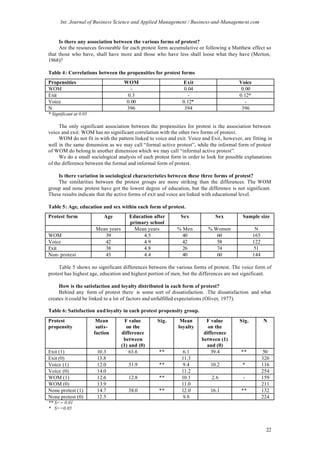
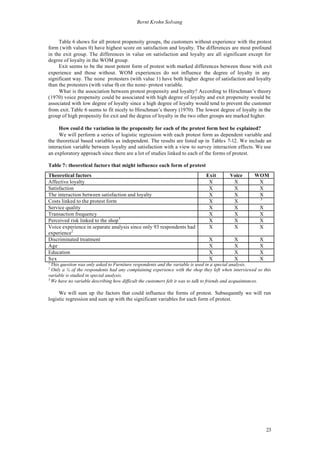
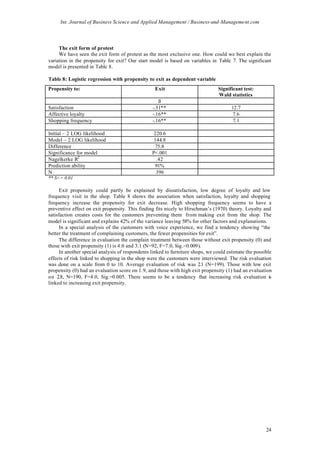
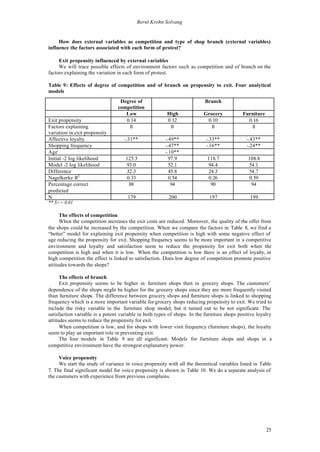
process improvement: A constructive case study

Kari Uusitalo
Department of Management Studies, University of Tampere
FI-33104 Tampere, Finland
Tel: +358 400 616 358
Email: kari.uusitalo@uta.fi

Henri Hakala
Department of Management, University of Vaasa P.O. Box 700, FI-65101 Vaasa, Finland
Tel: +358 6 3248249
Email: henri.hakala@uwasa.fi

Teemu Kautonen
Department of Management, University of Vaasa, P.O. Box 700, FI-65101 Vaasa, Finland
Tel: +328 44 0244280
Email: teemu.kautonen@uwasa.fi


Abstract

Process-based thinking commonly focuses on enhancing the efficiency of processes, while it is often
criticized for not paying enough attention to the customer. This paper argues that customer complaint
information can be used as a basis for customer-focused process improvement. Thus, it is not enough to
make the complaining customer satisfied, but the complaint information should also feed back to the
actual processes where the fault causing the complaint arose and where it can be removed. The
empirical component of the study includes the development of a novel construction to utilize customer
complaints for process improvements, which was implemented in a large Finnish enterprise operating
in the wholesale logistics environment. The results show benefits at both operational and strategic
levels.

Keywords: customer orientation, process improvement, customer complaints, complaint management,
operations management, constructive method
Int. Journal of Business Science and Applied Management / Business-and-Management.com


1 INTRODUCTION
      The market-oriented philosophy in marketing and management literature has emphasized
customer satisfaction and loyalty as sources of performance and profitability (e.g. Deshpandé, Farley
and Webster, 1993; Foster, Gupta and Sjoblom, 1996; Jaworski and Kohli, 1993; Knox, 1998; Oakland
and Oakland, 1998; Slater and Narver, 1996). However, the customer orientation seldom reaches the
operational level of business processes in theory or practice. Process-oriented management teachings
such as activity based management (Turney, 1992), total quality management (Creech, 1994; Mizuno,
1992), business process re-engineering (Earl and Khan, 1994), continuous improvement (Davenport,
1993), lean management (Taylor, 1999; Vollmann, Berry and Whybark, 1997) and supply chain
management (Shapiro and Heskett, 1985) have traditionally focused on enhancing the efficiency of
processes within organizations. While a number of scholars have raised the role of the customer in the
improvement of business processes (Jones and Sasser, 1995, Kohli and Jaworski, 1990, Slater and
Narver, 1994, 1996), these teachings have also been criticized for being rhetoric and not paying enough
genuine attention to the customer (e.g. Wood, 1997). In short, despite their development towards
increased customer focus, these ‘engineering’ approaches essentially concentrate on processes as such
and do not appear to provide sufficient support to focus on the issues that are important to the
customer.
      This paper argues for a customer-focused approach to the improvement of business processes by
developing a construction which systematically utilizes customer feedback in form of complaints to
achieve process improvements both at strategic and operational levels. The basic idea is that it is not
enough to make the complaining customer satisfied, but that the complaint information should feed
back to the actual processes where the fault causing the complaint arose and where it can be removed,
thus avoiding further similar errors. This thinking is essentially utilizing the ideas of a learning system
(Checkland, 2000) and feedback loops that balance the variety between the environment and the
operations (Beer, 1985). While complaint management has been addressed in the previous literature
(e.g. Boshoff, 1997, 1998; Brown, Cowles and Tuten, 1996; Feinberg, Widdows, Hirsch-Wyncott and
Trappey, 1990; Hart, Heskett and Sasser, 1990; Johnston, 1995), Johnston and Mehra (2002)
emphasize that further research is required especially with respect to the ‘how’, that is, how the
complaint information could be utilized operationally. Moreover, little research has been devoted so far
to investigating how companies can better utilize qualitative customer complaint information. The
present paper addresses both of these knowledge gaps.
      Empirically, the paper adopts an applied approach based on the constructive case study method.
The constructive method concentrates on developing and implementing a new, innovative and
theoretically anchored construction (e.g. a model, plan, organization, technology, software or a
combination of these) to solve a real-world problem situation (Kasanen, Lukka and Siitonen, 1993;
Lukka, 2000, 2003, 2005). The implementation phase is an integral part of this method, as the ideal
construction not only makes a theoretical contribution but also solves the practical problem (Lukka,
2000). Thus, in business studies the construction is subjected to the practical test of whether it works in
the company or not. The construction developed in the present study includes a database solution for
collecting and analysing qualitative customer complaint data in a large Finnish company operating in
the wholesale logistics environment. The aim of the construction was to provide a tool for customer-
focused process improvement.
      The contribution of this paper is two-fold. Firstly, it introduces a novel construction which links
customer complaints to the company’s processes arguing that complaint information can be effectively
used to improve customer focus and operational quality. Secondly, from a managerial point of view,
the paper describes a construction that effectively utilizes customer complaint information in support of
managerial decision making both at operational and strategic levels aiming towards improved
operational quality.
      The paper is arranged following the logic of the constructive method. The first section reviews
literature relevant to analysing the role of customer complaints as a source of information for the
purpose of process improvement. This review summarizes the main literature used in developing the
construction. Next, the constructive case study methodology is described and the case company and
the developed construction are introduced. Finally, the results of the study are presented and discussed,
followed by the conclusions and implications for management and further research.


                                                                                                         2
Kari Uusitalo, Henri Hakala and Teemu Kautonen


2 CUSTOMER COMPLAINTS AND PROCESS IMPROVEMENT
     Extending the market-oriented philosophy to the management of processes would imply that the
emphasis should be placed on identifying and improving those processes in the company’s value chain
that generate the most value to the customer. Such improvements are not just a cost but also an
investment in long-term profitable customer relationships (Reichheld and Sasser, 1990). However,
errors and unsatisfactory service occur in all businesses given that “mistakes are an unavoidable feature
of all human endeavour” (Boshoff, 1997, p. 110). Occasional failures are not necessarily bad. As a
matter of fact, m customers accept that things go wrong sometimes and are happy enough as long as
                 ost
the problems are solved and do not occur again (Bitner, Booms and Tetreault, 1990; Feinberg et al.,
1990).
     Different types of faults can be prioritized on the basis of the cost they cause to the company or its
customers (Albright and Roth, 1994; Shank and Govindarajan, 1994). The Japanese quality philosophy
distinguishes between random and systematic faults in this context (Mizuno, 1992). Random errors
often have relatively simple causes and are thus fairly easy to identify and analyse. They are often
‘human’ and can therefore usually be corrected by the person responsible for the particular task (Cardy
and Dobbins, 1996; EFQM, 1997; Oakland and Oakland, 1998). Systematic errors cause the customer
to experience dissatisfaction on a continuous rather than sporadic basis. The reasons causing this type
of errors are often multifaceted and removing their causes requires complex analysis (Mizuno, 1992).
To correct the problem is therefore a task for the management who have the power to eliminate the
causes. Our particular interest in this paper concerns systematic errors as removing such faults in a
company’s processes demonstrates the greatest potential to improve quality in a way valued by the
customer (Berry and Parasuraman, 1997; Clinton and Hsu, 1997; Hammer, 1990).
     The identification of systematic faults requires a considerable amount of versatile data (Reichheld
and Sasser, 1990). We argue that customer complaints can be a valuable and inexpensive source of
information for identifying systematic errors and enabling customer-focused process improvement. The
feedback that the customer provides out of their own initiative, such as complaints, is often very direct,
concrete and detailed (Reichheld and Sasser, 1990). Thus, compared with data collected by means of
customer surveys and panel studies, complaint information provides a more reliable picture of the
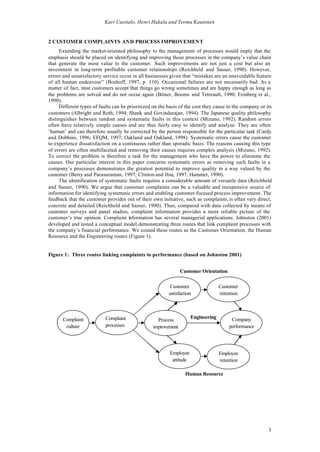
customer’s true opinion. Complaint information has several managerial applications. Johnston (2001)
developed and tested a conceptual model demonstrating three routes that link complaint processes with
the company’s financial performance. We coined these routes as the Customer Orientation, the Human
Resource and the Engineering routes (Figure 1).


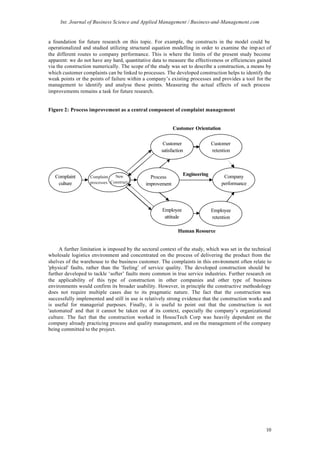
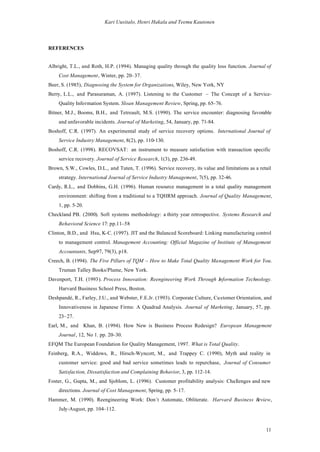
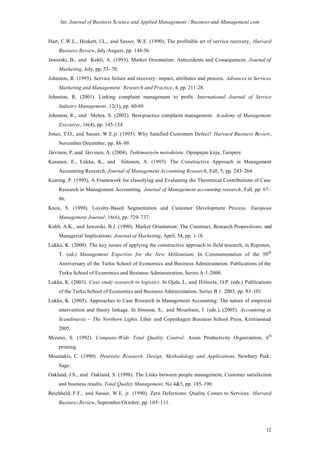
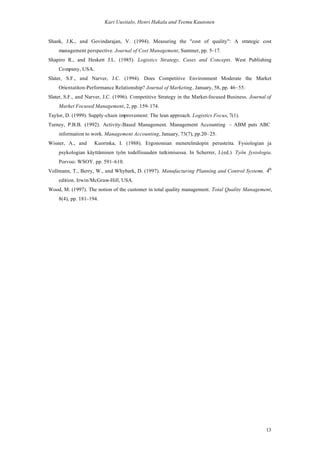
Figure 1: Three routes linking complaints to performance (based on Johnston 2001)


                                                                Customer Orientation

                                                          Customer                  Customer
                                                         satisfaction               retention


      Complaint            Complaint                                  Engineering        Company
                                                    Process
       culture             processes              improvement                           performance


                                                          Employee                  Employee
                                                           attitude                 retention

                                                                  Human Resource


                                                                                                         3
Int. Journal of Business Science and Applied Management / Business-and-Management.com


      The Customer Orientation route suggests that complaint processes impact on customer
satisfaction, which in turn through its effect on customer retention has an impact on the firm’s financial
performance. It essentially covers the customer recovery process, that is, making the complaining
customer satisfied through an appropriate correction of the error made. Furthermore, Johnston (2001)
argued that complaint processes, if made ‘staff-friendly’, can also have an impact on employee
attitudes and to financial performance via employee retention. We call this the Human Resource route.
The reasoning behind this route suggests that by making complaint management easier to the
employees, allowing a certain degree of human error, and relaying not only the complaints but also the
positive feedback received from the customers to the employees, employees are believed to be happier,
learn from their mistakes and remain with the company, thus reducing operation and switching costs.
Finally, Johnston (2001) suggested that complaint processes should be designed to focus on process
improvements that are likely to achieve savings and thus positively impact profitability, which is not
necessarily the case if the improvement merely targets customer satisfaction. These elements form the
third route in the model, which we coined the Engineering route. According to our understanding, this
is the process where the errors causing the complaints are identified, analysed and tracked back to their
source. Thereafter the information can be used in aid of decision making in an attempt to improve
processes, thus preventing similar errors happening again.
      The focus in the following analysis is on the Engineering route. We argue, however, that the three
routes are intertwined. Process improvements affect customer satisfaction and retention, as they do
employee attitudes and retention. Similarly, process improvement should be based on information
about the factors that have a positive impact on customer satisfaction and employee attitudes. The
particular emphasis of the following analysis is on utilizing customer complaint information to
determine what makes the customer dissatisfied and using this as a basis for process improvement,
which in turn aims to avoid the repetition of the errors that gave rise to the complaint in the first place.
So far little research has been aimed at finding tangible methods to analyse and derive operational
benefits from customer complaints. The following section presents a construction that was
implemented in a large Finnish company as a solution for analysing complaint information and tracking
back complaints to the processes within the organization where the fault causing the complaint
occurred. This is followed by a discussion of the results achieved through the implementation at both
the operational and strategic levels.


3 METHOD AND DATA

     The constructive case study method
     The constructive method is a specialized form of case study, which concentrates on developing a
new, innovative construction to solve practical, real-life problems Lukka, 2003, 2005). Lukka (2000)
characterizes construction as an abstract concept which has a nearly infinite number of possible
realizations. Examples include different models, diagrams, plans, organizational structures, commercial
products and information systems. A particular characteristic of constructions is that they are not
discovered but invented. The construction developed in the present study is a novel, practically relevant
method of systemizing the utilization of customer complaint information for processes improvement.
     In addition to building a theoretically anchored construction, the implementation of the developed
construction is at the core of the method. Therefore, unlike for example in action research, the
researcher does not attempt to be an observing bystander but works actively and explicitly on the
project in order to make it work in practice (Lukka, 2005). A constructive study is experimental by its
nature. Following the pragmatic philosophy of science, the constructive method believes that one can
make a contribution to theory through a profound analysis of what works and what does not work in
practice (Lukka, 2000). The ideal results from a constructive case study combine both the solution to
the practical problem and a contribution to theory. The theoretical contribution can take the form of an
entirely new theory but more often constructive studies demonstrate, test or develop existing theory
(Keating, 1995; Lukka, 2000, 2005).
     The present study was carried out in three phases. The pre-study phase and the development of the
construction took place mostly during 1999-2001, whilst the implementation of the construction in the
case company followed in 2001-2002. Analysis and monitoring of the continuing implementation of
the construction has continued ever since and the construction is still in use at the case company at the
moment of writing this paper (August 2007). The relatively long period between the initial
implementation in the case company and this analysis, strengthens the validity the construction and
findings, as the construction has been not only initially successful, but stood against the test of time in
ever changing world. The strong intervention required by the constructive case study method was


                                                                                                          4
Kari Uusitalo, Henri Hakala and Teemu Kautonen


enabled by the main project researcher’s position as a project manager responsible for the development
of the customer feedback system, and his previous experience with the company. The credible
organizational role of the main researcher allowed him to collect a wealth of data by means of
observation, participation and interaction with various staff members in meetings, informal discussions
and email dialogues. The researcher made extensive notes over the course of the implementation
process, which were used as a basis for the present analysis. The following sections present the case
company and the theoretical construct, followed by a presentation and discussion of the results of the
study.

      The case
      The case company ‘HouseTech Corp’ (pseudonym) is one of the major agents in the technical
wholesale in Northern Europe. It generates an annual turnover of around one billion euros, has
approximately 2500 employees and maintains operations in eight countries in Northern Europe. As is
typical in the wholesale business, logistics has a central role in HouseTech Corp’s operations. Its role in
the value chain is to act as an intermediary between the manufacturers and their customers. The present
study was conducted in HouseTech Corp’s central distribution centre in Finland. This unit maintains a
product range of nearly 30 000 items and delivers approximately six million order lines per annum. Its
clientele includes electrical, heating, plumbing, ventilation, air conditioning and refrigeration
contractors, industrial companies, power plants, public organizations and retailers. The central
distribution centre delivers goods with the help of transport partners directly to business or public
sector customers or the customers can choose to collect the goods from the central warehouse.
Moreover, the company operates a chain of 'express stores' where local small businesses can purchase
and collect a limited selection of items without prior order.
      This study deals with the customer delivery process. The customer delivery process is a
combination of the physical movement of goods and information. Quality in this operation means, from
the customer point of view, that the ordered goods reach the right place undamaged and at the right
time. Due to the nature of the technical wholesale business, the majority of complaints relate to actual
'physical' shortcomings in the delivery process rather than emotional perceptions of service quality. In
other words, the complaints relate to situations where the products ordered have reached the customer
late, in a faulty condition, in insufficient quantities, or the correct products have not reached the
customer at all. These sorts of problems are common in all high volume warehousing operations. Most
customers tend to complain about this kind of shortcomings because the operations management
system automatically invoices all the goods that have left the warehouse. HouseTech Corp had and still
has a back office function to handle complaints that cannot be immediately and informally solved by
the sales clerk. While sales clerks input most of the complaints into the system, further processing and
the correction of errors is dealt with by the back office complaint handlers.
      The need for the project on which this paper is based arose because the logistics management was
concerned about the increasing number of complaints and the associated costs. The preliminary
analysis of the logistics management concluded that the quality management projects already
undertaken – including a quality system covering all functions in accordance with the ISO9000
standard and self-assessments in accordance with the criteria provided by the European Foundation for
Quality Management – did not seem to focus on the issues that the customers complained about. At the
operational level, the complaint handlers were not satisfied with the IT system and had concerns over
the quality of the complaints process. The complaint handlers are operational problem-solvers whose
task is to solve the problem for the customer, make the appropriate corrections in the warehousing and
invoicing systems as well as find out who is responsible for the direct cost associated with the error,
whenever this is humanly possible. Complaints handlers did not have a managerial perspective to their
work, but a lot of tacit knowledge on what caused the problems in the first place. Since the complaint
data was neither systematically collected nor analysed and the complaint handlers merely focused on
correcting individual delivery errors, the complaint information and the complaint handlers’ tacit
knowledge did not reach the managerial level. An effective method and respective working procedures
were required to address this problem.
      The logistics director of HouseTech Corp had a strong belief in the benefits of using customer
data, but no clear vision as to how one should go about realizing the benefits. At the time, there was no
known off-the-shelf software or other solution available for the problem situation at hand. This is why
the company decided to have a research-based solution developed to solve the problem. The aim was to
provide a solution to the question of how to use the complaints information in order to improve quality
in the processes causing the complaints in the first place. As the precise objectives of the project could
not be clearly defined, the project was given plenty of room for innovation. The research process could
be characterized as heuristic. As the objectives were not clear, the best means of getting there could not


                                                                                                         5
Int. Journal of Business Science and Applied Management / Business-and-Management.com


be ‘programmed’ and planned in advance (e.g. Moustakis, 1990). Moreover, numerous small problems
had to be solved during the course of the project as they emerged, and many of these solutions needed
to be approved by a number of people in the organization, which slowed down the process. Against this
backdrop, it was necessary to choose a method where the problems, disturbances and unexpected
difficulties could be tackled heuristically as they appear (Wisner and Kuorinka, 1988), and the
constructive methodology appeared appropriate and flexible enough for this purpose.

      The construction
      To function as the technical core of the construction, a database solution was created based on
standard relational databases and the SQL protocol. The user interfaces were custom-developed, and
although the system was built on standard database elements, the application itself was new and not
available off-the-shelf at the time. The user interface for the input of data into the system was created
around the job description of the complaint handlers. This was done because the complaint handlers
were the ones holding the most information in each individual case and it was recognized that it would
be beneficial to capture some of their knowledge to support managerial decision making. In the new
system, a qualitative description of what went wrong from both the customer’s and the sales clerk’s
perspective was made available to the complaint handler. A new task for the complaint handler became
to link the complaint to the company’s process and activity descriptions in the database system.
Furthermore, since complaint handlers obviously find out what happened and why as well as how the
complaint was solved, the new system required them to record their own description of these elements
too. All of the complaint related details, although recorded mainly for the needs of the complaint
handler, were stored in the data warehouse. All the details, including the qualitative customer
comments, could be easily accessed should someone wish to look deeper into the individual complaints
later on.
      The following information was put together for each customer feedback event:
           • Complaint information from the customer, what has happened and the customer’s
                perception as to why this has happened.
           • Sales clerk’s immediate reaction (e.g. calling the customer to find out what happened
                exactly), possible corrective action and interpretation of the event.
           • Order data.
           • Complaint handler’s description and analysis of the complaint’s causes and effects, and
                a description of the corrective actions taken.
           • Link to activities and agents identified to have been part of the cause for the compla int.

     The system recorded both negative and positive customer feedback in a similar manner. As much
as 17 % of the feedback was positive. These customers could be described as particularly delighted
about the service, given that they made the effort to specifically relay their satisfaction back to the
organization. The rest of the feedback consisted of complaints, which can be classified roughly into
errors caused by workers or local poor working methods (40 %), poor internal processes (10 %) and
poor external processes (50 %, e.g. deliveries by the transport partners).
     However, the real novelty of the construction does not lie in its technical structure, user interfaces
or what data is recorded, but in its managerial aspects. Three contributions of the construction should
be particularly emphasized in this context. First, the new system classifies the errors that have caused
the customer complaint for the purposes of further analysis and aid in managerial decision making.
Second, the system allows the management to trace back the complaint and the respective error to the
procedures, individuals, vehicles, partners (transport companies) or machines responsible for the error
within the whole delivery process. Thus, with the help of the new system, the management can aim
process improvement actions to those processes that really matter to the customer. Third, the new
system allows the company to combine the complaint data with other information already available in
the company. The procedures and activities that the complaints are now linked to were already
accurately defined in the company and used by its activity-based cost accounting system. As the whole
company utilizes the same data warehouse, the construction now also links complaints directly with
cost accounting, and provides qualitative data for the uses of management accounting. The following
section discusses the impact of the construction at operational and strategic levels as it was
implemented in HouseTech Corp.


                                                                                                         6
Kari Uusitalo, Henri Hakala and Teemu Kautonen


4 RESULTS

     Operational level – compl aint handlers
     The implementation of the construction had several positive effects at the operational level of
complaint handling. As an immediate effect of utilizing the new construction, the complaint handlers
perceived the recording, analysing and reporting of complaints data to have become easier, making
their work easier and more motivating.

    “The best thing in the new system is that customer feedback, with all associated order data, prints
    out automatically in our office. Just by reading one paper or screenful, I can now get a whole
    picture of the complaint, and start doing my job without the need to search for more information
    from the computer systems or telephone around the company and bother other people with simple
    questions. The system makes our work considerably easier and faster. Another great thing in the
    new system is the feeling one gets while recording one’s own actions into the database, that the
    work we do is not wasted – someone is going to use the information later on. Feels like the bosses
    have finally realized how important work we are doing!”(A complaint handler, April 2002)

     Therefore, in terms of the conceptual model (Figure 1), the process improvement in fact feeds
back to the employee attitudes component in the Human Resource route which, the model predicts,
contributes to performance via employee retention.
     Moreover, the average working time used for handling each complaint was measured to have
reduced by approximately 15 % (or eight minutes) due to the new construction. The measurement was
conducted by recording the working time used on the different phases of the customer complaint
process during one week each in June 1998 and November 2004 by means of work-time clocking and
time-logs recorded by the new IT system itself. This result is a direct measure of success in terms of
improving the effectiveness and efficiency in the process of complaint handling. Although no direct
cost savings were made through staff redundancy, the direct time saving, for its part, made it possible
to keep staff numbers constant despite growth in operations volume.

      Operational level – warehouse management
      The warehouse management (the lowest level of operational management) found the information
created by the construction a very useful tool. With the implementation of the construction, these
managers started to review the complaint data systematically and continuously, whereas previously
their knowledge about complaints was based on sporadic discussions with the complaint handlers. They
could now better monitor the performance in terms of the number of complaints tracked back to their
area of responsibility. The following quote from one of the warehouse operations managers illustrates
this:

    “We have had the custom of going through the errors with employees every week. Occasionally,
    there were unpleasant situations where complaint handlers had marked an error as caused by a
    particular employee, but the employee himself denied responsibility. And who would want to take
    the responsibility for errors as they are linked to the productivity bonus and therefore to the
    worker’s pay check. We as supervisors must be able to prove the error and its link to the specific
    employee in a reliable manner if required, but previously without the system it was quite difficult.
    The new system enables us to print out every complaint with the associated data that shows
    extensively the cause for the error, who made it and what sort of hassle the error caused. An
    extensive and well documented description gives less room for guesswork and speculation, a thing
    that my workers have started to appreciate. Our work becomes much easier; we can take action
    backed by facts instead of guessing and shooting from the hip.”(A warehouse operations manager,
    August 2002)

     Furthermore, the new system enabled warehouse managers to effectively analyse the reasons
behind each complaint and combine this information with their own detailed operational knowledge.
Thus, the system provided warehouse management with factual information backing their decisions to
change working methods, relocate employees or initiate training. For example, when an employee was
identified as the cause for a systematic fault, the warehouse management initiated discussions with the
respective employee regarding the problem. In some cases this was enough, if the fault was caused for
instance by unintended carelessness on part of the employee. In others, the reason could be traced back
to faulty equipment, a local working method or a plain misunderstanding. Where the underlying cause


                                                                                                      7
Int. Journal of Business Science and Applied Management / Business-and-Management.com


was identified as shortage of skill, the warehouse manager could rotate the employee to other duties
more suitable to their skills or initiate further training.
     Moreover, as positive feedback was recorded in a similar manner as complaints, the warehouse
management adopted the habit of reviewing also this information and giving feedback to employees on
their successful efforts that had led to customer delight. This was perceived to have very positive
effects to employee satisfaction and thus employee attitudes in terms of Figure 1.

    “We do help some “begging” customers occasionally to get their stuff delivered next day,
    although they have actually ordered too late in the afternoon to get next day delivery. It felt quite
    nice that my boss [Transport Manager] actually said that the customer had thanked us because I
    was still able to get his goods into the truck. Never thanked me for that sort of thing before. It
    seemed to be important for the customer to get the ordered pipes next day, so I did a little extra
    work, because of the hassle the customer would have otherwise had at his construction site.” (A
    transport co-ordinator, August 2002)

    Strategic level
    At the strategic level, the logistics management became more interested in utilizing customer
complaint information with the implementation of the construction and started to review and analyse
complaint data regularly, on a monthly and annual basis.

        “Analysing the data seems to become more and more interesting as the size of the database
    grows. The database now has five months’ data, and it’s becoming quite interesting to play with
    the data in Access, and see whether anything new comes out. I can hardly wait until we can start
    looking at the data on an annual basis, when I expect we can better see the spread of different error
    types and can evaluate their cost effects and use that for improving our operations.” (Logistics
    Manager, August 2002)

    “I have always believed that customer information is a key for achieving a new kind of, even
    strategic competitive advantage. However, I often wondered what is the relevant information we
    ought to get from the customer, and how we should go about getting that information. These
    customer satisfaction questionnaires we send out seem, from the perspective of improving
    logistics, rather useless. With regard to this new customer feedback construction, I was not
    convinced at the beginning that complaints information is a sensible source of customer
    information. I didn’t believe that it generates enough data for a reliable and systematic analysis.
    However, as it seems now, our large volumes cause a large number of complaints, even though
    they are relatively few proportionally [given the total volume]. A careful handling of customer
    feedback creates a surprising amount of useful and interesting data.” (Director of Logistics,
    November 2002)

      By investigating and analysing the data in the long run, the top logistics management could
identify trends and larger issues in the delivery process. This led to a further investigation concerning
the potential for redesigning parts of the delivery process. For example, the logistics management
initiated discussions with the transport partners aiming to reduce the number of errors occurring when
goods are transported from the warehouse to the customer’s premises.

    “I meet with all our transport partners once a month to evaluate and go through current issues and
    ponder about how to develop operations and cooperation. Before the latest meeting with one of the
    transporters, I filtered out from the system all the errors that, according to the system, they had
    caused and sent them the list a couple of days beforehand. It was quite a confusion and surprise for
    both of us, as we both claimed that we were innocent and that the other party was solely
    responsible for the mistakes. However, the uniform reporting of errors created an intensive and
    productive dialogue. Already during the first meeting we found a problem spot in the delivery
    process, which we obviously decided to fix as quickly as possible. I am going to do the same thing
    with all of our transport partners.” (Transport Manager, October 2002)

     Numerous small changes in the warehouse operations were implemented during the observed
period. As the construction continues to be in use, more will be done every month. In principle these
changes, if correctly implemented, should lead to better operations, improvement in quality and
reduction in the number of complaints. While it was not within the scope of this study to measure the


                                                                                                       8
Kari Uusitalo, Henri Hakala and Teemu Kautonen


effects in absolute numbers, the management reported clear improvements on those occasions where
changes were made based on the construction.

    “Yes, the system is still actively used. It now forms an integrated part of our customer contact
    handling in the customer service centre.” (Business Planning Manager, May 2006)


5 CONCLUSION
      This paper addressed the issue of utilizing customer complaint information as a source for
customer-focused process improvement, which was argued to direct process improvements to those
activities that generate most value to the customer. A previous study by Johnston (2001) had shown
that a well-handled customer complaint process positively correlates with process improvements (the
Engineering route), customer satisfaction (the Customer Orientation route), employee attitudes (the
Human Resource route) and, ultimately, company performance (Figure 1). However, the literature
acknowledged that the problem of 'how' to achieve process improvements by utilizing customer
complaints remained largely unsolved (Johnston and Mehra, 2002). The present paper set out to
address this problem by creating a novel construction that – along the lines suggested by process-
oriented management teachings (see e.g. Albright and Roth, 1994; Berry and Parasura man, 1997;
Mizuno, 1992; Reichheld and Sasser, 1990) – recorded qualitative customer complaint information
together with the complaint handler’s interpretation, and allowed these to be processed systematically
and linked to the rest of the company’s information system. Hence, both the complaint itself and the
complaint handler’s tacit knowledge became usable as a managerial tool both at operational and
strategic levels. The study thus demonstrated the usability of various process management teachings
and their compatibility with customer-focused thinking when correctly employed.
      The construction was implemented in a large Finnish technical wholesale enterprise and the
implementation was studied as part of the constructive case study research method (e.g. Lukka, 2000,
2005). The results attained through the implementation clearly demonstrate that it is possible to achieve
business process improvements by utilizing customer complaint data, thus supporting the
argumentation in previous research which has raised the role of customer information in the
improvement of business processes (e.g. Jones and Sasser, 1995, Kohli and Jaworski, 1990, Slater and
Narver, 1994, 1996). Moreover, in terms of the Customer Orientation, Engineering and Human
Resource routes depicted in Figure 1, the results of the case study showed that these are intertwined
rather than independent of each other. The process improvements achieved became manifest and had
managerial implications on three distinguishable levels of organization.
      Firstly, by making the complaint-handling process more effective and staff-friendly, the
construction showed a direct impact on the time and costs associated with handling the complaints. The
complaint handlers also felt that their contribution to the company was finally recognized and their
work became more valued by the management. Thus, in terms of the model in Figure 1, the
Engineering route also impacted the Human Resource route via the process improvement having an
effect on employee attitudes.
      Secondly, enabling the operations management to track back each complaint to its source
improved the management’s ability to monitor performance and intervene to remove a problem if
required. The customer complaint data was actively used to make minor adjustments and improvements
within processes. These adjustments decreased the number of errors made and had a direct impact on
costs, thus ‘engineering’ the processes and the Engineering route continuously to become more
efficient.
      Thirdly, the feedback data was also utilized in aid of strategic decision making regarding the long
term development of warehouse operations and the network of transport partnerships. This had a direct
impact on the Engineering route. Arguably the construction also improves customer satisfaction and
thus the Customer Orientation route, although this was not explicitly demonstrated in our case. The
developed construction did not really change the way the company deals with an individual customer
recovery, with the exception of adding the possibility to give feedback via internet. However, as the
customers complain and respective process improvements are made, customers do not experience
similar errors in the future, which will reflect on their satisfaction in the longer term.
      Based on the results of the case study, we propose extending the original model adopted from
Johnston (2001) as illustrated in Figure 2. Thus, we propose that process improvements may also have
indirect effects on company performance by positively impacting employee attitudes and customer
satisfaction. The increased customer satisfaction and improved employee attitudes, in turn, are likely to
have a positive impact on enhanced utilization of the customer complaint system and subsequent
process improvement, thus creating a positive loop in the long run. The extended model could serve as


                                                                                                       9
Int. Journal of Business Science and Applied Management / Business-and-Management.com


a foundation for future research on this topic. For example, the constructs in the model could be
operationalized and studied utilizing structural equation modelling in order to examine the imp act of
the different routes to company performance. This is where the limits of the present study become
apparent: we do not have any hard, quantitative data to measure the effectiveness or efficiencies gained
via the construction numerically. The scope of the study was set to describe a construction, a means by
which customer complaints can be linked to processes. The developed construction helps to identify the
weak points or the points of failure within a company’s existing processes and provides a tool for the
management to identify and analyse these points. Measuring the actual effects of such process
improvements remains a task for future research.


Figure 2: Process improvement as a central component of complaint management


                                                           Customer Orientation

                                                      Customer                 Customer
                                                     satisfaction              retention


   Complaint                                                     Engineering        Company
                   Complaint   New             Process
    culture        processes Construct       improvement                           performance


                                                     Employee                  Employee
                                                      attitude                 retention

                                                              Human Resource


     A further limitation is imposed by the sectoral context of the study, which was set in the technical
wholesale logistics environment and concentrated on the process of delivering the product from the
shelves of the warehouse to the business customer. The complaints in this environment often relate to
'physical' faults, rather than the 'feeling’ of service quality. The developed construction should be
further developed to tackle ‘softer’ faults more common in true service industries. Further research on
the applicability of this type of construction in other companies and other type of business
environments would confirm its broader usability. However, in principle the constructive methodology
does not require multiple cases due to its pragmatic nature. The fact that the construction was
successfully implemented and still in use is relatively strong evidence that the construction works and
is useful for managerial purposes. Finally, it is useful to point out that the construction is not
'automated' and that it cannot be taken out of its context, especially the company’s organizational
culture. The fact that the construction worked in HouseTech Corp was heavily dependent on the
company already practicing process and quality management, and on the management of the company
being committed to the project.


                                                                                                      10
Kari Uusitalo, Henri Hakala and Teemu Kautonen


REFERENCES


Albright, T.L., and Roth, H.P. (1994). Managing quality through the quality loss function. Journal of
    Cost Management, Winter, pp. 20– 37.
Beer, S. (1985), Diagnosing the System for Organizations, Wiley, New York, NY
Berry, L.L., and Parasuraman, A. (1997). Listening to the Customer – The Concept of a Service-
    Quality Information System. Sloan Management Review, Spring, pp. 65–76.
Bitner, M.J., Booms, B.H., and Tetreault, M.S. (1990). The service encounter: diagnosing favorable
    and unfavorable incidents. Journal of Marketing, 54, January, pp. 71-84.
Boshoff, C.R. (1997). An experimental study of service recovery options. International Journal of
    Service Industry Management, 8(2), pp. 110-130.
Boshoff, C.R. (1998). RECOVSAT: an instrument to measure satisfaction with transaction specific
    service recovery. Journal of Service Research, 1(3), pp. 236-49.
Brown, S.W., Cowles, D.L., and Tuten, T. (1996). Service recovery, its value and limitations as a retail
    strategy. International Journal of Service Industry Management, 7(5), pp. 32-46.
Cardy, R.L., and Dobbins, G.H. (1996). Human resource management in a total quality management
    environment: shifting from a traditional to a TQHRM approach. Journal of Quality Management,
    1, pp. 5-20.
Checkland PB. (2000). Soft systems methodology: a thirty year retrospective. Systems Research and
    Behavioral Science 17: pp.11–58
Clinton, B.D., and Hsu, K-C. (1997). JIT and the Balanced Scoreboard: Linking manufacturing control
    to management control. Management Accounting: Official Magazine of Institute of Management
    Accountants, Sep97, 79(3), p18.
Creech, B. (1994). The Five Pillars of TQM – How to Make Total Quality Management Work for You.
    Truman Talley Books/Plume, New York.
Davenport, T.H. (1993). Process Innovation: Reengineering Work Through Information Technology.
    Harvard Business School Press, Boston.
Deshpandé, R., Farley, J.U., and Webster, F.E.Jr. (1993). Corporate Culture, Customer Orientation, and
    Innovativeness in Japanese Firms: A Quadrad Analysis. Journal of Marketing, January, 57, pp.
    23– 27.
Earl, M., and Khan, B. (1994). How New is Business Process Redesign? European Management
    Journal, 12, No 1. pp. 20–30.
EFQM The European Foundation for Quality Management, 1997. What is Total Quality.
Feinberg, R.A., Widdows, R., Hirsch-Wyncott, M., and Trappey C. (1990), Myth and reality in
    customer service: good and bad service sometimes leads to repurchase, Journal of Consumer
    Satisfaction, Dissatisfaction and Complaining Behavior, 3, pp. 112-14.
Foster, G., Gupta, M., and Sjoblom, L. (1996). Customer profitability analysis: Challenges and new
    directions. Journal of Cost Management, Spring, pp. 5–17.
Hammer, M. (1990). Reengineering Work: Don´t Automate, Obliterate. Harvard Business Review,
    July-August, pp. 104–112.


                                                                                                     11
Int. Journal of Business Science and Applied Management / Business-and-Management.com


Hart, C.W.L., Heskett, J.L., and Sasser, W.E. (1990), The profitable art of service recovery, Harvard
    Business Review, July-August, pp. 148-56.
Jaworski, B., and Kohli, A. (1993). Market Orientation: Antecedents and Consequences. Journal of
    Marketing, July, pp. 53– 70.
Johnston, R. (1995). Service failure and recovery: impact, attributes and process. Advances in Services
    Marketing and Management: Research and Practice, 4, pp. 211-28.
Johnston, R, (2001). Linking complaint management to profit. International Journal of Service
    Industry Management. 12(1), pp. 60-69.
Johnston, R., and Mehra, S. (2002). Best-practice complaint management. Academy of Management
    Executive, 16(4), pp. 145-154
Jones, T.O., and Sasser, W.E.jr. (1995). Why Satisfied Customers Defect? Harvard Business Review,
    November/December, pp. 88–89.
Järvinen, P.,and Järvinen, A. (2004). Tutkimustyön metodeista. Opinpajan kirja, Tampere.
Kasanen, E., Lukka, K., and        Siitonen, A. (1993). The Constructive Approach in Management
    Accounting Research, Journal of Management Accounting Research, Fall, 5, pp. 243–264.
Keating, P. (1995). A Framework for classifying and Evaluating the Theoretical Contributions of Case
    Research in Management Accounting. Journal of Management accounting research, Fall, pp. 67–
    86.
Knox, S. (1998). Loyalty-Based Segmentation and Customer Development Process. European
    Management Journal, 16(6), pp. 729–737.
Kohli, A.K., and Jaworski, B.J. (1990). Market Orientation: The Construct, Research Propositions, and
    Managerial Implications. Journal of Marketing, April, 54, pp. 1-18.
Lukka, K. (2000). The key issues of applying the constructive approach to field research, in Reponen,
    T. (ed.) Management Expertise for the New Millennium: In Commemoration of the 50th
    Anniversary of the Turku School of Economics and Business Administration. Publications of the
    Turku School of Economics and Business Administration, Series A-1:2000.
Lukka, K. (2003). Case study research in logistics. In Ojala, L. and Hilmola, O-P. (eds.) Publications
    of the Turku School of Economics and Business Administration, Series B 1: 2003, pp. 83–101.
Lukka, K. (2005). Approaches to Case Research in Management Accounting: The nature of empirical
    intervention and theory linkage. In Jönsson, S., and Mouritsen, J. (eds.), (2005). Accounting in
    Scandinavia – The Northern Lights. Liber and Copenhagen Business School Press, Kristianstad
    2005.
Mizuno, S. (1992). Company-Wide Total Quality Control. Asian Productivity Organization, 6th
    printing.
Moustakis, C. (1990). Heuristic Research. Design, Methodology and Applications. Newbury Park:
    Sage.
Oakland, J.S., and Oakland, S. (1998). The Links between people management, Customer satisfaction
    and business results. Total Quality Management, No 4&5, pp. 185–190.
Reichheld, F.F., and Sasser, W.E. jr. (1990). Zero Defections: Quality Comes to Services. Harvard
    Business Review, September/October, pp. 105–111.


                                                                                                    12
Kari Uusitalo, Henri Hakala and Teemu Kautonen


Shank, J.K., and Govindarajan, V. (1994). Measuring the "cost of quality": A strategic cost
    management perspective. Journal of Cost Management, Summer, pp. 5–17.
Shapiro R., and Heskett J.L. (1985). Logistics Strategy, Cases and Concepts. West Publishing
    Co mpany, USA.
Slater, S.F., and Narver, J.C. (1994). Does Competitive Environment Moderate the Market
    Orientatiton-Performance Relationship? Journal of Marketing, January, 58, pp. 46– 55.
Slater, S.F., and Narver, J.C. (1996). Competitive Strategy in the Market-focused Business. Journal of
    Market Focused Management, 2, pp. 159–174.
Taylor, D. (1999). Supply-chain improvement: The lean approach. Logistics Focus, 7(1).
Turney, P.B.B. (1992). Activity-Based Management. Management Accounting – ABM puts ABC
    information to work. Management Accounting, January, 73(7), pp.20– 25.
Wisner, A., and      Kuorinka, I. (1988). Ergonomian menetelmäopin perusteita. Fysiologian ja
    psykologian käyttäminen työn todellisuuden tutkimisessa. In Scherrer, J.(ed.) Työn fysiologia.
    Porvoo: WSOY. pp. 591–610.
Vollmann, T., Berry, W., and Whybark, D. (1997). Manufacturing Planning and Control Systems. 4th
    edition. Irwin/McGraw-Hill, USA.
Wood, M. (1997). The notion of the customer in total quality management. Total Quality Management,
    8(4), pp. 181–194.


                                                                                                   13
Int. Journal of Business Science and Applied Management, Volume 3, Issue 1, 2008


Customer protest: Exit, voice or negative word of mouth

Bernt Krohn Solvang
Department of Work Life and Innovation, University of Agder
Service box 509, 4898 Grimstad, Norway
Tel: +47 37253147
Email: Bernt.K.Solvang@uia.no


Abstract

Of the three forms of protest the propensity of word of mouth (WOM) seems to be the most common,
and the most exclusive form of protest seems to be exit. The propensity for voice lies in between. The
costs linked to voice influence the propensity for WOM. The customers seem to do an evaluation
between the three forms of protest, yet the rational picture of the customers should be moderated.

Leaders should improve their treatment of the customers making complaints. The more they can treat
customer complaints in an orderly and nice way the less informal negative word of mouth activity they
will experience and they will reduce the exit propensity and lead the customers to the complain
organisation. They should also ensure that their customers feel they get equal treatment by the staff.

Keywords: voice, word of mouth, WOM, exit, satisfaction, loyalty
Bernt Krohn Solvang


1 INTRODUCTION
     The customer’s potential to complain or make positive comments is hidden from the shop prior to
the purchase being made (Brief, 1998). This potential is of considerable significance for shops in a
market where there is competition and where keeping customers is of the greatest importance (Aaker,
1991; Fornell, 1992). Hirschman (1970) presents two main forms of protest: protest to the shop or to a
public complaints body (voice) or changing shop (exit). To complete the analysis of protest behaviour
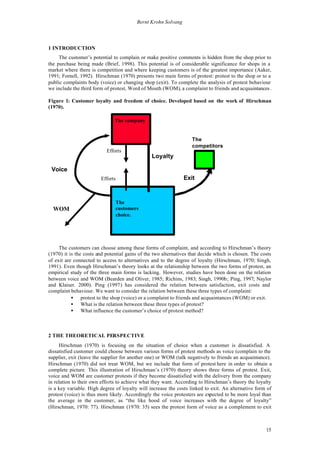
we include the third form of protest, Word of Mouth (WOM), a complaint to friends and acquaintances .

Figure 1: Customer loyalty and freedom of choice. Developed based on the work of Hirschman
(1970).

                               The company


                                                                   The
                                                                   competitors
                           Efforts
                                                Loyalty

 Voice
                        Efforts                                Exit


                               The
  WOM                          customers
                               choice.


     The customers can choose among these forms of complaint, and according to Hirschman’s theory
(1970) it is the costs and potential gains of the two alternatives that decide which is chosen. The costs
of exit are connected to access to alternatives and to the degree of loyalty (Hirschman, 1970; Singh,
1991). Even though Hirschman’s theory looks at the relationship between the two forms of protest, an
empirical study of the three main forms is lacking. However, studies have been done on the relation
between voice and WOM (Bearden and Oliver, 1985; Richins, 1983; Singh, 1990b; Ping, 1997; Naylor
and Klaiser. 2000). Ping (1997) has considered the relation between satisfaction, exit costs and
complaint behaviour. We want to consider the relation between these three types of complaint:
           • protest to the shop (voice) or a complaint to friends and acquaintances (WOM) or exit.
           • What is the relation between these three types of protest?
           • What influence the customer’s choice of protest method?


2 THE THEORETICAL PERSPECTIVE
     Hirschman (1970) is focusing on the situation of choice when a customer is dissatisfied. A
dissatisfied customer could choose between various forms of protest methods as voice (complain to the
supplier, exit (leave the supplier for another one) or WOM (talk negatively to friends an acquaintance).
Hirschman (1970) did not treat WOM, but we include that form of protest here in order to obtain a
complete picture. This illustration of Hirschman’s (1970) theory shows three forms of protest. Exit,
voice and WOM are customer protests if they become dissatisfied with the delivery from the company
in relation to their own efforts to achieve what they want. According to Hirschman’s theory the loyalty
is a key variable. High degree of loyalty will increase the costs linked to exit. An alternative form of
protest (voice) is thus more likely. Accordingly the voice protesters are expected to be more loyal than
the average in the customer, as “the like hood of voice increases with the degree of loyalty”
(Hirschman, 1970: 77). Hirschman (1970: 35) sees the protest form of voice as a complement to exit


                                                                                                      15
Int. Journal of Business Science and Applied Management / Business-and-Management.com


and not as a substitute for it. According to this theory exit is associated with costs and gains as the form
of voice is. The costs linked to exit might be of emotional character and travel distance and price and
quality variation. The voice costs are linked to bargaining power and by that to education.
     We are focusing on the connection between these forms of protest since, to our knowledge these
connections have not been treated empirically in a study.

     The form of protests
     Dissatisfied customers may react in various ways that often manifest itself through frustration and
anger: for instance to go to the representative of the shop, respond in private by means of negative
comments to friends and acquaintances, or go to a formal complaints body (Richins 1983; Singh,
1990b; Singh, 1990; Singh, 1991; Strauss, Schmidt and Schoeler 2005). Singh (1990) divides
customers into four groups according to their pattern of response. The passive ones have a low score
for all types of reaction.
     Only a few of those who are dissatisfied, make themselves heard, (Teknologisk Institutt 1993;
Grønhaug 1977). Andreasen and Best (1977) reported that more than half of those who were
dissatisfied did not complain at all, while according to Brief (1998) only 20% of Americans
complained in response to unsatisfactory service. The tendency to complain is, then, a function of
insufficient satisfaction and of frustration behaviour (Strauss, Schmidt and Schoeler 2005). Many of the
customers who are dissatisfied do not complain directly to the shop. Several authors, (Andreasen and
Best, 1977; Tarp, 1986; Grønhaug and Gilly, 1991; Hernandez et al., 1991; Bearden and Oliver, 1985;
Richins, 1983) see this in connection with the possibility of winning one’s case against the costs of
complaining in the best Hirschman tradition (1970). Berry and Parasuraman, (1991) state that
customers have a zone of tolerance where a performance that lies within the zone will be accepted.
Performances exceeding the zone create delight and loyalty, while performances falling short of the
zone create dissatisfaction.
     Will loyalty be able to create an increased zone of tolerance or is the degree of loyalty not
significant for the zone? Will the zone of tolerance be able to reduce the tendency to protest?

      Exit
      The main behaviour in exit is to leave the shop and start being a customer in another shop. This
behaviour has costs and gains. The exit costs are related to access to alternatives and to the degree of
loyalty. Hirschman (1970) argues that the exit costs are higher in those cases where there is no
alternative shop. If the customer is convinced that complaining will be effective that could delay exit
(Hirschman, 1970: 37). Customer loyalty will work as a barrier against exit. The barrier may be
compared to a cost (‘protective tariffs’) (Hirschman, 1970:79). Exit propensity means the probability
of a customer choosing the exit option.
      How is the exit propensity affected by the degree of loyalty? When loyalty increases, we expect
that the exit propensity will decrease since the costs of exit increase with increasing loyalty. How does
exit stay as a protest form in relation to voice and WOM? Do the customers have equal access to each
form of protest?

     Voice
     Voice works as a supplement to exit and not as a replacement for it (Hirschman, 1970: 35). A
decreasing degree of satisfaction and increasing exit costs may seem to play an equal role in
encouraging complaint behaviour (Ping, 1997). Those who are loyal are over-represented among the
complainers if Hirschman’s theory (1970) holds. The complainers score high on complaining and low
on the other forms of reaction. Those who are angry score high on comments to friends and
acquaintances (WOM), while the activists score high on complaining and high on third-party action
(consumer bodies) (Singh, 1990). Other factors which should be considered in an analysis of complaint
behaviour are understood risk, confidence in the success of the complaint as well as the advantages and
costs of complaining (Bearden and Teel, 1983; Tarp, 1986; Richins, 1985; Andreasen, 1997).
     Grønhaug and Gilly (1991) suppose that the greater tendency to complain about the service
industries may be linked to the fact that the services are difficult to standardise. Grønhaug (1972) finds
that consumers with a high risk evaluation have a greater tendency to make use of consumer-related
sources of information, while those with a lower risk evaluation make greater use of market-dominated
sources.
     When focusing on technology based service encounters Snellman and Vihtkari (2003) find that
customers who actually consider themselves guilty for the outcome were the most frequent
complainers, while the ones attributing the outcome to technology failures or service process failures
complain less often. Online customers are less likely to complain than offline customers and online


                                                                                                         16
Bernt Krohn Solvang


customers are more sensitive to benefits/costs of complaining. The difference could be explained by a
difference in personal competence expressed where the offline customers have highest score (Cho,
Hiltz and Fjermestad 2002).
     Comp lain, protest and avoidance have also been seen as negative effects of loyalty programs
(Strauss, Schmidt and Schoeler 2005).
     Each fourth of the potential complainers do not complain. The main reasons for this are linked to
perceived costs of complaining as time and efforts (Voorhees, Brandy and Horowitz 2006). According
to Grønhaug and Zaltman (1981), making a complaint is positively linked to experience, education and
income, but negatively linked to age.

     Voice handling
     Poor handling of a complainer who chooses to complain instead of changing shop because he has
a certain loyalty will weaken the complainer’s faith in the supplier. This results in fewer satisfied
customers and reduced loyalty. The risk of exit and a reduction in repeat purchase increase, together
with the increased probability of negative private comments (WOM) (Bearden and Oliver, 1985;
Grønhaug, 1987; Richins, 1983). Griffin (1995: 191) points out those complainers who have obtained a
quick solution have a repeat-purchase tendency of 82%, in contrast to those who have experienced a
major problem without complaining and whose repeat-purchase tendency is 9%. Those who complain,
irrespective of the result, have a repeat purchase figure of 19%. Gilly and Hansen (1985) point out that
effective complaint handling results in customer satisfaction and loyalty.
     We must suppose that many of the complainers are loyal customers. They choose to complain
instead of changing shop because their loyalty has increased the costs perceived in changing shop. On
the other hand a greater zone of tolerance among the loyal customers may keep them from
complaining. Good handling of this type of complainer will strengthen the complainer’s faith in the
supplier: ‘only moderate degrees of satisfaction with service recovery are needed to restore future
repurchase intention’ (Andreassen, 1997: 195; Singh, 1990b; Gilly and Hansen, 1985).
     Good complaint handling results in satisfaction and increased loyalty, and reduces the probability
of negative private comments (WOM) (Bearden and Oliver, 1985; Grønhaug, 1987; Richins, 1983).
This in turn reduces the risk of exit and increases the probability of repeat purchase. Increased
probability of repeat purchase means a better financial result for the supplier. Calculations show that an
increase of 5% in the repeat purchase share from 60% to 65% increases receipts by 15%. ‘On the other
hand a fall in customer loyalty from, for example, 90 to 80 will result in future sales being halved.’
(Andreassen, 1997: 4) This is also shown by Oliver (1997, pp. 368-369). A better financial situation
helps the supplier to satisfy complainers. A weaker situation makes it more difficult for the supplier to
offer good complaint handling.

     Negative WOM
     Bearden and Oliver (1985) found that a higher potential loss stimulates various forms of
complaint, and that the extent of private complaint behaviour is inversely linked to satisfaction with the
response from the firm. They point out that if the organisation makes a mistake in its complaint
handling, this may lead to loss of goodwill and negative WOM. Grønhaug (1977) pointed out that the
complaints seem to build up round complex products which involve a high risk.
     Richins (1983) found a connection between the consumers’ evaluation of the complaint handling
and comments about the shop. The more negative the complaint handling expected by the complainer,
the greater the probability of negative private comments (WOM). In another work Singh (1990b) points
out that exit and negative WOM are linked to an evaluation of the probability of the complaint being
successful. But Naylor and Kleiser (2000) do not find any effect of earlier complaint handling on
negative WOM. No complainers are less likely to engage in negative word of mouth than the
dissatisfied and recovery groups (Voorhees, Brandy and Horowitz 2006).
     Some of the protest forms turn out the public against a firm that has wronged them. Protests
published at the Internet are rooted in injustice, identity and turn out as a personal grievance into a
“cause” worthy of public attention and support (Ward and Ostrom 2006).

     Customer satisfaction
     Customer satisfaction and dissatisfaction are associated with the expectations of the customer. If
high expectations are met, the customer will be satisfied, but if low expectations are not exceeded by
the delivery the customer will be dissatisfied (Oliver, 1997). The customer’s experiences could be
linked to various sources as service performance, product quality, transactions, product delivery and
other factors (Zeithaml, Parasuraman, Berry, 1990).


                                                                                                       17
Int. Journal of Business Science and Applied Management / Business-and-Management.com


      Churchill, Gilbert and Surprenant (1982) found possible effects of satisfaction dependent on
product characteristics (durable and non-durable). Whilst Snellman and Vihtkari (2003) do not find any
difference in complaining rate between customers in retail banking and traditional technology based
service encounter, while Oliver (1997) finds a greater tendency to complain about durables than about
non-durables, but the largest group is those who do not want to complain. This can also be linked to the
significance of design, which plays a central role for durables.
      Grønhaug and Gilly (1991) point out that customer dissatisfaction can be connected with lack of
confidence concerning the transaction, and that much of the dissatisfaction could be linked to market-
institutional circumstances beyond the seller’s responsibility, such as no product delivered or a long
delivery time. Grønhaug and Zaltman (1981) find that it was the transaction frequency, and not the
qualities of the good, which best explains the variation in customer dissatisfaction. Ping (1997)
maintains that the tendency to complain is related to satisfaction and involvement in the relationship, in
the case of firms. Richins (1985) shows a positive connection between potential financial loss and the
tendency to complain.
      However, there is no simple connection between satisfaction and loyalty. Even satisfied customers
can switch to another store because there is no one-to-one connection between satisfaction and loyalty.
The relation between satisfaction and loyalty is influenced by characteristics of the consumer such as
age and income (Homburg and Giering 2001). Bloemer and Kasper (1995) and Bloemer and de Ruyter
(1998), differentiate between two types of satisfaction. Manifest satisfaction conveys a customer who
has made a deliberate choice and has reached the conclusion that he/she is satisfied with the offer.
Latent satisfaction expresses an unconscious customer who has not compared the offer with other
suppliers. They find that an increase in the manifest satisfaction has a greater impact on customer
loyalty than an increase in the latent satisfaction.

     Customer loyalty
     In literature concerning consumer behaviour there are different approaches to view/define
customer loyalty. It is differentiated between consumer loyalty in the consumer goods market,
customer loyalty in the business-to-business market and the synthesis between consumer and customer
loyalty (Kotler 1987; Oliver, Rust and Varki 1997).
     The loyalty phenomenon is characterized by diffuse and vaguely delimited contents of meaning
(Jacoby and Chestnut, 1978; Peter and Olson, 1993; Dekimpe and Steenkamp 1997). Hirschman’s
loyalty concept is equated with “non-exit” and hence it is too simple (Huefner and Hunt 1994). In
addition to being an unclear concept, several researchers have equated loyalty with repurchase (Carman
1970; Wind, 1978; Grønhaug and Gilly 1991). It is indicated that customer loyalty and repurchase can
be increased through establishing barriers that make it more difficult for the customer to go to another
store, and consequently repurchase increases (Aaker, 1991; Selnes and Reve 1994; Andreassen and
Bredal 1996).

      Loyalty as a development pattern in phases: This concept in particular has given inspiration to our
approach. Oliver (1997) presents customer loyalty in the form of four Loyalty Phases, viewed as steps
of a loyalty ladder:
      • Step 1 Cognitive loyalty – The customer has favourable knowledge of the supplier, but a
          better offer will result in exit to the competitor. The loyalty is only based on cognition.
      • Step 2 Affective loyalty – is an emotional attitude based on cognitive loyalty.
      • Step 3 Conative loyalty – is intentional loyalty that includes a deeply felt obligation to buy.
      • Step 4 Action loyalty – a determination to defy any obstacles in order to buy (Oliver, 1997:
          392-393).

    This seems to be a fruitful approach to this diffusing concept.

    Research questions
    1. How are the various forms of protest distributed?
    2. How is the variation in satisfaction and loyalty distributed in each form of protest?
    3. How could the variation in the propensity for each of the protest forms best is explained by
        customer related variables?
    4. How do external factors as competition and type of shop branch influence the factors
        associated with each form of protest?


                                                                                                       18
Bernt Krohn Solvang


3 METHODOLOGY

      Sample of shops
      We choose a quantitative design in order to be better able to answer our research questions. The
framework for the sample consists of four shops in the southern region of Norway, two in the grocery
trade and two in the furniture trade. For each shop 100 customers were selected, a sample of 400
customers altogether. In the case of the grocery shops the interviews were carried out outside the shops
on a Saturday and a Tuesday in October 1998. The sample of grocery customers was thus selected out
of convenience (those who came out of the shop).
      In the case of the furniture shops the plan was to carry out the interviews in the shop. However,
because of a shortage of customers, a random sample of c        ustomers was selected from the shops’
customers list. The interviews were conducted by telephone. The Saturday customers were collected in
one group since customers on this specific day of the week can have a different shopping pattern with
several family members taking part.
      The four shops differed on two criteria: type of trade to get variation in risks for the customers
(grocery and furniture) and competition situation and by that getting higher variation in the exit costs.
Consequently we included two grocery shops, one in a highly competitive area (low exit costs) and one
in a less competitive area (higher exit costs), and two furniture shops, one in a highly competitive area
and one in a less competitive area. All four shops are members of retail chains.

    Definition of and Measurement of central variables

     Loyalty
     First we tried to establish an index variable based on loyalty as an attitude and a repurchase
indicator: the percentage share of the respondent’s own trade in that type of shop for the shop in
question. This index variable was not reliable since Cronbach Alfa came out under 0.7 (Hair,
Anderson, Latham and Black, 1998).
     Then we established an index variable based on loyalty as an attitude and an indicator of an
emotional variable: To what extent the respondents would recommend the shop to others if they were
asked for advice. This indicator of affective loyalty come out with a significant Cronbach Alfa 0.70
(N=396). Consequently our indicator of Affective Loyalty is measured like this:

    Measurement of loyalty
    a) Self-evaluation of loyalty to the shop in question on a scale from 0 (extremely low) to 10
       (extremely high).
    b) Self-evaluation of to what extent the respondents would recommend the shop to others if they
       were asked for advice on a scale from 0 to 10.

    A reflective index (Troye, 1994) was worked out on the basis of these two indicators by the sum
(a+b). In a reliability analysis Cronbach Alfa came out with 0.70 (Hair, Anderson, Latham and Black,
1998). This indicates satisfactory reliability. The customer loyalty variable is then measures in values
from 0 to 20.

     Satisfaction
Customer satisfaction comprises the opinion about the positive response in the exchange and the degree
of satisfied expectations (Andreassen, 1997).

    Satisfaction was measured as follows:
    a) Self-evaluation of satisfaction with the shop in question measured on a scale from 0 to 10.
    b) Self-evaluation of the perceived balance between the costs related to being a customer in the
         shop in connection with costs involving money and time, and the feeling of what one is left
         with in return for these costs, measured on a balance scale from 0 to 10.

    The sum of a) and b) make up our index variable for satisfaction, a reflective index measurement
(Troye, 1994). Coronach Alfa between these two indicators is 0.861, which indicates high reliability.
The satisfaction index is measured in values from 0 to 20.

     Interaction between loyalty and satisfaction
     By multiplying the two variables satisfaction and loyalty we got a new variable representing the
interaction between them.


                                                                                                      19
Int. Journal of Business Science and Applied Management / Business-and-Management.com


    Service quality
    Zeithaml, Parasuraman, Berry (1990) presented five dimensions in their Service Quality Concept.
We have indicators to include three of these dimensions in our study. These are the following
dimensions:
   a) Reliability (ability to perform the promised service)
   b) Responsiveness (Willingness to help customers and provide prompt service)
   c) Assurance (Knowledge and courtesy of employees and their ability to convey trust and
        confidence)

     As an indicator on Reliability we used respondent evaluation of the shop on how polite they found
the employees in the shop on a scale from 0 to 10. As an indicator on Responsiveness we used
respondent evaluation of the shop on willingness to serve you, they assessed the employees in the shop
on a scale from 0 to 10. As an indicator on Assurance we used respondent evaluation of the shop on the
level of relevant knowledge they assessed the employees in the shop on a scale from 0 to 10. We made
our index variable, service quality, by first running a factor analysis of theses three indicators (Principle
Component Analyses).
     The component Matrix comes up with one component.

Table 1: Factor analysis of service indicators. Component Matrix
Polite staff (reliability)                                                     0.900
Willingness to serve (Responsiveness)                                          0.901
Knowledge (Assurance)                                                          0.800
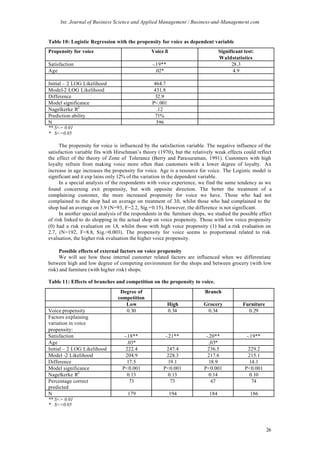
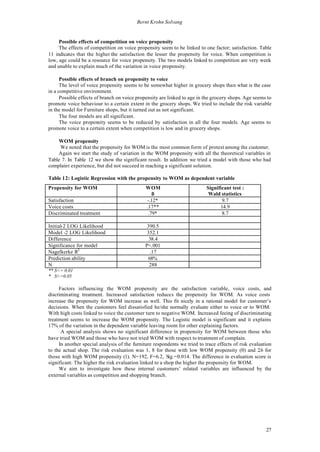
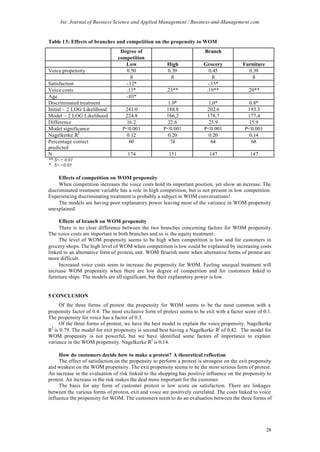
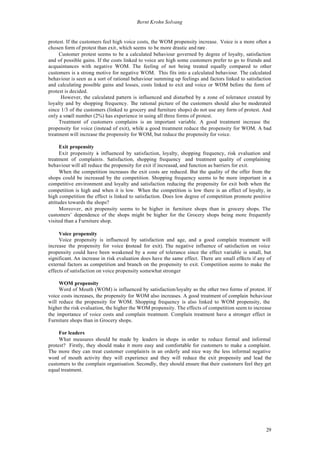
N                                                                               396

     The three indicators are all in compliance with a common factor we will call service quality. We
then performed a reliability analysis to see if these three variables could be joined together in an index
variable. Conbach’s ALPA=0.84. This indicates high reliability if we make an index variable consisting
of the sum of these three variable. Consequently this index variable is our service quality variable with
values from 0 to 30.

     Exit costs: Self-evaluation of perceived costs in changing shop measured on a scale from 0 to 10.

     Propensity to exit: Propensity to exit is a self-evaluation of the probability of the customer
continuing to use the shop in question. Those answering very likely or likely were given the value 0 for
the variable tendency to exit, while those answering fairly unlikely or unlikely and do not know were
given the value 1 for the variable propensity to exit. The group average is between 1 and 0 and is
interpreted as the propensity to exit for the group.

     Voice costs: Self-evaluation of the costs related to complaining on a scale from 0 to 10.

    Propensity to voice: Self-evaluation of the propensity to complain measured on a scale from 0
(have never complained to the shop) and 1 (have complained once or several times to the shop). The
group average lies between 1 and 0 and is interpreted as the propensity to complain for the group.

     Negative Word of Mouth (WOM): Self-evaluation of to what extent one complains to friends
and acquaintances rather than to the shop measured on a scale from 0 to 10.

    Propensity to WOM: Self-evaluation of the propensity to WOM measures on a scale from 0 to 1.
Those who found WOM actual or very actual we defined as high propensity (1) and those who found
WOM little or not actual as low propensity (0).

     Experience with complaining: The method chosen was self-evaluation of how the complaint was
received and handled. 23% of the respondents had experience with complaints to the shop. They
answered according to these categories: bad (1), less good (2), satisfactory (3), good (4) and extremely
good (5).
     Discriminated treatment: Self-evaluation of perceived discriminated treatment measured on a
scale from 0 to 1. “Some times we may feel that other customers are getting better treatment than
ourselves. To what extent is such discriminated treatment happing here?” Those who answered “it


                                                                                                          20
Bernt Krohn Solvang


happens often” and those who answered “now and then” and those who answered “seldom” were all
given value 1 and those who answered “never “were given value 0.

     Perceived risk linked to the shop: Self-evaluation of risk linked to the customers’ shop. To what
extent do you feel a risk by doing your shopping at this outlet? Scale from 0 to 10 where 10 are
measured as extremely high risk. This question was only presented to customers from the furniture
shops since the risk linked to grocery shopping is considered low.

    Shopping frequency: How many times have you done your shopping in this outlet the last 4
weeks?

        Age: The age of the respondents in years.

        Education: The number of years of education after primary school.


4 ANALYSIS OF THE RESEARCH QUESTIONS

        How is the various form of protest spread among the customers?
        What are the portions of the various forms of protest? Our data from this research might give an
idea.

Table 2: the distribution of propensity and costs for each form of protest.
                                              Exit                 Voice                WOM
The propensity for                            0.1                   0.3                   0.4
Costs linked to each protest form,            2.3                   3.0           42% answered actual
scale from 0-10.                                                                    and very actual
N                                              380                  396                   396

     According to these data, the propensity of Exit is lowest, of WOM protest highest and Voice in
between. Dissatisfied customers would choose to complain to friends and family four times more often
than make an exit and three times more often than to make “voice” to the shop. More than each three of
the customers in this sample have not been engaged in any form of protest. On the other hand only 2%
of the respondents have been engaged in all three forms. Of those with two protest forms, the ones with
Voice and WOM constitute the largest group (13%).
     We do not have WOM costs measured in the same way as Exit and Voice, but the costs of WOM
seem to be low. The subjective costs linked to the other two forms are small and comparable.

        How are the customers distributed on various combinations of protest forms?

Table 3: the distribution of combinations of the protest forms.
Protest form                                         %                                 N
No protest form                                      36                               380
Exit                                                 10                               380
Voice                                                31                               396
WOM                                                  42                               396
All three forms                                       2                               380
Voice and WOM                                        13                               396
Vo ice and exit                                       5                               380
Exit and WOM                                          5                               380

     More than each three of the customers in this sample have not been engaged in any form of
protest. On the other hand only 2% of the respondents have been engaged in all three forms. Of those
with two protest forms, the ones with Voice and WOM constitute the largest group (13%). More than
each three of the sample does not make any protest at all.


                                                                                                     21
Int. Journal of Business Science and Applied Management / Business-and-Management.com


     Is there any association between the various forms of protest?
     Are the resources favourable for each protest form accumulative or following a Matthew effect so
that those who have, shall have more and those who have less shall loose what they have (Merton,
1968)?

Table 4: Correlations between the propensities for protest forms
Propensities                          WOM                      Exit                      Voice
WOM                                      -                     0.04                       0.00
Exit                                    0.3                      -                       0.12*
Voice                                  0.00                   0.12*                         -
N                                      396                     394                        396
* Significant at 0.05

     The only significant association between the propensities for protest is the association between
voice and exit. WOM has no significant correlation with the other two forms of protest.
     WOM do not fit in with the pattern linked to voice and exit. Voice and Exit, however, are fitting in
well in the same dimension as we may call “formal active protest”, while the informal form of protest
of WOM do belong in another dimension which we may call “informal active protest”.
     We do a small sociological analysis of each protest form in order to look for possible explanations
of the difference between the formal and informal form of protest.

    Is there variation in sociological characteristics between these three forms of protest?
    The similarities between the protest groups are more striking than the differences. The WOM
group and none protest have got the lowest degree of education, but the difference is not significant.
These results indicate that the active forms of exit and voice are linked with educational level.

Table 5: Age, education and sex within each form of protest.
Protest form                Age         Education after       Sex             Sex          Sample size
                                        primary school
                        Mean years        Mean years        % Men          % Women                N
WOM                        39                4.5              40              60                 165
Voice                      42                4.9              42              58                 122
Exit                       38                4.8              26              74                 51
Non- protest               43                4.4              40              60                 144

     Table 5 shows no significant differences between the various forms of protest. The voice form of
protest has highest age, education and highest portion of men, but the differences are not significant.

     How is the satisfaction and loyalty distributed in each form of protest?
     Behind any form of protest there is some sort of dissatisfaction. The dissatisfaction and what
creates it could be linked to a lot of factors and unfulfilled expectations (Oliver, 1977).

Table 6: Satisfaction and loyalty in each protest propensity group.
Protest                  Mean          F value     Sig.       Mean        F value        Sig.          N
propensity               satis-         on the               loyalty       on the
                        faction      difference                          difference
                                      between                           between (1)
                                     (1) and (0)                          and (0)
Exit (1)                 10.3            63.6       **         6.1          39.4          **           50
Exit (0)                 13.8                                 11.3                                     326
Voice (1)                12.0           31.9        **         9.4          10.2           *           116
Voice (0)                14.0                                 11.2                                     254
WOM (1)                  12.6           12.8        **        10.1          2.6            -           159
WOM (0)                  13.9                                 11.0                                     211
None protest (1)         14.7           38.0        **        12.0          16.1          **           132
None protest (0)         12.5                                  9.8                                     224
** S<= 0.01
* S<=0.05


                                                                                                        22
Bernt Krohn Solvang


     Table 6 shows for all protest propensity groups, the customers without experience with the protest
form (with values 0) have highest score on satisfaction and loyalty. The differences are most profound
in the exit group. The differences in value on satisfaction and loyalty are all significant except for
degree of loyalty in the WOM group.
     Exit seems to be the most potent form of protest with marked differences between those with exit
experience and those without. WOM experiences do not influence the degree of loyalty in any
significant way. The none protesters (with value 1) have both higher degree of satisfaction and loyalty
than the protesters (with value 0) on the none- protest variable.
     What is the association between protest propensity and loyalty? According to Hirschman’s theory
(1970) voice propensity could be associated with high degree of loyalty and exit propensity would be
associated with low degree of loyalty since a high degree of loyalty would tend to prevent the customer
from exit. Table 6 seems to fit nicely to Hirschman’s theory (1970). The lowest degree of loyalty in the
group of high propensity for exit and the degree of loyalty in the two other groups are marked higher.

     How coul d the variation in the propensity for each of the protest form best be explained?
     We will perform a series of logistic regression with each protest form as dependent variable and
the theoretical based variables as independent. The results are listed up in Tables 7-12. We include an
interaction variable between loyalty and satisfaction with a view to survey interaction effects. We use
an exploratory approach since there are a lot of studies linked to each of the forms of protest.

Table 7: theoretical factors that might influence each form of protest
Theoretical factors                                                          Exit        Voice       WOM
Affective loyalty                                                             X           X           X
Satisfaction                                                                  X           X           X
The interaction between satisfaction and loyalty                              X           X           X
                                                                                                        3
Costs linked to the protest form                                              X           X
Service quality                                                               X           X             X
Transaction frequency                                                         X           X             X
Perceived risk linked to the shop 1                                           X           X             X
Voice experience in separate analysis since only 93 respondents had           X           X             X
experience2
Discriminated treatment                                                        X           X            X
Age                                                                            X           X            X
Education                                                                      X           X            X
Sex                                                                            X           X            X
1
  This question was only asked to Furniture respondents and the variable is used in a special analysis.
2
  Only a ¼ of the respondents had any complaining experience with the shop they left when interviewed so this
variable is studied in special analysis.
3
  We have no variable describing how difficult the customers felt it was to talk to friends and acquaintances.

     We will sum up the factors that could influence the forms of protest. Subsequently we will run
logistic regression and sum up with the significant variables for each form of protest.


                                                                                                            23
Int. Journal of Business Science and Applied Management / Business-and-Management.com


     The exit form of protest
     We have seen the exit form of protest as the most exclusive one. How could we best explain the
variation in the propensity for exit? Our start model is based on variables in Table 7. The significant
model is presented in Table 8.

Table 8: Logistic regression with propensity to exit as dependent variable
Propensity to:                                    Exit                          Significant test:
                                                                                Wald statistics
                                                    ß
Satisfaction                                     -.31**                               12.7
Affective loyalty                                -.16**                                7.6
Shopping frequency                               -.16**                                7.1

Initial – 2 LOG likelihood                        220.6
Model – 2 LOG likelihood                          144.8
Difference                                        75.8
Significance for model                           P<.001
Nagelkerke R2                                      .42
Prediction ability                                91%
N                                                  396
** S<= 0.01

      Exit propensity could partly be explained by dissatisfaction, low degree of loyalty and low
frequency visit in the shop. Table 8 shows the association when satisfaction, loyalty and shopping
frequency increase the propensity for exit decrease. High shopping frequency seems to have a
preventive effect on exit propensity. This finding fits nicely to Hirschman’s (1970) theory. Loyalty and
satisfaction creates costs for the customers preventing them from making exit from the shop. The
model is significant and explains 42% of the variance leaving 58% for other factors and explanations.
      In a special analysis of the customers with voice experience, we find a tendency showing “the
better the treatment of complaining customers, the fewer propensities for exit”.
      The difference in evaluation the complain treatment between those without exit propensity (0) and
those with exit propensity (1) is 4.0 and 3.1 (N=92, F=7.0, Sig.= 0.009).
      In another special analysis of respondents linked to furniture shops, we could estimate the possible
effects of risk linked to shopping in the shop were the customers were interviewed. The risk evaluation
was done on a scale from 0 to 10. Average evaluation of risk was 2.1 (N=199). Those with low exit
propensity (0) had an evaluation score on 1.9, and those with high exit propensity (1) had an evaluation
on 2.8, N=190, F=4.0, Sig.=0.005. There seems to be a tendency that increasing risk evaluation is
linked to increasing exit propensity.


                                                                                                       24
Bernt Krohn Solvang


     How does external variables as competition and type of shop branch (external variables)
influence the factors associated with each form of protest?

     Exit propensity influenced by external variables
     We will trace possible effects of environment factors such as competition and of branch on the
factors explaining the variation in each form of protest.

Table 9: Effects of degree of competition and of branch on propensity to exit. Four analytical
models
                                  Degree of                               Branch
                                 competition
                                    Low                 High             Grocery            Furniture
Exit propensity                     0.14                0.12              0.10                0.16
Factors explaining                    ß                   ß                 ß                   ß
variation in exit propensity
Affective loyalty                   -.31**             -.49**              -.33**             -.43**
Shopping frequency                                     -.47**              -.16**             -.24**
Age                                                    -.10**
Initial -2 log likelihood           125.3                97.9              118.7               108.8
Model -2 log likelihood             93.0                 52.1              94.4                54.1
Difference                          32.3                 45.8              24.3                54.7
Nagelkerke R2                       0.33                 0.54              0.26                0.59
Percentage correct                   88                   94                90                  94
predicted
N                                    179                 200                197                 199
** S<= 0.01

      The effects of competition
      When the competition increases the exit costs are reduced. Moreover, the quality of the offer from
the shops could be increased by the competition. When we compare the factors in Table 8, we find a
“better” model for explaining exit propensity when competition is high with some negative effect of
age reducing the propensity for exit. Shopping frequency seems to be more important in a competitive
environment and loyalty and satisfaction seem to reduce the propensity for exit both when the
competition is high and when it is low. When the competition is low there is an effect of loyalty, in
high competition the effect is linked to satisfaction. Does low degree of competition promote positive
attitudes towards the shops?

      The effects of branch
      Exit propensity seems to be higher in furniture shops then in grocery shops. The customers’
dependence of the shops might be higher for the grocery shops since they are more frequently visited
than furniture shops. The difference between grocery shops and furniture shops is linked to shopping
frequency which is a more important variable for grocery shops reducing propensity to exit. We tried to
include the risky variable in the furniture shop model, but it turned out to be not significant. The
satisfaction variable is a potent variable in both types of shops. In the furniture shops positive loyalty
attitudes seems to reduce the propensity for exit.
      When competition is low, and for shops with lower visit frequency (furniture shops), the loyalty
seem to play an important role in preventing exit.
      The four models in Table 9 are all significant. Models for furniture shops and shops in a
competitive environment have the strongest explanatory power.

     Voice propensity
     We start the study of variance in voice propensity with all the theoretical variables listed in Table
7. The final significant model for voice propensity is shown in Table 10. We do a separate analysis of
the customers with experience from previous complains.


                                                                                                        25
Int. Journal of Business Science and Applied Management / Business-and-Management.com


Table 10: Logistic Regression with the propensity for voice as dependent variable
Propensity for voice                            Voice ß                           Significant test:
                                                                                  Wald statistics
Satisfaction                                     -.19**                                 28.3
Age                                                .02*                                  4.9

Initial – 2 LOG Likelihood                        464.7
Model-2 LOG Likelihood                            431.8
Difference                                        32.9
Model significance                               P<.001
Nagelkerke R2                                      .12
Prediction ability                                71%
N                                                  396
** S<= 0.01
* S<=0.05

     The propensity for voice is influenced by the satisfaction variable. The negative influence of the
satisfaction variable fits with Hirschman’s theory (1970), but the relatively weak effects could reflect
the effect of the theory of Zone of Tolerance (Berry and Parasuraman, 1991). Customers with high
loyalty refrain from making voice more often than customers with a lower degree of loyalty. An
increase in age increases the propensity for voice. Age is a resource for voice. The Logistic model is
significant and it exp lains only 12% of the variation in the dependent variable.
     In a special analysis of the respondents with voice experience, we find the same tendency as we
found concerning exit propensity, but with opposite direction. The better the treatment of a
complaining customer, the more increased propensity for voice we have. Those who had not
complained to the shop had an average on treatment of 3.0, whilst those who had complained to the
shop had an average on 3.9 (N=93, F=2.2, Sig.=0.15). However, the difference is not significant.
     In another special analysis of the respondents in the furniture shops, we studied the possible effect
of risk linked to do shopping in the actual shop on voice propensity. Those with low voice propensity
(0) had a risk evaluation on 1.8, whilst those with high voice propensity (1) had a risk evaluation on
2.7, (N=192, F=8.8, Sig.=0.003). The propensity for voice seems to proportional related to risk
evaluation, the higher risk evaluation the higher voice propensity.

      Possible effects of external factors on voice propensity
      We will see how these internal customer related factors are influenced when we differentiate
between high and low degree of competing environment for the shops and between grocery (with low
risk) and furniture (with higher risk) shops.

Table 11: Effects of branches and competition on the propensity to voice.
                                  Degree of                               Branch
                                 competition
                                    Low                   High           Grocery             Furniture
Voice propensity                    0.30                  0.34            0.34                 0.29
Factors explaining
variation in voice
propensity:
Satisfaction                        -.18**             -.21**             -.20**               -.19**
Age                                   .03*                                  ,03*
Initial – 2 LOG Likelihood           222.4             247.4               236.5               229.2
Model -2 Likelihood                  204.9             228.3               217.6               215.1
Difference                            17.5             19.1                 18.9               14.1
Model significance                 P<0.001            P<0.001            P<0.001              P<0.001
Nagelkerke R2                         0.13             0.13                 0.14               0.10
Percentage correct                     73               73                   67                 74
predicted
N                                    179                  194               184                  186
** S<= 0.01
* S<=0.05


                                                                                                         26
Bernt Krohn Solvang


     Possible effects of competition on voice propensity
     The effects of competition on voice propensity seem to be linked to one factor; satisfaction. Table
11 indicates that the higher the satisfaction the lesser the propensity for voice. When competition is
low, age could be a resource for voice propensity. The two models linked to competition are very week
and unable to explain much of the variation in voice propensity.

      Possible effects of branch on propensity to voice
      The level of voice propensity seems to be somewhat higher in grocery shops than what is the case
in a competitive environment.
      Possible effects of branch on voice propensity are linked to age in the grocery shops. Age seems to
promote voice behaviour to a certain extent in the grocery shops. We tried to include the risk variable
in the model for Furniture shops, but it turned out as not significant.
      The four models are all significant.
      The voice propensity seems to be reduced by satisfaction in all the four models. Age seems to
promote voice to a certain extent when competition is low and in grocery shops.

    WOM propensity
     We noted that the propensity for WOM is the most common form of protest among the customer.
    Again we start the study of variation in the WOM propensity with all the theoretical variables in
Table 7. In Table 12 we show the significant result. In addition we tried a model with those who had
complaint experience, but did not succeed in reaching a significant solution.

Table 12: Logistic Regression with the propensity to WOM as dependent variable
Propensity for WOM                            WOM                          Significant test :
                                                 ß                          Wald statistics
Satisfaction                                  -.12*                               9.7
Voice costs                                   .17**                              14.9
Discriminated treatment                        .79*                               8.7

Initial-2 LOG Likelihood                       390.5
Model -2 LOG Likelihood                        352.1
Difference                                      38.4
Significance for model                        P<.001
Nagelkerke R2                                    .17
Prediction ability                             68%
N                                               288
** S<= 0.01
* S<=0.05

     Factors influencing the WOM propensity are the satisfaction variable, voice costs, and
discriminating treatment. Increased satisfaction reduces the propensity for WOM. As voice costs
increase the propensity for WOM increase as well. This fit nicely in a rational model for customer’s
decisions. When the customers feel dissatisfied he/she normally evaluate either to voice or to WOM.
With high costs linked to voice the customer turn to negative WOM. Increased feeing of discriminating
treatment seems to increase the WOM propensity. The Logistic model is significant and it explains
17% of the variation in the dependent variable leaving room for other explaining factors.
      A special analysis shows no significant difference in propensity for WOM between those who
have tried WOM and those who have not tried WOM with respect to treatment of complain.
     In another special analysis of the furniture respondents we tried to trace effects of risk evaluation
to the actual shop. The risk evaluation was 1, 8 for those with low WOM propensity (0) and 2.6 for
those with high WOM propensity (1). N=192, F=6.2, Sig.=0.014. The difference in evaluation score is
significant. The higher the risk evaluation linked to a shop the higher the propensity for WOM.
     We aim to investigate how these internal customers’ related variables are influenced by the
external variables as competition and shopping branch.


                                                                                                       27
Int. Journal of Business Science and Applied Management / Business-and-Management.com


Table 13: Effects of branches and competition on the propensity to WOM
                                  Degree of                               Branch
                                 competition
                                    Low                 High             Grocery            Furniture
Voice propensity                     0.50               0.39                0.45              0.39
                                       ß                  ß                   ß                 ß
Satisfaction                        -.12*                                  -.15*
Voice costs                          .13*              .23**              .19**               .20**
Age                                 -.03*
Discriminated treatment                                1.0*               1,0*                0.8*
Initial – 2 LOG Likelihood          241.0              188.8              202.6               193.3
Model – 2 LOG Likelihood            224.8              166,2              178,7               177,4
Difference                          16.2               22.6               23.9                15.9
Model significance                 P<0.001            P<0.001            P<0.001             P<0.001
Nagelkerke R2                       0.12               0.20               0.20                0.14
Percentage correct                   60                 74                 64                  68
predicted
N                                    174                 151                147                147
** S<= 0.01
* S<=0.05

     Effects of competition on WOM propensity
     When competition increases the voice costs hold its important position, yet show an increase. The
discriminated treatment variable has a role in high competition, but is not present in low competition.
Experiencing discriminating treatment is probably a subject in WOM conversations!
     The models are having poor explanatory power leaving most of the variance in WOM propensity
unexplained.

     Effects of branch on WOM propensity
     There is no clear difference between the two branches concerning factors for WOM propensity.
The voice costs are important in both branches and so is the equity treatment.
     The level of WOM propensity seems to be high when competition is low and for customers in
grocery shops. The high level of WOM when competition is low could be explained by increasing costs
linked to an alternative form of protest, exit. WOM flourish more when alternative forms of protest are
more difficult.
     Increased voice costs seem to increase the propensity for WOM. Feeling unequal treatment will
increase WOM propensity when there are low degree of competition and for customers l nked to  i
furniture ships. The models are all significant, but their explanatory power is low.


5 CONCLUSION
      Of the three forms of protest the propensity for WOM seems to be the most common with a
propensity factor of 0.4. The most exclusive form of protest seems to be exit with a factor score of 0.1.
The propensity for voice has a factor of 0.3.
      Of the three forms of protest, we have the best model to explain the voice propensity. Nagelkerke
R2 is 0.79. The model for exit propensity is second best having a Nagelkerke R2 of 0.42. The model for
WOM propensity is not powerful, but we have identified some factors of importance to explain
variance in the WOM propensity. Nagelkerke R2 is 0.14.

     How do customers decide how to make a protest? A theoretical reflection
     The effect of satisfaction on the propensity to perform a protest is strongest on the exit propensity
and weakest on the WOM propensity. The exit propensity seems to be the most serious form of protest.
An increase in the evaluation of risk linked to the shopping has positive influence on the propensity to
protest. An increase in the risk makes the deal more important for the customer.
     The basis for any form of customer protest is low score on satisfaction. There are linkages
between the various forms of protest, exit and voice are positively correlated. The costs linked to voice
influence the propensity for WOM. The customers seem to do an evaluation between the three forms of


                                                                                                        28
Bernt Krohn Solvang


protest. If the customers feel high voice costs, the WOM propensity increase. Voice is a more often a
chosen form of protest than exit, which seems to be more drastic and rare .
     Customer protest seems to be a calculated behaviour governed by degree of loyalty, satisfaction
and of possible gains. If the costs linked to voice are high some customers prefer to go to friends and
acquaintances with negative WOM. The feeling of not being treated equally compared to other
customers is a strong motive for negative WOM. This fits into a calculated behaviour. The calculated
behaviour is seen as a sort of rational behaviour summing up feelings and factors linked to satisfaction
and calculating possible gains and losses, costs linked to exit and voice or WOM before the form of
protest is decided.
      However, the calculated pattern is influenced and disturbed by a zone of tolerance created by
loyalty and by shopping frequency. The rational picture of the customers should also be moderated
since 1/3 of the customers (linked to grocery and furniture shops) do not use any form of protest. And
only a small number (2%) has experience in using all three forms of protest.
     Treatment of customers complains is an important variable. A good treatment increase the
propensity for voice (instead of exit), while a good treatment reduce the propensity for WOM. A bad
treatment will increase the propensity for WOM, but reduce the propensity for voice.

      Exit propensity
      Exit propensity i influenced by satisfaction, loyalty, shopping frequency, risk evaluation and
                       s
treatment of complaints. Satisfaction, shopping frequency and treatment quality of complaining
behaviour will all reduce the propensity for exit if increased, and function as barriers for exit.
      When the competition increases the exit costs are reduced. But the quality of the offer from the
shops could be increased by the competition. Shopping frequency seems to be more important in a
competitive environment and loyalty and satisfaction reducing the propensity for exit both when the
competition is high and when it is low. When the competition is low there is an effect of loyalty, in
high competition the effect is linked to satisfaction. Does low degree of competition promote positive
attitudes towards the shops?
      Moreover, exit propensity seems to be higher in furniture shops than in grocery shops. The
customers’ dependence of the shops might be higher for the Grocery shops being more frequently
visited than a Furniture shop.

     Voice propensity
     Voice propensity is influenced by satisfaction and age, and a good complain treatment will
increase the propensity for voice (  instead for exit). The negative influence of satisfaction on voice
propensity could have been weakened by a zone of tolerance since the effect variable is small, but
significant. An increase in risk evaluation does have the same effect. There are small effects if any of
external factors as competition and branch on the propensity to exit. Competition seems to make the
effects of satisfaction on voice propensity somewhat stronger

     WOM propensity
     Word of Mouth (WOM) is influenced by satisfaction/loyalty as the other two forms of protest. If
voice costs increases, the propensity for WOM also increases. A good treatment of complain behaviour
will reduce the propensity for WOM. Shopping frequency is also linked to WOM propensity, the
higher the risk evaluation, the higher the WOM propensity. The effects of competition seem to increase
the importance of voice costs and complain treatment. Complain treatment have a stronger effect in
Furniture shops than in Grocery shops.

     For leaders
     What measures should be made by leaders in shops in order to reduce formal and informal
protest? Firstly, they should make it more easy and comfortable for customers to make a complaint.
The more they can treat customer complaints in an orderly and nice way the less informal negative
word of mouth activity they will experience and they will reduce the exit propensity and lead the
customers to the complain organisation. Secondly, they should ensure that their customers feel they get
equal treatment.


                                                                                                     29
Int. Journal of Business Science and Applied Management / Business-and-Management.com


REFERENCES

Aaker D. A. (1991) .Managing Brand Equity. New York: Free Press.
Andreassen T. W. and Bredal Dag. (1996). Kundepleie i praksis. Oslo: Ad Notam, Gyldendal.
Andreasen A.R. and A. Best 1977. Consumer complaint: Does business respond? Harvard Business
    Review, July-August, 55-101
Andreassen T. W. (1997). Dissatisfaction with Services. Dissertation. Stockholm: Företaksøkonomiska
    institusjonen, Stockholm University
Bearden W.O. and R.L. Oliver (1985). The Role of Public and Private Complaining in Satisfaction with
    Problem Resolution. The Journal of Consumer Affairs. 19, 2, 222-240.
Bearden W.O. and J.E. Teel (1983). Selected Determinants of Customer Satisfaction and Complaint
    Reports. Journal of Marketing Research, 20, 21-28.
Berry, L.L. and A. Parasuraman (1991). Marketing Service: Competing through Quality. New York:
    The Free Press.
Bloemer, J.M., Kasper, H.D. (1995). The complex relationships between consumer satisfaction and
    brand loyalty. Journal of Economic Psychology, 16,311-329.
Bloemer J.M., de Ruyter K. (1998). On the relationship between perceived service quality, service
    loyalty and switching costs.- In: International journal of service industry management, 9p. 436-
    454.
Brief P. A. (1998). Attitudes In and Around Organizations. Sage Publications Inc.
Cho Y, Im I, Hiltz R, Fjermestad J. (2002). The effects of post-purchase evaluation factors on online
    vs. off line customer complaining behaviour: Implication for customer loyalty. Advances in
    consumer research, Volume XXIX (29): 318-326.
Carman, J.M.     1970. Correlates of Brand Loyality: Some Positive Results. Journal of Marketing
    Research nr.7: 67-76.
Churchill Jr., Gilbert A., Surprenant. (1982). An investigation into the determinants of customer
    satisfaction. Journal of Marketing Research, Vol.19 Issue 4, pp 491- 504.
Dekimpe M.G., Steenkamp J.B. (1997). The Increasing Power of Store Brands: Building Loyalty and
    Market Share. Long range planning.Vol.30.mr.6:917-930.
Griffin Jill. (1995). Customer Loyalty. How to Earn It. How to Keep It. New York: Lexington Books
Gilly M.C. and R.W. Hansen (1985). Consumer complaint handling as a strategic marketing tool. The
    Journal of Consumer Marketing, 2, 5-16.
Grønhaug Kjell (1987). Exploring the Problem-Prone Consumers: Hypotheses and Empirical Findings.
    European Journal of Marketing 21.1, 74-82.
Grønhaug Kjell. (1972). Risk indicators, Perceived risk and consumer’s choice of information sources.
    The Swedish Journal of Economics. 7, 2, 246-262.
Grønhaug Kjell (1977). Kjøpers klageadferd: Noen undersøkelsesresultater (The Customer’s Complaint
    Behaviour: Some Survey Results). Tidsskrift for Samfunnsforskning, 6, 6, 240-250.
Grønhaug Kjell and Mary C. Gilly. (1991). A transaction cost approach to consumer dissatisfaction and
    complaint actions. Journal of Economic Psychology 12; 165-183.


                                                                                                   30
Bernt Krohn Solvang


Grønhaug K. and G. Zaltman (1981). Complainers and no complainers revisited: Another look at the
    data. Journal of Economic Psychology 1, 121—195.
Hair.J.F. R.E. Anderson, R.L. Tatham and W.C. Black. (1998). Multivariate Data Analysis. New
    Jersey: Prentice Hall.
Hernandez S.A., W. Strahle, H.L. Garcia and R.C. Sorensen. (1991). A Cross-cultural Study of
    Consumer Complaining Behavior: VCR owners in U.S. and Puerto Rico. Journal of Consumer
    Policy 14, 35-62.
Hirschman, A. O. (1970). Exit, Voice and Loyalty. Harvard University Press, Cambridge Ma.
Homburg, C., Giering, A. (2001). Personal Characteristics as Moderators of the Relationship between
    Customer Satisfaction and Loyalty. Psychology & Marketing. Vol. 18: 43-66.
Huefner, J.C., Hunt, K.H. (1994). Extending the Hirschman Model: When voice and exit don’t tell the
    whole story. Journal of consumer satisfaction, dissatisfaction, and complaining Behavior. Vol 7.
    P.267-270
Jacoby J., Chestnut, R. (1978). Brand Loyalty Measurement and Management Ronald Press
    Publication, New York
Kotler Philip (1987). Marketing management New Jersey: Prentice-Hall.
Merton R.K. (1968). The Matthew Effect in Science. Science, 159 (3810): 56-63
Nayor G. and S.B. Kleiser. (2000). Negative versus Positive Word-of-Mouth. Journal of Consumer
    Satisfaction, Dissatisfaction and Complaining Behavior. 13, 26-36.
Oliver R.L. (1997). Satisfaction. A Behavioural Perspective on the Consumer. New York: McGraw-
    Hill Company.
Oliver R.L., Rust R.T. Varki S. (1997) Customer Delight: Foundations, Findings, and Managerial
    Insight. Journal of Retailing. 73. NO.3:311-336.
Peter J.P. & Olson J.C. (1993) Consumer Behavior and Marketing Strategy Homewood Illinois 3rd ed.:
    Irwin.
Ping R.A. (1997). Voice in Business-to-Business Relationships: Cost-of-Exit and Demographic
    Antecedents. Journal of Retailing 73, 261-281.
Richins M.L. (1983). Negative Word-of-Mouth By Dissatisfied Consumers: A Pilot Study.
Journal of Marketing 47, 68-78.
Richins M.L. (1985). The role of product importance in complaining behavior. In H Hunt and
                                                                                 .K.
    R.L.Day (eds) Consumer Satisfaction, Dissatisfaction and Complaining Behavior. Bloomington,
    Ind.: Department of Marketing, Indiana University. 50-53.
Selnes Fred and Reve Torgeir (1994) Relasjonsmarkedsføring-keiserens nye klær? Praktisk økonomi
    og ledelse.2:61-70.
Singh J. 1990, B. Voice, Exit, and Negative Word-of-Mouth Behavior: An Investigation Across Three
    Service Categories. Journal of the Academy of Marketing Sience.18,1, 1-15.
Singh J. (1990). A Typology of Consumer Dissatisfaction Response Styles. Journal of
    Retailing, 66, 57-99.
Singh J. (1991). Industry characteristics and consumer dissatisfaction. Journal of Consumers Affairs.
    25, 19-57.


                                                                                                  31
Int. Journal of Business Science and Applied Management / Business-and-Management.com


Snellman,K.,Vihtkari,T. (2003). Customer complaining behaviour in technology-based service
    encounters. International journal of service industry Management,14 (2): 217-231)
Strauss B, Schmidt M,Schoeler A. (2005). Customer fustration in loyalty programs.
International Journal of Service Industry Management 16 (3-4): 229-252
Tarp (1986). Consumer complaint handling in America: An update study. Technical Assistance
    research programs, Washington DC.
Teknologisk Institutt (1993). Kunden i fokus. Los-serien Consumer complaint handling in America:
    Summary of findings and recommendations. Technical Assistance Research programs,
    Washington. DC.
Troye S. V., (1994) Teori- og forskningsevaluering (Theory and Research Evaluation). Tano.
Voorhees, C.M., Brandy, M.K., Horowitz,D.M. (2006). A Voice From the Silent Masses: An
    Exploratory and Comparative Analysis of Noncomplainers. Journal of the Academy of Marketing
    Science.Volum 34,No. 4. pp 514- 527
Ward, J.C., Ostrom,A.L. (2006). Complaining to the Masses: The Role of Protest Framinig in
    Customer- Created Complaint Web Sites. Journal of Consumer Research.Vol. 33 pp. 220-230.
Wind,Y. (1978) Issues and Advances in Segmentation Research. Journal of Marketing research 15,317-
    337. John Wiley & Sons.
Zeithaml,V.A.,Parasuraman,A.,Berry,L.L. (1990). Delivering quality service. Balancing Customer
    Perceptions and Expectations. New York: The Free Press.


                                                                                               32
Int. Journal of Business Science and Applied Management, Vol 3, Issue 1, 2008


Internet-induced marketing techniques: Critical factors in
viral marketing campaigns

Maria Woerndl
empirica Gesellschaft fur Kommunikations- und Technologieforschung mbH
Oxfordstr. 2, 53111 Bonn, Germany
Tel: +49-228-98530-0
Fax: +49-228-98530-12
Email: maria .woerndl@empirica.com

Savvas Papagiannidis
Business School, Newcastle University
Armstrong Building, Newcastle upon Tyne, NE1 7RU, United Kingdom
Tel: +44 (0) 191 222 5724
Fax: +44 (0) 191 222 8131
Email: savvas.papagiannidis@ncl.ac.uk

Michael Bourlakis
Business School, Brunel University
Elliott Jaques Building, Uxbridge, Middlesex, UB8 3PH, United Kingdom
Tel: +44 (0) 1895265427
Fax: +44 (0) 1895 232806
Email: michael.bourlakis@ncl.ac.uk

Feng Li
Armstrong Building, Newcastle upon Tyne, NE1 7RU, United Kingdom
Newcastle upon Tyne, NE1 7RU, United Kingdom
Tel: +44 (0) 191 222 7976
Fax: +44 (0) 191 222 8131
Email: feng.li@ncl.ac.uk


Abstract

The rapid diffusion of the Internet and the emergence of various social constructs facilitated by Internet
technologies are changing the drivers that define how marketing techniques are developed and refined.
This paper identifies critical factors for viral marketing, an Internet-based ‘word-of-mouth’ marketing
technique. Based on existing knowledge, five types of viral marketing factors that may critically
influence the success of viral marketing campaigns are identified. These factors are the overall
structure of the campaign, the characteristics of the product or service, the content of the message, the
characteristics of the diffusion and, the peer-to-peer information conduit. The paper discusses three
examples of viral marketing campaigns and identifies the specific factors in each case that influence its
success. The paper concludes with a viral marketing typology differentiating between viral marketing
communications, unintended viral marketing and commercial viral marketing. This is still a rapidly
evolving area and further research is clearly needed to monitor new developments and make sense of
the radical changes these developments bring to the market.

Keywords: viral marketing, marketing campaigns, internet word-of-mouth, social networking
Int. Journal of Business Science and Applied Management / Business-and-Management.com


1 INTRODUCTION
     While the underlying principle of word-of-mouth marketing is well-established and acknowledged
(Richins, 1983; Wilson, 1991), the Internet fosters new marketing strategies (Achrol and Kotler, 1999;
Arnott and Bridgewater, 2002), one of which is viral marketing. At the core of this emerging form of
marketing is the transmission of marketing messages through various Internet-based channels by peers.
During these transmissions, information passes between individuals without the involvement of the
original message source, propagating like a virus would have done, infecting the hosts.
     This paper synthesises the emerging literature on viral marketing and identifies important factors
that need to be considered when organising a viral marketing campaign. The paper first defines viral
marketing and reviews emerging research streams. It then identifies the benefits and challenges
associated with viral marketing and presents the critical factors that need to be considered when
organising viral marketing campaigns. The paper then explores these factors in the context of three
case studies. The paper concludes with the development of a viral marketing campaign typology before
outlining future research possibilities and practical implications.


2 VIRAL MARKETING
     The short history of viral marketing is generally agreed to have been launched by Hotmail’s tag
line “Get your private, free e-mail from Hotmail at http://www.hotmail.com (Helm, 2000, Porter &
                                                                               ”
Golan, 2006) and the resulting successful widespread diffusion of Hotmail. This tag line, added
automatically to every email sent from a Hotmail account, was passed on from existing Hotmail users
to the recipients of their email messages in the way that viruses spread, hence the term viral marketing.
While for Welker (2002, p.7) viral marketing is nothing more than “a new interpretation of the good
old word-of-mouth-paradigm”, the use of the Internet for spreading the message clearly is a new
concept that would not have been possible without the widespread diffusion of information and
communication technologies. For the purposes of this study we will c       onsider viral marketing as a
technique which utilises the Internet to transmit and spread messages among individuals who will filter
and forward the messages to their peers, who may be potentially interested in the message’s content.
     The communication style used for transmission is usually informal. Messages are spread through
different channels such as email, chat rooms and discussion forums. They may contain various types of
content ranging from text and images, to MS PowerPoint files, Adobe’s Flash animations and so on.
Recently, users found an additional channel to distribute and share their video clips online via services
like YouTube. The value of such services and their potential impact as viral marketing tools were
vividly demonstrated by Google’s acquisition of YouTube in 2006 for 1.65 billion US dollars (BBC,
2006a). One significant benefit of web-based viral channels when compared to other informal channels
is that they often provide mechanisms for measuring the popularity and success of a campaign. For
example, YouTube measures the number of times a clip was viewed and the viewers’ ratings, while it
allows qualitative feedback through the viewers’ comments. This information is publicly available and
will be used later in this paper when benchmarking the critical factors in two of the case studies
presented.

     2.1 Traditional ‘word of mouth’ marketing and viral marking
     Word of mouth implies that informal, ad hoc communication between individuals concerning
products and services (Bayus, 1985) is taking place. This communication can be positive as well as
negative, depending on the satisfaction levels of the individuals (Evans et al, 2006). In comparison to
other forms of marketing communications, information dissemination and sharing among individuals is
rapid when word-of-mouth occurs. The behaviour and views of individuals are significantly influenced
by negative word of mouth communication, which tends to be weighted more heavily by consumers
than positive communication (Solomon, 2004). Research has found that 90% of dissatisfied consumers
do not purchase products or services of the company involved in the negative word-of-mouth
communication (Solomon, 2003). Equally importantly, these consumers will communicate their
dissatisfaction to at least nine other people and 13% of these dissatisfied consumers will communicate
their negative view to more than thirty people.
     The Internet ‘word of mouth’ communication, i.e. viral marketing, is a far more effective,
penetrating and faster medium compared to the traditional word of mouth communication (Helm,
2000). It is also a far more focused medium as consumers communicate their views in their social
sphere (friends, colleagues etc) where their influence is more critical. This kind of communication can
reach a wider audience gradually and can maximise its reach not only in their locality (as was the case


                                                                                                      34
Maria Woerndl, Savvas Papagiannidis, Michael Bourlakis and Feng Li


with traditional word of mouth) but even on a national and global scale. The content of the message
remains the same whilst it could be biased and filtered during traditional word of mouth
communication (Helm, 2000).

     2.2 Viral marketing positioning and emerging research streams
     Viral marketing spans a number of marketing domains. Kaikati and Kaikati (2004), for example,
categorise viral marketing as a stealth marketing technique. While stealth marketing is a recent
proposition within marketing, viral marketing relates to the advertising (Phelps, et al., 2004, Porter &
Golan, 2006) and brand (Dobele, et al., 2005, Moore, 2003) elements of traditional marketing. Of the
emerging new marketing streams, viral marketing is firmly positioned in the e-marketing domain. The
other major domain that viral marketing fits into is marketing communications. This approach puts
emphasis on the spread of the message and its viral characteristics (Welker, 2002). While conventional
communication in marketing directly addresses the consumer, viral marketing communication aims to
create an environment where customers and consumers transmit messages without the involvement of
the original source. Therefore, viral marketing can also impact on consumer behaviour by influencing
consumer perceptions, attitudes and views and has the potential to emerge as a key element of a
company’s promotional mix (Kirby and Marsden, 2006). The underlying principle of viral
communication, however, remains the ‘traditional’ word-of-mouth paradigm that is now facilitated by
the Internet.
     The existing literature on viral marketing indicates four emerging research streams making both
theoretical/conceptual and empirical contributions: viral marketing comparisons, consumer-to-
consumer (C2C) viral marketing, studies of communications media and viral marketing positioning.
Comparisons investigate different viral marketing variables in light of other marketing techniques such
as television advertising (Porter & Golan, 2006). C2C viral marketing examines specific issues within
the consumer context, such as impact on costumer value and loyalty (Gruen, et al., 2006).
Communications media studies may examine specific transmission modes like e-mail (Phelps, et al.,
2004) and include communication domain studies (Welker, 2002). The final stream is viral marketing
positioning, where research is concerned with identifying the positioning characteristics of viral
marketing and drawing conclusions about the viral marketing domain (Dobele, et al., 2005, Helm,
2000). This research fits into the positioning stream as it investigates critical success factors of viral
marketing, by developing, mapping and testing a model of critical factors for viral campaigns. The
review of the literature, presented in the following sections focuses on the benefits and risks associated
with viral marketing and constructs the basis for a model that could be used for viral campaigns.

     2.3 Benefits and risks of viral marketing
     The heightened attention paid to viral marketing in the computer and management literature is a
sign that there can be significant benefits to be gained from viral marketing. One important benefit is
that viral marketing is relatively inexpensive in comparison to many other forms of advertising and
marketing campaigns (Dobele, et al., 2005, Kaikati & Kaikati, 2004, Welker, 2002). The other major
benefits relate to the positive diffusion characteristics: viral marketing can, for example, reach
audiences within a short period of time (Kaikati & Kaikati, 2004) as messages spread exponentially at a
fast speed (Helm, 2000, Welker, 2002). This rapid diffusion can significantly boost the speed of the
adoption of the marketed product or service (Dobele, et al., 2005). Yet, besides positive financial and
diffusion implications, viral marketing makes use of peer-to-peer transmission (Dobele, et al., 2005),
which is one of the most influential marketing methods available to marketers and it overcomes legal
and privacy concerns as messages are not unsolicited anymore and hence may avoid being considered
as ‘spam’. In addition, viral marketing can help achieve substantial audience reach as marketers get
access to diverse audiences through social contacts (Helm, 2000) and can profit from effective
targeting (Dobele, et al., 2005). The above points can be grouped into four categories as shown in
Table 1: financial, diffusion speed, peer-to-peer transmission and audience reach.


                                                                                                       35
Int. Journal of Business Science and Applied Management / Business-and-Management.com


Table 1: Potential benefits of viral marketing
      Category                           Benefit                                References

      Financial                                                      (Dobele, et al., 2005, Kaikati &
                        Inexpensive
                                                                     Kaikati, 2004, Welker, 2002)
                        Reaches audiences within a short period
                                                                     (Kaikati & Kaikati, 2004)
                        of time
   Diffusion speed      Rapid, fast diffusion                        (Helm, 2000, Welker, 2002)
                        Boosts adoption speed                        (Dobele, et al., 2005)
                        Exponential                                  (Helm, 2000)
    Peer-to-peer
                        Voluntary transmission by sender             (Dobele, et al., 2005)
    transmission
                        More effective targeting                     (Dobele, et al., 2005)
   Audience reach       Access to diverse audience through social
                                                                     (Helm, 2000)
                        contacts

      Yet, besides these significant benefits, there are risks and challenges that marketers have to face
when engaging in viral marketing campaigns. Probably the biggest risk is the lack of control associated
with viral marketing campaigns: organisations have no means of controlling the spread of the message
and the content of the transmission (Dobele, et al., 2005, Helm, 2000, Kaikati & Kaikati, 2004, Welker,
2002). The receivers of a message may even consider the transmission as ‘spam’. With this lack of
control comes the potential of a negative impact from a viral campaign. Negativity can occur through
backlash and unfavourable word-of-mouth, and may result in a negative brand image, product or
service boycott, unfavourable attributes associated with the organisation and its products and services,
hate sites etc. (Dobele, et al., 2005, Helm, 2000, Kaikati & Kaikati, 2004, Phelps, et al., 2004). A lack
of legal standards in terms of viral marketing is another potentially risky issue (Kaikati & Kaikati,
2004). The dependency on the consumer for message transmission is a further risk as consumers, for
example, may want a return from the organisation for passing on a viral message (Helm, 2000). The
final risk to be considered when engaging in viral marketing campaigns is the lack of ethical standards
(Kaikati & Kaikati, 2004): consumers may feel exploited, cheated, and used (Dobele, et al., 2005), and
may view viral messages as an invasion of their privacy (Phelps, et al., 2004). Table 2 provides an
overview of the risks associated with viral marketing.

Table 2: Risks associated with viral marketing
    Category                          Potential risk                                Reference
                   • Uncontrollable nature, in particular loss over
                   content and audience reach and few possibilities to    (Kaikati & Kaikati, 2004)
                   measure success
                   • Total loss of control in particular content and
                                                                          (Welker, 2002)
    Lack of        timing
                   • Spam                                                 (Dobele, et al., 2005)
     control       • Lack of control mechanisms:
                            o No control over distortion processes
                                 e.g. information passed by consumers
                                                                          (Helm, 2000)
                                 might be filtered, incomplete, and
                                 biased
                            o Adverse selection of customers
                   • Risk of backlash and negative brand impact           (Kaikati & Kaikati, 2004)
    Potential      • Negative word-of-mouth can happen                    (Dobele, et al., 2005)
    negative       • Negative WOM leading to boycott, ruin,
                   unfavourable attitudes                                 (Helm, 2000)
     impact
                   • Hate sites
                   • May lead to negative perceptions of brands           (Phelps, et al., 2004)
   Consumer        • Consumers unwilling to provide referrals
                   unless there is some return                            (Helm, 2000)
  dependency


                                                                                                      36
Maria Woerndl, Savvas Papagiannidis, Michael Bourlakis and Feng Li


  Lack of legal
   standards        •   Emerging legal issues have to be considered        (Kaikati & Kaikati, 2004)

    Lack of         •   Consumers may feel exploited, cheated, used        (Dobele, et al., 2005)
     ethical        •   Emerging ethical issues have to be considered      (Kaikati & Kaikati, 2004)
                    •   Consumer privacy invasion
   standards                                                               (Phelps, et al., 2004)


      2.4 Critical factors for viral marketing campaigns
      From the previous discussion on benefits and risks, a number of critical factors applicable to viral
marketing campaigns are emerging whilst the relevant literature acknowledges five key issues that
critically influence viral marketing campaigns: the overall structure of the campaign, the characteristics
of the product or service, the content of the message, the characteristics of the diffusion and, the peer-
to-peer information conduit (Figure 1).


Figure 1: Emerging critical factors for viral marketing campaigns


      The overall structure of the campaign needs to encourage viral activity and address ethical and
legal issues. In cases where, for example, ethical issues are not considered, the viral campaign may end
up in a negative outcome for the organisation launching it. The second critical factor is related to the
characteristics of the product or service that is to be marketed. Whereas some products and services are
suitable for viral marketing campaigns, others are less suitable. Another crucial element is the content
of the message transmitted. Messages that foster imagination and provide entertainment to the receiver
or even intrigue the receiver are more likely to be sent voluntarily. Overall, a message should be
actively engaging the receiver in order to convert him or her to a transmitter. The fourth critical factor
is related to the characteristics of the diffusion: at what speed is the message transmitted? What
audience does the message reach? What is the nature of the exponential spread? The remaining critical
success factor for viral marketing is the peer-to-peer information conduit: the transmission of a
message depends on the communication channels and technologies available to the sender and used by
the individual; and the combination of technologies leveraged. Another critical element is the
credibility of the sending source. Table 3 illustrates these five critical factors for viral marketing
campaigns, including specific aspects and example questions. These are placed in context in the next
section using three cases of viral marketing campaigns.


                                                                                                       37
Int. Journal of Business Science and Applied Management / Business-and-Management.com


Table 3: Critical factors for viral marketing campaigns
      Critical factor           Specific aspects                     Example questions
                            •    Exponential           Does the message spread exponentially among
         Diffusion                                     audiences?
                            •    Speed                 Does the message spread at a very rapid pace
      characteristics                                  among audiences?
                            •    Audience reach        Does the message reach a wide and the right
                                                       audience?
                            • Channels available       What communication channels are available to
                            & used                     message transmitters and receivers? What
                                                       channels do transmitters use to transmit the
                                                       message?
                            • Technology               What technology is available to message
       Peer-to-peer         available, used            transmitters and receivers? What technologies
   information conduit                                 do transmitters use to transmit the message?
                                                       What technologies do receivers employ to get
                                                       messages?
                            • Combinations of          What technologies do transmitter and receiver
                            technologies leveraged     combine to send and receive messages?
                            • Source credibility       How credible is the message transmitter to the
                                                       message receiver?
                            •    Imagination           Is the message imaginative?
                            •    Fun & intrigue        Does the message offer fun & intrigue to
                                                       transmitter and receiver?
     Message content
                            •    Ease of use           Is the message easy to use? Does it have a
                                                       high visibility?
                            •    Engaging              Does the message engage both the transmitter
                                                       and receiver?
     Product/Service        •    Suitability           Is the product and/or service marketed suitable
                                                       for a viral marketing campaign?
      characteristics

                            • Encourages viral         Does the campaign encourage viral marketing
    Overall campaign        activity                   activities?
         structure          • Ethical & legal          Does the campaign adhere to ethical
                            issues                     standards?
                                                       Does the campaign follow legal requirements?


3 VIRAL MARKETING CASE STUDIES
     This paper is exploratory in nature as there is scant theory and literature about the phenomenon of
interest, i.e. viral marketing. As the objects of enquiry are the campaigns a case study approach is
appropriate and has been applied, combined with extant secondary data analysis (Yin, 1984). Such an
approach limits our analysis and discussions to the content of each campaign and does not take into
consideration the aims and goals of the campaigns designers and initiators, neither does it take into
consideration the opinions and perceptions of the recipients of each message.
     The three cases illustrated in the following pages are prime examples of viral marketing
campaigns and, as will be fully illustrated in the next section, they represent very distinctive types of
viral marketing campaigns. The number of cases is sufficient considering the scarcity of previous
empirical research in this scientific field. The three cases are studied and are subjected to comparative
analysis where underlying similarities, differences and systematic associations are sought out (Ragin,
1987) and subsequently, further insightful findings are generated.


                                                                                                      38
Maria Woerndl, Savvas Papagiannidis, Michael Bourlakis and Feng Li


     Case 1: Social viral communication in practice: A ‘news -game’
     In the final game of the 2006 FIFA Football World Cup, Zinedine Zidane, the captain of the
French team, head butted an opponent on the pitch in front of millions of football enthusiasts. The
referee instantly sent Zidane off the pitch for his violent act against the Italian player in the 110th
minute of the game. Famously, Italy went on to win the World Cup in a penalty shoot-out.

      Viral marketing campaign characteristics
      The world cup final took place in Berlin, Germany on the evening of July 9th , 2006. It started at
8:00pm Central European Summer Time (CEST) and ended after 120 minutes excluding half time,
extra time and penalty shoot out time. The Zidane head butt happened at approximately 10:00pm
CEST. In a matter of a few hours the Internet was taken by storm by the ‘Zinedine Zidane Game’,
developed by Alberto Zanot, an Italian graphic designer from Milan. The game encourages the
computer user to head-butt the Italian player by way of mouse movements and mouse clicks. Zanot
took less than an hour to develop the game using Macromedia flash, Action Script language, and TV
shots of the football players (Heffernan, 2006). He initially emailed the game to friends, effectively
initiating the viral marketing campaign. On July 11th , in a matter of one single day, the game had been
viewed more than 1.5 million times (Heffernan, 2006). The game was spreading at an exponential rate
around the globe, corresponding to the first critical factor, an exponential, fast, and wide reaching
diffusion.
      The two identifiable core channels used for peer-to-peer transmission in the Zidane case were e-
mail and online communities. The source of the game, Alberto Zanot, initially emailed his friends a
copy of the game. These friends then sent it on to their friends and posted it in online communities.
Even three months later, in October 2006, a Google search on the keywords ‘Zinedine Zidane game’
discovered many online resources for the same game. The Zidane game therefore satisfies the second
success criteria, as it employs the peer-to-peer information conduit.
      The message transmitted in the Zidane case was an interactive online game. The game itself is
very simple, based on Adobe’s Flash, basic graphics and minimal game-play. From the web game
developer’s perspective, the purpose of the game is twofold: it aims to entertain and it seeks to
comment on a news event, hence it is categorised as a ‘newsgame’ (Frasca, 2006). The original game
was enhanced with a timer and score at a later time. The game further provoked different spin-offs such
as FootyMax (www.footymax.com/zidane.htm), where the various views of stakeholders are
interpreted and pictured in a funny fashion. The French, for example, would have seen the Italian
player running against a lamppost. The game scores on source imagination and contemporariness, for
the fact that making a game about a topical, controversial action on the football pitch is engaging. The
Zidane game therefore addresses the third critical factor, message content.
      The Zidane game is in a format that is suitable for viral communication as it is a computer game
that can easily be transmitted over the Internet. A particular feature of the game is that it stimulates
recipient action: the receiver of the game is encouraged to play the game. The game is easy to use and
understand, and it is funny. The game is about a topical event that reached a wide coverage in the news
and promotes transmission through its characteristics including this association with the recent news
event. The Zidane game therefore satisfies the fourth critical requirement, appropriate product
characteristics.
      When it comes to the overall campaign structure, there is no information available regarding legal
issues raised in regards to the game. Potential legal concerns can arise from using images of the two
players, therefore infringing image and personal rights. Another possible question is whether FIFA
World Cup copyright laws have been breached and whether FIFA will take legal action against the
game developer. The violent action displayed by Zidane during the game is a negative feature of
football over which FIFA has only limited control: during the game, the referee did send Zidane off the
pitch and FIFA did carry out an official investigation following the game. A specific feature of the
Zidane game campaign structure is that it is short-lived, being based on a news event (Frasca, 2006). In
terms of ethical issues, there are no indications that FIFA had any involvement in the message
development and transmission process. A specific ethical aspect regarding the game is the fact that it
displays violence, which message recipients and victim support groups may find disturbing.
      Social viral communication as evident in the online game case contains messages about certain
brands, organisations, events, etc. These parties and product/services involved can benefit from this
type of communication. Still, the lack of control over message content can be an issue. Another
important thing to note is that as news-games are topical they may end up having a shorter life -time
span, which wears off as the related news and events buzz decreases. Still, this case clearly illustrates
the potential of viral marketing as an information transmission mechanism that could be used for
commercial purposes too, as show in the following two cases.


                                                                                                      39
Int. Journal of Business Science and Applied Management / Business-and-Management.com


     Case 2: Unintentional viral marketing: The pancake video
     On August 25th , 2006 the BBC published an article about a pancake video on its news website
(BBC, 2006b). This video, documenting the making of pancakes, was produced by a 1st year computer
science student at Aberdeen University and uploaded onto YouTube.com on August 13th , 2006. The
video has not only been shown to about six million viewers of ABC's Good Morning America, but it
has also been featured on Fox news in America, Sky News, and Five News in Britain and in Australia
by the Australian Broadcasting Company. By October 23rd, 2006 the pancake video had been viewed
more than 1.2 million times on YouTube (www.youtube.com/watch?v=PnCVZozHTG8).

      Viral marketing campaign characteristics
      The hundreds of thousands of viewers who watched and continue to watch the pancake video are
testimony to the suitability of this kind of video clips for viral purposes. The pancake video
incorporates the first critical success factor, an exponential and fast diffusion that is reaching a wide
range of audiences. It took only three days for the video to become the week’s hottest video on the
YouTube Website and another nine days to appear on the BBC news website. By the time the BBC
published the story the video had received more than 700,000 hits. With the number of hits the video
was getting and the ‘buzz’ about the video spreading around the world, the diffusion is characterised as
being exponential. Following the initial hype about the video in the first two weeks after the upload, the
diffusion process slowed down slightly, but nevertheless it remained popular, managing to exceed 1.4
million viewings by early January 2007.
      The second critical factor, i.e. peer-to-peer information conduit, incorporates communication
channels and technology available, used and leveraged by the message senders. In the pancake case the
exact message channels available, used and leveraged for information transmission, are not known.
What is known is that the uploading of the video onto YouTube ignited the diffusion process. ‘Buzz’
about the video was generated by a large number of people viewing it measured by way of hits. This
initial exponential diffusion of the pancake video also captured the interest of ABC's Good Morning
America and resulted in an article on the BBC website, which further fuelled the success of the video.
      When it comes to the content, the pancake video is based on both vision and sound. The video
shows the process of making pancakes while the viewer is exposed to a pancake song specifically
composed for the video. This song was very well-accepted among viewers and it even climbed to
number one in the Israeli single charts. The message of making pancakes is engaging, imaginative fun
to watch and intrigues through its simplicity.
      Interestingly, although the video is primarily about the process of making pancakes, it features the
following products indirectly promoting their use: BeRo Plain Flour, milk and eggs (no brand visible),
Sainsbury’s raspberry jam, Sainsbury’s pure Canadian maple syrup, Nutella chocolate spread and Tate
and Lyle sugar. Various unidentified items of crockery and cutlery are used in the process of making
the pancakes. The video also shows one individual making and eating the pancakes, but it does not
show the face of this person, nor does it disclose the identity of the person. It is evident then that a
range of companies have been the recipients of a free promotion notwithstanding the stimuli given to
viewers to engage in making a new activity, i.e. pancakes. It can be argued, although this needs to be
empirically tested, that the pancake video could result in increased sales of specific products and could
influence consumer behaviour towards novel uses of products. It also increases awareness and loyalty
for the products and services involved and, at least in this example, it transmits positive marketing
connotations for them.
      When it comes to the last success factor, i.e. the overall campaign structure, the pancake video has
been produced by an individual out of pure enjoyment for making videos. There was no identifiable
commercial reason for making the video. There are no obvious ethical issues associated with the video
either which encourages spread by sheer enjoyment of watching the video. This is not the case, though,
when it comes to legal issues. It is unlikely that the owners of these brands shown in the video were
aware that their products were being used in a video production. With the widespread diffusion and
attention the pancake video was getting in the press, these brands receive free marketing, associated
with enjoyment, without their involvement. Whether the organisations would have chosen to get
involved in the first place remains open to question and shows the lack of control that organisations
have over viral marketing. In this case the buzz that the clip generated could be perceived positively by
the above mentioned companies, but there is no guarantee that this will always be the case.


                                                                                                       40
Maria Woerndl, Savvas Papagiannidis, Michael Bourlakis and Feng Li


     Case 3: Commercial viral marketing in practice: An Internet video ad
     Fat Wallet Inc. provides shopping discounts and pricing information for online shoppers. The
American company, based in Illinois, commissioned the Scottish student who produced the pancake
video to develop a promotional video. In this video FatWallet.com advertises its services using the
slogan ‘Pocket the difference’ to the online audience. The video has a similar look and sound to the
pancake video and was also well-received by the YouTube audience as indicated by the comments the
viewers made.

     Viral marketing campaign characteristics
     The diffusion process commenced when the video was placed on YouTube
(www.youtube.com/watch?v=5iC4K71yF5E) and a link was made from the FatWallet website to this
video on October 19th , 2006. By early January 2007, the video clip had been viewed more than 25,000
times. Although the diffusion is not as fast as the pancake video, for a commercial ad it is considerable
exposure. Hence, the commercial Fat Wallet campaign is satisfying the first characteristic of speedy
diffusion and reaching the audiences. Source credibility was high as the producer could capitalise on
the earlier success of the pancake video too. While it is clear that people interested in the producer’s
videos and FatWallet.com will spread the message, it remains unclear what attributes of the message
foster its non-commercially related diffusion among peers. Fat Wallet, however, makes clever use of
the producer’s peer-to-peer network.
     The content of the Fat Wallet video message is clearly commercial. Both, the producer as well as
the organisation paying for the video promotion are open about this issue. In the comments left on the
producer’s section in YouTube as well as on the Fat Wallet forum, the viewers express a positive flair
towards this openness. The majority of viewers considered the content of the message, the commercial
ad, to be entertaining and particularly like the music. The FatWallet video therefore fulfils the second
characteristic: a fun message that is worthwhile transmitting.
     With the buzz surrounding YouTube, online videos are increasingly proving to be a well-received
method of communication. Online videos are easily transmitted by electronic means; this ease of
electronic transmission is a key advantage in terms of viral marketing. Hence, the product
characteristics make videos a suitable product for spreading viral marketing messages.
     The FatWallet campaign’s clever use of the peer-to-peer network of the producer ensures that the
video reaches a target audience, giving the organisation some degree of control over transmission. As
FatWallet paid for this ad, the company was in total control of the message content. The content
produced was original (for example the song was specifically composed for this advertisement)
avoiding legal issues, such as copyright issues.


4 ANALYSIS OF THE DIFFERENT TYPES OF VIRAL MARKETING CAMPAIGNS
      The three viral marketing campaigns discussed above illustrate the various aspects that contribute
to a successful campaign. The first case is an example of how personal desire for social interaction can
attract the users’ interest and spread very quickly. In the second one although the prime aim is to
produce an entertaining clip, the video unintentionally acts as a marketing conduit for the featured
products. Finally, in the third case a company with clear commercial motivations aims to capitalise on
viral mechanisms in order to promote its services.
       Table 4 is derived from a literature synthesis and cases of viral marketing campaigns. The three
aspects of diffusion characteristics are all fulfilled in the social interaction (SI) and unintentional viral
marketing (UI). For the commercial campaign (C), it is unclear whether it spreads exponentially and at
high speed. It is, however, reaching the audience targeted by the organisation because the video was
commissioned and placed on the web space of the producer of a successful UI campaign. If the
organisation had not intended to target the followers of this producer, it would not have commissioned
the clip and had it placed on this person’s YouTube web space. While email and online communities
were the key channels and technology used in the SI campaign, a YouTube clip snowballed into
various news coverage and email notifications in the UI case. The peer-to-peer information conduit in
the commercial campaign uses the producer’s peer-to-peer network on YouTube; emails; forums and
the organisation’s own website for spreading the message. All three originating sources are credible as
none of the sources appears to be hiding their origin and intentions. For message content, SI and UI
fulfil all the criteria identified (e.g. imagination). The commercial campaign is imaginative, fun, and
easy to use. All three types feature suitable products and services. Equally, all three campaigns
encourage viral activity although the activity at the commercial level is by no means as strong as in the
other two. While there is no information available regarding legal issues that have arisen, there are
potential legal grey areas in the SI campaign. UI campaigns remain to be studied in terms of ethical


                                                                                                          41
Int. Journal of Business Science and Applied Management / Business-and-Management.com


issues, while there may also be legal issues caused when using referring to brands that are protected,
e.g. by using trademarks. There are no legal and ethical issues emerging from the commercial
campaign.
      Finally, in terms of controlling the viral marketing campaign, it is evident from the previous
analysis that we are dealing with a rapidly evolving phenomenon that operates within a very short
timeframe and its power of online influence via the ‘word of mouse’ is critical during message
dissemination (Skrob, 2005). This unique on-line channel puts the internet user at the centre of its
operations and its strength lies within internet users’ willingness to share the message with friends,
relatives and other interested persons (Skrob, 2005). Firms need to be aware that, upon the release of a
message during traditional word of mouth marketing, consumer behaviour is influenced either
positively or negatively by conditions such as awareness, expectations, perceptions, attitudes,
behavioural intentions (Buttle, 1998). Day (1971) stressed that the impact of that medium is bigger
compared to advertising in raising awareness during his examination of a product innovation. Firms
face similar issues during viral marketing, an area where further research is highly recommended.


Table 4: Viral marketing aspects for social interaction (SI), unintentional interaction (UI) and
commercial (C) campaigns
    Factors                Aspects                   SI                  UI                   C
                    •   Exponential                  v                    v                Unclear
   Diffusion
                    •   Speed                        v                    v                Unclear
characteristics
                    •   Audience reach               v                    v              Potentially

                    •   Channels and                                                      YouTube
                                                                      YouTube
                        technology                 Email                                    Email
                                                                   News coverage
  Peer-to-peer          available, used           Forums                                   Forums
                                                                       Email
  information           and combined                                                    Org. Website
    conduit                                   Original source                          Original source
                                                                   Original source
                    •   Source credibility        credible                             credible (openly
                                                                  credible (student)
                                                 (designer)                              commercial)
                    •   Imagination                  v                    v                   v
    Message         •   Fun & intrigue               v                    v                  Fun
    content         •   Ease of use                  v                    v                   v

                    •   Engaging                     v                    v                 N/A
Product service     •   Suitability                  v                    v                   v
characteristics
                    •   Encourages viral
                                                     v                    v                   v
                        activity
    Overall
                    •   Ethical & legal        Potential legal
   campaign
                        issues                    concerns
   structure                                                            None                None
                                              Potential ethical
                                                   issues


                                                                                                       42
Maria Woerndl, Savvas Papagiannidis, Michael Bourlakis and Feng Li


5 A VIRAL MARKETING TYPOLOGY
     The cases presented in the previous section illustrate that there are different types of viral
marketing. In the first case there is viral communication, which is interaction between message sender
and receiver about a worthwhile issue. In this case, products, services and organisations are not a
feature of the message; knowledge about these is intangible and intrinsic. In the second case, the
transmission contains the actual product, service or organisation marketed, but the aim of the message
is not to market these. Therefore, it is unintentional viral marketing. In the third case, the message
contains the product, service and/or organisation being actively promoted. This type of viral marketing
is commercial, as the aim is to promote a product, service or organisation. Table 5 tabulates these three
types. Message content in terms of product, service and organisation visibility determines this viral
marketing typology.


Table 5: Viral marketing typology
     Type            Social Interaction                 Unintentional                  Commercial
    Motive            Co mmunication                   Communication                  Create interest
  Visibility             Intangible                       Identifiable               Intention driven
  Intention               Not viral                 Not viral or concealed        Open viral vs. concealed
                                                             viral                         viral
     Basis                    Social               Social and/or commercial            Commercial


      The viral marketing typology presented in Table 5 differentiates between social interaction,
unintentional and commercial viral marketing. The key factors that determine this differentiation are
the underlying motive for the action, the visibility of the product, service and organis ation, the intention
of the originating source and the communication basis. The motive in both social interaction and
unintentional is communication. In the commercial group it is to create interest in something such as a
specific product, brand, service, or organisation. Visibility is different in all three categories: in social
interaction it is intangible, with the message not containing any obvious marketing messages. In the
unintentional type, products and services are included in the content. In the commercial group,
visibility is driven by the intention, which can be openly viral or concealed viral. Openly viral is where
it is clear who the organisation is or what product or service is being marketed. In concealed viral the
intention is unclear. In this sub-type, ethical issues are likely to arise. Users may, for example, be
tricked into believing a message originates form an un-biased, un-related source when this is not the
case. The intention of social interaction is purely not viral marketing. In unintentional it can be not
viral, concealed viral or a combination of both. As is the case in the commercial group, concealed viral
raises concerns regarding ethical issues. The communication basis in social interaction is purely social.
In unintentional it is social and/or commercial and in commercial it is commercially driven.


6 CONCLUSIONS
     This paper has synthesised the emerging body of literature on viral marketing and in doing so,
developed and tested five critical factors for viral marketing campaigns. The validity of the synthesis is
underlined by a viral marketing typology which differentiates between social communication with viral
elements, unintentional viral marketing and commercial viral marketing. For each form of viral
marketing critical aspects emerge which are tested by way of using the three cases presented. In terms
of the model and the typology developed, future research could test the validity of the model in
different contexts and settings. The typology needs refinement and testing, which is another avenue for
further research. Researchers may find it interesting to develop their own typologies and future
research can then compare these typologies.
     As with any emerging field of study, empirical evidence will bring in -depth understanding
fostering knowledge creation about viral marketing. Scholars may be interested in empirically
investigating diffusion patterns. Questions that may be of interest include: what are the diffusion
patterns of different viral marketing campaigns and what are the differences between regions, countries
and continents? In addition, what boundaries do messages cross and what are the transmission barriers?
Moreover, at what speed do different messages spread, what factors increase/decrease message
diffusions? In terms of peer-to-peer information conduit, researchers may be interested in studying
what communication channels message transmitters use frequently/infrequently, what technologies are


                                                                                                          43
Int. Journal of Business Science and Applied Management / Business-and-Management.com


used and to what extent, and whether the lack of certain technologies inhibits message transmission.
What makes a source credible is another interesting question as is what characteristics do frequent
message transmitters have? Another question might be how to foster viral activity among individuals.
In terms of message content, interesting questions are: what are common characteristics of successfully
diffusing viral marketing messages and what are the differences between highly successful versus
mildly successful campaigns? Also, what are the key characteristics and attributes that make a message
viral? For product and service characteristics, future research could investigate what products are
specifically suitable and unsuitable for viral marketing and the underlying reasons for this suitability or
unsuitability; and one could study what makes a product suitable for a viral marketing campaign and
the underlying reasons. Researchers may also find it interesting to study differences between product
and service campaigns. In terms of overall campaign structure, a potential line of inquiry is how
organisations can ensure ethical issues are addressed and develop ethical standards for viral marketing
campaigns. At this point in time, legal issues applicable to viral marketing campaigns are unknown and
further exploratory research is needed. The emerging literature treats viral marketing as a purely
individual centred phenomenon, yet it would be interesting to study the role of organisations and
organisational networks in the diffusion process.


REFERENCES
Achrol, R.S. & Kotler, P. (1999). Marketing in the network economy. Journal of Marketing, 63, 146-
     163.
Arnott, D.C. & Bridgewater, S. (2002). Internet, interaction and implications for marketing. Marketing
     Intelligence and Planning, 20(2), 86-95.
Bayus, BL (1985). Word-of-mouth: the indirect effects of marketing efforts, Journal of Advertising
     Research, 25, 31-39.
BBC (2006a). Google buys YouTube for $1.65bn. Retrieved 5th January, 2006, from
     http://news.bbc.co.uk/1/hi/business/6034577.stm
BBC (2006b). People flip for pancakes footage. Retrieved 5th January, 2006, from
     http://news.bbc.co.uk/1/hi/scotland/north_east/5286342.stm
Buttle, F.A. (1998). Word of mouth: understanding and managing referral marketing. Journal of
     Strategic Marketing, 6, 241-254.
Day, G.S. (1971). Attitude change, media and word of mouth. Journal of Advertising Research, 11(6),
     31-40.
Dobele, A., Toleman, D., & Beverland, M. (2005). Controlled infection! Spreading the brand message
     through viral marketing. Business Horizons, 48(2), 143-149.
Evans, M. , Jamal, A. & Foxall, G. (2006) Consumer Behaviour, Wiley.
Frasca, G. (2006). Playing with Fire: The Little Game That Could, from
     http://seriousgamessource.com/features/feature_101806_little_game_1.php
Gruen, T. W., Osmonbekov, T., & Czaplewski, A. J. (2006). eWOM: The impact of customer-to-
     customer online know-how exchange on customer value and loyalty. Journal of Business
     Research, 59(4), 449-456.
Heffernan, S. (2006). Neep Sleep Become Neep Tweest. Retrieved 30/10, 2006, from
     http://screens.blogs.nytimes.com/2006/07/11/neep-sleep-becomes-neep-tweest/
Helm, S. (2000). Viral Marketing - Establishing Customer Relationships by 'Word-of-mouse'.
     Electronic Markets, 10(3), 158-161.


                                                                                                        44
Maria Woerndl, Savvas Papagiannidis, Michael Bourlakis and Feng Li


Kaikati, A. M., & Kaikati, J. G. (2004). Stealth Marketing: how to reach consumers surreptitiously.
    California Management Review, 46(4), 6-22.
Kirby, J. & Marsden, P. (2006) Connected Marketing: The Viral, Buzz and Word of Mouth Revolution,
    Butterworth-Heinemann.
Moore, R. E. (2003). From genericide to viral marketing: on 'brand'. Language & Communication,
    23(3-4), 331-357.
Phelps, J. E., Lewis, R., Mobilio, L., Perry, D., & Raman, N. (2004). Viral Marketing or Electronic
    Word-of-Mouth Advertising: Examining Consumer Responses and Motivations to Pass Along
    Email. Journal of Advertising Research, 44(4), 333-348.
Porter, L., & Golan, G. J. (2006). From Subservient Chickens to Brawny Men: A Comparison of Viral
    Advertising to Television Advertising. Journal of Interactive Advertising, 6(2), 30-38.
Ragin, C.C. (1987). The Comparative Method: Moving Beyond Qualitative and Quantitative Strategies,
    University of California Press, Berkeley.
Richins, M.L. (1983). Negative word-of-mouth by dissatisfied customers: A pilot study. Journal of
    Marketing, 47(1), 68-78.
Skrob, J.R. (2005). Open source and viral marketing, University of Applied Science Kufstein, Austria.
Solomon, M. (2003) Conquering Consumerspace; Marketing Strategies for a Branded World,
    Amacom, New York.
Solomon, M. (2004) Consumer Behaviour: Buying, Having and Being, Pearson, Upper Saddle River,
    New Jersey.
Welker, C. B. (2002). The paradigm of Viral Communication. Information Services & Use, 22(1), 3-8.
Wilson, J.R. (1991). Word of Mouth Marketing, J. Wiley, New York.
Yin, R.K. (1984), Case Study Research: Design and Methods, Sage Publications, London.


                                                                                                      45
Int. Journal of Business Science and Applied Management, Volume 3, Issue 1, 2008


Book Review:
Essentials of Marketing

Eric Shiu
Business School, University of Birmingham
University House, Edgbaston, Birmingham, B15 2TT, United Kingdom
Tel: +44-121-4146529
Fax: +44-121-4147791
Email: e.c.shiu@bham.ac.uk

Colin Cheng
Business School, University of Birmingham
University House, Edgbaston, Birmingham, B15 2TT, United Kingdom
Tel: +44-07910353262
Fax: +44-121-4147791
Email: cxc409@bham.ac.uk


Book Information

    Book Title: Essentials of Marketing
    Author: Frances Brassington and Stephen Pettitt
    Publisher: Prentice Hall: Financial Times Press, UK
    Edition: 2nd edition
    Year: 2007
    Pages: 545 pages
    ISBN: 978-1405858281
    Price: £35.99


Keywords: marketing
Eric Shiu and Colin Cheng


BOOK REVIEW
      ‘Essentials of Marketing’ is a condensed version of the same two authors’ hugely popular book
entitled ‘Principles of Marketing’. Although ‘Essentials of Marketing’ is a condensed version, it
comprises all the key topics at an appropriate depth necessary for an introductory marketing student to
grasp the knowledge of the subject. These key topics cover, among others, buyer behaviour, market
segmentation, marketing research, product, price, place, promotion, marketing planning, management
and control.
      The book is well structured and the tone of writing is clear, and thus the reader should not find it
difficult at all to follow. There are a number of pedagogical features, such as corporate social
responsibility cases, end-of-chapter questions and the eye-catching text design (e.g. Spiderman) on the
book, as well as student companion websites off the book. These features, which are all well designed
and well equipped with corresponding materials, provide additional support for the readers to enhance
their learning effectiveness. For example, the corporate social responsibility cases, including
counterfeit drugs in the Place chapter and product recycling in the Advertising and Personal Selling
chapter, helps readers to taste the flavour of the emerging ethical trend in marketing. However, among
all the characteristics and features of this book, we believe that the two of them are crucial in helping
the book to stand out against so many competing books in the market.
      First, Brassington and Pettitt have used numerous real-life examples throughout the book to
support their explanation of specific marketing concepts. For example, in the Price chapter, they used
altogether 15 real-life examples, ranging from Andrex toilet tissue to the hotel accommodation sector.
These examples, all interesting, concise and well-presented, are derived predominantly from the UK
and European market context and therefore a reader in the UK or continental Europe would find them
familiar and even emotionally attached. We feel that these well-selected examples, which readers may
have prior knowledge, experience or attitude, can promote deep learning. In addition, the case studies
at the end of each chapter, which can be regarded as conclusive examples of bigger proportion and
greater pedagogical importance, provide an explicit link to the knowledge contained in corresponding
chapters through the questions at the end of the case studies. For example, in the Product chapter, the
author put forward the Mini case study and posed questions for students to answer. These questions,
such as ‘What is the core product that the Mini offers compared with the mainstream BMW range?’
and ‘How could the Mini’s core product be translated into tangible, augmented and potential
products?’, serve well the purpose of linking theory to practice.
      Second, the book has been written in a very lively manner. The academic knowledge of
introductory marketing has been well developed. There is little room for extra knowledge not yet
provided in the current publishing market that a new author can fill. Nevertheless, Brassington and
Pettitt managed to organise the book in a way that some topics of marketing, which have been usually
covered less than adequately among current introductory marketing textbooks, or have received strong
interest among academicians and practitioners, are presented in a designated substantial part of a
chapter or a separate chapter. For example, business-to-business marketing, which has been usually
much less covered than business-to-consumer marketing in a typical introductory marketing textbook,
has been covered in appropriate depth. Service and non-profit marketing, as well as e-marketing and
new media, have witnessed increasing importance, and the authors have rightly assigned two separate
chapters to deal with these two topics. This organisation of contents is definitely a bonus for the
quality and appeal of the book. However, we believe it is the style in presenting the contents, rather
than the contents themselves, that becomes a more important success factor of the book. The style of
writing is not only well-structured and clear, but also hugely lively. For a reader who has very little
prior knowledge of marketing, the book, for its attractive writing style, can become the magnetic
gateway through which the reader is happily interested in exploring the sea of knowledge of
introductory marketing.
      In view of the popularity of Brassington and Pettitt’s authorship in introductory marketing,
‘Essentials of Marketing’ is likely to have an updated third edition in a few years’ time. For this, we
suggest the following points that the authors could consider for further improving their work:
      1.      The authors introduced a number of important branches of introductory marketing in the
              first chapter, and have provided designated space for discussing most of them, including
              business-to-business marketing, service and non-profit marketing as well as e-marketing
              and new media, in greater depth. If book space allows, the updated edition can assign two
              additional chapters to discuss small business marketing and international marketing, whose
              importance has been noted in the first chapter but which have not been adequately covered
              in the current edition.


                                                                                                       47
Int. Journal of Business Science and Applied Management / Business-and-Management.com


2.    In the chapter of buyer behaviour, the terms ‘buyer’, ‘consumer’ and ‘customer’ are not
      clearly and consistently used. In our opinion, all three should mean differently from each
      other. If the authors believe that they can mean the same, they should clarify prior to the
      wide use of the terms. Besides, in the same chapter, the use of the term ‘consumer
      customers’ looks a bit odd.
3.    We believe that the four Ps should be nearly equally important, with no one of them being
      significantly more important than the other. In the book, there are three chapters for
      promo tion, and one chapter for each of the other Ps. This may convey an implicit message
      to readers that promotion is the most important element in the marketing mix.
4.    Segmentation has been discussed in depth in a designated chapter. On the contrary,
      targeting and positioning seem to be inadequately covered.


                                                                                              48

Vol3 issue1 (1)

  • 2.
    Int. Journal ofBusiness Science and Applied Management, Volume 3, Issue 1, 2008 Customer complaints as a source of customer-focused process improvement: A constructive case study Kari Uusitalo Department of Management Studies, University of Tampere FI-33104 Tampere, Finland Tel: +358 400 616 358 Email: kari.uusitalo@uta.fi Henri Hakala Department of Management, University of Vaasa P.O. Box 700, FI-65101 Vaasa, Finland Tel: +358 6 3248249 Email: henri.hakala@uwasa.fi Teemu Kautonen Department of Management, University of Vaasa, P.O. Box 700, FI-65101 Vaasa, Finland Tel: +328 44 0244280 Email: teemu.kautonen@uwasa.fi Abstract Process-based thinking commonly focuses on enhancing the efficiency of processes, while it is often criticized for not paying enough attention to the customer. This paper argues that customer complaint information can be used as a basis for customer-focused process improvement. Thus, it is not enough to make the complaining customer satisfied, but the complaint information should also feed back to the actual processes where the fault causing the complaint arose and where it can be removed. The empirical component of the study includes the development of a novel construction to utilize customer complaints for process improvements, which was implemented in a large Finnish enterprise operating in the wholesale logistics environment. The results show benefits at both operational and strategic levels. Keywords: customer orientation, process improvement, customer complaints, complaint management, operations management, constructive method
  • 3.
    Int. Journal ofBusiness Science and Applied Management / Business-and-Management.com 1 INTRODUCTION The market-oriented philosophy in marketing and management literature has emphasized customer satisfaction and loyalty as sources of performance and profitability (e.g. Deshpandé, Farley and Webster, 1993; Foster, Gupta and Sjoblom, 1996; Jaworski and Kohli, 1993; Knox, 1998; Oakland and Oakland, 1998; Slater and Narver, 1996). However, the customer orientation seldom reaches the operational level of business processes in theory or practice. Process-oriented management teachings such as activity based management (Turney, 1992), total quality management (Creech, 1994; Mizuno, 1992), business process re-engineering (Earl and Khan, 1994), continuous improvement (Davenport, 1993), lean management (Taylor, 1999; Vollmann, Berry and Whybark, 1997) and supply chain management (Shapiro and Heskett, 1985) have traditionally focused on enhancing the efficiency of processes within organizations. While a number of scholars have raised the role of the customer in the improvement of business processes (Jones and Sasser, 1995, Kohli and Jaworski, 1990, Slater and Narver, 1994, 1996), these teachings have also been criticized for being rhetoric and not paying enough genuine attention to the customer (e.g. Wood, 1997). In short, despite their development towards increased customer focus, these ‘engineering’ approaches essentially concentrate on processes as such and do not appear to provide sufficient support to focus on the issues that are important to the customer. This paper argues for a customer-focused approach to the improvement of business processes by developing a construction which systematically utilizes customer feedback in form of complaints to achieve process improvements both at strategic and operational levels. The basic idea is that it is not enough to make the complaining customer satisfied, but that the complaint information should feed back to the actual processes where the fault causing the complaint arose and where it can be removed, thus avoiding further similar errors. This thinking is essentially utilizing the ideas of a learning system (Checkland, 2000) and feedback loops that balance the variety between the environment and the operations (Beer, 1985). While complaint management has been addressed in the previous literature (e.g. Boshoff, 1997, 1998; Brown, Cowles and Tuten, 1996; Feinberg, Widdows, Hirsch-Wyncott and Trappey, 1990; Hart, Heskett and Sasser, 1990; Johnston, 1995), Johnston and Mehra (2002) emphasize that further research is required especially with respect to the ‘how’, that is, how the complaint information could be utilized operationally. Moreover, little research has been devoted so far to investigating how companies can better utilize qualitative customer complaint information. The present paper addresses both of these knowledge gaps. Empirically, the paper adopts an applied approach based on the constructive case study method. The constructive method concentrates on developing and implementing a new, innovative and theoretically anchored construction (e.g. a model, plan, organization, technology, software or a combination of these) to solve a real-world problem situation (Kasanen, Lukka and Siitonen, 1993; Lukka, 2000, 2003, 2005). The implementation phase is an integral part of this method, as the ideal construction not only makes a theoretical contribution but also solves the practical problem (Lukka, 2000). Thus, in business studies the construction is subjected to the practical test of whether it works in the company or not. The construction developed in the present study includes a database solution for collecting and analysing qualitative customer complaint data in a large Finnish company operating in the wholesale logistics environment. The aim of the construction was to provide a tool for customer- focused process improvement. The contribution of this paper is two-fold. Firstly, it introduces a novel construction which links customer complaints to the company’s processes arguing that complaint information can be effectively used to improve customer focus and operational quality. Secondly, from a managerial point of view, the paper describes a construction that effectively utilizes customer complaint information in support of managerial decision making both at operational and strategic levels aiming towards improved operational quality. The paper is arranged following the logic of the constructive method. The first section reviews literature relevant to analysing the role of customer complaints as a source of information for the purpose of process improvement. This review summarizes the main literature used in developing the construction. Next, the constructive case study methodology is described and the case company and the developed construction are introduced. Finally, the results of the study are presented and discussed, followed by the conclusions and implications for management and further research. 2
  • 4.
    Kari Uusitalo, HenriHakala and Teemu Kautonen 2 CUSTOMER COMPLAINTS AND PROCESS IMPROVEMENT Extending the market-oriented philosophy to the management of processes would imply that the emphasis should be placed on identifying and improving those processes in the company’s value chain that generate the most value to the customer. Such improvements are not just a cost but also an investment in long-term profitable customer relationships (Reichheld and Sasser, 1990). However, errors and unsatisfactory service occur in all businesses given that “mistakes are an unavoidable feature of all human endeavour” (Boshoff, 1997, p. 110). Occasional failures are not necessarily bad. As a matter of fact, m customers accept that things go wrong sometimes and are happy enough as long as ost the problems are solved and do not occur again (Bitner, Booms and Tetreault, 1990; Feinberg et al., 1990). Different types of faults can be prioritized on the basis of the cost they cause to the company or its customers (Albright and Roth, 1994; Shank and Govindarajan, 1994). The Japanese quality philosophy distinguishes between random and systematic faults in this context (Mizuno, 1992). Random errors often have relatively simple causes and are thus fairly easy to identify and analyse. They are often ‘human’ and can therefore usually be corrected by the person responsible for the particular task (Cardy and Dobbins, 1996; EFQM, 1997; Oakland and Oakland, 1998). Systematic errors cause the customer to experience dissatisfaction on a continuous rather than sporadic basis. The reasons causing this type of errors are often multifaceted and removing their causes requires complex analysis (Mizuno, 1992). To correct the problem is therefore a task for the management who have the power to eliminate the causes. Our particular interest in this paper concerns systematic errors as removing such faults in a company’s processes demonstrates the greatest potential to improve quality in a way valued by the customer (Berry and Parasuraman, 1997; Clinton and Hsu, 1997; Hammer, 1990). The identification of systematic faults requires a considerable amount of versatile data (Reichheld and Sasser, 1990). We argue that customer complaints can be a valuable and inexpensive source of information for identifying systematic errors and enabling customer-focused process improvement. The feedback that the customer provides out of their own initiative, such as complaints, is often very direct, concrete and detailed (Reichheld and Sasser, 1990). Thus, compared with data collected by means of customer surveys and panel studies, complaint information provides a more reliable picture of the customer’s true opinion. Complaint information has several managerial applications. Johnston (2001) developed and tested a conceptual model demonstrating three routes that link complaint processes with the company’s financial performance. We coined these routes as the Customer Orientation, the Human Resource and the Engineering routes (Figure 1). Figure 1: Three routes linking complaints to performance (based on Johnston 2001) Customer Orientation Customer Customer satisfaction retention Complaint Complaint Engineering Company Process culture processes improvement performance Employee Employee attitude retention Human Resource 3
  • 5.
    Int. Journal ofBusiness Science and Applied Management / Business-and-Management.com The Customer Orientation route suggests that complaint processes impact on customer satisfaction, which in turn through its effect on customer retention has an impact on the firm’s financial performance. It essentially covers the customer recovery process, that is, making the complaining customer satisfied through an appropriate correction of the error made. Furthermore, Johnston (2001) argued that complaint processes, if made ‘staff-friendly’, can also have an impact on employee attitudes and to financial performance via employee retention. We call this the Human Resource route. The reasoning behind this route suggests that by making complaint management easier to the employees, allowing a certain degree of human error, and relaying not only the complaints but also the positive feedback received from the customers to the employees, employees are believed to be happier, learn from their mistakes and remain with the company, thus reducing operation and switching costs. Finally, Johnston (2001) suggested that complaint processes should be designed to focus on process improvements that are likely to achieve savings and thus positively impact profitability, which is not necessarily the case if the improvement merely targets customer satisfaction. These elements form the third route in the model, which we coined the Engineering route. According to our understanding, this is the process where the errors causing the complaints are identified, analysed and tracked back to their source. Thereafter the information can be used in aid of decision making in an attempt to improve processes, thus preventing similar errors happening again. The focus in the following analysis is on the Engineering route. We argue, however, that the three routes are intertwined. Process improvements affect customer satisfaction and retention, as they do employee attitudes and retention. Similarly, process improvement should be based on information about the factors that have a positive impact on customer satisfaction and employee attitudes. The particular emphasis of the following analysis is on utilizing customer complaint information to determine what makes the customer dissatisfied and using this as a basis for process improvement, which in turn aims to avoid the repetition of the errors that gave rise to the complaint in the first place. So far little research has been aimed at finding tangible methods to analyse and derive operational benefits from customer complaints. The following section presents a construction that was implemented in a large Finnish company as a solution for analysing complaint information and tracking back complaints to the processes within the organization where the fault causing the complaint occurred. This is followed by a discussion of the results achieved through the implementation at both the operational and strategic levels. 3 METHOD AND DATA The constructive case study method The constructive method is a specialized form of case study, which concentrates on developing a new, innovative construction to solve practical, real-life problems Lukka, 2003, 2005). Lukka (2000) characterizes construction as an abstract concept which has a nearly infinite number of possible realizations. Examples include different models, diagrams, plans, organizational structures, commercial products and information systems. A particular characteristic of constructions is that they are not discovered but invented. The construction developed in the present study is a novel, practically relevant method of systemizing the utilization of customer complaint information for processes improvement. In addition to building a theoretically anchored construction, the implementation of the developed construction is at the core of the method. Therefore, unlike for example in action research, the researcher does not attempt to be an observing bystander but works actively and explicitly on the project in order to make it work in practice (Lukka, 2005). A constructive study is experimental by its nature. Following the pragmatic philosophy of science, the constructive method believes that one can make a contribution to theory through a profound analysis of what works and what does not work in practice (Lukka, 2000). The ideal results from a constructive case study combine both the solution to the practical problem and a contribution to theory. The theoretical contribution can take the form of an entirely new theory but more often constructive studies demonstrate, test or develop existing theory (Keating, 1995; Lukka, 2000, 2005). The present study was carried out in three phases. The pre-study phase and the development of the construction took place mostly during 1999-2001, whilst the implementation of the construction in the case company followed in 2001-2002. Analysis and monitoring of the continuing implementation of the construction has continued ever since and the construction is still in use at the case company at the moment of writing this paper (August 2007). The relatively long period between the initial implementation in the case company and this analysis, strengthens the validity the construction and findings, as the construction has been not only initially successful, but stood against the test of time in ever changing world. The strong intervention required by the constructive case study method was 4
  • 6.
    Kari Uusitalo, HenriHakala and Teemu Kautonen enabled by the main project researcher’s position as a project manager responsible for the development of the customer feedback system, and his previous experience with the company. The credible organizational role of the main researcher allowed him to collect a wealth of data by means of observation, participation and interaction with various staff members in meetings, informal discussions and email dialogues. The researcher made extensive notes over the course of the implementation process, which were used as a basis for the present analysis. The following sections present the case company and the theoretical construct, followed by a presentation and discussion of the results of the study. The case The case company ‘HouseTech Corp’ (pseudonym) is one of the major agents in the technical wholesale in Northern Europe. It generates an annual turnover of around one billion euros, has approximately 2500 employees and maintains operations in eight countries in Northern Europe. As is typical in the wholesale business, logistics has a central role in HouseTech Corp’s operations. Its role in the value chain is to act as an intermediary between the manufacturers and their customers. The present study was conducted in HouseTech Corp’s central distribution centre in Finland. This unit maintains a product range of nearly 30 000 items and delivers approximately six million order lines per annum. Its clientele includes electrical, heating, plumbing, ventilation, air conditioning and refrigeration contractors, industrial companies, power plants, public organizations and retailers. The central distribution centre delivers goods with the help of transport partners directly to business or public sector customers or the customers can choose to collect the goods from the central warehouse. Moreover, the company operates a chain of 'express stores' where local small businesses can purchase and collect a limited selection of items without prior order. This study deals with the customer delivery process. The customer delivery process is a combination of the physical movement of goods and information. Quality in this operation means, from the customer point of view, that the ordered goods reach the right place undamaged and at the right time. Due to the nature of the technical wholesale business, the majority of complaints relate to actual 'physical' shortcomings in the delivery process rather than emotional perceptions of service quality. In other words, the complaints relate to situations where the products ordered have reached the customer late, in a faulty condition, in insufficient quantities, or the correct products have not reached the customer at all. These sorts of problems are common in all high volume warehousing operations. Most customers tend to complain about this kind of shortcomings because the operations management system automatically invoices all the goods that have left the warehouse. HouseTech Corp had and still has a back office function to handle complaints that cannot be immediately and informally solved by the sales clerk. While sales clerks input most of the complaints into the system, further processing and the correction of errors is dealt with by the back office complaint handlers. The need for the project on which this paper is based arose because the logistics management was concerned about the increasing number of complaints and the associated costs. The preliminary analysis of the logistics management concluded that the quality management projects already undertaken – including a quality system covering all functions in accordance with the ISO9000 standard and self-assessments in accordance with the criteria provided by the European Foundation for Quality Management – did not seem to focus on the issues that the customers complained about. At the operational level, the complaint handlers were not satisfied with the IT system and had concerns over the quality of the complaints process. The complaint handlers are operational problem-solvers whose task is to solve the problem for the customer, make the appropriate corrections in the warehousing and invoicing systems as well as find out who is responsible for the direct cost associated with the error, whenever this is humanly possible. Complaints handlers did not have a managerial perspective to their work, but a lot of tacit knowledge on what caused the problems in the first place. Since the complaint data was neither systematically collected nor analysed and the complaint handlers merely focused on correcting individual delivery errors, the complaint information and the complaint handlers’ tacit knowledge did not reach the managerial level. An effective method and respective working procedures were required to address this problem. The logistics director of HouseTech Corp had a strong belief in the benefits of using customer data, but no clear vision as to how one should go about realizing the benefits. At the time, there was no known off-the-shelf software or other solution available for the problem situation at hand. This is why the company decided to have a research-based solution developed to solve the problem. The aim was to provide a solution to the question of how to use the complaints information in order to improve quality in the processes causing the complaints in the first place. As the precise objectives of the project could not be clearly defined, the project was given plenty of room for innovation. The research process could be characterized as heuristic. As the objectives were not clear, the best means of getting there could not 5
  • 7.
    Int. Journal ofBusiness Science and Applied Management / Business-and-Management.com be ‘programmed’ and planned in advance (e.g. Moustakis, 1990). Moreover, numerous small problems had to be solved during the course of the project as they emerged, and many of these solutions needed to be approved by a number of people in the organization, which slowed down the process. Against this backdrop, it was necessary to choose a method where the problems, disturbances and unexpected difficulties could be tackled heuristically as they appear (Wisner and Kuorinka, 1988), and the constructive methodology appeared appropriate and flexible enough for this purpose. The construction To function as the technical core of the construction, a database solution was created based on standard relational databases and the SQL protocol. The user interfaces were custom-developed, and although the system was built on standard database elements, the application itself was new and not available off-the-shelf at the time. The user interface for the input of data into the system was created around the job description of the complaint handlers. This was done because the complaint handlers were the ones holding the most information in each individual case and it was recognized that it would be beneficial to capture some of their knowledge to support managerial decision making. In the new system, a qualitative description of what went wrong from both the customer’s and the sales clerk’s perspective was made available to the complaint handler. A new task for the complaint handler became to link the complaint to the company’s process and activity descriptions in the database system. Furthermore, since complaint handlers obviously find out what happened and why as well as how the complaint was solved, the new system required them to record their own description of these elements too. All of the complaint related details, although recorded mainly for the needs of the complaint handler, were stored in the data warehouse. All the details, including the qualitative customer comments, could be easily accessed should someone wish to look deeper into the individual complaints later on. The following information was put together for each customer feedback event: • Complaint information from the customer, what has happened and the customer’s perception as to why this has happened. • Sales clerk’s immediate reaction (e.g. calling the customer to find out what happened exactly), possible corrective action and interpretation of the event. • Order data. • Complaint handler’s description and analysis of the complaint’s causes and effects, and a description of the corrective actions taken. • Link to activities and agents identified to have been part of the cause for the compla int. The system recorded both negative and positive customer feedback in a similar manner. As much as 17 % of the feedback was positive. These customers could be described as particularly delighted about the service, given that they made the effort to specifically relay their satisfaction back to the organization. The rest of the feedback consisted of complaints, which can be classified roughly into errors caused by workers or local poor working methods (40 %), poor internal processes (10 %) and poor external processes (50 %, e.g. deliveries by the transport partners). However, the real novelty of the construction does not lie in its technical structure, user interfaces or what data is recorded, but in its managerial aspects. Three contributions of the construction should be particularly emphasized in this context. First, the new system classifies the errors that have caused the customer complaint for the purposes of further analysis and aid in managerial decision making. Second, the system allows the management to trace back the complaint and the respective error to the procedures, individuals, vehicles, partners (transport companies) or machines responsible for the error within the whole delivery process. Thus, with the help of the new system, the management can aim process improvement actions to those processes that really matter to the customer. Third, the new system allows the company to combine the complaint data with other information already available in the company. The procedures and activities that the complaints are now linked to were already accurately defined in the company and used by its activity-based cost accounting system. As the whole company utilizes the same data warehouse, the construction now also links complaints directly with cost accounting, and provides qualitative data for the uses of management accounting. The following section discusses the impact of the construction at operational and strategic levels as it was implemented in HouseTech Corp. 6
  • 8.
    Kari Uusitalo, HenriHakala and Teemu Kautonen 4 RESULTS Operational level – compl aint handlers The implementation of the construction had several positive effects at the operational level of complaint handling. As an immediate effect of utilizing the new construction, the complaint handlers perceived the recording, analysing and reporting of complaints data to have become easier, making their work easier and more motivating. “The best thing in the new system is that customer feedback, with all associated order data, prints out automatically in our office. Just by reading one paper or screenful, I can now get a whole picture of the complaint, and start doing my job without the need to search for more information from the computer systems or telephone around the company and bother other people with simple questions. The system makes our work considerably easier and faster. Another great thing in the new system is the feeling one gets while recording one’s own actions into the database, that the work we do is not wasted – someone is going to use the information later on. Feels like the bosses have finally realized how important work we are doing!”(A complaint handler, April 2002) Therefore, in terms of the conceptual model (Figure 1), the process improvement in fact feeds back to the employee attitudes component in the Human Resource route which, the model predicts, contributes to performance via employee retention. Moreover, the average working time used for handling each complaint was measured to have reduced by approximately 15 % (or eight minutes) due to the new construction. The measurement was conducted by recording the working time used on the different phases of the customer complaint process during one week each in June 1998 and November 2004 by means of work-time clocking and time-logs recorded by the new IT system itself. This result is a direct measure of success in terms of improving the effectiveness and efficiency in the process of complaint handling. Although no direct cost savings were made through staff redundancy, the direct time saving, for its part, made it possible to keep staff numbers constant despite growth in operations volume. Operational level – warehouse management The warehouse management (the lowest level of operational management) found the information created by the construction a very useful tool. With the implementation of the construction, these managers started to review the complaint data systematically and continuously, whereas previously their knowledge about complaints was based on sporadic discussions with the complaint handlers. They could now better monitor the performance in terms of the number of complaints tracked back to their area of responsibility. The following quote from one of the warehouse operations managers illustrates this: “We have had the custom of going through the errors with employees every week. Occasionally, there were unpleasant situations where complaint handlers had marked an error as caused by a particular employee, but the employee himself denied responsibility. And who would want to take the responsibility for errors as they are linked to the productivity bonus and therefore to the worker’s pay check. We as supervisors must be able to prove the error and its link to the specific employee in a reliable manner if required, but previously without the system it was quite difficult. The new system enables us to print out every complaint with the associated data that shows extensively the cause for the error, who made it and what sort of hassle the error caused. An extensive and well documented description gives less room for guesswork and speculation, a thing that my workers have started to appreciate. Our work becomes much easier; we can take action backed by facts instead of guessing and shooting from the hip.”(A warehouse operations manager, August 2002) Furthermore, the new system enabled warehouse managers to effectively analyse the reasons behind each complaint and combine this information with their own detailed operational knowledge. Thus, the system provided warehouse management with factual information backing their decisions to change working methods, relocate employees or initiate training. For example, when an employee was identified as the cause for a systematic fault, the warehouse management initiated discussions with the respective employee regarding the problem. In some cases this was enough, if the fault was caused for instance by unintended carelessness on part of the employee. In others, the reason could be traced back to faulty equipment, a local working method or a plain misunderstanding. Where the underlying cause 7
  • 9.
    Int. Journal ofBusiness Science and Applied Management / Business-and-Management.com was identified as shortage of skill, the warehouse manager could rotate the employee to other duties more suitable to their skills or initiate further training. Moreover, as positive feedback was recorded in a similar manner as complaints, the warehouse management adopted the habit of reviewing also this information and giving feedback to employees on their successful efforts that had led to customer delight. This was perceived to have very positive effects to employee satisfaction and thus employee attitudes in terms of Figure 1. “We do help some “begging” customers occasionally to get their stuff delivered next day, although they have actually ordered too late in the afternoon to get next day delivery. It felt quite nice that my boss [Transport Manager] actually said that the customer had thanked us because I was still able to get his goods into the truck. Never thanked me for that sort of thing before. It seemed to be important for the customer to get the ordered pipes next day, so I did a little extra work, because of the hassle the customer would have otherwise had at his construction site.” (A transport co-ordinator, August 2002) Strategic level At the strategic level, the logistics management became more interested in utilizing customer complaint information with the implementation of the construction and started to review and analyse complaint data regularly, on a monthly and annual basis. “Analysing the data seems to become more and more interesting as the size of the database grows. The database now has five months’ data, and it’s becoming quite interesting to play with the data in Access, and see whether anything new comes out. I can hardly wait until we can start looking at the data on an annual basis, when I expect we can better see the spread of different error types and can evaluate their cost effects and use that for improving our operations.” (Logistics Manager, August 2002) “I have always believed that customer information is a key for achieving a new kind of, even strategic competitive advantage. However, I often wondered what is the relevant information we ought to get from the customer, and how we should go about getting that information. These customer satisfaction questionnaires we send out seem, from the perspective of improving logistics, rather useless. With regard to this new customer feedback construction, I was not convinced at the beginning that complaints information is a sensible source of customer information. I didn’t believe that it generates enough data for a reliable and systematic analysis. However, as it seems now, our large volumes cause a large number of complaints, even though they are relatively few proportionally [given the total volume]. A careful handling of customer feedback creates a surprising amount of useful and interesting data.” (Director of Logistics, November 2002) By investigating and analysing the data in the long run, the top logistics management could identify trends and larger issues in the delivery process. This led to a further investigation concerning the potential for redesigning parts of the delivery process. For example, the logistics management initiated discussions with the transport partners aiming to reduce the number of errors occurring when goods are transported from the warehouse to the customer’s premises. “I meet with all our transport partners once a month to evaluate and go through current issues and ponder about how to develop operations and cooperation. Before the latest meeting with one of the transporters, I filtered out from the system all the errors that, according to the system, they had caused and sent them the list a couple of days beforehand. It was quite a confusion and surprise for both of us, as we both claimed that we were innocent and that the other party was solely responsible for the mistakes. However, the uniform reporting of errors created an intensive and productive dialogue. Already during the first meeting we found a problem spot in the delivery process, which we obviously decided to fix as quickly as possible. I am going to do the same thing with all of our transport partners.” (Transport Manager, October 2002) Numerous small changes in the warehouse operations were implemented during the observed period. As the construction continues to be in use, more will be done every month. In principle these changes, if correctly implemented, should lead to better operations, improvement in quality and reduction in the number of complaints. While it was not within the scope of this study to measure the 8
  • 10.
    Kari Uusitalo, HenriHakala and Teemu Kautonen effects in absolute numbers, the management reported clear improvements on those occasions where changes were made based on the construction. “Yes, the system is still actively used. It now forms an integrated part of our customer contact handling in the customer service centre.” (Business Planning Manager, May 2006) 5 CONCLUSION This paper addressed the issue of utilizing customer complaint information as a source for customer-focused process improvement, which was argued to direct process improvements to those activities that generate most value to the customer. A previous study by Johnston (2001) had shown that a well-handled customer complaint process positively correlates with process improvements (the Engineering route), customer satisfaction (the Customer Orientation route), employee attitudes (the Human Resource route) and, ultimately, company performance (Figure 1). However, the literature acknowledged that the problem of 'how' to achieve process improvements by utilizing customer complaints remained largely unsolved (Johnston and Mehra, 2002). The present paper set out to address this problem by creating a novel construction that – along the lines suggested by process- oriented management teachings (see e.g. Albright and Roth, 1994; Berry and Parasura man, 1997; Mizuno, 1992; Reichheld and Sasser, 1990) – recorded qualitative customer complaint information together with the complaint handler’s interpretation, and allowed these to be processed systematically and linked to the rest of the company’s information system. Hence, both the complaint itself and the complaint handler’s tacit knowledge became usable as a managerial tool both at operational and strategic levels. The study thus demonstrated the usability of various process management teachings and their compatibility with customer-focused thinking when correctly employed. The construction was implemented in a large Finnish technical wholesale enterprise and the implementation was studied as part of the constructive case study research method (e.g. Lukka, 2000, 2005). The results attained through the implementation clearly demonstrate that it is possible to achieve business process improvements by utilizing customer complaint data, thus supporting the argumentation in previous research which has raised the role of customer information in the improvement of business processes (e.g. Jones and Sasser, 1995, Kohli and Jaworski, 1990, Slater and Narver, 1994, 1996). Moreover, in terms of the Customer Orientation, Engineering and Human Resource routes depicted in Figure 1, the results of the case study showed that these are intertwined rather than independent of each other. The process improvements achieved became manifest and had managerial implications on three distinguishable levels of organization. Firstly, by making the complaint-handling process more effective and staff-friendly, the construction showed a direct impact on the time and costs associated with handling the complaints. The complaint handlers also felt that their contribution to the company was finally recognized and their work became more valued by the management. Thus, in terms of the model in Figure 1, the Engineering route also impacted the Human Resource route via the process improvement having an effect on employee attitudes. Secondly, enabling the operations management to track back each complaint to its source improved the management’s ability to monitor performance and intervene to remove a problem if required. The customer complaint data was actively used to make minor adjustments and improvements within processes. These adjustments decreased the number of errors made and had a direct impact on costs, thus ‘engineering’ the processes and the Engineering route continuously to become more efficient. Thirdly, the feedback data was also utilized in aid of strategic decision making regarding the long term development of warehouse operations and the network of transport partnerships. This had a direct impact on the Engineering route. Arguably the construction also improves customer satisfaction and thus the Customer Orientation route, although this was not explicitly demonstrated in our case. The developed construction did not really change the way the company deals with an individual customer recovery, with the exception of adding the possibility to give feedback via internet. However, as the customers complain and respective process improvements are made, customers do not experience similar errors in the future, which will reflect on their satisfaction in the longer term. Based on the results of the case study, we propose extending the original model adopted from Johnston (2001) as illustrated in Figure 2. Thus, we propose that process improvements may also have indirect effects on company performance by positively impacting employee attitudes and customer satisfaction. The increased customer satisfaction and improved employee attitudes, in turn, are likely to have a positive impact on enhanced utilization of the customer complaint system and subsequent process improvement, thus creating a positive loop in the long run. The extended model could serve as 9
  • 11.
    Int. Journal ofBusiness Science and Applied Management / Business-and-Management.com a foundation for future research on this topic. For example, the constructs in the model could be operationalized and studied utilizing structural equation modelling in order to examine the imp act of the different routes to company performance. This is where the limits of the present study become apparent: we do not have any hard, quantitative data to measure the effectiveness or efficiencies gained via the construction numerically. The scope of the study was set to describe a construction, a means by which customer complaints can be linked to processes. The developed construction helps to identify the weak points or the points of failure within a company’s existing processes and provides a tool for the management to identify and analyse these points. Measuring the actual effects of such process improvements remains a task for future research. Figure 2: Process improvement as a central component of complaint management Customer Orientation Customer Customer satisfaction retention Complaint Engineering Company Complaint New Process culture processes Construct improvement performance Employee Employee attitude retention Human Resource A further limitation is imposed by the sectoral context of the study, which was set in the technical wholesale logistics environment and concentrated on the process of delivering the product from the shelves of the warehouse to the business customer. The complaints in this environment often relate to 'physical' faults, rather than the 'feeling’ of service quality. The developed construction should be further developed to tackle ‘softer’ faults more common in true service industries. Further research on the applicability of this type of construction in other companies and other type of business environments would confirm its broader usability. However, in principle the constructive methodology does not require multiple cases due to its pragmatic nature. The fact that the construction was successfully implemented and still in use is relatively strong evidence that the construction works and is useful for managerial purposes. Finally, it is useful to point out that the construction is not 'automated' and that it cannot be taken out of its context, especially the company’s organizational culture. The fact that the construction worked in HouseTech Corp was heavily dependent on the company already practicing process and quality management, and on the management of the company being committed to the project. 10
  • 12.
    Kari Uusitalo, HenriHakala and Teemu Kautonen REFERENCES Albright, T.L., and Roth, H.P. (1994). Managing quality through the quality loss function. Journal of Cost Management, Winter, pp. 20– 37. Beer, S. (1985), Diagnosing the System for Organizations, Wiley, New York, NY Berry, L.L., and Parasuraman, A. (1997). Listening to the Customer – The Concept of a Service- Quality Information System. Sloan Management Review, Spring, pp. 65–76. Bitner, M.J., Booms, B.H., and Tetreault, M.S. (1990). The service encounter: diagnosing favorable and unfavorable incidents. Journal of Marketing, 54, January, pp. 71-84. Boshoff, C.R. (1997). An experimental study of service recovery options. International Journal of Service Industry Management, 8(2), pp. 110-130. Boshoff, C.R. (1998). RECOVSAT: an instrument to measure satisfaction with transaction specific service recovery. Journal of Service Research, 1(3), pp. 236-49. Brown, S.W., Cowles, D.L., and Tuten, T. (1996). Service recovery, its value and limitations as a retail strategy. International Journal of Service Industry Management, 7(5), pp. 32-46. Cardy, R.L., and Dobbins, G.H. (1996). Human resource management in a total quality management environment: shifting from a traditional to a TQHRM approach. Journal of Quality Management, 1, pp. 5-20. Checkland PB. (2000). Soft systems methodology: a thirty year retrospective. Systems Research and Behavioral Science 17: pp.11–58 Clinton, B.D., and Hsu, K-C. (1997). JIT and the Balanced Scoreboard: Linking manufacturing control to management control. Management Accounting: Official Magazine of Institute of Management Accountants, Sep97, 79(3), p18. Creech, B. (1994). The Five Pillars of TQM – How to Make Total Quality Management Work for You. Truman Talley Books/Plume, New York. Davenport, T.H. (1993). Process Innovation: Reengineering Work Through Information Technology. Harvard Business School Press, Boston. Deshpandé, R., Farley, J.U., and Webster, F.E.Jr. (1993). Corporate Culture, Customer Orientation, and Innovativeness in Japanese Firms: A Quadrad Analysis. Journal of Marketing, January, 57, pp. 23– 27. Earl, M., and Khan, B. (1994). How New is Business Process Redesign? European Management Journal, 12, No 1. pp. 20–30. EFQM The European Foundation for Quality Management, 1997. What is Total Quality. Feinberg, R.A., Widdows, R., Hirsch-Wyncott, M., and Trappey C. (1990), Myth and reality in customer service: good and bad service sometimes leads to repurchase, Journal of Consumer Satisfaction, Dissatisfaction and Complaining Behavior, 3, pp. 112-14. Foster, G., Gupta, M., and Sjoblom, L. (1996). Customer profitability analysis: Challenges and new directions. Journal of Cost Management, Spring, pp. 5–17. Hammer, M. (1990). Reengineering Work: Don´t Automate, Obliterate. Harvard Business Review, July-August, pp. 104–112. 11
  • 13.
    Int. Journal ofBusiness Science and Applied Management / Business-and-Management.com Hart, C.W.L., Heskett, J.L., and Sasser, W.E. (1990), The profitable art of service recovery, Harvard Business Review, July-August, pp. 148-56. Jaworski, B., and Kohli, A. (1993). Market Orientation: Antecedents and Consequences. Journal of Marketing, July, pp. 53– 70. Johnston, R. (1995). Service failure and recovery: impact, attributes and process. Advances in Services Marketing and Management: Research and Practice, 4, pp. 211-28. Johnston, R, (2001). Linking complaint management to profit. International Journal of Service Industry Management. 12(1), pp. 60-69. Johnston, R., and Mehra, S. (2002). Best-practice complaint management. Academy of Management Executive, 16(4), pp. 145-154 Jones, T.O., and Sasser, W.E.jr. (1995). Why Satisfied Customers Defect? Harvard Business Review, November/December, pp. 88–89. Järvinen, P.,and Järvinen, A. (2004). Tutkimustyön metodeista. Opinpajan kirja, Tampere. Kasanen, E., Lukka, K., and Siitonen, A. (1993). The Constructive Approach in Management Accounting Research, Journal of Management Accounting Research, Fall, 5, pp. 243–264. Keating, P. (1995). A Framework for classifying and Evaluating the Theoretical Contributions of Case Research in Management Accounting. Journal of Management accounting research, Fall, pp. 67– 86. Knox, S. (1998). Loyalty-Based Segmentation and Customer Development Process. European Management Journal, 16(6), pp. 729–737. Kohli, A.K., and Jaworski, B.J. (1990). Market Orientation: The Construct, Research Propositions, and Managerial Implications. Journal of Marketing, April, 54, pp. 1-18. Lukka, K. (2000). The key issues of applying the constructive approach to field research, in Reponen, T. (ed.) Management Expertise for the New Millennium: In Commemoration of the 50th Anniversary of the Turku School of Economics and Business Administration. Publications of the Turku School of Economics and Business Administration, Series A-1:2000. Lukka, K. (2003). Case study research in logistics. In Ojala, L. and Hilmola, O-P. (eds.) Publications of the Turku School of Economics and Business Administration, Series B 1: 2003, pp. 83–101. Lukka, K. (2005). Approaches to Case Research in Management Accounting: The nature of empirical intervention and theory linkage. In Jönsson, S., and Mouritsen, J. (eds.), (2005). Accounting in Scandinavia – The Northern Lights. Liber and Copenhagen Business School Press, Kristianstad 2005. Mizuno, S. (1992). Company-Wide Total Quality Control. Asian Productivity Organization, 6th printing. Moustakis, C. (1990). Heuristic Research. Design, Methodology and Applications. Newbury Park: Sage. Oakland, J.S., and Oakland, S. (1998). The Links between people management, Customer satisfaction and business results. Total Quality Management, No 4&5, pp. 185–190. Reichheld, F.F., and Sasser, W.E. jr. (1990). Zero Defections: Quality Comes to Services. Harvard Business Review, September/October, pp. 105–111. 12
  • 14.
    Kari Uusitalo, HenriHakala and Teemu Kautonen Shank, J.K., and Govindarajan, V. (1994). Measuring the "cost of quality": A strategic cost management perspective. Journal of Cost Management, Summer, pp. 5–17. Shapiro R., and Heskett J.L. (1985). Logistics Strategy, Cases and Concepts. West Publishing Co mpany, USA. Slater, S.F., and Narver, J.C. (1994). Does Competitive Environment Moderate the Market Orientatiton-Performance Relationship? Journal of Marketing, January, 58, pp. 46– 55. Slater, S.F., and Narver, J.C. (1996). Competitive Strategy in the Market-focused Business. Journal of Market Focused Management, 2, pp. 159–174. Taylor, D. (1999). Supply-chain improvement: The lean approach. Logistics Focus, 7(1). Turney, P.B.B. (1992). Activity-Based Management. Management Accounting – ABM puts ABC information to work. Management Accounting, January, 73(7), pp.20– 25. Wisner, A., and Kuorinka, I. (1988). Ergonomian menetelmäopin perusteita. Fysiologian ja psykologian käyttäminen työn todellisuuden tutkimisessa. In Scherrer, J.(ed.) Työn fysiologia. Porvoo: WSOY. pp. 591–610. Vollmann, T., Berry, W., and Whybark, D. (1997). Manufacturing Planning and Control Systems. 4th edition. Irwin/McGraw-Hill, USA. Wood, M. (1997). The notion of the customer in total quality management. Total Quality Management, 8(4), pp. 181–194. 13
  • 15.
    Int. Journal ofBusiness Science and Applied Management, Volume 3, Issue 1, 2008 Customer protest: Exit, voice or negative word of mouth Bernt Krohn Solvang Department of Work Life and Innovation, University of Agder Service box 509, 4898 Grimstad, Norway Tel: +47 37253147 Email: Bernt.K.Solvang@uia.no Abstract Of the three forms of protest the propensity of word of mouth (WOM) seems to be the most common, and the most exclusive form of protest seems to be exit. The propensity for voice lies in between. The costs linked to voice influence the propensity for WOM. The customers seem to do an evaluation between the three forms of protest, yet the rational picture of the customers should be moderated. Leaders should improve their treatment of the customers making complaints. The more they can treat customer complaints in an orderly and nice way the less informal negative word of mouth activity they will experience and they will reduce the exit propensity and lead the customers to the complain organisation. They should also ensure that their customers feel they get equal treatment by the staff. Keywords: voice, word of mouth, WOM, exit, satisfaction, loyalty
  • 16.
    Bernt Krohn Solvang 1INTRODUCTION The customer’s potential to complain or make positive comments is hidden from the shop prior to the purchase being made (Brief, 1998). This potential is of considerable significance for shops in a market where there is competition and where keeping customers is of the greatest importance (Aaker, 1991; Fornell, 1992). Hirschman (1970) presents two main forms of protest: protest to the shop or to a public complaints body (voice) or changing shop (exit). To complete the analysis of protest behaviour we include the third form of protest, Word of Mouth (WOM), a complaint to friends and acquaintances . Figure 1: Customer loyalty and freedom of choice. Developed based on the work of Hirschman (1970). The company The competitors Efforts Loyalty Voice Efforts Exit The WOM customers choice. The customers can choose among these forms of complaint, and according to Hirschman’s theory (1970) it is the costs and potential gains of the two alternatives that decide which is chosen. The costs of exit are connected to access to alternatives and to the degree of loyalty (Hirschman, 1970; Singh, 1991). Even though Hirschman’s theory looks at the relationship between the two forms of protest, an empirical study of the three main forms is lacking. However, studies have been done on the relation between voice and WOM (Bearden and Oliver, 1985; Richins, 1983; Singh, 1990b; Ping, 1997; Naylor and Klaiser. 2000). Ping (1997) has considered the relation between satisfaction, exit costs and complaint behaviour. We want to consider the relation between these three types of complaint: • protest to the shop (voice) or a complaint to friends and acquaintances (WOM) or exit. • What is the relation between these three types of protest? • What influence the customer’s choice of protest method? 2 THE THEORETICAL PERSPECTIVE Hirschman (1970) is focusing on the situation of choice when a customer is dissatisfied. A dissatisfied customer could choose between various forms of protest methods as voice (complain to the supplier, exit (leave the supplier for another one) or WOM (talk negatively to friends an acquaintance). Hirschman (1970) did not treat WOM, but we include that form of protest here in order to obtain a complete picture. This illustration of Hirschman’s (1970) theory shows three forms of protest. Exit, voice and WOM are customer protests if they become dissatisfied with the delivery from the company in relation to their own efforts to achieve what they want. According to Hirschman’s theory the loyalty is a key variable. High degree of loyalty will increase the costs linked to exit. An alternative form of protest (voice) is thus more likely. Accordingly the voice protesters are expected to be more loyal than the average in the customer, as “the like hood of voice increases with the degree of loyalty” (Hirschman, 1970: 77). Hirschman (1970: 35) sees the protest form of voice as a complement to exit 15
  • 17.
    Int. Journal ofBusiness Science and Applied Management / Business-and-Management.com and not as a substitute for it. According to this theory exit is associated with costs and gains as the form of voice is. The costs linked to exit might be of emotional character and travel distance and price and quality variation. The voice costs are linked to bargaining power and by that to education. We are focusing on the connection between these forms of protest since, to our knowledge these connections have not been treated empirically in a study. The form of protests Dissatisfied customers may react in various ways that often manifest itself through frustration and anger: for instance to go to the representative of the shop, respond in private by means of negative comments to friends and acquaintances, or go to a formal complaints body (Richins 1983; Singh, 1990b; Singh, 1990; Singh, 1991; Strauss, Schmidt and Schoeler 2005). Singh (1990) divides customers into four groups according to their pattern of response. The passive ones have a low score for all types of reaction. Only a few of those who are dissatisfied, make themselves heard, (Teknologisk Institutt 1993; Grønhaug 1977). Andreasen and Best (1977) reported that more than half of those who were dissatisfied did not complain at all, while according to Brief (1998) only 20% of Americans complained in response to unsatisfactory service. The tendency to complain is, then, a function of insufficient satisfaction and of frustration behaviour (Strauss, Schmidt and Schoeler 2005). Many of the customers who are dissatisfied do not complain directly to the shop. Several authors, (Andreasen and Best, 1977; Tarp, 1986; Grønhaug and Gilly, 1991; Hernandez et al., 1991; Bearden and Oliver, 1985; Richins, 1983) see this in connection with the possibility of winning one’s case against the costs of complaining in the best Hirschman tradition (1970). Berry and Parasuraman, (1991) state that customers have a zone of tolerance where a performance that lies within the zone will be accepted. Performances exceeding the zone create delight and loyalty, while performances falling short of the zone create dissatisfaction. Will loyalty be able to create an increased zone of tolerance or is the degree of loyalty not significant for the zone? Will the zone of tolerance be able to reduce the tendency to protest? Exit The main behaviour in exit is to leave the shop and start being a customer in another shop. This behaviour has costs and gains. The exit costs are related to access to alternatives and to the degree of loyalty. Hirschman (1970) argues that the exit costs are higher in those cases where there is no alternative shop. If the customer is convinced that complaining will be effective that could delay exit (Hirschman, 1970: 37). Customer loyalty will work as a barrier against exit. The barrier may be compared to a cost (‘protective tariffs’) (Hirschman, 1970:79). Exit propensity means the probability of a customer choosing the exit option. How is the exit propensity affected by the degree of loyalty? When loyalty increases, we expect that the exit propensity will decrease since the costs of exit increase with increasing loyalty. How does exit stay as a protest form in relation to voice and WOM? Do the customers have equal access to each form of protest? Voice Voice works as a supplement to exit and not as a replacement for it (Hirschman, 1970: 35). A decreasing degree of satisfaction and increasing exit costs may seem to play an equal role in encouraging complaint behaviour (Ping, 1997). Those who are loyal are over-represented among the complainers if Hirschman’s theory (1970) holds. The complainers score high on complaining and low on the other forms of reaction. Those who are angry score high on comments to friends and acquaintances (WOM), while the activists score high on complaining and high on third-party action (consumer bodies) (Singh, 1990). Other factors which should be considered in an analysis of complaint behaviour are understood risk, confidence in the success of the complaint as well as the advantages and costs of complaining (Bearden and Teel, 1983; Tarp, 1986; Richins, 1985; Andreasen, 1997). Grønhaug and Gilly (1991) suppose that the greater tendency to complain about the service industries may be linked to the fact that the services are difficult to standardise. Grønhaug (1972) finds that consumers with a high risk evaluation have a greater tendency to make use of consumer-related sources of information, while those with a lower risk evaluation make greater use of market-dominated sources. When focusing on technology based service encounters Snellman and Vihtkari (2003) find that customers who actually consider themselves guilty for the outcome were the most frequent complainers, while the ones attributing the outcome to technology failures or service process failures complain less often. Online customers are less likely to complain than offline customers and online 16
  • 18.
    Bernt Krohn Solvang customersare more sensitive to benefits/costs of complaining. The difference could be explained by a difference in personal competence expressed where the offline customers have highest score (Cho, Hiltz and Fjermestad 2002). Comp lain, protest and avoidance have also been seen as negative effects of loyalty programs (Strauss, Schmidt and Schoeler 2005). Each fourth of the potential complainers do not complain. The main reasons for this are linked to perceived costs of complaining as time and efforts (Voorhees, Brandy and Horowitz 2006). According to Grønhaug and Zaltman (1981), making a complaint is positively linked to experience, education and income, but negatively linked to age. Voice handling Poor handling of a complainer who chooses to complain instead of changing shop because he has a certain loyalty will weaken the complainer’s faith in the supplier. This results in fewer satisfied customers and reduced loyalty. The risk of exit and a reduction in repeat purchase increase, together with the increased probability of negative private comments (WOM) (Bearden and Oliver, 1985; Grønhaug, 1987; Richins, 1983). Griffin (1995: 191) points out those complainers who have obtained a quick solution have a repeat-purchase tendency of 82%, in contrast to those who have experienced a major problem without complaining and whose repeat-purchase tendency is 9%. Those who complain, irrespective of the result, have a repeat purchase figure of 19%. Gilly and Hansen (1985) point out that effective complaint handling results in customer satisfaction and loyalty. We must suppose that many of the complainers are loyal customers. They choose to complain instead of changing shop because their loyalty has increased the costs perceived in changing shop. On the other hand a greater zone of tolerance among the loyal customers may keep them from complaining. Good handling of this type of complainer will strengthen the complainer’s faith in the supplier: ‘only moderate degrees of satisfaction with service recovery are needed to restore future repurchase intention’ (Andreassen, 1997: 195; Singh, 1990b; Gilly and Hansen, 1985). Good complaint handling results in satisfaction and increased loyalty, and reduces the probability of negative private comments (WOM) (Bearden and Oliver, 1985; Grønhaug, 1987; Richins, 1983). This in turn reduces the risk of exit and increases the probability of repeat purchase. Increased probability of repeat purchase means a better financial result for the supplier. Calculations show that an increase of 5% in the repeat purchase share from 60% to 65% increases receipts by 15%. ‘On the other hand a fall in customer loyalty from, for example, 90 to 80 will result in future sales being halved.’ (Andreassen, 1997: 4) This is also shown by Oliver (1997, pp. 368-369). A better financial situation helps the supplier to satisfy complainers. A weaker situation makes it more difficult for the supplier to offer good complaint handling. Negative WOM Bearden and Oliver (1985) found that a higher potential loss stimulates various forms of complaint, and that the extent of private complaint behaviour is inversely linked to satisfaction with the response from the firm. They point out that if the organisation makes a mistake in its complaint handling, this may lead to loss of goodwill and negative WOM. Grønhaug (1977) pointed out that the complaints seem to build up round complex products which involve a high risk. Richins (1983) found a connection between the consumers’ evaluation of the complaint handling and comments about the shop. The more negative the complaint handling expected by the complainer, the greater the probability of negative private comments (WOM). In another work Singh (1990b) points out that exit and negative WOM are linked to an evaluation of the probability of the complaint being successful. But Naylor and Kleiser (2000) do not find any effect of earlier complaint handling on negative WOM. No complainers are less likely to engage in negative word of mouth than the dissatisfied and recovery groups (Voorhees, Brandy and Horowitz 2006). Some of the protest forms turn out the public against a firm that has wronged them. Protests published at the Internet are rooted in injustice, identity and turn out as a personal grievance into a “cause” worthy of public attention and support (Ward and Ostrom 2006). Customer satisfaction Customer satisfaction and dissatisfaction are associated with the expectations of the customer. If high expectations are met, the customer will be satisfied, but if low expectations are not exceeded by the delivery the customer will be dissatisfied (Oliver, 1997). The customer’s experiences could be linked to various sources as service performance, product quality, transactions, product delivery and other factors (Zeithaml, Parasuraman, Berry, 1990). 17
  • 19.
    Int. Journal ofBusiness Science and Applied Management / Business-and-Management.com Churchill, Gilbert and Surprenant (1982) found possible effects of satisfaction dependent on product characteristics (durable and non-durable). Whilst Snellman and Vihtkari (2003) do not find any difference in complaining rate between customers in retail banking and traditional technology based service encounter, while Oliver (1997) finds a greater tendency to complain about durables than about non-durables, but the largest group is those who do not want to complain. This can also be linked to the significance of design, which plays a central role for durables. Grønhaug and Gilly (1991) point out that customer dissatisfaction can be connected with lack of confidence concerning the transaction, and that much of the dissatisfaction could be linked to market- institutional circumstances beyond the seller’s responsibility, such as no product delivered or a long delivery time. Grønhaug and Zaltman (1981) find that it was the transaction frequency, and not the qualities of the good, which best explains the variation in customer dissatisfaction. Ping (1997) maintains that the tendency to complain is related to satisfaction and involvement in the relationship, in the case of firms. Richins (1985) shows a positive connection between potential financial loss and the tendency to complain. However, there is no simple connection between satisfaction and loyalty. Even satisfied customers can switch to another store because there is no one-to-one connection between satisfaction and loyalty. The relation between satisfaction and loyalty is influenced by characteristics of the consumer such as age and income (Homburg and Giering 2001). Bloemer and Kasper (1995) and Bloemer and de Ruyter (1998), differentiate between two types of satisfaction. Manifest satisfaction conveys a customer who has made a deliberate choice and has reached the conclusion that he/she is satisfied with the offer. Latent satisfaction expresses an unconscious customer who has not compared the offer with other suppliers. They find that an increase in the manifest satisfaction has a greater impact on customer loyalty than an increase in the latent satisfaction. Customer loyalty In literature concerning consumer behaviour there are different approaches to view/define customer loyalty. It is differentiated between consumer loyalty in the consumer goods market, customer loyalty in the business-to-business market and the synthesis between consumer and customer loyalty (Kotler 1987; Oliver, Rust and Varki 1997). The loyalty phenomenon is characterized by diffuse and vaguely delimited contents of meaning (Jacoby and Chestnut, 1978; Peter and Olson, 1993; Dekimpe and Steenkamp 1997). Hirschman’s loyalty concept is equated with “non-exit” and hence it is too simple (Huefner and Hunt 1994). In addition to being an unclear concept, several researchers have equated loyalty with repurchase (Carman 1970; Wind, 1978; Grønhaug and Gilly 1991). It is indicated that customer loyalty and repurchase can be increased through establishing barriers that make it more difficult for the customer to go to another store, and consequently repurchase increases (Aaker, 1991; Selnes and Reve 1994; Andreassen and Bredal 1996). Loyalty as a development pattern in phases: This concept in particular has given inspiration to our approach. Oliver (1997) presents customer loyalty in the form of four Loyalty Phases, viewed as steps of a loyalty ladder: • Step 1 Cognitive loyalty – The customer has favourable knowledge of the supplier, but a better offer will result in exit to the competitor. The loyalty is only based on cognition. • Step 2 Affective loyalty – is an emotional attitude based on cognitive loyalty. • Step 3 Conative loyalty – is intentional loyalty that includes a deeply felt obligation to buy. • Step 4 Action loyalty – a determination to defy any obstacles in order to buy (Oliver, 1997: 392-393). This seems to be a fruitful approach to this diffusing concept. Research questions 1. How are the various forms of protest distributed? 2. How is the variation in satisfaction and loyalty distributed in each form of protest? 3. How could the variation in the propensity for each of the protest forms best is explained by customer related variables? 4. How do external factors as competition and type of shop branch influence the factors associated with each form of protest? 18
  • 20.
    Bernt Krohn Solvang 3METHODOLOGY Sample of shops We choose a quantitative design in order to be better able to answer our research questions. The framework for the sample consists of four shops in the southern region of Norway, two in the grocery trade and two in the furniture trade. For each shop 100 customers were selected, a sample of 400 customers altogether. In the case of the grocery shops the interviews were carried out outside the shops on a Saturday and a Tuesday in October 1998. The sample of grocery customers was thus selected out of convenience (those who came out of the shop). In the case of the furniture shops the plan was to carry out the interviews in the shop. However, because of a shortage of customers, a random sample of c ustomers was selected from the shops’ customers list. The interviews were conducted by telephone. The Saturday customers were collected in one group since customers on this specific day of the week can have a different shopping pattern with several family members taking part. The four shops differed on two criteria: type of trade to get variation in risks for the customers (grocery and furniture) and competition situation and by that getting higher variation in the exit costs. Consequently we included two grocery shops, one in a highly competitive area (low exit costs) and one in a less competitive area (higher exit costs), and two furniture shops, one in a highly competitive area and one in a less competitive area. All four shops are members of retail chains. Definition of and Measurement of central variables Loyalty First we tried to establish an index variable based on loyalty as an attitude and a repurchase indicator: the percentage share of the respondent’s own trade in that type of shop for the shop in question. This index variable was not reliable since Cronbach Alfa came out under 0.7 (Hair, Anderson, Latham and Black, 1998). Then we established an index variable based on loyalty as an attitude and an indicator of an emotional variable: To what extent the respondents would recommend the shop to others if they were asked for advice. This indicator of affective loyalty come out with a significant Cronbach Alfa 0.70 (N=396). Consequently our indicator of Affective Loyalty is measured like this: Measurement of loyalty a) Self-evaluation of loyalty to the shop in question on a scale from 0 (extremely low) to 10 (extremely high). b) Self-evaluation of to what extent the respondents would recommend the shop to others if they were asked for advice on a scale from 0 to 10. A reflective index (Troye, 1994) was worked out on the basis of these two indicators by the sum (a+b). In a reliability analysis Cronbach Alfa came out with 0.70 (Hair, Anderson, Latham and Black, 1998). This indicates satisfactory reliability. The customer loyalty variable is then measures in values from 0 to 20. Satisfaction Customer satisfaction comprises the opinion about the positive response in the exchange and the degree of satisfied expectations (Andreassen, 1997). Satisfaction was measured as follows: a) Self-evaluation of satisfaction with the shop in question measured on a scale from 0 to 10. b) Self-evaluation of the perceived balance between the costs related to being a customer in the shop in connection with costs involving money and time, and the feeling of what one is left with in return for these costs, measured on a balance scale from 0 to 10. The sum of a) and b) make up our index variable for satisfaction, a reflective index measurement (Troye, 1994). Coronach Alfa between these two indicators is 0.861, which indicates high reliability. The satisfaction index is measured in values from 0 to 20. Interaction between loyalty and satisfaction By multiplying the two variables satisfaction and loyalty we got a new variable representing the interaction between them. 19
  • 21.
    Int. Journal ofBusiness Science and Applied Management / Business-and-Management.com Service quality Zeithaml, Parasuraman, Berry (1990) presented five dimensions in their Service Quality Concept. We have indicators to include three of these dimensions in our study. These are the following dimensions: a) Reliability (ability to perform the promised service) b) Responsiveness (Willingness to help customers and provide prompt service) c) Assurance (Knowledge and courtesy of employees and their ability to convey trust and confidence) As an indicator on Reliability we used respondent evaluation of the shop on how polite they found the employees in the shop on a scale from 0 to 10. As an indicator on Responsiveness we used respondent evaluation of the shop on willingness to serve you, they assessed the employees in the shop on a scale from 0 to 10. As an indicator on Assurance we used respondent evaluation of the shop on the level of relevant knowledge they assessed the employees in the shop on a scale from 0 to 10. We made our index variable, service quality, by first running a factor analysis of theses three indicators (Principle Component Analyses). The component Matrix comes up with one component. Table 1: Factor analysis of service indicators. Component Matrix Polite staff (reliability) 0.900 Willingness to serve (Responsiveness) 0.901 Knowledge (Assurance) 0.800 N 396 The three indicators are all in compliance with a common factor we will call service quality. We then performed a reliability analysis to see if these three variables could be joined together in an index variable. Conbach’s ALPA=0.84. This indicates high reliability if we make an index variable consisting of the sum of these three variable. Consequently this index variable is our service quality variable with values from 0 to 30. Exit costs: Self-evaluation of perceived costs in changing shop measured on a scale from 0 to 10. Propensity to exit: Propensity to exit is a self-evaluation of the probability of the customer continuing to use the shop in question. Those answering very likely or likely were given the value 0 for the variable tendency to exit, while those answering fairly unlikely or unlikely and do not know were given the value 1 for the variable propensity to exit. The group average is between 1 and 0 and is interpreted as the propensity to exit for the group. Voice costs: Self-evaluation of the costs related to complaining on a scale from 0 to 10. Propensity to voice: Self-evaluation of the propensity to complain measured on a scale from 0 (have never complained to the shop) and 1 (have complained once or several times to the shop). The group average lies between 1 and 0 and is interpreted as the propensity to complain for the group. Negative Word of Mouth (WOM): Self-evaluation of to what extent one complains to friends and acquaintances rather than to the shop measured on a scale from 0 to 10. Propensity to WOM: Self-evaluation of the propensity to WOM measures on a scale from 0 to 1. Those who found WOM actual or very actual we defined as high propensity (1) and those who found WOM little or not actual as low propensity (0). Experience with complaining: The method chosen was self-evaluation of how the complaint was received and handled. 23% of the respondents had experience with complaints to the shop. They answered according to these categories: bad (1), less good (2), satisfactory (3), good (4) and extremely good (5). Discriminated treatment: Self-evaluation of perceived discriminated treatment measured on a scale from 0 to 1. “Some times we may feel that other customers are getting better treatment than ourselves. To what extent is such discriminated treatment happing here?” Those who answered “it 20
  • 22.
    Bernt Krohn Solvang happensoften” and those who answered “now and then” and those who answered “seldom” were all given value 1 and those who answered “never “were given value 0. Perceived risk linked to the shop: Self-evaluation of risk linked to the customers’ shop. To what extent do you feel a risk by doing your shopping at this outlet? Scale from 0 to 10 where 10 are measured as extremely high risk. This question was only presented to customers from the furniture shops since the risk linked to grocery shopping is considered low. Shopping frequency: How many times have you done your shopping in this outlet the last 4 weeks? Age: The age of the respondents in years. Education: The number of years of education after primary school. 4 ANALYSIS OF THE RESEARCH QUESTIONS How is the various form of protest spread among the customers? What are the portions of the various forms of protest? Our data from this research might give an idea. Table 2: the distribution of propensity and costs for each form of protest. Exit Voice WOM The propensity for 0.1 0.3 0.4 Costs linked to each protest form, 2.3 3.0 42% answered actual scale from 0-10. and very actual N 380 396 396 According to these data, the propensity of Exit is lowest, of WOM protest highest and Voice in between. Dissatisfied customers would choose to complain to friends and family four times more often than make an exit and three times more often than to make “voice” to the shop. More than each three of the customers in this sample have not been engaged in any form of protest. On the other hand only 2% of the respondents have been engaged in all three forms. Of those with two protest forms, the ones with Voice and WOM constitute the largest group (13%). We do not have WOM costs measured in the same way as Exit and Voice, but the costs of WOM seem to be low. The subjective costs linked to the other two forms are small and comparable. How are the customers distributed on various combinations of protest forms? Table 3: the distribution of combinations of the protest forms. Protest form % N No protest form 36 380 Exit 10 380 Voice 31 396 WOM 42 396 All three forms 2 380 Voice and WOM 13 396 Vo ice and exit 5 380 Exit and WOM 5 380 More than each three of the customers in this sample have not been engaged in any form of protest. On the other hand only 2% of the respondents have been engaged in all three forms. Of those with two protest forms, the ones with Voice and WOM constitute the largest group (13%). More than each three of the sample does not make any protest at all. 21
  • 23.
    Int. Journal ofBusiness Science and Applied Management / Business-and-Management.com Is there any association between the various forms of protest? Are the resources favourable for each protest form accumulative or following a Matthew effect so that those who have, shall have more and those who have less shall loose what they have (Merton, 1968)? Table 4: Correlations between the propensities for protest forms Propensities WOM Exit Voice WOM - 0.04 0.00 Exit 0.3 - 0.12* Voice 0.00 0.12* - N 396 394 396 * Significant at 0.05 The only significant association between the propensities for protest is the association between voice and exit. WOM has no significant correlation with the other two forms of protest. WOM do not fit in with the pattern linked to voice and exit. Voice and Exit, however, are fitting in well in the same dimension as we may call “formal active protest”, while the informal form of protest of WOM do belong in another dimension which we may call “informal active protest”. We do a small sociological analysis of each protest form in order to look for possible explanations of the difference between the formal and informal form of protest. Is there variation in sociological characteristics between these three forms of protest? The similarities between the protest groups are more striking than the differences. The WOM group and none protest have got the lowest degree of education, but the difference is not significant. These results indicate that the active forms of exit and voice are linked with educational level. Table 5: Age, education and sex within each form of protest. Protest form Age Education after Sex Sex Sample size primary school Mean years Mean years % Men % Women N WOM 39 4.5 40 60 165 Voice 42 4.9 42 58 122 Exit 38 4.8 26 74 51 Non- protest 43 4.4 40 60 144 Table 5 shows no significant differences between the various forms of protest. The voice form of protest has highest age, education and highest portion of men, but the differences are not significant. How is the satisfaction and loyalty distributed in each form of protest? Behind any form of protest there is some sort of dissatisfaction. The dissatisfaction and what creates it could be linked to a lot of factors and unfulfilled expectations (Oliver, 1977). Table 6: Satisfaction and loyalty in each protest propensity group. Protest Mean F value Sig. Mean F value Sig. N propensity satis- on the loyalty on the faction difference difference between between (1) (1) and (0) and (0) Exit (1) 10.3 63.6 ** 6.1 39.4 ** 50 Exit (0) 13.8 11.3 326 Voice (1) 12.0 31.9 ** 9.4 10.2 * 116 Voice (0) 14.0 11.2 254 WOM (1) 12.6 12.8 ** 10.1 2.6 - 159 WOM (0) 13.9 11.0 211 None protest (1) 14.7 38.0 ** 12.0 16.1 ** 132 None protest (0) 12.5 9.8 224 ** S<= 0.01 * S<=0.05 22
  • 24.
    Bernt Krohn Solvang Table 6 shows for all protest propensity groups, the customers without experience with the protest form (with values 0) have highest score on satisfaction and loyalty. The differences are most profound in the exit group. The differences in value on satisfaction and loyalty are all significant except for degree of loyalty in the WOM group. Exit seems to be the most potent form of protest with marked differences between those with exit experience and those without. WOM experiences do not influence the degree of loyalty in any significant way. The none protesters (with value 1) have both higher degree of satisfaction and loyalty than the protesters (with value 0) on the none- protest variable. What is the association between protest propensity and loyalty? According to Hirschman’s theory (1970) voice propensity could be associated with high degree of loyalty and exit propensity would be associated with low degree of loyalty since a high degree of loyalty would tend to prevent the customer from exit. Table 6 seems to fit nicely to Hirschman’s theory (1970). The lowest degree of loyalty in the group of high propensity for exit and the degree of loyalty in the two other groups are marked higher. How coul d the variation in the propensity for each of the protest form best be explained? We will perform a series of logistic regression with each protest form as dependent variable and the theoretical based variables as independent. The results are listed up in Tables 7-12. We include an interaction variable between loyalty and satisfaction with a view to survey interaction effects. We use an exploratory approach since there are a lot of studies linked to each of the forms of protest. Table 7: theoretical factors that might influence each form of protest Theoretical factors Exit Voice WOM Affective loyalty X X X Satisfaction X X X The interaction between satisfaction and loyalty X X X 3 Costs linked to the protest form X X Service quality X X X Transaction frequency X X X Perceived risk linked to the shop 1 X X X Voice experience in separate analysis since only 93 respondents had X X X experience2 Discriminated treatment X X X Age X X X Education X X X Sex X X X 1 This question was only asked to Furniture respondents and the variable is used in a special analysis. 2 Only a ¼ of the respondents had any complaining experience with the shop they left when interviewed so this variable is studied in special analysis. 3 We have no variable describing how difficult the customers felt it was to talk to friends and acquaintances. We will sum up the factors that could influence the forms of protest. Subsequently we will run logistic regression and sum up with the significant variables for each form of protest. 23
  • 25.
    Int. Journal ofBusiness Science and Applied Management / Business-and-Management.com The exit form of protest We have seen the exit form of protest as the most exclusive one. How could we best explain the variation in the propensity for exit? Our start model is based on variables in Table 7. The significant model is presented in Table 8. Table 8: Logistic regression with propensity to exit as dependent variable Propensity to: Exit Significant test: Wald statistics ß Satisfaction -.31** 12.7 Affective loyalty -.16** 7.6 Shopping frequency -.16** 7.1 Initial – 2 LOG likelihood 220.6 Model – 2 LOG likelihood 144.8 Difference 75.8 Significance for model P<.001 Nagelkerke R2 .42 Prediction ability 91% N 396 ** S<= 0.01 Exit propensity could partly be explained by dissatisfaction, low degree of loyalty and low frequency visit in the shop. Table 8 shows the association when satisfaction, loyalty and shopping frequency increase the propensity for exit decrease. High shopping frequency seems to have a preventive effect on exit propensity. This finding fits nicely to Hirschman’s (1970) theory. Loyalty and satisfaction creates costs for the customers preventing them from making exit from the shop. The model is significant and explains 42% of the variance leaving 58% for other factors and explanations. In a special analysis of the customers with voice experience, we find a tendency showing “the better the treatment of complaining customers, the fewer propensities for exit”. The difference in evaluation the complain treatment between those without exit propensity (0) and those with exit propensity (1) is 4.0 and 3.1 (N=92, F=7.0, Sig.= 0.009). In another special analysis of respondents linked to furniture shops, we could estimate the possible effects of risk linked to shopping in the shop were the customers were interviewed. The risk evaluation was done on a scale from 0 to 10. Average evaluation of risk was 2.1 (N=199). Those with low exit propensity (0) had an evaluation score on 1.9, and those with high exit propensity (1) had an evaluation on 2.8, N=190, F=4.0, Sig.=0.005. There seems to be a tendency that increasing risk evaluation is linked to increasing exit propensity. 24
  • 26.
    Bernt Krohn Solvang How does external variables as competition and type of shop branch (external variables) influence the factors associated with each form of protest? Exit propensity influenced by external variables We will trace possible effects of environment factors such as competition and of branch on the factors explaining the variation in each form of protest. Table 9: Effects of degree of competition and of branch on propensity to exit. Four analytical models Degree of Branch competition Low High Grocery Furniture Exit propensity 0.14 0.12 0.10 0.16 Factors explaining ß ß ß ß variation in exit propensity Affective loyalty -.31** -.49** -.33** -.43** Shopping frequency -.47** -.16** -.24** Age -.10** Initial -2 log likelihood 125.3 97.9 118.7 108.8 Model -2 log likelihood 93.0 52.1 94.4 54.1 Difference 32.3 45.8 24.3 54.7 Nagelkerke R2 0.33 0.54 0.26 0.59 Percentage correct 88 94 90 94 predicted N 179 200 197 199 ** S<= 0.01 The effects of competition When the competition increases the exit costs are reduced. Moreover, the quality of the offer from the shops could be increased by the competition. When we compare the factors in Table 8, we find a “better” model for explaining exit propensity when competition is high with some negative effect of age reducing the propensity for exit. Shopping frequency seems to be more important in a competitive environment and loyalty and satisfaction seem to reduce the propensity for exit both when the competition is high and when it is low. When the competition is low there is an effect of loyalty, in high competition the effect is linked to satisfaction. Does low degree of competition promote positive attitudes towards the shops? The effects of branch Exit propensity seems to be higher in furniture shops then in grocery shops. The customers’ dependence of the shops might be higher for the grocery shops since they are more frequently visited than furniture shops. The difference between grocery shops and furniture shops is linked to shopping frequency which is a more important variable for grocery shops reducing propensity to exit. We tried to include the risky variable in the furniture shop model, but it turned out to be not significant. The satisfaction variable is a potent variable in both types of shops. In the furniture shops positive loyalty attitudes seems to reduce the propensity for exit. When competition is low, and for shops with lower visit frequency (furniture shops), the loyalty seem to play an important role in preventing exit. The four models in Table 9 are all significant. Models for furniture shops and shops in a competitive environment have the strongest explanatory power. Voice propensity We start the study of variance in voice propensity with all the theoretical variables listed in Table 7. The final significant model for voice propensity is shown in Table 10. We do a separate analysis of the customers with experience from previous complains. 25
  • 27.
    Int. Journal ofBusiness Science and Applied Management / Business-and-Management.com Table 10: Logistic Regression with the propensity for voice as dependent variable Propensity for voice Voice ß Significant test: Wald statistics Satisfaction -.19** 28.3 Age .02* 4.9 Initial – 2 LOG Likelihood 464.7 Model-2 LOG Likelihood 431.8 Difference 32.9 Model significance P<.001 Nagelkerke R2 .12 Prediction ability 71% N 396 ** S<= 0.01 * S<=0.05 The propensity for voice is influenced by the satisfaction variable. The negative influence of the satisfaction variable fits with Hirschman’s theory (1970), but the relatively weak effects could reflect the effect of the theory of Zone of Tolerance (Berry and Parasuraman, 1991). Customers with high loyalty refrain from making voice more often than customers with a lower degree of loyalty. An increase in age increases the propensity for voice. Age is a resource for voice. The Logistic model is significant and it exp lains only 12% of the variation in the dependent variable. In a special analysis of the respondents with voice experience, we find the same tendency as we found concerning exit propensity, but with opposite direction. The better the treatment of a complaining customer, the more increased propensity for voice we have. Those who had not complained to the shop had an average on treatment of 3.0, whilst those who had complained to the shop had an average on 3.9 (N=93, F=2.2, Sig.=0.15). However, the difference is not significant. In another special analysis of the respondents in the furniture shops, we studied the possible effect of risk linked to do shopping in the actual shop on voice propensity. Those with low voice propensity (0) had a risk evaluation on 1.8, whilst those with high voice propensity (1) had a risk evaluation on 2.7, (N=192, F=8.8, Sig.=0.003). The propensity for voice seems to proportional related to risk evaluation, the higher risk evaluation the higher voice propensity. Possible effects of external factors on voice propensity We will see how these internal customer related factors are influenced when we differentiate between high and low degree of competing environment for the shops and between grocery (with low risk) and furniture (with higher risk) shops. Table 11: Effects of branches and competition on the propensity to voice. Degree of Branch competition Low High Grocery Furniture Voice propensity 0.30 0.34 0.34 0.29 Factors explaining variation in voice propensity: Satisfaction -.18** -.21** -.20** -.19** Age .03* ,03* Initial – 2 LOG Likelihood 222.4 247.4 236.5 229.2 Model -2 Likelihood 204.9 228.3 217.6 215.1 Difference 17.5 19.1 18.9 14.1 Model significance P<0.001 P<0.001 P<0.001 P<0.001 Nagelkerke R2 0.13 0.13 0.14 0.10 Percentage correct 73 73 67 74 predicted N 179 194 184 186 ** S<= 0.01 * S<=0.05 26
  • 28.
    Bernt Krohn Solvang Possible effects of competition on voice propensity The effects of competition on voice propensity seem to be linked to one factor; satisfaction. Table 11 indicates that the higher the satisfaction the lesser the propensity for voice. When competition is low, age could be a resource for voice propensity. The two models linked to competition are very week and unable to explain much of the variation in voice propensity. Possible effects of branch on propensity to voice The level of voice propensity seems to be somewhat higher in grocery shops than what is the case in a competitive environment. Possible effects of branch on voice propensity are linked to age in the grocery shops. Age seems to promote voice behaviour to a certain extent in the grocery shops. We tried to include the risk variable in the model for Furniture shops, but it turned out as not significant. The four models are all significant. The voice propensity seems to be reduced by satisfaction in all the four models. Age seems to promote voice to a certain extent when competition is low and in grocery shops. WOM propensity We noted that the propensity for WOM is the most common form of protest among the customer. Again we start the study of variation in the WOM propensity with all the theoretical variables in Table 7. In Table 12 we show the significant result. In addition we tried a model with those who had complaint experience, but did not succeed in reaching a significant solution. Table 12: Logistic Regression with the propensity to WOM as dependent variable Propensity for WOM WOM Significant test : ß Wald statistics Satisfaction -.12* 9.7 Voice costs .17** 14.9 Discriminated treatment .79* 8.7 Initial-2 LOG Likelihood 390.5 Model -2 LOG Likelihood 352.1 Difference 38.4 Significance for model P<.001 Nagelkerke R2 .17 Prediction ability 68% N 288 ** S<= 0.01 * S<=0.05 Factors influencing the WOM propensity are the satisfaction variable, voice costs, and discriminating treatment. Increased satisfaction reduces the propensity for WOM. As voice costs increase the propensity for WOM increase as well. This fit nicely in a rational model for customer’s decisions. When the customers feel dissatisfied he/she normally evaluate either to voice or to WOM. With high costs linked to voice the customer turn to negative WOM. Increased feeing of discriminating treatment seems to increase the WOM propensity. The Logistic model is significant and it explains 17% of the variation in the dependent variable leaving room for other explaining factors. A special analysis shows no significant difference in propensity for WOM between those who have tried WOM and those who have not tried WOM with respect to treatment of complain. In another special analysis of the furniture respondents we tried to trace effects of risk evaluation to the actual shop. The risk evaluation was 1, 8 for those with low WOM propensity (0) and 2.6 for those with high WOM propensity (1). N=192, F=6.2, Sig.=0.014. The difference in evaluation score is significant. The higher the risk evaluation linked to a shop the higher the propensity for WOM. We aim to investigate how these internal customers’ related variables are influenced by the external variables as competition and shopping branch. 27
  • 29.
    Int. Journal ofBusiness Science and Applied Management / Business-and-Management.com Table 13: Effects of branches and competition on the propensity to WOM Degree of Branch competition Low High Grocery Furniture Voice propensity 0.50 0.39 0.45 0.39 ß ß ß ß Satisfaction -.12* -.15* Voice costs .13* .23** .19** .20** Age -.03* Discriminated treatment 1.0* 1,0* 0.8* Initial – 2 LOG Likelihood 241.0 188.8 202.6 193.3 Model – 2 LOG Likelihood 224.8 166,2 178,7 177,4 Difference 16.2 22.6 23.9 15.9 Model significance P<0.001 P<0.001 P<0.001 P<0.001 Nagelkerke R2 0.12 0.20 0.20 0.14 Percentage correct 60 74 64 68 predicted N 174 151 147 147 ** S<= 0.01 * S<=0.05 Effects of competition on WOM propensity When competition increases the voice costs hold its important position, yet show an increase. The discriminated treatment variable has a role in high competition, but is not present in low competition. Experiencing discriminating treatment is probably a subject in WOM conversations! The models are having poor explanatory power leaving most of the variance in WOM propensity unexplained. Effects of branch on WOM propensity There is no clear difference between the two branches concerning factors for WOM propensity. The voice costs are important in both branches and so is the equity treatment. The level of WOM propensity seems to be high when competition is low and for customers in grocery shops. The high level of WOM when competition is low could be explained by increasing costs linked to an alternative form of protest, exit. WOM flourish more when alternative forms of protest are more difficult. Increased voice costs seem to increase the propensity for WOM. Feeling unequal treatment will increase WOM propensity when there are low degree of competition and for customers l nked to i furniture ships. The models are all significant, but their explanatory power is low. 5 CONCLUSION Of the three forms of protest the propensity for WOM seems to be the most common with a propensity factor of 0.4. The most exclusive form of protest seems to be exit with a factor score of 0.1. The propensity for voice has a factor of 0.3. Of the three forms of protest, we have the best model to explain the voice propensity. Nagelkerke R2 is 0.79. The model for exit propensity is second best having a Nagelkerke R2 of 0.42. The model for WOM propensity is not powerful, but we have identified some factors of importance to explain variance in the WOM propensity. Nagelkerke R2 is 0.14. How do customers decide how to make a protest? A theoretical reflection The effect of satisfaction on the propensity to perform a protest is strongest on the exit propensity and weakest on the WOM propensity. The exit propensity seems to be the most serious form of protest. An increase in the evaluation of risk linked to the shopping has positive influence on the propensity to protest. An increase in the risk makes the deal more important for the customer. The basis for any form of customer protest is low score on satisfaction. There are linkages between the various forms of protest, exit and voice are positively correlated. The costs linked to voice influence the propensity for WOM. The customers seem to do an evaluation between the three forms of 28
  • 30.
    Bernt Krohn Solvang protest.If the customers feel high voice costs, the WOM propensity increase. Voice is a more often a chosen form of protest than exit, which seems to be more drastic and rare . Customer protest seems to be a calculated behaviour governed by degree of loyalty, satisfaction and of possible gains. If the costs linked to voice are high some customers prefer to go to friends and acquaintances with negative WOM. The feeling of not being treated equally compared to other customers is a strong motive for negative WOM. This fits into a calculated behaviour. The calculated behaviour is seen as a sort of rational behaviour summing up feelings and factors linked to satisfaction and calculating possible gains and losses, costs linked to exit and voice or WOM before the form of protest is decided. However, the calculated pattern is influenced and disturbed by a zone of tolerance created by loyalty and by shopping frequency. The rational picture of the customers should also be moderated since 1/3 of the customers (linked to grocery and furniture shops) do not use any form of protest. And only a small number (2%) has experience in using all three forms of protest. Treatment of customers complains is an important variable. A good treatment increase the propensity for voice (instead of exit), while a good treatment reduce the propensity for WOM. A bad treatment will increase the propensity for WOM, but reduce the propensity for voice. Exit propensity Exit propensity i influenced by satisfaction, loyalty, shopping frequency, risk evaluation and s treatment of complaints. Satisfaction, shopping frequency and treatment quality of complaining behaviour will all reduce the propensity for exit if increased, and function as barriers for exit. When the competition increases the exit costs are reduced. But the quality of the offer from the shops could be increased by the competition. Shopping frequency seems to be more important in a competitive environment and loyalty and satisfaction reducing the propensity for exit both when the competition is high and when it is low. When the competition is low there is an effect of loyalty, in high competition the effect is linked to satisfaction. Does low degree of competition promote positive attitudes towards the shops? Moreover, exit propensity seems to be higher in furniture shops than in grocery shops. The customers’ dependence of the shops might be higher for the Grocery shops being more frequently visited than a Furniture shop. Voice propensity Voice propensity is influenced by satisfaction and age, and a good complain treatment will increase the propensity for voice ( instead for exit). The negative influence of satisfaction on voice propensity could have been weakened by a zone of tolerance since the effect variable is small, but significant. An increase in risk evaluation does have the same effect. There are small effects if any of external factors as competition and branch on the propensity to exit. Competition seems to make the effects of satisfaction on voice propensity somewhat stronger WOM propensity Word of Mouth (WOM) is influenced by satisfaction/loyalty as the other two forms of protest. If voice costs increases, the propensity for WOM also increases. A good treatment of complain behaviour will reduce the propensity for WOM. Shopping frequency is also linked to WOM propensity, the higher the risk evaluation, the higher the WOM propensity. The effects of competition seem to increase the importance of voice costs and complain treatment. Complain treatment have a stronger effect in Furniture shops than in Grocery shops. For leaders What measures should be made by leaders in shops in order to reduce formal and informal protest? Firstly, they should make it more easy and comfortable for customers to make a complaint. The more they can treat customer complaints in an orderly and nice way the less informal negative word of mouth activity they will experience and they will reduce the exit propensity and lead the customers to the complain organisation. Secondly, they should ensure that their customers feel they get equal treatment. 29
  • 31.
    Int. Journal ofBusiness Science and Applied Management / Business-and-Management.com REFERENCES Aaker D. A. (1991) .Managing Brand Equity. New York: Free Press. Andreassen T. W. and Bredal Dag. (1996). Kundepleie i praksis. Oslo: Ad Notam, Gyldendal. Andreasen A.R. and A. Best 1977. Consumer complaint: Does business respond? Harvard Business Review, July-August, 55-101 Andreassen T. W. (1997). Dissatisfaction with Services. Dissertation. Stockholm: Företaksøkonomiska institusjonen, Stockholm University Bearden W.O. and R.L. Oliver (1985). The Role of Public and Private Complaining in Satisfaction with Problem Resolution. The Journal of Consumer Affairs. 19, 2, 222-240. Bearden W.O. and J.E. Teel (1983). Selected Determinants of Customer Satisfaction and Complaint Reports. Journal of Marketing Research, 20, 21-28. Berry, L.L. and A. Parasuraman (1991). Marketing Service: Competing through Quality. New York: The Free Press. Bloemer, J.M., Kasper, H.D. (1995). The complex relationships between consumer satisfaction and brand loyalty. Journal of Economic Psychology, 16,311-329. Bloemer J.M., de Ruyter K. (1998). On the relationship between perceived service quality, service loyalty and switching costs.- In: International journal of service industry management, 9p. 436- 454. Brief P. A. (1998). Attitudes In and Around Organizations. Sage Publications Inc. Cho Y, Im I, Hiltz R, Fjermestad J. (2002). The effects of post-purchase evaluation factors on online vs. off line customer complaining behaviour: Implication for customer loyalty. Advances in consumer research, Volume XXIX (29): 318-326. Carman, J.M. 1970. Correlates of Brand Loyality: Some Positive Results. Journal of Marketing Research nr.7: 67-76. Churchill Jr., Gilbert A., Surprenant. (1982). An investigation into the determinants of customer satisfaction. Journal of Marketing Research, Vol.19 Issue 4, pp 491- 504. Dekimpe M.G., Steenkamp J.B. (1997). The Increasing Power of Store Brands: Building Loyalty and Market Share. Long range planning.Vol.30.mr.6:917-930. Griffin Jill. (1995). Customer Loyalty. How to Earn It. How to Keep It. New York: Lexington Books Gilly M.C. and R.W. Hansen (1985). Consumer complaint handling as a strategic marketing tool. The Journal of Consumer Marketing, 2, 5-16. Grønhaug Kjell (1987). Exploring the Problem-Prone Consumers: Hypotheses and Empirical Findings. European Journal of Marketing 21.1, 74-82. Grønhaug Kjell. (1972). Risk indicators, Perceived risk and consumer’s choice of information sources. The Swedish Journal of Economics. 7, 2, 246-262. Grønhaug Kjell (1977). Kjøpers klageadferd: Noen undersøkelsesresultater (The Customer’s Complaint Behaviour: Some Survey Results). Tidsskrift for Samfunnsforskning, 6, 6, 240-250. Grønhaug Kjell and Mary C. Gilly. (1991). A transaction cost approach to consumer dissatisfaction and complaint actions. Journal of Economic Psychology 12; 165-183. 30
  • 32.
    Bernt Krohn Solvang GrønhaugK. and G. Zaltman (1981). Complainers and no complainers revisited: Another look at the data. Journal of Economic Psychology 1, 121—195. Hair.J.F. R.E. Anderson, R.L. Tatham and W.C. Black. (1998). Multivariate Data Analysis. New Jersey: Prentice Hall. Hernandez S.A., W. Strahle, H.L. Garcia and R.C. Sorensen. (1991). A Cross-cultural Study of Consumer Complaining Behavior: VCR owners in U.S. and Puerto Rico. Journal of Consumer Policy 14, 35-62. Hirschman, A. O. (1970). Exit, Voice and Loyalty. Harvard University Press, Cambridge Ma. Homburg, C., Giering, A. (2001). Personal Characteristics as Moderators of the Relationship between Customer Satisfaction and Loyalty. Psychology & Marketing. Vol. 18: 43-66. Huefner, J.C., Hunt, K.H. (1994). Extending the Hirschman Model: When voice and exit don’t tell the whole story. Journal of consumer satisfaction, dissatisfaction, and complaining Behavior. Vol 7. P.267-270 Jacoby J., Chestnut, R. (1978). Brand Loyalty Measurement and Management Ronald Press Publication, New York Kotler Philip (1987). Marketing management New Jersey: Prentice-Hall. Merton R.K. (1968). The Matthew Effect in Science. Science, 159 (3810): 56-63 Nayor G. and S.B. Kleiser. (2000). Negative versus Positive Word-of-Mouth. Journal of Consumer Satisfaction, Dissatisfaction and Complaining Behavior. 13, 26-36. Oliver R.L. (1997). Satisfaction. A Behavioural Perspective on the Consumer. New York: McGraw- Hill Company. Oliver R.L., Rust R.T. Varki S. (1997) Customer Delight: Foundations, Findings, and Managerial Insight. Journal of Retailing. 73. NO.3:311-336. Peter J.P. & Olson J.C. (1993) Consumer Behavior and Marketing Strategy Homewood Illinois 3rd ed.: Irwin. Ping R.A. (1997). Voice in Business-to-Business Relationships: Cost-of-Exit and Demographic Antecedents. Journal of Retailing 73, 261-281. Richins M.L. (1983). Negative Word-of-Mouth By Dissatisfied Consumers: A Pilot Study. Journal of Marketing 47, 68-78. Richins M.L. (1985). The role of product importance in complaining behavior. In H Hunt and .K. R.L.Day (eds) Consumer Satisfaction, Dissatisfaction and Complaining Behavior. Bloomington, Ind.: Department of Marketing, Indiana University. 50-53. Selnes Fred and Reve Torgeir (1994) Relasjonsmarkedsføring-keiserens nye klær? Praktisk økonomi og ledelse.2:61-70. Singh J. 1990, B. Voice, Exit, and Negative Word-of-Mouth Behavior: An Investigation Across Three Service Categories. Journal of the Academy of Marketing Sience.18,1, 1-15. Singh J. (1990). A Typology of Consumer Dissatisfaction Response Styles. Journal of Retailing, 66, 57-99. Singh J. (1991). Industry characteristics and consumer dissatisfaction. Journal of Consumers Affairs. 25, 19-57. 31
  • 33.
    Int. Journal ofBusiness Science and Applied Management / Business-and-Management.com Snellman,K.,Vihtkari,T. (2003). Customer complaining behaviour in technology-based service encounters. International journal of service industry Management,14 (2): 217-231) Strauss B, Schmidt M,Schoeler A. (2005). Customer fustration in loyalty programs. International Journal of Service Industry Management 16 (3-4): 229-252 Tarp (1986). Consumer complaint handling in America: An update study. Technical Assistance research programs, Washington DC. Teknologisk Institutt (1993). Kunden i fokus. Los-serien Consumer complaint handling in America: Summary of findings and recommendations. Technical Assistance Research programs, Washington. DC. Troye S. V., (1994) Teori- og forskningsevaluering (Theory and Research Evaluation). Tano. Voorhees, C.M., Brandy, M.K., Horowitz,D.M. (2006). A Voice From the Silent Masses: An Exploratory and Comparative Analysis of Noncomplainers. Journal of the Academy of Marketing Science.Volum 34,No. 4. pp 514- 527 Ward, J.C., Ostrom,A.L. (2006). Complaining to the Masses: The Role of Protest Framinig in Customer- Created Complaint Web Sites. Journal of Consumer Research.Vol. 33 pp. 220-230. Wind,Y. (1978) Issues and Advances in Segmentation Research. Journal of Marketing research 15,317- 337. John Wiley & Sons. Zeithaml,V.A.,Parasuraman,A.,Berry,L.L. (1990). Delivering quality service. Balancing Customer Perceptions and Expectations. New York: The Free Press. 32
  • 34.
    Int. Journal ofBusiness Science and Applied Management, Vol 3, Issue 1, 2008 Internet-induced marketing techniques: Critical factors in viral marketing campaigns Maria Woerndl empirica Gesellschaft fur Kommunikations- und Technologieforschung mbH Oxfordstr. 2, 53111 Bonn, Germany Tel: +49-228-98530-0 Fax: +49-228-98530-12 Email: maria .woerndl@empirica.com Savvas Papagiannidis Business School, Newcastle University Armstrong Building, Newcastle upon Tyne, NE1 7RU, United Kingdom Tel: +44 (0) 191 222 5724 Fax: +44 (0) 191 222 8131 Email: savvas.papagiannidis@ncl.ac.uk Michael Bourlakis Business School, Brunel University Elliott Jaques Building, Uxbridge, Middlesex, UB8 3PH, United Kingdom Tel: +44 (0) 1895265427 Fax: +44 (0) 1895 232806 Email: michael.bourlakis@ncl.ac.uk Feng Li Armstrong Building, Newcastle upon Tyne, NE1 7RU, United Kingdom Newcastle upon Tyne, NE1 7RU, United Kingdom Tel: +44 (0) 191 222 7976 Fax: +44 (0) 191 222 8131 Email: feng.li@ncl.ac.uk Abstract The rapid diffusion of the Internet and the emergence of various social constructs facilitated by Internet technologies are changing the drivers that define how marketing techniques are developed and refined. This paper identifies critical factors for viral marketing, an Internet-based ‘word-of-mouth’ marketing technique. Based on existing knowledge, five types of viral marketing factors that may critically influence the success of viral marketing campaigns are identified. These factors are the overall structure of the campaign, the characteristics of the product or service, the content of the message, the characteristics of the diffusion and, the peer-to-peer information conduit. The paper discusses three examples of viral marketing campaigns and identifies the specific factors in each case that influence its success. The paper concludes with a viral marketing typology differentiating between viral marketing communications, unintended viral marketing and commercial viral marketing. This is still a rapidly evolving area and further research is clearly needed to monitor new developments and make sense of the radical changes these developments bring to the market. Keywords: viral marketing, marketing campaigns, internet word-of-mouth, social networking
  • 35.
    Int. Journal ofBusiness Science and Applied Management / Business-and-Management.com 1 INTRODUCTION While the underlying principle of word-of-mouth marketing is well-established and acknowledged (Richins, 1983; Wilson, 1991), the Internet fosters new marketing strategies (Achrol and Kotler, 1999; Arnott and Bridgewater, 2002), one of which is viral marketing. At the core of this emerging form of marketing is the transmission of marketing messages through various Internet-based channels by peers. During these transmissions, information passes between individuals without the involvement of the original message source, propagating like a virus would have done, infecting the hosts. This paper synthesises the emerging literature on viral marketing and identifies important factors that need to be considered when organising a viral marketing campaign. The paper first defines viral marketing and reviews emerging research streams. It then identifies the benefits and challenges associated with viral marketing and presents the critical factors that need to be considered when organising viral marketing campaigns. The paper then explores these factors in the context of three case studies. The paper concludes with the development of a viral marketing campaign typology before outlining future research possibilities and practical implications. 2 VIRAL MARKETING The short history of viral marketing is generally agreed to have been launched by Hotmail’s tag line “Get your private, free e-mail from Hotmail at http://www.hotmail.com (Helm, 2000, Porter & ” Golan, 2006) and the resulting successful widespread diffusion of Hotmail. This tag line, added automatically to every email sent from a Hotmail account, was passed on from existing Hotmail users to the recipients of their email messages in the way that viruses spread, hence the term viral marketing. While for Welker (2002, p.7) viral marketing is nothing more than “a new interpretation of the good old word-of-mouth-paradigm”, the use of the Internet for spreading the message clearly is a new concept that would not have been possible without the widespread diffusion of information and communication technologies. For the purposes of this study we will c onsider viral marketing as a technique which utilises the Internet to transmit and spread messages among individuals who will filter and forward the messages to their peers, who may be potentially interested in the message’s content. The communication style used for transmission is usually informal. Messages are spread through different channels such as email, chat rooms and discussion forums. They may contain various types of content ranging from text and images, to MS PowerPoint files, Adobe’s Flash animations and so on. Recently, users found an additional channel to distribute and share their video clips online via services like YouTube. The value of such services and their potential impact as viral marketing tools were vividly demonstrated by Google’s acquisition of YouTube in 2006 for 1.65 billion US dollars (BBC, 2006a). One significant benefit of web-based viral channels when compared to other informal channels is that they often provide mechanisms for measuring the popularity and success of a campaign. For example, YouTube measures the number of times a clip was viewed and the viewers’ ratings, while it allows qualitative feedback through the viewers’ comments. This information is publicly available and will be used later in this paper when benchmarking the critical factors in two of the case studies presented. 2.1 Traditional ‘word of mouth’ marketing and viral marking Word of mouth implies that informal, ad hoc communication between individuals concerning products and services (Bayus, 1985) is taking place. This communication can be positive as well as negative, depending on the satisfaction levels of the individuals (Evans et al, 2006). In comparison to other forms of marketing communications, information dissemination and sharing among individuals is rapid when word-of-mouth occurs. The behaviour and views of individuals are significantly influenced by negative word of mouth communication, which tends to be weighted more heavily by consumers than positive communication (Solomon, 2004). Research has found that 90% of dissatisfied consumers do not purchase products or services of the company involved in the negative word-of-mouth communication (Solomon, 2003). Equally importantly, these consumers will communicate their dissatisfaction to at least nine other people and 13% of these dissatisfied consumers will communicate their negative view to more than thirty people. The Internet ‘word of mouth’ communication, i.e. viral marketing, is a far more effective, penetrating and faster medium compared to the traditional word of mouth communication (Helm, 2000). It is also a far more focused medium as consumers communicate their views in their social sphere (friends, colleagues etc) where their influence is more critical. This kind of communication can reach a wider audience gradually and can maximise its reach not only in their locality (as was the case 34
  • 36.
    Maria Woerndl, SavvasPapagiannidis, Michael Bourlakis and Feng Li with traditional word of mouth) but even on a national and global scale. The content of the message remains the same whilst it could be biased and filtered during traditional word of mouth communication (Helm, 2000). 2.2 Viral marketing positioning and emerging research streams Viral marketing spans a number of marketing domains. Kaikati and Kaikati (2004), for example, categorise viral marketing as a stealth marketing technique. While stealth marketing is a recent proposition within marketing, viral marketing relates to the advertising (Phelps, et al., 2004, Porter & Golan, 2006) and brand (Dobele, et al., 2005, Moore, 2003) elements of traditional marketing. Of the emerging new marketing streams, viral marketing is firmly positioned in the e-marketing domain. The other major domain that viral marketing fits into is marketing communications. This approach puts emphasis on the spread of the message and its viral characteristics (Welker, 2002). While conventional communication in marketing directly addresses the consumer, viral marketing communication aims to create an environment where customers and consumers transmit messages without the involvement of the original source. Therefore, viral marketing can also impact on consumer behaviour by influencing consumer perceptions, attitudes and views and has the potential to emerge as a key element of a company’s promotional mix (Kirby and Marsden, 2006). The underlying principle of viral communication, however, remains the ‘traditional’ word-of-mouth paradigm that is now facilitated by the Internet. The existing literature on viral marketing indicates four emerging research streams making both theoretical/conceptual and empirical contributions: viral marketing comparisons, consumer-to- consumer (C2C) viral marketing, studies of communications media and viral marketing positioning. Comparisons investigate different viral marketing variables in light of other marketing techniques such as television advertising (Porter & Golan, 2006). C2C viral marketing examines specific issues within the consumer context, such as impact on costumer value and loyalty (Gruen, et al., 2006). Communications media studies may examine specific transmission modes like e-mail (Phelps, et al., 2004) and include communication domain studies (Welker, 2002). The final stream is viral marketing positioning, where research is concerned with identifying the positioning characteristics of viral marketing and drawing conclusions about the viral marketing domain (Dobele, et al., 2005, Helm, 2000). This research fits into the positioning stream as it investigates critical success factors of viral marketing, by developing, mapping and testing a model of critical factors for viral campaigns. The review of the literature, presented in the following sections focuses on the benefits and risks associated with viral marketing and constructs the basis for a model that could be used for viral campaigns. 2.3 Benefits and risks of viral marketing The heightened attention paid to viral marketing in the computer and management literature is a sign that there can be significant benefits to be gained from viral marketing. One important benefit is that viral marketing is relatively inexpensive in comparison to many other forms of advertising and marketing campaigns (Dobele, et al., 2005, Kaikati & Kaikati, 2004, Welker, 2002). The other major benefits relate to the positive diffusion characteristics: viral marketing can, for example, reach audiences within a short period of time (Kaikati & Kaikati, 2004) as messages spread exponentially at a fast speed (Helm, 2000, Welker, 2002). This rapid diffusion can significantly boost the speed of the adoption of the marketed product or service (Dobele, et al., 2005). Yet, besides positive financial and diffusion implications, viral marketing makes use of peer-to-peer transmission (Dobele, et al., 2005), which is one of the most influential marketing methods available to marketers and it overcomes legal and privacy concerns as messages are not unsolicited anymore and hence may avoid being considered as ‘spam’. In addition, viral marketing can help achieve substantial audience reach as marketers get access to diverse audiences through social contacts (Helm, 2000) and can profit from effective targeting (Dobele, et al., 2005). The above points can be grouped into four categories as shown in Table 1: financial, diffusion speed, peer-to-peer transmission and audience reach. 35
  • 37.
    Int. Journal ofBusiness Science and Applied Management / Business-and-Management.com Table 1: Potential benefits of viral marketing Category Benefit References Financial (Dobele, et al., 2005, Kaikati & Inexpensive Kaikati, 2004, Welker, 2002) Reaches audiences within a short period (Kaikati & Kaikati, 2004) of time Diffusion speed Rapid, fast diffusion (Helm, 2000, Welker, 2002) Boosts adoption speed (Dobele, et al., 2005) Exponential (Helm, 2000) Peer-to-peer Voluntary transmission by sender (Dobele, et al., 2005) transmission More effective targeting (Dobele, et al., 2005) Audience reach Access to diverse audience through social (Helm, 2000) contacts Yet, besides these significant benefits, there are risks and challenges that marketers have to face when engaging in viral marketing campaigns. Probably the biggest risk is the lack of control associated with viral marketing campaigns: organisations have no means of controlling the spread of the message and the content of the transmission (Dobele, et al., 2005, Helm, 2000, Kaikati & Kaikati, 2004, Welker, 2002). The receivers of a message may even consider the transmission as ‘spam’. With this lack of control comes the potential of a negative impact from a viral campaign. Negativity can occur through backlash and unfavourable word-of-mouth, and may result in a negative brand image, product or service boycott, unfavourable attributes associated with the organisation and its products and services, hate sites etc. (Dobele, et al., 2005, Helm, 2000, Kaikati & Kaikati, 2004, Phelps, et al., 2004). A lack of legal standards in terms of viral marketing is another potentially risky issue (Kaikati & Kaikati, 2004). The dependency on the consumer for message transmission is a further risk as consumers, for example, may want a return from the organisation for passing on a viral message (Helm, 2000). The final risk to be considered when engaging in viral marketing campaigns is the lack of ethical standards (Kaikati & Kaikati, 2004): consumers may feel exploited, cheated, and used (Dobele, et al., 2005), and may view viral messages as an invasion of their privacy (Phelps, et al., 2004). Table 2 provides an overview of the risks associated with viral marketing. Table 2: Risks associated with viral marketing Category Potential risk Reference • Uncontrollable nature, in particular loss over content and audience reach and few possibilities to (Kaikati & Kaikati, 2004) measure success • Total loss of control in particular content and (Welker, 2002) Lack of timing • Spam (Dobele, et al., 2005) control • Lack of control mechanisms: o No control over distortion processes e.g. information passed by consumers (Helm, 2000) might be filtered, incomplete, and biased o Adverse selection of customers • Risk of backlash and negative brand impact (Kaikati & Kaikati, 2004) Potential • Negative word-of-mouth can happen (Dobele, et al., 2005) negative • Negative WOM leading to boycott, ruin, unfavourable attitudes (Helm, 2000) impact • Hate sites • May lead to negative perceptions of brands (Phelps, et al., 2004) Consumer • Consumers unwilling to provide referrals unless there is some return (Helm, 2000) dependency 36
  • 38.
    Maria Woerndl, SavvasPapagiannidis, Michael Bourlakis and Feng Li Lack of legal standards • Emerging legal issues have to be considered (Kaikati & Kaikati, 2004) Lack of • Consumers may feel exploited, cheated, used (Dobele, et al., 2005) ethical • Emerging ethical issues have to be considered (Kaikati & Kaikati, 2004) • Consumer privacy invasion standards (Phelps, et al., 2004) 2.4 Critical factors for viral marketing campaigns From the previous discussion on benefits and risks, a number of critical factors applicable to viral marketing campaigns are emerging whilst the relevant literature acknowledges five key issues that critically influence viral marketing campaigns: the overall structure of the campaign, the characteristics of the product or service, the content of the message, the characteristics of the diffusion and, the peer- to-peer information conduit (Figure 1). Figure 1: Emerging critical factors for viral marketing campaigns The overall structure of the campaign needs to encourage viral activity and address ethical and legal issues. In cases where, for example, ethical issues are not considered, the viral campaign may end up in a negative outcome for the organisation launching it. The second critical factor is related to the characteristics of the product or service that is to be marketed. Whereas some products and services are suitable for viral marketing campaigns, others are less suitable. Another crucial element is the content of the message transmitted. Messages that foster imagination and provide entertainment to the receiver or even intrigue the receiver are more likely to be sent voluntarily. Overall, a message should be actively engaging the receiver in order to convert him or her to a transmitter. The fourth critical factor is related to the characteristics of the diffusion: at what speed is the message transmitted? What audience does the message reach? What is the nature of the exponential spread? The remaining critical success factor for viral marketing is the peer-to-peer information conduit: the transmission of a message depends on the communication channels and technologies available to the sender and used by the individual; and the combination of technologies leveraged. Another critical element is the credibility of the sending source. Table 3 illustrates these five critical factors for viral marketing campaigns, including specific aspects and example questions. These are placed in context in the next section using three cases of viral marketing campaigns. 37
  • 39.
    Int. Journal ofBusiness Science and Applied Management / Business-and-Management.com Table 3: Critical factors for viral marketing campaigns Critical factor Specific aspects Example questions • Exponential Does the message spread exponentially among Diffusion audiences? • Speed Does the message spread at a very rapid pace characteristics among audiences? • Audience reach Does the message reach a wide and the right audience? • Channels available What communication channels are available to & used message transmitters and receivers? What channels do transmitters use to transmit the message? • Technology What technology is available to message Peer-to-peer available, used transmitters and receivers? What technologies information conduit do transmitters use to transmit the message? What technologies do receivers employ to get messages? • Combinations of What technologies do transmitter and receiver technologies leveraged combine to send and receive messages? • Source credibility How credible is the message transmitter to the message receiver? • Imagination Is the message imaginative? • Fun & intrigue Does the message offer fun & intrigue to transmitter and receiver? Message content • Ease of use Is the message easy to use? Does it have a high visibility? • Engaging Does the message engage both the transmitter and receiver? Product/Service • Suitability Is the product and/or service marketed suitable for a viral marketing campaign? characteristics • Encourages viral Does the campaign encourage viral marketing Overall campaign activity activities? structure • Ethical & legal Does the campaign adhere to ethical issues standards? Does the campaign follow legal requirements? 3 VIRAL MARKETING CASE STUDIES This paper is exploratory in nature as there is scant theory and literature about the phenomenon of interest, i.e. viral marketing. As the objects of enquiry are the campaigns a case study approach is appropriate and has been applied, combined with extant secondary data analysis (Yin, 1984). Such an approach limits our analysis and discussions to the content of each campaign and does not take into consideration the aims and goals of the campaigns designers and initiators, neither does it take into consideration the opinions and perceptions of the recipients of each message. The three cases illustrated in the following pages are prime examples of viral marketing campaigns and, as will be fully illustrated in the next section, they represent very distinctive types of viral marketing campaigns. The number of cases is sufficient considering the scarcity of previous empirical research in this scientific field. The three cases are studied and are subjected to comparative analysis where underlying similarities, differences and systematic associations are sought out (Ragin, 1987) and subsequently, further insightful findings are generated. 38
  • 40.
    Maria Woerndl, SavvasPapagiannidis, Michael Bourlakis and Feng Li Case 1: Social viral communication in practice: A ‘news -game’ In the final game of the 2006 FIFA Football World Cup, Zinedine Zidane, the captain of the French team, head butted an opponent on the pitch in front of millions of football enthusiasts. The referee instantly sent Zidane off the pitch for his violent act against the Italian player in the 110th minute of the game. Famously, Italy went on to win the World Cup in a penalty shoot-out. Viral marketing campaign characteristics The world cup final took place in Berlin, Germany on the evening of July 9th , 2006. It started at 8:00pm Central European Summer Time (CEST) and ended after 120 minutes excluding half time, extra time and penalty shoot out time. The Zidane head butt happened at approximately 10:00pm CEST. In a matter of a few hours the Internet was taken by storm by the ‘Zinedine Zidane Game’, developed by Alberto Zanot, an Italian graphic designer from Milan. The game encourages the computer user to head-butt the Italian player by way of mouse movements and mouse clicks. Zanot took less than an hour to develop the game using Macromedia flash, Action Script language, and TV shots of the football players (Heffernan, 2006). He initially emailed the game to friends, effectively initiating the viral marketing campaign. On July 11th , in a matter of one single day, the game had been viewed more than 1.5 million times (Heffernan, 2006). The game was spreading at an exponential rate around the globe, corresponding to the first critical factor, an exponential, fast, and wide reaching diffusion. The two identifiable core channels used for peer-to-peer transmission in the Zidane case were e- mail and online communities. The source of the game, Alberto Zanot, initially emailed his friends a copy of the game. These friends then sent it on to their friends and posted it in online communities. Even three months later, in October 2006, a Google search on the keywords ‘Zinedine Zidane game’ discovered many online resources for the same game. The Zidane game therefore satisfies the second success criteria, as it employs the peer-to-peer information conduit. The message transmitted in the Zidane case was an interactive online game. The game itself is very simple, based on Adobe’s Flash, basic graphics and minimal game-play. From the web game developer’s perspective, the purpose of the game is twofold: it aims to entertain and it seeks to comment on a news event, hence it is categorised as a ‘newsgame’ (Frasca, 2006). The original game was enhanced with a timer and score at a later time. The game further provoked different spin-offs such as FootyMax (www.footymax.com/zidane.htm), where the various views of stakeholders are interpreted and pictured in a funny fashion. The French, for example, would have seen the Italian player running against a lamppost. The game scores on source imagination and contemporariness, for the fact that making a game about a topical, controversial action on the football pitch is engaging. The Zidane game therefore addresses the third critical factor, message content. The Zidane game is in a format that is suitable for viral communication as it is a computer game that can easily be transmitted over the Internet. A particular feature of the game is that it stimulates recipient action: the receiver of the game is encouraged to play the game. The game is easy to use and understand, and it is funny. The game is about a topical event that reached a wide coverage in the news and promotes transmission through its characteristics including this association with the recent news event. The Zidane game therefore satisfies the fourth critical requirement, appropriate product characteristics. When it comes to the overall campaign structure, there is no information available regarding legal issues raised in regards to the game. Potential legal concerns can arise from using images of the two players, therefore infringing image and personal rights. Another possible question is whether FIFA World Cup copyright laws have been breached and whether FIFA will take legal action against the game developer. The violent action displayed by Zidane during the game is a negative feature of football over which FIFA has only limited control: during the game, the referee did send Zidane off the pitch and FIFA did carry out an official investigation following the game. A specific feature of the Zidane game campaign structure is that it is short-lived, being based on a news event (Frasca, 2006). In terms of ethical issues, there are no indications that FIFA had any involvement in the message development and transmission process. A specific ethical aspect regarding the game is the fact that it displays violence, which message recipients and victim support groups may find disturbing. Social viral communication as evident in the online game case contains messages about certain brands, organisations, events, etc. These parties and product/services involved can benefit from this type of communication. Still, the lack of control over message content can be an issue. Another important thing to note is that as news-games are topical they may end up having a shorter life -time span, which wears off as the related news and events buzz decreases. Still, this case clearly illustrates the potential of viral marketing as an information transmission mechanism that could be used for commercial purposes too, as show in the following two cases. 39
  • 41.
    Int. Journal ofBusiness Science and Applied Management / Business-and-Management.com Case 2: Unintentional viral marketing: The pancake video On August 25th , 2006 the BBC published an article about a pancake video on its news website (BBC, 2006b). This video, documenting the making of pancakes, was produced by a 1st year computer science student at Aberdeen University and uploaded onto YouTube.com on August 13th , 2006. The video has not only been shown to about six million viewers of ABC's Good Morning America, but it has also been featured on Fox news in America, Sky News, and Five News in Britain and in Australia by the Australian Broadcasting Company. By October 23rd, 2006 the pancake video had been viewed more than 1.2 million times on YouTube (www.youtube.com/watch?v=PnCVZozHTG8). Viral marketing campaign characteristics The hundreds of thousands of viewers who watched and continue to watch the pancake video are testimony to the suitability of this kind of video clips for viral purposes. The pancake video incorporates the first critical success factor, an exponential and fast diffusion that is reaching a wide range of audiences. It took only three days for the video to become the week’s hottest video on the YouTube Website and another nine days to appear on the BBC news website. By the time the BBC published the story the video had received more than 700,000 hits. With the number of hits the video was getting and the ‘buzz’ about the video spreading around the world, the diffusion is characterised as being exponential. Following the initial hype about the video in the first two weeks after the upload, the diffusion process slowed down slightly, but nevertheless it remained popular, managing to exceed 1.4 million viewings by early January 2007. The second critical factor, i.e. peer-to-peer information conduit, incorporates communication channels and technology available, used and leveraged by the message senders. In the pancake case the exact message channels available, used and leveraged for information transmission, are not known. What is known is that the uploading of the video onto YouTube ignited the diffusion process. ‘Buzz’ about the video was generated by a large number of people viewing it measured by way of hits. This initial exponential diffusion of the pancake video also captured the interest of ABC's Good Morning America and resulted in an article on the BBC website, which further fuelled the success of the video. When it comes to the content, the pancake video is based on both vision and sound. The video shows the process of making pancakes while the viewer is exposed to a pancake song specifically composed for the video. This song was very well-accepted among viewers and it even climbed to number one in the Israeli single charts. The message of making pancakes is engaging, imaginative fun to watch and intrigues through its simplicity. Interestingly, although the video is primarily about the process of making pancakes, it features the following products indirectly promoting their use: BeRo Plain Flour, milk and eggs (no brand visible), Sainsbury’s raspberry jam, Sainsbury’s pure Canadian maple syrup, Nutella chocolate spread and Tate and Lyle sugar. Various unidentified items of crockery and cutlery are used in the process of making the pancakes. The video also shows one individual making and eating the pancakes, but it does not show the face of this person, nor does it disclose the identity of the person. It is evident then that a range of companies have been the recipients of a free promotion notwithstanding the stimuli given to viewers to engage in making a new activity, i.e. pancakes. It can be argued, although this needs to be empirically tested, that the pancake video could result in increased sales of specific products and could influence consumer behaviour towards novel uses of products. It also increases awareness and loyalty for the products and services involved and, at least in this example, it transmits positive marketing connotations for them. When it comes to the last success factor, i.e. the overall campaign structure, the pancake video has been produced by an individual out of pure enjoyment for making videos. There was no identifiable commercial reason for making the video. There are no obvious ethical issues associated with the video either which encourages spread by sheer enjoyment of watching the video. This is not the case, though, when it comes to legal issues. It is unlikely that the owners of these brands shown in the video were aware that their products were being used in a video production. With the widespread diffusion and attention the pancake video was getting in the press, these brands receive free marketing, associated with enjoyment, without their involvement. Whether the organisations would have chosen to get involved in the first place remains open to question and shows the lack of control that organisations have over viral marketing. In this case the buzz that the clip generated could be perceived positively by the above mentioned companies, but there is no guarantee that this will always be the case. 40
  • 42.
    Maria Woerndl, SavvasPapagiannidis, Michael Bourlakis and Feng Li Case 3: Commercial viral marketing in practice: An Internet video ad Fat Wallet Inc. provides shopping discounts and pricing information for online shoppers. The American company, based in Illinois, commissioned the Scottish student who produced the pancake video to develop a promotional video. In this video FatWallet.com advertises its services using the slogan ‘Pocket the difference’ to the online audience. The video has a similar look and sound to the pancake video and was also well-received by the YouTube audience as indicated by the comments the viewers made. Viral marketing campaign characteristics The diffusion process commenced when the video was placed on YouTube (www.youtube.com/watch?v=5iC4K71yF5E) and a link was made from the FatWallet website to this video on October 19th , 2006. By early January 2007, the video clip had been viewed more than 25,000 times. Although the diffusion is not as fast as the pancake video, for a commercial ad it is considerable exposure. Hence, the commercial Fat Wallet campaign is satisfying the first characteristic of speedy diffusion and reaching the audiences. Source credibility was high as the producer could capitalise on the earlier success of the pancake video too. While it is clear that people interested in the producer’s videos and FatWallet.com will spread the message, it remains unclear what attributes of the message foster its non-commercially related diffusion among peers. Fat Wallet, however, makes clever use of the producer’s peer-to-peer network. The content of the Fat Wallet video message is clearly commercial. Both, the producer as well as the organisation paying for the video promotion are open about this issue. In the comments left on the producer’s section in YouTube as well as on the Fat Wallet forum, the viewers express a positive flair towards this openness. The majority of viewers considered the content of the message, the commercial ad, to be entertaining and particularly like the music. The FatWallet video therefore fulfils the second characteristic: a fun message that is worthwhile transmitting. With the buzz surrounding YouTube, online videos are increasingly proving to be a well-received method of communication. Online videos are easily transmitted by electronic means; this ease of electronic transmission is a key advantage in terms of viral marketing. Hence, the product characteristics make videos a suitable product for spreading viral marketing messages. The FatWallet campaign’s clever use of the peer-to-peer network of the producer ensures that the video reaches a target audience, giving the organisation some degree of control over transmission. As FatWallet paid for this ad, the company was in total control of the message content. The content produced was original (for example the song was specifically composed for this advertisement) avoiding legal issues, such as copyright issues. 4 ANALYSIS OF THE DIFFERENT TYPES OF VIRAL MARKETING CAMPAIGNS The three viral marketing campaigns discussed above illustrate the various aspects that contribute to a successful campaign. The first case is an example of how personal desire for social interaction can attract the users’ interest and spread very quickly. In the second one although the prime aim is to produce an entertaining clip, the video unintentionally acts as a marketing conduit for the featured products. Finally, in the third case a company with clear commercial motivations aims to capitalise on viral mechanisms in order to promote its services. Table 4 is derived from a literature synthesis and cases of viral marketing campaigns. The three aspects of diffusion characteristics are all fulfilled in the social interaction (SI) and unintentional viral marketing (UI). For the commercial campaign (C), it is unclear whether it spreads exponentially and at high speed. It is, however, reaching the audience targeted by the organisation because the video was commissioned and placed on the web space of the producer of a successful UI campaign. If the organisation had not intended to target the followers of this producer, it would not have commissioned the clip and had it placed on this person’s YouTube web space. While email and online communities were the key channels and technology used in the SI campaign, a YouTube clip snowballed into various news coverage and email notifications in the UI case. The peer-to-peer information conduit in the commercial campaign uses the producer’s peer-to-peer network on YouTube; emails; forums and the organisation’s own website for spreading the message. All three originating sources are credible as none of the sources appears to be hiding their origin and intentions. For message content, SI and UI fulfil all the criteria identified (e.g. imagination). The commercial campaign is imaginative, fun, and easy to use. All three types feature suitable products and services. Equally, all three campaigns encourage viral activity although the activity at the commercial level is by no means as strong as in the other two. While there is no information available regarding legal issues that have arisen, there are potential legal grey areas in the SI campaign. UI campaigns remain to be studied in terms of ethical 41
  • 43.
    Int. Journal ofBusiness Science and Applied Management / Business-and-Management.com issues, while there may also be legal issues caused when using referring to brands that are protected, e.g. by using trademarks. There are no legal and ethical issues emerging from the commercial campaign. Finally, in terms of controlling the viral marketing campaign, it is evident from the previous analysis that we are dealing with a rapidly evolving phenomenon that operates within a very short timeframe and its power of online influence via the ‘word of mouse’ is critical during message dissemination (Skrob, 2005). This unique on-line channel puts the internet user at the centre of its operations and its strength lies within internet users’ willingness to share the message with friends, relatives and other interested persons (Skrob, 2005). Firms need to be aware that, upon the release of a message during traditional word of mouth marketing, consumer behaviour is influenced either positively or negatively by conditions such as awareness, expectations, perceptions, attitudes, behavioural intentions (Buttle, 1998). Day (1971) stressed that the impact of that medium is bigger compared to advertising in raising awareness during his examination of a product innovation. Firms face similar issues during viral marketing, an area where further research is highly recommended. Table 4: Viral marketing aspects for social interaction (SI), unintentional interaction (UI) and commercial (C) campaigns Factors Aspects SI UI C • Exponential v v Unclear Diffusion • Speed v v Unclear characteristics • Audience reach v v Potentially • Channels and YouTube YouTube technology Email Email News coverage Peer-to-peer available, used Forums Forums Email information and combined Org. Website conduit Original source Original source Original source • Source credibility credible credible (openly credible (student) (designer) commercial) • Imagination v v v Message • Fun & intrigue v v Fun content • Ease of use v v v • Engaging v v N/A Product service • Suitability v v v characteristics • Encourages viral v v v activity Overall • Ethical & legal Potential legal campaign issues concerns structure None None Potential ethical issues 42
  • 44.
    Maria Woerndl, SavvasPapagiannidis, Michael Bourlakis and Feng Li 5 A VIRAL MARKETING TYPOLOGY The cases presented in the previous section illustrate that there are different types of viral marketing. In the first case there is viral communication, which is interaction between message sender and receiver about a worthwhile issue. In this case, products, services and organisations are not a feature of the message; knowledge about these is intangible and intrinsic. In the second case, the transmission contains the actual product, service or organisation marketed, but the aim of the message is not to market these. Therefore, it is unintentional viral marketing. In the third case, the message contains the product, service and/or organisation being actively promoted. This type of viral marketing is commercial, as the aim is to promote a product, service or organisation. Table 5 tabulates these three types. Message content in terms of product, service and organisation visibility determines this viral marketing typology. Table 5: Viral marketing typology Type Social Interaction Unintentional Commercial Motive Co mmunication Communication Create interest Visibility Intangible Identifiable Intention driven Intention Not viral Not viral or concealed Open viral vs. concealed viral viral Basis Social Social and/or commercial Commercial The viral marketing typology presented in Table 5 differentiates between social interaction, unintentional and commercial viral marketing. The key factors that determine this differentiation are the underlying motive for the action, the visibility of the product, service and organis ation, the intention of the originating source and the communication basis. The motive in both social interaction and unintentional is communication. In the commercial group it is to create interest in something such as a specific product, brand, service, or organisation. Visibility is different in all three categories: in social interaction it is intangible, with the message not containing any obvious marketing messages. In the unintentional type, products and services are included in the content. In the commercial group, visibility is driven by the intention, which can be openly viral or concealed viral. Openly viral is where it is clear who the organisation is or what product or service is being marketed. In concealed viral the intention is unclear. In this sub-type, ethical issues are likely to arise. Users may, for example, be tricked into believing a message originates form an un-biased, un-related source when this is not the case. The intention of social interaction is purely not viral marketing. In unintentional it can be not viral, concealed viral or a combination of both. As is the case in the commercial group, concealed viral raises concerns regarding ethical issues. The communication basis in social interaction is purely social. In unintentional it is social and/or commercial and in commercial it is commercially driven. 6 CONCLUSIONS This paper has synthesised the emerging body of literature on viral marketing and in doing so, developed and tested five critical factors for viral marketing campaigns. The validity of the synthesis is underlined by a viral marketing typology which differentiates between social communication with viral elements, unintentional viral marketing and commercial viral marketing. For each form of viral marketing critical aspects emerge which are tested by way of using the three cases presented. In terms of the model and the typology developed, future research could test the validity of the model in different contexts and settings. The typology needs refinement and testing, which is another avenue for further research. Researchers may find it interesting to develop their own typologies and future research can then compare these typologies. As with any emerging field of study, empirical evidence will bring in -depth understanding fostering knowledge creation about viral marketing. Scholars may be interested in empirically investigating diffusion patterns. Questions that may be of interest include: what are the diffusion patterns of different viral marketing campaigns and what are the differences between regions, countries and continents? In addition, what boundaries do messages cross and what are the transmission barriers? Moreover, at what speed do different messages spread, what factors increase/decrease message diffusions? In terms of peer-to-peer information conduit, researchers may be interested in studying what communication channels message transmitters use frequently/infrequently, what technologies are 43
  • 45.
    Int. Journal ofBusiness Science and Applied Management / Business-and-Management.com used and to what extent, and whether the lack of certain technologies inhibits message transmission. What makes a source credible is another interesting question as is what characteristics do frequent message transmitters have? Another question might be how to foster viral activity among individuals. In terms of message content, interesting questions are: what are common characteristics of successfully diffusing viral marketing messages and what are the differences between highly successful versus mildly successful campaigns? Also, what are the key characteristics and attributes that make a message viral? For product and service characteristics, future research could investigate what products are specifically suitable and unsuitable for viral marketing and the underlying reasons for this suitability or unsuitability; and one could study what makes a product suitable for a viral marketing campaign and the underlying reasons. Researchers may also find it interesting to study differences between product and service campaigns. In terms of overall campaign structure, a potential line of inquiry is how organisations can ensure ethical issues are addressed and develop ethical standards for viral marketing campaigns. At this point in time, legal issues applicable to viral marketing campaigns are unknown and further exploratory research is needed. The emerging literature treats viral marketing as a purely individual centred phenomenon, yet it would be interesting to study the role of organisations and organisational networks in the diffusion process. REFERENCES Achrol, R.S. & Kotler, P. (1999). Marketing in the network economy. Journal of Marketing, 63, 146- 163. Arnott, D.C. & Bridgewater, S. (2002). Internet, interaction and implications for marketing. Marketing Intelligence and Planning, 20(2), 86-95. Bayus, BL (1985). Word-of-mouth: the indirect effects of marketing efforts, Journal of Advertising Research, 25, 31-39. BBC (2006a). Google buys YouTube for $1.65bn. Retrieved 5th January, 2006, from http://news.bbc.co.uk/1/hi/business/6034577.stm BBC (2006b). People flip for pancakes footage. Retrieved 5th January, 2006, from http://news.bbc.co.uk/1/hi/scotland/north_east/5286342.stm Buttle, F.A. (1998). Word of mouth: understanding and managing referral marketing. Journal of Strategic Marketing, 6, 241-254. Day, G.S. (1971). Attitude change, media and word of mouth. Journal of Advertising Research, 11(6), 31-40. Dobele, A., Toleman, D., & Beverland, M. (2005). Controlled infection! Spreading the brand message through viral marketing. Business Horizons, 48(2), 143-149. Evans, M. , Jamal, A. & Foxall, G. (2006) Consumer Behaviour, Wiley. Frasca, G. (2006). Playing with Fire: The Little Game That Could, from http://seriousgamessource.com/features/feature_101806_little_game_1.php Gruen, T. W., Osmonbekov, T., & Czaplewski, A. J. (2006). eWOM: The impact of customer-to- customer online know-how exchange on customer value and loyalty. Journal of Business Research, 59(4), 449-456. Heffernan, S. (2006). Neep Sleep Become Neep Tweest. Retrieved 30/10, 2006, from http://screens.blogs.nytimes.com/2006/07/11/neep-sleep-becomes-neep-tweest/ Helm, S. (2000). Viral Marketing - Establishing Customer Relationships by 'Word-of-mouse'. Electronic Markets, 10(3), 158-161. 44
  • 46.
    Maria Woerndl, SavvasPapagiannidis, Michael Bourlakis and Feng Li Kaikati, A. M., & Kaikati, J. G. (2004). Stealth Marketing: how to reach consumers surreptitiously. California Management Review, 46(4), 6-22. Kirby, J. & Marsden, P. (2006) Connected Marketing: The Viral, Buzz and Word of Mouth Revolution, Butterworth-Heinemann. Moore, R. E. (2003). From genericide to viral marketing: on 'brand'. Language & Communication, 23(3-4), 331-357. Phelps, J. E., Lewis, R., Mobilio, L., Perry, D., & Raman, N. (2004). Viral Marketing or Electronic Word-of-Mouth Advertising: Examining Consumer Responses and Motivations to Pass Along Email. Journal of Advertising Research, 44(4), 333-348. Porter, L., & Golan, G. J. (2006). From Subservient Chickens to Brawny Men: A Comparison of Viral Advertising to Television Advertising. Journal of Interactive Advertising, 6(2), 30-38. Ragin, C.C. (1987). The Comparative Method: Moving Beyond Qualitative and Quantitative Strategies, University of California Press, Berkeley. Richins, M.L. (1983). Negative word-of-mouth by dissatisfied customers: A pilot study. Journal of Marketing, 47(1), 68-78. Skrob, J.R. (2005). Open source and viral marketing, University of Applied Science Kufstein, Austria. Solomon, M. (2003) Conquering Consumerspace; Marketing Strategies for a Branded World, Amacom, New York. Solomon, M. (2004) Consumer Behaviour: Buying, Having and Being, Pearson, Upper Saddle River, New Jersey. Welker, C. B. (2002). The paradigm of Viral Communication. Information Services & Use, 22(1), 3-8. Wilson, J.R. (1991). Word of Mouth Marketing, J. Wiley, New York. Yin, R.K. (1984), Case Study Research: Design and Methods, Sage Publications, London. 45
  • 47.
    Int. Journal ofBusiness Science and Applied Management, Volume 3, Issue 1, 2008 Book Review: Essentials of Marketing Eric Shiu Business School, University of Birmingham University House, Edgbaston, Birmingham, B15 2TT, United Kingdom Tel: +44-121-4146529 Fax: +44-121-4147791 Email: e.c.shiu@bham.ac.uk Colin Cheng Business School, University of Birmingham University House, Edgbaston, Birmingham, B15 2TT, United Kingdom Tel: +44-07910353262 Fax: +44-121-4147791 Email: cxc409@bham.ac.uk Book Information Book Title: Essentials of Marketing Author: Frances Brassington and Stephen Pettitt Publisher: Prentice Hall: Financial Times Press, UK Edition: 2nd edition Year: 2007 Pages: 545 pages ISBN: 978-1405858281 Price: £35.99 Keywords: marketing
  • 48.
    Eric Shiu andColin Cheng BOOK REVIEW ‘Essentials of Marketing’ is a condensed version of the same two authors’ hugely popular book entitled ‘Principles of Marketing’. Although ‘Essentials of Marketing’ is a condensed version, it comprises all the key topics at an appropriate depth necessary for an introductory marketing student to grasp the knowledge of the subject. These key topics cover, among others, buyer behaviour, market segmentation, marketing research, product, price, place, promotion, marketing planning, management and control. The book is well structured and the tone of writing is clear, and thus the reader should not find it difficult at all to follow. There are a number of pedagogical features, such as corporate social responsibility cases, end-of-chapter questions and the eye-catching text design (e.g. Spiderman) on the book, as well as student companion websites off the book. These features, which are all well designed and well equipped with corresponding materials, provide additional support for the readers to enhance their learning effectiveness. For example, the corporate social responsibility cases, including counterfeit drugs in the Place chapter and product recycling in the Advertising and Personal Selling chapter, helps readers to taste the flavour of the emerging ethical trend in marketing. However, among all the characteristics and features of this book, we believe that the two of them are crucial in helping the book to stand out against so many competing books in the market. First, Brassington and Pettitt have used numerous real-life examples throughout the book to support their explanation of specific marketing concepts. For example, in the Price chapter, they used altogether 15 real-life examples, ranging from Andrex toilet tissue to the hotel accommodation sector. These examples, all interesting, concise and well-presented, are derived predominantly from the UK and European market context and therefore a reader in the UK or continental Europe would find them familiar and even emotionally attached. We feel that these well-selected examples, which readers may have prior knowledge, experience or attitude, can promote deep learning. In addition, the case studies at the end of each chapter, which can be regarded as conclusive examples of bigger proportion and greater pedagogical importance, provide an explicit link to the knowledge contained in corresponding chapters through the questions at the end of the case studies. For example, in the Product chapter, the author put forward the Mini case study and posed questions for students to answer. These questions, such as ‘What is the core product that the Mini offers compared with the mainstream BMW range?’ and ‘How could the Mini’s core product be translated into tangible, augmented and potential products?’, serve well the purpose of linking theory to practice. Second, the book has been written in a very lively manner. The academic knowledge of introductory marketing has been well developed. There is little room for extra knowledge not yet provided in the current publishing market that a new author can fill. Nevertheless, Brassington and Pettitt managed to organise the book in a way that some topics of marketing, which have been usually covered less than adequately among current introductory marketing textbooks, or have received strong interest among academicians and practitioners, are presented in a designated substantial part of a chapter or a separate chapter. For example, business-to-business marketing, which has been usually much less covered than business-to-consumer marketing in a typical introductory marketing textbook, has been covered in appropriate depth. Service and non-profit marketing, as well as e-marketing and new media, have witnessed increasing importance, and the authors have rightly assigned two separate chapters to deal with these two topics. This organisation of contents is definitely a bonus for the quality and appeal of the book. However, we believe it is the style in presenting the contents, rather than the contents themselves, that becomes a more important success factor of the book. The style of writing is not only well-structured and clear, but also hugely lively. For a reader who has very little prior knowledge of marketing, the book, for its attractive writing style, can become the magnetic gateway through which the reader is happily interested in exploring the sea of knowledge of introductory marketing. In view of the popularity of Brassington and Pettitt’s authorship in introductory marketing, ‘Essentials of Marketing’ is likely to have an updated third edition in a few years’ time. For this, we suggest the following points that the authors could consider for further improving their work: 1. The authors introduced a number of important branches of introductory marketing in the first chapter, and have provided designated space for discussing most of them, including business-to-business marketing, service and non-profit marketing as well as e-marketing and new media, in greater depth. If book space allows, the updated edition can assign two additional chapters to discuss small business marketing and international marketing, whose importance has been noted in the first chapter but which have not been adequately covered in the current edition. 47
  • 49.
    Int. Journal ofBusiness Science and Applied Management / Business-and-Management.com 2. In the chapter of buyer behaviour, the terms ‘buyer’, ‘consumer’ and ‘customer’ are not clearly and consistently used. In our opinion, all three should mean differently from each other. If the authors believe that they can mean the same, they should clarify prior to the wide use of the terms. Besides, in the same chapter, the use of the term ‘consumer customers’ looks a bit odd. 3. We believe that the four Ps should be nearly equally important, with no one of them being significantly more important than the other. In the book, there are three chapters for promo tion, and one chapter for each of the other Ps. This may convey an implicit message to readers that promotion is the most important element in the marketing mix. 4. Segmentation has been discussed in depth in a designated chapter. On the contrary, targeting and positioning seem to be inadequately covered. 48