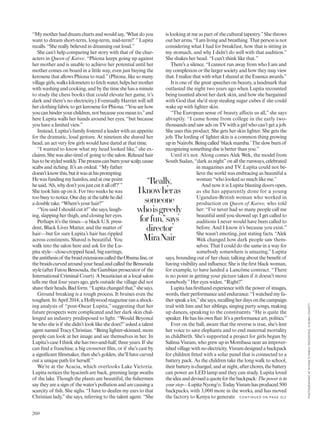
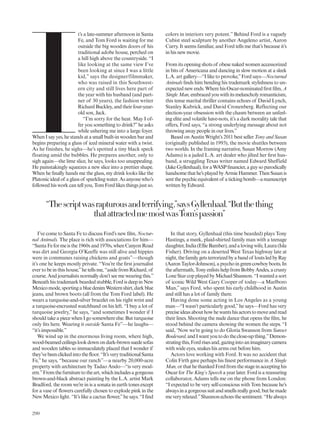
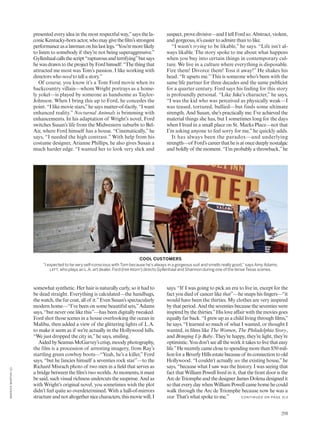
“I want to
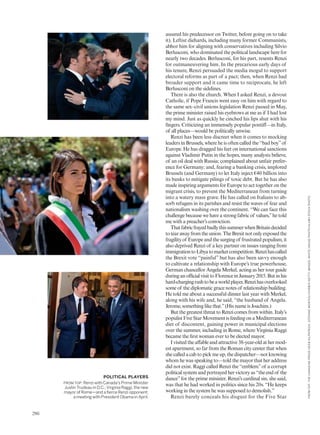
create
opportunities
for people
of color”
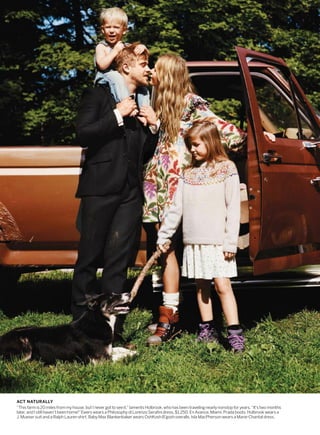
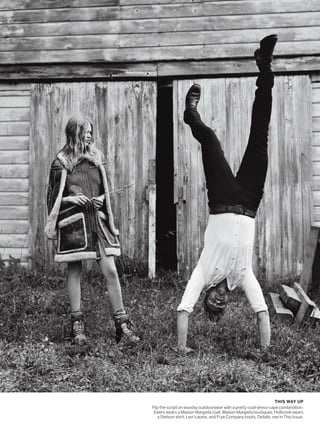
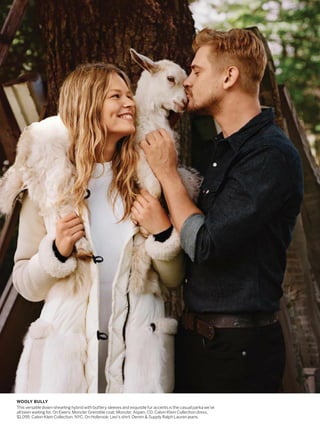
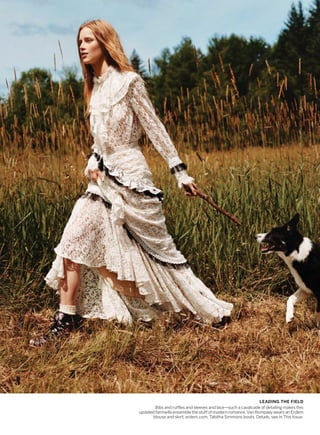
RICHLY ROMANTIC PRINTS, LACE,
SHEARLING—AND BOOTS
TO LOSE YOUR HEAD OVER
LOVE
FALLING IN
OCT
Lupita
The RIGHT-NOW
Revolution
RALPH LAUREN’S
NEW FRONTIER
Director’s CUT
TOM FORD’S THRILLING
SCREEN RETURN
Staying STRONG
A FATHER FACES THE LOSS
OF HIS WIFE IN
THE PARIS ATTACKS
SCORE!
CAM NEWTON’S
WINNING STYLE
C O N T IN U ED > 9 4
100, 102
MASTHEAD
108
EDITOR’S LETTER
118
UP FRONT
In his heartbreaking
memoir,Antoine Leiris
describes searching for
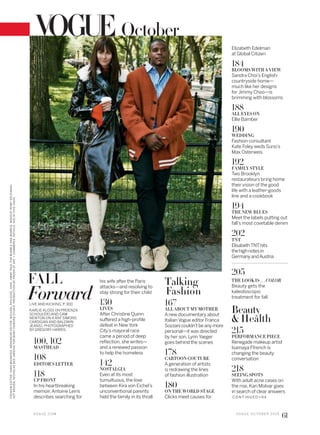
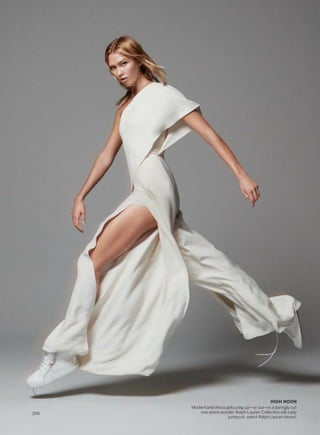
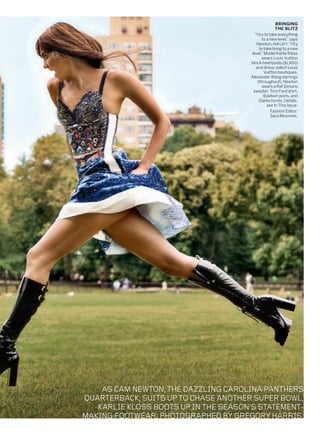
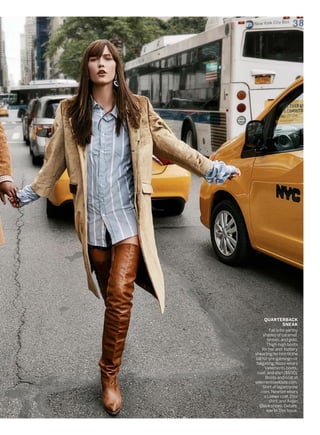
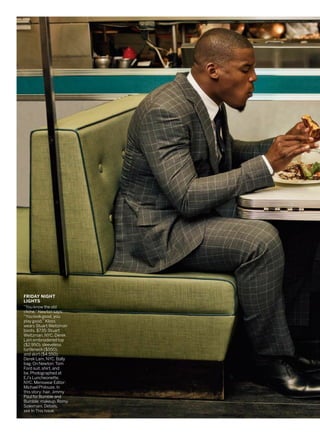
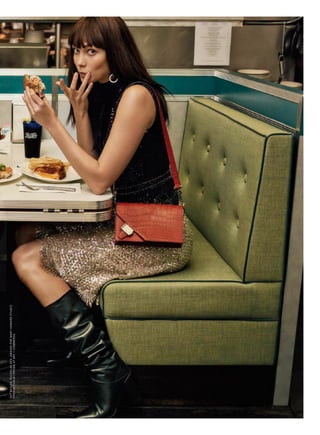
KARLIE KLOSS (IN PROENZA
SCHOULER) AND CAM
NEWTON (IN A RAF SIMONS
CARDIGAN AND BALDWIN
JEANS). PHOTOGRAPHED
BY GREGORY HARRIS.
LIVE AND KICKING, P. 300
FALL
Forward
his wife after the Paris
attacks—and resolving to
stay strong for their child
130
LIVES
After Christine Quinn
suffered a high-profile
defeat in New York
City’s mayoral race
came a period of deep
reflection, she writes—
and a renewed passion
to help the homeless
142
NOSTALGIA
Even at its most
tumultuous, the love
between Kira von Eichel’s
unconventional parents
held the family in its thrall
Talking
Fashion
167
ALL ABOUT MY MOTHER
A new documentary about
Italian Vogue editor Franca
Sozzani couldn’t be any more
personal—it was directed
by her son. LynnYaeger
goes behind the scenes
178
CARTOON COUTURE
A generation of artists
is redrawing the lines
of fashion illustration
180
ON THE WORLD STAGE
Clicks meet causes for
Elizabeth Edelman
at Global Citizen
184
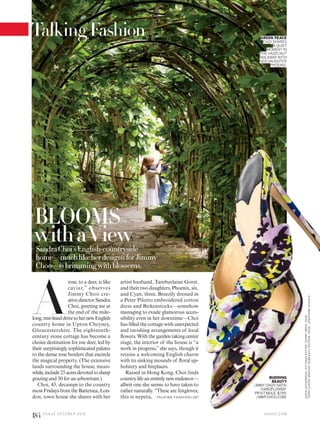
BLOOMS WITH A VIEW
Sandra Choi’s English-
countryside home—
much like her designs
for Jimmy Choo—is
brimming with blossoms
188
ALL EYES ON
Ellie Bamber
190
WEDDING
Fashion consultant
Kate Foley weds Suno’s
Max Osterweis
192
FAMILY STYLE
Two Brooklyn
restaurateurs bring home
their vision of the good
life with a leather-goods
line and a cookbook

194
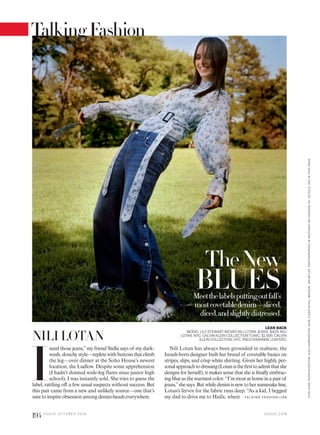
THE NEW BLUES
Meet the labels putting out
fall’s most covetable denim
202
TNT
ElisabethTNThits
thehighnotesin
GermanyandAustria
205
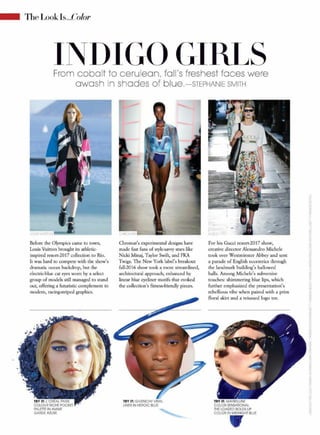
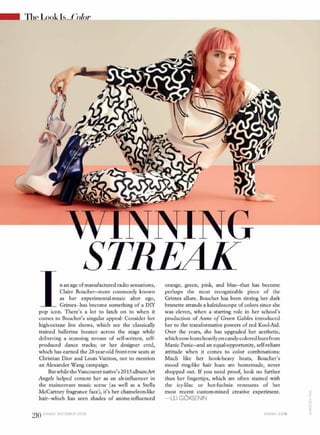
THE LOOK IS . . . COLOR
Beauty gets the
kaleidoscopic
treatment for fall
Beauty
& Health
215
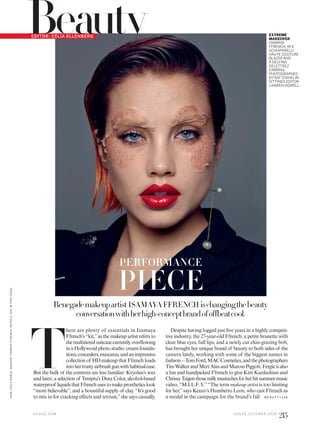
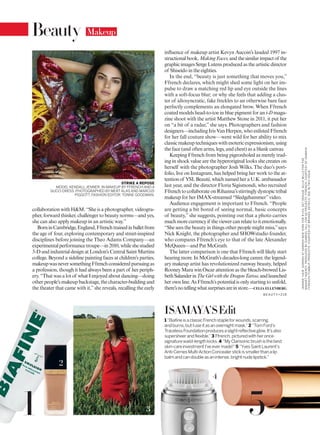
PERFORMANCE PIECE
Renegade makeup artist
Isamaya Ffrench is
changing the beauty
conversation
218
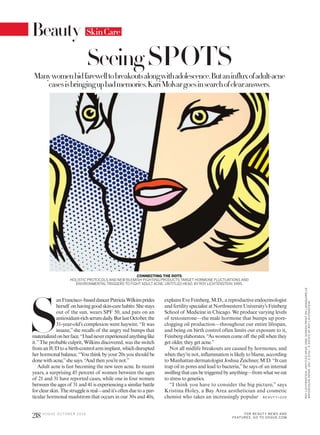
SEEING SPOTS
With adult acne cases on
the rise, Kari Molvar goes
in search of clear answers
V O G U E . C O M V O G U E O C T O B E R 2 0 1 6
61
FASHIONEDITOR:SARAMOONVES.MENSWEAREDITOR:MICHAELPHILOUZE.HAIR,JIMMYPAULFORBUMBLEANDBUMBLE;MAKEUP,ROMYSOLEIMANI.
SETDESIGN,NICHOLASDESJARDINSFORMARYHOWARDSTUDIO.PRODUCTIONBYPRODNATART+COMMERCE.DETAILS,SEEINTHISISSUE.
October
Cover Look
SUNSET
STARLET
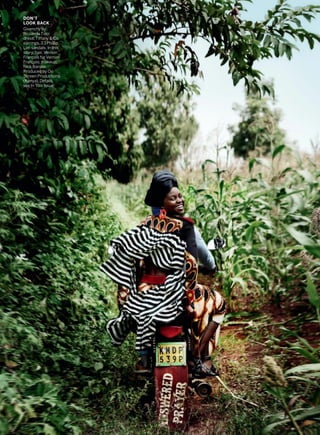
Lupita Nyong’o wears a
Chanel dress and Cathy
Waterman earrings. To get
this look, try: La Base Pro
Hydra Glow, Nude Miracle
Weightless Foundation,
Les Sourcils Definis Brow
Expert in Noir, Color Design
Eyeshadow Palette in Kissed
by Gold, Grandiôse Extrême
Mascara, Juicy Tubes in
Pure. All by Lancôme.
Hair, Vernon François
for Vernon François;
makeup, Nick Barose.
Produced by Onscreen
Productions (Kenya).
Details, see In This Issue.
Photographer:
Mario Testino.
Fashion Editor:
Tonne Goodman.
220
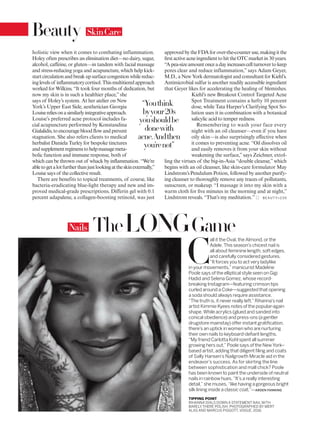
THE LONG GAME
This season’s chicest nail
is all about feminine length
230
FEAST OR FASHION?
Probiotics have been
called into question
230
EXTENSION SCHOOL
Stretch your way
to new heights
PeopleAre
TalkıngAbout
232
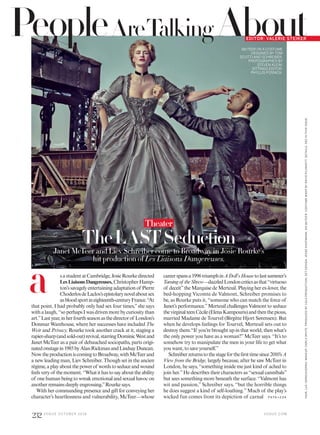
THEATER
Janet McTeer and Liev
Schreiber star in Les
Liaisons Dangereuses
234
DESIGN
Anandamayi Arnold fills
paper fruits with surprises
234
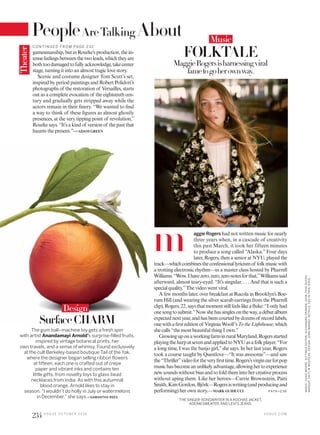
MUSIC
Maggie Rogers is
harnessing viral fame
to go her own way
236
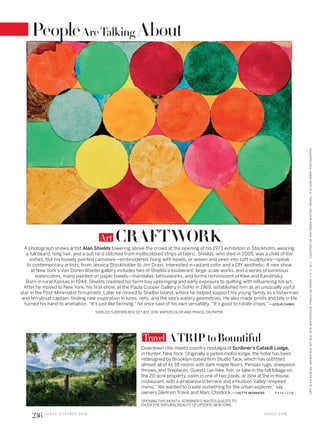
ART
Alan Shields’s colorful
works speak to a
new generation
236
TRAVEL
A sixties motor lodge
gets a sleek update
238
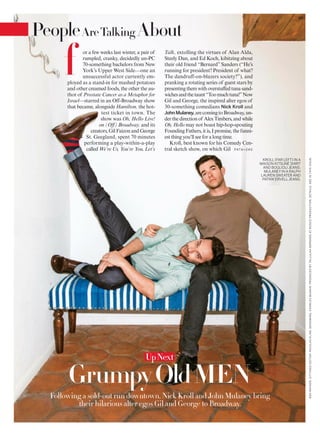
UP NEXT
Nick Kroll and
John Mulaney come
to Broadway
240
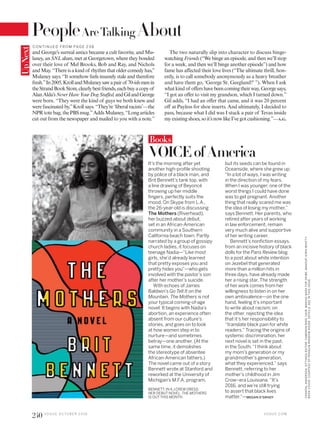
BOOKS
Brit Bennett adds a debut
novel to her repertoire
Fashion
&Features
245
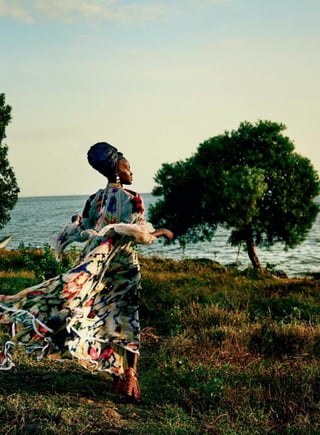
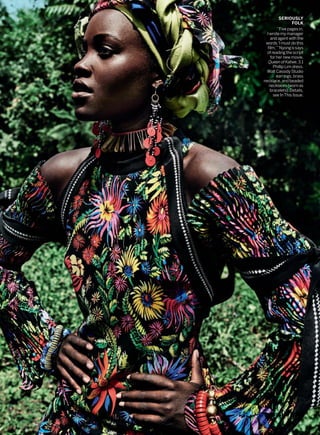
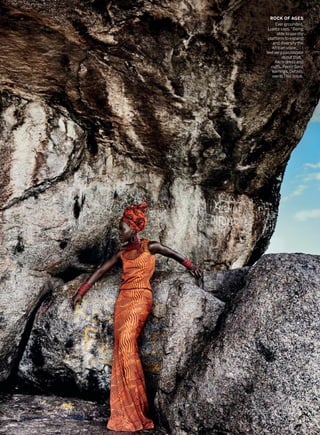
MY AFRICA
In Queen of Katwe,
Lupita Nyong’o brings
her brilliance to a story
from her native East
Africa.To celebrate, she
takes Vogue—and the
most glorious prints
of the season—to her
family’s village in Kenya.
By Elizabeth Rubin
262
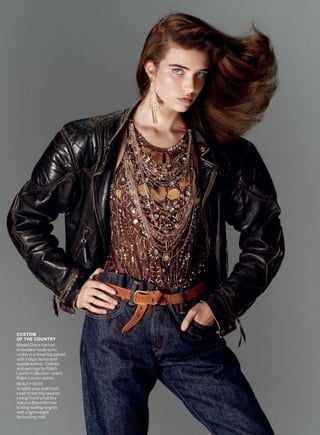
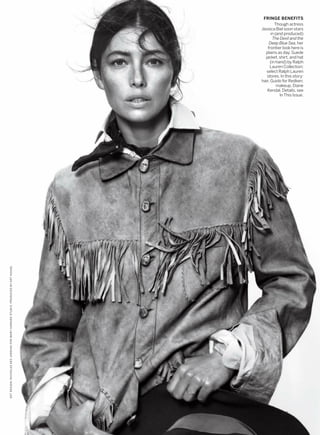
THE NEW FRONTIER
What will you wear to the
revolution? Ralph Lauren
has plenty of ideas
268
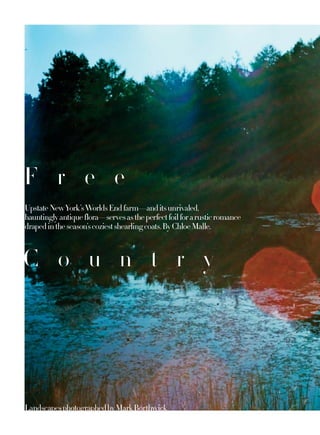
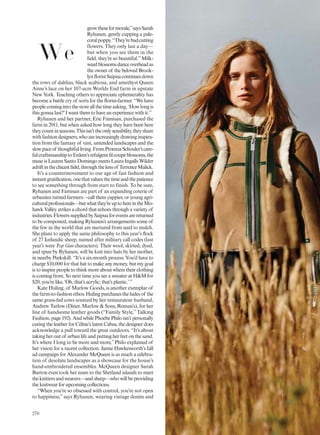
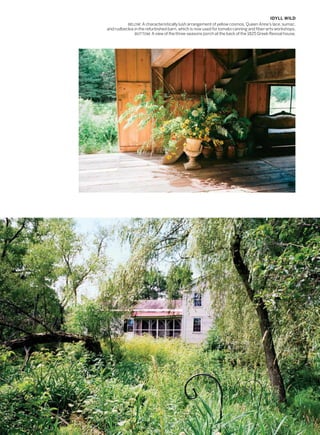
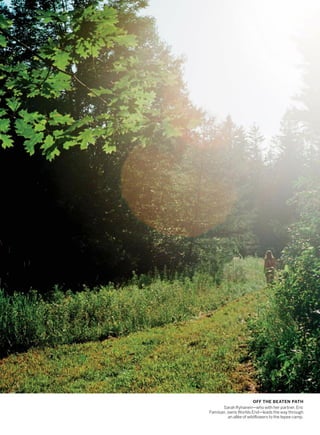
FREE COUNTRY
Upstate New York’s
Worlds End farm serves
as the perfect foil for
romance draped in the
season’s coziest shearling
coats. By Chloe Malle
282
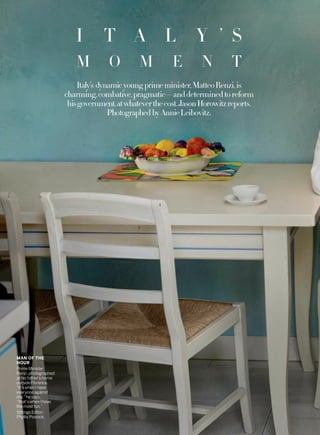
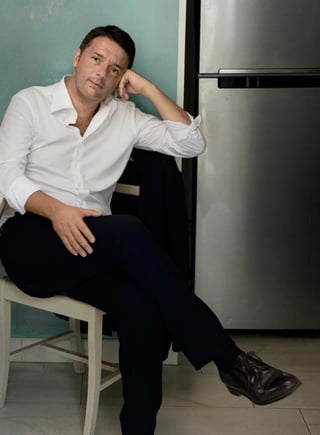
ITALY’S MOMENT
Prime Minister Matteo
Renzi is charming,
combative, pragmatic—
and determined to
reform his government.
Jason Horowitz reports
288
HIGH CONTRAST
Tom Ford’s dark new
thriller, Nocturnal Animals,
is a mythic American
story about passion and
revenge. By John Powers
292
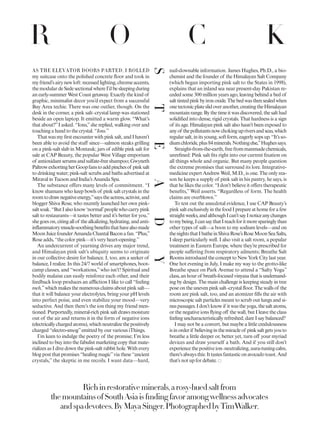
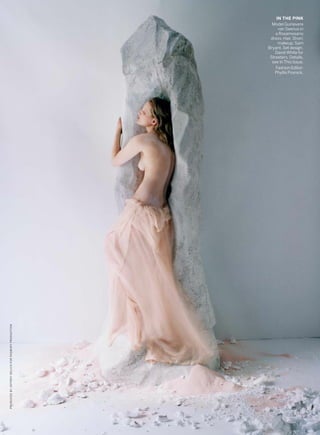
ROCK STEADY
Rich in restorative
minerals, pink salt is
finding favor among
wellness advocates
and spa devotees.
By Maya Singer
294
ONE FISH, TWO FISH
With omakase-style
restaurants flourishing
in New York, times have
never been better for
a sushi lover like Jeffrey
Steingarten. But will
a crisis of conscience
spoil his fun?
298
MOMENT OF THE MONTH
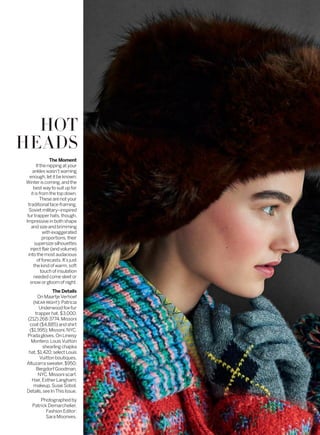
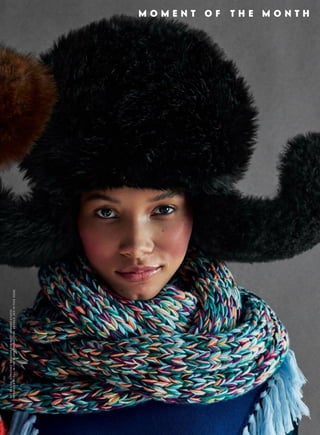
Hot heads
300
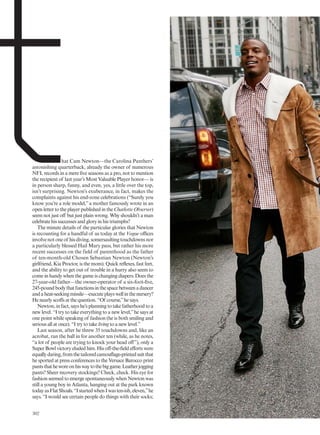
LIVE AND KICKING
As Carolina Panthers
quarterback Cam Newton
suits up for another
season, Karlie Kloss boots
up in statement-making
footwear.By Robert Sullivan
Index
310
MOUNTAIN HIGH
Camping goes global
and polished
314
INTHISISSUE
316
LASTLOOK
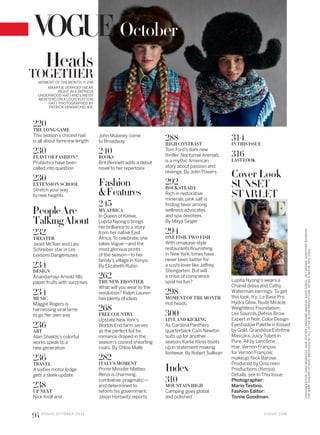
MAARTJE VERHOEF (NEAR
RIGHT, IN A PATRICIA
UNDERWOOD HAT) AND LINEISY
MONTERO (IN A LOUIS VUITTON
HAT). PHOTOGRAPHED BY
PATRICK DEMARCHELIER.
MOMENT OF THE MONTH, P. 298
Heads
TOGETHER
V O G U E . C O M
94 V O G U E O C TO B E R 2 0 1 6
FASHIONEDITOR:SARAMOONVES.HAIR,ESTHERLANGHAM;MAKEUP,SUSIESOBOL.SETDESIGN,DOROTHÉEBAUSSAN
FORMARYHOWARDSTUDIO.PRODUCEDBYFILLINTHEBLANKPRODUCTION.DETAILS,SEEINTHISISSUE.
October
ANNA WINTOUR
Editor in Chief
Design Director RAÚL MARTINEZ
Fashion Director TONNE GOODMAN
Features Director EVE MACSWEENEY Market Director, Fashion and Accessories VIRGINIA SMITH
Executive Fashion Editor PHYLLIS POSNICK Style Director CAMILLA NICKERSON
International Editor at Large HAMISH BOWLES Fashion News Director MARK HOLGATE
Creative Digital Director SALLY SINGER
Creative Director at Large GRACE CODDINGTON
FA S H I O N /A C C E S S O R I E S
Fashion News Editor EMMA ELWICK-BATES Bookings Director HELENA SURIC Accessories Director SELBY DRUMMOND
Editors GRACE GIVENS, ALEXANDRA MICHLER, EMMA MORRISON Menswear Editor MICHAEL PHILOUZE
Bookings Associate ERINA DIGBY Associate Market Editors SARA KLAUSING, WILLOW LINDLEY, FRANCESCA RAGAZZI Market Manager TAYLOR ANGINO
Associates LAUREN BELLAMY, GABRIELLA KAREFA-JOHNSON, YOHANA LEBASI
Fashion Writer RACHEL WALDMAN Fashion Market Assistant MADELINE SWANSON Home Market Associate SAMANTHA REES
B E A U T Y
Beauty Director CELIA ELLENBERG
Beauty Editor LAURA REGENSDORF Beauty Associate ARDEN FANNING
F E AT U R E S
Culture Editor VALERIE STEIKER Senior Editors TAYLOR ANTRIM, LAUREN MECHLING, JOYCE RUBIN (Copy), COREY SEYMOUR
Entertainment Director JILLIAN DEMLING Arts Editor MARK GUIDUCCI Style Editor at Large ELISABETH VON THURN UND TAXIS
Assistant Editor ELIZABETH INGLESE Assistant Entertainment Editor SAMANTHA LONDON
Features Associates LILI GÖKSENIN, MADELEINE LUCKEL, LILAH RAMZI Features Assistant LAUREN SANCHEZ
A R T
Deputy Design Director ALBERTO ORTA
Art Director MARTIN HOOPS
Associate Art Director NOBI KASHIWAGI Designer JENNIFER DONNELLY
Visual Director ALEX O’NEILL Visual Director, Research MAUREEN SONGCO Visual Editor, Research TIM HERZOG
Senior Visual Producers NIC BURDEKIN, JENNIFER GREIM Visual Editor LIANA BLUM Assistant to the Design Director ROSEMARY HANSEN
V O G U E . C O M
Managing Editor ALEXANDRA MACON Head of Product ISHANI MUKHERJEE Director of Engineering KENTON JACOBSEN
Fashion News Director CHIOMA NNADI Director, Vogue Runway NICOLE PHELPS Executive Fashion Editor JORDEN BICKHAM
Beauty Director CATHERINE PIERCY Executive Visual Director ANDREW GOLD
Art Director FERNANDO DIAS DE SOUZA Director of Visual Production and Development ALLISON BROWN
Fashion News Editor ALESSANDRA CODINHA Style Editor EDWARD BARSAMIAN Senior Fashion Writer MARJON CARLOS
Market Editors KELLY CONNOR, CHELSEA ZALOPANY Associate Market Editor ANNY CHOI
Accessories Editor BROOKE DANIELSON Archive Editor LAIRD BORRELLI-PERSSON
Fashion News Writers KRISTIN ANDERSON, JANELLE OKWODU, LIANA SATENSTEIN, STEFF YOTKA Fashion News Associate EMILY FARRA
Senior Beauty Writer MACKENZIE WAGONER Beauty Writer MONICA KIM Associate Beauty Editor JENNA RENNERT
Deputy Culture Editor JESSIE HEYMAN Senior Culture Writer JULIA FELSENTHAL Culture Writer PATRICIA GARCIA
Living Editor VIRGINIA VAN ZANTEN Living Writer BROOKE BOBB
Visual Director SUZANNE SHAHEEN Senior Visual Editor EMILY ROSSER Visual Editors SAMANTHA ADLER, RUBEN RAMOS
Enterainment Media Editor SOPHIA LI Visual Content Creator BARDIA ZEINALI Visual Associate ALEXANDRA GURVITCH Designer SARA JENDUSA
Social Media Manager, Vogue Runway LUCIE ZHANG Associate Social Media Manager JULIA FRANK
Production Manager CHRISTINA LIAO Assistant Managing Editor OLIVIA WEISS Research Editor LISA MACABASCO Producers IVY TAN, MARIA WARD
Product Manager BEN SMIT Senior Developers JEROME COVINGTON, GREGORY KILIAN Developers JE SUIS ENCRATEIA, SIMONE HILL, BEN MILTON
P R O D U C T I O N /C O P Y/ R E S E A R C H
Deputy Managing Editor DAVID BYARS
Digital Production Manager JASON ROE Production Designers COR HAZELAAR, SARA REDEN
Deputy Copy Chief CAROLINE KIRK Senior Copy Editor LESLIE LIPTON Copy Editor DIEGO HADIS
Research Director ALEXANDRA SANIDAD Research Associate COURTNEY MARCELLIN
Fashion Credits Editor IVETTE MANNERS
S P E C I A L E V E N T S / E D I T O R I A L D E V E L O P M E N T/C O M M U N I C AT I O N S
Director of Special Events EADDY KIERNAN
Editorial Business Director MIRA ILIE Associate Director, Operations XAVIER GONZALEZ Contracts Manager ALEXA ELAM
Editorial Business Coordinator JESSECA JONES Special Events Associate LINDSAY STALL
Executive Director of Communications HILDY KURYK Director of Brand Marketing NEGAR MOHAMMADI
Communications and Marketing Manager DANIKA OWSLEY
Executive Assistant to the Editor in Chief GRACE HUNT Assistants to the Editor in Chief CORINNE PIERRE-LOUIS, REBECCA UNGER
European Editor FIONA DARIN European Fashion Associates CAMILA HENNESSY, ANTHONY KLEIN
West Coast Director LISA LOVE West Coast Associate CAMERON BIRD
Managing Editor JON GLUCK Executive Director, Editorial and Special Projects CHRISTIANE MACK
C O N T R I B U T I N G E D I T O R S
ROSAMOND BERNIER, MIRANDA BROOKS, SARAH BROWN, SYLVANA WARD DURRETT, ADAM GREEN, ROB HASKELL, NATHAN HELLER,
LAWREN HOWELL, CAROLINA IRVING, REBECCA JOHNSON, DODIE KAZANJIAN, SHIRLEY LORD, CHLOE MALLE, CATIE MARRON, SARA MOONVES,
SARAH MOWER, MEGAN O’GRADY, JOHN POWERS, MARINA RUST, LAUREN SANTO DOMINGO, TABITHA SIMMONS, JEFFREY STEINGARTEN,
ROBERT SULLIVAN, PLUM SYKES, ANDRÉ LEON TALLEY, JONATHAN VAN METER, SHELLEY WANGER, JANE WITHERS, VICKI WOODS, LYNN YAEGER
V O G U E . C O M
100 V O G U E O C TO B E R 2 0 1 6
SUSAN D. PLAGEMANN
Chief Revenue Officer and Publisher
Associate Publisher, Marketing KIMBERLY FASTING BERG
General Manager DAVID STUCKEY
A D V E R T I S I N G
Executive Director, Digital Advertising KRISTEN ELLIOTT
Advertising Director, Digital ELIZABETH MARVIN
Executive Director, International Fashion and Business Development SUSAN CAPPA
Executive Retail Director GERALDINE RIZZO
Executive Beauty Director LAUREN HULKOWER-BELNICK
Fashion Director JAMIE TILSON ROSS
Luxury Director ROY KIM
Senior Director, American Fashion and Beauty MARIE LA FRANCE
American Fashion Manager LENA JOHNSON
Account Managers BLAIR CHEMIDLIN, LYNDSEY NATALE
Executive Assistants to the Publisher ANNIE MAYBELL, JEENA MARIE PENA
Advertising Associate NINA CAPACCHIONE
Retail Coordinator ELIZABETH ODACHOWSKI International Fashion Coordinator SAMANTHA KIRSHON
Advertising Assistants LILY MUMMERT, ELEANOR PEERY, GABRIELLE MIZRAHI, CAMERON CHALFIN
Advertising Tel: 212 286 2860
B U S I N E S S
Executive Director of Finance and Business Development SYLVIA W. CHAN
Senior Business Director TERESA GRANDA
Business Managers CHRISTINE GUERCIO, MERIDITH HAINES
Advertising Services Manager PHILIP ZISMAN
C R E AT I V E S E R V I C E S
Integrated Marketing
Executive Director, Creative Services BONNIE ABRAMS
Executive Director of Events, Partnerships, and Communications BRIGID WALSH
Senior Director, Creative Development and Integrated Partnerships RACHAEL KLEIN
Branded Content Director JANE HERMAN
Integrated Marketing Director MARK HARTNETT
Director, Special Events CARA CROWLEY
Associate Directors, Integrated Marketing EUNICE KIM, MICHELLE FAWBUSH
Digital Marketing Manager ELLYN PULEIO
Senior Integrated Marketing Manager CASSANDRA SKOUFALOS
Integrated Marketing Manager LIAM MCKESSAR
Integrated Marketing Assistants SHARTINIQUE CHLOE LEE, TARA MCDERMOTT
Vogue Studio
Creative Director DELPHINE GESQUIERE
Director of Vogue Studio Services SCOTT ASHWELL
Associate Creative Director SARAH RUBY
Art Directors NANCY ROSENBERG, TIMOTHY SCHULTHEIS
Copy Director DEENIE HARTZOG-MISLOCK
Designer KELSEY REIFLER
M A R K E T I N G
Executive Director of Marketing MELISSA HALVERSON
Marketing Director YI-MEI TRUXES
Senior Marketing Managers MEREDITH MCCUE, ALEXANDRIA GURULE
Marketing Managers ANNA NATALI SWANSON, LINDSAY KASS
D I G I TA L A D S T R AT E G Y A N D P L A N N I N G
Director, Digital Operations JASON LOUIE
Senior Digital Account Manager REBECCA ISQUITH
Digital Account Manager COURTNEY CARROLL
Associate Account Manager RYAN HOOVER
Analysts, Sales Planning REBECCA YOUNG, ALANA SCHARLOP, HAYLEY SAMELA
B R A N C H O F F I C E S
San Francisco ASHLEY KNOWLTON, Northwest Director, 1700 Montgomery St., Suite 200, San Francisco CA 94111 Tel: 415 955 8210
Midwest WENDY LEVY, Director, 875 N. Michigan Ave., Chicago IL 60611 Tel: 312 649 3522
Detroit STEPHANIE SCHULTZ, Director, 2600 West Big Beaver Rd., Troy MI 48084 Tel: 248 458 7953
Los Angeles MARJAN DIPIAZZA, Executive West Coast Director; KATIE HUSA, Account Manager, West Coast, 6300 Wilshire Blvd., Los Angeles CA 90048 Tel: 323 965 3598
Southeast PETER ZUCKERMAN, Z. MEDIA 1666 Kennedy Causeway, Suite 602, Miami Beach FL 33141 Tel: 305 532 5566
Paris FLORENCE MOUVIER, Director, Europe 4 Place du Palais Bourbon, 75343 Paris Cedex 07 Tel: 331 4411 7846
Milan ALESSANDRO AND RINALDO MODENESE, Managers, Italy Via M. Malpighi 4, 20129 Milan Tel: 39 02 2951 3521
P U B L I S H E D B Y C O N D É N A S T
Chairman Emeritus S.I. NEWHOUSE, JR.
Chairman CHARLES H. TOWNSEND
President & Chief Executive Officer ROBERT A.SAUERBERG, JR.
Chief Financial Officer DAVID E.GEITHNER
Chief Marketing Officer & President, Condé Nast Media Group EDWARD J. MENICHESCHI
Chief Administrative Officer JILL BRIGHT
Chief Human Resources Officer JOANN MURRAY
Executive Vice President/Chief Digital Officer FRED SANTARPIA
Executive Vice President–Consumer Marketing MONICA RAY
Executive Vice President–Corporate Communications CAMERON R. BLANCHARD
Senior Vice President–Business Operations DAVID ORLIN
Senior Vice President–Corporate Controller DAVID B.CHEMIDLIN
Senior Vice President–Managing Director–23 Stories JOSH STINCHCOMB
Senior Vice President–Network Sales & Partnerships, CN & Chief Revenue Officer, CNÉ LISA VALENTINO
Senior Vice President–Financial Planning & Analysis SUZANNE REINHARDT
Senior Vice President–Strategy–23 Stories PADRAIG CONNOLLY
Senior Vice President–Ad Products & Monetization DAVID ADAMS
Senior Vice President–Licensing CATHY HOFFMAN GLOSSER
Senior Vice President–Research & Analytics STEPHANIE FRIED
Senior Vice President–Digital Operations LARRY BAACH
Senior Vice President–Human Resources NICOLE ZUSSMAN
General Manager–Digital MATTHEW STARKER
C O N D É N A S T E N T E R TA I N M E N T
President DAWN OSTROFF
Executive Vice President–General Manager–Digital Video JOY MARCUS
Executive Vice President–Chief Operating Officer SAHAR ELHABASHI
Executive Vice President–Motion Pictures JEREMY STECKLER
Executive Vice President–Alternative TV JOE LABRACIO
Executive Vice President–CNÉ Studios AL EDGINGTON
Senior Vice President–Marketing & Partner Management TEAL NEWLAND
C O N D É N A S T I N T E R N AT I O N A L
Chairman and Chief Executive JONATHAN NEWHOUSE
President NICHOLAS COLERIDGE
Condé Nast is a global media company producing premium content for more than 263 million consumers in 30 markets.
www.condenast.com www.condenastinternational.com Published at 1 World Trade Center, New York NY 10007.
Subscription Inquiries: subscriptions@vogue.com or www.vogue.com/services or call (800) 234-2347.
For Permissions and Reprint requests: (212) 630-5656; fax: (212) 630-5883.
Address all editorial, business, and production correspondence to Vogue Magazine, 1 World Trade Center, New York NY 10007.
Being the star of a docu-
mentary made by her son,
though—the photographer
and filmmaker Francesco
Carrozzini—can’t have been
effortless or easy. During the
course of filming they told
me there were many strong
disagreements about the
direction the movie was tak-
ing, with one early version
unceremoniously scrapped.
In the end, Francesco
turned to Baz Luhrmann
for advice, and what Baz
said to him clearly paid off.
The result, which you can
read about in “All About
My Mother”(Talking Fash-
ion, page 167), by Lynn
Yaeger, is totally compel-
ling and insightful. And
how could it not be, given
Francesco is every bit his
mother’s son? Both are intel-
ligent, cultured, charming,
don’t-ever-play-by-the-rule-
book characters who each
brought so much of themselves to this film.
The deep bond between Francesco and Franca is very
much in evidence throughout the
T
his October issue is really about fearless-
ness. As you’ve no doubt guessed, our
cover star, Lupita Nyong’o, is very much
part of that, but it’s someone who isn’t
used to being in front of a camera that I
want to talk about first. Franca Sozzani,
the editor of Italian Vogue, is the subject
of a new documentary, Franca: Chaos and Creation, which
just premiered at the Venice Film Festival. Franca is some-
one I’ve been so lucky to call a good friend for 30 years now,
with both of us becoming editors around the same time, so
watching her story unfold on-screen was particularly mov-
ing for me. Truth be told, I’ve always been rather in awe of
her. She is a risk-taking visionary—and the hardest-working
person I know. (The two qualities are, I suspect, not entirely
unrelated.) That Franca makes her multitasking look so ef-
fortless and easy is enviable.
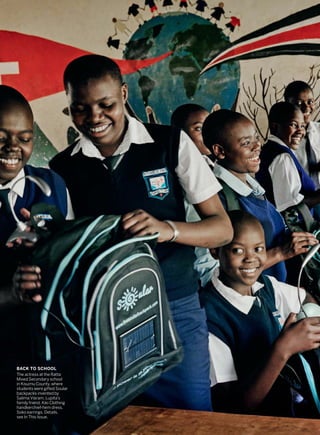
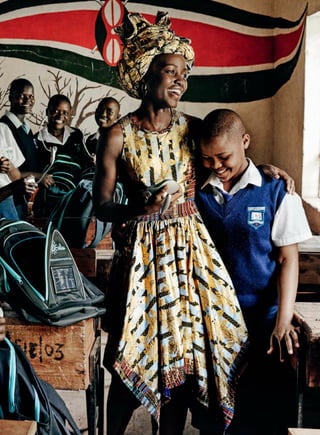
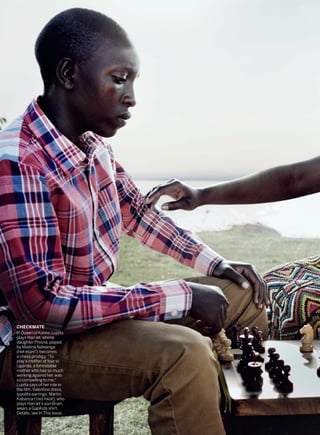
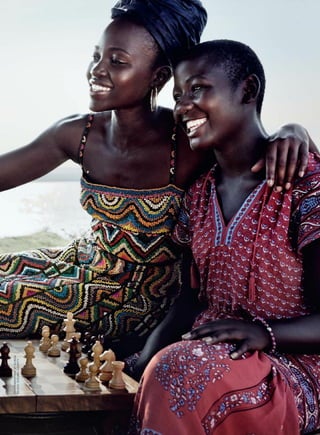
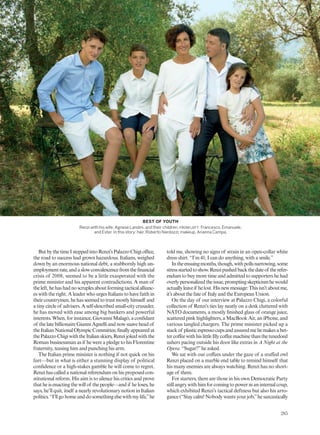
THE
QUICK STUDIES
LUPITA NYONG’O (WEARING ROKSANDA) WITH THE STUDENTS FROM
MAMA DORCA NYONG’O GIRLS’HOSTEL, RATTA MIXED SECONDARY
SCHOOL, IN KISUMU COUNTY. PHOTOGRAPHED BYMARIO TESTINO.
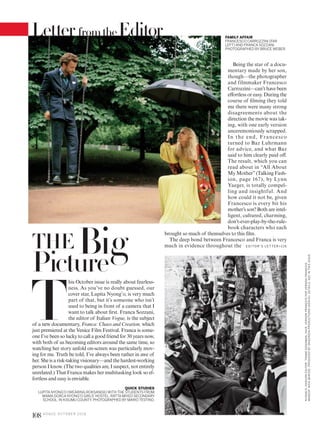
FAMILY AFFAIR
FRANCESCO CARROZZINI (FAR
LEFT) AND FRANCA SOZZANI.
PHOTOGRAPHED BY BRUCE WEBER.
EDITO R ’S LE T T ER>1 16
BigPicture
NYONG’O:FASHIONEDITOR:TONNEGOODMAN.HAIR,VERNONFRANÇOISFORVERNONFRANÇOIS;
MAKEUP,NICKBAROSE.PRODUCEDBYONSCREENPRODUCTIONS(KENYA).DETAILS,SEEINTHISISSUE.
108 V O G U E O C TO B E R 2 0 1 6
LetterfromtheEditor
abouthisdecisiontodosoin“TheNewFrontier,”page262).
John Powers met Tom at home in Santa Fe to discuss his sec-
ond movie, Nocturnal Animals, a powerful, menacing study
of revenge and retribution with—this is Tom, after all!—an
utterly striking cast. John’s excellent piece (“High Contrast,”
page 288) has its amusing moments, such as the account of
Tom’s perfectionism kicking in as he poured a glass of water,
yetitalsoepitomizeswhathasdrivenhiscareeralltheseyears:
theability,asJohnputsit,tobe“atoncedeeplynostalgicand
boldly of the moment.”
One thing that Tom said—about not throwing away the
people in our lives—particularly struck me. It’s a comment
born out of personal experience. When he walked away from
his first fashion life in 2004, Tom went from a huge support
network to nothing. Professionally, at least, he became a
single man, someone who had to learn how to live all over
again. That he did so, and magnificently, is a huge testament
tohisbravery,whetheritinvolvedsittinginthedirector’schair
the very first time or acting on his instincts that the fashion
system drastically needed an overhaul. At a moment when
it’s more important than ever to stand by your words and
actions, I’m pleased that in this issue we can celebrate three
amazing and creative people who always do exactly that.
movie, as he perfectly captures
how she is an editor who con-
stantly expands the notion
of what a magazine can and
should be. Here, closeness is
no impediment to stepping
back and seeing the bigger
picture. As Lynn points out,
“Carrozzini was aware practi-
cally from birth that Sozzani
was no ordinary mom. Not
only was she driven and de-
termined; she was also—in her
fearlessness, her wild imagina-
tion, her unique way of fusing
socialissueswith fashion—not
like any of her professional
contemporaries.”
Someone else who sees the
bigger picture is Lupita, who
I’m delighted to say is making
her third Vogue cover appear-
ance in as many years. This
time around, she returned to
hernativeKenyawithphotographerMarioTestino,Fashion
DirectorTonneGoodman,andthewriterElizabethRubinin
tow (“My Africa,”page 245). The story is a wonderfully inti-
mate and life-affirming portrait of one of the most talented
and beautiful actresses of her generation. Lupita is happy
to use her fame and status in the world to do meaningful
things—while also asking everyone to think more deeply
and carefully about the challenges faced by people of color
inourculturetoday.Herlatestfilm,Queenof Katwe,directed
by Mira Nair, most likely got off the ground because of Lu-
pita’s early involvement; ditto Danai Gurira’s play Eclipsed:
Brilliant though it is, without Lupita’s presence it may not
have made the transfer from the Public Theater to Broad-
way—or even been staged at
the Public to begin with. In her
quietly ambitious yet fiercely
focused way, Lupita questions
thestatusquo—somethingthat
is to be applauded, loudly.
Lastly,TomFord.It’shisrole
as a director that we’re focusing
on now, rather than that of de-
signer, though he continues to
play that part to dazzling effect.
Tom just showed a collection
during September’s New York
shows that was immediately
available to buy (as did Ralph
Lauren, a man never content
to rest on his laurels, who talks
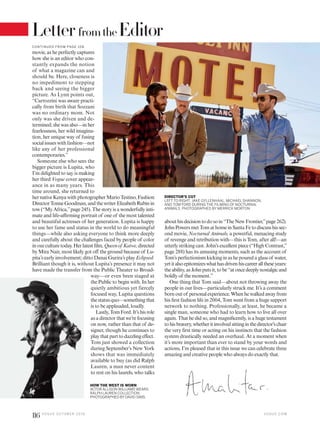
DIRECTOR’S CUT
LEFT TO RIGHT: JAKE GYLLENHAAL, MICHAEL SHANNON,
AND TOM FORD DURING THE FILMING OF NOCTURNAL
ANIMALS. PHOTOGRAPHED BY MERRICK MORTON.
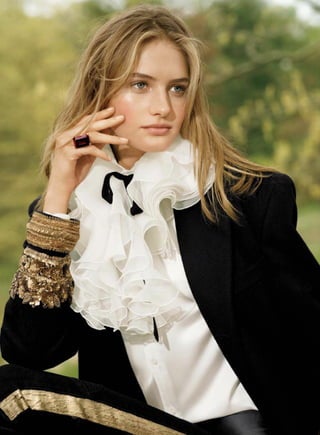
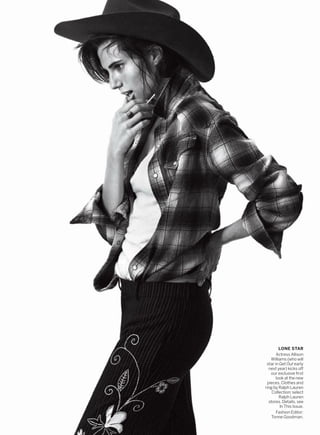
HOW THE WEST IS WORN
ACTOR ALLISON WILLIAMS WEARS
RALPH LAUREN COLLECTION.
PHOTOGRAPHED BY DAVID SIMS.
C O N TIN U ED F RO M PAG E 10 8
V O G U E . C O M
116 V O G U E O C TO B E R 2 0 1 6
LetterfromtheEditor
Love Among theRuins
In his slender, heartbreaking memoir, ANTOINE LEIRIS describes searching for
his wife after the Paris attacks—and resolving to stay strong for their child.
NOVEMBER 13,10:37 P.M.
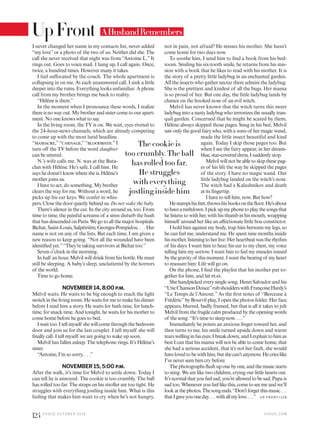
Melvil fell asleep without a murmur, as he usually does
when his mama isn’t there. He knows that with Papa, the
lullabies are not as soft and the hugs not as warm, so he
doesn’t expect too much.
To keep myself awake until she gets home, I read. It’s the
story of a novelist turned detective who discovers that a
novelist turned murderer did not actually write the novel that
madehimwanttobecomeanovelist.Myphone,lyingonmy
bedside table, buzzes. I read the text from a friend:
“Hey, everything OK? Are you at home?”
I hate those text messages that don’t really say anything.
I don’t reply.
“Everything OK?”“ . . . ”“Are you safe?”
What’s that supposed to mean, “safe”? I put the book
down and rush to the living room on tiptoes. Do not wake
the baby. I grab the remote. Live: Terrorist attack at the
Stade de France. I think about Hélène. I should call her, tell
her it would be a good idea to take a taxi home. But there is
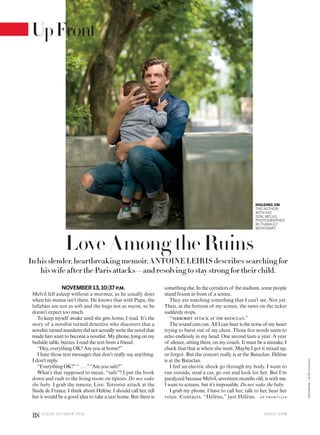
HOLDING ON
THE AUTHOR,
WITH HIS
SON, MELVIL,
PHOTOGRAPHED
BY THIBAULT
MONTAMAT.
something else. In the corridors of the stadium, some people
stand frozen in front of a screen.
They are watching something that I can’t see. Not yet.
Then, at the bottom of my screen, the news on the ticker
suddenly stops.
“terrorist attack at the bataclan.”
The sound cuts out. All I can hear is the noise of my heart
trying to burst out of my chest. Those five words seem to
echo endlessly in my head. One second lasts a year. A year
of silence, sitting there, on my couch. It must be a mistake. I
check that that is where she went. Maybe I got it mixed up,
or forgot. But the concert really is at the Bataclan. Hélène
is at the Bataclan.
I feel an electric shock go through my body. I want to
run outside, steal a car, go out and look for her. But I’m
paralyzed because Melvil, seventeen months old, is with me.
I want to scream, but it’s impossible. Do not wake the baby.
I grab my phone. I have to call her, talk to her, hear her
voice. Contacts. “Hélène,” just Hélène. U P F RO N T>1 24
V O G U E . C O M
118 V O G U E O C TO B E R 2 0 1 6
GROOMING,LAUREGAUDOU
UpFront
not in pain, not afraid? He misses his mother. She hasn’t
come home for two days now.
To soothe him, I send him to find a book from his bed-
room. Smiling his six-tooth smile, he returns from his mis-
sion with a book that he likes to read with his mother. It is
the story of a pretty little ladybug in an enchanted garden.
All the insects who gather nectar there admire the ladybug.
She is the prettiest and kindest of all the bugs. Her mama
is so proud of her. But one day, the little ladybug lands by
chance on the hooked nose of an evil witch.
Melvil has never known that the witch turns this sweet
ladybug into a nasty ladybug who terrorizes the usually tran-
quil garden. Concerned that he might be scared by them,
Hélène always skipped those pages. Snug in his bed, Melvil
saw only the good fairy who, with a wave of her magic wand,
made the little insect beautiful and kind
again. Today I skip those pages too. But
when I see the fairy appear, in her dream-
blue, star-covered dress, I suddenly stop.
Melvil will not be able to skip these pag-
es of his life the way he skipped the pages
of the story. I have no magic wand. Our
little ladybug landed on the witch’s nose.
The witch had a Kalashnikov and death
at its fingertip.
I have to tell him, now. But how?
Hestampshisfeet,throwshisbooksonthefloor.He’sabout
tohaveameltdown.Ipickupmyphonetoplaythesongsthat
he listens to with her, with his thumb in his mouth, wrapping
himself around her like an affectionate little boa constrictor.
I hold him against my body, trap him between my legs, so
he can feel me, understand me. He spent nine months inside
hismother,listeningtoherlive:Herheartbeatwastherhythm
of his days. I want him to hear, his ear to my chest, my voice
telling him my sorrow. I want him to feel my muscles tensed
bythegravityof thismoment.Iwantthebeatingof myheart
to reassure him: Life will go on.
On the phone, I find the playlist that his mother put to-
gether for him, and hit play.
She handpicked every single song. Henri Salvador and his
“UneChansonDouce”rubshoulderswithFrançoiseHardy’s
“Le Temps de l’Amour.” As the first notes of “Berceuse à
Frédéric”by Bourvil play, I open the photos folder. Her face
appears, blurred, badly framed, but that is all it takes to jolt
Melvil from the fragile calm produced by the opening words
of the song. “It’s time to sleep now. . . .”
Immediately he points an anxious finger toward her, and
then turns to me, his smile turned upside down and warm
tearswellinginhiseyes.Ibreakdown,andIexplaintohimas
best I can that his mama will not be able to come home, that
she had a serious accident, that it’s not her fault, she would
havelovedtobewithhim,butshecan’tanymore.Hecrieslike
I’ve never seen him cry before.
The photographs flash up one by one, and the music starts
to sting. We are like two children, crying our little hearts out.
It’s normal that you feel sad; you’re allowed to be sad; Papa is
sad too. Whenever you feel like this, come to see me and we’ll
lookatthephotos.Thesongends.“Don’tforgetthismusic...
thatIgaveyouoneday...withallmylove....”
I never changed her name in my contacts list, never added
“my love”or a photo of the two of us. Neither did she. The
call she never received that night was from “Antoine L.” It
rings out. Goes to voice mail. I hang up, I call again. Once,
twice, a hundred times. However many it takes.
I feel suffocated by the couch. The whole apartment is
collapsing in on me. At each unanswered call, I sink a little
deeper into the ruins. Everything looks unfamiliar. A phone
call from my brother brings me back to reality.
“Hélène is there.”
In the moment when I pronounce these words, I realize
thereisnowayout.Mybrotherandsistercometoourapart-
ment. No one knows what to say.
In the living room, the TV is on. We wait, eyes riveted to
the 24-hour-news channels, which are already competing
to come up with the most lurid headline.
“massacre,”“carnage,”“bloodbath.”I
turn off the TV before the word slaughter
can be uttered.
N.’s wife calls me. N. was at the Bata-
clan with Hélène. He’s safe. I call him. He
sayshedoesn’tknowwheresheis.Hélène’s
mother joins us.
I have to act, do something. My brother
clears the way for me. Without a word, he
picks up his car keys. We confer in whis-
pers. Close the door quietly behind us. Do not wake the baby.
There’s silence in the car. In the city around us, too. From
time to time, the painful screams of a siren disturb the hush
that has descended on Paris. We go to all the major hospitals.
Bichat, Saint-Louis, Salpêtrière, Georges-Pompidou. . . . Her
name is not on any of the lists. But each time, I am given a
new reason to keep going. “Not all the wounded have been
identified yet.”“They’re taking survivors at Bichat too.”
Seven o’clock in the morning.
In half an hour, Melvil will drink from his bottle. He must
still be sleeping. A baby’s sleep, uncluttered by the horrors
of the world.
Time to go home.
NOVEMBER 14,8:00 P.M.
Melvil waits. He waits to be big enough to reach the light
switch in the living room. He waits for me to make his dinner
before I read him a story. He waits for bath time, for lunch-
time, for snack time. And tonight, he waits for his mother to
come home before he goes to bed.
I wait too. I tell myself she will come through the bedroom
door and join us for the last couplet. I tell myself she will
finally call. I tell myself we are going to wake up soon.
Melvil has fallen asleep. The telephone rings. It’s Hélène’s
sister.
“Antoine, I’m so sorry. . . .”
NOVEMBER 15, 5:00 P.M.
After the walk, it’s time for Melvil to settle down. Today I
can tell he is annoyed. The cookie is too crumbly. The ball
has rolled too far. The straps on his stroller are too tight. He
struggles with everything jostling inside him. What is this
feeling that makes him want to cry when he’s not hungry, U P F RO N T>1 2 8
AHusbandRemembers
The cookie is
too crumbly. The ball
has rolled too far.
He struggles
with everything
jostling inside him
V O G U E . C O M
124 V O G U E O C TO B E R 2 0 1 6
UpFront
The tale of the little ladybug ends when, having once
again become the prettiest ladybug in the garden, she finds
her mama, who cries with joy at seeing her little girl again.
Now I must explain to Melvil, every time he needs to hear
it, why his mama will not be waiting for him at the end of
his story. I tear the page out of the book and pin it to the
wall of his bedroom, next to a photograph of her. Melvil
is holding on to her shoulders while he lies on her back.
She is looking at me, no pose, no lens. Her eyes speak di-
rectly to me. They tell me about the
simplejoysof thoseseventeenmonths
we spent together, the three of us.
NOVEMBER 16, 10:00 A.M.
Accompanied by Hélène’s mother
and sister, I map out the mortuary.
Color-coded. Blue, police, so I can
get through. Fluorescent yellow,
psychological-support staff, to avoid.
Black, mortuary staff, so I can see her
again.Iheadtowardsomeoneinblue,
who leads me to someone in black,
who suggests I go to see someone in
fluorescent yellow. I pretend not to
hear what he says.
Since arriving, I have been asked
a dozen times if I would like to sit
down; each time, I refuse, out of fear
that I won’t be able to get up again.
Protocols. Paperwork. Families
come and go. About fifteen enter be-
fore us. All reemerge in pieces.
“You’ve come to see Luna-Hélène Muyal?”
It’s our turn.
Ayoungwomanspeakstous.Shehasdonethisathousand
times before, I can hear it in her voice.
Hélène is there, just next door. I can sense her. I would like
toseeher,alone.Hélène’smotherandsisterunderstand.They
know that even here, it is the two of us, first of all.
We were like two little Lego bricks that fit together per-
fectly.Our“onceuponatime”beganoneJune21,withmusic,
at a concert. I thought she wouldn’t want someone like me.
We were both Parisian, but I thought she was too beautiful,
too sophisticated, too everything for a guy like me. I took
her hand. We were swallowed up by the crowd and the noise.
Until the last moment, I thought she would escape me. Then
we kissed. A love story like any other.
The door opens.
“Let me know when you’re ready.”
She is there. A pane of Plexiglas separates us. I press on it
with all my weight. Our life together flashes before my eyes.
I feel as though I never had another life. Hélène was the
moon. A brunette with milk-white skin, eyes that made her
look like a frightened owl, a smile you could fit the whole
world inside. I remember her smile on our wedding day.
She is just as beautiful as she always was.
She looks like the woman I watched wake up each morn-
ing. I want to lie next to her languorous body, warm her up,
tell her she is the most beautiful woman I ever met. I want
to close my eyes, too, and wait for Melvil to call out to us,
to start tangling himself up in our crumpled sheets.
Hélène often asked me if love could be shared. If, after the
arrival of our child, I would still love her as much. After his
birth, she never asked that question again.
Icry,Italktoher.Iwouldliketostayanotherhour,atleast
aday,perhapsalifetime.ButImustleaveher.Themoonmust
set.Today,November16,thesunrisesonournew“onceupon
atime.”Thestoryof afatherandasonwhogoonlivingalone,
without the aid of the star to whom
they swore allegiance.
“Monsieur,itistimetoleaveher....”
NOVEMBER 16, 11:00 A.M.
Since coming out of the mortuary,
I have only one thought in my head:
going to see Melvil at the day care.
Finding him and telling him that I
saw his mother, and I brought her
with me in the palm of my hand.
We are in the car, on the way back,
when it begins. My brother-in-law,
who is driving, sees my foot freneti-
cally tapping, and says reassuringly,
“You’ll get to the day care on time,
don’t worry.” It is not the stress of
being late that dictates these move-
ments, it is the words that have sud-
denly started to form in my mind,
imposing their rhythm. One after
another or all at the same time. Each
onebeginstoplayafewnotes,likethe
moments before an orchestra starts to play.
Melvil was the only one, that day, who could respond to
my smile with a smile. The only one, that day, who saw that
I had his mama with me. We go home on the path that he
adores, the one where we see the most road signs. He lifts up
his arms: “No parking!”He lifts them again less than 50 feet
later . . . another “No parking!”And so on. . . .
House, lunch, diaper, pajamas, nap, computer. The words
continue to arrive. All I have to do is pluck them from the air.
After a few minutes, the letter is there: “You will not have
my hate.”
I hesitate for a while before posting it, then my brother
forces me to do what I have not done for two days.
“Lunch is ready. Come and eat!”
No time to think about it. Facebook, through which I’m
communicating with some of Hélène’s friends, is open in the
next tab. “What’s on your mind?”it asks. Copy, paste, post.
My words no longer belong to me.
On Friday night, you stole the life of an exceptional being,
the love of my life, the mother of my son, but you will not have
my hate.
From the book You Will Not Have My Hate, by Antoine
Leiris, copyright 2016 by Librairie Arthème Fayard and
translation copyright © 2016 by Sam Taylor. To be
published on October 25. Reprinted by permission of
Penguin Press, an imprint of Penguin Random House LLC.
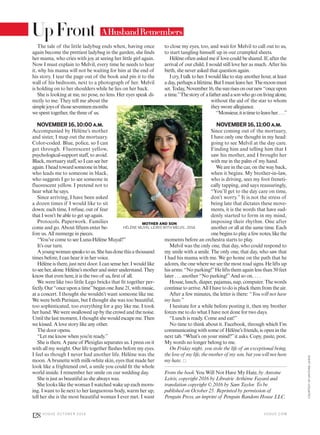
MOTHER AND SON
HÉLÈNE MUYAL-LEIRIS WITH MELVIL, 2014.
AHusbandRemembers
V O G U E . C O M
128 V O G U E O C TO B E R 2 0 1 6
UpFront
COURTESYOFANTOINELEIRIS
Losing Out Loud
Three years ago, former front-runner CHRISTINE QUINN suffered a high-profile
defeat in New York City’s mayoral race. But what came next? A period of deep
reflection, she writes—and a renewed passion to help the homeless.
I
lost my mother when I was sixteen. She always
made clear to my sister and me that we were win-
ners, that nothing could stand in our way—not
opposition, not sexism, nothing. We were strong
Irishwomen, and Irishwomen push through.
Herconvictionpropelledmeintopolitics,intothe
speaker’s chair of the New York City Council for
eightyears,and,in2013,intothemayoralrace.Anditseemed
for some time that my mother had been prescient. The poll
numbers, public opinion, and conventional wisdom all told
a consistent story: I would win the race and make history as
thefirstfemale,andfirstopenlygay,mayorof NewYorkCity.
AndsoIranoutof thegate,throughthefiveboroughs,full
of joy and momentum. I was constantly thinking of women
and girls, and LGBT children, who grew up feeling hopeless,
and what my victory could mean for them and their futures.
Thatmomentumchangedfast.SuddenlyIwatchedmylead
slip away. I felt powerless to stop it. I stood in the spotlight as
the prospect of certain victory turned into clear and convinc-
ing defeat. The final weeks of campaigning, when I knew I
wouldn’t succeed, were excruciating.
Thenitwasover.Iconceded,whilemyamazingwife,Kim,
kept her hand on my lower back for support. A week later, I
stoodinfrontof CityHallandendorsedmyopponent,Billde
Blasio. Those days are still white-hot in my mind.
Today,threeyearson,Iremainstruckbyhowdifficultitall
was.I’dalwayshadthetoughestpersona,thethickestskin,the
loudest voice, the most boisterous laugh. I’d moved quickly
and let the brickbats bounce off me. Fragility was anathema,
failureadirtyword.Thestrengthmymothergaveuswithboth
hands prepared me to work hard, expect success, to strive for
it, and to believe in my own limitlessness.
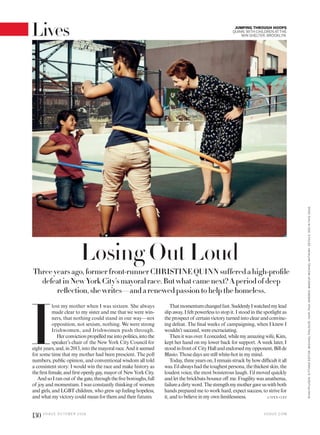
JUMPING THROUGH HOOPS
QUINN, WITH CHILDREN AT THE
WIN SHELTER, BROOKLYN.
RYANPFLUGER.SITTINGSEDITOR:MICHAELPHILOUZE.HAIR,PAULWARREN;MAKEUP,MICHAELANTHONY.DETAILS,SEEINTHISISSUE.
LIV ES >1 32
V O G U E . C O M
130 V O G U E O C TO B E R 2 0 1 6
Lives
Immediately following the results, I focused on wrapping
up my term as speaker, work that provided me with a much-
needed distraction. I insulated myself with obligations, dead-
lines,andmeetings,refusingtoallowadownminute.Itriedto
ignore the fact that there was a mayoral transition the whole
city was watching, and that it wasn’t mine. True to form, I
threwmyself intothiseffortandpostponedaddressingtheim-
pact of the race—not on my political career but on my heart.
The day after the primary was September 11. I went down
to the Memorial because that’s what I had done every Sep-
tember11foreightyearsasspeaker.Iturnedmyphoneoff,of
course.AndwhenIfinallyturneditbackonhourslater,Isaw
three missed calls from Hillary Clinton’s office. Then I went
home and got under the covers. There were more calls from
her office. I called her back, which was difficult for me. It was
a very emotional call. She told me how hard it had been for
hertowatchwhatwashappening.PresidentClintoncalledthe
sameday.I’llneverforgetit.Hesaid,“Justkeepdoinggood.”
My ennui felt embarrassing, shameful even. I felt that I
had so profoundly let everyone down. I wanted to avoid be-
ing seen. Kim had to walk the dogs; I didn’t want to go out.
I sat at home watching TV—thank God for NCIS reruns
and SVU—ruminating on all that I had not done right. Over
the holiday we went to Thailand: I wanted to be somewhere
halfwayaroundtheworldwithalottosee,aplacewhere,even
if I was trying to troll the blogs, it would be hard to keep up.
When I talked to Andrew Cuomo after my defeat, he said,
“Look, all you did was lose. I imploded in front of the whole
state of New York, and look at me now—I’m the governor.
You’llbefine.”AndIsaid,“Howlongtillyoufeltbetter?”He
said: a year. “A year? That’s horrible!”There he was, this big,
tough guy. He said, “I’m just telling you the truth.”
Back home again, it was difficult to figure out what to do.
Should I throw myself into finding a new job? Should I take
some time, as Kim was advocating? People were lovely, but I
didn’twanttogettogetherwiththem.Ireplayedeverydecision
I had made: We had peaked too early. I should have punched
back when the people who wanted horse carriages banned
got funding from an outside group and ran attack ads that
misrepresented my position. I remember an interview with
Barbara Walters when she was asked, “What’s your biggest
regret?”Shestartedlaughingandsaidsomethingtotheeffect
of, “Oh, I’ve asked people that question a million times, and
somepeoplesay,‘Ihavenoregrets.’IregretIworetheseshoes
instead of the tan ones, you know? I regret these earrings.”
I kept thinking about that because I had a litany of regrets.
SlowlyIbegantosharethem.Thedefeatanditsimpactforced
metoseethatbarrelingthroughchallengeswithoutacknowl-
edging their difficulty was a strategy that had its limitations.
And then I got out of bed. Kim and my amazing fam-
ily and friends helped. So did the dozens of everyday New
Yorkers who stopped me while I was walking
And so I lived and grew through coming out as a lesbian
in a less enlightened time; through losing my mom to cancer
before I’d finished high school; through wrestling with alco-
holism and bulimia. I rose to the top of the political heap in a
toughcity—andIstoodfirmthrougheveryloss,resoluteand
ready to tackle the next challenge. But my mother, whom I
missandlove,leftmeunpreparedinonesense.Shetaughtme
to power through, and I have, but at a cost.
L
osing in private is hard. Losing in public is hard-
er. And I think women lose and fall harder than
men. To outsiders, the stakes seem different,
and the conversation is skewed; to me, being
a woman—and being gay—meant a different
recovery process. When I lost, I felt as though I’d disap-
pointed thousands of people I’d never met who had pinned
their hopes on me.
Politics is a mixture of the deliberate, languorous pace of
crafting legislation and the frenetic contact sport of elec-
tions and jockeying for the next headline. I thrived in that
rough-and-tumble world, working my way up from young
staffer to the city’s top lawmaker; it was exhilarating and
deeply fulfilling.
But there’s a flip side to those highs. Politics can be binary:
all or nothing, yes or no, win or lose. Whenever there was a
badpressstory,orif Imadeamistake,Iwouldbeatmyself up.
AndsoitwaswhenIlosttheraceformayorof NewYorkCity
thatwas,tociteapostmortemNewYorkTimesdocumentary
that I’ve never brought myself to watch, mine to lose.
Mayorof NewYorkCity.ItwasajobI’dkeptaneyeonmy
whole career. On Primary Day, I was campaigning outside a
supermarket on the Upper West Side when a group of girls,
ten or eleven years old, spotted me and called out, “There’s
Chris Quinn, the woman who’s running for mayor!”As the
light changed, they ran across the street to meet me. I’ll never
forget that one of them shook my hand and burst into tears.
Girls that age are their most pure selves. They aren’t chil-
dren;theyhaveaheadontheirshouldersandhaven’tyetbeen
corruptedbythetoxicityof asocietythatpitswomenagainst
one another. As I hugged her, she said through her sobs how
incredible it was to her that a woman could be mayor, and to
meet her, and to visualize it. When I conceded, only hours
later,allIcouldthinkof wasthatgirl.Shepersonifiedtheloss.
I’m still struck by how hard it is to separate what’s per-
sonal—as in what’s uniquely mine—from what’s necessarily
asharedexperiencewithotherwomen.Partof thatisbeinga
publicfigure,sonaturallyIknewalotof eyeswereonmeand
thatotherpeoplelookedatmydestinyandsawtheirs.I’malso
stillshockedbyhowlongthepersonalimpacthasaffectedme.
While there were still, officially, two more months to the
mayor’s race, the night I lost the primary was the decisive
moment. New York is an overwhelmingly Democratic city;
no Republican had a realistic chance at victory in a citywide
race. Bill de Blasio shot ahead of me and Bill Thompson, the
former city comptroller, to secure his spot on the Democratic
ballot against a long-shot Republican, effectively sealing the
deal. In the same breath that the networks hailed de Blasio as
a victor, the talking heads deemed my political career over.
Kim had to walk the dogs. I sat at
home watching TV and ruminating
on all that I had not done right
LIV ES >14 0
TheComebackKid
V O G U E . C O M
132 V O G U E O C TO B E R 2 0 1 6
Lives
things that allowed me to contribute, but on some days I still
felt dogged by the feeling that I had failed people.
Thecompanionshipof brilliantwomen,andmentoringthe
next generation, brought me joy as I taught politics at Har-
vardforasemester.Iworkedalongsidefiveincrediblefellows,
including two formidable female public servants: former U.S.
senator Kay Hagan of North Carolina and former Massa-
chusettsattorneygeneralMarthaCoakley,bothof whomhad
also recently suffered high-profile political defeats. Bonding
with them—in the student dining halls, at yoga class—was a
way to share an experience to which few can relate. We sup-
ported one another through laughter and tears and looked
ahead, trying to rebound and figure out our next chapters.
Last fall, two years after my defeat, I felt ready
to return to public service, and I yearned to get
backtomyroots.Atthebeginningof mycareerI
wasahousingadvocateandtenantorganizer,as-
sistinglower-incomeNewYorkersastheyfought
fortheirrighttoaffordablehousingandfreedom
frompredatorylandlords.Manywerepoorwom-
en of color, including seniors and young single
moms.Thefeelingof helpingtoreverseanunfair
evictionandkeepingthesewomenintheirhomes
was sweeter than any political triumph.
I
n November 2015, I started my first full-
timepost-politicsjob.IrunWin,formerly
called Women in Need. It’s New York
City’s largest nonprofit that provides
shelter and support services for homeless
women and their children, offering them their
ownunitsinelevenshelters.Duringtheday,these
women work, look for jobs, and send their kids
off to school. At night, they serve dinner and
help with homework. Many have fled domestic
violence or are in recovery from substance abuse
or mental illness. Many grew up homeless them-
selves. Some are undocumented. They are the
forgotten faces of homelessness.
I knew that taking the job at the very moment that the
mayorwasbeingpilloriedbythepressforhismanagementof
NewYork’sacutehomelessnesscrisismightraiseaneyebrow.I
couldseetheheadline:onetimerivalquinntoplaydeblasio
foil on homelessness. But I also knew that to be effective in
myrole,Inotonlyneededtojoinforceswiththemayor,Ineed-
edtosupporthisadministration’seffortstogetahandleonthe
problem.Ihadtodothisknowingthatmydefeatin2013came
in large part due to a sustained attack he levied, falsely accus-
ingmeof lookingoutforthewealthyattheexpenseof every-
one else during my time as City Council speaker. Partnering
with him was tough at first, but in fact we work well together
andareunitedbyourmutualloveforNewYorkandthedesire
to help people—and that matters much more than politics.
In the political arena, I had an extraordinary opportunity
this summer to play a part as a surrogate in supporting the
presidential bid of Hillary Clinton. She’s one of my mentors,
who was there for me in good times and not-so-good times.
Thenightshewinsthepresidencywillbeawatershedmoment
for women and girls everywhere.
the dogs, spinning, getting a haircut, eating out, or riding
the subway, to offer a kind word and a pat on the elbow. It
meant the world. I received a lovely note from New York’s
Cardinal Dolan (who, as you can imagine, agrees with me on
some things but certainly not everything). He said, “I haven’t
heard from you, so I fear you think I only liked you because
youwereinapowerfulposition.That’snottrue;Iactuallylike
you. When can we get pasta?”
That first winter I was out of office, Kim said to me one
nightovertakeout,“Whatdidyouusedtolovetodothatyou
didn’tgettodowhenyouweresobusyinpolitics?”And—this
is so ironic in view of those anti–horse carriage advocates—I
answered, “I used to love riding horses.”We have a house on
the Jersey Shore, so we went to find a stable. I started taking
lessonsandthenveryquickly,andperhapsimpulsively,bought
a horse who was too young, too high energy, and very bom-
bastic. I know, I know . . . that does ring some bells. I began
torideherandtakecareof her,which—particularlywiththis
horse, who was very needy—was wonderful and reaffirmed
that I could be helpful outside government or politics.
Mylifebegantoseembrighter,andIfeltstrongerandsurer
of myself.AndrewCuomoaskedmetohelphimworktoward
legislation dealing with sex crimes in the university system,
and I seized the opportunity to give voice to those who were
silenced in the seemingly unending epidemic of rape on col-
lege campuses. I returned to my advocacy roots by joining
nonprofitboards:pushingforchoiceandwomen’shealthand
reproductiverightsattheNationalInstituteforReproductive
Health Action Fund; advocating for LGBT youth through
the Tyler Clementi Foundation; and fighting for equality in
sports through Athlete Ally—especially as Russia repressed
theLGBTcommunityduringtheSochiOlympics.Allof these
stepsforwardwereimportantvictories—buttherewereocca-
sionalsetbacksandbumpsintheroad.Iwasdoingrewarding
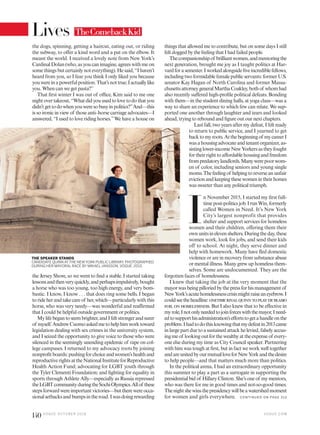
THE SPEAKER STANDS
CANDIDATE QUINN ATTHE NEWYORK PUBLIC LIBRARY, PHOTOGRAPHED
DURING HER MAYORAL RACE BY MIKAEL JANSSON, VOGUE, 2013.
TheComebackKid
C O N TIN U ED O N PAG E 31 2
V O G U E . C O M
140 V O G U E O C TO B E R 2 0 1 6
Lives
Even at its most tumultuous, the love between KIRA VON EICHEL’s
unconventional parents held the entire family in its thrall.
W
hen my mother was pulled
into a pool in the midst of a
raucous party, it was by my
father, who was in the pro-
cess of divorcing her. It was
2002, at a farm in Virginia.
The dancing at the party was
frenetic, and the two of them, Henry and Lindy, were at the
center of it. Even as they were coming undone, they couldn’t
stopdancingwitheachother.Atsomepointsomeonepushed
a guest, fully clothed, into the pool, setting off a cheerful
melee of tumbling waterborne partygoers. My mother play-
fully shoved her soon-to-be ex-husband, and as he fell, he
grabbed her arm and she tumbled in on top of him. They
were underwater unraveling limb from limb, and when my
father emerged to the surface he screamed bloody murder.
My mother claims she wasn’t trying to drown him; that
she couldn’t control where she fell in after him. I believe her.
She’s not the murderous type. But he went on to repeat the
story throughout Washington, D.C., and all the way to Mu-
nich, where most of his family lived. Can you believe Lindy
tried to drown me?
A year before the party, 9/11 happened, and my parents
were still living in the house together. My brother, sister, and
I were in New York. We each made it to our homes safely,
and when the phone lines opened, we called one another.
My sister insisted we all drive to Connecticut, to her mother-
in-law’s house. My husband and I were in our apartment in
LittleItaly.Iwantedtostay.Thephonerangagain,anditwas
LindyandHenry.Theywereonthekitchenphone,theysaid.
Icouldpicturetheirfacespressedtogethertothereceiver,and
Iyearnedforthem.Theytoldmetogo;theysaidtheyneeded
to know we were all safe.
So we went. The mother-in-law told me that it was prob-
ably good that our parents were splitting up because we were
too obsessed with them. It was true. But
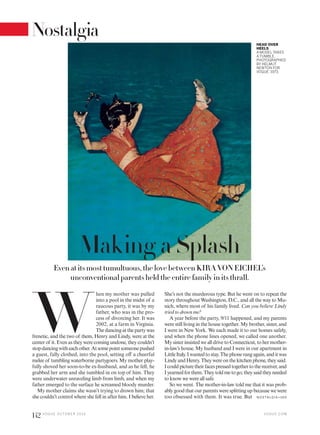
HEAD OVER
HEELS
A MODEL TAKES
A TUMBLE.
PHOTOGRAPHED
BY HELMUT
NEWTON FOR
VOGUE, 1973.
N OSTA LG IA >16 0
Making a Splash
V O G U E . C O M
142 V O G U E O C TO B E R 2 0 1 6
Nostalgia
what she missed was that being in their club, loving them so
much and being taken on their ride—sometimes blissfully,
at other times stressfully—was all we knew.
Other people reject their parents as early as twelve. It’s
a rite of passage and self-determination. Our position was
more slippery. Our parents had had my sister and me when
they were in college—in a sense we’d grown up together.
They moved from Switzerland to Toronto, where my father
worked at the Bank of Nova Scotia and my brother was
born. My siblings and I were still small children when we
moved again, to Washington, D.C. And we were misfits,
no country to call home, split between Europe and North
America. We defined ourselves by our unconventional par-
ents and lived in the cocoon of being their offspring.
T
hey met in 1968. He was a young German bar-
on banished to Canada for a series of infrac-
tions that included too-long hair and a love of
rock’n’roll. She was a Toronto WASP turned
beatnik in the thirteenth grade of Branksome
Hall,theschoolhermotherhadalsoattended.Heshowedup
a Pied Piper, leading her into corners of Toronto she’d never
explored to buy exotic cheeses and German bread for picnics
on her family’s farm. And no one was a better combination
of nurturing and game than she. She kissed away the many
wounds of his somewhat gothic upbringing: the cold castle;
the coal in his stocking.
We didn’t grow up as the kids of hippies or as typical
children of privilege. Our rambling Victorian house in D.C.
attracted people from all walks of life. They gathered week
after week throughout my childhood to be dazzled by my
father and comforted by my mother. Relatives in tasteful
tweed from Germany, bagpipe- and bridge-playing Cana-
dians, think-tank fellows, liberal senators, poets, and artists
who otherwise eschewed human company, all met there. A
friend of my brother’s who slept over often called them von
Eichel Kitchen People.
Ours wasn’t a show house; it was decidedly lived-in. Fab-
rics from around the world covered Biedermeier sofas. My
mother’s obscure poetry journals and our Hindu comic
books from the ashram we had been to weighed down the
tables. The place was filled with strange collections that
ranged from my father’s ivory heads to his great-grand-
father’s ancient coins to tableaux of Tintin figurines. My
father dressed us in baggy pants from Argentina, raincoats
from Australia, and Liberty print dresses from London. My
mother wrote us letters apologizing when she lost her temper
and included snippets of Emily Dickinson or William Blake
to make a point.
Screaming fights and flying porcelain, and my mother’s
threats to leave and never come back, regularly accompa-
nied summer visits to relatives’castles in Germany or to my
mother’s parents’horse farm in Ontario. We were described
by our parents as classless and free, but instructed that chew-
ing gum was gauche. We weren’t allowed to cut bangs, as we
were told one should never conceal one’s forehead, but Doc
Martens boots and hair dyed blue-black were applauded.
Impeccable table manners were non-negotiable, yet loud
conversation and strong opinions were encouraged.
Walkinginonourparentsinflagrantewasnotuncommon,
andIalwayssawitasproof thatallwaswellinspiteof thefights.
Andhereiswhereitgetstricky.Hewasunfaithfultoher.With
allhisbrilliance,anditshighs,sexwasboundtoenterthemix.
And so, suddenly, after 33 years, the beautiful chaos and
idealism couldn’t hold the center. We three children each left
home for universities in the 1990s. By the time our parents
began to split in 2001, they had grown into adults with differ-
ent values. He reverted back to type, as a German aristocrat,
whilehercommitmenttopsychologydeepened.Whenthefive
of us were together, the old theater of the perfect bohemian
family endured, but when the weekend was over, they grew
more distant again.
Their breakup felt as though it were against the laws of
nature, not just to us but to a whole group of friends who
couldn’t fathom how it was possible. We had to rearrange
our entire sense of things, try to know one parent without
the other. Together they had been irresistible, in spite of their
many flaws, and apart they were too human, and the flaws
felt too close to the bone. He had never been faithful; she was
chaotic and prone to rages. Henry was drawn like a magpie
toshinythingsandpeople;Lindy,inthosedays,neededtobe
needed a touch too much. Neither one was able to do in the
world alone what they’d done together.
Henry died young, at 64, of complications from leukemia.
My brother and I found a box of letters he’d saved from
various conquests during the years he’d been unfaithful to
my mother. They were hilariously poorly written, which my
brotherpointedoutwasarelief—Mommywouldneverwrite
stupidletterslikethat.Whenhesaidthis,ourmotherlaughed
and said that when she’d rail against the affairs, he would
explain that he didn’t love the others the way he loved her.
Four years later, I still miss him acutely. Lindy, at long last,
became a therapist, on top of being a poet. My two siblings
and I talk almost daily, share friends and playlists, and can’t
help living within blocks of one another in Brooklyn.
A few weeks before my father died, I lay in his bed at the
house he shared with his second wife in Austria. We were
holding hands, and he said he wished my mother could see
the view of the lake from the window, as if the end of his life
didn’t quite make sense without her to bear witness.
Impeccable table manners were
non-negotiable, yet loud conversation
and strong opinions were encouraged
JOY RIDE
HENRY TAKES LINDY FOR A SPIN IN GERMANY, 1970.
V O G U E . C O M
160 V O G U E O C TO B E R 2 0 1 6
COURTESYOFKIRAVONEICHEL
CrazyforThemNostalgia
W
ho’s going to play me?” Franca
Sozzani asked when her son,
Francesco Carrozzini, informed
her that he was planning to
make a film about her life. “You
are playing Franca,”he replied.
And who better to bring to life the spectacular career of
this editor in chief, for 28 years at the helm of Italian Vogue,
than the woman herself?
Carrozzini’s new biopic, Franca: Chaos and Creation,
took six years to complete. Though he began by immers-
ing himself in other biographical films—Anderson Coo-
per’s documentary with his own mother; Martin Scorsese’s
Italianamerican; My Architect, by Nathaniel Kahn,
about his father, Louis Kahn; and Sarah Polley’s Sto-
ries We Tell among them—some of the subjects of those
films were deceased. But even when they were alive, were
they as seemingly impenetrable as the enigmatic Sozzani?
Persuading his mother to embark on the project in the
first place was no easy task. “She said yes—but there were a
lot of buts,”Carrozzini recalls. “Many times she didn’t want
to keep doing it; it was too hard—I feel like the whole thing
almosttankedsevenoreighttimes!Wearguedsomuchabout
things—not about content but about the music, the colors,
certain home videos she didn’t want in. She was relentless!”
he says, laughing. “It was a lot of ‘Fuck you,’a lot of ‘I love
you.’”Carrozzinismiles.“Mymothertreatsmelikeshetreats
herphotographers:Whenyoudon’thear,youknowit’sgreat.”
It proved far simpler to get his mother to talk about her
business life than her personal story, but even there, he says,
Sozzani is a woman of famously few
REEL LIFE
FRANCA SOZZANI WITH HER SON, FRANCESCO CARROZZINI,
PHOTOGRAPHED BY BRUCE WEBER, 2016.
AfascinatingnewdocumentaryaboutItalianVogueeditor
FrancaSozzanicouldn’tbeanymorepersonal—itwasdirected
byherson.LynnYaegergoesbehindthescenes.
AllAbout
MyMother
TA L K I N G FAS H I O N >16 8
V O G U E . C O M V O G U E O C T O B E R 2 0 1 6
167
EDITORS: MARK HOLGATE & MARK GUIDUCCI
TalkingFashion
words. And, in fact, one gets a sense of
the subject’s silent authority in the scenes
where Carrozzini films her strolling alone,
perfectlycoiffed,exquisitelygarbed,andlost
in thought through a snowy Central Park.
A first cut of the movie was rejected—
Sozzanitoldhimcurtlythatitdidn’tgodeep
enough, that it was like a TV movie—but
both agreed that the final version, completed
in April, was good to go. Carrozzini says he
hopes that he has fulfilled Baz Luhrmann’
friendly instructions: “Make the movie tha
only you can make—bring to the table you
mother and you,”the director told him.
Carrozzini was aware practically from birth
that Sozzani was no ordinary mom. Not only
wasshedrivenanddetermined,shewasalso—in
her fearlessness, her wild imagination, her unique way of
fusing social issues with fashion—not like any of her profes-
sional contemporaries.
“I didn’t even know what I was doing—it even surprises
me,” Sozzani says, laughing as she takes the measure of
a tenure that includes flaunting models posed in daring,
socially conscious scenarios shot by stellar photographers
who were allowed not just to push but to smash boundar-
ies. As Bruce Weber, who worked with her from her earliest
days, explains in the film, “She wasn’t asking me a million
questions. I thought, Wow, she trusts me!”
For almost three decades, trusting luminaries that include
Weber, Peter Lindbergh, and Tim Walker, Sozzani has been
buildinganotoriousbackcatalog,including“Water&Oil,”a
2010featurethatfamouslyofferedmodelKristenMcMenamy
covered in oil and supine on a beach, a clear reference to the
horrific BP spill. The photographer for this scandalous effort
was her stalwart comrade Steven Meisel, who has shot so
many of her covers, and the ensuing controversy—whatever
was this doing in a fashion mag?—landed Sozzani on CNN.
“Why can’t I talk about it? Why can’t a fashion magazine
talk about what’s happening in the
world?”Sozzanirespondswhencrit-
ics suggest that her topics—women
swooning in graveyards, women ar-
rested, women abused, a gaggle of
models in various stages of plastic
surgery—havenoplacebetweensoft
covers. “Market researchers always
say, Do this, do that.”She shrugs. “I
did the exact opposite of what they
said. I don’t think that today a fash-
ion magazine can only show you the
clothes, and that’s it.”
Perhaps the most famous exam-
ple of this manifesto was her July
2008 Black Issue, a decision to fea-
ture black models exclusively. Some
thought this was perhaps meant to echo the segregation
rampantintheindustry,butSozzaniarguesthatherintention
was just the opposite. “I knew it would be controversial, but
I was sure that was the right moment.”In any case, the issue
sold out and was reprinted twice.
SozzaniwasbornintoaprosperousnorthernItalianfamily
(thefilmincludeshomemoviesof herasachildenjoyinglush
summerholidays)andsaysshealwaysthoughtshe“wasgoing
to have a bourgeois life—a husband, kids, a country house,
a beach house.”She married young, but the union was very
brief—asked why she went through with it in the first place,
shedeadpans,“BecauseIwasalreadywearingthedress.”She
planned to study physics at university—never imagining the
combustible mixture she would introduce in the pages of a
magazine—before switching to philosophy and literature.
Thentwothingshappenedthatchangedherforever:Shefell
in love with Yves Saint Laurent—because, she says, he gave a
womanpermissiontodresslikeaman—and,inthelate1960s,
she visited London. “At that time in Italy there was a very
conservative way of dressing,”she remembers. “When I went
to London, I found a totally new world, and it changed me
completely:notonlymyapproachtoclothesbutevenmyway
of living. We were breathing a completely antiestablishment
kind of air. Maybe in my head I never came back.”
Sozzanineverabandonedthatrevolutionaryoutlook.From
the first, she says, “I knew that Italian Vogue would not just
be a social magazine. It was important for me to do some-
thing different.”Something different, indeed: The strength
of thephotographs,theinternationallanguageof images,the
unique way they merge brutal reality with fantasy are what
gives her work its special power: “I add the dream!”as Soz-
zani says. And while that’s true, there is a firm reality behind
thatdream—onethathersonbrilliantlyelucidatesinFranca:
Chaos and Creation. In taking as its subject this iconic editor,
who has until now remained a rather mysterious figure, he
shows us a woman—a mom!—whose vision has always been
laced with courage and humor.
But if the pictures in her magazine are provocative,
the invisible hand is gentle. “You need to be light in life,”
Sozzani explains in the film. “Lightness for me is when being
profound allows you to fly high.”
FAMILY TRADITION
SOZZANI’S FATHER WALKS
HER DOWN THE AISLE. TA L K I N G FAS H I O N >17 8
t
d
e
’s
at
ur
ROLE CALL
MODELS KRISTEN MCMENAMY (LEFT), 2010,AND JOURDAN DUNN
(RIGHT), 2008. CENTER: MODEL LINDA EVANGELISTA, 2005.ALL
PHOTOGRAPHED FOR ITALIAN VOGUE BY STEVEN MEISEL.
V O G U E . C O M
ROLECALL:COURTESYOFITALIANVOGUE.FAMILYTRADITION:COURTESYOFFRANCASOZZANI.
168 V O G U E O C TO B E R 2 0 1 6
TalkingFashion
CartoonCOUTURE
J
ust to be clear: While so-
cial media didn’t start the
fire that is street-fashion
illustration, they certainly
fanned its flames. Unlike
in the seventies and eight-
ies, though—the last time illustration
was this huge—the hottest illustra-
tors posting today are predominantly
female, and in their new relationships
with designers and brands they’re
having some fun with fashion. The
London-based painter Helen Downie
began quietly putting her work on
Anewgenerationofartistsisredrawingthelines
aroundfashion,illustration,andsocial-mediawhimsy.
practitioners have set up pad and pa-
per in New York. Joana Avillez grew
up drawing, her mother a painter and
photographer and her father a Por-
tugal-born illustrator. “My dad and
I would just draw all the time,” she
recalls, “and after dinner we’d all be
working on something together.”She
went to school for painting, but after
a stint in the art world she published
Life Dressing: The Idiosyncratic Fash-
ionistas—sketchesof twoolderwomen
who,asAvillezwrote,“livetodressand
dresstolive.”Thesedays,sheconsiders
herself less a fashion illustrator than
anillustratorof
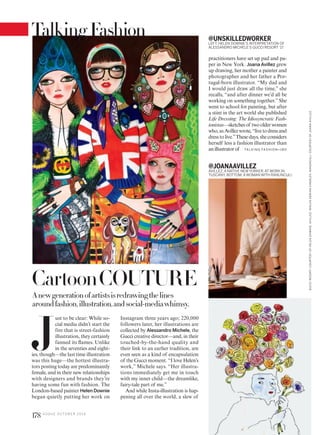
@UNSKILLEDWORKER
LEFT: HELEN DOWNIE’S INTERPRETATION OF
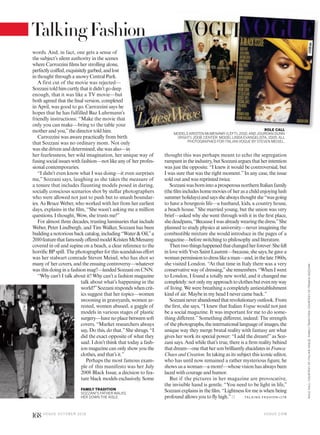
ALESSANDRO MICHELE’S GUCCI RESORT ’17.
Instagram three years ago; 220,000
followers later, her illustrations are
collected by Alessandro Michele, the
Gucci creative director—and, in their
touched-by-the-hand quality and
their link to an earlier tradition, are
even seen as a kind of encapsulation
of the Gucci moment. “I love Helen’s
work,” Michele says. “Her illustra-
tions immediately get me in touch
with my inner child—the dreamlike,
fairy-tale part of me.”
And while Insta-illustration is hap-
pening all over the world, a slew of
@JOANAAVILLEZ
AVILLEZ, A NATIVE NEWYORKER, AT WORK IN
TUSCANY. BOTTOM: A WOMAN WITH RANUNCULI.
TA L K I N G FAS H I O N >1 8 0
GUCCIRESORT:COURTESYOFHELENDOWNIE.AVILLEZ:NIKLASADRIANVINDELEV.RANUNCULI:COURTESYOFJOANAAVILLEZ.
178 V O G U E O C TO B E R 2 0 1 6
TalkingFashion
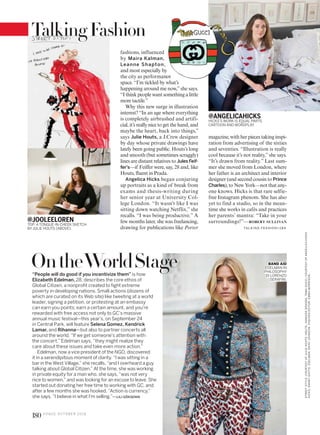
@JOOLEELOREN
TOP: A TONGUE-IN-CHEEK SKETCH
BYJULIE HOUTS (ABOVE).
@ANGELICAHICKS
HICKS’S WORK IS EQUAL PARTS
CARTOON AND WORDPLAY.
fashions, influenced
by Maira Kalman,
Leanne Shapton,
and most especially by
the city as performance
space. “I’m tickled by what’s
happening around me now,”she says.
“I think people want something a little
more tactile.”
Why this new surge in illustration
interest? “In an age where everything
is completely airbrushed and artifi-
cial, it’s really nice to get the hand, and
maybe the heart, back into things,”
says Julie Houts, a J.Crew designer
by day whose private drawings have
lately been going public. Houts’s long
and smooth (but sometimes scraggly)
lines are distant relatives to Jules Feif-
fer’s—if Feiffer were, say, 28 and, like
Houts, fluent in Prada.
Angelica Hicks began conjuring
up portraits as a kind of break from
exams and thesis-writing during
her senior year at University Col-
lege London. “It wasn’t like I was
sitting down watching Netflix,” she
recalls. “I was being productive.” A
few months later, she was freelancing,
drawing for publications like Porter
magazine, with her pieces taking inspi-
ration from advertising of the sixties
and seventies. “Illustration is really
cool because it’s not reality,”she says.
“It’s drawn from reality.” Last sum-
mer she moved from London, where
her father is an architect and interior
designer (and second cousin to Prince
Charles), to New York—not that any-
one knows. Hicks is that rare selfie-
free Instagram phenom. She has also
yet to find a studio, so in the mean-
time she works in cafés and practices
her parents’ mantra: “Take in your
surroundings!”—ROBERT SULLIVAN
“People will do good if you incentivize them” is how
Elizabeth Edelman, 28, describes the core ethos of
Global Citizen, a nonprofit created to fight extreme
poverty in developing nations. Small actions (dozens of
which are curated on its Web site) like tweeting at a world
leader, signing a petition, or protesting at an embassy
can earn you points; earn a certain amount, and you’re
rewarded with free access not only to GC’s massive
annual music festival—this year’s, on September 24
in Central Park, will feature Selena Gomez, Kendrick
Lamar, and Rihanna—but also to partner concerts all
around the world. “If we get someone’s attention with
the concert,” Edelman says, “they might realize they
care about these issues and take even more action.”
Edelman, now a vice president of the NGO, discovered
it in a serendipitous moment of clarity. “I was sitting in a
bar in the West Village,” she recalls, “and I overheard a guy
talking about Global Citizen.” At the time, she was working
in private equity for a man who, she says, “was not very
nice to women,” and was looking for an excuse to leave. She
started out donating her free time to working with GC, and
after a few months she was hooked. “Action is currency,”
she says. “I believe in what I’m selling.”—LILI GÖKSENIN
OntheWorldStage BAND AID
EDELMAN IN
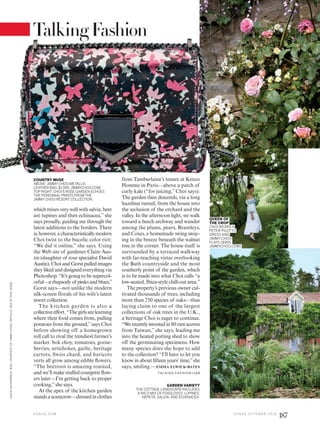
PHILOSOPHY
DI LORENZO
SERAFINI.
TA L K I N G FAS H I O N >1 8 4
STREETSTYLE:COURTESYOFJULIEHOUTS.HOUTS:VANESSAGRANDA.TAMAGUCCI:COURTESYOFANGELICAHICKS.
HICKS:DANNYGHITIS.EDELMAN:DAISYJOHNSON.FASHIONEDITOR:EMMAMORRISON.
TalkingFashion
180 V O G U E O C TO B E R 2 0 1 6
TalkingFashion
BLOOMS
withaViewSandraChoi’sEnglish-countryside
home—muchlikeherdesignsforJimmy
Choo—isbrimmingwithblossoms.
A
rose, to a deer, is like
caviar,” observes
Jimmy Choo cre-
ative director Sandra
Choi, greeting me at
the end of the mile-
long,tree-lineddrivetohernewEnglish
country home in Upton Cheyney,
Gloucestershire. The eighteenth-
century stone cottage has become a
choice destination for roe deer, led by
their surprisingly sophisticated palates
to the dense rose borders that encircle
the magical property. (The extensive
lands surrounding the house, mean-
while,include25 acresdevotedtosheep
grazing and 30 for an arboretum.)
Choi, 43, decamps to the country
most Fridays from the Battersea, Lon-
don, town house she shares with her
GREEN PEACE
CHOI SHARES
A QUIET
MOMENT IN
THE HAZELNUT
WALKWAYWITH
HER DAUGHTER
PHOENIX.
artist husband, Tamburlaine Gorst,
and their two daughters, Phoenix, six,
and Cyan, three. Breezily dressed in
a Peter Pilotto embroidered cotton
dress and Birkenstocks—somehow
managing to exude glamorous acces-
sibility even in her downtime—Choi
has filled the cottage with unexpected
and ravishing arrangements of local
flowers. With the garden taking center
stage, the interior of the house is “a
work in progress,” she says, though it
retains a welcoming English charm
with its sinking mounds of floral up-
holstery and fireplaces.
Raised in Hong Kong, Choi finds
countrylifeanentirelynewendeavor—
albeit one she seems to have taken to
rather naturally. “These are foxgloves;
this is nepeta,
BUDDING
BEAUTY
JIMMY CHOO SATIN
CAMOFLOWER-
PRINT MULE, $795;
JIMMYCHOO.COM.TA L K I N G FAS H I O N >1 87
V O G U E . C O M
KASIAGATKOWSKA.SITTINGSEDITOR:SONNYGROO.HAIR,
TERRICAPON;MAKEUP,REBEKAHLIDSTONE.SHOE:JOSEPHINESCHIELE.
184 V O G U E O C TO B E R 2 0 1 6
TalkingFashion
which mixes very well with salvia; here
are lupines and then echinacea,” she
says proudly, guiding me through the
latest additions to the borders. There
is,however,acharacteristicallymodern
Choi twist to the bucolic color riot:
“We did it online,” she says. Using
the Web site of gardener Claire Aus-
tin (daughter of rose specialist David
Austin),ChoiandGorstpulledimages
they liked and designed everything via
Photoshop. “It’s going to be supercol-
orful—arhapsodyof pinksandblues,”
Gorst says—not unlike the modern
silk-screen florals of his wife’s latest
resort collection.
The kitchen garden is also a
collective effort. “The girls are learning
where their food comes from, pulling
potatoes from the ground,”says Choi
before showing off a homegrown
roll call to rival the trendiest farmer’s
market: bok choy, tomatoes, goose-
berries, artichokes, garlic, heritage
carrots, Swiss chard, and haricots
verts all grow among edible flowers.
“The beetroot is amazing roasted,
and we’ll make stuffed courgette flow-
ers later—I’m getting back to proper
cooking,”she says.
At the apex of the kitchen garden
stands a scarecrow—dressed in clothes
from Tamburlaine’s tenure at Kenzo
Homme in Paris—above a patch of
curly kale (“for juicing,” Choi says).
The garden then descends, via a long
hazelnut tunnel, from the house into
the seclusion of the orchard and the
valley. In the afternoon light, we walk
toward a beech archway and wander
among the plums, pears, Bramleys,
and Coxes, a homemade swing sway-
ing in the breeze beneath the walnut
tree in the corner. The house itself is
surrounded by a terraced walkway
with far-reaching vistas overlooking
the Bath countryside and the most
southerly point of the garden, which
is to be made into what Choi calls “a
low-seated, Ibiza-style chill-out area.”
The property’s previous owner cul-
tivated thousands of trees, including
more than 250 species of oaks—thus
laying claim to one of the largest
collections of oak trees in the U.K.,
a heritage Choi is eager to continue.
“We recently invested in 80 rare acorns
from Taiwan,” she says, leading me
into the heated potting shed to show
off the germinating specimens. How
many species does she hope to add
to the collection? “I’ll have to let you
know in about fifteen years’time,”she
says, smiling.—EMMA ELWICK-BATES
COUNTRY MUSE
ABOVE: JIMMYCHOO METALLIC
LEATHER BAG, $1,595; JIMMYCHOO.COM.
TOP RIGHT: CHOI’S ROSE GARDEN ECHOES
THE PERENNIALPRINTS FROM THE
JIMMYCHOO RESORT COLLECTION.
GARDEN VARIETY
THE COTTAGE LANDSCAPE INCLUDES
AWILD MIX OF FOXGLOVES, LUPINES,
NEPETA, SALVIA,AND ECHINACEA.
TA L K I N G FAS H I O N >1 8 8
QUEEN OF
THE CROP
CHOI WEARS A
PETER PILOTTO
DRESS AND
JIMMY CHOO
FLATS ($995;
JIMMYCHOO.COM).
V O G U E . C O M V O G U E O C T O B E R 2 0 1 6
187
KASIAGATKOWSKA.BAG:COURTESYOFJIMMYCHOO.DETAILS,SEEINTHISISSUE.
ELLIE
Bamber
FIRE BIRD
THE ACTRESS
IN RED-HOT
CHANEL.
Y
ou must excuse my
hair,”says nineteen-
year-old Ellie Bam-
ber, pushing back
her damp auburn
locks. Dressed in
only an oversize Calvin Klein T-shirt
thrown over her bathing suit, the en-
ergeticBritishactressistakingabreak
from promoting Tom Ford’s film
Nocturnal Animals (page 288) when I
reach her via Skype at a villa with her
family on Spain’s Costa Brava. Even
post-swim, Bamber’s tresses against
her pale skin create an Egon Schiele
effect—and Ford, meanwhile, seems
to be developing a propensity for red-
headsakintoHitchcock’sforblondes.
Bamber, though, freely admits that
the color isn’t natural. “I turned red
for the film—but it suits me.”
As the on-screen daughter of Jake
Gyllenhaal and Isla Fisher, Bamber
is brazen, vulnerable, and at the epi-
center of the film’s violent story line.
“Tom created a safe environment,
despite the scary sequence of events,”
she says of the perfectionist director,
who changed her character’s nail pol-
ish after spotting a particular shade
on a wardrobe TA L K I N G FAS H I O N >1 9 0
alleyeson
V O G U E . C O M
PIERRESUU/GCIMAGES/GETTYIMAGES
188 V O G U E O C TO B E R 2 0 1 6
TalkingFashion
supervisor.Asixteen-weekstintatLon-
don’s Old Vic as Dinah in High Society
helped prepare her for the stamina of
the production, which was further en-
hancedbythecamaraderieonset.“Ellie
can sing, act—and she has this other-
worldly, ethereal beauty,”says Fisher.
From her first audition at his Victo-
ria offices, Ford immediately spotted
Bamber’sfashionflair—“HesaidIhad
great personal style; I was done after
that!” she says—and she’s since cap-
tured the attention of Karl Lagerfeld.
“If I’m not hanging out in Supreme or
LyzOlko,IlovetodressupinChanel,”
she says. “It’s got such a cool edge.”
Cool credentials seem to be some-
thing that Bamber comes by effort-
lessly. Next up: her first indie lead, in
Extra Curricular Activities, with Colin
Ford and Timothy Simons.—EMMA
ELWICK-BATES
ATA LINKS
OF LONDON
EVENT.
IN A SAM
GREENBERG
VINTAGE
JACKET,
IN GILES
DEACON.
IN MARKUS
LUPFER.
Though fashion consultant Kate Foley has lately
been more accustomed to lighting up Manhattan,
for her nuptials to Suno’s Max Osterweis she
gathered her friends from around the globe at the
exquisitely restored West Dean Gardens in her
home county of Sussex. A collection of Victorian
glasshouses and July flora provided the backdrop
for Foley’s crisp broderie anglaise Suno dress, set
off by her signature red lip. Passionflower vines
decorated the tables, where guests sat down to
a garden-fresh feast prepared by Tart London—
the first wedding for the eco-conscious London
caterers, who fulfilled the groom’s wish for a
childhood favorite: pineapple upside-down cake.
“I have married my best friend,” the charming
bride told me, moments before spinning around
the dance floor in her second look of the day, a
dazzling silver-sequined number by Erdem. —E.E.-B.
HEAVEN
AND EARTH
KATE FOLEYAND
MAX OSTERWEIS
CELEBRATE UNDER
A MAGNIFICENT
PERGOLA. RIGHT:
SIMPLY LUSH
FLORALS.
TA L K I N G FAS H I O N >1 92
SONICBloom
LONDON:DAVIDM.BENETT/GETTYIMAGES.MARKUSLUPFER:STUARTC.WILSON/GETTYIMAGES.GILESDEACON:RABBANI+SOLIMENE
PHOTOGRAPHY/GETTYIMAGES.SAMGREENBERG:MIKEMARSLAND/WIREIMAGE/GETTYIMAGES.SONICBLOOM:CINZIABRUSCHINI,PAOLOMANZI.
190 V O G U E O C TO B E R 2 0 1 6
TalkingFashion
Whichiswhytherecipeforaioliiscalled“IAlmostAlways
Fail.”“It’s totally true!”Tarlow admits. There’s also a week-
end-long ragù, an herb-loaded green gazpacho, and morel
toast so good you’ll want to befriend a forager.
Huling, meanwhile—teaming up with the same nearby
farms that supply the restaurants’ grass-fed beef—has just
openedMarlowGoods,anEastVillagestorefrontshowcasing
herlineof simple,functionalbagsandwalletsinarainbowof
vegetable-tanned leathers. There, the growing range includes
leather rugs, pillows, and bolsters, which began as prototypes
for their Brooklyn brownstone. The twin facets of the family
businessinvariablyintertwine:Hulingshotnextseason’slook
book inside Diner, and her leather covers the banquettes at
theirGreenpointbar,AchillesHeel.“They’veagedsobeauti-
fully,”she says.—LAURA REGENSDORF
W
illiamsburg in 1998 was desolate; we
just wanted to open a place where we
could all hang out,” Andrew Tarlow
says of the inspiration behind Diner,
his restaurant—now a neighborhood
fixture—born in a vintage Kullman dining car. That New
Year’sEve,heandhisthen-girlfriend,KateHuling,convened
20 or so friends to celebrate the first night of service. Never
mindthatthegaswasn’tturnedon,orthatyouthoutweighed
experience—what they had was a pot of cassoulet so satisfy-
ing, it foretold a lifetime rooted in the community of food.
“Theintimacyof itallwasinstantlypalpable,”recallsHuling.
Eighteen years and four bright-eyed children later, the
couplehaveleftanindeliblemarkonBrooklyn’sdiningscene
withagroupof influentialrestaurantsandbars(alongwitha
provisions shop, bakery, small-press magazine, and partner-
shipintheWytheHotel)groundedindeeprelationshipswith
staff, with farmers, and with regulars. It’s a family affair in
the broadest sense, which Tarlow and co-writer Anna Dunn
captureintheirfirstcookbook,DinnerattheLongTable(Ten
Speed). The book lays out a trove of recipes, a wide-angle
narrative—beginningwithTarlowandHuling’scoupdefoudre
while working together at the Odeon in Manhattan—and a
philosophy:thatentertainingshouldbefrequentandfearless.
“I hope this can inspire people to come together and not be
so scared of failing in the process,”he says.
ROOTS AND ALL
RECIPES LIKE PICKLED EGGS,
TINGED MAGENTA WITH
LOCAL BEETS, HIGHLIGHT
THE HERE AND NOW.
TwoBrooklynrestaurateursbring
hometheirvisionofthegoodlifewith
aleather-goodslineandacookbook.
SUNNY SIDE UP
LEFT: ANDREW TARLOW
AND KATE HULING
(IN AN A DÉTACHER
DRESS) AT THEIR
RESTAURANT MARLOW
& SONS. BELOW:
THE DINAN BAG BY
MARLOW GOODS, $555;
MARLOWGOODS.COM.
TALKING FASHION>194
FamilyStyle
TARLOWANDHULING:LIZBARCLAY.ALLOTHERS:NIKOLEHERRIOTTANDMICHAELGRAYDON.
192 V O G U E O C TO B E R 2 0 1 6
TalkingFashion
TheNew
BLUESMeetthelabelsputtingoutfall’s
mostcovetabledenim—sliced,
diced,andslightlydistressed.
LEAN BACK
MODEL LILY STEWARTWEARS NILI LOTAN JEANS, $425; NILI
LOTAN, NYC. CALVIN KLEIN COLLECTION TUNIC, $1,595; CALVIN
KLEIN COLLECTION, NYC. PACO RABANNE LOAFERS.NILI LOTAN
I
need those jeans,”my friend Stella says of my dark-
wash,slouchystyle—repletewithbuttonsthatclimb
the leg—over dinner at the Soho House’s newest
location, the Ludlow. Despite some apprehension
(I hadn’t donned wide-leg flares since junior high
school), I was instantly sold. She tries to guess the
label, rattling off a few usual suspects without success. But
this pair came from a new and unlikely source—one that’s
sure to inspire obsession among denim-heads everywhere. TA L K I N G FAS H I O N >1 9 8
Nili Lotan has always been grounded in realness; the
Israeli-born designer built her brand of covetable basics on
stripes, slips, and crisp white shirting. Given her highly per-
sonalapproachtodressing(Lotanisthefirsttoadmitthatshe
designs for herself), it makes sense that she is finally embrac-
ing blue as the warmest color. “I’m most at home in a pair of
jeans,”she says. But while denim is new to her namesake line,
Lotan’s fervor for the fabric runs deep. “As a kid, I begged
my dad to drive me to Haifa, where
V O G U E . C O M
VICKIKING.FASHIONEDITOR:ALEXHARRINGTON.HAIR,ILKERAKYOL;MAKEUP,JENMYLES.PHOTOGRAPHEDINHASTINGS-ON-HUDSON,NY.DETAILS,SEEINTHISISSUE.
194 V O G U E O C TO B E R 2 0 1 6
TalkingFashion
B
orrowing from the boys? Save for
a single long-ago skateboarder’s
plaid shirt (suddenly very Vete-
ments) and the odd attempt to
make off with my partner’s cloth-
ing,myeffortshavealwaysseemed
doomed. Instead of emulating the tomboyish
élan of Mica Arganaraz, I manage to look more
under the weather than anything. (Or, as my
mother might say, “as if you’ve let yourself go.”)
Enter Sean Barron and Jamie Mazur, the
brains behind the L.A. cult denim brand Re/
Done, who source vintage Levi’s, take them
apart, and recut them into contemporary sil-
houettes. “Every cool girl we knew wanted to
wear vintage Levi’s, and we worked out a way to
flatterbodiesnow,”saysBarron.Theduo’strade
secret:Thevintagebackpocketsaresignificantly
larger than most pockets today, resulting in a
beneficial optical illusion. “It makes your behind
look much smaller,”says Barron.
When Re/Done launched in July 2014 as an
e-commerce project with just two designs—
straight skinny and modified boyfriend—the
first 190 pairs sold out in 20 minutes, with 2,000
people signing on to the waiting list. And the
members of the label’s loyal cortege are as glossy
as they are devoted. “It’s hard to fall in love with
a pair of jeans without trying them on before-
hand,”saysactressEmilyRatajkowski,butthat’s
exactly what she—along with Beyoncé, Dakota
Johnson, Cara Delevingne, and Gigi and Bella
Hadid—did.“Everypairfitsdifferently,sofindingapairthat
fitsperfectlyfeelsincrediblyspecial,”saysKendallJenner,who
owns more than 20 pairs.
The way so many stylish women are responding to the
brand feels timely. In a moment when real, authentic (yet
still fashionable) gestures—the upscale hoodie, the elegant
track pant, the bespoke jean—are trumping gilded and
overwrought design statements, the desire to deconstruct,
reconstruct, and reconsider seems to reflect our ever-more-
multidimensional world. Thejeansarerepairedandreassem-
bledonricketymachinesfromthe1940sandheldtogetherin
part by official Levi’s rivets—the company gave Re/Done its
blessing four months into the launch. Now Barron and Ma-
zur are working with Hanes to make the perfect shrunken T-
shirt and with Champion for rescaled hoodies and sun-faded
varsity sweatshirts, while their own brand will soon include
patchworked denim pieces, mink-trimmed jackets, and their
first “new”jeans, to be called Re/Done Originals.
Inspired, I send the duo a challenge: to downsize a pair
of my husband’s vintage Japanese selvage 32/32 jeans us-
ing the formula at the crux of their business. The husband
hasn’t noticed that his jeans have gone AWOL—but will he
be able to place them after their L.A. overhaul? A mere 48
hourslater,theFedExfromLosAngelesarrives.Theanswer:
No—they’re now revitalized as a straight skinny 25/30 work
of art. (Warning re husband’s denim attentiveness: Results
may vary.)—EMMA ELWICK-BATES
RE/DONE
the American sailors came to sell Levi’s,”she recalls. “I lived
inmydenimjacketanddidn’tcareabouttheschooluniform.”
Cut to Lotan’s blues. The assortment of drop-crotch trou-
sers, hip-huggers, and a gently washed utilitarian jacket—
which evokes the effortlessly casual instinct that the brand
is known for—is laid-back in a way that transcends trends.
The best example here, the flirty-yet-unfussy Ena flared fit,
with a length of buttons that allow you to reveal a sliver of
skin (or not!), promises to put the ease in day-to-evening
dressing.Whoknowswhat’snextforLotan—asailorpantin
denim, perhaps? “Definitely maybe,”she says, smiling. Until
then, I’m taking a walk on the wide side.—RACHEL WALDMAN
PIECES OF WORK
MODEL LILY STEWARTWEARS A RE/DONE SHERPA-LINED DENIM
JACKET ($550) AND HIGH-RISE JEANS ($345); SHOPREDONE.COM.
PACO RABANNE TOP, $970; PACORABANNE.COM.
TA L K IN G FASH I O N >2 02
VICKIKING.FASHIONEDITOR:ALEXHARRINGTON.HAIR,ILKERAKYOL;MAKEUP,JENMYLES.PHOTOGRAPHEDINHASTINGS-ON-HUDSON,NY.DETAILS,SEEINTHISISSUE.
198 V O G U E O C TO B E R 2 0 1 6
TalkingFashion
FOR FASHION NEWS AND
FEATURES, GO TO VOGUE.COM
L
ake Starnberg is Bavaria’s fairy-tale spot:
deep-green forests, snow-capped Alps, a calm,
emerald lake. On a cloudy day the landscape
looks romantic—even melancholic—but, boy,
does it change when the sky opens up. Sun-
light glistens on the water; the whole horizon
sparkles.Ourfamilysummerhousefitstheromance:ayellow
eighteenth-century folly full of beautiful, hopelessly propor-
tionedrooms,eachmorecolorfulthanthelast,withwinding,
crooked wooden staircases leading you through.
The lake was where we spent our days growing up. When
the water was cold, we kept to the wooden dock next to our
simple boathouse, spinning fantastical stories about the dan-
gerous underwater plants waiting to wrap around our legs
anddragusdown.Mymother,aboyscoutatheart,taughtus
to water-ski and wakeboard, and had us dragged behind the
boat at breakneck speed in twin inflatable doughnuts. Tennis
andhorsebackridingwerealsoonthemenu.Anoldercousin
one summer brought his mountaineering equipment and
thus began a tradition of rappelling out the tower window.
These days my summers are a lot less extreme, but my
mother and I still take our waterskiing very seriously. And
thereisachaoticcomingandgoingof family—uncles,aunts,
cousins;youneverquiteknowwhowillappearthroughthose
gates. My sister’s little baby girl is the new attraction.
If LakeStarnbergisafairytale,thentheAustriancountry-
side around Salzburg is a veritable fantasy. The meadows are
fluorescent green, the mountain peaks shaped like Toblerone
chocolates; even the cows look perfectly checkered. Staying
at gallerist Thaddaeus Ropac’s estate, Villa Emslieb, during
festival season can feel fantastical too. Days pass as you laze
beside his black granite pool, inscribed by the Swiss artist
Sylvie Fleury with the fitting instruction to be amazing.
Thaddaeus has a knack for mixing up a potpourri of
houseguests. Artists, musicians, writers, actors, directors, ar-
chitects, younameit—anyonewhoisanyoneandhappens to
find themselves around Salzburg will show up for one of his
lunches,dinners,orparties.Makesmewonderwherehehides
his army of Oompa Loompas to run the show so smoothly.
BiancaJagger, anannualhouseguest,wasmyroomieonthis
visit. I loved watching her descend from her room deliciously
perfumed and decked out in her signature tailored suits or a
beautiful Cavalli leopard caftan. One night the young violin-
ist Joseph Morag and pianist Riko Higuma spoiled us with
Brahms,Rachmaninoff,andTchaikovsky.Othereveningswe
weretakentoasymphonyconductedbyDanielBarenboimor
arehearsalwithItaliansuperstarconductorRiccardoMuti or
the opera for a performance of Mozart’s Don Giovanni. That
nightendedwithschnitzelatSalzburg’smostlegendaryhotel,
Goldener Hirsch. Being amazing indeed.
Alpinegetawaysareforfamily,friends,and
extremewatersports.ElisabethTNThitsthe
highnotesinGermanyandAustria.
TalkingFashion
TNT
INTO THE
BLUE
LAKE
STARNBERG
IN BAVARIA,
GERMANY,
THE SITE OF
MYFAMILY’S
SUMMER
HOUSE.
PICTURE-PERFECT
ABOVE:THE SALZBURG CONCERTHALLHASAKOOKY,COOLSIXTIES
FLAIR,SO,OFCOURSE,I STAGEDAN IMPROMPTU PHOTO SHOOT.
LEFT: UPONARRIVALATTHADDAEUS’S HOUSEWEWENTSTRAIGHT
TOTHE POOL,WHICH REMINDED USTO BEAMAZING!
WANT MORE OF THE UNEXPECTED? FOLLOW TNT’S ADVENTURES AT VOGUE.COM/TNT.
BROUGHT TO YOU BY THE 2017 CHEVROLET MALIBU.
COURTESYOFELISABETHTNT
202 V O G U E O C TO B E R 2 0 1 6
EDITOR: CELIA ELLENBERG
Beauty
T
here are plenty of essentials in Isamaya
Ffrench’s “kit,”as the makeup artist refers to
themultitieredsuitcasecurrentlyoverflowing
in a Hollywood photo studio: cream founda-
tions,concealers,mascaras,andanimpressive
collection of HD makeup that Ffrench loads
intohertrustyairbrushgunwithhabitualease.
But the bulk of the contents are less familiar: Kryolan’s wax
and latex; a selection of Temptu’s Dura Color, alcohol-based
waterproof liquidsthatFfrenchusestomakeprostheticslook
“more believable”; and a bountiful supply of clay. “It’s good
to mix in for cracking effects and texture,”she says casually.
Despite having logged just five years in a highly competi-
tive industry, the 27-year-old Ffrench, a petite brunette with
clear blue eyes, full lips, and a newly cut chin-grazing bob,
has brought her unique brand of beauty to both sides of the
camera lately, working with some of the biggest names in
fashion—TomFord,MACCosmetics,andthephotographers
TimWalkerandMertAlasandMarcusPiggott.Fergieisalso
a fan and handpicked Ffrench to give Kim Kardashian and
ChrissyTeigenthosemilkmustachesforherhitsummermusic
video, “M.I.L.F. $.”“The term makeup artist is too limiting
for her,”says Kenzo’s Humberto Leon, who cast Ffrench as
a model in the campaign for the brand’s fall
Renegademakeupartist ISAMAYA FFRENCH ischangingthebeauty
conversationwithherhigh-conceptbrandofoffbeatcool.
PERFORMANCE
PIECE
EXTREME
MAKEOVER
ISAMAYA
FFRENCH, IN A
SCHIAPARELLI
HAUTE COUTURE
BLAZER AND
A DELFINA
DELETTREZ
EARRING.
PHOTOGRAPHED
BY RAF STAHELIN.
SITTINGS EDITOR:
LAWREN HOWELL.
B E AU T Y>2 16
V O G U E . C O M V O G U E O C T O B E R 2 0 1 6
215
HAIR,CAILENOBLE;MAKEUP,ISAMAYAFFRENCH.DETAILS,SEEINTHISISSUE.
collaboration with H&M. “She is a photographer, videogra-
pher, forward thinker, challenger to beauty norms—and yes,
she can also apply makeup in an artistic way.”
BorninCambridge,England,Ffrenchtrainedinballetfrom
the age of four, exploring contemporary and street-inspired
disciplines before joining the Theo Adams Company—an
experimentalperformancetroupe—in2010,whileshestudied
3-D and industrial design at London’s Central Saint Martins
college. Beyond a sideline painting faces at children’s parties,
makeupwasneversomethingFfrenchconsideredpursuingas
a profession, though it had always been a part of her periph-
ery. “That was a lot of what I enjoyed about dancing—doing
other people’s makeup backstage, the character-building and
the theater that came with it,”she reveals, recalling the early
1“BiafineisaclassicFrenchstapleforwounds,scarring,
andburns,butIuseitasanovernightmask.”2 “TomFord’s
TracelessFoundationproducesaslightreflectiveglow.It’salso
supersheerandflexible.”3 Ffrench,picturedwithheronce-
signaturewaist-lengthlocks.4 “MyClarisonicbrushisthebest
skin-careinvestmentI’veevermade!”5 “YvesSaintLaurent’s
Anti-CernesMulti-ActionConcealerstickissmallerthanalip
balmandcandoubleasanintense,brightnudelipstick.”
STRIKE A REPOSE
MODEL KENDALLJENNER, IN MAKEUP BY FFRENCH AND A
GUCCI DRESS. PHOTOGRAPHED BY MERT ALAS AND MARCUS
PIGGOTT. FASHION EDITOR: TONNE GOODMAN.
ISAMAYA’SEdit
influence of makeup artist Kevyn Aucoin’s lauded 1997 in-
structionalbook,MakingFaces,andthesimilarimpactof the
graphic images Serge Lutens produced as the artistic director
of Shiseido in the eighties.
In the end, “beauty is just something that moves you,”
Ffrench declares, which might shed some light on her im-
pulse to draw a matching red lip and eye outside the lines
with a soft-focus blur; or why she feels that adding a clus-
ter of idiosyncratic, fake freckles to an otherwise bare face
perfectly complements an elongated brow. When Ffrench
coated models head-to-toe in blue pigment for an i-D maga-
zine shoot with the artist Matthew Stone in 2011, it put her

on “a bit of a radar,” she says. Photographers and fashion
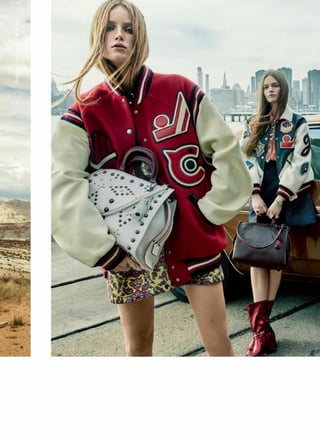
designers—including Iris Van Herpen, who enlisted Ffrench
for her fall couture show—went wild for her ability to mix
classicmakeuptechniques withesotericexpressionism, using
the face (and often arms, legs, and chest) as a blank canvas.
Keeping Ffrench from being pigeonholed as merely trad-
ing in shock value are the hyperoriginal looks she creates on
herself with the photographer Josh Wilks. The duo’s port-
folio, live on Instagram, has helped bring her work to the at-
tentionof YSLBeauté,whichnamedheraU.K.ambassador
last year, and the director Floria Sigismondi, who recruited
FfrenchtocollaborateonRihanna’sstirringlydystopictribal
makeup for her IMAX-streamed “Sledgehammer”video.
Audience engagement is important to Ffrench. “People
are getting a bit bored of seeing normal, basic concepts
of beauty,” she suggests, pointing out that a photo carries
muchmorecurrencyif theviewercanrelatetoitemotionally.
“She sees the beauty in things other people might miss,”says
Nick Knight, the photographer and SHOWstudio founder,
who compares Ffrench’s eye to that of the late Alexander
McQueen—and Pat McGrath.
The latter comparison is one that Ffrench will likely start
hearing more. In McGrath’s decades-long career, the legend-
ary makeup artist has revolutionized runway beauty, helped
Rooney Mara win Oscar attention as the bleach-browed Lis-
bethSalanderinTheGirlwiththeDragonTattoo,andlaunched
herownline.AsFfrench’spotentialisonlystartingtounfold,
there’snotellingwhatsurprisesareinstore.—CELIA ELLENBERG
Makeup
4
2
31 5
B E AU T Y>2 1 8
JENNER:HAIR,GARRENATGARRENNEWYORKFORR+CO.SETDESIGN,GILLEMILLSFORTHE
MAGNETAGENCY.PRODUCEDBYGABRIELHILLFORGEPROJECTS.FFRENCH:COURTESYOFISAMAYA
FFRENCH/TUMBLR.PRODUCTS:COURTESYOFBRANDS.DETAILS,SEEINTHISISSUE.
Beauty
S
anFrancisco–baseddancerPatriciaWilkinsprides
herself on having good skin-care habits: She stays
out of the sun, wears SPF 50, and pats on an
antioxidant-richserumdaily.ButlastOctober,the
31-year-old’s complexion went haywire. “It was
insane,”she recalls of the angry red bumps that
materializedonherface.“Ihadneverexperiencedanythinglike
it.”The probable culprit, Wilkins discovered, was the switch
fromanIUDtoabirth-controlarmimplant,whichdisrupted
her hormonal balance. “You think by your 20s you should be
done with acne,”she says. “And then you’renot.”
Adult acne is fast becoming the new teen acne. In recent
years, a surprising 45 percent of women between the ages
of 21 and 31 have reported cases, while one in four women
between the ages of 31 and 41 is experiencing a similar battle
forclearskin.Thestruggleisreal—andit’softenduetoapar-
ticular hormonal maelstrom that occurs in our 30s and 40s,
explains Eve Feinberg, M.D., a reproductive endocrinologist
and fertility specialist at Northwestern University’s Feinberg
School of Medicine in Chicago. We produce varying levels
of testosterone—the male hormone that bumps up pore-
clogging oil production—throughout our entire lifespan,
and being on birth control often limits our exposure to it,
Feinberg elaborates. “As women come off the pill when they
get older, they get acne.”
Not all midlife breakouts are caused by hormones, and
when they’re not, inflammation is likely to blame, according
to Manhattan dermatologist Joshua Zeichner, M.D. “It can
trap oil in pores and lead to bacteria,”he says of an internal
swellingthatcanbetriggeredbyanything—fromwhatweeat
to stress to genetics.
“I think you have to consider the big picture,” says
Kristina Holey, a Bay Area aesthetician and cosmetic
chemist who takes an increasingly popular
CONNECTING THE DOTS
HOLISTIC PROTOCOLS AND NEW BLEMISH-FIGHTING PRODUCTS TARGET HORMONE FLUCTUATIONS AND
ENVIRONMENTALTRIGGERS TO FIGHT ADULT ACNE. UNTITLED HEAD, BY ROY LICHTENSTEIN, 1995.
Manywomenbidfarewelltobreakoutsalongwithadolescence.Butaninfluxofadult-acne
casesisbringingupbadmemories.KariMolvargoesinsearchofclearanswers.
SeeingSPOTS
B E AU T Y>2 2 0
SkinCare
218 V O G U E O C TO B E R 2 0 1 6
ROYLICHTENSTEIN.UNTITLEDHEAD,1995.SCREENPRINTONLANAQUARELLE
WATERCOLORPAPER.18¾″X219∕16″.©ESTATEOFROYLICHTENSTEIN.
Beauty
FOR BEAUT Y NEWS AND
FEATURES, GO TO VOGUE.COM
holistic view when it comes to combating inflammation.
Holey often prescribes an elimination diet—no dairy, sugar,
alcohol, caffeine, or gluten—in tandem with facial massage
and stress-reducing yoga and acupuncture, which help kick-
startcirculationandbreakupsurfacecongestionwhilereduc-
inglevelsof inflammatorycortisol.Thismultitieredapproach
worked for Wilkins. “It took four months of dedication, but
now my skin is in such a healthier place,” she
says of Holey’s system. At her atelier on New
York’s Upper East Side, aesthetician Georgia
Louisereliesonasimilarlyintegrativeapproach.
Louise’s preferred acne protocol includes fa-
cial acupuncture performed by Konstandina
Gialalidis,toencouragebloodflowandprevent
stagnation. She also refers clients to medical
herbalist Daniela Turley for bespoke tinctures
andsupplementregimenstohelpmanagemeta-
bolic function and immune response, both of
which can be thrown out of whack by inflammation. “We’re
abletogetalotfurtherthanjustlookingattheskinexternally,”
Louise says of the collective result.
There are benefits to topical treatments, of course, like
bacteria-eradicating blue-light therapy and new and im-
proved medical-grade prescriptions. Differin gel with 0.1
percent adapalene, a collagen-boosting retinoid, was just
approvedbytheFDAforover-the-counteruse,makingitthe
first active acne ingredient to hit the OTC market in 30 years.
“Apea-sizeamountonceadayincreasescellturnovertokeep
pores clear and reduce inflammation,” says Adam Geyer,
M.D., a New York dermatologist and consultant for Kiehl’s.
Antimicrobial sulfur is another readily accessible ingredient
that Geyer likes for accelerating the healing of blemishes.
Kiehl’s new Breakout Control Targeted Acne
Spot Treatment contains a hefty 10 percent
dose, while Tata Harper’s Clarifying Spot So-
lution uses it in combination with a botanical
salicylic acid to temper redness.
Remembering to wash your face every
night with an oil cleanser—even if you have
oily skin—is also surprisingly effective when
it comes to preventing acne. “Oil dissolves oil
and easily removes it from your skin without
weakening the surface,” says Zeichner, extol-
ling the virtues of the big-in-Asia “double cleanse,” which
begins with an oil cleanser, like skin-care formulator May
Lindstrom’s Pendulum Potion, followed by another purify-
ing cleanser to thoroughly remove any traces of pollutants,
sunscreen, or makeup. “I massage it into my skin with a
warm cloth for five minutes in the morning and at night,”
Lindstrom reveals. “That’s my meditation.”
“Youthink
byyour20s
youshouldbe
donewith
acne.Andthen
you’renot”
C
all it the Oval, the Almond, or the
Adele. This season’s chicest nail is
all about feminine length, soft edges,
and carefully considered gestures.
“It forces you to act very ladylike
in your movements,” manicurist Madeline
Poole says of the elliptical style seen on Gigi
Hadid and Selena Gomez, whose record-
breaking Instagram—featuring crimson tips
curled around a Coke—suggested that opening
a soda should always require assistance.
“The truth is, it never really left,” Rihanna’s nail
artist Kimmie Kyees notes of the popular-again
shape. While acrylics (glued and sanded into
conical obedience) and press-ons (a gentler
drugstore mainstay) offer instant gratification,
there’s an uptick in women who are nurturing
their own nails to keyboard-defiant lengths.
“My friend Carlotta Kohl spent all summer
growing hers out,” Poole says of the New York–
based artist, adding that diligent filing and coats
of Sally Hansen’s Nailgrowth Miracle aid in the
endeavor’s success. As for skirting the line
between sophistication and mall chick? Poole
has been known to paint the underside of neutral
nails in rainbow hues. “It’s a really interesting
detail,” she muses, “like having a gorgeous bright
silk lining inside a classic coat.”—ARDEN FANNING
TheLONGGameNails
TIPPING POINT
RIHANNA DIALS DOWN A STATEMENT NAILWITH
BARELYTHERE POLISH. PHOTOGRAPHED BY MERT
ALAS AND MARCUS PIGGOTT, VOGUE, 2016.
B E AU T Y>2 3 0
SkinCareBeauty
Health
Fitness
G
wynethPaltrow:yes.DariaStrokous:onboard.DreeHemingway:
“Always.”The proclaimed benefits of probiotic supplements are
hard to resist. Said to boost levels of beneficial bacteria that live
in the gut, they are credited with helping to regulate our immune
system,mood,weight,andcomplexion.Claimsof animprovedsenseof irony
shouldberollinginanydaynow.
AnewstudyledbyOluf Pedersen,M.D.,attheUniversityof Copenhagen,
however,suggeststhereisnomerittothemfortheaverageperson:Noconsis-
tenteffectswerefoundonthebacterialmakeupof healthyadultstakingpro-
bioticsupplementsversusthosewhowerenot.AccordingtoPedersen,“There
is scientific evidence that probiotics have beneficial effects in some forms of
colitis and irritable-colon diseases.”For the unafflicted, he tells me, “you are
wastingyourdollars.”Abettersolution,saymedics,istruenutrition.“Wecan
get everything we need by focusing on our diets and making sure they have
a healthy combination of probiotics,”says Tim Spector, M.D., professor of
geneticepidemiologyatKing’sCollegeLondon.Herecommendsyogurtand
fermentedfoods,aswellasberriesandgreenvegetables.“Theresearchisstill
in its infancy,”he says, “but it’s definitely more sound than that of probiotic
supplements.”My capsule collection just got smaller.—EVIANA HARTMAN
FEASTorFashion?
NUTRITION IN A CAPSULE
ARE ALL GOOD BACTERIA CREATED EQUAL? PHOTOGRAPHED BY GRANT CORNETT.
Extension
School
F
or more than a decade,
experts thought that the
importance of traditional
stretching before exercise
was overstated; it could even
hinder performance. Now multiple
studies are revising that position: Only
the most elite athletes could notice the
potential detriment. For the rest of us,
going beyond knees-toes-done may
improve injury prevention, range of
motion, and possibly our appearance.
Just in time for these findings comes
an explosion of classes and studios
dedicated solely to limbering up. Heather
Andersen’s Stretch sessions at New
York Pilates in SoHo include lengthening
(without tensing) moves on the reformer.
Ropes and bands are the tools of the
Stretch Therapy class at Equinox in
Beverly Hills, while trainers called
“flexologists” manually assist clients
into deeper bends and splits at Stretch
Lab in Santa Monica and Venice. After
I train with Andersen, my body feels
more fluid and less tight. “Stretching
lengthens bulky muscles,” she says,
“which makes them look thinner.” I’m
ready to lean in.—KAYLEEN SCHAEFER
FLEXING PRETTY
MIRANDA KERR GOES OUT
ON A LIMB. PHOTOGRAPHED BY
INEZ AND VINOODH, VOGUE, 2015.
NUTRITIONINACAPSULE:PROPSTYLIST,JOJOLI;FOODSTYLIST,VICTORIAGRANOF
Beauty
PATA >2 3 4
sastudentatCambridge,JosieRourkedirected
Les Liaisons Dangereuses, Christopher Hamp-
ton’s savagely entertaining adaptation of Pierre
ChoderlosdeLaclos’sepistolarynovelaboutsex
asbloodsportineighteenth-centuryFrance.“At
that point, I had probably only had sex four times,”she says
with a laugh, “so perhaps I was driven more by curiosity than
art.”Lastyear,inherfourthseasonasthedirectorof London’s
Donmar Warehouse, where her successes have included The
Weir and Privacy, Rourke took another crack at it, staging a
rapier-sharp(andsold-out)revival,starringDominicWestand
Janet McTeer as a pair of debauched sociopaths, parts origi-
natedonstagein1985byAlanRickmanandLindsayDuncan.
NowtheproductioniscomingtoBroadway,withMcTeerand
a new leading man, Liev Schreiber. Though set in the ancien
régime,aplayaboutthepowerof wordstoseduceandwound
feelsveryof themoment.“Whatithastosayabouttheability
of one human being to wreak emotional and sexual havoc on
another remains deeply engrossing,”Rourke says.
With her commanding presence and gift for conveying her
character’s heartlessness and vulnerability, McTeer—whose
careerspansa1996triumphinADoll’sHousetolastsummer’s
Tamingof theShrew—dazzledLondoncriticsasthat“virtuoso
of deceit”the Marquise de Merteuil. Playing her ex-lover, the
bed-hopping Vicomte de Valmont, Schreiber promises to
be, as Rourke puts it, “someone who can match the force of
Janet’s performance.”Merteuil challenges Valmont to seduce
thevirginalteenCécile(ElenaKampouris)andthenthepious,
married Madame de Tourvel (Birgitte Hjort Sørensen). But
when he develops feelings for Tourvel, Merteuil sets out to
destroy them.“If you’re brought up in that world, then what’s
the only power you have as a woman?”McTeer says. “It’s to
somehow try to manipulate the men in your life to get what
you want, to save yourself.”
Schreiberreturnstothestageforthefirsttimesince2010’sA
View from the Bridge, largely because, after he saw McTeer in
London, he says, “something inside me just kind of ached to
join her.”He describes their characters as “sexual cannibals”
but sees something more beneath the surface. “Valmont has
wit and passion,” Schreiber says, “but the horrible things
he does suggest a kind of self-loathing.”Much of the play’s
wicked fun comes from its depiction of carnal
Theater
TheLASTSeduction
Janet McTeer and Liev Schreiber come to Broadway in Josie Rourke’s
hit production of Les Liaisons Dangereuses.
MCTEER (IN A COSTUME
DESIGNED BYTOM
SCUTT) AND SCHREIBER,
PHOTOGRAPHED BY
STEVEN KLEIN.
SITTINGS EDITOR:
PHYLLIS POSNICK.
a
EDITOR: VALERIE STEIKER
AboutPeopleAreTalking
V O G U E . C O M
232 V O G U E O C TO B E R 2 0 1 6
HAIR,LUCVERSCHUEREN;MAKEUP,CARLAWHITE.PRODUCEDBYLOLAPRODUCTION.SETDESIGN,JESSEKAUFMANN.ONMCTEER:COSTUMEMADEBYDAVIDPLUNKETT.DETAILS,SEEINTHISISSUE.
THE SINGER-SONGWRITER IN A ROCHAS JACKET,
ADEAM SWEATER,AND LEVI’S JEANS.
aggie Rogers had not written music for nearly
three years when, in a cascade of creativity
this past March, it took her fifteen minutes
to produce a song called “Alaska.”Four days
later, Rogers, then a senior at NYU, played the
track—whichcombinestheconfessionallyricismof folkmusicwith
a trotting electronic rhythm—in a master class hosted by Pharrell
Williams.“Wow.Ihavezero,zero,zeronotesforthat,”Williamssaid
afterward, almost teary-eyed. “It’s singular. . . . And that is such a
special quality.”The video went viral.
A few months later, over breakfast at Rucola in Brooklyn’s Boe-
rum Hill (and wearing the silver scarab earrings from the Pharrell
clip),Rogers,22,saysthatmomentstillfeelslikeafluke:“Ionlyhad
onesongtosubmit.”Nowshehassinglesontheway,adebutalbum
expectednextyear,andhasbeencourtedbydozensof recordlabels,
onewithafirsteditionof VirginiaWoolf’sTotheLighthouse,which
she calls “the most beautiful thing I own.”
GrowinguponaworkingfarminruralMaryland,Rogersstarted
playingtheharpatsevenandappliedtoNYUasafolkplayer.“For
a long time, I was the banjo girl,”she says. In her last year, Rogers
took a course taught by Questlove—“It was awesome”—and saw
the“Thriller”videofortheveryfirsttime.Rogers’svirginearforpop
musichasbecomeanunlikelyadvantage,allowinghertoexperience
new sounds without bias and to fold them into her creative process
without aping them. Like her heroes—Carrie Brownstein, Patti
Smith,KimGordon,Björk—Rogersiswriting(andproducingand
performing) her own story.—MARK GUIDUCCI
gamesmanship,butinRourke’sproduction,thein-
tensefeelingsbetweenthetwoleads,whichtheyare
bothtoodamagedtofullyacknowledge,takecenter
stage, turning it into an almost tragic love story.
Scenic and costume designer Tom Scutt’s set,
inspired by period paintings and Robert Polidori’s
photographs of the restoration of Versailles, starts
out as a complete evocation of the eighteenth cen-
tury and gradually gets stripped away while the
actors remain in their finery. “We wanted to find
a way to think of these figures as almost ghostly
presences, at the very tipping point of revolution,”
Rourkesays.“It’sakindof versionof thepastthat
haunts the present.”—ADAM GREEN
Design
The gum ball–machine toy gets a fresh spin
with artist Anandamayi Arnold’s surprise-filled fruits,
inspired by vintage botanical prints, her
own travels, and a sense of whimsy. Found exclusively
at the cult Berkeley-based boutique Tail of the Yak,
where the designer began selling ribbon flowers
at fifteen, each one is crafted out of crepe
paper and vibrant inks and contains ten
little gifts, from novelty toys to glass-bead
necklaces from India. As with this autumnal
blood orange, Arnold likes to stay in
season. “I wouldn’t do holly in July or watermelons
in December,” she says.—SAMANTHA REES
SurfaceCHARM
Theater
FOLKTALE
MaggieRogersisharnessingviral
fametogoherownway.
Music
m
C O N TIN U ED F RO M PAG E 2 32
PATA >2 3 6
V O G U E . C O M
MUSIC:CHADMOORE.SITTINGSEDITOR:ALEXANDRACRONAN.HAIR,TINAOUTEN;
MAKEUP,CAITLINWOOTERS.DESIGN:JOHNMANNO.DETAILS,SEEINTHISISSUE.
People AboutAreTalking
234 V O G U E O C TO B E R 2 0 1 6
ATRIP toBountiful
PATA >2 3 8
Travel
Downtown chic meets country nostalgia at Scribner’s Catskill Lodge,
in Hunter, New York. Originally a sixties motor lodge, the hotel has been
redesigned by Brooklyn-based firm Studio Tack, which has outfitted
almost all of its 38 rooms with dark maple floors, Persian rugs, sheepskin
throws, and fireplaces. Guests can hike, fish, or take in the fall foliage on
the 20-acre property, swim in one of two pools, or dine at the in-house
restaurant, with a wraparound terrace and a Hudson Valley–inspired
menu. “We wanted to create something for the urban explorer,” say
owners Glennon Travis and Marc Chodock.—IVETTE MANNERS
OPENING THIS MONTH, SCRIBNER’S INVITES GUESTS TO
ENJOYTHE NATURAL BEAUTY OF UPSTATE NEWYORK.
A photograph shows artist Alan Shields towering above the crowd at the opening of his 1973 exhibition in Stockholm, wearing
a full beard, long hair, and a suit he’d stitched from multicolored strips of fabric. Shields, who died in 2005, was a child of the
sixties, but his loosely painted canvases—embroidered, hung with beads, or woven and sewn into soft sculptures—speak
to contemporary artists, from Jessica Stockholder to Jim Drain, interested in radiant color and a DIY aesthetic. A new show
at New York’s Van Doren Waxter gallery includes two of Shields’s exuberant, large-scale works, and a series of luminous
watercolors, many painted on paper towels—mandalas, latticeworks, and forms reminiscent of Klee and Kandinsky.
Born in rural Kansas in 1944, Shields credited his farm-boy upbringing and early exposure to quilting with influencing his art.
After he moved to New York, his first show, at the Paula Cooper Gallery in SoHo in 1969, established him as an unusually joyful
star in the Post-Minimalist firmament. Later he moved to Shelter Island, where he helped support his young family as a fisherman
and ferryboat captain, finding new inspiration in lures, nets, and the sea’s watery geometries. He also made prints and late in life
turned his hand to animation. “It’s just like farming,” he once said of his own versatility. “It’s good to rotate crops.”—LESLIE CAMHI
CRAFTWORKArt
SHIELDS’S BROWN BOX SET #13, 1974,WATERCOLOR AND PENCIL ON PAPER.
V O G U E . C O M
236 V O G U E O C TO B E R 2 0 1 6
ART:ALANSHIELDS.BROWNBOXSET#13,1974.WATERCOLOR,PENCILONPAPER.71
⁄8˝X101
⁄4˝.COURTESYOFVANDORENWAXTER.TRAVEL:©ALISONPERRYPHOTOGRAPHY.
People AboutAreTalking
or a few weeks last winter, a pair of
rumpled, cranky, decidedly un-PC
70-something bachelors from New
York’s Upper West Side—one an
unsuccessful actor currently em-
ployed as a stand-in for mashed potatoes
and other creamed foods, the other the au-
thor of Prostate Cancer as a Metaphor for
Israel—starred in an Off-Broadway show
that became, alongside Hamilton, the hot-
test ticket in town. The
show was Oh, Hello Live!
on (Off) Broadway, and its
creators,GilFaizonandGeorge
St. Geegland, spent 70 minutes
performing a play-within-a-play
called We’re Us, You’re You, Let’s
Talk, extolling the virtues of Alan Alda,
Steely Dan, and Ed Koch, kibitzing about
their old friend “Bernard” Sanders (“He’s
running for president? President of what?
The dandruff-on-blazers society?”), and
pranking a rotating series of guest stars by
presentingthemwithoverstuffedtunasand-
wichesandthetaunt“Toomuchtuna!”Now
Gil and George, the inspired alter egos of
30-something comedians Nick Kroll and
JohnMulaney, arecomingtoBroadway,un-
derthedirectionof AlexTimbers,andwhile
Oh, Hello may not boast hip-hop-spouting
Founding Fathers, it is, I promise, the funni-
est thing you’ll see for a long time.
Kroll, best known for his Comedy Cen-
tral sketch show, on which Gil
f
KROLL (FAR LEFT) IN A
MAISON KITSUNÉ SHIRT
AND BOGLIOLI JEANS;
MULANEY IN A RALPH
LAUREN SWEATER AND
PATRIK ERVELLJEANS.
GrumpyOldMEN
Following a sold-out run downtown, Nick Kroll and John Mulaney bring
their hilarious alter egos Gil and George to Broadway.
PATA >24 0
UpNext
BENRAYNER.SITTINGSEDITOR:NICOLASKLAM.GROOMING,CHARLESMCNAIR.PRODUCEDBYTALLULAHBERNARDATROSCOPRODUCTION.DETAILS,SEEINTHISISSUE.
People AboutAreTalking
TAKE
ACTION
TOGETHER
Join us at BCAcampaign.com
#BCAstrength
TO DEFEAT
BREAST CANCER
®
BENNETT, IN AJ.CREW DRESS;
HER DEBUT NOVEL, THE MOTHERS,
IS OUTTHIS MONTH.
VOICEofAmerica
It’s the morning after yet
another high-profile shooting
by police of a black man, and
Brit Bennett’s tank top, with
a line drawing of Beyoncé
throwing up her middle
fingers, perfectly suits the
mood. On Skype from L.A.,
the 26-year-old is discussing
The Mothers (Riverhead),
her buzzed-about debut,
set in an African-American
community in a Southern
California beach town. Partly
narrated by a group of gossipy
church ladies, it focuses on
teenage Nadia—“Like most
girls, she’d already learned
that pretty exposes you and
pretty hides you”—who gets
involved with the pastor’s son
after her mother’s suicide.
With echoes of James
Baldwin’s Go Tell It on the
Mountain, The Mothers is not
your typical coming-of-age
novel: It begins with Nadia’s
abortion, an experience often
absent from our culture’s
stories, and goes on to look
at how women step in to
nurture—and sometimes
betray—one another. (At the
same time, it demolishes
the stereotype of absentee
African-American fathers.)
The novel came out of a story
Bennett wrote at Stanford and
reworked at the University of
Michigan’s M.F.A. program,
Books
but its seeds can be found in
Oceanside, where she grew up.
“In a lot of ways, I was writing
in the direction of my fears.
When I was younger, one of the
worst things I could have done
was to get pregnant. Another
thing that really scared me was
the idea of losing my mother,”
says Bennett. Her parents, who
retired after years of working
in law enforcement, remain
very much alive and supportive
of her writing career.
Bennett’s nonfiction essays,
from an incisive history of black
dolls for the Paris Review blog
to a post about white intention
on Jezebel that generated
more than a million hits in
three days, have already made
her a rising star. The strength
of her work comes from her
willingness to listen in on her
own ambivalence—on the one
hand, feeling it’s important
to write about racism; on
the other, rejecting the idea
that it’s her responsibility to
“translate black pain for white
readers.” Tracing the origins of
systemic discrimination, her
next novel is set in the past,
in the South. “I think about
my mom’s generation or my
grandmother’s generation,
what they experienced,” says
Bennett, referring to her
mother’s childhood in Jim
Crow–era Louisiana. “It’s
2016, and we’re still trying
to assert that black lives
matter.”—MEGAN O’GRADY
UpNext
and George’s surreal antics became a cult favorite, and Mu-
laney, an SNL alum, met at Georgetown, where they bonded
over their love of Mel Brooks, Bob and Ray, and Nichols
and May. “There is a kind of rhythm that older comedy has,”
Mulaney says. “It somehow feels insanely stale and therefore
fresh.”In2005,KrollandMulaneysawapairof 70-ishmenin
theStrandBookStore,clearlybestfriends,eachbuyacopyof
AlanAlda’sNeverHaveYourDogStuffed,andGilandGeorge
were born. “They were the kind of guys we both knew and
were fascinated by,”Kroll says. “They’re ‘liberal racists’—the
NPRtotebag,thePBSmug.”AddsMulaney,“Longarticles
cut out from the newspaper and mailed to you with a note.”
The two naturally slip into character to discuss binge-
watching Friends (“We binge an episode, and then we’ll stop
for a week, and then we’ll binge another episode”) and how
fame has affected their love lives (“The ultimate thrill, hon-
estly, is to call somebody anonymously as a heavy breather
and have them go, ‘George St. Geegland?’ ”). When I ask
whatkindof offershavebeencomingtheirway,Georgesays,
“I got an offer to visit my grandson, which I turned down.”
Gil adds, “I had an offer that came, and it was 20 percent
off at Payless for shoe inserts. And ultimately, I decided to
pass, because what I did was I stuck a pair of Tevas inside
myexistingshoes, soit’s nowlikeI’vegotcushioning.”—A.G.
V O G U E . C O M
240 V O G U E O C TO B E R 2 0 1 6
CHANTALANDERSON.SITTINGSEDITOR:CAMERONBIRD.HAIR,MAKIKONARAFORORIBE;MAKEUP,KIRINBHATTY.
BOOKCOVER:COURTESYOFPENGUINRANDOMHOUSE.DETAILS,SEEINTHISISSUE.
C O N TIN U ED F RO M PAG E 2 3 8
People AboutAreTalking
October 2016
DANCING WITH THE STARS
LupitacelebrateswithherfellowLuowomeninwesternKenya.RobertoCavallidress.CaraCroningerearrings.RoxanneAssoulinbracelets.
PhotographedatKitMikayi,KisumuCounty.Details,seeInThisIssue.FashionEditor:TonneGoodman.
Inhernewmovie,QueenofKatwe,LupitaNyong’obringshertalentandbrillianceto
astoryfromhernativeEastAfrica.Tocelebrate,shetakesVogue—andthemostglorious
printsoftheseason—toherfamily’svillageinKenya.ByElizabethRubin.
PhotographedbyMarioTestino.
A f r i c a
THE GOLDEN
HOUR
Lupita at Dunga
Beach, near the
shores of majestic
Lake Victoria.
Chloé dress. Cara
Croninger earrings.
Christian Louboutin
sandals. Details,
see In This Issue.
upitaNyong’owalkstall,
much taller than her height. Her mother, Dorothy, once said
that her family will forever tease her about how she walks: as
if she believes she’s six feet tall. (She’s five-five.) The first time
Imeether,atalaid-backtavernainBrooklyn,whereshelives,
Ifeelthatwalk.Sheiscool,straight-backed,circumspect.She
doesn’t ooze emotion the way many young Americans do.
She orders the green eggs and lamb, and lets the joke speak
for itself, not offering a gratuitous laugh. But once we start
speaking about her work, she’s all in, as if able to forget the
public Lupita for a moment or two, slip inside the details of
story and character, and let go.
Around Christmas of 2014, Lupita got an email from the
directorMiraNairwiththescriptforQueenof Katwe,which
tells how Phiona Mutesi, an uneducated girl from the slums
of Uganda,risestobecomethechesschampionof hercoun-
tryandaninternationalchessmaster.Nairwantedhertoplay
Phiona’smother,Harriet.“FivepagesinIwrotemymanager
and agent with the words ‘I must do this film,’”says Lupita.
“Toplayamotherof fourinUganda,aformidablemoth-
er who has so much working against her, was so compelling
to me. It wasn’t something I thought I’d be asked to do”—at
least not by Hollywood. “The fact that it was based on a
true story, an uplifting story out of Africa. . . .”She inhales
and shakes her head. “Oh, my goodness, all my dreams were
coming true in that script.”
I’d just seen her on Broadway in Danai Gurira’s Eclipsed.
She played a fifteen-year-old Liberian called the Girl, shel-
tering with wives numbers one and three of a Liberian
commander who is never seen onstage. The Girl is forced
to become the fourth wife until Maima (wife number
two), a warrior with an AK-47, shows up and persuades
her to escape captivity and join the fight. Lupita gave an
incredibly physical performance. She leaped, wailed, hid,
manipulated her face in the exaggerated way children do.
She inhabited the child’s naïveté and ruthlessness, and
crumbled, too, like a child.
“Lupita employs a powerful intellect in her work and
makes very deep, very intricate choices. And she’s just re-
lentless in her pursuit of authenticity and specificity of the
character,” says Gurira, who is an actress (The Walking
Dead) as well as a playwright. “She is 150 percent every
second, doing more and more work offstage, growing in her
understanding of that world. It’s a dream for a writer.”It’s
what Lupita said she needed “after that long roller-coaster
ride that culminated in the Academy Awards.”
For Nyong’o, 2014 was a year that only happens in fairy
tales or Hollywood, a year that spun the then-31-year-old
actress of 12 Years a Slave into an icon of fashion, beauty,
and cool, a star whose combination of grace and mischief
and timing on the scene broke a color barrier that never
should have existed. In the six months leading up to the
Oscars, she swirled through 66 red carpets. She was dubbed
People’s Most Beautiful Person and appeared on the cover
of multiple magazines. “But it was all not acting,”she says.
Thedirectorof 12 YearsaSlave,artistandfilmmakerSteve
McQueen, who continues to be a guiding voice for her, told
her,“Youhavetogorightbacktothebeginning,towhenyou
saw your first film or dressed up, and remind yourself what
the purpose is, why you got into the profession, because you
get seduced by the obvious.”And so Lupita harnessed her
newlymintedOscarpowertobringEclipsedtothestage.And
with Queen of Katwe and the forthcoming film adaptation
of ChimamandaNgozi Adichie’sAmericanah—andevento
some extent with her fantasy roles as the pirate Maz Kanata
in Star Wars: The Force Awakens, Nakia in Marvel’s Black
Panther,motherwolf RakshainDisney’snewJungleBook—
Lupita is using her stature to reshape the way the world sees
itself, to reflect images that have always been present but
weren’t being looked at.
She didn’t set out with a mission to tell these African
stories, Lupita says. It happened organically. “Being able to
use my platform to expand and diversify the African voice,”
she says, searching for the right words, “I feel very passion-
ate about that. It feels intentional, meaningful.”
There’ssomethingaboutLupitathatalsofeelsintentional,as
if she had been groomed, designed even, to be a messenger,
to bear with poise the privilege and burden of her newfound
fame. Mira Nair has known her for many years almost as a
daughter.(Nair’shusband,UgandanpoliticalscientistMah-
moodMamdani,isanoldfriendof Lupita’sfatherfromtheir
days in the late sixties as student activists at Makerere Uni-
versity.) Lupita interned for Nair on The Namesake. Then,
when Nair was setting up Maisha, a lab for East African
filmmakers in Kampala, Lupita joined her as a production
coordinator—of course,alltheyoungdirectorstherewanted
her in their films even then.
“Her roots are strong, which is why she flies,” says Nair
over dinner in New York, where she is rehearsing for the
Broadway debut of the musical based on her film Monsoon
Wedding. “She knows where she comes from and uses that
to see the world. She has seen ups and downs through the
family’sjourney;thatgivesheraclear-eyedapproachtowho
she plays and what she stands for.”
Andwhetherit’scutting-edgemusic,dance,orfashion,“it
soundsboringtosaythis,butthepoliticsof representation—
what we represent when we do our thing—she knows how to
use the system and be true to herself.”Nair laughs. “Really, I
knowherassomeonewhoisgreedyforfun,”shesays,thumb-
ing through her iPhone to find the photo she sent Lupita of
an amazing hairstyle she saw in a book—cornrows rising up
248
PHOTOGRAPHEDATNYONG’OFAMILYRESIDENCE,KISUMUCOUNTY
SERIOUSLY
FOLK
“Five pages in,
I wrote my manager
and agent with the
words ‘I must do this
film,’”Nyong’o says
of reading the script
for her new movie,
Queen of Katwe. 3.1
Phillip Lim dress.
Walt Cassidy Studio
earrings, brass
necklace, and beaded
necklaces (worn as
bracelets). Details,
see In This Issue.
GENERATION
NEXT
Lupita with her
paternalgrandmother,
Dorca, age 96, who
built a dormitory
for orphaned and
disadvantaged
schoolgirls. Duro
Olowu silk coat
and skirt. Cult Gaia
turban. Walt Cassidy
Studio earrings.
PHOTOGRAPHEDATNYONG’OFAMILYRESIDENCE,KISUMUCOUNTY.
OPPOSITE:PHOTOGRAPHEDATKITMIKAYI,KISUMUCOUNTY.
ROCK OF AGES
Ever grounded,
Lupita says, “Being
able to use my
platform to expand
and diversify the
African voice . . . I
feel very passionate
about that.”
Akris dress and
cuffs. Perez Sanz
earrings. Details,
see In This Issue.
BACK TO SCHOOL
The actress at the Ratta
Mixed Secondary school
in Kisumu County, where
students were gifted Soular
backpacks invented by
Salima Visram, Lupita’s
family friend. Kiki Clothing
handkerchief-hem dress.
Soko earrings. Details,
see In This Issue.
WINGED VICTORY
“She’s just relentless in
her pursuit of authenticity
and specificity of the
character,” the playwright
and Walking Dead actress
Danai Gurira says of Lupita.
Lupita stands beneath
the stone formation
Kit Mikayi, close to the
Nyongo’s’ village, in a
Valentino dress and cuffs.
into a bulbous Popsicle. “Next thing I knew, at the Met gala
shedidthehair.”Thehair:high,tall,asculpturalexclamation.
Eclipsed closed in June, and Lupita went to Bali to relax.
You can see her there on Facebook and Instagram, two for-
mats she curates with a careful selection of Lupitas—diva,
fashionista, monitor of Lupita cartoons and drawings on
#FanArtFriday,andmessengersharingvideoslikeMic’s“23
Ways You Could Be Killed If You Are Black in America.”
Thefollowingmonth,IcatchupwithherinKenya,where
she has traveled to her family’s ancestral village in the Luo
homeland, a stone’s throw from Lake Victoria. “We’d visit
my grandparents, spend my vacations here; all the cousins
would come from around the world to spend Christmas in
the village,” says Lupita. Today she’s wearing a baby-blue
halter dress and an udeng, an
Indonesian headdress. “I saw
them on the men and thought,
That will work so well for me.
It’s a little cultural appropria-
tion,” she says, quite pleased.
We’re at the Acacia Premier
Hotelinthenearesttown,Kisu-
mu, where she’s staying.
In the afternoon, we caravan
out to the family grounds, past
the railroad and the strange
Stonehenge-size rocks balanc-
ing on the horizon. The most
famous is Kit Mikayi—which
means “stones of the first
wife”in Luo, the language and
name of the Nyong’o family’s
ethnic group, which stretches
across parts of Kenya, South
Sudan, Uganda, and Tanza-
nia. The place is still a sacred
pilgrimage site.
Up a dirt road, past a malar-
ia-research hospital funded by
Walter Reed, Ratta Mixed Sec-
ondary school, fields, chickens,
goats, and short-horned cows,
we arrive at the gated fam-
ily compound. A sign nearby
reads: an experiment in rural living. Lupita’s father,
Peter Anyang’Nyong’o, has taken to grand-scale farming—
bananas, tomatoes, potted kale, fruit trees, maize.
Lupita is the second of six children from a prominent
Kenyan family. Her mother manages the Africa Cancer
Foundation. Her father is a senator, political activist, and
former university lecturer. She and her siblings grew up in
the public eye, negotiating visibility, privilege, and politics.
A wellspring in the village is named after her great-great-
grandfather. On her grandparents’ land stands a small,
stately chapel built in memory of her grandfather, the re-
gion’s first clergyman, who ministered to the poor and
brought Christianity and education to the villagers. After
his death, Lupita’s grandmother completed their project to
build a dormitory for orphaned or disadvantaged girls from
the district so that they could go to school unencumbered
by suitors or domestic chores.
In a glass-enclosed patio at Lupita’s parents’ house, her
father—a dramatic storyteller—narrates in great detail his
political past: leading demonstrations, getting detained and
interrogated, security men ransacking the house during the
regime of Kenyan president Daniel arap Moi. His brother
Charles vanished at just 26. The family heard he was thrown
off a ferry. “It was vicarious punishment,” says Nyong’o,
busy fielding calls and messages on his iPhone. “Fascist
regimes, if they can’t get you, they get your wife or uncle.”
In 1981, he and Dorothy went into self-imposed exile
with their first daughter, Zawadi, now a digital activist for
social justice. He took a teaching position in Mexico, where
Lupita was born and given her non-African name. They
also gave her a Luo name—Amondi, which means “born
at dawn.” When the family re-
turned to Nairobi, the trouble
also returned. Peter was thrown
in the infamous Nyayo House
torture chamber—you’re kept
dirty, cold, unfed, and interro-
gated day after day. “It’s dehu-
manization.Itdemoralizesyou.”
Did the kids know about all
this? I ask.
Oh, yes, he nods. “We told
them everything. “Zawadi was
traumatized. These things made
her afraid of the outside world.”
Lupita too?
“I don’t think so. The trouble
with Lupita is she grew under
the shadow of Zawadi,” he
says. “Terrorized by her . . . ah,
siblings”—he shakes his head—
“until they separated in early
high school and Lupita found
her own personality.”
Lupita was already acting
and leading the other kids in
kindergarten. By high school
at St. Mary’s, in Nairobi, she
was in all the musicals. “When
I got there, I kept hearing ‘Lu-
pita this, Lupita that,’ and I
thought, Is she some supermodel?” a Kenyan producer
tells me. “All the guys talked about her. She had a walk.”
Just a day in the Nyong’o world and I can imagine the
origins of both Lupita’s confidence and her freedom. Out-
side on the terrace Dorothy teaches Lupita how to make
ugali for a video—Lupita had confessed on Kenyan TV
that she cannot cook the national dish made of cornmeal.
Dorothy moves about the grounds with elegance, a regal
bearing, overseeing the cooking, the cleaning—doing much
herself. She has been the tree shading the children from
their father’s tumultuous political career—seeking ways to
cultivate their interests.
When Lupita was fourteen, her aunt encouraged her to
audition for the Phoenix Players, the only repertory-theater
group in Nairobi. It was Dorothy who drove her to rehears-
als, sat in the car doing her work so Lupita could perform
Juliet and cement her name in Nairobi thespian circles.
STYLE FILE
LupitawasdelightedwhentheninetiesSouthSudanese
modelAlekWek,“wholookedsomuchlikeme,”broadened
beautyideals.Missonidress.Details,seeInThisIssue.
255
PHOTOGRAPHEDATKITMIKAYI,KISUMUCOUNTY
CHECKMATE
In Queen of Katwe, Lupita
plays Harriet, whose
daughter Phiona, played
by Madina Nalwanga
(FAR RIGHT), becomes
a chess prodigy. “To
play a mother of four in
Uganda, a formidable
mother who has so much
working against her, was
so compelling to me,”
Lupita says of her role in
the film. Valentino dress.
Ippolita earrings. Martin
Kabanza (THIS PAGE), who
plays Harriet’s son Brian,
wears a GapKids shirt.
Details, see In This Issue.
PHOTOGRAPHEDATDUNGA
BEACH,KISUMUCOUNTY
PARENTAL
GUIDANCE
Lupita at home with
her father, Senator
Peter Anyang’
Nyong’o (FAR LEFT),
who represents the
county of Kisumu, and
her mother, Dorothy
Nyong’o (NEAR
LEFT), the managing
director of the Africa
Cancer Foundation.
On Lupita: Zac
Posen dress. Cara
Croninger earrings.
Stella McCartney
loafers. On Dorothy:
Antonio Marras dress.
Giuseppe Zanotti
Design sandals.
POISED FOR
SUCCESS
Lupita’s upcoming
films include Star
Wars: Episode VIII
and Americanah.
Prada dress.
Ashley Pittman
bracelet (worn as a
necklace). Details,
see In This Issue.
259
PHOTOGRAPHEDATSENATORPETERANYANG’NYONG’OANDDOROTHYNYONG’ORESIDENCE,KISUMUCOUNTY
“Mymotherhaddreamchartsandwouldsay,‘Whatdoyou
want to dream short-term, long-term, mid-term?’ ”Lupita
recalls. “She really believed in dreaming out loud.”
She can’t help comparing her story with that of the char-
acters in Queen of Katwe. “Phiona keeps going up against
her mother and is unable to achieve her potential until her
mother comes on board in a little way, even just buying the
kerosene that allows Phiona to read.”(Phiona, like so many
villagegirls,walkskilometerstofetchwater,helpshermother
with washing and cooking, and by the time she has a minute
to study the chess books that could elevate her game, it’s
dark and there’s no electricity.) Eventually Harriet will sell
her clothing fabric to get kerosene for Phiona. “You see how
youcanhinderyourchildren,notbecauseyoumeanto,”and
here Lupita walls her hands around her eyes, “but because
you have a limited view.”
Instead, Lupita’s family fostered a leader with an appetite
for the dramatic, loud gesture. At nineteen she shaved her
head, an act very few girls would have dared at that time.
“I wanted to know what my head looked like,” she ex-
claims. She was also tired of going to the salon. Relaxed hair
hastobestyledweekly.Theprocesscanburnyourscalp,cause
scabs and itching. It’s an ordeal. “My father
doesn’tknowthis,butitwasathisprompting.
Hewasfundingmyhairdos,andatonepoint
hesaid,‘Ah,whydon’tyoujustcutitalloff?’”
She took him up on it. For two weeks he was
toobusytonotice.Onedayatthetablehedid
a double take. “Where’s your hair?”
“You said I should cut it!”she says, laugh-
ing, slapping her thigh, and closing her eyes.
Perhaps it’s the times—a black U.S. presi-
dent, Black Lives Matter, and the matter of
hair—but for sure Lupita’s hair has rippled
across continents. Shaved is beautiful. You
walk into the salon here and ask for the Lu-
pita style—close-cropped head, big earrings,
theantithesisof thebraidextensionscalledtheObamaline,or
thebraidscurvedaroundyourheadandcalledtheBensouda
style (after Fatou Bensouda, the Gambian prosecutor of the
International Criminal Court). A beautician at a local salon
tells me that four years ago, girls outside the village did not
shavetheirheads.Badform.“Lupitachangedthat,”shesays.
Ground breaking is a rough process. It bruises even the
toughest.InApril2014,aHollywoodmagazineranashock-
ing analysis of “post-Oscar Lupita,” suggesting that her
future prospects were complicated and her dark skin chal-
lenged an industry predisposed to light. “Would Beyoncé
be who she is if she didn’t look like she does?”asked a talent
agent named Tracy Christian. “Being lighter-skinned, more
people can look at her image and see themselves in her. In
Lupita’s case I think she has two-and-half, three years. If she
can find a franchise, a big crossover film, or if she’s cast by
a significant filmmaker, then she’s golden, she’ll have carved
out a unique path for herself.”
We’re at the Acacia, which overlooks Lake Victoria.
Lupita notices the hyacinth are back, greening large swaths
of the lake. Though the plants are beautiful, the fishermen
say they are a sign of the water’s pollution and are causing a
scarcity of fish. She sighs. “I have to deafen my ears to that
Christian lady,”she says, referring to the talent agent. “She
is looking at me as part of the cultural tapestry.”She throws
out her arms. “I am living and breathing. That person is not
considering what I had for breakfast, how that is sitting in
my stomach, and why I didn’t do well with that audition.”
She shakes her head. “I can’t think like that.”
There’s a silence. “I cannot run away from who I am and
my complexion or the larger society and how they may view
that. I realizethatwithwhatIsharedattheEssenceawards.” 
It is one of the great speeches on beauty, a landmark that
outlasted the night two years ago when Lupita recounted
being taunted about her dark skin, and how she bargained
with God that she’d stop stealing sugar cubes if she could
wake up with lighter skin.
“The European sense of beauty affects us all,” she says
abruptly. “I came home from college in the early two-
thousands and saw ads on TV with a girl who can’t get a job.
She uses this product. She gets her skin lighter. She gets the
job. The lording of lighter skin is a common thing growing
upinNairobi.Beingcalled‘blackmamba.’Theslowburnof
recognizing something else is better than you.” 
Until it’s not. Along comes Alek Wek, the model from
South Sudan, “dark as night”on all the runways, celebrated
in magazines and TV. Lupita could not be-
lieve the world was embracing as beautiful a
woman “who looked so much like me.”
And now it is Lupita blasting doors open,
as she has apparently done for a young
Ugandan-British woman who worked in
production on Queen of Katwe, who told
her: “I’ve never had so many people call me
beautiful until you showed up. I get called to
auditions I never would have been called to
before. And I know it’s because you exist.”
She wasn’t emoting, just stating facts. “Alek
Wek changed how dark people saw them-
selves. That I could do the same in a way for
somebody somewhere is amazing,” Lupita
says, bounding out of her chair, talking about the benefit of
having visibility and influence. She is the first black woman,
for example, to have landed a Lancôme contract. “There
is no point in getting your picture taken if it doesn’t move
somebody.”Her eyes widen. “Right?”
Lupitahasfirsthandexperiencewiththepowerof images,
words, their performance and endurance. “I watched my fa-
therspeakalot,”shesays,recallingherdaysonthecampaign
trail with him and her siblings, singing party songs, making
up dances, speaking to the constituents. “He is quite the
speaker.Hehashisownflair.It’saperformanceart,politics.”
Ever on the ball, aware that the reverse is true, she’s lent
her voice to save elephants and to end maternal mortality
in childbirth. She’s supported a project for girls begun by
Salima Visram, who grew up in Mombasa near an impover-
ishedvillagewithnoelectricity. Visramdesignedabackpack
for children fitted with a solar panel that is connected to a
battery pack. As the children take the long walk to school,
theirbatteryischarged,andatnight,afterchores,thebattery
can power an LED lamp and they can study. Lupita loved
theideaanddevisedaquoteforthebackpack:Thepowerisin
yourstep—LupitaNyong’o.TodayVisramhasproduced500
backpacks, with 3,000 more in the works, and has moved
the factory to Kenya to generate
“Really,
Iknowheras
someone
whoisgreedy
forfun,”says
director
MiraNair
260
C O N TIN U ED O N PAG E 31 2
PHOTOGRAPHEDATNYONG’OFAMILYRESIDENCE,KISUMUCOUNTY
DON’T
LOOK BACK
Givenchy by
Riccardo Tisci
dress. Tiffany & Co.
earrings. 3.1 Phillip
Lim sandals. In this
story: hair, Vernon
François for Vernon
François; makeup,
Nick Barose.
Produced by On
Screen Productions
(Kenya). Details,
see In This Issue.
N E W
T H E
WHATWILLYOUWEARTOTHEREVOLUTION?RALPHLAUREN—WHOSE
NEWCOLLECTIONWILLBEAVAILABLEINSTORESTHESAMEDAYIT’SSHOWN
ONTHERUNWAY—HASPLENTYOFIDEAS.PHOTOGRAPHEDBYDAVIDSIMS.
alph Lauren is no stranger to crossing
frontiers—he’s been doing it for years;
decadeseven—buttheterritoryhe’sjust
lit out for doesn’t come with any sign-
posting. On September 14, Ralph (as
with Hillary or Kanye, the first name
alonesuffices)presentedacollectionthat
was available to buy nanoseconds after it was walked down
therunway,andgloballyatthat:inhisownboutiques,online,
andinstoresdottedaroundtheworld.Maybethegargantuan
scaleof theundertakingsubconsciouslyinfluencedthedesign
process, because what he showed, which you can see here
on five very different all-American women, is a virtual ode
to vastness—from the wide-open vistas of the mythic West
(fringing,buffaloplaid)tothetowering,twinklingmetropolis
that is New York (fluid jumpsuits, Art Deco beading that
gleams more than the Chrysler Building ’round midnight)—
coalesced into a collection that’s as much of its time as it is
timeless. Newness-wise, the collection has legs, and Ralph
knowshowtousethem:He’scoveredjustabouteverycurrent
waytowearpants,which—if youhaven’tnoticedalready,you
will very soon—are having a moment.
Obviously, he’s not alone in thinking about immediacy.
TomFord,TommyHilfiger,Burberry’sChristopherBailey—
they’re all in the here-and-now game too. But this is Ralph.
That’s major. That’s the mountain and Muhammad at the
same time. Still, the man himself, sitting one particularly hot
andhumidafternooninhissixth-floorofficeat650Madison
Avenue,seemsunfazedbythetectonicshifthiscompanyhas
undertaken.Guessit’sthepioneermind-set:Thinkonlyof the
destination,notthejourney.Revisitingtheearlyconversations
aboutthismonumentaltransformation—nottomentionhav-
ingtoworkontwocollectionsatoncetogetthisonereadyfor
September—he insists that his decision was driven forward
by a single thought. “Showing clothes, then delivering them
six months later . . . it’s over,”he says with a measured final-
ity. “With the Internet, social media . . . you have to change.”
These days, change is not an unfamiliar concept at Ralph
Lauren. Ralph’s morning had started with a town-hall meet-
ing to reveal his company’s first-quarter figures, which were
encouraging,afterarecentless-stellartransitinthecompany’s
fortunes required a substantial rethink of how it operated.
Stefan Larsson, the young Swedish president and CEO who
wasinstalledlastNovember,discussedtheWayForwardplan
that he’d formulated for the near-50-year-old company, and
whereitwastakingRalphLauren,thebrand.(Onanupward
trajectory, he was happy to report.) Ralph Lauren, the man,
spoke to his new way of showing from September onward.
“I’ve always looked at the business as an evolution,”he said.
“We’re never standing still, and we’re never chasing anyone.
Everything is a new chapter.”
Inaway,hisresponsetoeverydesigner’schallengetoday—
tomakepeoplereconnectwiththepleasureof shoppingand
to speak to our need for instant gratification—is textbook
Ralph:Forgetthedinandclamorof industryhand-wringing
and just cut to the chase by engaging with those who are
actually buying. “I’ve been through it before, when noth-
ing moves,”he says. “When everything is available, how do
you do specialness? How do you create magic?”Part of the
dilemma,hefreelyacknowledges,isfindingaplaceforfashion
at a time when it is simply one element of an ever-expanding
repertoire of what we rely upon to give a sense of expression
to our lives. “Where you see most of the excitement now is
in food,”he says. “Restaurants, where to go, what’s healthy:
That’s the sensibility that’s happening. There are more
diverse ideas about living. The world is into experience, so
you’ve got to give experience.”He’s doing his part for that:
At the time of writing, he was envisioning two shows taking
place on Madison Avenue, one for the usual industry types
and one aimed at label loyalists—and both in the shadow of
his empire, which stretches from Seventy-first to Seventy-
second streets, so those right-off-the-runway clothes are
tantalizingly close. That night, even familiar terrain will
become a new frontier.—MARK HOLGATE
R
F R O N T I E R
LONE STAR
Actress Allison
Williams (who will
star in Get Out early
next year) kicks off
our exclusive first
look at the new
pieces. Clothes and
ring by Ralph Lauren
Collection; select
Ralph Lauren
stores. Details, see
In This Issue.
Fashion Editor:
Tonne Goodman.
CUSTOM
OF THE COUNTRY
Model Grace Hartzel
embodies haute boho
codes in a tinsel top paired
with indigo denim and
supple leather. Clothes
and earrings by Ralph
Lauren Collection; select
Ralph Lauren stores.
BEAUTY NOTE
Amplify your look from
head to toe this season.
Living Proof’s Full Dry
Volume Blast lifts hair
to long-lasting heights
with a lightweight
texturizing mist.
GALLANTLY STREAMING
Actress Renée Elise Goldsberry is hanging up her Hamilton hat in pursuit
of small-screen performances (including Netflix’s Altered Carbon and
HBO’s The Immortal Life of Henrietta Lacks). Ralph Lauren Collection fringed-
crochet dress; select Ralph Lauren stores. Details, see In This Issue.
HIGH NOON
Model Karlie Kloss gets a leg up—or out—in a daringly cut
one-piece wonder. Ralph Lauren Collection silk cady
jumpsuit; select Ralph Lauren stores.
266
FRINGE BENEFITS
Though actress
Jessica Biel soon stars
in (and produced)
The Devil and the
Deep Blue Sea, her
frontier look here is
plains as day. Suede
jacket, shirt, and hat
(in hand) by Ralph
Lauren Collection;
select Ralph Lauren
stores. In this story:
hair, Guido for Redken;
makeup, Diane
Kendal. Details, see
In This Issue.
267
SETDESIGN,NICHOLASDESJARDINSFORMARYHOWARDSTUDIO.PRODUCEDBYARTHOUSE.
F r e e
C o u n t r y
UpstateNewYork’sWorldsEndfarm—anditsunrivaled,
hauntinglyantiqueflora—servesastheperfectfoilforarusticromance
drapedintheseason’scoziestshearlingcoats.ByChloeMalle.
LandscapesphotographedbyMarkBorthwick
GREEN LIGHT
The pond catches
the sun behind the
property’s historic
swing-beam barn.
Sittings Editor:
Miranda Brooks.
growtheseformorale,”saysSarah
Ryhanen, gently cupping a pale-
coralpoppy.“They’rebadcutting
flowers. They only last a day—
but when you see them in the
field, they’re so beautiful.”Milk-
weedblossomsdanceoverheadas
the owner of the beloved Brook-
lynfloristSaipuacontinuesdown
the rows of dahlias, black scabiosa, and amethyst Queen
Anne’s lace on her 107-acre Worlds End farm in upstate
New York. Teaching others to appreciate ephemerality has
become a battle cry of sorts for the florist-farmer. “We have
peoplecomingintothestoreallthetimeasking,‘Howlongis
this gonna last?’I want them to have an experience with it.”
Ryhanen and her partner, Eric Famisan, purchased the
farm in 2011, but when asked how long they have been here
theycountinseasons.Thisisn’ttheonlysensibilitytheyshare
withfashiondesigners,whoareincreasinglydrawinginspira-
tion from the fantasy of vast, untended landscapes and the
slowpaceof thoughtfulliving.FromProenzaSchouler’scare-
fulcraftsmanshiptoErdem’srefulgentfilcoupéblossoms,the
muse is Lauren Santo Domingo meets Laura Ingalls Wilder
adriftinthechicestfield,throughthelensof TerrenceMalick.
It’s a countermovement to our age of fast fashion and
instantgratification,onethatvaluesthetimeandthepatience
to see something through from start to finish. To be sure,
Ryhanen and Famisan are part of an expanding coterie of
urbanites turned farmers—call them yappies, or young agri-
culturalprofessionals—butwhatthey’reuptohereintheMo-
hawk Valley strikes a chord that echoes through a variety of
industries.FlowerssuppliedbySaipuaforeventsarereturned
to be composted, making Ryhanen’s arrangements some of
the few in the world that are nurtured from seed to mulch.
She plans to apply the same philosophy to this year’s flock
of 27 Icelandic sheep, named after military call codes (last
year’s were Top Gun characters). Their wool, skirted, dyed,
and spun by Ryhanen, will be knit into hats by her mother,
in nearby Peekskill. “It’s a six-month process. You’d have to
charge $10,000 for that hat to make any money, but my goal
is to inspire people to think more about where their clothing
is coming from. So next time you see a sweater at H&M for
$20, you’re like, ‘Oh, that’s acrylic; that’s plastic.’”
Kate Huling, of Marlow Goods, is another exemplar of
the farm-to-fashion ethos. Huling purchases the hides of the
same grass-fed cows sourced by her restaurateur husband,
Andrew Tarlow (Diner, Marlow & Sons, Roman’s), for her
line of handsome leather goods (“Family Style,” Talking
Fashion, page 192). And while Phoebe Philo isn’t personally
curing the leather for Céline’s latest Cabas, the designer does
acknowledge a pull toward the great outdoors. “It’s about
taking her out of urban life and putting her feet on the sand.
It’s where I long to be more and more,”Philo explained of
her vision for a recent collection. Jamie Hawkesworth’s fall
ad campaign for Alexander McQueen is as much a celebra-
tion of desolate landscapes as a showcase for the house’s
hand-embroidered ensembles. McQueen designer Sarah
Burton even took her team to the Shetland islands to meet
theknittersandweavers—andsheep—whowillbeproviding
the knitwear for upcoming collections.
“When you’re so obsessed with control, you’re not open
to happiness,” says Ryhanen, wearing vintage denim and
We
270
GOLD STANDARD
Bundle up for the magic
hour in luxurious layers.
Models Rianne Van
Rompaey and Anna Ewers
and actor Boyd Holbrook,
star of Netflix’s hit series
Narcos, matched theirs
to the surrounding fields.
FROM FAR LEFT: Van
Rompaey wears a Sacai
coat, $3,575; Bergdorf
Goodman, NYC. Ewers
wears a Coach 1941 coat
($2,795) and dress ($795);
coach.com. Holbrook
wears a Carhartt jacket.
Details, see In This Issue.
Fashion Editor:
Camilla Nickerson.
FashionportfoliophotographedbyAlasdairMcLellan
IDYLL WILD
BELOW: A characteristically lush arrangement of yellow cosmos, Queen Anne’s lace, sumac,
and rudbeckia in the refurbished barn, which is now used for tomato canning and fiber-arts workshops.
BOTTOM: A view of the three-seasons porch at the back of the 1825 Greek Revival house.
OFF THE BEATEN PATH
Sarah Ryhanen—who with her partner, Eric
Famisan, owns Worlds End—leads the way through
an allée of wildflowers to the tepee camp.
ACT NATURALLY
“This farm is 20 miles from my house, but I never got to see it,” laments Holbrook, who has been traveling nearly nonstop for years. “It's two months
later, and I still haven’t been home!" Ewers wears a Philosophy di Lorenzo Serafini dress, $1,250; En Avance, Miami. Prada boots. Holbrook wears a
J. Mueser suit and a Ralph Lauren shirt. Baby Max Blankenbaker wears OshKosh B’gosh overalls. Isla MacPherson wears a Marie-Chantal dress.
BLONDE AMBITION
The palest of camel-hued shearling—shorn short or shaggy—keeps the look light and the warmth
tucked in. Van Rompaey wears a Paco Rabanne coat and dress ($1,550); pacorabanne.com. Stuart Weitzman
boots. Ewers wears a Céline coat; Céline, NYC. Off-White c/o Virgil Abloh boots. Details, see In This Issue.
AT HOME ON
THE RANGE
A guest surveys
the flora in a
neighboring
field. BELOW: Wild
grasses grow
abundantly around
the 1⁄4-acre pond.
tread-soled farm boots, her favorite hen, Goldie, nestled
under her arm like a fragile football. She plucks two yolk-
yellow cherry tomatoes from the vine, hands one to me, and
pops the other in her mouth like a gum ball. “There was one
day last fall,”she says, “where I was dealing with an injured,
bloody sheep in the morning and then that evening I was
at MoMA debating with some women from Louis Vuitton
about whether a peony was white enough for the event I
was doing for them. One is not better than the other. The
reality is I appreciate that someone cares so much about
what color white a peony is. It lends significance to what I
do here on the farm.”
We pull carrots for lunch, which are washed, roasted,
and tossed in a salad with Russian kale, cucumbers, and
coriander seeds. Communal meals are a daily ritual at
Worlds End and at Saipua. Today the group discusses the
weekend’s elderberry-foraging workshop and that evening’s
meteor shower. Our centerpiece is a china pitcher erupting
with yellow cosmos, Queen Anne’s lace, and various wild-
flowers from the garden. Ryhanen encourages everyone
on the farm to create spontaneous arrangements. The fact
that this one, like the field poppies, might not last through
tomorrow’s lunch is of little concern. It’s important to have
things just for morale.
276
THIS WAY UP
Flip the script on woodsy outdoorwear with a pretty coat-dress-cape combination.
Ewers wears a Maison Margiela coat; Maison Margiela boutiques. Holbrook wears
a Stetson shirt, Levi’s jeans, and Frye Company boots. Details, see In This Issue.
WOOLY BULLY
This versatile down-shearling hybrid with buttery sleeves and exquisite fur accents is the casual parka we’ve
all been waiting for. On Ewers: Moncler Grenoble coat; Moncler, Aspen, CO. Calvin Klein Collection dress,
$1,095; Calvin Klein Collection, NYC. On Holbrook: Levi’s shirt. Denim & Supply Ralph Lauren jeans.
LEADING THE FIELD
Bibs and ruffles and sleeves and lace—such a cavalcade of detailing makes this
updated farmwife ensemble the stuff of modern romance. Van Rompaey wears an Erdem
blouse and skirt; erdem.com. Tabitha Simmons boots. Details, see In This Issue.
WARM WELCOME
Stand out from the crowd with a snow-white shag. Van Rompaey, among the farm’s 27 Icelandic sheep, wears a
Chloé coat and bag. Coat at net-a-porter.com. BEAUTY NOTE: Embrace your waves’ natural state. Strong Sexy
Hair Core Strength mask’s sulfate-free formula replenishes strands with aloe vera and mango butter.
A CALL TO ARMS
Flirt with this fall trend by opting for fine tweed with a fuzzy twist. Ewers wears a Prada jacket and tights; select Prada
boutiques. In this story: hair, Anthony Turner; makeup, Aaron de Mey. Menswear Editor: Michael Philouze. Photographed
on location at Nectar Hills Farm (pages 275 and 280) and the Saipua farm, Worlds End. Details, see In This Issue.
SETDESIGN,GERARDSANTOSFORSTREETERS.
PRODUCEDBYROGERDONGFORGEPROJECTS.
MAN OF THE
HOUR
Prime Minister
Renzi, photographed
at his father’s home
outside Florence.
“It’s when I have
everyone against
me,” he says,
“that’s when I have
the most fun.”
Sittings Editor:
Phyllis Posnick.
Italy’s dynamicyoung primeminister,MatteoRenzi,is
charming,combative,pragmatic—anddeterminedtoreform
hisgovernment,atwhateverthecost.JasonHorowitzreports.
Photographed byAnnieLeibovitz.
I T A L Y ’ S
M O M E N T
hey haven’t
arrived?”asked Matteo Renzi. The 41-year-old Italian prime
minister, dressed in a tailored navy Armani suit, swept into
a reception room in Palazzo Chigi, the frescoed sixteenth-
century seat of power in Rome, expecting to bestow the
thanksof agratefulnationonagroupof Italianskiingcham-
pions. The skiers, to his astonishment, were running late.
Renzi exudes confidence and an almost mischievous
nonchalance—a combination that has beguiled, infu-
riated, and defined Italy since he became its youngest
leader two years ago. On this summer
day he spun on the heels of his polished
black shoes and clapped his hands into
the praying gesture of Italian disbelief.
“Marvelous,” he said.
In a country—and a continent—
known for taking its time, Renzi moves at
a breakneck pace. He hates sitting still. A
fraught photo shoot last year prompted
the photojournalist Alex Majoli to com-
plain to Renzi’s press secretary that “only
one other person ever made me work as
hard for a photo: Rihanna.” Before one
of our interviews, Renzi, having just had
breakfast with his wife, Agnese Landini,
excused himself to brush his teeth—and
ran at full clip to the sink. In meetings he
is known for being brusque, with elbows-on-the-table and
bouncing-knee intensity. His friends say the thing that truly
enrages him is wasting time. (When, during a trip to Boston
and Cambridge last March, an aide held up his motorcade
to remind Renzi he had forgotten to film a progress report
for his millions of social-media followers, the prime min-
ister practically exploded: “Fuck, you’ve got to tell me!”)
Impatience is stamped on Renzi’s face. With his soft features
and infectious laugh, he can be disarmingly charming, but
Renzi’s default expression is one of restlessness: lips pursed,
hyphen-short eyebrows arched, and dark eyes glaring with a
dubious let’s-get-on-with-it look.
That sense of urgency is a necessity for a leader seeking to
change a country that has had 63 governments in 70 years.
ButitisalsorequiredtorescueaEuropeanUnioninexisten-
tial crisis, as elite estrangement from economically alienated
citizens has fueled a populist rage most clearly manifested
in Britain’s momentous decision to leave the E.U. Renzi
may be the man for the moment. A pure political animal
who in his rise to power presciently tapped the mad-as-hell
vein running through Europe, Renzi campaigned under
a superhero nickname: Il Rottamatore, the Demolition
Man of dusty institutions. But once in office, Renzi became
Stability Man, seeking measured reforms—liberalize the
job market, improve education, and legalize civil unions for
same-sexcouples.Hehasanaffable,Everymanqualityabout
him—backslapping provincial charm is one of Renzi’s most
powerful political weapons—but his eyes betray constant
calibration and light up when he waxes poetic about “work-
ing the levers inside the system.”
Renzi has sought to spark Italy’s beleaguered economy
by attracting foreign investors—Apple in Naples, IBM in
Milan, Amazon outside Rome—but also by pledging €30
million in government funding to its fashion industry. But
his greatest ambition is constitutional: to reshape Italian
democracy through a key reform that would essentially
dissolve the bloated Italian senate and strip it of its abil-
ity to gridlock legislation. By streamlining government,
Renzi hopes to transform his country into a reliable inter-
national player and unifying force for a Europe that has
come undone. Europe needs to be a place of more “ideals
and values,” he says, “fewer rules and parameters.” He
has great hopes for himself. After a speech at Harvard in
March, as Renzi headed to his motorcade, a breeze scat-
tered his handwritten notes across the
Cambridge sidewalk. I collected them for
an aide, noticing that Renzi, at the top
of the page, had scrawled “JFK”and an
Obamaesque “Change.”
PresidentObama,itsohappens,alsohas
great hopes for Renzi. “I first met Matteo
whenhevisitedtheWhiteHouseasmayor
of Florence. Even then I realized that he
was a leader who was on the move, and
thathehadaprogressive,forward-looking
vision for the future of his country,” the
presidentsays.“Ihavebeenimpressedwith
theboldstepshehastakentoreformItaly’s
economy and political system, as well as
his passion for European solidarity.”
In some ways, Renzi has modeled him-
self after the Clinton-era iteration of Tony Blair, before
the former British prime minister fatefully tied himself to
George W. Bush and the burden of the Iraq War. Like Blair
in the 1990s, Renzi is a pro-business centrist attempting to
free his liberal party from outdated ideologies. “He is, in my
view, one of the most important things to happen to Eu-
rope in several years,” says Blair, adding that the so-called
Brexit has made “Renzi more important. He’s a reformer
inside Italy and a reformer for Europe. And it’s essential
that he succeed on both counts.”
TRenzisays
he’llleavepolitics
ifhisproposed
reformsfail.“I’lldo
somethingelse
withmylife.I’m41;
Icandoanything,
withasmile”
284
ButbythetimeIsteppedintoRenzi’sPalazzoChigioffice,
the road to success had grown hazardous. Italians, weighed
down by an enormous national debt, a stubbornly high un-
employmentrate,andaslowconvalescencefromthefinancial
crisis of 2008, seemed to be a little exasperated with the
prime minister and his apparent contradictions. A man of
theleft,hehashadnoscruplesaboutformingtacticalallianc-
es with the right. A leader who urges Italians to have faith in
theircountrymen,hehasseemedtotrustmostlyhimself and
a tiny circle of advisers. A self-described small-city crusader,
he has moved with ease among big bankers and powerful
interests. When, for instance, Giovanni Malagò, a confidant
of the late billionaire Gianni Agnelli and now suave head of
theItalianNationalOlympicCommittee,finallyappearedat
thePalazzoChigiwiththeItalianskiers,Renzijokedwiththe
Roman businessman as if he were a pledge to his Florentine
fraternity, teasing him and punching his arm.
The Italian prime minister is nothing if not quick on his
feet—but in what is either a stunning display of political
confidence or a high-stakes gamble he will come to regret,
Renzihascalledanationalreferendumonhisproposedcon-
stitutional reform. His aim is to silence his critics and prove
that he is enacting the will of the people—and if he loses, he
says, he’ll quit, itself a nearly revolutionary notion in Italian
politics.“I’llgohomeanddosomethingelsewithmylife,”he
told me, showing no signs of strain in an open-collar white
dress shirt. “I’m 41; I can do anything, with a smile.”
Intheensuingmonths,though,withpollsnarrowing,some
stressstartedtoshow.Renzipushedbackthedateof therefer-
endum to buy more time and admitted to supporters he had
overlypersonalizedtheissue,promptingskepticismhewould
actuallyleaveif helost.Hisnewmessage:Thisisn’taboutme,
it’s about the fate of Italy and the European Union.
On the day of our interview at Palazzo Chigi, a colorful
collection of Renzi’s ties lay neatly on a desk cluttered with
NATO documents, a mostly finished glass of orange juice,
scattered pink highlighters, a MacBook Air, an iPhone, and
various tangled chargers. The prime minister picked up a
stackof plasticespressocupsandassuredmehemakesabet-
tercoffeewithhislittleIllycoffeemachinethanthetuxedoed
ushers pacing outside his door like extras in A Night at the
Opera. “Sugar?”he asked.
We sat with our coffees under the gaze of a stuffed owl
Renzi placed on a marble end table to remind himself that
his many enemies are always watching. Renzi has no short-
age of them.
For starters, there are those in his own Democratic Party
still angry with him for coming to power in an internal coup,
which exhibited Renzi’s tactical deftness but also his arro-
gance (“Stay calm! Nobody wants your job,”he sarcastically
BEST OF YOUTH
Renzi with his wife, Agnese Landini, and their children, FROM LEFT: Francesco, Emanuele,
and Ester. In this story: hair, Roberto Nardozzi; makeup, Arianna Campa.
285
assured his predecessor on Twitter, before going on to take
it). Leftist diehards, including many former Communists,
abhor him for aligning with conservatives including Silvio
Berlusconi, who dominated the political landscape here for
nearly two decades. Berlusconi, for his part, resents Renzi
for outmaneuvering him. In the precarious early days of
his tenure, Renzi persuaded the media mogul to support
electoral reforms as part of a pact; then, when Renzi had
broader support and it came time to reciprocate, he left
Berlusconi on the sidelines.
There is also the church. When I asked Renzi, a devout
Catholic, if Pope Francis went easy on him with regard to
the same sex–civil unions legislation Renzi passed in May,
the prime minister raised his eyebrows at me as if I had lost
my mind. Just as quickly he cinched his lips shut with his
fingers. Criticizing an immensely popular pontiff—in Italy,
of all places—would be politically unwise.
Renzi has been less discreet when it comes to mocking
leaders in Brussels, where he is often called the “bad boy”of
Europe. He has dragged his feet on international sanctions
against Vladimir Putin in the hopes, many analysts believe,
of an oil deal with Russia; complained about unfair prefer-
ence for Germany; and, fearing a banking crisis, implored
Brussels (and Germany) to let Italy inject €40 billion into
its banks to mitigate pilings of toxic debt. But he has also
made inspiring arguments for Europe to act together on the
migrant crisis, to prevent the Mediterranean from turning
into a watery mass grave. He has called on Italians to ab-
sorb refugees in its parishes and resist the waves of fear and
nationalism washing over the continent. “We can face this
challenge because we have a strong fabric of values,”he told
me with a preacher’s conviction.
ThatfabricfrayedbadlythissummerwhenBritaindecided
totearawayfromtheunion.TheBrexitnotonlyexposedthe
fragilityof Europeandthesurgingof frustratedpopulism,it
also deprived Renzi of a key partner on issues ranging from
immigrationtoLibyatomarketcompetition.Renzihascalled
the Brexit vote “painful” but has also been savvy enough
to cultivate a relationship with Europe’s true powerhouse,
German chancellor Angela Merkel, acting as her tour guide
duringanofficialvisittoFlorenceinJanuary2015.Butinhis
hard-chargingrushtobeaworldplayer,Renzihasoverlooked
some of the diplomatic grace notes of relationship building.
He told me about a successful dinner last year with Merkel,
along with his wife and, he said, “the husband of Angela.
Jerome, something like that.”(His name is Joachim.)
But the greatest threat to Renzi comes from within. Italy’s
populist Five Star Movement is feeding on a Mediterranean
diet of discontent, gaining power in municipal elections
over the summer, including in Rome, where Virginia Raggi
became the first woman ever to be elected mayor.
I visited the affable and attractive 38-year-old at her mod-
est apartment, so far from the Roman city center that when
she called a cab to pick me up, the dispatcher—not knowing
whom he was speaking to—told the mayor that her address
did not exist. Raggi called Renzi the “emblem”of a corrupt
political system and portrayed her victory as “the end of the
dance”for the prime minister. Renzi’s cardinal sin, she said,
was that he had worked in politics since his 20s. “He keeps
working in the system he was supposed to demolish.”
Renzi barely conceals his disgust for the Five Star
POLITICAL PLAYERS
FROM TOP: Renzi with Canada’s Prime Minister
Justin Trudeau in D.C.; Virginia Raggi, the new
mayor of Rome—and a fierce Renzi opponent;
a meeting with President Obama in April.
FROMTOP:THECANADIANPRESS/SEANKILPATRICK;STEFANOMONTESI/CORBIS/GETTYIMAGES;WHITEHOUSEPHOTO/ALAMYSTOCKPHOTO.
286
Movement and their above-the-fray approach to politics.
When I brought up Raggi and her party, his eyes rolled.
“They must get their hands dirty to govern,” Renzi said.
“We’ll see if they’re capable.”
He also knows that his political survival depends on his
reestablishing his outsider credentials among Italians who
are increasingly enchanted by Raggi and her populist party.
When I complimented Renzi on his office, which is wallpa-
pered in an ornate golden damask, he called it “hideous.”
Berlusconi decorated the place at his own expense, Renzi
said, and the prime minister can’t afford to take it down.
“‘Lookathowbeautiful,’”hesaid,inaMilaneseaccent—
a spot-on Berlusconi impression. “ ‘I paid for it myself.’”
Themessagewasclear.Renzi,whovowstoserveonlytwo
terms, who ignores the socialite scene of Rome, who acts the
part of barista in open collar, is but a renter in the seat of
power and the underdog in the great battle to change Italy.
“I’m trying to slim down to get
ready for the campaign,” said Renzi
about the coming referendum. He had
been swimming at six every morning
in a nearby gym with the army, lifting
weights with a judo master, and run-
ning on the treadmill. “It’s when I have
everyone against me,” he said, “that’s
when I have the most fun.”
This is all heady stuff for an altar boy
from Rignano sull’Arno, a tiny town
about a 30-minute train ride from Flor-
ence where Renzi was born and raised
and enrolled in the deeply Catholic Boy
Scouts.Hisfamily’scondominiumissituatedaboveabutcher
shopandfacesthechurchwherehisfather,apoliticallyactive
businessman, sings and plays the organ in the choir. His par-
entshavemovedtothecountryside,buthissister Matilde still
lives in the apartment.
On the day I visited, I spoke to locals reading sports news-
papersatanearbycoffeebar,whorememberedRenziplaying
soccerbehindthechurch:“WecallhimMatteo,”saidAmato
Degl’Innocenti, 77. “He’s as familiar as someone you might
bump into at dinner.”
Renzi worked for his father distributing newspapers
to local delivery boys and was drawn to politics early. He
graduated from the University of Florence with a degree in
law and began shaping his image as a brash antiestablish-
ment politician, rising through the ranks to become mayor
of Florence in 2009. In the city’s Parrucchiere Tony Estetica
beauty salon, decorated with cardboard cutouts and a
Neapolitan crèche figurine of Renzi, the owner, Antonio
Salvi, showed me the tanning bed where the wunderkind
mayor used to recline in a huddle of his closest advisers.
Across the Arno in Palazzo Strozzi, Ermanno Daelli, a fel-
low Florentine and the designer behind Ermanno Scervino,
Renzi’s unofficial clothier, swooned about Renzi’s being the
first Italian prime minister to open Milan Fashion Week,
during which Renzi touted the bright future of the coun-
try’s fashion sector, declaring, “Fashion is many people
working hard, with passion behind what they do,”at a lun-
cheon with industry leaders including Giorgio Armani and
Donatella Versace (an event he plans to repeat this year).
“Other politicians were worried to be seen in fashion be-
cause it would be seen as not serious,”Daelli said, “like they
were there to look at the legs of models. Renzi knows that
fashion is an economic engine.”
“It was an important—even extraordinary—event, con-
sidering that no politician, neither of the right nor of the
left, had ever been present,” added Armani, who used to
criticize Renzi for dressing too casually but now approves
of his wardrobe and says he looks best in dark blue or gray.
“Everything about Mr. Renzi is new and different from the
usual image of our politics.”
Inthemayor’sofficeatPalazzoVecchio,Renzi’ssuccessor,
Dario Nardella, showed off vividly painted Vasari frescoes
with a laser pointer. “Through here,” he told me cheerily,
“havepassedthegreatestmeninhistory.”Heclearlyincluded
Renzi,of whomhespokedeferentially.“RenziisaFlorentine
with a capital F,”Nardella said. “In his character he is com-
bative, ironic, proud, argumentative.
Renzi is like Machiavelli. He wants to
change politics. There is a pragmatism
there.”
With Merkel at the end of her po-
litical trajectory and Britain exiting the
European Union, progressive leaders
in the United States and Canada are
in the market for just such a pragmatic
partner. President Obama, who jogged
with Renzi during a G7 summit in
Japan (“the first time I ran with snip-
ers!”Renzi said), personally invited the
prime minister as the guest of honor
for a state dinner for Italy in October,
just before Renzi’s make-or-break vote. Renzi, the president
said, “has proven to be a valued partner and friend” with
whomheenjoystalkingaboutfamily,fitness,andpolitics.He
said that under Renzi’s leadership, Italy had played an active
role in the coalition against ISIS, supported Afghan security
forces, and “emphasized the need to address the root causes
of migrationwhiletreatingmigrantswhodoarrivehumanely
and with respect.”
Renzi has chatted on the phone with Hillary Clinton,
whose candidacy he supports. He has established a twenty-
first-century version of the Clinton-Blair bonhomie with
Justin Trudeau of Canada, who appears in photos doing
impossibly difficult yoga poses. “I told him, ‘I hate you,’ ”
RenzirecallsjokingwithTrudeauatarecentnuclearsummit.
“He said, ‘Let’s take a selfie!’And I said, ‘You’re doing it on
purpose because you’re more handsome.’”
I
first met Renzi during his four-day sweep through
theUnitedStatesinMarchaboardItaly’sAirForce
One, a small but elegant A319 corporate jet with
brown leather seats and suede walls. Soon after lift-
off, an aide invited me up front, where Renzi had
an office, a small suite with a bed and a bathroom.
The prime minister had removed his Ermanno
Scervino tie and suit jacket and sat next to his wife, who has
ringlets of dark hair, a sly smile, and rarely speaks with the
press. Wearing an elegantly tailored glen-plaid pantsuit, she
quietly read the French novel Memoirs of Hadrian, by Mar-
guerite Yourcenar, as we talked.
“HeisaFlorentine
withacapitalF,”said
Nardella.“Ironic,
proud,argumentative.
Renziislike
Machiavelli.Hewants
tochangepolitics”
C O N TIN U ED O N PAG E 31 3
287
THREE FOR THE ROAD
FROM NEAR RIGHT: The film’s Jake
Gyllenhaal, in a Maison Margiela shirt;
Aaron Taylor-Johnson, in a Freemans
Sporting Club Shirt; and Michael Shannon,
in a John Varvatos jacket. In this story:
grooming, Losi. Produced by LOLA
Production. Menswear Editor: Michael
Philouze. Details, see In This Issue.
Sittings Editor: Phyllis Posnick.
SETDESIGN,PIERSHANMER.CAR:PICTURECAR.
SetintheHollywoodhills,wherehespendsmuchofhistime,andthe
expansiveSouthwest,wherehegrewup,TomFord’sdarknewthriller,
NocturnalAnimals,isamythicAmericanstoryaboutpassionandrevenge.
ByJohnPowers.PhotographedbyNormanJeanRoy.
H I G H C O N T R A S T
I
t’s a late-summer afternoon in Santa
Fe, and Tom Ford is waiting for me
outside the big wooden doors of his
traditional adobe house, perched on
a hill high above the countryside. “I
like looking at the same view I’ve
been looking at since I was a little
kid,” says the designer/filmmaker,
who was raised in this Southwest-
ern city and still lives here part of
the year with his husband (and part-
ner of 30 years), the fashion writer
RichardBuckley,andtheirfour-year-
old son, Jack.
“I’m sorry for the heat. May I of-
fer you something to drink?”he asks
while ushering me into a large foyer.
When I say yes, he stands at a small built-in wooden bar and
begins preparing a glass of iced mineral water with a twist.
As he finishes, he sighs—he’s spotted a tiny black speck
floating amid the bubbles. He prepares another, only to
sigh again—the lime slice, he says, looks too unappealing.
He painstakingly squeezes a new slice into a prettier shape.
When he finally hands me the glass, my drink looks like the
Platonic ideal of a glass of sparkling water. As anyone who’s
followed his work can tell you, Tom Ford likes things just so.
I’ve come to Santa Fe to discuss Ford’s new film, Noctur-
nal Animals. The place is rich with associations for him—
“SantaFeformeisthe1960sand1970s,whenCanyonRoad
was dirt and Georgia O’Keeffe was still alive and hippies
were in communes raising chickens and goats”—though
it’s one he keeps mostly private. “You’re the first journalist
ever to be in this house,”he tells me, “aside from Richard, of
course. And journalists normally don’t see me wearing this.”
Beneathhistrademarkbeardedstubble,FordisdeepinNew
Mexicomode,sportingabluedenimWesternshirt,darkblue
jeans, and brown boots (all from the Tom Ford label). He
wears a turquoise-and-silver bracelet on his right wrist and
a turquoise-encrusted watchband on his left. “I buy a lot of
turquoise jewelry,” he says, “and sometimes I wonder if I
should take a piece when I go somewhere else. But turquoise
only fits here. Wearing it outside Santa Fe”—he laughs—
“it’s impossible.”
We wind up in the enormous living room, where high,
wood-beamedceilingslookdownondark-brownsuedesofas
and wooden tables so immaculately placed that I wonder if
they’vebeenclickedintothefloor.“It’sverytraditionalSanta
Fe,” he says, “because our ranch”—a nearby 20,000-acre
property with architecture by Tadao Ando—“is very mod-
ern.”Fromthefurnituretotheart,whichincludesagorgeous
brown-and-black abstract painting by the L.A. artist Mark
Bradford, the room we’re in is a sonata in earth tones except
for a vase of flowers carefully chosen to explode pink in the
New Mexico light. “It’s like a cactus flower,”he says. “I find
colors in interiors very potent.” Behind Ford is a vaguely
Cubist steel sculpture by another Angeleno artist, Aaron
Curry. It seems familiar, and Ford tells me that’s because it’s
in his new movie.
From its opening shots of obese naked women accessorized
in bits of Americana and dancing in slow motion at a sleek
L.A. art gallery—“I like to provoke,”Ford says—Nocturnal
Animals finds him bending his trademark stylishness to un-
expected new ends. Where his Oscar-nominated first film, A
SingleMan,embracedyouwithitsmelancholyromanticism,
this tense marital thriller contains echoes of David Lynch,
Stanley Kubrick, and David Cronenberg. Reflecting our
election-year obsession with the chasm between an unfeel-
ing elite and volatile have-nots, it’s a dark morality tale that
offers, Ford says, “a strong underlying message about not
throwing away people in our lives.”
Based on Austin Wright’s 2011 best seller Tony and Susan
(originally published in 1993), the movie shuttles between
two worlds. In the framing narrative, Susan Morrow (Amy
Adams) is a jaded L.A. art dealer who jilted her first hus-
band, a struggling Texas writer named Edward Sheffield
(JakeGyllenhaal),foraWASPfinancier,aguysoparodically
handsomethathe’splayedbyArmieHammer.ThenSusanis
sentthepsychicequivalentof atickingbomb—amanuscript
written by Edward.
In that story, Gyllenhaal (this time bearded) plays Tony
Hastings, a meek, plaid-shirted family man with a teenage
daughter,India(EllieBamber),andalovingwife,Laura(Isla
Fisher). Driving on a deserted West Texas highway late at
night,thefamilygetsterrorizedbyabandof loutsledbyRay
(AaronTaylor-Johnson),apsychoingreencowboyboots.In
the aftermath, Tony enlists help from Bobby Andes, a crusty
LoneStarcopplayedbyMichaelShannon.“Iwantedasort
of iconic Wild West Gary Cooper of today—a Marlboro
Man,”says Ford, who spent his early childhood in Austin
and still has a lot of family there.
Having done some acting in Los Angeles as a young
man—“I wasn’t particularly good,”he says—Ford has very
preciseideasabouthowhewantshisactorstomoveandread
their lines. Shooting the nude dance that opens the film, he
stood behind the camera showing the women the steps. “I
said, ‘Now we’re going to do Gloria Swanson from Sunset
Boulevard,andIwantyoutodotheclose-upthing.”Demon-
stratingthis,Fordrisesand,gazingintoanimaginarycamera
with wide eyes, snakes his arms out before him.
Actors love working with Ford. It was no accident that
Colin Firth gave perhaps his finest performance in A Single
Man,orthathethankedFordfromthestageinacceptinghis
Oscar for The King’s Speech a year later. Ford is a reassuring
collaborator, Adams tells me on the phone from London:
“I expected to be very self-conscious with Tom because he’s
alwaysinagorgeoussuitandsmellsreallygood,buthemade
meveryrelaxed.”Shannonechoesthesentiment.“Healways
“Thescriptwasrapturousandterrifying,”saysGyllenhaal.“Butthething
thatattractedmemostwasTom’spassion”
290
presented every idea in the most respectful way,”says the la-
conicKentucky-bornactor,whomaygivethefilm’sstrongest
performanceasalawmanonhislastlegs.“You’remorelikely
to listen to somebody if they’re not being superaggressive.”
Gyllenhaalcallsthescript“rapturousandterrifying”butsays
hewasdrawntotheprojectbyFordhimself:“Thethingthat
attracted me most was Tom’s passion. I like working with
directors who need to tell a story.”
Of course, you know it’s a Tom Ford movie when its
backcountry villain—whom Wright portrays as a home-
ly yokel—is played by someone as handsome as Taylor-
Johnson. When I bring this up to Ford, he concedes the
point. “I like movie stars,”he says matter-of-factly. “I want
enhanced reality.” Nocturnal Animals is brimming with
enhancements. In his adaptation of Wright’s novel, Ford
switches Susan’s life from the Midwestern suburbs to Bel-
Air, where Ford himself has a house. “Cinematically,” he
says, “I needed the high contrast.” With help from his
costume designer, Arianne Phillips, he also gives Susan a
much harder edge. “I wanted her to look very slick and
somewhat synthetic. Her hair is naturally curly, so it had to
be dead straight. Everything is calculated—the handbags,
the watch, the fur coat, all of it.”Even Susan’s spectacularly
modern home—“I’ve been on some beautiful sets,”Adams
says, “but never one like this”—has been digitally tweaked.
Ford shot those scenes in a house overlooking the ocean in
Malibu, then added a view of the glittering lights of L.A.
to make it seem as if we’re actually in the Hollywood hills.
“We just dropped the city in,”he says, smiling.
AidedbySeamusMcGarvey’scrisp,moodyphotography,
the film is a procession of arresting imagery, from Ray’s
startling green cowboy boots—“Yeah, he’s a killer,” Ford
says, “but he fancies himself a seventies rock star”—to the
Richard Misrach photo of two men in a field that serves as
a bridge between the film’s two worlds. At moments, it must
be said, such visual richness undercuts the suspense. And as
with Wright’s original novel, you sometimes wish the plot
didn’t feel quite so overdetermined. With a hall-of-mirrors
structureandnotaltogethernicecharacters,thismoviewill,I
suspect, prove divisive—and I tell Ford so. Abstract, violent,
and gorgeous, it’s easier to admire than to like.
“I wasn’t trying to be likable,” he says. “Life isn’t al-
ways likable. The story spoke to me about what happens
when you buy into certain things in contemporary cul-
ture. We live in a culture where everything is disposable.
Fire them! Divorce them! Toss it away!” He shakes his
head. “It upsets me.”This is someone who’s been with the
same life partner for three decades and the same publicist
for a quarter century. Ford says his feeling for this story
is profoundly personal. “Like Jake’s character,” he says,
“I was the kid who was perceived as physically weak—I
was teased, tortured, bullied—but finds some ultimate
strength. And Susan, she’s practically me. I’ve achieved the
material things she has, but I sometimes long for the days
when I lived in a small place on St. Marks Place—not that
I’m asking anyone to feel sorry for me,” he quickly adds.
It has always been the paradox—and underlying
strength—of Ford’s career that he is at once deeply nostalgic
and boldly of the moment. “I’m probably a throwback,”he
says. “If I was going to pick an era to live in, except for the
fact you died of cancer like that”—he snaps his fingers—“it
would have been the thirties. My clothes are very inspired
by that period. And the seventies because the seventies were
inspired by the thirties.”His love affair with the movies goes
equally far back. “I grew up as a child living through films,”
he says. “I learned so much of what I wanted, or thought I
wanted, in films like The Women, The Philadelphia Story,
and Bringing Up Baby. They’re happy, they’re light, they’re
optimistic. You don’t see all the work it takes to live that easy
life.”He recently came close to spending more than $50 mil-
lionforaBeverlyHillsestatebecauseof itsconnectiontoold
Hollywood. “I couldn’t actually see the existing house,”he
says, “because what I saw was the history. I was seeing that
fact that William Powell lived in it, that the front door is the
Arc de Triomphe and the designer James Dolena designed it
so that every day when William Powell came home he could
walk through the Arc de Triomphe because now he was a
star. That’s what spoke to me.”
COOL CUSTOMERS
“I expected to be very self-conscious with Tom because he’s always in a gorgeous suit and smells really good,” says Amy Adams,
LEFT, who plays an L.A. art dealer. Ford (FAR RIGHT) directs Gyllenhaal and Shannon during one of the tense Texas scenes.
C O N TIN U ED O N PAG E 31 3
291
MERRICKMORTON(2)
Richinrestorativeminerals,arosy-huedsaltfrom
themountainsofSouthAsiaisfındingfavoramongwellnessadvocates
andspadevotees.ByMayaSinger.PhotographedbyTimWalker.
AS THE ELEVATOR DOORS PARTED, I ROLLED
my suitcase onto the polished concrete floor and took in
myfriend’sairynewloft:recessedlighting,chromeaccents,
the modular de Sede sectional where I’d be sleeping during
an early-summer West Coast getaway. Exactly the kind of
graphic, minimalist decor you’d expect from a successful
Bay Area techie. There was one outlier, though. On the
desk in the corner, a pink salt–crystal lamp was stationed
beside an open laptop. It emitted a warm glow. “What’s
that about?”I asked. “Ions,”she replied, walking over and
touching a hand to the crystal. “Ions.”
Thatwasmyfirstencounterwithpinksalt,andIhaven’t
been able to avoid the stuff since—salmon steaks grilling
on a pink-salt slab in Montauk; jars of edible pink salt for
sale at CAP Beauty, the popular West Village emporium
of antioxidantserumsandsulfate-freeshampoo;Gwyneth
PaltrowexhortingherGoopfanstoaddpinchesof pinksalt
to drinking water; pink-salt scrubs and baths advertised at
Miraval in Tucson and India’s Ananda Spa.
The substance offers many levels of commitment. “I
know shamans who keep bowls of pink salt crystals in the
roomtodrawnegativeenergy,”saystheactress,activist,and
blogger Shiva Rose, who recently launched her own pink-
saltsoak.“ButIalsoknow‘normal’peoplewhocarrypink
salt to restaurants—it tastes better and it’s better for you,”
shegoeson,citingallof thealkalizing,hydrating,andanti-
inflammatorymuscle-soothingbenefitsthathavealsomade
MoonJuicefounderAmandaChantalBaconafan.“Plus,”
Rose adds, “the color pink—it’s very heart-opening.”
An undercurrent of yearning drives any major trend,
and Himalayan pink salt’s ubiquity seems to originate
in our collective desire for balance. I, too, am a seeker of
balance, I realize. In this 24/7 world of smartphones, boot-
camp classes, and “workations,”who isn’t? Spiritual and
bodily malaise can easily reinforce each other, and their
feedback loop produces an affliction I like to call “feeling
meh,”whichmakesthenumerousclaimsaboutpinksalt—
that it will balance your electrolytes, bring your pH levels
into perfect poise, and even stabilize your mood—very
seductive. And then there’s the ion thing my friend men-
tioned. Purportedly, mineral-rich pink salt draws moisture
out of the air and returns it in the form of negative ions
(electricallychargedatoms),whichneutralizethepositively
charged “electro-smog”emitted by our various iThings.
I’m keen to indulge the poetry of the promise; I’m less
inclined to buy into the fabulist marketing copy that mate-
rializes as I dive down the pink-salt rabbit hole. With every
blog post that promises “healing magic”via these “ancient
crystals,” the skeptic in me recoils. I want data—hard,
nail-downable information. James Hughes, Ph.D., a bio-
chemist and the founder of the Himalayan Salt Company
(which began importing pink salt to the States in 1998),
explains that an inland sea near present-day Pakistan re-
ceded some 300 million years ago, leaving behind a bed of
salttintedpinkbyironoxide.Thebedwasthensealedwhen
onetectonicplateslidoveranother,creatingtheHimalayan
mountainrange.Bythetimeitwasdiscovered,thesalthad
solidified into dense, rigid crystals. That hardness is a sign
of its age. Himalayan pink salt also hasn’t been exposed to
anyof thepollutantsnowchokingupriversandseas,which
regularsalt,initsyoung,softform,eagerlysopsup.“It’sso-
diumchloride,plus84minerals.Nothingelse,”Hughessays.
Straight-from-the-earth,freefrommanmadechemicals,
unrefined: Pink salt fits right into our current fixation on
all things whole and organic. But many people question
the extreme promises that surround its lore. Integrative-
medicine expert Andrew Weil, M.D., is one. The only rea-
son he keeps a supply of pink salt in his pantry, he says, is
that he likes the color. “I don’t believe it offers therapeutic
benefits,” Weil asserts. “Regardless of form. The health
claims are overblown.”
To test out the anecdotal evidence, I use CAP Beauty’s
pink salt exclusively in the food I prepare at home for a few
straightweeks,andalthoughIcan’tsayInoticeanychanges
tomybeing,IcansaythatIreachforitmoresparinglythan
other types of salt—a boon to my sodium levels—and on
thenightsthatIbatheinShivaRose’sRoseMoonSeaSalts,
I sleep particularly well. I also visit a salt room, a popular
treatment in Eastern Europe, where they’re prescribed for
people suffering from respiratory ailments; Breathe Salt
RoomsintroducedtheconcepttoNewYorkCitylastyear.
One hot evening in July, I make my way to the grotto-like
Breathe space on Park Avenue to attend a “Salty Yoga”
class,anhourof breath-focusedvinyasathatisundemand-
ing by design. The main challenge is keeping steady in tree
pose on the uneven pink salt–crystal floor. The walls of the
room are pink salt, too, and an atomizer fills the air with
microscopic salt particles meant to scrub out lungs and si-
nuspassages.Idon’tknowif itwastheyoga,thesaltatoms,
or the negative ions flying off the wall, but I leave the class
feeling uncharacteristically refreshed; dare I say balanced?
I may not be a convert, but maybe a little credulousness
isinorderif believinginthemiracleof pinksaltgetsyouto
breathe a little deeper or, better yet, turn off your myriad
devices and draw yourself a bath. And if you still don’t
experiencethepositiveion–neutralizing,aura-tuningcalm,
there’salwaysthis:Ittastesfantasticonavocadotoast.And
that’s not up for debate.
STEADY
R O C K
IN THE PINK
Model Guinevere
van Seenus in
a Rosamosario
dress. Hair, Shon;
makeup, Sam
Bryant. Set design,
David White for
Streeters. Details,
see In This Issue.
Fashion Editor:
Phyllis Posnick.
PRODUCEDBYJEFFREYDELICHFORPADBURYPRODUCTION
t was a feast to remember, 22 courses, all
chosen and prepared by the chef himself,
right then and there, plus three wines
poured in generous amounts. The restau-
rant was Shuko, a relatively new place on
East Twelfth Street in Manhattan. There
was no written menu, so every course
was a surprise.
We started with a bang, a tiny bang:
one Kumamoto oyster, small and briny,
nearly frozen and topped with chopped
apple; next, a one-inch square of mochi
heaped with bright-green pistachio miso;
and then a small, flat bowl filled with the youngest, earliest
spring vegetables and cubes of raw scallop, all glistening
under a mild vinaigrette. The next dish was a bit more
substantial—sweet translucent strips of raw trout laid on
a thick oval of rice, and over it a sheet of deliciously salty,
crackling grilled trout skin.
Nextcameoneof theevening’ssuperstars,ameaty,deeply
pink rectangular slice of fish, also laid out on a nugget of
boiled rice. This was bluefin tuna, a cut from its belly known
as toro, rich and opulent, probably the costliest piece of fish
in the world, the most tender and delectable, a transcendent
sensual experience.
But as we realized long ago, sensual pleasure can rarely be
enjoyed for itself alone. Soon enough a squall of completely
unpleasant thoughts moves in and rains all over our parade.
It reminds me of that day in the Garden of Eden—we were
all there—when one bite from the fruit of the Tree of the
Knowledge of Good and Evil cast a dark cloud over every-
thing that followed on Earth.
Bluefin tuna are the kings and queens of the seas. Some
growaslargeasbabywhales,andsomelivefor30years.Blue-
fincansprintat30milesanhour,arevoraciouscarnivores,are
warm-blooded(unlikemostotherfish),and,likesharks,must
continuously plunge ahead to survive. They migrate several
thousand miles twice a year and, like migratory wild geese
andducks,gorgethemselvestostoreenergyforthelongswim
ahead.Themeatof thebluefinismorehighlyvaluedthanthat
of the bigeye, albacore, yellowfin (ahi), skipjack, or blackfin
tuna,andwhereverthebluefin’smuscleisstriatedandlayered
with its own fat—mostly in its belly and the muscles around
its neck and jaw—it is the most succulent and desirable meat
under the sea. Given its size, a bluefin is the single most valu-
able catch in all the world’s oceans, and humans hunt it with
unmatched energy wherever it swims.
So it’s no wonder that bluefin have been overfished nearly
everywhere to the point of extinction. Conservation and
wildlife organizations are practically unanimous: Do not eat
bluefintuna,atleastforseveralyearsormaybedecades,until
their population has rebounded and can then be stabilized
and properly managed.
I knew all of this when the chef put the pink strip of fatty
bluefin belly in front of me. Once in my mouth and after a
chewortwo,thetorodissolvedintoacloudof exquisiteflavor
and tenderness, and with it dissolved my culinary superego.
And it’s not only the bluefin. Later, we’ll turn to a few of
the dozens of other creatures of the sea commonly served in
sushi bars. But for now let’s return to our memorable feast.
WITHOMAKASE-STYLERESTAURANTSFLOURISHINGINNEWYORK,
TIMESHAVENEVERBEENBETTERFORASUSHILOVERLIKE
JEFFREYSTEINGARTEN.BUTWILLACRISISOFGASTRONOMICCONSCIENCE
SPOILHISFUN?PHOTOGRAPHEDBYERICBOMAN.
F I S H
i
F I S H
294
THE BIG BLUE
The head of a
freshly caught
bluefin tuna—one
of the most highly
prized sushi fish
in the world.
Next came a simple little soup, a clear golden broth of
bonito flakes and kelp with one honshimeji mushroom,
having the deepest, meatiest umami flavor imaginable, with
not a cow in sight. Most of our remaining courses were
thin rectangular slices of raw fish laid on lumps of white
rice: sea bream, skipjack, fluke, and unctuous yellow sea-
urchin “tongues.”Then there were slices of raw amberjack
with shiso leaf and pickled plum, striped bass with a chip
of dried, fermented citrus peel and minced hot pepper, a
dense and crunchy slice of geoduck (the obscenely phallic-
looking sea creature, longer and thicker than a banana,
that thrusts out from a large clamshell but when sliced
thin in a sushi bar looks completely innocuous), and then
another form of toro—the sinews that hold its many lay-
ers together carefully peeled and delectably crisped over
charcoal embers. Nearing the end, we ate crunchy rice un-
der thin slices of costly white maitake mushrooms, then
sweet chopped eel—and finally the chef handed us more
lotus root, pickled this time and laid into a large spicy shiso
leaf doubled over into a sort of sling. We were offered a
dessert but were unable to take even one more sip or bite.
The style of our feast is known as omakase—from the
Japanese for “entrust” and used to mean “chef’s choice.”
An omakase meal can be sushi or tempura, teriyaki or a
series of vegan dishes. It can last several hours, like our
dinner at Shuko, or it can be limited to a few courses. In the
U.S., omakase usually refers to an extended sushi dinner,
ideally eaten at the sushi counter, where the chef prepares
one piece of fish at a time, announces its name and origin,
answers your questions, and guesses what else you might
enjoy and how much more you’d like to eat. You expect to
be brought the most perfect seafood available at that time
of year, fish that will be handled as carefully as a kidney
awaiting transplantation and as respectfully as a still-living
thing. You marvel at the endless training of the dedicated
staff, the precision of their work, their incredible concentra-
tion for hours at a time, their lack of pretense, their quiet.
And the beauty of their knives.
The past decade has seen a flowering and flourishing in
NewYorkCityof thehighest-qualitysushirestaurants,most
of them offering extended omakase meals. For aficionados
with plump wallets, this is a heavenly moment in time, not
merely for the supremely refined enjoyment available to us
but also for a rarely discussed feature. A full-blown, all-out
omakase dinner is a high-end celebration of gluttony and
excess in the guise of a refined, high-protein, near-perfect
paleo meal (if you ignore the rice).
My introduction to omakase was 25 years ago in Los An-
geles, at a restaurant named Ginza Sushiko, then reputed to
be the most authentic and refined and expensive sushi place
intheU.S.Towinareservation,youneededapersonalintro-
duction to the chef, Masa Takayama, from one of his inner
circle of young Hollywood royalty. Somehow, as I recall,
I talked my way past these barriers and, knowing something
of restaurant customs in Japan, set in advance a price for
lunch. The man on the telephone agreed that $150 would be
adequateif Ididn’texpecttoeatfugu(thevauntedpoisonous
blowfish) or Iranian caviar.
Ginza Sushiko was located in a somewhat crummy strip
mall on Wilshire several miles from downtown; a tall, nicely
dressed Japanese man assured me that he would guard my
shabby rental car. The restaurant was handsome and bright
inside with a bar long enough for nine diners, and behind it
Masa Takayama was already preparing my lunch. I was the
only remaining customer. I had never had a more refined
and satisfying series of courses of sashimi and sushi—one
perfect and pristine piece of fish after another. Masa later
told me that the counter was made from a single piece of
silky wood, and that he rubbed it every morning to keep it
satiny,justashesharpenedhiskniveseverymorningonaset
of sharpening stones.
When I asked Masa where he bought his fish, he showed
me a typed form with lists of fish names in Japanese and in
English. Masa had written a weight in grams next to several
of these names. He explained that he would soon fax the
form to his agent at the famous Tsukiji fish market in Tokyo
(the largest in the world), who would buy the fish, pack it
up, and dispatch it on a Northwest Airlines flight to LAX,
which Masa would meet the next day in his odd little truck.
As he prospered Masa moved his restaurant to Beverly
Hills, on Rodeo Drive, where I was able to afford one or
two fantastically expensive meals. In 2004, Masa moved to
the Time Warner Center on Columbus Circle in New York,
where I’ve eaten seven times, most of them with great plea-
sure. I was a guest of somebody else on five occasions and
paidformyself twice,mostrecentlyatthecurrentrateof $595
foranexcellentdinnerforone,tipincluded,withsakeandtax
bringing the total to $800. It’s a good thing I wasn’t thirstier.
Today Masa has a company named Horyo in Tokyo that
buys fish at Tsukiji and dispatches it to him in New York,
where he now has three restaurants and another on the way
named Tetsu. His Time Warner Center restaurant may be
the most expensive in the city, if not the entire country, but
Masa still sharpens his knives every morning.
When Masa first arrived in New York, there were several
first-rate sushi places, the best of which was probably Ku-
rumazushi, founded in 1977 and still presided over by Mr.
Toshihiro Uezu. I had an excellent lunch there three weeks
ago as a guest of my book publisher. The restaurant’s online
menu lists omakase at $300 a person, which by the end of
our lunch with tax, tip, and a little sake came to $800 for
the two of us. I hope the punishment meted out to my pub-
lisher’s delegate was light.
ONCEINMYMOUTHANDAFTERACHEWORTWO,THETORO
DISSOLVEDINTOACLOUDOFEXQUISITEFLAVORANDTENDERNESS,
ANDWITHITDISSOLVEDMYCULINARYSUPEREGO
296
Masa certainly raised the bar on sushi prices in the city,
giving cover to several other serious new restaurants that
specialize in omakase meals and need to charge enough to
serve fish of the highest quality and support several well-
trained sushi chefs. Two young men who worked alongside
Masa some fifteen hours a day for eight years are Nick Kim
and Jimmy Lau. Both left Masa to open the sushi bar Neta
on West Eighth Street in 2012, as chefs, not owners. After
leaving in 2013, they spent a year planning, organizing,
and raising capital to open Shuko—the site of my feast to
remember—a beautiful restaurant with a lovely counter
having room for 20 and a few tables at the front. In just two
years, Shuko has emerged as one of the top omakase sushi
places in the city and one of the most hospitable. There
are two menus: $135 for just raw fish and $175 for fish plus
several dishes cooked in the kitchen. Adding a fabulous
course of Japanese beef costs $50. I’ve never had the most
expensive menu, which includes squab from an Amish farm
in Pennsylvania, cooked two ways.
O Ya is a gift from Boston, where Tim and Nancy Cush-
manwonoverthecitywiththeirinnovativestyleof omakase.
Thevarietiesof fisharefamiliar,butthearomaticherbs,spic-
es, and garnishes paired with them are originals largely from
the Western pantry: maple, pine nut, Perigord truffle, green
mango with coconut broth, sesame brittle, nigella seeds, aji
amarillo,cocoapulp,walnut,apricot,chickenschmaltz. The
Cushmansarequiteatalentedcouple,Timaconjurerof sur-
prising flavors and Nancy a charismatic sommelier of sake
and a keyboardist. My printed menu at O Ya, which is on
East Twenty-eighth Street near Lexington Avenue, conclud-
ed with eighteen delectable-sounding cooked dishes—foie
gras shumai, tea-brined pork, bone-marrow chawanmushi,
and four costly styles of wagyu beef—all of which I need
to try. The omakase dinner of eighteen courses costs $185;
a 24-course Okii Ringo is $245. Add $150 for sake, plus
tax and tip, and you’re up to $300 a person and beyond,
not unusual for an upscale omakase dinner in this city.
Ichimura is the two-Michelin-star sushi bar within David
Bouley’s Japanese restaurant Brushstroke, at 30 Hudson
Street, in Tribeca. Chef Eiji Ichimura presides over a quiet,
eight-seat area of traditional perfection, sufficiently apart
from the bright lights of the main rooms at Brushstroke but
close enough to absorb a little of their energy. Your $195
omakase begins with one or two ethereal courses of sashimi
and glides onto a dozen or so pieces of sushi, briefly inter-
ruptedwithaclassicchawanmushi(thecunningandbrilliant
savory Japanese custard). Mr. Ichimura’s craftsmanship, his
relaxed, friendly mood, and the quality of his fish are unex-
celled. But here there is no fusion, no showy surprises. His
toro does come as a triple-decker.
Sushi Nakazawa drew everybody’s attention when it
opened three years ago because chef Daisuke Nakazawa
was trained for years in Tokyo by the world-famous Jiro
Ono, the subject of the 2011 hit documentary Jiro Dreams
of Sushi.Aftertwomealsthereattablesfarremovedfromthe
sushi bar, my third dinner, at the counter, was memorable,
with several original and unusual dishes.
The buzz today surrounds Sushi Zo, a ten-seat sushi bar
recently imported from L.A. to West Third Street in Green-
wich Village by chef Keizo Seki, whose little empire now
expands from two highly praised restaurants to a third. The
online reviews have been predominantly ecstatic, but you
can’t trust reviews unless you know the people who wrote
them. I was forced to postpone my own visit when I realized
IhadalreadybustedmyarticlebudgetatVoguewithouthope
of pardonorappeal.Twolessexpensivebuthighlysatisfying
places for an omakase dinner are Sushi Seki in Chelsea and
Kanoyama in the East Village.
he sushi business is a monument to
globalization.SushiintheU.S.andin
Japanwasrevolutionizedintheearly
1970s,whenJapanAirlineslaunched
flightsbetweenTokyoandbothNew
YorkCityandLosAngeles withspe-
cial freight lockers designed to hold
cargoes of valuable fish, including
raw 1,000-pound bluefins. For the first time, tuna caught in
NewEngland,easternCanada,andLongIslandcouldarrive
freshatTokyo’sTsukijimarketfourdaysoutof thewater,be
sold at the daily tuna auction, and be dispatched whole or in
parts to sushi bars throughout Japan, the rest of Asia, even
back to parts of North America. Every year since then has
broughtinnovationsintransportandcommunication.Today
there are hardly any desirable fish or shellfish anywhere on
the planet that aren’t at great risk of getting captured and
relished by the most technologically talented predators on
Earth. Tsukiji market is still at the center, the throbbing
heart of a vast network, at least for setting prices (auction
resultsarepostedontheInternet)andlevelsof quality.Masa
Takayama’s Tokyo company now has four buyers at Tsukiji,
and they send him the best they can find; Masa also buys
some local fish from nearby distributors. Mr. Uezu at Ku-
rumazushihasbeendevelopinghisownnetworkof suppliers
ever since he opened in 1977, buying crab, he told me, only
whenhiscrabspecialisttelephoneswithsomethingespecially
fine. Nearly all the sushi places I visited mentioned as a sup-
plier a company called True World Foods—headquartered
in New Jersey and with 23 branches around the country
and major operations at Tsukiji. True World’s marketing
manager, Mr. Tad Kumagai, estimates that of the 500 sushi
barsinNewYorkCity,hiscompanysellssomefishtoatleast
90 percent of them. I asked him, Does that mean that every
sushi place in the city serves fish of
TODAY,THEREAREHARDLYANYFISHORSHELLFISHANYWHEREONTHE
PLANETTHATAREN’TATGREATRISKOFGETTINGCAPTUREDANDRELISHEDBY
THEMOSTTECHNOLOGICALLYTALENTEDPREDATORSONEARTH
C O N TIN U ED O N PAG E 314
t
297
HOT
HEADS
The Moment
Ifthenippingatyour
ankleswasn’twarning
enough,letitbeknown:
Winteriscoming,andthe
bestwaytosuitupfor
itisfromthetopdown.
Thesearenotyour
traditionalface-framing,
Sovietmilitary–inspired
furtrapperhats,though.
Impressiveinbothshape
andsizeandbrimming
withexaggerated
proportions,their
supersizesilhouettes
injectflair(andvolume)
intothemostaudacious
offorecasts.It’sjust
thekindofwarm,soft
touchofinsulation
neededcomesleetor
snoworgloomofnight.
The Details
OnMaartjeVerhoef
(NEARRIGHT):Patricia
Underwoodfox-fur
trapperhat,$3,000;
(212)268-3774.Missoni
coat($4,885)andshirt
($1,995);Missoni,NYC.
Pradagloves.OnLineisy
Montero:LouisVuitton
shearlingchapka
hat,$1,420;selectLouis
Vuittonboutiques.
Altuzarrasweater,$950;
BergdorfGoodman,
NYC.Missoniscarf.
Hair,EstherLangham;
makeup,SusieSobol.
Details,seeInThisIssue.
Photographed by
Patrick Demarchelier.
Fashion Editor:
Sara Moonves.
M O M E N T O F T H E M O N T H
SETDESIGN,DOROTHÉEBAUSSANFORMARYHOWARDSTUDIO.
PRODUCEDBYFILLINTHEBLANKPRODUCTION.DETAILS,SEEINTHISISSUE.
K I C K I N G
L I V E
A N D
ASCAMNEWTON,THEDAZZLINGCAROLINAPANTHERS
QUARTERBACK,SUITSUPTOCHASEANOTHERSUPERBOWL,
KARLIEKLOSSBOOTSUPINTHESEASON’SSTATEMENT-
MAKINGFOOTWEAR.PHOTOGRAPHEDBYGREGORYHARRIS.
BRINGING
THE BLITZ
“I try to take everything
to a new level,”says
Newton, FARLEFT.“I try
to take living to a new
level.”Model Karlie Kloss
wears Louis Vuitton
block-heel boots ($1,900)
and dress; select Louis
Vuitton boutiques.
Alexander Wang earrings
(throughout). Newton
wears a Raf Simons
sweater, Tom Ford shirt,
Baldwin jeans, and
Clarks boots. Details,
see In This Issue.
Fashion Editor:
Sara Moonves.
hat Cam Newton—the Carolina Panthers’
astonishing quarterback, already the owner of numerous
NFL records in a mere five seasons as a pro, not to mention
the recipient of last year’s Most Valuable Player honor— is
in person sharp, funny, and even, yes, a little over the top,
isn’t surprising. Newton’s exuberance, in fact, makes the
complaints against his end-zone celebrations (“Surely you
know you’re a role model,”a mother famously wrote in an
open letter to the player published in the Charlotte Observer)
seem not just off but just plain wrong. Why shouldn’t a man
celebrate his successes and glory in his triumphs?
The minute details of the particular glories that Newton
is recounting for a handful of us today at the Vogue offices
involvenotoneof hisdiving,somersaultingtouchdownsnor
a particularly blessed Hail Mary pass, but rather his more
recent successes on the field of parenthood as the father
of ten-month-old Chosen Sebastian Newton (Newton’s
girlfriend, Kia Proctor, is the mom). Quick reflexes, fast feet,
and the ability to get out of trouble in a hurry also seem to
come in handy when the game is changing diapers. Does the
27-year-old father—the owner-operator of a six-foot-five,
245-poundbodythatfunctionsinthespacebetweenadancer
andaheat-seekingmissile—executeplayswellinthenursery?
He nearly scoffs at the question. “Of course,”he says.
Newton,infact,sayshe’splanningtotakefatherhoodtoa
new level. “I try to take everything to a new level,”he says at
one point while speaking of fashion (he is both smiling and
serious all at once). “I try to take living to a new level.”
Last season, after he threw 35 touchdowns and, like an
acrobat, ran the ball in for another ten (while, as he notes,
“a lot of people are trying to knock your head off”), only a
Super Bowl victory eluded him. His off-the-field efforts were
equallydaring,fromthetailoredcamouflage-printedsuitthat
he sported at press conferences to the Versace Barocco print
pantsthatheworeonhiswaytothebiggame.Leatherjogging
pants? Sheer recovery stockings? Check, check. His eye for
fashion seemed to emerge spontaneously when Newton was
still a young boy in Atlanta, hanging out at the park known
todayasFlatShoals.“IstartedwhenIwasten-ish,eleven,”he
says. “I would see certain people do things with their socks;
302
QUARTERBACK
SNEAK
Fall is for earthy
shades of caramel,
brown, and gold.
Thigh-high boots
for her and buttery
shearling for him fit the
bill for pre-gaming—or
tailgating. Kloss wears
Vetements boots,
coat,andshirt($600).
Boots and coat at
vetementswebsite.com.
Shirt at lagarconne
.com. Newton wears
a Loewe coat, Etro
shirt, and Aidan
Black shoes. Details,
see In This Issue.
certain people would have headbands on. It never made any
particular person better than the next person, but you know
the old cliché—you look good, you play good.” (His own
line, MADE Cam Newton, distributed by Belk, the North
Carolina–based department store, is, as he sees it, for the
Southern man on the go.)
Critics, of course, have been quick to see Newton’s taste in
clothing in the same light as his now-notorious touchdown
dances—his dabs and joy-bursts in the end zone. That is, as
mere histrionics. For Newton himself, though, it all comes
downtooneprinciple:goingforit.“Somanypeople—female,
male, young, old—come up to me and want to talk about
the way I dress. I take that as a compliment.”What do they
ask? “A lot of times, it’s just ‘Why?’—like, ‘Why would you
wear a fox tail?’So I tell ’em: It’s just an added accessory that
makes me have my own spill; you know, a signature, pizzazz,
swag—something that another person’s not willing to do.”
He began to be courted by colleges when, as a junior in
high school, he passed for 2,500 yards, completing 23 touch-
downsandrunningninemore.HeendedupatAuburn,where
in one year he won college football’s most famous totem, the
HeismanTrophy,alongwithanationalchampionship,before
being swept up as the first pick in the 2011 NFL draft. In
Newton’s first game, he threw for more than 400 yards—no
one else in history had even come close.
He also ignited the Panthers, a team that had not been on
fire, bringing some much-needed fun to what’s occasionally
referred to as the No Fun League. Now he teases younger
players. “Don’tjustcomeouthereasagenericcharacter,”he
says. “Put your own style into it—express yourself!”
“He’s 27 years old, but he’s five years old in his heart,”one
of his teammates told a reporter in Charlotte, where—as he
wasatAuburn—Newtonisbeloved.Atthemoment,though,
his heart appears to be consumed by his ten-month-old
teammate, whose touch (no offense) seems just a little off at
the moment. “He’s grabbing things, but he hasn’t perfected
it,”Newton says. “He’s grabbing his bottle, putting it in his
mouth, but then he makes a move and it just falls.”Newton
can remember when he was growing into his own body—
when he went from sometimes feeling scared out on the field
as a seven-year-old to feeling good. And he remembers the
feelinghehadwhen,in2010,playingagainsttheLSUTigers,
he broke the SEC record for rushing yards by a quarterback
in a single season on one half-the-field run past two tackles,
ultimately dragging a defender into the end zone along with
him—a play that likely won him the Heisman. On that day,
Newton says, he felt like he had the whole stadium in the
palm of his hand. “I was watching a rerun the other day,”he
says,“andI’mjustlike,‘Damn—Ilooksochildishoutthere.’
Youknow,laughing,smiling,goofingaround.ButIwouldn’t
have wanted it any other way. When people see me play, I
want them to see the joy of it. Life is already hard enough.
Why not smile, why not enjoy it?”—ROBERT SULLIVAN
RED ZONE
Milk-chocolaty over-the-knee-highs pair perfectly with the
season’s exaggerated padded shoulders—reminiscent of a certain
playmaker’s distinctively broad silhouette. Kloss in Giuseppe Zanotti
Design suede boots, $1,595; Giuseppe Zanotti Design boutiques.
Jacquemus jacket, $855; jacquemus.com. Off-White c/o Virgil
Abloh skirt, $880; off---white.com. On Newton: Raf Simons sweater
vest and shirt. Timberland boots. Details, see In This Issue.
305
FRIDAY NIGHT
LIGHTS
“You know the old
cliché,” Newton says:
“You look good, you
play good.” Kloss
wears Stuart Weitzman
boots, $735; Stuart
Weitzman, NYC. Derek
Lam embroidered top
($2,950), sleeveless
turtleneck ($550),
and skirt ($4,550);
Derek Lam, NYC. Bally
bag. On Newton: Tom
Ford suit, shirt, and
tie. Photographed at
EJ’s Luncheonette,
NYC. Menswear Editor:
Michael Philouze. In
this story: hair, Jimmy
Paul for Bumble and
Bumble; makeup, Romy
Soleimani. Details,
see In This Issue.
SETDESIGN,NICHOLASDESJARDINSFORMARYHOWARDSTUDIO.
PRODUCTIONBYPRODNATART+COMMERCE.
2
EDITOR: EMMA ELWICK-BATES
Index
Trek into the wilderness—with
Wi-Fi, of course—as camping goes
global and polished.
Mountain
High 4
5
3
1
1:MIKAELJANSSON.FASHIONEDITOR:GRACECODDINGTON.2,11,&16:JOHNMANNO.
3:COURTESYOFVINCECAMUTO.4:COURTESYOFAUDEMARSPIGUET.5&20:LIAMGOODMAN.
6:COURTESYOFNET-A-PORTER.7:COURTESYOFDIESEL.8:COURTESYOFMATCHESFASHION.COM.
9:COURTESYOFAMAZON.10:COURTESYOFB&OPLAY.
6
1. Model Caroline Trentini,
Vogue, 2015. 2. Emilio
Pucci jacket; Emilio Pucci
boutiques. 3. Vince
Camuto sunglasses, $85;
vincecamuto.com.
4. Audemars Piguet
watch; Audemars
Piguet, NYC. 5. Sacai
boots, $1,440; sacai.
jp. 6. Elizabeth and
James pants, $325;
net-a-porter. 7. Diesel
jacket, $398; Diesel, NYC.
8. Marni sandals, $619;
matchesfashion.com.
9. Lumitem action
camera with selfie stick,
$150; amazon.com.
10. B&O Play speaker,
$249; beoplay.com.
11. Versace sweater;
select Versace boutiques.
12. Glamping Canonici
di San Marco, Mirano,
Italy. 13. Tom Dixon Brew
Cafetiere, $210; tomdixon
.net. 14. Brunello
Cucinelli handbag;
brunellocucinelli.com.
15. David Yurman
necklace; David Yurman,
NYC. 16. Canvas by
Lands’ End sweater, $95;
canvasbylandsend
.com. 17. Le Labo
solid perfume, $90;
lelabofragrances.com.
18. The Elder Statesman
cap, $255; elder-
statesman.com.
19. Balenciaga earring,
$445 for pair; Balenciaga,
NYC. 20. Chanel
backpack; select Chanel
boutiques. 21. RXBAR
protein bars, $2.49
each; rxbar.com.
CHECK OUT VOGUE.COM FOR
MORE SHOPPABLE LOOKS
12:ANDREACACOPARDI/GLAMPINGCANONICIDISANMARCO.13:COURTESYOFTOMDIXON.
14:COURTESYOFBRUNELLOCUCINELLI.15:COURTESYOFDAVIDYURMAN.
17:COURTESYOFLELABOFRAGRANCES.18:COURTESYOFTHEELDERSTATESMAN.
19:COURTESYOFBALENCIAGA.21:COURTESYOFRXBAR.SPREAD:DETAILS,SEEINTHISISSUE.
17
14
9
11
10
16
15
12
7
8
20
19
21
18
13
LOSING OUT LOUD
CONTINUED FROM PAGE 140
Despite my not having been able to do
it in New York City last time around,
she will do it for every city in America
this November.
Formyself,Iamnotclosingthedoor
onrunningforofficeagain.Ilovedgov-
erning; I thought it was fabulous and a
great way to serve. And I’d like to think
I wasn’t half bad at it. But I love the job
IhavenowandtheworkIamgettingto
do. The women I meet at Win’s shelters
arestuckinthecycleof homelessness—
a pernicious, self-reinforcing, intergen-
erational loop that exerts a centripetal
force so strong it can seem impossible
to escape. I hear their stories every day.
I watch them look at their children and
fight to succeed with everything they
have.Theyachetodomoreanddobet-
ter and climb higher. And they are do-
ing it. In my own, far smaller way, I’m
doing the same thing alongside them.
Estephanieisamotherof twodaugh-
ters,oneseverelydisabled,ataWinshel-
ter, who gave up her home in Florida
to tend her sick mother in New York.
She is trying to figure out a plan to take
careof hergirlsandgetworksothatshe
can get an apartment. I once told her
that through my job I meet important
people, including policy makers. What
did she want me to tell them?
She replied, “Tell them I’m trying re-
allyhard.Andthateverystepforwardis
a victory. Every step matters.”
MY AFRICA
CONTINUED FROM PAGE 260
employment and income.
“There are certain cards that have
been dealt me that I take on,” Lupita
says. “I want to create opportunities
for other people of color because I’m
fortunate enough to have a platform to
do that. That is why Eclipsed and even
Queen of Katwe are so important, to
changethenarrative,offeranewlenson
African identity.”
It’s also why she wanted to make
Adichie’s Americanah—“a portrait of
Africandynamismandracialcommen-
tary,”she says, but at its heart, an epic
lovestoryof twoNigeriansacrossthree
continents: That will be a first for Hol-
lywood. Lupita preordered the book,
devoured it, and asked a mutual friend,
Kenyan author Binyavanga Wainaina,
toforwardanemailtoAdichie.Though
12 Years a Slave had not yet premiered,
she wanted to buy the rights and make
the movie. “I can’t tell you how much
I laughed and cried out loud reading
your book,”she wrote Adichie. “As an
Africanactresslookingtodevelopgreat
projects,Iamalwayssearchingforchar-
acters who are full of life, complicated
and indelible in their pursuits and in
their needs.”
Americanah is filled with such char-
acters. Lupita wanted to play Ifemelu,
the young Nigerian student who comes
to America (babysitting for her auntie
andthenmakingherwaytocollege)and
experiencesitsbaffling,offensive,fertile,
andprivilegedways.Shesoonbeginsan
anonymous blog with such titles as “To
My Fellow Non-American Blacks: In
America, You Are Black, Baby,” and
observations like “If you are a woman,
please do not speak your mind as you
are used to doing in your country. Be-
causeinAmerica,strong-mindedblack
women are scary.” Her blog takes off;
advertisers want in, and she’s suddenly
theItgirlonrace,invitedtoconferences
and workshops, all of which intensifies
herunease—it’sclearthatLupitamight
identify with Ifemelu’s experiences.
Adichie was curious when she got
Nyong’o’s email. She asked Wainaina
what Lupita was like, if she was “real,”
because “being real”matters, and when
“Binya said, ‘Yes, very real,’ ” she de-
cided to go ahead. “I liked the idea of
a young African woman being at the
center of the adaptation,”says Adichie.
On a slight rise past the Prayer Palace
Christian Centre and the Shepherd’s
Grammar School in a corner of
Kampala’s Katwe slum stands a one-
story building, painted brown, with a
corrugated-metalroof.It’saclean,well-
tended shelter, like a church. And it’s
blessed by elevation—in Katwe, that is
how your wealth is measured. Like any
Ugandan slum, Katwe is an unforgiv-
ing place where raw sewage festers in
gutters along the mud road, and the
earth is so unstable that when the rains
come, you, your children, and your be-
longings are likely to be swept away if
you’re low to the ground. With no state
of welfare to fall back on, your wits are
your survival.
In this chess club, Robert Katende
(played by David Oyelowo in the film)
continuestodeploychesstoteachlifeto
children, to plan, strategize, and hope.
There are two benches against the yel-
low wall, but the kids sit on the floor—
that way no space is wasted on chairs.
Curious teachings written by the kids
adorn the walls.
never reply when you are angry.
never make a promise when you
are happy.
neverwasteyourtimeonrevenge.
InNair’smovie,Phionashadowsher
brotherBrianthroughthealleysof Kat-
weandspieshimthroughacrackinthe
club’s wooden slats. Coach Robert sees
her,invitesherin,andoneof theyoung
girls entices her into the world of chess
by holding up a pawn and a queen. “In
chess, the small one can become the big
one,”shesays.Robertdoesn’tpaymuch
mind. Girls were not taken as seriously
asboys,butovertimehenoticesthatshe
is learning fast and winning.
The real Harriet has come by today
in a bright-blue dress with yellow em-
broidery. We talk about the days when
she didn’t trust Robert and took Phi-
ona out of the club. She had lost hope,
says Robert, interrupting. “She tried
to get the kids in school. She failed.
She sold her mattress. The money
wasn’t enough. They were chased out
of school for defaulting tuition.”And
so like many in Katwe she reduced her
dreams to survival, with the kids selling
eggplants and maize. “And now Rob-
ert comes,”he says, pointing at himself
and laughing, “and says, ‘Let me take
themtothechessclub.’”Harrietissmil-
ing, and I ask her what persuaded her
to let Robert take the children back to
compete. She closes her eyes. Her arms
are crossed on her chest. “His faith,”
she says. And his aid. He paid the rent
when they were thrown onto the street.
He paid their hospital bill when one of
her four children was ill. He was always
there. “I started to trust him,”she says,
smiling. Shy. Sly. Contained. As Lupita
puts it: “Harriet shines. She is very re-
served but also very cheeky.”
And that is what inspired Nair to
make this film, when Tendo Nagenda,
a Ugandan vice president for Disney,
told her the story. She saw Harriet
as a Mother Courage who would do
anything to save her children except
compromise her values. And she saw in
Katwe a story she had to tell. “We need
to know that genius is everywhere, that
youdon’thavetoleaveeveryonebehind
while ascending.”
Phiona today—now in her 20s—is
thriving in school and chess, and has
openedmorethan300chessclubs.That
such a story can be told to the world
thrills Lupita as much as it did Nair.
Lupita has always been attracted and
movedbyrisk-takersanddreamersand
wants their experiences known.
V O G U E . C O M
312 V O G U E O C TO B E R 2 0 1 6
HIGH CONTRAST
CONTINUED FROM PAGE 291
He and his family currently divide
their time between L.A., Santa Fe, and
London.“OurhouseinLondonisJohn
Nash, 1827 English. I like that each
house looks like where it is. Context is
very,veryimportanttome.”Theyspent
thelastschoolyearinLondonbuthave
enrolled Jack at an L.A. school for the
currentacademicyear.Inthemeantime,
Ford spends his days in New Mexico in
simple pleasures—tennis, swimming,
hiking,andhorsebackriding.“InSanta
Fe,”he says, “I live in the past.”But like
anybrilliantdesigner,heknowswhento
move on. The city has been buzzing at
hisdecisiontoputhis20,000-acreranch
on the market for $75 million.
If the 55-year-old Ford is perpetually
drawn by the past, he is, as ever, taking
aimatthefuture.Evenashekeepsgrow-
ing the Tom Ford brand—it now has
more than 120 stores and turns over $1
billionayear—he’sworkingtomakehis
mark as a filmmaker, an ambition he
takessoseriouslythathepointedlynever
includes his own clothes in his movies.
Even though he lost a bit of money do-
ing it, Ford calls making A Single Man
“the most fun I’d ever had in my life, so
how can you put a price on that?” He
is equally enthusiastic about Nocturnal
Animals,whichhepresoldatCannesfor
$20 million. Why did it take so long be-
tweenprojects?“Well,Ihaveanotherjob
and I have a child. I said, with Jack, I’m
not going to make another movie until
he’s three, and when he turned three, I
startedproduction.”Thesedays,making
moviesholdsaspecialappeal.“I’vebeen
doingmyoldjobformorethan30years.
Iknowitinsideout.Iknowthebusiness;
Iknowtheplayers.Iknowthecycle.Do-
ing movies feels newer and fresher and
so, more exciting.”
His years in fashion prepared him
well. “Being a fashion designer in Eu-
rope is like being a dictator,” he says,
stiffening his body to suggest absolute
martial control. “You say, ‘This is the
way it’s going to be. That is what you’re
going to wear. This is what looks good
now.’”Hefindstheprocessof directing
verysimilar.“Youhireagreatteam,you
have a vision—you have to have that.
You lead them, steer them, direct them
torealizeyourgoal.Thenyoutakeitand
pushitoutthere.Soitfeltverynatural.”
And unlike most filmmakers, Ford
finds himself in the privileged posi-
tion of being able to make exactly the
films he wants
“I have an inner compass,”she says,
pointing. She follows the direction the
arrow is facing whenever a potential
project comes along. Does it sing? Is it
pointing north or south? And because
the destiny of an actor depends on oth-
ers, she says, “I am definitely at a point
where I feel like taking charge of what I
want to make.”
While she wants to work with risk-
taking directors like Kathryn Bigelow
and Ava DuVernay, director of Selma,
she’dalsolovetomeetandtalktothose
courageous, perhaps less well known
women who forged their own radical
paths, like Assata Shakur. She was a
member of the Black Panthers and the
Black Liberation Army, was convicted
of several crimes, escaped from prison,
andgotpoliticalasyluminCuba,where
she lives, still wanted by the FBI. Her
choices, her destiny, would definitely
make a fascinating tale. “Maybe for a
future project,”Lupita says with a mis-
chievous smile. “You never know.”
ITALY’S MOMENT
CONTINUED FROM PAGE 287
Thecouplemet22 yearsagoasteen-
agers in the Scouts. “In short pants,”
Agnese told me. Since their marriage
in 1999, they have had three children,
Francesco, fifteen; Emanuele, thirteen;
and Ester, ten. The two celebrated their
tenthweddinganniversaryin2009 with
a trip to New York, where they took in
MammaMia!onBroadway.Thefamily
lives in a modest home outside Flor-
ence, where Agnese works as a high
school humanities teacher. Away from
the Roman magnifying glass, life is re-
markably quiet. Ester has sleepovers
with her cousins, Francesco cooks
French fries, and Emanuele lets his fa-
ther pick the mighty Barcelona soccer
team when they play video games.
“And he loses all the same,”Agnese
said wryly.
As a steward spread a yellow table-
cloth,servingsalmon,shrimp,chocolate
cake, and Renzi’s omnipresent can of
Coke, Agnese, who regards her garru-
lous husband with an endearing weari-
ness, made fun of the oversize blazer
he wore as teenage champion on the
Italian Wheel of Fortune. The prime
minister,seemingatouchembarrassed,
wantedtotalkaboutallthewayshewas
trying to make Italy a more modern,
risk-taking enterprise, a goal he com-
municates tirelessly on social media.
“I’m not on Twitter or Facebook,”
Agnese interjected proudly.
Renzi stressed that he preferred real
contact with voters and said he spent
a half hour every day reading emails
sent to him by Italians. “I’ll show you,”
he said, leaping up from his seat and
disappearingintohisoffice.Hereturned
with an elegant duffel bag in the Italian
flag’s red, white, and green, embossed
with the name renzi. He opened the
bag to reveal thousands of pages that
he carried wherever he went.
I returned to my seat in the back of
theplaneforthelandingatAndrewsAir
Force Base, which had become a vast
parking lot for heads of state attending
a conference in Washington. Renzi’s
aides began buzzing with the news on
their phones that during the flight,
one of Italy’s ministers had resigned
after discussing government business
about oil investments with a boyfriend
who stood to financially gain from the
information.
I asked Renzi the next morning at
Villa Firenze, the residence of the Ital-
ian ambassador in Washington, about
his decision to demand his minister’s
resignation.“IneededtoshowthatItaly
has changed,”he told me.
Over the following months, Renzi
won key votes and fought to keep his
enemies at bay. In our final meeting, in
Rome’s Palazzo Chigi, an Arco-style
floor lamp hovered over Renzi’s black
hair, and the silver halo reminded me
that some of Renzi’s best friends in
Florence use the word illuminated to
describe him. They say he has a calling
for leadership, on display since the be-
ginning, and that in a palace that once
housed papal libraries, he is Italy’s, and
Europe’s, best hope of salvation.
Butitseemedtomethatif Renziwere
towinthecomingreferendumandlead
Italy and Europe through this chaotic
period, it would not be because he is a
saint unsullied by politics, but because
he is the right kind of sinner—an un-
apologetic politician, a believer in the
Europeanprojectwhoseentireadultlife
has been spent in the pursuit of influ-
ence.Renziissomeonewhoknowshow
to acquire power, and who knows what
to do with it.
As we wrapped up our conversation,
ouremptyplasticespressocupsinfront
of us on the table, I asked him if he had
the stamina to persuade Italians to fol-
lowhim.Heleanedforward,lookedme
in the eye, and left no doubt as to his
answer. “You know when you’re fight-
ing a battle in which you believe?” he
asked. “You give it your all.” CONTINUED ON PAGE 314
V O G U E . C O M V O G U E O C T O B E R 2 0 1 6
313
TableofContents61:On
Kloss:Coat($4,950)and
boots($1,860);Proenza
Schouler,NYC.OnNewton:
Cardigan($1,698)and
shirt($574);rafsimons
.com.Jeans,$249;Baldwin,
KansasCity,MO.Clarks
boots,$130;clarksusa
.com.Coverlook94:Dress,
$67,900;selectChanel
boutiques.Earrings,$9,190;
BarneysNewYork,NYC.
Editor’sletter108:On
Nyong’o:Dress,$2,040;
matchesfashion.com.
Pichulikearrings,$75;
pichulik.com.Lives130:
Tailor,CoraJamesforLars
NordAgency.OnQuinn:
Marnidress,priceupon
request;selectMarni
boutiques.ZinoJewellery
earrings,$750;daniellezino
.com.SamEdelmanpumps,
$120;samedelman.com.
TalkingFashion187:Dress,
$1,395;modaoperandi
.com.194:Loafers,$1,250;
BarneysNewYork,NYC.
198:PacoRabanne
bra(wornundersheer
top),priceuponrequest;
pacorabanne.com.Beauty
215:Manicure,Christina
AvilesforDiorVernis.Blazer
(partofasuit),priceupon
request;schiaparelli.comfor
information.Earring,$1,080;
net-a-porter.com.216:
OnJenner:Manicure,Emi
KudoforDiorVernis.Dress,
$26,000;selectGucci
boutiques.HuttonWilkinson
forTonyDuquettenecklace
($16,000),ruby-and-
diamondring($20,000),
andonyxring($16,000);
tonyduquette.com.
Biafineemulsion,$50;
biafinecream.com.Tom
FordTracelessFoundation
SPF15,$82;tomford.com.
ClarisonicMiaFit,$219;
clarisonic.com.YvesSaint
LaurentAnti-CernesMulti-
ActionConcealer,$38;
yslbeautyus.com.
PATA232:OnSchreiber:
Coat,breeches,andshoes
fromUnitedAmerican
CostumeCompany,L.A.;
vestfromTDFCostume
Collection,NYC;shirtfrom
ClaudiaDiazCostume
Shop,NYC.234:Tailor,
LucyFalckforChristyRilling
Studio.Jacket,$22,250;
modaoperandi.com.
Sweater,$495;net-a-porter
.com.Jeans,$98;levi.com.
Papersurpriseball,$70;Tail
oftheYak,Berkeley,CA.238:
OnKroll:Shirt,$250;Maison
Kitsuné,NYC,(212)481-
6010.Jeans,$325;boglioli.it.
MackWeldonsocks,$15;
mackweldon.com.J.Crew
shoes,$288;jcrew.com.On
Mulaney:Sweater,$995;
selectRalphLaurenstores.
Jeans,$275;patrikervell
.com.Church’sshoes,$725;
church-footwear.com.240:
Dress,$98;jcrew.com.
MYAFRICA
Inthisstory:Specialthanks
toMT+.Producedby
OnScreenProductions
(Kenya);getonscreen.com.
245:Dress,$3,485;select
RobertoCavalliboutiques.
Earrings,$300;
caracroninger.net.
Bracelets($340forset
offive)andchokersworn
onarms($120each);
roxanneassoulin.com.
246–247:Dress,
$7,995;selectNeiman
Marcusstores.Cara
Croningerearrings,$260;
caracroninger.net.Sandals,
priceuponrequest;
christianlouboutin.com.
249:Dress,$850;
31philliplim.com.Earrings
($200),necklace($500),
andnecklaceswornas
bracelets($500each);
waltcassidy.com.250:Coat
($3,546)andskirt($1,690);
matchesfashion.com.
Denimturban,$38;cultgaia
.com.Earrings,$200;
waltcassidy.com.251:Dress
($5,990),cuffswornasa
necklace($495each),and
cuffs($495each);Akris
boutiques.Earrings,$742;
perezsanz.com.252–253:
Dress,$165;kikiclothing
.com.Earrings,$58;
shopsoko.com.254:Dress
($7,900)andcuffs($625
each);selectValentino
boutiques.WaltCassidy
Studioearrings,$200;
waltcassidy.com.PerezSanz
choker,$1,650;perezsanz
.com.255:Dress,$2,680;
Missoni,NYC.256–257:On
Nyong’o:Dress,$28,000;
selectValentinoboutiques.
Earrings,$1,695;ippolita
.com.OnKabanza:Shirt,
$30;gap.com.J.Crew
pants,$50;jcrew.com.
OnNalwanga:JohnHardy
bracelet,$2,900;johnhardy
.com.258:OnNyong’o:
Dress,priceuponrequest;
zacposen.com.Earrings,$300;
caracroninger.net.Loafers,
$565;SaksFifthAvenue,
NYC.OnDorothy:Dress,
$2,195;Blake,Chicago.
Sandals,$845;Giuseppe
ZanottiDesignboutiques.
259:Dress,$3,850;select
Pradaboutiques.Bracelet
wornasanecklace,$495;
ashleypittman.com.
ChristianLouboutin
sandals,priceuponrequest;
christianlouboutin.com.261:
Dress,$6,535;Givenchy,
NYC.Earrings,$750;
tiffany.com.Sandals,$595;
31philliplim.com.
THENEWFRONTIER
Inthisstory:Tailor,Leah
HuntsingerforChristy
RillingStudio.Manicure,
JinSoonChoiforJINsoon.
263:Shirt($890),pants
($2,690),andring($1,100).
Stetsoncowboyhat,$250;
jjhatcenter.com.264:Jacket
($3,490),top($4,990),
andearrings($595).
PoloRalphLaurenjeans,
$125;PoloRalphLauren
stores.265:Dress,$2,690.
266:Jumpsuit,$3,990.
GiuseppeZanottiDesign
sneakers,$625;Giuseppe
ZanottiDesignboutiques.
267:Jacket($3,990),
tomake.“I’mnotadirectorforhire,”he
saysfirmly.“Igetofferedgreatthingsall
the time, but I can’t function like that. I
can’t function in a studio. I can’t func-
tion with people breathing down my
neck. I have to have ultimate control of
projects. I have to own them, to be able
to say, ‘This is what I’m doing.’”
As the afternoon shadows start to
lengthen, I ask the natural question: So
what is Tom Ford doing next?
Unfolding his arms, he gives a tiny
shrug.
“Idon’tknow,”hesaysalmostdream-
ily. “I want to do a very dark, twisted
comedy.ButIhavetothinkwhatIwant
tosay.”Hepauses.“Becausethat’swhat
making movies is for me. ‘What do I
want to say now?’”
ONE FISH, TWO FISH
CONTINUEDFROMPAGE297
the same quality (firm-fleshed, with a
bright, clean flavor characteristic of the
species and lacking any “fishy”flavor)?
Mr. Kumagai seemed uncomfortable
answering directly, but it became clear
that his customers can choose among
varying levels of quality and price.
Allof thishasputmeonthevergeof
panic. What if we totally run out of su-
shi? The main threat to the bluefin may
be overfishing—but many other spe-
cies and fishing areas are in danger for
lots of other reasons. When you learn
thedetails,you’llseethatif you’rereally
seriousaboutconservationandsustain-
ability, you need to know, before you
popapieceof sushiintoyourmouth:1)
theprecisespeciesof thefishandwhere
it was caught; 2) how it was caught; 3)
whether other species were harmed in
the process; 4) whether the ocean floor
was damaged; 5) whether this species is
particularly vulnerable on account of
its life cycle; 6) how well the local au-
thorities are managing that particular
fishery—settingquotasscientificallyand
enforcingthem;7)inthecaseof farmed
or ranched fish, whether that particu-
lar farm is healthy or full of disease; 8)
whether the fish was farm-raised from
eggs or, more commonly and destruc-
tively, from juveniles captured from the
wildinhugenetsandreleasedintopens
to be fattened; 9) if the growing fish,
farmedorranched,arefedlivefish,how
these were captured; and 10) how the
waste continually generated by thou-
sands of confined fish is disposed of.
(These criteria were developed by
the indispensable Seafood Watch at the
Monterey Bay Aquarium, whose Web
siteoffersrecommendationsandanaly-
sis for 91 species. The World Wildlife
Fund does comparable work. Casson
Trenor summarizes the issues in his ex-
cellent book, Sustainable Sushi, North
Atlantic Books, 2008.)
Canyouimaginesittingatasushibar
and being able to answer all these ques-
tions for every morsel of fish plunked
down in front of you? Some species
can be handled with only a small num-
ber of simple facts. When a sushi chef
puts a strip of sea urchin (uni) before
you, you need only ask him where it’s
from. If it lived in Maine, please refuse
it; according to the most recent data,
the stock there is down to 10 percent
of what it once was and needs time to
InThisIssue
V O G U E . C O M
314 V O G U E O C TO B E R 2 0 1 6
shirt($650),andhat
($1,950).Charvetscarf,$91;
011-33-1-4260-3070.
FREECOUNTRY
Inthisstory:Tailor,Laura
CorteseforChristyRilling
Studio.Tailor,Zunyda
WatsonforStitchedTailors.
270–271:OnHolbrook:
Jacket,$110;carhartt.com.
274:OnEwers:Boots,price
uponrequest;selectPrada
boutiques.OnHolbrook:
Three-piecesuit,$3,650;
J.Mueser,NYC.Ralph
Laurenshirt($425)and
tie($185);selectRalph
Laurenstores.TheFrye
Companyboots,$358;
thefryecompany.com.On
Blankenbaker:Overalls,
$36;oshkosh.com.On
MacPherson:Dress,$109;
mariechantal.com.Bonpoint
tights(wornassocks),$75;
bonpoint.com.Hi-Tecboots,
$60;amazon.com.
275:OnVanRompaey:Coat,
$7,590.Boots,$565;Stuart
Weitzman,NYC.OnEwers:
Coat,$8,100.Boots,$932;
ssense.com.277:OnEwers:
Coat,$6,670.Wigwam
socks,$13;wigwam.com.
OnHolbrook:Shirt,$100;
stetson.com.WGACAbelt,
$128;whatgoesaroundnyc
.com.TheFrye
Companyboots,$358;
thefryecompany.com.
278:OnEwers:Coat,
$9,100.OnHolbrook:Shirt,
$68;levi.com.Jeans,
$125;ralphlauren.com.
279:Blouseandskirt,
priceduponrequest.Boots,
$795;tabithasimmons.com.
280:Coat($6,550)andbag
(priceuponrequest
forsimilarstyles).Bagat
Chloéboutiques.
281:Jacket($5,840)
andtights($515).
HIGHCONTRAST
288–289:OnGyllenhaal:
Shirt,$350;Maison
Margielaboutiques.
JohnVarvatosStarUSA
T-shirt,$68;johnvarvatos
.com.GildedAgejeans,
$249;GildedAge,NYC.On
Taylor-Johnson:Shirt,
$215;freemanssporting
club.com.WGACAT-shirt
($300)andbelt($98);
whatgoesaroundnyc.com.
GildedAgejeans,$249;
GildedAge,NYC.Fiorentini+
Bakerboots,$495;Fiorentini-
Baker.OnShannon:Jacket,
$2,198;johnvarvatos.com.
Levi’sjeans,$89.50;levi.com.
ROCKSTEADY
293:Dress,$870;
rosamosario.com.
MOMENTOFTHEMONTH
Inthisstory:Tailor,Leah
HuntsingerforChristy
RillingStudio.Manicure,
AliciaTorello.298–299:
OnVerhoef:Gloves,$440;
selectPradaboutiques.
OnMontero:Scarf,
$2,720;Missoni,NYC.
LIVEANDKICKING
Inthisstory:Tailor,Laura
CorteseforChristyRilling
Studio.Manicure,Casey
Herman.300–301:On
Kloss:Dress,priceupon
request;LouisVuittonstores.
Earrings,$425;Alexander
Wang,NYC.OnNewton:
Sweater,$1,910;rafsimons
.com.Shirt,$615;TomFord
boutiques.Jeans,$249;
baldwin.co.Boots,$130;
clarksusa.com.302–303:
OnKloss:Bootsandcoat,
priceduponrequest;
vetementswebsite.com.
OnNewton:Coat,$3,250;
DoverStreetMarket,NYC.
Shirt,$365;Etro,NYC.
Shoes,$395;toboot.com.
304–305:OnNewton:vest
($1,087)andshirt($641);
rafsimons.com.Boots,
$190;timberland.com.
306–307:Bag,priceupon
request;Bally,NYC.On
Newton:Suit($3,870),shirt
($640),andtie($220);Tom
Fordboutiques.
INDEX310–311:2.Jacket,
$2,580.4.Watch,$27,900.
11.Sweater,$2,295.
14.Handbag,$1,595.15.
Necklace,$2,200.
20.Backpack,$4,000.
LASTLOOK316:Bag;
ProenzaSchouler,NYC.
ALLPRICES APPROXIMATE.
VOGUEISAREGISTEREDTRADEMARKOFADVANCEMAGAZINEPUBLISHERSINC.COPYRIGHT©2016CONDÉNAST. ALLRIGHTSRESERVED.PRINTEDINTHEU.S.A.VOLUME206,NO.10.VOGUE(ISSN0042-
8000)ispublishedmonthlybyCondéNast,whichisadivisionofAdvanceMagazinePublishersInc.PRINCIPALOFFICE:1WorldTradeCenter,NewYork,NY10007.S.I.Newhouse,Jr.,ChairmanEmeritus;CharlesH.Townsend,
Chairman;RobertA.Sauerberg,Jr.,President&ChiefExecutiveOfficer;DavidE.Geithner,ChiefFinancialOfficer;JillBright,ChiefAdministrativeOfficer.PeriodicalspostagepaidatNewYork,NY,andatadditionalmailingoffices.
CanadianGoodsandServicesTaxRegistrationNo.123242885-RT0001.POSTMASTER: Send all UAAto CFS (see DMM 507.1.5.2); NON-POSTALAND MILITARYFACILITIES: Send address corrections toVOGUE,P.O.
Box37720,Boone,IA50037-0720.FORSUBSCRIPTIONS,ADDRESSCHANGES,ADJUSTMENTS,ORBACK-ISSUEINQUIRIES:PleasewritetoVOGUE,P.O.Box37720,Boone,IA50037-0720,call800-234-2347,oremail
subscriptions@vogue.com.Pleasegivebothnewandoldaddressesasprintedonmostrecentlabel.Subscribers:IfthePostOfficealertsusthatyourmagazineisundeliverable,wehavenofurtherobligationunlesswereceive
acorrectedaddresswithinoneyear.If,duringyoursubscriptiontermoruptooneyearafterthemagazinebecomesundeliverable,youareeverdissatisfiedwithyoursubscription,letusknow.Youwillreceiveafullrefundonall
unmailedissues.Firstcopyofnewsubscriptionwillbemailedwithinfourweeksafterreceiptoforder.Addressalleditorial,business,andproductioncorrespondencetoVOGUEMagazine,1WorldTradeCenter,NewYork,NY
10007.Forreprints,pleaseemailreprints@condenast.comorcallWright’sMedia877-652-5295.Forreusepermissions,pleaseemailcontentlicensing@condenast.comorcall800-897-8666.Visitusonlineatwww.vogue.com.
TosubscribetootherCondéNastmagazinesontheWorldWideWeb,visitwww.condenastdigital.com.Occasionally,wemakeoursubscriberlistavailabletocarefullyscreenedcompaniesthatofferproductsandservicesthat
webelievewouldinterestourreaders.Ifyoudonotwanttoreceivetheseoffersand/orinformation,pleaseadviseusatP.O.Box37720,Boone,IA50037-0720,orcall800-234-2347.
VOGUEISNOTRESPONSIBLEFORTHERETURNORLOSSOF,ORFORDAMAGEORANYOTHERINJURYTO,UNSOLICITEDMANUSCRIPTS,UNSOLICITEDARTWORK(INCLUDING,BUTNOTLIMITEDTO,DRAWINGS,PHOTO-
GRAPHS,ANDTRANSPARENCIES),ORANYOTHERUNSOLICITEDMATERIALS.THOSESUBMITTINGMANUSCRIPTS,PHOTOGRAPHS,ARTWORK,OROTHERMATERIALSFORCONSIDERATIONSHOULDNOT SENDORIGI-
NALS,UNLESSSPECIFICALLYREQUESTEDTODOSOBYVOGUEINWRITING.MANUSCRIPTS,PHOTOGRAPHS,ANDOTHERMATERIALSSUBMITTEDMUSTBEACCOMPANIEDBYASELF-ADDRESSEDSTAMPEDENVELOPE.
regenerate. If it’s from Canada—New
BrunswickorBritishColumbia—that’s
fine; both fisheries have strict quotas
strictly enforced, and the urchins are
gathered by hand, doing no damage
to the ocean floor; sea urchins can live
for 50 years, and the females produce
millions of eggs, so the species itself is
not vulnerable. But if your urchin lived
in California—scary urchins with long
purple spines—it is in some danger,
because no quotas exist there and the
population may already be declining.
(In my experience, Santa Barbara uni
still seem to be the most common in
U.S. bars.) Sushi chefs are often proud
toannouncethattheirseaurchinscome
fromHokkaido,inthecoldfarnorthof
Japan.ButIdon’thaveenoughinforma-
tion on how sea urchins are fished and
processed in Hokkaido. So sea urchins
are easy: Enjoy East Coast or West, but
preferably from Canada.
Conch is even easier. The Florida
conchfisherieshavebeencloseduntilthe
population recovers. Most Caribbean
nationshavenocontrolsandoverfishing
is everywhere. Just say no to conch.
How can we use such knowledge?
You can’t very well take a massive fish
encyclopediatoyourlocalsushibar.But
there’s an app for it! Seafood Watch has
designed one for Android and Apple
that offers abbreviated recommenda-
tions for all 91 species. But during an
omakase feast, when the chef hands
you a piece of sushi and identifies the
fish and where it came from, you really
can’t hand it back to him after looking
it up on your phone, if for example you
havefoundthatallfreshwatereel,unagi,
should be avoided. (Who knew? I love
unagi,buttheyareallfarmedinAsiaus-
ingprohibitedchemicalswithnocontrol
overthespreadof theirwastes,andmost
newfarmsbeginbycapturingjuveniles.)
You could print out the restaurant’s
àlacartemenuinadvance,spendaneve-
ningortwoeditingitwiththehelpof the
full-scaleversionof SeafoodWatch,and
presentittothechef beforedinnerstarts.
That might work, but only if you’re a
veryregularcustomer.Itmightbebetter
to pick three or four species you really
worry about, and when the chef asks
whether you have any allergies, tell him
about your concerns. Otherwise, just
order à la carte and say no to omakase.
Some years back, I drove two hours
from San Diego to the port city of
Ensenada, on the Pacific coast of Baja
California, to visit a bluefin ranch. I
onceimaginedthatrancheslikethisone
couldrelievethepressureonwildbluefin
and supply sushi fans with an endless
supply of toro. Fat chance! There are
now bluefin ranches all over the world.
To operate a ranch, juvenile and ado-
lescent bluefin are captured at sea and
dropped into the fenced pens, devastat-
ing the wild bluefin population more
severely than fishing for adult bluefin,
which will have had several years to
spawn and reproduce. In recent years,
scientists at Kindai University in Japan
have succeeded in hatching bluefin eggs
and raising the tiny infants until they
can survive on their own.
Willthismeanthereturnof toro?Let
us prey.
V O G U E . C O M V O G U E O C T O B E R 2 0 1 6
315
AWORDABOUTDISCOUNTERSWHILEVOGUETHOROUGHLYRESEARCHESTHECOMPANIESMENTIONEDINITSPAGES,WECANNOT
GUARANTEETHEAUTHENTICITYOFMERCHANDISESOLDBYDISCOUNTERS.ASISALWAYSTHECASEINPURCHASINGANITEMFROM
ANYWHEREOTHERTHANTHEAUTHORIZEDSTORE,THEBUYERTAKESARISKANDSHOULDUSECAUTIONWHENDOINGSO.
ProenzaSchoulerbag,$1,595
The unflashy flash of yellow on this otherwise subdued bucket tote is just what we’ve come to expect from the boys
at Proenza Schouler—pieces that coolly stand out without showing off. In this bag’s case, the sunny leather whipstitch is
the first of many unusually charming details: The snakeskin edging on each panel lends a hint of the exotic, while
the discreet silver toggle closure adds some fine-jewelry finesse. This cleverly constructed carryall has been dubbed
the Hex for its geometric shape (the swirling canvas slices emerge smoothly from a six-sided base) and has become an
anchor piece for a brand known for its best-in-show bags. It’s wearable minimalism at its chicest max.
P H O T O G R A P H E D B Y E R I C B O M A N
EDITOR: VIRGINIA SMITH
LastLook
DETAILS,SEEINTHISISSUE
316 V O G U E O C TO B E R 2 0 1 6
Vogue us october_2016

Vogue us october_2016

  • 1.
    “I want to create opportunities forpeople of color” RICHLY ROMANTIC PRINTS, LACE, SHEARLING—AND BOOTS TO LOSE YOUR HEAD OVER LOVE FALLING IN OCT Lupita The RIGHT-NOW Revolution RALPH LAUREN’S NEW FRONTIER Director’s CUT TOM FORD’S THRILLING SCREEN RETURN Staying STRONG A FATHER FACES THE LOSS OF HIS WIFE IN THE PARIS ATTACKS SCORE! CAM NEWTON’S WINNING STYLE
  • 62.
    C O NT IN U ED > 9 4 100, 102 MASTHEAD 108 EDITOR’S LETTER 118 UP FRONT In his heartbreaking memoir,Antoine Leiris describes searching for KARLIE KLOSS (IN PROENZA SCHOULER) AND CAM NEWTON (IN A RAF SIMONS CARDIGAN AND BALDWIN JEANS). PHOTOGRAPHED BY GREGORY HARRIS. LIVE AND KICKING, P. 300 FALL Forward his wife after the Paris attacks—and resolving to stay strong for their child 130 LIVES After Christine Quinn suffered a high-profile defeat in New York City’s mayoral race came a period of deep reflection, she writes— and a renewed passion to help the homeless 142 NOSTALGIA Even at its most tumultuous, the love between Kira von Eichel’s unconventional parents held the family in its thrall Talking Fashion 167 ALL ABOUT MY MOTHER A new documentary about Italian Vogue editor Franca Sozzani couldn’t be any more personal—it was directed by her son. LynnYaeger goes behind the scenes 178 CARTOON COUTURE A generation of artists is redrawing the lines of fashion illustration 180 ON THE WORLD STAGE Clicks meet causes for Elizabeth Edelman at Global Citizen 184 BLOOMS WITH A VIEW Sandra Choi’s English- countryside home— much like her designs for Jimmy Choo—is brimming with blossoms 188 ALL EYES ON Ellie Bamber 190 WEDDING Fashion consultant Kate Foley weds Suno’s Max Osterweis 192 FAMILY STYLE Two Brooklyn restaurateurs bring home their vision of the good life with a leather-goods line and a cookbook 194 THE NEW BLUES Meet the labels putting out fall’s most covetable denim 202 TNT ElisabethTNThits thehighnotesin GermanyandAustria 205 THE LOOK IS . . . COLOR Beauty gets the kaleidoscopic treatment for fall Beauty & Health 215 PERFORMANCE PIECE Renegade makeup artist Isamaya Ffrench is changing the beauty conversation 218 SEEING SPOTS With adult acne cases on the rise, Kari Molvar goes in search of clear answers V O G U E . C O M V O G U E O C T O B E R 2 0 1 6 61 FASHIONEDITOR:SARAMOONVES.MENSWEAREDITOR:MICHAELPHILOUZE.HAIR,JIMMYPAULFORBUMBLEANDBUMBLE;MAKEUP,ROMYSOLEIMANI. SETDESIGN,NICHOLASDESJARDINSFORMARYHOWARDSTUDIO.PRODUCTIONBYPRODNATART+COMMERCE.DETAILS,SEEINTHISISSUE. October
  • 95.
    Cover Look SUNSET STARLET Lupita Nyong’owears a Chanel dress and Cathy Waterman earrings. To get this look, try: La Base Pro Hydra Glow, Nude Miracle Weightless Foundation, Les Sourcils Definis Brow Expert in Noir, Color Design Eyeshadow Palette in Kissed by Gold, Grandiôse Extrême Mascara, Juicy Tubes in Pure. All by Lancôme. Hair, Vernon François for Vernon François; makeup, Nick Barose. Produced by Onscreen Productions (Kenya). Details, see In This Issue. Photographer: Mario Testino. Fashion Editor: Tonne Goodman. 220 THE LONG GAME This season’s chicest nail is all about feminine length 230 FEAST OR FASHION? Probiotics have been called into question 230 EXTENSION SCHOOL Stretch your way to new heights PeopleAre TalkıngAbout 232 THEATER Janet McTeer and Liev Schreiber star in Les Liaisons Dangereuses 234 DESIGN Anandamayi Arnold fills paper fruits with surprises 234 MUSIC Maggie Rogers is harnessing viral fame to go her own way 236 ART Alan Shields’s colorful works speak to a new generation 236 TRAVEL A sixties motor lodge gets a sleek update 238 UP NEXT Nick Kroll and John Mulaney come to Broadway 240 BOOKS Brit Bennett adds a debut novel to her repertoire Fashion &Features 245 MY AFRICA In Queen of Katwe, Lupita Nyong’o brings her brilliance to a story from her native East Africa.To celebrate, she takes Vogue—and the most glorious prints of the season—to her family’s village in Kenya. By Elizabeth Rubin 262 THE NEW FRONTIER What will you wear to the revolution? Ralph Lauren has plenty of ideas 268 FREE COUNTRY Upstate New York’s Worlds End farm serves as the perfect foil for romance draped in the season’s coziest shearling coats. By Chloe Malle 282 ITALY’S MOMENT Prime Minister Matteo Renzi is charming, combative, pragmatic— and determined to reform his government. Jason Horowitz reports 288 HIGH CONTRAST Tom Ford’s dark new thriller, Nocturnal Animals, is a mythic American story about passion and revenge. By John Powers 292 ROCK STEADY Rich in restorative minerals, pink salt is finding favor among wellness advocates and spa devotees. By Maya Singer 294 ONE FISH, TWO FISH With omakase-style restaurants flourishing in New York, times have never been better for a sushi lover like Jeffrey Steingarten. But will a crisis of conscience spoil his fun? 298 MOMENT OF THE MONTH Hot heads 300 LIVE AND KICKING As Carolina Panthers quarterback Cam Newton suits up for another season, Karlie Kloss boots up in statement-making footwear.By Robert Sullivan Index 310 MOUNTAIN HIGH Camping goes global and polished 314 INTHISISSUE 316 LASTLOOK MAARTJE VERHOEF (NEAR RIGHT, IN A PATRICIA UNDERWOOD HAT) AND LINEISY MONTERO (IN A LOUIS VUITTON HAT). PHOTOGRAPHED BY PATRICK DEMARCHELIER. MOMENT OF THE MONTH, P. 298 Heads TOGETHER V O G U E . C O M 94 V O G U E O C TO B E R 2 0 1 6 FASHIONEDITOR:SARAMOONVES.HAIR,ESTHERLANGHAM;MAKEUP,SUSIESOBOL.SETDESIGN,DOROTHÉEBAUSSAN FORMARYHOWARDSTUDIO.PRODUCEDBYFILLINTHEBLANKPRODUCTION.DETAILS,SEEINTHISISSUE. October
  • 101.
    ANNA WINTOUR Editor inChief Design Director RAÚL MARTINEZ Fashion Director TONNE GOODMAN Features Director EVE MACSWEENEY Market Director, Fashion and Accessories VIRGINIA SMITH Executive Fashion Editor PHYLLIS POSNICK Style Director CAMILLA NICKERSON International Editor at Large HAMISH BOWLES Fashion News Director MARK HOLGATE Creative Digital Director SALLY SINGER Creative Director at Large GRACE CODDINGTON FA S H I O N /A C C E S S O R I E S Fashion News Editor EMMA ELWICK-BATES Bookings Director HELENA SURIC Accessories Director SELBY DRUMMOND Editors GRACE GIVENS, ALEXANDRA MICHLER, EMMA MORRISON Menswear Editor MICHAEL PHILOUZE Bookings Associate ERINA DIGBY Associate Market Editors SARA KLAUSING, WILLOW LINDLEY, FRANCESCA RAGAZZI Market Manager TAYLOR ANGINO Associates LAUREN BELLAMY, GABRIELLA KAREFA-JOHNSON, YOHANA LEBASI Fashion Writer RACHEL WALDMAN Fashion Market Assistant MADELINE SWANSON Home Market Associate SAMANTHA REES B E A U T Y Beauty Director CELIA ELLENBERG Beauty Editor LAURA REGENSDORF Beauty Associate ARDEN FANNING F E AT U R E S Culture Editor VALERIE STEIKER Senior Editors TAYLOR ANTRIM, LAUREN MECHLING, JOYCE RUBIN (Copy), COREY SEYMOUR Entertainment Director JILLIAN DEMLING Arts Editor MARK GUIDUCCI Style Editor at Large ELISABETH VON THURN UND TAXIS Assistant Editor ELIZABETH INGLESE Assistant Entertainment Editor SAMANTHA LONDON Features Associates LILI GÖKSENIN, MADELEINE LUCKEL, LILAH RAMZI Features Assistant LAUREN SANCHEZ A R T Deputy Design Director ALBERTO ORTA Art Director MARTIN HOOPS Associate Art Director NOBI KASHIWAGI Designer JENNIFER DONNELLY Visual Director ALEX O’NEILL Visual Director, Research MAUREEN SONGCO Visual Editor, Research TIM HERZOG Senior Visual Producers NIC BURDEKIN, JENNIFER GREIM Visual Editor LIANA BLUM Assistant to the Design Director ROSEMARY HANSEN V O G U E . C O M Managing Editor ALEXANDRA MACON Head of Product ISHANI MUKHERJEE Director of Engineering KENTON JACOBSEN Fashion News Director CHIOMA NNADI Director, Vogue Runway NICOLE PHELPS Executive Fashion Editor JORDEN BICKHAM Beauty Director CATHERINE PIERCY Executive Visual Director ANDREW GOLD Art Director FERNANDO DIAS DE SOUZA Director of Visual Production and Development ALLISON BROWN Fashion News Editor ALESSANDRA CODINHA Style Editor EDWARD BARSAMIAN Senior Fashion Writer MARJON CARLOS Market Editors KELLY CONNOR, CHELSEA ZALOPANY Associate Market Editor ANNY CHOI Accessories Editor BROOKE DANIELSON Archive Editor LAIRD BORRELLI-PERSSON Fashion News Writers KRISTIN ANDERSON, JANELLE OKWODU, LIANA SATENSTEIN, STEFF YOTKA Fashion News Associate EMILY FARRA Senior Beauty Writer MACKENZIE WAGONER Beauty Writer MONICA KIM Associate Beauty Editor JENNA RENNERT Deputy Culture Editor JESSIE HEYMAN Senior Culture Writer JULIA FELSENTHAL Culture Writer PATRICIA GARCIA Living Editor VIRGINIA VAN ZANTEN Living Writer BROOKE BOBB Visual Director SUZANNE SHAHEEN Senior Visual Editor EMILY ROSSER Visual Editors SAMANTHA ADLER, RUBEN RAMOS Enterainment Media Editor SOPHIA LI Visual Content Creator BARDIA ZEINALI Visual Associate ALEXANDRA GURVITCH Designer SARA JENDUSA Social Media Manager, Vogue Runway LUCIE ZHANG Associate Social Media Manager JULIA FRANK Production Manager CHRISTINA LIAO Assistant Managing Editor OLIVIA WEISS Research Editor LISA MACABASCO Producers IVY TAN, MARIA WARD Product Manager BEN SMIT Senior Developers JEROME COVINGTON, GREGORY KILIAN Developers JE SUIS ENCRATEIA, SIMONE HILL, BEN MILTON P R O D U C T I O N /C O P Y/ R E S E A R C H Deputy Managing Editor DAVID BYARS Digital Production Manager JASON ROE Production Designers COR HAZELAAR, SARA REDEN Deputy Copy Chief CAROLINE KIRK Senior Copy Editor LESLIE LIPTON Copy Editor DIEGO HADIS Research Director ALEXANDRA SANIDAD Research Associate COURTNEY MARCELLIN Fashion Credits Editor IVETTE MANNERS S P E C I A L E V E N T S / E D I T O R I A L D E V E L O P M E N T/C O M M U N I C AT I O N S Director of Special Events EADDY KIERNAN Editorial Business Director MIRA ILIE Associate Director, Operations XAVIER GONZALEZ Contracts Manager ALEXA ELAM Editorial Business Coordinator JESSECA JONES Special Events Associate LINDSAY STALL Executive Director of Communications HILDY KURYK Director of Brand Marketing NEGAR MOHAMMADI Communications and Marketing Manager DANIKA OWSLEY Executive Assistant to the Editor in Chief GRACE HUNT Assistants to the Editor in Chief CORINNE PIERRE-LOUIS, REBECCA UNGER European Editor FIONA DARIN European Fashion Associates CAMILA HENNESSY, ANTHONY KLEIN West Coast Director LISA LOVE West Coast Associate CAMERON BIRD Managing Editor JON GLUCK Executive Director, Editorial and Special Projects CHRISTIANE MACK C O N T R I B U T I N G E D I T O R S ROSAMOND BERNIER, MIRANDA BROOKS, SARAH BROWN, SYLVANA WARD DURRETT, ADAM GREEN, ROB HASKELL, NATHAN HELLER, LAWREN HOWELL, CAROLINA IRVING, REBECCA JOHNSON, DODIE KAZANJIAN, SHIRLEY LORD, CHLOE MALLE, CATIE MARRON, SARA MOONVES, SARAH MOWER, MEGAN O’GRADY, JOHN POWERS, MARINA RUST, LAUREN SANTO DOMINGO, TABITHA SIMMONS, JEFFREY STEINGARTEN, ROBERT SULLIVAN, PLUM SYKES, ANDRÉ LEON TALLEY, JONATHAN VAN METER, SHELLEY WANGER, JANE WITHERS, VICKI WOODS, LYNN YAEGER V O G U E . C O M 100 V O G U E O C TO B E R 2 0 1 6
  • 103.
    SUSAN D. PLAGEMANN ChiefRevenue Officer and Publisher Associate Publisher, Marketing KIMBERLY FASTING BERG General Manager DAVID STUCKEY A D V E R T I S I N G Executive Director, Digital Advertising KRISTEN ELLIOTT Advertising Director, Digital ELIZABETH MARVIN Executive Director, International Fashion and Business Development SUSAN CAPPA Executive Retail Director GERALDINE RIZZO Executive Beauty Director LAUREN HULKOWER-BELNICK Fashion Director JAMIE TILSON ROSS Luxury Director ROY KIM Senior Director, American Fashion and Beauty MARIE LA FRANCE American Fashion Manager LENA JOHNSON Account Managers BLAIR CHEMIDLIN, LYNDSEY NATALE Executive Assistants to the Publisher ANNIE MAYBELL, JEENA MARIE PENA Advertising Associate NINA CAPACCHIONE Retail Coordinator ELIZABETH ODACHOWSKI International Fashion Coordinator SAMANTHA KIRSHON Advertising Assistants LILY MUMMERT, ELEANOR PEERY, GABRIELLE MIZRAHI, CAMERON CHALFIN Advertising Tel: 212 286 2860 B U S I N E S S Executive Director of Finance and Business Development SYLVIA W. CHAN Senior Business Director TERESA GRANDA Business Managers CHRISTINE GUERCIO, MERIDITH HAINES Advertising Services Manager PHILIP ZISMAN C R E AT I V E S E R V I C E S Integrated Marketing Executive Director, Creative Services BONNIE ABRAMS Executive Director of Events, Partnerships, and Communications BRIGID WALSH Senior Director, Creative Development and Integrated Partnerships RACHAEL KLEIN Branded Content Director JANE HERMAN Integrated Marketing Director MARK HARTNETT Director, Special Events CARA CROWLEY Associate Directors, Integrated Marketing EUNICE KIM, MICHELLE FAWBUSH Digital Marketing Manager ELLYN PULEIO Senior Integrated Marketing Manager CASSANDRA SKOUFALOS Integrated Marketing Manager LIAM MCKESSAR Integrated Marketing Assistants SHARTINIQUE CHLOE LEE, TARA MCDERMOTT Vogue Studio Creative Director DELPHINE GESQUIERE Director of Vogue Studio Services SCOTT ASHWELL Associate Creative Director SARAH RUBY Art Directors NANCY ROSENBERG, TIMOTHY SCHULTHEIS Copy Director DEENIE HARTZOG-MISLOCK Designer KELSEY REIFLER M A R K E T I N G Executive Director of Marketing MELISSA HALVERSON Marketing Director YI-MEI TRUXES Senior Marketing Managers MEREDITH MCCUE, ALEXANDRIA GURULE Marketing Managers ANNA NATALI SWANSON, LINDSAY KASS D I G I TA L A D S T R AT E G Y A N D P L A N N I N G Director, Digital Operations JASON LOUIE Senior Digital Account Manager REBECCA ISQUITH Digital Account Manager COURTNEY CARROLL Associate Account Manager RYAN HOOVER Analysts, Sales Planning REBECCA YOUNG, ALANA SCHARLOP, HAYLEY SAMELA B R A N C H O F F I C E S San Francisco ASHLEY KNOWLTON, Northwest Director, 1700 Montgomery St., Suite 200, San Francisco CA 94111 Tel: 415 955 8210 Midwest WENDY LEVY, Director, 875 N. Michigan Ave., Chicago IL 60611 Tel: 312 649 3522 Detroit STEPHANIE SCHULTZ, Director, 2600 West Big Beaver Rd., Troy MI 48084 Tel: 248 458 7953 Los Angeles MARJAN DIPIAZZA, Executive West Coast Director; KATIE HUSA, Account Manager, West Coast, 6300 Wilshire Blvd., Los Angeles CA 90048 Tel: 323 965 3598 Southeast PETER ZUCKERMAN, Z. MEDIA 1666 Kennedy Causeway, Suite 602, Miami Beach FL 33141 Tel: 305 532 5566 Paris FLORENCE MOUVIER, Director, Europe 4 Place du Palais Bourbon, 75343 Paris Cedex 07 Tel: 331 4411 7846 Milan ALESSANDRO AND RINALDO MODENESE, Managers, Italy Via M. Malpighi 4, 20129 Milan Tel: 39 02 2951 3521 P U B L I S H E D B Y C O N D É N A S T Chairman Emeritus S.I. NEWHOUSE, JR. Chairman CHARLES H. TOWNSEND President & Chief Executive Officer ROBERT A.SAUERBERG, JR. Chief Financial Officer DAVID E.GEITHNER Chief Marketing Officer & President, Condé Nast Media Group EDWARD J. MENICHESCHI Chief Administrative Officer JILL BRIGHT Chief Human Resources Officer JOANN MURRAY Executive Vice President/Chief Digital Officer FRED SANTARPIA Executive Vice President–Consumer Marketing MONICA RAY Executive Vice President–Corporate Communications CAMERON R. BLANCHARD Senior Vice President–Business Operations DAVID ORLIN Senior Vice President–Corporate Controller DAVID B.CHEMIDLIN Senior Vice President–Managing Director–23 Stories JOSH STINCHCOMB Senior Vice President–Network Sales & Partnerships, CN & Chief Revenue Officer, CNÉ LISA VALENTINO Senior Vice President–Financial Planning & Analysis SUZANNE REINHARDT Senior Vice President–Strategy–23 Stories PADRAIG CONNOLLY Senior Vice President–Ad Products & Monetization DAVID ADAMS Senior Vice President–Licensing CATHY HOFFMAN GLOSSER Senior Vice President–Research & Analytics STEPHANIE FRIED Senior Vice President–Digital Operations LARRY BAACH Senior Vice President–Human Resources NICOLE ZUSSMAN General Manager–Digital MATTHEW STARKER C O N D É N A S T E N T E R TA I N M E N T President DAWN OSTROFF Executive Vice President–General Manager–Digital Video JOY MARCUS Executive Vice President–Chief Operating Officer SAHAR ELHABASHI Executive Vice President–Motion Pictures JEREMY STECKLER Executive Vice President–Alternative TV JOE LABRACIO Executive Vice President–CNÉ Studios AL EDGINGTON Senior Vice President–Marketing & Partner Management TEAL NEWLAND C O N D É N A S T I N T E R N AT I O N A L Chairman and Chief Executive JONATHAN NEWHOUSE President NICHOLAS COLERIDGE Condé Nast is a global media company producing premium content for more than 263 million consumers in 30 markets. www.condenast.com www.condenastinternational.com Published at 1 World Trade Center, New York NY 10007. Subscription Inquiries: subscriptions@vogue.com or www.vogue.com/services or call (800) 234-2347. For Permissions and Reprint requests: (212) 630-5656; fax: (212) 630-5883. Address all editorial, business, and production correspondence to Vogue Magazine, 1 World Trade Center, New York NY 10007.
  • 109.
    Being the starof a docu- mentary made by her son, though—the photographer and filmmaker Francesco Carrozzini—can’t have been effortless or easy. During the course of filming they told me there were many strong disagreements about the direction the movie was tak- ing, with one early version unceremoniously scrapped. In the end, Francesco turned to Baz Luhrmann for advice, and what Baz said to him clearly paid off. The result, which you can read about in “All About My Mother”(Talking Fash- ion, page 167), by Lynn Yaeger, is totally compel- ling and insightful. And how could it not be, given Francesco is every bit his mother’s son? Both are intel- ligent, cultured, charming, don’t-ever-play-by-the-rule- book characters who each brought so much of themselves to this film. The deep bond between Francesco and Franca is very much in evidence throughout the T his October issue is really about fearless- ness. As you’ve no doubt guessed, our cover star, Lupita Nyong’o, is very much part of that, but it’s someone who isn’t used to being in front of a camera that I want to talk about first. Franca Sozzani, the editor of Italian Vogue, is the subject of a new documentary, Franca: Chaos and Creation, which just premiered at the Venice Film Festival. Franca is some- one I’ve been so lucky to call a good friend for 30 years now, with both of us becoming editors around the same time, so watching her story unfold on-screen was particularly mov- ing for me. Truth be told, I’ve always been rather in awe of her. She is a risk-taking visionary—and the hardest-working person I know. (The two qualities are, I suspect, not entirely unrelated.) That Franca makes her multitasking look so ef- fortless and easy is enviable. THE QUICK STUDIES LUPITA NYONG’O (WEARING ROKSANDA) WITH THE STUDENTS FROM MAMA DORCA NYONG’O GIRLS’HOSTEL, RATTA MIXED SECONDARY SCHOOL, IN KISUMU COUNTY. PHOTOGRAPHED BYMARIO TESTINO. FAMILY AFFAIR FRANCESCO CARROZZINI (FAR LEFT) AND FRANCA SOZZANI. PHOTOGRAPHED BY BRUCE WEBER. EDITO R ’S LE T T ER>1 16 BigPicture NYONG’O:FASHIONEDITOR:TONNEGOODMAN.HAIR,VERNONFRANÇOISFORVERNONFRANÇOIS; MAKEUP,NICKBAROSE.PRODUCEDBYONSCREENPRODUCTIONS(KENYA).DETAILS,SEEINTHISISSUE. 108 V O G U E O C TO B E R 2 0 1 6 LetterfromtheEditor
  • 117.
    abouthisdecisiontodosoin“TheNewFrontier,”page262). John Powers metTom at home in Santa Fe to discuss his sec- ond movie, Nocturnal Animals, a powerful, menacing study of revenge and retribution with—this is Tom, after all!—an utterly striking cast. John’s excellent piece (“High Contrast,” page 288) has its amusing moments, such as the account of Tom’s perfectionism kicking in as he poured a glass of water, yetitalsoepitomizeswhathasdrivenhiscareeralltheseyears: theability,asJohnputsit,tobe“atoncedeeplynostalgicand boldly of the moment.” One thing that Tom said—about not throwing away the people in our lives—particularly struck me. It’s a comment born out of personal experience. When he walked away from his first fashion life in 2004, Tom went from a huge support network to nothing. Professionally, at least, he became a single man, someone who had to learn how to live all over again. That he did so, and magnificently, is a huge testament tohisbravery,whetheritinvolvedsittinginthedirector’schair the very first time or acting on his instincts that the fashion system drastically needed an overhaul. At a moment when it’s more important than ever to stand by your words and actions, I’m pleased that in this issue we can celebrate three amazing and creative people who always do exactly that. movie, as he perfectly captures how she is an editor who con- stantly expands the notion of what a magazine can and should be. Here, closeness is no impediment to stepping back and seeing the bigger picture. As Lynn points out, “Carrozzini was aware practi- cally from birth that Sozzani was no ordinary mom. Not only was she driven and de- termined; she was also—in her fearlessness, her wild imagina- tion, her unique way of fusing socialissueswith fashion—not like any of her professional contemporaries.” Someone else who sees the bigger picture is Lupita, who I’m delighted to say is making her third Vogue cover appear- ance in as many years. This time around, she returned to hernativeKenyawithphotographerMarioTestino,Fashion DirectorTonneGoodman,andthewriterElizabethRubinin tow (“My Africa,”page 245). The story is a wonderfully inti- mate and life-affirming portrait of one of the most talented and beautiful actresses of her generation. Lupita is happy to use her fame and status in the world to do meaningful things—while also asking everyone to think more deeply and carefully about the challenges faced by people of color inourculturetoday.Herlatestfilm,Queenof Katwe,directed by Mira Nair, most likely got off the ground because of Lu- pita’s early involvement; ditto Danai Gurira’s play Eclipsed: Brilliant though it is, without Lupita’s presence it may not have made the transfer from the Public Theater to Broad- way—or even been staged at the Public to begin with. In her quietly ambitious yet fiercely focused way, Lupita questions thestatusquo—somethingthat is to be applauded, loudly. Lastly,TomFord.It’shisrole as a director that we’re focusing on now, rather than that of de- signer, though he continues to play that part to dazzling effect. Tom just showed a collection during September’s New York shows that was immediately available to buy (as did Ralph Lauren, a man never content to rest on his laurels, who talks DIRECTOR’S CUT LEFT TO RIGHT: JAKE GYLLENHAAL, MICHAEL SHANNON, AND TOM FORD DURING THE FILMING OF NOCTURNAL ANIMALS. PHOTOGRAPHED BY MERRICK MORTON. HOW THE WEST IS WORN ACTOR ALLISON WILLIAMS WEARS RALPH LAUREN COLLECTION. PHOTOGRAPHED BY DAVID SIMS. C O N TIN U ED F RO M PAG E 10 8 V O G U E . C O M 116 V O G U E O C TO B E R 2 0 1 6 LetterfromtheEditor
  • 119.
    Love Among theRuins Inhis slender, heartbreaking memoir, ANTOINE LEIRIS describes searching for his wife after the Paris attacks—and resolving to stay strong for their child. NOVEMBER 13,10:37 P.M. Melvil fell asleep without a murmur, as he usually does when his mama isn’t there. He knows that with Papa, the lullabies are not as soft and the hugs not as warm, so he doesn’t expect too much. To keep myself awake until she gets home, I read. It’s the story of a novelist turned detective who discovers that a novelist turned murderer did not actually write the novel that madehimwanttobecomeanovelist.Myphone,lyingonmy bedside table, buzzes. I read the text from a friend: “Hey, everything OK? Are you at home?” I hate those text messages that don’t really say anything. I don’t reply. “Everything OK?”“ . . . ”“Are you safe?” What’s that supposed to mean, “safe”? I put the book down and rush to the living room on tiptoes. Do not wake the baby. I grab the remote. Live: Terrorist attack at the Stade de France. I think about Hélène. I should call her, tell her it would be a good idea to take a taxi home. But there is HOLDING ON THE AUTHOR, WITH HIS SON, MELVIL, PHOTOGRAPHED BY THIBAULT MONTAMAT. something else. In the corridors of the stadium, some people stand frozen in front of a screen. They are watching something that I can’t see. Not yet. Then, at the bottom of my screen, the news on the ticker suddenly stops. “terrorist attack at the bataclan.” The sound cuts out. All I can hear is the noise of my heart trying to burst out of my chest. Those five words seem to echo endlessly in my head. One second lasts a year. A year of silence, sitting there, on my couch. It must be a mistake. I check that that is where she went. Maybe I got it mixed up, or forgot. But the concert really is at the Bataclan. Hélène is at the Bataclan. I feel an electric shock go through my body. I want to run outside, steal a car, go out and look for her. But I’m paralyzed because Melvil, seventeen months old, is with me. I want to scream, but it’s impossible. Do not wake the baby. I grab my phone. I have to call her, talk to her, hear her voice. Contacts. “Hélène,” just Hélène. U P F RO N T>1 24 V O G U E . C O M 118 V O G U E O C TO B E R 2 0 1 6 GROOMING,LAUREGAUDOU UpFront
  • 125.
    not in pain,not afraid? He misses his mother. She hasn’t come home for two days now. To soothe him, I send him to find a book from his bed- room. Smiling his six-tooth smile, he returns from his mis- sion with a book that he likes to read with his mother. It is the story of a pretty little ladybug in an enchanted garden. All the insects who gather nectar there admire the ladybug. She is the prettiest and kindest of all the bugs. Her mama is so proud of her. But one day, the little ladybug lands by chance on the hooked nose of an evil witch. Melvil has never known that the witch turns this sweet ladybug into a nasty ladybug who terrorizes the usually tran- quil garden. Concerned that he might be scared by them, Hélène always skipped those pages. Snug in his bed, Melvil saw only the good fairy who, with a wave of her magic wand, made the little insect beautiful and kind again. Today I skip those pages too. But when I see the fairy appear, in her dream- blue, star-covered dress, I suddenly stop. Melvil will not be able to skip these pag- es of his life the way he skipped the pages of the story. I have no magic wand. Our little ladybug landed on the witch’s nose. The witch had a Kalashnikov and death at its fingertip. I have to tell him, now. But how? Hestampshisfeet,throwshisbooksonthefloor.He’sabout tohaveameltdown.Ipickupmyphonetoplaythesongsthat he listens to with her, with his thumb in his mouth, wrapping himself around her like an affectionate little boa constrictor. I hold him against my body, trap him between my legs, so he can feel me, understand me. He spent nine months inside hismother,listeningtoherlive:Herheartbeatwastherhythm of his days. I want him to hear, his ear to my chest, my voice telling him my sorrow. I want him to feel my muscles tensed bythegravityof thismoment.Iwantthebeatingof myheart to reassure him: Life will go on. On the phone, I find the playlist that his mother put to- gether for him, and hit play. She handpicked every single song. Henri Salvador and his “UneChansonDouce”rubshoulderswithFrançoiseHardy’s “Le Temps de l’Amour.” As the first notes of “Berceuse à Frédéric”by Bourvil play, I open the photos folder. Her face appears, blurred, badly framed, but that is all it takes to jolt Melvil from the fragile calm produced by the opening words of the song. “It’s time to sleep now. . . .” Immediately he points an anxious finger toward her, and then turns to me, his smile turned upside down and warm tearswellinginhiseyes.Ibreakdown,andIexplaintohimas best I can that his mama will not be able to come home, that she had a serious accident, that it’s not her fault, she would havelovedtobewithhim,butshecan’tanymore.Hecrieslike I’ve never seen him cry before. The photographs flash up one by one, and the music starts to sting. We are like two children, crying our little hearts out. It’s normal that you feel sad; you’re allowed to be sad; Papa is sad too. Whenever you feel like this, come to see me and we’ll lookatthephotos.Thesongends.“Don’tforgetthismusic... thatIgaveyouoneday...withallmylove....” I never changed her name in my contacts list, never added “my love”or a photo of the two of us. Neither did she. The call she never received that night was from “Antoine L.” It rings out. Goes to voice mail. I hang up, I call again. Once, twice, a hundred times. However many it takes. I feel suffocated by the couch. The whole apartment is collapsing in on me. At each unanswered call, I sink a little deeper into the ruins. Everything looks unfamiliar. A phone call from my brother brings me back to reality. “Hélène is there.” In the moment when I pronounce these words, I realize thereisnowayout.Mybrotherandsistercometoourapart- ment. No one knows what to say. In the living room, the TV is on. We wait, eyes riveted to the 24-hour-news channels, which are already competing to come up with the most lurid headline. “massacre,”“carnage,”“bloodbath.”I turn off the TV before the word slaughter can be uttered. N.’s wife calls me. N. was at the Bata- clan with Hélène. He’s safe. I call him. He sayshedoesn’tknowwheresheis.Hélène’s mother joins us. I have to act, do something. My brother clears the way for me. Without a word, he picks up his car keys. We confer in whis- pers. Close the door quietly behind us. Do not wake the baby. There’s silence in the car. In the city around us, too. From time to time, the painful screams of a siren disturb the hush that has descended on Paris. We go to all the major hospitals. Bichat, Saint-Louis, Salpêtrière, Georges-Pompidou. . . . Her name is not on any of the lists. But each time, I am given a new reason to keep going. “Not all the wounded have been identified yet.”“They’re taking survivors at Bichat too.” Seven o’clock in the morning. In half an hour, Melvil will drink from his bottle. He must still be sleeping. A baby’s sleep, uncluttered by the horrors of the world. Time to go home. NOVEMBER 14,8:00 P.M. Melvil waits. He waits to be big enough to reach the light switch in the living room. He waits for me to make his dinner before I read him a story. He waits for bath time, for lunch- time, for snack time. And tonight, he waits for his mother to come home before he goes to bed. I wait too. I tell myself she will come through the bedroom door and join us for the last couplet. I tell myself she will finally call. I tell myself we are going to wake up soon. Melvil has fallen asleep. The telephone rings. It’s Hélène’s sister. “Antoine, I’m so sorry. . . .” NOVEMBER 15, 5:00 P.M. After the walk, it’s time for Melvil to settle down. Today I can tell he is annoyed. The cookie is too crumbly. The ball has rolled too far. The straps on his stroller are too tight. He struggles with everything jostling inside him. What is this feeling that makes him want to cry when he’s not hungry, U P F RO N T>1 2 8 AHusbandRemembers The cookie is too crumbly. The ball has rolled too far. He struggles with everything jostling inside him V O G U E . C O M 124 V O G U E O C TO B E R 2 0 1 6 UpFront
  • 129.
    The tale ofthe little ladybug ends when, having once again become the prettiest ladybug in the garden, she finds her mama, who cries with joy at seeing her little girl again. Now I must explain to Melvil, every time he needs to hear it, why his mama will not be waiting for him at the end of his story. I tear the page out of the book and pin it to the wall of his bedroom, next to a photograph of her. Melvil is holding on to her shoulders while he lies on her back. She is looking at me, no pose, no lens. Her eyes speak di- rectly to me. They tell me about the simplejoysof thoseseventeenmonths we spent together, the three of us. NOVEMBER 16, 10:00 A.M. Accompanied by Hélène’s mother and sister, I map out the mortuary. Color-coded. Blue, police, so I can get through. Fluorescent yellow, psychological-support staff, to avoid. Black, mortuary staff, so I can see her again.Iheadtowardsomeoneinblue, who leads me to someone in black, who suggests I go to see someone in fluorescent yellow. I pretend not to hear what he says. Since arriving, I have been asked a dozen times if I would like to sit down; each time, I refuse, out of fear that I won’t be able to get up again. Protocols. Paperwork. Families come and go. About fifteen enter be- fore us. All reemerge in pieces. “You’ve come to see Luna-Hélène Muyal?” It’s our turn. Ayoungwomanspeakstous.Shehasdonethisathousand times before, I can hear it in her voice. Hélène is there, just next door. I can sense her. I would like toseeher,alone.Hélène’smotherandsisterunderstand.They know that even here, it is the two of us, first of all. We were like two little Lego bricks that fit together per- fectly.Our“onceuponatime”beganoneJune21,withmusic, at a concert. I thought she wouldn’t want someone like me. We were both Parisian, but I thought she was too beautiful, too sophisticated, too everything for a guy like me. I took her hand. We were swallowed up by the crowd and the noise. Until the last moment, I thought she would escape me. Then we kissed. A love story like any other. The door opens. “Let me know when you’re ready.” She is there. A pane of Plexiglas separates us. I press on it with all my weight. Our life together flashes before my eyes. I feel as though I never had another life. Hélène was the moon. A brunette with milk-white skin, eyes that made her look like a frightened owl, a smile you could fit the whole world inside. I remember her smile on our wedding day. She is just as beautiful as she always was. She looks like the woman I watched wake up each morn- ing. I want to lie next to her languorous body, warm her up, tell her she is the most beautiful woman I ever met. I want to close my eyes, too, and wait for Melvil to call out to us, to start tangling himself up in our crumpled sheets. Hélène often asked me if love could be shared. If, after the arrival of our child, I would still love her as much. After his birth, she never asked that question again. Icry,Italktoher.Iwouldliketostayanotherhour,atleast aday,perhapsalifetime.ButImustleaveher.Themoonmust set.Today,November16,thesunrisesonournew“onceupon atime.”Thestoryof afatherandasonwhogoonlivingalone, without the aid of the star to whom they swore allegiance. “Monsieur,itistimetoleaveher....” NOVEMBER 16, 11:00 A.M. Since coming out of the mortuary, I have only one thought in my head: going to see Melvil at the day care. Finding him and telling him that I saw his mother, and I brought her with me in the palm of my hand. We are in the car, on the way back, when it begins. My brother-in-law, who is driving, sees my foot freneti- cally tapping, and says reassuringly, “You’ll get to the day care on time, don’t worry.” It is not the stress of being late that dictates these move- ments, it is the words that have sud- denly started to form in my mind, imposing their rhythm. One after another or all at the same time. Each onebeginstoplayafewnotes,likethe moments before an orchestra starts to play. Melvil was the only one, that day, who could respond to my smile with a smile. The only one, that day, who saw that I had his mama with me. We go home on the path that he adores, the one where we see the most road signs. He lifts up his arms: “No parking!”He lifts them again less than 50 feet later . . . another “No parking!”And so on. . . . House, lunch, diaper, pajamas, nap, computer. The words continue to arrive. All I have to do is pluck them from the air. After a few minutes, the letter is there: “You will not have my hate.” I hesitate for a while before posting it, then my brother forces me to do what I have not done for two days. “Lunch is ready. Come and eat!” No time to think about it. Facebook, through which I’m communicating with some of Hélène’s friends, is open in the next tab. “What’s on your mind?”it asks. Copy, paste, post. My words no longer belong to me. On Friday night, you stole the life of an exceptional being, the love of my life, the mother of my son, but you will not have my hate. From the book You Will Not Have My Hate, by Antoine Leiris, copyright 2016 by Librairie Arthème Fayard and translation copyright © 2016 by Sam Taylor. To be published on October 25. Reprinted by permission of Penguin Press, an imprint of Penguin Random House LLC. MOTHER AND SON HÉLÈNE MUYAL-LEIRIS WITH MELVIL, 2014. AHusbandRemembers V O G U E . C O M 128 V O G U E O C TO B E R 2 0 1 6 UpFront COURTESYOFANTOINELEIRIS
  • 133.
    Losing Out Loud Threeyears ago, former front-runner CHRISTINE QUINN suffered a high-profile defeat in New York City’s mayoral race. But what came next? A period of deep reflection, she writes—and a renewed passion to help the homeless. I lost my mother when I was sixteen. She always made clear to my sister and me that we were win- ners, that nothing could stand in our way—not opposition, not sexism, nothing. We were strong Irishwomen, and Irishwomen push through. Herconvictionpropelledmeintopolitics,intothe speaker’s chair of the New York City Council for eightyears,and,in2013,intothemayoralrace.Anditseemed for some time that my mother had been prescient. The poll numbers, public opinion, and conventional wisdom all told a consistent story: I would win the race and make history as thefirstfemale,andfirstopenlygay,mayorof NewYorkCity. AndsoIranoutof thegate,throughthefiveboroughs,full of joy and momentum. I was constantly thinking of women and girls, and LGBT children, who grew up feeling hopeless, and what my victory could mean for them and their futures. Thatmomentumchangedfast.SuddenlyIwatchedmylead slip away. I felt powerless to stop it. I stood in the spotlight as the prospect of certain victory turned into clear and convinc- ing defeat. The final weeks of campaigning, when I knew I wouldn’t succeed, were excruciating. Thenitwasover.Iconceded,whilemyamazingwife,Kim, kept her hand on my lower back for support. A week later, I stoodinfrontof CityHallandendorsedmyopponent,Billde Blasio. Those days are still white-hot in my mind. Today,threeyearson,Iremainstruckbyhowdifficultitall was.I’dalwayshadthetoughestpersona,thethickestskin,the loudest voice, the most boisterous laugh. I’d moved quickly and let the brickbats bounce off me. Fragility was anathema, failureadirtyword.Thestrengthmymothergaveuswithboth hands prepared me to work hard, expect success, to strive for it, and to believe in my own limitlessness. JUMPING THROUGH HOOPS QUINN, WITH CHILDREN AT THE WIN SHELTER, BROOKLYN. RYANPFLUGER.SITTINGSEDITOR:MICHAELPHILOUZE.HAIR,PAULWARREN;MAKEUP,MICHAELANTHONY.DETAILS,SEEINTHISISSUE. LIV ES >1 32 V O G U E . C O M 130 V O G U E O C TO B E R 2 0 1 6 Lives
  • 135.
    Immediately following theresults, I focused on wrapping up my term as speaker, work that provided me with a much- needed distraction. I insulated myself with obligations, dead- lines,andmeetings,refusingtoallowadownminute.Itriedto ignore the fact that there was a mayoral transition the whole city was watching, and that it wasn’t mine. True to form, I threwmyself intothiseffortandpostponedaddressingtheim- pact of the race—not on my political career but on my heart. The day after the primary was September 11. I went down to the Memorial because that’s what I had done every Sep- tember11foreightyearsasspeaker.Iturnedmyphoneoff,of course.AndwhenIfinallyturneditbackonhourslater,Isaw three missed calls from Hillary Clinton’s office. Then I went home and got under the covers. There were more calls from her office. I called her back, which was difficult for me. It was a very emotional call. She told me how hard it had been for hertowatchwhatwashappening.PresidentClintoncalledthe sameday.I’llneverforgetit.Hesaid,“Justkeepdoinggood.” My ennui felt embarrassing, shameful even. I felt that I had so profoundly let everyone down. I wanted to avoid be- ing seen. Kim had to walk the dogs; I didn’t want to go out. I sat at home watching TV—thank God for NCIS reruns and SVU—ruminating on all that I had not done right. Over the holiday we went to Thailand: I wanted to be somewhere halfwayaroundtheworldwithalottosee,aplacewhere,even if I was trying to troll the blogs, it would be hard to keep up. When I talked to Andrew Cuomo after my defeat, he said, “Look, all you did was lose. I imploded in front of the whole state of New York, and look at me now—I’m the governor. You’llbefine.”AndIsaid,“Howlongtillyoufeltbetter?”He said: a year. “A year? That’s horrible!”There he was, this big, tough guy. He said, “I’m just telling you the truth.” Back home again, it was difficult to figure out what to do. Should I throw myself into finding a new job? Should I take some time, as Kim was advocating? People were lovely, but I didn’twanttogettogetherwiththem.Ireplayedeverydecision I had made: We had peaked too early. I should have punched back when the people who wanted horse carriages banned got funding from an outside group and ran attack ads that misrepresented my position. I remember an interview with Barbara Walters when she was asked, “What’s your biggest regret?”Shestartedlaughingandsaidsomethingtotheeffect of, “Oh, I’ve asked people that question a million times, and somepeoplesay,‘Ihavenoregrets.’IregretIworetheseshoes instead of the tan ones, you know? I regret these earrings.” I kept thinking about that because I had a litany of regrets. SlowlyIbegantosharethem.Thedefeatanditsimpactforced metoseethatbarrelingthroughchallengeswithoutacknowl- edging their difficulty was a strategy that had its limitations. And then I got out of bed. Kim and my amazing fam- ily and friends helped. So did the dozens of everyday New Yorkers who stopped me while I was walking And so I lived and grew through coming out as a lesbian in a less enlightened time; through losing my mom to cancer before I’d finished high school; through wrestling with alco- holism and bulimia. I rose to the top of the political heap in a toughcity—andIstoodfirmthrougheveryloss,resoluteand ready to tackle the next challenge. But my mother, whom I missandlove,leftmeunpreparedinonesense.Shetaughtme to power through, and I have, but at a cost. L osing in private is hard. Losing in public is hard- er. And I think women lose and fall harder than men. To outsiders, the stakes seem different, and the conversation is skewed; to me, being a woman—and being gay—meant a different recovery process. When I lost, I felt as though I’d disap- pointed thousands of people I’d never met who had pinned their hopes on me. Politics is a mixture of the deliberate, languorous pace of crafting legislation and the frenetic contact sport of elec- tions and jockeying for the next headline. I thrived in that rough-and-tumble world, working my way up from young staffer to the city’s top lawmaker; it was exhilarating and deeply fulfilling. But there’s a flip side to those highs. Politics can be binary: all or nothing, yes or no, win or lose. Whenever there was a badpressstory,orif Imadeamistake,Iwouldbeatmyself up. AndsoitwaswhenIlosttheraceformayorof NewYorkCity thatwas,tociteapostmortemNewYorkTimesdocumentary that I’ve never brought myself to watch, mine to lose. Mayorof NewYorkCity.ItwasajobI’dkeptaneyeonmy whole career. On Primary Day, I was campaigning outside a supermarket on the Upper West Side when a group of girls, ten or eleven years old, spotted me and called out, “There’s Chris Quinn, the woman who’s running for mayor!”As the light changed, they ran across the street to meet me. I’ll never forget that one of them shook my hand and burst into tears. Girls that age are their most pure selves. They aren’t chil- dren;theyhaveaheadontheirshouldersandhaven’tyetbeen corruptedbythetoxicityof asocietythatpitswomenagainst one another. As I hugged her, she said through her sobs how incredible it was to her that a woman could be mayor, and to meet her, and to visualize it. When I conceded, only hours later,allIcouldthinkof wasthatgirl.Shepersonifiedtheloss. I’m still struck by how hard it is to separate what’s per- sonal—as in what’s uniquely mine—from what’s necessarily asharedexperiencewithotherwomen.Partof thatisbeinga publicfigure,sonaturallyIknewalotof eyeswereonmeand thatotherpeoplelookedatmydestinyandsawtheirs.I’malso stillshockedbyhowlongthepersonalimpacthasaffectedme. While there were still, officially, two more months to the mayor’s race, the night I lost the primary was the decisive moment. New York is an overwhelmingly Democratic city; no Republican had a realistic chance at victory in a citywide race. Bill de Blasio shot ahead of me and Bill Thompson, the former city comptroller, to secure his spot on the Democratic ballot against a long-shot Republican, effectively sealing the deal. In the same breath that the networks hailed de Blasio as a victor, the talking heads deemed my political career over. Kim had to walk the dogs. I sat at home watching TV and ruminating on all that I had not done right LIV ES >14 0 TheComebackKid V O G U E . C O M 132 V O G U E O C TO B E R 2 0 1 6 Lives
  • 143.
    things that allowedme to contribute, but on some days I still felt dogged by the feeling that I had failed people. Thecompanionshipof brilliantwomen,andmentoringthe next generation, brought me joy as I taught politics at Har- vardforasemester.Iworkedalongsidefiveincrediblefellows, including two formidable female public servants: former U.S. senator Kay Hagan of North Carolina and former Massa- chusettsattorneygeneralMarthaCoakley,bothof whomhad also recently suffered high-profile political defeats. Bonding with them—in the student dining halls, at yoga class—was a way to share an experience to which few can relate. We sup- ported one another through laughter and tears and looked ahead, trying to rebound and figure out our next chapters. Last fall, two years after my defeat, I felt ready to return to public service, and I yearned to get backtomyroots.Atthebeginningof mycareerI wasahousingadvocateandtenantorganizer,as- sistinglower-incomeNewYorkersastheyfought fortheirrighttoaffordablehousingandfreedom frompredatorylandlords.Manywerepoorwom- en of color, including seniors and young single moms.Thefeelingof helpingtoreverseanunfair evictionandkeepingthesewomenintheirhomes was sweeter than any political triumph. I n November 2015, I started my first full- timepost-politicsjob.IrunWin,formerly called Women in Need. It’s New York City’s largest nonprofit that provides shelter and support services for homeless women and their children, offering them their ownunitsinelevenshelters.Duringtheday,these women work, look for jobs, and send their kids off to school. At night, they serve dinner and help with homework. Many have fled domestic violence or are in recovery from substance abuse or mental illness. Many grew up homeless them- selves. Some are undocumented. They are the forgotten faces of homelessness. I knew that taking the job at the very moment that the mayorwasbeingpilloriedbythepressforhismanagementof NewYork’sacutehomelessnesscrisismightraiseaneyebrow.I couldseetheheadline:onetimerivalquinntoplaydeblasio foil on homelessness. But I also knew that to be effective in myrole,Inotonlyneededtojoinforceswiththemayor,Ineed- edtosupporthisadministration’seffortstogetahandleonthe problem.Ihadtodothisknowingthatmydefeatin2013came in large part due to a sustained attack he levied, falsely accus- ingmeof lookingoutforthewealthyattheexpenseof every- one else during my time as City Council speaker. Partnering with him was tough at first, but in fact we work well together andareunitedbyourmutualloveforNewYorkandthedesire to help people—and that matters much more than politics. In the political arena, I had an extraordinary opportunity this summer to play a part as a surrogate in supporting the presidential bid of Hillary Clinton. She’s one of my mentors, who was there for me in good times and not-so-good times. Thenightshewinsthepresidencywillbeawatershedmoment for women and girls everywhere. the dogs, spinning, getting a haircut, eating out, or riding the subway, to offer a kind word and a pat on the elbow. It meant the world. I received a lovely note from New York’s Cardinal Dolan (who, as you can imagine, agrees with me on some things but certainly not everything). He said, “I haven’t heard from you, so I fear you think I only liked you because youwereinapowerfulposition.That’snottrue;Iactuallylike you. When can we get pasta?” That first winter I was out of office, Kim said to me one nightovertakeout,“Whatdidyouusedtolovetodothatyou didn’tgettodowhenyouweresobusyinpolitics?”And—this is so ironic in view of those anti–horse carriage advocates—I answered, “I used to love riding horses.”We have a house on the Jersey Shore, so we went to find a stable. I started taking lessonsandthenveryquickly,andperhapsimpulsively,bought a horse who was too young, too high energy, and very bom- bastic. I know, I know . . . that does ring some bells. I began torideherandtakecareof her,which—particularlywiththis horse, who was very needy—was wonderful and reaffirmed that I could be helpful outside government or politics. Mylifebegantoseembrighter,andIfeltstrongerandsurer of myself.AndrewCuomoaskedmetohelphimworktoward legislation dealing with sex crimes in the university system, and I seized the opportunity to give voice to those who were silenced in the seemingly unending epidemic of rape on col- lege campuses. I returned to my advocacy roots by joining nonprofitboards:pushingforchoiceandwomen’shealthand reproductiverightsattheNationalInstituteforReproductive Health Action Fund; advocating for LGBT youth through the Tyler Clementi Foundation; and fighting for equality in sports through Athlete Ally—especially as Russia repressed theLGBTcommunityduringtheSochiOlympics.Allof these stepsforwardwereimportantvictories—buttherewereocca- sionalsetbacksandbumpsintheroad.Iwasdoingrewarding THE SPEAKER STANDS CANDIDATE QUINN ATTHE NEWYORK PUBLIC LIBRARY, PHOTOGRAPHED DURING HER MAYORAL RACE BY MIKAEL JANSSON, VOGUE, 2013. TheComebackKid C O N TIN U ED O N PAG E 31 2 V O G U E . C O M 140 V O G U E O C TO B E R 2 0 1 6 Lives
  • 145.
    Even at itsmost tumultuous, the love between KIRA VON EICHEL’s unconventional parents held the entire family in its thrall. W hen my mother was pulled into a pool in the midst of a raucous party, it was by my father, who was in the pro- cess of divorcing her. It was 2002, at a farm in Virginia. The dancing at the party was frenetic, and the two of them, Henry and Lindy, were at the center of it. Even as they were coming undone, they couldn’t stopdancingwitheachother.Atsomepointsomeonepushed a guest, fully clothed, into the pool, setting off a cheerful melee of tumbling waterborne partygoers. My mother play- fully shoved her soon-to-be ex-husband, and as he fell, he grabbed her arm and she tumbled in on top of him. They were underwater unraveling limb from limb, and when my father emerged to the surface he screamed bloody murder. My mother claims she wasn’t trying to drown him; that she couldn’t control where she fell in after him. I believe her. She’s not the murderous type. But he went on to repeat the story throughout Washington, D.C., and all the way to Mu- nich, where most of his family lived. Can you believe Lindy tried to drown me? A year before the party, 9/11 happened, and my parents were still living in the house together. My brother, sister, and I were in New York. We each made it to our homes safely, and when the phone lines opened, we called one another. My sister insisted we all drive to Connecticut, to her mother- in-law’s house. My husband and I were in our apartment in LittleItaly.Iwantedtostay.Thephonerangagain,anditwas LindyandHenry.Theywereonthekitchenphone,theysaid. Icouldpicturetheirfacespressedtogethertothereceiver,and Iyearnedforthem.Theytoldmetogo;theysaidtheyneeded to know we were all safe. So we went. The mother-in-law told me that it was prob- ably good that our parents were splitting up because we were too obsessed with them. It was true. But HEAD OVER HEELS A MODEL TAKES A TUMBLE. PHOTOGRAPHED BY HELMUT NEWTON FOR VOGUE, 1973. N OSTA LG IA >16 0 Making a Splash V O G U E . C O M 142 V O G U E O C TO B E R 2 0 1 6 Nostalgia
  • 147.
    what she missedwas that being in their club, loving them so much and being taken on their ride—sometimes blissfully, at other times stressfully—was all we knew. Other people reject their parents as early as twelve. It’s a rite of passage and self-determination. Our position was more slippery. Our parents had had my sister and me when they were in college—in a sense we’d grown up together. They moved from Switzerland to Toronto, where my father worked at the Bank of Nova Scotia and my brother was born. My siblings and I were still small children when we moved again, to Washington, D.C. And we were misfits, no country to call home, split between Europe and North America. We defined ourselves by our unconventional par- ents and lived in the cocoon of being their offspring. T hey met in 1968. He was a young German bar- on banished to Canada for a series of infrac- tions that included too-long hair and a love of rock’n’roll. She was a Toronto WASP turned beatnik in the thirteenth grade of Branksome Hall,theschoolhermotherhadalsoattended.Heshowedup a Pied Piper, leading her into corners of Toronto she’d never explored to buy exotic cheeses and German bread for picnics on her family’s farm. And no one was a better combination of nurturing and game than she. She kissed away the many wounds of his somewhat gothic upbringing: the cold castle; the coal in his stocking. We didn’t grow up as the kids of hippies or as typical children of privilege. Our rambling Victorian house in D.C. attracted people from all walks of life. They gathered week after week throughout my childhood to be dazzled by my father and comforted by my mother. Relatives in tasteful tweed from Germany, bagpipe- and bridge-playing Cana- dians, think-tank fellows, liberal senators, poets, and artists who otherwise eschewed human company, all met there. A friend of my brother’s who slept over often called them von Eichel Kitchen People. Ours wasn’t a show house; it was decidedly lived-in. Fab- rics from around the world covered Biedermeier sofas. My mother’s obscure poetry journals and our Hindu comic books from the ashram we had been to weighed down the tables. The place was filled with strange collections that ranged from my father’s ivory heads to his great-grand- father’s ancient coins to tableaux of Tintin figurines. My father dressed us in baggy pants from Argentina, raincoats from Australia, and Liberty print dresses from London. My mother wrote us letters apologizing when she lost her temper and included snippets of Emily Dickinson or William Blake to make a point. Screaming fights and flying porcelain, and my mother’s threats to leave and never come back, regularly accompa- nied summer visits to relatives’castles in Germany or to my mother’s parents’horse farm in Ontario. We were described by our parents as classless and free, but instructed that chew- ing gum was gauche. We weren’t allowed to cut bangs, as we were told one should never conceal one’s forehead, but Doc Martens boots and hair dyed blue-black were applauded. Impeccable table manners were non-negotiable, yet loud conversation and strong opinions were encouraged. Walkinginonourparentsinflagrantewasnotuncommon, andIalwayssawitasproof thatallwaswellinspiteof thefights. Andhereiswhereitgetstricky.Hewasunfaithfultoher.With allhisbrilliance,anditshighs,sexwasboundtoenterthemix. And so, suddenly, after 33 years, the beautiful chaos and idealism couldn’t hold the center. We three children each left home for universities in the 1990s. By the time our parents began to split in 2001, they had grown into adults with differ- ent values. He reverted back to type, as a German aristocrat, whilehercommitmenttopsychologydeepened.Whenthefive of us were together, the old theater of the perfect bohemian family endured, but when the weekend was over, they grew more distant again. Their breakup felt as though it were against the laws of nature, not just to us but to a whole group of friends who couldn’t fathom how it was possible. We had to rearrange our entire sense of things, try to know one parent without the other. Together they had been irresistible, in spite of their many flaws, and apart they were too human, and the flaws felt too close to the bone. He had never been faithful; she was chaotic and prone to rages. Henry was drawn like a magpie toshinythingsandpeople;Lindy,inthosedays,neededtobe needed a touch too much. Neither one was able to do in the world alone what they’d done together. Henry died young, at 64, of complications from leukemia. My brother and I found a box of letters he’d saved from various conquests during the years he’d been unfaithful to my mother. They were hilariously poorly written, which my brotherpointedoutwasarelief—Mommywouldneverwrite stupidletterslikethat.Whenhesaidthis,ourmotherlaughed and said that when she’d rail against the affairs, he would explain that he didn’t love the others the way he loved her. Four years later, I still miss him acutely. Lindy, at long last, became a therapist, on top of being a poet. My two siblings and I talk almost daily, share friends and playlists, and can’t help living within blocks of one another in Brooklyn. A few weeks before my father died, I lay in his bed at the house he shared with his second wife in Austria. We were holding hands, and he said he wished my mother could see the view of the lake from the window, as if the end of his life didn’t quite make sense without her to bear witness. Impeccable table manners were non-negotiable, yet loud conversation and strong opinions were encouraged JOY RIDE HENRY TAKES LINDY FOR A SPIN IN GERMANY, 1970. V O G U E . C O M 160 V O G U E O C TO B E R 2 0 1 6 COURTESYOFKIRAVONEICHEL CrazyforThemNostalgia
  • 154.
    W ho’s going toplay me?” Franca Sozzani asked when her son, Francesco Carrozzini, informed her that he was planning to make a film about her life. “You are playing Franca,”he replied. And who better to bring to life the spectacular career of this editor in chief, for 28 years at the helm of Italian Vogue, than the woman herself? Carrozzini’s new biopic, Franca: Chaos and Creation, took six years to complete. Though he began by immers- ing himself in other biographical films—Anderson Coo- per’s documentary with his own mother; Martin Scorsese’s Italianamerican; My Architect, by Nathaniel Kahn, about his father, Louis Kahn; and Sarah Polley’s Sto- ries We Tell among them—some of the subjects of those films were deceased. But even when they were alive, were they as seemingly impenetrable as the enigmatic Sozzani? Persuading his mother to embark on the project in the first place was no easy task. “She said yes—but there were a lot of buts,”Carrozzini recalls. “Many times she didn’t want to keep doing it; it was too hard—I feel like the whole thing almosttankedsevenoreighttimes!Wearguedsomuchabout things—not about content but about the music, the colors, certain home videos she didn’t want in. She was relentless!” he says, laughing. “It was a lot of ‘Fuck you,’a lot of ‘I love you.’”Carrozzinismiles.“Mymothertreatsmelikeshetreats herphotographers:Whenyoudon’thear,youknowit’sgreat.” It proved far simpler to get his mother to talk about her business life than her personal story, but even there, he says, Sozzani is a woman of famously few REEL LIFE FRANCA SOZZANI WITH HER SON, FRANCESCO CARROZZINI, PHOTOGRAPHED BY BRUCE WEBER, 2016. AfascinatingnewdocumentaryaboutItalianVogueeditor FrancaSozzanicouldn’tbeanymorepersonal—itwasdirected byherson.LynnYaegergoesbehindthescenes. AllAbout MyMother TA L K I N G FAS H I O N >16 8 V O G U E . C O M V O G U E O C T O B E R 2 0 1 6 167 EDITORS: MARK HOLGATE & MARK GUIDUCCI TalkingFashion
  • 155.
    words. And, infact, one gets a sense of the subject’s silent authority in the scenes where Carrozzini films her strolling alone, perfectlycoiffed,exquisitelygarbed,andlost in thought through a snowy Central Park. A first cut of the movie was rejected— Sozzanitoldhimcurtlythatitdidn’tgodeep enough, that it was like a TV movie—but both agreed that the final version, completed in April, was good to go. Carrozzini says he hopes that he has fulfilled Baz Luhrmann’ friendly instructions: “Make the movie tha only you can make—bring to the table you mother and you,”the director told him. Carrozzini was aware practically from birth that Sozzani was no ordinary mom. Not only wasshedrivenanddetermined,shewasalso—in her fearlessness, her wild imagination, her unique way of fusing social issues with fashion—not like any of her profes- sional contemporaries. “I didn’t even know what I was doing—it even surprises me,” Sozzani says, laughing as she takes the measure of a tenure that includes flaunting models posed in daring, socially conscious scenarios shot by stellar photographers who were allowed not just to push but to smash boundar- ies. As Bruce Weber, who worked with her from her earliest days, explains in the film, “She wasn’t asking me a million questions. I thought, Wow, she trusts me!” For almost three decades, trusting luminaries that include Weber, Peter Lindbergh, and Tim Walker, Sozzani has been buildinganotoriousbackcatalog,including“Water&Oil,”a 2010featurethatfamouslyofferedmodelKristenMcMenamy covered in oil and supine on a beach, a clear reference to the horrific BP spill. The photographer for this scandalous effort was her stalwart comrade Steven Meisel, who has shot so many of her covers, and the ensuing controversy—whatever was this doing in a fashion mag?—landed Sozzani on CNN. “Why can’t I talk about it? Why can’t a fashion magazine talk about what’s happening in the world?”Sozzanirespondswhencrit- ics suggest that her topics—women swooning in graveyards, women ar- rested, women abused, a gaggle of models in various stages of plastic surgery—havenoplacebetweensoft covers. “Market researchers always say, Do this, do that.”She shrugs. “I did the exact opposite of what they said. I don’t think that today a fash- ion magazine can only show you the clothes, and that’s it.” Perhaps the most famous exam- ple of this manifesto was her July 2008 Black Issue, a decision to fea- ture black models exclusively. Some thought this was perhaps meant to echo the segregation rampantintheindustry,butSozzaniarguesthatherintention was just the opposite. “I knew it would be controversial, but I was sure that was the right moment.”In any case, the issue sold out and was reprinted twice. SozzaniwasbornintoaprosperousnorthernItalianfamily (thefilmincludeshomemoviesof herasachildenjoyinglush summerholidays)andsaysshealwaysthoughtshe“wasgoing to have a bourgeois life—a husband, kids, a country house, a beach house.”She married young, but the union was very brief—asked why she went through with it in the first place, shedeadpans,“BecauseIwasalreadywearingthedress.”She planned to study physics at university—never imagining the combustible mixture she would introduce in the pages of a magazine—before switching to philosophy and literature. Thentwothingshappenedthatchangedherforever:Shefell in love with Yves Saint Laurent—because, she says, he gave a womanpermissiontodresslikeaman—and,inthelate1960s, she visited London. “At that time in Italy there was a very conservative way of dressing,”she remembers. “When I went to London, I found a totally new world, and it changed me completely:notonlymyapproachtoclothesbutevenmyway of living. We were breathing a completely antiestablishment kind of air. Maybe in my head I never came back.” Sozzanineverabandonedthatrevolutionaryoutlook.From the first, she says, “I knew that Italian Vogue would not just be a social magazine. It was important for me to do some- thing different.”Something different, indeed: The strength of thephotographs,theinternationallanguageof images,the unique way they merge brutal reality with fantasy are what gives her work its special power: “I add the dream!”as Soz- zani says. And while that’s true, there is a firm reality behind thatdream—onethathersonbrilliantlyelucidatesinFranca: Chaos and Creation. In taking as its subject this iconic editor, who has until now remained a rather mysterious figure, he shows us a woman—a mom!—whose vision has always been laced with courage and humor. But if the pictures in her magazine are provocative, the invisible hand is gentle. “You need to be light in life,” Sozzani explains in the film. “Lightness for me is when being profound allows you to fly high.” FAMILY TRADITION SOZZANI’S FATHER WALKS HER DOWN THE AISLE. TA L K I N G FAS H I O N >17 8 t d e ’s at ur ROLE CALL MODELS KRISTEN MCMENAMY (LEFT), 2010,AND JOURDAN DUNN (RIGHT), 2008. CENTER: MODEL LINDA EVANGELISTA, 2005.ALL PHOTOGRAPHED FOR ITALIAN VOGUE BY STEVEN MEISEL. V O G U E . C O M ROLECALL:COURTESYOFITALIANVOGUE.FAMILYTRADITION:COURTESYOFFRANCASOZZANI. 168 V O G U E O C TO B E R 2 0 1 6 TalkingFashion
  • 157.
    CartoonCOUTURE J ust to beclear: While so- cial media didn’t start the fire that is street-fashion illustration, they certainly fanned its flames. Unlike in the seventies and eight- ies, though—the last time illustration was this huge—the hottest illustra- tors posting today are predominantly female, and in their new relationships with designers and brands they’re having some fun with fashion. The London-based painter Helen Downie began quietly putting her work on Anewgenerationofartistsisredrawingthelines aroundfashion,illustration,andsocial-mediawhimsy. practitioners have set up pad and pa- per in New York. Joana Avillez grew up drawing, her mother a painter and photographer and her father a Por- tugal-born illustrator. “My dad and I would just draw all the time,” she recalls, “and after dinner we’d all be working on something together.”She went to school for painting, but after a stint in the art world she published Life Dressing: The Idiosyncratic Fash- ionistas—sketchesof twoolderwomen who,asAvillezwrote,“livetodressand dresstolive.”Thesedays,sheconsiders herself less a fashion illustrator than anillustratorof @UNSKILLEDWORKER LEFT: HELEN DOWNIE’S INTERPRETATION OF ALESSANDRO MICHELE’S GUCCI RESORT ’17. Instagram three years ago; 220,000 followers later, her illustrations are collected by Alessandro Michele, the Gucci creative director—and, in their touched-by-the-hand quality and their link to an earlier tradition, are even seen as a kind of encapsulation of the Gucci moment. “I love Helen’s work,” Michele says. “Her illustra- tions immediately get me in touch with my inner child—the dreamlike, fairy-tale part of me.” And while Insta-illustration is hap- pening all over the world, a slew of @JOANAAVILLEZ AVILLEZ, A NATIVE NEWYORKER, AT WORK IN TUSCANY. BOTTOM: A WOMAN WITH RANUNCULI. TA L K I N G FAS H I O N >1 8 0 GUCCIRESORT:COURTESYOFHELENDOWNIE.AVILLEZ:NIKLASADRIANVINDELEV.RANUNCULI:COURTESYOFJOANAAVILLEZ. 178 V O G U E O C TO B E R 2 0 1 6 TalkingFashion
  • 159.
    @JOOLEELOREN TOP: A TONGUE-IN-CHEEKSKETCH BYJULIE HOUTS (ABOVE). @ANGELICAHICKS HICKS’S WORK IS EQUAL PARTS CARTOON AND WORDPLAY. fashions, influenced by Maira Kalman, Leanne Shapton, and most especially by the city as performance space. “I’m tickled by what’s happening around me now,”she says. “I think people want something a little more tactile.” Why this new surge in illustration interest? “In an age where everything is completely airbrushed and artifi- cial, it’s really nice to get the hand, and maybe the heart, back into things,” says Julie Houts, a J.Crew designer by day whose private drawings have lately been going public. Houts’s long and smooth (but sometimes scraggly) lines are distant relatives to Jules Feif- fer’s—if Feiffer were, say, 28 and, like Houts, fluent in Prada. Angelica Hicks began conjuring up portraits as a kind of break from exams and thesis-writing during her senior year at University Col- lege London. “It wasn’t like I was sitting down watching Netflix,” she recalls. “I was being productive.” A few months later, she was freelancing, drawing for publications like Porter magazine, with her pieces taking inspi- ration from advertising of the sixties and seventies. “Illustration is really cool because it’s not reality,”she says. “It’s drawn from reality.” Last sum- mer she moved from London, where her father is an architect and interior designer (and second cousin to Prince Charles), to New York—not that any- one knows. Hicks is that rare selfie- free Instagram phenom. She has also yet to find a studio, so in the mean- time she works in cafés and practices her parents’ mantra: “Take in your surroundings!”—ROBERT SULLIVAN “People will do good if you incentivize them” is how Elizabeth Edelman, 28, describes the core ethos of Global Citizen, a nonprofit created to fight extreme poverty in developing nations. Small actions (dozens of which are curated on its Web site) like tweeting at a world leader, signing a petition, or protesting at an embassy can earn you points; earn a certain amount, and you’re rewarded with free access not only to GC’s massive annual music festival—this year’s, on September 24 in Central Park, will feature Selena Gomez, Kendrick Lamar, and Rihanna—but also to partner concerts all around the world. “If we get someone’s attention with the concert,” Edelman says, “they might realize they care about these issues and take even more action.” Edelman, now a vice president of the NGO, discovered it in a serendipitous moment of clarity. “I was sitting in a bar in the West Village,” she recalls, “and I overheard a guy talking about Global Citizen.” At the time, she was working in private equity for a man who, she says, “was not very nice to women,” and was looking for an excuse to leave. She started out donating her free time to working with GC, and after a few months she was hooked. “Action is currency,” she says. “I believe in what I’m selling.”—LILI GÖKSENIN OntheWorldStage BAND AID EDELMAN IN PHILOSOPHY DI LORENZO SERAFINI. TA L K I N G FAS H I O N >1 8 4 STREETSTYLE:COURTESYOFJULIEHOUTS.HOUTS:VANESSAGRANDA.TAMAGUCCI:COURTESYOFANGELICAHICKS. HICKS:DANNYGHITIS.EDELMAN:DAISYJOHNSON.FASHIONEDITOR:EMMAMORRISON. TalkingFashion 180 V O G U E O C TO B E R 2 0 1 6
  • 163.
    TalkingFashion BLOOMS withaViewSandraChoi’sEnglish-countryside home—muchlikeherdesignsforJimmy Choo—isbrimmingwithblossoms. A rose, to adeer, is like caviar,” observes Jimmy Choo cre- ative director Sandra Choi, greeting me at the end of the mile- long,tree-lineddrivetohernewEnglish country home in Upton Cheyney, Gloucestershire. The eighteenth- century stone cottage has become a choice destination for roe deer, led by their surprisingly sophisticated palates to the dense rose borders that encircle the magical property. (The extensive lands surrounding the house, mean- while,include25 acresdevotedtosheep grazing and 30 for an arboretum.) Choi, 43, decamps to the country most Fridays from the Battersea, Lon- don, town house she shares with her GREEN PEACE CHOI SHARES A QUIET MOMENT IN THE HAZELNUT WALKWAYWITH HER DAUGHTER PHOENIX. artist husband, Tamburlaine Gorst, and their two daughters, Phoenix, six, and Cyan, three. Breezily dressed in a Peter Pilotto embroidered cotton dress and Birkenstocks—somehow managing to exude glamorous acces- sibility even in her downtime—Choi has filled the cottage with unexpected and ravishing arrangements of local flowers. With the garden taking center stage, the interior of the house is “a work in progress,” she says, though it retains a welcoming English charm with its sinking mounds of floral up- holstery and fireplaces. Raised in Hong Kong, Choi finds countrylifeanentirelynewendeavor— albeit one she seems to have taken to rather naturally. “These are foxgloves; this is nepeta, BUDDING BEAUTY JIMMY CHOO SATIN CAMOFLOWER- PRINT MULE, $795; JIMMYCHOO.COM.TA L K I N G FAS H I O N >1 87 V O G U E . C O M KASIAGATKOWSKA.SITTINGSEDITOR:SONNYGROO.HAIR, TERRICAPON;MAKEUP,REBEKAHLIDSTONE.SHOE:JOSEPHINESCHIELE. 184 V O G U E O C TO B E R 2 0 1 6
  • 166.
    TalkingFashion which mixes verywell with salvia; here are lupines and then echinacea,” she says proudly, guiding me through the latest additions to the borders. There is,however,acharacteristicallymodern Choi twist to the bucolic color riot: “We did it online,” she says. Using the Web site of gardener Claire Aus- tin (daughter of rose specialist David Austin),ChoiandGorstpulledimages they liked and designed everything via Photoshop. “It’s going to be supercol- orful—arhapsodyof pinksandblues,” Gorst says—not unlike the modern silk-screen florals of his wife’s latest resort collection. The kitchen garden is also a collective effort. “The girls are learning where their food comes from, pulling potatoes from the ground,”says Choi before showing off a homegrown roll call to rival the trendiest farmer’s market: bok choy, tomatoes, goose- berries, artichokes, garlic, heritage carrots, Swiss chard, and haricots verts all grow among edible flowers. “The beetroot is amazing roasted, and we’ll make stuffed courgette flow- ers later—I’m getting back to proper cooking,”she says. At the apex of the kitchen garden stands a scarecrow—dressed in clothes from Tamburlaine’s tenure at Kenzo Homme in Paris—above a patch of curly kale (“for juicing,” Choi says). The garden then descends, via a long hazelnut tunnel, from the house into the seclusion of the orchard and the valley. In the afternoon light, we walk toward a beech archway and wander among the plums, pears, Bramleys, and Coxes, a homemade swing sway- ing in the breeze beneath the walnut tree in the corner. The house itself is surrounded by a terraced walkway with far-reaching vistas overlooking the Bath countryside and the most southerly point of the garden, which is to be made into what Choi calls “a low-seated, Ibiza-style chill-out area.” The property’s previous owner cul- tivated thousands of trees, including more than 250 species of oaks—thus laying claim to one of the largest collections of oak trees in the U.K., a heritage Choi is eager to continue. “We recently invested in 80 rare acorns from Taiwan,” she says, leading me into the heated potting shed to show off the germinating specimens. How many species does she hope to add to the collection? “I’ll have to let you know in about fifteen years’time,”she says, smiling.—EMMA ELWICK-BATES COUNTRY MUSE ABOVE: JIMMYCHOO METALLIC LEATHER BAG, $1,595; JIMMYCHOO.COM. TOP RIGHT: CHOI’S ROSE GARDEN ECHOES THE PERENNIALPRINTS FROM THE JIMMYCHOO RESORT COLLECTION. GARDEN VARIETY THE COTTAGE LANDSCAPE INCLUDES AWILD MIX OF FOXGLOVES, LUPINES, NEPETA, SALVIA,AND ECHINACEA. TA L K I N G FAS H I O N >1 8 8 QUEEN OF THE CROP CHOI WEARS A PETER PILOTTO DRESS AND JIMMY CHOO FLATS ($995; JIMMYCHOO.COM). V O G U E . C O M V O G U E O C T O B E R 2 0 1 6 187 KASIAGATKOWSKA.BAG:COURTESYOFJIMMYCHOO.DETAILS,SEEINTHISISSUE.
  • 167.
    ELLIE Bamber FIRE BIRD THE ACTRESS INRED-HOT CHANEL. Y ou must excuse my hair,”says nineteen- year-old Ellie Bam- ber, pushing back her damp auburn locks. Dressed in only an oversize Calvin Klein T-shirt thrown over her bathing suit, the en- ergeticBritishactressistakingabreak from promoting Tom Ford’s film Nocturnal Animals (page 288) when I reach her via Skype at a villa with her family on Spain’s Costa Brava. Even post-swim, Bamber’s tresses against her pale skin create an Egon Schiele effect—and Ford, meanwhile, seems to be developing a propensity for red- headsakintoHitchcock’sforblondes. Bamber, though, freely admits that the color isn’t natural. “I turned red for the film—but it suits me.” As the on-screen daughter of Jake Gyllenhaal and Isla Fisher, Bamber is brazen, vulnerable, and at the epi- center of the film’s violent story line. “Tom created a safe environment, despite the scary sequence of events,” she says of the perfectionist director, who changed her character’s nail pol- ish after spotting a particular shade on a wardrobe TA L K I N G FAS H I O N >1 9 0 alleyeson V O G U E . C O M PIERRESUU/GCIMAGES/GETTYIMAGES 188 V O G U E O C TO B E R 2 0 1 6 TalkingFashion
  • 169.
    supervisor.Asixteen-weekstintatLon- don’s Old Vicas Dinah in High Society helped prepare her for the stamina of the production, which was further en- hancedbythecamaraderieonset.“Ellie can sing, act—and she has this other- worldly, ethereal beauty,”says Fisher. From her first audition at his Victo- ria offices, Ford immediately spotted Bamber’sfashionflair—“HesaidIhad great personal style; I was done after that!” she says—and she’s since cap- tured the attention of Karl Lagerfeld. “If I’m not hanging out in Supreme or LyzOlko,IlovetodressupinChanel,” she says. “It’s got such a cool edge.” Cool credentials seem to be some- thing that Bamber comes by effort- lessly. Next up: her first indie lead, in Extra Curricular Activities, with Colin Ford and Timothy Simons.—EMMA ELWICK-BATES ATA LINKS OF LONDON EVENT. IN A SAM GREENBERG VINTAGE JACKET, IN GILES DEACON. IN MARKUS LUPFER. Though fashion consultant Kate Foley has lately been more accustomed to lighting up Manhattan, for her nuptials to Suno’s Max Osterweis she gathered her friends from around the globe at the exquisitely restored West Dean Gardens in her home county of Sussex. A collection of Victorian glasshouses and July flora provided the backdrop for Foley’s crisp broderie anglaise Suno dress, set off by her signature red lip. Passionflower vines decorated the tables, where guests sat down to a garden-fresh feast prepared by Tart London— the first wedding for the eco-conscious London caterers, who fulfilled the groom’s wish for a childhood favorite: pineapple upside-down cake. “I have married my best friend,” the charming bride told me, moments before spinning around the dance floor in her second look of the day, a dazzling silver-sequined number by Erdem. —E.E.-B. HEAVEN AND EARTH KATE FOLEYAND MAX OSTERWEIS CELEBRATE UNDER A MAGNIFICENT PERGOLA. RIGHT: SIMPLY LUSH FLORALS. TA L K I N G FAS H I O N >1 92 SONICBloom LONDON:DAVIDM.BENETT/GETTYIMAGES.MARKUSLUPFER:STUARTC.WILSON/GETTYIMAGES.GILESDEACON:RABBANI+SOLIMENE PHOTOGRAPHY/GETTYIMAGES.SAMGREENBERG:MIKEMARSLAND/WIREIMAGE/GETTYIMAGES.SONICBLOOM:CINZIABRUSCHINI,PAOLOMANZI. 190 V O G U E O C TO B E R 2 0 1 6 TalkingFashion
  • 171.
    Whichiswhytherecipeforaioliiscalled“IAlmostAlways Fail.”“It’s totally true!”Tarlowadmits. There’s also a week- end-long ragù, an herb-loaded green gazpacho, and morel toast so good you’ll want to befriend a forager. Huling, meanwhile—teaming up with the same nearby farms that supply the restaurants’ grass-fed beef—has just openedMarlowGoods,anEastVillagestorefrontshowcasing herlineof simple,functionalbagsandwalletsinarainbowof vegetable-tanned leathers. There, the growing range includes leather rugs, pillows, and bolsters, which began as prototypes for their Brooklyn brownstone. The twin facets of the family businessinvariablyintertwine:Hulingshotnextseason’slook book inside Diner, and her leather covers the banquettes at theirGreenpointbar,AchillesHeel.“They’veagedsobeauti- fully,”she says.—LAURA REGENSDORF W illiamsburg in 1998 was desolate; we just wanted to open a place where we could all hang out,” Andrew Tarlow says of the inspiration behind Diner, his restaurant—now a neighborhood fixture—born in a vintage Kullman dining car. That New Year’sEve,heandhisthen-girlfriend,KateHuling,convened 20 or so friends to celebrate the first night of service. Never mindthatthegaswasn’tturnedon,orthatyouthoutweighed experience—what they had was a pot of cassoulet so satisfy- ing, it foretold a lifetime rooted in the community of food. “Theintimacyof itallwasinstantlypalpable,”recallsHuling. Eighteen years and four bright-eyed children later, the couplehaveleftanindeliblemarkonBrooklyn’sdiningscene withagroupof influentialrestaurantsandbars(alongwitha provisions shop, bakery, small-press magazine, and partner- shipintheWytheHotel)groundedindeeprelationshipswith staff, with farmers, and with regulars. It’s a family affair in the broadest sense, which Tarlow and co-writer Anna Dunn captureintheirfirstcookbook,DinnerattheLongTable(Ten Speed). The book lays out a trove of recipes, a wide-angle narrative—beginningwithTarlowandHuling’scoupdefoudre while working together at the Odeon in Manhattan—and a philosophy:thatentertainingshouldbefrequentandfearless. “I hope this can inspire people to come together and not be so scared of failing in the process,”he says. ROOTS AND ALL RECIPES LIKE PICKLED EGGS, TINGED MAGENTA WITH LOCAL BEETS, HIGHLIGHT THE HERE AND NOW. TwoBrooklynrestaurateursbring hometheirvisionofthegoodlifewith aleather-goodslineandacookbook. SUNNY SIDE UP LEFT: ANDREW TARLOW AND KATE HULING (IN AN A DÉTACHER DRESS) AT THEIR RESTAURANT MARLOW & SONS. BELOW: THE DINAN BAG BY MARLOW GOODS, $555; MARLOWGOODS.COM. TALKING FASHION>194 FamilyStyle TARLOWANDHULING:LIZBARCLAY.ALLOTHERS:NIKOLEHERRIOTTANDMICHAELGRAYDON. 192 V O G U E O C TO B E R 2 0 1 6 TalkingFashion
  • 173.
    TheNew BLUESMeetthelabelsputtingoutfall’s mostcovetabledenim—sliced, diced,andslightlydistressed. LEAN BACK MODEL LILYSTEWARTWEARS NILI LOTAN JEANS, $425; NILI LOTAN, NYC. CALVIN KLEIN COLLECTION TUNIC, $1,595; CALVIN KLEIN COLLECTION, NYC. PACO RABANNE LOAFERS.NILI LOTAN I need those jeans,”my friend Stella says of my dark- wash,slouchystyle—repletewithbuttonsthatclimb the leg—over dinner at the Soho House’s newest location, the Ludlow. Despite some apprehension (I hadn’t donned wide-leg flares since junior high school), I was instantly sold. She tries to guess the label, rattling off a few usual suspects without success. But this pair came from a new and unlikely source—one that’s sure to inspire obsession among denim-heads everywhere. TA L K I N G FAS H I O N >1 9 8 Nili Lotan has always been grounded in realness; the Israeli-born designer built her brand of covetable basics on stripes, slips, and crisp white shirting. Given her highly per- sonalapproachtodressing(Lotanisthefirsttoadmitthatshe designs for herself), it makes sense that she is finally embrac- ing blue as the warmest color. “I’m most at home in a pair of jeans,”she says. But while denim is new to her namesake line, Lotan’s fervor for the fabric runs deep. “As a kid, I begged my dad to drive me to Haifa, where V O G U E . C O M VICKIKING.FASHIONEDITOR:ALEXHARRINGTON.HAIR,ILKERAKYOL;MAKEUP,JENMYLES.PHOTOGRAPHEDINHASTINGS-ON-HUDSON,NY.DETAILS,SEEINTHISISSUE. 194 V O G U E O C TO B E R 2 0 1 6 TalkingFashion
  • 177.
    B orrowing from theboys? Save for a single long-ago skateboarder’s plaid shirt (suddenly very Vete- ments) and the odd attempt to make off with my partner’s cloth- ing,myeffortshavealwaysseemed doomed. Instead of emulating the tomboyish élan of Mica Arganaraz, I manage to look more under the weather than anything. (Or, as my mother might say, “as if you’ve let yourself go.”) Enter Sean Barron and Jamie Mazur, the brains behind the L.A. cult denim brand Re/ Done, who source vintage Levi’s, take them apart, and recut them into contemporary sil- houettes. “Every cool girl we knew wanted to wear vintage Levi’s, and we worked out a way to flatterbodiesnow,”saysBarron.Theduo’strade secret:Thevintagebackpocketsaresignificantly larger than most pockets today, resulting in a beneficial optical illusion. “It makes your behind look much smaller,”says Barron. When Re/Done launched in July 2014 as an e-commerce project with just two designs— straight skinny and modified boyfriend—the first 190 pairs sold out in 20 minutes, with 2,000 people signing on to the waiting list. And the members of the label’s loyal cortege are as glossy as they are devoted. “It’s hard to fall in love with a pair of jeans without trying them on before- hand,”saysactressEmilyRatajkowski,butthat’s exactly what she—along with Beyoncé, Dakota Johnson, Cara Delevingne, and Gigi and Bella Hadid—did.“Everypairfitsdifferently,sofindingapairthat fitsperfectlyfeelsincrediblyspecial,”saysKendallJenner,who owns more than 20 pairs. The way so many stylish women are responding to the brand feels timely. In a moment when real, authentic (yet still fashionable) gestures—the upscale hoodie, the elegant track pant, the bespoke jean—are trumping gilded and overwrought design statements, the desire to deconstruct, reconstruct, and reconsider seems to reflect our ever-more- multidimensional world. Thejeansarerepairedandreassem- bledonricketymachinesfromthe1940sandheldtogetherin part by official Levi’s rivets—the company gave Re/Done its blessing four months into the launch. Now Barron and Ma- zur are working with Hanes to make the perfect shrunken T- shirt and with Champion for rescaled hoodies and sun-faded varsity sweatshirts, while their own brand will soon include patchworked denim pieces, mink-trimmed jackets, and their first “new”jeans, to be called Re/Done Originals. Inspired, I send the duo a challenge: to downsize a pair of my husband’s vintage Japanese selvage 32/32 jeans us- ing the formula at the crux of their business. The husband hasn’t noticed that his jeans have gone AWOL—but will he be able to place them after their L.A. overhaul? A mere 48 hourslater,theFedExfromLosAngelesarrives.Theanswer: No—they’re now revitalized as a straight skinny 25/30 work of art. (Warning re husband’s denim attentiveness: Results may vary.)—EMMA ELWICK-BATES RE/DONE the American sailors came to sell Levi’s,”she recalls. “I lived inmydenimjacketanddidn’tcareabouttheschooluniform.” Cut to Lotan’s blues. The assortment of drop-crotch trou- sers, hip-huggers, and a gently washed utilitarian jacket— which evokes the effortlessly casual instinct that the brand is known for—is laid-back in a way that transcends trends. The best example here, the flirty-yet-unfussy Ena flared fit, with a length of buttons that allow you to reveal a sliver of skin (or not!), promises to put the ease in day-to-evening dressing.Whoknowswhat’snextforLotan—asailorpantin denim, perhaps? “Definitely maybe,”she says, smiling. Until then, I’m taking a walk on the wide side.—RACHEL WALDMAN PIECES OF WORK MODEL LILY STEWARTWEARS A RE/DONE SHERPA-LINED DENIM JACKET ($550) AND HIGH-RISE JEANS ($345); SHOPREDONE.COM. PACO RABANNE TOP, $970; PACORABANNE.COM. TA L K IN G FASH I O N >2 02 VICKIKING.FASHIONEDITOR:ALEXHARRINGTON.HAIR,ILKERAKYOL;MAKEUP,JENMYLES.PHOTOGRAPHEDINHASTINGS-ON-HUDSON,NY.DETAILS,SEEINTHISISSUE. 198 V O G U E O C TO B E R 2 0 1 6 TalkingFashion FOR FASHION NEWS AND FEATURES, GO TO VOGUE.COM
  • 181.
    L ake Starnberg isBavaria’s fairy-tale spot: deep-green forests, snow-capped Alps, a calm, emerald lake. On a cloudy day the landscape looks romantic—even melancholic—but, boy, does it change when the sky opens up. Sun- light glistens on the water; the whole horizon sparkles.Ourfamilysummerhousefitstheromance:ayellow eighteenth-century folly full of beautiful, hopelessly propor- tionedrooms,eachmorecolorfulthanthelast,withwinding, crooked wooden staircases leading you through. The lake was where we spent our days growing up. When the water was cold, we kept to the wooden dock next to our simple boathouse, spinning fantastical stories about the dan- gerous underwater plants waiting to wrap around our legs anddragusdown.Mymother,aboyscoutatheart,taughtus to water-ski and wakeboard, and had us dragged behind the boat at breakneck speed in twin inflatable doughnuts. Tennis andhorsebackridingwerealsoonthemenu.Anoldercousin one summer brought his mountaineering equipment and thus began a tradition of rappelling out the tower window. These days my summers are a lot less extreme, but my mother and I still take our waterskiing very seriously. And thereisachaoticcomingandgoingof family—uncles,aunts, cousins;youneverquiteknowwhowillappearthroughthose gates. My sister’s little baby girl is the new attraction. If LakeStarnbergisafairytale,thentheAustriancountry- side around Salzburg is a veritable fantasy. The meadows are fluorescent green, the mountain peaks shaped like Toblerone chocolates; even the cows look perfectly checkered. Staying at gallerist Thaddaeus Ropac’s estate, Villa Emslieb, during festival season can feel fantastical too. Days pass as you laze beside his black granite pool, inscribed by the Swiss artist Sylvie Fleury with the fitting instruction to be amazing. Thaddaeus has a knack for mixing up a potpourri of houseguests. Artists, musicians, writers, actors, directors, ar- chitects, younameit—anyonewhoisanyoneandhappens to find themselves around Salzburg will show up for one of his lunches,dinners,orparties.Makesmewonderwherehehides his army of Oompa Loompas to run the show so smoothly. BiancaJagger, anannualhouseguest,wasmyroomieonthis visit. I loved watching her descend from her room deliciously perfumed and decked out in her signature tailored suits or a beautiful Cavalli leopard caftan. One night the young violin- ist Joseph Morag and pianist Riko Higuma spoiled us with Brahms,Rachmaninoff,andTchaikovsky.Othereveningswe weretakentoasymphonyconductedbyDanielBarenboimor arehearsalwithItaliansuperstarconductorRiccardoMuti or the opera for a performance of Mozart’s Don Giovanni. That nightendedwithschnitzelatSalzburg’smostlegendaryhotel, Goldener Hirsch. Being amazing indeed. Alpinegetawaysareforfamily,friends,and extremewatersports.ElisabethTNThitsthe highnotesinGermanyandAustria. TalkingFashion TNT INTO THE BLUE LAKE STARNBERG IN BAVARIA, GERMANY, THE SITE OF MYFAMILY’S SUMMER HOUSE. PICTURE-PERFECT ABOVE:THE SALZBURG CONCERTHALLHASAKOOKY,COOLSIXTIES FLAIR,SO,OFCOURSE,I STAGEDAN IMPROMPTU PHOTO SHOOT. LEFT: UPONARRIVALATTHADDAEUS’S HOUSEWEWENTSTRAIGHT TOTHE POOL,WHICH REMINDED USTO BEAMAZING! WANT MORE OF THE UNEXPECTED? FOLLOW TNT’S ADVENTURES AT VOGUE.COM/TNT. BROUGHT TO YOU BY THE 2017 CHEVROLET MALIBU. COURTESYOFELISABETHTNT 202 V O G U E O C TO B E R 2 0 1 6
  • 194.
    EDITOR: CELIA ELLENBERG Beauty T hereare plenty of essentials in Isamaya Ffrench’s “kit,”as the makeup artist refers to themultitieredsuitcasecurrentlyoverflowing in a Hollywood photo studio: cream founda- tions,concealers,mascaras,andanimpressive collection of HD makeup that Ffrench loads intohertrustyairbrushgunwithhabitualease. But the bulk of the contents are less familiar: Kryolan’s wax and latex; a selection of Temptu’s Dura Color, alcohol-based waterproof liquidsthatFfrenchusestomakeprostheticslook “more believable”; and a bountiful supply of clay. “It’s good to mix in for cracking effects and texture,”she says casually. Despite having logged just five years in a highly competi- tive industry, the 27-year-old Ffrench, a petite brunette with clear blue eyes, full lips, and a newly cut chin-grazing bob, has brought her unique brand of beauty to both sides of the camera lately, working with some of the biggest names in fashion—TomFord,MACCosmetics,andthephotographers TimWalkerandMertAlasandMarcusPiggott.Fergieisalso a fan and handpicked Ffrench to give Kim Kardashian and ChrissyTeigenthosemilkmustachesforherhitsummermusic video, “M.I.L.F. $.”“The term makeup artist is too limiting for her,”says Kenzo’s Humberto Leon, who cast Ffrench as a model in the campaign for the brand’s fall Renegademakeupartist ISAMAYA FFRENCH ischangingthebeauty conversationwithherhigh-conceptbrandofoffbeatcool. PERFORMANCE PIECE EXTREME MAKEOVER ISAMAYA FFRENCH, IN A SCHIAPARELLI HAUTE COUTURE BLAZER AND A DELFINA DELETTREZ EARRING. PHOTOGRAPHED BY RAF STAHELIN. SITTINGS EDITOR: LAWREN HOWELL. B E AU T Y>2 16 V O G U E . C O M V O G U E O C T O B E R 2 0 1 6 215 HAIR,CAILENOBLE;MAKEUP,ISAMAYAFFRENCH.DETAILS,SEEINTHISISSUE.
  • 195.
    collaboration with H&M.“She is a photographer, videogra- pher, forward thinker, challenger to beauty norms—and yes, she can also apply makeup in an artistic way.” BorninCambridge,England,Ffrenchtrainedinballetfrom the age of four, exploring contemporary and street-inspired disciplines before joining the Theo Adams Company—an experimentalperformancetroupe—in2010,whileshestudied 3-D and industrial design at London’s Central Saint Martins college. Beyond a sideline painting faces at children’s parties, makeupwasneversomethingFfrenchconsideredpursuingas a profession, though it had always been a part of her periph- ery. “That was a lot of what I enjoyed about dancing—doing other people’s makeup backstage, the character-building and the theater that came with it,”she reveals, recalling the early 1“BiafineisaclassicFrenchstapleforwounds,scarring, andburns,butIuseitasanovernightmask.”2 “TomFord’s TracelessFoundationproducesaslightreflectiveglow.It’salso supersheerandflexible.”3 Ffrench,picturedwithheronce- signaturewaist-lengthlocks.4 “MyClarisonicbrushisthebest skin-careinvestmentI’veevermade!”5 “YvesSaintLaurent’s Anti-CernesMulti-ActionConcealerstickissmallerthanalip balmandcandoubleasanintense,brightnudelipstick.” STRIKE A REPOSE MODEL KENDALLJENNER, IN MAKEUP BY FFRENCH AND A GUCCI DRESS. PHOTOGRAPHED BY MERT ALAS AND MARCUS PIGGOTT. FASHION EDITOR: TONNE GOODMAN. ISAMAYA’SEdit influence of makeup artist Kevyn Aucoin’s lauded 1997 in- structionalbook,MakingFaces,andthesimilarimpactof the graphic images Serge Lutens produced as the artistic director of Shiseido in the eighties. In the end, “beauty is just something that moves you,” Ffrench declares, which might shed some light on her im- pulse to draw a matching red lip and eye outside the lines with a soft-focus blur; or why she feels that adding a clus- ter of idiosyncratic, fake freckles to an otherwise bare face perfectly complements an elongated brow. When Ffrench coated models head-to-toe in blue pigment for an i-D maga- zine shoot with the artist Matthew Stone in 2011, it put her on “a bit of a radar,” she says. Photographers and fashion designers—including Iris Van Herpen, who enlisted Ffrench for her fall couture show—went wild for her ability to mix classicmakeuptechniques withesotericexpressionism, using the face (and often arms, legs, and chest) as a blank canvas. Keeping Ffrench from being pigeonholed as merely trad- ing in shock value are the hyperoriginal looks she creates on herself with the photographer Josh Wilks. The duo’s port- folio, live on Instagram, has helped bring her work to the at- tentionof YSLBeauté,whichnamedheraU.K.ambassador last year, and the director Floria Sigismondi, who recruited FfrenchtocollaborateonRihanna’sstirringlydystopictribal makeup for her IMAX-streamed “Sledgehammer”video. Audience engagement is important to Ffrench. “People are getting a bit bored of seeing normal, basic concepts of beauty,” she suggests, pointing out that a photo carries muchmorecurrencyif theviewercanrelatetoitemotionally. “She sees the beauty in things other people might miss,”says Nick Knight, the photographer and SHOWstudio founder, who compares Ffrench’s eye to that of the late Alexander McQueen—and Pat McGrath. The latter comparison is one that Ffrench will likely start hearing more. In McGrath’s decades-long career, the legend- ary makeup artist has revolutionized runway beauty, helped Rooney Mara win Oscar attention as the bleach-browed Lis- bethSalanderinTheGirlwiththeDragonTattoo,andlaunched herownline.AsFfrench’spotentialisonlystartingtounfold, there’snotellingwhatsurprisesareinstore.—CELIA ELLENBERG Makeup 4 2 31 5 B E AU T Y>2 1 8 JENNER:HAIR,GARRENATGARRENNEWYORKFORR+CO.SETDESIGN,GILLEMILLSFORTHE MAGNETAGENCY.PRODUCEDBYGABRIELHILLFORGEPROJECTS.FFRENCH:COURTESYOFISAMAYA FFRENCH/TUMBLR.PRODUCTS:COURTESYOFBRANDS.DETAILS,SEEINTHISISSUE. Beauty
  • 197.
    S anFrancisco–baseddancerPatriciaWilkinsprides herself on havinggood skin-care habits: She stays out of the sun, wears SPF 50, and pats on an antioxidant-richserumdaily.ButlastOctober,the 31-year-old’s complexion went haywire. “It was insane,”she recalls of the angry red bumps that materializedonherface.“Ihadneverexperiencedanythinglike it.”The probable culprit, Wilkins discovered, was the switch fromanIUDtoabirth-controlarmimplant,whichdisrupted her hormonal balance. “You think by your 20s you should be done with acne,”she says. “And then you’renot.” Adult acne is fast becoming the new teen acne. In recent years, a surprising 45 percent of women between the ages of 21 and 31 have reported cases, while one in four women between the ages of 31 and 41 is experiencing a similar battle forclearskin.Thestruggleisreal—andit’softenduetoapar- ticular hormonal maelstrom that occurs in our 30s and 40s, explains Eve Feinberg, M.D., a reproductive endocrinologist and fertility specialist at Northwestern University’s Feinberg School of Medicine in Chicago. We produce varying levels of testosterone—the male hormone that bumps up pore- clogging oil production—throughout our entire lifespan, and being on birth control often limits our exposure to it, Feinberg elaborates. “As women come off the pill when they get older, they get acne.” Not all midlife breakouts are caused by hormones, and when they’re not, inflammation is likely to blame, according to Manhattan dermatologist Joshua Zeichner, M.D. “It can trap oil in pores and lead to bacteria,”he says of an internal swellingthatcanbetriggeredbyanything—fromwhatweeat to stress to genetics. “I think you have to consider the big picture,” says Kristina Holey, a Bay Area aesthetician and cosmetic chemist who takes an increasingly popular CONNECTING THE DOTS HOLISTIC PROTOCOLS AND NEW BLEMISH-FIGHTING PRODUCTS TARGET HORMONE FLUCTUATIONS AND ENVIRONMENTALTRIGGERS TO FIGHT ADULT ACNE. UNTITLED HEAD, BY ROY LICHTENSTEIN, 1995. Manywomenbidfarewelltobreakoutsalongwithadolescence.Butaninfluxofadult-acne casesisbringingupbadmemories.KariMolvargoesinsearchofclearanswers. SeeingSPOTS B E AU T Y>2 2 0 SkinCare 218 V O G U E O C TO B E R 2 0 1 6 ROYLICHTENSTEIN.UNTITLEDHEAD,1995.SCREENPRINTONLANAQUARELLE WATERCOLORPAPER.18¾″X219∕16″.©ESTATEOFROYLICHTENSTEIN. Beauty FOR BEAUT Y NEWS AND FEATURES, GO TO VOGUE.COM
  • 199.
    holistic view whenit comes to combating inflammation. Holey often prescribes an elimination diet—no dairy, sugar, alcohol, caffeine, or gluten—in tandem with facial massage and stress-reducing yoga and acupuncture, which help kick- startcirculationandbreakupsurfacecongestionwhilereduc- inglevelsof inflammatorycortisol.Thismultitieredapproach worked for Wilkins. “It took four months of dedication, but now my skin is in such a healthier place,” she says of Holey’s system. At her atelier on New York’s Upper East Side, aesthetician Georgia Louisereliesonasimilarlyintegrativeapproach. Louise’s preferred acne protocol includes fa- cial acupuncture performed by Konstandina Gialalidis,toencouragebloodflowandprevent stagnation. She also refers clients to medical herbalist Daniela Turley for bespoke tinctures andsupplementregimenstohelpmanagemeta- bolic function and immune response, both of which can be thrown out of whack by inflammation. “We’re abletogetalotfurtherthanjustlookingattheskinexternally,” Louise says of the collective result. There are benefits to topical treatments, of course, like bacteria-eradicating blue-light therapy and new and im- proved medical-grade prescriptions. Differin gel with 0.1 percent adapalene, a collagen-boosting retinoid, was just approvedbytheFDAforover-the-counteruse,makingitthe first active acne ingredient to hit the OTC market in 30 years. “Apea-sizeamountonceadayincreasescellturnovertokeep pores clear and reduce inflammation,” says Adam Geyer, M.D., a New York dermatologist and consultant for Kiehl’s. Antimicrobial sulfur is another readily accessible ingredient that Geyer likes for accelerating the healing of blemishes. Kiehl’s new Breakout Control Targeted Acne Spot Treatment contains a hefty 10 percent dose, while Tata Harper’s Clarifying Spot So- lution uses it in combination with a botanical salicylic acid to temper redness. Remembering to wash your face every night with an oil cleanser—even if you have oily skin—is also surprisingly effective when it comes to preventing acne. “Oil dissolves oil and easily removes it from your skin without weakening the surface,” says Zeichner, extol- ling the virtues of the big-in-Asia “double cleanse,” which begins with an oil cleanser, like skin-care formulator May Lindstrom’s Pendulum Potion, followed by another purify- ing cleanser to thoroughly remove any traces of pollutants, sunscreen, or makeup. “I massage it into my skin with a warm cloth for five minutes in the morning and at night,” Lindstrom reveals. “That’s my meditation.” “Youthink byyour20s youshouldbe donewith acne.Andthen you’renot” C all it the Oval, the Almond, or the Adele. This season’s chicest nail is all about feminine length, soft edges, and carefully considered gestures. “It forces you to act very ladylike in your movements,” manicurist Madeline Poole says of the elliptical style seen on Gigi Hadid and Selena Gomez, whose record- breaking Instagram—featuring crimson tips curled around a Coke—suggested that opening a soda should always require assistance. “The truth is, it never really left,” Rihanna’s nail artist Kimmie Kyees notes of the popular-again shape. While acrylics (glued and sanded into conical obedience) and press-ons (a gentler drugstore mainstay) offer instant gratification, there’s an uptick in women who are nurturing their own nails to keyboard-defiant lengths. “My friend Carlotta Kohl spent all summer growing hers out,” Poole says of the New York– based artist, adding that diligent filing and coats of Sally Hansen’s Nailgrowth Miracle aid in the endeavor’s success. As for skirting the line between sophistication and mall chick? Poole has been known to paint the underside of neutral nails in rainbow hues. “It’s a really interesting detail,” she muses, “like having a gorgeous bright silk lining inside a classic coat.”—ARDEN FANNING TheLONGGameNails TIPPING POINT RIHANNA DIALS DOWN A STATEMENT NAILWITH BARELYTHERE POLISH. PHOTOGRAPHED BY MERT ALAS AND MARCUS PIGGOTT, VOGUE, 2016. B E AU T Y>2 3 0 SkinCareBeauty
  • 201.
    Health Fitness G wynethPaltrow:yes.DariaStrokous:onboard.DreeHemingway: “Always.”The proclaimed benefitsof probiotic supplements are hard to resist. Said to boost levels of beneficial bacteria that live in the gut, they are credited with helping to regulate our immune system,mood,weight,andcomplexion.Claimsof animprovedsenseof irony shouldberollinginanydaynow. AnewstudyledbyOluf Pedersen,M.D.,attheUniversityof Copenhagen, however,suggeststhereisnomerittothemfortheaverageperson:Noconsis- tenteffectswerefoundonthebacterialmakeupof healthyadultstakingpro- bioticsupplementsversusthosewhowerenot.AccordingtoPedersen,“There is scientific evidence that probiotics have beneficial effects in some forms of colitis and irritable-colon diseases.”For the unafflicted, he tells me, “you are wastingyourdollars.”Abettersolution,saymedics,istruenutrition.“Wecan get everything we need by focusing on our diets and making sure they have a healthy combination of probiotics,”says Tim Spector, M.D., professor of geneticepidemiologyatKing’sCollegeLondon.Herecommendsyogurtand fermentedfoods,aswellasberriesandgreenvegetables.“Theresearchisstill in its infancy,”he says, “but it’s definitely more sound than that of probiotic supplements.”My capsule collection just got smaller.—EVIANA HARTMAN FEASTorFashion? NUTRITION IN A CAPSULE ARE ALL GOOD BACTERIA CREATED EQUAL? PHOTOGRAPHED BY GRANT CORNETT. Extension School F or more than a decade, experts thought that the importance of traditional stretching before exercise was overstated; it could even hinder performance. Now multiple studies are revising that position: Only the most elite athletes could notice the potential detriment. For the rest of us, going beyond knees-toes-done may improve injury prevention, range of motion, and possibly our appearance. Just in time for these findings comes an explosion of classes and studios dedicated solely to limbering up. Heather Andersen’s Stretch sessions at New York Pilates in SoHo include lengthening (without tensing) moves on the reformer. Ropes and bands are the tools of the Stretch Therapy class at Equinox in Beverly Hills, while trainers called “flexologists” manually assist clients into deeper bends and splits at Stretch Lab in Santa Monica and Venice. After I train with Andersen, my body feels more fluid and less tight. “Stretching lengthens bulky muscles,” she says, “which makes them look thinner.” I’m ready to lean in.—KAYLEEN SCHAEFER FLEXING PRETTY MIRANDA KERR GOES OUT ON A LIMB. PHOTOGRAPHED BY INEZ AND VINOODH, VOGUE, 2015. NUTRITIONINACAPSULE:PROPSTYLIST,JOJOLI;FOODSTYLIST,VICTORIAGRANOF Beauty
  • 203.
    PATA >2 34 sastudentatCambridge,JosieRourkedirected Les Liaisons Dangereuses, Christopher Hamp- ton’s savagely entertaining adaptation of Pierre ChoderlosdeLaclos’sepistolarynovelaboutsex asbloodsportineighteenth-centuryFrance.“At that point, I had probably only had sex four times,”she says with a laugh, “so perhaps I was driven more by curiosity than art.”Lastyear,inherfourthseasonasthedirectorof London’s Donmar Warehouse, where her successes have included The Weir and Privacy, Rourke took another crack at it, staging a rapier-sharp(andsold-out)revival,starringDominicWestand Janet McTeer as a pair of debauched sociopaths, parts origi- natedonstagein1985byAlanRickmanandLindsayDuncan. NowtheproductioniscomingtoBroadway,withMcTeerand a new leading man, Liev Schreiber. Though set in the ancien régime,aplayaboutthepowerof wordstoseduceandwound feelsveryof themoment.“Whatithastosayabouttheability of one human being to wreak emotional and sexual havoc on another remains deeply engrossing,”Rourke says. With her commanding presence and gift for conveying her character’s heartlessness and vulnerability, McTeer—whose careerspansa1996triumphinADoll’sHousetolastsummer’s Tamingof theShrew—dazzledLondoncriticsasthat“virtuoso of deceit”the Marquise de Merteuil. Playing her ex-lover, the bed-hopping Vicomte de Valmont, Schreiber promises to be, as Rourke puts it, “someone who can match the force of Janet’s performance.”Merteuil challenges Valmont to seduce thevirginalteenCécile(ElenaKampouris)andthenthepious, married Madame de Tourvel (Birgitte Hjort Sørensen). But when he develops feelings for Tourvel, Merteuil sets out to destroy them.“If you’re brought up in that world, then what’s the only power you have as a woman?”McTeer says. “It’s to somehow try to manipulate the men in your life to get what you want, to save yourself.” Schreiberreturnstothestageforthefirsttimesince2010’sA View from the Bridge, largely because, after he saw McTeer in London, he says, “something inside me just kind of ached to join her.”He describes their characters as “sexual cannibals” but sees something more beneath the surface. “Valmont has wit and passion,” Schreiber says, “but the horrible things he does suggest a kind of self-loathing.”Much of the play’s wicked fun comes from its depiction of carnal Theater TheLASTSeduction Janet McTeer and Liev Schreiber come to Broadway in Josie Rourke’s hit production of Les Liaisons Dangereuses. MCTEER (IN A COSTUME DESIGNED BYTOM SCUTT) AND SCHREIBER, PHOTOGRAPHED BY STEVEN KLEIN. SITTINGS EDITOR: PHYLLIS POSNICK. a EDITOR: VALERIE STEIKER AboutPeopleAreTalking V O G U E . C O M 232 V O G U E O C TO B E R 2 0 1 6 HAIR,LUCVERSCHUEREN;MAKEUP,CARLAWHITE.PRODUCEDBYLOLAPRODUCTION.SETDESIGN,JESSEKAUFMANN.ONMCTEER:COSTUMEMADEBYDAVIDPLUNKETT.DETAILS,SEEINTHISISSUE.
  • 205.
    THE SINGER-SONGWRITER INA ROCHAS JACKET, ADEAM SWEATER,AND LEVI’S JEANS. aggie Rogers had not written music for nearly three years when, in a cascade of creativity this past March, it took her fifteen minutes to produce a song called “Alaska.”Four days later, Rogers, then a senior at NYU, played the track—whichcombinestheconfessionallyricismof folkmusicwith a trotting electronic rhythm—in a master class hosted by Pharrell Williams.“Wow.Ihavezero,zero,zeronotesforthat,”Williamssaid afterward, almost teary-eyed. “It’s singular. . . . And that is such a special quality.”The video went viral. A few months later, over breakfast at Rucola in Brooklyn’s Boe- rum Hill (and wearing the silver scarab earrings from the Pharrell clip),Rogers,22,saysthatmomentstillfeelslikeafluke:“Ionlyhad onesongtosubmit.”Nowshehassinglesontheway,adebutalbum expectednextyear,andhasbeencourtedbydozensof recordlabels, onewithafirsteditionof VirginiaWoolf’sTotheLighthouse,which she calls “the most beautiful thing I own.” GrowinguponaworkingfarminruralMaryland,Rogersstarted playingtheharpatsevenandappliedtoNYUasafolkplayer.“For a long time, I was the banjo girl,”she says. In her last year, Rogers took a course taught by Questlove—“It was awesome”—and saw the“Thriller”videofortheveryfirsttime.Rogers’svirginearforpop musichasbecomeanunlikelyadvantage,allowinghertoexperience new sounds without bias and to fold them into her creative process without aping them. Like her heroes—Carrie Brownstein, Patti Smith,KimGordon,Björk—Rogersiswriting(andproducingand performing) her own story.—MARK GUIDUCCI gamesmanship,butinRourke’sproduction,thein- tensefeelingsbetweenthetwoleads,whichtheyare bothtoodamagedtofullyacknowledge,takecenter stage, turning it into an almost tragic love story. Scenic and costume designer Tom Scutt’s set, inspired by period paintings and Robert Polidori’s photographs of the restoration of Versailles, starts out as a complete evocation of the eighteenth cen- tury and gradually gets stripped away while the actors remain in their finery. “We wanted to find a way to think of these figures as almost ghostly presences, at the very tipping point of revolution,” Rourkesays.“It’sakindof versionof thepastthat haunts the present.”—ADAM GREEN Design The gum ball–machine toy gets a fresh spin with artist Anandamayi Arnold’s surprise-filled fruits, inspired by vintage botanical prints, her own travels, and a sense of whimsy. Found exclusively at the cult Berkeley-based boutique Tail of the Yak, where the designer began selling ribbon flowers at fifteen, each one is crafted out of crepe paper and vibrant inks and contains ten little gifts, from novelty toys to glass-bead necklaces from India. As with this autumnal blood orange, Arnold likes to stay in season. “I wouldn’t do holly in July or watermelons in December,” she says.—SAMANTHA REES SurfaceCHARM Theater FOLKTALE MaggieRogersisharnessingviral fametogoherownway. Music m C O N TIN U ED F RO M PAG E 2 32 PATA >2 3 6 V O G U E . C O M MUSIC:CHADMOORE.SITTINGSEDITOR:ALEXANDRACRONAN.HAIR,TINAOUTEN; MAKEUP,CAITLINWOOTERS.DESIGN:JOHNMANNO.DETAILS,SEEINTHISISSUE. People AboutAreTalking 234 V O G U E O C TO B E R 2 0 1 6
  • 207.
    ATRIP toBountiful PATA >23 8 Travel Downtown chic meets country nostalgia at Scribner’s Catskill Lodge, in Hunter, New York. Originally a sixties motor lodge, the hotel has been redesigned by Brooklyn-based firm Studio Tack, which has outfitted almost all of its 38 rooms with dark maple floors, Persian rugs, sheepskin throws, and fireplaces. Guests can hike, fish, or take in the fall foliage on the 20-acre property, swim in one of two pools, or dine at the in-house restaurant, with a wraparound terrace and a Hudson Valley–inspired menu. “We wanted to create something for the urban explorer,” say owners Glennon Travis and Marc Chodock.—IVETTE MANNERS OPENING THIS MONTH, SCRIBNER’S INVITES GUESTS TO ENJOYTHE NATURAL BEAUTY OF UPSTATE NEWYORK. A photograph shows artist Alan Shields towering above the crowd at the opening of his 1973 exhibition in Stockholm, wearing a full beard, long hair, and a suit he’d stitched from multicolored strips of fabric. Shields, who died in 2005, was a child of the sixties, but his loosely painted canvases—embroidered, hung with beads, or woven and sewn into soft sculptures—speak to contemporary artists, from Jessica Stockholder to Jim Drain, interested in radiant color and a DIY aesthetic. A new show at New York’s Van Doren Waxter gallery includes two of Shields’s exuberant, large-scale works, and a series of luminous watercolors, many painted on paper towels—mandalas, latticeworks, and forms reminiscent of Klee and Kandinsky. Born in rural Kansas in 1944, Shields credited his farm-boy upbringing and early exposure to quilting with influencing his art. After he moved to New York, his first show, at the Paula Cooper Gallery in SoHo in 1969, established him as an unusually joyful star in the Post-Minimalist firmament. Later he moved to Shelter Island, where he helped support his young family as a fisherman and ferryboat captain, finding new inspiration in lures, nets, and the sea’s watery geometries. He also made prints and late in life turned his hand to animation. “It’s just like farming,” he once said of his own versatility. “It’s good to rotate crops.”—LESLIE CAMHI CRAFTWORKArt SHIELDS’S BROWN BOX SET #13, 1974,WATERCOLOR AND PENCIL ON PAPER. V O G U E . C O M 236 V O G U E O C TO B E R 2 0 1 6 ART:ALANSHIELDS.BROWNBOXSET#13,1974.WATERCOLOR,PENCILONPAPER.71 ⁄8˝X101 ⁄4˝.COURTESYOFVANDORENWAXTER.TRAVEL:©ALISONPERRYPHOTOGRAPHY. People AboutAreTalking
  • 209.
    or a fewweeks last winter, a pair of rumpled, cranky, decidedly un-PC 70-something bachelors from New York’s Upper West Side—one an unsuccessful actor currently em- ployed as a stand-in for mashed potatoes and other creamed foods, the other the au- thor of Prostate Cancer as a Metaphor for Israel—starred in an Off-Broadway show that became, alongside Hamilton, the hot- test ticket in town. The show was Oh, Hello Live! on (Off) Broadway, and its creators,GilFaizonandGeorge St. Geegland, spent 70 minutes performing a play-within-a-play called We’re Us, You’re You, Let’s Talk, extolling the virtues of Alan Alda, Steely Dan, and Ed Koch, kibitzing about their old friend “Bernard” Sanders (“He’s running for president? President of what? The dandruff-on-blazers society?”), and pranking a rotating series of guest stars by presentingthemwithoverstuffedtunasand- wichesandthetaunt“Toomuchtuna!”Now Gil and George, the inspired alter egos of 30-something comedians Nick Kroll and JohnMulaney, arecomingtoBroadway,un- derthedirectionof AlexTimbers,andwhile Oh, Hello may not boast hip-hop-spouting Founding Fathers, it is, I promise, the funni- est thing you’ll see for a long time. Kroll, best known for his Comedy Cen- tral sketch show, on which Gil f KROLL (FAR LEFT) IN A MAISON KITSUNÉ SHIRT AND BOGLIOLI JEANS; MULANEY IN A RALPH LAUREN SWEATER AND PATRIK ERVELLJEANS. GrumpyOldMEN Following a sold-out run downtown, Nick Kroll and John Mulaney bring their hilarious alter egos Gil and George to Broadway. PATA >24 0 UpNext BENRAYNER.SITTINGSEDITOR:NICOLASKLAM.GROOMING,CHARLESMCNAIR.PRODUCEDBYTALLULAHBERNARDATROSCOPRODUCTION.DETAILS,SEEINTHISISSUE. People AboutAreTalking
  • 210.
    TAKE ACTION TOGETHER Join us atBCAcampaign.com #BCAstrength TO DEFEAT BREAST CANCER ®
  • 211.
    BENNETT, IN AJ.CREWDRESS; HER DEBUT NOVEL, THE MOTHERS, IS OUTTHIS MONTH. VOICEofAmerica It’s the morning after yet another high-profile shooting by police of a black man, and Brit Bennett’s tank top, with a line drawing of Beyoncé throwing up her middle fingers, perfectly suits the mood. On Skype from L.A., the 26-year-old is discussing The Mothers (Riverhead), her buzzed-about debut, set in an African-American community in a Southern California beach town. Partly narrated by a group of gossipy church ladies, it focuses on teenage Nadia—“Like most girls, she’d already learned that pretty exposes you and pretty hides you”—who gets involved with the pastor’s son after her mother’s suicide. With echoes of James Baldwin’s Go Tell It on the Mountain, The Mothers is not your typical coming-of-age novel: It begins with Nadia’s abortion, an experience often absent from our culture’s stories, and goes on to look at how women step in to nurture—and sometimes betray—one another. (At the same time, it demolishes the stereotype of absentee African-American fathers.) The novel came out of a story Bennett wrote at Stanford and reworked at the University of Michigan’s M.F.A. program, Books but its seeds can be found in Oceanside, where she grew up. “In a lot of ways, I was writing in the direction of my fears. When I was younger, one of the worst things I could have done was to get pregnant. Another thing that really scared me was the idea of losing my mother,” says Bennett. Her parents, who retired after years of working in law enforcement, remain very much alive and supportive of her writing career. Bennett’s nonfiction essays, from an incisive history of black dolls for the Paris Review blog to a post about white intention on Jezebel that generated more than a million hits in three days, have already made her a rising star. The strength of her work comes from her willingness to listen in on her own ambivalence—on the one hand, feeling it’s important to write about racism; on the other, rejecting the idea that it’s her responsibility to “translate black pain for white readers.” Tracing the origins of systemic discrimination, her next novel is set in the past, in the South. “I think about my mom’s generation or my grandmother’s generation, what they experienced,” says Bennett, referring to her mother’s childhood in Jim Crow–era Louisiana. “It’s 2016, and we’re still trying to assert that black lives matter.”—MEGAN O’GRADY UpNext and George’s surreal antics became a cult favorite, and Mu- laney, an SNL alum, met at Georgetown, where they bonded over their love of Mel Brooks, Bob and Ray, and Nichols and May. “There is a kind of rhythm that older comedy has,” Mulaney says. “It somehow feels insanely stale and therefore fresh.”In2005,KrollandMulaneysawapairof 70-ishmenin theStrandBookStore,clearlybestfriends,eachbuyacopyof AlanAlda’sNeverHaveYourDogStuffed,andGilandGeorge were born. “They were the kind of guys we both knew and were fascinated by,”Kroll says. “They’re ‘liberal racists’—the NPRtotebag,thePBSmug.”AddsMulaney,“Longarticles cut out from the newspaper and mailed to you with a note.” The two naturally slip into character to discuss binge- watching Friends (“We binge an episode, and then we’ll stop for a week, and then we’ll binge another episode”) and how fame has affected their love lives (“The ultimate thrill, hon- estly, is to call somebody anonymously as a heavy breather and have them go, ‘George St. Geegland?’ ”). When I ask whatkindof offershavebeencomingtheirway,Georgesays, “I got an offer to visit my grandson, which I turned down.” Gil adds, “I had an offer that came, and it was 20 percent off at Payless for shoe inserts. And ultimately, I decided to pass, because what I did was I stuck a pair of Tevas inside myexistingshoes, soit’s nowlikeI’vegotcushioning.”—A.G. V O G U E . C O M 240 V O G U E O C TO B E R 2 0 1 6 CHANTALANDERSON.SITTINGSEDITOR:CAMERONBIRD.HAIR,MAKIKONARAFORORIBE;MAKEUP,KIRINBHATTY. BOOKCOVER:COURTESYOFPENGUINRANDOMHOUSE.DETAILS,SEEINTHISISSUE. C O N TIN U ED F RO M PAG E 2 3 8 People AboutAreTalking
  • 216.
    October 2016 DANCING WITHTHE STARS LupitacelebrateswithherfellowLuowomeninwesternKenya.RobertoCavallidress.CaraCroningerearrings.RoxanneAssoulinbracelets. PhotographedatKitMikayi,KisumuCounty.Details,seeInThisIssue.FashionEditor:TonneGoodman. Inhernewmovie,QueenofKatwe,LupitaNyong’obringshertalentandbrillianceto astoryfromhernativeEastAfrica.Tocelebrate,shetakesVogue—andthemostglorious printsoftheseason—toherfamily’svillageinKenya.ByElizabethRubin. PhotographedbyMarioTestino. A f r i c a
  • 217.
    THE GOLDEN HOUR Lupita atDunga Beach, near the shores of majestic Lake Victoria. Chloé dress. Cara Croninger earrings. Christian Louboutin sandals. Details, see In This Issue.
  • 219.
    upitaNyong’owalkstall, much taller thanher height. Her mother, Dorothy, once said that her family will forever tease her about how she walks: as if she believes she’s six feet tall. (She’s five-five.) The first time Imeether,atalaid-backtavernainBrooklyn,whereshelives, Ifeelthatwalk.Sheiscool,straight-backed,circumspect.She doesn’t ooze emotion the way many young Americans do. She orders the green eggs and lamb, and lets the joke speak for itself, not offering a gratuitous laugh. But once we start speaking about her work, she’s all in, as if able to forget the public Lupita for a moment or two, slip inside the details of story and character, and let go. Around Christmas of 2014, Lupita got an email from the directorMiraNairwiththescriptforQueenof Katwe,which tells how Phiona Mutesi, an uneducated girl from the slums of Uganda,risestobecomethechesschampionof hercoun- tryandaninternationalchessmaster.Nairwantedhertoplay Phiona’smother,Harriet.“FivepagesinIwrotemymanager and agent with the words ‘I must do this film,’”says Lupita. “Toplayamotherof fourinUganda,aformidablemoth- er who has so much working against her, was so compelling to me. It wasn’t something I thought I’d be asked to do”—at least not by Hollywood. “The fact that it was based on a true story, an uplifting story out of Africa. . . .”She inhales and shakes her head. “Oh, my goodness, all my dreams were coming true in that script.” I’d just seen her on Broadway in Danai Gurira’s Eclipsed. She played a fifteen-year-old Liberian called the Girl, shel- tering with wives numbers one and three of a Liberian commander who is never seen onstage. The Girl is forced to become the fourth wife until Maima (wife number two), a warrior with an AK-47, shows up and persuades her to escape captivity and join the fight. Lupita gave an incredibly physical performance. She leaped, wailed, hid, manipulated her face in the exaggerated way children do. She inhabited the child’s naïveté and ruthlessness, and crumbled, too, like a child. “Lupita employs a powerful intellect in her work and makes very deep, very intricate choices. And she’s just re- lentless in her pursuit of authenticity and specificity of the character,” says Gurira, who is an actress (The Walking Dead) as well as a playwright. “She is 150 percent every second, doing more and more work offstage, growing in her understanding of that world. It’s a dream for a writer.”It’s what Lupita said she needed “after that long roller-coaster ride that culminated in the Academy Awards.” For Nyong’o, 2014 was a year that only happens in fairy tales or Hollywood, a year that spun the then-31-year-old actress of 12 Years a Slave into an icon of fashion, beauty, and cool, a star whose combination of grace and mischief and timing on the scene broke a color barrier that never should have existed. In the six months leading up to the Oscars, she swirled through 66 red carpets. She was dubbed People’s Most Beautiful Person and appeared on the cover of multiple magazines. “But it was all not acting,”she says. Thedirectorof 12 YearsaSlave,artistandfilmmakerSteve McQueen, who continues to be a guiding voice for her, told her,“Youhavetogorightbacktothebeginning,towhenyou saw your first film or dressed up, and remind yourself what the purpose is, why you got into the profession, because you get seduced by the obvious.”And so Lupita harnessed her newlymintedOscarpowertobringEclipsedtothestage.And with Queen of Katwe and the forthcoming film adaptation of ChimamandaNgozi Adichie’sAmericanah—andevento some extent with her fantasy roles as the pirate Maz Kanata in Star Wars: The Force Awakens, Nakia in Marvel’s Black Panther,motherwolf RakshainDisney’snewJungleBook— Lupita is using her stature to reshape the way the world sees itself, to reflect images that have always been present but weren’t being looked at. She didn’t set out with a mission to tell these African stories, Lupita says. It happened organically. “Being able to use my platform to expand and diversify the African voice,” she says, searching for the right words, “I feel very passion- ate about that. It feels intentional, meaningful.” There’ssomethingaboutLupitathatalsofeelsintentional,as if she had been groomed, designed even, to be a messenger, to bear with poise the privilege and burden of her newfound fame. Mira Nair has known her for many years almost as a daughter.(Nair’shusband,UgandanpoliticalscientistMah- moodMamdani,isanoldfriendof Lupita’sfatherfromtheir days in the late sixties as student activists at Makerere Uni- versity.) Lupita interned for Nair on The Namesake. Then, when Nair was setting up Maisha, a lab for East African filmmakers in Kampala, Lupita joined her as a production coordinator—of course,alltheyoungdirectorstherewanted her in their films even then. “Her roots are strong, which is why she flies,” says Nair over dinner in New York, where she is rehearsing for the Broadway debut of the musical based on her film Monsoon Wedding. “She knows where she comes from and uses that to see the world. She has seen ups and downs through the family’sjourney;thatgivesheraclear-eyedapproachtowho she plays and what she stands for.” Andwhetherit’scutting-edgemusic,dance,orfashion,“it soundsboringtosaythis,butthepoliticsof representation— what we represent when we do our thing—she knows how to use the system and be true to herself.”Nair laughs. “Really, I knowherassomeonewhoisgreedyforfun,”shesays,thumb- ing through her iPhone to find the photo she sent Lupita of an amazing hairstyle she saw in a book—cornrows rising up 248 PHOTOGRAPHEDATNYONG’OFAMILYRESIDENCE,KISUMUCOUNTY
  • 220.
    SERIOUSLY FOLK “Five pages in, Iwrote my manager and agent with the words ‘I must do this film,’”Nyong’o says of reading the script for her new movie, Queen of Katwe. 3.1 Phillip Lim dress. Walt Cassidy Studio earrings, brass necklace, and beaded necklaces (worn as bracelets). Details, see In This Issue.
  • 221.
    GENERATION NEXT Lupita with her paternalgrandmother, Dorca,age 96, who built a dormitory for orphaned and disadvantaged schoolgirls. Duro Olowu silk coat and skirt. Cult Gaia turban. Walt Cassidy Studio earrings. PHOTOGRAPHEDATNYONG’OFAMILYRESIDENCE,KISUMUCOUNTY. OPPOSITE:PHOTOGRAPHEDATKITMIKAYI,KISUMUCOUNTY.
  • 222.
    ROCK OF AGES Evergrounded, Lupita says, “Being able to use my platform to expand and diversify the African voice . . . I feel very passionate about that.” Akris dress and cuffs. Perez Sanz earrings. Details, see In This Issue.
  • 223.
    BACK TO SCHOOL Theactress at the Ratta Mixed Secondary school in Kisumu County, where students were gifted Soular backpacks invented by Salima Visram, Lupita’s family friend. Kiki Clothing handkerchief-hem dress. Soko earrings. Details, see In This Issue.
  • 225.
    WINGED VICTORY “She’s justrelentless in her pursuit of authenticity and specificity of the character,” the playwright and Walking Dead actress Danai Gurira says of Lupita. Lupita stands beneath the stone formation Kit Mikayi, close to the Nyongo’s’ village, in a Valentino dress and cuffs.
  • 226.
    into a bulbousPopsicle. “Next thing I knew, at the Met gala shedidthehair.”Thehair:high,tall,asculpturalexclamation. Eclipsed closed in June, and Lupita went to Bali to relax. You can see her there on Facebook and Instagram, two for- mats she curates with a careful selection of Lupitas—diva, fashionista, monitor of Lupita cartoons and drawings on #FanArtFriday,andmessengersharingvideoslikeMic’s“23 Ways You Could Be Killed If You Are Black in America.” Thefollowingmonth,IcatchupwithherinKenya,where she has traveled to her family’s ancestral village in the Luo homeland, a stone’s throw from Lake Victoria. “We’d visit my grandparents, spend my vacations here; all the cousins would come from around the world to spend Christmas in the village,” says Lupita. Today she’s wearing a baby-blue halter dress and an udeng, an Indonesian headdress. “I saw them on the men and thought, That will work so well for me. It’s a little cultural appropria- tion,” she says, quite pleased. We’re at the Acacia Premier Hotelinthenearesttown,Kisu- mu, where she’s staying. In the afternoon, we caravan out to the family grounds, past the railroad and the strange Stonehenge-size rocks balanc- ing on the horizon. The most famous is Kit Mikayi—which means “stones of the first wife”in Luo, the language and name of the Nyong’o family’s ethnic group, which stretches across parts of Kenya, South Sudan, Uganda, and Tanza- nia. The place is still a sacred pilgrimage site. Up a dirt road, past a malar- ia-research hospital funded by Walter Reed, Ratta Mixed Sec- ondary school, fields, chickens, goats, and short-horned cows, we arrive at the gated fam- ily compound. A sign nearby reads: an experiment in rural living. Lupita’s father, Peter Anyang’Nyong’o, has taken to grand-scale farming— bananas, tomatoes, potted kale, fruit trees, maize. Lupita is the second of six children from a prominent Kenyan family. Her mother manages the Africa Cancer Foundation. Her father is a senator, political activist, and former university lecturer. She and her siblings grew up in the public eye, negotiating visibility, privilege, and politics. A wellspring in the village is named after her great-great- grandfather. On her grandparents’ land stands a small, stately chapel built in memory of her grandfather, the re- gion’s first clergyman, who ministered to the poor and brought Christianity and education to the villagers. After his death, Lupita’s grandmother completed their project to build a dormitory for orphaned or disadvantaged girls from the district so that they could go to school unencumbered by suitors or domestic chores. In a glass-enclosed patio at Lupita’s parents’ house, her father—a dramatic storyteller—narrates in great detail his political past: leading demonstrations, getting detained and interrogated, security men ransacking the house during the regime of Kenyan president Daniel arap Moi. His brother Charles vanished at just 26. The family heard he was thrown off a ferry. “It was vicarious punishment,” says Nyong’o, busy fielding calls and messages on his iPhone. “Fascist regimes, if they can’t get you, they get your wife or uncle.” In 1981, he and Dorothy went into self-imposed exile with their first daughter, Zawadi, now a digital activist for social justice. He took a teaching position in Mexico, where Lupita was born and given her non-African name. They also gave her a Luo name—Amondi, which means “born at dawn.” When the family re- turned to Nairobi, the trouble also returned. Peter was thrown in the infamous Nyayo House torture chamber—you’re kept dirty, cold, unfed, and interro- gated day after day. “It’s dehu- manization.Itdemoralizesyou.” Did the kids know about all this? I ask. Oh, yes, he nods. “We told them everything. “Zawadi was traumatized. These things made her afraid of the outside world.” Lupita too? “I don’t think so. The trouble with Lupita is she grew under the shadow of Zawadi,” he says. “Terrorized by her . . . ah, siblings”—he shakes his head— “until they separated in early high school and Lupita found her own personality.” Lupita was already acting and leading the other kids in kindergarten. By high school at St. Mary’s, in Nairobi, she was in all the musicals. “When I got there, I kept hearing ‘Lu- pita this, Lupita that,’ and I thought, Is she some supermodel?” a Kenyan producer tells me. “All the guys talked about her. She had a walk.” Just a day in the Nyong’o world and I can imagine the origins of both Lupita’s confidence and her freedom. Out- side on the terrace Dorothy teaches Lupita how to make ugali for a video—Lupita had confessed on Kenyan TV that she cannot cook the national dish made of cornmeal. Dorothy moves about the grounds with elegance, a regal bearing, overseeing the cooking, the cleaning—doing much herself. She has been the tree shading the children from their father’s tumultuous political career—seeking ways to cultivate their interests. When Lupita was fourteen, her aunt encouraged her to audition for the Phoenix Players, the only repertory-theater group in Nairobi. It was Dorothy who drove her to rehears- als, sat in the car doing her work so Lupita could perform Juliet and cement her name in Nairobi thespian circles. STYLE FILE LupitawasdelightedwhentheninetiesSouthSudanese modelAlekWek,“wholookedsomuchlikeme,”broadened beautyideals.Missonidress.Details,seeInThisIssue. 255 PHOTOGRAPHEDATKITMIKAYI,KISUMUCOUNTY
  • 227.
    CHECKMATE In Queen ofKatwe, Lupita plays Harriet, whose daughter Phiona, played by Madina Nalwanga (FAR RIGHT), becomes a chess prodigy. “To play a mother of four in Uganda, a formidable mother who has so much working against her, was so compelling to me,” Lupita says of her role in the film. Valentino dress. Ippolita earrings. Martin Kabanza (THIS PAGE), who plays Harriet’s son Brian, wears a GapKids shirt. Details, see In This Issue.
  • 228.
  • 229.
    PARENTAL GUIDANCE Lupita at homewith her father, Senator Peter Anyang’ Nyong’o (FAR LEFT), who represents the county of Kisumu, and her mother, Dorothy Nyong’o (NEAR LEFT), the managing director of the Africa Cancer Foundation. On Lupita: Zac Posen dress. Cara Croninger earrings. Stella McCartney loafers. On Dorothy: Antonio Marras dress. Giuseppe Zanotti Design sandals.
  • 230.
    POISED FOR SUCCESS Lupita’s upcoming filmsinclude Star Wars: Episode VIII and Americanah. Prada dress. Ashley Pittman bracelet (worn as a necklace). Details, see In This Issue. 259 PHOTOGRAPHEDATSENATORPETERANYANG’NYONG’OANDDOROTHYNYONG’ORESIDENCE,KISUMUCOUNTY
  • 231.
    “Mymotherhaddreamchartsandwouldsay,‘Whatdoyou want to dreamshort-term, long-term, mid-term?’ ”Lupita recalls. “She really believed in dreaming out loud.” She can’t help comparing her story with that of the char- acters in Queen of Katwe. “Phiona keeps going up against her mother and is unable to achieve her potential until her mother comes on board in a little way, even just buying the kerosene that allows Phiona to read.”(Phiona, like so many villagegirls,walkskilometerstofetchwater,helpshermother with washing and cooking, and by the time she has a minute to study the chess books that could elevate her game, it’s dark and there’s no electricity.) Eventually Harriet will sell her clothing fabric to get kerosene for Phiona. “You see how youcanhinderyourchildren,notbecauseyoumeanto,”and here Lupita walls her hands around her eyes, “but because you have a limited view.” Instead, Lupita’s family fostered a leader with an appetite for the dramatic, loud gesture. At nineteen she shaved her head, an act very few girls would have dared at that time. “I wanted to know what my head looked like,” she ex- claims. She was also tired of going to the salon. Relaxed hair hastobestyledweekly.Theprocesscanburnyourscalp,cause scabs and itching. It’s an ordeal. “My father doesn’tknowthis,butitwasathisprompting. Hewasfundingmyhairdos,andatonepoint hesaid,‘Ah,whydon’tyoujustcutitalloff?’” She took him up on it. For two weeks he was toobusytonotice.Onedayatthetablehedid a double take. “Where’s your hair?” “You said I should cut it!”she says, laugh- ing, slapping her thigh, and closing her eyes. Perhaps it’s the times—a black U.S. presi- dent, Black Lives Matter, and the matter of hair—but for sure Lupita’s hair has rippled across continents. Shaved is beautiful. You walk into the salon here and ask for the Lu- pita style—close-cropped head, big earrings, theantithesisof thebraidextensionscalledtheObamaline,or thebraidscurvedaroundyourheadandcalledtheBensouda style (after Fatou Bensouda, the Gambian prosecutor of the International Criminal Court). A beautician at a local salon tells me that four years ago, girls outside the village did not shavetheirheads.Badform.“Lupitachangedthat,”shesays. Ground breaking is a rough process. It bruises even the toughest.InApril2014,aHollywoodmagazineranashock- ing analysis of “post-Oscar Lupita,” suggesting that her future prospects were complicated and her dark skin chal- lenged an industry predisposed to light. “Would Beyoncé be who she is if she didn’t look like she does?”asked a talent agent named Tracy Christian. “Being lighter-skinned, more people can look at her image and see themselves in her. In Lupita’s case I think she has two-and-half, three years. If she can find a franchise, a big crossover film, or if she’s cast by a significant filmmaker, then she’s golden, she’ll have carved out a unique path for herself.” We’re at the Acacia, which overlooks Lake Victoria. Lupita notices the hyacinth are back, greening large swaths of the lake. Though the plants are beautiful, the fishermen say they are a sign of the water’s pollution and are causing a scarcity of fish. She sighs. “I have to deafen my ears to that Christian lady,”she says, referring to the talent agent. “She is looking at me as part of the cultural tapestry.”She throws out her arms. “I am living and breathing. That person is not considering what I had for breakfast, how that is sitting in my stomach, and why I didn’t do well with that audition.” She shakes her head. “I can’t think like that.” There’s a silence. “I cannot run away from who I am and my complexion or the larger society and how they may view that. I realizethatwithwhatIsharedattheEssenceawards.”  It is one of the great speeches on beauty, a landmark that outlasted the night two years ago when Lupita recounted being taunted about her dark skin, and how she bargained with God that she’d stop stealing sugar cubes if she could wake up with lighter skin. “The European sense of beauty affects us all,” she says abruptly. “I came home from college in the early two- thousands and saw ads on TV with a girl who can’t get a job. She uses this product. She gets her skin lighter. She gets the job. The lording of lighter skin is a common thing growing upinNairobi.Beingcalled‘blackmamba.’Theslowburnof recognizing something else is better than you.”  Until it’s not. Along comes Alek Wek, the model from South Sudan, “dark as night”on all the runways, celebrated in magazines and TV. Lupita could not be- lieve the world was embracing as beautiful a woman “who looked so much like me.” And now it is Lupita blasting doors open, as she has apparently done for a young Ugandan-British woman who worked in production on Queen of Katwe, who told her: “I’ve never had so many people call me beautiful until you showed up. I get called to auditions I never would have been called to before. And I know it’s because you exist.” She wasn’t emoting, just stating facts. “Alek Wek changed how dark people saw them- selves. That I could do the same in a way for somebody somewhere is amazing,” Lupita says, bounding out of her chair, talking about the benefit of having visibility and influence. She is the first black woman, for example, to have landed a Lancôme contract. “There is no point in getting your picture taken if it doesn’t move somebody.”Her eyes widen. “Right?” Lupitahasfirsthandexperiencewiththepowerof images, words, their performance and endurance. “I watched my fa- therspeakalot,”shesays,recallingherdaysonthecampaign trail with him and her siblings, singing party songs, making up dances, speaking to the constituents. “He is quite the speaker.Hehashisownflair.It’saperformanceart,politics.” Ever on the ball, aware that the reverse is true, she’s lent her voice to save elephants and to end maternal mortality in childbirth. She’s supported a project for girls begun by Salima Visram, who grew up in Mombasa near an impover- ishedvillagewithnoelectricity. Visramdesignedabackpack for children fitted with a solar panel that is connected to a battery pack. As the children take the long walk to school, theirbatteryischarged,andatnight,afterchores,thebattery can power an LED lamp and they can study. Lupita loved theideaanddevisedaquoteforthebackpack:Thepowerisin yourstep—LupitaNyong’o.TodayVisramhasproduced500 backpacks, with 3,000 more in the works, and has moved the factory to Kenya to generate “Really, Iknowheras someone whoisgreedy forfun,”says director MiraNair 260 C O N TIN U ED O N PAG E 31 2 PHOTOGRAPHEDATNYONG’OFAMILYRESIDENCE,KISUMUCOUNTY
  • 232.
    DON’T LOOK BACK Givenchy by RiccardoTisci dress. Tiffany & Co. earrings. 3.1 Phillip Lim sandals. In this story: hair, Vernon François for Vernon François; makeup, Nick Barose. Produced by On Screen Productions (Kenya). Details, see In This Issue.
  • 233.
    N E W TH E WHATWILLYOUWEARTOTHEREVOLUTION?RALPHLAUREN—WHOSE NEWCOLLECTIONWILLBEAVAILABLEINSTORESTHESAMEDAYIT’SSHOWN ONTHERUNWAY—HASPLENTYOFIDEAS.PHOTOGRAPHEDBYDAVIDSIMS. alph Lauren is no stranger to crossing frontiers—he’s been doing it for years; decadeseven—buttheterritoryhe’sjust lit out for doesn’t come with any sign- posting. On September 14, Ralph (as with Hillary or Kanye, the first name alonesuffices)presentedacollectionthat was available to buy nanoseconds after it was walked down therunway,andgloballyatthat:inhisownboutiques,online, andinstoresdottedaroundtheworld.Maybethegargantuan scaleof theundertakingsubconsciouslyinfluencedthedesign process, because what he showed, which you can see here on five very different all-American women, is a virtual ode to vastness—from the wide-open vistas of the mythic West (fringing,buffaloplaid)tothetowering,twinklingmetropolis that is New York (fluid jumpsuits, Art Deco beading that gleams more than the Chrysler Building ’round midnight)— coalesced into a collection that’s as much of its time as it is timeless. Newness-wise, the collection has legs, and Ralph knowshowtousethem:He’scoveredjustabouteverycurrent waytowearpants,which—if youhaven’tnoticedalready,you will very soon—are having a moment. Obviously, he’s not alone in thinking about immediacy. TomFord,TommyHilfiger,Burberry’sChristopherBailey— they’re all in the here-and-now game too. But this is Ralph. That’s major. That’s the mountain and Muhammad at the same time. Still, the man himself, sitting one particularly hot andhumidafternooninhissixth-floorofficeat650Madison Avenue,seemsunfazedbythetectonicshifthiscompanyhas undertaken.Guessit’sthepioneermind-set:Thinkonlyof the destination,notthejourney.Revisitingtheearlyconversations aboutthismonumentaltransformation—nottomentionhav- ingtoworkontwocollectionsatoncetogetthisonereadyfor September—he insists that his decision was driven forward by a single thought. “Showing clothes, then delivering them six months later . . . it’s over,”he says with a measured final- ity. “With the Internet, social media . . . you have to change.” These days, change is not an unfamiliar concept at Ralph Lauren. Ralph’s morning had started with a town-hall meet- ing to reveal his company’s first-quarter figures, which were encouraging,afterarecentless-stellartransitinthecompany’s fortunes required a substantial rethink of how it operated. Stefan Larsson, the young Swedish president and CEO who wasinstalledlastNovember,discussedtheWayForwardplan that he’d formulated for the near-50-year-old company, and whereitwastakingRalphLauren,thebrand.(Onanupward trajectory, he was happy to report.) Ralph Lauren, the man, spoke to his new way of showing from September onward. “I’ve always looked at the business as an evolution,”he said. “We’re never standing still, and we’re never chasing anyone. Everything is a new chapter.” Inaway,hisresponsetoeverydesigner’schallengetoday— tomakepeoplereconnectwiththepleasureof shoppingand to speak to our need for instant gratification—is textbook Ralph:Forgetthedinandclamorof industryhand-wringing and just cut to the chase by engaging with those who are actually buying. “I’ve been through it before, when noth- ing moves,”he says. “When everything is available, how do you do specialness? How do you create magic?”Part of the dilemma,hefreelyacknowledges,isfindingaplaceforfashion at a time when it is simply one element of an ever-expanding repertoire of what we rely upon to give a sense of expression to our lives. “Where you see most of the excitement now is in food,”he says. “Restaurants, where to go, what’s healthy: That’s the sensibility that’s happening. There are more diverse ideas about living. The world is into experience, so you’ve got to give experience.”He’s doing his part for that: At the time of writing, he was envisioning two shows taking place on Madison Avenue, one for the usual industry types and one aimed at label loyalists—and both in the shadow of his empire, which stretches from Seventy-first to Seventy- second streets, so those right-off-the-runway clothes are tantalizingly close. That night, even familiar terrain will become a new frontier.—MARK HOLGATE R F R O N T I E R
  • 234.
    LONE STAR Actress Allison Williams(who will star in Get Out early next year) kicks off our exclusive first look at the new pieces. Clothes and ring by Ralph Lauren Collection; select Ralph Lauren stores. Details, see In This Issue. Fashion Editor: Tonne Goodman.
  • 235.
    CUSTOM OF THE COUNTRY ModelGrace Hartzel embodies haute boho codes in a tinsel top paired with indigo denim and supple leather. Clothes and earrings by Ralph Lauren Collection; select Ralph Lauren stores. BEAUTY NOTE Amplify your look from head to toe this season. Living Proof’s Full Dry Volume Blast lifts hair to long-lasting heights with a lightweight texturizing mist.
  • 236.
    GALLANTLY STREAMING Actress RenéeElise Goldsberry is hanging up her Hamilton hat in pursuit of small-screen performances (including Netflix’s Altered Carbon and HBO’s The Immortal Life of Henrietta Lacks). Ralph Lauren Collection fringed- crochet dress; select Ralph Lauren stores. Details, see In This Issue.
  • 237.
    HIGH NOON Model KarlieKloss gets a leg up—or out—in a daringly cut one-piece wonder. Ralph Lauren Collection silk cady jumpsuit; select Ralph Lauren stores. 266
  • 238.
    FRINGE BENEFITS Though actress JessicaBiel soon stars in (and produced) The Devil and the Deep Blue Sea, her frontier look here is plains as day. Suede jacket, shirt, and hat (in hand) by Ralph Lauren Collection; select Ralph Lauren stores. In this story: hair, Guido for Redken; makeup, Diane Kendal. Details, see In This Issue. 267 SETDESIGN,NICHOLASDESJARDINSFORMARYHOWARDSTUDIO.PRODUCEDBYARTHOUSE.
  • 239.
    F r ee C o u n t r y UpstateNewYork’sWorldsEndfarm—anditsunrivaled, hauntinglyantiqueflora—servesastheperfectfoilforarusticromance drapedintheseason’scoziestshearlingcoats.ByChloeMalle. LandscapesphotographedbyMarkBorthwick
  • 240.
    GREEN LIGHT The pondcatches the sun behind the property’s historic swing-beam barn. Sittings Editor: Miranda Brooks.
  • 241.
    growtheseformorale,”saysSarah Ryhanen, gently cuppinga pale- coralpoppy.“They’rebadcutting flowers. They only last a day— but when you see them in the field, they’re so beautiful.”Milk- weedblossomsdanceoverheadas the owner of the beloved Brook- lynfloristSaipuacontinuesdown the rows of dahlias, black scabiosa, and amethyst Queen Anne’s lace on her 107-acre Worlds End farm in upstate New York. Teaching others to appreciate ephemerality has become a battle cry of sorts for the florist-farmer. “We have peoplecomingintothestoreallthetimeasking,‘Howlongis this gonna last?’I want them to have an experience with it.” Ryhanen and her partner, Eric Famisan, purchased the farm in 2011, but when asked how long they have been here theycountinseasons.Thisisn’ttheonlysensibilitytheyshare withfashiondesigners,whoareincreasinglydrawinginspira- tion from the fantasy of vast, untended landscapes and the slowpaceof thoughtfulliving.FromProenzaSchouler’scare- fulcraftsmanshiptoErdem’srefulgentfilcoupéblossoms,the muse is Lauren Santo Domingo meets Laura Ingalls Wilder adriftinthechicestfield,throughthelensof TerrenceMalick. It’s a countermovement to our age of fast fashion and instantgratification,onethatvaluesthetimeandthepatience to see something through from start to finish. To be sure, Ryhanen and Famisan are part of an expanding coterie of urbanites turned farmers—call them yappies, or young agri- culturalprofessionals—butwhatthey’reuptohereintheMo- hawk Valley strikes a chord that echoes through a variety of industries.FlowerssuppliedbySaipuaforeventsarereturned to be composted, making Ryhanen’s arrangements some of the few in the world that are nurtured from seed to mulch. She plans to apply the same philosophy to this year’s flock of 27 Icelandic sheep, named after military call codes (last year’s were Top Gun characters). Their wool, skirted, dyed, and spun by Ryhanen, will be knit into hats by her mother, in nearby Peekskill. “It’s a six-month process. You’d have to charge $10,000 for that hat to make any money, but my goal is to inspire people to think more about where their clothing is coming from. So next time you see a sweater at H&M for $20, you’re like, ‘Oh, that’s acrylic; that’s plastic.’” Kate Huling, of Marlow Goods, is another exemplar of the farm-to-fashion ethos. Huling purchases the hides of the same grass-fed cows sourced by her restaurateur husband, Andrew Tarlow (Diner, Marlow & Sons, Roman’s), for her line of handsome leather goods (“Family Style,” Talking Fashion, page 192). And while Phoebe Philo isn’t personally curing the leather for Céline’s latest Cabas, the designer does acknowledge a pull toward the great outdoors. “It’s about taking her out of urban life and putting her feet on the sand. It’s where I long to be more and more,”Philo explained of her vision for a recent collection. Jamie Hawkesworth’s fall ad campaign for Alexander McQueen is as much a celebra- tion of desolate landscapes as a showcase for the house’s hand-embroidered ensembles. McQueen designer Sarah Burton even took her team to the Shetland islands to meet theknittersandweavers—andsheep—whowillbeproviding the knitwear for upcoming collections. “When you’re so obsessed with control, you’re not open to happiness,” says Ryhanen, wearing vintage denim and We 270
  • 242.
    GOLD STANDARD Bundle upfor the magic hour in luxurious layers. Models Rianne Van Rompaey and Anna Ewers and actor Boyd Holbrook, star of Netflix’s hit series Narcos, matched theirs to the surrounding fields. FROM FAR LEFT: Van Rompaey wears a Sacai coat, $3,575; Bergdorf Goodman, NYC. Ewers wears a Coach 1941 coat ($2,795) and dress ($795); coach.com. Holbrook wears a Carhartt jacket. Details, see In This Issue. Fashion Editor: Camilla Nickerson. FashionportfoliophotographedbyAlasdairMcLellan
  • 243.
    IDYLL WILD BELOW: Acharacteristically lush arrangement of yellow cosmos, Queen Anne’s lace, sumac, and rudbeckia in the refurbished barn, which is now used for tomato canning and fiber-arts workshops. BOTTOM: A view of the three-seasons porch at the back of the 1825 Greek Revival house.
  • 244.
    OFF THE BEATENPATH Sarah Ryhanen—who with her partner, Eric Famisan, owns Worlds End—leads the way through an allée of wildflowers to the tepee camp.
  • 245.
    ACT NATURALLY “This farmis 20 miles from my house, but I never got to see it,” laments Holbrook, who has been traveling nearly nonstop for years. “It's two months later, and I still haven’t been home!" Ewers wears a Philosophy di Lorenzo Serafini dress, $1,250; En Avance, Miami. Prada boots. Holbrook wears a J. Mueser suit and a Ralph Lauren shirt. Baby Max Blankenbaker wears OshKosh B’gosh overalls. Isla MacPherson wears a Marie-Chantal dress.
  • 246.
    BLONDE AMBITION The palestof camel-hued shearling—shorn short or shaggy—keeps the look light and the warmth tucked in. Van Rompaey wears a Paco Rabanne coat and dress ($1,550); pacorabanne.com. Stuart Weitzman boots. Ewers wears a Céline coat; Céline, NYC. Off-White c/o Virgil Abloh boots. Details, see In This Issue.
  • 247.
    AT HOME ON THERANGE A guest surveys the flora in a neighboring field. BELOW: Wild grasses grow abundantly around the 1⁄4-acre pond. tread-soled farm boots, her favorite hen, Goldie, nestled under her arm like a fragile football. She plucks two yolk- yellow cherry tomatoes from the vine, hands one to me, and pops the other in her mouth like a gum ball. “There was one day last fall,”she says, “where I was dealing with an injured, bloody sheep in the morning and then that evening I was at MoMA debating with some women from Louis Vuitton about whether a peony was white enough for the event I was doing for them. One is not better than the other. The reality is I appreciate that someone cares so much about what color white a peony is. It lends significance to what I do here on the farm.” We pull carrots for lunch, which are washed, roasted, and tossed in a salad with Russian kale, cucumbers, and coriander seeds. Communal meals are a daily ritual at Worlds End and at Saipua. Today the group discusses the weekend’s elderberry-foraging workshop and that evening’s meteor shower. Our centerpiece is a china pitcher erupting with yellow cosmos, Queen Anne’s lace, and various wild- flowers from the garden. Ryhanen encourages everyone on the farm to create spontaneous arrangements. The fact that this one, like the field poppies, might not last through tomorrow’s lunch is of little concern. It’s important to have things just for morale. 276
  • 248.
    THIS WAY UP Flipthe script on woodsy outdoorwear with a pretty coat-dress-cape combination. Ewers wears a Maison Margiela coat; Maison Margiela boutiques. Holbrook wears a Stetson shirt, Levi’s jeans, and Frye Company boots. Details, see In This Issue.
  • 249.
    WOOLY BULLY This versatiledown-shearling hybrid with buttery sleeves and exquisite fur accents is the casual parka we’ve all been waiting for. On Ewers: Moncler Grenoble coat; Moncler, Aspen, CO. Calvin Klein Collection dress, $1,095; Calvin Klein Collection, NYC. On Holbrook: Levi’s shirt. Denim & Supply Ralph Lauren jeans.
  • 250.
    LEADING THE FIELD Bibsand ruffles and sleeves and lace—such a cavalcade of detailing makes this updated farmwife ensemble the stuff of modern romance. Van Rompaey wears an Erdem blouse and skirt; erdem.com. Tabitha Simmons boots. Details, see In This Issue.
  • 251.
    WARM WELCOME Stand outfrom the crowd with a snow-white shag. Van Rompaey, among the farm’s 27 Icelandic sheep, wears a Chloé coat and bag. Coat at net-a-porter.com. BEAUTY NOTE: Embrace your waves’ natural state. Strong Sexy Hair Core Strength mask’s sulfate-free formula replenishes strands with aloe vera and mango butter.
  • 252.
    A CALL TOARMS Flirt with this fall trend by opting for fine tweed with a fuzzy twist. Ewers wears a Prada jacket and tights; select Prada boutiques. In this story: hair, Anthony Turner; makeup, Aaron de Mey. Menswear Editor: Michael Philouze. Photographed on location at Nectar Hills Farm (pages 275 and 280) and the Saipua farm, Worlds End. Details, see In This Issue. SETDESIGN,GERARDSANTOSFORSTREETERS. PRODUCEDBYROGERDONGFORGEPROJECTS.
  • 253.
    MAN OF THE HOUR PrimeMinister Renzi, photographed at his father’s home outside Florence. “It’s when I have everyone against me,” he says, “that’s when I have the most fun.” Sittings Editor: Phyllis Posnick. Italy’s dynamicyoung primeminister,MatteoRenzi,is charming,combative,pragmatic—anddeterminedtoreform hisgovernment,atwhateverthecost.JasonHorowitzreports. Photographed byAnnieLeibovitz. I T A L Y ’ S M O M E N T
  • 255.
    hey haven’t arrived?”asked MatteoRenzi. The 41-year-old Italian prime minister, dressed in a tailored navy Armani suit, swept into a reception room in Palazzo Chigi, the frescoed sixteenth- century seat of power in Rome, expecting to bestow the thanksof agratefulnationonagroupof Italianskiingcham- pions. The skiers, to his astonishment, were running late. Renzi exudes confidence and an almost mischievous nonchalance—a combination that has beguiled, infu- riated, and defined Italy since he became its youngest leader two years ago. On this summer day he spun on the heels of his polished black shoes and clapped his hands into the praying gesture of Italian disbelief. “Marvelous,” he said. In a country—and a continent— known for taking its time, Renzi moves at a breakneck pace. He hates sitting still. A fraught photo shoot last year prompted the photojournalist Alex Majoli to com- plain to Renzi’s press secretary that “only one other person ever made me work as hard for a photo: Rihanna.” Before one of our interviews, Renzi, having just had breakfast with his wife, Agnese Landini, excused himself to brush his teeth—and ran at full clip to the sink. In meetings he is known for being brusque, with elbows-on-the-table and bouncing-knee intensity. His friends say the thing that truly enrages him is wasting time. (When, during a trip to Boston and Cambridge last March, an aide held up his motorcade to remind Renzi he had forgotten to film a progress report for his millions of social-media followers, the prime min- ister practically exploded: “Fuck, you’ve got to tell me!”) Impatience is stamped on Renzi’s face. With his soft features and infectious laugh, he can be disarmingly charming, but Renzi’s default expression is one of restlessness: lips pursed, hyphen-short eyebrows arched, and dark eyes glaring with a dubious let’s-get-on-with-it look. That sense of urgency is a necessity for a leader seeking to change a country that has had 63 governments in 70 years. ButitisalsorequiredtorescueaEuropeanUnioninexisten- tial crisis, as elite estrangement from economically alienated citizens has fueled a populist rage most clearly manifested in Britain’s momentous decision to leave the E.U. Renzi may be the man for the moment. A pure political animal who in his rise to power presciently tapped the mad-as-hell vein running through Europe, Renzi campaigned under a superhero nickname: Il Rottamatore, the Demolition Man of dusty institutions. But once in office, Renzi became Stability Man, seeking measured reforms—liberalize the job market, improve education, and legalize civil unions for same-sexcouples.Hehasanaffable,Everymanqualityabout him—backslapping provincial charm is one of Renzi’s most powerful political weapons—but his eyes betray constant calibration and light up when he waxes poetic about “work- ing the levers inside the system.” Renzi has sought to spark Italy’s beleaguered economy by attracting foreign investors—Apple in Naples, IBM in Milan, Amazon outside Rome—but also by pledging €30 million in government funding to its fashion industry. But his greatest ambition is constitutional: to reshape Italian democracy through a key reform that would essentially dissolve the bloated Italian senate and strip it of its abil- ity to gridlock legislation. By streamlining government, Renzi hopes to transform his country into a reliable inter- national player and unifying force for a Europe that has come undone. Europe needs to be a place of more “ideals and values,” he says, “fewer rules and parameters.” He has great hopes for himself. After a speech at Harvard in March, as Renzi headed to his motorcade, a breeze scat- tered his handwritten notes across the Cambridge sidewalk. I collected them for an aide, noticing that Renzi, at the top of the page, had scrawled “JFK”and an Obamaesque “Change.” PresidentObama,itsohappens,alsohas great hopes for Renzi. “I first met Matteo whenhevisitedtheWhiteHouseasmayor of Florence. Even then I realized that he was a leader who was on the move, and thathehadaprogressive,forward-looking vision for the future of his country,” the presidentsays.“Ihavebeenimpressedwith theboldstepshehastakentoreformItaly’s economy and political system, as well as his passion for European solidarity.” In some ways, Renzi has modeled him- self after the Clinton-era iteration of Tony Blair, before the former British prime minister fatefully tied himself to George W. Bush and the burden of the Iraq War. Like Blair in the 1990s, Renzi is a pro-business centrist attempting to free his liberal party from outdated ideologies. “He is, in my view, one of the most important things to happen to Eu- rope in several years,” says Blair, adding that the so-called Brexit has made “Renzi more important. He’s a reformer inside Italy and a reformer for Europe. And it’s essential that he succeed on both counts.” TRenzisays he’llleavepolitics ifhisproposed reformsfail.“I’lldo somethingelse withmylife.I’m41; Icandoanything, withasmile” 284
  • 256.
    ButbythetimeIsteppedintoRenzi’sPalazzoChigioffice, the road tosuccess had grown hazardous. Italians, weighed down by an enormous national debt, a stubbornly high un- employmentrate,andaslowconvalescencefromthefinancial crisis of 2008, seemed to be a little exasperated with the prime minister and his apparent contradictions. A man of theleft,hehashadnoscruplesaboutformingtacticalallianc- es with the right. A leader who urges Italians to have faith in theircountrymen,hehasseemedtotrustmostlyhimself and a tiny circle of advisers. A self-described small-city crusader, he has moved with ease among big bankers and powerful interests. When, for instance, Giovanni Malagò, a confidant of the late billionaire Gianni Agnelli and now suave head of theItalianNationalOlympicCommittee,finallyappearedat thePalazzoChigiwiththeItalianskiers,Renzijokedwiththe Roman businessman as if he were a pledge to his Florentine fraternity, teasing him and punching his arm. The Italian prime minister is nothing if not quick on his feet—but in what is either a stunning display of political confidence or a high-stakes gamble he will come to regret, Renzihascalledanationalreferendumonhisproposedcon- stitutional reform. His aim is to silence his critics and prove that he is enacting the will of the people—and if he loses, he says, he’ll quit, itself a nearly revolutionary notion in Italian politics.“I’llgohomeanddosomethingelsewithmylife,”he told me, showing no signs of strain in an open-collar white dress shirt. “I’m 41; I can do anything, with a smile.” Intheensuingmonths,though,withpollsnarrowing,some stressstartedtoshow.Renzipushedbackthedateof therefer- endum to buy more time and admitted to supporters he had overlypersonalizedtheissue,promptingskepticismhewould actuallyleaveif helost.Hisnewmessage:Thisisn’taboutme, it’s about the fate of Italy and the European Union. On the day of our interview at Palazzo Chigi, a colorful collection of Renzi’s ties lay neatly on a desk cluttered with NATO documents, a mostly finished glass of orange juice, scattered pink highlighters, a MacBook Air, an iPhone, and various tangled chargers. The prime minister picked up a stackof plasticespressocupsandassuredmehemakesabet- tercoffeewithhislittleIllycoffeemachinethanthetuxedoed ushers pacing outside his door like extras in A Night at the Opera. “Sugar?”he asked. We sat with our coffees under the gaze of a stuffed owl Renzi placed on a marble end table to remind himself that his many enemies are always watching. Renzi has no short- age of them. For starters, there are those in his own Democratic Party still angry with him for coming to power in an internal coup, which exhibited Renzi’s tactical deftness but also his arro- gance (“Stay calm! Nobody wants your job,”he sarcastically BEST OF YOUTH Renzi with his wife, Agnese Landini, and their children, FROM LEFT: Francesco, Emanuele, and Ester. In this story: hair, Roberto Nardozzi; makeup, Arianna Campa. 285
  • 257.
    assured his predecessoron Twitter, before going on to take it). Leftist diehards, including many former Communists, abhor him for aligning with conservatives including Silvio Berlusconi, who dominated the political landscape here for nearly two decades. Berlusconi, for his part, resents Renzi for outmaneuvering him. In the precarious early days of his tenure, Renzi persuaded the media mogul to support electoral reforms as part of a pact; then, when Renzi had broader support and it came time to reciprocate, he left Berlusconi on the sidelines. There is also the church. When I asked Renzi, a devout Catholic, if Pope Francis went easy on him with regard to the same sex–civil unions legislation Renzi passed in May, the prime minister raised his eyebrows at me as if I had lost my mind. Just as quickly he cinched his lips shut with his fingers. Criticizing an immensely popular pontiff—in Italy, of all places—would be politically unwise. Renzi has been less discreet when it comes to mocking leaders in Brussels, where he is often called the “bad boy”of Europe. He has dragged his feet on international sanctions against Vladimir Putin in the hopes, many analysts believe, of an oil deal with Russia; complained about unfair prefer- ence for Germany; and, fearing a banking crisis, implored Brussels (and Germany) to let Italy inject €40 billion into its banks to mitigate pilings of toxic debt. But he has also made inspiring arguments for Europe to act together on the migrant crisis, to prevent the Mediterranean from turning into a watery mass grave. He has called on Italians to ab- sorb refugees in its parishes and resist the waves of fear and nationalism washing over the continent. “We can face this challenge because we have a strong fabric of values,”he told me with a preacher’s conviction. ThatfabricfrayedbadlythissummerwhenBritaindecided totearawayfromtheunion.TheBrexitnotonlyexposedthe fragilityof Europeandthesurgingof frustratedpopulism,it also deprived Renzi of a key partner on issues ranging from immigrationtoLibyatomarketcompetition.Renzihascalled the Brexit vote “painful” but has also been savvy enough to cultivate a relationship with Europe’s true powerhouse, German chancellor Angela Merkel, acting as her tour guide duringanofficialvisittoFlorenceinJanuary2015.Butinhis hard-chargingrushtobeaworldplayer,Renzihasoverlooked some of the diplomatic grace notes of relationship building. He told me about a successful dinner last year with Merkel, along with his wife and, he said, “the husband of Angela. Jerome, something like that.”(His name is Joachim.) But the greatest threat to Renzi comes from within. Italy’s populist Five Star Movement is feeding on a Mediterranean diet of discontent, gaining power in municipal elections over the summer, including in Rome, where Virginia Raggi became the first woman ever to be elected mayor. I visited the affable and attractive 38-year-old at her mod- est apartment, so far from the Roman city center that when she called a cab to pick me up, the dispatcher—not knowing whom he was speaking to—told the mayor that her address did not exist. Raggi called Renzi the “emblem”of a corrupt political system and portrayed her victory as “the end of the dance”for the prime minister. Renzi’s cardinal sin, she said, was that he had worked in politics since his 20s. “He keeps working in the system he was supposed to demolish.” Renzi barely conceals his disgust for the Five Star POLITICAL PLAYERS FROM TOP: Renzi with Canada’s Prime Minister Justin Trudeau in D.C.; Virginia Raggi, the new mayor of Rome—and a fierce Renzi opponent; a meeting with President Obama in April. FROMTOP:THECANADIANPRESS/SEANKILPATRICK;STEFANOMONTESI/CORBIS/GETTYIMAGES;WHITEHOUSEPHOTO/ALAMYSTOCKPHOTO. 286
  • 258.
    Movement and theirabove-the-fray approach to politics. When I brought up Raggi and her party, his eyes rolled. “They must get their hands dirty to govern,” Renzi said. “We’ll see if they’re capable.” He also knows that his political survival depends on his reestablishing his outsider credentials among Italians who are increasingly enchanted by Raggi and her populist party. When I complimented Renzi on his office, which is wallpa- pered in an ornate golden damask, he called it “hideous.” Berlusconi decorated the place at his own expense, Renzi said, and the prime minister can’t afford to take it down. “‘Lookathowbeautiful,’”hesaid,inaMilaneseaccent— a spot-on Berlusconi impression. “ ‘I paid for it myself.’” Themessagewasclear.Renzi,whovowstoserveonlytwo terms, who ignores the socialite scene of Rome, who acts the part of barista in open collar, is but a renter in the seat of power and the underdog in the great battle to change Italy. “I’m trying to slim down to get ready for the campaign,” said Renzi about the coming referendum. He had been swimming at six every morning in a nearby gym with the army, lifting weights with a judo master, and run- ning on the treadmill. “It’s when I have everyone against me,” he said, “that’s when I have the most fun.” This is all heady stuff for an altar boy from Rignano sull’Arno, a tiny town about a 30-minute train ride from Flor- ence where Renzi was born and raised and enrolled in the deeply Catholic Boy Scouts.Hisfamily’scondominiumissituatedaboveabutcher shopandfacesthechurchwherehisfather,apoliticallyactive businessman, sings and plays the organ in the choir. His par- entshavemovedtothecountryside,buthissister Matilde still lives in the apartment. On the day I visited, I spoke to locals reading sports news- papersatanearbycoffeebar,whorememberedRenziplaying soccerbehindthechurch:“WecallhimMatteo,”saidAmato Degl’Innocenti, 77. “He’s as familiar as someone you might bump into at dinner.” Renzi worked for his father distributing newspapers to local delivery boys and was drawn to politics early. He graduated from the University of Florence with a degree in law and began shaping his image as a brash antiestablish- ment politician, rising through the ranks to become mayor of Florence in 2009. In the city’s Parrucchiere Tony Estetica beauty salon, decorated with cardboard cutouts and a Neapolitan crèche figurine of Renzi, the owner, Antonio Salvi, showed me the tanning bed where the wunderkind mayor used to recline in a huddle of his closest advisers. Across the Arno in Palazzo Strozzi, Ermanno Daelli, a fel- low Florentine and the designer behind Ermanno Scervino, Renzi’s unofficial clothier, swooned about Renzi’s being the first Italian prime minister to open Milan Fashion Week, during which Renzi touted the bright future of the coun- try’s fashion sector, declaring, “Fashion is many people working hard, with passion behind what they do,”at a lun- cheon with industry leaders including Giorgio Armani and Donatella Versace (an event he plans to repeat this year). “Other politicians were worried to be seen in fashion be- cause it would be seen as not serious,”Daelli said, “like they were there to look at the legs of models. Renzi knows that fashion is an economic engine.” “It was an important—even extraordinary—event, con- sidering that no politician, neither of the right nor of the left, had ever been present,” added Armani, who used to criticize Renzi for dressing too casually but now approves of his wardrobe and says he looks best in dark blue or gray. “Everything about Mr. Renzi is new and different from the usual image of our politics.” Inthemayor’sofficeatPalazzoVecchio,Renzi’ssuccessor, Dario Nardella, showed off vividly painted Vasari frescoes with a laser pointer. “Through here,” he told me cheerily, “havepassedthegreatestmeninhistory.”Heclearlyincluded Renzi,of whomhespokedeferentially.“RenziisaFlorentine with a capital F,”Nardella said. “In his character he is com- bative, ironic, proud, argumentative. Renzi is like Machiavelli. He wants to change politics. There is a pragmatism there.” With Merkel at the end of her po- litical trajectory and Britain exiting the European Union, progressive leaders in the United States and Canada are in the market for just such a pragmatic partner. President Obama, who jogged with Renzi during a G7 summit in Japan (“the first time I ran with snip- ers!”Renzi said), personally invited the prime minister as the guest of honor for a state dinner for Italy in October, just before Renzi’s make-or-break vote. Renzi, the president said, “has proven to be a valued partner and friend” with whomheenjoystalkingaboutfamily,fitness,andpolitics.He said that under Renzi’s leadership, Italy had played an active role in the coalition against ISIS, supported Afghan security forces, and “emphasized the need to address the root causes of migrationwhiletreatingmigrantswhodoarrivehumanely and with respect.” Renzi has chatted on the phone with Hillary Clinton, whose candidacy he supports. He has established a twenty- first-century version of the Clinton-Blair bonhomie with Justin Trudeau of Canada, who appears in photos doing impossibly difficult yoga poses. “I told him, ‘I hate you,’ ” RenzirecallsjokingwithTrudeauatarecentnuclearsummit. “He said, ‘Let’s take a selfie!’And I said, ‘You’re doing it on purpose because you’re more handsome.’” I first met Renzi during his four-day sweep through theUnitedStatesinMarchaboardItaly’sAirForce One, a small but elegant A319 corporate jet with brown leather seats and suede walls. Soon after lift- off, an aide invited me up front, where Renzi had an office, a small suite with a bed and a bathroom. The prime minister had removed his Ermanno Scervino tie and suit jacket and sat next to his wife, who has ringlets of dark hair, a sly smile, and rarely speaks with the press. Wearing an elegantly tailored glen-plaid pantsuit, she quietly read the French novel Memoirs of Hadrian, by Mar- guerite Yourcenar, as we talked. “HeisaFlorentine withacapitalF,”said Nardella.“Ironic, proud,argumentative. Renziislike Machiavelli.Hewants tochangepolitics” C O N TIN U ED O N PAG E 31 3 287
  • 259.
    THREE FOR THEROAD FROM NEAR RIGHT: The film’s Jake Gyllenhaal, in a Maison Margiela shirt; Aaron Taylor-Johnson, in a Freemans Sporting Club Shirt; and Michael Shannon, in a John Varvatos jacket. In this story: grooming, Losi. Produced by LOLA Production. Menswear Editor: Michael Philouze. Details, see In This Issue. Sittings Editor: Phyllis Posnick. SETDESIGN,PIERSHANMER.CAR:PICTURECAR.
  • 260.
  • 261.
    I t’s a late-summerafternoon in Santa Fe, and Tom Ford is waiting for me outside the big wooden doors of his traditional adobe house, perched on a hill high above the countryside. “I like looking at the same view I’ve been looking at since I was a little kid,” says the designer/filmmaker, who was raised in this Southwest- ern city and still lives here part of the year with his husband (and part- ner of 30 years), the fashion writer RichardBuckley,andtheirfour-year- old son, Jack. “I’m sorry for the heat. May I of- fer you something to drink?”he asks while ushering me into a large foyer. When I say yes, he stands at a small built-in wooden bar and begins preparing a glass of iced mineral water with a twist. As he finishes, he sighs—he’s spotted a tiny black speck floating amid the bubbles. He prepares another, only to sigh again—the lime slice, he says, looks too unappealing. He painstakingly squeezes a new slice into a prettier shape. When he finally hands me the glass, my drink looks like the Platonic ideal of a glass of sparkling water. As anyone who’s followed his work can tell you, Tom Ford likes things just so. I’ve come to Santa Fe to discuss Ford’s new film, Noctur- nal Animals. The place is rich with associations for him— “SantaFeformeisthe1960sand1970s,whenCanyonRoad was dirt and Georgia O’Keeffe was still alive and hippies were in communes raising chickens and goats”—though it’s one he keeps mostly private. “You’re the first journalist ever to be in this house,”he tells me, “aside from Richard, of course. And journalists normally don’t see me wearing this.” Beneathhistrademarkbeardedstubble,FordisdeepinNew Mexicomode,sportingabluedenimWesternshirt,darkblue jeans, and brown boots (all from the Tom Ford label). He wears a turquoise-and-silver bracelet on his right wrist and a turquoise-encrusted watchband on his left. “I buy a lot of turquoise jewelry,” he says, “and sometimes I wonder if I should take a piece when I go somewhere else. But turquoise only fits here. Wearing it outside Santa Fe”—he laughs— “it’s impossible.” We wind up in the enormous living room, where high, wood-beamedceilingslookdownondark-brownsuedesofas and wooden tables so immaculately placed that I wonder if they’vebeenclickedintothefloor.“It’sverytraditionalSanta Fe,” he says, “because our ranch”—a nearby 20,000-acre property with architecture by Tadao Ando—“is very mod- ern.”Fromthefurnituretotheart,whichincludesagorgeous brown-and-black abstract painting by the L.A. artist Mark Bradford, the room we’re in is a sonata in earth tones except for a vase of flowers carefully chosen to explode pink in the New Mexico light. “It’s like a cactus flower,”he says. “I find colors in interiors very potent.” Behind Ford is a vaguely Cubist steel sculpture by another Angeleno artist, Aaron Curry. It seems familiar, and Ford tells me that’s because it’s in his new movie. From its opening shots of obese naked women accessorized in bits of Americana and dancing in slow motion at a sleek L.A. art gallery—“I like to provoke,”Ford says—Nocturnal Animals finds him bending his trademark stylishness to un- expected new ends. Where his Oscar-nominated first film, A SingleMan,embracedyouwithitsmelancholyromanticism, this tense marital thriller contains echoes of David Lynch, Stanley Kubrick, and David Cronenberg. Reflecting our election-year obsession with the chasm between an unfeel- ing elite and volatile have-nots, it’s a dark morality tale that offers, Ford says, “a strong underlying message about not throwing away people in our lives.” Based on Austin Wright’s 2011 best seller Tony and Susan (originally published in 1993), the movie shuttles between two worlds. In the framing narrative, Susan Morrow (Amy Adams) is a jaded L.A. art dealer who jilted her first hus- band, a struggling Texas writer named Edward Sheffield (JakeGyllenhaal),foraWASPfinancier,aguysoparodically handsomethathe’splayedbyArmieHammer.ThenSusanis sentthepsychicequivalentof atickingbomb—amanuscript written by Edward. In that story, Gyllenhaal (this time bearded) plays Tony Hastings, a meek, plaid-shirted family man with a teenage daughter,India(EllieBamber),andalovingwife,Laura(Isla Fisher). Driving on a deserted West Texas highway late at night,thefamilygetsterrorizedbyabandof loutsledbyRay (AaronTaylor-Johnson),apsychoingreencowboyboots.In the aftermath, Tony enlists help from Bobby Andes, a crusty LoneStarcopplayedbyMichaelShannon.“Iwantedasort of iconic Wild West Gary Cooper of today—a Marlboro Man,”says Ford, who spent his early childhood in Austin and still has a lot of family there. Having done some acting in Los Angeles as a young man—“I wasn’t particularly good,”he says—Ford has very preciseideasabouthowhewantshisactorstomoveandread their lines. Shooting the nude dance that opens the film, he stood behind the camera showing the women the steps. “I said, ‘Now we’re going to do Gloria Swanson from Sunset Boulevard,andIwantyoutodotheclose-upthing.”Demon- stratingthis,Fordrisesand,gazingintoanimaginarycamera with wide eyes, snakes his arms out before him. Actors love working with Ford. It was no accident that Colin Firth gave perhaps his finest performance in A Single Man,orthathethankedFordfromthestageinacceptinghis Oscar for The King’s Speech a year later. Ford is a reassuring collaborator, Adams tells me on the phone from London: “I expected to be very self-conscious with Tom because he’s alwaysinagorgeoussuitandsmellsreallygood,buthemade meveryrelaxed.”Shannonechoesthesentiment.“Healways “Thescriptwasrapturousandterrifying,”saysGyllenhaal.“Butthething thatattractedmemostwasTom’spassion” 290
  • 262.
    presented every ideain the most respectful way,”says the la- conicKentucky-bornactor,whomaygivethefilm’sstrongest performanceasalawmanonhislastlegs.“You’remorelikely to listen to somebody if they’re not being superaggressive.” Gyllenhaalcallsthescript“rapturousandterrifying”butsays hewasdrawntotheprojectbyFordhimself:“Thethingthat attracted me most was Tom’s passion. I like working with directors who need to tell a story.” Of course, you know it’s a Tom Ford movie when its backcountry villain—whom Wright portrays as a home- ly yokel—is played by someone as handsome as Taylor- Johnson. When I bring this up to Ford, he concedes the point. “I like movie stars,”he says matter-of-factly. “I want enhanced reality.” Nocturnal Animals is brimming with enhancements. In his adaptation of Wright’s novel, Ford switches Susan’s life from the Midwestern suburbs to Bel- Air, where Ford himself has a house. “Cinematically,” he says, “I needed the high contrast.” With help from his costume designer, Arianne Phillips, he also gives Susan a much harder edge. “I wanted her to look very slick and somewhat synthetic. Her hair is naturally curly, so it had to be dead straight. Everything is calculated—the handbags, the watch, the fur coat, all of it.”Even Susan’s spectacularly modern home—“I’ve been on some beautiful sets,”Adams says, “but never one like this”—has been digitally tweaked. Ford shot those scenes in a house overlooking the ocean in Malibu, then added a view of the glittering lights of L.A. to make it seem as if we’re actually in the Hollywood hills. “We just dropped the city in,”he says, smiling. AidedbySeamusMcGarvey’scrisp,moodyphotography, the film is a procession of arresting imagery, from Ray’s startling green cowboy boots—“Yeah, he’s a killer,” Ford says, “but he fancies himself a seventies rock star”—to the Richard Misrach photo of two men in a field that serves as a bridge between the film’s two worlds. At moments, it must be said, such visual richness undercuts the suspense. And as with Wright’s original novel, you sometimes wish the plot didn’t feel quite so overdetermined. With a hall-of-mirrors structureandnotaltogethernicecharacters,thismoviewill,I suspect, prove divisive—and I tell Ford so. Abstract, violent, and gorgeous, it’s easier to admire than to like. “I wasn’t trying to be likable,” he says. “Life isn’t al- ways likable. The story spoke to me about what happens when you buy into certain things in contemporary cul- ture. We live in a culture where everything is disposable. Fire them! Divorce them! Toss it away!” He shakes his head. “It upsets me.”This is someone who’s been with the same life partner for three decades and the same publicist for a quarter century. Ford says his feeling for this story is profoundly personal. “Like Jake’s character,” he says, “I was the kid who was perceived as physically weak—I was teased, tortured, bullied—but finds some ultimate strength. And Susan, she’s practically me. I’ve achieved the material things she has, but I sometimes long for the days when I lived in a small place on St. Marks Place—not that I’m asking anyone to feel sorry for me,” he quickly adds. It has always been the paradox—and underlying strength—of Ford’s career that he is at once deeply nostalgic and boldly of the moment. “I’m probably a throwback,”he says. “If I was going to pick an era to live in, except for the fact you died of cancer like that”—he snaps his fingers—“it would have been the thirties. My clothes are very inspired by that period. And the seventies because the seventies were inspired by the thirties.”His love affair with the movies goes equally far back. “I grew up as a child living through films,” he says. “I learned so much of what I wanted, or thought I wanted, in films like The Women, The Philadelphia Story, and Bringing Up Baby. They’re happy, they’re light, they’re optimistic. You don’t see all the work it takes to live that easy life.”He recently came close to spending more than $50 mil- lionforaBeverlyHillsestatebecauseof itsconnectiontoold Hollywood. “I couldn’t actually see the existing house,”he says, “because what I saw was the history. I was seeing that fact that William Powell lived in it, that the front door is the Arc de Triomphe and the designer James Dolena designed it so that every day when William Powell came home he could walk through the Arc de Triomphe because now he was a star. That’s what spoke to me.” COOL CUSTOMERS “I expected to be very self-conscious with Tom because he’s always in a gorgeous suit and smells really good,” says Amy Adams, LEFT, who plays an L.A. art dealer. Ford (FAR RIGHT) directs Gyllenhaal and Shannon during one of the tense Texas scenes. C O N TIN U ED O N PAG E 31 3 291 MERRICKMORTON(2)
  • 263.
    Richinrestorativeminerals,arosy-huedsaltfrom themountainsofSouthAsiaisfındingfavoramongwellnessadvocates andspadevotees.ByMayaSinger.PhotographedbyTimWalker. AS THE ELEVATORDOORS PARTED, I ROLLED my suitcase onto the polished concrete floor and took in myfriend’sairynewloft:recessedlighting,chromeaccents, the modular de Sede sectional where I’d be sleeping during an early-summer West Coast getaway. Exactly the kind of graphic, minimalist decor you’d expect from a successful Bay Area techie. There was one outlier, though. On the desk in the corner, a pink salt–crystal lamp was stationed beside an open laptop. It emitted a warm glow. “What’s that about?”I asked. “Ions,”she replied, walking over and touching a hand to the crystal. “Ions.” Thatwasmyfirstencounterwithpinksalt,andIhaven’t been able to avoid the stuff since—salmon steaks grilling on a pink-salt slab in Montauk; jars of edible pink salt for sale at CAP Beauty, the popular West Village emporium of antioxidantserumsandsulfate-freeshampoo;Gwyneth PaltrowexhortingherGoopfanstoaddpinchesof pinksalt to drinking water; pink-salt scrubs and baths advertised at Miraval in Tucson and India’s Ananda Spa. The substance offers many levels of commitment. “I know shamans who keep bowls of pink salt crystals in the roomtodrawnegativeenergy,”saystheactress,activist,and blogger Shiva Rose, who recently launched her own pink- saltsoak.“ButIalsoknow‘normal’peoplewhocarrypink salt to restaurants—it tastes better and it’s better for you,” shegoeson,citingallof thealkalizing,hydrating,andanti- inflammatorymuscle-soothingbenefitsthathavealsomade MoonJuicefounderAmandaChantalBaconafan.“Plus,” Rose adds, “the color pink—it’s very heart-opening.” An undercurrent of yearning drives any major trend, and Himalayan pink salt’s ubiquity seems to originate in our collective desire for balance. I, too, am a seeker of balance, I realize. In this 24/7 world of smartphones, boot- camp classes, and “workations,”who isn’t? Spiritual and bodily malaise can easily reinforce each other, and their feedback loop produces an affliction I like to call “feeling meh,”whichmakesthenumerousclaimsaboutpinksalt— that it will balance your electrolytes, bring your pH levels into perfect poise, and even stabilize your mood—very seductive. And then there’s the ion thing my friend men- tioned. Purportedly, mineral-rich pink salt draws moisture out of the air and returns it in the form of negative ions (electricallychargedatoms),whichneutralizethepositively charged “electro-smog”emitted by our various iThings. I’m keen to indulge the poetry of the promise; I’m less inclined to buy into the fabulist marketing copy that mate- rializes as I dive down the pink-salt rabbit hole. With every blog post that promises “healing magic”via these “ancient crystals,” the skeptic in me recoils. I want data—hard, nail-downable information. James Hughes, Ph.D., a bio- chemist and the founder of the Himalayan Salt Company (which began importing pink salt to the States in 1998), explains that an inland sea near present-day Pakistan re- ceded some 300 million years ago, leaving behind a bed of salttintedpinkbyironoxide.Thebedwasthensealedwhen onetectonicplateslidoveranother,creatingtheHimalayan mountainrange.Bythetimeitwasdiscovered,thesalthad solidified into dense, rigid crystals. That hardness is a sign of its age. Himalayan pink salt also hasn’t been exposed to anyof thepollutantsnowchokingupriversandseas,which regularsalt,initsyoung,softform,eagerlysopsup.“It’sso- diumchloride,plus84minerals.Nothingelse,”Hughessays. Straight-from-the-earth,freefrommanmadechemicals, unrefined: Pink salt fits right into our current fixation on all things whole and organic. But many people question the extreme promises that surround its lore. Integrative- medicine expert Andrew Weil, M.D., is one. The only rea- son he keeps a supply of pink salt in his pantry, he says, is that he likes the color. “I don’t believe it offers therapeutic benefits,” Weil asserts. “Regardless of form. The health claims are overblown.” To test out the anecdotal evidence, I use CAP Beauty’s pink salt exclusively in the food I prepare at home for a few straightweeks,andalthoughIcan’tsayInoticeanychanges tomybeing,IcansaythatIreachforitmoresparinglythan other types of salt—a boon to my sodium levels—and on thenightsthatIbatheinShivaRose’sRoseMoonSeaSalts, I sleep particularly well. I also visit a salt room, a popular treatment in Eastern Europe, where they’re prescribed for people suffering from respiratory ailments; Breathe Salt RoomsintroducedtheconcepttoNewYorkCitylastyear. One hot evening in July, I make my way to the grotto-like Breathe space on Park Avenue to attend a “Salty Yoga” class,anhourof breath-focusedvinyasathatisundemand- ing by design. The main challenge is keeping steady in tree pose on the uneven pink salt–crystal floor. The walls of the room are pink salt, too, and an atomizer fills the air with microscopic salt particles meant to scrub out lungs and si- nuspassages.Idon’tknowif itwastheyoga,thesaltatoms, or the negative ions flying off the wall, but I leave the class feeling uncharacteristically refreshed; dare I say balanced? I may not be a convert, but maybe a little credulousness isinorderif believinginthemiracleof pinksaltgetsyouto breathe a little deeper or, better yet, turn off your myriad devices and draw yourself a bath. And if you still don’t experiencethepositiveion–neutralizing,aura-tuningcalm, there’salwaysthis:Ittastesfantasticonavocadotoast.And that’s not up for debate. STEADY R O C K
  • 264.
    IN THE PINK ModelGuinevere van Seenus in a Rosamosario dress. Hair, Shon; makeup, Sam Bryant. Set design, David White for Streeters. Details, see In This Issue. Fashion Editor: Phyllis Posnick. PRODUCEDBYJEFFREYDELICHFORPADBURYPRODUCTION
  • 265.
    t was afeast to remember, 22 courses, all chosen and prepared by the chef himself, right then and there, plus three wines poured in generous amounts. The restau- rant was Shuko, a relatively new place on East Twelfth Street in Manhattan. There was no written menu, so every course was a surprise. We started with a bang, a tiny bang: one Kumamoto oyster, small and briny, nearly frozen and topped with chopped apple; next, a one-inch square of mochi heaped with bright-green pistachio miso; and then a small, flat bowl filled with the youngest, earliest spring vegetables and cubes of raw scallop, all glistening under a mild vinaigrette. The next dish was a bit more substantial—sweet translucent strips of raw trout laid on a thick oval of rice, and over it a sheet of deliciously salty, crackling grilled trout skin. Nextcameoneof theevening’ssuperstars,ameaty,deeply pink rectangular slice of fish, also laid out on a nugget of boiled rice. This was bluefin tuna, a cut from its belly known as toro, rich and opulent, probably the costliest piece of fish in the world, the most tender and delectable, a transcendent sensual experience. But as we realized long ago, sensual pleasure can rarely be enjoyed for itself alone. Soon enough a squall of completely unpleasant thoughts moves in and rains all over our parade. It reminds me of that day in the Garden of Eden—we were all there—when one bite from the fruit of the Tree of the Knowledge of Good and Evil cast a dark cloud over every- thing that followed on Earth. Bluefin tuna are the kings and queens of the seas. Some growaslargeasbabywhales,andsomelivefor30years.Blue- fincansprintat30milesanhour,arevoraciouscarnivores,are warm-blooded(unlikemostotherfish),and,likesharks,must continuously plunge ahead to survive. They migrate several thousand miles twice a year and, like migratory wild geese andducks,gorgethemselvestostoreenergyforthelongswim ahead.Themeatof thebluefinismorehighlyvaluedthanthat of the bigeye, albacore, yellowfin (ahi), skipjack, or blackfin tuna,andwhereverthebluefin’smuscleisstriatedandlayered with its own fat—mostly in its belly and the muscles around its neck and jaw—it is the most succulent and desirable meat under the sea. Given its size, a bluefin is the single most valu- able catch in all the world’s oceans, and humans hunt it with unmatched energy wherever it swims. So it’s no wonder that bluefin have been overfished nearly everywhere to the point of extinction. Conservation and wildlife organizations are practically unanimous: Do not eat bluefintuna,atleastforseveralyearsormaybedecades,until their population has rebounded and can then be stabilized and properly managed. I knew all of this when the chef put the pink strip of fatty bluefin belly in front of me. Once in my mouth and after a chewortwo,thetorodissolvedintoacloudof exquisiteflavor and tenderness, and with it dissolved my culinary superego. And it’s not only the bluefin. Later, we’ll turn to a few of the dozens of other creatures of the sea commonly served in sushi bars. But for now let’s return to our memorable feast. WITHOMAKASE-STYLERESTAURANTSFLOURISHINGINNEWYORK, TIMESHAVENEVERBEENBETTERFORASUSHILOVERLIKE JEFFREYSTEINGARTEN.BUTWILLACRISISOFGASTRONOMICCONSCIENCE SPOILHISFUN?PHOTOGRAPHEDBYERICBOMAN. F I S H i F I S H 294
  • 266.
    THE BIG BLUE Thehead of a freshly caught bluefin tuna—one of the most highly prized sushi fish in the world.
  • 267.
    Next came asimple little soup, a clear golden broth of bonito flakes and kelp with one honshimeji mushroom, having the deepest, meatiest umami flavor imaginable, with not a cow in sight. Most of our remaining courses were thin rectangular slices of raw fish laid on lumps of white rice: sea bream, skipjack, fluke, and unctuous yellow sea- urchin “tongues.”Then there were slices of raw amberjack with shiso leaf and pickled plum, striped bass with a chip of dried, fermented citrus peel and minced hot pepper, a dense and crunchy slice of geoduck (the obscenely phallic- looking sea creature, longer and thicker than a banana, that thrusts out from a large clamshell but when sliced thin in a sushi bar looks completely innocuous), and then another form of toro—the sinews that hold its many lay- ers together carefully peeled and delectably crisped over charcoal embers. Nearing the end, we ate crunchy rice un- der thin slices of costly white maitake mushrooms, then sweet chopped eel—and finally the chef handed us more lotus root, pickled this time and laid into a large spicy shiso leaf doubled over into a sort of sling. We were offered a dessert but were unable to take even one more sip or bite. The style of our feast is known as omakase—from the Japanese for “entrust” and used to mean “chef’s choice.” An omakase meal can be sushi or tempura, teriyaki or a series of vegan dishes. It can last several hours, like our dinner at Shuko, or it can be limited to a few courses. In the U.S., omakase usually refers to an extended sushi dinner, ideally eaten at the sushi counter, where the chef prepares one piece of fish at a time, announces its name and origin, answers your questions, and guesses what else you might enjoy and how much more you’d like to eat. You expect to be brought the most perfect seafood available at that time of year, fish that will be handled as carefully as a kidney awaiting transplantation and as respectfully as a still-living thing. You marvel at the endless training of the dedicated staff, the precision of their work, their incredible concentra- tion for hours at a time, their lack of pretense, their quiet. And the beauty of their knives. The past decade has seen a flowering and flourishing in NewYorkCityof thehighest-qualitysushirestaurants,most of them offering extended omakase meals. For aficionados with plump wallets, this is a heavenly moment in time, not merely for the supremely refined enjoyment available to us but also for a rarely discussed feature. A full-blown, all-out omakase dinner is a high-end celebration of gluttony and excess in the guise of a refined, high-protein, near-perfect paleo meal (if you ignore the rice). My introduction to omakase was 25 years ago in Los An- geles, at a restaurant named Ginza Sushiko, then reputed to be the most authentic and refined and expensive sushi place intheU.S.Towinareservation,youneededapersonalintro- duction to the chef, Masa Takayama, from one of his inner circle of young Hollywood royalty. Somehow, as I recall, I talked my way past these barriers and, knowing something of restaurant customs in Japan, set in advance a price for lunch. The man on the telephone agreed that $150 would be adequateif Ididn’texpecttoeatfugu(thevauntedpoisonous blowfish) or Iranian caviar. Ginza Sushiko was located in a somewhat crummy strip mall on Wilshire several miles from downtown; a tall, nicely dressed Japanese man assured me that he would guard my shabby rental car. The restaurant was handsome and bright inside with a bar long enough for nine diners, and behind it Masa Takayama was already preparing my lunch. I was the only remaining customer. I had never had a more refined and satisfying series of courses of sashimi and sushi—one perfect and pristine piece of fish after another. Masa later told me that the counter was made from a single piece of silky wood, and that he rubbed it every morning to keep it satiny,justashesharpenedhiskniveseverymorningonaset of sharpening stones. When I asked Masa where he bought his fish, he showed me a typed form with lists of fish names in Japanese and in English. Masa had written a weight in grams next to several of these names. He explained that he would soon fax the form to his agent at the famous Tsukiji fish market in Tokyo (the largest in the world), who would buy the fish, pack it up, and dispatch it on a Northwest Airlines flight to LAX, which Masa would meet the next day in his odd little truck. As he prospered Masa moved his restaurant to Beverly Hills, on Rodeo Drive, where I was able to afford one or two fantastically expensive meals. In 2004, Masa moved to the Time Warner Center on Columbus Circle in New York, where I’ve eaten seven times, most of them with great plea- sure. I was a guest of somebody else on five occasions and paidformyself twice,mostrecentlyatthecurrentrateof $595 foranexcellentdinnerforone,tipincluded,withsakeandtax bringing the total to $800. It’s a good thing I wasn’t thirstier. Today Masa has a company named Horyo in Tokyo that buys fish at Tsukiji and dispatches it to him in New York, where he now has three restaurants and another on the way named Tetsu. His Time Warner Center restaurant may be the most expensive in the city, if not the entire country, but Masa still sharpens his knives every morning. When Masa first arrived in New York, there were several first-rate sushi places, the best of which was probably Ku- rumazushi, founded in 1977 and still presided over by Mr. Toshihiro Uezu. I had an excellent lunch there three weeks ago as a guest of my book publisher. The restaurant’s online menu lists omakase at $300 a person, which by the end of our lunch with tax, tip, and a little sake came to $800 for the two of us. I hope the punishment meted out to my pub- lisher’s delegate was light. ONCEINMYMOUTHANDAFTERACHEWORTWO,THETORO DISSOLVEDINTOACLOUDOFEXQUISITEFLAVORANDTENDERNESS, ANDWITHITDISSOLVEDMYCULINARYSUPEREGO 296
  • 268.
    Masa certainly raisedthe bar on sushi prices in the city, giving cover to several other serious new restaurants that specialize in omakase meals and need to charge enough to serve fish of the highest quality and support several well- trained sushi chefs. Two young men who worked alongside Masa some fifteen hours a day for eight years are Nick Kim and Jimmy Lau. Both left Masa to open the sushi bar Neta on West Eighth Street in 2012, as chefs, not owners. After leaving in 2013, they spent a year planning, organizing, and raising capital to open Shuko—the site of my feast to remember—a beautiful restaurant with a lovely counter having room for 20 and a few tables at the front. In just two years, Shuko has emerged as one of the top omakase sushi places in the city and one of the most hospitable. There are two menus: $135 for just raw fish and $175 for fish plus several dishes cooked in the kitchen. Adding a fabulous course of Japanese beef costs $50. I’ve never had the most expensive menu, which includes squab from an Amish farm in Pennsylvania, cooked two ways. O Ya is a gift from Boston, where Tim and Nancy Cush- manwonoverthecitywiththeirinnovativestyleof omakase. Thevarietiesof fisharefamiliar,butthearomaticherbs,spic- es, and garnishes paired with them are originals largely from the Western pantry: maple, pine nut, Perigord truffle, green mango with coconut broth, sesame brittle, nigella seeds, aji amarillo,cocoapulp,walnut,apricot,chickenschmaltz. The Cushmansarequiteatalentedcouple,Timaconjurerof sur- prising flavors and Nancy a charismatic sommelier of sake and a keyboardist. My printed menu at O Ya, which is on East Twenty-eighth Street near Lexington Avenue, conclud- ed with eighteen delectable-sounding cooked dishes—foie gras shumai, tea-brined pork, bone-marrow chawanmushi, and four costly styles of wagyu beef—all of which I need to try. The omakase dinner of eighteen courses costs $185; a 24-course Okii Ringo is $245. Add $150 for sake, plus tax and tip, and you’re up to $300 a person and beyond, not unusual for an upscale omakase dinner in this city. Ichimura is the two-Michelin-star sushi bar within David Bouley’s Japanese restaurant Brushstroke, at 30 Hudson Street, in Tribeca. Chef Eiji Ichimura presides over a quiet, eight-seat area of traditional perfection, sufficiently apart from the bright lights of the main rooms at Brushstroke but close enough to absorb a little of their energy. Your $195 omakase begins with one or two ethereal courses of sashimi and glides onto a dozen or so pieces of sushi, briefly inter- ruptedwithaclassicchawanmushi(thecunningandbrilliant savory Japanese custard). Mr. Ichimura’s craftsmanship, his relaxed, friendly mood, and the quality of his fish are unex- celled. But here there is no fusion, no showy surprises. His toro does come as a triple-decker. Sushi Nakazawa drew everybody’s attention when it opened three years ago because chef Daisuke Nakazawa was trained for years in Tokyo by the world-famous Jiro Ono, the subject of the 2011 hit documentary Jiro Dreams of Sushi.Aftertwomealsthereattablesfarremovedfromthe sushi bar, my third dinner, at the counter, was memorable, with several original and unusual dishes. The buzz today surrounds Sushi Zo, a ten-seat sushi bar recently imported from L.A. to West Third Street in Green- wich Village by chef Keizo Seki, whose little empire now expands from two highly praised restaurants to a third. The online reviews have been predominantly ecstatic, but you can’t trust reviews unless you know the people who wrote them. I was forced to postpone my own visit when I realized IhadalreadybustedmyarticlebudgetatVoguewithouthope of pardonorappeal.Twolessexpensivebuthighlysatisfying places for an omakase dinner are Sushi Seki in Chelsea and Kanoyama in the East Village. he sushi business is a monument to globalization.SushiintheU.S.andin Japanwasrevolutionizedintheearly 1970s,whenJapanAirlineslaunched flightsbetweenTokyoandbothNew YorkCityandLosAngeles withspe- cial freight lockers designed to hold cargoes of valuable fish, including raw 1,000-pound bluefins. For the first time, tuna caught in NewEngland,easternCanada,andLongIslandcouldarrive freshatTokyo’sTsukijimarketfourdaysoutof thewater,be sold at the daily tuna auction, and be dispatched whole or in parts to sushi bars throughout Japan, the rest of Asia, even back to parts of North America. Every year since then has broughtinnovationsintransportandcommunication.Today there are hardly any desirable fish or shellfish anywhere on the planet that aren’t at great risk of getting captured and relished by the most technologically talented predators on Earth. Tsukiji market is still at the center, the throbbing heart of a vast network, at least for setting prices (auction resultsarepostedontheInternet)andlevelsof quality.Masa Takayama’s Tokyo company now has four buyers at Tsukiji, and they send him the best they can find; Masa also buys some local fish from nearby distributors. Mr. Uezu at Ku- rumazushihasbeendevelopinghisownnetworkof suppliers ever since he opened in 1977, buying crab, he told me, only whenhiscrabspecialisttelephoneswithsomethingespecially fine. Nearly all the sushi places I visited mentioned as a sup- plier a company called True World Foods—headquartered in New Jersey and with 23 branches around the country and major operations at Tsukiji. True World’s marketing manager, Mr. Tad Kumagai, estimates that of the 500 sushi barsinNewYorkCity,hiscompanysellssomefishtoatleast 90 percent of them. I asked him, Does that mean that every sushi place in the city serves fish of TODAY,THEREAREHARDLYANYFISHORSHELLFISHANYWHEREONTHE PLANETTHATAREN’TATGREATRISKOFGETTINGCAPTUREDANDRELISHEDBY THEMOSTTECHNOLOGICALLYTALENTEDPREDATORSONEARTH C O N TIN U ED O N PAG E 314 t 297
  • 269.
    HOT HEADS The Moment Ifthenippingatyour ankleswasn’twarning enough,letitbeknown: Winteriscoming,andthe bestwaytosuitupfor itisfromthetopdown. Thesearenotyour traditionalface-framing, Sovietmilitary–inspired furtrapperhats,though. Impressiveinbothshape andsizeandbrimming withexaggerated proportions,their supersizesilhouettes injectflair(andvolume) intothemostaudacious offorecasts.It’sjust thekindofwarm,soft touchofinsulation neededcomesleetor snoworgloomofnight. The Details OnMaartjeVerhoef (NEARRIGHT):Patricia Underwoodfox-fur trapperhat,$3,000; (212)268-3774.Missoni coat($4,885)andshirt ($1,995);Missoni,NYC. Pradagloves.OnLineisy Montero:LouisVuitton shearlingchapka hat,$1,420;selectLouis Vuittonboutiques. Altuzarrasweater,$950; BergdorfGoodman, NYC.Missoniscarf. Hair,EstherLangham; makeup,SusieSobol. Details,seeInThisIssue. Photographedby Patrick Demarchelier. Fashion Editor: Sara Moonves.
  • 270.
    M O ME N T O F T H E M O N T H SETDESIGN,DOROTHÉEBAUSSANFORMARYHOWARDSTUDIO. PRODUCEDBYFILLINTHEBLANKPRODUCTION.DETAILS,SEEINTHISISSUE.
  • 271.
    K I CK I N G L I V E A N D
  • 272.
    ASCAMNEWTON,THEDAZZLINGCAROLINAPANTHERS QUARTERBACK,SUITSUPTOCHASEANOTHERSUPERBOWL, KARLIEKLOSSBOOTSUPINTHESEASON’SSTATEMENT- MAKINGFOOTWEAR.PHOTOGRAPHEDBYGREGORYHARRIS. BRINGING THE BLITZ “I tryto take everything to a new level,”says Newton, FARLEFT.“I try to take living to a new level.”Model Karlie Kloss wears Louis Vuitton block-heel boots ($1,900) and dress; select Louis Vuitton boutiques. Alexander Wang earrings (throughout). Newton wears a Raf Simons sweater, Tom Ford shirt, Baldwin jeans, and Clarks boots. Details, see In This Issue. Fashion Editor: Sara Moonves.
  • 273.
    hat Cam Newton—theCarolina Panthers’ astonishing quarterback, already the owner of numerous NFL records in a mere five seasons as a pro, not to mention the recipient of last year’s Most Valuable Player honor— is in person sharp, funny, and even, yes, a little over the top, isn’t surprising. Newton’s exuberance, in fact, makes the complaints against his end-zone celebrations (“Surely you know you’re a role model,”a mother famously wrote in an open letter to the player published in the Charlotte Observer) seem not just off but just plain wrong. Why shouldn’t a man celebrate his successes and glory in his triumphs? The minute details of the particular glories that Newton is recounting for a handful of us today at the Vogue offices involvenotoneof hisdiving,somersaultingtouchdownsnor a particularly blessed Hail Mary pass, but rather his more recent successes on the field of parenthood as the father of ten-month-old Chosen Sebastian Newton (Newton’s girlfriend, Kia Proctor, is the mom). Quick reflexes, fast feet, and the ability to get out of trouble in a hurry also seem to come in handy when the game is changing diapers. Does the 27-year-old father—the owner-operator of a six-foot-five, 245-poundbodythatfunctionsinthespacebetweenadancer andaheat-seekingmissile—executeplayswellinthenursery? He nearly scoffs at the question. “Of course,”he says. Newton,infact,sayshe’splanningtotakefatherhoodtoa new level. “I try to take everything to a new level,”he says at one point while speaking of fashion (he is both smiling and serious all at once). “I try to take living to a new level.” Last season, after he threw 35 touchdowns and, like an acrobat, ran the ball in for another ten (while, as he notes, “a lot of people are trying to knock your head off”), only a Super Bowl victory eluded him. His off-the-field efforts were equallydaring,fromthetailoredcamouflage-printedsuitthat he sported at press conferences to the Versace Barocco print pantsthatheworeonhiswaytothebiggame.Leatherjogging pants? Sheer recovery stockings? Check, check. His eye for fashion seemed to emerge spontaneously when Newton was still a young boy in Atlanta, hanging out at the park known todayasFlatShoals.“IstartedwhenIwasten-ish,eleven,”he says. “I would see certain people do things with their socks; 302
  • 274.
    QUARTERBACK SNEAK Fall is forearthy shades of caramel, brown, and gold. Thigh-high boots for her and buttery shearling for him fit the bill for pre-gaming—or tailgating. Kloss wears Vetements boots, coat,andshirt($600). Boots and coat at vetementswebsite.com. Shirt at lagarconne .com. Newton wears a Loewe coat, Etro shirt, and Aidan Black shoes. Details, see In This Issue.
  • 276.
    certain people wouldhave headbands on. It never made any particular person better than the next person, but you know the old cliché—you look good, you play good.” (His own line, MADE Cam Newton, distributed by Belk, the North Carolina–based department store, is, as he sees it, for the Southern man on the go.) Critics, of course, have been quick to see Newton’s taste in clothing in the same light as his now-notorious touchdown dances—his dabs and joy-bursts in the end zone. That is, as mere histrionics. For Newton himself, though, it all comes downtooneprinciple:goingforit.“Somanypeople—female, male, young, old—come up to me and want to talk about the way I dress. I take that as a compliment.”What do they ask? “A lot of times, it’s just ‘Why?’—like, ‘Why would you wear a fox tail?’So I tell ’em: It’s just an added accessory that makes me have my own spill; you know, a signature, pizzazz, swag—something that another person’s not willing to do.” He began to be courted by colleges when, as a junior in high school, he passed for 2,500 yards, completing 23 touch- downsandrunningninemore.HeendedupatAuburn,where in one year he won college football’s most famous totem, the HeismanTrophy,alongwithanationalchampionship,before being swept up as the first pick in the 2011 NFL draft. In Newton’s first game, he threw for more than 400 yards—no one else in history had even come close. He also ignited the Panthers, a team that had not been on fire, bringing some much-needed fun to what’s occasionally referred to as the No Fun League. Now he teases younger players. “Don’tjustcomeouthereasagenericcharacter,”he says. “Put your own style into it—express yourself!” “He’s 27 years old, but he’s five years old in his heart,”one of his teammates told a reporter in Charlotte, where—as he wasatAuburn—Newtonisbeloved.Atthemoment,though, his heart appears to be consumed by his ten-month-old teammate, whose touch (no offense) seems just a little off at the moment. “He’s grabbing things, but he hasn’t perfected it,”Newton says. “He’s grabbing his bottle, putting it in his mouth, but then he makes a move and it just falls.”Newton can remember when he was growing into his own body— when he went from sometimes feeling scared out on the field as a seven-year-old to feeling good. And he remembers the feelinghehadwhen,in2010,playingagainsttheLSUTigers, he broke the SEC record for rushing yards by a quarterback in a single season on one half-the-field run past two tackles, ultimately dragging a defender into the end zone along with him—a play that likely won him the Heisman. On that day, Newton says, he felt like he had the whole stadium in the palm of his hand. “I was watching a rerun the other day,”he says,“andI’mjustlike,‘Damn—Ilooksochildishoutthere.’ Youknow,laughing,smiling,goofingaround.ButIwouldn’t have wanted it any other way. When people see me play, I want them to see the joy of it. Life is already hard enough. Why not smile, why not enjoy it?”—ROBERT SULLIVAN RED ZONE Milk-chocolaty over-the-knee-highs pair perfectly with the season’s exaggerated padded shoulders—reminiscent of a certain playmaker’s distinctively broad silhouette. Kloss in Giuseppe Zanotti Design suede boots, $1,595; Giuseppe Zanotti Design boutiques. Jacquemus jacket, $855; jacquemus.com. Off-White c/o Virgil Abloh skirt, $880; off---white.com. On Newton: Raf Simons sweater vest and shirt. Timberland boots. Details, see In This Issue. 305
  • 277.
    FRIDAY NIGHT LIGHTS “You knowthe old cliché,” Newton says: “You look good, you play good.” Kloss wears Stuart Weitzman boots, $735; Stuart Weitzman, NYC. Derek Lam embroidered top ($2,950), sleeveless turtleneck ($550), and skirt ($4,550); Derek Lam, NYC. Bally bag. On Newton: Tom Ford suit, shirt, and tie. Photographed at EJ’s Luncheonette, NYC. Menswear Editor: Michael Philouze. In this story: hair, Jimmy Paul for Bumble and Bumble; makeup, Romy Soleimani. Details, see In This Issue.
  • 278.
  • 281.
    2 EDITOR: EMMA ELWICK-BATES Index Trekinto the wilderness—with Wi-Fi, of course—as camping goes global and polished. Mountain High 4 5 3 1 1:MIKAELJANSSON.FASHIONEDITOR:GRACECODDINGTON.2,11,&16:JOHNMANNO. 3:COURTESYOFVINCECAMUTO.4:COURTESYOFAUDEMARSPIGUET.5&20:LIAMGOODMAN. 6:COURTESYOFNET-A-PORTER.7:COURTESYOFDIESEL.8:COURTESYOFMATCHESFASHION.COM. 9:COURTESYOFAMAZON.10:COURTESYOFB&OPLAY. 6
  • 282.
    1. Model CarolineTrentini, Vogue, 2015. 2. Emilio Pucci jacket; Emilio Pucci boutiques. 3. Vince Camuto sunglasses, $85; vincecamuto.com. 4. Audemars Piguet watch; Audemars Piguet, NYC. 5. Sacai boots, $1,440; sacai. jp. 6. Elizabeth and James pants, $325; net-a-porter. 7. Diesel jacket, $398; Diesel, NYC. 8. Marni sandals, $619; matchesfashion.com. 9. Lumitem action camera with selfie stick, $150; amazon.com. 10. B&O Play speaker, $249; beoplay.com. 11. Versace sweater; select Versace boutiques. 12. Glamping Canonici di San Marco, Mirano, Italy. 13. Tom Dixon Brew Cafetiere, $210; tomdixon .net. 14. Brunello Cucinelli handbag; brunellocucinelli.com. 15. David Yurman necklace; David Yurman, NYC. 16. Canvas by Lands’ End sweater, $95; canvasbylandsend .com. 17. Le Labo solid perfume, $90; lelabofragrances.com. 18. The Elder Statesman cap, $255; elder- statesman.com. 19. Balenciaga earring, $445 for pair; Balenciaga, NYC. 20. Chanel backpack; select Chanel boutiques. 21. RXBAR protein bars, $2.49 each; rxbar.com. CHECK OUT VOGUE.COM FOR MORE SHOPPABLE LOOKS 12:ANDREACACOPARDI/GLAMPINGCANONICIDISANMARCO.13:COURTESYOFTOMDIXON. 14:COURTESYOFBRUNELLOCUCINELLI.15:COURTESYOFDAVIDYURMAN. 17:COURTESYOFLELABOFRAGRANCES.18:COURTESYOFTHEELDERSTATESMAN. 19:COURTESYOFBALENCIAGA.21:COURTESYOFRXBAR.SPREAD:DETAILS,SEEINTHISISSUE. 17 14 9 11 10 16 15 12 7 8 20 19 21 18 13
  • 283.
    LOSING OUT LOUD CONTINUEDFROM PAGE 140 Despite my not having been able to do it in New York City last time around, she will do it for every city in America this November. Formyself,Iamnotclosingthedoor onrunningforofficeagain.Ilovedgov- erning; I thought it was fabulous and a great way to serve. And I’d like to think I wasn’t half bad at it. But I love the job IhavenowandtheworkIamgettingto do. The women I meet at Win’s shelters arestuckinthecycleof homelessness— a pernicious, self-reinforcing, intergen- erational loop that exerts a centripetal force so strong it can seem impossible to escape. I hear their stories every day. I watch them look at their children and fight to succeed with everything they have.Theyachetodomoreanddobet- ter and climb higher. And they are do- ing it. In my own, far smaller way, I’m doing the same thing alongside them. Estephanieisamotherof twodaugh- ters,oneseverelydisabled,ataWinshel- ter, who gave up her home in Florida to tend her sick mother in New York. She is trying to figure out a plan to take careof hergirlsandgetworksothatshe can get an apartment. I once told her that through my job I meet important people, including policy makers. What did she want me to tell them? She replied, “Tell them I’m trying re- allyhard.Andthateverystepforwardis a victory. Every step matters.” MY AFRICA CONTINUED FROM PAGE 260 employment and income. “There are certain cards that have been dealt me that I take on,” Lupita says. “I want to create opportunities for other people of color because I’m fortunate enough to have a platform to do that. That is why Eclipsed and even Queen of Katwe are so important, to changethenarrative,offeranewlenson African identity.” It’s also why she wanted to make Adichie’s Americanah—“a portrait of Africandynamismandracialcommen- tary,”she says, but at its heart, an epic lovestoryof twoNigeriansacrossthree continents: That will be a first for Hol- lywood. Lupita preordered the book, devoured it, and asked a mutual friend, Kenyan author Binyavanga Wainaina, toforwardanemailtoAdichie.Though 12 Years a Slave had not yet premiered, she wanted to buy the rights and make the movie. “I can’t tell you how much I laughed and cried out loud reading your book,”she wrote Adichie. “As an Africanactresslookingtodevelopgreat projects,Iamalwayssearchingforchar- acters who are full of life, complicated and indelible in their pursuits and in their needs.” Americanah is filled with such char- acters. Lupita wanted to play Ifemelu, the young Nigerian student who comes to America (babysitting for her auntie andthenmakingherwaytocollege)and experiencesitsbaffling,offensive,fertile, andprivilegedways.Shesoonbeginsan anonymous blog with such titles as “To My Fellow Non-American Blacks: In America, You Are Black, Baby,” and observations like “If you are a woman, please do not speak your mind as you are used to doing in your country. Be- causeinAmerica,strong-mindedblack women are scary.” Her blog takes off; advertisers want in, and she’s suddenly theItgirlonrace,invitedtoconferences and workshops, all of which intensifies herunease—it’sclearthatLupitamight identify with Ifemelu’s experiences. Adichie was curious when she got Nyong’o’s email. She asked Wainaina what Lupita was like, if she was “real,” because “being real”matters, and when “Binya said, ‘Yes, very real,’ ” she de- cided to go ahead. “I liked the idea of a young African woman being at the center of the adaptation,”says Adichie. On a slight rise past the Prayer Palace Christian Centre and the Shepherd’s Grammar School in a corner of Kampala’s Katwe slum stands a one- story building, painted brown, with a corrugated-metalroof.It’saclean,well- tended shelter, like a church. And it’s blessed by elevation—in Katwe, that is how your wealth is measured. Like any Ugandan slum, Katwe is an unforgiv- ing place where raw sewage festers in gutters along the mud road, and the earth is so unstable that when the rains come, you, your children, and your be- longings are likely to be swept away if you’re low to the ground. With no state of welfare to fall back on, your wits are your survival. In this chess club, Robert Katende (played by David Oyelowo in the film) continuestodeploychesstoteachlifeto children, to plan, strategize, and hope. There are two benches against the yel- low wall, but the kids sit on the floor— that way no space is wasted on chairs. Curious teachings written by the kids adorn the walls. never reply when you are angry. never make a promise when you are happy. neverwasteyourtimeonrevenge. InNair’smovie,Phionashadowsher brotherBrianthroughthealleysof Kat- weandspieshimthroughacrackinthe club’s wooden slats. Coach Robert sees her,invitesherin,andoneof theyoung girls entices her into the world of chess by holding up a pawn and a queen. “In chess, the small one can become the big one,”shesays.Robertdoesn’tpaymuch mind. Girls were not taken as seriously asboys,butovertimehenoticesthatshe is learning fast and winning. The real Harriet has come by today in a bright-blue dress with yellow em- broidery. We talk about the days when she didn’t trust Robert and took Phi- ona out of the club. She had lost hope, says Robert, interrupting. “She tried to get the kids in school. She failed. She sold her mattress. The money wasn’t enough. They were chased out of school for defaulting tuition.”And so like many in Katwe she reduced her dreams to survival, with the kids selling eggplants and maize. “And now Rob- ert comes,”he says, pointing at himself and laughing, “and says, ‘Let me take themtothechessclub.’”Harrietissmil- ing, and I ask her what persuaded her to let Robert take the children back to compete. She closes her eyes. Her arms are crossed on her chest. “His faith,” she says. And his aid. He paid the rent when they were thrown onto the street. He paid their hospital bill when one of her four children was ill. He was always there. “I started to trust him,”she says, smiling. Shy. Sly. Contained. As Lupita puts it: “Harriet shines. She is very re- served but also very cheeky.” And that is what inspired Nair to make this film, when Tendo Nagenda, a Ugandan vice president for Disney, told her the story. She saw Harriet as a Mother Courage who would do anything to save her children except compromise her values. And she saw in Katwe a story she had to tell. “We need to know that genius is everywhere, that youdon’thavetoleaveeveryonebehind while ascending.” Phiona today—now in her 20s—is thriving in school and chess, and has openedmorethan300chessclubs.That such a story can be told to the world thrills Lupita as much as it did Nair. Lupita has always been attracted and movedbyrisk-takersanddreamersand wants their experiences known. V O G U E . C O M 312 V O G U E O C TO B E R 2 0 1 6
  • 284.
    HIGH CONTRAST CONTINUED FROMPAGE 291 He and his family currently divide their time between L.A., Santa Fe, and London.“OurhouseinLondonisJohn Nash, 1827 English. I like that each house looks like where it is. Context is very,veryimportanttome.”Theyspent thelastschoolyearinLondonbuthave enrolled Jack at an L.A. school for the currentacademicyear.Inthemeantime, Ford spends his days in New Mexico in simple pleasures—tennis, swimming, hiking,andhorsebackriding.“InSanta Fe,”he says, “I live in the past.”But like anybrilliantdesigner,heknowswhento move on. The city has been buzzing at hisdecisiontoputhis20,000-acreranch on the market for $75 million. If the 55-year-old Ford is perpetually drawn by the past, he is, as ever, taking aimatthefuture.Evenashekeepsgrow- ing the Tom Ford brand—it now has more than 120 stores and turns over $1 billionayear—he’sworkingtomakehis mark as a filmmaker, an ambition he takessoseriouslythathepointedlynever includes his own clothes in his movies. Even though he lost a bit of money do- ing it, Ford calls making A Single Man “the most fun I’d ever had in my life, so how can you put a price on that?” He is equally enthusiastic about Nocturnal Animals,whichhepresoldatCannesfor $20 million. Why did it take so long be- tweenprojects?“Well,Ihaveanotherjob and I have a child. I said, with Jack, I’m not going to make another movie until he’s three, and when he turned three, I startedproduction.”Thesedays,making moviesholdsaspecialappeal.“I’vebeen doingmyoldjobformorethan30years. Iknowitinsideout.Iknowthebusiness; Iknowtheplayers.Iknowthecycle.Do- ing movies feels newer and fresher and so, more exciting.” His years in fashion prepared him well. “Being a fashion designer in Eu- rope is like being a dictator,” he says, stiffening his body to suggest absolute martial control. “You say, ‘This is the way it’s going to be. That is what you’re going to wear. This is what looks good now.’”Hefindstheprocessof directing verysimilar.“Youhireagreatteam,you have a vision—you have to have that. You lead them, steer them, direct them torealizeyourgoal.Thenyoutakeitand pushitoutthere.Soitfeltverynatural.” And unlike most filmmakers, Ford finds himself in the privileged posi- tion of being able to make exactly the films he wants “I have an inner compass,”she says, pointing. She follows the direction the arrow is facing whenever a potential project comes along. Does it sing? Is it pointing north or south? And because the destiny of an actor depends on oth- ers, she says, “I am definitely at a point where I feel like taking charge of what I want to make.” While she wants to work with risk- taking directors like Kathryn Bigelow and Ava DuVernay, director of Selma, she’dalsolovetomeetandtalktothose courageous, perhaps less well known women who forged their own radical paths, like Assata Shakur. She was a member of the Black Panthers and the Black Liberation Army, was convicted of several crimes, escaped from prison, andgotpoliticalasyluminCuba,where she lives, still wanted by the FBI. Her choices, her destiny, would definitely make a fascinating tale. “Maybe for a future project,”Lupita says with a mis- chievous smile. “You never know.” ITALY’S MOMENT CONTINUED FROM PAGE 287 Thecouplemet22 yearsagoasteen- agers in the Scouts. “In short pants,” Agnese told me. Since their marriage in 1999, they have had three children, Francesco, fifteen; Emanuele, thirteen; and Ester, ten. The two celebrated their tenthweddinganniversaryin2009 with a trip to New York, where they took in MammaMia!onBroadway.Thefamily lives in a modest home outside Flor- ence, where Agnese works as a high school humanities teacher. Away from the Roman magnifying glass, life is re- markably quiet. Ester has sleepovers with her cousins, Francesco cooks French fries, and Emanuele lets his fa- ther pick the mighty Barcelona soccer team when they play video games. “And he loses all the same,”Agnese said wryly. As a steward spread a yellow table- cloth,servingsalmon,shrimp,chocolate cake, and Renzi’s omnipresent can of Coke, Agnese, who regards her garru- lous husband with an endearing weari- ness, made fun of the oversize blazer he wore as teenage champion on the Italian Wheel of Fortune. The prime minister,seemingatouchembarrassed, wantedtotalkaboutallthewayshewas trying to make Italy a more modern, risk-taking enterprise, a goal he com- municates tirelessly on social media. “I’m not on Twitter or Facebook,” Agnese interjected proudly. Renzi stressed that he preferred real contact with voters and said he spent a half hour every day reading emails sent to him by Italians. “I’ll show you,” he said, leaping up from his seat and disappearingintohisoffice.Hereturned with an elegant duffel bag in the Italian flag’s red, white, and green, embossed with the name renzi. He opened the bag to reveal thousands of pages that he carried wherever he went. I returned to my seat in the back of theplaneforthelandingatAndrewsAir Force Base, which had become a vast parking lot for heads of state attending a conference in Washington. Renzi’s aides began buzzing with the news on their phones that during the flight, one of Italy’s ministers had resigned after discussing government business about oil investments with a boyfriend who stood to financially gain from the information. I asked Renzi the next morning at Villa Firenze, the residence of the Ital- ian ambassador in Washington, about his decision to demand his minister’s resignation.“IneededtoshowthatItaly has changed,”he told me. Over the following months, Renzi won key votes and fought to keep his enemies at bay. In our final meeting, in Rome’s Palazzo Chigi, an Arco-style floor lamp hovered over Renzi’s black hair, and the silver halo reminded me that some of Renzi’s best friends in Florence use the word illuminated to describe him. They say he has a calling for leadership, on display since the be- ginning, and that in a palace that once housed papal libraries, he is Italy’s, and Europe’s, best hope of salvation. Butitseemedtomethatif Renziwere towinthecomingreferendumandlead Italy and Europe through this chaotic period, it would not be because he is a saint unsullied by politics, but because he is the right kind of sinner—an un- apologetic politician, a believer in the Europeanprojectwhoseentireadultlife has been spent in the pursuit of influ- ence.Renziissomeonewhoknowshow to acquire power, and who knows what to do with it. As we wrapped up our conversation, ouremptyplasticespressocupsinfront of us on the table, I asked him if he had the stamina to persuade Italians to fol- lowhim.Heleanedforward,lookedme in the eye, and left no doubt as to his answer. “You know when you’re fight- ing a battle in which you believe?” he asked. “You give it your all.” CONTINUED ON PAGE 314 V O G U E . C O M V O G U E O C T O B E R 2 0 1 6 313
  • 285.
    TableofContents61:On Kloss:Coat($4,950)and boots($1,860);Proenza Schouler,NYC.OnNewton: Cardigan($1,698)and shirt($574);rafsimons .com.Jeans,$249;Baldwin, KansasCity,MO.Clarks boots,$130;clarksusa .com.Coverlook94:Dress, $67,900;selectChanel boutiques.Earrings,$9,190; BarneysNewYork,NYC. Editor’sletter108:On Nyong’o:Dress,$2,040; matchesfashion.com. Pichulikearrings,$75; pichulik.com.Lives130: Tailor,CoraJamesforLars NordAgency.OnQuinn: Marnidress,priceupon request;selectMarni boutiques.ZinoJewellery earrings,$750;daniellezino .com.SamEdelmanpumps, $120;samedelman.com. TalkingFashion187:Dress, $1,395;modaoperandi .com.194:Loafers,$1,250; BarneysNewYork,NYC. 198:PacoRabanne bra(wornundersheer top),priceuponrequest; pacorabanne.com.Beauty 215:Manicure,Christina AvilesforDiorVernis.Blazer (partofasuit),priceupon request;schiaparelli.comfor information.Earring,$1,080; net-a-porter.com.216: OnJenner:Manicure,Emi KudoforDiorVernis.Dress, $26,000;selectGucci boutiques.HuttonWilkinson forTonyDuquettenecklace ($16,000),ruby-and- diamondring($20,000), andonyxring($16,000); tonyduquette.com. Biafineemulsion,$50; biafinecream.com.Tom FordTracelessFoundation SPF15,$82;tomford.com. ClarisonicMiaFit,$219; clarisonic.com.YvesSaint LaurentAnti-CernesMulti- ActionConcealer,$38; yslbeautyus.com. PATA232:OnSchreiber: Coat,breeches,andshoes fromUnitedAmerican CostumeCompany,L.A.; vestfromTDFCostume Collection,NYC;shirtfrom ClaudiaDiazCostume Shop,NYC.234:Tailor, LucyFalckforChristyRilling Studio.Jacket,$22,250; modaoperandi.com. Sweater,$495;net-a-porter .com.Jeans,$98;levi.com. Papersurpriseball,$70;Tail oftheYak,Berkeley,CA.238: OnKroll:Shirt,$250;Maison Kitsuné,NYC,(212)481- 6010.Jeans,$325;boglioli.it. MackWeldonsocks,$15; mackweldon.com.J.Crew shoes,$288;jcrew.com.On Mulaney:Sweater,$995; selectRalphLaurenstores. Jeans,$275;patrikervell .com.Church’sshoes,$725; church-footwear.com.240: Dress,$98;jcrew.com. MYAFRICA Inthisstory:Specialthanks toMT+.Producedby OnScreenProductions (Kenya);getonscreen.com. 245:Dress,$3,485;select RobertoCavalliboutiques. Earrings,$300; caracroninger.net. Bracelets($340forset offive)andchokersworn onarms($120each); roxanneassoulin.com. 246–247:Dress, $7,995;selectNeiman Marcusstores.Cara Croningerearrings,$260; caracroninger.net.Sandals, priceuponrequest; christianlouboutin.com. 249:Dress,$850; 31philliplim.com.Earrings ($200),necklace($500), andnecklaceswornas bracelets($500each); waltcassidy.com.250:Coat ($3,546)andskirt($1,690); matchesfashion.com. Denimturban,$38;cultgaia .com.Earrings,$200; waltcassidy.com.251:Dress ($5,990),cuffswornasa necklace($495each),and cuffs($495each);Akris boutiques.Earrings,$742; perezsanz.com.252–253: Dress,$165;kikiclothing .com.Earrings,$58; shopsoko.com.254:Dress ($7,900)andcuffs($625 each);selectValentino boutiques.WaltCassidy Studioearrings,$200; waltcassidy.com.PerezSanz choker,$1,650;perezsanz .com.255:Dress,$2,680; Missoni,NYC.256–257:On Nyong’o:Dress,$28,000; selectValentinoboutiques. Earrings,$1,695;ippolita .com.OnKabanza:Shirt, $30;gap.com.J.Crew pants,$50;jcrew.com. OnNalwanga:JohnHardy bracelet,$2,900;johnhardy .com.258:OnNyong’o: Dress,priceuponrequest; zacposen.com.Earrings,$300; caracroninger.net.Loafers, $565;SaksFifthAvenue, NYC.OnDorothy:Dress, $2,195;Blake,Chicago. Sandals,$845;Giuseppe ZanottiDesignboutiques. 259:Dress,$3,850;select Pradaboutiques.Bracelet wornasanecklace,$495; ashleypittman.com. ChristianLouboutin sandals,priceuponrequest; christianlouboutin.com.261: Dress,$6,535;Givenchy, NYC.Earrings,$750; tiffany.com.Sandals,$595; 31philliplim.com. THENEWFRONTIER Inthisstory:Tailor,Leah HuntsingerforChristy RillingStudio.Manicure, JinSoonChoiforJINsoon. 263:Shirt($890),pants ($2,690),andring($1,100). Stetsoncowboyhat,$250; jjhatcenter.com.264:Jacket ($3,490),top($4,990), andearrings($595). PoloRalphLaurenjeans, $125;PoloRalphLauren stores.265:Dress,$2,690. 266:Jumpsuit,$3,990. GiuseppeZanottiDesign sneakers,$625;Giuseppe ZanottiDesignboutiques. 267:Jacket($3,990), tomake.“I’mnotadirectorforhire,”he saysfirmly.“Igetofferedgreatthingsall the time, butI can’t function like that. I can’t function in a studio. I can’t func- tion with people breathing down my neck. I have to have ultimate control of projects. I have to own them, to be able to say, ‘This is what I’m doing.’” As the afternoon shadows start to lengthen, I ask the natural question: So what is Tom Ford doing next? Unfolding his arms, he gives a tiny shrug. “Idon’tknow,”hesaysalmostdream- ily. “I want to do a very dark, twisted comedy.ButIhavetothinkwhatIwant tosay.”Hepauses.“Becausethat’swhat making movies is for me. ‘What do I want to say now?’” ONE FISH, TWO FISH CONTINUEDFROMPAGE297 the same quality (firm-fleshed, with a bright, clean flavor characteristic of the species and lacking any “fishy”flavor)? Mr. Kumagai seemed uncomfortable answering directly, but it became clear that his customers can choose among varying levels of quality and price. Allof thishasputmeonthevergeof panic. What if we totally run out of su- shi? The main threat to the bluefin may be overfishing—but many other spe- cies and fishing areas are in danger for lots of other reasons. When you learn thedetails,you’llseethatif you’rereally seriousaboutconservationandsustain- ability, you need to know, before you popapieceof sushiintoyourmouth:1) theprecisespeciesof thefishandwhere it was caught; 2) how it was caught; 3) whether other species were harmed in the process; 4) whether the ocean floor was damaged; 5) whether this species is particularly vulnerable on account of its life cycle; 6) how well the local au- thorities are managing that particular fishery—settingquotasscientificallyand enforcingthem;7)inthecaseof farmed or ranched fish, whether that particu- lar farm is healthy or full of disease; 8) whether the fish was farm-raised from eggs or, more commonly and destruc- tively, from juveniles captured from the wildinhugenetsandreleasedintopens to be fattened; 9) if the growing fish, farmedorranched,arefedlivefish,how these were captured; and 10) how the waste continually generated by thou- sands of confined fish is disposed of. (These criteria were developed by the indispensable Seafood Watch at the Monterey Bay Aquarium, whose Web siteoffersrecommendationsandanaly- sis for 91 species. The World Wildlife Fund does comparable work. Casson Trenor summarizes the issues in his ex- cellent book, Sustainable Sushi, North Atlantic Books, 2008.) Canyouimaginesittingatasushibar and being able to answer all these ques- tions for every morsel of fish plunked down in front of you? Some species can be handled with only a small num- ber of simple facts. When a sushi chef puts a strip of sea urchin (uni) before you, you need only ask him where it’s from. If it lived in Maine, please refuse it; according to the most recent data, the stock there is down to 10 percent of what it once was and needs time to InThisIssue V O G U E . C O M 314 V O G U E O C TO B E R 2 0 1 6
  • 286.
    shirt($650),andhat ($1,950).Charvetscarf,$91; 011-33-1-4260-3070. FREECOUNTRY Inthisstory:Tailor,Laura CorteseforChristyRilling Studio.Tailor,Zunyda WatsonforStitchedTailors. 270–271:OnHolbrook: Jacket,$110;carhartt.com. 274:OnEwers:Boots,price uponrequest;selectPrada boutiques.OnHolbrook: Three-piecesuit,$3,650; J.Mueser,NYC.Ralph Laurenshirt($425)and tie($185);selectRalph Laurenstores.TheFrye Companyboots,$358; thefryecompany.com.On Blankenbaker:Overalls, $36;oshkosh.com.On MacPherson:Dress,$109; mariechantal.com.Bonpoint tights(wornassocks),$75; bonpoint.com.Hi-Tecboots, $60;amazon.com. 275:OnVanRompaey:Coat, $7,590.Boots,$565;Stuart Weitzman,NYC.OnEwers: Coat,$8,100.Boots,$932; ssense.com.277:OnEwers: Coat,$6,670.Wigwam socks,$13;wigwam.com. OnHolbrook:Shirt,$100; stetson.com.WGACAbelt, $128;whatgoesaroundnyc .com.TheFrye Companyboots,$358; thefryecompany.com. 278:OnEwers:Coat, $9,100.OnHolbrook:Shirt, $68;levi.com.Jeans, $125;ralphlauren.com. 279:Blouseandskirt, priceduponrequest.Boots, $795;tabithasimmons.com. 280:Coat($6,550)andbag (priceuponrequest forsimilarstyles).Bagat Chloéboutiques. 281:Jacket($5,840) andtights($515). HIGHCONTRAST 288–289:OnGyllenhaal: Shirt,$350;Maison Margielaboutiques. JohnVarvatosStarUSA T-shirt,$68;johnvarvatos .com.GildedAgejeans, $249;GildedAge,NYC.On Taylor-Johnson:Shirt, $215;freemanssporting club.com.WGACAT-shirt ($300)andbelt($98); whatgoesaroundnyc.com. GildedAgejeans,$249; GildedAge,NYC.Fiorentini+ Bakerboots,$495;Fiorentini- Baker.OnShannon:Jacket, $2,198;johnvarvatos.com. Levi’sjeans,$89.50;levi.com. ROCKSTEADY 293:Dress,$870; rosamosario.com. MOMENTOFTHEMONTH Inthisstory:Tailor,Leah HuntsingerforChristy RillingStudio.Manicure, AliciaTorello.298–299: OnVerhoef:Gloves,$440; selectPradaboutiques. OnMontero:Scarf, $2,720;Missoni,NYC. LIVEANDKICKING Inthisstory:Tailor,Laura CorteseforChristyRilling Studio.Manicure,Casey Herman.300–301:On Kloss:Dress,priceupon request;LouisVuittonstores. Earrings,$425;Alexander Wang,NYC.OnNewton: Sweater,$1,910;rafsimons .com.Shirt,$615;TomFord boutiques.Jeans,$249; baldwin.co.Boots,$130; clarksusa.com.302–303: OnKloss:Bootsandcoat, priceduponrequest; vetementswebsite.com. OnNewton:Coat,$3,250; DoverStreetMarket,NYC. Shirt,$365;Etro,NYC. Shoes,$395;toboot.com. 304–305:OnNewton:vest ($1,087)andshirt($641); rafsimons.com.Boots, $190;timberland.com. 306–307:Bag,priceupon request;Bally,NYC.On Newton:Suit($3,870),shirt ($640),andtie($220);Tom Fordboutiques. INDEX310–311:2.Jacket, $2,580.4.Watch,$27,900. 11.Sweater,$2,295. 14.Handbag,$1,595.15. Necklace,$2,200. 20.Backpack,$4,000. LASTLOOK316:Bag; ProenzaSchouler,NYC. ALLPRICES APPROXIMATE. VOGUEISAREGISTEREDTRADEMARKOFADVANCEMAGAZINEPUBLISHERSINC.COPYRIGHT©2016CONDÉNAST. ALLRIGHTSRESERVED.PRINTEDINTHEU.S.A.VOLUME206,NO.10.VOGUE(ISSN0042- 8000)ispublishedmonthlybyCondéNast,whichisadivisionofAdvanceMagazinePublishersInc.PRINCIPALOFFICE:1WorldTradeCenter,NewYork,NY10007.S.I.Newhouse,Jr.,ChairmanEmeritus;CharlesH.Townsend, Chairman;RobertA.Sauerberg,Jr.,President&ChiefExecutiveOfficer;DavidE.Geithner,ChiefFinancialOfficer;JillBright,ChiefAdministrativeOfficer.PeriodicalspostagepaidatNewYork,NY,andatadditionalmailingoffices. CanadianGoodsandServicesTaxRegistrationNo.123242885-RT0001.POSTMASTER:Send all UAAto CFS (see DMM 507.1.5.2); NON-POSTALAND MILITARYFACILITIES: Send address corrections toVOGUE,P.O. Box37720,Boone,IA50037-0720.FORSUBSCRIPTIONS,ADDRESSCHANGES,ADJUSTMENTS,ORBACK-ISSUEINQUIRIES:PleasewritetoVOGUE,P.O.Box37720,Boone,IA50037-0720,call800-234-2347,oremail subscriptions@vogue.com.Pleasegivebothnewandoldaddressesasprintedonmostrecentlabel.Subscribers:IfthePostOfficealertsusthatyourmagazineisundeliverable,wehavenofurtherobligationunlesswereceive acorrectedaddresswithinoneyear.If,duringyoursubscriptiontermoruptooneyearafterthemagazinebecomesundeliverable,youareeverdissatisfiedwithyoursubscription,letusknow.Youwillreceiveafullrefundonall unmailedissues.Firstcopyofnewsubscriptionwillbemailedwithinfourweeksafterreceiptoforder.Addressalleditorial,business,andproductioncorrespondencetoVOGUEMagazine,1WorldTradeCenter,NewYork,NY 10007.Forreprints,pleaseemailreprints@condenast.comorcallWright’sMedia877-652-5295.Forreusepermissions,pleaseemailcontentlicensing@condenast.comorcall800-897-8666.Visitusonlineatwww.vogue.com. TosubscribetootherCondéNastmagazinesontheWorldWideWeb,visitwww.condenastdigital.com.Occasionally,wemakeoursubscriberlistavailabletocarefullyscreenedcompaniesthatofferproductsandservicesthat webelievewouldinterestourreaders.Ifyoudonotwanttoreceivetheseoffersand/orinformation,pleaseadviseusatP.O.Box37720,Boone,IA50037-0720,orcall800-234-2347. VOGUEISNOTRESPONSIBLEFORTHERETURNORLOSSOF,ORFORDAMAGEORANYOTHERINJURYTO,UNSOLICITEDMANUSCRIPTS,UNSOLICITEDARTWORK(INCLUDING,BUTNOTLIMITEDTO,DRAWINGS,PHOTO- GRAPHS,ANDTRANSPARENCIES),ORANYOTHERUNSOLICITEDMATERIALS.THOSESUBMITTINGMANUSCRIPTS,PHOTOGRAPHS,ARTWORK,OROTHERMATERIALSFORCONSIDERATIONSHOULDNOT SENDORIGI- NALS,UNLESSSPECIFICALLYREQUESTEDTODOSOBYVOGUEINWRITING.MANUSCRIPTS,PHOTOGRAPHS,ANDOTHERMATERIALSSUBMITTEDMUSTBEACCOMPANIEDBYASELF-ADDRESSEDSTAMPEDENVELOPE. regenerate. If it’s from Canada—New BrunswickorBritishColumbia—that’s fine; both fisheries have strict quotas strictly enforced, and the urchins are gathered by hand, doing no damage to the ocean floor; sea urchins can live for 50 years, and the females produce millions of eggs, so the species itself is not vulnerable. But if your urchin lived in California—scary urchins with long purple spines—it is in some danger, because no quotas exist there and the population may already be declining. (In my experience, Santa Barbara uni still seem to be the most common in U.S. bars.) Sushi chefs are often proud toannouncethattheirseaurchinscome fromHokkaido,inthecoldfarnorthof Japan.ButIdon’thaveenoughinforma- tion on how sea urchins are fished and processed in Hokkaido. So sea urchins are easy: Enjoy East Coast or West, but preferably from Canada. Conch is even easier. The Florida conchfisherieshavebeencloseduntilthe population recovers. Most Caribbean nationshavenocontrolsandoverfishing is everywhere. Just say no to conch. How can we use such knowledge? You can’t very well take a massive fish encyclopediatoyourlocalsushibar.But there’s an app for it! Seafood Watch has designed one for Android and Apple that offers abbreviated recommenda- tions for all 91 species. But during an omakase feast, when the chef hands you a piece of sushi and identifies the fish and where it came from, you really can’t hand it back to him after looking it up on your phone, if for example you havefoundthatallfreshwatereel,unagi, should be avoided. (Who knew? I love unagi,buttheyareallfarmedinAsiaus- ingprohibitedchemicalswithnocontrol overthespreadof theirwastes,andmost newfarmsbeginbycapturingjuveniles.) You could print out the restaurant’s àlacartemenuinadvance,spendaneve- ningortwoeditingitwiththehelpof the full-scaleversionof SeafoodWatch,and presentittothechef beforedinnerstarts. That might work, but only if you’re a veryregularcustomer.Itmightbebetter to pick three or four species you really worry about, and when the chef asks whether you have any allergies, tell him about your concerns. Otherwise, just order à la carte and say no to omakase. Some years back, I drove two hours from San Diego to the port city of Ensenada, on the Pacific coast of Baja California, to visit a bluefin ranch. I onceimaginedthatrancheslikethisone couldrelievethepressureonwildbluefin and supply sushi fans with an endless supply of toro. Fat chance! There are now bluefin ranches all over the world. To operate a ranch, juvenile and ado- lescent bluefin are captured at sea and dropped into the fenced pens, devastat- ing the wild bluefin population more severely than fishing for adult bluefin, which will have had several years to spawn and reproduce. In recent years, scientists at Kindai University in Japan have succeeded in hatching bluefin eggs and raising the tiny infants until they can survive on their own. Willthismeanthereturnof toro?Let us prey. V O G U E . C O M V O G U E O C T O B E R 2 0 1 6 315 AWORDABOUTDISCOUNTERSWHILEVOGUETHOROUGHLYRESEARCHESTHECOMPANIESMENTIONEDINITSPAGES,WECANNOT GUARANTEETHEAUTHENTICITYOFMERCHANDISESOLDBYDISCOUNTERS.ASISALWAYSTHECASEINPURCHASINGANITEMFROM ANYWHEREOTHERTHANTHEAUTHORIZEDSTORE,THEBUYERTAKESARISKANDSHOULDUSECAUTIONWHENDOINGSO.
  • 287.
    ProenzaSchoulerbag,$1,595 The unflashy flashof yellow on this otherwise subdued bucket tote is just what we’ve come to expect from the boys at Proenza Schouler—pieces that coolly stand out without showing off. In this bag’s case, the sunny leather whipstitch is the first of many unusually charming details: The snakeskin edging on each panel lends a hint of the exotic, while the discreet silver toggle closure adds some fine-jewelry finesse. This cleverly constructed carryall has been dubbed the Hex for its geometric shape (the swirling canvas slices emerge smoothly from a six-sided base) and has become an anchor piece for a brand known for its best-in-show bags. It’s wearable minimalism at its chicest max. P H O T O G R A P H E D B Y E R I C B O M A N EDITOR: VIRGINIA SMITH LastLook DETAILS,SEEINTHISISSUE 316 V O G U E O C TO B E R 2 0 1 6