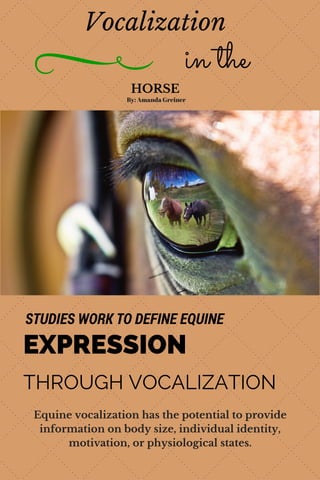
Vocalization
HORSE
in the
EXPRESSION
THROUGH VOCALIZATION
STUDIES WORK TO DEFINE EQUINE
Equine vocalization has the potential to provide
information on body size, individual identity,
motivation, or physiological states.
By: Amanda Greiner
Auditory
PERCEPTION
Range of 55 Hz-33.5 kHz and most sensitive at a range of 1 kHz-
16 kHz.
Horses are more sensitive to LOW frequencies than high
frequencies.
Sensitivity
- Body and head size and structure
between breeds have an impact.
E.g.. Broader brain case creates lower frequency.
- Distance between individuals increases the frequency which can be
heard at a shorter distance.
- Increase in signal duration increases detectability.
( Browning, 2006)
( Yeon, 2012 )
( Browning, 2011 )
Dark bands indicate concentration of
sounds over a specific duration at a
specific frequency giving rise to
expressive components.
(A) Whinny, (B) whinny from social
separation (C) Nicker produced when a
stallion encounters a mare in estrus. (D)
squeal produced by a diestrus mare when
a stallion approached. (E) Squeal
produced by estrus mare when a stallion
approached. (F) Groan, (G) blow (alarm),
(H) blow (after sniffing), (I) snore (dyspnea
- imaired breathing), (J) snort.
(A, F-J) are adapted from Waring (2003).
Praat spectrogram
EXPRESSIVE
COMPONENT
Frequency­ varying
Acoustically different vocalizations can help horse owners
differentiate between distress and eustress calls to
strengthen the horse - handler bond.
Cited:
David G. Browning. Equine vocalization: A comparison of Arabian and Morgan horse whinnies. The Journal of the Acoustical Society of
America 129, 2671 (2011)
David G. Browning, Peter M. Scheifele. Equine acoustics: Further analysis of a whinny—The expressive component
The Journal of the Acoustical Society of America 119, 3435 (2006)
Yeon, Seong C Acoustic communication in the domestic horse (Equus caballus). Journal of Veterinary Behavior: Clinical Applications
and Research, 2012, Vol.7(3), pp.179-185
(Yeon, 2012)

Vocalization in Horses

  • 1.
    Vocalization HORSE in the EXPRESSION THROUGH VOCALIZATION STUDIESWORK TO DEFINE EQUINE Equine vocalization has the potential to provide information on body size, individual identity, motivation, or physiological states. By: Amanda Greiner
  • 2.
    Auditory PERCEPTION Range of 55Hz-33.5 kHz and most sensitive at a range of 1 kHz- 16 kHz. Horses are more sensitive to LOW frequencies than high frequencies. Sensitivity - Body and head size and structure between breeds have an impact. E.g.. Broader brain case creates lower frequency. - Distance between individuals increases the frequency which can be heard at a shorter distance. - Increase in signal duration increases detectability. ( Browning, 2006) ( Yeon, 2012 ) ( Browning, 2011 )
  • 3.
    Dark bands indicateconcentration of sounds over a specific duration at a specific frequency giving rise to expressive components. (A) Whinny, (B) whinny from social separation (C) Nicker produced when a stallion encounters a mare in estrus. (D) squeal produced by a diestrus mare when a stallion approached. (E) Squeal produced by estrus mare when a stallion approached. (F) Groan, (G) blow (alarm), (H) blow (after sniffing), (I) snore (dyspnea - imaired breathing), (J) snort. (A, F-J) are adapted from Waring (2003). Praat spectrogram EXPRESSIVE COMPONENT Frequency­ varying Acoustically different vocalizations can help horse owners differentiate between distress and eustress calls to strengthen the horse - handler bond. Cited: David G. Browning. Equine vocalization: A comparison of Arabian and Morgan horse whinnies. The Journal of the Acoustical Society of America 129, 2671 (2011) David G. Browning, Peter M. Scheifele. Equine acoustics: Further analysis of a whinny—The expressive component The Journal of the Acoustical Society of America 119, 3435 (2006) Yeon, Seong C Acoustic communication in the domestic horse (Equus caballus). Journal of Veterinary Behavior: Clinical Applications and Research, 2012, Vol.7(3), pp.179-185 (Yeon, 2012)