OR
Very large-scale integration (VLSI) is the process of
integrating or embedding hundreds of thousands of
transistors on a single silicon semiconductor
microchip.
VLSI technology was conceived in the late 1970s
when advanced level computer processor microchips
were under development.
VLSI is a successor to large-scale integration (LSI),
medium-scale integration (MSI) and small-scale
integration (SSI) technologies.
VLSI Technology
VLSI is one of the most widely used technologies for
microchip processors, integrated circuits (IC) and
component designing. It was initially designed to support
hundreds of thousands of transistor gates on a microchip
which, as of 2012, exceeded several billion. All of these
transistors are remarkably integrated and embedded
within a microchip that has shrunk over time but still has
the capacity to hold enormous amounts of transistors.
The first 1 mega byte RAM was built on top of VLSI
design principles and included more than one million
transistors on its microchip dye.
What is VLSI?
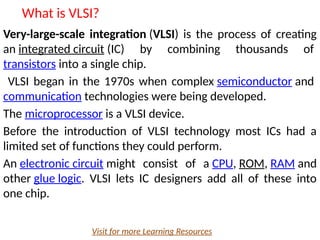
Very-large-scale integration (VLSI) is the process of creating
an integrated circuit (IC) by combining thousands of
transistors into a single chip.
VLSI began in the 1970s when complex semiconductor and
communication technologies were being developed.
The microprocessor is a VLSI device.
Before the introduction of VLSI technology most ICs had a
limited set of functions they could perform.
An electronic circuit might consist of a CPU, ROM, RAM and
other glue logic. VLSI lets IC designers add all of these into
one chip.
Visit for more Learning Resources
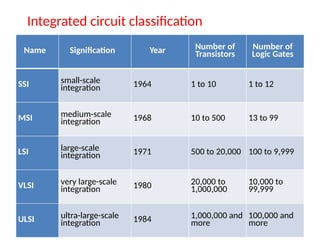
Integrated circuit classification
Name Signification Year Number of
Transistors
Number of
Logic Gates
SSI small-scale
integration 1964 1 to 10 1 to 12
MSI medium-scale
integration 1968 10 to 500 13 to 99
LSI large-scale
integration 1971 500 to 20,000 100 to 9,999
VLSI very large-scale
integration 1980 20,000 to
1,000,000
10,000 to
99,999
ULSI ultra-large-scale
integration 1984 1,000,000 and
more
100,000 and
more
.
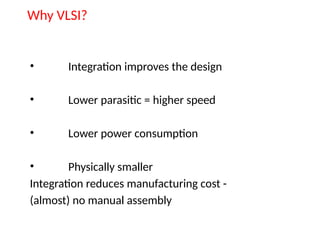
Why VLSI?
• Integration improves the design
• Lower parasitic = higher speed
• Lower power consumption
• Physically smaller
Integration reduces manufacturing cost -
(almost) no manual assembly
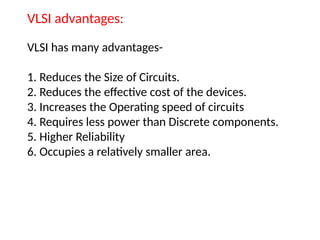
VLSI advantages:
VLSI has many advantages-
1. Reduces the Size of Circuits.
2. Reduces the effective cost of the devices.
3. Increases the Operating speed of circuits
4. Requires less power than Discrete components.
5. Higher Reliability
6. Occupies a relatively smaller area.
VLSI Applications
VLSI is an implementation technology for electronic circuitry -
analogue or digital
It is concerned with forming a pattern of interconnected
switches and gates on the surface of a crystalofsemiconductor
• Microprocessors
• personal computers
• microcontrollers
• Memory - DRAM / SRAM
• Special Purpose Processors - ASICS (CD players, DSP
applications)
• Optical Switches
Has made highly sophisticated control systems mass-
producable and therefore cheap
VLSI Applications
In today's world VLSI chips are widely used in various
branches of Engineering like:
1.Voice and Data Communication networks
2.Digital Signal Processing
3.Computers
4.Commercial Electronics
5.Automobiles
6.Medicine and many more.
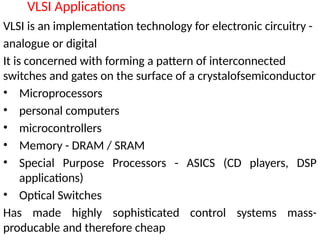
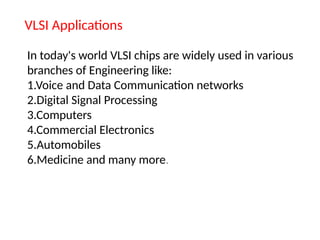
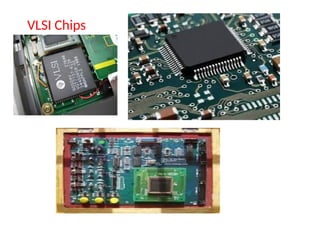
VLSI Chips
THE END
For more detail contact us

vlsi design lab presentation_trends.pptx

  • 1.
    OR Very large-scale integration(VLSI) is the process of integrating or embedding hundreds of thousands of transistors on a single silicon semiconductor microchip. VLSI technology was conceived in the late 1970s when advanced level computer processor microchips were under development. VLSI is a successor to large-scale integration (LSI), medium-scale integration (MSI) and small-scale integration (SSI) technologies.
  • 2.
    VLSI Technology VLSI isone of the most widely used technologies for microchip processors, integrated circuits (IC) and component designing. It was initially designed to support hundreds of thousands of transistor gates on a microchip which, as of 2012, exceeded several billion. All of these transistors are remarkably integrated and embedded within a microchip that has shrunk over time but still has the capacity to hold enormous amounts of transistors. The first 1 mega byte RAM was built on top of VLSI design principles and included more than one million transistors on its microchip dye.
  • 3.
    What is VLSI? Very-large-scaleintegration (VLSI) is the process of creating an integrated circuit (IC) by combining thousands of transistors into a single chip. VLSI began in the 1970s when complex semiconductor and communication technologies were being developed. The microprocessor is a VLSI device. Before the introduction of VLSI technology most ICs had a limited set of functions they could perform. An electronic circuit might consist of a CPU, ROM, RAM and other glue logic. VLSI lets IC designers add all of these into one chip. Visit for more Learning Resources
  • 4.
    Integrated circuit classification NameSignification Year Number of Transistors Number of Logic Gates SSI small-scale integration 1964 1 to 10 1 to 12 MSI medium-scale integration 1968 10 to 500 13 to 99 LSI large-scale integration 1971 500 to 20,000 100 to 9,999 VLSI very large-scale integration 1980 20,000 to 1,000,000 10,000 to 99,999 ULSI ultra-large-scale integration 1984 1,000,000 and more 100,000 and more .
  • 5.
    Why VLSI? • Integrationimproves the design • Lower parasitic = higher speed • Lower power consumption • Physically smaller Integration reduces manufacturing cost - (almost) no manual assembly
  • 6.
    VLSI advantages: VLSI hasmany advantages- 1. Reduces the Size of Circuits. 2. Reduces the effective cost of the devices. 3. Increases the Operating speed of circuits 4. Requires less power than Discrete components. 5. Higher Reliability 6. Occupies a relatively smaller area.
  • 7.
    VLSI Applications VLSI isan implementation technology for electronic circuitry - analogue or digital It is concerned with forming a pattern of interconnected switches and gates on the surface of a crystalofsemiconductor • Microprocessors • personal computers • microcontrollers • Memory - DRAM / SRAM • Special Purpose Processors - ASICS (CD players, DSP applications) • Optical Switches Has made highly sophisticated control systems mass- producable and therefore cheap
  • 8.
    VLSI Applications In today'sworld VLSI chips are widely used in various branches of Engineering like: 1.Voice and Data Communication networks 2.Digital Signal Processing 3.Computers 4.Commercial Electronics 5.Automobiles 6.Medicine and many more.
  • 9.
  • 10.
    THE END For moredetail contact us