Introduction to VLSI
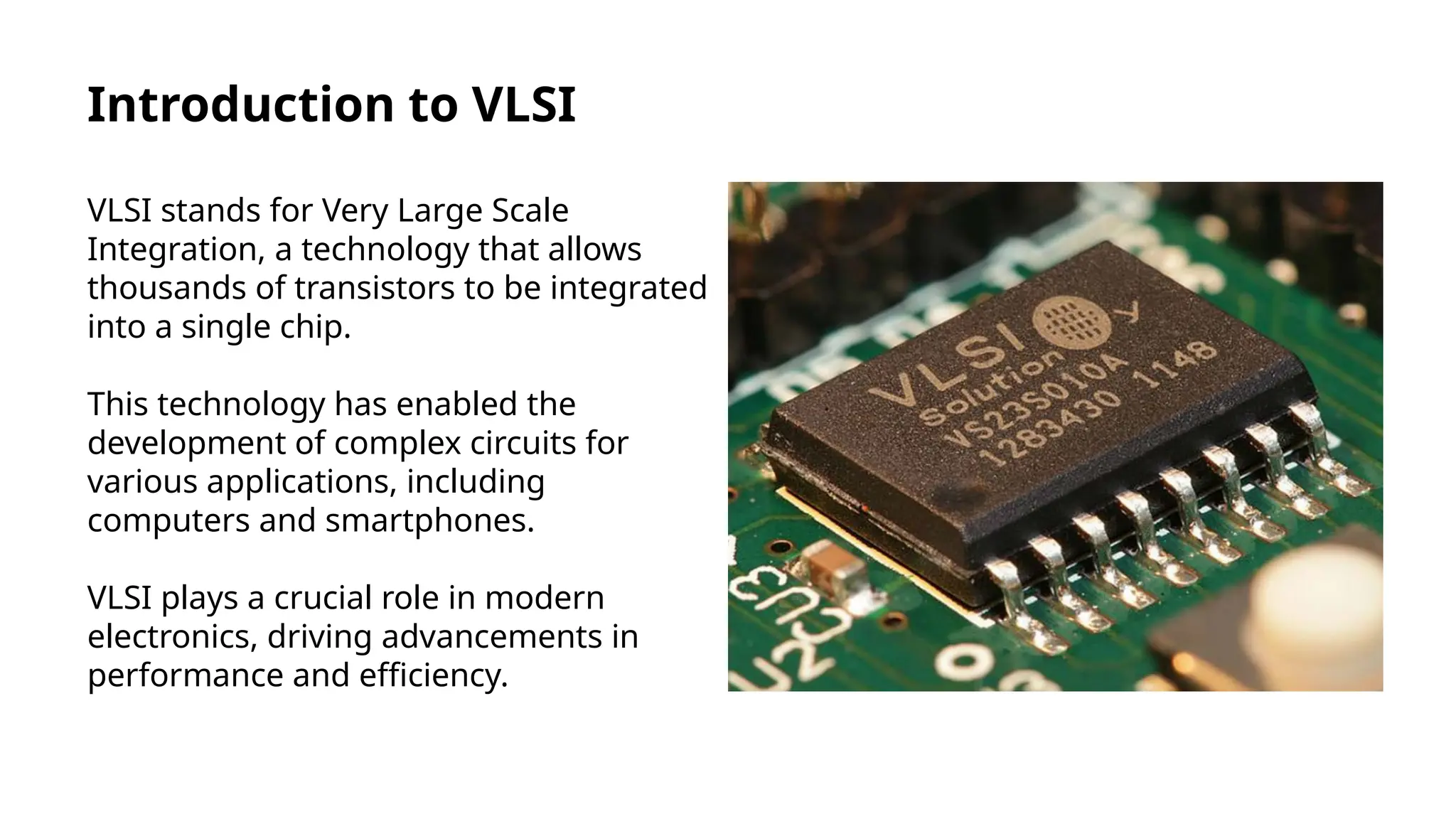
VLSIstands for Very Large Scale
Integration, a technology that allows
thousands of transistors to be integrated
into a single chip.
This technology has enabled the
development of complex circuits for
various applications, including
computers and smartphones.
VLSI plays a crucial role in modern
electronics, driving advancements in
performance and efficiency.
3.
History of VLSI
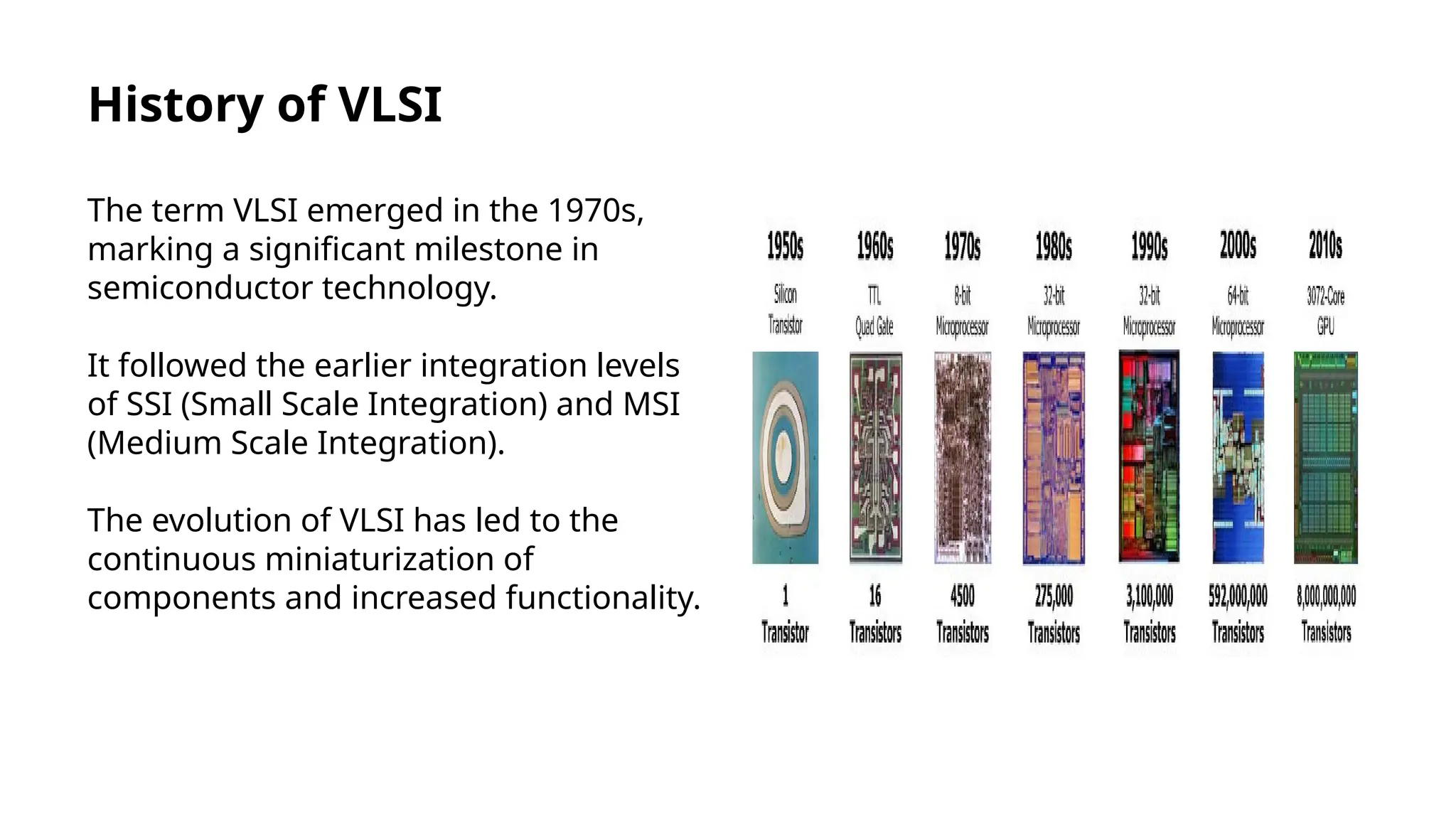
Theterm VLSI emerged in the 1970s,
marking a significant milestone in
semiconductor technology.
It followed the earlier integration levels
of SSI (Small Scale Integration) and MSI
(Medium Scale Integration).
The evolution of VLSI has led to the
continuous miniaturization of
components and increased functionality.
4.
VLSI Design Process
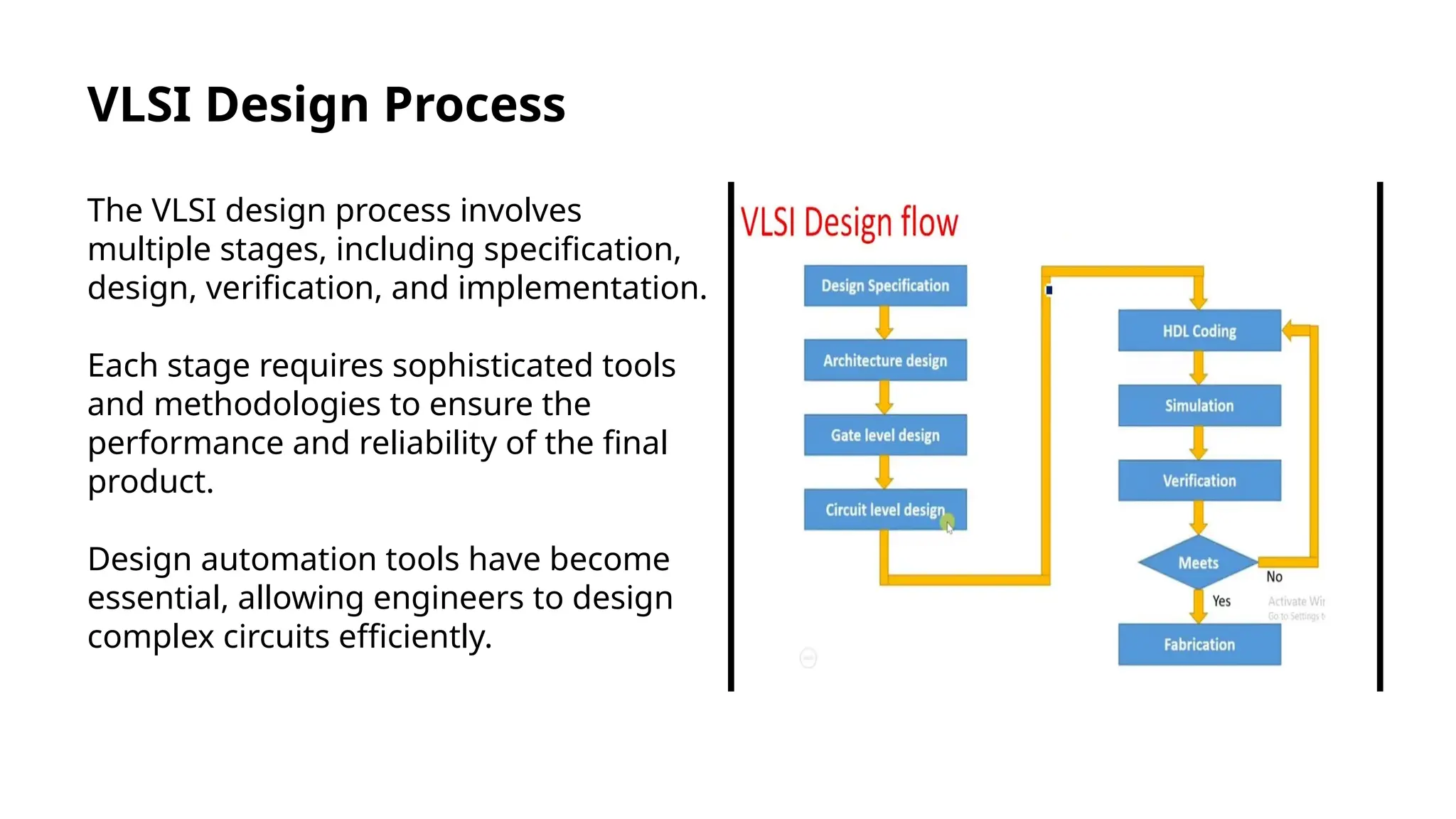
TheVLSI design process involves
multiple stages, including specification,
design, verification, and implementation.
Each stage requires sophisticated tools
and methodologies to ensure the
performance and reliability of the final
product.
Design automation tools have become
essential, allowing engineers to design
complex circuits efficiently.
5.
Types of VLSICircuits
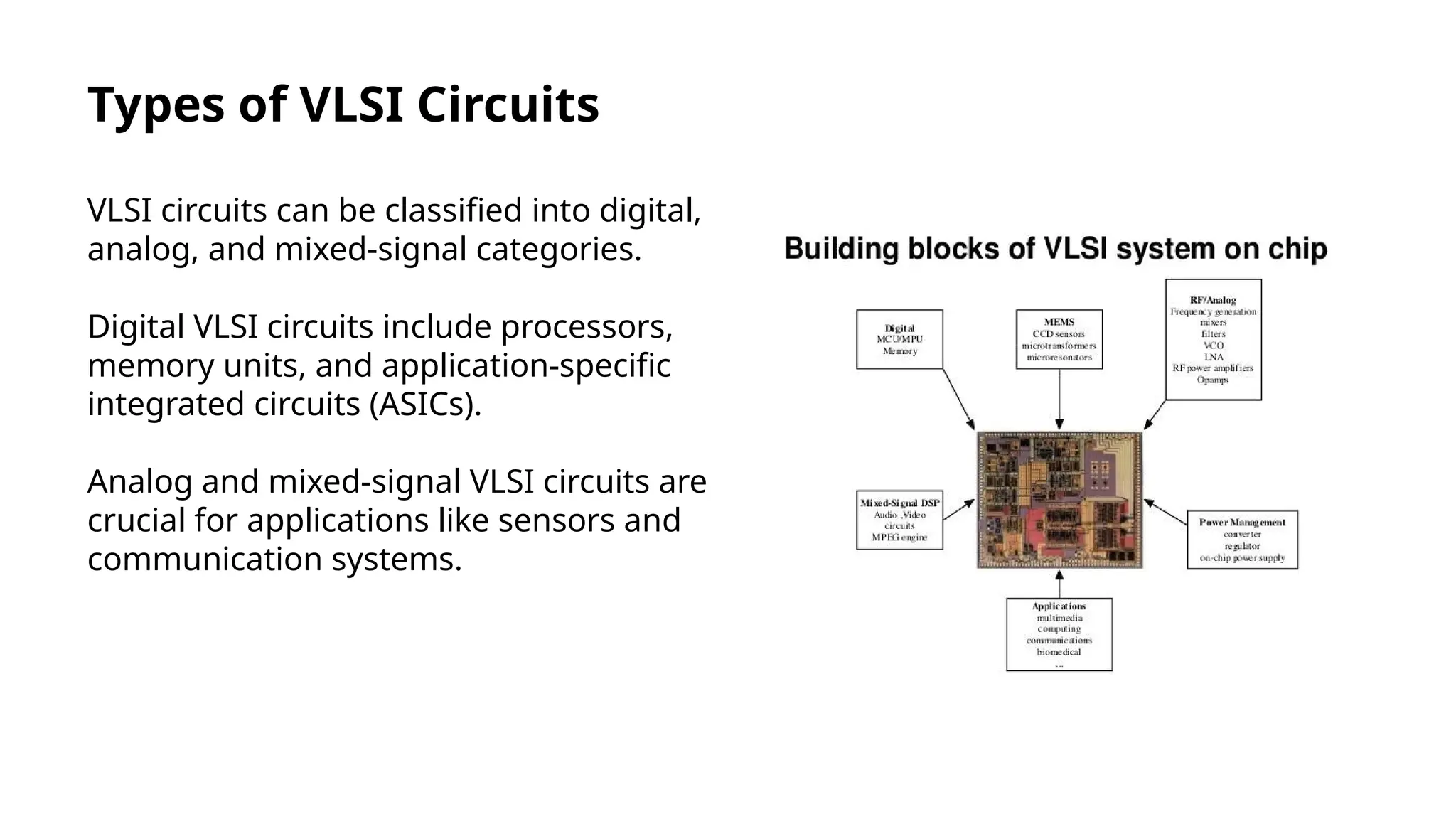
VLSI circuits can be classified into digital,
analog, and mixed-signal categories.
Digital VLSI circuits include processors,
memory units, and application-specific
integrated circuits (ASICs).
Analog and mixed-signal VLSI circuits are
crucial for applications like sensors and
communication systems.
6.
Fabrication Technologies
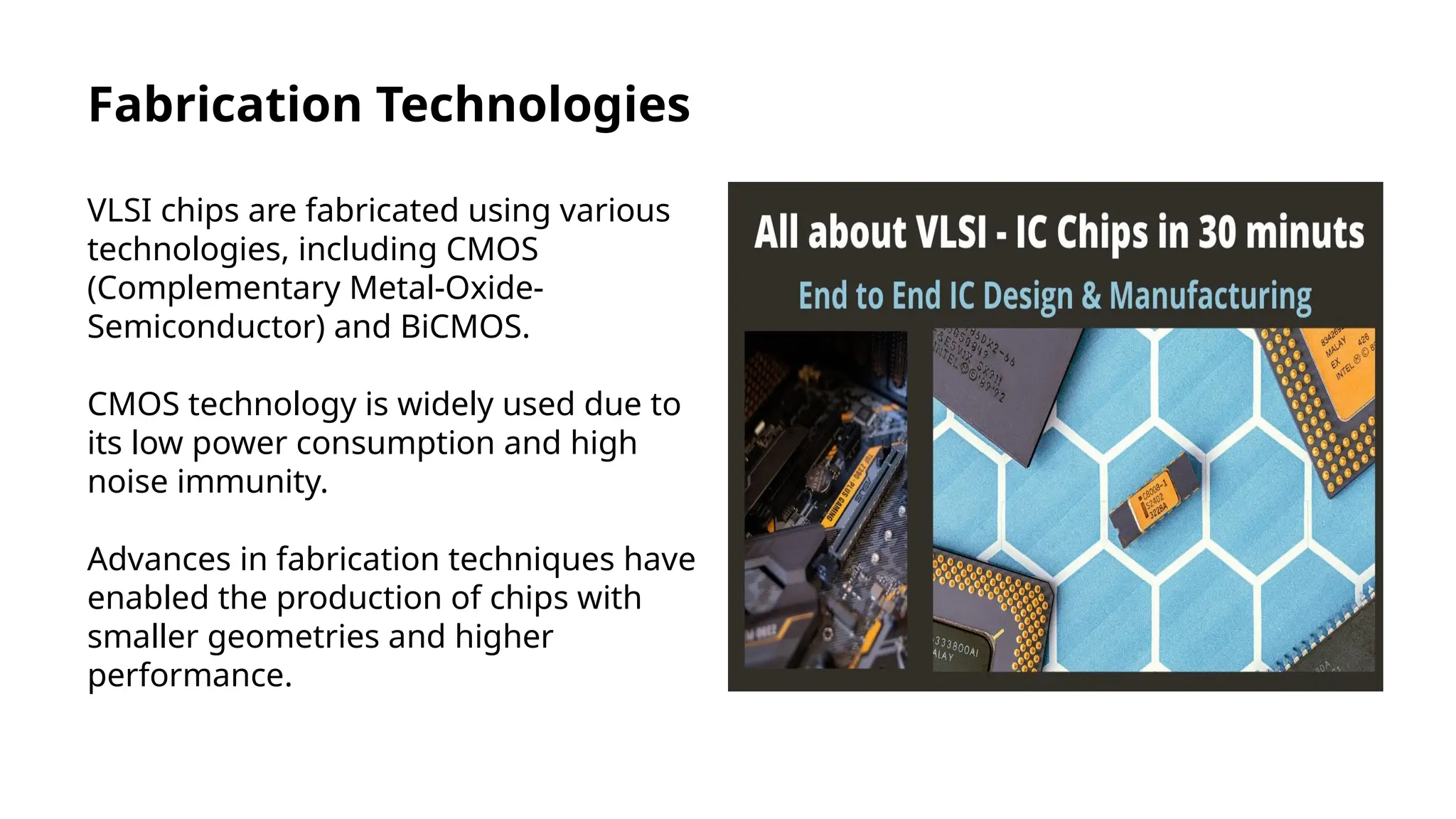
VLSI chipsare fabricated using various
technologies, including CMOS
(Complementary Metal-Oxide-
Semiconductor) and BiCMOS.
CMOS technology is widely used due to
its low power consumption and high
noise immunity.
Advances in fabrication techniques have
enabled the production of chips with
smaller geometries and higher
performance.
7.
Challenges in VLSI
Thedesign and fabrication of VLSI
circuits face challenges such as power
consumption, heat dissipation, and
design complexity.
As transistors shrink in size, issues like
short channel effects and leakage
currents become more significant.
Addressing these challenges requires
innovative design techniques and
materials to maintain performance.
8.
Applications of VLSI
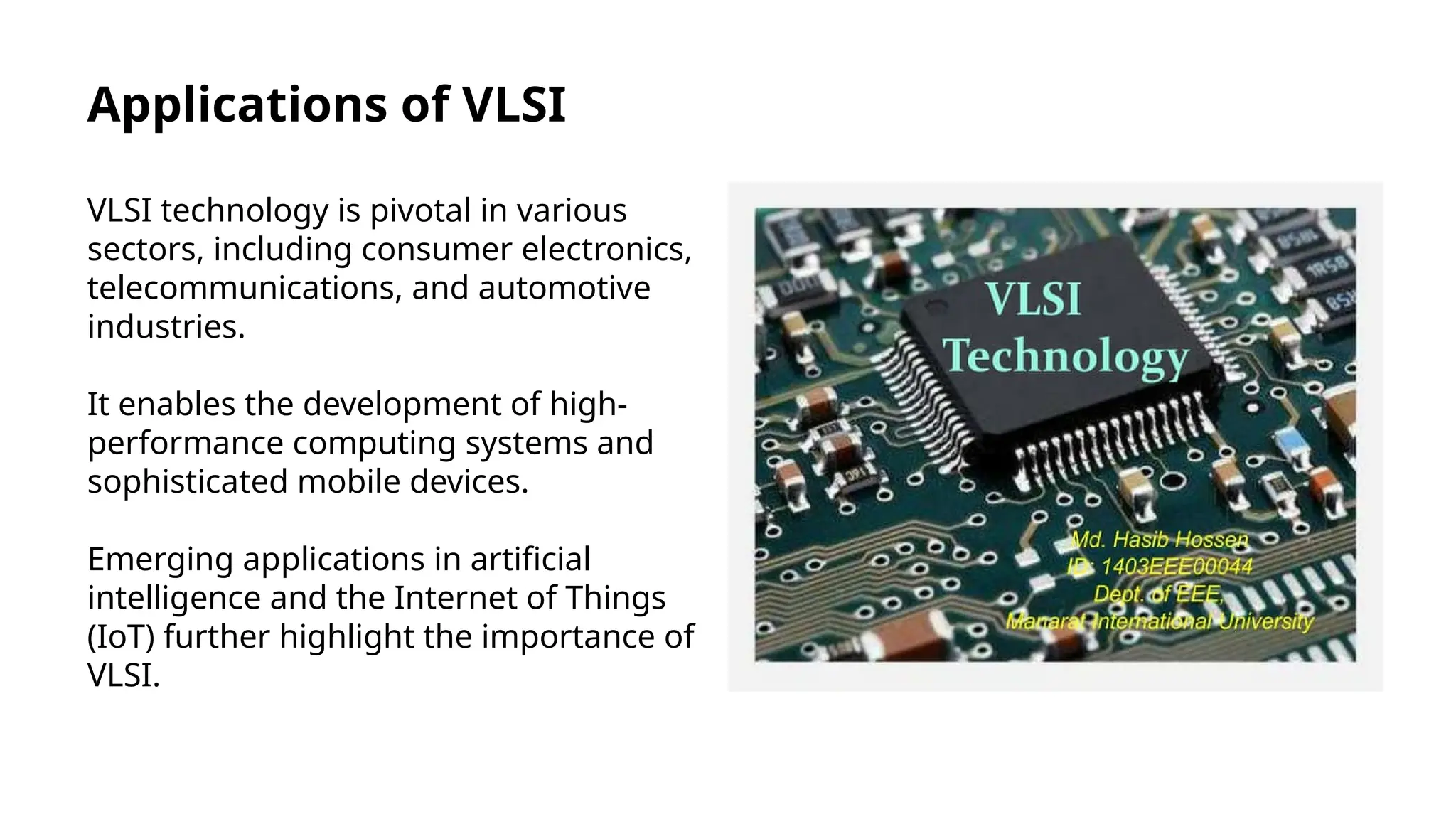
VLSItechnology is pivotal in various
sectors, including consumer electronics,
telecommunications, and automotive
industries.
It enables the development of high-
performance computing systems and
sophisticated mobile devices.
Emerging applications in artificial
intelligence and the Internet of Things
(IoT) further highlight the importance of
VLSI.
9.
Future Trends inVLSI
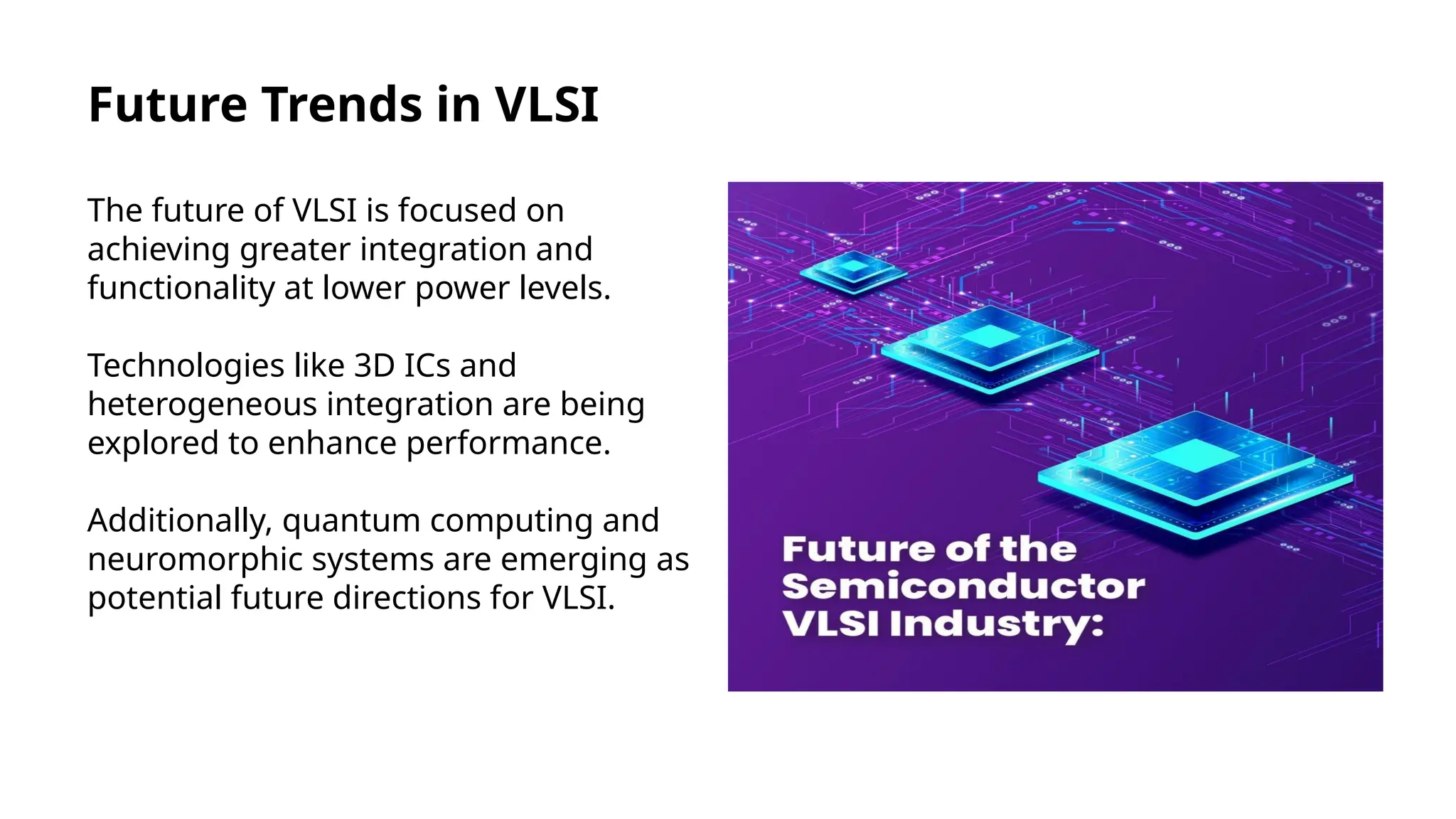
The future of VLSI is focused on
achieving greater integration and
functionality at lower power levels.
Technologies like 3D ICs and
heterogeneous integration are being
explored to enhance performance.
Additionally, quantum computing and
neuromorphic systems are emerging as
potential future directions for VLSI.
10.
VLSI and Sustainability
Thesemiconductor industry is
increasingly prioritizing sustainability in
VLSI design and manufacturing.
Efforts are being made to reduce energy
consumption and minimize waste during
the production process.
Sustainable practices not only benefit the
environment but also improve the overall
efficiency of VLSI systems.
11.
Conclusion
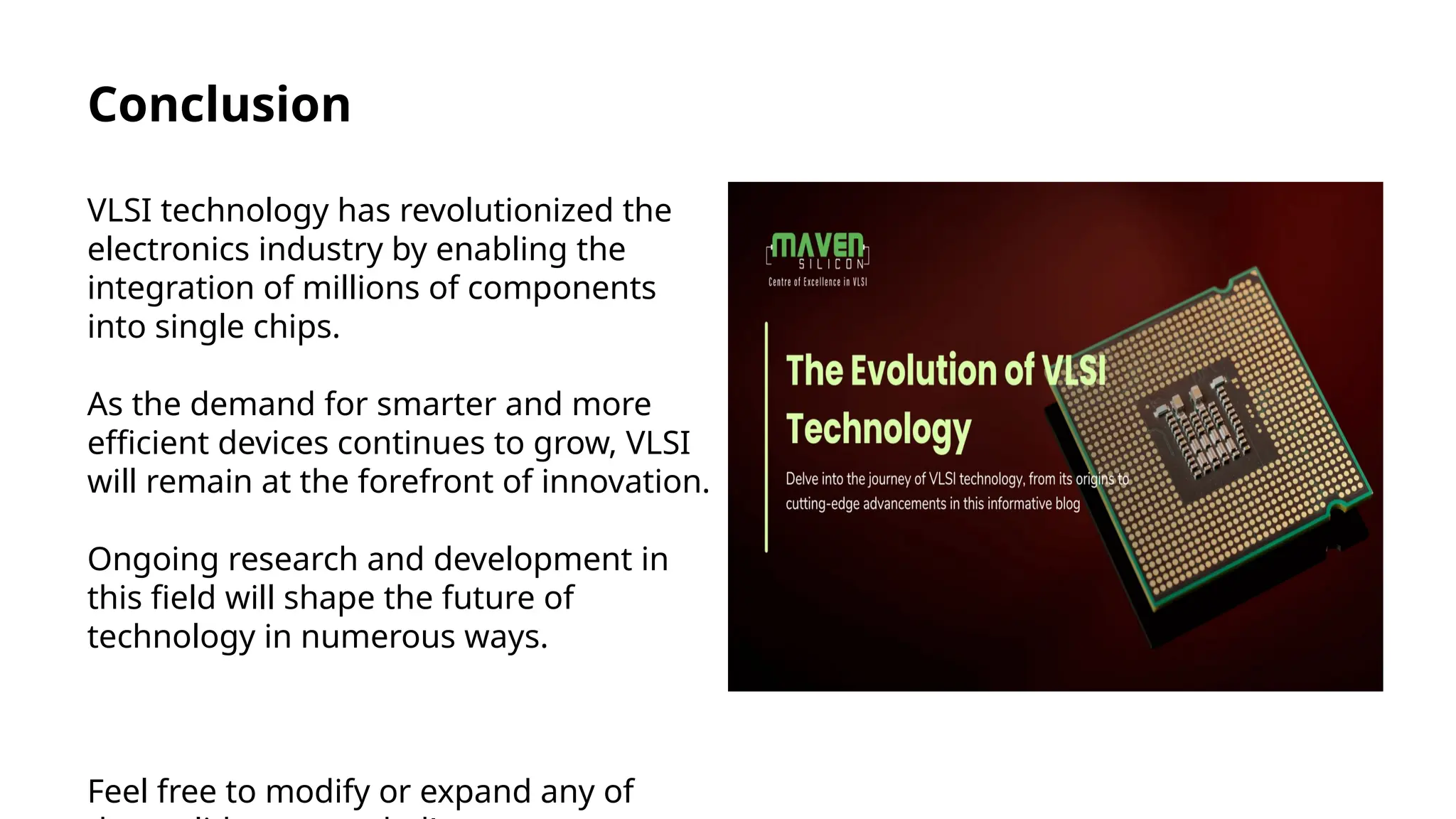
VLSI technology hasrevolutionized the
electronics industry by enabling the
integration of millions of components
into single chips.
As the demand for smarter and more
efficient devices continues to grow, VLSI
will remain at the forefront of innovation.
Ongoing research and development in
this field will shape the future of
technology in numerous ways.
Feel free to modify or expand any of