Page 1 of 11
Empowering ERP Asset Management Solutions
Asset criticality is not just
a reliability tool
Properly applied ranking improves
business performance and
profitability
By Scott Gorsuch, Former Director of Reliability
Strategies, Alcoa GPP (retired)
In a perfect world, maintenance planners have a finite and known set of work to plan
and sufficient personnel and parts ready to allocate. In reality, most planners work at
a frenzied pace to prioritize and make sense of all the work at hand as well as the
imminent, inevitable surprises.
The easiest way to streamline this task is by focusing attention on the most critical
assets. This strategy is well understood to improve maintenance efficiency and
effectiveness. Categorizing assets by importance allows planners and schedulers to
better understand the priorities, direct their efforts for maximum effect, and block out
the “noise” and squeaky wheels that disrupt the plan. It minimizes the frenzied activity
to repair equipment that breaks down and improves equipment availability and
reliability, which in turn drives down variability in the plant’s output.
But the benefits don’t stop there. The valuable insights gained from knowledge of
criticality can extend beyond asset maintenance planning and execution and ripple
throughout the organization. It has the potential to improve business decisions about
maintenance strategies and risk management as well as inventory, procurement,
maintenance budgeting, and continuous improvement.
The cumulative effect brings greater stability and predictability to the equipment,
systems, and operations. Ultimately, fully leveraged criticality filters can drive
operational improvements that are reflected in overall business performance and
profitability.
Exactly how asset criticality is applied will vary for each company based on the goals,
culture of the plant or business as a whole, and what tools are used to extend its value
beyond the given work execution benefits. Whether the effort meets with ongoing
success depends on it being a collaborative, consensus effort that is ingrained in the
culture and treated as a journey. This means regularly looking back, measuring results,
reviewing how criticalities are used, and making continuous improvements to make
sure the desired results are achieved.
Initial hurdles have already been crossed
Asset management systems (EAM/CMMS) in use today are centered on a database of
maintainable asset records and equipment hierarchies. Each was built based on
considerations such as whether and how:
•   Work orders will be written
•   Equipment history will be maintained
•   BOMs will be maintained
•   Preventive maintenance plans will be created
•   Standard text (specifications, regulatory, etc.) will be maintained
•   Budgets will be created and variances tracked
•   Events will be tracked
•   Metrics will be collected
Building this foundation took a lot of work and was probably the most significant effort
in the EAM/CMMS implementation.
In addition, through the software, asset criticality or priority can be set up and used
to improve decisions about equipment maintenance and reliability. Most companies,
in some form or fashion, have already made an initial stab at formalizing the
importance of the equipment in their operations. In the best cases, this process was
collaborative and used a structured methodology, and the results were recorded in
the EAM/CMMS.
Now it’s time for the next step: employing processes and tools that drive business
value throughout the organization by extending the capabilities of the EAM/CMMS
and maximizing the potential of asset criticality analysis.
Metals manufacturer offers a window into the possibilities  
Not long ago, a major metals manufacturer turned its focus to the most relevant
equipment and eliminated a lot of the noise by conducting a risk-based criticality
analysis. Major and minor components were established collaboratively by Operations
and Maintenance using parameters such as production, safety, environmental impact,
maintainability, equipment reliability, spares availability, and overall costs. As the
example, three plants were included in the initiative.
The goal was to become well managed and “boring” by
eliminating the frenzied activity to repair equipment that
breaks down, and thereby maximize output and make it
more predictable.
Once the criticalities were implemented, the margins at the
plants were compared from operating in crisis mode
without clear priorities vs. the margins generated from
stable, consistent operation. The latter approach, of course,
was far more profitable.
The metals plant with the most stability in performance had operating margins that
were tens of millions of dollars higher than the two less focused facilities. Having a
better understanding of the significant impact of criticality on profitability, they quickly
mobilized the workforce to address defects and failures on the most critical
equipment, even if it meant spending more than planned on maintenance. Despite
the higher maintenance costs, they were still making more money than projected for
the year.
"A well-managed plant, I soon
learned, is a quiet place. A
factory that is 'dramatic,' a
factory in which the 'epic of
industry' is unfolded before the
visitor's eyes, is poorly managed.
A well-managed factory is
boring." – Peter Drucker
For the two lesser performers, anything that broke was potentially treated as critical
regardless of its actual importance to the operation. Not giving precedence to key
equipment meant that its downtime was prolonged and production was lost. The least
effective plant lost tens of millions of dollars against their forecasted operating
budget.
After plotting and translating the data to reflect the impact
of maintenance on operations, all three plants saw
improvement opportunities and the value of ongoing
review and improvement of the designation and utilization
of asset criticalities. The more profitable plant could save
millions more by reducing maintenance costs with better predictive and preventive
maintenance strategies, for example. The least profitable has a real opportunity to
stabilize its operation by putting more focus on the more critical equipment. For all
three plants, it is a journey of continuous improvement.
Starting the journey  
Criticality is a filter that allows visibility into what’s important
and suppresses the noise. It transcends work execution
improvement initiatives and should be at the center of all
maintenance processes – how work is scheduled, how the
budget is planned, and even how performance is
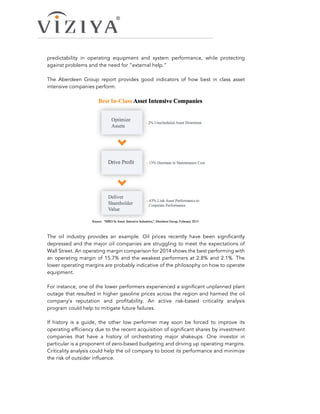
measured. Criticality provides the opportunity to visualize optimization of assets, drive
profits, deliver shareholder value, and achieve best-in-class status.
Right from the start, defining criticality allows a change of focus – to eliminating
wasteful maintenance activities, minimizing maintenance costs, reducing unscheduled
downtime, and improving asset performance. It is a business philosophy and tool that
provides a structured approach to focusing limited resources on driving stability and
Criticality is a filter that allows
visibility into what’s important
and suppresses the noise.
The least effective plant lost tens
of millions of dollars against their
forecasted operating budget.
predictability in operating equipment and system performance, while protecting
against problems and the need for “external help.”
The Aberdeen Group report provides good indicators of how best in class asset
intensive companies perform.
The oil industry provides an example. Oil prices recently have been significantly
depressed and the major oil companies are struggling to meet the expectations of
Wall Street. An operating margin comparison for 2014 shows the best performing with
an operating margin of 15.7% and the weakest performers at 2.8% and 2.1%. The
lower operating margins are probably indicative of the philosophy on how to operate
equipment.
For instance, one of the lower performers experienced a significant unplanned plant
outage that resulted in higher gasoline prices across the region and harmed the oil
company’s reputation and profitability. An active risk-based criticality analysis
program could help to mitigate future failures.
If history is a guide, the other low performer may soon be forced to improve its
operating efficiency due to the recent acquisition of significant shares by investment
companies that have a history of orchestrating major shakeups. One investor in
particular is a proponent of zero-based budgeting and driving up operating margins.
Criticality analysis could help the oil company to boost its performance and minimize
the risk of outsider influence.
Defining asset criticality is just the first step. Properly used,
it has the ability to influence processes throughout the plant
as well as the performance of the company as a whole. It
must also be recognized as a continuous journey. Just as
physical assets change over time, so will the priorities of the
equipment and business. Criticality rankings and how they
are used must be fine-tuned on an ongoing basis.
How asset criticality improves business performance  
Criticalities can be used in a wide range of business processes to drive variability in
the operation down to a minimum. Following are ten examples.
1.   Reliability strategies and technologies: Knowledge of
criticality allows companies to make targeted
investments in predictive and condition-based
maintenance tools and technologies, which maximize
asset availability by identifying defects before they
become failures. Awareness of the current condition
and criticality of equipment allows limited resources
(labor, materials, money, and time) to be optimally allocated.
2.   Risk management methodologies: Criticality analysis extends the benefits of
structured methodologies to assess and manage risk and to control costs.
Understanding which needs are immediate and which can wait is central to
mitigating operational risk.
3.   Predictive and preventive maintenance plans: Creating specific and rigorous PdM
and PM plans with detailed work instructions for the most critical equipment
improves reliability, availability, and utilization of the equipment. Employing the
right predictive technologies at the right intervals further enhances the results.
Practices such as visual inspection, calibration, vibration analysis, thermography,
ultrasound, oil analysis, and motor circuit analysis are among the candidates to
consider.
4.   Backlog work planning and scheduling: Criticality is
most known for filtering and prioritizing the work on
hand. It places focus on “first things first” so that tasks
can be effectively organized in the planning period. It
enables the work to be coordinated, scheduled and
performed in the appropriate sequence, with material
delivery requirements properly aligned, and alongside
other activities that are less critical. Most companies
today use criticality in some manner to set their
Properly used, it has the ability
to influence processes
throughout the plant as well as
the performance of the company
as a whole.
Criticality rankings and how they
are used must be fine-tuned on
an ongoing basis.
Refining and formalizing the
process is a real opportunity to
become a participant in the
overall activities of the
operation.
scheduling priorities in business meetings. Refining and formalizing the process is
a real opportunity to become a participant in the overall activities of the operation.
5.   Break-in work planning and scheduling: For unplanned, unscheduled break-in
work, the criticality filter gives precedence where it is needed. With this
knowledge, better decisions can be made such as whether the work can be
planned and scheduled for a different time, how to mobilize the correct resources,
whether other work can be deferred to fill in resource shortages, and whether or
how to make the most use of the unexpected downtime by adding less urgent
pending work to the plan.
6.   Bill of materials: Knowing asset criticality allows a framework to be set for
developing BOMs, starting with the most critical and working down to the least
critical. Since it translates into stocking requirements for the storeroom at a given
location, steps can be taken to ensure an adequate supply of parts listed in critical
asset BOMs and any standard work BOMs. Maintenance planners can generate
work BOMs more effectively with the assurance that the right material will be on
site at the right time to perform the job.
7.   Inventory stocking levels: Demand can be
forecasted on critical components very easily, which
simplifies management of stock items and spares.
EAM/CMMS min-max fields can be used to define
the safety stock for repairables and the traveling
population of all spares. To accelerate the
refurbishment of critical spares that have fallen
below the safety stock minimum, the priorities for
the machine shop can be changed.
8.   Inventory purchasing: Inventory working capital
can be ordered as a function of the impact of the
component’s time in operation. Without an
understanding of asset criticality, the storeroom
becomes a repository of material that may or may
not be important and result in excess working
capital. Although working capital is a one-time charge, the cost of managing the
material is an ongoing expense. While criticalities stabilize inventory purchases
and warehouse turns, there may be a one-time lift when they are initially defined.
9.   Maintenance budgeting: Understanding asset criticality allows Maintenance to
justify spending on critical assets and decide where spending on less critical assets
can be delayed. Maintenance costs for an operating facility cannot be zero, but
there is a minimum. Eliminating the noise above the minimum adds to the
company’s profitability.
Spares Factoids:
• 21% of critical MRO SKU’s are
under-stocked
• 6% of MRO inventory SKU’s
account for more than 90% of
throughput
• ~55% of MRO inventories have
not moved in the last 36-48
months and 30% of that will
probably never move
• 8% of MRO inventory SKU’s are
duplicates
Source: PCA Consulting
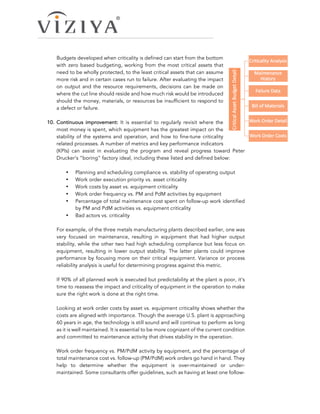
Budgets developed when criticality is defined can start from the bottom
with zero based budgeting, working from the most critical assets that
need to be wholly protected, to the least critical assets that can assume
more risk and in certain cases run to failure. After evaluating the impact
on output and the resource requirements, decisions can be made on
where the cut line should reside and how much risk would be introduced
should the money, materials, or resources be insufficient to respond to
a defect or failure.
10.  Continuous improvement: It is essential to regularly revisit where the
most money is spent, which equipment has the greatest impact on the
stability of the systems and operation, and how to fine-tune criticality
related processes. A number of metrics and key performance indicators
(KPIs) can assist in evaluating the program and reveal progress toward Peter
Drucker’s “boring” factory ideal, including these listed and defined below:
•   Planning and scheduling compliance vs. stability of operating output
•   Work order execution priority vs. asset criticality
•   Work costs by asset vs. equipment criticality
•   Work order frequency vs. PM and PdM activities by equipment
•   Percentage of total maintenance cost spent on follow-up work identified
by PM and PdM activities vs. equipment criticality
•   Bad actors vs. criticality
For example, of the three metals manufacturing plants described earlier, one was
very focused on maintenance, resulting in equipment that had higher output
stability, while the other two had high scheduling compliance but less focus on
equipment, resulting in lower output stability. The latter plants could improve
performance by focusing more on their critical equipment. Variance or process
reliability analysis is useful for determining progress against this metric.
If 90% of all planned work is executed but predictability at the plant is poor, it’s
time to reassess the impact and criticality of equipment in the operation to make
sure the right work is done at the right time.
Looking at work order costs by asset vs. equipment criticality shows whether the
costs are aligned with importance. Though the average U.S. plant is approaching
60 years in age, the technology is still sound and will continue to perform as long
as it is well maintained. It is essential to be more cognizant of the current condition
and committed to maintenance activity that drives stability in the operation.
Work order frequency vs. PM/PdM activity by equipment, and the percentage of
total maintenance cost vs. follow-up (PM/PdM) work orders go hand in hand. They
help to determine whether the equipment is over-maintained or under-
maintained. Some consultants offer guidelines, such as having at least one follow-
up work order for every six to eight rounds on a piece of equipment, but starting
points of this nature must be adjusted for the local culture, equipment, etc.
Comparing bad actors to criticality provides
insight into whether the initial settings were
correct and offers an opportunity to revisit the
values. For instance, the criticality value of a
problem asset should be reassessed particularly
if it causes recurring break-in work. Alternate
methods to expedite recurring repairs should be
evaluated, such as whether to develop a standard
repair work instruction to ensure more efficient
responses going forward. Likewise, storeroom
stocking levels for critical spares should also be
regularly reviewed to make sure expectations for
the equipment and plant are met.
The right tools make all the difference  
EAM/CMMS solutions are the essential launching point for asset criticality benefits
as they house the assigned values and focus attention on the most urgent
equipment. In order to reach beyond the work execution advantages and
leverage the rankings for broader business improvement, integrated third-party
solutions are available to enhance your EAM/CMMS footprint.
VIZIYA created its WorkAlign product family with the understanding that
Maintenance needs to prioritize and effectively manage critical assets.
•   With WorkAlign Scheduler, maintenance supervisors and planners can easily
filter down to the most urgent jobs for the most critical assets in a particular
location, and make better scheduling decisions.
•   WorkAlign Mobile puts criticality data in the hands of users in the field to
ensure awareness of priorities and simplify work execution and data
collection, such as entering failure codes, inventory transactions, or new work
requests.
•   By calculating and presenting crucial metrics with WorkAlign Analytics,
companies can monitor progress against business objectives and optimize
their software, processes, and business results.
•   They can use WorkAlign Maintenance Budgeting, a tool developed in
collaboration with Alcoa that supports zero based budgeting, to assure
adequate budgets for critical assets and establish tighter budgets for lower
priority assets.
10 Processes Improved with Asset
Criticality:
• Reliability strategies and technologies
• Risk management methodologies
• Predictive and preventive maintenance
plans
• Backlog work planning and scheduling
• Break-in work planning and scheduling
• Bill of materials
• Inventory stocking levels
• Inventory purchasing
• Maintenance budgeting
• Continuous improvement
•   With WorkAlign Warranty Tracker, knowledge of critical equipment that
routinely fails in early life can be used to reconsider the vendor choice and
improve purchasing decisions.
Conclusion
With the right processes and tools, Maintenance has the power to deliver
profitability to the operation by increasing availability, stability, and predictability
of the equipment. Asset criticality analysis guides business decisions and is
recommended for driving the efficiency and effectiveness of the overall
maintenance program. Keeping high criticality equipment performing at a very
high level, and driving variability out of the processes, is a continuous journey with
the potential to deliver significant, ongoing value to the bottom line.
Authors
SCOTT GORSUCH
Scott Gorsuch is the Manager of Engineering and Equipment Technology for
Alcoa World Alumina and the Manager of Enterprise Business Systems at Alcoa, Inc.
About VIZIYA
Headquartered in Hamilton, ON, with offices in Barcelona, Perth, Atlanta and Dubai,
VIZIYA is the industry leader providing bolt-on software products to enhance ERP-
based asset maintenance systems. VIZIYA’s proprietary WorkAlign™ Product Suite
delivers seamless integration into existing ERP systems. With over 45,000 users at 740
sites across 6 continents, the world’s best companies use VIZIYA products to help
them better maintain their assets. Visit viziya.com for more information.

Viziya

  • 1.
    Page 1 of11 Empowering ERP Asset Management Solutions Asset criticality is not just a reliability tool Properly applied ranking improves business performance and profitability By Scott Gorsuch, Former Director of Reliability Strategies, Alcoa GPP (retired)
  • 2.
    In a perfectworld, maintenance planners have a finite and known set of work to plan and sufficient personnel and parts ready to allocate. In reality, most planners work at a frenzied pace to prioritize and make sense of all the work at hand as well as the imminent, inevitable surprises. The easiest way to streamline this task is by focusing attention on the most critical assets. This strategy is well understood to improve maintenance efficiency and effectiveness. Categorizing assets by importance allows planners and schedulers to better understand the priorities, direct their efforts for maximum effect, and block out the “noise” and squeaky wheels that disrupt the plan. It minimizes the frenzied activity to repair equipment that breaks down and improves equipment availability and reliability, which in turn drives down variability in the plant’s output. But the benefits don’t stop there. The valuable insights gained from knowledge of criticality can extend beyond asset maintenance planning and execution and ripple throughout the organization. It has the potential to improve business decisions about maintenance strategies and risk management as well as inventory, procurement, maintenance budgeting, and continuous improvement. The cumulative effect brings greater stability and predictability to the equipment, systems, and operations. Ultimately, fully leveraged criticality filters can drive operational improvements that are reflected in overall business performance and profitability. Exactly how asset criticality is applied will vary for each company based on the goals, culture of the plant or business as a whole, and what tools are used to extend its value beyond the given work execution benefits. Whether the effort meets with ongoing success depends on it being a collaborative, consensus effort that is ingrained in the culture and treated as a journey. This means regularly looking back, measuring results, reviewing how criticalities are used, and making continuous improvements to make sure the desired results are achieved. Initial hurdles have already been crossed Asset management systems (EAM/CMMS) in use today are centered on a database of maintainable asset records and equipment hierarchies. Each was built based on considerations such as whether and how: •   Work orders will be written •   Equipment history will be maintained •   BOMs will be maintained •   Preventive maintenance plans will be created •   Standard text (specifications, regulatory, etc.) will be maintained •   Budgets will be created and variances tracked
  • 3.
    •   Eventswill be tracked •   Metrics will be collected Building this foundation took a lot of work and was probably the most significant effort in the EAM/CMMS implementation. In addition, through the software, asset criticality or priority can be set up and used to improve decisions about equipment maintenance and reliability. Most companies, in some form or fashion, have already made an initial stab at formalizing the importance of the equipment in their operations. In the best cases, this process was collaborative and used a structured methodology, and the results were recorded in the EAM/CMMS. Now it’s time for the next step: employing processes and tools that drive business value throughout the organization by extending the capabilities of the EAM/CMMS and maximizing the potential of asset criticality analysis. Metals manufacturer offers a window into the possibilities   Not long ago, a major metals manufacturer turned its focus to the most relevant equipment and eliminated a lot of the noise by conducting a risk-based criticality analysis. Major and minor components were established collaboratively by Operations and Maintenance using parameters such as production, safety, environmental impact, maintainability, equipment reliability, spares availability, and overall costs. As the example, three plants were included in the initiative. The goal was to become well managed and “boring” by eliminating the frenzied activity to repair equipment that breaks down, and thereby maximize output and make it more predictable. Once the criticalities were implemented, the margins at the plants were compared from operating in crisis mode without clear priorities vs. the margins generated from stable, consistent operation. The latter approach, of course, was far more profitable. The metals plant with the most stability in performance had operating margins that were tens of millions of dollars higher than the two less focused facilities. Having a better understanding of the significant impact of criticality on profitability, they quickly mobilized the workforce to address defects and failures on the most critical equipment, even if it meant spending more than planned on maintenance. Despite the higher maintenance costs, they were still making more money than projected for the year. "A well-managed plant, I soon learned, is a quiet place. A factory that is 'dramatic,' a factory in which the 'epic of industry' is unfolded before the visitor's eyes, is poorly managed. A well-managed factory is boring." – Peter Drucker
  • 4.
    For the twolesser performers, anything that broke was potentially treated as critical regardless of its actual importance to the operation. Not giving precedence to key equipment meant that its downtime was prolonged and production was lost. The least effective plant lost tens of millions of dollars against their forecasted operating budget. After plotting and translating the data to reflect the impact of maintenance on operations, all three plants saw improvement opportunities and the value of ongoing review and improvement of the designation and utilization of asset criticalities. The more profitable plant could save millions more by reducing maintenance costs with better predictive and preventive maintenance strategies, for example. The least profitable has a real opportunity to stabilize its operation by putting more focus on the more critical equipment. For all three plants, it is a journey of continuous improvement. Starting the journey   Criticality is a filter that allows visibility into what’s important and suppresses the noise. It transcends work execution improvement initiatives and should be at the center of all maintenance processes – how work is scheduled, how the budget is planned, and even how performance is measured. Criticality provides the opportunity to visualize optimization of assets, drive profits, deliver shareholder value, and achieve best-in-class status. Right from the start, defining criticality allows a change of focus – to eliminating wasteful maintenance activities, minimizing maintenance costs, reducing unscheduled downtime, and improving asset performance. It is a business philosophy and tool that provides a structured approach to focusing limited resources on driving stability and Criticality is a filter that allows visibility into what’s important and suppresses the noise. The least effective plant lost tens of millions of dollars against their forecasted operating budget.
  • 5.
    predictability in operatingequipment and system performance, while protecting against problems and the need for “external help.” The Aberdeen Group report provides good indicators of how best in class asset intensive companies perform. The oil industry provides an example. Oil prices recently have been significantly depressed and the major oil companies are struggling to meet the expectations of Wall Street. An operating margin comparison for 2014 shows the best performing with an operating margin of 15.7% and the weakest performers at 2.8% and 2.1%. The lower operating margins are probably indicative of the philosophy on how to operate equipment. For instance, one of the lower performers experienced a significant unplanned plant outage that resulted in higher gasoline prices across the region and harmed the oil company’s reputation and profitability. An active risk-based criticality analysis program could help to mitigate future failures. If history is a guide, the other low performer may soon be forced to improve its operating efficiency due to the recent acquisition of significant shares by investment companies that have a history of orchestrating major shakeups. One investor in particular is a proponent of zero-based budgeting and driving up operating margins. Criticality analysis could help the oil company to boost its performance and minimize the risk of outsider influence.
  • 6.
    Defining asset criticalityis just the first step. Properly used, it has the ability to influence processes throughout the plant as well as the performance of the company as a whole. It must also be recognized as a continuous journey. Just as physical assets change over time, so will the priorities of the equipment and business. Criticality rankings and how they are used must be fine-tuned on an ongoing basis. How asset criticality improves business performance   Criticalities can be used in a wide range of business processes to drive variability in the operation down to a minimum. Following are ten examples. 1.   Reliability strategies and technologies: Knowledge of criticality allows companies to make targeted investments in predictive and condition-based maintenance tools and technologies, which maximize asset availability by identifying defects before they become failures. Awareness of the current condition and criticality of equipment allows limited resources (labor, materials, money, and time) to be optimally allocated. 2.   Risk management methodologies: Criticality analysis extends the benefits of structured methodologies to assess and manage risk and to control costs. Understanding which needs are immediate and which can wait is central to mitigating operational risk. 3.   Predictive and preventive maintenance plans: Creating specific and rigorous PdM and PM plans with detailed work instructions for the most critical equipment improves reliability, availability, and utilization of the equipment. Employing the right predictive technologies at the right intervals further enhances the results. Practices such as visual inspection, calibration, vibration analysis, thermography, ultrasound, oil analysis, and motor circuit analysis are among the candidates to consider. 4.   Backlog work planning and scheduling: Criticality is most known for filtering and prioritizing the work on hand. It places focus on “first things first” so that tasks can be effectively organized in the planning period. It enables the work to be coordinated, scheduled and performed in the appropriate sequence, with material delivery requirements properly aligned, and alongside other activities that are less critical. Most companies today use criticality in some manner to set their Properly used, it has the ability to influence processes throughout the plant as well as the performance of the company as a whole. Criticality rankings and how they are used must be fine-tuned on an ongoing basis. Refining and formalizing the process is a real opportunity to become a participant in the overall activities of the operation.
  • 7.
    scheduling priorities inbusiness meetings. Refining and formalizing the process is a real opportunity to become a participant in the overall activities of the operation. 5.   Break-in work planning and scheduling: For unplanned, unscheduled break-in work, the criticality filter gives precedence where it is needed. With this knowledge, better decisions can be made such as whether the work can be planned and scheduled for a different time, how to mobilize the correct resources, whether other work can be deferred to fill in resource shortages, and whether or how to make the most use of the unexpected downtime by adding less urgent pending work to the plan. 6.   Bill of materials: Knowing asset criticality allows a framework to be set for developing BOMs, starting with the most critical and working down to the least critical. Since it translates into stocking requirements for the storeroom at a given location, steps can be taken to ensure an adequate supply of parts listed in critical asset BOMs and any standard work BOMs. Maintenance planners can generate work BOMs more effectively with the assurance that the right material will be on site at the right time to perform the job. 7.   Inventory stocking levels: Demand can be forecasted on critical components very easily, which simplifies management of stock items and spares. EAM/CMMS min-max fields can be used to define the safety stock for repairables and the traveling population of all spares. To accelerate the refurbishment of critical spares that have fallen below the safety stock minimum, the priorities for the machine shop can be changed. 8.   Inventory purchasing: Inventory working capital can be ordered as a function of the impact of the component’s time in operation. Without an understanding of asset criticality, the storeroom becomes a repository of material that may or may not be important and result in excess working capital. Although working capital is a one-time charge, the cost of managing the material is an ongoing expense. While criticalities stabilize inventory purchases and warehouse turns, there may be a one-time lift when they are initially defined. 9.   Maintenance budgeting: Understanding asset criticality allows Maintenance to justify spending on critical assets and decide where spending on less critical assets can be delayed. Maintenance costs for an operating facility cannot be zero, but there is a minimum. Eliminating the noise above the minimum adds to the company’s profitability. Spares Factoids: • 21% of critical MRO SKU’s are under-stocked • 6% of MRO inventory SKU’s account for more than 90% of throughput • ~55% of MRO inventories have not moved in the last 36-48 months and 30% of that will probably never move • 8% of MRO inventory SKU’s are duplicates Source: PCA Consulting
  • 8.
    Budgets developed whencriticality is defined can start from the bottom with zero based budgeting, working from the most critical assets that need to be wholly protected, to the least critical assets that can assume more risk and in certain cases run to failure. After evaluating the impact on output and the resource requirements, decisions can be made on where the cut line should reside and how much risk would be introduced should the money, materials, or resources be insufficient to respond to a defect or failure. 10.  Continuous improvement: It is essential to regularly revisit where the most money is spent, which equipment has the greatest impact on the stability of the systems and operation, and how to fine-tune criticality related processes. A number of metrics and key performance indicators (KPIs) can assist in evaluating the program and reveal progress toward Peter Drucker’s “boring” factory ideal, including these listed and defined below: •   Planning and scheduling compliance vs. stability of operating output •   Work order execution priority vs. asset criticality •   Work costs by asset vs. equipment criticality •   Work order frequency vs. PM and PdM activities by equipment •   Percentage of total maintenance cost spent on follow-up work identified by PM and PdM activities vs. equipment criticality •   Bad actors vs. criticality For example, of the three metals manufacturing plants described earlier, one was very focused on maintenance, resulting in equipment that had higher output stability, while the other two had high scheduling compliance but less focus on equipment, resulting in lower output stability. The latter plants could improve performance by focusing more on their critical equipment. Variance or process reliability analysis is useful for determining progress against this metric. If 90% of all planned work is executed but predictability at the plant is poor, it’s time to reassess the impact and criticality of equipment in the operation to make sure the right work is done at the right time. Looking at work order costs by asset vs. equipment criticality shows whether the costs are aligned with importance. Though the average U.S. plant is approaching 60 years in age, the technology is still sound and will continue to perform as long as it is well maintained. It is essential to be more cognizant of the current condition and committed to maintenance activity that drives stability in the operation. Work order frequency vs. PM/PdM activity by equipment, and the percentage of total maintenance cost vs. follow-up (PM/PdM) work orders go hand in hand. They help to determine whether the equipment is over-maintained or under- maintained. Some consultants offer guidelines, such as having at least one follow-
  • 9.
    up work orderfor every six to eight rounds on a piece of equipment, but starting points of this nature must be adjusted for the local culture, equipment, etc. Comparing bad actors to criticality provides insight into whether the initial settings were correct and offers an opportunity to revisit the values. For instance, the criticality value of a problem asset should be reassessed particularly if it causes recurring break-in work. Alternate methods to expedite recurring repairs should be evaluated, such as whether to develop a standard repair work instruction to ensure more efficient responses going forward. Likewise, storeroom stocking levels for critical spares should also be regularly reviewed to make sure expectations for the equipment and plant are met. The right tools make all the difference   EAM/CMMS solutions are the essential launching point for asset criticality benefits as they house the assigned values and focus attention on the most urgent equipment. In order to reach beyond the work execution advantages and leverage the rankings for broader business improvement, integrated third-party solutions are available to enhance your EAM/CMMS footprint. VIZIYA created its WorkAlign product family with the understanding that Maintenance needs to prioritize and effectively manage critical assets. •   With WorkAlign Scheduler, maintenance supervisors and planners can easily filter down to the most urgent jobs for the most critical assets in a particular location, and make better scheduling decisions. •   WorkAlign Mobile puts criticality data in the hands of users in the field to ensure awareness of priorities and simplify work execution and data collection, such as entering failure codes, inventory transactions, or new work requests. •   By calculating and presenting crucial metrics with WorkAlign Analytics, companies can monitor progress against business objectives and optimize their software, processes, and business results. •   They can use WorkAlign Maintenance Budgeting, a tool developed in collaboration with Alcoa that supports zero based budgeting, to assure adequate budgets for critical assets and establish tighter budgets for lower priority assets. 10 Processes Improved with Asset Criticality: • Reliability strategies and technologies • Risk management methodologies • Predictive and preventive maintenance plans • Backlog work planning and scheduling • Break-in work planning and scheduling • Bill of materials • Inventory stocking levels • Inventory purchasing • Maintenance budgeting • Continuous improvement
  • 10.
    •   WithWorkAlign Warranty Tracker, knowledge of critical equipment that routinely fails in early life can be used to reconsider the vendor choice and improve purchasing decisions. Conclusion With the right processes and tools, Maintenance has the power to deliver profitability to the operation by increasing availability, stability, and predictability of the equipment. Asset criticality analysis guides business decisions and is recommended for driving the efficiency and effectiveness of the overall maintenance program. Keeping high criticality equipment performing at a very high level, and driving variability out of the processes, is a continuous journey with the potential to deliver significant, ongoing value to the bottom line.
  • 11.
    Authors SCOTT GORSUCH Scott Gorsuchis the Manager of Engineering and Equipment Technology for Alcoa World Alumina and the Manager of Enterprise Business Systems at Alcoa, Inc. About VIZIYA Headquartered in Hamilton, ON, with offices in Barcelona, Perth, Atlanta and Dubai, VIZIYA is the industry leader providing bolt-on software products to enhance ERP- based asset maintenance systems. VIZIYA’s proprietary WorkAlign™ Product Suite delivers seamless integration into existing ERP systems. With over 45,000 users at 740 sites across 6 continents, the world’s best companies use VIZIYA products to help them better maintain their assets. Visit viziya.com for more information.