Visual Neural Networking with Mobile Medical Imaging:
Disruptive Tools and Technologies for Value Care­Giving Teams
Authors:
Jim Smurro, MS, MBA; Eliot L. Siegel, MD, FSIIM; Krishna Surapaneni, MD
Background
Radiologists are adapting to challenges presented by a dynamic ecosystem –
requirements for clinical documentation for "meaningful use," changing
reimbursement models, ONC/CMS/IOM concerns about quality, safety, efficiency,
and increased regulatory scrutiny regarding exposures to harmful radiation.
Mobile medical imaging offers potentially disruptive technology for communications-
enhanced care delivery, including more timely clinician-specialist and provider-
patient communications, and providing clinical decision support at point of care in
real time or asynchronously.
Evaluation:
Mobile medical imaging allows care-giving teams to communicate, collaborate, and
train together – anywhere, anytime – with medical images and video.
Annotated medical images, telestrated cine clips, and encapsulated audio files help
teams document and share episodes of care. Clinical encounters and specialist
consultations are captured at the POC in standards-compliant clinical notes for
provider-mandated EHR’s and patient-directed PHR’s, pursuant to ONC’s Health
Outcomes Policy Priorities for Meaningful Use.
Secure, encrypted imaging portals with digital identity verification enable multi-
disciplinary teams to communicate, collaborate, coordinate, and deliver "faster,
smarter, better" patient-centric care to informed and engaged patients and families.
Visual Neural Networking with Mobile Medical Imaging:
Disruptive Tools and Technologies for Value Care­Giving Teams
Background:
Radiologists are adapting to challenges presented by a dynamic ecosystem –
requirements for clinical documentation for "meaningful use," changing reimbursement
models, ONC/CMS/IOM concerns about quality, safety, efficiency, and increased
regulatory scrutiny regarding exposures to harmful radiation.
Mobile medical imaging offers potentially disruptive technology for communications-
enhanced care delivery, including more timely clinician-specialist and provider-patient
communications, and providing clinical decision support at point of care in real time or
asynchronously.
Evaluation:
Mobile medical imaging allows care-giving teams to communicate, collaborate, and train
together – anywhere, anytime – with medical images and video.
Annotated medical images, telestrated cine clips, and encapsulated audio files help teams
document and share episodes of care. Clinical encounters and specialist consultations are
captured at the POC in standards-compliant clinical notes for provider-mandated EHR’s
and patient-directed PHR’s, pursuant to ONC’s Health Outcomes Policy Priorities for
Meaningful Use.
Secure, encrypted imaging portals with digital identity verification enable multi-
disciplinary teams to communicate, collaborate, coordinate, and deliver "faster, smarter,
better" patient-centric care to informed and engaged patients and families.
Discussion:
Visual Neural Networking with Mobile Medical Imaging – Some illustrative real-world
clinical use cases:
 Rapid evaluation and emergent treatment of acute ischemic stroke ["Time is
Brain"] with neurological expertise and remote telestroke support for rescue therapies
that limit permanent damage and disability
 Collaborative medical image sharing by clinicians and specialists that reduces
redundant testing, avoids unnecessary exposures to harmful radiation and improves
diagnostic detection, evaluation and treatment
 Virtual tumor boards networks with multi-specialist collaborations that can boost
recruitment (and retention) of patients for oncology clinical trials, treatment and care,
especially from rural and under-served patient populations
 Surgical "road mapping," simulation and training, including pre-operative team
"warm-ups" with actual patient images, prior to interventional radiology, cardiac
catheterization, and endovascular procedures
 Remote patient monitoring following emergency surgery – from recovery in the ICU
to convalescence in the "medical home" - that can reduce post-operative complications
from sepsis (especially dangerous for elderly patients) and avoids preventable re-
admission hospitalizations
Presentation Outline:
Part 1 – Visual Neural Networking: Vision and Value Proposition – Jim Smurro
Adapting to Change in Dynamic Ecosystems [reimbursement models; ACO’s]
Pro-active response to IOM (and FDA) concerns: Quality, Safety, Efficiency
Mobile Medical Imaging: Disruptive Technology for Value Care-Giving Teams
Part 2 – Mobile Medical Imaging: Status report on current apps – Krishna Surapaneni
Illustrative Use Cases: Acute Stroke; Appendicitis
Emerging Apps: Physician, Medical Student and Patient Education
How-to videos for Doctors; Instructional videos for Patients
Part 3 – Implications for Radiologists: Value Innovation through Services Differentiation –
Eliot Siegel
Mobile Medical Imaging as a communications platform: Specialist-Clinician and Clinician-
Patient communications
Mobile Medical Imaging as a tool for Clinical Data Capture at the Point of Care
Redefine radiologist potential role as "Conductor" of Visual Communications for Care-
Giving Teams in the brave new world of EHR’s and "Meaningful Use" leverage radiology
standards for media-rich clinical documentation
Potential new revenue streams: reimbursable teleconsults, virtual tumor boards,
oncology clinical trials, telestroke networks
Conclusion:
Visual neural networking with mobile medical imaging empowers care-giving teams to
deliver ‘value care’ for the 21st century –'faster, smarter, better' patient-centric care –
with higher quality, lower costs, and healthier outcomes.
Disruptive technologies such as these, enrich, enhance andaugment team skills in a "virtuous
circle" of communications, collaboration, cooperation and coordination. Teamwork
and training boost productivity and performance. "Deliberate practice" improves quality,
safety and clinical outcomes. Team "checklists" reinforce and sustain learning curve improvements.
"Anywhere, Anytime" medical imaging "revitalizes" aging technology infrastructures with
ubiquitous connectivity, bi-directional "pixel liquidity," and ad hoc collaborations that
extend the range, reach, and effectiveness of medical devices and equipment.
Visual neural networking transforms workflows for teams empowered with mHealth
connectivity. Smart, agile teams, working in concert from off-campus locations, consume
fewer and less costly RVU resources to orchestrate delivery of team value care.
With fewer medical errors, less redundant care, and more skilled labor delivering better
care in less costly venues, cost savings begin to accrue, compound and multiply. Working
together, care-giving teams start bending the cost curve.
Visual neural networking with mobile medical imaging – connecting patients to providers
with pictures – helps transform knowledge workers with talent, training and expertise
into visually­networked teams for innovation, growth and prosperity.
Authors:
Krishna Surapaneni, MD, MPh, New York Presbyterian Hospital/Columbia University Medical Center; Jim Smurro, MS, MBA; Eliot L. Siegel, MD, FSIIM
Disclosures and Conflicts
Eliot Siegel, M.D.
Dr. Siegel is Professor and Vice Chair at the University of Maryland School of Medicine, Department of Diagnostic Radiology, as well as Chief of Radiology and
Nuclear Medicine for the Veterans Affairs Maryland Healthcare System, both in Baltimore, MD. Dr. Siegel is also responsible for the NCI's National Cancer Image
Archive and is Workspace Lead of the National Cancer Institute's caBIG In Vivo Imaging Workspace.
Under his guidance, the VA Maryland Healthcare System became the first filmless healthcare enterprise in the United States. He has written over 200 articles and
book chapters about PACS (Picture Archiving and Communication Systems) and digital imaging, and has edited six books on the topic, including Filmless
Radiology and Security Issues in the Digital Medical Enterprise. He has made more than 1,000 presentations throughout the world on a broad range of topics
involving the use of computers in medicine. He has been named as Researcher of the Year, received multiple awards for innovation, including the Smithsonian
award, and was selected as runner up Educator of the Year for Diagnostic Radiology. The readers and editorial board of Medical Imaging have selected Dr. Siegel
as one of the top ten radiologists for the past two years. He was symposium chairman for the Society of Photo-optical and Industrial Engineers (SPIE) Medical
Imaging Meeting for three years, is currently chair of Publications for the Society of Computer Applications in Radiology (SIIM) and has been honored as a fellow
in that organization. He is chairman of the RSNA's Medical Imaging Resource Committee. His areas of interest and responsibility at both the local and national
levels include digital imaging and PACS, telemedicine, the electronic medical record, and informatics. Dr. Siegel holds an M.D. from the University of Maryland.
Jim Smurro
Jim Smurro is Director of Corporate Development for Foresight Imaging. His responsibilities encompass strategy formulation and execution of strategic business
initiatives, including new ventures, technology partnerships and marketing alliances. Mr. Smurro brings a wealth of experience as principal, investor and advisor to
entrepreneurs and emerging growth companies in healthcare services and information technology. He holds both undergraduate and masters degrees in
Engineering and Applied Physics from Harvard University. Mr. Smurro earned his MBA in Management of Technology from Harvard Business School, where also he
completed doctoral (DBA) studies in disruptive technology innovation
Krishna Surapaneni, MD
Dr. Surapaneni joined P&S July 1, 2010, as assistant professor of clinical radiology.Dr. Surapaneni received his MD from Ross University School of Medicine. He
completed a radiology residency at Long Island College Hospital and a neuroradiology fellowship at NewYork-Presbyterian Hospital/Columbia.
June 2011 Volume 21, Number 6
A L S O I N S I D E :
CTC Use Grows Despite
Reimbursement Obstacles
New ACGME Standards Concern
Program Directors
Diligence Necessary to Minimize
Gadolinium-related Events
MDCT Angiography Effective in
Ischemic Stroke, SAH Diagnosis
Course Enrollment for RSNA 2011 Begins July 6
See Page 21
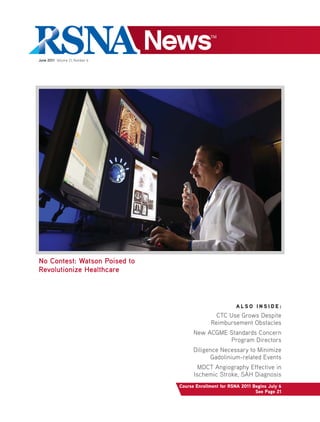
No Contest: Watson Poised to
Revolutionize Healthcare
NEWS YOU CAN USE
13 RSNA News | June 2011 June 2011 | RSNA News 14
FEATURE
Well before Watson’s gameshow victory, experts at
the University of Maryland (UM) School of Medi-
cine in Baltimore and Columbia University Medical
Center began working with IBM to apply Watson’s
analytics capabilities to healthcare. Specifically,
Watson is being developed as an assistant capable
of reading electronic health records (EHR) and
providing instant feedback to physicians in ways not
always available from doctors and nurses.
“This breakthrough in computer sci-
ence will allow us to explore this tech-
nique for medical diagnosis,” said Eliot
Siegel, M.D., a professor and vice-chair
of imaging informatics at the University of Mary-
land School of Medicine (MSM), chief of imaging
services for the Maryland Veterans Affairs (VA)
Healthcare System at the Baltimore VA Medical
Center and co-chair of RSNA’s Medical Imaging
Resource Center (MIRC) committee.
“The potential for a renaissance in electronic
health records really lies in the evolution of com-
puter systems,” said Dr. Siegel, director of UM’s
Maryland Imaging Research Technologies Labo-
ratory, who was instrumental in the partnership
between MSM and IBM. “I’m really surprised it has
taken this long for that renaissance to start.”
Physicians at Columbia University are helping
identify critical medical issues to which Watson may
be able to contribute, according to IBM.
Analytics Capability Critical to Healthcare
Powered by 90 servers and 360 computer chips,
Watson was built in four years by IBM researchers
seeking to develop a machine that could quickly
answer complex questions. Through IBM’s Deep
Question Answering, Natural Language Process-
ing and Machine Learning statistical techniques,
Watson works to understand questions and develop
answers—a capability critical to the technology’s
potential value to healthcare.
IBM is also working with speech-recognition
software developer Nuance Communications to give
Winning the $1 million “Jeopardy!” challenge earlier this year was just the tip of the
iceberg for Watson, the IBM supercomputer that experts believe has the potential to
revolutionize the healthcare industry.
Watson the analytics capabilities necessary for physician-
patient consultations.
Earlier attempts at artificial intelligence required every
possible question and answer to be hard-coded into the
system, a time-consuming process with little value in
healthcare, said Martin Kohn, M.D., Chief Medical Sci-
entist, Care Delivery Systems, IBM Research.
“Watson uses a probabilistic, evidence-based
approach,” Dr. Kohn said. “It generates and scores many
hypotheses using an extensible collection
of natural language processing, machine
learning and reasoning algorithms. Many
previous such efforts relied on programmed decision
rules. Watson is a self-learning system that does not rely
on such rules. It gathers and weighs evidence to refine its
hypotheses.”
Decision Support Boosted to New Level
Radiology stands to benefit tremendously from Watson’s
capabilities, experts say.
“The technology has the potential to provide deci-
sion support on a scale not dreamt of prior to this,” said
Nancy Knight, Ph.D., the director of Academic and
Research Development and a founder of the Maryland
Imaging Research Technologies Laboratory at UM.
“Watson can supply the radiologist at the point of
care with complete patient information from the elec-
tronic health record, including imaging history, allow-
ing the radiologist to mine an often exhaustive number
of records to identify the most important points,” Dr.
Knight said. “It also provides the latest and most exten-
sive scientific knowledge and clinical experience that can be used to inform
decisions about diagnosis, additional tests, management and likely prognoses.”
Watson is currently in the testing phase in that learning process, said Dr.
Siegel, who pointed out the similarity to real-life students progressing from
medical school to residencies.
The first step—acquiring book knowledge—is already under way. Watson’s
database already includes information from medical journals and textbooks
such as the Merck Manual of Diagnosis and Therapy, Harrison’s Principles of
Internal Medicine, the American College of Physicians Medicine and Stein’s Inter-
nal Medicine.
Next, experts will work to develop Watson’s understanding of the physiol-
ogy of the human body, followed by the third step: gathering experience.
“Watson not only needs the general knowledge that made him so successful
on ‘Jeopardy!,’ but also information from the databases specific to medicine,”
Dr. Siegel said.
Watson is an Assistant, not a Physician
In time, Dr. Siegel would like to see Watson function as a physician’s assistant.
He envisions Watson being used for chart review, providing assistance on drug
interactions or inconsistencies in prescriptions. Regardless of the technology’s
potential, Dr. Siegel stresses that Watson is designed to act as an assistant to a
physician, rather than a replacement.
“I don’t see this technology supplanting physicians or radiologists,” Dr. Sie-
gel said. “It’s a tool that will gather, summarize and analyze information—very
similar to the role now performed by our best residents and fellows.”
As the technology progresses and expands, it will be especially important to
rural hospitals or areas where there may be fewer experts, but healthcare orga-
nizations across the board stand to benefit, he said.
“Watson’s eventual expansion into healthcare has profound implications for
radiology and will certainly improve the safety, effectiveness and potentially
the cost of healthcare delivery overall.” 
No Contest: Watson Poised to
Revolutionize Healthcare
“Watson’s eventual expansion
into healthcare has profound
implications for radiology and
will certainly improve the safety,
effectiveness and potentially
the cost of healthcare delivery
overall.”
Eliot Siegel, M.D.
SIEGEL DISCUSSES
WATSON’S ROLE
AT UM
To view a video
podcast of Eliot
Siegel, M.D.,
discussing the
development of Watson as an
assistant capable of reading elec-
tronic health records and provid-
ing instant feedback to physicians
at the University of Maryland
School of Medicine, go to www.
umm.edu/media/video/misc_
siegel_watson.htm.
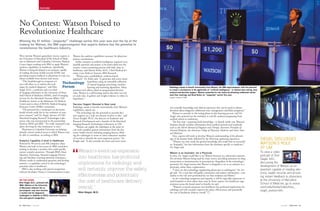
Radiology stands to benefit enormously from Watson, the IBM supercomputer with the potential
to create a renaissance in the application of “artificial intelligence,” in medical data mining, data
analysis and decision support. Watson cemented its star status by defeating celebrated contes-
tants Ken Jennings and Brad Rutter on “Jeopardy!” earlier this year.
Images courtesy of IBM.
ON THE COVER
Eliot Siegel, M.D., pictured with
IBM’s Watson at the University
of Maryland, believes the su-
percomputer may soon become
a routine tool for diagnostic
radiologists in addition to PACS, advanced visualiza-
tion and speech recognition.
Technology
Forum

Visual Neural Networking at SIIM

  • 1.
    Visual Neural Networkingwith Mobile Medical Imaging: Disruptive Tools and Technologies for Value Care­Giving Teams Authors: Jim Smurro, MS, MBA; Eliot L. Siegel, MD, FSIIM; Krishna Surapaneni, MD Background Radiologists are adapting to challenges presented by a dynamic ecosystem – requirements for clinical documentation for "meaningful use," changing reimbursement models, ONC/CMS/IOM concerns about quality, safety, efficiency, and increased regulatory scrutiny regarding exposures to harmful radiation. Mobile medical imaging offers potentially disruptive technology for communications- enhanced care delivery, including more timely clinician-specialist and provider- patient communications, and providing clinical decision support at point of care in real time or asynchronously. Evaluation: Mobile medical imaging allows care-giving teams to communicate, collaborate, and train together – anywhere, anytime – with medical images and video. Annotated medical images, telestrated cine clips, and encapsulated audio files help teams document and share episodes of care. Clinical encounters and specialist consultations are captured at the POC in standards-compliant clinical notes for provider-mandated EHR’s and patient-directed PHR’s, pursuant to ONC’s Health Outcomes Policy Priorities for Meaningful Use. Secure, encrypted imaging portals with digital identity verification enable multi- disciplinary teams to communicate, collaborate, coordinate, and deliver "faster, smarter, better" patient-centric care to informed and engaged patients and families.
  • 2.
    Visual Neural Networkingwith Mobile Medical Imaging: Disruptive Tools and Technologies for Value Care­Giving Teams Background: Radiologists are adapting to challenges presented by a dynamic ecosystem – requirements for clinical documentation for "meaningful use," changing reimbursement models, ONC/CMS/IOM concerns about quality, safety, efficiency, and increased regulatory scrutiny regarding exposures to harmful radiation. Mobile medical imaging offers potentially disruptive technology for communications- enhanced care delivery, including more timely clinician-specialist and provider-patient communications, and providing clinical decision support at point of care in real time or asynchronously. Evaluation: Mobile medical imaging allows care-giving teams to communicate, collaborate, and train together – anywhere, anytime – with medical images and video. Annotated medical images, telestrated cine clips, and encapsulated audio files help teams document and share episodes of care. Clinical encounters and specialist consultations are captured at the POC in standards-compliant clinical notes for provider-mandated EHR’s and patient-directed PHR’s, pursuant to ONC’s Health Outcomes Policy Priorities for Meaningful Use. Secure, encrypted imaging portals with digital identity verification enable multi- disciplinary teams to communicate, collaborate, coordinate, and deliver "faster, smarter, better" patient-centric care to informed and engaged patients and families. Discussion: Visual Neural Networking with Mobile Medical Imaging – Some illustrative real-world clinical use cases:  Rapid evaluation and emergent treatment of acute ischemic stroke ["Time is Brain"] with neurological expertise and remote telestroke support for rescue therapies that limit permanent damage and disability  Collaborative medical image sharing by clinicians and specialists that reduces redundant testing, avoids unnecessary exposures to harmful radiation and improves diagnostic detection, evaluation and treatment  Virtual tumor boards networks with multi-specialist collaborations that can boost recruitment (and retention) of patients for oncology clinical trials, treatment and care, especially from rural and under-served patient populations  Surgical "road mapping," simulation and training, including pre-operative team "warm-ups" with actual patient images, prior to interventional radiology, cardiac catheterization, and endovascular procedures  Remote patient monitoring following emergency surgery – from recovery in the ICU to convalescence in the "medical home" - that can reduce post-operative complications from sepsis (especially dangerous for elderly patients) and avoids preventable re- admission hospitalizations Presentation Outline: Part 1 – Visual Neural Networking: Vision and Value Proposition – Jim Smurro Adapting to Change in Dynamic Ecosystems [reimbursement models; ACO’s] Pro-active response to IOM (and FDA) concerns: Quality, Safety, Efficiency Mobile Medical Imaging: Disruptive Technology for Value Care-Giving Teams Part 2 – Mobile Medical Imaging: Status report on current apps – Krishna Surapaneni Illustrative Use Cases: Acute Stroke; Appendicitis Emerging Apps: Physician, Medical Student and Patient Education How-to videos for Doctors; Instructional videos for Patients Part 3 – Implications for Radiologists: Value Innovation through Services Differentiation – Eliot Siegel Mobile Medical Imaging as a communications platform: Specialist-Clinician and Clinician- Patient communications Mobile Medical Imaging as a tool for Clinical Data Capture at the Point of Care Redefine radiologist potential role as "Conductor" of Visual Communications for Care- Giving Teams in the brave new world of EHR’s and "Meaningful Use" leverage radiology standards for media-rich clinical documentation Potential new revenue streams: reimbursable teleconsults, virtual tumor boards, oncology clinical trials, telestroke networks Conclusion: Visual neural networking with mobile medical imaging empowers care-giving teams to deliver ‘value care’ for the 21st century –'faster, smarter, better' patient-centric care – with higher quality, lower costs, and healthier outcomes. Disruptive technologies such as these, enrich, enhance andaugment team skills in a "virtuous circle" of communications, collaboration, cooperation and coordination. Teamwork and training boost productivity and performance. "Deliberate practice" improves quality, safety and clinical outcomes. Team "checklists" reinforce and sustain learning curve improvements. "Anywhere, Anytime" medical imaging "revitalizes" aging technology infrastructures with ubiquitous connectivity, bi-directional "pixel liquidity," and ad hoc collaborations that extend the range, reach, and effectiveness of medical devices and equipment. Visual neural networking transforms workflows for teams empowered with mHealth connectivity. Smart, agile teams, working in concert from off-campus locations, consume fewer and less costly RVU resources to orchestrate delivery of team value care. With fewer medical errors, less redundant care, and more skilled labor delivering better care in less costly venues, cost savings begin to accrue, compound and multiply. Working together, care-giving teams start bending the cost curve. Visual neural networking with mobile medical imaging – connecting patients to providers with pictures – helps transform knowledge workers with talent, training and expertise into visually­networked teams for innovation, growth and prosperity.
  • 3.
    Authors: Krishna Surapaneni, MD,MPh, New York Presbyterian Hospital/Columbia University Medical Center; Jim Smurro, MS, MBA; Eliot L. Siegel, MD, FSIIM Disclosures and Conflicts Eliot Siegel, M.D. Dr. Siegel is Professor and Vice Chair at the University of Maryland School of Medicine, Department of Diagnostic Radiology, as well as Chief of Radiology and Nuclear Medicine for the Veterans Affairs Maryland Healthcare System, both in Baltimore, MD. Dr. Siegel is also responsible for the NCI's National Cancer Image Archive and is Workspace Lead of the National Cancer Institute's caBIG In Vivo Imaging Workspace. Under his guidance, the VA Maryland Healthcare System became the first filmless healthcare enterprise in the United States. He has written over 200 articles and book chapters about PACS (Picture Archiving and Communication Systems) and digital imaging, and has edited six books on the topic, including Filmless Radiology and Security Issues in the Digital Medical Enterprise. He has made more than 1,000 presentations throughout the world on a broad range of topics involving the use of computers in medicine. He has been named as Researcher of the Year, received multiple awards for innovation, including the Smithsonian award, and was selected as runner up Educator of the Year for Diagnostic Radiology. The readers and editorial board of Medical Imaging have selected Dr. Siegel as one of the top ten radiologists for the past two years. He was symposium chairman for the Society of Photo-optical and Industrial Engineers (SPIE) Medical Imaging Meeting for three years, is currently chair of Publications for the Society of Computer Applications in Radiology (SIIM) and has been honored as a fellow in that organization. He is chairman of the RSNA's Medical Imaging Resource Committee. His areas of interest and responsibility at both the local and national levels include digital imaging and PACS, telemedicine, the electronic medical record, and informatics. Dr. Siegel holds an M.D. from the University of Maryland. Jim Smurro Jim Smurro is Director of Corporate Development for Foresight Imaging. His responsibilities encompass strategy formulation and execution of strategic business initiatives, including new ventures, technology partnerships and marketing alliances. Mr. Smurro brings a wealth of experience as principal, investor and advisor to entrepreneurs and emerging growth companies in healthcare services and information technology. He holds both undergraduate and masters degrees in Engineering and Applied Physics from Harvard University. Mr. Smurro earned his MBA in Management of Technology from Harvard Business School, where also he completed doctoral (DBA) studies in disruptive technology innovation Krishna Surapaneni, MD Dr. Surapaneni joined P&S July 1, 2010, as assistant professor of clinical radiology.Dr. Surapaneni received his MD from Ross University School of Medicine. He completed a radiology residency at Long Island College Hospital and a neuroradiology fellowship at NewYork-Presbyterian Hospital/Columbia.
  • 4.
    June 2011 Volume21, Number 6 A L S O I N S I D E : CTC Use Grows Despite Reimbursement Obstacles New ACGME Standards Concern Program Directors Diligence Necessary to Minimize Gadolinium-related Events MDCT Angiography Effective in Ischemic Stroke, SAH Diagnosis Course Enrollment for RSNA 2011 Begins July 6 See Page 21 No Contest: Watson Poised to Revolutionize Healthcare
  • 5.
    NEWS YOU CANUSE 13 RSNA News | June 2011 June 2011 | RSNA News 14 FEATURE Well before Watson’s gameshow victory, experts at the University of Maryland (UM) School of Medi- cine in Baltimore and Columbia University Medical Center began working with IBM to apply Watson’s analytics capabilities to healthcare. Specifically, Watson is being developed as an assistant capable of reading electronic health records (EHR) and providing instant feedback to physicians in ways not always available from doctors and nurses. “This breakthrough in computer sci- ence will allow us to explore this tech- nique for medical diagnosis,” said Eliot Siegel, M.D., a professor and vice-chair of imaging informatics at the University of Mary- land School of Medicine (MSM), chief of imaging services for the Maryland Veterans Affairs (VA) Healthcare System at the Baltimore VA Medical Center and co-chair of RSNA’s Medical Imaging Resource Center (MIRC) committee. “The potential for a renaissance in electronic health records really lies in the evolution of com- puter systems,” said Dr. Siegel, director of UM’s Maryland Imaging Research Technologies Labo- ratory, who was instrumental in the partnership between MSM and IBM. “I’m really surprised it has taken this long for that renaissance to start.” Physicians at Columbia University are helping identify critical medical issues to which Watson may be able to contribute, according to IBM. Analytics Capability Critical to Healthcare Powered by 90 servers and 360 computer chips, Watson was built in four years by IBM researchers seeking to develop a machine that could quickly answer complex questions. Through IBM’s Deep Question Answering, Natural Language Process- ing and Machine Learning statistical techniques, Watson works to understand questions and develop answers—a capability critical to the technology’s potential value to healthcare. IBM is also working with speech-recognition software developer Nuance Communications to give Winning the $1 million “Jeopardy!” challenge earlier this year was just the tip of the iceberg for Watson, the IBM supercomputer that experts believe has the potential to revolutionize the healthcare industry. Watson the analytics capabilities necessary for physician- patient consultations. Earlier attempts at artificial intelligence required every possible question and answer to be hard-coded into the system, a time-consuming process with little value in healthcare, said Martin Kohn, M.D., Chief Medical Sci- entist, Care Delivery Systems, IBM Research. “Watson uses a probabilistic, evidence-based approach,” Dr. Kohn said. “It generates and scores many hypotheses using an extensible collection of natural language processing, machine learning and reasoning algorithms. Many previous such efforts relied on programmed decision rules. Watson is a self-learning system that does not rely on such rules. It gathers and weighs evidence to refine its hypotheses.” Decision Support Boosted to New Level Radiology stands to benefit tremendously from Watson’s capabilities, experts say. “The technology has the potential to provide deci- sion support on a scale not dreamt of prior to this,” said Nancy Knight, Ph.D., the director of Academic and Research Development and a founder of the Maryland Imaging Research Technologies Laboratory at UM. “Watson can supply the radiologist at the point of care with complete patient information from the elec- tronic health record, including imaging history, allow- ing the radiologist to mine an often exhaustive number of records to identify the most important points,” Dr. Knight said. “It also provides the latest and most exten- sive scientific knowledge and clinical experience that can be used to inform decisions about diagnosis, additional tests, management and likely prognoses.” Watson is currently in the testing phase in that learning process, said Dr. Siegel, who pointed out the similarity to real-life students progressing from medical school to residencies. The first step—acquiring book knowledge—is already under way. Watson’s database already includes information from medical journals and textbooks such as the Merck Manual of Diagnosis and Therapy, Harrison’s Principles of Internal Medicine, the American College of Physicians Medicine and Stein’s Inter- nal Medicine. Next, experts will work to develop Watson’s understanding of the physiol- ogy of the human body, followed by the third step: gathering experience. “Watson not only needs the general knowledge that made him so successful on ‘Jeopardy!,’ but also information from the databases specific to medicine,” Dr. Siegel said. Watson is an Assistant, not a Physician In time, Dr. Siegel would like to see Watson function as a physician’s assistant. He envisions Watson being used for chart review, providing assistance on drug interactions or inconsistencies in prescriptions. Regardless of the technology’s potential, Dr. Siegel stresses that Watson is designed to act as an assistant to a physician, rather than a replacement. “I don’t see this technology supplanting physicians or radiologists,” Dr. Sie- gel said. “It’s a tool that will gather, summarize and analyze information—very similar to the role now performed by our best residents and fellows.” As the technology progresses and expands, it will be especially important to rural hospitals or areas where there may be fewer experts, but healthcare orga- nizations across the board stand to benefit, he said. “Watson’s eventual expansion into healthcare has profound implications for radiology and will certainly improve the safety, effectiveness and potentially the cost of healthcare delivery overall.”  No Contest: Watson Poised to Revolutionize Healthcare “Watson’s eventual expansion into healthcare has profound implications for radiology and will certainly improve the safety, effectiveness and potentially the cost of healthcare delivery overall.” Eliot Siegel, M.D. SIEGEL DISCUSSES WATSON’S ROLE AT UM To view a video podcast of Eliot Siegel, M.D., discussing the development of Watson as an assistant capable of reading elec- tronic health records and provid- ing instant feedback to physicians at the University of Maryland School of Medicine, go to www. umm.edu/media/video/misc_ siegel_watson.htm. Radiology stands to benefit enormously from Watson, the IBM supercomputer with the potential to create a renaissance in the application of “artificial intelligence,” in medical data mining, data analysis and decision support. Watson cemented its star status by defeating celebrated contes- tants Ken Jennings and Brad Rutter on “Jeopardy!” earlier this year. Images courtesy of IBM. ON THE COVER Eliot Siegel, M.D., pictured with IBM’s Watson at the University of Maryland, believes the su- percomputer may soon become a routine tool for diagnostic radiologists in addition to PACS, advanced visualiza- tion and speech recognition. Technology Forum