VISUAL LITERACY
THROUGH IMAGES
ENGLISH QUARTER 1 – MODULE 2
YEAH OR NAH…
Listen to the statements carefully. Say YEAH if the statement
is correct and NAH if it is incorrect.
1. Visual Media refer to pictures,
images, and graphic organizers which
are used in the classroom.
2. Power Point presentation is the most
common example of visual media.
3. Visual media cannot help students
retain concept ideas.
4. Facebook is an example of visual
media.
5. YouTube allows videos on its
platform.
6. Visual media are not used as
learning aids.
7. The most common types of visual
media being used by online marketers
today are images.
8. Internet users prefer to watch videos
than read articles.
9. Instagram is an example of a reliable
online source.
10. Peer-reviewed journals, webpages,
forums, and blogs are not online
sources.
I. DESCRIBING FORMS
AND CONVENTIONS
OF FILM
LIGHTS, CAMERA, ACTION!
Let’s compare the two pictures below…
A
- The place is dark
- It feels eerie or scary
- The facial expression of the character is sad, scared, or confused.
B
- The place is very bright
- It feels like they are having fun.
- The characters look happy.
Observe the pictures below…
1. Which of these
films have you
watched?
2. Which of these
films do you like
the most?
3. Why do you like
that film?
4. What other films
do you enjoy
watching?
What is a film?
There are different forms
of film such as:
1. Action
2. Adventure
3. Comedy
4. Crime and gangster
5. Drama
6. Epics/ Historical
7. Horror
8. Musical/ Dance
9. Science Fiction
10.War
11.Fantasy
A film, also called a movie
or motion picture, consists
of moving pictures that
have been recorded so
that they can be shown at
the cinema or on
television. A film tells a
story or shows a real
situation. The process of
filmmaking is both an art
and an industry.
In order to communicate key messages to
an audience, producers of films use certain
conventions and devices such as lights,
blocking, directions, characterization,
acting, dialog, setting, and set-up.
1. Light
- Is a convention of
films used to create
a specific
atmosphere. It is a
very important
aspect for shaping
meaning in films. It
can manipulate a
viewer’s attitude
towards a setting
or a character.
Natural Lighting High Key Lighting
Low Key Lighting
2. Blocking
- Is simply the relationship of
the camera to the actors.
Essentially, it is the physical
movement of the actors
relative to the positive of the
camera.
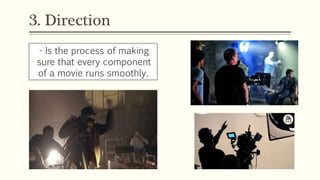
3. Direction
- Is the process of making
sure that every component
of a movie runs smoothly.
4. Characterization
- Is the process by
which the writer
reveals the
personality of the
character.
Characterization is
revealed through
direct
characterization or
indirect
characterization.
5. Acting
- Affects the way an
audience responds.
This includes facial
expressions, body
language, and
delivery of lines.
6. Dialogue
- Is the exchange
of spoken words
between two or
more characters
in the film or
moving pictures.
7. Setting
- Is both the time
and geographic
location within a film
or within a work of
film. The setting
helps initiate the
main backdrop and
mood for a story.
This is where the
story or scene takes
place.
A Castle A Small Hut
An Underwater Palace An Enchanted Forest
8. Set-up
- Is also called the
set design. It refers
to the creation of a
scenery that copies
the “look” or
physical
appearance of the
set for a film. It is
often structured or
built in studios. It
can also be outside
locations.
LET’S TRY PT. 1
Identify the movie’s form whether it is a Drama, Horror,
Comedy, Musical…etc.
HORROR
DRAMA
ACTION
MUSICAL/ COMEDY
ACTION/ SCI-FI
LET’S TRY PT. 2
Identify the conventions or devices of films used in the
scene. (Lights, direction…etc.)
1. The actors are
positioned in front
of the house.
a. Direction
b. Lighting
c. Blocking
d. Acting
1. The actors are
positioned in front
of the house.
a. Direction
b. Lighting
c. Blocking
d. Acting
2. “Get out, the
house is on fire!” said
Captain America.
a. Direction
b. Dialogue
c. Blocking
d. Set-up
2. “Get out, the
house is on fire!” said
Captain America.
a. Direction
b. Dialogue
c. Blocking
d. Set-up
3. They use natural
sunlight for the boat
scene.
a. Lighting
b. Dialogue
c. Blocking
d. Set-up
3. They use natural
sunlight for the boat
scene.
a. Lighting
b. Dialogue
c. Blocking
d. Set-up
4. The actress made
us cry in the scene.
a. Lighting
b. Acting
c. Setting
d. Set-up
4. The actress made
us cry in the scene.
a. Lighting
b. Acting
c. Setting
d. Set-up
5. Our story takes
place in an
enchanted forest.
a. Lighting
b. Acting
c. Setting
d. Characterization
5. Our story takes
place in an
enchanted forest.
a. Lighting
b. Acting
c. Setting
d. Characterization
II. ANALYZING
PICTURES
A PICTURE THAT COULD MEAN A THOUSAND
WORDS…
Before you can analyze the characters and
setting, let us first learn the meaning of
print, non-print, and digital materials.
These are the different materials or
resources where we can get information.
Print Materials
- Refer to any
publication,
document, or record
including;
newspapers,
magazines, books,
photographs,
drawings, maps,
almanac, dictionary,
atlas, encyclopedia,
etc.
Non-Print Materials
- Refer to formats with
special characteristics
whose information
content can only be
accessed through the
use of machines/
digital equipment
such as e-books, e-
journals, electronic
images, audio-visual
materials, tape
recording, etc.
Digital Materials
- Refer to electronic
records and other
content (MS Office
files, PDFs, images,
audio or video files,
etc.) that were
originally created or
stored in a digital
environment (like
phones, computers,
internet, etc.)
Basically, characters and setting can be
analyzed in print, non-print, and digital
materials. They can be analyzed in terms of age,
gender, race, nationality, attitude, or behavior.
The setting can also be analyzed using these
materials.
age gender race/ nationality attitude/ behavior
Picture analysis is the extraction of
meaningful information from images by
means of processing techniques.
Characters can be analyzed in terms of
age, gender, race, nationality, attitude, or
behavior. A setting can be analyzed in
terms of urban (city) and rural (province),
affluent (rich) or poor.
LET’S TRY AGAIN…
Analyze the pictures by answering the given questions.
A B
1.Which picture has an urban setting?
2.Which picture has a rural setting?
3.Which picture can be described as affluent?
4.Which of the pictures can be described as poor?
5.Which of the pictures show a younger age group?
1. What does the picture show?
2.What can you say about the character in the picture?
3.How old do you think is the person?
4.Do you think the character loves her work?
5. What do you think is the setting of the picture?
III. FINDING
MEANING IN
VISUAL MEDIA
THE GATHERING OF INFORMATION
What is visual?
It is something
that you look at,
such as a picture
chart, or a film
that is used to
illustrate
something more
appealing or
easier to
understand.
What is visual media?
Visual media are sources of
information in the form of visual
representations. These can be
abstractions, analogues, rough
illustrations, or digital
reproductions of the objects.
There should be an interpretation
of data, and sources may be
hosted on the internet, printed in
publications, displayed through
broadcast media, or otherwise
disseminated.
What are the types of visual media?
Infographics
poster
bar graph
pie chart
Let’s try to interpret:
1. What gender has the most
number of deaths?
2. What age range has the
highest death rate?
3. What age range has the
least death rate?
4. What is the source of this
update?
5. What is the date when the
data was released?
Let’s Review!
Forms of Film: Comedy,
Action, Sci-Fi, Horror,
Adventure, etc.
Film conventions: light, blocking,
direction, characterization,
acting, dialogue, setting, and
set-up
Picture Analysis
-Print Media
-Non-Print Media
- Digital Media
Pictures can be analyzed
according to age, gender,
race, nationality, attitude, or
behavior. A setting can be
analyzed whether it is urban
or rural, or affluent or poor.
Types of Visual Media:
Images
Videos
Infographics

Visual literacy through images

  • 1.
  • 2.
    YEAH OR NAH… Listento the statements carefully. Say YEAH if the statement is correct and NAH if it is incorrect.
  • 3.
    1. Visual Mediarefer to pictures, images, and graphic organizers which are used in the classroom.
  • 4.
    2. Power Pointpresentation is the most common example of visual media.
  • 5.
    3. Visual mediacannot help students retain concept ideas.
  • 6.
    4. Facebook isan example of visual media.
  • 7.
    5. YouTube allowsvideos on its platform.
  • 8.
    6. Visual mediaare not used as learning aids.
  • 9.
    7. The mostcommon types of visual media being used by online marketers today are images.
  • 10.
    8. Internet usersprefer to watch videos than read articles.
  • 11.
    9. Instagram isan example of a reliable online source.
  • 12.
    10. Peer-reviewed journals,webpages, forums, and blogs are not online sources.
  • 13.
    I. DESCRIBING FORMS ANDCONVENTIONS OF FILM LIGHTS, CAMERA, ACTION!
  • 14.
    Let’s compare thetwo pictures below… A - The place is dark - It feels eerie or scary - The facial expression of the character is sad, scared, or confused. B - The place is very bright - It feels like they are having fun. - The characters look happy.
  • 15.
    Observe the picturesbelow… 1. Which of these films have you watched? 2. Which of these films do you like the most? 3. Why do you like that film? 4. What other films do you enjoy watching?
  • 16.
    What is afilm? There are different forms of film such as: 1. Action 2. Adventure 3. Comedy 4. Crime and gangster 5. Drama 6. Epics/ Historical 7. Horror 8. Musical/ Dance 9. Science Fiction 10.War 11.Fantasy A film, also called a movie or motion picture, consists of moving pictures that have been recorded so that they can be shown at the cinema or on television. A film tells a story or shows a real situation. The process of filmmaking is both an art and an industry.
  • 17.
    In order tocommunicate key messages to an audience, producers of films use certain conventions and devices such as lights, blocking, directions, characterization, acting, dialog, setting, and set-up.
  • 18.
    1. Light - Isa convention of films used to create a specific atmosphere. It is a very important aspect for shaping meaning in films. It can manipulate a viewer’s attitude towards a setting or a character. Natural Lighting High Key Lighting Low Key Lighting
  • 19.
    2. Blocking - Issimply the relationship of the camera to the actors. Essentially, it is the physical movement of the actors relative to the positive of the camera.
  • 20.
    3. Direction - Isthe process of making sure that every component of a movie runs smoothly.
  • 21.
    4. Characterization - Isthe process by which the writer reveals the personality of the character. Characterization is revealed through direct characterization or indirect characterization.
  • 22.
    5. Acting - Affectsthe way an audience responds. This includes facial expressions, body language, and delivery of lines.
  • 23.
    6. Dialogue - Isthe exchange of spoken words between two or more characters in the film or moving pictures.
  • 24.
    7. Setting - Isboth the time and geographic location within a film or within a work of film. The setting helps initiate the main backdrop and mood for a story. This is where the story or scene takes place. A Castle A Small Hut An Underwater Palace An Enchanted Forest
  • 25.
    8. Set-up - Isalso called the set design. It refers to the creation of a scenery that copies the “look” or physical appearance of the set for a film. It is often structured or built in studios. It can also be outside locations.
  • 26.
    LET’S TRY PT.1 Identify the movie’s form whether it is a Drama, Horror, Comedy, Musical…etc.
  • 27.
  • 28.
  • 29.
  • 30.
  • 31.
  • 32.
    LET’S TRY PT.2 Identify the conventions or devices of films used in the scene. (Lights, direction…etc.)
  • 33.
    1. The actorsare positioned in front of the house. a. Direction b. Lighting c. Blocking d. Acting
  • 34.
    1. The actorsare positioned in front of the house. a. Direction b. Lighting c. Blocking d. Acting
  • 35.
    2. “Get out,the house is on fire!” said Captain America. a. Direction b. Dialogue c. Blocking d. Set-up
  • 36.
    2. “Get out,the house is on fire!” said Captain America. a. Direction b. Dialogue c. Blocking d. Set-up
  • 37.
    3. They usenatural sunlight for the boat scene. a. Lighting b. Dialogue c. Blocking d. Set-up
  • 38.
    3. They usenatural sunlight for the boat scene. a. Lighting b. Dialogue c. Blocking d. Set-up
  • 39.
    4. The actressmade us cry in the scene. a. Lighting b. Acting c. Setting d. Set-up
  • 40.
    4. The actressmade us cry in the scene. a. Lighting b. Acting c. Setting d. Set-up
  • 41.
    5. Our storytakes place in an enchanted forest. a. Lighting b. Acting c. Setting d. Characterization
  • 42.
    5. Our storytakes place in an enchanted forest. a. Lighting b. Acting c. Setting d. Characterization
  • 43.
    II. ANALYZING PICTURES A PICTURETHAT COULD MEAN A THOUSAND WORDS…
  • 44.
    Before you cananalyze the characters and setting, let us first learn the meaning of print, non-print, and digital materials. These are the different materials or resources where we can get information.
  • 45.
    Print Materials - Referto any publication, document, or record including; newspapers, magazines, books, photographs, drawings, maps, almanac, dictionary, atlas, encyclopedia, etc.
  • 46.
    Non-Print Materials - Referto formats with special characteristics whose information content can only be accessed through the use of machines/ digital equipment such as e-books, e- journals, electronic images, audio-visual materials, tape recording, etc.
  • 47.
    Digital Materials - Referto electronic records and other content (MS Office files, PDFs, images, audio or video files, etc.) that were originally created or stored in a digital environment (like phones, computers, internet, etc.)
  • 48.
    Basically, characters andsetting can be analyzed in print, non-print, and digital materials. They can be analyzed in terms of age, gender, race, nationality, attitude, or behavior. The setting can also be analyzed using these materials. age gender race/ nationality attitude/ behavior
  • 49.
    Picture analysis isthe extraction of meaningful information from images by means of processing techniques. Characters can be analyzed in terms of age, gender, race, nationality, attitude, or behavior. A setting can be analyzed in terms of urban (city) and rural (province), affluent (rich) or poor.
  • 50.
    LET’S TRY AGAIN… Analyzethe pictures by answering the given questions.
  • 51.
    A B 1.Which picturehas an urban setting? 2.Which picture has a rural setting? 3.Which picture can be described as affluent? 4.Which of the pictures can be described as poor? 5.Which of the pictures show a younger age group?
  • 52.
    1. What doesthe picture show? 2.What can you say about the character in the picture? 3.How old do you think is the person? 4.Do you think the character loves her work? 5. What do you think is the setting of the picture?
  • 53.
    III. FINDING MEANING IN VISUALMEDIA THE GATHERING OF INFORMATION
  • 54.
    What is visual? Itis something that you look at, such as a picture chart, or a film that is used to illustrate something more appealing or easier to understand.
  • 55.
    What is visualmedia? Visual media are sources of information in the form of visual representations. These can be abstractions, analogues, rough illustrations, or digital reproductions of the objects. There should be an interpretation of data, and sources may be hosted on the internet, printed in publications, displayed through broadcast media, or otherwise disseminated.
  • 56.
    What are thetypes of visual media?
  • 57.
  • 58.
    Let’s try tointerpret: 1. What gender has the most number of deaths? 2. What age range has the highest death rate? 3. What age range has the least death rate? 4. What is the source of this update? 5. What is the date when the data was released?
  • 59.
    Let’s Review! Forms ofFilm: Comedy, Action, Sci-Fi, Horror, Adventure, etc. Film conventions: light, blocking, direction, characterization, acting, dialogue, setting, and set-up Picture Analysis -Print Media -Non-Print Media - Digital Media Pictures can be analyzed according to age, gender, race, nationality, attitude, or behavior. A setting can be analyzed whether it is urban or rural, or affluent or poor. Types of Visual Media: Images Videos Infographics

Editor's Notes

  • #2 NOTE: To change the image on this slide, select the picture and delete it. Then click the Pictures icon in the placeholder to insert your own image.
  • #14 NOTE: To change the image on this slide, select the picture and delete it. Then click the Pictures icon in the placeholder to insert your own image.
  • #44 NOTE: To change the image on this slide, select the picture and delete it. Then click the Pictures icon in the placeholder to insert your own image.
  • #54 NOTE: To change the image on this slide, select the picture and delete it. Then click the Pictures icon in the placeholder to insert your own image.