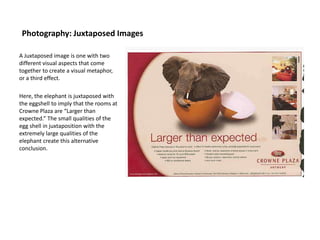
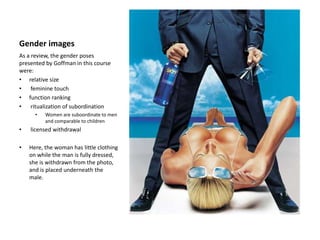
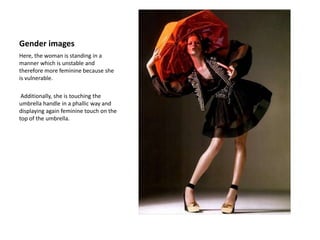
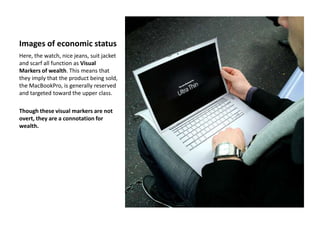
Visual Literacy An overview of visual concepts presented throughout the semesterCreated by Hannah J. Goulding
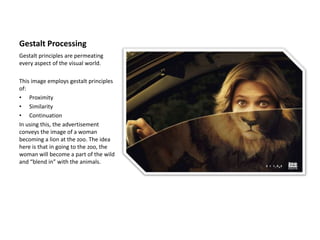
Gestalt ProcessingGestalt principles are permeating every aspect of the visual world.This image employs gestalt principles of:Proximity
Similarity
ContinuationIn using this, the advertisement conveys the image of a woman becoming a lion at the zoo. The idea here is that in going to the zoo, the woman will become a part of the wild and “blend in” with the animals.
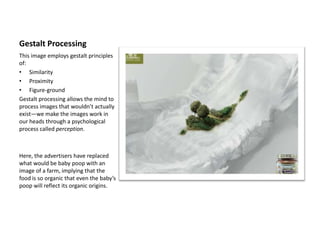
Gestalt ProcessingThis image employs gestalt principles of:Similarity
Proximity
Figure-ground Gestalt processing allows the mind to process images that wouldn’t actually exist—we make the images work in our heads through a psychological process called perception. Here, the advertisers have replaced what would be baby poop with an image of a farm, implying that the food is so organic that even the baby’s poop will reflect its organic origins.
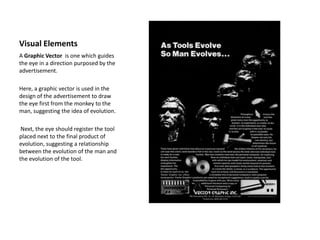
Visual ElementsA Graphic Vector  is one which guides the eye in a direction purposed by the advertisement. Here, a graphic vector is used in the design of the advertisement to draw the eye first from the monkey to the man, suggesting the idea of evolution.Next, the eye should register the tool placed next to the final product of evolution, suggesting a relationship between the evolution of the man and the evolution of the tool.
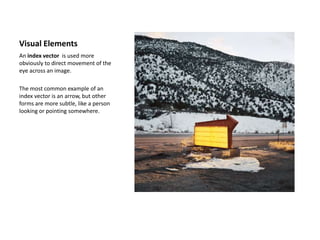
Visual ElementsAn index vector  is used more obviously to direct movement of the eye across an image. The most common example of an index vector is an arrow, but other forms are more subtle, like a person looking or pointing somewhere.
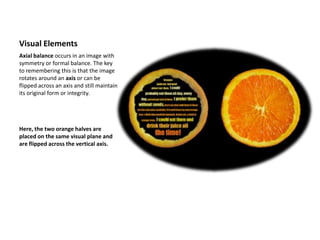
Visual Elements	Axial balance occurs in an image with symmetry or formal balance. The key to remembering this is that the image rotates around an axis or can be flipped across an axis and still maintain its original form or integrity. Here, the two orange halves are placed on the same visual plane and are flipped across the vertical axis.
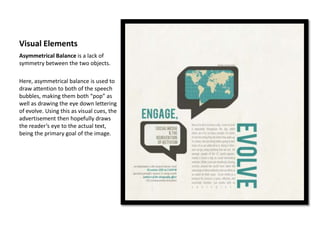
Visual Elements	Asymmetrical Balance is a lack of symmetry between the two objects. Here, asymmetrical balance is used to draw attention to both of the speech bubbles, making them both “pop” as well as drawing the eye down lettering of evolve. Using this as visual cues, the advertisement then hopefully draws the reader’s eye to the actual text, being the primary goal of the image.

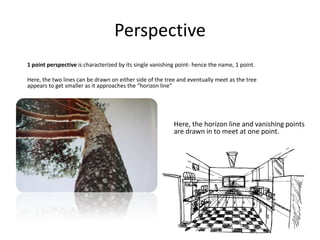
Perspective1 point perspective is characterized by its single vanishing point- hence the name, 1 point. Here, the two lines can be drawn on either side of the tree and eventually meet as the tree appears to get smaller as it approaches the “horizon line”Here, the horizon line and vanishing points are drawn in to meet at one point.
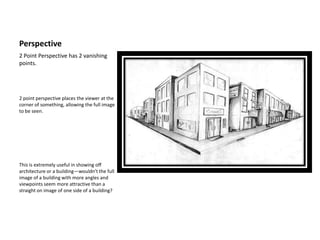
Perspective	2 Point Perspective has 2 vanishing points. 2 point perspective places the viewer at the corner of something, allowing the full image to be seen. This is extremely useful in showing off architecture or a building—wouldn’t the full image of a building with more angles and viewpoints seem more attractive than a straight on image of one side of a building?

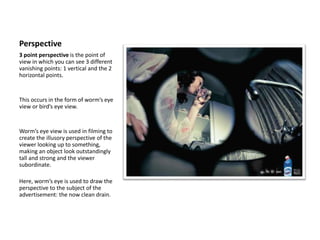
Perspective	3 point perspective is the point of view in which you can see 3 different vanishing points: 1 vertical and the 2 horizontal points. This occurs in the form of worm’s eye view or bird’s eye view. Worm’s eye view is used in filming to create the illusory perspective of the viewer looking up to something, making an object look outstandingly tall and strong and the viewer subordinate. Here, worm’s eye is used to draw the perspective to the subject of the advertisement: the now clean drain.
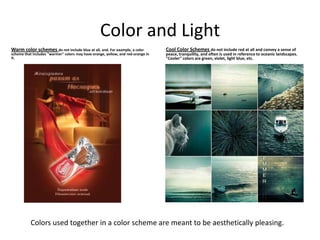
Color and Light Warm color schemes do not include blue at all, and. For example, a color scheme that includes "warmer" colors may have orange, yellow, and red-orange in it. Cool Color Schemes do not include red at all and convey a sense of peace, tranquility, and often is used in reference to oceanic landscapes. "Cooler" colors are green, violet, light blue, etc.Colors used together in a color scheme are meant to be aesthetically pleasing.
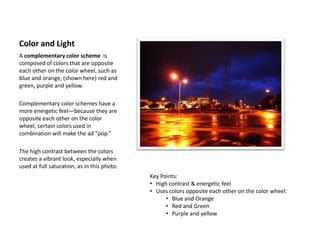
Color and Light A complementary color scheme  is composed of colors that are opposite each other on the color wheel, such as blue and orange, (shown here) red and green, purple and yellow. Complementary color schemes have a more energetic feel—because they are opposite each other on the color wheel, certain colors used in combination will make the ad “pop.” The high contrast between the colors creates a vibrant look, especially when used at full saturation, as in this photo. Key Points:High contrast & energetic feel
Uses colors opposite each other on the color wheel:
Blue and Orange
Red and Green
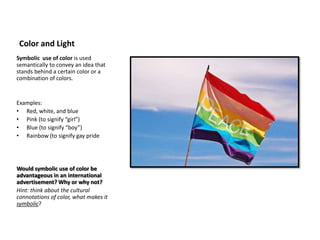
Purple and yellowColor and Light	Symbolic  use of color is used semantically to convey an idea that stands behind a certain color or a combination of colors. Examples:Red, white, and blue
Pink (to signify “girl”)
Blue (to signify “boy”)
Rainbow (to signify gay prideWould symbolic use of color be advantageous in an international advertisement? Why or why not?Hint: think about the cultural connotations of color, what makes it symbolic?
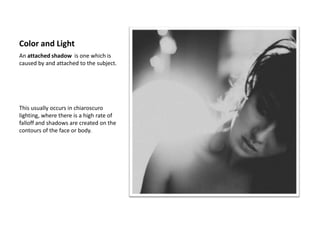
Color and Light	An attached shadow  is one which is caused by and attached to the subject. This usually occurs in chiaroscuro lighting, where there is a high rate of falloff and shadows are created on the contours of the face or body.
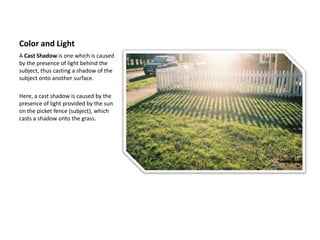
Color and LightA Cast Shadow is one which is caused by the presence of light behind the subject, thus casting a shadow of the subject onto another surface. Here, a cast shadow is caused by the presence of light provided by the sun on the picket fence (subject), which casts a shadow onto the grass.
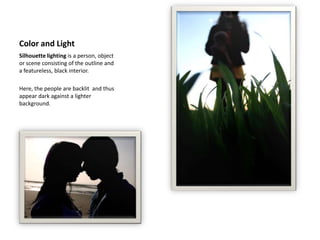
Color and Light	Silhouette lighting is a person, object or scene consisting of the outline and a featureless, black interior. Here, the people are backlit  and thus appear dark against a lighter background.
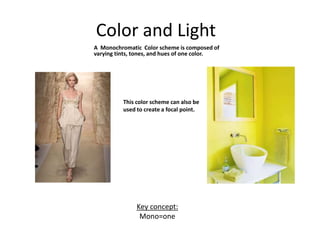
Color and Light	A  Monochromatic  Color scheme is composed of varying tints, tones, and hues of one color. This color scheme can also be used to create a focal point. Key concept:Mono=one
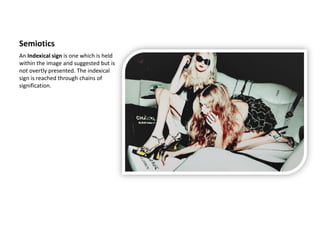
SemioticsAn Indexical sign is one which is held within the image and suggested but is not overtly presented. The indexical sign is reached through chains of signification.
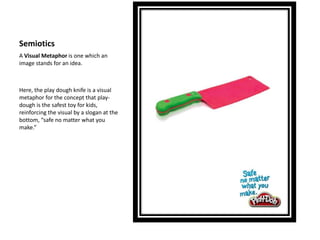
Semiotics 	A Visual Metaphor is one which an image stands for an idea. Here, the play dough knife is a visual metaphor for the concept that play-dough is the safest toy for kids, reinforcing the visual by a slogan at the bottom, “safe no matter what you make.”
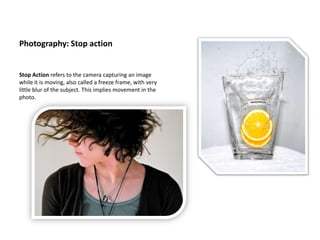
Photography: Stop actionStop Action refers to the camera capturing an image while it is moving, also called a freeze frame, with very little blur of the subject. This implies movement in the photo.
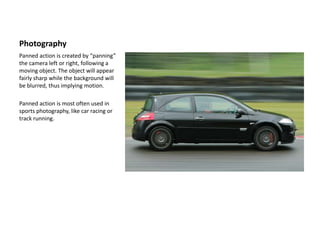
PhotographyPanned action is created by “panning”  the camera left or right, following a moving object. The object will appear fairly sharp while the background will be blurred, thus implying motion. Panned action is most often used in sports photography, like car racing or track running.
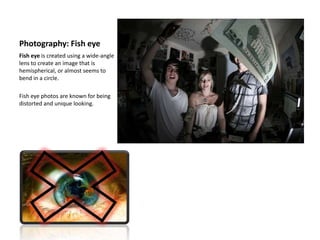
Photography: Fish eyeFish eye is created using a wide-angle lens to create an image that is hemispherical, or almost seems to bend in a circle. Fish eye photos are known for being distorted and unique looking.
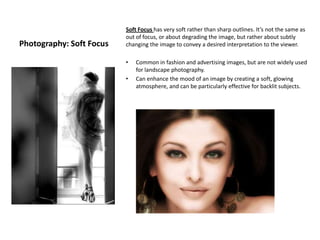
Photography: Soft FocusSoft Focus has very soft rather than sharp outlines. It’s not the same as out of focus, or about degrading the image, but rather about subtly changing the image to convey a desired interpretation to the viewer.Common in fashion and advertising images, but are not widely used for landscape photography.
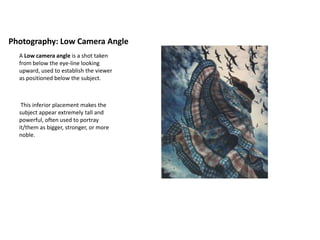
Can enhance the mood of an image by creating a soft, glowing atmosphere, and can be particularly effective for backlit subjects. Photography: Low Camera AngleA Low camera angle is a shot taken from below the eye-line looking upward, used to establish the viewer as positioned below the subject. This inferior placement makes the subject appear extremely tall and powerful, often used to portray it/them as bigger, stronger, or more noble.
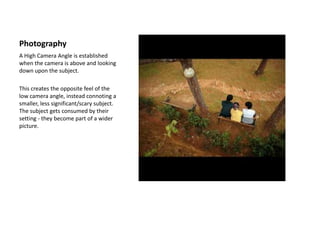
PhotographyA High Camera Angle is established when the camera is above and looking down upon the subject. This creates the opposite feel of the low camera angle, instead connoting asmaller, less significant/scary subject. The subject gets consumed by their setting - they become part of a wider picture.
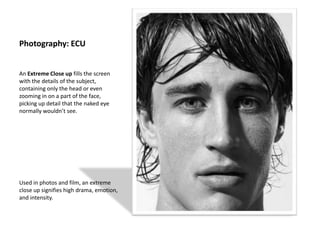
Photography: ECUAn Extreme Close up fills the screen with the details of the subject, containing only the head or even zooming in on a part of the face, picking up detail that the naked eye normally wouldn’t see. Used in photos and film, an extreme close up signifies high drama, emotion, and intensity.
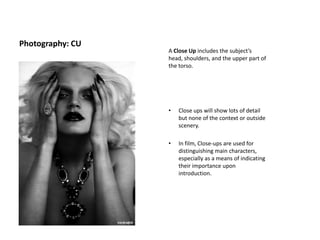
Photography: CUA Close Up includes the subject’s head, shoulders, and the upper part of the torso. Close ups will show lots of detail but none of the context or outside scenery.
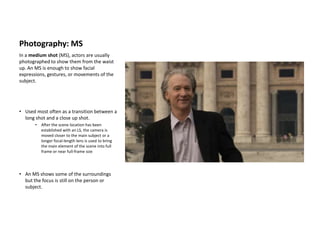
In film, Close-ups are used for distinguishing main characters, especially as a means of indicating their importance upon introduction.Photography: MSIn a medium shot (MS), actors are usually photographed to show them from the waist up. An MS is enough to show facial expressions, gestures, or movements of the subject. Used most often as a transition between a long shot and a close up shot.
After the scene location has been established with an LS, the camera is moved closer to the main subject or a longer focal-length lens is used to bring the main element of the scene into full frame or near full-frame size
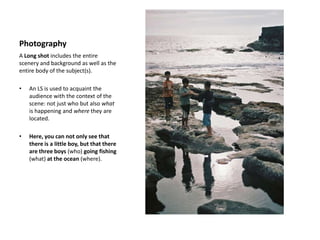
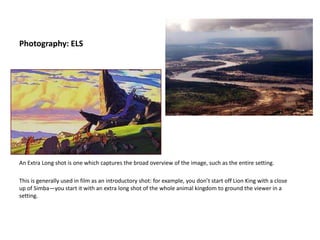
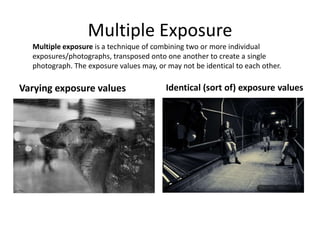
An MS shows some of the surroundings but the focus is still on the person or subject. PhotographyA Long shot includes the entire scenery and background as well as the entire body of the subject(s). An LS is used to acquaint the audience with the context of the scene: not just who but also what is happening and where they are located.

Visual literacy

  • 1.
    Visual Literacy Anoverview of visual concepts presented throughout the semesterCreated by Hannah J. Goulding
  • 2.
    Gestalt ProcessingGestalt principlesare permeating every aspect of the visual world.This image employs gestalt principles of:Proximity
  • 3.
  • 4.
    ContinuationIn using this,the advertisement conveys the image of a woman becoming a lion at the zoo. The idea here is that in going to the zoo, the woman will become a part of the wild and “blend in” with the animals.
  • 5.
    Gestalt ProcessingThis imageemploys gestalt principles of:Similarity
  • 6.
  • 7.
    Figure-ground Gestalt processingallows the mind to process images that wouldn’t actually exist—we make the images work in our heads through a psychological process called perception. Here, the advertisers have replaced what would be baby poop with an image of a farm, implying that the food is so organic that even the baby’s poop will reflect its organic origins.
  • 8.
    Visual ElementsA GraphicVector is one which guides the eye in a direction purposed by the advertisement. Here, a graphic vector is used in the design of the advertisement to draw the eye first from the monkey to the man, suggesting the idea of evolution.Next, the eye should register the tool placed next to the final product of evolution, suggesting a relationship between the evolution of the man and the evolution of the tool.
  • 9.
    Visual ElementsAn indexvector is used more obviously to direct movement of the eye across an image. The most common example of an index vector is an arrow, but other forms are more subtle, like a person looking or pointing somewhere.
  • 10.
    Visual Elements Axial balanceoccurs in an image with symmetry or formal balance. The key to remembering this is that the image rotates around an axis or can be flipped across an axis and still maintain its original form or integrity. Here, the two orange halves are placed on the same visual plane and are flipped across the vertical axis.
  • 11.
    Visual Elements Asymmetrical Balanceis a lack of symmetry between the two objects. Here, asymmetrical balance is used to draw attention to both of the speech bubbles, making them both “pop” as well as drawing the eye down lettering of evolve. Using this as visual cues, the advertisement then hopefully draws the reader’s eye to the actual text, being the primary goal of the image.
  • 12.
    Perspective1 point perspectiveis characterized by its single vanishing point- hence the name, 1 point. Here, the two lines can be drawn on either side of the tree and eventually meet as the tree appears to get smaller as it approaches the “horizon line”Here, the horizon line and vanishing points are drawn in to meet at one point.
  • 13.
    Perspective 2 Point Perspectivehas 2 vanishing points. 2 point perspective places the viewer at the corner of something, allowing the full image to be seen. This is extremely useful in showing off architecture or a building—wouldn’t the full image of a building with more angles and viewpoints seem more attractive than a straight on image of one side of a building?
  • 14.
    Perspective 3 point perspectiveis the point of view in which you can see 3 different vanishing points: 1 vertical and the 2 horizontal points. This occurs in the form of worm’s eye view or bird’s eye view. Worm’s eye view is used in filming to create the illusory perspective of the viewer looking up to something, making an object look outstandingly tall and strong and the viewer subordinate. Here, worm’s eye is used to draw the perspective to the subject of the advertisement: the now clean drain.
  • 15.
    Color and LightWarm color schemes do not include blue at all, and. For example, a color scheme that includes "warmer" colors may have orange, yellow, and red-orange in it. Cool Color Schemes do not include red at all and convey a sense of peace, tranquility, and often is used in reference to oceanic landscapes. "Cooler" colors are green, violet, light blue, etc.Colors used together in a color scheme are meant to be aesthetically pleasing.
  • 16.
    Color and LightA complementary color scheme is composed of colors that are opposite each other on the color wheel, such as blue and orange, (shown here) red and green, purple and yellow. Complementary color schemes have a more energetic feel—because they are opposite each other on the color wheel, certain colors used in combination will make the ad “pop.” The high contrast between the colors creates a vibrant look, especially when used at full saturation, as in this photo. Key Points:High contrast & energetic feel
  • 17.
    Uses colors oppositeeach other on the color wheel:
  • 18.
  • 19.
  • 20.
    Purple and yellowColorand Light Symbolic use of color is used semantically to convey an idea that stands behind a certain color or a combination of colors. Examples:Red, white, and blue
  • 21.
    Pink (to signify“girl”)
  • 22.
  • 23.
    Rainbow (to signifygay prideWould symbolic use of color be advantageous in an international advertisement? Why or why not?Hint: think about the cultural connotations of color, what makes it symbolic?
  • 24.
    Color and Light Anattached shadow is one which is caused by and attached to the subject. This usually occurs in chiaroscuro lighting, where there is a high rate of falloff and shadows are created on the contours of the face or body.
  • 25.
    Color and LightACast Shadow is one which is caused by the presence of light behind the subject, thus casting a shadow of the subject onto another surface. Here, a cast shadow is caused by the presence of light provided by the sun on the picket fence (subject), which casts a shadow onto the grass.
  • 26.
    Color and Light Silhouettelighting is a person, object or scene consisting of the outline and a featureless, black interior. Here, the people are backlit and thus appear dark against a lighter background.
  • 27.
    Color and Light A Monochromatic Color scheme is composed of varying tints, tones, and hues of one color. This color scheme can also be used to create a focal point. Key concept:Mono=one
  • 28.
    SemioticsAn Indexical signis one which is held within the image and suggested but is not overtly presented. The indexical sign is reached through chains of signification.
  • 29.
    Semiotics A VisualMetaphor is one which an image stands for an idea. Here, the play dough knife is a visual metaphor for the concept that play-dough is the safest toy for kids, reinforcing the visual by a slogan at the bottom, “safe no matter what you make.”
  • 30.
    Photography: Stop actionStopAction refers to the camera capturing an image while it is moving, also called a freeze frame, with very little blur of the subject. This implies movement in the photo.
  • 31.
    PhotographyPanned action iscreated by “panning” the camera left or right, following a moving object. The object will appear fairly sharp while the background will be blurred, thus implying motion. Panned action is most often used in sports photography, like car racing or track running.
  • 32.
    Photography: Fish eyeFisheye is created using a wide-angle lens to create an image that is hemispherical, or almost seems to bend in a circle. Fish eye photos are known for being distorted and unique looking.
  • 33.
    Photography: Soft FocusSoftFocus has very soft rather than sharp outlines. It’s not the same as out of focus, or about degrading the image, but rather about subtly changing the image to convey a desired interpretation to the viewer.Common in fashion and advertising images, but are not widely used for landscape photography.
  • 34.
    Can enhance themood of an image by creating a soft, glowing atmosphere, and can be particularly effective for backlit subjects. Photography: Low Camera AngleA Low camera angle is a shot taken from below the eye-line looking upward, used to establish the viewer as positioned below the subject. This inferior placement makes the subject appear extremely tall and powerful, often used to portray it/them as bigger, stronger, or more noble.
  • 35.
    PhotographyA High CameraAngle is established when the camera is above and looking down upon the subject. This creates the opposite feel of the low camera angle, instead connoting asmaller, less significant/scary subject. The subject gets consumed by their setting - they become part of a wider picture.
  • 36.
    Photography: ECUAn ExtremeClose up fills the screen with the details of the subject, containing only the head or even zooming in on a part of the face, picking up detail that the naked eye normally wouldn’t see. Used in photos and film, an extreme close up signifies high drama, emotion, and intensity.
  • 37.
    Photography: CUA CloseUp includes the subject’s head, shoulders, and the upper part of the torso. Close ups will show lots of detail but none of the context or outside scenery.
  • 38.
    In film, Close-upsare used for distinguishing main characters, especially as a means of indicating their importance upon introduction.Photography: MSIn a medium shot (MS), actors are usually photographed to show them from the waist up. An MS is enough to show facial expressions, gestures, or movements of the subject. Used most often as a transition between a long shot and a close up shot.
  • 39.
    After the scenelocation has been established with an LS, the camera is moved closer to the main subject or a longer focal-length lens is used to bring the main element of the scene into full frame or near full-frame size
  • 40.
    An MS showssome of the surroundings but the focus is still on the person or subject. PhotographyA Long shot includes the entire scenery and background as well as the entire body of the subject(s). An LS is used to acquaint the audience with the context of the scene: not just who but also what is happening and where they are located.

Editor's Notes

  • #3 They are the rules governing many aspects of our perception and are thus so common that many times they are overlooked, even when they are the sole reason why you understood a particular image. Advertisements rely on principles of gestalt processing to convey meanings of an image by comparison.
  • #5 In case the viewer didn’t pick up on this, it is reinforced in black and white by the caption, “As Tools evolve, so man evolves,” though making a clever yet discreet play on the expected version, which would have been “As man evolves, so tools evolve.” This suggests that in order for further progress, be it in personal success or in evolution, “man” (the preferred audience for the image) must get the new, up and coming tool. This new tool is the focus of the advertisement: thus, as all advertisements it seems to come back to the same principle—with the purchase of this particular product, the individual will have better success as a person.
  • #6 The idea behind index vectors is to get a point, literally, across the page without having any misinterpretations or aberrant readings of the image or advertisement. Here is an example of an advertisement in “real life,” in which the index vector (arrow sign) is pointing toward an establishment to convey the message “Go there” or “Eat here.” In an advertisement with a more subtle example of this, it might be a message such as “Look at her/it/that,” in which case the index vector is assisting in conveying meaning.
  • #7 Here, asymmetrical balance as well as an employment of gestalt processing is used to make a comparison between the two orange halves, thus drawing the reader’s attention to the text held within the orange rind. The two are placed on the same visual plane and can be flipped across the vertical axis to produce the same image. Once this flipping occurs, the reader has effectively transposed the text onto their image and thought processing surrounding the orange, thus fulfilling their goal to associate the words conveying an idea with the subject of the image, being the orange.
  • #14 The connotations of color are culturally learned, which varies internationally.
  • #22 Panned action: A movement which scans a scene horizontally. The camera is placed on a tripod, which operates as a stationary axis point as the camera is turned, often to follow a moving object which is kept in the middle of the frame.