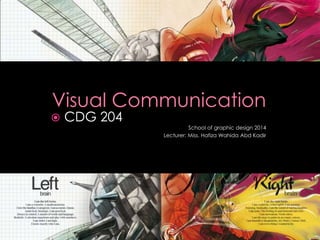
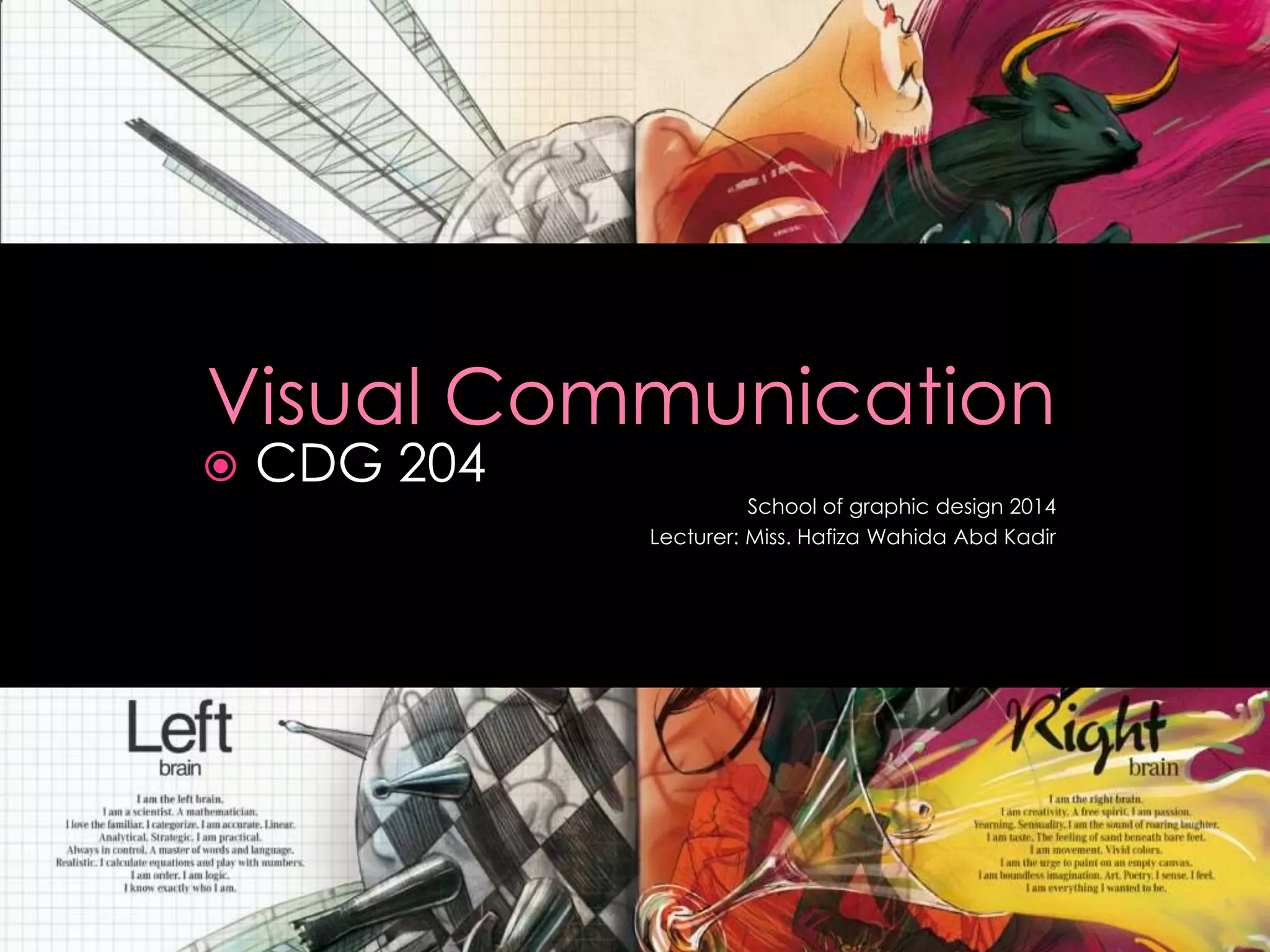
Visual Communication
 CDG 204
School of graphic design 2014
Lecturer: Miss. Hafiza Wahida Abd Kadir
Chapter 13
COLOUR - 'In full colour.'
FUNCTIONAL COLOURS
• Colours must have a communicative
function, and should:
– Attract through colour strenght.
– Create atmosphere with the help of cold or
warm colours for example.
– Inform, as in a hospital where yellow indicates
infection.
– Structure, as in a newspaper where different
sections are colour coded.
– Teach, for instance through tint blocks which
emphasize and clarify certain parts of the
material.
Natural Colour Theory
• The most common system of describing
colours is the NATURAL COLOUR
SYSTEM (NCS), which is based on
research into how humans perceive
colour.
• This system is described in the COLOUR
SPACE, the COLOUR CIRCLE and the
COLOUR TRIANGLE.
Colour Combinations
• The four quadrants (quaters) of the
COLOUR CIRCLE provide a general
template for combining colours.
• Combinations of colours in the same
quadrant produce whispering colours.
• Colours from adjoining quadrants give
speaking colours.
• Shouting colours are obtained by putting
together colours from two quadrants which
are opposite each other in the colour
circle.

Visual communication tutorial 7

  • 1.
    Visual Communication  CDG204 School of graphic design 2014 Lecturer: Miss. Hafiza Wahida Abd Kadir
  • 2.
    Chapter 13 COLOUR -'In full colour.'
  • 3.
    FUNCTIONAL COLOURS • Coloursmust have a communicative function, and should: – Attract through colour strenght. – Create atmosphere with the help of cold or warm colours for example. – Inform, as in a hospital where yellow indicates infection. – Structure, as in a newspaper where different sections are colour coded. – Teach, for instance through tint blocks which emphasize and clarify certain parts of the material.
  • 4.
    Natural Colour Theory •The most common system of describing colours is the NATURAL COLOUR SYSTEM (NCS), which is based on research into how humans perceive colour. • This system is described in the COLOUR SPACE, the COLOUR CIRCLE and the COLOUR TRIANGLE.
  • 5.
    Colour Combinations • Thefour quadrants (quaters) of the COLOUR CIRCLE provide a general template for combining colours. • Combinations of colours in the same quadrant produce whispering colours. • Colours from adjoining quadrants give speaking colours. • Shouting colours are obtained by putting together colours from two quadrants which are opposite each other in the colour circle.