ADD A FOOTER 1
1. __the process of translating a solution
into a language that the computer can
understand.
2. __integrated development environment
3. __a programming language that allows
the programmer to use objects to
accomplish a program’s goal
4. __the people who write computer
programs
5. __the process of giving a mechanism the
directions to accomplish a task
a) Programming
b) Programmers
c) Object-oriented programming language
d) IDE
e) CODING
ADD A FOOTER 2
6. __what the user sees and interacts with
while an application is running.
7. __anything that can be seen, touched, or
used
8. __the process of locating and correcting
the errors (bugs) in a program
9. __programs created for the Windows
environment, the Web, or mobile devices
10.__a pattern that the computer uses to
create (instantiate) an object
f) Class
g) Object
h) Debugging
i) Applications
j) Class
ADD A FOOTER 3
JANUARY
2023
ADD A FOOTER 5
•A programming language is a
computer language programmers use to
develop software programs, scripts, or
other sets of instructions for computers
to execute.
ADD A FOOTER 6
•FUNCTION
•TARGET
•CONSTRUCTS
•EXPRESSIVE POWER
ADD A FOOTER 7
•A prominent purpose of programming
languages is to provide instructions to a
computer. As such, programming languages
differ from most other forms of human
expression in that they require a greater
degree of precision and completeness.
ADD A FOOTER 8
•Visual Basic (VB) is an event-driven
programming language and environment
from Microsoft that provides a graphical user
interface (GUI) which allows programmers to
modify code by simply dragging and
dropping objects and defining their behavior
and appearance.
ADD A FOOTER 9
•Derived from BASIC(Beginner's All-
purpose Symbolic Instruction Code)
11
1. Procedural programming languages
A procedural language follows a sequence of statements or
commands in order to achieve a desired output.
EX:
• C and C++
• Java
• Pascal
• BASIC
12
2. Functional programming languages
Rather than focusing on the execution of statements, functional
languages focus on the output of mathematical functions and
evaluations.
EX:
• Scala
• Erlang
• Haskell
• Elixir
• F#
13
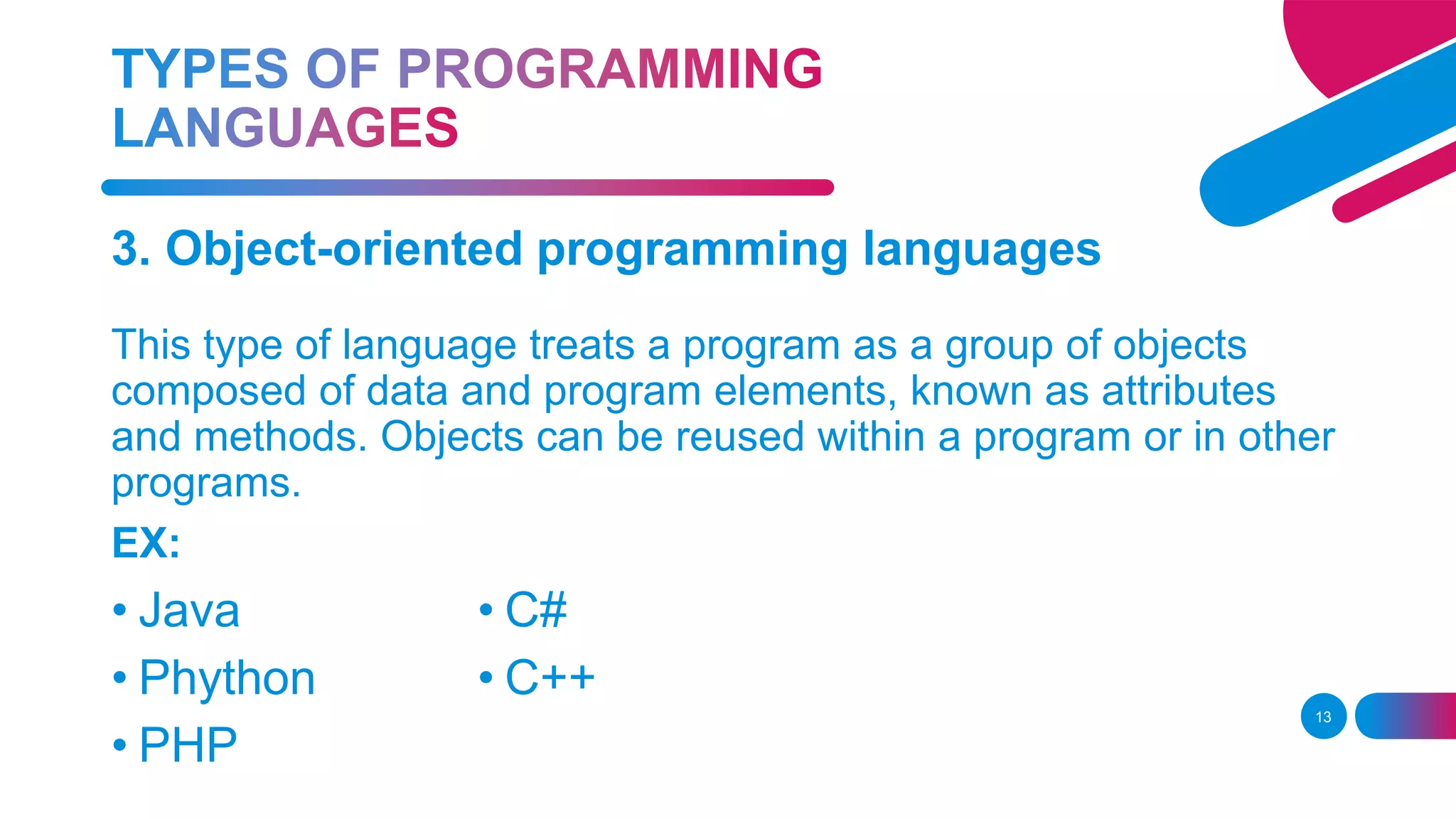
3. Object-oriented programming languages
This type of language treats a program as a group of objects
composed of data and program elements, known as attributes
and methods. Objects can be reused within a program or in other
programs.
EX:
• Java
• Phython
• PHP
• C#
• C++
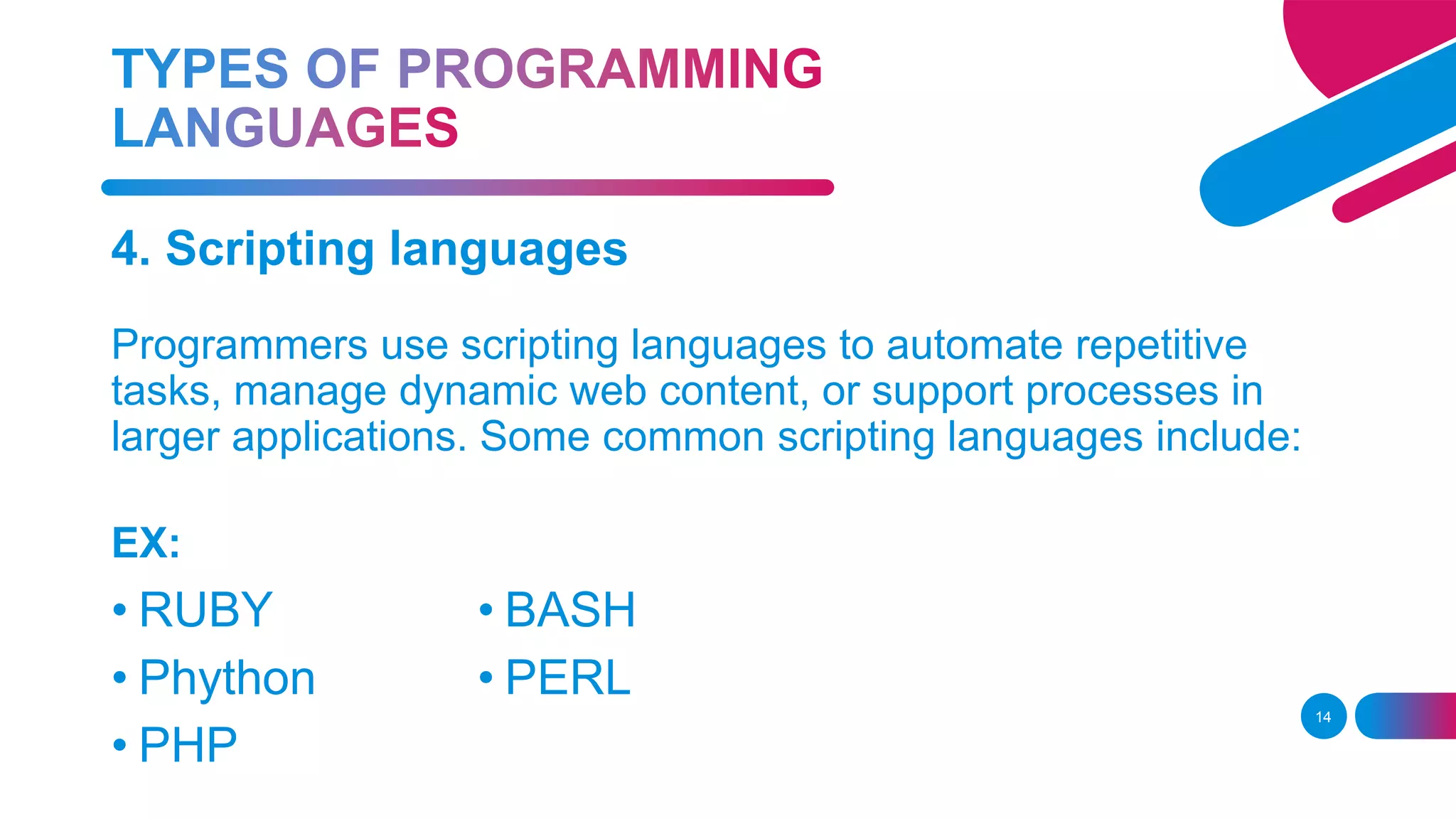
14
4. Scripting languages
Programmers use scripting languages to automate repetitive
tasks, manage dynamic web content, or support processes in
larger applications. Some common scripting languages include:
EX:
• RUBY
• Phython
• PHP
• BASH
• PERL
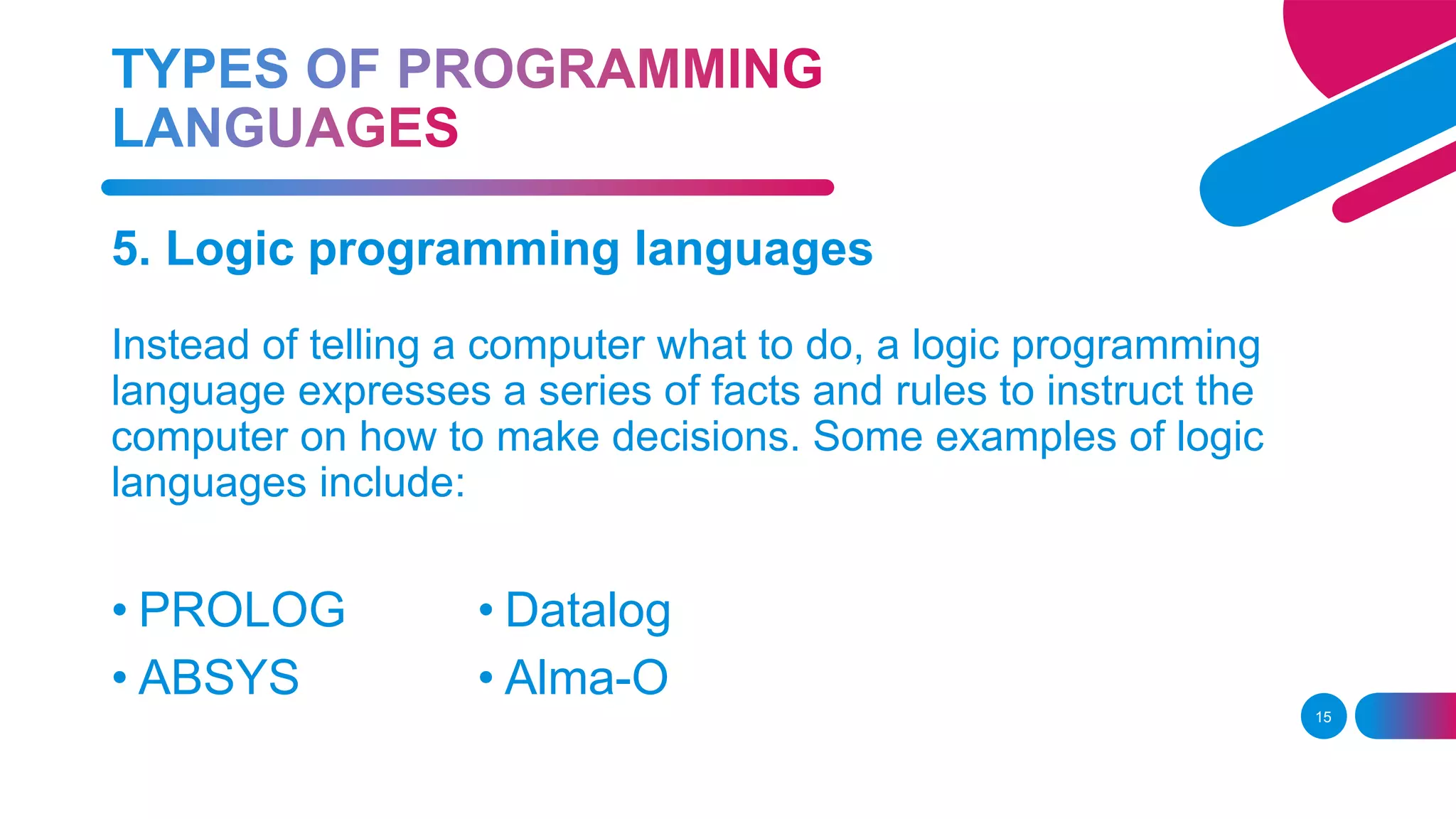
15
5. Logic programming languages
Instead of telling a computer what to do, a logic programming
language expresses a series of facts and rules to instruct the
computer on how to make decisions. Some examples of logic
languages include:
• PROLOG
• ABSYS
• Datalog
• Alma-O
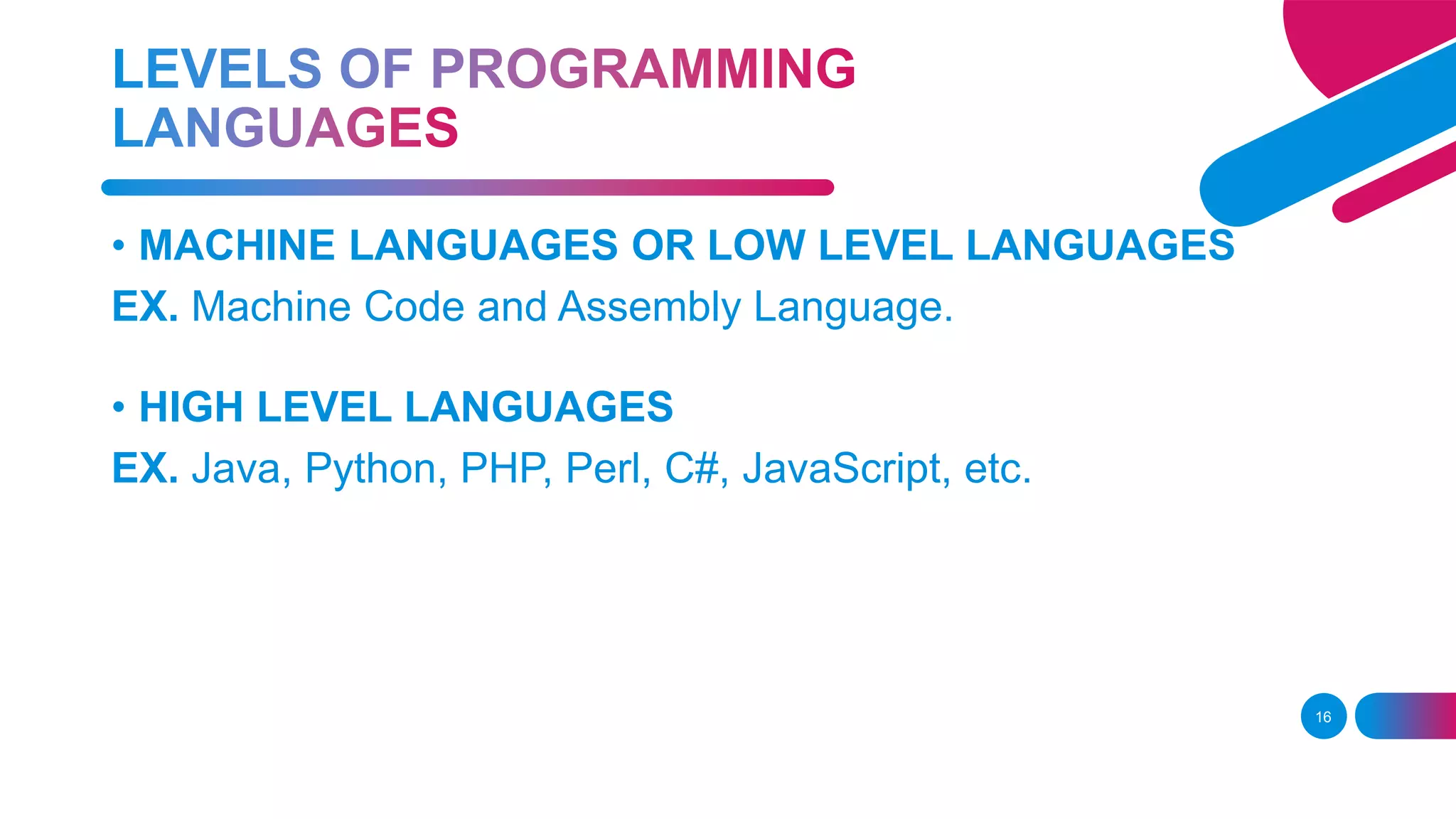
16
• MACHINE LANGUAGES OR LOW LEVEL LANGUAGES
EX. Machine Code and Assembly Language.
• HIGH LEVEL LANGUAGES
EX. Java, Python, PHP, Perl, C#, JavaScript, etc.
17
• Visual Basic was first introduced in 1991; it is considered the
third generation of event-driven programming languages.
Various Windows programs were developed throughout the
1990s using VB.
• VB continued to evolve throughout the 1990s until Visual Basic
6 was released in 1998, which was replaced by VB .NET.
18
•What is visual Basic
•Types and examples of
programming languages
19
•Applications
•Class
•Coding
•Computer Program
•Debugging
20
•IDE
•Instance
•Integrated Development Environment
•Object
•Object Oriented Programming
Language
21
•User Interface

VISUAL BASIC.pptx

  • 1.
    ADD A FOOTER1 1. __the process of translating a solution into a language that the computer can understand. 2. __integrated development environment 3. __a programming language that allows the programmer to use objects to accomplish a program’s goal 4. __the people who write computer programs 5. __the process of giving a mechanism the directions to accomplish a task a) Programming b) Programmers c) Object-oriented programming language d) IDE e) CODING
  • 2.
    ADD A FOOTER2 6. __what the user sees and interacts with while an application is running. 7. __anything that can be seen, touched, or used 8. __the process of locating and correcting the errors (bugs) in a program 9. __programs created for the Windows environment, the Web, or mobile devices 10.__a pattern that the computer uses to create (instantiate) an object f) Class g) Object h) Debugging i) Applications j) Class
  • 3.
  • 4.
  • 5.
    ADD A FOOTER5 •A programming language is a computer language programmers use to develop software programs, scripts, or other sets of instructions for computers to execute.
  • 6.
    ADD A FOOTER6 •FUNCTION •TARGET •CONSTRUCTS •EXPRESSIVE POWER
  • 7.
    ADD A FOOTER7 •A prominent purpose of programming languages is to provide instructions to a computer. As such, programming languages differ from most other forms of human expression in that they require a greater degree of precision and completeness.
  • 8.
    ADD A FOOTER8 •Visual Basic (VB) is an event-driven programming language and environment from Microsoft that provides a graphical user interface (GUI) which allows programmers to modify code by simply dragging and dropping objects and defining their behavior and appearance.
  • 9.
    ADD A FOOTER9 •Derived from BASIC(Beginner's All- purpose Symbolic Instruction Code)
  • 11.
    11 1. Procedural programminglanguages A procedural language follows a sequence of statements or commands in order to achieve a desired output. EX: • C and C++ • Java • Pascal • BASIC
  • 12.
    12 2. Functional programminglanguages Rather than focusing on the execution of statements, functional languages focus on the output of mathematical functions and evaluations. EX: • Scala • Erlang • Haskell • Elixir • F#
  • 13.
    13 3. Object-oriented programminglanguages This type of language treats a program as a group of objects composed of data and program elements, known as attributes and methods. Objects can be reused within a program or in other programs. EX: • Java • Phython • PHP • C# • C++
  • 14.
    14 4. Scripting languages Programmersuse scripting languages to automate repetitive tasks, manage dynamic web content, or support processes in larger applications. Some common scripting languages include: EX: • RUBY • Phython • PHP • BASH • PERL
  • 15.
    15 5. Logic programminglanguages Instead of telling a computer what to do, a logic programming language expresses a series of facts and rules to instruct the computer on how to make decisions. Some examples of logic languages include: • PROLOG • ABSYS • Datalog • Alma-O
  • 16.
    16 • MACHINE LANGUAGESOR LOW LEVEL LANGUAGES EX. Machine Code and Assembly Language. • HIGH LEVEL LANGUAGES EX. Java, Python, PHP, Perl, C#, JavaScript, etc.
  • 17.
    17 • Visual Basicwas first introduced in 1991; it is considered the third generation of event-driven programming languages. Various Windows programs were developed throughout the 1990s using VB. • VB continued to evolve throughout the 1990s until Visual Basic 6 was released in 1998, which was replaced by VB .NET.
  • 18.
    18 •What is visualBasic •Types and examples of programming languages
  • 19.
  • 20.
  • 21.

Editor's Notes

  • #7 Function: A programming language is a language used to write computer programs, which instruct a computer to perform some kind of computation, and/or organize the flow of control between external devices (such as a printer, a robot, or any peripheral). Target: Programming languages differ from natural languages in that natural languages are only used for interaction between people, while programming languages also allow humans to communicate instructions to machines. In some cases, programming languages are used by one program or machine to program another; PostScript source code, for example, is frequently generated programmatically to control a computer printer or display. Constructs: Programming languages may contain constructs for defining and manipulating data structures or for controlling the flow of execution. Expressive power: The theory of computation classifies languages by the computations they can express (see Chomsky hierarchy). All Turing complete languages can implement the same set of algorithms. ANSI/ISO SQL and Charity are examples of languages that are not Turing complete yet often called programming languages.
  • #10 BASIC was an early programming language that is still among the simplest and most popular of programming languages.
  • #12 Each series of steps is called a procedure, and a program written in one of these languages will have one or more procedures within it. Common examples of procedural languages include:
  • #13  Each function–a reusable module of code–performs a specific task and returns a result. The result will vary depending on what data you input into the function. Some popular functional programming languages include:
  • #14 This makes it a popular language type for complex programs, as code is easier to reuse and scale. Some common object-oriented programming (OOP) languages include:
  • #15 This makes it a popular language type for complex programs, as code is easier to reuse and scale. Some common object-oriented programming (OOP) languages include:
  • #17 Low-level languages have a low level of abstraction than high-level programming languages. Because of this, Low-Level code is more easily read by computers and is faster at runtime. However, although this code runs more efficiently, it’s not efficient for developers to write.