Vision-Language-Action Models for
Embodied AI
A Deep Dive into the 2024 Survey
Mohibkhan Pathan
CMPE 258 - Deep Learning
Professor Vijay Eranti
What is Embodied
AI?
08
Why Do We Need VLA Models?
02
What Are VLA Models?
03
High-Level Task Planners
07
Training Data and Benchmarks
01
Challenges
09
Table of contents
The Three Main Parts of
VLA Models
11
Key Components
05
Low-Level Control
06
The Future of VLAs
10
References
04
● AI that lives in the real world, not just on a screen
● Can see, understand, and take actions
● Example: A robot that follows the command “bring me a cup”
● It combines vision, language, and movement
● Not like ChatGPT or CLIP — they don’t interact with the physical world
What is Embodied AI?
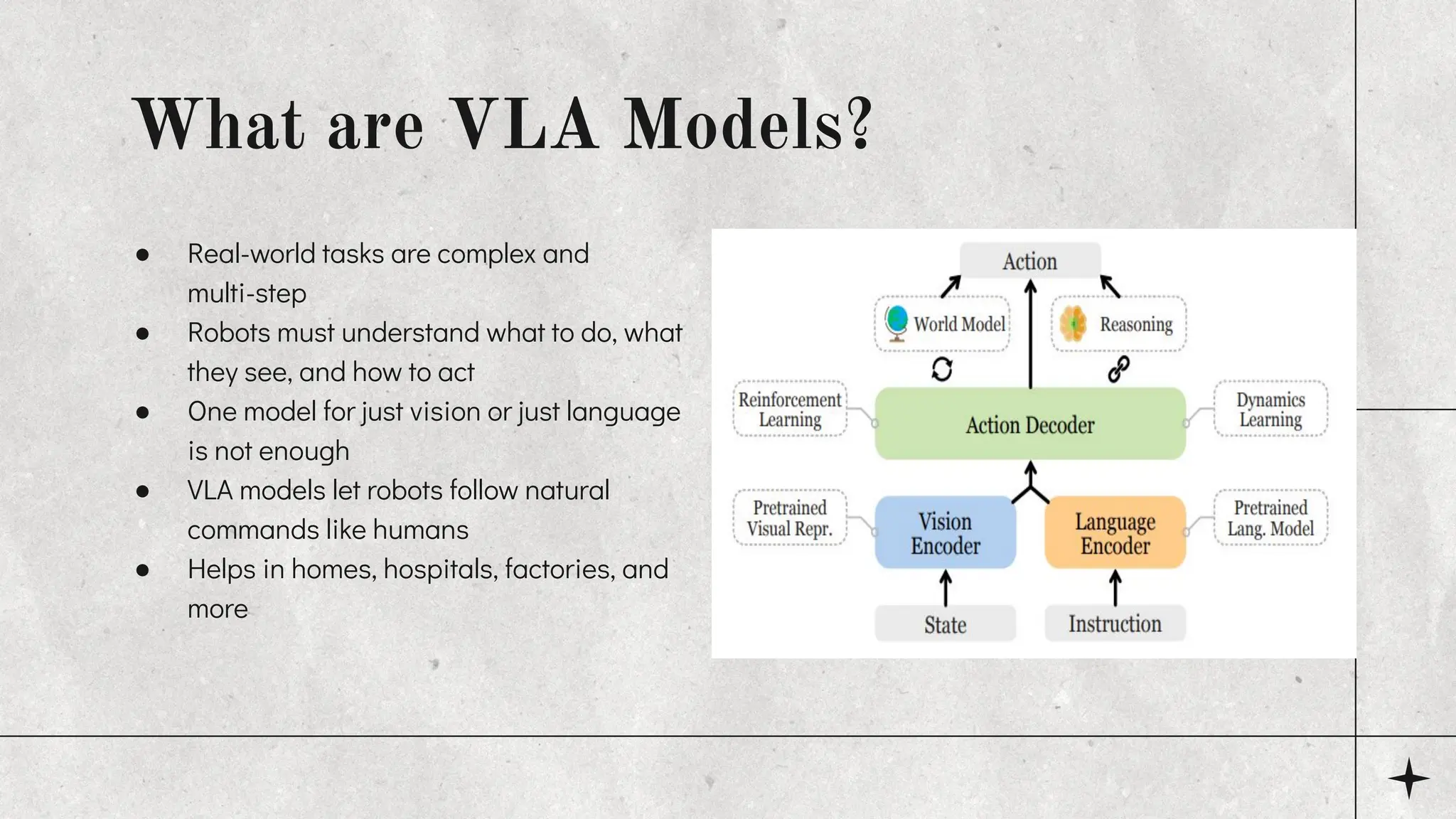
● Real-world tasks are complex and multi-step
● Robots must understand what to do, what they see, and how to act
● One model for just vision or just language is not enough
● VLA models let robots follow natural commands like humans
● Helps in homes, hospitals, factories, and more
Why Do We Need VLA Models?
What are VLA Models?
● Real-world tasks are complex and
multi-step
● Robots must understand what to do, what
they see, and how to act
● One model for just vision or just language
is not enough
● VLA models let robots follow natural
commands like humans
● Helps in homes, hospitals, factories, and
more
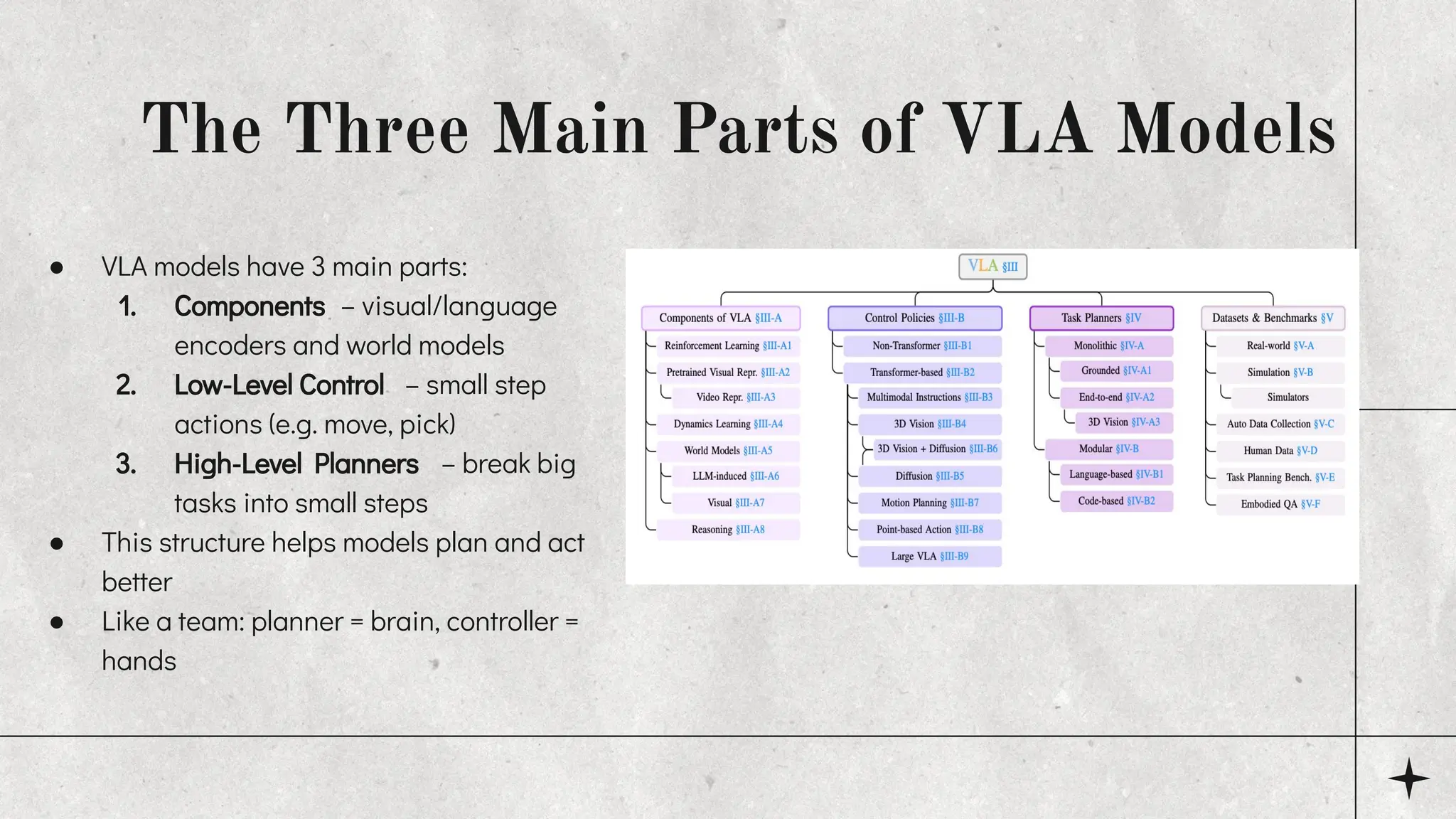
The Three Main Parts of VLA Models
● VLA models have 3 main parts:
1. Components – visual/language
encoders and world models
2. Low-Level Control – small step
actions (e.g. move, pick)
3. High-Level Planners – break big
tasks into small steps
● This structure helps models plan and act
better
● Like a team: planner = brain, controller =
hands
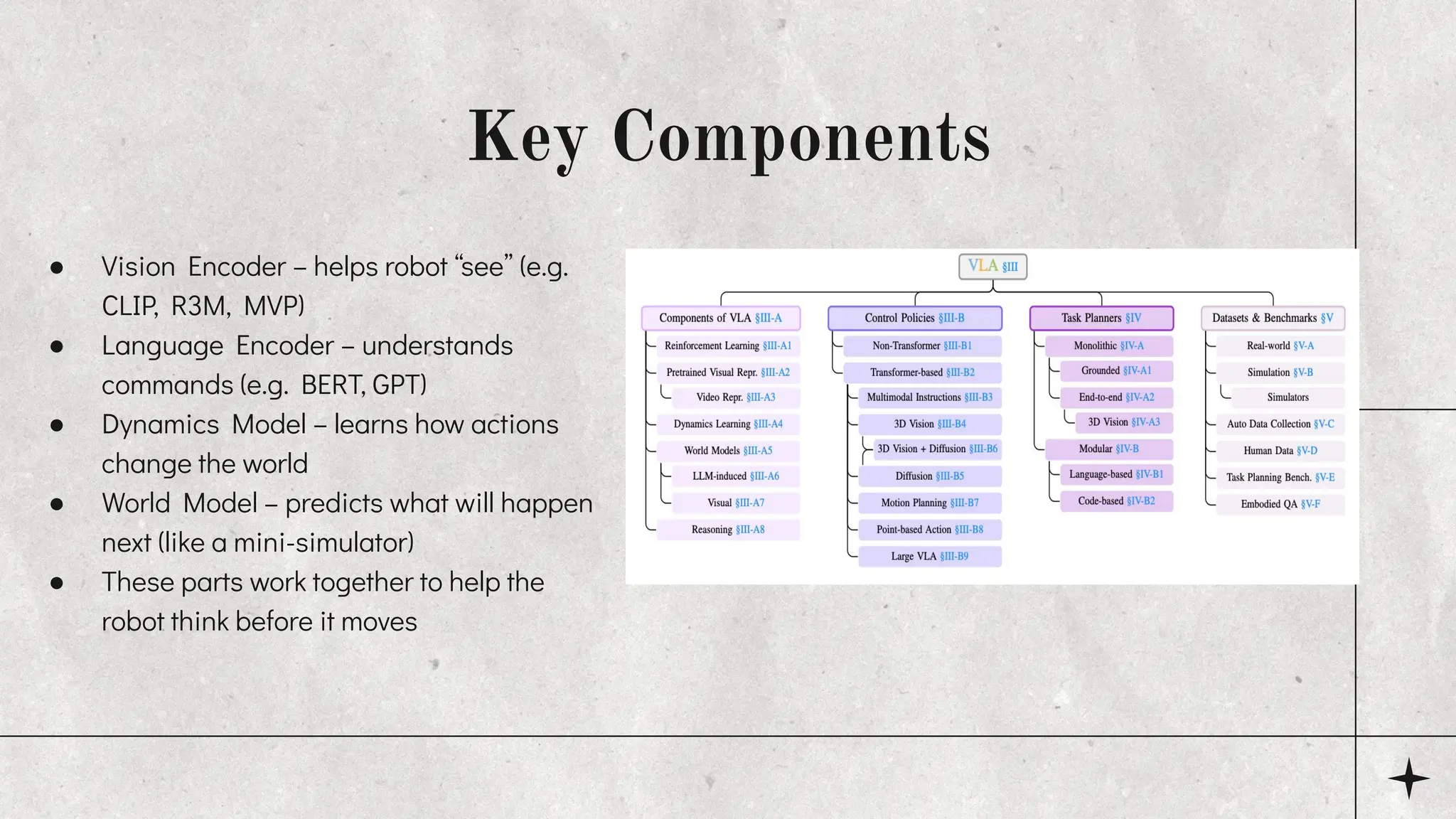
Key Components
● Vision Encoder – helps robot “see” (e.g.
CLIP, R3M, MVP)
● Language Encoder – understands
commands (e.g. BERT, GPT)
● Dynamics Model – learns how actions
change the world
● World Model – predicts what will happen
next (like a mini-simulator)
● These parts work together to help the
robot think before it moves
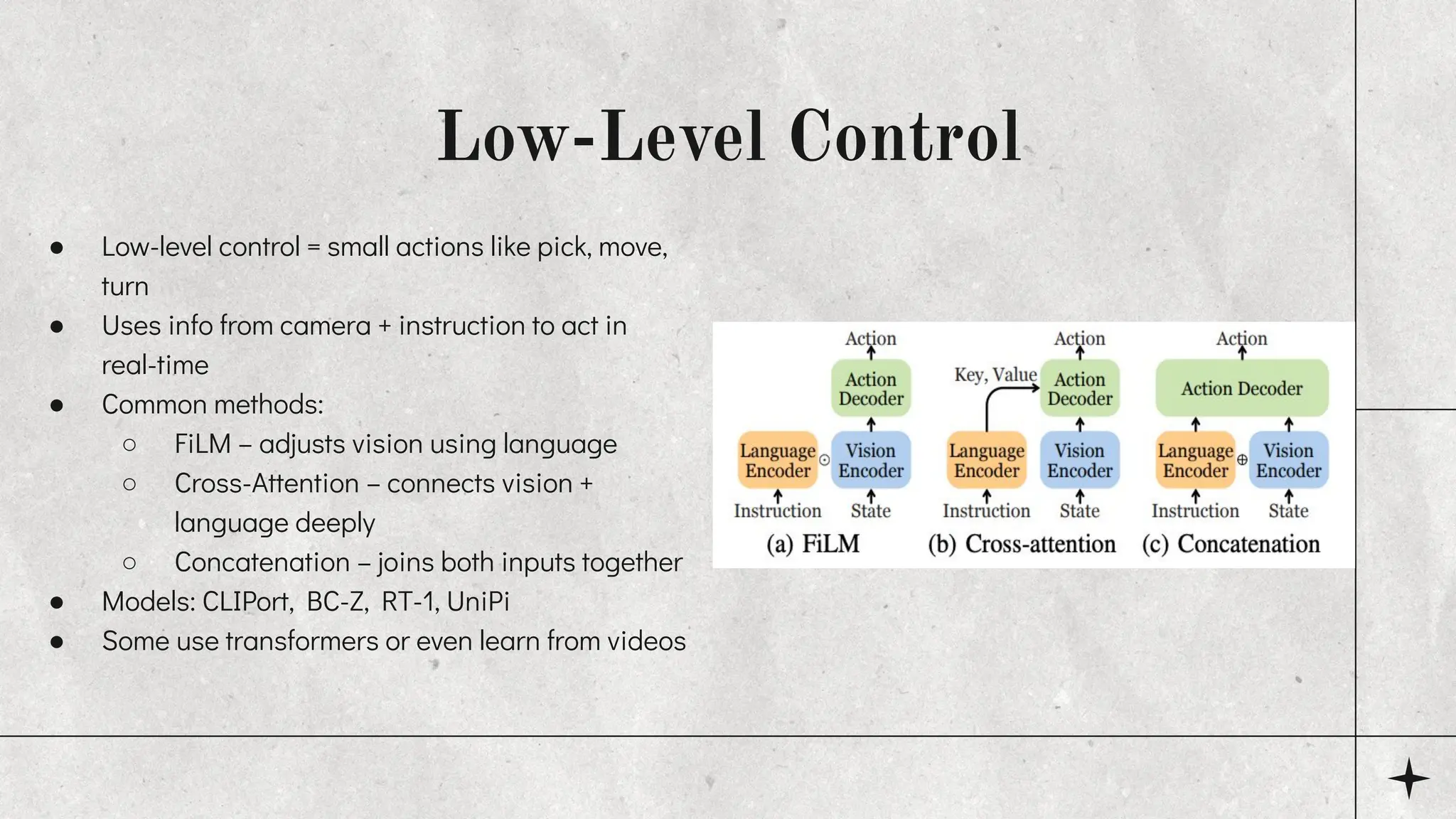
Low-Level Control
● Low-level control = small actions like pick, move,
turn
● Uses info from camera + instruction to act in
real-time
● Common methods:
○ FiLM – adjusts vision using language
○ Cross-Attention – connects vision +
language deeply
○ Concatenation – joins both inputs together
● Models: CLIPort, BC-Z, RT-1, UniPi
● Some use transformers or even learn from videos
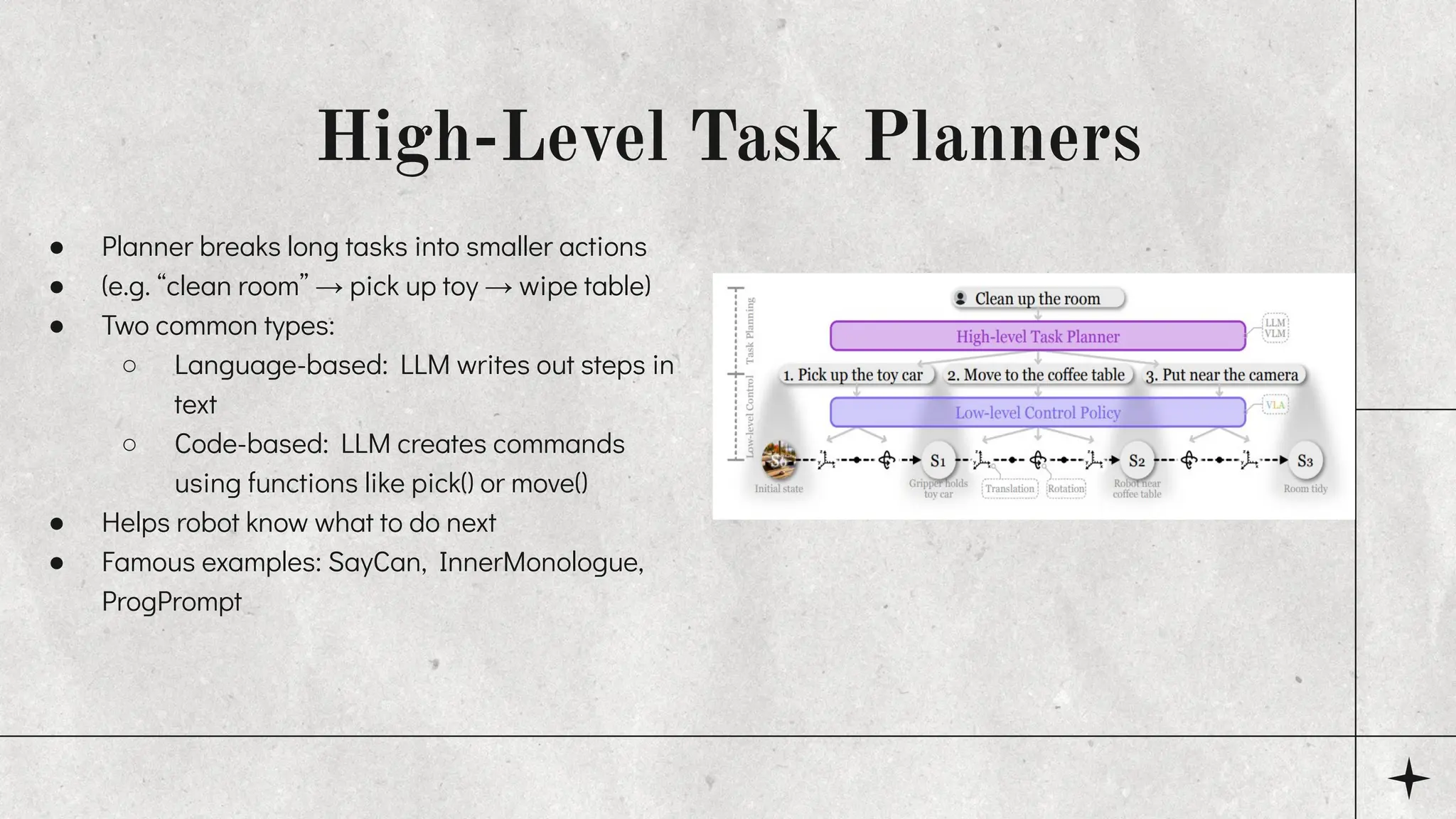
High-Level Task Planners
● Planner breaks long tasks into smaller actions
● (e.g. “clean room” → pick up toy → wipe table)
● Two common types:
○ Language-based: LLM writes out steps in
text
○ Code-based: LLM creates commands
using functions like pick() or move()
● Helps robot know what to do next
● Famous examples: SayCan, InnerMonologue,
ProgPrompt
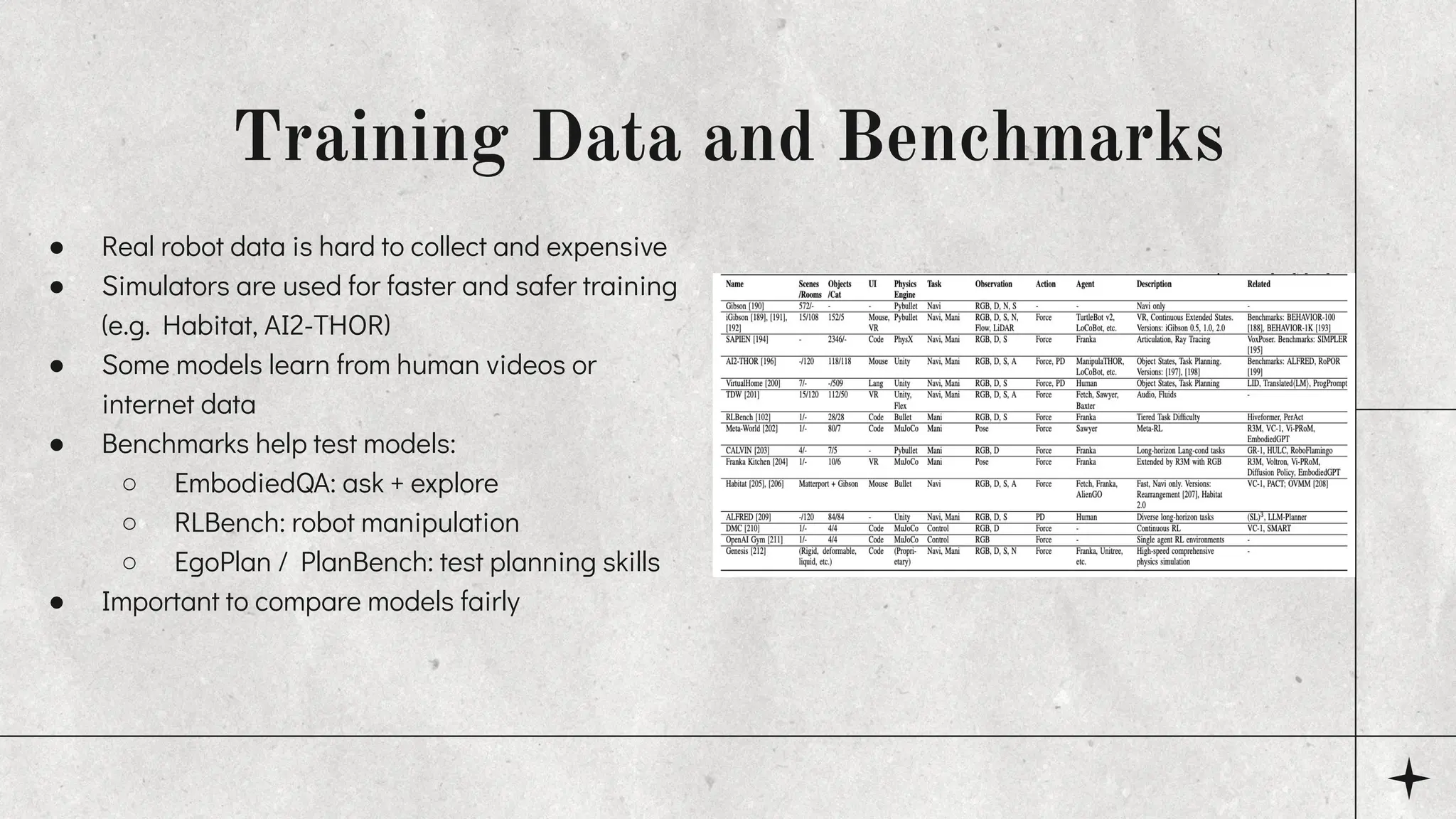
Training Data and Benchmarks
● Real robot data is hard to collect and expensive
● Simulators are used for faster and safer training
(e.g. Habitat, AI2-THOR)
● Some models learn from human videos or
internet data
● Benchmarks help test models:
○ EmbodiedQA: ask + explore
○ RLBench: robot manipulation
○ EgoPlan / PlanBench: test planning skills
● Important to compare models fairly
● Real data is hard to get – robot demos take time
● Models are slow – need to act faster in real life
● System is complex – many parts must work together
● Struggle with new tasks – not good at generalizing
● No standard tests – hard to compare different models
● Safety is important – robots must be trusted by people
Challenges
● Smarter planning with better world models
● Faster and smaller models for real-time use
● Use in homes, hospitals, factories, and more
● Safer and more human-friendly robot behavior
● Learn from the world just like humans do
The Future of VLA Models
Ma, Y., Song, Z., Zhuang, Y., Hao, J., & King, I. (2024).
A Survey on Vision-Language-Action Models for Embodied AI.
arXiv preprint arXiv:2408.14496.
https://arxiv.org/abs/2408.14496
Resources

Vision-Language-Action Models for Embodied AI

  • 1.
    Vision-Language-Action Models for EmbodiedAI A Deep Dive into the 2024 Survey Mohibkhan Pathan CMPE 258 - Deep Learning Professor Vijay Eranti
  • 2.
    What is Embodied AI? 08 WhyDo We Need VLA Models? 02 What Are VLA Models? 03 High-Level Task Planners 07 Training Data and Benchmarks 01 Challenges 09 Table of contents The Three Main Parts of VLA Models 11 Key Components 05 Low-Level Control 06 The Future of VLAs 10 References 04
  • 3.
    ● AI thatlives in the real world, not just on a screen ● Can see, understand, and take actions ● Example: A robot that follows the command “bring me a cup” ● It combines vision, language, and movement ● Not like ChatGPT or CLIP — they don’t interact with the physical world What is Embodied AI?
  • 4.
    ● Real-world tasksare complex and multi-step ● Robots must understand what to do, what they see, and how to act ● One model for just vision or just language is not enough ● VLA models let robots follow natural commands like humans ● Helps in homes, hospitals, factories, and more Why Do We Need VLA Models?
  • 5.
    What are VLAModels? ● Real-world tasks are complex and multi-step ● Robots must understand what to do, what they see, and how to act ● One model for just vision or just language is not enough ● VLA models let robots follow natural commands like humans ● Helps in homes, hospitals, factories, and more
  • 6.
    The Three MainParts of VLA Models ● VLA models have 3 main parts: 1. Components – visual/language encoders and world models 2. Low-Level Control – small step actions (e.g. move, pick) 3. High-Level Planners – break big tasks into small steps ● This structure helps models plan and act better ● Like a team: planner = brain, controller = hands
  • 7.
    Key Components ● VisionEncoder – helps robot “see” (e.g. CLIP, R3M, MVP) ● Language Encoder – understands commands (e.g. BERT, GPT) ● Dynamics Model – learns how actions change the world ● World Model – predicts what will happen next (like a mini-simulator) ● These parts work together to help the robot think before it moves
  • 8.
    Low-Level Control ● Low-levelcontrol = small actions like pick, move, turn ● Uses info from camera + instruction to act in real-time ● Common methods: ○ FiLM – adjusts vision using language ○ Cross-Attention – connects vision + language deeply ○ Concatenation – joins both inputs together ● Models: CLIPort, BC-Z, RT-1, UniPi ● Some use transformers or even learn from videos
  • 9.
    High-Level Task Planners ●Planner breaks long tasks into smaller actions ● (e.g. “clean room” → pick up toy → wipe table) ● Two common types: ○ Language-based: LLM writes out steps in text ○ Code-based: LLM creates commands using functions like pick() or move() ● Helps robot know what to do next ● Famous examples: SayCan, InnerMonologue, ProgPrompt
  • 10.
    Training Data andBenchmarks ● Real robot data is hard to collect and expensive ● Simulators are used for faster and safer training (e.g. Habitat, AI2-THOR) ● Some models learn from human videos or internet data ● Benchmarks help test models: ○ EmbodiedQA: ask + explore ○ RLBench: robot manipulation ○ EgoPlan / PlanBench: test planning skills ● Important to compare models fairly
  • 11.
    ● Real datais hard to get – robot demos take time ● Models are slow – need to act faster in real life ● System is complex – many parts must work together ● Struggle with new tasks – not good at generalizing ● No standard tests – hard to compare different models ● Safety is important – robots must be trusted by people Challenges
  • 12.
    ● Smarter planningwith better world models ● Faster and smaller models for real-time use ● Use in homes, hospitals, factories, and more ● Safer and more human-friendly robot behavior ● Learn from the world just like humans do The Future of VLA Models
  • 13.
    Ma, Y., Song,Z., Zhuang, Y., Hao, J., & King, I. (2024). A Survey on Vision-Language-Action Models for Embodied AI. arXiv preprint arXiv:2408.14496. https://arxiv.org/abs/2408.14496 Resources