HACKING
An introduction
by Jayaseelan Vejayon
So…what is hacking?
• Hacking is the practice of modifying the features of a
  system, in order to accomplish a goal outside of the
  creator's original purpose.
                                                   (http://whatishacking.org/)


• Computer hacking
   – is the practice of modifying computer hardware and
     software to accomplish a goal outside of the creator’s
     original purpose.
   – is most common among teenagers and young adults
                       (http://www.wisegeek.org/what-is-computer-hacking.htm)
Why hack?
• Profit
   – Information can be sold
   – Information can be used to steal


• Protest
   – Eg. Hactivism: a hacktivist is someone whom utilizes
     technology to announce a social, ideological, religious, or
     political message


• Challenge
   – Fun, problem-solving skill, the thrill of power
Why hack? Some examples…
• Hackers want to
  – use the victim’s computer to store illicit materials
    i.e pirated software, pornography, etc.

  – steal the victim’s personal information in order to
    access accounts or the accounts of the website
    visitors. The data can be used to gain access to
    important databases; billing, merchant accounts,
    etc.
Why hack? Some examples…
• Hackers want to
  – set-up fake ecommerce sites to access credit card
    details; gain entry to servers that contain credit
    card details and other forms of credit card fraud

  – spy on friends, family, co-workers for personal
    reasons

  – revenge
    (http://www.website-guardian.com/why-do-hackers-hack-websites-va-5.html)
Effects of hacking
• Damage to information

• Theft of information
   – Credit card details, social security numbers, identity fraud,
     email addresses

• Compromise/damage of systems

• Use of victim machines as “zombies”

   Hacking attacks cost large businesses an average of about
   $2.2 million per year (Symantec 2010 State of Enterprise Security
   Study)
Effects of hacking
• Businesses may suffer from damaged reputations
  and lawsuits

• Business secrets could be stolen and sold to
  competitors

• Computing system/infrastructure could suffer from
  performance degrading as the resources used for
  malicious activities
In an education institution, hacking can cause damage to the institution’s
credibility/reputation ie. If examination system is compromised and
sensitive data tampered
A hacker…
Can fall into one of these types:

• Black hats
         Individuals with good computing knowledge, abilities and
          expertise but with the intentions and conducts to cause
          damage on the systems they attack
         Also known as crackers


• White hats
         Individuals with good hacking skills
         They perform defensive activities against hacking
         Also known as security analysts
A hacker…
• Gray hats
        Individuals that perform both offensive and defensive
         hacking activities


• Suicide hackers
        Individuals whom want to fail a computing system for a
         personal ‘reason’ or ‘cause’
        Not worried about the serious consequences that they may
         have to face as a result of their damaging activities i.e being
         jailed for many years
Types of attacks …
• DoS/DDoS Attacks
• Password Guessing Attacks
• Man-in-the-Middle Attacks
• Identity Spoofing
• Interception
• Eavesdropping
• Backdoor Attacks
… and many more!
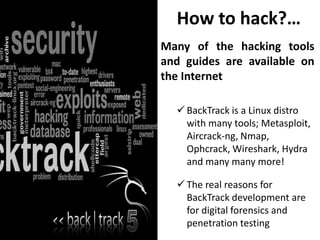
How to hack?…
Many of the hacking tools
and guides are available on
the Internet

   BackTrack is a Linux distro
    with many tools; Metasploit,
    Aircrack-ng, Nmap,
    Ophcrack, Wireshark, Hydra
    and many many more!

   The real reasons for
    BackTrack development are
    for digital forensics and
    penetration testing
How to hack?…some examples
System Hacking; Keyloggers, password
 cracking
Trojans
Viruses
Sniffers
Social Engineering
Denial of Service
SQL Injection
How to hack?…some examples
Password cracking - dictionary attacks, brute
 forcing attacks, hybrid attacks, syllable
 attacks and rule-based attacks

Other types of password cracking attacks –
 shoulder surfing, social engineering,
 dumpster diving, wire sniffing, Man-in-the-
 Middle, password guessing, keylogger
Passwords…


Enforce complexity so that passwords
are difficult to break; use combination
of letters, numbers, special characters
How to hack?…some examples
Password cracking - dictionary attacks, brute
 forcing attacks, hybrid attacks, syllable
 attacks and rule-based attacks

Other types of attacks – shoulder surfing,
 social engineering, dumpster diving, wire
 sniffing, Man-in-the-Middle, password
 guessing, keylogger
How to hack?
             LIVE DEMO
Keylogger
Sniffing
Web-cloning
Google Hacking
NTFS Streams
DNS Spoofing
Thank you
http://jayitsecurity.blogspot.com

Computer Hacking - An Introduction

  • 1.
  • 2.
    So…what is hacking? •Hacking is the practice of modifying the features of a system, in order to accomplish a goal outside of the creator's original purpose. (http://whatishacking.org/) • Computer hacking – is the practice of modifying computer hardware and software to accomplish a goal outside of the creator’s original purpose. – is most common among teenagers and young adults (http://www.wisegeek.org/what-is-computer-hacking.htm)
  • 3.
    Why hack? • Profit – Information can be sold – Information can be used to steal • Protest – Eg. Hactivism: a hacktivist is someone whom utilizes technology to announce a social, ideological, religious, or political message • Challenge – Fun, problem-solving skill, the thrill of power
  • 4.
    Why hack? Someexamples… • Hackers want to – use the victim’s computer to store illicit materials i.e pirated software, pornography, etc. – steal the victim’s personal information in order to access accounts or the accounts of the website visitors. The data can be used to gain access to important databases; billing, merchant accounts, etc.
  • 5.
    Why hack? Someexamples… • Hackers want to – set-up fake ecommerce sites to access credit card details; gain entry to servers that contain credit card details and other forms of credit card fraud – spy on friends, family, co-workers for personal reasons – revenge (http://www.website-guardian.com/why-do-hackers-hack-websites-va-5.html)
  • 6.
    Effects of hacking •Damage to information • Theft of information – Credit card details, social security numbers, identity fraud, email addresses • Compromise/damage of systems • Use of victim machines as “zombies” Hacking attacks cost large businesses an average of about $2.2 million per year (Symantec 2010 State of Enterprise Security Study)
  • 7.
    Effects of hacking •Businesses may suffer from damaged reputations and lawsuits • Business secrets could be stolen and sold to competitors • Computing system/infrastructure could suffer from performance degrading as the resources used for malicious activities In an education institution, hacking can cause damage to the institution’s credibility/reputation ie. If examination system is compromised and sensitive data tampered
  • 8.
    A hacker… Can fallinto one of these types: • Black hats  Individuals with good computing knowledge, abilities and expertise but with the intentions and conducts to cause damage on the systems they attack  Also known as crackers • White hats  Individuals with good hacking skills  They perform defensive activities against hacking  Also known as security analysts
  • 9.
    A hacker… • Grayhats  Individuals that perform both offensive and defensive hacking activities • Suicide hackers  Individuals whom want to fail a computing system for a personal ‘reason’ or ‘cause’  Not worried about the serious consequences that they may have to face as a result of their damaging activities i.e being jailed for many years
  • 10.
    Types of attacks… • DoS/DDoS Attacks • Password Guessing Attacks • Man-in-the-Middle Attacks • Identity Spoofing • Interception • Eavesdropping • Backdoor Attacks … and many more!
  • 11.
    How to hack?… Manyof the hacking tools and guides are available on the Internet  BackTrack is a Linux distro with many tools; Metasploit, Aircrack-ng, Nmap, Ophcrack, Wireshark, Hydra and many many more!  The real reasons for BackTrack development are for digital forensics and penetration testing
  • 12.
    How to hack?…someexamples System Hacking; Keyloggers, password cracking Trojans Viruses Sniffers Social Engineering Denial of Service SQL Injection
  • 13.
    How to hack?…someexamples Password cracking - dictionary attacks, brute forcing attacks, hybrid attacks, syllable attacks and rule-based attacks Other types of password cracking attacks – shoulder surfing, social engineering, dumpster diving, wire sniffing, Man-in-the- Middle, password guessing, keylogger
  • 14.
    Passwords… Enforce complexity sothat passwords are difficult to break; use combination of letters, numbers, special characters
  • 15.
    How to hack?…someexamples Password cracking - dictionary attacks, brute forcing attacks, hybrid attacks, syllable attacks and rule-based attacks Other types of attacks – shoulder surfing, social engineering, dumpster diving, wire sniffing, Man-in-the-Middle, password guessing, keylogger
  • 16.
    How to hack? LIVE DEMO Keylogger Sniffing Web-cloning Google Hacking NTFS Streams DNS Spoofing
  • 17.

Editor's Notes

  • #3 There are also other types of hacking that I came across; brain hacking, biohackingSince the word “hack” has long been used to describe someone who is incompetent at his/her profession, some hackers claim this term is offensive and fails to give appropriate recognition to their skills.Many hackers are true technology buffs who enjoy learning more about how computers work and consider computer hacking an “art” form. After this, the term hacking in this presentation is relevant to computer hacking only