Virtualisation Optimisation The Cloud and BeyondPresenter Adam Nash – SolarWinds Product Manager
What is Virtualisation?Virtualization, in computing, is the creation of a virtual (rather than actual) version of something, such as a hardware platform, operating system, a storage device or network resourcesIn the UK server virtualisation is where the majority of virtualisation takes place – desktop is increasingApplication and storage virtualisation is gaining momentum- Slide 2 -
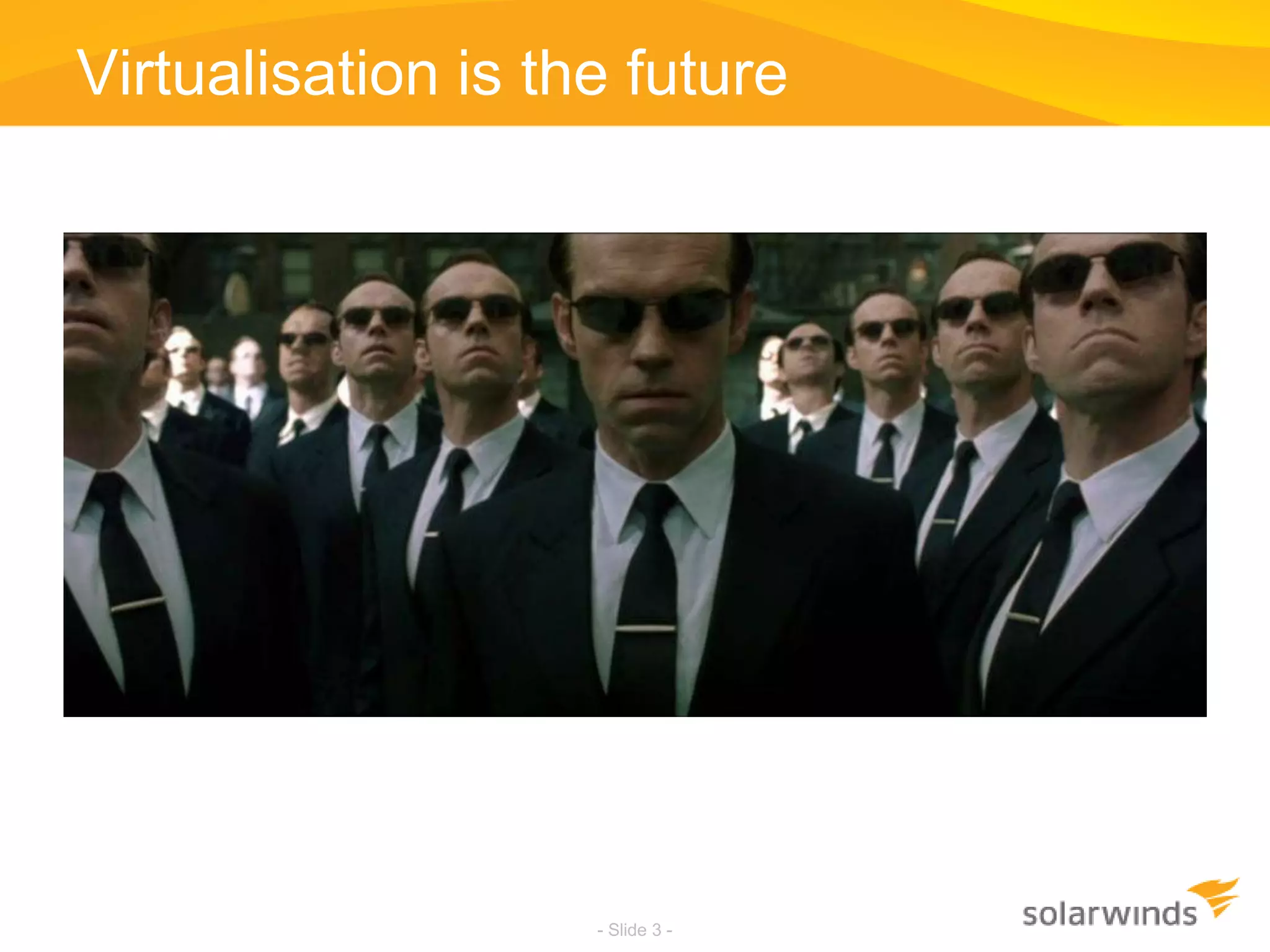
Virtualisation is the future - Slide 3 -
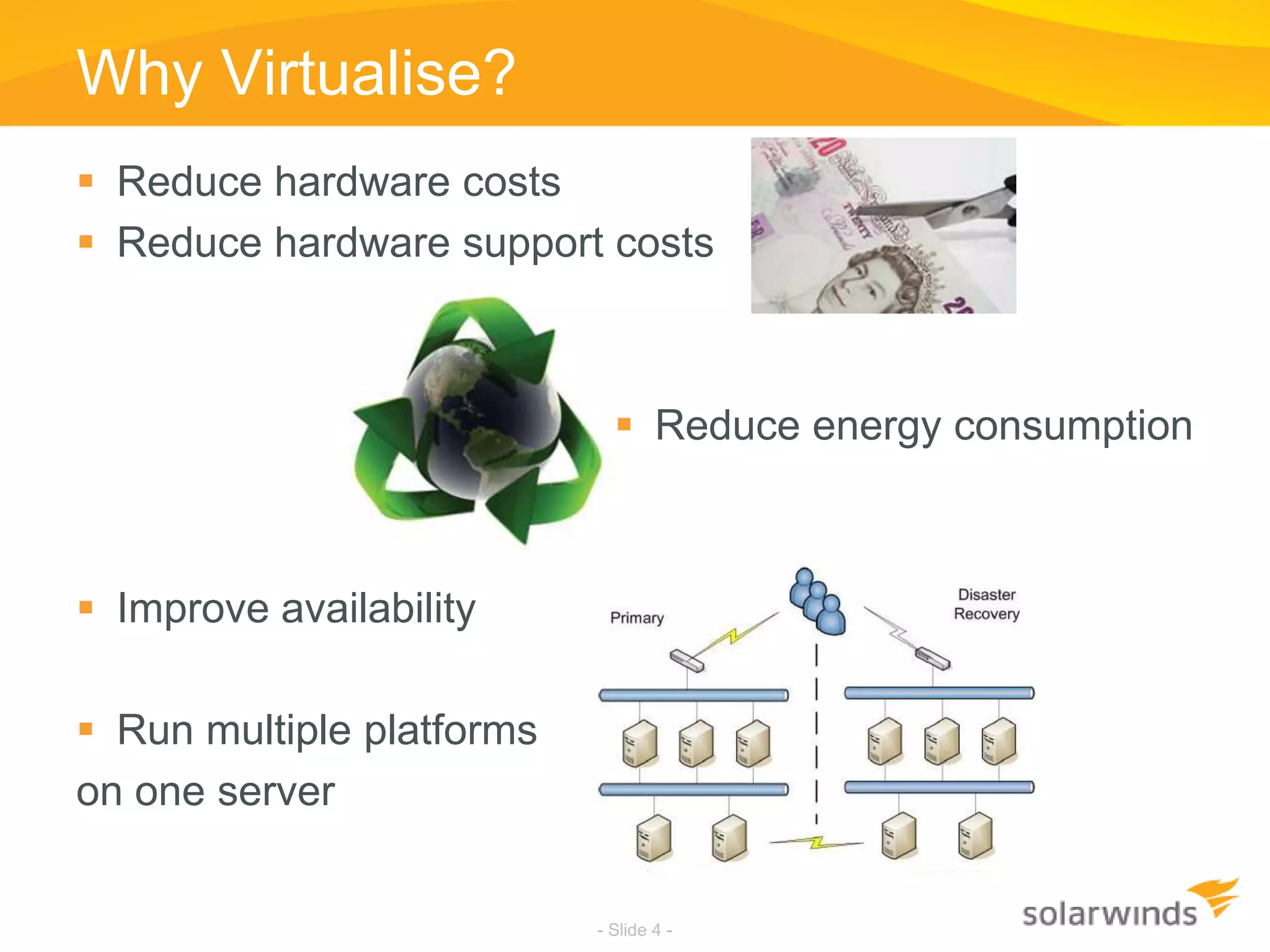
Why Virtualise?Reduce hardware costsReduce hardware support costsReduce energy consumptionImprove availabilityRun multiple platforms on one server- Slide 4 -
The Virtualisation MarketAt the end of 2009, only 18% of enterprise data centre workloads that could be virtualized had been virtualized, according to Gartner. The number is expected to grow to more than 50% by the close of 2012. Up to 50% of SMBs were expected to move partially or completely to a virtualised environment over the next 2-3 yearsVMware dominates the server virtualisation market with around 80% of market share- Slide 5 -
The Virtualisation Market Cont.IDC (Global Market Research firm stated ‘IDC believes that automation tools increasingly represent the battleground in determining the winners and losers in a marketplace which is rapidly reshaping itself’Recent study by Forrester Consulting of 257 virtualization decision-makers in the U.S., U.K., France, Germany and Japan include:Moving to internal clouds requires changes to processes and automation managementUnderstanding of performance all of the components involved in virtualisation is critical- Slide 6 -
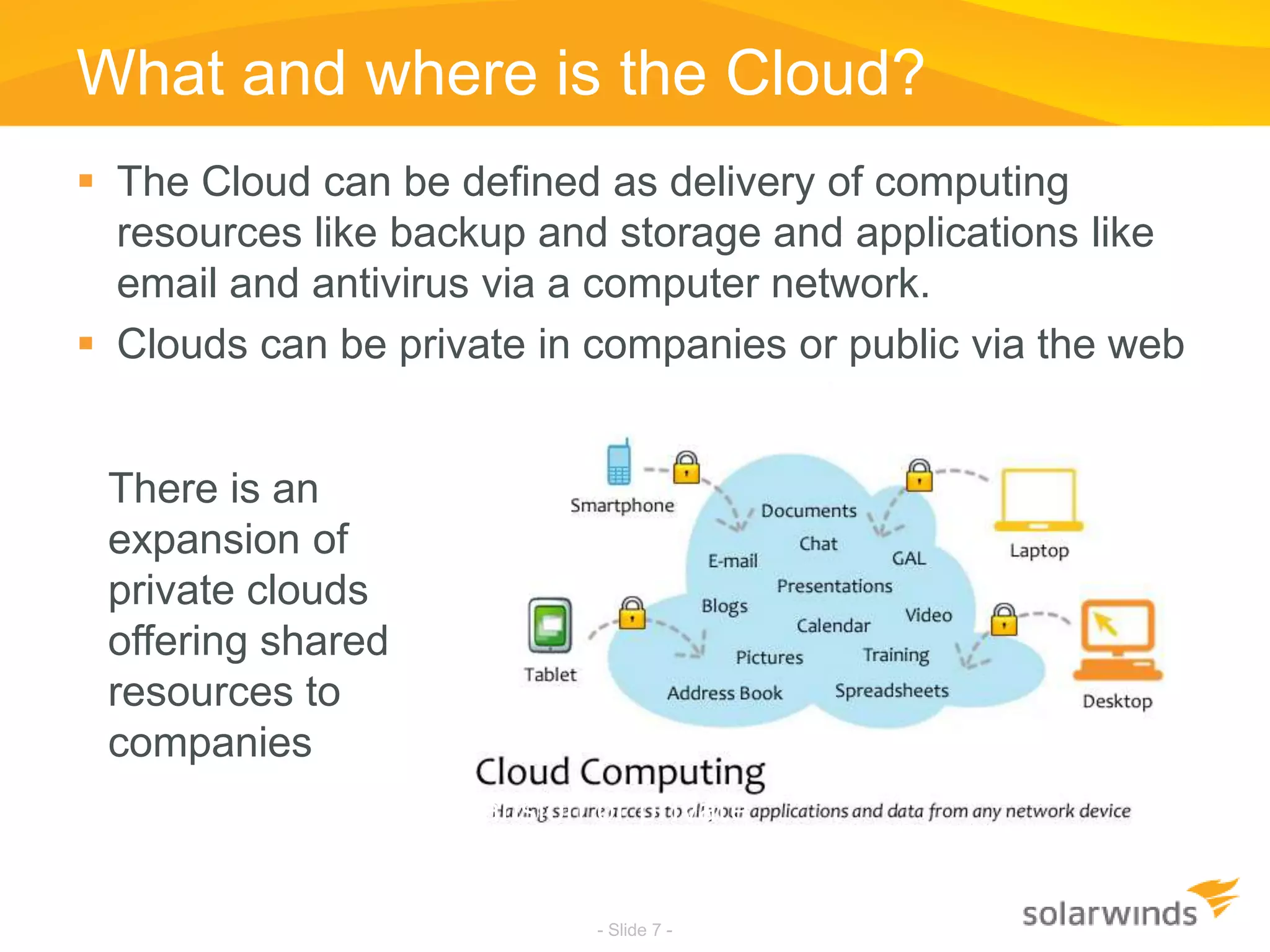
What and where is the Cloud?- Slide 7 -The Cloud can be defined as delivery of computing resources like backup and storage and applications like email and antivirus via a computer network.Clouds can be private in companies or public via the webThere is an expansion of private clouds offering shared resources to companiesThere is an expansion of private clouds offering shared resources to companies
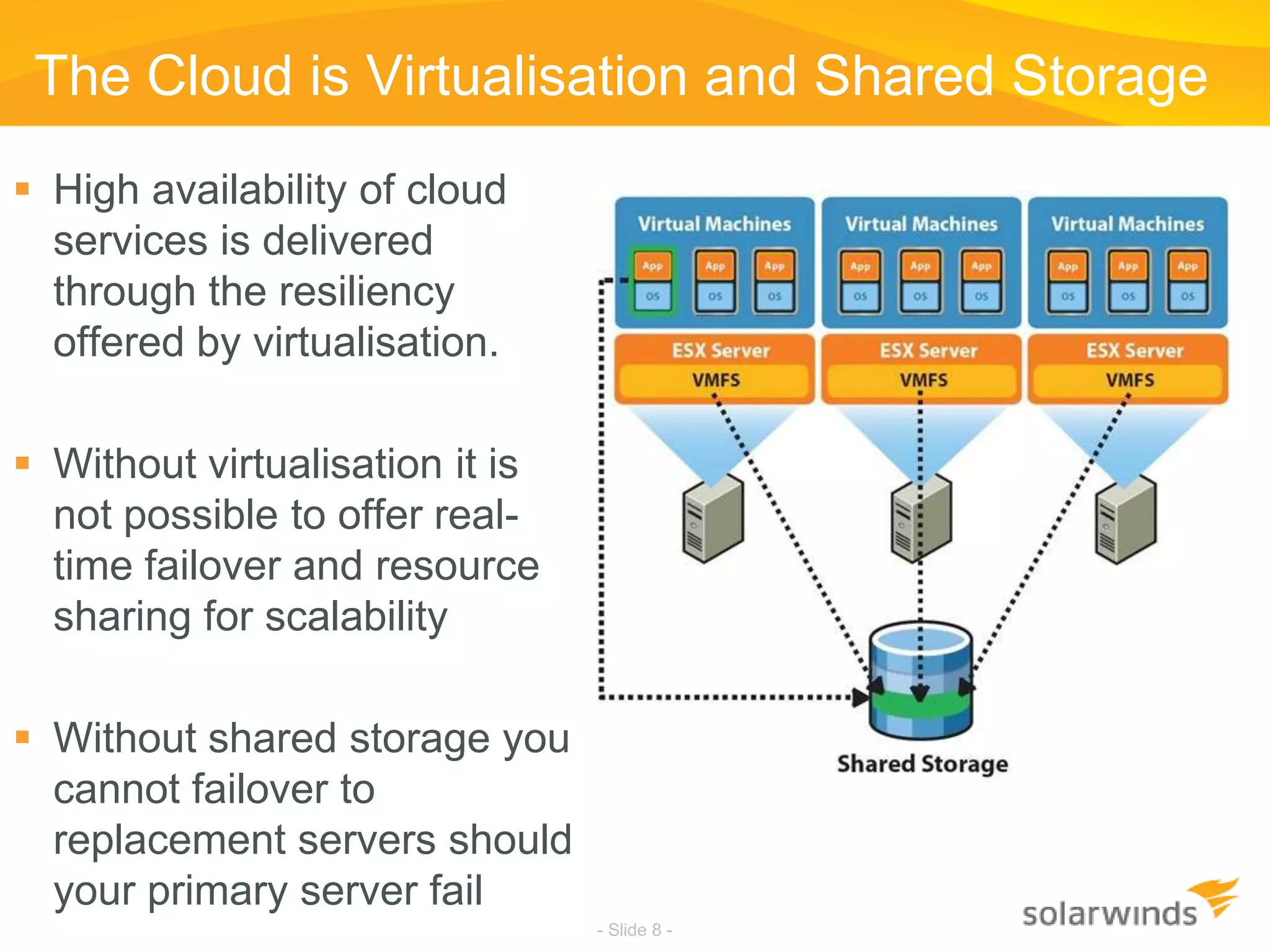
The Cloud is Virtualisation and Shared StorageHigh availability of cloud services is delivered through the resiliency offered by virtualisation.Without virtualisation it is not possible to offer real-time failover and resource sharing for scalabilityWithout shared storage you cannot failover to replacement servers should your primary server fail- Slide 8 -
Issues migrating to a Cloud environmentWho, what, where and when? Keeping track of expanding virtual resources is a missionResource bottlenecks as architecture changes rapidlyDifficulties planning capacity and rightsizing resources allocated to virtual machinesWho is using your virtual infrastructure? making the right department pay for the resource they use- Slide 9 -
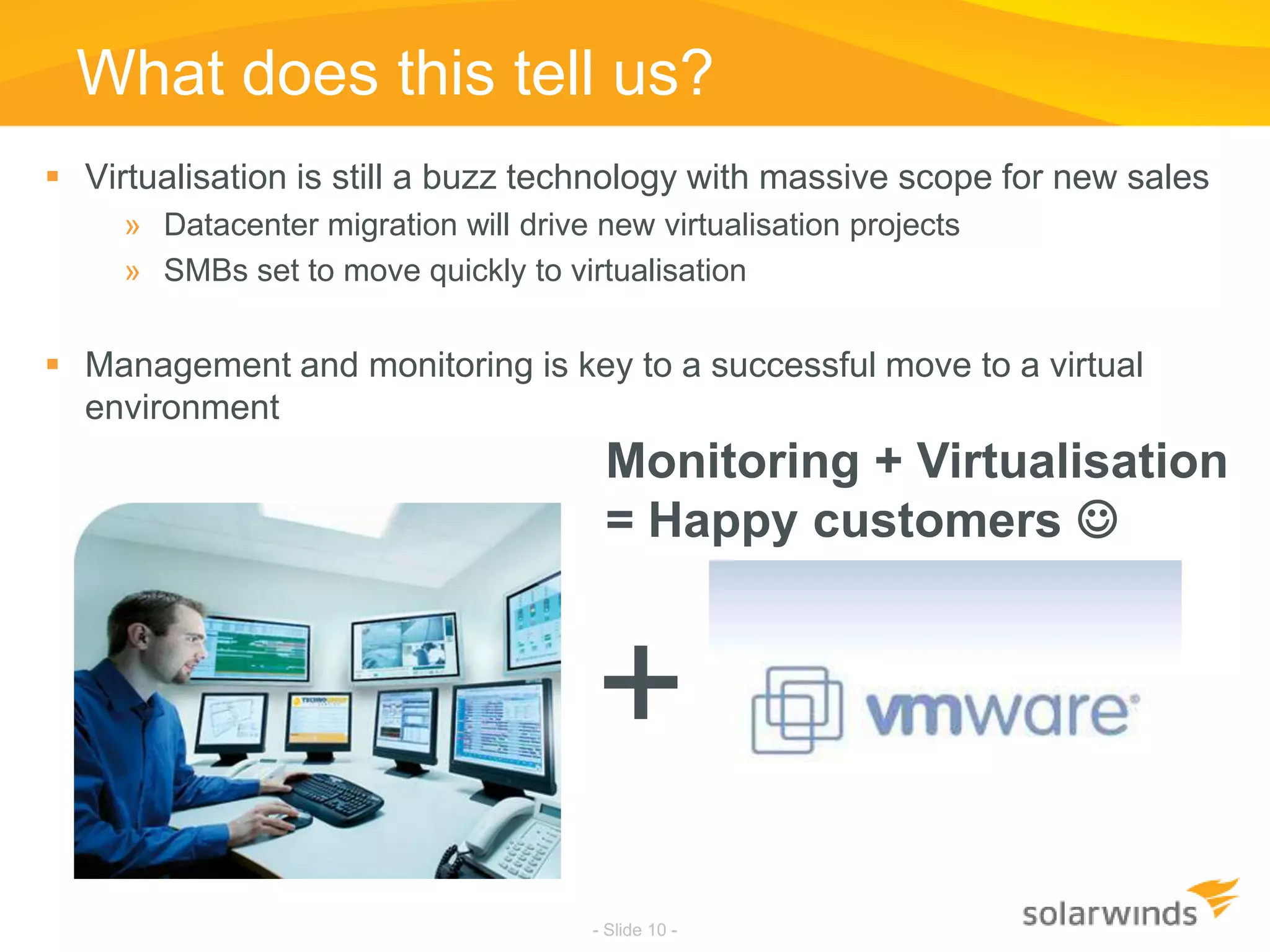
What does this tell us?Virtualisation is still a buzz technology with massive scope for new salesDatacenter migration will drive new virtualisation projectsSMBs set to move quickly to virtualisationManagement and monitoring is key to a successful move to a virtual environment + - Slide 10 -Monitoring + Virtualisation = Happy customers 
Beating Cloud and Virtualisation Management Problems by monitoring and optimising
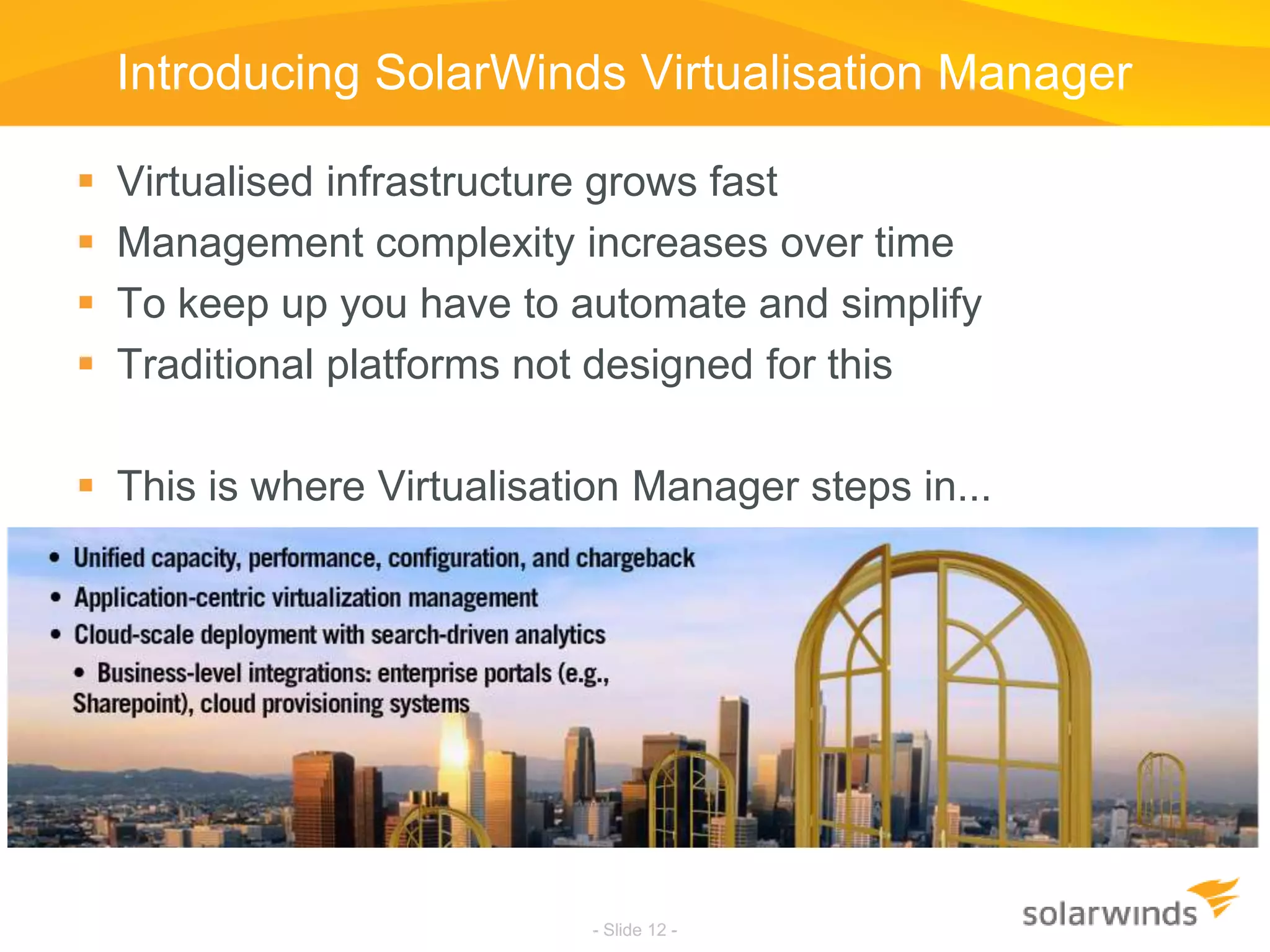
Introducing SolarWinds Virtualisation ManagerVirtualised infrastructure grows fastManagement complexity increases over timeTo keep up you have to automate and simplifyTraditional platforms not designed for thisThis is where Virtualisation Manager steps in...- Slide 12 -
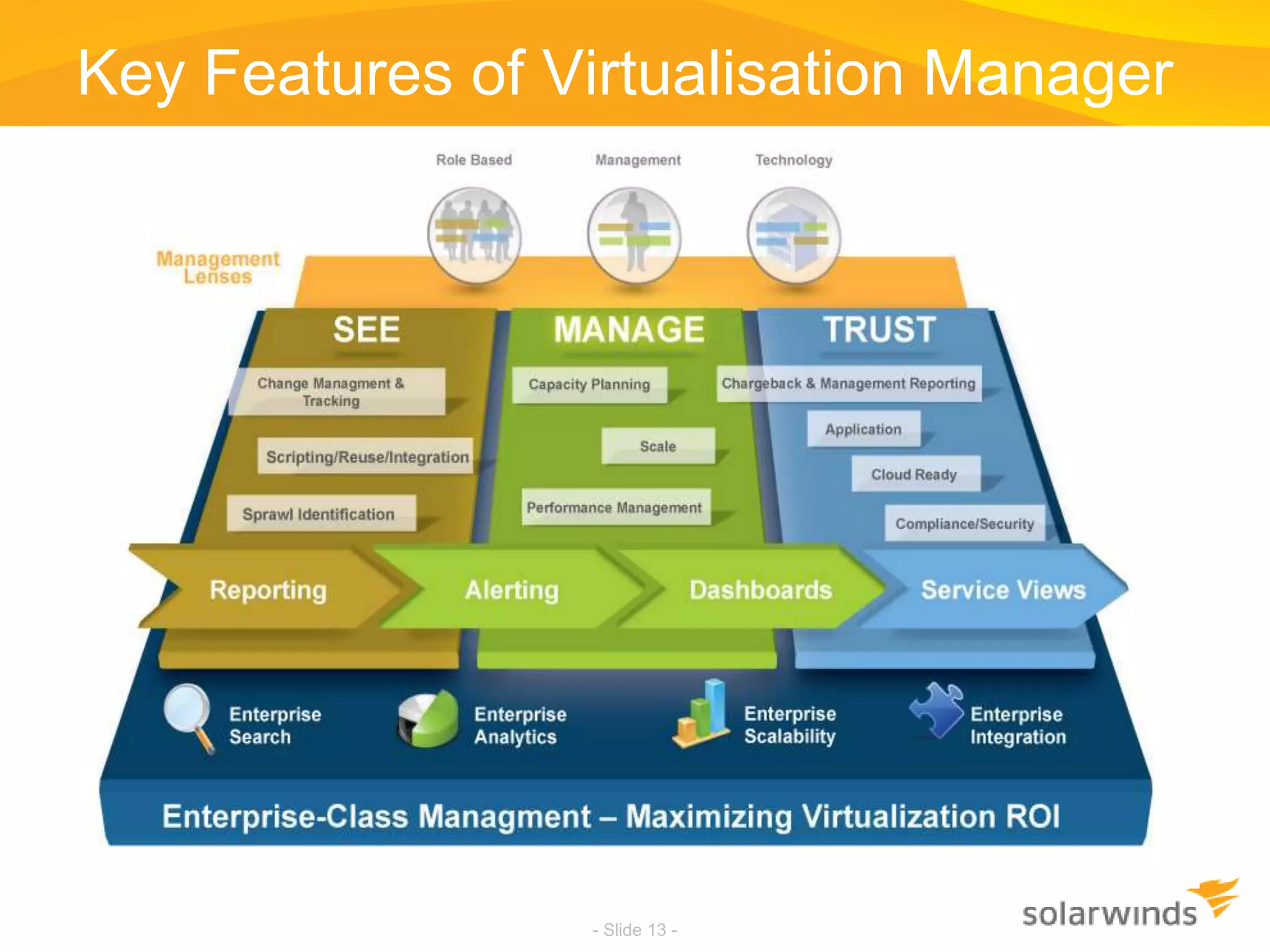
Key Features of Virtualisation Manager - Slide 13 -
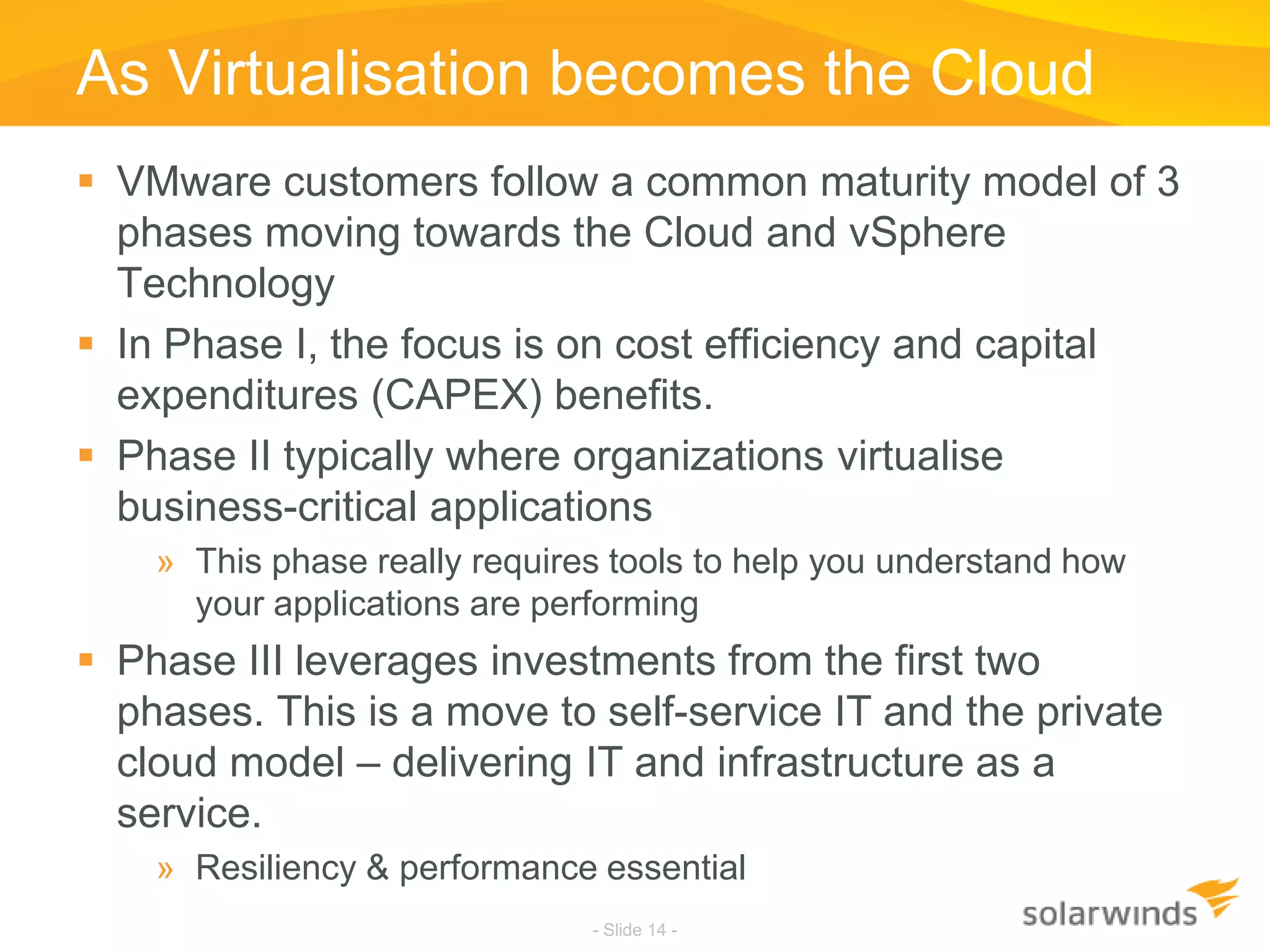
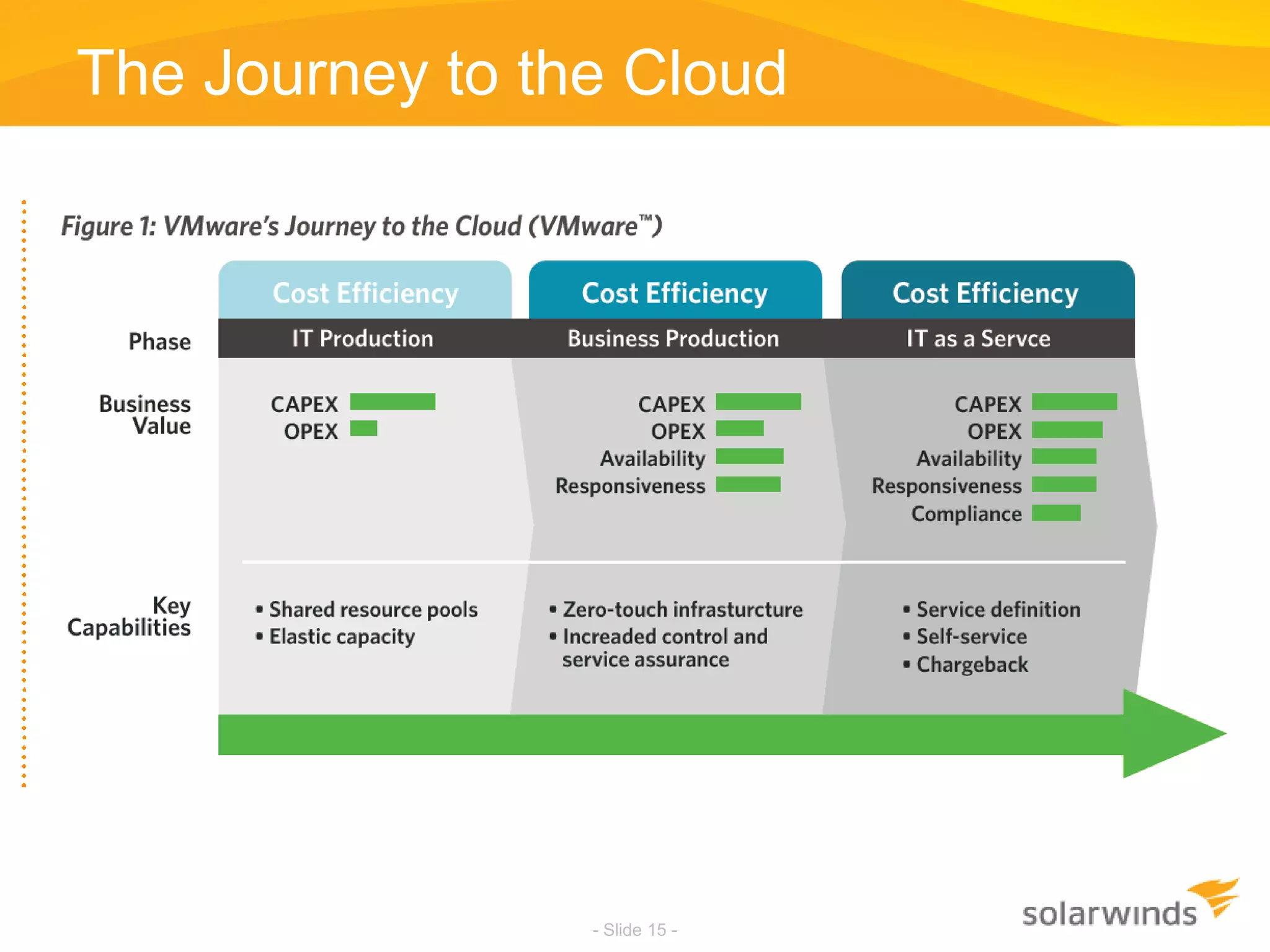
As Virtualisation becomes the CloudVMware customers follow a common maturity model of 3 phases moving towards the Cloud and vSphere TechnologyIn Phase I, the focus is on cost efficiency and capital expenditures (CAPEX) benefits. Phase II typically where organizations virtualise business-critical applicationsThis phase really requires tools to help you understand how your applications are performingPhase III leverages investments from the first two phases. This is a move to self-service IT and the private cloud model – delivering IT and infrastructure as a service.Resiliency & performance essential- Slide 14 -
The Journey to the Cloud- Slide 15 -
Phase 1 Difficulties addressedSolarWinds answers key questions at each stage of vSphere adoption:Phase 1: IT Production PhaseHow many VMs do I have?How many have I added in the last 6 months?Do I have rogue or orphan VMs?What OS do they run?Where’s the bottleneck?- Slide 16 -
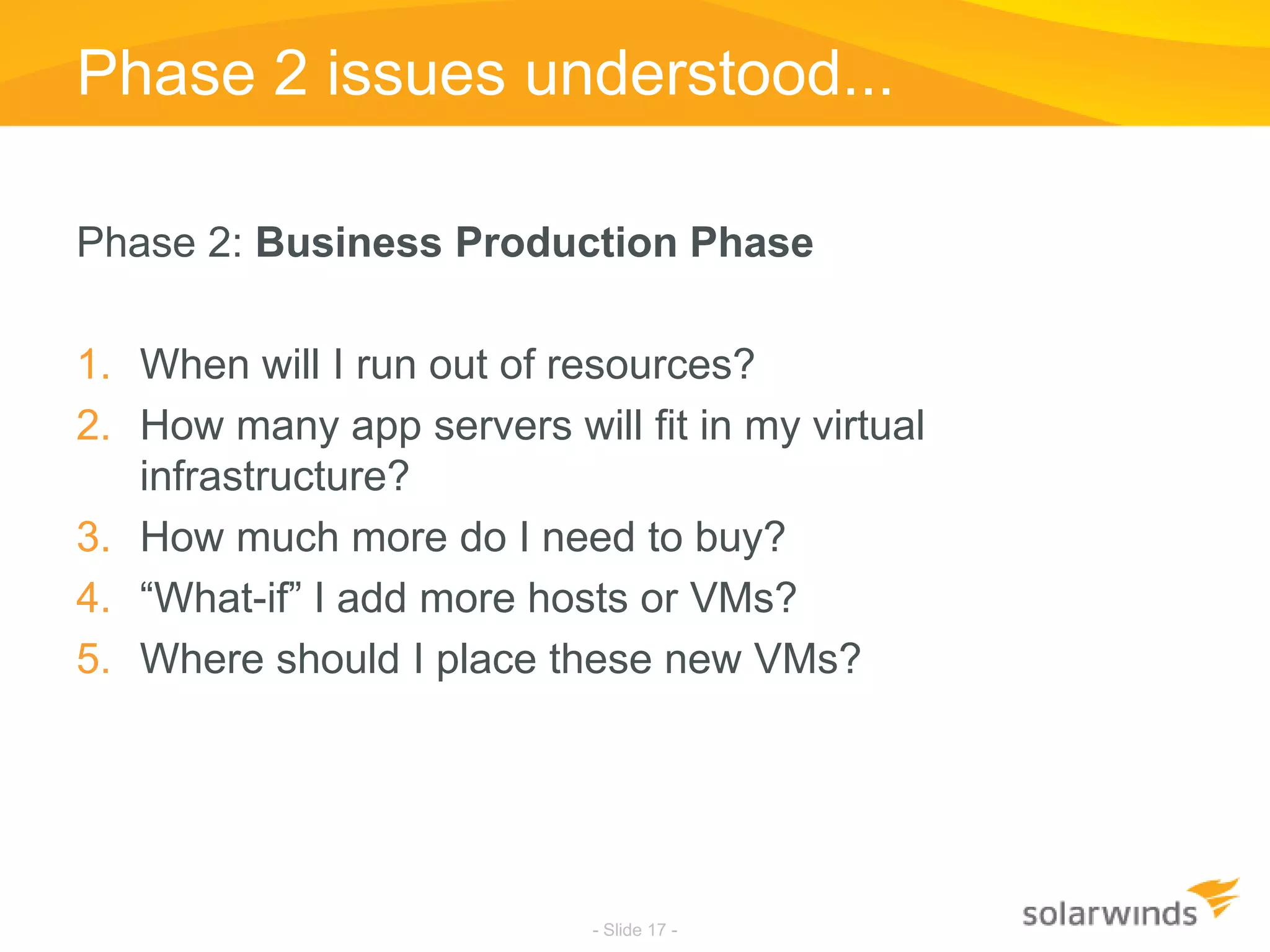
Phase 2 issues understood...Phase 2: Business Production PhaseWhen will I run out of resources?How many app servers will fit in my virtual infrastructure?How much more do I need to buy?“What-if” I add more hosts or VMs?Where should I place these new VMs?- Slide 17 -
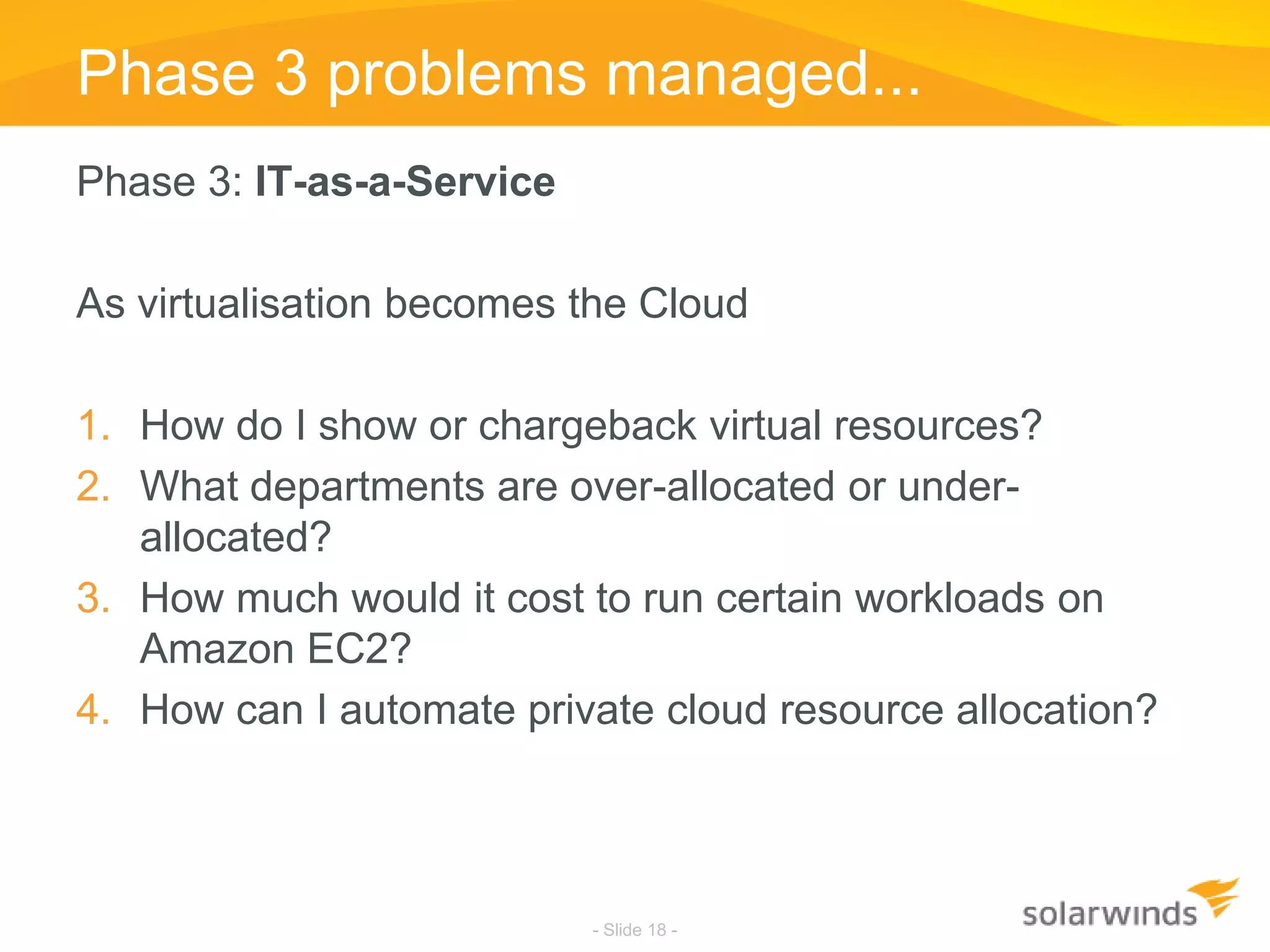
Phase 3 problems managed...Phase 3: IT-as-a-ServiceAs virtualisation becomes the CloudHow do I show or chargeback virtual resources?What departments are over-allocated or under-allocated?How much would it cost to run certain workloads on Amazon EC2?How can I automate private cloud resource allocation?- Slide 18 -
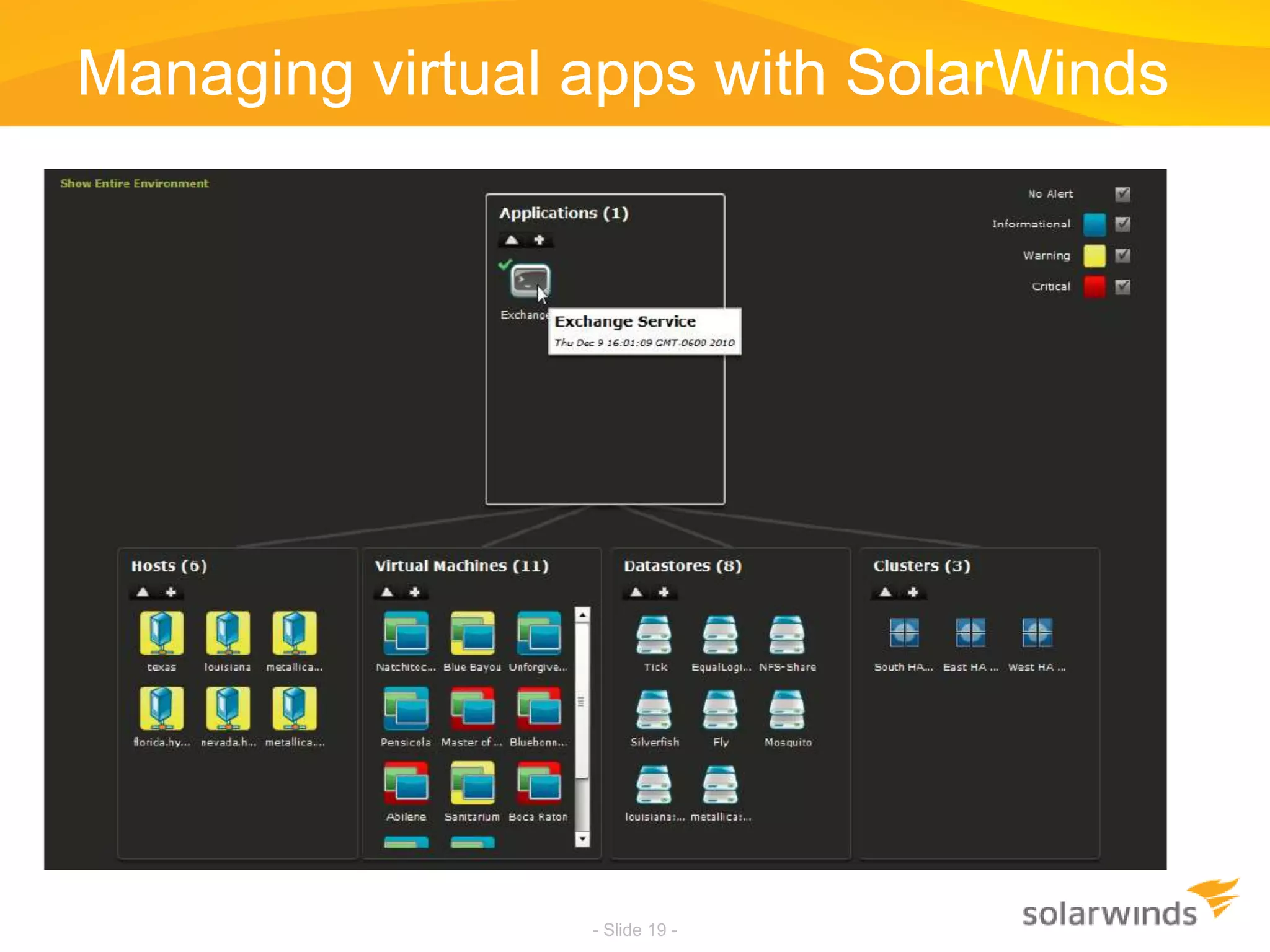
Managing virtual apps with SolarWinds- Slide 19 -
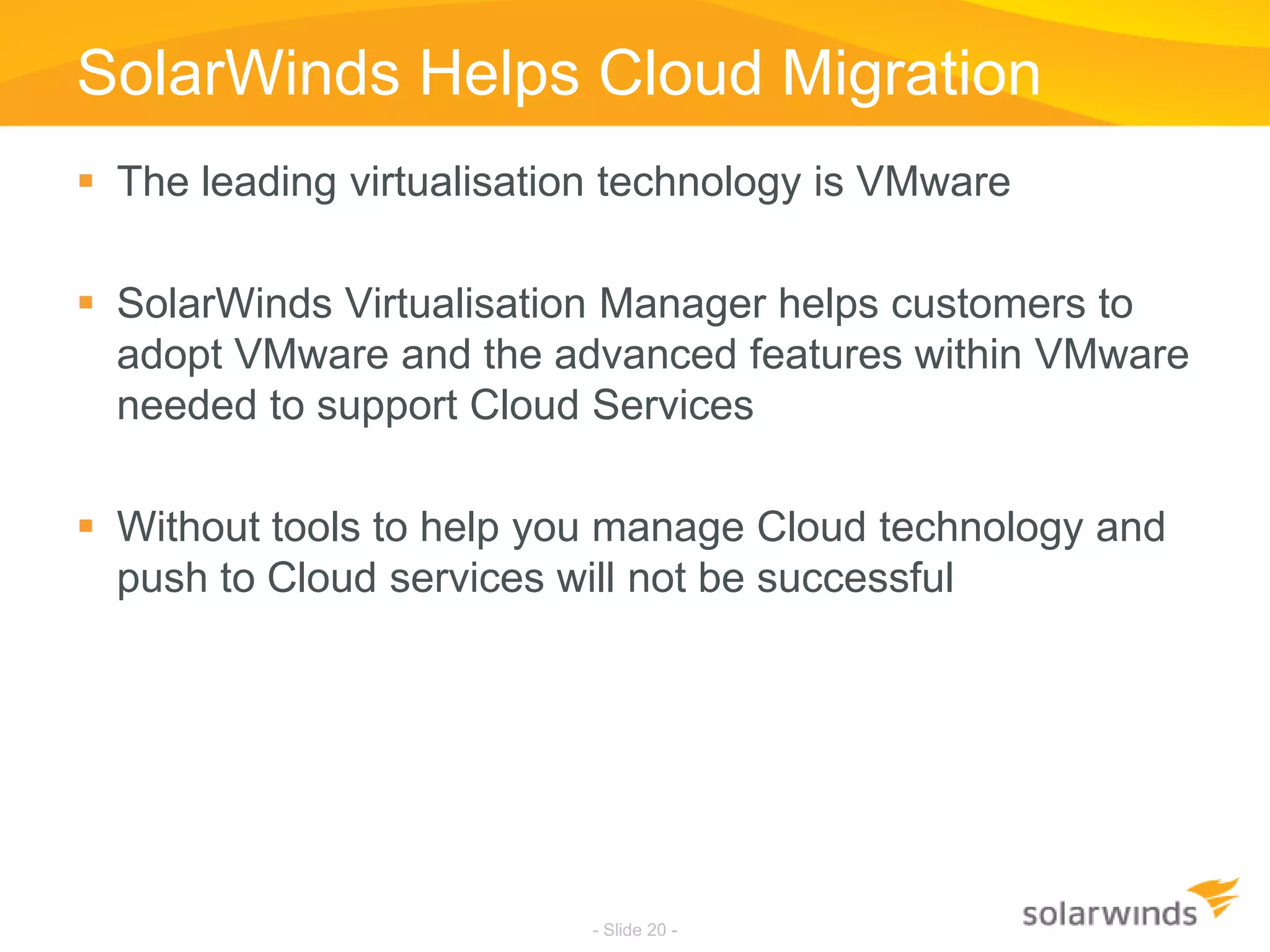
SolarWinds Helps Cloud MigrationThe leading virtualisation technology is VMwareSolarWinds Virtualisation Manager helps customers to adopt VMware and the advanced features within VMware needed to support Cloud ServicesWithout tools to help you manage Cloud technology and push to Cloud services will not be successful- Slide 20 -
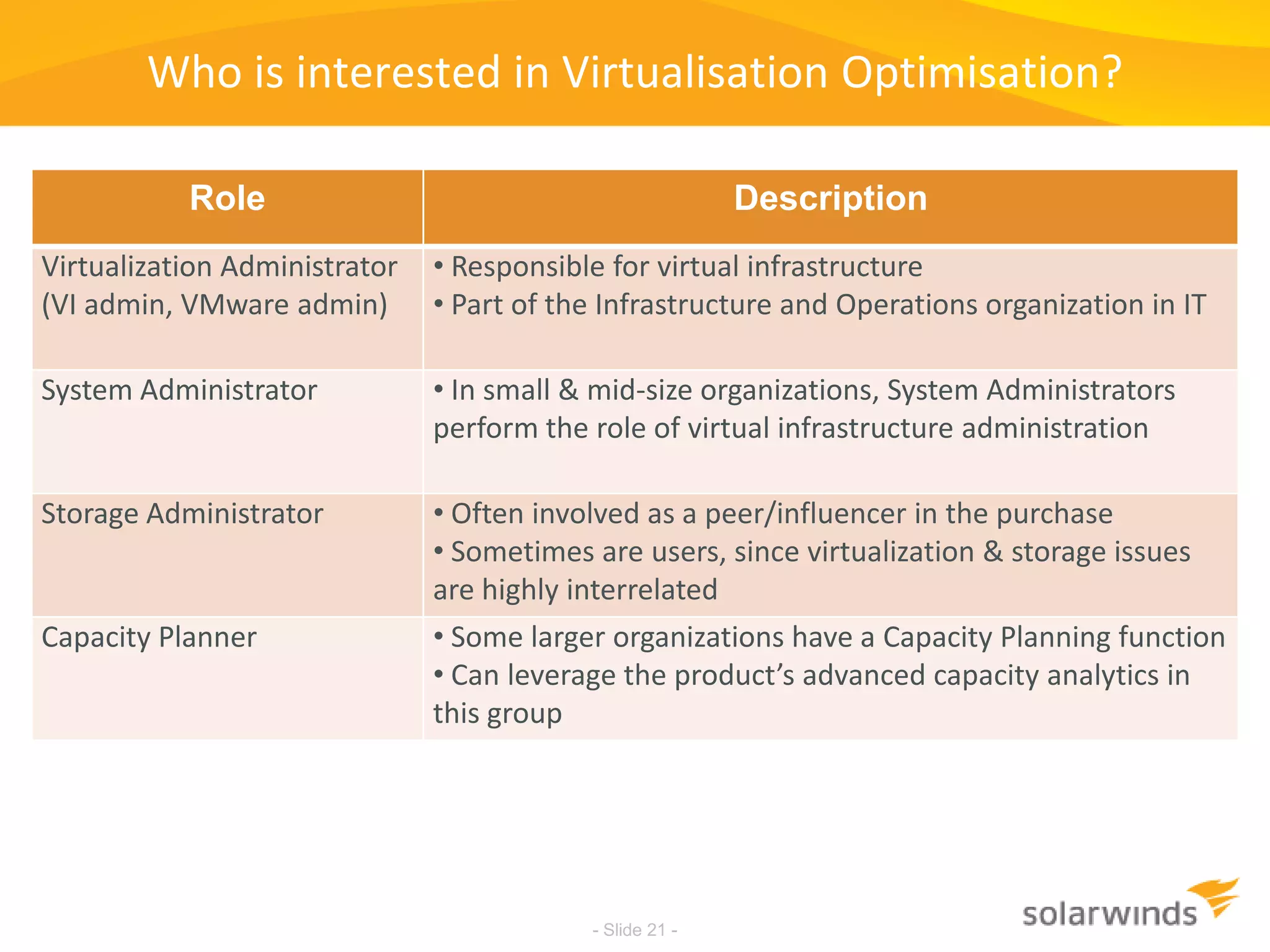
Who is interested in VirtualisationOptimisation?- Slide 21 -
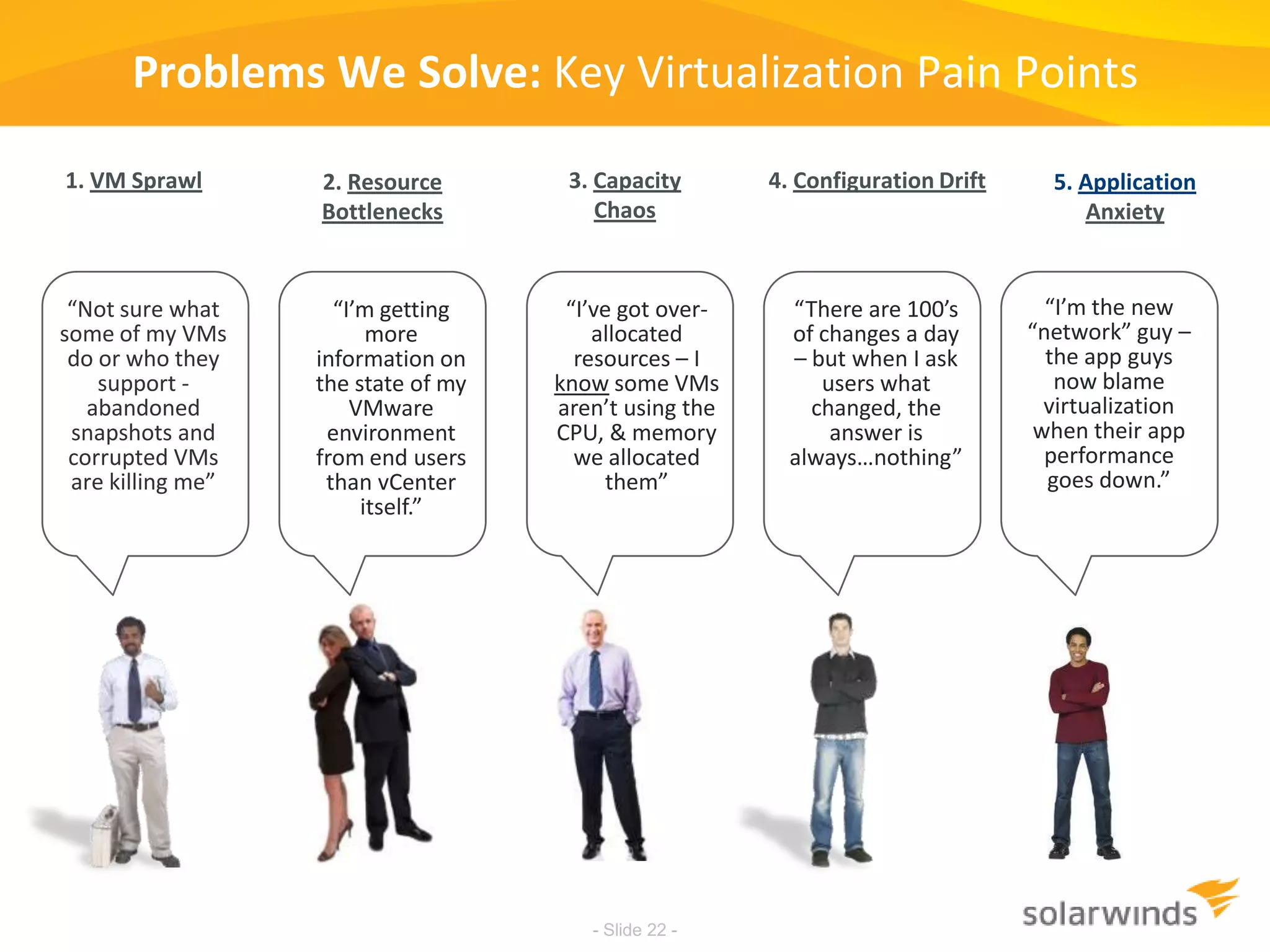
Problems We Solve: Key Virtualization Pain Points1. VM Sprawl3. Capacity Chaos4. Configuration Drift2. Resource Bottlenecks5. Application Anxiety“I’m the new “network” guy – the app guys now blame virtualization when their app performance goes down.” “Not sure what some of my VMs do or who they support - abandoned snapshots and corrupted VMs are killing me”“I’ve got over-allocated resources – I know some VMs aren’t using the CPU, & memory we allocated them” “There are 100’s of changes a day – but when I ask users what changed, the answer is always…nothing” “I’m getting more information on the state of my VMware environment from end users than vCenter itself.”- Slide 22 -
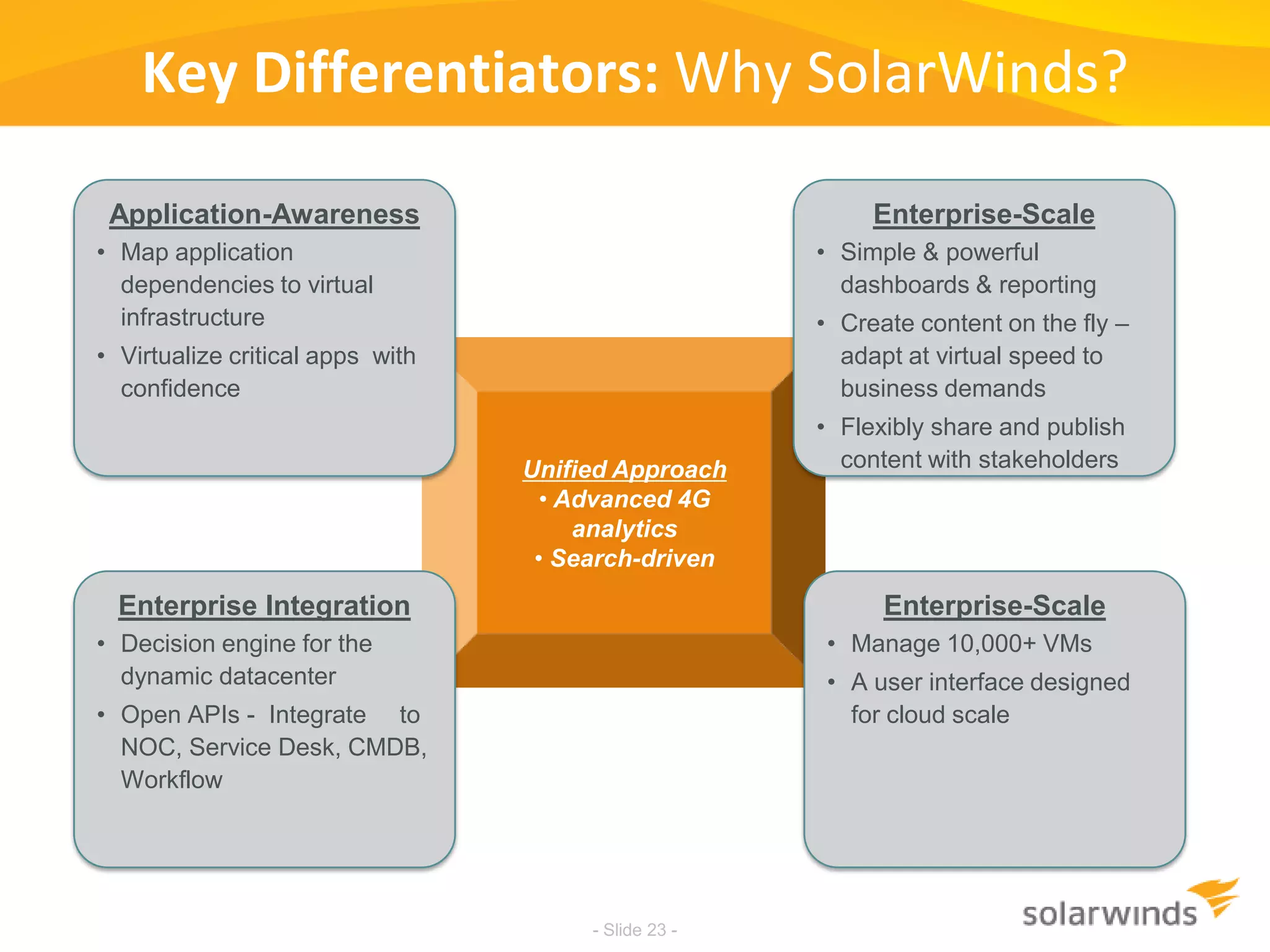
Key Differentiators: Why SolarWinds?Application-AwarenessMap application dependencies to virtual infrastructure
Virtualize critical apps  with confidenceEnterprise-ScaleSimple & powerful dashboards & reporting
Create content on the fly – adapt at virtual speed to business demands

Virtualisation optimisation, the cloud and beyond

  • 1.
    Virtualisation Optimisation TheCloud and BeyondPresenter Adam Nash – SolarWinds Product Manager
  • 2.
    What is Virtualisation?Virtualization,in computing, is the creation of a virtual (rather than actual) version of something, such as a hardware platform, operating system, a storage device or network resourcesIn the UK server virtualisation is where the majority of virtualisation takes place – desktop is increasingApplication and storage virtualisation is gaining momentum- Slide 2 -
  • 3.
    Virtualisation is thefuture - Slide 3 -
  • 4.
    Why Virtualise?Reduce hardwarecostsReduce hardware support costsReduce energy consumptionImprove availabilityRun multiple platforms on one server- Slide 4 -
  • 5.
    The Virtualisation MarketAtthe end of 2009, only 18% of enterprise data centre workloads that could be virtualized had been virtualized, according to Gartner. The number is expected to grow to more than 50% by the close of 2012. Up to 50% of SMBs were expected to move partially or completely to a virtualised environment over the next 2-3 yearsVMware dominates the server virtualisation market with around 80% of market share- Slide 5 -
  • 6.
    The Virtualisation MarketCont.IDC (Global Market Research firm stated ‘IDC believes that automation tools increasingly represent the battleground in determining the winners and losers in a marketplace which is rapidly reshaping itself’Recent study by Forrester Consulting of 257 virtualization decision-makers in the U.S., U.K., France, Germany and Japan include:Moving to internal clouds requires changes to processes and automation managementUnderstanding of performance all of the components involved in virtualisation is critical- Slide 6 -
  • 7.
    What and whereis the Cloud?- Slide 7 -The Cloud can be defined as delivery of computing resources like backup and storage and applications like email and antivirus via a computer network.Clouds can be private in companies or public via the webThere is an expansion of private clouds offering shared resources to companiesThere is an expansion of private clouds offering shared resources to companies
  • 8.
    The Cloud isVirtualisation and Shared StorageHigh availability of cloud services is delivered through the resiliency offered by virtualisation.Without virtualisation it is not possible to offer real-time failover and resource sharing for scalabilityWithout shared storage you cannot failover to replacement servers should your primary server fail- Slide 8 -
  • 9.
    Issues migrating toa Cloud environmentWho, what, where and when? Keeping track of expanding virtual resources is a missionResource bottlenecks as architecture changes rapidlyDifficulties planning capacity and rightsizing resources allocated to virtual machinesWho is using your virtual infrastructure? making the right department pay for the resource they use- Slide 9 -
  • 10.
    What does thistell us?Virtualisation is still a buzz technology with massive scope for new salesDatacenter migration will drive new virtualisation projectsSMBs set to move quickly to virtualisationManagement and monitoring is key to a successful move to a virtual environment + - Slide 10 -Monitoring + Virtualisation = Happy customers 
  • 11.
    Beating Cloud andVirtualisation Management Problems by monitoring and optimising
  • 12.
    Introducing SolarWinds VirtualisationManagerVirtualised infrastructure grows fastManagement complexity increases over timeTo keep up you have to automate and simplifyTraditional platforms not designed for thisThis is where Virtualisation Manager steps in...- Slide 12 -
  • 13.
    Key Features ofVirtualisation Manager - Slide 13 -
  • 14.
    As Virtualisation becomesthe CloudVMware customers follow a common maturity model of 3 phases moving towards the Cloud and vSphere TechnologyIn Phase I, the focus is on cost efficiency and capital expenditures (CAPEX) benefits. Phase II typically where organizations virtualise business-critical applicationsThis phase really requires tools to help you understand how your applications are performingPhase III leverages investments from the first two phases. This is a move to self-service IT and the private cloud model – delivering IT and infrastructure as a service.Resiliency & performance essential- Slide 14 -
  • 15.
    The Journey tothe Cloud- Slide 15 -
  • 16.
    Phase 1 DifficultiesaddressedSolarWinds answers key questions at each stage of vSphere adoption:Phase 1: IT Production PhaseHow many VMs do I have?How many have I added in the last 6 months?Do I have rogue or orphan VMs?What OS do they run?Where’s the bottleneck?- Slide 16 -
  • 17.
    Phase 2 issuesunderstood...Phase 2: Business Production PhaseWhen will I run out of resources?How many app servers will fit in my virtual infrastructure?How much more do I need to buy?“What-if” I add more hosts or VMs?Where should I place these new VMs?- Slide 17 -
  • 18.
    Phase 3 problemsmanaged...Phase 3: IT-as-a-ServiceAs virtualisation becomes the CloudHow do I show or chargeback virtual resources?What departments are over-allocated or under-allocated?How much would it cost to run certain workloads on Amazon EC2?How can I automate private cloud resource allocation?- Slide 18 -
  • 19.
    Managing virtual appswith SolarWinds- Slide 19 -
  • 20.
    SolarWinds Helps CloudMigrationThe leading virtualisation technology is VMwareSolarWinds Virtualisation Manager helps customers to adopt VMware and the advanced features within VMware needed to support Cloud ServicesWithout tools to help you manage Cloud technology and push to Cloud services will not be successful- Slide 20 -
  • 21.
    Who is interestedin VirtualisationOptimisation?- Slide 21 -
  • 22.
    Problems We Solve:Key Virtualization Pain Points1. VM Sprawl3. Capacity Chaos4. Configuration Drift2. Resource Bottlenecks5. Application Anxiety“I’m the new “network” guy – the app guys now blame virtualization when their app performance goes down.” “Not sure what some of my VMs do or who they support - abandoned snapshots and corrupted VMs are killing me”“I’ve got over-allocated resources – I know some VMs aren’t using the CPU, & memory we allocated them” “There are 100’s of changes a day – but when I ask users what changed, the answer is always…nothing” “I’m getting more information on the state of my VMware environment from end users than vCenter itself.”- Slide 22 -
  • 23.
    Key Differentiators: WhySolarWinds?Application-AwarenessMap application dependencies to virtual infrastructure
  • 24.
    Virtualize critical apps with confidenceEnterprise-ScaleSimple & powerful dashboards & reporting
  • 25.
    Create content onthe fly – adapt at virtual speed to business demands
  • 26.
    Flexibly share andpublish content with stakeholdersUnified Approach Advanced 4G analytics
  • 27.
    Search-drivenEnterprise IntegrationDecisionengine for the dynamic datacenter
  • 28.
    Open APIs - Integrate to NOC, Service Desk, CMDB, WorkflowEnterprise-ScaleManage 10,000+ VMs
  • 29.
    A user interfacedesigned for cloud scale- Slide 23 -
  • 30.
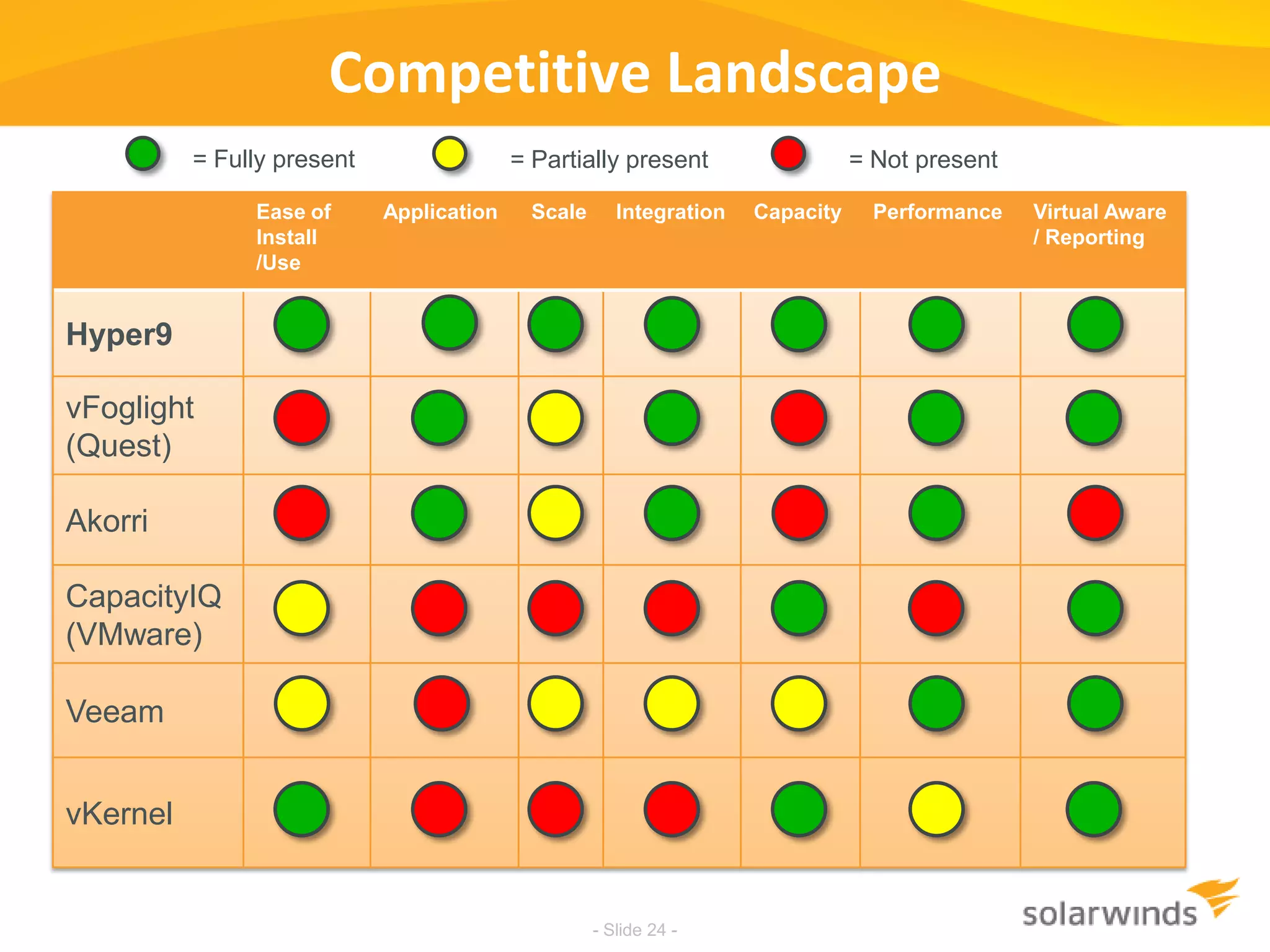
    Competitive Landscape= Fullypresent= Not present= Partially present- Slide 24 -
  • 31.
    Cloud Adoption MadeEasier Explosive growth in Virtualization Management market – SolarWinds is a market leader
  • 32.
    Virtualization Manager/Hyper9 bringssignificant competitive differentiation & market successIF ONLY… someone made a tool more powerful, easier AND less expensive than VMW CapacityIQ, VEEAM Reporter, vKernel, Quest vFoglight, etc to manage my end users environment… my end user would buy Virtualization Management!!!Welcome SolarWinds Virtualization Manager (Hyper9). - Slide 25 -