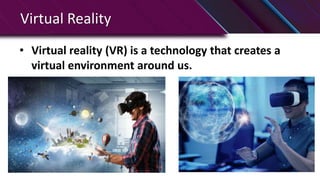
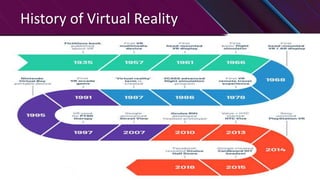
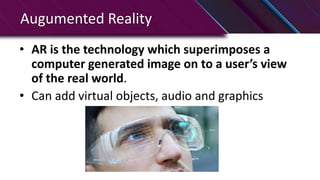
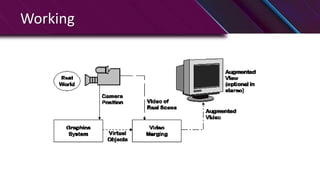
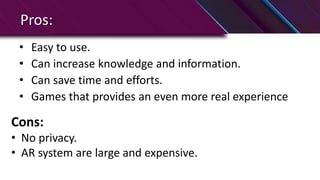
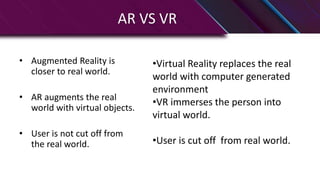
This document provides an overview of virtual reality (VR) and augmented reality (AR). It discusses the history of each technology and their applications in fields like military, medicine, education, and entertainment. Some pros of VR include easier learning and risk-free exploration, while cons include expense and cyber sickness. AR can increase knowledge and save time/effort for applications like education and design. However, AR systems are large/expensive and lack privacy. The key difference between VR and AR is that AR augments the real world with virtual objects, keeping users connected to reality, while VR fully immerses users in a virtual environment and cuts them off from the real world.
















![5G Explained! A High Level Overview [Introduction]](https://cdn.slidesharecdn.com/ss_thumbnails/5gexplainedahighleveloverview-260119165306-cc137a3e-thumbnail.jpg?width=640&height=640&fit=bounds)


