Virtual Education
What is Virtual Education? Virtual education refers to instruction in a learning environment where teacher and student are separated by time or space, or both, and the teacher provides course content through course management applications, multimedia resources, the Internet, videoconferencing, etc. ...en.wikipedia.org/wiki/Virtual_education
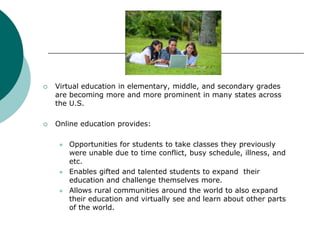
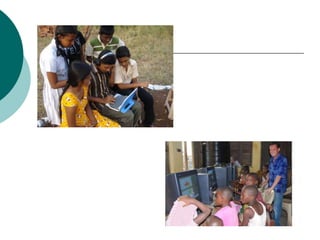
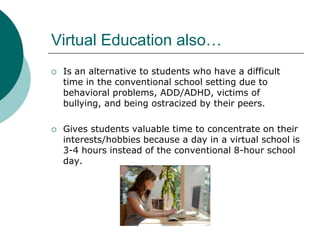
Virtual education in elementary, middle, and secondary grades are becoming more and more prominent in many states across the U.S.Online education provides: Opportunities for students to take classes they previously were unable due to time conflict, busy schedule, illness, and etc.Enables gifted and talented students to expand  their education and challenge themselves more. Allows rural communities around the world to also expand their education and virtually see and learn about other parts of the world.
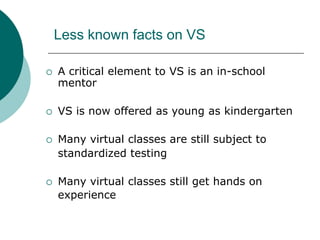
Virtual Education also…Is an alternative to students who have a difficult time in the conventional school setting due to behavioral problems, ADD/ADHD, victims of bullying, and being ostracized by their peers. Gives students valuable time to concentrate on their interests/hobbies because a day in a virtual school is 3-4 hours instead of the conventional 8-hour school day.
Less known facts on VSA critical element to VS is an in-school mentorVS is now offered as young as kindergartenMany virtual classes are still subject to 	standardized testingMany virtual classes still get hands on experience
What kind of hands on experience?http://ctlt.iastate.edu/~tegivs/TEGIVS/Gail-Wortmann/Q4.swf
Pros of VS for studentsStudents can work at their own paceStudents learn to become more independent and responsible for their work and successCaters to students who travel or have special needs Can provide more advanced classes to students who would benefit from those options
Pros of VS for teachersCan provide jobs for teachers without classroomsAllows for more flexibility Gives teachers an opportunity to learn more technology and means of communicationAllows teachers to better communicate and form relationships with students
Cons of VS for studentsThe students could fall behind if they are not self motivated enoughLess hands on experience (although some is included as explained previously)Could take away from social interactions so other forms of social interaction are needed (similar to home schooling)Severe eye strain
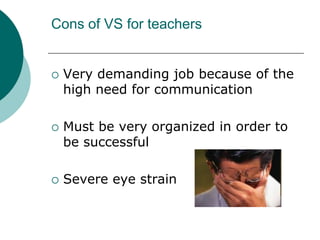
Cons of VS for teachersVery demanding job because of the high need for communicationMust be very organized in order to be successfulSevere eye strain
In conclusion…There are pros and cons to VS so in order to see if it would work for you or your child, be sure to do quality research and find out what VS has to provide

Virtual education

  • 1.
  • 2.
    What is VirtualEducation? Virtual education refers to instruction in a learning environment where teacher and student are separated by time or space, or both, and the teacher provides course content through course management applications, multimedia resources, the Internet, videoconferencing, etc. ...en.wikipedia.org/wiki/Virtual_education
  • 3.
    Virtual education inelementary, middle, and secondary grades are becoming more and more prominent in many states across the U.S.Online education provides: Opportunities for students to take classes they previously were unable due to time conflict, busy schedule, illness, and etc.Enables gifted and talented students to expand their education and challenge themselves more. Allows rural communities around the world to also expand their education and virtually see and learn about other parts of the world.
  • 5.
    Virtual Education also…Isan alternative to students who have a difficult time in the conventional school setting due to behavioral problems, ADD/ADHD, victims of bullying, and being ostracized by their peers. Gives students valuable time to concentrate on their interests/hobbies because a day in a virtual school is 3-4 hours instead of the conventional 8-hour school day.
  • 6.
    Less known factson VSA critical element to VS is an in-school mentorVS is now offered as young as kindergartenMany virtual classes are still subject to standardized testingMany virtual classes still get hands on experience
  • 7.
    What kind ofhands on experience?http://ctlt.iastate.edu/~tegivs/TEGIVS/Gail-Wortmann/Q4.swf
  • 8.
    Pros of VSfor studentsStudents can work at their own paceStudents learn to become more independent and responsible for their work and successCaters to students who travel or have special needs Can provide more advanced classes to students who would benefit from those options
  • 9.
    Pros of VSfor teachersCan provide jobs for teachers without classroomsAllows for more flexibility Gives teachers an opportunity to learn more technology and means of communicationAllows teachers to better communicate and form relationships with students
  • 10.
    Cons of VSfor studentsThe students could fall behind if they are not self motivated enoughLess hands on experience (although some is included as explained previously)Could take away from social interactions so other forms of social interaction are needed (similar to home schooling)Severe eye strain
  • 11.
    Cons of VSfor teachersVery demanding job because of the high need for communicationMust be very organized in order to be successfulSevere eye strain
  • 12.
    In conclusion…There arepros and cons to VS so in order to see if it would work for you or your child, be sure to do quality research and find out what VS has to provide