Viral Hepatitis
A to E
KHUSHI MAWA
GROUP 2
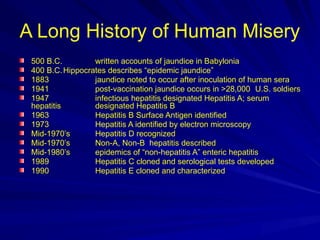
A Long History of Human Misery
500 B.C. written accounts of jaundice in Babylonia
400 B.C.Hippocrates describes “epidemic jaundice”
1883 jaundice noted to occur after inoculation of human sera
1941 post-vaccination jaundice occurs in >28,000 U.S. soldiers
1947 infectious hepatitis designated Hepatitis A; serum
hepatitis designated Hepatitis B
1963 Hepatitis B Surface Antigen identified
1973 Hepatitis A identified by electron microscopy
Mid-1970’s Hepatitis D recognized
Mid-1970’s Non-A, Non-B hepatitis described
Mid-1980’s epidemics of “non-hepatitis A” enteric hepatitis
1989 Hepatitis C cloned and serological tests developed
1990 Hepatitis E cloned and characterized
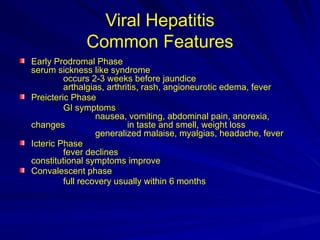
Viral Hepatitis
Common Features
Early Prodromal Phase
serum sickness like syndrome
occurs 2-3 weeks before jaundice
arthalgias, arthritis, rash, angioneurotic edema, fever
Preicteric Phase
GI symptoms
nausea, vomiting, abdominal pain, anorexia,
changes in taste and smell, weight loss
generalized malaise, myalgias, headache, fever
Icteric Phase
fever declines
constitutional symptoms improve
Convalescent phase
full recovery usually within 6 months
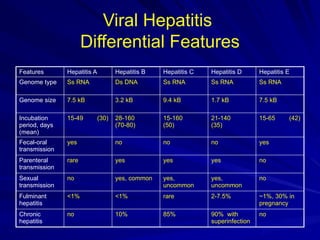
Viral Hepatitis
Differential Features
Features Hepatitis A Hepatitis B Hepatitis C Hepatitis D Hepatitis E
Genome type Ss RNA Ds DNA Ss RNA Ss RNA Ss RNA
Genome size 7.5 kB 3.2 kB 9.4 kB 1.7 kB 7.5 kB
Incubation
period, days
(mean)
15-49 (30) 28-160
(70-80)
15-160
(50)
21-140
(35)
15-65 (42)
Fecal-oral
transmission
yes no no no yes
Parenteral
transmission
rare yes yes yes no
Sexual
transmission
no yes, common yes,
uncommon
yes,
uncommon
no
Fulminant
hepatitis
<1% <1% rare 2-7.5% ~1%, 30% in
pregnancy
Chronic
hepatitis
no 10% 85% 90% with
superinfection
no
Acute Hepatitis
Evaluation and Recommendations
Access for viral hepatitis A, B, C,
– Hep A IgM, Hep B Surface Ag, Core IgM, Hep C Ab (or PCR)
– Consider alcohol and drug toxicity, autoimmune hepatitis, ischemia
– Consider biliary tract disease: CBD stone, PSC
– Consider other viruses: CMV, EBV, HSV, etc.
Hospitalization for excessive anorexia, nausea, vomiting
– Rising total bilirubin >15
– Rising pro time > 15
– Rapidly falling transaminases while bilirubin is rising
– Liver failure: hepatic encephalopathy, ascites
Bed rest prn
Consider high protein high calorie diet
Minimize medications: phenothiazines, ? vitamin K are OK; stop OCP’s,
Etoh, acetaminophen, etc.
Office visit and LFT’s twice a week while LFT’s rising, and every 1-2 weeks
while improving
Immunoprophylaxis for contacts of HAV, HBV
Hepatitis A
Picornaviridae
Transmitted by fecal oral route, contaminated food, water, shellfish
Most infections are sub clinical
– Incidence peaks in fall and winter
– 80% infected children are anicteric
– 10-50% infected college students are anicteric
– 30-50% U.S. adults are HAV IgG+, but only 3-5% recall prior jaundice
– High attack rate: 70-90% exposed become infected
>60,000 clinical cases per year in U.S.
– Incubation 15-49 days (mean 30 days)
– HAV Ag appears in liver at 1-2 weeks
– HAV then appears in bile and stool
– Fecal infectivity begins 2-3 weeks before jaundice, lasts 4-5 weeks,
ends 2 weeks after peak transaminitis
Chronic infection never occurs
– 60% have normal LFT’s at 2 months; 100% normal at 6 months
Hepatitis A
Prevention
General prevention
– Water chlorination
– Boil water 20 minutes
– Wash hands
– Avoid contaminated food
HAV Immunoglobulin
– Can prevent 85-95% infections if given within two weeks of exposure
– Household and sexual contacts
– Day care contacts
– Prison contacts
– Common source outbreaks
HAV Vaccine
– 90-98% successful with one injection, 100% with two injections
– Protection begins after 1-2 weeks, may last 20 years
– Give to all of the above
– Travelers to endemic areas
– Homosexuals, IV drug abusers
– Persons with HCV and HBV
– Military
Hepatitis B
Hepadnaviridae
Transmission route is variable
– HBV is found in blood and all body fluids except stool
– “Western” societies: percutaneous, hetero/homosexual contact is most
common
– “Non-western” societies: perinatal transmission is most common
Epidemiology
– Worldwide
2 billion people have markers of infection
400 million have chronic infection (5%)
– U.S.
1.25 million chronic infections (50% Asian)
200 thousand acute infections per year
250 deaths/year from fulminant HBV
4000 deaths/year from chronic HBV
800 deaths/year from HBV related hepatomas
Hepatitis B
90% cases are self-limited with spontaneous resolution
– >50% are anicteric
– 10% become chronic
– <1% are fulminant (10% if “E Ag mutant”)
– 3-5% in U.S. have HBV markers
Surface Ag appears 1-12 weeks after exposure
– Clinical hepatitis and Core IgM occur 4 weeks after Surface antigen
– E Ag indicates period of infectivity
– S Ab indicates resolving infection
– Rare “window period” occurs when Surface Ag disappears and before Surface Ab
appears; Core Ab will be positive
Extrahepatic manifestations
– Arthralgias and rash (25%)
– Angioneurotic edema, polyarteritis nodosa, mononeuritis, membranoproliferative
GN, arthritis, Raynaud’s phenomena, Type II mixed essential cryroglobulinemia,
Guillan Barre Syndrome, pancreatitis, pericarditis
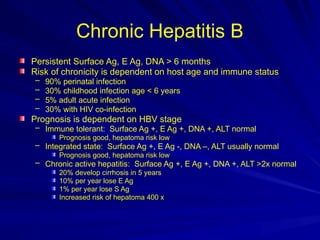
Chronic Hepatitis B
Persistent Surface Ag, E Ag, DNA > 6 months
Risk of chronicity is dependent on host age and immune status
– 90% perinatal infection
– 30% childhood infection age < 6 years
– 5% adult acute infection
– 30% with HIV co-infection
Prognosis is dependent on HBV stage
– Immune tolerant: Surface Ag +, E Ag +, DNA +, ALT normal
Prognosis good, hepatoma risk low
– Integrated state: Surface Ag +, E Ag -, DNA –, ALT usually normal
Prognosis good, hepatoma risk low
– Chronic active hepatitis: Surface Ag +, E Ag +, DNA +, ALT >2x normal
20% develop cirrhosis in 5 years
10% per year lose E Ag
1% per year lose S Ag
Increased risk of hepatoma 400 x
Hepatitis B
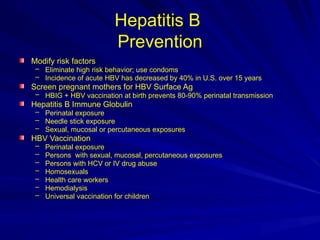
Prevention
Modify risk factors
– Eliminate high risk behavior; use condoms
– Incidence of acute HBV has decreased by 40% in U.S. over 15 years
Screen pregnant mothers for HBV Surface Ag
– HBIG + HBV vaccination at birth prevents 80-90% perinatal transmission
Hepatitis B Immune Globulin
– Perinatal exposure
– Needle stick exposure
– Sexual, mucosal or percutaneous exposures
HBV Vaccination
– Perinatal exposure
– Persons with sexual, mucosal, percutaneous exposures
– Persons with HCV or IV drug abuse
– Homosexuals
– Health care workers
– Hemodialysis
– Universal vaccination for children
Hepatitis B
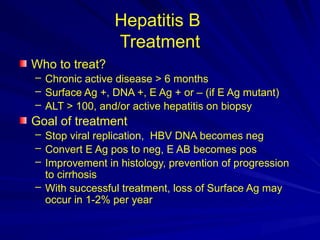
Treatment
Who to treat?
– Chronic active disease > 6 months
– Surface Ag +, DNA +, E Ag + or – (if E Ag mutant)
– ALT > 100, and/or active hepatitis on biopsy
Goal of treatment
– Stop viral replication, HBV DNA becomes neg
– Convert E Ag pos to neg, E AB becomes pos
– Improvement in histology, prevention of progression
to cirrhosis
– With successful treatment, loss of Surface Ag may
occur in 1-2% per year
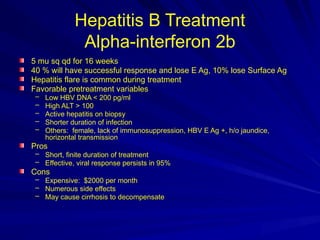
Hepatitis B Treatment
Alpha-interferon 2b
5 mu sq qd for 16 weeks
40 % will have successful response and lose E Ag, 10% lose Surface Ag
Hepatitis flare is common during treatment
Favorable pretreatment variables
– Low HBV DNA < 200 pg/ml
– High ALT > 100
– Active hepatitis on biopsy
– Shorter duration of infection
– Others: female, lack of immunosuppression, HBV E Ag +, h/o jaundice,
horizontal transmission
Pros
– Short, finite duration of treatment
– Effective, viral response persists in 95%
Cons
– Expensive: $2000 per month
– Numerous side effects
– May cause cirrhosis to decompensate
Hepatitis B Treatment
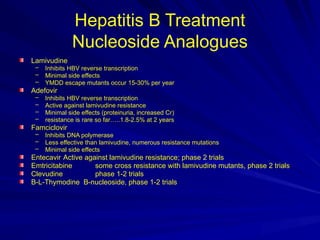
Nucleoside Analogues
Lamivudine
– Inhibits HBV reverse transcription
– Minimal side effects
– YMDD escape mutants occur 15-30% per year
Adefovir
– Inhibits HBV reverse transcription
– Active against lamivudine resistance
– Minimal side effects (proteinuria, increased Cr)
– resistance is rare so far…..1.8-2.5% at 2 years
Famciclovir
– Inhibits DNA polymerase
– Less effective than lamivudine, numerous resistance mutations
– Minimal side effects
Entecavir Active against lamivudine resistance; phase 2 trials
Emtricitabine some cross resistance with lamivudine mutants, phase 2 trials
Clevudine phase 1-2 trials
B-L-Thymodine B-nucleoside, phase 1-2 trials
Hepatitis C
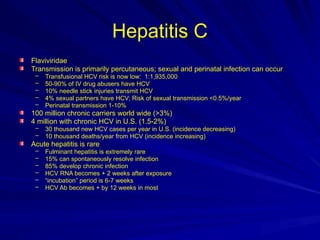
Flaviviridae
Transmission is primarily percutaneous; sexual and perinatal infection can occur
– Transfusional HCV risk is now low: 1:1,935,000
– 50-90% of IV drug abusers have HCV
– 10% needle stick injuries transmit HCV
– 4% sexual partners have HCV; Risk of sexual transmission <0.5%/year
– Perinatal transmission 1-10%
100 million chronic carriers world wide (>3%)
4 million with chronic HCV in U.S. (1.5-2%)
– 30 thousand new HCV cases per year in U.S. (incidence decreasing)
– 10 thousand deaths/year from HCV (incidence increasing)
Acute hepatitis is rare
– Fulminant hepatitis is extremely rare
– 15% can spontaneously resolve infection
– 85% develop chronic infection
– HCV RNA becomes + 2 weeks after exposure
– “incubation” period is 6-7 weeks
– HCV Ab becomes + by 12 weeks in most
Hepatitis C
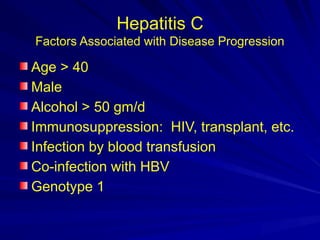
Factors Associated with Disease Progression
Age > 40
Male
Alcohol > 50 gm/d
Immunosuppression: HIV, transplant, etc.
Infection by blood transfusion
Co-infection with HBV
Genotype 1
Hepatitis C
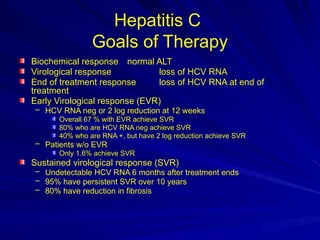
Goals of Therapy
Biochemical response normal ALT
Virological response loss of HCV RNA
End of treatment response loss of HCV RNA at end of
treatment
Early Virological response (EVR)
– HCV RNA neg or 2 log reduction at 12 weeks
Overall 67 % with EVR achieve SVR
80% who are HCV RNA neg achieve SVR
40% who are RNA +, but have 2 log reduction achieve SVR
– Patients w/o EVR
Only 1.6% achieve SVR
Sustained virological response (SVR)
– Undetectable HCV RNA 6 months after treatment ends
– 95% have persistent SVR over 10 years
– 80% have reduction in fibrosis
Hepatitis C
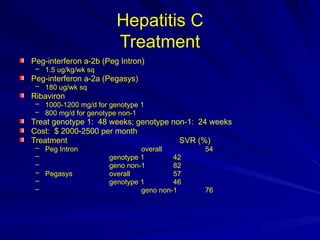
Treatment
Peg-interferon a-2b (Peg Intron)
– 1.5 ug/kg/wk sq
Peg-interferon a-2a (Pegasys)
– 180 ug/wk sq
Ribaviron
– 1000-1200 mg/d for genotype 1
– 800 mg/d for genotype non-1
Treat genotype 1: 48 weeks; genotype non-1: 24 weeks
Cost: $ 2000-2500 per month
Treatment SVR (%)
– Peg Intron overall 54
– genotype 1 42
– geno non-1 82
– Pegasys overall 57
– genotype 1 46
– geno non-1 76
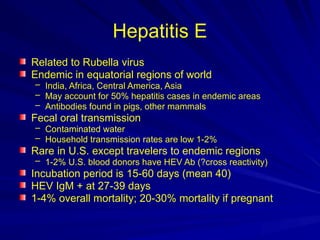
Hepatitis E
Related to Rubella virus
Endemic in equatorial regions of world
– India, Africa, Central America, Asia
– May account for 50% hepatitis cases in endemic areas
– Antibodies found in pigs, other mammals
Fecal oral transmission
– Contaminated water
– Household transmission rates are low 1-2%
Rare in U.S. except travelers to endemic regions
– 1-2% U.S. blood donors have HEV Ab (?cross reactivity)
Incubation period is 15-60 days (mean 40)
HEV IgM + at 27-39 days
1-4% overall mortality; 20-30% mortality if pregnant
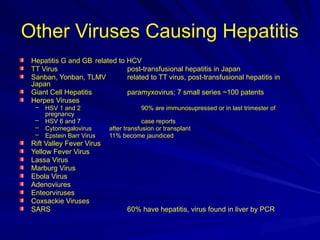
Other Viruses Causing Hepatitis
Hepatitis G and GB related to HCV
TT Virus post-transfusional hepatitis in Japan
Sanban, Yonban, TLMV related to TT virus, post-transfusional hepatitis in
Japan
Giant Cell Hepatitis paramyxovirus; 7 small series ~100 patents
Herpes Viruses
– HSV 1 and 2 90% are immunosupressed or in last trimester of
pregnancy
– HSV 6 and 7 case reports
– Cytomegalovirus after transfusion or transplant
– Epstein Barr Virus 11% become jaundiced
Rift Valley Fever Virus
Yellow Fever Virus
Lassa Virus
Marburg Virus
Ebola Virus
Adenoviures
Enteorviruses
Coxsackie Viruses
SARS 60% have hepatitis, virus found in liver by PCR

Viral hepatitis A to E .

  • 1.
    Viral Hepatitis A toE KHUSHI MAWA GROUP 2
  • 2.
    A Long Historyof Human Misery 500 B.C. written accounts of jaundice in Babylonia 400 B.C.Hippocrates describes “epidemic jaundice” 1883 jaundice noted to occur after inoculation of human sera 1941 post-vaccination jaundice occurs in >28,000 U.S. soldiers 1947 infectious hepatitis designated Hepatitis A; serum hepatitis designated Hepatitis B 1963 Hepatitis B Surface Antigen identified 1973 Hepatitis A identified by electron microscopy Mid-1970’s Hepatitis D recognized Mid-1970’s Non-A, Non-B hepatitis described Mid-1980’s epidemics of “non-hepatitis A” enteric hepatitis 1989 Hepatitis C cloned and serological tests developed 1990 Hepatitis E cloned and characterized
  • 3.
    Viral Hepatitis Common Features EarlyProdromal Phase serum sickness like syndrome occurs 2-3 weeks before jaundice arthalgias, arthritis, rash, angioneurotic edema, fever Preicteric Phase GI symptoms nausea, vomiting, abdominal pain, anorexia, changes in taste and smell, weight loss generalized malaise, myalgias, headache, fever Icteric Phase fever declines constitutional symptoms improve Convalescent phase full recovery usually within 6 months
  • 4.
    Viral Hepatitis Differential Features FeaturesHepatitis A Hepatitis B Hepatitis C Hepatitis D Hepatitis E Genome type Ss RNA Ds DNA Ss RNA Ss RNA Ss RNA Genome size 7.5 kB 3.2 kB 9.4 kB 1.7 kB 7.5 kB Incubation period, days (mean) 15-49 (30) 28-160 (70-80) 15-160 (50) 21-140 (35) 15-65 (42) Fecal-oral transmission yes no no no yes Parenteral transmission rare yes yes yes no Sexual transmission no yes, common yes, uncommon yes, uncommon no Fulminant hepatitis <1% <1% rare 2-7.5% ~1%, 30% in pregnancy Chronic hepatitis no 10% 85% 90% with superinfection no
  • 5.
    Acute Hepatitis Evaluation andRecommendations Access for viral hepatitis A, B, C, – Hep A IgM, Hep B Surface Ag, Core IgM, Hep C Ab (or PCR) – Consider alcohol and drug toxicity, autoimmune hepatitis, ischemia – Consider biliary tract disease: CBD stone, PSC – Consider other viruses: CMV, EBV, HSV, etc. Hospitalization for excessive anorexia, nausea, vomiting – Rising total bilirubin >15 – Rising pro time > 15 – Rapidly falling transaminases while bilirubin is rising – Liver failure: hepatic encephalopathy, ascites Bed rest prn Consider high protein high calorie diet Minimize medications: phenothiazines, ? vitamin K are OK; stop OCP’s, Etoh, acetaminophen, etc. Office visit and LFT’s twice a week while LFT’s rising, and every 1-2 weeks while improving Immunoprophylaxis for contacts of HAV, HBV
  • 6.
    Hepatitis A Picornaviridae Transmitted byfecal oral route, contaminated food, water, shellfish Most infections are sub clinical – Incidence peaks in fall and winter – 80% infected children are anicteric – 10-50% infected college students are anicteric – 30-50% U.S. adults are HAV IgG+, but only 3-5% recall prior jaundice – High attack rate: 70-90% exposed become infected >60,000 clinical cases per year in U.S. – Incubation 15-49 days (mean 30 days) – HAV Ag appears in liver at 1-2 weeks – HAV then appears in bile and stool – Fecal infectivity begins 2-3 weeks before jaundice, lasts 4-5 weeks, ends 2 weeks after peak transaminitis Chronic infection never occurs – 60% have normal LFT’s at 2 months; 100% normal at 6 months
  • 7.
    Hepatitis A Prevention General prevention –Water chlorination – Boil water 20 minutes – Wash hands – Avoid contaminated food HAV Immunoglobulin – Can prevent 85-95% infections if given within two weeks of exposure – Household and sexual contacts – Day care contacts – Prison contacts – Common source outbreaks HAV Vaccine – 90-98% successful with one injection, 100% with two injections – Protection begins after 1-2 weeks, may last 20 years – Give to all of the above – Travelers to endemic areas – Homosexuals, IV drug abusers – Persons with HCV and HBV – Military
  • 8.
    Hepatitis B Hepadnaviridae Transmission routeis variable – HBV is found in blood and all body fluids except stool – “Western” societies: percutaneous, hetero/homosexual contact is most common – “Non-western” societies: perinatal transmission is most common Epidemiology – Worldwide 2 billion people have markers of infection 400 million have chronic infection (5%) – U.S. 1.25 million chronic infections (50% Asian) 200 thousand acute infections per year 250 deaths/year from fulminant HBV 4000 deaths/year from chronic HBV 800 deaths/year from HBV related hepatomas
  • 9.
    Hepatitis B 90% casesare self-limited with spontaneous resolution – >50% are anicteric – 10% become chronic – <1% are fulminant (10% if “E Ag mutant”) – 3-5% in U.S. have HBV markers Surface Ag appears 1-12 weeks after exposure – Clinical hepatitis and Core IgM occur 4 weeks after Surface antigen – E Ag indicates period of infectivity – S Ab indicates resolving infection – Rare “window period” occurs when Surface Ag disappears and before Surface Ab appears; Core Ab will be positive Extrahepatic manifestations – Arthralgias and rash (25%) – Angioneurotic edema, polyarteritis nodosa, mononeuritis, membranoproliferative GN, arthritis, Raynaud’s phenomena, Type II mixed essential cryroglobulinemia, Guillan Barre Syndrome, pancreatitis, pericarditis
  • 10.
    Chronic Hepatitis B PersistentSurface Ag, E Ag, DNA > 6 months Risk of chronicity is dependent on host age and immune status – 90% perinatal infection – 30% childhood infection age < 6 years – 5% adult acute infection – 30% with HIV co-infection Prognosis is dependent on HBV stage – Immune tolerant: Surface Ag +, E Ag +, DNA +, ALT normal Prognosis good, hepatoma risk low – Integrated state: Surface Ag +, E Ag -, DNA –, ALT usually normal Prognosis good, hepatoma risk low – Chronic active hepatitis: Surface Ag +, E Ag +, DNA +, ALT >2x normal 20% develop cirrhosis in 5 years 10% per year lose E Ag 1% per year lose S Ag Increased risk of hepatoma 400 x
  • 11.
    Hepatitis B Prevention Modify riskfactors – Eliminate high risk behavior; use condoms – Incidence of acute HBV has decreased by 40% in U.S. over 15 years Screen pregnant mothers for HBV Surface Ag – HBIG + HBV vaccination at birth prevents 80-90% perinatal transmission Hepatitis B Immune Globulin – Perinatal exposure – Needle stick exposure – Sexual, mucosal or percutaneous exposures HBV Vaccination – Perinatal exposure – Persons with sexual, mucosal, percutaneous exposures – Persons with HCV or IV drug abuse – Homosexuals – Health care workers – Hemodialysis – Universal vaccination for children
  • 12.
    Hepatitis B Treatment Who totreat? – Chronic active disease > 6 months – Surface Ag +, DNA +, E Ag + or – (if E Ag mutant) – ALT > 100, and/or active hepatitis on biopsy Goal of treatment – Stop viral replication, HBV DNA becomes neg – Convert E Ag pos to neg, E AB becomes pos – Improvement in histology, prevention of progression to cirrhosis – With successful treatment, loss of Surface Ag may occur in 1-2% per year
  • 13.
    Hepatitis B Treatment Alpha-interferon2b 5 mu sq qd for 16 weeks 40 % will have successful response and lose E Ag, 10% lose Surface Ag Hepatitis flare is common during treatment Favorable pretreatment variables – Low HBV DNA < 200 pg/ml – High ALT > 100 – Active hepatitis on biopsy – Shorter duration of infection – Others: female, lack of immunosuppression, HBV E Ag +, h/o jaundice, horizontal transmission Pros – Short, finite duration of treatment – Effective, viral response persists in 95% Cons – Expensive: $2000 per month – Numerous side effects – May cause cirrhosis to decompensate
  • 14.
    Hepatitis B Treatment NucleosideAnalogues Lamivudine – Inhibits HBV reverse transcription – Minimal side effects – YMDD escape mutants occur 15-30% per year Adefovir – Inhibits HBV reverse transcription – Active against lamivudine resistance – Minimal side effects (proteinuria, increased Cr) – resistance is rare so far…..1.8-2.5% at 2 years Famciclovir – Inhibits DNA polymerase – Less effective than lamivudine, numerous resistance mutations – Minimal side effects Entecavir Active against lamivudine resistance; phase 2 trials Emtricitabine some cross resistance with lamivudine mutants, phase 2 trials Clevudine phase 1-2 trials B-L-Thymodine B-nucleoside, phase 1-2 trials
  • 15.
    Hepatitis C Flaviviridae Transmission isprimarily percutaneous; sexual and perinatal infection can occur – Transfusional HCV risk is now low: 1:1,935,000 – 50-90% of IV drug abusers have HCV – 10% needle stick injuries transmit HCV – 4% sexual partners have HCV; Risk of sexual transmission <0.5%/year – Perinatal transmission 1-10% 100 million chronic carriers world wide (>3%) 4 million with chronic HCV in U.S. (1.5-2%) – 30 thousand new HCV cases per year in U.S. (incidence decreasing) – 10 thousand deaths/year from HCV (incidence increasing) Acute hepatitis is rare – Fulminant hepatitis is extremely rare – 15% can spontaneously resolve infection – 85% develop chronic infection – HCV RNA becomes + 2 weeks after exposure – “incubation” period is 6-7 weeks – HCV Ab becomes + by 12 weeks in most
  • 16.
    Hepatitis C Factors Associatedwith Disease Progression Age > 40 Male Alcohol > 50 gm/d Immunosuppression: HIV, transplant, etc. Infection by blood transfusion Co-infection with HBV Genotype 1
  • 17.
    Hepatitis C Goals ofTherapy Biochemical response normal ALT Virological response loss of HCV RNA End of treatment response loss of HCV RNA at end of treatment Early Virological response (EVR) – HCV RNA neg or 2 log reduction at 12 weeks Overall 67 % with EVR achieve SVR 80% who are HCV RNA neg achieve SVR 40% who are RNA +, but have 2 log reduction achieve SVR – Patients w/o EVR Only 1.6% achieve SVR Sustained virological response (SVR) – Undetectable HCV RNA 6 months after treatment ends – 95% have persistent SVR over 10 years – 80% have reduction in fibrosis
  • 18.
    Hepatitis C Treatment Peg-interferon a-2b(Peg Intron) – 1.5 ug/kg/wk sq Peg-interferon a-2a (Pegasys) – 180 ug/wk sq Ribaviron – 1000-1200 mg/d for genotype 1 – 800 mg/d for genotype non-1 Treat genotype 1: 48 weeks; genotype non-1: 24 weeks Cost: $ 2000-2500 per month Treatment SVR (%) – Peg Intron overall 54 – genotype 1 42 – geno non-1 82 – Pegasys overall 57 – genotype 1 46 – geno non-1 76
  • 19.
    Hepatitis E Related toRubella virus Endemic in equatorial regions of world – India, Africa, Central America, Asia – May account for 50% hepatitis cases in endemic areas – Antibodies found in pigs, other mammals Fecal oral transmission – Contaminated water – Household transmission rates are low 1-2% Rare in U.S. except travelers to endemic regions – 1-2% U.S. blood donors have HEV Ab (?cross reactivity) Incubation period is 15-60 days (mean 40) HEV IgM + at 27-39 days 1-4% overall mortality; 20-30% mortality if pregnant
  • 20.
    Other Viruses CausingHepatitis Hepatitis G and GB related to HCV TT Virus post-transfusional hepatitis in Japan Sanban, Yonban, TLMV related to TT virus, post-transfusional hepatitis in Japan Giant Cell Hepatitis paramyxovirus; 7 small series ~100 patents Herpes Viruses – HSV 1 and 2 90% are immunosupressed or in last trimester of pregnancy – HSV 6 and 7 case reports – Cytomegalovirus after transfusion or transplant – Epstein Barr Virus 11% become jaundiced Rift Valley Fever Virus Yellow Fever Virus Lassa Virus Marburg Virus Ebola Virus Adenoviures Enteorviruses Coxsackie Viruses SARS 60% have hepatitis, virus found in liver by PCR