ANTIDEPRESSANTS
Sourav Biswas
Group 15
Course 4
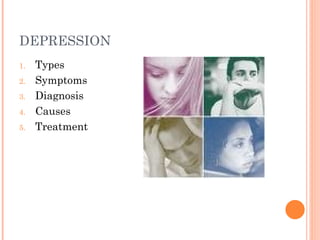
DEPRESSION
1. Types
2. Symptoms
3. Diagnosis
4. Causes
5. Treatment
TYPES OF DEPRESSION
 Major depression
 Chronic depression (Dysthymia)
 Atypical depression
 Bipolar disorder/Manic depression
 Seasonal depression (SAD)
SYMPTOMS
• persistently sad, anxious, or empty moods
• loss of pleasure in usual activities (anhedonia)
• feelings of helplessness, guilt, or worthlessness
• crying, hopelessness, or persistent pessimism
• fatigue or decreased energy
• loss of memory, concentration, or decision-making capability
• restlessness, irritability
• sleep disturbances
• change in appetite or weight
• physical symptoms that defy diagnosis and do not respond to
treatment (especially pain and gastrointestinal complaints)
• thoughts of suicide or death, or suicide attempts
• poor self-image or self-esteem (as illustrated, for example, by
verbal self-reproach)
DIAGNOSIS
• Extensive patient and family history
• Blood test for hypothyroidism
• Current medication
• DSM-IV
• One of the first two symptoms
• Five other symptoms
CAUSES OF DEPRESSION
 Genetics
 Death/Abuse
 Medications
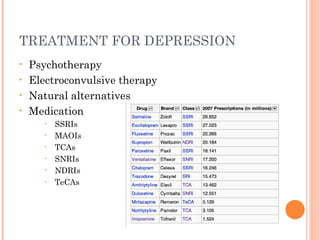
TREATMENT FOR DEPRESSION
• Psychotherapy
• Electroconvulsive therapy
• Natural alternatives
• Medication
• SSRIs
• MAOIs
• TCAs
• SNRIs
• NDRIs
• TeCAs
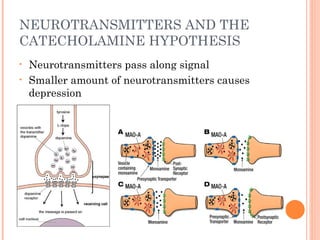
NEUROTRANSMITTERS AND THE
CATECHOLAMINE HYPOTHESIS
• Neurotransmitters pass along signal
• Smaller amount of neurotransmitters causes
depression
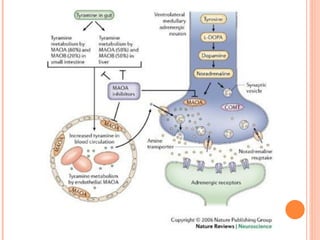
MONOAMINE OXIDASE (MAO) AND
DEPRESSION
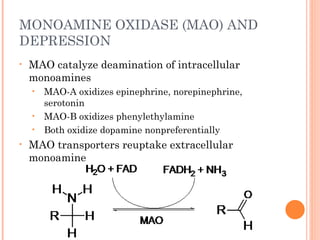
• MAO catalyze deamination of intracellular
monoamines
• MAO-A oxidizes epinephrine, norepinephrine,
serotonin
• MAO-B oxidizes phenylethylamine
• Both oxidize dopamine nonpreferentially
• MAO transporters reuptake extracellular
monoamine
MONOAMINE OXIDASE INHIBITORS
(MAOIS)
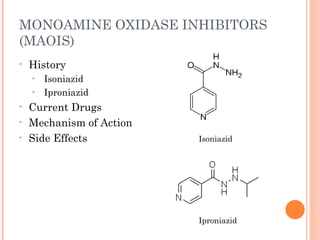
• History
• Isoniazid
• Iproniazid
• Current Drugs
• Mechanism of Action
• Side Effects Isoniazid
Iproniazid
MAOIS ON THE MARKET
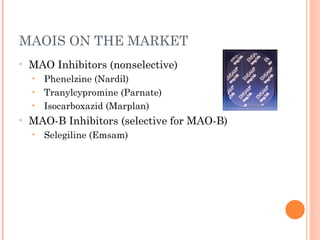
• MAO Inhibitors (nonselective)
• Phenelzine (Nardil)
• Tranylcypromine (Parnate)
• Isocarboxazid (Marplan)
• MAO-B Inhibitors (selective for MAO-B)
• Selegiline (Emsam)
MAOIS MECHANISM OF ACTION
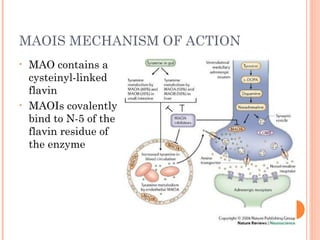
• MAO contains a
cysteinyl-linked
flavin
• MAOIs covalently
bind to N-5 of the
flavin residue of
the enzyme
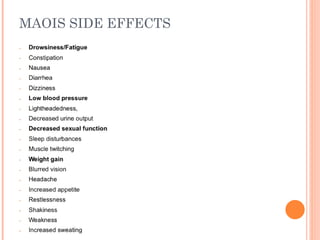
MAOIS SIDE EFFECTS
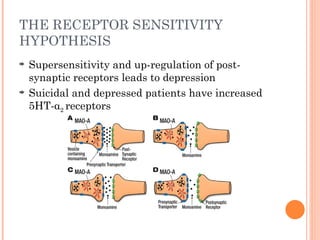
THE RECEPTOR SENSITIVITY
HYPOTHESIS
Supersensitivity and up-regulation of post-
synaptic receptors leads to depression
Suicidal and depressed patients have increased
5HT-α2 receptors
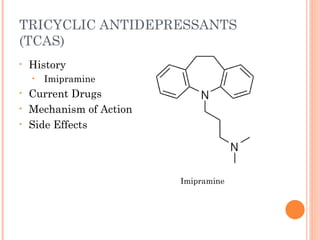
TRICYCLIC ANTIDEPRESSANTS
(TCAS)
• History
• Imipramine
• Current Drugs
• Mechanism of Action
• Side Effects
Imipramine
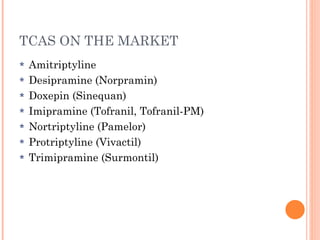
TCAS ON THE MARKET
Amitriptyline
Desipramine (Norpramin)
Doxepin (Sinequan)
Imipramine (Tofranil, Tofranil-PM)
Nortriptyline (Pamelor)
Protriptyline (Vivactil)
Trimipramine (Surmontil)
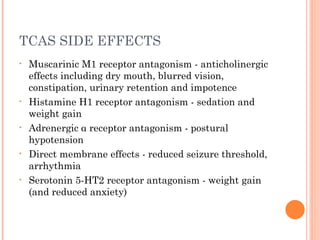
TCAS SIDE EFFECTS
• Muscarinic M1 receptor antagonism - anticholinergic
effects including dry mouth, blurred vision,
constipation, urinary retention and impotence
• Histamine H1 receptor antagonism - sedation and
weight gain
• Adrenergic α receptor antagonism - postural
hypotension
• Direct membrane effects - reduced seizure threshold,
arrhythmia
• Serotonin 5-HT2 receptor antagonism - weight gain
(and reduced anxiety)
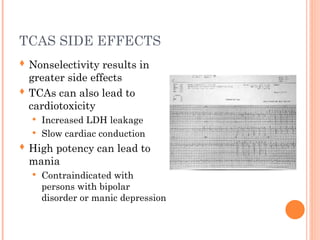
TCAS SIDE EFFECTS
 Nonselectivity results in
greater side effects
 TCAs can also lead to
cardiotoxicity
 Increased LDH leakage
 Slow cardiac conduction
 High potency can lead to
mania
 Contraindicated with
persons with bipolar
disorder or manic depression
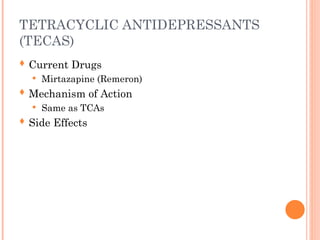
TETRACYCLIC ANTIDEPRESSANTS
(TECAS)
 Current Drugs
 Mirtazapine (Remeron)
 Mechanism of Action
 Same as TCAs
 Side Effects
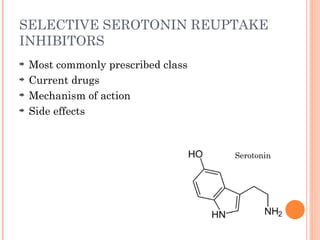
SELECTIVE SEROTONIN REUPTAKE
INHIBITORS
Most commonly prescribed class
Current drugs
Mechanism of action
Side effects
Serotonin
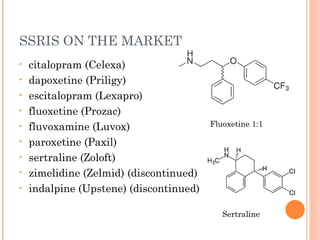
SSRIS ON THE MARKET
• citalopram (Celexa)
• dapoxetine (Priligy)
• escitalopram (Lexapro)
• fluoxetine (Prozac)
• fluvoxamine (Luvox)
• paroxetine (Paxil)
• sertraline (Zoloft)
• zimelidine (Zelmid) (discontinued)
• indalpine (Upstene) (discontinued)
Fluoxetine 1:1
Sertraline
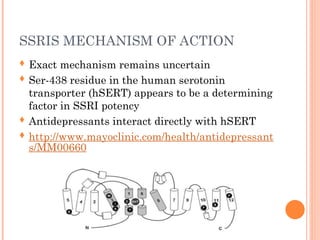
SSRIS MECHANISM OF ACTION
 Exact mechanism remains uncertain
 Ser-438 residue in the human serotonin
transporter (hSERT) appears to be a determining
factor in SSRI potency
 Antidepressants interact directly with hSERT
 http://www.mayoclinic.com/health/antidepressant
s/MM00660
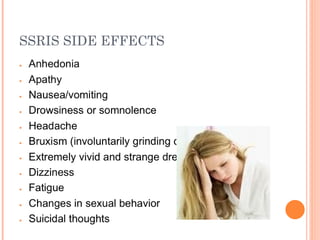
SSRIS SIDE EFFECTS
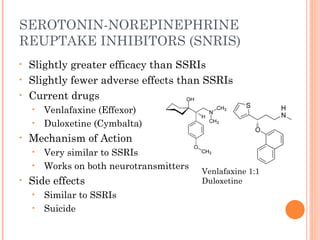
SEROTONIN-NOREPINEPHRINE
REUPTAKE INHIBITORS (SNRIS)
• Slightly greater efficacy than SSRIs
• Slightly fewer adverse effects than SSRIs
• Current drugs
• Venlafaxine (Effexor)
• Duloxetine (Cymbalta)
• Mechanism of Action
• Very similar to SSRIs
• Works on both neurotransmitters
• Side effects
• Similar to SSRIs
• Suicide
Venlafaxine 1:1
Duloxetine
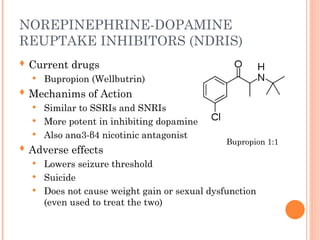
NOREPINEPHRINE-DOPAMINE
REUPTAKE INHIBITORS (NDRIS)
 Current drugs
 Bupropion (Wellbutrin)
 Mechanims of Action
 Similar to SSRIs and SNRIs
 More potent in inhibiting dopamine
 Also anα3-β4 nicotinic antagonist
 Adverse effects
 Lowers seizure threshold
 Suicide
 Does not cause weight gain or sexual dysfunction
(even used to treat the two)
Bupropion 1:1
REFERENCES
 http://ajp.psychiatryonline.org/cgi/reprint/157/11/1901
 http://www.webmd.com/depression/
 http://pn.psychiatryonline.org/content/41/24/21.full
 http://www.mayoclinic.com/health/maois/MH00072
 http://www.springerlink.com/content/b9b8668ff59f89d7/fulltext.pdf
 http://www.emsam.com/pi_emsam.pdf
 http://www.nevdgp.org.au/info/topics/depression_theory.htm
 http://www.uspharmacist.com/content/t/psychotropic_disorders/c/11467/
 http://www.jbc.org/content/284/15/10276.full.pdf+html
 http://www.aafp.org/afp/981200ap/cadieux.html
 http://www.mayoclinic.com/health/antidepressants/MH00071
 http://books.google.com/books?id=R0W1ErpsQpkC&pg=PA565&lpg=PA565&dq=tcas+mechanism+
of+action&source=bl&ots=oASle2Z-pr&sig=36CB_3JY4uD3LIYvqXWmAb3nliY&hl=en&ei=HzfFS9
OrB4Tu9gTD6_ixDg&sa=X&oi=book_result&ct=result&resnum=8&ved=0CCoQ6AEwBw#v=onepa
ge&q=tcas%20mechanism%20of%20action&f=false
 http://www.informaworld.com/smpp/content~content=a916036122&db=all

Antidepressants Sourav.ppt antidepressants

  • 1.
  • 2.
    DEPRESSION 1. Types 2. Symptoms 3.Diagnosis 4. Causes 5. Treatment
  • 3.
    TYPES OF DEPRESSION Major depression  Chronic depression (Dysthymia)  Atypical depression  Bipolar disorder/Manic depression  Seasonal depression (SAD)
  • 4.
    SYMPTOMS • persistently sad,anxious, or empty moods • loss of pleasure in usual activities (anhedonia) • feelings of helplessness, guilt, or worthlessness • crying, hopelessness, or persistent pessimism • fatigue or decreased energy • loss of memory, concentration, or decision-making capability • restlessness, irritability • sleep disturbances • change in appetite or weight • physical symptoms that defy diagnosis and do not respond to treatment (especially pain and gastrointestinal complaints) • thoughts of suicide or death, or suicide attempts • poor self-image or self-esteem (as illustrated, for example, by verbal self-reproach)
  • 5.
    DIAGNOSIS • Extensive patientand family history • Blood test for hypothyroidism • Current medication • DSM-IV • One of the first two symptoms • Five other symptoms
  • 6.
    CAUSES OF DEPRESSION Genetics  Death/Abuse  Medications
  • 7.
    TREATMENT FOR DEPRESSION •Psychotherapy • Electroconvulsive therapy • Natural alternatives • Medication • SSRIs • MAOIs • TCAs • SNRIs • NDRIs • TeCAs
  • 8.
    NEUROTRANSMITTERS AND THE CATECHOLAMINEHYPOTHESIS • Neurotransmitters pass along signal • Smaller amount of neurotransmitters causes depression
  • 9.
    MONOAMINE OXIDASE (MAO)AND DEPRESSION • MAO catalyze deamination of intracellular monoamines • MAO-A oxidizes epinephrine, norepinephrine, serotonin • MAO-B oxidizes phenylethylamine • Both oxidize dopamine nonpreferentially • MAO transporters reuptake extracellular monoamine
  • 10.
    MONOAMINE OXIDASE INHIBITORS (MAOIS) •History • Isoniazid • Iproniazid • Current Drugs • Mechanism of Action • Side Effects Isoniazid Iproniazid
  • 11.
    MAOIS ON THEMARKET • MAO Inhibitors (nonselective) • Phenelzine (Nardil) • Tranylcypromine (Parnate) • Isocarboxazid (Marplan) • MAO-B Inhibitors (selective for MAO-B) • Selegiline (Emsam)
  • 12.
    MAOIS MECHANISM OFACTION • MAO contains a cysteinyl-linked flavin • MAOIs covalently bind to N-5 of the flavin residue of the enzyme
  • 14.
  • 15.
    THE RECEPTOR SENSITIVITY HYPOTHESIS Supersensitivityand up-regulation of post- synaptic receptors leads to depression Suicidal and depressed patients have increased 5HT-α2 receptors
  • 16.
    TRICYCLIC ANTIDEPRESSANTS (TCAS) • History •Imipramine • Current Drugs • Mechanism of Action • Side Effects Imipramine
  • 17.
    TCAS ON THEMARKET Amitriptyline Desipramine (Norpramin) Doxepin (Sinequan) Imipramine (Tofranil, Tofranil-PM) Nortriptyline (Pamelor) Protriptyline (Vivactil) Trimipramine (Surmontil)
  • 18.
    TCAS SIDE EFFECTS •Muscarinic M1 receptor antagonism - anticholinergic effects including dry mouth, blurred vision, constipation, urinary retention and impotence • Histamine H1 receptor antagonism - sedation and weight gain • Adrenergic α receptor antagonism - postural hypotension • Direct membrane effects - reduced seizure threshold, arrhythmia • Serotonin 5-HT2 receptor antagonism - weight gain (and reduced anxiety)
  • 19.
    TCAS SIDE EFFECTS Nonselectivity results in greater side effects  TCAs can also lead to cardiotoxicity  Increased LDH leakage  Slow cardiac conduction  High potency can lead to mania  Contraindicated with persons with bipolar disorder or manic depression
  • 20.
    TETRACYCLIC ANTIDEPRESSANTS (TECAS)  CurrentDrugs  Mirtazapine (Remeron)  Mechanism of Action  Same as TCAs  Side Effects
  • 21.
    SELECTIVE SEROTONIN REUPTAKE INHIBITORS Mostcommonly prescribed class Current drugs Mechanism of action Side effects Serotonin
  • 22.
    SSRIS ON THEMARKET • citalopram (Celexa) • dapoxetine (Priligy) • escitalopram (Lexapro) • fluoxetine (Prozac) • fluvoxamine (Luvox) • paroxetine (Paxil) • sertraline (Zoloft) • zimelidine (Zelmid) (discontinued) • indalpine (Upstene) (discontinued) Fluoxetine 1:1 Sertraline
  • 23.
    SSRIS MECHANISM OFACTION  Exact mechanism remains uncertain  Ser-438 residue in the human serotonin transporter (hSERT) appears to be a determining factor in SSRI potency  Antidepressants interact directly with hSERT  http://www.mayoclinic.com/health/antidepressant s/MM00660
  • 24.
  • 25.
    SEROTONIN-NOREPINEPHRINE REUPTAKE INHIBITORS (SNRIS) •Slightly greater efficacy than SSRIs • Slightly fewer adverse effects than SSRIs • Current drugs • Venlafaxine (Effexor) • Duloxetine (Cymbalta) • Mechanism of Action • Very similar to SSRIs • Works on both neurotransmitters • Side effects • Similar to SSRIs • Suicide Venlafaxine 1:1 Duloxetine
  • 26.
    NOREPINEPHRINE-DOPAMINE REUPTAKE INHIBITORS (NDRIS) Current drugs  Bupropion (Wellbutrin)  Mechanims of Action  Similar to SSRIs and SNRIs  More potent in inhibiting dopamine  Also anα3-β4 nicotinic antagonist  Adverse effects  Lowers seizure threshold  Suicide  Does not cause weight gain or sexual dysfunction (even used to treat the two) Bupropion 1:1
  • 27.
    REFERENCES  http://ajp.psychiatryonline.org/cgi/reprint/157/11/1901  http://www.webmd.com/depression/ http://pn.psychiatryonline.org/content/41/24/21.full  http://www.mayoclinic.com/health/maois/MH00072  http://www.springerlink.com/content/b9b8668ff59f89d7/fulltext.pdf  http://www.emsam.com/pi_emsam.pdf  http://www.nevdgp.org.au/info/topics/depression_theory.htm  http://www.uspharmacist.com/content/t/psychotropic_disorders/c/11467/  http://www.jbc.org/content/284/15/10276.full.pdf+html  http://www.aafp.org/afp/981200ap/cadieux.html  http://www.mayoclinic.com/health/antidepressants/MH00071  http://books.google.com/books?id=R0W1ErpsQpkC&pg=PA565&lpg=PA565&dq=tcas+mechanism+ of+action&source=bl&ots=oASle2Z-pr&sig=36CB_3JY4uD3LIYvqXWmAb3nliY&hl=en&ei=HzfFS9 OrB4Tu9gTD6_ixDg&sa=X&oi=book_result&ct=result&resnum=8&ved=0CCoQ6AEwBw#v=onepa ge&q=tcas%20mechanism%20of%20action&f=false  http://www.informaworld.com/smpp/content~content=a916036122&db=all