Hepatitis (Liver-Attacking) Viruses
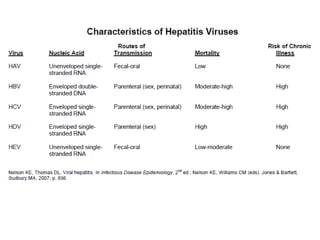
HepatitisA – fecal/oral, contaminated food, vaccine available
Hepatitis B – blood, semen, vertical (mother-child), vaccine
available
Hepatitis C – blood (IV drug use, transfusion, organ donation,
unsterile injecting equipment, sexual intercourse)
Hepatitis D – survives only in cells co-infected with hepatitis B
Hepatitis E* – contaminated food or water, fecal/oral
*causes short-term disease and is not a chronic carrier state
4.
Viral Hepatitis
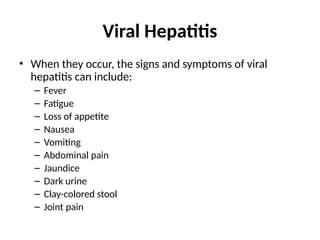
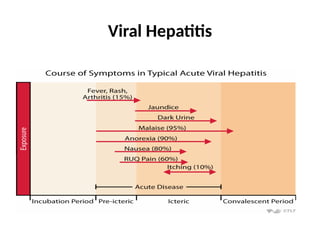
• Whenthey occur, the signs and symptoms of viral
hepatitis can include:
– Fever
– Fatigue
– Loss of appetite
– Nausea
– Vomiting
– Abdominal pain
– Jaundice
– Dark urine
– Clay-colored stool
– Joint pain
Viral B/C Hepatitis
•Viral B/C hepatitis is the leading cause of liver
cancer and the most common reason for liver
transplantation
• Each year an estimated large numbers of
indivduals become infected with Hepatitis B, and
Hepatitis C variable at different parts!!!
7.
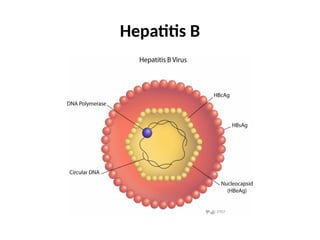
Hepatitis B
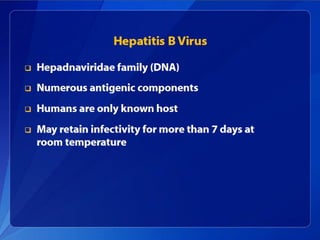
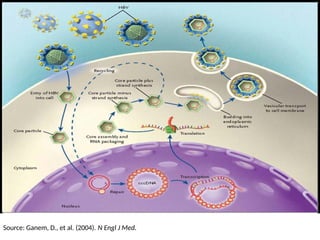
• HepatitisB is caused by infection with the Hepatitis
B virus (HBV), the prototype member of the
hepadnavirus [Hepadnaviradae] family
– HBV is the only human representative of this
family.
– It has a circular DNA genome of 3.2 kb
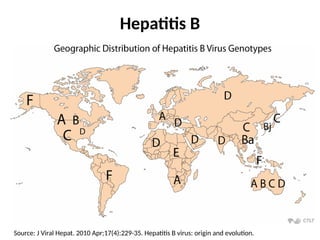
• Currently, eight genotypes (A−H) are identified by a
divergence of >8% in the entire genome
8.
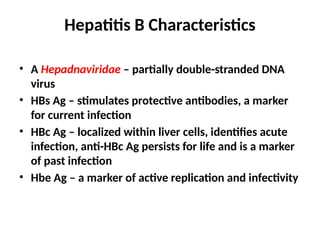
Hepatitis B Characteristics
•A Hepadnaviridae – partially double-stranded DNA
virus
• HBs Ag – stimulates protective antibodies, a marker
for current infection
• HBc Ag – localized within liver cells, identifies acute
infection, anti-HBc Ag persists for life and is a marker
of past infection
• Hbe Ag – a marker of active replication and infectivity
Hepatitis B
Source: JViral Hepat. 2010 Apr;17(4):229-35. Hepatitis B virus: origin and evolution.
13.
Hepatitis B
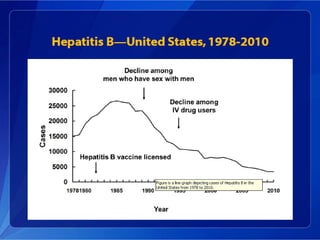
Epidemiology
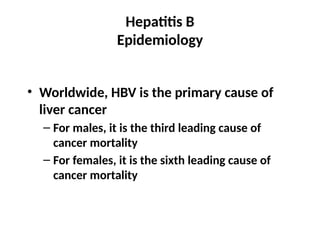
• Worldwide,HBV is the primary cause of
liver cancer
– For males, it is the third leading cause of
cancer mortality
– For females, it is the sixth leading cause of
cancer mortality
14.
Hepatitis B
Epidemiology
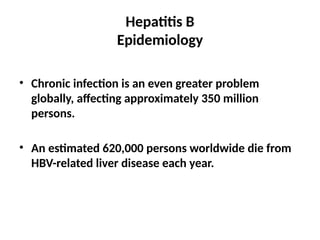
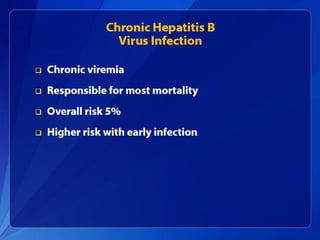
• Chronicinfection is an even greater problem
globally, affecting approximately 350 million
persons.
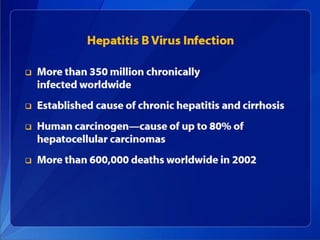
• An estimated 620,000 persons worldwide die from
HBV-related liver disease each year.
15.
Hepatitis B
Epidemiology
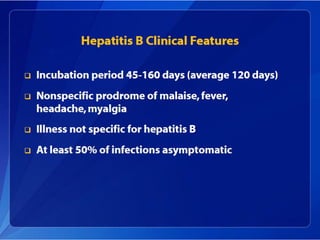
• Theincubation period from the time of exposure to
onset of symptoms is 6 weeks to 6 months.
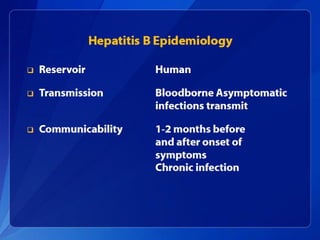
• HBV is found in highest concentrations in blood and
in lower concentrations in other body fluids (e.g.,
semen, vaginal secretions, and wound exudates).
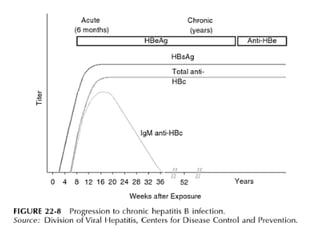
• HBV infection can be self-limited or chronic.
16.
Hepatitis B
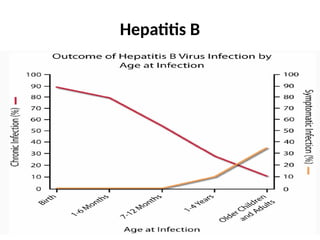
In adults,only approximately half of newly
acquired HBV infections are symptomatic, and
approximately 1% of reported cases result in
acute liver failure and death.
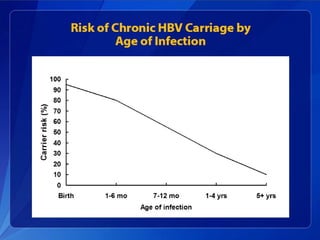
Neoborns [90% CHBV]
Infants up to 5 years [50% CHBV]
17.
Hepatitis B
Diagnosis
• HepatitisB is detected by looking for a number
of different antigens and antibodies:
– Hepatitis B surface antigen (HBs Ag):
• A protein on the surface of HBV; it can be detected in high
levels in serum during acute or chronic HBV infection.
• The presence of HBs Ag indicates that the person is
infectious.
• The body normally produces antibodies to HBs Ag as part of
the normal immune response to infection.
• HBs Ag is the antigen used to make Hepatitis B vaccine.
18.
Hepatitis B
Diagnosis
• HepatitisB is detected by looking for a number
of different antigens and antibodies:
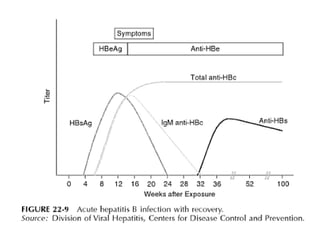
– Hepatitis B surface antibody (anti-HBs):
• The presence of anti-HBs is generally interpreted as
indicating recovery and immunity from HBV infection.
• Anti-HBs also develops in a person who has been
successfully vaccinated against Hepatitis B.
– Total Hepatitis B core antibody (anti-HBc):
• Appears at the onset of symptoms in acute Hepatitis B and
persists for life.
• The presence of anti-HBc indicates previous or ongoing
infection with HBV in an undefined time frame.
19.
Hepatitis B
Diagnosis
• HepatitisB is detected by looking for a number
of different antigens and antibodies:
– IgM antibody to Hepatitis B core antigen (IgM anti-
HBc):
• Positivity indicates recent infection with HBV (≤6 months).
• Its presence indicates acute infection.
– Hepatitis B e antigen (Hbe Ag):
• A secreted product of the nucleocapsid gene of HBV that is
found in serum during acute and chronic Hepatitis B.
• Its presence indicates that the virus is replicating and the
infected person has high levels of HBV.
20.
Hepatitis B
Diagnosis
• HepatitisB is detected by looking for a number
of different antigens and antibodies:
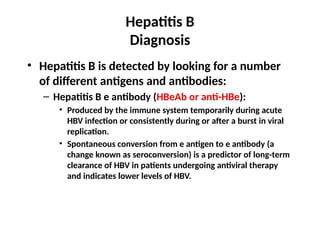
– Hepatitis B e antibody (HBeAb or anti-HBe):
• Produced by the immune system temporarily during acute
HBV infection or consistently during or after a burst in viral
replication.
• Spontaneous conversion from e antigen to e antibody (a
change known as seroconversion) is a predictor of long-term
clearance of HBV in patients undergoing antiviral therapy
and indicates lower levels of HBV.
21.
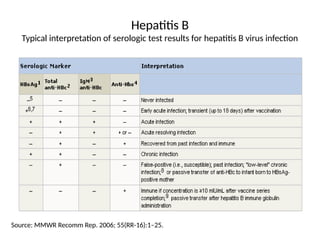
Hepatitis B
Typical interpretationof serologic test results for hepatitis B virus infection
Source: MMWR Recomm Rep. 2006; 55(RR-16):1–25.
Hepatitis B
Treatment
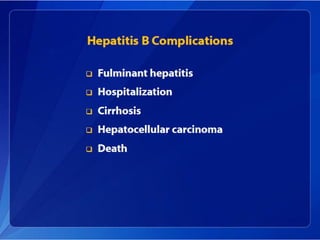
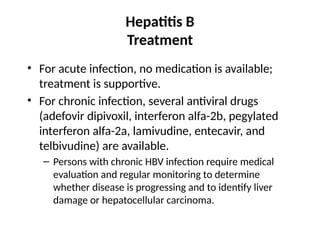
• Foracute infection, no medication is available;
treatment is supportive.
• For chronic infection, several antiviral drugs
(adefovir dipivoxil, interferon alfa-2b, pegylated
interferon alfa-2a, lamivudine, entecavir, and
telbivudine) are available.
– Persons with chronic HBV infection require medical
evaluation and regular monitoring to determine
whether disease is progressing and to identify liver
damage or hepatocellular carcinoma.
40.
Hepatitis B
Elimination
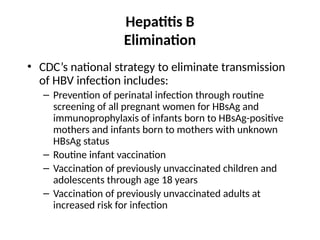
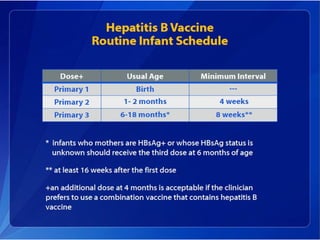
• CDC’snational strategy to eliminate transmission
of HBV infection includes:
– Prevention of perinatal infection through routine
screening of all pregnant women for HBsAg and
immunoprophylaxis of infants born to HBsAg-positive
mothers and infants born to mothers with unknown
HBsAg status
– Routine infant vaccination
– Vaccination of previously unvaccinated children and
adolescents through age 18 years
– Vaccination of previously unvaccinated adults at
increased risk for infection
45.
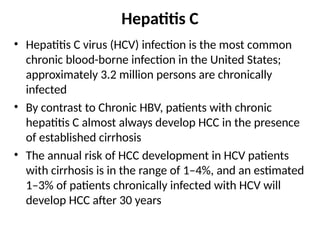
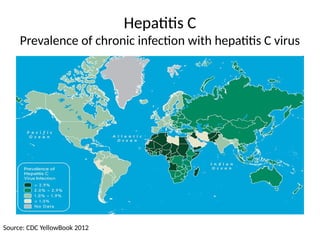
Hepatitis C
• HepatitisC virus (HCV) infection is the most common
chronic blood-borne infection in the United States;
approximately 3.2 million persons are chronically
infected
• By contrast to Chronic HBV, patients with chronic
hepatitis C almost always develop HCC in the presence
of established cirrhosis
• The annual risk of HCC development in HCV patients
with cirrhosis is in the range of 1–4%, and an estimated
1–3% of patients chronically infected with HCV will
develop HCC after 30 years
46.
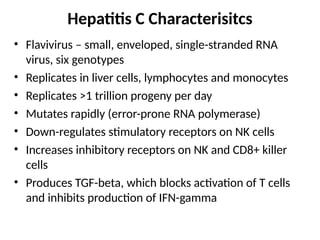
Hepatitis C Characterisitcs
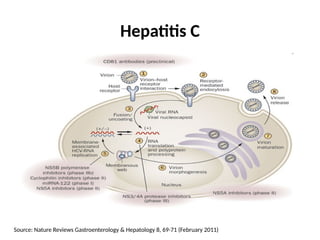
•Flavivirus – small, enveloped, single-stranded RNA
virus, six genotypes
• Replicates in liver cells, lymphocytes and monocytes
• Replicates >1 trillion progeny per day
• Mutates rapidly (error-prone RNA polymerase)
• Down-regulates stimulatory receptors on NK cells
• Increases inhibitory receptors on NK and CD8+ killer
cells
• Produces TGF-beta, which blocks activation of T cells
and inhibits production of IFN-gamma
47.
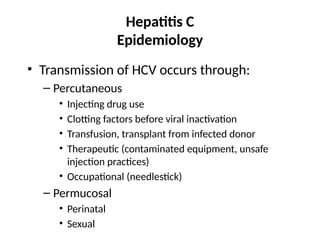
Hepatitis C
Epidemiology
• Transmissionof HCV occurs through:
– Percutaneous
• Injecting drug use
• Clotting factors before viral inactivation
• Transfusion, transplant from infected donor
• Therapeutic (contaminated equipment, unsafe
injection practices)
• Occupational (needlestick)
– Permucosal
• Perinatal
• Sexual
48.
Hepatitis C
Epidemiology
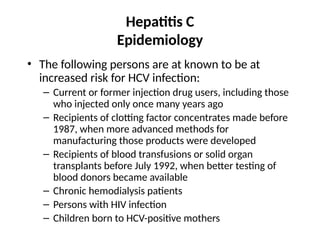
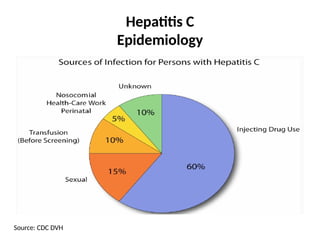
• Thefollowing persons are at known to be at
increased risk for HCV infection:
– Current or former injection drug users, including those
who injected only once many years ago
– Recipients of clotting factor concentrates made before
1987, when more advanced methods for
manufacturing those products were developed
– Recipients of blood transfusions or solid organ
transplants before July 1992, when better testing of
blood donors became available
– Chronic hemodialysis patients
– Persons with HIV infection
– Children born to HCV-positive mothers
Hepatitis C
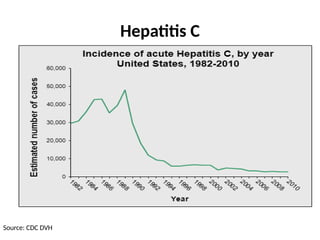
• Althoughonly 850 cases of confirmed acute
Hepatitis C were reported in the United States in
2010, CDC estimates that approximately 16,000
new HCV infections occurred that year, after
adjusting for asymptomatic infection and
underreporting.
• Persons newly infected with HCV are usually
asymptomatic, so acute Hepatitis C is rarely
identified or reported.
Hepatitis C
Diagnosis
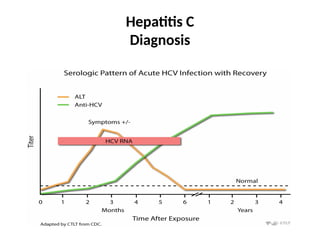
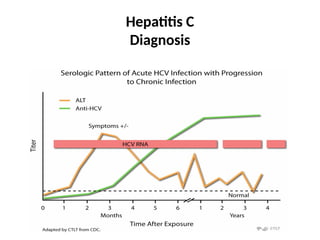
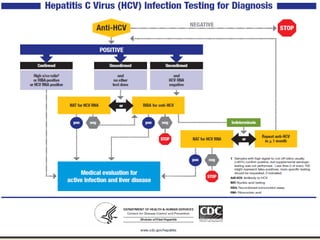
• Sixtyto 70% of persons newly infected with HCV
typically are usually asymptomatic or have a mild
clinical illness.
• HCV RNA can be detected in blood within 1–3
weeks after exposure.
• The average time from exposure to antibody to
HCV (anti-HCV) seroconversion is 8–9 weeks, and
anti-HCV can be detected in >97% of persons by 6
months after exposure.
59.
Hepatitis C
Chronic Illness
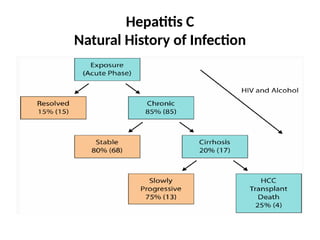
•75-85% of those infected with HCV will
develop chronic infection.
• 60-70% of those infected with HCV will
develop chronic liver disease.
• 5-20% of those infected will develop
cirrhosis over a period of 20-30 years
• 1-5% will die from the consequences of
chronic infection (liver cancer or cirrhosis)
60.
Hepatitis C
Treatment
• Interferon-basedtherapy is currently the
standard of care for patients with chronic
HCV, and has been proven to be effective in
eliminating HCV.
• Both conventional and pegylated interferon
(IFN) therapy have been used widely, with
the aim of achieving a sustained virological
response (SVR).
61.
Hepatitis C
Prevention
• UnlikeHBV, there is currently no vaccine for
HCV.
• However, with the screening of HCV in
blood transfusion services, transfusion-
related HCV infection has been lowered to
almost zero.
62.
Hepatitis C
Prevention
• Itmay be possible to develop a preventive vaccine
for HCV:
– 30% of persons clear the virus spontaneously
– The genome of HCV is not integrated into the host
genome
– After HCV infection, CD-8 CTL responses and antibodies
appear, but the “protective immune response” or
critical epitopes are not known
– Persons who clear HCV and become re-infected have
low viral loads and are more likely to clear HCV
63.
Hepatitis D
• HepatitisD (HDV), also known as "delta
hepatitis," is a single-stranded circular RNA
virus structurally unrelated to the Hepatitis A,
B, or C viruses
• Hepatitis D, which can be acute or chronic, is
uncommon in the United States
64.
Hepatitis D
• HDVis an incomplete virus that requires the
helper function of HBV to replicate and only
occurs among people who are infected with the
Hepatitis B virus (HBV).
• HDV is transmitted through percutaneous or
mucosal contact with infectious blood and can be
acquired either as a coinfection with HBV or as
superinfection in persons with HBV infection.
65.
Hepatitis E
• HepatitisE virus (HEV), the major etiologic agent
of enterically transmitted non-A hepatitis
worldwide, is a spherical, non-enveloped, single
stranded RNA virus that is approximately 32 to 34
nm in diameter.
• HEV is the sole member of the genus Hepevirus.
– Two major species of the virus are recognized:
• Mammalian HEV, a virus that causes acute hepatitis in humans
and has a reservoir in pigs and possibly a range of other
mammals
• Avian HEV, causing big liver and spleen disease in chickens
66.
Hepatitis E
• HepatitisE is a serious liver disease caused by the
Hepatitis E virus (HEV) that usually results in an
acute infection.
• It does not lead to a chronic infection.
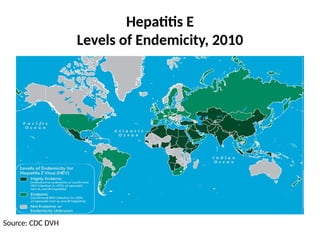
• While rare in the United States, Hepatitis E is
common in many parts of the world.
• Hepatitis E is transmitted through the fecal oral
route and outbreaks are usually associated with
contaminated water supplies in countries with
poor sanitation.
67.
Hepatitis E
Acute Illness
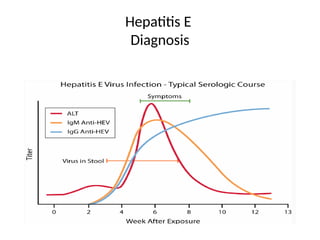
•The incubation period following exposure
to HEV ranges from 15 to 60 days (mean, 40
days).
• Typical clinical signs and symptoms of acute
hepatitis E are similar to those of other
types of viral hepatitis and include
abdominal pain anorexia, dark urine, fever,
hepatomegaly, jaundice, malaise, nausea,
and vomiting.
68.
Hepatitis E
• Mostpeople with Hepatitis E recover
completely.
• The overall case-fatality rate is ≤4%.
• However, for pregnant women, Hepatitis E
is more serious and the disease is fatal in
10%–30% of pregnant women, particularly
those in their third trimester.
Hepatitis E
Epidemiology
• Thehighest attack rate is seen among persons aged 15-40
years.
– In most hepatitis E outbreaks, the highest rates of clinically
evident disease have been in young to middle-age adults; lower
disease rates in younger age groups may be the result of an icteric
and/or subclinical HEV infection.
• The case fatality rate overall is 1%-3%.
– In pregnant women, the case fatality rate can be as high as 15%-
25%.
• HEV is found in the stool (feces) of persons and animals
with hepatitis E.
• HEV is spread by eating or drinking contaminated food or
water.
• Transmission from person to person occurs less commonly
than with hepatitis A virus.
Hepatitis E
Prevention
• AHepatitis E vaccine was just approved for use
(but only in China).
• Good sanitation measures are essential for
preventing environmental contamination.
• Good personal hygiene is also essential for
prevention and control including:
– Hand washing with soap:
• After using the bathroom
• After changing a diaper
• Before preparing and eating food


![Hepatitis B
• Hepatitis B is caused by infection with the Hepatitis
B virus (HBV), the prototype member of the
hepadnavirus [Hepadnaviradae] family
– HBV is the only human representative of this
family.
– It has a circular DNA genome of 3.2 kb
• Currently, eight genotypes (A−H) are identified by a
divergence of >8% in the entire genome](https://image.slidesharecdn.com/viralhepatitis-260104020537-901de426/85/Viral-Hepatitis-pptx-virus-charcactestic-7-320.jpg)
![Hepatitis B
In adults, only approximately half of newly
acquired HBV infections are symptomatic, and
approximately 1% of reported cases result in
acute liver failure and death.
Neoborns [90% CHBV]
Infants up to 5 years [50% CHBV]](https://image.slidesharecdn.com/viralhepatitis-260104020537-901de426/85/Viral-Hepatitis-pptx-virus-charcactestic-16-320.jpg)


![CASE_PRESENTATION_ON_subdural_hematoma(SDH)[1 FINAL PPT]-1.pptx](https://cdn.slidesharecdn.com/ss_thumbnails/casepresentationonsubduralhematomasdh1finalppt-1-260129172522-d405d375-thumbnail.jpg?width=640&height=640&fit=bounds)


