Vigilent
Intelligent Cooling Control & Management
                            Comprehensive Solutions for Dynamic Energy Management
                                                in Data Centers


  Vigilent Corp. Confidential                        Slide 1
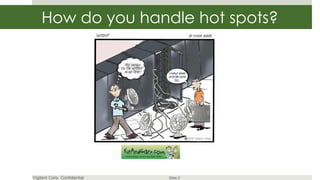
How do you handle hot spots?


Vigilent Corp. Confidential   Slide 2
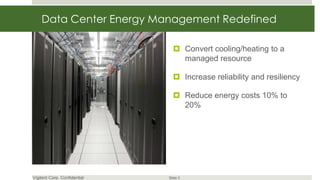
Data Center Energy Management Redefined

                                 Convert cooling/heating to a
                                  managed resource

                                 Increase reliability and resiliency

                                 Reduce energy costs 10% to
                                  20%


Vigilent Corp. Confidential   Slide 3
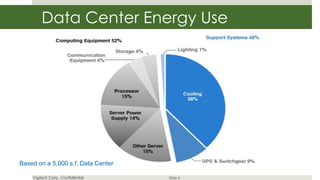
Data Center Energy Use


Based on a 5,000 s.f. Data Center

    Vigilent Corp. Confidential     Slide 4
History
 Founded in April 2004 by Dr. Clifford Federspiel

 Secured seed funding from State of California in November 2005

 First commercial deployment with Chevron Energy Solutions in
  March 2007

 First data center deployments in December 2008

 Changed our name from Federspiel Controls to Vigilent
  Corp, May 2011


Vigilent Corp. Confidential       Slide 5
Installations


Vigilent Corp. Confidential   Slide 6
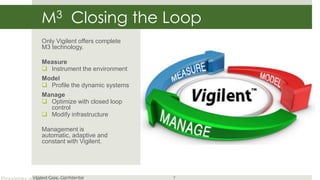
M3 Closing the Loop
    Only Vigilent offers complete
    M3 technology.

    Measure
     Instrument the environment
    Model
     Profile the dynamic systems
    Manage
     Optimize with closed loop
      control
     Modify infrastructure

    Management is
    automatic, adaptive and
    constant with Vigilent.


Vigilent Corp. Confidential         7
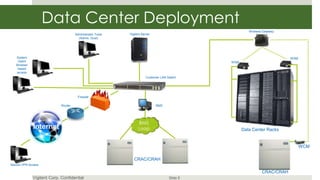
Data Center Deployment
                                                                                                       Wireless Gateway
                                     Administrator Tools   Vigilent Server
                                       (Admin, Dust)


   System                                                                                                                  WSM
    Users                                                                                     WSM
   Browser
    based
   access
                                                                      Customer LAN Switch


                                      Firewall

                            Router                                           BMS


             Internet                                                                               Data Center Racks


                                                                                                                                 WCM

                                                              CRAC/CRAH
Secure VPN Access

                                                                                                               CRAC/CRAH
             Vigilent Corp. Confidential                                            Slide 8
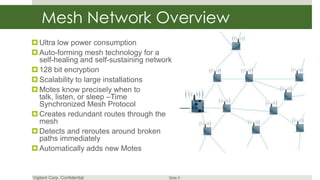
Mesh Network Overview
 Ultra low power consumption
 Auto-forming mesh technology for a
  self-healing and self-sustaining network
 128 bit encryption
 Scalability to large installations
 Motes know precisely when to
  talk, listen, or sleep –Time
  Synchronized Mesh Protocol
 Creates redundant routes through the
  mesh
 Detects and reroutes around broken
  paths immediately
 Automatically adds new Motes


Vigilent Corp. Confidential              Slide 9
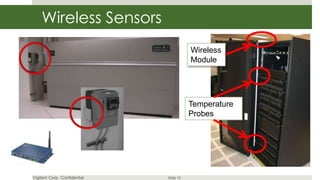
Wireless Sensors
                                         Wireless
                                         Module


                                         Temperature
                                         Probes


Vigilent Corp. Confidential   Slide 10
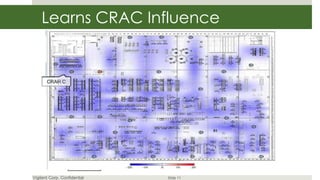
Learns CRAC Influence


Vigilent Corp. Confidential   Slide 11
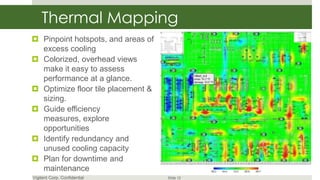
Thermal Mapping
 Pinpoint hotspots, and areas of
  excess cooling
 Colorized, overhead views
  make it easy to assess
  performance at a glance.
 Optimize floor tile placement &
  sizing.
 Guide efficiency
  measures, explore
  opportunities
 Identify redundancy and
  unused cooling capacity
 Plan for downtime and
  maintenance
Vigilent Corp. Confidential         Slide 12
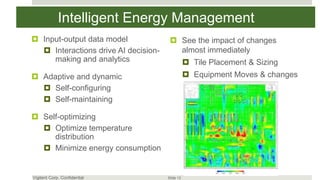
Intelligent Energy Management
 Input-output data model               See the impact of changes
   Interactions drive AI decision-      almost immediately
     making and analytics                         Tile Placement & Sizing
 Adaptive and dynamic                            Equipment Moves & changes
   Self-configuring
   Self-maintaining

 Self-optimizing
   Optimize temperature
     distribution
   Minimize energy consumption


Vigilent Corp. Confidential           Slide 13
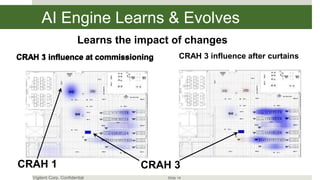
AI Engine Learns & Evolves
                          Learns the impact of changes
     1
CRAH 3 influence at commissioning               CRAH 3 influence after curtains


CRAH 1                               CRAH 3
   Vigilent Corp. Confidential            Slide 14
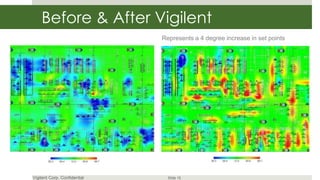
Before & After Vigilent
                              Represents a 4 degree increase in set points


Vigilent Corp. Confidential     Slide 15
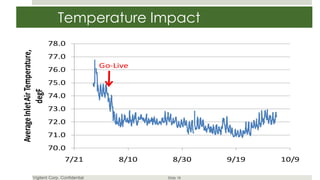
Temperature Impact
                                 78.0
 45% CRACs OFF on average
Average Inlet Air Temperature,

                                 77.0
              Go-Live
 How much does the temperature increase?
     76.0
                                 75.0
             degF


                                 74.0
                                 73.0
                                 72.0
                                 71.0
                                 70.0
                                    7/21   8/10      8/30    9/19   10/9

             Vigilent Corp. Confidential          Slide 16
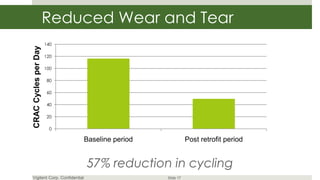
Reduced Wear and Tear
                      140
CRAC Cycles per Day

                      120

                      100

                       80

                       60

                       40

                       20

                        0

                              Baseline period              Post retrofit period


                              57% reduction in cycling
Vigilent Corp. Confidential                     Slide 17
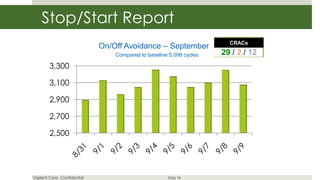
Stop/Start Report
                                                                        CRACs
                              On/Off Avoidance – September
                                  Compared to baseline 5,098 cycles   29 / 2 / 12
        3,300

        3,100

        2,900

        2,700

        2,500


Vigilent Corp. Confidential                           Slide 18
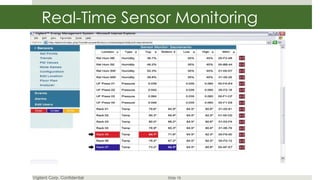
Real-Time Sensor Monitoring


Vigilent Corp. Confidential   Slide 19
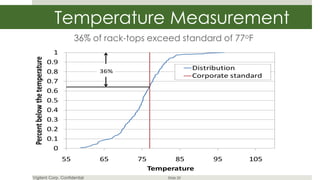
Temperature Measurement
                                            36% of rack-tops exceed standard of 77oF
                                   1
 Percent below the temperature

                                 0.9
                                                                              Distribution
                                 0.8             36%
                                                                              Corporate standard
                                 0.7
                                 0.6
                                 0.5
                                 0.4
                                 0.3
                                 0.2
                                 0.1
                                   0
                                       55        65       75         85            95       105
                                                               Temperature
Vigilent Corp. Confidential                                        Slide 20
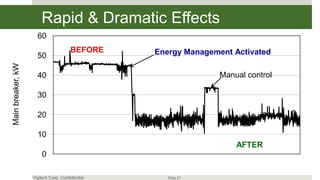
Rapid & Dramatic Effects
                     60
                                      BEFORE     Energy Management Activated
                     50
Main breaker, kW


                     40                                         Manual control

                     30

                     20

                     10
                                                                    AFTER
                       0

                   Vigilent Corp. Confidential      Slide 21
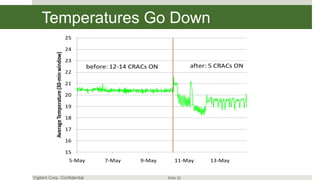
Temperatures Go Down
                                                  25

                                                  24
            Average Temperature (30-min window)   23
                                                           before: 12-14 CRACs ON              after: 5 CRACs ON
                                                  22

                                                  21

                                                  20

                                                  19

                                                  18

                                                  17

                                                  16

                                                  15
                                                   5-May        7-May      9-May        11-May       13-May


Vigilent Corp. Confidential                                                         Slide 22
Designed to Scale

 Easily accommodates major changes to square footage
      Mesh-based sensors can be added anywhere in facility, network
       automatically configures
      Easy to expand for more square footage

 Server infrastructure easily expands
      Additional servers can be incrementally added
      AI model is topology-independent


Vigilent Corp. Confidential           Slide 23
Robust
 Standard backup and archiving
     Configuration and trend data backed up weekly

 History-insensitive behavior
     System dynamically profiles environment and can function even after
      data loss

 Failsafe Protection
     System migrates to 100% cooling upon signal loss from manager or
      sensors
     Manual override capability


Vigilent Corp. Confidential           Slide 24
Security
 Administration
      Ubuntu Linux secure operating system
      Operates inside firewall
      Password-protected, MD5 web
       authentication

 Sensors
           802.15.4 secure protocol
           Authentication, 128-bit encryption
           Low-power, sleepy, frequency hopping
           Frequency hopping and path diversity


Vigilent Corp. Confidential              Slide 25
Vigilent
                               TM


     Intelligent Energy Management
                                    Jeff Hecht – Regional Sales Manager
                                     973.406.4695 jhecht@vigilent.com


 Vigilent Corp. Confidential                        Slide 26

Vigilent Jeffrey Hecht Presentation Deck

  • 1.
    Vigilent Intelligent Cooling Control& Management Comprehensive Solutions for Dynamic Energy Management in Data Centers Vigilent Corp. Confidential Slide 1
  • 2.
    How do youhandle hot spots? Vigilent Corp. Confidential Slide 2
  • 3.
    Data Center EnergyManagement Redefined  Convert cooling/heating to a managed resource  Increase reliability and resiliency  Reduce energy costs 10% to 20% Vigilent Corp. Confidential Slide 3
  • 4.
    Data Center EnergyUse Based on a 5,000 s.f. Data Center Vigilent Corp. Confidential Slide 4
  • 5.
    History  Founded inApril 2004 by Dr. Clifford Federspiel  Secured seed funding from State of California in November 2005  First commercial deployment with Chevron Energy Solutions in March 2007  First data center deployments in December 2008  Changed our name from Federspiel Controls to Vigilent Corp, May 2011 Vigilent Corp. Confidential Slide 5
  • 6.
  • 7.
    M3 Closing theLoop Only Vigilent offers complete M3 technology. Measure  Instrument the environment Model  Profile the dynamic systems Manage  Optimize with closed loop control  Modify infrastructure Management is automatic, adaptive and constant with Vigilent. Vigilent Corp. Confidential 7
  • 8.
    Data Center Deployment Wireless Gateway Administrator Tools Vigilent Server (Admin, Dust) System WSM Users WSM Browser based access Customer LAN Switch Firewall Router BMS Internet Data Center Racks WCM CRAC/CRAH Secure VPN Access CRAC/CRAH Vigilent Corp. Confidential Slide 8
  • 9.
    Mesh Network Overview Ultra low power consumption  Auto-forming mesh technology for a self-healing and self-sustaining network  128 bit encryption  Scalability to large installations  Motes know precisely when to talk, listen, or sleep –Time Synchronized Mesh Protocol  Creates redundant routes through the mesh  Detects and reroutes around broken paths immediately  Automatically adds new Motes Vigilent Corp. Confidential Slide 9
  • 10.
    Wireless Sensors Wireless Module Temperature Probes Vigilent Corp. Confidential Slide 10
  • 11.
    Learns CRAC Influence VigilentCorp. Confidential Slide 11
  • 12.
    Thermal Mapping  Pinpointhotspots, and areas of excess cooling  Colorized, overhead views make it easy to assess performance at a glance.  Optimize floor tile placement & sizing.  Guide efficiency measures, explore opportunities  Identify redundancy and unused cooling capacity  Plan for downtime and maintenance Vigilent Corp. Confidential Slide 12
  • 13.
    Intelligent Energy Management Input-output data model  See the impact of changes  Interactions drive AI decision- almost immediately making and analytics  Tile Placement & Sizing  Adaptive and dynamic  Equipment Moves & changes  Self-configuring  Self-maintaining  Self-optimizing  Optimize temperature distribution  Minimize energy consumption Vigilent Corp. Confidential Slide 13
  • 14.
    AI Engine Learns& Evolves Learns the impact of changes 1 CRAH 3 influence at commissioning CRAH 3 influence after curtains CRAH 1 CRAH 3 Vigilent Corp. Confidential Slide 14
  • 15.
    Before & AfterVigilent Represents a 4 degree increase in set points Vigilent Corp. Confidential Slide 15
  • 16.
    Temperature Impact 78.0  45% CRACs OFF on average Average Inlet Air Temperature, 77.0 Go-Live  How much does the temperature increase? 76.0 75.0 degF 74.0 73.0 72.0 71.0 70.0 7/21 8/10 8/30 9/19 10/9 Vigilent Corp. Confidential Slide 16
  • 17.
    Reduced Wear andTear 140 CRAC Cycles per Day 120 100 80 60 40 20 0 Baseline period Post retrofit period 57% reduction in cycling Vigilent Corp. Confidential Slide 17
  • 18.
    Stop/Start Report CRACs On/Off Avoidance – September Compared to baseline 5,098 cycles 29 / 2 / 12 3,300 3,100 2,900 2,700 2,500 Vigilent Corp. Confidential Slide 18
  • 19.
    Real-Time Sensor Monitoring VigilentCorp. Confidential Slide 19
  • 20.
    Temperature Measurement 36% of rack-tops exceed standard of 77oF 1 Percent below the temperature 0.9 Distribution 0.8 36% Corporate standard 0.7 0.6 0.5 0.4 0.3 0.2 0.1 0 55 65 75 85 95 105 Temperature Vigilent Corp. Confidential Slide 20
  • 21.
    Rapid & DramaticEffects 60 BEFORE Energy Management Activated 50 Main breaker, kW 40 Manual control 30 20 10 AFTER 0 Vigilent Corp. Confidential Slide 21
  • 22.
    Temperatures Go Down 25 24 Average Temperature (30-min window) 23 before: 12-14 CRACs ON after: 5 CRACs ON 22 21 20 19 18 17 16 15 5-May 7-May 9-May 11-May 13-May Vigilent Corp. Confidential Slide 22
  • 23.
    Designed to Scale Easily accommodates major changes to square footage  Mesh-based sensors can be added anywhere in facility, network automatically configures  Easy to expand for more square footage  Server infrastructure easily expands  Additional servers can be incrementally added  AI model is topology-independent Vigilent Corp. Confidential Slide 23
  • 24.
    Robust  Standard backupand archiving  Configuration and trend data backed up weekly  History-insensitive behavior  System dynamically profiles environment and can function even after data loss  Failsafe Protection  System migrates to 100% cooling upon signal loss from manager or sensors  Manual override capability Vigilent Corp. Confidential Slide 24
  • 25.
    Security  Administration  Ubuntu Linux secure operating system  Operates inside firewall  Password-protected, MD5 web authentication  Sensors  802.15.4 secure protocol  Authentication, 128-bit encryption  Low-power, sleepy, frequency hopping  Frequency hopping and path diversity Vigilent Corp. Confidential Slide 25
  • 26.
    Vigilent TM Intelligent Energy Management Jeff Hecht – Regional Sales Manager 973.406.4695 jhecht@vigilent.com Vigilent Corp. Confidential Slide 26

Editor's Notes

  • #4  At Vigilent, we believe it is insufficient to maintain the status quo. Cooling and heating resources need to be managed as are other important, mission-critical assets of a company. That’s why we’re reshaping how people think about handling these resources, providing tools to allow you to control your assets in a way not previously feasible. We believe that one of the most important contributions that Vigilent has made to energy management in buildings and data centers is to turn cooling and heating, for the first time, into a managed resource. To fully understand what this means, think of how phone service was treated only 20 years ago: As a necessary utility and cost center. Today, it is a managed resource that is a part of a firm’s broader communications infrastructure. What Vigilent can do for you is to enable you to treat cooling and heating resources in the same manner. This has important implications for your business. The reliability and resiliency of your cooling/heating plant can both be increased; we enable the equipment to run further below their operating margins, and less often, for example. We provide the tools that keep you in the driver’s seat, allowing you to explore alternatives and determine firsthand the impact of changes you might be considering. You will save on your energy costs – savings of as much as 50% in reduced energy for cooling is something you can reasonably target.
  • #6 MIT PhD control engineeringSW that turns un-managed mess of complex relationships into a modeled and optimized environment.CEC, PIER (Public Interest Energy Research), DoEStarted doing retrofits in Constant Air Volume buildingsDC focus – energy density greater-first ones end ‘08 Franchise Tax Board (15-20K), SilVly Labs (160K), Oracle (5K)Case studies by 3rd partiesPrivately held, angel funding, late stage/small invest from top tier VC, now self-funded since profitable, ------------------The company was founded in 2004 by Clifford Federspiel, PhD, and builds on his research. As you’ll learn, Dr. Federspiel’s software turns an un-managed mess of complex relationships into a modeled and optimized environment. He has a PhD from MIT focused on control engineering, then worked for Johnson Controls and UC Berkeley before founding the company.The company relied on grants from DoE, PIER, Calif. Energy Commission to fund early implementations. Case studies are available for some of these sites, written by independent third parties because the work was done as part of a government or other research project.In 2007, the firm introduced its first product for energy management in buildings, followed a year later in 2008 with a product for the data center market.The company has received angel and VC financing. We’re privately held.
  • #7  All of these sites have experienced significant savings in cooling costs.Many have reducedthe average temperature at their facilitiesNTT partnership. Act as control layer on top of their A/Cs (all DX). Expect to do 40-50 systems this year.------------Vigilenthas a strong reference base of showcase installations with ~ 60-70 sensor networks in place. These sites include commercial buildings and large data centers All of these sites have experienced significant savings in cooling costs. Many have reducedthe average temperature at their facilities As you can see our primary focus has been Fortune 100 in the US. We are also expanding into Asia, esp. Japan through a major partnership with NTT.
  • #8 3-fold mantra explains what we doTurns out doing all three,realtime, in a dynamic chaotic environment is really hard.Measure: wireless sensors placed at relevant locations (server inlet, CRAC/CRAH input/output)Model: data is input to AI engine that analyzes it, compares to historical data, profiles in real time, recommends changes to cooling plant. Manage: recommendations of AI engine automatically and constantly used to close the loop, controlling components of cooling plan. (what components can we control? ***)ALSO can be used for what-if modeling, simulating effect of changes, can be used by facilities mgmt to change physical infrastructure.----------------------------Three fold mantra explains what we do: measure what’s going on; model the system so you can understand influences and predict that if you do A, then B will happen; and take automatic steps to optimize the environment. Then measure what happened, learn from it, and repeat over time.Turns out that to do all three, in realtime in a dynamic chaotic environment is really hard. To achieve this goal, Vigilenthas pioneered the application of closed-loop control to energy management systems. It begins with measuring key attributes in the environment. Wireless sensors are placed at all relevant locations to measure server inlet and outlet air, CRAC input/output. The data collected from these nodes becomes a component of a sophisticated model. Advanced artificial intelligence software analyzes the data, compares to historical trends, and profiles the system in real time,recommending changes in device performance. The model makes use of more than just real-world data. It can also use data you input to do what-if modeling, simulating the effect of environmental/device changes. This allows behavior to be predicted and planned for. The recommendations of the AI engine are then automatically and constantly used to close the loop, controlling components of the cooling plant to respond in real-time, using industry-standard protocols. The recommendations can also be used by energy or facilities management to implement changes to the physical infrastructure.
  • #9 [DATA CENTER TRACK] Our systems are designed to be non-disruptive and transparent to an organization’s IT infrastructure. We tie into existing cooling systems using industry-standard protocols. All data is communicated from our wireless nodes and gateways using a facility’s existing network backbone. At the center of everything is our AI engine and control server, which runs on industry-standard hardware and is built around open standards. Administrators can be located anywhere within the facility, or behind the organization’s firewall, and not only monitor but also control the systems through simple web portals. In fact, administrators don’t even have to be on-site to get updates, our energy management systems can provide remote and mobile access through SMS links to mobile phones.
  • #11 Goal: Improve the efficiency of the data center while improving reliabilityWorked in colos before
  • #13  [DATA CENTER TRACK] Visualization tools make it easy to identify areas where excess heat or cooling is an issue. Overhead views of the entire facility, with temperature variances highlighted in color, allow instantaneous recognition of problem areas. Graphical results can be viewed as a movie, providing a time-based perspective on changes in temperature conditions throughout the facility.
  • #14  Let’s take a look at how the Vigilent energy management system works to manage the environment. The complexity of a data center or building requires a significant amount of (artificial) intelligence to address the real-time requirements of thousands of variables changing many times a second. Our approach is to develop a comprehensive data model of all system inputs and outputs – we treat the environment as its own ecosystem, as it were; the outputs of many, many sensors are used as inputs to a highly-sophisticated AI system that is capable of handling the decision making at a level that is out of reach of most people. The system is adaptive and dynamic, reconfiguring itself and its responses as its understanding of the feedback systems in the environment develop. Our technology goes in quickly because it is capable of automatically configuring, developing environmental stimulus-response profiles as it starts up, and then dynamically evolving as changes occur. Our technology is self-optimizing, not only reducing energy costs and throttling coolers, but optimizing temperature distribution across a topology, for an even temperature load which, counter-intuitively, can actually reduce temperatures while slowing fan speeds.
  • #15  A powerful artificial intelligence engine is at the core of out energy management system. When it is first installed, it perturbs the environment, measures the response, and develops a profile of cause-effect behavior. Let’s take a look at some before and after depictions. These charts are based on real data collected at one of our installations; they are not hypothetical, but rather, actual. The floor plan on the left is a CAD export of the data center layout. Our system allows you to import standard CAD drawings and then overlays real-time data on the graphics, making it easy to know where sensors are placed, and where thermal issues might arise. Before our system was activated – at the time it was “commissioned” and the original profile developed – you can see the effect of crosstalk. Two of the air handlers were fighting for control of some of the same real estate, with unnecessary temperature fluctuations. That suggested where curtains should be placed, to channel airflow and optimize cooling.[CLICK TO FADE IN GRAPHICS] With our system running, and the curtains in place, the chart on the right shows CRAH 3 has now been restricted to affect only a specific area and, as a result, cooling more effectively.
  • #20  [DATA CENTER TRACK] Data from a variety of sensor types can be monitored in a single, easy-to-comprehend interface Areas of concern are highlighted in appropriate colors, bringing immediate attention Data is stored in the systems internal database, which can be easily extracted to in-house systems
  • #22  When our energy management system is installed, the effects are almost immediate (graph period is 2 weeks). Here is a graph from an actual customer site that vividly shows how dramatically energy consumption can be reduced . A baseline was acquired for approximately a week; here, the average consumption during that time was around 45kW. Our system was installed, the software started, and within hours the consumption dropped to around 18kW. As a means of demonstrating how manual control can be used to override the system, you’ll see that for a brief period it was turned off, resulting in an approximately 75% increase in consumption. Then, when the system was reactivated, energy usage dropped again to its nominal level. The magnitude of decrease in energy consumption will, of course, vary from site to site, but typically we find reductions in the 15% to 25% range. What drives the energy savings is a reduction in both duty cycle for each fan, and a reduction in overall fan speed. Counter-intuitively, lower fan speeds can actually result in lower temperatures, when managed properly.
  • #24  Vigilentenergy management systems are designed to grow with your needs and deployment goals. Start small and expand, or grow over time. The system is insensitive to the square footage covered. The mesh-based sensors are easy to add, extending the network as far as needed; the network dynamically reconfigures itself to match configuration updates. This makes it easy to add more square footage under energy management, whether because a project is implemented in phases, or a facility grows in size. Additional servers can quickly be added to accommodate expansions. However, individual servers can handle thousands of nodes. The AI engine is independent of the network or physical configuration. It builds up a cause-and-effect map which doesn’t care about where nodes are located or how a building is laid out, but rather determines the input-output relationships of all network elements. This means that the Vigilent system you buy today can grow and adapt to your evolving needs.
  • #25  At Vigilent, we realize that our systems are at the core of our customers’ infrastructure. That they must run consistently and with resilience, and provide robust performance that can be relied on. That’s why we have designed every component of our system to take that into account; it’s an obligation we take very seriously. All of the configuration and trend data in each system is backed up weekly, independent of any other backups your network administrators may have implemented. However, the system’s fundamental performance doesn’t rely at all on this data, rather it constantly profiles its configuration and environment and can dynamically and quickly rebuild the databases needed. It also includes powerful failsafe protection for unforeseen instances. All coolers will be turned on to their maximum should there be a signal loss, and alert messages distributed; for some period of time there might be excessive energy usage, but there will not be an overtemperature situation. Each system can be manually overridden, for when an energy manager wants to control the system themselves.
  • #26  Security is an important part of every Vigilentsystem; again, we understand you are running your business on our equipment and rely on its secure and continuous performance. The system servers are built upon open source code which has been shaken down in the public domain; we chose Ubuntu Linux for many reasons, but security was a very important factor. The administration console can be accessed from a web browser, but is designed to be run only within inside the firewall; all communications through the portal are password protected, and utilize MD5 web authentication. All of the sensors are designed to run inside the firewall, and utilize authentication with 128-bit encryption. The sensors also are designed for a low-power environment, which means their signals cannot travel far; in addition, they utilize frequency hopping, which makes locking onto a signal hard and temporary.