Space Operations, Inc.
CRAIG RUSSELL – Founder
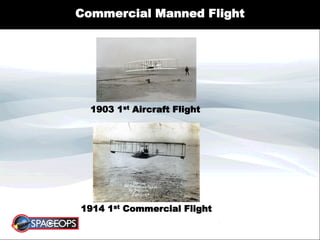
Commercial Manned Flight
1903 1st Aircraft Flight
1914 1st Commercial Flight
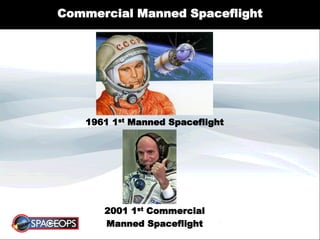
Commercial Manned Spaceflight
1961 1st Manned Spaceflight
2001 1st Commercial
Manned Spaceflight
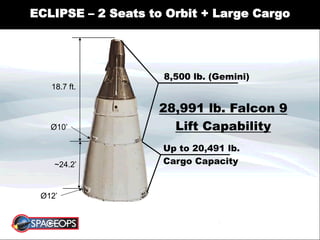
ECLIPSE – 2 Seats to Orbit + Large Cargo
8,500 lb. (Gemini)
Up to 20,491 lb.
Cargo Capacity
28,991 lb. Falcon 9
Lift CapabilityØ10’
Ø12’
18.7 ft.
~24.2’
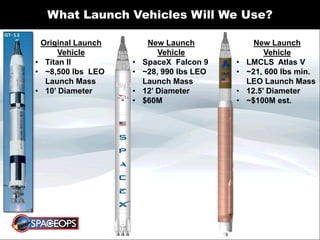
What Launch Vehicles Will We Use?
New Launch
Vehicle
• SpaceX Falcon 9
• ~28, 990 lbs LEO
Launch Mass
• 12’ Diameter
• $60M
Original Launch
Vehicle
• Titan II
• ~8,500 lbs LEO
Launch Mass
• 10’ Diameter
New Launch
Vehicle
• LMCLS Atlas V
• ~21, 600 lbs min.
LEO Launch Mass
• 12.5’ Diameter
• ~$100M est.
Business Overview
• 2 Seats to Orbit & 10,000 lbs + Cargo
• FAST – 15 Months to Launch
• Least Expensive Orbital Option
• 3 - 4 Year Monopoly Situation
• Multi-Mission Capability
• Reusable Spacecraft
Market Opportunity
• Satellite Servicing & Repair
• Space Tourism
• U.S. Gov’t (Commercial Space Act 1998)
• New Space Station Construction &
Resupply
• Satellite Deployment
• Orbital Debris De-orbit
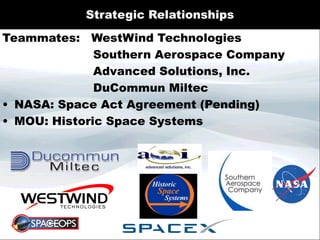
Strategic Relationships
Teammates: WestWind Technologies
Southern Aerospace Company
Advanced Solutions, Inc.
DuCommun Miltec
• NASA: Space Act Agreement (Pending)
• MOU: Historic Space Systems
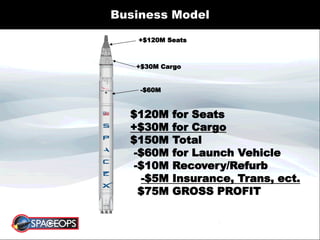
Business Model
+$120M Seats
+$30M Cargo
$120M for Seats
+$30M for Cargo
$150M Total
-$60M for Launch Vehicle
-$10M Recovery/Refurb
-$5M Insurance, Trans, ect.
$75M GROSS PROFIT
-$60M
Competition
• Sierra Nevada
• Blue Origin
• StratoLaunch
• Virgin Galactic
Competition Barriers to Entry
2 – 3 Years to copy and convert
Production Drawings
What Have We Accomplished So Far?
• CAD models of Gemini capsule structure
• Letter of intent with SpaceX for use of
Falcon9 launch vehicle
• NDA with Lockheed Martin Commercial
Launch Services (LMCLS)
• Multiple companies ready to execute work
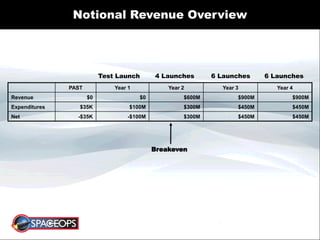
Notional Revenue Overview
PAST Year 1 Year 2 Year 3 Year 4
Revenue $0 $0 $600M $900M $900M
Expenditures $35K $100M $300M $450M $450M
Net -$35K -$100M $300M $450M $450M
Breakeven
4 Launches 6 Launches 6 LaunchesTest Launch
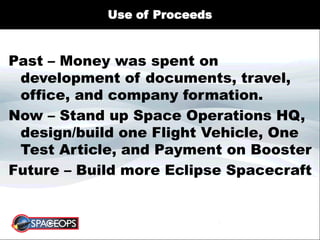
Use of Proceeds
Past – Money was spent on
development of documents, travel,
office, and company formation.
Now – Stand up Space Operations HQ,
design/build one Flight Vehicle, One
Test Article, and Payment on Booster
Future – Build more Eclipse Spacecraft
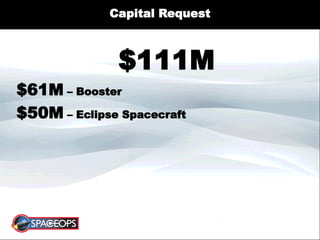
Capital Request
$111M
$61M – Booster
$50M – Eclipse Spacecraft
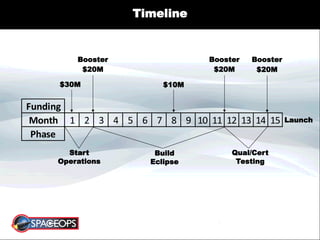
Timeline
Funding
Month 1 2 3 4 5 6 7 8 9 10 11 12 13 14 15
Phase
$30M
$20M $20M $20M
$10M
Booster Booster Booster
Start
Operations
Build
Eclipse
Qual/Cert
Testing
Launch
Space Operations, Inc.
Craig Russell - Founder
Office: 256-774-3096
Mobile: 256-653-7759
Email: bcrussell@spaceoperationsinc.com
URL: http://www.spaceoperationsinc.com/
BACKUP SLIDES
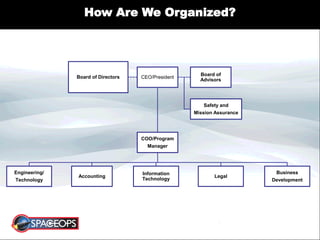
How Are We Organized?
Board of Directors CEO/President
COO/Program
Manager
Board of
Advisors
Safety and
Mission Assurance
Engineering/
Technology
Accounting
Information
Technology
Legal
Business
Development
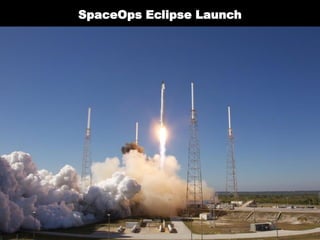
SpaceOps Eclipse Launch
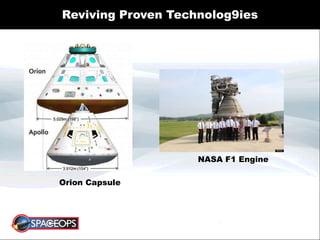
Reviving Proven Technolog9ies
NASA F1 Engine
Orion Capsule
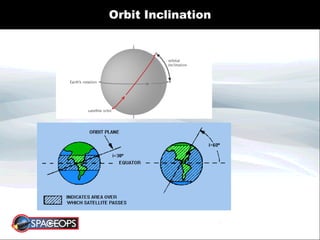
Orbit Inclination
Commercial Space Act of 1998
Public Law 105-303
An Act
To encourage the development of a commercial space industry in the United States, and for other purposes.
Oct. 28, 1998 - [H.R. 1702]
SEC. 101. COMMERCIALIZATION OF SPACE STATION.
(a) Policy.--The Congress declares that a priority goal of constructing the International Space Station is the economic
development of Earth orbital space. The Congress further declares that free and competitive markets create the most efficient
conditions for promoting economic development, and should therefore govern the economic development of Earth orbital
space. The Congress further declares that the use of free market principles in operating, servicing, allocating the use of, and
adding capabilities to the Space Station, and the resulting fullest possible engagement of commercial providers and
participation of commercial users, will reduce Space Station operational costs for all partners and the Federal Government's
share of the United States burden to fund operations.
SEC. 107. SOURCES OF EARTH SCIENCE DATA.
(a) Acquisition.--The Administrator shall, to the extent possible and while satisfying the scientific or educational requirements of
the National Aeronautics and Space Administration, and where appropriate, of other Federal agencies and scientific
researchers, acquire, where cost- effective, space-based and airborne Earth remote sensing data, services, distribution, and
applications from a commercial provider.
TITLE II--FEDERAL ACQUISITION OF SPACE TRANSPORTATION SERVICES
(a) In General.--Except as otherwise provided in this section, the Federal Government shall acquire space transportation
services from United States commercial providers whenever such services are required in the course of its activities. To the
maximum extent practicable, the Federal Government shall plan missions to accommodate the space transportation services
capabilities of United States commercial providers.
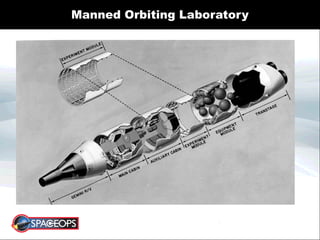
Manned Orbiting Laboratory
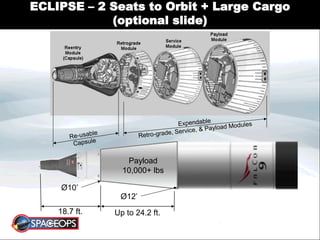
ECLIPSE – 2 Seats to Orbit + Large Cargo
(optional slide)
Payload
10,000+ lbs
18.7 ft. Up to 24.2 ft.
Ø10’
Ø12’
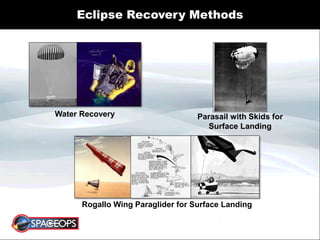
Eclipse Recovery Methods
Water Recovery
Rogallo Wing Paraglider for Surface Landing
Parasail with Skids for
Surface Landing
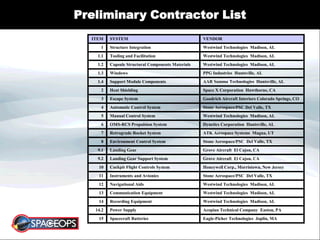
ITEM SYSTEM VENDOR
1 Structure Integration Westwind Technologies Madison, AL
1.1 Tooling and Facilitation Westwind Technologies Madison, AL
1.2 Capsule Structural Components Materials Westwind Technologies Madison, AL
1.3 Windows PPG Industries Huntsville, AL
1.4 Support Module Components AAR Summa Technologies Huntsville, AL
2 Heat Shielding Space X Corporation Hawthorne, CA
3 Escape System Goodrich Aircraft Interiors Colorado Springs, CO
4 Automatic Control System Stone Aerospace/PSC Del Valle, TX
5 Manual Control System Westwind Technologies Madison, AL
6 OMS-RCS Propulsion System Dynetics Corporation Huntsville, AL
7 Retrograde Rocket System ATK Aerospace Systems Magna, UT
8 Environment Control System Stone Aerospace/PSC Del Valle, TX
9.1 Landing Gear Grove Aircraft El Cajon, CA
9.2 Landing Gear Support System Grove Aircraft El Cajon, CA
10 Cockpit Flight Controls System Honeywell Corp., Morristown, New Jersey
11 Instruments and Avionics Stone Aerospace/PSC Del Valle, TX
12 Navigational Aids Westwind Technologies Madison, AL
13 Communication Equipment Westwind Technologies Madison, AL
14 Recording Equipment Westwind Technologies Madison, AL
14.2 Power Supply Acopian Technical Company Easton, PA
15 Spacecraft Batteries Eagle-Picher Technologies Joplin, MA
Preliminary Contractor List
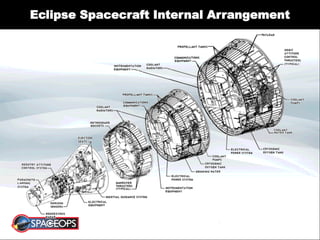
Eclipse Spacecraft Internal Arrangement
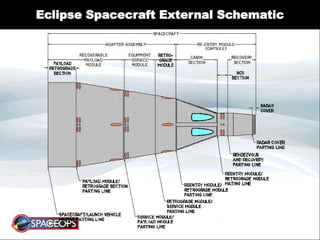
Eclipse Spacecraft External Schematic
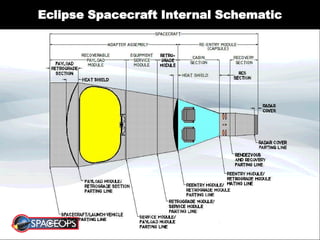
Eclipse Spacecraft Internal Schematic
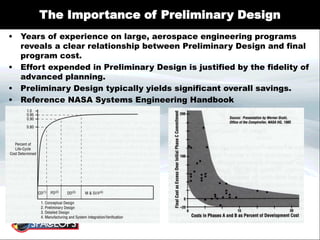
The Importance of Preliminary Design
• Years of experience on large, aerospace engineering programs
reveals a clear relationship between Preliminary Design and final
program cost.
• Effort expended in Preliminary Design is justified by the fidelity of
advanced planning.
• Preliminary Design typically yields significant overall savings.
• Reference NASA Systems Engineering Handbook
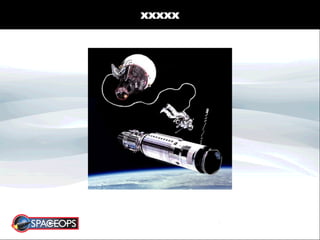
xxxxx
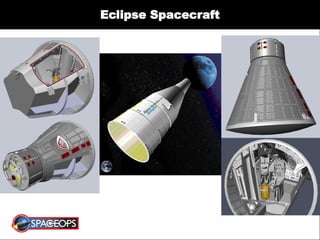
Eclipse Spacecraft
The Eclipse
SpaceOps Advisors
• Gordon Woodcock
• William Peters
• Ed Kiker
• Herb Guendel
• Frank Arena
• Gert Schmitz
• Ed Keith
• Manfred Segewitz
• Dan Weiss
• Dr. John Bossard
Vision & Mission Statement
• Vision - To provide a manned launch
capability, based in the U.S., at the earliest
possible time.
• Mission - To develop, build, operate, and
maintain safe, reliable, competitively
priced, man-rated spacecraft.

Investor space ops-presentation_2_dec2017

  • 1.
    Space Operations, Inc. CRAIGRUSSELL – Founder
  • 2.
    Commercial Manned Flight 19031st Aircraft Flight 1914 1st Commercial Flight
  • 3.
    Commercial Manned Spaceflight 19611st Manned Spaceflight 2001 1st Commercial Manned Spaceflight
  • 4.
    ECLIPSE – 2Seats to Orbit + Large Cargo 8,500 lb. (Gemini) Up to 20,491 lb. Cargo Capacity 28,991 lb. Falcon 9 Lift CapabilityØ10’ Ø12’ 18.7 ft. ~24.2’
  • 5.
    What Launch VehiclesWill We Use? New Launch Vehicle • SpaceX Falcon 9 • ~28, 990 lbs LEO Launch Mass • 12’ Diameter • $60M Original Launch Vehicle • Titan II • ~8,500 lbs LEO Launch Mass • 10’ Diameter New Launch Vehicle • LMCLS Atlas V • ~21, 600 lbs min. LEO Launch Mass • 12.5’ Diameter • ~$100M est.
  • 6.
    Business Overview • 2Seats to Orbit & 10,000 lbs + Cargo • FAST – 15 Months to Launch • Least Expensive Orbital Option • 3 - 4 Year Monopoly Situation • Multi-Mission Capability • Reusable Spacecraft
  • 7.
    Market Opportunity • SatelliteServicing & Repair • Space Tourism • U.S. Gov’t (Commercial Space Act 1998) • New Space Station Construction & Resupply • Satellite Deployment • Orbital Debris De-orbit
  • 8.
    Strategic Relationships Teammates: WestWindTechnologies Southern Aerospace Company Advanced Solutions, Inc. DuCommun Miltec • NASA: Space Act Agreement (Pending) • MOU: Historic Space Systems
  • 9.
    Business Model +$120M Seats +$30MCargo $120M for Seats +$30M for Cargo $150M Total -$60M for Launch Vehicle -$10M Recovery/Refurb -$5M Insurance, Trans, ect. $75M GROSS PROFIT -$60M
  • 10.
    Competition • Sierra Nevada •Blue Origin • StratoLaunch • Virgin Galactic
  • 11.
    Competition Barriers toEntry 2 – 3 Years to copy and convert Production Drawings
  • 12.
    What Have WeAccomplished So Far? • CAD models of Gemini capsule structure • Letter of intent with SpaceX for use of Falcon9 launch vehicle • NDA with Lockheed Martin Commercial Launch Services (LMCLS) • Multiple companies ready to execute work
  • 13.
    Notional Revenue Overview PASTYear 1 Year 2 Year 3 Year 4 Revenue $0 $0 $600M $900M $900M Expenditures $35K $100M $300M $450M $450M Net -$35K -$100M $300M $450M $450M Breakeven 4 Launches 6 Launches 6 LaunchesTest Launch
  • 14.
    Use of Proceeds Past– Money was spent on development of documents, travel, office, and company formation. Now – Stand up Space Operations HQ, design/build one Flight Vehicle, One Test Article, and Payment on Booster Future – Build more Eclipse Spacecraft
  • 15.
    Capital Request $111M $61M –Booster $50M – Eclipse Spacecraft
  • 16.
    Timeline Funding Month 1 23 4 5 6 7 8 9 10 11 12 13 14 15 Phase $30M $20M $20M $20M $10M Booster Booster Booster Start Operations Build Eclipse Qual/Cert Testing Launch
  • 17.
    Space Operations, Inc. CraigRussell - Founder Office: 256-774-3096 Mobile: 256-653-7759 Email: bcrussell@spaceoperationsinc.com URL: http://www.spaceoperationsinc.com/
  • 18.
  • 19.
    How Are WeOrganized? Board of Directors CEO/President COO/Program Manager Board of Advisors Safety and Mission Assurance Engineering/ Technology Accounting Information Technology Legal Business Development
  • 20.
  • 21.
    Reviving Proven Technolog9ies NASAF1 Engine Orion Capsule
  • 22.
  • 23.
    Commercial Space Actof 1998 Public Law 105-303 An Act To encourage the development of a commercial space industry in the United States, and for other purposes. Oct. 28, 1998 - [H.R. 1702] SEC. 101. COMMERCIALIZATION OF SPACE STATION. (a) Policy.--The Congress declares that a priority goal of constructing the International Space Station is the economic development of Earth orbital space. The Congress further declares that free and competitive markets create the most efficient conditions for promoting economic development, and should therefore govern the economic development of Earth orbital space. The Congress further declares that the use of free market principles in operating, servicing, allocating the use of, and adding capabilities to the Space Station, and the resulting fullest possible engagement of commercial providers and participation of commercial users, will reduce Space Station operational costs for all partners and the Federal Government's share of the United States burden to fund operations. SEC. 107. SOURCES OF EARTH SCIENCE DATA. (a) Acquisition.--The Administrator shall, to the extent possible and while satisfying the scientific or educational requirements of the National Aeronautics and Space Administration, and where appropriate, of other Federal agencies and scientific researchers, acquire, where cost- effective, space-based and airborne Earth remote sensing data, services, distribution, and applications from a commercial provider. TITLE II--FEDERAL ACQUISITION OF SPACE TRANSPORTATION SERVICES (a) In General.--Except as otherwise provided in this section, the Federal Government shall acquire space transportation services from United States commercial providers whenever such services are required in the course of its activities. To the maximum extent practicable, the Federal Government shall plan missions to accommodate the space transportation services capabilities of United States commercial providers.
  • 24.
  • 25.
    ECLIPSE – 2Seats to Orbit + Large Cargo (optional slide) Payload 10,000+ lbs 18.7 ft. Up to 24.2 ft. Ø10’ Ø12’
  • 26.
    Eclipse Recovery Methods WaterRecovery Rogallo Wing Paraglider for Surface Landing Parasail with Skids for Surface Landing
  • 27.
    ITEM SYSTEM VENDOR 1Structure Integration Westwind Technologies Madison, AL 1.1 Tooling and Facilitation Westwind Technologies Madison, AL 1.2 Capsule Structural Components Materials Westwind Technologies Madison, AL 1.3 Windows PPG Industries Huntsville, AL 1.4 Support Module Components AAR Summa Technologies Huntsville, AL 2 Heat Shielding Space X Corporation Hawthorne, CA 3 Escape System Goodrich Aircraft Interiors Colorado Springs, CO 4 Automatic Control System Stone Aerospace/PSC Del Valle, TX 5 Manual Control System Westwind Technologies Madison, AL 6 OMS-RCS Propulsion System Dynetics Corporation Huntsville, AL 7 Retrograde Rocket System ATK Aerospace Systems Magna, UT 8 Environment Control System Stone Aerospace/PSC Del Valle, TX 9.1 Landing Gear Grove Aircraft El Cajon, CA 9.2 Landing Gear Support System Grove Aircraft El Cajon, CA 10 Cockpit Flight Controls System Honeywell Corp., Morristown, New Jersey 11 Instruments and Avionics Stone Aerospace/PSC Del Valle, TX 12 Navigational Aids Westwind Technologies Madison, AL 13 Communication Equipment Westwind Technologies Madison, AL 14 Recording Equipment Westwind Technologies Madison, AL 14.2 Power Supply Acopian Technical Company Easton, PA 15 Spacecraft Batteries Eagle-Picher Technologies Joplin, MA Preliminary Contractor List
  • 28.
  • 29.
  • 30.
  • 31.
    The Importance ofPreliminary Design • Years of experience on large, aerospace engineering programs reveals a clear relationship between Preliminary Design and final program cost. • Effort expended in Preliminary Design is justified by the fidelity of advanced planning. • Preliminary Design typically yields significant overall savings. • Reference NASA Systems Engineering Handbook
  • 32.
  • 33.
  • 34.
    SpaceOps Advisors • GordonWoodcock • William Peters • Ed Kiker • Herb Guendel • Frank Arena • Gert Schmitz • Ed Keith • Manfred Segewitz • Dan Weiss • Dr. John Bossard
  • 35.
    Vision & MissionStatement • Vision - To provide a manned launch capability, based in the U.S., at the earliest possible time. • Mission - To develop, build, operate, and maintain safe, reliable, competitively priced, man-rated spacecraft.