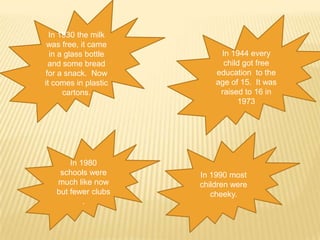
In 1930 the milk
 was free, it came
  in a glass bottle        In 1944 every
 and some bread             child got free
for a snack. Now          education to the
it comes in plastic       age of 15. It was
      cartons.             raised to 16 in
                                1973


       In 1980
    schools were      In 1990 most
   much like now      children were
   but fewer clubs       cheeky.
           .
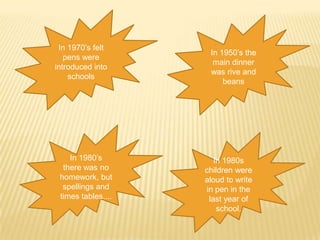
In 1970’s felt
                     In 1950’s the
   pens were
                      main dinner
introduced into
                     was rive and
    schools
                         beans


    In 1980’s          In 1980s
  there was no      children were
 homework, but      aloud to write
  spellings and     in pen in the
 times tables....    last year of
                        school.
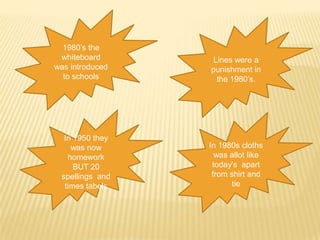
1980’s the
 whiteboard      Lines were a
was introduced   punishment in
  to schools      the 1980’s.


  In 1950 they
    was now      In 1980s cloths
   homework        was allot like
     BUT 20       today's apart
 spellings and    from shirt and
  times tabels          tie
I asked my Gran (62) about school when she was a child.

School was from 9 am to 4pm. Detention was from 4pm to 4.30pm a
cane across the palm of your hand a slipper across your bum. They
used a straight
Pen with ,bottle of ink are a fountain pen. Books were Janet and john (
biff and kipper). We had 20 spellings a week and table tests. If we got
them wrong we would be called dunce and told to stand in the corner.
I had to have learnt my tables by the age of nine.
When I first started school in 1952, we used chalk and small black
boards. We weren’t allowed paper until we were older, we had queue
for a tea spoon of cold liver oil every day . Small children had to rest
after dinner. We lay on small camp beds
Classrooms were colder, windows were higher so you could look out.

Each child had a desk with a lid . Inside they kept books and fountain pen
and bottle of ink.
On the desk lid there was an ink well and a groove for the pen. Desks
were sloped to help writing.

teachers were strict and the punishment was common including cane,
detention, dunce cap, harness and had to Wright

The teacher tort all subjects including singing ,PE and pottery.

Most of the UK punishment was hash but USA was hasher.

In war times they had a radio to listening for import news.

In 1990 they had to share a computer.
The dentists who'd come and the optician to check up the children.
In 1970s the main food was breed, cereal and sausages.
.
1944 Butler's Education Act creates the "tripartite", hierarchical system of
grammar, technical and secondary modern schools.
Selection is decided by an exam taken at the age of 11. Meanwhile, the school
leaving age is raised to 15.
1951 General Certificate of Education (GCE) O-levels and A-levels are
introduced, replacing the School Certificate and the Higher School Certificate.
1964 Harold Wilson's newly-elected Labour government promises to set up
comprehensive schools, combining pupils of all ability levels.
1973 School leaving age raised to 16.
1988
The National Curriculum, stipulating subjects to be studied until the age of 16,
is also introduced.
1995 The government introduces National Curriculum Tests, often called Sats,
for all children aged seven, 11 and 14 ( tests for seven year olds were first
tried in 1991).
1997 The National Literacy Strategy, aimed at raising standards to those of the
UK's main competitors, is introduced for primary schools in England.
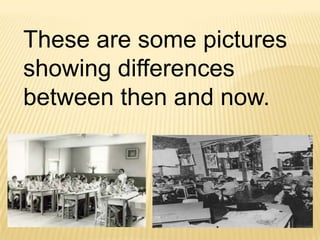
These are some pictures
showing differences
between then and now.
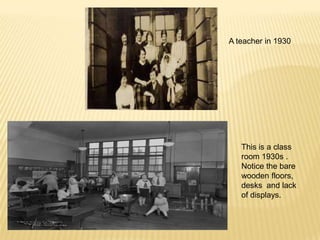
A teacher in 1930


   This is a class
   room 1930s .
   Notice the bare
   wooden floors,
   desks and lack
   of displays.
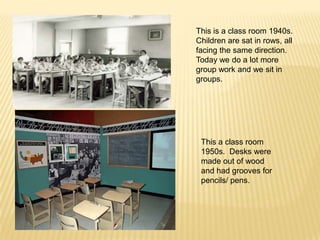
This is a class room 1940s.
Children are sat in rows, all
facing the same direction.
Today we do a lot more
group work and we sit in
groups.


 This a class room
 1950s. Desks were
 made out of wood
 and had grooves for
 pencils/ pens.
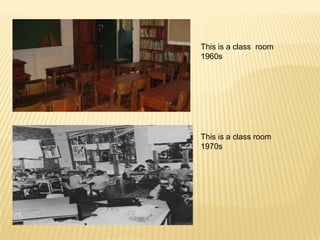
This is a class room
1960s


This is a class room
1970s
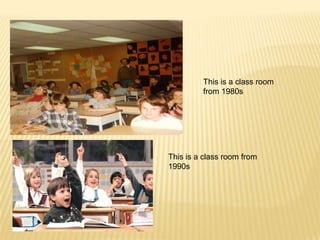
This is a class room
         from 1980s


This is a class room from
1990s
This class room 2000.
Technology including
laptops, Interactive
Whiteboards are
introduced along with the
Internet.

Today – wireless
technology, I Pads, I
pods are becoming
popular. A focus on skills
and independent
learning.
Where will education be
in the future
1940sA
teacher             A
                    teache
                    r
                    1960s


A                    A
teacher              teacher
1950s                1970s


          A teacher 1980s
A Teacher
    A teacher 1990s
                             1930


                       A
   A uniforms          uniforms
   1930s               1940s


                      A uniforms
                      1960s
A
uniforms
1950
A                   A
   uniforms            uniforms
   1970                1980s


                         A
                         uniforms
                         2000
A uniforms
1990s


              A cane                A ruler
                                    1930s
Thank you for watching


  BY JOSHUA.S

Joshuasing

  • 2.
    In 1930 themilk was free, it came in a glass bottle In 1944 every and some bread child got free for a snack. Now education to the it comes in plastic age of 15. It was cartons. raised to 16 in 1973 In 1980 schools were In 1990 most much like now children were but fewer clubs cheeky. .
  • 3.
    In 1970’s felt In 1950’s the pens were main dinner introduced into was rive and schools beans In 1980’s In 1980s there was no children were homework, but aloud to write spellings and in pen in the times tables.... last year of school.
  • 4.
    1980’s the whiteboard Lines were a was introduced punishment in to schools the 1980’s. In 1950 they was now In 1980s cloths homework was allot like BUT 20 today's apart spellings and from shirt and times tabels tie
  • 5.
    I asked myGran (62) about school when she was a child. School was from 9 am to 4pm. Detention was from 4pm to 4.30pm a cane across the palm of your hand a slipper across your bum. They used a straight Pen with ,bottle of ink are a fountain pen. Books were Janet and john ( biff and kipper). We had 20 spellings a week and table tests. If we got them wrong we would be called dunce and told to stand in the corner. I had to have learnt my tables by the age of nine. When I first started school in 1952, we used chalk and small black boards. We weren’t allowed paper until we were older, we had queue for a tea spoon of cold liver oil every day . Small children had to rest after dinner. We lay on small camp beds
  • 6.
    Classrooms were colder,windows were higher so you could look out. Each child had a desk with a lid . Inside they kept books and fountain pen and bottle of ink. On the desk lid there was an ink well and a groove for the pen. Desks were sloped to help writing. teachers were strict and the punishment was common including cane, detention, dunce cap, harness and had to Wright The teacher tort all subjects including singing ,PE and pottery. Most of the UK punishment was hash but USA was hasher. In war times they had a radio to listening for import news. In 1990 they had to share a computer. The dentists who'd come and the optician to check up the children. In 1970s the main food was breed, cereal and sausages.
  • 7.
    . 1944 Butler's EducationAct creates the "tripartite", hierarchical system of grammar, technical and secondary modern schools. Selection is decided by an exam taken at the age of 11. Meanwhile, the school leaving age is raised to 15. 1951 General Certificate of Education (GCE) O-levels and A-levels are introduced, replacing the School Certificate and the Higher School Certificate. 1964 Harold Wilson's newly-elected Labour government promises to set up comprehensive schools, combining pupils of all ability levels. 1973 School leaving age raised to 16. 1988 The National Curriculum, stipulating subjects to be studied until the age of 16, is also introduced. 1995 The government introduces National Curriculum Tests, often called Sats, for all children aged seven, 11 and 14 ( tests for seven year olds were first tried in 1991). 1997 The National Literacy Strategy, aimed at raising standards to those of the UK's main competitors, is introduced for primary schools in England.
  • 8.
    These are somepictures showing differences between then and now.
  • 9.
    A teacher in1930 This is a class room 1930s . Notice the bare wooden floors, desks and lack of displays.
  • 10.
    This is aclass room 1940s. Children are sat in rows, all facing the same direction. Today we do a lot more group work and we sit in groups. This a class room 1950s. Desks were made out of wood and had grooves for pencils/ pens.
  • 11.
    This is aclass room 1960s This is a class room 1970s
  • 12.
    This is aclass room from 1980s This is a class room from 1990s
  • 13.
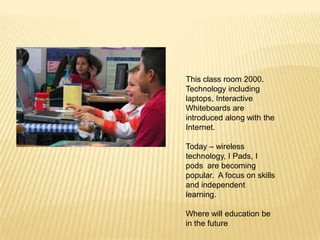
    This class room2000. Technology including laptops, Interactive Whiteboards are introduced along with the Internet. Today – wireless technology, I Pads, I pods are becoming popular. A focus on skills and independent learning. Where will education be in the future
  • 14.
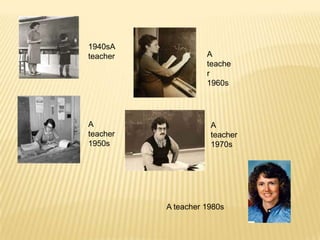
    1940sA teacher A teache r 1960s A A teacher teacher 1950s 1970s A teacher 1980s
  • 15.
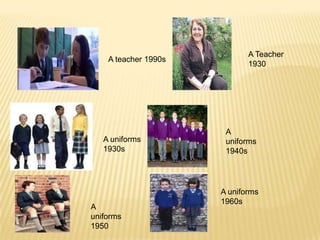
    A Teacher A teacher 1990s 1930 A A uniforms uniforms 1930s 1940s A uniforms 1960s A uniforms 1950
  • 16.
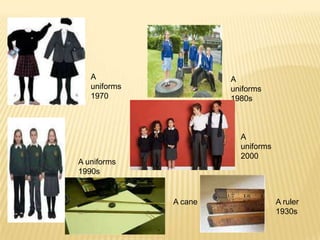
    A A uniforms uniforms 1970 1980s A uniforms 2000 A uniforms 1990s A cane A ruler 1930s
  • 17.
    Thank you forwatching BY JOSHUA.S