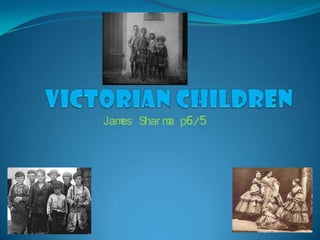
Jam Shar m p6/5
   es     a
Poor Children
 There was no money for toys, nowhere to play
    except alleys and yards.
   Many poor children lived in tiny country cottages or
    city slums.
   If they had any toys they would be ragdolls or cheap
    penny toys.
   Children had to work for little or no money.
   Most family's couldn’t afford to take their kids to
    school.
Rich Children
 In victorian times you were either a rich child or a
  poor child.
 Their toys would be toy soldiers or maybe a train set.
 They would go away to a good boarding school or
  would be tutored by a governor at home.
The child workhouse
 The workhouse was a place where orphans and
    disabled children went.
   They would get food and a bed in return for work like
    picking oakum.
   The children who were born in the workhouse often
    stayed in the workhouse.
   You had to get up at 7am and work till 4pm and bed
    by 8pm every day.
   The punishment for not obeying the rules was
    nothing but bread and water for 2 days.
Victorian schools
 Only richer families could afford to pay the school
  fees, though some schools gave free places to poor
  boys.
 Poor girls did not go to school when the Victorian
  age began meaning they had little education.
 Sometimes, wealthy girls may have attended
  boarding schools.
 Ragged Schools were schools for poor children. One
  of the first was started in Portsmouth.
Chimney sweeps
 The children were frequently underfed so that they would
  remain small enough for the work.
 The work was extremely dangerous, severe burns, falls
  and lung disease killed many of the children.
 Children were not necessary, the job could be done,
  more safely, just a well, by using brushes.
 Children as young as 3 were used for the job. - They
  "outgrew" the job around 9 or 10.
New laws for schools
 Reformers campaigned for new laws to improve
  working conditions for children and give children the
  opportunity for schooling.
 In 1870 Parliament said there had to be a school in
  every town and village.
 In the 1860s a farmer might pay 6 pence (6d) a week
  for each child.
 By 1880, the law said that all children aged 5 to 10
  must go to primary school, so every child would
  receive at least a basic education.
Comparison!
Rich children                   Poor children
 they would always go to the    If they did not work
  top schools whatever the        properly , they would not
  price.                          eat dinner!
 They would get everything
                                 There was no fun it was
                                  all work
  they wanted.
                                 They would be lucky if
 They were fed proper            they would live to 40
  nutritious food.               Their houses were literally
 And they would get big          shaks!
  houses and lots of helpers.


                Verdict: rich children win!
I hope you liked it!

Victorian children james

  • 1.
    Jam Shar mp6/5 es a
  • 2.
    Poor Children  Therewas no money for toys, nowhere to play except alleys and yards.  Many poor children lived in tiny country cottages or city slums.  If they had any toys they would be ragdolls or cheap penny toys.  Children had to work for little or no money.  Most family's couldn’t afford to take their kids to school.
  • 3.
    Rich Children  Invictorian times you were either a rich child or a poor child.  Their toys would be toy soldiers or maybe a train set.  They would go away to a good boarding school or would be tutored by a governor at home.
  • 4.
    The child workhouse The workhouse was a place where orphans and disabled children went.  They would get food and a bed in return for work like picking oakum.  The children who were born in the workhouse often stayed in the workhouse.  You had to get up at 7am and work till 4pm and bed by 8pm every day.  The punishment for not obeying the rules was nothing but bread and water for 2 days.
  • 5.
    Victorian schools  Onlyricher families could afford to pay the school fees, though some schools gave free places to poor boys.  Poor girls did not go to school when the Victorian age began meaning they had little education.  Sometimes, wealthy girls may have attended boarding schools.  Ragged Schools were schools for poor children. One of the first was started in Portsmouth.
  • 6.
    Chimney sweeps  Thechildren were frequently underfed so that they would remain small enough for the work.  The work was extremely dangerous, severe burns, falls and lung disease killed many of the children.  Children were not necessary, the job could be done, more safely, just a well, by using brushes.  Children as young as 3 were used for the job. - They "outgrew" the job around 9 or 10.
  • 7.
    New laws forschools  Reformers campaigned for new laws to improve working conditions for children and give children the opportunity for schooling.  In 1870 Parliament said there had to be a school in every town and village.  In the 1860s a farmer might pay 6 pence (6d) a week for each child.  By 1880, the law said that all children aged 5 to 10 must go to primary school, so every child would receive at least a basic education.
  • 8.
    Comparison! Rich children Poor children  they would always go to the  If they did not work top schools whatever the properly , they would not price. eat dinner!  They would get everything  There was no fun it was all work they wanted.  They would be lucky if  They were fed proper they would live to 40 nutritious food.  Their houses were literally  And they would get big shaks! houses and lots of helpers. Verdict: rich children win!
  • 9.
    I hope youliked it!