Game
Programmer
Profiles
Walid Sassi
2016
1
Programmers
• Programmers use different types of coding
languages.
• Each language has different capabilities, and they
choose the language that best suits their needs.
• The type of language is determined by the type of
platforms(computers, consoles, or mobile
devices) on which the game will be released.
• Creating a full-featured video game requires
many different types of programmers.
2
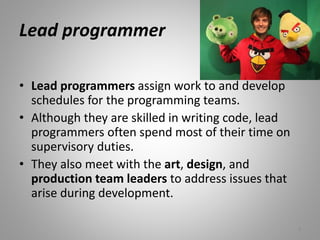
Lead programmer
• Lead programmers assign work to and develop
schedules for the programming teams.
• Although they are skilled in writing code, lead
programmers often spend most of their time on
supervisory duties.
• They also meet with the art, design, and
production team leaders to address issues that
arise during development.
3
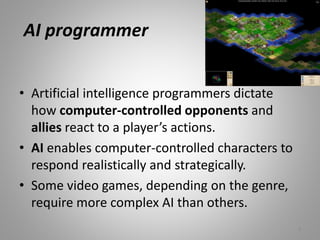
AI programmer
• Artificial intelligence programmers dictate
how computer-controlled opponents and
allies react to a player’s actions.
• AI enables computer-controlled characters to
respond realistically and strategically.
• Some video games, depending on the genre,
require more complex AI than others.
4
Graphics programmer
• Graphics programmers create tools that allow
artists to bring their work to the screen.
• Using their knowledge of advanced
mathematics, they implement complex
algorithms to produce 2D and 3D graphics.
• They also work closely with artists to
determine the best way to incorporate artwork
into a game.
5
Network programmer
• Many video games are played online, allowing
players across the globe to compete against or
cooperate with one another.
• Network programmers write the code that
enables this online play.
• They also develop security measures to
prevent players from cheating.
6
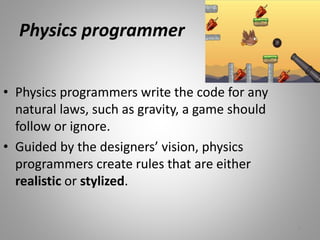
Physics programmer
• Physics programmers write the code for any
natural laws, such as gravity, a game should
follow or ignore.
• Guided by the designers’ vision, physics
programmers create rules that are either
realistic or stylized.
7
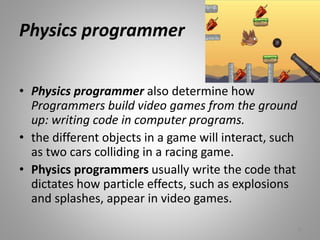
Physics programmer
• Physics programmer also determine how
Programmers build video games from the ground
up: writing code in computer programs.
• the different objects in a game will interact, such
as two cars colliding in a racing game.
• Physics programmers usually write the code that
dictates how particle effects, such as explosions
and splashes, appear in video games.
8
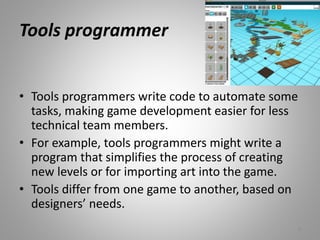
Tools programmer
• Tools programmers write code to automate some
tasks, making game development easier for less
technical team members.
• For example, tools programmers might write a
program that simplifies the process of creating
new levels or for importing art into the game.
• Tools differ from one game to another, based on
designers’ needs.
9
User interface
programmer
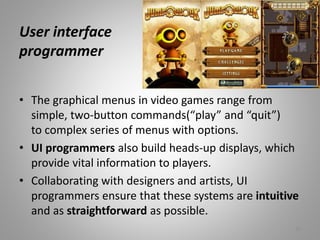
• The graphical menus in video games range from
simple, two-button commands(“play” and “quit”)
to complex series of menus with options.
• UI programmers also build heads-up displays, which
provide vital information to players.
• Collaborating with designers and artists, UI
programmers ensure that these systems are intuitive
and as straightforward as possible.
10
the next Presentation is coming 
11

+Vg programmer

  • 1.
  • 2.
    Programmers • Programmers usedifferent types of coding languages. • Each language has different capabilities, and they choose the language that best suits their needs. • The type of language is determined by the type of platforms(computers, consoles, or mobile devices) on which the game will be released. • Creating a full-featured video game requires many different types of programmers. 2
  • 3.
    Lead programmer • Leadprogrammers assign work to and develop schedules for the programming teams. • Although they are skilled in writing code, lead programmers often spend most of their time on supervisory duties. • They also meet with the art, design, and production team leaders to address issues that arise during development. 3
  • 4.
    AI programmer • Artificialintelligence programmers dictate how computer-controlled opponents and allies react to a player’s actions. • AI enables computer-controlled characters to respond realistically and strategically. • Some video games, depending on the genre, require more complex AI than others. 4
  • 5.
    Graphics programmer • Graphicsprogrammers create tools that allow artists to bring their work to the screen. • Using their knowledge of advanced mathematics, they implement complex algorithms to produce 2D and 3D graphics. • They also work closely with artists to determine the best way to incorporate artwork into a game. 5
  • 6.
    Network programmer • Manyvideo games are played online, allowing players across the globe to compete against or cooperate with one another. • Network programmers write the code that enables this online play. • They also develop security measures to prevent players from cheating. 6
  • 7.
    Physics programmer • Physicsprogrammers write the code for any natural laws, such as gravity, a game should follow or ignore. • Guided by the designers’ vision, physics programmers create rules that are either realistic or stylized. 7
  • 8.
    Physics programmer • Physicsprogrammer also determine how Programmers build video games from the ground up: writing code in computer programs. • the different objects in a game will interact, such as two cars colliding in a racing game. • Physics programmers usually write the code that dictates how particle effects, such as explosions and splashes, appear in video games. 8
  • 9.
    Tools programmer • Toolsprogrammers write code to automate some tasks, making game development easier for less technical team members. • For example, tools programmers might write a program that simplifies the process of creating new levels or for importing art into the game. • Tools differ from one game to another, based on designers’ needs. 9
  • 10.
    User interface programmer • Thegraphical menus in video games range from simple, two-button commands(“play” and “quit”) to complex series of menus with options. • UI programmers also build heads-up displays, which provide vital information to players. • Collaborating with designers and artists, UI programmers ensure that these systems are intuitive and as straightforward as possible. 10
  • 11.
    the next Presentationis coming  11