Patient loyalty: It’s up for grabs
Today’s patients are retail-savvy consumers.
Do you know what it takes to win their loyalty?
By Matthew Collier and Leslie Meyer Basham
2 | Patient loyalty: It’s up for grabs
Excellent experience has long been top-
of-mind for executives in consumer-driven
businesses like retail and banking, but it’s
been a much lower priority in healthcare;
perhaps not surprisingly. Patient care, after
all, is the healthcare sector’s core concern.
And many providers have assumed that as
long as they offer excellent quality of care,
patient loyalty will naturally follow.
In a digital and consumerist age, however, quality of experience increasingly
drives loyalty—for just about every type of consumer business. Accenture
research shows that today’s consumers have come to expect speed to access,
responsiveness and convenient interactions with all companies they do
business with—including their healthcare provider1
.
Just as in other industries, healthcare consumers will switch if they don’t
get the experience they want. Yet, as research also indicates, give them a
superior experience, and plenty would actually pay more for it1
.
Since experience excellence plainly helps create the repeat patient
“customers” that sustain profitable growth, healthcare providers urgently
need to catch up on the loyalty learning curve. Better yet, they need to get
ahead of it. First, though, they need to understand the nature and scale of
the consumer loyalty challenge.
3 | Patient loyalty: It’s up for grabs
Loyalty is up for grabs
Service-driven switching rates in retail still dwarf
those in other industries, but the trend for healthcare
is already clear: consumer loyalty is up for grabs.
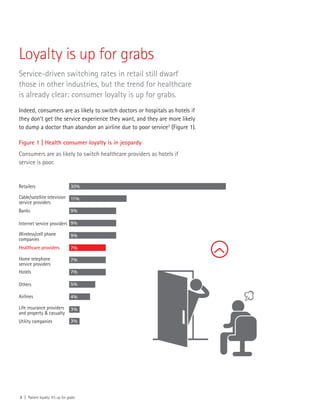
Indeed, consumers are as likely to switch doctors or hospitals as hotels if
they don’t get the service experience they want, and they are more likely
to dump a doctor than abandon an airline due to poor service2
(Figure 1).
Retailers 30%
11%
9%
9%
9%
7%
7%
7%
5%
4%
3%
3%
Cable/satellite television
service providers
Banks
Home telephone
service providers
Healthcare providers
Internet service providers
Hotels
Airlines
Utility companies
Others
Wireless/cell phone
companies
Life insurance providers
and property & casualty
Figure 1 | Health consumer loyalty is in jeopardy
Consumers are as likely to switch healthcare providers as hotels if
service is poor.
Consumer expectations are
high…as are the rewards for
meeting them
Additional research confirms the correlation between the customer service
experience and patient loyalty, and two findings in particular underscore it:
Consumers want responsiveness and convenience
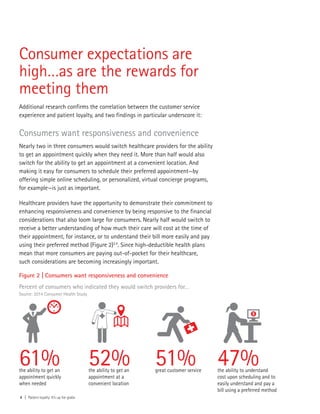
Nearly two in three consumers would switch healthcare providers for the ability
to get an appointment quickly when they need it. More than half would also
switch for the ability to get an appointment at a convenient location. And
making it easy for consumers to schedule their preferred appointment—by
offering simple online scheduling, or personalized, virtual concierge programs,
for example—is just as important.
Healthcare providers have the opportunity to demonstrate their commitment to
enhancing responsiveness and convenience by being responsive to the financial
considerations that also loom large for consumers. Nearly half would switch to
receive a better understanding of how much their care will cost at the time of
their appointment, for instance, or to understand their bill more easily and pay
using their preferred method (Figure 2)3,4
. Since high-deductible health plans
mean that more consumers are paying out-of-pocket for their healthcare,
such considerations are becoming increasingly important.
4 | Patient loyalty: It’s up for grabs
Figure 2 | Consumers want responsiveness and convenience
Percent of consumers who indicated they would switch providers for…
Source: 2014 Consumer Health Study
61%the ability to get an
appointment quickly
when needed
52%the ability to get an
appointment at a
convenient location
51%great customer service
47%the ability to understand
cost upon scheduling and to
easily understand and pay a
bill using a preferred method
Consumers will pay more for the services they value
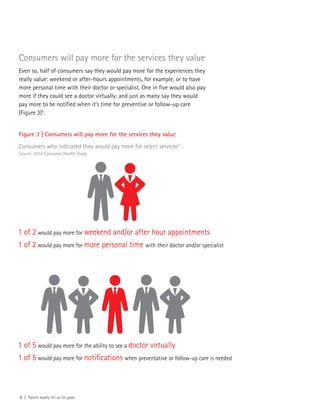
Even so, half of consumers say they would pay more for the experiences they
really value: weekend or after-hours appointments, for example, or to have
more personal time with their doctor or specialist. One in five would also pay
more if they could see a doctor virtually; and just as many say they would
pay more to be notified when it’s time for preventive or follow-up care
(Figure 3)5
.
5 | Patient loyalty: It’s up for grabs
Figure 3 | Consumers will pay more for the services they value
Consumers who indicated they would pay more for select services2
…
Source: 2014 Consumer Health Study
1 of 2 would pay more for weekend and/or after hour appointments
1 of 2 would pay more for more personal time with their doctor and/or specialist
1 of 5 would pay more for the ability to see a doctor virtually
1 of 5 would pay more for notifications when preventative or follow-up care is needed
6 | Patient loyalty: It’s up for grabs
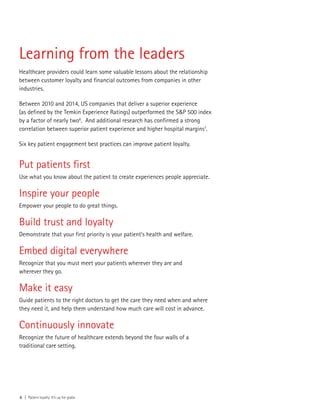
Put patients first
Use what you know about the patient to create experiences people appreciate.
Inspire your people
Empower your people to do great things.
Build trust and loyalty
Demonstrate that your first priority is your patient’s health and welfare.
Embed digital everywhere
Recognize that you must meet your patients wherever they are and
wherever they go.
Make it easy
Guide patients to the right doctors to get the care they need when and where
they need it, and help them understand how much care will cost in advance.
Continuously innovate
Recognize the future of healthcare extends beyond the four walls of a
traditional care setting.
Learning from the leaders
Healthcare providers could learn some valuable lessons about the relationship
between customer loyalty and financial outcomes from companies in other
industries.
Between 2010 and 2014, US companies that deliver a superior experience
(as defined by the Temkin Experience Ratings) outperformed the S&P 500 index
by a factor of nearly two6
. And additional research has confirmed a strong
correlation between superior patient experience and higher hospital margins7
.
Six key patient engagement best practices can improve patient loyalty.
Providing a better consumer experience
will not only help healthcare providers
win patient loyalty—it will also bring them
significant financial benefits. Those providers
that develop strategies, capabilities and
analytics that minimize barriers and enable
the key elements of a superior patient
experience—speed to access, convenience,
information transparency and personalized
service—will be best positioned to out-
perform their peers. They will also be able
to build lifelong relationships with their
patients, and ultimately, to overcome the
consumer loyalty challenge.
7 | Patient loyalty: It’s up for grabs
Copyright © 2016 Accenture. All rights reserved.
Accenture, its logo, and High Performance Delivered
are trademarks of Accenture.
This document makes descriptive reference to trademarks that
may be owned by others. The use of such trademarks herein is not
an assertion of ownership of such trademarks by Accenture and is
not intended to represent or imply the existence of an association
between Accenture and the lawful owners of such trademarks.
Methodology
Accenture reviewed the findings from our 2014 Consumer
Health Study and our 2014 Global Consumer Pulse Research
to understand consumer behavior, preferences, and attitudes
as they pertain to healthcare in the US. Survey responses
were analyzed across a variety of demographic segments,
including respondent geography, gender and age group.
Contact the Authors
Matthew Collier
matthew.d.collier@accenture.com
Leslie Meyer Basham
leslie.m.basham@accenture.com
Contributor
Anishi Shah
anishi.shah@accenture.com
Join the conversation
	@AccentureStrat
	@AccentureHealth
About Accenture
Accenture is a leading global professional services company,
providing a broad range of services and solutions in strategy,
consulting, digital, technology and operations. Combining
unmatched experience and specialized skills across more than
40 industries and all business functions—underpinned by the
world’s largest delivery network—Accenture works at the
intersection of business and technology to help clients
improve their performance and create sustainable value
for their takeholders. With approximately 373,000 people
serving clients in more than 120 countries, Accenture drives
innovation to improve the way the world works and lives.
Visit us at www.accenture.com.
Accenture’s 2014 Consumer Health Study
Accenture’s 2014 Consumer Health Study is an online
survey of 7,254 U.S. residents, 18 years and older, conducted
in November 2014. The survey included both insured and
uninsured healthcare consumers. The research aims to under-
stand consumer behavior and preference with regard to
healthcare shopping and switching, utilization and willingness
to pay. The analysis applies advanced analytics to normalize
the sample population across age, gender, region, income
and insurance type.
10th Annual Global Consumer Pulse Research
The Accenture Global Consumer Pulse Research is an annual
research project that assesses consumer attitudes toward the
customer experience (including marketing, sales and customer
service practices) and consumers’ behaviors in response to
companies’ practices. In 2014 Accenture conducted an online
survey of 23,600+ end consumers in 33 countries, asking them
to evaluate 10 industry sectors (up to four industries per
respondent). This study focuses on findings for US healthcare.
“Happy Patients, Healthy Margins” Research
The analysis used Centers for Medicare and Medicaid Services
(CMS) Hospital Consumer Assessment of Healthcare Providers
and Systems (HCAHPS) performance scores (2008-2013) as a
proxy for the hospital consumer experience, and CMS-reported
hospital margins as a proxy for hospital financial performance.
All CMS data was obtained through Billian’s Healthdata. The
correlation between the overall rating and the financial margin
was then stratified by hospital type and HCAHPS sub-factors
to gauge whether the positive correlation was associated with
particular factors.
Endnotes
1 	Global Consumer Pulse Research, Accenture, January, 2015
2 	Ibid
3 	Ibid
4 	2014 Accenture Healthcare Consumer Survey
5	Ibid
6 	2014 Temkin Experience Ratings; Accenture analysis
7 	Patient Engagement: Happy Patients, Healthy Margins,
	 Accenture, October, 2015
100/70
100/70

Accenture strategy-patient-engagement-consumer-loyalty - copy

  • 1.
    Patient loyalty: It’sup for grabs Today’s patients are retail-savvy consumers. Do you know what it takes to win their loyalty? By Matthew Collier and Leslie Meyer Basham
  • 2.
    2 | Patientloyalty: It’s up for grabs Excellent experience has long been top- of-mind for executives in consumer-driven businesses like retail and banking, but it’s been a much lower priority in healthcare; perhaps not surprisingly. Patient care, after all, is the healthcare sector’s core concern. And many providers have assumed that as long as they offer excellent quality of care, patient loyalty will naturally follow. In a digital and consumerist age, however, quality of experience increasingly drives loyalty—for just about every type of consumer business. Accenture research shows that today’s consumers have come to expect speed to access, responsiveness and convenient interactions with all companies they do business with—including their healthcare provider1 . Just as in other industries, healthcare consumers will switch if they don’t get the experience they want. Yet, as research also indicates, give them a superior experience, and plenty would actually pay more for it1 . Since experience excellence plainly helps create the repeat patient “customers” that sustain profitable growth, healthcare providers urgently need to catch up on the loyalty learning curve. Better yet, they need to get ahead of it. First, though, they need to understand the nature and scale of the consumer loyalty challenge.
  • 3.
    3 | Patientloyalty: It’s up for grabs Loyalty is up for grabs Service-driven switching rates in retail still dwarf those in other industries, but the trend for healthcare is already clear: consumer loyalty is up for grabs. Indeed, consumers are as likely to switch doctors or hospitals as hotels if they don’t get the service experience they want, and they are more likely to dump a doctor than abandon an airline due to poor service2 (Figure 1). Retailers 30% 11% 9% 9% 9% 7% 7% 7% 5% 4% 3% 3% Cable/satellite television service providers Banks Home telephone service providers Healthcare providers Internet service providers Hotels Airlines Utility companies Others Wireless/cell phone companies Life insurance providers and property & casualty Figure 1 | Health consumer loyalty is in jeopardy Consumers are as likely to switch healthcare providers as hotels if service is poor.
  • 4.
    Consumer expectations are high…asare the rewards for meeting them Additional research confirms the correlation between the customer service experience and patient loyalty, and two findings in particular underscore it: Consumers want responsiveness and convenience Nearly two in three consumers would switch healthcare providers for the ability to get an appointment quickly when they need it. More than half would also switch for the ability to get an appointment at a convenient location. And making it easy for consumers to schedule their preferred appointment—by offering simple online scheduling, or personalized, virtual concierge programs, for example—is just as important. Healthcare providers have the opportunity to demonstrate their commitment to enhancing responsiveness and convenience by being responsive to the financial considerations that also loom large for consumers. Nearly half would switch to receive a better understanding of how much their care will cost at the time of their appointment, for instance, or to understand their bill more easily and pay using their preferred method (Figure 2)3,4 . Since high-deductible health plans mean that more consumers are paying out-of-pocket for their healthcare, such considerations are becoming increasingly important. 4 | Patient loyalty: It’s up for grabs Figure 2 | Consumers want responsiveness and convenience Percent of consumers who indicated they would switch providers for… Source: 2014 Consumer Health Study 61%the ability to get an appointment quickly when needed 52%the ability to get an appointment at a convenient location 51%great customer service 47%the ability to understand cost upon scheduling and to easily understand and pay a bill using a preferred method
  • 5.
    Consumers will paymore for the services they value Even so, half of consumers say they would pay more for the experiences they really value: weekend or after-hours appointments, for example, or to have more personal time with their doctor or specialist. One in five would also pay more if they could see a doctor virtually; and just as many say they would pay more to be notified when it’s time for preventive or follow-up care (Figure 3)5 . 5 | Patient loyalty: It’s up for grabs Figure 3 | Consumers will pay more for the services they value Consumers who indicated they would pay more for select services2 … Source: 2014 Consumer Health Study 1 of 2 would pay more for weekend and/or after hour appointments 1 of 2 would pay more for more personal time with their doctor and/or specialist 1 of 5 would pay more for the ability to see a doctor virtually 1 of 5 would pay more for notifications when preventative or follow-up care is needed
  • 6.
    6 | Patientloyalty: It’s up for grabs Put patients first Use what you know about the patient to create experiences people appreciate. Inspire your people Empower your people to do great things. Build trust and loyalty Demonstrate that your first priority is your patient’s health and welfare. Embed digital everywhere Recognize that you must meet your patients wherever they are and wherever they go. Make it easy Guide patients to the right doctors to get the care they need when and where they need it, and help them understand how much care will cost in advance. Continuously innovate Recognize the future of healthcare extends beyond the four walls of a traditional care setting. Learning from the leaders Healthcare providers could learn some valuable lessons about the relationship between customer loyalty and financial outcomes from companies in other industries. Between 2010 and 2014, US companies that deliver a superior experience (as defined by the Temkin Experience Ratings) outperformed the S&P 500 index by a factor of nearly two6 . And additional research has confirmed a strong correlation between superior patient experience and higher hospital margins7 . Six key patient engagement best practices can improve patient loyalty.
  • 7.
    Providing a betterconsumer experience will not only help healthcare providers win patient loyalty—it will also bring them significant financial benefits. Those providers that develop strategies, capabilities and analytics that minimize barriers and enable the key elements of a superior patient experience—speed to access, convenience, information transparency and personalized service—will be best positioned to out- perform their peers. They will also be able to build lifelong relationships with their patients, and ultimately, to overcome the consumer loyalty challenge. 7 | Patient loyalty: It’s up for grabs
  • 8.
    Copyright © 2016Accenture. All rights reserved. Accenture, its logo, and High Performance Delivered are trademarks of Accenture. This document makes descriptive reference to trademarks that may be owned by others. The use of such trademarks herein is not an assertion of ownership of such trademarks by Accenture and is not intended to represent or imply the existence of an association between Accenture and the lawful owners of such trademarks. Methodology Accenture reviewed the findings from our 2014 Consumer Health Study and our 2014 Global Consumer Pulse Research to understand consumer behavior, preferences, and attitudes as they pertain to healthcare in the US. Survey responses were analyzed across a variety of demographic segments, including respondent geography, gender and age group. Contact the Authors Matthew Collier matthew.d.collier@accenture.com Leslie Meyer Basham leslie.m.basham@accenture.com Contributor Anishi Shah anishi.shah@accenture.com Join the conversation @AccentureStrat @AccentureHealth About Accenture Accenture is a leading global professional services company, providing a broad range of services and solutions in strategy, consulting, digital, technology and operations. Combining unmatched experience and specialized skills across more than 40 industries and all business functions—underpinned by the world’s largest delivery network—Accenture works at the intersection of business and technology to help clients improve their performance and create sustainable value for their takeholders. With approximately 373,000 people serving clients in more than 120 countries, Accenture drives innovation to improve the way the world works and lives. Visit us at www.accenture.com. Accenture’s 2014 Consumer Health Study Accenture’s 2014 Consumer Health Study is an online survey of 7,254 U.S. residents, 18 years and older, conducted in November 2014. The survey included both insured and uninsured healthcare consumers. The research aims to under- stand consumer behavior and preference with regard to healthcare shopping and switching, utilization and willingness to pay. The analysis applies advanced analytics to normalize the sample population across age, gender, region, income and insurance type. 10th Annual Global Consumer Pulse Research The Accenture Global Consumer Pulse Research is an annual research project that assesses consumer attitudes toward the customer experience (including marketing, sales and customer service practices) and consumers’ behaviors in response to companies’ practices. In 2014 Accenture conducted an online survey of 23,600+ end consumers in 33 countries, asking them to evaluate 10 industry sectors (up to four industries per respondent). This study focuses on findings for US healthcare. “Happy Patients, Healthy Margins” Research The analysis used Centers for Medicare and Medicaid Services (CMS) Hospital Consumer Assessment of Healthcare Providers and Systems (HCAHPS) performance scores (2008-2013) as a proxy for the hospital consumer experience, and CMS-reported hospital margins as a proxy for hospital financial performance. All CMS data was obtained through Billian’s Healthdata. The correlation between the overall rating and the financial margin was then stratified by hospital type and HCAHPS sub-factors to gauge whether the positive correlation was associated with particular factors. Endnotes 1 Global Consumer Pulse Research, Accenture, January, 2015 2 Ibid 3 Ibid 4 2014 Accenture Healthcare Consumer Survey 5 Ibid 6 2014 Temkin Experience Ratings; Accenture analysis 7 Patient Engagement: Happy Patients, Healthy Margins, Accenture, October, 2015 100/70 100/70