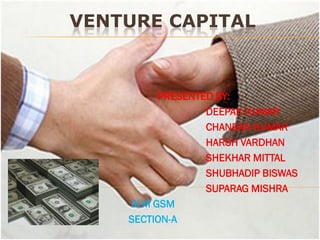
VENTURE CAPITAL


          PRESENTED BY:
                  DEEPAK KUMAR
                  CHANDAN KUMAR
                  HARSH VARDHAN
                  SHEKHAR MITTAL
                  SHUBHADIP BISWAS
                  SUPARAG MISHRA
    IILM GSM
    SECTION-A
VENTURE CAPITAL:
   Money provided by investors to startup firms and small
    businesses with perceived long-term growth potential.
    This is a very important source of funding for startups
    that do not have access to capital markets. It typically
    entails high risk for the investor, but it has the potential
    for above-average returns.
   investment made in a business or industrial enterprise
    that carries high elements of risk, insecurity and
    probability of business hazards.
   Venture capitalists are full-time professional investors
    who invest for their partnership funds
VENTURE CAPITAL…
 Before making an investment, they carefully
  scrutinize the founders and their business
  concepts
 After the initial investment, venture capitalists
  tend to be very active in the process of raising
  additional funds for their portfolio companies
 They also continuously monitor their
  companies, both formally through participation
  at the board level and informally
POTENTIALITY OF INDIA:
 India, along with Israel, Taiwan and the United
  States, is recognized for its globally competitive
  high technology and human capital.
 The success in software and information
  technology -- against several odds such as
  inadequate infrastructure, expensive hardware,
  restricted access to foreign resources and limited
  domestic demand, is a pointer to the hidden
  potential it has in the field of knowledge and
  technology based industry
DEVELOPMENT
In 1972, a committee on Development of Small and Medium
   Enterprises highlighted the need to foster venture capital as a
   source of funding new entrepreneurs and technology. This
   resulted in a few incremental steps being taken over the next
   decade-and-a-half to facilitate venture capital funds into needy
   technology oriented small and medium Enterprises (SMEs),
   namely:
 Risk Capital Foundation, sponsored by IFCI, was set-up in 1975
   to promote and support new technologies and businesses.
 Seed Capital Scheme and the National Equity Scheme was set
   up by IDBI in 1976
 Programme for Advancement of Commercial Technology (PACT)
   Scheme was introduced by ICICI in 1985.
 Setting up of TDICI AND REGIONAL FUNDS
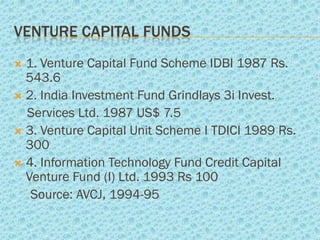
VENTURE CAPITAL FUNDS
 1. Venture Capital Fund Scheme IDBI 1987 Rs.
  543.6
 2. India Investment Fund Grindlays 3i Invest.
  Services Ltd. 1987 US$ 7.5
 3. Venture Capital Unit Scheme I TDICI 1989 Rs.
  300
 4. Information Technology Fund Credit Capital
  Venture Fund (I) Ltd. 1993 Rs 100
   Source: AVCJ, 1994-95
TYPES OF VENTURE CAPITAL FUNDS
 1 . VCFs promoted by the Central govt.
  controlled development financial
  institutions
 2. VCFs promoted by the state government-
  controlled development finance institutions
 3. VCFs promoted by Public Sector banks

 4. VCFs promoted by the foreign banks or
  private sector companies and financial
  institutions
SOME OF THE PROJECTS FINANCED BY TDICI

 MASTEK
 TEMPTATION FOODS

 RISHABH INSTRUMENTS

 SYNERGY ART FOUNDATION
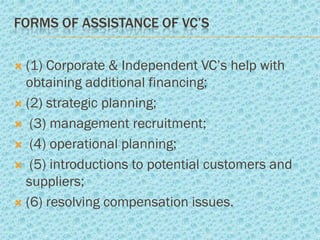
FORMS OF ASSISTANCE OF VC’S

 (1) Corporate & Independent VC’s help with
  obtaining additional financing;
 (2) strategic planning;

 (3) management recruitment;

 (4) operational planning;

 (5) introductions to potential customers and
  suppliers;
 (6) resolving compensation issues.
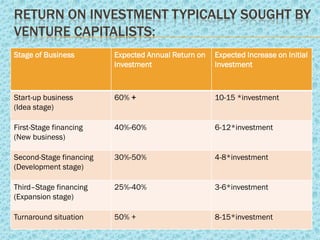
RETURN ON INVESTMENT TYPICALLY SOUGHT BY
VENTURE CAPITALISTS:
Stage of Business        Expected Annual Return on   Expected Increase on Initial
                         Investment                  Investment


Start-up business        60% +                       10-15 *investment
(Idea stage)

First-Stage financing    40%-60%                     6-12*investment
(New business)

Second-Stage financing   30%-50%                     4-8*investment
(Development stage)

Third–Stage financing    25%-40%                     3-6*investment
(Expansion stage)

Turnaround situation     50% +                       8-15*investment
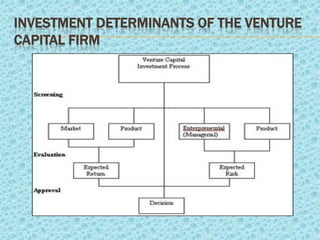
INVESTMENT DETERMINANTS OF THE VENTURE
CAPITAL FIRM
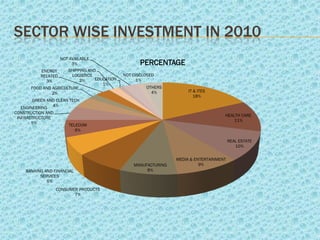
SECTOR WISE INVESTMENT IN 2010
                  NOT AVAILABLE
                       3%                            PERCENTAGE
          ENERGY      SHIPPING AND
          RELATED       LOGISTICS             NOT DISCLOSED
            3%             2%     EDUCATION         1%
                                     1%
      FOOD AND AGRICULTURE                             OTHERS
               2%                                        4%            IT & ITES
                                                                          18%
        GREEN AND CLEAN TECH
                4%
   ENGINEERING
CONSTRUCTION AND
                                                                                      HEALTH CARE
 INFRASTRUCTURE
                                                                                          11%
       5%              TELECOM
                            6%

                                                                                          REAL ESTATE
                                                                                             10%

                                                                  MEDIA & ENTERTAINMENT
                                                  MANUFACTURING             9%
    BANKING AND FINANCIAL                              8%
          SERVICES
             6%
                 CONSUMER PRODUCTS
                        7%
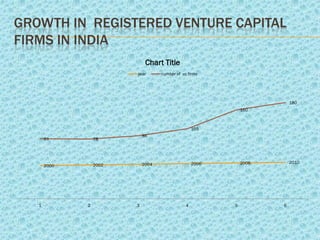
GROWTH IN REGISTERED VENTURE CAPITAL
FIRMS IN INDIA
                              Chart Title
                         year       number of vc firms


                                                                          180
                                                               160


                                                    105
                             86
       81         78


                             2004                   2006       2008       2010
       2000       2002


   1          2          3                      4          5          6
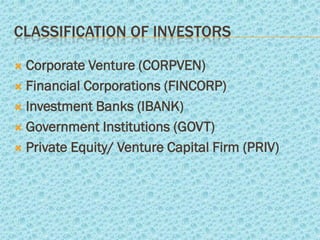
CLASSIFICATION OF INVESTORS

 Corporate Venture (CORPVEN)
 Financial Corporations (FINCORP)

 Investment Banks (IBANK)

 Government Institutions (GOVT)

 Private Equity/ Venture Capital Firm (PRIV)
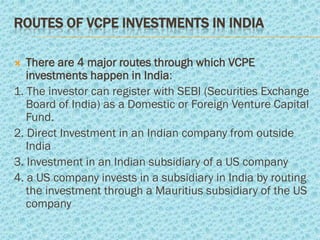
ROUTES OF VCPE INVESTMENTS IN INDIA

  There are 4 major routes through which VCPE
   investments happen in India:
1. The investor can register with SEBI (Securities Exchange
   Board of India) as a Domestic or Foreign Venture Capital
   Fund.
2. Direct Investment in an Indian company from outside
   India
3. Investment in an Indian subsidiary of a US company
4. a US company invests in a subsidiary in India by routing
   the investment through a Mauritius subsidiary of the US
   company
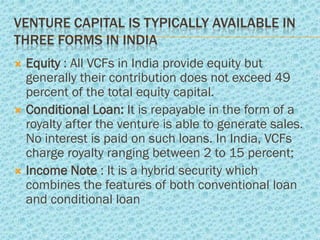
VENTURE CAPITAL IS TYPICALLY AVAILABLE IN
THREE FORMS IN INDIA
 Equity : All VCFs in India provide equity but
  generally their contribution does not exceed 49
  percent of the total equity capital.
 Conditional Loan: It is repayable in the form of a
  royalty after the venture is able to generate sales.
  No interest is paid on such loans. In India, VCFs
  charge royalty ranging between 2 to 15 percent;
 Income Note : It is a hybrid security which
  combines the features of both conventional loan
  and conditional loan
SOME IMPORTANT VENTURE CAPITAL FUNDS IN
INDIA
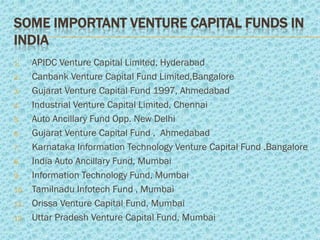
1.    APIDC Venture Capital Limited, Hyderabad
2.    Canbank Venture Capital Fund Limited,Bangalore
3.    Gujarat Venture Capital Fund 1997, Ahmedabad
4.    Industrial Venture Capital Limited, Chennai
5.    Auto Ancillary Fund Opp. New Delhi
6.    Gujarat Venture Capital Fund , Ahmedabad
7.    Karnataka Information Technology Venture Capital Fund .Bangalore
8.    India Auto Ancillary Fund, Mumbai
9.    Information Technology Fund, Mumbai
10.   Tamilnadu Infotech Fund , Mumbai
11.   Orissa Venture Capital Fund, Mumbai
12.   Uttar Pradesh Venture Capital Fund, Mumbai
TOP FIVE CAPITAL VENTURE FIRMS IN 2010

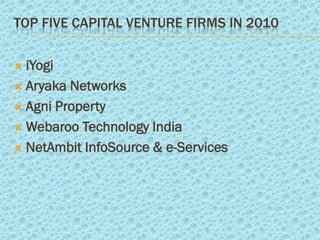
 iYogi
 Aryaka Networks

 Agni Property

 Webaroo Technology India

 NetAmbit InfoSource & e-Services
CURRENT SCENARIO
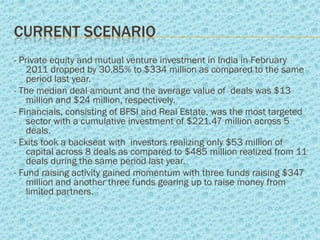
- Private equity and mutual venture investment in India in February
    2011 dropped by 30.85% to $334 million as compared to the same
    period last year.
- The median deal amount and the average value of deals was $13
    million and $24 million, respectively.
- Financials, consisting of BFSI and Real Estate, was the most targeted
    sector with a cumulative investment of $221.47 million across 5
    deals.
- Exits took a backseat with investors realizing only $53 million of
    capital across 8 deals as compared to $485 million realized from 11
    deals during the same period last year.
- Fund raising activity gained momentum with three funds raising $347
    million and another three funds gearing up to raise money from
    limited partners.
THANK
  YOU

Venture capital in india

  • 1.
    VENTURE CAPITAL PRESENTED BY: DEEPAK KUMAR CHANDAN KUMAR HARSH VARDHAN SHEKHAR MITTAL SHUBHADIP BISWAS SUPARAG MISHRA IILM GSM SECTION-A
  • 2.
    VENTURE CAPITAL:  Money provided by investors to startup firms and small businesses with perceived long-term growth potential. This is a very important source of funding for startups that do not have access to capital markets. It typically entails high risk for the investor, but it has the potential for above-average returns.  investment made in a business or industrial enterprise that carries high elements of risk, insecurity and probability of business hazards.  Venture capitalists are full-time professional investors who invest for their partnership funds
  • 3.
    VENTURE CAPITAL…  Beforemaking an investment, they carefully scrutinize the founders and their business concepts  After the initial investment, venture capitalists tend to be very active in the process of raising additional funds for their portfolio companies  They also continuously monitor their companies, both formally through participation at the board level and informally
  • 4.
    POTENTIALITY OF INDIA: India, along with Israel, Taiwan and the United States, is recognized for its globally competitive high technology and human capital.  The success in software and information technology -- against several odds such as inadequate infrastructure, expensive hardware, restricted access to foreign resources and limited domestic demand, is a pointer to the hidden potential it has in the field of knowledge and technology based industry
  • 5.
    DEVELOPMENT In 1972, acommittee on Development of Small and Medium Enterprises highlighted the need to foster venture capital as a source of funding new entrepreneurs and technology. This resulted in a few incremental steps being taken over the next decade-and-a-half to facilitate venture capital funds into needy technology oriented small and medium Enterprises (SMEs), namely:  Risk Capital Foundation, sponsored by IFCI, was set-up in 1975 to promote and support new technologies and businesses.  Seed Capital Scheme and the National Equity Scheme was set up by IDBI in 1976  Programme for Advancement of Commercial Technology (PACT) Scheme was introduced by ICICI in 1985.  Setting up of TDICI AND REGIONAL FUNDS
  • 6.
    VENTURE CAPITAL FUNDS 1. Venture Capital Fund Scheme IDBI 1987 Rs. 543.6  2. India Investment Fund Grindlays 3i Invest. Services Ltd. 1987 US$ 7.5  3. Venture Capital Unit Scheme I TDICI 1989 Rs. 300  4. Information Technology Fund Credit Capital Venture Fund (I) Ltd. 1993 Rs 100 Source: AVCJ, 1994-95
  • 7.
    TYPES OF VENTURECAPITAL FUNDS  1 . VCFs promoted by the Central govt. controlled development financial institutions  2. VCFs promoted by the state government- controlled development finance institutions  3. VCFs promoted by Public Sector banks  4. VCFs promoted by the foreign banks or private sector companies and financial institutions
  • 8.
    SOME OF THEPROJECTS FINANCED BY TDICI  MASTEK  TEMPTATION FOODS  RISHABH INSTRUMENTS  SYNERGY ART FOUNDATION
  • 9.
    FORMS OF ASSISTANCEOF VC’S  (1) Corporate & Independent VC’s help with obtaining additional financing;  (2) strategic planning;  (3) management recruitment;  (4) operational planning;  (5) introductions to potential customers and suppliers;  (6) resolving compensation issues.
  • 10.
    RETURN ON INVESTMENTTYPICALLY SOUGHT BY VENTURE CAPITALISTS: Stage of Business Expected Annual Return on Expected Increase on Initial Investment Investment Start-up business 60% + 10-15 *investment (Idea stage) First-Stage financing 40%-60% 6-12*investment (New business) Second-Stage financing 30%-50% 4-8*investment (Development stage) Third–Stage financing 25%-40% 3-6*investment (Expansion stage) Turnaround situation 50% + 8-15*investment
  • 11.
    INVESTMENT DETERMINANTS OFTHE VENTURE CAPITAL FIRM
  • 12.
    SECTOR WISE INVESTMENTIN 2010 NOT AVAILABLE 3% PERCENTAGE ENERGY SHIPPING AND RELATED LOGISTICS NOT DISCLOSED 3% 2% EDUCATION 1% 1% FOOD AND AGRICULTURE OTHERS 2% 4% IT & ITES 18% GREEN AND CLEAN TECH 4% ENGINEERING CONSTRUCTION AND HEALTH CARE INFRASTRUCTURE 11% 5% TELECOM 6% REAL ESTATE 10% MEDIA & ENTERTAINMENT MANUFACTURING 9% BANKING AND FINANCIAL 8% SERVICES 6% CONSUMER PRODUCTS 7%
  • 13.
    GROWTH IN REGISTEREDVENTURE CAPITAL FIRMS IN INDIA Chart Title year number of vc firms 180 160 105 86 81 78 2004 2006 2008 2010 2000 2002 1 2 3 4 5 6
  • 14.
    CLASSIFICATION OF INVESTORS Corporate Venture (CORPVEN)  Financial Corporations (FINCORP)  Investment Banks (IBANK)  Government Institutions (GOVT)  Private Equity/ Venture Capital Firm (PRIV)
  • 15.
    ROUTES OF VCPEINVESTMENTS IN INDIA  There are 4 major routes through which VCPE investments happen in India: 1. The investor can register with SEBI (Securities Exchange Board of India) as a Domestic or Foreign Venture Capital Fund. 2. Direct Investment in an Indian company from outside India 3. Investment in an Indian subsidiary of a US company 4. a US company invests in a subsidiary in India by routing the investment through a Mauritius subsidiary of the US company
  • 16.
    VENTURE CAPITAL ISTYPICALLY AVAILABLE IN THREE FORMS IN INDIA  Equity : All VCFs in India provide equity but generally their contribution does not exceed 49 percent of the total equity capital.  Conditional Loan: It is repayable in the form of a royalty after the venture is able to generate sales. No interest is paid on such loans. In India, VCFs charge royalty ranging between 2 to 15 percent;  Income Note : It is a hybrid security which combines the features of both conventional loan and conditional loan
  • 17.
    SOME IMPORTANT VENTURECAPITAL FUNDS IN INDIA 1. APIDC Venture Capital Limited, Hyderabad 2. Canbank Venture Capital Fund Limited,Bangalore 3. Gujarat Venture Capital Fund 1997, Ahmedabad 4. Industrial Venture Capital Limited, Chennai 5. Auto Ancillary Fund Opp. New Delhi 6. Gujarat Venture Capital Fund , Ahmedabad 7. Karnataka Information Technology Venture Capital Fund .Bangalore 8. India Auto Ancillary Fund, Mumbai 9. Information Technology Fund, Mumbai 10. Tamilnadu Infotech Fund , Mumbai 11. Orissa Venture Capital Fund, Mumbai 12. Uttar Pradesh Venture Capital Fund, Mumbai
  • 18.
    TOP FIVE CAPITALVENTURE FIRMS IN 2010  iYogi  Aryaka Networks  Agni Property  Webaroo Technology India  NetAmbit InfoSource & e-Services
  • 19.
    CURRENT SCENARIO - Privateequity and mutual venture investment in India in February 2011 dropped by 30.85% to $334 million as compared to the same period last year. - The median deal amount and the average value of deals was $13 million and $24 million, respectively. - Financials, consisting of BFSI and Real Estate, was the most targeted sector with a cumulative investment of $221.47 million across 5 deals. - Exits took a backseat with investors realizing only $53 million of capital across 8 deals as compared to $485 million realized from 11 deals during the same period last year. - Fund raising activity gained momentum with three funds raising $347 million and another three funds gearing up to raise money from limited partners.
  • 20.