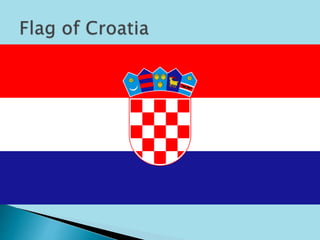
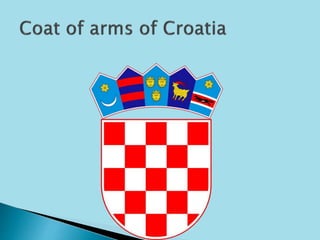
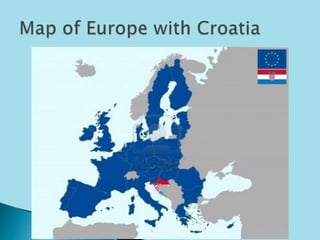
 Croatia (Croatian: Hrvatska pronounced [xř̩ʋaːts 
kaː]), officially the Republic of 
Croatia (Croatian: Republika Hrvatska), is a 
unitary democratic parliamentary republic at the 
crossroads of Central Europe, Southern Europe, 
and the Mediterranean.
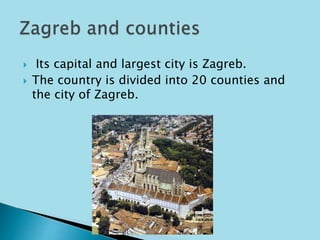
 Its capital and largest city is Zagreb. 
 The country is divided into 20 counties and 
the city of Zagreb.
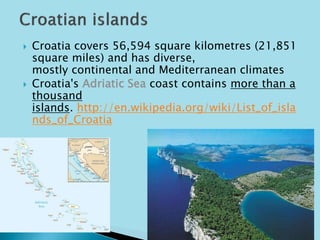
 Croatia covers 56,594 square kilometres (21,851 
square miles) and has diverse, 
mostly continental and Mediterranean climates 
 Croatia's Adriatic Sea coast contains more than a 
thousand 
islands. http://en.wikipedia.org/wiki/List_of_isla 
nds_of_Croatia
 The country's population is 4.28 million, most of 
whom are Croats, with the most common religious 
denomination being Roman Catholicism. 
 Having joined on 1 July 2013, Croatia is the newest, 
28th member state of the European Union. 
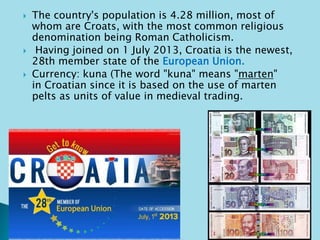
 Currency: kuna (The word "kuna" means "marten" 
in Croatian since it is based on the use of marten 
pelts as units of value in medieval trading.
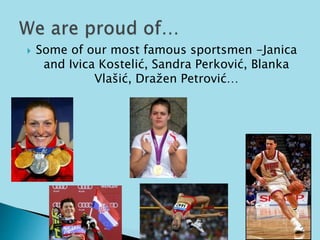
 Some of our most famous sportsmen -Janica 
and Ivica Kostelić, Sandra Perković, Blanka 
Vlašić, Dražen Petrović…
 http://www.youtube.com/watch?v=bCxulFgT 
938 
 http://www.youtube.com/watch?v=Zj5H5Lx7J 
SU
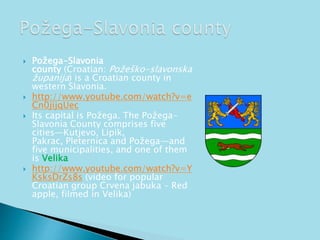
 Požega-Slavonia 
county (Croatian: Požeško-slavonska 
županija) is a Croatian county in 
western Slavonia. 
 http://www.youtube.com/watch?v=e 
Cn0jijqUec 
 Its capital is Požega. The Požega- 
Slavonia County comprises five 
cities—Kutjevo, Lipik, 
Pakrac, Pleternica and Požega—and 
five municipalities, and one of them 
is Velika 
 http://www.youtube.com/watch?v=Y 
KsksDrZs8s (video for popular 
Croatian group Crvena jabuka – Red 
apple, filmed in Velika)
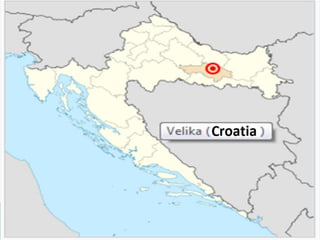
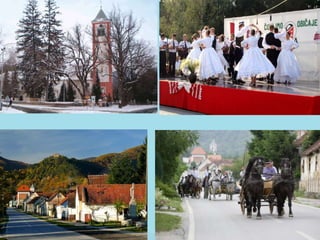
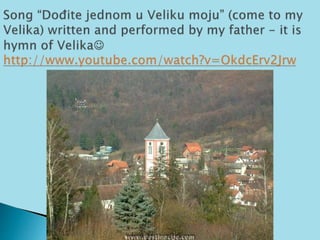
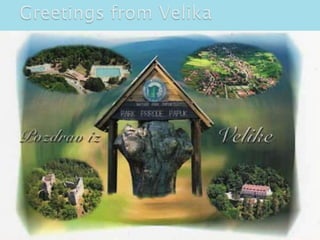
 Velika is a village and recreational centre on the 
southern slopes of Papuk Mountain in the Požega 
Valley in Slavonia, 12 km north of Požega; 
elevation 278 m. 
 The village itself has a population of 2500 
inhabitants, and with other villages municipality 
of Velika has 5.888 inhabitants 
 Chief occupations include farming, viticulture 
and tourism.
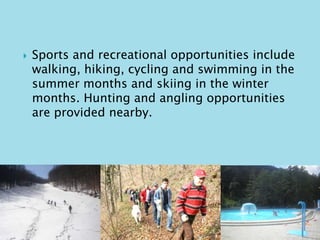
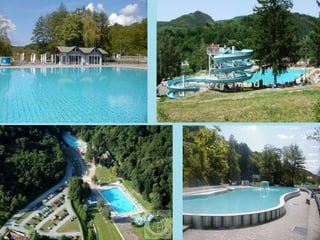
 Sports and recreational opportunities include 
walking, hiking, cycling and swimming in the 
summer months and skiing in the winter 
months. Hunting and angling opportunities 
are provided nearby.
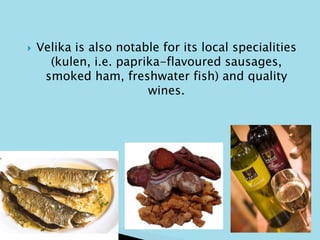
 Velika is also notable for its local specialities 
(kulen, i.e. paprika-flavoured sausages, 
smoked ham, freshwater fish) and quality 
wines.
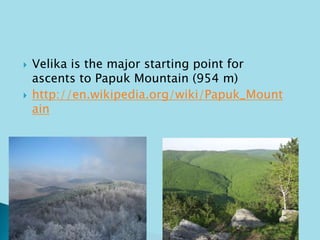
 Velika is the major starting point for 
ascents to Papuk Mountain (954 m) 
 http://en.wikipedia.org/wiki/Papuk_Mount 
ain
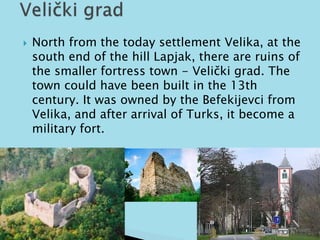
 North from the today settlement Velika, at the 
south end of the hill Lapjak, there are ruins of 
the smaller fortress town - Velički grad. The 
town could have been built in the 13th 
century. It was owned by the Befekijevci from 
Velika, and after arrival of Turks, it become a 
military fort.
 Primary and secondary education is essentially 
free because it is mostly sponsored by 
the Ministry of Education of the Croatian 
Government, and higher education is also mostly 
free 
 Since the primary school became compulsory, the 
literacy rate in Croatia is at a substantial level of 
98,1%. A large majority of children do manage to 
complete the grade school. 
 Secondary education is currently optional, 
although most political parties now advocate the 
stance that it should also become compulsory.
 Croatian elementary education consists of eight years, and 
it is compulsory. Children begin schools at the age of 6 or 
7. 
 The grade schools are split in two stages: 
 1st through 4th grade, being taught by one teacher per 
class, with subjects such as Croatian, mathematics, visual 
art , nature and society, physical education, music 
education, religion and at least one foreign language 
(usually English, usually in the 1st grade and compulsory 
in the 4th grade) 
 5th through 8th grades, where different teachers teach 
different subjects, with added subjects such 
as history, geography, biology, chemistry, physics, informa 
tics and in addition to English often a second language
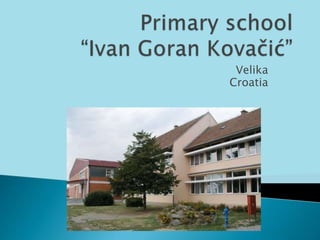
Velika 
Croatia
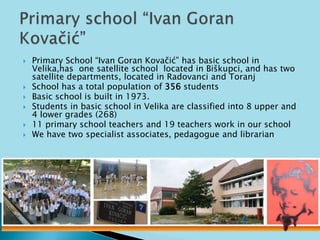
 Primary School “Ivan Goran Kovačić” has basic school in 
Velika,has one satellite school located in Biškupci, and has two 
satellite departments, located in Radovanci and Toranj 
 School has a total population of 356 students 
 Basic school is built in 1973. 
 Students in basic school in Velika are classified into 8 upper and 
4 lower grades (268) 
 11 primary school teachers and 19 teachers work in our school 
 We have two specialist associates, pedagogue and librarian
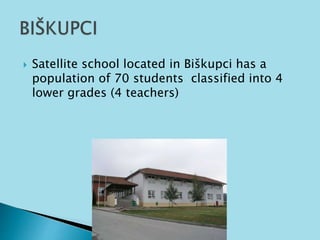
 Satellite school located in Biškupci has a 
population of 70 students classified into 4 
lower grades (4 teachers)
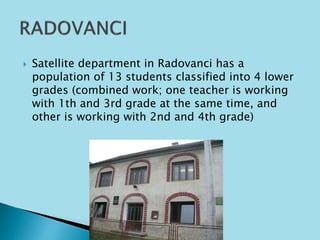
 Satellite department in Radovanci has a 
population of 13 students classified into 4 lower 
grades (combined work; one teacher is working 
with 1th and 3rd grade at the same time, and 
other is working with 2nd and 4th grade)
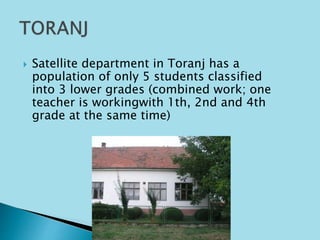
 Satellite department in Toranj has a 
population of only 5 students classified 
into 3 lower grades (combined work; one 
teacher is workingwith 1th, 2nd and 4th 
grade at the same time)
Velika   croatia

Velika croatia

  • 2.
     Croatia (Croatian:Hrvatska pronounced [xř̩ʋaːts kaː]), officially the Republic of Croatia (Croatian: Republika Hrvatska), is a unitary democratic parliamentary republic at the crossroads of Central Europe, Southern Europe, and the Mediterranean.
  • 6.
     Its capitaland largest city is Zagreb.  The country is divided into 20 counties and the city of Zagreb.
  • 7.
     Croatia covers56,594 square kilometres (21,851 square miles) and has diverse, mostly continental and Mediterranean climates  Croatia's Adriatic Sea coast contains more than a thousand islands. http://en.wikipedia.org/wiki/List_of_isla nds_of_Croatia
  • 8.
     The country'spopulation is 4.28 million, most of whom are Croats, with the most common religious denomination being Roman Catholicism.  Having joined on 1 July 2013, Croatia is the newest, 28th member state of the European Union.  Currency: kuna (The word "kuna" means "marten" in Croatian since it is based on the use of marten pelts as units of value in medieval trading.
  • 9.
     Some ofour most famous sportsmen -Janica and Ivica Kostelić, Sandra Perković, Blanka Vlašić, Dražen Petrović…
  • 10.
     http://www.youtube.com/watch?v=bCxulFgT 938  http://www.youtube.com/watch?v=Zj5H5Lx7J SU
  • 11.
     Požega-Slavonia county(Croatian: Požeško-slavonska županija) is a Croatian county in western Slavonia.  http://www.youtube.com/watch?v=e Cn0jijqUec  Its capital is Požega. The Požega- Slavonia County comprises five cities—Kutjevo, Lipik, Pakrac, Pleternica and Požega—and five municipalities, and one of them is Velika  http://www.youtube.com/watch?v=Y KsksDrZs8s (video for popular Croatian group Crvena jabuka – Red apple, filmed in Velika)
  • 12.
     Velika isa village and recreational centre on the southern slopes of Papuk Mountain in the Požega Valley in Slavonia, 12 km north of Požega; elevation 278 m.  The village itself has a population of 2500 inhabitants, and with other villages municipality of Velika has 5.888 inhabitants  Chief occupations include farming, viticulture and tourism.
  • 15.
     Sports andrecreational opportunities include walking, hiking, cycling and swimming in the summer months and skiing in the winter months. Hunting and angling opportunities are provided nearby.
  • 16.
     Velika isalso notable for its local specialities (kulen, i.e. paprika-flavoured sausages, smoked ham, freshwater fish) and quality wines.
  • 17.
     Velika isthe major starting point for ascents to Papuk Mountain (954 m)  http://en.wikipedia.org/wiki/Papuk_Mount ain
  • 18.
     North fromthe today settlement Velika, at the south end of the hill Lapjak, there are ruins of the smaller fortress town - Velički grad. The town could have been built in the 13th century. It was owned by the Befekijevci from Velika, and after arrival of Turks, it become a military fort.
  • 21.
     Primary andsecondary education is essentially free because it is mostly sponsored by the Ministry of Education of the Croatian Government, and higher education is also mostly free  Since the primary school became compulsory, the literacy rate in Croatia is at a substantial level of 98,1%. A large majority of children do manage to complete the grade school.  Secondary education is currently optional, although most political parties now advocate the stance that it should also become compulsory.
  • 22.
     Croatian elementaryeducation consists of eight years, and it is compulsory. Children begin schools at the age of 6 or 7.  The grade schools are split in two stages:  1st through 4th grade, being taught by one teacher per class, with subjects such as Croatian, mathematics, visual art , nature and society, physical education, music education, religion and at least one foreign language (usually English, usually in the 1st grade and compulsory in the 4th grade)  5th through 8th grades, where different teachers teach different subjects, with added subjects such as history, geography, biology, chemistry, physics, informa tics and in addition to English often a second language
  • 23.
  • 24.
     Primary School“Ivan Goran Kovačić” has basic school in Velika,has one satellite school located in Biškupci, and has two satellite departments, located in Radovanci and Toranj  School has a total population of 356 students  Basic school is built in 1973.  Students in basic school in Velika are classified into 8 upper and 4 lower grades (268)  11 primary school teachers and 19 teachers work in our school  We have two specialist associates, pedagogue and librarian
  • 25.
     Satellite schoollocated in Biškupci has a population of 70 students classified into 4 lower grades (4 teachers)
  • 26.
     Satellite departmentin Radovanci has a population of 13 students classified into 4 lower grades (combined work; one teacher is working with 1th and 3rd grade at the same time, and other is working with 2nd and 4th grade)
  • 27.
     Satellite departmentin Toranj has a population of only 5 students classified into 3 lower grades (combined work; one teacher is workingwith 1th, 2nd and 4th grade at the same time)