VECTOR ALGEBRA
RUCHI SAINI
B.TECH ECE
4th
SEM
INTRODUCTION TO VECTOR ALGEBRA
VECTOR OPERATIONS
DOT PRODUCT
CROSS PRODUCT
APPLICATIONS OF VECTOR ALGEBRA
CONCLUSION
INTRODUCTION TO VECTOR ALGEBRA
Vector algebra is a branch of mathematics that deals with
the study of vectors and their properties. A vector is a
mathematical object that has both magnitude and direction.
In vector algebra, vectors are represented using coordinates
or components in a coordinate system. Vectors can be
added, subtracted, multiplied by a scalar, and normalized.
VECTOR OPERATIONS
The addition of two vectors results in a new vector that is the sum
of the two original vectors. The subtraction of two vectors results
in a new vector that is the difference between the two original
vectors.
Scalar multiplication involves multiplying a vector by a scalar (a
real number). This operation changes the magnitude of the
vector but not its direction.
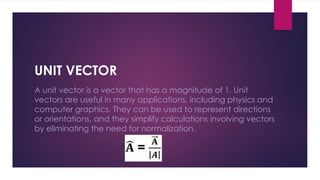
UNIT VECTOR
A unit vector is a vector that has a magnitude of 1. Unit
vectors are useful in many applications, including physics and
computer graphics. They can be used to represent directions
or orientations, and they simplify calculations involving vectors
by eliminating the need for normalization.
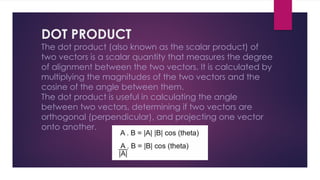
DOT PRODUCT
The dot product (also known as the scalar product) of
two vectors is a scalar quantity that measures the degree
of alignment between the two vectors. It is calculated by
multiplying the magnitudes of the two vectors and the
cosine of the angle between them.
The dot product is useful in calculating the angle
between two vectors, determining if two vectors are
orthogonal (perpendicular), and projecting one vector
onto another.
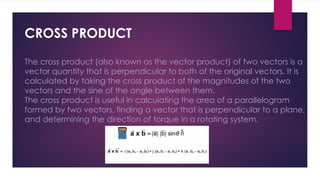
CROSS PRODUCT
The cross product (also known as the vector product) of two vectors is a
vector quantity that is perpendicular to both of the original vectors. It is
calculated by taking the cross product of the magnitudes of the two
vectors and the sine of the angle between them.
The cross product is useful in calculating the area of a parallelogram
formed by two vectors, finding a vector that is perpendicular to a plane,
and determining the direction of torque in a rotating system.
APPLICATIONS OF VECTOR ALGEBRA
Vector algebra has numerous applications in physics, engineering,
computer graphics, and many other fields. In physics, vectors are
used to represent forces, velocities, and accelerations. In
engineering, vectors are used to represent forces, moments, and
displacements.
In computer graphics, vectors are used to represent positions,
orientations, and transformations of objects in three-dimensional
space. Vector algebra is also used in optimization problems, such as
finding the shortest distance between two points or the minimum
energy required to move an object from one position to another.
CONCLUSION
Vector algebra is a powerful tool for representing and manipulating
vectors in a variety of contexts. Its applications extend far beyond
the realm of pure mathematics and have practical implications in
many fields.
By understanding the fundamental concepts of vector algebra, we
can better understand the world around us and solve complex
problems with greater ease and efficiency.
THANK YOU

VECTOR ALGEBRA.pptx pptpptpptjhbuhjbubbhbh

  • 1.
  • 2.
    INTRODUCTION TO VECTORALGEBRA VECTOR OPERATIONS DOT PRODUCT CROSS PRODUCT APPLICATIONS OF VECTOR ALGEBRA CONCLUSION
  • 3.
    INTRODUCTION TO VECTORALGEBRA Vector algebra is a branch of mathematics that deals with the study of vectors and their properties. A vector is a mathematical object that has both magnitude and direction. In vector algebra, vectors are represented using coordinates or components in a coordinate system. Vectors can be added, subtracted, multiplied by a scalar, and normalized.
  • 4.
    VECTOR OPERATIONS The additionof two vectors results in a new vector that is the sum of the two original vectors. The subtraction of two vectors results in a new vector that is the difference between the two original vectors. Scalar multiplication involves multiplying a vector by a scalar (a real number). This operation changes the magnitude of the vector but not its direction.
  • 5.
    UNIT VECTOR A unitvector is a vector that has a magnitude of 1. Unit vectors are useful in many applications, including physics and computer graphics. They can be used to represent directions or orientations, and they simplify calculations involving vectors by eliminating the need for normalization.
  • 6.
    DOT PRODUCT The dotproduct (also known as the scalar product) of two vectors is a scalar quantity that measures the degree of alignment between the two vectors. It is calculated by multiplying the magnitudes of the two vectors and the cosine of the angle between them. The dot product is useful in calculating the angle between two vectors, determining if two vectors are orthogonal (perpendicular), and projecting one vector onto another.
  • 7.
    CROSS PRODUCT The crossproduct (also known as the vector product) of two vectors is a vector quantity that is perpendicular to both of the original vectors. It is calculated by taking the cross product of the magnitudes of the two vectors and the sine of the angle between them. The cross product is useful in calculating the area of a parallelogram formed by two vectors, finding a vector that is perpendicular to a plane, and determining the direction of torque in a rotating system.
  • 8.
    APPLICATIONS OF VECTORALGEBRA Vector algebra has numerous applications in physics, engineering, computer graphics, and many other fields. In physics, vectors are used to represent forces, velocities, and accelerations. In engineering, vectors are used to represent forces, moments, and displacements. In computer graphics, vectors are used to represent positions, orientations, and transformations of objects in three-dimensional space. Vector algebra is also used in optimization problems, such as finding the shortest distance between two points or the minimum energy required to move an object from one position to another.
  • 9.
    CONCLUSION Vector algebra isa powerful tool for representing and manipulating vectors in a variety of contexts. Its applications extend far beyond the realm of pure mathematics and have practical implications in many fields. By understanding the fundamental concepts of vector algebra, we can better understand the world around us and solve complex problems with greater ease and efficiency.
  • 10.