Valence bond theory(VBT)
Salient features
1. A central metal atom or ion present in a complex makes available a definite
number of vacant orbitals or empty orbitals (s, p, d and) for the formation of
coordinate bond with suitable ligands.
2. The number of vacant orbitals provided by the central metal atom or ion is
equal to the coordination number of the metal ion. For example : Cu2+
provides 4 vacant orbitals in the complex formation [Cu(NH3)4]2+
3. The suitable atomic orbitals of the metal undergoes hybridization to give an
equal no of new orbitals of equal energy called hybrid orbitals.
4. The bonding in metal complexes arises when a filled ligand orbital containing a
lone pair of electrons overlaps a vacant hybrid orbital on the metal cation or
atom to form a coordinate covalent bond.
5. Each ligand has at least one orbital containing a lone pair of electrons. The
complex formed between strong ligand and metal ion are called low spin
complexes and the complex formed between weak ligand and metal ion are
called high spin complexes.
2.
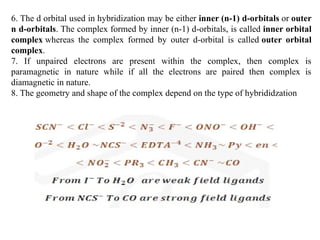
6. The dorbital used in hybridization may be either inner (n-1) d-orbitals or outer
n d-orbitals. The complex formed by inner (n-1) d-orbitals, is called inner orbital
complex whereas the complex formed by outer d-orbital is called outer orbital
complex.
7. If unpaired electrons are present within the complex, then complex is
paramagnetic in nature while if all the electrons are paired then complex is
diamagnetic in nature.
8. The geometry and shape of the complex depend on the type of hybrididzation
3.
Coordination
Number
Types
of Hybridizations
Geometry Examples
2sp Linear [Ag(NH3)2]+
3 sp2
Triangular planar [HgI3]–
4 sp3
Tetrahedral [CoCl4]2-
4 sp2
d Square planar [Ni(CN)4]2-
4 sd3
Tetrahedral MnO4
–
, CrO4
2-
5 dsp3
Trigonal bipyramidal Fe(CO)5
5 dsp3
Square pyramidal [Ni(CN)5]3-
6 d2
sp3
Octahedral [Fe(CN)6] 4-
6 sp3
d2
Octahedral [Fe(F)6] 3-
Hybridization and Geometry of Complexes
4.
Formation and magneticproperties of octahedral complexes
Hybridisation, magnetic character and spin type of the complex
1. Complex [Fe(CN)6]4−
Let the oxidation state of Fe=x
x+6(−1)=−4
x=+2
The electronic configuration of Fe= [Ar]3d6
4s2
The electronic configuration of Fe2+
=[Ar]3d6
4s0
CN− is a strong field ligand. So, due to the presence of strong-field ligands, the
pairing of 3d electrons takes place in the excited state
Hybridization: d2
sp3
Magnetic character:Diamagnetic
Spin: Low spin complex
5.
2. Complex [Fe(CN)6]3−
Letthe oxidation state of Fe=x
x+6(−1)=−3
x=+3
The electronic configuration of Fe= [Ar]3d6
4s2
The electronic configuration of Fe2+
=[Ar]3d5
4s0
CN− is a strong field ligand. So, due to the presence of strong-field ligands, the pairing
of 3d electrons takes place in the excited state
Hybridization: d2
sp3
Magnetic character: paramagnetic
Spin: Low spin complex
6.
3. Complex [CoF6]3-
Letthe oxidation state of Co = x
x+6(−1)=−3
x=+3
The electronic configuration of Co= [Ar]3d7
4s2
The electronic configuration of Co3+
=[Ar]3d6
4s0
F− is a weak ligand so the pairing of d electrons do not occur in the excited state.
Hybridization: sp3
d2
Magnetic character: paramagnetic
Spin: high spin complex
7.
3. Complex [Co(CN)6]3-
Letthe oxidation state of Co = x
x+6(−1)=−3
x=+3
The electronic configuration of Co= [Ar]3d7
4s2
The electronic configuration of Co3+
=[Ar]3d6
4s0
CN− is a strong ligand, so the pairing of d electrons occur in the excited state. The
electronic configuration in the excited state.
Hybridization: d2
sp3
Magnetic character: diamagnetic
Spin: low spin complex
8.
4. Complex [Fe(H2O)6]2+
H2OWeak filed ligand.
⇒
Hybridization: sp3
d2
Magnetic character: paramagnetic
Spin: high spin complex
5. Complex [Cr(H2O)6]3+
H2O Weak filed ligand
⇒
Let the oxidation state of Co = x
x+6(0)=+3
x=+3
The electronic configuration of Co= [Ar]3d7
4s2
The electronic configuration of Co3+
=[Ar]3d6
4s0
9.
Formation and magneticproperties of tetrahedral complexes
Formation of [Ni(CO)4]: Oxidation state of nickel =zero.
Its outer electronic configuration is 3d8
4s2
. Hence we have
Atomic orbitals of Ni
in (Z=28) ground state
3d 4s 4p
Hybridized sp3
orbitals of Ni
Formation of
[Ni(CO)4]
Hybridization: sp3
Magnetic character: diamagnetic
10.
Formation of [Cu(NH3)4]2+
oxidation state of copper = +2
Formation and magnetic properties of square planar complexes
Hybridization: dsp2
Magnetic character: paramagnetic
Inner orbital complex
11.
Formation of [Ni(CN)4]2-
Hybridization: dsp2
Magnetic character: diamagnetic
Inner orbital complex
12.
Formation of [Pt(Cl)4]2-
Hybridization: dsp2
Magnetic character: diamagnetic
Inner orbital complex
The ground state electron configuration of Pt2+
is [Xe]4f14
5d8
4S0
Excited electronic state
13.
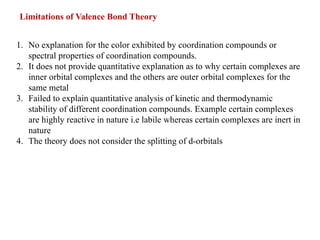
Limitations of ValenceBond Theory
1. No explanation for the color exhibited by coordination compounds or
spectral properties of coordination compounds.
2. It does not provide quantitative explanation as to why certain complexes are
inner orbital complexes and the others are outer orbital complexes for the
same metal
3. Failed to explain quantitative analysis of kinetic and thermodynamic
stability of different coordination compounds. Example certain complexes
are highly reactive in nature i.e labile whereas certain complexes are inert in
nature
4. The theory does not consider the splitting of d-orbitals
![Valence bond theory (VBT)
Salient features
1. A central metal atom or ion present in a complex makes available a definite
number of vacant orbitals or empty orbitals (s, p, d and) for the formation of
coordinate bond with suitable ligands.
2. The number of vacant orbitals provided by the central metal atom or ion is
equal to the coordination number of the metal ion. For example : Cu2+
provides 4 vacant orbitals in the complex formation [Cu(NH3)4]2+
3. The suitable atomic orbitals of the metal undergoes hybridization to give an
equal no of new orbitals of equal energy called hybrid orbitals.
4. The bonding in metal complexes arises when a filled ligand orbital containing a
lone pair of electrons overlaps a vacant hybrid orbital on the metal cation or
atom to form a coordinate covalent bond.
5. Each ligand has at least one orbital containing a lone pair of electrons. The
complex formed between strong ligand and metal ion are called low spin
complexes and the complex formed between weak ligand and metal ion are
called high spin complexes.](https://image.slidesharecdn.com/cft-250428071825-b78111a0/85/VBT-Crystal-fied-theory-structure-limitations-1-320.jpg)
![Valence bond theory (VBT)
Salient features
1. A central metal atom or ion present in a complex makes available a definite
number of vacant orbitals or empty orbitals (s, p, d and) for the formation of
coordinate bond with suitable ligands.
2. The number of vacant orbitals provided by the central metal atom or ion is
equal to the coordination number of the metal ion. For example : Cu2+
provides 4 vacant orbitals in the complex formation [Cu(NH3)4]2+
3. The suitable atomic orbitals of the metal undergoes hybridization to give an
equal no of new orbitals of equal energy called hybrid orbitals.
4. The bonding in metal complexes arises when a filled ligand orbital containing a
lone pair of electrons overlaps a vacant hybrid orbital on the metal cation or
atom to form a coordinate covalent bond.
5. Each ligand has at least one orbital containing a lone pair of electrons. The
complex formed between strong ligand and metal ion are called low spin
complexes and the complex formed between weak ligand and metal ion are
called high spin complexes.](https://image.slidesharecdn.com/cft-250428071825-b78111a0/75/VBT-Crystal-fied-theory-structure-limitations-1-2048.jpg)
![Coordination
Number
Types
of Hybridizations
Geometry Examples
2 sp Linear [Ag(NH3)2]+
3 sp2
Triangular planar [HgI3]–
4 sp3
Tetrahedral [CoCl4]2-
4 sp2
d Square planar [Ni(CN)4]2-
4 sd3
Tetrahedral MnO4
–
, CrO4
2-
5 dsp3
Trigonal bipyramidal Fe(CO)5
5 dsp3
Square pyramidal [Ni(CN)5]3-
6 d2
sp3
Octahedral [Fe(CN)6] 4-
6 sp3
d2
Octahedral [Fe(F)6] 3-
Hybridization and Geometry of Complexes](https://image.slidesharecdn.com/cft-250428071825-b78111a0/85/VBT-Crystal-fied-theory-structure-limitations-3-320.jpg)
![Formation and magnetic properties of octahedral complexes
Hybridisation, magnetic character and spin type of the complex
1. Complex [Fe(CN)6]4−
Let the oxidation state of Fe=x
x+6(−1)=−4
x=+2
The electronic configuration of Fe= [Ar]3d6
4s2
The electronic configuration of Fe2+
=[Ar]3d6
4s0
CN− is a strong field ligand. So, due to the presence of strong-field ligands, the
pairing of 3d electrons takes place in the excited state
Hybridization: d2
sp3
Magnetic character:Diamagnetic
Spin: Low spin complex](https://image.slidesharecdn.com/cft-250428071825-b78111a0/85/VBT-Crystal-fied-theory-structure-limitations-4-320.jpg)
![2. Complex [Fe(CN)6]3−
Let the oxidation state of Fe=x
x+6(−1)=−3
x=+3
The electronic configuration of Fe= [Ar]3d6
4s2
The electronic configuration of Fe2+
=[Ar]3d5
4s0
CN− is a strong field ligand. So, due to the presence of strong-field ligands, the pairing
of 3d electrons takes place in the excited state
Hybridization: d2
sp3
Magnetic character: paramagnetic
Spin: Low spin complex](https://image.slidesharecdn.com/cft-250428071825-b78111a0/85/VBT-Crystal-fied-theory-structure-limitations-5-320.jpg)
![3. Complex [CoF6]3-
Let the oxidation state of Co = x
x+6(−1)=−3
x=+3
The electronic configuration of Co= [Ar]3d7
4s2
The electronic configuration of Co3+
=[Ar]3d6
4s0
F− is a weak ligand so the pairing of d electrons do not occur in the excited state.
Hybridization: sp3
d2
Magnetic character: paramagnetic
Spin: high spin complex](https://image.slidesharecdn.com/cft-250428071825-b78111a0/85/VBT-Crystal-fied-theory-structure-limitations-6-320.jpg)
![3. Complex [Co(CN)6]3-
Let the oxidation state of Co = x
x+6(−1)=−3
x=+3
The electronic configuration of Co= [Ar]3d7
4s2
The electronic configuration of Co3+
=[Ar]3d6
4s0
CN− is a strong ligand, so the pairing of d electrons occur in the excited state. The
electronic configuration in the excited state.
Hybridization: d2
sp3
Magnetic character: diamagnetic
Spin: low spin complex](https://image.slidesharecdn.com/cft-250428071825-b78111a0/85/VBT-Crystal-fied-theory-structure-limitations-7-320.jpg)
![4. Complex [Fe(H2O)6]2+
H2O Weak filed ligand.
⇒
Hybridization: sp3
d2
Magnetic character: paramagnetic
Spin: high spin complex
5. Complex [Cr(H2O)6]3+
H2O Weak filed ligand
⇒
Let the oxidation state of Co = x
x+6(0)=+3
x=+3
The electronic configuration of Co= [Ar]3d7
4s2
The electronic configuration of Co3+
=[Ar]3d6
4s0](https://image.slidesharecdn.com/cft-250428071825-b78111a0/85/VBT-Crystal-fied-theory-structure-limitations-8-320.jpg)
![Formation and magnetic properties of tetrahedral complexes
Formation of [Ni(CO)4]: Oxidation state of nickel =zero.
Its outer electronic configuration is 3d8
4s2
. Hence we have
Atomic orbitals of Ni
in (Z=28) ground state
3d 4s 4p
Hybridized sp3
orbitals of Ni
Formation of
[Ni(CO)4]
Hybridization: sp3
Magnetic character: diamagnetic](https://image.slidesharecdn.com/cft-250428071825-b78111a0/85/VBT-Crystal-fied-theory-structure-limitations-9-320.jpg)
![Formation of [Cu(NH3)4] 2+
oxidation state of copper = +2
Formation and magnetic properties of square planar complexes
Hybridization: dsp2
Magnetic character: paramagnetic
Inner orbital complex](https://image.slidesharecdn.com/cft-250428071825-b78111a0/85/VBT-Crystal-fied-theory-structure-limitations-10-320.jpg)
![Formation of [Ni(CN)4] 2-
Hybridization: dsp2
Magnetic character: diamagnetic
Inner orbital complex](https://image.slidesharecdn.com/cft-250428071825-b78111a0/85/VBT-Crystal-fied-theory-structure-limitations-11-320.jpg)
![Formation of [Pt(Cl)4] 2-
Hybridization: dsp2
Magnetic character: diamagnetic
Inner orbital complex
The ground state electron configuration of Pt2+
is [Xe]4f14
5d8
4S0
Excited electronic state](https://image.slidesharecdn.com/cft-250428071825-b78111a0/85/VBT-Crystal-fied-theory-structure-limitations-12-320.jpg)