Validation of
Vasti for futurity


             Dr. K. Shiva Rama Prasad
       M.D.(Ay) COP (German), M.A, Ph.D. (Jyotish)


28-05-2008           doctorksrprasad@gmail.com       1
                       doctorksrprasad@aol.in
Futurity Vs Futility


• Futurity =The time yet to come
• or
• The quality of being in or of the future
• Futility = Uselessness as a
  consequence of having no practical result
                 doctorksrprasad@gmail.com    2
                   doctorksrprasad@aol.in
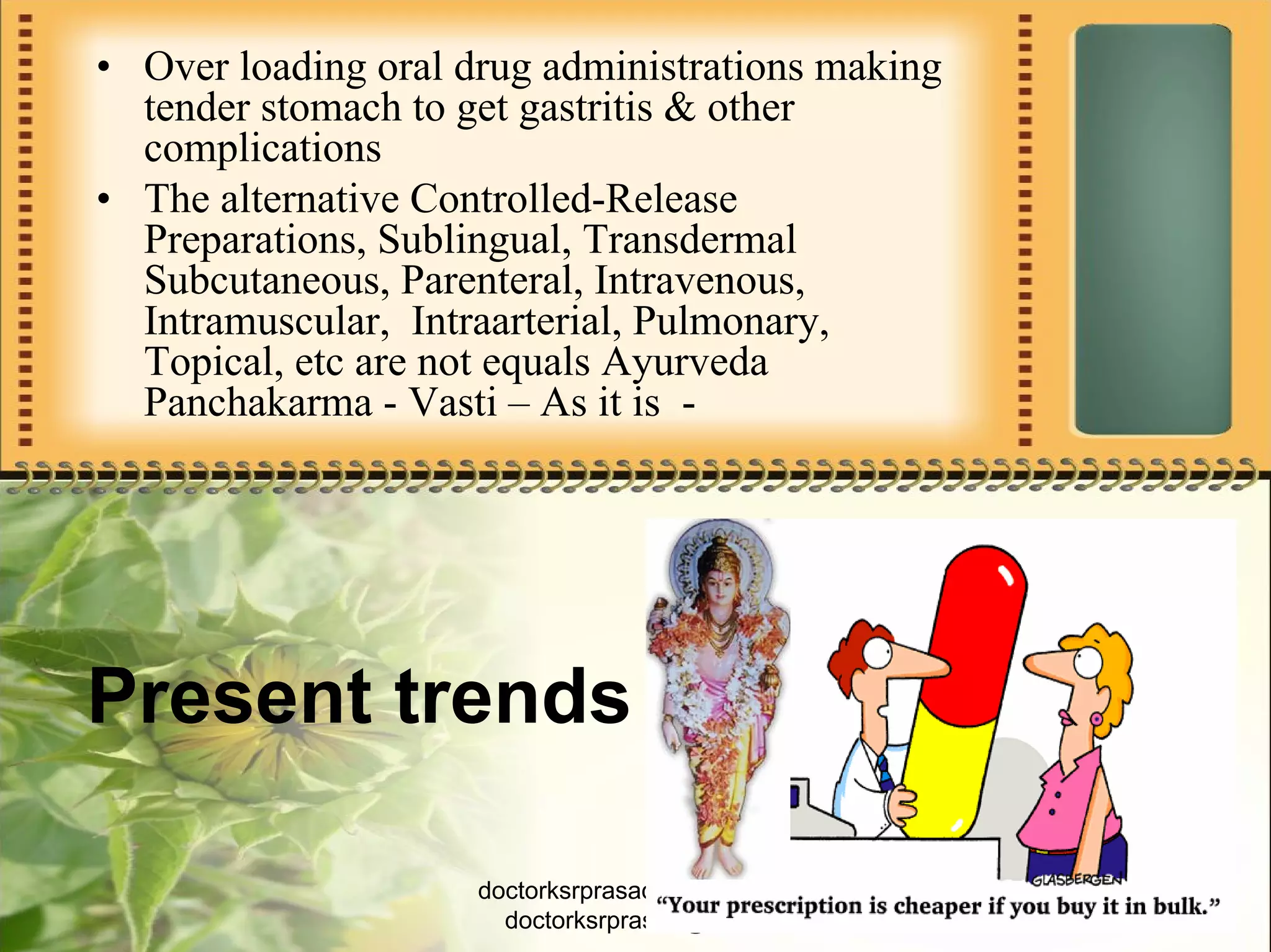
• Over loading oral drug administrations making
  tender stomach to get gastritis & other
  complications
• The alternative Controlled-Release
  Preparations, Sublingual, Transdermal
  Subcutaneous, Parenteral, Intravenous,
  Intramuscular, Intraarterial, Pulmonary,
  Topical, etc are not equals Ayurveda
  Panchakarma - Vasti – As it is -


Present trends

                     doctorksrprasad@gmail.com    3
                       doctorksrprasad@aol.in
Rectal
                                                     Administration
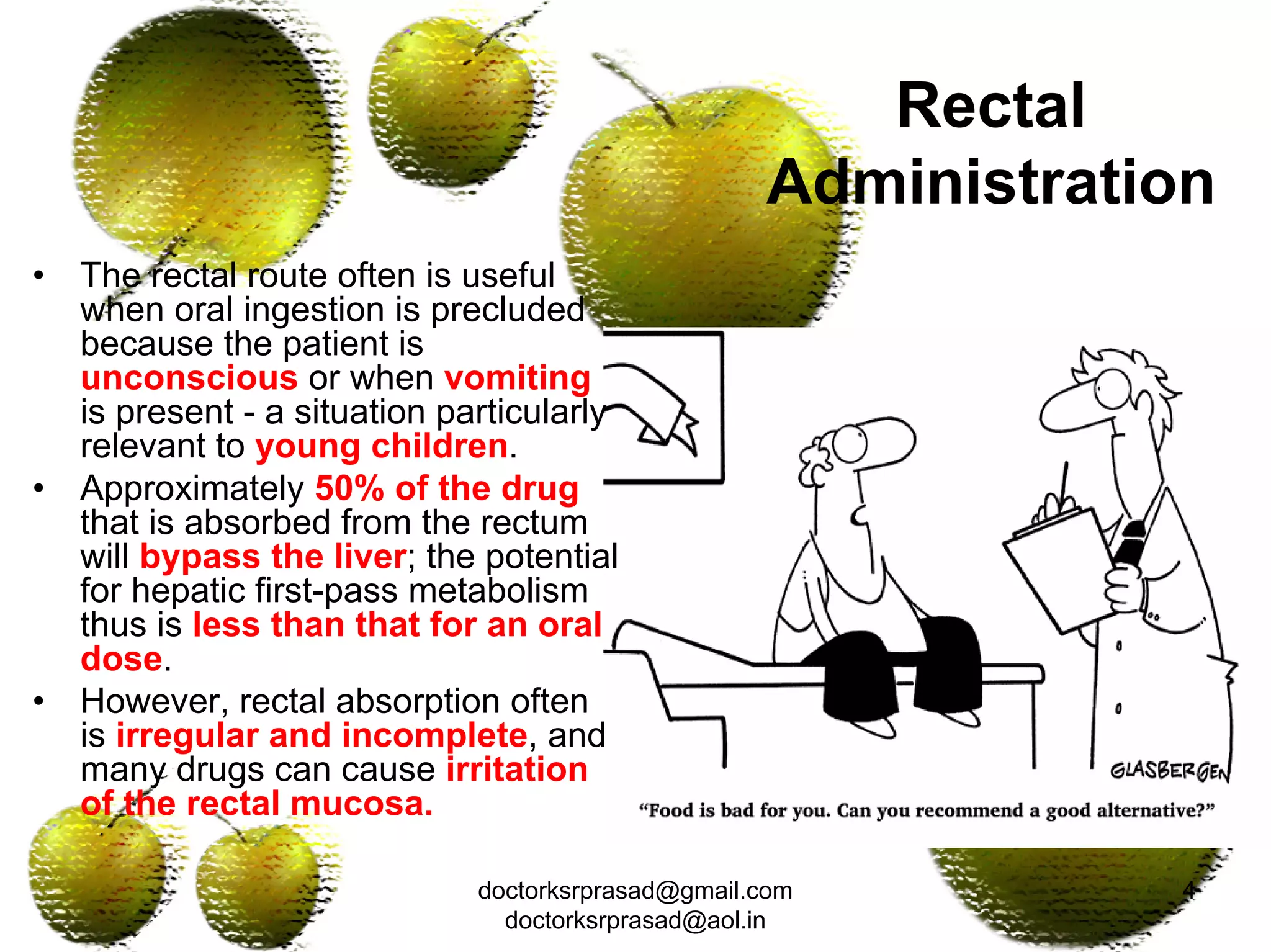
•   The rectal route often is useful
    when oral ingestion is precluded
    because the patient is
    unconscious or when vomiting
    is present - a situation particularly
    relevant to young children.
•   Approximately 50% of the drug
    that is absorbed from the rectum
    will bypass the liver; the potential
    for hepatic first-pass metabolism
    thus is less than that for an oral
    dose.
•   However, rectal absorption often
    is irregular and incomplete, and
    many drugs can cause irritation
    of the rectal mucosa.

                               doctorksrprasad@gmail.com         4
                                 doctorksrprasad@aol.in
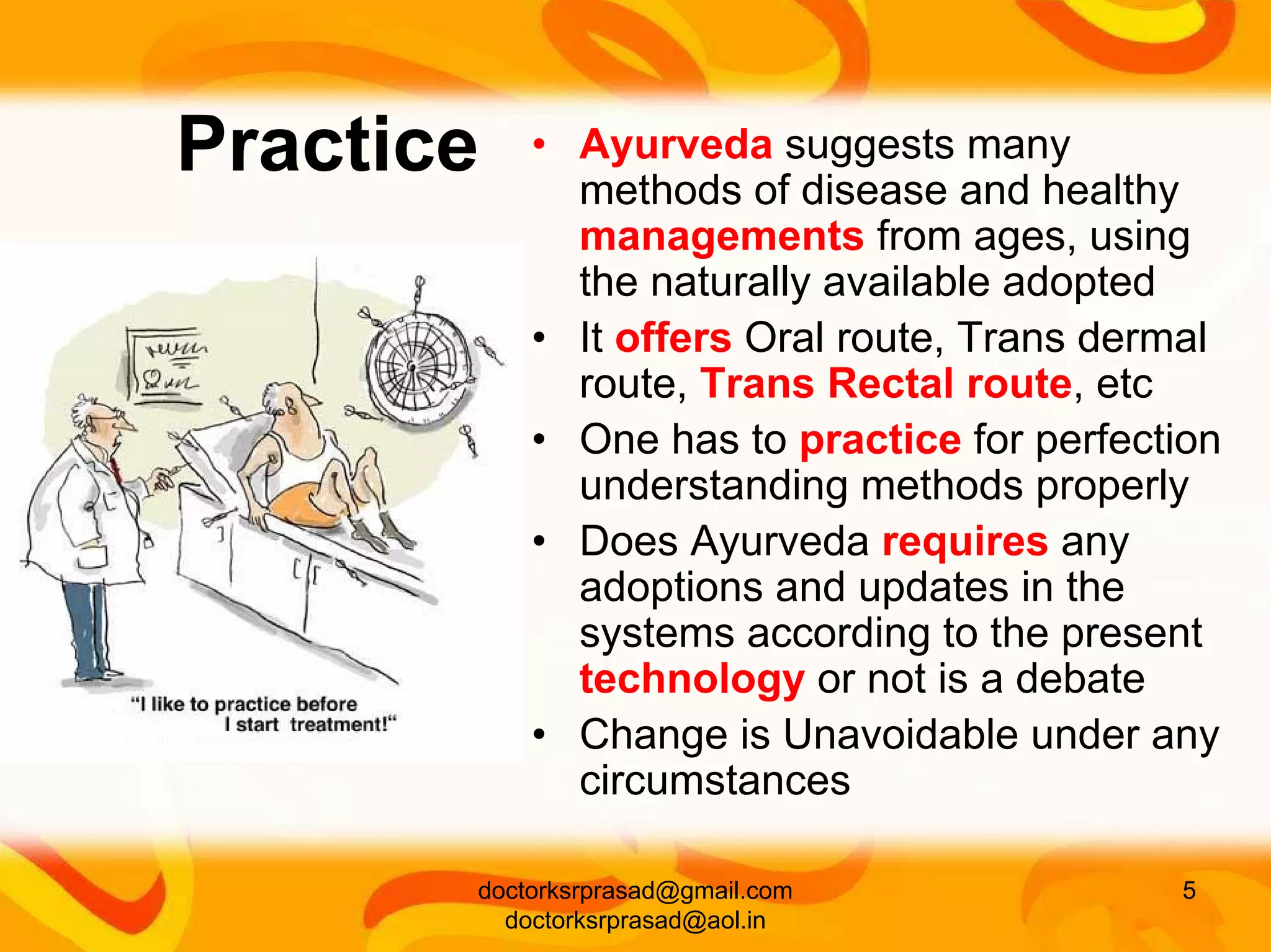
Practice   • Ayurveda suggests many
             methods of disease and healthy
             managements from ages, using
             the naturally available adopted
           • It offers Oral route, Trans dermal
             route, Trans Rectal route, etc
           • One has to practice for perfection
             understanding methods properly
           • Does Ayurveda requires any
             adoptions and updates in the
             systems according to the present
             technology or not is a debate
           • Change is Unavoidable under any
             circumstances

       doctorksrprasad@gmail.com            5
         doctorksrprasad@aol.in
Tunes of Trans Rectal route

                                     Vasti or Basti

• The pronunciation of the Technical term
  itself is first problem
• Many times not undergone the concepts
• Following colloquially
• Not having touch with Instruments /
  Mechanism /Drug qualities /etc


             doctorksrprasad@gmail.com                     6
               doctorksrprasad@aol.in
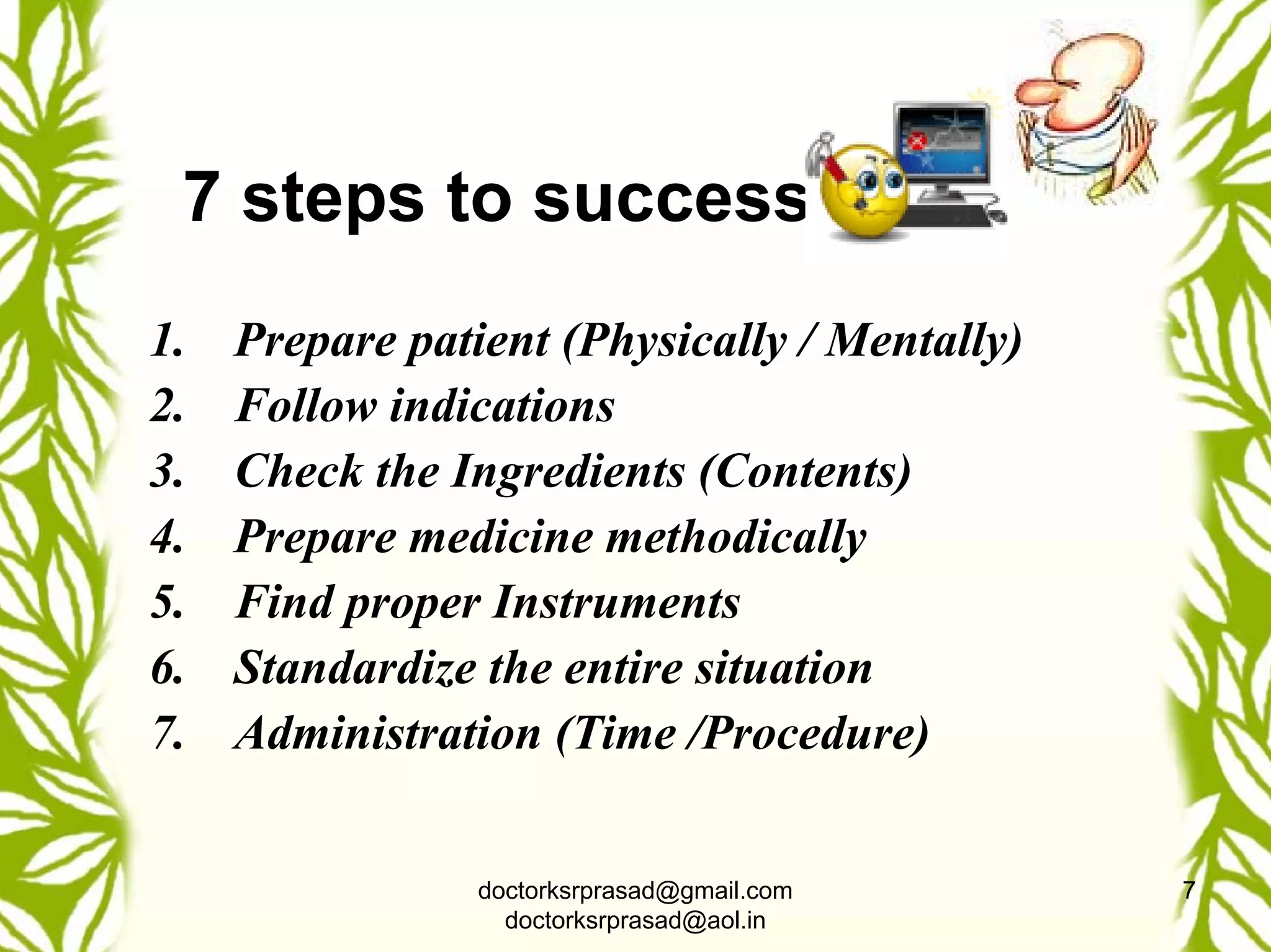
7 steps to success
1.   Prepare patient (Physically / Mentally)
2.   Follow indications
3.   Check the Ingredients (Contents)
4.   Prepare medicine methodically
5.   Find proper Instruments
6.   Standardize the entire situation
7.   Administration (Time /Procedure)


                 doctorksrprasad@gmail.com     7
                   doctorksrprasad@aol.in
Dimensions                          &                Definition


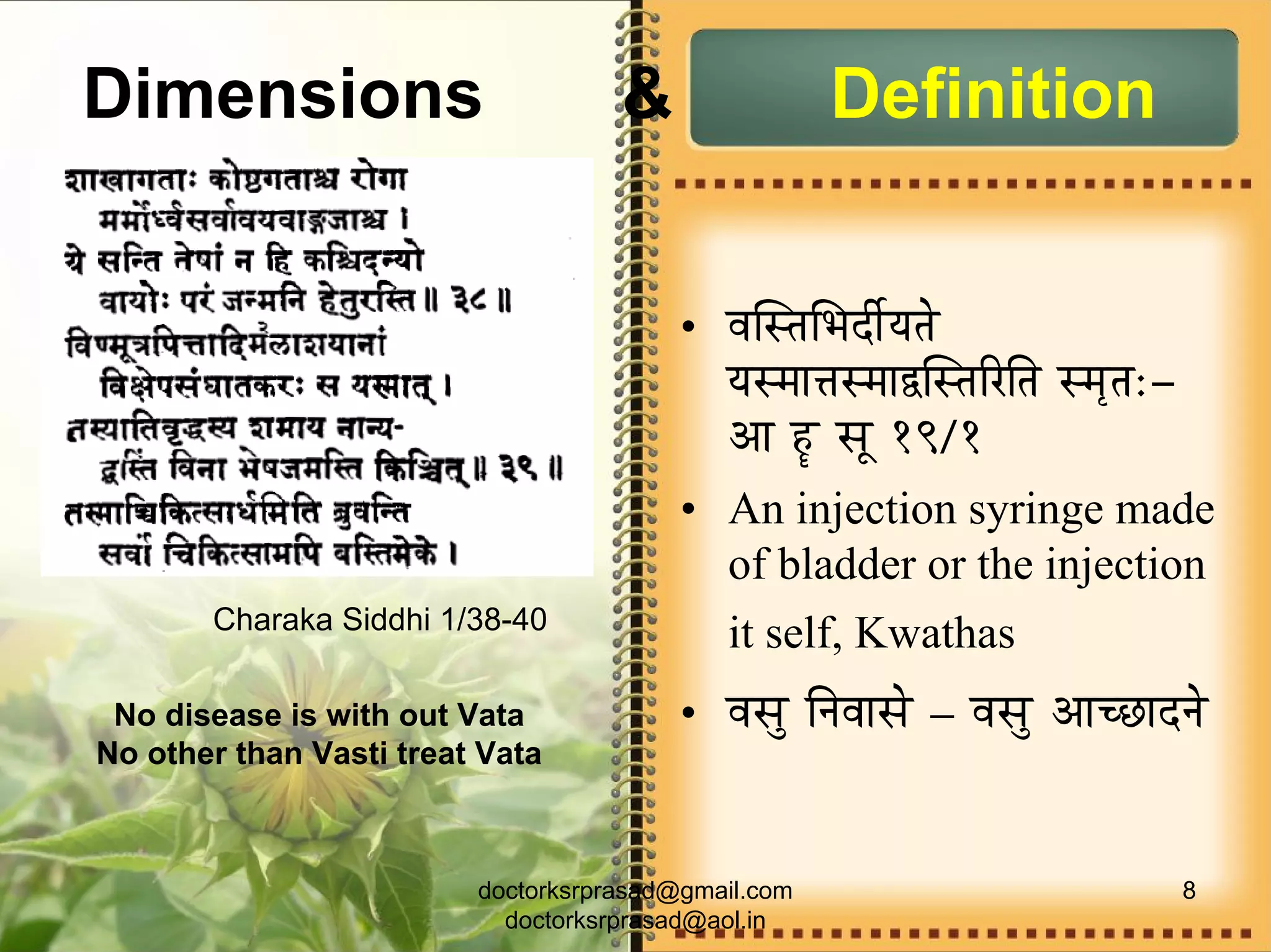
                                         • uÉÎxiÉÍpÉSÏïrÉiÉå
                                           rÉxqÉɨÉxqÉɲÎxiÉËUÌiÉ xqÉ×iÉ:-
                                           AÉ WÛû xÉÔ 19/1
                                         • An injection syringe made
                                           of bladder or the injection
       Charaka Siddhi 1/38-40
                                           it self, Kwathas
 No disease is with out Vata             • uÉxÉÑ ÌlÉuÉÉxÉå – uÉxÉÑ AÉcNûÉSlÉå
No other than Vasti treat Vata


                         doctorksrprasad@gmail.com                           8
                           doctorksrprasad@aol.in
• Enema = An injection of a
  liquid through the anus to
  stimulate evacuation;
  sometimes used for
  diagnostic purposes
• Many varieties of
  nomenclature based upon the
  site of administration –
  Shirovasti, Urovasti,
  Kativasti, Uttaravasti, Vasti
  = Niruha, Anuvasana

          doctorksrprasad@gmail.com   9
            doctorksrprasad@aol.in
Preparation & Understanding
    patient (Physically / Mentally)
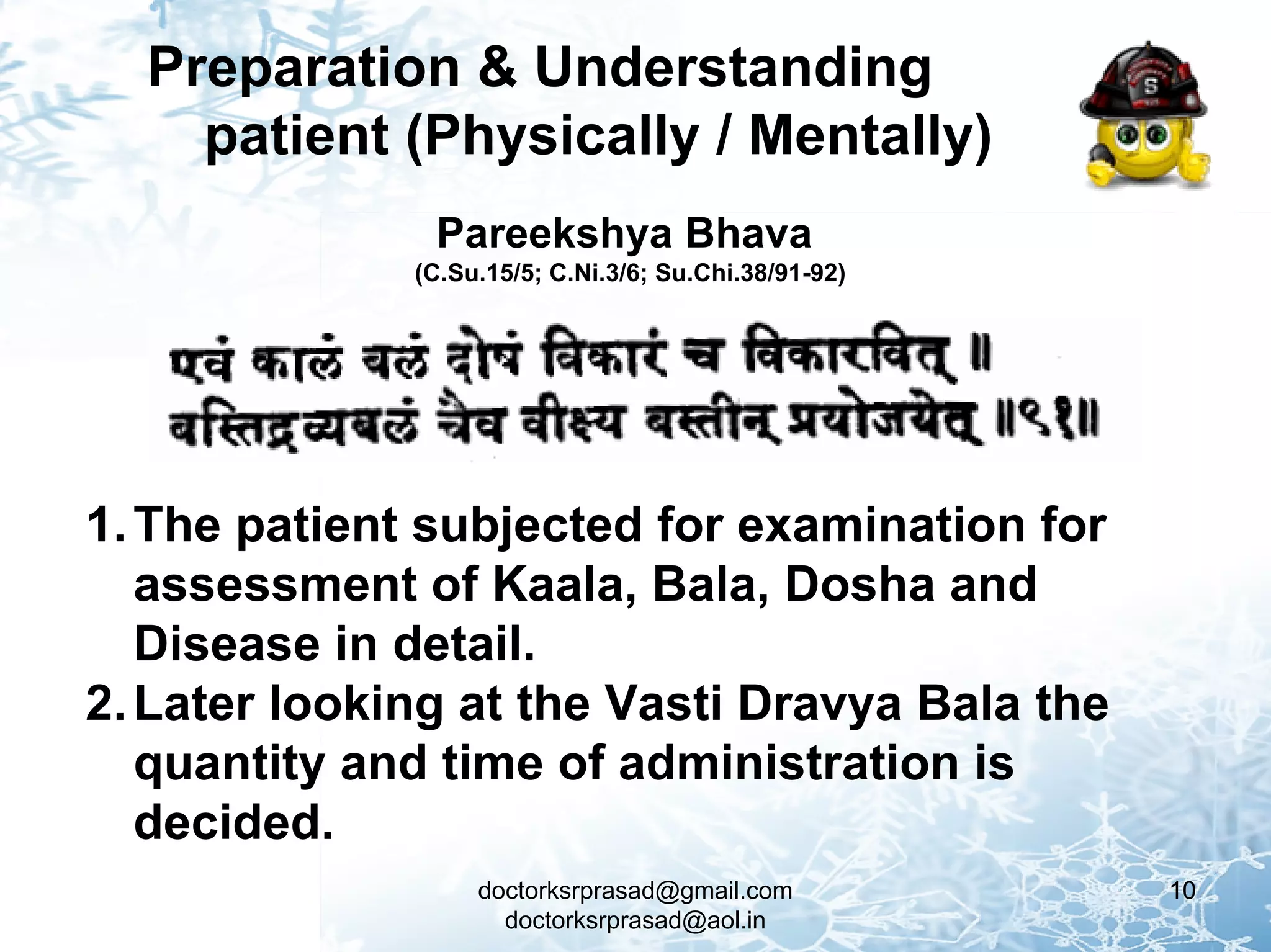
               Pareekshya Bhava
              (C.Su.15/5; C.Ni.3/6; Su.Chi.38/91-92)


1. The patient subjected for examination for
   assessment of Kaala, Bala, Dosha and
   Disease in detail.
2. Later looking at the Vasti Dravya Bala the
   quantity and time of administration is
   decided.
                   doctorksrprasad@gmail.com           10
                     doctorksrprasad@aol.in
•   In this course of preparation –
    –   In Kaala - Rutu kaala, Vayo kaala, Vyadhi
        Kriyakaala, Ahara kaala
    –   In Bala – Rogi bala (Physical /psychological),
        Roga Bala, Aushadha Bala
    –   In Dosha - sansargatwam – Vruddhi, Ksheena,
        Urdhwa /Adho gati, etc
    –   In Vyadhi - Rogamarga - Shakha /Kosta/Marma,
        Swatantra / Paratantra, Vata vyadhi, Vata
        sthaana janya vyadhi, Shakha /Kosta janya
        vyadhi, Pureeshaadhana / srotas janya vyadhi,
        Shodhanaarha vyadhi, Brumhanadi
        kramoyogam


                    doctorksrprasad@gmail.com            11
                      doctorksrprasad@aol.in
• Based upon the site/ Organ Vasti – Pakwashaya,
  Mootrashaya, garbhashaya
• Based upon the Drug content / material – Nirooha,
  Anuvasana
• Based upon the Quantity of the material – Sneha,
  Anuvasana, Matravasti
• Based upon the function – Shodhana, Shamana
• Based upon the number of administrations – Karma, Kala,
  Yoga
• Based upon the utility – Yapana, Siddha, Piccha, Rakta,
  Prasruta Yogiki, etc
• Based upon the Karmukata (purpose /intentions) –
  Vajikarana, Brumhana, Lekhana, Vandhtwahara, Teekshna,
  Mrudu, Krimighna, Chakshushya, Malabhedana, etc


                Vasti classification
                     doctorksrprasad@gmail.com              12
                       doctorksrprasad@aol.in
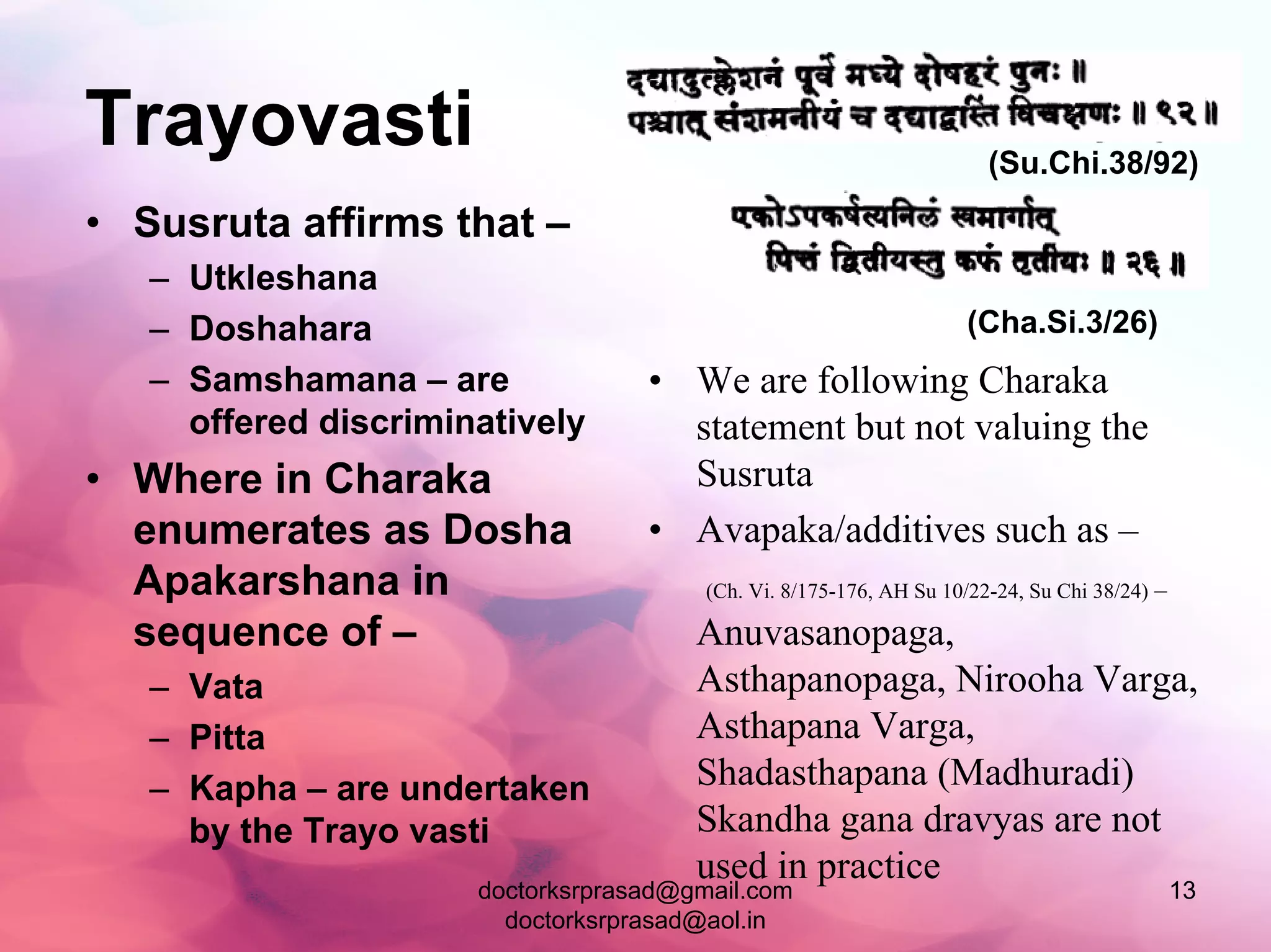
Trayovasti                                                             (Su.Chi.38/92)
• Susruta affirms that –
   – Utkleshana
   – Doshahara                                                      (Cha.Si.3/26)
   – Samshamana – are              • We are following Charaka
     offered discriminatively        statement but not valuing the
• Where in Charaka                   Susruta
  enumerates as Dosha              • Avapaka/additives such as –
  Apakarshana in                        (Ch. Vi. 8/175-176, AH Su 10/22-24, Su Chi 38/24) –

  sequence of –                        Anuvasanopaga,
   – Vata                              Asthapanopaga, Nirooha Varga,
   – Pitta                             Asthapana Varga,
   – Kapha – are undertaken            Shadasthapana (Madhuradi)
     by the Trayo vasti                Skandha gana dravyas are not
                                       used in practice
                      doctorksrprasad@gmail.com                                               13
                        doctorksrprasad@aol.in
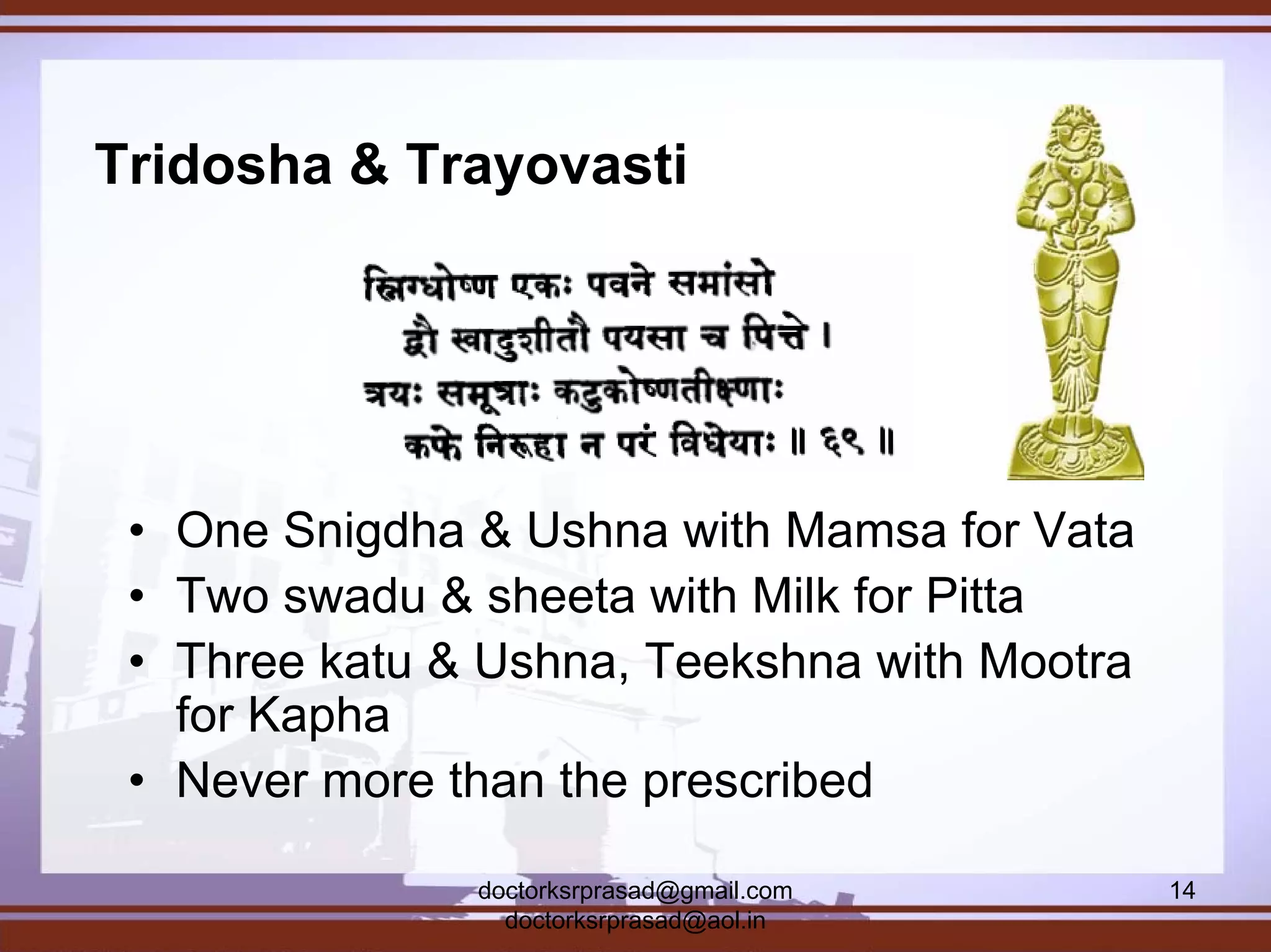
Tridosha & Trayovasti


 • One Snigdha & Ushna with Mamsa for Vata
 • Two swadu & sheeta with Milk for Pitta
 • Three katu & Ushna, Teekshna with Mootra
   for Kapha
 • Never more than the prescribed

               doctorksrprasad@gmail.com      14
                 doctorksrprasad@aol.in
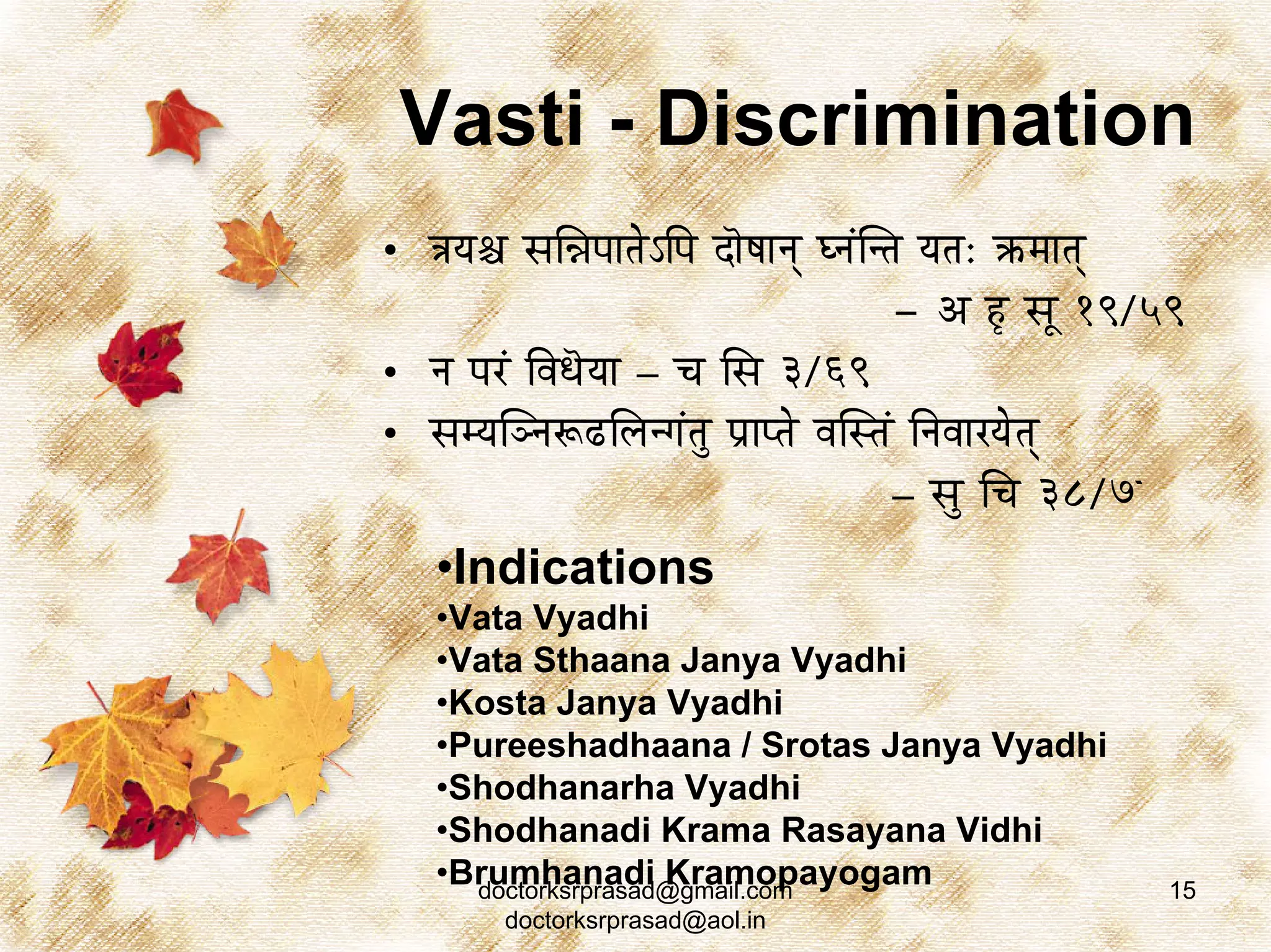
Vasti - Discrimination
• §ÉrÉ¶É xÉͳÉmÉÉiÉåÅÌmÉ SÉãwÉÉlÉç blÉÇÎliÉ rÉiÉ: ¢üqÉÉiÉç
                                          - A WØ xÉÔ 19/59
• lÉ mÉUÇ ÌuÉkÉãrÉÉ – cÉ ÍxÉ 3/69
• xÉqrÉÎglÉÃRûÍsÉlaÉÇiÉÑ mÉëÉmiÉå uÉÎxiÉÇ ÌlÉuÉÉUrÉåiÉç
                                          – xÉÑ ÍcÉ 38/7û
   •Indications
   •Vata Vyadhi
   •Vata Sthaana Janya Vyadhi
   •Kosta Janya Vyadhi
   •Pureeshadhaana / Srotas Janya Vyadhi
   •Shodhanarha Vyadhi
   •Shodhanadi Krama Rasayana Vidhi
   •Brumhanadi Kramopayogam
     doctorksrprasad@gmail.com                          15
        doctorksrprasad@aol.in
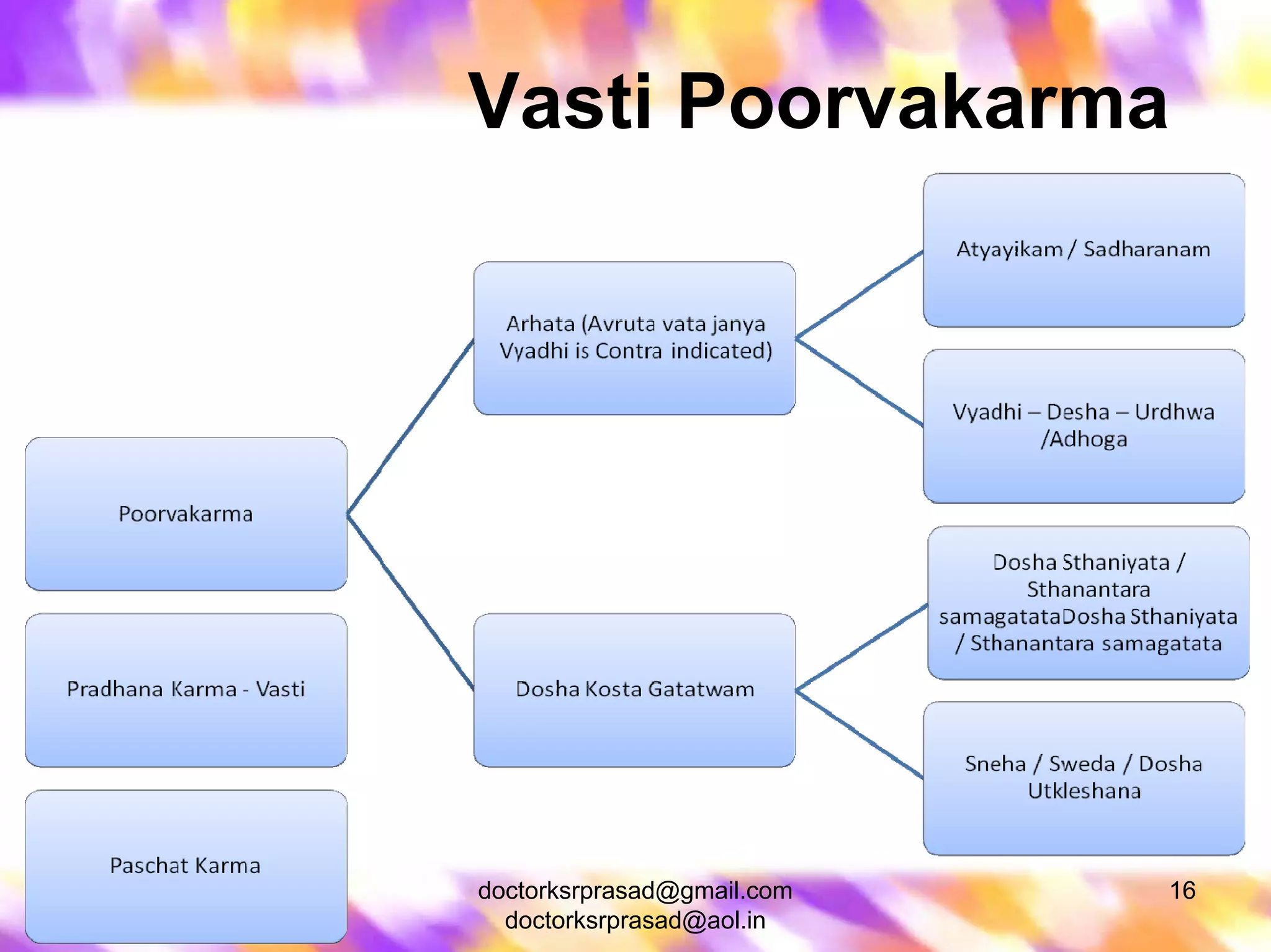
Vasti Poorvakarma


doctorksrprasad@gmail.com   16
  doctorksrprasad@aol.in
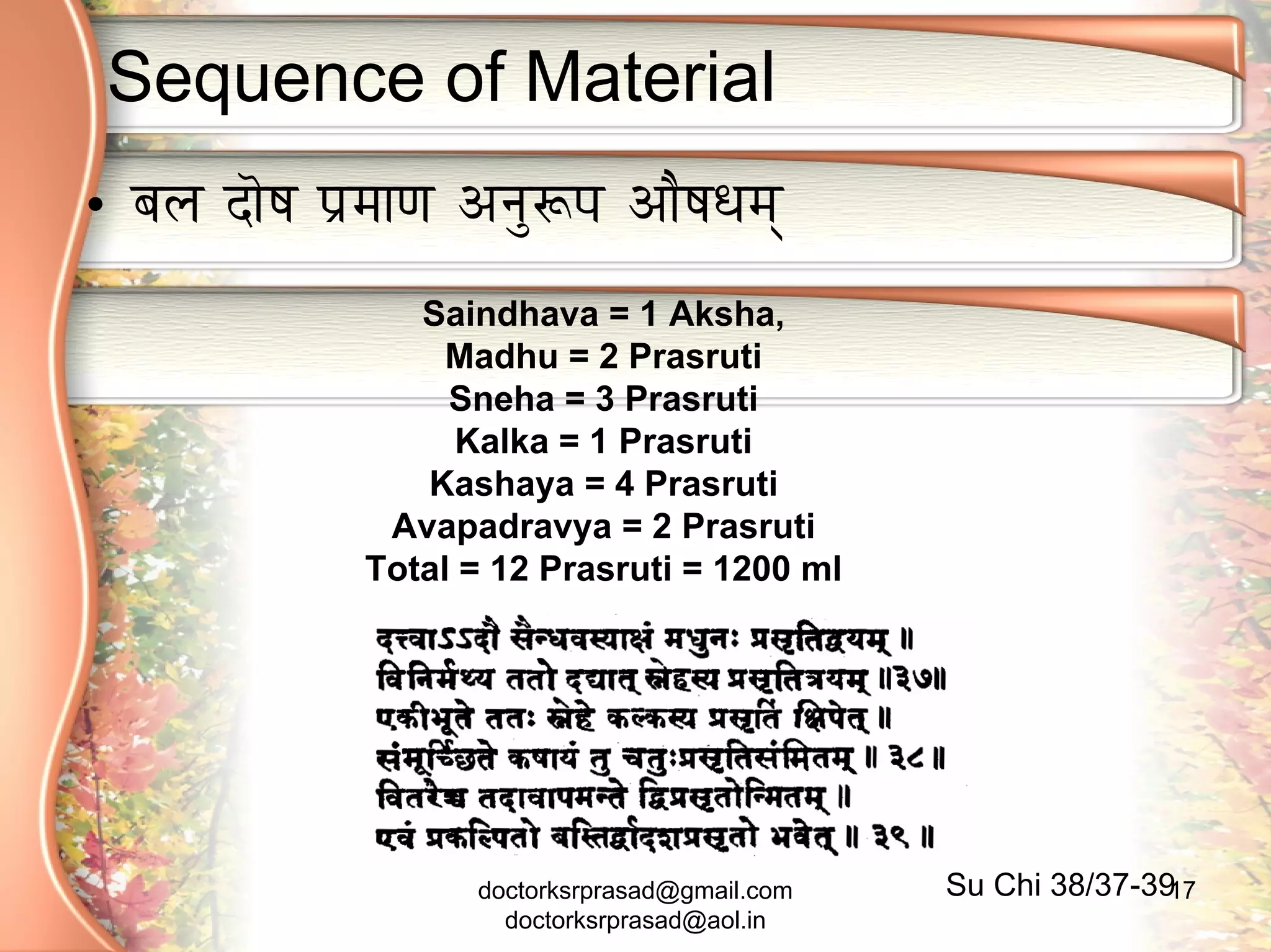
Sequence of Material
• oÉsÉ SÉãwÉ mÉëqÉÉhÉ AlÉÑÃmÉ AÉæwÉkÉqÉç
                   Saindhava = 1 Aksha,
                     Madhu = 2 Prasruti
                     Sneha = 3 Prasruti
                      Kalka = 1 Prasruti
                   Kashaya = 4 Prasruti
                 Avapadravya = 2 Prasruti
                Total = 12 Prasruti = 1200 ml


                      doctorksrprasad@gmail.com   Su Chi 38/37-3917
                        doctorksrprasad@aol.in
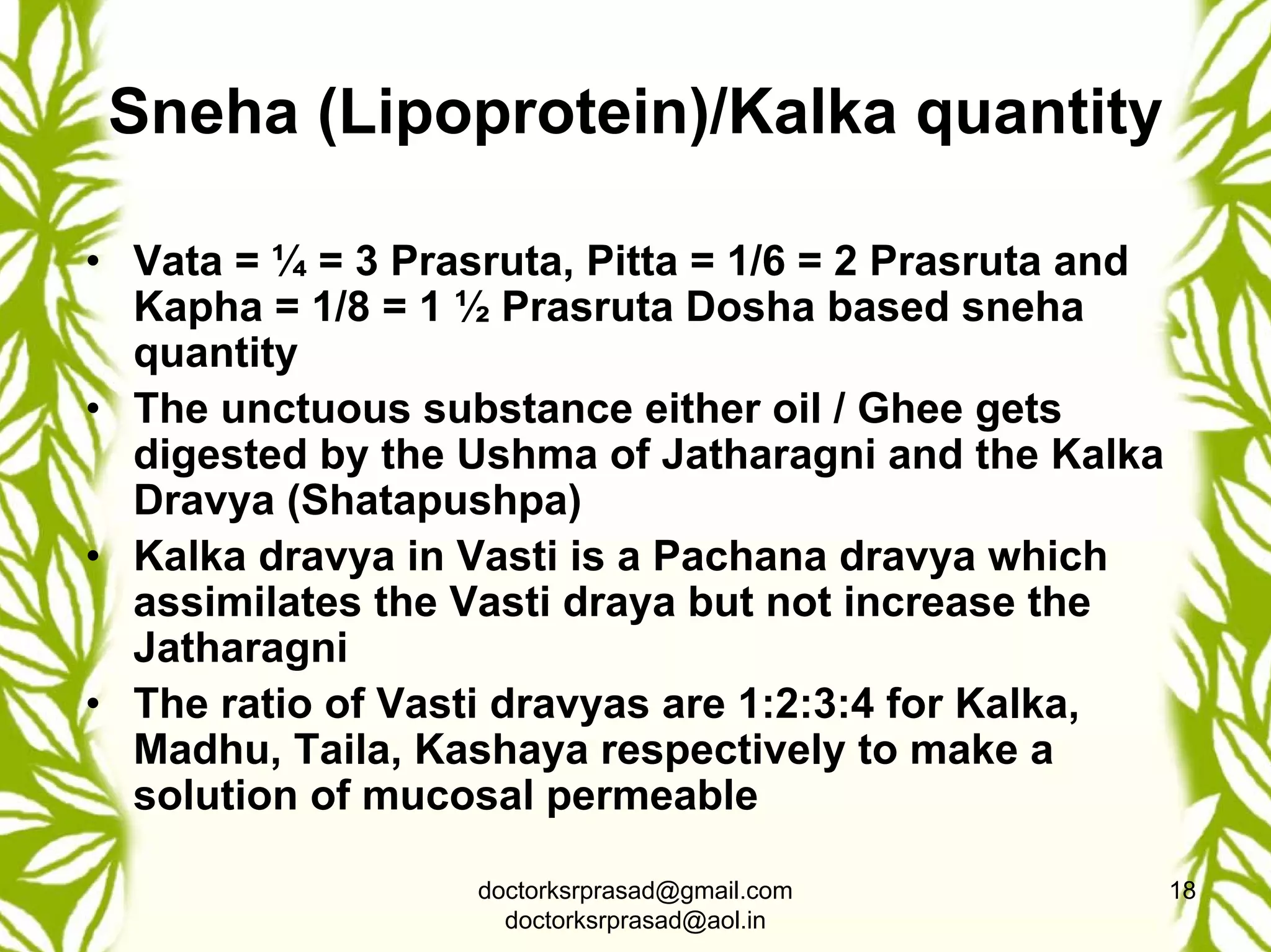
Sneha (Lipoprotein)/Kalka quantity

• Vata = ¼ = 3 Prasruta, Pitta = 1/6 = 2 Prasruta and
  Kapha = 1/8 = 1 ½ Prasruta Dosha based sneha
  quantity
• The unctuous substance either oil / Ghee gets
  digested by the Ushma of Jatharagni and the Kalka
  Dravya (Shatapushpa)
• Kalka dravya in Vasti is a Pachana dravya which
  assimilates the Vasti draya but not increase the
  Jatharagni
• The ratio of Vasti dravyas are 1:2:3:4 for Kalka,
  Madhu, Taila, Kashaya respectively to make a
  solution of mucosal permeable

                   doctorksrprasad@gmail.com            18
                     doctorksrprasad@aol.in
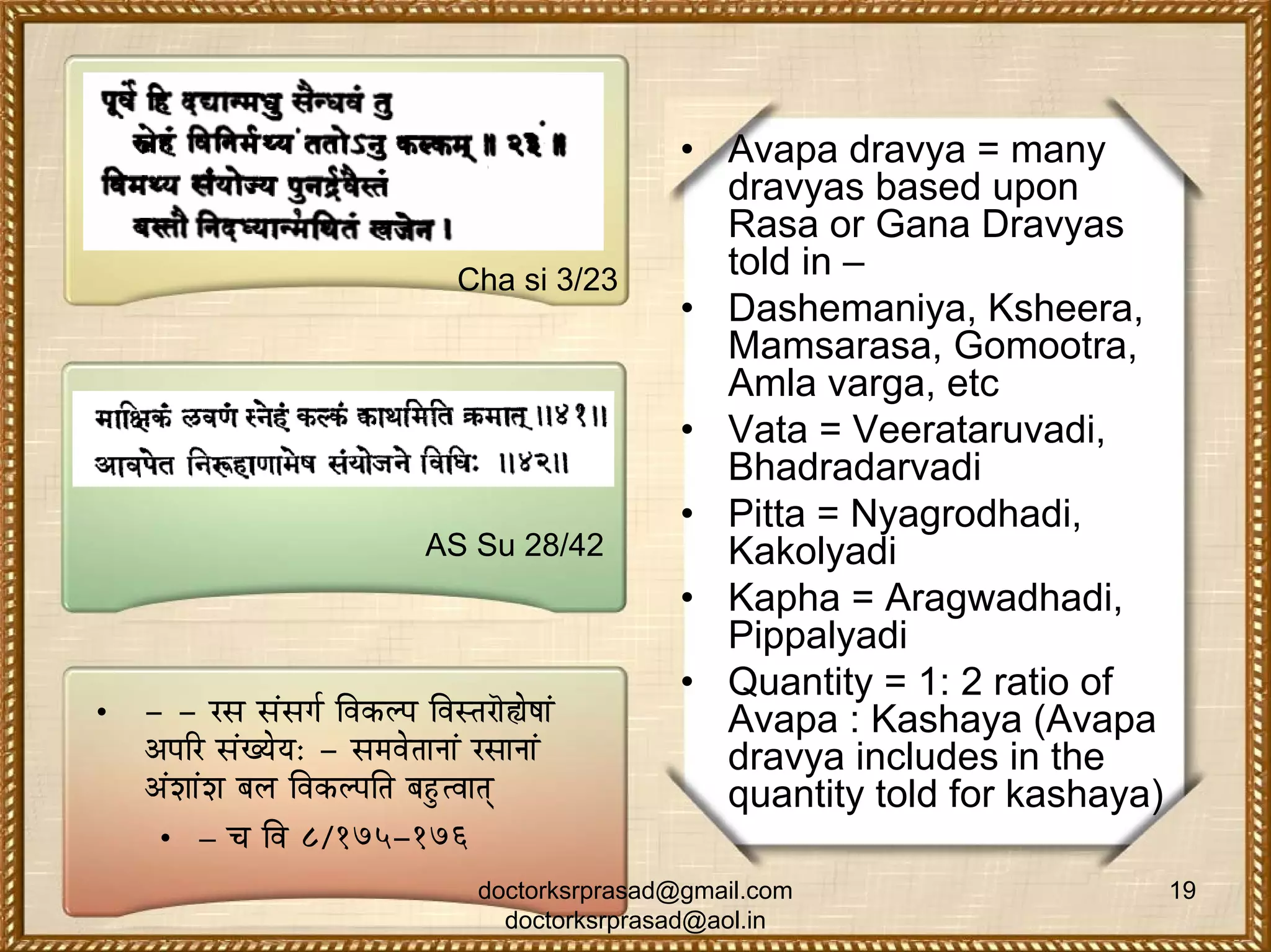
• Avapa dravya = many
                                                        dravyas based upon
                                                        Rasa or Gana Dravyas
                                    Cha si 3/23
                                                        told in –
                                                      • Dashemaniya, Ksheera,
                                                        Mamsarasa, Gomootra,
                                                        Amla varga, etc
                                                      • Vata = Veerataruvadi,
                                                        Bhadradarvadi
                                                      • Pitta = Nyagrodhadi,
                                AS Su 28/42             Kakolyadi
                                                      • Kapha = Aragwadhadi,
                                                        Pippalyadi
                                                      • Quantity = 1: 2 ratio of
•   - - UxÉ xÉÇxÉaÉï ÌuÉMüsmÉ ÌuÉxiÉUÉã½åwÉÉÇ           Avapa : Kashaya (Avapa
    AmÉËU xÉÇZrÉårÉ: - xÉqÉuÉåiÉÉlÉÉÇ UxÉÉlÉÉÇ          dravya includes in the
    AÇzÉÉÇzÉ oÉsÉ ÌuÉMüsmÉÌiÉ oÉWÒûiuÉÉiÉç              quantity told for kashaya)
     • – cÉ ÌuÉ 8/175-176
                                      doctorksrprasad@gmail.com                      19
                                        doctorksrprasad@aol.in
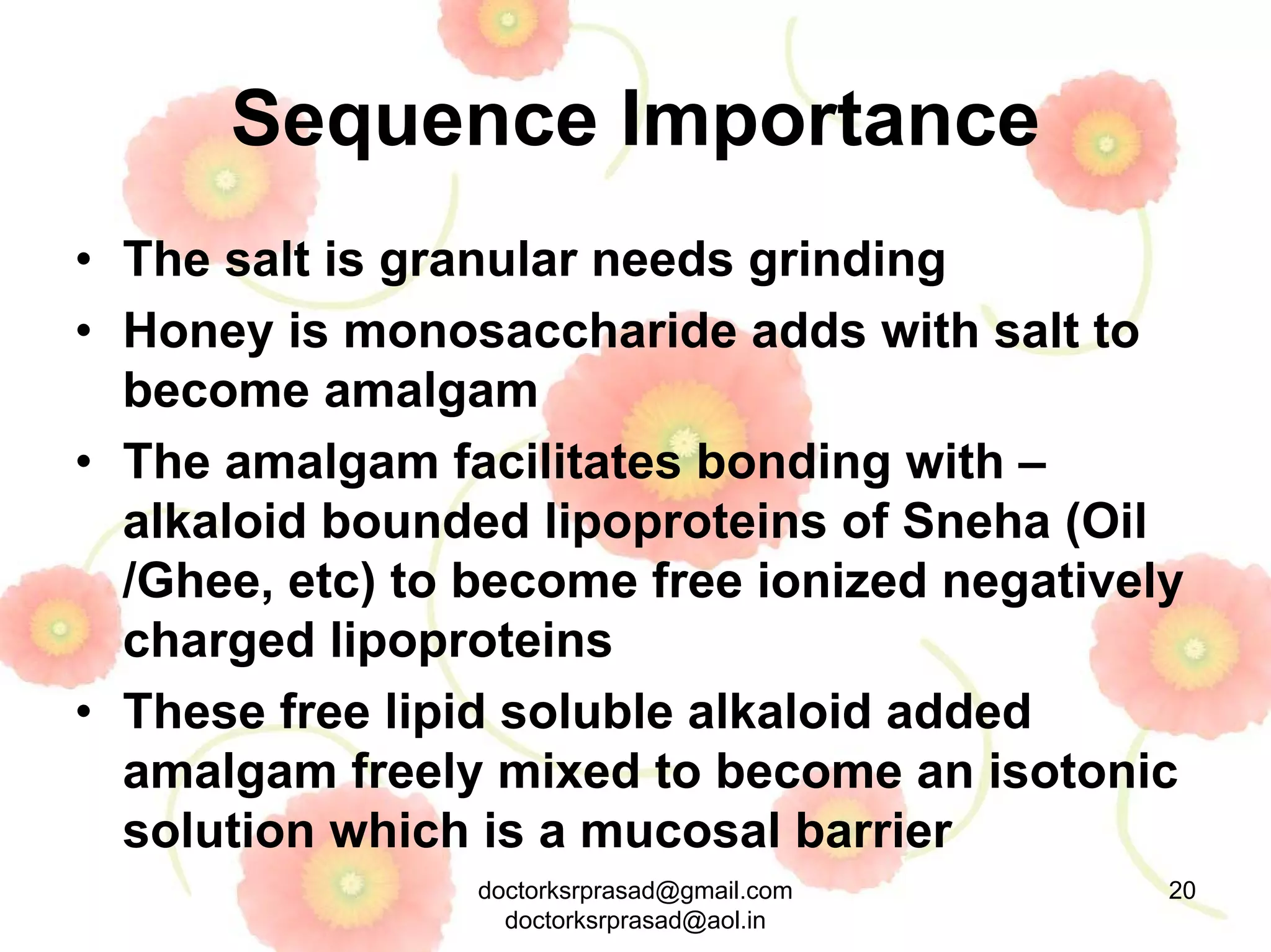
Sequence Importance
• The salt is granular needs grinding
• Honey is monosaccharide adds with salt to
  become amalgam
• The amalgam facilitates bonding with –
  alkaloid bounded lipoproteins of Sneha (Oil
  /Ghee, etc) to become free ionized negatively
  charged lipoproteins
• These free lipid soluble alkaloid added
  amalgam freely mixed to become an isotonic
  solution which is a mucosal barrier
                 doctorksrprasad@gmail.com    20
                   doctorksrprasad@aol.in
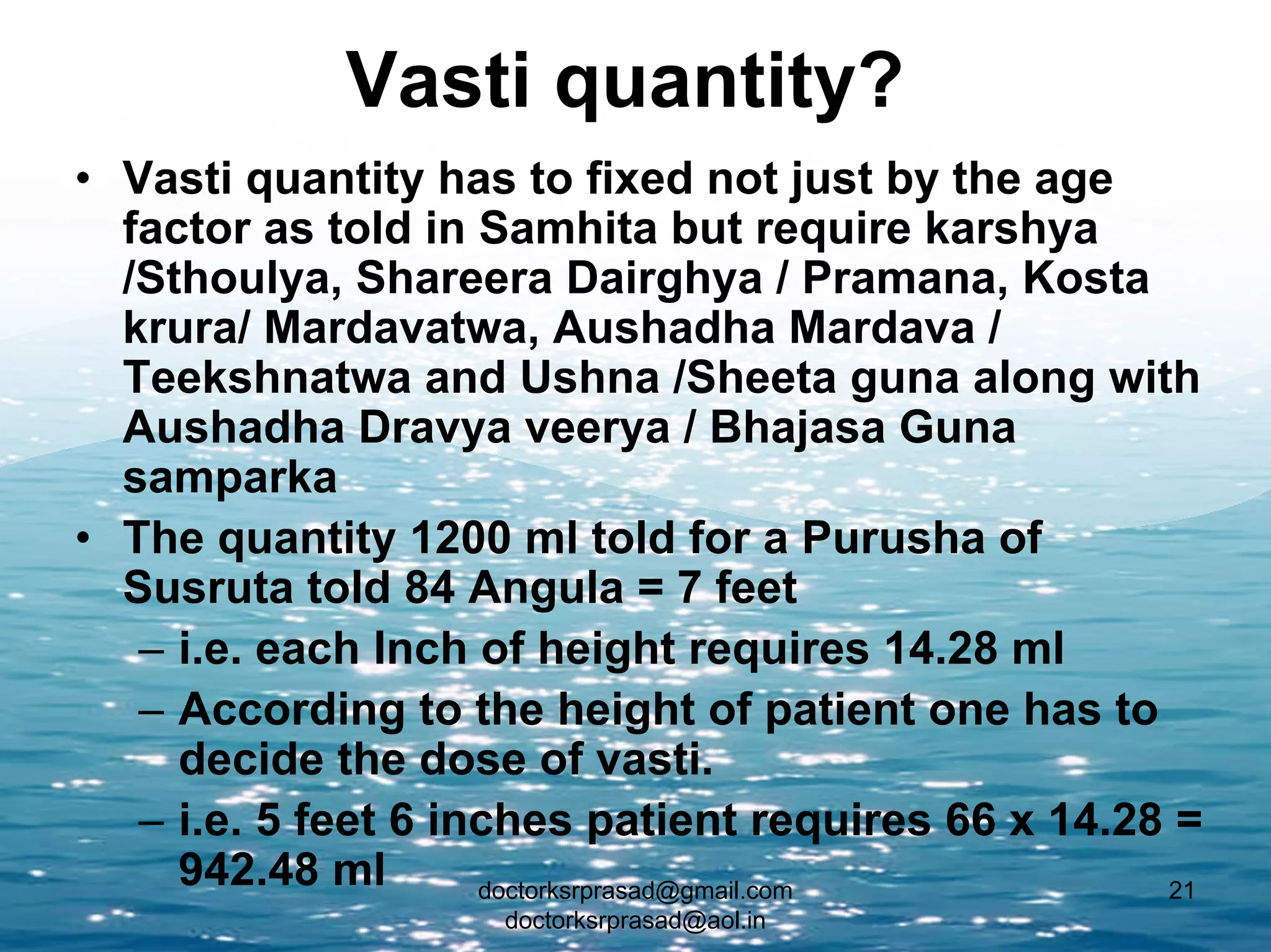
Vasti quantity?
• Vasti quantity has to fixed not just by the age
  factor as told in Samhita but require karshya
  /Sthoulya, Shareera Dairghya / Pramana, Kosta
  krura/ Mardavatwa, Aushadha Mardava /
  Teekshnatwa and Ushna /Sheeta guna along with
  Aushadha Dravya veerya / Bhajasa Guna
  samparka
• The quantity 1200 ml told for a Purusha of
  Susruta told 84 Angula = 7 feet
   – i.e. each Inch of height requires 14.28 ml
   – According to the height of patient one has to
     decide the dose of vasti.
   – i.e. 5 feet 6 inches patient requires 66 x 14.28 =
     942.48 ml       doctorksrprasad@gmail.com       21
                    doctorksrprasad@aol.in
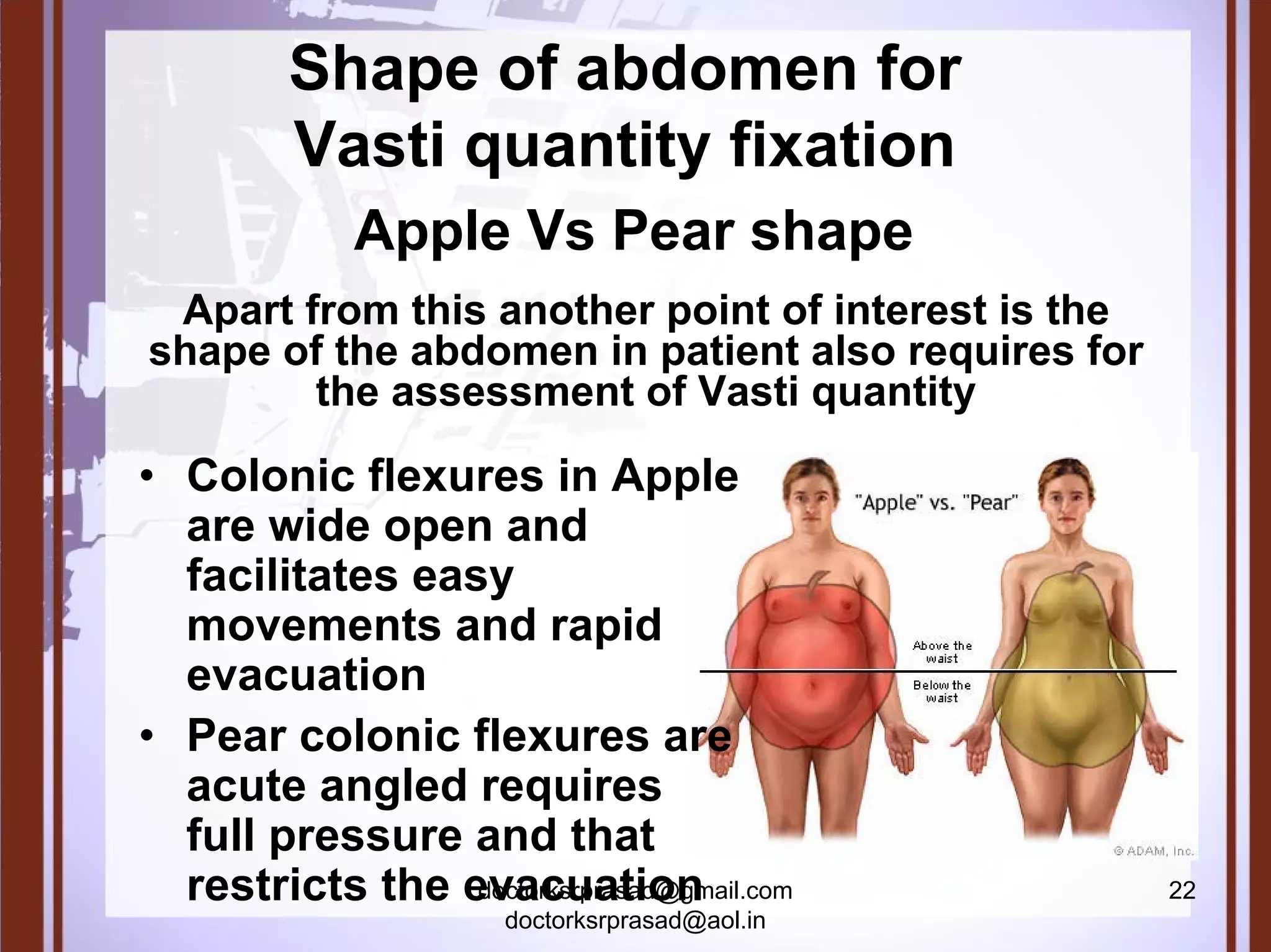
Shape of abdomen for
         Vasti quantity fixation
             Apple Vs Pear shape
 Apart from this another point of interest is the
shape of the abdomen in patient also requires for
        the assessment of Vasti quantity

• Colonic flexures in Apple
  are wide open and
  facilitates easy
  movements and rapid
  evacuation
• Pear colonic flexures are
  acute angled requires
  full pressure and that
  restricts the evacuation
                 doctorksrprasad@gmail.com          22
                       doctorksrprasad@aol.in
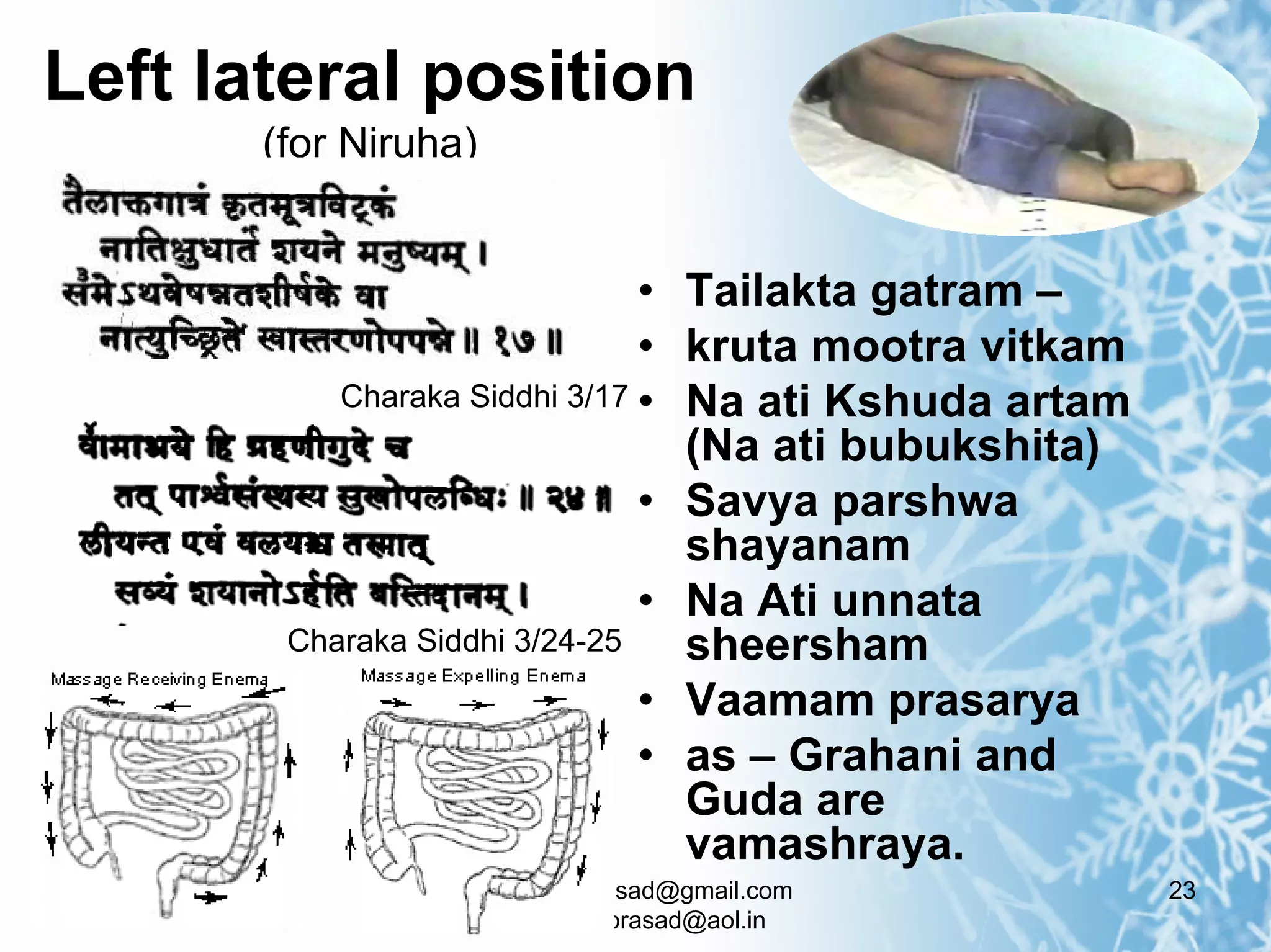
Left lateral position
       (for Niruha)


                               • Tailakta gatram –
                               • kruta mootra vitkam
           Charaka Siddhi 3/17 • Na ati Kshuda artam
                                 (Na ati bubukshita)
                               • Savya parshwa
                                 shayanam
                               • Na Ati unnata
        Charaka Siddhi 3/24-25   sheersham
                               • Vaamam prasarya
                               • as – Grahani and
                                 Guda are
                                 vamashraya.
                      doctorksrprasad@gmail.com        23
                        doctorksrprasad@aol.in
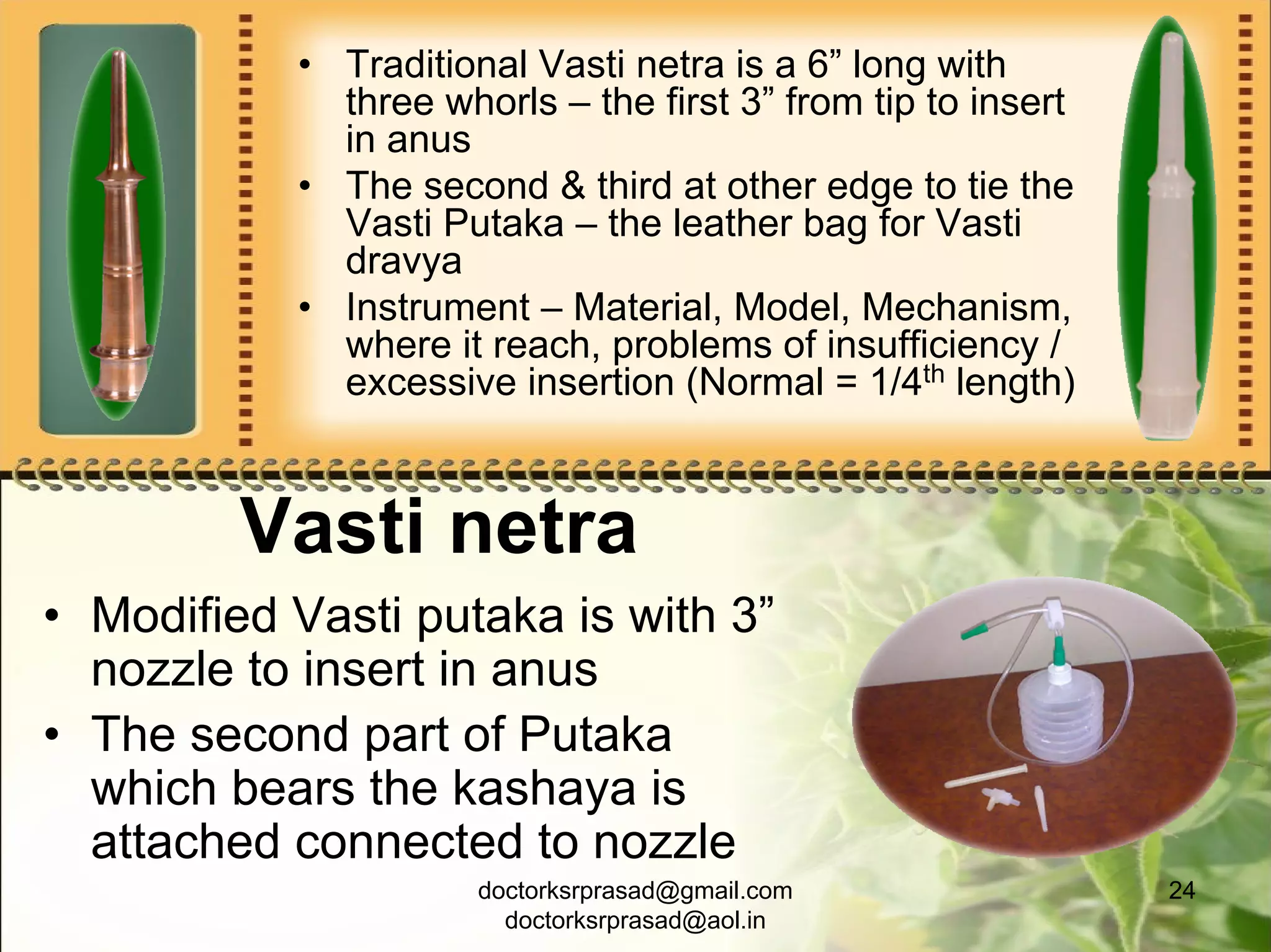
• Traditional Vasti netra is a 6” long with
             three whorls – the first 3” from tip to insert
             in anus
           • The second & third at other edge to tie the
             Vasti Putaka – the leather bag for Vasti
             dravya
           • Instrument – Material, Model, Mechanism,
             where it reach, problems of insufficiency /
             excessive insertion (Normal = 1/4th length)


         Vasti netra
• Modified Vasti putaka is with 3”
  nozzle to insert in anus
• The second part of Putaka
  which bears the kashaya is
  attached connected to nozzle
                      doctorksrprasad@gmail.com               24
                        doctorksrprasad@aol.in
• Unctuous rectum (Tailakta gatram)
  facilitates the insertion of nozzle
• 3” nozzle is administered inside
  anus
• A regulated forceful squeeze of
  Putaka helps the Vasti Dravya to
  reach high colon
• An anti clock wise massage on
  abdomen facilitate the reverse
  peristalsis for – Na Ati Bhukta
  patient
• Wait for the muhurtha (48 minutes)
  for evacuation
• An clock wise massage on abdomen
  facilitate the active peristalsis
• If not evacuated after 2 muhurtha,
  forcible evacuation required
• If Vata increases – Anuvasana is
  required or Sneha orally also
  administered                           Vasti Adana
                     doctorksrprasad@gmail.com     25
                       doctorksrprasad@aol.in
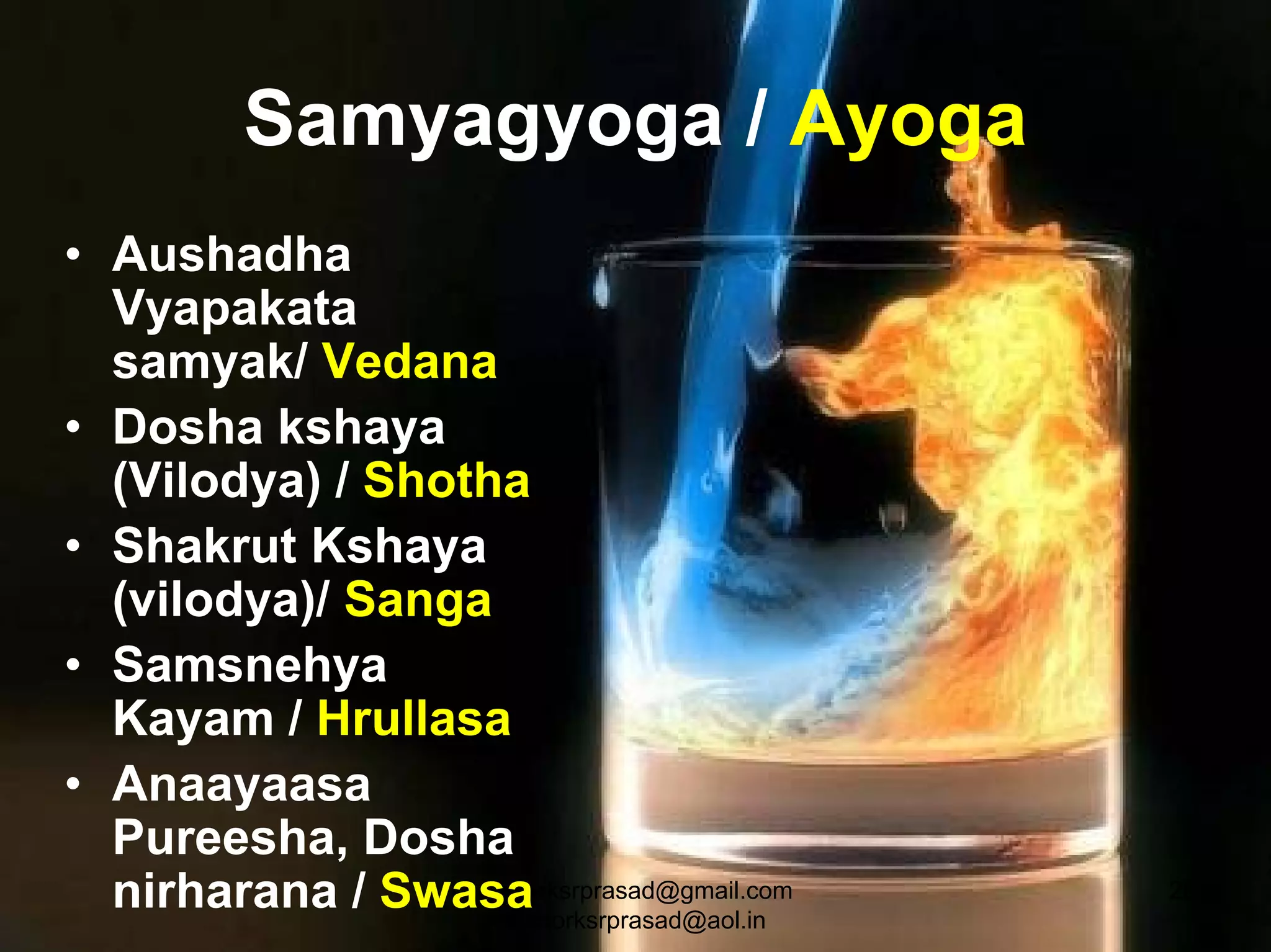
Samyagyoga / Ayoga
• Aushadha
  Vyapakata
  samyak/ Vedana
• Dosha kshaya
  (Vilodya) / Shotha
• Shakrut Kshaya
  (vilodya)/ Sanga
• Samsnehya
  Kayam / Hrullasa
• Anaayaasa
  Pureesha, Dosha
  nirharana / Swasa
                  doctorksrprasad@gmail.com
                    doctorksrprasad@aol.in
                                              26
Paschat karma
• Pratyaagamana kaala = 1 Muhoorta (Su chi 38/18)
• If retains more may cause – Shoola, Anaha, Jwara,
  Marana, etc
• Parihaara kaala is 3 days
• ÌuÉMüÉUÉ rÉå ÌlÉÃWûxrÉ pÉuÉÇÌiÉ mÉëcÉsÉæqÉïsÉæ:
  iÉå xÉÑZÉÉãwhÉÉÇoÉÑÍxÉ£üxrÉ rÉÉÇÌiÉ pÉÑ£üuÉzzÉqÉqÉç
  AjÉuÉÉiÉÉÍkÉïiÉÇ pÉÔrÉxxɱ LuÉÉlÉÑuÉÉxÉrÉåiÉç (A H su 19/51-52)
• Sukhoshna snaana -
• Bhojana “Tribhaaga” (Su chi 38/12)
    – Teekshna – ¾
    – Madhya – ½
    – Alpa – ¼
• Anuvasana Vasti on same day (if vata nipeedita)
    – Vata = Bilwa Taila
    – Pitta = Jeevaneeya Taila
    – Kapha = Phala Taila
• xÉuÉÉïÎluÉMüÉUÉlÉç zÉqÉrÉåͳÉÃWû: - - - AlÉÑuÉÉxrÉ mÉËUoÉ×ÇWûhÉÉjÉïqÉç - cÉUMü
                                doctorksrprasad@gmail.com                          27
                                  doctorksrprasad@aol.in
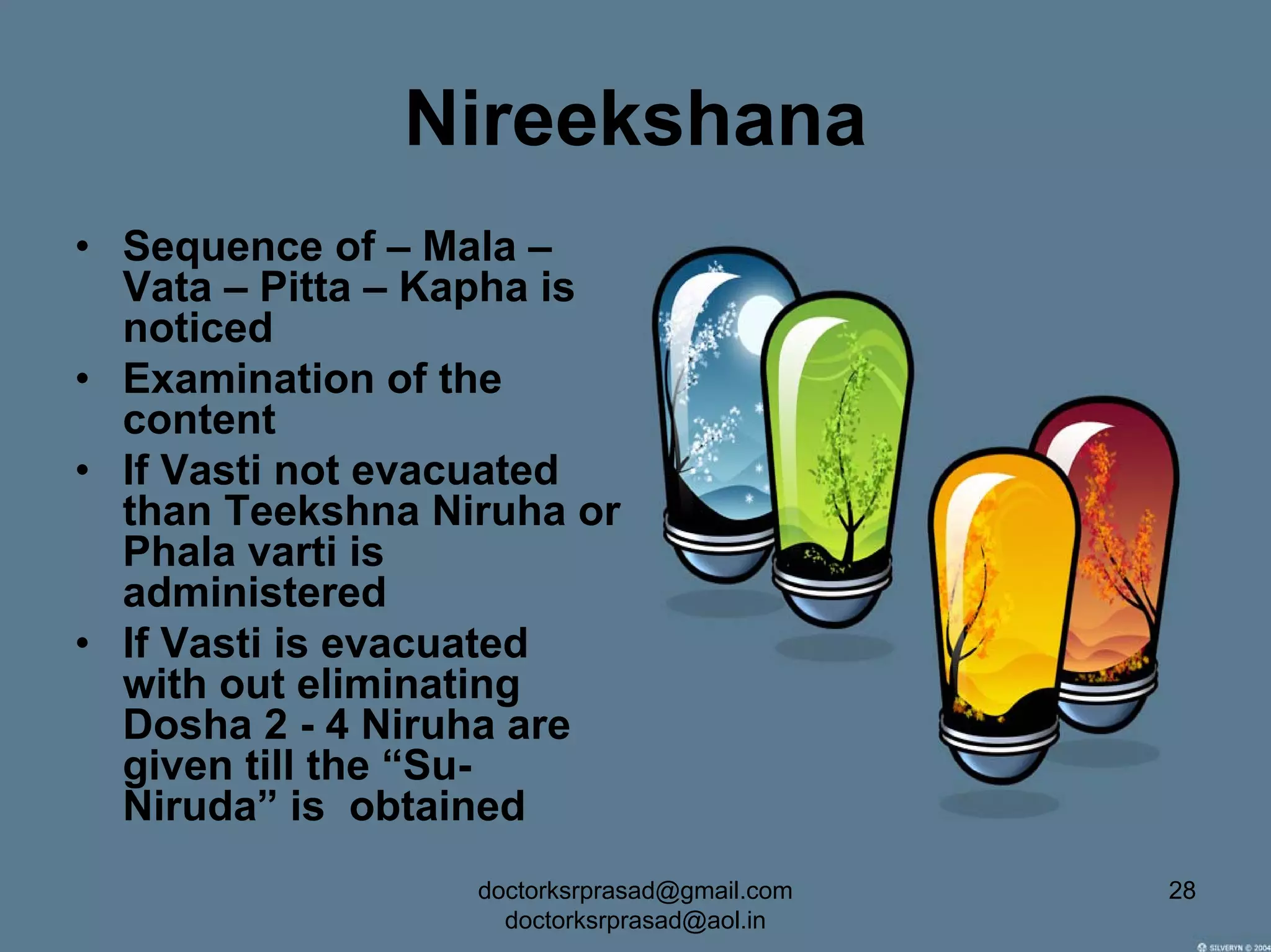
Nireekshana
• Sequence of – Mala –
  Vata – Pitta – Kapha is
  noticed
• Examination of the
  content
• If Vasti not evacuated
  than Teekshna Niruha or
  Phala varti is
  administered
• If Vasti is evacuated
  with out eliminating
  Dosha 2 - 4 Niruha are
  given till the “Su-
  Niruda” is obtained
                  doctorksrprasad@gmail.com   28
                    doctorksrprasad@aol.in
Vyapat


Prateekaara
  doctorksrprasad@gmail.com   29
    doctorksrprasad@aol.in
Pharmaco-dynamics
              • The isotonic solute bears the buffers
                (Satapushpa) to enhance the alkaloid
                bonded lipids
              • The broken small lipid chains cross
                mucosal barrier and bypass the Liver to
                reach site of disease through systemic
                circulation
              • The action potential negatively charged
                lipoprotein bonded alkaloids regulate the
                systemic damage and restore to normal
              • At the same time pressure on nerve
24 May 1887
                endings in the hypo gastric & sacral plexus
                relived by removal of faecal & flatus

                    doctorksrprasad@gmail.com            30
                      doctorksrprasad@aol.in
doctorksrprasad@gmail.com   31
  doctorksrprasad@aol.in
doctorksrprasad@gmail.com   32
  doctorksrprasad@aol.in
doctorksrprasad@gmail.com   33
  doctorksrprasad@aol.in
At the
                      interest
                          of
                     developing
                    Utility based
                    Value added
                    Panchakarma
         • doctorksrprasad@gmail.com
             • doctorksrprasad@aol.in
doctorksrprasad@gmail.com           34
  doctorksrprasad@aol.in

Vasti ksr

  • 1.
    Validation of Vasti forfuturity Dr. K. Shiva Rama Prasad M.D.(Ay) COP (German), M.A, Ph.D. (Jyotish) 28-05-2008 doctorksrprasad@gmail.com 1 doctorksrprasad@aol.in
  • 2.
    Futurity Vs Futility •Futurity =The time yet to come • or • The quality of being in or of the future • Futility = Uselessness as a consequence of having no practical result doctorksrprasad@gmail.com 2 doctorksrprasad@aol.in
  • 3.
    • Over loadingoral drug administrations making tender stomach to get gastritis & other complications • The alternative Controlled-Release Preparations, Sublingual, Transdermal Subcutaneous, Parenteral, Intravenous, Intramuscular, Intraarterial, Pulmonary, Topical, etc are not equals Ayurveda Panchakarma - Vasti – As it is - Present trends doctorksrprasad@gmail.com 3 doctorksrprasad@aol.in
  • 4.
    Rectal Administration • The rectal route often is useful when oral ingestion is precluded because the patient is unconscious or when vomiting is present - a situation particularly relevant to young children. • Approximately 50% of the drug that is absorbed from the rectum will bypass the liver; the potential for hepatic first-pass metabolism thus is less than that for an oral dose. • However, rectal absorption often is irregular and incomplete, and many drugs can cause irritation of the rectal mucosa. doctorksrprasad@gmail.com 4 doctorksrprasad@aol.in
  • 5.
    Practice • Ayurveda suggests many methods of disease and healthy managements from ages, using the naturally available adopted • It offers Oral route, Trans dermal route, Trans Rectal route, etc • One has to practice for perfection understanding methods properly • Does Ayurveda requires any adoptions and updates in the systems according to the present technology or not is a debate • Change is Unavoidable under any circumstances doctorksrprasad@gmail.com 5 doctorksrprasad@aol.in
  • 6.
    Tunes of TransRectal route Vasti or Basti • The pronunciation of the Technical term itself is first problem • Many times not undergone the concepts • Following colloquially • Not having touch with Instruments / Mechanism /Drug qualities /etc doctorksrprasad@gmail.com 6 doctorksrprasad@aol.in
  • 7.
    7 steps tosuccess 1. Prepare patient (Physically / Mentally) 2. Follow indications 3. Check the Ingredients (Contents) 4. Prepare medicine methodically 5. Find proper Instruments 6. Standardize the entire situation 7. Administration (Time /Procedure) doctorksrprasad@gmail.com 7 doctorksrprasad@aol.in
  • 8.
    Dimensions & Definition • uÉÎxiÉÍpÉSÏïrÉiÉå rÉxqÉɨÉxqÉɲÎxiÉËUÌiÉ xqÉ×iÉ:- AÉ WÛû xÉÔ 19/1 • An injection syringe made of bladder or the injection Charaka Siddhi 1/38-40 it self, Kwathas No disease is with out Vata • uÉxÉÑ ÌlÉuÉÉxÉå – uÉxÉÑ AÉcNûÉSlÉå No other than Vasti treat Vata doctorksrprasad@gmail.com 8 doctorksrprasad@aol.in
  • 9.
    • Enema =An injection of a liquid through the anus to stimulate evacuation; sometimes used for diagnostic purposes • Many varieties of nomenclature based upon the site of administration – Shirovasti, Urovasti, Kativasti, Uttaravasti, Vasti = Niruha, Anuvasana doctorksrprasad@gmail.com 9 doctorksrprasad@aol.in
  • 10.
    Preparation & Understanding patient (Physically / Mentally) Pareekshya Bhava (C.Su.15/5; C.Ni.3/6; Su.Chi.38/91-92) 1. The patient subjected for examination for assessment of Kaala, Bala, Dosha and Disease in detail. 2. Later looking at the Vasti Dravya Bala the quantity and time of administration is decided. doctorksrprasad@gmail.com 10 doctorksrprasad@aol.in
  • 11.
    In this course of preparation – – In Kaala - Rutu kaala, Vayo kaala, Vyadhi Kriyakaala, Ahara kaala – In Bala – Rogi bala (Physical /psychological), Roga Bala, Aushadha Bala – In Dosha - sansargatwam – Vruddhi, Ksheena, Urdhwa /Adho gati, etc – In Vyadhi - Rogamarga - Shakha /Kosta/Marma, Swatantra / Paratantra, Vata vyadhi, Vata sthaana janya vyadhi, Shakha /Kosta janya vyadhi, Pureeshaadhana / srotas janya vyadhi, Shodhanaarha vyadhi, Brumhanadi kramoyogam doctorksrprasad@gmail.com 11 doctorksrprasad@aol.in
  • 12.
    • Based uponthe site/ Organ Vasti – Pakwashaya, Mootrashaya, garbhashaya • Based upon the Drug content / material – Nirooha, Anuvasana • Based upon the Quantity of the material – Sneha, Anuvasana, Matravasti • Based upon the function – Shodhana, Shamana • Based upon the number of administrations – Karma, Kala, Yoga • Based upon the utility – Yapana, Siddha, Piccha, Rakta, Prasruta Yogiki, etc • Based upon the Karmukata (purpose /intentions) – Vajikarana, Brumhana, Lekhana, Vandhtwahara, Teekshna, Mrudu, Krimighna, Chakshushya, Malabhedana, etc Vasti classification doctorksrprasad@gmail.com 12 doctorksrprasad@aol.in
  • 13.
    Trayovasti (Su.Chi.38/92) • Susruta affirms that – – Utkleshana – Doshahara (Cha.Si.3/26) – Samshamana – are • We are following Charaka offered discriminatively statement but not valuing the • Where in Charaka Susruta enumerates as Dosha • Avapaka/additives such as – Apakarshana in (Ch. Vi. 8/175-176, AH Su 10/22-24, Su Chi 38/24) – sequence of – Anuvasanopaga, – Vata Asthapanopaga, Nirooha Varga, – Pitta Asthapana Varga, – Kapha – are undertaken Shadasthapana (Madhuradi) by the Trayo vasti Skandha gana dravyas are not used in practice doctorksrprasad@gmail.com 13 doctorksrprasad@aol.in
  • 14.
    Tridosha & Trayovasti • One Snigdha & Ushna with Mamsa for Vata • Two swadu & sheeta with Milk for Pitta • Three katu & Ushna, Teekshna with Mootra for Kapha • Never more than the prescribed doctorksrprasad@gmail.com 14 doctorksrprasad@aol.in
  • 15.
    Vasti - Discrimination •§ÉrÉ¶É xÉͳÉmÉÉiÉåÅÌmÉ SÉãwÉÉlÉç blÉÇÎliÉ rÉiÉ: ¢üqÉÉiÉç - A WØ xÉÔ 19/59 • lÉ mÉUÇ ÌuÉkÉãrÉÉ – cÉ ÍxÉ 3/69 • xÉqrÉÎglÉÃRûÍsÉlaÉÇiÉÑ mÉëÉmiÉå uÉÎxiÉÇ ÌlÉuÉÉUrÉåiÉç – xÉÑ ÍcÉ 38/7û •Indications •Vata Vyadhi •Vata Sthaana Janya Vyadhi •Kosta Janya Vyadhi •Pureeshadhaana / Srotas Janya Vyadhi •Shodhanarha Vyadhi •Shodhanadi Krama Rasayana Vidhi •Brumhanadi Kramopayogam doctorksrprasad@gmail.com 15 doctorksrprasad@aol.in
  • 16.
  • 17.
    Sequence of Material •oÉsÉ SÉãwÉ mÉëqÉÉhÉ AlÉÑÃmÉ AÉæwÉkÉqÉç Saindhava = 1 Aksha, Madhu = 2 Prasruti Sneha = 3 Prasruti Kalka = 1 Prasruti Kashaya = 4 Prasruti Avapadravya = 2 Prasruti Total = 12 Prasruti = 1200 ml doctorksrprasad@gmail.com Su Chi 38/37-3917 doctorksrprasad@aol.in
  • 18.
    Sneha (Lipoprotein)/Kalka quantity •Vata = ¼ = 3 Prasruta, Pitta = 1/6 = 2 Prasruta and Kapha = 1/8 = 1 ½ Prasruta Dosha based sneha quantity • The unctuous substance either oil / Ghee gets digested by the Ushma of Jatharagni and the Kalka Dravya (Shatapushpa) • Kalka dravya in Vasti is a Pachana dravya which assimilates the Vasti draya but not increase the Jatharagni • The ratio of Vasti dravyas are 1:2:3:4 for Kalka, Madhu, Taila, Kashaya respectively to make a solution of mucosal permeable doctorksrprasad@gmail.com 18 doctorksrprasad@aol.in
  • 19.
    • Avapa dravya= many dravyas based upon Rasa or Gana Dravyas Cha si 3/23 told in – • Dashemaniya, Ksheera, Mamsarasa, Gomootra, Amla varga, etc • Vata = Veerataruvadi, Bhadradarvadi • Pitta = Nyagrodhadi, AS Su 28/42 Kakolyadi • Kapha = Aragwadhadi, Pippalyadi • Quantity = 1: 2 ratio of • - - UxÉ xÉÇxÉaÉï ÌuÉMüsmÉ ÌuÉxiÉUÉã½åwÉÉÇ Avapa : Kashaya (Avapa AmÉËU xÉÇZrÉårÉ: - xÉqÉuÉåiÉÉlÉÉÇ UxÉÉlÉÉÇ dravya includes in the AÇzÉÉÇzÉ oÉsÉ ÌuÉMüsmÉÌiÉ oÉWÒûiuÉÉiÉç quantity told for kashaya) • – cÉ ÌuÉ 8/175-176 doctorksrprasad@gmail.com 19 doctorksrprasad@aol.in
  • 20.
    Sequence Importance • Thesalt is granular needs grinding • Honey is monosaccharide adds with salt to become amalgam • The amalgam facilitates bonding with – alkaloid bounded lipoproteins of Sneha (Oil /Ghee, etc) to become free ionized negatively charged lipoproteins • These free lipid soluble alkaloid added amalgam freely mixed to become an isotonic solution which is a mucosal barrier doctorksrprasad@gmail.com 20 doctorksrprasad@aol.in
  • 21.
    Vasti quantity? • Vastiquantity has to fixed not just by the age factor as told in Samhita but require karshya /Sthoulya, Shareera Dairghya / Pramana, Kosta krura/ Mardavatwa, Aushadha Mardava / Teekshnatwa and Ushna /Sheeta guna along with Aushadha Dravya veerya / Bhajasa Guna samparka • The quantity 1200 ml told for a Purusha of Susruta told 84 Angula = 7 feet – i.e. each Inch of height requires 14.28 ml – According to the height of patient one has to decide the dose of vasti. – i.e. 5 feet 6 inches patient requires 66 x 14.28 = 942.48 ml doctorksrprasad@gmail.com 21 doctorksrprasad@aol.in
  • 22.
    Shape of abdomenfor Vasti quantity fixation Apple Vs Pear shape Apart from this another point of interest is the shape of the abdomen in patient also requires for the assessment of Vasti quantity • Colonic flexures in Apple are wide open and facilitates easy movements and rapid evacuation • Pear colonic flexures are acute angled requires full pressure and that restricts the evacuation doctorksrprasad@gmail.com 22 doctorksrprasad@aol.in
  • 23.
    Left lateral position (for Niruha) • Tailakta gatram – • kruta mootra vitkam Charaka Siddhi 3/17 • Na ati Kshuda artam (Na ati bubukshita) • Savya parshwa shayanam • Na Ati unnata Charaka Siddhi 3/24-25 sheersham • Vaamam prasarya • as – Grahani and Guda are vamashraya. doctorksrprasad@gmail.com 23 doctorksrprasad@aol.in
  • 24.
    • Traditional Vastinetra is a 6” long with three whorls – the first 3” from tip to insert in anus • The second & third at other edge to tie the Vasti Putaka – the leather bag for Vasti dravya • Instrument – Material, Model, Mechanism, where it reach, problems of insufficiency / excessive insertion (Normal = 1/4th length) Vasti netra • Modified Vasti putaka is with 3” nozzle to insert in anus • The second part of Putaka which bears the kashaya is attached connected to nozzle doctorksrprasad@gmail.com 24 doctorksrprasad@aol.in
  • 25.
    • Unctuous rectum(Tailakta gatram) facilitates the insertion of nozzle • 3” nozzle is administered inside anus • A regulated forceful squeeze of Putaka helps the Vasti Dravya to reach high colon • An anti clock wise massage on abdomen facilitate the reverse peristalsis for – Na Ati Bhukta patient • Wait for the muhurtha (48 minutes) for evacuation • An clock wise massage on abdomen facilitate the active peristalsis • If not evacuated after 2 muhurtha, forcible evacuation required • If Vata increases – Anuvasana is required or Sneha orally also administered Vasti Adana doctorksrprasad@gmail.com 25 doctorksrprasad@aol.in
  • 26.
    Samyagyoga / Ayoga •Aushadha Vyapakata samyak/ Vedana • Dosha kshaya (Vilodya) / Shotha • Shakrut Kshaya (vilodya)/ Sanga • Samsnehya Kayam / Hrullasa • Anaayaasa Pureesha, Dosha nirharana / Swasa doctorksrprasad@gmail.com doctorksrprasad@aol.in 26
  • 27.
    Paschat karma • Pratyaagamanakaala = 1 Muhoorta (Su chi 38/18) • If retains more may cause – Shoola, Anaha, Jwara, Marana, etc • Parihaara kaala is 3 days • ÌuÉMüÉUÉ rÉå ÌlÉÃWûxrÉ pÉuÉÇÌiÉ mÉëcÉsÉæqÉïsÉæ: iÉå xÉÑZÉÉãwhÉÉÇoÉÑÍxÉ£üxrÉ rÉÉÇÌiÉ pÉÑ£üuÉzzÉqÉqÉç AjÉuÉÉiÉÉÍkÉïiÉÇ pÉÔrÉxxɱ LuÉÉlÉÑuÉÉxÉrÉåiÉç (A H su 19/51-52) • Sukhoshna snaana - • Bhojana “Tribhaaga” (Su chi 38/12) – Teekshna – ¾ – Madhya – ½ – Alpa – ¼ • Anuvasana Vasti on same day (if vata nipeedita) – Vata = Bilwa Taila – Pitta = Jeevaneeya Taila – Kapha = Phala Taila • xÉuÉÉïÎluÉMüÉUÉlÉç zÉqÉrÉåͳÉÃWû: - - - AlÉÑuÉÉxrÉ mÉËUoÉ×ÇWûhÉÉjÉïqÉç - cÉUMü doctorksrprasad@gmail.com 27 doctorksrprasad@aol.in
  • 28.
    Nireekshana • Sequence of– Mala – Vata – Pitta – Kapha is noticed • Examination of the content • If Vasti not evacuated than Teekshna Niruha or Phala varti is administered • If Vasti is evacuated with out eliminating Dosha 2 - 4 Niruha are given till the “Su- Niruda” is obtained doctorksrprasad@gmail.com 28 doctorksrprasad@aol.in
  • 29.
  • 30.
    Pharmaco-dynamics • The isotonic solute bears the buffers (Satapushpa) to enhance the alkaloid bonded lipids • The broken small lipid chains cross mucosal barrier and bypass the Liver to reach site of disease through systemic circulation • The action potential negatively charged lipoprotein bonded alkaloids regulate the systemic damage and restore to normal • At the same time pressure on nerve 24 May 1887 endings in the hypo gastric & sacral plexus relived by removal of faecal & flatus doctorksrprasad@gmail.com 30 doctorksrprasad@aol.in
  • 31.
    doctorksrprasad@gmail.com 31 doctorksrprasad@aol.in
  • 32.
    doctorksrprasad@gmail.com 32 doctorksrprasad@aol.in
  • 33.
    doctorksrprasad@gmail.com 33 doctorksrprasad@aol.in
  • 34.
    At the interest of developing Utility based Value added Panchakarma • doctorksrprasad@gmail.com • doctorksrprasad@aol.in doctorksrprasad@gmail.com 34 doctorksrprasad@aol.in