VASCULAR AND CELLULAR EVENTS IN
INFLAMMATION
MODERATOR – DR GANESH KADAM.
PRESENTED BY – DR SHRUTI SONI.
INFLAMMATION
Inflammation is a response of vascularized tissues to
infections and damaged tissues that brings cells and molecules
of host defense from the circulation to the sites
where they are needed, in order to eliminate the offending
agents.
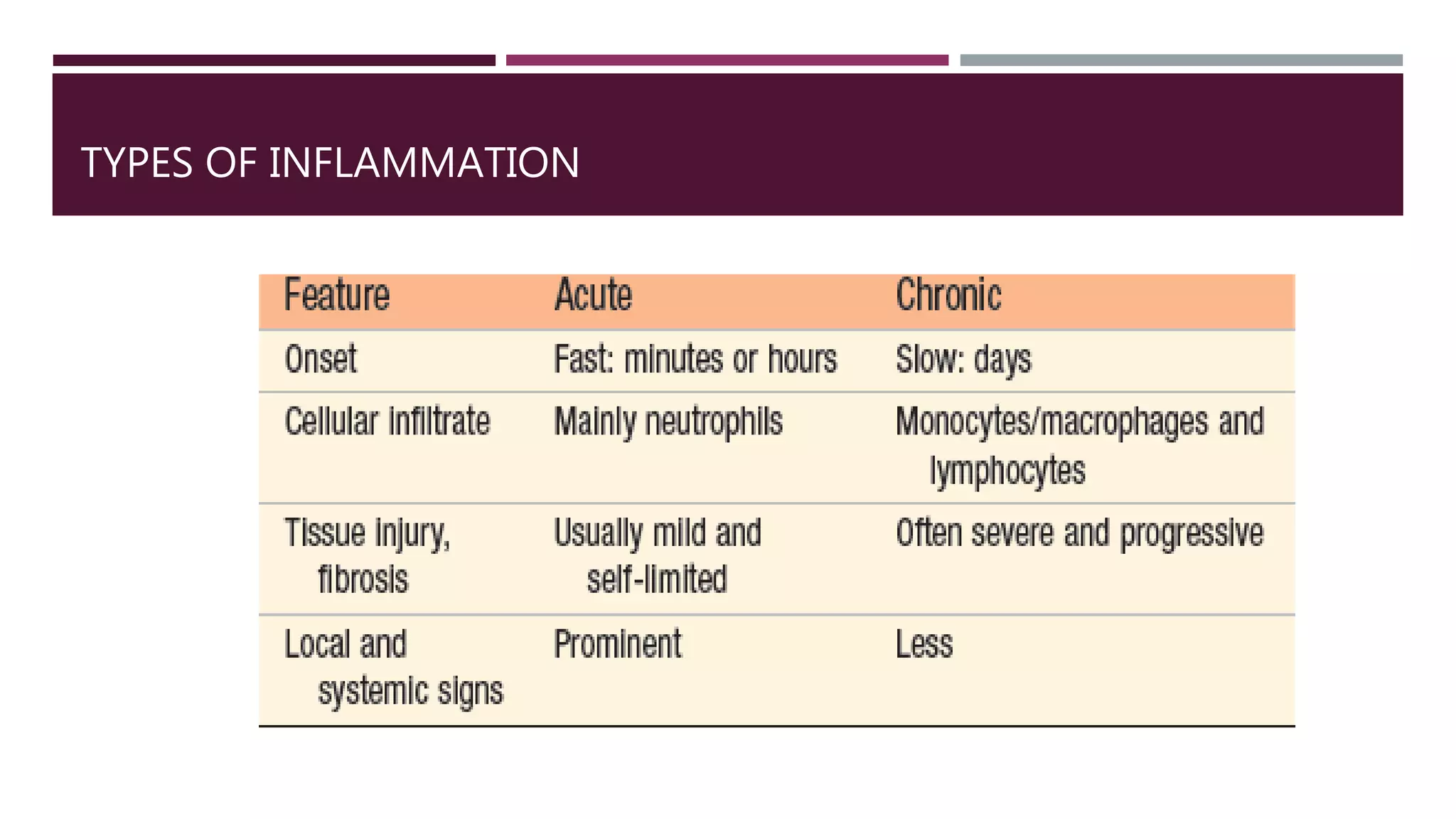
TYPES OF INFLAMMATION
MAIN FEATURES OF ACUTE INFLAMMATION
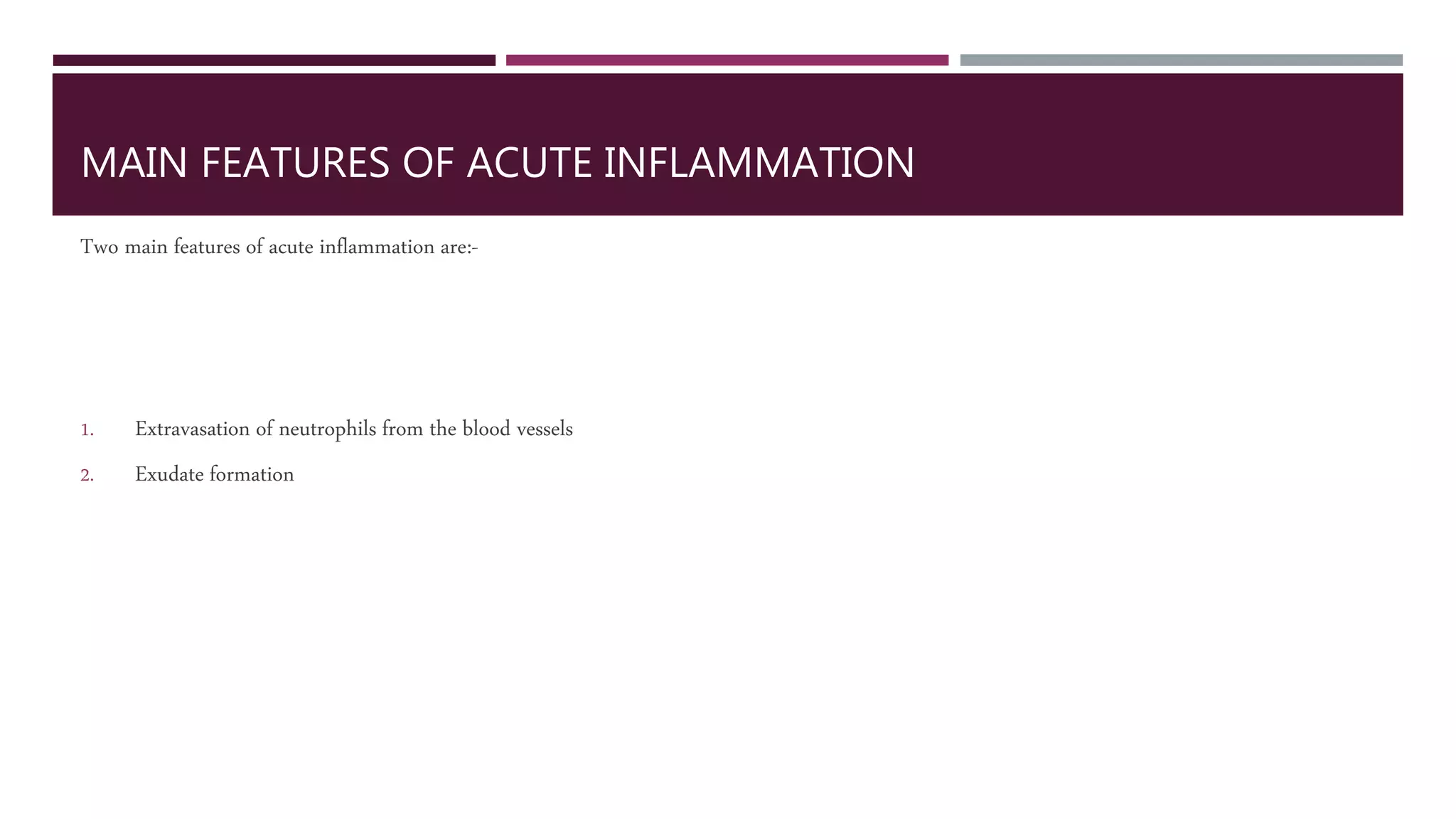
Two main features of acute inflammation are:-
1. Extravasation of neutrophils from the blood vessels
2. Exudate formation
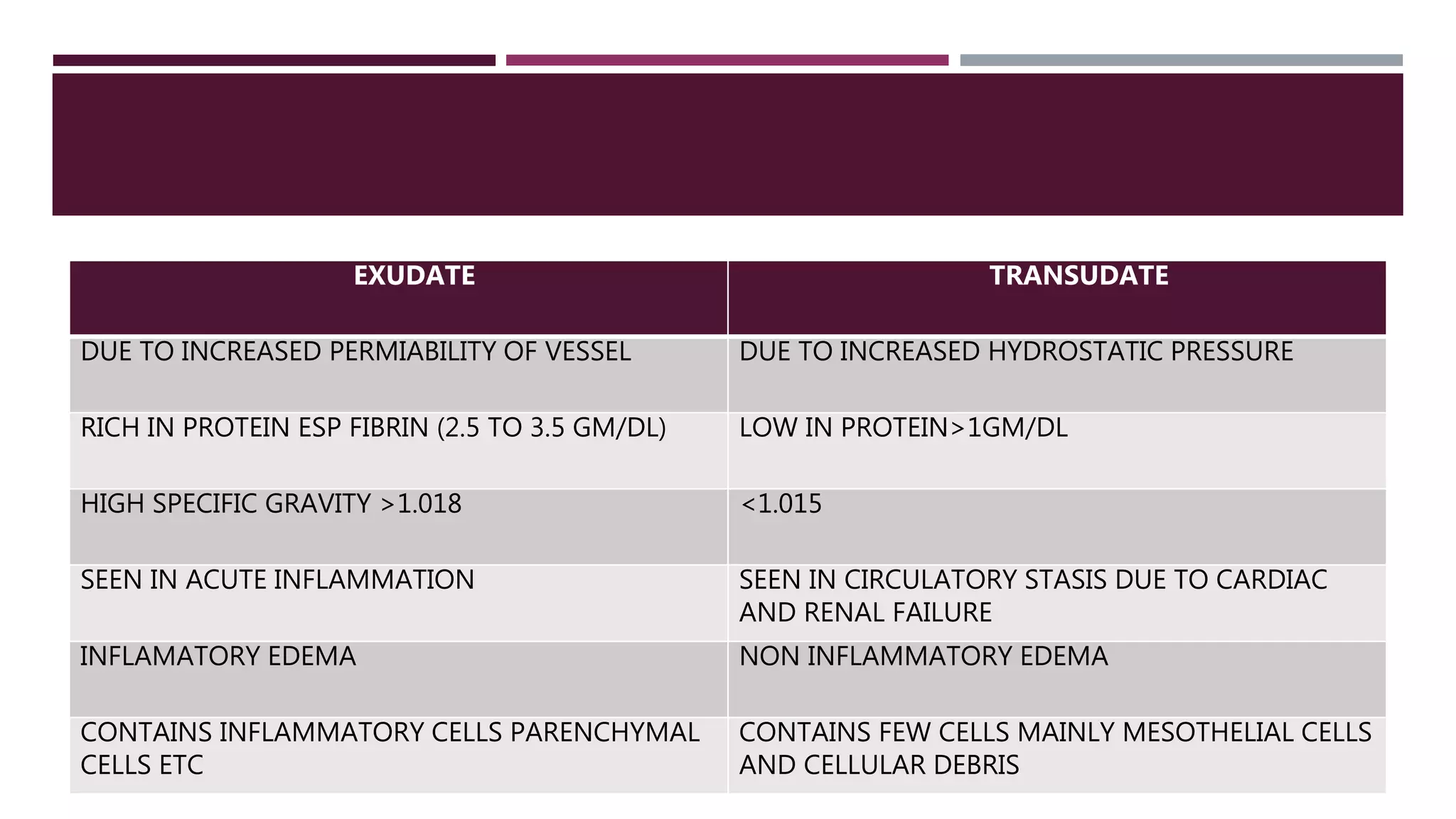
EXUDATE TRANSUDATE
DUE TO INCREASED PERMIABILITY OF VESSEL DUE TO INCREASED HYDROSTATIC PRESSURE
RICH IN PROTEIN ESP FIBRIN (2.5 TO 3.5 GM/DL) LOW IN PROTEIN>1GM/DL
HIGH SPECIFIC GRAVITY >1.018 <1.015
SEEN IN ACUTE INFLAMMATION SEEN IN CIRCULATORY STASIS DUE TO CARDIAC
AND RENAL FAILURE
INFLAMATORY EDEMA NON INFLAMMATORY EDEMA
CONTAINS INFLAMMATORY CELLS PARENCHYMAL
CELLS ETC
CONTAINS FEW CELLS MAINLY MESOTHELIAL CELLS
AND CELLULAR DEBRIS
EVENTS OF ACUTE INFLAMMATION
1. VASCULAR EVENTS
2. CELLULAR EVENTS
VASCULAR EVENTS
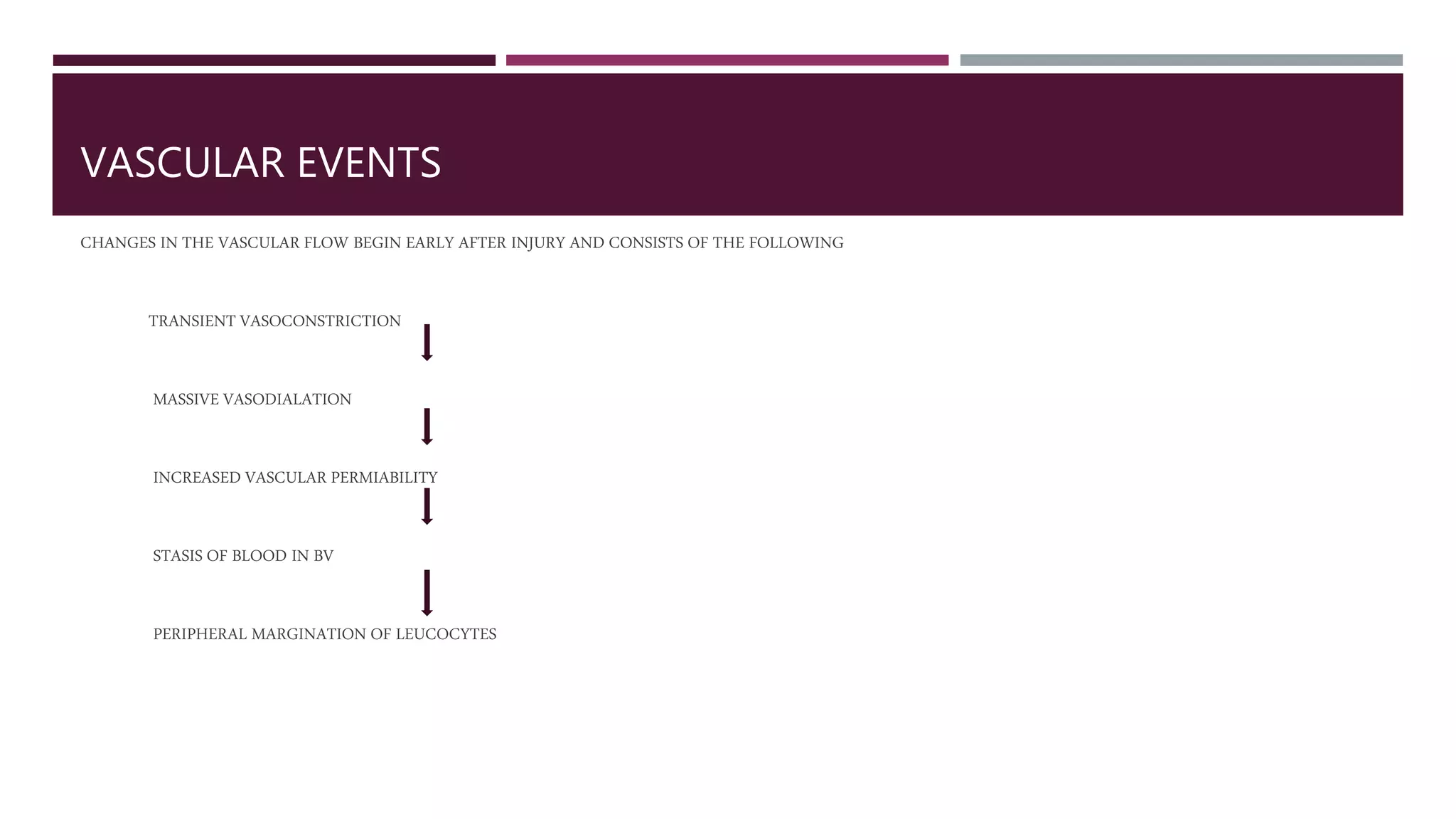
CHANGES IN THE VASCULAR FLOW BEGIN EARLY AFTER INJURY AND CONSISTS OF THE FOLLOWING
TRANSIENT VASOCONSTRICTION
MASSIVE VASODIALATION
INCREASED VASCULAR PERMIABILITY
STASIS OF BLOOD IN BV
PERIPHERAL MARGINATION OF LEUCOCYTES
STEPS IN VASCULAR CHANGES
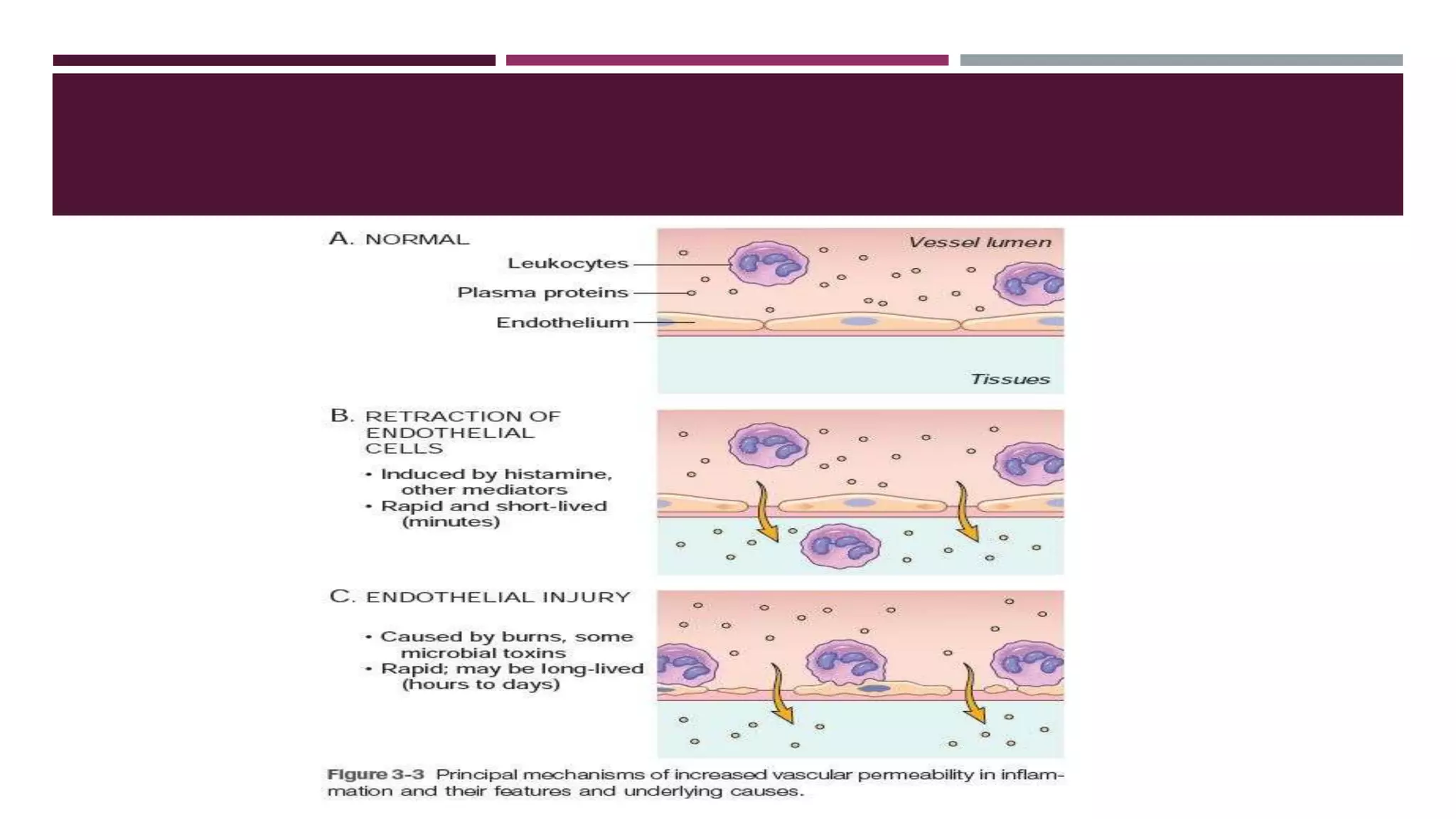
INCREASED VASCULAR PERMIABILITY
MECHANISMS :-
1. ENDOTHELIAL CONTRACTION: THIS IS THE MOST COMMON MECHANISM.
MEDIATORS:
 HISTAMINE
 BRADYKININ
 SUBSTANCE P
 LEUCOTREINS
FIRST MEDIATOR TO REACH ENDOTHELIAL CELLS FOR CONTRACTION OF ENDOTHELIUM IS HISTAMINE.
-IT IS AN IMMEDIATE TRANSIENT RESPONSE.
2. ENDOTHELIAL RETRACTION :-
 DELAYED SUSTAINABLE TYPE OF ENDOTHELIAL CONTRACTION.
 NO SHRINKING OF CELL
 JUNCTIONAL GAP FORMED
MEDIATORS:-
 IL-1
 TNF
3.DIRECT INJURY-
A. SEVERE INJURY- SEVERE BURNS,TOXINS,CHEMICALS ETC.
 ENDOTHELIAL CELLS DIE IMMEDIATELY BY COAGULATIVE NECROSIS.
 IMMEDIATE SUSTAINABLE RESPONSE.
B. MILD INJURY- MILD SUNBURNS
 CELL DEATH OCCURS AFTER FEW HOURS BY APOPTOSIS.
 IT IS A DELAYED SUSTAINABLE RESPONSE.
4.INCREASED TRANSCYTOSIS:-
 INCREASED TRANSPORT OF PROTINS AND FLUIDS THROUGH ENDOTHELIAL CELLS INVOLVING INTRACELLULAR CHANNELS IS CALLED
TRANSCYTOSIS.
MEDIATORS:
 HISTAMINE
 VEGF
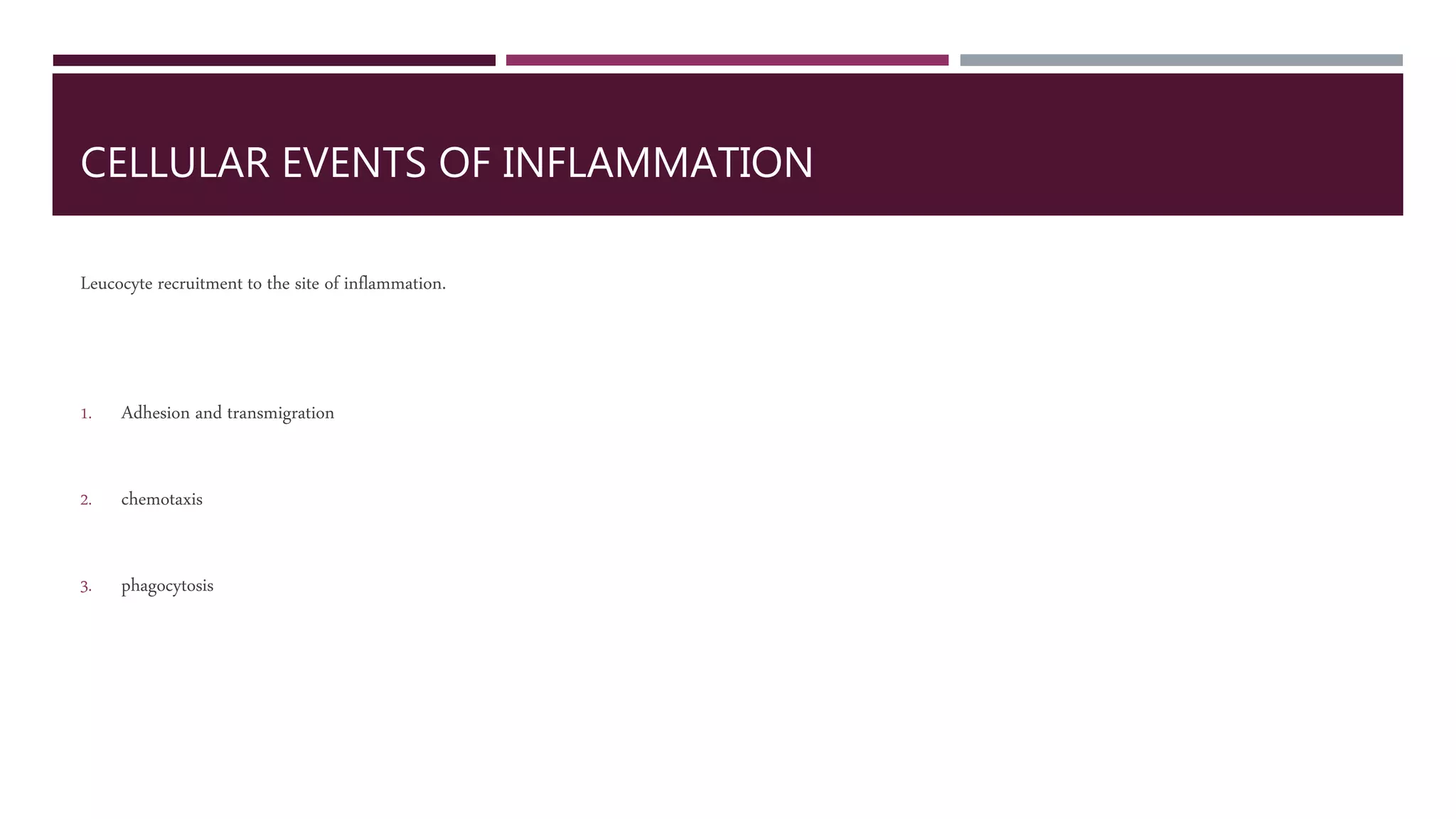
CELLULAR EVENTS OF INFLAMMATION
Leucocyte recruitment to the site of inflammation.
1. Adhesion and transmigration
2. chemotaxis
3. phagocytosis
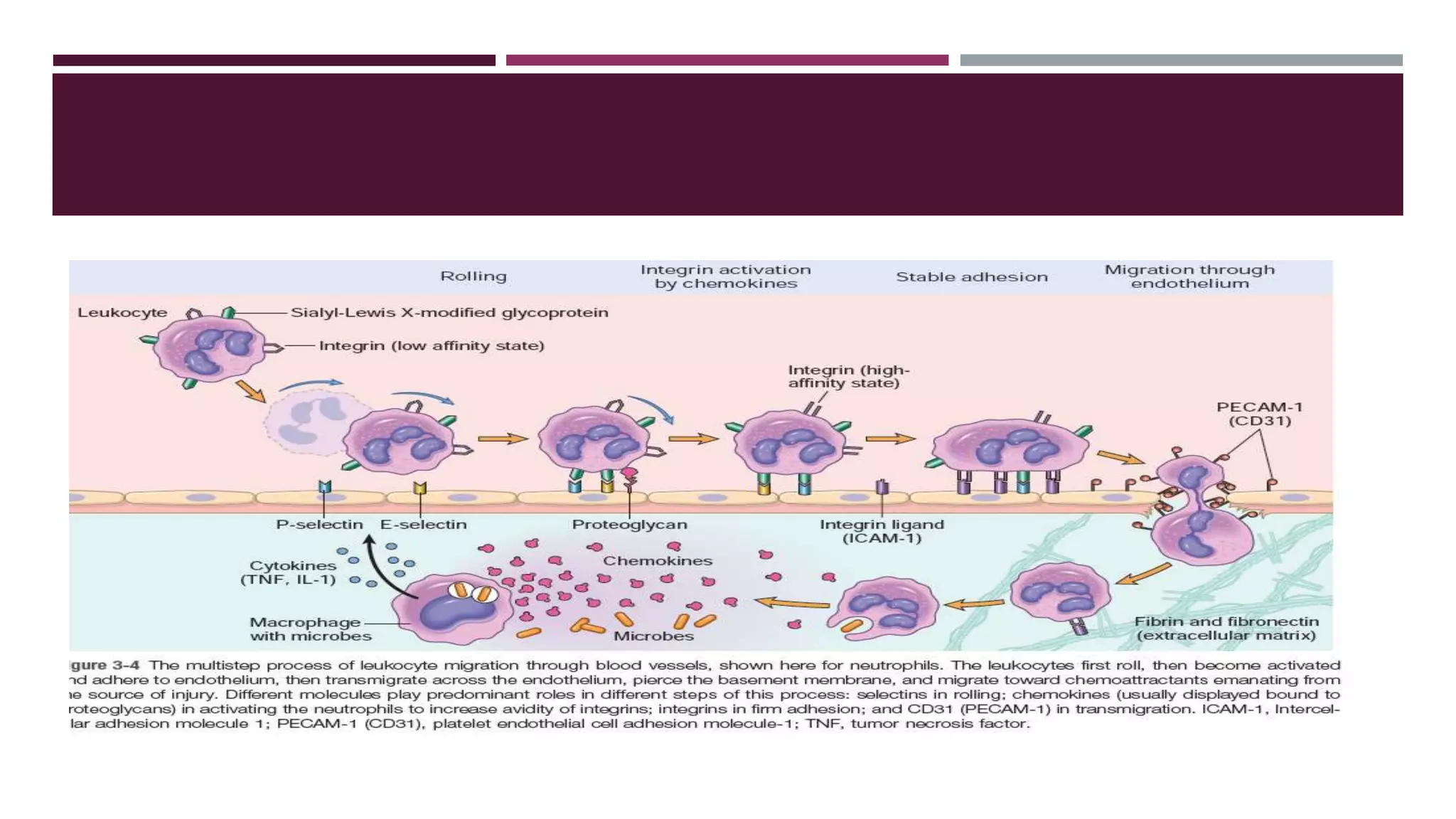
 Adheshion and transmigration occurs in the following steps of events:
 Margination
 rolling
 Loose adhesion
 Firm adhesion
 Transmigration / diapedesis
Adhesion molecules help in adhesion and transmigration .
ADHESION MOLECULES
1. Selectiins
 E selectin { cd-62 e} :found on the surface of endothelial cells
 P selectin {cd 62 p}: endothelial cells and platelets
 L selectin {cd 62 l}: on leucocytes/ neutrophils
Selectins help in rolling and loose adhesions.
Second category of adhesion molecules:-
2. Immunoglobing superfamily :
 Found on the endothelial cells .
The 2 members o f this family are:
 ICAM {INTRA CELLULAR ADHESION MOLECULE}
• I CAM 1
• I CAM 2
 V CAM{ VASCULAR ADHESION MOLECULES}
• V CAM 1
• V CAM 2
The third category includes:
3. Integrins
 Found on the surface of leucocytes.
Types :-
 Beta 2 integrins –1. LFA 1
2. MAC1
 Beta 1 integrin -1. VLA 4
CATEGORY 2 AND 3 i.e. IMMUNOGLOBINS AND INTEGRINS HELP IN FIRM ADHESION OF THE LEUCOCYTES TO THE ENDOTHELIAL CELLS.
Category 4 of adhesion molecules:
4. CD 31/ PECAM 1 { PLATELET ENDOTHELIAL CELLS ADHESION MOLECULE}
 Responsible for transmigration.
 Found on the endothelial cells and leucocytes.
MECHANISM OF APPEARANCE OF ADHESION MOLECULE.
 1. Redistribution : for P SELECTINS.
 P Selectins are found in the weible palade body in the endothelial cells.
 Wp bodies are the ultra marker of endothelial cells.
Mediators responsible for redistribution are:
 histamine
 Thrombin
 PAF
During acute inflammation mediators within few seconds take out the p selectins from the weibel palade body and put them on the endothelial cells.
2. induction / fresh synthesis: of 1. e selectins
2. I CAM
3. V CAM
These are freshly synthesised during acute inflammation.
MEDIATORS:
 IL 1
 TNF
3. By increased avidity of binding : for integrins.
 Integrins are always present on the surface of leucocytes.
 During inflammation chemokines are released.
 Integrins capacity to bind to their complementary proteins increases.
B. Chemotaxis
After exiting the circulation, leukocytes move in the
tissues toward the site of injury by a process called chemotaxis,
which is defined as locomotion along a chemical
gradient.
 CHEMOTACTIC AGENTS ARE:-
 LT-B4
 IL-8
 C5A
 Bacterial products. ( exogenous chemoattractant)
The receptors for these ligands are 7 transmembrane g coupled receptors aka serpentine receptor present on the surface of leucocyte.
Ligands + receptor binding
increase in the cytosolic calcium
polymerisation of actin filaments at leading edge.
pseudopod formation
neutrophil movement
C. Phagocytosis :-
It includes:
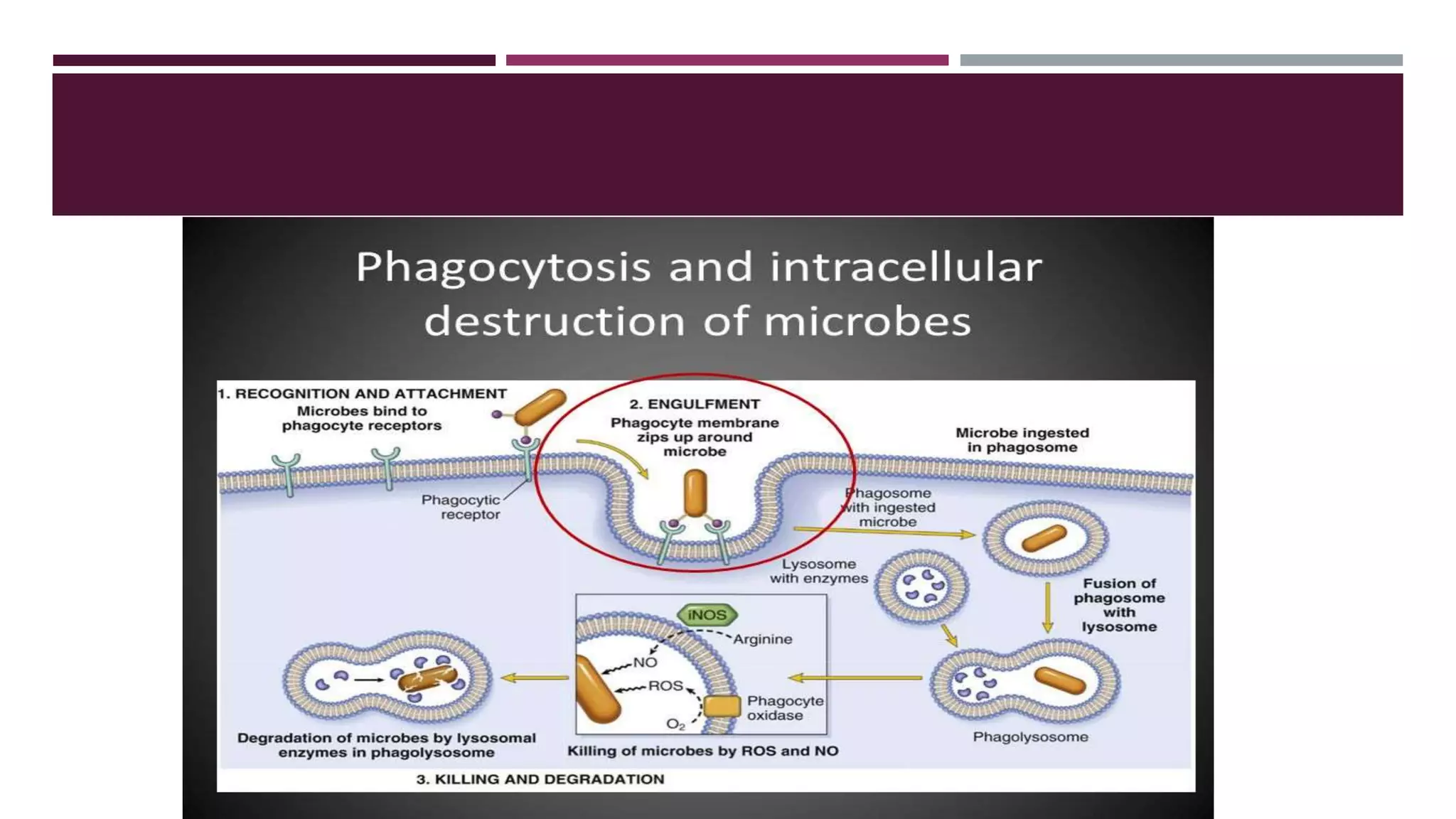
 Recognition and attachment
 engulfment
 Killing of the bacteria
 Neutrophils has 3 receptors on its surface which help in recognition and attachment.
 Mannose receptors
 Scavanger receptors
 MAC 1 integrin
Efficiency of phagocytosis is increased by opsonisation. ( rendering of bacteria and other cells subject to phagocytosis )
 Opsonins::-
 igG
 C3b and c3b i
 Collectins( plasma proteins)
1. fibronectin
2. Mannose binding lectin
3. crp
4. fibrinogen
3. Engulfment ::-
After a particle is bound to phagocyte receptors,
extensions of the cytoplasm (pseudopods) flow
around it, and the plasma membrane pinches off to form a
vesicle (phagosome) that encloses the particle. The phagosome
then fuses with a lysosomal granule, resulting in
discharge of the granule’s contents into the phagolysosome
c. Killing of the bacteria.
There are 2 ways in which the intracellular degeneration occurs:-
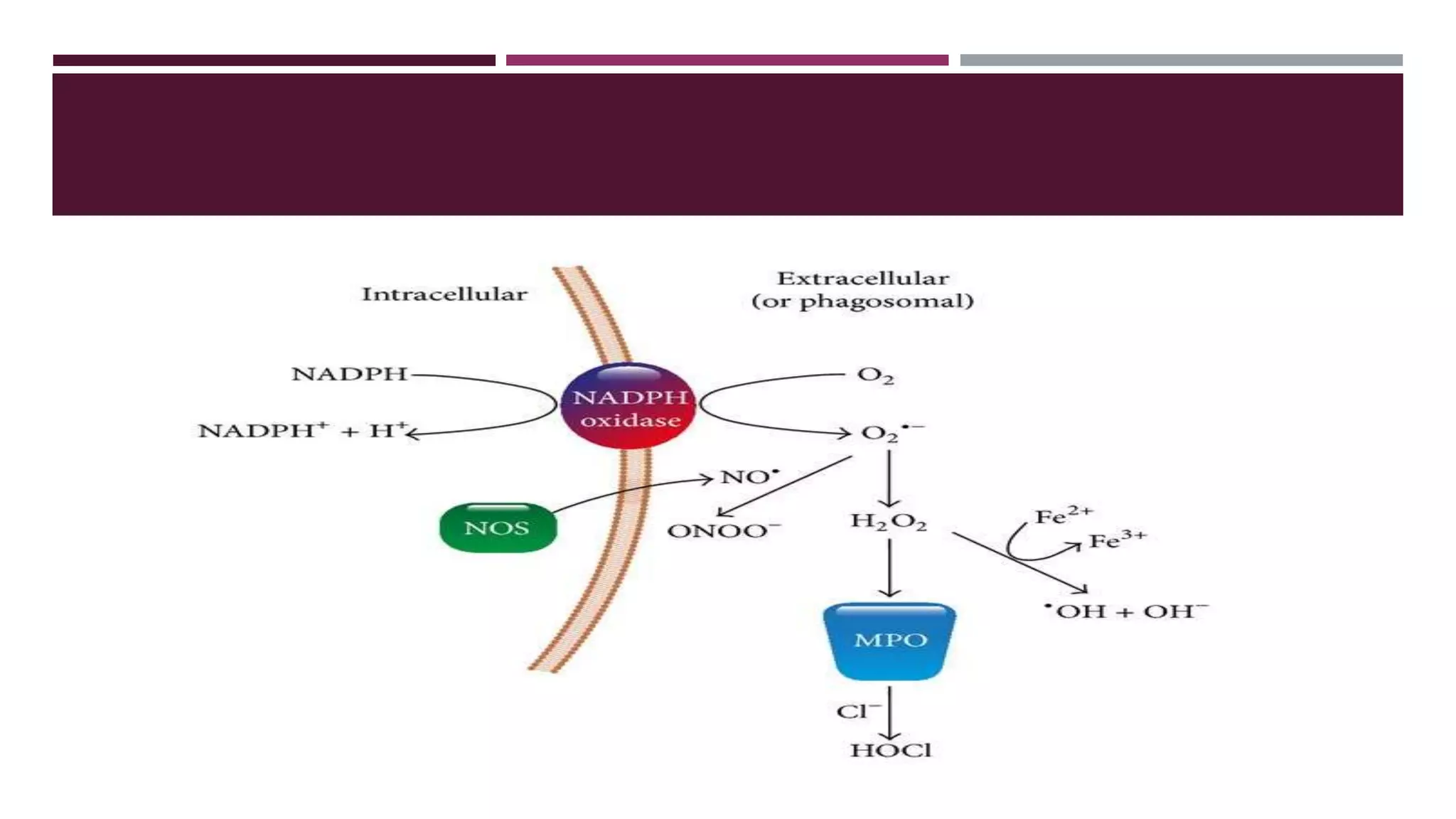
 Oxygen dependent
 Oxygen independent
 HoCL. Kills the bacteria by:-
 Lipid peroxidation
 halogenation.
Oxygen independent killing::-
1. Bacterial permeability increasing protein:- it acts as phospholipase and breaks the phospholipid coat of the bacteria.
2.lysozyme:- it breaks the glycopeptide coat of the bacteria.
3.lactoferrin:- it binds to iron and inhibits the bacterial growth.
4. Major basic protein:- found in the eosinophilic granukes and is toxic to bacteria.

Vascular and cellular events in inflammation

  • 1.
    VASCULAR AND CELLULAREVENTS IN INFLAMMATION MODERATOR – DR GANESH KADAM. PRESENTED BY – DR SHRUTI SONI.
  • 2.
    INFLAMMATION Inflammation is aresponse of vascularized tissues to infections and damaged tissues that brings cells and molecules of host defense from the circulation to the sites where they are needed, in order to eliminate the offending agents.
  • 3.
  • 4.
    MAIN FEATURES OFACUTE INFLAMMATION Two main features of acute inflammation are:- 1. Extravasation of neutrophils from the blood vessels 2. Exudate formation
  • 5.
    EXUDATE TRANSUDATE DUE TOINCREASED PERMIABILITY OF VESSEL DUE TO INCREASED HYDROSTATIC PRESSURE RICH IN PROTEIN ESP FIBRIN (2.5 TO 3.5 GM/DL) LOW IN PROTEIN>1GM/DL HIGH SPECIFIC GRAVITY >1.018 <1.015 SEEN IN ACUTE INFLAMMATION SEEN IN CIRCULATORY STASIS DUE TO CARDIAC AND RENAL FAILURE INFLAMATORY EDEMA NON INFLAMMATORY EDEMA CONTAINS INFLAMMATORY CELLS PARENCHYMAL CELLS ETC CONTAINS FEW CELLS MAINLY MESOTHELIAL CELLS AND CELLULAR DEBRIS
  • 7.
    EVENTS OF ACUTEINFLAMMATION 1. VASCULAR EVENTS 2. CELLULAR EVENTS
  • 8.
    VASCULAR EVENTS CHANGES INTHE VASCULAR FLOW BEGIN EARLY AFTER INJURY AND CONSISTS OF THE FOLLOWING TRANSIENT VASOCONSTRICTION MASSIVE VASODIALATION INCREASED VASCULAR PERMIABILITY STASIS OF BLOOD IN BV PERIPHERAL MARGINATION OF LEUCOCYTES
  • 9.
    STEPS IN VASCULARCHANGES INCREASED VASCULAR PERMIABILITY MECHANISMS :- 1. ENDOTHELIAL CONTRACTION: THIS IS THE MOST COMMON MECHANISM. MEDIATORS:  HISTAMINE  BRADYKININ  SUBSTANCE P  LEUCOTREINS FIRST MEDIATOR TO REACH ENDOTHELIAL CELLS FOR CONTRACTION OF ENDOTHELIUM IS HISTAMINE. -IT IS AN IMMEDIATE TRANSIENT RESPONSE.
  • 10.
    2. ENDOTHELIAL RETRACTION:-  DELAYED SUSTAINABLE TYPE OF ENDOTHELIAL CONTRACTION.  NO SHRINKING OF CELL  JUNCTIONAL GAP FORMED MEDIATORS:-  IL-1  TNF
  • 11.
    3.DIRECT INJURY- A. SEVEREINJURY- SEVERE BURNS,TOXINS,CHEMICALS ETC.  ENDOTHELIAL CELLS DIE IMMEDIATELY BY COAGULATIVE NECROSIS.  IMMEDIATE SUSTAINABLE RESPONSE. B. MILD INJURY- MILD SUNBURNS  CELL DEATH OCCURS AFTER FEW HOURS BY APOPTOSIS.  IT IS A DELAYED SUSTAINABLE RESPONSE.
  • 13.
    4.INCREASED TRANSCYTOSIS:-  INCREASEDTRANSPORT OF PROTINS AND FLUIDS THROUGH ENDOTHELIAL CELLS INVOLVING INTRACELLULAR CHANNELS IS CALLED TRANSCYTOSIS. MEDIATORS:  HISTAMINE  VEGF
  • 14.
    CELLULAR EVENTS OFINFLAMMATION Leucocyte recruitment to the site of inflammation. 1. Adhesion and transmigration 2. chemotaxis 3. phagocytosis
  • 15.
     Adheshion andtransmigration occurs in the following steps of events:  Margination  rolling  Loose adhesion  Firm adhesion  Transmigration / diapedesis Adhesion molecules help in adhesion and transmigration .
  • 17.
    ADHESION MOLECULES 1. Selectiins E selectin { cd-62 e} :found on the surface of endothelial cells  P selectin {cd 62 p}: endothelial cells and platelets  L selectin {cd 62 l}: on leucocytes/ neutrophils Selectins help in rolling and loose adhesions.
  • 18.
    Second category ofadhesion molecules:- 2. Immunoglobing superfamily :  Found on the endothelial cells . The 2 members o f this family are:  ICAM {INTRA CELLULAR ADHESION MOLECULE} • I CAM 1 • I CAM 2  V CAM{ VASCULAR ADHESION MOLECULES} • V CAM 1 • V CAM 2
  • 19.
    The third categoryincludes: 3. Integrins  Found on the surface of leucocytes. Types :-  Beta 2 integrins –1. LFA 1 2. MAC1  Beta 1 integrin -1. VLA 4 CATEGORY 2 AND 3 i.e. IMMUNOGLOBINS AND INTEGRINS HELP IN FIRM ADHESION OF THE LEUCOCYTES TO THE ENDOTHELIAL CELLS.
  • 20.
    Category 4 ofadhesion molecules: 4. CD 31/ PECAM 1 { PLATELET ENDOTHELIAL CELLS ADHESION MOLECULE}  Responsible for transmigration.  Found on the endothelial cells and leucocytes.
  • 21.
    MECHANISM OF APPEARANCEOF ADHESION MOLECULE.  1. Redistribution : for P SELECTINS.  P Selectins are found in the weible palade body in the endothelial cells.  Wp bodies are the ultra marker of endothelial cells. Mediators responsible for redistribution are:  histamine  Thrombin  PAF During acute inflammation mediators within few seconds take out the p selectins from the weibel palade body and put them on the endothelial cells.
  • 22.
    2. induction /fresh synthesis: of 1. e selectins 2. I CAM 3. V CAM These are freshly synthesised during acute inflammation. MEDIATORS:  IL 1  TNF
  • 23.
    3. By increasedavidity of binding : for integrins.  Integrins are always present on the surface of leucocytes.  During inflammation chemokines are released.  Integrins capacity to bind to their complementary proteins increases.
  • 24.
    B. Chemotaxis After exitingthe circulation, leukocytes move in the tissues toward the site of injury by a process called chemotaxis, which is defined as locomotion along a chemical gradient.
  • 25.
     CHEMOTACTIC AGENTSARE:-  LT-B4  IL-8  C5A  Bacterial products. ( exogenous chemoattractant) The receptors for these ligands are 7 transmembrane g coupled receptors aka serpentine receptor present on the surface of leucocyte.
  • 26.
    Ligands + receptorbinding increase in the cytosolic calcium polymerisation of actin filaments at leading edge. pseudopod formation neutrophil movement
  • 27.
    C. Phagocytosis :- Itincludes:  Recognition and attachment  engulfment  Killing of the bacteria
  • 29.
     Neutrophils has3 receptors on its surface which help in recognition and attachment.  Mannose receptors  Scavanger receptors  MAC 1 integrin Efficiency of phagocytosis is increased by opsonisation. ( rendering of bacteria and other cells subject to phagocytosis )
  • 30.
     Opsonins::-  igG C3b and c3b i  Collectins( plasma proteins) 1. fibronectin 2. Mannose binding lectin 3. crp 4. fibrinogen
  • 31.
    3. Engulfment ::- Aftera particle is bound to phagocyte receptors, extensions of the cytoplasm (pseudopods) flow around it, and the plasma membrane pinches off to form a vesicle (phagosome) that encloses the particle. The phagosome then fuses with a lysosomal granule, resulting in discharge of the granule’s contents into the phagolysosome
  • 32.
    c. Killing ofthe bacteria. There are 2 ways in which the intracellular degeneration occurs:-  Oxygen dependent  Oxygen independent
  • 34.
     HoCL. Killsthe bacteria by:-  Lipid peroxidation  halogenation.
  • 35.
    Oxygen independent killing::- 1.Bacterial permeability increasing protein:- it acts as phospholipase and breaks the phospholipid coat of the bacteria. 2.lysozyme:- it breaks the glycopeptide coat of the bacteria. 3.lactoferrin:- it binds to iron and inhibits the bacterial growth. 4. Major basic protein:- found in the eosinophilic granukes and is toxic to bacteria.