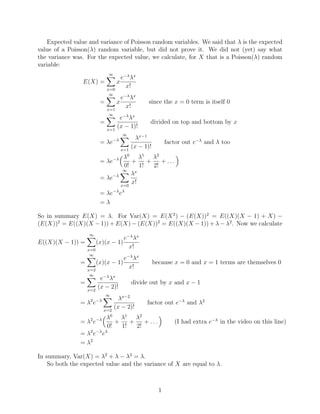
Expected value and variance of Poisson random variables. We said that λ is the expected
value of a Poisson(λ) random variable, but did not prove it. We did not (yet) say what
the variance was. For the expected value, we calculate, for X that is a Poisson(λ) random
variable:
E(X) =
∞
x=0
x
e−λ
λx
x!
=
∞
x=1
x
e−λ
λx
x!
since the x = 0 term is itself 0
=
∞
x=1
e−λ
λx
(x − 1)!
divided on top and bottom by x
= λe−λ
∞
x=1
λx−1
(x − 1)!
factor out e−λ
and λ too
= λe−λ λ0
0!
+
λ1
1!
+
λ2
2!
+ . . .
= λe−λ
∞
x=0
λx
x!
= λe−λ
eλ
= λ
So in summary E(X) = λ. For Var(X) = E(X2
) − (E(X))2
= E((X)(X − 1) + X) −
(E(X))2
= E((X)(X − 1)) + E(X) − (E(X))2
= E((X)(X − 1)) + λ − λ2
. Now we calculate
E((X)(X − 1)) =
∞
x=0
(x)(x − 1)
e−λ
λx
x!
=
∞
x=2
(x)(x − 1)
e−λ
λx
x!
because x = 0 and x = 1 terms are themselves 0
=
∞
x=2
e−λ
λx
(x − 2)!
divide out by x and x − 1
= λ2
e−λ
∞
x=2
λx−2
(x − 2)!
factor out e−λ
and λ2
= λ2
e−λ λ0
0!
+
λ1
1!
+
λ2
2!
+ . . . (I had extra e−λ
in the video on this line)
= λ2
e−λ
eλ
= λ2
In summary, Var(X) = λ2
+ λ − λ2
= λ.
So both the expected value and the variance of X are equal to λ.
1

Variance=lambda in poisson distribution

  • 1.
    Expected value andvariance of Poisson random variables. We said that λ is the expected value of a Poisson(λ) random variable, but did not prove it. We did not (yet) say what the variance was. For the expected value, we calculate, for X that is a Poisson(λ) random variable: E(X) = ∞ x=0 x e−λ λx x! = ∞ x=1 x e−λ λx x! since the x = 0 term is itself 0 = ∞ x=1 e−λ λx (x − 1)! divided on top and bottom by x = λe−λ ∞ x=1 λx−1 (x − 1)! factor out e−λ and λ too = λe−λ λ0 0! + λ1 1! + λ2 2! + . . . = λe−λ ∞ x=0 λx x! = λe−λ eλ = λ So in summary E(X) = λ. For Var(X) = E(X2 ) − (E(X))2 = E((X)(X − 1) + X) − (E(X))2 = E((X)(X − 1)) + E(X) − (E(X))2 = E((X)(X − 1)) + λ − λ2 . Now we calculate E((X)(X − 1)) = ∞ x=0 (x)(x − 1) e−λ λx x! = ∞ x=2 (x)(x − 1) e−λ λx x! because x = 0 and x = 1 terms are themselves 0 = ∞ x=2 e−λ λx (x − 2)! divide out by x and x − 1 = λ2 e−λ ∞ x=2 λx−2 (x − 2)! factor out e−λ and λ2 = λ2 e−λ λ0 0! + λ1 1! + λ2 2! + . . . (I had extra e−λ in the video on this line) = λ2 e−λ eλ = λ2 In summary, Var(X) = λ2 + λ − λ2 = λ. So both the expected value and the variance of X are equal to λ. 1