Statistics for Business and
Economics
Random Variables &
Probability Distributions
Content
1. Two Types of Random Variables
2. Probability Distributions for Discrete
Random Variables
3. The Binomial Distribution
4. Poisson and Hypergeometric Distributions
5. Probability Distributions for Continuous
Random Variables
6. The Normal Distribution
Content (continued)
7. Descriptive Methods for Assessing
Normality
8. Approximating a Binomial Distribution
with a Normal Distribution
9. Uniform and Exponential Distributions
10. Sampling Distributions
11. The Sampling Distribution of a Sample
Mean and the Central Limit Theorem
Learning Objectives
1. Develop the notion of a random variable
2. Learn that numerical data are observed values of
either discrete or continuous random variables
3. Study two important types of random variables
and their probability models: the binomial and
normal model
4. Define a sampling distribution as the probability of
a sample statistic
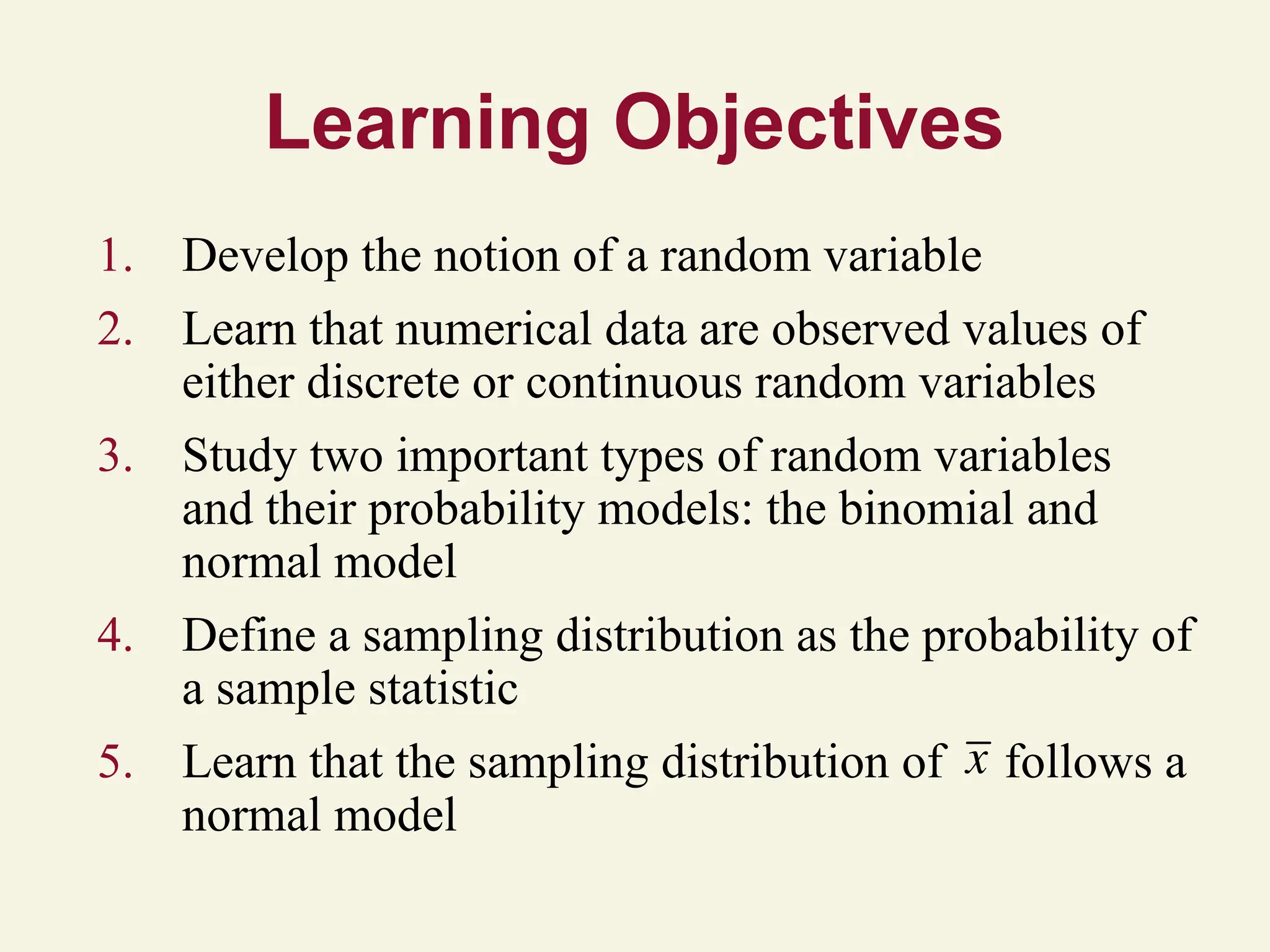
5. Learn that the sampling distribution of follows a
normal model
x
Thinking Challenge
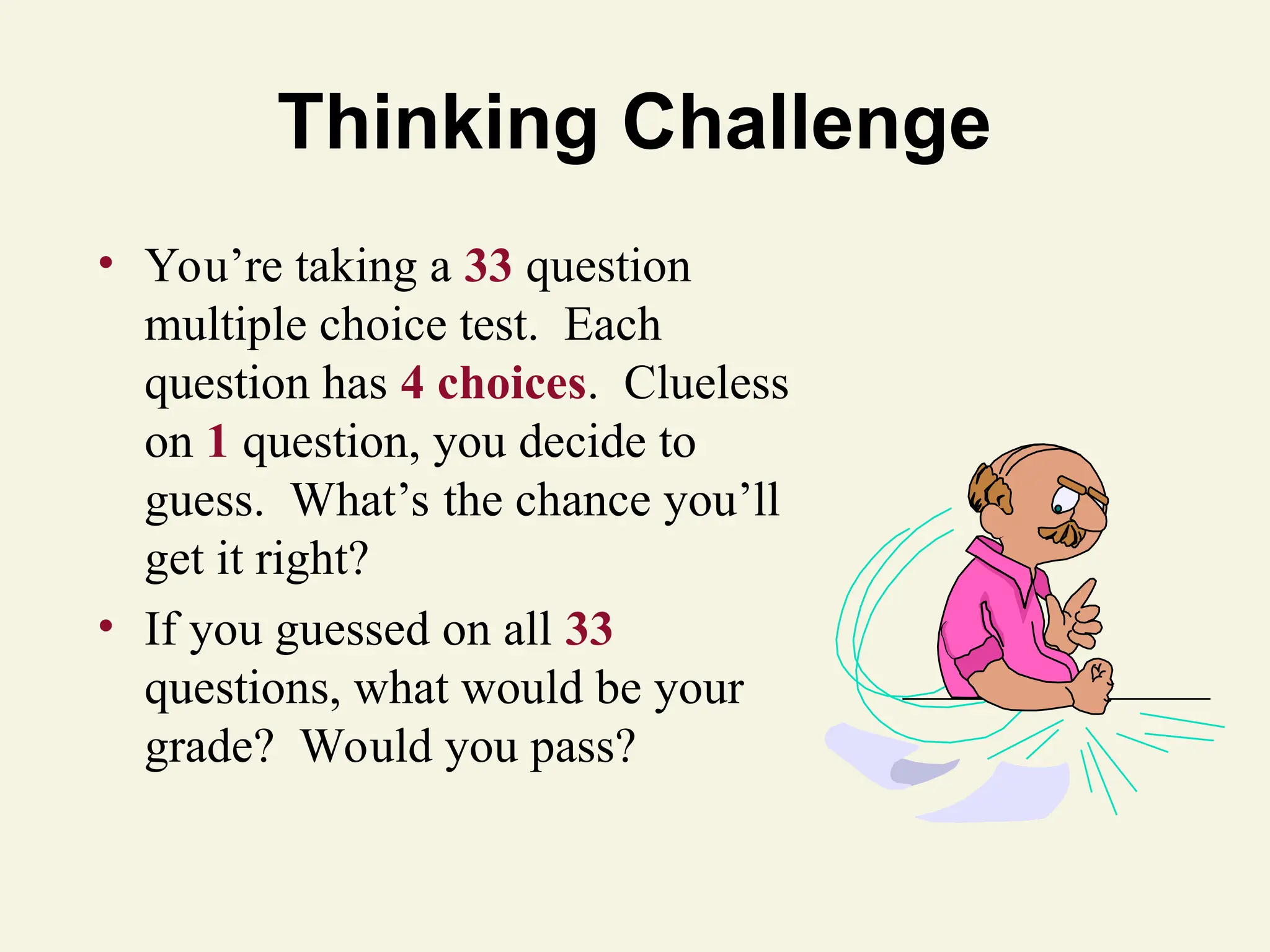
• You’re taking a 33 question
multiple choice test. Each
question has 4 choices. Clueless
on 1 question, you decide to
guess. What’s the chance you’ll
get it right?
• If you guessed on all 33
questions, what would be your
grade? Would you pass?
4.1
Two Types of Random Variables
Random Variable
A random variable is a variable that assumes
numerical values associated with the random
outcomes of an experiment, where one (and only
one) numerical value is assigned to each sample
point.
Discrete
Random Variable
Random variables that can assume a countable
number (finite or infinite) of values are called
discrete.
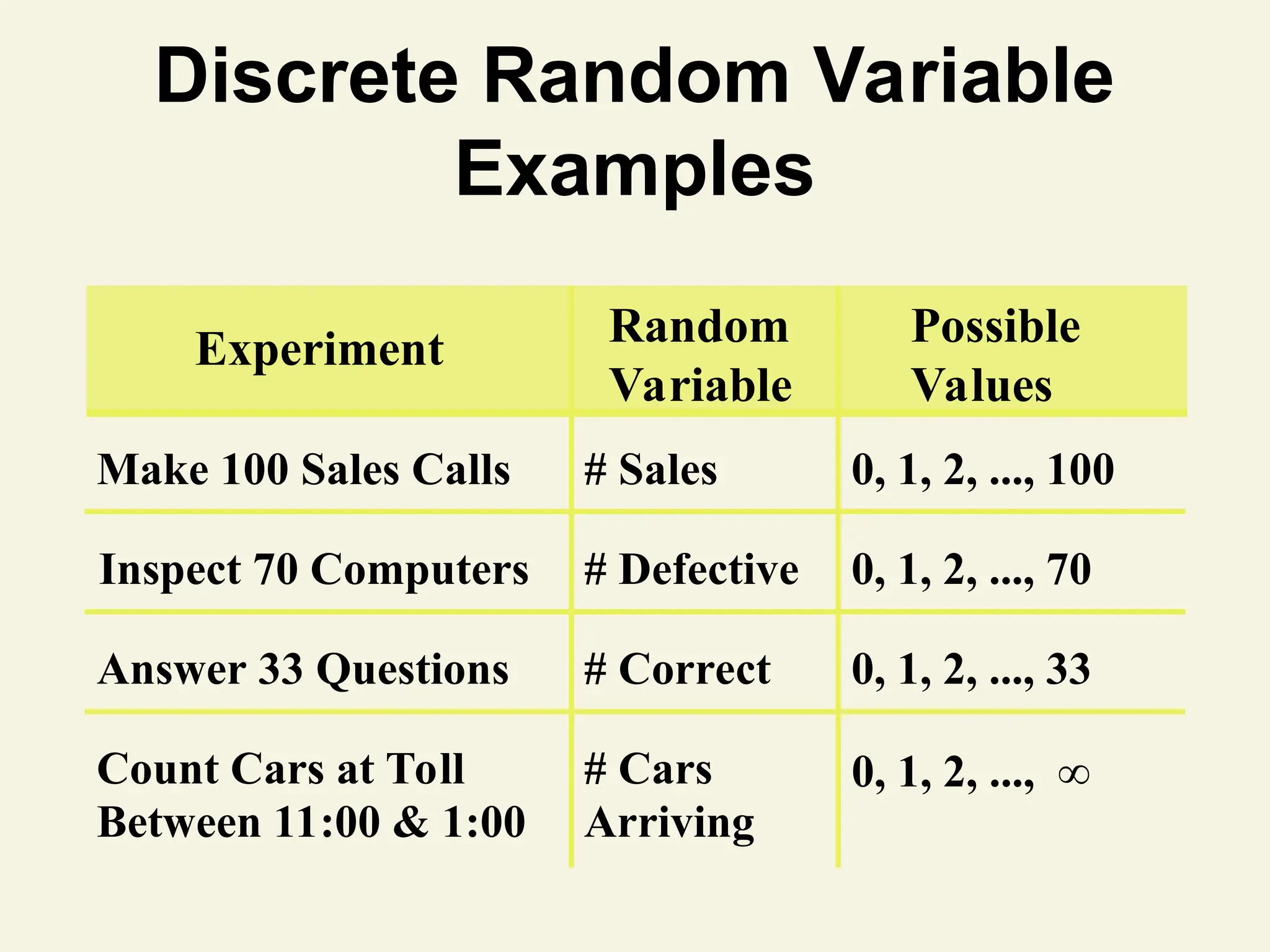
Discrete Random Variable
Examples
Experiment Random
Variable
Possible
Values
Count Cars at Toll
Between 11:00 & 1:00
# Cars
Arriving
0, 1, 2, ..., ∞
Make 100 Sales Calls # Sales 0, 1, 2, ..., 100
Inspect 70 Computers # Defective 0, 1, 2, ..., 70
Answer 33 Questions # Correct 0, 1, 2, ..., 33
Continuous
Random Variable
Random variables that can assume values
corresponding to any of the points contained in
one or more intervals (i.e., values that are
infinite and uncountable) are called continuous.
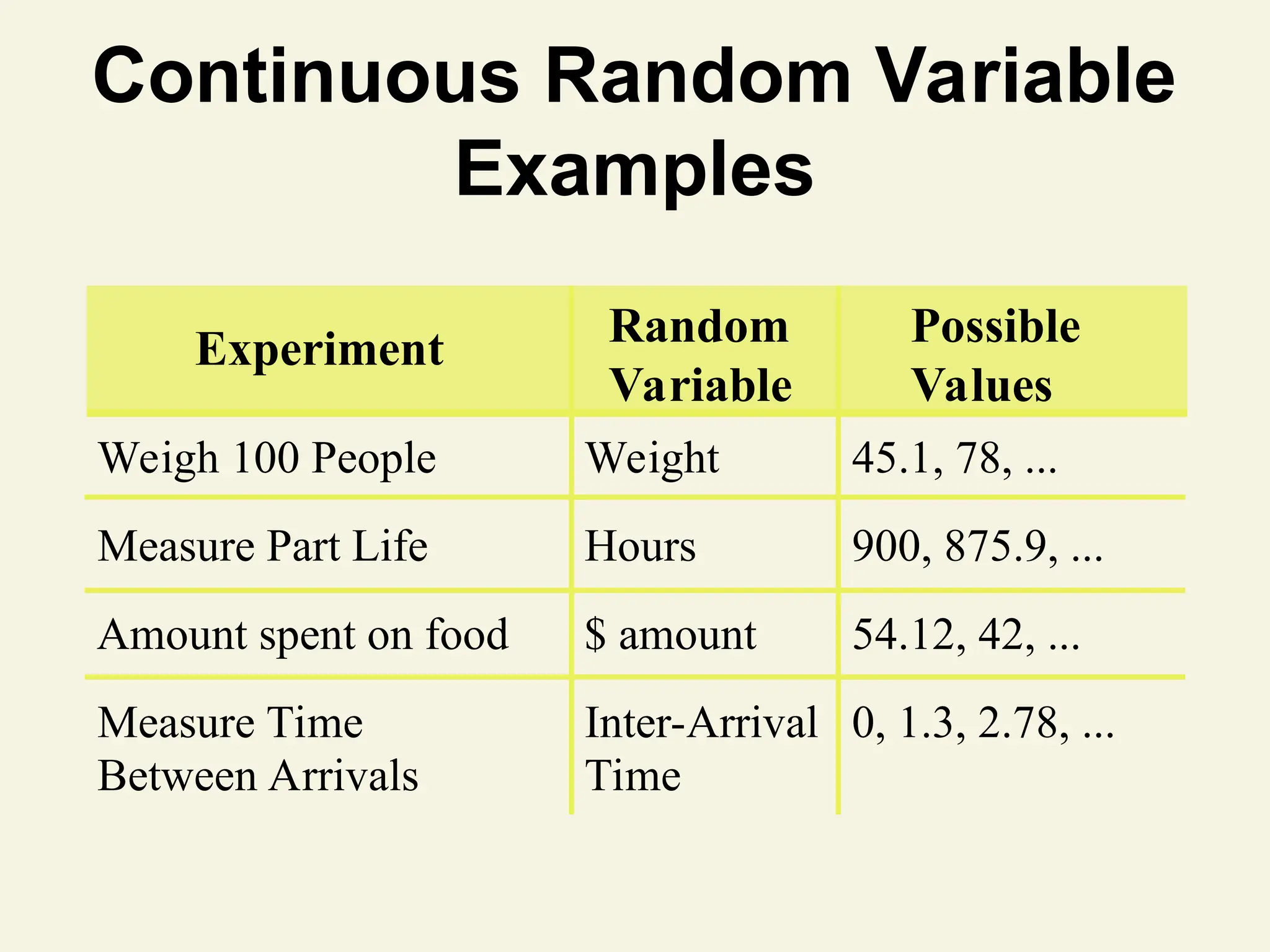
Continuous Random Variable
Examples
Measure Time
Between Arrivals
Inter-Arrival
Time
0, 1.3, 2.78, ...
Experiment Random
Variable
Possible
Values
Weigh 100 People Weight 45.1, 78, ...
Measure Part Life Hours 900, 875.9, ...
Amount spent on food $ amount 54.12, 42, ...
4.2
Probability Distributions for
Discrete Random Variables
Discrete
Probability Distribution
The probability distribution of a discrete
random variable is a graph, table, or formula
that specifies the probability associated with each
possible value the random variable can assume.
Requirements for the
Probability Distribution of a
Discrete Random Variable x
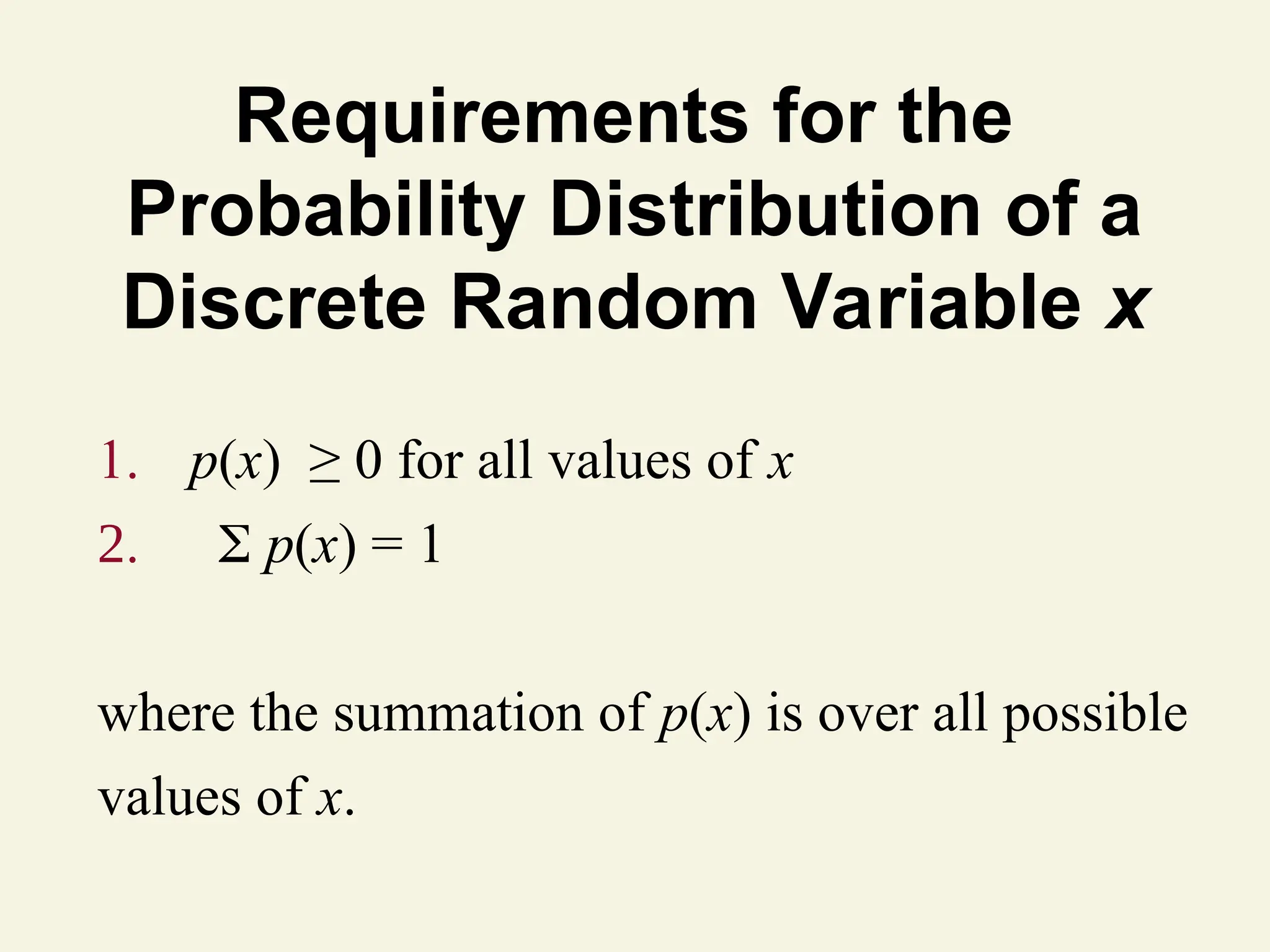
1. p(x) ≥ 0 for all values of x
2.  p(x) = 1
where the summation of p(x) is over all possible
values of x.
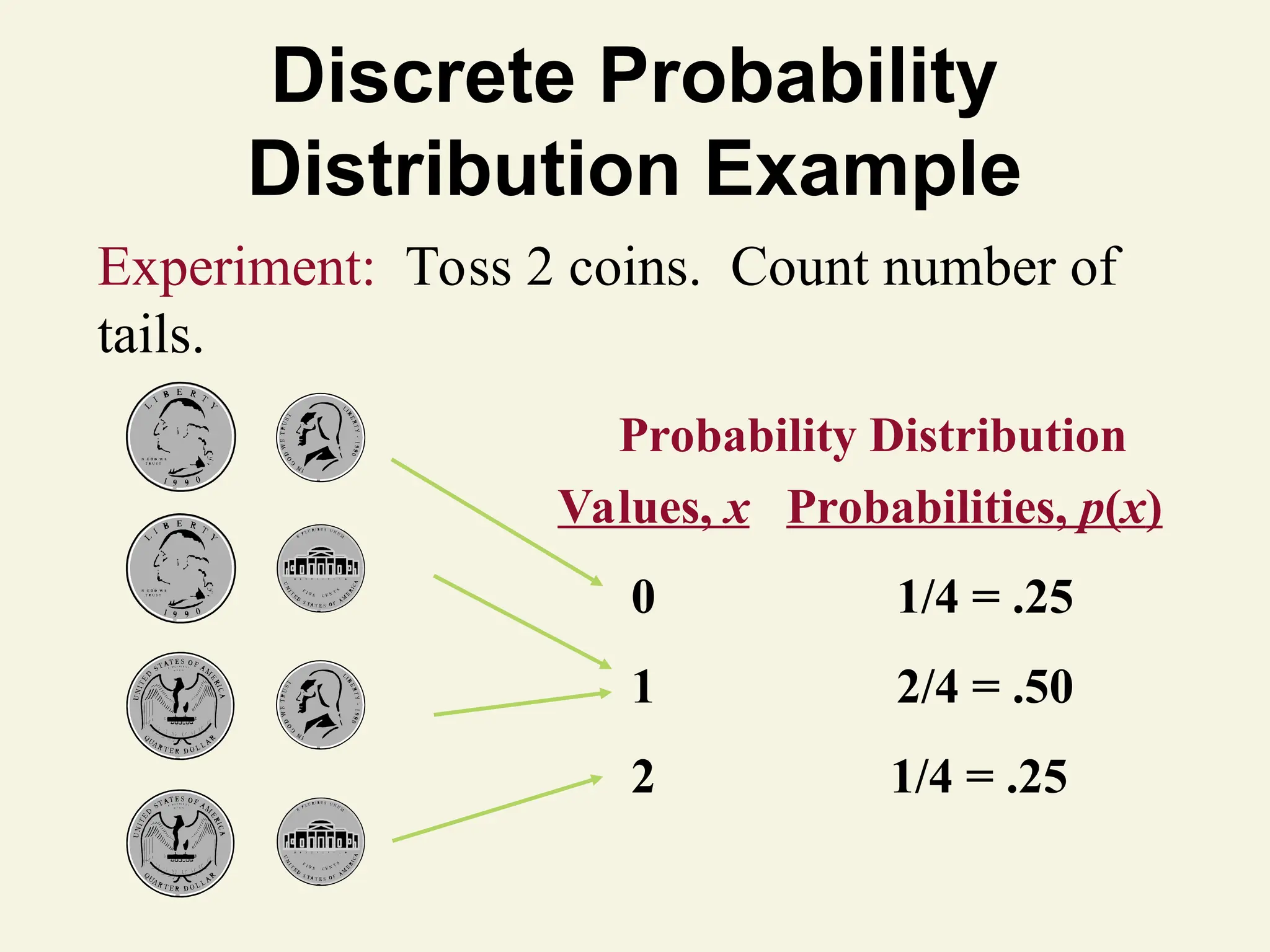
Discrete Probability
Distribution Example
Probability Distribution
Values, x Probabilities, p(x)
0 1/4 = .25
1 2/4 = .50
2 1/4 = .25
Experiment: Toss 2 coins. Count number of
tails.
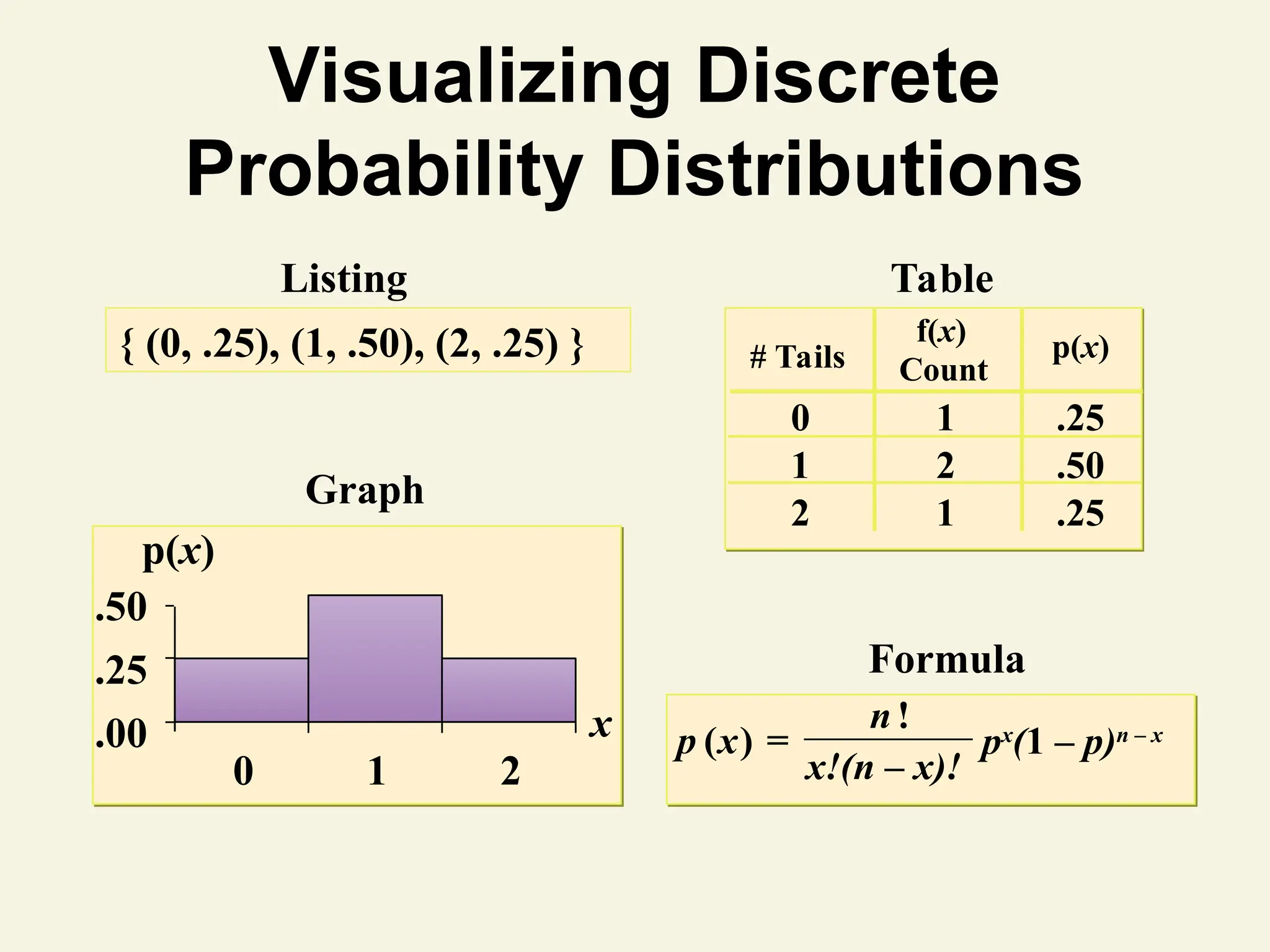
Visualizing Discrete
Probability Distributions
Listing Table
Formula
# Tails
f(x)
Count
p(x)
0 1 .25
1 2 .50
2 1 .25
p x
n
x!(n – x)!
( )
!
= px
(1 – p)n – x
Graph
.00
.25
.50
0 1 2
x
p(x)
{ (0, .25), (1, .50), (2, .25) }
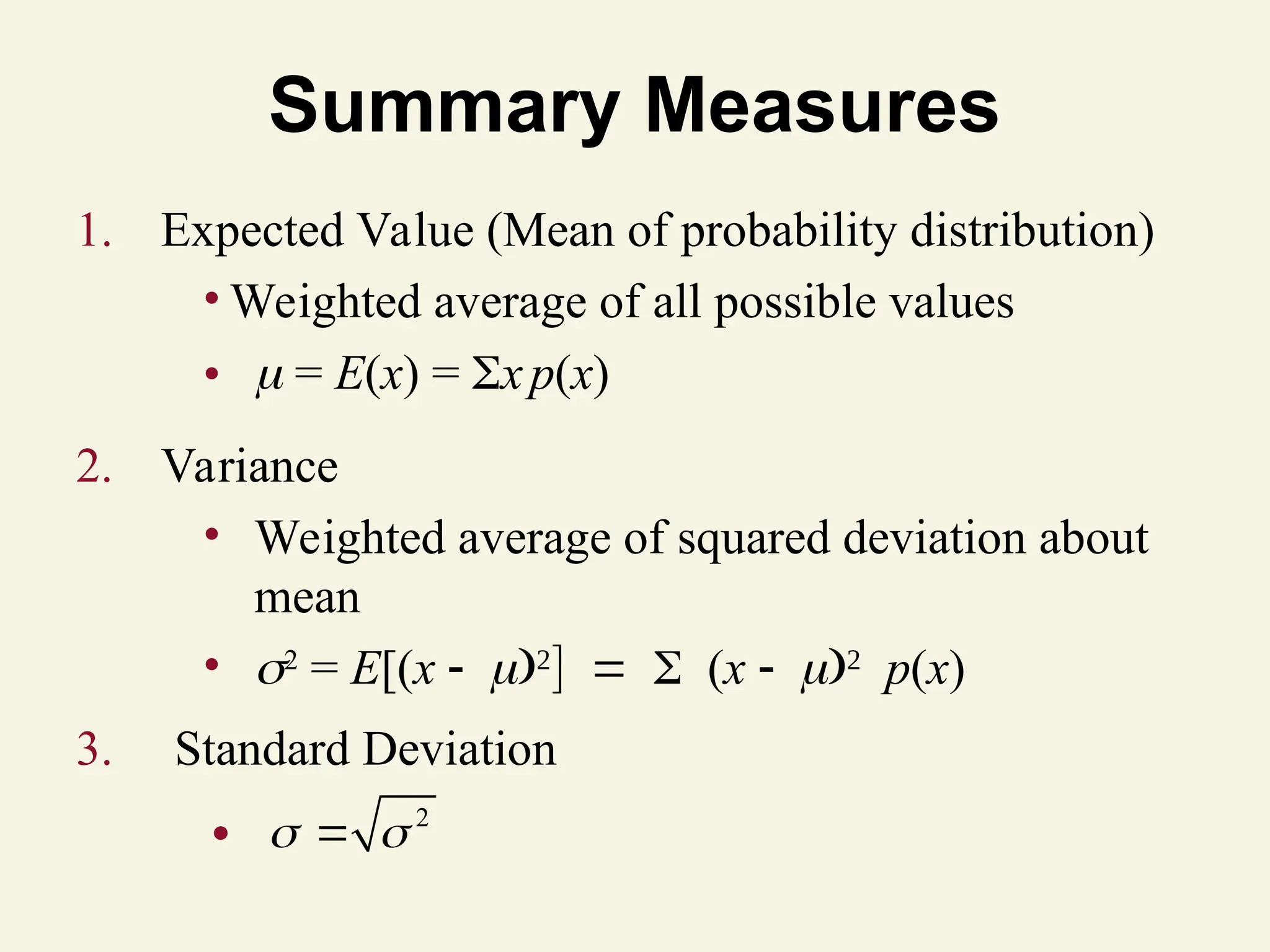
Summary Measures
1. Expected Value (Mean of probability distribution)
• Weighted average of all possible values
•  = E(x) = xp(x)
2. Variance
• Weighted average of squared deviation about
mean
• 2
= E[(x 
(x 
p(x)
3. Standard Deviation
2
 

●
Summary Measures
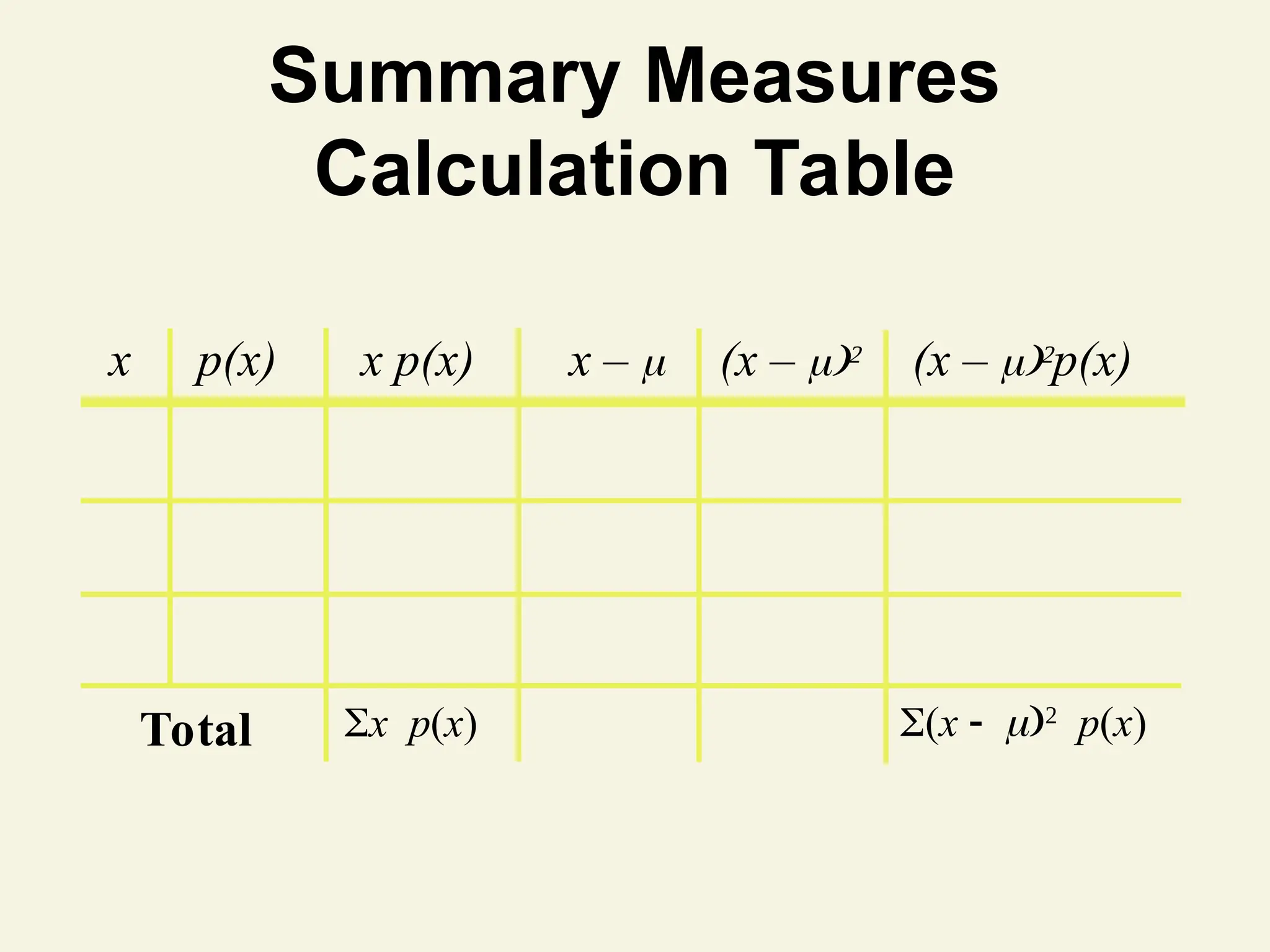
Calculation Table
x p(x) x p(x) x – 
Total (x 
p(x)
(x – 
(x – 
p(x)
xp(x)
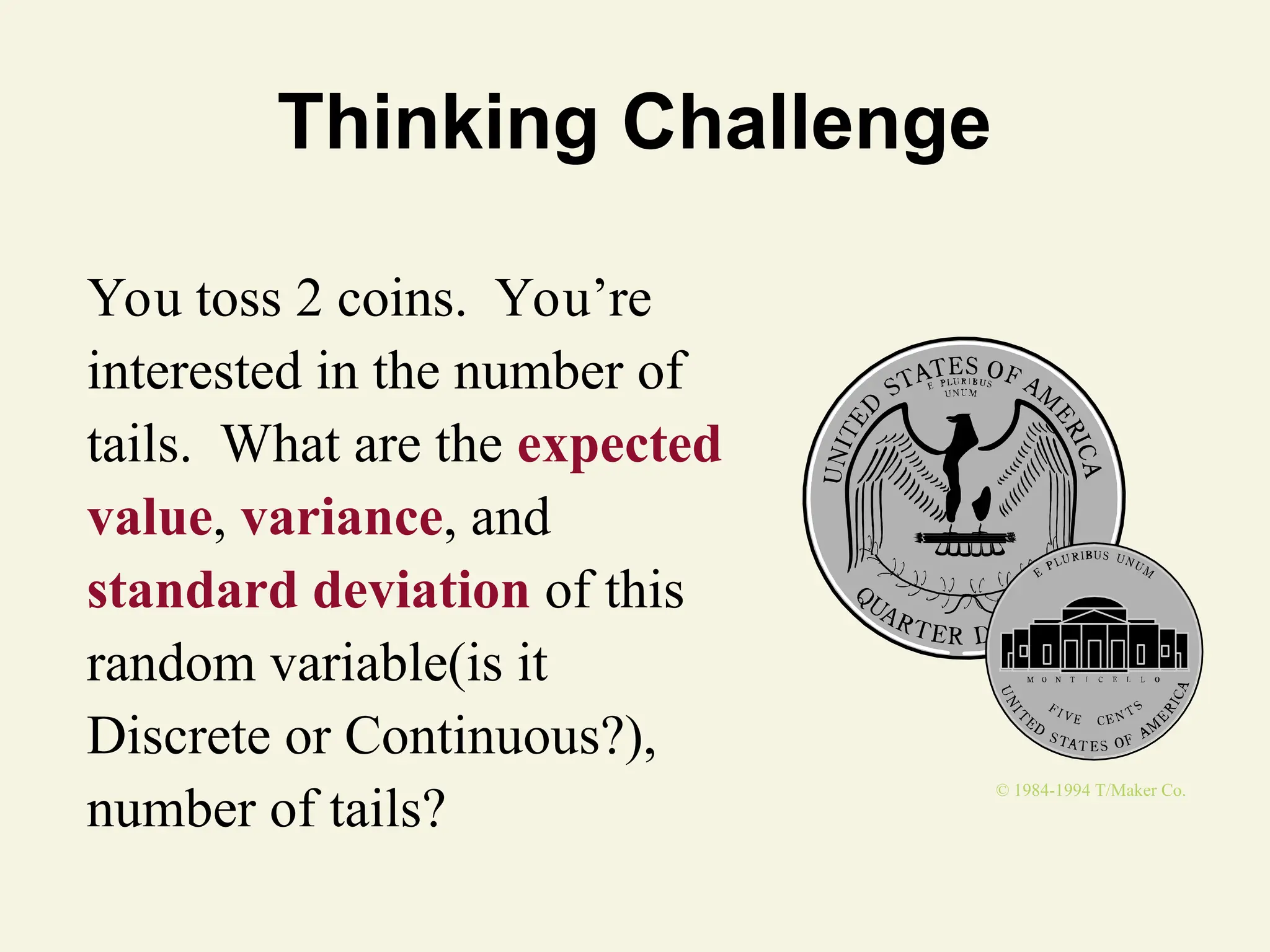
Thinking Challenge
You toss 2 coins. You’re
interested in the number of
tails. What are the expected
value, variance, and
standard deviation of this
random variable(is it
Discrete or Continuous?),
number of tails?
© 1984-1994 T/Maker Co.
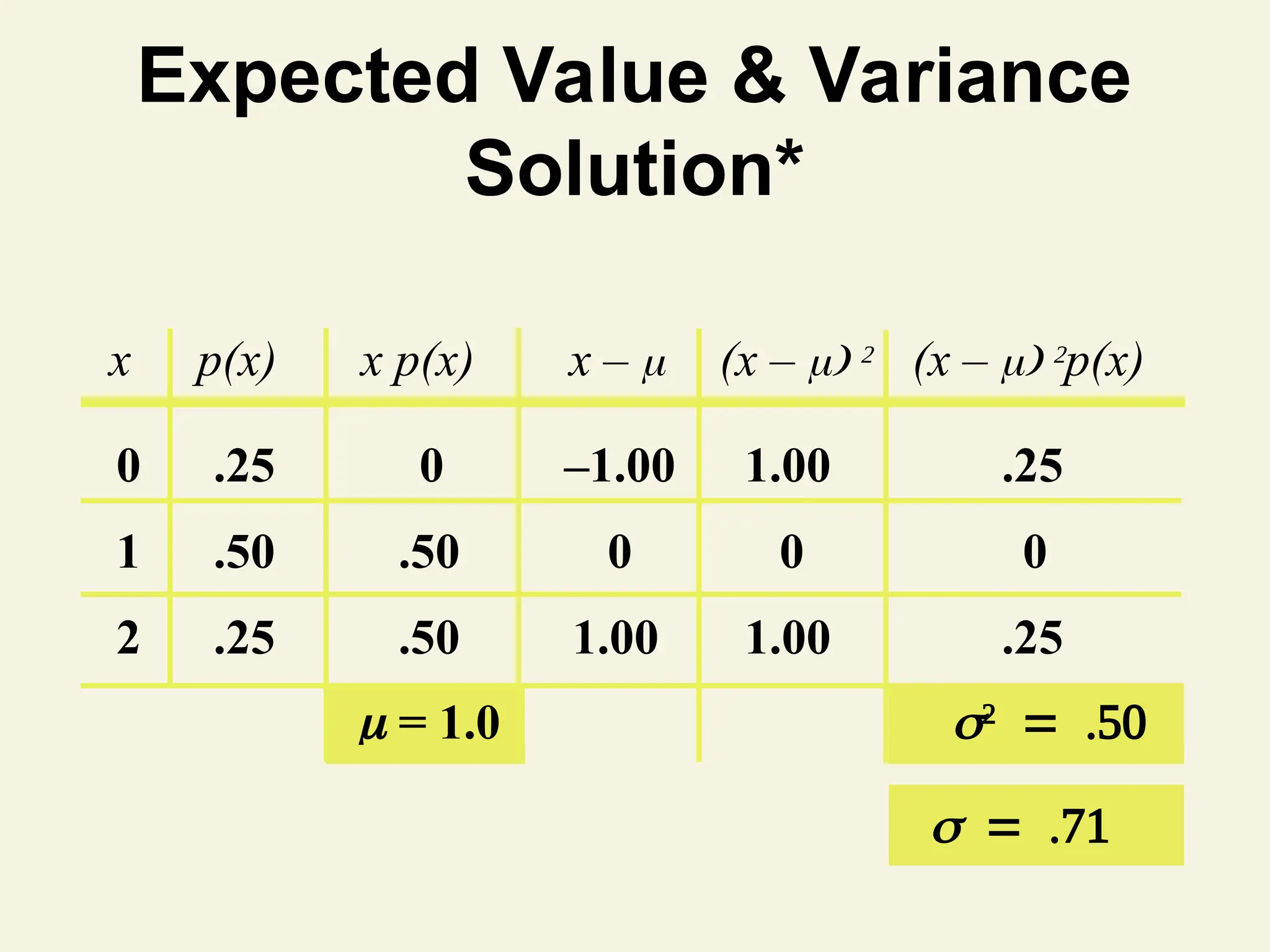
Expected Value & Variance
Solution*
0 .25 –1.00 1.00
1 .50 0 0
2 .25 1.00 1.00
0
.50
.50
 = 1.0
x p(x) x p(x) x –  (x – 
(x – 
p(x)
.25
0
.25



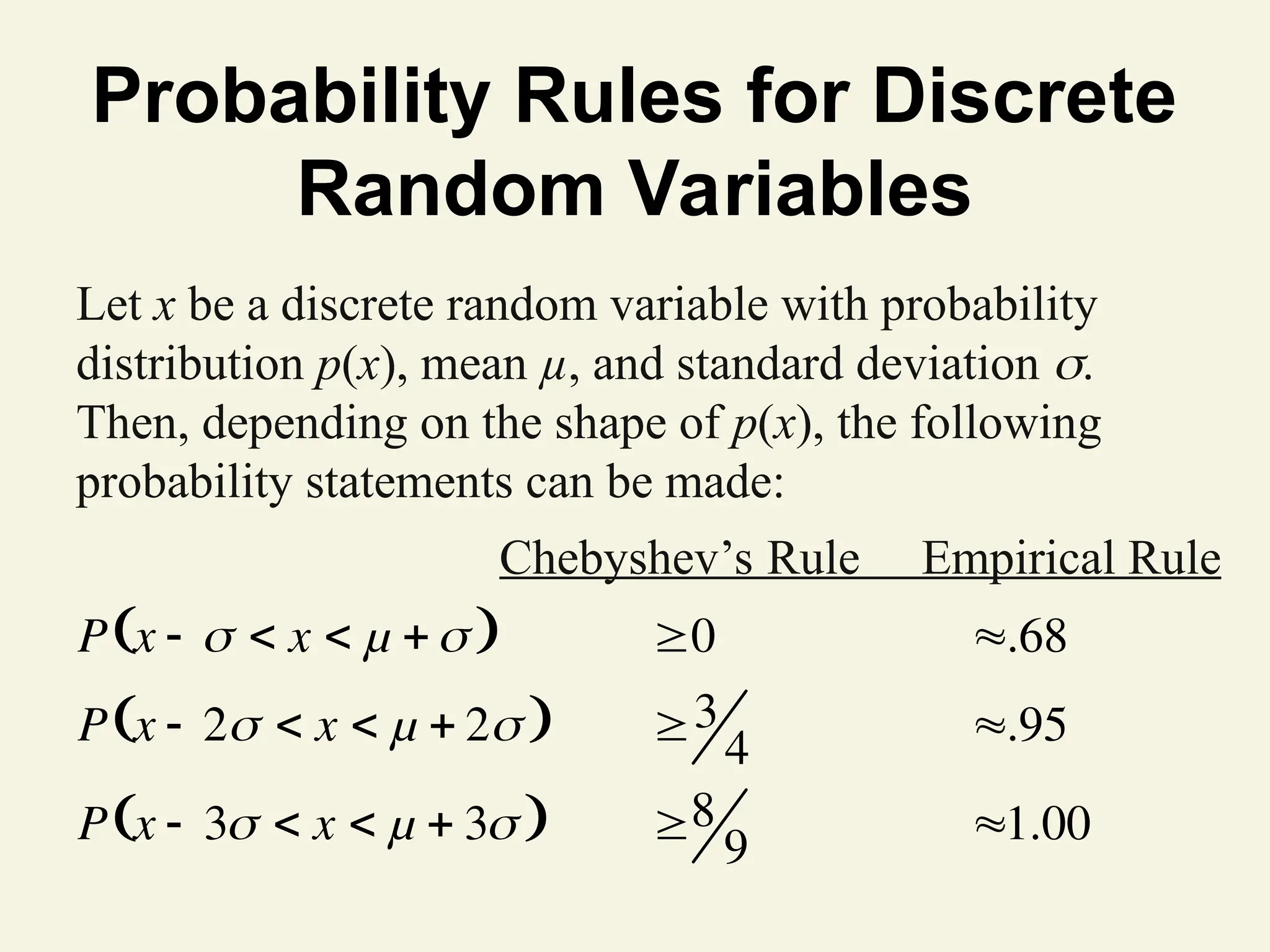
Probability Rules for Discrete
Random Variables
Let x be a discrete random variable with probability
distribution p(x), mean µ, and standard deviation .
Then, depending on the shape of p(x), the following
probability statements can be made:
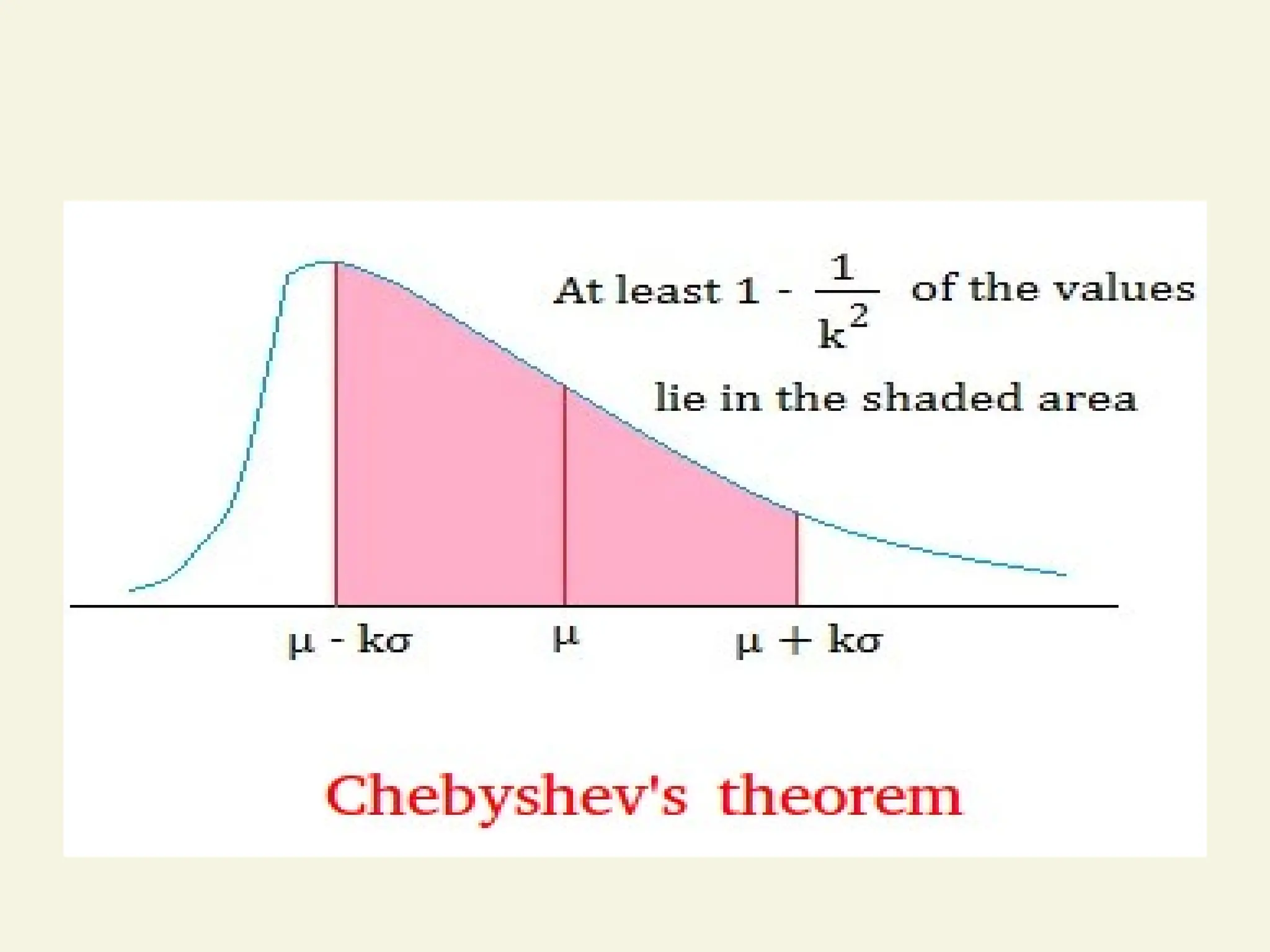
Chebyshev’s Rule Empirical Rule
P x    x  µ 
  0 .68
P x  2  x  µ  2
  3
4 .95
P x  3  x  µ  3
  8
9 1.00
The Binomial Distribution
Binomial Distribution
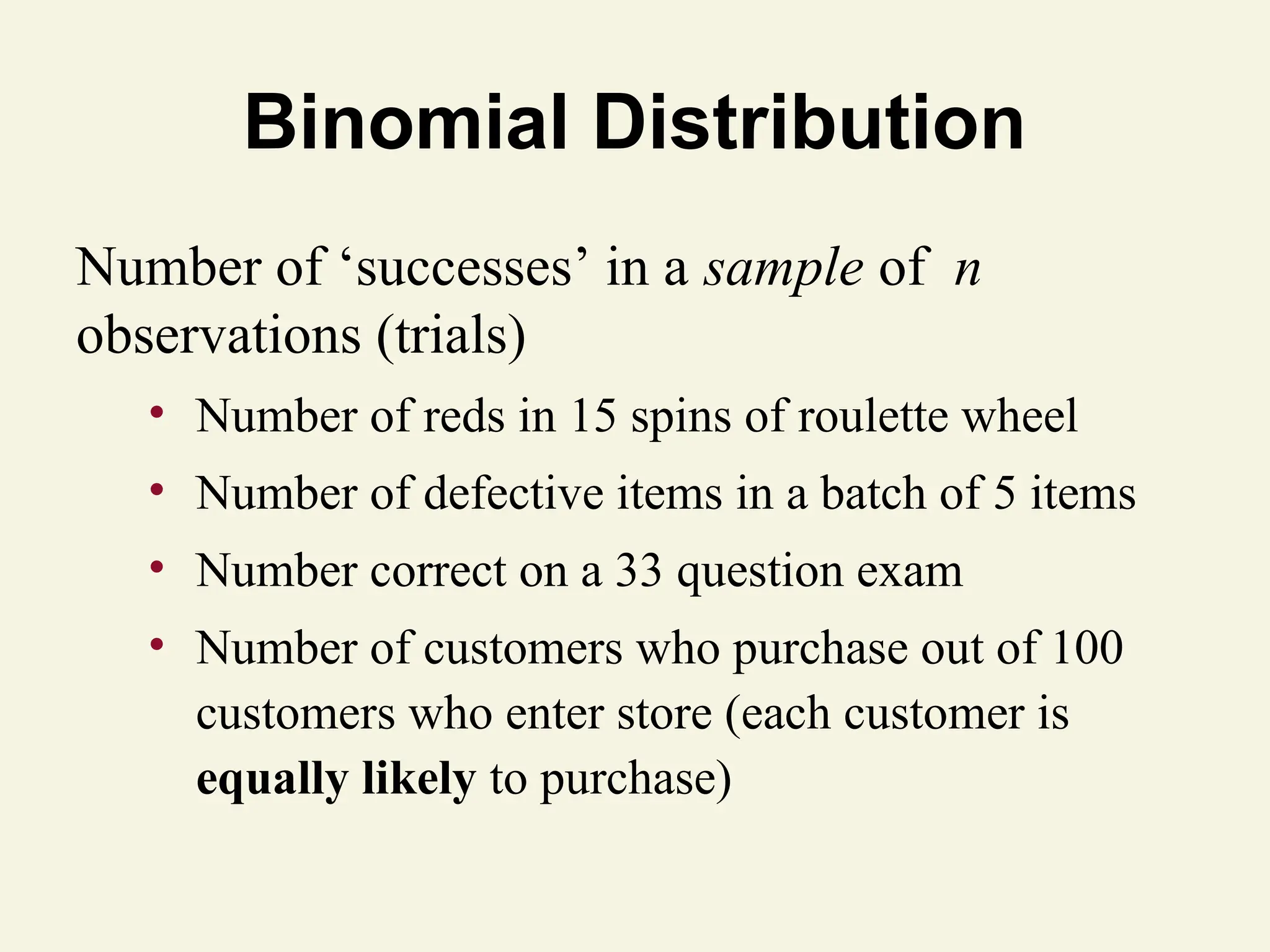
Number of ‘successes’ in a sample of n
observations (trials)
• Number of reds in 15 spins of roulette wheel
• Number of defective items in a batch of 5 items
• Number correct on a 33 question exam
• Number of customers who purchase out of 100
customers who enter store (each customer is
equally likely to purchase)
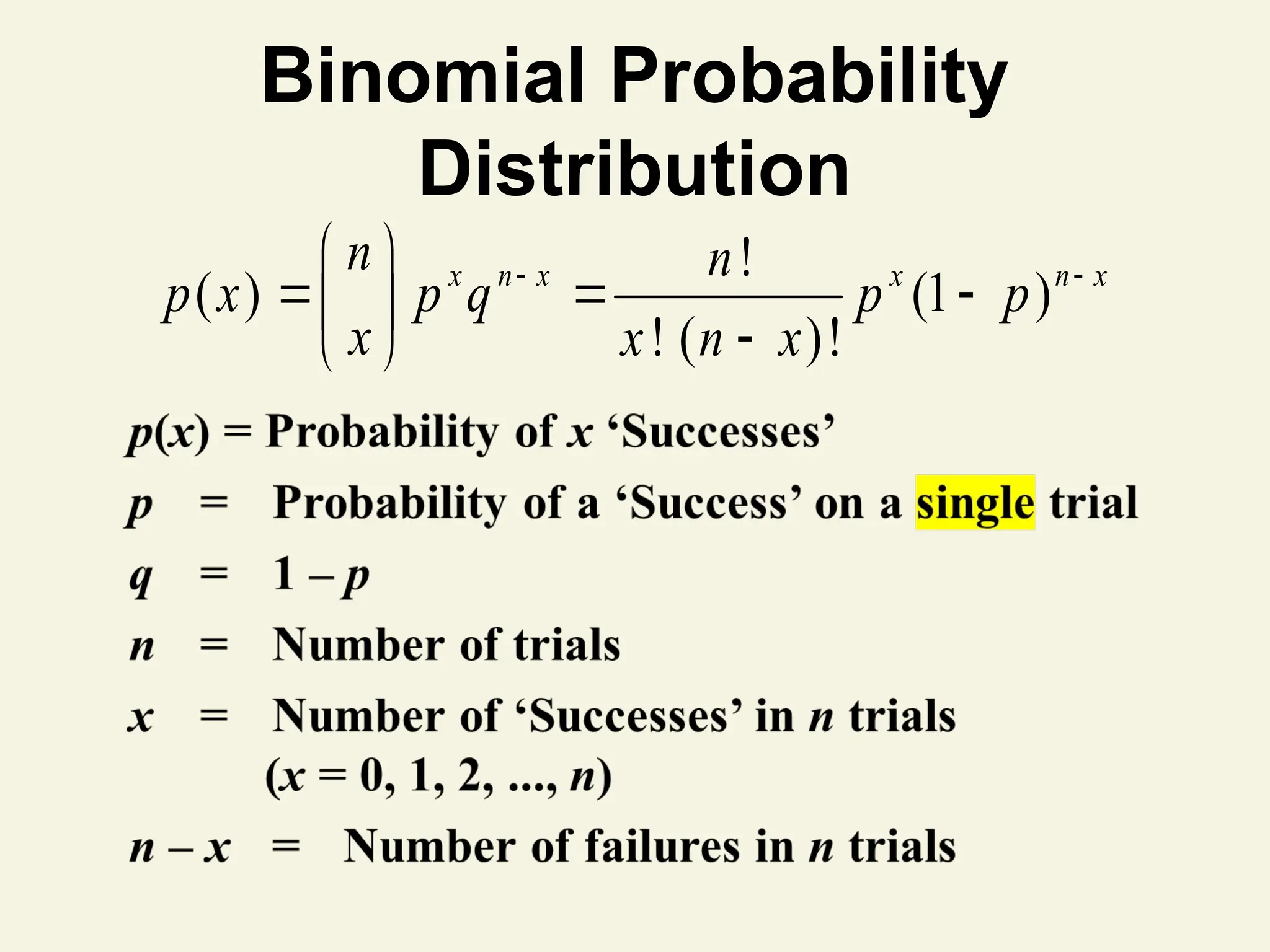
Binomial Probability
Distribution
!
( ) (1 )
! ( )!
x n x x n x
n n
p x p q p p
x x n x
 
 
  
 

 
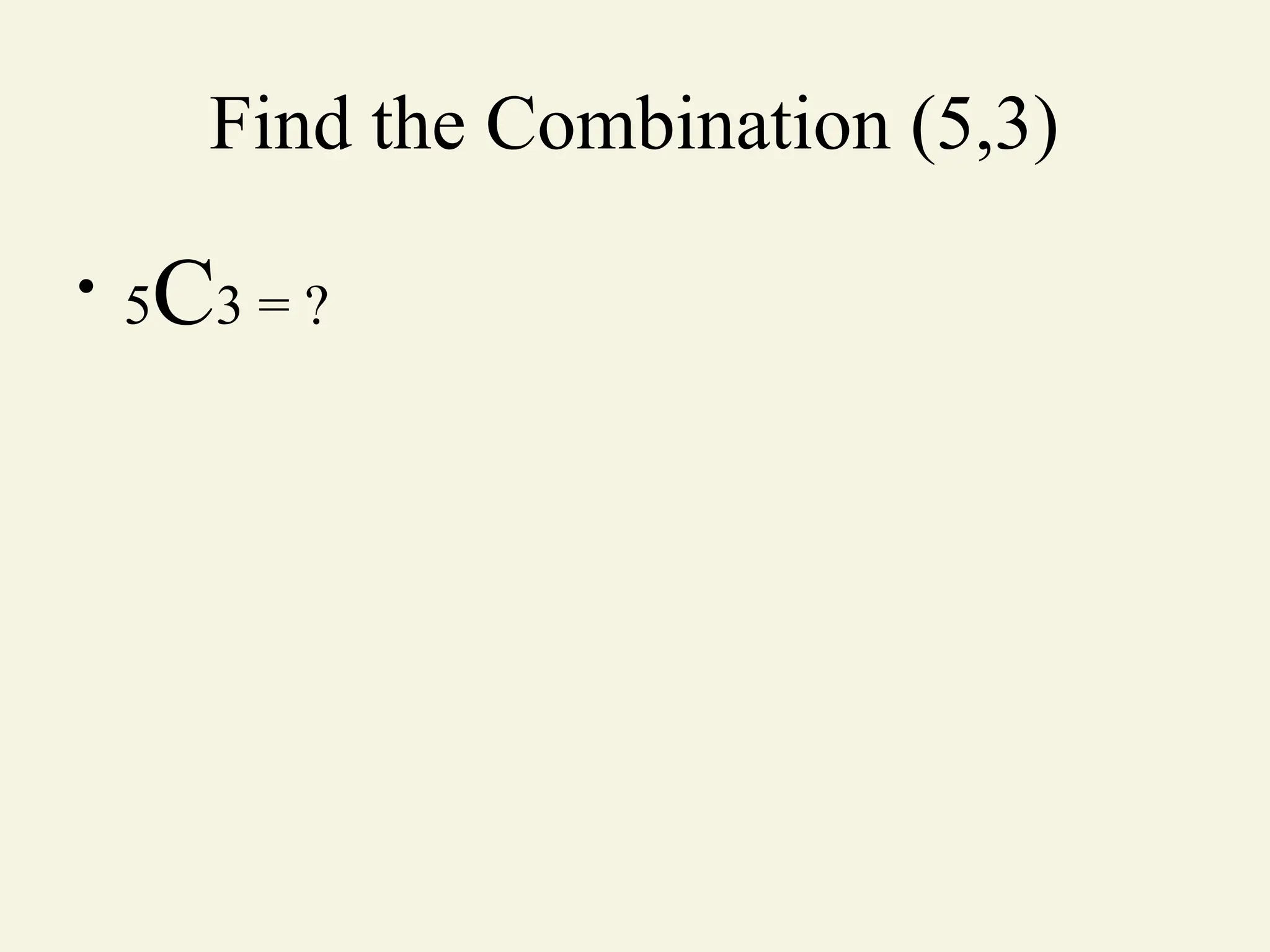
Find the Combination (5,3)
• 5C3 = ?
nCx
• Combination 5C3 = 5!/[3!(5-3)!]=10
Binomial Probability
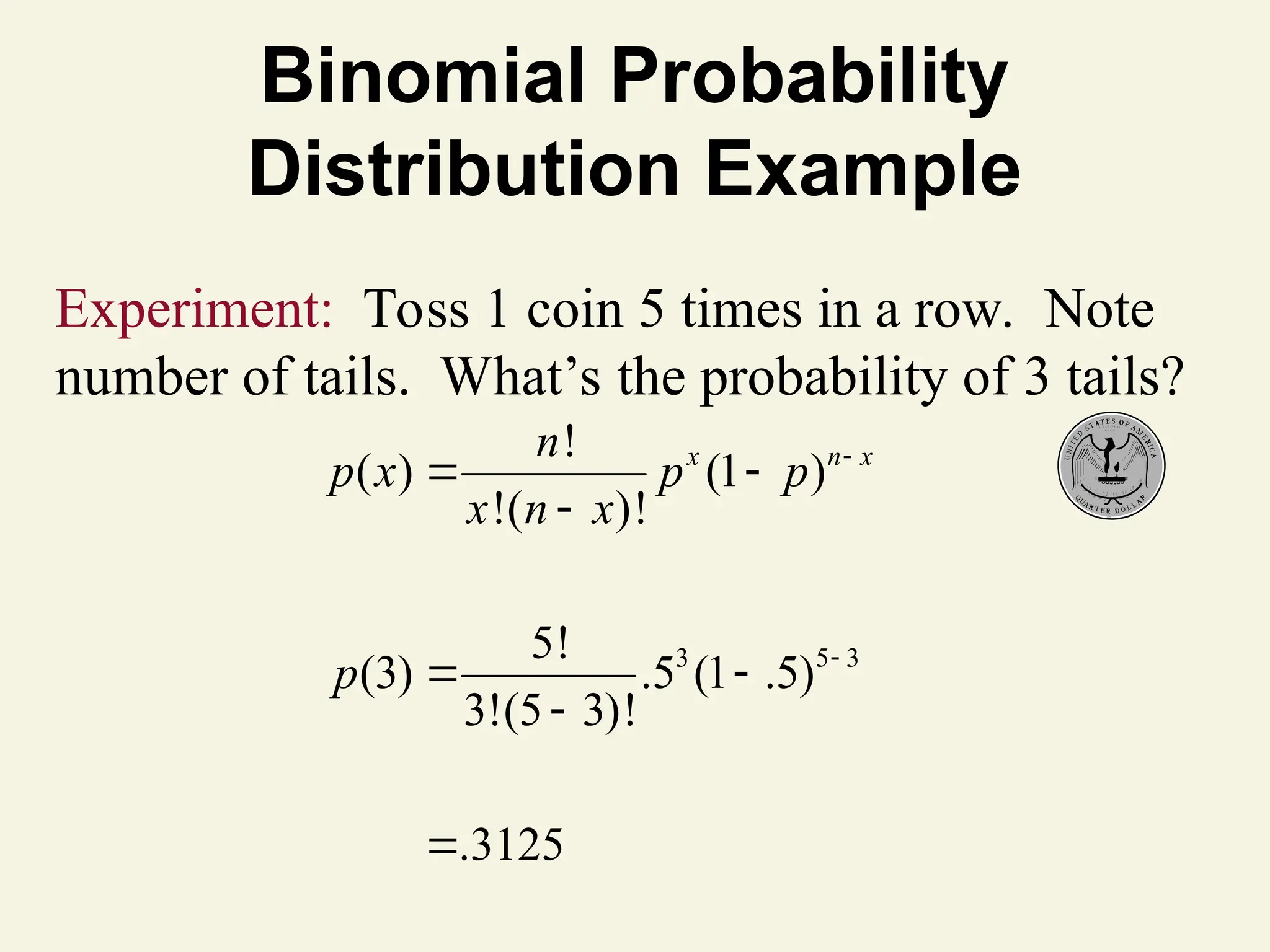
Distribution Example
3 5 3
!
( ) (1 )
!( )!
5!
(3) .5 (1 .5)
3!(5 3)!
.3125
x n x
n
p x p p
x n x
p


 

 


Experiment: Toss 1 coin 5 times in a row. Note
number of tails. What’s the probability of 3 tails?
Binomial Probability Table
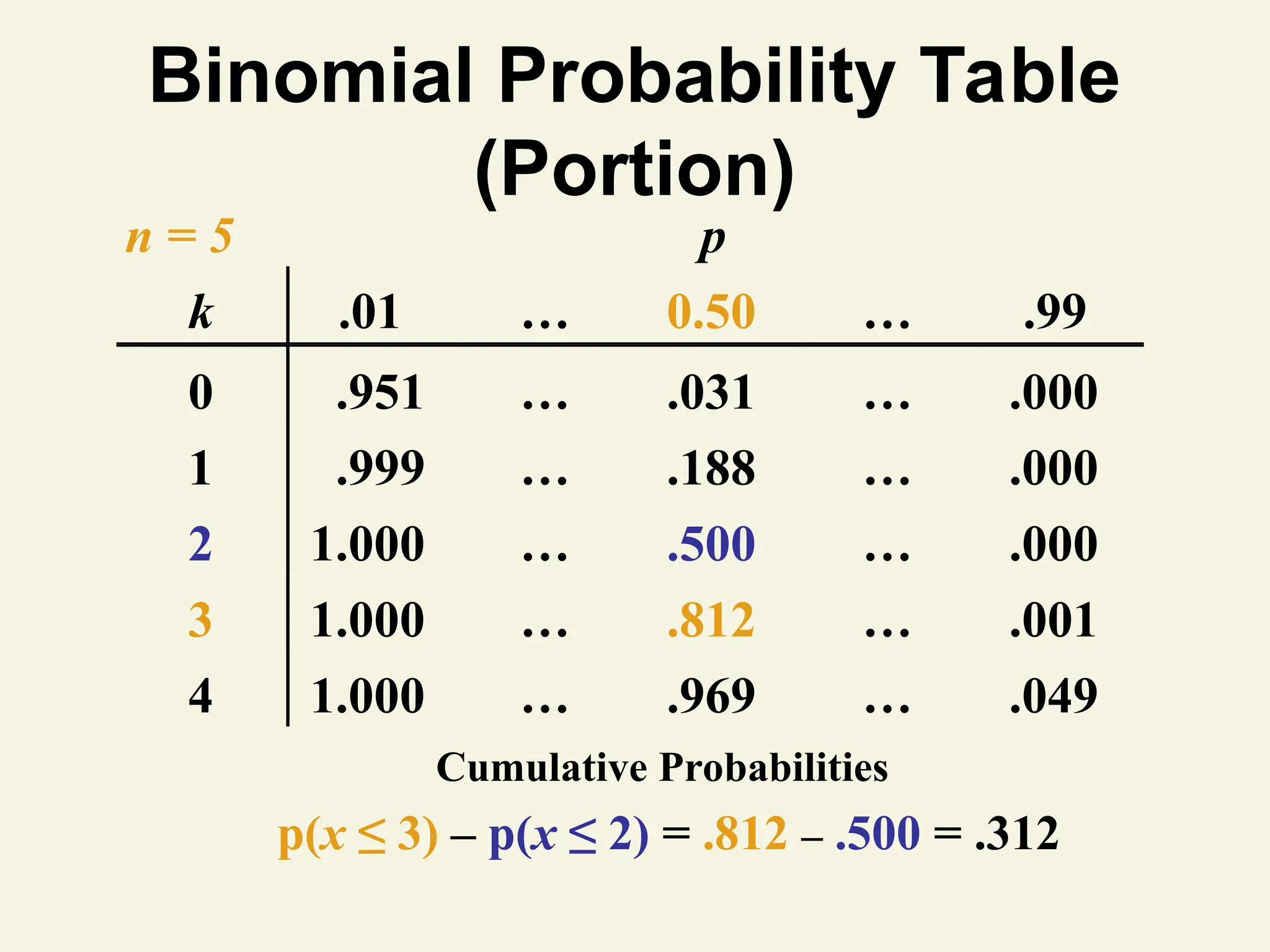
(Portion)
n = 5 p
k .01 … 0.50 … .99
0 .951 … .031 … .000
1 .999 … .188 … .000
2 1.000 … .500 … .000
3 1.000 … .812 … .001
4 1.000 … .969 … .049
Cumulative Probabilities
p(x ≤ 3) – p(x ≤ 2) = .812 – .500 = .312
Binomial Distribution
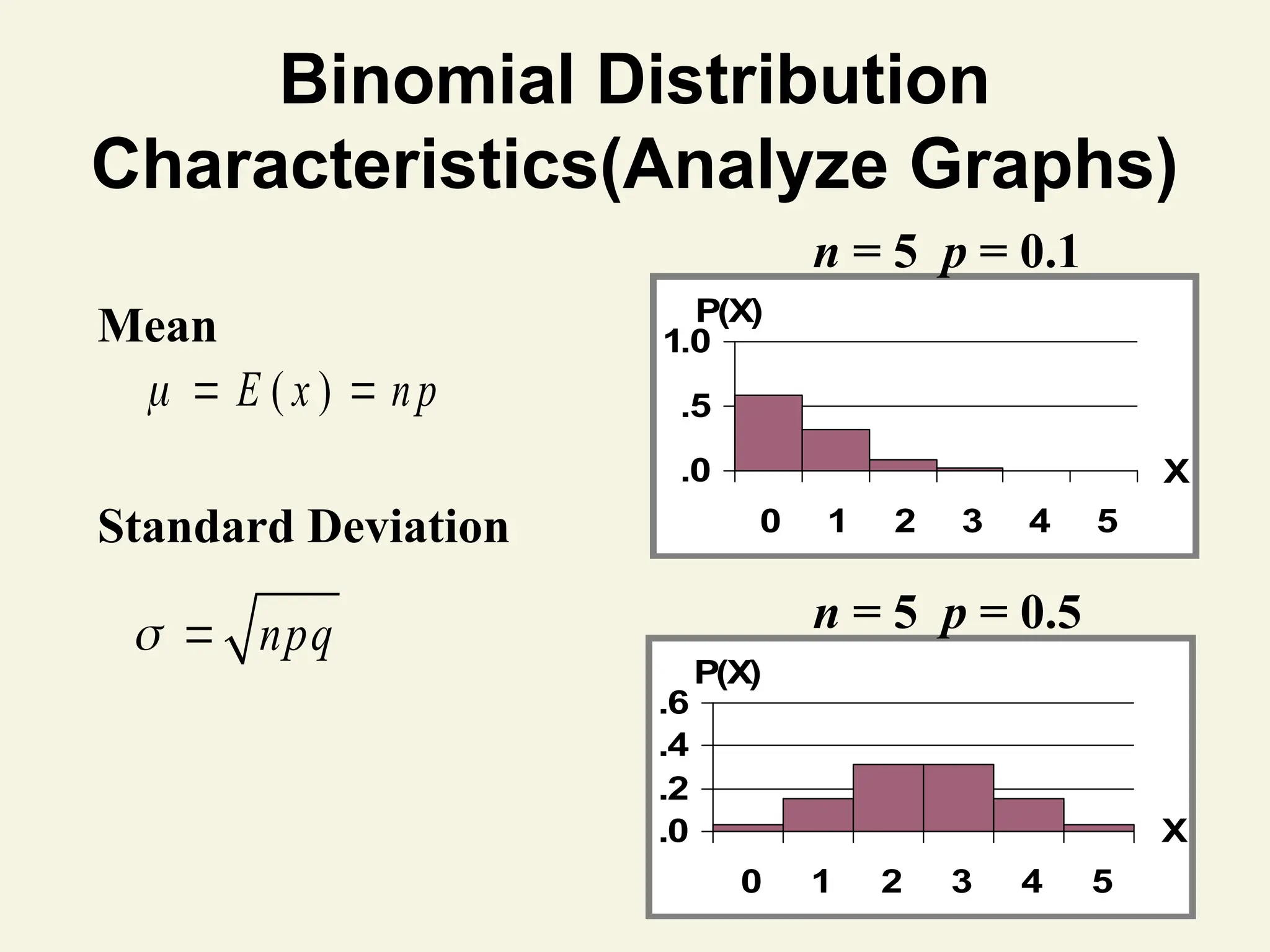
Characteristics(Analyze Graphs)
.0
.5
1.0
0 1 2 3 4 5
X
P(X)
.0
.2
.4
.6
0 1 2 3 4 5
X
P(X)
n = 5 p = 0.1
n = 5 p = 0.5
  E ( x )  np
Mean
Standard Deviation
  npq
Binomial Distribution
Thinking Challenge
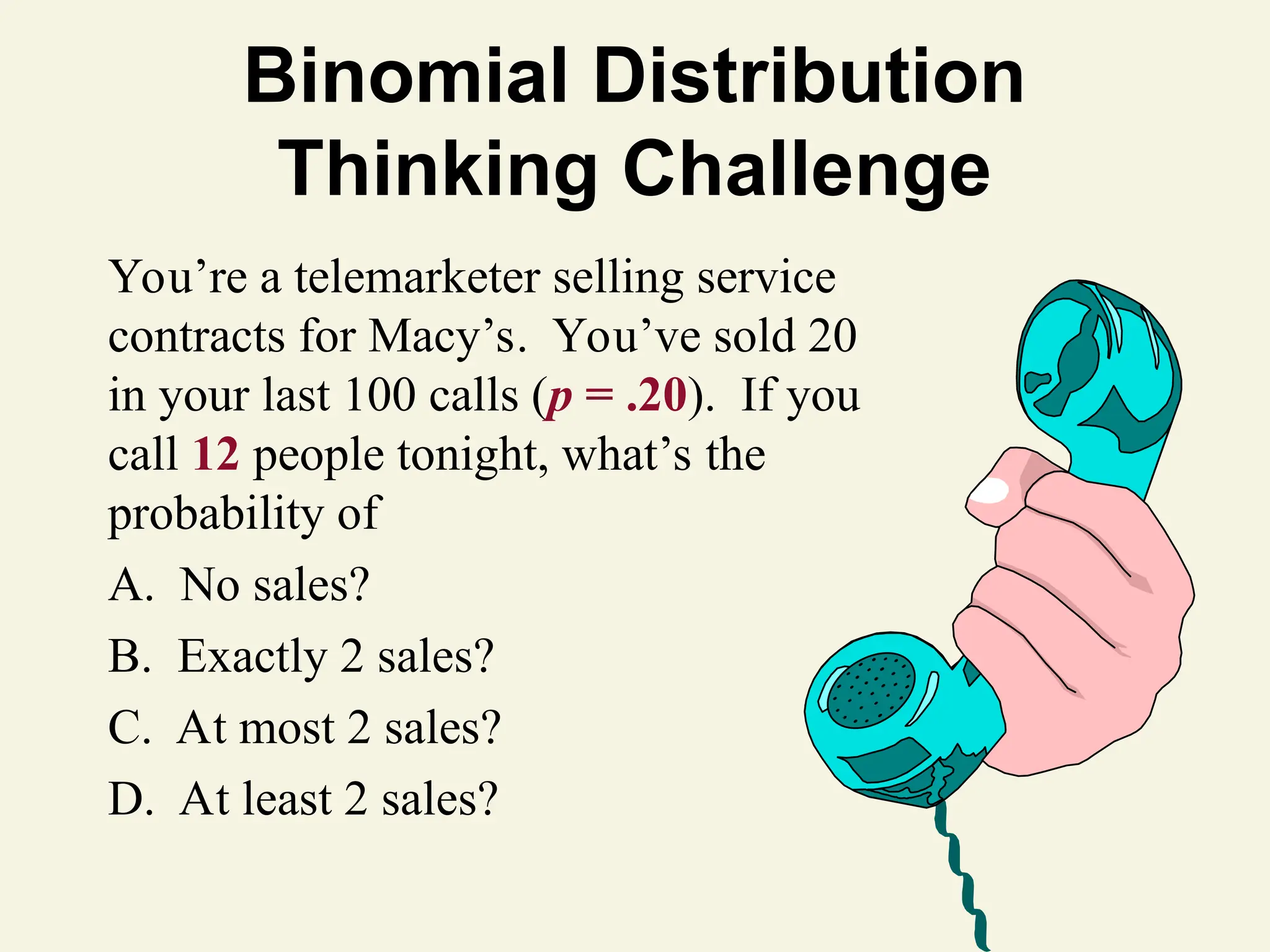
You’re a telemarketer selling service
contracts for Macy’s. You’ve sold 20
in your last 100 calls (p = .20). If you
call 12 people tonight, what’s the
probability of
A. No sales?
B. Exactly 2 sales?
C. At most 2 sales?
D. At least 2 sales?
Binomial Distribution Solution*
n = 12, p = .20
A. p(0) = .0687
B. p(2) = .2835
C. p(at most 2) = p(0) + p(1) + p(2)
= .0687 + .2062 + .2835
= .5584
D. p(at least 2) = p(2) + p(3)...+ p(12)
= 1 – [p(0) + p(1)]
= 1 – .0687 – .2062
= .7251
•Exercise Time!
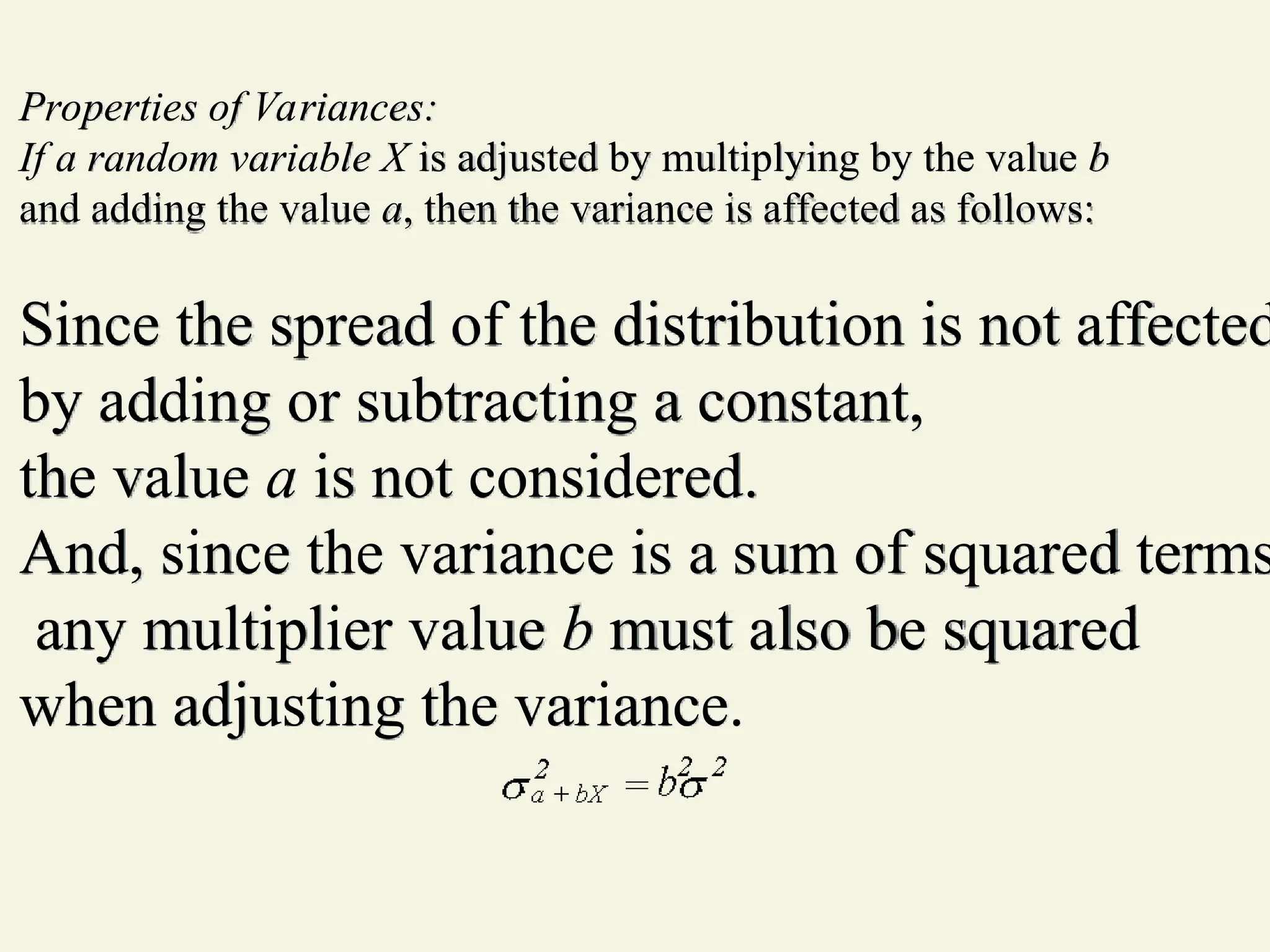
Properties of Variances:
If a random variable X is adjusted by multiplying by the value b
and adding the value a, then the variance is affected as follows:
Since the spread of the distribution is not affected
by adding or subtracting a constant,
the value a is not considered.
And, since the variance is a sum of squared terms
any multiplier value b must also be squared
when adjusting the variance.
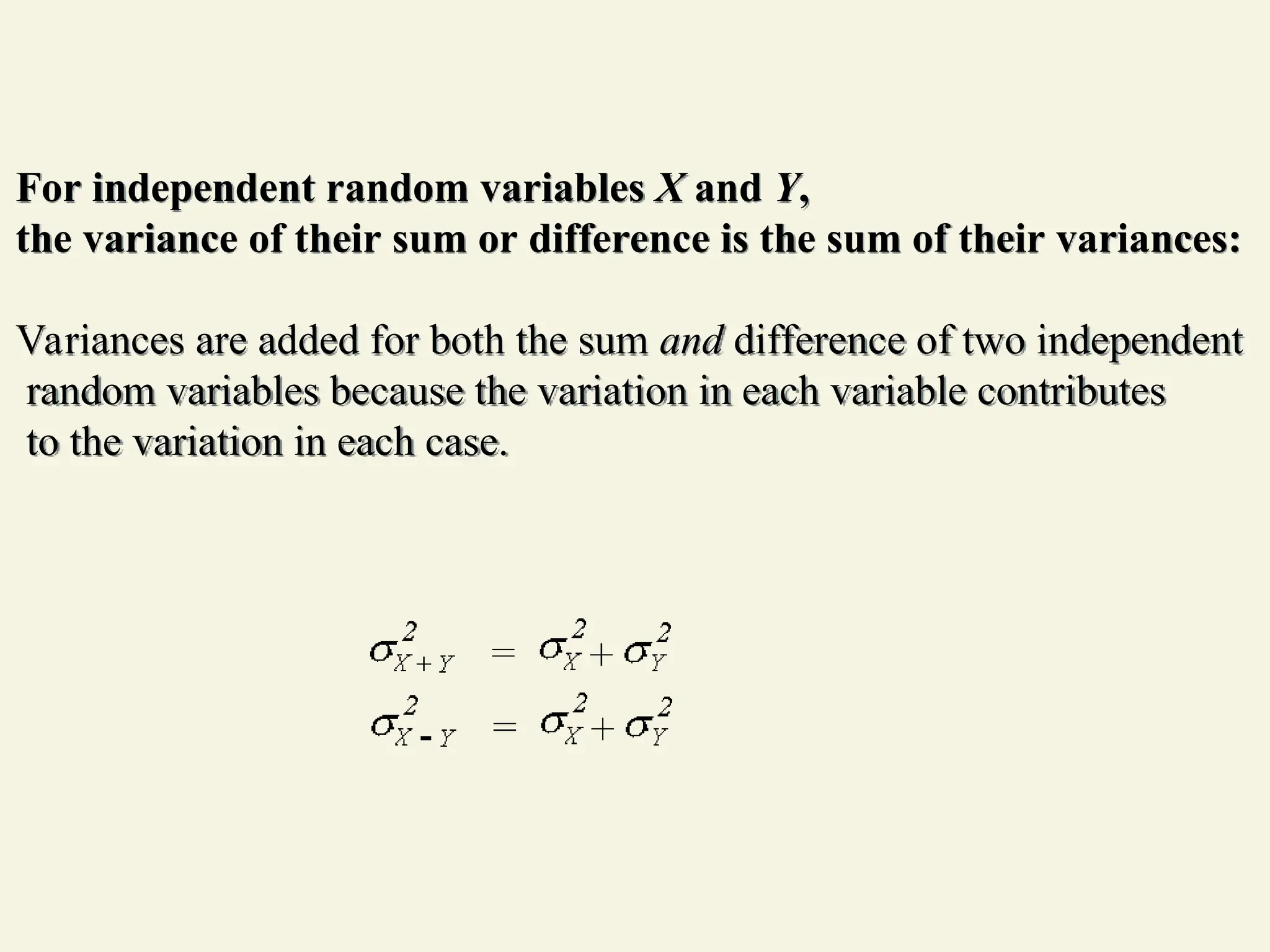
For independent random variables X and Y,
the variance of their sum or difference is the sum of their variances:
Variances are added for both the sum and difference of two independent
random variables because the variation in each variable contributes
to the variation in each case.
4.4
Other Discrete Distributions:
Poisson and Hypergeometric
Poisson Distribution
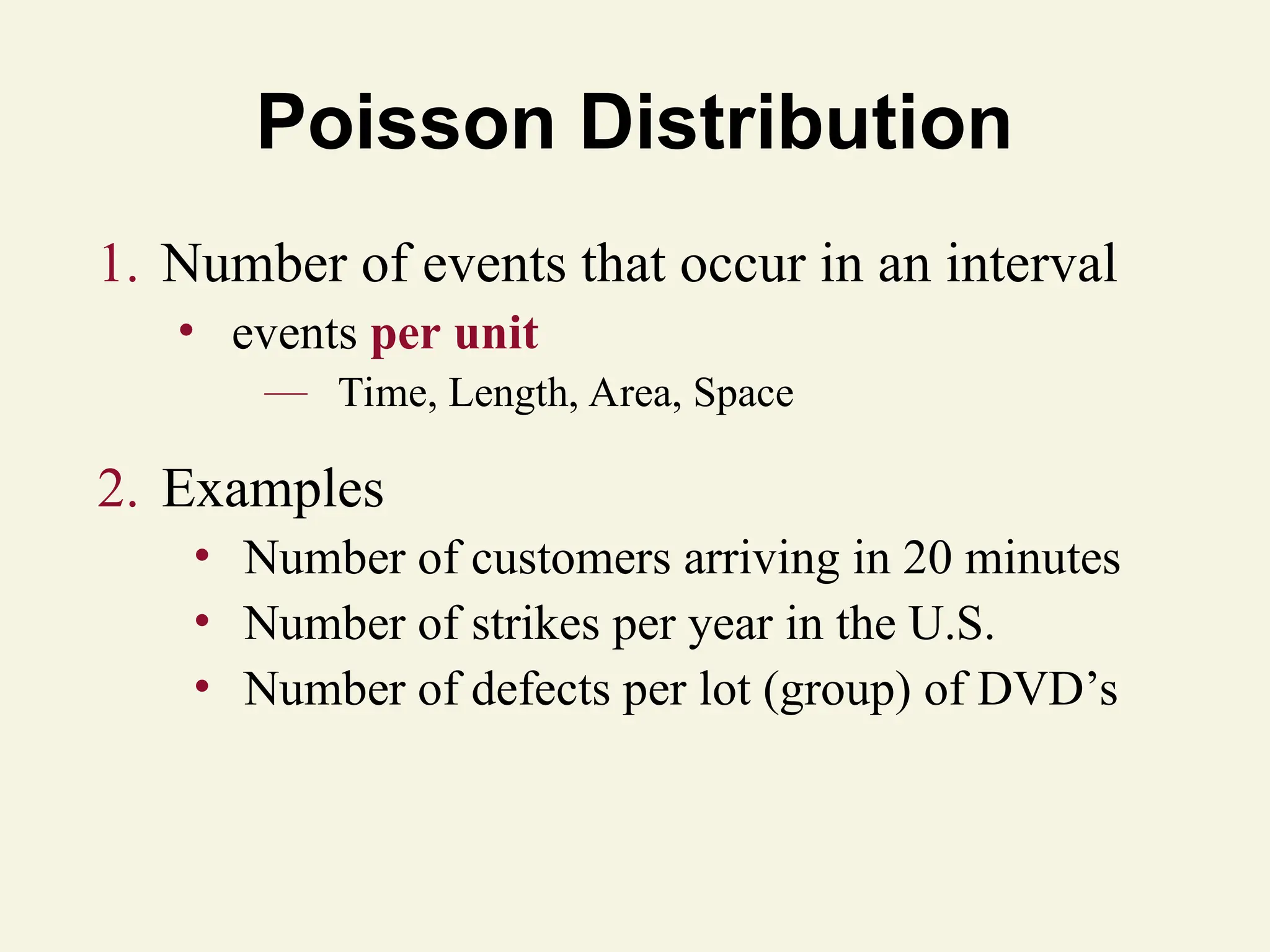
1. Number of events that occur in an interval
• events per unit
— Time, Length, Area, Space
2. Examples
• Number of customers arriving in 20 minutes
• Number of strikes per year in the U.S.
• Number of defects per lot (group) of DVD’s
Characteristics of a Poisson
Random Variable
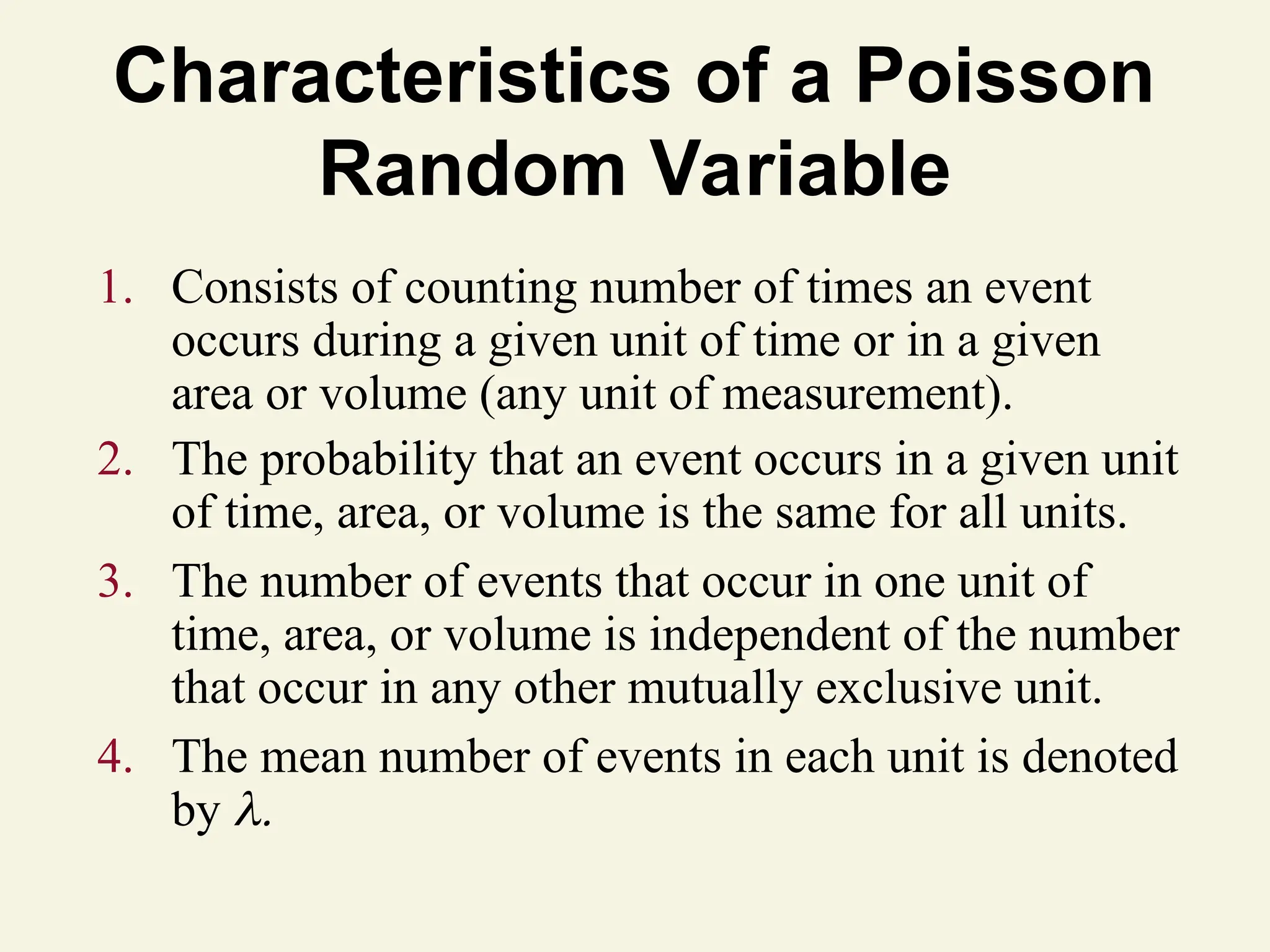
1. Consists of counting number of times an event
occurs during a given unit of time or in a given
area or volume (any unit of measurement).
2. The probability that an event occurs in a given unit
of time, area, or volume is the same for all units.
3. The number of events that occur in one unit of
time, area, or volume is independent of the number
that occur in any other mutually exclusive unit.
4. The mean number of events in each unit is denoted
by 
Poisson Probability
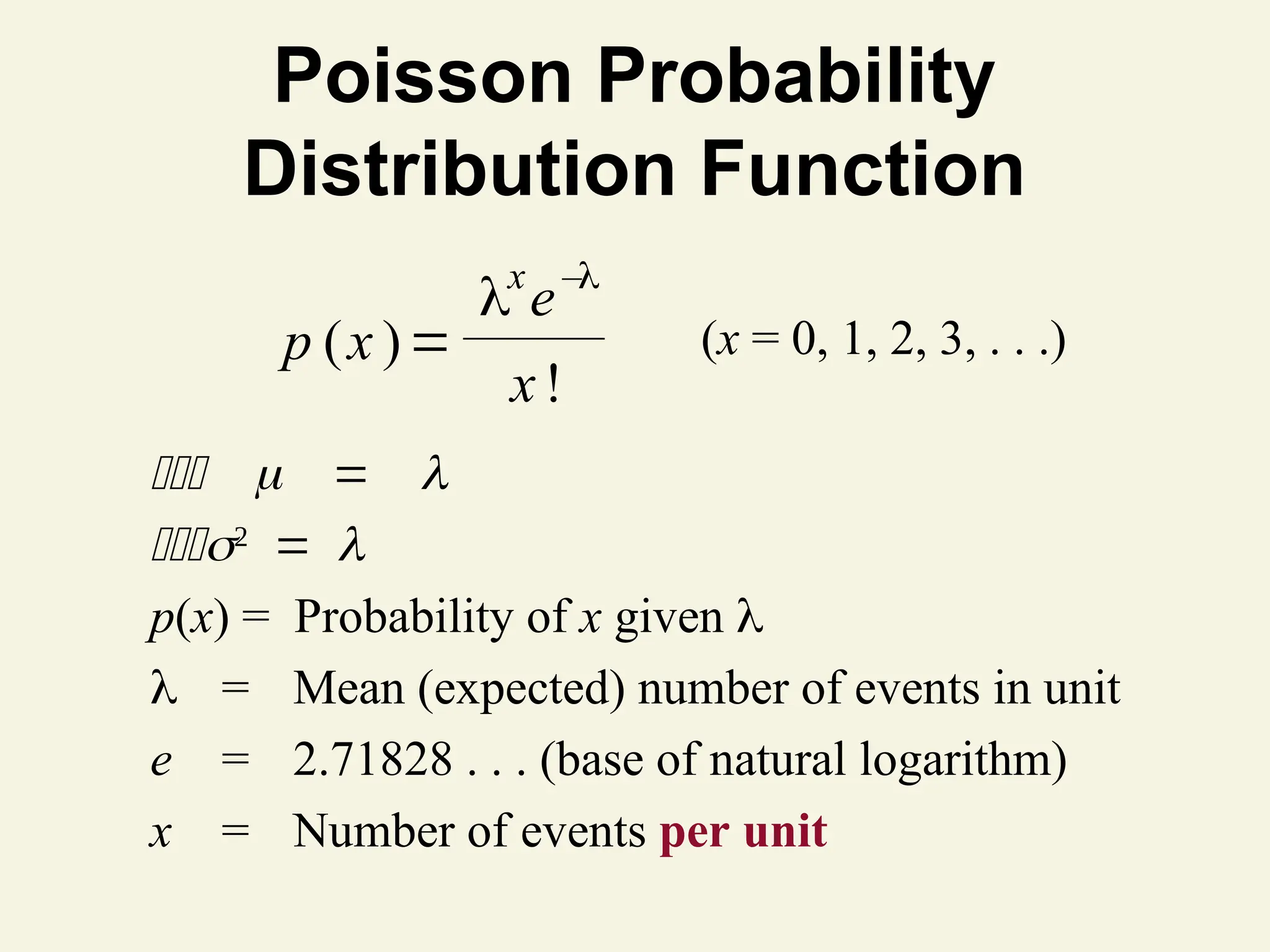
Distribution Function



p(x) = Probability of x given 
 = Mean (expected) number of events in unit
e = 2.71828 . . . (base of natural logarithm)
x = Number of events per unit
p x
x
( )
!

x
 
e–
(x = 0, 1, 2, 3, . . .)
Poisson Probability
Distribution Function
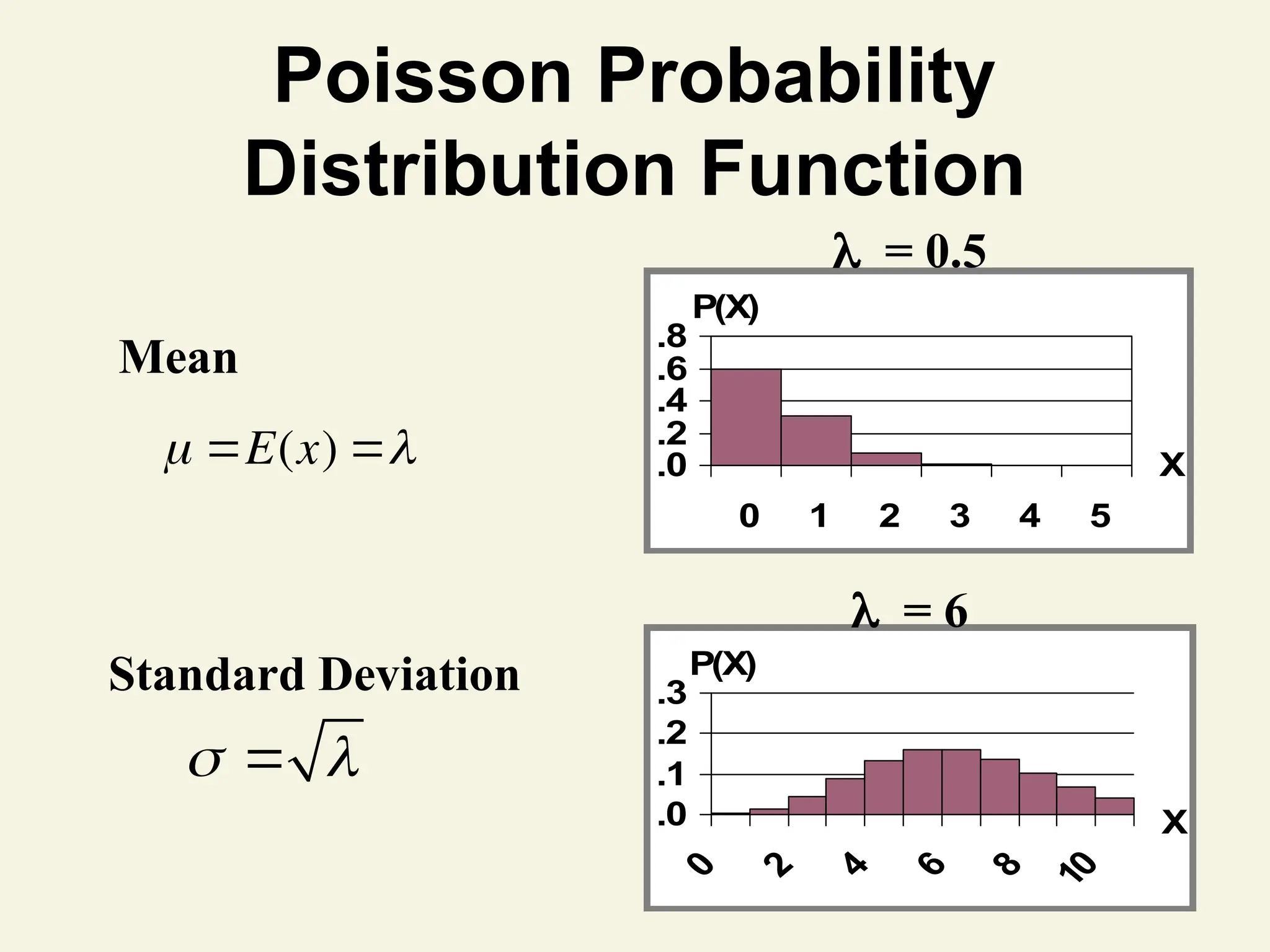
.0
.2
.4
.6
.8
0 1 2 3 4 5
X
P(X)
.0
.1
.2
.3
X
P(X)
= 0.5
= 6
Mean
Standard Deviation
 

 E(x) 
Poisson Distribution Example
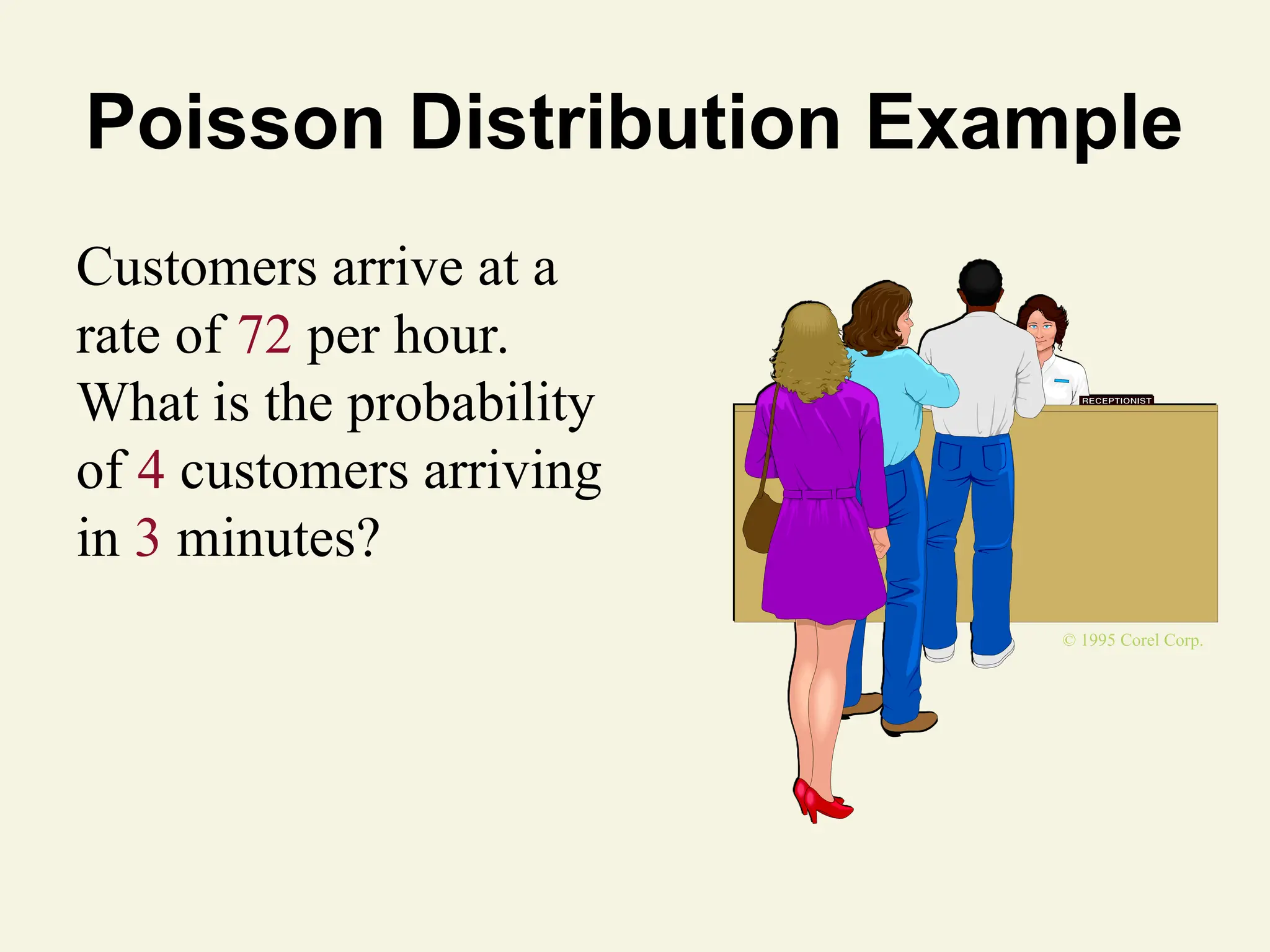
Customers arrive at a
rate of 72 per hour.
What is the probability
of 4 customers arriving
in 3 minutes?
© 1995 Corel Corp.
Poisson Distribution Solution
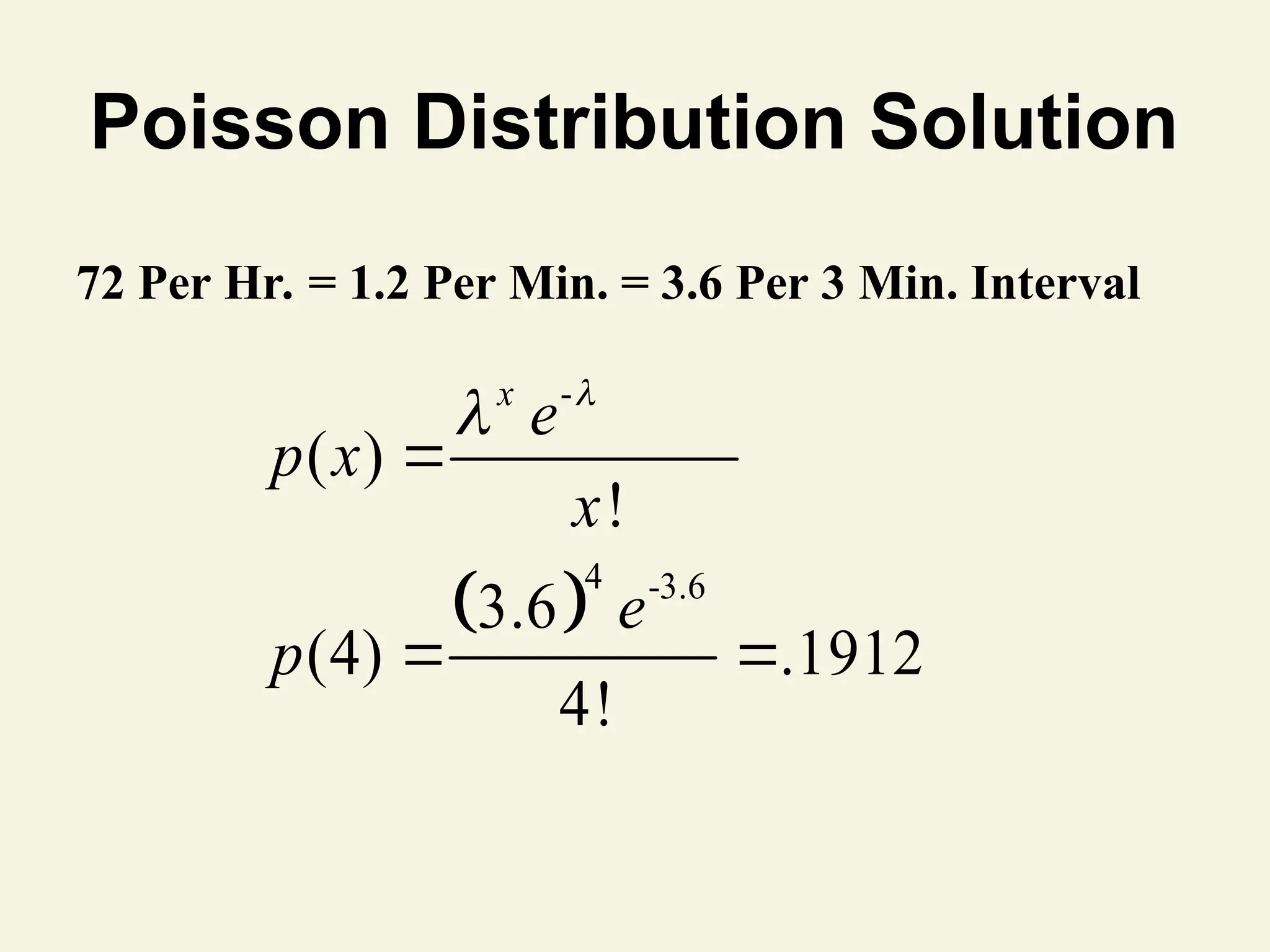
72 Per Hr. = 1.2 Per Min. = 3.6 Per 3 Min. Interval
 
-
4 -3.6
( )
!
3.6
(4) .1912
4!
x
e
p x
x
e
p



 
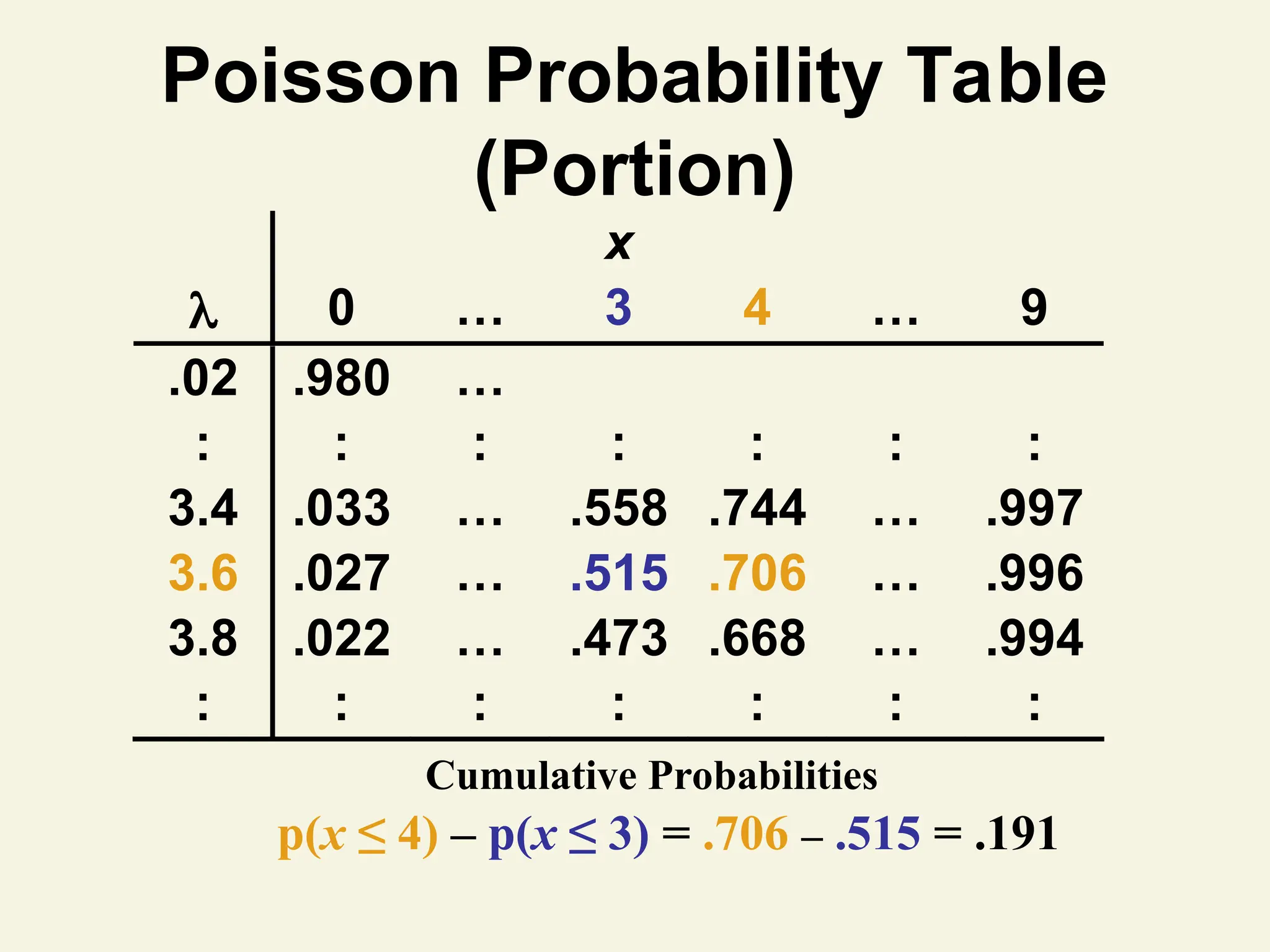
Poisson Probability Table
(Portion)
x
 0 … 3 4 … 9
.02 .980 …
: : : : : : :
3.4 .033 … .558 .744 … .997
3.6 .027 … .515 .706 … .996
3.8 .022 … .473 .668 … .994
: : : : : : :
Cumulative Probabilities
p(x ≤ 4) – p(x ≤ 3) = .706 – .515 = .191
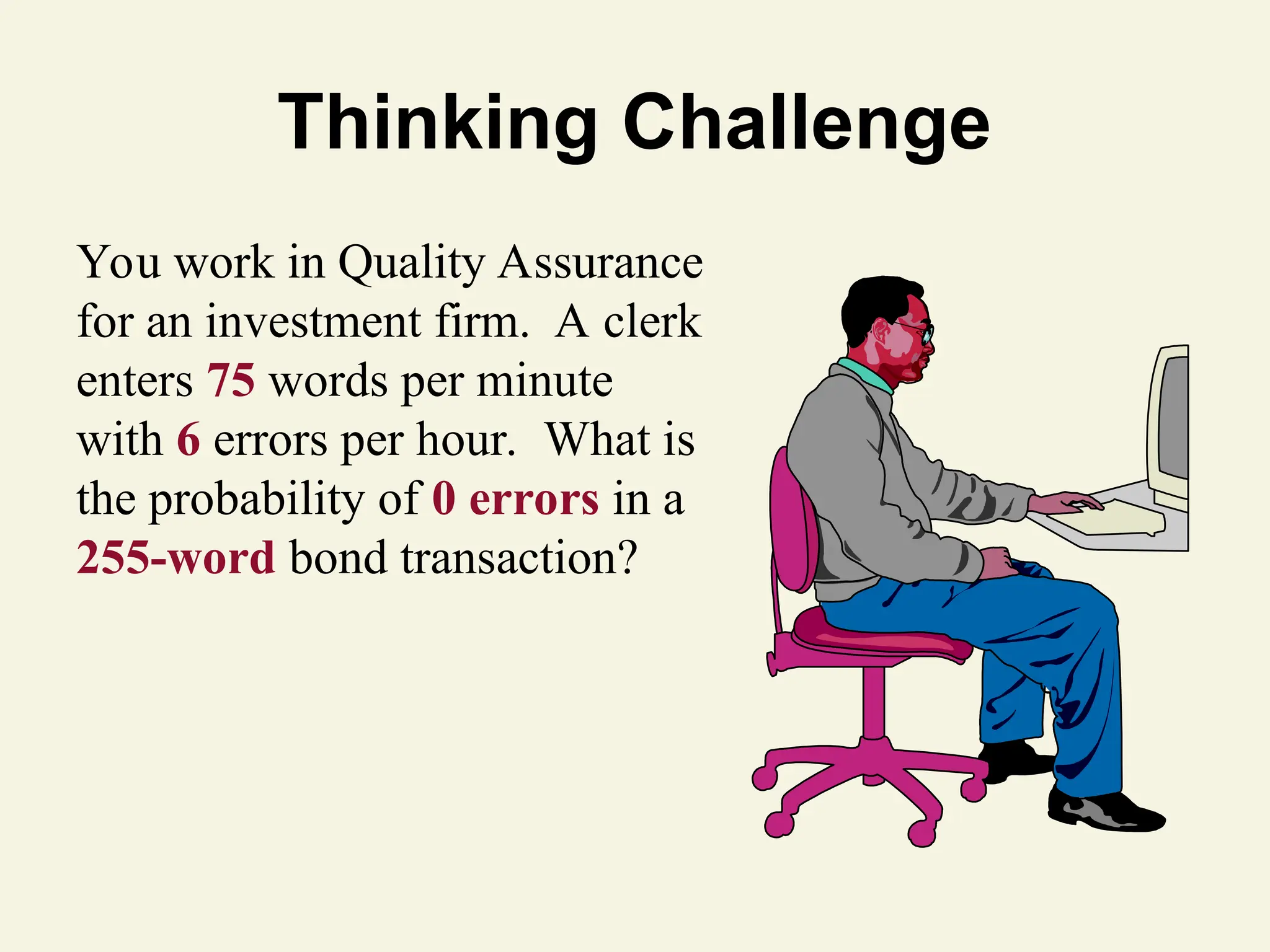
Thinking Challenge
You work in Quality Assurance
for an investment firm. A clerk
enters 75 words per minute
with 6 errors per hour. What is
the probability of 0 errors in a
255-word bond transaction?
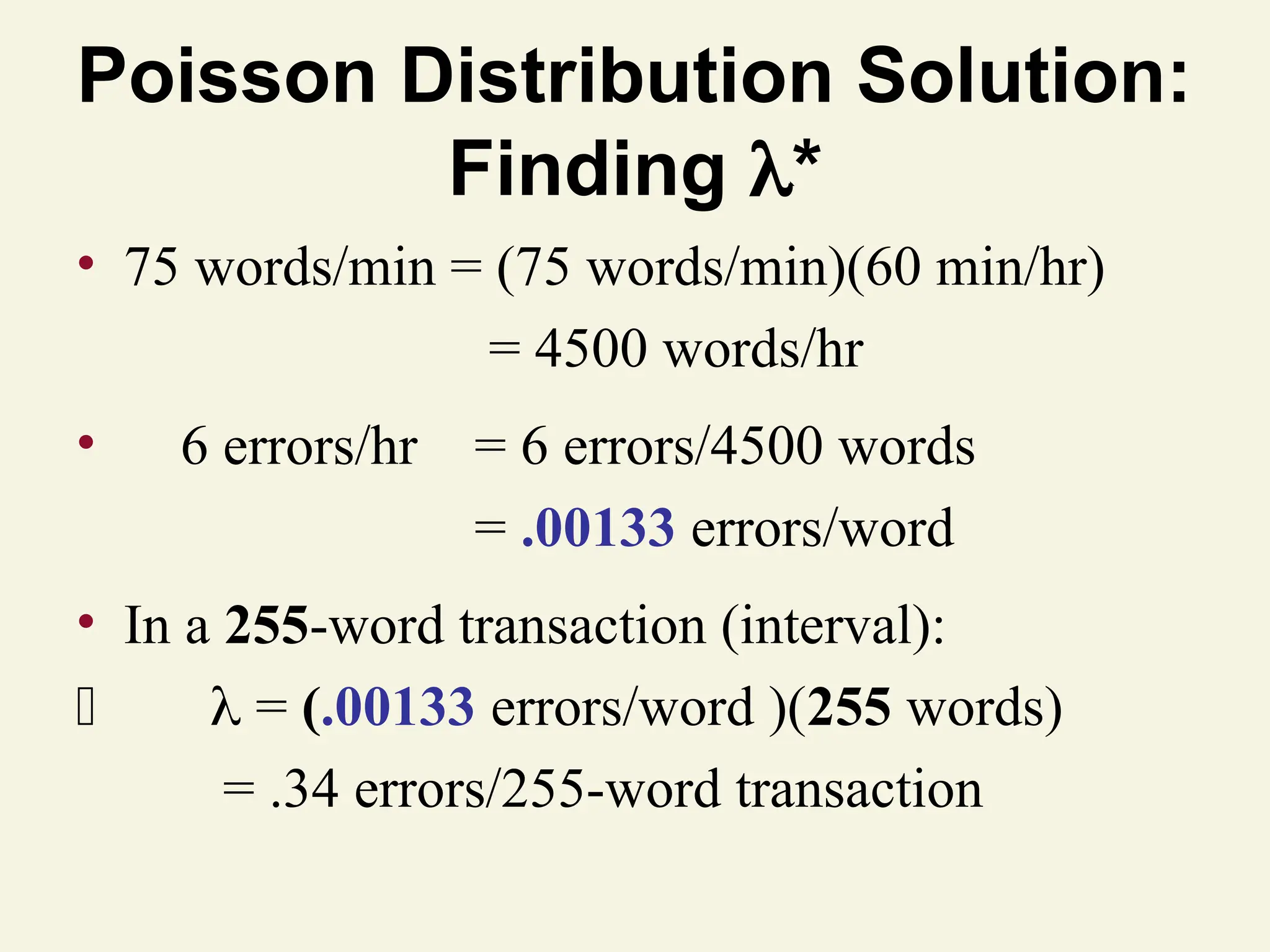
Poisson Distribution Solution:
Finding *
• 75 words/min = (75 words/min)(60 min/hr)
= 4500 words/hr
• 6 errors/hr = 6 errors/4500 words
= .00133 errors/word
• In a 255-word transaction (interval):
 = (.00133 errors/word )(255 words)
= .34 errors/255-word transaction
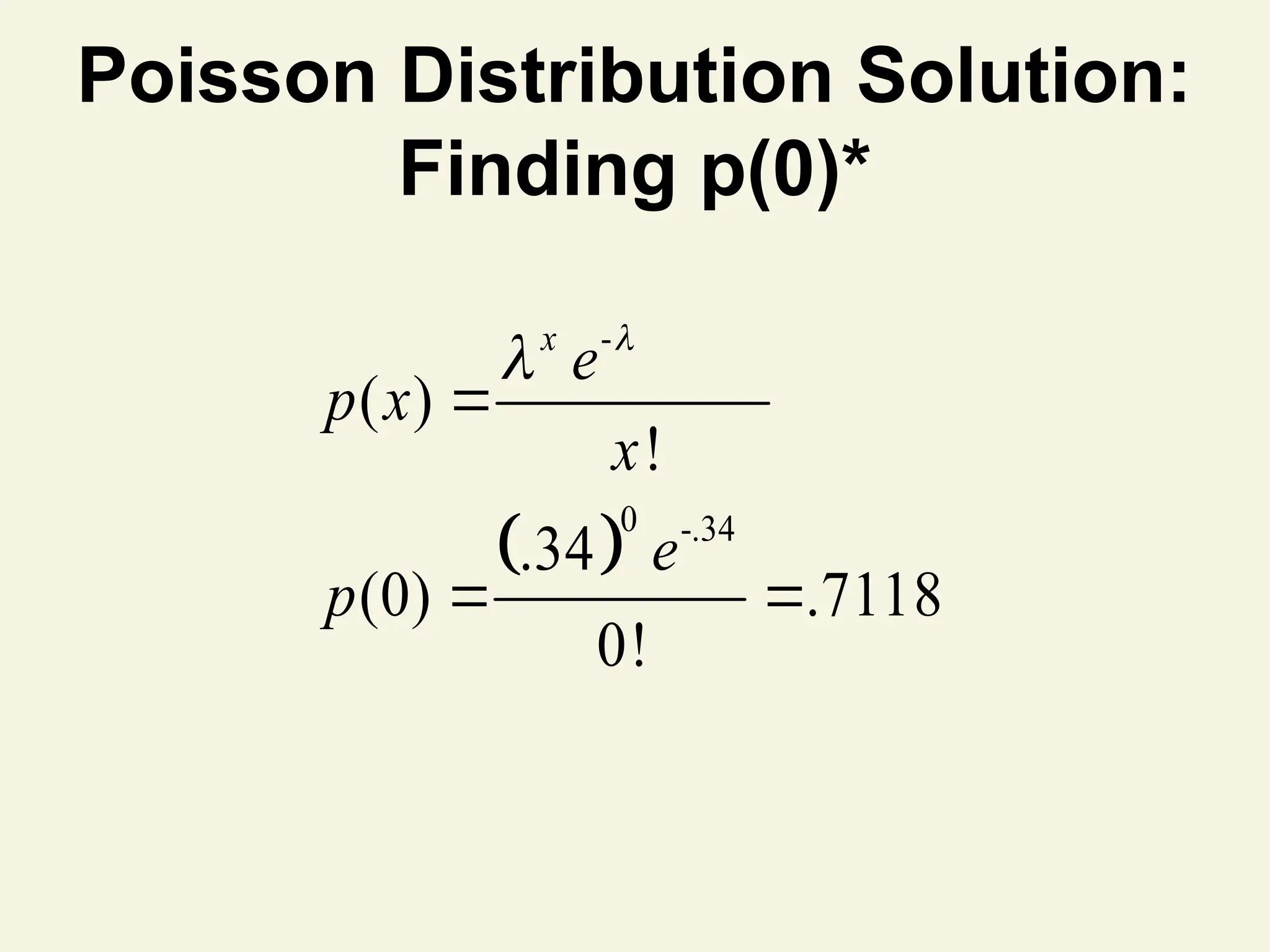
Poisson Distribution Solution:
Finding p(0)*
 
-
0 -.34
( )
!
.34
(0) .7118
0!
x
e
p x
x
e
p



 
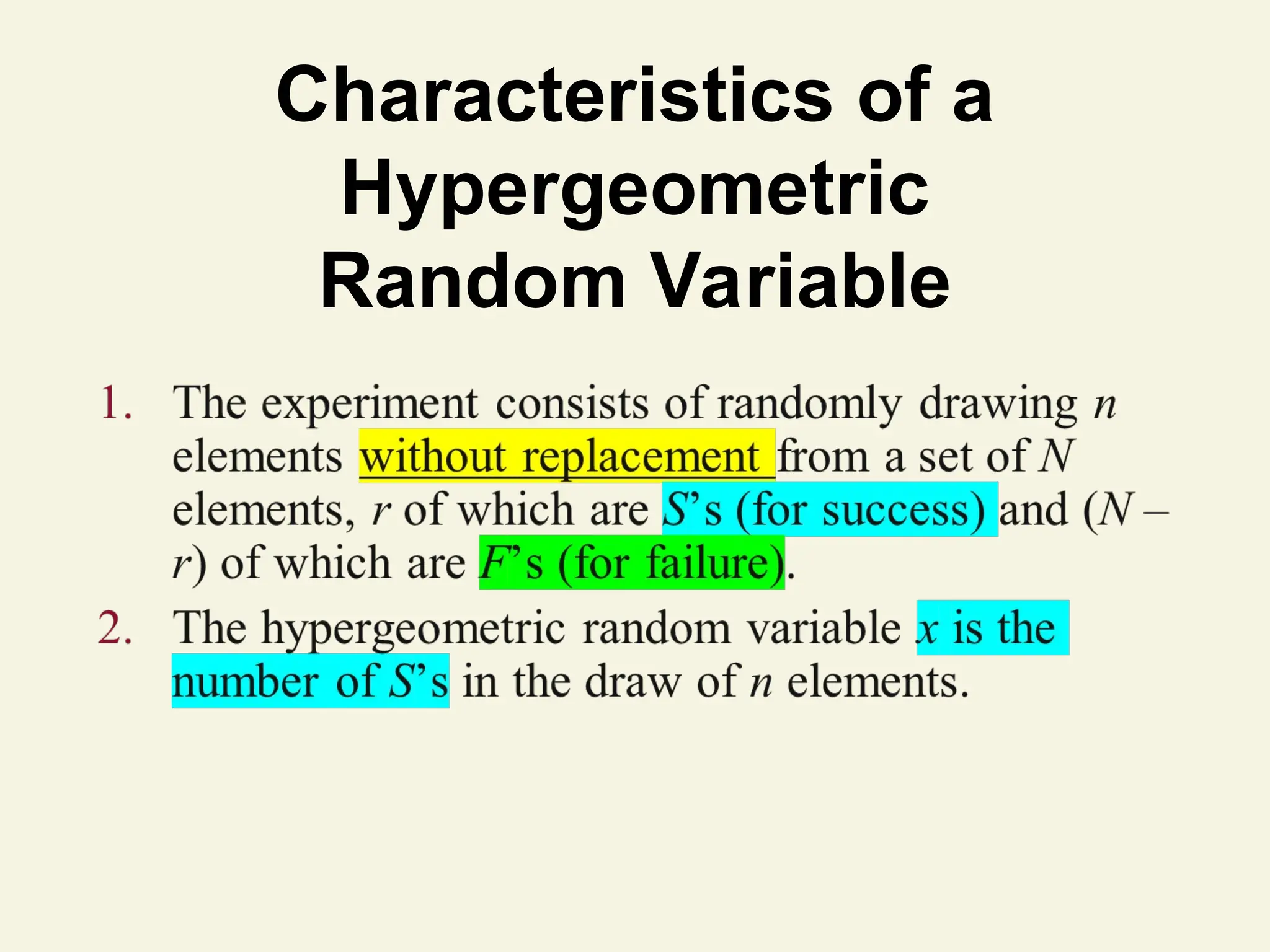
Characteristics of a
Hypergeometric
Random Variable
Hypergeometric Probability
Distribution Function
where . . .
[x = Maximum [0, n – (N – r), …,
Minimum (r, n)]
p x
 
r
x






N  r
n  x






N
n






µ 
nr
N
2

r N  r
 n N  n
 
N2
N  1
 
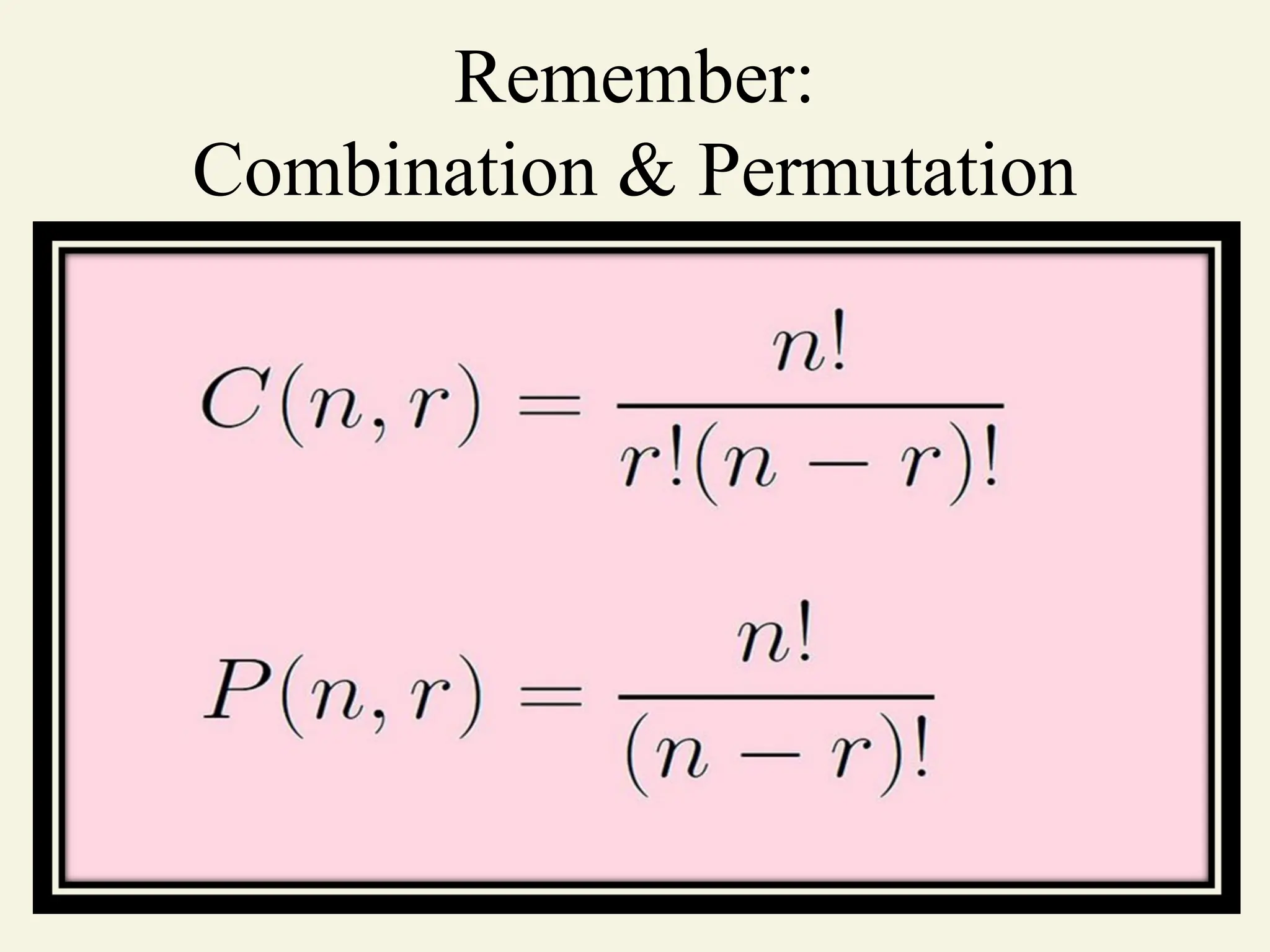
Remember:
Combination & Permutation
Hypergeometric Probability
Distribution Function
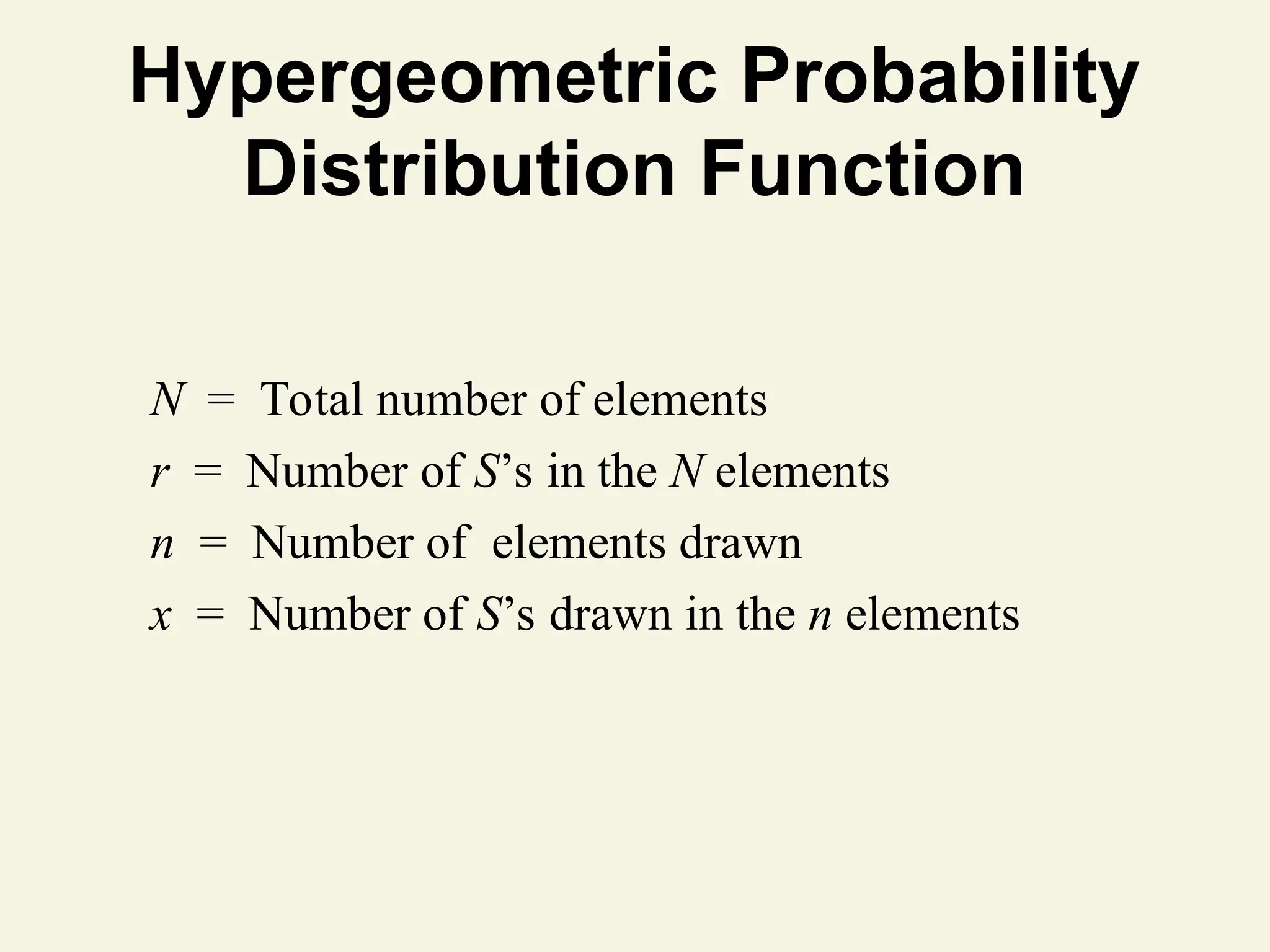
N = Total number of elements
r = Number of S’s in the N elements
n = Number of elements drawn
x = Number of S’s drawn in the n elements
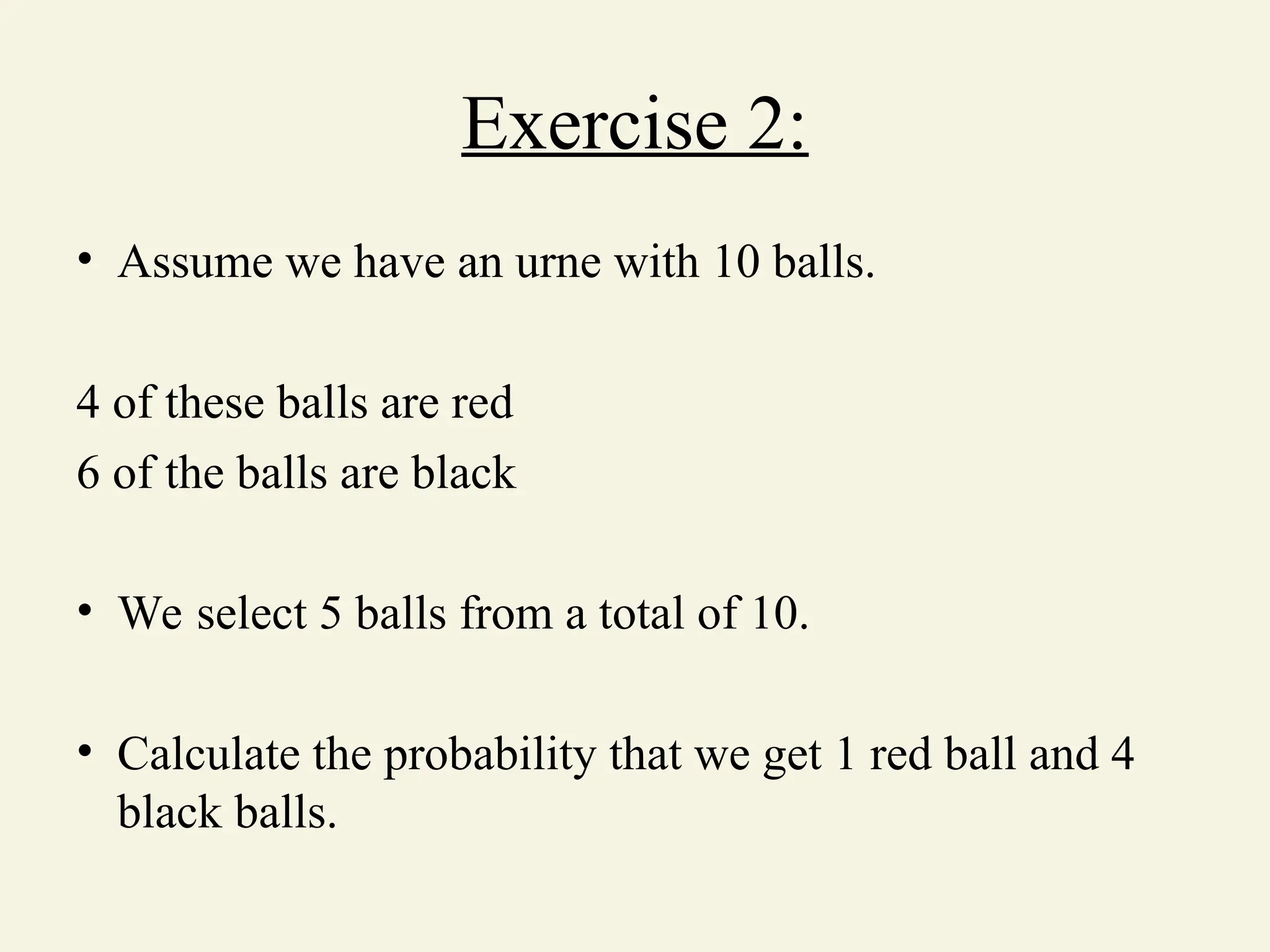
Exercise 2:
• Assume we have an urne with 10 balls.
4 of these balls are red
6 of the balls are black
• We select 5 balls from a total of 10.
• Calculate the probability that we get 1 red ball and 4
black balls.
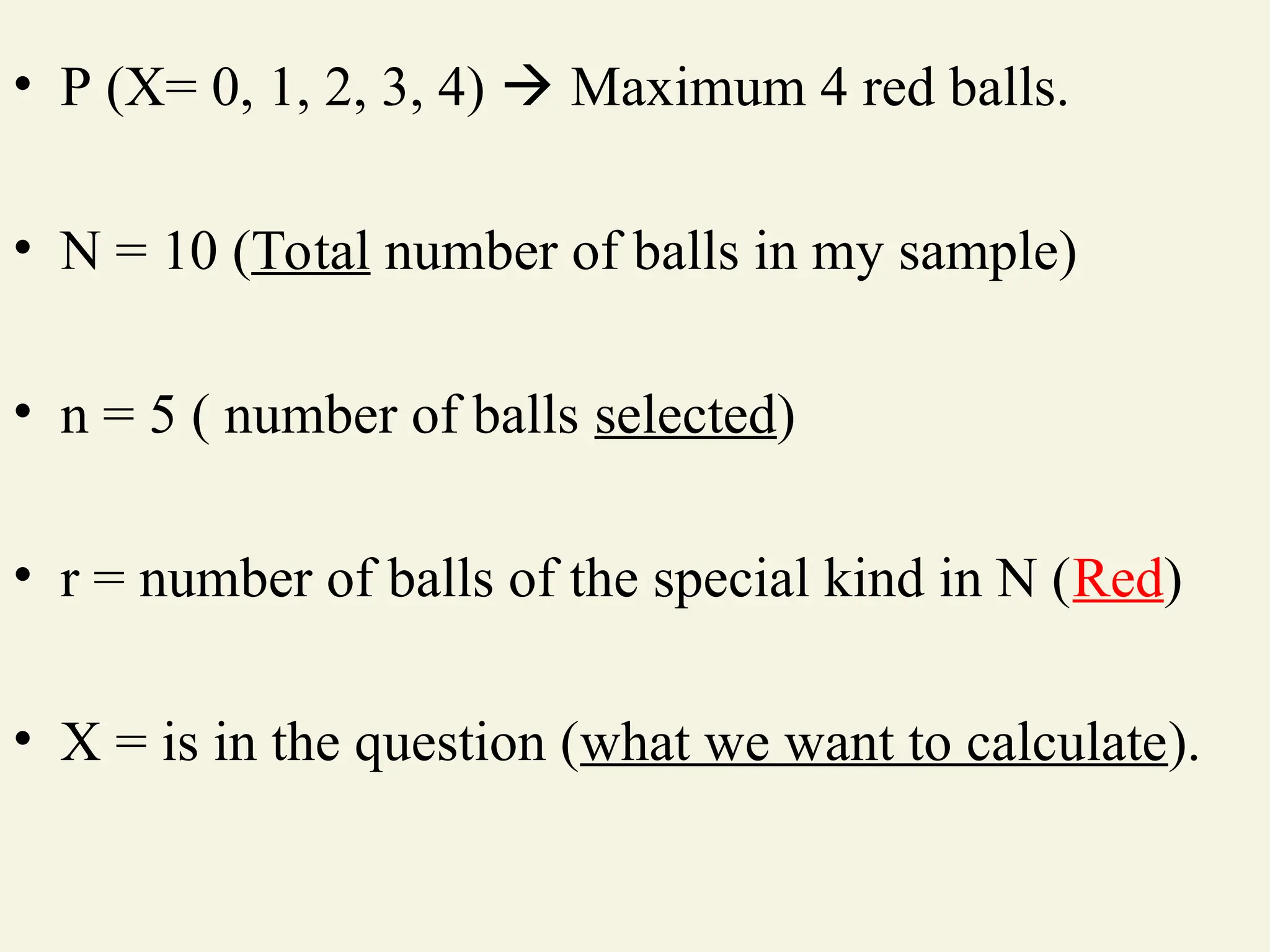
• P (X= 0, 1, 2, 3, 4)  Maximum 4 red balls.
• N = 10 (Total number of balls in my sample)
• n = 5 ( number of balls selected)
• r = number of balls of the special kind in N (Red)
• X = is in the question (what we want to calculate).
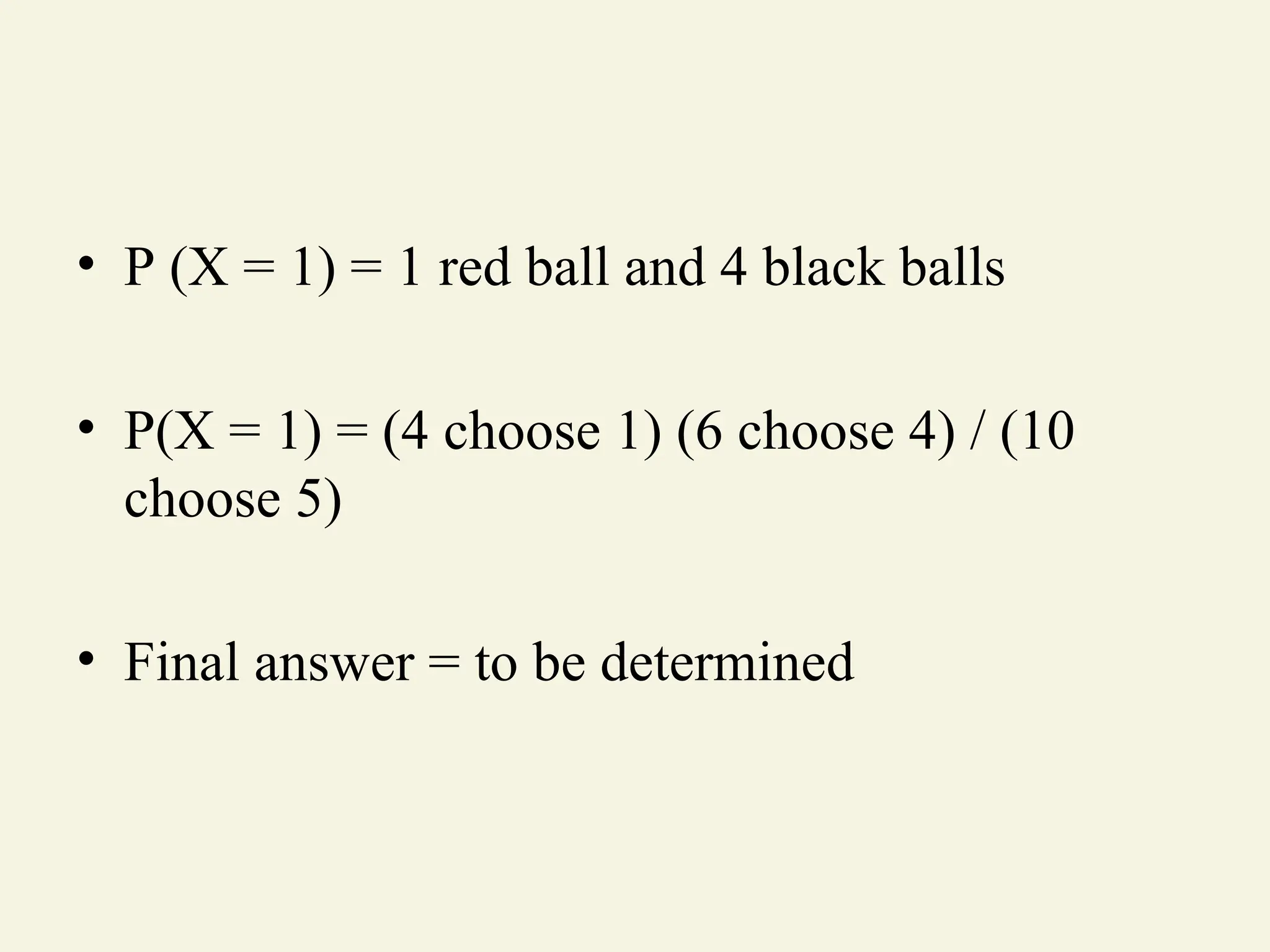
• P (X = 1) = 1 red ball and 4 black balls
• P(X = 1) = (4 choose 1) (6 choose 4) / (10
choose 5)
• Final answer = to be determined
4.5
Probability Distributions for
Continuous Random Variables
Continuous Probability
Density Function
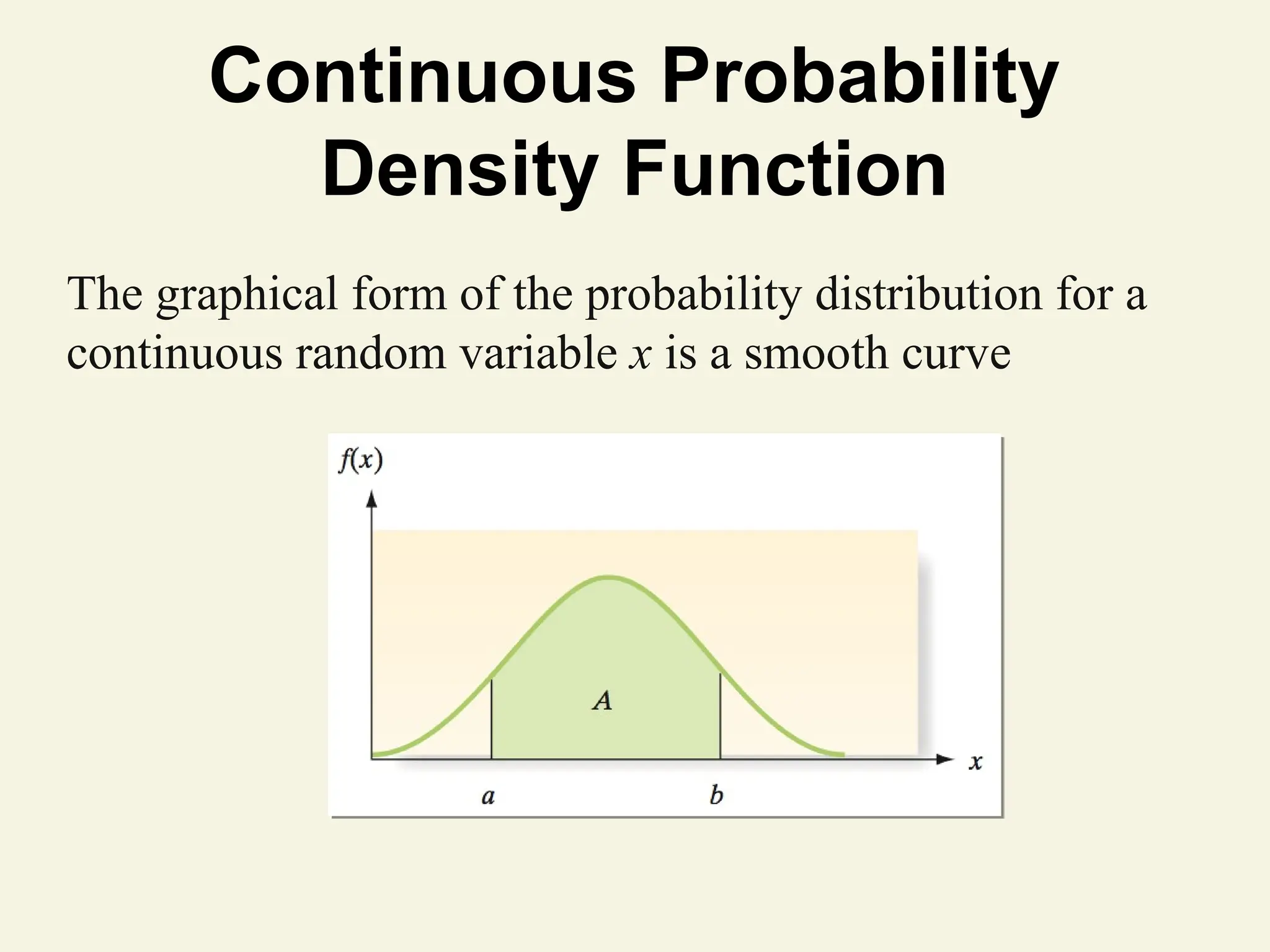
The graphical form of the probability distribution for a
continuous random variable x is a smooth curve
Continuous Probability
Density Function
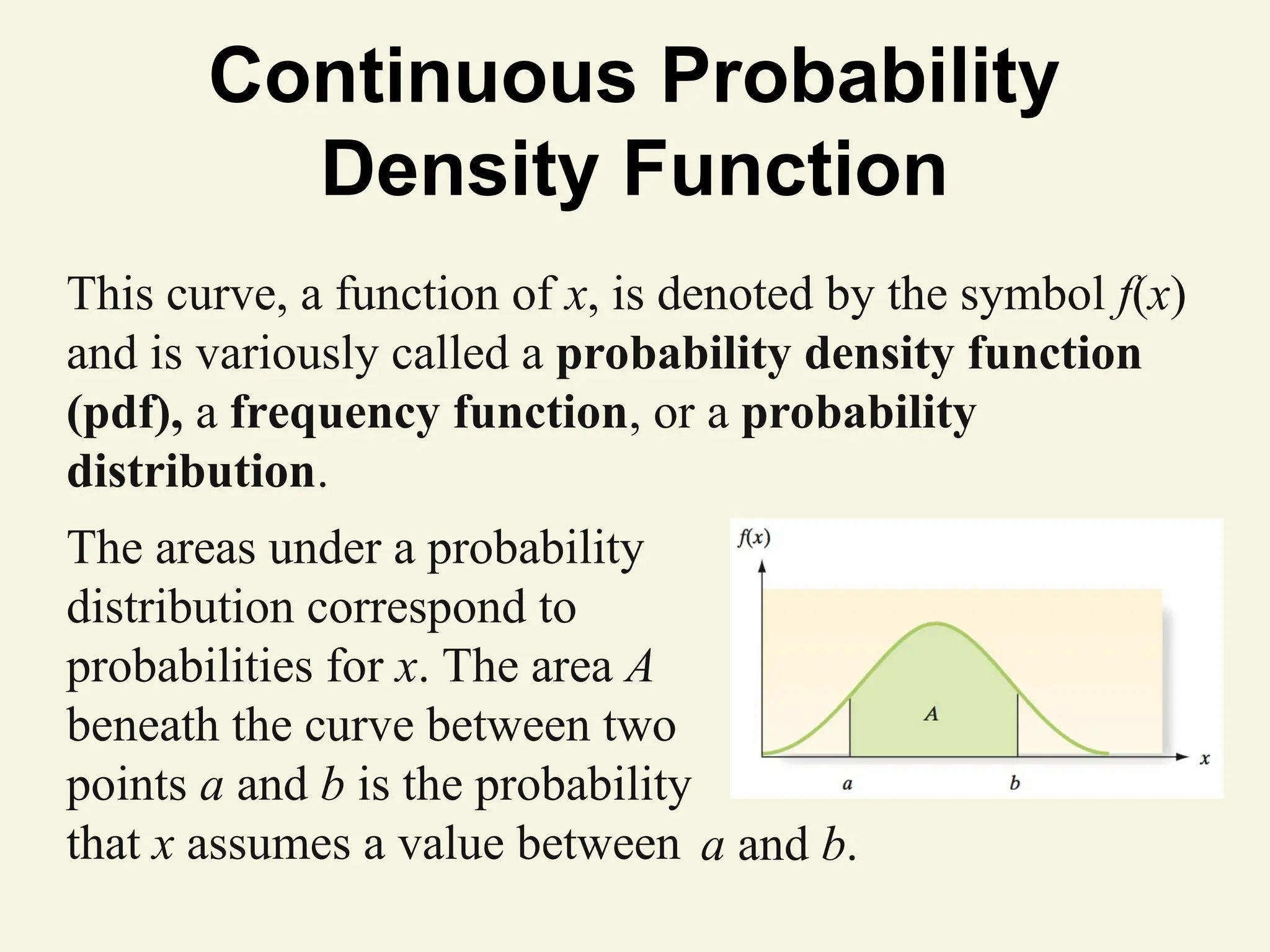
This curve, a function of x, is denoted by the symbol f(x)
and is variously called a probability density function
(pdf), a frequency function, or a probability
distribution.
The areas under a probability
distribution correspond to
probabilities for x. The area A
beneath the curve between two
points a and b is the probability
that x assumes a value between a and b.

Discrete Random Variables&Prob dist (4.0).pptx

  • 1.
    Statistics for Businessand Economics Random Variables & Probability Distributions
  • 2.
    Content 1. Two Typesof Random Variables 2. Probability Distributions for Discrete Random Variables 3. The Binomial Distribution 4. Poisson and Hypergeometric Distributions 5. Probability Distributions for Continuous Random Variables 6. The Normal Distribution
  • 3.
    Content (continued) 7. DescriptiveMethods for Assessing Normality 8. Approximating a Binomial Distribution with a Normal Distribution 9. Uniform and Exponential Distributions 10. Sampling Distributions 11. The Sampling Distribution of a Sample Mean and the Central Limit Theorem
  • 4.
    Learning Objectives 1. Developthe notion of a random variable 2. Learn that numerical data are observed values of either discrete or continuous random variables 3. Study two important types of random variables and their probability models: the binomial and normal model 4. Define a sampling distribution as the probability of a sample statistic 5. Learn that the sampling distribution of follows a normal model x
  • 5.
    Thinking Challenge • You’retaking a 33 question multiple choice test. Each question has 4 choices. Clueless on 1 question, you decide to guess. What’s the chance you’ll get it right? • If you guessed on all 33 questions, what would be your grade? Would you pass?
  • 6.
    4.1 Two Types ofRandom Variables
  • 7.
    Random Variable A randomvariable is a variable that assumes numerical values associated with the random outcomes of an experiment, where one (and only one) numerical value is assigned to each sample point.
  • 8.
    Discrete Random Variable Random variablesthat can assume a countable number (finite or infinite) of values are called discrete.
  • 9.
    Discrete Random Variable Examples ExperimentRandom Variable Possible Values Count Cars at Toll Between 11:00 & 1:00 # Cars Arriving 0, 1, 2, ..., ∞ Make 100 Sales Calls # Sales 0, 1, 2, ..., 100 Inspect 70 Computers # Defective 0, 1, 2, ..., 70 Answer 33 Questions # Correct 0, 1, 2, ..., 33
  • 10.
    Continuous Random Variable Random variablesthat can assume values corresponding to any of the points contained in one or more intervals (i.e., values that are infinite and uncountable) are called continuous.
  • 11.
    Continuous Random Variable Examples MeasureTime Between Arrivals Inter-Arrival Time 0, 1.3, 2.78, ... Experiment Random Variable Possible Values Weigh 100 People Weight 45.1, 78, ... Measure Part Life Hours 900, 875.9, ... Amount spent on food $ amount 54.12, 42, ...
  • 12.
  • 13.
    Discrete Probability Distribution The probabilitydistribution of a discrete random variable is a graph, table, or formula that specifies the probability associated with each possible value the random variable can assume.
  • 14.
    Requirements for the ProbabilityDistribution of a Discrete Random Variable x 1. p(x) ≥ 0 for all values of x 2.  p(x) = 1 where the summation of p(x) is over all possible values of x.
  • 15.
    Discrete Probability Distribution Example ProbabilityDistribution Values, x Probabilities, p(x) 0 1/4 = .25 1 2/4 = .50 2 1/4 = .25 Experiment: Toss 2 coins. Count number of tails.
  • 16.
    Visualizing Discrete Probability Distributions ListingTable Formula # Tails f(x) Count p(x) 0 1 .25 1 2 .50 2 1 .25 p x n x!(n – x)! ( ) ! = px (1 – p)n – x Graph .00 .25 .50 0 1 2 x p(x) { (0, .25), (1, .50), (2, .25) }
  • 17.
    Summary Measures 1. ExpectedValue (Mean of probability distribution) • Weighted average of all possible values •  = E(x) = xp(x) 2. Variance • Weighted average of squared deviation about mean • 2 = E[(x  (x  p(x) 3. Standard Deviation 2    ●
  • 18.
    Summary Measures Calculation Table xp(x) x p(x) x –  Total (x  p(x) (x –  (x –  p(x) xp(x)
  • 19.
    Thinking Challenge You toss2 coins. You’re interested in the number of tails. What are the expected value, variance, and standard deviation of this random variable(is it Discrete or Continuous?), number of tails? © 1984-1994 T/Maker Co.
  • 20.
    Expected Value &Variance Solution* 0 .25 –1.00 1.00 1 .50 0 0 2 .25 1.00 1.00 0 .50 .50  = 1.0 x p(x) x p(x) x –  (x –  (x –  p(x) .25 0 .25   
  • 21.
    Probability Rules forDiscrete Random Variables Let x be a discrete random variable with probability distribution p(x), mean µ, and standard deviation . Then, depending on the shape of p(x), the following probability statements can be made: Chebyshev’s Rule Empirical Rule P x    x  µ    0 .68 P x  2  x  µ  2   3 4 .95 P x  3  x  µ  3   8 9 1.00
  • 23.
  • 24.
    Binomial Distribution Number of‘successes’ in a sample of n observations (trials) • Number of reds in 15 spins of roulette wheel • Number of defective items in a batch of 5 items • Number correct on a 33 question exam • Number of customers who purchase out of 100 customers who enter store (each customer is equally likely to purchase)
  • 25.
  • 26.
    Binomial Probability Distribution ! ( )(1 ) ! ( )! x n x x n x n n p x p q p p x x n x            
  • 27.
    Find the Combination(5,3) • 5C3 = ?
  • 28.
    nCx • Combination 5C3= 5!/[3!(5-3)!]=10
  • 29.
    Binomial Probability Distribution Example 35 3 ! ( ) (1 ) !( )! 5! (3) .5 (1 .5) 3!(5 3)! .3125 x n x n p x p p x n x p          Experiment: Toss 1 coin 5 times in a row. Note number of tails. What’s the probability of 3 tails?
  • 30.
    Binomial Probability Table (Portion) n= 5 p k .01 … 0.50 … .99 0 .951 … .031 … .000 1 .999 … .188 … .000 2 1.000 … .500 … .000 3 1.000 … .812 … .001 4 1.000 … .969 … .049 Cumulative Probabilities p(x ≤ 3) – p(x ≤ 2) = .812 – .500 = .312
  • 31.
    Binomial Distribution Characteristics(Analyze Graphs) .0 .5 1.0 01 2 3 4 5 X P(X) .0 .2 .4 .6 0 1 2 3 4 5 X P(X) n = 5 p = 0.1 n = 5 p = 0.5   E ( x )  np Mean Standard Deviation   npq
  • 32.
    Binomial Distribution Thinking Challenge You’rea telemarketer selling service contracts for Macy’s. You’ve sold 20 in your last 100 calls (p = .20). If you call 12 people tonight, what’s the probability of A. No sales? B. Exactly 2 sales? C. At most 2 sales? D. At least 2 sales?
  • 33.
    Binomial Distribution Solution* n= 12, p = .20 A. p(0) = .0687 B. p(2) = .2835 C. p(at most 2) = p(0) + p(1) + p(2) = .0687 + .2062 + .2835 = .5584 D. p(at least 2) = p(2) + p(3)...+ p(12) = 1 – [p(0) + p(1)] = 1 – .0687 – .2062 = .7251
  • 34.
  • 35.
    Properties of Variances: Ifa random variable X is adjusted by multiplying by the value b and adding the value a, then the variance is affected as follows: Since the spread of the distribution is not affected by adding or subtracting a constant, the value a is not considered. And, since the variance is a sum of squared terms any multiplier value b must also be squared when adjusting the variance.
  • 36.
    For independent randomvariables X and Y, the variance of their sum or difference is the sum of their variances: Variances are added for both the sum and difference of two independent random variables because the variation in each variable contributes to the variation in each case.
  • 37.
  • 38.
    Poisson Distribution 1. Numberof events that occur in an interval • events per unit — Time, Length, Area, Space 2. Examples • Number of customers arriving in 20 minutes • Number of strikes per year in the U.S. • Number of defects per lot (group) of DVD’s
  • 39.
    Characteristics of aPoisson Random Variable 1. Consists of counting number of times an event occurs during a given unit of time or in a given area or volume (any unit of measurement). 2. The probability that an event occurs in a given unit of time, area, or volume is the same for all units. 3. The number of events that occur in one unit of time, area, or volume is independent of the number that occur in any other mutually exclusive unit. 4. The mean number of events in each unit is denoted by 
  • 40.
    Poisson Probability Distribution Function    p(x)= Probability of x given   = Mean (expected) number of events in unit e = 2.71828 . . . (base of natural logarithm) x = Number of events per unit p x x ( ) !  x   e– (x = 0, 1, 2, 3, . . .)
  • 41.
    Poisson Probability Distribution Function .0 .2 .4 .6 .8 01 2 3 4 5 X P(X) .0 .1 .2 .3 X P(X) = 0.5 = 6 Mean Standard Deviation     E(x) 
  • 42.
    Poisson Distribution Example Customersarrive at a rate of 72 per hour. What is the probability of 4 customers arriving in 3 minutes? © 1995 Corel Corp.
  • 43.
    Poisson Distribution Solution 72Per Hr. = 1.2 Per Min. = 3.6 Per 3 Min. Interval   - 4 -3.6 ( ) ! 3.6 (4) .1912 4! x e p x x e p     
  • 44.
    Poisson Probability Table (Portion) x 0 … 3 4 … 9 .02 .980 … : : : : : : : 3.4 .033 … .558 .744 … .997 3.6 .027 … .515 .706 … .996 3.8 .022 … .473 .668 … .994 : : : : : : : Cumulative Probabilities p(x ≤ 4) – p(x ≤ 3) = .706 – .515 = .191
  • 45.
    Thinking Challenge You workin Quality Assurance for an investment firm. A clerk enters 75 words per minute with 6 errors per hour. What is the probability of 0 errors in a 255-word bond transaction?
  • 46.
    Poisson Distribution Solution: Finding* • 75 words/min = (75 words/min)(60 min/hr) = 4500 words/hr • 6 errors/hr = 6 errors/4500 words = .00133 errors/word • In a 255-word transaction (interval):  = (.00133 errors/word )(255 words) = .34 errors/255-word transaction
  • 47.
    Poisson Distribution Solution: Findingp(0)*   - 0 -.34 ( ) ! .34 (0) .7118 0! x e p x x e p     
  • 48.
  • 49.
    Hypergeometric Probability Distribution Function where. . . [x = Maximum [0, n – (N – r), …, Minimum (r, n)] p x   r x       N  r n  x       N n       µ  nr N 2  r N  r  n N  n   N2 N  1  
  • 50.
  • 51.
    Hypergeometric Probability Distribution Function N= Total number of elements r = Number of S’s in the N elements n = Number of elements drawn x = Number of S’s drawn in the n elements
  • 56.
    Exercise 2: • Assumewe have an urne with 10 balls. 4 of these balls are red 6 of the balls are black • We select 5 balls from a total of 10. • Calculate the probability that we get 1 red ball and 4 black balls.
  • 57.
    • P (X=0, 1, 2, 3, 4)  Maximum 4 red balls. • N = 10 (Total number of balls in my sample) • n = 5 ( number of balls selected) • r = number of balls of the special kind in N (Red) • X = is in the question (what we want to calculate).
  • 58.
    • P (X= 1) = 1 red ball and 4 black balls • P(X = 1) = (4 choose 1) (6 choose 4) / (10 choose 5) • Final answer = to be determined
  • 59.
  • 60.
    Continuous Probability Density Function Thegraphical form of the probability distribution for a continuous random variable x is a smooth curve
  • 61.
    Continuous Probability Density Function Thiscurve, a function of x, is denoted by the symbol f(x) and is variously called a probability density function (pdf), a frequency function, or a probability distribution. The areas under a probability distribution correspond to probabilities for x. The area A beneath the curve between two points a and b is the probability that x assumes a value between a and b.

Editor's Notes

  • #2 As a result of this class, you will be able to...
  • #3 As a result of this class, you will be able to...
  • #4 As a result of this class, you will be able to...
  • #5 The ‘pass’ question is meant to be a ‘teaser’ and not answered.
  • #6 :1, 1, 3
  • #12 :1, 1, 3
  • #16 Experiment is tossing 1 coin twice.
  • #17 population notation is used since all values are specified.
  • #21 population notation is used since all values are specified.
  • #23 :1, 1, 3
  • #31 Distribution has different shapes. 1st Graph: If inspecting 5 items & the Probability of a defect is 0.1 (10%), the Probability of finding 0 defective item is about 0.6 (60%). If inspecting 5 items & the Probability of a defect is 0.1 (10%), the Probability of finding 1 defective items is about .35 (35%). 2nd Graph: If inspecting 5 items & the Probability of a defect is 0.5 (50%), the Probability of finding 1 defective items is about .18 (18%). Note: Could use formula or tables at end of text to get Probabilities.
  • #32 Let’s conclude this section on the binomial with the following Thinking Challenge.
  • #33 From the Binomial Tables: A. p(0) = .0687 B. p(2) = .2835 C. p(at most 2) = p(0) + p(1) + p(2) = .0687+ .2062 + .2835 = .5584 D. p(at least 2) = p(2) + p(3)...+ p(12) = 1 - [p(0) + p(1)] = 1 - .0687 - .2062 = .7251
  • #37 :1, 1, 3
  • #38 Other Examples: Number of machines that break down in a day Number of units sold in a week Number of people arriving at a bank teller per hour Number of telephone calls to customer support per hour
  • #59 :1, 1, 3