

Integrating Values and Ethics into
    Post Secondary Teaching

      38th Annual PRTESOL Convention
         Friday November 18, 2011
            San Juan, Puerto Rico


                  Paul T. Begley
UCEA Center for the Study of Leadership and Ethics
               Nipissing University
                 Ontario, Canada
Presentation Plan
   Purposes:
    - The Nature of the Problem We Confront

   Processes:
    - Terms and Concepts
    - Some Special Issues and Problems
    - Being an Ethical Person / Ethical Professional

   Context:
    - Values and Ethics in Teaching
    - Strategies and Resources
Part 1: The Nature of the Problem

   Dr. Alejandro’s view

   Important Social Trends

   Dipali’s Lament
Our Purposes ?
   Provide students with the knowledge and
    processes needed to navigate life.

   Do this by:
    – Provide a vocabulary for articulating values
    – Sustained dialogue about purposes


   Outcomes:
    – Increased self-awareness
    – Sensitivity to perceptions of others
    – Capacity for self-actualization (moral compass)
A Moral Compass
Part 2: Processes, Terms
           & Key Concepts
   Values are:
    – A conception of the desirable with
      motivating force,


    - characteristic of individuals & groups,

    - that influence the choice of ways and
    means leading to actions

Hodgkinson (1978)
Part 2:
Processes and Concepts


   Where Values Come From

   The Nature of Value Conflicts
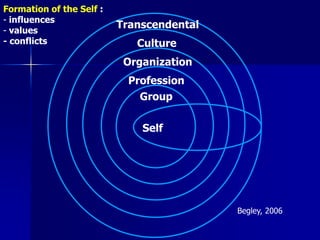
Formation of the Self :
- influences
- values
                          Transcendental
- conflicts                  Culture
                           Organization
                            Profession
                              Group

                              Self


                                           Begley, 2006
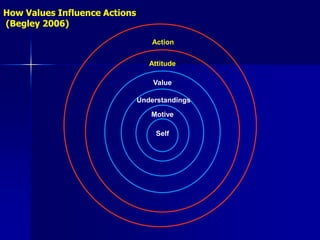
How Values Influence Actions
(Begley 2006)

                                   Action


                                  Attitude

                                   Value

                               Understandings

                                  Motive

                                    Self
How it works in the real world

   How we make professional decisions
    using values and ethics

   The four motivational bases

   Special nature of ethics
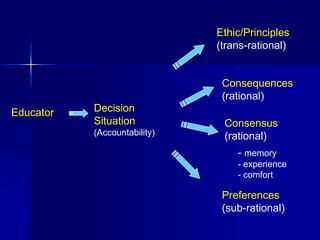
Ethic/Principles
                              (trans-rational)


                               Consequences
                               (rational)
Educator   Decision
           Situation           Consensus
           (Accountability)    (rational)
                                  - memory
                                  - experience
                                  - comfort

                               Preferences
                               (sub-rational)
Some Problems

   “Hardening of the Attitudes”, the
    negative effects of time & experience.

   The culture-based nature of ethics

   Distinguishing between personal,
    professional & social values
More Problems
   Articulation versus commitment

   Using ethics versus being ethical

   Does environment trump character?

 Externally derived values versus
self-actualization
Summary: Being Ethical
Strive for Authenticity & Moral Literacy:

A synergy resulting from:
  – Self-knowledge


  – Sensitivity to the perspectives of others

  – Professional knowledge and skills
Part 3: Context of Teaching
   Expert Advice; Piaget, Kohlberg, Nucci

   The Purposes of Education

   Three ways ethics relate to teaching

   Strategies and resources
Expert Advice

   Piaget (1965) says:

    Individuals reconstruct their
    knowledge of the world as a result of
    interactions with the environment.
Expert Advice - Kohlberg

   Six Stages of Moral Reasoning
    – Moving from egocentrism to reasoning
      grounded in principles

    – Similar to motivational bases

    – Consider developmental stage with
      curriculum design
Expert Advice - Nucci

   Three Principles:
    – Focus on issues of justice, fairness &
      human welfare

    – Integrated within curriculum, not add-on

    – Incorporate dialogue
Purposes of Education
   Aesthetic Purposes – be all that you
    can be

   Economic Purposes – learn to earn

   Ideological Purposes – socialization,
    citizenship and transmission of social
    values
Ethics and Teaching
   Three ways ethics relate to teaching:

    – Influence on cognitive processes of
      individuals and groups

    – Guidelines for actions & resolving
      dilemmas

    – As a strategic tool to build consensus
Strategies and Resources

   Where this information comes from

   Three Strategies

   Four specific resources
Three Teaching Strategies

   Emphasize and articulate Intents,
    Purposes and Goals

   Use a Multi-Ethical Analysis Process

   Case Study Approach – 3 P’s Process
    (personal, peer, professor)
Resources

   Begley’s Value Audit Process

   VEEA Journal and JALE Journal

   CSLE Annotated Resource Lists
The Value Audit Procedure

An Integrated Problem Analysis Resource

    Combining:

     – Hodgkinson’s Value Paradigm


     – Leithwood’s Problem Solving Framework


     – Shapiro & Stefkovich Multi-ethical analysis
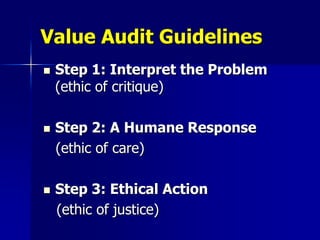
Value Audit Guidelines
   Step 1: Interpret the Problem
    (ethic of critique)

   Step 2: A Humane Response
    (ethic of care)

   Step 3: Ethical Action
    (ethic of justice)
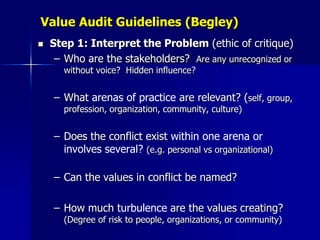
Value Audit Guidelines (Begley)
   Step 1: Interpret the Problem (ethic of critique)
     – Who are the stakeholders? Are any unrecognized or
      without voice? Hidden influence?


    – What arenas of practice are relevant? (self, group,
      profession, organization, community, culture)


    – Does the conflict exist within one arena or
      involves several? (e.g. personal vs organizational)

    – Can the values in conflict be named?

    – How much turbulence are the values creating?
      (Degree of risk to people, organizations, or community)
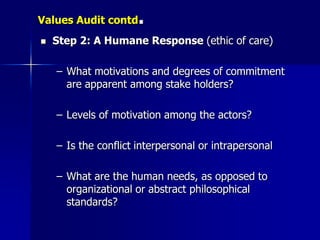
Values Audit contd    .
   Step 2: A Humane Response (ethic of care)

    – What motivations and degrees of commitment
      are apparent among stake holders?

    – Levels of motivation among the actors?

    – Is the conflict interpersonal or intrapersonal

    – What are the human needs, as opposed to
      organizational or abstract philosophical
      standards?
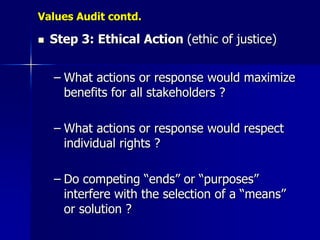
Values Audit contd.

   Step 3: Ethical Action (ethic of justice)


    – What actions or response would maximize
      benefits for all stakeholders ?

    – What actions or response would respect
      individual rights ?

    – Do competing “ends” or “purposes”
      interfere with the selection of a “means”
      or solution ?
Other Resources
   CSLE Centre website
    http://www.nipissingu.ca/csle/

   Values and Ethics in Educational
    Administration (VEEA)

   Journal of Authentic Leadership in Education
    (JALE)

   CSLE Annotated Resource Lists
Thank you !

Paul Begley ptbegley@gmail.com
Integrating Values and Ethics into

Integrating Values and Ethics into

  • 1.
    Integrating Values andEthics into Post Secondary Teaching 38th Annual PRTESOL Convention Friday November 18, 2011 San Juan, Puerto Rico Paul T. Begley UCEA Center for the Study of Leadership and Ethics Nipissing University Ontario, Canada
  • 2.
    Presentation Plan  Purposes: - The Nature of the Problem We Confront  Processes: - Terms and Concepts - Some Special Issues and Problems - Being an Ethical Person / Ethical Professional  Context: - Values and Ethics in Teaching - Strategies and Resources
  • 3.
    Part 1: TheNature of the Problem  Dr. Alejandro’s view  Important Social Trends  Dipali’s Lament
  • 4.
    Our Purposes ?  Provide students with the knowledge and processes needed to navigate life.  Do this by: – Provide a vocabulary for articulating values – Sustained dialogue about purposes  Outcomes: – Increased self-awareness – Sensitivity to perceptions of others – Capacity for self-actualization (moral compass)
  • 5.
  • 6.
    Part 2: Processes,Terms & Key Concepts  Values are: – A conception of the desirable with motivating force, - characteristic of individuals & groups, - that influence the choice of ways and means leading to actions Hodgkinson (1978)
  • 7.
    Part 2: Processes andConcepts  Where Values Come From  The Nature of Value Conflicts
  • 8.
    Formation of theSelf : - influences - values Transcendental - conflicts Culture Organization Profession Group Self Begley, 2006
  • 9.
    How Values InfluenceActions (Begley 2006) Action Attitude Value Understandings Motive Self
  • 10.
    How it worksin the real world  How we make professional decisions using values and ethics  The four motivational bases  Special nature of ethics
  • 11.
    Ethic/Principles (trans-rational) Consequences (rational) Educator Decision Situation Consensus (Accountability) (rational) - memory - experience - comfort Preferences (sub-rational)
  • 12.
    Some Problems  “Hardening of the Attitudes”, the negative effects of time & experience.  The culture-based nature of ethics  Distinguishing between personal, professional & social values
  • 13.
    More Problems  Articulation versus commitment  Using ethics versus being ethical  Does environment trump character?  Externally derived values versus self-actualization
  • 14.
    Summary: Being Ethical Strivefor Authenticity & Moral Literacy: A synergy resulting from: – Self-knowledge – Sensitivity to the perspectives of others – Professional knowledge and skills
  • 15.
    Part 3: Contextof Teaching  Expert Advice; Piaget, Kohlberg, Nucci  The Purposes of Education  Three ways ethics relate to teaching  Strategies and resources
  • 16.
    Expert Advice  Piaget (1965) says: Individuals reconstruct their knowledge of the world as a result of interactions with the environment.
  • 17.
    Expert Advice -Kohlberg  Six Stages of Moral Reasoning – Moving from egocentrism to reasoning grounded in principles – Similar to motivational bases – Consider developmental stage with curriculum design
  • 18.
    Expert Advice -Nucci  Three Principles: – Focus on issues of justice, fairness & human welfare – Integrated within curriculum, not add-on – Incorporate dialogue
  • 19.
    Purposes of Education  Aesthetic Purposes – be all that you can be  Economic Purposes – learn to earn  Ideological Purposes – socialization, citizenship and transmission of social values
  • 20.
    Ethics and Teaching  Three ways ethics relate to teaching: – Influence on cognitive processes of individuals and groups – Guidelines for actions & resolving dilemmas – As a strategic tool to build consensus
  • 21.
    Strategies and Resources  Where this information comes from  Three Strategies  Four specific resources
  • 22.
    Three Teaching Strategies  Emphasize and articulate Intents, Purposes and Goals  Use a Multi-Ethical Analysis Process  Case Study Approach – 3 P’s Process (personal, peer, professor)
  • 23.
    Resources  Begley’s Value Audit Process  VEEA Journal and JALE Journal  CSLE Annotated Resource Lists
  • 24.
    The Value AuditProcedure An Integrated Problem Analysis Resource  Combining: – Hodgkinson’s Value Paradigm – Leithwood’s Problem Solving Framework – Shapiro & Stefkovich Multi-ethical analysis
  • 25.
    Value Audit Guidelines  Step 1: Interpret the Problem (ethic of critique)  Step 2: A Humane Response (ethic of care)  Step 3: Ethical Action (ethic of justice)
  • 26.
    Value Audit Guidelines(Begley)  Step 1: Interpret the Problem (ethic of critique) – Who are the stakeholders? Are any unrecognized or without voice? Hidden influence? – What arenas of practice are relevant? (self, group, profession, organization, community, culture) – Does the conflict exist within one arena or involves several? (e.g. personal vs organizational) – Can the values in conflict be named? – How much turbulence are the values creating? (Degree of risk to people, organizations, or community)
  • 27.
    Values Audit contd .  Step 2: A Humane Response (ethic of care) – What motivations and degrees of commitment are apparent among stake holders? – Levels of motivation among the actors? – Is the conflict interpersonal or intrapersonal – What are the human needs, as opposed to organizational or abstract philosophical standards?
  • 28.
    Values Audit contd.  Step 3: Ethical Action (ethic of justice) – What actions or response would maximize benefits for all stakeholders ? – What actions or response would respect individual rights ? – Do competing “ends” or “purposes” interfere with the selection of a “means” or solution ?
  • 29.
    Other Resources  CSLE Centre website http://www.nipissingu.ca/csle/  Values and Ethics in Educational Administration (VEEA)  Journal of Authentic Leadership in Education (JALE)  CSLE Annotated Resource Lists
  • 30.
    Thank you ! PaulBegley ptbegley@gmail.com