Update on FEMA and FDI Provisions || 12th August 2018 || J.B Nagar Study Circle || ICAI ||
CA. Sudha G. Bhushan ||09769033172 || sudhag999@gmail.com
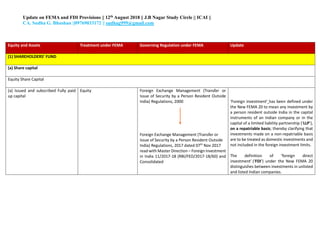
Equity and Assets Treatment under FEMA Governing Regulation under FEMA Update
(1) SHAREHOLDERS’ FUND
(a) Share capital
Equity Share Capital
(a) Issued and subscribed Fully paid
up capital
Equity Foreign Exchange Management (Transfer or
Issue of Security by a Person Resident Outside
India) Regulations, 2000
Foreign Exchange Management (Transfer or
Issue of Security by a Person Resident Outside
India) Regulations, 2017 dated 07th
Nov 2017
read with Master Direction – Foreign Investment
in India 11/2017-18 (RBI/FED/2017-18/60) and
Consolidated
‘Foreign investment’ has been defined under
the New FEMA 20 to mean any investment by
a person resident outside India in the capital
instruments of an Indian company or in the
capital of a limited liability partnership (‘LLP’),
on a repatriable basis; thereby clarifying that
investments made on a non-repatriable basis
are to be treated as domestic investments and
not included in the foreign investment limits.
The definition of ‘foreign direct
investment’ (‘FDI’) under the New FEMA 20
distinguishes between investments in unlisted
and listed Indian companies.
Update on FEMA and FDI Provisions || 12th August 2018 || J.B Nagar Study Circle || ICAI ||
CA. Sudha G. Bhushan ||09769033172 || sudhag999@gmail.com
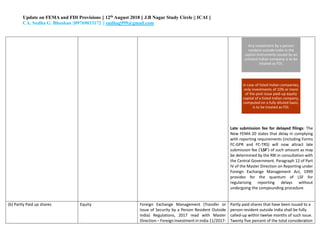
Late submission fee for delayed filings: The
New FEMA 20 states that delay in complying
with reporting requirements (including Forms
FC-GPR and FC-TRS) will now attract late
submission fee (‘LSF’) of such amount as may
be determined by the RBI in consultation with
the Central Government. Paragraph 12 of Part
IV of the Master Direction on Reporting under
Foreign Exchange Management Act, 1999
provides for the quantum of LSF for
regularizing reporting delays without
undergoing the compounding procedure
(b) Partly Paid up shares Equity Foreign Exchange Management (Transfer or
Issue of Security by a Person Resident Outside
India) Regulations, 2017 read with Master
Direction – Foreign Investment in India 11/2017-
Partly paid shares that have been issued to a
person resident outside India shall be fully
called-up within twelve months of such issue.
Twenty five percent of the total consideration
Any investment by a person
resident outside India in the
capital instruments issued by an
unlisted Indian company is to be
treated as FDI,
in case of listed Indian companies,
only investments of 10% or more
of the post issue paid-up equity
capital of a listed Indian company,
computed on a fully diluted basis,
is to be treated as FDI.
Update on FEMA and FDI Provisions || 12th August 2018 || J.B Nagar Study Circle || ICAI ||
CA. Sudha G. Bhushan ||09769033172 || sudhag999@gmail.com
18 (RBI/FED/2017-18/60) and Consolidated FDI
Policy Circular of 2017
amount (including share premium, if any),
shall be received upfront.
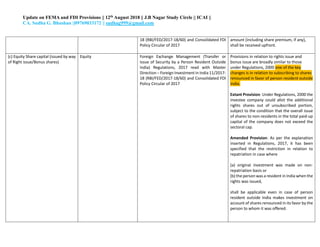
(c) Equity Share capital (issued by way
of Right issue/Bonus shares)
Equity Foreign Exchange Management (Transfer or
Issue of Security by a Person Resident Outside
India) Regulations, 2017 read with Master
Direction – Foreign Investment in India 11/2017-
18 (RBI/FED/2017-18/60) and Consolidated FDI
Policy Circular of 2017
Provisions in relation to rights issue and
bonus issue are broadly similar to those
under Regulations, 2000 one of the key
changes is in relation to subscribing to shares
renounced in favor of person resident outside
India.
Extant Provision: Under Regulations, 2000 the
investee company could allot the additional
rights shares out of unsubscribed portion,
subject to the condition that the overall issue
of shares to non-residents in the total paid-up
capital of the company does not exceed the
sectoral cap.
Amended Provision: As per the explanation
inserted in Regulations, 2017, it has been
specified that the restriction in relation to
repatriation in case where
(a) original investment was made on non-
repatriation basis or
(b) the person was a resident in India when the
rights was issued,
shall be applicable even in case of person
resident outside India makes investment on
account of shares renounced in its favor by the
person to whom it was offered.
Update on FEMA and FDI Provisions || 12th August 2018 || J.B Nagar Study Circle || ICAI ||
CA. Sudha G. Bhushan ||09769033172 || sudhag999@gmail.com
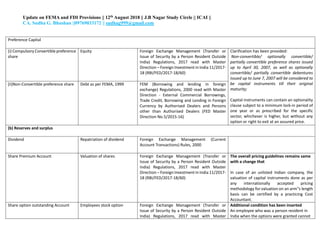
Preference Capital
(i) Compulsory Convertible preference
share
Equity Foreign Exchange Management (Transfer or
Issue of Security by a Person Resident Outside
India) Regulations, 2017 read with Master
Direction – Foreign Investment in India 11/2017-
18 (RBI/FED/2017-18/60)
Clarification has been provided:
Non-convertible/ optionally convertible/
partially convertible preference shares issued
up to April 30, 2007, as well as optionally
convertible/ partially convertible debentures
issued up to June 7, 2007 will be considered to
be capital instruments till their original
maturity;
Capital instruments can contain an optionality
clause subject to a minimum lock-in period of
one year or as prescribed for the specific
sector, whichever is higher, but without any
option or right to exit at an assured price.
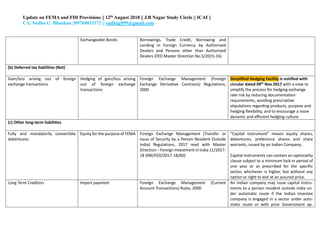
(ii)Non-Convertible preference share Debt as per FEMA, 1999 FEM (Borrowing and lending in foreign
exchange) Regulations, 2000 read with Master
Direction - External Commercial Borrowings,
Trade Credit, Borrowing and Lending in Foreign
Currency by Authorised Dealers and Persons
other than Authorised Dealers (FED Master
Direction No.5/2015-16)
(b) Reserves and surplus
Dividend Repatriation of dividend Foreign Exchange Management (Current
Account Transactions) Rules, 2000
Share Premium Account Valuation of shares Foreign Exchange Management (Transfer or
Issue of Security by a Person Resident Outside
India) Regulations, 2017 read with Master
Direction – Foreign Investment in India 11/2017-
18 (RBI/FED/2017-18/60)
The overall pricing guidelines remains same
with a change that
In case of an unlisted Indian company, the
valuation of capital instruments done as per
any internationally accepted pricing
methodology for valuation on an arm‟s length
basis can be certified by a practicing Cost
Accountant.
Share option outstanding Account Employees stock option Foreign Exchange Management (Transfer or
Issue of Security by a Person Resident Outside
India) Regulations, 2017 read with Master
Additional condition has been inserted
An employee who was a person resident in
India when the options were granted cannot
Update on FEMA and FDI Provisions || 12th August 2018 || J.B Nagar Study Circle || ICAI ||
CA. Sudha G. Bhushan ||09769033172 || sudhag999@gmail.com
Direction – Foreign Investment in India 11/2017-
18 (RBI/FED/2017-18/60)
repatriate the sale proceeds after selling the
shares so acquired pursuant to exercise of
options.
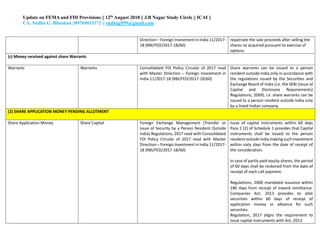
(c) Money received against share Warrants
Warrants Warrants Consolidated FDI Policy Circular of 2017 read
with Master Direction – Foreign Investment in
India 11/2017-18 (RBI/FED/2017-18/60)
Share warrants can be issued to a person
resident outside India only in accordance with
the regulations issued by the Securities and
Exchange Board of India (i.e. the SEBI (Issue of
Capital and Disclosure Requirements)
Regulations, 2009), i.e. share warrants can be
issued to a person resident outside India only
by a listed Indian company
(2) SHARE APPLICATION MONEY PENDING ALLOTMENT
Share Application Money Share Capital Foreign Exchange Management (Transfer or
Issue of Security by a Person Resident Outside
India) Regulations, 2017 read with Consolidated
FDI Policy Circular of 2017 read with Master
Direction – Foreign Investment in India 11/2017-
18 (RBI/FED/2017-18/60)
Issue of capital instruments within 60 days
Para 2 (2) of Schedule 1 provides that Capital
instruments shall be issued to the person
resident outside India making such investment
within sixty days from the date of receipt of
the consideration.
In case of partly paid equity shares, the period
of 60 days shall be reckoned from the date of
receipt of each call payment.
Regulations, 2000 mandated issuance within
180 days from receipt of inward remittance.
Companies Act, 2013 provides to allot
securities within 60 days of receipt of
application money or advance for such
securities.
Regulation, 2017 aligns the requirement to
issue capital instruments with Act, 2013.
Update on FEMA and FDI Provisions || 12th August 2018 || J.B Nagar Study Circle || ICAI ||
CA. Sudha G. Bhushan ||09769033172 || sudhag999@gmail.com
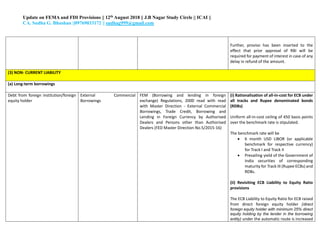
Further, proviso has been inserted to the
effect that prior approval of RBI will be
required for payment of interest in case of any
delay in refund of the amount.
(3) NON- CURRENT LIABILITY
(a) Long-term borrowings
Debt from foreign institution/foreign
equity holder
External Commercial
Borrowings
FEM (Borrowing and lending in foreign
exchange) Regulations, 2000 read with read
with Master Direction - External Commercial
Borrowings, Trade Credit, Borrowing and
Lending in Foreign Currency by Authorised
Dealers and Persons other than Authorised
Dealers (FED Master Direction No.5/2015-16)
(i) Rationalisation of all-in-cost for ECB under
all tracks and Rupee denominated bonds
(RDBs)
Uniform all-in-cost ceiling of 450 basis points
over the benchmark rate is stipulated.
The benchmark rate will be
• 6 month USD LIBOR (or applicable
benchmark for respective currency)
for Track I and Track II
• Prevailing yield of the Government of
India securities of corresponding
maturity for Track III (Rupee ECBs) and
RDBs.
(ii) Revisiting ECB Liability to Equity Ratio
provisions
The ECB Liability to Equity Ratio for ECB raised
from direct foreign equity holder (direct
foreign equity holder with minimum 25% direct
equity holding by the lender in the borrowing
entity) under the automatic route is increased
Update on FEMA and FDI Provisions || 12th August 2018 || J.B Nagar Study Circle || ICAI ||
CA. Sudha G. Bhushan ||09769033172 || sudhag999@gmail.com
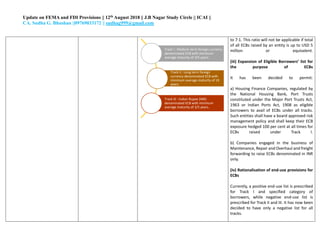
to 7:1. This ratio will not be applicable if total
of all ECBs raised by an entity is up to USD 5
million or equivalent.
(iii) Expansion of Eligible Borrowers’ list for
the purpose of ECBs
It has been decided to permit:
a) Housing Finance Companies, regulated by
the National Housing Bank, Port Trusts
constituted under the Major Port Trusts Act,
1963 or Indian Ports Act, 1908 as eligible
borrowers to avail of ECBs under all tracks.
Such entities shall have a board approved risk
management policy and shall keep their ECB
exposure hedged 100 per cent at all times for
ECBs raised under Track I.
b) Companies engaged in the business of
Maintenance, Repair and Overhaul and freight
forwarding to raise ECBs denominated in INR
only.
(iv) Rationalisation of end-use provisions for
ECBs
Currently, a positive end-use list is prescribed
for Track I and specified category of
borrowers, while negative end-use list is
prescribed for Track II and III. It has now been
decided to have only a negative list for all
tracks.
Track I : Medium term foreign currency
denominated ECB with minimum
average maturity of 3/5 years.
Track II : Long term foreign
currency denominated ECB with
minimum average maturity of 10
years.
Track III : Indian Rupee (INR)
denominated ECB with minimum
average maturity of 3/5 years.
Update on FEMA and FDI Provisions || 12th August 2018 || J.B Nagar Study Circle || ICAI ||
CA. Sudha G. Bhushan ||09769033172 || sudhag999@gmail.com
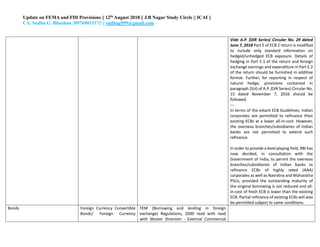
Vide A.P. (DIR Series) Circular No. 29 dated
June 7, 2018 Part E of ECB 2 return is modified
to include only standard information on
hedged/unhedged ECB exposure. Details of
hedging in Part E.1 of the return and foreign
exchange earnings and expenditure in Part E.2
of the return should be furnished in additive
format. Further, for reporting in respect of
natural hedge, provisions contained in
paragraph 2(iii) of A.P. (DIR Series) Circular No.
15 dated November 7, 2016 should be
followed.
---
In terms of the extant ECB Guidelines, Indian
corporates are permitted to refinance their
existing ECBs at a lower all-in-cost. However,
the overseas branches/subsidiaries of Indian
banks are not permitted to extend such
refinance.
In order to provide a level playing field, RBI has
now decided, in consultation with the
Government of India, to permit the overseas
branches/subsidiaries of Indian banks to
refinance ECBs of highly rated (AAA)
corporates as well as Navratna and Maharatna
PSUs, provided the outstanding maturity of
the original borrowing is not reduced and all-
in-cost of fresh ECB is lower than the existing
ECB. Partial refinance of existing ECBs will also
be permitted subject to same conditions.
Bonds Foreign Currency Convertible
Bonds/ Foreign Currency
FEM (Borrowing and lending in foreign
exchange) Regulations, 2000 read with read
with Master Direction - External Commercial
Update on FEMA and FDI Provisions || 12th August 2018 || J.B Nagar Study Circle || ICAI ||
CA. Sudha G. Bhushan ||09769033172 || sudhag999@gmail.com
Exchangeable Bonds Borrowings, Trade Credit, Borrowing and
Lending in Foreign Currency by Authorised
Dealers and Persons other than Authorised
Dealers (FED Master Direction No.5/2015-16)
(b) Deferred tax liabilities (Net)
Gain/loss arising out of foreign
exchange transactions
Hedging of gain/loss arising
out of foreign exchange
transactions
Foreign Exchange Management (Foreign
Exchange Derivative Contracts) Regulations,
2000
Simplified Hedging Facility is notified with
circular dated 09th
Nov 2017 with a view to
simplify the process for hedging exchange
rate risk by reducing documentation
requirements, avoiding prescriptive
stipulations regarding products, purpose and
hedging flexibility, and to encourage a more
dynamic and efficient hedging culture.
(c) Other long-term liabilities
Fully and mandatorily convertible
debentures
Equity for the purpose of FEMA Foreign Exchange Management (Transfer or
Issue of Security by a Person Resident Outside
India) Regulations, 2017 read with Master
Direction – Foreign Investment in India 11/2017-
18 (RBI/FED/2017-18/60)
“Capital instrument” means equity shares,
debentures, preference shares and share
warrants, issued by an Indian Company;
Capital instruments can contain an optionality
clause subject to a minimum lock-in period of
one year or as prescribed for the specific
sector, whichever is higher, but without any
option or right to exit at an assured price.
Long Term Creditors Import payment Foreign Exchange Management (Current
Account Transactions) Rules, 2000
An Indian company may issue capital instru-
ments to a person resident outside India un-
der automatic route if the Indian investee
company is engaged in a sector under auto-
matic route or with prior Government ap-
Update on FEMA and FDI Provisions || 12th August 2018 || J.B Nagar Study Circle || ICAI ||
CA. Sudha G. Bhushan ||09769033172 || sudhag999@gmail.com
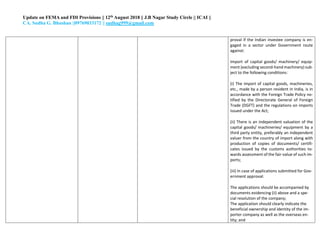
proval if the Indian investee company is en-
gaged in a sector under Government route
against:
Import of capital goods/ machinery/ equip-
ment (excluding second-hand machinery) sub-
ject to the following conditions:
(i) The import of capital goods, machineries,
etc., made by a person resident in India, is in
accordance with the Foreign Trade Policy no-
tified by the Directorate General of Foreign
Trade (DGFT) and the regulations on imports
issued under the Act;
(ii) There is an independent valuation of the
capital goods/ machineries/ equipment by a
third party entity, preferably an independent
valuer from the country of import along with
production of copies of documents/ certifi-
cates issued by the customs authorities to-
wards assessment of the fair-value of such im-
ports;
(iii) In case of applications submitted for Gov-
ernment approval:
i. The applications should be accompanied by
documents evidencing (ii) above and a spe-
cial resolution of the company;
ii. The application should clearly indicate the
beneficial ownership and identity of the im-
porter company as well as the overseas en-
tity; and
Update on FEMA and FDI Provisions || 12th August 2018 || J.B Nagar Study Circle || ICAI ||
CA. Sudha G. Bhushan ||09769033172 || sudhag999@gmail.com
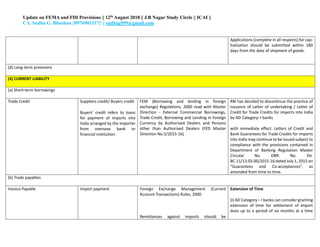
iii. Applications (complete in all respects) for cap-
italization should be submitted within 180
days from the date of shipment of goods.
(d) Long-term provisions
(4) CURRENT LIABILITY
(a) Short-term borrowings
Trade Credit Suppliers credit/ Buyers credit
Buyers’ credit refers to loans
for payment of imports into
India arranged by the importer
from overseas bank or
financial institution.
FEM (Borrowing and lending in foreign
exchange) Regulations, 2000 read with Master
Direction - External Commercial Borrowings,
Trade Credit, Borrowing and Lending in Foreign
Currency by Authorised Dealers and Persons
other than Authorised Dealers (FED Master
Direction No.5/2015-16)
RBI has decided to discontinue the practice of
issuance of Letter of undertaking / Letter of
Credit for Trade Credits for imports into India
by AD Category–I banks
with immediate effect. Letters of Credit and
Bank Guarantees for Trade Credits for imports
into India may continue to be issued subject to
compliance with the provisions contained in
Department of Banking Regulation Master
Circular No. DBR. No. Dir.
BC.11/13.03.00/2015-16 dated July 1, 2015 on
“Guarantees and Co-acceptances”, as
amended from time to time.
(b) Trade payables
Invoice Payable Import payment Foreign Exchange Management (Current
Account Transactions) Rules, 2000
Remittances against imports should be
Extension of Time
(i) AD Category – I banks can consider granting
extension of time for settlement of import
dues up to a period of six months at a time
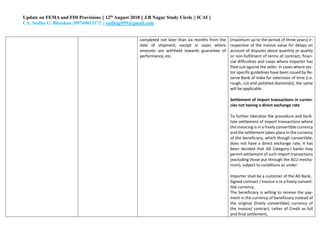
Update on FEMA and FDI Provisions || 12th August 2018 || J.B Nagar Study Circle || ICAI ||
CA. Sudha G. Bhushan ||09769033172 || sudhag999@gmail.com
completed not later than six months from the
date of shipment, except in cases where
amounts are withheld towards guarantee of
performance, etc.
(maximum up to the period of three years) ir-
respective of the invoice value for delays on
account of disputes about quantity or quality
or non-fulfilment of terms of contract; finan-
cial difficulties and cases where importer has
filed suit against the seller. In cases where sec-
tor specific guidelines have been issued by Re-
serve Bank of India for extension of time (i.e.
rough, cut and polished diamonds), the same
will be applicable.
Settlement of Import transactions in curren-
cies not having a direct exchange rate
To further liberalize the procedure and facili-
tate settlement of import transactions where
the invoicing is in a freely convertible currency
and the settlement takes place in the currency
of the beneficiary, which though convertible,
does not have a direct exchange rate, it has
been decided that AD Category-I banks may
permit settlement of such import transactions
(excluding those put through the ACU mecha-
nism), subject to conditions as under:
a. Importer shall be a customer of the AD Bank,
b. Signed contract / invoice is in a freely convert-
ible currency,
c. The beneficiary is willing to receive the pay-
ment in the currency of beneficiary instead of
the original (freely convertible) currency of
the invoice/ contract, Letter of Credit as full
and final settlement,
Update on FEMA and FDI Provisions || 12th August 2018 || J.B Nagar Study Circle || ICAI ||
CA. Sudha G. Bhushan ||09769033172 || sudhag999@gmail.com
d. AD bank is satisfied with the bonafides of the
transactions, and
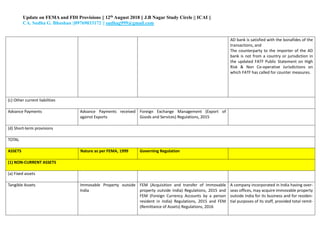
e. The counterparty to the importer of the AD
bank is not from a country or jurisdiction in
the updated FATF Public Statement on High
Risk & Non Co-operative Jurisdictions on
which FATF has called for counter measures.
(c) Other current liabilities
Advance Payments Advance Payments received
against Exports
Foreign Exchange Management (Export of
Goods and Services) Regulations, 2015
(d) Short-term provisions
TOTAL
ASSETS Nature as per FEMA, 1999 Governing Regulation
(1) NON-CURRENT ASSETS
(a) Fixed assets
Tangible Assets Immovable Property outside
India
FEM (Acquisition and transfer of immovable
property outside India) Regulations, 2015 and
FEM (Foreign Currency Accounts by a person
resident in India) Regulations, 2015 and FEM
(Remittance of Assets) Regulations, 2016
A company incorporated in India having over-
seas offices, may acquire immovable property
outside India for its business and for residen-
tial purposes of its staff, provided total remit-
Update on FEMA and FDI Provisions || 12th August 2018 || J.B Nagar Study Circle || ICAI ||
CA. Sudha G. Bhushan ||09769033172 || sudhag999@gmail.com
--------------------------------------------------
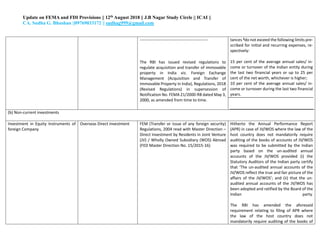
The RBI has issued revised regulations to
regulate acquisition and transfer of immovable
property in India viz. Foreign Exchange
Management (Acquisition and Transfer of
Immovable Property in India), Regulations, 2018
(Revised Regulations) in supersession of
Notification No. FEMA 21/2000-RB dated May 3,
2000, as amended from time to time.
tances 8
do not exceed the following limits pre-
scribed for initial and recurring expenses, re-
spectively:
a. 15 per cent of the average annual sales/ in-
come or turnover of the Indian entity during
the last two financial years or up to 25 per
cent of the net worth, whichever is higher;
b. 10 per cent of the average annual sales/ in-
come or turnover during the last two financial
years.
(b) Non-current investments
Investment in Equity Instruments of
foreign Company
Overseas Direct investment FEM (Transfer or issue of any foreign security)
Regulations, 2004 read with Master Direction –
Direct Investment by Residents in Joint Venture
(JV) / Wholly Owned Subsidiary (WOS) Abroad
(FED Master Direction No. 15/2015-16)
Hitherto the Annual Performance Report
(APR) in case of JV/WOS where the law of the
host country does not mandatorily require
auditing of the books of accounts of JV/WOS
was required to be submitted by the Indian
party based on the un-audited annual
accounts of the JV/WOS provided (i) the
Statutory Auditors of the Indian party certify
that ‘The un-audited annual accounts of the
JV/WOS reflect the true and fair picture of the
affairs of the JV/WOS’; and (ii) that the un-
audited annual accounts of the JV/WOS has
been adopted and ratified by the Board of the
Indian party.
The RBI has amended the aforesaid
requirement relating to filing of APR where
the law of the host country does not
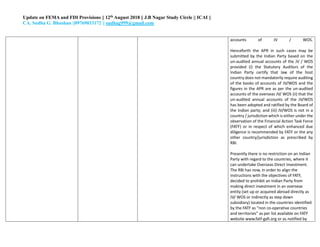
mandatorily require auditing of the books of
Update on FEMA and FDI Provisions || 12th August 2018 || J.B Nagar Study Circle || ICAI ||
CA. Sudha G. Bhushan ||09769033172 || sudhag999@gmail.com
accounts of JV / WOS.
Henceforth the APR in such cases may be
submitted by the Indian Party based on the
un-audited annual accounts of the JV / WOS
provided (i) the Statutory Auditors of the
Indian Party certify that law of the host
country does not mandatorily require auditing
of the books of accounts of JV/WOS and the
figures in the APR are as per the un-audited
accounts of the overseas JV/ WOS (ii) that the
un-audited annual accounts of the JV/WOS
has been adopted and ratified by the Board of
the Indian party; and (iii) JV/WOS is not in a
country / jurisdiction which is either under the
observation of the Financial Action Task Force
(FATF) or in respect of which enhanced due
diligence is recommended by FATF or the any
other country/jurisdiction as prescribed by
RBI.
Presently there is no restriction on an Indian
Party with regard to the countries, where it
can undertake Overseas Direct Investment.
The RBI has now, in order to align the
instructions with the objectives of FATF,
decided to prohibit an Indian Party from
making direct investment in an overseas
entity (set up or acquired abroad directly as
JV/ WOS or indirectly as step down
subsidiary) located in the countries identified
by the FATF as “non co-operative countries
and territories” as per list available on FATF
website www.fatf-gafi.org or as notified by
Update on FEMA and FDI Provisions || 12th August 2018 || J.B Nagar Study Circle || ICAI ||
CA. Sudha G. Bhushan ||09769033172 || sudhag999@gmail.com
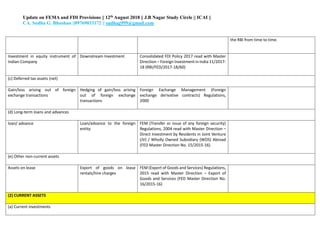
the RBI from time to time.
Investment in equity instrument of
Indian Company
Downstream Investment Consolidated FDI Policy 2017 read with Master
Direction – Foreign Investment in India 11/2017-
18 (RBI/FED/2017-18/60)
(c) Deferred tax assets (net)
Gain/loss arising out of foreign
exchange transactions
Hedging of gain/loss arising
out of foreign exchange
transactions
Foreign Exchange Management (Foreign
exchange derivative contracts) Regulations,
2000
(d) Long-term loans and advances
loan/ advance Loan/advance to the foreign
entity
FEM (Transfer or issue of any foreign security)
Regulations, 2004 read with Master Direction –
Direct Investment by Residents in Joint Venture
(JV) / Wholly Owned Subsidiary (WOS) Abroad
(FED Master Direction No. 15/2015-16)
(e) Other non-current assets
Assets on lease Export of goods on lease
rentals/hire charges
FEM (Export of Goods and Services) Regulations,
2015 read with Master Direction – Export of
Goods and Services (FED Master Direction No.
16/2015-16)
(2) CURRENT ASSETS
(a) Current investments
Update on FEMA and FDI Provisions || 12th August 2018 || J.B Nagar Study Circle || ICAI ||
CA. Sudha G. Bhushan ||09769033172 || sudhag999@gmail.com
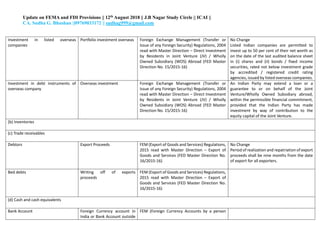
Investment in listed overseas
companies
Portfolio investment overseas Foreign Exchange Management (Transfer or
Issue of any Foreign Security) Regulations, 2004
read with Master Direction – Direct Investment
by Residents in Joint Venture (JV) / Wholly
Owned Subsidiary (WOS) Abroad (FED Master
Direction No. 15/2015-16)
No Change
Listed Indian companies are permitted to
invest up to 50 per cent of their net worth as
on the date of the last audited balance sheet
in (i) shares and (ii) bonds / fixed income
securities, rated not below investment grade
by accredited / registered credit rating
agencies, issued by listed overseas companies.
Investment in debt instruments of
overseas company
Overseas investment Foreign Exchange Management (Transfer or
Issue of any Foreign Security) Regulations, 2004
read with Master Direction – Direct Investment
by Residents in Joint Venture (JV) / Wholly
Owned Subsidiary (WOS) Abroad (FED Master
Direction No. 15/2015-16)
An Indian Party may extend a loan or a
guarantee to or on behalf of the Joint
Venture/Wholly Owned Subsidiary abroad,
within the permissible financial commitment,
provided that the Indian Party has made
investment by way of contribution to the
equity capital of the Joint Venture.
(b) Inventories
(c) Trade receivables
Debtors Export Proceeds FEM (Export of Goods and Services) Regulations,
2015 read with Master Direction – Export of
Goods and Services (FED Master Direction No.
16/2015-16)
No Change
Period of realization and repatriation of export
proceeds shall be nine months from the date
of export for all exporters.
Bed debts Writing off of exports
proceeds
FEM (Export of Goods and Services) Regulations,
2015 read with Master Direction – Export of
Goods and Services (FED Master Direction No.
16/2015-16)
(d) Cash and cash equivalents
Bank Account Foreign Currency account in
India or Bank Account outside
FEM (Foreign Currency Accounts by a person
Update on FEMA and FDI Provisions || 12th August 2018 || J.B Nagar Study Circle || ICAI ||
CA. Sudha G. Bhushan ||09769033172 || sudhag999@gmail.com
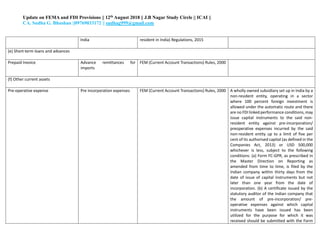
India resident in India) Regulations, 2015
(e) Short-term loans and advances
Prepaid Invoice Advance remittances for
imports
FEM (Current Account Transactions) Rules, 2000
(f) Other current assets
Pre-operative expense Pre incorporation expenses FEM (Current Account Transactions) Rules, 2000 A wholly owned subsidiary set up in India by a
non-resident entity, operating in a sector
where 100 percent foreign investment is
allowed under the automatic route and there
are no FDI linked performance conditions, may
issue capital instruments to the said non-
resident entity against pre-incorporation/
preoperative expenses incurred by the said
non-resident entity up to a limit of five per
cent of its authorised capital (as defined in the
Companies Act, 2013) or USD 500,000
whichever is less, subject to the following
conditions: (a) Form FC-GPR, as prescribed in
the Master Direction on Reporting as
amended from time to time, is filed by the
Indian company within thirty days from the
date of issue of capital instruments but not
later than one year from the date of
incorporation. (b) A certificate issued by the
statutory auditor of the Indian company that
the amount of pre-incorporation/ pre-
operative expenses against which capital
instruments have been issued has been
utilized for the purpose for which it was
received should be submitted with the Form
Update on FEMA and FDI Provisions || 12th August 2018 || J.B Nagar Study Circle || ICAI ||
CA. Sudha G. Bhushan ||09769033172 || sudhag999@gmail.com
FC-GPR.
Pre-incorporation/ pre-operative expenses
will include amounts remitted to the investee
Company’s account or to the investor’s
account in India if it exists or to any consultant
or attorney or to any other material/ service
provider for expenditure relating to
incorporation or necessary for
commencement of operations.
TOTAL
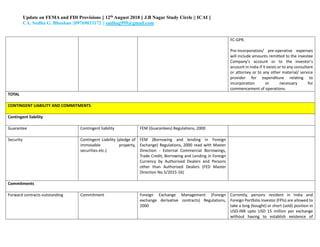
CONTINGENT LIABILITY AND COMMITMENTS
Contingent liability
Guarantee Contingent liability FEM (Guarantees) Regulations, 2000
Security Contingent Liability (pledge of
immovable property,
securities etc.)
FEM (Borrowing and lending in Foreign
Exchange) Regulations, 2000 read with Master
Direction - External Commercial Borrowings,
Trade Credit, Borrowing and Lending in Foreign
Currency by Authorised Dealers and Persons
other than Authorised Dealers (FED Master
Direction No.5/2015-16)
Commitments
Forward contracts outstanding Commitment Foreign Exchange Management (Foreign
exchange derivative contracts) Regulations,
2000
Currently, persons resident in India and
Foreign Portfolio Investor (FPIs) are allowed to
take a long (bought) or short (sold) position in
USD-INR upto USD 15 million per exchange
without having to establish existence of
Update on FEMA and FDI Provisions || 12th August 2018 || J.B Nagar Study Circle || ICAI ||
CA. Sudha G. Bhushan ||09769033172 || sudhag999@gmail.com
underlying exposure. In addition, residents &
FPIs are allowed to take long or short positions
in EUR-INR, GBP-INR and JPY-INR pairs, all put
together, upto USD 5 million equivalent per
exchange without having to establish
existence of any underlying exposure.
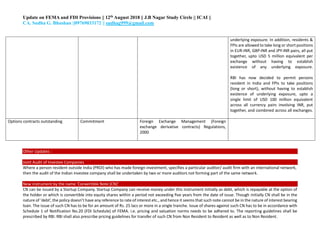
RBI has now decided to permit persons
resident in India and FPIs to take positions
(long or short), without having to establish
existence of underlying exposure, upto a
single limit of USD 100 million equivalent
across all currency pairs involving INR, put
together, and combined across all exchanges.
Options contracts outstanding Commitment Foreign Exchange Management (Foreign
exchange derivative contracts) Regulations,
2000
Other Updates :
Joint Audit of Investee Companies
Where a person resident outside India (PROI) who has made foreign investment, specifies a particular auditor/ audit firm with an international network,
then the audit of the Indian investee company shall be undertaken by two or more auditors not forming part of the same network.
New instrument by the name ‘Convertible Note (CN)’
CN can be issued by a Startup Company. Startup Company can receive money under this instrument initially as debt, which is repayable at the option of
the holder or which is convertible into equity shares within a period not exceeding five years from the date of issue. Though initially CN shall be in the
nature of ‘debt’, the policy doesn’t have any reference to rate of interest etc., and hence it seems that such note cannot be in the nature of interest bearing
loan. The issue of such CN has to be for an amount of Rs. 25 lacs or more in a single tranche. Issue of shares against such CN has to be in accordance with
Schedule 1 of Notification No.20 (FDI Schedule) of FEMA. i.e. pricing and valuation norms needs to be adhered to. The reporting guidelines shall be
prescribed by RBI. RBI shall also prescribe pricing guidelines for transfer of such CN from Non Resident to Resident as well as to Non Resident.
Update on FEMA and FDI Provisions || 12th August 2018 || J.B Nagar Study Circle || ICAI ||
CA. Sudha G. Bhushan ||09769033172 || sudhag999@gmail.com
Acquisition/ transfer by a Non- Resident Indian (NRI) || Newly inserted provisionsAcquisition of immovable property
a. An NRI or an OCI can acquire by way of purchase any immovable property (other than agricultural land/ plantation property/ farm house) in India.
b. An NRI or an OCI can acquire by way of gift any immovable property (other than agricultural land/ plantation property/ farm house) in India from
person resident in India or from an NRI or an OCI who in any case is a relative as defined in section 2(77) of the Companies Act, 2013.
c. An NRI or an OCI can acquire any immovable property in India by way of inheritance from a person resident outside India who had acquired the
property in accordance with the provisions of the foreign exchange law in force at the time of acquisition.
d. An NRI or an OCI can acquire any immovable property in India by way of inheritance from a person resident in India
Transfer of immovable property
a) An NRI or an OCI may transfer any immovable property in India to a person resident in India;
b) An NRI or an OCI may transfer any immovable property (other than agricultural land or plantation property or farm house) to an NRI or 19
an OCI. In
case the transfer is by way of gift the transferee should be a relative as defined in section 2(77) of the Companies Act, 2013.
Joint acquisition by the spouse of an NRI or an OCI
a) A person resident outside India, not being a Non-Resident Indian or an Overseas Citizen of India, who is a spouse of a Non-Resident Indian or an
Overseas Citizen of India may acquire one immovable property (other than agricultural land/ farm house/ plantation property), jointly with his/
her NRI/ OCI spouse.
b) Consideration for transfers made under this para should be out of funds received in India through banking channels by way of inward remittance
from any place outside India or by debit to non-resident account of the person concerned maintained in accordance with the Act or the rules
framed thereunder. Payments cannot be made either by traveller’s cheque or by foreign currency notes or by other mode except those specifically
mentioned in this para.
c) The marriage should have been registered and subsisted for a continuous period of not less than two years immediately preceding the acquisition
of such property.
d) The non-resident spouse should not otherwise be prohibited from such acquisition.
Acquisition by a Long-Term Visa holder
Update on FEMA and FDI Provisions || 12th August 2018 || J.B Nagar Study Circle || ICAI ||
CA. Sudha G. Bhushan ||09769033172 || sudhag999@gmail.com
a) A person being a citizen of Afghanistan, Bangladesh or Pakistan belonging to minority communities in those countries viz., Hindus, Sikhs, Jains,
Buddhists, Parsis and Christians, who is residing in India and has been granted a Long Term Visa (LTV) by the Central Government may purchase
only one residential immovable property in India as dwelling unit for self-occupation and only one immovable property for self-employment.
b) The property should not be located in and around restricted/ protected areas so notified by the Central Government or cantonment areas.
c) The person should submit a declaration to the Revenue Authority of the district where the property is located specifying the source of funds and
that he/ she is residing in India on a LTV.
d) The registration documents of the property should mention the nationality and the fact that such person is on a LTV.
e) The property of such person may be attached/ confiscated in the event of his/ her indulgence in anti-India activities.
f) A copy of the documents of the purchased property shall be submitted to the Deputy Commissioner of Police (DCP)/ Foreigners Registration Office
(FRO)/ Foreigners Regional Registration Office (FRRO) concerned and to the Ministry of Home Affairs (Foreigners Division).
g) Sale of the immovable property so acquired is permissible only after such person has acquired Indian citizenship. However, transfer of such im-
movable property before acquiring Indian citizenship requires the prior approval of the Deputy Commissioner of Police (DCP)/ Foreigners Regis-
tration Office (FRO)/ Foreigners Regional Registration Office (FRRO) concerned.
h) In the event of failure in repayment of external commercial borrowing availed by a person resident in India under the provisions of the Foreign
Exchange Management (Borrowing or Lending in Foreign Exchange) Regulations, 2000, as amended from time to time, a bank which is an author-
ised dealer may permit the overseas lender or the security trustee (in whose favour the charge on immovable property has been created to secure
the ECB) to sell the immovable property on which the said loan has been secured only to a (by the) person resident in India and to repatriate the
sale proceeds towards outstanding dues in respect of the said loan and not any other loan.
i) An authorised dealer which is an Indian correspondent of an overseas lender may create a mortgage on an immovable property in India owned
by an NRI or an OCI who is a director of a company outside India, for a loan to be availed by the company outside India from the said overseas
lender subject to the following conditions:
• The funds should be used by the borrowing company only for its core business purposes overseas; and
• In case of invocation of charge the authorised dealer should sell the immovable property to an eligible acquirer and remit the sale proceeds to
the overseas lender.
A person resident outside India who has acquired any immovable property in India in accordance with foreign exchange laws in force at the time
of such acquisition or with the general or specific permission of the Reserve Bank may transfer such property to a person resident in India provided
the transaction takes place through banking channels in India and provided that the resident is not otherwise prohibited from such acquisition.

Recent changes under Fema

  • 1.
    Update on FEMAand FDI Provisions || 12th August 2018 || J.B Nagar Study Circle || ICAI || CA. Sudha G. Bhushan ||09769033172 || sudhag999@gmail.com Equity and Assets Treatment under FEMA Governing Regulation under FEMA Update (1) SHAREHOLDERS’ FUND (a) Share capital Equity Share Capital (a) Issued and subscribed Fully paid up capital Equity Foreign Exchange Management (Transfer or Issue of Security by a Person Resident Outside India) Regulations, 2000 Foreign Exchange Management (Transfer or Issue of Security by a Person Resident Outside India) Regulations, 2017 dated 07th Nov 2017 read with Master Direction – Foreign Investment in India 11/2017-18 (RBI/FED/2017-18/60) and Consolidated ‘Foreign investment’ has been defined under the New FEMA 20 to mean any investment by a person resident outside India in the capital instruments of an Indian company or in the capital of a limited liability partnership (‘LLP’), on a repatriable basis; thereby clarifying that investments made on a non-repatriable basis are to be treated as domestic investments and not included in the foreign investment limits. The definition of ‘foreign direct investment’ (‘FDI’) under the New FEMA 20 distinguishes between investments in unlisted and listed Indian companies.
  • 2.
    Update on FEMAand FDI Provisions || 12th August 2018 || J.B Nagar Study Circle || ICAI || CA. Sudha G. Bhushan ||09769033172 || sudhag999@gmail.com Late submission fee for delayed filings: The New FEMA 20 states that delay in complying with reporting requirements (including Forms FC-GPR and FC-TRS) will now attract late submission fee (‘LSF’) of such amount as may be determined by the RBI in consultation with the Central Government. Paragraph 12 of Part IV of the Master Direction on Reporting under Foreign Exchange Management Act, 1999 provides for the quantum of LSF for regularizing reporting delays without undergoing the compounding procedure (b) Partly Paid up shares Equity Foreign Exchange Management (Transfer or Issue of Security by a Person Resident Outside India) Regulations, 2017 read with Master Direction – Foreign Investment in India 11/2017- Partly paid shares that have been issued to a person resident outside India shall be fully called-up within twelve months of such issue. Twenty five percent of the total consideration Any investment by a person resident outside India in the capital instruments issued by an unlisted Indian company is to be treated as FDI, in case of listed Indian companies, only investments of 10% or more of the post issue paid-up equity capital of a listed Indian company, computed on a fully diluted basis, is to be treated as FDI.
  • 3.
    Update on FEMAand FDI Provisions || 12th August 2018 || J.B Nagar Study Circle || ICAI || CA. Sudha G. Bhushan ||09769033172 || sudhag999@gmail.com 18 (RBI/FED/2017-18/60) and Consolidated FDI Policy Circular of 2017 amount (including share premium, if any), shall be received upfront. (c) Equity Share capital (issued by way of Right issue/Bonus shares) Equity Foreign Exchange Management (Transfer or Issue of Security by a Person Resident Outside India) Regulations, 2017 read with Master Direction – Foreign Investment in India 11/2017- 18 (RBI/FED/2017-18/60) and Consolidated FDI Policy Circular of 2017 Provisions in relation to rights issue and bonus issue are broadly similar to those under Regulations, 2000 one of the key changes is in relation to subscribing to shares renounced in favor of person resident outside India. Extant Provision: Under Regulations, 2000 the investee company could allot the additional rights shares out of unsubscribed portion, subject to the condition that the overall issue of shares to non-residents in the total paid-up capital of the company does not exceed the sectoral cap. Amended Provision: As per the explanation inserted in Regulations, 2017, it has been specified that the restriction in relation to repatriation in case where (a) original investment was made on non- repatriation basis or (b) the person was a resident in India when the rights was issued, shall be applicable even in case of person resident outside India makes investment on account of shares renounced in its favor by the person to whom it was offered.
  • 4.
    Update on FEMAand FDI Provisions || 12th August 2018 || J.B Nagar Study Circle || ICAI || CA. Sudha G. Bhushan ||09769033172 || sudhag999@gmail.com Preference Capital (i) Compulsory Convertible preference share Equity Foreign Exchange Management (Transfer or Issue of Security by a Person Resident Outside India) Regulations, 2017 read with Master Direction – Foreign Investment in India 11/2017- 18 (RBI/FED/2017-18/60) Clarification has been provided: Non-convertible/ optionally convertible/ partially convertible preference shares issued up to April 30, 2007, as well as optionally convertible/ partially convertible debentures issued up to June 7, 2007 will be considered to be capital instruments till their original maturity; Capital instruments can contain an optionality clause subject to a minimum lock-in period of one year or as prescribed for the specific sector, whichever is higher, but without any option or right to exit at an assured price. (ii)Non-Convertible preference share Debt as per FEMA, 1999 FEM (Borrowing and lending in foreign exchange) Regulations, 2000 read with Master Direction - External Commercial Borrowings, Trade Credit, Borrowing and Lending in Foreign Currency by Authorised Dealers and Persons other than Authorised Dealers (FED Master Direction No.5/2015-16) (b) Reserves and surplus Dividend Repatriation of dividend Foreign Exchange Management (Current Account Transactions) Rules, 2000 Share Premium Account Valuation of shares Foreign Exchange Management (Transfer or Issue of Security by a Person Resident Outside India) Regulations, 2017 read with Master Direction – Foreign Investment in India 11/2017- 18 (RBI/FED/2017-18/60) The overall pricing guidelines remains same with a change that In case of an unlisted Indian company, the valuation of capital instruments done as per any internationally accepted pricing methodology for valuation on an arm‟s length basis can be certified by a practicing Cost Accountant. Share option outstanding Account Employees stock option Foreign Exchange Management (Transfer or Issue of Security by a Person Resident Outside India) Regulations, 2017 read with Master Additional condition has been inserted An employee who was a person resident in India when the options were granted cannot
  • 5.
    Update on FEMAand FDI Provisions || 12th August 2018 || J.B Nagar Study Circle || ICAI || CA. Sudha G. Bhushan ||09769033172 || sudhag999@gmail.com Direction – Foreign Investment in India 11/2017- 18 (RBI/FED/2017-18/60) repatriate the sale proceeds after selling the shares so acquired pursuant to exercise of options. (c) Money received against share Warrants Warrants Warrants Consolidated FDI Policy Circular of 2017 read with Master Direction – Foreign Investment in India 11/2017-18 (RBI/FED/2017-18/60) Share warrants can be issued to a person resident outside India only in accordance with the regulations issued by the Securities and Exchange Board of India (i.e. the SEBI (Issue of Capital and Disclosure Requirements) Regulations, 2009), i.e. share warrants can be issued to a person resident outside India only by a listed Indian company (2) SHARE APPLICATION MONEY PENDING ALLOTMENT Share Application Money Share Capital Foreign Exchange Management (Transfer or Issue of Security by a Person Resident Outside India) Regulations, 2017 read with Consolidated FDI Policy Circular of 2017 read with Master Direction – Foreign Investment in India 11/2017- 18 (RBI/FED/2017-18/60) Issue of capital instruments within 60 days Para 2 (2) of Schedule 1 provides that Capital instruments shall be issued to the person resident outside India making such investment within sixty days from the date of receipt of the consideration. In case of partly paid equity shares, the period of 60 days shall be reckoned from the date of receipt of each call payment. Regulations, 2000 mandated issuance within 180 days from receipt of inward remittance. Companies Act, 2013 provides to allot securities within 60 days of receipt of application money or advance for such securities. Regulation, 2017 aligns the requirement to issue capital instruments with Act, 2013.
  • 6.
    Update on FEMAand FDI Provisions || 12th August 2018 || J.B Nagar Study Circle || ICAI || CA. Sudha G. Bhushan ||09769033172 || sudhag999@gmail.com Further, proviso has been inserted to the effect that prior approval of RBI will be required for payment of interest in case of any delay in refund of the amount. (3) NON- CURRENT LIABILITY (a) Long-term borrowings Debt from foreign institution/foreign equity holder External Commercial Borrowings FEM (Borrowing and lending in foreign exchange) Regulations, 2000 read with read with Master Direction - External Commercial Borrowings, Trade Credit, Borrowing and Lending in Foreign Currency by Authorised Dealers and Persons other than Authorised Dealers (FED Master Direction No.5/2015-16) (i) Rationalisation of all-in-cost for ECB under all tracks and Rupee denominated bonds (RDBs) Uniform all-in-cost ceiling of 450 basis points over the benchmark rate is stipulated. The benchmark rate will be • 6 month USD LIBOR (or applicable benchmark for respective currency) for Track I and Track II • Prevailing yield of the Government of India securities of corresponding maturity for Track III (Rupee ECBs) and RDBs. (ii) Revisiting ECB Liability to Equity Ratio provisions The ECB Liability to Equity Ratio for ECB raised from direct foreign equity holder (direct foreign equity holder with minimum 25% direct equity holding by the lender in the borrowing entity) under the automatic route is increased
  • 7.
    Update on FEMAand FDI Provisions || 12th August 2018 || J.B Nagar Study Circle || ICAI || CA. Sudha G. Bhushan ||09769033172 || sudhag999@gmail.com to 7:1. This ratio will not be applicable if total of all ECBs raised by an entity is up to USD 5 million or equivalent. (iii) Expansion of Eligible Borrowers’ list for the purpose of ECBs It has been decided to permit: a) Housing Finance Companies, regulated by the National Housing Bank, Port Trusts constituted under the Major Port Trusts Act, 1963 or Indian Ports Act, 1908 as eligible borrowers to avail of ECBs under all tracks. Such entities shall have a board approved risk management policy and shall keep their ECB exposure hedged 100 per cent at all times for ECBs raised under Track I. b) Companies engaged in the business of Maintenance, Repair and Overhaul and freight forwarding to raise ECBs denominated in INR only. (iv) Rationalisation of end-use provisions for ECBs Currently, a positive end-use list is prescribed for Track I and specified category of borrowers, while negative end-use list is prescribed for Track II and III. It has now been decided to have only a negative list for all tracks. Track I : Medium term foreign currency denominated ECB with minimum average maturity of 3/5 years. Track II : Long term foreign currency denominated ECB with minimum average maturity of 10 years. Track III : Indian Rupee (INR) denominated ECB with minimum average maturity of 3/5 years.
  • 8.
    Update on FEMAand FDI Provisions || 12th August 2018 || J.B Nagar Study Circle || ICAI || CA. Sudha G. Bhushan ||09769033172 || sudhag999@gmail.com Vide A.P. (DIR Series) Circular No. 29 dated June 7, 2018 Part E of ECB 2 return is modified to include only standard information on hedged/unhedged ECB exposure. Details of hedging in Part E.1 of the return and foreign exchange earnings and expenditure in Part E.2 of the return should be furnished in additive format. Further, for reporting in respect of natural hedge, provisions contained in paragraph 2(iii) of A.P. (DIR Series) Circular No. 15 dated November 7, 2016 should be followed. --- In terms of the extant ECB Guidelines, Indian corporates are permitted to refinance their existing ECBs at a lower all-in-cost. However, the overseas branches/subsidiaries of Indian banks are not permitted to extend such refinance. In order to provide a level playing field, RBI has now decided, in consultation with the Government of India, to permit the overseas branches/subsidiaries of Indian banks to refinance ECBs of highly rated (AAA) corporates as well as Navratna and Maharatna PSUs, provided the outstanding maturity of the original borrowing is not reduced and all- in-cost of fresh ECB is lower than the existing ECB. Partial refinance of existing ECBs will also be permitted subject to same conditions. Bonds Foreign Currency Convertible Bonds/ Foreign Currency FEM (Borrowing and lending in foreign exchange) Regulations, 2000 read with read with Master Direction - External Commercial
  • 9.
    Update on FEMAand FDI Provisions || 12th August 2018 || J.B Nagar Study Circle || ICAI || CA. Sudha G. Bhushan ||09769033172 || sudhag999@gmail.com Exchangeable Bonds Borrowings, Trade Credit, Borrowing and Lending in Foreign Currency by Authorised Dealers and Persons other than Authorised Dealers (FED Master Direction No.5/2015-16) (b) Deferred tax liabilities (Net) Gain/loss arising out of foreign exchange transactions Hedging of gain/loss arising out of foreign exchange transactions Foreign Exchange Management (Foreign Exchange Derivative Contracts) Regulations, 2000 Simplified Hedging Facility is notified with circular dated 09th Nov 2017 with a view to simplify the process for hedging exchange rate risk by reducing documentation requirements, avoiding prescriptive stipulations regarding products, purpose and hedging flexibility, and to encourage a more dynamic and efficient hedging culture. (c) Other long-term liabilities Fully and mandatorily convertible debentures Equity for the purpose of FEMA Foreign Exchange Management (Transfer or Issue of Security by a Person Resident Outside India) Regulations, 2017 read with Master Direction – Foreign Investment in India 11/2017- 18 (RBI/FED/2017-18/60) “Capital instrument” means equity shares, debentures, preference shares and share warrants, issued by an Indian Company; Capital instruments can contain an optionality clause subject to a minimum lock-in period of one year or as prescribed for the specific sector, whichever is higher, but without any option or right to exit at an assured price. Long Term Creditors Import payment Foreign Exchange Management (Current Account Transactions) Rules, 2000 An Indian company may issue capital instru- ments to a person resident outside India un- der automatic route if the Indian investee company is engaged in a sector under auto- matic route or with prior Government ap-
  • 10.
    Update on FEMAand FDI Provisions || 12th August 2018 || J.B Nagar Study Circle || ICAI || CA. Sudha G. Bhushan ||09769033172 || sudhag999@gmail.com proval if the Indian investee company is en- gaged in a sector under Government route against: Import of capital goods/ machinery/ equip- ment (excluding second-hand machinery) sub- ject to the following conditions: (i) The import of capital goods, machineries, etc., made by a person resident in India, is in accordance with the Foreign Trade Policy no- tified by the Directorate General of Foreign Trade (DGFT) and the regulations on imports issued under the Act; (ii) There is an independent valuation of the capital goods/ machineries/ equipment by a third party entity, preferably an independent valuer from the country of import along with production of copies of documents/ certifi- cates issued by the customs authorities to- wards assessment of the fair-value of such im- ports; (iii) In case of applications submitted for Gov- ernment approval: i. The applications should be accompanied by documents evidencing (ii) above and a spe- cial resolution of the company; ii. The application should clearly indicate the beneficial ownership and identity of the im- porter company as well as the overseas en- tity; and
  • 11.
    Update on FEMAand FDI Provisions || 12th August 2018 || J.B Nagar Study Circle || ICAI || CA. Sudha G. Bhushan ||09769033172 || sudhag999@gmail.com iii. Applications (complete in all respects) for cap- italization should be submitted within 180 days from the date of shipment of goods. (d) Long-term provisions (4) CURRENT LIABILITY (a) Short-term borrowings Trade Credit Suppliers credit/ Buyers credit Buyers’ credit refers to loans for payment of imports into India arranged by the importer from overseas bank or financial institution. FEM (Borrowing and lending in foreign exchange) Regulations, 2000 read with Master Direction - External Commercial Borrowings, Trade Credit, Borrowing and Lending in Foreign Currency by Authorised Dealers and Persons other than Authorised Dealers (FED Master Direction No.5/2015-16) RBI has decided to discontinue the practice of issuance of Letter of undertaking / Letter of Credit for Trade Credits for imports into India by AD Category–I banks with immediate effect. Letters of Credit and Bank Guarantees for Trade Credits for imports into India may continue to be issued subject to compliance with the provisions contained in Department of Banking Regulation Master Circular No. DBR. No. Dir. BC.11/13.03.00/2015-16 dated July 1, 2015 on “Guarantees and Co-acceptances”, as amended from time to time. (b) Trade payables Invoice Payable Import payment Foreign Exchange Management (Current Account Transactions) Rules, 2000 Remittances against imports should be Extension of Time (i) AD Category – I banks can consider granting extension of time for settlement of import dues up to a period of six months at a time
  • 12.
    Update on FEMAand FDI Provisions || 12th August 2018 || J.B Nagar Study Circle || ICAI || CA. Sudha G. Bhushan ||09769033172 || sudhag999@gmail.com completed not later than six months from the date of shipment, except in cases where amounts are withheld towards guarantee of performance, etc. (maximum up to the period of three years) ir- respective of the invoice value for delays on account of disputes about quantity or quality or non-fulfilment of terms of contract; finan- cial difficulties and cases where importer has filed suit against the seller. In cases where sec- tor specific guidelines have been issued by Re- serve Bank of India for extension of time (i.e. rough, cut and polished diamonds), the same will be applicable. Settlement of Import transactions in curren- cies not having a direct exchange rate To further liberalize the procedure and facili- tate settlement of import transactions where the invoicing is in a freely convertible currency and the settlement takes place in the currency of the beneficiary, which though convertible, does not have a direct exchange rate, it has been decided that AD Category-I banks may permit settlement of such import transactions (excluding those put through the ACU mecha- nism), subject to conditions as under: a. Importer shall be a customer of the AD Bank, b. Signed contract / invoice is in a freely convert- ible currency, c. The beneficiary is willing to receive the pay- ment in the currency of beneficiary instead of the original (freely convertible) currency of the invoice/ contract, Letter of Credit as full and final settlement,
  • 13.
    Update on FEMAand FDI Provisions || 12th August 2018 || J.B Nagar Study Circle || ICAI || CA. Sudha G. Bhushan ||09769033172 || sudhag999@gmail.com d. AD bank is satisfied with the bonafides of the transactions, and e. The counterparty to the importer of the AD bank is not from a country or jurisdiction in the updated FATF Public Statement on High Risk & Non Co-operative Jurisdictions on which FATF has called for counter measures. (c) Other current liabilities Advance Payments Advance Payments received against Exports Foreign Exchange Management (Export of Goods and Services) Regulations, 2015 (d) Short-term provisions TOTAL ASSETS Nature as per FEMA, 1999 Governing Regulation (1) NON-CURRENT ASSETS (a) Fixed assets Tangible Assets Immovable Property outside India FEM (Acquisition and transfer of immovable property outside India) Regulations, 2015 and FEM (Foreign Currency Accounts by a person resident in India) Regulations, 2015 and FEM (Remittance of Assets) Regulations, 2016 A company incorporated in India having over- seas offices, may acquire immovable property outside India for its business and for residen- tial purposes of its staff, provided total remit-
  • 14.
    Update on FEMAand FDI Provisions || 12th August 2018 || J.B Nagar Study Circle || ICAI || CA. Sudha G. Bhushan ||09769033172 || sudhag999@gmail.com -------------------------------------------------- The RBI has issued revised regulations to regulate acquisition and transfer of immovable property in India viz. Foreign Exchange Management (Acquisition and Transfer of Immovable Property in India), Regulations, 2018 (Revised Regulations) in supersession of Notification No. FEMA 21/2000-RB dated May 3, 2000, as amended from time to time. tances 8 do not exceed the following limits pre- scribed for initial and recurring expenses, re- spectively: a. 15 per cent of the average annual sales/ in- come or turnover of the Indian entity during the last two financial years or up to 25 per cent of the net worth, whichever is higher; b. 10 per cent of the average annual sales/ in- come or turnover during the last two financial years. (b) Non-current investments Investment in Equity Instruments of foreign Company Overseas Direct investment FEM (Transfer or issue of any foreign security) Regulations, 2004 read with Master Direction – Direct Investment by Residents in Joint Venture (JV) / Wholly Owned Subsidiary (WOS) Abroad (FED Master Direction No. 15/2015-16) Hitherto the Annual Performance Report (APR) in case of JV/WOS where the law of the host country does not mandatorily require auditing of the books of accounts of JV/WOS was required to be submitted by the Indian party based on the un-audited annual accounts of the JV/WOS provided (i) the Statutory Auditors of the Indian party certify that ‘The un-audited annual accounts of the JV/WOS reflect the true and fair picture of the affairs of the JV/WOS’; and (ii) that the un- audited annual accounts of the JV/WOS has been adopted and ratified by the Board of the Indian party. The RBI has amended the aforesaid requirement relating to filing of APR where the law of the host country does not mandatorily require auditing of the books of
  • 15.
    Update on FEMAand FDI Provisions || 12th August 2018 || J.B Nagar Study Circle || ICAI || CA. Sudha G. Bhushan ||09769033172 || sudhag999@gmail.com accounts of JV / WOS. Henceforth the APR in such cases may be submitted by the Indian Party based on the un-audited annual accounts of the JV / WOS provided (i) the Statutory Auditors of the Indian Party certify that law of the host country does not mandatorily require auditing of the books of accounts of JV/WOS and the figures in the APR are as per the un-audited accounts of the overseas JV/ WOS (ii) that the un-audited annual accounts of the JV/WOS has been adopted and ratified by the Board of the Indian party; and (iii) JV/WOS is not in a country / jurisdiction which is either under the observation of the Financial Action Task Force (FATF) or in respect of which enhanced due diligence is recommended by FATF or the any other country/jurisdiction as prescribed by RBI. Presently there is no restriction on an Indian Party with regard to the countries, where it can undertake Overseas Direct Investment. The RBI has now, in order to align the instructions with the objectives of FATF, decided to prohibit an Indian Party from making direct investment in an overseas entity (set up or acquired abroad directly as JV/ WOS or indirectly as step down subsidiary) located in the countries identified by the FATF as “non co-operative countries and territories” as per list available on FATF website www.fatf-gafi.org or as notified by
  • 16.
    Update on FEMAand FDI Provisions || 12th August 2018 || J.B Nagar Study Circle || ICAI || CA. Sudha G. Bhushan ||09769033172 || sudhag999@gmail.com the RBI from time to time. Investment in equity instrument of Indian Company Downstream Investment Consolidated FDI Policy 2017 read with Master Direction – Foreign Investment in India 11/2017- 18 (RBI/FED/2017-18/60) (c) Deferred tax assets (net) Gain/loss arising out of foreign exchange transactions Hedging of gain/loss arising out of foreign exchange transactions Foreign Exchange Management (Foreign exchange derivative contracts) Regulations, 2000 (d) Long-term loans and advances loan/ advance Loan/advance to the foreign entity FEM (Transfer or issue of any foreign security) Regulations, 2004 read with Master Direction – Direct Investment by Residents in Joint Venture (JV) / Wholly Owned Subsidiary (WOS) Abroad (FED Master Direction No. 15/2015-16) (e) Other non-current assets Assets on lease Export of goods on lease rentals/hire charges FEM (Export of Goods and Services) Regulations, 2015 read with Master Direction – Export of Goods and Services (FED Master Direction No. 16/2015-16) (2) CURRENT ASSETS (a) Current investments
  • 17.
    Update on FEMAand FDI Provisions || 12th August 2018 || J.B Nagar Study Circle || ICAI || CA. Sudha G. Bhushan ||09769033172 || sudhag999@gmail.com Investment in listed overseas companies Portfolio investment overseas Foreign Exchange Management (Transfer or Issue of any Foreign Security) Regulations, 2004 read with Master Direction – Direct Investment by Residents in Joint Venture (JV) / Wholly Owned Subsidiary (WOS) Abroad (FED Master Direction No. 15/2015-16) No Change Listed Indian companies are permitted to invest up to 50 per cent of their net worth as on the date of the last audited balance sheet in (i) shares and (ii) bonds / fixed income securities, rated not below investment grade by accredited / registered credit rating agencies, issued by listed overseas companies. Investment in debt instruments of overseas company Overseas investment Foreign Exchange Management (Transfer or Issue of any Foreign Security) Regulations, 2004 read with Master Direction – Direct Investment by Residents in Joint Venture (JV) / Wholly Owned Subsidiary (WOS) Abroad (FED Master Direction No. 15/2015-16) An Indian Party may extend a loan or a guarantee to or on behalf of the Joint Venture/Wholly Owned Subsidiary abroad, within the permissible financial commitment, provided that the Indian Party has made investment by way of contribution to the equity capital of the Joint Venture. (b) Inventories (c) Trade receivables Debtors Export Proceeds FEM (Export of Goods and Services) Regulations, 2015 read with Master Direction – Export of Goods and Services (FED Master Direction No. 16/2015-16) No Change Period of realization and repatriation of export proceeds shall be nine months from the date of export for all exporters. Bed debts Writing off of exports proceeds FEM (Export of Goods and Services) Regulations, 2015 read with Master Direction – Export of Goods and Services (FED Master Direction No. 16/2015-16) (d) Cash and cash equivalents Bank Account Foreign Currency account in India or Bank Account outside FEM (Foreign Currency Accounts by a person
  • 18.
    Update on FEMAand FDI Provisions || 12th August 2018 || J.B Nagar Study Circle || ICAI || CA. Sudha G. Bhushan ||09769033172 || sudhag999@gmail.com India resident in India) Regulations, 2015 (e) Short-term loans and advances Prepaid Invoice Advance remittances for imports FEM (Current Account Transactions) Rules, 2000 (f) Other current assets Pre-operative expense Pre incorporation expenses FEM (Current Account Transactions) Rules, 2000 A wholly owned subsidiary set up in India by a non-resident entity, operating in a sector where 100 percent foreign investment is allowed under the automatic route and there are no FDI linked performance conditions, may issue capital instruments to the said non- resident entity against pre-incorporation/ preoperative expenses incurred by the said non-resident entity up to a limit of five per cent of its authorised capital (as defined in the Companies Act, 2013) or USD 500,000 whichever is less, subject to the following conditions: (a) Form FC-GPR, as prescribed in the Master Direction on Reporting as amended from time to time, is filed by the Indian company within thirty days from the date of issue of capital instruments but not later than one year from the date of incorporation. (b) A certificate issued by the statutory auditor of the Indian company that the amount of pre-incorporation/ pre- operative expenses against which capital instruments have been issued has been utilized for the purpose for which it was received should be submitted with the Form
  • 19.
    Update on FEMAand FDI Provisions || 12th August 2018 || J.B Nagar Study Circle || ICAI || CA. Sudha G. Bhushan ||09769033172 || sudhag999@gmail.com FC-GPR. Pre-incorporation/ pre-operative expenses will include amounts remitted to the investee Company’s account or to the investor’s account in India if it exists or to any consultant or attorney or to any other material/ service provider for expenditure relating to incorporation or necessary for commencement of operations. TOTAL CONTINGENT LIABILITY AND COMMITMENTS Contingent liability Guarantee Contingent liability FEM (Guarantees) Regulations, 2000 Security Contingent Liability (pledge of immovable property, securities etc.) FEM (Borrowing and lending in Foreign Exchange) Regulations, 2000 read with Master Direction - External Commercial Borrowings, Trade Credit, Borrowing and Lending in Foreign Currency by Authorised Dealers and Persons other than Authorised Dealers (FED Master Direction No.5/2015-16) Commitments Forward contracts outstanding Commitment Foreign Exchange Management (Foreign exchange derivative contracts) Regulations, 2000 Currently, persons resident in India and Foreign Portfolio Investor (FPIs) are allowed to take a long (bought) or short (sold) position in USD-INR upto USD 15 million per exchange without having to establish existence of
  • 20.
    Update on FEMAand FDI Provisions || 12th August 2018 || J.B Nagar Study Circle || ICAI || CA. Sudha G. Bhushan ||09769033172 || sudhag999@gmail.com underlying exposure. In addition, residents & FPIs are allowed to take long or short positions in EUR-INR, GBP-INR and JPY-INR pairs, all put together, upto USD 5 million equivalent per exchange without having to establish existence of any underlying exposure. RBI has now decided to permit persons resident in India and FPIs to take positions (long or short), without having to establish existence of underlying exposure, upto a single limit of USD 100 million equivalent across all currency pairs involving INR, put together, and combined across all exchanges. Options contracts outstanding Commitment Foreign Exchange Management (Foreign exchange derivative contracts) Regulations, 2000 Other Updates : Joint Audit of Investee Companies Where a person resident outside India (PROI) who has made foreign investment, specifies a particular auditor/ audit firm with an international network, then the audit of the Indian investee company shall be undertaken by two or more auditors not forming part of the same network. New instrument by the name ‘Convertible Note (CN)’ CN can be issued by a Startup Company. Startup Company can receive money under this instrument initially as debt, which is repayable at the option of the holder or which is convertible into equity shares within a period not exceeding five years from the date of issue. Though initially CN shall be in the nature of ‘debt’, the policy doesn’t have any reference to rate of interest etc., and hence it seems that such note cannot be in the nature of interest bearing loan. The issue of such CN has to be for an amount of Rs. 25 lacs or more in a single tranche. Issue of shares against such CN has to be in accordance with Schedule 1 of Notification No.20 (FDI Schedule) of FEMA. i.e. pricing and valuation norms needs to be adhered to. The reporting guidelines shall be prescribed by RBI. RBI shall also prescribe pricing guidelines for transfer of such CN from Non Resident to Resident as well as to Non Resident.
  • 21.
    Update on FEMAand FDI Provisions || 12th August 2018 || J.B Nagar Study Circle || ICAI || CA. Sudha G. Bhushan ||09769033172 || sudhag999@gmail.com Acquisition/ transfer by a Non- Resident Indian (NRI) || Newly inserted provisionsAcquisition of immovable property a. An NRI or an OCI can acquire by way of purchase any immovable property (other than agricultural land/ plantation property/ farm house) in India. b. An NRI or an OCI can acquire by way of gift any immovable property (other than agricultural land/ plantation property/ farm house) in India from person resident in India or from an NRI or an OCI who in any case is a relative as defined in section 2(77) of the Companies Act, 2013. c. An NRI or an OCI can acquire any immovable property in India by way of inheritance from a person resident outside India who had acquired the property in accordance with the provisions of the foreign exchange law in force at the time of acquisition. d. An NRI or an OCI can acquire any immovable property in India by way of inheritance from a person resident in India Transfer of immovable property a) An NRI or an OCI may transfer any immovable property in India to a person resident in India; b) An NRI or an OCI may transfer any immovable property (other than agricultural land or plantation property or farm house) to an NRI or 19 an OCI. In case the transfer is by way of gift the transferee should be a relative as defined in section 2(77) of the Companies Act, 2013. Joint acquisition by the spouse of an NRI or an OCI a) A person resident outside India, not being a Non-Resident Indian or an Overseas Citizen of India, who is a spouse of a Non-Resident Indian or an Overseas Citizen of India may acquire one immovable property (other than agricultural land/ farm house/ plantation property), jointly with his/ her NRI/ OCI spouse. b) Consideration for transfers made under this para should be out of funds received in India through banking channels by way of inward remittance from any place outside India or by debit to non-resident account of the person concerned maintained in accordance with the Act or the rules framed thereunder. Payments cannot be made either by traveller’s cheque or by foreign currency notes or by other mode except those specifically mentioned in this para. c) The marriage should have been registered and subsisted for a continuous period of not less than two years immediately preceding the acquisition of such property. d) The non-resident spouse should not otherwise be prohibited from such acquisition. Acquisition by a Long-Term Visa holder
  • 22.
    Update on FEMAand FDI Provisions || 12th August 2018 || J.B Nagar Study Circle || ICAI || CA. Sudha G. Bhushan ||09769033172 || sudhag999@gmail.com a) A person being a citizen of Afghanistan, Bangladesh or Pakistan belonging to minority communities in those countries viz., Hindus, Sikhs, Jains, Buddhists, Parsis and Christians, who is residing in India and has been granted a Long Term Visa (LTV) by the Central Government may purchase only one residential immovable property in India as dwelling unit for self-occupation and only one immovable property for self-employment. b) The property should not be located in and around restricted/ protected areas so notified by the Central Government or cantonment areas. c) The person should submit a declaration to the Revenue Authority of the district where the property is located specifying the source of funds and that he/ she is residing in India on a LTV. d) The registration documents of the property should mention the nationality and the fact that such person is on a LTV. e) The property of such person may be attached/ confiscated in the event of his/ her indulgence in anti-India activities. f) A copy of the documents of the purchased property shall be submitted to the Deputy Commissioner of Police (DCP)/ Foreigners Registration Office (FRO)/ Foreigners Regional Registration Office (FRRO) concerned and to the Ministry of Home Affairs (Foreigners Division). g) Sale of the immovable property so acquired is permissible only after such person has acquired Indian citizenship. However, transfer of such im- movable property before acquiring Indian citizenship requires the prior approval of the Deputy Commissioner of Police (DCP)/ Foreigners Regis- tration Office (FRO)/ Foreigners Regional Registration Office (FRRO) concerned. h) In the event of failure in repayment of external commercial borrowing availed by a person resident in India under the provisions of the Foreign Exchange Management (Borrowing or Lending in Foreign Exchange) Regulations, 2000, as amended from time to time, a bank which is an author- ised dealer may permit the overseas lender or the security trustee (in whose favour the charge on immovable property has been created to secure the ECB) to sell the immovable property on which the said loan has been secured only to a (by the) person resident in India and to repatriate the sale proceeds towards outstanding dues in respect of the said loan and not any other loan. i) An authorised dealer which is an Indian correspondent of an overseas lender may create a mortgage on an immovable property in India owned by an NRI or an OCI who is a director of a company outside India, for a loan to be availed by the company outside India from the said overseas lender subject to the following conditions: • The funds should be used by the borrowing company only for its core business purposes overseas; and • In case of invocation of charge the authorised dealer should sell the immovable property to an eligible acquirer and remit the sale proceeds to the overseas lender. A person resident outside India who has acquired any immovable property in India in accordance with foreign exchange laws in force at the time of such acquisition or with the general or specific permission of the Reserve Bank may transfer such property to a person resident in India provided the transaction takes place through banking channels in India and provided that the resident is not otherwise prohibited from such acquisition.