Jeremy	
  Halpern	
  @startupboston	
  
Partner,	
  Nutter	
  McClennen	
  &	
  Fish	
  
Paulina	
  Hill	
  @paulinahill	
  
Polaris	
  Partners	
  
Christopher	
  Mirabile	
  @cmirabile	
  
Launchpad	
  Venture	
  Group	
  
TCN	
  FastTrack	
  –	
  May	
  2014	
  
Valuing	
  an	
  Early	
  Stage	
  Company	
  
#TCNLive	
  
Sources	
  of	
  early-­‐stage	
  capital	
  
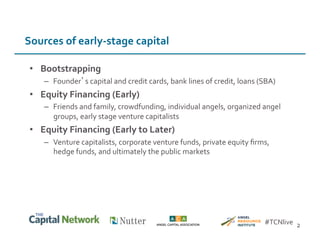
•  Bootstrapping	
  
–  Founder’s	
  capital	
  and	
  credit	
  cards,	
  bank	
  lines	
  of	
  credit,	
  loans	
  (SBA)	
  
•  Equity	
  Financing	
  (Early)	
  
–  Friends	
  and	
  family,	
  crowdfunding,	
  individual	
  angels,	
  organized	
  angel	
  
groups,	
  early	
  stage	
  venture	
  capitalists	
  
•  Equity	
  Financing	
  (Early	
  to	
  Later)	
  
–  Venture	
  capitalists,	
  corporate	
  venture	
  funds,	
  private	
  equity	
  firms,	
  
hedge	
  funds,	
  and	
  ultimately	
  the	
  public	
  markets	
  
2	
  #TCNlive	
  
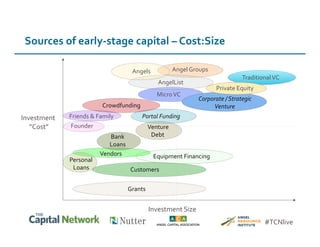
Investment	
  Size	
  
Investment	
  
“Cost”	
  
Traditional	
  VC	
  
Micro	
  VC	
  
Equipment	
  Financing	
  
Angel	
  Groups	
  Angels	
  
AngelList	
  
Corporate	
  /	
  Strategic	
  
Venture	
  
Customers	
  
Portal	
  Funding	
  
Vendors	
  
Founder	
  
Friends	
  &	
  Family	
  
Crowdfunding	
  
Grants	
  
Venture	
  
Debt	
  Bank	
  
Loans	
  
Personal	
  
Loans	
  
Private	
  Equity	
  
Sources	
  of	
  early-­‐stage	
  capital	
  –	
  Cost:Size	
  
#TCNlive	
  
Avoid	
  the	
  “Capital	
  Gap”	
  
Stage	

 Pre-­‐
Seed	

Seed	
  
Start-­‐Up	

$500,000	
  to	
  
$2,500,000	

Early	

 Later	

Source	

 Founders,	
  
Friends	
  
and	
  Family	

Individual	
  
Angels,	
  
MicroCaps	
  
Accelerators	
  
Venture	
  Funds	

Investment	
  	

 $25,000	
  to	
  
$100,000	

$100,000	
  to	
  
$500,000	
  	

$5,000,000	
  and	
  up	
  
(initial	
  capital	
  may	
  be	
  smaller,	
  
but	
  exit	
  targets	
  higher)	

Market	
  Entry	

	
  Micro	
  Cap	
  VCs,	
  
Angel	
  Groups	
  and	
  
Angel	
  Group	
  
Syndication	

4	
  
Mind	
  the	
  Gap	
  !	
  
#TCNlive	
  
•  Common	
  Equity	
  
–  Typical	
  for	
  Founders	
  
–  Not	
  typical	
  for	
  new,	
  sophisticated	
  investors	
  
–  Restricted	
  stock	
  and	
  Options	
  
•  Debt	
  and	
  Convertible	
  Notes	
  
–  Often	
  used	
  by	
  early	
  stage	
  companies	
  to	
  avoid	
  valuation	
  
–  Not	
  the	
  best	
  mechanism	
  for	
  aligning	
  Founders	
  and	
  investors	
  
•  Preferred	
  Equity	
  	
  
–  Primary	
  mechanism	
  for	
  sophisticated	
  angels,	
  angel	
  groups	
  and	
  VCs	
  
5	
  
Equity	
  Investment	
  Vehicles	
  
Pre-­‐money	
   	
  $	
  	
  	
  1,500,000	
  	
   	
  $	
  2,000,000	
  	
   	
  $	
  	
  2,250,000	
  	
   	
  $	


  2,500,000	
  	
   	
  $	


  2,750,000	
  	
   	
  $	


  3,000,000	
  	
   	
  $	


  3,250,000	
  	
   	
  $	


  3,500,000	
  	
  
Note	
   	
  $	


  610,717	
  	
   	
  $	


  610,717	
  	
   	
  $	
  610,717	
  	
   	
  $	


  610,717	
  	
   	
  $	


  610,717	
  	
   	
  $	


  610,717	
  	
   	
  $	


  610,717	
  	
   	
  $	


  610,717	
  	
  
Series	
  A	
   	
  $	
  1,500,000	
  	
   	
  $	
  1,500,000	
  	
   	
  $	
  	
  1,500,000	
  	
   	
  $	


  1,500,000	
  	
   	
  $	


  1,500,000	
  	
   	
  $	


  1,500,000	
  	
   	
  $	


  1,500,000	
  	
   	
  $	


  1,500,000	
  	
  
Option	
  Pool	
  
(8.25%)	
   	
  $	
  	
  	
  297,884	
  	
   	
  $	
  	
  	
  339,134	
  	
   	
  $359,759	
  	
   	
  $	


  380,384	
  	
   	
  $	


  401,009	
  	
   	
  $	


  421,634	
  	
   	
  $	


  442,259	
  	
   	
  $	


  462,884	
  	
  
Post-­‐money	
   	
  $	
  3,908,601	
  	
   	
  $	
  4,449,851	
  	
   	
  $	
  	
  4,720,476	
  	
   	
  $	


  4,991,101	
  	
   	
  $	
  	
  5,261,726	
  	
   	
  $	
  	
  5,532,351	
  	
   	
  $	
  	
  5,802,976	
  	
   	
  $	
  	
  6,073,601	
  	
  
Investor	
  
Ownership	
   54%	
   47%	
   45%	
   42%	
   40%	
   38%	
   36%	
   35%	
  
Management	
  
Ownership	
   46%	
   53%	
   55%	
   58%	
   60%	
   62%	
   64%	
   65%	
  
6	
  
Dilution	
  	
  -­‐	
  Valuation’s	
  relationship	
  to	
  Ownership	
  
Capital	
  Needs	
  
Time	
  
High	
  Risk	
  
Low	
  	
  
Risk	
  
Crystallize	
  
Ideas	
  
Demonstrate	
  
Product	
  
Early	
  Scaling	
  
Growth	
  
Sustained	
  
Growth	
  
Market	
  Entry	
  
•  Raising	
  money	
  takes	
  place	
  over	
  and	
  over	
  
again	
  because	
  different	
  lenders	
  and	
  
investors	
  match	
  the	
  current	
  capital	
  
amounts	
  and	
  risk	
  profile	
  
Risk	
  vs.	
  Return	
  
#TCNlive	
  
•  Understand	
  the	
  capital	
  needed	
  today,	
  and	
  the	
  total	
  capital	
  
needed	
  to	
  get	
  to	
  milestones	
  (e.g.	
  exit!)	
  
–  Type	
  of	
  business	
  (e.g.	
  SaaS,	
  Medical	
  Equipment)?	
  
–  Cost	
  of	
  getting	
  to	
  market?	
  
–  Cost	
  of	
  ramping	
  and	
  running	
  the	
  business?	
  
•  Compensate	
  the	
  management	
  for	
  getting	
  to	
  this	
  point	
  
–  What	
  do	
  they	
  need	
  for	
  future	
  motivation?	
  
–  How	
  many	
  more	
  senior	
  people	
  will	
  be	
  hired	
  w/	
  options?	
  
•  Look	
  at	
  comparable	
  exits	
  to	
  understand	
  likely	
  exit	
  multiple	
  
–  Don’t	
  forget	
  to	
  account	
  for	
  invested	
  capital!	
  
•  Is	
  this	
  a	
  business	
  investors	
  can	
  afford	
  to	
  invest	
  in?	
  
8	
  
The	
  Long	
  View	
  –	
  Total	
  Capital	
  Requirements	
  
#TCNlive	
  
•  Valuation	
  Based	
  on	
  Measuring….	
  
–  Sales	
  (Multiple	
  of	
  revenue	
  –P/R)	
  
–  Net	
  Income	
  (P/E)	
  
–  Cash	
  Flow	
  (EBITDA	
  or	
  Free	
  Cash	
  Flow)	
  
–  Discounted	
  Cash	
  Flow	
  (DCF)	
  
–  Discounted	
  Future	
  Earnings	
  
–  Net	
  Worth	
  or	
  Book	
  Value	
  
–  Real	
  Options,	
  Black	
  Scholes,	
  etc.	
  
•  NONE	
  OF	
  THESE	
  APPLY	
  TO	
  STARTUPS!	
  
9	
  
Quantitative	
  Methods	
  –	
  Valuing	
  Mature	
  Companies	
  
#TCNlive	
  
Valuation	
  Issues	
  
•  Market	
  Test	
  &	
  the	
  Power	
  of	
  Auction:	
  Leverage	
  
•  Round	
  size	
  	
  
•  Source	
  (Angel,	
  VC,	
  Strategic	
  etc.)	
  
•  Total	
  Capital	
  Requirements	
  
•  Terms	
  vs.	
  Pre-­‐Money	
  Price	
  
•  Impact	
  of	
  Option	
  Plans	
  
•  Price	
  less	
  important	
  than	
  relationship	
  
•  Positioning	
  for	
  future	
  
•  Impact	
  of	
  Convertible	
  Debt	
  from	
  F&F	
  
•  On	
  the	
  “Promise”	
  or	
  the	
  “Numbers”	
  but	
  not	
  both!	
  
Qualitative	
  &	
  Quantitative	
  Factors	
  
•  COMPARABLES	
  
–  Valuation	
  of	
  deals	
  recently	
  
completed	
  	
  in	
  a	
  similar	
  space	
  
•  KEY	
  ASSETS	
  OF	
  THE	
  
COMPANY	
  	
  
–  Management:	
  Commitment	
  	
  
Knowledge	
  &	
  Experience	
  	
  
–  Intellectual	
  Property	
  &	
  
Defensibility	
  
–  Financials	
  &	
  Time	
  to	
  Profit	
  
–  Milestones	
  Achieved	
  
–  Revenue	
  
–  Customers	
  and	
  Feedback	
  
–  Barriers	
  to	
  Entry	
  
•  FINANCING	
  HISTORY	
  /	
  NEEDS	
  
–  Funding	
  to	
  Date	
  
–  Future	
  Funding	
  Needs	
  
–  Last	
  Round	
  Post-­‐Money	
  Valuation	
  
–  When	
  was	
  last	
  round	
  completed	
  
–  Is	
  the	
  stock	
  option	
  pool	
  sufficient	
  
•  SIZE	
  AND	
  GROWTH	
  OF	
  
MARKET	
  
–  Current	
  Size	
  &	
  Targeted	
  Market	
  
•  NOT	
  the	
  Total	
  Available	
  Market	
  
–  Growth	
  -­‐	
  CAGR	
  
11	
  #TCNlive	
  
Early	
  Stage	
  Company	
  Valuation	
  Methodologies	
  
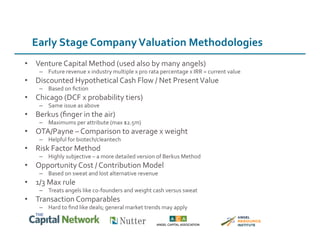
•  Venture	
  Capital	
  Method	
  (used	
  also	
  by	
  many	
  angels)	
  
–  Future	
  revenue	
  x	
  industry	
  multiple	
  x	
  pro	
  rata	
  percentage	
  x	
  IRR	
  =	
  current	
  value	
  
•  Discounted	
  Hypothetical	
  Cash	
  Flow	
  /	
  Net	
  Present	
  Value	
  
–  Based	
  on	
  fiction	
  
•  Chicago	
  (DCF	
  x	
  probability	
  tiers)	
  
–  Same	
  issue	
  as	
  above	
  
•  Berkus	
  (finger	
  in	
  the	
  air)	
  
–  Maximums	
  per	
  attribute	
  (max	
  $2.5m)	
  
•  OTA/Payne	
  –	
  Comparison	
  to	
  average	
  x	
  weight	
  
–  Helpful	
  for	
  biotech/cleantech	
  
•  Risk	
  Factor	
  Method	
  
–  Highly	
  subjective	
  –	
  a	
  more	
  detailed	
  version	
  of	
  Berkus	
  Method	
  
•  Opportunity	
  Cost	
  /	
  Contribution	
  Model	
  
–  Based	
  on	
  sweat	
  and	
  lost	
  alternative	
  revenue	
  
•  1/3	
  Max	
  rule	
  
–  Treats	
  angels	
  like	
  co-­‐founders	
  and	
  weight	
  cash	
  versus	
  sweat	
  
•  Transaction	
  Comparables	
  
–  Hard	
  to	
  find	
  like	
  deals;	
  general	
  market	
  trends	
  may	
  apply	
  
Investor-­‐Driven	
  Method	
  (aka	
  Venture	
  Math)	
  
•  VALUATION	
  -­‐	
  Investor	
  Requirements	
  
–  Return	
  rate	
  required	
  by	
  investor	
  (VC	
  driver)	
  
–  10X	
  to	
  20X	
  –	
  what	
  is	
  it?	
  
–  Time	
  Frame	
  –	
  3-­‐5-­‐7	
  years	
  
–  Any	
  initial	
  ownership	
  goals	
  
–  Valuation	
  can	
  be	
  determined	
  by	
  working	
  in	
  reverse	
  from	
  exit	
  
valuation	
  assuming	
  hypothetical	
  intervening	
  dilution	
  
•  VALUATION	
  -­‐	
  Investor	
  Internal	
  Dynamics	
  
–  What	
  you	
  can	
  sell	
  to	
  your	
  syndicate	
  partners	
  
–  Size	
  of	
  fund	
  and	
  time	
  since	
  fund	
  inception	
  
–  Minimum	
  Investment	
  =	
  meaningful	
  percentage?	
  
13	
  #TCNlive	
  
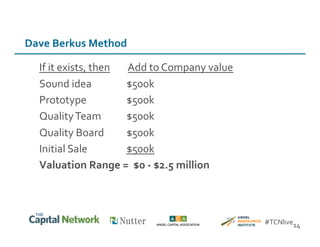
Dave	
  Berkus	
  Method	
  
If	
  it	
  exists,	
  then	


  Add	
  to	
  Company	
  value	
  
Sound	
  idea 	
   	
   	
  $500k	
  
Prototype 	
   	
   	
  $500k	
  
Quality	
  Team 	
   	
  $500k	
  
Quality	
  Board 	
   	
  $500k	
  
Initial	
  Sale 	
   	
   	
  $500k	
  
Valuation	
  Range	
  =	
  	
  $0	
  -­‐	
  $2.5	
  million	
  
14	
  #TCNlive	
  
Bill	
  Payne	
  Method	
  
Factor 	
  Weight 	


  Rating	
  (100%	
  basis) 	
  Comment	
  
Management 	
   	
  30	
   	
  125 	
   	
  On	
  board,	
  ex	
  sales	
  
Size	
  of	
  Opportunity 	
  25	
   	
  115 	
   	
  Could	
  be	
  huge	
  
Product/Service 	
   	
  10	
   	
  110 	
   	
  Disruptive	
  platform	
  
Sales	
  Channels 	
   	
  10	


  70 	
   	
  All	
  foreign	
  
Stage	
  of	
  Business 	
   	
  10	
   	
  125 	
   	
  Prototype	
  works	
  
Other 	
   	
  15	


  80 	
   	
  All	
  revs	
  outside	
  US	


  100%	
  
	
  Weighted	
  Average	
  Rating	
  =	
  1.0875	
  
	
  Pre-­‐revenue	
  Multiplier	
  =	
  $1.75	
  million	
  
	
  Valuation	
  =	
  1.0875	
  x	
  $1.75	
  million	
  =	
  $1,903,125	
  
15	
  #TCNlive	
  
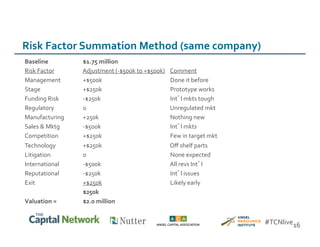
Risk	
  Factor	
  Summation	
  Method	
  (same	
  company)	
  
Baseline	
   	
  $1.75	
  million	
  	
  
Risk	
  Factor	


  Adjustment	
  (-­‐$500k	
  to	
  +$500k) 	
  Comment	


Management 	
  +$500k 	
  Done	
  it	
  before	
  
Stage 	
  +$250k 	
  Prototype	
  works	
  
Funding	
  Risk 	
  -­‐$250k 	
  Int’l	
  mkts	
  tough	
  
Regulatory 	
  0 	
  Unregulated	
  mkt	
  
Manufacturing 	
  +250k 	
  Nothing	
  new	
  
Sales	
  &	
  Mktg 	
  -­‐$500k 	
  Int’l	
  mkts	
  
Competition 	
  +$250k 	
  Few	
  in	
  target	
  mkt	
  
Technology 	
  +$250k 	
  Off	
  shelf	
  parts	
  
Litigation 	
  0 	
  None	
  expected	
  
International 	
  -­‐$500k 	
  All	
  revs	
  Int’l	
  
Reputational 	
  -­‐$250k 	
  Int’l	
  issues	
  
Exit	
   	
  +$250k 	
  Likely	
  early	


  $250k	
  	
  
Valuation	
  = 	
  $2.0	
  million	
  
16	
  #TCNlive	
  
Structure	
  to	
  allow	
  value	
  growth	
  over	
  time	
  
•  Underlying	
  Assumption	
  
–  All	
  business	
  is	
  a	
  risk	
  adjusted	
  cash	
  flow	
  
–  Structuring	
  a	
  deal	
  is	
  “guessing”	
  what	
  the	
  exit	
  valuation	
  will	
  be	
  
•  Valuation	
  is	
  a	
  “Black	
  Art”	
  	
  
–  Goal	
  is	
  to	
  quantify	
  a	
  qualitative	
  assessment,	
  and	
  then….	
  
–  Negotiate	
  the	
  deal	
  so	
  that	
  everyone	
  feels	
  just	
  a	
  bit	
  unhappy	
  
•  Setting	
  Deal	
  Structure	
  
–  MUST	
  understand	
  total	
  capital	
  requirements	
  and	
  likely	
  capital	
  sources	
  
–  Need	
  to	
  understand	
  option	
  pool	
  needs	
  	
  
–  Other	
  economic	
  terms	
  include:	
  liquidation	
  preference,	
  dividends,	
  anti-­‐
dilution	
  adjustment	
  and	
  vesting	
  of	
  founder’s	
  stock	
  and	
  option	
  pool	
  
GOAL: 	
  Founders,	
  Management,	
  Early	
  Investors	
  and	
  Later	
  Investors	
  all	
  
have	
  great	
  risk	
  adjusted	
  returns	
  
17	
  #TCNlive	
  
Angel	
  Round	
  Sizes	
  Remain	
  Steady	
  Over	
  Three-­‐Year	
  Period	
  
$0.00	
  
$0.50	
  
$1.00	
  
2011	
   2012	
   2013	
  
Median	
  Round	
  Size	
   Mean	
  Round	
  Size	
  
*Angel rounds include angels & angel groups only
$950K $857K
$931K
$610K $600K $600K
$M
•  Average	
  valuation	
  across	
  all	
  angel	
  deals	
  :	
  
$2.45million	
  	
  pre-­‐money	
  	
  
$350k	
  invested	
  
19	
  
Angel	
  Data	
  2013	
  
#TCNlive	
  
20	
  
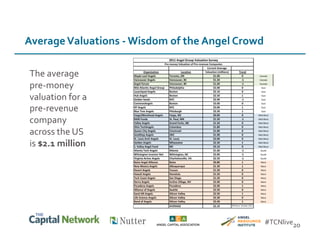
The	
  average	
  	
  
pre-­‐money	
  
valuation	
  for	
  a	
  	
  
pre-­‐revenue	
  
company	
  	
  
across	
  the	
  US	
  	
  
is	
  $2.1	
  million	
  
Average	
  Valuations	
  -­‐	
  Wisdom	
  of	
  the	
  Angel	
  Crowd	
  
#TCNlive	
  
TCN	
  FastTrack	
  
May	
  2014	
  
Valuing	
  an	
  Early	
  Stage	
  Company	
  
Jeremy	
  Halpern	
  
Nutter	
  McClennen	
  &	
  Fish	
  
@startupboston
jhalpern@nutter.com	
  
617.439.2943	
  
Paulina	
  Hill	
  
Polaris	
  Partners	
  
@paulinahill	
  
Christopher	
  Mirabile	
  
Launchpad	
  Venture	
  Group	
  
@cmirabile	
  

Company Valuation and Metrics – top down or bottom up?

  • 1.
    Jeremy  Halpern  @startupboston   Partner,  Nutter  McClennen  &  Fish   Paulina  Hill  @paulinahill   Polaris  Partners   Christopher  Mirabile  @cmirabile   Launchpad  Venture  Group   TCN  FastTrack  –  May  2014   Valuing  an  Early  Stage  Company   #TCNLive  
  • 2.
    Sources  of  early-­‐stage  capital   •  Bootstrapping   –  Founder’s  capital  and  credit  cards,  bank  lines  of  credit,  loans  (SBA)   •  Equity  Financing  (Early)   –  Friends  and  family,  crowdfunding,  individual  angels,  organized  angel   groups,  early  stage  venture  capitalists   •  Equity  Financing  (Early  to  Later)   –  Venture  capitalists,  corporate  venture  funds,  private  equity  firms,   hedge  funds,  and  ultimately  the  public  markets   2  #TCNlive  
  • 3.
    Investment  Size   Investment   “Cost”   Traditional  VC   Micro  VC   Equipment  Financing   Angel  Groups  Angels   AngelList   Corporate  /  Strategic   Venture   Customers   Portal  Funding   Vendors   Founder   Friends  &  Family   Crowdfunding   Grants   Venture   Debt  Bank   Loans   Personal   Loans   Private  Equity   Sources  of  early-­‐stage  capital  –  Cost:Size   #TCNlive  
  • 4.
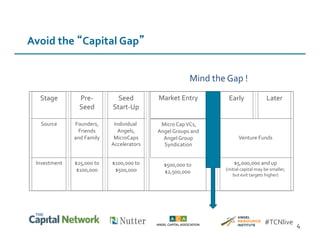
    Avoid  the  “Capital  Gap”   Stage Pre-­‐ Seed Seed   Start-­‐Up $500,000  to   $2,500,000 Early Later Source Founders,   Friends   and  Family Individual   Angels,   MicroCaps   Accelerators   Venture  Funds Investment   $25,000  to   $100,000 $100,000  to   $500,000   $5,000,000  and  up   (initial  capital  may  be  smaller,   but  exit  targets  higher) Market  Entry  Micro  Cap  VCs,   Angel  Groups  and   Angel  Group   Syndication 4   Mind  the  Gap  !   #TCNlive  
  • 5.
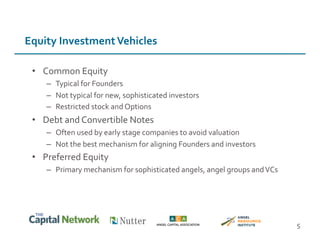
    •  Common  Equity   –  Typical  for  Founders   –  Not  typical  for  new,  sophisticated  investors   –  Restricted  stock  and  Options   •  Debt  and  Convertible  Notes   –  Often  used  by  early  stage  companies  to  avoid  valuation   –  Not  the  best  mechanism  for  aligning  Founders  and  investors   •  Preferred  Equity     –  Primary  mechanism  for  sophisticated  angels,  angel  groups  and  VCs   5   Equity  Investment  Vehicles  
  • 6.
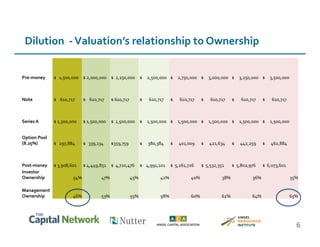
    Pre-­‐money    $      1,500,000      $  2,000,000      $    2,250,000      $          2,500,000      $          2,750,000      $          3,000,000      $          3,250,000      $          3,500,000     Note    $        610,717      $        610,717      $  610,717      $              610,717      $              610,717      $              610,717      $              610,717      $              610,717     Series  A    $  1,500,000      $  1,500,000      $    1,500,000      $          1,500,000      $          1,500,000      $          1,500,000      $          1,500,000      $          1,500,000     Option  Pool   (8.25%)    $      297,884      $      339,134      $359,759      $            380,384      $            401,009      $            421,634      $            442,259      $            462,884     Post-­‐money    $  3,908,601      $  4,449,851      $    4,720,476      $        4,991,101      $    5,261,726      $    5,532,351      $    5,802,976      $    6,073,601     Investor   Ownership   54%   47%   45%   42%   40%   38%   36%   35%   Management   Ownership   46%   53%   55%   58%   60%   62%   64%   65%   6   Dilution    -­‐  Valuation’s  relationship  to  Ownership  
  • 7.
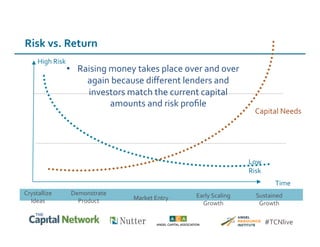
    Capital  Needs   Time   High  Risk   Low     Risk   Crystallize   Ideas   Demonstrate   Product   Early  Scaling   Growth   Sustained   Growth   Market  Entry   •  Raising  money  takes  place  over  and  over   again  because  different  lenders  and   investors  match  the  current  capital   amounts  and  risk  profile   Risk  vs.  Return   #TCNlive  
  • 8.
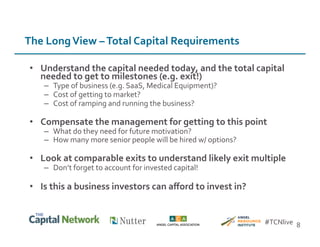
    •  Understand  the  capital  needed  today,  and  the  total  capital   needed  to  get  to  milestones  (e.g.  exit!)   –  Type  of  business  (e.g.  SaaS,  Medical  Equipment)?   –  Cost  of  getting  to  market?   –  Cost  of  ramping  and  running  the  business?   •  Compensate  the  management  for  getting  to  this  point   –  What  do  they  need  for  future  motivation?   –  How  many  more  senior  people  will  be  hired  w/  options?   •  Look  at  comparable  exits  to  understand  likely  exit  multiple   –  Don’t  forget  to  account  for  invested  capital!   •  Is  this  a  business  investors  can  afford  to  invest  in?   8   The  Long  View  –  Total  Capital  Requirements   #TCNlive  
  • 9.
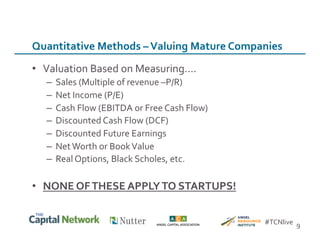
    •  Valuation  Based  on  Measuring….   –  Sales  (Multiple  of  revenue  –P/R)   –  Net  Income  (P/E)   –  Cash  Flow  (EBITDA  or  Free  Cash  Flow)   –  Discounted  Cash  Flow  (DCF)   –  Discounted  Future  Earnings   –  Net  Worth  or  Book  Value   –  Real  Options,  Black  Scholes,  etc.   •  NONE  OF  THESE  APPLY  TO  STARTUPS!   9   Quantitative  Methods  –  Valuing  Mature  Companies   #TCNlive  
  • 10.
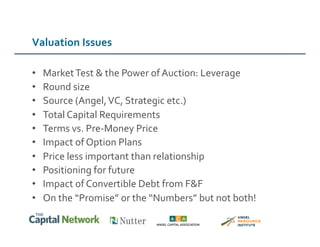
    Valuation  Issues   • Market  Test  &  the  Power  of  Auction:  Leverage   •  Round  size     •  Source  (Angel,  VC,  Strategic  etc.)   •  Total  Capital  Requirements   •  Terms  vs.  Pre-­‐Money  Price   •  Impact  of  Option  Plans   •  Price  less  important  than  relationship   •  Positioning  for  future   •  Impact  of  Convertible  Debt  from  F&F   •  On  the  “Promise”  or  the  “Numbers”  but  not  both!  
  • 11.
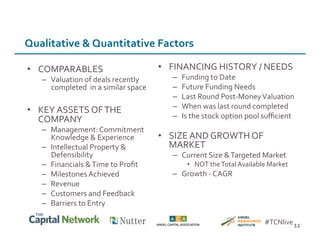
    Qualitative  &  Quantitative  Factors   •  COMPARABLES   –  Valuation  of  deals  recently   completed    in  a  similar  space   •  KEY  ASSETS  OF  THE   COMPANY     –  Management:  Commitment     Knowledge  &  Experience     –  Intellectual  Property  &   Defensibility   –  Financials  &  Time  to  Profit   –  Milestones  Achieved   –  Revenue   –  Customers  and  Feedback   –  Barriers  to  Entry   •  FINANCING  HISTORY  /  NEEDS   –  Funding  to  Date   –  Future  Funding  Needs   –  Last  Round  Post-­‐Money  Valuation   –  When  was  last  round  completed   –  Is  the  stock  option  pool  sufficient   •  SIZE  AND  GROWTH  OF   MARKET   –  Current  Size  &  Targeted  Market   •  NOT  the  Total  Available  Market   –  Growth  -­‐  CAGR   11  #TCNlive  
  • 12.
    Early  Stage  Company  Valuation  Methodologies   •  Venture  Capital  Method  (used  also  by  many  angels)   –  Future  revenue  x  industry  multiple  x  pro  rata  percentage  x  IRR  =  current  value   •  Discounted  Hypothetical  Cash  Flow  /  Net  Present  Value   –  Based  on  fiction   •  Chicago  (DCF  x  probability  tiers)   –  Same  issue  as  above   •  Berkus  (finger  in  the  air)   –  Maximums  per  attribute  (max  $2.5m)   •  OTA/Payne  –  Comparison  to  average  x  weight   –  Helpful  for  biotech/cleantech   •  Risk  Factor  Method   –  Highly  subjective  –  a  more  detailed  version  of  Berkus  Method   •  Opportunity  Cost  /  Contribution  Model   –  Based  on  sweat  and  lost  alternative  revenue   •  1/3  Max  rule   –  Treats  angels  like  co-­‐founders  and  weight  cash  versus  sweat   •  Transaction  Comparables   –  Hard  to  find  like  deals;  general  market  trends  may  apply  
  • 13.
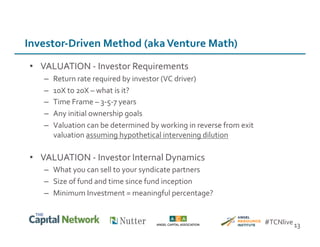
    Investor-­‐Driven  Method  (aka  Venture  Math)   •  VALUATION  -­‐  Investor  Requirements   –  Return  rate  required  by  investor  (VC  driver)   –  10X  to  20X  –  what  is  it?   –  Time  Frame  –  3-­‐5-­‐7  years   –  Any  initial  ownership  goals   –  Valuation  can  be  determined  by  working  in  reverse  from  exit   valuation  assuming  hypothetical  intervening  dilution   •  VALUATION  -­‐  Investor  Internal  Dynamics   –  What  you  can  sell  to  your  syndicate  partners   –  Size  of  fund  and  time  since  fund  inception   –  Minimum  Investment  =  meaningful  percentage?   13  #TCNlive  
  • 14.
    Dave  Berkus  Method   If  it  exists,  then                Add  to  Company  value   Sound  idea      $500k   Prototype      $500k   Quality  Team    $500k   Quality  Board    $500k   Initial  Sale      $500k   Valuation  Range  =    $0  -­‐  $2.5  million   14  #TCNlive  
  • 15.
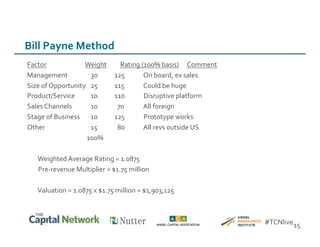
    Bill  Payne  Method   Factor  Weight          Rating  (100%  basis)  Comment   Management    30    125    On  board,  ex  sales   Size  of  Opportunity  25    115    Could  be  huge   Product/Service    10    110    Disruptive  platform   Sales  Channels    10        70    All  foreign   Stage  of  Business    10    125    Prototype  works   Other    15        80    All  revs  outside  US        100%    Weighted  Average  Rating  =  1.0875    Pre-­‐revenue  Multiplier  =  $1.75  million    Valuation  =  1.0875  x  $1.75  million  =  $1,903,125   15  #TCNlive  
  • 16.
    Risk  Factor  Summation  Method  (same  company)   Baseline    $1.75  million     Risk  Factor              Adjustment  (-­‐$500k  to  +$500k)  Comment         Management  +$500k  Done  it  before   Stage  +$250k  Prototype  works   Funding  Risk  -­‐$250k  Int’l  mkts  tough   Regulatory  0  Unregulated  mkt   Manufacturing  +250k  Nothing  new   Sales  &  Mktg  -­‐$500k  Int’l  mkts   Competition  +$250k  Few  in  target  mkt   Technology  +$250k  Off  shelf  parts   Litigation  0  None  expected   International  -­‐$500k  All  revs  Int’l   Reputational  -­‐$250k  Int’l  issues   Exit    +$250k  Likely  early          $250k     Valuation  =  $2.0  million   16  #TCNlive  
  • 17.
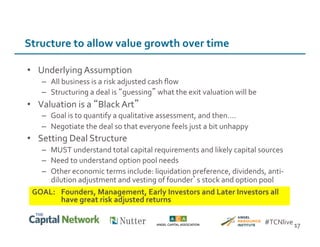
    Structure  to  allow  value  growth  over  time   •  Underlying  Assumption   –  All  business  is  a  risk  adjusted  cash  flow   –  Structuring  a  deal  is  “guessing”  what  the  exit  valuation  will  be   •  Valuation  is  a  “Black  Art”     –  Goal  is  to  quantify  a  qualitative  assessment,  and  then….   –  Negotiate  the  deal  so  that  everyone  feels  just  a  bit  unhappy   •  Setting  Deal  Structure   –  MUST  understand  total  capital  requirements  and  likely  capital  sources   –  Need  to  understand  option  pool  needs     –  Other  economic  terms  include:  liquidation  preference,  dividends,  anti-­‐ dilution  adjustment  and  vesting  of  founder’s  stock  and  option  pool   GOAL:  Founders,  Management,  Early  Investors  and  Later  Investors  all   have  great  risk  adjusted  returns   17  #TCNlive  
  • 18.
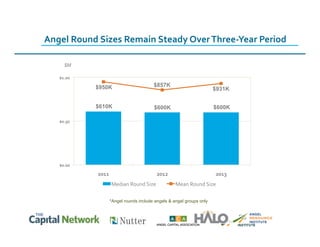
    Angel  Round  Sizes  Remain  Steady  Over  Three-­‐Year  Period   $0.00   $0.50   $1.00   2011   2012   2013   Median  Round  Size   Mean  Round  Size   *Angel rounds include angels & angel groups only $950K $857K $931K $610K $600K $600K $M
  • 19.
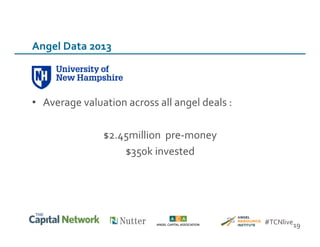
    •  Average  valuation  across  all  angel  deals  :   $2.45million    pre-­‐money     $350k  invested   19   Angel  Data  2013   #TCNlive  
  • 20.
    20   The  average     pre-­‐money   valuation  for  a     pre-­‐revenue   company     across  the  US     is  $2.1  million   Average  Valuations  -­‐  Wisdom  of  the  Angel  Crowd   #TCNlive  
  • 21.
    TCN  FastTrack   May  2014   Valuing  an  Early  Stage  Company   Jeremy  Halpern   Nutter  McClennen  &  Fish   @startupboston jhalpern@nutter.com   617.439.2943   Paulina  Hill   Polaris  Partners   @paulinahill   Christopher  Mirabile   Launchpad  Venture  Group   @cmirabile