














Tecnologie e Startup: ICT è solo una
commodity?
PhD in Computer Engineering at
Politecnico of Milano
CEO of FifthIngenium
Speaker
Consultant
Intel Software Innovator for RealSense
Microsoft Most Valuable Professionist for Kinect
mvaloriani@gmail.com
@MatteoValoriani
Agenda
IT Doesn’t Matter - Nicholas Carr (2000)
l’IT (Information Technology) è una commodity e come tale non costituisce
un elemento differenziante o una leva strategica di sviluppo.
Ciò che conta sarebbero, per esempio, i modelli di business e organizzativi,
il marketing, le strategie distributive.
Emerging technologies & trends
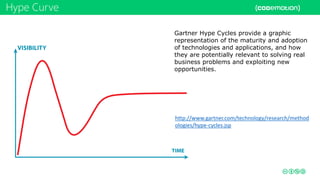
Hype Curve
Gartner Hype Cycles provide a graphic
representation of the maturity and adoption
of technologies and applications, and how
they are potentially relevant to solving real
business problems and exploiting new
opportunities.
http://www.gartner.com/technology/research/method
ologies/hype-cycles.jsp
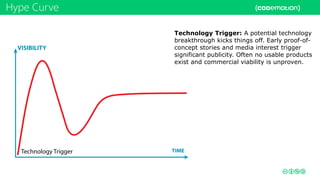
Hype Curve
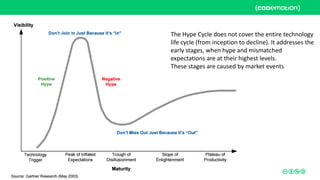
Technology Trigger: A potential technology
breakthrough kicks things off. Early proof-of-
concept stories and media interest trigger
significant publicity. Often no usable products
exist and commercial viability is unproven.
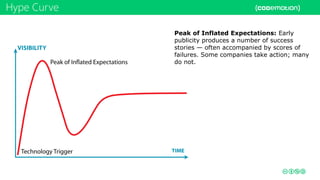
Hype Curve
Peak of Inflated Expectations: Early
publicity produces a number of success
stories — often accompanied by scores of
failures. Some companies take action; many
do not.
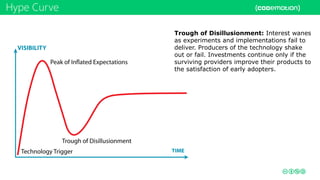
Hype Curve
Trough of Disillusionment: Interest wanes
as experiments and implementations fail to
deliver. Producers of the technology shake
out or fail. Investments continue only if the
surviving providers improve their products to
the satisfaction of early adopters.
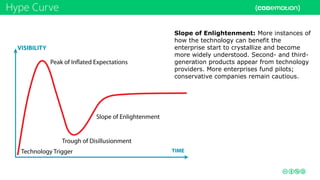
Hype Curve
Slope of Enlightenment: More instances of
how the technology can benefit the
enterprise start to crystallize and become
more widely understood. Second- and third-
generation products appear from technology
providers. More enterprises fund pilots;
conservative companies remain cautious.
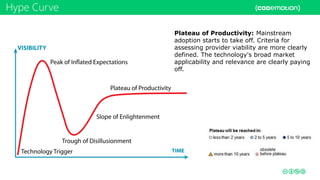
Hype Curve
Plateau of Productivity: Mainstream
adoption starts to take off. Criteria for
assessing provider viability are more clearly
defined. The technology's broad market
applicability and relevance are clearly paying
off.
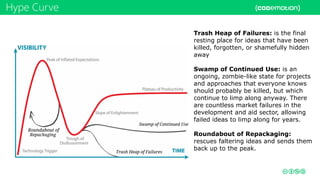
Hype Curve
Trash Heap of Failures: is the final
resting place for ideas that have been
killed, forgotten, or shamefully hidden
away
Swamp of Continued Use: is an
ongoing, zombie-like state for projects
and approaches that everyone knows
should probably be killed, but which
continue to limp along anyway. There
are countless market failures in the
development and aid sector, allowing
failed ideas to limp along for years.
Roundabout of Repackaging:
rescues faltering ideas and sends them
back up to the peak.
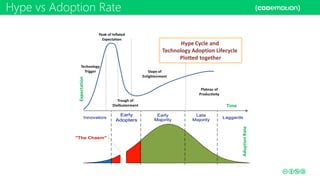
Hype vs Adoption Rate
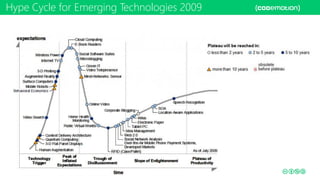
Hype Cycle for Emerging Technologies 2009
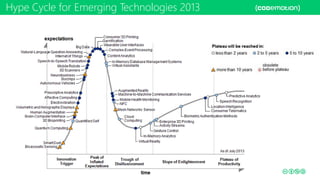
Hype Cycle for Emerging Technologies 2013
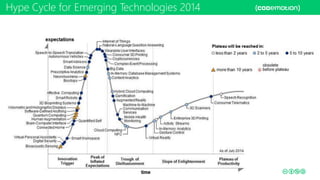
Hype Cycle for Emerging Technologies 2014
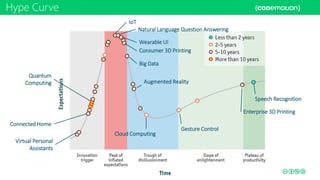
Hype Curve
Speech Recognition
Gesture Control
Cloud Computing
Augmented Reality
Big Data
Consumer 3D Printing
Wearable UI
IoT
Natural Language Question Answering
Connected Home
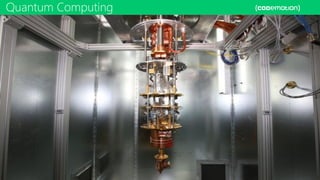
Quantum
Computing
Enterprise 3D Printing
Virtual Personal
Assistants
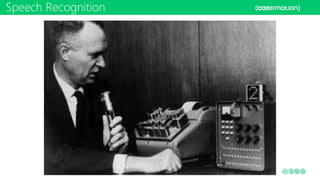
Speech Recognition
Gesture Control
Cloud Computing
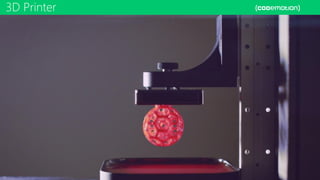
3D Printer
Augmented Reality
Wearable UI
Natural Language Question Answering
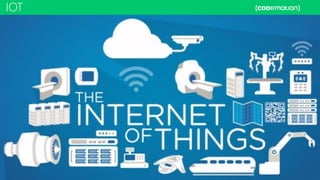
IOT
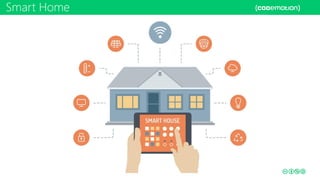
Smart Home
Quantum Computing
Her
Technology Strategy
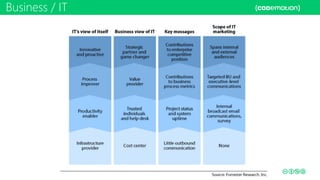
Business / IT
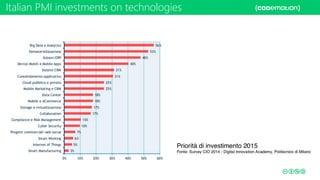
Italian PMI investments on technologies
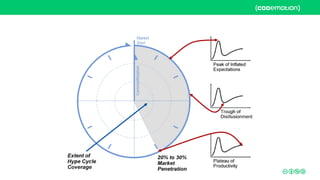
The Hype Cycle does not cover the entire technology
life cycle (from inception to decline). It addresses the
early stages, when hype and mismatched
expectations are at their highest levels.
These stages are caused by market events
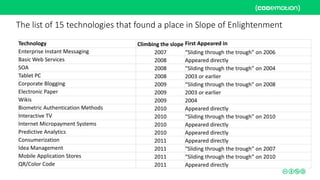
Technology Climbing the slope First Appeared in
Enterprise Instant Messaging 2007 “Sliding through the trough” on 2006
Basic Web Services 2008 Appeared directly
SOA 2008 “Sliding through the trough” on 2004
Tablet PC 2008 2003 or earlier
Corporate Blogging 2009 “Sliding through the trough” on 2008
Electronic Paper 2009 2003 or earlier
Wikis 2009 2004
Biometric Authentication Methods 2010 Appeared directly
Interactive TV 2010 “Sliding through the trough” on 2010
Internet Micropayment Systems 2010 Appeared directly
Predictive Analytics 2010 Appeared directly
Consumerization 2011 Appeared directly
Idea Management 2011 “Sliding through the trough” on 2007
Mobile Application Stores 2011 “Sliding through the trough” on 2010
QR/Color Code 2011 Appeared directly
The list of 15 technologies that found a place in Slope of Enlightenment
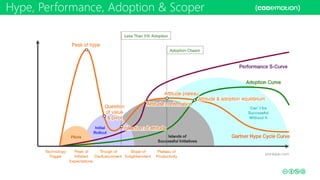
Hype, Performance, Adoption & Scoper
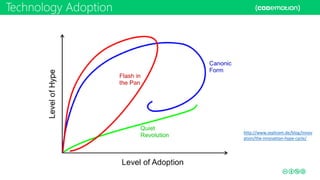
Technology Adoption
http://www.zephram.de/blog/innov
ation/the-innovation-hype-cycle/
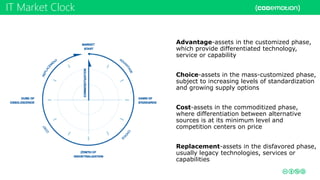
IT Market Clock
Advantage-assets in the customized phase,
which provide differentiated technology,
service or capability
Choice-assets in the mass-customized phase,
subject to increasing levels of standardization
and growing supply options
Cost-assets in the commoditized phase,
where differentiation between alternative
sources is at its minimum level and
competition centers on price
Replacement-assets in the disfavored phase,
usually legacy technologies, services or
capabilities
Why?
Technological limits and missing of flexibility
Gap between business goal IT delivery
76+% maintenance, 20% innovation
Broken promises
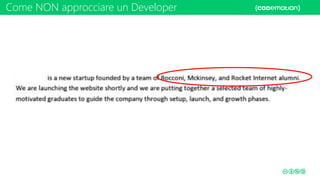
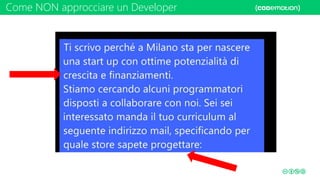
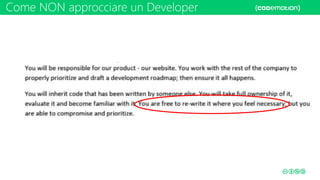
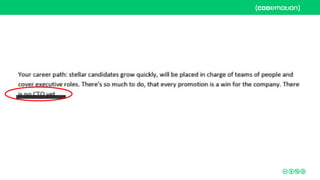
Come non approcciare un DEV
Come NON approcciare un Developer
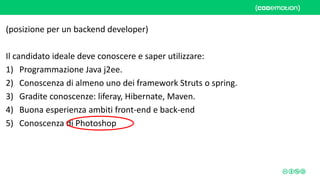
(posizione per un backend developer)
Il candidato ideale deve conoscere e saper utilizzare:
1) Programmazione Java j2ee.
2) Conoscenza di almeno uno dei framework Struts o spring.
3) Gradite conoscenze: liferay, Hibernate, Maven.
4) Buona esperienza ambiti front-end e back-end
5) Conoscenza di Photoshop
Conclusions
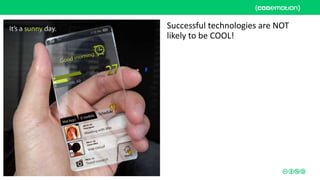
Successful technologies are NOT
likely to be COOL!
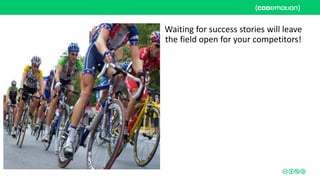
Waiting for success stories will leave
the field open for your competitors!
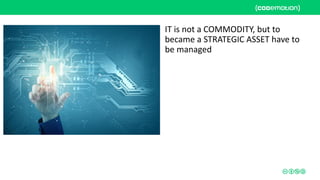
IT is not a COMMODITY, but to
became a STRATEGIC ASSET have to
be managed
If you aren’t a developer, find a good
CTO
If you are a developer, find a startup
were IT is a strategic asset
La conoscenza e la capacità di dominare le tecnologia
sono condizioni necessarie ancorché non sufficienti: le
tecnologie di per se stesse non risolvono i problemi, ma
sono l’elemento abilitante essenziale per perseguirne la
risoluzione.
A.Fugetta
• https://medium.com/italia/perche-servono-le-competenze-tecnologiche-
del-saper-fare-94507b7c600b
• https://hbr.org/2003/05/it-doesnt-matter
• http://www.alfonsofuggetta.org/wordpress/wp-
content/uploads/2014/08/VademecumInnovazione.pdf
• http://www.techeconomy.it/2015/02/02/perche-servono-competenze-
tecnologiche-saper/
• Mastering the Hype Cycle: How to Choose the Right Innovation at the
Right Time, By Jackie Fenn, Mark Raskino

Tecnologie e Startup: ICT è solo una commodity? - Matteo Valoriani - Codemotion Rome 2015

  • 1.
    Tecnologie e Startup:ICT è solo una commodity?
  • 2.
    PhD in ComputerEngineering at Politecnico of Milano CEO of FifthIngenium Speaker Consultant Intel Software Innovator for RealSense Microsoft Most Valuable Professionist for Kinect mvaloriani@gmail.com @MatteoValoriani
  • 3.
  • 5.
    IT Doesn’t Matter- Nicholas Carr (2000) l’IT (Information Technology) è una commodity e come tale non costituisce un elemento differenziante o una leva strategica di sviluppo. Ciò che conta sarebbero, per esempio, i modelli di business e organizzativi, il marketing, le strategie distributive.
  • 7.
  • 8.
    Hype Curve Gartner HypeCycles provide a graphic representation of the maturity and adoption of technologies and applications, and how they are potentially relevant to solving real business problems and exploiting new opportunities. http://www.gartner.com/technology/research/method ologies/hype-cycles.jsp
  • 9.
    Hype Curve Technology Trigger:A potential technology breakthrough kicks things off. Early proof-of- concept stories and media interest trigger significant publicity. Often no usable products exist and commercial viability is unproven.
  • 10.
    Hype Curve Peak ofInflated Expectations: Early publicity produces a number of success stories — often accompanied by scores of failures. Some companies take action; many do not.
  • 11.
    Hype Curve Trough ofDisillusionment: Interest wanes as experiments and implementations fail to deliver. Producers of the technology shake out or fail. Investments continue only if the surviving providers improve their products to the satisfaction of early adopters.
  • 12.
    Hype Curve Slope ofEnlightenment: More instances of how the technology can benefit the enterprise start to crystallize and become more widely understood. Second- and third- generation products appear from technology providers. More enterprises fund pilots; conservative companies remain cautious.
  • 13.
    Hype Curve Plateau ofProductivity: Mainstream adoption starts to take off. Criteria for assessing provider viability are more clearly defined. The technology's broad market applicability and relevance are clearly paying off.
  • 14.
    Hype Curve Trash Heapof Failures: is the final resting place for ideas that have been killed, forgotten, or shamefully hidden away Swamp of Continued Use: is an ongoing, zombie-like state for projects and approaches that everyone knows should probably be killed, but which continue to limp along anyway. There are countless market failures in the development and aid sector, allowing failed ideas to limp along for years. Roundabout of Repackaging: rescues faltering ideas and sends them back up to the peak.
  • 15.
  • 16.
    Hype Cycle forEmerging Technologies 2009
  • 17.
    Hype Cycle forEmerging Technologies 2013
  • 18.
    Hype Cycle forEmerging Technologies 2014
  • 19.
    Hype Curve Speech Recognition GestureControl Cloud Computing Augmented Reality Big Data Consumer 3D Printing Wearable UI IoT Natural Language Question Answering Connected Home Quantum Computing Enterprise 3D Printing Virtual Personal Assistants
  • 20.
  • 21.
  • 22.
  • 23.
  • 24.
  • 26.
  • 27.
  • 28.
  • 29.
  • 30.
  • 31.
  • 32.
  • 33.
  • 34.
    Italian PMI investmentson technologies
  • 35.
    The Hype Cycledoes not cover the entire technology life cycle (from inception to decline). It addresses the early stages, when hype and mismatched expectations are at their highest levels. These stages are caused by market events
  • 36.
    Technology Climbing theslope First Appeared in Enterprise Instant Messaging 2007 “Sliding through the trough” on 2006 Basic Web Services 2008 Appeared directly SOA 2008 “Sliding through the trough” on 2004 Tablet PC 2008 2003 or earlier Corporate Blogging 2009 “Sliding through the trough” on 2008 Electronic Paper 2009 2003 or earlier Wikis 2009 2004 Biometric Authentication Methods 2010 Appeared directly Interactive TV 2010 “Sliding through the trough” on 2010 Internet Micropayment Systems 2010 Appeared directly Predictive Analytics 2010 Appeared directly Consumerization 2011 Appeared directly Idea Management 2011 “Sliding through the trough” on 2007 Mobile Application Stores 2011 “Sliding through the trough” on 2010 QR/Color Code 2011 Appeared directly The list of 15 technologies that found a place in Slope of Enlightenment
  • 37.
  • 38.
  • 39.
    IT Market Clock Advantage-assetsin the customized phase, which provide differentiated technology, service or capability Choice-assets in the mass-customized phase, subject to increasing levels of standardization and growing supply options Cost-assets in the commoditized phase, where differentiation between alternative sources is at its minimum level and competition centers on price Replacement-assets in the disfavored phase, usually legacy technologies, services or capabilities
  • 42.
    Why? Technological limits andmissing of flexibility Gap between business goal IT delivery 76+% maintenance, 20% innovation Broken promises
  • 46.
  • 47.
  • 48.
  • 49.
  • 51.
    (posizione per unbackend developer) Il candidato ideale deve conoscere e saper utilizzare: 1) Programmazione Java j2ee. 2) Conoscenza di almeno uno dei framework Struts o spring. 3) Gradite conoscenze: liferay, Hibernate, Maven. 4) Buona esperienza ambiti front-end e back-end 5) Conoscenza di Photoshop
  • 52.
  • 53.
    Successful technologies areNOT likely to be COOL!
  • 54.
    Waiting for successstories will leave the field open for your competitors!
  • 55.
    IT is nota COMMODITY, but to became a STRATEGIC ASSET have to be managed
  • 56.
    If you aren’ta developer, find a good CTO If you are a developer, find a startup were IT is a strategic asset
  • 57.
    La conoscenza ela capacità di dominare le tecnologia sono condizioni necessarie ancorché non sufficienti: le tecnologie di per se stesse non risolvono i problemi, ma sono l’elemento abilitante essenziale per perseguirne la risoluzione. A.Fugetta
  • 58.
    • https://medium.com/italia/perche-servono-le-competenze-tecnologiche- del-saper-fare-94507b7c600b • https://hbr.org/2003/05/it-doesnt-matter •http://www.alfonsofuggetta.org/wordpress/wp- content/uploads/2014/08/VademecumInnovazione.pdf • http://www.techeconomy.it/2015/02/02/perche-servono-competenze- tecnologiche-saper/ • Mastering the Hype Cycle: How to Choose the Right Innovation at the Right Time, By Jackie Fenn, Mark Raskino