Instrument Qualification
Mohammed Shafikur Rahman, PhD
Assistant Professor
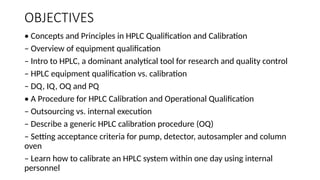
OBJECTIVES
• Concepts and Principles in HPLC Qualification and Calibration
– Overview of equipment qualification
– Intro to HPLC, a dominant analytical tool for research and quality control
– HPLC equipment qualification vs. calibration
– DQ, IQ, OQ and PQ
• A Procedure for HPLC Calibration and Operational Qualification
– Outsourcing vs. internal execution
– Describe a generic HPLC calibration procedure (OQ)
– Setting acceptance criteria for pump, detector, autosampler and column
oven
– Learn how to calibrate an HPLC system within one day using internal
personnel
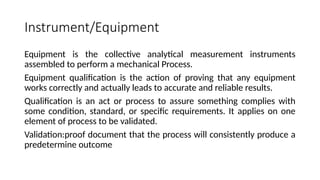
Instrument/Equipment
Equipment is the collective analytical measurement instruments
assembled to perform a mechanical Process.
Equipment qualification is the action of proving that any equipment
works correctly and actually leads to accurate and reliable results.
Qualification is an act or process to assure something complies with
some condition, standard, or specific requirements. It applies on one
element of process to be validated.
Validation:proof document that the process will consistently produce a
predetermine outcome
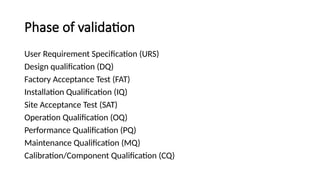
Phase of validation
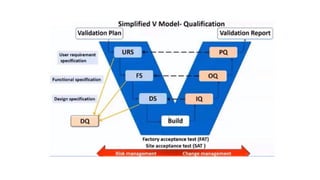
User Requirement Specification (URS)
Design qualification (DQ)
Factory Acceptance Test (FAT)
Installation Qualification (IQ)
Site Acceptance Test (SAT)
Operation Qualification (OQ)
Performance Qualification (PQ)
Maintenance Qualification (MQ)
Calibration/Component Qualification (CQ)
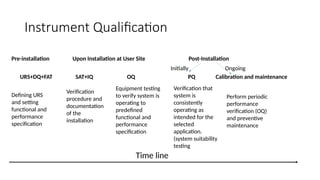
Instrument Qualification
Time line
Pre-installation Upon Installation at User Site Post-Installation
URS+DQ+FAT SAT+IQ OQ PQ Calibration and maintenance
Defining URS
and setting
functional and
performance
specification
Verification
procedure and
documentation
of the
installation
Equipment testing
to verify system is
operating to
predefined
functional and
performance
specification
Perform periodic
performance
verification (OQ)
and preventive
maintenance
Verification that
system is
consistently
operating as
intended for the
selected
application.
(system suitability
testing
Initially Ongoing
URS
User Requirements Specification (URS), is the most critical of
documents and yet, the most often bungled. Whether the system is
purely mechanical, or a mix of electro-mechanical, or solely a software
program, the successful compilation and execution of the Installation
Qualification (IQ) (for installation), Operational Qualification (OQ) (for
functionality) and the Performance / Product Qualification (PQ) (for
operability), is dependent on an User Requirements Specification (URS)
containing clear, concise and testable requirements.
URS cont…
The following guidelines should be followed during the production of
the URS :
1. Each requirement statement to be uniquely referenced,and no
longer than 250 words.
2. Requirement statements should not be duplicated nor contradicted.
3. The URS should express requirements and not design solutions.
4. Each requirement should be testable.
URS cont…
5. The URS must be understood by both user and supplier; ambiguity
and jargon should be avoided.
6. The use of diagrams is often useful.
7. The scope for readers to make assumptions or misinterpret should
be minimized.
8. Wherever possible, the URS should distinguish between
mandatory/regulatory requirements and desirable features.
Validation vs Qualification
Validation:
Refers to the total life cycle of a product from development through use
and maintenance. Owners are responsible for Validating Their

Processes (personnel, equipment, methods, SOPs) to ensure
compliance to cGMP/GLP regulations.
Qualification: (Inspection, functional testing and documentation
review)
Is a part of the validation process which verifies module and system
functional performance prior to being placed on-line and thereafter
according to a standard operating procedure.
Equipment Qualification
It is a basic requirement of good analytical chemistry that balances and
other analytical instruments must be suitable for the purpose for which
they are used and that they must be appropriately calibrated. As a
consequence, Equipment Qualification is gaining more and more
importance in ensuring the validity of results. Regulatory bodies also
seem to be turning their attention increasingly to this area, and
manufacturers of analytical equipment are forced to play a significant
role in the various steps of Equipment
5 steps of Equipment Qualification
Step 1: Design Qualification (DQ) defines the functional and operational
specifications of a balance or instrument.
Step 2: Installation Qualification (IQ) ensures that a balance or instrument is
received as designed and specified. It documents the installation in the selected
user environment.
Step 3: Operational Qualification (OQ) demonstrates that a balance or instrument
will function according to its operational specification in the selected environment.
Step 4: Performance Qualification (PQ) demonstrates that a balance or instrument
consistently performs according to a specification appropriate to its routine use.
Step 5: Maintenance Qualification (MQ) describes and documents any
maintenance required on the equipment.
DQ and vendor qualification
As part of the design qualification process, the vendor should be
qualified; there may be situations where a vendor audit is
recommended.
IQ includes
• A procedure designed to establish that the instrument is installed and
configured according to the requirements established by the instrument
manufacturer.
• Instrument functional description
– Specific instrument ID (i.e. serial number), location
– Software / firmware revision
– Verification of certificates and manuals • Installation/configuration procedures
– Site compatibility
– Electrical, fluidic, communication connections • User approval of IQ completion
– With signature and date
OQ typically includes
• A procedure designed to establish that the system is functioning
according to manufacturer specifications throughout its intended
operating range.
• Functional qualification procedure
– Power-up initialization and diagnostic for each LC component
• Acceptance criteria
• User’s approval of OQ completion
-with signature and date
What is PQ?
• A procedure designed to establish that the overall system is
performing as intended with actual use.
– If electronic data is stored via a computer network, network access
should be verified as part of the performance qualification.
• PQ protocols are developed by the user, though generic procedures
using test mixtures might be adequate
• Typically, PQ involves performing system suitability test.
– Check precision, peak resolution, tailing factor, etc
Maintenance Qualification
The MQ describes and documents any maintenance required on the
equipment. This includes routine servicing and any repairs necessary.
Details of any maintenance contracts are also documented in this
section, together with a list of authorized service engineers. In addition,
the MQ includes the routine cleaning of the equipment and also its
ultimate disposal.
Component Qualification/Calibration
Component qualification (CQ) – is a relatively new term developed in
2005. This term refers to the manufacturing of auxiliary components to
ensure that they are manufactured to the correct design criteria. This
could include packaging components such as folding cartons, shipping
cases, labels or even phase change material. All of these components
must have some type of random inspection to ensure that the third
party manufacturer's process is consistently producing components
that are used in the world of GMP at drug or biologic manufacture.
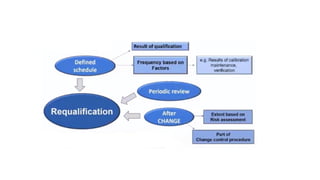
Instrument re-qualification
Instrument Validation should not be viewed as a one-off event –
confidence in analytical results is required for the whole of the
instrument’s working life. To ensure that this confidence is retained,

the instrument validation process should be repeated at regular
intervals during the instruments operational life. The difference

between Installation Validation and Re Qualification is that IQ is
omitted for the Re-Qualification Re-Qualification should be

performed at least annually and should be performed more frequently
for applications whose test results have critical im

2024 Instrument Qualification_latest.pptx

  • 1.
    Instrument Qualification Mohammed ShafikurRahman, PhD Assistant Professor
  • 2.
    OBJECTIVES • Concepts andPrinciples in HPLC Qualification and Calibration – Overview of equipment qualification – Intro to HPLC, a dominant analytical tool for research and quality control – HPLC equipment qualification vs. calibration – DQ, IQ, OQ and PQ • A Procedure for HPLC Calibration and Operational Qualification – Outsourcing vs. internal execution – Describe a generic HPLC calibration procedure (OQ) – Setting acceptance criteria for pump, detector, autosampler and column oven – Learn how to calibrate an HPLC system within one day using internal personnel
  • 3.
    Instrument/Equipment Equipment is thecollective analytical measurement instruments assembled to perform a mechanical Process. Equipment qualification is the action of proving that any equipment works correctly and actually leads to accurate and reliable results. Qualification is an act or process to assure something complies with some condition, standard, or specific requirements. It applies on one element of process to be validated. Validation:proof document that the process will consistently produce a predetermine outcome
  • 4.
    Phase of validation UserRequirement Specification (URS) Design qualification (DQ) Factory Acceptance Test (FAT) Installation Qualification (IQ) Site Acceptance Test (SAT) Operation Qualification (OQ) Performance Qualification (PQ) Maintenance Qualification (MQ) Calibration/Component Qualification (CQ)
  • 5.
    Instrument Qualification Time line Pre-installationUpon Installation at User Site Post-Installation URS+DQ+FAT SAT+IQ OQ PQ Calibration and maintenance Defining URS and setting functional and performance specification Verification procedure and documentation of the installation Equipment testing to verify system is operating to predefined functional and performance specification Perform periodic performance verification (OQ) and preventive maintenance Verification that system is consistently operating as intended for the selected application. (system suitability testing Initially Ongoing
  • 8.
    URS User Requirements Specification(URS), is the most critical of documents and yet, the most often bungled. Whether the system is purely mechanical, or a mix of electro-mechanical, or solely a software program, the successful compilation and execution of the Installation Qualification (IQ) (for installation), Operational Qualification (OQ) (for functionality) and the Performance / Product Qualification (PQ) (for operability), is dependent on an User Requirements Specification (URS) containing clear, concise and testable requirements.
  • 9.
    URS cont… The followingguidelines should be followed during the production of the URS : 1. Each requirement statement to be uniquely referenced,and no longer than 250 words. 2. Requirement statements should not be duplicated nor contradicted. 3. The URS should express requirements and not design solutions. 4. Each requirement should be testable.
  • 10.
    URS cont… 5. TheURS must be understood by both user and supplier; ambiguity and jargon should be avoided. 6. The use of diagrams is often useful. 7. The scope for readers to make assumptions or misinterpret should be minimized. 8. Wherever possible, the URS should distinguish between mandatory/regulatory requirements and desirable features.
  • 11.
    Validation vs Qualification Validation: Refersto the total life cycle of a product from development through use and maintenance. Owners are responsible for Validating Their  Processes (personnel, equipment, methods, SOPs) to ensure compliance to cGMP/GLP regulations. Qualification: (Inspection, functional testing and documentation review) Is a part of the validation process which verifies module and system functional performance prior to being placed on-line and thereafter according to a standard operating procedure.
  • 12.
    Equipment Qualification It isa basic requirement of good analytical chemistry that balances and other analytical instruments must be suitable for the purpose for which they are used and that they must be appropriately calibrated. As a consequence, Equipment Qualification is gaining more and more importance in ensuring the validity of results. Regulatory bodies also seem to be turning their attention increasingly to this area, and manufacturers of analytical equipment are forced to play a significant role in the various steps of Equipment
  • 13.
    5 steps ofEquipment Qualification Step 1: Design Qualification (DQ) defines the functional and operational specifications of a balance or instrument. Step 2: Installation Qualification (IQ) ensures that a balance or instrument is received as designed and specified. It documents the installation in the selected user environment. Step 3: Operational Qualification (OQ) demonstrates that a balance or instrument will function according to its operational specification in the selected environment. Step 4: Performance Qualification (PQ) demonstrates that a balance or instrument consistently performs according to a specification appropriate to its routine use. Step 5: Maintenance Qualification (MQ) describes and documents any maintenance required on the equipment.
  • 14.
    DQ and vendorqualification As part of the design qualification process, the vendor should be qualified; there may be situations where a vendor audit is recommended.
  • 15.
    IQ includes • Aprocedure designed to establish that the instrument is installed and configured according to the requirements established by the instrument manufacturer. • Instrument functional description – Specific instrument ID (i.e. serial number), location – Software / firmware revision – Verification of certificates and manuals • Installation/configuration procedures – Site compatibility – Electrical, fluidic, communication connections • User approval of IQ completion – With signature and date
  • 16.
    OQ typically includes •A procedure designed to establish that the system is functioning according to manufacturer specifications throughout its intended operating range. • Functional qualification procedure – Power-up initialization and diagnostic for each LC component • Acceptance criteria • User’s approval of OQ completion -with signature and date
  • 17.
    What is PQ? •A procedure designed to establish that the overall system is performing as intended with actual use. – If electronic data is stored via a computer network, network access should be verified as part of the performance qualification. • PQ protocols are developed by the user, though generic procedures using test mixtures might be adequate • Typically, PQ involves performing system suitability test. – Check precision, peak resolution, tailing factor, etc
  • 18.
    Maintenance Qualification The MQdescribes and documents any maintenance required on the equipment. This includes routine servicing and any repairs necessary. Details of any maintenance contracts are also documented in this section, together with a list of authorized service engineers. In addition, the MQ includes the routine cleaning of the equipment and also its ultimate disposal.
  • 19.
    Component Qualification/Calibration Component qualification(CQ) – is a relatively new term developed in 2005. This term refers to the manufacturing of auxiliary components to ensure that they are manufactured to the correct design criteria. This could include packaging components such as folding cartons, shipping cases, labels or even phase change material. All of these components must have some type of random inspection to ensure that the third party manufacturer's process is consistently producing components that are used in the world of GMP at drug or biologic manufacture.
  • 21.
    Instrument re-qualification Instrument Validationshould not be viewed as a one-off event – confidence in analytical results is required for the whole of the instrument’s working life. To ensure that this confidence is retained,  the instrument validation process should be repeated at regular intervals during the instruments operational life. The difference  between Installation Validation and Re Qualification is that IQ is omitted for the Re-Qualification Re-Qualification should be  performed at least annually and should be performed more frequently for applications whose test results have critical im