Validating LPWA demand
LPWA IoT Network Event 2016
Telefonica IoT CCDO
Paula Valverde
Head of IoT New Business
@paula_valver
2
Chapter Title (32 pt)
Subheading (20 pt)
3
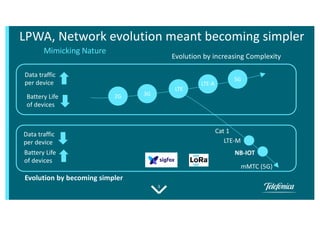
LPWA, Network evolution meant becoming simpler
Mimicking Nature
3G
LTE
5G
LTE-A
Data traffic
per device
2G
Evolution by increasing Complexity
Cat 1
Data traffic
per device
Battery Life
of devices
Evolution by becoming simpler
Battery Life
of devices
LTE-M
NB-IOT
mMTC (5G)
4
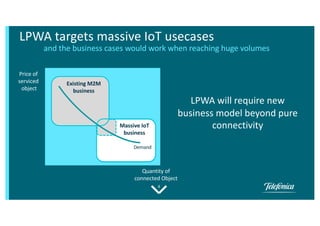
LPWA targets massive IoT usecases
and the business cases would work when reaching huge volumes
Price of
serviced
object
Quantity of
connected Object
Demand
Massive IoT
business
LPWA will require new
business model beyond pure
connectivity
Existing M2M
business
5
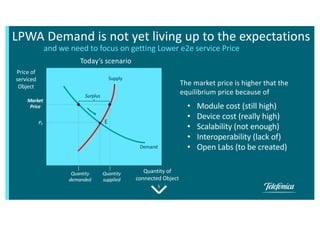
LPWA Demand is not yet living up to the expectations
and we need to focus on getting Lower e2e service Price
Price of
serviced
Object
Quantity of
connected Object
• Module cost (still high)
• Device cost (really high)
• Scalability (not enough)
• Interoperability (lack of)
• Open Labs (to be created)
Today’s scenario
E
Surplus
Quantity
demanded
Quantity
supplied
Market
Price
Demand
Supply
PE
The market price is higher that the
equilibrium price because of
6
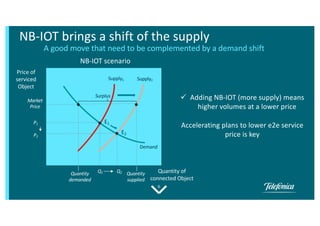
NB-IOT brings a shift of the supply
A good move that need to be complemented by a demand shift
Price of
serviced
Object
Quantity of
connected Object
ü Adding NB-IOT (more supply) means
higher volumes at a lower price
Accelerating plans to lower e2e service
price is key
NB-IOT scenario
E1
Quantity
demanded
Quantity
supplied
Market
Price
Demand
Supply1
E2
Surplus
Supply2
P1
P2
Q1 Q2
7
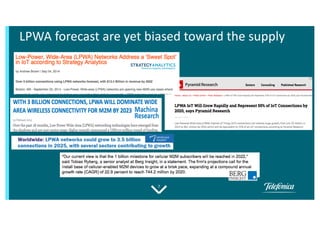
LPWA forecast are yet biased toward the supply
8
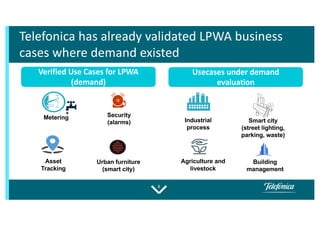
Telefonica has already validated LPWA business
cases where demand existed
Metering
Urban furniture
(smart city)
Security
(alarms)
Verified Use Cases for LPWA
(demand)
Asset
Tracking
Usecases under demand
evaluation
Industrial
process
Agriculture and
livestock
Smart city
(street lighting,
parking, waste)
Building
management
9
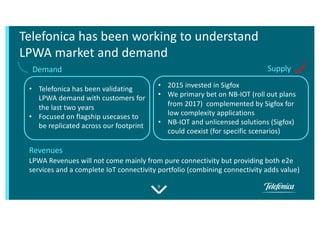
Telefonica has been working to understand
LPWA market and demand
Demand
• Telefonica has been validating
LPWA demand with customers for
the last two years
• Focused on flagship usecases to
be replicated across our footprint
Supply
Revenues
• 2015 invested in Sigfox
• We primary bet on NB-IOT (roll out plans
from 2017) complemented by Sigfox for
low complexity applications
• NB-IOT and unlicensed solutions (Sigfox)
could coexist (for specific scenarios)
LPWA Revenues will not come mainly from pure connectivity but providing both e2e
services and a complete IoT connectivity portfolio (combining connectivity adds value)
10
We have been quite busy (and will be)
Validating demand with customers
Thanks!

Validating the LPWA demand

  • 1.
    Validating LPWA demand LPWAIoT Network Event 2016 Telefonica IoT CCDO Paula Valverde Head of IoT New Business @paula_valver
  • 2.
    2 Chapter Title (32pt) Subheading (20 pt)
  • 3.
    3 LPWA, Network evolutionmeant becoming simpler Mimicking Nature 3G LTE 5G LTE-A Data traffic per device 2G Evolution by increasing Complexity Cat 1 Data traffic per device Battery Life of devices Evolution by becoming simpler Battery Life of devices LTE-M NB-IOT mMTC (5G)
  • 4.
    4 LPWA targets massiveIoT usecases and the business cases would work when reaching huge volumes Price of serviced object Quantity of connected Object Demand Massive IoT business LPWA will require new business model beyond pure connectivity Existing M2M business
  • 5.
    5 LPWA Demand isnot yet living up to the expectations and we need to focus on getting Lower e2e service Price Price of serviced Object Quantity of connected Object • Module cost (still high) • Device cost (really high) • Scalability (not enough) • Interoperability (lack of) • Open Labs (to be created) Today’s scenario E Surplus Quantity demanded Quantity supplied Market Price Demand Supply PE The market price is higher that the equilibrium price because of
  • 6.
    6 NB-IOT brings ashift of the supply A good move that need to be complemented by a demand shift Price of serviced Object Quantity of connected Object ü Adding NB-IOT (more supply) means higher volumes at a lower price Accelerating plans to lower e2e service price is key NB-IOT scenario E1 Quantity demanded Quantity supplied Market Price Demand Supply1 E2 Surplus Supply2 P1 P2 Q1 Q2
  • 7.
    7 LPWA forecast areyet biased toward the supply
  • 8.
    8 Telefonica has alreadyvalidated LPWA business cases where demand existed Metering Urban furniture (smart city) Security (alarms) Verified Use Cases for LPWA (demand) Asset Tracking Usecases under demand evaluation Industrial process Agriculture and livestock Smart city (street lighting, parking, waste) Building management
  • 9.
    9 Telefonica has beenworking to understand LPWA market and demand Demand • Telefonica has been validating LPWA demand with customers for the last two years • Focused on flagship usecases to be replicated across our footprint Supply Revenues • 2015 invested in Sigfox • We primary bet on NB-IOT (roll out plans from 2017) complemented by Sigfox for low complexity applications • NB-IOT and unlicensed solutions (Sigfox) could coexist (for specific scenarios) LPWA Revenues will not come mainly from pure connectivity but providing both e2e services and a complete IoT connectivity portfolio (combining connectivity adds value)
  • 10.
    10 We have beenquite busy (and will be) Validating demand with customers
  • 11.